Category: Transport

  • MIL-OSI United Nations: Remarks by UNFPA Executive Director Dr. Natalia Kanem to the Committee on the Elimination of Discrimination against Women (CEDAW)

    Source: United Nations Population Fund

    Ms. Nahla Haider, Chair of the Committee on the Elimination of Discrimination against Women, 

    Distinguished Members of the Committee, 

    Delegates, experts, friends,

    Greetings of peace! 

    We enter CEDAW deliberations on General Recommendation 41 on Gender Stereotypes at a moment of grave import for the human rights of women and girls and, indeed, their very bodily autonomy. 

    There is powerful pushback against the rights of women, in all their diversities, and particularly their reproductive rights. Across the globe, we discern fierce opposition that threatens decades of progress. 

    And what progress! 

    • Maternal mortality down by one third since the year 2000. 
    • Adolescent births have also dropped by a third over the same period.
    • More than 160 countries have passed laws to address domestic violence. 

    Yet within the halls of the United Nations, previously agreed longstanding language on gender equality, diversity and sexual and reproductive health and reproductive rights comes under attack with increasing frequency. In this game of diplomatic chess, women and girls are the disposable pawns.

    That’s not hyperbole. Gender stereotypes are not merely societal nuisances; they are deep-rooted causes of discrimination that affect women and girls in profound ways.

    The effects show in stories we at UNFPA constantly hear from girls our programmes support, like Amina. 

    Amina was a bright girl who excelled in her studies. She dreamed of becoming a doctor. Yet when she was 13, her parents told her she was to be married. In her village, girls were expected to marry young and raise children. 

    It’s a familiar story – one that plays out day after day, year in, year out, in communities around the world. Not all will have happy endings. Indeed, failure to act upon harmful gender stereotypes can mean a death sentence for a girl coerced into marriage or forced to bear children before her mind and her body are ready.

    Fortunately, Amina’s story took a good turn when UNFPA helped her find her voice, stand up for her rights and return to school. Now, she is inspiring other girls in her village to imagine a different future and pursue their dreams.

    In this context, thank goodness for the Convention on the Elimination of Discrimination against Women. CEDAW is a fundamental safeguard in our shared commitment to advancing gender equality. 

    Gender stereotypes remain an impediment to human progress. Stereotyping constrains women’s and girls’ access to sexual and reproductive health and rights by controlling their bodies, denying them autonomy in healthcare decisions, and perpetuating stigma and shame around their sexuality.

    Harmful stereotypes pose significant risks to economic, social and political stability. 

    They limit the participation of women in the workforce, contribute to the gender wage gap, restrict leadership opportunities and decrease productivity.  

    Women still earn just 77 cents for every $1 dollar paid to men, not to mention their unpaid labor in the home. Is it any wonder that poverty so often wears a woman’s face?

    Stereotypes increase all forms of gender-based violence. Now, with the rise of unregulated technology, they are being amplified and weaponized. Biased algorithms and toxic online interactions add yet another layer of disadvantage, discrimination and often violence, severely limiting the opportunities, potential and participation of women and girls. This must change.

    The ripple effects of these pernicious stereotypes touch every aspect of our lives and our societies.

    They drive political polarization, fracture communities and undermine the very foundations of democracy. By reinforcing harmful divisions, fueling bitter conflicts and exacerbating inequality, stereotypes contribute to a more fractured and unstable world, where progress and peace become ever more elusive.

    Gender equality is a fundamental human right. Yet gender discrimination persists, and factors such as age, race, class, disability and sexual orientation intersect to compound challenges for women and girls. 

    What more must be done to end the stereotyping of women of African descent and other ethnic minorities, which remains so pervasive in popular culture?

    This flattening of identities and experiences can have deadly consequences. A Black woman is told by her doctor that he is uncomfortable treating her with adequate pain medicine. Even though the woman is herself a doctor, and familiar with all the protocols, she is denied life-saving care.

    What happens when systems fail to truly ‘see’ a woman with disabilities in all her complexity? When we fail to see that she, too, has needs and desires?

    I am reminded of Mary, a young woman in Uganda with a physical disability. She has dreams for her life but tells us that she always feels invisible. Healthcare providers often overlook her sexual and reproductive health needs, assuming that she’s not sexually active.

    A local organization, supported by UNFPA, provided Mary with accessible information about her body, reproductive health and healthy relationships. We also trained healthcare workers to provide the inclusive, non-judgmental care all women, regardless of their abilities, deserve.

    Empowered with knowledge and confident in her rights, Mary has become an advocate for other women with disabilities, challenging the stigma and stereotypes that so often limit their right to make informed choices about their bodies and lives.

    The gender stereotypes that CEDAW aims to dislodge are deeply woven into the fabric of our societies, perpetuated by everyone from governments and the media to schools and healthcare systems.

    And let us remember, stereotypes don’t just harm women and girls. They affect everyone. That’s why I expect men to step up. 

    Men need to be willing to step away from roles that privilege their power and choices over women’s. Gender stereotypes affect them, too – how they express or suppress their emotions, the interests and jobs they pursue, their financial responsibilities and their recourse to violence and aggression. This in turn shapes laws, policies and many aspects of life, ranging from healthcare to employment.

    At UNFPA, we are tackling harmful gender stereotypes head on.

    We fight for laws that protect women and girls. We work with communities to shift harmful social and gender norms, and we support comprehensive sexuality education to help young people develop healthy attitudes and behaviours and to empower girls to become leaders. Education is transformative.

    Technology, too, can transform lives. Together with partners, UNFPA is working to create a digital world that is safe and accessible to all. We are taking the lead in demanding that big tech respect women and girls and make the digital space gender bias–free.

    We also work with boys and men, so that they become allies in the fight for gender equality and are not themselves trapped by harmful gender norms.

    Fathers’ Schools in Armenia, Azerbaijan, Belarus, Georgia, Moldova and Ukraine, funded by the European Union and implemented by UNFPA and UN Women, are encouraging men to embrace their roles as engaged fathers while also creating pathways for women to thrive in the workforce.

    By shining a light on gender stereotypes as a grave human rights issue, setting clear international standards and holding States accountable, CEDAW, through this General Recommendation, can help drive societal change.

    Drawing on this General Recommendation, and in response to national demands, UNFPA will continue to support legislation, policies, and programmes that aim to eliminate discriminatory practices and social norms.

    Quoting Dr. bell hooks:

    “Stereotypes abound when there is distance. They are an invention, a pretense that one knows when the steps that would make real knowing possible cannot be taken or are not allowed.”

    Quoting Audre Lorde:

    “For the master’s tools will never dismantle the master’s house.”

    People of CEDAW,

    Continue to formulate processes that give a woman her own money – that’s power, beyond empowerment. Wallet autonomy.

    Continue to deliver self-agency, self-determination and bodily autonomy. That’s part of human dignity.

    Fashion changes to match the female face of healthcare and caregiving, and also adapt to the female face of logistics, of shipping and other industries that are newly big employers of women.

    From menarche through menopause and across a woman’s life course, hopefully, to healthy longevity – break stereotypes and allow people to speak to what matters.

    Distinguished Delegates,

    In this uncertain moment, don’t fail to stand with women – all women – unapologetically, without reservation.

    The nature of your noble mandate calls you to be selfless, but allow me to add that you also need to look after your own self, with kindness.

    Sisters, I encourage you to renew your personal commitment to Article 24 of the Universal Declaration of Human Rights: Women absolutely have the right to rest and leisure. 

    In closing, I urge each of you, whatever your role—whether in government, civil society, academia, United Nations agencies or other stakeholders—to engage actively in the development of this General Recommendation.

    This is not the time to roll back the clock on women’s rights and choices. Yes, compromise will be necessary. Yet set the essential boundaries. Hold fast to long-standing international norms. Stand up for women and stay inspired. 

    The pendulum swings. So, again, seek what inspires you. Because the march continues. And your work saves and transforms lives.

    Let us keep moving forward – together.

    Thank you.

    MIL OSI United Nations News

  • MIL-OSI Australia: Child bitten by dingo at Yidney Rocks

    Source: Government of Queensland

    Issued: 17 Feb 2025

    The Queensland Parks and Wildlife Service (QPWS) is investigating an incident on K’gari after a twelve-year-old boy was bitten on the back by a tagged dingo near Yidney Rocks.

    Around 12:15pm on Sunday 16 January 2025, two children and an adult were playing in shallow water when the male dingo approached him from behind and bit him.

    Nearby fishers ran to assist and attempted to deter the dingo with a stick. The dingo moved away but followed the group back to their accommodation.

    The group were carrying a dingo stick but put it on nearby rocks before entering the water. The boy was treated by paramedics for superficial puncture wounds and a laceration.

    When rangers attended the scene, the dingo was still in the area. Rangers have identified the dingo from photographs and provided Be dingo-safe information to fishers and staff at the private accommodation.

    Rangers will monitor the dingo and provide further education to residents and visitors to the island.

    People are urged to always carry a dingo stick. Fishers are advised to move dingoes on immediately and not let them linger nearby.

    Report any concerning dingo encounters by calling 07 4127 9150 or emailing dingo.ranger@des.qld.gov.au

    Visitors to K’gari are reminded to Be dingo-safe! at all times:

    • Always stay close (within arm’s reach) to children and young teenagers
    • Always walk in groups and carry a stick
    • Never feed dingoes
    • Camp in fenced areas where possible
    • Do not run. Running or jogging can trigger a negative dingo interaction
    • Lock up food stores and iceboxes (even on a boat)
    • Never store food or food containers in tents, and
    • Secure all rubbish, fish and bait.

    For more information go to K’gari dingoes.

    MIL OSI News

  • MIL-Evening Report: Remembering the Poly-1: what NZ’s forgotten homegrown school computer can teach us about state-led innovation

    Source: The Conversation (Au and NZ) – By Mark Rickerby, Lecturer, School of Product Design, University of Canterbury

    The Poly-1. MOTAT , CC BY-NC

    Some 45 years ago, a team of staff and students at Wellington Polytechnic designed and built a desktop computer with an operating system customised for the needs of New Zealand schools.

    The Poly-1 was far ahead of international competition, but New Zealand failed to capitalise on the opportunity. At the time, public investment in a new knowledge-based industry ran counter to both “Think Big” industrial policy and the emerging neoliberal agenda in government.

    As New Zealand looks to scale up investment in artificial intelligence (AI) and advanced technologies, the story of the Poly-1 has enduring lessons about research and innovation policy – and the importance of multidisciplinary collaboration.

    Leading the world

    The Poly-1 was designed in 1980 as a learning device and teacher support tool. It was advanced for its time with colour graphics and powerful processors. It incorporated a networking feature, enabling up to 32 workstations across multiple sites to communicate over a real-time connection.

    Its tough, rounded fibreglass case with carry handles and integrated keyboard was ergonomically designed to handle the rigours of classroom use. A range of bold colour options were meant to make it more relatable for children.

    Fifty working prototypes were built in less than a year. A large group of volunteer teachers worked over the summer break to integrate course content and ensure it was ready for use in classrooms.

    In 1981, the Department of Education signed a NZ$10 million purchase agreement for 1,000 units per year over a five year period.

    The Poly-1 went into production under Polycorp, a joint venture with Lower Hutt-based Progeni. Manufacturing was backed by the state-owned Development Finance Corporation venture capital fund.

    Polycorp was poised for scale with a field-tested product and unique distributed learning model. Wide deployment in classrooms would position New Zealand as leading the world in maths education and applied computing.

    Blocking innovators and boosting importers

    Voicing outrage at this use of public funds, corporate lobbyists began publicly attacking “bureaucrats and boffins”. Privately, they put pressure on ministers sympathetic to a nascent deregulation agenda. They argued only the market could properly decide which computers were used.

    In 1982, then prime minister Robert Muldoon’s cabinet scuttled the deal, halting higher volume production and discarding two years of work.

    The beneficiary of the broken contract was Apple, which targeted New Zealand as its first education market outside the United States. It gave away free Apple II computers to schools, then followed up by offering larger volumes to the Department of Education at below cost.

    The Apple computers were unsupported by curriculum resources, lacked teacher training and were soon obsolete.

    By the mid 1980s, the rollout of computers in classrooms stalled as the Fourth Labour Government prioritised administrative reforms in education. Schools were left on their own to deal with hawkish IT vendors and distributors.

    Missed opportunities

    Relying on an underdeveloped market to serve the growing demand for computers in education led to anti-competitive practices and a devaluing of the teaching expertise behind the software and services.

    It’s unlikely the Poly-1 would have survived through the early 1990s as cheap IBM-compatible clones became widespread. But its ultimate end was a consequence of finance rather than technology.

    The collapse of the government-owned Development Finance Corporation in a complex tangle of failed property investments left Progeni directly exposed as a debtor to the BNZ, which was also teetering on the edge of collapse.

    In late 1989, Progeni was forced into receivership by the bank, which asset-stripped the company and sold it at a nominal value.

    Innovation is interdisciplinary

    The current government has recently announced major structural changes to New Zealand’s research and innovation system, including a new Public Research Organisation focused on advanced technology.

    Institutional reform is much needed and long overdue, but significant challenges remain. A narrow focus on science and technology driving economic growth is not enough. More attention to detail is needed to bridge from current capacity to a desired future state.

    The Poly-1 required collaboration with industrial designers and teachers to become market-ready – and the same is true today.

    Successfully commercialising research in AI and other advanced technologies requires contributions from experts across design, social science, arts and business.

    Like personal computers in 1980, AI is a new category with contested meanings. This has an impact on policy and the reception of new products.

    Discussions about state-led innovation often default to arguments about picking winners. But direct support for industries and firms is only part of the broader picture.

    In order to see economic and public benefits of investment in AI, the government has a role to play in coordinating interdisciplinary efforts across sectors. This requires visions for the future that are a practical response to the needs of individuals, businesses and communities.

    Countries like New Zealand have so far been consumers rather than producers of current generation AI. Changing this balance requires willingness to learn from past mistakes to support leadership in both innovation and regulation. Poly-1 still has lessons to teach us.

    Mark Rickerby was the recipient of an arts innovation grant from Manatū Taonga, Ministry for Culture & Heritage in 2021. He is a member of the New Zealand Game Developers Association (NZGDA).

    ref. Remembering the Poly-1: what NZ’s forgotten homegrown school computer can teach us about state-led innovation – https://theconversation.com/remembering-the-poly-1-what-nzs-forgotten-homegrown-school-computer-can-teach-us-about-state-led-innovation-249577

    MIL OSI AnalysisEveningReport.nz

  • MIL-OSI Global: YouTube at 20: how it transformed viewing in eight steps

    Source: The Conversation – UK – By Alex Connock, Senior Fellow, Said Business School, University of Oxford

    Chay Tee

    The world’s biggest video sharing platform, YouTube, has just turned 20.

    It was started inauspiciously in February 2005 by former PayPal employees Chad Hurley, Steve Chen and Jawed Karim – with a 19-second video of Karim exploring San Diego Zoo.

    That year, YouTube’s disruption of the media timeline was minimal enough for there to be no mention of it in The Guardian’s coverage of TV’s Digital Revolution at the Edinburgh TV Festival.

    Twenty years on, it’s a different story.

    YouTube is a massive competitor to TV, an engagement beast, uploading as much new video every five minutes as the 2,400 hours BBC Studios produces in a whole year. The 26-year-old YouTube star Mr Beast earned US$85 million (£67 million) in 2024 from videos – ranging from live Call of Duty play-alongs to handing out 1,000 free cataract operations.

    As a business, YouTube is now worth some US$455 billion (2024 Bloomberg estimate). That is a spectacular 275 times return on the US$1.65 billion Google paid for it in 2006. For the current YouTube value, Google could today buy British broadcaster ITV about 127 times.

    YouTube has similar gross revenue (US$36.1 billion in 2024) to the streaming giant Netflix – but without the financial inconvenience of making shows, since most of the content is uploaded for free.

    YouTube’s first video: a 19-second look at the elephants of San Diego Zoo.

    YouTube has 2.7 billion monthly active users, or 40% of the entire global population outside China, where it is blocked. It is also now one of the biggest music streaming sites, and the second biggest social network (to Facebook), plus a paid broadcast channel for 100 million subscribers.

    YouTube has built a video Library of Babel, its expansive shelves lined eclectically with Baby Shark Dance, how to fix septic tanks, who would win a shooting war between Britain and France … and quantum physics.

    The site has taken over global children’s programming to the point where Wired magazine pointed out that the future of this genre actually “isn’t television”. But there are flaws, too: it has been described as a conduit for disinformation by fact checkers.

    So how did all that happen? Eight key innovations have helped YouTube achieve its success.

    1. How new creativity is paid for

    Traditional broadcast and print uses either the risk-on, fixed cost of hiring an office full of staff producers and writers, or the variable but risky approach of one-off commissioning from freelancers. Either way, the channel goes out of pocket, and if the content fails to score with viewers, it loses money.

    YouTube did away with all that, flipping the risk profile entirely to the creator, and not paying upfront at all. It doesn’t have to deal with the key talent going out clubbing all night and being late to the set, not to mention other boring aspects of production like insurance, cash flow or contracts.

    2. The revenue model of media

    YouTube innovated by dividing any earnings with the creator, via an advertising income split of roughly 50% (the exact amount varies in practice). This incentivises creators to study the science of engagement, since it makes them more money. Mr Beast has a team employed just to optimise the thumbnails for his videos.

    3. Advertising

    Alongside parent company Google/Alphabet, and especially with the introduction (March 2007) of YouTube Analytics and other technologies, the site adrenalised programmatic video advertising, where ad space around a particular viewer is digitally auctioned off to the highest buyer, in real time.

    That means when you land on a high-rating Beyoncé video and see a pre-roll ad for Grammarly, the advertiser algorithmically liked the look of your profile, so bid money to show you the ad. When that system works, it is ultra efficient, the key reason why the broad, demographics-based broadcast TV advertising market is so challenged.

    4. Who makes content

    About 50 million people now think they are professional creators, many of them on YouTube. Influencers have used the site to build businesses without mediation from (usually white and male) executives in legacy media.

    This has driven, at its best, a major move towards the democratisation and globalisation of content production. Brazil and Kenya both have huge, eponymous YouTube creator economies, giving global distribution to diverse voices that realistically would been disintermediated in the 20th century media ecology.

    5. The way we tell stories

    Traditional TV ads and films start slow and build to a climax. Not so YouTube videos – and even more, YouTube Shorts – which prioritise a big emotive hit in the first few seconds for engagement, and regular further hits to keep people there. Mr Beast’s leaked internal notes describe how to do sequential escalation, meaning moving to more elaborate or extreme details as a video goes on: “An example of a one thru three minute tactic we would use is crazy progression,” he says, reflecting his deep homework. “I spent basically five years of my life studying virality on YouTube.”

    6. Copyright

    Back in 2015, if someone stole your intellectual property – say, old episodes of Mr Bean – and re-broadcast it on their own channel, you would call a media lawyer and sue. Now there is a better option – Content ID – to take the money instead. Through digital rights monetisation (DRM), owners can algorithmically discover their own content and claim the ad revenue, a material new income stream for producers.

    7. Video technicalities

    Most technical innovations in video production have found their way to the mainstream via YouTube, such as 360-degree, 4k, VR (virtual reality) and other tech acronyms. And now YouTube has started to integrate generative AI into its programme-producing suite for creators, with tight integration of Google’s Veo tools.

    These will offer, according to CEO Neal Mohan, “billions of people around the world access to AI”. This is another competitive threat to traditional producers, because bedroom creators can now make their own visual effects-heavy fan-fiction episodes of Star Wars.

    8. News

    YouTube became a rabbit hole of disinformation, misinformation and conspiracy, via a reinforcement-learning algorithm that prioritises view time but not editorial accuracy. Covid conspiracy fans got to see “5G health risk” or “chemtrail” videos, because the algorithm knew they might like them too.

    How can the big, legacy media brands respond? Simple. By meeting the audience where the viewers are, and putting their content on YouTube. The BBC has 14.7 million YouTube subscribers. ITV is exploiting its catalogue to put old episodes of Thunderbirds on there. Meanwhile in February 2025, Channel 4 also announced success in reaching young viewers via YouTube. Full episode views were “up 169% year-on-year, surpassing 110 million organic views in the UK”.

    Alex Connock has worked or consulted for BBC, Channel 4, ITV and Meta.

    ref. YouTube at 20: how it transformed viewing in eight steps – https://theconversation.com/youtube-at-20-how-it-transformed-viewing-in-eight-steps-250083

    MIL OSI – Global Reports

  • MIL-OSI Global: Feel like you’re in a funk? Here’s what you can do to get out of it – and how you can prevent it from happening in the future

    Source: The Conversation – UK – By Jolanta Burke, Senior Lecturer, Centre for Positive Health Sciences, RCSI University of Medicine and Health Sciences

    Whatever the reason, there are many things you can do to get out of a funk. Vectorium/ Shutterstock

    Are you feeling worn out? Struggling with lingering sadness, anxiety or feelings of indifference? If so, you might be stuck in a funk.

    There are many reasons you might find yourself in a funk – including returning home after a holiday, not being sure what your goals in life are and a lack of meaning and purpose driving you forward. Sometimes, there’s no clear reason why we find ourselves in a funk.

    Whatever the cause, don’t lose hope. There are many things you can do to turn the way you’re feeling around.


    Ready to make a change? The Quarter Life Glow-up is a new, six-week newsletter course from The Conversation’s UK and Canada editions.

    Every week, we’ll bring you research-backed advice and tools to help improve your relationships, your career, your free time and your mental health – no supplements or skincare required. Sign up here to start your glow-up at any time.


    1. Express yourself

    As obvious as it sounds, one of the best ways to get out of a funk is exploring the reasons you’re feeling this way.

    Try writing down your deepest thoughts and feelings without judgement – no matter how disjointed they are. Or, grab a paintbrush, spray paint, pencil or chalk and express your emotions through art. You might even choose to dance, letting your movements convey what you’re feeling and help you get to the root of your funk.

    Whatever form of self-expression works for you, all that matters is getting your feelings out. This will help you make sense of what’s causing your funk, and may make it easier to overcome.

    2. Remember the good times

    When we’re in a funk, we’re often overwhelmed by feelings of sadness or indifference. It can be hard to reduce these negative emotions – especially since negative feelings serve a purpose, by helping us understand what’s going on inside.

    Instead of trying to banish bad feelings, try instead to layer positive emotions on top of them. This may help balance your emotions out.

    You can do this by closing your eyes and savouring a happy moment from the past when you felt alive, vibrant and fulfilled. Use every sense as you relive those joyful memories.

    3. Connect with someone

    Research shows the most fulfilled people don’t bury themselves in their thoughts when feeling down. Instead, they look outward – engaging with others and their surroundings.

    So when you’re in a funk, try finding ways of connecting, even briefly, with the people around you. Even a simple conversation with a stranger might lift your spirits.

    Or take it a step further if you can and do something kind for someone – or try volunteering. This may help break you out of your low mood by giving you a sense of fulfilment?

    4. Heal in nature

    Nature is shown to improve wellbeing in many ways – such as lowering blood pressure, refreshing your mind and reminding you that you’re part of something larger than yourself.

    A walk in the park may have many benefits for your wellbeing.
    GoodStudio/ Shutterstock

    If you’ve been feeling down, try going for a walk in the park or find a quiet place to stop on a hike. Lift your head to the sky, listen for the birds singing, immerse yourself in the foliage and let the sound of water wash over you. All of these things are linked with better mental health.

    Preventing a funk

    Doing any of these activities even just once can make a difference to the way your feeling. The more often you do them, the better.

    And once you’ve broken out of your funk, there are things you can do to avoid slipping into one in the future.

    1. Build resilience

    Resilience isn’t just about bouncing back. It’s more about finding the right resources to help you get out of a funk – and knowing how to use these resources effectively.

    For example, if connecting with your friends helps boost your wellbeing, this would be considered one of your “resources” that can help break you out of a funk. Of course, schedules can get in the way, so you’ll need to to find a time that works best for everyone.

    This is what resilience is all about. Identifying your go-to resources for preventing those low feelings can help you create a ready-made toolkit to draw from whenever you feel a funk coming on. To build your tool-kit, think about the things that made the biggest difference in pulling you out of a funk the last time.

    2. Cultivate hope

    Hope isn’t just wishful thinking. It’s about cultivating the will to keep moving forward and finding a way to get there. It’s a pathway to a better life, keeping us focused on growth.

    But one of the challenges in building hope is the lack of a clear vision of where we want to be. To overcome this, take some time to imagine your best-case scenario – what your life would look like ten years from now if everything you’ve ever hoped for came true.

    Spend 20 minutes writing it down. Don’t stop to worry about spelling or grammar (this is just for you). Repeat this exercise as often as needed to create your ideal future.

    When you’re finished, write down how you can achieve what you hope for. Having a well-defined vision of your best possible self can help keep you motivated and prevent you from feeling stuck – and will also give you a reserve of hope to draw upon when facing hard times.

    3. Practise self-acceptance

    Most importantly, focus on practising self-acceptance. Everyone experiences rough patches, so don’t be hard on yourself for being in a funk — it’s just a temporary state.

    Embrace where you are and accept yourself fully, regardless of your current situation. And remember that self-acceptance doesn’t mean resignation. It’s about acknowledging, “It’s okay to be me,” while also envisioning how you want “me” to evolve in the future. With this mindset, you can work towards becoming the person you aspire to be.

    Unlike trees, which are rooted in place, we have the flexibility to grow and change. Remember this the next time you start feeling stuck.

    Jolanta Burke does not work for, consult, own shares in or receive funding from any company or organisation that would benefit from this article, and has disclosed no relevant affiliations beyond their academic appointment.

    ref. Feel like you’re in a funk? Here’s what you can do to get out of it – and how you can prevent it from happening in the future – https://theconversation.com/feel-like-youre-in-a-funk-heres-what-you-can-do-to-get-out-of-it-and-how-you-can-prevent-it-from-happening-in-the-future-235986

    MIL OSI – Global Reports

  • MIL-OSI Global: AI vampires could save Buffy fan favourites like Angel and Spike from a reboot recast

    Source: The Conversation – UK – By Valentina Signorelli, Associate Professor in Film and TV, University of Greenwich

    Buffy fans are rejoicing that a reboot of the series by Oscar-winning director Chloé Zhao is imminent, with Sarah Michelle Gellar set to reprise the title role.

    For millennials like myself who grew up devouring the show (to the point of creating a new academic field, Buffy studies), this news is extremely exciting. However, some critical details remain unclear.

    When Gellar addressed the rumour of a reboot in an Instagram post on February 6, her co-star David Boreanaz, who played Buffy’s first love interest, Angel, commented: “Excited for you and your journey. Enjoy the moments and continue to give back to fans.”

    His words, which seem to suggest he won’t be returning as Angel, allude to a significant challenge facing the reboot. What to do about now-visibly older cast members such as Boreanaz (now 55) who play ageless vampires? James Marsters, who played Buffy’s punk-rebel lover, Spike, faces a similar problem: he is now 62.

    However, in the two decades since the final episode aired, there have been significant advancements in technology that may offer a way around having to sideline or recast fan favourites. The solution could involve the use of AI de-ageing technology.

    AI vampires

    De-ageing technology isn’t new to Hollywood. AI rejuvenation has been used in a number of blockbusters over the last few years – take Robert De Niro, Joe Pesci and Al Pacino in The Irishman (2019), for example. More recently, Tom Hanks was de-aged using AI for the graphic novel adaptation Here.

    AI has also been used to restore actors’ voices. This effect was used for the voice of Val Kilmer in Top Gun: Maverick (2022). Kilmer had lost his voice as a result of his battle with throat cancer.

    How de-ageing technology was used in The Irishman.

    A mixed voice-and-vision technique has also allowed The Mandalorian (2020) and The Book of Boba Fett (2021) to bring back a young Luke Skywalker. And Roadrunner: A Film About Anthony Bourdain (2021) controversially used AI to recreate the late chef’s timber for the voiceover.

    However, AI has yet to be explored in the unique context of the timeless vampire character – an archetype where immortality and daring beauty are defining traits, at least on TV.

    If done right, AI could de-age Boreanaz and Marsters, allowing the actors to return as Angel and Spike without breaking continuity or forcing abrupt casting changes.

    In return, this move could influence the vampire genre as a whole – not only bringing TV actors back to beloved roles but, more importantly, allowing them to carry their fan base with them into a new era.

    AI and gender in Hollywood

    Women have been disproportionately affected by AI’s impact on job security, as a 2024 Mercer study highlighted.

    Hollywood still has a gender disparity problem. In 2024, 70% of the top-grossing films had ten or more men in key positions behind the screen, compared with just 8% for women. AI is enhancing this gap, automating roles where women have greater representation (such as background acting and voice work), as well as excluding them from AI development and decision-making.

    Male actors, meanwhile, have seen their job security increased by the technology, as they’re able to retain leading roles in film sequels such as Harrison Ford in Indiana Jones and the Dial of Destiny (2023).


    Looking for something good? Cut through the noise with a carefully curated selection of the latest releases, live events and exhibitions, straight to your inbox every fortnight, on Fridays. Sign up here.


    In the Buffy reboot, led by a now 47-year-old Gellar, we could witness an intriguing power reversal in both cases. If AI is not used, removing Boreanaz and Marsters from their roles, the show could still stand without them. Unlike her male co-stars, Buffy is human, so ageing isn’t a major issue for Gellar and her character. Twenty years later, fans would naturally expect to see her looking visibly older and facing new adventures.

    However, if AI de-aging is used to preserve Angel and Spike as we remember them in their often-sexualised signature look, then Buffy’s vampire lovers would look noticeably younger than her for the first time. This would provide an interesting twist to what film historian Steve Neale has defined as “masculinity as spectacle”, reversing traditional gendered cinematic power dynamics.

    By allowing AI to preserve Angel and Spike as immortal, the reboot could bridge generational and new fans while exploring the latest use of a controversial technology.

    Regardless of the outcome, we know Buffy doesn’t “have time for vendettas. The mission is what matters”. Let’s hope this new show can rise to the challenge and still slay in the 21st century.

    Valentina Signorelli is co-founder of Italian production company Daitona

    ref. AI vampires could save Buffy fan favourites like Angel and Spike from a reboot recast – https://theconversation.com/ai-vampires-could-save-buffy-fan-favourites-like-angel-and-spike-from-a-reboot-recast-249403

    MIL OSI – Global Reports

  • MIL-OSI USA: Governor McKee, Rhode Island Department of Housing Announce Municipal Fellows Program Awards to Help Address the Housing Crisis

    Source: US State of Rhode Island

    Published on Monday, February 17, 2025

    PROVIDENCE, RI — Governor Dan McKee and the Rhode Island Department of Housing today announced grant awards to eight municipalities totaling approximately $1.1 million through the Municipal Fellows Program. This program places early-career professionals in roles focused on planning, zoning, and housing development, to support municipal efforts to increase housing production as well as grow the pipeline of planners in the state.

    “My administration has made historic investments in housing development and preservation. Continued progress on housing goals depends on action at the local level,” said Governor Dan McKee. “With the Municipal Fellows program, we are directly supporting municipalities to move projects forward and address local barriers to housing production.”

    “Addressing Rhode Island’s housing crisis requires an all-hands-on-deck approach. We need municipalities to be our partners in creating more housing, and we also need more professionals in the planning field so that our cities and towns can strategically address zoning and development,” said House Speaker K. Joseph Shekarchi. “The Municipal Fellows program addresses both of these objectives and the end result will benefit our entire state.”

    “Addressing Rhode Island’s housing crisis requires a comprehensive and collaborative approach. These grant awards, and the fellowships they will support, represent the kind of action necessary to bolster our efforts and ensure our communities have the tools necessary to meet our housing needs,” said Senate President Dominick J. Ruggerio.

    Following in-depth discussions with municipal leaders, the Department of Housing identified key challenges to housing production, including staffing shortages at the local level which impact review process timelines and capacity to address local zoning issues. In response, the Department, in collaboration with its partners, launched the Municipal Fellows program as part of a series of municipal supports.

    “Our municipalities play a critical role in addressing the housing crisis,” said Rhode Island Department of Housing Secretary Deborah Goddard. “The Department has engaged in conversations with all 39 cities and towns, as well as the League of Cities and Towns. It is clear that municipal leaders are eager to grow housing opportunities but often face barriers. In many conversations, we heard that staff capacity to engage in planning is a problem. That’s where the municipal fellows program comes in: putting new capacity right into cities and towns to move projects forward.”

    Fellows are funded for nearly two years and are focused on planning and development activities within the municipality. Awardees include:

    • Newport — $154,000
    • Coventry — $154,000
    • Cranston —$147,000
    • Foster — $147,000
    • Johnston — $147,000
    • Westerly — $147,000
    • Lincoln — $147,000
    • Cumberland — $103,459

    “Our Fellow, Diego, possesses ability, interest, and professionalism that are most impressive,” said Shawn Lacey, Westerly Town Manager. “His desire and ability to learn the fundamentals of planning in the public sector is apparent. We look forward to his contribution, with his architectural and urban planning skills, to the Town’s’ evolving affordable housing policy and the creation of a strategic production plan for the next decade.”

    To date, Coventry, Cranston, Newport, Johnston, Lincoln, and Westerly have successfully hired fellows, with the remaining municipalities making significant progress in their hiring efforts.

    The Municipal Fellows program is part of a series of municipal supports created by the Department of Housing and other partners. Additional municipal supports include the recently announced $2.8 million in municipal infrastructure grants, led by the Rhode Island Infrastructure Bank in partnership with the Department of Housing, to enhance municipal infrastructure and support the development of affordable housing across the state.

    The Municipal Fellows program is funded by State Fiscal Recovery Funds. 

    For more information on all Department of Housing programs, please visit www.housing.ri.gov.

    MIL OSI USA News

  • MIL-OSI Africa: Financing Oil and Gas (O&G) Projects in Congo: Increased Investment to Drive Output

    Source: Africa Press Organisation – English (2) – Report:

    BRAZZAVILLE, Congo (Republic of the), February 17, 2025/APO Group/ —

    As the Republic of Congo endeavors to boost its oil production to 500,000 barrels per day (bpd) by 2027 and expedite gas exploration and production, the Ministry of Hydrocarbons is simultaneously prioritizing the modernization of downstream infrastructure to address energy insecurity. With new regulatory measures, large-scale infrastructure projects and a strong push toward sustainability, the country has seen an influx of international investment, thereby strengthening Congo’s momentum toward ambitious reforms in the hydrocarbon sector.

    Towards Increased Production

    The Congolese subsidiary of China Oil Natural Gas Oversees Holding Ltd (Cogo) plans to invest $150 million to boost oil production over the next three years in the Conkouati-Koui and Nanga III fields in Congo. The company will drill four wells – two in each field – with the project set to expand to include 3D seismic surveys and further data analysis. On October 3, 2024, the new Director General of Cogo’s Congolese subsidiary Fublert Dzimbe presented the company’s activity roadmap to the Minister of Hydrocarbons Bruno Jean-Richard Itoua.

    Meanwhile, oil and gas supermajor TotalEnergies announced last year that it will invest $600 million to strengthen exploration and production activities in Congo. The investment will be used to finance exploration and maintain production in the country’s deep offshore Moho Nord field, which accounts for approximately half of all Congolese oil production – roughly 140,000 bpd. TotalEnergies’ commitment to Congo’s oil production is set to ensure additional production of 40,000 bpd, adding to the country’s current levels of 267,000 bpd.

    Set to finance a seven-year development program across the Mengo-Kundji-Bindi IIoilfields in Congo, oil and gas company Trident secured a $300 million financing facility from pan-African multilateral financing institution Afreximbank in 2023. The capital will enable the company to increase production – up to 30% of national crude output – while opening job creation opportunities.

    A Focus on Refining

    Currently, the Congolaise de raffinage, a subsidiary of the state-owned Société nationale des pétroles du Congo, operates the nation’s sole refinery in Pointe-Noire. With a processing capacity of one million tons per year, the refinery converts crude oil into finished products such as butane gas, gasoline, kerosene, light diesel and heavy fuel oil, meeting approximately 70% of the country’s refined energy needs.

    To address growing domestic demand and reduce the reliance on imports, the government has initiated the construction of a new refinery in Fouta – near Pointe Noire. Known at the Atlantic Petrochemical Refinery, the project is being developed in partnership with the Chinese firm Beijing Fortune Dingheng Investment, representing an investment of around $600 million. The first phase aims to achieve a production capacity of 2.5 million tons per year, focusing on high-quality gasoline and diesel. The refinery is expected to commence operations by the end of 2025, contributing significantly to national energy security.

    As sub-Saharan Africa’s fourth-largest oil producer, Congo presents significant investment opportunities for global investors. The country aims to attract fresh capital to its oil sector, with a licensing round set to be launched at the inaugural Congo Energy & Investment Forum (CEIF) 2025, taking place in Brazzaville from March 24-26. Meanwhile, the country is preparing to launch its Gas Master Plan alongside a new Gas Code at CEIF 2025, which are set to provide a strategic framework for investing in the country’s gas value chain.

    MIL OSI Africa

  • MIL-OSI Security: Tisdale — Tisdale RCMP: three arrested after fleeing from police

    Source: Royal Canadian Mounted Police

    On February 11, 2025 at approximately 4:55 p.m., Tisdale RCMP received a report of an intoxicated driver on Main Street in Tisdale, SK.

    Officers responded and located the suspect vehicle, which was exiting a parking lot in Tisdale, SK. Officers activated their emergency equipment and initiated a traffic stop, but the vehicle fled at a high rate of speed. Officers followed the vehicle.

    The suspect vehicle exited town and turned down a dead-end grid road. At the end of the road, the suspect vehicle slid into the ditch and became stuck in a field. The vehicle occupants exited the vehicle. An adult female was arrested at the scene while two males fled on foot into a nearby treed area.

    As a result of continued investigation and searches by Tisdale RCMP, Melfort RCMP, and Saskatchewan RCMP’s Police Dog Services, two adult males were located and arrested later that same day. One of the adult males was taken to hospital by EMS with weather-related injuries.

    Charges have not been laid at this time. Tisdale RCMP continue to investigate.

    MIL Security OSI

  • MIL-OSI: Societe Generale: Information regarding executed transactions within the framework of a share buyback program (outside the liquidity agreement)

    Source: GlobeNewswire (MIL-OSI)

    INFORMATION REGARDING EXECUTED TRANSACTIONS WITHIN THE FRAMEWORK OF A SHARE BUYBACK PROGRAM (OUTSIDE THE LIQUIDITY AGREEMENT)

    Regulated Information

    Paris, 17 February 2025

    (In accordance with article 5 of Regulation (EU) No 596/2014 on Market Abuse Regulation and article 3(3) of Delegated Regulation (EU) 2016/1052 supplementing Regulation (EU) No 596/2014 through regulatory technical standards concerning the conditions applicable to buyback programs and stabilization measures)

    As announced on Thursday 6 February 2025, Societe Generale started on Monday 10 February 2025, an ordinary share buyback program for EUR 872 million for the purpose of shares cancellation.

    Societe Generale received all necessary authorizations from supervisory authorities. These buybacks will be carried out in compliance with the conditions, notably regarding the maximum price, set forth by the General Meeting of 22 May 2024 and presented in the description released on 17 May 2024, as well as in accordance with the Market Abuse Regulation. They are performed on the trading platforms on which Societe Generale shares are listed for trading or are traded, including the regulated market of Euronext Paris.

    Purchases performed during the period from 10 to 14 February 2025 are described below. As of February 14, 2025, Societe Generale has completed 12% of its share buyback program, representing 0.4%* of its share capital.

    The liquidity contract concluded with Rothschild has also temporarily been suspended throughout the buyback period.

    Issuer name: Societe Generale – LEI O2RNE8IBXP4R0TD8PU41

    Reference of the financial instrument: ISIN FR0000130809

    Period: From 10 to 14 February 2025

    * Ratio between the number of shares repurchased and the 800,316,777 shares comprising the current share capital.

    Purchases performed by Societe Generale during the period

    Aggregated presentation by day and market

    Issuer name Issuer code (LEI) Transaction date ISIN Code Daily total volume (in number of shares) Daily weighted average price of shares acquired Platform
    SOCIETE GENERALE O2RNE8IBXP4R0TD8PU41 10-Feb-25 FR0000130809 362 124 35,7689 XPAR
    SOCIETE GENERALE O2RNE8IBXP4R0TD8PU41 10-Feb-25 FR0000130809 199 120 35,7415 CEUX
    SOCIETE GENERALE O2RNE8IBXP4R0TD8PU41 10-Feb-25 FR0000130809 25 000 35,7473 TQEX
    SOCIETE GENERALE O2RNE8IBXP4R0TD8PU41 10-Feb-25 FR0000130809 15 000 35,7792 AQEU
    SOCIETE GENERALE O2RNE8IBXP4R0TD8PU41 11-Feb-25 FR0000130809 398 546 36,1667 XPAR
    SOCIETE GENERALE O2RNE8IBXP4R0TD8PU41 11-Feb-25 FR0000130809 165 000 36,1551 CEUX
    SOCIETE GENERALE O2RNE8IBXP4R0TD8PU41 11-Feb-25 FR0000130809 19 000 36,1305 TQEX
    SOCIETE GENERALE O2RNE8IBXP4R0TD8PU41 11-Feb-25 FR0000130809 12 000 36,1520 AQEU
    SOCIETE GENERALE O2RNE8IBXP4R0TD8PU41 12-Feb-25 FR0000130809 345 676 37,1056 XPAR
    SOCIETE GENERALE O2RNE8IBXP4R0TD8PU41 12-Feb-25 FR0000130809 150 000 37,0716 CEUX
    SOCIETE GENERALE O2RNE8IBXP4R0TD8PU41 12-Feb-25 FR0000130809 19 000 37,0939 TQEX
    SOCIETE GENERALE O2RNE8IBXP4R0TD8PU41 12-Feb-25 FR0000130809 11 000 37,0842 AQEU
    SOCIETE GENERALE O2RNE8IBXP4R0TD8PU41 13-Feb-25 FR0000130809 305 947 37,2202 XPAR
    SOCIETE GENERALE O2RNE8IBXP4R0TD8PU41 13-Feb-25 FR0000130809 202 000 37,2104 CEUX
    SOCIETE GENERALE O2RNE8IBXP4R0TD8PU41 13-Feb-25 FR0000130809 28 000 37,1090 TQEX
    SOCIETE GENERALE O2RNE8IBXP4R0TD8PU41 13-Feb-25 FR0000130809 15 000 37,1341 AQEU
    SOCIETE GENERALE O2RNE8IBXP4R0TD8PU41 14-Feb-25 FR0000130809 347 390 36,9117 XPAR
    SOCIETE GENERALE O2RNE8IBXP4R0TD8PU41 14-Feb-25 FR0000130809 176 000 36,9096 CEUX
    SOCIETE GENERALE O2RNE8IBXP4R0TD8PU41 14-Feb-25 FR0000130809 20 000 36,9106 TQEX
    SOCIETE GENERALE O2RNE8IBXP4R0TD8PU41 14-Feb-25 FR0000130809 12 000 36,9131 AQEU
          TOTAL 2 827 803 36,6008  

    Press contacts:

    Jean-Baptiste Froville_+33 1 58 98 68 00_ jean-baptiste.froville@socgen.com
    Fanny Rouby_+33 1 57 29 11 12_ fanny.rouby@socgen.com

    Societe Generale

    Societe Generale is a top tier European Bank with more than 126,000 employees serving about 25 million clients in 65 countries across the world. We have been supporting the development of our economies for 160 years, providing our corporate, institutional, and individual clients with a wide array of value-added advisory and financial solutions. Our long-lasting and trusted relationships with the clients, our cutting-edge expertise, our unique innovation, our ESG capabilities and leading franchises are part of our DNA and serve our most essential objective – to deliver sustainable value creation for all our stakeholders.

    The Group runs three complementary sets of businesses, embedding ESG offerings for all its clients:

    • French Retail, Private Banking and Insurance, with leading retail bank SG and insurance franchise, premium private banking services, and the leading digital bank BoursoBank.
    • Global Banking and Investor Solutions, a top tier wholesale bank offering tailored-made solutions with distinctive global leadership in equity derivatives, structured finance and ESG.
    • Mobility, International Retail Banking and Financial Services, comprising well-established universal banks (in Czech Republic, Romania and several African countries), Ayvens (the new ALD I LeasePlan brand), a global player in sustainable mobility, as well as specialized financing activities.

    Committed to building together with its clients a better and sustainable future, Societe Generale aims to be a leading partner in the environmental transition and sustainability overall. The Group is included in the principal socially responsible investment indices: DJSI (Europe), FTSE4Good (Global and Europe), Bloomberg Gender-Equality Index, Refinitiv Diversity and Inclusion Index, Euronext Vigeo (Europe and Eurozone), STOXX Global ESG Leaders indexes, and the MSCI Low Carbon Leaders Index (World and Europe).

    In case of doubt regarding the authenticity of this press release, please go to the end of the Group News page on societegenerale.com website where official Press Releases sent by Societe Generale can be certified using blockchain technology. A link will allow you to check the document’s legitimacy directly on the web page.

    For more information, you can follow us on Twitter/X @societegenerale or visit our website societegenerale.com.

    Attachment

    The MIL Network

  • MIL-OSI United Kingdom: UK Government awards grant to strengthen mangrove conservation in Belize

    Source: United Kingdom – Government Statements

    Award from Sustainable Blue Economies Programme Blue Social Challenge Fund reaffirms UK’s commitment to collaborating with Caribbean nations to safeguard vital ocean resources.

    The UK Government through its Sustainable Blue Economies Programme Blue Social Challenge Fund (BSCF) has awarded a grant of £99,191 (approximately BZD250,000) to MarAlliance for the project “Mangrove Habitat for Juvenile Fish Recruitment: Building Local Knowledge and Capacity.” This initiative reaffirms the UK’s commitment to collaborating with Caribbean nations to safeguard vital ocean resources.

    The Fund aims to enhance the resilience of Small Island Developing States (SIDS) like Belize and their economies to the impacts of climate change and economic shocks, through better ocean management, poverty reduction/improved livelihoods and greater use of nature-based solutions.

    High Commissioner Christine Rowlands stated:

    By funding this project, we are supporting work that enables local communities and fishers to contribute data needed for the sustainable management of Belize’s beautiful mangrove forests and juvenile fishes. This in turn contributes to improved livelihoods of fishers, sustainable fisheries, and builds climate resilience of coastal communities. This is the purpose of BSCF, to support vulnerable communities working together to address the adverse impacts of climate change on their livelihoods and we are happy to work with MarAlliance on this initiative.

    Belize’s mangrove ecosystems play a crucial role in mitigating coastal erosion, sequestering carbon, and providing essential nursery habitats for juvenile fish. However, extensive mangrove loss over the past two decades has posed a significant threat to coastal integrity and the livelihoods dependent on sustainable fisheries.

    This project seeks to bridge critical knowledge gaps by evaluating the contribution of mangroves to fish population recruitment. Leveraging advanced methodologies such as environmental DNA (eDNA) analysis, the initiative will generate valuable insights to enhance fisheries management in Belize. By actively engaging university students and local community members, the project aims to expand the scientific understanding of mangrove ecology while delivering direct economic benefits to stakeholders through training and fieldwork participation. The data collected will provide coastal communities and policymakers with robust evidence on the ecological and economic value of mangroves, facilitating informed conservation strategies in Belize.

    A key aspect of the project is its participatory approach of co-created scientific research with fishers and coastal communities. Through targeted training initiatives, local community members will be empowered to take an active role in resource stewardship, ensuring alignment between local practices and national fisheries objectives.

    Dr. Rachel Graham, Founder and Executive Director of MarAlliance highlighted that:

    Our mangrove based fisheries work illuminates the critical role of these ecosystems as vital nursery habitats, bridging scientific inquiry and community knowledge to quantify and protect juvenile fish populations. With profound gratitude to the British High Commission, MarAlliance is transforming local fishing insights into evidence-based strategies that support small-scale fishers adapting to unprecedented environmental challenges along Belize’s vulnerable coastal shorelines.

    The project’s outputs will include a publicly accessible scientific report informing of the contributions of mangroves to biodiversity and fisheries productivity. Ultimately, this initiative aims to have a cadre of trained local biologists and fishers, heighten awareness of mangroves as critical nursery habitats for sustained fisheries, strengthen community livelihoods, and drive policy actions to protect Belize’s coastal ecosystems, thereby enhancing resilience to climate change.

    Updates to this page

    Published 17 February 2025

    MIL OSI United Kingdom

  • MIL-OSI United Nations: 17 February 2025 Departmental update WHO launches new technical brief on encephalitis

    Source: World Health Organisation

    WHO has published a new technical brief on encephalitis , a serious, life-threatening neurological condition characterized by inflammation of the brain.

    Encephalitis affects people across all age groups, has high mortality and often leads to significant long-term complications (sequelae) including hearing loss, seizures, limb weakness, and difficulties with vision, speech, language, memory and communication. Globally in 2021, encephalitis was the fourth leading cause of neurological health loss (i.e. disability-adjusted life years, DALYs) in children aged under 5 years and the 13th across all age groups.

    Many different pathogens can cause encephalitis. Herpes simplex (HSV) is the most common cause of encephalitis globally. Autoimmune encephalitis, an inflammatory brain disorder driven by the immune system, is also increasingly recognized as a cause.

    Some pathogens are spread by mosquitoes and ticks (vector-transmitted). Others can be prevented by vaccines, including influenza, varicella-zoster virus (VZV), rabies, poliomyelitis and encephalitis linked to measles, mumps and rubella (MMR). Some pathogens, like Japanese encephalitis virus (JEV), are both transmitted by vectors and can be prevented through vaccination.

    Encephalitis is a growing global concern due to population density, intensive farming, climate change, vaccine hesitancy, and human-animal proximity, especially in under-resourced communities.

    The technical brief, which forms part of the implementation of the broader Intersectoral global action plan on epilepsy and other neurological disorders (IGAP), draws attention to the lack of access to essential care, especially in low-and middle-income countries. 

    Worldwide, people living with encephalitis and associated disabilities continue to have difficulties accessing treatment and rehabilitation, and many also experience discrimination and human rights violations, further underscoring the need for urgent action.

    The brief covers the diagnosis, treatment and care of encephalitis (i.e. care pathways; diagnosis; treatment; care, including social protection and welfare; rehabilitation; and an interdisciplinary workforce). It also addresses surveillance and prevention (i.e. vaccines and vector control), and research, advocacy and awareness.

    “Encephalitis is a growing public health challenge, and by prioritizing it within global and national health agendas and strengthening collaboration, we can reduce its impact and save lives,” said Dr Tarun Dua, Head of the Brain Health Unit, WHO. “These efforts will not only improve health outcomes and quality of life for those affected and their families but also result in stronger more resilient health systems.”

    This technical brief is based on evidence from a WHO-commissioned scoping review  and discussions held at a WHO-convened meeting, Why encephalitis matters? with people with lived experience and carers, academics, researchers and service providers.

    MIL OSI United Nations News

  • MIL-OSI Global: A new theory explains how water first arrived on Earth

    Source: The Conversation – France – By Quentin Kral, Astrophysicien à l’observatoire de Paris-PSL, CNRS, Sorbonne Université, Université Paris Cité

    How did Earth become a blue planet? NASA, CC BY

    When Earth first formed, it was too hot to retain ice. This means all the water on our planet must have originated from extraterrestrial sources. Studies of ancient terrestrial rocks suggest liquid water existed on Earth as early as 100 million years after the Sun’s formation–practically “immediately” on an astrophysical timescale. This water, now over 4.5 billion years old, has been perpetually renewed through Earth’s water cycle. My research team has recently proposed a new theory to explain how water first arrived on Earth.

    A mystery billions of years in the making

    Astrophysicists have been grappling with the question of how water arrived on our young planet for decades. One of the earliest hypotheses suggested that Earth’s water was a direct byproduct of the planet’s formation, released via magma during volcanic eruptions, in which most of the emitted gas is water vapor.

    However, this hypothesis evolved in the 1990s following analysis of Earth’s water composition and the discovery of the potential role of icy comets, pointing to an extraterrestrial origin. Comets, which are mixtures of ice and rock formed in the distant reaches of the solar system, are sometimes ejected toward the Sun. When warmed by the Sun, they develop striking tails of dust and gas that are visible from Earth. Asteroids, located in the asteroid belt between Mars and Jupiter, were also proposed as potential progenitors of Earth’s water.

    The study of cometary and asteroid rocks via meteorites–small fragments of these bodies that have fallen to Earth–has provided key insights. By analyzing the D/H ratio–the proportion of heavy hydrogen (deuterium) to standard hydrogen–scientists found that Earth’s water more closely matches that of “carbonaceous” asteroids, which bear traces of past water. This shifted the focus of research toward these asteroids.

    The asteroid belt lies between Mars and Jupiter, while the Kuiper Belt extends beyond Neptune.
    Pline/Wikipedia, CC BY

    Recent studies have centered on identifying the celestial mechanisms that could have delivered these water-rich asteroids to the dry surface of early Earth. Numerous theories have emerged to explain the “perturbation” of planetesimals–large, icy bodies in the asteroid and Kuiper belts. These scenarios propose gravitational interactions that dislodged these objects, sending them hurtling toward Earth. Such events would have required a complex “gravitational billiards” process, suggesting a tumultuous history of the solar system.

    While it is evident that planetary formation involved significant upheavals and impacts, it is possible that Earth’s water delivery occurred in a more natural and less dramatic manner.

    A simpler hypothesis

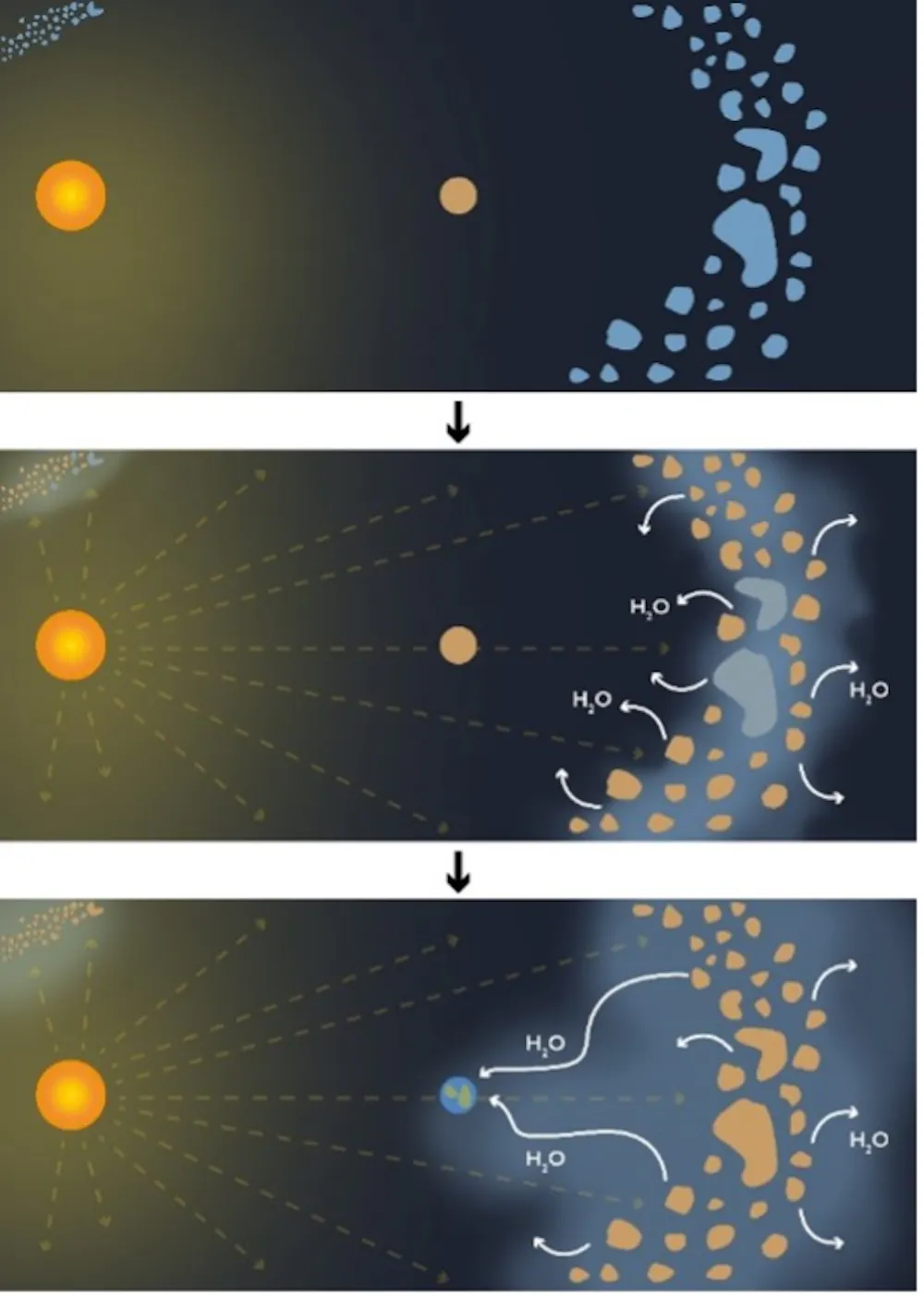
    I started with the assumption that asteroids emerge icy from their formation cocoon, also known as the protoplanetary disk. This cocoon is a massive, hydrogen-rich disk filled with dust, where planets and initial belts form. It envelops the entire nascent planetary system. Once this protective cocoon dissipates–after a few million years–the asteroids warm up, causing their ice to melt or, more precisely, to sublimate. In space, where pressure is nearly zero, the water remains in vapor form after this process.

    A disk of water vapour is then superimposed on the asteroid belt orbiting the Sun. As the ice sublimates, the disk fills with vapor, which spreads inward toward the Sun due to complex dynamic processes. Along the way, this vapor disk encounters the inner planets, immersing them in a kind of “bath”. In a way, the disk “waters” the terrestrial planets: Mars, Earth, Venus and Mercury. Most of this water capture occurred 20 to 30 million years after the Sun’s formation, during a period when the Sun’s luminosity increased dramatically over a brief period of time, increasing the degassing rate of asteroids.

    Step-by-step illustration of a new model for water distribution on the inner planets of the solar system, including Earth. Five million years after the Sun’s birth, asteroids in the main belt release water vapor due to solar energy. This vapor gradually spreads into the inner solar system, eventually enveloping the planets, which capture part of it to form oceans between 10 and 100 million years later.
    Sylvain Cnudde/Observatoire de Paris — PSL/LESIA, Fourni par l’auteur

    Once water is captured by a planet’s gravitational pull, many processes can occur. On Earth, however, a protective mechanism ensures the total mass of water has remained relatively constant from the end of the capture period until today. If water rises too high into the atmosphere, it condenses into clouds, which eventually return to the surface as rain–a process known as the water cycle.

    The quantities of water on Earth, both past and present, are well documented. Our model, which begins with the degassing of ice from the original asteroid belt, successfully accounts for the amount of water needed to form oceans, rivers and lakes, and even the water buried deep within Earth’s mantle. Precise measurements of the D/H ratio of water in the oceans also align with our model. Moreover, the model explains the quantities of water present in the past on other planets–and even on the Moon.

    You might wonder how I arrived at this new theory. It stems from recent observations, particularly those made with ALMA, a radio telescope array of over 60 antennae located in Chile, on a plateau five kilometres above sea level. Observations of extrasolar systems with belts similar to the Kuiper Belt reveal that planetesimals in these belts sublimate carbon monoxide (CO). For belts closer to their star, such as the asteroid belt, CO is too volatile to be present, and water is more likely to be released.

    Building the model

    It was from these findings that the initial idea for the theory began to take shape. Moreover, recent data from the Hayabusa 2 and OSIRIS-REx missions, which explored asteroids similar to those that might have contributed to the formation of the initial water vapor disk, provided key confirmation. These missions, along with long-standing observations from ground-based telescopes, revealed substantial amounts of hydrated minerals on these asteroids–minerals that can only form through contact with water. This supports the premise that these asteroids were initially icy, even though most have since lost their ice (except for larger bodies like Ceres).

    With the foundation of the model in place, the next step was to develop a numerical simulation to track the degassing of ice, the dispersion of water vapor, and its eventual capture by planets. During these simulations, it quickly became clear that the model could account for Earth’s water supply. Additional research on past water quantities for Mars and other terrestrial planets confirmed the model’s applicability to them as well. It all fit, and the results were ready for publication!

    As researchers, it’s not enough to design a model that works and seems to explain everything. The theory must be tested on a larger scale. While it’s now impossible to detect the initial water vapor disk that “watered” the terrestrial planets, we can look to extrasolar systems with young asteroid belts to see if such water vapor disks exist. According to our calculations, these disks, though faint, should be detectable with ALMA. Our team has just secured time on ALMA to investigate specific systems for evidence of them.

    We may be at the dawn of a new era in understanding the origins of Earth’s water.

    Quentin Kral ne travaille pas, ne conseille pas, ne possède pas de parts, ne reçoit pas de fonds d’une organisation qui pourrait tirer profit de cet article, et n’a déclaré aucune autre affiliation que son organisme de recherche.

    ref. A new theory explains how water first arrived on Earth – https://theconversation.com/a-new-theory-explains-how-water-first-arrived-on-earth-246516

    MIL OSI – Global Reports

  • MIL-OSI USA: Federal government challenges auxiliary system

    Source: US International Brotherhood of Boilermakers

    The establishment of auxiliary locals by the Boilermakers’ union was a product of segregationist practices during the early 20th century. While this isn’t a proud moment for the union, it’s an important part of Boilermaker history that cannot be ignored.

    These were Jim Crow-era ideas that marginalized Black workers, subjecting them to discriminatory rules and limited union representation. Auxiliary locals, controlled by nearby white locals, were not allowed to send their own delegates to Convention, which silenced Black members in union decision-making.

    Members of auxiliary locals lacked business agents, grievance committees or any channel to negotiate with employers. Black workers also faced barriers to career advancement, such as being excluded from apprenticeship programs and facing restrictions on promotions from helper to mechanic. Union insurance policies were also unequal, with death and injury benefits for Black members set at half the amount granted to white members.

    Black members paid the same dues as white members but received less in return. This inequitable treatment was not unique to the Boilermakers, as many unions did the same. Since the practice ended in the last century, the union has apologized for its past treatment of Black members and changed its ways.

    The situation began to shift with the onset of World War II. Although segregation was still widespread, the federal government started to challenge racial discrimination in wartime industries. President Franklin D. Roosevelt barred companies that held federal contracts from engaging in racial discrimination, leading to the establishment of the Fair Employment Practices Committee in 1941. The FEPC encouraged workers to report discriminatory practices—especially workers employed by companies tied to federal defense contracts.

    By late 1942, complaints began surfacing from Black Boilermakers in Portland, Oregon. Local 72 had 65% of shipyard employees in the region, including those at the massive Kaiser Shipyards. Eager to diversify its workforce, Kaiser began recruiting Black workers from New York City, but Local 72 resisted integration. They formed an auxiliary local for Black members. Local NAACP leaders even backed the decision because they saw it as a step toward inclusion.

    However, many Black workers were unwilling to accept a segregated system. In July 1943, more than 300 Black workers at Kaiser Shipyards were dismissed for refusing to join the auxiliary local, citing inequities. The firings sparked FEPC public hearings, where Local 72’s attorney, Leland Tanner, defended the auxiliary system by claiming, “We live in that house, we didn’t build it and we’re not the architects of it.” Tanner’s statement highlighted the nature of segregation in American society, where legal precedents, such as the Supreme Court’s Plessy v. Ferguson decision in 1896, had enshrined racial separation as an acceptable norm.

    Segregation reached a boiling point when Providence, Rhode Island, Local 308 integrated its lodge by accepting around 500 Black members. In 1943, the local elected a Black delegate for Convention. Union leadership was not pleased.

    IVP William J. Buckley intervened, stating the Black delegate would not be recognized and his vote would be invalidated. Subsequently, he pressured Local 308 to create a segregated auxiliary lodge.

    It wasn’t the hoped-for outcome, but the controversy surrounding the auxiliary system exposed the racial divides within the union, which mirrored the broader national struggle over civil rights. And future battles would eventually dismantle segregated practices in the Boilermakers.  

    In the next issue of The Boilermaker Reporter, read how the auxiliary lodge practice ended at the Boilermakers.  

    MIL OSI USA News

  • MIL-OSI USA: Travel Advisory: RIDOT to Reduce Travel Lanes on Route 113 over I-95 and I-295 in Warwick as Bridge Replacement Project Begins

    Source: US State of Rhode Island

    Starting on Friday night, February 21, RIDOT will reduce the number of travel lanes on both directions of Route 113 (East Avenue) in Warwick where the road passes over I-95 and I-295, located between the Route 5 intersection and the main entrance to the Community College of Rhode Island (CCRI) Knight Campus. The changes are the first steps in a project to replace two structurally deficient bridges over the Interstates along this important transportation corridor.

    The temporary traffic pattern requires the closure of the left lane in both directions of Route 113 so RIDOT can set up a work zone to begin demolition of the existing median barrier. There will be one through lane for Route 113 east and west traffic as well as a lane for merging traffic coming onto and off of the Interstate. All ramps will remain open.

    The traffic pattern will be in place until mid-spring, when RIDOT will shift traffic onto the eastbound side of the bridges while it begins demolition and reconstruction of the other side. The second phase of this work for the westbound side of the bridges will take place from mid-summer to late fall. By the end of the year all travel lanes will be restored to their original configuration.

    If adverse weather occurs on February 21, RIDOT will shift the traffic pattern change to the following Friday, February 28.

    The bridges were built in 1965 and carry up to 33,000 vehicles per day on Route 113, a major east-west corridor for Warwick that links large residential and commercial areas including access to CCRI.

    The bridge replacements are part of the new $102.4 million Warwick Corridor Project. In addition to the bridge work, RIDOT will improve several other important corridors and intersections, with paving, sidewalk work, ADA accessibility, new traffic signal upgrades, and new pedestrian crossing and other safety features. Specifically, RIDOT will pave sections of East Avenue, Route 2 (Bald Hill Road), East Avenue, Main Avenue, West Shore Road and Post Road. More information on this project is available at www.ridot.net/WarwickCorridor.

    All construction projects are subject to changes in schedule and scope depending on needs, circumstances, findings, and weather.

    The replacement of these bridges is made possible by RhodeWorks. RIDOT is committed to bringing Rhode Island’s infrastructure into a state of good repair while respecting the environment and striving to improve it. Learn more at www.ridot.net/RhodeWorks.

    MIL OSI USA News

  • MIL-OSI Global: Deeply religious African countries (surprisingly) provide little state support to religion – unlike countries in Europe

    Source: The Conversation – Africa – By David Jeffery-Schwikkard, PhD Candidate (Theology and Religious Studies), King’s College London

    In most of the world, countries with religious populations are more likely to have governments that support religion through laws and policies. These laws might include religious education, funding for religious institutions, and laws based on religious values. Not so in sub-Saharan Africa.

    In a recently published research paper, David Jeffery-Schwikkard, who studies secularism, argues that sub-Saharan African countries provide little state support for religion, even though their populations are among the most devout globally.

    These findings unsettle many common misconceptions about the role of religion in politics. The Conversation Africa asked him a few questions.


    How prevalent is religion in countries in sub-Saharan Africa?

    A population is normally considered very religious if most people say religion is “very important” in their lives or report attending religious services at least once a week.

    In surveys conducted between 2007 and 2018 by the Pew Research Centre, 46% of respondents outside sub-Saharan Africa said religion was very important in their lives. Within sub-Saharan Africa, the average is nearly twice that: 89%. Ethiopia and Senegal are among the most religious countries in the world. In both cases, 98% of people said religion was very important. Of the 20 countries in sub-Saharan Africa for which Pew has data, Botswana (71%) and South Africa (75%) are the least religious. Yet even these countries are far above the global average.

    What does this matter for how states are run?

    Generally, countries with religious populations have states that provide a lot of support to religion. This is what you would expect, since religious citizens probably want more state support for their religions.

    What this means, though, is that commentators often assume that religious citizens are a threat to secular states. This then shapes how analysts make sense of public displays of religion. One example of this is in South Africa, where many people assumed that former president Jacob Zuma, who often used religious rhetoric, would pursue religious laws and policies.


    Read more:
    TB Joshua scandal: the forces that shaped Nigeria’s mega pastor and made him untouchable


    These assumptions are especially common in analyses of religion and politics in Africa. Yet, while it is easy to identify laws or policies in sub-Saharan Africa that are religious, one can easily overlook the fact that having some of these laws is not unusual globally. In other words, having some pro-religion laws and policies doesn’t necessarily mean that countries are governed by religious beliefs.

    Thus one might focus on Ghana’s support for Hajj, while forgetting that the UK reserves seats in the House of Lords for the Church of England, and that Germany collects taxes on behalf of churches. Yet the UK and Germany are rarely seen as religious states. Some level of state support for religion does not mean that a country is governed by religious beliefs.

    Why are African countries different?

    Contrary to the global trend, countries in sub-Saharan Africa provide very little state support to religion – less than half the global average. This is as measured by the Religion and State Project at Bar Ilan University, based on the number of different types of support provided, such as reserving political positions for religious leaders or funding religious schools.

    One of the most popular explanations for the scant support for religion is that states in sub-Saharan Africa lack the necessary financial and administrative capacity. These states, the argument goes, would provide more support if only they had more money and were better able to implement their policies.

    However, data from the World Bank shows that this is not the case: overall, there is no relationship between state capacity and support for religion.


    Read more:
    Catholic synod: the voices of church leaders in Africa are not being heard – 3 reasons why


    A more plausible explanation is that religious actors in these countries tend to lack moral authority. Moral authority, as theorised by American political scientist Anna Grzymala-Busse, is the extent to which people see religious actors as defenders of the nation.

    Several factors are conducive to moral authority. These include whether people share the same ethnicity or religion, whether religious actors have control over education, and whether they have sided with the “right side” in moments of national crisis.

    Can you give an example?

    Consider Rwanda and Mozambique.

    Until 1994, the Roman Catholic Church in Rwanda enjoyed moral prestige. The church controlled a significant share of the education system and had supported the independence movement against Belgium. Most Rwandans were Catholic. And indeed, the church maintained a very close relationship with the state after independence in 1962.

    Yet this moral authority was forfeited after the church was seen to be complicit in the Rwandan Genocide in 1994, which claimed about 800,000 lives. Today, the government keeps a careful distance from religion, despite 90% of Rwandans reporting that religion is very important in their lives.


    Read more:
    Rwanda’s genocide could have been prevented: 3 things the international community should have done – expert


    Mozambique provides a contrast to Rwanda, yet with similar outcomes. The Roman Catholic Church denounced the liberation movement’s struggle against Portugal. The country has no religious or ethnic majority. At independence, formal education was scarce.

    There was therefore little reason for Mozambicans to see the church as a defender of the nation. On the contrary, religious institutions were persecuted after independence. Like Rwanda, Mozambique provides extremely little state support for religion, despite being one of the most religious countries internationally.


    Read more:
    Between state and mosque: new book explores the turbulent history of Islamic politics in Mozambique


    These factors – religious diversity, limited enrolment in schools controlled by religious organisations, and moments of political crisis in which those organisations can misstep – make it less likely that religious actors are held by citizens as integral to national identity. And while sub-Saharan Africa is extremely varied, common historical influences, such as the legacies of colonialism, may make these factors more likely.

    What can we learn from this?

    Clearly, we need to be more careful in how we interpret the role of religion in politics. While it might be tempting to see religious fervour as a threat to secular democracy, it is not necessarily so. A politician might use religious rhetoric, but this does not mean that it will translate into religious laws. Equally, some state support for religion is not unusual globally. Analyses of single policies need to keep this in mind.


    Read more:
    Christianity is changing in South Africa as pentecostal and indigenous churches grow – what’s behind the trend


    This research also upends the way many people normally think about secularism. Many people in Europe have become less religious. Consequently, European states are offered as models of secularism. However, this has it backwards.

    Despite their electorates being less religious, European states are more involved in religion than their counterparts in sub-Saharan African. If secularism is the separation of religion and the state, then countries in sub-Saharan Africa – which maintain a secular state despite widespread religion – are in fact the exemplar.

    David Jeffery-Schwikkard does not work for, consult, own shares in or receive funding from any company or organisation that would benefit from this article, and has disclosed no relevant affiliations beyond their academic appointment.

    ref. Deeply religious African countries (surprisingly) provide little state support to religion – unlike countries in Europe – https://theconversation.com/deeply-religious-african-countries-surprisingly-provide-little-state-support-to-religion-unlike-countries-in-europe-245490

    MIL OSI – Global Reports

  • MIL-OSI Africa: Deeply religious African countries (surprisingly) provide little state support to religion – unlike countries in Europe

    Source: The Conversation – Africa – By David Jeffery-Schwikkard, PhD Candidate (Theology and Religious Studies), King’s College London

    In most of the world, countries with religious populations are more likely to have governments that support religion through laws and policies. These laws might include religious education, funding for religious institutions, and laws based on religious values. Not so in sub-Saharan Africa.

    In a recently published research paper, David Jeffery-Schwikkard, who studies secularism, argues that sub-Saharan African countries provide little state support for religion, even though their populations are among the most devout globally.

    These findings unsettle many common misconceptions about the role of religion in politics. The Conversation Africa asked him a few questions.


    How prevalent is religion in countries in sub-Saharan Africa?

    A population is normally considered very religious if most people say religion is “very important” in their lives or report attending religious services at least once a week.

    In surveys conducted between 2007 and 2018 by the Pew Research Centre, 46% of respondents outside sub-Saharan Africa said religion was very important in their lives. Within sub-Saharan Africa, the average is nearly twice that: 89%. Ethiopia and Senegal are among the most religious countries in the world. In both cases, 98% of people said religion was very important. Of the 20 countries in sub-Saharan Africa for which Pew has data, Botswana (71%) and South Africa (75%) are the least religious. Yet even these countries are far above the global average.

    What does this matter for how states are run?

    Generally, countries with religious populations have states that provide a lot of support to religion. This is what you would expect, since religious citizens probably want more state support for their religions.

    What this means, though, is that commentators often assume that religious citizens are a threat to secular states. This then shapes how analysts make sense of public displays of religion. One example of this is in South Africa, where many people assumed that former president Jacob Zuma, who often used religious rhetoric, would pursue religious laws and policies.


    Read more: TB Joshua scandal: the forces that shaped Nigeria’s mega pastor and made him untouchable


    These assumptions are especially common in analyses of religion and politics in Africa. Yet, while it is easy to identify laws or policies in sub-Saharan Africa that are religious, one can easily overlook the fact that having some of these laws is not unusual globally. In other words, having some pro-religion laws and policies doesn’t necessarily mean that countries are governed by religious beliefs.

    Thus one might focus on Ghana’s support for Hajj, while forgetting that the UK reserves seats in the House of Lords for the Church of England, and that Germany collects taxes on behalf of churches. Yet the UK and Germany are rarely seen as religious states. Some level of state support for religion does not mean that a country is governed by religious beliefs.

    Why are African countries different?

    Contrary to the global trend, countries in sub-Saharan Africa provide very little state support to religion – less than half the global average. This is as measured by the Religion and State Project at Bar Ilan University, based on the number of different types of support provided, such as reserving political positions for religious leaders or funding religious schools.

    One of the most popular explanations for the scant support for religion is that states in sub-Saharan Africa lack the necessary financial and administrative capacity. These states, the argument goes, would provide more support if only they had more money and were better able to implement their policies.

    However, data from the World Bank shows that this is not the case: overall, there is no relationship between state capacity and support for religion.


    Read more: Catholic synod: the voices of church leaders in Africa are not being heard – 3 reasons why


    A more plausible explanation is that religious actors in these countries tend to lack moral authority. Moral authority, as theorised by American political scientist Anna Grzymala-Busse, is the extent to which people see religious actors as defenders of the nation.

    Several factors are conducive to moral authority. These include whether people share the same ethnicity or religion, whether religious actors have control over education, and whether they have sided with the “right side” in moments of national crisis.

    Can you give an example?

    Consider Rwanda and Mozambique.

    Until 1994, the Roman Catholic Church in Rwanda enjoyed moral prestige. The church controlled a significant share of the education system and had supported the independence movement against Belgium. Most Rwandans were Catholic. And indeed, the church maintained a very close relationship with the state after independence in 1962.

    Yet this moral authority was forfeited after the church was seen to be complicit in the Rwandan Genocide in 1994, which claimed about 800,000 lives. Today, the government keeps a careful distance from religion, despite 90% of Rwandans reporting that religion is very important in their lives.


    Read more: Rwanda’s genocide could have been prevented: 3 things the international community should have done – expert


    Mozambique provides a contrast to Rwanda, yet with similar outcomes. The Roman Catholic Church denounced the liberation movement’s struggle against Portugal. The country has no religious or ethnic majority. At independence, formal education was scarce.

    There was therefore little reason for Mozambicans to see the church as a defender of the nation. On the contrary, religious institutions were persecuted after independence. Like Rwanda, Mozambique provides extremely little state support for religion, despite being one of the most religious countries internationally.


    Read more: Between state and mosque: new book explores the turbulent history of Islamic politics in Mozambique


    These factors – religious diversity, limited enrolment in schools controlled by religious organisations, and moments of political crisis in which those organisations can misstep – make it less likely that religious actors are held by citizens as integral to national identity. And while sub-Saharan Africa is extremely varied, common historical influences, such as the legacies of colonialism, may make these factors more likely.

    What can we learn from this?

    Clearly, we need to be more careful in how we interpret the role of religion in politics. While it might be tempting to see religious fervour as a threat to secular democracy, it is not necessarily so. A politician might use religious rhetoric, but this does not mean that it will translate into religious laws. Equally, some state support for religion is not unusual globally. Analyses of single policies need to keep this in mind.


    Read more: Christianity is changing in South Africa as pentecostal and indigenous churches grow – what’s behind the trend


    This research also upends the way many people normally think about secularism. Many people in Europe have become less religious. Consequently, European states are offered as models of secularism. However, this has it backwards.

    Despite their electorates being less religious, European states are more involved in religion than their counterparts in sub-Saharan African. If secularism is the separation of religion and the state, then countries in sub-Saharan Africa – which maintain a secular state despite widespread religion – are in fact the exemplar.

    – Deeply religious African countries (surprisingly) provide little state support to religion – unlike countries in Europe
    – https://theconversation.com/deeply-religious-african-countries-surprisingly-provide-little-state-support-to-religion-unlike-countries-in-europe-245490

    MIL OSI Africa

  • MIL-OSI Video: High-level visit from Madagascar

    Source: World Trade Organization – WTO (video statements)

    Director-General Ngozi Okonjo-Iweala met with David Ralambofiringa, Minister of Industrialization and Trade of Madagascar, following the country’s Trade Policy Review.

    The fourth review of the trade policies and practices of Madagascar took place on 12 and 14 February 2025.

    More about Madagascar’s TPR: https://www.wto.org/english/tratop_e/tpr_e/tp566_e.htm

    Download this video from the WTO website:
    https://www.wto.org/english/res_e/webcas_e/webcas_e.htm

    https://www.youtube.com/watch?v=azRILTuaNEk

    MIL OSI Video

  • MIL-OSI Security: United States Attorney’s Office Announces Departure of Darcie N. McElwee as U.S Attorney

    Source: Office of United States Attorneys

    First Assistant U.S. Attorney Craig M. Wolff is now Acting U.S. Attorney

    PORTLAND, Maine: The United States Attorney’s Office for the District of Maine announced today the departure of Darcie N. McElwee as U.S. Attorney following termination by the new administration.

    Under the Vacancies Reform Act, First Assistant U.S. Attorney Craig M. Wolff is now the Acting U.S Attorney for the District of Maine. As Acting U.S. Attorney, he is the chief federal law enforcement official in the state of Maine.

    Wolff is a career prosecutor who became an Assistant U.S. Attorney in 2002. He has served as First Assistant U.S. Attorney and Senior Litigation Counsel, and prior to joining the District of Maine he was an Assistant U.S. Attorney in the District of Maryland for four years.

    Wolff received an undergraduate degree from Harvard University and a law degree from the University of Virginia. Before joining the Department of Justice, he clerked for U.S. District Judge J. Frederick Motz in the District of Maryland and worked as an associate in the Washington, D.C. office of an international law firm.

    ###

    MIL Security OSI

  • MIL-OSI Africa: Imperatus Energy Chief Executive Officer (CEO) Unpacks Downstream Strategy for Congo

    Source: Africa Press Organisation – English (2) – Report:

    BRAZZAVILLE, Congo (Republic of the), February 17, 2025/APO Group/ —

    As the Republic of Congo strives to reach a crude oil production target of 500,000 barrels per day, it is also making significant strides in advancing its downstream sector. Energy trading companies, such as Imperatus Energy, will be pivotal to ensuring efficient distribution and market stability during this expansion strategy. In an interview with Energy Capital & Power (https://EnergyCapitalPower.com), Imperatus Energy CEO Oumar Semega discussed the company’s supply chain strategies and infrastructure development updates in Congo.

    What strategies are being implemented by Imperatus Energy to ensure a reliable and efficient supply chain for petroleum and gas products?

    As a specialized energy trading company, Imperatus Energy adopts a flexible and optimized approach to secure a reliable supply of petroleum and gas products in the African market. We prioritize diversification of supply sources by working with a vast network of international and regional producers, refineries and suppliers.

    Our logistics and flow management strategy involves collaboration with storage terminals, pipeline operators and maritime, river and land transport providers. By negotiating agreements, we optimize costs and ensure the swift and secure distribution of products. We also leverage technology to enhance visibility and performance through risk management tools, digital cargo tracking platforms and advanced trading systems.

    To mitigate risks, we employ proactive risk management and regulatory compliance strategies, including financial hedging to counter oil and gas price volatility.

    How does Imperatus Energy collaborate with local and international partners to meet the Republic of Congo, and Africa’s, energy needs?

    Imperatus Energy adopts a collaborative approach, working with a strategic network of local and international partners to secure competitive and reliable petroleum and gas supplies for Africa. We maintain partnerships with international producers and refineries, ensuring access to significant energy volumes under optimal conditions.

    To support local markets, we work closely with importers and petroleum distribution companies, offering flexible solutions in terms of volume, delivery schedules and payment terms. This helps local players efficiently distribute energy to end consumers.

    With rising demand for energy logistics and storage in the Republic of Congo, how is Imperatus Energy developing its infrastructure to address these challenges?

    We partner with refineries, storage terminals and top logistics operators to secure transportation and product availability in key markets. This strategy enables flexibility in responding to demand fluctuations while optimizing transport and storage costs.

    Through advanced logistics management, we identify the best supply routes based on existing infrastructure, including floating storage, pipelines, maritime, river, rail and road transport. By securing agreements with suppliers and storage operators, we ensure uninterrupted supply, even during market tensions. We also leverage technology for real-time shipment tracking, demand forecasting and trading optimization.

    How does Imperatus Energy facilitate transactions and payment solutions for its energy clients?

    Imperatus Energy provides secure and flexible payment solutions, recognizing the financing and liquidity challenges in African markets. We offer tailored payment options, including deferred payments, trade financing through credit lines, letters of credit for secured transactions, installment plans for cash flow management and multi-currency payment capabilities. By partnering with banks and financial institutions, we ensure access to funding for petroleum and gas purchases. To optimize international transactions, we assist with currency conversion and foreign exchange operations, negotiating favorable conditions with banking partners to minimize transaction costs.

    As a Gold Sponsor at the inaugural Congo Energy & Investment Forum 2025, what are your expectations for this event?

    Imperatus Energy views this event as a platform to reinforce our commitment to Africa’s energy market, particularly in the Republic of Congo. We aim to strengthen partnerships by engaging with key industry players, including government officials, financial institutions, local businesses and international investors, to foster sustainable energy collaborations.

    Understanding market trends and investment opportunities is another priority. The forum provides a unique chance to analyze regulatory developments and identify investment prospects in energy trading, imports and distribution.

    MIL OSI Africa

  • MIL-OSI United Kingdom: Leuchars Station medical and dental centre marks major construction milestone

    Source: United Kingdom – Government Statements

    Around 3,700 armed forces personnel and their families will benefit from the new building at Leuchars Station.

    The project team celebrate at a topping out ceremony. (Crown Copyright)

    A ceremony has been held to mark the topping out of a new medical and dental centre at Leuchars Station in Fife. 

    The Defence Infrastructure Organisation (DIO) is managing the build on behalf of the British Army, and contracted the £22 million facility to Graham Building North who began construction in October. 

    The new building will replace the current medical and dental centre which was built in 1936. Around 3,700 personnel at the British Army establishment and their dependents will benefit from the new building, which will house physical rehabilitation and mental health facilities as well as GP and dental services. Leuchars Station is to become the army’s hub in Scotland, and the new building has been designed to cater for this increase in personnel .

    The building has been carefully designed to be as sustainable as possible, including through thermal efficiency, solar panels, air source heat pumps and 4 electric vehicle charging stations. Building materials have been selected not only on the basis of suitability but also to reduce carbon impact on the environment. It is hoped that the building can be an example of sustainability in construction of future MOD medical and dental centres. 

    Shaun Purdy, DIO’s Project Manager, said: 

    Reaching this milestone, with completion of the structure, means it’s easy for both the medical staff and other personnel at Leuchars to see the scale of this new facility and how well-suited it will be for their needs. Our focus now moves to the interior of the building as we look forward to the completion of the building in the coming months.

    Lt Col Christopher Stewart, Senior Medical Officer, said: 

    The East of Scotland Medical Practice team is thrilled to see the new medical and dental centre taking shape at speed. This state-of-the-art facility will provide us considerably more clinical space and allow us to deliver a greater number of services simultaneously, whilst supporting our outputs as a training practice.  

    Our mission is to deliver an exceptional level of care to the service personnel and families we serve and this new facility will help us to achieve this.

    Commander Defence Primary Healthcare, Surgeon Commodore (RN) Andy Nelstrop, said: 

    Seeing this facility take shape at such speed is remarkable. Providing expert healthcare to armed forces personnel is a priority within the Defence Medical Services (DMS), and this facility will provide a modern environment for both Defence Primary Healthcare staff and patients based at Leuchars, improving access to services, making the patient and staff experience better and enabling the best clinical outcomes.  

    This brand new, purpose-built building, highlights the value and importance that we place on protecting the health of our armed forces and ensuring they are fit to fight. It builds on the successes of previous work to make it easier for personnel to see the right medical professional as quickly as possible.

    Chris MacLeod, Graham Building North’s Regional Director, said: 

    Our team have been working diligently to deliver this medical and dental facility for our longstanding client, the Defence Infrastructure Organisation. With the frame completed, we can now visualise this sustainable, state of the art building and the services it will provide for the military personnel and their families at Leuchars and in the wider region. 

    With the structure built to its full height, attention now turns to interior works. Once the replacement facility is complete, medical personnel and patients will transition over to the new medical and dental centre and Graham will demolish the old building. 

    Updates to this page

    Published 17 February 2025

    MIL OSI United Kingdom

  • MIL-OSI United Kingdom: Nemolizumab approved to treat prurigo nodularis and atopic dermatitis (eczema) for patients in the UK

    Source: United Kingdom – Government Statements

    This national approval was granted after an Access Consortium new active substance work-sharing initiative (NASWSI) procedure.

    The Medicines and Healthcare products Regulatory Agency (MHRA) has today, 17  February 2025, approved the medicine nemolizumab (brand name Nemluvio) for the treatment of two skins conditions – moderate to severe prurigo nodularis for adults aged 18 and above, and moderate-to-severe atopic dermatitis (eczema) for adults and adolescents aged 12 and above.  

    Prurigo nodularis is a chronic skin condition that causes hard, itchy bumps called nodules.  The safety and efficacy of nemolizumab for this condition were demonstrated in two clinical trials in adults (aged 18 yrs and over). The safety and efficacy of nemolizumab have not been established in patients below the age of 18 years with prurigo nodularis.  

    Nemolizumab has also been approved for both adults and adolescent patients (from aged 12 years and with a body weight of at least 30kg) for the treatment of moderate-to-severe atopic dermatitis. It has been approved for use in combination with therapies used on the skin (topical) when the atopic dermatitis is not well controlled by topical therapies alone. Efficacy and safety were demonstrated in two clinical trials in adolescents and adults with moderate-to-severe atopic dermatitis which was not adequately controlled by topical treatments. 

    Julian Beach, MHRA Interim Executive Director of Healthcare Quality and Access, said: 

    “Keeping patients safe and enabling their access to high quality, safe and effective medical products are key priorities for us.  

    “We’re assured that the appropriate regulatory standards for the approval of this medicine have been met. As with all products, we will keep its safety under close review.” 

    Nemolizumab’s recommended dosage is 30 mg and it is administered as an injection in a pre-filled pen or pre-filled syringe.  

    The most common side effects with Nemluvio in prurigo nodularis and atopic dermatitis are hypersensitivity and injection site reactions. For the full list of all side effects reported with this medicine, see Section 4 of the Patient Information Leaflet (PIL) or the SmPC available on the MHRA website.  As with any medicine, the MHRA will keep the safety and effectiveness of nemolizumab’s under close review.  Anyone who suspects they are having a side effect from this medicine are encouraged to talk to their doctor, pharmacist or nurse and report it directly to the MHRA Yellow Card scheme, either through the website (https://yellowcard.mhra.gov.uk/) or by searching the Google Play or Apple App stores for MHRA Yellow Card.     

    Notes to editors   

    • The new marketing authorisation was granted on 17 February 2025 to Galderma (U.K.) Limited 

    • This national approval was granted after an Access Consortium new active substance work-sharing initiative (NASWSI) procedure. 

    • More information can be found in the Summary of Product Characteristics and Patient Information leaflets which will be published on the MHRA Products website within 7 days of approval.   

    • The Medicines and Healthcare products Regulatory Agency (MHRA) is responsible for regulating all medicines and medical devices in the UK by ensuring they work and are acceptably safe.  All our work is underpinned by robust and fact-based judgements to ensure that the benefits justify any risks.   

    • The MHRA is an executive agency of the Department of Health and Social Care.   

    • For media enquiries, please contact the newscentre@mhra.gov.uk, or call on 020 3080 7651.

    Updates to this page

    Published 17 February 2025

    MIL OSI United Kingdom

  • MIL-OSI Russia: Tatyana Golikova and Veronika Skvortsova opened the Center for Cognitive and Psychoemotional Health of the Federal Medical and Biological Agency of Russia

    Translartion. Region: Russians Fedetion –

    Source: Government of the Russian Federation – An important disclaimer is at the bottom of this article.

    Previous news Next news

    Tatyana Golikova and Veronika Skvortsova opened the Center for Cognitive and Psychoemotional Health of the Federal Medical and Biological Agency of Russia

    Deputy Prime Minister Tatyana Golikova and the head of the Federal Medical and Biological Agency Veronika Skvortsova opened the Center for Cognitive and Psychoemotional Health of the Federal Medical and Biological Agency of Russia, which was created as a reference model for further scaling throughout the country.

    The center was opened on the basis of the Federal Center for Brain and Neurotechnology of the Federal Medical and Biological Agency of Russia, which combines the latest diagnostic and rehabilitation technologies, scientific and human resources potential and is one of the leading medical institutions in the country.

    “Today we have looked a little into the future. This is a unique innovative, scientific, educational, medical and production complex that allows us to develop the latest technologies. The technologies that have become possible here will be distributed throughout the Russian Federation, to those medical institutions that will use these methods and promote them. This is a huge part of the work that the Federal Medical and Biological Agency has done on behalf of the head of state. The development of these technologies became possible as a result of the implementation of the national project “Healthcare” and within the framework of the national projects “Long and Active Life” and “New Health Preservation Technologies” that have been “moving across the country” since January 1, 2025 – a technological leadership project that is designed to develop and promote technologies related to both maintaining health and achieving goals throughout the country,” said Tatyana Golikova.

    The tasks of the Center for Cognitive and Psychoemotional Health include scientific activities, development of new methods of treatment and diagnostics, implementation of new standards of therapy, creation of a system of objective assessment and support of human cognitive health.

    The best specialists are gathered here – neurologists, psychologists, psychotherapists, rehabilitation specialists and psychiatrists – for comprehensive work on the preservation and restoration of cognitive functions.

    In addition, the center’s work focuses on interaction with healthy people. Its goal is to prevent cognitive and psycho-emotional disorders, as well as to draw attention to the need to take care of one’s own mental health.

    “It is important that this reference center for cognitive and psycho-emotional health was created in the high-tech Center for Brain and Neurotechnology, which allows, when signs of ill health are found, to accurately identify the cause of these signs using a variety of diagnostic methods – genetic, morphological, visualization methods, neurophysiology and other functional methods. Thus, to help each person in a personalized, most targeted way,” Veronika Skvortsova emphasized.

    For the first time, a multidisciplinary approach and correction methods and protocols that have proven themselves in neurorehabilitation carried out at the Federal Center for Brain and Neurotechnology of the Federal Medical and Biological Agency of Russia have been applied to the correction of cognitive and psychoemotional disorders, which traditionally belong to the field of neurology and psychoneurology. It is rehabilitation approaches that have proven effective in the correction of neurological syndromes.

    A technological algorithm has been created that allows any person, healthy or sick, to undergo testing for basic cognitive functions – memory, attention, speed of thinking and others, to identify anxiety, subdepression, depression, internal excitement and so on.

    The structure of the center includes a scientific department of cognitive disorders, which has access to all the advanced diagnostic and treatment capacities of the Federal Center for Brain and Neurotechnology, and they are also available to the center’s patients. This allows for not only treatment, but also educational and scientific activities. Educational programs have been developed for training specialists of multidisciplinary “cognitive” teams, transfer of the center’s methods – both on the basis of the Brain Center and in a remote format.

    Many cognitive and psycho-emotional health disorders in adulthood and old age have their roots in problems that appear in childhood. Therefore, the Center for Cognitive and Psycho-Emotional Health also accepts children, for which purpose multidisciplinary teams have been created, consisting of leading pediatric neurologists, speech therapists, physical and rehabilitation medicine doctors, and psychologists.

    In addition, the Center for Cognitive and Psycho-Emotional Health implements advanced instrumental methods on unique equipment, mainly of domestic development. In particular, this is a biofeedback complex for improving the psycho-emotional state using machine learning algorithms, devices for visual color-pulse therapy and transcranial electrical stimulation, which help reduce tension, improve sleep and increase resistance to stress.

    This year, it is planned to open 10 such centers in the Federal Medical and Biological Agency system in all federal districts. Round-the-clock telemedicine communication has been established, special educational programs have been developed for each module.

    Please note: This information is raw content directly from the source of the information. It is exactly what the source states and does not reflect the position of MIL-OSI or its clients.

    MIL OSI Russia News

  • MIL-OSI Canada: Premier’s statement on Family Day

    Source: Government of Canada regional news

    Premier David Eby has issued the following statement celebrating Family Day:

    “Family Day is an opportunity to spend time with the people you love, doing the things you love, whether that is exploring the outdoors, enjoying a cozy day at home or, like my family, heading to the playground with the best swing.

    “This day also invites us to reflect on the importance of family, especially in these times of extraordinary change and uncertainty. Our families – those we are born into and those we choose – provide us with unconditional love and support. They are our ties to our past, present and future. And they are always there for us when we need them.

    “Our government is there for families, too. We know B.C. families are facing big challenges and we are focused on addressing the issues that you are talking about at the kitchen table, during school dropoff and on the playground.

    “Tomorrow, Lt. Gov. Wendy Cocchia will deliver the speech from the throne, laying out our government’s plan to defend British Columbians in these uncertain times and secure a brighter future for everyone who calls this place home. 

    “We will continue reducing costs for families by expanding affordable child care and helping people buy their first family home. We will further strengthen health care by helping more families get a family doctor. We will make our communities safer by working with law enforcement and social agencies to crack down on organized crime and keep repeat offenders off our streets. And we will accelerate our work to build a sustainable, clean economy with good, family-supporting jobs so generations to come can keep the family tree firmly planted here in British Columbia.

    “This is a special Family Day for my crew as it is our first as a family of five. That means more fun, more laughs and more rides on the swing.

    “From my family to yours, happy Family Day!”

    MIL OSI Canada News

  • MIL-OSI USA: Bowman, Brief Remarks on the Economy and Accountability in Supervision, Applications, and Regulation

    Source: US State of New York Federal Reserve

    Thank you for the invitation to join you here in Phoenix at the ABA’s Conference for Community Bankers.1 For the past seven years, this conference provided an excellent forum for me and bankers to meet and interact with a range of state and federal regulators, policymakers, service providers, and other stakeholders. Today I would like to share a brief update on my views on monetary policy and the economy, before I turn to bank regulatory issues, and describe how I think that regulators should approach the important work of “maintenance” of the regulatory framework.
    Economic Outlook and Monetary PolicyToward the end of last year, the Federal Open Market Committee (FOMC) began the process of moving the target range for the federal funds rate to a more neutral setting to reflect the progress made since 2023 on lowering inflation and cooling the labor market. At our September meeting, the FOMC voted to lower the target range, for the first time since we began tightening monetary policy to combat inflation, by 50 basis points to 4-3/4 to 5 percent.
    You may remember that I dissented from that decision, the first time a Fed Governor dissented from an FOMC rate decision in nearly 20 years. I preferred a smaller initial cut to begin the policy recalibration phase. I explained my reasoning in a statement published after the meeting noting that the strong economy and a healthy labor market did not warrant a larger cut. In addition, moving the policy rate down too quickly could unnecessarily risk stoking demand, potentially reigniting inflationary pressures, and could be interpreted as a premature “declaration of victory” on our price-stability mandate.
    At the most recent FOMC meeting last month, my colleagues and I voted to hold the federal funds rate target range at 4-1/4 to 4‑1/2 percent and to continue to reduce the Federal Reserve’s securities holdings. I supported this action because, after recalibrating the policy rate by 100 basis points through the December meeting, I think that policy is now in a good place, allowing the Committee to be patient and pay closer attention to the inflation data as it evolves.
    In my view, the current policy stance also provides the opportunity to review further indicators of economic activity and get further clarity on the administration’s policies and their effects on the economy. It will be very important to have a better sense of these policies, how they will be implemented, and establish greater confidence about how the economy will respond in the coming weeks and months.
    For now, the U.S. economy remains strong, with solid growth in economic activity and a labor market near full employment. Core inflation is still somewhat elevated, but has appeared to resume its downward path, and my baseline expectation has been that it will moderate further this year. Even with this outlook, there are upside risks to my baseline expectation for the inflation path.
    In 2023, the rate of inflation declined significantly, but it has taken longer to see further meaningful declines since that time. The latest consumer and producer price index reports suggest that the 12-month measure of core personal consumption expenditures inflation—which excludes food and energy prices—likely moved down to around 2.6 percent in January, which would represent a noticeable stepdown from its 2.8 percent reading in December and 3.0 percent at the end of 2023. Progress had been especially slow and uneven since the spring of last year mostly due to rising core goods price inflation.
    After increasing at a solid pace, on average, over the first nine months of last year, gross domestic product appears to have risen a bit more moderately in the fourth quarter, reflecting a large drop in the volatile category of inventory investment. In contrast, private domestic final purchases, which provide a better signal about underlying growth in economic activity, maintained its strong momentum from earlier in the year, as personal consumption rose robustly again in the fourth quarter. Following strong readings in December, retail sales and sales of motor vehicles softened in January. However, these data can be noisy around this time of the year and sales were likely affected by the cold and wintery weather last month.
    Payroll employment gains have picked up since the summer of last year and averaged a strong pace of about 240,000 per month over the past three months, with last month’s gains likely held back by the Los Angeles wildfires and the harsh winter weather. The unemployment rate edged down further to 4.0 percent in January and has moved sideways since the middle of last year, remaining below my estimate of full employment.
    The labor market appears to have stabilized in the second half of last year, after it loosened from extremely tight conditions. The rise in the unemployment rate since mid-2023 largely reflects weaker hiring, as job seekers entering or re-entering the labor force are taking longer to find work, while layoffs have remained low. The ratio of job vacancies to unemployed workers has remained close to the pre-pandemic level in recent months, and there are still more available jobs than available workers. The labor market no longer appears to be especially tight, but wage growth remains somewhat above the pace consistent with our inflation goal.
    The recent revision of the Bureau of Labor Statistics labor data further vindicates my view that the labor market was not weakening in a concerning way during the summer of last year. Although payroll employment gains were revised down considerably in the 12 months through March 2024, job gains were little revised, on net, over the remainder of last year. It is crucial that U.S. official data more accurately capture structural changes in labor markets in real time, so we can confidently rely on these data for monetary and economic policymaking. But in the meantime, given conflicting economic signals, measurement challenges, and significant data revisions in recent years, I remain cautious about taking signal from only a limited set of real-time data releases.
    Assuming the economy evolves as I expect, I think that inflation will slow further this year. As the inflation data since the spring of last year show, its progress may be bumpy and uneven, and progress on disinflation may take longer than we would hope. I continue to see greater risks to price stability, especially while the labor market remains strong.
    With encouraging signs that geopolitical tensions may be abating in the Middle East, Eastern Europe, and in Asia, I will be monitoring global supply chains which could continue to be susceptible to disruptions, and lead to inflationary effects on food, energy, and other commodity markets. In addition, the release of pent-up demand following the election could lead to stronger economic activity, which could also influence inflationary pressures.
    Having entered a new phase in the process of moving the federal funds rate toward a more neutral policy stance, there are a few considerations that lead me to prefer a cautious and gradual approach to adjusting policy, as it provides us time to assess progress in achieving our inflation and employment goals.
    Given the current policy stance, I think that easier financial conditions from higher equity prices over the past year may have slowed progress on disinflation. And I am watching the increase in longer-term Treasury yields that has occurred since the start of policy recalibration at the September meeting. Some have interpreted it as a reflection of investors’ concerns about inflation risks and the possibility of tighter-than-expected policy that may be required to address inflationary pressures.
    There is still more work to be done to bring inflation closer to our 2 percent goal. I would like to gain greater confidence that progress in lowering inflation will continue as we consider making further adjustments to the target range. We need to keep inflation in focus while the labor market appears to be in balance and the unemployment rate remains at historically low levels. Before our March meeting, we will have received one additional month of inflation and employment data.
    Looking forward, it is important to note that monetary policy is not on a preset course. At each FOMC meeting, my colleagues and I will make our decisions based on the incoming data and the implications for and risks to the outlook and guided by the Fed’s dual-mandate goals of maximum employment and stable prices. I will also continue to meet with a broad range of contacts to help me interpret the signals provided by real-time data and as I assess the appropriateness of our monetary policy stance.
    Bringing inflation in line with our price stability goal is essential for sustaining a healthy labor market and fostering an economy that works for everyone in the longer run.
    Maintenance of the Regulatory FrameworkI will now turn to bank supervision, the bank applications process, and regulation. Community banks experience the burden of the regulatory framework most acutely when it is not appropriately tailored to their size, risk, complexity, and business model. While promoting safety and soundness in the banking system—particularly among community banks—is an important and necessary regulatory objective, we must also be cautious to ensure that the framework does not become an impediment to their operations, preventing them from providing competitive products and services, innovating, and engaging in appropriate risk-taking.
    During my tenure at the Board, I have laid out a wide range of issues and concerns that I see as critical components that are necessary to build and maintain an effective regulatory framework.2 While I will only address a subset of these issues today, I’d like to begin by clarifying what I mean by this.
    Our work to maintain an effective framework is never really complete. Just as complacency can be fatal to the business of a bank, complacency can also prevent regulators from meeting their statutory obligation to promote a safe and sound banking system that enables banks to serve their customers effectively and efficiently.
    System maintenance is not something that we should shy away from. In our everyday lives, we invest significant time in maintenance. We schedule regular oil changes for our cars, and we invest in the infrastructure that allows our economy to function. Devoting resources to maintenance often prevents more costly issues down the road—it’s easier to get oil changes than it is to rebuild an engine.
    So, what does maintenance look like in practice? To address this question, I think it’s helpful to look at three core areas in the bank regulatory framework: Supervision, Bank applications, and Regulation.
    Approach to SupervisionLet’s start with supervision. Supervision operates almost entirely outside of the public view. Much of the work involves the review of proprietary business information from banks, and the preparation of examination reports shielded from public scrutiny under the auspices of protecting confidential supervisory information. But confidentiality should not be used to prevent scrutiny and accountability in the assignment of ratings.
    So, today, I am going to dig a bit deeper into the realm of supervision to discuss supervisory ratings, accountability, and the troubling trend of inaction and opacity within the supervisory toolkit.
    Rational Standards & RatingsWhile there is some public disclosure of supervisory information, it is often difficult to get a true understanding of supervision based on data that may be released. In fact, this data often sends confusing and conflicting signals. For example, the Board’s Supervision and Regulation Report presented information stating that only one-third of large financial institutions maintained satisfactory ratings across all relevant ratings components in the first half of 2024.3 At the same time, this report noted that most large financial institutions met supervisory expectations with respect to capital and liquidity.4
    The odd mismatch between financial condition and overall supervisory condition as assessed by the prudential regulators raises a more significant issue, whether subjective examiner judgment—those evaluations based on subjective, examiner-driven, non-financial concerns—is driving the firm’s overall rating. Are ratings trends based on the materiality of the identified issues, or do they imply that the regulators see widespread fragility in the banking system?
    While this example highlights a large bank ratings framework issue, it is symptomatic of a broader issue that warrants scrutiny—whether the approach to supervision has led to a world in which core financial risks have been de-prioritized, and non-core and non-financial risks—things like IT, operational risk, management, risk management, internal controls, and governance—have been over-emphasized. These issues are important, and certainly worthwhile topics for examiners to consider, but their review should not come at the expense of more material financial risk considerations—and they should not drive the overall assessment of a firm’s condition. There is evidence that supervision has undergone such a shift, not only among large banks, but among regional and community banks as well.5 For all institutions, financial metrics are not among the primary findings determined from the examination process, and arguably they have been de-emphasized when assigning supervisory ratings.
    Prioritization is valuable in the supervisory process, both to inform how examiners allocate their time, but also in helping banks allocate resources to remediate issues identified during the supervisory process. The frequency of supervisory findings related to non-financial metrics may be a byproduct of how long it takes to remediate these issues, like longstanding issues with IT systems that have not been enhanced over many years of growth. However, we should also be vigilant and deliberate about any shift in supervisory focus from financial risk toward non-financial risks and internal processes, as this shift is not focused on fundamental safety and soundness issues and it is not cost-free.
    We should also not expect every firm to coalesce around a single set of products, internal processes, and risk-management practices. Variety in banking models is a strength and a necessity of the U.S. banking system, relying on management and boards of directors to determine bank strategy, rather than a bank’s business model effectively being set by supervisory directives.
    Supervisory practices like horizontal reviews can create examiner incentives to expect uniformity and “grade on a curve,” but this approach perversely punishes variation among bank practices, stifling competition and innovation. Supervisory findings also inform bank ratings, which can have follow-on effects like limiting options for mergers and acquisitions (M&A); raising the cost of liquidity; or diverting resources away from other, more important bank management priorities.
    Diagnostic AccountabilityTo maintain strong and appropriate supervisory standards and practices, we need to take a step back and diagnose the bank regulatory system in its entirety: what is working, what is broken, and what needs to be updated. When things go wrong, having an impartial check on subjective judgments can lead to a better diagnosis. Of course, a better diagnosis can produce more efficient and targeted improvements, and better promote accountability. Accountability is critical to maintaining an effective regulatory system, and yet it can be difficult to establish a regulatory culture that includes mechanisms to promote accountability for supervisors and regulators.6
    At every organizational level, from examiners to agency leadership, judgments are made that contribute to the overall effectiveness of the supervisory process. Reserve Bank examiners play a critical role in examining Fed-regulated institutions, both banks and holding companies. The Federal Reserve exercises its supervisory responsibilities by supervisory portfolio, with each portfolio relying on a combination of Board and Reserve Bank staff.7 But this split allocation of responsibility should not diminish the accountability for supervisory decision making. Responsibility for supervisory decisions must be coupled with accountability for these decisions. The misalignment of responsibility and accountability limits our ability to conduct effective supervision.
    This division of responsibility can pose a challenge to accountability. In the aftermath of the bank failures in 2023 and the broader stress to the banking system, the Board and other agencies proposed a variety of regulatory reform measures to remediate and address identified issues, based on internal reviews of the failures and banking stress. While I applaud efforts to hold ourselves accountable, we must ensure that self-reviews are credible, both in the causes they identify and in the reform agenda that they are used to support. An internal review process poses the temptation to avoid responsibility by assigning blame elsewhere, even when the review may be motivated by good intentions and with the outward appearance of impartiality.
    Many of the core problems in the lead-up to the bank failures involved well-known, core banking risks—interest rate risk, liquidity risk, and poor risk management. But if we look at the subsequent reform agenda, we see that the policy emphasis has been on broader regulatory changes rather than addressing supervisory program deficiencies. In my mind, this highlights the need to have a process that challenges the subjective judgments of those that were involved in oversight, not only in performing the diagnostics, but evaluating how identified issues can best be remediated.
    Purging Inaction and Opacity from the Supervisory ToolkitSupervision differs significantly from the regulatory process. Implementing new regulations, or amending existing ones, requires a public notice and comment process established by the Administrative Procedure Act. When done appropriately, regulations require regulators to “show their work” by providing extensive analytical and factual support for proposals and final rules and soliciting comment from the public and addressing those comments before finalizing a regulation. In contrast, the execution of bank examinations and the issuance of supervisory guidance lack these procedural safeguards, instead relying heavily on discretion and judgment with far lower standards for justifying actions taken with factual and analytical support under the veil of confidential supervisory information. The greater flexibility afforded in the supervisory process can lead to poor outcomes, often caused by the temptation to use inaction and opacity as supervisory tools. In my view, these tools, inaction and opacity, are not appropriate and must be subject to appropriate scrutiny or purged from the toolkit altogether.
    First let’s consider inaction. The exam process requires open communication between examiners and banks. Often interpretive questions arise during the exam process; how do existing rules and statutes apply in a particular circumstance? These questions arise when existing rules and guidance are unclear, which is a frequent occurrence. For example, how can a bank operate in a safe and sound manner while offering a new product or service, or when serving customers in particular business lines with unique needs? Banks go to great effort to meet all applicable requirements and regulatory expectations, and regulators should welcome banks seeking supervisory input and relying on a compliance-focused mindset.
    Open communication with regulated banks is a hallmark of good supervision, but regulators must live up to their end of the bargain by not leaving banks in “limbo” for extended periods of time. When a bank requests feedback and engages in good faith to provide information and respond to reasonable questions, regulators have an obligation to provide a clear response. Banks should not be left to wonder whether an interpretation of existing laws, regulations, and guidance is consistent with the understanding of regulators.
    Next, let’s consider opacity. Questions raised in the supervisory channel often result from supervisory expectations that lack sufficient clarity or the application of rules and regulations to new and emerging products and services. While regulators should not form an opinion without understanding the relevant facts and circumstances, they must also strive to provide clarity—not just to the bank being examined, but to all banks. Supervisory expectations should not surprise regulated firms, and yet transparency around expectations is often challenging to achieve.8
    The problem of opacity in supervisory expectations is exacerbated by the umbrella of confidential supervisory information, or CSI, which is the label given to most materials developed in the examination process. The rules designed to protect CSI limit the public’s visibility into shifting priorities and expectations in the supervisory process.9 Changes in supervisory expectations frequently come without the benefit of guidance, advance notice, or published rulemaking. In the worst-case scenario these shifts, cloaked by the veil of supervisory opacity, can have significant financial and reputational impacts or can disrupt the management and operations of affected banks.
    Opacity in supervisory expectations, or in the interpretation of applicable laws and regulations, should not be discovered only at the conclusion of an examination with the issuance of deficiencies, matters requiring attention, matters requiring immediate attention, or other shortcomings.
    Approach to ApplicationsSunshine is the best disinfectant when it comes to an approach that fosters transparency and accountability. So, I would like to spend a few minutes discussing how we can better shine a light into the dark corners of the bank applications process.
    De Novo FormationDe novo formation has essentially stagnated over the past several years. While many factors have contributed to the decline in the aggregate number of banks in the United States, one key factor has been the lack of new bank formation to replace banks that have been acquired or closed their doors. This lack of de novo bank approvals does not necessarily indicate a lack of demand for new charters though, particularly in light of ongoing demand for bank “charter strip” acquisitions where banks have been acquired just for their charters, the growing demand for banking-as-a-service partnerships, and the shift of activities outside of the banking sector into the non-bank financial system.10 We should consider whether the applications process itself has become an unnecessary impediment to de novo formation.
    How can we improve the process of de novo formation? As fewer applications come in, institutional muscle memory for how to deal with new bank charters erodes, and it becomes difficult to navigate and ultimately to overcome institutional inertia. A few steps like developing specialized expertise, streamlining the application process, and improving transparency can yield significant improvements.
    First, de novo formations are very different from other bank applications where there are existing institutions with established supervisory ratings and examination records. A de novo formation has no supervisory record of performance on which to base a decision or inform judgments about whether an application is consistent with approval. Instead, regulators must evaluate the proposal based on applicable statutory requirements: Is the business plan sound? Is appropriate bank leadership in place? Does the bank have a viable business plan and strategy? Is the bank’s proposal supported by sufficient capital? Should there be an expectation that all of these questions are answered exhaustively often well over a year before the bank would be formed, if it is approved?
    In recent years de novo formations have been rare, and therefore staff tasked with evaluating these proposals do not have a recent perspective or deep well of experience from which to draw. Under our current approach, regional Reserve Banks are the primary point of contact for de novo applicants. We should consider creating a specialized resource that can be utilized by any reserve bank to assist them during the pre-filing conversations with de novo applicants. Our goal should be to facilitate new bank creation—identifying and finding achievable pathways to yes, instead of expecting and insisting on increasing requirements to unachievable levels or those that are intended to deter applicants from filing or moving forward.
    We should also consider whether there are ways to streamline the application process, including, if needed, by recommending statutory changes. While the agencies use some common forms, de novo formations currently involve a range of regulatory approvals. A de novo applicant must apply for a bank charter from the Office of the Comptroller of the Currency or a state banking authority, deposit insurance from the Federal Deposit Insurance Corporation, and potentially membership or a parallel holding company formation application with the Federal Reserve.
    Each regulator may be focused on different aspects of the application, and each has the right to ask for additional information as part of the application review and analysis potentially significantly extending the review timeframe. We should have clear standards of review and approval—and coordinated actions—among the state and federal regulators involved in any application. This should include clear timelines for the point at which a regulator forfeits their opportunity to object due to inaction, delay, or stalling tactics.
    But standards for de novo approval are not always clear to applicants, which can lead to lengthy back-and-forth discussions with banking agency staff even after an applicant has prepared the information required by the appropriate application forms. The need for extensive additional information from de novo applicants can be caused by a failure to provide information requested in the application form, but I suspect the submission of incomplete information is often a product of forms that do not include all necessary information.
    We should not need to constantly supplement application forms with ad hoc information requests. If additional information is needed, we should modify the required application forms. One area where the lack of transparent and clear standards is most evident is with the amount of capital required to establish a de novo bank. Discussions around required capital often hinge on subjective assessments based on planned business model and growth, but they rarely involve regulators providing a minimum required capital amount. Standards for approval should not be shrouded in mystery.
    Reform of the de novo applications process should not be thought of as a deregulatory exercise. Clear and transparent standards do not imply “low” or inadequate standards. At the same time, if we want to encourage a pipeline of de novo bank formations, we should also be comfortable with the uncertainty that accompanies any new business, including the risk that some de novo banks will not succeed.
    The cost of eliminating the failure of de novo banks—or really of any banks at any time—is simply too great. Banking is fundamentally about appropriately managed risks, and regulators play a key role in promoting a system that is safe and sound while also serving to support the banking needs of customers and broader economic growth. Our goal should not be to create a banking system that is safe, sound, and ultimately irrelevant.
    Mergers and AcquisitionsThe issues with the banking applications process extend beyond de novo formations, but involve some of the same concerns, whether there are clear standards, and we are able to act in a timely manner. As a threshold matter, if regulators are clear about the information they need to process an application—for example, by updating applications forms to include the full set of information needed to analyze each statutory approval requirement—then we should also hold ourselves to fixed approval timelines. In my view, the purgatory of a long application process is another form of regulatory “inaction” that must be eliminated.
    We should also address aspects of the applications process that contribute to delay, including both the approach to competition and the public comment process.
    The banking agencies have long relied on competitive “screens” to evaluate the pro forma effect of a merger. This process looks at the standalone institutions, imagines a merger in which their operations are combined, and then looks at how measures of competition will change in the areas served by the merged institutions. Where there is overlap in markets served, there is the potential for tripping competitive screens and triggering additional scrutiny. At the Federal Reserve, when a competitive screen is triggered the application process takes more time, as staff reviews the conflict, and the matter is removed from the Reserve Bank-delegated processing track.
    Perversely, many banks that trigger additional scrutiny operate in rural markets and have less aggregate banking business over which institutions can compete. In these concentrated markets, the analytical approach may involve a counterfactual in which only two future states of the world exist—the banks continue to operate on a standalone basis, or the banks merge and operate as a consolidated whole. However, this framing ignores a possible third option, that one or both of the institutions will cease being viable and shut its doors, or be acquired by a credit union, similarly leading to an erosion of market competition and potentially greater disruption to the communities served. This analytical approach to evaluating competition no longer remains appropriate, and it needs to be reformed to better reflect actual market realities. This must include competition from credit unions, the farm credit system, internet banks, financial technology firms and other non-banks.
    Finally, many M&A applications come to the Board due to the receipt of an adverse comment from the public about the past supervisory record of one or both of the institutions involved in a merger. The receipt of an adverse comment causes substantial delays in the processing of an application, as this too removes an application from the “delegated” processing by the local Federal Reserve Bank, escalating the matter to the Board of Governors in D.C. While it is important that regulators take into account public feedback—and indeed, is required by applicable law—we should also be concerned about comments that may lack factual support or may solely rely on matters always considered in the review of a proposal, like the existing supervisory records of the acquirer and the target institution, and may be negated by the regulator’s own examination report.
    Approach to Regulation – Cleanup and the Statutory Regulatory ReviewSince the passage of the Dodd-Frank Act nearly 15 years ago, the body of regulations that all banks are subject to has increased dramatically. Many of the reforms made after the 2008 financial crisis were important and essential to ensuring a stronger and more resilient banking system. Yet, a number of the changes are backward looking—responding only to that mortgage crisis—not fully considering the potential future unintended consequences or future states of the world.
    With well over a decade of change in the banking system now behind us post-implementation, it is time to evaluate whether all these changes continue to be relevant. Some of the regulations put in place immediately after that financial crisis resulted in pushing foundational banking activities out of the banking system into less regulated corners of the financial system. We need to ask whether this is appropriate. These tradeoffs are complicated, and we must consider not only the changes that were made but also the evolution of and differences in the banking system today.
    Driving all risk out of the banking system is at odds with the fundamental nature of the business of banking. Banks, after all, are businesses. And they must be able to earn a profit and grow while also managing their risks. Adding requirements that impose more costs must be balanced with whether the new requirements make the correct tradeoffs between safety and soundness and enabling banks to serve their customers and run their businesses. The task of policymakers and regulators is not to eliminate risk from the banking system, but rather to ensure that risk is appropriately and effectively managed.
    In a well-functioning and appropriately regulated banking system, banks serve an indispensable role in credit provision and economic stability. The goal is to create and maintain a system that supports safe and sound banking practices, and results in the implementation of appropriate risk management. No efficient banking system can eliminate all bank failures. But well-designed and well-maintained systems can limit bank failures and mitigate the harm caused by any that occur.
    Maintenance of the regulatory framework is necessary to ensure that our regulations continue to strike the right balance between encouraging growth and innovation, and safety and soundness. One easily identifiable way to achieve this is using the Economic Growth and Regulatory Paperwork Reduction Act (EGRPRA) review process, which the agencies initiated in February last year.
    Although to-date it has not done so, the EGRPRA review requires the federal banking agencies to identify any outdated, unnecessary, or overly burdensome regulations and eliminate unnecessary regulations and take other steps to address the regulatory burdens associated with outdated or overly burdensome regulations. As I noted, prior iterations of the EGRPRA process have been underwhelming in their ability to result in meaningful change, but it is my expectation that this review, and eventually the accompanying report to Congress, will provide a meaningful process for stakeholders and the public to engage with the banking agencies in identifying regulations that are no longer necessary or are overly burdensome. It is also my expectation that regulators will be responsive to concerns raised by the public.
    Another area that is ripe for review are several of the Board’s rules that address core banking issues—from loans to insiders, to transactions with affiliates, to state member bank activities, and holding company requirements. Many of the Board’s regulations have not been comprehensively reviewed or updated in more than 20 years. Given the dynamic nature of the banking system and how the economy and banking and financial services industries have evolved over that period, it is imperative that we update and simplify many of the Board’s regulations, including thresholds for applicability and benchmarks.
    Finally, I want to address the unintended consequences of anti-money laundering requirements in the provision of banking services. I think we can agree that fighting money laundering, terrorist financing, and other illicit activities is not only a statutory responsibility of the banking system but it also serves important public policy goals. But while the regulatory framework prescribing how banks fulfill this role is not within the Federal Reserve’s responsibilities, it is important to consider how these requirements affect the ability of banks to serve customers. For example, the threshold for currency transaction reports (CTR) was established more than 50 years ago and has not been updated or indexed to inflation during that time. Just as an example, at the time it was implemented, a fully loaded Cadillac cost less than the CTR threshold. We’ve come a long way since 1972.
    It has also created a regime of more extensive and invasive reporting of customers’ transactions that may pose little actual risks related to tracking illicit activities. This reporting regime is also not cost-free, as banks may opt to avoid banking customers that trigger high volumes of CTR reporting, or that otherwise trigger the filing of suspicious activity reports. The calibration of reporting requirements, their effect on bank customers, and the growing problem of customer “de-banking,” warrant greater public attention.
    The Federal Reserve should review the supervisory messages given to banks and their holding companies about how supervisors will evaluate and consider the bank’s risks associated with customers that are caught in the Bank Secrecy Act or Anti-Money Laundering reporting web. I am concerned that this framework is being used to downgrade a bank’s condition based on a disproportionate weighting of its compliance with these requirements in comparison to its overall condition. There are separate examinations conducted for this purpose, and they should be viewed separately, not as a cudgel for downgrading a bank’s condition through the governance and controls mechanism or management assessment.
    Closing ThoughtsThe banking system can be an engine of economic growth and opportunity, particularly when it is supported by a bank regulatory framework that is rational and well-maintained. The work of rationalizing and maintaining this system is an ongoing cycle. While my remarks today have touched on a wide range of issues that require rationalization and “maintenance,” this is by no means an exhaustive list.
    Maintaining an effective framework is not only about ensuring the existing plumbing continues to work (and making it more efficient where possible) but it also must include promoting a system that is responsive to emerging threats and the needs of the banking system. As an example, the significant increase in fraud over the past few years has not generated the strong regulatory and governmental response necessary, even though fraud can become a source of material financial risk, particularly to smaller institutions.
    Thank you again for the opportunity to share my thoughts with you today. As always, it is a pleasure to be with you!

    1. The views expressed in these remarks are my own and do not necessarily reflect those of my colleagues on the Board of Governors of the Federal Reserve System or the Federal Open Market Committee. Return to text
    2. See, e.g., Michelle W. Bowman, “Bank Regulation in 2025 and Beyond (PDF)” (speech at the Kansas Bankers Association Government Relations Conference, Topeka, Kansas, February 5, 2025); Michelle W. Bowman, “Approaching Policymaking Pragmatically (PDF)” (speech at the Forum Club of the Palm Beaches, West Palm Beach, Florida, November 20, 2024); Michelle W. Bowman, “Building a Community Banking Framework for the Future (PDF)” (speech at the 2024 Community Banking Research Conference, St. Louis, Missouri, October 2, 2024); Michelle W. Bowman, “The Future of Stress Testing and the Stress Capital Buffer Framework (PDF)” (speech at the Executive Council of the Banking Law Section of the Federal Bar Association, Washington, D.C., September 10, 2024); Michelle W. Bowman, “Liquidity, Supervision, and Regulatory Reform (PDF)” (speech at “Exploring Conventional Bank Funding Regimes in an Unconventional World,” Dallas, Texas, July 18, 2024); Michelle W. Bowman, “The Consequences of Bank Capital Reform (PDF)” (speech to the ISDA Board of Directors, London, England, June 26, 2024); Michelle W. Bowman, “Innovation in the Financial System (PDF)” (speech at the Salzburg Global Seminar on Financial Technology Innovation, Social Impact, and Regulation: Do We Need New Paradigms?, Salzburg, Austria, June 17, 2024); Michelle W. Bowman, “Bank Mergers and Acquisitions, and De Novo Bank Formation: Implications for the Future of the Banking System (PDF)” (remarks at A Workshop on the Future of Banking, Kansas City, Missouri, April 2, 2024); Michelle W. Bowman, “Tailoring, Fidelity to the Rule of Law, and Unintended Consequences (PDF)” (speech at the Harvard Law School Faculty Club, Cambridge, Massachusetts, March 5, 2024); Michelle W. Bowman, “The Role of Research, Data, and Analysis in Banking Reforms (PDF)” (speech at the 2023 Community Banking Research Conference, St. Louis, Missouri, October 4, 2023). Return to text
    3. See Board of Governors of the Federal Reserve System, Supervision and Regulation Report (PDF) at 16-17 (Washington: Board of Governors, November 2024), (describing data for the first half of 2024, the most recent period for which data is available). Return to text
    4. Board of Governors of the Federal Reserve System, Supervision and Regulation Report. Return to text
    5. Board of Governors of the Federal Reserve System, Supervision and Regulation Report at 17, 20. Return to text
    6. See Michelle W. Bowman, “Accountability for Banks, Accountability for Regulators (PDF)” (Essay published in Starling Insights, February 13, 2024). Return to text
    7. “Understanding Federal Reserve Supervision,” Board of Governors of the Federal Reserve System, last modified April 27, 2023. Return to text
    8. See Michelle W. Bowman, “Approaching Policymaking Pragmatically (PDF)” (speech at the Forum Club of the Palm Beaches, West Palm Beach, Florida, November 20, 2024). Return to text
    9. See Michelle W. Bowman, “Reflections on the Economy and Bank Regulation (PDF)” (speech at the New Jersey Bankers Association Annual Economic Leadership Forum, Somerset, New Jersey, March 7, 2024). Return to text
    10. See Michelle W. Bowman, “The Consequences of Fewer Banks in the U.S. Banking System (PDF)” (speech at the Wharton Financial Regulation Conference, Philadelphia, Pennsylvania, April 14, 2023). Return to text

    MIL OSI USA News

  • MIL-OSI Europe: OSCE welcomes Spain’s anti-trafficking efforts, urges a comprehensive law and better victim identification and protection

    Source: Organization for Security and Co-operation in Europe – OSCE

    Headline: OSCE welcomes Spain’s anti-trafficking efforts, urges a comprehensive law and better victim identification and protection

    OSCE welcomes Spain’s anti-trafficking efforts, urges a comprehensive law and better victim identification and protection | OSCE
    Skip navigation

    Navigation

    Navigation

    Home Newsroom News and press releases OSCE welcomes Spain’s anti-trafficking efforts, urges a comprehensive law and better victim identification and protection

    MIL OSI Europe News

  • MIL-OSI United Kingdom: John Flint to step down as National Wealth Fund CEO in the summer

    Source: United Kingdom – Executive Government & Departments

    John Flint to step down from his role as CEO of the National Wealth Fund (NWF) in the summer, after four years of public service.

    • Flint has successfully led the NWF through its recent transformation, building on his leadership of the UK Infrastructure Bank (UKIB).
    • Since launch the NWF has unlocked £1.6 billion of investment in support of the government’s growth and clean energy missions, as part of the Plan for Change.
    • The recruitment process for his successor will start shortly.

    John Flint is to step down from the role of the CEO of the National Wealth Fund (NWF) in the summer after seeing through the transition from the UK Infrastructure Bank (UKIB). 

    Appointed as CEO of UKIB in 2021, Flint led the organisation from a start-up to an established feature of the UK investment and policy landscape.

    In October 2024, UKIB was transformed into the NWF with Flint taking on the role of CEO of the new organisation. Since then, Flint has driven forward the transformation of the institution, with its broader mandate to support the government’s growth and clean energy missions through its partnership with the private sector and local government.

    Since its launch the NWF has invested in 11 deals, securing 8,600 jobs and unlocking £1.6 billion in investment spread right across the industries that turbocharge growth in our economy as government’s number one mission – from clean energy to digital infrastructure.

    Backed by capitalisation of £27.8 billion, the NWF has been established to mobilise over £70 billion of business investment and help kickstart economic growth as part of the government’s Plan for Change.

    The NWF has also recently committed to trialling strategic partnerships with local government, starting in Greater Manchester, West Yorkshire, West Midlands, and the Glasgow City Region. These partnerships will provide enhanced, hands-on support with tailored commercial and financial advice to help regions develop and secure long-term investment opportunities.

    Chancellor of the Exchequer Rachel Reeves said: 

    John Flint has been an outstanding CEO of UKIB and the NWF. He will leave behind a considerable legacy – having led the scale-up of UKIB and its transformation into the NWF. I would like to thank him and wish him well.

    His successor will be required to build on his work by backing businesses and our local leaders to invest in the industries of the future. In doing so we can get Britain building the infrastructure we need to grow as part of our Plan for Change.

    John Flint said:  

    It has been a huge privilege to lead UKIB and NWF, working with some of the brightest and best of the public and private sectors. After successfully leading the transformation of UKIB into the NWF, this summer will be the right moment to hand over to a successor and look for a new challenge.

    I will do so feeling confident that the NWF is well positioned to mobilise billions of pounds of investment and play a leading role in supporting the government’s ambitions on growth and clean energy. I will follow its future activities with interest.

    A recruitment process to identify Flint’s replacement will launch shortly. Flint will remain as CEO until the summer to support an orderly transition to a new CEO and to ensure that momentum is maintained. 

    John Flint biography

    As Chief Executive Officer of the NWF, Flint chaired the Fund’s Executive Committee, is a member of the Board of Directors, and chairs the Investment Committee, which makes decisions on investments. 

    Previously Flint was Group Chief Executive of HSBC. During his 30-year career with HSBC, Flint built a range of skills in wholesale banking, retail banking, and Treasury and risk management. He represented HSBC in nine countries, spending much of his career in Asia. He progressed through the roles of Group Treasurer, Deputy Head of Global Markets, Chief Executive of HSBC Asset Management, and Chief Executive of Retail Banking and Wealth Management, before being appointed Group Chief Executive.

    Updates to this page

    Published 17 February 2025

    MIL OSI United Kingdom

  • MIL-OSI United Kingdom: Innovation@Leeds funding aims to provide launchpad for future business success

    Source: City of Leeds

    Funding has been confirmed for seven projects that will provide support to business trailblazers in Leeds and strengthen the city’s reputation as an innovation hotspot.

    Leeds City Council’s Innovation@Leeds programme recently invited grant applications from organisations that were ready, willing and able to use their expertise to turbocharge the development of a new wave of digital and tech-savvy companies.

    A total of 40 applications were received, with the seven successful bidders – chosen by the council following a competitive selection process – each receiving a grant of up to £25,000.

    They will now use the funding to run a range of knowledge-sharing events and mentoring programmes aimed at people from diverse communities and backgrounds who want to launch or further develop their own innovation-led businesses.

    This work will, it is anticipated, help the participants build the kind of skills and contacts that will prove crucial as they look to carve out their own niche in fields such as artificial intelligence or health and financial tech.

    In the longer term, it is hoped their businesses will go on to deliver cutting-edge products, processes and services that make Leeds a healthier and greener place to live.

    The grants are also designed to benefit the Leeds economy by driving inclusive growth while showcasing the city’s innovation strengths to outside investors.

    The initiatives that have been chosen to receive funding are:

    • GreenTech Gathering, four full-day workshops that will provide green technology businesses with expert insight in areas such as investor readiness and brand strategy. The sessions will be delivered with support from madeby.studio, Sustainable Ventures, Bruntwood SciTech and Optimo;
    • A programme of mentoring, workshops and public speaking opportunities – delivered by FinTech North – that will help aspiring entrepreneurs and future business leaders develop their pitching and presenting skills;
    • The Brand Lab, which will see creative design studio Buttercrumble running a series of workshops focused on how tech organisations can connect with target audiences through the use of techniques such as visual storytelling and inclusive communication;
    • Athena VC Elevate, a venture capital-focused programme – being run by Lifted Ventures – that will aim to give business founders the tools and knowledge they need to achieve rapid growth and long-term success;
    • A programme of business support – including grant-writing assistance and one-to-one mentoring – delivered by Quick Labs, a science innovation hub that provides affordable, fully-equipped laboratory space for early-stage tech start-ups;
    • Global Innovators, a project designed to help innovative businesses better understand – and realise – their international growth potential. The programme will be delivered by Creaticity, Synhrgy and Investor Ladder;
    • AI 360 Leeds, an AI Tech UK business support programme that will give start-ups, entrepreneurs and others the chance to find out more about artificial intelligence strategies and how they can be used to power growth.

    Innovation@Leeds was launched by the council in 2021 to try to ensure that opportunities in sectors such as digital are made available to all.

    The programme’s latest grants are being funded through central government’s UK Shared Prosperity Fund, which is administered locally by the West Yorkshire Combined Authority.

    The award of the grants will align with a city-wide vision – co-created by the council with key local partners – for stimulating innovation in a way that has a positive social impact.

    One aspect of that vision is the further development and transformation of the Leeds Innovation Arc, an area on the west side of the city centre that is home to globally-renowned educational, health and cultural establishments as well as an array of start-ups, scale-ups and major businesses.

    Councillor Jonathan Pryor, Leeds City Council’s deputy leader and executive member for economy, transport and sustainable development, said:

    “We are determined, as a council, to play our part in giving people from all backgrounds and communities the opportunity to make the most of their potential.

    “These Innovation@Leeds grants are a great example of how that ambition can be achieved, with the chosen projects set to offer expert insight and guidance to a diverse range of founders, entrepreneurs and thinkers.

    “Their success will be the city’s success, as a productive future for their businesses will have a positive wider impact on Leeds and its economy through the creation of jobs and other opportunities.

    “By sharing knowledge and expertise, the projects also underline how a collaborative approach to working can help our thriving innovation sector reach even greater heights.”

    ENDS

    MIL OSI United Kingdom

  • MIL-OSI United Kingdom: expert reaction to EDX medical press release giving topline findings on a new prostate cancer screening test

    Source: United Kingdom – Science Media Centre

    Scientists comment on a press release from EDX that gives findings on a new screening test for prostate cancer. 

    Prof Derek Rosario, Consultant Urological Surgeon, Honorary Professor and Clinical Advisor (Prostate) to the UK National Screening Committee, said:

    “As far as I can tell from the information in the press release from EDX Medical, there have been no prospective clinical studies of this ‘super test’. The test relies on an algorithm to combine information from around 100 previously ‘validated’ biomarkers in blood and urine. To what extent these biomarkers are feeding in additional information and how the algorithm will work in clinical practice has yet to be determined. The most telling statement to me is … “EDX Medical scientists expect the test to consistently deliver exceptionally high accuracy with levels of sensitivity and specificity of between 96-99% across an extended age-range and diverse ethnic groups. By comparison, current standard of care prostate testing, including prostate specific antigen (PSA) tests and biopsies, can be below 50%.EDX Medical’s scientific team will validate further clinical data over coming months prior to seeking regulatory approval from the Medicines & Healthcare products Regulatory Agency (MHRA) and the US Food and Drug Administration (FDA) with a view to launching the test later this year or early 2026.” So, there is an expectation that this test will be effective, but as far as I can tell these claims have not been demonstrated with a clinical study as yet. The test needs to be prospectively validated – I’m not sure whether I have missed the original literature on this, but we need more information than is currently provided by the press release to be able to validate the claims. To what extent this test will outperform something like the Stockholm 3 (a blood test that estimates the risk of prostate cancer in men) remains to be seen. A test that has both a sensitivity and specificity of 96-99% would be truly unusual in clinical practice – usually there is a trade-off to be had between the two, so that statistic does not quite make sense to me, though I would need to see the data underlying these claims to make a final judgement, but it is not yet provided.”

    Professor Ros Eeles, Professor of Oncogenetics at The Institute of Cancer Research, London, and Consultant in Clinical Oncology and Cancer Genetics at The Royal Marsden NHS Foundation Trust, said:

    “The development of new biomarker tests for early detection of prostate cancer is an important area of research to increase the number of prostate cancer cases found at an earlier stage and to prevent deaths from prostate cancer.

    “However, it is very important to show that any new biomarker tests do indeed improve earlier diagnosis and such tests need trials to determine this. While the biomarkers used in this test have been validated, this particular combination of markers has not yet been shown to detect cancer at an earlier stage and prevent deaths.

    “The TRANSFORM trial – led by six researchers including myself – will assess several approaches to earlier detection of prostate cancer in hundreds of thousands of men, including genetic risk stratification, imaging techniques and biomarkers.”

    Prof Freddie Hamdy, Nuffield Professor of Surgery, Professor of Urology, University of Oxford, said:

    “The fact that there is nothing published on the test does not necessarily mean they have not validated it already. They claim: “Individually, these biomarkers have all been clinically validated and published and in previous trials on more than 31,000 positive prostate cancer samples as well as more than 100,000 control non-cancer samples.” So we have to assume that they have already done this, we just don’t know the data and the nature of the cohorts on which the test was validated, and we don’t know if it has been peer-reviewed and I tried to find published literature but couldn’t. They also admit the test needs further validation.

    “They claim both high sensitivity/specificity AND accurate risk prediction. But increasing the diagnosis of prostate cancer in itself is not a desirable achievement unless it detects ‘important’ disease, i.e. clinically significant, and this is where the problem lies. How did they define ‘risk prediction’? Urologists themselves are revisiting what ‘clinical significant’ prostate cancer means. So for example if the ‘bar’ was the detection of any cancer with Gleason Grade Group 2 as the threshold, it is fraught with problems because it will continue to increase over-diagnosis and over-treatment.”

    Press release: https://edxmedical.co.uk/product/a-new-comprehensive-prostate-cancer-screening-test/

    Declared interests

    No reply to our request for DOIs was received.

    MIL OSI United Kingdom

  • MIL-OSI United Kingdom: Madagascar’s WTO Trade Policy Review: UK Statement

    Source: United Kingdom – Government Statements

    UK Statement at Madagascar’s World Trade Organization Trade Policy Review. Delivered on 12 February 2025.

    1. Let me begin by offering a warm welcome to the delegation from Madagascar led by Her Excellency Priscilla Andrianarivo. I thank Madagascar for the significant preparations and work which I know go into a Trade Policy Review and we express our gratitude to colleagues from the WTO Secretariat for their respective reports, and as ever, to our Discussant, Her Excellency Ms Clara Delgado Jesus, for their insightful comments.

    2. Chair, we are grateful for the Reports provided by this Trade Policy Review, which have given us important insights into Madagascar’s own economic efforts, and reforms, over the review period.

    3. As we have heard this morning regarding Madagascar’s aspirations on trade, the Reports highlights the growth in trade Madagascar has seen over the period of review, initially accounting for just under half of GDP to now over two thirds.

    4. We welcome continued efforts to integrate into global supply chains and note that this is key to addressing the severe levels of poverty that are present. The Reports note the importance of Madagascar realising its growth potential through improving the economy and tackling corruption; we look forward to supporting Madagascar to go further and faster on this.

    5. We hope to also see further growth in Foreign Direct Investment; Madagascar’s location and array of resources make it an attractive destination for this and we hope to see the recent reforms to the Mining Code and the introduction of the new Investment Law create even more opportunities here. In this context it would be remiss of me not to mention the opportunities that the International Foodservices Distribution Association (IFDA) could afford here and we encourage Madagascar to consider their participation.

    6. Chair, the UK and Madagascar have a positive and longstanding relationship. As well as being the first official diplomatic partner Madagascar ever had, the UK and the English language has been a consistently trusted and regular feature in Madagascar.  We are particularly pleased to see this relationship marked last November by Lord Collins, FCDO Minister for Africa, meeting with General Ravalomanana.

    7. This was a valuable conversation and we were particularly pleased to hear of the focus on deforestation and the importance of raising awareness on its impact. One of the first things most people picture when thinking of Madagascar is your beautiful landscapes. These initiatives are crucial in preserving Madagascar’s natural environment, ensuring its beauty and biodiversity remain intact for future generations, as well as visitors.

    8. In this conversation we also encouraged Madagascar to interrogate the decline in per capita income since independence in 1960 and promoted the need for national industrialisation to tackle extreme poverty. We discussed economic diversification and the value of new partnerships. We look forward to seeing increased efforts to deliver regulatory reforms and the types of government-backed initiatives that make Madagascar a more accessible and easier-to-navigate option for foreign investors.

    9. Our relationship recently reached another significant milestone with Madagascar entering into our regional Economic Partnership Agreement. This will offer better access to the UK market, stimulate growth through foreign investment and increase development cooperation, which can support infrastructure, natural resources, and environmental projects in Madagascar. We hope this year we can propel our technical engagement in order to see trade between our countries flourish.

    10. There are also some exciting engagements to look forward to. Next week, the International Trade Centre and the UK Trade Partnerships Programme bring together operators in the textile industry to prepare Malagasy enterprises on the new sustainability regulations for UK market and the EU.

    11. I also welcome Madagascar’s efforts to support women in trade and gender equality, in particular its work to meet AfCFTA protocols [the African Continental Free Trade Area]. The UK encourages Madagascar’s engagement in the important work happening here in Geneva too, to which they can make valuable contribution, not least the Informal Working Group on Trade and Gender, of which my Ambassador co-chairs, along with our esteemed discussant today.

    12. As a member of several negotiation groups at the WTO, such as the G90, the African Group, ACP, the LDC group and the G33, we hope Madagascar continues to make the most of support available to LDC Members. For example, the Enhanced Integrated Framework, providing in-country technical assistance and the Advisory Centre on WTO Law which provides legal support on WTO issues, both of which the UK is very pleased to support.

    13. As we consider participation in activities here in Geneva, and the opportunities, I would also like to take this opportunity to encourage Madagascar to ratify the ‘Fish 1’ agreement, as well as to consider their participation in the e-commerce JI, and on domestic regulation, in addition to the aforementioned IFDA.

    14. Chair, Trade Policy Reviews are an important time of reflection. It is a time to both take stock of successes and to set goals. In this regard, it is positive to hear that the government has expressed willingness to liberalise the market and to attract more investors, notably with the promotion of the Special Economic Zone and the new Investment Law.

    15. We encourage Madagascar to address barriers around monopolies and dominance in certain markets. We look forward to proactive steps to encourage competition, particularly in the telecommunications, vanilla, lychee, and renewables industries.

    16. I’d also like to take this chance to underline the valuable potential for expansion in renewable energy in Madagascar and say that the UK is committed to accelerating the global clean power transition and to work with countries who share our ambitions on this.

    17. Finally, Chair, I wanted to end with a few words of Malagasy wisdom, from the epic poem Ibonia: “So long as this tree is green and healthy, I will be all right”. Cultivating an economy aligned with the international rules-based order of which the WTO is part of will mean not just Madagascar, or the WTO blossoms: we all do.

    18. Again, I would like to thank the WTO Secretariat, the discussant and Madagascar for the huge amount of work that goes into a Trade Policy Review, and for the informative answers to our questions. We hope this will be a valuable exercise in transparency.

    Updates to this page

    Published 17 February 2025

    MIL OSI United Kingdom