Category: Ukraine

  • MIL-OSI Video: President Biden welcomes PM Kier Starmer of the U.K. to the White House for a bilateral meeting

    Source: United States of America – The White House (video statements)

    The U.S. and U.K. will continue to work together to address our most pressing foreign policy issues – including support for Ukraine, the urgent need for a ceasefire deal that will free the hostages and enable increased relief in Gaza, and a free, open, and secure Indo-Pacific.

    https://www.youtube.com/watch?v=m2Dvw8M9apc

    MIL OSI Video

  • MIL-OSI Global: Why do people still back Trump, after everything? 5 things to understand about MAGA supporters’ thinking

    Source: The Conversation – USA – By Alex Hinton, Distinguished Professor of Anthropology; Director, Center for the Study of Genocide and Human Rights, Rutgers University – Newark

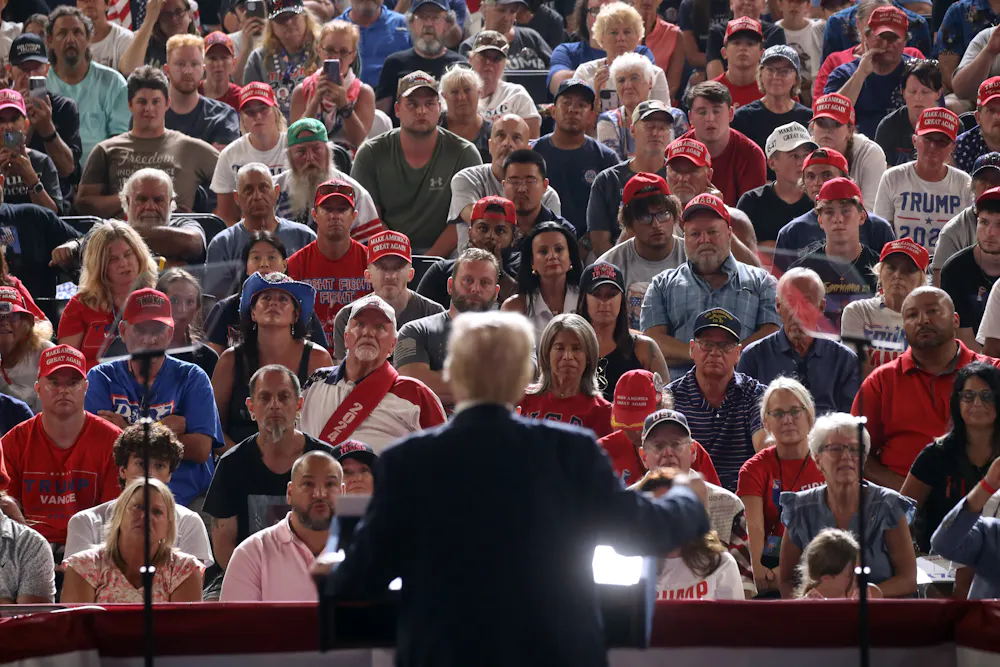
    Supporters watch Donald Trump speak at a rally in Uniondale, N.Y., on Sept. 18, 2024. Spencer Platt/Getty Images

    For many people, especially those leaning left, Donald Trump’s disqualifications to be president seem obvious, prompting some to question: How could anyone still vote for Trump?

    Some of the evidence Trump’s critics cite include his two impeachments, multiple criminal indictments at the state and federal levels and a felony conviction. Opponents also say that Trump is a threat to democracy, a misogynist, racist, a serial liar and a rapist.

    About 78% of Democrats and Democrat-leaning independent voters say that Trump broke the law when he allegedly tried to overturn the 2020 election results. But less than half of Republicans think he did anything wrong.

    I am an anthropologist of peace and conflict, and I have been studying what I call the Trumpiverse since 2015, when Trump descended a golden escalator and announced his candidacy for president. I later wrote a related book in 2021, called “It Can Happen Here.”

    More recently, I have been examining toxic polarization – and ways to stop it. Many efforts to reduce people’s polarized views begin with an injunction: Listen and understand.

    To this end, I have attended Trump rallies, populist and nonpartisan events and meetings where Democrats and Republicans connect and talk. Along the way, I have spoken with Trump supporters ranging from the Make America Great Again, or MAGA, faithful to moderate “hold the nose and vote for him” conservatives.

    And indeed, many on the left fail to understand who Trump voters are and how they vary. Trump’s base cannot simply be dismissed as racist “deplorables”, as Hillary Clinton famously said in 2016, or as country bumpkins in red MAGA hats. Trump voters trend older, white, rural, religious and less educated. But they include others outside those demographic groups.

    Many people have thoughtful reasons for voting for Trump, even if their reasoning – as is also true for those on the left – is often inflamed by populist polarizers and media platforms.

    Here are five key lines of reasoning that, in varying combinations, inform Trump voters’ choice.

    Donald Trump speaks at a rally on July 31, 2024, in Harrisburg, Pa.
    Spencer Platt/Getty Images

    1. Media distortion

    Where those on the left see Trump’s many failings, those on the right may see what some political observers call Trump Derangement Syndrome, sometimes simply called TDS.

    According to this line of argument, the left-leaning media dissects Trump’s every word, and the media then distorts what he says. I have found that some Trump supporters think that people who feed too much on this allegedly biased media diet can get TDS and develop a passionate, perhaps illogical dislike of Trump.

    I have also heard hardcore Trump supporters argue, with no evidence, that such “fake news” media outlets, like CNN, are part of a larger deep state plot of the federal government to upend the will of the people. This plot, according to those who propagate it, includes not just leftists, government bureaucrats and people who claim to be Republicans, but really aren’t, but also people in law enforcement.

    Some Trump supporters also see merit in his contention that he is being wrongly persecuted, just like some see the Jan. 6 defendants being persecuted.

    2. Bread on the table, money in the bank

    “Are you better off than you were four years ago?”

    For many Trump voters, the answer to Ronald Reagan’s famous question is clear: “No.” They accurately remember Trump’s term as one of tax cuts, economic growth and stock market highs.

    It is true that overall employment numbers and average pay went up under President Joe Biden. But for some Trump supporters, that economic boost pales in comparison to the massive surge in inflation during Biden’s term, with prices rising almost 20%. While the inflation rate has recently abated, prices remain high – as voters are reminded of every day at the grocery store.

    Polls also show that Trump has a strong lead over Democratic presidential nominee Kamala Harris on how they would handle the economy, which is a top concern for voters, especially Republicans.

    3. A border invasion

    Another reason some Americans want to vote for Trump: immigration.

    Like inflation, the number of people illegally crossing the border soared under Biden.

    This massive influx of “illegal aliens,” as Trump calls them, dropped to its lowest level in four years in July 2024. This happened after the Biden administration made it harder for immigrants to apply for asylum at the U.S.-Mexico border, a policy measure that is in line with many Republicans’ approach.

    In 2022, a poll found 7 out of 10 Republicans worried that “open borders” were part of a Democratic plot to expand liberals’ power by replacing conservative white people with nonwhite foreigners.

    Trump has played into some people’s mostly false concerns that immigrants living illegally in the U.S. are freeloaders and won’t assimilate, as illustrated by recent – untrue – allegations that immigrants are eating pets in Ohio.

    In 2022, 82% of Republicans said they viewed immigration as a “very important” issue. Trump continues to tout his proposed solution, which includes shutting the border, building a wall and deporting 11 million immigrants who are living in the U.S. without legal authorization.

    People attend a Donald Trump rally in Uniondale, N.Y., on Sept. 18, 2024.
    Michael M. Santiago/Getty Images

    4. A proven record

    Some Trump voters simply compare the records of Trump and Biden-Harris and find that the tally tilts firmly toward Trump.

    And it’s not just about the economy and immigration.

    There were no new wars under Trump. Biden-Harris, in contrast, are saddled with Russia’s invasion of Ukraine and Israel’s invasion of the Gaza Strip. Trump supporters’ perception is that American taxpayers foot a large portion of the bill, even though other countries are also giving money to Ukraine, and Israel is actually buying weapons from the U.S.

    I have found that Trump supporters also think he is better suited to deal with the rising power and threat of China.

    5. The MAGA bull in a china shop

    While some Harris supporters lament Trump’s destruction of democracy and decency in politics, I have found that Trump voters see a charismatic MAGA bull in a china shop.

    It is precisely because Trump is an unrelenting pugilist, or a fighter – as he showed when he raised a fist after the assassination attempt against him in July – that he should be elected, his supporters believe.

    Some even view him as savior – who will save the U.S. from a “radical left” apocalypse.

    For such Trump stalwarts, MAGA is not simply a slogan. In the Trumpiverse, it is a movement to save an America that is on the brink of failure.

    Alexander Hinton receives funding from the Rutgers-Newark Center for the Study of Politics and Race in America.

    ref. Why do people still back Trump, after everything? 5 things to understand about MAGA supporters’ thinking – https://theconversation.com/why-do-people-still-back-trump-after-everything-5-things-to-understand-about-maga-supporters-thinking-239031

    MIL OSI – Global Reports

  • MIL-OSI Global: What is ‘dark money’ political spending, and how does it affect US politics?

    Source: The Conversation – USA – By Emily Lau, Staff Attorney, State Democracy Research Initiative, University of Wisconsin-Madison

    Where exactly did this money come from? Manuel Augusto Moreno/Moment via Getty Images

    Every campaign season brings renewed attention to the amount of money influencing American politics, and who is spending it, and for what purposes. In particular, people are concerned about what is called “dark money.” For instance, recent media coverage has pointed to escalating dark money spending on both the Democratic and Republican sides.

    The term sounds scary and raises the specter of shadowy people manipulating the nation’s politics. As a researcher who studies the American democratic system, I think it’s worthwhile to unpack what dark money is, what concerns it raises and what might be done to address it.

    Unidentified political donors

    When people talk about dark money, they’re usually referring to money spent on elections that comes from sources that cannot be identified.

    Federal and state laws impose some limits on contributions and require some political contributions and expenditures to be publicly disclosed. Candidates for federal office, for example, must report their campaign donors to the Federal Election Commission. The FEC makes these reports available to the public.

    Likewise, super PACs – groups permitted to spend unlimited amounts on independent electoral advocacy – must also report some information about donations, such as the identities of and amounts given by people who donate more than US$200 in a year.

    But campaign finance disclosure laws have gaps.

    Federal law, for example, allows certain entities – most notably nonprofits designated as “social welfare” organizations or trade associations under Sections 501(c)(4) and 501(c)(6) of the tax code – to raise and spend large sums on electoral advocacy without disclosing their donors.

    A CBS News investigation into dark money in U.S. politics.

    Another dark money pathway involves making donations to super PACs through shell companies, which are companies set up for the purpose of hiding the financial activities of other people or groups – in this case, political contributions. Although super PACs are legally required to report who they received the contributions from, if the funds come from shell companies, the super PACs may not know and are not required to disclose where the money actually came from. That information remains hidden from public view.

    A lack of donor transparency raises multiple concerns. Voters may have a harder time assessing the validity of political messages or discerning whether candidates may be beholden to certain interests. Regulators and watchdogs can have trouble detecting illegal activity, such as campaign spending by foreign nationals. And unscrupulous people and groups can spread misinformation or destructive rhetoric without being identified or held accountable.

    Undisclosed political expenditures

    While discussions of dark money usually focus on where it comes from, the term can also describe a lack of transparency about where it goes.

    Under federal law, campaign committees must report their direct disbursements, such as payments to vendors or consultants. These vendors and consultants, however, sometimes function as pass-through entities that receive campaign funds and then purchase undisclosed goods and services. And any of these recipients can be set up as shell companies, making the flow of funds even more difficult to track.

    For instance, Hillary Clinton’s 2016 campaign and the Democratic National Committee faced FEC complaints for failing to disclose indirect payments made through the campaign’s law firm to researchers who compiled a dossier on Donald Trump’s Russia ties. The Clinton campaign and the DNC paid a fine to settle the matter without conceding wrongdoing.

    But enforcement can be difficult. In 2020, a watchdog group filed an FEC complaint alleging that Trump’s reelection campaign directed hundreds of millions of dollars to a pass-through entity in an improper effort to hide its expenditures – which included payments to top advisers and family members that, by law, would have otherwise been disclosed. The FEC dismissed the Trump complaint in 2022 when commissioners deadlocked 3-3 on whether to pursue it.

    As with a lack of donor disclosure, a lack of expenditure disclosure can deprive voters and regulators of valuable information. Lack of transparency can also invite questionable campaign practices, such as using donated funds in ways that enrich candidates, campaign staff or their associates.

    It can be hard to determine who is really behind shell companies and campaign donors.
    nicodemos/E+ via Getty Images

    Stalled federal reforms

    Proponents of greater campaign finance transparency have had little success pressing federal lawmakers and regulators to address dark money.

    Since 2010, congressional Democrats have been introducing legislation known as the DISCLOSE Act. Among other requirements, it would make dark money groups reveal major donors and restrict the use of shell companies to conceal donors’ identities. While versions of the bill have passed the House, they have repeatedly stalled in the Senate. Opponents maintain that these measures would infringe people’s privacy rights and chill constitutionally protected speech.

    Advocates have also made minimal headway persuading Congress or federal agencies to adopt new disclosure regulations or tighten enforcement.

    The FEC, which has an even partisan split among its six commissioners, has often been unable to get a majority to agree to take action. And the FEC’s most notable recent decisions have been to loosen, rather than tighten, campaign finance rules. Congress has barred the Securities and Exchange Commission from establishing new political spending disclosure rules for public companies, although some companies self-report more than the law requires.

    States’ efforts to curb dark money

    Dark money is also an issue in state and local elections. The strength of state and local transparency laws varies. Because these elections typically receive less attention and scrutiny than federal elections, money sometimes flows even more opaquely.

    Unlike the federal government, a number of states and localities have bolstered their disclosure rules in recent years. Arizona, California, Colorado, New Jersey and Washington, for example, have passed new laws requiring more donor information, including about the original sources of funds that are transferred between multiple groups before being spent on electioneering.

    Meanwhile, states such as Iowa, Massachusetts and Texas have adopted laws requiring campaigns to provide details about how consultants and vendors spend the campaign’s funds.

    Even in these states, disclosure gaps remain. The reality is that efforts to improve transparency can seem like a game of whack-a-mole: Each new round of regulations tends to generate new workarounds. But the experiences in these states and elsewhere may offer models and lessons for other jurisdictions.

    The current Supreme Court has given mixed messages about campaign finance transparency.
    Fred Schilling, Collection of the Supreme Court of the United States

    Constitutional questions

    Beyond the political challenge of getting stronger transparency regulations adopted, proponents of such measures also face potential constitutional challenges by opponents of disclosure.

    In multiple cases, including the 2010 Citizens United v. FEC ruling, the U.S. Supreme Court has rejected First Amendment claims brought by political spenders who wished to conceal their identities. In that case, the court observed that transparency helps the electorate “make informed decisions and give proper weight to different speakers and messages.”

    However, the Supreme Court has also recognized a right to engage in anonymous political speech. And in recent years, the court’s conservative supermajority has become somewhat more skeptical of disclosure rules, including in a 2021 case, Americans for Prosperity Foundation v. Bonta, which overturned a state law requiring charities to identify major donors. In her dissent, Justice Sonia Sotomayor warned that the court’s argument could be applied to campaign finance disclosure regulations.

    Therefore, even if public momentum builds for stronger transparency regulations, the Supreme Court could stand as an obstacle to such reforms.

    Emily Lau does not work for, consult, own shares in or receive funding from any company or organization that would benefit from this article, and has disclosed no relevant affiliations beyond their academic appointment.

    ref. What is ‘dark money’ political spending, and how does it affect US politics? – https://theconversation.com/what-is-dark-money-political-spending-and-how-does-it-affect-us-politics-236294

    MIL OSI – Global Reports

  • MIL-OSI Canada: Canada to Host Ministerial Conference on the Human Dimension of Ukraine’s 10-Point Peace Formula

    Source: Government of Canada News

    News release

    September 25, 2024 – New York, New York – Global Affairs Canada

    The Honourable Mélanie Joly, Minister of Foreign Affairs, today announced that Canada, together with co-organizers Norway and Ukraine, will host the Ministerial Conference on the Human Dimension of Ukraine’s 10-Point Peace Formula on October 30-31, 2024.

    The Ministerial Conference will bring together Foreign Affairs Ministers to advance the common vision articulated by the Joint Communiqué on a Peace Framework developed at the Summit on Peace in Ukraine at Bürgenstock, Switzerland, in June 2024.

    During the conference, Ministers will exchange views with the aim of developing a concrete plan, guided by the principles of international human rights and humanitarian law, for the return of prisoners of war as well as deported civilians and children back to Ukraine. The Conference participants will also aim to strengthen the International Coalition for the Return of Ukrainian Children, integrate the Women, Peace and Security perspective into the 10-Point Peace Formula, and identify approaches for post-return rehabilitation and reintegration for Ukrainian returnees.

    Quotes

    “Canada continues to deploy significant efforts to raise awareness of, and advocate on the issue of, illegally detained and deported Ukrainians, a critical issue dating back to Russia’s invasion of Ukraine in 2014 that has been exacerbated since the launch of Russia’s full-scale war of aggression in 2022. I look forward to welcoming my counterparts to Canada and exchanging views on how the international community can support Ukraine in its efforts for a comprehensive, just and lasting peace.”

    – Mélanie Joly, Minister of Foreign Affairs of Canada

    “The release of all prisoners and deported persons from Russian captivity, including children, is Ukraine’s top priority. I look forward to working together on the solutions that will ensure the return of our people back home and the restoration of just and lasting peace in Ukraine.”

    – Andrii Sybiha, Minister of Foreign Affairs of Ukraine

    “The return of all our people—every detained and deported Ukrainian—is a fundamental precondition for a comprehensive, just, and lasting peace in Ukraine. The human dimension is one of the core elements of Ukraine’s Peace Formula. It is crucial that we, as an international community, unite our efforts in Canada to find solutions that will bring every Ukrainian home.”

    – Andriy Yermak, Head of the Office of the President of Ukraine

    “Russia’s full-scale war against Ukraine has lasted for more than two and a half years. The ongoing hostilities and occupation of Ukrainian territory continuously expose Ukrainian civilians to the risk of detention by Russian forces or agents and other violations. The scale and complexity of the many thousands of Ukrainians in detention, children as well as adults, call for closer scrutiny by the world community on how to stop it, and I look forward to working closely with my Ukrainian and Canadian colleagues on this important agenda.”

    – Espen Barth Eide, Minister of Foreign Affairs of Norway

    Quick facts

    • President Volodymyr Zelenskyy introduced Ukraine’s 10-Point Peace Formula in November 2022 at the G20 summit. In August 2023, ten working groups were established, each dedicated to a specific pillar of the 10-point Peace Formula. Canada, along with Norway, are co-chairs of Working Group 4, which focuses on the return of prisoners of war, detained civilians, and illegally transferred and deported children.

    • Canada and Ukraine co-lead the International Coalition for the Return of Ukrainian Children. Launched in February 2024, in Kyiv, this coalition has expanded to 40 states, including some non-Western countries.

    • In June 2024, Ukraine and Switzerland hosted the Summit on Peace in Ukraine, a diplomatic initiative to garner international support for Ukraine’s Peace Formula. Prime Minister Justin Trudeau attended the summit and chaired a breakout session on the human dimension of the war in Ukraine. He also announced that Canada will host a ministerial conference on this human dimension this year.

    Associated links

    Contacts

    Media Relations Office
    Global Affairs Canada
    media@international.gc.ca
    Follow us on Twitter: @CanadaFP
    Like us on Facebook: Canada’s foreign policy – Global Affairs Canada

    MIL OSI Canada News

  • MIL-OSI Translation: Canada to host ministerial conference on human dimension of Ukraine’s 10-point peace formula

    MIL OSI Translation. Canadian French to English –

    Source: Government of Canada – in French 1

    Press release

    September 25, 2024 – New York, New York – Global Affairs Canada

    The Honourable Mélanie Joly, Minister of Foreign Affairs, today announced that Canada, with the support of Norway and Ukraine as co-hosts, will host the Ministerial Conference on the Human Dimension of Ukraine’s 10-Point Peace Formula on October 30-31, 2024.

    The Ministerial Conference will bring together foreign ministers to advance the vision set out in the Joint Communiqué on the Peace Framework, developed at the Ukraine Peace Summit in Bürgenstock, Switzerland, in June 2024.

    During the conference, the ministers will exchange views with the aim of developing a concrete plan, guided by international principles of human rights and humanitarian law, for the return to Ukraine of prisoners of war, as well as the civilian population and deported children. The conference participants will also aim to strengthen the International Coalition for the Repatriation of Ukrainian Children, to integrate the perspective of women, peace and security into the 10-point peace formula, and to identify approaches for the rehabilitation and reintegration of Ukrainian women and men repatriated to the country.

    Quotes

    “Canada continues to work hard to raise awareness and advocate on the issue of illegally detained and deported Ukrainians, a major issue that dates back to Russia’s invasion of Ukraine in 2014 and has been exacerbated since Russia launched its full-scale war of aggression in 2022. I look forward to welcoming my counterparts to Canada and discussing how the international community can support Ukraine in its efforts to achieve a comprehensive, just and lasting peace.”

    – Mélanie Joly, Minister of Foreign Affairs of Canada

    “The release of all prisoners and detainees, as well as all those deported to Russia, including children, is Ukraine’s top priority. I look forward to working together to find solutions that will ensure the return of our citizens and the restoration of a just and lasting peace in Ukraine.”

    – Andrii Sybiha, Minister of Foreign Affairs of Ukraine

    “The return of our people, that is, all detained and deported Ukrainians, is an essential condition for a comprehensive, just and lasting peace in Ukraine. The human dimension is one of the essential elements of Ukraine’s peace formula. It is essential that we, as the international community, join forces with Canada to find solutions that will allow all Ukrainians to return home.”

    – Andriy Yermak, Head of the Office of the President of Ukraine

    “Russia’s full-scale war against Ukraine has been going on for over two and a half years. The ongoing hostilities and occupation of Ukrainian territory place the Ukrainian civilian population at constant risk of detention by Russian forces or agents and other aggression. The scale and complexity of the detention of thousands of Ukrainians, both children and adults, demands that the global community take a closer look at how to end it, and I look forward to working closely with my colleagues from Ukraine and Canada on this important issue.”

    – Espen Barth Eide, Minister of Foreign Affairs of Norway

    Quick Facts

    President Volodymyr Zelenskyy presented Ukraine’s 10-Point Peace Formula in November 2022 at the G20 Summit. In August 2023, ten working groups were established, each dedicated to a pillar of the 10-Point Peace Formula. Canada and Norway co-chair Working Group 4, which focuses on the return of prisoners of war, civilians in detention, and illegally transferred and deported children.

    Canada and Ukraine co-lead the International Coalition for the Repatriation of Ukrainian Children. Launched in February 2024 in Kyiv, this coalition has expanded to 40 states, including some non-Western countries.

    In June 2024, Ukraine and Switzerland hosted the Ukraine Peace Summit, a diplomatic initiative aimed at garnering international support for Ukraine’s peace formula. Prime Minister Justin Trudeau attended the summit and chaired a discussion session on the human dimension of the war in Ukraine. He also announced that Canada would host a ministerial conference on the human dimension this year.

    Related links

    Contact persons

    Media Relations OfficeGlobal Affairs Canadamedia@international.gc.caFollow us on Twitter: @CanadaPELike us on Facebook: Canada’s foreign policy – Global Affairs Canada

    EDITOR’S NOTE: This article is a translation. Apologies should the grammar and/or sentence structure not be perfect.

    MIL Translation OSI

  • MIL-OSI USA: Administrator Samantha Power’s First Day at the UN General Assembly High-Level Week

    Source: USAID

    The following is attributable to Spokesperson Benjamin Suarato:

    Today, Administrator Power arrived in New York today for the UN General Assembly High Level Week. She first met with Saudi Arabia’s Dr. Abdullah Al Rabeeah, Royal Court Adviser and Supervisor General of the King Salman Humanitarian Aid and Relief Center, to discuss areas for potential collaboration and ongoing humanitarian responses in Sudan, Gaza, and Ukraine.

    Joined by First Lady Dr. Jill Biden, Administrator Power and UNICEF Executive Director Catherine Russell co-hosted the official launch of the Partnership for a Lead-Free Future, a first of its kind coalition to end childhood lead poisoning in developing countries by 2040. The launch event included an announcement of more than $150 million in donor commitments, ten times the amount that is spent each year tackling this problem, with 26 countries and 38 partner organizations joining the coalition.

    Administrator Power also participated in a roundtable hosted by President of Ukraine Volodymyr Zelenskyy, Bank of America, and the U.S. Chamber of Commerce. Alongside U.S. Deputy Secretary of State Rich Verma and CEOs from major energy, finance, and insurance firms, Administrator Power discussed how USAID, other U.S. government agencies, and private sector actors are helping to address immediate needs and future opportunities in Ukraine’s energy sector and broader economy.

    MIL OSI USA News

  • MIL-OSI United Nations: Secretary-General’s remarks at the Opening of the General Debate of the Seventy-ninth Session of the General Assembly [trilingual, as delivered, scroll down for all-English and all-French]

    Source: United Nations secretary general

    Mr. President of the General Assembly,

    Excellencies,

    Ladies and gentlemen,

    Our world is in a whirlwind.

    We are in an era of epic transformation – facing challenges unlike any we have ever seen – challenges that demand global solutions.

    Yet geo-political divisions keep deepening. The planet keeps heating.

    Wars rage with no clue how they will end.

    And nuclear posturing and new weapons cast a dark shadow.

    We are edging towards the unimaginable – a powder keg that risks engulfing the world.

    Meanwhile, 2024 is the year that half of humanity goes to the polls – and all of humanity will be affected.

    I stand before you in this whirlwind convinced of two overriding truths.

    First, the state of our world is unsustainable.

    We can’t go on like this.

    And second, the challenges we face are solvable.

    But that requires us to make sure the mechanisms of international problem-solving actually solve problems.

    The Summit of the Future was a first step, but we have a long way to go.

    Getting there requires confronting three major drivers of unsustainability.

    A world of impunity – where violations and abuses threaten the very foundation of international law and the UN Charter.

    A world of inequality – where injustices and grievances threaten to undermine countries or even push them over the edge.

    And a world of uncertainty – where unmanaged global risks threaten our future in unknowable ways.

    These worlds of impunity, inequality and uncertainty are connected and colliding.

    Excellencies,

    The level of impunity in the world is politically indefensible and morally intolerable.

    Today, a growing number of governments and others feel entitled to a “get out of jail free” card.

    They can trample international law.

    They can violate the United Nations Charter.

    They can turn a blind eye to international human rights conventions or the decisions of international courts.

    They can thumb their nose at international humanitarian law.

    They can invade another country, lay waste to whole societies, or utterly disregard the welfare of their own people.

    And nothing will happen.

    We see this age of impunity everywhere — in the Middle East, in the heart of Europe, in the Horn of Africa, and beyond.

    The war in Ukraine is spreading with no signs of letting up.

    Civilians are paying the price – in rising death tolls and shattered lives and communities.

    It is time for a just peace based on the UN Charter, on international law and on UN resolutions.

    Meanwhile, Gaza is a non-stop nightmare that threatens to take the entire region with it.

    Look no further than Lebanon.

    We should all be alarmed by the escalation. 

    Lebanon is at the brink. 

    The people of Lebanon – the people of Israel – and the people of the world — cannot afford Lebanon to become another Gaza.

    Let’s be clear.

    Nothing can justify the abhorrent acts of terror committed by Hamas on October 7th, or the taking of hostages – both of which I have repeatedly condemned.

    And nothing can justify the collective punishment of the Palestinian people.

    The speed and scale of the killing and destruction in Gaza are unlike anything in my years as Secretary-General.

    More than 200 of our own staff have been killed, many with their families.

    And yet the women and men of the United Nations continue to deliver humanitarian aid.

    I know you join me in paying a special tribute to UNRWA and to all humanitarians in Gaza.

    The international community must mobilize for an immediate ceasefire, the immediate and unconditional release of all hostages, and the beginning of an irreversible process towards a two-State solution.

    For those who go on undermining that goal with more settlements, more landgrabs, more incitement — I ask:

    What is the alternative?

    How could the world accept a one-state future in which a large a large number of Palestinians would be included without any freedom, rights or dignity?

    In Sudan, a brutal power struggle has unleashed horrific violence — including widespread rape and sexual assaults.

    A humanitarian catastrophe is unfolding as famine spreads.  Yet outside powers continue to interfere with no unified approach to finding peace.

    In the Sahel, the dramatic and rapid expansion of the terrorist threat requires a joint approach rooted in solidarity – but regional and international cooperation have broken down.

    From Myanmar to the Democratic Republic of the Congo to Haiti to Yemen and beyond – we continue to see appalling levels of violence and human suffering in the face of a chronic failure to find solutions.

    Meanwhile our peacekeeping missions are too often operating in areas where simply there is no peace to keep.

    Instability in many places around the world is a by-product of instability in power relations and geo-political divides.

    For all its perils, the Cold War had rules.

    There were hot lines, red lines and guard rails.

    It can feel as though we don’t have that today.

    Nor do we have a unipolar world.

    We are moving to a multipolar world, but we are not there yet.

    We are in a purgatory of polarity.

    And in this purgatory, more and more countries are filling the spaces of geopolitical divides, doing whatever they want with no accountability.

    That is why it is more important than ever to reaffirm the Charter, to respect international law, to support and implement decisions of international courts, and to reinforce human rights in the world.

    Anywhere and everywhere.

    Excellences, Mesdames et Messieurs,
     
    L’augmentation des inégalités est un deuxième facteur de l’insoutenabilité et une tache sur notre conscience collective.
     
    L’inégalité n’est pas une question technique ou bureaucratique.
     
    Au fond, l’inégalité est une question de pouvoir, aux racines historiques.
     
    Les conflits, les bouleversements climatiques et la crise du coût de la vie étendent ces racines historiques plus profondément encore.
     
    Dans le même temps, le monde peine encore à se relever de la flambée des inégalités engendrée par la pandémie.
     
    Si l’on regarde les 75 pays les plus pauvres du monde, un tiers d’entre eux se trouve aujourd’hui dans une situation pire qu’il y a cinq ans.
     
    Au cours de la même période, les cinq hommes les plus riches de la planète ont plus que doublé leurs fortunes.
     
    Et un pour cent des habitants de la planète détient 43 % de l’ensemble des avoirs financiers mondiaux.
     
    Au niveau national, certains gouvernements décuplent les inégalités en accordant des cadeaux fiscaux massifs aux entreprises et aux ultra-riches — au détriment des investissements dans la santé, l’éducation et la protection sociale.
     
    Et personne n’est plus lésé que les femmes et les filles du monde entier.
     
    Excellences,
     
    La discrimination et les abus généralisés fondés sur le genre constituent l’inégalité la plus répandue dans toutes les sociétés.
     
    Chaque jour, il semble que nous soyons confrontés à de nouveaux cas révoltants de féminicides, de violences fondées sur le genre et de viols collectifs – en temps de paix comme en tant qu’arme de guerre.
     
    Dans certains pays, les lois sont utilisées pour menacer la santé et les droits reproductifs.
     
    Et en Afghanistan, les lois sont utilisées pour entériner l’oppression systématique des femmes et des filles.
     
    Et je suis désolé de constater que, malgré des années de beaux discours, l’inégalité de genre se manifesteet je vous demande pardon de le dire, elle se manifeste aujourd’hui encore, pleinement dans cette enceinte.
     
    Moins de 10 pour cent des intervenants au Débat général de cette semaine sont des femmes.
     
    C’est inacceptable, surtout quand on sait que l’égalité entre les femmes et les hommes contribue à la paix, au développement durable, à l’action climatique et bien plus encore.
     
    C’est précisément pour cela nous avons pris des mesures spécifiques pour atteindre la parité hommes-femmes parmi les hauts responsables de l’Organisation des Nations Unies,objectif qui est déjà complété.
     
    C’est faisable.
     
    J’exhorte les institutions politiques et économiques du monde dominées par les hommes à le faire aussi.
     
    Excellences,
     
    Les inégalités mondiales se reflètent et se renforcent jusque dans nos propres organisations internationales.
     
    Le Conseil de sécurité des Nations Unies a été conçu par les vainqueurs de la Seconde Guerre mondiale.
     
    À l’époque, la majeure partie du continent africain était encore sous domination coloniale.
     
    À ce jour, l’Afrique n’a toujours aucun siège permanent au sein de la principale instance de paix du monde.
     
    Un changement s’impose.
     
    Il en va de même pour l’architecture financière mondiale, mise en place il y a 80 ans.
     
    Je félicite les dirigeants de la Banque mondiale et du Fonds monétaire international pour les mesures importantes qu’ils ont entreprises.
     
    Mais comme le souligne le Pacte pour l’avenir, la lutte contre les inégalités exige une accélération de la réforme de l’architecture financière internationale.
     
    Au cours des huit dernières décennies, l’économie mondiale s’est développée et transformée.
     
    Les institutions de Bretton Woods n’ont pas suivi le rythme.
     
    Elles ne sont plus en mesure de fournir un filet de sécurité mondial, ni d’offrir aux pays en développement le niveau de soutien dont ils ont tant besoin.
     
    Dans les pays les plus pauvres du monde, le coût des intérêts de la dette dépasse, en moyenne, le coût des investissements dans l’éducation, la santé et les infrastructures publiques réunis.
     
    Et à l’échelle du monde, plus de 80 % des cibles des Objectifs de développement durable ne sont pas en bonne voie.

    Excelencias,

    Volver al camino correcto requiere un aumento de financiamiento para la Agenda 2030 y el Acuerdo de París.

    Esto implica que los países del G20 lideren un Estímulo para los Objetivos de Desarrollo Sostenible de 500.000 millones de dólares al año.

    Implica reformas para aumentar sustancialmente la capacidad de préstamo de los Bancos Multilaterales de Desarrollo – y permitirles ampliar masivamente la financiación asequible a largo plazo para el clima y el desarrollo.

    Implica ampliar la financiación de contingencia mediante el reciclaje de los Derechos Especiales de Giro.

    E implica promover una reestructuración de la deuda a largo plazo.

    Excelencias,

    No me hago ilusiones sobre las barreras a la reforma del sistema multilateral.

    Los que tienen poder político y económico, o y los que creen tenerlo, son siempre reacios al cambio.

    Pero el status quo ya está agotando su poder.

    Sin reformas, la fragmentación es inevitable, y las instituciones globales perderán legitimidad, credibilidad y eficacia.

    Excellencies,

    The third driver of our unsustainable world is uncertainty.

    The ground is shifting under our feet.

    Anxiety levels are off the charts.

    And young people, in particular, are counting on us and seeking solutions.

    Uncertainty is compounded by two existential threats – the climate crisis and the rapid advance of technology — in particular, Artificial Intelligence.

    Excellencies,

    We are in a climate meltdown.

    Extreme temperatures, raging fires, droughts, and epic floods are not natural disasters.

    They are human disasters — increasingly fueled by fossil fuels.

    No country is spared. But the poorest and most vulnerable are hardest hit.

    Climate hazards are blowing a hole through the budgets of many African countries, costing up to five per cent of GDP – every year.

    And this is just the start.

    We are on course to careen past the global limit of a 1.5 degree temperature rise.

    But as the problem gets worse, solutions are getting better.

    Renewable prices are plummeting, roll-out is accelerating, and lives are being transformed by affordable, accessible clean energy.

    Renewables don’t just generate power. They generate jobs, wealth, energy security and a path out of poverty for millions.

    But developing countries cannot be plundered in that journey.

    Our Panel on Critical Minerals has recommended fair and sustainable ways to meet global demand for these resources, which are essential to the renewables revolution.

    Excellencies,

    A future without fossil fuels is certain.  A fair and fast transition is not.

    That is in your hands.

    By next year, every country must produce an ambitious new national climate action plan – or Nationally Determined Contributions.

    These must bring national energy strategies, sustainable development priorities, and climate ambitions together.

    They must align with the 1.5 degree limit, cover the whole economy, and contribute to every one of the COP28 energy transition targets.

    An International Energy Agency report released today breaks this down.

    By 2035, on average, advanced economies must slash energy emissions 80 per cent, and emerging markets 65 per cent.

    The G20 is responsible for 80 per cent of total emissions.

    They must lead the charge – keeping with the principle of common but differentiated responsibilities and respective capabilities in the light of different national circumstances.

    But this must be a joint effort — pooling resources, scientific capacities and proven and affordable technologies for all to be able to reach those targets.

    I’m honoured to be working closely with President Lula of Brazil – who is both G20 Chair and COP30 host – to secure maximum ambition, acceleration and cooperation. We just met for that purpose.

    Finance is essential.

    COP29 is around the corner.

    It must deliver a significant new finance goal.

    We also need a Loss and Damage Fund that meets the scale of the challenge – and developed countries meeting their adaptation finance promises.

    And we must finally flip the script on a crazy situation:

    We continue to reward polluters to wreck our planet.

    The fossil fuel industry continues to pocket massive profits and subsidies, while everyday people bear the costs of climate catastrophe – from rising insurance premiums to lost livelihoods.

    I call on G20 countries to shift money from fossil fuel subsidies and investments to a just energy transition;

    To put an effective price on carbon;

    And to implement new and innovative sources of financing – including solidarity levies on fossil fuel extraction – through legally-binding, transparent mechanisms.

    All by next year and this taking into account that those who shoulder the blame must foot the bill.

    Polluters must pay.

    Excellencies,

    The rapid rise of new technologies poses another unpredictable existential risk.

    Artificial Intelligence will change virtually everything we know — from work, education and communication, to culture and politics.

    We know AI is rapidly advancing, but where is it taking us:

    To more freedom – or more conflict?

    To a more sustainable world – or greater inequality?

    To being better informed – or easier to manipulate?

    A handful of companies and even individuals have already amassed enormous power over the development of AI – with little accountability or oversight for the moment.

    Without a global approach to its management, artificial intelligence could lead to artificial divisions across the board – a Great Fracture with two internets, two markets, two economies – with every country forced to pick a side, and enormous consequences for all.

    The United Nations is the universal platform for dialogue and consensus.

    It is uniquely placed to promote cooperation on AI – based on the values of the Charter and international law.

    The global debate happens here, or it does not happen.

    I welcome important first steps.

    Two resolutions in the General Assembly, the Global Digital Compact, and the recommendations of the High-Level Body on AI can lay the foundations for inclusive governance of AI.

    Let’s move forward together to make AI a force for good.

    Excellencies,

    Nothing lasts forever.

    But a feature of human life is that it appears otherwise.

    The current order always feels fixed.

    Until it is not.
     
    Across human history, we see empires rising and falling; old certainties crumbling; tectonic shifts in global affairs.
     
    Today our course is unsustainable.

    It is in all our interests to manage the epic transformations underway; to choose the future we want and to guide our world towards it.

    Many have said that the differences and divisions today are just too great.

    That it is impossible for us to come together for the common good.

    You proved that is not true.

    The Summit of the Future showed that with a spirit of dialogue and compromise, we can join forces to steer our world to a more sustainable path.

    It is not the end.

    It is a start of a journey, a compass in the whirlwind.

    Let’s keep going.

    Let’s move our world towards less impunity and more accountability …. less inequality and more justice … less uncertainty and more opportunity.

    The people of the world are looking to us – and succeeding generations will look back on us.

    Let them find us on the side of the United Nations Charter … on the side of our shared values and principles … and on the right side of history.

    I thank you.

    ***
    [all-English]

    Mr. President of the General Assembly,
     
    Excellencies,
     
    Ladies and gentlemen,
     
    Our world is in a whirlwind.
     
    We are in an era of epic transformation – facing challenges unlike any we have ever seen – challenges that demand global solutions.
     
    Yet geo-political divisions keep deepening. The planet keeps heating.

    Wars rage with no clue how they will end.
     
    And nuclear posturing and new weapons cast a dark shadow.
     
    We are edging towards the unimaginable – a powder keg that risks engulfing the world.
     
    Meanwhile, 2024 is the year that half of humanity goes to the polls – and all of humanity will be affected.
     
    I stand before you in this whirlwind convinced of two overriding truths.
     
    First, the state of our world is unsustainable.
     
    We can’t go on like this.
     
    And second, the challenges we face are solvable.
     
    But that requires us to make sure the mechanisms of international problem-solving actually solve problems.
     
    The Summit of the Future was a first step, but we have a long way to go.
     
    Getting there requires confronting three major drivers of unsustainability.
     
    A world of impunity – where violations and abuses threaten the very foundation of international law and the UN Charter.
     
    A world of inequality – where injustices and grievances threaten to undermine countries or even push them over the edge.
     
    And a world of uncertainty – where unmanaged global risks threaten our future in unknowable ways.
     
    These worlds of impunity, inequality and uncertainty are connected and colliding.
     
    Excellencies,
     
    The level of impunity in the world is politically indefensible and morally intolerable.
     
    Today, a growing number of governments and others feel entitled to a “get out of jail free” card.
     
    They can trample international law.
     
    They can violate the United Nations Charter.
     
    They can turn a blind eye to international human rights conventions or the decisions of international courts.
     
    They can thumb their nose at international humanitarian law.
     
    They can invade another country, lay waste to whole societies, or utterly disregard the welfare of their own people.
     
    And nothing will happen.
     
    We see this age of impunity everywhere — in the Middle East, in the heart of Europe, in the Horn of Africa, and beyond.
     
    The war in Ukraine is spreading with no signs of letting up.
     
    Civilians are paying the price – in rising death tolls and shattered lives and communities.
     
    It is time for a just peace based on the UN Charter, on international law and on UN resolutions.
     
    Meanwhile, Gaza is a non-stop nightmare that threatens to take the entire region with it.
     
    Look no further than Lebanon.
     
    We should all be alarmed by the escalation. 
     
    Lebanon is at the brink. 
     
    The people of Lebanon – the people of Israel – and the people of the world — cannot afford Lebanon to become another Gaza.
     
    Let’s be clear.
     
    Nothing can justify the abhorrent acts of terror committed by Hamas on October 7th, or the taking of hostages – both of which I have repeatedly condemned.
     
    And nothing can justify the collective punishment of the Palestinian people.
     
    The speed and scale of the killing and destruction in Gaza are unlike anything in my years as Secretary-General.
     
    More than 200 of our own staff have been killed, many with their families.
     
    And yet the women and men of the United Nations continue to deliver humanitarian aid.
     
    I know you join me in paying a special tribute to UNRWA and to all humanitarians in Gaza.
     
    The international community must mobilize for an immediate ceasefire, the immediate and unconditional release of all hostages, and the beginning of an irreversible process towards a two-State solution.
     
    For those who go on undermining that goal with more settlements, more landgrabs, more incitement — I ask:
     
    What is the alternative?
     
    How could the world accept a one-state future in which a large a large number of Palestinians would be included without any freedom, rights or dignity?
     
    In Sudan, a brutal power struggle has unleashed horrific violence — including widespread rape and sexual assaults.
     
    A humanitarian catastrophe is unfolding as famine spreads.  Yet outside powers continue to interfere with no unified approach to finding peace.
     
    In the Sahel, the dramatic and rapid expansion of the terrorist threat requires a joint approach rooted in solidarity – but regional and international cooperation have broken down.
     
    From Myanmar to the Democratic Republic of the Congo to Haiti to Yemen and beyond – we continue to see appalling levels of violence and human suffering in the face of a chronic failure to find solutions.
     
    Meanwhile our peacekeeping missions are too often operating in areas where simply there is no peace to keep.
     
    Instability in many places around the world is a by-product of instability in power relations and geo-political divides.
     
    For all its perils, the Cold War had rules.
     
    There were hot lines, red lines and guard rails.
     
    It can feel as though we don’t have that today.
     
    Nor do we have a unipolar world.
     
    We are moving to a multipolar world, but we are not there yet.
     
    We are in a purgatory of polarity.
     
    And in this purgatory, more and more countries are filling the spaces of geopolitical divides, doing whatever they want with no accountability.
     
    That is why it is more important than ever to reaffirm the Charter, to respect international law, to support and implement decisions of international courts, and to reinforce human rights in the world.
     
    Anywhere and everywhere.

    Excellencies, Ladies and Gentlemen,

    Rising inequalities are a second driver of unsustainability and a stain on our collective conscience. 

    Inequality is not a technical or bureaucratic issue. 

    At its heart, inequality is a question of power with historic roots.

    Conflict, climate upheaval and the cost-of-living crisis, are pushing those roots deeper. 

    At the same time, the world has not recovered from the surge in inequalities caused by the pandemic.

    Of the world’s poorest 75 countries, one-third are worse off today than they were five years ago.

    During that same period, the five richest men in the world have more than doubled their wealth.
     
    And the top one per cent of people on earth own 43 per cent of all global financial assets.

    At the national level, some governments are supercharging inequalities by doling out massive tax giveaways to corporations and the ultra-rich, while shortchanging investments in health, education and social protection.

    No one is being short-changed more than the world’s women and girls. 

    Excellencies, 
     
    Rampant gender-based discrimination and abuse are the most prevalent inequality across all societies. 
     
    Every day, it seems we are confronted by yet more sickening cases of femicide, gender-based violence and mass rape, both in peacetime and as a weapon of war. 
     
    In some countries, laws are being used to threaten reproductive health and rights. 

    And in Afghanistan, laws are being used to lock-in the systematic oppression of women and girls. 
     
    And I am sorry to observe that despite years of talk, gender inequality is on full display, and I am sorry for mentioning it here, gender inequality is on full display in this very Hall. 

    Less than 10 per cent of speakers during this week’s General Debate are women. 
     
    This is unacceptable – especially when we know gender equality delivers for peace, sustainable development, climate action and much more. 

    That is precisely why we took targeted measures to achieve gender parity among the United Nations senior leadership, an objective that has already been achieved.

    It’s doable. 

    I call on male-dominated political and economic establishments around the world to do it as well.
     
    Excellencies,

    Global inequalities are reflected and reinforced even in our own global institutions.

    The United Nations Security Council was designed by the victors of the Second World War. 

    Most of Africa was still under colonial domination. 

    To this day, Africa has no permanent seat on the world’s preeminent council of peace. 

    This must change.

    So must the global financial architecture, set up 80 years ago. 

    I commend the leaders of the World Bank and the International Monetary Fund for taking important steps.

    But as the Pact for the Future emphasizes, tackling inequalities requires accelerating reform of the international financial architecture.

    Over the past eight decades, the global economy has grown and transformed.

    The Bretton Woods institutions have not kept pace.

    They can no longer provide a global safety net – or offer developing countries the level of support they need.

    Debt interest payments in the world’s poorest countries now cost more, on average, than investments in education, health and infrastructure combined.

    And around the world, more than 80 per cent of Sustainable Development Goal targets are off track. 

    Excellencies,

    Getting back on track requires a surge of financing for the 2030 Agenda and the Paris Agreement.

    That means G20 countries leading on an SDG Stimulus of $500 billion a year. 

    It means reforms to substantially increase the lending capacity of Multilateral Development Banks and enable them to massively scale-up affordable long-term climate and development finance.

    It means expanding contingency financing through recycling Special Drawing Rights.

    And it means promoting long-term debt-restructuring.

    Excellencies,

    I have no illusions about the obstacles to reform of the multilateral system.

    Those with political and economic power – and those who believe they have power – are always reluctant to change.

    But the status quo is already draining their power.

    Without reform, fragmentation is inevitable, and global institutions will become less legitimate, less credible, and less effective.
     
    Excellencies,
     
    The third driver of our unsustainable world is uncertainty.
     
    The ground is shifting under our feet.
     
    Anxiety levels are off the charts.
     
    And young people, in particular, are counting on us and seeking solutions.
     
    Uncertainty is compounded by two existential threats – the climate crisis and the rapid advance of technology — in particular, Artificial Intelligence.
     
    Excellencies,
     
    We are in a climate meltdown.
     
    Extreme temperatures, raging fires, droughts, and epic floods are not natural disasters.
     
    They are human disasters — increasingly fueled by fossil fuels.
     
    No country is spared. But the poorest and most vulnerable are hardest hit.
     
    Climate hazards are blowing a hole through the budgets of many African countries, costing up to five per cent of GDP – every year.
     
    And this is just the start.
     
    We are on course to careen past the global limit of a 1.5 degree temperature rise.
     
    But as the problem gets worse, solutions are getting better.
     
    Renewable prices are plummeting, roll-out is accelerating, and lives are being transformed by affordable, accessible clean energy.
     
    Renewables don’t just generate power. They generate jobs, wealth, energy security and a path out of poverty for millions.
     
    But developing countries cannot be plundered in that journey.
     
    Our Panel on Critical Minerals has recommended fair and sustainable ways to meet global demand for these resources, which are essential to the renewables revolution.
     
    Excellencies,
     
    A future without fossil fuels is certain.  A fair and fast transition is not.
     
    That is in your hands.
     
    By next year, every country must produce an ambitious new national climate action plan – or Nationally Determined Contributions.
     
    These must bring national energy strategies, sustainable development priorities, and climate ambitions together.
     
    They must align with the 1.5 degree limit, cover the whole economy, and contribute to every one of the COP28 energy transition targets.
     
    An International Energy Agency report released today breaks this down.
     
    By 2035, on average, advanced economies must slash energy emissions 80 per cent, and emerging markets 65 per cent.
     
    The G20 is responsible for 80 per cent of total emissions.
     
    They must lead the charge – keeping with the principle of common but differentiated responsibilities and respective capabilities in the light of different national circumstances.
     
    But this must be a joint effort — pooling resources, scientific capacities and proven and affordable technologies for all to be able to reach those targets.
     
    I’m honoured to be working closely with President Lula of Brazil – who is both G20 Chair and COP30 host – to secure maximum ambition, acceleration and cooperation. We just met for that purpose.
     
    Finance is essential.
     
    COP29 is around the corner.
     
    It must deliver a significant new finance goal.
     
    We also need a Loss and Damage Fund that meets the scale of the challenge – and developed countries meeting their adaptation finance promises.
     
    And we must finally flip the script on a crazy situation:
     
    We continue to reward polluters to wreck our planet.
     
    The fossil fuel industry continues to pocket massive profits and subsidies, while everyday people bear the costs of climate catastrophe – from rising insurance premiums to lost livelihoods.
     
    I call on G20 countries to shift money from fossil fuel subsidies and investments to a just energy transition;
     
    To put an effective price on carbon;
     
    And to implement new and innovative sources of financing – including solidarity levies on fossil fuel extraction – through legally-binding, transparent mechanisms.
     
    All by next year and this taking into account that those who shoulder the blame must foot the bill.
     
    Polluters must pay.
     
    Excellencies,
     
    The rapid rise of new technologies poses another unpredictable existential risk.
     
    Artificial Intelligence will change virtually everything we know — from work, education and communication, to culture and politics.
     
    We know AI is rapidly advancing, but where is it taking us:
     
    To more freedom – or more conflict?
     
    To a more sustainable world – or greater inequality?
     
    To being better informed – or easier to manipulate?
     
    A handful of companies and even individuals have already amassed enormous power over the development of AI – with little accountability or oversight for the moment.
     
    Without a global approach to its management, artificial intelligence could lead to artificial divisions across the board – a Great Fracture with two internets, two markets, two economies – with every country forced to pick a side, and enormous consequences for all.
     
    The United Nations is the universal platform for dialogue and consensus.
     
    It is uniquely placed to promote cooperation on AI – based on the values of the Charter and international law.
     
    The global debate happens here, or it does not happen.
     
    I welcome important first steps.
     
    Two resolutions in the General Assembly, the Global Digital Compact, and the recommendations of the High-Level Body on AI can lay the foundations for inclusive governance of AI.
     
    Let’s move forward together to make AI a force for good.
     
    Excellencies,
     
    Nothing lasts forever.
     
    But a feature of human life is that it appears otherwise.
     
    The current order always feels fixed.
     
    Until it is not.
     
    Across human history, we see empires rising and falling; old certainties crumbling; tectonic shifts in global affairs.
     
    Today our course is unsustainable.
     
    It is in all our interests to manage the epic transformations underway; to choose the future we want and to guide our world towards it.
     
    Many have said that the differences and divisions today are just too great.
     
    That it is impossible for us to come together for the common good.
     
    You proved that is not true.
     
    The Summit of the Future showed that with a spirit of dialogue and compromise, we can join forces to steer our world to a more sustainable path.
     
    It is not the end.
     
    It is a start of a journey, a compass in the whirlwind.
     
    Let’s keep going.
     
    Let’s move our world towards less impunity and more accountability …. less inequality and more justice … less uncertainty and more opportunity.
     
    The people of the world are looking to us – and succeeding generations will look back on us.
     
    Let them find us on the side of the United Nations Charter … on the side of our shared values and principles … and on the right side of history.
     
    I thank you.

    ***
    [all-French]

    Monsieur le Président,

    Excellences,

    Mesdames et Messieurs,

    Notre monde est pris dans un tourbillon.

    Nous vivons une ère de transformation aux proportions épiques et faisons face à des défis sans précédent qui exigent des solutions mondiales.

    Et pourtant, les divisions géopolitiques ne vont qu’en s’aggravant. La planète continue de se réchauffer.

    Les guerres font rage sans que l’on sache comment elles vont se terminer.

    Les gesticulations nucléaires et les nouvelles armes font planer sur nous une ombre inquiétante.

    Nous allons tout droit vers l’inimaginable : une poudrière qui risque d’engloutir le monde.

    En 2024, la moitié de l’humanité doit se rendre aux urnes – et c’est sur l’humanité tout entière que pèsera l’issue de ces scrutins.

    Je me tiens devant vous, face à ce tourbillon, convaincu de deux vérités primordiales.

    Tout d’abord, l’état dans lequel se trouve notre monde n’est pas viable.

    On ne peut pas continuer ainsi.

    Et deuxièmement, il est possible de relever les défis auxquels nous sommes confrontés.

    Mais pour cela, nous devons nous assurer que les mécanismes de règlement des problèmes internationaux permettent bel et bien de régler les problèmes.

    Le Sommet de l’avenir était un premier pas, mais le chemin à parcourir est encore long.

    Pour y parvenir, il faut s’attaquer à trois grands facteurs de l’insoutenabilité.

    Un monde d’impunité – dans lequel les violations et les atteintes menacent le fondement même du droit international et de la Charte des Nations Unies.

    Un monde d’inégalités – où les injustices et les griefs auxquelles elles donnent jour menacent d’affaiblir les pays, ou pire, de les précipiter dans le gouffre.

    Et un monde d’incertitude – où les risques mondiaux ne sont pas gérés, ce qui hypothèque notre avenir, bien au-delà de ce que l’on peut imaginer.

    Ces mondes d’impunité, d’inégalité et d’incertitude sont liés entre eux et se télescopent.

    Excellences,

    Le degré d’impunité dans le monde est indéfendable sur le plan politique et moralement intolérable.

    Aujourd’hui, un nombre croissant de gouvernements et d’autres acteurs se sentent autorisés à bénéficier, comme au Monopoly, d’une carte « Vous êtes libéré de prison ».

    Ils peuvent fouler aux pieds le droit international.

    Ils peuvent violer la Charte des Nations Unies.

    Ils peuvent ignorer les conventions internationales relatives aux droits humains ou les décisions des tribunaux internationaux.

    Ils peuvent bafouer le droit international humanitaire.

    Ils peuvent envahir un autre pays, dévaster des sociétés entières ou mépriser complètement le bien-être de leur propre peuple.

    Sans que rien ne se passe.

    Partout ‒ au Moyen-Orient, au cœur de l’Europe, dans la Corne de l’Afrique et au-delà ‒ c’est l’ère de l’impunité.

    La guerre en Ukraine s’étend et rien n’indique qu’elle va s’arrêter.

    Ce sont les populations civiles qui en paient le prix. À preuve, les morts de plus en plus nombreuses, les vies et les communautés brisées.

    Il est temps d’instaurer une paix juste, fondée sur la Charte des Nations Unies, le droit international et les résolutions des organes des Nations Unies.

    Pendant ce temps, Gaza vit un cauchemar permanent qui menace d’entraîner toute la région dans le chaos.

    À commencer par le Liban.

    Nous devrions tous être alarmés par cette escalade. 

    Le Liban est au bord du gouffre. 

    Le peuple libanais, le peuple israélien et les peuples du monde ne peuvent se permettre que le Liban devienne un autre Gaza.

    Soyons clairs.

    Rien ne peut justifier les actes de terreur abominables commis par le Hamas le 7 octobre, ni les prises d’otages, que j’ai condamnés à maintes reprises.

    Mais rien ne peut justifier d’infliger un châtiment collectif au peuple palestinien.

    La rapidité et l’ampleur du massacre et des destructions à Gaza ne ressemblent à rien d’autre de ce que j’ai connu depuis que je suis Secrétaire général.

    Plus de 200 membres du personnel des Nations Unies ont déjà été tués et, souvent, des membres de leurs familles ont aussi péri à leurs côtés.

    Et pourtant, les femmes et les hommes des Nations Unies continuent d’accomplir leur mission.

    Je sais que vous vous joignez à moi pour rendre un hommage appuyé à l’UNRWA et à tous les humanitaires à Gaza.

    La communauté internationale doit se mobiliser pour obtenir un cessez-le-feu immédiat, la libération immédiate et inconditionnelle des tous les otages et le lancement d’un processus irréversible pour qu’une solution des deux États voie le jour.

    J’aimerais poser une question à ceux qui continuent de saper cet objectif en multipliant les implantations, les expulsions, les provocations:
    Quelle est l’alternative ?

    Comment le monde pourrait-il accepter un État qui inclurait un grand nombre de Palestiniens et de Palestiniennes privés de liberté, de droits et de dignité ?

    Au Soudan, une lutte brutale pour le pouvoir a donné lieu à d’horribles violences, notamment des viols et des agressions sexuelles à grande échelle.

    Une catastrophe humanitaire est en train de se produire dans un pays en proie à une famine rampante. Pourtant, les puissances extérieures continuent de s’ingérer sans aucune approche unifiée pour trouver la paix.

    Au Sahel, l’expansion dramatique et rapide de la menace terroriste exige l’adoption d’une approche commune fondée sur la solidarité, mais la coopération régionale et internationale est en panne.

    Du Myanmar à la République démocratique du Congo, en passant par Haïti et le Yémen, les populations restent exposées à des violences et des souffrances effroyables, sur fond d’incapacité chronique à trouver des solutions.

    Pendant ce temps, nos missions de maintien de la paix opèrent trop souvent dans des lieux où il n’y a tout simplement pas de paix à maintenir.

    L’instabilité que l’on observe en de nombreux endroits du monde est la conséquence de l’instabilité des relations de pouvoir et des clivages géopolitiques.

    La Guerre Froide était pleine de dangers, mais elle avait aussi ses règles.

    Il y avait le téléphone rouge, des limites à ne pas franchir et des garde-fous.

    On a parfois l’impression que l’on n’a rien de tout cela aujourd’hui.

    Nous ne vivons pas non plus dans un monde unipolaire.

    Nous sommes en train de passer à un monde multipolaire, mais nous n’y sommes pas encore.

    Nous sommes en fait dans le purgatoire de la polarité.

    Et dans ce purgatoire, de plus en plus de pays occupent les espaces laissés vides par les divisions géopolitiques et font ce qu’ils veulent sans avoir à rendre de comptes.

    C’est pourquoi il est plus important que jamais de réaffirmer la Charte, d’appuyer et de respecter le droit international et de renforcer les droits humains à travers le monde.

    Partout et en tout lieu.

    Excellences, Mesdames et Messieurs,

    L’augmentation des inégalités est un deuxième facteur de l’insoutenabilité et une tache sur notre conscience collective. 

    L’inégalité n’est pas une question technique ou bureaucratique. 

    Au fond, l’inégalité est une question de pouvoir, aux racines historiques.

    Les conflits, les bouleversements climatiques et la crise du coût de la vie étendent ces racines historiques plus profondément encore. 

    Dans le même temps, le monde peine encore à se relever de la flambée des inégalités engendrée par la pandémie.

    Si l’on regarde les 75 pays les plus pauvres du monde, un tiers d’entre eux se trouve aujourd’hui dans une situation pire qu’il y a cinq ans.

    Au cours de la même période, les cinq hommes les plus riches de la planète ont plus que doublé leurs fortunes.

    Et un pour cent des habitants de la planète détient 43 % de l’ensemble des avoirs financiers mondiaux.

    Au niveau national, certains gouvernements décuplent les inégalités en accordant des cadeaux fiscaux massifs aux entreprises et aux ultra-riches — au détriment des investissements dans la santé, l’éducation et la protection sociale.

    Et personne n’est plus lésé que les femmes et les filles du monde entier.

    Excellences,

    La discrimination et les abus généralisés fondés sur le genre constituent l’inégalité la plus répandue dans toutes les sociétés.

    Chaque jour, il semble que nous soyons confrontés à de nouveaux cas révoltants de féminicides, de violences fondées sur le genre et de viols collectifs – en temps de paix comme en tant qu’arme de guerre.

    Dans certains pays, les lois sont utilisées pour menacer la santé et les droits reproductifs. 

    Et en Afghanistan, les lois sont utilisées pour entériner l’oppression systématique des femmes et des filles.

    Et je suis désolé de constater que, malgré des années de beaux discours, l’inégalité de genre se manifeste, et je vous demande pardon de le dire, elle se manifeste aujourd’hui encore, pleinement dans cette enceinte.

    Moins de 10 pour cent des intervenants au Débat général de cette semaine sont des femmes.
     
    C’est inacceptable, surtout quand on sait que l’égalité entre les femmes et les hommes contribue à la paix, au développement durable, à l’action climatique et bien plus encore.

    C’est précisément pour cela nous avons pris des mesures spécifiques pour atteindre la parité hommes-femmes parmi les hauts responsables de l’Organisation des Nations Unies, objectif qui est déjà complété.

    C’est faisable.

    J’exhorte les institutions politiques et économiques du monde dominées par les hommes à le faire aussi.
     
    Excellences,

    Les inégalités mondiales se reflètent et se renforcent jusque dans nos propres organisations internationales.

    Le Conseil de sécurité des Nations Unies a été conçu par les vainqueurs de la Seconde Guerre mondiale. 

    À l’époque, la majeure partie du continent africain était encore sous domination coloniale. 

    À ce jour, l’Afrique n’a toujours aucun siège permanent au sein de la principale instance de paix du monde. 

    Un changement s’impose.

    Il en va de même pour l’architecture financière mondiale, mise en place il y a 80 ans. 

    Je félicite les dirigeants de la Banque mondiale et du Fonds monétaire international pour les mesures importantes qu’ils ont entreprises.

    Mais comme le souligne le Pacte pour l’avenir, la lutte contre les inégalités exige une accélération de la réforme de l’architecture financière internationale.

    Au cours des huit dernières décennies, l’économie mondiale s’est développée et transformée.

    Les institutions de Bretton Woods n’ont pas suivi le rythme.

    Elles ne sont plus en mesure de fournir un filet de sécurité mondial, ni d’offrir aux pays en développement le niveau de soutien dont ils ont tant besoin. 

    Dans les pays les plus pauvres du monde, le coût des intérêts de la dette dépasse, en moyenne, le coût des investissements dans l’éducation, la santé et les infrastructures publiques réunis.

    Et à l’échelle du monde, plus de 80 % des cibles des Objectifs de développement durable ne sont pas en bonne voie.

    Excellences,

    Pour que l’on puisse redresser le cap, les financements mobilisés pour le Programme 2030 et l’Accord de Paris doivent connaître un véritable bond.

    Cela implique que les pays du G20 montrent l’exemple sur le Plan de relance des Objectifs de développement durable, de 500 milliards de dollars par an.

    Cela implique également d’engager des réformes pour renforcer considérablement la capacité de prêt des Banques multilatérales de développement, afin qu’elles puissent proposer bien davantage de financements abordables et à long terme pour l’action climatique et le développement.

    Cela implique de débloquer plus largement des financements pour imprévus, à travers le recyclage des droits de tirage spéciaux.

    Et cela implique de promouvoir une restructuration de la dette à long terme.

    Excellences,

    Je ne me fais guère d’illusions sur les obstacles que nous rencontrerons dans le cadre de la réforme du système multilatéral.

    Ceux qui détiennent le pouvoir politique et économique – et ceux qui croient le détenir – ont toujours une aversion au changement.

    Pourtant, le statu quo ébranle déjà leur pouvoir.

    Sans réforme, la fragmentation est inévitable, condamnant les institutions mondiales à perdre en légitimité, en crédibilité et en efficacité.

    Excellences,

    Le troisième facteur de l’insoutenabilité de notre monde est l’incertitude.

    Le sol se dérobe sous nos pieds.

    L’anxiété est à son comble.

    Les jeunes, en particulier, comptent sur nous et recherchent des solutions.

    L’incertitude est aggravée par deux menaces existentielles : la crise climatique et les bouleversements technologiques rapides, notamment l’intelligence artificielle.

    Excellences,

    Nous assistons à un véritable effondrement du climat.

    Les températures extrêmes, les incendies violents, les sécheresses et les inondations catastrophiques ne sont pas des catastrophes naturelles.

    Ce sont des catastrophes humaines, dont les combustibles fossiles précipitent l’enchaînement.

    Aucun pays n’est épargné. Mais ce sont les pays les plus pauvres et les plus vulnérables qui paient le prix fort.

    Les calamités climatiques obèrent les budgets de nombreux pays d’Afrique et leur coûtent jusqu’à 5 % de leur PIB – chaque année.

    Et ce n’est que le début.

    La température mondiale est sur le point de dépasser la limite de 1,5 degré.

    Mais si le problème s’aggrave, les solutions que l’on y apporte deviennent plus efficaces.

    Prenons l’exemple des énergies renouvelables : leur prix diminue fortement, leur déploiement s’accélère et des populations voient leur quotidien transformé par une énergie propre, accessible et d’un coût abordable.

    Les énergies renouvelables ne servent pas qu’à produire de l’électricité. Elles créent aussi des emplois et de la richesse, sont gages de sécurité énergétique et permettent à des millions de personnes de sortir de la pauvreté.

    Mais cela ne doit pas passer par le pillage des pays en développement.

    Notre Groupe chargé de la question des minéraux essentiels a recommandé que des mesures équitables et durables soient prises pour répondre à la demande mondiale dans ces ressources, indispensables à la révolution des énergies renouvelables.

    Excellences,

    Il est certain qu’un monde sans combustibles fossiles verra le jour. En revanche, rien ne dit que la transition sera rapide ou équitable.

    Cela dépend de vous.

    D’ici à l’an prochain, tous les pays devront élaborer de nouveaux plans d’action nationaux pour le climat ambitieux – ou déterminer leurs contributions au niveau national.

    Ils devront faire converger leurs stratégies énergétiques nationales, leurs priorités en matière de développement durable et les ambitions climatiques.

    Ils devront ne pas dépasser la limite de 1,5 degré, couvrir l’ensemble de l’économie et concourir à la réalisation de tous les objectifs de transition énergétique convenus lors de la COP28.

    Dans le rapport qu’elle a publié aujourd’hui, l’Agence internationale de l’énergie chiffre le niveau d’ambition à atteindre.

    D’ici à 2035, en moyenne, les émissions de gaz à effet de serre doivent diminuer de 80 % dans les économies avancées, de 65 % dans les marchés émergents.

    Les pays du G20 sont responsables au total de 80 % des émissions.

    Ils doivent mener la charge, en respectant le principe des responsabilités communes mais différenciées et en tenant compte des capacités de chacun, en fonction des différents contextes nationaux.

    Mais cette action doit s’inscrire dans une démarche collective et suppose la mise en commun des ressources, des capacités scientifiques et de technologies abordables à l’efficacité avérée pour que tous puissent atteindre cet objectif.

    J’ai l’honneur de collaborer étroitement avec le Président Lula, dont le pays préside le G20 et accueillera la COP 30, afin de garantir le plus haut degré d’ambition possible, d’accélérer le rythme des progrès et de favoriser la coopération.

    Nous venons de nous rencontrer pour discuter de cela.

    Les financements sont d’une importance cruciale.

    La COP29 arrive à grands pas.

    Elle doit être l’occasion de fixer un nouvel objectif ambitieux en matière de financement.

    Il faut également que le fonds pour les pertes et les préjudices soit à la hauteur de l’enjeu et que les pays développés tiennent leurs promesses en matière de financement de l’adaptation.

    Et l’heure est venue de faire bouger les lignes face à une situation insensée.

    Nous continuons de récompenser les pollueurs qui détruisent notre planète.

    Le secteur des combustibles fossiles continue d’engranger des profits et des subventions considérables, mais ce sont les populations qui supportent les coûts de la catastrophe climatique, depuis la hausse des primes d’assurance jusqu’à la perte de leurs moyens de subsistance.

    Je demande aux pays du G20 de mettre fin aux subventions et aux investissements liés aux combustibles fossiles et de financer à la place une transition énergétique juste,

    De mettre un prix au carbone.

    Et d’adopter des sources de financement nouvelles et novatrices – notamment en instaurant une redevance internationale de solidarité sur l’extraction des combustibles fossiles, au moyen de mécanismes juridiquement contraignants et transparents.

    Et ce, d’ici à l’année prochaine.

    Et ce en tenant compte du fait que pour les responsables, l’heure des comptes a sonné.

    Les pollueurs doivent payer.

    Excellences,

    L’essor rapide des nouvelles technologies est une autre menace existentielle dont les conséquences sont imprévisibles.

    L’intelligence artificielle transformera notre monde du tout au tout : le travail, mais aussi l’éducation, la communication, la culture ou encore la politique.

    Nous savons que l’intelligence artificielle progresse rapidement, mais où nous mène-t-elle ?

    Vers plus de liberté ou plus de conflits ?

    Vers un monde plus durable ou de plus grandes inégalités ?

    Serons-nous mieux informés ou plus faciles à manipuler ?

    Une poignée d’entreprises et même de particuliers ont déjà acquis un pouvoir immense grâce au développement de l’intelligence artificielle, sans, pour le moment, avoir véritablement à rendre des comptes et sans grand contrôle.

    Faute de mesures mondiales pour en gérer le déploiement, l’intelligence artificielle risque d’engendrer des divisions artificielles dans tous les domaines, de donner lieu à une grande fracture entre deux internets, deux marchés et deux économies et, ainsi, de faire naître une situation où chaque pays serait contraint de choisir un camp, ce qui serait lourd de conséquences pour l’humanité tout entière.

    L’ONU est une instance universelle de dialogue et de consensus.

    Elle est particulièrement bien placée pour promouvoir la coopération en ce qui concerne l’intelligence artificielle, sur la base des valeurs de la Charte et du droit international.

    C’est dans cette enceinte, et nulle part ailleurs, que les membres de la communauté internationale débattent.

    Je salue les premières mesures importantes qui ont été prises.

    Deux résolutions de l’Assemblée générale, le Pacte numérique mondial et les recommandations de l’Organe consultatif de haut niveau sur l’intelligence artificielle, peuvent asseoir les bases d’une gouvernance inclusive de l’intelligence artificielle.

    Ensemble, faisons de l’intelligence artificielle une force au service du bien.

    Excellences,

    Rien n’est éternel.

    Mais l’humanité a ceci de particulier qu’elle croit le contraire.

    L’ordre en place a toujours l’air d’être indémontable.

    Jusqu’au jour où tout bascule.

    L’histoire de l’humanité a été marquée par l’essor et la chute d’empires, l’effondrement de vieilles certitudes et de véritables séismes sur le théâtre du monde.

    Aujourd’hui, nous allons droit dans le mur.

    Il est dans notre intérêt à toutes et à tous de gérer les transformations colossales qui sont en cours, de déterminer l’avenir que nous voulons et de faciliter son avènement dans le monde.

    Beaucoup pensent que les divisions et les divergences d’aujourd’hui sont insurmontables,

    Que nous ne parviendrons pas à nous rassembler pour le bien commun.

    Vous avez prouvé que ce n’était pas le cas.

    Le Sommet de l’avenir a montré que nous pouvons unir nos forces dans un esprit de dialogue et de compromis pour engager le monde sur une voie plus durable.

    Ce n’est pas une fin.

    Ce n’est que le début, une boussole dans la tempête.

    Il faut continuer sur cette lancée.

    Ne ménageons pas nos efforts : pour lutter contre l’impunité et renforcer le respect du principe de responsabilité… pour moins d’inégalités et plus de justice… pour échapper à l’incertitude et élargir le champ des possibles.

    Les populations du monde entier comptent sur nous, et les générations futures nous jugeront à l’aune de ce que nous aurons accompli.

    Nous devons ne pas les décevoir. Nous devons être à la hauteur de la Charte des Nations Unies… de nos valeurs et principes communs… et du bon côté de l’histoire.

    Et je vous remercie.
     

    MIL OSI United Nations News

  • MIL-OSI United Nations: Experts of the Committee on Enforced Disappearances Commend Ukraine’s Law on Missing Persons in Special Circumstances, Ask Questions on Secret Detentions and the Forced Transfer of Children to the Russian Federation

    Source: United Nations – Geneva


    The Committee on Enforced Disappearances today concluded its consideration of the initial report of Ukraine, with Committee Experts commending the State on the adoption of the law on the legal status of persons missing in special circumstances, while asking questions on secret detentions and the forced transfer of children to the Russian Federation.


    Several Committee Experts paid tribute to the courage and resilience of the people of Ukraine in the context of the ongoing war on its territory.  Carmen Rosa Villa Quintana, Committee Expert and Country Rapporteur, said the Committee could not be indifferent to war in any circumstances.  It was essential to bring about peace in line with the United Nations Charter.

    Olivier de Frouville, Committee Chair and Country Rapporteur, congratulated the State party for adopting the law on the legal status of persons missing in special circumstances, and for its 2022 revision, which contributed positively to the search for missing persons.  Could Ukrainian State agents be held accountable under the law?

    Mr. de Frouville said there were allegations of secret detentions in Kharkiv, particularly during the period of 2014 to 2016, and that basements of buildings in Kyiv were being used as unofficial detention sites.  Did the State party have information on these allegations?  There did not seem to be an effective mechanism to prevent these practices from continuing.

    Addressing the forced transfer of children to the Russian Federation and occupied territories, Mr. de Frouville asked how many of the 19,546 children who had been transferred were considered as victims of enforced disappearance.  Was there a specific procedure for reviewing placements of children who had been illegally adopted?

    Introducing the report, Leonid Tymchenko, Deputy Minister of Internal Affairs of Ukraine and head of the delegation, said that the law on the legal status of persons missing under special circumstances stipulated that the Ukrainian State was obliged to take all possible measures to trace a person missing in special circumstances.  The law also established enforced disappearance as an offence in national criminal law.

    Since September 2015, Mr. Tymchenko reported, law enforcement agencies had registered more than 5,000 criminal offences directly related to enforced disappearances, including the deprivation of liberty of more than 14,000 civilians.

    The delegation said investigations had been carried out that had disproven allegations of incommunicado detentions.  The State party investigated all such allegations.

    Regarding the forced transfer of children, Mr. Tymchenko said several heads of the occupation authorities and two deputies of the State Duma of the Federal Assembly of the Russian Federation were charged by Ukraine with committing criminal offences in this regard, while the International Criminal Court had issued an arrest warrant for President Putin and lvova-Belova, the Presidential Commissioner for Children’s Rights.

    The delegation added that the State party was doing everything possible to obtain information on the missing children.  It was negotiating an agreement regarding the return of around 300 children.  Russian officials had not recognised the transfer and illegal adoption of Ukrainian children and had made falsified documents to hide these crimes.

    In concluding remarks, Horacio Ravenna, Committee Vice-Chair and acting Chair for the dialogue, said the Committee and the State party shared a common goal: full implementation of the Convention. Ukraine had shown its commitment to this goal.  He called on the State party to remain in contact with the Committee, which would support its efforts to implement the Convention.  The Committee’s strong hope was that peace would be achieved in Ukraine.

    Mr. Tymchenko, in his concluding remarks, said cooperation with the Committee would help the State party in its efforts to uphold its international obligations. He called on the Committee to keep in mind the current circumstances in Ukraine.  Every day, aerial attacks were being carried out across the State.  The State party was aware that it needed to uphold human rights, even those of its enemies.


    The delegation of Ukraine consisted of the Commissioner for Persons Missing in Special Circumstances and representatives of the Office of the Prosecutor General; Security Service; Ministry of Internal Affairs; National Police; and the Permanent Mission of Ukraine to the United Nations Office at Geneva.


    The Committee will issue its concluding observations on the report of Ukraine at the end of its twenty-seventh session, which concludes on 4 October.  Summaries of the public meetings of the Committee can be found here, while webcasts of the public meetings can be found here.  The programme of work of the Committee’s twenty-seventh session and other documents related to the session can be found here.


    The Committee will next meet in public this afternoon, Tuesday 24 September, at 3 p.m. to consider the initial report of Morocco (CED/C/MAR/1).

    Report

    The Committee has before it the initial report of Ukraine (CED/C/UKR/1).

    Presentation of Report

    LEONID TYMCHENKO, Deputy Minister of Internal Affairs of Ukraine and head of the delegation, said this dialogue was an important event that marked a new chapter in the protection of human rights and freedoms.  In the midst of an unprovoked war with the Russian Federation, Ukraine remained committed to human rights principles and this dialogue was an important part of the collective struggle for justice.  In 2015, Ukraine became a State party to the Convention, and thus undertook to eradicate and prevent enforced disappearances.  Currently, enforced disappearances committed on Ukraine’s sovereign territory were related to the armed aggression of the Russian Federation.  Despite these challenging times, Ukraine continued to comply with its international obligations.

    Ukraine took measures to ensure the uniform application of the Convention within its internationally recognised borders, including in the territories controlled by the aggressor State and its occupation forces, including Donetsk, Luhansk, Zaporizhzhia, Kherson, and Kharkiv regions, as well as the Autonomous Republic of Crimea and the city of Sevastopol.  It ensured that all reports of unlawful acts as defined in article two of the Convention deliberately committed by representatives of the occupation administration of the Russian Federation were promptly, thoroughly and impartially recorded and properly investigated, with all perpetrators identified and brought to justice, and, if found guilty by a court, punished in accordance with the gravity of their actions.

    The law on the legal status of persons gone missing under special circumstances stipulated that the Ukrainian State was obliged to take all possible measures to trace a person missing in special circumstances.  The law also established enforced disappearance as an offence in national criminal law.  On 21 August 2024, the Verkhovna Rada adopted a law on the ratification of the Rome Statute.  In order to implement the Rome Statute, it adopted in the first reading a draft law that would add articles to the Criminal Code on crimes against humanity, which would include enforced disappearance within the meaning of article five of the Convention.

    Since September 2015, law enforcement agencies had registered more than 5,000 criminal offences directly related to enforced disappearances, including the deprivation of liberty of more than 14,000 civilians.  Special attention should be paid to the results of the investigation conducted by the State into the forced transfer of Ukrainian children to the temporarily occupied territories of Ukraine from 2022 to 2024, their deportation to the Russian Federation and the Republic of Belarus and the forced granting of Russian citizenship, and their placement in Russian families and adoption.

    Several heads of the occupation authorities and two deputies of the State Duma of the Federal Assembly of the Russian Federation were charged with committing criminal offences by Ukraine in this regard, while the International Criminal Court had issued an arrest warrant for President Putin and lvova-Belova, the Presidential Commissioner for Children’s Rights, for the illegal transfer and deportation of Ukrainian children.

    The Prosecutor’s Offices had served 275 persons with notices of suspicion in 137 criminal proceedings, and 119 indictments against 241 persons were sent to bring the perpetrators to justice.  The State party had also established a unified register of persons gone missing under special circumstances, which had been in operation since May 2023.  As of today, it contained information on 48,324 such individuals who were currently being sought to determine their fate.  Around 4,700 people had been confirmed to be in captivity; the actual number could be much higher.  The aggressor State was not fulfilling its international obligations under the Geneva Conventions, denying the Red Cross access to visit places of detention and holding civilian hostages.  This made it impossible to exert influence on the Russian Federation, which was not a State party to the Convention.

    Measures had been taken to release both captured Ukrainian defenders and illegally detained civilians.  In the period before the full-scale invasion, 3,497 people were released; since the invasion, 3,669 people had been released.  More than 90 per cent of persons returned from captivity reported that they were subjected to various forms of violence and torture by representatives of the aggressor State, and in the period before the full-scale invasion, all detainees without exception were subjected to psychological and physical violence.

    The Constitution of Ukraine stipulated that everyone had the right to liberty and personal inviolability.  No one could be arrested or held in detention, except by a reasoned court decision and only in accordance with the conditions and procedures established by law.  Ukraine had established a national preventive mechanism to ensure the effective prevention and elimination of enforced disappearances.  In 109 territorial units of the national police, the “Custody Records” information subsystem was implemented, designed to guarantee the safe stay of detained persons under police control.

    The State ensured the police’s ability to effectively fight crime without violating human rights through the introduction of electronic recording of all actions against persons under police control, as well as a mandatory interview of the detained person and the police officer who carried out the detention.  The State also ensured that there was sufficient infrastructure in the police unit; round-the-clock video surveillance; a human rights inspector; and remote oversight by authorised officials of the central police authority.  In 2018, Ukraine established the State Bureau of Investigation, a State law enforcement agency responsible for preventing and investigating criminal offences committed, in particular, by law enforcement officers.

    During this time of crisis for Ukraine, the country had a special responsibility to take strict measures to prevent and eliminate enforced disappearances in accordance with the requirements of the Convention.  The end of the aggressive war of the Russian Federation would prevent enforced disappearances in Ukraine.  Ukraine’s strategic goal was a comprehensive, just and sustainable peace in the State for the security of the whole world, which it hoped to achieve through the Ukrainian peace formula initiative put forward by Ukrainian President Volodymyr Zelenskyy.

    Questions by Committee Experts

    OLIVIER DE FROUVILLE, Committee Chair and Country Rapporteur, said the Committee acknowledged that Ukraine had a situation of armed conflict in its territory which affected the implementation of the Convention.  This was particularly true in the context of the large-scale invasion conducted since February 2022.  Mr. de Frouville paid tribute to the resilience of the Ukrainian people.  Despite the difficult situation, Ukraine continued to exert efforts to comply with its international obligations.  It was acting to search for victims of enforced disappearance on its territory and uphold the rights of families.  He expressed hope that the dialogue would help the State party to better apply the Convention.

    The report was drafted by the national Ukrainian police in collaboration with other State agencies.  Were victims’ associations or other civil society organizations involved in drafting the report?  Had the State party made any response to communications sent to it under the urgent actions procedure?  Were there any examples of courts directly invoking the Convention?  The Ukrainian Human Rights Commission had contact with the Russian Human Rights Commission.  Had the sharing of information between these bodies led to the identification of missing persons?  What efforts had been made to increase the financing and human resources of the Human Rights Commission and to implement its recommendations?

    Mr. de Frouville congratulated the State party for adopting the law on the legal status of persons missing in special circumstances, and for its 2022 revision, which contributed positively to the search for missing persons.  The law covered some cases of enforced disappearance, but not cases that did not have a link to the armed conflict or other special circumstances.  The law also potentially excluded enforced disappearance committed by the Ukrainian State.  Could Ukrainian State agents be held accountable under the law?

    The Committee welcomed the unified register of missing persons.  The register was limited to cases of special circumstances leading to disappearances. The clear category of enforced disappearance was not included in the register; would this be done in future? When would DNA data be included in the register, and was the DNA data of relatives of disappeared persons being collected?  The State party had several different databases related to human rights violations; were these connected to the register of missing persons?   The Prosecution Service had identified over 1,000 victims of enforced disappearance.  Could this data be included in the missing persons register?

    What risks had the State party identified related to martial law declared as part of Ukraine’s state of emergency?  Had the State party taken steps to prevent violations in the context of the state of emergency?

    CARMEN ROSA VILLA QUINTANA, Committee Expert and Country Rapporteur, paid tribute to the courage of the people of Ukraine.  The Committee could not be indifferent to war in any circumstances.  It was essential to bring about peace in line with the United Nations Charter.

    The State party had reported that it had not identified any facts implying that Ukrainian authorities were involved in any cases of enforced disappearance.  However, the Ukrainian Security Service was investigating several cases of violations of the laws and customs of war.  Were there any cases that could fall into the category of enforced disappearance?  Third party information indicated that there were individuals or groups involved in cases of enforced disappearance.  In one case, two police officers had been found to have committed crimes of enforced disappearance and torture in 2021.  There was information about the enforced disappearance of 30 journalists. What investigations had been carried out into these cases?  Had perpetrators been held accountable?  How was the State party implementing the Istanbul Protocol?

    There were cases of Russian officials being prosecuted without being informed of the charges against them. Would the State party make informing accused persons of the charges against them a legal requirement?  Did judges have the ability to define crimes as enforced disappearances?  How did the State party address violations of the Convention in the territories occupied by the Russian Federation?

    What institutions were involved in investigating the disappearance of two members of the Ukrainian Orthodox Church? How was the State party investigating cases of enforced disappearance in the context of human trafficking, migration or forced displacement due to armed conflict and working to prevent this phenomenon?  Did the State party intend to define the forced transfer of children to the Russian Federation as acts of enforced disappearance?  Could information be provided on the outcomes of investigations into these cases?

    Ms. Villa Quintana welcomed planned amendments to the Criminal Code and the Code of Criminal Procedure.  Did the State party plan to increase the penalty for the crime of enforced disappearance, which was currently not commensurate with the seriousness of the crime?  When would the amendments to the two Codes be adopted?  Was enforced disappearance being considered as a stand-alone crime in these amendments, and were aggravating circumstances being considered?

    Legal provisions on hierarchical responsibility were not in line with international standards. What progress had been made to adopt draft legislation on hierarchical responsibility?  What was the statute of limitations for enforced disappearance? When did it start?  The provisions on the statute of limitations in the Convention had not been incorporated in national law.  Could foreigners responsible for enforced disappearance who were not residing in Ukraine be tried in Ukraine?  Were accused persons given access to a lawyer, and appointed a lawyer if they could not afford them?  What measures were in place to notify accused persons from Russia to guarantee their active participation in trials?  What was the procedure for the appointment and removal of judges and prosecutors, particularly those charged with corruption?

    Which authorities were responsible for searching for missing and disappeared persons?  How did the State party ensure that they cooperated and carried out their mandates effectively?  The Code on Criminal Procedures established that persons charged with a crime could be suspended from their positions.  How rigorously was suspension applied; could the State party provide examples?

    A Committee Expert paid tribute to the courage and resilience of Ukraine.  Were the 5,000 cases of enforced disappearance registered by Ukraine cases of disappearance carried out by State agents against non-State actors?

    Responses by the Delegation

    The delegation said the State party had established a database of persons who went missing in special circumstances to address disappearances related to the Russian Federation’s invasion of Ukraine. However, the national police collected biological material and DNA of persons who went missing in all contexts and registered it in relevant databases.  Authorities could also collect the DNA of the relatives of missing persons.  Data in State databases on enforced disappearances was unified.  In future, Ukraine planned to add DNA data collected by the International Commission on Missing Persons to its databases to help identify missing persons.  The Commissioner for Persons Missing in Special Circumstances and relatives of victims, including those who lived abroad, had access to the information in registries of missing persons.

    Judges could apply the Convention directly and there were examples of cases in which judges had done so.  The State party did not have access to occupied territories and could not conduct investigations there.  However, it had identified two mass graves in liberated regions, in which around 125 bodies were buried, and around 400 bodies buried in other graves in these regions.  It predicted that there were many more such graves in the occupied territories.

    Victims of human rights violations committed by Ukrainian authorities had the right to seek redress.  All persons had the right to a lawyer.  Persons who could not hire a lawyer were provided one by the State.  In cases where authorities were not able to arrest suspects residing in the Russian Federation, trials could be held in absentia.  After the State party had ratified the Rome Statute, it would be required to investigate hierarchical responsibility.  Prosecutors who were suspended for corruption or other violations were no longer able to work on cases; they were replaced immediately.

    There was a clear division between trafficking in persons and enforced disappearance in the Criminal Code.  The State party had registered cases of the trafficking of persons to the occupied territories.  Seven minors had been identified as victims in these cases and four perpetrators had been identified.  All cases of disappearance of children by Russian authorities qualified as war crimes.  Investigations into such crimes were being carried out in cooperation with non-governmental organizations to determine the fate of these children.

    When authorities received allegations that State agents had committed a crime, the State Bureau of Investigation investigated these allegations independently.

    The law on the legal status of persons missing in special circumstances did not define the precise characteristics of the victims of enforced disappearance.  The State party welcomed the Committee’s advice concerning the revision of the law in this regard.

    Questions by Committee Experts

    CARMEN ROSA VILLA QUINTANA, Committee Expert and Country Rapporteur, asked for information on regions where large numbers of enforced disappearances were reported, and how the State party obtained information on these cases.  Was there a specialised unit within the Security Service for investigating enforced disappearance?  Were there investigations being carried out into disappearances of activists?  What protection mechanisms were in place for persons involved in investigations of enforced disappearances and family members of victims?  Had specialised protection been provided to such persons?

    What conditions were applied regarding extradition agreements?  Had there been applications for extraditions of persons allegedly involved in enforced disappearance?  How did the State party uphold international standards in the investigation of missing persons and exhumations?  Were there any cases of intimidation or reprisals against witnesses of enforced disappearance?  How were prosecutors nominated?

    OLIVIER DE FROUVILLE, Committee Chair and Country Rapporteur, asked about the mandate of the Commissioner for Persons Missing in Special Circumstances.  How was Ukrainian law that addressed hierarchic responsibility adapted to the provisions of the Rome Statute?  What follow-up was carried out regarding urgent actions, particularly when protection measures were requested?  Was cooperation between the Ukrainian Human Rights Commission and the Russian Human Rights Commission effective?  Did the Ukrainian Commission promote the provisions of the Convention?  How did the State party prevent prolonged detention and arbitrary arrests in the context of the state of emergency?

    A Committee Expert asked whether the 5,000 enforced disappearances reported by the delegation included cases carried out against Ukrainian forces.  These should not be considered enforced disappearances.  Did the State party investigate Ukrainian citizens who were accomplices in acts of enforced disappearance?

    Responses by the Delegation

    The delegation said the State party worked together with the Commissioner for Persons Missing in Special Circumstances and the Ukrainian Human Rights Commission to provide truth for the families and loved ones of victims.

    The State party had qualified 438 war crimes involving enforced disappearance.  At least 14,000 Ukrainian civilians were being detained by the Russian Federation.  The Government had given the Human Rights Commission the power to work on liberating Ukrainian prisoners of war; this had led to cooperation with the Russian Human Rights Commission.  The Prosecution Service had a war crimes department, which conducted investigations into war crimes. 

    Ukraine had ratified bilateral agreements with five countries that addressed extraditions.  The State did not extradite persons unless it received guarantees that the safety and fair trial rights of the person involved would be respected.  Judicial registries were open to the public.

    The 5,000 cases of enforced disappearance recorded by Ukraine mainly concerned detained citizens held by Russian authorities.  The State party did not have statistics on journalists and the occupations of detained persons; Russian authorities often classified civilian prisoners as combatants. Prosecutors were faced with a large workload and their work was hindered by ongoing attacks.  Some investigators had been killed while carrying out investigations.

    The Commissioner for Persons Missing in Special Circumstances was empowered to cooperate with relevant national and international institutions, including the Ombudsman and law enforcement personnel, in investigations.  The Commissioner provided family members and relatives with information on the outcomes of investigations, and determined whether disappearances were committed by military personnel.

    Complaints of enforced disappearance against Ukrainian State agents could be taken to civilian courts, whereas complaints of enforced disappearances carried out by Russian authorities needed to be submitted to the dedicated Commission.  The Government provided protection measures for victims of enforced disappearance such as name changes; however, it did not have a sufficient budget to provide measures such as safehouses.

    In 2023, responsibility for searching for missing persons in special circumstances was transferred to the Ministry of Internal Affairs.  Special circumstances included armed conflicts and natural or man-made emergencies. In October 2023, a hotline was established within the Commission for Persons Missing in Special Circumstances, which relatives of missing and detained persons could use to file reports. The Commissioner had met with more than 5,000 family members and held meetings with several non-governmental organizations.

    The armed forces participated in searches for missing persons.  They removed bodies and documented deceased persons.  Around 55,000 people had been given “missing” status.  This number included both military personnel and civilians. Around 5,000 cases had been discontinued due to the discovery of the body.

    Questions by Committee Experts

    OLIVIER DE FROUVILLE, Committee Chair and Country Rapporteur, asked whether the State party planned to incorporate the risk of enforced disappearance into its legislation on extraditions?  There was an agreement with Sweden regarding the confidential exchange of information towards locating missing persons.  Could more information be provided about this positive practice?

    There were allegations of secret detentions in Kharkiv, particularly during the period of 2014 to 2016, and that basements of buildings in Kyiv were being used as unofficial detention sites. There were also credible allegations that around 240 prisoners of war were being held in unofficial detention sites after a drone attack on a detention centre.  Did the State party have information on these allegations? Rulings had been made on incommunicado detention conducted by the police, but there did not seem to be an effective mechanism to prevent these practices from continuing.

    The Subcommittee on Prevention of Torture had reported that not all persons deprived of liberty were given the right to contact family members and lawyers.  This right needed to be respected.  How was the right to habeas corpus implemented?  Had there been complaints of delays in the registration of deprivation of liberty, or gaps in registration?  What follow-up was made?  There were reports of difficulties in registering the transfer of detainees. This could lead to enforced disappearance.  How was the State addressing this?  What training on enforced disappearance and international human rights law was provided for State agents, judges, prosecutors, civilians and family members?

    It was positive that Ukraine was addressing legal difficulties created by disappearances.  How was the State party working to resolve overlaps between the laws that addressed enforced disappearance?  There was criticism that legislation related to enforced disappearance was complicated and that the compensation it provided was not sufficient. Did the State party plan to expand protection to all civilian victims of enforced disappearance, rather than only civilian prisoners?

    The State party needed to adopt specific legislation to address crimes listed in article 25 of the Convention. How many of the 19,546 children who had been transferred to the Russian Federation were considered as “disappeared”? How were the best interests of the child and the rights of children to express their opinions respected regarding the return of children to their families?  Was there a specific procedure related to the revision and review of a placement of a child who had been illegally adopted?

    CARMEN ROSA VILLA QUINTANA, Committee Expert and Country Rapporteur, asked whether persons who were not relatives of victims but were under their guardianship could be categorised as victims.  How were the rights established in the Criminal Procedural Code and the Criminal Code regarding truth, reparation and compensation provided to victims?  Could the crime of enforced disappearance be subject to a reconciliation measure? 

    Damages for crimes of enforced disappearance could be obtained through a civil case in some cases, but the State was responsible for reparation in other cases.  In what cases were perpetrators responsible for providing reparations?  What amount was paid by the State?  Did the State party plan to make amendments to legislation in this regard?  Was access to compensation subject to a conviction, and was there a deadline by which compensation needed to be provided? How many victims of enforced disappearance had received reparation?  What was the standard of proof for the granting of reparation?

    What measures were in place related to medical, social and educational support for persons deprived of liberty?  Did the State party adopt a differentiated approach for different categories of victims?

    The Human Rights Commission and the Office of Persons Missing in Special Circumstances, as well as the Ukrainian police and other State and international bodies were involved in searches for disappeared persons.  How did the State party coordinate these efforts and what resources were available in this regard?  What outcomes had these activities achieved; how many disappeared persons had been identified overall?  Were investigations being carried out by sea and water?  Had sentences for enforced disappearance been handed down that were commensurate with the severity of the crime?

    Were the two separate registries on missing persons interconnected and how did they contribute to the identification of deceased persons?  How were places of burial registered?  In how many cases had deceased persons been identified?  There were allegations that State authorities had refused to provide information to relatives of victims regarding the whereabouts of disappeared persons.  How would the State party prevent this?

    In which registry were persons who had been transferred to the Russian Federation registered?  How did the State party conduct searches for such persons?  How many burial sites was the State party aware of that had not been exhumed?  How many exhumed bodies had been returned to relatives?  Had the State party mapped mass burial and common grave sites and taken measures to protect them?

    The inclusion of missing persons in State registers could take around 48 hours.  Did search activities begin before registration had finished?  Did the State party follow the Committee’s guidelines on search practices?  Were tools such as photographs and fingerprints used to identify missing persons?  What organization was responsible for keeping human remains? Did relatives of victims have access to the State registry on human genomic information?  Biological material was taken on a compulsory basis from State agents in cases of martial law.  Was this information included in the registry on human genomic information?  Who could access this information?  In which registries were unidentified bodies registered?

    Responses by the Delegation

    The delegation said the Ministry of Reintegration was responsible for collecting information about persons relocated within the country.  It maintained a registry of reintegrated persons.  To identify persons, the State party used facial recognition systems, tattoos, personal documents and fingerprints.  When these methods were unsuccessful, DNA tests were conducted.  The biological material of military personnel was collected by each military division, which held this material while the person was under their charge.  When military personnel went missing, this data was registered in the missing persons registry.  There was a DNA database that would soon be integrated with the registry of missing persons.

    As of today, Ukraine had registered over 55,000 missing persons, including around 48,000 persons who had gone missing under special circumstances.  The State had located around 2,500 unidentified bodies. Around 4,000 bodies had been identified through cooperation between State bodies and a procedure for identification had been developed. 

    Relatives of persons who went missing in special circumstances had the right to a comprehensive investigation of those persons’ whereabouts.  Their property was subject to protection and marriages were valid until investigations were closed or the missing person was declared dead. Searches were not stopped until the person or their remains were located.

    The family members of persons who went missing in military service were provided with payments by the State in line with the missing person’s salary.  Families had the right to social protection. Guardianship for dependents of persons who went missing was established in accordance with domestic law.  Persons whose family members had died or gone missing were not subject to conscriptions.

    Investigation had been carried out that had disproven allegations of incommunicado detentions. The State party investigated all allegations of incommunicado detentions.

    Training was provided to prosecutors and investigators, including by international experts.  Seven training sessions were held for over 400 prosecutors and investigators on torture and enforced disappearance.  Staff of the national police’s missing persons unit received special training on international humanitarian law.

    There was no statute of limitations currently on the crime of enforced disappearance.  Judges decided on the sum of money granted for compensation to victims by the State in civilian court cases.  The Government was working to make the compensation process easier for civilians.  Debate was ongoing about the amount and source of compensation funds.  Under the Criminal Procedure Code, non-relatives who were close to victims could be recognised as victims.

    A draft law was being prepared that would provide compensation for victims of illegal activities conducted by Russian authorities.  The Register of Damage for Ukraine, which recorded claims and evidence on damage, loss or injury caused by the Russian Federation’s acts in or against Ukraine, had been established in the Netherlands, supported by the Council of Europe.

    The Prosecutor General’s Office coordinated investigations involving a range of State bodies.  It convened roundtables on investigations that included United Nations agencies and non-governmental organizations.  It was open to revising its processes.  All identified bodies from mass graves were returned to families and buried in accordance with the family’s religion.

    Ukraine had no bilateral agreement with Sweden.  Its relationship with Sweden was governed by the Association Agreement between the European Union and Ukraine. 

    The Commissioner for Persons Missing in Special Circumstances was appointed and dismissed by the Cabinet of Ministers and the term of their office was not specified by law.

    Questions by Committee Experts


    CARMEN ROSA VILLA QUINTANA, Committee Expert and Country Rapporteur, asked whether the Register of Damage for Ukraine was a physical register.  Was there a single register of victims that allowed the State to assess the scale of compensation?  Was the State party providing measures promoting non-recurrence? Almost all court cases held in absentia had led to guilty verdicts.  Were the persons subject to trials properly notified?  There were allegations that conscientious objectors had been held in police stations, sometimes in incommunicado detention.  Had investigations identified State agents who had carried out incommunicado detentions?

    A Committee Expert asked about the criteria that judges used to decide whether to provide compensation in criminal proceedings or whether to refer the case to civil proceedings.  Was there a State fund that provided compensation when perpetrators were unable to provide compensation?

    OLIVIER DE FROUVILLE, Committee Chair and Country Rapporteur, asked about measures to improve the monitoring of deprivation of liberty.  Were there cases of the transfer of Ukrainian children that had been classified as cases of enforced disappearance?  Was there legislation that allowed for the review of adoption procedures that had arisen out of enforced disappearance?

    Responses by the Delegation

    The delegation said a specific compensation mechanism was being created for persons who were victims of serious crimes to support these persons to integrate back into society. Many returned Ukrainian soldiers had suffered torture.  If Ukrainian State agents were found to be guilty of enforced disappearance, the State provided compensation to victims.  Judges assessed the nature of the crimes to determine compensation amounts.

    The State party was doing everything possible to obtain information on the missing children. It was negotiating an agreement regarding the return of around 300 children.  Russian officials had not recognised the transfer and illegal adoption of Ukrainian children and had made falsified documents to hide these crimes. There were specific rules regarding investigations of crimes involving children.  Special child-friendly rooms were used for interviews with child victims to prevent traumatisation.

    Closing Remarks

    HORACIO RAVENNA, Committee Vice-Chair and Acting Chairperson for the review of Ukraine, said the Committee and the State party shared a common goal: full implementation of the Convention.  Ukraine had shown its commitment to this goal.  He called on the State party to remain in contact with the Committee, which would support its efforts to implement the Convention.  The Committee praised the efforts exerted by civil society partners and the Ukrainian Human Rights Commission to prevent enforced disappearance.  Its strong hope was that peace would be achieved in Ukraine.  Humanity had been deeply shaken by the horrors that were unfolding in the war.  The Committee was aware that the aid that it could provide the State party in this situation was limited.  It wished for a swift end to the dreadful war.

    LEONID TYMCHENKO, Deputy Minister of Internal Affairs of Ukraine and head of the delegation, said the dialogue had been fruitful.  The presence of the high-level Ukrainian delegation demonstrated the importance that Ukraine attached to the issue of enforced disappearance.  Cooperation with the Committee would help the State party in its efforts to uphold its international obligations.  Mr. Tymchenko called on the Committee to keep in mind the current circumstances in Ukraine. Every day, bombs could be heard, and aerial attacks were being carried out across the State.  The State party was aware that it needed to uphold human rights, even those of its enemies.  Both State agents and citizens had had very difficult experiences over the past few years.  The war had made the citizens of Ukraine aware of the price of freedom, independence, and the territory of their country.

    ___________

    Produced by the United Nations Information Service in Geneva for use of the media; 
    not an official record. English and French versions of our releases are different as they are the product of two separate coverage teams that work independently.


    CED24.007E

    MIL OSI United Nations News

  • MIL-OSI United Kingdom: “Putin’s invasion of Ukraine is in his interest alone – to expand his mafia state into a mafia empire”: UK statement at the UN Security Council

    Source: United Kingdom – Executive Government & Departments 3

    Statement by Foreign Secretary David Lammy at the UN Security Council meeting on the maintenance of peace and security in Ukraine.

    President Zelenskyy, the UK commends you not only for standing up for your people but for standing up for democracy.

    Seeing you in Kyiv a few weeks ago with Secretary Blinken I saw ordinary people from all walks of life. The soldiers and the civilians. The firefighters and the first responders.

    The mothers and the fathers working together in defence of freedom. Your bravery and courage is an inspiration to us all.

    But Mr. President, I also want to speak directly to the Kremlin and its representative here today. And Vladimir Putin. 

    Russia sits on this Council. But its actions tear up the UN Charter.

    Russia sits on this Council. But over the weekend we saw it put forward amendments designed to wreck the UN’s future.

    Russia claims to stand for the Global South. But it runs roughshod over international law.

    Vladimir Putin, when you fire missiles into Ukraine hospitals. We know who you are. 

    When you send mercenaries into African countries. We know who you are.

    When you murder opponents in European cities. We know who you are.

    Your invasion is in your own interests. Yours alone. To expand your mafia state into a mafia empire. An empire built on corruption.

    Robbing from the Russian people as well as Ukraine. An empire built on crushing dissent. Courageous opponents like Navalny. 

    An empire built on lies. Spreading disinformation at home and abroad to sow disorder.

    Mr President, I speak not only as a Briton, as a Londoner, and as a Foreign Secretary.

    But I say to the Russian representative, on his phone as I speak, that I stand here also as a black man whose ancestors were taken in chains from Africa, at the barrel of a gun to be enslaved, whose ancestors rose up and fought in a great rebellion of the enslaved. 

    Imperialism. I know it when I see it. And I will call it out for what it is.

    In this week, when I’m here talking to other partners around the world about our shared futures, and the future of the UN, Russia is trying to return us to a world of the past.

    A world of imperialism. A world of redrawing borders by force. A world without the UN Charter. 

    We cannot allow this to happen. Ukraine’s fight matters to all of us. The UK will remain Ukraine’s staunchest supporter.

    Because Mr. President these are the stakes. 

    If we let an imperialist redraw borders by force those will not be the last borders to be redrawn.

    If we let an imperialist deny a nation its path Ukraine will not be the last state to be subjected. Maduro will take encouragement and go for Guyana next.

    So let me be clear. We want peace in Ukraine. We want it for the Ukrainian people.

    As President Zelenskyy has said, it must be a peace that respects the fundamental principles that underpin the United Nations.

    The principles of sovereignty and territorial integrity, as enshrined in this UN Charter. The Charter of the United Nations.  Putin’s Russia wants to unravel it. We want to uphold it. And we will.

    As President Zelenskyy said, the UN Charter will prevail.

    Slava Ukraini!

    Updates to this page

    Published 24 September 2024

    MIL OSI United Kingdom

  • MIL-OSI United Nations: Readout of the Secretary-General’s meeting with H.E. Recep Tayyip Erdoğan, President of the Republic of Türkiye

    Source: United Nations secretary general

    The Secretary-General met with H.E. Recep Tayyip Erdoğan, President of the Republic of Türkiye. The Secretary-General expressed his appreciation for Türkiye’s support to the United Nations and multilateralism.

    The Secretary-General and the President discussed the way forward on the Cyprus issue as well as developments in the Middle East and Ukraine.

    MIL OSI United Nations News

  • MIL-OSI USA: Chairman McCaul Issues Statement in Response to President Biden’s UNGA Speech

    Source: US House Committee on Foreign Affairs

    Media Contact 202-226-8467

    Washington, D.C. — Today, House Foreign Affairs Committee Chairman issued the following statement in response to President Biden’s speech at the United Nations General Assembly (UNGA) meeting today.

    “With the world on fire, President Biden visited UNGA today to tout his administration’s foreign policy ‘success.’ The truth is that President Biden will leave office with the world far more dangerous than when he entered. Under his watch, Putin launched a war in Ukraine; the CCP has increasingly threatened the Philippines and Taiwan; and Iran and its proxies have dramatically escalated their attacks, including Hamas’ massacre of more than 1,200 innocent people in Israel in the largest mass-killing of Jews since the Holocaust.

    “This global chaos all points back to President Biden’s botched withdrawal from Afghanistan, which he has the audacity to call ‘the right decision.’ His withdrawal left a thousand Americans stranded under Taliban rule, emboldened America’s adversaries, and led to the deaths of 13 valiant servicemembers. Today, thanks to the Biden-Harris administration, Afghan women and girls live under one of the world’s most oppressive regimes. Let’s be clear: The Biden-Harris administration’s weakness enabled this catastrophe and left us with two hot wars and a hot zone. The United States must return to projecting strength to ensure peace prevails.”

    ###

    MIL OSI USA News

  • MIL-OSI United Kingdom: Britain’s return to responsible global leadership will help drive growth at home, Prime Minister to tell United Nations

    Source: United Kingdom – Executive Government & Departments

    Britain will return to responsible global leadership under my watch, the Prime Minister will tell the UN General Assembly in New York this week.

    • Prime Minister will travel to New York today to participate in United General Assembly meetings with important international partners. 

    • He will contribute to sessions on major global challenges such as the situation in Ukraine, the Middle East and climate change. 

    • PM will pledge to return the UK to responsible global leadership to tackle the issues that rebound on British people at home.

    Britain will return to responsible global leadership under my watch, the Prime Minister will tell the UN General Assembly in New York this week.  

    He will use several interventions across his two-day visit to argue that our participation and reputation abroad is directly linked to our security, stability and prosperity at home. 

    In a speech to the UN General Assembly on Thursday, he will say that it is only by being a reliable and trusted international partner, working together to solve global problems such as war, poverty and climate change – that we can build a safer and more prosperous UK. 

    The Prime Minister will say: 

    We are returning the UK to responsible global leadership. This is the moment to reassert fundamental principles and our willingness to defend them. To recommit to the UN, to internationalism, to the rule of law. 

    Because I know that this matters to the British people. War, poverty and climate change all rebound on us at home. They make us less secure, they harm our economy, and they create migration flows on an unprecedented scale.  

    The British people are safer and more prosperous when we work internationally to solve these problems, instead of merely trying to manage their effects. So, the responsible global leadership that we will pursue is undeniably in our self-interest.

    He will use his speech to set out how the UK will step up to play its part, guided by the rule of law, in tackling these challenges in a world that is increasingly dominated by conflicts – including those in Ukraine, the Middle East and Sudan.

    It follows a major drive by the Prime Minister in his first few months in office to reset the UK’s relationship with its key allies and prove that Britain is back as a major player on the world stage – a key part of his ambition to drive growth and improve the lives of hardworking British people.

    Updates to this page

    Published 24 September 2024

    MIL OSI United Kingdom

  • MIL-OSI United Kingdom: Press release: Britain’s return to responsible global leadership will help drive growth at home, Prime Minister to tell United Nations

    Source: United Kingdom – Prime Minister’s Office 10 Downing Street

    Britain will return to responsible global leadership under my watch, the Prime Minister will tell the UN General Assembly in New York this week.

    • Prime Minister will travel to New York today to participate in United General Assembly meetings with important international partners. 

    • He will contribute to sessions on major global challenges such as the situation in Ukraine, the Middle East and climate change. 

    • PM will pledge to return the UK to responsible global leadership to tackle the issues that rebound on British people at home.

    Britain will return to responsible global leadership under my watch, the Prime Minister will tell the UN General Assembly in New York this week.  

    He will use several interventions across his two-day visit to argue that our participation and reputation abroad is directly linked to our security, stability and prosperity at home. 

    In a speech to the UN General Assembly on Thursday, he will say that it is only by being a reliable and trusted international partner, working together to solve global problems such as war, poverty and climate change – that we can build a safer and more prosperous UK. 

    The Prime Minister will say: 

    We are returning the UK to responsible global leadership. This is the moment to reassert fundamental principles and our willingness to defend them. To recommit to the UN, to internationalism, to the rule of law. 

    Because I know that this matters to the British people. War, poverty and climate change all rebound on us at home. They make us less secure, they harm our economy, and they create migration flows on an unprecedented scale.  

    The British people are safer and more prosperous when we work internationally to solve these problems, instead of merely trying to manage their effects. So, the responsible global leadership that we will pursue is undeniably in our self-interest.

    He will use his speech to set out how the UK will step up to play its part, guided by the rule of law, in tackling these challenges in a world that is increasingly dominated by conflicts – including those in Ukraine, the Middle East and Sudan.

    It follows a major drive by the Prime Minister in his first few months in office to reset the UK’s relationship with its key allies and prove that Britain is back as a major player on the world stage – a key part of his ambition to drive growth and improve the lives of hardworking British people.

    Updates to this page

    Published 24 September 2024

    MIL OSI United Kingdom

  • MIL-OSI Submissions: Global Bodies – IPU Assembly to focus on AI, science and technology

    Source: Inter-Parliamentary Union (IPU)

    Geneva, 24 September 2024 – Hundreds of parliamentarians from around the world will gather in Geneva for the 149th IPU Assembly, taking place from 13-17 October 2024.

    Under the overarching theme: Harnessing science, technology, and innovation for a more peaceful and sustainable future, legislators will consider parliamentary action to maximize the benefits, but also mitigate the risks, of new technologies, with a particular focus on artificial intelligence (AI).  

    Bertrand Picard, Swiss psychiatrist, explorer and technology pioneer, will address the Assembly on the importance of placing humanity back at the centre of science and innovation.

    IPU Charter on the Ethics of Science and Technology

    The Assembly is set to adopt a new Charter on the Ethics of Science and Technology, drafted by the IPU’s Working Group on Science and Technology.

    The Charter aims to create a regulatory framework of principles to guide legislation and decision-making, ensuring that science and technology serve to benefit humanity, society and the environment.

    Addressing the impact of AI on democracy

    Parliamentarians are also expected to adopt an IPU resolution entitled The impact of artificial intelligence on democracy, human rights and the rule of law.

    The resolution urges parliaments “to develop strong legal frameworks and policies for the responsible creation, deployment and use of AI technology”.

    It seeks to address the vulnerabilities of democratic institutions to AI and mitigate harmful impacts such as the spread of misinformation, hate speech, or incitement of violence through AI-generated content.

    Marking the 25th anniversary of the Anti-Personnel Mine Ban Convention

    The Assembly will commemorate the 25th anniversary of the entry into force of the Anti-Personnel Mine Ban Convention (APMBC) and its role in reducing the harm caused by anti-personnel mines.

    H.R.H. Prince Mired Raad Zeid Al-Hussein of Jordan, Special Envoy for the APMBC, will participate, encouraging parliaments that have not yet ratified the Convention to do so.

    2024 Cremer-Passy Prize

    The winner of the 2024 Cremer-Passy Prize will be announced during the Assembly. This prestigious award, now in its third edition, will recognize an outstanding parliamentarian who has made an exceptional contribution to supporting peace efforts.

    A full programme of parliamentary meetings

    Throughout the Assembly, various IPU bodies will convene, including the four thematic Standing Committees, the Forum of Women Parliamentarians, the Forum of Young Parliamentarians, and the Committee on the Human Rights of Parliamentarians.

    Additionally, IPU bodies dedicated to parliamentary diplomacy and maintaining dialogue between countries at war will meet, including the IPU Task Force for the peaceful resolution of the war in Ukraine and the IPU Committee on Middle East Questions.

    Practical details

    Date: 13-17 October 2024.

    Venue: The International Conference Centre Geneva (CICG), 7 rue de Varembé, 1202 Geneva, Switzerland.

    Media attendance: All UN-accredited media representatives will be able to access the Assembly venue. For international media travelling to Geneva, please register here https://registration.ipu.org/event/149Assembly/regProcessStep1

    The Assembly will be livestreamed at ipu.org/149

    The IPU is the global organization of national parliaments. It was founded more than 130 years ago as the first multilateral political organization in the world, encouraging cooperation and dialogue between all nations. Today, the IPU comprises 180 national Member Parliaments and 15 regional parliamentary bodies. It promotes democracy and helps parliaments develop into stronger, younger, greener, more gender-balanced and more innovative institutions. It also defends the human rights of parliamentarians through a dedicated committee made up of MPs from around the world.

    MIL OSI – Submitted News

  • MIL-OSI USA: Congressman Cohen Calls for Allowing Ukrainian Use of NATO-Supplied Weapons in Russia

    Source: United States House of Representatives – Congressman Steve Cohen (TN-09)

    WASHINGTON – Congressman Steve Cohen (TN-9), the House Ranking Member of the Commission on Security and Cooperation in Europe, also known as the Helsinki Commission, today called for allowing NATO-supplied weapons to be used by Ukraine within Russia during a commission hearing on “Russia’s Shadow War on NATO.”

    In his opening remarks, Congressman Cohen said that, now more than ever, Vladimir Putin “wants to weaken and destabilize the West,” including through the use of disinformation campaigns aimed at interfering in our elections to help Donald Trump.

    Congressman Cohen also noted that Ukraine is asking to use offensive weapons inside Russia, adding: “and I support their request.”

    He continued: “I think they need to go forward with offensive weapons and strike into Russia and bring the war home to the Russian people. This is ludicrous – to allow Russia to attack and kill Ukrainians, destroy cultural objects, destroy cities with reckless disregard for life. Hit schools, hit hospitals and senior facilities – and Ukraine is not supposed to go into Russia? That’s crazy. I mean both your arms are tied behind your back and tied behind it, unfortunately, by my government, our government, which is supporting Ukraine — and we’ve done a lot — but we’ve been slow in doing it…This war would have been much closer to ending – on Ukraine’s terms, but ending – if we’d have given them those weapons earlier.”

    See his entire opening statement here.

    See his questions to the witnesses here.

    Witnesses at today’s hearing were:

    • Mr. Erkki Tori, National Security Advisor to the Prime Minister of Estonia;
    • Dr. Benjamin L. Schmitt, Senior Fellow, Department of Physics and Astronomy and Kleinman Center for Energy Policy, University of Pennsylvania; and
    • Mr. Michael Weiss, Investigative Journalist and Author

    # # #

    MIL OSI USA News

  • MIL-OSI Video: Secretary Blinken participates in a UN Security Council Ministerial Meeting on Ukraine

    Source: United States of America – Department of State (video statements)

    Secretary of State Antony J. Blinken participates in a UN Security Council Ministerial Meeting on Ukraine in New York City, New York, on September 24, 2024.

    Transcript: https://www.state.gov/secretary-antony-j-blinken-at-a-un-security-council-ministerial-meeting-on-ukraine/
    ———-
    Under the leadership of the President and Secretary of State, the U.S. Department of State leads America’s foreign policy through diplomacy, advocacy, and assistance by advancing the interests of the American people, their safety and economic prosperity. On behalf of the American people we promote and demonstrate democratic values and advance a free, peaceful, and prosperous world.

    The Secretary of State, appointed by the President with the advice and consent of the Senate, is the President’s chief foreign affairs adviser. The Secretary carries out the President’s foreign policies through the State Department, which includes the Foreign Service, Civil Service and U.S. Agency for International Development.

    Get updates from the U.S. Department of State at www.state.gov and on social media!
    Facebook: https://www.facebook.com/statedept
    Twitter: https://twitter.com/StateDept
    Instagram: https://www.instagram.com/statedept
    Flickr: https://flickr.com/photos/statephotos/

    Subscribe to the State Department Blog: https://www.state.gov/blogs
    Watch on-demand State Department videos: https://video.state.gov/
    Subscribe to The Week at State e-newsletter: http://ow.ly/diiN30ro7Cw

    State Department website: https://www.state.gov/
    Careers website: https://careers.state.gov/
    White House website: https://www.whitehouse.gov/
    Terms of Use: https://state.gov/tou

    #StateDepartment #DepartmentofState #Diplomacy

    https://www.youtube.com/watch?v=WkG8Y6FlYSM

    MIL OSI Video

  • MIL-OSI Canada: Prime Minister advances progress and prosperity at the United Nations General Assembly and the Summit of the Future

    Source: Government of Canada – Prime Minister

    Progressive leadership is driven by a shared belief that we cannot falter – on rights, on equality, and on an economy that works for everyone. We must keep moving forward.

    That’s the message the Prime Minister, Justin Trudeau, delivered as he concluded his participation in the 79th Session of the United Nations (UN) General Assembly (UNGA) and the Summit of the Future, in New York City, United States of America. During UNGA, the Prime Minister reaffirmed Canada’s commitment to advancing progress, prosperity, and fairness for every generation.

    Prime Minister Trudeau joined global leaders at the Summit of the Future, which concluded with the adoption of the Pact for the Future – an ambitious pact that will see countries work together to tackle shared challenges. At the Summit, the Prime Minister delivered a statement affirming Canada’s support for the Summit of the Future, its call for nations to achieve the 2030 Agenda for Sustainable Development, and its commitment to investing in our workers, our communities, and our future.

    Building on the progress made at the Summit of the Future, Prime Minister Trudeau joined world leaders and prominent advocates at UNGA to accelerate progress toward the Sustainable Development Goals (SDGs). He emphasized Canada’s commitment to unlocking increased financing to achieve the SDGs globally, particularly through his role as Co-Chair of the SDG Stimulus Leaders group. He also underscored the central role of gender equality as a pathway to achieving sustainable development, and made clear that women and girls must be able to make choices about their bodies, their lives, and their own futures. Canada announced over $112 million to help protect the comprehensive sexual and reproductive health and rights of women and girls worldwide. We will also invest $58 million in projects that empower women and promote gender equality, particularly in Latin America, Africa, and Southeast Asia. With this funding, Canada will fulfill its $100 million commitment to address issues in unpaid and paid care work in low- and middle-income countries.

    For tens of millions of people across the globe, including in Canada, climate change is not an abstraction. It is real, it is costly, and it does not stop at our borders. To successfully tackle climate change, the Prime Minister emphasized the importance of global, collective climate action. He highlighted industrial decarbonization as one such approach to fight climate change, including through innovative tools such as carbon pricing. He also welcomed six new members to Canada’s Global Carbon Pricing Challenge, which calls on countries to put a price on carbon to cover 60 per cent of global emissions by 2030. The Prime Minister also announced $3.9 million to be delivered through Canada’s Global Forest Leadership Program so we can more effectively respond to wildfires and advance international leadership on sustainable forest management.

    Prime Minister Trudeau, alongside the Prime Minister of Haiti, Garry Conille, convened a High-Level Meeting of the UN Economic and Social Council Ad Hoc Advisory Group on Haiti to strengthen efforts to restore democracy, security, and stability in Haiti. The Prime Minister highlighted ongoing work to respond to the humanitarian needs of the Haitian people and Canada’s continued support of the Multinational Security Support mission in the country. He emphasized the criticality of Haitian-led solutions to the conflict. He announced over $16 million to support the transitional government’s election preparedness, increase humanitarian aid, reduce gang violence, and expand access to justice for women and youth detainees while supporting their reintegration into society. These measures will make a meaningful difference in helping Haiti address its immediate needs and create a better, more prosperous future for its people.

    At UNGA, the Prime Minister also announced $3.6 million in new wide-ranging investments to strengthen global peace and security, including on land mine clearance, and protect the rights of Indigenous Peoples, particularly women affected by conflict. He emphasized the role of UN agencies in accomplishing this important work, announcing a $9 million investment to support the UN’s efforts to strengthen development, humanitarian, and peacebuilding assistance in countries across the globe.

    The Prime Minister participated in a leaders’ roundtable titled In Defense of Democracy: Fighting Against Extremism, where he engaged with world leaders on challenges facing democracies, such as inequality, polarization, disinformation, and violent extremism, including online. He reaffirmed Canada’s commitment to strengthening the rules-based international order and multilateral institutions, like the UN.

    Throughout his visit, Prime Minister Trudeau met with international counterparts to discuss pressing geopolitical challenges, including Russia’s ongoing war of aggression against Ukraine and its global impacts, as well as the evolving situation in the Middle East. He emphasized the importance of protecting democratic institutions from emerging threats, including misinformation and election interference, and safeguarding peace and security around the world.

    At UNGA, the Prime Minister held bilateral meetings with the President of Ukraine, Volodymyr Zelenskyy, the President of the European Commission, Ursula von der Leyen, the Chancellor of Germany, Olaf Scholz, and the Prime Minister of Japan, Kishida Fumio, among others. 

    In the face of global economic and social insecurity, Canada chooses to invest in our country. Whether it’s national $10-a-day child care, an ambitious housing plan, a national dental care program, or an industrial strategy that creates good-paying jobs while fighting climate change – these are choices that will make a positive difference in the lives of Canadians and help solve global challenges.

    Quote

    “Canada chooses to invest in our people, in our future, and in progress. That was my message at UNGA and at the Summit of the Future. Our government is taking action to fight climate change, break down barriers, solve the world’s most pressing challenges, and deliver fairness for every generation.”

    — The Rt. Hon. Justin Trudeau, Prime Minister of Canada

    Quick Facts

    • While in New York City, Prime Minister Trudeau had bilateral meetings with the Prime Minister of Haiti, Garry Conille, the Prime Minister of Japan, Kishida Fumio, the United Nations (UN) Secretary-General, António Guterres, the President of Ukraine, Volodymyr Zelenskyy, the Chancellor of Germany, Olaf Scholz, the President of the European Commission, Ursula von der Leyen, His Majesty King Abdullah II bin Al-Hussein of Jordan, the President of Ghana, Nana Akufo-Addo, the Mayor of Kitchener, Berry Vrbanovic, the Governor of New York State, Kathy Hochul, the Chief Adviser of Bangladesh, Muhammad Yunus, the President of Kenya, William Ruto, and Malala Yousafzai.
    • The Prime Minister also had interactions with other leaders, including the Secretary General of the North Atlantic Treaty Organization, Jens Stoltenberg, the Prime Minister of Denmark, Mette Frederiksen, the Prime Minister of Finland, Petteri Orpo, the Taoiseach of Ireland, Simon Harris, the Prime Minister of Bhutan, Tshering Tobgay, the President of Guatemala, Bernardo Arévalo, the President of Ecuador, Daniel Noboa, the President of Brazil, Luiz Inácio Lula da Silva, the Prime Minister of Barbados, Mia Mottley, the President of Nigeria, Bola Ahmed Tinubu, the Prime Minister of Armenia, Nikol Pashinyan, the Managing Director of the International Monetary Fund, Kristalina Georgieva, and the President of Spain, Pedro Sánchez.
    • As a founding member of the UN since its creation in 1945, Canada has actively contributed to the organization, playing a key role in drafting the UN Charter, the treaty that is the cornerstone of the rules-based international order.
    • Canada is the sixth-largest donor to the UN, including voluntary and assessed contributions totalling over US$2 billion in 2022.
    • In 2015, Canada joined all UN Member States in adopting ambitious goals for sustainable development, as outlined in Transforming our World: The 2030 Agenda for Sustainable Development. The 2030 Agenda centres on a set of 17 Sustainable Development Goals (SDGs), encompassing the social, economic, and environmental dimensions of sustainable development. Taken together, the SDGs aim to improve the lives of all people, while protecting the planet.
    • Released in 2021, Moving Forward Together: Canada’s 2030 Agenda National Strategy builds upon 30 actions and five core principles to create and foster an enabling environment for ongoing dialogue and participation to encourage Canadians to take action to realize the SDGs.
    • In 2022, Prime Minister Trudeau was named Co-Chair of the UN SDG Advocates group by UN Secretary-General António Guterres, alongside the Prime Minister of Barbados, Mia Mottley. SDG Advocates work to raise global awareness of the SDGs and of the need for accelerated action by using their respective platforms.
    • Prime Minister Trudeau is also Co-Chair of the SDG Stimulus Leaders group alongside the Prime Minister of Jamaica, Andrew Holness. The group advocates for equipping developing countries with the financial resources to invest in the 17 SDGs and secure a more just and equitable future for all people.
    • At the Summit for the Future, global leaders enhanced co-operation on critical challenges and addressed gaps in global governance. They reaffirmed existing commitments – including to the SDGs and the UN Charter – and moved toward a modernized UN system that can effectively tackle the challenges of today and tomorrow.
    • At the Summit, leaders adopted the Pact for the Future  and its annexes – the Global Digital Compact and Declaration on Future Generations. The Pact is a global framework to bolster global co-operation and address critical challenges facing the world, such as climate change, global inequality, and the need for stronger multilateral co-operation, for the benefit of all and for future generations.
    • In 2021, Canada launched the Global Carbon Pricing Challenge. This partnership aims to expand the use of pollution pricing by strengthening existing systems and supporting emerging ones. The Challenge, which has a collective goal of covering 60 per cent of global emissions by 2030, also serves as a forum for dialogue and co-ordination to make pricing systems more effective and compatible while supporting other countries in adopting carbon pricing and cutting emissions on the path to net-zero by 2050.

    Related Products

    Associated Links

    MIL OSI Canada News

  • MIL-OSI United Nations: Readout of the Secretary-General’s meeting with H.E. Ms. Viola Amherd, President of the Swiss Confederation [scroll down for French]

    Source: United Nations secretary general

    The Secretary-General met with H.E. Ms. Viola Amherd, President of the Swiss Confederation. The Secretary-General and the President discussed Switzerland’s role on the Security Council. They also exchanged views on the war in Ukraine and the situation in Afghanistan.

    The Secretary-General also expressed support for Switzerland’s engagement in the field of Women Peace and Security.  

    *****

    Le Secrétaire général a rencontré S.E. Mme Viola Amherd, Présidente de la Confédération suisse. Le Secrétaire général et la Présidente ont discuté du rôle de la Suisse au sein du Conseil de sécurité. Ils ont également échangé des points de vue sur la guerre en Ukraine et la situation en Afghanistan.

    Le Secrétaire général a également exprimé son soutien à l’engagement de la Suisse dans le domaine des femmes, de la paix et de la sécurité.  

    MIL OSI United Nations News

  • MIL-OSI Translation: Prime Minister advocates progress and prosperity at UN General Assembly and Future Summit

    MIL OSI Translation. Canadian French to English –

    Source: Prime Minister of Canada – in French

    Progressive leadership is driven by the belief that we cannot turn back the clock on rights, equality, and an economy that works for everyone. We must keep moving forward.

    This was the message delivered by Prime Minister Justin Trudeau at the conclusion of his participation in the 79th session of the United Nations General Assembly (UNGA) and the Future Summit in New York, United States of America. At the UNGA, the Prime Minister reaffirmed Canada’s commitment to progress, prosperity and equity for all generations.

    Prime Minister Trudeau joined world leaders at the Future Summit, which concluded with the adoption of the Compact for the Future, an ambitious agreement that will inspire countries to work together to address shared challenges. At the Summit, the Prime Minister issued a statement indicating Canada’s support for the Future Summit, calling on countries to deliver on the2030 Agenda for Sustainable Developmentand intended to invest in its workers, in its communities and in its future.

    Building on the progress made at the Future Summit, Prime Minister Trudeau joined world leaders and prominent human rights advocates at the UNGA to accelerate progress on the Sustainable Development Goals (SDGs). He signalled Canada’s commitment to finding new sources of financing to achieve the SDGs globally, particularly as co-chair of the SDG Stimulus Leaders Group. He highlighted the fundamental role of gender equality as a means to achieve sustainable development and made clear that women and girls must be able to make choices about their bodies, their lives and their futures. To this end, Canada announced more than $112 million in support to protect access to comprehensive sexual and reproductive health and rights services for women and girls around the world. Canada will also invest $58 million in projects that empower women and promote gender equality, particularly in Latin America, Africa and Southeast Asia. With this funding, Canada will deliver on its $100 million commitment to address issues related to paid and unpaid care work in low- and middle-income countries.

    For tens of millions of people around the world, including in Canada, climate change is not an illusion: it is real, it is costly and it knows no borders. To effectively combat this threat, the Prime Minister stressed the importance of collective action on a global scale. He highlighted decarbonizing the industrial sector as one solution to combat climate change, including through innovative tools such as carbon pricing. He also welcomed six new members of theGlobal Carbon Pricing Challenge launched by Canada, which calls on countries to set a price on carbon to cover 60% of global emissions by 2030. The Prime Minister also announced $3.9 million through Canada’s Global Forest Leadership Program, so we can better fight wildfires and advance international expertise in sustainable forest management.

    Prime Minister Trudeau, together with the Prime Minister of Haiti, Garry Conille, convened a High-level Meeting of the United Nations Economic and Social Council Ad Hoc Advisory Group on Haiti to strengthen efforts to restore democracy, security and stability in Haiti. The Prime Minister highlighted the work being done to address the humanitarian needs of the Haitian people and Canada’s continued support for the Multinational Security Support Mission in the country. He emphasized the critical importance of Haitian-led solutions to the conflict. In this regard, he announced more than $16 million to support the transitional government’s electoral preparations, increase humanitarian assistance, reduce gang-related violence, and increase access to justice for women and youth detainees, while supporting their reintegration into society. These measures will go a long way to helping Haiti address its immediate needs and create a brighter, more prosperous future for its people.

    At the UNGA, the Prime Minister also announced $3.6 million in major new investments to strengthen global peace and security, including mine clearance, and to protect the rights of indigenous peoples, particularly women affected by conflict. He highlighted the role of the United Nations in this important work, and announced an investment of $9 million to support United Nations initiatives to increase the effectiveness of development, humanitarian and peacebuilding assistance in countries around the world.

    The Prime Minister participated in a leaders’ roundtable entitled “Defending Democracy: Combating Extremism,” where he spoke with world leaders about the challenges facing democracies, such as inequality, polarization, disinformation and violent extremism, including online. He reaffirmed Canada’s commitment to strengthening the rules-based international order and multilateral institutions, such as the United Nations.

    During his visit, Prime Minister Trudeau met with his international counterparts to discuss priority geopolitical challenges, including Russia’s war of aggression against Ukraine and its global implications, as well as developments in the Middle East. He also stressed the need to protect democratic institutions from emerging threats, including disinformation and election interference, and to preserve peace and security around the world.

    At the UNGA, the Prime Minister held bilateral meetings with President of Ukraine Volodymyr Zelenskyy, President of the European Commission Ursula von der Leyen, Chancellor of Germany Olaf Scholz and Prime Minister of Japan Kishida Fumio, among others.

    In the face of economic and social insecurity around the world, the Government of Canada is choosing to invest in our country. From a $10-a-day national child care program to an ambitious housing plan, a national dental care plan, and an industrial sector strategy that creates well-paying jobs – not to mention fighting climate change – these choices will have a positive impact on the lives of Canadians and help address global challenges.

    Quote

    “Canada is choosing to invest in its people, its future and progress. This is the message I wanted to bring to the UNGA and the Future Summit. Our government is taking action to fight climate change, break down barriers, address the world’s most pressing challenges and give every generation a fair chance.”

    Highlights

    During his trip to New York, Prime Minister Trudeau held bilateral meetings with Prime Minister Garry Conille of Haiti, Prime Minister Kishida Fumio of Japan, United Nations Secretary-General António Guterres, President Volodymyr Zelenskyy of Ukraine, Chancellor Olaf Scholz of Germany, President of the European Commission Ursula von der Leyen, His Majesty King Abdullah II bin Al-Hussein of Jordan, President Nana Akufo-Addo of Ghana, Mayor Berry Vrbanovic of Kitchener, Governor Kathy Hochul of New York, Senior Advisor to Bangladesh Muhammad Yunus, President William Ruto of Kenya, and Malala Yousafzai. The Prime Minister also held discussions with other leaders, including North Atlantic Treaty Organization Secretary-General Jens Stoltenberg, Danish Prime Minister Mette Frederiksen, Finnish Prime Minister Petteri Orpo, Irish Taoiseach Simon Harris, Bhutanese Prime Minister Tshering Tobgay, Guatemalan President Bernardo Arévalo, Ecuadorian President Daniel Noboa, Brazilian President Luiz Inácio Lula da Silva, Barbados Prime Minister Mia Mottley, Nigerian President Bola Ahmed Tinubu, Armenian Prime Minister Nikol Pashinyan, International Monetary Fund President and Managing Director Kristalina Georgieva, and Spanish President Pedro Sánchez. As a founding member of the United Nations since its creation in 1945, Canada has actively contributed to the organization, including playing a key role in drafting the UN Charter, the cornerstone treaty of the rules-based international order. Canada is the sixth largest donor to the United Nations, with voluntary contributions and assessed contributions totaling more than US$2 billion in 2022. In 2015, Canada joined all UN Member States in adopting ambitious Sustainable Development Goals, as outlined in theTransforming our world: the 2030 Agenda for Sustainable Development. The 2030 Agenda focuses on a set of 17 Sustainable Development Goals (SDGs) that address the social, economic and environmental dimensions of sustainable development. Together, the SDGs aim to improve people’s lives, but also protect the planet. Released in 2021, theCanada’s National Strategy for the 2030 Agenda: Moving Forward Togetheris based on 30 actions and 5 core principles to create and foster an environment for ongoing dialogue and engagement to encourage Canadians to take action to implement the SDGs. In 2022, Prime Minister Trudeau was appointed Co-Chair of the SDG Advocates Group by United Nations Secretary-General António Guterres, alongside Prime Minister Mia Mottley of Barbados. Through their respective platforms, the members of the SDG Advocates Group aim to raise global awareness of the SDGs and the need to accelerate action to achieve them. Prime Minister Trudeau also serves as Co-Chair of the SDG Stimulus Leaders Group, alongside Prime Minister Andrew Holness of Jamaica. The Group advocates for developing countries to have the financial resources they need to invest in the 17 SDGs to ensure a just and equitable future for all people. At the Future Summit, world leaders strengthened cooperation on major challenges and addressed gaps in global governance. They renewed existing commitments, including to the SDGs and the Charter of the United Nations, and undertook to modernize the United Nations system to effectively address the challenges of today and tomorrow. Also at the Summit, leaders adopted the Deal for the Future and its annexes, the Global Digital Deal and the Declaration on Future Generations. The Deal for the Future is a comprehensive framework to promote global cooperation and address critical challenges facing the world, such as climate change, inequality, and the need for strong multilateral cooperation, for the benefit of all and future generations. In 2021, Canada launched the Global Carbon Pricing Challenge. This partnership aims to scale up the use of pollution pricing by strengthening existing systems and supporting new ones. The Challenge, which collectively aims to cover 60% of global emissions by 2030, also serves as a forum for dialogue and coordination to improve the effectiveness and compatibility of pricing regimes, while helping other countries adopt carbon pricing and reduce emissions towards the goal of carbon neutrality by 2050.

    Related products

    Related links

    EDITOR’S NOTE: This article is a translation. Apologies should the grammar and/or sentence structure not be perfect.

    MIL Translation OSI

  • MIL-OSI USA: A Steward of Democracy: Rep. Jim Costa Honored by the Ukrainian Parliament and President Zelenskyy in Kyiv, Ukraine

    Source: United States House of Representatives – Congressman Jim Costa Representing 16th District of California

    WASHINGTON – Congressman Jim Costa (CA-21), a member of the House Foreign Affairs Committee, was awarded the Honorary Diploma of the Verkhovna Rada of Ukraine, one of the highest distinguished awards by the Ukrainian Parliament. This prestigious accolade recognizes Costa’s unwavering support for Ukraine and his commitment to defending democracy.

    The Honorary Diploma was presented to Congressman Costa during a visit to Ukraine, where he met with President Volodymyr Zelenskyy, Ukrainian leaders, and members of the Ukrainian Parliament.

    “I am honored to receive this accolade and will continue to work with Ukraine to help it defend itself and preserve its sovereignty. The United States and Ukraine share a commitment to democracy and security. I look forward to continuing our collaboration and standing with the resilient Ukrainian people,” said Costa.

    BACKGROUND
    Congressman Jim Costa’s visit to Ukraine was marked by productive dialogues on critical issues, including security cooperation, economic development, and humanitarian aid. Costa was joined by Representatives Salud Carbajal (CA-24), Jimmy Panetta (CA-19), and Don Bacon (NE-02).

    Costa’s meeting with President Zelenskyy highlighted the deepening partnership between the U.S. and Ukraine and underscored the importance of continued support for Ukraine’s democratic aspirations and territorial integrity. President Zelenskyy spoke in detail about the situation on the front and the priority needs of the Ukrainian Defense Forces. Costa responded by indicating the importance of maintaining solidarity with the Ukrainian people, and our European allies to defend democracy.

    Members traveled through Konovaltsia and Kokorudza streets in Lviv, Ukraine, where a Russian missile killed seven people, including three children on September 4, 2024. One of the buildings damaged in the Russian attack was the Lviv Oblast Centre for Sports Medicine and Rehabilitation on Konovaltsia Street, a 130-year-old architectural monument.

    President Volodymyr Zelenskyy reaffirmed to the members that he will present Ukraine’s victory plan to U.S. President Biden, Congress, and both U.S. presidential candidates soon. 

    A folder of photos and videos is available HERE.  

    MIL OSI USA News

  • MIL-OSI Asia-Pac: President Lai addresses 2024 Concordia Annual Summit

    Source: Republic of China Taiwan

    President Lai addresses 2024 Concordia Annual Summit
    2024-09-25

    On the morning of September 25 (afternoon of September 24 EDT), President Lai Ching-te addressed the 2024 Concordia Annual Summit via video at the invitation of the New York-based non-profit organization Concordia, speaking on Taiwan’s key priorities in the current international security environment and vision for the future.
    In his remarks, President Lai said that democracy around the world is facing serious threats, citing as examples Russia’s invasion of Ukraine and China’s intensifying military intimidation in the Taiwan Strait and the East and South China Seas. The president indicated that through its use of gray-zone tactics such as economic coercion and cognitive warfare, China poses serious threats to global peace and stability. He said that China often uses lawfare and distorts history to expand its power, an example being its distortion of United Nations General Assembly (UNGA) Resolution 2758. The president thanked the United States and the Inter-Parliamentary Alliance on China (IPAC) for taking concrete actions to oppose China’s misinterpretations.
    President Lai reiterated that democratic Taiwan and authoritarian China are not subordinate to each other, and that we will maintain peace and stability in the Taiwan Strait by promoting our Four Pillars of Peace action plan. The president expressed hope that Taiwan and other democratic nations will jointly support the democratic umbrella and counter authoritarian aggression as we navigate a new era in global democratic development. President Lai expressed that a stronger Taiwan is better able to promote democracy, peace, and prosperity around the world, and that we welcome more countries to join in support of democratic Taiwan and a stronger democracy worldwide.
    A transcript of President Lai’s speech follows:
    I want to begin by thanking Concordia for the opportunity to address the Annual Summit. Since my inauguration in May, I have been sharing Taiwan’s roadmap for development at various international venues. I’m honored to speak on our key priorities in the current international security environment, as well as our vision for the future.
    Our goal is to make Taiwan stronger, because a stronger Taiwan is better able to promote democracy, peace, and prosperity around the world.
    Our sincere hope is for Taiwan and other democratic nations to jointly support the democratic umbrella and counter authoritarian aggression as we navigate a new era in global democratic development, echoing the theme of this summit.
    Democracy around the world is facing serious threats. We have seen the growth of authoritarianism and Russia’s invasion of Ukraine, which has exceeded two years. And we have seen China intensifying its military intimidation in the Taiwan Strait and the East and South China Seas. Through its use of gray-zone tactics such as economic coercion and cognitive warfare, China poses serious threats to global peace and stability.
    China often uses lawfare and distorts history to expand its power. I want to emphasize that democratic Taiwan and authoritarian China are not subordinate to each other. This is a fact with a long-established, global consensus. Regardless of that, China has distorted UNGA Resolution 2758 in support of its “one China principle,” falsely claiming that Taiwan is a part of the People’s Republic of China and that we have no right to participate in the UN system and other international fora.
    I would like to thank the US and IPAC for taking concrete actions to oppose China’s misinterpretations. We welcome more countries to join in support of democratic Taiwan and a stronger democracy worldwide.
    China’s threat to Taiwan is a threat to the entire international community. China doesn’t just want to change the status quo in the Taiwan Strait. It intends to change the rules-based international order and achieve international hegemony.
    In this situation, our top priority is to maintain peace and stability in the Taiwan Strait by promoting our Four Pillars of Peace action plan.
    First, we will strengthen our national defense. We will strengthen our capabilities and show our resolve for self-defense.
    Second, we will build economic security. We will continue to reduce economic dependence on China. We also aim to sign trade agreements with other democratic countries, participate more in the regional economy, and mutually enhance our economic resilience.
    Third, we will strengthen our partnerships with democratic countries. Taiwan will continue to cooperate with like-minded partners on “democracy chips.” We will also strengthen cooperation with other countries in national defense so that the democratic community can demonstrate the strength of deterrence and achieve our goal of peace.
    The final pillar is stable and principled cross-strait leadership. Taiwan will neither yield nor provoke, and will maintain the status quo in the Taiwan Strait. We will remain committed to safeguarding regional peace and stability.
    The road ahead may be difficult, but as long as we follow it together, I am confident that we can further strengthen democracy and sustain peace. Together, let’s forge ahead on the path to greater prosperity. Thank you.
    Concordia organizes its annual summit outside the UN headquarters during each year’s General Debate of the UNGA, inviting world leaders and top private sector representatives to seek solutions to global and regional challenges that are highly valued by the UN community. Among those who addressed this year’s summit were President Santiago Peña Palacios of the Republic of Paraguay, President Luis Abinader of the Dominican Republic, Prime Minister Philip Davis of the Commonwealth of The Bahamas, former Prime Minister Theresa May of the United Kingdom, former President Iván Duque of the Republic of Colombia, former President Kolinda Grabar-Kitarović of the Republic of Croatia, US Senators Bill Cassidy and Chris Coons, US House Representative Chrissy Houlahan, UN Deputy High Commissioner for Refugees Kelly Clements, Governor of New York State Kathy Hochul, President of Eurasia Group Ian Bremmer, and President of The Rockefeller Foundation Rajiv J. Shah.

    MIL OSI Asia Pacific News

  • MIL-OSI United Nations: Readout of the Secretary-General’s meeting with H.E. Mr. Simon Harris T.D., Taoiseach of Ireland

    Source: United Nations secretary general

    The Secretary-General met with H.E. Mr. Simon Harris T.D., Taoiseach of Ireland. The Secretary-General and the Taoiseach discussed the Summit of the Future, the implementation of the Pact for the Future, and efforts to galvanize support for multilateralism. They also discussed the wars in Ukraine and the situation in the the Middle East, including the war in Gaza. 

    MIL OSI United Nations News

  • MIL-OSI Canada: Prime Minister Justin Trudeau meets with President of Ukraine Volodymyr Zelenskyy

    Source: Government of Canada – Prime Minister

    Today, Prime Minister Justin Trudeau met with the President of Ukraine, Volodymyr Zelenskyy, on the margins of the 79th Session of the United Nations General Assembly.

    Prime Minister Trudeau reiterated Canada’s condemnation of Russia’s ongoing war of aggression against Ukraine, including its horrific targeting of civilians and energy infrastructure. The Prime Minister reaffirmed Canada’s commitment to continue providing military, financial, humanitarian, development, and other assistance to Ukraine as it fights to preserve its sovereignty, territorial integrity, and independence.

    The two leaders discussed countering Russian misinformation and disinformation, and President Zelenskyy’s diplomatic efforts toward peace, including through Ukraine’s Peace Formula. They committed to continue building on the success of the recent Summit on Peace in Ukraine, and the Prime Minister underlined ongoing contributions to these efforts. This includes Canada’s co-leadership, with Ukraine, of the International Coalition for the Return of Ukrainian Children, and the meeting of foreign ministers on the human dimension of Russia’s war against Ukraine, to be hosted by Canada in October.

    Prime Minister Trudeau and President Zelenskyy reaffirmed their intention to remain in close and regular contact.

    Associated Links

    MIL OSI Canada News

  • MIL-OSI Canada: Prime Minister Justin Trudeau meets with President of the European Commission Ursula von der Leyen

    Source: Government of Canada – Prime Minister

    Today, Prime Minister Justin Trudeau met with the President of the European Commission, Ursula von der Leyen, on the margins of the 79th Session of the United Nations General Assembly.

    The leaders highlighted the close relationship between Canada and the European Union (EU) and the importance of continued collaboration on shared priorities, including economic security, sustainable development, and global stability.

    The Prime Minister and the President discussed the need to take action on climate change, carbon pricing, and industrial decarbonization. They emphasized the crucial role of the private sector in driving innovation and accelerating investments for a clean energy transition.

    The leaders exchanged views on pressing geopolitical issues. They reaffirmed their unwavering support for Ukraine in the face of Russia’s unjustifiable war of aggression, and emphasized the importance of promoting lasting peace and security in the Middle East.

    They also underscored their support for Haiti, highlighting the pivotal steps that have been taken toward restoring peace and stability in the country. Prime Minister Trudeau noted the need for additional support for the UN-authorized Multinational Security Support mission to ensure its success.

    Prime Minister Trudeau and President von der Leyen looked forward to continue strengthening the strong partnership between Canada and the EU, including in the context of Canada’s G7 Presidency next year. The two leaders agreed to remain in close contact.

    Associated Links

    MIL OSI Canada News

  • MIL-OSI Translation: Prime Minister Justin Trudeau meets with Ukrainian President Volodymyr Zelenskyy

    MIL OSI Translation. Canadian French to English –

    Source: Prime Minister of Canada – in French

    Today, Prime Minister Justin Trudeau met with the President of Ukraine, Volodymyr Zelenskyy, on the margins of the 79th session of the United Nations General Assembly.

    Prime Minister Trudeau reiterated Canada’s condemnation of Russia’s ongoing war of aggression against Ukraine, including its horrific targeting of civilians and energy infrastructure. The Prime Minister reaffirmed Canada’s commitment to continue providing military, financial, humanitarian, development and other support to Ukraine in its fight to preserve its sovereignty, territorial integrity and independence.

    The two leaders discussed ways to combat Russian misinformation and disinformation, as well as President Zelenskyy’s diplomatic efforts to promote peace, including through the Ukraine Peace Plan. They committed to building on the successes of the recent Ukraine Peace Summit, and the Prime Minister highlighted ongoing contributions in this regard, including Canada’s co-chairing of the International Coalition for the Repatriation of Ukrainian Children, and Canada’s meeting of foreign ministers on the human dimension of Russia’s war on Ukraine in October.

    Prime Minister Trudeau and President Zelenskyy reaffirmed their intention to remain in close and regular contact.

    Related links

    EDITOR’S NOTE: This article is a translation. Apologies should the grammar and/or sentence structure not be perfect.

    MIL Translation OSI

  • MIL-OSI USA: Tuberville Demands Biden Administration Protect Farmers Amid Historic Inflation, Rising Input Costs

    US Senate News:

    Source: United States Senator Tommy Tuberville (Alabama)

    “The issues plaguing American producers are directly linked to the harmful policies.”

    WASHINGTON – Today, U.S. Senator Tommy Tuberville (R-AL) spoke on the Senate floor about the how the Biden administration’s inflationary policies are hurting American farmers. He stressed the importance of passing a Farm Bill that puts American farmers first.

    Read Senator Tuberville’s remarks below or on YouTube or Rumble.

    “Mr. President, I rise today to talk about the dire state of our American farm economy and our farmers. American farmers and producers are the backbone of our nation’s agriculture economy and food security.

    Despite their critical role in our lives to feed, clothe, and fuel not only the United States, but the entire world, our farmers are struggling to survive—and that’s an understatement. The current state of the agriculture economy is bleak and on the verge of collapse. We have problems all over the world. We have problems in our country. There’s nothing more important. Nothing more important that we should be addressing than our food supply here in this country.

    Costs for farmers are rising. Commodity prices are falling. Our farmers cannot break even—much less, make a profit. According to the USDA, net farm income this year is projected to decline 4.4% from 2023 […]. That is a disaster. This follows a shocking—listen to this—a shocking 19.5% decline in 2022.

    Not one business in this country can survive with this kind of decline. And our farmers and our farms are no different. This means producer’s income has plummeted 23% in just two years. 23%. These figures represent over $40 billion in lost revenue for America’s hardworking producers. This is the largest two-year decline ever in our farm income, ever in the history of this country.

    Right now, our row croppers, especially, are facing considerable financial hardship. According to the American Farm Bureau Federation, row croppers had a $27.7 billion decline in cash receipts since last year. In Alabama, my state, our producers are yielding bumper crops of cotton, peanuts, corn, soybeans, and yet they can’t profit due to [the] rising cost of production. Our catfish producers are in the same boat. Rising input costs and falling fish prices are threatening to put them out of business. A multitude of factors that producers have no control over are impacting their bottom lines.

    And I wanna talk about one of them. This miraculous, this ‘world saving’ Inflation Reduction Act that we passed a few years ago, was supposed to ‘save our economy.’ It was supposed to save a lot of workers. You know what it’s done to our farmers? It’s almost put us out of business. The Inflation Reduction Act started a tax credit for imports and exports.

    Unfortunately, all the tax credits are going to people, and countries, and farmers from overseas—Brazil and China. [The tax credit] is supposed to go to our farmers, [but] no it’s not gonna do that. For some reason, this Administration [has] given all the tax credits to the farmers from other countries, and our farmers are struggling.

    The Biden administration has control, has total control, over our farm economy, but you hadn’t heard a peep out of them, not one peep about our farmers. And this is a disastrous year coming up. And right now, we are harvesting our crops and they’re bumper crops. The issues plaguing American producers are directly linked to the harmful policies, as I just said, from the Biden-Harris administration.

    This includes the lack of domestic energy production, skyrocketing inflation, which comes from the Inflation Reduction Act, and endless environmental hurdles. Let me say something about conservation and all the things that happen in our environment. There’s nobody, and I mean nobody on the face of the earth, that takes care and is more conscious of environmental problems than our farmers, because they make a living off our land. But we’re putting so many regulations on them. We’re closing our farms down and running them overseas, and we’re gonna have a national security threat because all of our food is gonna come from foreign countries.

    Farmers are experiencing rising high costs of labor [and an] increase [in the] price of feeds, fertilizer, and pesticides. And I’m not going to sugarcoat it. America’s agriculture producers are facing a very tough road ahead. And it’s something nobody, the media, this building, […] The House of Representatives—nobody’s even talking about. Folks, if we can’t eat. If we don’t have food to eat, we’re done.

    Many farmers fear that their farm loans this year will not be renewed. They have to have farm loans to put a crop in the ground. They fear cash flow is drying up and interest rates continuing to rise create an uncertain future for farming operations. Although Congress only has a few legislative days left to act, we must stop adding fuel to the Biden-Harris administration’s fire. We’ve got to quit adding fuel. We’ve got to help the farmers.

    We need to pass a Farm Bill that helps our farmers. Democrats are [in] control of that. […] A farm bill is for five years. […] Five years ago, the Farm Bill was $870 billion for [a] five-year period. It runs in a five-year period. So, this past year, we’re supposed to be working on a Farm Bill. I’m on the Ag Committee. We go by the control of the Democratic Party. Our Democratic Chairwoman has decided we won’t do a Farm Bill this year.

    We’re just throwing farmers underneath the bus. They need help. You would think by looking at everything going on, that my colleagues on the Left would rather our food come from other countries, take over our farmland, control it, and do something else with it. 

    Producers need a strong safety net—we’ve got to have a safety net for our farmers. Considering no farmer’s risks are the same, we cannot take a one-size-fits-all approach. Remember, we have a Farm Bill that covers livestock, hogs, row croppers, forest, fish. There’s a lot of things involved.

    Farmers across the country have fluctuating levels of risk impacted by land and equipment costs, access to irrigation, and variable input requirements. Southern row croppers rely heavily, heavily upon Title I Commodity Programs in the Farm Bill, particularly the Price Loss [Coverage] program and the Agricultural Risk [Coverage] program. Yet Midwest producers heavily utilize crop insurance.

    Where there may be an overlap across regions among these programs, we must fix the entire farm safety net, not just parts of it. Take the reference prices and commodity programs, for example. Reference prices are how much prices are in their commodity sells for. Our farmers […] are today operating on 2012 reference prices, 2012. Fourteen years later, the costs of production are 22-31% higher today than they were at that time a decade ago—making current reference prices completely inadequate for our farmers.

    We don’t have time to waste. Our farmers are facing an uphill battle to remain in business. […] The American people going to the grocery store are gonna find out pretty quick what it is to be hungry if we don’t wake up and smell the roses.

    Even if a Farm Bill is passed today, producers wouldn’t receive any commodity program support from this Farm Bill until 2026. Game, set, match before 2026 for our farmers in this country.

    That’s help our farmers need now to survive, not two years late. Senate Republicans stand ready to act on a solid bipartisan bill the House Agriculture Committee passed earlier this year. Yet, Senate Democrats and the Biden administration refused, they refused, to come to the table to find practical, bipartisan solutions to the many problems our farmers are facing today.

    ‘Let’s don’t worry about our farmers. Let’s worry about Ukraine. Let’s worry about people overseas. Eight hundred bases we have around the world. Let’s don’t worry about eating. We can without eating.’ That’s what this Administration’s saying. 

    This forces us to look to supplemental appropriation packages to help our producers, if we’re not gonna do a Farm Bill, to renew their farm loans and plan for next year’s crops. If they don’t get help this year, we’re gonna have huge problems. They won’t be pocketing this money. If we come up with some money to help the farmers get along, they’ll just be planting another crop.

    Without immediate action to assist producers, our nation’s agriculture industry may never, ever, make it back from the damage that we’re doing to them today. America has lost—listen to this—America has lost 150,000 farms and 25,000 farmers in our country over the last few years. What? 150,000 farms closed up. Why? They can’t make a profit. You’ve owned a farm for 100 years, you and your family. But you get to the point where you say, ‘you know, I’m not passing something down to our kids that really wanna farm, we’re not gonna put them in harm’s way. We’re gonna sell. We’re gonna get out of the business. And we’re gonna let somebody else worry about it. Let’s let the Federal Government worry about it.’ […]

    We can’t afford any more losses to our farms. Our farmers are hurting. They’re hurting real bad. But have you heard anybody talk about it, no.

    You’re gonna hear a lot of people complaining about it and there’s gonna be an uproar in the next few years when prices double and triple as what they are today because we’re not gonna have any food. And it’s gonna come from Brazil, it’s gonna come from China, it’s gonna come from Vietnam. 

    We are doing severe damage to the farmers across this country and nobody cares. I’ll continue to be the voice of our Southern agriculture producers in the Senate and ensure that we have a seat at the table on this Farm Bill upcoming. But as I just said a while ago, [even] if we do a Farm Bill today, we’re gonna lose at least half of our farmers in this country this year, this year if they don’t get some help.

    Mr. President, I yield the floor.”

    Senator Tommy Tuberville represents Alabama in the United States Senate and is a member of the Senate Armed Services, Agriculture, Veterans’ Affairs, and HELP Committees.

    MIL OSI USA News

  • MIL-OSI China: UNGA starts general debate to seek global cooperation against challenges

    Source: China State Council Information Office

    UN Secretary-General Antonio Guterres (at the podium and on the screens) delivers a speech at the opening ceremony of the General Debate of the 79th session of the United Nations General Assembly (UNGA) at the UN headquarters in New York, on Sept. 24, 2024. [Photo/Xinhua]

    The General Debate of the 79th session of the United Nations General Assembly (UNGA) began on Tuesday amid growing calls for more international cooperation to address challenges such as climate change, poverty and inequality, while tackling the fallout from ongoing conflicts and global health crises.

    The session saw world leaders heading to New York to deliver their statements as they took part in high-level discussions on the existential threat of sea-level rise, accelerating progress in combating the growing threat of antimicrobial resistance, and driving forward the United Nation’s long-term goal of achieving global nuclear disarmament with a plenary meeting marking the International Day for the Total Elimination of Nuclear Weapons.

    President of the 79th session of the UNGA, Philemon Yang, told the opening ceremony that “the General Debate remains one of the world’s most inclusive, representative and authoritative platforms for global reflection and collective action. This year, the urgency of our task cannot be overstated.”

    He noted that countries are falling behind in the pursuit of the Sustainable Development Goals (SDGs). With just five years to go, less than 18 percent have been met. Meanwhile, the climate crisis is “no longer a distant threat” but “here now, ravaging ecosystems and dismantling the livelihoods of entire communities.”

    Yang also addressed the various conflicts raging from the Middle East to Ukraine, and from Haiti to South Sudan. “I call for an immediate ceasefire in all these conflict settings,” he said.

    UN Secretary-General Antonio Guterres opened the General Debate of the 79th session of the General Assembly, saying that the current state of the world is unsustainable, but working together can find solutions.

    “That requires us to make sure the mechanisms of international problem-solving actually solve problems,” he said. “It is time for a just peace based on the UN Charter, international law and UN resolutions.”

    The agenda

    The 79th session of the UNGA opened on Sept. 10, and the first day of the high-level General Debate falls on Tuesday. The 79th session marks a crucial milestone in the global effort to accelerate progress towards the 17 SDGs, according to a UN press release.

    While the overall state of SDGs globally remains of grave concern, the SDG Moment event on Tuesday demonstrates that dramatic progress is still possible between now and 2030. It will do so by highlighting inspiring examples of progress across the world and the role of just and inclusive transitions in accelerating SDG progress.

    World leaders gathered to engage in the annual high-level general debate under the theme “Leaving no one behind: acting together for the advancement of peace, sustainable development and human dignity for present and future generations.” Heads of state and government and ministers will explore solutions to intertwined global challenges to advance peace, security, and sustainable development.

    On Wednesday, the High-Level Meeting on Sea-Level Rise will convene global leaders, experts and stakeholders to address the urgent and escalating threat of rising sea levels. This meeting will focus on building common understanding, mobilizing political leadership and promoting multi-sectoral and multi-stakeholder collaboration and international cooperation towards the objective of “addressing the threats posed by sea-level rise.”

    Participants will work towards developing comprehensive solutions and actionable commitments to combat sea-level rise, ensuring a resilient and sustainable future including for small island developing states and low-lying coastal areas, according to the United Nations.

    On Thursday, the High-level Meeting on Antimicrobial Resistance (AMR) presents an opportunity for countries and stakeholders to renew efforts and accelerate progress in combating the growing threat of AMR. This meeting will serve as the foundation for executing policies and ensuring accountability for strengthening health systems against AMR.

    “Building on the momentum of previous declarations and commitments, participants will focus on enhancing international cooperation, promoting the responsible use of antimicrobials, and advancing the development of new treatments to safeguard global health,” said the United Nations.

    Also on Thursday, a high-level meeting will be held for International Day for the Total Elimination of Nuclear Weapons.

    On Monday, the United Nations just concluded the highly anticipated two-day Summit of the Future, which underscored the urgent need for enhanced international cooperation to address pressing challenges such as climate change, poverty and inequality, while tackling the impacts of ongoing conflicts and global health crises.

    MIL OSI China News

  • MIL-OSI Translation: Prime Minister Justin Trudeau meets with European Commission President Ursula von der Leyen

    MIL OSI Translation. Canadian French to English –

    Source: Prime Minister of Canada – in French

    Today, Prime Minister Justin Trudeau met with European Commission President Ursula von der Leyen on the margins of the 79th session of the United Nations General Assembly.

    The leaders highlighted the close relationship between Canada and the European Union (EU) and the importance of continuing their collaboration on shared priorities, such as economic security, sustainable development and global stability.

    The Prime Minister and the President discussed the need for action on climate change, carbon pricing and industrial decarbonization. They emphasized the critical role the private sector can play in driving innovation and accelerating investment to support the clean energy transition.

    The leaders exchanged views on pressing geopolitical issues. They reaffirmed their unwavering support for Ukraine in the face of Russia’s unjustifiable war of aggression and stressed the importance of promoting lasting peace and security in the Middle East.

    They also reaffirmed their support for Haiti, and highlighted the decisive steps taken to restore peace and stability there. Prime Minister Trudeau stressed the need for additional support to the United Nations-authorized Multinational Security Support Mission to ensure its success.

    Prime Minister Trudeau and President von der Leyen looked forward to continuing to strengthen the strong partnership between Canada and the EU, including through Canada’s G7 Presidency next year. The two leaders agreed to remain in close contact.

    Related links

    EDITOR’S NOTE: This article is a translation. Apologies should the grammar and/or sentence structure not be perfect.

    MIL Translation OSI

  • MIL-OSI Security: Director Rachel Rossi Delivers Opening Remarks at the World Affairs Council’s “From Local to Global: Justice Reform & Community Engagement in the United States and Ukraine”

    Source: United States Attorneys General 7

    Remarks as Prepared for Delivery

    Thank you, Fraser, for that kind introduction and thank you to the World Affairs Council for organizing this panel. A big thank you to Jared Kimball and our colleagues with the Criminal Division’s Office of Overseas Prosecutorial Development, Assistance and Training (OPDAT) for inviting the Office for Access to Justice to partner in this engagement.

    It is an honor to be here in the company of distinguished representatives from Ukraine and Seattle – to learn about their respective community prosecution efforts and to think more deeply about the prosecutor’s role in ensuring equal access to justice for all.

    I must first acknowledge and applaud the Ukrainian Prosecutor General’s Office for its pursuit of community driven approaches to prosecution – especially during such a complex and devastating time.

    Roman Shpyrka is here with us from the Office of Ukraine’s Prosecutor General with a number of his colleagues. Roman – thank you and your team for being here and for all you are doing in the face of unimaginable challenges. We are honored to stand with you as Ukraine plans for a future grounded in the rule of law.

    While our circumstances are quite different, through our collaboration we have seen that that community driven approaches to prosecution align with the mission of equal access to justice for all.

    Achieving “access to justice” requires that all communities can equally access public safety and the promise of justice. This requires equal enforcement of laws, but it also requires us to intentionally dismantle barriers many continue to face, to accelerate innovative strategies and to safeguard the integrity of our legal systems, so that justice doesn’t depend on income, status, who you are or where you live. This, in turn, promotes trust in the rule of law.

    This is the mission of the Office for Access to Justice. As a stand-alone federal office, we are housed within the Justice Department – the United States’ leading federal prosecuting agency – because closing access to justice gaps for all is central to the pursuit of justice.

    Attorney General Merrick B. Garland underscored the importance of our mission in quoting former Attorney General Robert F. Kennedy who stated, quote “It must be our purpose … to insure that the department over which I preside is more than a Department of Prosecution and is in fact the Department of Justice.” Attorney General Garland further stated: “We are responsible not only for enforcing the law, but for upholding the Rule of Law. We are responsible for protecting civil rights and pursuing justice for all Americans.”

    As prosecutors stand at the forefront of this pursuit of access to justice, community prosecution strategies incorporate a multi-dimensional approach.

    First, this mission requires consistent engagement with the community. We’ll soon hear more about prosecutorial strategies to engage and collaborate with community members and community-based organizations in a variety of innovative ways.

    And it is with this commitment that our office is working to ensure engagement advances culturally responsive approaches, including for communities that don’t speak or write English. Through our Language Access Program, we have partnered with 38 United States Attorneys’ Offices and 24 other Justice Department offices to translate public-facing materials, include webpages, complaint forms and more.

    We’ve also launched the Access DOJ initiative, to make the Justice Department’s programs and services more efficient and accessible. And we lead the Federal Government Pro Bono Program, assisting federal prosecutors and government employees across the country to engage with communities by volunteering to provide pro bono legal help.

    Prosecutors can also support access to justice by supporting access to counsel for the accused. A robust public defense function helps to ensure the integrity of convictions and that due process rights are protected – central elements to the pursuit of justice. Just last year, our office launched a Public Defense Resource Hub for professionals providing public defense services and related organizations. And we recently partnered with the Federal Bureau of Prisons to conduct a first-of-its-kind comprehensive review of access to counsel in federal pretrial facilities.

    Prosecutors can further pursue equal access to justice through the development of and support for innovative approaches to ensuring justice. For example, our office is supporting leaders across the country who are moving away from the reliance on fines and fees to promote economic justice. We recently published a spotlight report to uplift promising practices across the country, including those lead by prosecutors, to reduce these economic burdens faced by low-income communities.

    And over the last year, our office, led by my colleagues Jarvis Idowu, Jesse Bernstein and Lauren Lambert, has joined OPDAT to support the exchange of knowledge by organizing virtual sessions with Ukraine and U.S. prosecutors and experts from around the country to uplift a variety of innovative prosecutorial strategies.

    Topics have included youth justice, trauma-informed victims and witness engagement, community-based alternatives and partnerships, diversion programs and specialty courts, bail and pretrial detention, restorative justice, data-driven strategies and working with internally displaced persons and the veteran community.

    This week, we’re thrilled to learn more about the innovations driven by the King County Prosecutor’s Office — like their focus on access to justice for those struggling with addiction through LEAD, a community-driven partnership to direct people engaged in low-level drug activity into evidence-based, intensive wrap-around services.

    Finally, prosecutors pursue access to justice through efforts like this one today, to share best practices and engage with our partners at home and abroad. Our office proudly supports U.S. implementation of UN Sustainable Development Goal 16, focused on access to justice. We serve as the U.S. authority on access to justice internationally, like at the U.N. Crime Commission and the Cross Border Crime Forum, centering the importance of access to justice as we tackle complex cross-border criminal issues and pursue strengthened democracy and rule of law globally.

    Prosecutors carry a heavy burden and awesome privilege to pursue public safety. They regularly stand with those experiencing our society’s worst violence, trauma and unimaginable harm. They lead the charge to safeguard the integrity of the criminal justice process, advance community collaboration, uphold civil rights, protect due process and pursue the promise of access to justice for all. And in Ukraine today, it is undeniable that this burden has only become more complex and difficult.

    We’re impressed by the dedication of our colleagues, both here in Seattle and abroad in Ukraine to these principles. The Office for Access to Justice looks forward to continued collaboration as we stand shoulder to shoulder with you in this critical mission. Together, we can increase community trust and strengthen the rule of law. I’ll now turn it over to our moderator, and former King County Prosecuting Attorney, Dan Satterburg.

    MIL Security OSI

  • MIL-OSI United Nations: The Church of Jesus Christ of Latter-day Saints supports WFP’s school meals programme in Haiti

    Source: World Food Programme

    NEW YORK CITY–Today, the United Nations World Food Programme (WFP) welcomed a contribution of US$ 8 million from The Church of Jesus Christ of Latter-day Saints towards WFP’s home-grown school meals programme in Haiti. The announcement came at the Clinton Global Initiative (CGI) 2024 Annual Meeting taking place in New York City, where it was featured as a new CGI Commitment to Action.

    The grant from the Church to World Food Program USA will support WFP’s ongoing work with local governments and partners in Haiti’s Artibonite and Centre departments to scale up school meals that use food from local smallholder farmers. 

    “Building on more than a decade of work together, the Church continues to serve as an essential collaborator, supporting WFP’s global operations during emergencies, while simultaneously stepping up to build community resilience,” said Barron Segar, World Food Program USA President and CEO. “In addition to supporting work on the ground in Haiti, we are grateful for the Church’s generosity in helping us serve thousands of people in other countries around the world this year, as we combat the world’s global hunger crisis.” 

    In Haiti, half of the population is struggling to find enough to eat — one of the highest proportions of acute food insecurity worldwide. Home-grown school meals serve as an opportunity to provide much-needed nutrition to children and to support their education, while sourcing food locally supports local economies and ensures sustainability of the programme. In the upcoming 2024/25 school year, WFP is planning to provide school meals to nearly 500,000 students, 70 percent of which will be made entirely with Haitian-grown ingredients purchased from local farmers.

    “As followers of Jesus Christ, we strive to care for those in need as He would,” said Blaine R. Maxfield, Managing Director of the Church’s Welfare and Self-Reliance Services. “These efforts in Haiti will help ensure that children have access to the nutrition they need to focus on their education, while at the same time strengthening communities by sourcing meals locally.”

    As a longstanding collaborator of WFP, in 2024 alone, the Church has generously supported food assistance in multiple countries across the globe — from delivering emergency food in Ukraine and Nigeria, to feeding school children and ensuring mothers and their newborn children have access to the right nutrients in Chad, Ecuador, Cuba, Guinea, Honduras and Peru.

    #                   #                      #


    About WFP 


    The United Nations World Food Programme is the world’s largest humanitarian organization saving lives in emergencies and using food assistance to build a pathway to peace, stability and prosperity for people recovering from conflict, disasters and the impact of climate change. Follow us on X, formerly Twitter, via @wfp_media. 


    About World Food Program USA   

    World Food Program USA, a 501(c)(3) organization based in Washington, DC, proudly supports the mission of the United Nations World Food Programme by mobilizing American policymakers, businesses and individuals to advance the global movement to end hunger. Our leadership and support help to bolster an enduring American legacy of feeding families in need around the world. To learn more, please visit wfpusa.org.  

    MIL OSI United Nations News