The pace of talks to resolve the war in Ukraine depends on Kyiv’s position, the effectiveness of U.S. mediation, and the situation on the ground, Kremlin spokesman Dmitry Peskov said in remarks televised on Sunday.
Five months into U.S. President Donald Trump’s term, there is no clear end to the war Russia launched in February 2022 against its smaller neighbour, despite his 2024 campaign vow to end it in one day.
Trump, who has pushed both sides towards ceasefire talks since his January inauguration, said on Friday he thinks “something will happen” about a settlement of the war.
“A lot depends, naturally, on the position of the Kyiv regime,” Peskov told Belarus 1 TV, the main state television channel in Russia’s neighbour.
“It depends on how effectively Washington’s mediating efforts continue,” he said, adding that the situation on the ground was another factor that could not be ignored.
Peskov did not elaborate on what Moscow expects from Washington or Kyiv. Moscow has been demanding that Ukraine cede more land and abandon Western military support, conditions Kyiv calls unacceptable.
While no date has been set for the next round of talks, Peskov said Russia hoped dates would become clear “in the near future.”
After a gap of more than three years, Russia and Ukraine held face-to-face talks in Istanbul on May 16 and June 2 that led to a series of prisoner exchanges and the return of their dead soldiers.
They have made no progress towards a ceasefire, however. Their blueprints for a peace deal shared at the June 2 talks were “absolutely contradictory memorandums”, Russian President Vladimir Putin said on Friday.
Russia, which already controls about a fifth of Ukraine, continues to advance gradually, gaining ground in recent weeks in Ukraine’s southeastern regions of Donetsk and Dnipropetrovsk, and ramping up air attacks nationwide.
Turkey, which hosted the previous round of talks, is ready to host them again, it said on Friday.
External Affairs Minister (EAM) S. Jaishankar will pay an official visit to the United States from 30 June to 2 July at the invitation of U.S. Secretary of State Marco Rubio to participate in the next Quad Foreign Ministers’ Meeting (QFMM), scheduled for 1 July, an official said on Sunday.
In a statement, the Ministry of External Affairs (MEA) stated that the Quad Foreign Ministers will build upon the discussions held during the last QFMM, which took place in Washington on January 21 this year.
“They will exchange views on regional and global developments, particularly those concerning the Indo-Pacific, and review the progress made on various Quad initiatives in the run-up to the Quad Leaders’ Summit, which will be hosted by India. The Ministers are also expected to deliberate on new proposals aimed at advancing the shared vision of a free and open Indo-Pacific,” the MEA statement read.
EAM Jaishankar will also inaugurate an exhibition titled, “The Human Cost of Terrorism” at the United Nations Headquarters, New York on June 30.
“The exhibition will highlight the devastating toll of heinous terrorist acts around the world, and the steps taken by the international community to combat terrorism,” the statement noted.
India’s UN Mission said it will “highlight the devastating toll of heinous terrorist acts around the world”.
U.S. Secretary of State Marco Rubio will host the upcoming QFMM, which will also be attended by Australia’s Foreign Minister Penny Wong and Japan’s Foreign Minister Iwaya Takeshi, next Tuesday in Washington.
Rubio’s first diplomatic engagement after he took office on January 21 was the Quad foreign ministers meeting, which took place a day after President Donald Trump was inaugurated.
Next week’s meeting “builds on that momentum to advance a free, open, and secure Indo-Pacific”, Principal Deputy Spokesperson for the Department of State, Thomas Pigott, said.
“This is what American leadership looks like: strength, peace, and prosperity,” he said.
Earlier, S. Jaishankar posted on X that he had a phone conversation with Penny Wong on Thursday in preparation for the Quad meeting.
The Quad meeting will be the first time the ministers get together after the Pahalgam attack.
It will come a day before Pakistan takes over the rotating presidency of the Security Council.
The Quad meeting is expected to lay the groundwork for the Summit to be hosted by Prime Minister Narendra Modi which will bring US President Donald Trump, and Prime Ministers Anthony Albanese of Australia and Shigeru Ishiba of Japan to India.
At their meeting in February, PM Modi said he looked forward to hosting Trump at the summit.
The first foreign affairs meeting after Trump’s inauguration showed his administration’s regional priority as China’s threat loomed. However, the world’s attention turned to the Middle East and Ukraine.
The conflict between Israel and Iran appears to have ebbed for now, freeing some bandwidth to turn attention to the Indo-Pacific, where China poses a challenge to the nations of the region.
Source: People’s Republic of China – State Council News
Staff members of the State Service for Emergencies of Ukraine conduct search and clearance operations at the site of an air strike in Kiev, Ukraine, on June 23, 2025. [Photo/Xinhua]
Ukrainian President Volodymyr Zelensky signed a decree on Sunday to withdraw the country from the Ottawa Convention — an international treaty that bans the use of anti-personnel landmines.
The decree approves the National Security and Defense Council’s decision to pull out of the treaty “so as to protect the territorial integrity and sovereignty of Ukraine.”
The withdrawal will take effect once it passes parliament, said Ukrainian lawmaker Roman Kostenko.
“Russia is not a side of this convention,” Kostenko wrote on Facebook. “We cannot stay bound when the enemy has no limitations.”
Ukraine signed the Ottawa Convention in 1999 and ratified it in 2005.
Source: People’s Republic of China in Russian – People’s Republic of China in Russian –
Source: People’s Republic of China – State Council News
KYIV, June 29 (Xinhua) — Ukrainian President Volodymyr Zelensky signed a decree on Sunday that puts into effect the decision of the National Security and Defense Council on the country’s withdrawal from the Convention on the Prohibition of the Use, Stockpiling, Production and Transfer of Anti-Personnel Mines and on their Destruction (Ottawa Convention). The text of the decree was published on the website of the Office of the President of Ukraine.
As the Ukrainian Foreign Ministry explained later in its statement, official Kyiv took this step because Russia, not being a signatory to the Ottawa Convention, has been widely using anti-personnel mines in the armed conflict against Ukraine since 2022. The statement points out that because of this, Ukraine has found itself in an unequal and unfair situation that limits its right to self-defense under Article 51 of the UN Charter.
Verkhovna Rada deputy Roman Kostenko, in turn, stated on Facebook that in order for V. Zelensky’s decree on Ukraine’s withdrawal from the Ottawa Convention to come into force, the relevant bill must be approved by the country’s parliament.
The Ottawa Convention was signed in December 1997. Ukraine acceded to the treaty in February 1999 and ratified it in May 2005. –0–
Former New Zealand prime minister Helen Clark has warned the country needs to maintain its nuclear-free policy as a “fundamental tenet” of its independent foreign policy in the face of gathering global storm clouds.
Writing in a new book being published next week, she says “nuclear war is an existential threat to humanity. Far from receding, the threat of use of nuclear weapons is ever present.
Writing before the US surprise attack with B-2 stealth bombers and “bunker-buster” bombs on three Iranian nuclear facilities on June 22, Clark says “the Middle East is a tinder box with the failure of the Iran nuclear deal and with Israel widely believed to possess nuclear weapons”.
The Doomsday Clock references the Ukraine war theatre where “use of nuclear weapons has been floated by Russia”.
Also, the arms control architecture for Europe is unravelling, leaving the continent much less secure. India and Pakistan both have nuclear arsenals, she says.
“North Korea continues to develop its nuclear weapons capacity.”
‘Serious ramifications’ Clark, who was also United Nations Development Programme administrator from 2009 to 2017, a member of The Elders group of global leaders founded by Nelson Mandela in 2007, and is an advocate for multilateralism and nuclear disarmament, says an outright military conflict between China and the United States “would be one between two nuclear powers with serious ramifications for East Asia, Southeast Asia, the Pacific, and far beyond.”
She advises New Zealand to be wary of Australia’s decision to enter a nuclear submarine purchase programme with the United States.
“There has been much speculation about a potential Pillar Two of the AUKUS agreement which would see others in the region become partners in the development of advanced weaponry,” Clark says.
“This is occurring in the context of rising tensions between the United States and China.
“Many of us share the view that New Zealand should be a voice for de-escalation, not for enthusiastic expansion of nuclear submarine fleets in the Pacific and the development of more lethal weaponry.”
Eyes of Fire: The Last Voyage and Legacy of the Rainbow Warrior . . . publication July 2025. Image: Little Island Press
In the face of the “current global turbulence, New Zealand needs to reemphasise the principles and values which drove its nuclear-free legislation and its advocacy for a nuclear-free South Pacific and global nuclear disarmament.
Clark says that the years 1985 – the Rainbow Warrior was bombed by French secret agents on 10 July 1985 — and 1986 were critical years in the lead up to New Zealand’s nuclear-free legislation in 1987.
“New Zealanders were clear – we did not want to be defended by nuclear weapons. We wanted our country to be a force for diplomacy and for dialogue, not for warmongering.”
Chronicles humanitarian voyage The book Eyes of Fire chronicles the humanitarian voyage by the Greenpeace flagship to the Marshall Islands to relocate 320 Rongelap Islanders who were suffering serious community health consequences from the US nuclear tests in the 1950s.
The author, Dr David Robie, founder of the Pacific Media Centre at Auckland University of Technology, was the only journalist on board the Rainbow Warrior in the weeks leading up to the bombing.
His book recounts the voyage and nuclear colonialism, and the transition to climate justice as the major challenge facing the Pacific, although the “Indo-Pacific” rivalries between the US, France and China mean that geopolitical tensions are recalling the Cold War era in the Pacific.
Dr Robie is also critical of Indonesian colonialism in the Melanesian region of the Pacific, arguing that a just-outcome for Jakarta-ruled West Papua and also the French territories of Kanaky New Caledonia and “French” Polynesia are vital for peace and stability in the region.
Headline: A return to Nature. – 36th Parallel Assessments
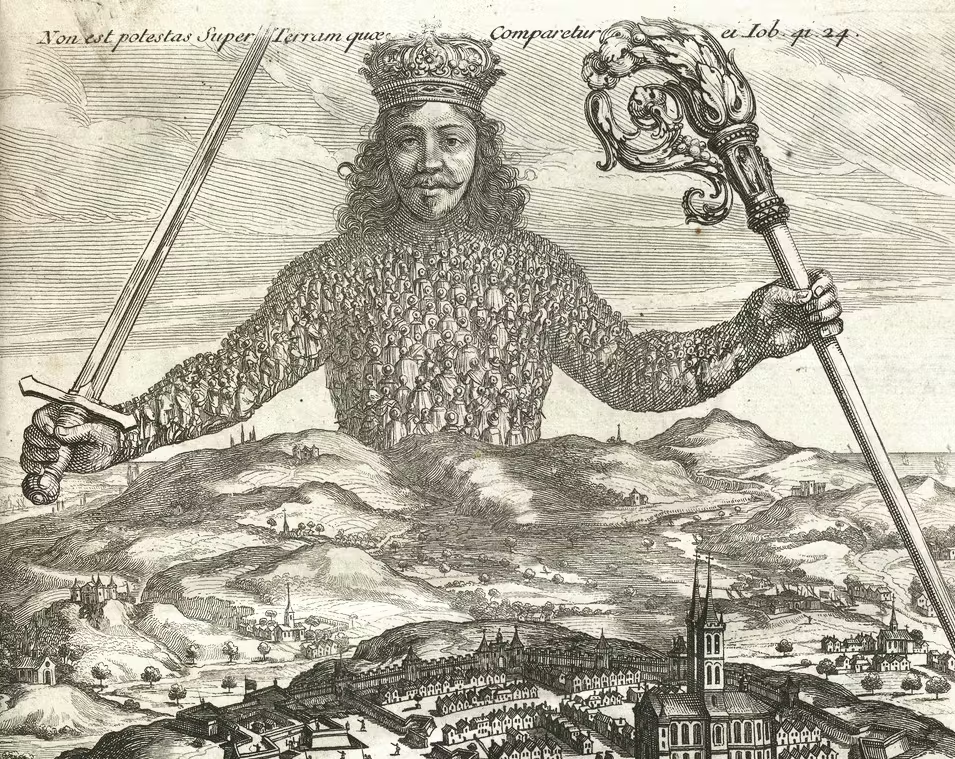
Thomas Hobbes wrote his seminal work Leviathan in 1651. In it he describes the world system as it was then as being in “a state of nature,” something that some have interpreted as anarchy. However, anarchy has order and purpose. It is not chaos. In fact, if we think of Adam Smith’s “invisible hand of the market” we get something similar to what anarchy is in practice: the aggregate of individual acts of self-interest can lead to the optimisation of value and outcomes at the collective level. Anarchy clears; chaos does not.
For Hobbes, the state of nature was chaos. Absent a “Sovereign” (i.e. a government) that could impose order on global and domestic societies, humans were destined to lead lives the were “solitary, poor, nasty, brutish and short.” This has translated into notions of “might makes right,” “survival of the fittest,” “to the victor goes the spoils” and other axioms of so-called power politics. The most elaborate of these, international relations realism, is a school of thought that is based on the belief that because the international system has no superseding Sovereign in the form of world government with comprehensive enforcement powers, and because there are no universally shared values and mores throughout the globe community that ideologically bind cultures, groups and individuals, global society exists as a state of nature where, even if there are attempts to manage the relationships between States (and other actors) via rules, norms, institutions and the like, the bottom line is that States (and other actors) have interests, not friends.
Interests are pursued in a context of power differentials. Alliances are temporary and based on the convergence of mutual interests. Values are not universal and so are inconsequential. International exchange is transactional, not altruistic. Actors with greater resources at their disposal (human, natural, intellectual) prevail over those that have less. In case of resource parity between States or other actors, balances of power become systems regulators, but these are fluid and contingent, not permanent. Geography matters in that regard, which is why geopolitics (the relationship of power to geography) is the core of international relations.
It is worth remembering this when evaluating contemporary international relations. It has been well established by now that the liberal international order of the post WW2 era has largely been dismantled in the context of increasing multipolarity in inter-State relations and the rise of the Global South within the emerging order. As I have written before, the long transition and systemic realignment in international affairs has led to norm erosion, rules violations, multinational institutional and international organizational decay or irrelevance and the rise of conflict (be it in trade, diplomacy or armed force) as the new systems regulator.
These developments have accentuated over the last decade and now have a catalyst for a full move into a new global moment–but not into a multipolar or multiplex constellation arrangement in which rising and established powers move between multilateral blocs depending on the issues involved. Instead, the move appears to be one towards a modern Hobbesian state of nature, with the precipitant being the MAGA administration of Donald Trump and its foreign policy approach.
We must be clear that it is not Trump who is the architect of this move. As mentioned in pervious posts, he is an empty vessel consumed by his own self-worth. That makes him a useful tool of far smarter people than he, people who work in the shadow of relative anonymity and who cut their teeth in rightwing think tanks and policy centres. In their view the liberal internationalist order placed too many constraints on the exercise of US power while at the same time requiring the US to over-extend itself as the “world’s policeman” and international aid donor . Bound by international conventions on the one hand and besieged by foreign rent-seekers and adversaries on the other, the US was increasingly bent under the weight of overlapped demands in which existential national interests were subsumed to a plethora of frivolous diversions (such as human rights and democracy promotion).
For these strategists, the solution to the dilemma was not to be found in any new multipolar (or even technopolar) constellation but in a dismantling of the entire edifice of international order, something that was based on an architecture of rules, institutions and norms nearly 500 years in the making. Many have mentioned Trump’s apparent mercantilist inclinations and his admiration for former US president William McKinley’s tariff policies in the late 1890s. Although that may be true, the Trump/MAGA agenda is far broader in scope than trade. In fact, the US had its greatest period of (neo-imperial) expansion during McKinley’s tenure as president (1897-1901), winning the Spanish-American War and annexing Hawai’i, Puerto Rico, Guam, American Samoa and the Philippines, so Trump’s admiration for him may well be based on notions of territorial expansionism as well.
Whatever Trump’s views of McKinley, the basic idea under-riding his foreign policy team’s approach is that in a world where the exercise of power is the ultimate arbiter of a State’s international status, the US remains the greatest Power of them all. It does not matter if the PRC or Russia challenge the US or if other emerging powers join the competition. Without the hobbling effect of its liberal obligations the US can and will dominate them all. This involves trade but also the exercise of raw (neo) imperialist ambitions in places like Greenland, the Panama Canal and even Canada. It involves sidelining the UN, NATO, EU and other international organisations where the US had to share equal votes with lesser powers who flaunted the respect and tribute that should naturally be given in recognition of the US’s superior power base.
There appears to be a belief in this approach that the US can be a new hegemon–but not Sovereign–in a unipolar world, even more so than during the post-USSR-pre 9/11 interregnum. In a new state of nature it can sit at the core of the international system, orbited by constellations of lesser Great Powers like the PRC, Russia, the EU, perhaps India, who in turn would be circled by lesser powers of various stripes. The US will not seek to police the world or waste time and resources on well-meaning but ultimately futile soft power exercises like those involving foreign aid and humanitarian assistance. Its power projection will be sharp on all dimensions, be it trade, diplomacy or in military-security affairs. It will use leverage, intimidation and varying degrees of coercion as well as persuasion (and perhaps even bribery) as diplomatic tools. It will engage the world primarily in bilateral fashion, eschewing multilateralism for others to pursue according to their own interests and power capabilities. That may suit them, but for the US multilateralism is just another obsolescent vestige of the liberal internationalist past.
Source: Northrop-Grumman.
A possible (and partial) explanation for the change in the US foreign policy approach may be the learning effect in the US of Russia’s invasion of Ukraine and Israel’s scorched earth campaign in Gaza. Trump and his advisors may have learned that impunity has its own rewards, that no country or group of countries other than the US (if it has the will) can effectively confront a state determined to pursue its interests regardless of international law, the laws of war or institutional censorship (say, by the UN or International Criminal Court), or any other type of countervailing power. The Russians and Israelis have gotten away with their behaviour because, all rhetoric and hand-wringing aside, there is no actor or group of actors who have the will or capability to stop them. For Trump strategists, these lesser powers are pursuing their interests regardless of diplomatic niceties and international conventions, and they are prevailing precisely because of that. Other than providing military assistance to Ukraine, no one has lifted a serious finger against the Russians other than the Ukrainians themselves, and even fewer have seriously moved to confront Israel’s now evident ethnic cleansing campaign in part because the US has backed Israel unequivocally. The exercise of power in each case occurred in a norm enforcement vacuum in spite of the plethora of agencies and institutions designed to prevent such egregious violations of international standards.
Put another way: if Israel and Russia can get away with their disproportionate and indiscriminate aggression, imagine what the US can do.
If we go on to include the PRC’s successful aggressive military “diplomacy” in East/SE Asia, the use of targeted assassinations, hacking, disinformation and covert direct influence campaigns overseas by various States and assorted other unpunished violations of international conventions, then it is entirely plausible that Trump’s foreign policy brain trust sees the moment as ripe for finally breaking the shackles of liberal internationalism. Also recall that many in Trump’s inner circle subscribe to chaos or disruption theory, in which a norms-breaking “disruptor” like Trump seizes the opportunities presented by the breakdown of the status quo ante.
Before the US could hollow out liberal internationalism abroad and replace it with a modern international state of nature it had to crush liberalism at home. Using Executive Orders as a bludgeon and with a complaint Republican-dominated Congress and Republican-adjacent federal courts. the Trump administration has openly exercised increasingly authoritarian control powers with the intention of subjugating US civil society to its will. Be it in its deportation policies, rollbacks of civil rights protections, attacks on higher education, diminishing of federal government capacity and services (except in the security field), venomous scapegoating of opponents and vulnerable groups, the Trump/MAGA domestic agenda not only seeks to turn the US into a illiberal or “hard” democracy (what Spanish language scholars call a “democradura” as a play on words mixing the terms democracia and dura (hard)). It also serves notice that the US under Trump/MAGA is willing to do whatever is necessary to re-impose its supremacy in world affairs, even if it means hurting its own in order to prove the point. By its actions at home Trump’s administration demonstrates capability, intent and steadfast resolve as it establishes a reputation for ruthless pursuit of its policy agenda. Foreign interlocutors will have to take note of this and adjust accordingly. Hence, for Trump’s advisors, authoritarianism at home is the first step towards undisputed supremacy abroad.
The Trump embrace of international state of nature differs from Hobbes because it does not see the need for a superseding global governance network but instead believes that the US can dominate the world without the encumbrances of power-sharing with lesser players. In this view hegemony means domination, no more or less. It implies no attempt at playing the role of a Sovereign imposing order on a disorderly and recalcitrant community of Nation-States and non-State actors that do not share common values, much less interests.
This is the core of the current US foreign policy approach. It is not about reorganising the international order within the extant frameworks as given. It is about removing those frameworks entirely and replacing them with an America First, go it alone agenda where the US, by virtue of its unrivalled power differential relative to all other States and global actors, can maximise its self-interest in largely unconstrained fashion. Some vestiges of the old international order may remain, but they will be marginalised and crippled the longer the US project is in force.
What does not seem to be happening in Trump’s foreign policy circle are three things. First, recognition that other States and international actors may band together against the US move to unipolarity in a new state of nature and that for all its talk the US may not be able to impose unipolar dominance over them. Second, understanding that States like the PRC, Russia and other Great Powers and communities (like the EU) may resist the US move and challenge it before it can consolidate the new international status quo. Third, foreseeing that the technology titans who today are influential in the Trump administration may decide to transfer there loyalties elsewhere, especially if Trump’s ego starts becoming a hindrance to their (economic and digital) power bases. The fusion of private technology control and US State power may not be as compatible over time as presently appears to be the case, something that may not occur with States such as the PRC, India or Japan that have different corporate cultures and political structures. As the current investment in the Middle Eastern oligarchies shows, the fusion of State and private techno power may be easier to accomplish in those contexts rather than the US.
In any event, whether it be a short-term interlude or a longue durée feature of international life, a modern state of nature is now our new global reality.
Dean Gonzalez, distinguished faculty members, ladies and gentlemen,
Most importantly, graduates,
Let me begin with the most important word of all: congratulations!
You now join a long line of Sciences Po alumni who have shaped our world – including some of whom are doing it every day at the United Nations as they work in my office supporting the Secretary-General.
Let’s also take a moment to recognise your families, friends and loved ones – who have been with you every step of the way.
They deserve a round of applause.
Students representing more than 120 nationalities come here to learn how the world works, and how it can work better.
That spirit of global curiosity and purpose has also carried me through every chapter of my own journey.
Designing schools and hospitals in my home country of Nigeria.
Advising four Presidents on poverty reduction, development policy planning and public sector reform.
Supporting Member States to lead the process that transformed global aspirations into the Sustainable Development Goals.
And now as the longest-serving Deputy Secretary-General in United Nations history, supporting the Secretary-General on some of the most complex situations in our history, from COVID, to Ukraine, to Sudan and Gaza and today’s continuing crisis in the Middle East.
Today, I want to reflect on the lessons I have learned along the way.
First, don’t agonise, organise.
We live in a world of hurt. A world that is messy, complicated and often overwhelming.
And I know it might be easy to feel paralyzed by the scale and hopelessness of today’s challenges.
Don’t.
Because more than ever, those challenges are connected – and we solve them by seeing those connections and coming together.
When I served as Nigeria’s Minister of Environment, my job was never just about the environment.
When Lake Chad was drying up, it wasn’t just an ecological crisis – it was a security crisis. Boko Haram was born and abducted 200 school girls.
When we faced population and urban sprawl and tensions rose between farmers and herders, it wasn’t just about water access– it was about food systems and growing cities.
When I met girls walking hours to fetch water, missing school every day – it wasn’t just about resources – it was about gender equality.
We didn’t work in siloes. We built coalitions across sectors – civil society, young people, traditional leaders, the private sector – to find real solutions.
We didn’t agonize, we organized.
And, yes, there’s plenty to agonize about today – especially when multilateralism is under attack and international cooperation is on the back foot.
But I have seen what’s possible when we find common ground and forge ahead.
Just look at the last two months at the UN.
A landmark Pandemic Treaty approved at the World Health Organization.
Major new protections for our oceans at the World Ocean Conference in Nice.
And from Paris, I head to Sevilla — where the world is coming together to commit to better finance sustainable development.
So, when the problems seem larger than life, too tangled, too tough — don’t agonize.
Organize.
Mobilize.
And help realize the change our world so urgently needs.
Remember you did not fail for want of trying.
The second lesson – keep learning and delivering.
Graduation isn’t the end of learning. In many ways, it’s just the start of your lifelong journey.
When I joined the UN, I was not steeped in the intricacies of international diplomacy.
Throughout my career, I have had to learn fast – and deliver even faster.
So will you.
Even now, I am learning every day – about AI, about geothermal energy, space debris, biotechnology, cybersecurity.
You will face even more change, even faster, especially in the new era of super technologies.
Regardless of the task that is put in front of you, get ahead of it. Learn more. Do more. Show your stuff and deliver. Performance opens doors.
Yes, some of life is luck and privilege.
But I guarantee: the harder you work, the luckier you will get.
Third, make hope your most powerful asset. The world is a cynical place. And international affairs is not for the faint of heart.
There will be setbacks and critics.
There will be many days when the problems seem too big, and the politics too small. When anxieties grip you like a fever.
Just look around: war in Ukraine, atrocities in Sudan, catastrophe in Gaza, climate chaos everywhere.
But never forget, hope is not a four-letter word.
Hope is the courage to build when others are tearing down.
Hope is the decision to get up one more time, to negotiate one more deal, even when the odds are against you.
I have sat with young girls who survived the worst horrors of war and sexual violence.
And in their eyes, I saw not just pain – but power.
The power to heal. To lead. To hope. To survive and thrive.
Hope is not the absence of fear. It is the refusal to be defined by it.
So, carry it with you. Guard it fiercely.
Because hope is not just a feeling. It’s a force.
Fourth, hold onto your moral compass.
Your degree will open doors.
But your integrity will tell you which ones are worth walking through.
And in today’s world – where the global moral compass is spinning – that clarity matters more than ever.
We live in a world where military spending is soaring, while development budgets shrink.
Where fossil fuel subsidies dwarf investments in climate action.
Where conflict and hardship has forced more people from their homes than at any time since the Second World War.
In this world, your role as changemakers is not just to make the right deals.
It is to draw the right lines.
There will be pressure to stay silent.
There will be moments when abandoning principles may seem an easier choice.
But integrity matters most.
As Deputy Secretary-General, I have had to tell hard truths to powerful people.
To remind leaders of the many promises they made – and the people they made them to.
It is never easy to challenge power.
But we don’t serve power.
We serve people.
And if we truly serve people, we must use our superpower and stand for justice, dignity, and solidarity.
As we mark Beijing+30, we cannot talk about a future and leave women and girls behind.
Gender equality is not charity. It powers our agency. And human rights.
And everyone wins when we leave no one behind.
But let’s be honest, we are not there yet.
So, to the men here today, I say: don’t stand in the way.
Don’t walk ahead.
Walk with. Stand with. And speak up. For the other half of your society, women.
The final lesson is this: invest time in what truly sustains you.
Your career will have highs and lows.
Plans change.
Titles come and go.
But what will carry you through are the people who know you beyond your résumé.
Friends, families, mentors, partners.
Protect those bonds. Nurture them.
Because in the toughest moments, those relationships will remind you of who you are, why you started, and why you must keep going.
So, no matter how far you go, or how fast — never lose sight of what, and who, matters most.
Dear graduates,
Today, you are not just stepping into the world.
You are inheriting its unfinished business, and its boundless possibilities.
As I look out, I see the next generation of climate champions, human rights defenders, and world class diplomats.
And I am filled with hope.
Whatever path you choose, walk it with courage and conviction.
Congratulations, Class of 2025.
The world is waiting.
And I, for one, can’t wait to see what you will do.
On 21–23 May, Minister for Social Services Camilla Waltersson Grönvall and Minister for Older People and Social Security Anna Tenje visited Lviv, Ukraine. While in Ukraine, Ms Waltersson Grönvall and Ms Tenje took part in the Ministerial Social Policy Summit, which Sweden co-hosted together with Ukraine, Moldova and Lithuania. Ministers from several EU countries were also in attendance.
Source: United States Senator for Kansas Roger Marshall
Senator Marshall Joins Fox News to Discuss the Reconciliation Bill, Medicaid, and Operation Midnight Hammer.
Washington – On Saturday, U.S. Senator Roger Marshall, M.D. (R-Kansas), joined Rich Edson on Fox News’ Fox News Live to discuss the Senate’s latest timeline to move the reconciliation bill forward, the negotiations around the SALT deduction, the best way to save Medicaid for those who need it most, and what’s next for America in the ongoing conflicts abroad.
Click HERE or on the image above to watch the full interview.
On the Republican reconciliation bill:
“In my career as an obstetrician, I feel like this bill is three weeks past its due date. It’s time to have the baby. Everyone’s upset – that means we’re probably close to where it needs to be. We cannot blow this chance. This is the President’s legacy, his agenda. If you supported President Trump, you should support this bill. This will be the largest tax decrease in American history. We’re going to secure the border – a whole lot of other good things, but mostly this is the beginning of America’s great, golden era.”
On the SALT Deduction and its impact on negotiations:
“… Over in the house, I think we have a little tighter margin. And again, I think that what we asked the President to do here was split the baby, but he’s keeping the baby together. This is the best we can get. Speaker Johnson was there with us yesterday, negotiating this to the last second. I think everyone has thrown their best argument on the table – I think that’s a great step forward. I wish we were cutting more spending, including this, but this is the best bill that we can get through the finish line.”
On how to save Medicaid from disaster:
“Again, just because you have Medicaid doesn’t mean you have access to care. You pointed out that a third of doctors don’t accept Medicaid, and another third basically rule them out through the schedule. What our bill does is give a block grant for rural hospitals and for Community Health Centers. One of my three pillars of MAHA is making sure that everyone has meaningful, affordable access to primary care. Even Bernie Sanders agrees with me that these Community Health Centers are a great way to do that. I think that healthcare will be better.
“And in this bill, we absolutely preserve Medicaid for those who need it the most. We don’t touch seniors in nursing homes, people with disabilities, pregnant women, or children. So, we will protect Medicaid for those who need it the most. And on the other hand, we want to make sure everyone has access to care. We’ll do it through a block grant – I’m so proud of the work we’ve done here, as far as making health care more affordable and more accessible.”
On where the Medicaid savings will come from:
“So, the savings come from a couple of things. One, something called a provider tax, which is absolutely a scam, a money laundering scam, where you have one state, maybe getting 25 times more per person than what a state like Kansas is getting. So, we need to level out those provider taxes.
“And then, as we talk about people that may lose Medicaid, half of them are people that are on it fraudulently or through some type of error. And the other half will be those that are refusing to work 20 hours a day. Again, 60, 70% of Americans support some type of work requirements if you don’t have a disability, you’re working age, you don’t have a child under the age of 13, then I think it’s reasonable to ask people to work or volunteer for 20 hours a week.”
On what’s next for America in the Israel and Iran conflict:
“I think it will take them years just to restart their nuclear program. I think that they can’t control their airspace. They don’t have the will to do it. From what I’ve seen, I’m in shock and awe. You know, it’s shocking how much damage we did to their facilities. Obliterated is a great term. I’m in awe of our military, the great job that they did.
“Thanks to all those Air Force guys who did this off. I’m an Army guy, but I’m still going to salute them. They did a great job. And thanks to all of our soldiers over in the Middle East, I don’t see Iran getting back in this ball game for several years.
“Iran cannot have any type of nuclear bomb if they don’t want to move things in a different direction right now, then we need to double down on our sanctions. Whatever we need to do. Look, I don’t want boots on the ground. I’m tired of all the killing. I want all the killing to stop in Gaza, in Iran – all these different places, Ukraine. But at the end of the game, Iran cannot have a nuclear warhead.”
Source: Africa Press Organisation – English (2) – Report:
Download logo
We welcome the signing of the peace agreement between the Democratic Republic of the Congo and the Republic of Rwanda.
This important achievement for Africa and international security has been made possible thanks to the decisive role of the United States and personally President Donald Trump, as well as a number of countries and international organizations.
In particular, we commend the constructive efforts of the Presidents of Angola and Kenya, the African Union, the East African Community, the Southern African Development Community, and the United Nations.
The State of Qatar has made a significant contribution to advancing the peace settlement, especially by ensuring complementarity and coherence among various mediation initiatives.
Ukraine highly values the effective mediation by the United States. We congratulate U.S. Secretary of State Marco Rubio and American diplomacy on this achievement. The active involvement of the American side in the negotiation process played a decisive role in reaching and signing the peace agreement.
We hope for the responsible efforts of both parties in implementing the peace agreement and in ensuring lasting peace and security in the Great Lakes region. This will create favourable conditions for strengthening the economic potential and social stability of the states in the region, improving their investment attractiveness, and deepening economic ties with other countries.
Ukraine reaffirms its commitment to comprehensively intensify mutually beneficial cooperation with the countries of the region, including a readiness to contribute meaningfully to achieving their socio-economic development goals.
We are confident that the United States can play a similarly decisive role in achieving a just peace and ending Russia’s war of aggression against Ukraine. This peace agreement demonstrates that it is possible to stop the killing and restore peace even under challenging circumstances, when the international community acts resolutely and the parties participate in the peace process in good faith.
We emphasize that the foundation of the peaceful settlement between the Democratic Republic of the Congo and the Republic of Rwanda is based on the fundamental principles of the UN Charter, including the mutual obligation of states to respect each other’s territorial integrity and sovereignty within internationally recognized borders, to refrain from the threat or use of force, to avoid interference in internal affairs, and to facilitate the return of refugees and internally displaced persons.
It is precisely these universally recognized principles of international law that underpin Ukraine’s proposals for ending the war in Europe and restoring a comprehensive, just, and sustainable peace for Ukraine.
– on behalf of Ministry of Foreign Affairs of Ukraine.
After eight years of renovations, the Waldorf Astoria in New York has reopened and is welcoming new guests. The Waldorf – as most people know it – introduced room service, velvet ropes, red-velvet cake and Thousand Island dressing. It gave its name to a salad, a chain of lunchrooms, as well as a now obscure form of democracy.
In 1907, the novelist Henry James said the Waldorf embodied what he called the “hotel spirit”: it was a place where everyone was equal – as long as they could afford the price of admission. To James, hotels defined America’s emerging culture and ideals. He said this new “spirit” was one of opportunity; of a new elite that was accessible not only by lineage, but by money.
As the historian and journalist David Freeland wrote, the Waldorf generally made room for all who were “able and ready to pay” and who displayed a willingness to “conduct themselves properly”. The Waldorf ethos was developed by its first maître d’, Oscar Tschirky – known simply as “Oscar of the Waldorf” because people struggled to pronounce his name. “Our innovations were startling and sensational”, Tschirky said in his ghost-written autobiography in 1943, “but they were always genteel”.
Those early innovations included the invention of the “presidential suite”, which saw the hotel become an unlikely early force for American feminism when it became a hub of high-level talks between suffragists and President Woodrow Wilson.
The Waldorf, then, is an American institution – or, at least, it used to be.
It is now in the hands of Chinese owners and has been shunned by presidents since Barack Obama, worried over potential security risks. The brand itself has been watered down as there are currently 32 “Waldorf Astorias” dotted around the globe.
The story of the Waldorf encapsulates modern America’s crisis of the establishment. Few places better personify the creation of the US version of the establishment (much more about money than breeding or class). And in the past decade, the hotel’s position, like the US establishment more generally, has come under assault by a rival hotel owner, Donald Trump.
The Insights section is committed to high-quality longform journalism. Our editors work with academics from many different backgrounds who are tackling a wide range of societal and scientific challenges.
Trump has his own ideas about how to use these modern palaces to project power – and his innovations are anything but genteel. So what can the beginnings of this former American institution tell us about America today? As a researcher of political and democratic institutions, I have been examining the role of hotels in the story of American democracy. And this particular story begins with a Swiss-born waiter.
Oscar of the Waldorf
Tschirky was born in the Swiss Alpine village of Le Locle in 1866. He and his mother boarded the steamer La France in 1883, bound for New York. In his book, he recalled his mother’s announcement:
Yes, Oscar, we’re going to go to America and live with your brother in that great land of plenty where we can have everything we’ve always wanted.
That night, according to his book, was “the beginning of Oscar’s career as beloved servitor and counsellor to the great and near great of this world”.
Although it would be ten years after arriving in New York, that Tschirky would join the Waldorf (which was just about to open) as maître d’. His contract and salary commenced on January 1 1893, ahead of the grand opening of the Fifth Avenue hotel in March. He would occupy his post for the next half-century as “host to the world”.
Tschirky would remain in place as the hotel expanded in 1897 when John Jacob Astor IV built and connected the larger, taller Astoria Hotel next door. Then in 1931 the hotel was forced to relocate when its Fifth Avenue location was razed for the Empire State Building. The “new” Waldorf Astoria New York reopened on Park Avenue with the addition of its famous towers, making it the tallest hotel in the world at the time.
Tschirky was born just one year after the end of the American Civil War. It was an America of Jim Crow laws and segregation. He would live to see women’s suffrage, but not the civil rights reforms of the mid-1960s.
In this turbulent context, it appears that Tschirky did his best to keep the Waldorf out of politics. He stuck to the advice given by the Waldorf’s manager, George Boldt (himself a German immigrant) who told him that it was “not up to the hotel to settle international affairs”.
Tschirky came to understand, realise, and represent the “hotel spirit” of a new America as he presided over the establishment of hotels as American palaces: not only for visitors, but for the new American aristocracy.
A presidential palace
The Waldorf famously hosted every US president from Grover Cleveland to Franklin Roosevelt. In spring 1897, Cleveland was at the Waldorf with members of his former cabinet, who wanted him as Democratic candidate in the 1900 election. This was the first reported instance of “Waldorf democracy” – in this case, the term was used to identify this new group within (and in some respects differentiate it from) “the democracy”, that was the Democrats.
President Grover Cleveland (sitting on the far left) and his cabinet, between 1895 and 1896. Shutterstock/Everett Collection
This politics was not embraced by all. As reported in The Ohio Democrat, Congressman Edward W. Carmack of Tennessee dismissed it as “the walled-off Democracy, because they are by themselves, representing nobody, and unable to influence a vote”.
Nevertheless, political elites liked the luxury that the Waldorf offered. Presidential suites were established during Woodrow Wilson’s presidency (1913-21). In the Waldorf, this famous suite emulates the furniture of the White House and still contains several presidential souvenirs, (including John F. Kennedy’s rocking chair).
The hotel was also popular among the famous “Four Hundred of the Gilded Age” – the highest echelons of New York society. The group was originally led by Caroline Schermerhorn Astor. The Astors’ ancestral family home, the town of Walldorf, in western Germany, had even given the hotel its name. According to Tschirky’s book, the Waldorf’s grand ballroom was:
… where Teddy Roosevelt had dined, where presidents McKinley, Taft, Wilson, Harding, Coolidge and Hoover had spoken historic words to the nation, where princes of royal blood had been welcomed, where the great people in every walk of life had been honored.
The Waldorf proved a suitable palace for US presidents and their entourages and Tschirky, a suitable “servant”. When interviewed by Washington DC’s Evening Star, Tschirky “wouldn’t talk about presidents except to say that Franklin D. Roosevelt calls him, ‘my neighbor across the Hudson’”.
But Tschirky, “for all his celebrity acquaintances, never forgot that he was, in the end, a servant”, as Freeland wrote. The Waldorf likewise applied the term to its staff.
Exclusivity, exclusion and ‘democracy’
The world famous hotelier Conrad Hilton, who acquired the Waldorf in 1949, recalled in his autobiography, Be My Guest:
Originally the Waldorf was said to purvey exclusiveness to the exclusive. Later [the writer and artist] Oliver Herford announced that it ‘brought exclusiveness to the masses’. But that exclusiveness remained whether the hotel catered to a convention of three thousand or a tête-à-tête between crowned heads.
The Waldorf ethos projected “taste” and imbued it in others. Tschirky “subtly schooled Americans in fine European dining”. In 1956 – six years after Tschirky’s death – the New York Times recalled that, alongside Boldt, he undertook to teach people how to spend their money. The Waldorf embodied good taste by enforcing it, for example in its expectation of “proper conduct”.
But with exclusivity comes exclusion. Hence, the hotel’s introduction of the velvet rope. According to the Waldorf’s luxury suite specialists, this was done “to create order … the fact that it created a sense of stature and separation was secondary”.
Tschirky’s statement that “all who pay their bills are on an equal footing” reflects one of his “rules for success”:
… be as courteous to the man in a five dollar room as to the occupant of the royal suite. It is an old rule, but it never changes.
We can see from this mindset how the hotel was seen to possess, as American Studies scholar Annabella Fick put it, “a democratic quality … even though it is also elitist. In that, it invokes the democratic understanding of early America, which also differentiated between land-owning gentry and the mob”.
This was not the only differentiation. Just two years after the Waldorf opened, the 1895 New York State Equal Rights Law (commonly known as the Malby Law) – which aimed to abolish racial discrimination in public places – had aroused Boldt’s indignation. According to Freeland, Boldt described the law to reporters as “an outrage, as it prevents us from making any selection of our patrons. A man who runs a first-class hotel must respect the wishes of his guests as to the sort of people that he entertains, and the law should not dictate to him.”
In his paradoxical desire for the freedom to discriminate and persecute as he wished – and on behalf of his customers, real or imagined – Boldt illustrated the exclusion inherent in exclusivity. Boldt’s statement also presaged a system of informal segregation, in which Black Americans were allowed in the Waldorf (and elsewhere), but were certainly not welcome.
Despite this the Waldorf was at the heart of a fundamental shift in American culture which “invited” ordinary Americans access beyond the velvet rope – as long as they could afford it. As James McCarthy and John Rutherford said in their 1931 book, Peacock Alley: “The average man and woman … frowned upon grand display – chiefly because the average person knew it was beyond his or her own horizon of enjoyment. The arrival of the Waldorf, however, was an invitation to the public to taste of this grandeur.”
And it wasn’t just the paying customers. During its 30th anniversary in 1923, the Waldorf elevated its staff – its servants – to the level of guests. Reporters for the Birmingham Age-Herald noted: “Practically the entire staff of the hotel were guests … the affair reached the topnotch of Waldorf democracy, for the waiters and financiers, telephone girls and captains of industry, coat-room clerks and merchant princes sat side by side and swapped reminiscences with each other.” The article continues:
Oscar sat [at] the head of his own table as guest of honor. For a brief time Oscar was no longer the solicitous host … For an hour or two Oscar was himself the guest, and the entire kitchen menage of the Waldorf-Astoria was kept hopping filling his wants and those of his fellow guests.
Oscar and his wife Louise, in the Birmingham Age-Herald above ‘Father Knickerbocker’ – a personification of New York City (hence The Knicks) – celebrating the Waldorf at 30. Library of Congress
But being a guest was a temporary experience.
The “Waldorf democracy” described during this event – of people from every walk of life and status mixing and socialising – was very different to that of the Cleveland entourage. It was not party-political, but institutional.
Democracy meant different things, at different times, within the Waldorf; just like in the broader US. The Waldorf, in turn, began to change, and perhaps even lose its meaning within the US by the time of Obama’s presidency.
Chinese ownership
The Waldorf lost its status as presidential palace in 2014. It was bought for $1.95bn by a Chinese company that was later seized by the Chinese government. Security concerns a year later prompted President Obama to stay at the Lotte New York Palace Hotel instead.
Obama’s choice of where to stay – and where not to stay – was widely discussed in the media. The decision was seen to “break with decades of tradition”. ABC News recognised and portrayed it as the end of an era, bidding “Goodbye to the Waldorf Astoria, welcome to the Lotte New York Palace Hotel”. This new era was also framed in geopolitical terms, for example by the New York Times:
With Chinese spies rummaging through White House emails, President Obama has decided not to risk making their spying any easier: He will break with tradition and abandon the Waldorf Astoria … Mr. Obama and other officials will instead take up residence a few blocks away at the Lotte New York Palace.
The same article also pointed out that “hotels have long represented a weak link in security for travelling officials and others”. In fact, Nikita Khrushchev had once got stuck in an elevator at the Waldorf, and “probably thought it was an attempt to assassinate him”.
Covering up an assassination as an “elevator accident” is probably not what Hilton had in mind when he envisaged his hotels as “a means of combating communism”. On the contrary – as Professor Mairi Maclean, a researcher of business elites, put it – Hilton envisaged hotels as a means of “facilitating world peace through international trade and travel”.
Women’s suffrage
It may not have brought about world peace, but the Waldorf did play a part in certain moments of US history because it was always seen as a key arena to lobby rulers, most notably in 1916. Women’s suffrage in America was still four years away. On one side of the debate (and the Waldorf itself) were two hundred suffragists, occupying the East Room. On the other was Woodrow Wilson, occupying the Presidential Suite.
Tschirky recalled being “appointed diplomatic courier … and delegated to carry the first communiqué of the morning … In the midst of it all I stood my ground, swearing myself an ice cold neutral”.
Though neutral on the question of suffrage, Tschirky was willing to reduce boundaries within the hotel, especially if it was good for business. Even as the hotel was being built, Tschirky remembered that “there was not, in all America, such a thing as a motor car, a radio … Nor were cocktails ever seen in private homes; or divorces tolerated in society; nor did women smoke, or wear dresses above their ankles”.
Then in 1907 a notice was put up in the Waldorf: “Women would be served in the hotel restaurants at any time, with or without male escorts.” Freeland noted Tschirky’s simple confirmation that: “We will serve women. What else can you do in a hotel?”
Crowd of women’s suffrage supporters demonstrating with signs reading, ‘Wilson Against Women’, in Chicago on October 20, 1916. Wilson withheld his support for Votes of Women until 1918. Shutterstock/Everett Collection
A few years later, discussing women’s right to smoke in the dining rooms, Tschirky said: “We do not regulate the public taste. Public taste does and should regulate us.”
During the Waldorf’s 30th anniversary in 1923, newspapers such as El Imparcial celebrated it as “a civic asset of unique importance. And to its other accolades must be added that of contributing effectively to the progress of feminism. It was a memorable day in the women’s rights movement when The Waldorf Astoria granted female access to the Peacock Alley.”
Nevertheless, even the naming of Peacock Alley – a corridor in the hotel that became an important place of congregation, especially for women – was a recognition of exclusivity. It was where people gathered to parade themselves. As the recollection goes in Tschirky’s memoirs: “The Waldorf Hotel was a triumphant picture of the Best People at their best”.
Trump
With their ostentatious decor and gilded interiors, Trump’s hotels could be seen as the modern incarnation of Peacock Alley.
But the tenets of politeness, respect and decorum that Tschirky set down seem like echoes from another age when compared to a recent AI video showing Trump and Israeli Prime Minister Benjamin Netanyahu sitting shirtless at a pool with drinks at an imaginary “Trump Gaza hotel”. The video appears to have been a spoof, but that didn’t stop the president from sharing it on Truth Social, his own social media platform, and Instagram.
Like Hilton (who was immortalised in Mad Men, demanding a Hilton on the moon) hotels have always been a part of Trump’s brand. Trump recalled, in How to Get Rich, that his “first big deal, in 1974, involved the old Commodore Hotel site near Grand Central Station” on 42nd Street.
The former Trump International Hotel in Washington DC, opened in 2016, was described as “the epicenter of the president’s business interests in [the capital]”. It was also “a popular choice for lobbyists and Republican Congress members during Trump’s presidency”.
“The Trump Organization sold the hotel’s lease to CGI in 2022, when the hotel was reflagged as a Waldorf Astoria”, though Trump’s firm is rumoured to be in talks to reacquire it.
Another similarity between Hilton and Trump is their use of hotels as symbols for the nation. Each hotel of Hilton’s was envisaged as a “Little America”, “to show the countries most exposed to communism the other side of the coin”.
It had all of the ingredients of greatness, but it had been neglected and left to deteriorate for many many decades … It had the foundation of success. All of the elements were here. Our job is to restore our former glory, honor its heritage, but also imagine a brand new and exciting vision for the future.
Forbes commented that this event “could’ve easily been mistaken for a Trump rally”, for example in his statement that “my theme today is five words: ‘under budget and ahead of schedule’ … We don’t hear those words too often in government – but you will!”
Similarly, in an interview with the New York Post, Trump’s son Eric Trump used familiar Maga rhetoric: “Our family has saved the hotel once. If asked, we would save it again”.
What would Tschirky have made of all this? As a political neutral he would have decried Trump’s frequent hotel plugs during political campaigns. No doubt his behaviour would have seemed crass.
Perhaps this reflects two different eras of hotels and their intended functions. Grand hotels such as the Waldorf were shaped by European colonialism, by immigrants like Tschirky and Boldt. But as historian Annabel Wharton describes, the Hiltons “were constructed not, as in the nineteenth century, to meet an established need, but to create one. They suggest that this pressure was not produced simply by the desire for profit, but from a remarkable political commitment to the system that promoted profit-making”. I think we can read Trump’s hotels, and now his politics, in the same way.
The hotel spirit has entered a new phase with Trump’s proposals to “own, level, and develop” the Gaza Strip and create a “Riviera of the Middle East” – riding roughshod over the democratic will of Palestinians in Gaza who dismissed Trump’s vision.
Less than two decades after opening, Tschirky remarked that “many of the great events, financial, diplomatic, political, had had their inception within [the Waldorf’s] stone walls”. For him, it was “an international crossroad where men from all lands came to exchange goods and ideas” and to plan the changes in the world which he would later see come to pass.
Tschirky saw hotels as the most democratic places on Earth. But the “hotel spirit” he espoused – that uniquely American narrative within which he “became a citizen almost overnight” (a feat that seems vanishingly unlikely today) – seems to have been consigned to the past.
“I know that better times will come again”, he says in the preface to his book, “but in terms of the past, I think I have seen the best. New York has changed. America has changed.”
To hear about new Insights articles, join the hundreds of thousands of people who value The Conversation’s evidence-based news. Subscribe to our newsletter.
Alex Prior does not work for, consult, own shares in or receive funding from any company or organisation that would benefit from this article, and has disclosed no relevant affiliations beyond their academic appointment.
The Government of Canada announced the implementation of tariff rate quotas (TRQs) on imports of steel mill products from non-free trade agreement partners, effective June 27, 2025. This measure will help stabilize the Canadian market and prevent harmful diversion of foreign steel from third countries into Canada while minimizing impacts on Canadian importers and downstream users.
The Government of Canada announced the implementation of tariff rate quotas (TRQs) on imports of steel mill products from non-free trade agreement partners, effective June 27, 2025. This measure will help stabilize the Canadian market and prevent harmful diversion of foreign steel from third countries into Canada while minimizing impacts on Canadian importers and downstream users.
The TRQs will be administered on the basis of five steel product categories: flat, long, pipe and tube, semi-finished, and stainless steel (see Annex A for list of tariff classifications applicable to each category). A 50 per cent surtax will be applied on imports of covered products that exceed the specified quantity threshold from non-FTA partners.
The quotas will be reviewed in 30 days to ensure their appropriateness and effectiveness in light of evolving market circumstances, and periodically thereafter. The reviews will be supported by the newly established industry-government steel task force.
Administration of the Tariff-Rate Quotas
Global Affairs Canada will be responsible for administering the quota of products that may be imported without this additional surtax through the issuance of shipment-specific import permits. To facilitate the administration of the TRQs, the subject products are being added to the Import Control List. Importations made without the applicable shipment-specific import permit will be assessed the 50 per cent surtax by the CBSA. This surtax would be additive to any existing surtaxes or anti-dumping and countervailing duty measures, as well as forthcoming tariff measures based on the country of “melt and pour” for steel or “smelt and cast” for aluminum.
Key elements of the tariff-rate quota include:
Total quota volume: For each of the five steel product categories, a limit is imposed on the quantity of goods that may be imported without a surtax. The one-year limit corresponds to all of 2024 imports from non-FTA countries.
Quota periods: The annual quota will be administered on the basis of three-month quarterly periods. Once the quota for a category in a quarter has been filled, imports under that category will be subject to a surtax for the remainder of that period. Any quota remaining at the end of a quarter will be rolled over into the following one.
Country share limit: For each category, there is a limit on the share of the total quarterly quota that imports from a single country of origin can fill. The limits are based on historical trade patterns. If imports from a country reaches the specified limit in a category, all subsequent imports from that country in that category will be subject to the surtax, until the end of the quarter.
See Annex B for additional details on the tariff-rate quota volume and limits.
The TRQs will apply to imports originating in any country that does not have a free trade agreement in force with Canada. The list of countries excluded from the tariff-rate quotas are set out in Annex C.
Global Affairs Canada and the Canada Border Services Agency will be responsible for administering the tariff-rate quota for each steel product category. Additional information on the administration of these measures can be found at the links below:
GAC Notice to Importers (will follow)
CBSA Customs Notice (will follow)
Annex A – Steel Products Subject to Provisional Safeguards
The Council Implementing Decision 2022 /382[1], establishing the existence of a mass influx of displaced persons from Ukraine and having the effect of introducing temporary protection, specifies in Article 2(1) and (2) the categories of persons who receive temporary protection and their rights.
Member States must ensure that beneficiaries of temporary protection on their territory enjoy these rights. For further information on the obligations of Member States, the Commission refers the Honourable Member to the guidance documents and operational guidelines[2].
According to Article 64(1) of the Asylum and Migration Management Regulation (AMMR)[3], financial contributions consist of transfers from the contributing Member States to the EU budget.
Pursuant to Article 64(2) of the AMMR, the benefitting Member States shall identify actions eligible for funding, and the Commission shall collaborate closely with them to ensure that those actions correspond to the objectives of the Annual Solidarity Pool (Articles 56(2)(b) and 56(3)) of the AMMR.
The Commission is working on the assessment of migratory pressure, risk of migratory pressure and significant migratory situation. The assessments of these situations will be based on both quantitative and qualitative data, in accordance with Articles 9 and 10 of the AMMR.
[1] Council Implementing Decision (EU) 2022/382 of 4 March 2022 establishing the existence of a mass influx of displaced persons from Ukraine within the meaning of Article 5 of Directive 2001/55/EC, and having the effect of introducing temporary protection, OJ L 71, 4.3.2022, p. 1-6 (https://eur-lex.europa.eu/eli/dec_impl/2022/382/oj/eng).
[3] Regulation (EU) 2024/1351 of the European Parliament and of the Council of 14 May 2024 on asylum and migration management, amending Regulations (EU) 2021/1147 and (EU) 2021/1060 and repealing Regulation (EU) No 604/2013, OJ L, 2024/1351, 22.5.2024 (http://data.europa.eu/eli/reg/2024/1351/oj).
The EU has imposed unprecedented restrictive measures (sanctions) in response to Russia’s war of aggression against Ukraine, including far-reaching trade restrictions in several economic sectors, and specific financial measures against Russian individuals and entities.
As the Honourable Member is aware, these sanctions are adopted under the EU’s Common Foreign and Security Policy and are aimed to maximise their impact on Russia’s ability to conduct and finance its war of aggression.
On 10 June 2025, the Commission President and the High Representative/Vice-President[1] stated that the joint proposal for the 18th sanctions package includes, among other measures, sanctions on the Nord Stream pipelines.
This measure should prevent Russia from generating any revenue in the future by using those pipelines to transport natural gas. Those future measures are currently discussed in the Council and require a unanimous adoption.
The proposals and the negotiations in the Council are not public. Hence, the Commission is not able to comment further on measures prior to their adoption in the Council.
The Commission will continue to cooperate and coordinate closely with Member States and operators on the implementation and enforcement of sanctions once they are adopted.
The EU has imposed unprecedented restrictive measures (sanctions) in response to Russia’s war of aggression against Ukraine, including far-reaching trade restrictions in several economic sectors, and specific financial measures against Russian individuals and entities.
As the Honourable Member is aware, these sanctions are adopted under the EU’s Common Foreign and Security Policy and are aimed to maximise their impact on Russia’s ability to conduct and finance its war of aggression.
On 10 June 2025, the Commission President and the High Representative/Vice-President[1] stated that the joint proposal for the 18th sanctions package includes, among other measures, sanctions on the Nord Stream pipelines.
This measure should prevent Russia from generating any revenue in the future by using those pipelines to transport natural gas. Those future measures are currently discussed in the Council and require a unanimous adoption.
The proposals and the negotiations in the Council are not public. Hence, the Commission is not able to comment further on measures prior to their adoption in the Council.
The Commission will continue to cooperate and coordinate closely with Member States and operators on the implementation and enforcement of sanctions once they are adopted.
Source: United Nations General Assembly and Security Council
NEW YORK, 27 June (Division for Ocean Affairs and the Law of the Sea) — The thirty-fifth Meeting of States Parties to the United Nations Convention on the Law of the Sea was held at Headquarters from 23 to 26 June. The background press release can be found at: https://press.un.org/en/2025/sea2232.doc.htm and https://press.un.org/en/2024/sea2195.doc.htm.
The Meeting elected Nguyen Minh Vu (Viet Nam) as President, by acclamation. Milan Jaya Nyamrajsingh Meetarbhan (Mauritius), David Antonio Giret Soto (Paraguay), Laura McIlhenny (Australia) and Mykola Prytula (Ukraine) were elected as Vice-Presidents, also by acclamation.
The Meeting took note of the annual report of the International Tribunal for the Law of the Sea for 2024, as well as the information reported by the Secretary-General of the International Seabed Authority and the Chairperson of the Commission on the Limits of the Continental Shelf, on the activities of these bodies since the thirty-fourth Meeting of States Parties held in 2024.
In his capacity as Co-Coordinator of the Open-Ended Working Group on the Conditions of Service of Members of the Commission on the Limits of the Continental Shelf, John Pangipita (United Republic of Tanzania) delivered a report on its work since the thirty-fourth Meeting. Following the resignation of Sidney Kemble (Netherlands), the Meeting decided to defer the consideration of the appointment of a Co-Coordinator of the Open-Ended Working Group from developed States until the thirty-sixth Meeting of States Parties and that the Working Group would continue to function for the time being under the coordination of Mr. Pangipita.
The Meeting conducted a by-election for vacancies in the Commission allocated to members of the Commission from the Group of Eastern European States and the Group of Western European and Other States, electing Stig-Morten Knutsen (Norway) for a term of office commencing on the date of the election and ending on 15 June 2028.
In the absence of other nominations, the Meeting decided in respect of the vacant seat allocated to members of the Commission from the Group of Eastern European States, which had remained unfilled since 2015, that the Secretary-General would circulate a call for nominations with a view to conducting elections at the thirty-sixth Meeting of States Parties in 2026, if the President received information about potential candidates no later than 1 March 2026. If a candidate had not been identified by that date, the Group should transmit, by the same date, a proposal on how to address the ongoing vacancy.
In its consideration of administrative and budgetary matters of the Tribunal, the Meeting took note of the report on budgetary matters for the financial periods 2023 and 2024 and the report of the external auditor for the financial period 2024. The Meeting also decided to extend Indonesia and Canada as member and alternate member, respectively, of the staff pension committee of the Tribunal for a three-year term of office starting on 1 January 2026.
Under article 319 of the Convention, the Meeting considered the reports of the Secretary-General for the information of States Parties on issues of a general nature, relevant to States Parties, which had arisen with respect to the United Nations Convention on the Law of the Sea (see A/79/340 and A/80/70). In their interventions, delegations addressed a wide range of matters of relevance to oceans and the law of the sea.
A more detailed account of the proceedings of the thirty-fifth Meeting of States Parties will be included in the report of the Meeting, to be issued in due course as document SPLOS/35/11.
The United Nations Convention on the Law of the Sea, which was adopted on 10 December 1982, entered into force on 16 November 1994. It sets out the legal framework within which all activities in the oceans and seas must be carried out and is of strategic importance as the basis for national, regional and global action and cooperation in the marine sector.
June 27, 2025 – Riga, Latvia – National Defence / Canadian Armed Forces
Yesterday, the Honourable David J. McGuinty, Minister of National Defence, concluded a successful visit to Latvia, where he met with Latvian Minister of Defence Andris Sprūds, participated in a flower laying ceremony, and attended the first Transfer of Command Authority ceremony of the Canada-led North Atlantic Treaty Organization (NATO) Multinational Brigade in Latvia (MNB-LVA) since its establishment last year.
During his meeting in Riga, Minister McGuinty reaffirmed Canada’s unwavering commitment to NATO’s deterrence and defence posture through the MNB-LVA. The Ministers discussed concrete opportunities to deepen defence cooperation following Canada’s June 9 defence investment announcement and underscored the importance of closer collaboration through initiatives such as Readiness 2030 (formerly ReArm Europe).
Minister McGuinty also attended the MNB-LVA Transfer of Command Authority ceremony at Ādaži Military Base, which saw Colonel Kris Reeves assume command of the 14-nation Brigade from Colonel Cédric Aspirault. The Minister was joined by Minister Sprūds, Lieutenant-General Steve Boivin, Commander of the Canadian Joint Operations Command, and Major General Jette Albinus, Commander of Multinational Division North, among other distinguished guests. Minister McGuinty also took the opportunity to thank Canadian Armed Forces (CAF) members deployed in Latvia for their dedication and service.
This historic transition marks a milestone in Canada’s contribution to NATO’s largest reinforcement to collective defence in a generation. Canada’s contributions to the Brigade support Operation REASSURANCE, the CAF’s largest overseas mission, which plays a critical role in NATO’s deterrence and defence posture in Central and Eastern Europe.
Prior to his visit to Latvia, Minister McGuinty joined Prime Minister Mark Carney and Minister of Foreign Affairs Anita Anand at the Canada-European Union (EU) and NATO Summits, where they reaffirmed Canada’s commitment to European defence and reinforced Canada’s support for Ukraine.
At the Canada-EU Summit, Ministers McGuinty and Anand signed the Canada-EU Security and Defence Partnership (SDP), strengthening Canada-EU ties and enhancing security cooperation. The SDP provides a framework for dialogue and co-operation in security and defence priorities. For Canada and the EU Member States who are also NATO Allies, this will help deliver on capability targets more quickly and economically. This new partnership is the first step toward Canada’s participation in Security Action for Europe (SAFE), an instrument under Readiness 2030, which will create significant defence procurement and industrial opportunities for Canada.
On the margins of the Canada-EU Summit, Minister McGuinty met with Belgian Minister of Defence Theo Franken as well as High Representative for Foreign Affairs and Security Policy and Vice-President of the European Commission Kaja Kallas. Together, they highlighted the importance of transatlantic security and welcomed the signature of the Canada-EU SDP.
At the NATO Leaders’ Summit on June 24–25, in The Hague, Prime Minister Carney and Minister McGuinty reaffirmed Canada’s strong commitment to NATO and Euro-Atlantic security. Alongside their counterparts, they endorsed a new Defence Investment Pledge—outlined in the Leaders’ Declaration—committing Allies to invest five percent of GDP in defence by 2035, including at least 3.5 percent for core military spending and 1.5% for defence-related expenditures.
Minister McGuinty also held several bilateral meetings with key Allies to advance defence cooperation. On June 24, he signed a Letter of Intent (LOI) for Canada to join a NATO project regarding cooperation on establishing a multinational capacity for stockpiling of defence critical raw materials. This project will help showcase Canada’s advantage in critical minerals, while supporting Canadian defence industries and improving supply chain security across the Alliance.
Minister McGuinty also joined Danish Defence Minister Troels Lund Poulsen, German Defence Minister Boris Pistorius, and Norwegian Defence Minister Tore O. Sandvik in signing a LOI welcoming Denmark to the Maritime Security Partnership (MSP). It was established between Canada, Germany, and Norway on the margins of last year’s NATO Summit in Washington, D.C. This expanded cooperation builds on the MSP’s core pillars—innovation, materiel cooperation, industry resilience, and joint training—and strengthens maritime security in the North Atlantic.
Source: People’s Republic of China in Russian – People’s Republic of China in Russian –
Source: People’s Republic of China – State Council News
Moscow/Minsk, June 27 (Xinhua) — Russia is ready for a third round of talks with Ukraine, Russian President Vladimir Putin said on Friday after a meeting of the Supreme Eurasian Economic Council in Minsk.
“The subject of negotiations with Ukraine should be the discussion of memoranda between the two countries,” the Russian president said.
He recalled that Russia and Ukraine are currently fulfilling agreements on the exchange of prisoners of war, as well as the bodies of dead soldiers. The humanitarian component is important. This creates conditions for further resolution of the essence of the problem, the Russian leader added.
“We have already given away over six thousand bodies and are ready to give away almost three thousand more,” said V. Putin.
The leaders of both delegations are in constant contact with each other, the Russian President concluded.
Earlier, according to Ukrainian media reports citing the words of Ukrainian Defense Minister Rustem Umerov, Ukraine plans to propose holding a meeting between V. Zelensky and V. Putin after the completion of the humanitarian exchange. –0–
In both of the recent elections pro-European forces scraped to victory, thanks to a strong turnout among Moldovan diaspora voters, primarily in western Europe and north America. And in both elections, Russian interference was a significant factor. This is unlikely to change in the upcoming parliamentary vote. Moldova is too important a battleground in Russia’s campaign to rebuild a Soviet-style sphere of influence in eastern Europe.
Wedged between EU and Nato member Romania to the west and Ukraine to the east, Moldova has its own aspirations for EU accession. But with a breakaway region in Transnistria, which is host to a Russian military base and “peacekeeping force” and whose population is leaning heavily towards Russia, this will not be a straightforward path to membership.
What’s more, a Euro-sceptic and Moscow-friendly government after the next elections might allow the Kremlin to increase its military presence in the region and thereby pose a threat not only to Ukraine but also to Romania. While not quite equivalent to Russia’s unsinkable aircraft carrier of Kaliningrad, a more Russia-friendly Moldovan government would be a major strategic asset for Moscow.
Unsurprisingly, Moldova’s president, Maia Sandu, and her Ukrainian counterpart, Volodymyr Zelensky have little doubt that further destabilisation is at the top of Russia’s agenda. Fears about a Russian escalation in the months before the elections are neither new nor unfounded.
There were worries that Moldova and Transnistria might be next on the Kremlin’s agenda as far back as the aftermath of Russia’s illegal annexation of Crimea in 2014. These worries resurfaced when Moscow, rather prematurely, announced the beginning of stage two of its war against Ukraine in late April, 2022.
Knife-edge elections are nothing new in Moldova. The country is not only physically divided along the river Nistru, but even in the territory controlled by the government, opinions over its future geopolitical orientation remain split.
With no pre-1991 history of independent statehood, parts of Moldova were part of Ukraine, Romania and the Soviet Union. Russian is widely spoken and, while declining in number, Moldovan labour migrants to Russia remain important contributors of remittances, which accounted for over 12 percent of the country’s GDP in 2023.
A large number of Moldovans are, therefore, not keen on severing all ties with Russia. This does not mean they are supporters of Russia’s aggression against Ukraine or opponents of closer relations with the European Union. But as the referendum and presidential elections in October 2024, if pushed to make a choice between Russia and Europe and manipulated by Russian fear-mongering and vote buying, pro-European majorities remain slim.
This is despite the significant support that the EU has provided to Moldova, including €1.9 billion (£1.6 billion) in financial support to facilitate reforms as part of the country’s efforts to join the EU. And there’s also nearly €200 million in military assistance over the past four years, including a €20 million package for improved air defences announced in April.
Russian interference in the 2024 election was well documented.
The EU has also provided several emergency aid packages to assist the country’s population during repeated energy crises triggered by Russia. Since then, the Moldovans and Brussels have agreed on comprehensive energy strategy that will make the country immune to Russian blackmail.
This pattern of competitive influence seeking by Russia and the EU is long-standing and has not produced any decisive, lasting breakthroughs for either side.
When the current president of Moldova, Maia Sandu, won in 2020, she defeated her opponent, Igor Dodon, by a decisive 58% to 42% margin, equivalent to some 250,000 votes that separated the candidates in the second round. Sandu’s Party of Action and Solidarity (PAS) obtained almost 53% of votes in the 2021 parliamentary elections and gained 63 seats in the 101-seat parliament. Not since the 2005 elections, won by the communist party under then-president Vladimir Voronin, had there been a a majority single-party government in Moldova. According to current opinion polls, PAS remains the strongest party with levels of support between 27% and 37%.
In a crowded field of political parties and their leaders in which disappointment and doubt are the prevailing negative emotions among the electorate, Sandu and PAS remain the least unpopular choices. They have weathered the fall-out from the war in Ukraine well so far – managing the influx of refugees, keeping relations with Transnistria stable, and steering Moldova through a near-constant cost-of-living and energy crisis. Anti-government protests in 2022-23 eventually fizzled out.
Russia’s election interference in 2024 was ultimately not successful in cheating pro-European voters out of their victories in the presidential elections and the referendum on future EU membership. But this is unlikely to stop the Kremlin from trying again in the run-up to parliamentary elections in September.
Moscow will try to disrupt and delay Moldova’s already bumpy road to EU membership. A weakened pro-European government after parliamentary elections would be a very useful tool for Russia. Moldova and its European allies are in for an unusually hot summer.
Stefan Wolff is a past recipient of grant funding from the Natural Environment Research Council of the UK, the United States Institute of Peace, the Economic and Social Research Council of the UK, the British Academy, the NATO Science for Peace Programme, the EU Framework Programmes 6 and 7 and Horizon 2020, as well as the EU’s Jean Monnet Programme. He is a Trustee and Honorary Treasurer of the Political Studies Association of the UK and a Senior Research Fellow at the Foreign Policy Centre in London.
In the wake of unprecedented violence against children in 2024, the Security Council heard today that the world is failing to protect them from the horrors of war — and that urgent action is needed to correct this course — during a day-long debate on children and armed conflict.
“The year 2024 marked a devastating new record,” reported Virginia Gamba, Special Representative of the Secretary-General for Children and Armed Conflict, as the UN verified 41,370 grave violations against children — a “staggering” 25 per cent increase from 2023. “Behind these numbers are the shattered stories, dreams and futures of 22,495 children, each of them profoundly affected by war, displacement and the collapse of protection systems that should have served as their shield,” she stressed. Spotlighting the “sharp” rise in the number of children subjected to multiple grave violations — 3,137 in total — she said this is a “stark reminder of the compounded vulnerabilities children face in conflict settings”.
Nearly 12,000 Children Killed or Maimed in 2024
Detailing “the six grave violations the Security Council entrusted to my office”, she said that, in 2024, 11,967 children were killed or maimed — the highest number “since this mandate was established over two decades ago”. Further, there were 7,402 cases of recruitment and use; 1,982 cases of sexual violence; 2,374 cases of attacks on schools and hospitals; thousands of children were forcibly abducted; and denied humanitarian access is now one of the greatest obstacles to protecting children in conflict zones. “These atrocities against children span the globe,” she underscored, which demonstrates the universal, indiscriminate nature of these grave violations.
Also noting that Government forces “remained the principal perpetrators” of the killing and maiming of children, attacks on schools and hospitals, and the denial of humanitarian access, she stressed: “We cannot continue to stand by and watch with no action what is happening to the children globally — and especially in Gaza.” She therefore urged the international community, inter alia, to call on all parties to conflict to engage with the UN to develop, sign and fully implement action plans that end and prevent these violations. Adding that the children and armed conflict mandate has proven its value, she urged: “Let us prove that it matters — that they, our children, matter.”
Explosives Leading Cause of Child Casualties
Also briefing the Council was Sheema Sen Gupta, Director of Child Protection and Migration of the United Nations Children’s Fund (UNICEF), who stated that today’s report “once again confirms what too many children already know — that the world is failing to protect them from the horrors of war”. She highlighted two “deeply disturbing” trends. First, the increased use of explosive weapons in populated areas is now the leading cause of child casualties in many of the world’s conflicts, accounting for over 70 per cent of all incidents of killing and maiming. Second is the surge in sexual violence, and she reported that verified cases of such violence against children increased by 35 per cent in 2024.
On that, she noted that nearly 10,000 cases of sexual violence were reported in the Democratic Republic of the Congo during the first two months of 2025, with children constituting over 40 per cent of those affected. Nevertheless, this agenda “remains a source of hope”, with over 16,000 children receiving protection and reintegration support in 2024. Calling on all parties to conflict to stop the use of explosive weapons in populated areas, she also underlined the need to protect and expand humanitarian space. “Fund this agenda,” she added, stressing: “Children are not collateral damage.”
Growing Up in War
Next, Sila — a 17-year-old girl from Idlib, Syria — said that she is part of a generation of thousands of children that has lived through war and knows nothing of safety. “Rather, I know nothing but smoke, shelling, displacement and fear,” she said. Stating that she came to the Council to talk about the pain that remains after war, she described a childhood in which her home was a suitcase as bombings forced her family to constantly move. “My childhood was full of fear and anxiety, and I was deprived of people I loved,” she said. She added: “Imagine that you go to school, and you hear the sound of the plane over your head, and you don’t know if the projectile will hit your school or your home.”
War does not end when the bombing stops, she added. “The real danger remains after the war — the landmines, the unexploded shells and the life that turns into death traps,” she said, pointing out that “many people lost their limbs — or even their lives — without participating in any battle”. Now, she works with a humanitarian organization to raise awareness about the dangers posed by remnants of war. “It’s our turn to speak and raise our voices, and to educate others,” she said. She stressed: “Today, I did not come as a victim — I came as a witness.” As such, she asked for the international community’s support so that children can achieve their dreams and opportunities.
“It is my fervent hope that today’s debate will be an opportunity not just to express outrage, but to follow through with tangible action,” stressed Vindhya Vasini Persaud, Minister for Human Services and Social Security of Guyana and Council President for June, speaking in her national capacity as the floor opened. Similarly, Greece’s representative, Chair of the Working Group on this agenda item, welcomed today’s report as a call “not just for reflection on one of the gravest affronts to international law, but also for action”. He asked those present: “Do we live up to our promises to children?”
Mandate Holder’s Response Muted
Most statements suggested otherwise. Algeria’s representative posed his own question: “How can we ignore the 7,188 verified grave violations attributed to Israeli forces?” Stressing that the response of the Special Representative’s office to this matter has been “strikingly insufficient”, he said that its statements “fall critically short of the decisive and sustained condemnation warranted by the immense scale of the crisis”. He concluded: “The protection of children in conflict demands a more vigorous — a more vocal — response to the unparalleled crisis in Gaza.”
The representative of the United Kingdom, for his part, pointed to the Palestinians killed trying to reach “the few aid sites permitted by Israel”. “This is unacceptable,” he stated, calling on Israel to abide by its obligations to protect children and to enable aid to enter Gaza at scale. China’s representative also called on Israel to lift its humanitarian blockade. The representative of Sierra Leone — expressing similar concern over the “appalling humanitarian situation confronting children in Gaza” — emphasized that it is States — especially those exercising territorial control — that must ensure the protection of civilians.
The representative of the Russian Federation also emphasized States’ leading role in this context, emphasizing: “This is why this theme — more than any other theme — requires intergovernmental cooperation and must, under no circumstances, be politicized.” However, he said that the structures assisting the Council in this regard “have not demonstrated themselves to be paragons of impartiality”, as the report continues to include “unverified figures about children in Ukraine”. Further spotlighting a “continuous reduction in Russian child victims in the report”, he said that it does not include figures of the children killed or maimed by Ukraine’s armed forces.
Pakistan’s representative, meanwhile, pointed out that it took the killing of thousands of Palestinian children in Gaza for the situation to be included in the last year’s report. And while welcoming this year’s removal of references to his country as a situation of concern — “a long-overdue correction” — he expressed regret that the previously documented plight of children in “the Indian illegally occupied Jammu and Kashmir” was omitted without justification.
Report Offers ‘Sobering Snapshot’
Nevertheless, the representative of the United States said that the report is a “sobering snapshot”, which “serves as a poignant reminder of the urgency and necessity of strengthening the international community’s child-protection capacity”. Observing that “alarm bells should be ringing everywhere”, Slovenia’s representative stressed: “We need to do better.” Panama’s representative said that there is an “urgent need to broaden social-integration programmes with a focus on young people to rebuild their futures”. The representative of France called for capacity-building to protect children in peacekeeping operations.
Offering another proposal, the representative of the Republic of Korea said that “listening to and empowering survivors must be the starting point of any survivor-centred response”, for which he expressed support. To that end, Seoul has contributed $8.6 million to prevent gender-based violence and assist survivors in the Democratic Republic of the Congo. In that vein, Denmark’s representative urged that all monitoring, prevention and response efforts account for the gendered impact of grave violations, as they have “distinct and profound effects on girls and boys”.
Somalia’s representative, however, concluded: “It is only by striving to end wars — and by investing earnestly in the prevention of new ones — that we can hope to guarantee a world where no child is left to bear the wounds of war.” Similarly, Ukraine’s representative said that “one simple thing” is needed to stop the Russian Federation from killing and maiming children in Ukraine — “a full, unconditional ceasefire for at least 30 days as a first step towards just and lasting peace”. The representative of Lebanon, too, said that children have suffered from the ravages of numerous wars that have broken out on Lebanese territory: “They pay a hefty toll for the mistakes of adults.”
He, along with other Member States, also drew attention to the high number of violations in the Occupied Palestinian Territory. “What is happening in Gaza now is a flagrant violation of international humanitarian law and humanitarian values,” said Saudi Arabia’s representative. However, Israel’s representative — pointing to “one of the most outrageous statements I have ever seen in official UN documents” — noted that the Secretary-General has called on Hamas and Palestinian Islamic Jihad to develop action plans with the UN, and on Israel to sign a matching one. Adding that the report “switches the roles of victim and aggressor”, he rejected the “grotesque false equivalence between a sovereign democracy and a terror regime”.
Success Stories
Yet, there were positive notes. The observer for the African Union reported that the bloc has adopted a comprehensive legal and policy framework for protecting children, particularly in conflict situations. El Salvador’s representative pointed to her country’s “drastically” reduced homicide rates and provision of psychosocial care, education and reintegration programmes to victims of violence. The representative of the Philippines, for her part, welcomed the removal of her country as a situation of concern in the next report, which is a testament to its whole-of-Government approach and sustained, strategic collaboration with the UN. She stated: “We hope that the Philippines’ story will serve as an inspiration of what we, as a global community, can do for children everywhere — to let children be children.”
In the wake of unprecedented violence against children in 2024, the Security Council heard today that the world is failing to protect them from the horrors of war — and that urgent action is needed to correct this course — during a day-long debate on children and armed conflict.
“The year 2024 marked a devastating new record,” reported Virginia Gamba, Special Representative of the Secretary-General for Children and Armed Conflict, as the UN verified 41,370 grave violations against children — a “staggering” 25 per cent increase from 2023. “Behind these numbers are the shattered stories, dreams and futures of 22,495 children, each of them profoundly affected by war, displacement and the collapse of protection systems that should have served as their shield,” she stressed. Spotlighting the “sharp” rise in the number of children subjected to multiple grave violations — 3,137 in total — she said this is a “stark reminder of the compounded vulnerabilities children face in conflict settings”.
Nearly 12,000 Children Killed or Maimed in 2024
Detailing “the six grave violations the Security Council entrusted to my office”, she said that, in 2024, 11,967 children were killed or maimed — the highest number “since this mandate was established over two decades ago”. Further, there were 7,402 cases of recruitment and use; 1,982 cases of sexual violence; 2,374 cases of attacks on schools and hospitals; thousands of children were forcibly abducted; and denied humanitarian access is now one of the greatest obstacles to protecting children in conflict zones. “These atrocities against children span the globe,” she underscored, which demonstrates the universal, indiscriminate nature of these grave violations.
Also noting that Government forces “remained the principal perpetrators” of the killing and maiming of children, attacks on schools and hospitals, and the denial of humanitarian access, she stressed: “We cannot continue to stand by and watch with no action what is happening to the children globally — and especially in Gaza.” She therefore urged the international community, inter alia, to call on all parties to conflict to engage with the UN to develop, sign and fully implement action plans that end and prevent these violations. Adding that the children and armed conflict mandate has proven its value, she urged: “Let us prove that it matters — that they, our children, matter.”
Explosives Leading Cause of Child Casualties
Also briefing the Council was Sheema Sen Gupta, Director of Child Protection and Migration of the United Nations Children’s Fund (UNICEF), who stated that today’s report “once again confirms what too many children already know — that the world is failing to protect them from the horrors of war”. She highlighted two “deeply disturbing” trends. First, the increased use of explosive weapons in populated areas is now the leading cause of child casualties in many of the world’s conflicts, accounting for over 70 per cent of all incidents of killing and maiming. Second is the surge in sexual violence, and she reported that verified cases of such violence against children increased by 35 per cent in 2024.
On that, she noted that nearly 10,000 cases of sexual violence were reported in the Democratic Republic of the Congo during the first two months of 2025, with children constituting over 40 per cent of those affected. Nevertheless, this agenda “remains a source of hope”, with over 16,000 children receiving protection and reintegration support in 2024. Calling on all parties to conflict to stop the use of explosive weapons in populated areas, she also underlined the need to protect and expand humanitarian space. “Fund this agenda,” she added, stressing: “Children are not collateral damage.”
Growing Up in War
Next, Sila — a 17-year-old girl from Idlib, Syria — said that she is part of a generation of thousands of children that has lived through war and knows nothing of safety. “Rather, I know nothing but smoke, shelling, displacement and fear,” she said. Stating that she came to the Council to talk about the pain that remains after war, she described a childhood in which her home was a suitcase as bombings forced her family to constantly move. “My childhood was full of fear and anxiety, and I was deprived of people I loved,” she said. She added: “Imagine that you go to school, and you hear the sound of the plane over your head, and you don’t know if the projectile will hit your school or your home.”
War does not end when the bombing stops, she added. “The real danger remains after the war — the landmines, the unexploded shells and the life that turns into death traps,” she said, pointing out that “many people lost their limbs — or even their lives — without participating in any battle”. Now, she works with a humanitarian organization to raise awareness about the dangers posed by remnants of war. “It’s our turn to speak and raise our voices, and to educate others,” she said. She stressed: “Today, I did not come as a victim — I came as a witness.” As such, she asked for the international community’s support so that children can achieve their dreams and opportunities.
“It is my fervent hope that today’s debate will be an opportunity not just to express outrage, but to follow through with tangible action,” stressed Vindhya Vasini Persaud, Minister for Human Services and Social Security of Guyana and Council President for June, speaking in her national capacity as the floor opened. Similarly, Greece’s representative, Chair of the Working Group on this agenda item, welcomed today’s report as a call “not just for reflection on one of the gravest affronts to international law, but also for action”. He asked those present: “Do we live up to our promises to children?”
Mandate Holder’s Response Muted
Most statements suggested otherwise. Algeria’s representative posed his own question: “How can we ignore the 7,188 verified grave violations attributed to Israeli forces?” Stressing that the response of the Special Representative’s office to this matter has been “strikingly insufficient”, he said that its statements “fall critically short of the decisive and sustained condemnation warranted by the immense scale of the crisis”. He concluded: “The protection of children in conflict demands a more vigorous — a more vocal — response to the unparalleled crisis in Gaza.”
The representative of the United Kingdom, for his part, pointed to the Palestinians killed trying to reach “the few aid sites permitted by Israel”. “This is unacceptable,” he stated, calling on Israel to abide by its obligations to protect children and to enable aid to enter Gaza at scale. China’s representative also called on Israel to lift its humanitarian blockade. The representative of Sierra Leone — expressing similar concern over the “appalling humanitarian situation confronting children in Gaza” — emphasized that it is States — especially those exercising territorial control — that must ensure the protection of civilians.
The representative of the Russian Federation also emphasized States’ leading role in this context, emphasizing: “This is why this theme — more than any other theme — requires intergovernmental cooperation and must, under no circumstances, be politicized.” However, he said that the structures assisting the Council in this regard “have not demonstrated themselves to be paragons of impartiality”, as the report continues to include “unverified figures about children in Ukraine”. Further spotlighting a “continuous reduction in Russian child victims in the report”, he said that it does not include figures of the children killed or maimed by Ukraine’s armed forces.
Pakistan’s representative, meanwhile, pointed out that it took the killing of thousands of Palestinian children in Gaza for the situation to be included in the last year’s report. And while welcoming this year’s removal of references to his country as a situation of concern — “a long-overdue correction” — he expressed regret that the previously documented plight of children in “the Indian illegally occupied Jammu and Kashmir” was omitted without justification.
Report Offers ‘Sobering Snapshot’
Nevertheless, the representative of the United States said that the report is a “sobering snapshot”, which “serves as a poignant reminder of the urgency and necessity of strengthening the international community’s child-protection capacity”. Observing that “alarm bells should be ringing everywhere”, Slovenia’s representative stressed: “We need to do better.” Panama’s representative said that there is an “urgent need to broaden social-integration programmes with a focus on young people to rebuild their futures”. The representative of France called for capacity-building to protect children in peacekeeping operations.
Offering another proposal, the representative of the Republic of Korea said that “listening to and empowering survivors must be the starting point of any survivor-centred response”, for which he expressed support. To that end, Seoul has contributed $8.6 million to prevent gender-based violence and assist survivors in the Democratic Republic of the Congo. In that vein, Denmark’s representative urged that all monitoring, prevention and response efforts account for the gendered impact of grave violations, as they have “distinct and profound effects on girls and boys”.
Somalia’s representative, however, concluded: “It is only by striving to end wars — and by investing earnestly in the prevention of new ones — that we can hope to guarantee a world where no child is left to bear the wounds of war.” Similarly, Ukraine’s representative said that “one simple thing” is needed to stop the Russian Federation from killing and maiming children in Ukraine — “a full, unconditional ceasefire for at least 30 days as a first step towards just and lasting peace”. The representative of Lebanon, too, said that children have suffered from the ravages of numerous wars that have broken out on Lebanese territory: “They pay a hefty toll for the mistakes of adults.”
He, along with other Member States, also drew attention to the high number of violations in the Occupied Palestinian Territory. “What is happening in Gaza now is a flagrant violation of international humanitarian law and humanitarian values,” said Saudi Arabia’s representative. However, Israel’s representative — pointing to “one of the most outrageous statements I have ever seen in official UN documents” — noted that the Secretary-General has called on Hamas and Palestinian Islamic Jihad to develop action plans with the UN, and on Israel to sign a matching one. Adding that the report “switches the roles of victim and aggressor”, he rejected the “grotesque false equivalence between a sovereign democracy and a terror regime”.
Success Stories
Yet, there were positive notes. The observer for the African Union reported that the bloc has adopted a comprehensive legal and policy framework for protecting children, particularly in conflict situations. El Salvador’s representative pointed to her country’s “drastically” reduced homicide rates and provision of psychosocial care, education and reintegration programmes to victims of violence. The representative of the Philippines, for her part, welcomed the removal of her country as a situation of concern in the next report, which is a testament to its whole-of-Government approach and sustained, strategic collaboration with the UN. She stated: “We hope that the Philippines’ story will serve as an inspiration of what we, as a global community, can do for children everywhere — to let children be children.”
As the General Assembly marked the twentieth anniversary of the responsibility to protect, the UN Chief emphasized that the principle remains a moral imperative amid growing global turmoil, escalating identity-based violence, widespread breaches of international law and deepening impunity.
Opening the session, Philémon Yang (Cameroon), President of the General Assembly, recalled that, 20 years ago, at the 2005 World Summit, world leaders affirmed the responsibility of individual States to protect their populations from genocide, war crimes, ethnic cleansing and crimes against humanity. Born from the horrors of Rwanda and the former Yugoslavia, that commitment represented a pledge that “never again would the international community stand silent as innocent lives were destroyed by the gravest crimes”.
Nevertheless, today, two decades later, “we must ask ourselves how we have allowed ourselves to fall short”, he said. From Gaza to Ukraine, from Sudan to Myanmar, there is blatant disregard for human rights, early warnings are ignored and the Security Council is failing to act.
Also acknowledging commendable gains, he noted the establishment of international mechanisms for atrocity prevention. Prevention and protection strategies have been implemented across peacekeeping operations. “We must find ways to deliver on the promise of ‘never again’,” he stressed.
Picking up that thread, UN Secretary-General António Guterres emphasized that the world is witnessing the highest number of armed conflicts since the end of the Second World War. Further, conflicts are becoming more protracted, complex and interconnected, while emerging threats such as the weaponization of new technologies and the proliferation of advanced weaponry require a constant adaptation to prevent the commission of atrocity crimes and to protect populations.
However, he continued, too often, early warnings go unheeded, and alleged evidence of crimes committed by States and non-State actors is met with denial, indifference, or repression. “Responses are often too little, too late, inconsistent or undermined by double standards,” he said, adding that “civilians are paying the highest price”.
“We must recognize that the responsibility to protect is more than a principle — it is a moral imperative, rooted in our shared humanity and the UN Charter,” he emphasized, spotlighting the seventeenth report of the Secretary-General on the responsibility to protect.
The report highlights efforts achieved through national prevention mechanisms or under regional leadership, demonstrating that early diplomacy, early warning and institutional innovation can be effective in preventing and responding to atrocity crimes. It also underscores the need to mainstream atrocity prevention across the United Nations system — from humanitarian action to peacekeeping to human rights. Additionally, it calls for integrating early warning, supporting national prevention mechanisms and embedding atrocity prevention in the broader agendas of sustaining peace, human rights and the 2030 Agenda for Sustainable Development.
“No society is immune from the risk of atrocity crimes,” he asserted, emphasizing that “prevention must begin at home — with leadership that protects rights, embraces diversity and upholds the rule of law”. And it must be supported globally through multilateral cooperation, principled diplomacy, and early and decisive action to effectively protect populations. Two decades on, the responsibility to protect remains both an urgent necessity and an unfulfilled promise. “Let us keep the promise, deepen our commitment, strengthen our cooperation and ensure that atrocity-prevention and protecting populations becomes a permanent and universal practice,” he stated.
In the ensuing debate, numerous Member States emphasized that — amid growing violence against civilians and worsening humanitarian crises — the responsibility to protect must remain central to efforts aimed at promoting peace and security.
Speaking on behalf of the Group of Friends on the Responsibility to Protect, the representative of Morocco expressed concern that, despite unanimous support for ending atrocity crimes, serious violations of international humanitarian law and human rights law persist. “This growing gap between rhetoric and action is especially concerning given the international community’s improved understanding of risk factors and increased capacity to respond,” he pointed out. He also acknowledged the key role of the Global Centre for the Responsibility to Protect in advancing this principle.
Expressing concern about the increased use of the veto in the Council, the representative of the European Union, speaking in its capacity as observer, said all Member States — especially those holding veto power — must support both the Code of Conduct regarding Security Council action against genocide, crimes against humanity or war crimes, as well as the French-Mexican initiative on refraining from the use of veto in the case of mass atrocities.
“While some advances in military technology can bring increased precision and a reduction of civilian harm,” she said, the recent evolution of warfare, including the use of artificial intelligence (AI), may lead to diluted human control and increased brutality in conflict. Further, “when prevention fails, we need to make every effort to ensure that the perpetrators of atrocity crimes are held accountable,” she said, reaffirming support for the International Criminal Court.
Relatedly, Denmark’s delegate, also speaking for Estonia, Finland, Iceland, Latvia, Lithuania, Norway and Sweden, urged the Council “to renew and strengthen its focus on prevention” and acknowledged the efforts of the UN Office on Genocide Prevention and the Responsibility to Protect, as well as civil society experts. Stressing the importance of the fight against sexual and gender-based violence, she added: “Independent and impartial international courts and tribunals, in particular the International Court of Justice and International Criminal Court, are central to accountability for the most serious crimes.”
Slovenia’s delegate stressed that the veto power in the Council should not be used in situations where there is a clear threat of mass atrocity crimes, as it hinders effective decision–making and prevents action that would help to protect populations in a timely and effective manner. Her country was among the first to appoint a national Responsibility to Protect Focal Point, she said, highlighting the Ljubljana-Hague Convention on International Cooperation in the Investigation and Prosecution of Genocide, Crimes against Humanity, War Crimes and Other International Crimes. “This is the first major international treaty in the field of international criminal law since the Rome Statute that enables States to cooperate effectively internationally in the investigation and prosecution of international crimes by filling legal gaps in the fields of international legal assistance and extradition,” she pointed out.
The representative of France, speaking also for Mexico, said that while civilians worldwide are victims of large-scale violations of international humanitarian law and human rights, “the Council is too often paralysed by the use of the veto”. He welcomed the mention in the Secretary-General’s report of the French-Mexican initiative on the voluntary regulation of the use of the veto in the Council in cases of mass atrocities. “The veto is not a privilege but a responsibility,” he said, noting that this proposal is already supported by over 100 States and inviting all other States to join this commitment, starting with the Council’s elected and permanent members. He also emphasized the crucial role of national human rights institutions, civil society and the Human Rights Council’s mechanisms as essential tools for early warning, prevention and accountability.
“Now, more than ever, we must continue to promote and defend our collective political commitment to [the] responsibility to protect and its implementation,” said Australia’s delegate, speaking also on behalf of Canada and New Zealand. The world is facing the highest level of conflict since the Second World War, with reported violations of international humanitarian law and human rights law in the Democratic Republic of the Congo, Ethiopia, Israel and the Occupied Palestinian Territory, Myanmar, Sudan, Ukraine and Yemen. “We cannot allow impunity,” he asserted, calling for full accountability for atrocity crimes through appropriate national and international investigative and justice mechanisms, such as the International Court of Justice and the International Criminal Court.
However, other delegates voiced concern that the responsibility to protect principle is increasingly being instrumentalized to justify interventions under a humanitarian pretext, or to undermine States’ sovereignty through the application of unilateral coercive measures.
Among them was the representative of Venezuela, speaking on behalf of the Group of Friends in Defense of the Charter of the United Nations, who cited the notion as “non-consensual and controversial”. Accordingly, he voiced concern over the principle “selective and politically motivated” application.
Paradoxically, at the same time, the world is witnessing a “resounding failure” to ensure the protection of civilians caught in the armed conflict in Gaza, where the Palestinian people are suffering an increasingly brutal Israeli occupation, which represents a systematic violation of international law and requires urgent action to protect and save civilian lives, in accordance with international humanitarian law.
Poland’s representative emphasized that invoking the responsibility to protect to justify military aggression — such as the Russian Federation’s 2022 invasion of Ukraine — constitutes a deliberate distortion of the principle. In March 2022, the International Court of Justice issued a preliminary ruling finding that Moscow did not have grounds to attack Ukraine based on claims of genocide, he noted. He also expressed support for the mandates of the Special Advisers on Genocide Prevention and on the Responsibility to Protect.
Other delegates highlighted their countries’ experiences with genocide, war crimes, ethnic cleansing and crimes against humanity.
“The crisis in Myanmar is the heartbreaking case in point,” said that country’s representative, adding that the military junta continues to commit widespread atrocities with impunity, violating the core principles of the responsibility to protect. Noting that the Prosecutor of the International Criminal Court applied in 2024 for an arrest warrant against Commander-in-Chief Min Aung Hlaing, he said a swift decision is vital. He also called for the issuance of the arrest warrant against Min Aung Hlaing “to save lives and protect the people of Myanmar from the military junta’s further heinous crimes”. The Security Council must act decisively, he asserted, noting that a follow-up to resolution 2669 (2022) should include monitoring and enforcement.
Noting that the application of the responsibility to protect principle “remains uneven”, Burundi’s delegate emphasized that it “cannot be selective on the basis of temporal or material considerations”. Drawing attention to the 1972 genocide committed against the Hutu ethnic group, he said that, during this “massacre of terrible proportions”, which occurred between April and July 1972, hundreds of thousands of Burundians of the Hutu ethnic group were hunted down, arrested, executed without trial and very often buried in mass graves.
“This has a name in international law: genocide,” he said. And while Burundi’s Truth and Reconciliation Commission officially described the events of 1972 as such, identifying over 4,000 potential mass graves and collecting thousands of witness testimonies, “no international body has recognized this crime as such”. Citing this silence as “a form of abandoning innocent victims whose souls need to be put to rest”, he underscored that “the responsibility to protect is not a slogan”, but a “legal, moral and political commitment”.
As the General Assembly marked the twentieth anniversary of the responsibility to protect, the UN Chief emphasized that the principle remains a moral imperative amid growing global turmoil, escalating identity-based violence, widespread breaches of international law and deepening impunity.
Opening the session, Philémon Yang (Cameroon), President of the General Assembly, recalled that, 20 years ago, at the 2005 World Summit, world leaders affirmed the responsibility of individual States to protect their populations from genocide, war crimes, ethnic cleansing and crimes against humanity. Born from the horrors of Rwanda and the former Yugoslavia, that commitment represented a pledge that “never again would the international community stand silent as innocent lives were destroyed by the gravest crimes”.
Nevertheless, today, two decades later, “we must ask ourselves how we have allowed ourselves to fall short”, he said. From Gaza to Ukraine, from Sudan to Myanmar, there is blatant disregard for human rights, early warnings are ignored and the Security Council is failing to act.
Also acknowledging commendable gains, he noted the establishment of international mechanisms for atrocity prevention. Prevention and protection strategies have been implemented across peacekeeping operations. “We must find ways to deliver on the promise of ‘never again’,” he stressed.
Picking up that thread, UN Secretary-General António Guterres emphasized that the world is witnessing the highest number of armed conflicts since the end of the Second World War. Further, conflicts are becoming more protracted, complex and interconnected, while emerging threats such as the weaponization of new technologies and the proliferation of advanced weaponry require a constant adaptation to prevent the commission of atrocity crimes and to protect populations.
However, he continued, too often, early warnings go unheeded, and alleged evidence of crimes committed by States and non-State actors is met with denial, indifference, or repression. “Responses are often too little, too late, inconsistent or undermined by double standards,” he said, adding that “civilians are paying the highest price”.
“We must recognize that the responsibility to protect is more than a principle — it is a moral imperative, rooted in our shared humanity and the UN Charter,” he emphasized, spotlighting the seventeenth report of the Secretary-General on the responsibility to protect.
The report highlights efforts achieved through national prevention mechanisms or under regional leadership, demonstrating that early diplomacy, early warning and institutional innovation can be effective in preventing and responding to atrocity crimes. It also underscores the need to mainstream atrocity prevention across the United Nations system — from humanitarian action to peacekeeping to human rights. Additionally, it calls for integrating early warning, supporting national prevention mechanisms and embedding atrocity prevention in the broader agendas of sustaining peace, human rights and the 2030 Agenda for Sustainable Development.
“No society is immune from the risk of atrocity crimes,” he asserted, emphasizing that “prevention must begin at home — with leadership that protects rights, embraces diversity and upholds the rule of law”. And it must be supported globally through multilateral cooperation, principled diplomacy, and early and decisive action to effectively protect populations. Two decades on, the responsibility to protect remains both an urgent necessity and an unfulfilled promise. “Let us keep the promise, deepen our commitment, strengthen our cooperation and ensure that atrocity-prevention and protecting populations becomes a permanent and universal practice,” he stated.
In the ensuing debate, numerous Member States emphasized that — amid growing violence against civilians and worsening humanitarian crises — the responsibility to protect must remain central to efforts aimed at promoting peace and security.
Speaking on behalf of the Group of Friends on the Responsibility to Protect, the representative of Morocco expressed concern that, despite unanimous support for ending atrocity crimes, serious violations of international humanitarian law and human rights law persist. “This growing gap between rhetoric and action is especially concerning given the international community’s improved understanding of risk factors and increased capacity to respond,” he pointed out. He also acknowledged the key role of the Global Centre for the Responsibility to Protect in advancing this principle.
Expressing concern about the increased use of the veto in the Council, the representative of the European Union, speaking in its capacity as observer, said all Member States — especially those holding veto power — must support both the Code of Conduct regarding Security Council action against genocide, crimes against humanity or war crimes, as well as the French-Mexican initiative on refraining from the use of veto in the case of mass atrocities.
“While some advances in military technology can bring increased precision and a reduction of civilian harm,” she said, the recent evolution of warfare, including the use of artificial intelligence (AI), may lead to diluted human control and increased brutality in conflict. Further, “when prevention fails, we need to make every effort to ensure that the perpetrators of atrocity crimes are held accountable,” she said, reaffirming support for the International Criminal Court.
Relatedly, Denmark’s delegate, also speaking for Estonia, Finland, Iceland, Latvia, Lithuania, Norway and Sweden, urged the Council “to renew and strengthen its focus on prevention” and acknowledged the efforts of the UN Office on Genocide Prevention and the Responsibility to Protect, as well as civil society experts. Stressing the importance of the fight against sexual and gender-based violence, she added: “Independent and impartial international courts and tribunals, in particular the International Court of Justice and International Criminal Court, are central to accountability for the most serious crimes.”
Slovenia’s delegate stressed that the veto power in the Council should not be used in situations where there is a clear threat of mass atrocity crimes, as it hinders effective decision–making and prevents action that would help to protect populations in a timely and effective manner. Her country was among the first to appoint a national Responsibility to Protect Focal Point, she said, highlighting the Ljubljana-Hague Convention on International Cooperation in the Investigation and Prosecution of Genocide, Crimes against Humanity, War Crimes and Other International Crimes. “This is the first major international treaty in the field of international criminal law since the Rome Statute that enables States to cooperate effectively internationally in the investigation and prosecution of international crimes by filling legal gaps in the fields of international legal assistance and extradition,” she pointed out.
The representative of France, speaking also for Mexico, said that while civilians worldwide are victims of large-scale violations of international humanitarian law and human rights, “the Council is too often paralysed by the use of the veto”. He welcomed the mention in the Secretary-General’s report of the French-Mexican initiative on the voluntary regulation of the use of the veto in the Council in cases of mass atrocities. “The veto is not a privilege but a responsibility,” he said, noting that this proposal is already supported by over 100 States and inviting all other States to join this commitment, starting with the Council’s elected and permanent members. He also emphasized the crucial role of national human rights institutions, civil society and the Human Rights Council’s mechanisms as essential tools for early warning, prevention and accountability.
“Now, more than ever, we must continue to promote and defend our collective political commitment to [the] responsibility to protect and its implementation,” said Australia’s delegate, speaking also on behalf of Canada and New Zealand. The world is facing the highest level of conflict since the Second World War, with reported violations of international humanitarian law and human rights law in the Democratic Republic of the Congo, Ethiopia, Israel and the Occupied Palestinian Territory, Myanmar, Sudan, Ukraine and Yemen. “We cannot allow impunity,” he asserted, calling for full accountability for atrocity crimes through appropriate national and international investigative and justice mechanisms, such as the International Court of Justice and the International Criminal Court.
However, other delegates voiced concern that the responsibility to protect principle is increasingly being instrumentalized to justify interventions under a humanitarian pretext, or to undermine States’ sovereignty through the application of unilateral coercive measures.
Among them was the representative of Venezuela, speaking on behalf of the Group of Friends in Defense of the Charter of the United Nations, who cited the notion as “non-consensual and controversial”. Accordingly, he voiced concern over the principle “selective and politically motivated” application.
Paradoxically, at the same time, the world is witnessing a “resounding failure” to ensure the protection of civilians caught in the armed conflict in Gaza, where the Palestinian people are suffering an increasingly brutal Israeli occupation, which represents a systematic violation of international law and requires urgent action to protect and save civilian lives, in accordance with international humanitarian law.
Poland’s representative emphasized that invoking the responsibility to protect to justify military aggression — such as the Russian Federation’s 2022 invasion of Ukraine — constitutes a deliberate distortion of the principle. In March 2022, the International Court of Justice issued a preliminary ruling finding that Moscow did not have grounds to attack Ukraine based on claims of genocide, he noted. He also expressed support for the mandates of the Special Advisers on Genocide Prevention and on the Responsibility to Protect.
Other delegates highlighted their countries’ experiences with genocide, war crimes, ethnic cleansing and crimes against humanity.
“The crisis in Myanmar is the heartbreaking case in point,” said that country’s representative, adding that the military junta continues to commit widespread atrocities with impunity, violating the core principles of the responsibility to protect. Noting that the Prosecutor of the International Criminal Court applied in 2024 for an arrest warrant against Commander-in-Chief Min Aung Hlaing, he said a swift decision is vital. He also called for the issuance of the arrest warrant against Min Aung Hlaing “to save lives and protect the people of Myanmar from the military junta’s further heinous crimes”. The Security Council must act decisively, he asserted, noting that a follow-up to resolution 2669 (2022) should include monitoring and enforcement.
Noting that the application of the responsibility to protect principle “remains uneven”, Burundi’s delegate emphasized that it “cannot be selective on the basis of temporal or material considerations”. Drawing attention to the 1972 genocide committed against the Hutu ethnic group, he said that, during this “massacre of terrible proportions”, which occurred between April and July 1972, hundreds of thousands of Burundians of the Hutu ethnic group were hunted down, arrested, executed without trial and very often buried in mass graves.
“This has a name in international law: genocide,” he said. And while Burundi’s Truth and Reconciliation Commission officially described the events of 1972 as such, identifying over 4,000 potential mass graves and collecting thousands of witness testimonies, “no international body has recognized this crime as such”. Citing this silence as “a form of abandoning innocent victims whose souls need to be put to rest”, he underscored that “the responsibility to protect is not a slogan”, but a “legal, moral and political commitment”.
New York, June 27, 2025 (GLOBE NEWSWIRE) — The crypto market never sleeps—just ask anyone who’s watched Cardano slide while Dogecoin wobbles under bearish pressure. Fresh Cardano news shows ADA leading the downturn alongside XRP, and if current Dogecoin price prediction models hold, DOGE might be in for rougher seas. But here’s the twist: Amid the chaos, Remittix is quietly stealing the spotlight. With global remittances poised to hit $250 trillion by 2027, this project could rewrite the rules for cross-border payments.
Remittix – The sleeper hit of 2025?
Let’s be honest—when Cardano stumbles and Dogecoin feels the squeeze, investors start hunting for real utility. Enter Remittix, a PayFi platform that’s not just another crypto project but a potential game-changer for the $183 trillion banking industry. Its presale is buzzing, and for good reason: Imagine converting 100+ cryptos into fiat, then zapping it directly to any bank account. No wonder the crypto-to-fiat market (worth $1.5 billion and climbing at 16-20% yearly) is taking notice.
What sets Remittix apart? Try flat fees with no surprises, near-instant transfers, and support for 30+ fiat currencies. Add a flawless audit (no red flags here), and suddenly traditional players like Stripe and Wise look sluggish.
Remittix unpacked: More than hype
So, what exactly is Remittix? Think of it as the missing link between crypto and your grandma’s bank account. Built on Ethereum, it taps into local payment networks to bridge the gap—fast crypto speed meets everyday fiat convenience. With 100+ cryptos and 30 fiats supported, it’s arguably the most versatile payment tool out there.
Tokenomics matter, too: only 1.5 billion RTX tokens exist, half up for grabs in the presale. Scarcity + real-world use = a recipe even skeptics might find tempting.
How Remittix Works (Without the Jargon)
Here’s the magic: Connect your wallet via Remittix’s dApp, pick your crypto, punch in the recipient’s bank details—done. No waiting days for wires or deciphering fee structures. Traditional transfers? They’re riddled with middlemen; Remittix cuts them out, slashing costs and delays.
Businesses win big, too. The Pay API lets merchants accept crypto but get paid in fiat. For global commerce, that’s not just convenient—it’s revolutionary.
Cardano: The Rocky Road Ahead
Cardano isn’t having its best month. Recent Cardano news highlights ADA’s slump, mirroring XRP’s struggles. Technical charts hint at more pain unless key supports hold. Regulatory clouds and rivals like Ethereum aren’t helping.
But there’s a silver lining: Ukraine’s push to add Bitcoin to reserves could lift the entire market, ADA included. Long-term? It hinges on Cardano delivering its roadmap—no small feat.
Dogecoin: When Memes Meet Reality
Born as a joke, Dogecoin outgrew its meme roots thanks to Elon Musk and a diehard community. But now? DOGE is down 7%, flirting with a make-or-break $0.175 support. Geopolitics and risk-off moods are hitting meme coins hard, and Dogecoin price prediction models aren’t optimistic.
Sure, bulls dream of $2 DOGE, but today’s charts scream caution. Volatility isn’t going anywhere.
The Bottom Line
While Cardano news spells turbulence and Dogecoin wobbles, Remittix offers something rare: A real-world solution with staggering potential. Its presale is a golden ticket to the PayFi revolution—before exchanges send prices soaring. More than $15.7 million raised so far. 420% gains for initial-price investors. Another price rise imminent. Get a 50% token bonus for a limited time! Use promo code SPRINT50 now.
The takeaway? In a market obsessed with hype, Remittix delivers substance. And that might just be the smartest bet of 2025. Ready to dive in at $0.0781?
Discover the future of PayFi with Remittix by checking out their presale here:
Legal Disclaimer: This media platform provides the content of this article on an “as-is” basis, without any warranties or representations of any kind, express or implied. We assume no responsibility for any inaccuracies, errors, or omissions. We do not assume any responsibility or liability for the accuracy, content, images, videos, licenses, completeness, legality, or reliability of the information presented herein. Any concerns, complaints, or copyright issues related to this article should be directed to the content provider mentioned above.
New York, June 27, 2025 (GLOBE NEWSWIRE) — The crypto market never sleeps—just ask anyone who’s watched Cardano slide while Dogecoin wobbles under bearish pressure. Fresh Cardano news shows ADA leading the downturn alongside XRP, and if current Dogecoin price prediction models hold, DOGE might be in for rougher seas. But here’s the twist: Amid the chaos, Remittix is quietly stealing the spotlight. With global remittances poised to hit $250 trillion by 2027, this project could rewrite the rules for cross-border payments.
Remittix – The sleeper hit of 2025?
Let’s be honest—when Cardano stumbles and Dogecoin feels the squeeze, investors start hunting for real utility. Enter Remittix, a PayFi platform that’s not just another crypto project but a potential game-changer for the $183 trillion banking industry. Its presale is buzzing, and for good reason: Imagine converting 100+ cryptos into fiat, then zapping it directly to any bank account. No wonder the crypto-to-fiat market (worth $1.5 billion and climbing at 16-20% yearly) is taking notice.
What sets Remittix apart? Try flat fees with no surprises, near-instant transfers, and support for 30+ fiat currencies. Add a flawless audit (no red flags here), and suddenly traditional players like Stripe and Wise look sluggish.
Remittix unpacked: More than hype
So, what exactly is Remittix? Think of it as the missing link between crypto and your grandma’s bank account. Built on Ethereum, it taps into local payment networks to bridge the gap—fast crypto speed meets everyday fiat convenience. With 100+ cryptos and 30 fiats supported, it’s arguably the most versatile payment tool out there.
Tokenomics matter, too: only 1.5 billion RTX tokens exist, half up for grabs in the presale. Scarcity + real-world use = a recipe even skeptics might find tempting.
How Remittix Works (Without the Jargon)
Here’s the magic: Connect your wallet via Remittix’s dApp, pick your crypto, punch in the recipient’s bank details—done. No waiting days for wires or deciphering fee structures. Traditional transfers? They’re riddled with middlemen; Remittix cuts them out, slashing costs and delays.
Businesses win big, too. The Pay API lets merchants accept crypto but get paid in fiat. For global commerce, that’s not just convenient—it’s revolutionary.
Cardano: The Rocky Road Ahead
Cardano isn’t having its best month. Recent Cardano news highlights ADA’s slump, mirroring XRP’s struggles. Technical charts hint at more pain unless key supports hold. Regulatory clouds and rivals like Ethereum aren’t helping.
But there’s a silver lining: Ukraine’s push to add Bitcoin to reserves could lift the entire market, ADA included. Long-term? It hinges on Cardano delivering its roadmap—no small feat.
Dogecoin: When Memes Meet Reality
Born as a joke, Dogecoin outgrew its meme roots thanks to Elon Musk and a diehard community. But now? DOGE is down 7%, flirting with a make-or-break $0.175 support. Geopolitics and risk-off moods are hitting meme coins hard, and Dogecoin price prediction models aren’t optimistic.
Sure, bulls dream of $2 DOGE, but today’s charts scream caution. Volatility isn’t going anywhere.
The Bottom Line
While Cardano news spells turbulence and Dogecoin wobbles, Remittix offers something rare: A real-world solution with staggering potential. Its presale is a golden ticket to the PayFi revolution—before exchanges send prices soaring. More than $15.7 million raised so far. 420% gains for initial-price investors. Another price rise imminent. Get a 50% token bonus for a limited time! Use promo code SPRINT50 now.
The takeaway? In a market obsessed with hype, Remittix delivers substance. And that might just be the smartest bet of 2025. Ready to dive in at $0.0781?
Discover the future of PayFi with Remittix by checking out their presale here:
Legal Disclaimer: This media platform provides the content of this article on an “as-is” basis, without any warranties or representations of any kind, express or implied. We assume no responsibility for any inaccuracies, errors, or omissions. We do not assume any responsibility or liability for the accuracy, content, images, videos, licenses, completeness, legality, or reliability of the information presented herein. Any concerns, complaints, or copyright issues related to this article should be directed to the content provider mentioned above.
New York, June 27, 2025 (GLOBE NEWSWIRE) — The crypto market never sleeps—just ask anyone who’s watched Cardano slide while Dogecoin wobbles under bearish pressure. Fresh Cardano news shows ADA leading the downturn alongside XRP, and if current Dogecoin price prediction models hold, DOGE might be in for rougher seas. But here’s the twist: Amid the chaos, Remittix is quietly stealing the spotlight. With global remittances poised to hit $250 trillion by 2027, this project could rewrite the rules for cross-border payments.
Remittix – The sleeper hit of 2025?
Let’s be honest—when Cardano stumbles and Dogecoin feels the squeeze, investors start hunting for real utility. Enter Remittix, a PayFi platform that’s not just another crypto project but a potential game-changer for the $183 trillion banking industry. Its presale is buzzing, and for good reason: Imagine converting 100+ cryptos into fiat, then zapping it directly to any bank account. No wonder the crypto-to-fiat market (worth $1.5 billion and climbing at 16-20% yearly) is taking notice.
What sets Remittix apart? Try flat fees with no surprises, near-instant transfers, and support for 30+ fiat currencies. Add a flawless audit (no red flags here), and suddenly traditional players like Stripe and Wise look sluggish.
Remittix unpacked: More than hype
So, what exactly is Remittix? Think of it as the missing link between crypto and your grandma’s bank account. Built on Ethereum, it taps into local payment networks to bridge the gap—fast crypto speed meets everyday fiat convenience. With 100+ cryptos and 30 fiats supported, it’s arguably the most versatile payment tool out there.
Tokenomics matter, too: only 1.5 billion RTX tokens exist, half up for grabs in the presale. Scarcity + real-world use = a recipe even skeptics might find tempting.
How Remittix Works (Without the Jargon)
Here’s the magic: Connect your wallet via Remittix’s dApp, pick your crypto, punch in the recipient’s bank details—done. No waiting days for wires or deciphering fee structures. Traditional transfers? They’re riddled with middlemen; Remittix cuts them out, slashing costs and delays.
Businesses win big, too. The Pay API lets merchants accept crypto but get paid in fiat. For global commerce, that’s not just convenient—it’s revolutionary.
Cardano: The Rocky Road Ahead
Cardano isn’t having its best month. Recent Cardano news highlights ADA’s slump, mirroring XRP’s struggles. Technical charts hint at more pain unless key supports hold. Regulatory clouds and rivals like Ethereum aren’t helping.
But there’s a silver lining: Ukraine’s push to add Bitcoin to reserves could lift the entire market, ADA included. Long-term? It hinges on Cardano delivering its roadmap—no small feat.
Dogecoin: When Memes Meet Reality
Born as a joke, Dogecoin outgrew its meme roots thanks to Elon Musk and a diehard community. But now? DOGE is down 7%, flirting with a make-or-break $0.175 support. Geopolitics and risk-off moods are hitting meme coins hard, and Dogecoin price prediction models aren’t optimistic.
Sure, bulls dream of $2 DOGE, but today’s charts scream caution. Volatility isn’t going anywhere.
The Bottom Line
While Cardano news spells turbulence and Dogecoin wobbles, Remittix offers something rare: A real-world solution with staggering potential. Its presale is a golden ticket to the PayFi revolution—before exchanges send prices soaring. More than $15.7 million raised so far. 420% gains for initial-price investors. Another price rise imminent. Get a 50% token bonus for a limited time! Use promo code SPRINT50 now.
The takeaway? In a market obsessed with hype, Remittix delivers substance. And that might just be the smartest bet of 2025. Ready to dive in at $0.0781?
Discover the future of PayFi with Remittix by checking out their presale here:
Legal Disclaimer: This media platform provides the content of this article on an “as-is” basis, without any warranties or representations of any kind, express or implied. We assume no responsibility for any inaccuracies, errors, or omissions. We do not assume any responsibility or liability for the accuracy, content, images, videos, licenses, completeness, legality, or reliability of the information presented herein. Any concerns, complaints, or copyright issues related to this article should be directed to the content provider mentioned above.
At the European Council meeting on June 26 and 27, leaders focused on how to ramp up EU defence readiness and boost competitiveness. They also discussed ongoing efforts towards achieving peace in Ukraine and welcomed the cessation of hostilities in Iran.
At the European Council meeting on June 26 and 27, leaders focused on how to ramp up EU defence readiness and boost competitiveness. They also discussed ongoing efforts towards achieving peace in Ukraine and welcomed the cessation of hostilities in Iran.
Ukraine plans to ask the European Union to sanction Bangladeshi entities it says are importing wheat taken from Ukrainian territories occupied by Russia, after its warnings to Dhaka failed to stop the trade, a top Ukrainian diplomat in South Asia said.
Russian forces have occupied large parts of Ukraine’s southern agricultural regions since 2014 and Kyiv has accused Russia of stealing its grain even before the 2022 invasion. Russian officials say there is no theft of grain involved as the territories previously considered part of Ukraine are now part of Russia and will remain so forever.
According to documents provided to Reuters by people familiar with the matter, the Ukraine Embassy in New Delhi sent several letters to Bangladesh’s foreign affairs ministry this year, asking them to reject more than 150,000 tonnes of grain allegedly stolen and shipped from Russian port of Kavkaz.
Asked about the confidential diplomatic communication, Ukraine’s ambassador to India, Oleksandr Polishchuk, said Dhaka had not responded to the communication and Kyiv will now escalate the matter as its intelligence showed entities in Russia mix grain procured from occupied Ukrainian territories with Russian wheat before shipping.
“It’s a crime,” Polishchuk said in an interview at Ukraine’s embassy in New Delhi.
“We will share our investigation with our European Union colleagues, and we will kindly ask them to take the appropriate measures.”
Ukraine’s diplomatic tussle with Bangladeshi authorities has not been previously reported.
The Bangladesh and Russian foreign ministries did not respond to requests for comment.
A Bangladeshi food ministry official said Dhaka bars imports from Russia if the origin of the grain is from occupied Ukrainian territory, adding that the country imports no stolen wheat.
Amid the war with Russia, the agricultural sector remains one of the main sources of export earnings for Ukraine, supplying grain, vegetable oil and oilseeds to foreign markets.
In April, Ukraine detained a foreign vessel in its territorial waters, alleging it was involved in the illegal trade of stolen grain, and last year seized a foreign cargo ship and detained its captain on similar suspicions.
The EU has so far sanctioned 342 ships that are part of Russia’s so-called shadow fleet, which the bloc says enable Moscow to circumvent Western restrictions to move oil, arms and grain. Russia says Western sanctions are illegal.
‘NOT DIAMONDS OR GOLD’
A Ukraine official told Reuters Ukrainian law prohibits any voluntary trade between Ukrainian producers, including grain farmers in the occupied territories, and Russian entities.
The Ukraine Embassy has sent four letters to Bangladesh’s government, reviewed by Reuters, in which it shared vessel names and their registration numbers involved in the alleged trade of moving the grain from the Crimean ports of Sevastopol and Kerch, occupied by Russia since 2014, and Berdiansk, which is under Moscow’s control since 2022, to Kavkaz in Russia.
The letters stated the departure and tentative arrival dates of the ships that left from Kavkaz for Bangladesh between November 2024 and June 2025.
The June 11 letter said Bangladesh can face “serious consequences” of sanctions for taking deliveries of “stolen grain”, and that such purchases fuel “humanitarian suffering.”
The sanctions “may extend beyond importing companies and could also target government officials and the leadership of ministries and agencies who knowingly facilitate or tolerate such violations,” the letter added.
In a statement to Reuters, Anitta Hipper, EU Spokesperson for Foreign Affairs and Security Policy, said the vessels in question were not currently subject to any restrictive measures.
The sanctions regime was designed to act against activities that undermine the food security of Ukraine including transportation of “stolen Ukrainian grain” and “any proven involvement of vessels in shipping stolen Ukrainian grain could provide the basis for future restrictive measures,” she added.
The Russia-controlled territories, excluding Crimea, accounted for about 3% of the total Russian grain harvest in 2024, according to Reuters’ estimates based on official Russian data. Russian grain transporter Rusagrotrans says Bangladesh was the fourth largest buyer of Russian wheat in May.
Ambassador Polishchuk told Reuters their intelligence shows Russia mixes its grain with that from occupied Ukrainian territories to avoid detection.
A Russian trader, who spoke on condition of anonymity, said that when the grain is loaded for export at a Russian port, it is very difficult to track its origin.
“These are not diamonds or gold. The composition of impurities does not allow for identification,” the person said.