Category: United Kingdom

  • MIL-OSI United Kingdom: PM remarks on call with the Coalition of the Willing: 15 March 2025

    Source: United Kingdom – Executive Government & Departments

    Press release

    PM remarks on call with the Coalition of the Willing: 15 March 2025

    The Prime Minister held a call with international leaders in the Coalition of the Willing this morning.

    Good morning colleagues.

    Can I just start by thanking you all for making time for this important meeting this morning.

    We’ve got a lot to discuss because since we last met in person in London just under two weeks ago a lot has happened, particularly in the last week. 

    So it’s very important we catch up to move forward.

    I think what this week has shown, particularly the developments and progress on Tuesday, is that President Zelenskyy, who is with us this morning, has shown once again, that Ukraine is the party of peace because he has agreed to and committed to a 30-day unconditional ceasefire.

    Now what we see, and this is the centrepiece for our discussions today, is that Putin is the one trying to delay.

    And in a sense, and you all know this, if Putin is serious about peace, it’s very simple: he has to stop his barbaric attacks on Ukraine and agree to a ceasefire.

    And the world is watching.

    And my feeling is that sooner or later Putin is going to have to come to the table and engage in serious discussions.

    But, and this is a big but, for us this morning in our meeting, we can’t sit back and simply wait for that to happen.

    We have to keep pushing ahead, pushing forward and preparing for peace.

    And a peace that will be secure and that will last, and I think that means strengthening Ukraine so they can defend themselves, and strengthening obviously in terms of military capability, in terms of funding and in terms of the provision of further support from all of us to Ukraine. 

    Secondly, being prepared to defend any deal ourselves through a Coalition of the Willing. We’ve begun that process this morning and we can take it forward.

    Thirdly, and very importantly given the developments of the past few days, to keep the pressure on Putin to come to the table and I think that collectively we’ve got a number of ways that we can do that. 

    And so it’s those three areas we’ll focus on in this meeting: strengthening Ukraine, being prepared to defend any deal ourselves through a Coalition of the Willing, and keeping that pressure on Russia at this crucial time. 

    So that’s what this meeting is about.

    Updates to this page

    Published 15 March 2025

    MIL OSI United Kingdom

  • MIL-OSI Global: Let juries judge disruptive protesters like Just Stop Oil on their integrity – expert view

    Source: The Conversation – UK – By Graeme Hayes, Reader in Political Sociology, Aston University

    The UK Court of Appeal recently ruled on an appeal brought by 16 environmental activists serving prison sentences for planning or participating in a series of disruptive non-violent protests.

    The cases include the five-year term being served by Roger Hallam, co-founder of Extinction Rebellion and Just Stop Oil, and the terms of two years and 20 months handed down to Phoebe Plummer and Anna Holland respectively, for throwing soup over Van Gogh’s Sunflowers while the painting was on display at the National Gallery in London.

    Some news reports emphasised the reduction of sentences for some of the defendants (Hallam’s term was reduced to four years, for example), but the court’s decision upheld most of the sentences. There were only minor sentence reductions where the court found the initial sentences to be “manifestly excessive”, while the appeals of ten activists were dismissed outright.

    In Holland and Plummer’s case, the court rejected original trial judge Christopher Hehir’s insistence that throwing soup over a painting was violent (equivalent to assaulting a person, Hehir had argued). Yet the court still upheld the lengthy prison sentences Hehir handed down, maintaining that the soup action was “disproportionate or extreme”.

    The defendants’ motives for such disproportionate actions – to raise awareness about climate change and pressure the UK government to issue no new licences for the exploration and production of fossil fuels – were not considered relevant by either Hehir or the Court of Appeal.

    Does this amount to a fair and appropriate hearing? In an article published in the Oxford Journal of Legal Studies, we suggest that the cases of non-violent disruptive protesters should be governed by what we call “the integrity principle”. This would spur a radical rethink of how the courts approach the trials of such protesters.

    Integrity in protest trials

    The trials of protesters are different from most criminal trials. Just as legal philosopher Anthony Duff once argued, we consider that the purpose of all criminal trials is to “call the defendant to account”. Duff tells us that we can be held responsible as citizens, to the community, for our moral wrongs. A criminal trial is not just about deciding “did they do it”, but also about communicating what, as a society, is considered right and wrong. For that to happen, a trial must engage defendants in a discussion as to why they did what they did.

    It is here where the trials of non-violent protesters should be different from “ordinary” criminal trials. There are two reasons. First, unlike in most criminal trials, defendants prosecuted for staging disruptive protest rarely dispute the facts of what they did. Instead, they seek to explain why they did it.

    Second, they do so because their action is not intended for personal gain, but to improve the life of the community. Political philosophy tends to maintain that disobedient and disruptive actions can be morally justified if they are motivated by an attempt to uphold the fundamental rights of, or avoid harms caused to, others, or highlight injustices and the failures of political processes.

    In other words, these activists are seeking to act as citizens, and give a public account of their action as justified and proportionate. In Duff’s reasoning, this sort of accountability must be central to a criminal trial. But this depends on the defendants’ ability to explain their motives to a jury, in ways that are consistent with their beliefs and values. In short, the trial should allow defendants to demonstrate to the jury they had acted with integrity.

    If the trial is a site of moral communication that engages the sense of right and wrong of the community – and, like Duff, we argue it should be – then protest defendants should be able to offer a legally relevant account of their actions, and the jury should be able to decide whether they accept this account.

    Yet, as we have previously written, the law in England and Wales has been reframed over the past five years to reduce the defences that activists are able to rely upon. What protest defendants can say in court is inconsistently policed by judges. But in all cases, even where defendants can explain their motivations, they cannot now do so as part of a legal defence. Instead, they must rely on juries deciding (in rare cases) with their conscience rather than legal direction. This breaches the integrity principle, because juries are not able to decide, in law, whether they accept the account of action that might otherwise be put to them by the defence.


    Read more:
    Just Stop Oil’s harsh sentences are the logical outcome of Britain’s authoritarian turn against protest


    If the jury does decide to convict, we argue that the integrity principle must also apply to sentencing. Where they are found guilty, it is illogical that activists should be expected to express remorse for their actions. This would be to disavow their motives, moral consistency and public accountability. Rather than remorse, their the integrity of their intentions and the honesty of their explanation of them should be regarded as a mitigating factor.

    Integrity and democracy

    Disruptive protest directs our attention to the failure of the democratic process to properly address pressing social problems. For the courts to punish those who attempt to highlight this failure only exacerbates it. Crucially, it denies both the moral purpose of criminal law and the social function of juries. Yet this is exactly what is happening right now in British courts.

    We can see in the Court of Appeal’s judgment how the courts are failing to follow the integrity principle. Not only did the court sideline the motivations of the defendants, holding that the harm caused was too serious to take them into account, but it also acted to endorse more severe and deterrent sentences.

    If we reorganise the trials of activists to place their integrity at the heart of the process, enabling them to give a legally meaningful account of their action, the law would finally recognise that disruptive protest is not an irritant outside of the democratic process, but is integral to it.


    Don’t have time to read about climate change as much as you’d like?

    Get a weekly roundup in your inbox instead. Every Wednesday, The Conversation’s environment editor writes Imagine, a short email that goes a little deeper into just one climate issue. Join the 40,000+ readers who’ve subscribed so far.


    Graeme Hayes receives funding from the British Academy/Leverhulme Trust for the project ‘Justifying Protest in the Courts: Voice, Democracy, and the Law’

    Steven Cammiss receives funding from the British Academy/Leverhulme Trust.

    ref. Let juries judge disruptive protesters like Just Stop Oil on their integrity – expert view – https://theconversation.com/let-juries-judge-disruptive-protesters-like-just-stop-oil-on-their-integrity-expert-view-251949

    MIL OSI – Global Reports

  • MIL-OSI United Kingdom: Protection for energy customers ahead of RTS switch-off

    Source: Scottish Government

    Acting Climate Action Minister writes to Ofgem.

    Acting Minister for Climate Action Dr Alasdair Allan has asked for urgent actions to increase the pace of progress on replacing Radio Teleswitch Service (RTS) meters ahead of the service switching off in June.

    RTS meters are out of date and energy suppliers are being encouraged by Ofgem to replace old meters with smart meters. If meters are not replaced before the service is switched off, it could mean disruption to heating and hot water supplies, and possibly higher bills for households and businesses still using the technology.

    In response to Ofgem’s consultation on an introduction of new licence conditions to the RTS, Dr Allan reiterated the Scottish Government’s repeated calls for further action to be taken to protect energy consumers as the industry works to replace thousands of meters across the country.

    Ofgem’s data from suppliers shows that between October 2024 and January 2025 around 18,700 RTS meters were replaced in Scotland. As of January 2025, there were still 146,302 RTS consumers in Scotland who need to have their meters replaced. Support for RTS energy meters ends on June 30 2025.

    Acting Climate Action Minister Alasdair Allan said:

    “Protecting consumers is the Scottish Government’s highest priority. The approach taken so far has been insufficient, and consumers cannot be blamed for the failure of the energy industry to properly plan for and respond to the RTS switch-off.

    “People who rely on the RTS will experience considerable detriment unless meters are replaced by the switch-off date – particularly in rural and island communities.

    “There is a real and pressing need for suppliers to be made to explain what their workforce plan is to get engineers to premises. Consideration should also be given to additional enforcement action to reduce no-show instances and to ensure that every household is fitted with a fully functioning meter before the deadline.

    “Due to the cost of living crisis, it is also unacceptable to expect consumers to pay for expensive re-wiring as a consequence of the RTS switch-off – they should not be confronted with any additional anxieties. The creation of a fund to support consumers in this position is critical.

    “While devolved governments do not hold the levers, the Scottish Government will work with Ofgem, the UK Government and industry to raise awareness of the RTS switch-off.”

    Background 

    Energy infrastructure and regulation is the responsibility of the UK Government. 

    Full letter from Dr Alasdair Allan to Ofgem

    Consumers may use an RTS meter if their property: 

    • has a meter that switches between peak and off-peak tariff rates, such as Economy 7 or Economy 10, or a Total Heating Total Control tariff
    • has a meter that automatically turns on heating or hot water
    • uses electric or storage heaters
    • is located in a no-gas supply area (off-grid), especially in rural areas. 
    • Advice Direct Scotland 0800 028 1456 and Citizens Advice Scotland 0800 028 1456. 

    Ofgem guidance: Replacing your Radio Teleswitch electricity meter | Ofgem

    Letter from Dr Alasdair Allan to UK Government (8 January 2025)

    Letter from Minister for Climate Action to the Parliamentary Under-Secretary of State for Energy Consumers reiterating calls for more support for consumers struggling with energy bills (September 2024)

    Open letter from then-Minister for Climate Action Gillian Martin urging energy suppliers to prioritise Radio Teleswitch Service customers when progressing the roll-out of smart meters (June 2024)

    MIL OSI United Kingdom

  • MIL-OSI United Kingdom: Sea eagle management boost

    Source: Scottish Government

    Further support to help farmers and crofters.

    Livestock farmers and crofters impacted by sea eagle predation will benefit from further support to help with the management and trial of new methods of prevention of livestock loss.  

    White-tailed eagles predate lambs and young sheep in some locations  which continues to have a significant emotional and financial impact on affected farming and crofting businesses.

    The Scottish Government will provide NatureScot with an additional £534,000 taking the total for the 2025-26 Sea Eagle Management Scheme to £970,000 ensuring more support for those worst impacted.

    This will allow the maximum standard measures payment of £1,500 to help with increased shepherding and monitoring to be increased to £1,800. The cap for the contribution to enhanced measures payment will double from £5,000 to £10,000 which will help increase the time spent by shepherds in the lambing parks during the period of lambing.

    There will also be additional support provided to be shared by farms most severely impacted and which wish to develop more bespoke approaches including indoor lambing to reduce the risk of predation.

    Agriculture Minister Jim Fairlie said:

    “We recognise that we need to ensure a balanced approach where species such as white tailed eagles come into conflict with agricultural activity especially sheep farming. The emotional and financial impacts for those worst affected cannot be underestimated.

    “I’ve been working with officials and NatureScot, as well as listening to the views of producers, to agree a way forward that allows our valued farmers and crofters to continue to successfully work the land at the same time as living alongside the sea eagle population.

    “With lambing season upon us again I hope this increase in support will help mitigate the impact and manage the tension between wildlife conservation efforts and our vital farming communities.”

    Robbie Kernahan, NatureScot Director of the Green Economy, said:

    “We welcome the Scottish Government’s increase in funding for this year’s Sea Eagle Management Scheme (SEMS), which will more than double the existing £436,000 available.

    “We are pleased to confirm that agreements will be extended or offered on that basis, with the focus being on those carrying out enhanced measures. New applicants and those with existing agreements will be contacted shortly with details of this year’s arrangements and payments. There will also be additional funding available to develop and test more in-depth management techniques for those suffering significant impacts.

    “We are committed to helping land managers to live alongside our most treasured and protected species. This additional funding clearly recognises that predation of livestock by sea eagles can have an impact on farms and crofts and this underpins commitments to support and offset the costs of farming and crofting in the presence of sea eagles.”

    Background

    Species reintroductions – Wildlife management – gov.scot

    Sea Eagle Management Scheme | NatureScot

    MIL OSI United Kingdom

  • MIL-OSI United Kingdom: Government must close Glasgow company aiding Russia say Greens

    Source: Scottish Greens

    The UK must close the loopholes in the sanctions placed on Russia.

    The UK Government must take action to end the operations of a Glasgow-based company key to Russia’s gas exports says Scottish Green MSP Ross Greer.

    Writing to the Secretary of State for Business and Trade, Jonathan Reynolds MP, Greer accused unethical businesses of exploiting loopholes in the sanctions placed on Russia and supporting their brutal invasion of Ukraine.

    Raising the example of Seapeak Maritime Ltd, based in Glasgow and London, Greer noted that the company operates seven oil tankers which export Russian liquified natural gas from Siberia to Europe. 

    Mr Greer said:

    “It’s been three years since Russia launched a full scale invasion of Ukraine, and over a decade since they seized Crimea. Their brutal and illegal war has left hundreds of thousands dead or wounded and forced many more to flee for safety. 

    “Scotland has taken a firm position in solidarity with the people of Ukraine, but Seapeak operating from an office in Glasgow shames and undermines our efforts. 

    “The Russian war machine is dependent in no small part on the profits made by their gas exports. I’m glad the UK Government has sanctioned many individuals and companies who have aided the Kremlin, but for some reason Seapeak remains untouched. They’ve made a fortune from shipping gas out of Russia, throwing a lifeline to Putin’s war economy as a result.

    “It’s time for Seapeak’s operations here to be shut down and their ships sanctioned. Ukraine desperately needs our help if it is to survive the Russian onslaught and Trump’s betrayal. The least we do is stop companies based here from enabling Putin’s regime.”

    The Green MSP has worked with Ukrainian NGO Razom We Stand since the full-scale invasion began and it was through their efforts that Seapeak’s activities were uncovered.

    Speaking on behalf of Razom We Stand, founder and executive director of the organisation, Svitlana Romanko says:

    “Three years into Russia’s full-scale invasion in Ukraine, we are disheartened to see that the UK and Scottish governments still allow Glasgow-based Seapeak to bring Russian gas to Europe and profit from this ongoing gas trade.

    “Let’s be brutally honest – the fossil fuel industry choosing blood money over basic human decency comes as no surprise to anyone. Every tanker of Russian gas that sets sail spits in the face of both morality and global security. They’re just counting their cash while Ukraine burns. 

    “With Seapeak’s vessels openly trading Russian LNG on the spot market, without constraints, both the UK and Scottish governments’ continued inaction is nothing short of complicity. There’s no grey area here – this is brazen war profiteering happening in Glasgow, right inside Britain itself. 

    “Each day the British and Scottish governments hesitate to curtail this home-based trade only serves to strengthen Putin’s ability to wage his war against Ukraine and Europe. 

    “This Arctic gas that Seapeak transports, represents a double catastrophe; funding Russian aggression in Ukraine and unleashing enormous carbon emissions making a mockery of our climate commitments. 

    “And it’s not only about Ukraine. The Kremlin’s continued efforts to expand its gas export infrastructure in the Arctic leads to environmental devastation and massive carbon emissions, directly undermining the urgently needed response to the climate crisis.”

    Letter to Secretary of State for Business and Trade

    Jonathan Reynolds MP
    Secretary of State for Business and Trade
    By Email

    7th March 2025

    Ending indirect support for Russia via LNG exports

    Dear Jonathan,

    As I’m sure you are aware, Russia’s brutal and illegal war against Ukraine is dependent to a significant extent on the economic returns generated by the export of fossil fuels. Three years into this war governments and businesses across the world, including our own, have adopted a wide range of measures to ensure that they are not complicit in Putin’s horrific crimes through engagement with the Russian energy industry. These measures remain incomplete however, and loopholes are being exploited by businesses who have no objection to supporting the Russian war economy.

    Last year my office was made aware of the case of Seapeak Maritime Ltd, operating out of Glasgow and London. Seapeak is involved with Yamal LNG, Russia’s largest LNG plant, as well as private joint stock company Novatek, their largest LNG exporter and second-largest gas producer.

    Seven LNG tankers, the Yakov Gakkel, Eduard Toll, Nikolay Yevgenov, Vladimir Voronin, Georgiy Ushakov, Rudolf Samoylovich and Seapeak Yamal appear to have been travelling from the Yamal LNG port at Sabetta in Siberia to different European destinations. The Sabetta port is a joint venture of Novatek and the Russian state. All seven of these ships are managed and operated by Seapeak Maritime Ltd and Seapeak Maritime Glasgow Ltd.

    Last year I worked with the Ukrainian NGO Razom We Stand and with Sky News to break this story. To my knowledge, Seapeak’s activities since then have not changed and they continue to play a key role in Russian LNG exports by operating roughly one third of all the tankers used for this work. I commend your expansion of sanctions against Russia’s so-called ‘shadow fleet’ and would urge you to take similar action against Seapeak and its fleet immediately.

    I would be happy to provide your officials with further information compiled by my office and Razom We Stand, if that would be of use.

    Best wishes,
    Ross Greer MSP

    MIL OSI United Kingdom

  • MIL-Evening Report: No apologies over fabricated terror plot from pollies or lobby groups

    COMMENTARY: By Greg Barns

    When it comes to antisemitism, politicians in Australia are often quick to jump on the claim without waiting for evidence.

    With notable and laudable exceptions like the Greens and independents such as Tasmanian federal MP Andrew Wilkie, it seems any allegation will do when it comes to the opportunity to imply Arab Australians, the Muslim community and Palestinian supporters are trying to destroy the lives of the Jewish community.

    A case in point. The discovery in January this year of a caravan found in Dural, New South Wales, filled with explosives and a note that referenced the Great Synagogue in Sydney led to a frenzy of clearly uninformed and dangerous rhetoric from politicians and the media about an imminent terrorist attack targeting the Jewish community.

    It was nothing of the sort as we now know with the revelation by police that this was a “fabricated terrorist plot”.

    As the ABC reported on March 10: “Police have said an explosives-laden caravan discovered in January at Dural in Sydney’s north-west was a ‘fake terrorism plot’ with ties to organised crime”, and that “the Australian Federal Police said they were confident this was a ‘fabricated terrorist plot’,” adding the belief was held “very early on after the caravan was located”.

    One would have thought the political and media class would know that it is critical in a society supposedly underpinned by the rule of law that police be allowed to get on with the job of investigating allegations without comment.

    Particularly so in the hot-house atmosphere that exists in this nation today.

    Opportunistic Dutton
    But not the ever opportunistic and divisive federal opposition leader Peter Dutton.

    After the Daily Telegraph reported the Dural caravan story on January 29,  Dutton was quick to say that this “was potentially the biggest terrorist attack in our country’s history”. To his credit, Prime Anthony Albanese said in response he does not “talk about operational matters for an ongoing investigation”.

    Dutton’s language was clearly designed to whip up fear and hysteria among the Jewish community and to demonise Palestinian supporters.

    He was not Robinson Crusoe sadly. New South Wales Premier Chris Minns told the media on January 29 that the Dural caravan discovery had the potential to have led to a “mass casualty event”.

    The Zionist Federation of Australia, an organisation that is an unwavering supporter of Israel despite the horror that nation has inflicted on Gaza, was even more overblown in its claims.

    It issued a statement that claimed: “This is undoubtedly the most severe threat to the Jewish community in Australia to date. The plot, if executed, would likely have resulted in the worst terrorist attack on Australian soil.”

    Note the word “undoubtedly”.

    Uncritical Israeli claims
    Then there was another uncritical Israel barracker, Sky News’ Sharri Markson, who claimed; “To think perpetrators would have potentially targeted a museum commemorating the Holocaust — a time when six million Jews were killed — is truly horrifying.”

    And naturally, Jilian Segal, the highly partisan so-called “Antisemitism Envoy” said the discovery of the caravan was a “chilling reminder that the same hatred that led to the murder of millions of Jews during the Holocaust still exists today”.

    In short, the response to the Dural caravan incident was simply an exercise in jumping on the antisemitism issue without any regard to the consequences for our community, including the fear it spread among Jewish Australians and the further demonising of the Arab Australian community.

    No circumspection. No leadership. No insistence that the matter had not been investigated fully.

    As the only Jewish organisation that represents humanity, the Jewish Council of Australia, said in a statement from its director Sarah Schwartz on March 10 the “statement from the AFP [Australian Federal Police] should prompt reflection from every politician, journalist and community leader who has sought to manipulate and weaponise fears within the Jewish community.

    ‘Irresponsible and dangerous’
    “The attempt to link these events to the support of Palestinians — whether at protests, universities, conferences or writers’ festivals — has been irresponsible and dangerous.” Truth in spades.

    And ask yourself this question. Let’s say the Dural caravan contained notes about mosques and Arab Australian community centres. Would the media, politicians and others have whipped up the same level of hysteria and divisive rhetoric?

    The answer is no.

    One assumes Dutton, Segal, the Zionist Federation and others who frothed at the mouth in January will now offer a collective mea culpa. Sadly, they won’t because there will be no demands to do so.

    The damage to our legal system has been done because political opportunism and milking antisemitism for political ends comes first for those who should know better.

    Greg Barns SC is national criminal justice spokesperson for the Australian Lawyers Alliance. This article was first published by Pearls and Irritations social policy journal and is republished with permission.

    MIL OSI AnalysisEveningReport.nz

  • MIL-OSI United Kingdom: Unlocking renewables opportunities

    Source: Scottish Government

    £3.2 million to realise high-value supply chain investment.

    A public-private agreement has been reached to help expand operations and attract new investment at the Port of Montrose.

    A Scottish Enterprise grant of £3.2 million will support a £7.2 million project to acquire and develop land just under two miles from the port.

    The new strategically-important site, Montrose Port Industrial Park, will offer both existing and new companies greater flexibility to grow and adapt alongside Scotland’s thriving renewables sector.

    The Scottish Enterprise investment is part of the Scottish Government’s commitment to invest up to £500 million over five years to develop the offshore wind supply chain and leverage an additional £1.5 billion of private investment.

    Deputy First Minister Kate Forbes said:

    “Scotland’s offshore wind sector is already creating significant opportunities, delivering jobs and attracting major investment across the country. 

    “The Scottish Government has made it clear that Scotland is open for business and we are working closely with Scottish Enterprise and public sector partners to maximise investment and drive growth in the sector.

    “The Port of Montrose is a key asset in supporting Scotland’s offshore wind industry. This investment is the latest in a series of strategic commitments we have made to unlock new opportunities and secure Scotland’s future as a renewables powerhouse.

    Scottish Enterprise CEO Adrian Gillespie said:

    “The expansion of Montrose Port is hugely important to providing new infrastructure and space to support the continued growth of the offshore wind sector.

    “Montrose Port Authority has exciting plans for the future and we are pleased to back that kind of ambition which will attract further investment into Scotland’s economy.”

    CEO of Montrose Port Authority Tom Hutchison said:

    “This investment marks a pivotal moment for Montrose Port, further establishing our role as a key hub in Scotland’s renewable energy sector. By expanding capacity and attracting new investment, we are creating valuable opportunities for business growth, job creation and long-term economic prosperity – both locally and across Scotland.

    “We are delighted that Scottish Enterprise recognises the potential of this project and supports our vision for sustainable growth. This development reinforces Montrose’s position at the forefront of Scotland’s energy transition, ensuring we continue to drive innovation and play a vital role in the offshore wind sector for years to come.”

    Background

    Recent investments made as part of the Scottish Government’s commitment of up to £500 million include:

    Scottish Ministers will host a Global Offshore Wind Investment Forum on Monday 17th March 2025 as part of a Green Industrial Strategy commitment to raise the profile of Scotland as a destination for capital investment.

    Montrose Port Authority (MPA), the world’s largest chain and anchor port, is a key hub for transport, logistics and energy on Scotland’s North East Coast. As a trust port, MPA drives sustainability, supports economic growth and plays a vital role in Scotland’s energy transition.

    A leading hub for renewable energy, MPA has become a major Operations & Maintenance (O&M) base for offshore wind. The port is home to the O&M base for Scotland’s largest offshore wind farm, Seagreen, and will be the base for the forthcoming Inch Cape wind project which will begin construction later this year.

    MIL OSI United Kingdom

  • MIL-OSI United Kingdom: Prime Minister to tell world leaders: ‘The ball is in Russia’s court, Putin must stop delaying tactics’

    Source: United Kingdom – Executive Government & Departments

    Press release

    Prime Minister to tell world leaders: ‘The ball is in Russia’s court, Putin must stop delaying tactics’

    The Coalition of the Willing will meet tomorrow as world leaders drive forward action to support a just and enduring peace for Ukraine.

    • Prime Minister Keir Starmer to host around 25 leaders for virtual call in further push for peace
    • Comes as President Putin tries to play games with President Trump’s peace plan
    • Keir Starmer will say countries need to strain every sinew to further ramp up economic pressure on Russia and force Putin into negotiations

    The Coalition of the Willing will meet tomorrow as world leaders drive forward action to support a just and enduring peace for Ukraine.

    Around 25 countries, including European partners, the EU Commission, NATO, Canada, Ukraine, Australia and New Zealand are expected to join the virtual meeting tomorrow morning. 

    The Prime Minister will tell leaders that now is the time for concrete commitments as President Putin tries to play pointless games with President Trump’s peace plan.

    He will say that countries need to ratchet up economic pressure on Russia, to force Putin into negotiations, in the short term and be prepared to support a just and enduring peace in Ukraine over the long term and continue to ramp up our military support to Ukraine to defend themselves against increasing Russian attacks.

    Prime Minister Keir Starmer said: 

    We can’t allow President Putin to play games with President Trump’s deal. The Kremlin’s complete disregard for President Trump’s ceasefire proposal only serves to demonstrate that Putin is not serious about peace.

    If Russia finally comes to the table, then we must be ready to monitor a ceasefire to ensure it is a serious, and enduring peace, if they don’t, then we need to strain every sinew to ramp up economic pressure on Russia to secure an end to this war. 

    Putin is trying to delay, saying there must be a painstaking study before a ceasefire can take place, but the world needs to see action, not a study or empty words and pointless conditions. 

    My message to the Kremlin could not be clearer: stop the barbaric attacks on Ukraine, once and for all, and agree to a ceasefire now. Until then we will keep working around the clock to deliver peace.

    The call is expected to delve further into how countries plan to contribute to the Coalition of the Willing, ahead of a military planning session being held next week.

    During the session tomorrow morning, leaders are expected to receive an update on progress made at a Chiefs of Defence meeting held in Paris on Tuesday, and updates from countries on efforts to unlock further military aid for Ukraine. The Prime Minister will also pay tribute to the collective European efforts to step up.

    The call follows a week of intensive diplomacy by UK ministers after the Defence Secretary travelled to Paris to meet counterparts from Germany, France, Poland and Italy, and the Foreign Secretary travelled to Canada for G7 Foreign Ministers.

    It also follows the Prime Minister’s Lancaster House Summit held a fortnight ago, where he again made clear that we must protect our country in a dangerous new era, and deliver on the foundation of security in the government’s Plan for Change.

    The government has already accelerated that work, announcing an increase in defence spending to 2.5% of GDP from 2027, with an ambition to reach 3% in the next parliament.

    Updates to this page

    Published 14 March 2025

    MIL OSI United Kingdom

  • MIL-OSI Global: What food did the real St Patrick eat? Less corned beef and cabbage, more oats and stinky cheese

    Source: The Conversation – UK – By Regina Sexton, Food and culinary historian, University College Cork

    Every St Patrick’s day, thousands of Americans eat corned beef and cabbage as a way of connecting to Ireland. But this association sits uncomfortably with many Irish people.

    That’s because the dish, while popular in the past, has nothing to do with St Patrick himself. St Patrick (also known as Patricius or Pádraig) was born in Roman Britain in the 5th century. He is the patron saint of Ireland and in later biographies, legend and folklore, he is depicted as almost single-handedly converting the Irish to Christianity, and breaking the power of the druids.

    The entangled mix of history, myth and folklore that has been attached to the saint makes it difficult to isolate historical fact from hagiographical and folklore embellishments. So what, if anything, do the celebratory foods of today have to do with the real St Patrick? And would he have eaten any of those same foods himself?


    Looking for something good? Cut through the noise with a carefully curated selection of the latest releases, live events and exhibitions, straight to your inbox every fortnight, on Fridays. Sign up here.


    The real St Patrick

    The little we know about the real Patrick comes from two, probably 5th-century, short Latin texts written by the saint himself. Those are the Confessio, which is believed to be Patrick’s autobiography, and the Epistola, a letter of excommunication to the soldiers of a British king Coroticus, after they killed and enslaved some of his converts.

    A St Patrick’s Day greeting card from 1909.
    Missouri History Museum

    In these texts, food is only mentioned in the context of hunger and the miraculous appearance of pigs that are slaughtered to sustain starving travellers.

    Other important biographies of St Patrick were written in the 7th and somewhere between the 9th and 12th century. The two 7th-century Latin texts were written by churchmen, Muirchú and Tírechán. The author of the later biography, The Tripartite Life of Saint Patrick, is not known, but it was written partly in Latin and partly in Irish. These hagiographies (writing on the lives of saints) were works in legend-building with little connection to the real Patrick.

    They do, however, give us a glimpse of the food culture of early medieval Ireland, when Patrick lived. They make references to dairy produce, salmon, bread, honey and meats, including beef, goat and a “ram for a king’s feast”.

    Herb gardens are discussed alongside details of the cooking culture with mention of copper cauldrons, kitchens and cooking women. Grain and dairy foods would have most common, with white meats abundant in summer, and grain – especially oats – associated with the winter and early spring.

    It is these foods, along with cultivated cabbage and onion-type vegetables and wild greens and fruit, that most likely would have sustained Patrick.

    Delicious miracles

    Food is frequently the subject of Saint Patrick’s miracles. As a child, he is said to have turned snow into butter and curds. On his missionary work, he was said to have changed water to honey, and cheese into stone and back to cheese again. In another miracle, he turned rushes into chives to satisfy a pregnant woman’s craving.

    The bountiful fish stocks of certain rivers are also attributed to the saint’s blessing. One such example is the River Bann in Northern Ireland which was known for its salmon.

    The food in Patrick’s world had a defined Irish signature. There is an emphasis in the hagiographies on a range of fresh, cultured and preserved dairy produce and the use of byproducts such as whey-water.

    Corned beef and cabbage has become a popular St Patrick’s Day meal, but bears little connection to the real Patrick.
    Brent Hofacker/Shutterstock

    The extensive and later abandoned Irish cheese-making tradition is referenced in mention of curds and fáiscre grotha (pressed curds). The differentiation between new milk and milk may indicate a skills-based culture of working with dairy in the preparation of a family of thickened, soured and fermented milks. The associated communities, of which Patrick would have been part, probably had a taste for highly flavoured and cultured milk and cheese products.

    These foods are typical of a self-sufficient agrarian economy, producing food that was suited to Irish soil and climatic conditions including wild and managed woodland, coastline and farmland. It is this vision of an untouched Ireland that continues to inspire Irish food culture today.

    Regina Sexton does not work for, consult, own shares in or receive funding from any company or organisation that would benefit from this article, and has disclosed no relevant affiliations beyond their academic appointment.

    ref. What food did the real St Patrick eat? Less corned beef and cabbage, more oats and stinky cheese – https://theconversation.com/what-food-did-the-real-st-patrick-eat-less-corned-beef-and-cabbage-more-oats-and-stinky-cheese-251746

    MIL OSI – Global Reports

  • MIL-OSI Global: Cuts and caps to benefits have always harmed people, not helped them into work

    Source: The Conversation – UK – By Ruth Patrick, Professor in Social Policy, University of York

    fizkes/Shutterstock

    Keir Starmer’s government is expected to announce a host of cuts to sickness and disability support in the coming days. The UK’s ageing and increasingly unwell population has led to what has been described as “unsustainable” and “indefensible” spending on benefits.

    As researchers of poverty and welfare reform, we find it both shocking and sadly unsurprising that, after more than a decade of cuts to social security, the government seems to have once again decided that austerity is the answer to the economic pressures they are facing.

    We have spent many years documenting the real harms created by reforms to social security. It was disappointing to hear Starmer describe Britain’s social security system as an expensive way to “trap” people on welfare, rather than helping them find work.

    The expected proposals are intended to incentivise people into work, by reducing the generosity of support offered to people claiming disability-related benefits. But in reality, many of the measures already implemented to reduce spending by cutting or capping benefits have pushed people further away from the labour market.

    The relationship between welfare and work is more complex than it first appears. Around 37% of people on universal credit are currently in work.

    Approximately 23% of those out of work are engaging with advisers whose job is to support them back into the labour market. The majority of the rest of universal credit claimants are people who are not expected to be in work – often people who have health challenges that make it difficult for them to work most jobs.

    The UK’s social security payments cover a much smaller proportion of the average wage than most other countries in Europe.

    A single person’s allowance on universal credit is £393.45 per month if they are 25 or over, while under-25s receive £311.68. This averages out at less than £100 a week to meet all essential living costs, bar support with housing.

    Disabled people received additional support in the form of personal independence payments (Pip) or disability living allowance if you live in England, Wales or Northern Ireland, and adult or child disability payments in Scotland.

    This support is designed to help people meet the additional costs that come with disabilities and long-term health conditions. It is not means-tested, and is available to people in employment as well as those not currently working.

    Ministers are expected to make it more difficult to access Pip, freezing its value so this does not rise with inflation, and to reduce the amount of universal credit received by those judged unable to work. These proposals are likely to face strong opposition from many Labour MPs.


    Want more politics coverage from academic experts? Every week, we bring you informed analysis of developments in government and fact check the claims being made.

    Sign up for our weekly politics newsletter, delivered every Friday.


    Currently, if people are not able to engage in paid work for long periods, they are entitled to an additional payment through universal credit. This amount – equivalent to approximately £400 a month – could go down. The problem is that this is already not enough to live on, and often necessitates going without essentials, such as food or electricity.

    Families with dependent children receive additional support through child elements of universal credit, and through child benefit. But this support is subject to caps – the controversial and poverty-producing two-child limit, and the benefit cap, which restricts the support any household can receive where no one is working or claiming disability benefits.

    Our research has shown that these restrictions do not work. The two-child limit is not helping families get into work, and nor is it affecting whether families have more children.

    The benefit cap harms mental health, pushes people deep into poverty, and increases economic inactivity. Both policies are punitive and, in our view, need to be removed.

    Other reforms to disability-related social security have left people hungry, pushed people into economic inactivity, increased depression, and may have even raised the suicide rate.

    Getting Britain working?

    The government is trying to solve the wrong problem. They are focusing on those who are out of work, when it is increasingly clear that one big reason people with disabilities are not in employment is because work environments have fewer roles they can fill.

    While spending on disability-related support has gone up in recent years, the overall welfare bill has not. On top of that, the proportion of people who are not in work and who are claiming disability-related social security is actually about the same as it has been for the last 40 years. Indeed, the fact it is so low, given population ageing, could be read as good news.

    Research shows cutting access to benefits does not necessarily get people into work.
    Shutterstock

    There have also been wider changes in the labour market. There has been a rapid decline in “light work”, like lift attendants, cinema ushers, or low-physical exertion roles in factories. As work environments have become more intense, people with disabilities have found it increasingly difficult to stay in work.

    So, what would work to entice more people into work? The truth is we know far more about what does not work than what does.

    The best evidence we have right now suggests that making it more difficult to claim social security and placing more strenuous work-search requirements on claimants will simply push people with poor health (particularly mental ill-health) further away from the labour market.

    The welfare narrative

    Behind the cuts currently being trailed is a popular but ill-founded logic which views social security as the cause of the country’s economic woes. Welfare itself is seen as the problem, with whole generations supposedly left parked on what is depicted as too-easy-to-claim and too-generous support.

    But this narrative grossly misrepresents what it’s actually like to try and claim social security. It is, in fact, notoriously complex. Often, this complexity is intentional.

    Making accessing social security difficult is not necessarily (or always) about meanness, but this “nasty strategy” is a product of a system that assumes that many people are not eligible for the support they claim.

    The system has always assessed eligibility for benefits, but the way these assessments have been done in recent years has often been experienced as degrading and dehumanising. On the flip side, some have claimed that people are not being assessed regularly enough, and suggest that some people who have claimed benefits in the past may now be fit to work.

    Where this is true is unclear, but the failure to reassess is also a product of cuts to this system – so taking more money out will not address this problem either.

    Britain’s social security system has been stripped to the bones: it provides neither security nor enough support to those who receive it, and is ripe for reform. But the reform required is not of the type Labour is proposing, which will succeed only in further decimating what little remains of our social security safety net.

    This article was co-published with LSE Blogs at the London School of Economics.

    Ruth Patrick receives funding for her research from organisations including Nuffield Foundation, The Robertson Trust, Trust for London, Abrdn Financial Fairness Trust and Joseph Rowntree Foundation. Ruth is a member of the Labour Party.

    Aaron Reeves has received funding from the European Research Council, Nuffield Foundation, and the Wellcome Trust.

    ref. Cuts and caps to benefits have always harmed people, not helped them into work – https://theconversation.com/cuts-and-caps-to-benefits-have-always-harmed-people-not-helped-them-into-work-252110

    MIL OSI – Global Reports

  • MIL-OSI Global: Keir Starmer’s civil service reforms: what is mission-led government and why is it so hard to achieve?

    Source: The Conversation – UK – By Patrick Diamond, Professor of Public Policy, Queen Mary University of London

    All governments, it seems, are destined to go to war with Whitehall. The administration of Keir Starmer has been in power only nine months, but there are clear indications ministers are frustrated and dissatisfied with civil service performance.

    They have so far avoided the temptation to publicly vilify Whitehall officials for the government’s inability to deliver rapid progress. There is no repeat of the rhetoric that a hard rain is about to fall on the civil service, as Boris Johnson and his chief adviser, Dominic Cummings, threatened in the aftermath of Brexit.

    Yet it is obvious that behind the scenes, senior figures in the Starmer administration believe the civil service is not functioning as it should. We’ve seen a flurry of announcements on reforming the machinery of government.

    The Cabinet Office minister, Pat McFadden, unveiled plans to subject officials to performance reviews, while removing poorly performing civil servants from their posts. The prime minister made it clear he wants to cut back quangos (notably scrapping the health agency, NHS England) and ensure ministers, not regulators, take significant policy decisions.

    Meanwhile, there is a determination to unleash artificial intelligence, ensuring public sector productivity improves. Starmer believes the British state has become “flabby”, slow-moving and ineffectual.


    Want more politics coverage from academic experts? Every week, we bring you informed analysis of developments in government and fact check the claims being made.

    Sign up for our weekly politics newsletter, delivered every Friday.


    The apparent disconnect between ministers and the bureaucracy is scarcely surprising. Before coming to power, Labour had detailed plans to make British government “mission-orientated”.

    The Starmer administration declared in its first king’s speech that “mission-based government” would entail “a whole new way of governing” addressing “long-term, complex problems”. This mission mind-set is exemplified by the American general George S. Paton: “Never tell people how to do things. Tell them what you want them to achieve and they will surprise you with their ingenuity.”

    Missions are intended to galvanise UK government, involving the whole of society in the drive for once-in-a-generation reforms without micro-managing from the centre.

    At the outset, there was too little appreciation among officials of the challenge that mission-orientated government posed to traditional ways of working in Whitehall. Starmer’s first chief of staff, Sue Gray, was determined to emphasise a return to reciprocal partnership between ministers and mandarins given the turmoil and instability that afflicted British government in the Johnson/Liz Truss era.

    Yet the prime minister now appears more focused on change than continuity. The implications of mission-orientated governance are potentially transformational.

    Mission-led government in a nutshell

    The concept of mission-led government essentially rests on four principles:

    1. Bringing a long-term, strategic perspective to policy development. Missions focus on long-term goals for society, instead of short-term targets or milestones.

    2. Breaking down silos across the public sector. Different government services and agencies work together on missions, ensuring issues do not slip between the institutional cracks.

    3. Giving professionals working on the front line of public service delivery greater agency. The idea is that fewer rules and edicts mean staff can respond to pressing challenges, adapting organisations accordingly.

    4. Incorporating ideas and insights generated outside the civil service, challenging the traditional monopoly over policy and implementation. Missions involve external organisations at the outset.

    The reality on the ground

    Each of these ideas are important, yet there is too little recognition of the significant challenge they pose to the culture and practices of Whitehall.

    UK central government does not do strategy well – and the past 15 years have witnessed a cull of what strategic capability there was. Day-to-day operational management and cost-cutting has long been prized over long-term thinking.

    Breaking down silos is necessary, yet difficult to achieve. The problem isn’t so much the mindset or recalcitrance of civil servants, but the prevailing system of parliamentary accountability.

    Ministers are responsible for the public money that has been allocated to their department. This reinforces boundaries and makes shared working across departments less tenable. No government has resolved the problem of how to achieve joint working on key programmes with the right blend of incentives, including shared budgets.

    Moreover, civil servants, like ministers, are reluctant to give frontline staff greater autonomy. There is a culture of mistrust after 40 years of public management reform.

    There is also a prevailing belief that many public sector professionals are ultimately self-interested. Leaving professionals at the front line to get on with implementation is an attractive proposition, but difficult to achieve given Whitehall’s instinct to impose rules, regulations, oversight and monitoring.

    Constitutional arrangements are central to civil service reform.
    Shutterstock/Adam Cowell

    Meanwhile, many in Whitehall believe giving a voice to outside “interest groups” potentially corrupts the policy process. Officials view the ideas of thinktanks as flimsy and insubstantial (in fairness, proposals such as universal credit originated by the Centre for Social Justice in the late 2000s scarcely stood the test of time).

    None of this makes change in central government unattainable. But it emphasises that all governments need a concerted strategy for reform, including being willing to devote political resources, as few recent prime ministers have done.

    And, if the Starmer administration pursues a genuinely mission-orientated approach, it must confront the fundamental question of the constitutional relationship between ministers and civil servants. This is an issue successive governments have avoided since the late 1960s.

    There is a compelling argument that in delivering missions, senior officials ought to be publicly accountable for delivery, as is the case, for example, in New Zealand. Yet that would require the doctrine of ministerial responsibility to be overhauled. Many will agree it is an unhelpful facade that should have been dismantled a long time ago anyway.

    Patrick Diamond is a member of the Labour Party and the Fabian Society. He is a former government special adviser.

    ref. Keir Starmer’s civil service reforms: what is mission-led government and why is it so hard to achieve? – https://theconversation.com/keir-starmers-civil-service-reforms-what-is-mission-led-government-and-why-is-it-so-hard-to-achieve-252230

    MIL OSI – Global Reports

  • MIL-OSI Global: The government has revealed its plans to get Britain building again. Some of them might just work

    Source: The Conversation – UK – By Graham Haughton, Professor, Urban and Environmental Planning, University of Manchester

    SARAWUT KAEWKET/Shutterstock

    The UK government has published its planning and infrastructure bill, a cornerstone of its strategy for growth. The bill aims to “get Britain building again and deliver economic growth” and includes the hugely ambitious target of building 1.5 million homes in England over this parliament.

    The bill is ambitious in scope – 160 pages long and very technical. But what does it promise exactly?

    On infrastructure, it outlines reforms to limit vexatious repeat use of judicial review to block development. There are also some measures for a stronger electricity grid to ease the move towards renewable energy. While the plan to reward people living near new pylons with £250 off their bills grabbed headlines, just as important are measures for energy storage to level out peaks in demand and supply.

    On the planning side, planning departments will be allowed to charge more to those making applications. This should speed up decisions by funding more planning officer roles. But there are no measures to increase funding for drawing up local plans. This is important because councils often fall behind schedule in producing these. And where there is no up-to-date plan, there is a danger that developers will push through controversial proposals.

    The bill also provides for more decisions to be delegated to planning officials rather than planning committees – this means council staff rather than elected representatives. This already happens for smaller planning applications, so is not entirely new. But it does raise concerns about democratic scrutiny.

    The government argues that local democracy will not be undermined, as planning officers will be making their decisions in the context of democratically approved local plans as well as national legislation. But this could be misleading, unless planning authorities have the funds to update local plans regularly.

    There are also changes to existing development corporation legislation, to support the building of new towns. Particularly welcome is the responsibility on development corporations – government organisations dealing with urban development – to consider climate change and design quality. This is in order to hit net-zero targets and avoid cookie-cutter housing estates.

    Other measures are aimed at ensuring appropriate infrastructure is built to serve these new towns.


    Read more:
    Why building new towns isn’t the answer to the UK’s housing crisis


    There are changes planned too on when compulsory purchase orders can be used to buy sites that are broadly to be used for the public good. This could be for affordable homes, health or education facilities, for instance. It would work by reducing payments to the actual value of the land rather than its “hope value” (when landholders hold out for price rises once planning permission is granted).

    There is also a commitment to creating a nature restoration fund, which the government hopes will overcome some of the delays to approving new housing caused by potential threats to wildlife.

    The fund will aim to unblock development in general rather than specific sites, as happens at the moment, and will pool contributions from developers to fund nature recovery. Where there are concerns for wildlife, experts will develop a long-term mitigation plan that will be paid for by the fund while allowing the development to go ahead in the meantime.

    Will it work?

    As a professor of urban and environmental planning, the question for me is will the bill encourage development to progress more speedily? Almost certainly – probably mostly in terms of bringing forward improvements to critical national infrastructure schemes such as the electric grid. For residential development, some incremental speeding up is likely as developers crave certainty in planning decisions.

    But on their own, these measures are unlikely to be enough to provide the 1.5 million new homes set out in the government’s target. They offer nothing to tackle critical bottlenecks in terms of both labour and materials. It is also difficult to see the target being met without much more government involvement – by building social housing in particular.

    Will the bill result in better quality development? There is surprisingly little in the plans about improving design quality, other than in development corporation areas. This is disappointing, and a missed opportunity to ensure that developers raise their game in residential building and neighbourhood quality.

    And might it override local democracy? Arguably yes, but in practice not as much as some critics might argue. Most of the reforms are finessing existing practices, such as delegated powers to planning officers. Much depends on what the national government guidance turns out to be.

    The biggest concern is that it might increase invisible political pressures on planning officers by councillors and senior officials. It would have been good to have seen more measures to protect their independence and professional judgement.

    Hopefully the bill will speed up delivery of nationally important schemes for critical infrastructure. This means things like modernising the electricity grid and removing repeated use of judicial review to block a development. These elements should create jobs sooner and support economic growth.

    Where the bill will make absolutely no difference is in improving living standards for people with older homes. This bill is focused on new builds and has little to offer those hoping for support in retrofitting ageing housing stock with more energy-efficient features or creating green spaces in areas where new development is increasingly in demand.

    Development should be compatible with nature restoration.
    Nick Beer/Shutterstock

    Despite some of the ministerial bluster about removing red tape, much of the content of this bill is not about removing planning regulations. It is much more about improving them. Some measures will work better than others, but overall, given the government’s electoral mandate to deliver growth and protect the environment, this is a reasonable balancing act.

    It’s unlikely to deliver much growth in its own right, but as an enabler of growth, it is promising. More worrying is whether it will lead to poor-quality housing built at pace and massive scale to inadequate energy-efficiency and design standards. This would fail to deliver on net-zero and biodiversity ambitions. It is very much a minor win for facilitating growth, but for nature it is nothing more than maintaining the status quo.

    Graham Haughton does not work for, consult, own shares in or receive funding from any company or organisation that would benefit from this article, and has disclosed no relevant affiliations beyond their academic appointment.

    ref. The government has revealed its plans to get Britain building again. Some of them might just work – https://theconversation.com/the-government-has-revealed-its-plans-to-get-britain-building-again-some-of-them-might-just-work-252231

    MIL OSI – Global Reports

  • MIL-OSI Global: Two charts that explain why Reform isn’t being dented by its scandals

    Source: The Conversation – UK – By Paul Whiteley, Professor, Department of Government, University of Essex

    The spat between Nigel Farage, the leader of the Reform party, and Rupert Lowe, the MP for Great Yarmouth, burst into the open when Lowe was suspended from the party. The allegation was that he had threatened violence to the party leadership, which he denies. The matter is currently being investigated by the police.

    The row does not appear to have affected support for Reform in the polls. A YouGov poll completed on March 10, after Lowe’s suspension, shows Reform on 23% in vote intentions, compared with 24% for Labour and 22% for the Conservatives. It is still a three-party race at the top of British party politics.

    In the 2024 general election a good deal of Reform’s support came from protest voters. These are voters who dislike all the mainstream parties and so see a vote for the party as a way of choosing “none of the above”. They are not attached to any party and can easily switch support when circumstances change. So why has support for the party not been affected by this row?

    Protest politics and support for Reform

    The answer to this question is that while Reform attracted a lot of discontented protest voters in the election, it has since acquired a more stable niche in British party politics. It is primarily a party of English nationalism, equivalent to the SNP in Scotland and Plaid Cymru in Wales. These three parties differ greatly in outlook and politics, but they occupy a similar place in the public’s minds.


    Want more politics coverage from academic experts? Every week, we bring you informed analysis of developments in government and fact check the claims being made.

    Sign up for our weekly politics newsletter, delivered every Friday.


    To examine Reform’s support from protest voters we can look at the relationship between spoilt ballots in the 2024 general election and support for the party in the 632 constituencies in England, Scotland and Wales. Normally, observers of British elections pay little attention to spoilt ballots (or “invalid votes” as they are described in official statistics). However, it turns out that they played an important role in the 2024 election which has a bearing on support for Reform.

    Research shows that voters who spoil their ballots can be classified into two categories: those who simply make a mistake when filling in the ballot and those who are protesting about the current system.

    Mistakes are easy to make in countries with complex electoral systems. However, in Britain, the first-past-the-post system in which everyone has just one vote, ensures that this is not a significant factor because ballot papers are so simple. The bulk of spoilt ballots are protests of various kinds, taking the form of blank ballots, write-in candidates, or abusive messages about parties and candidates.

    This is illustrated in the Lancashire seat of Chorley, which is held by the speaker of the House of Commons, Lindsay Hoyle. By tradition none of the major parties challenge the Speaker by campaigning in his constituency. In the election there were no less than 1,198 spoilt ballots in his constituency. It is fairly clear that these were a result of some voters feeling disenfranchised by the absence of their preferred party on the ballot paper.

    The relationship between the Reform vote share and the number of spoilt ballots in constituencies in the 2024 election

    Protest voting takes different forms.
    P Whiteley, CC BY-ND

    There is a strong negative relationship (a correlation of -0.46) between the share of a constituency vote that went to Reform in 2024 and the number of ballots spoiled in that constituency. Where people were voting Reform, in other words, fewer people were spoiling their ballots. The implication is that the party picked up votes from people who would normally spoil their ballots or would not have voted at all if Reform had not stood in their constituency. These are the protest voters.

    Identity politics and support for Reform

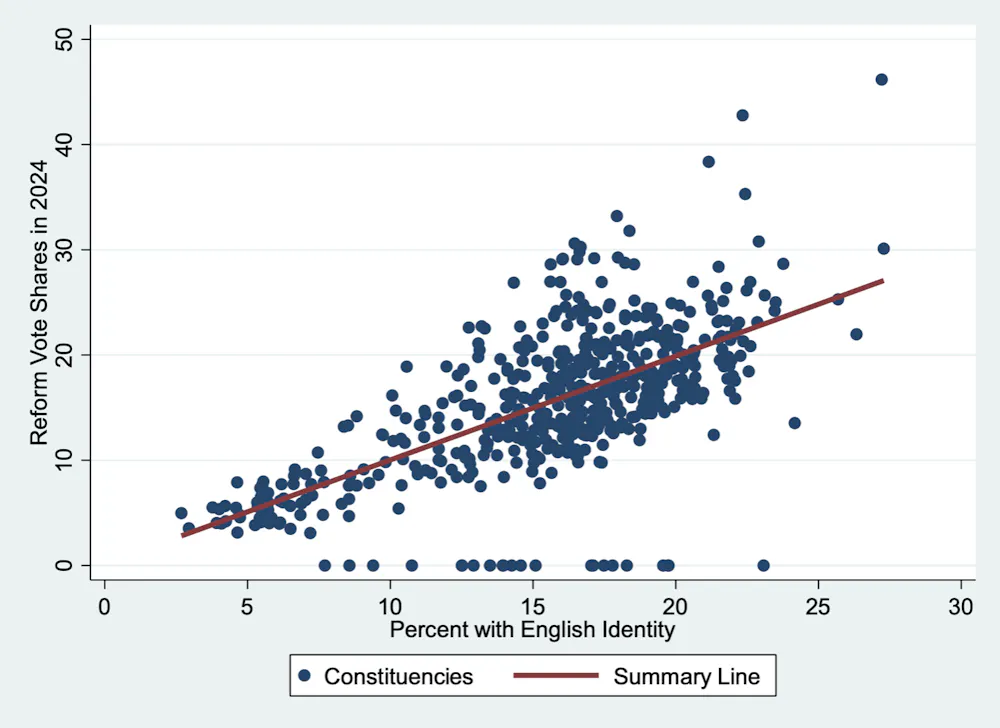
    Not all support for Reform came from protest voters, however. The chart below compares the percentage of Reform voters with those who identified as English in the 2021 census in England. There is a strong relationship between the two measures (a correlation of 0.66). The more English identifiers there are in a constituency, the greater support for Reform. In effect, Reform has become an English national party.

    The relationship between Reform voting and English identity in 2024

    An English national party in the making.
    P Whiteley, CC BY-ND

    National identities can change over time, but the process of change is slow. There has been a growth in “Englishness” at the expense of “Britishness” over time and this is undoubtedly reinforcing support for Reform.

    It means the party has a relatively solid base of supporters to rely on in future elections. While the row between the party’s leader and one of his MPs could play out in any number of different directions at this early stage, it would be wrong to suggest that Reform isn’t thinking big picture and long term.

    Farage has clearly learnt from his past and will not let his current party disintegrate into chaos like UKIP or the Brexit party before it.

    Paul Whiteley has received funding from the British Academy and the ESRC.

    ref. Two charts that explain why Reform isn’t being dented by its scandals – https://theconversation.com/two-charts-that-explain-why-reform-isnt-being-dented-by-its-scandals-252201

    MIL OSI – Global Reports

  • MIL-OSI Global: Keir Starmer to abolish NHS England – the pros and cons

    Source: The Conversation – UK – By Peter Sivey, Reader in Health Economics, Centre for Health Economics, University of York

    The UK government has announced the abolition of NHS England, phased over two years. In practice, this will involve merging some functions and staff from NHS England into the Department for Health and Social Care (DHSC). As part of the change, the government has stated that it expects to reduce duplication and save hundreds of millions of pounds.

    NHS England was established under the Health and Social Care Act of 2012 (the Lansley reforms) and is responsible for commissioning care and overseeing the day-to-day running of the NHS. This involves negotiating budgets for local care provision with bodies like integrated care boards and hospitals; performance management such as monitoring waiting times and quality measures; and implementing national initiatives across NHS organisations.

    NHS England was established to provide operational autonomy, shielding the health service from daily political interference. It is an “arm’s-length body”, meaning it operates independently from the government but remains accountable to it. The DHSC sets strategic goals and oversees NHS England activities.

    In practice, NHS England and DHSC have distinct roles, although they overlap in some areas. DHSC staff typically have broader policy expertise – for example, many have worked in other areas of the civil service, whereas NHS England staff often have more detailed knowledge of how the NHS works on the ground.

    Risks

    The loss of expertise within NHS England is probably the largest risk of the abolition. Alongside very experienced NHS managers and analysts, NHS England employs senior doctors and other health care workers who contribute valuable practical knowledge from the NHS frontline into policy roles.

    A major risk of this move is the potential loss of this clinical expertise and operational insight into policymaking. Lord Darzi’s report on the NHS specifically cited the loss in management talent that occurred as a result of the 2012 reforms, and cautioned against further reorganisation that might repeat that disruption.

    Another risk is that bringing NHS England functions directly under ministerial control risks increased politicisation of day-to-day NHS management.

    The government will argue that other policy areas like defence, education and policing do not have such a large arm’s-length body between the department and the frontline. However, health and social care is a uniquely large (11% of GDP) and highly political organisation, with a fast-growing budget and faster-growing challenges.

    NHS policy is already highly politicised, but abolishing NHS England risks the DHSC and the ministers being on the hook for every operational decision. This could lead to operational decisions being made to appease public opinion rather than promoting public health.

    The government faces significant practical challenges in merging two organisations with different cultures, working practices and pay structures. Currently, NHS England (about 16,000 staff) is much larger than DHSC (about 3,000 staff). Many NHS England roles will have to move into the much smaller DHSC.

    The transition itself will require investment, so the promised savings are unlikely to be achieved in the short term.

    Opportunities

    The main opportunity of the abolition is the removal of duplication between DHSC and NHS England.

    Currently, both organisations maintain separate policy teams covering similar areas – for example, elective surgery waiting times or cancer care. And sometimes, it is unclear how well they work together or why both are necessary.

    By consolidating within the DHSC, there is an opportunity to strengthen policy analysis. With one strong policy team in the DHSC, policy advice to ministers (DHSC) and policy implementation on the ground (previously NHS England) could be better coordinated and aligned with the government’s objectives.

    Lord Darzi’s report on the NHS highlighted the growth of regulatory roles within NHS England, questioning whether too much accountability could be counterproductive.

    The abolition of NHS England is also an opportunity to streamline regulation while strengthening local management roles and valuable policy analysis.

    Another opportunity from the abolition of the organisation would be the strengthening of local NHS bodies like integrated care boards. These local bodies, designed to tailor healthcare to local area needs, may sometimes have been stymied by excessive central control.

    The health secretary, Wes Streeting, has already expressed his desire to see more devolution of power and responsibility within the NHS. This process provides the opportunity to enact that promise.

    What will happen next?

    The abolition of NHS England and the transfer of some responsibilities back to the DHSC will take time and incur significant costs and disruption. Any benefits are likely to emerge only in the long term.

    Before the introduction of NHS England, there were larger regional organisations (strategic health authorities) that were responsible for implementing policy at a regional level. Perhaps the re-emergence of similar regional bodies could smooth the transition from a central NHS England to a more decentralised health service.

    Peter Sivey receives funding from the National Institute for Health and Care Research.

    ref. Keir Starmer to abolish NHS England – the pros and cons – https://theconversation.com/keir-starmer-to-abolish-nhs-england-the-pros-and-cons-252237

    MIL OSI – Global Reports

  • MIL-OSI United Kingdom: Trade Envoy programme appointment

    Source: United Kingdom – Executive Government & Departments

    News story

    Trade Envoy programme appointment

    Lord David Evans of Sealand appointed as UK Trade Envoy to Brazil.

    The Secretary of State for Business and Trade has appointed Lord David Evans of Sealand as the UK Trade Envoy to Brazil.

    UK Trade Envoys are appointed by the Business and Trade Secretary to drive UK economic growth through exports and investment. They are tasked with identifying trade and investment opportunities for businesses and championing the UK as a destination of choice for investment in their respective markets, working closely with the Department for Business and Trade.

    For more information visit: United Kingdom’s Trade Envoy Programme – GOV.UK

    Updates to this page

    Published 14 March 2025

    MIL OSI United Kingdom

  • MIL-OSI United Kingdom: Education Secretary’s speech at the ASCL conference

    Source: United Kingdom – Executive Government & Departments

    Speech

    Education Secretary’s speech at the ASCL conference

    The Education Secretary, Bridget Phillipson, speech at the Association of School and College Leaders.

    Good morning, everyone. Thank you so much for inviting me to speak.

    It’s good to be here. To talk to ASCL members once again.

    Continuing a conversation that has stretched over many years, during my time in opposition, and now as Secretary of State for Education,

    I value your voice and your views. When we agree, of course…

    But even when we don’t. I welcome those robust conversations.

    And Manny, that was certainly robust.

    And I welcome that challenge because I know you and your members want what I want, what parents want, what this government wants, what the Prime Minister wants, what the people of this country want:

    Better life chances for all of our children and young people.

    And through the headwinds and turbulence, the disruption and distraction, this is a government that will face down challenges and focus on outcomes for children.

    And I know that’s what you want too, Pepe.

    It’s been a year of change for both of us since we met at this conference last March.

    Because, just as this is your first ASCL Conference as General Secretary, it’s my first as Secretary of State.

    I did warn you last year that might happen.

    And when I spoke here last year, I told you what I’d do.

    I made promises to deliver change for children, and [political content removed] that’s exactly what I’ve done.

    That’s where my focus lies, delivering change for them – not playing politics or jumping on passing bandwagons or indulging the commentariat.

    I promised to move quickly on an expert-led Curriculum and Assessment Review – and it’s already in full swing.

    I promised a register of children not in school – we’re already legislating for that.

    I promised a single unique identifier for our children – we’re already legislating for that too.

    I promised a free breakfast club in every primary school – we’re already starting to roll them out.

    Promises made, promises kept. With funding. Tripling investment in breakfast clubs.

    On average a school switching to our early adopter breakfast club programme would get £21,400 more funding than under the last scheme.

    And much of our vital action is delivered by the Children’s Wellbeing and Schools Bill.

    That bill belongs to children. To keep them safe, to raise standards in their schools, and to save their parents money.

    And a lot of the change we are delivering, doesn’t need legislation:

    the biggest ever boost to Early Years Pupil Premium,

    new flexibility for teachers to take planning time remotely,

    new T-level qualifications.

    We are getting on and delivering. That’s what families expect of a responsible government, not more words, action that makes a genuine difference in their lives, right now.

    And Education is a driving force for change.

    That’s why, despite the toughest financial inheritance in a generation, the Chancellor protected key education priorities at the Budget.

    £8 billion for early years.

    A 5.5% pay award for schoolteachers.

    But I know we’ve had to make some incredibly difficult decisions already, and I’m afraid to say more are coming.

    I have to be blunt about our inheritance as a government, not just fiscally, but on the fabric of education too.

    You know this all too well, you see it every day.

    Children turning up still in nappies, not able to speak, absences stubbornly high, vacancies up, the SEND system creaking after years of neglect.

    The destruction in the social fabric that wraps around our children cannot be fixed overnight.

    [Political content removed]

    But together we’re making progress. Building long-term solutions to generational challenges. Rejecting the shiny appeal of quick fixes. Promoting the life chances of this country’s children.

    And I know that you’re all doing the same. Your leadership has never mattered more – with all of the challenges we face.

    You’ve risen to the occasion before. And Monday will mark the 5-year anniversary of the disruption to schools by Covid.

    You stepped up then. You did incredible things for our children. and I need you to step up again – but this time, government will be right at your side.

    Despite the challenges, I am hopeful. I believe this country’s best days lie ahead of us.

    There are so many examples of excellence in countless colleges and schools. But together we need to go further, so that every child gets the best education.

    That’s at the centre of my vision.

    To break down barriers to opportunity for every child.

    And it has to be for every child.

    It’s never enough for a just lucky few bright children from deprived backgrounds to succeed.

    I went to fantastic schools; I had teachers who believed in me, a family who prized learning.

    I was given the opportunities to achieve. For me, background wasn’t destiny, but for too many of the kids on my street, it was. I saw the bad luck of a tough start weigh down their life chances.

    And now I want opportunity for every child, and for that we need high and rising standards in every school.

    I know that’s a phrase you’ve heard a few times from me before.

    And I say it because it matters. Because standards drive life chances.

    And it means four things. And it starts with you. Teachers, leaders.

    You make such a difference in the lives of children.

    We’re working to get 6,500 more teachers across schools and colleges, to keep the great ones we’ve already got, and for all teachers to at least be progressing towards qualified teacher status.

    That’s the first step. The next is what you teach. The curriculum.

    And we need a core curriculum in all schools, one that builds on the past, but is fit for the future, rich in knowledge, broad and deep, cutting-edge, guided by the curriculum and assessment review, chaired by Professor Becky Francis – and she’ll be here tomorrow to tell you more about it.

    But to benefit, children need to be in the classroom and ready to learn. So high and rising standards means breaking down the barriers to learning too.

    Tackling our absence crisis, supporting our children with special educational needs.

    The final piece of the standards puzzle is structures and accountability.

    How we drive improvement, how we as government and you as leaders work together to deliver better life chances for children.

    So let’s talk about improvement, about accountability.

    Because I know the proposed changes are challenging. I know they’ve sparked debate. But that’s right where education should be, at the heart of our national conversation.

    That’s why we are consulting on this, why Ofsted are consulting on their proposals to improve inspection.

    They are genuine consultations. We need to hear from young people and parents, teachers and leaders. Because you understand our shared responsibility. The leaders in my schools did too.

    I remember one day I was passed a note during a lesson,

    And it called me to the Deputy Head’s office. Now Mr Hurst could be fierce, believe you me.  And getting summoned out of the blue put the fear of God into me. And when I got there, he told me to sit down.

    He told me he’d seen the list of pupils applying to visit Oxford and Cambridge that year – and that my name was nowhere to be seen.

    He told me to get that right by the end of the day. And then he sent me on my way.

    As teachers and leaders, you play those pivotal moments, when futures tip one way or the other. I only had one childhood, one chance to succeed.

    Where would I be now without those 2 minutes in Mr Hurst’s office?

    No child gets a second chance at childhood.

    We owe them that relentless pursuit of better. From stuck to good, good to great, great schools sharing their excellence.

    And strong and effective accountability will be at the heart of how we drive change for children.

    And the way we deliver improvement is changing too.

    Smarter, more diagnostic, more targeted. A system that challenges but provides support too.  So that when we identify problems, schools aren’t left out in the cold to solve them alone.

    Backed by swift action. Action in the 600 schools that are stuck – receiving consecutive poor Ofsted judgements.

    For the 300,000 children who go to those schools. That’s who these changes are for. Those children.

    And the spark of improvement in their schools and in their lives – that comes from leadership.

    I’ve seen it in my own constituency, especially during the pandemic. Strong groups of schools where leaders could share evidence, generate ideas, improve life chances by working together.

    And our new RISE teams share that spirit. Taking what’s best in schools and trusts and spreading it, so that all children can benefit.

    Improvement of schools, by schools, for children– with government there to challenge and support you.

    Where performance in schools isn’t good enough, RISE teams will be there with targeted interventions. Intensive, mandatory support, backed by investment, guided by top leaders, from top schools and top trusts.

    Added to that, our universal RISE service, a new offer of support for continuous improvement in all our schools, spreading best practice.

    Following four national priorities.

    One is attainment, with a focus on English and Maths.

    It’s not a nice-to-have. Good for some children but fine for others to miss out.

    No. All children need that firm foundation of attainment.

    That’s why the Prime Minister’s Plan for Change sets attainment as a key milestone.

    We’re investing in reading at key stages 2 and 3, building up phonics to fluency and we’ll be publishing our new Writing Framework for schools later this year.

    We’ll drive progress across the board, but especially for kids from tough backgrounds.

    And that progress must start early in life – when the possibilities still stretch out ahead.

    That’s why the Plan for Change also sets the milestone of a record number of children starting school ready to learn.

    So the next priority for RISE teams is reception year quality. Joining those two priorities are two more: attendance and inclusion – two urgent barriers to learning our children face.

    Unlocking learning for all children is so important.

    And as leaders you know it’s your responsibility to set the ethos of your school. To enforce good behaviour and to break down barriers.

    And phones are a big one.

    As school leaders you all know that so much of the damage caused by smartphones and social media takes place outside the school gates.

    The Technology Secretary has commissioned a study led by the University of Cambridge to assess the impact of social media and smartphones, strengthening the evidence base on their impact on children’s well-being

    But you know, we all do, that phones are disruptive, distracting, bad for behaviour.

    They have no place in our schools. And the government’s position is clear: you have our full backing in ridding our classrooms of the disruption of phones.

    And I know that will be the case in the overwhelming majority of your classrooms. But I expect it to be true in all classrooms.

    So I have tasked my officials to look at how we can more effectively monitor what’s happening on the ground

    Because this is not a government of gimmicks and rhetoric – [political content removed] but a government that will ensure that where words flow, action follows.

    Because if we don’t, it’s children who suffer.

    And it’s the same for absence. [political content removed]

    That challenge was turbocharged, not just by Covid but by no plan for our children’s return.

    It wreaked havoc with children’s life chances. You see it in your schools every day. [political content removed]

    And our new analysis shows the cost to future life chances. Take teenagers who attend nearly every day of year 11, they are almost twice as likely to get a Grade 5 or above in their English and Maths GCSEs than similar students who miss just 10 more days than them.

    The evidence is clear: absence scars life chances.

    Every day out of the classroom will cost a child hundreds of pounds in future wages over their lifetime.

    No parent wants that for their child.

    No school wants that for their pupils.

    No government wants that for their country.

    One in five children persistently absent from school. 1.6 million missing a day every other week.

    That’s the national picture. But it varies – from school to school.

    Our data shows that there are schools, facing similar challenges, but with significantly different performance on attendance.

    Some doing really well. But others not making enough progress. Not yet learning from the best. And I won’t accept the damage that does to those children.

    I expect schools to catch up – fast.

    And I know that’s what schools want to do, what you’re all working so hard to do,

    The way we turn this around is through collaboration, partnership and, if we’re honest, old-fashioned graft.  Shared responsibility too – parents, schools and government.

    We’re delivering daily attendance data, so we can identify, interrogate and tackle patterns of absence.

    The green shoots are appearing. Especially in our secondary schools. If we keep this up, we’ll achieve one of the biggest annual increases in recent memory.

    On attendance and the challenge of behaviour – continuing to work with you to spread best practice.

    And the way we drive improvement in schools will focus on attendance too. That’s why one of those four national priorities for our brand-new RISE teams is attendance. And we’re proposing that new school report cards include a focus on attendance too.

    We’re hosting 9 major conferences to reach every secondary school in the country – focusing on leadership.

    Building networks of schools. Bringing leaders together – to lead the solutions. And I want to thank everyone in this room who has helped and I’m so glad to hear from so many of you that they are working well for you.

    We will continue to support and challenge schools on this.

    But another barrier to learning that we all know is the failure of the system supporting children with special educational needs and disabilities.

    It’s not working how any of us would like. And children aren’t getting the support they need. Children and young people with SEND – along with disadvantaged children – have the most to gain from high and rising standards.

    And a classroom that caters to all is a strength. Children thinking in different ways is a gift. It’s time we recognised that. I’ve been told this is too hard, that it can’t be done.

    Of course it’s not easy, but it is possible. There are schools and trusts doing it already. I’ve talked to parents, and they tell me how important this is too.

    One father told me about his daughter at Becontree Primary School in Dagenham, which has a SEND unit for children with Autistic Spectrum Disorder.

    His daughter moving into a mainstream school gave him faith that she will be able to achieve as an adult, get a job, be an active citizen.

    It can be done.

    King Ecgbert School in Sheffield, part of Mercia Learning Trust.

    The school has a 30-place integrated resource unit for autism. Pupils spend most of their time in mainstream lessons, supported by specialist learning assistants.

    Inclusion spreads beyond the classroom. Pupils with SEND get the support they need to play sports, to join art clubs, to feature in school plays. 

    The school focuses not just on support, but on outcomes too.

    Attainment is above the local and national average.

    All pupils, including those with SEND achieve exceptionally well.

    They is proof that the inclusion vs standards compromise is no such thing, they go together. As the schools says, ‘if we get it right for our most vulnerable, then we’ll be getting it right for everyone’. 

    Their Ofsted report sums it up – ‘these impressive outcomes open doors to opportunity for all children leaving the school’.

    And that’s what it’s all about. Opportunity. We need to spread that excellence.

    And so I’m glad their headteacher, Paul Haigh, is now one of our new RISE advisers.

    This excellence exists and it must become the norm for all of our children.

    Action is underway: through our RISE teams, through the Curriculum and Assessment Review, through the £740m of capital investment I announced in December.

    But this is a complex and difficult challenge. It will take time. We need to get this right. We’re working with parents, teachers, experts, those with lived experience.

    Our Strategic Advisor on SEND, Dame Christine Lenehan is drawing on the wisdom of parents, professionals and leaders.

    Tom Rees, who is leading my Expert Advisory Group on Inclusion, is working with ImpactED, and will launch a survey on best practice tomorrow.

    Our conversations leave us in no doubt of the scale of the challenge that we face. But I am hopeful. The change we need already exists.

    Back in October last year I visited Chantry Academy on the outskirts of Ipswich.

    I met a young boy there with special educational needs. He told me that he had always felt too special for a normal school, but not special enough for a special school.

    He worried he just didn’t fit in anywhere. Until he joined Chantry Academy.

    And thanks to Chantry’s focus on inclusion, that little boy finally feels that he belongs. And speaking to the head teacher, I could see why.

    Community is the key – creating a community within the school where everyone is welcome – and connected to the community around them.

    Chantry is on an improvement journey. After an inadequate judgement from Ofsted in 2014, they joined Active Learning Trust and changed leadership.

    There is still more to do, but the school is seeing tangible progress.

    Just two years ago one in three students at Chantry were persistently absent.  Now it’s fewer than one in five, back below the national average.

    And the share of pupils getting good grades in English and maths at GCSE has nearly doubled since 2019.

    I love visiting schools and colleges.

    Because it reminds me what’s truly important. What really matters.

    It’s the children. Their life chances, their hopes, their futures.

    That’s what we’re here to do. That’s who we’re here to serve.

    That’s the responsibility of your jobs and of mine.

    That hopeful little boy in Ipswich,

    those quiet little girls growing up on streets like mine.

    But that’s the real privilege too.

    Why mine is the best job in government,

    Why yours are the source of so much about what’s good in our country.

    Because despite the big challenges, the early mornings, the late nights, the tough times, what we do matters.

    And I want to thank you, from the bottom of my heart, for all you do.

    For the difference you make. I know how hard you work, I know it’s not easy, the work of turning around children’s life chances never will be.

    But I want you to know that if we come together now,

    to spread what works, to end what doesn’t, to share the spirit of restless improvement.

    If we do that, together we have the chance to usher in not just a new era of education, but a brighter future too.

    For our children, for our communities, and for our country.

    Updates to this page

    Published 14 March 2025

    MIL OSI United Kingdom

  • MIL-OSI United Kingdom: Improving communities’ mental wellbeing

    Source: Scottish Government

    £30 million for grassroots projects for adults

    Community-led mental health and wellbeing projects are to benefit from £30 million Scottish Government funding over the next two years.

    The Communities Mental Health and Wellbeing Fund for Adults – first launched in 2021 – supports local groups to deliver programmes for adults which build resilience and tackle social isolation, loneliness and mental health inequalities. It is expected the Fund will open to applications this Autumn.

    In the first three years around 4,800 grants were made to a wide range of grassroots community projects focused on connecting people and providing peer support through activities such as sport, outdoor activities, and the arts.

    The charity, Empower Women for Change, has secured grant awards in all rounds of the Fund to date. This year, the group is using its grant to support lone parents, families with a disabled family member, Minority Ethnic families, and young mothers. Visiting their office in Glasgow Mental Wellbeing Minister Maree Todd said:  

    “I am pleased to meet staff and service users at Empower Women for Change and hear more about the valuable work they do in the community they support. It is inspiring to see first-hand the impact that this funding can have.

    “Since the fund was established, we have invested £66 million, reaching a variety of groups supporting those at increased risk of poor mental health and wellbeing – including people facing socio-economic disadvantage, older people and ethnic minority communities. I look forward to seeing the positive impact that this further £30 million investment will make to the wellbeing of people and communities across Scotland.”

    Empower Women for Change CEO and Founder Asma Abdalla said:

    “We are delighted and honoured to welcome the Minister Maree Todd to our organisation. The Wellbeing Fund has played a transformative role in improving the lives of our service users of ethnic minority women and girls and our volunteers, members, and staff.

    “Through our Inspired Women projects, we have provided vital mental health support, resilience, and community connection, changing lives and strengthening communities. We are looking forward to continuing this work, with support from the Wellbeing Fund.

    “We welcome this unique opportunity to share Inspired Women participants’ testimonies, their voices highlight the urgent need for sustained investment in grassroots wellbeing services. Please join us in amplifying their stories and celebrating the power of community-led change.”

    Partnership Manager at Glasgow Council for the Voluntary Sector Sheena Arthur said:

    “We are delighted that the Scottish Government’s Communities Mental Health and Wellbeing Fund is continuing. This fund delivers small grants which make a positive difference and so far, has supported over 900 Third Sector organisations and community groups across Glasgow.

    “In increasingly challenging times, the Third Sector plays a crucial role. This fund enables the development of existing projects as well as emerging ideas from the community. It helps to bring people together- contributing to better health and wellbeing of people and families, strengthening social connections and tackling inequality and poverty.”

    Background

    Within the first three years, the Communities Mental Health and Wellbeing Fund for Adults has provided around 4,800 grants to community organisations delivering mental health and wellbeing support.

    Wellbeing and prevention – Mental health – gov.scot

    Empower Women for Change

    MIL OSI United Kingdom

  • MIL-OSI United Kingdom: Sustainability support for universities

    Source: Scottish Government

    Further £10 million for Scottish Funding Council to support the sector.

    Additional support will be made available through the Scottish Funding Council (SFC) to support universities facing financial challenges.

    Education Secretary Jenny Gilruth said an additional £10 million will be provided to the SFC to support higher education institutions such as the University of Dundee as they navigate current financial challenges.

    It brings total additional support for the sector from the Scottish Government to £25 million, on top of the £1.1 billion in the 2025-26 budget for university teaching and research.

    The Scottish Government will convene a range of expertise from across the higher education sector, government, and Dundee City Region to support the University of Dundee while it develops its Financial Recovery Plan. This is in addition to work already underway by the SFC, which engages closely with universities on financial sustainability.

    Ms Gilruth said:

    “The Scottish Government is providing an additional £10 million support package to assist universities such as Dundee with navigating immediate financial challenges. This is on top of the £15 million of extra support previously announced for the sector in February.

    “Ministers have held further meetings with the University of Dundee, unions and the Scottish Funding Council this week, building on the extensive engagement that has already taken place with the institution since financial issues came to light.

    “Both the Higher Education Minister and I have conveyed our deep concern at the level of job losses currently being discussed at the University. While the University is an autonomous institution, it is our clear expectation that the University’s leadership works with us, and engages fully with staff and trade unions, to explore all options to protect jobs.

    “Work will continue in the coming days to convene the right range of expertise from across government, the sector, and the wider city region to support the institution as it continues to develop its Financial Recovery Plan.

    “Scotland’s universities play a pivotal role in the economy and wider society, and they must be supported to thrive into the future. This support package is another clear sign of the Scottish Government’s commitment to support the sector with financial challenges – challenges which have been compounded by UK Government policies on migration and employer National Insurance contributions.” 

    Chief Executive of Scottish Funding Council Francesca Osowska said:

    “We welcome Scottish Ministers’ continued commitment to the tertiary sector and confirmation of this additional funding. Recognising the particular challenges facing the University of Dundee, we look forward to engaging with a wide range of partners to secure its continued success as a world-renowned University delivering excellent outcomes for learners and researchers and contributing to economic growth and social wellbeing.”

    Background

    The additional £10 million capital funding has been identified from within the education portfolio.

    The Scottish Government has put forward proposals for a Scottish Graduate Visa and the First Minister wrote to the UK Government in January seeking clarity on changes to employers National Insurance contributions.

    MIL OSI United Kingdom

  • MIL-OSI United Kingdom: UK and China restart meaningful climate change dialogue

    Source: United Kingdom – Government Statements

    Press release

    UK and China restart meaningful climate change dialogue

    Energy Secretary calls for action and cooperation from China to tackle the climate emergency.

    • Energy Secretary visits Beijing to urge continued action from China – the world’s biggest emitter – to tackle the climate emergency   
    • Miliband expected to say there is no route to keeping future generations safe from climate threat without engaging China in responsible climate leadership
    • UK and China agree to secure and pragmatic cooperation and lesson sharing on climate and clean energy – delivering on government’s Plan for Change to re-engage with China on issues that matter to the British people

    Pragmatic cooperation with China will help keep British people safe from the climate crisis, as UK and Chinese ministers are set to meet in Beijing for the first formal talks to accelerate climate action in nearly 8 years.  

    As the government pursues its mission to become a clean energy superpower under the Plan for Change, The Energy Secretary will meet with China’s National Energy Administrator Minister Wang Hongzhi and China’s Ecology and Environment Minister Huang Runqiu in Beijing to commit to pragmatic engagement on the climate crisis, cooperating with China to reduce global emissions. 

    The UK is expected to launch a formal Climate Dialogue with Chinese counterparts, inviting Chinese ministers to London later this year, and for the first time institutionalising climate change talks between both countries moving forward. 

    China is the world’s largest investor and supplier of renewable energy but it remains the world’s largest emitter responsible for more emissions than the US, EU, India, and UK combined. China’s contribution to climate action is therefore crucial to tackling one of the biggest global challenges the world faces.   

    The Energy Secretary will also use the visit to engage frankly with China on UK concerns on issues like forced labour in supply chains, human rights and freedoms in Hong Kong, and China’s ongoing support for Russia’s illegal invasion of Ukraine.  

    The climate crisis is an existential threat to our way of life in Britain. Extreme weather is changing the lives of people and communities across country; from thousands of acres of farmland being submerged due to storms like Bert and Daragh, to record numbers of heat-related deaths in recent summers. In turn, China are feeling the effects with temperatures in Beijing remaining above 35°C for a record breaking 28 days last year.  

    The government’s Plan for Change is restoring the UK’s role as a responsible climate leader, and re-engaging with the world’s second largest economy will remain critical in delivering both climate and energy security for Britain and across the world.   

    Energy Secretary Ed Miliband said:  

    We can only keep future generations safe from climate change if all major emitters act. It is simply an act of negligence to today’s and future generations not to engage China on how it can play its part in taking action on climate. 

    That is why I will be meeting Chinese ministers for frank conversations about how both countries can fulfil the aims of the Paris Climate Agreement, to which both countries are signed up.  

    Our Plan for Change and clean energy superpower mission is about energy security, lower bills, good jobs and growth for the British people. It is with this mission that we can also influence climate action on a global stage, fight for our way of life and keep our planet safe for our children and grandchildren.

    The Energy Secretary will refresh an outdated 10-year-old UK Clean Energy Partnership with China – which will now provide clarity on areas where the UK government can securely collaborate with China on areas of mutual benefit – such as new emerging technologies, including hydrogen and carbon capture and storage. The UK will also share expertise on phasing out coal, having closed its last coal-fired power station last year.

    This will establish a formal agreed platform with China to engage with them on potential UK and global energy security concerns, and creating a channel to challenge them on areas where we disagree, such as forced labour in supply chains.

    This further boosts already robust national security controls in our critical infrastructure such as the National Security and Investment Act – providing a strengthened mechanism to protect the UK’s national security, which is the first duty of government.

    This is part of the government’s commitment to a long-term, strategic and pragmatic relationship with China, rooted in UK and global interests – cooperating where we can, competing where we need to, and challenging where we must. 

    As an open economy, the UK welcomes investment from a wide range of countries and investors on the basis is supports the UK’s mission for growth securely and pragmatically. The government will not hesitate to use established powers to protect national security in energy infrastructure whenever concerns are identified. These discussions complement the government’s mission to make Britain a clean energy superpower, delivering energy security and bringing down bills for good. The expected rise in the price cap shows once again the cost of remaining reliant on the unstable global fossil fuel markets that are driving price increases. 

    Three years on from Russia’s invasion of Ukraine, wholesale gas prices have now risen by 15% compared to the previous price cap period, which is directly affecting the cost of generating power and heating of homes. Moving to a power system based on homegrown, clean energy will reduce the UK’s reliance on volatile markets and protect billpayers.  

    To achieve this, government has set out the most ambitious reforms of the UK’s energy system in a generation. Within its first eight months in office, the government has lifted the onshore wind ban, established Great British Energy, approved nearly 3GW of solar, delivered a record-breaking renewables auction and kickstarted the carbon capture and hydrogen industries in the UK – helping to deliver energy security, grow the economy and deliver clean, cheap energy.    

    Notes to editors

    The last time an Energy Secretary visited Beijing for a formal climate and energy dialogue was in 2017. COP26 President Alok Sharma visited Tianjin in 2021 ahead of the COP26 summit in Glasgow.

    However, both our formal partnerships with China on climate and clean energy both date back to 2015. And this visit signals a shift in the dial in re-engaging with China and updating relationships in line with the current global landscape.

    Updates to this page

    Published 14 March 2025

    MIL OSI United Kingdom

  • MIL-OSI United Kingdom: Update: Genta-Equine 100 mg/ml Solution for Injection for Horses – Adverse events

    Source: United Kingdom – Government Statements

    News story

    Update: Genta-Equine 100 mg/ml Solution for Injection for Horses – Adverse events

    More information following investigation into an increase of adverse event reports following the use of Genta-Equine 100 mg/ml Solution for Injection for Horses.

    Since our initial notification on 18 December 2024, the Marketing Authorisation Holder (MAH) has provided findings of their investigation into adverse event reports relating to the use of Genta-Equine 100 mg/ml Solution for Injection for Horses, specifically batches T-001 and V-001. 

    The MAHs investigation has confirmed the presence of histamine in batches T-001 and V-001 at concentrations deemed sufficient to cause the adverse events received. Therefore, it has been concluded that this is the most likely root-cause for the adverse events. 

    A recall of affected batches has been initiated in Denmark and Belgium but due to the critical nature of Genta-Equine to equine veterinary surgeons in the UK, a recall has not been initiated in the UK.   

    Dechra (UK distributor) has advised that if veterinary professionals are concerned about using the affected batches of Genta-Equine, treatment with an alternative appropriate antibiotic should be considered. They have also advised that a refund can be received for any unopened bottles.   

    We have approved a further communication from Dechra to veterinary surgeons including this information and will continue working with the MAH to monitor reports and ensure appropriate actions are carried out as required. 

    Symptoms included in adverse event reports 

    These reports include signs of abdominal pain/colic, pawing, restlessness/agitation, groaning, shaking/shivering/fasciculation, Flehmen response, lying down or attempting to lie down, staggering, increased sweating and increased respiratory rate. 

    In all reports received to date, events commenced within minutes of administration and all horses recovered. 

    Adverse event reports received may include reports where more than one product was used, the product was used off-label and/or where, on further evaluation, it is considered that there is no causal association between the product and event. 

    Reporting of adverse events 

    We strongly encourage anyone who is aware of an adverse event to report directly to the MAH. Please provide all relevant information, including the batch number. 

    Contact details for the MAH or their local representative can found be on the product leaflet or on the  Product Information Database.

    The reporting of adverse events is critical to our ongoing monitoring activities in order to protect animal health, public health, and the environment. Find out more about pharmacovigilance at  VMD Connect – Adverse Events and Pharmacovigilance.

    Updates to this page

    Published 14 March 2025

    MIL OSI United Kingdom

  • MIL-OSI United Kingdom: Welcome Back to Guatemalan Chevening Scholars 2023-24

    Source: United Kingdom – Government Statements

    World news story

    Welcome Back to Guatemalan Chevening Scholars 2023-24

    Ambassador Juliana Correa welcomed the Guatemalan Chevening Scholars who successfully completed their master’s programs at prestigious UK universities.

    Four Guatemalan scholars from the 2023-24 academic year pursued master’s degrees at various renowned British institutions.

    The Embassy congratulated the scholars on the successful completion of their studies and for being outstanding representatives of Guatemala during their time in the UK.

    Chevening is the UK government’s global scholarship program, offered by the Foreign, Commonwealth & Development Office in partnership with various organizations. Since 1983, Chevening has helped build bridges with over 160 different countries and territories, supporting the education and development of future leaders, influencers, and decision-makers worldwide.

    The returning scholars are:

    • Francisco Alejandro Pineda Suárez – LLM in Comparative and International Dispute Resolution, Queen Mary University of London.
    • Ana Isabella González Palma – MSc in Medical Anthropology, University of Oxford.
    • Jaquilin Anai Salazar – MSc in International Development, University of Bristol.
    • Mario Andrea Yon Secaida – MSc in Public Policy and Administration, The London School of Economics and Political Science.

    Chevening has fostered economic development and better business environments worldwide by funding scholars who have created businesses, become directors, and hold high-level positions in global organizations.

    The application window for the 2025-2026 scholarships will open in August 2025. We strongly encourage mid-career professionals to apply for the program and sign up for alerts by visiting the Chevening website.

    Updates to this page

    Published 14 March 2025

    MIL OSI United Kingdom

  • MIL-OSI United Kingdom: Minister visits MHRA to see cutting-edge science protecting patients and supporting the NHS

    Source: United Kingdom – Government Statements

    Press release

    Minister visits MHRA to see cutting-edge science protecting patients and supporting the NHS

    The MHRA welcomed Health Minister Smyth to its science campus as part of British Science Week to demonstrate how innovations become safe, effective treatments for NHS patients.

    Health Minister Karin Smyth MP using microscope. Credit: MHRA

    Health Minister Karin Smyth MP this week visited the Medicines and Healthcare products Regulatory Agency (MHRA) to see first-hand how its scientists ensure NHS patients receive the latest medical innovations safely and in the shortest time possible.

    As part of British Science Week and NHS Healthcare Science Week, the visit highlighted the MHRA’s role in driving life sciences innovation – helping UK patients benefit from cutting-edge technologies, from mRNA vaccines to advanced cancer diagnostics.

    During the visit, Minister Smyth met with MHRA scientists and regulatory experts to hear how their work is helping the NHS move towards earlier diagnosis and prevention. This includes making sure the annual flu vaccine is as effective as possible, setting safety standards for genomic cancer testing, and enabling rapid access to new treatments.

    The Minister toured MHRA biologics laboratories, where scientists rigorously test biological medicines, including vaccines, to ensure they are effective and acceptably safe for patients. She also heard how the MHRA works with industry and healthcare partners to keep vital medicines available, so patients can access the treatments they need without delay.

    The MHRA’s expertise has global impact, with its scientific and regulatory leadership helping to shape international standards and ensure that innovations benefit patients worldwide.

    Health Minister Karin Smyth MP said:

    “The MHRA’s scientists are making a real difference by ensuring NHS patients can benefit from the latest medical advances safely and quickly. From speeding up access to life-saving vaccines to setting high safety standards for new cancer tests, their work is helping the NHS focus on earlier diagnosis and prevention. It was fantastic to see first-hand how their expertise is driving innovation, protecting patients, and strengthening our healthcare system.

    “British Science Week is a great time to celebrate their achievements and the UK’s world-leading expertise in medical innovation.”

    June Raine, MHRA Chief Executive, said:

    “The MHRA plays a vital role in making the UK a science superpower, working closely with the NHS and life sciences sector to bring innovations to patients faster while maintaining public trust in their safety.

    “We were delighted to welcome Minister Smyth and showcase how our expertise makes sure that scientific breakthroughs translate into real benefits for patients. Our work ensures the NHS can access cutting-edge medicines while upholding the highest safety standards.”

    Professor Anthony Harnden, MHRA Chair, said:

    “Science and regulation go hand in hand in improving patient care and patient safety. Today’s visit was a great opportunity to highlight how the MHRA’s work supports the NHS and the people it serves.

    “It’s important to recognise the scientists working behind the scenes to protect patients and support NHS staff. Their expertise gives healthcare professionals confidence that the treatments they use work and are acceptably safe.”

    Notes to editors 

    1. British Science Week and NHS Healthcare Science Week celebrate the role of science in protecting health. For more information, visit British Science Week and NHS Healthcare Science Week.
    2. The Medicines and Healthcare products Regulatory Agency (MHRA) is responsible for regulating all medicines and medical devices in the UK by ensuring they work and are acceptably safe. All our work is underpinned by robust and fact-based judgements to ensure that the benefits justify any risks. 
    3. The MHRA is an executive agency of the Department of Health and Social Care. 
    4. For media enquiries, please contact the newscentre@mhra.gov.uk, or call on 020 3080 7651.

    Updates to this page

    Published 14 March 2025

    MIL OSI United Kingdom

  • MIL-OSI United Kingdom: When women and girls are empowered in all their diversity, their leadership transforms societies: UK National statement at the UN Commission on the Status of Women General Discussion

    Source: United Kingdom – Government Statements

    Speech

    When women and girls are empowered in all their diversity, their leadership transforms societies: UK National statement at the UN Commission on the Status of Women General Discussion

    Statement by Lord Collins of Highbury, Minister for Africa and the UN, at the UN Commission on the Status of Women General Discussion.

    Three decades after the world came together in Beijing, we agreed a CSW Political Declaration to advance the rights of all women and girls and reaffirm the need to respect, promote and protect their fundamental freedoms.

    We should celebrate the lives saved and changed, and the progress made.

    Today, one in five young women were married as children versus nearly one in four a decade ago. More girls are and remain in school than ever before. Through multilateral action, numbers of female genital mutilation are falling rapidly.

    Together, we can deliver this kind of change. And so, we must also make this a year for advancing gender equality.

    Globally, progress on the rights of all women and girls and other marginalised groups is slowing and reversing.

    Women and girls are facing renewed assault.

    An assault on the essential rights that give them their autonomy over their lives and their bodies, keeping them from accessing comprehensive sexual health services and realising their sexual and reproductive rights, including safe abortion.

    An assault on the right to participate fully, equally, safely and meaningfully in all spheres of life.

    And an assault on our ability to work together – including multilaterally, where these rights must not be traded away.

    Rapidly emerging technologies are multiplying threats – from online violence to algorithmic bias.

    These threats affect men and boys too, who are being isolated by harmful narratives about gender roles and masculinity.

    Men and boys must play an equal part in this journey – as allies, champions and agents of change.

    When women and girls are empowered in all their diversity, their leadership transforms societies.

    It makes us more effective in everything from tackling the climate and nature crisis, to building peace and pursuing prosperity.

    Chair, advancing gender equality and empowering all women and girls is a priority for the United Kingdom.

    We are breaking down the barriers for women and girls from the schoolroom to the boardroom.

    And we are working with others through modern, respectful partnerships around the world – including with grassroots women-led groups.

    Civil society is and will remain at the heart of CSW.

    As a lifelong trade unionist, I know just how important civil society is to make the change we all so desire.

    Updates to this page

    Published 14 March 2025

    MIL OSI United Kingdom

  • MIL-OSI United Kingdom: UN Human Rights Council 58: UK Statement for the Interactive Dialogue with the Special Rapporteur on Human Rights and the Environment

    Source: United Kingdom – Government Statements

    World news story

    UN Human Rights Council 58: UK Statement for the Interactive Dialogue with the Special Rapporteur on Human Rights and the Environment

    UK Statement for the Interactive Dialogue with the Special Rapporteur on Human Rights and the Environment. Delivered at the 58th HRC in Geneva.

    Thank you Madam Vice-President.

    The United Kingdom thanks the Special Rapporteur for these reports.

    The ocean is essential for all life on Earth. As the legal framework for all activities in the ocean, the United Nations Convention on the Law of the Sea [UNCLOS] is fundamental to its protection, and an essential enabler for a healthy planet, global prosperity and security. The UK is committed to ratifying the UNCLOS BBNJ [United Nations Convention on the Law of the Sea on the Conservation and Sustainable Use of Marine Biological Diversity of Areas beyond National Jurisdiction] Implementing Agreement, and to seeing it enter into force as quickly as possible.

    The UK chairs the Global Ocean Alliance of 77 countries that champions ambitious ocean action. The Apia Commonwealth Ocean Declaration, adopted last year, recognised the need for collective action, and emphasised the need to ensure participation and empowerment of all people in ocean-related decision making and benefit-sharing.

    The report on the Special Rapporteur’s visit to the Maldives brings into focus the need for global cooperation in tackling the climate and nature crisis. The UK’s Foreign Secretary has made clear his commitment to forging a more equal partnership with the Global South. Without this, there can be no climate stability.

    Special Rapporteur, what more can States do to support those on the frontline of the impacts of the climate and nature emergency?

    Thank you.

    Updates to this page

    Published 14 March 2025

    MIL OSI United Kingdom

  • MIL-OSI United Kingdom: Martyn Oliver’s speech at the ASCL Annual Conference

    Source: United Kingdom – Government Statements

    Speech

    Martyn Oliver’s speech at the ASCL Annual Conference

    Sir Martyn Oliver, Ofsted’s Chief Inspector, spoke at the 2025 Association of School and College Leaders (ASCL) Annual Conference in Liverpool.

    Hello, and thank you so much for inviting me back to speak to you again.

    You may recall that I gave my first major speech as Chief Inspector here last year.

    It’s also great to be back as ASCL was my union for nearly 2 decades prior to taking on this role.

    Last year, I told you that I wanted “Ofsted to be a modern, world-class inspectorate and regulator – fit for purpose and also trusted by parents, by children and by you, the sectors we work with”.

    And I told you that I needed your help to do that.

    And that has not changed. I still have incredibly high ambitions for Ofsted, and I still need your help.

    But it has been a whirlwind year, and a lot has changed.

    The Big Listen, which I launched at last year’s conference, heard from tens of thousands of people, including many of you.

    We heard your voices, we responded in full, and we are acting.

    We’ve had a change in government since I last stood on this stage. And that too has brought changes, not least the abolition of the overall effectiveness grades and the expected reforms in the Children’s Wellbeing and Schools Bill.

    And we’ve made changes where we can:

    • we’ve brought in mental health awareness training
    • we reformed how we handle complaints
    • we developed our inspection pausing policy
    • we dropped deep dives in ungraded inspections
    • we’ve launched the Ofsted Academy
    • we’ve established external reference groups to offer independent advice and challenge
    • and many more changes

    These changes are important, and I know they have made a real difference to you.

    ASCL and some of you individually have been kind enough to share some really positive feedback about these changes and how these have impacted your work.

    But they have often been changes made to tackle specific challenges or issues.

    Which is why we are now consulting on a whole new approach to inspection.

    This will build on those things that were already working well, and on the interim reforms we have made, and of course on everything we heard in the Big Listen.

    I hope it too will make a real positive difference to all of you. But, as before, I need your help.

    And while the consultation, by the nature of such an exercise, mostly talks about the details of the framework, it is the methodology of inspection which will make the biggest impact.

    Which will build on the improvements you’ve seen in the last year.

    And which will ultimately reduce the pressure I know that you feel.

    New approach

    I have heard from some of you already. I know some of you have concerns about what we’re proposing. But I also know some of you are really positive about the changes.

    All I ask is that you give it proper consideration and take part in the consultation.

    I know that might be a big ask. I’ve been a deputy head, a head, and a MAT leader. I know how busy you are.

    But it’s really important that we hear from serving practitioners like you. People who are out there every day, doing the real and vital work of educating children.

    I hope that you will find that what we’re proposing is helpful, supportive, and intuitive.

    That it will reduce pressure on you, improve the information we give to families and to government, and support you to drive ever higher standards for children.

    But I’m sure you will also see things that we haven’t. Things that we may have missed or that could be clearer or stronger, or tighter or firmer.

    So please take part. Make sure we get an accountability system that is better for you, better for parents, and most importantly better for children.

    Because I know we can all agree that must be our top priority. We’re all on the same side, and all working towards the same goal. We all work for children.

    Report cards

    Perhaps understandably, our proposed report cards have gained a lot of the media attention so far.

    Much of the discussion has been encouraging. We’ve had thoughtful contributions. We’ve had support and we’ve had suggestions for improvements.

    I was particularly gratified by the support we had from parents. Schools Week commissioned a poll which told us that nearly two thirds of parents prefer this new approach and over 80% said they found it easy to understand.

    But we have also heard a small number of rather surprising responses. Responses seemingly built on a misunderstanding of what report cards are.

    So, I do want to be clear here today.

    Report cards are not and never were going to bring about the end of grading.

    They are not and never were going to sacrifice the much needed clarity for parents.

    And they are not and never were going to be about less accountability.

    You know, and I know, that we need a way of reporting that is reliable, clear and accessible.

    That informs government, that informs parents, and that helps you in your efforts to always do better for children.

    I believe our proposed report cards will do that. They will bring about better, more helpful, more nuanced, more detailed, and more precise accountability. They are about recognising strengths and being honest about weaknesses.

    Anyone who thought that report cards were going to be an end to assessment was mistaken. And they weren’t paying close enough attention to what parents want, what politicians promised, and what children deserve.

    They only get one childhood, one chance. Making sure we are getting it right, and striving for better every day, is not just important, it is absolutely vital.

    I’m sorry if that’s blunt. But I don’t believe in dodging the difficult.

    I hope what I’ve said is obvious to you, as it is to most people.

    But the most vocal critics of the proposed reforms seem to be under the misapprehension that a new low-accountability system is possible.

    It isn’t.

    Ofsted will always put children and their parents first – just as you all do, every day of your careers.

    We can, however, move from low-quality information and high-stakes inspection to a much richer, more nuanced set of information and sensible, supportive and proportionate accountability.

    I am delighted that the DfE has put out their consultation on accountability alongside our consultation – please do look at both, and if possible, complete, both.

    Our proposed grades

    If we can agree on that, then I hope you will also be able to see what we are trying to achieve with our proposed report cards.

    Of course, our top priority has to be giving parents and families the information they need in a clear and accessible way.

    That’s not a nice-to-have for them, it’s a must have.

    But I also believe we have designed them in a way that will help you.

    First and foremost, they are truly the end of the blunt overall effectiveness grades. Because they were not working. They hid strengths and weaknesses alike.

    So, we are proposing that we will instead grade and report on a wide range of evaluation areas. And we are proposing 5 new grades.

    There will be ‘causing concern’ for when something just isn’t good enough.

    There will be ‘attention needed’ when something needs focus from you.

    There will be ‘secure’, for where you are performing well and consistently.

    There will be ‘strong’, for where you are exceeding expectations.

    And there will be ‘exemplary’ for the truly exceptional practice worthy of being highlighted as something for others to learn from.

    I know there are some who want a system without grades. But Ofsted is not there to just divide schools into those who are meeting a minimum set of standards and those who aren’t.

    That wouldn’t be right, and that wouldn’t be fair.

    I know this because I have worked in schools at all levels and all grades. Some of the best and some of the worst schools in the country. And none of them would have been served by a met/not met system.

    Even the weakest had strengths worth noting. And even the strongest had things that I know that they needed to work on.

    Our proposed system recognises this complexity. It recognises that you can be doing great work and still have things to improve. And it recognises that you can need to improve and still have things worth celebrating.

    The alternative, that wouldn’t be fair.

    It wouldn’t be fair to those who fall below the line. Their strengths would be hidden or ignored. And they wouldn’t get the detailed feedback and subsequent support that they need.

    And it wouldn’t be fair to those above the line either. They deserve more than a tick in a box. They deserve to have the things they do well celebrated and perhaps even held up for others to learn from.

    But they also shouldn’t miss out on the benefit of an independent and expert viewpoint on what they could work on to be even better.

    It especially wouldn’t be fair to those on the edge. Imagine the pressure of a pass or fail distinction for them. For me, that doesn’t bear thinking about.

    And of course, it wouldn’t be fair to parents. They told us in the Big Listen, incredibly clearly, that they want a broad evaluative approach with clear reporting on what their child’s school is doing well and what it needs to work on.

    ‘This school is good enough’ is not something any parent wants to hear. I know it’s not something any of you would want to tell your communities either.

    I know you would much rather celebrate your successes with them and bring them with you on your improvement journeys.

    We see daily examples of people celebrating their grades, grateful that their hard work has been recognised. I would never want to lose that side of what we do.

    Our proposed evaluation areas

    So, we will grade. And we will grade on a range of evaluation areas, allowing for more detail and nuance than the current 4 or 5 sub-judgements.

    We’re proposing to evaluate many of the areas that you at ASCL suggested in your Blueprint for a Fairer Education System.

    You suggested a ‘balanced scorecard’ with measures including ‘pupil outcomes’, ‘curriculum provision’, ‘staff development’, and ‘inclusion.’ That is exactly what we are proposing.

    I’m particularly proud that we are proposing an evaluation area for inclusion, and that we’re threading inclusion through all other areas.

    As I said at this conference last year, and regularly since: “If you get it right for the most disadvantaged, you get it right for everyone.”

    Our proposals will put that sentiment at the heart of everything we do.

    Because there’s so much to applaud about England’s schools. About the work you all do every single day. But we have to recognise that there continue to be some children for whom it doesn’t work.

    Some who are the most disadvantaged and most vulnerable. Some children with SEND. Some children who don’t feel like they belong in our schools.

    We are ahead of many countries in many ways, but until we make sure that high performance delivers for every child, there will still be work to do.

    I hope our proposals around inclusion will accelerate these efforts for those who need our help the most.

    So, we are proposing to report on inclusion, and on curriculum. On achievement and on developing teaching. On a full range of areas covering all of your work.

    And I believe that this approach will allow you, and parents, to really see the detail of what you’re doing well, where you can improve, and perhaps, where your practice is truly exceptional.

    By breaking down what we’ve seen into more areas and a broader spectrum of grades, we can be more positive about the great things you’re doing, and clearer about anything that might need work or support.

    Context and consistency

    Of course, the proposals are not just about how we report. That’s just one part of the proposed new approach.

    And as I’ve said, I believe this approach will reduce pressure on you, as well as better inform parents and drive ever higher standards.

    A big part of that is by doing far more to take your context into account. We know that your schools don’t operate in bubbles.

    You will all have a unique set of challenges and opportunities based on the community you serve, on local economic factors, on access to services, on the availability of high-quality staff, and on hundreds of other things.

    We will recognise that and what you have been able to achieve in spite of or because of those factors.

    What’s more, you will be both reliant on and benefit from the relationships that you have. Relationships with other schools, with nurseries, with local authorities, with trusts, with alternative provision, and with many other agencies and contractors.

    Some of these will be positive and productive, some maybe less so. Again, we will recognise that, we will consider it as part of your context, and place accountability where it truly lies.

    ASCL’s Blueprint for a Fairer Education System called for an “accountability system [that] recognises the different contexts in which different schools and colleges operate”.

    Again, that is exactly what we’re proposing.

    Of course, we need to be careful in how we do this. We need to make sure we don’t lower standards for the most disadvantaged.

    And we need to balance context with consistency. We know we can and must do more to maintain consistency.

    But that cannot be through a tick box system that serves nobody. We need consistency in a way that also understands your individuality.

    Consistency does not mean an identical approach to every type of provider in every corner of the country. That too would serve nobody.

    I believe that what we are proposing strikes the right balance. It acknowledges and celebrates the rich variety of education in England.

    It tailors our approach both to what sort of provision you offer, but also the circumstances in which you are doing that.

    But it will also deliver a reliable and consistent approach that you, that government, and that parents can have faith in.

    But again, we will need your help, through the consultation.

    Transparency

    A big part of how we are proposing to do this is by being more transparent in everything that we do. That starts by being clearer about when we announce an inspection and the type of inspection you will receive.

    Routine notification calls will all continue to be made on Mondays, and there will now be only a single type of inspection.

    But transparency also extends to what we will look at on inspection.

    We are proposing new toolkits that clearly set out the standards for every grade in every evaluation area. These are bespoke to each type of education, so there’s one tailored to schools like you.

    I hope, by spelling out in more detail what each standard entails, we will remove any mystery or guesswork on your part.

    You should be able to read and understand each standard in exactly the same way as my inspectors.

    We want inspection to be a collaborative dialogue on an equal footing. We want you and our inspectors to be able to openly discuss where you are and where you’re heading.

    And we want to do that with a shared conception of what high-quality provision looks like.

    But please be reassured that we will not be going through everything line-by-line or ticking things off one-by-one.

    Once our inspectors are assured that you’re meeting a secure standard, they will let you know and move on.

    Please also be reassured, that nothing in these standards should be a surprise or require extra work from you.

    I don’t want you to be doing anything ‘for Ofsted’.

    We have based them firmly around the existing professional standards and expectations that you are already working to. The statutory and non-statutory guidance that underpins your work. The professional standards you qualified at.

    I hope that you will find nothing in there that you are not already doing, or at least aspire to be doing.

    Or to put it another way, I hope there’s nothing in there that you would just stop doing if we didn’t exist.

    More supportive

    We also want to do more to support improvement where it is needed, and work with you to deliver it.

    A big part of this will be through quicker and more iterative monitoring visits.

    If something needs attention, we will come back more quickly to check on progress and make sure you aren’t stuck with a grade that no longer reflects your school.

    I know the thought of inspectors coming back might be the last thing you want after an inspection, but I also know how helpful monitoring visits can be.

    I had several when I was running schools. Ofsted came with support and expertise, to make sure we had a realistic, precise and ambitious improvement plan and to check our progress.

    Because ultimately, we were all there for the same reason – to make sure we did the best for children, as quickly as we could.

    That is the spirit in which these visits will operate. Collaborative and open discussions about the progress you’re making, and any work still to do.

    We always want to improve

    Just as we want to help you improve, we want your help to improve too.

    We are already testing the proposed approach, identifying what works, and learning lessons.

    And we are already hearing feedback from those tests.

    I’m happy to hear both inspectors and leaders report that they found the new approach to be more flexible and more collaborative. And that we are able to get a better understanding of the school, while being less disruptive to you, your teachers, and your children.

    But we are also hearing that we have more to do on defining the differences between grades, particularly between secure and strong, so that work has begun too.

    This testing will continue, as will our work to resolve problems and improve the proposals.

    I want to give a big thank you to everyone who volunteered to help with these tests, including your president, past president, and some of you in the audience.

    But we also need all of your help. So please take part in the consultation before it closes on 28th April.

    This is a genuine chance to help develop the best approach to inspection for you, for families, and for children.

    Please don’t miss that chance.

    I don’t expect you to like absolutely everything we’re proposing.

    No accountability system can be perfect for all those it inspects and those it serves.

    Sometimes we have to balance what might be preferable for you against what is crucial for children and families.

    But I believe we are close to a system that reduces the pressure on you, improves the reporting we give to families, and focuses on what really matters to drive higher standards for every child.

    And with your help, I think we can get there.

    So, if you think something could be improved, please let us know.

    If you think we are missing something or need to go further, tell us.

    Perhaps you think you could help us even more by becoming an Ofsted Inspector and being a part of this new approach? Do it!

    But whatever you do, don’t just stand by. Take part.

    Thank you.

    Updates to this page

    Published 14 March 2025

    MIL OSI United Kingdom

  • MIL-OSI United Kingdom: Insolvency and Fair Competition

    Source: United Kingdom – Government Statements

    Press release

    Insolvency and Fair Competition

    At a recent public inquiry, Traffic Commissioner for the West of England, Kevin Rooney refused PHS Group SW Ltd’s application for a restricted goods vehicle operator’s licence, citing serious concerns over fair competition and tax compliance.

    The application sought authorisation for fifteen vehicles to support the company’s tool and plant hire operations. However, investigations revealed significant overlaps between PHS Group SW Ltd and the recently insolvent Purple Hire Solutions Ltd, including shared business addresses, contact details, operating centres, and familial ties among directors.

    Notably, Purple Hire Solutions Ltd had substantial unpaid tax liabilities, with a shortfall to HM Revenue and Customs (HMRC) amounting to £818,253. The company had previously prioritised payments to suppliers over settling its obligations to the public purse, a practice that undermines fair competition and places compliant businesses at a disadvantage.

    Commissioner Rooney also noted that Purple Hire Solutions Ltd was itself granted at a hearing following the insolvency of YHC Hire Services Ltd with a deficiency of £7.3 Million. Of that, £5.2 Million was expected to be novated to Purple Hire Solutions Ltd leaving £2.1 Million of which £680,000 was owed to the public purse.

    The commissioner emphasised that such practices not only violate legal obligations but also erode the integrity of the industry by allowing entities to operate without fulfilling their tax responsibilities. This behaviour distorts the competitive landscape, disadvantaging businesses that adhere to fiscal and regulatory requirements.

    Commissioner Rooney said “The Parker family business has gained liquidity to the sum of £1.5 Million at the expense of the UK taxpayer. That is clear unfair competition and makes the applicant unfit to hold a restricted goods vehicle operator’s licence. For the avoidance of doubt, it would also fail to establish good repute.”

    In light of these findings, the Traffic Commissioner concluded that PHS Group SW Ltd failed to meet the mandatory requirements of fitness to hold a restricted goods vehicle operator’s licence, leading to the refusal of their application.

    This decision underscores the commitment of regulatory authorities to uphold fair competition, maintaining a level playing field within the industry. Further information can be found here.

    Updates to this page

    Published 14 March 2025

    MIL OSI United Kingdom

  • MIL-OSI United Kingdom: First uncrewed mine countermeasures vessel delivered to UK Royal Navy, supporting British jobs and boosting British security

    Source: United Kingdom – Government Statements

    Press release

    First uncrewed mine countermeasures vessel delivered to UK Royal Navy, supporting British jobs and boosting British security

    British defence jobs have been boosted and British sailors will be better protected following delivery of the first end-to-end autonomous UK mine hunting vessel, known as ‘Ariadne’, which will boost as Royal Navy capabilities.

    • UK’s first vessel for detecting and destroying sea mines has been delivered to the Royal Navy.  

    • More than 200 UK jobs have been supported through the investment with Thales UK and its supply chain.   

    • The new technology enables mines to be detected rapidly and eliminates the need for sailors to enter dangerous mined areas.  

    British defence jobs have been boosted and British sailors will be better protected following delivery of the first end-to-end autonomous UK mine hunting vessel, known as ‘Ariadne’, which will boost as Royal Navy capabilities.  

    The vessel was designed and manufactured in the UK under a £184 million deal with Thales UK, which supports more than 200 jobs across Somerset, Plymouth, Portsmouth, and Scotland. This represents another example of the government delivering on its Plan for Change, by supporting jobs, boosting economic growth, whilst improving the UK’s defence capabilities.  

    The autonomous system, which includes the Unmanned Surface Vessel (USV) RNMB ARIADNE, enables the Royal Navy to locate and destroy sea mines faster and more efficiently, without putting personnel at risk.  

    RNMB ARIADNE is 12 metres long, the same size as an average bus, and can be deployed from a harbour or mother ship to hunt the seabed for mines using the Thales TSAM system, one of the world’s most sophisticated towed sonars. It is likely to be used both at home and overseas.  

    This announcement comes following the Prime Minister’s commitment to increase defence spending to 2.5% of GDP from 2027, with a clear ambition to hit 3% of GDP in the next Parliament.   

    Minister for Defence Procurement and Industry, Rt Hon Maria Eagle MP, said: 

    This delivery marks a significant milestone in our mine-hunting capabilities and the autonomous technology will keep Britain and our Royal Navy sailors safer by identifying & removing mines.   

    It has also supported hundreds of skilled jobs across UK industry – a clear demonstration that defence is an engine for economic growth.

    The programme forms part of a joint UK-France initiative with a total contract value of £361 million, managed by the Organisation for Joint Armament Co-operation (OCCAR).  

    The delivery is part of the Defence Equipment and Support (DE&S)-led Mine Hunting Capability Programme, which aims to transition from conventional Mine Counter Measures Vessels to Maritime Autonomous Systems.  

    Rear Admiral Steve McCarthy, Director of Maritime Environment at DE&S, said:  

    This is a significant first delivery for the Royal Navy and is a proud moment for all those involved in bringing this transformative capability into service. This project contributes to the growth and prosperity of our nation and will strengthen UK security through enhanced maritime operations.  

    Following successful trials of the prototype vessel RNMB APOLLO in the Firth of Clyde in September 2024, Royal Navy personnel will now undertake training with Thales’ support before conducting a thorough Operational Evaluation and beginning to deploy MMCM systems on active duty.  

    Phil Siveter, CEO of Thales in the UK, said: 

    We are incredibly proud to deliver this world-first autonomous mine hunting system to the UK Royal Navy. With the introduction of AI and advanced sensor technology, this innovation represents a new era in maritime defence technology and demonstrates our unwavering commitment to providing cutting-edge solutions that enhance the capabilities of our defence forces. The Royal Navy will now have a powerful tool to safeguard national interests and maintain security at sea.  

    The Royal Navy plans to gradually phase out conventional crewed mine hunting vessels as additional autonomous systems are delivered over the next five years or so. This transition represents a fundamental shift in naval operations, creating additional skilled employment opportunities in the maritime technology sector while establishing the UK as a leader in autonomous maritime systems.

    Updates to this page

    Published 14 March 2025

    MIL OSI United Kingdom

  • MIL-OSI United Kingdom: South West Water legal challenge to reduce charges fails

    Source: United Kingdom – Government Statements

    Press release

    South West Water legal challenge to reduce charges fails

    The water company tried to have 12 charges against it for sewage spills from two sewage pumping stations in Cornwall dropped.

    The charges relate to alleged offences between 2016 and 2021 at two sewage pumping stations.

    The Environment Agency has won a case against South West Water which tried to prevent 12 charges relating to sewage discharges in Cornwall being taken forward in an impending prosecution. 

    South West Water had launched an abuse of process case against the agency, but District Judge Matson gave a written judgment on Friday 7 March against the company following a hearing held at Plymouth Magistrates’ Court in January. 

    Clarissa Newell of the Environment Agency said:  

    We are a firm but fair regulator which takes pride in knowing our work protects the environment. South West Water’s attempt to cut down the number of charges we intend to prosecute it with only benefits the water company and we would rather see its effort spent on compliance.  

    Our duty is to hold those suspected of harming the environment to account and now this hurdle has been overcome we will proceed with our legal action.

    The charges relate to alleged offences between 2016 and 2021 at both the Harlyn and Holywell sewage pumping stations for sewage discharges outside of the company’s environmental permits.  

    The company argued the charges should be dropped claiming that the agency had acted contrary to its own policy of consistency, saying data had been treated differently from other water companies’ data. They also said that the installation and collection of environmental data monitoring (EDM) equipment that the company was required by the agency to use was inconsistent with agency policies. 

    But the agency successfully argued that it had called for the EDM equipment to be installed at the two sites as they were close to bathing waters which could be affected by sewage spills. 

    The agency also maintained that South West Water did not fully understand its sewage pumping station assets or the permitting process and relevant policies relating to them. 

    There was no evidence, said the agency, that EDM coverage did not meet Environment Agency polices and so was not inconsistent.   

    South West Water will appear in court at a date yet to be fixed to give its plea to the charges and for a full hearing on the case. 

    Background

    The charges: 

    1. That you from 1 January 2016 to 31 December 2016 at Harlyn Sewage Pumping Station, Cornwall, otherwise than in accordance with an environmental permit, caused a number of water discharge activities, namely discharges into the Harlyn Stream. Contrary to Regulations 12(1)(b) and 38(1)(a) Environmental Permitting (England and Wales) Regulations 2010.  

    2. That you from 1 January 2017 to 31 December 2017 at Harlyn Sewage Pumping Station, Cornwall, otherwise than in accordance with an environmental permit, caused a number of water discharge activities, namely discharges into the Harlyn Stream. Contrary to Regulations 12(1)(b) and 38(1)(a) Environmental Permitting (England and Wales) Regulations 2016.  

    3. That you from 1 January 2018 to 31 December 2018 at Harlyn Sewage Pumping Station, Cornwall, otherwise than in accordance with an environmental permit, caused a number of water discharge activities, namely discharges into the Harlyn Stream. Contrary to Regulations 12(1)(b) and 38(1)(a) Environmental Permitting (England and Wales) Regulations 2016.  

    4. That you from 1 January 2019 to 31 December 2019 at Harlyn Sewage Pumping Station, Cornwall, otherwise than in accordance with an environmental permit, caused a number of water discharge activities, namely discharges into the Harlyn Stream. Contrary to Regulations 12(1)(b) and 38(1)(a) Environmental Permitting (England and Wales) Regulations 2016.  

    5. That you from 1 January 2020 to 31 December 2020 at Harlyn Sewage Pumping Station, Cornwall, otherwise than in accordance with an environmental permit, caused a number of water discharge activities, namely discharges into the Harlyn Stream. Contrary to Regulations 12(1)(b) and 38(1)(a) Environmental Permitting (England and Wales) Regulations 2016.  

    6. That you from 1 January 2021 to 31 December 2021 at Harlyn Sewage Pumping Station, Cornwall, otherwise than in accordance with an environmental permit, caused a number of water discharge activities, namely discharges into the Harlyn Stream. Contrary to Regulations 12(1)(b) and 38(1)(a) Environmental Permitting (England and Wales) Regulations 2016. 

    7. That you from 1 January 2016 to 31 December 2016 at Holywell Sewage Pumping Station, Cornwall, otherwise than in accordance with an environmental permit, caused a number of water discharge activities, namely discharges into an unnamed stream that flows onto Holywell Bay Beach. Contrary to Regulations 12(1)(b) and 38(1)(a) Environmental Permitting (England and Wales) Regulations 2010.  

    8. That you from 1 January 2017 to 31 December 2017 at Holywell Sewage Pumping Station, Cornwall, otherwise than in accordance with an environmental permit, caused a number of water discharge activities, namely discharges into an unnamed stream that flows onto Holywell Bay Beach. Contrary to Regulations 12(1)(b) and 38(1)(a) Environmental Permitting (England and Wales) Regulations 2016.  

    9. That you from 1 January 2018 to 31 December 2018 at Holywell Sewage Pumping Station, Cornwall, otherwise than in accordance with an environmental permit, caused a number of water discharge activities, namely discharges into an unnamed stream that flows onto Holywell Bay Beach. Contrary to Regulations 12(1)(b) and 38(1)(a) Environmental Permitting (England and Wales) Regulations 2016.  

    10. That you from 1 January 2019 to 31 December 2019 at Holywell Sewage Pumping Station, Cornwall, otherwise than in accordance with an environmental permit, caused a number of water discharge activities, namely discharges into an unnamed stream that flows onto Holywell Bay Beach. Contrary to Regulations 12(1)(b) and 38(1)(a) Environmental Permitting (England and Wales) Regulations 2016.  

    11. That you from 1 January 2020 to 31 December 2020 at Holywell Sewage Pumping Station, Cornwall, otherwise than in accordance with an environmental permit, caused a number of water discharge activities, namely discharges into an unnamed stream that flows onto Holywell Bay Beach. Contrary to Regulations 12(1)(b) and 38(1)(a) Environmental Permitting (England and Wales) Regulations 2016.  

    12. That you from 1 January 2021 to 31 December 2021 at Holywell Sewage Pumping Station, Cornwall, otherwise than in accordance with an environmental permit, caused a number of water discharge activities, namely discharges into an unnamed stream that flows onto Holywell Bay Beach. Contrary to Regulations 12(1)(b) and 38(1)(a) Environmental Permitting (England and Wales) Regulations 2016.

    Updates to this page

    Published 14 March 2025

    MIL OSI United Kingdom

  • MIL-OSI United Kingdom: Preston Co-Operative Development Network Cooking Programme in Conjunction with Kind Communities CIC

    Source: City of Preston

    Since minoritised communities are traditionally under-served by mainstream enterprise schemes, Preston Co-operative Development Network (PCDN) in conjunction with Kind Communities CIC, designed and delivered a structured enterprise training programme for female cooks from underrepresented communities.

    The programme was funded by Preston City Council through the UK Shared Prosperity Fund (UKSPF).

    The ‘Lady Boss’ programme engaged with a group of 10 non-registered, home- based female cooks from minority communities, interested in gaining the requisite food safety qualification, registering with the local authority for food safety purposes, and incorporating as a business.

    70% of the group came from Preston’s most deprived wards, and 60% were non- native English speakers. To ensure language and cultural barriers were overcome, and legal and technical concepts understood, the programme was led by a multi-lingual PCDN Consultant and completely female led, in accordance with the group’s preferences.

    The 6 full-day programme consisted of workshops followed by facilitator-guided small group support, with mentors who had faced and successfully overcome the same challenges as group participants. By the end of the programme, all members had achieved Level 2 Food Safety certification, and 70% had successfully started trading.

    Adeela, a course participant said:

    ‘The amount the course has covered, and the support and training received has really helped me build my confidence.’

    Sangeetha, an attendee said:

    ‘I was able to understand how to start a home business and really enjoyed every weekly session.’

    Maria who also did the course said:

    ‘The trainer was very friendly. She explained everything very nicely and shared her own experience which was also helpful for us.’

    The initial aim of the programme was to encourage individual business set up and growth. As a result, the group has expressed its hope of collaboratively purchasing ingredients, cooking and catering.

    The group catered for Preston City Council’s International Women’s Day event, working together to cook and serve a three-course meal for 50 people. As testimony to their culinary skills, two Preston based organisations have asked them to cater at upcoming events. It is hoped that if the success continues, the group may explore forming a co-operative. Further support and training will be provided by PCDN to facilitate this.

    Councillor Nweeda Khan – Cabinet Member for Communities and Social Justice said:

    “This is a wonderful initiative, and it has been a pleasure to see how Lady Boss participants have not only grown in skills and knowledge but also in confidence and I look forward to seeing where this journey takes them next.”

    The Lady Boss programme highlights the importance of understanding and responding to societal changes. The message of co-operatives and co-operation is one that resonates widely across the population, and needs to become more inclusive to include historically disenfranchised groups.

    The UK Shared Prosperity Fund from the UK government provides £2.6 billion of funding for local investment by March 2025. The Fund aims to improve pride in place and increase life chances across the UK investing in communities and place, supporting local business, and people and skills.

    For more information, visit: GOV.UK – UK Shared Prosperity Fund: prospectus.

    MIL OSI United Kingdom

  • MIL-OSI United Kingdom: Hilsea Lido dives into the next phase after reaching a key milestone

    Source: City of Portsmouth

    The next phase will see a large tent erected over the pool to protect it from the elements and keep the temperature above five degrees. Once this is done, the transformation of the pool can begin. Finishing touches will include tiling the edges, steps and rest ledge, screeding and rendering the walls and floor, finishing the surface with paint, and securing the handrails.

    Cllr Steve Pitt, Leader of Portsmouth City Council said:

    “Hilsea Lido is an iconic Portsmouth attraction, which is undergoing a major refurbishment so it can be enjoyed by residents and visitors for many years to come.

    “It’s great this huge milestone has been achieved, and I’m looking forward to seeing the project progress towards the finish line.”

    The council have been working closely with consultancy company, Mace, along with contractors, Beard, to deliver this complex project, with lots of work needed to bring the lido back into public use.

    Ollie Chun, Southampton office lead at Beard, said:

    “We’re extremely proud to be working with Portsmouth City Council and project partners on the Hilsea Lido refurbishment, a poignant first project for our Southampton office which opened in 2024. The work requires a careful balance of meeting modern standards while preserving the site’s historic character, a challenge we’re meeting by leveraging Beard’s 135 years of experience.

    “This is an important milestone to celebrate, and is a step forward toward the opening of the revitalised community space later this year.”

    Discussions are ongoing with prospective operators of the site, with further details to be announced in due course.

    MIL OSI United Kingdom