Category: United Kingdom

  • MIL-OSI USA: King, Collins Praise Passage of Bipartisan Bill to Combat Illicit Fentanyl Trafficking

    US Senate News:

    Source: United States Senator for Maine Angus King
    WASHINGTON, D.C. — U.S. Senators Angus King, a member of the Senate Armed Services Committee (SASC) and the Select Senate Committee on Intelligence (SSCI), and Susan Collins, Chair of the Senate Appropriations Committee and member of SSCI and the Health, Education, Labor and Pensions (HELP) Committee, today lauded the passage of bipartisan legislation that would crack down on illegal fentanyl trafficking. The Halt All Lethal Trafficking (HALT) of Fentanyl Act will permanently classify fentanyl-related substances (FRS) — any substance that is structurally related to fentanyl by one or more listed modifications — as Schedule I controlled drugs. These drugs have no current accepted medical use and have a high potential for abuse.
    A permanent scheduling classification of FRS is required to make penalties for drug-related crimes clear and enforceable under the Drug Enforcement Administration (DEA). The legislation would also streamline the process for scientists seeking approval from the U.S. Department of Health and Human Services (DHHS) to research those substances. The bill passed the Senate in a 84-16 vote.
    “Opioids like fentanyl have devastated families and communities across Maine and the country for far too long,” said Senator King. “As we continue working to combat the fentanyl and overdose crisis, commonsense bills like the HALT Fentanyl Act will pave a the way toward a safer tomorrow. I am thankful to my colleagues for putting partisanship aside and recommitting to keeping our families out of harm’s way.”
    “The fentanyl epidemic has devastated lives and wreaked havoc on communities all over the United States, including here in Maine,” said Senator Collins. “This bipartisan legislation will permanently classify fentanyl analogues as a Schedule I substance, ensuring law enforcement always has the tools they need to combat the scourge of fentanyl and hold cartels accountable.”  
    The Centers for Disease Control and Prevention (CDC) estimates that there were 107,543 overdose deaths in the United States in 2023. Fentanyl and fentanyl-related substances accounted for nearly 75,000 of those deaths. Since 1999, the overdose crisis has increasingly been characterized by deaths involving these illicitly manufactured synthetic opioids, which are commonly sold through illicit drug markets for their fentanyl-like effect, and are often mixed with heroin or other drugs, such as cocaine, or pressed in to counterfeit prescription pills. The New England Journal of Medicine estimated that 22 teenagers died of overdoses each week in 2022.
    Since 2013, Maine has experienced tragically significant growth in total deaths from fentanyl-related overdoses. In 2021, 77% of all drug overdoses in Maine were due to fentanyl. The University of Maine estimates fentanyl to be 25 times more potent than oxycodone and 50-100 times more potent than heroin.
    However, there have recently been positive downward trends for overdose deaths in Maine and nationwide. Overall, the CDC found that drug overdose deaths in the United States decreased by three percent in 2023, the first annual decrease since 2018. Drug overdose deaths in Maine decreased by nearly 16% over this same period; this was the first year-over-year reduction in fatalities since 2018. Provisional data from the CDC also shows that overdose deaths for last year decreased 25% nationwide and 24% in Maine.
    As a member of the Senate Armed Services Committee and Select Senate Committee on Intelligence, Senator King has previously supported legislation to combat illicit drug use and decrease overdoses. He is a cosponsor of the Synthetics Trafficking and Overdose Prevention Act, bipartisan legislation that is designed to stop dangerous synthetic drugs like fentanyl and carfentanil from being shipped through our borders. Senator King also cosponsored the INTERDICT Act, bipartisan legislation to help halt the flow of illicit fentanyl from Mexico, China and other nations around the world into the United States. During an open hearing of the Select Senate Intelligence Committee last year, Senator King pressed Avril Haines, the former Director of National Intelligence and Christopher Wray, the former Director of the Federal Bureau of Investigation (FBI), about what the intelligence community is doing to halt the flow of illicit drugs — including fentanyl — from Mexico, China and other nations into the United States.
    Senator Collins has also been working to combat the fentanyl epidemic for years. Senator Collins is a cosponsor of the FEND Off Fentanyl Act , which was signed into law last year. This bill disrupts the flow of fentanyl into the United States, including by requiring the President to sanction criminal organizations and drug cartels involved in trafficking fentanyl and its precursors. Last Congress, she also introduced the Fighting Illicit Goods, Helping Trustworthy Importers, and Netting Gains (FIGHTING) for America Act to crack down on fentanyl smuggling.

    MIL OSI USA News

  • MIL-OSI Global: The Mona Lisa is a vampire

    Source: The Conversation – UK – By Frankie Dytor, Research Fellow, literature, art history and gender studies, University of Exeter

    Louvre Museum/Canva, CC BY-SA

    When Bernard Berenson learned that Leonardo da Vinci’s Mona Lisa had been stolen from the Louvre Gallery in Paris, the art critic heaved an enormous sigh of relief. Finally, he reflected, he could remove himself once and all from the dangerous influence of the work. “She had simply become an incubus,” he recalled years later, “and I was glad to be rid of her.”

    At long last, Berenson had freed himself from the vampiric face of the Mona Lisa.

    Today Leonardo’s painting, happily recovered in 1913 for generations of visitors after its theft in 1911, still looms large as perhaps the definitive symbol of Italian Renaissance art.

    French president Emmanuel Macron recently announced plans for a project titled Nouvelle Renaissance, which will see the artwork moved to its own exhibition room, relieving pressure on the main gallery space. One of the most visited artworks in the world, Berenson’s pronouncement of the enigmatically smiling figure as a male demon in female human form, sits oddly with her endless appearance on t-shirts and tea-towels.

    But looking again at how the myth of the Mona Lisa emerged, I believe that her fame is due not just to the painting’s display of artistic ingenuity – but to the troubling vampirism and gender ambiguity that 19th-century critics saw in Leonardo’s work.


    This article is part of Rethinking the Classics. The stories in this series offer insightful new ways to think about and interpret classic books and artworks. This is the canon – with a twist.


    Unlike many of his artistic contemporaries, Leonardo’s reputation remained relatively stable following his death in 1519. But praise for his work was, for centuries, caveated with one apparently intractable problem: he seemed a better draughtsman, inventor and scientist than artist proper.

    John Ruskin, England’s preeminent mid-Victorian critic, wrote off the Mona Lisa as a total mess. He lamented that the painting’s background was simply “grotesque” being all “blue and unfinished”.

    But as the century progressed, the tide began to turn, particularly in France. Writers newly praised the strange feelings that Leonardo’s paintings provoked, interrogating the nervous smiles and ironic stares of their subjects. “You are fascinated and troubled,” the historian Jules Michelet imagined in his monumental book Histoire de France (1855), describing himself in the Louvre moving like hypnotised prey towards the sinister artworks.

    The Mona Lisa was being slowly injected with a dose of eerie, haunted beauty. But it wasn’t until 1873, when the Oxford aesthete Walter Pater published his explosive book Studies in the History of the Renaissance that the character of the Mona Lisa took a decisively gothic turn. In it, Pater described her as one of the undead:

    She is older than the rocks on which she sits; like the vampire, she has been dead many times and learned the secrets of the grave

    “Lady Lisa”, as Pater memorably nicknamed her, turned from an Italian noblewoman into a dangerously deathly femme-fatale. Pater claimed that she carried all of time and history within her body, bearing the world’s experience from “the animalism of Greece” to “the sins of the Borgia”.

    The passage caused shockwaves, and a generation of readers were hooked. The poet Richard Le Gallienne recalled in his memoir how his friends were “all going round quoting the famous description”, as wannabe aesthetes endlessly recited, copied and reworked Pater’s lines.

    Pater scholar Michael Davis has explained how the book “queered the Renaissance”: he called on his readers to worship at the altar of a strange beauty, demanding that they “burn” with a “hard, gemlike flame” as they did so. Pater’s new reading of Mona Lisa was at the heart of an erotic revolution. The Mona Lisa had become a symbol of a new way of looking and feeling, charged with the aching pain of melancholic beauty.

    By the early 20th century, an industry of criticism had developed that took increasingly outrageous stances against the Mona Lisa.

    Stories circulated about virtuous mothers who refused to allow reproductions of the work to enter their home. Sigmund Freud reworked Pater’s interpretation of the Mona Lisa’s “unfathomable smile” to evidence his theory of Leonardo’s homosexuality, claiming that the Mona Lisa’s smile was in fact a painting of his dead mother’s smile. Pater’s passage, as the Irish writer W. B. Yeats summarised, had taken on a “revolutionary importance” and with it the Mona Lisa changed from a minor work to an icon of a decadent generation.


    Beyond the canon

    As part of the Rethinking the Classics series, we’re asking our experts to recommend a book or artwork that tackles similar themes to the canonical work in question, but isn’t (yet) considered a classic itself. Here is Frankie Dytor’s suggestion:

    The lesbian poet couple Katharine Bradley and Edith Cooper, published the poem La Gioconda (the Italian name for the Mona Lisa) under the pseudonym “Michael Field” in 1892:

    Historic, side-long, implicating eyes;

    A smile of velvet’s lustre on the cheek;

    Calm lips the smile leads upward; hand that lies

    Glowing and soft, the patience in its rest

    Of cruelty that waits and does not seek

    For prey; a dusky forehead and a breast

    Where twilight touches ripeness amorously:

    Behind her, crystal rocks, a sea and skies

    Of evanescent blue on cloud and creek;

    Landscape that shines suppressive of its zest

    For those vicissitudes by which men die.

    The poets frequently turned to historical subjects and artworks to explore queer and same-sex desire. Here, they show themselves to be the disciples of Pater’s cult of beauty, openly incorporating his stress on the “cruelty” that surrounds the “historic” features of the figure.

    But they also go beyond Pater, revelling in the desire that saturates the work, such as the twilight touching the Mona Lisa’s breast “amorously”.

    Frankie Dytor receives funding from The British Academy.

    ref. The Mona Lisa is a vampire – https://theconversation.com/the-mona-lisa-is-a-vampire-249987

    MIL OSI – Global Reports

  • MIL-OSI Global: The Living Mountain: why a second world war meditation on nature’s fragility and wonder is still relevant today

    Source: The Conversation – UK – By Sam Illingworth, Professor of Creative Pedagogies, Edinburgh Napier University

    Cairngorms national park, Scotland. Nat Nat Nat/Shutterstock

    Nan Shepherd’s The Living Mountain is not a book about conquering peaks or mapping uncharted terrain. It is instead a deeply felt, poetic encounter with the Cairngorms.

    This vast mountain range in north-east Scotland has been shaped by ancient glaciers and known for its high plateaus, deep corries and shifting light. These mountains, some of the highest in the UK, are rugged, remote, and often treacherous. Yet, they hold a stark, indifferent beauty.

    First written towards the end of the second world war, The Living Mountain remained unpublished in a drawer until 1977, its quiet brilliance only gradually recognised. Now, with publisher Scribner bringing out its first US edition, a new audience will discover this landmark of nature writing.

    Shepherd, a Scottish writer, educator, and poet, had an unparalleled relationship with the mountains. The best way to describe it is a word she herself used: feyness. There is a deep, almost mystical sensitivity in the way she moves through the landscape. She does not seek to master it, but to know it intimately – its ice, its rock, its light.

    Each chapter of The Living Mountain focuses on an element of this vast range: the plateau, the recesses, the plants, and, most strikingly for me, the water. Her description of Loch Etchachan made me want to go there immediately, but such is the clarity of her prose that I felt as if I already had. Its pristine waters shimmering in the shifting light, the stillness broken only by the wind and the sheer presence of the place evoked so vividly that it felt less like reading and more like remembering.

    Shepherd’s writing reminds me of the Scottish poet Norman MacCaig – though where MacCaig wrote often of Assynt in the far north-western corner of Scotland, Shepherd’s domain was the Cairngorms. Both share an awe, a humility and a sense of reverence towards their subject.

    There is a poetic tenderness throughout Shepherd’s writing, in the cadence of her sentences, in the careful weight of each word. At around 30,000 words, it is a short book, yet every phrase feels hewn from the page, as enduring as the granite she describes.

    A line I return to often is one that Shepherd uses to describe the water at the height of these peaks: “It does nothing, absolutely nothing, but be itself.” This is the essence of Shepherd’s philosophy. The mountains do not exist for our amusement or our conquest. They simply are.

    This is a book not about “Munro bagging” – the practice of ticking off Scotland’s 282 mountains over 3,000 feet – but about being with the land, walking it slowly, attentively, over a lifetime.

    A fragile land

    Yet, The Living Mountain is also a stark reminder of the fragility of that world. Shepherd notes, as early as 1934, that summer snow is disappearing: “Antiquity has gone from our snow.” Was this, unwittingly, one of the earliest literary observations of climate change? Around the same time, British engineer Guy Callendar had begun linking rising global temperatures to CO₂ emissions, though his findings were dismissed. Almost a century on, Shepherd’s words feel prophetic.

    For US readers encountering The Living Mountain for the first time, they may wonder what a remote range in the eastern Highlands of Scotland offers them. But these mountains contain, in their own way, the spirit of the Santa Cruz mountains, the Appalachians, the Rockies. In their solitude and permanence, they offer the same humility, the same respect, the same quiet self-reflection that comes with encountering something so vast and indifferent to human life.

    With a framing introduction by Robert Macfarlane, a British writer known for his books on landscape and nature, and an afterword by Jenny Odell, an American artist and educator, this edition gives The Living Mountain the platform it deserves. This is not just a book about place – it is a book that is place. It remains as vital as the mountains themselves, urging us to look more closely. To listen more deeply. To move through the world with the same quiet reverence that Shepherd once did.


    Don’t have time to read about climate change as much as you’d like?

    Get a weekly roundup in your inbox instead. Every Wednesday, The Conversation’s environment editor writes Imagine, a short email that goes a little deeper into just one climate issue. Join the 40,000+ readers who’ve subscribed so far.


    Sam Illingworth does not work for, consult, own shares in or receive funding from any company or organisation that would benefit from this article, and has disclosed no relevant affiliations beyond their academic appointment.

    ref. The Living Mountain: why a second world war meditation on nature’s fragility and wonder is still relevant today – https://theconversation.com/the-living-mountain-why-a-second-world-war-meditation-on-natures-fragility-and-wonder-is-still-relevant-today-246725

    MIL OSI – Global Reports

  • MIL-OSI Global: Parents abused by their children often suffer in silence – specialist therapy is helping them find a voice

    Source: The Conversation – UK – By Gemma Morgan, Senior Lecturer in Criminology, Swansea University

    shutterstock Frame Studio/Shutterstock

    Home is not always a place of safety for everyone. This is an unspoken reality for some parents who endure abuse at the hands of their children. From physical violence to emotional manipulation, this largely hidden issue cuts across families of all backgrounds.

    For too long, stigma and silence have allowed child-to-parent abuse to fester in the shadows, unacknowledged in policy discussions and under-researched in academic circles. But a recent study of ours analysed a therapeutic programme designed to address child-to-parent abuse, and its transformative potential.

    Child-to-parent abuse affects families across socio-economic and cultural boundaries. But it’s particularly prevalent in homes where domestic abuse and intimate partner violence is present.

    Legally, child-to-parent abuse is ambiguously positioned in England and Wales. It is often subsumed under domestic abuse legislation, including the Domestic Abuse Act 2021. But the law primarily focuses on people aged 16 and older, and problematically labels children as perpetrators, despite youth justice policy and practice moving to child-first approaches.

    This adds to the societal stigmas around child-to-parent abuse, and it is often misattributed to poor parenting. The problem is then compounded, discouraging parents from seeking help and perpetuating a cycle of silence and isolation.

    The Parallel Lives Programme is a therapeutic intervention in Wales, which takes a non-punitive, relationship-focused approach to support families affected by child-to-parent abuse. Delivered over seven weeks, the programme uses therapeutic and relationship-based approaches to support children and their parents to prevent child-to-parent abuse.

    What we found

    We undertook an evaluation of the programme to understand its potential strengths for addressing the abuse and areas for development. We used interviews, online surveys, observations and file reviews. A total of 42 people participated, including six members of staff, 19 parents and 17 children.

    One of the most significant findings from our research is the importance of therapeutic spaces and the destigmatisation of the issue. The Parallel Lives Programme created safe spaces for families to discuss complex and often stigmatised issues. Therapists provided non-judgmental environments where parents and children felt heard and supported. By framing young people as “children first” and creating spaces free of blame, the programme helped families address their issues.

    One therapist described the kind of things that often prevent parents from speaking out:

    There’s a lot of guilt and shame attached to [child-to-parent abuse], and [the parents] don’t feel like they can talk about it. So “I must be the only parent whose kid kicks off and breaks my window.” I think it is a lot for them to say, okay, this is a thing, and these are the steps that we can take, and also give them strategy.

    Parents echoed this sentiment, highlighting how the programme provided a rare opportunity to speak openly in a supportive environment. One father of a 12-year-old boy described his experience:

    Talking about raw emotions with people who do not judge you, they do not gasp, they don’t laugh or tut, they feel what you feel, and they want to help; it’s a safe environment. I struggle to talk about my feelings, and this has helped me open up.

    Another important finding was the programme’s emphasis on parent-child relationship building. Both parents and children reported improved communication and reduced conflict as a result of the intervention. One 14-year-old girl reflected: “[Because of the programme] my mum is listening to me more. She used to always just talk at me and have a go at me without listening to my side of things. It’s so much better now.”

    The strength-based approach adopted by the programme was also critical. Rather than focusing on deficits, therapists emphasised the inherent capabilities of families. One 16-year-old boy described how this approach helped him “learn to deal with anger and about my strengths”.

    Explaining the ethos behind this method, one therapist said: “We focus on strengths. It’s in our [organisational] DNA – everything that we do is focused on children’s strengths.”

    Tailored support also emerged as a central factor. No two families are the same, so interventions were flexible and adaptive, considering the unique circumstances and needs of each family member.

    Child-to-parent abuse affects families across socio-economic and cultural boundaries.
    polya_olya/Shutterstock

    Recommendations

    Our evaluation has highlighted critical gaps and opportunities in addressing child-to-parent abuse. But more extensive research is needed to understand how much of it goes on. Future research should also focus on measuring the long-term effectiveness of interventions like the Parallel Lives Programme.

    In terms of policy, child-to-parent abuse requires its own legal and policy frameworks, distinct from domestic abuse. Legislative reforms must reflect the complexity of this kind of abuse and avoid stigmatising children or neglecting parents’ needs.

    Initiatives like the Parallel Lives Programme should also be scaled, ensuring accessibility for all families. Increased funding and therapist training are essential to sustaining and replicating such initiatives.

    Finally, destigmatisation efforts are vital. Public awareness campaigns may be crucial in breaking the silence surrounding child-to-parent abuse. Removing the sense of shame and disgrace from this issue may encourage more families to seek help and engage with support services.

    Gemma Morgan received funding from the Media Academy Cymru to undertake an external evaluation of the Parallel Lives Programme.

    Joseph Janes received funding from the Media Academy Cymru to undertake an external evaluation of the Parallel Lives Programme.

    ref. Parents abused by their children often suffer in silence – specialist therapy is helping them find a voice – https://theconversation.com/parents-abused-by-their-children-often-suffer-in-silence-specialist-therapy-is-helping-them-find-a-voice-244859

    MIL OSI – Global Reports

  • MIL-OSI: PIMCO Announces 2025 Managing Directors

    Source: GlobeNewswire (MIL-OSI)

    NEWPORT BEACH, Calif., March 17, 2025 (GLOBE NEWSWIRE) — PIMCO, a global leader in active fixed income with deep expertise across public and private markets, is pleased to share the promotion of the officers of the firm to Managing Director.

    “Our goal is to have a Managing Director group as a collective that represents broad skillsets and expertise across our business globally, and leaders who embody PIMCO’s core values and our commitment to integrity and excellence – the key elements of our culture”, said PIMCO Chief Executive Officer Emmanuel Roman and PIMCO Group Chief Investment Officer Daniel Ivascyn.

    The following officers have been promoted to Managing Director with these objectives in mind: 

    Ben Ensminger-Law
    Mr. Ensminger-Law is a managing director and portfolio manager in the New York office. Prior to joining PIMCO in 2018, he was an analyst at Claren Road and previously worked at Citigroup in the U.S. and Asia. He began his career at MMC and has 24 years of investment experience. He holds an MBA from the University of Virginia and a bachelor’s degree from Brown University.

    Esteban Burbano
    Mr. Burbano is a managing director and fixed income strategist in the New York office. He joined PIMCO in 2009. Prior to joining PIMCO, Mr. Burbano was at Goldman Sachs and Bank of America. He has 21 years of investment experience and holds an MBA from the Wharton School at the University of Pennsylvania, where he also received undergraduate degrees in economics and engineering.

    Kirill Zavodov
    Mr. Zavodov is a managing director and portfolio manager in the London office. Prior to joining PIMCO in 2020, he was a managing director in the merchant banking division of Goldman Sachs. He began his career at The Blackstone Group. He has 14 years of investment experience and holds a Ph.D. in financial economics from the University of Cambridge.

    Rachit Jain
    Mr. Jain is a managing director and portfolio manager in the London office. Prior to joining PIMCO in 2009, he was an assistant director in the principal trading group at Royal Bank of Scotland/ABN Amro. He has 17 years of investment experience and holds master’s and undergraduate degrees in mathematics and computing from the Indian Institute of Technology (IIT) in Delhi, India.

    Sam Watkins
    Mr. Watkins is a managing director and head of PIMCO’s business in Australia and New Zealand. Prior to joining PIMCO in 2022, he worked at Goldman Sachs. Previously, he worked at Deutsche Bank, Credit Suisse, and Macquarie Bank in Australia. He has 24 years of investment and financial services experience and holds an undergraduate degree in agricultural economics from the University of Sydney.

    DISCLOSURES

    About PIMCO 

    PIMCO is a global leader in active fixed income with deep expertise across public and private markets. We invest our clients’ capital across a range of fixed income and credit opportunities, drawing upon our decades of experience navigating complex debt markets. Our flexible capital base and deep relationships with issuers have helped us become one of the world’s largest providers of traditional and nontraditional solutions for companies that need financing and investors who seek strong risk-adjusted returns.

    Except for the historical information and discussions contained herein, statements contained in this news release constitute forward-looking statements within the meaning of the Private Securities Litigation Reform Act of 1995. These statements may involve a number of risks, uncertainties and other factors that could cause actual results to differ materially, including the performance of financial markets, the investment performance of PIMCO’s sponsored investment products and separately managed accounts, general economic conditions, future acquisitions, competitive conditions and government regulations, including changes in tax laws. Readers should carefully consider such factors. Further, such forward-looking statements speak only on the date at which such statements are made. PIMCO undertakes no obligation to update any forward-looking statements to reflect events or circumstances after the date of such statements.

    Contact:
    Michael Reid
    Global Head of Corporate Communications
    Ph. 212-597-1301
    Email: michael.reid@pimco.com

    The MIL Network

  • MIL-OSI United Kingdom: UK and Faroe Islands reach agreement on fishing opportunities for 2025

    Source: United Kingdom – Executive Government & Departments

    Press release

    UK and Faroe Islands reach agreement on fishing opportunities for 2025

    UK secures over 2,000 tonnes of fishing opportunities through annual negotiations with the Faroe Islands, valued at £5 million

    The UK fishing industry will receive over 2,000 tonnes of fishing opportunities in Faroese waters, following annual negotiations with the Faroe Islands for 2025, the UK government has announced today (17 March). Based on historical prices, those are valued at £5 million to the UK.  

    The agreement secures UK fishermen 880 tonnes of cod and haddock, 575 tonnes of saithe, as well as redfish, blue ling and ling, flatfish and other species in Faroese waters.   

    The agreement also reconfirms the UK and Faroese commitments to scientific cooperation and to establish a new joint Compliance Forum, which will allow the parties to share good practice on monitoring, control and surveillance.  

    The deal follows the conclusion of negotiations with the EU, Norway and other coastal States at the end of 2024. In total, this brings fishing opportunities secured for the UK fleet in 2025 in the main negotiating forums to 750,000, worth up £960m based on historic landing prices. 

    Fisheries Minister Daniel Zeichner said:    

    I’m pleased the UK has reached an agreement with the Faroe Islands that will allow UK fishing vessels to take advantage of valuable fishing opportunities in 2025.  

    This agreement concludes the UK’s fisheries negotiations for 2025 and will see our fleet ready to take advantage of the quotas secured through these key negotiating forums. This government will always stand up for the British fishing industry, supporting our coastal communities through a sustainable and economically successful fishing sector.

    The UK negotiates annually with the Faroese Government under the UK-Faroe Islands fisheries framework agreement on potential exchanges of quota and broader fisheries management measures.   

    The agreement highlights both parties’ continued commitment to manage fisheries sustainably and support the long-term viability of stocks.  

    Throughout the negotiations, the UK Government worked closely with the devolved administrations to ensure that all fishing communities across the UK will benefit from the agreement.

    Updates to this page

    Published 17 March 2025

    MIL OSI United Kingdom

  • MIL-OSI United Nations: 17 March 2025 Statement Third meeting of the International Health Regulations (2005) Emergency Committee regarding the upsurge of mpox 2024

    Source: World Health Organisation

    The Director-General of the World Health Organization (WHO) is hereby transmitting the report of the third meeting of the International Health Regulations (2005) (IHR) Emergency Committee (Committee) regarding the upsurge of mpox 2024, held on Tuesday, 25 February 2025, from 12:00 to 17:00 CET.

    Concurring with the advice unanimously expressed by the Committee during the meeting, the WHO Director-General determined that the upsurge of mpox 2024 continues to meet the criteria of a public health emergency of international concern (PHEIC) and, accordingly, on 27 February 2025, issued temporary recommendations to States Parties.

    The WHO Director-General expresses his most sincere gratitude to the Chair, Members, and Advisors of the Committee.

    Proceedings of the meeting

    Sixteen (16) Members of, and two Advisors to, the International Health Regulations (2005) (IHR) Emergency Committee (Committee) were convened by teleconference, via Zoom, on Tuesday, 25 February 2025, from 12:00 to 17:00 CET. Fourteen (14) of the 16 Committee Members, and one of the two Advisors to the Committee participated in the meeting.

    On behalf of the Director-General of the World Health Organization (WHO), the Deputy Director-General welcomed Members of and Advisors to the Committee, as well as Government Officials designated to present their views to the Committee on behalf of the ten invited States Parties – Burundi, Canada, China, the Democratic Republic of the Congo (DRC), Nepal, Nigeria, Rwanda, Sierra Leone, Uganda, United Arab Emirates and United Kingdom of Great Britain and Northern Ireland (United Kingdom).

    In his opening remarks, the WHO Deputy Director-General recalled that, on 14 August 2024, the upsurge of mpox was determined to constitute a public health emergency of international concern (PHEIC). He noted that, over the three years from 1 January 2022 through 31 January 2025, almost 130 000 confirmed cases of mpox, including over 280 deaths, were reported to WHO from 130 countries and territories in all six WHO Regions, including seven countries and territories that had reported their first mpox cases since the previous meeting of the Committee on 22 November 2024. The WHO African Region, where some States Parties are continuing to experience sustained community transmission, accounts for 61% of the cases and 72% of the deaths reported globally over the past 12 months.

    The WHO Deputy Director-General highlighted that, since the last meeting of the Committee, the epidemiological situation continues to be volatile. Despite observed improvements pertaining to several aspects of the response – emergency coordination, surveillance, laboratory diagnostics, empowerment of communities, furthering equitable access to medical countermeasures and tools – several critical challenges had emerged, including: (a) rising geopolitical instability in the DRC due to escalating conflict affecting mpox response operations resulting in temporary pauses in operation, relocation of staff and restricted access to affected populations; (b) concurrent health emergencies requiring States Parties and partners to respond (e.g. Sudan virus disease outbreak in Uganda); and (c) uncertainties related to the pause in financial support from the United States of America (United States) occurring in the broader landscape of declining foreign assistance. To date, globally, one-third of the funds supporting the response to mpox had been pledged by the United States. Without sufficient funds, the ability of States Parties, WHO and partners to maintain, sustain, and expand the response to mpox would be compromised.

    The Representative of the Office of Legal Counsel then briefed the Members and Advisors on their roles and responsibilities and identified the mandate of the Committee under the relevant articles of the IHR. The Ethics Officer from the Department of Compliance, Risk Management, and Ethics provided the Members and Advisors with an overview of the WHO Declaration of Interests process. The Members and Advisors were made aware of their individual responsibility to disclose to WHO, in a timely manner, any interests of a personal, professional, financial, intellectual or commercial nature that may give rise to a perceived or actual conflict of interest. They were additionally reminded of their duty to maintain the confidentiality of the meeting discussions and the work of the Committee. Each Member and Advisor was surveyed, with no conflicts of interest identified.

    The meeting was handed over to the Chair who introduced the objectives of the meeting, which were to provide views to the WHO Director-General on whether the event continues to constitute a PHEIC, and if so, to provide views on the potential proposed temporary recommendations.

    Session open to representatives of States Parties invited to present their views

    The WHO Secretariat presented an overview of the global epidemiological situation of mpox, including all circulating clades of monkeypox virus (MPXV). Outside the WHO African Region, cases of mpox reported to WHO are associated with the spread of MPXV clade IIb, with a decline in the number of cases reported in recent months. In the WHO African Region, amid the circulation of multiple MPXV clades, the still growing number of cases reported monthly is driven by the spread of MPXV clade Ib. Since the Committee last met, on 22 November 2024, exported travel-related cases of confirmed MPXV clade Ib infection have been detected in eight additional countries outside the WHO African Region.

    The WHO Secretariat then focused on the three countries reporting most cases of MPXV clade Ib since January 2024 – the DRC (over 15 000 cases, including cases in areas where MPXV clade Ia is circulating); Burundi (over 3000 cases, with a sustained decrease reported weekly and a geographic shift to the administrative capital Gitega since the Committee last met); and Uganda (nearly 3000 cases, with an exponential increase in and around the capital Kampala since the Committee last met). Notwithstanding changes in the case definition of mpox cases, uneven surveillance coverage (including due to the conflict in the eastern provinces of the country), and limited laboratory testing capacity in the DRC introducing some challenges in the interpretation of data , the number of mpox cases reported weekly is plateauing and the geographic distribution of cases, in all provinces in the country, remained very similar to the situation presented at the previous meeting of the Committee. Mathematical modelling work suggests that, since the PHEIC was determined in mid-August 2024 in the DRC, the transmission rate has decreased in certain health zones of the North Kivu and South Kivu Provinces, as well as in some health zones of the capital Kinshasa where vaccination efforts are underway.

    The spread of MPXV clade Ia and Ib, in North Kivu, South Kivu, and Kinshasa Provinces of the DRC, as well as in Burundi and Uganda, appears to have started among adults, including through sexual networks involving commercial sex workers and their clients, disproportionately affecting the 20–39 years age group. Since then, in North Kivu and South Kivu Provinces of the DRC, more age group became affected reflecting community transmission through close contact, including household, whereas, in the capital Kinshasa, the spread has remained within the adult population. In Burundi and Uganda, the age distribution of mpox cases shows a bimodal pattern, with high incidence observed among young adults and younger children. This pattern reflects both ongoing sexual transmission and close contact transmission in household settings. The strikingly high proportion of cases among younger children (0-9 age group) observed in Burundi is possibly attributable to transmission occurring within health care facilities settings.

    In addition to the three aforementioned countries, community transmission of MPXV clade Ib is also observed in Kenya, Rwanda, and Zambia, while travel-related imported cases have been reported both, by countries in the WHO African Region (Angola, Zimbabwe, with cases in Tanzania being under investigation), and by 14 countries in the five remaining WHO Regions. Most travel-related imported cases are male and, in instances where limited secondary transmission in the country of importation has occurred, a few children have been infected through household contact, including child-to-child transmission on one occasion. The five imported cases with sole travel history to the United Arab Emirates may signal wider mpox transmission in that country.

    Mortality associated with the different MPXV clades in the WHO African Region, and notwithstanding the limitation of surveillance and laboratory diagnostics in the DRC, clade Ia accounts for the majority of fatal cases (1345), corresponding to an average case fatality rate (CFR%) of 2.5-3%, being highest in children under 1 year of age (4–5%). The CFR attributed with clade Ib infection remains very low at around 0.2%, and similar to the that attributed to clade IIb, with recorded deaths associated with specific risk factors such as uncontrolled HIV and other comorbidities.

    The WHO Secretariat also noted an increase in mpox cases reported in West African countries since the PHEIC was determined in mid-August 2024, including the first cases of mpox, due to MPXV clade IIa, reported by Sierra Leone.

    The WHO Secretariat presented the assessed risk by MPXV clades and further expressed in terms of overall public health risk where any given clade/s is/are circulating, as: Clade Ib – high public health risk in the DRC and neighbouring countries; Clade Ia – moderate public health risk in the DRC; Clade II – moderate public health risk in Nigeria and countries of West and Central Africa where mpox is endemic; and lade IIb – moderate public health risk globally.

    The WHO Secretariat subsequently provided an update on response actions taken together with States Parties and partners since the Committee last met. In addition to the overview provided by the WHO Deputy Director-General, and in the epidemiological overview, the WHO Secretariat provided details on progress and challenges focusing on the aspects of the response outlined below.

    The coordination of emergency operations by the WHO Secretariat was readjusted – including based on action reviews and leveraging the comparative advantages of WHO, State Parties, and partners –prioritizing a flexible, agile, and delivery-focused response. However, while decentralized field operations have intensified, such shifts take time, particularly in specific settings in the DRC and amid changes in geopolitical partnerships. The operational decentralization continues to emphasize increased laboratory diagnostic support, increased dissemination of standards and guidance to deliver safe clinical care, and empowering communities to enhance their efforts to protect themselves from risks associated with mpox.

    Additionally, through the Access and Allocation Mechanism (AAM), WHO and partners (Africa Centres for Disease Control and Prevention (Africa CDC), the Coalition for Epidemic Preparedness Innovations (CEPI), Gavi, The Vaccine Alliance (Gavi), and the United Nations Children’s Fund (UNICEF)) are continuing coordinated and multifaceted efforts to prioritize access to and roll out mpox vaccines in an equitable manner.

    With the WHO Mpox global strategic preparedness and response plan, September 2024-February 2025 (SPRP) reaching the end of its initial timeframe, and considering the response strategy it outlines as still fit for purpose, the WHO Secretariat is planning to release an extension of the plan in the coming weeks.

    In September 2024, the WHO Secretariat launched an appeal for US$ 87.4 million to support mpox response efforts WHO appeal: mpox public health emergency 2024 with US$ 65.5 million raised by the time of this meeting. The contribution from the United States had accounted for 33% of the funds raised, of which US$ 7.5 million is currently inaccessible due to the freeze of funds from the United States. As part of planning for the extension of the SPRP, the WHO Secretariat is conducting a review of available resources to address priority needs and mitigate potential future gaps in the delivery of the response. While the above-mentioned freeze is expected to primarily impact operations in Burundi, the Central African Republic, the DRC, the Republic of the Congo, and Rwanda, broader challenges are anticipated for the second and third quarters of 2025. Given the evolving epidemiological situation and challenges noted above, the reduction in predictable and flexible funding throughout 2025 will put at risk the progress of the mpox response to date.

    Representatives of Burundi, the DRC, Nigeria, Sierra Leone, and Uganda updated the Committee on the mpox epidemiological situation in their countries and their current control and response efforts, needs and challenges, including those related to the freeze of the funds from the United States. The use of mpox vaccine is contemplated in the response plans of the DRC, Nigeria, Sierra Leone, and Uganda. In Burundi, following action review, community-based interventions that are being strengthened in areas experiencing high incident of mpox include risk communication and awareness raising.

    Members of, and the Advisor to, the Committee then engaged in questions and answers, revolving around the issues and challenges enumerated below, with the presenters from States Parties and the WHO Secretariat, as well as with representatives of States Parties invited to submit a written statement to the Committee ahead of the meeting – Canada, China, Nepal, the United Arab Emirates, and the United Kingdom.

    Funding – The Committee reiterated the importance of efforts to mobilize domestic financial resources to support mpox response activities. Burundi and the DRC indicated the funds allocated to the response by their respective Governments, also providing details of specific activities supported. The DRC indicated that, at present, the freeze of the funds from the United States is impacting the transportation of clinical specimens and laboratory diagnostics, with a decline in the testing rate, and that the Government is exploring solutions with other partners. The WHO Secretariat added that alternative funding sources are being explored with non-traditional donors.

    Age distribution of mpox cases – The WHO Secretariat indicated that (a) there are studies ongoing to determine the secondary attack rate by age group and type of exposure; (b) at least in Burundi, there is no evidence of large outbreaks in settings where children are congregating and, hence, supporting evidence of child-to-child transmission; and (c) in the South Kivu Proving of the DRC, it remains unknown the extent to which transmission to children is occurring beyond the household setting.

    Impact of vaccination on transmission – The DRC indicated that, at present, there is no information about whether the use of the limited amount of mpox vaccine available is being effective in interrupting mpox transmission.

    The DRC – The DRC indicated that, due to insecurity and to decrease in laboratory testing rate, any apparent decrease of the number of reported mpox cases may represent an artifact and should be interpreted with caution. The WHO Secretariat highlighted that, being mpox a relatively mild illness, the rate of underreporting is unknown and that the trends of mpox surveillance data are critical to monitor the evolution of the situation. With respect to detection of a new MPXV clade Ia lineage in Kinshasa, the WHO Secretariat indicated that the strain, similarly to clade Ib, has increased human-to-human transmission potential.

    Uganda – Uganda elaborated on the shift of the dynamics of mpox transmission from lower to higher income groups. The initial spread of MPXV clade Ib initiated long-distance truck drivers, it continued in fishing communities, and then within commercial sex networks in the capital Kampala. The fact that more affluent individuals are now affected poses a public health risk both, nationally and internationally. Therefore, the use of mpox vaccine is focused among sex workers in Kampala.

    Nigeria – Nigeria indicated that, in the context of the mpox response, the human health and animal health sectors are working very closely and that, despite the numerous research initiatives, to date, there is no evidence of animal involvement in sustaining the mpox outbreak in the human population. Nigeria, with a population of 200 million persons, indicated that 20 000 doses of mpox vaccine have been used in the country, targeting health care workers, female sex workers, and men who have sex with men.

    The United Arab Emirates – Considering that, in five instances, travel-related imported cases of MPXV clade Ib infection had sole travel history to the United Arab Emirates, the representative of the country (a) indicated that the National IHR Focal Point reported to WHO the first case of MPXV clade Ib infection; (b) briefly described the surveillance, laboratory diagnostic, case management, and risk communication approaches in place; (c) indicated that mpox vaccine is available to health care workers and as a post-exposure measure; and (d) recalled that the country is bilaterally supporting the response efforts of some African countries.

    The United Kingdom – The United Kingdom (a) described the detection, investigation, and clinical and public health management of the travel-related imported mpox cases; and (b) highlighted that the countries of origin of the imported cases are systematically informed about the occurrences.

    Deliberative session

    Following the session open to invited States Parties, the Committee reconvened in a closed session to examine the questions in relation to whether the event constitutes a PHEIC or not, and if so, to consider the temporary recommendations drafted by the WHO Secretariat in accordance with IHR provisions.

    The Chair reminded the Committee Members of their mandate and recalled that a PHEIC is defined in the IHR as an “extraordinary event, which constitutes a public health risk to other States through the international spread of disease, and potentially requires a coordinated international response”.

    The Committee was unanimous in expressing the views that the ongoing upsurge of mpox still meets the criteria of a PHEIC and that the Director-General be advised accordingly

    The overarching considerations underpinning the advice of the Committee are (a) the insecurity in the eastern provinces and in the capital of the DRC – the State Party epicenter of the MPXV clade Ib outbreak –, hampering mpox response field operations and with the potential to morph into a larger scale humanitarian response; (b) the freeze of funding by the United States both, of specific mpox response activities as well as of other, directly or indirectly related, aid interventions; and (c) the continuing detection of travel-related imported mpox cases in States Parties within and outside the WHO African Region.

    On that basis, the Committee considered that:

    The event is “extraordinary” because of (a) the persistent, if not increasing, challenges in gauging the actual magnitude and trend of the MPXV clade Ib outbreak, especially in the DRC. This is thwarting the ability to assess progress, if any, towards controlling the spread of mpox and to adjust response interventions. The Committee’s reading is that, overall, the epidemiological situation is worryingly similar to that observed in November 2024; (b) the unfolding dynamics of MPXV clade Ib transmission, resulting in the shift in age groups affected and, hence, posing challenges in timely targeting response interventions; (c) the co-circulation and the risk of mutations of MPXV clades in the context of sustained community transmission; and (d) the possibility of change in the severity of disease resulting from food insecurity and interruption in the delivery of HIV-related care due to the freeze of aid.

    The event “constitutes a public health risk to other States through the international spread of disease” because of (a) the doubling of the number of States Parties having detected travel-related imported cases of MPXV clade Ib infection since the Committee last met, both in the WHO African Region and in all five other WHO Regions; (b) the possible influx of refugees from the eastern provinces of the DRC into neighbouring countries.

    The event “requires a coordinated international response” because of the needs (a) to mobilize, and optimize the use, of financial and other resources to sustain response efforts, at the required level, in the medium term, following the freeze of funding by the United States; and (b) to continue facilitating and increasing equitable access to mpox vaccines and diagnostics.

    The Committee subsequently considered the draft of the temporary recommendations proposed by the WHO Secretariat

    Anticipating the possibility that the WHO Director-General may determine that the event continues to constitute a PHEIC, the Committee had received a proposed set of revised temporary recommendations ahead of the meeting. This reflected the proposal to extend most of the temporary recommendations issued on 27 November 2024. The Committee indicated that it would be giving them further consideration with a view to share its advice in that regard with the WHO Director-General as soon as possible. In such a way, should the WHO Director-General determine that the event continues to constitute a PHEIC, he could proceed, without delay, with issuing such communication together with a prospective revised set of temporary recommendations.

    The Committee agreed to finalize the report of its third meeting during the week of 3 March 2025.

    Conclusions

    The Committee reiterated its concern regarding the continuing spread of MPXV in and beyond Africa, considering global geopolitical developments, the humanitarian situation in the DRC, as well as the foreseeable options and opportunities to secure sustainable funding to support response efforts. The Committee considered that the determination by the WHO Director-General that the upsurge of mpox still constitutes a PHEIC would be warranted. However, the Committee cautioned about the possible unintended consequences of determining an event to constitute a PHEIC for extended periods of time, since this could undermine the global public health alert function intrinsic to such a determination and reduce the leverage of a PHEIC in boosting domestic and international response efforts for future events. To that effect, the Committee reiterated the need to elaborate on considerations, related to the three criteria defining a PHEIC, that would inform its future advice to the WHO Director-General as to the termination of this PHEIC.

    The Incident Manager for mpox at WHO headquarters, on behalf of the WHO Deputy Director-General, expressed his gratitude to the Committee’s Officers, its Members and Advisor and closed the meeting.

    MIL OSI United Nations News

  • MIL-OSI United Kingdom: Termination of Pregnancy Law Consultation17 March 2025 The Government is inviting Islanders to give their feedback on proposed changes to the Termination of Pregnancy Law. The Minister for Health and Social Services has made a commitment to lodge the proposed… Read more

    Source: Channel Islands – Jersey

    17 March 2025

    The Government is inviting Islanders to give their feedback on proposed changes to the Termination of Pregnancy Law. The Minister for Health and Social Services has made a commitment to lodge the proposed law changes before the end of 2025. 

    Feedback from the termination of pregnancy consultation in 2023, has helped to shape the proposals set out in this consultation. Islanders are encouraged to complete the online survey at gov.je/consultations​. The consultation will be open until Monday 14 April.

    Assistant Minister for Health and Social Services, Deputy Andy Howell, said: “We want to make sure our legislation reflects societal values, meets the needs of women, and adapts to changes in medical practice. We are committed to considering all feedback and aim to have a clear and fit-for-purpose legal framework that takes account of changes in medical practice.”​

    MIL OSI United Kingdom

  • MIL-OSI Global: From pulpits to protest, the surprising history of the phrase ‘pride and prejudice’

    Source: The Conversation – USA – By Margie Burns, Lecturer of English, University of Maryland, Baltimore County

    Despite the phrase’s rich history, the fame of Jane Austen’s novel ended up drowning out all other associations. Suzy Hazelwood/Pexels

    Most readers hear “pride and prejudice” and immediately think of Jane Austen’s most famous novel, that salty-sweet confection of romance and irony with a fairy-tale ending.

    Few people, however, know the history of the phrase “pride and prejudice,” which I explore in my new book, “Jane Austen, Abolitionist: The Loaded History of the Phrase ‘Pride and Prejudice.’”

    Like most Austen fans and scholars, I had read and loved her novels for years without learning much about the history of the title, which Austen chose after scrapping the original one, “First Impressions.”

    By the 20th century, “pride and prejudice” became solely associated with Austen’s 1813 novel.

    The phrase, which has religious origins, appeared in hundreds of works before Austen was born. From Britain it traveled to America, and from religious tomes it expanded to secular works. It even became a hallmark of abolitionist writing.

    Fighting words for religious factions

    While 2025 marks Austen’s 250th birthday, the phrase “pride and prejudice” first appeared more than 400 years ago, in religious writings by English Protestants. As the daughter, sister, cousin and granddaughter of Church of England ministers, Austen was certainly aware of the tradition.

    If ministers wanted to reproach their parishioners or their opponents, they attributed criticism of their sermons to “pride and prejudice” – as coming from people too arrogant and narrow-minded to entertain their words in good faith.

    While the usage began in the Church of England, other denominations, even radical ones, soon adopted it: “Pride and prejudice” appears in the writings of Nonconformists, Anabaptists, Quakers, Dissenters and other representatives of “Schism, Faction and Sedition,” as one anonymous writer called them.

    One early takeaway is that, amid fervent religious conflicts, various denominations similarly used “pride and prejudice” as a criticism.

    The unnamed minister himself complained that, owing to “the Pride and Prejudice of mens Spirits, the prevailing Interests of some Factions and Parties, the greatest part of the Nation are miserably wanting in their Duty.”

    At the same time, the phrase could be invoked to support religious toleration and in pleas for inclusiveness.

    “When all Pride and Prejudice, all Interests and Designs, being submitted to the Honour of God, and the Discharge of our Duty,” an anonymous clergyman wrote in 1734, “the Holy Scriptures shall again triumph over the vain Traditions of Men; and Religion no longer take its Denomination from little Sects and Factions.”

    From politics to prose

    In the 18th century, advances in publishing led to an explosion of secular writing. For the first time, regular people could buy books about history, politics and philosophy. These popular texts spread the phrase “pride and prejudice” to even more distant shores.

    One fan was American founding father Thomas Paine.

    In his 47-page pamphlet “Common Sense,” Paine argued that kings could not be trusted to protect democracy: “laying aside all national pride and prejudice in favour of modes and forms, the plain truth is, that it is wholly owing to the constitution of the people, and not to the constitution of the government[,] that the crown is not as repressive in England as in Turkey.”

    Others included Daniel Defoe, author of “Robinson Crusoe.” In his 1708 essay “Review of the State of the British Nation,” Defoe satirically exhorted the public to vote Tory rather than electing men of sense, to “dispell the Poisons” that “Sloth, Envy, Pride and Prejudice may have contracted, and bring the Blood of the Party into a true circulation.”

    After the philosophers, the historians and the political commentators came the novelists. And among the novelists, female writers were especially important. My annotated list in “Jane Austen, Abolitionist” includes more than a dozen female writers using the phrase between 1758 and 1812, the year Austen finished revising “Pride and Prejudice.”

    Among them was Frances Burney. Scholars have often attributed Austen’s famous title to Burney, who used the phrase “pride and prejudice” in her novel “Cecilia.”

    But Burney was not alone. Female novelists who used the expression before Austen included Charlotte Lennox, sisters Harriet and Sophia Lee, Charlotte Turner Smith, Mrs. Colpoys, Anne Seymour Damer and mother and daughter Susannah and Elizabeth Gunning, who jointly authored their novel “The Heir Apparent.”

    An abolitionist rallying cry

    As the critique embodied in the phrase progressed beyond religious and partisan conflict, it became increasingly used in the context of ethics and social reform.

    My most striking discovery in this research is the long-standing association of the phrase “pride and prejudice” with abolitionism, the movement to eradicate enslavement and the slave trade.

    The leaders of transnational antislavery organizations used it at their conventions and in the books and periodicals they published. In 1843, 30 years after the publication of Austen’s “Pride and Prejudice,” British Quaker Thomas Clarkson wrote to the General Antislavery Convention, which was meeting in London.

    He exhorted the faithful to repudiate slavery “at once and forever” if there were any among them “whose eyes may be so far blinded, or their consciences so far seared by interest or ignorance, pride or prejudice, as still to sanction or uphold this unjust and sinful system.”

    He even used the phrase twice. Acknowledging that some violent abolitionists had aroused reaction, he warned his audience that “this state of feeling arises as much from pride and prejudice on the one hand, as from indiscretion or impropriety on the other.”

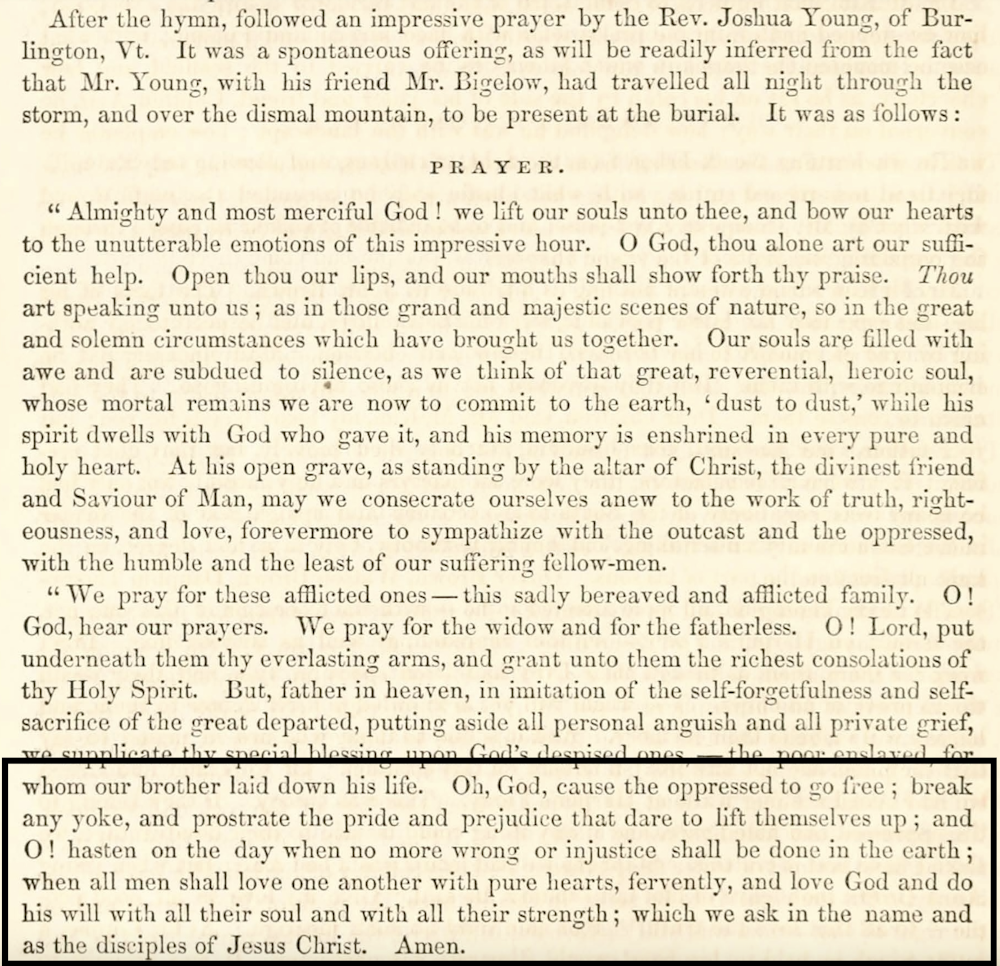
    At the funeral for abolitionist John Brown, the minister prayed over his body, “Oh, God, cause the oppressed to go free; break any yoke, and prostrate the pride and prejudice that dare to lift themselves up.”

    The prayer uttered at John Brown’s burial.
    Library of Congress

    Use of the phrase did not end with Emancipation or the end of the U.S. Civil War.

    In fact, it was one of Frederick Douglass’ favorite phrases. On Oct. 22, 1883, in his “Address at Lincoln Hall,” Douglass excoriated the Supreme Court’s decision rendering the Civil Rights Act of 1875 unconstitutional.

    As was typical of Douglass, the speech ranged beyond racial inequities: “Color prejudice is not the only prejudice against which a Republic like ours should guard. The spirit of caste is malignant and dangerous everywhere. There is the prejudice of the rich against the poor, the pride and prejudice of the idle dandy against the hard-handed workingman.”

    Austen’s independent women

    Early on in “Pride and Prejudice,” the conceited Caroline Bingley snipes that Elizabeth Bennet shows “an abominable sort of conceited independence.” Later, the snobbish Lady Catherine accuses Bennet of being “headstrong.” But near the ending, Mr. Darcy tells Bennet that he loves her for “the liveliness” of her “mind.”

    In this respect, Bennet reflects a quality that all of Austen’s heroines possess. While they try to adhere to standards of courtesy and respect, none are guilty of saying only what the leading man wants to hear.

    Jane Austen.
    Stock Montage/Getty Images

    Given that Austen chose her title to honor the phrase and its history, it is ironic that her own fame ended up drowning out the abolitionist associations of “pride and prejudice” after the Civil War.

    If there is any work of fiction that successfully makes self-sufficiency, independent thinking and open-mindedness look good – and makes sycophants, rigidity and hysterical devotion to rank and status look bad – it is “Pride and Prejudice.”

    Yet the lasting popularity of Austen’s novel demonstrates that the ethics contained in the phrase continue to resonate today, even if its context has been lost.

    Margie Burns does not work for, consult, own shares in or receive funding from any company or organization that would benefit from this article, and has disclosed no relevant affiliations beyond their academic appointment.

    ref. From pulpits to protest, the surprising history of the phrase ‘pride and prejudice’ – https://theconversation.com/from-pulpits-to-protest-the-surprising-history-of-the-phrase-pride-and-prejudice-249836

    MIL OSI – Global Reports

  • MIL-OSI United Kingdom: Food Waste Action Week — Buy loose, waste less 17 March 2025 Food Waste Action Week — Buy loose, waste less

    Source: Aisle of Wight

    WRAP’s Food Waste Action Week takes place this week (17 to 23 March).

    This year’s campaign encourages people to continue buying loose fruit and vegetables to save money by reducing food waste and avoiding plastic waste.

    According to WRAP, fresh fruit and vegetables make up the largest proportion of UK household food waste. Each year, UK households throw away 1.7 million tonnes of edible fruit and vegetables, mainly because they are not used in time.

    Research from Love Food Hate Waste has shown that if all apples, bananas and potatoes were sold loose, 8.2 million shopping baskets worth of food waste could be prevented every year.

    Councillor Lora Peacey-Wilcox, Cabinet lead for waste, said: “With WRAP research showing food waste costing on average £1,000 for a household of four every year, shopping for loose produce will help shoppers to save money, and waste less food.

    “WRAP’s research tells us that by removing the packaging on uncut fresh fruit and veg, it allows us to buy only what we will use, save money and avoid unnecessary packaging.”

    Natasha Dix, service director for environment and waste, said: “Buying loose fruit and vegetables can make a big difference in reducing food waste.

    “With loose produce on offer in shops, plastic waste is reduced. This simple change can also prevent tonnes of CO2 emissions, making a real impact on the environment.

    “And remember, as a last resort, we collect your food waste every week. Your food waste is used to create electricity and compost through a process called anaerobic digestion.” 

    Food waste is collected weekly at the kerbside. Please remove all plastic packaging from food before placing it in your food caddy. 

    Top tip: keep your caddy clean by lining with newspaper, compostable or thin carrier bags. No food caddy? You can order an indoor and outside food caddy online or by calling (01983) 823777.

    Simple ways to help you to save money on your food shop (courtesy of Love Food Hate Waste):

    •    Steer clear of pre-prepared fruit and veg. It’s easier but you’ll pay a premium for it and it usually comes covered in plastic wrap. 
    •    Food will last much longer when it’s stored correctly. This makes it easier to eat everything before it goes off. Store most fresh produce in the fridge — it’ll last longer. 
    •    Save money on food by making the most of what you buy. Aim to eat every edible morsel — for example, keeping the skins on carrots and potatoes (they’re also full of nutrients).

    To find out more about Food Waste Action Week and try out some tasty recipes using your leftovers, visit Love Food Hate Waste’s website

    MIL OSI United Kingdom

  • MIL-OSI United Kingdom: Why napping might be beneficial during Ramadan

    Source: Anglia Ruskin University

    By Timothy Hearn, Anglia Ruskin University

    During Ramadan, Muslims abstain from food and drink from sunrise to sunset. This unique rhythm often leads to changes in sleeping patterns. With nights shortened and days filled with fasting, many Muslims find themselves battling fatigue and a dip in alertness – and a well-timed nap may provide a much needed boost.

    Recently published research on athletes fasting during Ramadan has demonstrated that even a 40-minute nap taken after a strenuous evening session can significantly improve physical and cognitive performance. And, in studies with soccer players, those who napped showed better performance in short-distance shuttle runs and attention tests than those who skipped the nap.

    So, why can naps have such a transformative effect on our energy levels?

    Siesta science

    Naps work by giving the brain and body a chance to reset. When you’re awake for long stretches – especially under the stress of altered meal times and reduced nighttime sleep – the brain accumulates sleep pressure.

    A nap, especially in the early afternoon when many experience a natural dip in alertness, can relieve that pressure and enhance mood, reaction time, and even physical endurance. One 2024 study, for instance, showed that a 40-minute nap not only reduced feelings of sleepiness but also improved performance in tasks that require focus and quick thinking. While a 2025 study of female athletes found that both 40-minute and even 90-minute naps could enhance physical performance and mood after a night of sleep restriction.

    But it’s not all good news for habitual nappers. Although longer naps sometimes show even greater benefits, they may also lead to temporary grogginess – a phenomenon known as sleep inertia – which can counteract the positive effects if not managed properly.

    But there’s evidence that exposure to bright light and face washing could help nappers combat sleep inertia. For some, though, this grogginess can linger long enough to affect productivity, mood, and overall performance.

    When it comes to nap duration and timing, the key is to find the “sweet spot”. Short naps – lasting around 20 to 30 minutes – can improve alertness without causing sleep inertia. On the other hand, longer naps, such as those lasting 40 minutes or more, have been shown to boost both mental and physical performance but must be scheduled carefully to avoid interfering with nighttime sleep.

    To nap, or not to nap?

    During Ramadan, when the body is already adapting to a shifted sleep schedule, a carefully timed nap might be especially beneficial. It can serve as a counterbalance to the reduced sleep quality and quantity that sometimes accompany fasting. However, if taken too late in the day, a nap might delay the onset of your regular sleep cycle, leading to disrupted sleep patterns.

    But, when taken at the right time, napping can be a valuable tool for enhancing alertness, mood, and even physical performance – benefits that are particularly relevant during periods of fasting like Ramadan.

    Ultimately, the decision to adopt a daily nap should be guided by your personal lifestyle, sleep quality, and overall health goals. For many, a well-timed, moderate-length nap is not only a healthy habit, but also a strategic advantage in managing daily challenges – whether you’re fasting during Ramadan or simply trying to make the most of a hectic day.

    Timothy Hearn, Senior Lecturer in Bioinformatics, Anglia Ruskin University

    This article is republished from The Conversation under a Creative Commons license. Read the original article.

    The opinions expressed in VIEWPOINT articles are those of the author(s) and do not necessarily reflect the views of ARU.

    If you wish to republish this article, please follow these guidelines: https://theconversation.com/uk/republishing-guidelines

    MIL OSI United Kingdom

  • MIL-OSI United Kingdom: New approach could revolutionise diabetic exercise

    Source: Anglia Ruskin University

    A new approach to exercise that could potentially revolutionise diabetic health will be discussed at a free talk at the forthcoming Cambridge Festival.

    Dan Gordon, a former Paralympian and Professor of Exercise Physiology at Anglia Ruskin University (ARU), will discuss diabetes and approaches to exercise during his free talk on Saturday, 22 March.

    Professor Gordon will discuss the increasing prevalence of the condition in the UK and globally, and the effects that different types, intensity and duration of exercise have on blood glucose levels.

    Professor Gordon will also showcase new research developed with PhD student Chloe French, which could be of particular benefit to people with diabetic foot, a condition where blood vessels that supply the nerves in the feet are damaged, resulting in serious foot problems.

    The technique involves using a blood pressure cuff at the ankle to restrict blood flow to the foot. Under certain conditions, this was found to increase the amount of oxygen being delivered to the foot as well as a reduction in the anti-brachial index – a measure of localised blood pressure – after just four weeks.

    The talk will also address access to exercise, covering topics such as fear of low glucose, lack of motivation and body image.

    “Exercise is important for all of us and people with diabetes are no different, but there are additional challenges that some people have to live with, such as neuropathy, ulceration, or poor circulation, and it can be overwhelming.

    “This talk will be of interest to anyone living with or caring for someone with diabetes and will cover some of the principles of how exercise affects blood glucose, as well as the safest and most effective ways that people with diabetes, and its associated complications, can approach and enjoy exercise.”

    Dan Gordon, Professor of Exercise Physiology at Anglia Ruskin University (ARU)

    Professor Dan Gordon has over 20 years’ experience in the assessment of exercise physiology and impact of training and pathologies on important functions of the body.

    People can attend the talk in person at ARU’s Cambridge campus and online from 11am until 12noon on Saturday, 22 March. It is free to attend, but tickets must be booked in advance.

    To book tickets for the in-person event, visit https://www.eventbrite.co.uk/e/diabetes-and-exercise-finding-the-perfect-fit-in-person-event-tickets-1077766812549

    To attend the virtual event, book via https://www.eventbrite.co.uk/e/diabetes-and-exercise-finding-the-perfect-fit-virtual-event-tickets-1077782419229

    MIL OSI United Kingdom

  • MIL-OSI United Kingdom: SIA response to Home Office public body review

    Source: United Kingdom – Government Statements

    Press release

    SIA response to Home Office public body review

    The Security Industry Authority (SIA) today (17 March 2025) welcomed the publication of the Home Office public body review of the regulator.

    Public body reviews provide an opportunity for government departments to ensure they are satisfied that an arm’s length body such as the SIA is operating with a clear purpose using an appropriate delivery model.

    In a joint statement issued today, Heather Baily, Chair of the SIA, and Michelle Russell, Chief Executive of the SIA, said:

    We welcome the publication of this review of the SIA and of the regulatory regime for private security. The SIA embraced the review with a collaborative, open, and transparent approach. We are pleased the review provides the necessary assurance to ministers and the public that the SIA is a well-run organisation doing good work. 

    The focus of this review was efficiency, and the review confirms the SIA has challenged itself to increase efficiency to contain the cost of its operations.

    The review also confirms the SIA is best placed in its current form to deliver the licensing of regulated security roles and the regulation of private security.

    We are particularly pleased that the review acknowledges the work licensed security operatives do to protect the UK. The review encourages them to “continue to work with the SIA as an expert and authoritative regulator that is punching above its weight to encourage the highest standards in the profession.

    We seek and continue to benefit from the support and co-operation of those working in the private security industry and our many partners to provide effective regulation and pursue robustly those who choose not to comply.

    We will work with the Home Office and the devolved governments to implement the recommendations of this review.

    The Home Office conducted the review between August 2023 and March 2024.

    Download and read the full review here: Security Industry Authority: Public Body Review 2025 – GOV.UK.

    Further information

    The SIA is the organisation responsible for regulating the private security industry in the UK, reporting to the Home Secretary under the terms of the Private Security Industry Act 2001. The SIA’s main duties are the compulsory licensing of individuals undertaking designated activities and managing the voluntary Approved Contractor Scheme (ACS).

    For media enquiries only, please contact: media.enquiries@sia.gov.uk.

    Updates to this page

    Published 17 March 2025

    MIL OSI United Kingdom

  • MIL-OSI United Kingdom: Charity regulator warns about fraudulent letters sent on its behalf

    Source: United Kingdom – Executive Government & Departments

    News story

    Charity regulator warns about fraudulent letters sent on its behalf

    Charity Commission warns charities about fraudulent messages recently sent to charities and trustees.

    The messages typically request action to be taken such as removing a trustee or chief executive from their position, releasing funds as part of a grant or supplying documents such as a passport or utility bill. They may be signed as coming from ‘the Commission,’ Chief Executive Officer and/or its Directors.  

    We have reported the incidents to Action Fraud and will continue to monitor the situation.  

    It’s not always easy to tell if correspondence is real or fake, however please note we:

    • will only send you a letter just by post only if we do not have your current email address. Check and update your details
    • rarely address letters generically, for example ‘to whom it may concern’
    • do not write letters or emails of certification on behalf of UK charities regarding tax exemption or any other matters
    • do not issue requests to authenticate an account online by supplying personal identity documents
    • will not ask you to provide banking information

    In the rare circumstance where we might send you a letter by post  it will:

    • be franked – not stamped
    • normally have a case number or reference on it 
    • be unlikely to be marked as ‘Strictly Private and Confidential’ 
    • come from the Charity Commission of ‘England and Wales’, not the ‘UK’ or ‘England’

    It is unlikely that any serious allegations against individuals would be detailed in a letter, or that we would name individuals before there was clear evidence of wrongdoing. 

    Matters to do with casework or investigation would normally come from a caseworker or a team at the Commission . 

    If you are in any doubt, contact us to check.

    Updates to this page

    Published 17 March 2025

    MIL OSI United Kingdom

  • MIL-OSI United Kingdom: National Planning Skills Commitment Plan

    Source: Scottish Government

    Focus on skills and recruitment.

    A new programme is being launched to attract more people into the planning profession and build their skills.  

    The National Planning Skills Commitment Plan will provide training and skills development through monthly themed webinars, hands-on learning and recruitment support. It is supported by more than 100 leaders across almost 60 organisations in the built and natural environment professions. The plan will cover different themes at different times, with the first one on housing.

    More planners are needed in Scotland to meet recruitment gaps. In 2023-24 planners dealt with nearly 23,000 applications including 227 applications for major developments.

    Public Finance Minister Ivan McKee met planning students during a visit to Govan Housing Association’s Water Row Development.

    Mr McKee said: 

    “The response to the new National Planning Skills Commitment Plan has been overwhelmingly positive and demonstrates that the industry is eager to work with the Scottish Government to develop skills and welcome new talent. 

    “Planning promotes economic development, addresses housing shortages and supports action on climate change. Modernising how the profession is promoted and portrayed, and taking a more direct approach to recruitment will help attract the next generation of planning professionals. This will ensure that Scotland can deliver development and infrastructure efficiently, effectively and sustainably now and in the future.”

    Ross Nimmo, Head of Place at Glasgow City Region, said: 

    “Planners help to imagine and deliver many of our local, regional and national priorities, from town centres and business parks to renewable energy and nature networks. As a growing City Region, we need planners to create great places like Water Row in Govan. The National Planning Skills Commitment Plan and our own regional skills initiative are boosting the profession’s profile and opening up new routes to education and employment.”

    Background 

    The Commitment Plan is available at www.ourplace.scot/resource/training-and-recruitment-opportunities

    The Commitment plan builds on the Future Planners Research (2022) and delivers on the action outlined in the Planning and Housing Emergency – Delivery Plan (November 2024). Organisations committed to actions, this month, include Fife Council and Highland Council who are leading a workshop for the Scottish Young Planners Network on processing a planning application. Others training partners during March include the Improvement Service, Scottish Land Commission, Scottish Futures Trust, Architecture and Design Scotland.

    MIL OSI United Kingdom

  • MIL-OSI United Kingdom: New-look repairs and maintenance service to be rolled out across Stoke-on-Trent

    Source: City of Stoke-on-Trent

    Published: Monday, 17th March 2025

    A repairs and maintenance company, which looks after 17,500 homes and around 600 public buildings in Stoke-on-Trent, will be back under the control of Stoke-on-Trent City Council from April.

    In August 2024, the city council announced how Unitas is being brought back in-house to enable it to better meet new government regulations requiring landlords to adhere to new, higher standards ­- and be accountable for all aspects of service delivery.

    Unitas was established in 2018 as a wholly-owned subsidiary of the council, however, from Tuesday, 1 April 2025, Unitas will be transferred over to Stoke-on-Trent City Council and will operate alongside the hundreds of other valued services that the authority already provides.

    From that date, the Unitas name – and logo – will cease to exist, and the service will instead be known as the council’s Repairs and Maintenance Service.

    The current Unitas branding will be phased out and replaced with the Stoke-on-Trent City Council crest, in line with all other council services.

    New name badges and ID cards are currently being produced for repairs operatives who will present them upon arrival at a tenant’s property. The ID cards will also include a telephone number, which tenants can call to clarify who the person is before letting them into their homes.

    Councillor Chris Robinson, cabinet member for housing and planning at Stoke-on-Trent City Council, said: “Over the last six months, a lot of work has been going on behind the scenes to ensure this transition carried out as smoothly and sensitively as possible for all involved.

    “The project is progressing well and I’m pleased to be able to announce that, from Tuesday, 1 April, the service will be back under control of the council.

    “For now, and in the near future, we don’t expect tenants to notice a huge difference in the way we are delivering our housing repairs and maintenance service. Everything will continue as normal up until at least April.

    “But we know from speaking to our tenants that improvement is needed to our repairs and maintenance service and we are looking at what changes we need to make to ensure we can provide a high-quality service. We also want to make sure that repairs are done right the first time and that, through our proactive investment programme, we can fix common housing issues before they become a big problem – such as damp and mould.

    “We are committed to improving people’s lives and making the city a healthier, wealthier and safer place for all.”

    The decision to bring the council’s repair and maintenance service in-house follows the introduction of new government legislation, introduced on the back of the Grenfell Tower tragedy in 2017.

    MIL OSI United Kingdom

  • MIL-OSI United Kingdom: Work on Ryhope supported housing scheme reaches key milestone

    Source: City of Sunderland

    A new residential development on the site of the former St Cuthbert’s Church in Ryhope has reached a key milestone.

    The topping out of the six supported bungalows for people with physical and learning disabilities brings the development a step nearer completion.

    Built as part of Sunderland City Council’s ongoing work to provide homes for those who are most at need, each bungalow will come with 5G infrastructure built-in, ready to incorporate assistive technology depending on client needs. 

    The development is being supported by £660,000 funding from Homes England and is part of a council-led plan to deliver more supported properties for vulnerable residents. This includes more bungalows for people living with disabilities and providing specialist accommodation available for affordable rent. 

    Councillor Kevin Johnston, Cabinet Member for Housing, Regeneration and Business at Sunderland City Council, said: “It’s great to see work nearing completion on these six new bungalows, which are all about helping us to deliver more accessible properties for those who need them. 

    “We’ve worked closely with colleagues in Adult Social Care, Sunderland Care and Support and the residents themselves to create homes that will meet their needs.

    “The creative and innovative thinking from everyone involved has resulted in homes that are both personalised and technology enabled, enabling their residents to live as independently as possible.”

    The three three-bedroom bungalows and three two-bedroom bungalows in Ryhope follow similar projects to provide accessible housing in Washington and at Hylton Road.

    Matthew Wright, Manager – Affordable Housing Delivery at Homes England, said: “As the Government’s housing and regeneration agency, increasing the supply of quality affordable homes remains one of our key objectives and we are committed to supporting ambitious housebuilders of all sizes to build those homes and communities.

    “This investment through the Affordable Homes Programme does just that, enabling Sunderland City Council to build 12 much needed new homes the people of Sunderland can be proud of.”

    The development has been built by North East based T Manners and Sons.

    Derek Collinson, Contracts Manager at T Manners and Sons, said: “It is great to be working with Sunderland City Council on this project constructing six bungalows designed to provide comfortable and accessible living spaces that support individuals with specialised care needs.

    “The works have reached a major milestone, with the completion of the roofing works. As work progresses on internal fittings, landscaping, and hard-standing areas, the project continues to prioritise the use of the local supply chain. This commitment to local suppliers reinforces the project’s dedication to community investment and sustainable construction practices. We are really excited to see the final product come together and the positive impact it will have on the community.”

    The first residents are expected to start moving into their new homes this summer.

    MIL OSI United Kingdom

  • MIL-OSI United Kingdom: Show your community pride at this year’s Great British Spring Clean

    Source: City of Liverpool

    The sun is back out and spring is here, so get stuck in and clean up your community is the message for residents this month. 

    Liverpool City Council is encouraging residents to get involved in litter-picking events taking place during the Great British Spring Clean. 

    The annual cleanliness campaign, run by Keep Britain Tidy, returns from Friday 21 March to Sunday 6 April. And this year, even more people are being urged to become a #LitterHero and pledge to clean up their local area

    To celebrate the start of the cleaning fortnight, the Council is hosting a special launch event in West Derby next Friday. Anyone ready to make the pledge and help to remove rubbish from the streets is welcome to come down to St Mary’s Church from 9.30am. 

    Children from local primary schools will be leading the way, with pupils from Blackmoor Park Infants and Juniors joining members from Liverpool City Council and the Neighbourhood Police team to clear up litter left around the area. 

    For anyone not local to West Derby, there will be a number of community litter picks taking place across the city during the Great British Spring Clean fortnight. All community events will be shared on liverpool.gov.uk/klt.

    The Great British Spring Clean is a national event that takes place every year and asks people to protect the places they love by pledging to collect bags of litter. Last year, over four million people pledged to Keep Britain Tidy. 

    In Liverpool, 52 community events and activities took place during 2024’s Spring Clean, with over 1500 bags’ worth of rubbish taken off the streets. 

    To maintain good litter habits year-round, the Council joined forces with Keep Britain Tidy three years ago and launched Keep Liverpool Tidy. The collaboration focuses on education, engagement and enforcement around littering and dog fouling and closer work with volunteer groups across the city.  

    Since the start of the partnership, there has been a positive increase in community litter-picking, with campaigns like the Great British Spring Clean bringing an annual boost to activity.  

    Anyone interested in creating their own litter-picking activity can contact keepliverpooltidy@liverpool.gov.uk for more information. People can also get in touch to learn more about Liverpool’s established litter picking groups who operate throughout the year.

    Councillor Laura Robertson-Collins, Liverpool City Council’s Cabinet Member for Communities, Neighbourhoods and Streetscene said: “Previous Great British Spring Cleans have been a huge success and it’s fantastic to see so much interest in this year already. The launch day and surrounding events are a great way to get involved and help make Liverpool a cleaner, greener place to live and visit. 

    “Keeping our streets clean is everyone’s responsibility. It might not be your litter, but you can make a huge difference by joining in with a community litter-picking event. 

    “The Council is investing money to clean up the city and tackle the issue at its source, but there’s only so much we can do. I encourage everyone to sign up to an event in their local area or set one up if there isn’t one already. We’ll always be on hand to support where we can. 

    “We also want to use this Spring Clean to say a huge thank you to the volunteer groups and Friends Groups for their hard work all year round. Not only do they make a massive positive impact to the city, but they’re also a great place to meet new people and get out in nature.” 

    MIL OSI United Kingdom

  • MIL-OSI United Kingdom: Acclaimed markets return to Liverpool for 2025

    Source: City of Liverpool

    Liverpool’s award-winning Stanley Park Market is set to return for a second straight year later this month.  

    Launching on Wednesday 19 March, the weekly market will run between 9am and 3pm until mid-December.  

    Its return is closely followed by the spring edition of St George’s Hall Artisan Market, which takes place four days later. 

    Stanley Park Market’s inaugural year saw the market double in size from its initial 50 stalls. 

    Its growing success was celebrated at this year’s Great British Market Awards, where it took home the title of Best Community Market. 

    The market will be held every Wednesday, except when there are evening football matches or concerts held at Goodison Park or Anfield Stadium, as the site is reserved for those events. 

    Each week, there will be up to 100 stalls selling items including fresh local produce, clothing, homeware, toys, and more. Visitors can also choose from lots of hot food and drink stalls, with plenty of seating available.  

    Throughout the year, the market will host a variety of community groups and other local organisations to support people with their health and wellbeing. Last year this included special set ups by Everton in the Community and social care initiatives. 

    Continuing the theme of local craft being on show, Sunday 23 March sees the return of an artisan market at the Grade 1 listed St George’s Hall. The free market launched last year and has already attracted thousands of visitors.  

    Taking place between 10am and 4.30pm, people will be able to browse almost 70 stalls, offering the likes of homemade jewellery, artwork, artisan chocolate, and specialist drinks. The market will also be home to several hot street food vendors and live music performances throughout the day. 

    Liverpool is home to a many beloved markets, from the weekly Great Homer Street Market (Greatie Market) to a regular programme of farmers and craft markets. For a full list of dates and locations, visit the Council’s markets webpage. 

    Councillor Harry Doyle, Liverpool City Council’s Cabinet Member for Culture, Health and Wellbeing, said: “Stanley Park Market exceeded our expectations last year and I can’t wait to see what it brings in 2025. Having it and the St George’s artisan market return this year just goes to show how popular and highly successful these community-driven events have been. 

    “Liverpool is known for its collective spirit and there’s no better place to witness it than in any one of our incredible markets. They’re a fantastic way to connect neighbourhoods and support our local businesses and community groups.  

    “There are loads of markets happening all through the year, and I encourage everyone to head down to one local to you and see what you can find.” 

    Louise Pritchard, owner of Just Bee Gorgeous said: “I am really looking forward to taking my stall ‘Just Bee Gorgeous’ to both Stanley Park and St George’s Hall, once again this year.

    “Last year Stanley Park market had a fantastic community feel to it, because it was a place where people could meet up with their neighbours, family and friends, do a spot of shopping and also have a bite to eat, choosing from the impressive and reasonably-priced food options available.

    “St George’s Hall artisan market is held less frequently (roughly every quarter) but WOW is it worth the wait, because what a backdrop! Everyone is impressed by the stunning surroundings, and it is just the perfect venue to host an artisan market, where there is such a wealth of talent on display. What a great way for small businesses to showcase their work.

    “It is crucial to support your local small businesses because they are the life-blood of all communities. Your custom means so much more to a small business owner than to a giant multi-national corporation and could be the difference between being able or being unable to afford a sports kit for a child, fund medical expenses or even just pay for a short break for the family. Apart from the financial aspect, you are supporting someone’s dream which is fantastic.”

    MIL OSI United Kingdom

  • MIL-OSI United Kingdom: Building regulations: updated notices of approval for calculation methodologies: circular letter

    Source: United Kingdom – Government Statements

    Correspondence

    Building regulations: updated notices of approval for calculation methodologies: circular letter

    Methodologies of calculation of the energy performance of new buildings to demonstrate compliance with the Building Regulations 2010 in England, and the methodologies for expressing the energy performance of buildings in England and Wales.

    Applies to England

    Documents

    Details

    The purpose of this circular letter is to draw attention to the publication of the following:

    • updated Notice of approval of the methodologies of calculation of the energy performance of new buildings to demonstrate compliance with the Building Regulations 2010 in England
    • updated Notice of approval of the methodologies for expressing the energy performance of buildings in England and Wales

    The new notices of approval supersede the existing versions and come into effect on 17 March 2025. Please see the circular for full details.

    Updates to this page

    Published 17 March 2025

    Sign up for emails or print this page

    MIL OSI United Kingdom

  • MIL-OSI United Kingdom: Building a better future with the law

    Source: United Kingdom – Executive Government & Departments

    News story

    Building a better future with the law

    GLD lawyers played a critical role in delivering the Planning and Infrastructure Bill

    The Planning and Infrastructure Bill introduced to Parliament on 11 March is a key element of the Government’s Growth Mission.

    The Bill supports the Government’s commitments to build 1.5 million new homes in this Parliament, kickstart economic growth and make Britain a clean energy superpower through reforms to the planning system. 

    The key objective of the Bill is to streamline planning processes to accelerate house building and major infrastructure projects. The Bill will also support the government’s Clean Power 2030 mission by speeding up the delivery of clean energy infrastructure.

    Successful delivery of the Bill has involved outstanding cross government collaboration by Government Legal Department lawyers advising in 5 key departments: MHCLG, DfT, DESNZ, Defra and MoJ.

    GLD lawyers worked closely with lawyers in the Office for Parliamentary Counsel who drafted the Bill.

    Thanks to expert legal advice from across the Civil Service, we have been able to deliver all aspects of the Bill, and associated products such as the Explanatory Notes Delegated Powers Memorandum and Human Rights memorandum.  

    Innovative and creative thinking helped deliver legal solutions to support the delivery of housebuilding, the creation of a Nature Restoration Fund, and improvements to infrastructure and clean energy.

    The Bill’s measures which introduce environmental delivery plans make targeted amendments to existing environmental legislation, like the Conservation of Habitats and Species Regulations 2017, in order to assist the securing of improved outcomes for the environment.

    In response to Lord Banner KC’s independent review into legal challenges of Development Consent Orders[1], the Bill also makes provision for the removal of the paper permission stage for judicial reviews of National Policy Statements and Development Consent Orders, introduced by the Planning Act 2008, and removes the right to appeal for cases deemed totally without merit at the oral permission hearing.


    [1] Independent review into legal challenges against Nationally Significant Infrastructure Projects – GOV.UK

    Updates to this page

    Published 17 March 2025

    MIL OSI United Kingdom

  • MIL-OSI United Kingdom: British Embassy Zagreb invites bids for Impact Fund 2025 to 2026

    Source: United Kingdom – Executive Government & Departments

    World news story

    British Embassy Zagreb invites bids for Impact Fund 2025 to 2026

    British Embassy Zagreb invites organisations to submit proposals by 14 April 2025 for projects demonstrating impact in areas of strengthening inter-community relations in Southeast Europe.

    The British Embassy in Zagreb is inviting organisations to submit project proposals for funding from our Impact Fund. As the name suggests, the purpose of the fund is to achieve impact, so we’re looking for projects that make a real difference in the highlighted priority areas. Project proposals which strengthen and nurture relationships between Croatian and UK people and organisations are particularly welcome.

    Themes

    This year, the call will focus on organisations, projects and activities, which link to the following thematic areas:

    Regional stability and development: connecting and strengthening societies in Southeast Europe

    Projects which promote harmonious and constructive relations between communities within Croatia, and between communities in Croatia and its neighbours, to enable stability, European integration and socio-economic advancement in the context of global and domestic challenges. We will prioritise projects in the following areas: 

    • strengthening inter-community understanding, tolerance and constructive cooperation, both domestically and cross-border within Southeast Europe
    • defending against threats to inter-community relations in Southeast Europe, e.g. countering hate speech, historic distortion, and disinformation; supporting a healthy media landscape; and promoting factual, inclusive public discourse and narratives
    • empowering women and girls, enhancing female civic participation and equality, contributing to prosperity and security in the region

    Special emphasis should be placed on activities which generate change, with wider and lasting social impact.

    Innovation for growth: building and nurturing UK-Croatia research & innovation, science, technology, and business partnerships.

    Projects which nurture long-term research & innovation, science, technology, and business partnerships, with a special emphasis on fostering economic growth and UK-Croatia cooperation. We will prioritise projects in the following areas: 

    • establishing new partnerships between researchers, businesses and institutions in the UK and Croatia. In particular, large-scale UK-Croatia collaboration between researchers and organisations within Horizon Europe and other programmes (note: while we cannot directly fund research covered by these other programmes, but we can support establishing the research connections)
    • projects focused on policy and regulation, exchanging knowledge and best practice and other activities which promote and support research (this excludes direct funding) relating to AI, quantum technologies, high-performance computing, nuclear fusion, semiconductors, Health tech and engineering biology. Including values-based governance and regulation of new and emerging technologies, especially AI

    • building expertise on the commercialisation of innovation, connecting Croatian companies to venture capitals and tech ecosystems, and enabling the UK and Croatian business partnerships

    • addressing barriers to market access between the UK and Croatia (e.g. policy, implementation of regulations)

    Energy and climate: promoting green growth and energy transition  

    Projects which promote green and sustainable growth, support the transition to clean energy sources such as offshore wind, hydrogen and nuclear, and deeper UK-Croatia cooperation. Also, projects that tackle the climate crisis and mitigate its impacts, as well as tackling and reversing bio-diversity loss will be considered for funding. We will prioritise projects in the following areas: 

    • establishing UK-Croatia commercial and scientific partnerships in the development of net zero technologies, with focus on hydrogen and nuclear fission and fusion (e.g. joint initiatives, building partnerships within Horizon Europe, exchange programmes between the UK and Croatian institutions)
    • establishing UK-Croatia commercial and scientific partnerships in energy efficiency and storage, emission reduction, and accelerating to achieving net zero
    • establishing UK-Croatia commercial and scientific partnerships in tackling the climate crisis, mitigating its impacts by strengthening social, economic and ecological resilience, unlocking climate and nature finance

    Activity bid guidance

    The British Embassy will support projects with activities taking place between 20 June 2025 and 15 February 2026, with no expectation of continued funding beyond the stated period.

    Maximum project budget limit: 11,500 Euros.

    Project bids will be assessed against the following criteria:

    • alignment with thematic priorities and likelihood of achieving a real-world impact
    • outcomes that are achievable within the funding period and offer value for money
    • activity design that includes clear evaluation procedures and measures of impact
    • activity design that includes risk and financial accountability procedures
    • that the organisation’s safeguarding policies ensure protection of beneficiaries, especially vulnerable individuals and children

    Bidding process

    1. proposals must be submitted using the online application form.
    2. all proposals must be received by 12:00 pm on 14 April 2025. Late proposals will not be considered
    3. successful bidders will be notified by the end of May

    Transparency and further questions

    The British Embassy in Zagreb will organise an online question and answer session about the bidding process on Wednesday 26 March 2025 at 2pm (CET). You can join the live session using this link.

    Additional information and documentation

    All project implementers will be expected to sign a standard contract or grant agreement with the Embassy provided by the UK Foreign, Commonwealth & Development Office (FCDO).

    The terms of the contract or agreement are not negotiable.

    All projects are expected to have achieved 85% spend by end of December 2025. Proposed budgets must reflect this requirement.

    Updates to this page

    Published 17 March 2025

    MIL OSI United Kingdom

  • MIL-OSI United Kingdom: Spelthorne Borough Council: Letter to the Chief Executive (17 March 2025)

    Source: United Kingdom – Executive Government & Departments

    Correspondence

    Spelthorne Borough Council: Letter to the Chief Executive (17 March 2025)

    Letter to the Chief Executive of Spelthorne Borough Council outlining the Secretary of State’s proposed intervention package announced on 17 March 2025.

    Applies to England

    Documents

    Details

    A copy of the letter from James Blythe, Deputy Director, Local Government Stewardship and Interventions at the Ministry of Housing, Communities and Local Government to Spelthorne Borough Council Chief Executive, Daniel Mouawad, in response to the Inspectors’ Best Value Inspection report (January 2025).

    The letter sets out the findings of the report, the proposed statutory support package under section 15 of the Local Government Act 1999, including the appointment of Commissioners and invites representations on the proposal. All representations received on or before 28 March 2025 will be considered before ministers make their final decision.

    Updates to this page

    Published 17 March 2025

    Sign up for emails or print this page

    MIL OSI United Kingdom

  • MIL-OSI United Kingdom: Supporting people with Council Tax debt

    Source: Scottish Government

    Citizens Advice Scotland project expanded.

    People struggling with Council Tax arrears will have access to enhanced advice through the expansion of a Citizens Advice Scotland project.

    Backed by an additional £2.2 million in Scottish Government funding, the project provides tailored support to affected households and works with local authorities to support good practice in Council Tax debt collection.

    The project has already been delivered in nine local authority areas, where it has helped to promote dignified and empathetic approach to debt collection and supported more than 1,600 people with advice on Council Tax issues. This additional funding will allow the project to be extended across the whole country.

    Housing Minister Paul McLennan said:

    “Any type of debt, including council tax debt, puts pressure on households and can cause real difficulties for family finances. Empathy and dignity must be at the heart of debt support.

    “This project has already made a big difference to the way debts are collected in the local authorities where it is in place, including supporting people who cannot access digital technology, making connections with mental health services where needed and encouraging people to seek advice early.

    “By helping families manage debts, this project will help us deliver on our driving mission of eradicating child poverty. Other steps we are taking to support this include investing £6.9 billion in social security for the year ahead, £37 million to deliver the expand the free school meals programme, and continuing to put more money in families pockets through the Scottish Child Payment.” 

    Background

    Advice and support are available for people experiencing problem debt – Debt and money – Cost of Living Support Scotland

    MIL OSI United Kingdom

  • MIL-OSI United Kingdom: Heather Laing appointed as permanent Chief Executive

    Source: United Kingdom – Executive Government & Departments

    News story

    Heather Laing appointed as permanent Chief Executive

    The Immigration Advice Authority has announced the permanent appointment of Heather Laing as Chief Executive.

    With extensive knowledge and experience in the immigration sector, Heather Laing will take on the role of Chief Executive Officer of the Immigration Advice Authority (IAA) with immediate effect. Her expertise will strengthen the organisation’s leadership team and play a crucial role in delivering the IAA’s strategic objectives.  

    John Tuckett, Immigration Services Commissioner, said:

    I am delighted that Heather has been appointed as the IAA’s permanent Chief Executive. Having been in the role since January, her leadership, expertise, and commitment have already made a significant impact, and I have every confidence that she will continue to drive the organisation forward.

    With Heather in the lead, the IAA will continue to evolve and successfully deliver its mission to regulate the immigration sector, ensure high standards of practice and protect the interests of advice seekers.

    Heather Laing, Chief Executive, said:

    It’s a huge privilege to continue leading the IAA as Chief Executive. Over the past two months, I have seen first-hand the dedication of our team and the impact of our work in regulating the immigration sector. As we move forward, I look forward to building on this momentum, delivering on our strategic priorities, and ensuring that advice seekers remain at the heart of everything we do.

    Heather Laing was initially appointed as interim Chief Executive following the IAA’s rebrand on 16 January 2025. After a fair and open recruitment process, she will now continue in the role on a permanent basis.

    Updates to this page

    Published 17 March 2025

    MIL OSI United Kingdom

  • MIL-OSI United Kingdom: Fun packed programme for kids during the Easter Holidays

    Source: Scotland – City of Perth

    Looking for a fun packed programme for the kids during the Easter holidays?

    Letham WAC have visits arranged to visit Westbank Woods the outdoor community woods, den building, learning about the environment and the creatures that live in it.

    There are lots of ‘Spring Activities’ including arts and crafts, planting bulbs, spring hunt around the school grounds.

    Science activities – find out how to make a rainbow using different scientific experiments. Throughout the holidays there will be lots of Easter arts and crafts, sports, outdoor play and baking throughout the holidays.

    Come along and have lots of “Fun and Do Stuff”

    To book a place at this holiday service or any of the PKC holiday services please visit Kids clubs and wraparound care services – Opening times, booking places, costs and holidays.

    MIL OSI United Kingdom

  • MIL-OSI United Kingdom: Just two weeks to go for many businesses to submit 2024 packaging data for pEPR

    Source: United Kingdom – Executive Government & Departments

    Press release

    Just two weeks to go for many businesses to submit 2024 packaging data for pEPR

    Obligated businesses must submit 2024 packaging data by 1 April 2025 under new extended producer responsibility for packaging (pEPR) scheme

    There are now just two weeks to go for businesses to submit 2024 packaging data under the new extended producer responsibility for packaging (pEPR) scheme. 

    Under legislation which came into force on 1 January 2024, large organisations must submit their July-December 2024 data by 1 April. 

    Small organisations must submit their January-December 2024 data in one annual submission by 1 April. 

    In addition, all obligated organisations, large and small, must also register with their environmental regulator by the same date. Guidance on how to register can be found here. 

    The data producers provide will be crucial in helping to ensure fees are set at an appropriate level.

    The Government is grateful to all those in industry who have engaged closely with pEPR and already submitted extensive data, helping to finetune the policy. If obligated packaging producers have neither reported their data nor registered, they could face enforcement action.

    To check whether they need to report packaging data, businesses should visit EPR: who is affected and what to do and, if necessary, follow the online instructions to access the new Report Packaging Data service. 

    pEPR will move the cost of dealing with household packaging waste away from taxpayers onto the businesses who produce the packaging.  

    It will incentivise businesses to reduce unnecessary packaging and use more recycled and recyclable packaging, leading to less waste to landfill and reducing the release of damaging CO2 emissions. 

    Dr Margaret Bates, head of the UK pEPR scheme administrator PackUK, said:

    The need for an effective pEPR scheme that shifts the cost of managing household packaging waste to producers has never been more critical. 

    We urge all businesses to check their obligations under pEPR and to report their data and register with environment regulators by 1 April. 

    Together, we will deliver a fair and collaborative scheme that addresses the challenges of packaging waste and lays the foundation for a more sustainable and responsible approach to packaging.

    If a firm or a member of the public suspects a business is not complying with the regulations, they should report this to the regulators by contacting them directly via the details listed below.  

    To report via a 24-hour telephone service, call 0800 80 70 60 for England, Scotland, Northern Ireland and 0300 065 3000 for Wales. All reports are treated with strict confidentiality, with the option to report anonymously.

    Updates to this page

    Published 17 March 2025

    MIL OSI United Kingdom

  • MIL-OSI United Kingdom: The London Fire Brigade – what’s next?

    Source: Mayor of London

    The London Fire Brigade (LFB) has made significant progress in recent years, with the service removed from enhanced monitoring in March last year and an inspection in November finding it to be “outstanding” in one area, and “good” in five more.
     
    But the same report also assessed the LFB as “requires improvement” in how it manages performance and develops leaders and only “adequate” in four areas – including promoting the right values and culture. As there is no room for complacency, what are the priorities for the LFB going forward?  

    Tomorrow, the London Assembly Fire Committee will ask the Deputy Mayor responsible for the Fire Service, HM Inspector Lee Freeman KPM, and senior representatives from the LFB about the issues arising from the recent His Majesty’s Inspectorate of Constabulary and Fire & Rescue Services inspection report. 
     
    A question-and-answer session with the LFB and Deputy Mayor will follow covering diversifying the workforce, training, evacuation of high-rise buildings and the Professional Standards Unit.
     
    The meeting will take place on Tuesday 18 March from 10am, in the Chamber at City Hall, Kamal Chunchie Way, E16 1ZE.
     
    The guests are:
     
    Panel 1 – HMICFRS Inspection:

    • Jules Pipe CBE, Deputy Mayor for Planning, Regeneration and the Fire Service
    • His Majesty’s Inspector Lee Freeman KPM, HMICFRS.
    • Jonathan Smith, Deputy Commissioner and Operational Director for Preparedness and Response, LFB
    • Charlie Pugsley, Deputy Commissioner and Operational Director for Prevention, Protection and Policy, LFB 

    Panel 2 – Q&A:

    • Jules Pipe CBE, Deputy Mayor for Planning, Regeneration and the Fire Service
    • Jonathan Smith, Deputy Commissioner and Operational Director for Preparedness and Response, LFB
    • Charlie Pugsley, Deputy Commissioner and Operational Director for Prevention, Protection and Policy, LFB 
    • Sally Hopper, Director for People, LFB

    Media and members of the public are invited to attend.
     
    The meeting can also be viewed LIVE or later via webcast or YouTube.
     
    Follow us @LondonAssembly.


    MIL OSI United Kingdom

  • MIL-OSI United Kingdom: Labour must listen to backlash and radically rethink dangerous welfare reforms

    Source: Scottish Greens

    Labour’s cuts are cruel and must be stopped.

    Labour has 10 days to radically rethink their cruel cuts agenda, warns Scottish Greens MSP Maggie Chapman.

    The party’s spokesperson for social security, Ms Chapman is urging Labour to use the Spring statement, expected on March 26th, to halt dangerous social security reforms that could unleash even more harm than the Tories.

    Ms Chapman called for Labour to turn their attention towards the super rich by introducing a wealth tax instead of cutting vital life-lines and forcing disabled people into life-threatening situations.

    Ms Chapman said:

    “The reported budget cuts will only push the most vulnerable people in our society further into poverty and harm.

    “From cutting winter fuel payments and expecting pensioners to freeze or deal with it, to refusing to remove the punitive two-child cap that unfairly targets larger families, Labour has chosen to continue the most punishing Tory policies while preparing some of the most callous cuts the UK has ever seen.

    “These latest cuts represent a clear and direct attack on the lives of disabled people. They are not inevitable. They are a choice. Labour must listen to the disabled campaign groups and experts who are warning about the devastating impact these cuts will have.

    “I speak regularly with disabled people and activists who are terrified that ending this vital support will result in deaths. Is that what Labour meant when they promised change? Is it the legacy that Keir Starmer wants?

    “Each of us has intrinsic worth as human beings that is not tied to our personal economic input. It sets a harmful and dangerous tone when we say that only those who are able to work are worth helping. And we know that many people in work are also struggling to cope.

    “With so many people experiencing fear and anxiety, and with the emergence of the far right, the Spring statement is one of the most important in living memory.

    “It is time for Keir Starmer and Rachel Reeves to stop pandering to Tory austerity. They must bring in a wealth tax that collects a fair and justified share from the richest people who are never punished just for existing in the way that the poorest people are.

    “Labour must make good on the promise it made in opposition, start taxing the rich properly and stop turning its back on vulnerable people.”

    MIL OSI United Kingdom

  • MIL-OSI United Kingdom: How we protected the UK and space in February 2025

    Source: United Kingdom – Government Statements

    News story

    How we protected the UK and space in February 2025

    This report was issued in March 2025 and covers the time period 1 February 2025 to 28 February 2025 inclusive.

    February was a highly active month which saw uncontrolled re-entry alerts at their highest level since our records began. All NSpOC warning and protection services functioned as expected throughout the period.

    Re-entry Analysis

    February has seen an increase in the number of objects re-entering Earth’s atmosphere when compared to the previous month.  

    Chart showing number of re-entries monitored by month. March: 25, April: 22, May: 56, June: 48, July: 44, August: 89, September: 50, October: 35, November: 47, December: 83, January: 115, February: 129

    Of the 129 objects monitored for re-entry this month, 119 were satellites, 5 rocket bodies and 5 were classified as unknown objects, likely to be either a rocket body or a satellite

    In-Space Collision Avoidance

    Collision risks to UK-licenced satellites declined by 5% in January, but remained above the 12- month rolling average of 2,376.

    Chart showing number of collision risks to UK-licensed satellites monitored by month. March: 1,903, April: 1,899, May: 2,560, June: 1,881, July: 1,795, August: 2,137, September: 3,041, October: 3,181, November: 2,722, December: 2,142, January: 2,694, February: 2,567

    Number of Objects in Space

    There was an increase to the in-orbit population during January, with 380 newly catalogued objects added to the US Satellite Catalogue. 

    Chart showing number registered space objects by month. March: 28,478, April: 28,752, May: 28,850, June: 28,931, July: 28,917, August: 29,297, September: 29,678, October: 29,665, November: 29,826, December: 29,921, January: 29,985, February: 30,163

    110 newly catalogued objects were attributed to the SpaceX Transporter-12 mission, ranging from Earth imaging satellites to re-entry vehicles as well as a ‘selfie’ satellite.

    Fragmentation Analysis

    There were no new on-orbit fragmentations during February.

    Space weather

    Space weather was mostly minor to moderate throughout February, with some periods of increased activity. Key events this period included: 

    Early – Mid February:

    Frequent minor to moderate radio blackouts caused limited HF communication outages on the sunlit side of Earth. Isolated minor geomagnetic storms were triggered by fast solar winds but had limited impacts. Active high-energy electron fluence may have caused satellite charging. 

    23 February:

    A Strong (R3) radio blackout affected a wide area on the sunlit side, with possible minor disruptions to satellite navigation systems. 

    25 February: 

    A Minor (S1) radiation storm occurred, potentially causing occasional Single Event Upsets (SEUs). 

    Late February:

    Minor to moderate geomagnetic storms were recorded, likely causing minor satellite orientation issues.

    Comments

    The National Space Operations Centre combines and coordinates UK civil and military space domain awareness capabilities to enable operations, promote prosperity and protect UK interests in space and on Earth from space-related threats, risks and hazards

    Updates to this page

    Published 17 March 2025

    MIL OSI United Kingdom