Category: United Kingdom

  • MIL-OSI United Kingdom: Council awarded share of €7.5m PEACEPLUS funding to deliver community cross border walking programme

    Source: Northern Ireland City of Armagh

    Armagh City, Banbridge and Craigavon Borough Council is proud to announce it has been awarded funding from PEACEPLUS to help deliver ‘Walking for All’, a participation-based walking programme which will engage over 14,000 people in walking in rural areas in Northern Ireland and the border counties of Ireland.

    The funding announcement of €7,536,957 from PEACEPLUS is a programme managed by the Special EU Programmes Body (SEUPB).

    Walking for All aims to create healthier rural communities by encouraging participation in walking through organised, volunteer-led walks. These short walks, guided by trained volunteers, will be held in local community spaces and will also aim to bring diverse communities together, fostering acceptance and respect for differences.

    Key outcomes of this cross-border cross-community project include the appointment of dedicated Walking for All Officers, who will oversee the recruitment and training of Volunteer Walk Leaders. These leaders will support the creation of nearly 600 walking groups across rural communities, with the aim of engaging thousands of individuals in regular, social walks.

    The project involves 19 partners. Outscape, a registered charity and not-for-profit organisation, will co-ordinate and lead the project. Delivery on the ground across Northern Ireland will be undertaken by Armagh City, Banbridge and Craigavon Borough Council, 7 other Northern Ireland Local Authorities and Causeway Coast and Glens Heritage Trust. There will be 6 Local Sports Partnerships (LSPs) in Republic of Ireland who will also be responsible for project delivery including Louth, Cavan, Leitrim, Monaghan, Donegal and Sligo. Sport Ireland, Mountaineering Ireland and the Public Health Agency in Northern Ireland are support partners and were instrumental in the development of the programme.

    Lord Mayor Alderman Stephen Moutray said: “We are delighted to be one of the delivery partners for Walking for All and receive this funding from the Special EU Programmes Body to implement Walking for All. Being part of this programme under the mentorship of Outscape, we can take significant steps towards improving the health and wellbeing of rural communities in Armagh, Banbridge and Craigavon.

    “We look forward to being part of this collaborative approach which will use walking to address issues associated with people’s health, social exclusion and isolation.”

    Gina McIntyre, CEO Special EU Programmes Body commented: “Significant developments have been made in the provision of collaborative cross-border services in recent years, providing equality of access for citizens in rural areas. The EU INTERREG programme enabled much of this work and PEACEPLUS funding now builds – and further expands – these collaborative initiatives into areas of increasing wellbeing and reducing social isolation in rural areas.”

    Speaking on the project’s potential impact, Caro-Lynne Ferris, Executive Director at Outscape commented: “This is the most ambitious project Outscape has undertaken to date, and it marks a major milestone for both Northern Ireland and the border counties. We are excited to work with communities across NI and ROI, helping them embrace walking as a means to better health and strengthen social connections. This project will be a powerful catalyst for increased social cohesion and community wellbeing, with impacts that extend far beyond its duration.”

    Spanning the next three years, the project represents a significant step towards Armagh City, Banbridge and Craigavon Borough Council achieving its vision of ‘A happy, healthy and connected community, a vibrant and sustainable economy and appealing places for living, working and learning’ by delivering on one of its strategic goals of providing opportunities which improve quality of life and wellbeing for our communities in outdoor activities.  Walking For All also aligns with key government priorities, including the draft Obesity Strategy ‘Healthy Futures’ in Northern Ireland.

    MIL OSI United Kingdom

  • MIL-OSI United Kingdom: Pupils and council join forces for nature on lough shore

    Source: Northern Ireland City of Armagh

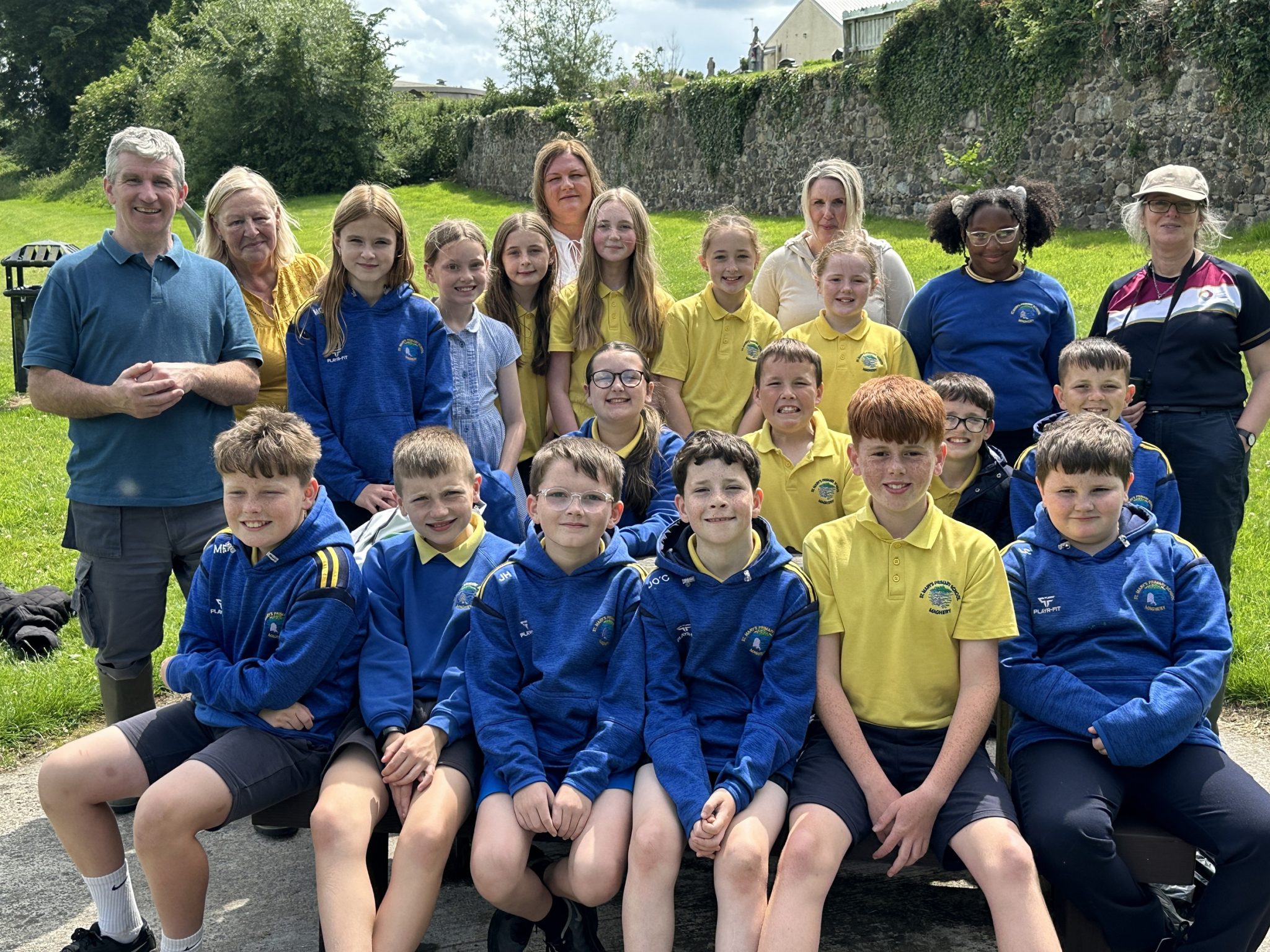
    Pupils from St Mary’s PS pictured at their environmental survey.

    The shores of Lough Neagh have proven to be the perfect location for local school pupils determined to make a positive impact on their environment and wildlife, with the help of Armagh City, Banbridge and Craigavon (ABC) Borough Council.

    Butterflies, wildflowers and a Great Crested Grebe were just some of the wonderful flora and fauna spotted and recorded by the pupils of St Mary’s Primary School in Maghery.

    As part of their project to promote and protect biodiversity, the children have been helping to manage a wild meadow at Maghery Country Park.

    Pupils and staff from St Mary’s PS Maghery pictured with officers from ABC Council at their environmental survey.

    The school adopted an area of wet grassland in Maghery Country Park which frequently flooded and was difficult for the Council’s Ground Maintenance team to manage.  Under the supervision of the Biodiversity Team at Oxford Island the project was agreed.

    The council agreed not to cut the grass area until the end of September allowing native wildflowers to grow and set seed. To assess the impact of their project, the school joined council officers last week, to carry out a survey of the range of native wildflowers growing in the uncut wet grassland, and a butterfly walk to count and identify species.

    The pupils who enjoyed a boat trip, also carried out a successful bird survey, when they spotted a range of species including Grey Heron, Coot, Great Crested Grebe, Mute Swan, Swallow, Mallard and Tufted duck.

    Council officers have praised the work of the pupils who had also participated in a Himalayan Balsam Bash to remove the non-native Himalayan Balsam invasive species which competes with the local wildflowers vital for pollinators.

    To find out more about environmental education programmes at Oxford Island, including an exciting summer programme of environmental activities for children, please visit – www.getactiveabc.com/facility/oxfordisland/

    MIL OSI United Kingdom

  • MIL-OSI United Kingdom: Advice accepted on autumn 2025 COVID-19 vaccination programme

    Source: United Kingdom – Government Statements

    Government response

    Advice accepted on autumn 2025 COVID-19 vaccination programme

    The government has accepted advice from the Joint Committee on Vaccination and Immunisation (JCVI) for the autumn 2025 COVID-19 vaccination programme

    A Department of Health and Social Care spokesperson said:

    This decision is based on expert advice from the Joint Committee on Vaccination and Immunisation (JCVI), which continuously monitor and evaluate emerging scientific evidence on COVID-19 vaccines.  

    The autumn 2025 vaccination programme will target people who are at the highest risk of serious illness to protect the most vulnerable.

    We encourage anyone who is eligible for COVID-19 vaccination to come forward for vaccination this autumn.”   

    Background information

    On the 13th November 2024, the JCVI published advice on the COVID-19 vaccination programme for spring 2025, autumn 2025 and spring 2026. On 26th June 2025, the Government decided, in line with JCVI advice, that a COVID-19 vaccine should be offered to those in the population most vulnerable to serious outcomes from COVID-19 and who are therefore most likely to benefit from vaccination.

    Vaccination will be offered in England in autumn 2025 to:

    • Adults aged 75 years and over
    • Residents in a care home for older adults
    • Individuals aged 6 months and over who are immunosuppressed, as defined in tables 3 and 4 of the COVID-19 chapter of the UK Health Security Agency (UKHSA) Green Book on immunisation against infectious disease.

    In line with JCVI advice, frontline health and social care workers (HSCWs) and staff working in care homes for older adults will not be eligible for COVID-19 vaccination under the national programme for autumn 2025.

    This is following an extensive review by JCVI of the scientific evidence surrounding the impact of vaccination on transmission of the virus from HSCWs to patients, protection of HSCWs against symptoms of the disease, and staff sickness absences.

    In the current era of high population immunity to COVID-19, additional COVID-19 doses provide very limited, if any, protection against infection and any subsequent onward transmission of infection.

    For HSCWs, this means that COVID-19 vaccination likely now has only a very limited impact on reducing staff sickness absence. Therefore, the focus of the programme is now on those at greatest risk of serious disease and who are therefore most likely to benefit from vaccination.

    Updates to this page

    Published 26 June 2025

    MIL OSI United Kingdom

  • MIL-OSI United Kingdom: Shop a Tipper does it again! Another success for council’s fly tipping scheme

    Source: City of Wolverhampton

    Following a report of dumped waste in Wednesfield and further information being provided by the witness, the council was able to bring the case to court.

    As a result, the resident received a £100 Enjoy Wolverhampton gift card for the details they reported through Shop a Tipper.

    Officers are now reminding offenders that they are being watched – and warning them not to ignore council investigations.

    In the latest prosecution, Paul Mansell, of Field Road in Dudley, pleaded guilty to one charge of fly tipping under the Environmental Protection Act 1990. He also admitted one of obstruction under section 110 of The Environment Act 1995 for failing to comply with investigating officers’ requests for assistance.

    During a hearing on 1 June, Dudley Magistrates Court fined Mansell £200, ordered him to pay costs of £1,000 and a victim surcharge of £80.

    The costs awarded to the council will be reinvested back into its environmental crime service.

    The court heard that at around 1.40pm on 30 August last year, a witness heard a van pull up outside a property in Hart Road, Wednesfield. A man got out of the van to pick up some scrap metal and put it in his van.

    He then pulled a large cardboard box out of the vehicle and placed it in the road. He picked up more scrap metal before driving off and leaving the box in the road.

    The box was full of wood, bubble wrap and other items. The witness dragged the box out of the road and onto the footpath and reported the incident to the council along with some images.

    Council officers investigated and issued a Fixed Penalty Notice (FPN) to the registered keeper of the vehicle. No response was made so a reminder letter was sent. When no response was received to that, the council issued a notice requiring him to attend an appointment at the council.

    When no contact was received and the appointment was missed, the council began the prosecution.

    Under Shop a Tipper, residents are encouraged to report any incidents of fly tipping. If the information provided leads to successful identification, and Fixed Penalty Notices are issued and paid or a prosecution takes place, residents receive a £100 Enjoy Wolverhampton gift card.

    Residents can contact 01902 552700 with information or report online at Fly-Tipping – Shop a Tipper.

    Councillor Bhupinder Gakhal, cabinet member for resident services at City of Wolverhampton Council, said: “Shop a Tipper has done it again! And it’s many thanks to the resident who came forward to provide us with the vital information.

    “Fly tipping is a horrible and unhygienic crime, but Shop a Tipper allows residents to provide information and evidence which can help. This means our officers can investigate and bring people to justice.

    “We continue to work hard to deter fly tipping through a variety of methods including our Shop a Tipper scheme, CCTV cameras, a drone and the increase in our Fixed Penalty Notice to £1,000.

    “Suspected fly tippers should be aware that they are being watched – and they can’t ignore our investigations.”

    Residents are reminded that waste can be disposed of free of charge at the council’s Household Waste and Recycling Centres (tips) which are open 7 days a week from 8am to 4pm. Centres are at Anchor Lane, Bilston and Shaw Road, Wolverhampton.

    A bulky item collection service to dispose of big unwanted items is also available, find out more at Bulky item collection.

    MIL OSI United Kingdom

  • MIL-OSI United Kingdom: Non-executive directors appointed to the Regulator of Social Housing

    Source: United Kingdom – Executive Government & Departments

    News story

    Non-executive directors appointed to the Regulator of Social Housing

    The Ministry of Housing, Communities and Local Government has confirmed the appointment of two new non-executive directors (NEDs) to the Board of the Regulator of Social Housing (RSH).

    The Ministry of Housing, Communities and Local Government has confirmed the appointment of two new non-executive directors (NEDs) to the Board of the Regulator of Social Housing (RSH).

    David Cassidy and Chan Kataria will join as NEDs of the RSH Board for terms of three years. David will take up his post from 1 July 2025 and Chan by the beginning of December 2025.

    The RSH undertakes regulation of registered providers of social housing, setting standards and carrying out robust regulation focusing on driving improvement in social landlords, including local authorities, and ensuring that housing associations are well-governed, financially viable and offer value for money.

    The Board supports the RSH to regulate for a viable, efficient and well-governed social housing sector that can deliver quality homes and services for current and future tenants.

    Parliamentary Under-Secretary of State, Baroness Taylor of Stevenage, said:

    “I welcome the appointment of Chan and David as new non-executive directors who will be valuable additions to the RSH Board. As this Government works to deliver the biggest increase in social and affordable housing in a generation, whilst ensuring homes are safe and decent for tenants, they will bring with them the skills necessary to help ensure the RSH effectively regulates the sector.”

    Bernadette Conroy, Chair of the RSH Board, said:

    “I am very pleased to welcome our new non-executive directors to the RSH. David and Chan bring considerable knowledge and expertise in social housing finance and management respectively, which will enhance the Board’s collective skills. I am looking forward to working with them.”

    Notes to editors:

    David Cassidy

    • David completed a 43-year banking career with Barclays in December 2024. He is a specialist in social housing finance having led that team within Barclays for ten years. He has experience in all aspects of debt finance including capital markets. David’s expertise also covers a diverse range of other commercial banking activities.

    Chan Kataria OBE

    • Chan is an experienced Chief Executive and NED with significant social housing experience. He is stepping down from his role as Group Chief Executive of East Midlands Housing where he led and oversaw significant change. Other current roles also include being a Board member of the Chartered Institute of Housing and a member of the CBI Regional Board in the Midlands. He was awarded an OBE in 2017 for services to housing.

    Updates to this page

    Published 26 June 2025

    MIL OSI United Kingdom

  • MIL-OSI United Kingdom: expert reaction to a Wellcome announcement on a new Synthetic Human Genome research project (SynHG)

    Source: United Kingdom – Executive Government & Departments

    Experts comment on a new research project that aims to synthesise human genomes announced by Wellcome. 

    Prof Robin Lovell-Badge FRS FMedSci, Group Leader, Francis Crick Institute, said:

    “Despite all the knowledge gained from sequencing (reading) human genomes, which began with the first about 25 years ago and has been rapidly accelerating ever since, there is a lot we do not understand about how they work. The protein encoding parts are fairly straightforward, but these comprise only a small fraction of the total. There are segments, notably those that contain highly repetitive DNA at the ends of chromosomes (telomeres) and the centromeres that play a role in segregating the chromosomes to each daughter cell when it divides, about which we know less. There are also huge numbers of repetitive elements, some remnants of viruses that have integrated into the genome or have been copied and moved around. Each gene also has a regulatory region that controls when and where it will be expressed (active) within cells. Some of these elements and the proteins with which they interact are also responsible for dynamic folding and generally organising the genome, which in turn is thought to help not just tight packaging of the chromosomes when the cell divides but also efficient control of gene activity. We can test the role of some of these elements, but given that many may be superfluous or even just evolutionary relics with no clear function (‘junk’ DNA), this is time consuming, expensive and often not rewarding. Being able to build and redesign segments or entire human chromosomes will be important – after all you can only truly understand something if you can build it from scratch. And if you understand what is relevant and important, it may be possible to refine or improve aspects of its activity – for example to more efficiently express gene products of medical value – or redesign it to make novel gene products.

    “I am therefore very enthusiastic about the project being launched by Wellcome, but not just about the scientific possibilities. It is critical when developing new technology to understand not just issues of potential utility, but also those concerned with safety and risk and very importantly the societal values on which it may impinge. Maintaining an active dialogue with varied publics will be important to help build in barriers where needed and to develop appropriate regulation to permit safe practices. It is also required to identify and understand hopes and concerns, where to draw limits and what other, even unrelated factors might influence where the science should be allowed to go. This is important in order to judge where the research needs particularly tight scrutiny and to define under what conditions even some experiments deemed to be of high risk might proceed or whether they should be prohibited outright for being far too dangerous. The latter is the recommendation for building ‘mirror life’ (organisms where all their DNA and proteins have the opposite chirality or twist.

    “As for synthetic human chromosomes, although the current project is very unlikely to get that far, it may eventually be possible to make synthetic cells that can be grown in the lab with high efficiency. If these were to ever be used in humans, it would be important to design them carefully so that they can’t lead to tumours or produce novel infectious particles. Indeed, I would urge incorporating an inducible genetic kill switch to eliminate them from any location in the body or at least to make them easy for the immune system find and destroy. However, there is no suggestion to make synthetic humans. We have no idea how to do this and it is likely to be very unsafe.”

    Sarah Norcross, Director of the Progress Educational Trust (PET), said:

    “It’s incredibly exciting to see such a wide-ranging project announced that will focus on human genome synthesis. Synthesising human genomes is a logical next step after what has been achieved to date with sequencing and editing human genomes, and this is also work that can benefit from current advances in AI. We sometimes forget that generative AI encompasses not just the generation of text, images and sounds, but also the generation of possible molecules that might then be synthesised in the laboratory.

    “There are two important nuances to add. First, we must recognise that this sort of work is not without controversy, and that is vital for researchers and the public to be in communication with one another. The public must have a clear understanding of what this research entails, while researchers and funders must have a thoroughgoing understanding of where the public wants to go with this science. We are therefore extremely pleased to see that a dedicated social science programme has been incorporated into this work at the outset, headed by Professor Joy Zhang.

    “Second, we must not forget ongoing work in genome sequencing and genome editing, which remains vital. Although the Human Genome Project was ostensibly completed in 2003, the human genome was not actually sequenced in its entirety until the Telomere to Telomere Consortium concluded its work 20 years later. As for human genome editing, we have barely begun to explore the possibilities and consequences of that technology, and we have seen one appalling (and thankfully isolated) instance of its misuse.

    “All of these different ways of investigating and working with human genomes must be approached with diligence, with a balance between ambition and humility, and with a view to public interests and concerns.”

    * https://www.bbc.co.uk/news/articles/c6256wpn97ro

    * Wellcome press release: https://wellcome.org/news/new-project-pioneer-principles-human-genome-synthesis


    Declared interests

    Sarah Norcross: PET is a charity which improves choices for people affected by infertility and genetic conditions.”

    For all other experts, no reply to our request for DOIs was received.

    MIL OSI United Kingdom

  • MIL-OSI United Kingdom: Health and Social Care Secretary speech on health inequalities

    Source: United Kingdom – Executive Government & Departments

    Speech

    Health and Social Care Secretary speech on health inequalities

    Wes Streeting spoke at Blackpool Football club on reducing health inequalities.

    Thank you very much, Simon. And thanks to all of you for coming to join us this morning here at Bloomfield Road. 

    I just want to echo, first of all, what Simon said about the club and about the impact it has through the trust of people in the community, particularly in terms of the work it does with young people, giving people opportunities or better life chances. 

    It’s a reminder that it’s something that government has to do, and I believe very strongly we can’t do without a good and active government. 

    But it’s also a reminder that whether we’re talking about creating health or education and life chances, the government can’t do it on our own. 

    And if we try to, we won’t have as much impact as if we work with partners. 

    So I just want to say a massive thank you to everyone here at the club for the work that you do as a proper community-rooted club. 

    This is a town that occupies a special place in my heart through a lot of happy memories from visits to Pleasure Beach as a kid. 

    I’ve got family up the road in Preston, too. And National Union of Students conferences in Winter Gardens during my student years, some of which I can still remember. 

    But as Health and Social Care Secretary, Blackpool is on my mind for less happy reasons: its health outcomes, which are not only poor, but unjust.   

    England is not an especially large nation. Yet the inequalities between us are huge.  

    Travel 30 miles down the road to Ribble Valley and men live for 8 years longer. 

    A baby girl born here in Blackpool will live 7 years less than one born in Wokingham.

    She will fall into ill health 18 years earlier in life. 

    As the report by the Chief Medical Officer on health in coastal communities puts it, in many working-class towns like this one, people are growing old before their time.  

    [Political content removed] 

    And the gap between the health of the poorest and wealthiest parts of our country have widened. 

    These stark health inequalities are not just down to the health service alone.  

    They are also caused by poverty, a lack of good work, damp housing, dirty air, and the sporting, travel and cultural opportunities which are afforded to the privileged few being denied to the many. 

    It is why I have been driving the NHS so hard to reform, improve productivity and cut waste.  

    Because every pound spent on diagnosing and treating illness is a pound that can’t be spent on tackling the causes of ill health.  

    In the coming days, we will be publishing our 10 year plan, which will set out how this mission-driven government will tackle illness, keep disease at bay, and reduce the health inequalities that shame our society.  

    Our 10 year plan will not just be a plan for the NHS, but a plan for health.  

    It will tackle illness at source through a whole-society approach, with a shift in focus from treating sickness to preventing it in the first place. 

    Already this government is taking action. The Education Secretary, Bridget Phillipson, is rolling out primary school breakfast clubs and free school lunches to millions of children, so they walk into the classroom with hungry minds not hungry bellies.  

    Angela Rayner, Deputy Prime Minister, is building a new generation of homes, and along with our Business Secretary, Jonny Reynolds, introducing sick pay from day one in the job. 

    The Chancellor, Rachel Reeves, has given workers on the minimum wage a £1,400 pay rise this year. 

    The Work and Pensions Secretary, Liz Kendall, is giving disabled people the right to work, so they can take up a job opportunity, knowing if things go wrong they can go back to the support they had before without the jeopardy or fear of missing out or being back to square one.   

    Our Energy Secretary, Ed Miliband, is extending the Warm Home Discount, helping keep millions more households warm this winter. 

    And our Environment Secretary, Steve Reed, is cleaning up our rivers and seas from sewage. 

    So, you can see that just those steps we’ve already taken less than a year in office that Keir Starmer’s government is determined to lift people out of poverty, tackle inequality and improve the health of our society. 

    [political content removed] 

    Today, I want to set out how our reforms to the NHS will fundamentally improve the health of working-class communities. 

    NHS founded on principle of equity 

    The National Health Service was founded to end grotesque inequality in access to healthcare.  

    Before 1948, working people avoided the doctor unless they absolutely needed to see one, because of the costs being so prohibitive.  

    Diseases such as rickets, scurvy and diphtheria were common amongst children. 

    The solution was revolutionary – universal healthcare, publicly funded, free at the point of need.  

    And as the NHS’s founder, my predecessor, Nye Bevan, promised, the NHS lifted the shadow from millions of homes and eradicated the fear of illness from people’s hearts.  

    It has been one of the great levellers of our society. The greatest institution this country has ever built. 

    But as the NHS was neglected and left to decline after 2010, it contributed toward the widening gap between rich and poor. 

    Two-tier healthcare 

    Waiting times soared, and a 2-tier healthcare system emerged, where those who can afford it pay to go private, and everyone else was being left behind. 

    [political content removed] 

    The NHS was never intended to just be a safety net for those who cannot afford to pay.  

    Such a system would be doomed to ever-declining quality care. 

    Taxpayers would question why they continue to pay for a service they don’t use.  

    Inevitably, the NHS would become a poor service for poor people. 

    Since its foundation, we have always aspired to an NHS that is universal in provision so that everyone receives high-quality care.  

    [Political content removed] 

    With our Plan for Change, the NHS is on the road to recovery. Since the general election, we have: 

    • recruited an extra 1,700 GPs to the frontline 

    • delivered an extra 3.6 million appointments for planned care and delivered on our promised 2 million in our first year 

    • diagnosed an extra 187,000 suspected cancer patients on time 

    • cut waiting lists in the month of April for the first time in 17 years 

    • cut waiting lists to their lowest level in 2 years 

    • cut waiting lists by almost a quarter of a million patients

    Each one of those patients we have taken off the waiting list is free from pain and in some cases disability, because of the decisions this government has taken. 

    I’m not here to do victory laps. I know that for the almost a quarter of a million people who have received faster treatment, there are more than 7 million cases still waiting.  

    We’ve done a lot but there’s so much more to do. Especially for towns like Blackpool. 

    Tackling inequalities 

    While there are so many social determinants of ill-health that need to be addressed, the fact is that the NHS doesn’t do enough to address the unjust, unequal way in which illness presents itself in our country.  

    In fact, it sometimes entrenches it. 

    General practice was neglected and declined across the board for more than a decade [political content removed].  

    But that doesn’t explain why there are 300 more patients per GP in the poorest communities, compared with the richest. 

    As I spoke about on Monday, far too many parents and their babies have been failed by maternity services.  

    But failing services don’t explain why Black women are almost 3 times more likely to die from childbirth than White women. 

    Black men are twice as likely to get prostate cancer than White men.  

    But given we know the risk is greater, and given we know how to catch cancer early, that doesn’t explain these sorts of inequalities given the evidence is there. 

    For those in greatest need often receive the worst-quality healthcare.  

    This fact flies in the face of the values upon which the NHS was founded.  

    A core ambition of our 10 year plan is to restore the promise of the NHS, to provide first class healthcare for everyone in our country. 

    Whoever you are, whatever your background, wherever you live. 

    NHS solutions 

    [Political content removed] 

    It has fallen to this government to rebuild the NHS for all of us.  

    We are starting where the need is greatest. 

    [Political content removed] 

    We’ve sent crack teams of top clinicians to hospitals around the country, where the highest numbers of people are off work, off sick, to help them cut waiting lists faster. Therefore, getting people not just back to health but back to work. 

    We are delivering on our manifesto commitment to fill in dental deserts, by paying dentists extra to come to work in underserved areas. 

    And today I can announce that we will go further. 

    In recent years, billions of pounds have been put aside for NHS trusts who let their spending get out of control and run up deficits.  

    It’s essentially a bailout fund for poor financial management.  

    I am working with Jim Mackey, Chief Executive of the NHS, to end that culture of rewards for failure. 

    Thanks to the reforms we’ve made to bear down on wasteful spending, the fund will not go to trusts which run deficits this year. 

    We can reinvest that money in the frontline, so it isn’t spent on rewarding poor performance but to improving poor health. 

    The £2.2 billion will fund more effective care – such as innovative medicines, modern technology and services that keep people out of hospital – all going to the places where they are most needed. 

    GP practices serving more deprived areas receive 10% less funding per needs-adjusted patient than poorer parts of our country and have 300 more patients per GP as a result.  

    So, working with the British Medical Association, we will review how health need is reflected in funding for general practice (known to the wonks in the room as the Carr-Hill formula), with a sharp focus on money following need. 

    Where health needs are greatest and GPs fewest, we will prioritise investment to rebuild your NHS and rebuild the health of your community. 

    NHS as anchor institution 

    I said in my first week in this job, the NHS has a part to play in dragging our country out of the sluggish growth and low productivity the government inherited. 

    It is the biggest employer in many towns in England.  

    In coastal towns like Blackpool, where far more people are off work due to long-term sickness, the NHS has a dual role to play.  

    Not just getting patients off waiting lists and back to work, although we are doing that. 

    The health service should also act as an engine of local economic growth, giving opportunities in training and work to local people. 

    Working in the NHS is rightly seen as a high status, secure job.  

    But many people see it as unachievable and out of their reach. 

    On a visit to King George Hospital in my own neck of the woods, I saw first-hand a brilliant programme, Project SEARCH, that supports 17 to 19 year olds who are learning disabled and/or autistic, with internships that give them experience of a wide range of paying jobs, as well as coaching on things like preparing a CV and interview skills.  

    One of them, Muhammed Patel, shared with me how much he had loved the experience and hoped for a career in the NHS.  

    Months later, he messaged me on Instagram to tell me he’s got a job.  

    He’s not the only one.  

    Project SEARCH aims to get every young person on their programme a job in the NHS or with another employer and is succeeding.  

    So today we are launching a new pilot, backed by £5 million, to help recruit an additional 1,000 people to the NHS from areas worst hit by unemployment. 

    The programme will offer a ladder into the world of work for people who find it hardest to break out of unemployment, including over 50s, unpaid carers and disabled people. 

    They will gain the skills needed in health and care, alongside support with job applications and work placements, kickstarting what will hopefully be a long-term and rewarding career in our health and care sectors, where they will more than repay the investment we’re making in them today. 

    Patient power revolution 

    Finally, our 10 year plan will address one of the starkest health inequalities, which is often written out of this conversation. 

    It is the unequal access in our society to information, choice and control over our own healthcare. 

    When I was diagnosed with kidney cancer, colleagues in Parliament asked where I was being treated and who my surgeon was.  

    They just wanted to make sure I was receiving the best possible care.  

    Luckily, the NHS had already assigned me a world-class surgeon who saved my life.  

    But those are questions that my mum, a cleaner here in Lancashire, would never think to ask and would certainly never ask. 

    When the wealthy receive a diagnosis, they already know the best surgeons and can push to get the best care.  

    But working-class people can’t.  

    If the wealthy are told to wait months for treatment, they can shop around. But working-class people can’t.  

    And if the wealthy want instant information about their own health, they can pay for an app that allows them to speak to a doctor over the phone, 24/7.  

    But working-class people can’t. 

    This is not just grossly unfair. It presents an existential risk to the health service. 

    More than any other age group, this generation of young people are prepared to opt-out of the NHS.  

    Last year the biggest increase in private hospital admissions was for people under the age of 40.  

    Almost half of young people say they would consider going private if they needed care.  

    The NHS feels increasingly slow and outdated to the generation that organises their lives at the touch of a button.  

    If you get annoyed at Deliveroo not getting your dinner to you in less than an hour, how will you feel being told to wait a year for a knee operation? 

    A failure to modernise risks this generation walking away from the NHS, first for their healthcare and then with their taxes.  

    People won’t accept paying higher and higher taxes to fund a health service that no longer meets their needs. 

    And the lack of control people feel over their own lives is made worse by an analogue, ‘computer says no’, NHS. 

    We can only close this inequality and shut down this risk to the NHS’s future through a revolution in patient power.  

    The ambition of our 10 year plan is nothing less than to provide NHS patients with the same ease, convenience, power, choice and control that’s afforded to private patients. 

    The good news is that technology gives us the opportunity to democratise healthcare in a way never before possible.  

    It can empower patients with choice and control and make managing our healthcare as convenient as doing our shopping or banking online.  

    Technology can be the great leveller. 

    Look at what Martin Lewis, the Money Saving Expert, has done for personal finances.  

    For ordinary people who sign up to his newsletter – and I’m one of them – who could never afford their own financial adviser, it is simple and easy to make your hard-earned money go further – if you’ve got access to the right advice.  

    Our 10 year plan for health will do the same for NHS patients, giving them easy access to information to help them improve their health. 

    We will introduce a tool on the NHS App called My Companion.  

    It will provide all patients with information about their health condition, if they have one, or their procedure, if they need one.  

    It will get patients answers to questions they forgot or felt too embarrassed to ask in a face-to-face appointment.  

    So, the next time you’re at an appointment and you’re told something that doesn’t sound right, you will have at your fingertips the information you need to speak up confidently. 

    And we will give every patient meaningful choice, through a new tool called My Choices.  

    It will show patients everything from their nearest pharmacy to the best hospital for heart surgery across the country, with patients able to choose based on their preference.  

    If NHS providers know that their waiting times, health outcomes of their patients, and patient satisfaction ratings will all be publicly available, they will be inspired to respond to patient choice, raise their game and deliver services that patients value. 

    Not everyone will want a choice.  

    Many just want their local hospital.  

    That’s fine and will always be a default option.  

    But we know that at the root of many inequalities in health outcomes is a failure to listen to patients.  

    A ‘one size fits all’ approach often misses the distinct needs of women, people from ethnic minority backgrounds or people living in rural communities.  

    And we will only deal with the grotesque health inequalities in our society by empowering all patients. 

    Conclusion 

    In the months leading up to the founding of the NHS, Nye Bevan said: 

    For a while it may appear that everything is going wrong.  

    As a matter of fact, everything will be going right because people will be able to complain.  

    They complain now, but no one hears about it. 

    He promised that a National Health Service would put a “megaphone to the mouth of every complainant, so that it can be heard all over the country.”

    [political content removed] 

    We have always believed that public services exist to serve the interests of the pupil, the passenger, the patient above all else.    

    And the driving force behind the work this government does every day is the principle that whatever class you come from, everyone deserves world-class services. 

    We expect nothing less from what we expect for ourselves, and that is why we’re determined to get our NHS back on its feet, to make sure it’s fit for the future and put power in the hands of every patient. Thank you.
    Updates to this page

    Published 26 June 2025

    MIL OSI United Kingdom

  • MIL-OSI United Kingdom: Helping crisis-hit communities in the Democratic Republic of Congo

    Source: Scottish Government

    Scotland’s Humanitarian Emergency Fund activated.

    Oxfam Scotland and Tearfund have welcomed Scottish Government funding to deliver life-saving humanitarian aid in the Democratic Republic of Congo (DRC) where millions of people face hunger, insecurity and the devastating impacts of violence and forced displacement.

    Since January, more than three million people in the DRC have been forced to flee their homes as fighting by armed groups intensifies and humanitarian needs increase exponentially, triggering one of the world’s most urgent and complex crises.

    The £250,000 provided through the Humanitarian Emergency Fund (HEF) will be distributed to Oxfam Scotland and Tearfund, and through local partners, to support emergency relief efforts across eastern DRC – helping families pay for essentials such as food, fuel, shelter or hygiene items, as well as accessing urgent medical care, trauma services and safe transport.

    External Affairs Secretary Angus Robertson said:

    “The humanitarian crisis in the Democratic Republic of Congo is on a scale we can hardly imagine here in Scotland. Successive waves of violence are claiming the lives of civilians, including children, with millions forced to flee to temporary accommodation where conditions are deteriorating.

    “The situation is being worsened by the scaling back of humanitarian assistance by other international donors. While our funding may only make a small impact in the face of such overwhelming need, we are determined to stand behind our values and Scotland’s long and proud history of responding to humanitarian crises around the world.”

    Manenji Mangundu, Oxfam Scotland’s Country Director in the Democratic Republic of Congo, said:

    “Every day, our partners and colleagues are meeting mothers who’ve walked for miles with nothing but their children in their arms, desperately searching for safety. They’ve lost everything: their homes, their loved ones, their hope of a normal life. The scale of human suffering here is staggering.

    “The recent cuts to humanitarian funding have been devastating. We’ve had to make impossible choices about who gets clean water, medicine, or even a place to sleep.

    “That’s why support from the Scottish Government is so vital. With our local partner, it’s helping us reach people who would otherwise be left with nothing. But with millions still in desperate need, we urgently need other governments and donors to follow Scotland’s lead. Now is the time to step up, not step back.”

    Poppy Anguandia, Tearfund’s Country Director for the DRC, said:

    “We are incredibly grateful for this vital funding, which arrives at a critical time for communities in North Kivu. The intensification of conflict has led to widespread displacement and immense suffering, with many returnees in Malehe finding their homes destroyed and livelihoods lost.

    “This support will enable us to provide immediate, life-saving assistance where it’s needed most, directly addressing urgent needs for food and basic essentials for 925 conflict-affected households through multipurpose cash assistance, while also tackling the alarming rise in gender-based violence for 9,000 individuals through community awareness and support sessions.”

    Background

    The Humanitarian Emergency Fund (HEF) is an annual £1 million fund provided by the Scottish Government to respond to overseas humanitarian emergencies. The aim of the HEF is to provide immediate and effective assistance to reduce the threat to life and wellbeing (e.g., hunger, disease or death) for a large number of a population caused by disasters, disease or conflict.

    The HEF is administered by the Disasters Emergency Committee, and since its establishment in 2017, has been supported by a panel of representatives from eight leading humanitarian organisations in Scotland; Oxfam, The British Red Cross, Islamic Relief, Tearfund, Save the Children, Christian Aid, SCIAF and Mercy Corps. 

    MIL OSI United Kingdom

  • MIL-OSI United Kingdom: Successful Familiarisation Visit at Dan Winter’s Cottage

    Source: Northern Ireland City of Armagh

    Lord Mayor Alderman Stephen Moutray pictured with Colin, Cristine, and their son Robert Winter, Joanne McElmeel, Trade Liaison Officer at ABC Council, alongside representatives from 22 local tourism providers during a successful familiarisation visit to Dan Winter’s Cottage.

    Armagh City, Banbridge and Craigavon Borough Council welcomed 22 local tourism providers to Dan Winter’s Cottage, Loughgall as part of its ongoing Familiarisation Visits programme. The tour was titled ‘Mud walls of Memories’ was led by Colin and Christine from Dan Winters Cottage.

    The visit was an opportunity for providers to build confidence in recommending local experiences to their guests, while also encouraging collaboration and connection across the tourism and hospitality sectors. By fostering these relationships, the Council aims to create a more cohesive and compelling destination, driving increased visitor spend, longer stays, and repeat visits to our borough.

    Speaking about the event, Lord Mayor of Armagh City, Banbridge and Craigavon Borough Alderman Stephen Moutray said:

    “It’s inspiring to see so many passionate providers come together to celebrate and support our local tourism offering. Initiatives like this not only showcase the best of our Borough but also build the partnerships that are vital for long-term success. Together, we are shaping a destination that visitors will want to return to time and time again.”

    Colin Winter, Dan Winter’s Cottage welcomed guests:

    “We’re delighted to offer visitors a truly immersive experience that brings our local history to life. With ‘Mud Walls of Memories’, we’re offering more than just a tour—we’re inviting people to step into the past and connect with the stories that shaped Dan Winter’s Cottage. We’re proud to bring its history to life in a way that’s meaningful and memorable.”

    The council is committed to driving tourism for the borough by providing memorable and unique visitor experiences. It is through these initiatives that the council continues to showcase its rich heritage and stories, celebrating local landmarks, historic buildings, and immersive tours — delivering cultural experiences to domestic, national, and international audiences.

    The council provides ongoing support to local tourism and hospitality providers through the Tourism, Arts and Culture Department. For more information and advice contact:

    *protected email*

    MIL OSI United Kingdom

  • MIL-OSI United Kingdom: AAIB Report: Piper PA-23-250, G-BKJW

    Source: United Kingdom – Government Statements

    News story

    AAIB Report: Piper PA-23-250, G-BKJW

    Fatal accident involving a Piper PA-23-250, G-BKJW, 1 nm south-west of Bagby Airfield, North Yorkshire, 6 July 2023

    Composite CCTV image of G-BKJW descent into terrain

    The pilot had departed Bagby airfield in the morning and flown to Deauville in France where he collected five passengers and delivered them to Abbeyshrule in Ireland. The accident occurred at the end of the return flight to Bagby, with the pilot the sole occupant of the aircraft. After the pilot made a normal radio call to Bagby to say that he was four miles from the airfield, the aircraft was seen on radar and CCTV to join right base for Runway 06. The CCTV video showed the aircraft’s descent angle start to steepen while it was on right base. There was then a slight reduction in descent angle before the descent angle steepened sharply and the aircraft struck trees and then the ground at an angle of about 35° to 40° nose-down, with no indication that the aircraft was starting to recover. The ground impact caused a fire, and the accident was not survivable.

    The post-impact fire destroyed a significant amount of physical evidence, but that which remained contained no identifiable defects that could have caused or contributed to the nose-dive. The one anomaly found was the position of the pitch trim drum which was 3 mm from the full nose-down position. Evidence from a flight trial on the same type of aircraft revealed that this was more nose-down than would be expected for any flap configuration in the speed range determined from the CCTV. However, the possibility of the trim having moved during the post-impact break-up could not be discounted, so other theories of what could have caused the final nose-dive were considered. Of all the causes reviewed, a pitch trim runaway was considered to be the most likely, but there was insufficient evidence to determine that it was the definitive cause of the accident.

    In conducting the investigation, it was apparent that although occurrences of pitch trim runaway are rare, when they do occur the results can easily be catastrophic, particularly if it occurs at low altitude where there is limited time to respond. Irrespective of whether a pitch trim runaway was the cause of the accident to G-BKJW, the investigation identified ways to reduce the risk of such an event. Consequently, the CAA plan eight safety actions which concern:

    1. Training for a pitch trim runaway.
    2. Deactivating inoperative autopilots.
    3. Making autopilot and electric trim circuit breakers more visible.
    4. Providing clearer information regarding differences training requirements.

    Read the report.

    Updates to this page

    Published 26 June 2025

    MIL OSI United Kingdom

  • MIL-OSI United Kingdom: New Homes England 2024 to 2025 housebuilding statistics published

    Source: United Kingdom – Executive Government & Departments

    Press release

    New Homes England 2024 to 2025 housebuilding statistics published

    Today’s statistics show the number of housing starts on site and completions delivered by Homes England between 1 April 2024 and 31 March 2025.

    Housing programmes delivered by Homes England resulted in 38,308 new houses starting on site and 36,872 new homes completed between 1 April 2024 and 31 March 2025. This represents an increase in both starts (by 5%) and completions (by 12%) compared to the same period the previous year.   

    30,087 of new starts on site were for affordable houses — a 0.6% increase on the previous year, and representing 79% of all starts.  

    Of the affordable homes started in this period:  

    • 5,680 were for social rent, an increase of 43% on the previous year  

    • 2,800 were for intermediate affordable housing schemes, including shared ownership and rent to buy — a decrease of 27% on the previous year 

    • 2,665 were for affordable rent, a decrease of 18%.  

    • The tenure is still to be confirmed for a further 18,942 of the affordable homes starts (a 1% increase on this figure for the same period last year). 

    Of the affordable housing starts delivered, 96% were delivered from the Affordable Homes Programme 2021 to 2026, up from 74% on the same period last year. This is because the Shared Ownership and Affordable Housing Programme (SOAHP) 2016 to 2021 closed to new business and finished delivering housing starts in March 2024. Over its lifetime, it exceeded its target of 130,000, delivering 136,169 affordable starts on site. It is due to finish delivery of completions by March 2026.  

    28,370 of the housing completions for this period were for affordable homes. This is a 15% increase on the previous year, and represents 77% of all completions. This increase can be attributed to the maturing of the Affordable Homes Programme 2021 to 2026, where the starts from the first couple of years develop into completions. 

    Of the affordable homes completed in this period:  

    • 10,755 were for affordable rent, an increase of 15% on the same period last year  

    • 11,883 were for Intermediate Affordable Housing Schemes, an increase of 13%  

    • 5,732 were for social rent, an increase of 33%. 

    Eamonn Boylan, Chief Executive of Homes England, said:  

    The statistics published today demonstrate the commitment and determination of the sector to build the new homes and communities the country needs.  

    It also shows the importance of programmes like the Affordable Homes Programme (AHP) to enable the delivery of these much-needed homes — and comes hot on the heels of the government committing a further £39 billion in funding to affordable homes over a 10 year period, giving confidence and certainty to the sector.  

    We’ll be working closely with the government on the operationalisation of this funding over the coming months, alongside other new initiatives such as the creation of the National Housing Bank, whilst continuing to work closely with local leaders to understand local needs, and providers to ensure they have the support to meet that need.

    Notes to Editors  

    All ‘tenure to be confirmed starts’ originate from Strategic Partnerships (SP) where providers are not contractually required to identify the tenure of a unit until completion. These starts will be restated under their specified tenure headings in future national statistics updates once the tenure has been established at completion. Homes England also manages the Help to Buy equity loan scheme in England (including in London on behalf of the GLA). However, the completions are reported by the Ministry of Housing, Communities and Local Government (MHCLG) and, therefore, are excluded from these statistics. 

    National housing statistics are published twice a year showing half and full year starts and completions as part of planned national statistical releases. The next release is half year starts and completions, which are due to be published in November or December 2025. Housing figures cannot be provided outside of these official releases.  

    Homes England programmes are funded by central government to enable private registered providers, house builders, community groups and local authorities to deliver affordable housing.  

    This release presents the housing starts on site and housing completions delivered by Homes England between 1 April 2024 and 31 March 2025 in England excluding London (for both the current and historical series) with the exception of the Build to Rent (BtR), Builders Finance Fund (BFF), Get Britain Building (GBB), the Home Building Fund – Short Term Fund (HBF-STF) and the Home Building Fund (HBF) programmes which are administered by Homes England on behalf of the Greater London Authority (GLA) and where delivery covers all of England including London.  

    Since April 2012, the Mayor of London has had oversight of strategic housing, regeneration and economic development in London.  

    The list of programmes included in these totals are detailed in the official housing statistics report.

    Updates to this page

    Published 26 June 2025

    MIL OSI United Kingdom

  • MIL-OSI United Kingdom: RSH publishes fire safety remediation report for Q4 2024/2025

    Source: United Kingdom – Executive Government & Departments

    Press release

    RSH publishes fire safety remediation report for Q4 2024/2025

    All social landlords are required to submit quarterly data to RSH and the Ministry of Housing, Communities and Local Government on the fire safety remediation of relevant buildings for which they are responsible. 

    Today (26 March 2025) the Regulator of Social Housing published the findings from its latest quarterly survey on the fire safety of 11 metre plus buildings in the social housing sector.

    Of the 17,391 relevant buildings reported, 99.9% had fire risk assessments undertaken and 1,897 (10.9%) were reported as currently having a life critical fire safety defect relating to the external wall system.  

    79.4% of relevant buildings with a LCFS EWS defect are expected to be remediated within five years.  

    Landlords must ensure that tenants are safe in their homes. A key aspect of this is delivering remediation programmes underpinned by robust and accurate systems, processes and data. 

    Since 14 June 2017 a total of 2,578 buildings have been identified as having an EWS-related LCFS defect, with 818 (31.7%) of these buildings having been remediated historically and 137 buildings having work completed but awaiting a new building works assessment.  

    RSH  will continue to monitor the performance of landlords in remediating 11 metre plus buildings and the progress they are making against their plans.  

    Will Perry, Director of Strategy at RSH, said:  

    Boards and councillors have a responsibility to keep their tenants safe and remediate their buildings. 

    We expect all landlords to take this responsibility with the utmost seriousness. They must continue to work at pace to address any fire safety risks in buildings, progressing permanent solutions and putting in place any necessary interim measures.  

    This quarterly survey is just one of the ways we monitor fire safety. We also look at how landlords ensure health and safety through our proactive inspections and other regulatory engagement, and we take action if there is an unacceptable risk to tenants.  

    Notes to editors

    1. The data referred to in this publication were reported in the Q4 2024/2025 survey, which ran from 25 March 2025 to 23 April 2025, with data being reported as at 31 March 2025.  

    2. The majority of relevant buildings reported (85.1%) have been assessed to have no outstanding or historic† EWS related LCFS defects in any building works assessment since 14 Jun 2017.​ 

    3. Landlords reported that work had already started or is complete on 21.0% (399) of affected buildings.​ 

    4. 29.1% (433) of landlords reported being responsible for at least one relevant building in this quarter. The majority of these were large landlords (those with 1,000 or more units).    

    5. 18.1% (344) of affected buildings have a completion date that is beyond ten years or is unclear from the survey response. 

    6. LCFS are defined as defects, shrinkages, faults or other failings in a building that give rise to fire safety risks identified by a Fire Risk Appraisal of External Wall construction or a fire risk assessment (or equivalent) undertaken to industry standards.  

    7. We advise caution in interpreting data changes over time as they may be influenced, at least in part, by a change in the number of reported buildings and their assessment status at each quarter end.

    8. For general enquiries email enquiries@rsh.gov.uk. For media enquiries please see our Media Enquiries page.

    Updates to this page

    Published 26 June 2025

    MIL OSI United Kingdom

  • MIL-OSI United Kingdom: How to choose a business rates agent

    Source: United Kingdom – Executive Government & Departments

    News story

    How to choose a business rates agent

    New advice to help you choose a business rates agent.

    The Valuation Office Agency (VOA) has published a new guide if you’re thinking about using an agent to manage your business rates.

    You can manage your business rates yourself by creating a business rates valuation account.

    If you want to appoint an agent, you can use the information below to help you make a decision about who to choose. Don’t let an agent choose you.

    The vast majority of business rates agents are reputable and provide a good service. But a small minority act in bad faith. Our new guide and video can help you avoid them.

    Choosing a business rates agent

    Do your research

    • Check reviews that other customers have posted online.
    • A firm or individual may refer to themselves as a ‘surveyor’, ‘rating advisor’, ‘rating consultant or similar’. This does not mean that they are members of a professional body.
    • Some rogue agents may change their name often to avoid poor reviews or complaints. Find out how long an agent has been using their current business name for free.
    • Speak with other local businesses like yours, particularly when agents make unexpected visits to your property.
    • Ask your local business network or trade body for advice.
    • Appointing an agent who is a member of a professional body may provide extra reassurance as they will be subject to that body’s rules and regulations.

    Beware of big promises

    • Be cautious. If it sounds too good to be true, it probably is. Some agents may promise large savings in your business rates, but they do this by submitting inaccurate information. This could result in penalties or increased rates bills for you.
    • Be wary of any agent who says they are acting on behalf of the VOA or who forwards emails they claim are from the VOA.
    • Read our guidance on identifying and reporting misrepresentation by agents for more on what to look out for.

    Understand your contract

    • Before signing a contract, read the small print and contract terms very carefully.
    • Check how long you’re signing up for.
    • Make sure you know what the total cost is over the full contract period, not just the introductory fees.
    • Make sure you understand all the information presented to you. If you have any doubts, do not sign the contact.
    • Reputable agents should not pressure you into signing a contract.
    • Be cautious of any agent who demands large sums of money up front.
    • Rogue agents may charge substantial fees for providing poor quality submissions using our online Check and Challenge service, which is free to use.

    Appointing an agent

    • You will need to sign up for your own business rates valuation account before you appoint an agent.
    • Use your business rates valuation account to appoint your agent using the code they give you.
    • If the agent’s name in our service does not match the name on your contract, you should be cautious. You should tell us by contacting agentstandards@voa.gov.uk.
    • Do not allow anyone, including agents, to use your business rates valuation account login details. They must have their own account.
    • Read our guidance on appointing an agent for more information.

    After you appoint an agent

    • Keep up to date with what your agent is doing.
    • Use your business rates valuation account to view correspondence between the VOA and your agent.
    • Remember, your business rates are your responsibility. If your agent provides inaccurate information, you might have to pay a penalty or pay any additional rates you owe.
    • If your agent changes or is suspended, it is your responsibility to update the account.
    • Check your account regularly to make sure your details are up to date and that you still authorise the agent to work on your behalf. You should do this every year at least.

    You can read more about the VOA’s agents standards and how to report poor agent behaviour. Our standards set out clear expectations of agents regarding their behaviour and professional practice, and the service they provide to their customers.

    Updates to this page

    Published 26 June 2025

    MIL OSI United Kingdom

  • MIL-OSI United Kingdom: If you take a GLP-1 medicine and have been hospitalised by acute pancreatitis, the Yellow Card Biobank wants to hear from you 

    Source: United Kingdom – Executive Government & Departments

    Press release

    If you take a GLP-1 medicine and have been hospitalised by acute pancreatitis, the Yellow Card Biobank wants to hear from you 

    GLP-1 medicines are licensed for Type 2 diabetes and weight management, and include the branded products Ozempic, Mounjaro and Wegovy 

    The pioneering Yellow Card Biobank, launched by the Medicines and Healthcare products Regulatory Agency (MHRA) and Genomics England, will start investigating whether the risk of acute pancreatitis (inflamed pancreas) from GLP-1 injections for weight loss and Type 2 diabetes may be influenced by an individual’s genes.   

    Patients who have been hospitalised with acute pancreatitis suspected to be related to glucagon-like peptide-1 receptor agonists (GLP-1 medicines), such as Ozempic and Mounjaro, are being asked to report it to the MHRA’s Yellow Card scheme. These medicines are sometimes referred to colloquially as “skinny jabs” although they are licensed for both weight loss and Type 2 diabetes.   

    Healthcare professionals are also being asked to help recruit for the study by reporting Yellow Cards on behalf of patients experiencing acute pancreatitis while taking GLP-1 medicines.    

    When a Yellow Card report is received, the MHRA will contact patients to ask if they would be willing to take part in the Biobank study. This would involve providing further information and submitting a saliva or spit sample which will be used to explore whether some people are at a higher risk of acute pancreatitis when taking these medicines due to their genetic makeup, with the overall aim of reducing the occurrence of these side effects in the future.  

    Dr Alison Cave, MHRA Chief Safety Officer said: 

    Evidence shows that almost a third of side effects to medicines could be prevented with the introduction of genetic testing. It is predicted that adverse drug reactions cost the NHS more than £2.2 billion a year in hospital stays alone.    

    Information from the Yellow Card Biobank will help us to better predict those most at risk of adverse reactions – enabling patients across the UK to receive the safest medicine for them, based on their genetic makeup.  

    To help us help you, we’re asking anyone who has been hospitalised with acute pancreatitis while taking a GLP-1 medicine to report this to us via our Yellow Card scheme.   

    Even if you don’t meet the criteria for this phase of the biobank study, information about your reaction to a medication is always extremely valuable in helping to improve patient safety.

    Professor Matt Brown, Chief Scientific Officer of Genomics England, said:     

    GLP-1 medicines like Ozempic and Wegovy have been making headlines, but like all medicines there can be a risk of serious side effects. We believe there is real potential to minimise these with many adverse reactions having a genetic cause.   

    This next step in our partnership with the MHRA will generate data and evidence for safer and more effective treatment through more personalised approaches to prescription, supporting a shift towards an increasingly prevention-focused healthcare system.

    Although infrequent, acute pancreatitis has been reported with GLP-1 medicines. This can be serious. The main symptom of this is severe pain in the stomach that radiates to the back and does not go away. Anyone who experiences this should seek immediate medical help.  

    The Yellow Card Biobank aims to help understand how a patient’s genetic makeup can impact the safety of their medicines and forms part of a long-term vision for more personalised medicine approaches. Approved scientists will use the genetic information in the Yellow Card Biobank to investigate whether a side effect from a medicine was caused by a specific genetic trait. Ultimately this will enable healthcare professionals to personalise prescriptions using rapid screening tests, so patients across the UK will receive the safest medication for them, based on their genetic makeup.  

    Side effects continue to be a significant burden on the NHS and studies have shown they account for one in six hospital admissions. Screening tests provide the opportunity to reduce the likelihood of these adverse drug reactions from happening.  

    The MHRA will request a saliva sample from everyone who takes part in the Yellow Card Biobank study. Saliva testing kits will be posted to participants at their home. It is quick and easy to provide a sample. Instructions will be provided along with a prepaid postage envelope.   

    Notes to Editors  

    • Glucagon-like peptide-1 receptor agonists (GLP-1 or GLP-1 RAs) are medicines that help people feel fuller by mimicking a natural hormone released after eating. Some newer medicines, like Mounjaro, also act on a second hormone involved in appetite and blood sugar control. These have been referred to in the media as “weight loss injections” or “skinny jabs”, but not all are authorised for weight loss.    

    • The Yellow Card Biobank is looking to recruit patients across the UK aged 18 or over who were hospitalised after experiencing acute pancreatitis after taking a GLP-1 medicine. If you are unsure whether you are or were taking one of these medicines, check the label to see what the active ingredient is – it should say semaglutide, liraglutide, lixisenatide, dulaglutide, exenatide or trizepatide. Alternatively, speak to a healthcare professional.  

    • Healthcare professionals are asked to report Yellow Cards on behalf of patients who are taking GLP-1 medicines (including dual GLP-1 and GIP agonists) and experience acute pancreatitis. While completing the Yellow Card, select “Yes” when asked if you agree to be contacted about the Yellow Card Biobank. If the patient is eligible, the team will be in touch to ask for your help in contacting the patient. The Yellow Card Biobank also works directly with healthcare professionals to refer patients, please see the website for more information or to get in touch with the team.    

    • The MHRA has issued recent guidance on how to use these medicines safely.   

    • The first phase of the Biobank campaign was to recruit patients who experienced severe reactions to direct oral anticoagulants (DOACs) and allopurinol.    

    • The Medicines and Healthcare products Regulatory Agency (MHRA) is responsible for regulating all medicines and medical devices in the UK by ensuring they work and are acceptably safe.  All our work is underpinned by robust and fact-based judgements to ensure that the benefits justify any risks.  

    • The MHRA is an executive agency of the Department of Health and Social Care.  

    • Genomics England is a company established and wholly owned by the Department for Health and Social Care. It is a global leader in enabling genomic medicine and research, focused on creating a world where everyone benefits from genomic healthcare. Building on the 100,000 Genomes Project, it supports the NHS’s world-first national whole genome sequencing service and runs the growing National Genomic Research Library alongside delivering numerous major genomics initiatives.  

    • This project forms part of the Government’s Life Sciences Vision.    

    • For media enquiries, please contact the newsdesk@mhra.gov.uk or call 020 3080 7651

    Updates to this page

    Published 26 June 2025

    MIL OSI United Kingdom

  • MIL-OSI United Kingdom: York has the least pregnant smokers in Yorkshire

    Source: City of York

    York has the lowest rate of pregnant women smoking in Yorkshire and the Humber at the time of delivery, new figures have revealed.

    According to new data published by NHS England Statistics on Women’s Smoking Status at Time of Delivery: Data tables – NHS England Digital only 4.6 per cent (65 women) smoked in York, at the time of their delivery. This shows a significant drop, when compared to figures in 2020, which were 10.4 per cent (167 women).

    Many women have been supported to help quit for good through help from the Health Trainers.

    Cllr Lucy Steels- Walshaw, Executive Member for Health, Wellbeing and Adult Social Care at City of York Council, said “Stopping smoking during pregnancy is a positive step you can take for the health of you and your baby.

    “Stopping smoking can be challenging, but you do not have to face this alone. The council’s health trainers can offer support tailored to your needs and look at techniques and strategies to keep you motivated on your journey to becoming smoke free”.

    The Health Trainers offer an incentive scheme of £170 in shopping vouchers which are offered, if they continue to quit during their pregnancy and quit for good.

    Lucy Evans, from Acomb, gave birth at full term to a 7lb 14oz healthy baby girl, Violet, 12 weeks ago. She stopped smoking a week after her first health trainer appointment early in her pregnancy, and received free nicotine gum and patches as well as one-to-one support sessions.

    She has just received her final voucher this week, which she plans to spend on clothes for Violet and a treat for herself.

    She said: “I wanted to quit to make sure my baby was healthy and would definitely recommend this scheme, you get so much support and help and it makes you want to quit even more.

    “I feel a lot healthier, I’m not coughing as much and am breathing better, and I feel like I can handle stress a lot better as I’m not relying on smoking.”

    The service offers personalised, individual support and advice, and signing up is really simple.

    Visit York Health Trainers and complete the online referral form, call 01904 553377 or email cychealthtrainers@york.gov.uk

    Across the region, the Smoking at Time of Delivery (SATOD) data shows that 7.5 per cent (3,901) of pregnant women across Yorkshire and the Humber were recorded as smoking in 2024/25.

    This is 1.8 per cent lower than the previous year, when maternal smoking rates were 9.3 per cent across the region. This equates to 642 fewer women smoking compared to last year.

    This is the lowest rate of smoking during pregnancy recorded in Yorkshire and the Humber since data began to be collected. This also reflects improvement across England as a whole, where SATOD rates fell to 6.1 per cent from 7.4 per cent last year.

    Smoking during pregnancy significantly increases the risk of harm to both mother and baby. It increases the risk of stillbirth, miscarriage, and sudden infant death. Children born to parents who smoke are also more likely to experience respiratory illness, learning difficulties, and diabetes, and are more likely to grow up to be smokers when compared to children born into smoke-free households.

    As well as the health harms caused by smoking during pregnancy, it also adds to the cost of living and pushes families further into poverty. The average smoker spends £3,000 per year on tobacco, with younger women from the most deprived areas being the most likely to smoke and be exposed to second-hand smoke during pregnancy.

    MIL OSI United Kingdom

  • MIL-OSI United Kingdom: Portsmouth pupils celebrate the power of reading at spectacular book awards ceremony

    Source: City of Portsmouth

    Hundreds of Year 5 pupils from across the city gathered at the Kings Theatre on Wednesday 25 June to celebrate their love of reading at the annual Year 5 Book Awards, a flagship event organised by the School Library Service.

    With over 1,500 votes cast by pupils from 21 local schools, author Mitch Johnson was announced as the winner for his gripping novel Toxic. The event, part of the city-wide In Our Words programme led by Portsmouth Creates, highlighted the transformative power of books and storytelling in young lives.

    Each participating school nominated a Reading Champion—pupils who not only enjoy reading but actively inspire their peers. Diya from Ark Ayrton Primary Academy and Cooper from Penbridge School were honoured on stage by the Lord Mayor of Portsmouth, Councillor Gerald Vernon-Jackson, and the Lady Mayoress.

    The awards also recognised the vital role of adults in fostering a love of reading. This year’s Inspiring adult awards went to Mrs Churchill and Mrs Lammas from The Flying Bull Academy, as nominated by their pupils.

    The ceremony featured a dramatic performance by pupils from St Swithun’s Catholic Primary School and an original poem by students from Mayville High School, both inspired by Toxic. A digital gallery showcased artwork created by pupils in response to the shortlisted books, with five standout artists receiving special recognition.

    Councillor Steve Pitt, Leader of Portsmouth City Council, said:

    “Reading is one of the most powerful tools we can give our young people. It opens doors to imagination, learning, and opportunity. Events like the Portsmouth Book Awards not only celebrate the joy of reading but also highlight the incredible work happening in our schools to nurture creativity and confidence in every child.”

    This annual event is particularly special this year as we celebrate the 2025 In Our Words programme —a year-long celebration of Portsmouth’s literary heritage and creative future. Organised by Portsmouth Creates, the programme invites residents of all ages to engage with books, storytelling, and the arts through a diverse calendar of events.

    Gemma Nichols, CEO Portsmouth Creates said, “We’re proud to support this year’s Book Awards in Portsmouth, a celebration not only of outstanding literature but of the transformative power of reading. Through our overarching initiative In Our Words we aim to champion accessibility, inspire young voices and encourage a lifelong love of books. As a city we must collectively work together to help raise literacy levels and inspire the next generation of thinkers, storytellers, and future leaders.”

    MIL OSI United Kingdom

  • MIL-OSI United Kingdom: NDA launches pioneering robotics partnership to manage nuclear waste

    Source: United Kingdom – Executive Government & Departments 2

    News story

    NDA launches pioneering robotics partnership to manage nuclear waste

    Nuclear Decommissioning Authority (NDA) group announces pioneering partnership to deploy innovative technology to manage radioactive waste.

    Demo robotic arm to sort and segregate waste

    The Nuclear Decommissioning Authority (NDA) group has today announced a pioneering partnership which will see innovative technology deployed for the first time on a nuclear site to remotely and autonomously sort and segregate radioactive waste.

    The NDA has committed to invest up to £9.5m in the project over four years, which is a collaboration with Nuclear Restoration Services (NRS), Sellafield and Nuclear Waste Services (NWS).

    The project, Auto-SAS, will be delivered jointly by AtkinsRéalis and Createc, working in partnership as ARCTEC to combine their joint experience and track record of developing automated systems and robotics in nuclear. They will take learning from the solutions they developed in an earlier innovation competition to develop a system which will be deployed on the NRS Oldbury, former nuclear site.

    Melanie Brownridge, NDA Chief R&D Officer, said:

    This is a hugely exciting project for us, using robotics to autonomously sort and categorise waste and has the potential to save hundreds of millions of pounds in waste storage and disposal costs.

    It’s a great example of collaboration across the NDA group and supply chain to develop transformative solutions to decommissioning challenges which enable us to deliver our mission safely and efficiently.

    Our ambition is to use what we learn here to benefit multiple sites in the NDA group and potentially beyond.

    Manual segregation of radioactive waste is complex and hazardous due to the nature of the material, so caution is exercised and where waste is mixed it’s currently all categorised as Intermediate Level Waste (ILW) or Plutonium Contaminated Material (PCM) rather than being sorted by type or radioactivity.

    Using robotics provides the ability to use technology to more accurately categorise the waste, avoiding using more costly waste routes when they aren’t required, while also removing people from hazardous environments and giving them the opportunity to develop new skills.

    Energy Minister, Michael Shanks, said:

    This cutting-edge partnership represents exactly the kind of innovation the UK needs to lead the world in safe, efficient nuclear decommissioning. It will put the Nuclear Decommissioning Authority at the forefront of using robotics to sort nuclear waste. Not only will this help protect and upskill workers, but by investing in technologies like this, we can ensure better value for taxpayers and potentially save hundreds of millions of pounds.

    Auto-SAS will be deployed on the NRS Oldbury site in South Gloucestershire initially and will be used to separate low level waste from intermediate level waste which has been retrieved from the vaults on site – created when the power station was operational.

    Andrew Forrest, NRS Chief Technical Officer, commented:

    This collaboration brings a game changing opportunity to accelerate our waste management and help deliver the decommissioning mission sooner, safely and cost effectively. I know the Oldbury team is excited to be part of the project and be a centre of innovation for the NDA group.

    The ARCTEC system will use a combination of sensors to categorise the waste before robotic manipulators grasp and consign waste items to the most appropriate waste route.

    Robert Marwood, Head of Robotics and Technology for AtkinsRéalis said on behalf of ARCTEC:

    This is an ambitious project with the potential to automate a time-consuming process and develop a scalable system that segregates hazardous materials safely and efficiently.

    AtkinsRéalis and Createc have a strong track record in developing and deploying advanced robotic systems in nuclear decommissioning. We are excited to be able to combine this expertise to collaborate and help the NDA achieve effective and optimised waste management for the UK’s legacy nuclear sites.

    The ambition is to transfer learning to support future deployments at other NDA group sites, for example Sellafield.

    Rav Chunilal, Head of Robotics and Artificial Intelligence at Sellafield Ltd, said:

    At Sellafield we’ve experienced first-hand how robotics and autonomous systems can revolutionise nuclear operations.

    Auto-SAS builds on that momentum, protecting our people and unlocking new levels of precision and efficiency in waste categorisation. And it has great potential to set a new standard for waste management across the NDA group.

    Gareth Garrs, Head of Waste Inventory and Compliance at Nuclear Waste Services, said:

    This is another strong example of collaboration across the NDA group, with NWS providing waste management advice and expertise to the nuclear industry around future waste disposals.

    With the increased deployment of these types of innovative technologies, NWS brings unique expertise in the management of radioactive waste which will ensure we deliver the significant benefits in terms of safety and efficiency.

    The project is being undertaken in two phases. Phase 1 runs from June 2025 to August 2027 and will deliver a fully operational system in an inactive environment. Phase 2 will deliver an active demonstration of the system at Oldbury.

    To find out more about this project and previous competitions on Autonomous sort and segregation of nuclear waste visit: Five UK companies have progressed through to the next phase of a £5.5 million radioactive waste segregation competition. – GOV.UK or watch: ISOSort – Sorting and Segregating Nuclear Waste.

    Updates to this page

    Published 26 June 2025

    MIL OSI United Kingdom

  • MIL-OSI United Kingdom: Appeal to trace relatives of the late Kevin Hubbard

    Source: City of Wolverhampton

    Kevin Hubbard was 61 and had been living in the Wolverhampton area.

    Anyone who is related to Kevin, or has any information which may help trace his relatives, is asked to please call Protection and Funerals Officer Elaine Thursfield on 07771 836846 or email her via elaine.thursfield@wolverhampton.gov.uk, or Diane Washbrook on 07967 769826. Alternatively please email court.ofprotection@wolverhampton.gov.uk.

    The council makes appeals of this nature as it believes that families and acquaintances of the deceased should be notified and be given the opportunity to get involved with the funeral arrangements, should they wish to.

    MIL OSI United Kingdom

  • MIL-OSI United Kingdom: UKCIF funded programme fosters entrepreneurship, job creation and resilience in coastal communities in Belize

    Source: United Kingdom – Executive Government & Departments

    World news story

    UKCIF funded programme fosters entrepreneurship, job creation and resilience in coastal communities in Belize

    The FCDO funded a comprehensive technical assistance programme in Belize, through the United Kingdom Caribbean Infrastructure Fund (UKCIF).

    AHC Alistair White

    Micro, small, and medium enterprises (MSMEs) supported under the United Kingdom Caribbean Infrastructure Fund (UKCIF) took centre stage at the Buy Belizean Expo on 14 June. The event in Dangriga Town gave them the opportunity to showcase their products and services after months of targeted assistance.

    Their participation was the culmination of a comprehensive technical assistance programme funded by the UK Foreign, Commonwealth and Development Office (UK FCDO), as part of the wider UKCIF Coastal Highway Upgrading Project. The initiative was implemented in partnership with the Caribbean Development Bank (CDB), the Belize Social Investment Fund (BSIF), the Ministry of Infrastructure Development and Housing (MIDH), and the Belize Trade & Investment Development Service (BELTRAIDE).

    The Coastal Highway Upgrading Project is financed by a £26 million (US$32 million) grant from the UK FCDO and a US$34.5 million (£28 million) loan from the CDB, along with counterpart funding from the Government of Belize. Together, these investments aim to strengthen infrastructure and economic resilience in coastal communities.

    The initiative has supported the formalisation of 80 Micro, Small & Medium Enterprises (MSMEs) and the training of 59 business owners in the coastal communities of Gales Point and Mullins River Villages – double the original target.

    BELTRAIDE has played a key role in equipping MSMEs with skills in business development and formalisation. For the entrepreneurs and businesses supported through the UKCIF programme – including those benefiting from BELTRAIDE’s training, the Buy Belizean Expo marked a pivotal milestone. It offered a platform to tap into new economic opportunities, expand market access, and experience the real-world impact of strategic investment in sustainable livelihoods.

    During the event, 21 MSMEs which had participated in the formalisation and training activities delivered by BELTRAIDE, alongside support agencies, highlighted their vibrant entrepreneurial spirit and economic resilience fostered through this initiative.

    The new acting British High Commissioner to Belize, Alistair White, spoke at the event, noting that,

    The UK is proud to support this expo, which brings to life some of our major aims through the UK Caribbean Infrastructure Fund – increasing opportunities and improving people’s lives.

    Elbert Ellis, portfolio manager in the Caribbean Development Bank’s Social Sector Division, spoke on behalf of the bank, praising the project’s training of female entrepreneurs. He noted,

    CDB’s commitment to supporting women-led enterprises is reflected at this Expo and overall Project, with 43 of the 80 newly formalized MSMEs being female-owned, helping to build a more inclusive business environment in Belize.

    Mr. Ishmael Quiroz, Executive Director of BELTRAIDE, said,

    At BELTRAIDE, we believe that small businesses are the cornerstone of Belize’s economic future. This Expo is a powerful reflection of what happens when capacity-building meets opportunity. The MSMEs on showcase here today have not only formalised their operations but are now positioned to thrive in larger markets, showcasing the success of strategic partnerships and community empowerment.

    amilah Cardona, P.Eng., Project Engineer in the MIDH’s Project Execution Unit, added,

    The work of the MIDH extends beyond building roads. We strongly believe that incorporating additional measures within these projects enhances the livelihoods and well-being of those communities directly impacted by the project and ensures that the benefits are widely shared and sustainable.

    This Buy Belizean Expo marked a significant accomplishment in the journey of supporting livelihoods along the Coastal Highway through the UKCIF Programme, celebrating community empowerment, equitable economic development, and the transformative impact of strategic partnerships.

    Updates to this page

    Published 26 June 2025

    MIL OSI United Kingdom

  • MIL-OSI United Kingdom: Whooping cough vaccination rates recover among pregnant women

    Source: United Kingdom – Executive Government & Departments

    News story

    Whooping cough vaccination rates recover among pregnant women

    As uptake rates improve for the seventh month, more newborns are protected from whooping cough.

    New figures released today by the UK Health Security Agency (UKHSA) show a significant and sustained increase in the number of pregnant women coming forward for the whooping cough vaccine.

    The latest data reveals a consistent seven-month upward trend in maternal pertussis vaccination rates. The rates climbed from 59.0% in May 2024 to nearly 73% in March this year. Uptake rates are now almost as high as the peak at the start of the programme.

    UKHSA has been urging pregnant women to come forward in light of falling vaccination rates and against the backdrop of a large whooping cough outbreak in 2023 to 2024 in which monthly cases peaked at over 3,000 in May 2024.

    Young babies are at highest risk of severe complications and death from whooping cough. 11 babies tragically died in England last year.

    Evidence from England shows that vaccination at the right time in pregnancy is highly effective, giving 91% protection against infant death.

    All babies are given 3 doses of the 6-in-1 jab at 8, 12 and 16 weeks of age to protect against whooping cough and other serious diseases such as diphtheria and polio. A pre-school booster is then offered at 3 years 4 months.

    Dr Sharif Ismail, Consultant Epidemiologist at UKHSA, said:

    The sustained increase in uptake of the whooping cough vaccine among pregnant women across the country shows that even more mothers are taking steps to protect their newborns during their first weeks of life when they are most at risk and before they can receive their own vaccinations.

    Pregnant women are offered a whooping cough vaccine in every pregnancy, ideally between 20 and 32 weeks. This passes protection to their baby in the womb so that they are protected from birth.

    While we’re making excellent progress, we want to ensure every expectant mother is offered the vaccine at the optimal time and understands that this vaccine is the best way to protect their baby during those crucial first weeks after birth.  If you are pregnant and approaching 20 weeks, and haven’t been offered the whooping cough vaccine, please speak to your GP or midwife today to find out how you can get your vaccine.

    Whooping cough, clinically known as pertussis, is a bacterial infection which affects the lungs. The first signs of infection are similar to a cold, such as a runny nose and sore throat, but after about a week, the infection can develop into coughing bouts that last for a few minutes and are typically worse at night. Young babies may also make a distinctive ‘whoop’ or have difficulty breathing after a bout of coughing, though not all babies make this noise which means whooping cough can be hard to recognise.

    If anyone in your family is diagnosed with whooping cough, it’s important they stay at home and do not go into work, school or nursery until 48 hours after starting antibiotics, or 2 weeks after symptoms start if they have not had antibiotics. This helps to prevent the spread of infection, especially to vulnerable groups, including infants. However, vaccination remains the best protection for babies and children.

    Minister for Public Health and Prevention Ashley Dalton said: 

    It is encouraging that vaccination rates for whooping cough have risen over the past seven months.

    However, there is no room for complacency in the fight against this serious and potentially deadly disease.  

    I strongly urge all pregnant women to get vaccinated when they become eligible and give the invaluable gift of protection to their newborn.

    Updates to this page

    Published 26 June 2025

    MIL OSI United Kingdom

  • MIL-OSI United Kingdom: UK trade envoy visit strengthens trade ties with Costa Rica

    Source: United Kingdom – Executive Government & Departments

    World news story

    UK trade envoy visit strengthens trade ties with Costa Rica

    UK trade envoy visits Costa Rica to boost trade ties and engage with British businesses.

    Ambassador Ben Lyster-Binns; Trade Envoy Jess Morden MP; Costa Rican Trade Minister Manuel Tovar and Sara Wheeler MBE, UK Trade Envoy Senior Relationship Manager.

    The UK trade envoy to Central America, Jessica Morden MP, undertook her first official visit to Costa Rica from 11 to 13 June 2025. The visit aimed to strengthen the UK Costa Rica trade relationship, reinforce UK commercial interests, and highlight the UK’s global leadership on climate resilience and sustainable finance.

    During her programme, the trade envoy met with key government officials, business leaders and representatives from British companies to explore new opportunities to advance trade and investment. This included a meeting with Costa Rica’s Minister of Foreign Trade, Manuel Tovar, where she reaffirmed the UK’s support for Costa Rica’s accession to the Comprehensive and Progressive Agreement for Trans-Pacific Partnership (CPTPP). The UK formally became a member of CPTPP in December 2024.

    The trade envoy also engaged with British companies operating in Costa Rica to gain insight into the investment landscape and identify opportunities for growth. A meeting with the British-Costa Rican Chamber of Commerce provided further perspective on the Chamber’s role in supporting UK businesses interests in the country.

    The trade envoy visited UK firms Smith & Nephew and AstraZeneca, to discuss how the Department for Business and Trade could continue to support their growth in Costa Rica. She concluded her visit with a stop at Country Day School, part of the UK-headquartered Nord Anglia Education group, touching on how the UK could support the delivery of British educational excellence in Costa Rica.

    Speaking at the King’s Birthday Party reception in San José, the trade envoy said:

    This visit offers me a valuable opportunity to further strengthen our extensive trade and investment ties, and to engage with many of you who are so passionate about the opportunities to boost bilateral prosperity.

    The UK Government’s number one mission is clear: economic growth. Our new industrial and trade strategy reflects this priority – grounded in long-term stability, a renewed commitment to free and fair trade, and a pro-business approach.

    The United Kingdom’s trade envoy programme is a network of parliamentarians integral to supporting the government’s growth mission by providing additional international trade and investment support to ministers.

    They play a crucial role in supporting the Department for Business and Trade’s growth priorities, in particular through helping deliver the industrial and trade strategies and attracting foreign direct investment to every region in the UK.

    Updates to this page

    Published 26 June 2025

    MIL OSI United Kingdom

  • MIL-OSI United Kingdom: British Embassy Manila Celebrates the King’s Birthday 2025

    Source: United Kingdom – Executive Government & Departments

    World news story

    British Embassy Manila Celebrates the King’s Birthday 2025

    The British Embassy Manila hosted the King’s Birthday Party on 17 June to celebrate the 77th birthday of King Charles III.

    British Ambassador Laure Beaufils (right) and Incoming Philippine Secretary of Foreign Affairs Maria Theresa Lazaro (left) toast to the health of HM King Charles III and to the prosperity of the Filipino people.

    Nearly 600 guests including dignitaries from the Philippine Government, diplomatic missions, business leaders, and notable figures from the education, arts, sports, health, and civil society sectors attended the reception, which showcased the best of British   food, drink, culture, and tradition.

    The programme opened with the singing of the British and Philippine national anthems by renowned Filipino performing artist Carla Guevarra Laforteza. 

    Before the symbolic cutting of cake, British Ambassador Laure Beaufils led the celebratory toast to His Majesty, King Charles III. She stated:

    The UK and the Philippines are like-minded countries looking in the same way and pulling in the same direction, with shared values and shared outlook on the world. We believe in freedom, human dignity, the rule of law, democracy, and we believe that international law and the Rules-Based International System are the scaffolding that hold our world together.

    The celebration comes at a significant time in UK-Philippine bilateral relations, following the signing of the Joint Framework of Enhanced Partnership earlier this year. This agreement established a comprehensive roadmap for cooperation across political, economic, maritime, science and technology, and climate environment cooperation – reflecting the deepening strategic alignment between the two nations.

    Incoming Philippine Secretary for Foreign Affairs, Maria Theresa Lazaro remarked:

    Our Enhanced Partnership, launched in 2021 and its Joint Framework, signed in March this year, provides great promise to our sectoral cooperation. It allows to deliver respective gains that will further underscore practical cooperation between our agencies and promote our shared values in the region.

    The event also commemorated the culmination of Ambassador Beaufils’ posting in the Philippines. She noted:

    I know that UK-Philippines relationship will continue to thrive and grow in the years ahead – and while I may no longer be the UK ambassador to the Philippines, I will forever be an ambassador for the Philippines.

    The reception which was hosted by Filipino British actress Bela Padilla also featured a parade of waiters, serving signature dishes and drinks from Gordon Ramsay Bar and Grill Philippines. Musical performances inspired by British West End Musicals by Carla Guevarra Laforteza together with performer Gian Magdangal, and acclaimed Filipino musical director Rony Fortich concluded the formal ceremonies.

    This year’s King’s Birthday Party has been organised with the support of the following: San Miguel Corporation; PRU Life UK; BAE Systems; Shell Philippines; VFS; Standard Chartered; Pandiman; HSBC; BPI; BDO; Unilever. And in kind, Gordon Ramsay Bar and Grill Philippines, Diageo, Emperador Distilleries, Cebu Pacific, Philippine Airlines and Jollibee Foods Corporation with samplings by English Tea Shop, Hattingley Valley and British Chamber of Commerce.

    Updates to this page

    Published 26 June 2025

    MIL OSI United Kingdom

  • MIL-OSI: BPX Authorised to Operate UK Regulated Marketplace for Traditional and Tokenised Securities

    Source: GlobeNewswire (MIL-OSI)

    London, June 26, 2025 (GLOBE NEWSWIRE) — BPX is pleased to announce that it is authorised by the Financial Conduct Authority (FCA) to operate as a Multilateral Trading Facility (MTF), Alternative Investment Fund Manager (AIFM), Cryptoasset Exchange and Custodian Wallet Provider.

    With these institutional grade regulatory permissions in place, BPX is developing a fully integrated marketplace to support the entire lifecycle of a security. This includes issuance, trading and collateralised lending of traditional dematerialised and tokenised securities, alongside settlement and custody of tokenised securities.

    BPX is also the only FCA-authorised trading venue to have passed Gate 1 of the Bank of England and FCA’s Digital Securities Sandbox (DSS).

    BPX now enters its next phase: preparing for live operations and welcoming institutional participants to connect in anticipation of its first transaction.

    BPX’s mission is to enhance access and liquidity for Issuers and Investors in investment funds and digital assets. Its distributed ledger technology enabled platform enables efficient tokenisation at scale, broadening investment opportunities, unlocking new liquidity sources, and facilitating capital access.

    Dr. Robert Barnes, BPX Co-CEO, said: “Our vision is a marketplace of best practice, modernised for institutions, offering access through a single connection to a broader range of hard-to-access alternative assets, such as infrastructure and real estate investment funds, whether traditional or tokenised—available for issuance, trading, and use as collateral.”

    Ali Celiker, Co-CEO, added: “Our comprehensive regulatory permissions and integrated market infrastructure strongly position us to advance our mission: enhancing access and liquidity for issuers and investors, while leading the transformation of capital markets from legacy systems to tokenised workflows—firmly anchored in regulatory compliance and driven by innovation.”

    == ends ==

    Media Contact:

    Tina Kane
    tina.kane@therealizationgroup.com
    +44(0)7887947329

    About Us

    BPX is a regulated marketplace and infrastructure provider that aims to enhance access and liquidity for Issuers and Investors in Investment Funds and Digital Assets. Initial operations in the UK will focus on RWA-based funds, for example, real estate and money market funds, with expansion plans to other fund types and alternate investment products within a multi-jurisdiction UK and UAE offering.

    BPX is authorised by the UK Financial Conduct Authority (FCA) to operate as both a Multilateral Trading Facility (MTF) and an Alternative Investment Fund Manager (AIFM). In May, BPX was added to the UK’s Cryptoasset register, becoming only the third entity to receive approval in 2025, further strengthening its position at the intersection of the law, capital markets, and distributed ledger technology. Additionally, BPX has successfully passed Gate 1 of the Bank of England/FCA Digital Securities Sandbox (DSS) and is currently progressing its Gate 2 application. 

    Through this combination of permissions, BPX will optimise the end-to-end investment and securities lending lifecycle for Issuers and Investors.

    BPX is headquartered in London, with an entity established at the DIFC Innovation Hub in the UAE to support future expansion plans.

    Learn more: www.bpx.exchange

    Notes to Editors

    • 14 Jan 25 – Approved at Gate 1 of Bank of England/FCA Digital Securities Sandbox (DSS) –
      • The DSS was established to support the government’s objective of digitalising the UK’s financial market infrastructure. The DSS provides a regulated, live environment for exploring emerging technologies—particularly distributed ledger technology (DLT)—in the issuance, trading, and settlement of financial securities within the UK
    • FCA authorisations
      • 27 March 2025 – Multilateral Trading Facility (MTF)
      • 27 March 2025 – Alternative Investment Fund Manager (AIFM)
      • 29 May 2025 – Cryptoasset Exchange and Custodian Wallet Provider
    • Target audience:  Capital market participants such as;
      • Investment, Pension, hedge and mutual funds. sovereign wealth funds, wealth managers, private banks, insurance companies, family offices.
    • Legal-first, digital-first architecture, establishing standards in digital assets, innovating in cooperation with industry and regulators.
    • Single connection to fully integrated, hybrid marketplace for:
      • Traditional dematerialised and tokenised securities
      • Digital twinning of traditional securities, and digital-native securities
      • Exchange and OTC workflows for issuance, trading and securities lending
      • Execution to post-trade (e.g. notary, asset-servicing, settlement)
      • Interoperability with existing workflows.

    The MIL Network

  • MIL-OSI Australia: Two youths charged with property offences in Kingston and Blackmans Bay

    Source: New South Wales Community and Justice

    Two youths charged with property offences in Kingston and Blackmans Bay

    Thursday, 26 June 2025 – 3:40 pm.

    Two youths will be proceeded against in relation to a series of property offences allegedly committed at Kingston and Blackmans Bay between 20-23 June.  
    A 16-year-old youth was arrested, charged and will appear before the Youth Justice Court at a later date.  
    A 15-year-old will be proceeded against pursuant to Youth Justice provisions. 
    They have been charged with 2x burglary, 3x aggravated burglary, 4x stealing and 1x attempted motor vehicle stealing. 
    Police have recovered several items of allegedly stolen property.  
    “Police remind all residents to ensure their homes, external buildings and vehicles are always locked and secured,” said Senior Sergeant Peter Borish.  
    Anyone with information relating to suspicious activity in the Kingston and Blackmans Bay area between 20-23 June is asked to contact police on 131 333 or report anonymously through Crime Stoppers Tasmania at crimestopperstas.com.au or on 1800 333 000 – quote Case No 1657.

    MIL OSI News

  • MIL-OSI Australia: Police officer arrested

    Source: New South Wales – News

    Detectives from SAPOL’s Anti-Corruption Section yesterday (Wednesday 25 June) arrested a Western District police officer for one count of abuse of public office, one count of aggravated stalking and two counts of aggravated assault following a lengthy investigation.

    The officer has been suspended with pay and will appear in the Adelaide Magistrates Court at 10am on 10 September 2025.

    As the matter is before the courts, no further comment will be made.

    MIL OSI News

  • MIL-OSI Australia: Interview – Sky News with Kieran Gilbert

    Source: Murray Darling Basin Authority

    KIERAN GILBERT: Let’s turn our attention to education. And the nation’s education ministers will hold their first gathering tomorrow since the Federal Election, that is. I want to go live to Adelaide. The Education Minister, Jason Clare, joins me.

    A big part of the lead-up to the election. I know that you and the Prime Minister were focusing on the deals done with the states on education funding arrangements, those Gonski reforms, as they’re known. But you’ve said you want it tied to reform, what sort of thing are you talking about on that?

    JASON CLARE, MINISTER FOR EDUCATION: Yeah, it’s important to make the point, this isn’t a blank cheque. The agreement that we’ve struck with every State and Territory over the course of the last 12 months represents the biggest extra investment by the Australian Government in our public schools ever. Something like an extra $16.5 dollars billion invested in our public schools over the next decade to finish the work that David Gonski started. But, I’ve been at pains to make the point that it’s not a blank cheque, that we want to tie this funding to real practical reforms, really to make sure that more kids finish high school. 

    Over the last decade, we’ve seen a drop in the number of kids finishing high school, particularly in public schools, from about 83 per cent down to 73 per cent, and we need to turn that around. And that requires reform not just at high school, but at primary school. One of the things we want to do is roll out a phonics check or a literacy check for kids in Year One, and that’s already underway, a lot of states are doing it this year, the others will roll it out from next year and that’s a 10 or a 15 minute check. It’s not a test, it’s not like NAPLAN, but it’s a tool for teachers to help, to make sure that they know where the children in their classroom are at and whether they need more support. And the next cab off the rank is a numeracy check, a similar sort of check, a tool for teachers to make sure that children are up to speed, where they need to be in Year One when it comes to numeracy adding up and counting. 

    Now, New South Wales have rolled out a pilot this year for about 169 schools of a check they’ve developed and they’ll roll that out across all public schools next year. We’re going to have a chat tomorrow about whether other states might be willing to pick that up as well next year.

    GILBERT: One of the other things I know that’s been out and I’m very interested, I think a lot of parents will be very keenly awaiting this bullying review. Give us an update on where that’s at. Will that be before the ministers tomorrow? Because, as you well know, this is something that everyone’s ultra sensitive about, particularly when you’re talking about social media these days and all the risks inherent with that.

    CLARE: I think that’s the big difference between what bullying was like when we were kids at school and what it’s like now. Bullying is cruel. It doesn’t just leave physical scars, it can leave invisible scars that can last a lifetime. And we’re not just talking now about push and shove in the playground or stealing someone else’s lunch money. At its most insidious, we’re talking about people using AI and deepfakes where they might take a photograph of a friend at school or someone at school, cut and paste their face and put it on the naked body of someone else and then splash that across the internet. And the impact of that can be extraordinarily harmful. We’ve seen recent examples of this applied to fellow students, but also to teachers and this review about what we do to tackle bullying in our schools needs to look at that as well as what happens actually in the school grounds. We’re never going to stamp it out entirely, but what this is about is making sure that where we can prevent it, we do. And what are the right responses for schools where there’s evidence of this sort of bullying happening.

    GILBERT: And on the issue of childcare centres, there have been reports recently about the mistreatment of children in care. I know that personal phones, for example, have been banned from childcare centres. What other reforms would you look at now off the back of this New South Wales response, led by New South Wales? But are you wanting to make it national and what other things you’re putting in place to ensure kids in childcare are receiving the protection they need as well?

    CLARE: Yeah, this is really serious. There’s more than a million families who’ve got their kids in childcare and early education at the moment. And the number one priority is to make sure that their children are safe. This is personal for me. I’m one of those parents who have my children in early education and care.

    In response to the arrest of that serial paedophile in Queensland a couple of years ago, we introduced some significant changes, including the banning of personal phones in childcare centres and beefing up, toughening up mandatory reporting, making that a requirement within 24 hours of where a serious event has occurred. But Four Corners had a report earlier this year which exposed some pretty terrifying and horrific examples of abuse in centres. In response to that, we announced that we’ll introduce legislation into the Federal Parliament that’s designed specifically to basically pull the money away from centres that aren’t up to quality standards or stop them from expanding, but also stop some of the bad actors that might be failing kids in childcare from then moving to another part of the care economy like the NDIS.

    And when that Four Corners report came out, two more things happened; the national regulator was asked to provide us with advice on what further steps we need to take. And NSW commissioned their own review by a former Deputy Ombudsman of NSW, Chris Wheeler. He delivered his report that was released today that sets out a number of things that we could do better, including more information for parents and beefing up penalties. And Chris Wheeler, as well as the national regulator, Gabrielle Sinclair, will brief ministers on their reports tomorrow so that we can build a roadmap for further steps and more reform to make sure that we keep our kids safe in early education and care.

    GILBERT: Yeah, indeed. And I know they’re a minority, but yeah, just ensure the dodgy operators do receive the appropriate penalties. Well, that’s good that that is a focus of that report. 

    I do want to conclude though, on tertiary education, there’s been a big focus on the salaries of Vice-Chancellors and suggestions that you might end up putting it in the hands of the remuneration tribunal as opposed to leave it up to university boards. What’s your thinking on that? Are you open to that?

    CLARE: This is one of the things I’ve asked an expert council on university governance to look at. They’re going to report to education ministers when we meet in October in a couple of months’ time. On its face, it makes sense to me when you think about it when it comes to politicians or judges or public servants, the remuneration tribunal plays a role in setting salaries there. So, it is the sort of thing that does make sense on its face. But we’ll wait to see what this expert panel recommends. We’ve asked them to look at that, as well as wage theft in our universities and ways to improve governance of our universities, full stop. You know, our universities do terrific work and this is all about setting them up..

    GILBERT: But it’s a way to ensure Vice-Chancellors pay doesn’t get out of hand.

    CLARE: I think that’s right. It’s about meeting community expectations. But it’s just one part of improving the governance of our universities and to be fair to the leaders of our universities I think they get that, and they’re leaning into this reform to make sure that we’re setting our universities up for the future.

    We’ve got data that we released yesterday that showed some good news that there are more Aussie students starting a degree at university this year than ever before when you take out those two COVID years, which are a bit of an anomaly. We think that we’re going to need more people in the years ahead to finish school and go to TAFE or go to university. So, more people going to university means universities are going to be even more important in the years ahead than they are today, and we’ve got to make sure that they’re fit for the future.

    GILBERT: Education Minister Jason Clare, thanks for making the time ahead of that important roundtable tomorrow with your colleagues. Appreciate it.

    CLARE: No worries. Thank you.
     

    MIL OSI News

  • MIL-OSI Australia: Investigation into stolen plaques at Soldiers Memorial Avenue

    Source: New South Wales Community and Justice

    Investigation into stolen plaques at Soldiers Memorial Avenue

    Thursday, 26 June 2025 – 3:11 pm.

    Tasmania Police is calling for public assistance as officers investigate the theft of more than 20 brass plaques from the Soldiers Memorial Avenue at the Queens Domain, Hobart.
    The City of Hobart and Friends of Soldiers Memorial Avenue reported the incident to police on Wednesday afternoon, saying it appears the plaques – which honour fallen World War I Tasmanian soldiers – have been forcibly removed.
    Friends of Soldiers Memorial Avenue President John Wadsley, Tasmania Police Hobart Division Acting Inspector Danny Jackson and City of Hobart Deputy Lord Mayor Zelinda Sherlock inspected the avenue on Thursday.
    A/Inspector Jackson hoped members of the public might be able to provide information to find the people responsible and locate the plaques.
    “Whilst these plaques don’t have significant monetary value, they have significant value to the families of the people who have been memorialised here and we are very keen to locate the people responsible and have those plaques recovered,” he said.
    “It’s appalling that someone would come and take those plaques from here.
    “We’re hopeful that someone out there knows something about where these plaques are, or who may be responsible.”
    Soldiers Memorial Avenue is a significant heritage site, with more than 530 trees planted to honour Tasmanian soldiers who died in World War I. Each tree is marked with a plaque bearing the name of a fallen soldier.
    Mr Wadsley said the Friends of Soldiers Memorial Avenue had been working for more than 24 years to restore the walk, which was an important site of remembrance for Tasmanian families.
    “These are really important places. These represent not only the service of someone who died, but also the love of a family that lost someone,” he said.
    Mr Wadsley said the stolen plaques had little monetary value for their brass content but would take about $600 each to replace.
    Anyone with information about the theft of the plaques is asked to contact Tasmania Police on 131 444 or report it anonymously to Crime Stoppers on 1800 333 or crimestopperstas.com.au. Quote OR778508

    CAPTION: Friends of Soldiers Memorial Avenue President John Wadsley, left, with Tasmania Police Acting Inspector Hobart Division Danny Jackson at the site where one of the plaques remembering a fallen soldier is missing. (Picture: Tasmania Police)

    MIL OSI News

  • MIL-Evening Report: The ARIA charts are about to undergo a big change. It could be a boost for local artists

    Source: The Conversation (Au and NZ) – By Catherine Strong, Associate Professor, Music Industry, RMIT University

    The Australian Recording Industry Association (ARIA), the organisation responsible for collating and publishing Australia’s music charts, has just announced the biggest overhaul of its methods in more than a decade.

    From September, the ARIA charts will be divided according to the release date of entries. Anything older than two years will be moved into a new “ARIA on replay” chart, with the exception of some music re-entering the charts after more than a decade.

    The stated aim of the reforms is to better connect Australian audiences with new, and particularly Australian, music. They are part of a series of interventions from different groups aimed at solving the nation’s ongoing music “crisis”.

    Why is this happening?

    ARIA is responding to two related trends through implementing this new chart system.

    The first is that the charts are increasingly dominated by old “catalogue” music. Creative Australia reports the ARIA’s Top 100 charts went from having almost 100% new singles (less than two years old) in 2018, to 70% new singles in 2024.

    This is related to a fundamental change in what is being counted.

    In 2014, ARIA expanded its sources from point-of-sale data (such as CD sales and iTunes downloads) to include plays on streaming services (such as Spotify and YouTube), which are now the most popular means of music consumption.

    People will typically buy a physical/iTunes single or album once. But they might listen to a song on Spotify hundreds of times, and each of these listens count as far as the ARIA charts are concerned.

    This explains the resurgence of old releases that find new audiences through media (such as Stranger Things boosting Kate Bush’s Running Up That Hill), as well as perennial favourites that never seem to be dislodged (Fleetwood Mac’s Rumours album has been in the ARIA Top 50 albums chart for more than 400 weeks).

    The second trend is the decline of Australian music in the charts. Research shows the ARIA’s singles and albums charts have become more homogeneous in recent decades, rather than more diversified.

    Artists from North America and the United Kingdom are dominating Australian charts more than ever. Many of them sit in the charts for extended periods, at the expense of homegrown talent.

    How streaming platforms changed the game

    A major challenge for artists on streaming platforms is discoverability, or visibility.

    Decisions made by platform-employed playlist curators and AI algorithms aren’t well understood, and are hard to influence. Yet they make a huge difference to how many people will encounter a piece of music.

    The inclusion of streaming data in the ARIA charts back in 2014 was presented as a way to more accurately assess what people were listening to.

    This new plan to separate old and new releases has a more interventionist agenda, attempting to “remove barriers for new Australian music”.

    It can be seen as a response to the overarching narrative of a “crisis” plaguing the Australian music industry – one which extends to existential challenges for live music, and the careers of musicians and other industry workers.

    The ARIA’s decision to put their finger on the scales of chart success shows how pressing this crisis narrative has become.

    What difference will it make?

    Even if Australian artists are better represented in future ARIA charts, material challenges will remain.

    Actual sales and streams may remain relatively low. Even with millions of streams, the value returned to artists is often too small to maintain a living.

    For most artists, a sustainable music career requires that visibility be translated into other revenue sources, such as live performances, merchandise sales, and media licensing deals.

    That said, ARIA’s aim of increasing discoverability for local acts seems likely to have some pay-off. Acts with their names in the new charts will enjoy extra visibility and prestige. If even a small number of opportunities arise from this, it could make a big difference to them, the local industries surrounding them, and the local audiences that will discover them.

    ARIA’s intervention is part of a patchwork of responses from industry, government, and communities to Australia’s music woes. Another recent response came from a New South Wales government scheme which will reward overseas headliners (through reduced venue fees) for including an Australian opening act in their show.

    State and federal governments are also investing in local music development and export. The surprising exception to this is previous trailblazer Victoria, which recently cut almost all contemporary music funding.

    ARIA’s new approach is emphasising the message that Australian music should be valued. Tracking how this approach plays out – as well as which Australian artists benefit – will help ensure a healthy music ecosystem in the future.

    Catherine Strong has received funding from the Victorian Music Development Office.

    Ben Green receives funding from the Australian Research Council and the Australasian Performing Right Association.

    ref. The ARIA charts are about to undergo a big change. It could be a boost for local artists – https://theconversation.com/the-aria-charts-are-about-to-undergo-a-big-change-it-could-be-a-boost-for-local-artists-259788

    MIL OSI AnalysisEveningReport.nz

  • MIL-OSI Australia: Man charged with sexual abuse of children

    Source: New South Wales Community and Justice

    Man charged with sexual abuse of children

    Thursday, 26 June 2025 – 12:46 pm.

    Tasmania Police has charged a man from southern Tasmania with child sexual abuse offences, including five counts of rape, as part of an ongoing investigation.The man, aged in his 50s, was previously charged in December 2023 with multiple historical sexual offences against three children under the age of 12.Following further inquiries and interviews by the Southern Sex Crimes Investigation Unit, the man was recently arrested and faces charges of sexual abuse against two more children.The man was bailed with strict conditions and will reappear in the Hobart Magistrates Court in late September.If you suspect child abuse, report it on 131444 or if the child is in immediate danger, call 000.You can also report anonymously to Crime Stoppers Tasmania on 1800 333 000 or crimestopperstas.com.auThe Tasmanian Government’s Keeping Children Safe website is available at https://keepingchildresafe.tas.gov.au/Support for victim survivors, if required, is available through Arch https://arch.tas.gov.au/ or via https://keepingchildrensafe.tas.gov.au/get-support/

    MIL OSI News

  • MIL-Evening Report: Oil shocks in the 1970s drove rapid changes in transport. It could happen again if Middle East tensions continue

    Source: The Conversation (Au and NZ) – By Hussein Dia, Professor of Future Urban Mobility, Swinburne University of Technology

    The Image Bank/Getty

    As the world watches the US–Iran situation with concern, the ripple effect from these events are reaching global oil supply chains – and exposing their fragility.

    If Iran closes the Strait of Hormuz as it is considering, it would restrict the global oil trade and trigger energy chaos.

    Petrol in some Australian cities could hit A$2.50 a litre according to some economists. As global instability worsens, other experts warn price spikes are increasingly likely.

    What would happen next? There is a precedent: the oil shocks of the 1970s, when oil prices quadrupled. The shock drove rapid change, from more efficient cars to sudden interest in alternative energy sources. This time, motorists would likely switch to electric vehicles.

    If this crisis continues or if another one flares up, it could mark a turning point in Australia’s long dependence on foreign oil.

    What would an oil shock mean?

    Australia currently imports 80% of its liquid fuels, the highest level on record. If the flow of oil stopped, we would have about 50 days worth in storage before we ran out.

    Our cars, buses, trucks and planes run overwhelmingly on petrol and diesel. Almost three-quarters (74%) of these liquid fuels are used in transport, with road transport accounting for more than half (54%) of all liquid fuels. Australia is highly exposed to global supply shocks.

    The best available option to reduce dependence on oil imports is to electrify transport.

    How does Australia compare on EVs?

    EV uptake in Australia continues to lag behind global leaders. In 2024, EVs accounted for 9.65% of new car sales in Australia, up from 8.45% in 2023.

    In the first quarter of 2025, EVs were 6.3% of new car sales, a decline from 7.4% in the final quarter of 2024.

    Norway remains the global leader, with battery-electric passenger cars making up 88.9% of sales in 2024. The United Kingdom also saw significant growth – EVs hit almost 20% of new car registrations in 2024.

    In China, EVs made up 40.9% of new car sales in 2024. The 12.87 million cars sold represent three-quarters of total EV sales worldwide.

    One reason for Australia’s sluggishness is a lack of reliable public chargers. While charging infrastructure is expanding, large parts of regional Australia still lack reliable access to EV charging.

    Until recently, Australia’s fuel efficiency standards were among the weakest in the OECD. Earlier this year, the government’s new standards came into force. These are expected to boost EV uptake.

    Could global tensions trigger faster action?

    If history is any guide, oil shocks lead to long-term change.

    The 1970s oil shocks triggered waves of energy reform.

    When global oil prices quadrupled in 1973–74, many nations were forced to reconsider where they got their energy. A few years later, the 1979 Iranian Revolution caused another major supply disruption, sending oil prices soaring and pushing much of the world into recession.

    Huge increases in oil prices drove people to look for alternatives during the 1970s oil shocks.
    Everett Collection/Shutterstock

    These shocks drove the formation of the International Energy Agency in 1974, spurred alternative energy investment and led to advances in fuel-efficiency standards.

    Much more recently, Russia’s invasion of Ukraine pushed the European Union to face up to its reliance on Russian gas and find alternatives by importing gas from different countries and accelerating the clean energy shift.

    Clearly, energy shocks can be catalysts for long-term structural change in how we produce and consume energy.

    The new crisis could do the same, but only if policy catches up.

    If fuel prices shot up and stayed there, consumer behaviour would begin to shift. People would drive less and seek alternate forms of transport. Over time, more would look for better ways to get around.

    But without stronger support such as incentives, infrastructure and fuel security planning, shifting consumer preferences could be too slow to matter.

    A clean-energy future is more secure

    Cutting oil dependency through electrification isn’t just good for the climate. It’s also a hedge against future price shocks and supply disruptions.

    Transport is now Australia’s third-largest source of greenhouse gas emissions. Now that emissions are falling in the electricity sector, transport will be the highest emitting sector emissions source as soon as 2030.

    Building a cleaner transport system also means building a more resilient one. Charging EVs on locally produced renewable power cuts our exposure to global oil markets. So do biofuels, better public transport and smarter urban planning.

    Improving domestic energy resilience isn’t just about climate targets. It’s about economic stability and national security. Clean local energy sources reduce vulnerability to events beyond our control.

    What can we learn from China?

    China offers a compelling case study. The nation of 1.4 billion faces real oil security challenges. In response, Beijing has spent the past decade building a domestic clean energy ecosystem to reduce oil dependency and cut emissions.

    This is now bearing fruit. Last year, China’s oil imports had the first sustained fall in nearly two decades. Crude oil imports fell 1.5%, while oil refinery activity also fell due to lower demand.

    China’s rapid uptake of EVs has clear energy security benefits.
    pim pic/Shutterstock

    China’s green energy transition was driven by coordinated policy, industrial investment and public support for clean transport.

    China’s rapid shift to EVs and clean energy shows how long-term planning and targeted investment can pay off on climate and energy security.

    What we do next matters

    The rolling crises of 2025 present Australian policymakers a rare alignment of interests. What’s good for the climate, for consumers and for national security may now be the same thing.

    Real change will require more than sustained high petrol prices. It demands political will, targeted investment and a long-term vision for clean, resilient transport.

    Doing nothing has a real cost – not just in what we pay at the service station, but in how vulnerable we remain to events a long way away.

    Hussein Dia receives funding from the Australian Research Council, the iMOVE Australia Cooperative Research Centre, Transport for New South Wales, Queensland Department of Transport and Main Roads, Victorian Department of Transport and Planning, and Department of Infrastructure, Transport, Regional Development, Communications and the Arts.

    ref. Oil shocks in the 1970s drove rapid changes in transport. It could happen again if Middle East tensions continue – https://theconversation.com/oil-shocks-in-the-1970s-drove-rapid-changes-in-transport-it-could-happen-again-if-middle-east-tensions-continue-259670

    MIL OSI AnalysisEveningReport.nz