Category: Vehicles

  • MIL-OSI: Form 8.3 – [ALLIANCE PHARMA PLC – 06 05 2025] – (CGWL)

    Source: GlobeNewswire (MIL-OSI)

    FORM 8.3

    PUBLIC OPENING POSITION DISCLOSURE/DEALING DISCLOSURE BY
    A PERSON WITH INTERESTS IN RELEVANT SECURITIES REPRESENTING 1% OR MORE
    Rule 8.3 of the Takeover Code (the “Code”)

    1.        KEY INFORMATION

    (a)   Full name of discloser: CANACCORD GENUITY WEALTH LIMITED (for Discretionary clients)
    (b)   Owner or controller of interests and short positions disclosed, if different from 1(a):
            The naming of nominee or vehicle companies is insufficient. For a trust, the trustee(s), settlor and beneficiaries must be named.
    N/A
    (c)   Name of offeror/offeree in relation to whose relevant securities this form relates:
            Use a separate form for each offeror/offeree
    ALLIANCE PHARMA PLC
    (d)   If an exempt fund manager connected with an offeror/offeree, state this and specify identity of offeror/offeree: N/A
    (e)   Date position held/dealing undertaken:
            For an opening position disclosure, state the latest practicable date prior to the disclosure
    06 MAY 2025
    (f)   In addition to the company in 1(c) above, is the discloser making disclosures in respect of any other party to the offer?
            If it is a cash offer or possible cash offer, state “N/A”
    N/A

    2.        POSITIONS OF THE PERSON MAKING THE DISCLOSURE

    If there are positions or rights to subscribe to disclose in more than one class of relevant securities of the offeror or offeree named in 1(c), copy table 2(a) or (b) (as appropriate) for each additional class of relevant security.

    (a)      Interests and short positions in the relevant securities of the offeror or offeree to which the disclosure relates following the dealing (if any)

    Class of relevant security: 1p ORDINARY
      Interests Short positions
    Number % Number %
    (1)   Relevant securities owned and/or controlled: 11,170,178 2.0664    
    (2)   Cash-settled derivatives:        
    (3)   Stock-settled derivatives (including options) and agreements to purchase/sell:        
    TOTAL: 11,170,178 2.0664    

    All interests and all short positions should be disclosed.

    Details of any open stock-settled derivative positions (including traded options), or agreements to purchase or sell relevant securities, should be given on a Supplemental Form 8 (Open Positions).

    (b)      Rights to subscribe for new securities (including directors’ and other employee options)

    Class of relevant security in relation to which subscription right exists:  
    Details, including nature of the rights concerned and relevant percentages:  

    3.        DEALINGS (IF ANY) BY THE PERSON MAKING THE DISCLOSURE

    Where there have been dealings in more than one class of relevant securities of the offeror or offeree named in 1(c), copy table 3(a), (b), (c) or (d) (as appropriate) for each additional class of relevant security dealt in.

    The currency of all prices and other monetary amounts should be stated.

    (a)        Purchases and sales

    Class of relevant security Purchase/sale Number of securities Price per unit
    1p ORDINARY SALE 760,175 64.5p

    (b)        Cash-settled derivative transactions

    Class of relevant security Product description
    e.g. CFD
    Nature of dealing
    e.g. opening/closing a long/short position, increasing/reducing a long/short position
    Number of reference securities Price per unit
    NONE        

    (c)        Stock-settled derivative transactions (including options)

    (i)        Writing, selling, purchasing or varying

    Class of relevant security Product description e.g. call option Writing, purchasing, selling, varying etc. Number of securities to which option relates Exercise price per unit Type
    e.g. American, European etc.
    Expiry date Option money paid/ received per unit
    NONE              

    (ii)        Exercise

    Class of relevant security Product description
    e.g. call option
    Exercising/ exercised against Number of securities Exercise price per unit

    (d)        Other dealings (including subscribing for new securities)

    Class of relevant security Nature of dealing
    e.g. subscription, conversion
    Details Price per unit (if applicable)
    NONE      

    4.        OTHER INFORMATION

    (a)        Indemnity and other dealing arrangements

    Details of any indemnity or option arrangement, or any agreement or understanding, formal or informal, relating to relevant securities which may be an inducement to deal or refrain from dealing entered into by the person making the disclosure and any party to the offer or any person acting in concert with a party to the offer:
    Irrevocable commitments and letters of intent should not be included. If there are no such agreements, arrangements or understandings, state “none”

    NONE

    (b)        Agreements, arrangements or understandings relating to options or derivatives

    Details of any agreement, arrangement or understanding, formal or informal, between the person making the disclosure and any other person relating to:
    (i)   the voting rights of any relevant securities under any option; or
    (ii)   the voting rights or future acquisition or disposal of any relevant securities to which any derivative is referenced:
    If there are no such agreements, arrangements or understandings, state “none”

    NONE

    (c)        Attachments

    Is a Supplemental Form 8 (Open Positions) attached? NO
    Date of disclosure: 07 MAY 2025
    Contact name: MARK ELLIOTT
    Telephone number: 01253 376539

    Public disclosures under Rule 8 of the Code must be made to a Regulatory Information Service.

    The Panel’s Market Surveillance Unit is available for consultation in relation to the Code’s disclosure requirements on +44 (0)20 7638 0129.

    The Code can be viewed on the Panel’s website at www.thetakeoverpanel.org.uk.

    The MIL Network

  • MIL-OSI Global: How to manage financial stress in uncertain times

    Source: The Conversation – USA – By Jeffrey Anvari-Clark, Assistant Professor of Social Work, University of North Dakota

    Having an action plan for personal finance is critical in uncertain times. Photo by Nicolas Guyonnet/Hans Lucas/AFP via Getty Images

    American families are struggling to keep up with their bills.

    The cost of food soared by more than 23% from 2020 to 2024. Other price increases, which are especially steep for vehicles, insurance, child care and housing, come as nearly 40% more people are behind on their credit card payments than in 2022.

    Now, uncertainty arising from zigzagging tariffs, firing of tens of thousands of federal workers and contractors, and massive cuts and freezes to federally funded programs means that more people are increasingly pessimistic about the economy.

    As an assistant professor of social work, I have found through my research that differences in how people experience, behave toward and feel about their personal finances have as much of an impact as do their age and gender on certain financial decisions. And those decisions, in turn, can affect their income and wealth moving forward.

    Improving your ‘financial efficacy’

    Scholars like me use the term “financial efficacy” when we’re assessing whether someone has personal finance know-how and the ability to put it to good use. People with a high level of financial efficacy can be more able to weather bouts of financial hardship and build wealth.

    Although everyone’s situation is unique and individual resources vary, there are still five broad areas that personal finance experts say are linked to good financial outcomes: emotional regulation, problem-solving skills, an ability to achieve goals, self-confidence and risk management.

    1. Being calm and carrying on

    Remaining calm in the face of a potential – or real – financial crisis tends to make it easier to think through important decisions. In contrast, reacting out of fear often leads to mistakes or quick fixes with costly long-term consequences. For example, rushing to fix a problem could lead you to take out a pay-day loan with high interest rates and fees.

    That’s why you should avoid making big financial decisions in a hurry.

    Waiting until you feel calm, perhaps giving yourself 24 hours to think it over, can protect you from making a bad situation worse. But don’t wait too long – procrastination can lead to late fees and compound your problems.

    Keeping your emotions under control depends on having healthy coping mechanisms for stressful situations. And having healthy habits helps to manage that stress.

    Consult an expert if you’re not sure how to tackle a financial challenge.
    Photo by Jeff Gritchen/Digital First Media/Orange County Register via Getty Images

    2. Problem solving with some creativity

    Solving financial problems is an exercise in improvisation. This includes finding creative ways to increase your income through a new job or side hustles and to reduce your expenses. Or look for solutions that will buy you more time, such as negotiating a repayment plan for an outstanding bill.

    This perseverance and resourcefulness often requires relying on skills you’ve used in the past. And it may help if you seek advice from people who you know have made good financial choices before.

    When in doubt about how to solve a financial problem, go see a financial counselor or social worker who can help assess your situation and identify the next steps. But be wary of the so-called finfluencers – short for financial influencers – who are active on social media. Instead, learn from the experts who focus on consumer protection and unbiased education.

    3. Setting goals and keeping track of them

    Achieving goals can be a short-term activity, like solving an immediate problem, or a longer-term process. It means keeping a clear outcome in mind and being able to tell when you’ve met a goal. More complex goals may need to be broken down into multiple milestones to stay on track.

    Whenever you’re in deep financial trouble, try to closely monitor your income and expenses. Adapt your budget according to what’s important to you. This will increase your sense of control over the situation.

    Tally up all your debt, including from credit cards, autos, student loans, medical or utility bills, and home mortgages. Figure out what you owe and to whom, and put together a plan to repay them. And if this feels overwhelming, that’s OK: A credit counseling nonprofit can help walk you through the process.

    Listing all your debt on paper or in a spreadsheet helps reduce anxiety and fear of the unknown. Having the plan helps you see a real way toward a financially stronger future. Then, take action and start paying them down.

    One possibility is to ask creditors for an extension or modified repayment schedule for a mortgage or car loan. Communicating with them up front shows them you are taking responsibility, and they will be more likely to work with you.

    Americans now owe an average of $6,455 in credit card debt. Paying in full during the grace period instead of later, with interest, can result in a substantial difference in what you owe.

    You never know when extra savings will come in handy.
    Faga Almeida/Universal Images Group via Getty Images

    4. Gaining more self-confidence through practice

    It’s always easier to be confident that you can achieve something if you’ve done it before. This is how confidence builds on itself.

    But what if you’re in a new situation? It can help reflecting back on your personal history, realizing that you’ve met challenges in the past, and being reasonably assured that you can do it again. Such confidence then helps you keep calm, think through some solutions and see that you can achieve your goals.

    Improving your money management confidence and skills can reduce your anxiety and stress in the moment. It can show you those areas of your financial life that are within your control and illumine the way forward to a healthier financial future.

    5. Planning ahead reduces your risks

    Even if your finances are OK today, I would advise you to plan ahead. It’s important to identify your own informal safety nets before you need them.

    Let’s say you had to pay an unexpected $400 bill. How would you handle it?

    Would you call a friend or a relative? Have that amount saved up, ready and waiting for emergency use? Cover it with your income? According to the Federal Reserve, only 63% of Americans could cover a $400 financial shock with the cash they have on hand.

    By regularly setting aside some of the money you earn, you can simultaneously manage your risks better and develop the skills to achieve bigger goals.

    Managing your own financial risks means doing your best to prevent a bad situation from getting worse. It also means you might be able to prevent a catastrophe in the future or be able to deal with it better.

    Having insurance policies, such as life and disability, homeowners or renters, and health and auto, is part of this. But so are maintaining enough savings to cover an emergency or having multiple income streams.

    The steps you take can also include something less tangible, such as caring for your health or tending to your relationships with friends and relatives so you can call on them when times are truly tough. Or better yet, they’ll be able to call on you.

    Jeffrey Anvari-Clark does not work for, consult, own shares in or receive funding from any company or organization that would benefit from this article, and has disclosed no relevant affiliations beyond their academic appointment.

    ref. How to manage financial stress in uncertain times – https://theconversation.com/how-to-manage-financial-stress-in-uncertain-times-255583

    MIL OSI – Global Reports

  • MIL-OSI China: China appreciates Spain’s emphasis on developing bilateral relations: FM spokesperson

    Source: People’s Republic of China – State Council News

    China appreciates the Spanish government’s emphasis on developing relations with China and its continuous promotion of practical cooperation and personnel exchanges between the two countries, Chinese foreign ministry spokesperson Lin Jian said on Wednesday.

    Lin made the remarks at a daily press briefing when asked to comment on Spain’s 2025-2028 foreign action strategy, which, among others, emphasizes the need to deepen its comprehensive strategic partnership with China.

    Citing Spanish Prime Minister Pedro Sanchez’s visit to China not long ago, Lin noted that the two countries had jointly issued an action plan on strengthening the comprehensive strategic partnership, proposing to build a more strategically resilient and dynamic comprehensive strategic partnership.

    He mentioned that the two sides had jointly signed a number of documents of cooperation in economy and trade, education, science and technology, and had achieved important cooperation results in the field of new energy such as electric vehicle and power batteries.

    China is willing to work with Spain to continue deepening open cooperation, especially in areas such as green development, artificial intelligence and digital economy, to enhance the well-being of the two peoples and add impetus to China-EU relations, Lin said.

    MIL OSI China News

  • MIL-OSI Africa: Wiring Africa’s industrial future: African Development Bank’s helping to spur Botswana’s automotive revolution

    Source: Africa Press Organisation – English (2) – Report:

    ABIDJAN, Ivory Coast, May 7, 2025/APO Group/ —

    The Botswanan town of Lobatse, some 70 km south of Gaborone, has been transformed into a vibrant manufacturing centre. Across sprawling factory floors, hundreds of skilled hands meticulously assemble intricate wiring harnesses – components that will eventually power Volkswagen and Nissan vehicles across Africa and beyond.

    In the automotive industry, wire harnesses are an intricate arrangement of wires, connectors, and components. They serve as vehicles’ central nervous systems, enabling the  transmission of electrical signals and power throughout the automobile.

    This is Delta Automotive Technologies, where strategic financing from the African Development Bank has catalysed a manufacturing renaissance that extends far beyond the factory wallsThe company makes wiring harnesses primarily for Volkswagen and Nissan.. For decades, Botswana’s economic history was written in diamonds. Today, a new chapter is unfolding as the African Development Bank’s $80 million credit line to the Botswana Development Corporation (BDC) for businesses in the country fuels Delta Automotive’s transformation into a manufacturing powerhouse.

    “This funding hasn’t just built infrastructure – it’s built opportunity,” says Darryn Hattingh, Delta’s Director of Manufacturing. “We’ve built a world-class operation that competes globally while creating opportunity locally. The support enables us to industrialise not just today’s production lines, but tomorrow’s innovations. It will support us to industrialise future businesses obtained through Volkswagen.”

    The firm, which is based in Botswana, makes wiring harnesses for  Volkswagen’s Polo Vivo and Polo 270, and Nissan’s H60 brands.

    It currently makes 120 vehicle harness sets for Volkswagen South Africa per day. By 2027, it hopes to create 340 vehicle sets for Volkswagen and 111 for Nissan in South Africa.

    Women powering an industrial revolution

    As one walks through Delta’s expansive manufacturing facility, one fact is immediately apparent: in a traditionally male-dominated industry, women’s expertise is driving this operation forward. An impressive 75% of Delta’s workforce is female, shattering glass ceilings with every wire harness assembled.

    For Clara Kaekane, a product and process engineer at Delta, the significance goes beyond personal achievement: “Every component we make is a challenge to outdated assumptions about gender and engineering work. I’m not just building car parts – I’m building a new perception of what is possible for women in manufacturing across Africa.”

    Kaekane feels empowered to work at the management level in the automotive industry, which is normally male-dominated.

    “This is a great opportunity for our country and company,” she says.

    Connecting communities to global value chains

    The hum of activity at Delta’s plant represents more than manufacturing – it is the sound of Botswana’s integration into sophisticated global supply networks. Currently producing 120 vehicle wiring harnesses daily, with plans to nearly triple output by 2027, Delta is an example of how African manufacturers can excel in precision-demanding global industries.

    “What is happening here is the physical manifestation of our High 5 development priorities, particularly  ‘Industrialize Africa’ and ‘Integrate Africa’. It also provides skills to the people of Africa,” said the African Development Bank’s Deputy Director General for Southern Africa, Moono Mupotola. “Each wire harness connects not just vehicle components, but Botswana’s workforce to global value chains, rural communities to industrial opportunities, and traditional economies to a diversified future.”

     Scaling impact: From hundreds to thousands

    The numbers tell a compelling story: There are 327 employees today, expected to grow to 1,000 within four years. Behind those numbers are families supported, skills developed, and communities transformed. With 95% of the workforce Botswana nationals, the company has become a major driver of local economic empowerment.

    “We’re seeing multiple development dividends from this single investment,” says Benedicta Abosi of BDC. “Delta’s growth is generating export earnings, creating quality jobs, developing technical skills and, perhaps most importantly, demonstrating what’s possible when development finance meets entrepreneurial vision.”

    She explained that five years ago, the Botswana Development Corporation supported multiple businesses, including Delta Automotive Technologies, through a $80 million line of credit facility from the African Development Bank.

    A blueprint for African industrial transformation, Delta’s success offers a replicable model for industrial development across the continent. By strategically supporting companies integrated into global supply chains, development finance can simultaneously address unemployment, gender inequality, economic diversification, and regional integration.

    As workers at Delta Automotive Technologies continue to assemble the components that will power vehicles across the region; they’re also creating a template for how African development finance can catalyse inclusive industrial transformation.

    “This has definitely been a good investment for the African Development Bank, and this is how we see development financing working in Africa, Mupotola added.

    MIL OSI Africa

  • MIL-OSI Global: Spacecraft can ‘brake’ in space using drag − advancing craft agility, space safety and planetary missions

    Source: The Conversation – USA – By Piyush Mehta, Associate Professor of Space Systems, West Virginia University

    Planetary space probes such as Mars Odyssey use a technique called aerobraking to save fuel. NASA/JPL

    When you put your hand out the window of a moving car, you feel a force pushing against you called drag. This force opposes a moving vehicle, and it’s part of the reason why your car naturally slows to a stop if you take your foot off the gas pedal. But drag doesn’t just slow down cars.

    Aerospace engineers are working on using the drag force in space to develop more fuel-efficient spacecraft and missions, deorbit spacecraft without creating as much space junk, and even place probes in orbit around other planets.

    Space is not a complete vacuum − at least not all of it. Earth’s atmosphere gets thinner with altitude, but it has enough air to impart a force of drag on orbiting spacecraft, even up to about 620 miles (1,000 kilometers).

    As an aerospace engineering professor, I study how drag affects the movement of spacecraft in orbit. Aerobraking, as the name suggests, is a type of maneuver that uses the thin air in space to apply a drag force in the direction opposite to a spacecraft’s motion, much like braking in a car.

    Changing an orbit

    In space, aerobraking can change the orbit of a spacecraft while minimizing the use of its propulsion system and fuel.

    Spacecraft that orbit around Earth do so in two types of orbits: circular and elliptical. In a circular orbit, the spacecraft is always at the same distance from the center of the Earth. As a result, it’s always moving at the same speed. An elliptical orbit is stretched, so the distance from Earth − and the speed the craft moves at − changes as the spacecraft travels along the orbit.

    The closest point in an elliptical orbit around Earth, where the satellite or spacecraft is moving fastest, is called the perigee. The farthest point, where it’s moving slowest, is called the apogee.

    The apogee is the point farthest from Earth in an elliptical orbit, while the perigee is the point closest to Earth.
    Iketsi/Wikimedia Commons, CC BY-SA

    The general idea behind aerobraking is to start in a large circular orbit and maneuver the spacecraft into a highly elliptical orbit, so that the lowest point in the orbit − the perigree − lies in the denser part of the upper atmosphere. For Earth, that’s between about 62 and 310 miles (100 and 500 kilometers), with the choice depending on time required to complete the orbit change.

    As the spacecraft passes through this lowest point, the air exerts a drag force on it, which reduces the stretch of the orbit over time. This force pulls the craft toward a circular orbit smaller than the original orbit.

    Aerobraking brings a spacecraft from a large, circular orbit into a highly elliptical orbit, into a smaller, more circular one.
    Moneya/Wikimedia Commons, CC BY-SA

    The first maneuver to put the spacecraft in an elliptical orbit so that drag can take effect does require using a propulsion system and some fuel. But once it’s in the elliptical orbit, drag from the atmosphere slows the craft, and it doesn’t need to use much, if any, fuel.

    Aerobraking brings a craft from a large orbit to a small orbit and is not reversible − it can’t increase the size of an orbit. Increasing the size of an orbit or raising the spacecraft to a higher orbit requires propulsion and fuel.

    Aerobraking uses

    A common case where spacecraft controllers use aerobraking is when changing the craft’s orbit from a geostationary orbit − GEO − to a low Earth orbit, LEO. A GEO orbit is a circular orbit with an altitude of roughly 22,236 miles (35,786 km). In GEO, the spacecraft makes one orbit around Earth in 24 hours, so the spacecraft always stays above the same point on Earth’s surface.

    In GEO orbit, a spacecraft orbits with Earth and stays above the same point on the surface the whole time.
    MikeRun/Wikimedia Commons, CC BY-SA

    Before aerobraking, the spacecraft’s onboard propulsion system thrusts in the opposite direction of the GEO orbit’s motion. This thrust puts it into an elliptical orbit. The craft passes through the atmosphere multiple times, which eventually circularizes the orbit.

    Once it makes it to LEO, the spacecraft may need to use a little bit of fuel to propel itself up into its target orbit. Usually, the lowest point of the original elliptical orbit is lower than the final target circular orbit.

    This process is conceptually similar to how the U.S. Space Force’s X-37B used aerobraking in early 2025.

    The U.S. Space Force reported that its unmanned spaceplane, X-37B, used aerobraking. This test demonstrated the craft’s agility and maneuverability.

    Another application for aerobraking is to make a spacecraft deorbit − or reenter the atmosphere − after it has stopped working. This way, the company or agency can dispose of the spacecraft and avoid creating space junk, since it will burn up in the lower atmosphere.

    NASA’s Mars reconnaissance orbiter used aerobraking to orbit around Mars.
    NASA/JPL

    Aerobraking for interplanetary missions

    A few Mars missions, including the Mars reconnaissance orbiter and the Mars Odyssey orbiter, have used aerobraking to reach their target orbits around the red planet.

    For interplanetary missions like these, scientists use aerobraking in conjunction with the craft’s onboard propulsion system. When a spacecraft arrives at Mars, it does so in a hyperbolic orbit.

    While an elliptical orbit is closed, a hyperbolic orbit doesn’t go all the way around a planet.
    Maxmath12/Wikimedia Commons

    Unlike a circular or an elliptical orbit, the spacecraft’s path in hyperbolic orbit won’t keep it orbiting around Mars. Instead, it would fly through and depart Mars − unless it uses thrust from its propulsion system to get “captured” into a closed elliptical orbit.

    As the spacecraft arrives at Mars, the onboard propulsion system fires to provide the force necessary to capture the spacecraft into a highly elliptical orbit around Mars. Once captured, scientists use aerobraking over several orbital passes through the atmosphere to achieve the final orbit, generally a circular one.

    Aerobraking maneuvers can result in significant fuel savings. As humans get closer to landing on the surface of the red planet, the fuel savings enabled by aerobraking could save mass and allow each spacecraft headed to Mars to take more supplies.

    In the grand arc of space exploration, aerobraking is not just a maneuver. It has a crucial role to play in the future of space operations and planetary missions and colonization.

    Piyush Mehta receives funding from multiple federal agencies – NASA, NSF, NOAA, IARPA, and DoD.

    ref. Spacecraft can ‘brake’ in space using drag − advancing craft agility, space safety and planetary missions – https://theconversation.com/spacecraft-can-brake-in-space-using-drag-advancing-craft-agility-space-safety-and-planetary-missions-254038

    MIL OSI – Global Reports

  • MIL-OSI Global: Was it a stone tool or just a rock? An archaeologist explains how scientists can tell the difference

    Source: The Conversation – USA – By John K. Murray, Ph.D. Candidate in Anthropology, Arizona State University

    Stone tools are deliberately made by the hands of hominins, like these worked on by the author. John K. Murray

    Have you ever found yourself in a museum’s gallery of human origins, staring at a glass case full of rocks labeled “stone tools,” muttering under your breath, “How do they know it’s not just any old rock?”

    At first glance, it might seem impossible to decipher. But as an experimental archaeologist with over a decade of experience studying and manufacturing stone tools, I can say that there are telltale signs that a rock has been modified by humans or our very ancient ancestors, hominins.

    This process, known as flintknapping, can be boiled down to mastering force, angles and rock structure. When done properly, flintknapping creates the recognizable features that archaeologists use to identify stone tools.

    A demonstration of traditional flintknapping techniques.

    Why do stone tools matter?

    John Murray demonstrates his flintknapping skills for the Glendale Community College Anthropology Club.
    John K. Murray

    Stone tools are rocks that have been selected for use or intentionally altered. This technology appeared around 3.3 million years ago and became essential to hominins – all the living and extinct species that belong to the human lineage. Currently, we Homo sapiens are the only living hominin.

    We are not the only living species to make and use stone tools, though – many other primates do – but the extent to which hominins modify them is unparalleled in the animal kingdom. Monkeys and other apes may hold a large stone in their hands to crack a nut on a flat, tablelike stone.

    But most hominins don’t rely on stones collected as-is. They modify and shape them into useful tools for a variety of tasks, including cutting meat or plants, woodworking, scraping hide and even as projectiles.

    Stone tools are important to archaeologists because they are durable and preserve well. This makes them some of the best evidence for hominin behavior and allows us to better understand how different populations adapted to local environments across time and large geographic regions.

    How are stone tools made?

    Hominins manufacture stone tools by fracturing or abrading rock. Here, I am going to focus on fractured or flaked stone technology because tools made through this technique dominate the archaeological record.

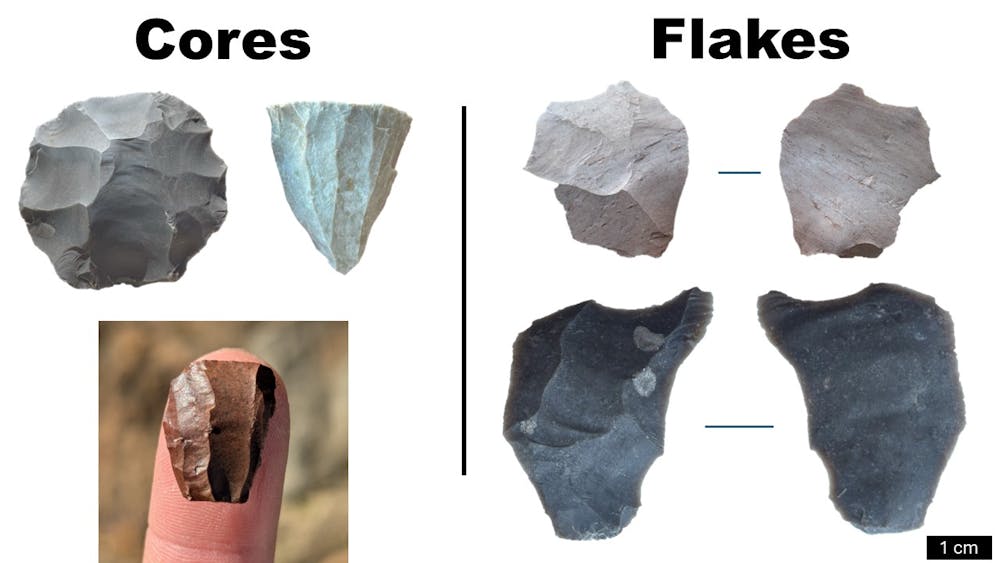
    The process of flaking involves applying force to the edge of a stone, known as the striking platform, through percussion or pressure to remove portions of the rock, which are called flakes. With some guidance from a teacher and plenty of practice, flintknappers can learn how to identify a promising platform on a chunk of stone, called a core, and consistently remove flakes from it. When struck, the platform is removed from the core and is a key feature of the flake.

    Flakes offer an immediate sharp cutting edge. A flintknapper can also further modify them into more specific shapes for other uses. An iconic example of this is the hand ax, which is a core that’s been flaked into a teardrop shape.

    Cores, left, are the object being struck by the flintknapper, and flakes, right, are the sharp-edged material removed from the core. Some cores, like this one from the archaeological site Pinnacle Point 5-6 in South Africa, can be as small as the tip of a finger.
    John K. Murray

    We often use hammerstones or large pieces of antler, called billets, to strike the core’s edge. Repetitive flaking not only allows a flintknapper to produce a significant amount of sharp cutting edge in the form of flakes, but gives them the ability to shape the core to their desired form … often with the risk of personal injury along the way. My fingers can attest to this!

    A modern flintknapper’s toolkit consists of leather pads, gloves, safety glasses, antler billets (left), hard hammerstones (right), and abraders (center-right with grooves), used to rub the edge of the stone to strengthen the platform before striking.
    John K. Murray

    However, not every type of rock has the characteristics needed to be flaked into a tool. You want the stone to exhibit what’s called conchoidal fracture. If you’ve ever seen glass break, you’ve witnessed conchoidal fracture. This smooth break, with concentric wavelike ripples, is defined by the physics of how force moves through different materials.

    Obsidian hand ax made by John Murray, showcasing examples of conchoidal fracture produced while making flakes to shape it.
    John K. Murray

    When an experienced knapper is preparing to remove a flake, we understand how the material we’re working will break when we strike it, so we can predict the shape and size of the tools that we are producing. A stone like obsidian, which is volcanic glass, is the poster child for conchoidal fracture.

    Of course, there is a lot of variation in the quality of rock that hominins have used for manufacturing stone tools, and many have made use of lesser quality stone. Even some of the earliest toolmakers were preferentially selecting rocks for certain properties, such as durability.

    How can you recognize stone tools?

    You may hear people saying that rocks that they found in their garden were tools because they “fit perfectly in the hand” or are “tool shaped.” But it’s not quite that straightforward. Although shape and function may play a role in the final product of a stone tool, it is not the smoking gun.

    Archaeologists can determine whether a chunk of rock is a stone tool based on clues left behind from the process of conchoidal fracture during flintknapping.

    One such clue is the presence of flake scars, or what we call negative removals, which can be found on both cores and flakes. These have characteristic ridges on one or more sides of the rock that outline previous flake removals – hence the use of the term scar.

    When we see multiple flake scars that are consistent in their orientation and size as opposed to being random, it is likely the stone in question was deliberately worked on by a hominin.

    The second feature is what we call the bulb of percussion. This is a bulge in the flake, just below the striking platform, that results from the concentration of force when the knapper struck it.

    Considering that producing a bulb of percussion requires the rock to be struck on a platform at a specific angle with enough force to detach it from the stone, it is improbable that this feature would be created through natural processes – but not impossible. Scientists have found naturally produced sharp stone fragments, or naturaliths, all over the world, even in Antarctica.

    However, when a lot of flakes with these diagnostic characteristics are found together, it’s unlikely they were created naturally.

    A hand ax made by John Murray shows many flake scars, some of which are outlined in black. The inner surface of three flakes shows the bulb of percussion just below the platform.
    John K. Murray

    The final thing to consider when determining whether a rock is a stone tool is the context in which it was found. Are there many stones in the area that exhibit the characteristics that we look for when trying to identify a stone tool? Is the stone tool made of an exotic material, or is it like the rest of the rocks near it?

    If you find a lot of stone tools in the same area made from one type of rock, you might have stumbled across an ancient flintknapping workshop. However, if you discover a tool that was made from a type of stone that can only be found hundreds of miles away, maybe someone traded for this material or carried it with them.

    Try it for yourself

    I think the best way for you to be able to learn to recognize whether a chunk of stone was a tool or just a rock is to try flintknapping yourself. I have taught more than 100 people of all ages to manufacture stone tools, and most agree: It is harder than you’d think.

    This experience puts you into the minds of our hominin ancestors, trying to tackle one of the earliest problems our lineage faced: getting a sharp edge from a chunky piece of rock.

    John K. Murray does not work for, consult, own shares in or receive funding from any company or organization that would benefit from this article, and has disclosed no relevant affiliations beyond their academic appointment.

    ref. Was it a stone tool or just a rock? An archaeologist explains how scientists can tell the difference – https://theconversation.com/was-it-a-stone-tool-or-just-a-rock-an-archaeologist-explains-how-scientists-can-tell-the-difference-251126

    MIL OSI – Global Reports

  • MIL-OSI: KVH Launches CommBox Edge Secure Suite for Advanced Cybersecurity Threat Detection & Response

    Source: GlobeNewswire (MIL-OSI)

    MIDDLETOWN, R.I., May 07, 2025 (GLOBE NEWSWIRE) — Today, KVH Industries, Inc. (Nasdaq: KVHI) unveiled the newest expansion to its CommBox Edge Communications Gateway–the Secure Suite threat detection and response service. Focused on detecting, preventing, and reporting cybersecurity threats, CommBox Edge Secure Suite actively identifies and blocks harmful traffic in real time to reduce the risks to vessel communications, operations, and network security. Secure Suite is fully compatible with both the CommBox Edge 6 and Edge 2 belowdeck appliances and the CommBox Edge virtual machine option, making it an easy-to-use and versatile cybersecurity upgrade to the CommBox Edge’s robust network and bandwidth management capabilities.

    “The modern commercial vessel is an extension of the corporate office–a mobile, connected network node that can face the threat of malicious cyber activities that put people, cargo, vessels, and business operations at risk,” observed Chad Impey, KVH’s senior vice president of global sales. “CommBox Edge Secure Suite is designed for rapid, easy, and affordable deployment while delivering advanced detection, prevention, and reporting capabilities. Combined with the CommBox Edge network and bandwidth management capabilities, Secure Suite delivers enhanced security for individual vessels and entire fleets while simultaneously maximizing your IT team’s resources and optimizing your communications.”

    CommBox Edge Secure Suite employs some of the most advanced cybersecurity and proactive monitoring technology available, including:

    • Cisco Talos, one of the world’s most advanced threat-blocking and detection solutions, focuses on emerging and existing cyber threats, enabling CommBox Edge Secure Suite to recognize and respond to new threat IDs and threat patterns.
    • Cisco Snort monitors, analyzes, and responds to malicious network traffic in real time using Cisco Talos rulesets, helping CommBox Edge Secure Suite identify and mitigate potential security threats.

    Secure Suite also includes a robust Intrusion Prevention System (IPS), active quarantine capabilities, and an intuitive cloud-based Threat Dashboard to reduce cyber risks to vessels, networks, and crews. The service helps mitigate those risks as part of a comprehensive network and onboard cybersecurity solution focused on:

    • Detection – The CommBox Edge Secure Suite IPS monitors incoming and outgoing traffic for suspicious patterns or signatures that match known attack types (like malware, vulnerabilities, or exploits).
    • Prevention – The IPS responds in real time to malicious actions by blocking harmful traffic (e.g., malware, viruses, denial of service, ping of death, etc.), resetting connections, adjusting firewalls, initiating quarantines, and sending alerts to administrators.
    • Reporting – Secure Suite includes an intuitive cloud-based Threat Dashboard. Also, it captures and reports detailed threat logs (including syslogs/rsyslogs) to an offsite Security Information and Event Management (SIEM) system or Security Operations Center (SOC) for future analysis and actionable insights.

    With this data and Secure Suite’s advanced features, you can enable new proactive responses to threats, minimize recovery time, pass security audits, remain compliant with industry standards, and identify resource-intensive threats to ensure optimal network performance,” concluded Impey.

    Secure Suite is available now as a service option within CommBox Edge, KVH’s all-in-one management toolbox for maritime IT professionals who want to control the growing array of wide area network (WAN) options, such as the VSAT, low earth orbit (LEO) services, 5G cellular, and other services available through the KVH ONE® global network. CommBox Edge also supports as many as thirty onboard local area networks and provides secure remote access to any onboard networked device, high-speed VPN links, and deep packet inspection.

    Note to Editors: For more information about CommBox Edge, please visit https://www.kvh.com/edge. High-resolution images of KVH products are available at the KVH Press Room Image Library, https://www.kvh.com/imagelibrary.

    About KVH Industries, Inc.

    KVH Industries, Inc. is a global leader in maritime and mobile connectivity delivered via the KVH ONE network. The company, founded in 1982, is based in Middletown, RI, with research, development, and manufacturing operations in Middletown, RI, and more than a dozen offices around the globe. KVH provides connectivity solutions for commercial maritime, leisure marine, military/government, and land mobile applications on vessels and vehicles, including the TracNet®, TracPhone®, and TracVision® product lines, CommBox Edge, the KVH ONE OpenNet Program for non-KVH antennas, AgilePlans® Connectivity as a Service (CaaS), and the KVH Link crew wellbeing content service.

    This press release contains forward-looking statements that involve risks and uncertainties. For example, forward-looking statements include claims regarding the anticipated efficacy of cybersecurity features to minimize risks to networks, operations, and crews. These and other factors are discussed in more detail in KVH’s Annual Report on Form 10-K filed with the SEC on March 10, 2025. Copies are available through its Investor Relations department and website: https://investors.kvh.com. KVH does not assume any obligation to update our forward-looking statements to reflect new information and developments.

    KVH Industries, Inc., has used, registered, or applied to register its trademarks in the USA and other countries around the world, including but not limited to the following marks: KVH, KVH ONE, TracVision, TracPhone, TracNet, CommBox, and AgilePlans. Other trademarks are the property of their respective companies.

    For further information, please contact:
    Chris Watson
    Vice President, Marketing & Communications
    KVH Industries, Inc.
    Tel: +1 401 845 2441
    cwatson@kvh.com

    The MIL Network

  • MIL-OSI: One Stop Systems Reports Q1 2025 Results

    Source: GlobeNewswire (MIL-OSI)

    First quarter of 2025 consolidated gross margin increased 320 basis points year-over-year to 32.6%, on consolidated revenue of $12.3 million

    OSS segment gross margin of 45.5%, on OSS segment revenue of $5.2 million

    OSS segment experienced strong first-quarter bookings of $10.4 million

    Management continues to expect double-digit consolidated revenue growth in 2025 and consolidated EBITDA break even for the year

    ESCONDIDO, Calif., May 07, 2025 (GLOBE NEWSWIRE) — One Stop Systems, Inc. (“OSS” or the “Company”) (Nasdaq: OSS), a leader in rugged Enterprise Class compute for artificial intelligence (AI), machine learning (ML), autonomy and sensor processing at the edge, reported results for the three-month period ended March 31, 2025. Comparisons for the three-month periods are to the same year-ago periods unless otherwise noted.

    “Our OSS segment achieved strong bookings during the first quarter of 2025, driven by growing demand from both new and existing commercial and defense customers. This positive trend highlights increased interest in our Enterprise Class compute solutions and validates our strategic focus on building multi-year, predictable revenue streams. Higher OSS segment orders are particularly encouraging amid ongoing uncertainty in business and government spending. Momentum remains strong, as the programs we are pursuing closely align with our customers’ evolving priorities on AI, ML, autonomy and sensor processing at the Edge,” stated OSS President and CEO, Mike Knowles.

    “As expected, our consolidated gross margin improved year-over-year and from the fourth quarter of 2024, supported by a 45.5% gross margin at our OSS segment, associated with a more profitable mix of products. While near-term market conditions affected the timing of certain OSS segment orders anticipated for the first and second quarters of 2025, we remain on track to achieve our 2025 annual guidance. In addition, we expect bookings to remain strong throughout the year within our OSS segment and support profitable revenue growth in the second half of 2025 and into 2026,” concluded Mr. Knowles.

    2025 First-Quarter Financial Summary

    Consolidated revenue was $12.3 million, compared to $12.7 million in the first quarter of 2024. OSS segment revenue decreased 5.9%, as compared to the same period in 2024, primarily due to lower volume of shipments to a commercial aerospace customer, partially offset by higher volume of shipments to a defense customer. Bressner segment revenue decreased $65,637, or 0.9%, as compared to the same period in 2024.

    The following table sets forth net revenue by segment for the three months ended March 31, 2025, and March 31, 2024 (Dollars may not calculate due to rounding):

      Three Months Ended

    Entity:

    March 31,
    2025
      % of Net
    Revenue
      March 31,
    2024
     
    % of Net
    Revenue

      %
    Change
    OSS $ 5,206,810       42.5 %   $ 5,533,872       43.7 %     (5.9 )%
    Bressner   7,052,277       57.5 %     7,117,914       56.3 %     (0.9 )%
    Total net revenue $ 12,259,088       100.0 %   $ 12,651,786       100.0 %     (3.1 )%
                                           

    Consolidated gross margin percentage was 32.6% for the three months ended March 31, 2025, compared to 29.4% in the prior year quarter. On a segment basis, the OSS segment had a gross margin of 45.5%, an increase of 11.3 percentage points as compared to the prior year of 34.2%. The increase in OSS segment gross margin was primarily due to higher volume of certain higher margin data storage units and componentry shipped in the quarter. The Company’s Bressner segment had a gross margin percentage of 23.1%, compared to 25.7% in the same period last year, due to product mix.

    Total operating expenses increased 19.2% to $5.9 million. This increase was predominantly attributable to higher marketing and selling costs due to an increase in personnel costs from the additions in headcount made during 2024 as well as an increase in research and development costs driven by higher engineering labor to support new product development.

    The Company reported a net loss of $2.0 million, or $(0.09) per share, as compared to a net loss of $1.3 million, or $(0.06) per share, in the prior year period.

    Adjusted EBITDA, a non-GAAP metric, was a loss of $1.1 million, compared to adjusted EBITDA loss of $500,452 in the prior year period.

    As of March 31, 2025, the Company reported cash and short-term investments of $9.1 million and total working capital of $23.1 million, compared to cash and short-term investments of $10.0 million and total working capital of $24.0 million at December 31, 2024.

    2025 Full Year Outlook

    OSS is executing a strategic plan targeting both commercial and defense markets, aiming to provide integrated solutions and establish OSS as a platform incumbent on large, multi-year programs. This approach is expected to drive long-term value by increasing predictable, recurring revenue and building a strong, multi-year backlog.

    As a result of OSS’ multi-year strategy, the Company continues to anticipate consolidated revenue of $59 to $61 million for the full year of 2025. This includes expected OSS segment revenue of approximately $30 million, representing over 20% year-over-year growth. In addition, the Company expects to be EBITDA break-even for the full year of 2025. Management expects revenue and profitability to improve at a higher rate in the second half of 2025 based on current trends and the Company’s expanding sales pipeline.

    Conference Call

    OSS will hold a conference call to discuss its results for the first quarter of 2025, followed by a question-and-answer period.

    Date: Wednesday, May 7, 2025
    Time: 10:00 a.m. ET (7:00 a.m. PT)
    Toll-free dial-in: 1-800-717-1738
    International dial-in: 1-646-307-1865
    Conference ID: 57745 (required for entry)
    Webcast: https://viavid.webcasts.com/starthere.jsp?ei=1710966&tp_key=28a1f0fc7f

    A replay of the call will be available after 1:00 p.m. ET on May 7, 2025, through May 21, 2025.

    Toll-free replay: 1-844-512-2921
    International replay: 1-412-317-6671
    Passcode: 1157745

    About One Stop Systems

    One Stop Systems, Inc. (Nasdaq: OSS) is a leader in AI enabled solutions for the demanding ‘edge’. OSS designs and manufactures Enterprise Class compute and storage products that enable rugged AI, sensor fusion and autonomous capabilities without compromise. These hardware and software platforms bring the latest data center performance to harsh and challenging applications, whether they are on land, sea or in the air.

    OSS products include ruggedized servers, compute accelerators, flash storage arrays, and storage acceleration software. These specialized compact products are used across multiple industries and applications, including autonomous trucking and farming, as well as aircraft, drones, ships and vehicles within the defense industry.

    OSS solutions address the entire AI workflow, from high-speed data acquisition to deep learning, training and large-scale inference, and have delivered many industry firsts for industrial OEM and government customers.

    As the fastest growing segment of the multi-billion-dollar edge computing market, AI enabled solutions require—and OSS delivers—the highest level of performance in the most challenging environments without compromise.

    OSS products are available directly or through global distributors. For more information, go to www.onestopsystems.com. You can also follow OSS on X, YouTube, and LinkedIn.

    Non-GAAP Financial Measures

    We believe that the use of adjusted earnings before interest, taxes, depreciation and amortization, or adjusted EBITDA, is helpful for an investor to assess the performance of the Company. The Company defines adjusted EBITDA as income (loss) before interest, taxes, depreciation, amortization, acquisition expense, impairment of long-lived assets, financing costs, government funded programs, fair value adjustments from purchase accounting, stock-based compensation expense, and expenses related to discontinued operations.

    Adjusted EBITDA is not a measurement of financial performance under generally accepted accounting principles in the United States, or GAAP. Because of varying available valuation methodologies, subjective assumptions and the variety of equity instruments that can impact a company’s non-cash operating expenses, we believe that providing a non-GAAP financial measure that excludes non-cash and non-recurring expenses allows for meaningful comparisons between our core business operating results and those of other companies, as well as providing us with an important tool for financial and operational decision making and for evaluating our own core business operating results over different periods of time.

    Our adjusted EBITDA measure may not provide information that is directly comparable to that provided by other companies in our industry, as other companies in our industry may calculate non-GAAP financial results differently, particularly related to non-recurring and unusual items. Our adjusted EBITDA is not a measurement of financial performance under GAAP, and should not be considered as an alternative to operating income or as an indication of operating performance or any other measure of performance derived in accordance with GAAP. We do not consider adjusted EBITDA to be a substitute for, or superior to, the information provided by GAAP financial results.

      For the Three Months Ended March 31,
        2025       2024  
    Net loss $ (2,017,634 )   $ (1,339,622 )
    Depreciation   223,847       289,547  
    Amortization of right-of-use assets net of change in lease liability   (2,032 )     55,997  
    Stock-based compensation expense   612,561       408,740  
    Interest expense   14,186       35,342  
    Interest income   (72,511 )     (141,725 )
    Provision for income taxes   109,466       191,269  
    Adjusted EBITDA $ (1,132,116 )   $ (500,452 )
           

    (Dollars may not calculate due to rounding)

    Adjusted EPS excludes the impact of certain items and, therefore, has not been calculated in accordance with GAAP. We believe that exclusion of certain selected items assists in providing a more complete understanding of our underlying results and trends and allows for comparability with our peer company index and industry. We use this measure along with the corresponding GAAP financial measures to manage our business and to evaluate our performance compared to prior periods and the marketplace. The Company defines non-GAAP income (loss) as income or (loss) before amortization, government funded programs, impairment of long lived assets, stock-based compensation, expenses related to discontinued operations, and acquisition costs. Adjusted EPS expresses adjusted income (loss) on a per share basis using weighted average diluted shares outstanding.

    Adjusted EPS is a non-GAAP financial measure and should not be considered in isolation or as a substitute for financial information provided in accordance with GAAP. These non-GAAP financial measures may not be computed in the same manner as similarly titled measures used by other companies. We expect to continue to incur expenses similar to the adjusted income from continuing operations and adjusted EPS financial adjustments described above, and investors should not infer from our presentation of these non-GAAP financial measures that these costs are unusual, infrequent or non-recurring.

    The following table reconciles non-GAAP net income and basic and diluted earnings per share:

      For the Three Months Ended March 31,
        2025       2024  
    Net loss $ (2,017,634 )   $ (1,339,622 )
    Stock-based compensation expense   612,561       408,740  
    Non-GAAP net loss $ (1,405,073 )   $ (930,882 )
    Non-GAAP net loss per share:      
    Basic $ (0.07 )   $ (0.04 )
    Diluted $ (0.07 )   $ (0.04 )
    Weighted average common shares outstanding:      
    Basic   21,384,599       20,709,234  
    Diluted   21,384,599       20,709,234  
     

    (Dollars may not calculate due to rounding)

    Forward-Looking Statements

    OSS cautions you that statements in this press release that are not a description of historical facts are forward-looking statements. . Words such as, but not limited to, “anticipate,” “aim,” “believe,” “contemplate,” “continue,” “could,” “design,” “estimate,” “expect,” “intend,” “may,” “might,” “plan,” “possible,” “potential,” “predict,” “project,” “seek,” “should,” “suggest,” “strategy,” “target,” “will,” “would,” and similar expressions or phrases, or the negative of those expressions or phrases, are intended to identify forward-looking statements, although not all forward-looking statements contain these identifying words. These statements include but are not limited to those relating to increased sales and revenues, non-GAAP financial measures, our multi-year strategy, increase in margins, and operating expenses. These statements are based on the company’s current beliefs and expectations. The inclusion of forward-looking statements should not be regarded as a representation by OSS or its partners that any of our plans or expectations will be achieved. Factors that could interfere with our ability to achieve our plans or expectations , include but are not limited to, our ability to expand our product offerings and further penetrate our target markets, future demand for AI/ML integrations, global socio-economic challenges, stock market uncertainty or volatility, reductions in business and/or government spending, and changes in our business strategies, management and/or senior leadership. Actual results may differ from those set forth in this press release due to the risk and uncertainties inherent in our business, including risks described in our prior press releases and in our filings with the Securities and Exchange Commission (SEC), including under the heading “Risk Factors” in our latest Annual Report on Form 10-K and any subsequent filings with the SEC. You are cautioned not to place undue reliance on these forward-looking statements, which speak only as of the date hereof, and the company undertakes no obligation to revise or update this press release to reflect events or circumstances after the date hereof. All forward-looking statements are qualified in their entirety by this cautionary statement, which is made under the safe harbor provisions of the Private Securities Litigation Reform Act of 1995.

    Media Contacts:
    Robert Kalebaugh
    One Stop Systems, Inc.
    Tel (858) 518-6154
    Email contact

    Investor Relations:
    Andrew Berger
    Managing Director
    SM Berger & Company, Inc.
    Tel (216) 464-6400
    Email contact

    ONE STOP SYSTEMS, INC. (OSS)
    CONSOLIDATED BALANCE SHEETS
     
      Unaudited   Audited
      March 31,   December 31,
        2025       2024  
    ASSETS      
    Current assets      
    Cash and cash equivalents $ 6,498,468     $ 6,794,093  
    Short-term investments   2,620,169       3,217,065  
    Accounts receivable, net   7,245,983       8,177,371  
    Inventories, net   15,099,479       13,176,156  
    Prepaid expenses and other current assets   1,178,620       836,364  
    Total current assets   32,642,719       32,201,048  
    Property and equipment, net   1,472,160       1,669,026  
    Operating lease right-of use assets   1,463,099       1,536,094  
    Deposits and other   38,093       38,093  
    Goodwill   1,489,722       1,489,722  
    Total Assets $ 37,105,793     $ 36,933,982  
           
    LIABILITIES AND STOCKHOLDERS’ EQUITY      
    Current liabilities      
    Accounts payable $ 4,475,684     $ 2,068,017  
    Accrued expenses and other liabilities   3,730,499       4,806,675  
    Current portion of operating lease obligation   272,865       285,937  
    Current portion of notes payable   1,079,484       1,035,050  
    Total current liabilities   9,558,532       8,195,679  
    Deferred tax liability, net   45,572       52,574  
    Operating lease obligation, net of current portion   1,451,728       1,513,684  
    Total liabilities   11,055,832       9,761,937  
    Commitments and contingencies      
    Stockholders’ equity      
    Common stock, $0.0001 par value; 50,000,000 shares authorized; 21,582,196 and 21,148,810 shares issued and outstanding   2,158       2,115  
    Additional paid-in capital   49,824,911       49,082,737  
    Accumulated other comprehensive income   293,587       140,254  
    Accumulated deficit   (24,070,695 )     (22,053,061 )
    Total stockholders’ equity   26,049,961       27,172,045  
    Total Liabilities and Stockholders’ Equity $ 37,105,793     $ 36,933,982  
           
    ONE STOP SYSTEMS, INC. (OSS)
    UNAUDITED CONSOLIDATED STATEMENTS OF OPERATIONS
    (Dollars may not calculate due to rounding)
     
      For the Three Months Ended March 31,
        2025       2024  
    Revenue:      
    Product $ 11,848,713     $ 12,287,046  
    Customer funded development   410,375       364,740  
        12,259,088       12,651,786  
    Cost of revenue:      
    Product   7,912,314       8,818,756  
    Customer funded development   349,782       109,737  
        8,262,096       8,928,493  
    Gross profit   3,996,992       3,723,293  
    Operating expenses:      
    General and administrative   2,366,369       2,094,317  
    Marketing and selling   2,218,190       1,920,113  
    Research and development   1,357,293       970,877  
    Total operating expenses   5,941,852       4,985,307  
    Loss from operations   (1,944,860 )     (1,262,014 )
    Other (expense) income, net:      
    Interest income   72,511       141,725  
    Interest expense   (14,186 )     (35,342 )
    Other (expense) income, net   (21,633 )     7,278  
    Total other income, net   36,692       113,661  
    Loss before income taxes   (1,908,168 )     (1,148,353 )
    Provision for income taxes   109,466       191,269  
    Net loss $ (2,017,634 )   $ (1,339,622 )
           
    Net loss per share:      
    Basic $ (0.09 )   $ (0.06 )
    Diluted $ (0.09 )   $ (0.06 )
           
    Weighted average common shares outstanding:      
    Basic   21,384,599       20,709,234  
    Diluted   21,384,599       20,709,234  
           
    ONE STOP SYSTEMS, INC. (OSS)
    UNAUDITED CONSOLIDATED STATEMENTS OF CASH FLOWS
     
      For the Three Months Ended March 31,
        2025       2024  
    Cash flows from operating activities:      
    Net loss $ (2,017,634 )   $ (1,339,622 )
    Adjustments to reconcile net loss to net cash (used in) provided by operating activities:      
    Deferred income taxes   1,737       (188,674 )
    Loss on disposal of property and equipment         354  
    Provision for bad debt   (100 )      
    Warranty reserves         (15,000 )
    Depreciation   223,847       289,547  
    Amortization of right-of-use assets   76,825       100,138  
    Inventory reserves   (146,200 )     94,063  
    Stock-based compensation expense   612,561       408,740  
    Changes in operating assets and liabilities:      
    Accounts receivable   1,068,100       842,057  
    Inventories   (1,418,185 )     (66,013 )
    Prepaid expenses and other current assets   (332,400 )     (224,116 )
    Accounts payable   2,336,310       1,486,003  
    Accrued expenses and other liabilities   (1,461,601 )     700,041  
    Operating lease liabilities   (78,857 )     (44,141 )
    Net cash (used in) provided by operating activities   (1,135,596 )     2,043,378  
           
    Cash flows from investing activities:      
    Redemption of short-term investment grade securities   597,288       1,811,364  
    Purchases of property and equipment, including capitalization of labor costs for test equipment and ERP   (12,793 )     (167,168 )
    Net cash provided by investing activities   584,495       1,644,196  
           
    Cash flows from financing activities:      
    Proceeds from exercise of stock options and warrants   373,310       127,350  
    Payment of payroll taxes on net issuance of employee stock options   (243,654 )     (246,376 )
    Repayments on notes payable         (680,948 )
    Net cash provided by (used in) financing activities   129,656       (799,974 )
           
    Net change in cash and cash equivalents   (421,445 )     2,887,600  
    Effect of exchange rates on cash   125,820       (32,446 )
    Cash and cash equivalents, beginning of period   6,794,093       4,048,948  
    Cash and cash equivalents, end of period $ 6,498,468     $ 6,904,102  

    The MIL Network

  • MIL-OSI USA: Lofgren, Matsui, Merkley Reintroduce Legislation to Give Individuals an Opportunity to Invest in Building America’s Clean-Energy Future

    Source: United States House of Representatives – Representative Zoe Lofgren (D-San Jose)

    Modeled after WWII victory bonds, Clean Energy Victory Bonds would spur investment in clean-energy projects, create jobs, & help U.S. fight the climate crisis

    WASHINGTON, DC – Today, Representatives Zoe Lofgren (CA-18) and Doris Matsui (CA-07) and U.S. Senator Jeff Merkley (D-OR) reintroduced the Clean Energy Victory Bond Act, bicameral legislation to give individuals the opportunity to buy Clean Energy Victory Bonds and help build America’s clean-energy future. Modeled after the highly successful victory bonds sold during World Wars I and II, which raised billions of dollars to finance the costs of war, Clean Energy Victory Bonds would help the country create jobs and save taxpayers money while investing in clean-energy infrastructure and fighting the climate crisis, protecting future generations.

    The bill would direct the U.S. Secretaries of Treasury, Energy, and Defense to develop and issue $50 billion in Clean Energy Victory Bonds that support energy efficiency, solar, wind, geothermal, and electric vehicle efforts. For as little as $50, all Americans would be able to voluntarily purchase these Treasury bonds to invest in clean energy.

    The sale of the $50 billion worth of bonds annually could be leveraged to inject $150 billion into clean-energy innovation and create more than one million jobs.

    “As climate-related emergencies become more and more common, I often hear from people who want to do their part in the fight against climate change, but don’t know how. The Clean Energy Victory Bond Act provides Americans with an opportunity to invest, within their means, in innovative technologies that will yield profits both for themselves and the world,” said Congresswoman Lofgren, Ranking Member of the House Committee on Science, Space, and Technology. “This is my seventh time reintroducing this bill. I feel strongly that, as momentum continues to build in California and around the country to be good stewards of our environment, we must employ proven economic growth-based tactics to tackle climate change. We all benefit when we invest in the future.”

    “Now, more than ever, we need collective action to fight climate change and support smart climate solutions,” said Congresswoman Matsui. “This legislation gives everyday Americans the opportunity to invest in the clean energy transition and help grow the American economy. This investment will flow back into our communities, creating good-paying jobs, lowering energy costs, and helping to make communities across the country more resilient to climate change, while also providing a strong return on investment and helping American families to safely and reliably grow their savings with government-backed bonds.”

    “Clean energy is America’s future, no matter how hard President Trump and his handpicked Fossil Fuel Cabinet try to sabotage its deployment,” said Senator Merkley. “As the Trump Administration slashes federal funds for renewable energy projects nationwide – including right here in Oregon – I’m fighting to advance solutions that will help end our dangerous dependence on fossil fuels and instead invest in public health and our environment. This bill expands access to affordable clean energy for families across America, delivering bold action to tackle climate chaos and creating jobs in the 21st-century economy.”

    Background

    The Clean Energy Victory Bonds would raise extra funds for investment in clean-energy and energy-efficiency deployment, including by:

    • Providing additional support to existing federal financing programs available to states for energy efficiency upgrades and clean energy deployment;
    • Providing funding for clean energy investments by all federal agencies;
    • Providing funding for electric grid enhancements and connections that enable clean energy deployment;
    • Providing funding to renovate existing inefficient buildings or building new energy efficient buildings;
    • Providing tax incentives and tax credits for clean energy technologies;
    • Providing funding for new innovation research, including ARPA-E, public competitions similar to those designed by the X Prize Foundation, grants provided through the Office of Energy Efficiency and Renewable Energy of the Department of Energy, or other mechanisms to fund revolutionary clean energy technology;
    • Providing additional funding for zero-emission vehicle infrastructure and manufacturing;
    • Providing additional funding to existing federal, State, and local grant programs that finance clean energy projects; and
    • Providing prioritized funding for clean energy projects that are located in and reduce energy rates in disadvantaged and vulnerable communities.  

    The Clean Energy Victory Bonds would:

    • be available to the public in denominations as low as $50;
    • accrue interest based on savings achieved through reduced-energy spending by the federal government and interest collected on loans provided from proceeds of the bonds; and
    • be capped at $50 billion each year.
    Click here for full text of the Clean Energy Victory Bond Act.

    In Connecticut, “Green Liberty Bonds” have been issued, and batches have sold out because the demand is so great. 

    Support from Sustainability & Business Groups

    The bill is supported by numerous organizations, includingGreen America, Communitas Financial Planning PBC, Transformative Wealth Management, Natural Investments, American Sustainable Business Council, Impact Investors, School Sisters of Notre Dame Collective Investment Fund, Figure 8 Investment Strategies, Greenvest/Vanderbilt Financial Group, Change the Chamber, Harkins Wealth Management, SharePower Responsible Investing, Your Best Path, LLC, and Chicory Wealth.

    “Americans from around the country support clean energy that will create jobs while addressing the climate crisis. In World War II, Victory Bonds offered Americans a way to support the war effort. Now, Clean Energy Victory Bonds will offer all Americans a safe investment, open to anyone, to support the rapid adoption of the solar, wind, and battery storage technologies that will benefit communities, workers, and the planet,” said Todd Larsen, Executive Co-Director For Consumer and Corporate Engagement, Green America.

    “Clean Energy Victory Bonds will provide a much-needed economic boost to our businesses and economy. This bill provides a reliable and highly-accessible financing mechanism that allows all Americans to provide the needed dollars for building a vibrant economy.” In an environment of reduced Federal Government spending this enables everyone to invest and work hand in hand with the private sector,” said David Levine, Co-founder and President, American Sustainable Business Council.

    “Taking a step forward to adjust our energy industry to meet the needs of the changing country, the Clean Energy Victory Bonds Act uses historical precedence to advance the U.S. toward a cleaner, brighter future for youth like us. While the transition to a clean energy economy may seem ambitious at times, this Act will allow everyday Americans to create an economy that works for all of us. It provides Americans the opportunity to help incentivize cleaner infrastructure and energy, paving the way for future steps to better our nation’s energy and climate,” said Evey Mengelkoch, Erika Pietrzak, and Sarah Hill, Climate Fellows of Change the Chamber

    ###

    MIL OSI USA News

  • MIL-OSI Russia: 11 killed, five injured in Indonesia road accident

    Translation. Region: Russian Federal

    Source: People’s Republic of China in Russian – People’s Republic of China in Russian –

    Source: People’s Republic of China – State Council News

    JAKARTA, May 7 (Xinhua) — At least 11 people were killed and five others injured on Wednesday when a truck collided with a small bus in central Indonesia’s Java province, a local rescue official said.

    According to him, the truck carrying sand was unable to climb up the slope.

    “It is suspected that the truck’s brakes failed. It rolled backwards and to the left, crashed into a small bus and then into a house,” the spokesman told Xinhua.

    “Our team immediately rushed to the scene to conduct rescue operations. All 11 of the deceased were passengers in a small bus. Five others were injured,” the official said, adding that all the injured were taken to hospital. -0-

    MIL OSI Russia News

  • MIL-OSI Russia: Rosneft enterprises’ teams hold events in honor of the Great Victory anniversary

    Translation. Region: Russian Federal

    Source: Rosneft – Rosneft – An important disclaimer is at the bottom of this article.

    Rosneft and its subsidiaries organize and participate in events in honor of the 80th anniversary of Victory in the Great Patriotic War. The company holds hundreds of events throughout Russia, which are designed to pass on to the younger generation the historical memory of the immortal feat of our people who liberated the world from fascism. Among the heroes of the front and the home front are many workers in the oil industry.

    Oil workers demonstrated mass heroism in the battles of the Great Patriotic War and labor valor at enterprises in the rear. The Red Army was supplied with fuel and lubricants in the required quantities. During the war, the few remaining specialists, women and teenagers who replaced the men who went to the front, achieved a significant increase in the volume of oil production and refining. New fields were discovered, oil refineries were put into operation. Thanks to the selfless work of oil workers, our country won the “war of motors”, which brought the overall Victory closer.

    The Company’s employees congratulate veterans of the Great Patriotic War and oil industry workers in different regions of the country on Victory Day. Festive concerts are held for them, where the winners of the corporate competition “Energy of Talents” perform. Rosneft volunteers also visit veteran oil workers at home, convey congratulations and memorable gifts from the teams of the enterprises.

    With the support of Rosneft, the Sretensky Monastery Choir is touring 24 cities across the country with the musical program “Dedicated to the Great Victory”. The production is based on real stories about the fates of heroes who walked the miles of war from Moscow to Berlin and the best works of the front-line years.

    More than 100 thousand Rosneft employees in more than 40 regions of Russia are taking part in the all-Russian action “Immortal Regiment” in various formats. On the eve of Victory Day, Rosneft enterprises held “Minutes of Silence” in memory of those killed in the war, as well as “Memory Watch”, during which workers began their work shift with portraits of relatives who had fought in the Great Patriotic War.

    About 1,000 employees of 33 Rosneft subsidiaries took part in a collective reading of the poem “Motherland” by poet Konstantin Simonov. Samotlorneftegaz employees read the famous lines at the monument “To fellow countrymen who died during the Great Patriotic War of 1941-1945” in the Victory Park of Nizhnevartovsk, unfurling an 80-meter St. George ribbon.

    More than 500 employees of the Samara group of Rosneft enterprises, veterans and employees of Rosneft enterprises, students, volunteers and residents of the Samara region in the city of Novokuibyshevsk next to the memorial complex to the heroes of the Great Patriotic War also unfurled an 80-meter St. George ribbon, honored the memory of the fallen heroes with a minute of silence and laid flowers at the Eternal Flame.

    Rosneft pays special attention to the formation of spiritual and patriotic values in the younger generation. Veteran oil workers together with current employees of the Company held “Lessons of Courage” in schools, universities and colleges, where children were told about how oil industry enterprises worked during the Great Patriotic War. Students, including students of “Rosneft classes” and schoolchildren from the “Movement of the First” were able to personally communicate with witnesses of those events. Also, for schoolchildren of Ufa, Samara, Gubkinsky, Saratov, Nizhnevartovsk, the settlement of Tazovsky in the Yamal-Nenets Autonomous District, they organized screenings of the documentary “War of Motors” about the significant contribution of oil workers to the Great Victory, which was filmed with the support of Rosneft.

    Samotlorneftegaz and Sevkomneftegaz held a patriotic event “Victory Waltz” in Nizhnevartovsk and Gubkinsky, in which representatives of three generations took part: veterans, employees of enterprises and students of “Rosneft-classes”. Volunteers danced a waltz to “Blue Scarf”, which was performed for soldiers on the fronts of the Great Patriotic War by Klavdiya Shulzhenko and other famous artists.

    On the eve of the Great Victory, the Company’s volunteers organized a number of large-scale clean-up days: they repaired, renovated, and tidied up memorials and monuments to the heroes of the Great Patriotic War. Volunteers from the Kuibyshev Oil Refinery and the Novokuibyshevsk Petrochemical Company tidied up more than 60 graves of front-line soldiers in Samara. Volunteers from Samotlorneftegaz tidied up the territory of the memorial complex “To fellow countrymen who died during the Great Patriotic War of 1941-1945” in Nizhnevartovsk. Udmurtneft employees helped to improve the monument to those killed during the war in the village of Svetloye, Votkinsk District; with the participation of the enterprise, memorials were also arranged in six other settlements of the Udmurt Republic. Bashneft organized the cleaning of the territory and renovation of elements of the park near the monument to “Ishimbay oil workers who died in battles for the Motherland” in the city of Ishimbay. Schoolchildren of the “Movement of the First” actively participated in all the events.

    The company organized mass car rallies in different regions of Russia, in which more than 1 thousand people took part. Employees of the enterprises RN-Yuganskneftegaz, Tyumenneftegaz, RN-Uvatneftegaz, Kharampurneftegaz, ROSPAN International, RN-Purneftegaz, and the corporate scientific institute in Tyumen held a joint campaign in the Tyumen region, the Yamalo-Nenets and Khanty-Mansiysk autonomous districts, covering 1,418 km in cars with Victory Banners – this distance corresponds to the number of days that the Great Patriotic War lasted.

    In Krasnoyarsk Krai, a motorcade of RN-Vankor workers drove a thousand kilometers across the tundra with the Victory Banner from the Vankor field to the port of Bukhta Sever on the shore of the Kara Sea. Bashneft organized a 160-kilometer motor rally of 50 cars in the Republic of Bashkortostan between the cities of Labor Valor Ishimbay and Ufa. During the Great Patriotic War, oil from Ishimbay was sent to Ufa for processing at the Ufa Oil Refinery (now Bashneft-UNPZ), the plant’s fuel went to the needs of the front and the rear.

    Volunteers from the Saratov Oil Refinery, RN-Vedomstvennaya Okhrana, and IK SIBINTEK drove a motorcade with jubilee symbols along the streets of Saratov from the oil refinery to the memorial complex to the soldiers-drivers. During the war, columns of cars with food, military equipment, uniforms, and fuel produced at the Saratov Oil Refinery went through Saratov to Stalingrad. During the fierce battles for Stalingrad, the Saratov-Stalingrad highway was called the “road of life” in the besieged hero city. Rosneft-Kuban Oil Products workers drove 150 km in 20 cars as part of the patriotic motor rally “Krasnodar-Novorossiysk”. Employees of the Komsomolsk Oil Refinery organized a motor rally from the Memorial Complex in Komsomolsk-on-Amur, where oil refiners laid flowers at the Eternal Flame. The column of more than 50 cars with anniversary symbols and Victory banners was headed by a Ural motorcycle from the 1970s.

    In addition, in various regions, the Company’s employees have created routes for auto tourists to memorial sites dedicated to the Great Patriotic War. Rosneft gas stations broadcast congratulations on the anniversary of the Victory, songs from the war years, and distribute St. George ribbons during the holidays. A number of stations have themed photo zones, field kitchens, and concerts by creative groups with a patriotic repertoire.

    Rosneft traditionally takes part in federal and regional events to green the territories on the eve of Victory Day. As part of the international action “Garden of Memory”, together with activists of the “Movement of the First”, Orenburgneft employees planted more than 10 thousand pine seedlings on 4.5 hectares of the Buzuluk pine forest, damaged by a natural fire, and 1.5 thousand pine trees in the steppe territory of the Kurmanaevsky district of the Orenburg region. “Kurgannefteprodukt” organized the planting of 20 thousand tree seedlings in the form of a geoglyph (an inscription made up of trees) “80 years of Victory”. Also, the geoglyph “80” appeared through the efforts of Bashneft-Dobycha employees in the city of Neftekamsk in the Republic of Bashkortostan. Employees of the corporate institute “VNIKTIneftekhimoborudovanie” took part in the landscaping of the slope of Mamayev Kurgan in Volgograd: they prepared the territory of the future alley and planted 80 silver maple seedlings.

    The Company’s employees took part in dozens of sports, intellectual competitions and contests dedicated to the Victory anniversary. Thus, Rosneft held corporate snowboarding competitions dedicated to the 80th anniversary of the Victory. More than 100 oil industry athletes from 35 subsidiaries gathered at the ski center in Baikalsk (Irkutsk Region). And in Tomsk, they organized the “Victory Ski Slope” at a distance of 200 meters – it became a symbol of memory of the heroes of the Battle of Stalingrad, which lasted 200 days and became a turning point in the Great Patriotic War.

    Commemorative museum exhibits have been organized at the enterprises, and street photo exhibitions reflecting the selfless labor of oil workers in the rear and the heroism of front-line soldiers have opened in the cities where the Company is present. A photo exhibition titled “Fuel of Victory” has opened in the Muzeon Arts Park in Moscow. In Ufa, Bashneft opened a photo exhibition about the contribution of Bashkir oil workers to the Victory in a park on the Belaya River embankment and laid out a memorial alley of apple and fir trees. In Saratov, an exhibition of patriotic drawings by children of Rosneft employees has been placed on the Cosmonauts Embankment.

    The employees of Verkhnechonskneftegaz initiated and created with their own hands the memorial “Memory Flame” in the shift camp of the Verkhnechonskoye field. On memorable dates for the country it will be lit as a symbol of the undying national memory of those who gave their lives on the battlefields.

    One of the central events of the anniversary year in Buzuluk (Orenburg region) and in Ryazan was the creation of large-scale murals with the support of Orenburgneft and the Ryazan Oil Refining Company, respectively.

    Rosneft contributes to preserving the historical memory of the events of the Great Patriotic War, the immortal feat of veterans who fought on the front lines and forged the Great Victory in the rear. Their unconditional love for the Motherland and patriotism are an unshakable example for current and future generations.

    Department of Information and Advertising of PJSC NK Rosneft May 7, 2025

    Please note: This information is raw content directly from the source of the information. It is exactly what the source states and does not reflect the position of MIL-OSI or its clients.

    MIL OSI Russia News

  • MIL-OSI Europe: Minutes – Tuesday, 6 May 2025 – Strasbourg – Final edition

    Source: European Parliament

    PV-10-2025-05-06

    EN

    EN

    iPlPv_Sit

    Minutes
    Tuesday, 6 May 2025 – Strasbourg

     Abbreviations and symbols

    + adopted
    rejected
    lapsed
    W withdrawn
    RCV roll-call votes
    EV electronic vote
    SEC secret ballot
    split split vote
    sep separate vote
    am amendment
    CA compromise amendment
    CP corresponding part
    D deleting amendment
    = identical amendments
    § paragraph

    IN THE CHAIR: Martin HOJSÍK
    Vice-President

    1. Opening of the sitting

    The sitting opened at 09:02.


    2. Request for an urgent decision (Rule 170)

    The President had received two requests for urgent decisions in accordance with Rule 170(5):

    – REGI Committee – Amending ERDF, Cohesion Fund and Just Transition Fund as regards specific measures to address strategic challenges in the context of the mid-term review ***I (COM(2025)0123 – C10-0063/2025 – 2025/0084(COD))

    – EMPL Committee – European Social Fund (ESF+): specific measures to address strategic challenges ***I (COM(2025)0164 – C10-0064/2025 – 2025/0085(COD))

    The votes on both requests would be taken on Wednesday 7 May 2025.

    The agenda was amended accordingly.


    3. A unified EU response to unjustified US trade measures and global trade opportunities for the EU (debate)

    Council and Commission statements: A unified EU response to unjustified US trade measures and global trade opportunities for the EU (2025/2657(RSP))

    Adam Szłapka (President-in-Office of the Council) and Maroš Šefčovič (Member of the Commission) made the statements.

    The following spoke: Jörgen Warborn, on behalf of the PPE Group, Iratxe García Pérez, on behalf of the S&D Group, Jordan Bardella, on behalf of the PfE Group, Nicola Procaccini, on behalf of the ECR Group, Valérie Hayer, on behalf of the Renew Group, Bas Eickhout, on behalf of the Verts/ALE Group, Martin Schirdewan, on behalf of The Left Group, René Aust, on behalf of the ESN Group, Michał Szczerba, Kathleen Van Brempt, Jorge Buxadé Villalba, Adam Bielan, Karin Karlsbro, Anna Cavazzini, Manon Aubry, Petr Bystron and Fabio De Masi.

    IN THE CHAIR: Esteban GONZÁLEZ PONS
    Vice-President

    The following spoke: Lukas Sieper, to put a question to Fabio De Masi, who answered it, Juan Ignacio Zoido Álvarez, Bernd Lange, Anna Bryłka, Daniele Polato, Svenja Hahn, Saskia Bricmont, Lynn Boylan, Lukas Sieper, Eva Maydell, Brando Benifei, Enikő Győri, Jaak Madison, Benoit Cassart, Virginijus Sinkevičius, Pasquale Tridico, Željana Zovko, who also answered a blue-card question from Petras Gražulis, Yannis Maniatis, Isabella Tovaglieri, Rihards Kols, Ľubica Karvašová, Vicent Marzà Ibáñez, Li Andersson, Angelika Niebler, Camilla Laureti, Sebastian Kruis, Kris Van Dijck, Barry Cowen, Isabella Lövin, Lídia Pereira, who also answered a blue-card question from João Oliveira, Javier Moreno Sánchez, Petra Steger, Adrian-George Axinia, Marie-Pierre Vedrenne, Bogdan Andrzej Zdrojewski, Raphaël Glucksmann, Jean-Paul Garraud, Marion Maréchal, Paulo Do Nascimento Cabral, Francisco Assis, Alexandr Vondra, Mika Aaltola, Evin Incir, Francesco Torselli, Jüri Ratas, Andi Cristea, Maria Walsh, Tonino Picula, Borja Giménez Larraz, Aodhán Ó Ríordáin, Michał Wawrykiewicz, Nina Carberry, Salvatore De Meo, Carmen Crespo Díaz, Luděk Niedermayer, Ingeborg Ter Laak and Miriam Lexmann.

    The following spoke under the catch-the-eye procedure: Francisco José Millán Mon, Maria Grapini, Sebastian Tynkkynen, Hilde Vautmans, Jaume Asens Llodrà, Marc Botenga, Kostas Papadakis, Diana Iovanovici Şoşoacă, João Oliveira, Ana Miranda Paz, Juan Fernando López Aguilar, Lucia Annunziata, Vytenis Povilas Andriukaitis and Dariusz Joński.

    The following spoke: Maroš Šefčovič and Adam Szłapka.

    The debate closed.


    4. CO2 emission performance standards for new passenger cars and new light commercial vehicles for 2025 to 2027 (debate)

    Statements by Parliament: CO2 emission performance standards for new passenger cars and new light commercial vehicles for 2025 to 2027 (2025/2700(RSP))

    The following spoke: Jens Gieseke, on behalf of the PPE Group, Mohammed Chahim, on behalf of the S&D Group, Jordan Bardella, on behalf of the PfE Group, Carlo Fidanza, on behalf of the ECR Group, Gerben-Jan Gerbrandy, on behalf of the Renew Group, Kai Tegethoff, on behalf of the Verts/ALE Group, Per Clausen, on behalf of The Left Group, and Siegbert Frank Droese, on behalf of the ESN Group.

    The debate closed.

    (The sitting was suspended for a few moments.)


    IN THE CHAIR: Younous OMARJEE
    Vice-President

    5. Resumption of the sitting

    The sitting resumed at 12:05.


    6. Voting time

    For detailed results of the votes, see also ‘Results of votes’ and ‘Results of roll-call votes’.


    6.1. CO2 emission performance standards for new passenger cars and new light commercial vehicles for 2025 to 2027 ***I (vote)

    Amending Regulation (EU) 2019/631 to include an additional flexibility as regards the calculation of manufacturers’ compliance with CO2 emission performance standards for new passenger cars and new light commercial vehicles for the calendar years 2025 to 2027 [COM(2025)0136 – C10-0062/2025 – 2025/0070(COD)] – ENVI Committee

    REQUEST FOR AN URGENT DECISION from the ECR Group, and jointly from the PPE, S&D and Renew groups (Rule 170(6))

    Approved

    The following tabling deadlines had been set:

    – amendments: Wednesday 7 May 2025 at 13:00
    – requests for separate votes and split votes: Wednesday 7 May 2025 at 19:00

    Vote: 8 May 2025.

    The following had spoken:

    Ondřej Krutílek, on behalf of the ECR Group (author of the request), before the vote.

    Detailed voting results


    6.2. The protection status of the wolf (Canis lupus) ***I (vote)

    The protection status of the wolf (Canis lupus) [COM(2025)0106 – C10-0044/2025 – 2025/0058(COD)] – ENVI Committee

    REQUEST FOR AN URGENT DECISION from the ENVI Committee (Rule 170(6))

    Approved

    The following tabling deadlines had been set:

    – amendments: Wednesday 7 May 2025 at 13:00
    – requests for separate votes and split votes: Wednesday 7 May 2025 at 19:00

    Vote: 8 May 2025.

    The following had spoken:

    Sebastian Everding, against the request, before the vote.

    Detailed voting results


    6.3. Amendments to the Capital Requirements Regulation as regards securities financing transactions under the net stable funding ratio ***I (vote)

    Amendments to the Capital Requirements Regulation as regards securities financing transactions under the net stable funding ratio [COM(2025)0146 – C10-0059/2025 – 2025/0077(COD)] – ECON Committee

    REQUEST FOR AN URGENT DECISION from the ECON Committee (Rule 170(6))

    Approved

    The following tabling deadlines had been set:

    – amendments: Wednesday 7 May 2025 at 13:00
    – requests for separate votes and split votes: Wednesday 7 May 2025 at 19:00

    Vote: 8 May 2025.

    Detailed voting results


    6.4. Request for the waiver of the immunity of Petr Bystron (vote)

    Report on the request for waiver of the immunity of Petr Bystron [2024/2047(IMM)] – Committee on Legal Affairs. Rapporteur: Pascale Piera (A10-0077/2025)

    (Majority of the votes cast)

    PROPOSAL FOR A DECISION

    Adopted (P10_TA(2025)67)

    Detailed voting results


    6.5. Request for the waiver of the immunity of Petras Gražulis (vote)

    Report on the request for waiver of the immunity of Petras Gražulis [2024/2089(IMM)] – Committee on Legal Affairs. Rapporteur: Pascale Piera (A10-0078/2025)

    (Majority of the votes cast)

    PROPOSAL FOR A DECISION

    Adopted (P10_TA(2025)68)

    Detailed voting results


    6.6. Request for the waiver of the immunity of Grzegorz Braun (vote)

    Report on the request for the waiver of the immunity of Grzegorz Braun [2024/2102(IMM)] – Committee on Legal Affairs. Rapporteur: Dainius Žalimas (A10-0081/2025)

    (Majority of the votes cast)

    PROPOSAL FOR A DECISION

    Adopted (P10_TA(2025)69)

    Detailed voting results


    6.7. Border regions’ instrument for development and growth (BRIDGEforEU) ***II (vote)

    Recommendation for second reading on the Council position at first reading with a view to the adoption of a proposal for a regulation of the European Parliament and of the Council on a mechanism to resolve legal and administrative obstacles in a cross-border context [17102/1/2024 – C10-0057/2025 – 2018/0198(COD)] – Committee on Regional Development. Rapporteur: Sandro Gozi (A10-0058/2025)

    The President informed the House that no proposals for rejection or amendment had been tabled in accordance with Rules 68 and 69 with regard to the Council’s position.

    The Council position was therefore deemed approved.

    The proposed act was thus adopted (P10_TA(2025)70)

    The following had spoken:

    Before the President’s announcement, Sandro Gozi (rapporteur), to make a statement under Rule 165(4).

    Detailed voting results


    6.8. Amending Regulation (EU) 2016/1011 as regards the scope of the rules for benchmarks, the use in the Union of benchmarks provided by an administrator located in a third country, and certain reporting requirements ***II (vote)

    Recommendation for second reading on the Council position at first reading with a view to the adoption of a regulation of the European Parliament and of the Council amending Regulation (EU) 2016/1011 as regards the scope of the rules for benchmarks, the use in the Union of benchmarks provided by an administrator located in a third country, and certain reporting requirements [05123/1/2025 – C10-0055/2025 – 2023/0379(COD)] – Committee on Economic and Monetary Affairs. Rapporteur: Jonás Fernández (A10-0060/2025)

    The President informed the House that no proposals for rejection or amendment had been tabled in accordance with Rules 68 and 69 with regard to the Council’s position.

    The Council position was therefore deemed approved.

    The proposed act was thus adopted (P10_TA(2025)71)

    Detailed voting results


    6.9. European Union labour market statistics on businesses ***II (vote)

    Recommendation for second reading on the Council position at first reading with a view to the adoption of a regulation of the European Parliament and of the Council on European Union labour market statistics on businesses, repealing Council Regulation (EC) No 530/1999 and Regulations (EC) No 450/2003 and (EC) No 453/2008 of the European Parliament and of the Council [17082/1/2024 – C10-0054/2025 – 2023/0288(COD)] – Committee on Economic and Monetary Affairs. Rapporteur: Irene Tinagli (A10-0057/2025)

    The President informed the House that no proposals for rejection or amendment had been tabled in accordance with Rules 68 and 69 with regard to the Council’s position.

    The Council position was therefore deemed approved.

    The proposed act was thus adopted (P10_TA(2025)72)

    Detailed voting results


    6.10. Amendments to the International Health Regulations contained in the Annex to Resolution WHA77.17 and adopted on 1 June 2024 *** (vote)

    Recommendation on the draft Council decision inviting Member States to accept, in the interest of the European Union, the amendments to the International Health Regulations (2005) contained in the Annex to Resolution WHA77.17 and adopted on 1 June 2024 [17046/2024 – COM(2024)0541 – C10-0005/2025 – 2024/0299(NLE)] – Committee on Public Health. Rapporteur: Adam Jarubas (A10-0064/2025)

    (Majority of the votes cast)

    DRAFT COUNCIL DECISION

    Approved (P10_TA(2025)73)

    Detailed voting results


    6.11. Mobilisation of the European Globalisation Adjustment Fund for Displaced Workers: application EGF/2024/003 BE/Van Hool – Belgium (vote)

    Report on the proposal for a decision of the European Parliament and of the Council on the mobilisation of the European Globalisation Adjustment Fund for Displaced Workers following an application from Belgium – EGF/2024/003 BE/Van Hool [COM(2025)0001 – C10-0056/2025 – 2025/0061(BUD)] – Committee on Budgets. Rapporteur: Janusz Lewandowski (A10-0080/2025)

    (Majority of the votes cast)

    MOTION FOR A RESOLUTION

    Adopted (P10_TA(2025)74)

    Detailed voting results


    6.12. Protection of the European Union’s financial interests – combating fraud – annual report 2023 (vote)

    Report on the protection of the European Union’s financial interests – combating fraud – annual report 2023 [2024/2083(INI)] – Committee on Budgetary Control. Rapporteur: Gilles Boyer (A10-0049/2025)

    The debate had taken place on 5 May 2025 (minutes of 5.5.2025, item 19).

    (Majority of the votes cast)

    MOTION FOR A RESOLUTION

    Adopted (P10_TA(2025)75)

    Detailed voting results


    6.13. Control of the financial activities of the European Investment Bank – annual report 2023 (vote)

    Report on the control of the financial activities of the European Investment Bank – annual report 2023 [2024/2052(INI)] – Committee on Budgetary Control. Rapporteur: Ondřej Knotek (A10-0068/2025)

    The debate had taken place on 5 May 2025 (minutes of 5.5.2025, item 21).

    (Majority of the votes cast)

    MOTION FOR A RESOLUTION

    Adopted (P10_TA(2025)76)

    Detailed voting results

    13

    (The sitting was suspended for a few moments.)


    7. Resumption of the sitting

    The sitting resumed at 12:28.


    8. Approval of the minutes of the previous sitting

    The minutes of the previous sitting were approved.


    9. A revamped long-term budget for the Union in a changing world (debate)

    Report on a revamped long-term budget for the Union in a changing world [2024/2051(INI)] – Committee on Budgets. Rapporteurs: Siegfried Mureşan and Carla Tavares (A10-0076/2025)

    Siegfried Mureşan and Carla Tavares introduced the report.

    The following spoke: Piotr Serafin (Member of the Commission).

    The following spoke: Hilde Vautmans (rapporteur for the opinion of the AFET Committee), Barry Andrews (rapporteur for the opinion of the DEVE Committee), Dirk Gotink (rapporteur for the opinion of the CONT Committee), Damian Boeselager (rapporteur for the opinion of the ECON Committee), Romana Tomc (rapporteur for the opinion of the EMPL Committee), Michalis Hadjipantela (rapporteur for the opinion of the ENVI Committee), Christian Ehler (rapporteur for the opinion of the ITRE Committee), Aura Salla (rapporteur for the opinion of the IMCO Committee), Rosa Serrano Sierra (rapporteur for the opinion of the TRAN Committee), Dragoş Benea (rapporteur for the opinion of the REGI Committee), Stefano Bonaccini (rapporteur for the opinion of the AGRI Committee), Hannes Heide (rapporteur for the opinion of the CULT Committee), Loucas Fourlas (rapporteur for the opinion of the LIBE Committee), Sven Simon (rapporteur for the opinion of the AFCO Committee), Alexandra Geese (rapporteur for the opinion of the FEMM Committee), Karlo Ressler, on behalf of the PPE Group, Jean-Marc Germain, on behalf of the S&D Group, Julien Sanchez, on behalf of the PfE Group, Bogdan Rzońca, on behalf of the ECR Group, Fabienne Keller, on behalf of the Renew Group, Rasmus Nordqvist, on behalf of the Verts/ALE Group, João Oliveira, on behalf of The Left Group, Milan Uhrík, on behalf of the ESN Group, Danuše Nerudová, Gabriele Bischoff, Jana Nagyová, Johan Van Overtveldt, Lucia Yar, Rasmus Andresen, Alexander Jungbluth, Isabel Benjumea Benjumea and Jens Geier.

    IN THE CHAIR: Roberts ZĪLE
    Vice-President

    The following spoke: Annamária Vicsek, who also answered a blue-card question from Gabriella Gerzsenyi, Ruggero Razza, Joachim Streit, Maria Ohisalo, Janusz Lewandowski, Sandra Gómez López, Dick Erixon, Anouk Van Brug, Hélder Sousa Silva, Dario Nardella, Fernand Kartheiser, Moritz Körner, who also answered a blue-card question from Rasmus Andresen, Georgios Aftias, Estelle Ceulemans, Laurence Trochu, Charles Goerens, Nina Carberry, René Repasi, Kristoffer Storm, Katri Kulmuni, Herbert Dorfmann, Victor Negrescu, Sebastian Tynkkynen, Vlad Vasile-Voiculescu, Andrey Novakov, Giuseppe Lupo, Antonella Sberna, Péter Magyar, Marcos Ros Sempere, Elena Nevado del Campo, Evin Incir, Thomas Bajada, Matjaž Nemec and André Rodrigues.

    The following spoke under the catch-the-eye procedure: Paulo Do Nascimento Cabral, Juan Fernando López Aguilar, Lukas Sieper, Nikolina Brnjac, Vytenis Povilas Andriukaitis and Nils Ušakovs.

    The following spoke: Piotr Serafin, Siegfried Mureşan and Carla Tavares.

    The debate closed.

    Vote: 7 May 2025.


    10. Discharge 2023 (joint debate)

    Discharge 2023: EU general budget – Commission, executive agencies and European Development Funds
    Report on discharge in respect of the implementation of the general budget of the European Union for the financial year 2023, Section III – Commission, executive agencies and the ninth, tenth and eleventh European Development Funds [COM(2024)0272 – C10-0067/2024 – 2024/2019(DEC)] – Committee on Budgetary Control. Rapporteur: Niclas Herbst (A10-0074/2025)

    Discharge 2023: EU general budget – European Parliament
    Report on discharge in respect of the implementation of the general budget of the European Union for the financial year 2023, Section I – European Parliament [COM(2024)0272 – C10-0068/2024 – 2024/2020(DEC)] – Committee on Budgetary Control. Rapporteur: Monika Hohlmeier (A10-0062/2025)

    Discharge 2023: EU general budget – European Council and Council
    Report on discharge in respect of the implementation of the general budget of the European Union for the financial year 2023, Section II – European Council and Council [COM(2024)0272 – C10-0069/2024 – 2024/2021(DEC)] – Committee on Budgetary Control. Rapporteur: Joachim Stanisław Brudziński (A10-0052/2025)

    Discharge 2023: EU general budget – Court of Justice of the European Union
    Report on discharge in respect of the implementation of the general budget of the European Union for the financial year 2023, Section IV – Court of Justice [COM(2024)0272 – C10-0070/2024 – 2024/2022(DEC)] – Committee on Budgetary Control. Rapporteur: Cristian Terheş (A10-0050/2025)

    Discharge 2023: EU general budget – Court of Auditors
    Report on discharge in respect of the implementation of the general budget of the European Union for the financial year 2023, Section V – Court of Auditors [COM(2024)0272 – C10-0071/2024 – 2024/2023(DEC)] – Committee on Budgetary Control. Rapporteur: Dick Erixon (A10-0047/2025)

    Discharge 2023: EU general budget – European Economic and Social Committee
    Report on discharge in respect of the implementation of the general budget of the European Union for the financial year 2023, Section VI – European Economic and Social Committee [COM(2024)0272 – C10-0073/2024 – 2024/2025(DEC)] – Committee on Budgetary Control. Rapporteur: Joachim Stanisław Brudziński (A10-0054/2025)

    Discharge 2023: EU general budget – Committee of the Regions
    Report on discharge in respect of the implementation of the general budget of the European Union for the financial year 2023, Section VII – Committee of the Regions [COM(2024)0272 – C10-0074/2024 – 2024/2026(DEC)] – Committee on Budgetary Control. Rapporteur: Joachim Stanisław Brudziński (A10-0046/2025)

    Discharge 2023: EU general budget – European Ombudsman
    Report on discharge in respect of the implementation of the general budget of the European Union for the financial year 2023, Section VIII – European Ombudsman [COM(2024)0272 – C10-0075/2024 – 2024/2027(DEC)] – Committee on Budgetary Control. Rapporteur: Joachim Stanisław Brudziński (A10-0055/2025)

    Discharge 2023: EU general budget – European Data Protection Supervisor
    Report on discharge in respect of the implementation of the general budget of the European Union for the financial year 2023, Section IX – European Data Protection Supervisor [COM(2024)0272 – C10-0076/2024 – 2024/2028(DEC)] – Committee on Budgetary Control. Rapporteur: Joachim Stanisław Brudziński (A10-0053/2025)

    Discharge 2023: EU general budget – European External Action Service
    Report on discharge in respect of the implementation of the general budget of the European Union for the financial year 2023, Section X – European External Action Service [COM(2024)0272 – C10-0072/2024 – 2024/2024(DEC)] – Committee on Budgetary Control. Rapporteur: Joachim Stanisław Brudziński (A10-0069/2025)

    Discharge 2023: European Public Prosecutor’s Office
    Report on discharge in respect of the implementation of the budget of the European Public Prosecutor’s Office for the financial year 2023 [COM(2024)0272 – C10-0077/2024 – 2024/2029(DEC)] – Committee on Budgetary Control. Rapporteur: Tomáš Zdechovský (A10-0051/2025)

    Discharge 2023: Agencies
    Report on discharge in respect of the implementation of the budget of the European Union Agencies for the financial year 2023 [COM(2024)0272 – C10-0078/2024 – 2024/2030(DEC)] – Committee on Budgetary Control. Rapporteur: Erik Marquardt (A10-0065/2025)

    Discharge 2023: Joint Undertakings
    Report on discharge in respect of the implementation of the budget of the EU joint undertakings for the financial year 2023 [COM(2024)0272 – C10-0079/2024 – 2024/2031(DEC)] – Committee on Budgetary Control. Rapporteur: Michal Wiezik (A10-0056/2025)

    Niclas Herbst, Joachim Stanisław Brudziński, Cristian Terheş, Dick Erixon, Monika Hohlmeier, Tomáš Zdechovský, Erik Marquardt and Michal Wiezik introduced the reports.

    The following spoke: Adam Szłapka (President-in-Office of the Council), Piotr Serafin (Member of the Commission) and Tony Murphy (President of the Court of Auditors).

    The following spoke: Michael Gahler (rapporteur for the opinion of the AFET Committee).

    IN THE CHAIR: Martin HOJSÍK
    Vice-President

    The following spoke: Romana Tomc (rapporteur for the opinion of the EMPL Committee), Antonio Decaro (rapporteur for the opinion of the ENVI Committee), Gheorghe Falcă (rapporteur for the opinion of the TRAN Committee), Giuseppe Lupo (rapporteur for the opinion of the PECH Committee), Nela Riehl (rapporteur for the opinion of the CULT Committee), Sven Simon (rapporteur for the opinion of the AFCO Committee), Tomáš Zdechovský (rapporteur for the opinion of the LIBE Committee), Lina Gálvez (rapporteur for the opinion of the FEMM Committee), Dirk Gotink, on behalf of the PPE Group, Mohammed Chahim, on behalf of the S&D Group, Julien Sanchez, on behalf of the PfE Group, Marco Squarta, on behalf of the ECR Group, Olivier Chastel, on behalf of the Renew Group, Daniel Freund, on behalf of the Verts/ALE Group, Jonas Sjöstedt, on behalf of The Left Group, Sarah Knafo, on behalf of the ESN Group, Kinga Kollár, Carla Tavares, Angéline Furet, Bert-Jan Ruissen, Gilles Boyer, Pasquale Tridico, Arno Bausemer, who also answered a blue-card question from Lukas Sieper, Céline Imart, José Cepeda, Anders Vistisen, Marion Maréchal, Gerben-Jan Gerbrandy, Marit Maij, Nikola Bartůšek, Maciej Wąsik, Christophe Clergeau, Fabrice Leggeri, Gheorghe Piperea, Evin Incir and Tiago Moreira de Sá.

    IN THE CHAIR: Pina PICIERNO
    Vice-President

    The following spoke: Fernand Kartheiser, Nils Ušakovs and Csaba Dömötör.

    The following spoke under the catch-the-eye procedure: Juan Fernando López Aguilar, Sebastian Tynkkynen and Lukas Sieper.

    The following spoke: Tony Murphy, Piotr Serafin, Adam Szłapka, Niclas Herbst, Monika Hohlmeier, Joachim Stanisław Brudziński, Cristian Terheş, Dick Erixon, Tomáš Zdechovský, Erik Marquardt and Michal Wiezik.

    The debate closed.

    Vote: 7 May 2025.


    11. Protecting Greenland’s right to decide its own future and maintain the rule-based world order (debate)

    Statement by the Vice-President of the Commission/High Representative of the Union for Foreign Affairs and Security Policy: Protecting Greenland’s right to decide its own future and maintain the rule-based world order (2025/2689(RSP))

    Kaja Kallas (Vice President of the Commission / High Representative of the Union for Foreign Affairs and Security Policy) made the statement.

    The following spoke: Henrik Dahl, on behalf of the PPE Group, Christel Schaldemose, on behalf of the S&D Group, Anders Vistisen, on behalf of the PfE Group, Kristoffer Storm, on behalf of the ECR Group, Stine Bosse, on behalf of the Renew Group, Villy Søvndal, on behalf of the Verts/ALE Group, Emma Fourreau, on behalf of The Left Group, Niels Flemming Hansen, Yannis Maniatis, Pierre-Romain Thionnet, Urmas Paet, Ignazio Roberto Marino, Per Clausen, David McAllister, Niels Fuglsang, Morten Løkkegaard, Michael Gahler, Tonino Picula, Michał Szczerba, Mika Aaltola and Jüri Ratas.

    The following spoke under the catch-the-eye procedure: Juan Fernando López Aguilar, Pernando Barrena Arza and Lukas Sieper.

    The following spoke: Kaja Kallas.

    The debate closed.


    12. An urgent assessment of the applicability of the Political Dialogue and Cooperation Agreement (PDCA) with Cuba (debate)

    Statement by the Vice-President of the Commission/High Representative of the Union for Foreign Affairs and Security Policy: An urgent assessment of the applicability of the Political Dialogue and Cooperation Agreement (PDCA) with Cuba (2025/2697(RSP))

    Kaja Kallas (Vice President of the Commission / High Representative of the Union for Foreign Affairs and Security Policy) made the statement.

    The following spoke: Gabriel Mato, on behalf of the PPE Group, Leire Pajín, on behalf of the S&D Group, Hermann Tertsch, on behalf of the PfE Group (the President reminded the speaker of the rules on conduct), Arkadiusz Mularczyk, on behalf of the ECR Group, Oihane Agirregoitia Martínez, on behalf of the Renew Group, Ana Miranda Paz, on behalf of the Verts/ALE Group, Irene Montero, on behalf of The Left Group, and Elena Nevado del Campo.

    IN THE CHAIR: Antonella SBERNA
    Vice-President

    The following spoke: Nacho Sánchez Amor, Nora Junco García, who also answered a blue-card question from Anthony Smith, Pernando Barrena Arza, Ľuboš Blaha, who also answered blue-card questions from Arkadiusz Mularczyk and Anthony Smith, Alice Teodorescu Måwe, Francisco Assis, Mariusz Kamiński, Martin Sonneborn, Antonio López-Istúriz White and Francisco José Millán Mon.

    The following spoke under the catch-the-eye procedure: Jaume Asens Llodrà, João Oliveira, Maria Zacharia, Leila Chaibi, Lefteris Nikolaou-Alavanos, Kateřina Konečná and Lukas Sieper.

    The following spoke: Kaja Kallas.

    The debate closed.


    13. The European Water Resilience Strategy (debate)

    Report on the European Water Resilience Strategy [2024/2104(INI)] – Committee on the Environment, Climate and Food Safety. Rapporteur: Thomas Bajada (A10-0073/2025)

    Thomas Bajada introduced the report.

    The following spoke: Jessika Roswall (Member of the Commission).

    The following spoke: Michal Wiezik (rapporteur for the opinion of the AGRI Committee), Carmen Crespo Díaz, on behalf of the PPE Group, Christophe Clergeau, on behalf of the S&D Group, Mireia Borrás Pabón, on behalf of the PfE Group, Alexandr Vondra, on behalf of the ECR Group, Grégory Allione, on behalf of the Renew Group, Jutta Paulus, on behalf of the Verts/ALE Group (the President reminded the House of the rules on conduct), Giorgos Georgiou, on behalf of The Left Group, Anja Arndt, on behalf of the ESN Group, Peter Liese, Annalisa Corrado, André Rougé, Anna Zalewska, Ana Vasconcelos, Tilly Metz, Emma Fourreau, Ingeborg Ter Laak, César Luena, Rody Tolassy, Claudiu-Richard Târziu, Emma Wiesner, Pär Holmgren, Dimitris Tsiodras, Heléne Fritzon, Mathilde Androuët, Paolo Inselvini, Jeannette Baljeu, Cristina Guarda, Lídia Pereira, Antonio Decaro, Esther Herranz García, Günther Sidl, Dan-Ştefan Motreanu, András Tivadar Kulja, Stefan Köhler and Sander Smit.

    The following spoke under the catch-the-eye procedure: Krzysztof Hetman.

    IN THE CHAIR: Nicolae ŞTEFĂNUȚĂ
    Vice-President

    The following spoke under the catch-the-eye procedure: Viktória Ferenc, Sebastian Tynkkynen, Ana Miranda Paz, Lukas Sieper, Kostas Papadakis and Maria Zacharia.

    The following spoke: Jessika Roswall and Thomas Bajada.

    The debate closed.

    Vote: 7 May 2025.


    14. 2023 and 2024 reports on Türkiye (debate)

    2023 and 2024 Commission reports on Türkiye [2025/2023(INI)] – Committee on Foreign Affairs. Rapporteur: Nacho Sánchez Amor (A10-0067/2025)

    Nacho Sánchez Amor introduced the report.

    The following spoke: Marta Kos (Member of the Commission).

    The following spoke: Isabel Wiseler-Lima, on behalf of the PPE Group, Yannis Maniatis, on behalf of the S&D Group, Nikola Bartůšek, on behalf of the PfE Group, Geadis Geadi, on behalf of the ECR Group, Malik Azmani, on behalf of the Renew Group, Vladimir Prebilič, on behalf of the Verts/ALE Group, Giorgos Georgiou, on behalf of The Left Group, Tomasz Froelich, on behalf of the ESN Group, Emmanouil Kefalogiannis, Joanna Scheuring-Wielgus, Afroditi Latinopoulou, Emmanouil Fragkos, Lucia Yar, Mélissa Camara, Özlem Demirel, Kostas Papadakis, Loucas Fourlas, Vivien Costanzo, Matthieu Valet, Tineke Strik, Jonas Sjöstedt, who also answered a blue-card question from Beatrice Timgren, Maria Zacharia, Alice Teodorescu Måwe, Evin Incir, Silvia Sardone, Fidias Panayiotou, Łukasz Kohut, Andreas Schieder, Elissavet Vozemberg-Vrionidi, Davor Ivo Stier, who also answered a blue-card question from Geadis Geadi, Reinhold Lopatka and Michalis Hadjipantela.

    The following spoke under the catch-the-eye procedure: Costas Mavrides, Sebastian Tynkkynen, Sebastian Everding and Nikolas Farantouris.

    The following spoke: Marta Kos.

    IN THE CHAIR: Younous OMARJEE
    Vice-President

    The following spoke: Nacho Sánchez Amor.

    The debate closed.

    Vote: 7 May 2025.


    15. Welcome

    On behalf of Parliament the President welcomed a group of young people from Serbia who had taken their seats in the distinguished visitors’ gallery.


    16. 2023 and 2024 reports on Serbia (debate)

    Report on the 2023 and 2024 Commission reports on Serbia [2025/2022(INI)] – Committee on Foreign Affairs. Rapporteur: Tonino Picula (A10-0072/2025)

    Tonino Picula introduced the report.

    The following spoke: Marta Kos (Member of the Commission).

    The following spoke: Davor Ivo Stier, on behalf of the PPE Group, Kathleen Van Brempt, on behalf of the S&D Group, Kinga Gál, on behalf of the PfE Group, Stephen Nikola Bartulica, on behalf of the ECR Group, Helmut Brandstätter, on behalf of the Renew Group, Vladimir Prebilič, on behalf of the Verts/ALE Group, Danilo Della Valle, on behalf of The Left Group, Michał Szczerba, Thijs Reuten, who also answered a blue-card question from Tomislav Sokol, António Tânger Corrêa, Cristian Terheş, Irena Joveva, Gordan Bosanac, Liudas Mažylis, Andreas Schieder, Annamária Vicsek, Matej Tonin, Thierry Mariani and Tomislav Sokol.

    The following spoke under the catch-the-eye procedure: Loucas Fourlas, Matjaž Nemec, Kristian Vigenin and Sebastian Tynkkynen.

    The following spoke: Marta Kos and Tonino Picula.

    The debate closed.

    Vote: 7 May 2025.


    17. 2023 and 2024 reports on Kosovo (debate)

    Report on the 2023 and 2024 Commission Reports on Kosovo [2025/2019(INI)] – Committee on Foreign Affairs. Rapporteur: Riho Terras (A10-0075/2025)

    Riho Terras introduced the report.

    The following spoke: Marta Kos (Member of the Commission).

    The following spoke: Davor Ivo Stier, on behalf of the PPE Group, Elio Di Rupo, on behalf of the S&D Group, Matthieu Valet, on behalf of the PfE Group, Ivaylo Valchev, on behalf of the ECR Group, Ilhan Kyuchyuk, on behalf of the Renew Group, Thomas Waitz, on behalf of the Verts/ALE Group, Merja Kyllönen, on behalf of The Left Group, Stanislav Stoyanov, on behalf of the ESN Group, Liudas Mažylis, Matjaž Nemec and Alexander Sell.

    The following spoke under the catch-the-eye procedure: Thijs Reuten and Sebastian Tynkkynen.

    The following spoke: Marta Kos and Riho Terras.

    The debate closed.

    Vote: 7 May 2025.


    18. Explanations of vote


    18.1. Written explanations of vote

    Explanations of vote submitted in writing under Rule 201 appear on the Members’ pages on Parliament’s website.


    19. Agenda of the next sitting

    The next sitting would be held the following day, 7 May 2025, starting at 09:00. The agenda was available on Parliament’s website.


    20. Approval of the minutes of the sitting

    In accordance with Rule 208(3), the minutes of the sitting would be put to the House for approval at the beginning of the afternoon of the next sitting.


    21. Closure of the sitting

    The sitting closed at 22:29.


    ATTENDANCE REGISTER

    Present:

    Aaltola Mika, Abadía Jover Maravillas, Adamowicz Magdalena, Aftias Georgios, Agirregoitia Martínez Oihane, Agius Peter, Agius Saliba Alex, Alexandraki Galato, Allione Grégory, Al-Sahlani Abir, Anadiotis Nikolaos, Anderson Christine, Andersson Li, Andresen Rasmus, Andrews Barry, Andriukaitis Vytenis Povilas, Androuët Mathilde, Angel Marc, Annemans Gerolf, Annunziata Lucia, Antoci Giuseppe, Arias Echeverría Pablo, Arimont Pascal, Arłukowicz Bartosz, Arnaoutoglou Sakis, Arndt Anja, Arvanitis Konstantinos, Asens Llodrà Jaume, Assis Francisco, Attard Daniel, Aubry Manon, Auštrevičius Petras, Axinia Adrian-George, Azmani Malik, Bajada Thomas, Baljeu Jeannette, Ballarín Cereza Laura, Bardella Jordan, Barna Dan, Barrena Arza Pernando, Bartulica Stephen Nikola, Bartůšek Nikola, Bausemer Arno, Bay Nicolas, Bay Christophe, Beke Wouter, Beleris Fredis, Bellamy François-Xavier, Benea Dragoş, Benifei Brando, Benjumea Benjumea Isabel, Beňová Monika, Berendsen Tom, Berger Stefan, Berlato Sergio, Bernhuber Alexander, Biedroń Robert, Bielan Adam, Bischoff Gabriele, Blaha Ľuboš, Blinkevičiūtė Vilija, Blom Rachel, Bloss Michael, Bocheński Tobiasz, Boeselager Damian, Bogdan Ioan-Rareş, Bonaccini Stefano, Bonte Barbara, Borchia Paolo, Borrás Pabón Mireia, Borvendég Zsuzsanna, Borzan Biljana, Bosanac Gordan, Boßdorf Irmhild, Bosse Stine, Botenga Marc, Boyer Gilles, Boylan Lynn, Brandstätter Helmut, Brasier-Clain Marie-Luce, Bricmont Saskia, Brnjac Nikolina, Brudziński Joachim Stanisław, Bryłka Anna, Buchheit Markus, Buczek Tomasz, Buda Daniel, Buda Waldemar, Budka Borys, Bugalho Sebastião, Buła Andrzej, Bullmann Udo, Burkhardt Delara, Buxadé Villalba Jorge, Bystron Petr, Bžoch Jaroslav, Camara Mélissa, Canfin Pascal, Carberry Nina, Cârciu Gheorghe, Carême Damien, Casa David, Caspary Daniel, Cassart Benoit, Castillo Laurent, del Castillo Vera Pilar, Cavazzini Anna, Cepeda José, Ceulemans Estelle, Chahim Mohammed, Chaibi Leila, Chastel Olivier, Chinnici Caterina, Christensen Asger, Cifrová Ostrihoňová Veronika, Ciriani Alessandro, Cisint Anna Maria, Clausen Per, Clergeau Christophe, Cormand David, Corrado Annalisa, Costanzo Vivien, Cotrim De Figueiredo João, Cowen Barry, Cremer Tobias, Crespo Díaz Carmen, Cristea Andi, Crosetto Giovanni, Cunha Paulo, Dahl Henrik, Danielsson Johan, Dauchy Marie, Dávid Dóra, David Ivan, Decaro Antonio, de la Hoz Quintano Raúl, Della Valle Danilo, Deloge Valérie, De Masi Fabio, De Meo Salvatore, Demirel Özlem, Deutsch Tamás, Devaux Valérie, Dibrani Adnan, Diepeveen Ton, Dieringer Elisabeth, Dîncu Vasile, Di Rupo Elio, Disdier Mélanie, Dobrev Klára, Doherty Regina, Doleschal Christian, Dömötör Csaba, Do Nascimento Cabral Paulo, Donazzan Elena, Dorfmann Herbert, Dostalova Klara, Dostál Ondřej, Droese Siegbert Frank, Dworczyk Michał, Ecke Matthias, Ehler Christian, Ehlers Marieke, Eriksson Sofie, Erixon Dick, Eroglu Engin, Estaràs Ferragut Rosa, Everding Sebastian, Falcă Gheorghe, Falcone Marco, Farantouris Nikolas, Farreng Laurence, Farský Jan, Ferber Markus, Ferenc Viktória, Fernández Jonás, Fidanza Carlo, Fiocchi Pietro, Firea Gabriela, Firmenich Ruth, Fita Claire, Fourlas Loucas, Fourreau Emma, Fragkos Emmanouil, Freund Daniel, Frigout Anne-Sophie, Fritzon Heléne, Froelich Tomasz, Fuglsang Niels, Funchion Kathleen, Furet Angéline, Furore Mario, Gahler Michael, Gál Kinga, Galán Estrella, Gálvez Lina, Gambino Alberico, García Hermida-Van Der Walle Raquel, Garraud Jean-Paul, Gasiuk-Pihowicz Kamila, Geadi Geadis, Gedin Hanna, Geese Alexandra, Geier Jens, Geisel Thomas, Gemma Chiara, Georgiou Giorgos, Gerbrandy Gerben-Jan, Germain Jean-Marc, Gerzsenyi Gabriella, Geuking Niels, Gieseke Jens, Giménez Larraz Borja, Girauta Vidal Juan Carlos, Glavak Sunčana, Glück Andreas, Glucksmann Raphaël, Goerens Charles, Gomes Isilda, Gómez López Sandra, Gonçalves Bruno, Gonçalves Sérgio, González Casares Nicolás, González Pons Esteban, Gori Giorgio, Gosiewska Małgorzata, Gotink Dirk, Gozi Sandro, Grapini Maria, Gražulis Petras, Grims Branko, Griset Catherine, Gronkiewicz-Waltz Hanna, Grossmann Elisabeth, Grudler Christophe, Gualmini Elisabetta, Guarda Cristina, Guetta Bernard, Győri Enikő, Gyürk András, Hadjipantela Michalis, Hahn Svenja, Haider Roman, Halicki Andrzej, Hansen Niels Flemming, Hauser Gerald, Häusling Martin, Hava Mircea-Gheorghe, Heide Hannes, Heinäluoma Eero, Henriksson Anna-Maja, Herbst Niclas, Herranz García Esther, Hetman Krzysztof, Hohlmeier Monika, Hojsík Martin, Holmgren Pär, Hölvényi György, Homs Ginel Alicia, Humberto Sérgio, Imart Céline, Incir Evin, Inselvini Paolo, Iovanovici Şoşoacă Diana, Jamet France, Jarubas Adam, Jerković Romana, Jongen Marc, Joński Dariusz, Jouvet Pierre, Joveva Irena, Juknevičienė Rasa, Junco García Nora, Jungbluth Alexander, Kabilov Taner, Kalfon François, Kaliňák Erik, Kaljurand Marina, Kalniete Sandra, Kamiński Mariusz, Karlsbro Karin, Kartheiser Fernand, Karvašová Ľubica, Katainen Elsi, Kefalogiannis Emmanouil, Kelleher Billy, Keller Fabienne, Kelly Seán, Kennes Rudi, Khan Mary, Kircher Sophia, Knafo Sarah, Knotek Ondřej, Kobosko Michał, Köhler Stefan, Kohut Łukasz, Kokalari Arba, Kolář Ondřej, Kollár Kinga, Kols Rihards, Konečná Kateřina, Kopacz Ewa, Körner Moritz, Kountoura Elena, Kovařík Ondřej, Kovatchev Andrey, Krištopans Vilis, Kruis Sebastian, Krutílek Ondřej, Kubín Tomáš, Kuhnke Alice, Kulja András Tivadar, Kulmuni Katri, Kyllönen Merja, Kyuchyuk Ilhan, Lakos Eszter, Lalucq Aurore, Lange Bernd, Langensiepen Katrin, Laššáková Judita, László András, Latinopoulou Afroditi, Laurent Murielle, Laureti Camilla, Laykova Rada, Lazarov Ilia, Le Callennec Isabelle, Leggeri Fabrice, Lenaers Jeroen, Leonardelli Julien, Lewandowski Janusz, Lexmann Miriam, Liese Peter, Lins Norbert, Loiseau Nathalie, Løkkegaard Morten, Lopatka Reinhold, López Javi, López Aguilar Juan Fernando, López-Istúriz White Antonio, Lövin Isabella, Lucano Mimmo, Luena César, Łukacijewska Elżbieta Katarzyna, Lupo Giuseppe, McAllister David, Madison Jaak, Maestre Cristina, Magoni Lara, Magyar Péter, Maij Marit, Maląg Marlena, Manda Claudiu, Mandl Lukas, Maniatis Yannis, Mantovani Mario, Maran Pierfrancesco, Marczułajtis-Walczak Jagna, Maréchal Marion, Mariani Thierry, Marino Ignazio Roberto, Marquardt Erik, Martusciello Fulvio, Marzà Ibáñez Vicent, Mato Gabriel, Mavrides Costas, Maydell Eva, Mayer Georg, Mazurek Milan, Mažylis Liudas, McNamara Michael, Mebarek Nora, Mehnert Alexandra, Meimarakis Vangelis, Meleti Eleonora, Mendes Ana Catarina, Mendia Idoia, Mertens Verena, Mesure Marina, Metsola Roberta, Metz Tilly, Mikser Sven, Milazzo Giuseppe, Millán Mon Francisco José, Minchev Nikola, Miranda Paz Ana, Molnár Csaba, Montero Irene, Montserrat Dolors, Morace Carolina, Morano Nadine, Moratti Letizia, Moreira de Sá Tiago, Moreno Sánchez Javier, Moretti Alessandra, Motreanu Dan-Ştefan, Mularczyk Arkadiusz, Müller Piotr, Mullooly Ciaran, Mureşan Siegfried, Muşoiu Ştefan, Nagyová Jana, Nardella Dario, Navarrete Rojas Fernando, Negrescu Victor, Nemec Matjaž, Nerudová Danuše, Nesci Denis, Neuhoff Hans, Neumann Hannah, Nevado del Campo Elena, Nica Dan, Niebler Angelika, Niedermayer Luděk, Niinistö Ville, Nikolaou-Alavanos Lefteris, Nikolic Aleksandar, Ní Mhurchú Cynthia, Noichl Maria, Nordqvist Rasmus, Novakov Andrey, Nykiel Mirosława, Obajtek Daniel, Ódor Ľudovít, Oetjen Jan-Christoph, Ohisalo Maria, Oliveira João, Olivier Philippe, Omarjee Younous, Ondruš Branislav, Ó Ríordáin Aodhán, Ozdoba Jacek, Paet Urmas, Pajín Leire, Palmisano Valentina, Panayiotou Fidias, Papadakis Kostas, Pappas Nikos, Pascual de la Parte Nicolás, Paulus Jutta, Pedro Ana Miguel, Pedulla’ Gaetano, Pellerin-Carlin Thomas, Peltier Guillaume, Penkova Tsvetelina, Pennelle Gilles, Pereira Lídia, Peter-Hansen Kira Marie, Petrov Hristo, Picaro Michele, Picierno Pina, Picula Tonino, Piera Pascale, Pietikäinen Sirpa, Pimpie Pierre, Piperea Gheorghe, de la Pisa Carrión Margarita, Pokorná Jermanová Jaroslava, Polato Daniele, Polfjärd Jessica, Popescu Virgil-Daniel, Pozņaks Reinis, Prebilič Vladimir, Princi Giusi, Protas Jacek, Pürner Friedrich, Rackete Carola, Radev Emil, Radtke Dennis, Rafowicz Emma, Ratas Jüri, Razza Ruggero, Rechagneux Julie, Regner Evelyn, Repasi René, Repp Sabrina, Ressler Karlo, Reuten Thijs, Riba i Giner Diana, Ricci Matteo, Ridel Chloé, Riehl Nela, Ripa Manuela, Rodrigues André, Ros Sempere Marcos, Roth Neveďalová Katarína, Rougé André, Ruissen Bert-Jan, Ruotolo Sandro, Rzońca Bogdan, Saeidi Arash, Salini Massimiliano, Salis Ilaria, Salla Aura, Sánchez Amor Nacho, Sanchez Julien, Sancho Murillo Elena, Saramo Jussi, Sardone Silvia, Šarec Marjan, Sargiacomo Eric, Satouri Mounir, Saudargas Paulius, Sbai Majdouline, Sberna Antonella, Schaldemose Christel, Schaller-Baross Ernő, Schenk Oliver, Scheuring-Wielgus Joanna, Schieder Andreas, Schilling Lena, Schneider Christine, Schnurrbusch Volker, Schwab Andreas, Scuderi Benedetta, Seekatz Ralf, Sell Alexander, Serrano Sierra Rosa, Sidl Günther, Sienkiewicz Bartłomiej, Sieper Lukas, Simon Sven, Singer Christine, Sinkevičius Virginijus, Sippel Birgit, Sjöstedt Jonas, Śmiszek Krzysztof, Smith Anthony, Smit Sander, Sokol Tomislav, Solier Diego, Solís Pérez Susana, Sommen Liesbet, Sonneborn Martin, Sorel Malika, Sousa Silva Hélder, Søvndal Villy, Squarta Marco, Staķis Mārtiņš, Stancanelli Raffaele, Ştefănuță Nicolae, Steger Petra, Stier Davor Ivo, Storm Kristoffer, Stöteler Sebastiaan, Stoyanov Stanislav, Strack-Zimmermann Marie-Agnes, Strada Cecilia, Streit Joachim, Strik Tineke, Strolenberg Anna, Sturdza Şerban Dimitrie, Stürgkh Anna, Sypniewski Marcin, Szczerba Michał, Szekeres Pál, Szydło Beata, Tamburrano Dario, Tânger Corrêa António, Tarczyński Dominik, Tarquinio Marco, Tarr Zoltán, Târziu Claudiu-Richard, Tavares Carla, Tegethoff Kai, Teodorescu Georgiana, Teodorescu Måwe Alice, Terheş Cristian, Ter Laak Ingeborg, Terras Riho, Tertsch Hermann, Thionnet Pierre-Romain, Timgren Beatrice, Tinagli Irene, Tobback Bruno, Tobé Tomas, Tolassy Rody, Tomac Eugen, Tomašič Zala, Tomaszewski Waldemar, Tomc Romana, Tonin Matej, Toom Jana, Topo Raffaele, Torselli Francesco, Tosi Flavio, Toussaint Marie, Tovaglieri Isabella, Tridico Pasquale, Trochu Laurence, Tsiodras Dimitris, Tudose Mihai, Turek Filip, Tynkkynen Sebastian, Uhrík Milan, Ušakovs Nils, Vaidere Inese, Valchev Ivaylo, Vălean Adina, Valet Matthieu, Van Brempt Kathleen, Van Brug Anouk, van den Berg Brigitte, Vandendriessche Tom, Van Dijck Kris, Van Lanschot Reinier, Van Leeuwen Jessika, Vannacci Roberto, Van Overtveldt Johan, Van Sparrentak Kim, Varaut Alexandre, Vasconcelos Ana, Vasile-Voiculescu Vlad, Vautmans Hilde, Vedrenne Marie-Pierre, Verougstraete Yvan, Veryga Aurelijus, Vicsek Annamária, Vieira Catarina, Vigenin Kristian, Vilimsky Harald, Vincze Loránt, Vind Marianne, Vistisen Anders, Vivaldini Mariateresa, Volgin Petar, von der Schulenburg Michael, Vondra Alexandr, Voss Axel, Vozemberg-Vrionidi Elissavet, Vrecionová Veronika, Vázquez Lázara Adrián, Waitz Thomas, Walsh Maria, Walsmann Marion, Warborn Jörgen, Warnke Jan-Peter, Wąsik Maciej, Wawrykiewicz Michał, Wcisło Marta, Wechsler Andrea, Weimers Charlie, Werbrouck Séverine, Wiesner Emma, Wiezik Michal, Winkler Iuliu, Winzig Angelika, Wiseler-Lima Isabel, Wiśniewska Jadwiga, Wölken Tiemo, Wolters Lara, Yar Lucia, Yon-Courtin Stéphanie, Yoncheva Elena, Zacharia Maria, Zalewska Anna, Žalimas Dainius, Zan Alessandro, Zarzalejos Javier, Zdechovský Tomáš, Zdrojewski Bogdan Andrzej, Zijlstra Auke, Zīle Roberts, Zingaretti Nicola, Złotowski Kosma, Zoido Álvarez Juan Ignacio, Zovko Željana, Zver Milan

    Excused:

    Verheyen Sabine

    MIL OSI Europe News

  • MIL-OSI Europe: Written question – Commission proposal for mandatory annual periodic technical inspections for vehicles older than 10 years – E-001707/2025

    Source: European Parliament

    Question for written answer  E-001707/2025
    to the Commission
    Rule 144
    Ondřej Dostál (NI)

    The Commission’s recently announced[1] proposals for amendments to EU roadworthiness legislation include a provision for bringing in mandatory annual periodic technical inspections for vehicles that are more than 10 years old, as opposed to the current bi-annual requirement.

    In Czechia alone, there are 6.7 million registered cars that are, on average, 17 years old. Due to this proposal, many of these cars will require twice as many inspections, amounting to millions of additional checks per year. This will cost between EUR 50 and EUR 100 each, and will result in additional costs to motorist households worth several EUR billion a year, without even counting the cost to society of additional infrastructure, additional administrative burdens and the diversion of qualified members of the workforce from more productive activities.

    • 1.Has the Commission taken the above into consideration on a Member State-by-Member State basis? Has there been an assessment of the proportionality of the proposed measure, weighing benefits against costs, and will the Commission publish the results from any such assessment?
    • 2.If the objective is maximising the number of life years saved, has the Commission considered whether the indicated resources might be better invested in healthcare or the design of healthy cities?

    Submitted: 29.4.2025

    • [1] https://ec.europa.eu/commission/presscorner/detail/en/ip_25_1083.
    Last updated: 7 May 2025

    MIL OSI Europe News

  • MIL-OSI Australia: ATO unveils ‘wild’ tax deduction attempts and priorities for 2025

    Source: New places to play in Gungahlin

    The Australian Taxation Office (ATO) has today revealed some of the ‘wild’ work related expense tax claims people have tried to put past the ATO, and spoiler alert: an air fryer generally won’t make the cut.

    Some of the most outrageous deduction attempts the ATO saw last year included:

    • A mechanic tried to claim an air fryer, microwave, 2 vacuum cleaners, a TV, gaming console and gaming accessories as work-related. The claim was denied as these expenses are personal in nature.
    • A truck driver tried to claim swimwear because it was hot where they stopped in transit and they wanted to go for a swim. The claim was denied as these expenses are personal in nature.
    • A manager in the fashion industry tried to claim well over $10,000 in luxury-branded clothing and accessories to be well presented at work, and to attend events, dinners and functions. The clothing was all conventional in nature and was not allowed.

    ATO Assistant Commissioner Rob Thomson reminded taxpayers that the ATO’s role is to collect the correct amount of tax that is owed, and exaggerated deduction attempts would not be tolerated.

    ‘While some people have tried their luck with unusual work-related deduction claims, most people realise to be able to claim an expense, it needs to meet strict criteria.

    ‘While a lunchtime dip might clear your head for work, swimwear for a truck driver is clearly not deductible.’

    ‘We know in many instances mistakes relating to work-related expenses could be avoided with a little time and effort,’ Mr Thomson said.

    This tax time the ATO will be focused on areas it sees frequent errors, including work-related expenses, working from home deductions and in respect to multiple income sources.

    ‘Work-related expenses must have a close connection to your income earning activities, and you should be prepared to back it up, with records like a receipt or invoice.’

    ‘If your deductions don’t pass the ‘pub test’, it’s highly unlikely your claim would meet the ATO’s strict criteria’.

    ‘Don’t fall into the trap of thinking you can claim expenses like travel to and from work and childcare costs. These expenses are personal in nature and cannot be claimed. When in doubt look for guidance on the ATO website or speak with your registered tax agent.’

    ‘If you’re anything like me, a paper receipt will get lost almost immediately. The myDeductions tool on the ATO app allows you to keep records of your work and general expenses to make lodging your tax return easier,’ Mr Thomson said.

    When you are ready to lodge your tax return you can easily share your saved deductions with your registered tax agent or upload them to myTax to make tax time simple.

    ‘If you’re not sure what you can or can’t claim, check the ATO website for detailed guidance, or ask your registered tax professional, if you have one. Don’t just claim it and hope for the best as penalties and interest may apply.’

    One of the most-claimed work-related expense each year is a working from home deduction. In 2024 more than 10 million people claimed a work-related deduction, and many of those claimed a deduction related to working from home. 

    There are 2 ways you can calculate your deduction for additional expenses you incur by working from home – the fixed rate method or the actual cost method.

    In order to claim a working from home deduction, you must be working from home to fulfil your employment duties (not carrying out minimal tasks) and you have to have records to prove you incurred additional expenses due to working from home.

    Using the fixed rate method allows you to claim 70 cents for every hour you work from home and covers your additional running expenses that are often difficult to apportion, like internet, phone usage, electricity and stationery.

    ‘Remember that you can’t then claim these items separately elsewhere in your tax return – no double dipping!’ Mr Thomson warned.

    To claim using the actual cost method, you must have records of all the expenses you claim, and the work-related use of your expenses to back up your deduction.

    The ATO is also reminding Australians to declare all sources of income, and make sure they are included on their tax return. This includes side-hustles, for example if you are providing ride sourcing services or selling services via an app.

    Each source of income you have will have different deductions available to you, depending on the nature of the income and your occupation.

    More information on specific deductions for different jobs is available in the ATO’s occupation and industry specific guides.

    Notes to journalists

    MIL OSI News

  • MIL-OSI Australia: Arrests – Aggravated assault and aggravated robbery – Jingili

    Source: Northern Territory Police and Fire Services

    The Northern Territory Police Force has arrested two males in relation to an aggravated assault and aggravated robbery that occurred in Jingili on Sunday 20 April.

    Around 8:15pm, the Joint Emergency Services Communication Centre received a report that a male and female had been assaulted while at a service station on McMillans Road.

    It is alleged that as the male victim returned to his vehicle from the service station, an alleged offender approached him aggressively before punching him to the back of the head. The offender then damaged the victim’s vehicle before assaulting him again. 

    A second male offender, known to the first, then approached and allegedly threw a rock through the vehicle’s window, striking the female, who was seated inside. The victims then drove away to avoid further assault and contacted police.

    During the incident, a female customer at the service station attempted to leave the location; however, one of the offenders opened her vehicle door and took the keys out of the ignition.

    The offender demanded money in exchange for the keys before pushing the victim to the ground and returning her keys.

    Both alleged offenders subsequently fled the location.

    On Tuesday 6 May, Detectives from Strike Force Trident arrested two males, aged 25 and 37-years-old, at a shopping centre on Trower Road.

    The 25-year-old male was identified in connection to a separate aggravated assault that occurred in Palmerston and had been actively evading police.

    The 25-year-old male has been charged with:

    • Aggravated assault x 2
    • Recklessly endanger serious harm
    • Endanger occupants of vehicle or vessel
    • Theft
    • Engage in violent conduct
    • Going armed in public

    And the 37-year-old has been charged with:

    • Recklessly endanger serious harm x 2
    • Endanger occupants of vehicle or vessel
    • Engage in violent conduct
    • Going armed in public

    Police urge anyone with information about the incident to make contact on 131 444. Anonymous reports can be made via Crime Stoppers on 1800 333 000 or via https://crimestoppersnt.com.au/.

    MIL OSI News

  • MIL-OSI Australia: Call for information – Crime series – Alice Springs

    Source: Northern Territory Police and Fire Services

    The Northern Territory Police Force is calling for information in relation to a crime series overnight.

    About 8pm, police received reports of an alleged aggravated robbery along Stephens Road, where a vehicle pulled up alongside the male and two unknown offenders with machetes threatened him and demanded cash and his backpack. As a result, the male’s backpack and wallet containing $100 were stolen and the youths fled in the vehicle.

    Shortly after, police received reports of an alleged aggravated robbery on Larapinta Drive, where two males with machetes confronted a male who was walking. The victim ran from the alleged offenders and dropped his phone. The youths picked up his phone; however, upon the victim asking for it back they demanded money in return. The victim handed over $300 before they gave his phone back and fled the scene in the vehicle.

    At 8:17pm, police received reports of an alleged aggravated robbery on Dixon Road, where a female was pushed off her e-scooter and threatened by four unknown offenders who alighted from a vehicle. One was allegedly holding a knife while they threatened the victim for money. The victims e-scooter and purse was stolen and the offenders fled the scene in the vehicle.

    Police attended to the three victims and obtained statements. Later in the night, police CCTV operators observed the vehicle travelling along Barrett Drive before it fled South of the Gap. Police were called to the scene; however, the vehicle fled before police arrival.

    About 11:20pm, police located the vehicle abandoned on a dirt track near Karnte Camp.

    The vehicle has been seized for forensic testing and the Crime command have carriage of the investigation.

    Anyone with information in relation to the crime series, particularly anyone with CCTV or dashcam footage from the area at the time of the incidents, is urged to contact police on 131 444. You can anonymously report crime via Crime Stoppers on 1800 333 000 or on https://crimestoppersnt.com.au/.

    MIL OSI News

  • MIL-OSI Europe: Highlights – Presentation of the the Road Worthiness Package by the European Commission – Committee on Transport and Tourism

    Source: European Parliament

    Road transport © Image used under license from Adobe Stock

    The Director of directorate C (land transport), Mr Kristian Schmidt will present the Roadworthiness package the European Commission published on 24 April 2025. The package comprises two directives that amend or replace several directives of the 2014 roadworthiness package. The first directive focuses on vehicle registration requirements while the second covers roadworthiness tests and technical roadside inspections.

    The exchange of views will take place on Wednesday 14th May 2025 in room ANTALL 4Q2 from where it will be webstreamed.

    MIL OSI Europe News

  • MIL-OSI Europe: Commission decides to refer BULGARIA, GREECE, and POLAND to the Court of Justice of the European Union for failing to transpose EU rules on tolls and vignettes levied for road infrastructure use

    Source: European Commission

    European Commission Press release Brussels, 07 May 2025 Today, the European Commission decided to refer Bulgaria, Greece and Poland to the Court of Justice of the European Union for failing to transpose EU rules on the charging of vehicles for the use of certain infrastructures.

    MIL OSI Europe News

  • MIL-OSI Asia-Pac: LCQ8: Operation of new Huanggang Port

    Source: Hong Kong Government special administrative region

    Following is a question by the Hon Kenneth Lau and a written reply by the Secretary for Security, Mr Tang Ping-keung, in the Legislative Council today (May 7):
     
    Question:
     
         It has been reported that the project of the new Huanggang Port building is expected to be completed by the end of this year. Upon commissioning, the new Huanggang Port will implement the “co-location arrangement”, and the time for immigration clearance will be shortened from the current 20 ‍minutes to 5 minutes. In this connection, will the Government inform this Council:
     
    (1) whether the Hong Kong Special Administrative Region Government has discussed with the Shenzhen Municipal Government the commissioning date of the new Huanggang Port, and of the progress of the preparatory work for the commissioning of the port;
     
    (2) given that, according to Government information, the new Huanggang Port will have a design flow of approximately 200 000 ‍passenger trips and 15 000 cross-boundary vehicle trips per day, whether the authorities have estimated the daily passenger and vehicle flows in the initial period after the new Huanggang Port is commissioned;

    (3) as it has been reported that the new Huanggang Port will be connected to five rail lines, including the Shenzhen Metro Line 7 and the MTR Northern Link (NOL) Spur Line, and the Government indicated in its paper submitted to the Subcommittee on Matters Relating to Railways of this Council on March 31 this year that it was actively discussing with the MTR Corporation Limited for commissioning the NOL Main Line and Spur Line together by 2034 or earlier, of the progress of the discussions; and
     
    (4) of the arrangements for public transport services, such as franchised buses, minibuses, taxis and cross-boundary coach services, upon the commissioning of the new Huanggang Port; as it is learnt that 24-‍hour clearance will be implemented at the new Huanggang Port, whether the authorities will allow public transport operators to operate overnight bus routes providing services between the new Huanggang Port and Yuen Long, Sheung Shui and urban Kowloon; if so, of the details; if not, the reasons for that?

    Reply:
     
    President,

         The Shenzhen Municipal Government and the Hong Kong Special Administrative Region (HKSAR) Government have obtained the Central Government’s support for the implementation of co-location arrangement at the redeveloped Huanggang Port to provide greater convenience for cross-boundary passengers. The new Huanggang Port building will be a multi-storey building with customs, immigration and quarantine clearance facilities and public transport interchanges for the Mainland and Hong Kong set up on different floors, laying the foundation for implementing the co-location arrangement at the new port. The new Huanggang Port will also adopt the new clearance mode of collaborative inspection and joint clearance to further enhance passenger clearance efficiency.

         In consultation with the Transport and Logistics Bureau, the reply to the question raised by the Hon Kenneth Lau is as follows:

    (1) The superstructure of the new Huanggang Port building is currently under construction and the target is to strive for basic completion of the new port building by end-2025. The arrangements and timetable for the commissioning of the port are subject to further discussions by the two governments.

    To promote the progress of the Huangguang Port redevelopment project from multiple perspectives, the two governments have set up various task forces which are actively working together to take forward the tasks on various aspects, such as design and construction, clearance arrangements and cross-boundary transport. In addition, the task force for collaboration on planning and development of Hong Kong-Shenzhen control points co-chaired by the Secretary for Security of the HKSAR Government and the Vice Mayor of the Shenzhen Municipal Government holds regular meetings to oversee the planning and development of various boundary control point projects, including the works and progress related to the redevelopment of the Huangguang Port.

    Regarding the financial arrangement for the redevelopment of the Huanggang Port, the Shenzhen Municipal Government has agreed in principle to bear the design and construction costs of the entire project (including the Hong Kong Port Area (HKPA)). The HKSAR Government will bear on its own the costs of other items for the HKPA other than basic construction works, such as furniture and equipment required by various departments and the information systems necessary for the operation of the control point. The HKSAR Government will seek funding for the related items from the Legislative Council at a suitable juncture.
     
    (2) The design flow of the redeveloped Huanggang Port is about 200 000 passenger trips per day, which can be increased to about 300 000 upon the commissioning of the Northern Link (NOL) Spur Line of the MTR, while the design flow of cross‑boundary vehicles is about 15 000 vehicular trips per day. The above design flow will be sufficient to meet the estimated demand of passenger and vehicular traffic during the initial period after the commissioning of the port.

    After the two governments have reached a consensus on the specific arrangements regarding the commissioning of the port (including the estimated passenger and vehicle flows in the initial period), advance arrangements for manpower deployment will be made. The HKSAR Government will, as always, closely monitor the actual clearance traffic during the initial commissioning of the port, flexibly allocate manpower and utilise innovative technology to meet the service demands at the port.

    (3) The governments of Shenzhen and Hong Kong are jointly taking forward the NOL Spur Line project through the Task Force for Hong Kong-Shenzhen Co-operation on Cross-Boundary Railway Infrastructure. The detailed planning and design are anticipated to commence this year. The HKSAR Government will strive to implement the NOL Main Line and Spur Line projects simultaneously. The target is to advance the NOL Spur Line for commissioning with the NOL Main Line concurrently by 2034 or earlier.

    (4) The co-location arrangement will be adopted at the new Huanggang Port. A public transport interchange will be set up in the HKPA of the new port for use by local public transport and cross-boundary transport services.

    With reference to the case of the Shenzhen Bay Port, the Transport Department (TD) will arrange various local public transport services (including franchised buses, green minibuses and taxis (including urban, New Territories and taxi fleet taxis)) to meet the transportation needs of passengers traveling to and from the new port. The TD will announce details of the relevant services in due course.

    As for cross-boundary transport services, the TD has been liaising with the relevant Mainland authorities on providing appropriate and adequate cross-boundary passenger transport services (including cross-boundary coach and cross-boundary hire car) with a view to meeting the travel needs of the public.

    MIL OSI Asia Pacific News

  • MIL-OSI Asia-Pac: LCQ4: Use of mechanised and automated cleaning technologies

    Source: Hong Kong Government special administrative region

         Following is a question by the Hon Andrew Lam and a reply by the Secretary for Environment and Ecology, Mr Tse Chin-wan, in the Legislative Council today (May 7):
     
    Question:
     
         The 2017 Policy Address proposed to explore the introduction of automated cleaning machines or technology for trial use at suitable venues or after large scale events. According to the Government’s paper submitted to the Subcommittee on Issues Relating to the Improvement of Environmental Hygiene and Cityscape of this Council in 2021, the Food and Environmental Hygiene Department (FEHD) has in recent years fully deployed technologies for mechanisation and automation of cleaning operations. In this connection, will the Government inform this Council:
     
    (1) of the items of cleaning machinery or technology deployed by the FEHD in various districts of Hong Kong, and the average annual utilisation rates of such items, with breakdowns by each of the 18 districts across the territory; and
     
    (2) whether the Government has regularly promoted and monitored the deployment of mechanised and automated technologies in cleaning operations by outsourced service contractors; if so, of the details; if not, how the Government will step up monitoring efforts?
     
    Reply:
     
    President,
     
         In recent years, the Food and Environmental Hygiene Department (FEHD) has been actively introducing new technologies to improve the quality and efficiency of street cleansing and refuse collection services, enhance the occupational safety of frontline staff and strengthen enforcement effectiveness.
     
         My reply to the question raised by the Hon Andrew Lam is as follows:
     
    (1) The FEHD has widely adopted the following technologies and equipment in public cleansing services, including:
     
    (i) Mini street washing vehicles equipped with high pressure hot water cleaners and pressure washer surface cleaners have been introduced in various districts, which can quickly remove dirt from pavements and come with the advantages of saving time and energy, being flexible, reducing disturbances to pedestrians, etc. Since early this year, 67 teams have been using mini street washing vehicles with pressure washer surface cleaners for street washing across the territory, and the locations covered by these vehicles have increased to about 3 600, including those with stubborn dirt or moss, with a view to bringing substantial enhancement to the cleanliness of such locations;
     
    (ii) Litter sweeping plays an important role in street cleansing. The FEHD has widely deployed 11 teams of new mechanical street sweepers in various districts to sweep roads, footbridges and central dividers. It has also provided 118 low-entry driver cab type refuse collection vehicles to enable drivers and cleaning workers in collecting and transporting refuse;
     
    (iii) To improve the refuse collection facilities in rural or remote sites and for better environmental hygiene, the FEHD is implementing a scheme to improve waste collection facilities, under which 287 solar-powered aluminium refuse collection points as well as 51 solar-powered compacting refuse bins and solar-powered refuse compactors have been set up in rural sites. These facilities feature a solar sensor or a foot pedal for touchless control of the inlet openings, and are more convenient and hygienic to use. Their enclosed design can also reduce odour emission and prevent pest infestation. Some of these collection facilities are equipped with a compacting function which will compact refuse to increase storage capacity when the refuse yield reaches a certain level, thereby reducing the need for provision of more refuse containers or more frequent refuse collection; and
     
    (iv) The FEHD also utilises technologies to monitor the cleanliness condition in order to step up the combat against illegal deposit of refuse. Currently, Internet Protocol (IP) cameras have been installed at over 500 illegal refuse deposit blackspots in various districts. The footage captured will be analysed by artificial intelligence to identify the acts of illegal deposit of refuse so that the Department can plan more effective enforcement actions, and institute prosecutions directly. Recently, IP cameras have been installed on traffic roads at over 30 suitable locations in various districts to combat littering from vehicles by irresponsible drivers or passengers. The footage captured will be used for prosecution. In 17 remote coastal sites, 360-degree cameras are used to remotely monitor their cleanliness for timely removal of refuse.
     
         Given the extensive use of the above technologies and equipment in the discharge of regular duties, the FEHD does not keep any specific statistics on their utilisation rates. The summary of the utilisation of the equipment is set out in Annex.
     
         The FEHD has made continuous effort in examining and testing out new technologies not only for greater work efficiency, but also for enhanced protection of the safety of frontline staff, who will have a reduced chance of sustaining work-related strains and injuries. For example:
     
    (i) The FEHD is working with the Electrical and Mechanical Services Department (EMSD) on the application of automated sweeping robots, which will be used for street cleansing so as to reduce the physical exertion of cleansing staff. The robots have been tested in the Hong Kong Science Park, and will undergo the second phase of testing on suitable pavements in due course;
     
    (ii) Electrically assisted trolleys are introduced to ease the physical burden on frontline street cleansing staff. These trolleys, apart from being electrically assisted, are equipped with indicator lights, buffers, reflective stickers, etc, which help enhance safety and work efficiency; and

    (iii) The FEHD is also bringing in the most advanced industrial grade robot dogs from the Mainland with a view to enhancing the efficiency in transportation of refuse and reducing the risk of injuries of cleansing workers caused by handling heavy objects. The Department will conduct tests on the refuse handling capacity of the robot dogs at specific locations, such as slopes, stairs and rugged areas. It will also explore ways to upgrade the ancillary facilities.
     
         In addition, the FEHD plans to, in collaboration with the EMSD, commence a trial on hydrogen fuel cell street washing vehicles in Yuen Long District and North District in mid-May this year to promote the use of cleaner hydrogen energy, which will contribute to achieving the carbon neutrality target of Hong Kong.

         After the trial use of new technologies, the FEHD will review their effectiveness and solicit views from different stakeholders for consideration of whether and how they should be put into wider use. It will also continue to identify technologies and equipment for improving street cleansing service and refuse collection work through various channels, such as drawing on the local, Mainland and overseas experiences.
     
    (2) The FEHD encourages the contractors bidding for service contracts to put forward suggestions on innovative applied technologies. If any suggestion(s) is/are rated as effective and practical, extra scores will be given to the tender. If the contractor is awarded the contract, such suggestion(s) will become the contract terms that shall be implemented. Innovative applied technologies proposed by contractors in recent years include the use of on-board refuse bin cleaners, which can help reduce the need for manual washing and enhance efficiency. The FEHD will progressively extend their scope of application in view of the satisfactory results.
     
         On the monitoring of contractors, the FEHD’s public cleansing service contracts will clearly set out the mechanical and automated cleaning equipment that shall be provided by contractors. The FEHD will monitor contractors’ performance (including whether applied technologies and equipment are provided as required in the contracts) through site inspections, surprise checks and examination of job records. In the event of any non-compliance with the contract requirements, the Department will take follow-up actions, which include the issue of warnings, default notices as well as deduction of monthly service charges. Contractors’ service performance records will also have a bearing on their eligibility or rating in future bidding for the FEHD’s outsourced service contracts.
     
         Thank you, President.

    MIL OSI Asia Pacific News

  • MIL-OSI Asia-Pac: Online auction of vehicle registration marks to be held from May 22 to 26

    Source: Hong Kong Government special administrative region

    Online auction of vehicle registration marks to be held from May 22 to 26 (5) A VRM can only be assigned to a motor vehicle registered in the name of the purchaser. Relevant information on the Certificate of Incorporation must be provided by the successful bidder in the Purchaser Information of the Memorandum of Sale if the VRM purchased is to be registered under the name of a body corporate.

    (6) Successful bidders will receive a notification email around seven working days after payment has been confirmed and can download the Memorandum of Sale from the E-Auction. The purchaser must apply for the VRM to be assigned to a motor vehicle registered in the name of the purchaser within 12 months from the date of issue of the Memorandum of Sale. If the purchaser fails to do so within the 12-month period, in accordance with the statutory provision, the allocation of the VRM will be cancelled and a new allocation will be arranged by the TD without prior notice to the purchaser.Issued at HKT 15:00

    NNNN

    MIL OSI Asia Pacific News

  • MIL-OSI Asia-Pac: Hong Kong Customs detects two illicit cigarette exporting cases and shuts down illicit cigarette packaging and storage centre with seizure worth about $16 million (with photo)

    Source: Hong Kong Government special administrative region

    Hong Kong Customs earlier detected two cases of exporting smuggled cigarettes in Kwai Chung and, upon a follow-up investigation, dismantled an illicit cigarette packaging and storage centre in Yuen Long last night (May 6). A total of about 3.6 million suspected illicit cigarettes with an estimated market value of about $16 million and a duty potential of about $12 million were seized and two persons were arrested.
     
    Customs earlier detected two cases of exporting smuggled cigarettes at a logistics centre in Kwai Chung. A total of about 1.9 million suspected illicit cigarettes were seized in two batches of goods destined for Australia.
     
    After a follow-up investigation, Customs took action last night and raided a metal warehouse in Tai Tong, Yuen Long, seizing about 1.7 million suspected illicit cigarettes and a batch of packaging tools. A 46-year-old man and a 75-year-old woman, who claimed to be a worker in a vehicle repair workshop and a retiree respectively, were arrested.
     
    Initial investigations revealed that the syndicate used a remote metal warehouse to collect and store illicit cigarettes. After repackaging, the illicit cigarettes were transported to the logistics centre concerned in Kwai Chung and were disguised as legitimate goods for exporting to Australia for profit.
     
    Investigations of the cases are ongoing, and the two arrested persons were released on bail pending further investigation.

    Customs will continue its risk assessment and intelligence analysis, and step up enforcement actions to combat cross-boundary illicit cigarette activities. Smuggling is a serious offence. Under the Import and Export Ordinance, any person found guilty of importing or exporting unmanifested cargo is liable to a maximum fine of $2 million and imprisonment for seven years upon conviction.

    Under the Dutiable Commodities Ordinance, anyone involved in dealing with, possession of, selling or buying illicit cigarettes commits an offence. The maximum penalty upon conviction is a fine of $1 million and imprisonment for two years.

    Members of the public may report any suspected illicit cigarette activities to Customs’ 24-hour hotline 182 8080 or its dedicated crime-reporting email account (crimereport@customs.gov.hk) or online form (eform.cefs.gov.hk/form/ced002).

    MIL OSI Asia Pacific News

  • MIL-OSI Asia-Pac: LCQ5: Combating offences of voyeurism and clandestine recording of intimate parts

    Source: Hong Kong Government special administrative region

         Following is a question by the Hon Doreen Kong and a reply by the Secretary for Security, Mr Tang Ping-keung, in the Legislative Council today (May 7):
     
    Question:
     
         There are views pointing out that although criminal offences of voyeurism and unlawful recording of intimate parts came into force in 2021, incidents involving clandestine recording of intimate parts of others in public places or private spaces still continue to occur from time to time following rapid technological development and widespread application of smart devices. In this connection, will the Government inform this Council:
     
    (1) since the offence of unlawful recording of intimate parts came into force, of the number of reports received by the Police regarding such an offence, and the number of cases in which prosecutions were instituted against the persons involved;
     
    (2) given that it is learnt that mini recording devices currently available on the market are mainly sourced from Mainland e-commerce platforms, of the measures the Government has put in place to prevent members of the public from using recording devices purchased through such channels for the purpose of clandestine recording; and
     
    (3) whether it will enhance the design of public places to prevent clandestine recording, and formulate building and design standards against clandestine recording, such as installing detection devices against clandestine recording (e.g. infrared scanners) in schools, shopping malls and other venues, as well as conducting improvement works to address design flaws in partition panels in certain restrooms and changing rooms?
     
    Reply:
     
    President,
     
         The act of clandestine photography seriously invades the victims’ privacy and often inflicts incurable physical and mental harm on them. In 2021, the Security Bureau amended the Crimes Ordinance (Cap. 200) to introduce four new offences to combat voyeurism-related acts: (1) the offence of voyeurism, which deals with the act of peeping or clandestine photography in circumstances that give rise to a reasonable expectation of privacy; (2) the offence of unlawful recording or observation of intimate parts; (3) the offence of publication of intimate images originating from commission of the above two offences; and (4) the offence of publication or threatened publication of intimate images without consent.
     
         The four new offences carry a maximum penalty of five years of imprisonment. The Government seeks to convey a clear message to the community that clandestine photography or malicious dissemination of intimate images will not be tolerated and that there are serious consequences for committing the relevant offences, thereby achieving a deterrent effect and protecting possible victims. Through high-profile law enforcement actions as well as publicity and education, the Police have been combatting voyeurism-related acts on all fronts to protect the privacy of the public.
     
         The reply to the Member’s question is as follows:
     
    (1)  The statistics on cases received by the Police, and the relevant numbers of arrests, prosecutions and convictions since voyeurism-related offences since the Crimes Ordinance (Cap. 200) came into effect in October 2021 are tabulated at Annex. In 2024, for the offence of voyeurism, the Police received 172 cases and arrested 107 persons; 59 persons were prosecuted. For the offence of unlawful recording or observation of intimate parts, the Police received 350 cases and arrested 252 persons; 193 persons were prosecuted.
     
    (2)  According to the Police’s statistics, in nearly 98 per cent of the offences of voyeurism and unlawful recording or observation of intimate parts in the past year, offenders used smartphones with camera functions that they carried with them to commit the crimes. Most of these cases occurred in places with high pedestrian flow, such as public transport, transport stations, and shopping malls. The offenders took the advantage of the crowdedness to follow the victims when boarding or alighting from the vehicles or when taking the escalators, and surreptitiously took photos with their smartphones, which were handy and not easily spotted.
     
         There are of course still cases involving the use of other general photographic equipment, which can be purchased from various channels. Similar to smartphones, the intended purposes of most of these types of photographic equipment are proper and legitimate. For example, to provide better care for elderly living alone, many families install video cameras at home, so that family members can render timely assistance to the elderly persons when they need help. Therefore, we are of the view that regulation on photographic equipment or its purchasing channels may not be the most direct and effective way to combat such crime. The Government needs to strike a balance between combatting crime and protecting the rights of the public to reasonably use technology products.
     
    (3)  On using architectural designs that prevent clandestine photography, the Police will continue to strengthen collaboration with public transport operators, shopping malls, public housing estates, private residential buildings and property management agencies, encouraging them to take into consideration the prevention of voyeurism-related offences in their overall crime prevention plan. The Police will also advise and encourage different stakeholders to conduct on-site reviews to ensure the safety of their venues. The Police are ready to offer advice on access control, illumination, mirror installation, coverage of closed circuit televisions, etc. to minimise the risks of crime. If necessary, professional advice can be sought from the Crime Prevention Bureau of the Police.
     
         On law enforcement, the Police have been stepping up efforts to combat voyeurism-related acts, particularly targeting high-risk places such as public transport, shopping malls and changing rooms. The Police have also been implementing anti-crime operations and intelligence-led operations to enhance the effectiveness of law enforcement.
     
         As for preventive measures, through ongoing collaboration with various stakeholders by way of publicity and education, the Police seek to heighten public vigilance and proactively disseminate messages on alertness against clandestine photography. Topics such as ways to identify suspected acts of clandestine photography and self-protection measures in different places (such as changing rooms and toilets) are covered. The Police also encourage citizens to come forward to report crimes.
     
         The Police have also produced posters, videos and publicity stickers on prevention of voyeurism-related acts, and distributed them through channels such as schools, shopping malls, public transport and government venues. Besides, the Police regularly organise crime prevention seminars and community activities to brief the public on relevant legislation and ways of self-protection. To further boost the publicity effects, the Police have uploaded relevant information, including educational videos and publicity posters, on the offence of voyeurism and prevention of clandestine photography on the website SafeCity.HK for public access and downloading.
     
         The Police call on members of the public to heighten their vigilance. In case suspected acts of clandestine photography are identified, they should not hesitate to report the crime and provide evidence to assist in the Police investigation. We will continue to combat voyeurism-related acts on all fronts through high-profile law enforcement actions, publicity and education to protect the privacy of the public.

    MIL OSI Asia Pacific News

  • MIL-OSI Asia-Pac: Interdepartmental pre-typhoon tabletop exercise concludes successfully

    Source: Hong Kong Government special administrative region

         The Security Bureau held an interdepartmental pre-typhoon tabletop exercise today (May 7) at the Emergency Monitoring and Support Centre (EMSC) in the Central Government Offices to enhance the emergency response and collaboration of bureaux, departments and other parties concerned in handling possible emergency situations if Hong Kong is struck by a super typhoon.
     
         According to the Hong Kong Observatory’s forecast, five to eight tropical cyclones are expected to hit Hong Kong this year. The tropical cyclone season will begin in June or earlier, and end in October or later. To ensure comprehensive preparedness, representatives from around 40 bureaux, departments and other parties concerned participated in this year’s exercise. 
     
         The exercise simulated a scenario in which a super typhoon and heavy rainstorm battered Hong Kong, causing widespread destruction, property damage and serious blockage of main thoroughfares. Participants were required to outline their response measures under different scenarios. The exercise served as an interdisciplinary platform for the participants to share their experience and expertise, and allowed the participating parties to gain a deeper understanding of the operation of the EMSC as well as their respective roles and responsibilities, with a view to enhancing the preparedness and interdepartmental collaboration in responding to threats posed by super typhoons. 
     
         The Government will continue to strengthen the overall preparedness and response capabilities to address the challenges posed by extreme weather, protecting Hong Kong people’s lives and properties.

    MIL OSI Asia Pacific News

  • MIL-OSI Asia-Pac: Text of PM’s address at the Global Conference on Space Exploration via video message

    Source: Government of India

    Posted On: 07 MAY 2025 12:46PM by PIB Delhi

    Distinguished delegates, Esteemed scientists, Innovators, Astronauts, And, Friends from across the globe,

    Namaskaar ! 

    It is a great pleasure to connect with all of you at the Global Space Exploration Conference 2025. Space is not just a destination. It is a declaration of curiosity, courage, and collective progress. India’s space journey reflects this spirit. From launching a small rocket in 1963, to becoming the first nation to land near the South Pole of Moon, our journey has been remarkable. Our rockets carry more than payloads. They carry the dreams of 1.4 billion Indians. India’s achievements are significant scientific milestones. Beyond that, they are proof that the human spirit can defy gravity. India made history by reaching Mars on its first attempt in 2014. Chandrayaan-1 helped discover water on the Moon. Chandrayaan-2 gave us the highest-resolution images of the Moon. Chandrayaan-3 increased our understanding of the lunar South Pole. We built cryogenic engines in a record time. We launched 100 satellites in a single mission. We have launched over 400 satellites for 34 nations on our launch vehicles. This year, we docked two satellites in space, a major step forward.  

    Friends,

    India’s space journey is not about racing others. It is about reaching higher together. Together, we share a common goal to explore space for the good of humanity. We launched a satellite for the South Asian nations. Now, the G20 Satellite Mission, announced during our Presidency, will be a gift to the Global South. We continue to march ahead with renewed confidence, pushing the boundaries of scientific exploration. Our first human space-flight mission, ‘Gaganyaan’, highlights our nation’s rising aspirations. In coming weeks, an Indian astronaut will travel to space as part of a joint ISRO-NASA Mission to the International Space Station. By 2035, the Bharatiya Antariksha Station will open new frontiers in research and global cooperation. By 2040, an Indian’s footprints will be on the Moon. Mars and Venus are also on our radar.

    Friends,

    For India, space is about exploration as well as about empowerment. It empowers governance, enhances livelihoods, and inspires generations. From fishermen alerts to GatiShakti platform, from railway safety to weather forecasting, our satellites look out for the welfare of every Indian. We have opened our space sector to startups, entrepreneurs, and young minds. Today, India has over 250 space start-ups. They are contributing to cutting-edge advancements in satellite technology, Propulsion systems, imaging, and much more. And, you know, it is even more inspiring that many of our missions are being led by women scientists. 

    Friends,

    India’s space vision is grounded in the ancient wisdom of ‘Vasudhaiva Kutumbakam’, that is, the world is one family. We strive not just for our own growth, but to enrich global knowledge, address common challenges, and inspire future generations. India stands for dreaming together, building together, and reaching for the stars together. Let us together write a new chapter in space exploration, guided by science and shared dreams for a better tomorrow. I wish you all a very pleasant and productive stay in India. 

    Thank you. 

    ***


    MJPS/ST

    (Release ID: 2127421) Visitor Counter : 273

    MIL OSI Asia Pacific News

  • MIL-OSI Asia-Pac: Prime Minister Shri Narendra Modi addresses the Global Conference on Space Exploration (GLEX) 2025

    Source: Government of India

    Prime Minister Shri Narendra Modi addresses the Global Conference on Space Exploration (GLEX) 2025

    Space is not merely a destination but a declaration of curiosity, courage, and collective progress: PM

    Indian rockets carry more than payloads—they carry the dreams of 1.4 billion Indians: PM

    India’s first human spaceflight mission – Gaganyaan, reflects the nation’s growing aspirations in space technology: PM

    Many of India’s space missions are being led by women scientists: PM

    India’s space vision is rooted in the ancient philosophy of ‘Vasudhaiva Kutumbakam’: PM

    Posted On: 07 MAY 2025 12:37PM by PIB Delhi

    Prime Minister Shri Narendra Modi addressed the Global Conference on Space Exploration (GLEX) 2025 via videoconferencing today. Welcoming the distinguished delegates, scientists, and astronauts from across the globe, he highlighted India’s remarkable space journey at the GLEX 2025, stating that, “space is not merely a destination but a declaration of curiosity, courage, and collective progress”. He emphasized that India’s space achievements reflect this spirit, from launching a small rocket in 1963 to becoming the first nation to land near the Moon’s South Pole. “Indian rockets carry more than payloads—they carry the dreams of 1.4 billion Indians”, he remarked, stating that India’s space advancements are significant scientific milestones and proof that the human spirit can defy gravity. He recalled India’s historic achievement of reaching Mars on its first attempt in 2014. He highlighted that Chandrayaan-1 helped discover water on the Moon, Chandrayaan-2 provided the highest-resolution images of the lunar surface, and Chandrayaan-3 furthered understanding of the Moon’s South Pole. “India developed cryogenic engines in record time, launched 100 satellites in a single mission, and successfully deployed over 400 satellites for 34 nations using Indian launch vehicles”, he pointed out, underlining India’s latest accomplishment—docking two satellites in space this year—calling it a major step forward in space exploration.

    Shri Modi reaffirmed that India’s space journey is not about competing with others but about reaching greater heights together. He emphasized the collective goal of exploring space for the benefit of humanity. He highlighted India’s commitment to regional cooperation, recalling the successful launch of a satellite for South Asian nations. He announced that the G20 Satellite Mission, introduced during India’s Presidency, would be a significant contribution to the Global South. He remarked that India continues to advance with renewed confidence, constantly pushing the boundaries of scientific exploration. “India’s first human spaceflight mission, ‘Gaganyaan,’ reflects the nation’s growing aspirations in space technology”, he pointed out. Shri Modi revealed that, in the coming weeks, an Indian astronaut would travel to space as part of a joint ISRO-NASA mission to the International Space Station. He further outlined India’s long-term vision, stating that by 2035, the Bharatiya Antariksha Station would facilitate groundbreaking research and international collaboration. He declared that by 2040, an Indian astronaut would leave footprints on the Moon and added that Mars and Venus remain key targets in India’s future space ambitions.

    Emphasizing that for India, space is not just about exploration but also empowerment, the Prime Minister highlighted how space technology enhances governance, improves livelihoods, and inspires generations. He noted the vital role of satellites in ensuring the welfare of every Indian, citing their contributions to fishermen alerts, the GatiShakti platform, railway safety, and weather forecasting. He underscored India’s commitment to fostering innovation by opening its space sector to startups, entrepreneurs, and young minds. He pointed out that India now has over 250 space startups, contributing to advancements in satellite technology, propulsion systems, imaging, and other pioneering fields. “Many of India’s space missions are being led by women scientists”, he proudly acknowledged.

    “India’s space vision is rooted in the ancient philosophy of ‘Vasudhaiva Kutumbakam’”, reaffirmed Shri Modi, stressing that India’s space journey is not just about its own growth but about enriching global knowledge, addressing shared challenges, and inspiring future generations. He emphasized India’s commitment to collaboration, stating that the nation stands for dreaming together, building together, and reaching for the stars together. Concluding his remarks, he called for a new chapter in space exploration, guided by science and the collective aspiration for a better future.


    ***

    MJPS/SR

    (Release ID: 2127419) Visitor Counter : 359

    MIL OSI Asia Pacific News

  • MIL-OSI Australia: Search and Rescue Operation – Kalkarindji

    Source: Northern Territory Police and Fire Services

    The Northern Territory Police Force coordinated a search and rescue operation conducted by local community members to locate two women southeast of Kalkarindji yesterday.

    About 10:00am, the Joint Emergency Services Communications Centre received reports of concerns for welfare of two women after they did not arrive safely to the Kalkarindji community following an outing the previous night. One of the females was able to get in contact with a member of the community and advised that they were bogged and the other female had walked off.

    A local helicopter, provided by Helimuster Helicopters commenced the Search and Rescue Operation and members from the community assisted.

    About 2:35pm, the first female was located by the ALPA Community Store manager near a cattle station bore and an hour later the second female and their pet dogs were located by the helicopter. Both females were safe and well and transported to Kalkarindji Clinic for medical assessment.

    Senior Constable Karl von Minden, Police Search and Rescue Coordinator said, “Police appreciate the assistance of staff from the Kalkarindji ALPA store, Helimuster Helicopters, local community members and Kalkarindji police for their swift response and assistance in the search efforts.”

    “Those who choose to explore the great Territory outback are urged to carry sufficient drinking water, consider bringing a Personal Locator Beacon and to stay with their vehicle if lost in the bush.”

    MIL OSI News

  • MIL-OSI Global: Mark Carney tells Donald Trump ‘Canada is not for sale’ in a high-stakes Oval Office meeting

    Source: The Conversation – Canada – By Stewart Prest, Lecturer, Political Science, University of British Columbia

    In a day of congenial menace at the White House, Canadian Prime Minister Mark Carney picked his spots carefully. He got his key message across — but got a largely unrelated earful in exchange from United States President Donald Trump.

    A trip to the White House has become a rite of passage for leaders around the world, with a series of predictable elements in the Trump era — from the blindside on social media to the handshake and the tense sitdown in the newly gilded Oval Office.

    Within the first few minutes of the meeting, Carney took an opportunity to interject with a clear pushback against Trump’s repeated assertions that Canada should become the “51st state.”

    The comments were carefully calibrated, using Trump’s own preferred language of real estate. After pointing out that some properties simply are not for sale, like the White House and Buckingham Palace, Carney asserted that Canada “will not be for sale, ever.”

    Trump repeatedly demurred in response, replying “never say never” and later in the meeting, “time will tell.” Carney, however, mouthed “never” as the president spoke — ostensibly joking but, in fact, clearly serious.

    Much of the rest of the meeting was dominated by Trump’s commentary, holding forth on everything from Carney’s recent election victory — for which the president claimed credit — to American attacks on Yemen and trade with China.

    Carney didn’t bite

    Without mentioning them by name, Trump also found time to remind the assembled media of his contempt for Carney’s predecessor, Justin Trudeau, and Canada’s former finance minister Chrystia Freeland — now handling the transport and internal trade portfolio for Carney — referring to her as “terrible.”

    Carney didn’t take the bait, and for the most part, seemed content to let Trump hold court, interjecting a couple of times to correct or redirect points Trump raised.

    In particular, Carney made clear that he sees the United States-Mexico-Canada trade agreement (USCMA) as a basis for future talks, committed Canada to a “step change” in its military investment and vowed to contribute to the president’s war on largely fictional fentanyl trafficking across the Canada-U.S. border.

    Carney also pushed back against Trump’s insistence that the U.S. does not need Canada, noting that the country is America’s “biggest client.” He was alluding to the fact that Canada buys more goods from the U.S. than any other country.

    Carney’s verbal pushback was further reinforced with some very effective face acting, reminiscent of Kamala Harris’s debate performance. The Carney head tilt seems destined to join the internet meme pantheon, a shortcut for “that’s sus” — “suspect” — that belongs to the ages.

    At the same time, almost everything Carney did say was met with skepticism and rebuttal.

    Indeed, the very idea of a new trade agreement and an end to tariffs on Canada was treated as an open question by Trump, who suggested that while USMCA was a “fine” agreement — miles better in his view than the very similar NAFTA agreement that preceded it — such a deal may no longer be needed.

    At one point, he even suggested USMCA be terminated outright.

    False claims

    As always, misinformation featured prominently in the president’s comments throughout the meeting with Carney. He returned repeatedly to his false claims about the U.S. subsidizing Canada. In doing so, he again confused a trade deficit with a financial subsidy. These falsehoods, moreover, were never directly rebutted by Carney.


    Read more:
    Trump’s obsession with trade deficits has no basis in economics. And it’s a bad reason for tariffs


    At another point, Trump said Canada could do nothing to convince him to remove tariffs.

    He later expanded on the point, returning to the idea that tariffs on things like Canadian energy, steel, aluminium and cars were not part of a trade negotiation, but rather an explicit attempt to end trade between the two countries in an attempt to reindustrialize the American economy.

    Simply put, under a thin veneer of supposed friendship and convivial conversation, Trump implied the U.S. no longer wants fair trade between the two countries, but no trade — unless it comes with an end to Canadian independence.

    Given the importance of the bilateral relationship, the meeting went as well as Canadians — and sympathetic Americans — could reasonably hope. Trump and his assembled cabinet secretaries did not gang up on Carney as they did on Ukraine’s Volodymyr Zelenskyy earlier this year.

    Instead, the meeting reinforced the idea that the two countries are indeed friends and they will continue to talk about the issues that divide them.

    Carney came across as polite yet assertive, and was largely treated with the respect due to a foreign head of government.

    Tariffs, trade

    At the same time, the two sides could not even agree on what they disagreed on. Carney emphasized the need for a refurbished agreement between the two countries addressing trade irritants in much the same way the two countries have done for decades. He went so far as to point out that the U.S. has taken advantage of the agreement with its approach to tariffs.


    Read more:
    Trump’s proposed tariffs against Canada and Mexico may be illegal, but that’s not the real problem


    Trump, conversely, remained committed to a project to fundamentally reorganize the American economy in a way that does not include Canada as an independent trading partner.

    As the president said, “time will tell” whose vision ultimately triumphs. But in the meantime, Canadians should expect a decidedly frosty friendship to continue.

    Stewart Prest does not work for, consult, own shares in or receive funding from any company or organisation that would benefit from this article, and has disclosed no relevant affiliations beyond their academic appointment.

    ref. Mark Carney tells Donald Trump ‘Canada is not for sale’ in a high-stakes Oval Office meeting – https://theconversation.com/mark-carney-tells-donald-trump-canada-is-not-for-sale-in-a-high-stakes-oval-office-meeting-255931

    MIL OSI – Global Reports

  • MIL-OSI Australia: Thomson Reuters SYNERGY Conference

    Source: New places to play in Gungahlin

    Jeremy Hirschhorn, Second Commissioner, Client Engagement Group
    Panel discussion at the Thomson Reuters SYNERGY Conference
    Sydney, 13 March 2025
    (Check against delivery)

    Macro trends in taxation of large corporations

    Thank you for the opportunity to speak on today’s panel on the topic of preparing for tax change, particularly in the context of large corporations, whether domestic or multinational.

    I would like to start with 2 very important provisos: firstly, I’m reminded of the old adage, to be very cautious before making predictions, especially about the future. And secondly, that these are the observations of an administrator – the bricklayer, not the architect – and certainly not with the intention to be suggestions on policy or the merits of future policy directions.

    Today I will touch on the following 5 topics:

    • context as to the status quo in Australia
    • which country gets to tax a multinational’s profits?
    • increased focus on the uncertain topic of ‘tax certainty’
    • transparency giving confidence to other participants
    • the ‘fifth pillar’ of third-party data.

    Some context as to the status quo in Australia

    The Australian setting is, in some ways, an ideal one for a tax administrator. We have a general population with financial and economic literacy and a keen eye for where something is fair, or it isn’t, particularly when it comes to paying tax. Because most Australians honestly pay the tax that is due (perhaps not always enthusiastically or exuberantly, but recognising the benefits of our social compact), they are very focused on making sure that other participants, particularly the rich and powerful, are also making their contribution. This is reflected in our ‘tax gap‘ analysis, which estimates that the Australian system is collecting about 93% of the tax legally due and payable. Australians also demand fiscal responsibility from their Governments.

    The Australian social compact is based on an expectation Government will play a significant role in social matters, especially in health, disability services, aged care, and social security. Political differences mainly go to the level of this role, rather than its existence. There is also an expectation that Governments will show discipline and strive for balanced budgets over the economic cycle – to sustainably pay for the above!

    In the last 2 years, the Government has achieved a surplus, supported by historically high employment and commodity prices (and the tax that flows from these), and our largest taxpayers have contributed significant levels of corporate tax to Federal Government revenues (even after taking into account franking benefits). This revenue goes a long way to support the priorities for spending by the Government of the day.

    Taking a longer-term perspective, the nature of the Australian economy is that the level of corporate tax collections has been relatively high as a percentage of GDP compared with many other developed countries, perhaps due to the relative immobility of much of the corporate activity in Australia (such as mining). This means that any reduction in corporate tax rate would require a very significant increase in overall corporate investment to be revenue neutral. As such, Australian Governments, given the community’s expectation of fiscal discipline, have historically found it challenging to dramatically pivot away from the existing corporate tax base.

    Which country gets to tax a multinational’s profits?

    One current area of flux is the question global tax policy makers have been collectively thinking about for a number of years: in a global economy, who gets to tax corporate profits?

    We’ve seen a macro trend over the decades to reduce taxes in market jurisdictions (unless there was a physical presence), with reductions or elimination of withholding taxes, custom duties and tariffs. (And as an aside, the flip side of this macro trend is the focus of companies on optimising supply chains and transfer pricing, and tax administrations on challenging transfer mis-pricing). This trend has arguably been partially offset with the conversion of sales taxes to value-added taxes (VATs) which implicitly tax some value generated offshore. More recently, VATs have been bolstered to apply to imported ‘business to consumer’ (B2C) services and B2C low value goods (rarely captured under the superseded sales tax and customs duties regimes).

    In the global economy of 2025, the model of economic participation with limited physical presence in a jurisdiction is increasingly prevalent, and this puts strain on market jurisdictions’ tax collections. From a tax administration perspective, this has been exacerbated by the international tax system effectively allowing significant profits to be booked in neither the market jurisdiction nor the ownership jurisdiction (where the underlying intellectual property driving value was developed), in combination with corporate tax rate competition (often by previously comparably taxed, but now lowly taxed, jurisdictions).

    Until very recently, the focus of much international tax discussion was on providing additional (but carefully limited) taxing rights to market jurisdictions (and limiting incentives to book profits in intermediate untaxed or low taxed jurisdictions). Possible solutions being discussed included extending the coverage of VATs, the implementation of Digital Services Tax (DSTs), and the OECD’s pillars work. However, there is now a new countervailing argument that taxation by the market jurisdiction should be severely limited and taxation (or not!) of corporate profits should be reserved to the ownership jurisdiction.

    This debate is fundamentally driven not just by economic concepts, but by national interests and cultural views as to the role of taxation and what is fair. Multilateral consensus may be increasingly difficult, but bilateral arrangements are also challenging in an interconnected world, making this a delicate dance for governments from a policy perspective, as well as administrators.

    I note that the increased capability and use of AI if anything exacerbates this trend and tension, and also raises new tax technical, policy, practical and economic questions. For example, can a market country tax the value generated by (mobile) robots (even if it wants to) or is the value in the data and the physical data centres, and can a country tax that?

    Increased focus on tax certainty – but is the concept of tax certainty itself uncertain?

    Often there is a (simplistic) proposition that we need increased tax certainty. It is beyond today’s scope to explore in detail, but I wanted to briefly reflect on what ‘tax certainty’ means from different perspectives. My proposition is that there is a balance to be struck between the ‘certainty’ meant and desired by each stakeholder, and that the ‘certainty’ of one stakeholder group (including the tax administrator!) cannot be excessively privileged over others.

    For Governments, tax certainty at the very least means broad predictability of the tax base for the country to pay for recurrent programs the community expects the Government to adequately fund, like healthcare, law enforcement and education. As well, governments require certainty that new tax policy settings won’t create unintended market distortions or taxpayers seeking out arrangements for the purposes of tax (usually avoidance) that they otherwise wouldn’t. Putting it another way, tax policy should not be inadvertently defined by unintended loopholes. The retention of ‘tax sovereignty’ is also critical to any Government.

    For taxpayers, there is a desire for ‘tax legislative certainty’ and ‘tax administration certainty’ (often blurred together). A well-designed system will ideally provide as much technical certainty as possible as well as certainty in the administrator’s view of the law, allowing taxpayers to correctly anticipate their obligations, and take informed positions consistent with their risk posture where their analysis of the law might differ from the administrator’s. It includes some sense of a ‘statute of limitations’, that (most) matters will be finalised within a reasonable time. It also means that, in the event of a dispute, there is confidence that there is access to an independent legal system. Often there is an element of ensuring that there is not double taxation of the same profits in different jurisdictions. As an aside, I would suggest that ‘double inclusion’ (where the profits are taxed, but only at nominal rates, in one of the jurisdictions) is not the same as ‘double taxation’. I would also add that, in my experience, there remains significantly more ‘double non-taxation’ in the international tax system than ‘true’ double taxation.

    Another (often overlooked or discounted) element of tax certainty for taxpayers is ‘tax setting certainty’, i.e. that longer-term settings are relatively stable (although noting the need for every Government to retain tax sovereignty). Over the last decades, we have seen ‘favourable instability’ in the sense of a macro trend towards reductions (sometimes dramatic reductions) in corporate tax rates globally (and even in Australia, where it is sometimes forgotten that the top corporate tax rate was almost 50% 40 years ago). Arguably this has provided windfall gains to already deployed capital on long term projects.

    The corollary is that a company should be cautious in assuming ‘setting stability’ in modelling possible investment in a country that has an attractively low corporate tax rate (or has other incentives), but is running unsustainable deficits. At some stage that country is likely to be forced to change either its spending or its taxation. Therefore, in making capital deployment decisions, investors should consider more than the current fiscal settings, but also how a country may seek (or be forced) to change those settings in future: and even if the changes do not directly change the taxation of the enterprise, they may affect its employees or customers, resulting in other pressures on the enterprise’s profitability.

    A revenue authority or administrator needs the ability to check and, if need be, challenge affairs of taxpayers to ensure tax law is complied with. On the other hand, a tax administrator will be acutely sensitive to any concept of tax certainty (or measures to provide ‘tax certainty’) which can be used as a practical shield for aggressive tax planning.

    Transparency giving confidence to other participants

    Another element of ‘tax certainty’ is that the broader citizenry has confidence that all taxpayers, especially the largest ones, are meeting their obligations and do not have unfair access to concessions or loopholes. Transparency is critical in providing this certainty and confidence.

    I’ve spoken before about how important transparency is, and I might expand on it now, particularly how it touches each segment of taxpayers. Australia has had a significant focus in recent years in increasing transparency across the tax system.

    The first increase we’ve seen is in transparency to the public by companies around their specific tax affairs. This is seen in several avenues, both through the ATO’s reporting (such as the corporate tax transparency report), and by companies themselves publishing information on their websites (for example under the Board of Taxation Voluntary Tax Transparency CodeExternal Link).

    Secondly, we’ve seen an increase in transparency to the public by tax administrators as to the health of the system overall. Through the ATO’s tax gap program, we publish reports on the estimated difference between what we expect to collect and the estimated full amount that would have been collected if every taxpayer was fully compliant with the law. In 2023–24 we released 8 different reports on our observations for income tax and GST, especially regarding larger taxpayers, including settlement statistics for public and multinational businesses. We also publish information on our super guarantee compliance results, our resolved objections from taxpayers, and figures regarding help given to individuals and small businesses experiencing vulnerability.

    Thirdly, the ATO has increased transparency to taxpayers on our administrative view on key circumstances and tax settings. We do this because it’s important taxpayers across all segments can have confidence in how the ATO will view their arrangements and won’t be pursuing them for compliance issues in the future. Although challenged by some as somehow ‘extra-legal’, we consider that taxpayers are unambiguously better off if they know the ATO’s risk parameters – although taxpayers might not agree with our parameters, they must be better off being able to make an informed risk-based decision than operating in the dark!

    Fourthly, we are providing tax assurance reports to large taxpayers so that they know how they are viewed by the ATO, for example through our justified trust program. This is supplemented by ‘population level’ statistics as to tax behaviours of the ‘peer group’. This means that large taxpayers have much more knowledge of where they stand with the ATO, as well as relative to others.

    As the community expectation of transparency increases, and more taxpayers place importance on showing their compliance to internal and external stakeholders, I would posit that we are likely to see not only an increase in the volume of transparency across all of the aspects above, but also a standardisation and integration of currently disparate measures.

    Third-party data – the ‘fifth pillar’

    Under traditional analysis, there are 4 pillars of tax compliance: registration, lodgment, payment and correct reporting. Increasingly at the ATO we are ‘splitting out’ third-party reporting (i.e. reporting on the tax affairs of others) as a ‘fifth pillar’ in its own right.

    What has become increasingly critical in a modern tax system is reliance of the system on third-party data provided by large corporations (ideally the ones now showing high levels of compliance!) which fuels how taxpayers of all size interact with their tax obligations.

    Third-party data gives administrators the ability to feed information into the system that makes complying easier, and importantly, not complying harder. More and more information like interest and dividend income, standardised investment trust data, salary, health insurance data and information about contractors, are all going directly into tax systems. This trend will continue, and we’ll see the classic concept of ‘self-assessment’ (at least for those with simpler affairs) being gradually replaced with ‘assisted assessment’ where taxpayers are provided a comprehensive picture of their own data which they then largely simply confirm.

    Modern tax administrators, therefore, will be asking for new data sources from companies holding relevant information, and tax systems will increasingly be defined around the fifth pillar of third-party data, rather than vice versa.

    Conclusion

    All this speaks to the relative health of Australia’s tax system, and while the ATO will always primarily focus on its purpose, which is to collect the taxes due so that Government can provide the services that the Australian community requires, the questions and challenges that stem from further abroad are important to ponder in ensuring our resilience and effectiveness in an uncertain world.

    Thank you once again for the opportunity to appear on this panel and for your attention, and I look forward to responding to your questions and observations.

    MIL OSI News

  • MIL-OSI Australia: Woman killed in hit-run collision at Hillcrest

    Source: New South Wales – News

    A pedestrian has died after being struck by a vehicle at Hillcrest overnight.

    Emergency services responded to North East Road, Hillcrest at 11pm on Tuesday 6 May after a young woman was hit by a car.

    Sadly, there was nothing police or paramedics could do, and the 20-year-old woman from Greenacres was pronounced deceased a short time later.

    Major Crash investigators attended and examined the scene overnight.  The crash occurred on the north-east bound carriageway of North East Road, near Forbes Street, near the service station.

    Investigators have spoken to witnesses who described seeing a silver sedan involved in the crash, but it did not stop at the scene.

    The driver of the car is urged to come forward.

    Anyone with information about this silver sedan, which possibly has front end damage, or the driver is asked to contact Crime Stoppers on 1800 333 000 or online at www.crimestopperssa.com.au

    Police are appealing for any witnesses or other motorists with dashcam footage, including of the woman’s presence on the roadway before the fatal crash, to contact police.  Police are also seeking any CCTV footage from the area.

    The young woman is the 29th life lost on South Australian roads so far this year.

    MIL OSI News