The following table lists the LCT thresholds for the financial year the car was imported, acquired or sold.
If you import or sell a car with a GST-inclusive value above these LCT thresholds, you must pay LCT except in certain circumstances. In general, the LCT value of a car includes the value of any parts, accessories or attachments you supplied, or imported, at the same time as the car.
An eligible vehicle is a four wheel drive, or all-wheel drive, and is either:
a ‘passenger car’ with a ground clearance of at least 175mm
an ‘off road passenger vehicle’.
Emergency vehicles
The following vehicles are considered emergency vehicles:
a vehicle registered in a state or territory as an emergency vehicle
an ambulance
a mobile intensive care ambulance (MICA) or similar vehicle that is
fitted with a siren and flashing warning lights
used to transport paramedics and equipment to the site of an accident
a fire-fighting vehicle
designed, permanently fitted out and equipped for fighting and preventing fires
with external markings identifying it as a fire-fighting vehicle
a police vehicle equipped with a siren and flashing warning lights
an emergency-response or search-and-rescue vehicle
designed and permanently fitted out for emergency-response or search-and-rescue operations
with external markings identifying it as a vehicle of that kind
a vehicle
designed and permanently fitted out for responding to and dealing with an environmental emergency
with external markings that identify it as a vehicle of that kind
a vehicle purchased for immediate modification or conversion into a vehicle mentioned in one of the items above before its first use
an ambulance or similar vehicle specially equipped for carrying sick or wounded animals.
Fuel-efficient cars
From 1 July 2025, a fuel-efficient car is defined as a vehicle that has a fuel consumption that does not exceed 3.5 litres per 100 kilometres as a combined rating under the vehicle standards in force under section 12 of the Road Vehicle Standards Act 2018.
Prior to 1 July 2025, a fuel-efficient car was defined as a vehicle with a fuel consumption that doesn’t exceed 7 litres per 100 kilometres.
However, the pre-1 July 2025 definition will apply to a car, if, before 1 July 2025:
an entity made a supply or importation of the car, and
the car was used in Australia for a purpose other than a purpose mentioned in subsection 9-5(1) of the LCT Act.
Luxury car tax value
The price of a vehicle excluding any luxury car tax (LCT) and any other Australian tax or Australian fee or charge other than GST and customs duty.
If you supply a car to an associate or by hire/lease, the LCT value is the full GST market value of the car (excluding any LCT and any other Australian tax or Australian fee or charge other than GST and customs duty).
Net amount
Your ‘net amount’ is increased by the amount of LCT attributable to that tax period.
It doesn’t include the amount of LCT payable for a taxable importation.
Price
The term ‘price’ for LCT purposes is generally the amount of money paid for the car.
To the extent the payment for the supply is not in money, the price means the GST inclusive market value of the consideration supplied.
STMicroelectronics and Innoscience sign GaN technology development and manufacturing agreement
Joint Development Agreement (JDA) on GaN technology to build the future in power electronics for AI datacenters, renewable energy generation and storage, cars and more
Innoscience can make use of manufacturing capacity of ST in Europe while ST can leverage manufacturing capacity at Innoscience in China
Geneva and Suzhou, March 31st, 2025 – STMicroelectronics (NYSE: STM), a global semiconductor leader serving customers across the spectrum of electronics applications, and Innoscience (HKEX:02577.HK), the world leader in 8” GaN-on-Si (gallium nitride on silicon) high-performance low-cost manufacturing, announce the signature of an agreement on GaN technology development and manufacturing, leveraging the strengths of each company to enhance GaN power solutions and supply chain resilience.
The companies have agreed on a joint development initiative on GaN power technology, to advance the promising future of GaN power for consumer electronics, datacenters, automotive and industrial power systems and many more applications in the coming years. In addition, the agreement allows Innoscience to utilize ST’s front-end manufacturing capacity outside China for its GaN wafers, while ST can leverage Innoscience’s front-end manufacturing capacity in China for its own GaN wafers. The common ambition is for each company to expand their individual offering in GaN with supply chain flexibility and resilience to cover all customers’ requirements in a wide range of applications.
Marco Cassis, President, Analog, Power & Discrete, MEMS and Sensors of STMicroelectronics declared: “ST and Innoscience are both Integrated Device Manufacturers, and with this agreement we will leverage this model to the benefit of our customers globally. First, ST will be accelerating its roadmap in GaN power technology to complement its silicon and silicon carbide offering. Second, ST will be able to leverage a flexible manufacturing model to serve customers globally.”
Dr. Weiwei Luo, Chairman and Founder of Innoscience, stated “GaN technology is essential to improve electronics, creating smaller and more efficient systems which save electric power, lower cost, and reduce CO2 Emissions. Innoscience pioneered mass production of 8-inch GaN technology and has shipped over 1 billion GaN devices into multiple markets, and we are very excited to move into strategic collaboration with ST. The joint collaboration between ST and Innoscience will further expand and accelerate the adoption of GaN technology. Together the teams at Innoscience and ST will develop the next generations of GaN technology”.
GaN power devices leverage fundamental material properties that enable new standards of system performance in power conversion, motion control, and actuation, offering significantly lower losses, which allows for enhanced efficiency, smaller size, and lighter weight, thus reducing the overall solution cost and carbon footprint; these devices are rapidly being adopted in consumer electronics, data center and industrial power supplies, and solar inverters, and are being actively designed into next-generation EV powertrains due to their substantial size and weight reduction benefits.
About STMicroelectronics
At ST, we are 50,000 creators and makers of semiconductor technologies mastering the semiconductor supply chain with state-of-the-art manufacturing facilities. An integrated device manufacturer, we work with more than 200,000 customers and thousands of partners to design and build products, solutions, and ecosystems that address their challenges and opportunities, and the need to support a more sustainable world. Our technologies enable smarter mobility, more efficient power and energy management, and the wide-scale deployment of cloud-connected autonomous things. We are on track to be carbon neutral in all direct and indirect emissions (scopes 1 and 2), product transportation, business travel, and employee commuting emissions (our scope 3 focus), and to achieve our 100% renewable electricity sourcing goal by the end of 2027. Further information can be found at www.st.com.
About Innoscience
Innoscience (HKEX:02577.HK) is the global leader in gallium nitride process innovation and power device manufacturing. Innoscience’s device design and performance set the worldwide standard for GaN, and the culture of continuous improvement will accelerate GaN performance and market adoption. The company’s gallium nitride products are used in multiple low, medium and high voltage applications, with GaN process nodes covering 15V to 1200V. Wafers, discrete devices, integrated power ICs, and modules provide customers with robust GaN solutions. With 800 patents granted or pending, Innoscience’s products are known for reliability, performance, and functionality within the fields of consumer electronics, automotive electronics, data centers, renewable energy and industrial power. Innoscience creates a bright future for GaN. Please visit www.innoscience.com for more information.
Contacts
Media Relations Alexis Breton Group VP Corporate External Communications Tel: +33.6.59.16.79.08 alexis.breton@st.com
Investor Relations Jérôme Ramel EVP Corporate Development & Integrated External Communication Tel: +41.22.929.59.20 jerome.ramel@st.com
More people living with substance-use challenges now have access to treatment and recovery with the opening of the new Northern BC Therapeutic Community in Prince George.
The recovery program has 25 publicly funded treatment and recovery beds and opened on March 13, 2025, following building renovations and program updates.
“People living in B.C.’s northern communities need access to treatment and care as close to home as possible,” said Josie Osborne, Minister of Health. “As we expand services around the province, it is essential that people in remote communities can also connect with the right recovery options. These new beds in Prince George mean that more people will be able to access treatment and recovery services, while removing some of the significant barriers faced by people living in rural and remote communities.”
The Northern BC Therapeutic Community is located 30 kilometres southwest of Prince George on the former Baldy Hughes site. It provides a safe environment for individuals to build community while focusing on recovery from substance-use challenges, and equips participants with the tools needed to sustain long-term success in their post-care journeys.
“When people need support in their recovery journey, every barrier removed helps them get closer to reaching their goals,” said Jonny Morris, CEO, Canadian Mental Health Association of B.C. “The new publicly funded treatment and recovery beds will help people access the supports they need, while staying closer to home – closing the distance and removing the financial costs that could otherwise hold them back. We are grateful to work with the Province of B.C. and Connective Support Society in providing these accessible, life-changing supports.”
The Therapeutic Community is operated by Connective, a community-based social services non-profit organization working throughout B.C. and Yukon to create safe, healthy and inclusive communities. Program stays will last between six and 12 months, with after-care services available for one year after program completion. This new holistic model focuses on rebuilding physical, emotional, mental, and spiritual well-being using personal and social responsibility within the recovery community as a vehicle for growth and development.
“As the toxic-drug crisis continues to cause tremendous harm in our communities, it is critical that we diversify the range of supports available for long-term recovery and stability,” said Mark Miller, CEO, Connective. “We are eager to offer this vital northern resource to those facing substance-use challenges, and to contribute our experience in response to this urgent and under-served need.”
These 25 beds are part of the 180 publicly funded beds announced in January 2024 and surpasses that for a total of 190 beds. Since 2017, the Province has added more than 750 substance-use beds, bringing the total number of publicly funded substance-use beds throughout B.C. to 3,778.
The Province is expanding treatment and recovery options in all regions of B.C. so more people can find the pathway to recovery that works for them. Adding bed-based services is one part of the government’s work to build up the entire continuum of mental-health and substance-use care for people to get the right support for them.
Quotes:
Amna Shah, parliamentary secretary for mental health and addictions –
“The network of full-service support and care for people battling substance use is increasing in B.C. The opening of this therapeutic community removes an obstacle for people in northern communities seeking help and relief from substance-use challenges.”
Debra Toporowski, parliamentary secretary for rural health –
“No matter where people live in B.C., they should have access to treatment and recovery care. The opening of the Northern BC Therapeutic Community means that now people in northern B.C. have expanded access to treatment when they are ready to take the first courageous step in their recovery. These 25 beds represent hope and healing for people struggling with substance-use challenges and provide life-saving care for those seeking support.”
Learn More:
To find mental-health and substance-use supports in B.C., visit: https://helpstartshere.gov.bc.ca/
To see the new data snapshot on mental health and substance use in B.C., visit: https://www2.gov.bc.ca/assets/gov/health/mental-health/building_a_mental_health_and_substance_use_system_of_care_snapshot.pdf
Technicians from NASA and primary contractor Amentum join the SLS (Space Launch System) rocket with the stacked solid rocket boosters for the Artemis II mission at NASA’s Kennedy Space Center in Florida on March 23, 2025. The core stage is the largest component of the rocket, standing 212 feet tall and weighing about 219,000 pounds with its engines. The stage is the backbone of the rocket, supporting the launch vehicle stage adapter, interim cryogenic propulsion stage, Orion stage adapter, and the Orion spacecraft. Artemis II is the first crewed test flight under NASA’s Artemis campaign and is another step toward missions on the lunar surface and helping the agency prepare for future human missions to Mars. Image credit: NASA/Frank Michaux
Based at NASA’s Johnson Space Center in Houston, the Astromaterials Research and Exploration Science Division, or ARES, curates the most extensive collection of extraterrestrial materials on Earth, ranging from microscopic cosmic dust particles to Apollo-era Moon rocks. Soon, ARES’ team of world-leading sample scientists hopes to add something new to its collection – lunar samples from the Moon’s South Pole region. As the Artemis campaign sample curation lead, Dr. Juliane Gross is helping ARES and NASA prepare to collect and return those samples safely. “I’m responsible for representing the voice of the Moon rocks and advocating for their protection, preservation, and maintaining their integrity during the planning and execution of all stages of the different Artemis sample return missions,” she said.
Her multifaceted role includes preparing the Johnson facility that will receive new lunar samples, developing curation strategies, and collaborating with mission teams to plan sampling operations, which encompass collection, handling, transport, and storage processes for all stages of Artemis missions. She trains program managers and engineers on the importance of sample return and teaches crew members how to identify lunar samples and collect them without contamination. She also works with the different programs and teams that oversee the vehicles used at different stages of lunar missions – collaborating with the human landing system team around tool storage and delivery to the lunar surface, the Orion Program to coordinate sample stowage for the return to Earth, and Exploration Ground Systems to plan sample recovery after splashdown. Once samples are returned to Earth, Gross and the ARES curation team will conduct a preliminary examination of the materials and release a sample catalog from which members of the global scientific community may request loans to carry out their respective research. Working across Artemis teams raised an unexpected but fun challenge for Gross – learning to communicate effectively with colleagues who have different academic and professional backgrounds. “Scientists like me speak a different language than engineers, and we all speak a different language than managers or the general public,” she said. “I have worked hard to find common vocabulary and to ‘translate’ science needs into the different types of languages that exist within the Artemis campaign. I’m trying to use our differences as strengths to enable mission success and to connect and build relationships with all these different teams through my love and passion for the Moon and rocks from the Moon.” That passion emerged shortly after Gross completed her Ph.D. in geology, while working on lunar samples with the Lunar and Planetary Institute. She went on to become a research scientist with the American Museum of Natural History in New York, and then a tenured professor of planetary sciences at Rutgers University in Piscataway, New Jersey. In 2019, NASA asked Gross to join the Apollo Next Generation Sample Analysis Program. Under the program, NASA preserved some of the 382 kilograms of lunar samples returned by Apollo missions, keeping them sealed for future generations to open and analyze. “NASA had the foresight to understand that technology would evolve and our level of sophistication for handling and examining samples would greatly increase,” Gross said. She and two other scientists had the incredible opportunity to open and examine two samples returned by Apollo 17. Their work served as a practice run for Artemis sample returns while building upon the fundamental insights into the shared origin and history of Earth and the Moon that scientists previously derived from other Apollo samples. For example, the team extracted gas from one sample that will provide information about the volatiles that future lunar missions may encounter around the Moon’s South Pole. “The Apollo Next Generation Sample Analysis Program linked the first generation of lunar explorers from Apollo with future explorers of the Moon with Artemis,” Gross said. “I’m very proud to have played such an important role in this initiative that now feeds forward to Artemis.”
Gross’ connection with NASA began even earlier in her career. She was selected to join the agency-sponsored Antarctic Search for Meteorites team and lived in the deep ice fields of Antarctica for two months with seven other people. “We lived in tiny two-person tents without any support and recovered a total of 263 space rocks under challenging conditions,” she said. “I experienced the powerful forces of Antarctica and traveled 332 miles on skidoos. My body changed in the cold – I stuffed my face with enough butter, chocolate, and peanut M&Ms to last a lifetime and yet I lost weight.” This formative experience taught Gross to find and celebrate beauty, even in her toughest moments. “I drank tea made with Antarctic glacier ice that is thousands to millions of years old. I will never forget the beautiful bell-like sounds that snow crystals make when being blown across the ice, the rainbow-sparkling ice crystals on a really cold day, the vast expanses of ice sheets looking like oceans frozen in eternity, and the icy bite of the wind on any unprotected skin that made me feel so alive and reminded me how vulnerable and precious life is,” she said. “And I will never ever forget the thrill and utter joy of finding a meteorite that you know no one on this planet has ever seen before you.” Gross ultimately received the Antarctica Service Medal of the United States Armed Forces from the U.S. Department of Defense for her work.
Transitioning from full-time academia to her current position at NASA has been a big adjustment for Gross, but she has learned to love the change and the growth opportunities that come with it. “Being part of this incredible moment in history when we are about to return to the Moon with Artemis, our Apollo of today, feels so special and humbling that it made the transition easier,” she said. The job has also increased Gross’ love and excitement for space exploration and reminds her every day why sample return missions are important. “The Moon is a museum of planetary history,” she said. “It has recorded and preserved the changes that affected the Earth-Moon system and is the best and most accessible place in the solar system to study planet-altering processes that have affected our corner of the universe.” Still, “The Moon is only our next frontier,” she said. “Keep looking up and never give up. Ad astra!” Watch below to learn about NASA’s rich history of geology training and hear how scientists and engineers are getting ready to bring back samples that will help us learn about the origins of our solar system.
BOSTON – A California man has pleaded guilty in federal court in Boston to trafficking and conspiring to traffic large quantities of methamphetamine and fentanyl.
Marcos Haro, 39, of Sacramento, Calif., pleaded guilty to one count of conspiracy to distribute and to possess with intent to distribute 50 grams or more of methamphetamine and 40 grams or more of fentanyl; two counts of distribution of and possession with intent to distribute 50 grams or more of methamphetamine; aiding and abetting; and one count of distribution of and possession with intent to distribute 40 grams or more of fentanyl; aiding and abetting. U.S. Senior District Court Judge William G. Young scheduled sentencing for June 25, 2025. In April 2023, Marcos Haro was indicted along with his brother Noel Haro.
Noel Haro is a member and influential leader of the “Border Brothers” gang – a large-scale international gang known to be involved in drug, weapon and human trafficking in Southern Arizona with a presence in Nogales, Mexico and the Arizona prison system. Noel Haro is currently serving a life sentence following convictions in Arizona for drug distribution, conspiracy and money laundering. Noel Haro was previously serving his sentence at a facility in Arizona but was transferred to serve his sentence in Massachusetts upon being deemed a security concern due to his alleged influence over other inmates and repeated introduction of cell phones and narcotics into Arizona facilities.
Beginning in or about April 2019, and investigation began into Noel Haro’s attempts to facilitate the trafficking of narcotics to Massachusetts. Investigators monitoring Noel Haro’s inmate calls learned that he was attempting to solicit friends and family members to transport narcotics from Arizona to Massachusetts on his behalf. In April 2022, recorded inmate calls indicated that Noel Haro worked with his brother, Marcos Haro, to arrange drug deals outside of prison.
In June 2022, Marcos Haro agreed to supply a cooperating witness- with samples of multiple narcotics – including fentanyl and methamphetamine. Marcos Haro later mailed the narcotics concealed in a purple teddy bear inside a postal package. On July 13, 2022, the package was retrieved and found to contain powdered fentanyl, five counterfeit fentanyl pills, methamphetamine and approximately 3 grams of heroin. On July 25, 2022, during a recorded inmate call, Noel Haro and Marcos Haro discussed selling one pound of methamphetamine to the same individual. On July 27, 2022, investigators retrieve the package sent from Marcos Haro which contained approximately 446.6 grams of 99% pure methamphetamine. On Aug. 10, 2022, Noel Haro directed Marcos Haro to arrange the sale of five pounds of methamphetamine to the same individual. Later, on Sept. 12, 2022, investigators retrieved two packages sent from Marcos Haro, which contained approximately 892.3 grams of 86% pure methamphetamine and approximately 1,320.2 grams of 95% pure methamphetamine.
In October 2022, Marcos and Noel Haro made arrangements to sell an individual 2,000 fentanyl pills. On Nov. 17, 2022, Marcos sent the individual a photograph of a United States Postal Service shipping box, label and receipt. On Nov. 20, 2022, investigators retrieved the package sent by Marcos Haro to the individual, which contained approximately 2,000 blue pills, which tested positive for approximately 215.3 grams of fentanyl.
According to court documents, on April 2, 2023, Marcos Haro was arrested in Sacramento, Calif. following a motor vehicle stop. A 9mm handgun with eight live rounds in the magazine and approximately 2.9 grams of suspected fentanyl that field tested positive for the presence of opiates, were found during a subsequent search of Marcos Haro’s vehicle. Marcos Haro has a criminal history including a 2016 conviction for possession of a controlled substance while armed and illegal possession of an assault weapon with a large capacity magazine, for which he was sentenced to seven years in prison.
Noel Haro pleaded guilty in March 2025 and is scheduled to be sentenced on June 5, 2025.
The charge conspiracy to distribute and to possess with intent to distribute 50 grams or more of methamphetamine and 40 grams or more of fentanyl provides for a sentence of at least 10 years and up to life in prison, at least five years and up to a lifetime of supervised release and a fine of up to $10 million. The charges of distribution of and possession with intent to distribute 50 grams or more of methamphetamine; aiding and abetting each provide for a sentence of at least 10 years and up to life in prison, at least five years and up to a lifetime of supervised release and a fine of up to $10 million. The charge of distribution of and possession with intent to distribute 40 grams or more of fentanyl; aiding and abetting provides for a sentence of at least five years and up to 40 years in prison, at least four years and up to a lifetime of supervised release and a fine of up to $5 million. Sentences are imposed by a federal district court judge based upon the U.S. Sentencing Guidelines and statutes which govern the determination of a sentence in a criminal case.
This case is part of an Organized Crime Drug Enforcement Task Forces (OCDETF) operation. OCDETF identifies, disrupts, and dismantles the highest-level criminal organizations that threaten the United States using a prosecutor-led, intelligence-driven, multi-agency approach. Additional information about the OCDETF Program can be found at https://www.justice.gov/OCDETF.
United States Attorney Leah B. Foley; Jodi Cohen, Special Agent in Charge of the Federal Bureau of Investigation, Boston Division; and Department of Correction’s Commissioner Shawn Jenkins made the announcement today. Valuable assistance was provided by the California Department of Corrections and Rehabilitation, the Sacramento County Sheriff’s Department and the Federal Bureau of Investigation, Sacramento Division. Assistant U.S. Attorneys Alathea E. Porter and Charles Dell’Anno of the Narcotics & Money Laundering Unit are prosecuting the case.
ST. LOUIS – U.S. District Judge Audrey G. Fleissig on Monday sentenced a man who participated in a nationwide scheme that stole $1.17 million worth of luxury rental cars to 75 months in prison.
James E. McGhaney, 36, of New York City, was also ordered to repay $938,963.
McGhaney recruited and supervised others who picked up the rental cars by using false driver’s licenses and counterfeit credit cards. The vehicles had been reserved using stolen identities. In all, the conspirators used the identities of at least 23 victims to steal 19 rental vehicles. McGhaney was one of eight defendants who have pleaded guilty in the case.
Tyrell A. Oliver, 40, of Atlanta, Georgia, was the scheme’s organizer. He was sentenced in February to 90 months in prison after pleading guilty in October to one count of conspiracy to commit wire fraud, three counts of wire fraud and three counts of aggravated identity theft. McGhaney pleaded guilty to one conspiracy count and three counts of wire fraud.
Rashad Holder, 35, of New York, was sentenced to 65 months in prison and ordered to repay $581,711. Steven B. Matthews, 40, of Atlanta, was sentenced to 24 months in prison and ordered to repay $107,072. Reginald M. Glenn, 36, was sentenced to 13 months in prison. Marlique J. McGhaney, 35, was sentenced to a year and a day in prison and ordered to repay $237,447. Daquasia M. Robinson, 33, was sentenced to five years of probation and ordered to repay $119,805. Shawnta B. Fonseca, 34, is scheduled to be sentenced in April. Glenn, Marlique McGhaney, Fonseca and Robinson are all New York residents.
The FBI investigated the case. Assistant U.S. Attorney Jonathan Clow is prosecuting the case.
Issues guidance following a transformative year with the Company adding two new business lines, significantly strengthening the Balance Sheet and demonstrating enhanced operational capabilities for additional services and consulting related to the fast power business.
JACKSONVILLE, Fla., March 31, 2025 (GLOBE NEWSWIRE) — Duos Technologies Group, Inc. (“Duos” or the “Company”) (Nasdaq: DUOT) a provider of machine vision and artificial intelligence that analyzes fast moving vehicles, Edge Data Centers and power solutions, reported financial results for the fourth quarter (“Q4 2024”) and full year ended December 31, 2024.
Fourth Quarter 2024 and Recent Operational Highlights
Signed Asset Management Agreement (“AMA”) with New APR Energy and Fortress Investment Group value at up to $42 million to manage 850MW of Gas-Powered Turbines. This agreement includes a 5% equity stake in the parent of New APR Energy and is the largest contract in the Company’s history.
Secured a $5 million advance payment for future services related to the AMA providing low-cost interim working capital as the Company grows.
Initiated marketing campaign targeted at the Tier 3 and Tier 4 data center markets for the provision of Duos Edge AIEdge Data Centers (“EDC”s).
Acquired six EDCs for initial deployments to Texas Regional Schools as “anchor” locations for service provisions.
Installed an initial EDC site in Amarillo, Texas with contract to include primary power for the support of installation site in addition to backup power.
Developing a high-density Data Center Park in Pampa, Texas in cooperation with New APR Energy and the Pampa Energy Center. The project includes the deployment of two Edge Data Centers and up to 500MW of bridging and permanent power, to support growing AI hyperscalers and HPC demands.
Added further intellectual property with patents covering the Railcar Inspection Portal (“RIP®”) and issued potential “IP Infraction” letters to a Class 1 railroad and its technology partner.
Scanned almost 10 million railcar images on over 700,000 unique railcars for the full year. This metric encompasses all railcars scanned at locations across the U.S., Canada, and Mexico, representing approximately 44% of the total freight car population in North America.
Entering 2025, the Company estimates $50.5 million of revenue in backlog including near-term extensions.
Completed an At-The-Market (“ATM”) capital raise for approximately $7.5 million with an average price of greater than $5.00 per share and low issuance costs.
Fourth Quarter 2024 Financial Results It should be noted that the following Financial Results represent the consolidation of the Company with its subsidiaries Duos Technologies, Duos Edge AI, Inc., and Duos Energy Corporation.
Total revenue for Q4 2024 decreased 4% to $1.46 million compared to $1.53 million in the fourth quarter of 2023 (“Q4 2023”). Total revenue for Q4 2024 includes approximately $1.43 million in recurring services and consulting revenue, an increase of 9% over the same period. The increase in recurring services and consulting revenues was driven by new revenue from power consulting work, which was not present in the comparative period.
Cost of revenues for Q4 2024 increased 47% to $1.79 million compared to $1.22 million for Q4 2023. The increase in costs year-over-year stems from $548,121 in amortization expenses recorded in Q4 2024 to offset site revenue related to a nonmonetary transaction for the new services and data agreement signed during the second quarter of 2024. The Company also generated $415,580 in services and consulting revenue from power consulting work, which was provided at cost, further increasing the cost of revenue for services and consulting, which was also not present in the corresponding period of Q4, 2023.
Gross margin for Q4 2024 decreased 209% to negative $330,000 compared to $303,000 for Q4 2023. The decline in margin during the quarter was a direct result of lower business activity timing in the technology systems area of the business as well as $415,580 in services and consulting revenue from power consulting work, which was largely provided at cost, and had a onetime dilutive effect on gross margin. These same project revenues and subsequent margin impacts were absent during Q4, 2023.
Operating expenses for Q4 2024 decreased 21% to $2.76 million compared to $3.48 million for Q4 2023. The decrease in expenses is attributed to reductions in development and administrative costs due to the completion of certain activities and the impact of previously implemented cost reductions. The decrease in operating expenses was slightly offset by additional investments in sales resources for expansion of the commercial team in preparation of the business expansions planned for Power and Data Centers. Beginning in late Q3 2024 and throughout all of Q4 2024 the Company allocated personnel costs, typically recorded under operating expenses, to costs of revenue associated with power consulting efforts, allowing the Company to recover costs that it would not have otherwise allowing the Company to maintain certain key resources required for anticipated business growth.
Net operating loss for Q4 2024 totaled $3.09 million compared to net operating loss of $3.18 million for Q4 2023. The decrease in net operating loss was as a result of planned reductions in operating expenses offset by anticipated lower revenues which resulted in an overall decrease in operating loss compared to the same quarter in 2023.
Net loss for Q4 2024 totaled $3.41 million compared to a net loss of $3.16 million for Q4 2023 as a result of higher interest costs related to the acquisition of 3 Edge Data Centers.
Cash and cash equivalents at December 31, 2024 totaled $6.27 million compared to $2.44 million at December 31, 2023. As of year-end, the Company had an additional $0.40 million in receivables, bolstering its liquidity position to approximately $6.67 million. Duos also had an additional $0.80 million of inventory as of December 31, 2024, consisting primarily of long-lead items for future RIP installations.
Across January and February of 2025, the Company issued an aggregate of 633,683 shares of common stock at a weighted average price of $6.24 per share through its ATM offering program, generating total net proceeds of approximately $3,836,032.
Full Year 2024 Financial Results
Total revenue for the full year 2024, decreased 3% to $7.28 million, down from $7.47 million for 2023. Much of the decrease in overall revenues was due to ongoing customer-driven delays beyond the Company’s control related to the deployment of two high-speed transit-focused Railcar Inspection Portals (RIPs). Although the systems were largely ready in 2023, installation was delayed due to customer site preparation issues, which has prevented the Company from recognizing the next phase of revenue. However, in 2024, the Company secured an equitable adjustment as partial compensation for those delays and increased the total contract value by $1.4 million, a substantial portion of which was recognized during the year. The customer is now nearing completion of site preparation, and field installation is expected to progress in 2025 with anticipated completion in 2026. Meanwhile, the Company continued its transition toward a greater focus on AI software and support services. Services and consulting revenues increased by 31% compared to 2023, driven by the addition of new AI and subscription customers, higher service contract pricing, and $921,562 in new revenue from power consulting work, all which was not present in for the full year in 2023. Underlying recurring revenues also continued to grow as new maintenance contracts are being established on installations coming online during 2025. The Company anticipates continued growth in service revenue from both new and existing customers, supported by upcoming renewals, a growing backlog, and the next generation of technology systems currently in production and expected to be completed in 2025.
Cost of revenues for the full year 2024, increased 11% to $6.81 million, up from $6.16 million in the same period of 2023. The increase in cost of revenues was driven by $1,569,311 in amortization expenses recorded in 2024 to offset site revenue related to a non-monetary transaction for the new services and data agreement signed during the second quarter of 2024. The Company also generated $921,562 in services and consulting revenue from power consulting work, which although was provided at cost, was partially performed by existing Duos staff. Part of the work was the retention of outside consultants further increasing the cost of revenue for services and consulting, which was also not present in the corresponding period of 2023, but prepared the Company for the signing of the Asset Management Agreement and expected significant revenue increases in 2025 and beyond. The Company continues to put into service additional artificial intelligence algorithms and maintenance and support services which are high margin and represent only marginal increases in the requisite costs to deliver these services. Cost of revenues on technology systems decreased during the period compared to the equivalent period in 2023 in line with the decline in project revenues. The decline in costs generally follows the same year-over-year trend as project revenues due to timing differences in major project work. This is primarily related to the procurement and manufacturing of transit-focused RIPs. As we are near the end of the manufacturing cycle and begin preparations for field installation in 2025, the cost of revenues for technology systems decreases accordingly. In contrast, during the same period in 2023, the Company was still progressing through the advanced stages of procurement and manufacturing for these RIPs.
Gross margin for the full year 2024, decreased 64% to $469,000, down from $1.31 million in the same period of 2023. As noted above, the decline in margin was primarily driven by the timing of business activity related to the two high-speed, transit-focused Railcar Inspection Portals. In 2024, activity centered on the advanced stages of procurement and manufacturing for these systems, but customer driven delays in installation deferred the recognition of higher-margin revenue. Additionally, the Company generated $921,562 in services and consulting revenue from power consulting work that was provided at cost, which further diluted overall gross margin. These power consulting revenues, and their margin impacts were not present in 2023. The gross margin for 2024 was approximately 6%, compared to 18% in 2023. This decline also reflects the fixed nature of certain departmental costs and the evolving stage of project completion. When comparing year-over-year results, the timing of manufacturing and installation milestones should be taken into consideration, as they can significantly impact the gross margin profile in any given period.
Operating expenses for the full year 2024, decreased 10% to $11.45 million, down from $12.76 million in the same period of 2023. There was a 43% increase in sales and marketing driven by continued investment in the commercial team, including the addition of professionals with extensive experience and leadership across the rail, Edge data center, and power industries. Research and development expenses declined by 16%, primarily due to lower personnel costs allocated to R&D and reduced testing as a result of completion of certain activities for prospective technologies. General and administration costs decreased by 18%, influenced by reductions in headcount and related personnel expenses, as well as a decline in non-cash amortization charges associated with the forfeiture of approximately 781,323 share options during 2024. Further contributing to the decrease were reductions in consulting and legal expenses compared to 2023.
Net operating loss for the years ended, December 31, 2024 and 2023 were $10,983,526 and $11,446,566, respectively. The decrease in losses from operations during the year was the result of planned decreases in operating expenses, which offset the impact of lower revenues recorded in the period as a consequence of delays in going to field for the two high-speed RIPs for a passenger transit client, and the short term lower gross margins from the impact of the initial power industry consulting.
Net loss for the years ended December 31, 2024 and 2023 was $10,764,457 and $11,241,718, respectively. The decrease in overall net loss was primarily attributable to a decrease in operating costs. Net loss per common share was $1.39 and $1.56 for the years ended December 31, 2024, and 2023, respectively, an improvement of $0.17 per share (basic).
Financial Outlook At the end of 2024, the Company’s contracts in backlog represented approximately $50.5 million in revenue, of which approximately $22.6 million is expected to be recognized in calendar 2025 not including an estimated $8.0 – $9.0 million in expected near-term awards and renewals. The remaining contract backlog consists of multi-year service and software agreements, along with project revenues extending through fiscal 2025, related to Duos Technologies, Duos Edge AI, and Duos Energy.
Based on these committed contracts and near-term pending orders that are already performing or scheduled to be executed throughout the course of 2025, the Company is in a position to reinstate revenue expectations for the fiscal year ending December 31, 2025. The Company expects total revenue for 2025 to range between $28 million and $30 million, representing an increase of 285% to 312% from 2024. Duos expects this improvement in operating results to be reflected over the course of the full year in 2025.
Management Commentary
“Over the past several months, we have made significant progress across all three of our business lines—rail, edge computing, and power—while also expanding our investor base and analyst coverage,” said Duos Chief Executive Officer Chuck Ferry. “Our Railcar Inspection Portal continues to gain traction, with growing interest from both rail operators and government agencies, despite the industry’s slow adoption cycle. Meanwhile, Duos Edge AI is scaling quickly, with strong demand for our Edge Data Centers, particularly in underserved rural areas. We remain on track to deploy 15 pods by the end of 2025 and are actively exploring opportunities to accelerate that growth. At the same time, Duos Energy is capitalizing on unprecedented demand for behind-the-meter power solutions, securing contracts for 390MW in just the first three months of operation, with additional deals in negotiation. The synergies between our power and edge computing businesses have exceeded expectations, opening doors to new opportunities across both sectors. With strong execution and a diversified portfolio, we are well-positioned for continued growth and profitability in 2025 and beyond.”
Conference Call The Company’s management will host a conference call today, March 31, 2025, at 4:30 p.m. Eastern time (1:30 p.m. Pacific time) to discuss these results, followed by a question-and-answer period.
Date:
Monday, March 31, 2025
Time:
4:30 p.m. Eastern time (1:30 p.m. Pacific time)
U.S. dial-in:
877-407-3088
International dial-in:
201-389-0927
Confirmation:
13751912
Please call the conference telephone number 5-10 minutes prior to the start time of the conference call. An operator will register your name and organization.
If you have any difficulty connecting with the conference call, please contact DUOT@duostech.com.
The conference call will be broadcast live via telephone and available for online replay via the investor section of the Company’s website here.
About Duos Technologies Group, Inc. Duos Technologies Group, Inc. (Nasdaq: DUOT), based in Jacksonville, Florida, through its wholly owned subsidiaries, Duos Technologies, Inc., Duos Edge AI, Inc., and Duos Energy Corporation, designs, develops, deploys and operates intelligent technology solutions for Machine Vision and Artificial Intelligence (“AI”) applications including real-time analysis of fast-moving vehicles, Edge Data Centers and power consulting. For more information, visit www.duostech.com, www.duosedge.ai and www.duosenergycorp.com.
Forward- Looking Statements
This news release includes forward-looking statements regarding the Company’s financial results and estimates and business prospects that involve substantial risks and uncertainties that could cause actual results to differ materially. Forward-looking statements relate to future events and typically address the Company’s expected future business and financial performance. The forward-looking statements in this news release relate to, among other things, information regarding anticipated timing for the installation, development and delivery dates of our systems; anticipated entry into additional contracts; anticipated effects of macro-economic factors (including effects relating to supply chain disruptions and inflation); timing with respect to revenue recognition; trends in the rate at which our costs increase relative to increases in our revenue; anticipated reductions in costs due to changes in the Company’s organizational structure; potential increases in revenue, including increases in recurring revenue; potential changes in gross margin (including the timing thereof); statements regarding our backlog and potential revenues deriving therefrom; and statements about future profitability and potential growth of the Company. Words such as “believe,” “expect,” “anticipate,” “should,” “plan,” “aim,” “will,” “may,” “should,” “could,” “intend,” “estimate,” “project,” “forecast,” “target,” “potential” and other words and terms of similar meaning, typically identify such forward-looking statements. Forward-looking statements involve risks and uncertainties and there are important factors that could cause actual results to differ materially from those expressed or implied by these forward-looking statements. These factors include, but are not limited to, the Company’s ability to continue as a going concern, the Company’s ability to generate sufficient cash to continue and expand operations, the competitive environment generally and in the Company’s specific market areas, changes in technology, the availability of and the terms of financing, changes in costs and availability of goods and services, economic conditions in general and in the Company’s specific market areas, changes in federal, state and/or local government laws and regulations potentially affecting the use of the Company’s technology, changes in operating strategy or development plans and the ability to attract and retain qualified personnel. The Company cautions that the foregoing list of risks, uncertainties and factors is not exclusive. Additional information concerning these and other risk factors is contained in the Company’s most recently filed Annual Report on Form 10-K, subsequent Quarterly Reports on Form 10-Q, recent Current Reports on Form 8-K, and other filings filed by the Company with the U.S. Securities and Exchange Commission (the “SEC”), which are available at the SEC’s website, http://www.sec.gov. The Company believes its plans, intentions and expectations reflected in or suggested by these forward-looking statements are based on reasonable assumptions. No assurance, however, can be given that the Company will achieve or realize these plans, intentions or expectations. Indeed, it is likely that some of the Company’s assumptions may prove to be incorrect. The Company’s actual results and financial position may vary from those projected or implied in the forward-looking statements and the variances may be material. Each forward-looking statement speaks only as of the date of the particular statement. We do not undertake or accept any obligation or undertaking to release publicly any updates or revisions to any forward-looking statements to reflect any change in our expectations or any change in events, conditions or circumstances on which any forward-looking statement is based, except as required by law. All subsequent written and oral forward-looking statements concerning the Company or other matters attributable to the Company or any person acting on its behalf are expressly qualified in their entirety by the cautionary statements above.
DUOS TECHNOLOGIES GROUP, INC. AND SUBSIDIARIES
CONSOLIDATED STATEMENTS OF OPERATIONS
For the Years Ended
December 31,
2024
2023
REVENUES:
Technology systems
$
2,252,357
$
3,618,022
Services and consulting
5,028,528
3,853,176
Total Revenues
7,280,885
7,471,198
COST OF REVENUES:
Technology systems
2,818,078
4,352,247
Services and consulting
3,993,592
1,810,070
Total Cost of Revenues
6,811,670
6,162,317
GROSS MARGIN
469,215
1,308,881
OPERATING EXPENSES:
Sales and marketing
2,138,431
1,493,309
Research and development
1,531,390
1,812,951
General and administration
7,782,920
9,449,187
Total Operating Expenses
11,452,741
12,755,447
LOSS FROM OPERATIONS
(10,983,526
)
(11,446,566
)
OTHER INCOME (EXPENSES):
Interest expense
(286,114
)
(7,159
)
Change in fair value of warrant liabilities
245,980
0
Gain on extinguishment of warrant liabilities
379,626
0
Other income, net
(120,423
)
212,007
Total Other Income (Expenses), net
219,069
204,848
NET LOSS
$
(10,764,457
)
$
(11,241,718
)
Basic and Diluted Net Loss Per Share
$
(1.39
)
$
(1.56
)
Weighted Average Shares-Basic and Diluted
7,736,281
7,204,177
DUOS TECHNOLOGIES GROUP, INC. AND SUBSIDIARIES
CONSOLIDATED BALANCE SHEETS
December 31,
December 31,
2024
2023
ASSETS
CURRENT ASSETS:
Cash
$
6,266,296
$
2,441,842
Accounts receivable, net
403,441
1,462,463
Contract assets
635,774
641,947
Inventory
605,356
1,526,165
Prepaid expenses and other current assets
176,338
184,478
Note Receivable, net
–
–
Total Current Assets
8,087,205
6,256,895
Inventory – non current
196,315
–
Property and equipment, net
2,771,779
726,507
Operating lease right of use asset – Office Lease
4,028,397
4,373,155
Financing lease right of use asset – Edge Data Centers
Headline: Thales to provide hybrid networking kits for French Army vehicles
Share this article
The French defence procurement agency (DGA) has awarded Thales a contract to provide hybrid networking kits for French Army vehicles, an innovative solution that can be installed without the need to make design changes to the platforms.
Installed on military vehicles such as the Griffon, VBCI and Serval, the kits provide access to commercial communication services (OneWeb1 and 5G), integrate them with theatre-wide networking capabilities and tie together communication systems at every level from combined/joint forces command to infantry fighting vehicles.
With developments in collaborative combat driving a growing need for connectivity, hybridisation solutions will complement existing hardened communications systems (SYRACUSE IV military satellite communications, CONTACT radios, HF radios) to provide higher data rates, longer range capabilities and improved resilience.
“Thales will be supporting the French Army in its strategic transition to hybrid communication networks. This latest stage in the ASTRIDE 3 programme will combine technological innovation with a deep understanding of operational requirements to provide the hyperconnectivity needed for collaborative combat in high-intensity conflict scenarios,” said Alexandre Bottero, Vice President, Networks and Infrastructure Systems, Thales.
This hybrid networking technology has been developed in an agile, incremental approach with the DGA and operational users to augment the communication capabilities of French Army vehicles. With current developments in collaborative combat, the ability of the armed forces to deploy operational networks of sensors and effectors calls for enhanced capabilities in terms of massification, usability and resilience of military communication systems. With this innovative hybridisation solution, commercial networks will complement existing hardened communication systems including the LOS radios developed for the ASTRIDE programme, the secure, high-data-rate, jam-resistant military satcom services provided by the SYRACUSE satellites, the latest-generation software-defined radios developed under the CONTACT programme and the MELCHIOR series of HF radios.
The hybrid networking solution for OneWeb satcom and 5G services is packaged as a non-intrusive kit, overcoming the need for design changes to the vehicle. It offers significant improvements in connectivity to enhance operational capabilities in the theatre of operations by supporting more extensive data sharing and closer multi-domain collaboration. The hybrid networking kit offers a combination of high performance and usability, and its modular design is part of an end-to-end approach encompassing communication systems at every level, from combined/joint forces command to infantry fighting vehicles.
Thales will provide an initial batch of 25 kits for field trials during the EXTO SJO 2025 exercise at the end of this year, with an additional 25 kits scheduled for delivery in 2026. Ultimately these hybrid networking kits are expected to equip all French Army vehicles that require them.
The ASTRIDE 3 programme’s central role in collaborative combat
Thales has been involved in the ASTRIDE 3 programme since 2022 and has designed a range of modular mobile communication stations offering the NATO-interoperable networking capabilities needed to provide a secure, resilient command infrastructure for deployed forces. The addition of this hybridisation solution further underscores the programme’s decisive role in making collaborative combat a reality while guaranteeing technological sovereignty.
1OneWeb is a constellation of approximately 650 Low Earth Orbit(LEO) telecommunications satellites providing broadband Internet access to private and professional users in regions that are poorly served by terrestrial networks.
About Thales
Thales (Euronext Paris: HO) is a global leader in advanced technologies for the Defence, Aerospace, and Cyber & Digital sectors. Its portfolio of innovative products and services addresses several major challenges: sovereignty, security, sustainability and inclusion.
The Group invests more than €4 billion per year in Research & Development in key areas, particularly for critical environments, such as Artificial Intelligence, cybersecurity, quantum and cloud technologies.
Thales has more than 83,000 employees in 68 countries. In 2024, the Group generated sales of €20.6 billion.
Source: The Conversation – USA – By Jonathan P. Stewart, Professor of Engineering, University of California, Los Angeles
The 6.9 magnitude Loma Prieta earthquake near San Francisco in 1989 caused about $6.8 billion in damage and 63 deaths.J.K. Nakata/U.S. Geological Survey
Earthquakes and the damage they cause are apolitical. Collectively, we either prepare for future earthquakes or the population eventually pays the price. The earthquakes that struck Myanmar on March 28, 2025, collapsing buildings and causing over 2,000 deaths, were a sobering reminder of the risks and the need for preparation.
In the U.S., this preparation hinges in large part on the expertise of scientists and engineers in federal agencies who develop earthquake hazard models and contribute to the creation of building codes designed to ensure homes, high-rises and other structures won’t collapse when the ground shakes.
Local communities and states decide whether to adopt building code documents. But those documents and other essential resources are developed through programs supported by federal agencies working in partnership with practicing engineers and earthquake experts at universities.
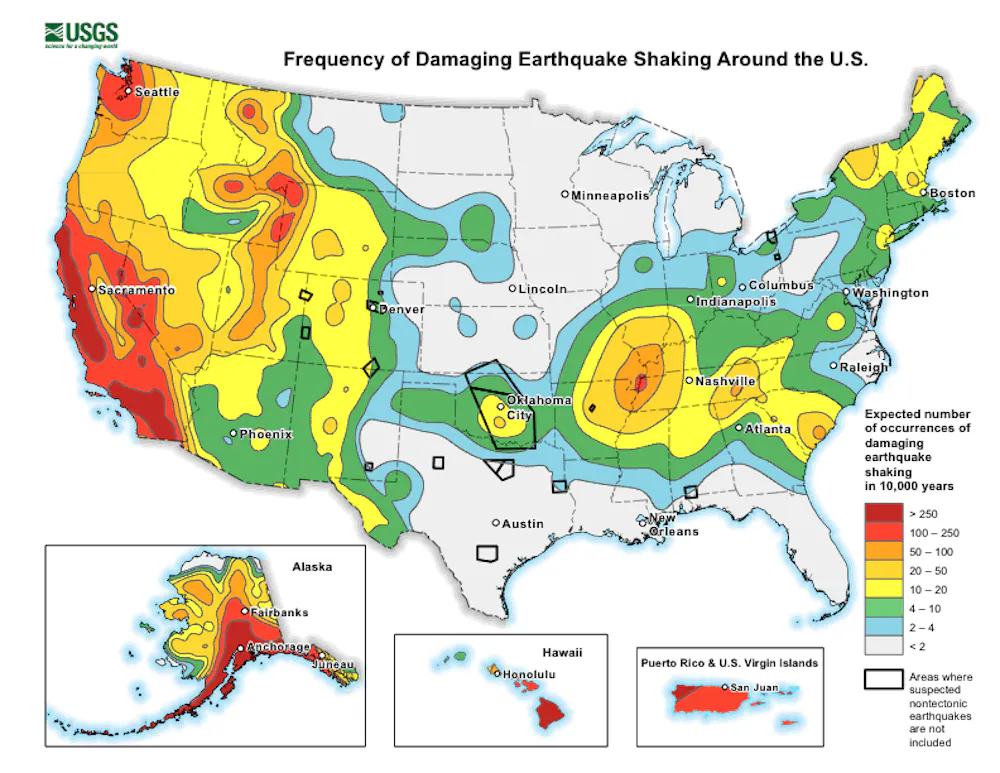
First, seismologists and earthquake engineers at the U.S. Geological Survey, or USGS, produce the National Seismic Hazard Model. These maps, based on research into earthquake sources such as faults and how seismic waves move through the earth’s crust, are used to determine the forces that structures in each community should be designed to resist.
A steering committee of earthquake experts from the private sector and universities works with USGS to ensure that the National Seismic Hazard Model implements the best available science.
In this 2023 update of the national seismic risk map, red areas have the greatest chance of a damaging earthquake occurring within 100 years. USGS
Second, the Federal Emergency Management Agency, FEMA, supports the process for periodically updating building codes. That includes supporting the work of the National Institute of Building Sciences’ Provisions Update Committee, which recommends building code revisions based on investigations of earthquake damage.
More broadly, FEMA, the USGS, the National Institute of Standards and Technology and the National Science Foundation work together through the National Earthquake Hazards Reduction Program to advance earthquake science and turn knowledge of earthquake risks into safer standards, better building design and education. Some of those agencies have been threatened by potential job and funding cuts under the Trump administration, and others face uncertainty regarding continuation of federal support for their work.
It is in large part because of the National Seismic Hazard Model and regularly updated building codes that U.S. buildings designed to meet modern code requirements are considered among the safest in the world, despite substantial seismic hazards in several states.
This paradigm has been made possible by the technical expertise and lack of political agendas among the federal staff. Without that professionalism, we believe experts from outside the federal government would be less likely to donate their time.
These programs and the federal agencies supporting them have benefited from a high level of staff expertise because hiring and advancement processes have been divorced from politics and focused on qualifications and merit.
This has not always been the case.
For much of early U.S. history, federal jobs were awarded through a patronage system, where political loyalty determined employment. As described in “The Federal Civil Service System and The Problem of Bureaucracy,” this system led to widespread corruption and dysfunction, with officials focused more on managing quid pro quo patronage than governing effectively. That peaked in 1881 with President James Garfield’s assassination by Charles Guiteau, a disgruntled supporter who had been denied a government appointment.
The passage of the Pendleton Act by Congress in 1883 shifted federal employment to a merit-based system. This preference for a merit-based system was reinforced in the Civil Service Reform Act of 1978. It states as national policy that “to provide the people of the United States with a competent, honest, and productive workforce … and to improve the quality of public service, Federal personnel management should be implemented consistent with merit system principles.”
The shift away from a patronage system produced a more stable and efficient federal workforce, which has enabled improvements in many critical areas, including seismic safety and disaster response.
Merit-based civil service matters for safety
While the work of these federal employees often goes unnoticed, the benefits are demonstrable and widespread. That becomes most apparent when disasters strike and buildings that meet modern code requirements remain standing.
A merit-based civil service is not just a democratic ideal but a proven necessity for the safety and security of the American people, one we hope will continue well into the future. This can be achieved by retaining federal scientists and engineers and supporting the essential work of federal agencies.
Jonathan P. Stewart has received funding from NSF and USGS. He is the chair of the Steering Committee for the National Seismic Hazard Model, a member of the National Institute of Building Sciences’ Provisions Update Committee, and a member of the federal Advisory Committee for Earthquake Hazard Reduction (ACEHR). His contributions to this article draw upon his experience and do not reflect the views of the Steering Committee, Provisions Update Committee, or ACEHR.
Lucy Arendt has received funding from NSF and the Applied Technology Council. She is a member and current chair of the federal Advisory Committee for Earthquake Hazard Reduction (ACEHR). Her contributions to this article reflect her professional expertise and do not reflect the views of ACEHR.
Following the devastating 7.7 magnitude earthquake that recently struck Myanmar, UNICEF is mobilizing 80 metric tons of life-saving supplies, including health kits, medical supplies, tents and hygiene kits for children and families in need.
Sumas First Nation (Semá:th) and the Province are strengthening their relationship through the return of the sacred Lightning Rock site.
After purchasing it last year, the Province has now successfully returned the 36-hectare Lightning Rock site to the Nation. This land holds deep cultural and spiritual significance to Semá:th and serves as a repository of traditions and narratives passed down through generations.
“The return of this sacred place is of great significance to the Semá:th, the Stó:lō, the Salish, and to First Nations people in general,” said Semá:th Chief Dalton Silver. “The respect and recognition evident here with this agreement is something our peoples have sought for too long. I’m thankful for the support from so many who’ve all played a part in making this a reality.”
The site contains a transformer stone that came to be known as Lightning Rock and is one of more than 100 sites where Stó:lō history says ancestors were transformed to stone. The site also holds the ancestral burial place of smallpox victims dating back to the 18th century.
Semá:th and the Province have worked in close collaboration to chart a path forward for the site’s protection since signing a memorandum of understanding (MOU) in 2017. In March 2024, the Province announced the purchase of the Lightning Rock site as part of ongoing negotiations with the intention to transfer the lands to Semá:th First Nation.
Now, the Province is returning the land to Semá:th First Nation. To make this historic moment possible, the Province and Semá:th signed a reconciliation agreement and a road agreement last fall. Since then, the Province and Semá:th First Nation have been working together to finalize the terms of the land transfer and engage with local interest holders so the agreement and the Lightning Rock return could be announced at the same time.
“Semá:th First Nation has spent decades advocating for this sacred land to be protected, and I am grateful to Chief Silver for his leadership in getting us to this point on our shared reconciliation journey,” said Christine Boyle, Minister of Indigenous Relations and Reconciliation. “This agreement is helping to protect this site, making a real difference for Semá:th members and providing certainty for everyone in the region.”
Through the reconciliation agreement, the Province and Semá:th First Nation have reaffirmed their commitment to building a strengthened government-to-government relationship and protecting the Lightning Rock site.
Part of the agreement includes a commitment for the Province and Semá:th First Nation to establish a special initiative to plan for the stewardship of Sumas Mountain. This initiative will be co-ordinated under the S’ólh Téméxw Stewardship Alliance – British Columbia (STSA-BC) Collaborative Stewardship Forum, a partnership between B.C. and 17 Stó:lō First Nations.
Other terms of the agreement include:
transferring ownership of the Lightning Rock site to Semá:th First Nation;
working together to formally protect the Lightning Rock site;
facilitating discussions between Semá:th First Nation and quarry operators about quarrying activity and potential economic opportunities; and
supporting the development of a cultural education and healing centre through a $1-million provincial contribution.
In addition to a reconciliation agreement, the Province, Semá:th First Nation and the City of Abbotsford have finalized a road agreement to explore alternative routes for the quarry access road that runs through the Lightning Rock site. The access route is used by gravel-hauling vehicles travelling to and from five quarries on Sumas Mountain and Highway 1.
“We are pleased to celebrate this significant milestone with Semá:th First Nation as these lands transfer from the Province today,” said Ross Siemens, mayor of Abbotsford. “As neighbours, the City of Abbotsford remains committed to working closely with Semá:th First Nation to address ongoing considerations in this culturally significant area in Semá:th traditional territory.”
The Province, Semá:th First Nation and the City of Abbotsford have agreed to contract a third party that will investigate the potential for mutually acceptable alternate routes for the access road. This process is expected to begin this year.
Learn More:
To learn more about Semá:th First Nation, visit: https://sumasfirstnation.com/
To learn more about the STSA-BC Collaborative Stewardship Forum, visit: https://thestsa.ca/stsa-operations/csf/
To learn more about agreements between the Province and Semá:th First Nation, visit: https://www2.gov.bc.ca/gov/content/environment/natural-resource-stewardship/consulting-with-first-nations/first-nations-negotiations/first-nations-a-z-listing/sumas-first-nation
F. Scott Fitzgerald’s The Great Gatsby, a top contender for the title of Great American Novel, turns 100 on April 10.
A century later, it is invoked to help make sense of a world that still confuses “material enterprise with moral achievement” – as critic Sarah Churchwell wrote in the foreword to Gatsby’s centennial edition.
A Meta insider’s memoir takes its title, Careless People, from Fitzgerald’s novel. The same phrase circulated on social media and in The New York Times during Donald Trump’s first presidency, referring to his administration’s downplaying of COVID-19.
In 2018, The Atlantic compared Trump to Tom Buchanan, one of Fitzgerald’s “careless people”, describing “an eerie symmetry […] as if the villain of F. Scott Fitzgerald’s 1925 novel had been brought to life in a louder, gaudier guise for the 21st century”. More recently, others have compared Trump to Gatsby himself.
The Great Gatsby tells the tale of a lovesick man striving for social acceptance, believing personal reinvention and riches can help to rewrite the past. It is a story of longing: not just for lost love, but for an unattainable ideal.
The centenary couldn’t be more timely for this literary masterpiece, preoccupied by the same things we are: immense affluence, privilege, the limits of social mobility and the hidden underbelly of the American Dream. The Great Gatsby, while a relative literary failure in Fitzgerald’s lifetime, is enduringly popular today, with at least 25 million copies sold to date, numerous film and stage adaptations (and literary riffs), and a staple position on school and university reading lists.
“What we think about Gatsby illuminates what we think about money, race, romance and history,” wrote The New York Times’ A.O. Scott recently. “How we imagine him has a lot to do with how we see ourselves.”
The Great Gatsby is set against the backdrop of Roaring Twenties America: an era Fitzgerald famously dubbed the Jazz Age.
Fuelled by the infectious rhythms of jazz, driven by the economic forces of market prosperity and mass consumerism, and heady on the alcoholic vapours and illicit thrills associated with Prohibition-era nightlife, the 1920s were a decade where American fortunes were made and lost.
It was also, as Fitzgerald’s novel outlines, a period where individual ambition burned as fiercely as desire.
Picryl
The plot follows the enigmatic Jay Gatsby, a spotlight-eschewing, self-made millionaire whose seemingly breezy approach to life masks a singular obsession: the rekindling of a lost romance with a beautiful woman from his past.
Born James Gatz, Fitzgerald’s charismatic protagonist reinvents himself in the hope of winning back the love of his life, wealthy socialite Daisy Buchanan. Taken at face value, Gatsby’s world is one of incredible luxury and dazzling excess – lavish parties, fast cars and ostentatious attire – all designed to lure Daisy back into his arms.
But as we begin to scratch beneath the surface, the glittering facade Gatsby has constructed gives way to something far more fragile and tragic: an impossible fantasy driven by jealously, obsession and self-deception.
As the reader comes to appreciate, Gatsby’s accumulated gains may grant him partial access to the world of old money, but he will never truly be accepted by America’s elite. No matter how hard he might try, he cannot surmount the barriers of class and entitlement.
Ultimately, Gatsby’s misguided belief that he can somehow crowbar his way into the upper echelons of high society while simultaneously turning back the hands of time leads to his downfall. In Fitzgerald’s words, he ends up paying “a high price for living too long with a single dream”.
F. Scott Fitzgerald’s novel is still invoked to help make sense of a world that often confuses ‘material enterprise with moral achievement’. Nickolas Muray/Picryl
F. Scott Fitzgerald, literary celebrity
Francis Scott Key Fitzgerald was born in St. Paul, Minnesota, on September 24 1896. The son of middle-class Catholic parents, he spent much of his youth living in upstate New York. In 1913, he enrolled at Princeton University, where he formed a lasting friendship with future literary critic Edmund Wilson.
More absorbed in literary and dramatic endeavours than his studies, Fitzgerald’s grades suffered and he dropped out in 1917 – though not before falling deeply in love with Ginevra King, an heiress who would leave an indelible imprint on his writing. She would inspire many of his fictional female characters, including Daisy Buchanan.
Fitzgerald first encountered King during a winter vacation in St. Paul in January 1915. The debutante daughter of a wealthy Chicago stockbroker, she quickly became the object of Fitzgerald’s intense devotion (much to the disapproval of her family, who thought him beneath her).
In the wake of his heartbreak after the relationship broke down, Fitzgerald enlisted in the United States Army, earning a commission as a second lieutenant. During his military service, he met Zelda Sayre, the woman he would eventually marry. Meanwhile, he began work on his first novel, This Side of Paradise.
Released in 1920, Fitzgerald’s formally adventurous debut was a critical success and cultural sensation, capturing the restless energy and shifting moral landscape of a cohort coming of age in the wake of World War I.
The novel’s transparently autobiographical narrative centres on Amory Blaine, a young Midwesterner whose intellectual and romantic adventures at Princeton – especially a doomed affair with the beautiful, elusive Isabelle Borgé – struck a chord with readers. It turned Fitzgerald into a media celebrity and unofficial spokesman for his generation.
Two years later, Fitzgerald published The Beautiful and Damned. It details the disintegration of a wealthy, aimless couple – Anthony and Gloria Patch – whose hedonistic lifestyle and misplaced belief in their own brilliance leads to ruin.
Fitzgerald’s tonally pessimistic second novel was again shaped by his own experiences, drawing heavily on his tempestuous marriage to Zelda, who was exhibiting symptoms of profound mental instability.
However, in stark contrast to This Side of Paradise, The Beautiful and Damned sold well, but received a lukewarm reception from reviewers. Some found its characters unappealing and its plot depressing.
By then, the Fitzgeralds had grown accustomed to the finer things in life. Which meant they needed money. Lots of it. To keep up with their lavish spending, Fitzgerald started to churn out short stories for popular magazines at a rapid pace. While this move provided him with a degree of financial security, some critics and contemporaries questioned whether he was squandering his literary gifts. Ernest Hemingway, for one, was “shocked” by his friend’s willingness to pander to commercial tastes and imperatives.
‘I want to write something new’
That said, while he was generating copy for mass-market publication, Fitzgerald was also hard at work on The Great Gatsby. In July 1922, he declared:
I want to write something new – something extraordinary and beautiful and simple + intricately patterned.
Determined to prove his worth as an artist, Fitzgerald, who wanted “to write a novel better than any ever written in America”, began to play with “form and emotion”. As his ideas for the new novel – which at one point bore the working title Trimalchio – took shape, Fitzgerald set up shop in Great Neck, Long Island. This location became the inspiration for East and West Egg, the fictionalised island communities that are the novel’s primary setting.
Fitzgerald, clearly not lacking in confidence, set his sights high for his third novel, taking inspiration from James Joyce’s Ulysses and T.S. Eliot’s The Waste Land.
Departing from conventional realism, Fitzgerald experimented with modernist techniques, layering his narrative with symbolic depth, synesthetic imagery, fragmented storytelling and complex characterisation.
The result was a work both lyrical and impressionistic. Here’s a vivid, illustrative excerpt:
The lights grow brighter as the earth lurches away from the sun, and now the orchestra is playing yellow cocktail music, and the opera of voices pitches a key higher. […] The groups change more swiftly, swell with new arrivals, dissolve and form in the same breath; already there are wanderers, confident girls who weave here and there among the stouter and more stable, become for a sharp, joyous moment the center of a group, and then, excited with triumph, glide on through the sea-change of faces and voices and color under the constantly changing light.
Fitzgerald’s Midwestern narrator, Nick Carraway, is describing one of Gatsby’s legendary West Egg parties. He is renting the house next to Gatsby’s mansion,
“a colossal affair by any standard”, with “a marble swimming pool, and more than forty acres of lawn and garden”.
At first, Nick is fascinated by his enigmatic neighbour, drawn in by the sheer force of Gatsby’s optimism and his unrelenting faith in the transformative power of love and the trappings of wealth. But as the novel progresses, events lead Nick to reevaluate. He describes his charming friend as possessing “one of those rare smiles with a quality of eternal reassurance in it, that you may come across four or five times in life”.
He continues, outlining attributes essential to a good confidence man:
It understood you just so far as you wanted to be understood, believed in you as you would like to believe in yourself, and assured you that it had precisely the impression of you that, at your best, you hoped to convey.
When he isn’t with Gatsby, Nick is often with his cousin Daisy and her husband, Tom, the embodiment of American aristocracy and snobbery. They are, in Nick’s damning estimation, “careless” and “rotten” people.
An unreconstructed white supremacist prone to casual displays of extreme prejudice and physical violence, the adulterous Tom – who wouldn’t be out of place in the more dismal real-world and online recesses of today – is, in particular, deeply suspicious of Gatsby, regarding him as an interloper with dubious intentions.
The Atlantic wrote that Tom, “the Yale man, the football star, the spender of old money, the scion of what he calls the Nordic race – embodies the peak of social status in his century”. And that “Trump – the former Playboy-cover subject, the billionaire celebrity, the most powerful man in America – does the same for his”.
And their shared personality traits are the product of their shared relationship to power – the casual unreflective certainty that comes from inheritance, and enables its holders to wield its blunt force as both a weapon and a shield.
Tom’s “little investigation” into Gatsby’s background and finances reveals they are not what they seem. This leads to unintended, disastrous consequences.
Nick, our disillusioned observer, doesn’t quite know what to make of it all. We take leave of him at the end of the novel, on “the beach and sprawled out on the sand”, reminiscing about “Gatsby’s wonder when he first picked out the green light at the end of Daisy’s dock”.
‘A flying leap into the future’
Fitzgerald knew he had achieved something special with The Great Gatsby. His peers did too. T.S. Eliot considered it “the first step” forward “American fiction has taken since Henry James”. Edith Wharton concurred, calling it “a flying leap into the future.”
Yet, for all this critical acclaim, The Great Gatsby failed to resonate with the reading public – much to Fitzgerald’s dismay. By October, the book had sold less than 20,000 copies. (By comparison, This Side of Paradise had sold nearly 50,000 copies, across multiple printings.) As his biographer Arthur Mizener observed, by February 1926, “a few thousand more copies had been sold and the book was dead”. It was a blow the writer never really recovered from.
Fitzgerald’s personal life was tumultuous, marred by alcoholism, Zelda’s mental health issues and financial debt. This had a negative effect on his work. While he completed one more novel in 1934 – the excellent, darkly romantic Tender is the Night, arguably his best book – Fitzgerald struggled to be productive.
Following several failed suicide attempts, in 1940 he died of a heart attack, believing himself an abject failure and his career a total write-off. His most recent royalty cheque had been for $13.13. He was 44.
In the immediate aftermath of his death, writers and critics began to reassess Fitzgerald’s accomplishments. This effort was initially spearheaded by his friends, notably Edmund Wilson, who, in 1941, organised a series of tributes to be published in The New Republic.
In 1945, Viking Press released The Portable F. Scott Fitzgerald, edited by Dorothy Parker, which brought Fitzgerald to the attention of a new generation of readers. At the same time, the US military distributed 150,000 copies of The Great Gatsby to American servicemen during World War II as part of their Armed Services Editions.
Before long, The Great Gatsby made its way into the classroom, where it remains a staple of countless high school and university syllabuses. It continues to inspire readers, many of whom encounter it at a formative stage in their lives.
Amazon
It has been adapted for the screen on multiple occasions – with mixed results. Jack Clayton’s 1974 version, starring Robert Redford as the eponymous Gatsby, was faithful to Fitzgerald’s vision, but utterly lifeless, while Baz Luhrmann’s 2013 adaptation, a hollow exercise in audiovisual bluster, failed to do justice to the novel’s subtleties. For all their shortcomings, these films helped cement Gatsby’s place in the popular imagination.
An ‘uncannily prescient’ enduring classic
Novelist Jesmyn Ward suggests Fitzgerald’s novel is
a book that endures, generation after generation, because every time a reader returns to The Great Gatsby, we discover new revelations, new insights, new burning bits of language.
I agree – and I think Fitzgerald would have had rich material to work with, had he been alive today. Ours, lest we forget, is a world where ersatz robber barons hoard nearly all our shared available assets and resources, where racist discourse resounds, and where rampant consumerism remains unchecked.
Last year America magazine argued Gatsby himself “gives the greatest insight into why Mr. Trump is still popular”, comparing Trump’s “fraudulent real estate deals” to Gatsby’s nefarious way of making his money, and Gatsby’s huge parties to Trump’s rallies. Both, the writer argued, are nouveau riche outsiders, “hell-bent on being accepted by the Manhattan set”, and scorned by the elites. (Though Trump’s second presidency seems to be ushering in a new elite.)
Thinking aloud, perhaps it’s more accurate to say Trump is a weird combination of characters. On one hand, he resembles Gatsby: a self-mythologising social climber, nostalgic for a past that never really existed. On the other, he shares much with Tom Buchanan: unscrupulous, self-interested and protected by his wealth.
In a historical moment that mirrors his own in many ways, Fitzgerald’s essentially tragic masterwork, which ends suggesting we are all forever “borne back ceaselessly into the past”, strikes me as uncannily prescient and relevant today.
Alexander Howard does not work for, consult, own shares in or receive funding from any company or organisation that would benefit from this article, and has disclosed no relevant affiliations beyond their academic appointment.
Union Home Minister and Minister of Cooperation, Shri Amit Shah says our relentless hunt against the drug trade continues In line with the Modi government’s zero tolerance against drugs, a major narco-network busted in Delhi-NCR
NCB and Delhi Police grabbed the gang by its throat and recovered methamphetamine, MDMA, and cocaine worth ₹27.4 crore and arrested five people
I applaud NCB and Delhi Police for this major breakthrough: Home Minister
Posted On: 31 MAR 2025 4:53PM by PIB Delhi
Union Home Minister and Minister of Cooperation, Shri Amit Shah said that our relentless hunt against the drug trade continues.
In his post on ‘X’ platform Home Minister said “In line with the Modi government’s zero tolerance against drugs, a major narco-network was busted in Delhi-NCR. The NCB and Delhi Police grabbed the gang by its throat and recovered methamphetamine, MDMA, and cocaine worth ₹27.4 crore and arrested five people. I applaud NCB and Delhi Police for this major breakthrough”.
Our relentless hunt against the drug trade continues.
In line with the Modi government’s zero tolerance against drugs, a major narco-network was busted in Delhi-NCR. The NCB and Delhi Police grabbed the gang by its throat and recovered methamphetamine, MDMA, and cocaine worth…
On receipt of an input about an imminent exchange of high-quality Methamphetamine in Chhatarpur area of Delhi a joint team of Narcotics Control Bureau (NCB) and Special cell of the Delhi Police mounted surveillance on the suspects leading to interception of a vehicle carrying 5.103 kilograms of High-quality Crystal Methamphetamine valued at Rs. 10.2 crore (appx.). Five occupants of the vehicle including four African Nationals belonging to influential family of Nigeria have been arrested.
Sustained on-the-spot, interrogation and technical backtracking revealed that this contraband was sourced from an African Kitchen in the Tilak Nagar area of West Delhi. Search at this kitchen led to recovery of 1.156 kilograms Crystal Methamphetamine, 4.142 kilograms Afghan Heroine and 5.776 kilograms MDMA (Ecstasy pills) valued at Rs 16.4 crore (appx.). Further, a follow-up search at a rented apartment at Greater Noida led to a recovery of 389 grams of Afghan Heroin and 26 grams of cocaine.
Investigation revealed about involvement of this syndicate in facilitating African Youth peddling drugs and narcotics, in getting student visas for study at major private universities of National Capital Region (NCR) as well as Punjab. For some of the students, the visa was only a cover for their stay in India where as they were involved in supplying drugs and Crypto conversions. Further, investigations to identify the backward and forward linkages of this drug syndicate is underway.
The seizure exemplifies the NCB’s commitment to successfully dismantle drug networks. To fight against drug trafficking, NCB seeks support of the citizens. Any person can share information related to sale of narcotics by calling on MANAS- National Narcotics Helpline Toll Free Number-1933.
Source: Hong Kong Government special administrative region
The Census and Statistics Department (C&SD) released the latest figures on retail sales today (March 31).
The value of total retail sales in February 2025, provisionally estimated at $29.4 billion, decreased by 13.0% compared with the same month in 2024. The revised estimate of the value of total retail sales in January 2025 decreased by 3.1% compared with a year earlier. For the first two months of 2025 taken together, it was provisionally estimated that the value of total retail sales decreased by 7.8% compared with the same period in 2024.
Of the total retail sales value in February 2025, online sales accounted for 7.8%. The value of online retail sales in that month, provisionally estimated at $2.3 billion, decreased by 7.3% compared with the same month in 2024. The revised estimate of online retail sales in January 2025 increased by 2.8% compared with a year earlier. For the first two months of 2025 taken together, it was provisionally estimated that the value of online retail sales decreased by 2.4% compared with the same period in 2024.
After netting out the effect of price changes over the same period, the provisional estimate of the volume of total retail sales in February 2025 decreased by 15.0% compared with a year earlier. The revised estimate of the volume of total retail sales in January 2025 decreased by 5.1% compared with a year earlier. For the first two months of 2025 taken together, the provisional estimate of the total retail sales decreased by 9.9% in volume compared with the same period in 2024.
In interpreting these figures, it should be noted that retail sales tend to show greater volatility in the first two months of a year due to the timing of the Chinese New Year. Consumer spending in the local market normally attains a seasonal high before the Festival. As the Chinese New Year fell on January 29 this year but on February 10 last year, it is more appropriate to analyse the retail sales figures for January and February taken together in making year-on-year comparison.
Analysed by broad type of retail outlet in descending order of the provisional estimate of the value of sales and comparing the combined total sales for January and February 2025 with the same period a year earlier, the value of sales of other consumer goods not elsewhere classified decreased by 2.0%. This was followed by sales of jewellery, watches and clocks, and valuable gifts (-15.8% in value); commodities in supermarkets (-4.4%); wearing apparel (-5.4%); electrical goods and other consumer durable goods not elsewhere classified (-5.3%); commodities in department stores (-9.9%); fuels (-8.5%); motor vehicles and parts (-49.9%); footwear, allied products and other clothing accessories (-12.3%); books, newspapers, stationery and gifts (-10.9%); furniture and fixtures (-25.6%); Chinese drugs and herbs (-9.1%); and optical shops (-7.6%).
On the other hand, the value of sales of food, alcoholic drinks and tobacco increased by 0.7% in the first two months of 2025 over the same period a year earlier. This was followed by sales of medicines and cosmetics (+0.6% in value).
Based on the seasonally adjusted series, the provisional estimate of the value of total retail sales decreased by 2.0% in the three months ending February 2025 compared with the preceding three-month period, while the provisional estimate of the volume of total retail sales decreased by 4.0%.
Commentary
A government spokesman said that the value of total retail sales increased further in February 2025 over the preceding month on a seasonally adjusted comparison. The year-on-year decline in the value of total retail sales in February 2025 widened, partly due to the earlier arrival of Chinese New Year in late January this year as compared to mid-February last year. Taking the first two months of 2025 together to remove this effect, the value of total retail sales saw a narrower decline on a year-on-year basis than December 2024.
Looking ahead, the spokesman said that the various measures by the Central Government to boost the Mainland economy and benefit Hong Kong, the SAR Government’s proactive efforts to promote tourism and mega events, and the sustained increases in employment earnings in local labour market, would benefit the retail sector, though it would continue to face challenge from the change in consumption patterns of visitors and residents.
Further information
Table 1 presents the revised figures on value index and value of retail sales for all retail outlets and by broad type of retail outlet for January 2025 as well as the provisional figures for February 2025. The provisional figures on the value of retail sales for all retail outlets and by broad type of retail outlet as well as the corresponding year-on-year changes for the first two months of 2025 taken together are also shown.
Table 2 presents the revised figures on value of online retail sales for January 2025 as well as the provisional figures for February 2025. The provisional figures on year-on-year changes for the first two months of 2025 taken together are also shown.
Table 3 presents the revised figures on volume index of retail sales for all retail outlets and by broad type of retail outlet for January 2025 as well as the provisional figures for February 2025. The provisional figures on year-on-year changes for the first two months of 2025 taken together are also shown.
Table 4 shows the movements of the value and volume of total retail sales in terms of the year-on-year rate of change for a month compared with the same month in the preceding year based on the original series, and in terms of the rate of change for a three-month period compared with the preceding three-month period based on the seasonally adjusted series.
The classification of retail establishments follows the Hong Kong Standard Industrial Classification (HSIC) Version 2.0, which is used in various economic surveys for classifying economic units into different industry classes.
These retail sales statistics measure the sales receipts in respect of goods sold by local retail establishments and are primarily intended for gauging the short-term business performance of the local retail sector. Data on retail sales are collected from local retail establishments through the Monthly Survey of Retail Sales (MRS). Local retail establishments with and without physical shops are covered in MRS and their sales, both through conventional shops and online channels, are included in the retail sales statistics.
The retail sales statistics cover consumer spending on goods but not on services (such as those on housing, catering, medical care and health services, transport and communication, financial services, education and entertainment) which account for over 50% of the overall consumer spending. Moreover, they include spending on goods in Hong Kong by visitors but exclude spending outside Hong Kong by Hong Kong residents. Hence they should not be regarded as indicators for measuring overall consumer spending.
Users interested in the trend of overall consumer spending should refer to the data series of private consumption expenditure (PCE), which is a major component of the Gross Domestic Product published at quarterly intervals. Compiled from a wide range of data sources, PCE covers consumer spending on both goods (including goods purchased from all channels) and services by Hong Kong residents whether locally or abroad. Please refer to the C&SD publication “Gross Domestic Product by Expenditure Component” for more details.
Users who have enquiries about the survey results may contact the Distribution Services Statistics Section of C&SD (Tel: 3903 7400; E-mail : mrs@censtatd.gov.hk).
Delivering on the EU’s net greenhouse gas emissions reduction target of at least 55% by 2030 compared to 1990 and the climate neutrality target by 2050, as enshrined in the European Climate Law[1], calls for ambitious action to ensure a swift decrease in emissions from all sectors, including transport.
The revised CO2 standards Regulation[2] sets targets which get more stringent over time, up to a 100% emission reduction for new cars and vans registered in the EU as of 2035.
These standards drive a gradual transition towards zero-emission mobility, while giving industry enough lead-time to develop an adequate compliance strategy.
The 2025 target requires a 15% reduction of emissions from the 2021 baseline. It was agreed by the co-legislators in 2019 and was confirmed in 2023.
For manufacturers that may not be in a position to achieve target compliance on their own , the regulation provides the option to pool with other manufacturers. Pooling is not mandatory but provides manufacturers with one more flexibility to choose from.
In the Industrial Action Plan for the European automotive sector[3], the Commission has announced that it will swiftly present additional flexibilities, through a targeted amendment of the CO2 emission standards, which would determine that compliance is assessed over the years of 2025, 2026 and 2027 combined to allow manufacturers to compensate target exceedance in one or two of these years by overachievements in the other year(s).
This will contribute to safeguarding industry’s capacity to invest, keeping the overall ambition of the 2025 targets. The Commission will also accelerate work on the preparation of the review of the regulation.
NEW YORK, NY, March 31, 2025 (GLOBE NEWSWIRE) — Samsara Luggage Inc. (OTC: SAML), a publicly traded company focused on acquiring and growing businesses in the public safety sector, today announced the streamlining of its operations to enhance efficiency and position the company for future growth. Additionally, the company is completing feasibility studies, due diligence, and/or contract negotiations on several potential acquisitions and growth initiatives.
SAML currently operates seven public safety subsidiaries across the United States and the United Arab Emirates, along with an industrial electric vehicle (EV) business in Serbia. These businesses are undergoing efficiency and cost-reduction initiatives to better align resources and optimize cash flow while building a robust management team to support the company’s uplisting ambitions.
Like many OTC companies, the company has faced challenges raising capital over the past two years, significantly affecting the growth and operations of its operating companies and its parent company, Ilustrato Pictures International Inc. (“ILUS”). However, ILUS believes it has a clear path to significant capital access during the next quarter. It’s anticipated that SAML will benefit greatly from improved investment, cash flow, and liquidity, allowing it to revitalize the cash-starved subsidiaries and reignite its growth and acquisition plans.
Streamlining the Public Safety Division
In 2024, SAML faced challenges scaling its public safety division due to the business’s capital-intensive nature and limited access to growth capital. To address these challenges, the company has implemented operational improvements to enhance cost efficiency and plans to advance previously delayed product certifications.
“There is no beating around the bush. The last 18 months in the ERT businesses have been extremely tough, with limited access to working capital. However, we expect those days are rapidly ending as the parent company anticipates being in a stronger position to assist with working capital. We remain committed to advancing our public safety ERT businesses and positioning the company for an uplisting alongside simultaneous M&A activities. I’m expecting an exciting time, with lots of hard work bringing our visions to reality, but we are ready,” said Nicolas Link, Interim CEO of SAML.
SAML is exploring non-cash-intensive acquisitions that can add scale and enhance the company’s market presence to supplement organic growth.
Revitalizing the Industrial Electric Vehicle Business
SAML’s Eraptor division, which focuses on industrial electric vehicles, will also receive renewed focus in 2025. Resource constraints in 2024 led to stalled production and R&D activities. Management aims to resume production and enhance R&D efforts to capitalize on the growing demand for innovative industrial EV solutions.
The Eraptor business is strategically aligned with SAML’s public safety operations, sharing a similar customer base and target markets. This alignment offers opportunities for cross-sector synergies and market penetration.
Exploring opportunities
Over the past 36 months, the world has changed considerably in almost all areas, including but not limited to governments, costs, inflation, financing, access to capital, technology, geopolitics, energy demands, defense, remote working, and nearly every aspect of daily life. These changes have drastically altered global dynamics. For this reason, we will explore opportunities that will add value to shareholders and generate positive cash flow, focusing on areas that align with our management skill set.
Corporate Updates
SAML also provides the following updates regarding its corporate structure and leadership. The company had previously filed for a name change to Emergency Response Technologies Inc. and a new trading symbol (RESQ). Although the application was initially declined due to a lender relationship, the company has since resolved the matter. Management expects to refile an application after its audited 2024 financials are completed.
Mr. John-Paul Backwell has stepped down as CEO and a Director of the Company to devote his efforts to developing Nasdaq-listed Fusion Fuel Green Plc (Nasdaq: HTOO), a corporation in which SAML’s parent entity, ILUS, maintains a substantial shareholding. Mr. Nicolas Link will temporarily assume the duties of CEO while the company recruits a new permanent CEO and Mr. Backwell will remain as an advisor to the company.
“We will undoubtedly miss John Paul Backwell’s involvement in ERT, but he remains a part of our extended ILUS family. He remains an advisor to ERT while focusing primarily on the HTOO business. I want to thank JP for his incredible sacrifice and commitment to the ERT business and to the group, for that matter. We are actively recruiting for a CEO to lead the SAML business into the next stage,” said Nicolas Link, Chairman and Interim CEO.
SAML notifies shareholders that it will file an NT 10-K and will file its financials late for a number of reasons, including but not limited to the following:
Addressing several SEC comments on its previous filings and disclosures, many of which are technical accounting issues, with numerous comments dating back to a period before our takeover.
There have been a number of changes within the group, including acquisitions, mergers, and share swaps. All of these have a knock-on effect in terms of accounting and consolidation that can only be completed once the subsidiaries have been audited and can be consolidated. We are mindful that we want to file the 2024 financials and any prior amendments correctly, providing a clean runway for upcoming registrations across the group. We have engaged consultants to assist with this, who have been working on it for several months.
In 2024, we changed auditors across the group, who are re-auditing the entire two-year period and can only complete their audits sequentially as the group finishes each part.
We also underwent software integration across the companies of an integrated ERP system, which naturally took time.
To prevent this scenario from happening again, we have hired additional accounting resources, highly experienced specialists in management within this area, and consultants with extensive PCAOB and SEC experience to ensure that we are accurate going forward.
The team is working diligently to complete the filing as soon as possible. Management thanks shareholders for their patience and assures them that the delay is not due to any legal problems. Instead, it is for continued improvement and to address previously raised regulatory comments, allowing for smoother registration processes in the future.
SAML will hold its annual shareholder meeting on June 20, 2025, as part of the broader ILUS group shareholder meeting, with further information to be published in due course.
Certain information set forth in this press release contains “forward-looking information”, including “future-oriented financial information” and “financial outlook”, under applicable securities laws (collectively referred to herein as forward-looking statements). Except for statements of historical fact, the information contained herein constitutes forward-looking statements and includes, but is not limited to, the (i) projected financial performance of the Company; (ii) completion of, and the use of proceeds from, the sale of the shares being offered hereunder; (iii) the expected development of the Company’s business, projects, and joint ventures; (iv) execution of the Company’s vision and growth strategy, including with respect to future M&A activity and global growth; (v) sources and availability of third-party financing for the Company’s projects; (vi) completion of the Company’s projects that are currently underway, in development or otherwise under consideration; (vii) renewal of the Company’s current customer, supplier and other material agreements; and (viii) future liquidity, working capital, and capital requirements. Forward-looking statements are provided to allow potential investors the opportunity to understand management’s beliefs and opinions in respect of the future so that they may use such beliefs and opinions as one factor in evaluating an investment. These statements are not guarantees of future performance and undue reliance should not be placed on them. Such forward-looking statements necessarily involve known and unknown risks and uncertainties, which may cause actual performance and financial results in future periods to differ materially from any projections of future performance or result expressed or implied by such forward-looking statements. Although forward-looking statements contained in this presentation are based upon what management of the Company believes are reasonable assumptions, there can be no assurance that forward-looking statements will prove to be accurate, as actual results and future events could differ materially from those anticipated in such statements. The Company undertakes no obligation to update forward-looking statements if circumstances or management’s estimates or opinions should change except as required by applicable securities laws. The reader is cautioned not to place undue reliance on forward-looking statements. The Securities and Exchange Commission (“SEC”) has provided guidance to issuers regarding the use of social media to disclose material non-public information. In this regard, investors and others should note that we announce material financial information via official Press Releases, in addition to SEC filings, press releases, Questions & Answers sessions, public conference calls and webcasts also may take time from time to time. We use these channels as well as social media to communicate with the public about our company, our services, and other issues. It is possible that the information we post on social media could be deemed to be material information. Therefore, considering the SEC’s guidance, we encourage investors, the media, and others interested in our company to review the information we post on social & media channels.
Q4 Sequential Revenue Growth of 43% Driven by New Products and Technologies, and 131% Year over Year
New OEM and Distributor Relationships to Equip New Campers and RVs with Advanced Lithium-Ion Batteries
Began Shipping e360 Home Energy Storage Solutions
REDMOND, Ore., March 31, 2025 (GLOBE NEWSWIRE) — Expion360 Inc. (Nasdaq: XPON) (“Expion360” or the “Company”), an industry leader in lithium-ion battery power storage solutions, today reported its financial and operational results for the fourth quarter and full year ended December 31, 2024.
Q4 2024 revenue totaled $2.0 million, up 131% from Q4 2023, and 43% sequentially from Q3 2024.
Began fulfilling purchase orders for its Home Energy Storage Solutions (“HESS”).
Signed a non-binding letter of intent with NeoVolta Inc. (“NeoVolta”), a leading innovator in energy storage solutions, providing the framework for a potential collaboration that aims to engineer a state-of-the-art battery manufacturing facility and develop innovative lithium-ion battery cell and module product designs, marking a significant milestone in the production of American-made batteries.
Partnered with Scout Campers, a subsidiary of Adventurer Manufacturing, Inc., to equip its high-quality campers with Expion360’s advanced lithium-ion batteries as a standard option, enhancing the energy efficiency and reliability of Scout Campers’ products.
Added several new original equipment manufacturers (“OEMs”) and one new distributor reflecting successful ongoing sales efforts to expand customer base across the United States.
Closed a $2.6 million registered direct offering and private placement priced at the market under Nasdaq rules.
Management Commentary
“The fourth quarter of 2024 and early 2025 was highlighted by robust sequential revenue growth, a strengthened balance sheet, and the addition of new OEM customers,” said Brian Schaffner, Chief Executive Officer and Interim Chief Financial Officer of Expion360. “Revenue grew sequentially for a fourth consecutive quarter, improving 43% from Q3 2024, demonstrating the successful execution of our efforts to expand sales with our more than 300 resellers across the United States, consisting of dealers, wholesalers, private-label customers and OEMs who then sell our products to end consumers. Year-over-year sales continued to be impacted by the downturn in the RV market with the persistence of high interest rates. We believe the RV market will continue to gain ground through 2025, with shipments remaining steady in the short term and increasing traction heading into next year. In January we took the opportunity to strengthen our balance sheet with the close of a $2.6 million registered direct offering and private placement.
“We are making significant progress against our goals with the ongoing expansion of our OEM relationships and acquisition of several new OEM partnerships. New customers, including Scout Campers, Alaskan Campers, and K-Z Recreational Vehicles, are driving demand for high-quality lithium battery technology for their premium campers and vehicles.
“We are working with NeoVolta to combine our strengths toward a potential collaboration that aims to engineer a US-based state-of-the-art battery manufacturing facility and develop innovative lithium-ion battery cell and module product designs. A formal engagement would enable us to contribute our expertise in design and engineering, while NeoVolta plans to provide the necessary capital and manpower. Together we expect to bring high-performance, sustainable energy storage solutions to the market to address the growing demand for efficient energy management in both residential and commercial applications.
“We have continued our progress in our Home Energy Storage Solutions vertical, with production shipments beginning in January 2025. We believe the HESS product line will benefit from a fast-growing battery energy storage market, and consumer uptake can rapidly scale with the introduction of products that improve price, flexibility, and integration. We also anticipate HESS will benefit from incentives available through California’s Self-Generation Incentive Program and federal tax credits available through the Inflation Reduction Act for home battery systems.
“Looking ahead, we anticipate our new OEM partnerships and distributors to generate incremental revenue of approximately $5.0 million for fiscal year 2025, with additional new customers expressing interest across our product line, including our next generation GC2, Group 27, and new Edge batteries. The anticipated revenue growth is expected to increase gross profits by an estimated $1.4 million for fiscal year 2025. We are also highly focused on further development of HESS and the introduction of new technologies and batteries. We look forward to announcements of additional wins and milestones in the months ahead,” concluded Mr. Schaffner.
Fourth Quarter 2024 Financial Summary
Revenue in the fourth quarter of 2024 totaled $2.0 million, an increase of 131% from $0.9 million in the prior year period. The increase was primarily due to increased OEM sales with existing and new customers.
Gross profit in the fourth quarter of 2024 totaled $438,552 or 22.1% of revenue, as compared to $205,114 or 23.9% of revenue in the prior year period. The decrease in gross profit was primarily due to OEM customer discounts issued in connection with higher-volume purchases.
Selling, general and administrative expenses in the fourth quarter of 2024 decreased to $1.6 million compared to $2.4 million in the prior year period. The decrease was primarily due to reductions in salaries related to a lower employee headcount and lower stock-based compensation.
Net loss in the fourth quarter of 2024 totaled $251,647, an 88% improvement from a net loss of $2.2 million in the prior year period. The decrease in net loss was primarily due to our sales growth.
Full Year 2024 Financial Summary
For the year ended December 31, 2024, revenue totaled $5.6 million, decreasing 6.0% from $6.0 million in the prior year. The decrease was primarily attributable to softness in the recreational market during the first two quarters, driving decreases in OEM sales during those same two periods.
Gross profit for the full year of 2024 totaled $1.2 million, a 20.5% gross margin as compared to $1.6 million or 26.3% of revenue in the same year-ago period. The decrease in gross profit was primarily attributable to lower sales volumes due to the slowdown in the RV industry resulting in lower economies of scale on fixed costs, as well as the liquidation of non-core product increasing cost of sales above what they would have been without the liquidation.
Selling, general and administrative expenses for the full year of 2024 decreased 9.6% to $7.9 million compared to $8.7 million in the prior year period. The decrease was primarily due to decreases in legal and professional fees, as well as salaries and benefits, which was partially offset by an increase in license and fee cash premiums paid when making repayment on our convertible note, as well as fees incurred in connection with our termination of our warehouse lease.
Net loss for the year ended December 31, 2024, totaled $13.5 million or $(21.03) per share, compared to net loss of $7.5 million or $(108.25) per share in the prior year. The net loss was primarily the result of $5.0 million in suspended liability expense due to our reverse stock split cash true-up payment provision in the Series A Warrants issued and sold in a public offering we consummated in August 2024, as well as increased interest incurred under our convertible note, and increased settlement expenses.
Cash and cash equivalents totaled $0.5 million as of December 31, 2024, compared to $3.9 million as of December 31, 2023. On January 3, 2025, the Company closed a $2.6 million registered direct offering and private placement priced at the market under Nasdaq rules.
Net cash used in operating activities totaled $9.6 million for the year ended December 31, 2024, compared to $5.5 million in the prior year period.
The share, per share, and resulting financial amounts in this press release, including prior period metrics, have been adjusted to reflect the reverse stock split of the Company’s common stock, par value $0.001 per share, which was effective on October 8, 2024.
Fourth Quarter & Full Year 2024 Results Conference Call
Brian Schaffner, Chief Executive Officer of Expion360, will host the conference call, followed by a question-and-answer period. The conference call will be accompanied by a presentation, which can be viewed during the webcast or accessed via the investor relations section of the Company’s website here.
To access the call, please use the following information:
A telephone replay will be available approximately three hours after the call and will remain available through April 14, 2025, by dialing 1-844-512-2921 from the U.S., or 1-412-317-6671 from international locations, and entering replay pin number: 10196334. The replay can also be viewed through the webcast link above and the presentation utilized during the call will be available via the investor relations section of the Company’s website here.
About Expion360
Expion360 is an industry leader in premium lithium iron phosphate (LiFePO4) batteries and accessories for recreational vehicles, marine applications, Light EV and residential energy storage.
The Company’s lithium-ion batteries feature half the weight of standard lead-acid batteries while delivering three times the power and ten times the number of charging cycles. Expion360 batteries also feature better construction and reliability compared to other lithium-ion batteries on the market due to their superior design and quality materials. Specially reinforced, fiberglass-infused, premium ABS and solid mechanical connections help provide top performance and safety. With Expion360 batteries, adventurers can enjoy the most beautiful and remote places on Earth even longer.
The Company is headquartered in Redmond, Oregon. Expion360 lithium-ion batteries are available today through more than 300 dealers, wholesalers, private-label customers, and OEMs across the country. To learn more about the Company, visit expion360.com.
Forward-Looking Statements
The foregoing material may contain “forward-looking statements” within the meaning of Section 27A of the Securities Act of 1933 and Section 21E of the Securities Exchange Act of 1934, each as amended. Forward-looking statements include all statements that do not relate solely to historical or current facts, including without limitation statements regarding the Company’s business prospects, and can be identified by the use of words such as “may,” “will,” “expect,” “project,” “estimate,” “anticipate,” “plan,” “believe,” “potential,” “should,” “continue” or the negative versions of those words or other comparable words. Forward-looking statements included in this press release include, but are not limited to, statements relating to the Company’s beliefs, plans, and expectations about its operations, product development and pipeline, growth prospects, market opportunity, potential partnership with NeoVolta, the anticipated incremental revenue to be generated from new OEM partnerships and distributors, and the expected timing of the Company’s next conference call to discuss the Company’s financial results. Forward-looking statements are not guarantees of future actions or performance. These forward-looking statements are based on information currently available to the Company and its current plans or expectations and are subject to a number of risks and uncertainties that could significantly affect current plans. Should one or more of these risks or uncertainties materialize, or the underlying assumptions prove incorrect, actual results may differ significantly from those anticipated, believed, estimated, expected, intended, or planned. Although the Company believes that the expectations reflected in the forward-looking statements are reasonable, the Company cannot guarantee future results, performance, or achievements. Except as required by applicable law, including the security laws of the United States, the Company does not intend to update any of the forward-looking statements to conform these statements to actual results.
Company Contact: Brian Schaffner, CEO and Interim CFO 541-797-6714 Email Contact
External Investor Relations: Chris Tyson, Executive Vice President MZ Group – MZ North America 949-491-8235 XPON@mzgroup.us www.mzgroup.us
Expion360 Inc. Balance Sheets
As of December 31, 2024
As of December 31, 2023
Assets
Current Assets
Cash and cash equivalents
$
547,565
$
3,932,698
Accounts receivable, net
613,022
154,935
Inventory
4,831,461
3,825,390
Prepaid/in-transit inventory
1,612,686
163,948
Prepaid expenses and other current assets
236,461
189,418
Total current assets
7,841,195
8,266,389
Property and equipment
914,081
1,348,326
Accumulated depreciation
(430,191
)
(430,295
)
Property and equipment, net
483,890
918,031
Other Assets
Operating leases – right-of-use asset
754,832
2,662,015
Deposits
27,471
58,896
Total other assets
782,303
2,720,911
Total assets
$
9,107,388
$
11,905,331
Liabilities and stockholders’ equity
Current liabilities
Accounts payable
$
338,091
$
286,985
Customer deposits
48,474
17,423
Accrued expenses and other current liabilities
187,464
292,515
Convertible note
—
2,082,856
Current portion of operating lease liability
256,153
522,764
Current portion of stockholder promissory notes
—
762,500
Current portion of long-term debt
31,758
50,839
Suspended Liability
4,985,948
—
Total current liabilities
5,847,888
4,015,882
Long-term debt, net of current portion and discount
198,412
298,442
Operating lease liability, net of current portion
542,764
2,241,325
Total liabilities
$
6,589,064
$
6,555,649
Stockholders’ equity
Preferred stock, par value $.001; 20,000,000 shares authorized; zero shares issued and outstanding
—
—
Common stock, par value $.001; 200,000,000 shares authorized; 2,096,082 and 69,230 issued and outstanding as of December 31, 2024 and 2023, respectively
2,096
69
Additional paid-in capital
37,091,468
26,445,378
Accumulated deficit
(34,575,240
)
(21,095,765
)
Total stockholders’ equity
2,518,324
5,349,682
Total liabilities and stockholders’ equity
$
9,107,388
$
11,905,331
Expion360 Inc. Statements of Operations
For the Years Ended December 31,
2024
2023
Net sales
$
5,624,939
$
5,981,134
Cost of sales
4,469,711
4,405,611
Gross profit
1,155,228
1,575,523
Selling, general and administrative
7,909,219
8,745,135
Loss from operations
(6,753,991
)
(7,169,612
)
Other (Income) / Expense
Interest income
(86,121
)
(125,854
)
Interest expense
976,618
124,511
Loss on sale of property and equipment
146,760
3,426
Settlement expense
709,900
281,680
Suspended liability expense
4,985,948
—
Other income
(6,073
)
(394
)
Total other expense
6,727,032
283,369
Loss before taxes
(13,481,023
)
(7,452,981
)
Tax (income) / expense
(1,548
)
3,293
Net loss
$
(13,479,475
)
$
(7,456,274
)
Net loss per share (basic and diluted)
$
(21.03
)
$
(108.25
)
Weighted-average number of common shares outstanding
641,011
68,882
Expion360 Inc. Statements of Cash Flows
For the Years Ended December 31,
2024
2023
Cash flows from operating activities
Net loss
$
(13,479,475
)
$
(7,456,274
)
Adjustments to reconcile net loss to net cash provided by (used in) operating activities:
Depreciation
173,973
205,723
Amortization of convertible note costs
667,144
—
Loss on sale of property and equipment
146,760
3,426
Decrease in allowance for doubtful accounts
—
(18,804
)
Stock-based settlement
209,000
251,680
Stock-based compensation
616,632
560,365
Decrease in right-of-use assets and lease liabilities
(67,778
)
—
Increase in suspended liability
4,985,948
—
Changes in operating assets and liabilities:
(Increase) / Decrease in accounts receivable
(458,087
)
161,904
(Increase) / Decrease in inventory
(1,006,071
)
704,746
Increase in prepaid/in-transit inventory
(1,448,738
)
(22,338
)
Increase in prepaid expenses and other current assets
(47,043
)
(17,626
)
Decrease in deposits
31,425
5,005
Increase in accounts payable
51,106
56,735
Increase in customer deposits
31,051
17,365
Increase / (Decrease) in accrued expenses and other current liabilities
21,819
(13,649
)
Increase in right-of-use assets and lease liabilities
9,789
30,510
Net cash used in operating activities
(9,562,545
)
(5,531,232
)
Cash flows from investing activities
Purchases of property and equipment
(19,203
)
(20,170
)
Net proceeds from sale of property and equipment
132,611
36,748
Net cash provided by investing activities
113,408
16,578
Cash flows from financing activities
Proceed from / (Principal payment on) convertible note
(2,750,000
)
2,420,025
Principal payments on long-term debt
(119,111
)
(161,194
)
Principal payments on stockholder promissory notes
(762,500
)
(62,500
)
Proceeds from exercise of warrants
185,434
49,800
Settlement of fractional shares for cashless warrant exercise
AUSTIN, Texas, March 31, 2025 (GLOBE NEWSWIRE) — Open Lending Corporation (Nasdaq: LPRO) (the “Company” or “Open Lending”), an industry trailblazer in lending enablement and risk analytics solutions for financial institutions, today reported financial results for its fourth quarter and full year ended December 31, 2024.
In a separate press release today, the Company announced that its Board of Directors (the “Board”) has appointed Jessica Buss, Chairman of the Board, as Chief Executive Officer, effective immediately. The Board has also appointed Michelle Glasl as Chief Operating Officer. Charles Jehl will continue to serve as Interim Chief Financial Officer and as a member of the Board.
Three Months EndedDecember 31, 2024Highlights
The Company facilitated 26,065 certified loans during the fourth quarter of 2024, compared to 26,263 certified loans in the fourth quarter of 2023.
Total revenue was $(56.9) million during the fourth quarter of 2024, compared to $14.9 million in the fourth quarter of 2023. The fourth quarter of 2024 was negatively impacted by a $81.3 million reduction in estimated profit share revenues related to business in historic vintages as compared to a $14.3 million reduction in the fourth quarter of 2023.
Gross loss was $63.2 million during the fourth quarter of 2024, compared to gross profit of $9.6 million in the fourth quarter of 2023.
Net loss was $144.4 million during the fourth quarter of 2024, compared to a net loss of $4.8 million in the fourth quarter of 2023. The fourth quarter of 2024 was negatively impacted by the recording of a valuation allowance on our deferred tax assets of $86.1 million, which increased our income tax expense during the period.
Adjusted EBITDA was $(73.1) million during the fourth quarter of 2024, compared to $(2.1) million in the fourth quarter of 2023.
Twelve Months EndedDecember 31, 2024Highlights
The Company facilitated 110,652 certified loans during the year ended December 31, 2024, compared to 122,984 certified loans in the prior year.
Total revenue was $24.0 million during the year ended December 31, 2024, compared to $117.5 million in the prior year. The year ended December 31, 2024 was negatively impacted by a $96.1 million reduction in estimated profit share revenues related to business in historic vintages as compared to a $22.8 million reduction in the prior year.
Gross profit was $0.2 million during the year ended December 31, 2024, compared to $95.2 million in the prior year.
Net loss was $135.0 million during the year ended December 31, 2024, compared to net income of $22.1 million in the prior year.
Adjusted EBITDA was $(42.9) million during the year ended December 31, 2024, compared to $50.2 million in the prior year.
Adjusted EBITDA is a non-GAAP financial measure. A reconciliation of this non-GAAP financial measure to its most directly comparable GAAP financial measure is provided in the financial table included at the end of this press release. An explanation of this measure and how it is calculated is also included under the heading “Non-GAAP Financial Measures.”
Fourth Quarter 2024 Impact Related to Profit Share Revenue Change in Estimates Each quarter, the Company evaluates and updates its profit share revenue forecast and makes adjustments to its profit share revenue and related contract assets accordingly. Following this evaluation, for the fourth quarter of 2024, adjustments attributable to the Company’s profit share revenue forecast resulted in a negative change in estimate of $81.3 million, primarily due to heightened delinquencies and corresponding defaults associated with loans originated in 2021 through 2024.
As discussed below, three factors primarily contributed to this reduction of estimated profit share.
First, there was continued deterioration of the Company’s 2021 and 2022 vintages. These certified loans were generated when used car values reached an all-time high in late 2021, driven by pandemic-related disruptions in the supply chain. The subsequent decline in used car values has increased the likelihood of default on vehicles that are now worth significantly less than their corresponding outstanding loan balances. Adjustments to the forecasted performance of the Company’s 2021 and 2022 vintages accounted for approximately 40% of the Company’s total negative change in estimate for the fourth quarter of 2024.
Second, continued elevated delinquencies and ultimate defaults as a result of broader macroeconomic conditions accounted for approximately 20% of the Company’s total negative change in estimate for the fourth quarter of 2024.
Finally, the Company identified two cohorts of borrowers, borrowers with credit builder tradelines and borrowers with fewer positive tradelines, that caused its 2023 and 2024 vintages to underperform. Adjustments to the forecasted performance of loans to these two cohorts of borrowers accounted for approximately 40% of the Company’s total negative change in estimate for the fourth quarter of 2024.
As a result of the profit share change in estimate adjustment, for the fourth quarter of 2024, the Company reduced its contract assets by $33.7 million and recorded an excess profit share receipts liability of $47.6 million, attributable to the change in its expected profit share revenue. Any future adjustments to the Company’s profit share revenue forecasts, positive or negative, will impact profit share revenue.
First Quarter 2025 Outlook For the first quarter of 2025, the Company currently expects total certified loans to be between 27,000 and 28,000.
The guidance provided includes forward-looking statements within the meaning of U.S. securities laws. See “Forward-Looking Statements” below.
Board Changes Jessica Buss will continue to serve as Chairman of the Board but will no longer be a member of the nominating and corporate governance and audit committees of the Board. Thomas Hegge will join the audit committee effective immediately.
Conference Call Open Lending will host a conference call to discuss the fourth quarter and full year 2024 financial results tomorrow, April 1, 2025, at 8:00 am ET. The conference call will be webcast live from the Company’s investor relations website at https://investors.openlending.com/ under the “Events” section. The conference call can also be accessed live over the phone by dialing (877) 407-4018, or for international callers (201) 689-8471; the conference ID is 13752724. An archive of the webcast will be available at the same location on the website shortly after the call has concluded.
About Open Lending Open Lending (Nasdaq: LPRO) provides loan analytics, risk-based pricing, risk modeling and default insurance to auto lenders throughout the United States. For over 20 years, we have been empowering financial institutions to create profitable auto loan portfolios with less risk and more reward. For more information, please visit www.openlending.com.
Forward-Looking Statements This press release includes certain statements that are not historical facts but are forward-looking statements for purposes of the safe harbor provisions under the United States Private Securities Litigation Reform Act of 1995, including statements related to market trends, consumer behavior and demand for automotive loans, as well as future financial performance under the heading “First Quarter 2025 Outlook” above. Forward-looking statements generally are accompanied by words such as “believe,” “may,” “will,” “estimate,” “continue,” “anticipate,” “intend,” “expect,” “should,” “would,” “plan,” “predict,” “potential,” “seem,” “seek,” “future,” “outlook,” and similar expressions that predict or indicate future events or trends or that are not statements of historical matters. These statements are based on various assumptions and on the current expectations of the Company’s management and are not predictions of actual performance. These forward-looking statements are provided for illustrative purposes only and are not intended to serve as, and must not be relied on by any investor as, a guarantee, an assurance, a prediction or a definitive statement of fact or probability. Actual events and circumstances are difficult or impossible to predict and will differ from assumptions. Many actual events and circumstances are beyond the Company’s control. These forward-looking statements are subject to a number of risks and uncertainties, including general economic, market, political and business conditions; applicable taxes, inflation, tariffs, supply chain disruptions including global hostilities and responses thereto, interest rates and the regulatory environment; the outcome of judicial proceedings to which Open Lending may become a party; and other risks discussed in our filings with the Securities and Exchange Commission, including our Annual Report on Form 10-K for the year ended December 31, 2024. If the risks materialize or assumptions prove incorrect, actual results could differ materially from the results implied by these forward-looking statements. There may be additional risks that the Company presently does not know or that it currently believes are immaterial that could also cause actual results to differ from those contained in the forward-looking statements. In addition, forward-looking statements reflect the Company’s expectations, plans or forecasts of future events and views as of the date of this press release. The Company anticipates that subsequent events and developments will cause its assessments to change. However, while the Company may elect to update these forward-looking statements at some point in the future, the Company specifically disclaims any obligation to do so. These forward-looking statements should not be relied upon as representing the Company’s assessments as of any date subsequent to the date of this press release. Accordingly, undue reliance should not be placed upon the forward-looking statements.
Non-GAAP Financial Measures The non-GAAP financial measures included in this press release are financial information that has not been prepared in accordance with GAAP. The Company uses Adjusted EBITDA and Adjusted EBITDA margin internally in analyzing our financial results and believes these measures are useful to investors, as a supplement to GAAP measures, in evaluating our ongoing operational performance. The Company believes that the use of non-GAAP financial measures provides an additional tool for investors to use in evaluating ongoing operating results and trends and in comparing our financial results with other companies in our industry, many of which present similar non-GAAP financial measures to investors.
The Company believes these measures provide useful information to investors and others in understanding and evaluating its operating results in the same manner as its management and board of directors. In addition, these measures provide useful measures for period-to-period comparisons of our business, as they remove the effect of certain non-cash items and certain non-recurring variable charges. Adjusted EBITDA is defined as GAAP net income (loss) excluding interest expense, income tax expense, depreciation and amortization expense, and share-based compensation expense. Adjusted EBITDA margin is defined as Adjusted EBITDA expressed as a percentage of total revenue.
Non-GAAP financial measures should not be considered in isolation from, or as a substitute for, financial information prepared in accordance with GAAP. Investors are encouraged to review the reconciliation of non-GAAP financial measures to their most directly comparable GAAP financial measure provided in the financial statement tables included below in this press release.
OPEN LENDING CORPORATION Consolidated Balance Sheets (Unaudited, in thousands, except share data)
December 31, 2024
December 31, 2023
Assets
Current assets
Cash and cash equivalents
$
243,164
$
240,206
Restricted cash
10,760
6,463
Accounts receivable, net
5,055
4,616
Current contract assets, net
9,973
28,704
Income tax receivable
3,558
7,035
Other current assets
3,215
2,852
Total current assets
275,725
289,876
Property and equipment, net
729
826
Capitalized software development costs, net
5,386
3,087
Operating lease right-of-use assets, net
3,878
3,990
Contract assets
5,094
610
Deferred tax asset, net
—
70,113
Other assets
5,556
5,535
Total assets
$
296,368
$
374,037
Liabilities and stockholders’ equity
Current liabilities
Accounts payable
$
953
$
375
Accrued expenses
5,166
8,131
Current portion of debt
7,500
4,688
Third-party claims administration liability
10,797
6,464
Current portion of excess profit share receipts
19,346
—
Other current liabilities
3,490
932
Total current liabilities
47,252
20,590
Long-term debt, net of deferred financing costs
132,217
139,357
Operating lease liabilities
3,273
3,450
Excess profit share receipts
28,210
—
Other liabilities
7,329
5,060
Total liabilities
218,281
168,457
Commitments and contingencies
Stockholders’ equity
Preferred stock, $0.01 par value; 10,000,000 shares authorized and none issued and outstanding
—
—
Common stock, $0.01 par value; 550,000,000 shares authorized, 128,198,185 shares issued and 119,350,001 shares outstanding as of December 31, 2024 and 128,198,185 shares issued and 118,819,795 shares outstanding as of December 31, 2023
1,282
1,282
Additional paid-in capital
502,664
502,032
Accumulated deficit
(328,759
)
(193,749
)
Treasury stock at cost, 8,848,184 shares at December 31, 2024 and 9,378,390 at December 31, 2023
(97,100
)
(103,985
)
Total stockholders’ equity
$
78,087
$
205,580
Total liabilities and stockholders’ equity
$
296,368
$
374,037
OPEN LENDING CORPORATION Consolidated Statements of Operations (Unaudited, in thousands, except share data)
Three Months Ended December 31,
Year Ended December 31,
2024
2023
2024
2023
Revenue
Program fees
$
13,734
$
13,482
$
57,040
$
64,092
Profit share
(73,160
)
(1,132
)
(43,123
)
43,301
Claims administration and other service fees
2,502
2,589
10,107
10,067
Total revenue
(56,924
)
14,939
24,024
117,460
Cost of services
6,265
5,365
23,855
22,282
Gross profit (loss)
(63,189
)
9,574
169
95,178
Operating expenses
General and administrative
10,549
12,002
43,867
43,043
Selling and marketing
3,958
4,349
17,218
17,485
Research and development
861
1,500
4,462
5,575
Total operating expenses
15,368
17,851
65,547
66,103
Operating income (loss)
(78,557
)
(8,277
)
(65,378
)
29,075
Interest expense
(2,849
)
(2,820
)
(11,317
)
(10,661
)
Interest income
2,812
3,018
12,090
10,335
Other income (expense), net
—
118
—
109
Income (loss) before income taxes
(78,594
)
(7,961
)
(64,605
)
28,858
Income tax expense (benefit)
65,842
(3,119
)
70,405
6,788
Net income (loss)
$
(144,436
)
$
(4,842
)
$
(135,010
)
$
22,070
Net income (loss) per common share
Basic
$
(1.21
)
$
(0.04
)
$
(1.13
)
$
0.18
Diluted
$
(1.21
)
$
(0.04
)
$
(1.13
)
$
0.18
Weighted average common shares outstanding
Basic
119,331,553
119,366,013
119,179,766
120,826,644
Diluted
119,331,553
119,366,013
119,179,766
121,474,880
OPEN LENDING CORPORATION Consolidated Statements of Cash Flows (Unaudited, in thousands)
Year Ended December 31,
2024
2023
Cash flows from operating activities
Net income (loss)
$
(135,010
)
$
22,070
Adjustments to reconcile net income (loss) to net cash provided by operating activities:
Share-based compensation
8,677
9,492
Depreciation and amortization
1,674
1,159
Amortization of debt issuance costs
427
428
Non-cash operating lease cost
705
620
Deferred income taxes
70,113
(4,985
)
Other
127
15
Changes in assets & liabilities:
Accounts receivable, net
(439
)
1,105
Contract assets, net
14,247
46,116
Excess profit share receipts
47,556
—
Other current and non-current assets
(429
)
(507
)
Accounts payable
578
86
Accrued expenses
(2,473
)
1,183
Income tax receivable, net
4,198
2,699
Operating lease liabilities
(624
)
(561
)
Third-party claims administration liability
4,333
2,409
Other current and non-current liabilities
3,938
1,329
Net cash provided by operating activities
17,598
82,658
Cash flows from investing activities
Purchase of property and equipment
(165
)
(123
)
Capitalized software development costs
(3,731
)
(2,055
)
Net cash used in investing activities
(3,896
)
(2,178
)
Cash flows from financing activities
Payments on term loans
(4,688
)
(3,750
)
Payment of excise tax on shares repurchased
(314
)
—
Shares repurchased
—
(37,322
)
Shares withheld for taxes related to restricted stock units
(1,445
)
(1,258
)
Net cash used in financing activities
(6,447
)
(42,330
)
Net change in cash and cash equivalents and restricted cash
7,255
38,150
Cash and cash equivalents and restricted cash at the beginning of the period
246,669
208,519
Cash and cash equivalents and restricted cash at the end of the period
$
253,924
$
246,669
Supplemental disclosure of cash flow information:
Interest paid
$
12,590
$
10,313
Income tax paid (refunded), net
(3,907
)
9,075
Non-cash investing and financing:
Right-of-use assets obtained in exchange for lease obligations
$
594
$
—
Share-based compensation for capitalized software development
285
88
Capitalized software development costs accrued but not paid
15
248
Accrued excise tax associated with share repurchases
—
314
OPEN LENDING CORPORATION Reconciliation of GAAP to Non-GAAP Financial Measures (Unaudited, in thousands)
Wendel completes the acquisition of a controlling stake in Monroe Capital LLC, a transformational transaction in line with its strategic roadmap
Wendel’s Asset Management platform now represents c.€34 billion1 of AuM in private assets and is expected to generate, on a full year basis, c.€160 million2 of Fee Related Earnings and c.€185 million of total pre-tax profit in 2025
Wendel (MF-FP) today announced that it has completed the definitive partnership agreement including the acquisition, together with AXA IM Prime, of 75% of Monroe Capital LLC (“Monroe Capital” or “the Company”), and a sponsoring program of $800 million to accelerate Monroe Capital’s growth, and will invest in GP commitment for up to $200 million.
As part of the initial transaction, Wendel has invested $1.133 billion to acquire 72% of Monroe Capital’s shares (from Monroe Capital management and Bonaccord Capital Partners which owns is a minority interest in Monroe Capital) together with rights to c.20% of the carried interest generated on past and future funds. The sellers will continue to own 25% of the Company post-closing of the initial transaction.
AXA IM Prime, through its GP4 Stake strategy, has completed the acquisition alongside Wendel, of a minority equity stake in Monroe Capital. This investment is made in conjunction with Wendel’s acquisition of its majority stake in Monroe Capital and reflects AXA IM Prime’s robust relationship with both managers.
This initial transaction involving 75% of Monroe Capital would be complemented by an earn-out mechanism with a maximum amount of $255 million, subject to Fee Related Earnings (“FRE”) performance thresholds (Max if CAGR above c.26%) in the period, and if achieved would be paid in cash in 2028.
Wendel will have a path to purchase the remaining 25% of Monroe Capital’s shares in subsequent transactions (put / call mechanisms) that would take place in three instalments over 2028 and 2032 and be payable in cash. The purchase of the remaining 25% shares would be valued through variable purchase multiples determined depending on realized FRE growth.
A private credit leader in the U.S. middle market with a demonstrated strong track record across market cycles
Founded in 2004 by Ted Koenig, Monroe Capital provides private credit solutions to borrowers in the U.S. and Canada, managing more than $205 billion of assets across 45+ investment vehicles. Monroe Capital’s strategic verticals are Lower Middle Market Direct Lending, Alternative Credit, Software & Technology, Real Estate, Venture Debt, Independent Sponsor and Middle Market CLOs. Each vertical has demonstrated strong investment performance and offers potential for significant organic growth.
Through December 31, 2024, Monroe Capital has directly originated over 800 transactions, has invested over $47 billion and has earned c.10% gross unlevered IRR6 for its directly originated transactions. Monroe Capital’s LP base is very broad and diversified, including public pensions, insurance companies, family offices and high net worth investors from across the globe.
The firm, which is headquartered in Chicago maintains eleven locations. Monroe Capital has grown to a team of over 275 employees, including 115 investment professionals. The firm currently has employees in the United States, South Korea, Australia and United Arab Emirates.
Wendel Third Party Asset Management Platform has reached a meaningful scale alongside its historical Principal Investment activity
Wendel’s ambition is to build a sizeable Asset Management platform managing investments in multiple private asset classes, alongside its historical Principal Investment activity. The development of the third-party Asset Management platform will provide Wendel with recurring and growing cashflows as well as exposure to multiple and high performing asset classes. As a result, Wendel’s dual business model is expected to generate an attractive and recurring return to shareholders.
With IK Partners and Monroe Capital, Wendel’s third party private asset management platform will reach c.€34 billion in AUM7, and on a full year basis, c.€ 455 million revenues, c.€160 million pre-tax FRE8 (c.€100 million in pre-tax FRE (Wendel share) by 2025 and has the objective to reach €150 million (Wendel share) in pre-tax FRE by 2027 .
This evolution of Wendel’s business model is designed to enable the development, over time, of a value-creating platform with the potential to generate operational synergies.
The third-party Asset Management platform will be developed alongside Wendel’s Principal Investment strategy, with the objective of generating double-digit Total Shareholder Return.
Laurent Mignon, Wendel Group CEO, commented:
“This acquisition marks an important step forward for Wendel’s asset management platform, which we are committed to scaling. Wendel is now becoming an asset manager alongside our decades-long activity as a long-term equity investor. Monroe Capital, founded by Ted Koenig in 2004, is a terrific company that has consistently delivered strong performance across various market cycles in North America, bolstered by a surge in demand for private credit solutions and with the scale to capitalize on the growing opportunity set we see in private credit. Monroe Capital is strategically positioned to capitalize on this increasing demand, attracting both institutional and retail investors. We are thrilled to collaborate with Ted Koenig, Chairman and CEO, Zia Uddin, President, and their talented teams to support their success and their ability to deliver robust financial performance over the coming years.
It will be also a great privilege for Wendel to partner with such a renowned investor as AXA IM Prime. This first partnership with a leading global player such as AXA IM is for us a strong sign of confidence in the model we are building in private asset management.
Wendel is executing its strategic plan with determination, rigor and financial discipline, as demonstrated by this transformational acquisition, while also focusing on premium assets in our principal investment activities. Our transformation to a dual-strategy model is now well-grounded, with top partners in asset management such as IK Partners in private equity and now Monroe Capital in private credit. Our priority for the near future will be to build our platform and to work on the rotation of our Principal Investment assets.
I would like to express my gratitude to the Wendel teams for their unwavering dedication and to the Supervisory Board of Wendel for its constant support in driving this ambitious strategy forward.”
Theodore L. Koenig, Chairman & CEO of Monroe Capital commented:
“”We are proud to finalize our partnership with Wendel and AXA IM Prime, a milestone achievement in our two-decade journey. Together, we are eager to collaborate and align our efforts to deliver exceptional results for our investors and clients worldwide.”
Gilles Dusaintpère, Head of AXA IM Prime GP Stake Investments at AXA IM said: “We are proud and excited to partner with two institutions we know well and to further strengthen our existing relationship with Monroe, a franchise we have been investing with foryears and that we are now happy to accompany as a minority shareholder. Our GP Stake strategy aims to partner with best-in-class private markets players and we look forward to supporting Monroe and its team, alongside Wendel, to help further grow its impressive platform.”
UBS acted as exclusive financial advisor to Wendel and Kirkland & Ellis LLP acted as legal counsel to Wendel. Wendel was also assisted by Fenchurch Advisory for this transaction. Goldman Sachs & Co. LLC acted as exclusive financial advisor to Monroe Capital, and Fried, Frank, Harris, Shriver & Jacobson LLP acted as legal counsel to Monroe Capital.
About Monroe Capital
Monroe Capital LLC (“Monroe”) is a premier asset management firm specializing in private credit markets across various strategies, including direct lending, technology finance, venture debt, alternative credit solutions, structured credit, real estate and equity. Since 2004, the firm has been successfully providing capital solutions to clients in the U.S. and Canada. Monroe prides itself on being a value-added and user-friendly partner to business owners, management, and both private equity and independent sponsors. Monroe’s platform offers a wide variety of investment products for both institutional and high net worth investors with a focus on generating high quality “alpha” returns irrespective of business or economic cycles. The firm is headquartered in Chicago and has 11 locations throughout the United States, Asia and Australia.
Visit our website: http://www.monroecap.com
About AXA IM Prime
Launched in 2022, AXA IM Prime is the Private Markets Enabler and Hedge Funds platform of AXA IM with c. €40 billion of assets under management as at the end of September 2024. It offers global and diversified private market solutions through primaries, secondaries and co-investments across private equity, infrastructure equity, private debt and hedge funds.
As both a principal investor and a General Partner, AXA IM Prime holds a deep understanding of client needs and offers a differentiated, global perspective of the investment world. It aims to create sustainable value for its clients, integrating ESG practices and encouraging ESG best practices within the industry.
Q1 2025 Trading update – Publication of NAV as of March 31, 2025 (post-market release)
Thursday, May 15, 2025
Annual General Meeting
Wednesday, July 30, 2025
H1 2025 results – Publication of NAV as of June 30, 2025, and condensed Half-Year consolidated financial statements (post-market release)
Thursday, October 23, 2025
Q3 2025 Trading update – Publication of NAV as of September 30, 2025 (post-market release)
Friday, December 12, 2025
2025 Investor Day
About Wendel
Wendel is one of Europe’s leading listed investment firms. Regarding its principal investment strategy, the Group invests in companies which are leaders in their field, such as ACAMS, Bureau Veritas, Crisis Prevention Institute, Globeducate, IHS Towers, Scalian, Stahl and Tarkett. In 2023, Wendel initiated a strategic shift into third-party asset management of private assets, alongside its historical principal investment activities. In May 2024, Wendel completed the acquisition of a 51% stake in IK Partners, a major step in the deployment of its strategic expansion in third-party private asset management and also announced in October 2024 the acquisition of 75% of Monroe Capital. Pro forma of Monroe Capital, Wendel manages more than 33 billion euros on behalf of third-party investors, and c.7.4 billion euros invested in its principal investments activity.
Wendel is listed on Eurolist by Euronext Paris.
Standard & Poor’s ratings: Long-term: BBB, stable outlook – Short-term: A-2
Wendel is the Founding Sponsor of Centre Pompidou-Metz. In recognition of its long-term patronage of the arts, Wendel received the distinction of “Grand Mécène de la Culture” in 2012.
For more information: wendelgroup.com
Follow us on LinkedIn @Wendel
1 As of December 2024
2 c.€100m of FRE expected in 2025, Wendel share. EURUSD @ 1.05
3 This amount includes usual closing adjustments
4 General Partner
5 Committed and managed capital (as of December 31, 2024)
SELLS, Ariz. – A Glendale man was sentenced March 11 to 38 months in prison for his role in transporting two illegal aliens in March 2024, one of whom suffered fatal injuries after jumping out of the vehicle while it was moving. U.S. Immigration and Customs Enforcement conducted the investigation, assisted by other law enforcement agencies.
“Smuggling activity brings all aspects of danger especially for those involved in human smuggling,” said ICE Homeland Security Investigations Special Agent in Charge Francisco B. Burrola. “Whether it is traversing over treacherous desert landscapes or placing your life in the hands of a smuggler, you are sure to face a harrowing journey. Completely avoidable, human smuggling often turns deadly, as in this case. HSI is committed to ending smuggling activity that ends with preventable fatalities.”
Steven Beltran-Lugo, of Glendale, pleaded guilty to conspiracy to transport illegal aliens for profit placing in jeopardy the life of any person and resulting in death on Oct. 1, 2024.
On March 6, 2024, Beltran-Lugo and his co-defendant, Cesar Velazquez-Munoz, picked up two illegal aliens near the border to transport them further into the United States. Beltran-Lugo was riding as a passenger in the front seat of the vehicle and was on the phone with a Phoenix-based smuggling coordinator throughout the event. When law enforcement began to follow the vehicle, the victim aliens were told to get out of the vehicle. One of the victims jumped out of the vehicle while it was still moving at about 45 miles per hour. The driver accelerated as the second victim exited the moving vehicle and hit the pavement, causing a brain hemorrhage and internal bleeding. The victim eventually succumbed to these injuries and passed away at the hospital two days later.
Cesar Velazquez-Munoz is scheduled to be sentenced March 31.
The sentencing is the result of the coordinated efforts of Joint Task Force Alpha. JTFA, a partnership with DHS, has been elevated and expanded with a mandate to target cartels and transnational criminal organizations to eliminate human smuggling and trafficking operating in Mexico, Guatemala, El Salvador, Honduras, Panama, and Colombia. JTFA currently comprises detailees from U.S. Attorneys’ Offices along the southwest border, including the Southern District of California, District of Arizona, District of New Mexico, and Western and Southern Districts of Texas. Dedicated support is provided by numerous components of the Justice Department’s Criminal Division, led by the Human Rights and Special Prosecutions Section and supported by the Money Laundering and Asset Recovery Section; Office of Enforcement Operations; and the Office of International Affairs, among others. JTFA also relies on substantial law enforcement investment from DHS, FBI, DEA, and other partners. To date, JTFA’s work has resulted in more than 355 domestic and international arrests of leaders, organizers, and significant facilitators of alien smuggling; more than 300 U.S. convictions; more than 250 significant jail sentences imposed; and forfeitures of substantial assets.
The United States Attorney’s Office, District of Arizona, Tucson, handled the prosecution.
Source: United States Senator for Wisconsin Tammy Baldwin
WASHINGTON, D.C. – As the Trump Administration plans to reshape the nation’s trade policy, U.S. Senator Tammy Baldwin (D-WI) is leading her Midwest colleagues, U.S. Senators Gary Peters (D-MI) and Elissa Slotkin (D-MI), in laying out a vision to prioritize American workers in trade policy, re-establish the United States as a world leader in manufacturing, and strengthen national security. Senator Baldwin has long worked against trade deals that undermine American workers, including opposing the North American Free Trade Agreement (NAFTA), Permanent Normal Trade Relations (PNTR) with China, and other deals that are a race to the bottom. Since 2001, flawed trade policies have contributed to the loss of 4.3 million manufacturing jobs in the U.S.
“For too long, the deck has been stacked against workers and has benefited trade cheats like China and the corporate fat cats in board rooms. Workers are the ones who make our economy go around and they are the ones we need to prioritize. Right now, we have a real opportunity to level the playing field for American workers and crack down on trade cheats, grow our Made in America economy, and ensure workers get the pay they deserve to live a good, middle-class life,” said Senator Baldwin.
“We need trade policies that provide a level playing field for American workers to compete and succeed,” said Senator Peters. “For far too long, American businesses and workers have paid the price of a trade landscape that benefits countries like China who blatantly cheat the system and undercut our businesses without being held accountable. Now is the time to take a real, comprehensive look at our trade policies to ensure we are putting American workers first and preventing good-paying jobs from being shipped overseas.”
“For 30 years we’ve been outsourcing our supply chains way too far, and too many Michigan workers have suffered because of it,” said Senator Slotkin. “Democrats, especially in the Midwest, need a vision for a 21st century trade policy. To me, that strategy isn’t rocket science. It should strengthen the Middle Class and protect American manufacturing and jobs, provide certainty for American businesses and farmers, and recognize that the U.S. has powerful economic levers to wield against our adversaries.”
In the letter to President Trump, Baldwin and her colleagues outline the details of a trade agenda that would center workers, stand up to trade cheats like China, and grow the American manufacturing sector, including:
Advocating for a Complete Reimagining of Relationship with People’s Republic of China (PRC): The plan calls for revising our trade relationship with China. By allowing China to join the World Trade Organization, the United States opted to treat China like a market economy. China’s non-market practices, rampant abuses of labor and human rights, and government-sponsored trade cheating call for a complete rethinking of our economic relationship, including Permanent Normal Trade Relations.
Review & Revise Free Trade Agreements: Baldwin calls for reviewing and revising each of the United States’ 14 free trade agreements with 20 countries, including the United States-Mexico-Canada Agreement (USMCA), to ensure the best outcomes for American workers.
Strengthen Trade Enforcement Mechanisms: Baldwin looks to strengthen trade enforcement mechanisms to curb cheating and manipulation by foreign countries. Baldwin identifies bipartisan legislation, such as the Leveling the Playing Field 2.0 Act to strengthen trade remedies, Fighting Trade Cheats Act to empower private companies to hold bad actors accountable, and efforts that can be addressed by executive action, like closing the de minimis loophole, which results in lost tariff revenue and the importing of counterfeit products and contraband drugs like fentanyl.
Support for Workers Who Lost Jobs Due to Short-Sighted Policies of the Past: Baldwin also calls for the strengthening and reauthorization of the Trade Adjustment Assistance (TAA) to provide critical support for American workers who lose their jobs due to the short-sighted policies of the past, so those workers can access job training benefits and quickly return to the workforce.
Full text of the letter can be found here and below.
Dear Mr. President:
Your Administration has announced that it is undertaking a comprehensive review of our nation’s trade policy, an action that is welcome and long overdue. Free trade and globalization have left us with offshored manufacturing, devastated communities, workers out of a job or in jobs with lower wages, and supply chains overly dependent on our adversaries in too many areas. Our states have suffered disproportionately, and we write to share policy solutions informed by that experience and to urge you to implement a pro-American worker trade policy.
The current global and domestic economic landscape is the result of deliberate policy choices. Now is the time to break the cycle and boldly set a new standard for how we design, implement, monitor and enforce our trade policies. Presidents of both parties have failed Americans on trade policy, and Congress has validated their mistakes—often, in close votes. Misguided decisions like granting Permanent Normal Trade Relations (PNTR), which paved the way for China’s accession into the World Trade Organization (WTO), along with the passage of NAFTA and CAFTA, as well as support of the Trans Pacific Partnership, are part of a misguided narrative that free trade and liberalization would improve economic growth and living standards, which for many communities has proven false. Since 2001, flawed trade policies have contributed to the loss of 4.3 million manufacturing jobs here in the U.S. We have fought for a pro-American worker trade policy, and would strongly support reforms that are reasoned, strategic, and durable. Our goal should be a combined pro-U.S. worker trade agenda and proactive industrial policy and strategic use of tariffs that secures supply chains, revitalizes communities, creates good-paying, union jobs and re-establishes the United States as a leader in world manufacturing.
First and foremost, we must drastically revise our trade relationship with the People’s Republic of China (PRC). By allowing China to join the WTO, the United States opted to treat the PRC like a market economy. Proponents claimed this would bring market reforms. That has proven a naïve and misguided approach. China still embraces a state-directed approach to trade and targets entire sectors and industries for global domination. China’s non-market practices, rampant abuses of labor and human rights, and government-sponsored trade cheating call for a complete rethinking of our economic relationship, including PNTR.
Each of the United States’ 14 free trade agreements with 20 countries, including the United States-Mexico-Canada Agreement (USMCA), must be reviewed and revised where necessary, in order to ensure the best outcomes for American workers. While your Administration oversaw the negotiations of the USMCA, which contained the strongest labor standards of any free trade agreement thus far, there are urgent issues to be addressed during the upcoming review. The PRC has increasingly located facilities in Mexico to take advantage of proximity to the United States and preferential treatment of goods under USMCA. It has also failed to fundamentally change a core challenge facing American workers: the continued offshoring of good manufacturing jobs because of wage suppression, union busting and weak regulations in Mexico. There are long-standing challenges to the U.S. economy that USMCA’s dispute mechanism has failed to address, such as Canada’s treatment of the United States dairy sector. Separate from USMCA, the United States is part of agreements about government procurement, through the WTO or negotiated separately, that result in a losing deal for Americans. All such agreements must be thoroughly reviewed and recalibrated to level the playing field.
The ultimate goal of our trade enforcement mechanisms should not be to react to injury, it must be to deter and prevent cheating in the first place. Foreign entities will continue to transship, evade trade remedies, and create new ways to cheat and take advantage of the United States, and stopping problems as they come up in a “whack-a-mole” fashion is a reactive strategy. Strengthening trade enforcement mechanisms will curb cheating and manipulation by foreign countries. There are substantive bipartisan efforts in this area, such as the Leveling the Playing Field 2.0 Act to strengthen trade remedies and the Fighting Trade Cheats Act to empower private companies to hold bad actors accountable. Furthermore, there are some bipartisan efforts that can be addressed by executive action, like closing the de minimis loophole, which your Administration acknowledges results in lost tariff revenue and the importation of counterfeit products and contraband drugs like fentanyl. The loophole also puts American manufacturers and retailers at a disadvantage. In addition, critical support for American workers who lose their jobs due to the short-sighted policies of the past, such as Trade Adjustment Assistance (TAA), must be reauthorized and strengthened as we try to right the ship on trade policy, to allow those workers to access job training benefits and quickly return to the workforce.
Tariffs are important tools for leveling the playing field when they are enacted in a strategic, deliberate, and durable way, but it can take months and years for supply chains to adjust. The positive impact of tariffs and trade policy must be bolstered by a robust industrial policy to create and sustain good-paying jobs with efforts such as investments, Buy America requirements, tax incentives, and other programs like those included in Infrastructure Investment and Jobs Act, the CHIPS and Science Act, and the Inflation Reduction Act. To be successful, we must also keep corporations in check with equitable tax rates and strong antitrust laws to prevent price gouging. Critically, we must empower workers to join unions and earn fair wages to support a middle class lifestyle and be able to save for a safe and secure retirement.
Lastly, we want to emphasize this proposal is critical to workers and communities in our states, as well as to our national security and emergency preparedness. Re-evaluating American trade policy and securing supply chains will strengthen our national security and better position the United States to defend itself if faced with conflict. During World War II, United States automakers shifted from producing civilian passenger vehicles to producing military equipment and weapons like tanks, engines, and aircraft. More recently, global events like the COVID-19 pandemic and the Russian invasion of Ukraine exposed the risks of our fragile supply chains. Now is the time to learn from these lessons and prioritize a trade policy that puts American workers first.
Thank you for your consideration of this most important issue.
Entire communities in central Myanmar have been devastated and the full scale of the earthquake disaster “remains unclear”, the UN’s top humanitarian coordinator in the countrysaid on Monday.
Humanitarian and Resident Coordinator Marcoluigi Corsi expressed the UN’s profound sorry at the immense loss of life stemming from Friday’s 7.7 and 6.4 magnitude quakes with the death toll rising to around 2,000, according to the country’s military junta.
“The latest reports indicate significant loss of life, widespread injuries, and many still unaccounted for as rescue operations continue,” Mr. Corsi said in a statement on behalf of the UN Country Team.
Urgent support operation continues
He stressed that the UN and partners continue to urgently mobilise in support of the emergency response, standing ready to assist all communities “wherever they are”.
The earthquakes struck near Mandalay and Sagaing, with impacts felt across Bago, Magway, Nay Pyi Taw, and parts of Shan State. Hospitals are overwhelmed, while communication and transport routes have been severely disrupted.
Thousands are sleeping in the open, fearful of aftershocks and unable to return to damaged homes.
UN-facilitated rescue teams from around 20 countries, including sniffer dogs, paramedics and medical supplies, supported by millions of dollars in aid, continue to arrive in Myanmar – where millions were already displaced by civil war, arising from the military coup of February 2021.
Resilience further eroded
“Even before this earthquake, nearly 20 million people in Myanmar were in need of humanitarian assistance,” Mr. Corsi emphasized. “This latest tragedy compounds an already dire crisis and risks further eroding the resilience of communities already battered by conflict, displacement, and past disasters.”
The UN Humanitarian Country Team is actively conducting rapid needs assessment missions in coordination with UN agencies, humanitarian partners, local authorities and community-based organizations, paying particular attention to the needs of women, children, the elderly, and people with disabilities, who are disproportionately affected in such disasters.
“Beyond the immediate response, this crisis highlights the urgent need to strengthen efforts towards recovery and to invest in measures that help communities withstand future shocks,” Mr. Corsi said.
Significant UN presence
An initial $15 million in emergency funds has been allocated by the UN to support the lifesaving response. Medical teams, shelter materials, and critical water, sanitation and hygiene (WASH) items are arriving – alongside prepositioned and supplementary food aid.
“We have a significant presence in Mandalay and surrounding areas, and we are doing everything we can to reach people in need despite serious logistical challenges,” Mr. Corsi said. “But much more will be required in the days and weeks ahead.”
More than ever, timely support is critical to prevent further deterioration of the crisis, he added.
The World Food Programme (WFP) reported that it aims to support 100,000 of the worst hit with ready-to-eat meals, following by food and cash-for-food assistance to around 800,000 for the next month.
WFP Myanmar/Chit Min Htet
Severe damage to Naypyidaw’s road infrastructure following the earthquake in Myanmar.
“The earthquake has laid bare the deeper vulnerabilities facing Myanmar’s people and underscored the need for sustained international attention to the broader crisis.”
Referencing the ongoing conflict which has seen military forces lose control of a majority of the country to opposition armed groups amid brutal fighting and airstrikes, she said that “all sides must urgently allow space for humanitarian relief and ensure that aid workers can operate in safety.”
Continuing military operations in quake-affected areas “risks further loss of life and undermines the shared imperative to respond,” she continued.
Ms. Bishop called for an immediate ceasefire by all parties, to prioritise the rescue, aid and recovery effort, including protection of civilians.
She said she was in close contact with Emergency Relief Coordinator Tom Fletcher and the UN Country Team in Myanmar who are working in partnership with neighboring countries and others, supported by the UN’s regional and global network.
Drowning in streaming choices? If so, you’re not alone – as our experts have a particularly wide range of picks this month.
From musicals and comedy, to serial killers and twisted fictional corporations, there’s plenty to get stuck into.
The Pitt
Binge (Australia), Neon (NZ)
The Pitt is best described as a cross between ER and 24. The series follows an emergency room in Pittsburgh in real time across a 15-hour shift. Each one hour episode is an hour of their shift. Creator R. Scott Gemill and executive producer John Wells both worked extensively on ER, as did Noah Wyle who plays Michael “Robby” Robinavitch, the senior attending.
The day in question falls on the anniversary of the death of Robby’s mentor during the COVID pandemic and he experiences several flashbacks throughout the shift. The ER ward is chaotic due to the nursing shortage and failing American healthcare system. The series regularly cuts to the overcrowded waiting room of desperate people, waiting to receive care.
The large ensemble is fantastic and it’s great to see a medical show that actually includes nursing staff as key characters (take note, Grey’s Anatomy!). By unfolding in real time, we get a sense of how chaotic their work is, with several doctors jumping between patients. Several key cases also unfold across several episodes, with many building to dramatic effects.
It should also be noted that due to having its home on a streaming platform, the show is allowed to depict graphic and sometimes gruesome medical scenes without intruding soundtracks or montages, which only adds to the realism.
– Stuart Richards
Severance, season two
Apple TV
In absurdist psychological thriller Severance, individuals working for the multinational biotech corporation Lumon Industries can have their work-selves surgically “severed”, separating the memories and experiences of their workplace “innies” from those of their “outies”.
The second season, three years in the making, looks at the fallout from season one’s cliffhanger finale, in which the innies of Macrodata Analysis, Helly R (Britt Lower), Irving B (John Turturro) and Dylan G (Zach Cherry), led by Mark S (Adam Scott), staged a revolt and busted briefly into their outies’ worlds. In doing so, they exposed shocking secrets about Lumon – including that outie Mark’s wife, thought dead, is somehow alive but being held by Lumon.
This season has been as stylish and weird as the first, revelling in striking cinematography, impeccable direction, quirky scripting and inspired world-building. It also becomes increasingly eerie, focusing more on Lumon’s bizarre, cult-like history and culture, and the unsettling nature of the innies’ jobs.
Although lore-heavy, the show has avoided many of the pitfalls of “puzzle box” shows, balancing revelations with astonishingly good performances, particularly from Trammell Tillman as Lumon floor manager Mr Milchick. This uncanny and perversely funny season deserves its status as a water cooler hit. Let’s just hope we don’t have to wait three more years for a resolution.
– Erin Harrington
Happiness
ThreeNow (New Zealand) from April 3
With their new show Happiness, airing on Three and Three Now, Kip Chapman and Luke Di Somma have created a welcome New Zealand answer to the popular style of “backstage” musical TV show.
The protagonist is stage director Charlie (Harry McNaughton), who has returned from New York to his hometown of Tauranga having been dismissed from helming a Broadway revival of Cats. In a desperate attempt to demonstrate competency for a renewal of his visa, and to please his mum Gaye (Rebecca Gibney), Charlie decides to help out the local amateur musical theatre society Pizzaz (“the finest large-scale yet boutique classical musical theatre company in Tauranga”) with its latest production, an original musical called The Trojan Horse.
While the story is fairly predictable, the show blessed with an engaging pastiche score by Luke Di Somma that references a variety of fun musical theatre tropes. It is a welcome addition to the “let’s put on a show” backstager genre, and will appeal to fans of musical theatre as well as workplace comedies.
Happiness paints New Zealand musical theatre talent in a positive light – showing what the locals can do – while being highly entertaining in its own right.
– Gregory Camp
Running Point
Netflix
Running Point is writer-producer Mindy Kaling’s return to her roots with an office-family comedy. After spending some time in high-school with Never Have I Ever and college with Sex Lives of College Girls, Kaling returns to where she started her TV career with The Office and The Mindy Project. Based very loosely on the real-life story of Los Angeles Lakers President Jeanie Buss, this Kate Hudson vehicle is ripe with satire, family dynamics and absurdity.
When her older brother (Justin Theroux) goes to rehab, he names his sister (Hudson) as the new president of their family business: basketball empire the Los Angeles “Waves”. Running Point feels like a more fully-realised version of Kaling’s previous short-lived family sports comedy Champions.
The cast is stacked with TV comedy MVPs including Brenda Song, Drew Tarver, Scott MacArthur, Jay Ellis, Max Greenfield and Jon Glaser. Hudson is at her most Goldie Hawn-like here, mixing physical comedy with goofiness and heart. It’s easy and enjoyable watching, even if (like me) you are not a big sports fan!
– Jessica Ford
Gone Girls: The Long Island Serial Killer
Netflix
True crime documentaries, particularly those concerned with serial killers, are often criticised for their silencing of the victims, while elevating the perpetrator and perversely celebrating their crimes.
Gone Girls: The Long Island Serial Killer bucks that trend. Its focus is on the women who were murdered by Rex Heuermann, and the families and friends who band together in their shared suffering and pursuit of justice over a period of more than two decades. In particular, it is the disappearance of Shannan Gilbert, and her mother’s dogged perseverance in keeping the police department’s attention on her missing daughter, which leads to the discovery and identification of the bodies of another six women.
Like his namesake, the “Long Island Ripper”, Heuermann relied on the fact that his victims were sex workers – assuming their deaths would be of little consequence to law enforcement, or that their disappearances wouldn’t even be noticed. For some time this was true, as one interviewee observes: “knowing that sex workers might be afraid to come forward with information, police were not active in reaching out to them and making them feel comfortable coming forward”.
But these women were mothers, daughters, sisters and friends. Gone Girls rejects the marginalisation of the victims, just as their communities had worked so hard to do.
– Jessica Gildersleeve
Adolescence
Netflix
Why do children kill other children? What makes an intelligent boy from a loving suburban family borrow a knife from a school friend and, on a casual Sunday evening, stab another child to death? When someone so young commits a horrific act, who is to blame – the child, the family, or society?
With its technical mastery and gut-punch power, Adolescence is a tour de force. The series tracks the story of 13-year-old Jamie Miller (Owen Cooper) after he is arrested and later charged with the murder of his classmate, Katie. Co-creator Stephen Graham stars as Jamie’s father, Eddie.
The series is a harrowing take on male violence and rage, and the misogynist radicalisation of vulnerable boys. Trapped in the dark mirrors of the manosphere, and allured by the grim logic of Andrew Tate, Jamie represents a generation of boys tragically and perhaps permanently lost to incel culture.
Skilfully filmed in Philip Barantini’s signature one-shot style, the series pushes the limits of television production. The high-wire act of timing and trust amplifies the message that one misstep can lead to failure. In Adolescence, however, there are no easy outs. Just as the continuous filming style offers no reprieve, the show refuses to offer a simple explanation for why Jamie did it.
Adolescence is not an easy watch, but for those parenting teens, it is a necessary one.
Edutainment at its finest, The Role of a Lifetime approaches contemporary parenthood with good humour and even better, good research. Informative without being preachy, the short series focuses on parenting tweens (children in late primary school) and above, with a sympathetic approach to the pressures of modern life. In a nutshell: social media is everywhere, what can and should we do about it?
Leads Kate Ritchie and Nazeem Hussain serve as part-segment presenters and part-parent role players in this mixture of magazine show and sitcom, while the steady hands of Amanda Keller and Maggie Dent provide context and permission to get it wrong.
Aimed very squarely at a nuclear heterocentric Australian middle class, there are moments that still stray into cliché. For instance, why is mum still in charge of dinner even though she’s also worked a full day, often still in full work clothes, until late at night? Nonetheless, the warm dynamic between the family members and the chosen experts makes the show really engaging and invites further discussion rather than dictating rules and failures.
The featured “young experts” who participate in the casual panels are also excellent. If they are anything resembling Australia’s future, we are in good hands.
– Liz Giuffre
Nickel Boys
Prime Video
Nickel Boys, a new film adaptation of Colson Whitehead’s novel, follows Elwood Curtis – a studious, law-abiding teenager who is sent to the Nickel Academy in mid-1960s Florida after he unwittingly accepts a ride in a stolen car and is unjustly convicted as an accessory to the theft.
The Nickel Academy, based on the real-life Dozier School for Boys, is a segregated reform school operating as a front for the coercion of unpaid labour from the boys detained there. These boys are subject to beatings, rapes and psychological torture. And their efforts to run away or resist often prove fatal.
At Nickel, Elwood bonds with another 17-year-old inmate, Turner, whose cynicism provides a foil to Elwood’s idealism. A second timeline follows the adult Elwood’s efforts to build a life and maintain relationships in the aftermath of his imprisonment and escape.
You don’t watch Nickel Boys so much as experience it – seeing and hearing what Elwood and (later) Turner see and hear. The film’s first-person approach can sometimes be distracting, not least because of the impulse to compare it with your own sense of what looking looks like.
That said, the film honours Whitehead’s ambivalence, developing a visual style that amplifies a major plot twist in the novel. It turns the darkest events into a luminous fable of endurance.
The authors do not work for, consult, own shares in or receive funding from any company or organisation that would benefit from this article, and have disclosed no relevant affiliations beyond their academic appointment.
Source: The Conversation (Au and NZ) – By Adam Frew, Lecturer in Mycorrhizal Ecology, Hawkesbury Institute for the Environment, Western Sydney University
If you’re walking outdoors, chances are something remarkable is happening under your feet. Vast fungal networks are silently working to keep ecosystems alive.
These fungi aren’t what you might picture. They are not mushrooms, or brightly coloured growths on tree trunks. Arbuscular mycorrhizal (AM) fungi look like spools of thread wrapped around plant roots.
What makes these fungi remarkable is the deal they struck almost half a billion years ago with another kingdom of life – plants.
AM fungi make threads of hyphae thinner than spider silk and weave them through plant roots. Then, they begin to trade, offering plants water and phosphorus, a vital plant nutrient in soils. In return, plants offer carbon-rich sugars and fats from photosynthesis. Fungi can’t photosynthesise, but plants can.
This symbiotic relationship can help plants survive periods of drought and live in nutrient poor soils. More than 80% of all plant families rely on these fungi, while AM fungi cannot live without plants.
Without these fungi, many of Australia’s plants — and the soil they grow in — would be in real trouble. Our continent is ancient, dry, and nutrient-poor. But while we monitor the fate of plants and animals in response to human impact and climate change, we haven’t been tracking the fungi who support it all. We don’t even know how many species there are, let alone if we’re losing them.
To help fill this gap, I have developed the first dedicated database recording species and distributions of AM fungi in Australia – AusAMF.
The underground economy of roots and filaments
AM fungi deserve to be better known. These essential companions to most of the world’s plants maintain plant diversity, suppress invasive species, store carbon, cycle nutrients and prevent soil erosion.
Here are five remarkable things about AM fungi:
1. They’re older than roots
Incredibly, this fungus-plant symbiosis emerged before plants evolved roots some 360–420 million years ago.
AM fungi have been around for 475 million years, partnering with very early land plants such as the ancestors of today’s liverworts – which have no roots. This ancient alliance actually helped plants colonise land.
2. They can boost native plants and reject invasives
AM fungi do more than transport nutrients, carbon and water. They shape entire plant communities. Some plants benefit more than others, influencing competition and species co-existence. By giving some species a competitive edge, AM fungi allow some plants to survive which might otherwise be lost.
When AM fungal diversity declines, it can lead to a loss of native plants and open the door to invasive plant species.
But with the right management — such as reducing pesticides or reintroducing locally adapted fungi — AM fungi can boost plant nutrition and ecosystem restoration. They can help native vegetation recover and stop invasive species from gaining a foothold.
3. They run an invisible underground economy
The fungi-plant trade is more organised than you might think.
In some instances, plants reward the fungi giving them the most phosphorus with more carbon, while the fungi prioritise plants offering them the most carbon – a bit like a marketplace. Some plants have figured out how to cheat the fungi, taking resources without giving anything in return.
This high-magnification video shows water and nutrients flowing inside the hyphae of the AM fungus Rhizophagus irregularis. Source: Oyarte Galvez et al. (2025) Nature
4. They boost plant defences against pests and disease
Fungi don’t just help plants grow, they help them fight. As AM fungi colonise a plant’s roots, they boost its defences against threats such as diseases and plant-eating insects by strengthening and speeding up chemical responses. My research shows the size of this fungal-defence boost for plants can depend on what AM fungi are present.
And if one plant is attacked, it puts out chemical signals which can move through the fungal network and let other plants know to ready their defences.
5. They take in vast amounts of carbon
Plants take carbon from the atmosphere and store it in their leaves, roots and wood. But AM fungi store carbon from plants too.
Because mycorrhizal fungi are found wherever there are plants, their underground networks are vast – and so is their carbon impact. Recent research estimates the annual figure is more than a third of global fossil fuel carbon emissions.
Vitally important, all but unknown
If AM fungi vanished, many plant species would likely follow suit. Others would become more vulnerable to drought, disease, and pests. Soil would erode more easily, and nutrient and carbon flows would shift dramatically.
Are they in trouble? We don’t know. AM fungi are out of sight, out of mind. No federal or state government agency seem to be tracking them. Our current National Soil Action Plan doesn’t mention fungi at all, despite their importance to soil health.
Other than Antarctica, Australia is the least sampled continent for soil AM fungi, with just 32 sites in global databases. Europe, by comparison, has data from more than 1,200 sites.
AM fungi help plants grow better. On the left is grass in symbiosis with AM fungi with visible white hyphae. On the right is grass without the fungi. Soil Ecology Wiki, CC BY
That’s where I hope the AusAMF database will help. I partnered with landholders and research networks to gather soil samples. So far, the database has data from 610 locations, with about 400 more on the way.
But this is still scratching the surface. AM fungal communities can differ between neighbouring fields or habitats, depending on land management methods and types of vegetation. Virtually all current records are a single snapshot in time — we lack the long-term monitoring needed to track seasonal or annual changes.
It would be a mistake to remain in the dark about AM fungi. The more we learn, the more we see their importance, not only in supporting biodiversity, but in helping our crops and ecosystems cope with a changing world. If they are in decline, we need to know – and set about protecting them.
Adam Frew receives funding from the Australian Research Council and the British Ecological Society.
Source: United States Senator for New Hampshire Jeanne Shaheen
(Washington, DC) – U.S. Senators Jeanne Shaheen (D-NH), Ranking Member of the U.S. Senate Appropriations Subcommittee on Agriculture, Rural Development, Food and Drug Administration and Related Agencies, and Thom Tillis (R-NC) sent a letter last week urging U.S. Secretary of Agriculture Brooke Rollins to work with Congress to quickly distribute the more than $23 billion Congress passed in December to assist farmers, ranchers and rural Americans in responding to devastating natural disasters in 2023 and 2024. In their letter, the Senators note that the assistance is sorely needed as farmers and ranchers across the country struggle to address the fallout of several billion-dollar natural disasters.
The Senators wrote, in part: “These funds will benefit producers in every State—the natural disasters that struck farms and ranches in 2023 and 2024 affected a wide range of crops, livestock, and on-farm infrastructure. In North Carolina, Hurricane Helene is estimated to have caused almost $5 billion in agricultural losses, and in New Hampshire, a disastrous freeze in 2023 damaged apple and peach trees, as well as other crops, with growers seeing as high as 100 percent crop losses for the year.”
They continued: “As you know, this program is intended to serve both producers with and without crop insurance, and reach small, diversified operations. The supplemental provides targeted funds for small farm states, and it also specifically directs the Secretary to offer technical assistance to interested non-insured producers to help them apply for funding made available.”
The lawmakers concluded: “As the Department implements all of the disaster assistance programs, we stand ready to assist you in this effort to advance our shared priority of helping farmers and rural communities recover and thrive. Thank you for your attention to this matter.”
The full text of the letter can be found here and below.
Dear Secretary Rollins,
Congress passed an expansive emergency supplemental in December, which included more than $23 billion to assist farmers, ranchers and rural Americans in responding to devastating natural disasters in 2023 and 2024. We write to urge you to distribute these funds expeditiously and in consultation with Congress. This assistance is crucial as our Nation’s farmers and ranchers are struggling to respond to several billion-dollar natural disasters around the country while preparing for planting in a challenging farm economy.
These funds will benefit producers in every State—the natural disasters that struck farms and ranches in 2023 and 2024 affected a wide range of crops, livestock, and on-farm infrastructure. In North Carolina, Hurricane Helene is estimated to have caused almost $5 billion in agricultural losses, and in New Hampshire, a disastrous freeze in 2023 damaged apple and peach trees, as well as other crops, with growers seeing as high as 100 percent crop losses for the year. The department must move swiftly and thoughtfully to implement a program that will support farms of varying size and production.
As you know, this program is intended to serve both producers with and without crop insurance, and reach small, diversified operations. The supplemental provides targeted funds for small farm states, and it also specifically directs the Secretary to offer technical assistance to interested non-insured producers to help them apply for funding made available.
Rural communities are also struggling to recover from natural disasters, and we urge you to prioritize distributing the $362 million appropriated for the Rural Development Disaster Assistance Fund, the first time this fund has received a direct appropriation. While we recognize it will take some time to implement a new program, Congress chose to utilize this fund to allow Rural Development to be nimble and provide specialized assistance to assist communities where they need it most. The department should work with all Rural Development State Offices to catalogue disaster needs and develop a fair allocation of available funds.
As the Department implements all of the disaster assistance programs, we stand ready to assist you in this effort to advance our shared priority of helping farmers and rural communities recover and thrive. Thank you for your attention to this matter.
Source: The Conversation – UK – By Chee Meng Tan, Assistant Professor of Business Economics, University of Nottingham
China’s president Xi Jinping recently held a meeting with 40 leaders of multinational companies, including BMW and AstraZeneca.
In contrast to Donald Trump’s rhetoric, Xi told the top level executives that globalisation was not going away. Xi is attempting to boost foreign investment in China, which has dropped in the last few years, and build new relationships that will offset Trump’s tariffs on many Chinese goods.
Xi is hoping to build on an anti-Trump bounce and inspire businesses to back Beijing as some signs emerged that China’s economy was doing a little better than expected in early 2025. Industrial production went up by 5.9% in January and February. Credit growth, which measures the amount of loans banks give out, also appears to be picking up, suggesting that businesses might be growing in China.
Retail sales, which are a major economic marker indicating consumer spending, has risen by up to 4% in January and February this year, compared to last year.
Beijing is also willing to create further stimulus packages to sustain China’s economic growth, which might lift consumer confidence further.
The big question then is what are the factors that could lead to a more buoyant outlook in China’s economic fortunes?
Beijing’s policy resolve
According to a Bloomberg report, China has traditionally relied on cheap loans and subsidies to boost economic sectors in infrastructure, manufacturing, and the property market. However, those times are over.
The problem is China has produced more goods to sell than people are willing to buy. In the past, Beijing relied on the west to purchase its products, but with rising protectionism and looming tariffs stemming from a Donald Trump-led US, US consumption of Chinese goods is likely to fall.
And if another key market in the form of the EU were to take a cue from Trump’s economic playbook and impose more tariffs on China, then Chinese hope for sales in the west for economic growth may not materialise.
Beijing’s surest way of boosting sales is through domestic consumption. This isn’t easy as China’s domestic spending remains relatively low at 40% of the country’s GDP, which is about 20% lower than the global average. And if Beijing wants cautious consumers to spend amid a relatively weak economic outlook, it needs to do more to raise consumer confidence.
Although China did introduce a stimulus package in September 2024, it has resolved to do more. In an early March 2025 speech in the Chinese parliament, Chinese premier Li Qiang promised a “special action plan” to vigorously raise domestic consumption for 2025. Several weeks later Li reiterated in the China Development Forum that Beijing would roll out more stimulus packages when the need arose.
These assurances are likely to have helped improve market sentiment, and the fact that China’s GDP growth target was also set at an ambitious level of around 5%, might signal Beijing’s confidence and resolve that the economy will improve.
This is why experts thought China would struggle when the US decided to introduce restrictions on Chinese access semiconductor and AI technologies. However, despite these restrictions, China has managed to develop a highly capable AI model of its own in the form of DeepSeek, which was unveiled early this year, and immediately boosted China’s image as an innovator.
Unlike other AI models, DeepSeek was apparently made at a fraction of the cost of other traditional AI models such as ChatGPT, and may have a more efficient coding scheme that allows for quicker problem solving. This has prompted Donald Trump to coin DeepSeek’s development as a wake-up call for the US tech industry.
Many AI startups in China are now revamping their business models to compete with DeepSeek, following widespread adoption of the latter’s technology. As the AI revolution in China could potentially reduce costs and thereby boost efficiency in the financial sector.
Following Trump’s return to the Oval Office, investors across the globe have been trying to reduce their reliance on the US by looking for investment opportunities elsewhere. This isn’t entirely surprising given Trump’s knack for the unpredictable, and how new US tariffs have been applied to a host of US allies such as Mexico, Canada, and the European Union.
While Trump is striking an increasingly protectionist tone, China is taking the opposite approach. Trump’s penchant for tariffs and disregard for the economic interest of US allies may mean Beijing might not need to do too much to attract more nations and businesses to consider turning towards Chinese markets.
Chee Meng Tan does not work for, consult, own shares in or receive funding from any company or organisation that would benefit from this article, and has disclosed no relevant affiliations beyond their academic appointment.
Source: The Conversation – UK – By David Bacci, Senior Research Fellow, Oxford Thermofluids Laboratory, University of Oxford
The most advanced fighter jets in the world are known as “fifth generation”. They contain technologies developed in the first part of the 21st century. Examples of fifth generation fighter jets include America’s F-35 Lightning II and F-22 Raptor, China’s Chengdu J-20 and Russia’s Sukhoi SU-57.
Now, however, nations are moving ahead with the sixth generation of combat jets. In the past few months, China has flown its J36 and J50 prototype jets. Meanwhile, the US has selected Boeing to build a new fighter aircraft called the F-47.
As with previous generations, the sixth will incorporate major advances in aircraft design, onboard electronics (avionics) and weapon systems.
But how will the new generation of jets stand out from the previous one? Future combat jets will not see dramatic increases in maximum speed, nor in flight performance. Instead, the true innovations will be in how these systems operate and achieve dominance in aerial combat.
Like the fifth generation, the sixth will be dominated by stealth technology. This helps fighters jets to reduce their chances of being detected by infrared and radar sensors, to the point that when their signatures are eventually picked up, the opponent has no time to act.
Stealth is achieved through particular shapes of airframe (such as diamond shapes) and coatings on the aircraft – called radar absorbing materials. The airframe is the fundamental structural framework of an aircraft, encompassing the fuselage, wings, tail assembly and landing gear.
The diamond-like shapes that already characterise fifth generation jets are likely to remain in the upcoming generation of fighter, but they will evolve.
A common feature we’re likely to see is the reduction or complete removal of vertical tails at the back of the aircraft and their control surfaces. In current aircraft, these tails provide directional stability and control in flight, allowing the aircraft to maintain its course and manoeuvre.
However, sixth generation jets could achieve this control with the help of thrust vectoring – the ability to manipulate the direction of engines and therefore the direction of thrust (the force that moves the jet through the air).
The role of vertical tails could also be partially replaced by devices called fluidic actuators. These apply forces to the the wing by blowing high speed and high pressure air on different parts of it.
F-35 Lightning II fighter aircraft. Vertical tails can be seen at the rear of this fifth generation jet. US Air Force / Paul Holcomb
The removal of the vertical tails would contribute to the fighter’s stealth. The new generation of fighters is also likely to see the use of novel radar absorbing materials with advanced capabilities.
We’ll see the introduction of what are known as adaptive cycle engines on sixth generation fighters. These engines will feature what’s known as a three stream design, which refers to the airstreams blowing through the engine. Current jets have two airstreams: one that passes through the core of the engine, and another that bypasses the core.
The development of a third stream provides an extra source of air flow to increase the engine’s fuel efficiency and performance. This will allow both the capability to cruise efficiently at supersonic speed and deliver a high thrust during combat.
It is likely that China and the US will build two separate fighters with different airframes. One will have a bigger airframe, designed for use in an area like the Pacific Ocean region. Here, the ability to fly further and carry a heavier payload will be key, because of the distances involved. Airframes designed for this region will therefore be larger.
Another fighter jet carrying a smaller airframe will be designed for use in areas such as Europe where agility and manoeuvrability will be more important.
The next wave of jets will have a system in the cockpit that gathers lots of information from other aircraft, ground surveillance stations and satellites. It would then integrate this data to give an enhanced situational awareness to the pilot. This system would also able to actively jam enemy sensors.
Another key feature will be the deployment of unmanned combat aerial vehicles (Ucavs), a form of drone aircraft. The piloted fighter jet would be able to control a variety of Ucavs, ranging from loyal wingmen to cheaper, unpiloted fighter jets that will assist the mission, including protecting the piloted fighter.
This will all be the responsibility of something called the advanced digital cockpit, a software-driven system that will use virtual reality and allow the pilot to effectively become a battle manager. Artificial intelligence (AI) will be a key feature of the support systems for the drones. This will allow them to be controlled with complete autonomy. The pilot will assign the main task – such as, “attack that enemy jet in that sector” – and the system will carry out the mission without any further input.
Another advancement will be the weapon systems, with the adoption of missiles that not only will be capable of travelling at hypersonic speeds, but will also incorporate stealth features. This will further reduce the reaction times of enemy forces. Directed energy weapons systems, such as laser weapons, could potentially appear in later stages, as this technology is under study.
Under America’s sixth generation fighter programme, the US Navy is working on a separate jet called the F/A-XX, complementing the F-47.
The UK, Italy and Japan are also working on a jet project known as the global combat air programme (GCAP). This will replace the Eurofighter Typhoon in service with the UK and Italy and the Mitsubishi F-2 in service with Japan.
Germany, Spain and France are working on a fighter programme called the future combat air system (FCAS). This could supersede Germany and Spain’s Typhoons and France’s Rafale.
The path for sixth generation fighter jets seems to have already been traced, but uncertainties remain. The feasibility of some of the characteristics described and development times and costs are not yet well defined. This interval of time was more than ten years for fifth generation fighter jets – and the sixth is going to be far more complex in terms of requirements and capability.
A new generation of fighter jet is expected to remain on active duty for something like 30 years. But warfare across the world evolves rapidly. It is unclear whether the design requirements we are fixing today remain relevant over the coming years.
David Bacci is affiliated with Cranfeild Defence & Security (CRanfield University) – Visiting Research Fellow
The RCMP/HRP Integrated Criminal Investigation Division continues to seek the public’s assistance in relation to a home invasion in West Dover.
On December 13, at approximately 7:35 p.m., RCMP Halifax Regional Detachment responded to a report of ahome invasion on West Dover Rd.
During the course of the investigation, a light-coloured vehicle of interest that was present at the time of the incident was identified.
The investigation, led by the General Investigative Section of the RCMP/HRP Integrated Criminal Investigation Division, continues.
Anyone with information about the vehicle or this incident is asked to contact police at 902-490-5020. To remain anonymous, call Nova Scotia Crime Stoppers, toll-free, at 1-800-222-TIPS (8477), submit a secure web tip atwww.crimestoppers.ns.ca, or use the P3 Tips app.