Category: Vehicles

  • MIL-OSI Global: Plastic pyrolysis − chemists explain a technique attempting to tackle plastic waste by bringing the heat

    Source: The Conversation – USA – By Kevin A. Schug, Professor of Analytical Chemistry, University of Texas at Arlington

    Large proportions of plastic waste don’t get recycled. Westend61 via Getty Images Plus

    In 1950, global plastic production was about 2 million tons. It’s now about 400 million tons – an increase of nearly 20,000%.

    As a material, it has seemingly limitless potential. Plastic is inexpensive to produce while being lightweight and sturdy. Its applications range from food and beverage packing to clothing and health care.

    When a plastic item ends its useful life, it can take a very long time to decompose, up to 500 years in some cases. Even then, the plastic pieces don’t disappear entirely – instead, they break down into smaller and smaller pieces, eventually becoming microplastics that end up in the soil where we grow food, the water we drink and the air we breathe.

    Research has linked these microplastics to health issues such as diabetes, heart disease and low male fertility.

    For years, local governments and manufacturers have relied on recycling as the answer to keep plastic waste from accumulating. However, despite their efforts to sort and separate recyclables, most plastics still end up in landfills – or worse, in green spaces and waterways.

    According to the U.S. Environmental Protection Agency, the overall recycling rate for plastics is 8.7%. About a third of milk jugs and plastic bottles are recycled – a higher rate than other types of plastic.

    Because plastic is so commonly used, finding new ways to manage and recycle plastic waste is becoming ever more important. Plastic waste pyrolysis is one technology that could help address this issue.

    This is a relatively new technique, so researchers still have only a limited knowledge of the pyrolysis process. As analytical chemists, we strive to understand the composition of complex mixtures, especially new creations from sources such as plastic waste pyrolysis.

    What is plastic pyrolysis?

    Plastic pyrolysis is a chemical process that involves chemically breaking down plastics into other molecules by heating the plastics to extremely high temperatures in the absence of oxygen.
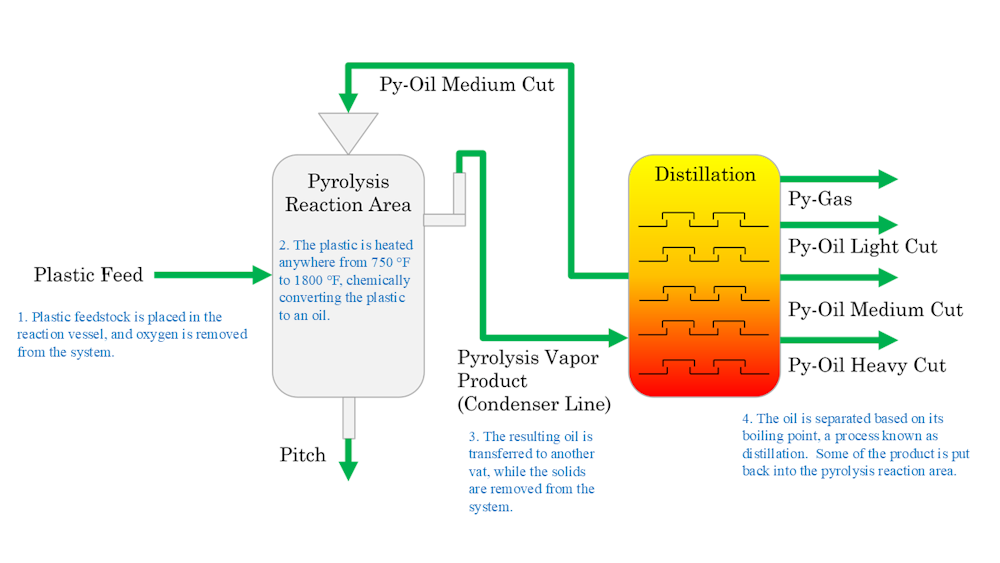
    Plastics are fed into the pyrolysis reactor, where they get hot and turn to oil. The oil moves to another vat where it’s boiled and distilled.
    Alexander Kaplitz and Kevin A. Schug

    Unlike traditional plastic recycling, pyrolysis theoretically isn’t limited to specific types of plastic. It could be made to accommodate many of them, although current technology is limited to a few types – polyethylene and polypropylene, used in food containers and bottles – at an industrial scale.

    So, plastic pyrolysis could help handle the waste from consumer products such as plastic bags, bottles, milk jugs, packaging materials, wet wipes and even discarded children’s toys. Pyrolysis can also handle more complex plastic waste such as tires and discarded electronics, although solid waste handlers and recyclers avoid certain plastic types in pyrolysis, such as polyvinyl chloride – or PVC, which is found in pipes and roofing products – and polystyrene, used in packaging, as these can create harmful byproducts.

    During pyrolysis, the plastic polymers are broken down into smaller molecules, resulting in the production of liquid oil, fuel source gases such as methane, propane and butane, and char.

    Char is the solid residue left at the end of the pyrolysis process. It can be used as a carbon-rich material for various applications, including adding it to soil to make it healthier for farming, as it increases soil moisture and pH, benefiting nutrient absorption. Char also has the ability to absorb harmful carbon gases from the air, which can help prevent climate change.

    The main downside of char is if it’s used too much it can increase soil alkalinity, which may hinder plant growth.

    Plastic pyrolysis uses heat to break down plastic, with the intent to convert plastic waste into usable materials.

    How pyrolosis works

    The plastic pyrolysis process typically involves several key steps.

    In the first step of pyrolysis, community recyclers collect the plastic waste and clean it to remove any contaminants. The plastic then gets shredded into smaller pieces to facilitate the pyrolysis process. Unlike traditional recycling, it needs only minimal sorting.

    Chemical recyclers operating pyrolysis plants feed the shredded plastic into a pyrolysis reactor, where they heat it to temperatures ranging from 600 to 1,600 degrees Fahrenheit (315 to 871 degrees Celsius). Without oxygen, plastics in the reactor don’t catch fire and emit fumes into the air. Instead, this high-temperature environment causes the plastic polymers to break down into smaller hydrocarbon molecules. These smaller molecules can be further refined.

    The high temperature turns some molecules into vapors, which condense into liquid oil. Chemical companies can further refine this oil to be used as fuel or as a raw material to make other chemicals or plastics.

    In addition to liquid oil, the pyrolysis process generates natural gases, such as methane, ethane, butane and propane. Pyrolysis operators then capture these gases, and they can sometimes use them as a source of energy to power the pyrolysis reactor or other industrial processes.

    Plastic pyrolysis generates oil, which engineers can use to create new materials or fuels.
    BASF, CC BY-NC-ND

    Benefits of pyrolysis

    When done effectively, plastic pyrolysis offers several benefits.

    By expanding recycling beyond just plastic bottles and milk jugs, pyrolysis could reduce the amount of plastic waste pollution that ends up in landfills and oceans.

    Additionally, converting plastic waste into usable products could help lower the production demand for new plastics from petroleum hydrocarbons. The byproducts could get used in recycled plastics.

    Some researchers are also testing pyrolysis oils to see whether they can use them instead of gasoline to fuel vehicles. The gases produced during pyrolysis can even generate energy that fuels the pyrolysis reactor, making the process more self-sustaining and reducing the need for external energy sources.

    Currently, about 15% to 20% of the pyrolysis products are recycled into new propylene and ethylene, while most – about 80% to 85% – becomes diesel fuel, hydrogen, methane and other chemicals.

    While plastic pyrolysis holds some promise, it also faces challenges. The cost of setting up and operating pyrolysis plants is high. How profitable the process is depends on the availability of suitable plastic waste, the market demand for the oils and gases produced, and the costs of energy and staff necessary to operate the reactor.

    Another issue is quality control. Most plastic types can undergo pyrolysis, but different plastics create oils with different chemical makeups. Scientists will need to understand the composition of these oils before industry can determine which plastic types to focus on and how each oil could create new materials.

    Pyrolysis oils have unique chemical compositions depending on the type of plastics used to create them.
    Alexander Kaplitz and Kevin A. Schug

    Researchers like us at The University of Texas at Arlington and our international colleagues are studying new chromatography-based oil-separation techniques that can successfully identify some types of pyrolysis oils. Chromatography is the process of separating components in a mixture by passing them through a stiff material.

    Different components in the mixture are attracted to this material to different degrees. So, they exit the chromatography system at different times, which separates them from one another.

    With more research into the technique’s efficiency and technological advancements to scale up pyrolysis, this technique could be one part of a sustainable solution to plastic waste management. In the meantime, pyrolysis is being used now, with one report estimating the market for pyrolysis plants at US$40 billion in 2024 and predicting it to grow to $1.2 billion by 2033.

    Kevin A. Schug receives funding from the National Science Foundation, the National Institutes for Health, ExxonMobil, and Weaver Consultants Group. He is affiliated with VUV Analytics, Inc. and Infinity Water Solutions as a member of their scientific advisory boards. Lummus Technology, LLC provided the funding for research on plastic waste pyrolysis oils at UT Arlington.

    Alexander Kaplitz does not work for, consult, own shares in or receive funding from any company or organization that would benefit from this article, and has disclosed no relevant affiliations beyond their academic appointment.

    ref. Plastic pyrolysis − chemists explain a technique attempting to tackle plastic waste by bringing the heat – https://theconversation.com/plastic-pyrolysis-chemists-explain-a-technique-attempting-to-tackle-plastic-waste-by-bringing-the-heat-234453

    MIL OSI – Global Reports

  • MIL-OSI Security: From Disaster Recovery to Saving Cultural Heritage: IAEA Boosts Assistance to Countries in Non-Destructive Testing

    Source: International Atomic Energy Agency – IAEA

    Non-destructive testing encompasses a variety of techniques that leverage the interactions of matter with radiation, sound, magnetic fields, electrical currents, and testing agents to inspect materials without damaging them. The most used methods include industrial radiography, ultrasonic testing, liquid penetrant inspection and magnetic particle inspection.

    Using gamma or X rays, industrial radiography plays a critical role in creating images that can reveal the safety and quality of civil engineering structures, as bridges, tunnels, dams and buildings are subject to deterioration from environmental stress, including extreme events like earthquakes. NDT is used extensively to inspect aircraft structures, turbine blades and pressure vessels.

    As NDT allows experts to inspect objects without harming them, it also contributes significantly to the field of cultural heritage. NDT techniques enable experts to analyse the internal structures of priceless artifacts, sculptures, and historical structures without causing damage, which aids in restoration and conservation efforts.

    Meet the Scientists at #ICARST2025

    Innovations and latest developments in NDT techniques will be prominently featured at the upcoming International Conference on Applications of Radiation Science and Technology, which will gather hundreds of experts from radiation-related physics, chemistry, materials science, biology, and engineering fields in Vienna from 7 to 11 April 2025. The conference will be livestreamed. 

    Following on from previous conferences in 2017 and 2022, #ICARST2025 will showcase how radiation sciences have contributed to industrial growth and economic development by providing versatile tools and processes to produce high quality products in a clean and efficient manner. Participants will discuss how these technologies help achieve the United Nations Sustainable Development Goals.

    “At a side event on Enhancing Global Collaboration in NDT for Disaster Recovery Enhancement, we will highlight the importance of strong international stakeholder networks in our NDT emergency response plan,” said Hannah Affum, an Industrial Technologist at the IAEA. “We will also sign Practical Arrangements with the International Committee for Non-Destructive Testing (ICDNT) for the promotion of increased use of NDT in industry, civil engineering, and cultural heritage.”

    MIL Security OSI

  • MIL-OSI Security: The ‘Wolf of West Virginia’ Pleads Guilty to Wire Fraud

    Source: Federal Bureau of Investigation (FBI) State Crime Alerts (c)

    CHARLESTON, W.Va. – Theodore Miller, 35, of South Charleston, pleaded guilty today to two counts of wire fraud. Miller admitted to defrauding more than 170 individuals through two real estate-related investment schemes that caused losses of between $395,000 and $434,501.

    According to court documents and statements made in court, Miller conceived and perpetrated the two fraudulent schemes between the spring of 2022 and September 2024. One scheme solicited direct investments to develop modern residential duplexes and a dry-storage lot on Bigley Avenue in Charleston. The other scheme offered a pooled real estate investment vehicle dubbed “Bear Lute.”

    To carry out these schemes, Miller portrayed himself on social media as the “Wolf of West Virginia,” a wealthy, successful and knowledgeable real estate mogul with enough disposable income to travel the world at his leisure. As part of his guilty pleas, Miller admitted that in reality, he had poor credit, thin month-to-month financial margins, was delinquent on property taxes and bills, and defaulted on loans.

    In each scheme, Miller made multiple misrepresentations to investors. These misrepresentations included that individuals would receive returns on their investments, that their investments were secured by real property, and that they could withdraw their investments. As part of his guilty pleas, Miller admitted that there were no returns on investments, that he never owned the real property he identified as security for the investments, and that he used the money from his fraud schemes to pay unrelated expenses, debts and obligations.

    Miller’s victims included an individual who wired $20,000 to Miller from California for the storage lot project on July 5, 2022, and an individual who wired $2,500 to Miller from Texas for Bear Lute on December 12, 2022.

    The money from the schemes was deposited into bank accounts for several entities Miller solely owned and operated including Bear Industries LLC, which initially served as an umbrella entity for the related businesses. Miller’s mother, Deanna Drumm, served as vice president of operations for Bear Industries from in or around 2019 to September 2024. While Miller lived outside the United States from in or about June  2021 to on or about August 8, 2024, he directed his mother to handle the day-to-day operational tasks for the Bear entities including the management of finances and transfer of funds.

    Drumm, 61, of Charleston, pleaded guilty on November 21, 2024, to aiding and abetting the sale and offer of unregistered securities. Both the direct investments and the Bear Lute investments were securities as defined by federal law, offered through interstate commerce via the internet, and were required to be registered. Drumm admitted that no registration statement was in effect for either of these securities, and that neither was exempt from the registration requirement. Drumm further admitted that she aided and abetted the offering of these unregistered securities in the course of her duties as vice president of operations for Bear Industries. Drumm is scheduled to be sentenced on May 29, 2025.

    In September 2022, the West Virginia Securities Commission issued a cease-and-desist letter to Bear Industries ordering it to stop the unregistered sale and offering of securities in Bear Lute. In November 2022, the West Virginia Securities Commission issued a cease-and-desist order regarding the same. Miller admitted that he continued to operate Bear Lute in violation of the order and never disclosed the order to his investors.

    On August 9, 2024, law enforcement officers arrested Miller following his return to the United States. Miller admitted that he told his wife during a recorded jail phone call on August 11, 2024, to report his iPhone stolen to make it inaccessible to law enforcement and to hide a backpack containing his laptop computer. Miller further admitted that the laptop contained most of the documents related to the direct investments and Bear Lute.

    Miller is scheduled to be sentenced on July 2, 2025, and faces a maximum penalty of 40 years in prison, up to three years of supervised release, and a $500,000 fine. Miller also owes restitution of between $395,000 and $434,501, with the final amount to be determined by the Court.

    Acting United States Attorney Lisa G. Johnston made the announcement and commended the investigative work of the Federal Bureau of Investigation (FBI), the West Virginia Fusion Center, the West Virginia Securities Commission, and the U.S. Securities and Exchange Commission.

    United States District Judge Irene C. Berger presided over the hearing. Assistant United States Attorneys Holly Wilson and Joshua Hanks are prosecuting the case.

    The U.S. Securities and Exchange Commission filed a parallel civil action against Miller, Bear Industries LLC, Bear Investments and Business Consulting LLC, and Drumm in U.S. District Court for the Southern District of West Virginia. The lawsuit alleges that Miller has engaged in the unregistered and fraudulent offer of securities related to his real estate-related investment programs since at least 2022, and that Miller’s social-media persona and businesses were all a calculated fraud to divert investor funds for his own personal benefit. The lawsuit seeks permanent injunctive relief, disgorgement of ill-gotten gains and prejudgment interest, and civil penalties.

    A copy of this press release is located on the website of the U.S. Attorney’s Office for the Southern District of West Virginia. Related court documents and information can be found on PACER by searching for Case Nos. 2:24-cr-145 and 2:24-cv-479.

    ###


    MIL Security OSI

  • MIL-OSI: LockerMap Expands with Fleet Pricing and Mobile Apps to Help Truck Drivers Receive Personal Packages on the Road

    Source: GlobeNewswire (MIL-OSI)

    Austin, TX, March 18, 2025 (GLOBE NEWSWIRE) — LockerMap, the leading package pickup locator, has announced new fleet pricing and mobile apps designed to help truck drivers easily receive their personal online orders while on the road. LockerMap aggregates publicly accessible, secure package lockers, helping truck drivers and travelers find a convenient pickup location for their personal packages. With thousands of retail lockers and other pickup locations mapped, LockerMap is now offering fleet subscriptions at just $20 per driver per year, making it an affordable perk for trucking companies to provide their drivers. Individual drivers can also subscribe to LockerMap Plus for access to premium features designed to make finding pickup locations even easier.

    “Truckers spend weeks or months on the road, and receiving personal packages isn’t as easy as it is for someone at home,” said Justin Capogna, founder of LockerMap. “Our new Fleet Pricing makes it simple for companies to give their drivers easy access to pickup locations nationwide, with zero management required. And for individual drivers, LockerMap Plus provides powerful tools to find the most convenient pickup spots along their routes.”

    Drivers Experiencing Real Benefits on the Road

    “As a professional driver, finding package lockers along my route was nearly impossible before LockerMap. This application has completely solved that challenge for me,” said Chris K., independent owner-operator.

    “LockerMap has allowed me to discover convenient pickup locations along my regular routes. It’s significantly improved my quality of life on the road,” said Shannon B., long-haul driver.

    Fleet Pricing: Hassle-Free for Companies, Game-Changing for Drivers

    LockerMap’s Fleet Pricing is designed to be a low-cost, zero-maintenance benefit for trucking companies. Every driver enrolled through a fleet subscription receives full access to LockerMap Plus, ensuring they can take advantage of premium features like truck stop filtering and route-based searching. Fleets receive a custom signup link for drivers to join, and there’s no need to manage seats or subscriptions, just a simple, flat-rate cost per driver with bulk discounts available.

    For truck drivers, LockerMap makes picking up personal packages significantly easier—reducing the frustration of rejected deliveries at truck stops, unnecessary detours, and wasted time searching for lockers.

    Learn more at lockermap.com/fleet-pricing.

    LockerMap Plus: Premium Features for Individual Drivers

    LockerMap is free to use, allowing anyone to browse and locate pickup locations. For truck drivers and frequent travelers who need more advanced features, LockerMap Plus provides:

    • Truck stop filtering – Find pickup locations at truck stops nationwide.
    • Route-based searching – Easily locate package pickup points along your planned route.
    • More detailed location info – Get precise details on locker types and operating hours.

    Drivers can upgrade to LockerMap Plus to access advanced search and filtering options, making it faster and easier to find the best pickup locations along their route.

    New iOS & Android Apps Make Finding Pickup Locations Even Easier

    LockerMap is available on web, iOS, and Android, ensuring drivers can access it anywhere. The new apps are available now in the App Store and Google Play and introduce truck stop filtering and route-based searching, helping drivers find the most convenient package pickup points without detouring off their route.

    With over 20,000 pickup locations in the U.S., including 650+ at truck stops, LockerMap is the first and only tool built specifically to help truckers, RVers, and frequent travelers access convenient package pickup locations.

    About LockerMap

    LockerMap helps people find package pickup locations with ease, offering a powerful search tool for Amazon lockers, package pickup solutions, and more. Whether you’re a trucker, RVer, traveler, or a shopper looking for a secure delivery option, LockerMap makes it easy to pick up packages safely and conveniently. Learn more at lockermap.com. 

    Press inquiries

    LockerMap
    https://lockermap.com
    Justin Capogna
    press@lockermap.com

    The MIL Network

  • MIL-OSI: TopLine Financial Credit Union Advocates for Members in Washington D.C.

    Source: GlobeNewswire (MIL-OSI)

    MAPLE GROVE, Minn., March 18, 2025 (GLOBE NEWSWIRE) — TopLine Financial Credit Union, a Twin Cities-based member-owned financial services cooperative, visited Capitol Hill in Washington, D.C., March 2 to March 5, 2025, as part of the annual America’s Credit Unions Governmental Affairs Conference, the credit union industry’s largest advocacy event.

    During the conference, TopLine executives and officials, along with over 6,000 other credit union professionals, board members and Minnesota Credit Union Network (MnCUN) staff members, discussed several top credit union issues with key legislative staff members. The group met with U.S. Senators Amy Klobuchar and Tina Smith as well as members of the U.S. House and their staff. Meetings focused on expanding credit union’s opportunities to serve more Minnesotans, emphasizing the importance of preserving our not-for-profit financial cooperative tax status, fighting back on efforts to disrupt the interchange system, and maintaining an independent credit union regulator – all are very important to the health of the credit union industry.

    TopLine spent valuable face time meeting with lawmakers and sharing members’ stories on how TopLine provides safe and affordable financial services to help members with all of their financial needs, from buying cars and homes, saving for retirement and investing in small businesses. These conversations emphasized the importance of preserving the tax status of credit unions, which allows credit unions to continue to do what they do best: focus on serving members and communities instead of chasing profits. Credit unions advocates shared with lawmakers that any limitation or curtailment of the tax status would have a dramatic impact on the $950 million in direct financial benefits Minnesota credit unions provide their members and over $4 billion in economic output in the state.

    “The Governmental Affairs Conference united credit union champions from across the nation to discuss key policies, engage with legislators on Capitol Hill, and reinforce to lawmakers and regulators why credit unions are America’s best financial partner—prioritizing people over profits, strengthening communities, and enhancing financial well-being for all,” said Mick Olson, President and Chief Executive Officer at TopLine Financial Credit Union. “TopLine representatives had meaningful discussions with our state lawmakers, emphasizing the importance of preserving our not-for-profit financial cooperative tax status. This fundamental aspect of our structure enables us to build a stronger, healthier financial future for the consumers we serve.”

    America’s Credit Unions is the premier national trade association serving America’s credit unions. The not-for-profit trade group is governed by volunteer directors who are elected by their credit union peers. To learn more, visit www.americascreditunions.org.

    Minnesota Credit Union Network (MnCUN) is the statewide trade association that works to ensure the success, growth and vitality of Minnesota credit unions. For more information, visit www.mncun.org.

    TopLine Financial Credit Union, a Twin Cities-based credit union, is Minnesota’s 9th largest credit union, with assets of over $1.1 billion and serves over 70,000 members. Established in 1935, the not-for-profit financial cooperative offers a complete line of financial services from its ten branch locations — in Bloomington, Brooklyn Park, Champlin, Circle Pines, Coon Rapids, Forest Lake, Maple Grove, Plymouth, St. Francis and in St. Paul’s Como Park — as well as by phone and online at www.TopLinecu.com or www.ahcu.coop. Membership is available to anyone who lives, works, worships, attends school or volunteers in Anoka, Benton, Carver, Chisago, Dakota, Hennepin, Isanti, Kanabec, Mille Lacs, Pine, Ramsey, Scott, Sherburne, Washington and Wright counties in Minnesota and their immediate family members, as well as employees and retirees of Anoka Hennepin School District #11, Anoka Technical College, Federal Premium Ammunition, Hoffman Enclosures, Inc., GRACO, Inc., and their subsidiaries. Visit us on our Facebook or Instagram. To learn more about the credit union’s foundation, visit www.TopLinecu.com/Foundation.

    CONTACT:
    Vicki Roscoe Erickson
    Senior Vice President and Chief Marketing Officer
    TopLine Financial Credit Union
    verickson@toplinecu.com | 763.391.0872

    A photo accompanying this announcement is available at https://www.globenewswire.com/NewsRoom/AttachmentNg/46b657cc-d617-4f18-a6af-6e6d0a03cb26

    The MIL Network

  • MIL-OSI Global: Ethiopia’s war may have ended, but the Tigray crisis hasn’t

    Source: The Conversation – Africa – By Assefa Leake Gebru, Assistant Professor of Political Science and Strategic Studies , Mekelle University

    For over 20 years, Ethiopia was led by the Ethiopian People’s Revolutionary Democratic Front, a coalition of four ethnic-based political parties representing Tigray, Amhara, Oromo, and Southern nations, nationalities and peoples. The Tigray People’s Liberation Front was the most influential party within the coalition. However, in 2018, when the Prosperity Party came into power, the front lost its important role in government.

    On 4 November 2020, the federal government launched an attack on Tigray, terming it a military offensive against political aggression from the Tigrayan front. This sparked a war that lasted two years, and caused severe damage to people and resources. The African Union’s lead mediator in the crisis, Olusegun Obasanjo, estimated about 600,000 civilians were killed. This makes it one of the most destructive conflicts of the 21st century.

    On 2 November 2022, the Ethiopian government and the Tigray People’s Liberation Front signed a peace deal in South Africa, the Pretoria agreement. More than two years later, however, Tigray still faces immense political and humanitarian challenges. Assefa Leake Gebru, who has studied post-war Tigray, explains what’s happening.

    What’s the current situation in Tigray?

    The 2022-2022 war and its lingering effects have thrown the Tigray region into chaos. People are grappling to get basics like food, water and medicine. The regional economy was devastated by the war. There have been no rehabilitation and reconstruction efforts so far. Humanitarian aid is limited. Imagine if your local grocery store ran out of everything and couldn’t restock – that’s the situation I have witnessed and studied in Tigray, which is affecting millions of residents.

    Additionally, the leaders of the Tigray People’s Liberation Front are now fighting among themselves for power. The division is mainly between two factions: one led by former regional president Debretsion Gebremichael and the other by Getachew Reda, who heads the interim administration.

    In January 2025, leaders of Tigray’s military forces supported calls from the Debretsion faction for new regional leadership. The interim administration opposed this, calling it a soft coup. The federal government considers the political faction led by Debretsion illegitimate. The military leaders’ decision also sparked public protests, with Tigrayans calling for a separation between the military and politics.

    This internal division has weakened the interim administration, which was installed as part of the Pretoria agreement in March 2023.

    Given this situation, the interim administration remains fragile amid serious humanitarian concerns and security threats facing the region. The interim government and dysfunctional law enforcement institutions aren’t strong enough to fix things.


    Read more:
    What is federalism? Why Ethiopia uses this system of government and why it’s not perfect


    Economically, jobs remain scarce. A 2024 survey found a youth unemployment rate of 81%. This situation has been created by economic collapse, asset plunder during the war and the absence of a functioning government.

    Socially, people are stressed and hurting, like a community still reeling from a major fallout. It’s a pile-up of problems that are making life incredibly tough.

    What, exactly, is the Pretoria agreement?

    The Pretoria agreement is an important peace deal between Tigray’s political leaders and the federal government. It was signed in Pretoria, South Africa, on 2 November 2022. The African Union facilitated the peace talks hosted by South Africa.

    The goal of the agreement? End the violence that began in 2020, keep people safe by calling for an immediate cessation of hostilities, allow aid like food trucks to roll in, disarm Tigray fighters and set up an interim government to restore order.

    It also aimed to re-establish the Ethiopian government’s control over federal installations in Tigray.

    What has been implemented and what hasn’t?

    There has been some positive progress. The Pretoria agreement established the interim government. Some everyday services are back, like banks reopening and planes flying again. A few Tigray fighters have put down their weapons.

    But here’s where it gets messy. Soldiers from Eritrea – which supported the Ethiopian army in the Tigray war – and militias from another Ethiopian region, Amhara, are still hanging around Tigray, raising security threats. They’re preventing internally displaced persons from going back home.

    The plan to fully disarm Tigrayan fighters hasn’t been completed either. This threatens regional stability, undermines peace efforts and increases the risk of renewed violence.

    What are the implications of not fully executing the Pretoria agreement?

    First, the region’s humanitarian crisis could worsen. An estimated one million displaced people are grappling with high levels of food insecurity, and thousands of schools remain closed. A weak interim government and the continued occupation of parts of Tigray by armed groups has hindered the restoration of services and stifled economic progress.

    Second, the division within the Tigray People’s Liberation Front makes it hard to lead the region under an interim administration. A lack of consensus on power-sharing has hindered effective governance, undermining the intended transitional authority.

    Third, a weak interim government can’t keep civilians safe, which was a pillar of the Pretoria agreement. Economically, the lack of jobs and skyrocketing prices are hitting Tigrayans hard. Socially, everyone’s on edge.

    Finally, there’s a risk of igniting further conflict in the region along the political fault lines between Debretsion and Getachew. There is a high chance of this situation being manipulated by Eritrean forces, who weren’t involved in the negotiations that led to the Pretoria agreement. The fractures in the interim government provide an opportunity for neighbouring Eritrea to support one faction against the other, which could escalate into war between Ethiopia and Eritrea. The Tigray People’s Liberation Front has been one of Eritrea’s bitterest enemies. The antagonism between the two led to the 1998-2000 war between Ethiopia and Eritrea.

    If these tensions keep up, Tigray will remain stuck in an awful cycle. The African Union and international community must address these issues to prevent a spiral into further chaos.

    Assefa Leake Gebru does not work for, consult, own shares in or receive funding from any company or organisation that would benefit from this article, and has disclosed no relevant affiliations beyond their academic appointment.

    ref. Ethiopia’s war may have ended, but the Tigray crisis hasn’t – https://theconversation.com/ethiopias-war-may-have-ended-but-the-tigray-crisis-hasnt-251846

    MIL OSI – Global Reports

  • MIL-OSI Security: Haines City Man Arrested for String of Convenience Store Robberies

    Source: Federal Bureau of Investigation (FBI) State Crime Alerts (b)

    Tampa, Florida – Acting United States Attorney Sara C. Sweeney announces the arrest of Davian Walker (19, Haines City) for robberies of convenience stores throughout the Middle District of Florida. If convicted, Walker faces a maximum penalty of 20 years in federal prison. 

    According to the complaint and court statements, Walker committed five robberies over the course of less than three months. Each robbery involved Walker brandishing what appeared to be a handgun to store clerks and demanding cash.

    Through an investigation into the first four robberies, law enforcement was able to link Walker to the robberies by identifying his phone number and the vehicle Walker was using to travel to each of the robberies. Using that information, law enforcement tracked and ultimately arrested Walker shortly after he committed a robbery in Titusville during the early morning hours of March 13, 2025.

    An indictment is merely a formal charge that a defendant has committed one or more violations of federal criminal law, and every defendant is presumed innocent unless, and until, proven guilty.

    This case was investigated by the Federal Bureau of Investigation, the Lake County Sheriff’s Office, the Hernando County Sheriff’s Office, the Zephyrhills Police Department, the Hillsborough County Sheriff’s Office, the Titusville Police Department, the Orlando Police Department, the Osceola County Sheriff’s Office and the Polk County Sheriff’s Office. It will be prosecuted by Assistant United States Attorney Candace Garcia Rich.

    This case is part of Operation Take Back America, a nationwide initiative that marshals the full resources of the Department of Justice to repel the invasion of illegal immigration, achieve the total elimination of cartels and transnational criminal organizations (TCOs), and protect our communities from the perpetrators of violent crime. Operation Take Back America streamlines efforts and resources from the Department’s Organized Crime Drug Enforcement Task Forces (OCDETFs) and Project Safe Neighborhoods (PSN).

    MIL Security OSI

  • MIL-OSI: ZOOZ Power Enhances Global Strategy with New Energy Storage Solutions, Advanced Energy Management System and Expended Sales Team

    Source: GlobeNewswire (MIL-OSI)

    Tel-Aviv, Israel, March 18, 2025 (GLOBE NEWSWIRE) — ZOOZ Power (Nasdaq and TASE: ZOOZ), a leading provider of flywheel-based power boosters and energy management systems for enabling ultra-fast EV charging solutions, announced today the enhancement of its strategic focus with the introduction of Energy Storage Systems (ESS) and an enhanced Energy Management System (EMS) designed to lead to maximizing EV charging performance and cost efficiency, along with the expansion of its sales team.

    The newly introduced Energy Storage System (ESS), in addition to ZOOZ Power’s intelligent* boosting offering, allows charging operators to significantly reduce electricity costs by storing energy during off-peak periods and deploying it during peak demand hours. This new addition to ZOOZ Power’s offering of systems to manage and improve overall power delivery to clusters of ultra-fast EV chargers substantially lowers operational expenses and enhances overall cost efficiency of EV charging infrastructure.

    Additionally, ZOOZ Power has upgraded its Energy Management System (EMS), improving the benefits of both the Intelligent Power Booster solution (ZOOSTER) and the new ESS offerings. The advanced EMS operates locally on-site, providing real-time management and rapid response capabilities to efficiently control energy flow, reduce power peaks, and extend battery lifecycles.

    The ZOOZTER Intelligent Power Booster continues to play a vital role in ZOOZ Power’s comprehensive solution, offering ultra-fast EV charging even in locations with limited grid capacity. By providing high-power bursts during charging sessions, the ZOOZTER effectively mitigates grid constraints, allowing consistent and reliable ultra-fast charging without costly infrastructure upgrades.

    In conjunction with its technological advancements, ZOOZ Power is expanding its global sales team. The Company is excited to announce the appointment of Mr. Ilan Tevet as the new Vice President of Global Sales. With over 25 years of experience in global B2B sales, business development and marketing, Ilan has a proven track record of driving growth. His deep expertise will be instrumental in accelerating ZOOZ Power’s planned global expansion.

    Furthermore, ZOOZ Power is strengthening its worldwide sales presence by appointing new sales managers in strategic markets, including the UK, Germany, and France. Further expansions are planned in other regions to align with the growing adoption of electric vehicles.

    “Our new ESS solutions, the enhanced EMS, and the strategic expansion of our sales team are pivotal steps toward providing comprehensive, efficient, and cost-optimized EV charging infrastructure,” said Erez Zimerman, CEO of ZOOZ Power. “With Ilan’s leadership and our expanded sales force in key markets, we are uniquely positioned to support and drive the global shift toward EV adoption.”

    *As used in this Press Release, intelligent boosting and Intelligent Power Booster refer to the ZOOZ Power Energy Management Software, which dynamically manages and optimizes energy consumption at the charging site

    About ZOOZ Power
    ZOOZ Power is a leading provider of flywheel-based power boosting and energy management solutions, enabling the widespread deployment of ultra-fast charging infrastructure for electric vehicles (EVs) while overcoming existing grid limitations.

    ZOOZ Power pioneers its unique flywheel-based power-boosting technology, enabling efficient utilization and power management of a power-limited grid at an EV charging site. Its flywheel technology allows high-performance, reliable, and cost-effective ultra-fast charging infrastructure.

    ZOOZ Power’s sustainable, power-boosting solutions are built with longevity and the environment in mind, helping its customers and partners accelerate the deployment of fast-charging infrastructure, thus facilitating improved utilization rates, better efficiency, greater flexibility, and faster revenues and profitability growth. ZOOZ Power is publicly traded on NASDAQ and TASE under the ticker ZOOZ

    For more information, please visit: www.zoozpower.com/

    Investor Contact:
    Miri Segal – CEO
    MS-IR LLC
    msegal@ms-ir.com

    Media enquiries:
    Media@zoozpower.com

    Forward-Looking Statement
    This press release contains “forward-looking statements” within the meaning of the Securities Act of 1933 and the Securities Exchange Act of 1934, as amended, and the safe-harbor provisions of the Private Securities Litigation Reform Act of 1995. Such forward-looking statements are based on the current beliefs, expectations, and assumptions of ZOOZ Power. All statements other than statements of historical facts contained in this press release, including statements regarding ZOOZ Power, and any of ZOOZ Power’s strategy, future operations and statements related to the collaboration between ZOOZ Power and “ON” charging network (including any plans to implement ZOOZ Power’s solution and upgrade an additional site of “ON” on Route 6) are forward-looking statements. These statements involve known and unknown risks, uncertainties and other important factors that may cause ZOOZ Power’s actual results, performance or achievements to be materially different from any future results, performance or achievements expressed or implied by the forward-looking statements. These risks and other risks and uncertainties are more fully discussed in the “Risk Factors” section of ZOOZ Power’s most recent Annual Report on Form 20-F as filed with the U.S. Securities and Exchange Commission (“SEC”) as well as other documents that may be subsequently filed by the Company from time to time with the SEC. The words “anticipate,” “believe,” “could,” “estimate,” “expect,” “intend,” “may,” “plan,” “potential,” “predict,” “project,” “should,” “target,” “will,” and similar expressions are intended to identify forward-looking statements, although not all forward-looking statements contain these identifying words. Forward-looking statements include, but are not limited to, statements relating to the limited operating history and evolving business model of ZOOZ Power, ZOOZ Power’s future prospects, ZOOZ Power’s planned global expansion, including the timing and the results thereof, statements regarding ZOOZ Power’s newly introduced Energy Storage System (ESS), intelligent boosting offering and Energy Management System (EMS), their adoption by the market and any benefits that they may have to ZOOZ Power, its operations, financial position and its current and potential customers, statements regarding the expansion of ZOOZ Power’s sales team and the effect of that expansion on ZOOZ Power’s planned global expansion, financial condition, market position and results of operations, statements relating to ZOOZ Power’s market position, statements regarding the demand for ZOOZ Power’s products, and the potential outcome of ZOOZ Power’s collaborations with third parties for installation of its flywheel-based power boosting solution. These forward-looking statements are only estimations, and ZOOZ Power may not actually achieve the plans, intentions or expectations disclosed in any forward-looking statements, so you should not place undue reliance on any forward-looking statements. Actual results or events could differ materially from the plans, intentions and expectations disclosed in forward-looking statements made in this Press Release. Management of ZOOZ Power has based these forward-looking statements largely on current expectations and projections about future events and trends that such persons believe may affect ZOOZ Power’s business, financial condition and operating results. Forward-looking statements contained in this Press Release are made as of the date hereof, and none of ZOOZ Power or any of its representatives or any other person undertakes any duty to update such information except as may be expressly required under applicable law.

    The MIL Network

  • MIL-OSI: Summit Nanotech Corporation Closes US$25.5M Funding Round to Accelerate Commercialization of their Direct Lithium Extraction Technology

    Source: GlobeNewswire (MIL-OSI)

    CALGARY, Alberta, March 18, 2025 (GLOBE NEWSWIRE) — Summit Nanotech Corporation (“Summit”), a leader in sustainable lithium extraction technology, announced today that it has successfully closed US$25.5 million in funding led by Evok Innovations and BDC Capital’s Climate Tech Fund, with participation from Xora Innovation, Capricorn Investment Group, Mitsui Kinzoku – SBI Material Innovation Fund, and LG Technology Ventures.

    “This funding comes at a pivotal time for Summit as we strengthen our strategic partnerships and transition from demonstration to full-scale commercial design,” said Amanda Hall, Founder and CEO. “We are ready to provide our industry-leading solution to lithium mining companies who want to maintain a strong focus on economics and environmental responsibility.”

    Summit’s innovative direct lithium extraction (“DLE”) technology, denaLi™, combines system and fully integrated water recycling. Data analytics and AI are harnessed for advanced process control that ensures reduced water use, maximum sorbent lifespan, maximum lithium recovery and leading on-stream reliability, driving levelized lithium costs down. By unlocking more resources economically, Summit’s technology will strengthen international supply chains.

    Nobuyoshi Sogabe, General Manager at Mitsui Kinzoku, expressed enthusiasm about the investment: “We are committed to make an effort to achieve a lithium supply chain from brine by collaborating our advanced material synthesis, processing, and scaling technologies with Summit’s innovative denaLi™ system, thereby contributing to the realization of a sustainable society.”

    In the last six months, Summit has achieved key milestones, including commissioning a demonstration plant in Northern Chile, successful sorbent qualification results with a major lithium mining company, and launching their proprietary data analytics platform. With strong investor backing and a commitment to innovation and cost reduction, Summit is well-positioned to drive the future of sustainable lithium extraction.

    “The demand for electric vehicles will soon outpace growth in lithium supply. Summit’s technology addresses this challenge by optimizing lithium extraction from brine to produce high-quality lithium at a lower cost,” said Cheri Corbett, Partner at BDC Capital’s Climate Tech Fund. “We need to get more competitive lithium to market if we are to meet the global demand for electric vehicles. That’s why we’re working with results-driven leaders like Amanda and her team. A great example of a growth-minded Canadian business, exactly the kind that BDC is designed to help get to the next level.”

    About Summit Nanotech Corporation

    Summit is a leading provider of direct lithium extraction (DLE) technology for the lithium mining industry. Founded in 2018 and headquartered in Calgary, Alberta, Summit has invented a patented sorbent, DLE process technology, and data analytics platform that, when combined, improves project economics by over $1,000 per tonne LCE and unlocks additional plant capacity compared to competing DLE technologies. Its technology selectively and efficiently captures lithium ions from brine which, after conversion, can be sold directly to a battery manufacturer. Summit partners with mining and oil and gas companies to accelerate and optimize their lithium resources.

    As the world shifts toward electrification, Summit is committed to building a cleaner, more responsible lithium supply chain for future generations.

    Learn more at summitnanotech.com.

    Media Contact:

    Kristen Gray
    Manager, Communications and Investor Relations
    media@summitnanotech.com

    A photo accompanying this announcement is available at https://www.globenewswire.com/NewsRoom/AttachmentNg/20d7e71d-1bb4-4c64-b152-1b74dfa09897

    The MIL Network

  • MIL-OSI: Pivotal Appoints Marjorie Dickman to its Board of Directors

    Source: GlobeNewswire (MIL-OSI)

    PALO ALTO, March 18, 2025 (GLOBE NEWSWIRE) — Pivotal, the market leader in light electric vertical takeoff and landing (eVTOL) aircraft, today announced the appointment of Marjorie Dickman to its board of directors. A global government affairs and geopolitical expert, Ms. Dickman is consistently recognized among the nation’s top public policy executives and top women in technology. For decades, she has led corporate strategies that navigate complex regulatory landscapes in the U.S. and abroad – creating opportunities, managing risk and growing market share.

    “We are thrilled to welcome Marjorie to Pivotal’s Board of Directors. Her wisdom of U.S. and global government affairs and her deep business acumen in the emerging tech and transportation sectors are invaluable to our growth,” said Ken Karklin, Chief Executive Officer, Pivotal. “This is an exciting time for Pivotal. Our aircraft offer a new way to experience flight, and our aero architecture is ready for public safety and defense use cases.”

    “I am excited to join the board and delighted that my extensive experience in tech and transportation innovation aligns with Pivotal’s mission,” said Marjorie Dickman. “I am especially pleased that my regulatory expertise in navigating global market access and competition can be an asset for Pivotal’s growth in the eVTOL market.”

    About Marjorie Dickman
    Ms. Dickman is a highly seasoned government affairs expert and attorney, based in Washington, D.C.

    She built her career leading government engagement and communication strategies for multinational technology companies – with a focus on rapidly evolving sectors like AI, automated and connected vehicles, cybersecurity, data privacy, Internet of Things (transport, energy, manufacturing), and secure communications for defense and first responders. Her track record of success building trusted government relationships, influencing public policy, and navigating regulatory and legal frameworks has earned numerous accolades. Examples include “Tech Titan” Policy Influencer, Global HERoes Role Model, and Most Powerful Women in Tech.

    As BlackBerry’s first Chief Government Affairs and Public Policy Officer and direct report to the CEO/Executive Chairman, Ms. Dickman opened the company’s Washington, D.C. office in 2020. She built BlackBerry’s Global Government Affairs and Public Policy organization from the ground up, including the company’s Government Relations and Technical Standards teams operating in the U.S., Canada, EMEA, the UK, LATAM, and APJ.

    Prior to BlackBerry, Ms. Dickman led a highly successful 16-year career at Intel Corporation – most recently launching and leading global government affairs for two of Intel’s most ‘disruptive’ businesses: Automated Driving and the Internet of Things – where she managed teams across the U.S., EMEA, China and Japan. Prior to Intel, she practiced law at a prominent Washington firm, specializing in telecom regulation and M&A.

    Ms. Dickman has been appointed to the Boards of the Eno Center for Transportation, Consumer Technology Association (CES), U.S. Chamber of Commerce’s Technology Engagement Center and Cybersecurity Leadership Council, No. Virginia Technology Council, and George Mason University’s College of Engineering and Computing. She is an honors graduate of Georgetown University Law Center (J.D.) and Duke University (A.B., Public Policy).

    About Pivotal
    Pivotal designs, develops, and manufactures light eVTOL aircraft. An industry pioneer, Pivotal is renowned for the BlackFly, the first light eVTOL to be commercially available and delivered to customers in the United States. In October 2023, Pivotal introduced its next generation production aircraft, the Helix, and in January 2024 began sales of the Helix. The company’s distinctive tilt-aircraft architecture and scalable technology platform have been under continuous improvement for well over a decade, and today, Pivotal has the most mature technology in the light eVTOL category. Efficient, compact, and simple, Pivotal vehicles are designed for a wide range of consumer, public safety, and defense applications. The company is headquartered in Palo Alto, CA. For videos and more information, visit https://pivotal.aero.

    Media Contact:
    Heidi Groshelle
    press@pivotal.aero

    A photo accompanying this announcement is available at https://www.globenewswire.com/NewsRoom/AttachmentNg/7fd7ffc9-f2e7-429c-b5b0-55ff0a50da3d

    The MIL Network

  • MIL-OSI: Expion360 to Host Fourth Quarter and Full Year 2024 Financial Results Conference Call on Monday, March 31, 2025 at 4:30 p.m. Eastern Time

    Source: GlobeNewswire (MIL-OSI)

    REDMOND, Ore., March 18, 2025 (GLOBE NEWSWIRE) — Expion360 Inc. (Nasdaq: XPON) (the “Company”), an industry leader in lithium-ion battery power storage, will hold a conference call on Monday, March 31, 2025, at 4:30 p.m. Eastern Time to discuss its financial results for the fourth quarter and full year ended December 31, 2024, and review ongoing initiatives and anticipated 2025 milestones. A press release detailing these results will be issued prior to the call.

    Expion360 Chief Executive Officer Brian Schaffner will host the conference call, followed by a question-and-answer period. The conference call will be accompanied by a presentation, which can be viewed during the webcast or accessed via the investor relations section of the Company’s website here.

    To access the call, please use the following information:

    A telephone replay will be available approximately three hours after the call and will remain available through April 14, 2025, by dialing 1-844-512-2921 from the U.S., or 1-412-317-6671 from international locations, and entering replay pin number: 10196334. The replay can also be viewed through the webcast link above and the presentation utilized during the call will be available via the investor relations section of the Company’s website here.

    About Expion360

    Expion360 is an industry leader in premium lithium iron phosphate (LiFePO4) batteries and accessories for recreational vehicles and marine applications, with residential and industrial applications under development. On December 19, 2023, the Company announced its entrance into the home energy storage market with the introduction of two premium LiFePO4 battery storage systems that enable residential and small business customers to create their own stable micro-energy grid and lessen the impact of increasing power fluctuations and outages.

    The Company’s lithium-ion batteries feature half the weight of standard lead-acid batteries while delivering three times the power and ten times the number of charging cycles. Expion360 batteries also feature better construction and reliability compared to other lithium-ion batteries on the market due to their superior design and quality materials. Specially reinforced, fiberglass-infused, premium ABS and solid mechanical connections help provide top performance and safety. With Expion360 batteries, adventurers can enjoy the most beautiful and remote places on Earth even longer.

    The Company is headquartered in Redmond, Oregon. Expion360 lithium-ion batteries are available today through more than 300 dealers, wholesalers, private-label customers, and OEMs across the country. To learn more about the Company, visit expion360.com.

    Company Contact:
    Brian Schaffner, CEO
    541-797-6714
    Email Contact

    External Investor Relations:
    Chris Tyson, Executive Vice President
    MZ Group – MZ North America
    949-491-8235
    XPON@mzgroup.us
    www.mzgroup.us

    The MIL Network

  • MIL-OSI: RTI at Aerospace TechWeek 2025: Advancing Next-Generation Aviation and Defense Technology

    Source: GlobeNewswire (MIL-OSI)

    SUNNYVALE, Calif., March 18, 2025 (GLOBE NEWSWIRE) — Real-Time Innovations (RTI), the infrastructure software company for smart-world systems, will exhibit at Aerospace TechWeek 2025, held April 2-3 in Munich, Germany. At booth #K24, RTI will showcase Connext®, the proven software framework that powers secure, high-performance data exchange across avionics systems, unmanned platforms, and multi-domain defense networks. Schedule a meeting with the RTI team here.

    As military aircraft and defense platforms advance, seamless connectivity, interoperability, and mission-critical reliability are more essential than ever. Designed with open architecture principles, Connext supports FACE™, MOSA, SOSA, and Multi-Domain Operations (MDO) requirements—enabling real-time situational awareness, AI-driven decision-making, and scalable connectivity for airborne operations.

    In addition to the booth, RTI experts will present at the following speaking sessions:

    Session 1:

    • Panel Discussion: “Advancing Military Air Traffic Management through Enhanced Connectivity” with EUROCAE
    • When: 11:55 AM, April 2 | Connectivity Track
    • Speaker: Thijs Brouwer, Senior Field Application Engineer, RTI

    Session 2:

    • Presentation: Real-Time Mission Systems and Advanced Communications in Avionics
    • When: 2:00 PM, April 2 | Avionics Track
    • Speaker: Andre Odermatt, Principal Application Engineer, A&D, RTI

    Event Details
    What: RTI at Aerospace TechWeek Europe 2025, Booth #K24
    When: April 2-3, 2025
    Where: MOC – Event Center Messe München, Munich, Germany

    About RTI

    Real-Time Innovations (RTI) is the infrastructure software company for smart-world systems. RTI Connext® is the world’s leading software framework for intelligent distributed systems. Uniquely, Connext users can build systems that combine advanced sensing, fast control, and AI algorithms.

    With 2,000 customer designs, RTI excels at getting customers to production. RTI software runs over 300 autonomous vehicle programs, supports dozens of automotive ADAS and software-defined architectures, controls the largest power plants in North America, integrates over 500 major defense programs, drives a new generation of MedTech systems and robotics, and underlies Canada’s air traffic control and NASA’s launch control systems.

    RTI runs a smarter world.

    RTI is the market leader in products compliant with the Data Distribution Service (DDS™) standard. RTI is privately held and headquartered in Silicon Valley with regional offices in Colorado, Spain, and Singapore.

    Download a free trial of the latest, fully-functional Connext software today: www.rti.com/downloads

    The MIL Network

  • MIL-OSI: Ascent Solar Technologies Publishes Business Update on Progress to Establish Long-Term Revenue Through Space Solar Solutions Underway

    Source: GlobeNewswire (MIL-OSI)

    THORNTON, Colo., March 18, 2025 (GLOBE NEWSWIRE) — Ascent Solar Technologies (“Ascent” or the “Company”) (Nasdaq: ASTI), the leading U.S. innovator in the design and manufacturing of featherweight, flexible thin-film photovoltaic (PV) solutions, today reported on its commercial progress and achievement of stated annual goals as the Company continues to execute upon its 2025 growth initiatives.

    Ascent is currently engaged with multiple strategic partners in the space market, including a major defense contractor, multiple deployable technology companies, as well as a satellite company to complete extensive integration testing of the Company’s unique thin-film CIGS solar technology. The expected result of successful testing and integration of Ascent’s technology is to secure long-term agreements for consistent annual revenue with a diverse set of customers in the space market.

    “I am happy to report that Ascent’s challenging turnaround process is in the rear-view mirror, as our products now regularly achieve the higher device performance needed to meet customer needs for space-based power,” said Paul Warley, CEO of Ascent Solar Technologies. “Our latest solar efficiency milestones are opening new revenue streams driven by the increasing demand to power space vehicles and beam solar energy. Ascent products – all produced domestically in our facility in Thornton, CO – are uniquely poised to reliably meet that demand in the harsh environment of space, reducing costs and increasing operational efficiency for customers in the public, private and government sectors.”

    Ascent’s leadership team looks forward to building upon its success for the remainder of 2025 and is eager to update its stockholder community with impactful Company announcements and milestones as they are finalized. Interested parties seeking to learn more about the Company, its products/technology, and market opportunity are encouraged to visit https://www.ascentsolar.com or email IR@ascentsolar.com.

    About Ascent Solar Technologies, Inc.

    Backed by 40 years of R&D, 15 years of manufacturing experience, numerous awards, and a comprehensive IP and patent portfolio, Ascent Solar Technologies, Inc. is a leading provider of innovative, high-performance, flexible thin-film solar panels for use in environments where mass, performance, reliability, and resilience matter. Ascent’s photovoltaic (PV) modules have been deployed on space missions, multiple airborne vehicles, agrivoltaic installations, in industrial/commercial construction as well as an extensive range of consumer goods, revolutionizing the use cases and environments for solar power. Ascent Solar’s research and development center and 5-MW nameplate production facility is in Thornton, Colorado. To learn more, visit https://www.ascentsolar.com.

    Forward-Looking Statements

    Statements in this press release that are not statements of historical or current fact constitute “forward-looking statements” including statements about the financing transaction, our business strategy, and the potential uses of the proceeds from the transaction. Such forward-looking statements involve known and unknown risks, uncertainties and other unknown factors that could cause the company’s actual operating results to be materially different from any historical results or from any future results expressed or implied by such forward-looking statements. We have based these forward-looking statements on our current assumptions, expectations, and projections about future events. In addition to statements that explicitly describe these risks and uncertainties, readers are urged to consider statements that contain terms such as “will,” “believes,” “belief,” “expects,” “expect,” “intends,” “intend,” “anticipate,” “anticipates,” “plans,” “plan,” to be uncertain and forward-looking. No information in this press release should be construed as any indication whatsoever of our future revenues, stock price, or results of operations. The forward-looking statements contained herein are also subject generally to other risks and uncertainties that are described from time to time in the company’s filings with the Securities and Exchange Commission including those discussed under the heading “Risk Factors” in our most recently filed reports on Forms 10-K and 10-Q.

    Media Contact

    Spencer Herrmann
    FischTank PR
    ascent@fischtankpr.com

    The MIL Network

  • MIL-OSI China: Israel launches airstrikes across Gaza

    Source: China State Council Information Office

    The Israeli army conducted on Tuesday intense airstrikes on the northern and central Gaza Strip, marking the most violent escalation since the ceasefire, according to local sources and eyewitnesses.

    Palestinian medical and security sources told Xinhua that Israeli warplanes launched raids of unprecedented scale, triggering successive explosions in several areas of northern and central Gaza.

    The sources said that the Israeli army has killed over 200 Palestinians in the coastal enclave.

    In an initial statement, the Palestinian Civil Defense said that Israeli aircraft targeted homes, mosques, schools and shelters, resulting in significant casualties.

    “Our crews are facing great difficulties due to the size and number of targets being struck simultaneously,” the civil defense added.

    Israeli Prime Minister Benjamin Netanyahu’s office announced early Tuesday that Netanyahu and the country’s Defense Minister Israel Katz had ordered the military to “operate against Hamas with increasingly powerful military force.”

    According to the statement, the move followed what it described as Hamas’s “repeated refusal to release hostages” and rejection of proposals presented by U.S. envoy Steve Witkoff and other mediators.

    The Israel Defense Forces (IDF) was conducting “extensive strikes” on Hamas targets, it said.

    The statement added that the strikes are being carried out under an operational plan presented by the IDF over the weekend and approved by the political leadership.

    Katz warned in a separate statement that if Hamas does not release all hostages, “the gates of hell will open in Gaza,” and Hamas will encounter the Israeli military “with an intensity they have never known before.”

    Israel’s state-owned Army Radio said that the move indicated the fragile ceasefire between Israel and Hamas, which took effect on Jan. 19, “has collapsed.”

    MIL OSI China News

  • MIL-OSI China: Severe storms claim 42 lives in US Midwest, South

    Source: China State Council Information Office

    At least 42 people have died over the past three days as tornadoes, dust storms and other severe weather events wreaked havoc across eight states in the U.S. Midwest and South, according to reports from local authorities in these states.

    The U.S. National Weather Service received about 80 tornado reports between Friday and Sunday and dozens of them have been confirmed, including an EF-4 tornado with wind speeds reaching 190 miles per hour in Arkansas.

    In the past three days, Missouri reported 12 storm-related fatalities; Kansas recorded eight, who were killed in a 50-vehicle crash due to a massive dust storm; and Mississippi reported six.

    Multiple deaths due to tornadoes, destructive gusts, dust storms, storm-related wildfires and heavy rainfall were also reported in Texas, Oklahoma, Arkansas, Alabama, and North Carolina.

    Footages circulating on social media and eyewitness accounts illustrate the immense destruction caused by the storms. Hundreds of homes and buildings were damaged while tens of thousands of households and businesses were left without power after storms battered their communities.

    In Alabama, a school bus was hurled onto a middle school roof and a mobile home were ripped from its foundations and smashed to the ground.

    In North Carolina, a fallen tree crashed into a home on Sunday, killing two children.

    The storm system weakened on Monday and is moving eastward. However, the National Weather Service warned that heavy rainfall poses a flooding threat for parts of the East Coast while the central U.S. faces extremely dry conditions, raising wildfire risks. 

    MIL OSI China News

  • MIL-OSI Global: Long, unplanned stay in space will have taken a toll on minds and bodies of stranded astronauts

    Source: The Conversation – UK – By Craig Jackson, Professor of Occupational Health Psychology, Birmingham City University

    US astronauts Sunni Williams and Barry Wilmore have been stranded in low earth orbit onboard the International Space Station for nine months. They are now finally due to return to Earth. Their planned return from their one week mission was abandoned due to concerns with the return vehicle, the Boeing Starliner-1, and this resulted in them being in space for 290 days.

    Wilmore and Williams do not hold the record for the longest stay in orbit, which belongs to cosmonaut Valeri Polyakov, who spent 437 continuous days on the Soviet Mir space station. Nine other US astronauts have spent more than 200 days each in orbit during a single spaceflight – but Wilmore and Williams do hold the record for the longest unplanned spaceflight among US astronauts. Could the unplanned nature of their extended trip produce effects not seen in other planned long-term spaceflights?

    The risks and hazards of space flight are well understood by Nasa and referred to as “RIDGE” – short for Radiation, Isolation and confinement, Distance from Earth, Gravity effects and hostile Environments. Aerospace medicine takes such issues seriously.

    Some physical effects include blood clots and pooling, reductions in bone density, poor digestion, lower nutrient absorption, musculoskeletal atrophy (muscle and bone loss), and poorer cardiovascular function due to reduced blood pumping in zero gravity. Other impacts include changes to the eyeballs due to the pooling of fluids, pooled cerebrospinal fluid around the skull area, and a semi-permanent feeling of congestion.

    The reduced sense of smell may be a blessing, as many space capsules develop an unpleasant smell. Physical effects from fluids can be improved, but not entirely negated, by cuff compression (a fabric sleeve that compresses an area of the body) to relieve pain and swelling. Musculoskeletal atrophy can be reduced with the help of an aerobic treadmill and resistive exercises to help maintain the muscles and cardiovascular function.

    Exposure to radiation is a serious concern, and longer exposures can increase the likelihood of astronauts developing some cancers later in life. The health of Wilmore and Williams will be monitored for many years to come.

    While stranded, Wilmore and Williams will have been providing vital data to help measure the impacts of prolonged stays – every bladder and bowel movement they had will have been weighed and checked for any signs of illness and to monitor changes brought about by their unplanned extension.

    On their return to Earth, they will require gentle physiotherapy to regain muscle function and strength, and for cardiovascular rehabilitation, paced carefully due to the physical fatigue and limitations they will suffer for a few weeks. Dizzy spells, reduced muscle function, and visual disturbances will be common and even walking will take some practice. Their skin will be “baby soft” after nine months of not having their clothes rub against their bodies.

    Of more interest may be the psychological challenges they face, from their concerns over the “near miss” by not returning to Earth in the vehicle they arrived in because Nasa decided it was too risky, through to having to live in confined quarters with others for so long, with a lack of privacy, and enforced companionship.

    Confinement in restricted space, isolation and prolonged separation from family means it is more likely that behavioural problems or psychiatric conditions may develop.

    Problem solving mentality

    Behaviour in others that was initially a minor annoyance can quickly become serious sources of stress and irritation during enforced confinement. Astronauts are selected and screened based on temperament, personality, aptitude and their ability to cope when things go wrong. A problem solving mentality and a will to live, coupled with an ability to follow commands and maintain order in the most difficult of circumstances are what makes astronauts better than most of us.

    They are trained to cope under any situation, such as crash-landings in deserts, or technical failures on board the spacecraft. But despite excellent training, human fallibility and failings will emerge given time.

    Astronaut training also instils the importance of resilience, despite the most trying circumstances, and they will have been trained to keep their fears and anxieties hidden for the benefit of the mission. It might only be after their return that Wilmore and Williams may express their relief. Depression and anxiety can be common after returning to Earth according to others who have been there, with Buzz Aldrin admitting it happened to him and others in his 1973 autobiography Return to Earth.

    Keeping busy will have helped keep worries away.
    Nasa

    They may have experienced feelings of abandonment and questioned why they could not be rescued sooner, or may have developed an understandable lack of trust in technology, and a lack of faith in their fellow mission crew members. They will no doubt have missed important dates with their families, experienced homesickness and possibly even questioned if they could last until rescued.

    Video-link contact with family will have kept them going but will have also been painful and difficult at the same time. Knowing that their families are worried about them, yet equally unable to do anything about it must have been particularly difficult. Although keeping themselves busy as a distraction will have helped, there would have been downtime when their worries must have been almost overwhelming.

    Sleep disturbances and the inability to get regular sleep to allow their brains to rest will have led to cumulative fatigue – both physical and mental. Some astronauts struggle to ever get used to sleeping in space – resulting in lack of performance in the sufferer.

    Being stranded on the ISS and unable to get back home while being able to see home fly by with every rotation of the Earth presents a unique form of frustration. One positive effect reported by many astronauts is the “overview effect” where a sense of peace and oneness with the planet is experienced when viewing the Earth from a whole new perspective. The overview effect seems to have a permanent impact, staying with astronauts for the rest of their lives.

    A complication in understanding any psychological effects of spaceflight is that many astronauts hope to continue their careers and have more missions, and therefore may not be honest about any negatives they experienced. With Nasa planning missions to Mars at some point in the future, the unique experiences of Wilmore and Williams will be useful to behavioural scientists planning such future missions and trying to understand the best psychological characteristics for selecting astronauts for long term spaceflights.

    Craig Jackson does not work for, consult, own shares in or receive funding from any company or organisation that would benefit from this article, and has disclosed no relevant affiliations beyond their academic appointment.

    ref. Long, unplanned stay in space will have taken a toll on minds and bodies of stranded astronauts – https://theconversation.com/long-unplanned-stay-in-space-will-have-taken-a-toll-on-minds-and-bodies-of-stranded-astronauts-252528

    MIL OSI – Global Reports

  • MIL-OSI United Kingdom: Community engagement on details to follow if outline plan for Neachells Lane open space approved

    Source: City of Wolverhampton

    If approved the details of the plan, such as the design of public footpaths, layout, appearance, landscaping, lighting and noise mitigation measures, will be subject to extensive community engagement by the developer and scrutinised by planners under reserved matters, before any works start on site.

    The land was formally a coal mine and was later used as a landfill site before becoming a public open space in the 1990s.

    The indicative masterplan, submitted by Goold Estates, would see 14.5 acres retained as public open space, and a distribution warehouse, new offices, 270 parking spaces (including 14 disabled bays and 42 electric vehicle charging bays), 60 lorry parking bays, and vehicular access off Neachells Lane developed on the eastern 16.5 acres of the site near industrial land comprising the Travis Perkins builders’ yard and other commercial units.

    The developer would be required to maximise the hundreds of job opportunities and apprenticeships for East Park residents, as well as make a Section 106 contribution of £150,000 for a children’s play area in the vicinity and £550,000 for improvements and facilities in East Park to compensate for the loss of nature conservation habitat and of Millennium Forest planting.

    Access to the site has been considered in line with the current highways layout and the proposed gyratory improvement scheme to address congestion and safety, which was in the pipeline before the Goold Estates scheme came forward – and remains under consideration as a separate planning application.

    City of Wolverhampton Council Cabinet Member for City Development, Jobs and Skills, said: “The proposal going to Planning Committee next week is only an outline plan, with the finer details to be determined later if it is approved.

    “If the scheme gets the green light, it will deliver significant financial investment and hundreds of jobs for local people. The loss of open space and the environmental impact would also be mitigated by other gains for the East Park community.

    “But make no mistake, should this outline planning application be approved by Planning Committee, there will need to be extensive community engagement by the developer to ensure the detailed plan addresses people’s concerns appropriately.”

    MIL OSI United Kingdom

  • MIL-OSI United Kingdom: Fundamental changes to Armed Forces processes to better support Women in UK Defence

    Source: United Kingdom – Government Statements

    Press release

    Fundamental changes to Armed Forces processes to better support Women in UK Defence

    As part of a series of changes to eradicate unacceptable behaviours in the military a new Tri-Service complaints unit for the Armed Forces has been announced.

    • New initiatives to tackle unacceptable behaviours in the military to be introduced at pace.

    • Changes include a new specialist Tri-Service team for taking the most serious complaints, such as bullying, discrimination and harassment, outside the single Service chain of command.

    • MOD creates a central Violence Against Women and Girls Taskforce, to drive cultural improvements 

    • Progress comes as Armed Forces Commissioner Bill continues through Parliament as part of the Government’s Plan for Change 

    As part of a series of changes to eradicate unacceptable behaviours in the military, and step-up support for women across UK Defence, a new Tri-Service complaints unit for the Armed Forces has been announced.  

    The new team will be independent of the single Service chain of command to provide individuals with greater confidence and help ensure that the most serious complaints are dealt with quickly, fairly and in a standardised way across the Armed Forces. Building on the change in 2022 when complaints were taken out of the direct chain of command, providing greater independence and confidence. 

    The change will see Bullying, Harassment, Discrimination related service complaints dealt with by a team outside the commands of the Royal Navy, British Army and Royal Air Force.  

    This builds on the successes of the tri-service approach to sexual offending, within the Defence Serious Crime Command which was set up in 2022.

    In addition, the Ministry of Defence will set up a Violence Against Women and Girls (VAWG) Taskforce, led centrally by Minister Carns to cohere and drive the work to change culture from the heart of the department. Minister Carns will be supported by a network of regional champions who will help raise awareness of and tackle violence against women and girls across the military, and a Defence Voices Panel – a challenge group made up of service personnel and civil servants to provide honest feedback and lived experiences. 

    The Minister for Defence People and Veterans Al Carns will set out these new measures before the House of Commons Defence Select Committee later today. He will give evidence alongside Service chiefs.  

    Minister for Veterans and People Alistair Carns said:

    This government was elected on a manifesto of change, and we are delivering for Defence. I am personally committed to ensuring that we do everything within our power to root out unacceptable behaviour and ensure that the Armed Forces is a place where everyone can thrive. 

    Women in the armed forces play a vital role in our keeping our nation safe. This is not just a matter of basic justice and equality, it is essential to military effectiveness.   

    Our people have spoken, and we have listened. We are moving at pace to create a new Tri-Service Complaints team to take the most serious complaints out of the chain of single Service command for the first time and to launch a central taskforce to give this issue the attention and focus it deserves.

    The MOD’s VAWG Taskforce will include regional support network, trained on topics including domestic violence and sexual offending. These roles will use a network of multidisciplinary experts to support Armed Forces personnel, including healthcare providers, social workers, and HR advisors and will link into the Victim Witness Care Unit.   These measures are part of the government’s commitment to improving Service life and renewing the contract with those who serve and have served and support this government’s foundation of strong national security.  

    The government introduced the Armed Forces Commissioner Bill in November – the first ever independent champion for serving personnel and their families. The Bill has passed through the House of Commons and is now in Committee Stage in the Lords. The Commissioner will be a direct point of contact for serving personnel and their families to raise issues which impact Service life. They are expected to be appointed by the end of 2025.  With powers to visit Defence sites unannounced and commission reports, the Commissioner will hold Defence to account and drive improvements to Service life.  

    The government is committed to standing up for those who serve the nation. At the end of July, the Armed Forces received the largest pay rise in over 20 years, and in December the MOD struck a landmark deal to bring the military housing estate back into public ownership to enable additional investment into homes for military families and deliver savings for taxpayers.

    Updates to this page

    Published 18 March 2025

    MIL OSI United Kingdom

  • MIL-OSI Russia: About three thousand students from Moscow colleges underwent advanced training at Rudnev

    Translartion. Region: Russians Fedetion –

    Source: Moscow Government – Government of Moscow –

    Almost three thousand students from Moscow colleges have undergone in-depth training in in-demand industrial specialties in the innovative educational space “Rudnevo”. At the unique site, students can practice their skills in conditions as close to real ones as possible. This was reported by Anastasia Rakova, Deputy Mayor of Moscow for Social Development.

    “Our goal is to train specialists in Moscow colleges who will be able to perform real tasks immediately after completing their studies. To do this, together with our partner employers, we are replacing outdated equipment, updating educational programs and creating new sites for practical training of students. The flagship center “Rudnevo”, opened in October last year, has become an important part of this work. The site conditions are as close as possible to production. Moreover, it is located in an industrial park where operating enterprises are located. During the operation of the center, almost three thousand students have been trained here, and this is only the beginning. Students from several colleges at once can practice practical skills here,” noted Anastasia Rakova.

    The flagship center for practical training of Moscow colleges “Rudnevo” is a high-tech educational and production complex, which is part of the special economic zone “Technopolis Moscow”. On an area of more than nine thousand square meters there are 21 workshops and laboratories equipped with modern equipment.

    Students can develop skills needed for work in such areas as mechanical engineering, electronics, industrial automation, aviation industry and unmanned aircraft systems. The unique educational platform allows for practical classes to be held simultaneously for students from several colleges.

    Putin and Sobyanin opened an innovative practical platform in Rudnev

    The center has all the conditions for studying: each student has their own work place, and a coworking space is equipped for group projects. The territory has a canteen with free hot meals for students on a budget form of education and a cafe where dishes are prepared by students of the capital’s food colleges.

    Practical classes are conducted by 42 masters of industrial training from Moscow colleges and 40 specialists from industrial enterprises. Large companies are participating in the development of training programs, in particular the capital’s machine-building plants Avangard and Skorost, the joint-stock company Kronshtad, the developer and manufacturer of unmanned aerial vehicles and software for their autonomy Gaskar and many other organizations.

    The center also cooperates with the country’s leading engineering universities, including the Moscow State Technological University “Stankin” and the Moscow State Technical University named after N.E. Bauman. This allows students to obtain relevant knowledge and skills that meet the requirements of the modern labor market.

    Please note: This information is raw content directly from the source of the information. It is exactly what the source states and does not reflect the position of MIL-OSI or its clients.

    Please Note; This Information is Raw Content Directly from the Information Source. It is access to What the Source Is Stating and Does Not Reflect

    https: //vv.mos.ru/nevs/ite/151445073/

    MIL OSI Russia News

  • MIL-OSI Russia: SPbGASU held a hackathon for schoolchildren “Transport and Logistics”

    Translartion. Region: Russians Fedetion –

    Source: Saint Petersburg State University of Architecture and Civil Engineering – Saint Petersburg State University of Architecture and Civil Engineering – Creating a digital twin of a highway

    On March 13, the hackathon of the Automobile and Road Faculty “Transport and Logistics” was held at SPbGASU. Students of St. Petersburg School No. 625 with advanced study of mathematics named after Hero of the Russian Federation V. E. Dudkin took part in it. Together with the ADF, the admissions committee of our university organized the hackathon.

    “This is a career guidance event. We wanted to show the kids what professions there are and what problems ordinary representatives of these professions solve. We also wanted to show that physics and mathematics are not just abstract subjects. An engineer needs to know them in order to apply them in his work to solve typical problems,” explained ADF Dean Andrey Zazykin.

    The hackathon participants united into four project teams, each of which received its own technical task. Having familiarized themselves with the workplace, materials and equipment, having undergone safety training, the guys, under the guidance of mentors – teachers and students of the Automobile and Road Engineering Faculty, began generating ideas and creating prototypes.

    One of the teams created a prototype of an AGV cart. This is an unmanned transport platform that provides automated transportation of goods around the warehouse. The guys assembled a cart platform for moving goods, created, tested and calibrated a program in the Trik Studio software, and showed the robot in action. The work was supervised by fourth-year undergraduate students of the ADF Daniil Parfeni and Mark Druzhinin.

    Another team, led by the head of the department of technical operation of vehicles Igor Chernyaev, developed a planning solution for a fleet of electric buses. To do this, they needed the ability to analyze and 3D modeling skills. The guys got the initial data for the calculations from textbooks, tables, and characteristics of electric buses.

    Another team’s task was to implement the Digital Twin technology on the streets of St. Petersburg. The schoolchildren created a digital twin of a road – a high-precision digital map of the route, which collects data on the condition of the road and traffic on it in real time. The guys worked in domestic software under the guidance of Yana Goncharova, an assistant at the Department of Transport Systems and Road and Bridge Construction, and Elena Sorokina, a senior lecturer at this department.

    A team of schoolchildren determines effective methods for interaction between earthmoving and transport machines and the working environment

    The fourth team identified effective methods of interaction between earthmoving and transport machines and the working environment. To do this, they conducted a series of experiments with changing the angle of the bucket under the guidance of senior lecturer of the Department of Ground Transport and Technological Machines Igor Vorozheikin.

    Young researchers prepared presentations of their projects and spoke to members of the expert jury, which, together with Andrey Zazykin, included the head of the department of land-transport technological machines Elena Kurakina and associate professor of the department of transport systems and road and bridge construction Egor Golov. The jury assessed how well the pre-project analysis was carried out, the rationale for the chosen solution, the achievement of the set goals (teamwork, obtaining a result in accordance with the project goals), the logical structure, the clarity and design of the presentation, the team’s performance, and the completeness of the topic. All four teams received diplomas and gifts.

    We asked guests to share their impressions of the hackathon and the university.

    Elena Popova, Deputy Director of School No. 625 for Educational and Training Work, noted: “The children’s interest in this practice-oriented event is very high. They gain new knowledge, make something with their own hands, and then systematize and present the results of their work.”

    “The event was very interesting, and the tasks were not easy. The mentor helped us, explained, gave ideas. And the team tried, everyone wanted to win. It was an interesting experience,” said tenth-grader Arseniy Bryukhov.

    “I like the university: this is not my first time here, it’s like coming home. The people here are friendly, they will always tell you, give you advice, explain. It’s cozy, warm, homey,” shared 11th grade student Ekaterina Nikiforova.

    Andrey Zazykin reported on plans to create a specialized class at school No. 625. Currently, the only motor transport class in our city is being implemented by SPbGASU at school No. 334. Its students receive knowledge in robotics, information technology, car repair, organization of passenger and freight transportation, and ensuring road safety.

    Please note: This information is raw content directly from the source of the information. It is exactly what the source states and does not reflect the position of MIL-OSI or its clients.

    MIL OSI Russia News

  • MIL-OSI Asia-Pac: Coastal Development

    Source: Government of India

    Posted On: 18 MAR 2025 3:48PM by PIB Delhi

    The ‘National Policy on Marine Fisheries, 2017 notified by the Government of India, provides guiding principles of conservation and optimum utilization of fisheries resources. The policy also highlights marine environment and pollution issues including micro-plastic and ghost nets. The policy supports regulatory mechanisms to control pollutants from land and sea-based sources, which can be effectively controlled and the ecosystems monitored for pollution related aspects. To combat marine plastic pollution, particularly from fishing and maritime sectors, the Department of Fisheries, Government of India has been actively engaged in the global efforts like Glolitter Partnership Project and Reglitter Project both of which are jointly implemented by the International Maritime Organization (IMO), Food, and Agriculture Organization of the United Nations (UN-FAO).

    These projects focus on preventing and reducing Marine Plastic Litter (MPL) from sea-based sources, with an emphasis on addressing abandoned, lost, or discarded fishing gear (ALDFG) and wastes from ships. As a Lead Partnering Country (LPC) in the Glolitter Project, Department of Fisheries, Government of India has published its National Action Plan (NAP), which outlines strategic measures to reduce Marine Plastic Litter from Sea-based Sources. To address the issues of destructive fishing, the Government of India has banned fishing methods such as pair or bull trawling and the use of LED or artificial lights for fishing in the EEZ area.

    To ensure long-term viability of the sector and to address the issues related to climate change, protection and restoration of critical habitat, the Department of Fisheries, Government of India is working closely with the State Governments and environmental agencies. These efforts include establishment of artificial reefs along the entire coastline of India, conduct of sea ranching, promotion of seaweed farming, implementation of uniform fishing ban for 61 days during the major fish breeding period and installation of Turtle Excluder Devices (TEDs) in trawl nets for conservation of turtles, etc. Further, advisories are issued to States/UTs to take measures to prevent juvenile fishing such as implementation of mesh size regulations and minimum legal size of fish under their Marine Fishing Regulation Acts (MFRAs) to ensure sustainable and responsible fishing practices. In addition, to enhance the economic resilience of coastal communities impacted by the climate change, the Department of Fisheries, Government of India under the Pradhan Mantri Matsya Sampada Yojana (PMMSY) has identified 100 coastal fishermen villages situated close to the coastline as Climate Resilient Coastal Fishermen Villages (CRCFV). The activities in the identified coastal fishermen villages are need-based facilities, including common facilities like fish drying yards, fish processing centers, fish markets, fishing jetties, ice plants, cold storages, and emergency rescue facilities. The Government is promoting climate resilient livelihoods like aquaculture, especially the mariculture of seaweed, food and ornamental fishes, bivalves etc through the schemes of the Department of Fisheries in a large way. Additionally, the ICAR-Fisheries Research Institutes have been contributing to enhance inland and marine aquaculture through ongoing research, technology development, and capacity-building with funding support of the Government of India.

    The regulatory framework such as Maritime Zones of India (Regulation of fishing by foreign vessels) Act, 1981 and the Marine Fishing Regulation Acts of all maritime States/Union Territories have provisions to prevent certain forms of Illegal, Unreported and Unregulated (IUU) fishing by foreign vessels and Indian vessels respectively. Further, implementation of ReALCraft, a web-based portal for registration and licensing of fishing vessels, issuance of biometric identity cards to marine fishers and vessel communication and support system supported under the Pradhan Mantri Matsya Sampada Yojana (PMMSY) also help in prevention of IUU fishing. In addition, the Fishery Survey of India (FSI) is conducting awareness programs in coastal fishing villages across the country to educate fishers about the FAO-CCRF (Code of Conduct for Responsible Fisheries) and need for prevention of IUU fishing. The Department of Fisheries, Government of India, is also collaborating with the international bodies, like the Indian Ocean Tuna Commission (IOTC), which works to prevent, deter and eliminate IUU fishing in the Indian Ocean region.

    To address the issue of price instability and ensure fair and predictable income for fishermen, PMMSY has supported 27189 units of fish transportation facilities (refrigerated vehicles, insulated vehicles, two wheelers/ three wheelers), 21 state-of-the-art wholesale fish markets, 202 fish retail markets, 6694 fish kiosks and 5 E-platforms for e-trading and e-marketing of fish and fisheries products in all the States/UTs across the country with a total outlay of Rs. 1654.51 crore. To provide real-time and accurate price information to fishers and fish farmers and to help them to negotiate better price, the Department through the National Fisheries Development Board (NFDB) has launched the ‘Fish Market Price Information System’ (FMPIS) during 2018-19 to capture and disseminate fish market prices of commercially important marine and inland fishes from 111 wholesale and retail fish markets in 29 States/UTs. Further, the Department of Fisheries signed a Memorandum of Understanding (MoU) with Open Network for Digital Commerce (ONDC) with an objective to provide a digital platform and empower all stakeholders including traditional fishermen, fish farmers’ producer organizations and entrepreneurs in the fisheries sector to buy and sell their products through e-marketplace.

    This information was given by Union Minister of State, Ministry of Fisheries, Animal Husbandry and Dairying, Shri George Kurian, in a written reply in Lok Sabha on 18th March, 2025.

     *******

    AA

    (Release ID: 2112267) Visitor Counter : 13

    MIL OSI Asia Pacific News

  • MIL-OSI USA: Governor Newsom honors fallen San Bernardino County Sheriff’s Deputy

    Source: US State of California 2

    Mar 17, 2025

    SACRAMENTO – Governor Gavin Newsom issued the following statement regarding the death of San Bernardino County Sheriff’s Deputy Hector Cuevas Jr.:

    “Jennifer and I are deeply saddened by the tragic loss of Deputy Cuevas. Our heartfelt condolences go out to his family, friends, and colleagues as they navigate this unimaginable time. His dedication to protecting and serving his community was remarkable, and we are eternally grateful for his service.”

    On March 17, 2025, Deputy Cuevas was in pursuit of a vehicle when he was involved in a traffic crash at an intersection in Victorville, California. He suffered fatal injuries as a result of the collision.

    Deputy Cuevas, 36, was a six-year veteran of law enforcement. He had been assigned to the Victorville Station for the past three years. Prior to his employment with the sheriff’s department, Deputy Cuevas was an officer with the Upland Police Department.

    He is survived by his wife, two children, his parents and a sister and brother.

    In honor of Deputy Cuevas, flags at the State Capitol and Capitol Annex Swing Space will be flown at half-staff.

    Press Releases, Recent News

    Recent news

    News Lo que necesita saber: California tiene un nuevo compañero en Sonora, México para impulsar el desarrollo de recursos energéticos renovables, la resiliencia de la cadena de suministro y el transporte limpio. To read this release in English, click here. Sacramento,…

    News SACRAMENTO – Governor Gavin Newsom today announced his appointment of 10 Superior Court Judges: two in Alameda County; three in Los Angeles County; one in Merced County; one in Orange County; two in San Bernardino County; and one in San Francisco County.Alameda…

    News Sacramento, California – Governor Gavin Newsom today issued a proclamation declaring March 17, 2025 through March 23, 2025, as United States Navy Week.The text of the proclamation and a copy can be found below: PROCLAMATIONCalifornia proudly plays a crucial role…

    MIL OSI USA News

  • MIL-OSI Asia-Pac: INTERNATIONAL CENTRE FOR AUTOMOTIVE TECHNOLOGY

    Source: Government of India

    Posted On: 18 MAR 2025 3:27PM by PIB Delhi

    International Centre for Automotive Technology (ICAT) has played a key role in advancing research and development within India’s automotive sector. It has successfully developed 27 innovative technologies, reflecting its commitment to excellence in automobile engineering. Additionally, ICAT holds 9 patents/ IPRs and 2 copyrights/ design registrations, highlighting its contributions to intellectual property in the automotive domain. ICAT’s experts have published over 50 technical papers in esteemed national and international forums. Furthermore, to strengthen the R&D ecosystem, ICAT has established over 40 Memorandums of Understanding (MoUs) with leading domestic and international automotive organizations and premier academia such as IIT-Kanpur, IIT-Roorkee, IIT-Hyderabad, CDAC, IDIADA-Spain, TUV Rhineland-Germany.

    ICAT has launched the ICAT incubation and acceleration centre for supporting startups in auto and allied domain. Additionally, ICAT is a board member in Automotive & Allied Research and Technology Innovations (AARTI) Foundation, a section-8 entity established with support from IIT-Roorkee, to support innovation and businesses in auto and allied domains, especially for startups and MSMEs. ICAT actively engages startups & MSMEs through workshops, seminars and webinars offering skilling and upskilling opportunities while serving as a technology and validation partner by providing technical and industry expertise.

    The Government of India has formulated various schemes to attract foreign investment in the heavy industry and automobile sectors. These schemes also aim to strengthen the position of India in global EV and hydrogen fuel cell market. The details are as under: –

    1. Production Linked Incentive (PLI) Scheme for Automobile and Auto Component Industry in India (PLI-Auto): Government has notified this scheme on 23.09.2021 for Automobile and Auto Component Industry for enhancing India’s manufacturing capabilities for Advanced Automotive Technology (AAT) products with a budgetary outlay of ₹25,938 crore. There are 41 approved foreign applicants in the scheme.
    2. Scheme to Promotion Manufacturing of Electric Passenger Cars in India (SPMEPCI): This scheme was notified on 15.03.2024 to promote the manufacturing of electric cars in India. Under this scheme, EV passenger cars (e-4W) can initially be imported with a minimum CIF value of USD 35,000, at a duty rate of 15% for a period of 5 years from the date of issuance of approval letter by MHI. This requires applicants to invest a minimum of ₹4,150 crore and achieve a minimum DVA of 25% at the end of third year and DVA of 50% at the end of fifth year.
    3. Faster Adoption and Manufacturing of (Hybrid &) Electric Vehicles in India (FAME India) Scheme Phase-II: The Government implemented this scheme for a period of five years from 01/04/2019 till 31/03/2024 with a total budgetary support of Rs.11,500 crore. There are foreign OEMs who had invested and were supported under the scheme.
    4. PM Electric Drive Revolution in Innovative Vehicle Enhancement (PM E-DRIVE)Scheme: This schemewith an outlay of Rs.10,900 crore was notified on 29th September, 2024. It is a two-year scheme w.e.f. 1st April, 2024 onwards, which aims to support EVs including e-2W, e-3W, e-Trucks, e-buses and e-Ambulances.  There are foreign OEMs who have invested and are supported under the scheme.
    5. National Green Hydrogen Mission (NGHM): The Ministry of New and Renewable Energy (MNRE) is implementing the National Green Hydrogen Mission, with an objective to make India a global hub of production, usage and export of Green Hydrogen and its derivatives. One of the objectives of the Mission is to support the deployment of Green Hydrogen as fuel in buses and trucks, in a phased manner on a pilot basis. MNRE issued the scheme guidelines for implementation of pilot projects for use of Green Hydrogen in the Transport Sector under the NGHM. Under this scheme, five pilot projects have been sanctioned consisting total of 37 vehicles (buses and trucks), and 9 hydrogen refuelling stations. As part of the Mission, the R&D Scheme Guidelines have been issued that include development of fuel cells as one of the key areas.

    This information was given by the Minister of State for Steel and Heavy Industries, Shri Bhupathiraju Srinivasa Varma in a written reply in the Lok Sabha today.

    ****

    TPJ/NJ

    (Release ID: 2112239) Visitor Counter : 41

    MIL OSI Asia Pacific News

  • MIL-OSI Asia-Pac: CURRENT STATUS OF FAME-II SCHEME

    Source: Government of India

    Posted On: 18 MAR 2025 3:26PM by PIB Delhi

    Faster Adoption and Manufacturing of (Hybrid &) Electric Vehicles in India (FAME India) Scheme Phase-II was implemented for a period of five years from 01.04.2019 with a total budgetary support of Rs.11,500 crore. The scheme incentivized sale of electric vehicles i.e. e-2Ws, e-3Ws & e-4Ws.  Further, grants for deployment of e-buses and setting up of EV public charging stations (EVPCS) were also provided under the scheme. The number of electric vehicles incentivized under the FAME India scheme Phase-II, as on 11.03.2025 are as under: –

    Sl. No.

    Segment

    No. of EVs for which incentive paid

    1

    e-2 wheelers

    14,28,009

    2

    e-3 wheelers

    1,64,523

    3

    e-4 wheelers

    22,548


    Total

    16,15,080

    Further, 6,862 electric buses were sanctioned to various cities/STUs/State Govt. entities for intra-city operations under the FAME-II Scheme. Out of 6,862 e-buses, 5,135 e-buses have been supplied till 28.02.2025.

    Further, under FAME-II scheme, MHI had sanctioned Rs.800 crore in March, 2023 to three Oil marketing companies (OMCs) namely Indian Oil Corporation Ltd. (IOCL), Bharat Petroleum Corporation Ltd. (BPCL) and Hindustan Petroleum Corporation Ltd. (HPCL) for setting up 7,432 public charging stations (PCS) at their Retail Outlets (ROs) across the country. Further, MHI sanctioned an additional Rs.73.50 crore for upgradation of 980 Public Charging stations in March, 2024. In addition, 400 charging stations have also been sanctioned which were allotted through EOI to other entities in various states.

    MHI is implementing following schemes on pan-India basis including for rural areas to strengthen electric vehicle (EV) ecosystem and accelerate adoption of electric vehicle in the country :

    i.     Production Linked Incentive (PLI) Scheme for Automobile and Auto Component Industry in India (PLI-Auto): The Government approved this scheme on 23.09.2021 for Automobile and Auto Component Industry in India for enhancing India’s manufacturing capabilities for advanced automotive technology (AAT) products with a budgetary outlay of Rs.25,938 crore. The scheme proposes financial incentives to boost domestic manufacturing of AAT products with minimum 50% Domestic Value Addition (DVA) and attract investments in the automotive manufacturing value chain.

    ii.    PLI Scheme for National Programme on Advanced Chemistry Cell (ACC) Battery Storage: The Government on 12.05.2021 approved PLI Scheme for manufacturing of ACC in the country with a budgetary outlay of Rs.18,100 crore. The scheme aims to establish a competitive domestic manufacturing ecosystem for 50 GWh of ACC batteries.

    iii.  PM Electric Drive Revolution in Innovative Vehicle Enhancement (PM E-DRIVE) Scheme: This scheme with an outlay of Rs.10,900 crore was notified on 29.09.2024. It is a two-year scheme which aims to support electric vehicles including e-2W, e-3W, e-Trucks, e-buses, e-Ambulances, EV public charging stations and upgradation of vehicle testing agencies.

    iv.   PM e-Bus Sewa-Payment Security Mechanism (PSM) Scheme: This Scheme notified on 28.10.2024, has an outlay of Rs.3,435.33 crore and aims to support deployment of more than 38,000 electric buses. The objective of scheme is to provide payment security to e-bus operators in case of default by Public Transport Authorities (PTAs).

    v.    Scheme for Promotion of Manufacturing of Electric Passenger Cars in India (SPMEPCI) was notified on 15.03.2024 to promote the manufacturing of electric cars in India. This requires applicants to invest a minimum of Rs.4,150 crore and to achieve a minimum DVA of 25% at the end of the third year and DVA of 50% at the end of the fifth year.

    This information was given by the Minister of State for Steel and Heavy Industries, Shri Bhupathiraju Srinivasa Varma in a written reply in the Lok Sabha today.

    ****

    TPJ/NJ

    (Release ID: 2112237) Visitor Counter : 66

    MIL OSI Asia Pacific News

  • MIL-OSI Asia-Pac: IMPACT OF 10 GWh CAPACITY PROJECT

    Source: Government of India

    Posted On: 18 MAR 2025 3:24PM by PIB Delhi

    The Ministry of Heavy Industries (MHI) administers a Production Linked Incentive (PLI) Scheme namely “National Programme on Advanced Chemistry Cell (ACC) Battery Storage”. Under the scheme, the total outlay is ₹18,100 Crore for a capacity of 50 GWh for a period of 5 years after gestation period of 2 years. A total of 40GWh in two tranches has been allocated to four PLI beneficiaries. Further, as per recommendation of EGoS in July 2024, MHI initiated the process for finalizing bid documents for balance 10 GWh capacity for Grid Scale Stationary Storage (GSSS) applications in consultation with Ministry of New and Renewable Energy (MNRE). The details of the scheme may be seen at:https://heavyindustries.gov.in/pli-scheme-national-programme-advanced-chemistry-cell-acc-battery-storage. The objectives of the PLI ACC scheme are:

    1. Promoting indigenous manufacturing
    2. Enhancing cost competitiveness
    3. Boosting clean energy and sustainability
    4. Encouraging investment and innovation
    5. Developing a robust supply chain and generating employment and economic growth.
    6. Fostering local manufacturing to decrease dependence on imported batteries, supporting the broader goal of self-reliance in the energy sector.

    The “National Mission on Transformative Mobility and Battery Storage” is a government initiative in India which, inter-alia, aimed at accelerating the adoption of electric vehicles (EVs) and battery storage technologies by promoting manufacturing of Giga Scale battery manufacturing units.

    The scheme is creating ACC manufacturing ecosystem in the country by reducing battery costs, making EVs more affordable and accelerating adoption, enhancing energy storage solutions for renewable integration, improving grid stability and energy efficiency.

    This information was given by the Minister of State for Steel and Heavy Industries, Shri Bhupathiraju Srinivasa Varma in a written reply in the Lok Sabha today.

    ****

    TPJ/NJ

    (Release ID: 2112233) Visitor Counter : 66

    MIL OSI Asia Pacific News

  • MIL-OSI Asia-Pac: IMPORT OF CRITICAL MINERALS FOR EVs

    Source: Government of India

    Posted On: 18 MAR 2025 3:23PM by PIB Delhi

    The country is greatly dependent on other Asian countries for raw materials, mineral processing, battery and other basic requirements for production and promotion of e-vehicles in the country, since the basic raw material for production of electric vehicles is lithium and other critical materials. At present, investments in manufacturing and overall value addition for Advanced Chemistry Cells (ACCs) are negligible in India and almost entire domestic demand of ACCs is still being met through imports. In order to reduce dependency of imported ACC battery for electric vehicles, the Government on 12th May, 2021 approved a Production Linked Incentive (PLI) Scheme for manufacturing of Advance Chemistry Cell (ACC) in the country. The total outlay of the scheme is Rs.18,100 Crore for a period of 5 years. The scheme envisages to establish a competitive ACC battery manufacturing set up in the country (50 GWh).

    As per the information received from Ministry of Mines, the Union Cabinet has approved the launch of the National Critical Mineral Mission (NCMM) on 29th January, 2025, for a period of seven years from 2024-25 to 2030-31, with a proposed expenditure of Rs.16,300 crore and an expected investment of Rs.18,000 crore by Public Sector Undertakings (PSUs) and other stakeholders. The NCMM aims to secure a long-term sustainable supply of critical minerals and strengthen India’s critical mineral value chains encompassing all stages from mineral exploration and mining to beneficiation, processing, and recovery from end-of-life products.

    In order to boost domestic production and reduce India’s dependence on imported lithium, cobalt and other key materials required for EV batteries, the Government of India has taken significant steps, which are as under:

    The Mines and Minerals (Development and Regulation) Act, 1957 (MMDR) has been amended through the MMDR Amendment Act, 2023 w.e.f. 17.08.2023. The Amendment Act, 2023 provides for:

    1. A list of 24 critical and strategic minerals in Part D of Schedule-I.
    2. Omission of six minerals from the list of 12 atomic minerals in Part B of Schedule-I namely Lithium, Titanium, Beryl and beryllium bearing minerals, Niobium, Tantalum and Zirconium bearing minerals and their inclusion in the list of aforesaid 24 critical and strategic minerals.
    3. Section 11D of the Act, which empowers Central Government to exclusively auction mining lease and composite license for critical & strategic minerals specified in Part D of the Schedule-I.
    4. Exploration license for 29 minerals included in Schedule-VII of the Act.

    In addition, Ministry of Mines has been empowered to auction blocks for grant of Exploration License through an order dated 21st October, 2024 under Section 20A of MMDR Act 1957. Central Government has successfully auctioned 24 blocks of critical and strategic minerals in 04 tranches in 2024.

    The exploration of critical minerals has been significantly increased. Over the past three years, the Geological Survey of India (GSI) has undertaken 368 exploration projects focused on critical and strategic minerals. In the FY 2024-25, 195 projects are being executed, and 227 projects have been approved for the upcoming financial year.

    100% FDI is allowed under “Automatic” route for mining and exploration of metal and non-metal ores. A foreign company may incorporate an Indian subsidiary company or invest in an existing Indian Company to become eligible for grant of mining and exploration rights.

    To support the critical minerals sector, Government has eliminated customs duties on 25 minerals and reduced Basic Customs Duties (BCD) on 2 minerals in the Union Budget for 2024-25.

    In the Union Budget 2025-26, the Government proposed to fully exempt cobalt powder and waste, the scrap of lithium-ion battery, Lead, Zinc and 12 more critical minerals to secure their availability for manufacturing in India and promote more jobs for India’s youth.

    Ministry of Mines is engaged in various multilateral and bilateral platforms for strengthening the critical minerals value chain, focussing on multiple objectives, including the processing and recycling of critical minerals such as Minerals Security Partnership (MSP) and the Indo-Pacific Economic Framework (IPEF), initiative on Critical and Emerging Technologies (iCET), the UK-India Technology Security Initiative (TSI) and others.

    The Ministry of Mines has taken a significant step to acquire overseas mineral assets through the establishment of a joint venture company, KhanijBidesh India Ltd. (KABIL).  Its overarching mission is to identify and acquire overseas mineral assets that hold critical and strategic significance, specifically targeting minerals like Lithium, Cobalt and others. KABIL has signed an Exploration and Development Agreement with CAMYEN, a state-owned enterprise of Catamarca province of Argentina, for Exploration and mining of Five Lithium Brine Block in Argentina with an area of around 15,703 Ha.

    This information was given by the Minister of State for Steel and Heavy Industries, Shri Bhupathiraju Srinivasa Varma in a written reply in the Lok Sabha today.

    ****

    TPJ/NJ

    (Release ID: 2112232) Visitor Counter : 68

    MIL OSI Asia Pacific News

  • MIL-OSI Asia-Pac: Leading zero-emission commercial vehicles manufacturer opens global headquarters in Hong Kong (with photo)

    Source: Hong Kong Government special administrative region

    Leading zero-emission commercial vehicles manufacturer opens global headquarters in Hong Kong (with photo) 
    The company also plans to establish a global research and development centre and intelligent manufacturing centre in Hong Kong and is committed to building a high-quality zero-emission commercial vehicle ecosystem for the world.
     
         Associate Director-General of Investment Promotion for Invest Hong Kong Mr Charles Ng said, “We are excited to welcome Wisdom Motor to Hong Kong. The establishment of its global headquarters is a testament to our city’s unparalleled suitability for technological and product development. With a rich talent pool and a strategic location, Hong Kong provides the perfect foundation for companies like Wisdom Motor to forge international partnerships and expand their presence in both the Asian and global markets.”
     
    The Chief Strategy Officer of Wisdom Motor, Mr Felix Xu, said, “Hong Kong is situated in the heart of Asia and in close proximity to the Mainland. It enables businesses to tap into the multitude of opportunities in the Guangdong-Hong Kong-Macao Bay Area and throughout the rest of the region. The city is an ideal base for us to promote our technological achievements to the Greater Bay Area, other parts of the Mainland, and developed overseas countries.”
     
    He also said that the Hong Kong global headquarters is a pivotal hub for developing intelligent and connected vehicle applications, including Vehicle Control Unit or Motor Control Unit electronic control systems and hydrogen fuel systems. The company will collaborate with local university research teams and technology companies to develop carbon-neutral technologies and projects tailored to Hong Kong’s unique conditions.
     
    He added that Wisdom Motor is an all-round enterprise with in-house capabilities in design, engineering, manufacturing, and delivery of class-leading smart zero-emission commercial vehicles. It is also at the forefront of integrating hydrogen fuel cell systems, leveraging advanced composite materials and manufacturing processes to achieve significant lightweight advantages. Wisdom Motor delivered Hong Kong’s first battery electric double-decker bus as well as the world’s first tri-axle hydrogen double-deck bus, paving the way to contribute to Hong Kong’s decarbonisation strategy.
     
    For more information about Wisdom Motor, please visit wisdommotor.com
    To get a copy of the photo, please visit
    www.flickr.com/photos/investhk/albums/72177720324481352Issued at HKT 18:45

    NNNN

    MIL OSI Asia Pacific News

  • MIL-OSI Asia-Pac: A.P.T.C. SAMOA GRADUATION 2025 – 27th February 2025.

    Source: Government of Western Samoa

    Share this:

    KEYNOTE ADDRESS by the Honourable Seuula Ioane Tuāau Minister for Education and Culture.

    Acknowledgments

    • Reverend Dr Taipisia Leilua

    • Your Excellency William Robinson, Australia High Commissioner to Samoa;

    • Vice Chancellor of the National University of Samoa;

    • Commissioners and Chief Executive Officers of APTC partners;

    • Chief Executive Officers of Government Agencies and Non-Government Organizations; and Principal of TVET institutions;

    • Australia Pacific Training Coalition (APTC) Samoa and Tonga Country Director, Lagaaia Lealiifano Easter Manila Silipa and staff;

    • APTC Graduands 2025;

    • Esteemed guests, ladies and gentlemen

    Introduction

    Tālofa lava and a pleasant good morning to you all.

    On behalf of the Samoan Government, it gives me a great privilege to be here to deliver the keynote address at today’s graduation ceremony.

    Congratulations and Acknowledgements

    Firstly, I would like to extend my heartfelt congratulations to each of the 89 Samoan women and men on achieving a significant milestone by graduating today.

    The Samoan Government acknowledges and appreciates your hard work and resilience in completing your Australian qualifications and we are proud of your accomplishments.

    Today, you will be conferred with Australian qualifications in seven (7) different vocational programs: drainage, plumbing services, skills for work and vocational pathways, commercial cookery, light vehicle mechanical technology, tourism, and wall and floor tiling.

    To our graduands, as your Minister for Education and Culture, I wish to convey the Government’s sincere congratulations on your achievements.

    Malo le finau! Malo le fai o le faiva!

    Gender Equality

    I am proud to announce that forty (40) of today’s graduates are women who have successfully completed their TVET programs. Notably, ten (10) of these remarkable women have excelled in traditionally male-dominated fields such as drainage and plumbing. Your achievements serve as a powerful testament to your hard work, dedication, breaking barriers and paving the way for future women and girls of Samoa.

    Government Support

    The Government of Samoa is committed to ensuring equal opportunities for everyone. I take this opportunity to acknowledge the Australian Government’s support through APTC, which offers access bursaries for our Samoan people, providing opportunities for them to pursue Technical and Vocational Education and Training (TVET). This supports the priorities of the Samoa Education Sector Plan 2019-2024, including inclusive education and TVET. It also supports the priorities of the Government of Samoa’s disability-inclusive development goals, as outlined in the National Policy for Persons with Disabilities 2021-2031.

    Today we also recognise the 24 graduates from the various government agencies who have partnered with APTC Samoa. These dedicated individuals from the Samoa Fire and Emergency Services Authority, Samoa Water Authority, and the Land Transport Authority have successfully completed the Certificate II in Drainage qualification. This signifies the positive impact of APTC’s support in our community.

    Partnerships

    The Samoan Government acknowledges the Australian Government and APTC for their partnership and support to other various government agencies and NGOs including the Samoa Police, Prisons and Corrections Services, Electric Power Corporation, Lakapi Samoa, Nuanua ole Alofa, Samoa Faafine Association, National Youth Council of Samoa and more. Your commitment to enhancing productivity, reducing unemployment, and building stronger communities in Samoa is truly commendable.

    It is great to see a growing number of our people leveraging these skills for improved livelihoods. The Government of Samoa stands committed to working alongside the Australian Government to ensure that our skills training aligns with industry needs, leading to robust employment outcomes for all Samoans. This collaboration has yielded impressive results, with over 3390 Samoans graduating with Australian qualifications since 2007.

    I would like to also highlight APTC’s collaboration with the Samoa Qualifications Authority (SQA) in bolstering Samoan qualifications and expanding our workforce’s global competitiveness, especially in high-demand fields, ensuring that our graduates are well-prepared to meet the challenges and opportunities of the global market.

    Additionally, APTC’s partnership with the National University of Samoa (NUS) which has been ongoing since 2007, ensures that our training programs are relevant and of high quality. Together, APTC and NUS have developed and accredited various programs and have provided numerous capability development opportunities for students as well as staff.

    I acknowledge and sincerely thank the Australian Government for its unwavering support and collaboration with the Samoa Education sector and TVET organisations through APTC, which has been crucial in nurturing and shaping Samoa’s future.

    Concluding Remarks

    To all our graduates, congratulations once again!

    I am confident that APTC has provided you with the skills and qualifications necessary to become invaluable contributors to Samoa’s expanding workforce. You now join a network of over 25,850 APTC Alumni across the region, and I eagerly look forward to your contributions to the national growth of Samoa.

    For those of you who have trained away from home at other APTC campuses, your dedication to learning sets a powerful example for future generations.

    As TVET role models, you now have the power to transform society’s perception of this valuable pathway to fulfilling careers. Remember, your learning journey does not end here. Continue to grow, both personally and professionally, to contribute to the betterment of Samoa.

    Well done to all the graduates! May you achieve great success in all your future endeavours.

    Faafetai tele lava. Soifua ma ia manuia.

    BACKGROUND OF THE AUSTRALIA PACIFIC TRAINING COALITION

    A centre of training excellence, the Australia Pacific Training Coalition (APTC) helps Pacific Island and Timorese citizens gain Australian skills and qualifications for a wide range of vocational careers.

    Over 25,860 Pacific Island and Timorese citizens have graduated with Australian qualifications from APTC campuses in Fiji, Samoa, Vanuatu, Papua New Guinea, Solomon Islands, and Timor-Leste. These qualifications range from accredited short courses to diploma level training for various vocational areas, including automotive, manufacturing, construction, electrical, tourism, hospitality, education, management, health and community services.

    These graduates have returned to industry and implemented a range of new skills, with over 90% of employers of APTC graduates reporting their significant contribution to improving workplace productivity.

    APTC collaborates with regional governments, industry and training providers to develop a more skilled, inclusive and productive workforce aligned with domestic and international labour market requirements, to enhance Pacific prosperity.

    APTC’s end-of-program outcomes are:

    1. APTC and partner graduates have improved employment outcomes

    2. Co-investment in skills training increases

    3. Selected TVET partners demonstrate quality TVET provision

    A.P.T.C. is an Australian Government initiative in partnership with the Pacific and Timor-Leste.

    APTC is implemented by TAFE Queensland (RTO 0275).

    Thank you.

    Photo by the Government of Samoa (Leota Marc Membrere)

    Share this:

    MIL OSI Asia Pacific News

  • MIL-OSI Asia-Pac: CELEBRATION OF THE BIRTHDAY OF HIS MAJESTY THE EMPEROR OF JAPAN.- 21st February 2025.

    Source: Government of Western Samoa

    Share this:

    REMARKS by the Prime Minister, Honourable Fiame Naomi Mataafa On the occasion of the celebration of the Birthday of His Majesty the Emperor of Japan hosted by the Ambassador of Japan, H.E Ryotaro Suzuki

    (Friday, 21 February 2025 at 6.30-8.30pm, Taumeasina Island Resort)

    Reverend Semikueva Fa’atoafe Ugapo

    Afioga Tuimalealiifano Vaaletoa Sualauvi II and Masiofo

    Members of the Council of Deputies

    Cabinet Ministers

    Speaker of the House

    Leader of Opposition

    Members of Parliament

    Chief Justice and Members of the Judiciary

    H.E Ryotaro Suzuki, Ambassador of Japan

    Members of the Diplomatic Corps

    Ladies and Gentlemen.

    Talofa and a pleasant good evening to you all.

    I would like to thank Your Excellency, Ryotaro Suzuki, for the invitation to say a few words at this evening’s reception to celebrate the 65th birthday of His Majesty the Emperor of Japan, Emperor Naruhito.

    The celebrations this evening, is also about the relationship that both our countries established with the aim to nurture and enhance friendly relations.

    Japan and Samoa have developed strong cordial relations that have prospered over the years. Japan and Samoa established diplomatic relations in April 1973 and this year marks 52 years of mutually beneficial partnership.

    Like our other development partners, Japan’s generous assistance through development cooperation has ensured that programs which Samoa could not invest in nor manage without the requisite technical expertise were well accommodated and resourced to overcome the constraints. The JICA volunteer programme in Samoa is an integral aspect in our relationship. The deployment of JICA volunteers to critical areas such as education, health, water/sanitation and environmental management has contributed immensely to the development of these areas.

    Japan continues to provide key economic infrastructure with related heavy-duty equipment. Last year, we signed an MoU under Japan’s Grant Assistance for

    Economic and Social Development Programme for the procurement of a new drilling rig for the Samoa Water Authority and the Exchange of Notes for the new Health Science Campus and resource centre at Le Papaigalagala campus

    Japan is committed to funding small-scale projects that directly benefit our village communities contributing to their social and economic development. A number of valuable projects funded under Japan’s Grant Assistance for Grass Roots Human Security Projects recently, included the reconstruction of the Samatau Primary school, the building of the Avele College Hall, the construction of the Mental Health Facility of Goshen Trust Mental Health Services, the handover of a Mobile Dental Clinic to the Ministry of Health, the handover of water tank trucks and pumper water tanks to FESA and the handover of 5 Toyota Landcruisers to the Samoa Water Authority to assist with routine inspection and repair works. Two weeks ago, Japan and the Samoa Umbrella for Non-Governmental Organisations (SUNGO) signed an agreement for the construction of the Samoa Integrated Training Centre for Community Development.

    Your Excellency,

    Our bilateral relations have achieved much through people-to-people exchange activities and the comprehensive development efforts of both countries. The exchange of high-level visits plays a crucial role in enhancing cooperation and commitment in our bilateral relations. In February 2024, Samoa hosted the visit of Japan’s former Minister of Foreign Affairs, Hon Ms. Yoko Kamikawa. We also received a senior level visit from the Japanese Ministry of Justice in support of democratic governance with a reciprocal visit of our Minister of Justice and delegation to Japan.

    In July last year, I attended the 10th Pacific Islands Leaders Meeting (PALM10) in Tokyo and had the opportunity to meet bilaterally with Prime Minister Kishida discussing cooperation that are aligned with the “2050 Strategy for the Blue Pacific Continent” which would translate to activities addressing country needs and the delivery of assistance bilaterally.

    These are, but a few highlights of the remarkable partnership our two countries have engaged in recently that continue to foster effective cooperation for the development of Samoa and reap mutual benefits for our two countries.

    Your Excellency,

    To conclude, I would like to offer our warmest congratulations on the celebration of his Majesty Emperor Naruhito’s birthday.

    Excellencies, Ladies and Gentlemen, I invite you all to please raise your glasses with me and let us pay tribute: “for the continued good health and prosperity of His Majesty Emperor Naruhito, and to continuing good relations between Samoa and Japan.”

    Ia Manuia!

    Share this:

    MIL OSI Asia Pacific News

  • MIL-OSI USA: Bringing the Heat: Abigail Howard Leads Thermal Systems for Artemis Rovers, Tools

    Source: NASA

    Depending on where you stand at the lunar South Pole, you may experience temperatures of 130°F (54°C) during sunlit periods, or as low as -334°F (-203°C) in a permanently shadowed region. Keeping crews comfortable and tools and vehicles operational in such extreme temperatures is a key challenge for engineers at Johnson Space Center working on elements of NASA’s Artemis campaign.
    Abigail Howard is part of that innovative team. Since joining Johnson in 2019, she has conducted thermal analysis for projects including the lunar terrain vehicle (LTV), pressurized rover, VIPER (Volatiles Investigating Polar Exploration Rover), and Gateway – humanity’s first lunar space station. Her work explores how different materials and components respond to different temperatures and how to manage heat transfer in products and structures.
    She currently serves as the passive thermal system manager for the Extravehicular Activity and Human Surface Mobility Program, leading a small team of thermal analysts. Together, they provide expertise on passive thermal design, hardware, modeling, and testing to vendors and international partners that are developing rovers and tools for human exploration of the lunar surface.

    Howard said her sudden shift from thermal analysis engineer to thermal system manager involved a steep learning curve. “Every day was like drinking through a firehose. I had to learn very quickly about systems engineering tasks, project phases, and leadership, while also learning about many new thermal approaches and designs so that I could provide good insight to project leadership and program vendors and partners,” she said. “Having a good group of senior engineers and friends to lean on and building up my team helped me get through it, but the single most important thing was not giving up. It gets easier and persistence pays off!”

    Howard feels fortunate to have worked on many interesting projects at NASA and presented her work at several conferences. Top achievements include watching her first NASA project launch successfully on Artemis I and supporting the LTV Source Evaluation Board as the thermal representative. “Something I’m really proud of is obtaining funding for and managing a test that looked at thermal performance of dust mitigation for spacecraft radiators,” she added.

    She believes interesting and challenging work is important but says the biggest determinant to professional success and satisfaction is your team and your team lead. “Having a really great team and team lead on Gateway thermal taught me the kind of leader and teammate I want to be,” she said.
    Howard encourages fellow members of the Artemis Generation to not let imposter syndrome get in their way. “Focus on the evidence of your abilities and remember that no one is in this alone,” she said. “It’s okay to ask for help.”

    MIL OSI USA News