Source: People’s Republic of China – State Council News
Shanghai Int’l Machine Tool Exhibition
Source: People’s Republic of China – State Council News
Shanghai Int’l Machine Tool Exhibition
Source: People’s Republic of China – State Council News
BEIJING, March 4 — Recent years have witnessed record-breaking heatwaves worldwide, making it clear that global warming is not merely a distant warning but a harsh reality.
Meanwhile, China, with its steadfast commitment and remarkable progress in green development, has emerged as a champion in the global transition to renewable energy, serving as a beacon of hope in the fight against climate change.
What has China achieved so far? What does it mean to the world? Here is what to know.
A GREENER CHINA
China has been making concrete steps toward its commitment to peak carbon emissions before 2030 and achieve carbon neutrality before 2060.
China’s carbon dioxide emissions per unit of GDP decreased by 50.9 percent in 2021 compared to 2005, the base year for the country’s climate contributions, according to recent reports submitted by China to the secretariat of the UN Framework Convention on Climate Change.
The country has been growing literally greener. China’s forest coverage rate reached 25 percent by 2023, with forest stock exceeding 20 billion cubic meters. The annual carbon-sink capacity of China’s forests and grassland has exceeded 1.2 billion tons of carbon dioxide equivalents, ranking first in the world.
Meanwhile, renewable energy expansion in China continues to set new records, with over 200 million kilowatts of newly installed capacity for renewable energy power generation in the first three quarters of 2024, accounting for more than 80 percent of total new installed capacity. In 2023, China accounted for 60 percent of the new renewable capacity added worldwide, according to World Energy Outlook 2024.
Electricity generated from clean energy accounted for 39.7 percent of the country’s total power generation in 2023, up by around 15 percentage points from 2013, according to a white paper titled China’s Energy Transition issued in 2024.
China is also a top player in reducing energy intensity, with 26 percent down since 2012. Its production and sales of new energy vehicles have topped the world for 10 consecutive years.
China’s achievements in green development reflect its strong commitment to balancing economic development with environmental sustainability, said Naing Swe Oo, a senior advisory board member of Myanmar Institute of Strategic and International Studies.
“Through the ambitious carbon neutrality goals, energy structure adjustments and industrial decarbonization efforts, China has made significant progress in the transition to a more sustainable economy,” he said.
THE GREEN GROWTH
Bearing fruitful achievements domestically, China has been assisting other countries in achieving green growth and strengthening their adaptation capacity for climate change.
For years, China has aided the construction of clean energy and environmental protection projects in developing countries.
For instance, under the China-Ethiopia-Sri Lanka Renewable Energy Technology Transfer Project, 11 green energy solutions have been installed covering 12 small and medium-sized demonstration sites and benefiting more than 50,000 people across five provinces in Sri Lanka and four regions in Ethiopia. They are expected to generate at least 70,000 kWh of energy — saving approximately 157,000 tons of greenhouse gas emissions every year.
Moreover, clean energy stations with Chinese investments have taken off in both Kazakhstan and Mali. The Zhanatas Wind Farm in Kazakhstan generates 350 million kWh of clean electricity annually, equivalent to saving 109,500 tons of standard coal and cutting carbon emissions by 289,000 tons every year.
The Gouina Hydropower Station in Mali has transformed West Africa’s energy landscape since its 2022 launch. Generating 687 million kWh annually, the hydropower plant provides enough power for 1 million residents across Mali, Senegal and Mauritania, replacing 240,000 tons of coal and reducing carbon emissions by 630,000 tons yearly.
Kenya economist James Shikwati noted that China’s experience in green and sustainable development provides valuable inspirations for Kenya and other African countries. “If China can produce more green products within Africa, it would be a significant benefit for the continent,” he said.
Boasting the world’s largest and most complete new-energy industrial chain, China is home to 70 percent of the photovoltaic components and 60 percent of wind power equipment worldwide. In 2023 alone, the country’s export of wind and photovoltaic products helped reduce carbon emissions by 810 million tons in recipient countries.
“Solving China’s problems also helps solve problems for many other countries,” said Hoe Ee Khor, chief economist of the ASEAN+3 Macroeconomic Research Office.
“If a country has effective and low-cost green technologies, is committed to a global ecological civilization, practices free trade, and is willing to share its green technologies, then it can play a key role in shaping a postmodern, ecological global civilization,” said Philip Clayton, president of the U.S. Institute for Ecological Civilization. “China can play and is playing this crucial role.”
A GREEN FUTURE
No matter how the international landscape evolves, China’s determination and action for proactive climate response never changes.
It is one of the initial parties to the UN Framework Convention on Climate Change and among the first signatories and ratifiers of the Paris Agreement on climate change.
From 2016 to 2023, China supported other developing countries with roughly 24.5 billion U.S. dollars in total climate-related funding.
Over the years, China has been active in promoting a fair and more equitable global climate governance system. Within the framework of the Belt and Road Initiative (BRI), China has signed a memorandum of understanding (MoU) with the UN Environment Programme on building a green Belt and Road for 2017-2022, launched the Initiative for Belt and Road Partnership on Green Development together with 31 countries, and formed the Belt and Road Initiative International Green Development Coalition with more than 150 partners from more than 40 countries.
“Through such initiatives as the BRI, China is helping other developing countries deploy green technologies, such as solar farms and wind power infrastructure. This not only promotes China’s influence, but also accelerates the global green transformation,” said Anna Malindog-Uy, vice president of the Asian Century Philippines Strategic Studies Institute, a Manila-based think tank.
By October 2024, China, an active participant in South-South cooperation, had signed 53 MoUs on South-South cooperation addressing climate change with 42 developing countries, and had implemented nearly 100 projects focused on climate change mitigation and adaptation. Additionally, China had rolled out over 300 capacity-building programs in climate-related fields and provided training opportunities for over 10,000 participants from more than 120 developing countries.
With climate change and green development listed among its eight key areas, the Global Development Initiative proposed by China has won the support of an increasing number of countries and regions around the world. It has established more than 30 cooperation platforms, with over 1,100 projects launched, covering all 17 of the United Nations’ sustainable development goals.
“There’s no doubt that China’s commitment to green development has positioned itself as a leader in the global fight against climate change, which is critical to global decarbonization efforts,” said Malindog-Uy. “China’s continued leadership in this field is likely to shape the future of the global energy markets and climate policy.”
Source: Republic of China Taiwan
Details
2024-12-10
President Lai attends 2024 Asia Democracy and Human Rights Award ceremony
On the morning of December 10, President Lai Ching-te presented the 2024 Asia Democracy and Human Rights Award to Bangladesh-based human rights organization Odhikar. In his remarks, President Lai recognized Odhikar’s dedication to promoting the human and political rights of the citizens of Bangladesh and courageously forging ahead in the pursuit of democracy and human rights. The president emphasized that defending democracy requires all the strength we can muster. He stated that the government of Taiwan will continue its efforts to strengthen Taiwan’s ability to defend democracy, and deepen partnerships with various countries to make global democracy more resilient. A translation of President Lai’s remarks follows: First, on behalf of the people of Taiwan, I want to offer sincere congratulations to Bangladesh-based human rights organization Odhikar, winner of the 2024 Asia Democracy and Human Rights Award. The Taiwan Foundation for Democracy (TFD) upholds that in Taiwan, human rights are a pillar of the nation. The TFD established the Asia Democracy and Human Rights Award in 2006, and thanks to the leadership of its successive chairmen and presidents, this award has now become one of Asia’s highest honors. And under the leadership of Chairman Han Kuo-yu (韓國瑜), it will continue to strengthen Taiwan’s links with the world. This award recognizes individuals or groups that have promoted democracy and defended human rights in Asia, and also conveys the values that Taiwan upholds. Recipients of this award, just like Odhikar, have fought valiantly for freedom and human rights. Since its founding in 1994, Odhikar has been dedicated to promoting the human and political rights of the citizens of Bangladesh. The organization not only provides oversight and promotes accountability, but also publishes an annual human rights report that exposes neglected human rights abuses, so that unjust practices hidden in darkness can be brought to light. Members of Odhikar’s team have long faced severe difficulties while conducting human rights work, including harassment, imprisonment, and surveillance. Nevertheless, all have maintained an indomitable fighting spirit, courageously forging ahead in the pursuit of democracy and human rights, which is truly admirable. Taiwan, like Bangladesh, has experienced the suppression and coercion of authoritarian rule. But thanks to the dedication of many democracy activists and defenders of human rights, the people of Taiwan now enjoy a free and democratic way of life, and can use their ballots to determine the future of their own country. Taiwan is now a vibrant democratic society on the frontline of the defense of democracy. In recent years, disinformation and cognitive warfare have become challenges for all democracies. Through the Global Cooperation and Training Framework (GCTF), Taiwan has continuously expanded cooperation with various partner countries, exchanging experiences and strategies to counter disinformation. In September this year, for example, a GCTF overseas workshop was held in Lithuania for the first time, exploring how to deal with foreign information manipulation and interference during elections. Looking ahead, the government of Taiwan will continue its efforts to strengthen our ability to defend democracy, and deepen our partnerships with various countries to make global democracy more resilient. I also want to emphasize that defending democracy requires all the strength we can muster. So today, on Human Rights Day, I am honored to congratulate Odhikar in person, and thank you all for sharing your ideas and experiences with Taiwan’s society to forge an even greater force for progress. I look forward to a world with more civil society organizations like Odhikar to strengthen the bulwarks of freedom and human rights, and I firmly believe that into the future, your courageous convictions will be carried forward here in Taiwan. Let’s continue our efforts. Members of the foreign diplomatic corps stationed in Taiwan were also in attendance at the event.
Details
2024-05-10
President Tsai attends 2024 Human Rights Press Awards ceremony
On the evening of May 10, President Tsai Ing-wen attended the 2024 Human Rights Press Awards ceremony. In her remarks, President Tsai thanked the media for reporting on and bringing awareness to many important human rights issues. The president stated that Taiwan remains committed to advancing human rights. In 2019, she said, Taiwan became the first Asian country to legalize same-sex marriage, and in the following year, we established the National Human Rights Commission to better monitor and secure human rights protections at home. The president also stated that in 2022, Taiwan rolled out our first National Human Rights Action Plan, and in February, the Executive Yuan passed the UN International Convention for the Protection of All Persons from Enforced Disappearance, marking another major milestone for Taiwan’s human rights development, achieved by our people and government working together. President Tsai stated that Taiwan now is rated as one of the freest countries when it comes to press freedom, and is an important hub for international media. This growing presence of international journalists, she said, is evidence that Taiwan is a country where transparency, freedom of expression, and easy access to information are ensured. The president said she is looking forward to Taiwan continuing to be the home for free press in Asia, and that Taiwan will continue to stand up for democracy, freedom, and human rights, and endeavor to build a world where all can live in dignity. A transcript of President Tsai’s remarks follows: It is my pleasure to join you all today at this important awards ceremony to congratulate the recipients of the Human Rights Press Awards. I am also happy about the fact that this event is being held in Taiwan for the very first time. Your presence here is testament to Taiwan’s hard work on safeguarding media freedom and human rights. This event is also a demonstration to the world just how deeply Taiwan values these important pillars of democracy. I would like to thank the organizers of this event: Human Rights Watch, the Walter Cronkite School of Journalism and Mass Communication at Arizona State University, the foreign correspondents’ clubs of Taiwan and Thailand, and the Reynolds Center for Business Journalism. I applaud you for taking up this important mission of maintaining this award at a time when journalists are under unprecedented pressure and repression in carrying out their duties. Tonight, I want to congratulate the recipients of the Human Rights Press Awards. Congratulations to you all, and thank you for reporting on, and bringing awareness to many important human rights issues. This includes the persecution of religious minorities in Myanmar, the rising number of suicides among Afghan women living under Taliban rule, and the Chinese government’s treatment of White Paper protesters, who stood up against COVID-19 lockdowns. In an era of rising authoritarianism, with an increasing number of autocratic leaders and disinformation campaigns, your role as journalists in exposing the truth is more critical than ever. And through a variety of forms, such as writing, photography, video, audio, and multimedia, your courage and effort not only inspire us. You also help raise awareness in the international community, and prompt us to take action to tackle these pressing human rights issues. More importantly, by exposing injustices, you give hope to those whose stories that you told. In Taiwan, we experienced the injustices of authoritarian rule, under nearly four decades of martial law. Some even sacrificed their lives for media freedom. Through our hard work, Taiwan now is rated as one of the freest countries when it comes to press freedom. In Freedom House’s report on Freedom in the World this year, Taiwan scored 94 out of 100. Under the Civil Liberties category, Taiwan received a perfect score for Freedom of Expression and Belief. Our news media is described as “generally free, reflecting a diversity of views and reporting aggressively on government policies.” Of course, in a critical way. According to the Economist Intelligence Unit’s Democracy Index 2023, Taiwan ranked 10th in the world and first in Asia, and was one of only 24 countries in the world evaluated as a “full democracy.” And, in this year’s World Press Freedom Index by Reporters Without Borders, Taiwan ranked 27th in the world, rising eight spots from last year. Despite these achievements, in recent years, there have been authoritarian forces targeting the freedom we have worked so hard to achieve. We found that there are constant attempts from authoritarian forces to influence our media environment. There are also well-funded, large-scale disinformation campaigns making extensive use of internal and external propaganda to influence Taiwan’s democracy. The freedoms enjoyed by Taiwanese citizens on the internet, media, and social media are now being utilized to erode Taiwan’s democracy. Eleven years in a row, Taiwan has exceeded every other country in the world, on the amount of false information disseminated within its borders by other governments, according to the research by V-Dem. There are several goals of such campaigns. They want to further polarize our society, pitting citizens against one another. They also want to erode trust in democratic institutions and government officials. They aggressively promote the narrative that democracy is chaotic and inefficient. Such disinformation campaigns have become one of the most difficult challenges for democracies like Taiwan. Moreover, the rise of AI has benefited all of us. On the other hand, this rise has also allowed disinformation to be generated and distributed at an unprecedented rate. This makes deterring it much more difficult. This also makes defending our right to know the facts all the more important. A democracy has limited means to deal with disinformation campaigns. This is out of the concern of causing harm to freedom of speech, if measures are taken to limit, restrict, or control the free flow of information. In Taiwan, in order to counter disinformation campaigns, we encourage all parts of our society to act together. As timeliness and transparency are keys to an effective defense against disinformation, the Taiwanese government holds news briefings and releases real-time official clarifications on a regular basis. Taiwan’s vibrant civil society also contributes quite a lot to combat disinformation. Some publish thoroughly researched and detailed reports on disinformation campaigns. They also identify playbooks on authoritarian information manipulation. This is accompanied by media literacy lesson plans and offering education to citizens. The civil tech community has also developed chatbots for chat applications to make fact-checking much easier. Other than countering information warfare from authoritarian regimes, Taiwan remains committed to advancing human rights. In 2019, we became the first Asian country to legalize same-sex marriage. The following year, we established the National Human Rights Commission to better monitor and secure human rights protections at home. And in 2022, we rolled out our first National Human Rights Action Plan, with the aim of continually improving human rights standards. Although Taiwan is not a member of the United Nations (UN), we have voluntarily incorporated six international covenants on human rights into domestic law, and issued national reports on their implementation. In February, the Executive Yuan passed the UN International Convention for the Protection of All Persons from Enforced Disappearance. This marked another major milestone for Taiwan’s human rights development, achieved by our people and government working together. As the result of our work on safeguarding freedom, Taiwan is now an important hub for international media. In recent years, we have received increasing numbers of resident correspondents and visiting journalists from international media agencies. As of last month, Taiwan is home to 176 correspondents from 86 media outlets originating in 22 countries – this is roughly double the figure from 2016. This growing presence of international journalists is evidence that Taiwan is a country where transparency, freedom of expression, and easy access to information are ensured. I am proud and looking forward to Taiwan continuing to be the home for free press in Asia. Despite the new and growing challenges in the region, Taiwan will continue to stand up for democracy, freedom, and human rights. Now more than ever, it is essential that we unite and support one another, as we address these challenges together and endeavor to build a world where all can live in dignity. I want to close by thanking you all again for joining me to honor the recipients of the Human Rights Press Awards. At a time when many journalists in Asia and from around the world must put their safety at risk for doing their job, you have our utmost respect for your professionalism and courage. Once again, congratulations to all the award-winners. Also in attendance at the event were European Economic and Trade Office Head Filip Grzegorzewski and British Office Taipei Representative John Dennis.
Details
2024-04-17
President Tsai delivers remarks at International Holocaust Remembrance Day event
On the afternoon of April 17, President Tsai Ing-wen attended an International Holocaust Remembrance Day event and delivered remarks, in which she said that unity is imperative in combating hatred and developing understanding. The president stated that as we are confronted with the growing threats of terrorism and authoritarianism, Taiwan has been taking initiatives, through collaboration with our international partners, to enhance regional religious freedom, to fight against discrimination, and to promote equality. She stated that Taiwan will continue to be a strong advocate for human rights and democracy, so we can leave the world a better place for future generations. Upon arrival, President Tsai took in a musical performance and watched as a rabbi recited a prayer before joining other distinguished guests to light candles in memory of the Holocaust’s victims. A transcript of President Tsai’s remarks follows: I would like to begin by thanking the Israel Economic and Cultural Office (ISECO) in Taipei, the German Institute Taipei, the Ministry of Foreign Affairs, and the Taiwan Foundation for Democracy for co-organizing this important event. I also want to thank you all for making time to come here today to remember those who lost their lives in the Holocaust. We are also here to pay tribute to those who survived, and to acknowledge the sufferings of all who were affected by this dark chapter of human history. I also want to take a moment to acknowledge Mr. Peter Gaspar, who is joining us virtually today. I am grateful for his participation in this year’s event and for sharing his harrowing experience with all of us. Every year, we come here together to remember those who perished in the Holocaust, as well as those who endured unimaginable sufferings because of this tragedy. We must pledge to never forget this period in history, when human dignity was cast aside for political ideology. We should also never stop fighting against discrimination and bigotry. We must also be reminded that there are still countless people who continue to suffer at the hands of authoritarian regimes and dictatorships, just because they are of different ethnic origin, gender, sexual orientation, religion, or political ideology. In other words, there is still much work needed to be done. In the pursuit of justice and truth, we can learn from Israel and Germany – Israel in its efforts to preserve the historical accounts of the Holocaust, especially its victims, and Germany in its courage to face the past. In Taiwan, we have been working to ensure that we address the injustices of the past and uncover the truth of atrocities in the authoritarian era. In addition to the annual commemoration of the 228 Incident, my government has built a solid foundation for the realization of transitional justice. We elevated transitional justice as a priority at the highest government level. The Executive Yuan established government bodies to further emphasize the values of transitional justice in policy implementation. The newly amended Political Archives Act came into effect this year, on the 77th anniversary of the 228 Incident. This is an important element in my government’s effort to restore truth in the pursuit of transitional justice. We hope this will further help bring some closure and comfort to the victims of the White Terror era and their families. Even though we have come quite a long way on upholding human rights and fighting against bigotry, the world must continue to confront antisemitism and authoritarian aggression. We are also seeing the horrifying effects of such aggressions in Ukraine and in Hamas’ terroristic attack on Israel. This is why we stress the importance of working alongside the international community to safeguard what we fought so hard to achieve, that is, democracy, freedom, equality, and peace. As part of our collaborative efforts, starting from 2021, the Israel office here, our Ministry of Education’s human rights resource center, and Yad Vashem, Israel’s World Holocaust Remembrance Center, co-organized workshops and held traveling exhibitions to raise awareness on the history of the Holocaust. We also continue to donate to Yad Ezer Lechaver, an NGO that works with our representative office in Tel Aviv, to help provide daily necessities to Holocaust survivors. Through collaboration with our international partners, Taiwan has been proactively taking initiatives to enhance regional religious freedom, to fight against discrimination, and to promote equality. Taiwan will continue to be a strong advocate for human rights and democracy. History has taught us time and again that unity is imperative in combating hatred and developing understanding. As we are confronted with the growing threats of terrorism and authoritarianism, it is even more important that we work together, so we can leave the world a better place for future generations. We owe it to the memory of those who lost their precious lives to a tragedy like the Holocaust and those who sacrificed themselves to protect the value of democracy. We should also remind ourselves to remain vigilant, while we reaffirm our vow to not let this tragedy happen again. In closing, I want to thank everyone for taking part in this meaningful event, and for keeping the names and stories of the victims of the Holocaust living in our memory. Also in attendance at the event were Chair of the Knesset Taiwan friendship group Boaz Toporovsky, ISECO Representative Maya Yaron, and German Institute Taipei Director General Jörg Polster.
Details
2024-02-28
President Tsai attends ceremony marking 77th anniversary of 228 Incident
On the morning of February 28, in Chiayi County, President Tsai Ing-wen attended the nation’s main memorial ceremony marking the 77th anniversary of the 228 Incident. The president offered a floral wreath in memory of the victims, and stated that over the past eight years the government has worked systematically to advance work in transitional justice, pointing out that it has completed four fact-finding investigation reports to restore historical truths and has helped victims to restore their reputations and receive compensation. She said that nearly 2,000 applications for compensation have been accepted for processing, and the government has already paid out a total of more than NT$4 billion in compensation. The government’s effort last year to pass an amendment to the Political Archives Act saw support from both the ruling and opposition parties, she said, and that amendment enters into force today. The president emphasized that transitional justice is not intended to be directed at any particular political party. Rather, she said, it is that the government in a democratic system must take responsibility for illegal acts committed by the state during an earlier period of authoritarian rule and make amends for past harms. She said that honestly facing up to our history is the only way Taiwan’s democratic institutions can become more deeply rooted and continue to evolve. Emphasizing that there is no shortcut to transitional justice, and that scars in the memory do not easily fade, the president said that our generation must take concrete action to find ways to peacefully coexist with history and build an even more open society. She said that to face the past, we must not forget the past, much less fear to remember it; and to face the future, we must continue to deepen our discussions as we pursue a more democratic, sustainable social community. A translation of the president’s remarks follows: The February 28 Incident filled the people of Taiwan with a desire for democracy and freedom, but authoritarianism and heavy-handed rule stymied the seeds of democracy and ushered in the White Terror era. This difficult period of the past left a scar on Taiwan’s history. To help this scar to heal, we must first understand the nature of the wound. Until we honestly face facts and listen to one other, we cannot close our wounds and reach the genuine reconciliation that ends our history being a cause of division in Taiwan. Once we do this, the people of Taiwan will be better able to join together in defense of democracy and move forward together. Over the past eight years, we have worked systematically to advance work in transitional justice. In the area of legislative action, we began with reinforcing the foundation for transitional justice by amending the Act Governing the Settlement of Ill-gotten Properties by Political Parties and Their Affiliate Organizations, the Act on Promoting Transitional Justice, the Organizational Act of the National Human Rights Museum, the Political Archives Act, and the Act to Restore Victim’s Rights Infringed by Illegal Acts of the State During the Period of Authoritarian Rule. We have also established specialized organizations and mechanisms that form the engine moving our transitional justice project forward. Now that the Transitional Justice Commission has completed its mission, the Executive Yuan is coordinating the efforts of six central government agencies that have taken over the task of implementing transitional justice work. Building on this foundation, our government has completed four fact-finding investigation reports to restore historical truths, and we have amended legislation to improve the handling of political archives and ill-gotten assets in the possession of political parties. From the ill-gotten party assets that have been appropriated by the state, a special fund has been established to support public welfare and transitional justice-related work. We have also helped victims restore their reputations and receive compensation. Nearly 2,000 applications for compensation have been accepted for processing by the Restoration of Victim’s Rights Infringed by Illegal Acts of the State During the Period of Authoritarian Rule Foundation since it was established over a year ago. Last year, for the first time ever, our government returned property to a victim from whom it had been illegally confiscated by the state during the period of authoritarian rule. In total, the government has already paid out more than NT$4 billion in compensation. Transitional justice is not intended to be directed at any particular political party. Rather, it is that the government in a democratic system must take responsibility for illegal acts committed by the state during an earlier period of authoritarian rule and make amends for past harms. Honestly facing up to our history is the only way Taiwan’s democratic institutions can become more deeply rooted and continue to evolve. After years of hard work, the 228 Memorial Foundation has identified 2,340 victims of the 228 Incident, and has additionally identified more than 4,000 possible victims. In a short while, acting on behalf of the government, I will be awarding “certificates of restored reputation” to the family members of several victims of the 228 Incident. Two of these individuals had originally been classified as “possible victims,” but after historical archives were made available for public access it was confirmed that they had indeed been victims. Our experience in this case showed us that there remain more historical truths for the government to help bring to light. This is why the government saw support from both the ruling and opposition parties last year when it worked to pass an amendment to the Political Archives Act. That amendment did pass, and it enters into force today. Political archives provide many important pieces in the puzzle of our historical past, so I would like to ask our national security officials to adopt an open-minded attitude. I would like for them to declassify more political archives and make them publicly accessible to the greatest possible extent. Our transitional justice work encompasses truth, justice, reparation, memorialization, and, most importantly, guarantees of non-recurrence. These are the five internationally recognized pillars of transitional justice. We have also seen different sectors of Taiwanese society contribute to transitional justice, each in its own way. In Search of a Mixed Identity, a film about a victim of the 228 Incident, will premiere next month, and the Gongsheng Music Festival, which is held annually to commemorate the incident, marked its 12th year in 2024. I want to thank the many civil society organizations and young people who have worked so long and hard to further the cause of transitional justice. You have given of yourselves for the nation, providing fresh tinder to keep the torch of democracy alight and keep it glowing ever stronger. I must also thank the Executive Yuan, the Transitional Justice Commission, the Ill-Gotten Party Assets Settlement Committee, and the various central government agencies and civil society organizations that have accompanied us on this undertaking every step of the way. Together we have worked on behalf of those who suffered the indignities of the 228 Incident and the White Terror era so that they can put the darkness behind them. But I know full well that our efforts pale in comparison to what the victims and their family members have been through. There is no shortcut to transitional justice, and scars in the memory do not easily fade. Our generation must take concrete action to find ways to peacefully coexist with history and build an even more open society. I have spoken with the Executive Yuan about the three points that Chiang Jung-sen (江榮森) just raised. As a matter of fact, these three points are related to issues the Executive Yuan is actively addressing right now, and I am confident that the Executive Yuan will come forward with public statements at the proper times. These matters are all part of the government’s work, and we will continue doing our best to address them. To face the past, we must not forget the past, much less fear to remember it. To face the future, we must continue to deepen our discussions as we pursue a more democratic, sustainable social community.
Details
2023-12-07
President Tsai attends 2023 Asia Democracy and Human Rights Award ceremony
On the morning of December 7, President Tsai Ing-wen presented the 2023 Asia Democracy and Human Rights Award to Amihan Abueva, regional executive director of the Child Rights Coalition Asia (CRC Asia). In remarks, President Tsai recognized Ms. Abueva’s long-term contributions to advocacy for the rights of children in her battle against all forms of child violence. The president pointed out that Taiwan has endeavored for nearly a decade now to incorporate international standards for the rights of the child into domestic law to ensure more protections for children’s rights. The president said that Taiwan will remain vigilant to protect our hard-earned democracy, freedom, and human rights, and by doing so, help further entrench the rights of the child here and globally. A transcript of President Tsai’s remarks follows: Today, I would like to begin by congratulating Ms. Amihan Abueva on receiving this year’s Asia Democracy and Human Rights Award, established by the Taiwan Foundation for Democracy. Ms. Abueva has been a powerful advocate for the rights of children in her decades-long battle against all forms of child violence, especially trafficking and sexual exploitation. Throughout her career, she has epitomized selflessness and courage, tirelessly fighting to secure a safer world for our children and our future. Whether in her former roles as executive secretary and president of ECPAT International [End Child Prostitution, Child Pornography and Trafficking of Children for Sexual Purposes], or in her current position as the regional executive director of the Child Rights Coalition of Asia, Ms. Abueva has pushed for more child participation, in society and in policy-making for child welfare. She has also contributed to the strengthening of the relevant legal framework at the national and international levels. As she once said, “Children’s rights are everybody’s business.” Ms. Abueva has also played an important role in government efforts by serving as Philippine representative to the ASEAN Commission on the Rights of Women and Children. And her leadership today at CRC Asia has helped connect child rights organizations throughout Asia, including our own Child Welfare League Foundation in Taiwan. The network she built has brought the public sector and private society together to work toward the improvement of children’s rights. While advocating her cause, Ms. Abueva has also devoted herself to awareness raising, through speeches and reading materials, helping both adults and children see the warning signs so that they can prevent trafficking from taking place. Throughout her storied career, her mission has remained the same: to protect children, their rights, and their future, by giving them a voice and making sure their stories are heard. Taiwan also strives to do its part to protect our children and their rights. As with most rights advocacy, we owe our thanks to our civil society in spearheading grassroots efforts and working in coordination with the government. And a crucial part of that is making sure we have sound legislation. For nearly a decade now, we have endeavored to incorporate international standards for the rights of the child into domestic law. In 2014 we passed legislation to bring the principles of the 1989 United Nations Convention on the Rights of the Child (UNCRC), the most ratified human rights treaty in history, into our own legal framework. And to bring Taiwan more in compliance with the UNCRC, we hold discussions and reviews on our implementation efforts, which help us formulate future policy and further protect the rights of children. To date, we have submitted two national reports, each followed by a review meeting. To these, we invite international experts to discuss the state of children’s rights in Taiwan with our government agencies and NGOs. Most importantly, and as Ms. Abueva has long championed, children and the youth are represented in these meetings to ensure that they have a voice in the protection of their own rights. Aside from overarching legislation, we want to ensure that children’s rights are covered by relevant laws. Under these laws, Taiwan has not only addressed traditional forms of violence done to children, in both home and school environments; we have also taken a forward-looking approach to prevent novel forms of child violence. With the addition to our Criminal Code of a chapter on offense against sexual privacy this year, we aim to protect the sexual privacy of every individual in the digital age. And this is particularly beneficial for children and young people, a large and vulnerable demographic of Internet users. As proclaimed in the UNCRC, children are entitled to the very rights set forth in the Universal Declaration of Human Rights. With this in mind, Taiwan will remain vigilant to protect our hard-earned democracy, freedom, and human rights, and by doing so, help further entrench the rights of the child here and globally. Once again, I extend my sincere congratulations to Ms. Abueva, and thank her for her selfless efforts. With the inspiration of such outstanding advocates as Ms. Abueva, I look forward to more people joining forces in the fight to protect the rights of the most vulnerable. Members of the foreign diplomatic corps in Taiwan were also in attendance at the event.
Details
2025-02-14
President Lai holds press conference following high-level national security meeting
On the morning of February 14, President Lai Ching-te convened the first high-level national security meeting of the year, following which he held a press conference. In remarks, President Lai announced that in this new year, the government will prioritize special budget allocations to ensure that Taiwan’s defense budget exceeds 3 percent of GDP. He stated that the government will also continue to reform national defense, reform our legal framework for national security, and advance our economic and trade strategy of being rooted in Taiwan while expanding globally. The president also proposed clear-cut national strategies for Taiwan-US relations, semiconductor industry development, and cross-strait relations. President Lai indicated that he instructed the national security and administrative teams to take swift action and deliver results, working within a stable strategic framework and according to the various policies and approaches outlined. He also instructed them to keep a close watch on changes in the international situation, seize opportunities whenever they arise, and address the concerns and hope of the citizens with concrete actions. He expressed hope that as long as citizens remain steadfast in their convictions, are willing to work hand in hand, stand firm amidst uncertainty, and look for ways to win within changing circumstances, Taiwan is certain to prevail in the test of time yet again. A translation of President Lai’s remarks follows: First, I would like to convey my condolences for the tragic incident which occurred at the Shin Kong Mitsukoshi department store in Taichung, which resulted in numerous casualties. I have instructed Premier Cho Jung-tai (卓榮泰) to lead the relevant central government agencies in assisting Taichung’s municipal government with actively resolving various issues regarding the incident. It is my hope that these issues can be resolved efficiently. Earlier today, I convened this year’s first high-level national security meeting. I will now report on the discussions from the meeting to all citizens. 2025 is a year full of challenges, but also a year full of hope. In today’s global landscape, the democratic world faces common threats posed by the convergence of authoritarian regimes, while dumping and unfair competition from China undermine the global economic order. A new United States administration was formed at the beginning of the year, adopting all-new strategies and policies to address challenges both domestic and from overseas. Every nation worldwide, including ours, is facing a new phase of changes and challenges. In face of such changes, ensuring national security, ensuring Taiwan’s indispensability in global supply chains, and ensuring that our nation continues to make progress amidst challenges are our top priorities this year. They are also why we convened a high-level national security meeting today. At the meeting, the national security team, the administrative team led by Premier Cho, and I held an in-depth discussion based on the overall state of affairs at home and abroad and the strategies the teams had prepared in response. We summed up the following points as an overall strategy for the next stage of advancing national security and development. First, for overall national security, so that we can ensure the freedom, democracy, and human rights of the Taiwanese people, as well as the progress and development of the nation as we face various threats from authoritarian regimes, Taiwan must resolutely safeguard national sovereignty, strengthen self-sufficiency in national defense, and consolidate national defense. Taiwan must enhance economic resilience, maintain economic autonomy, and stand firm with other democracies as we deepen our strategic partnerships with like-minded countries. As I have said, “As authoritarianism consolidates, democratic nations must come closer in solidarity!” And so, in this new year, we will focus on the following three priorities: First, to demonstrate our resolve for national defense, we will continue to reform national defense, implement whole-of-society defense resilience, and prioritize special budget allocations to ensure that our defense budget exceeds 3 percent of GDP. Second, to counter the threats to our national security from China’s united front tactics, attempts at infiltration, and cognitive warfare, we will continue with the reform of our legal framework for national security and expand the national security framework to boost societal resilience and foster unity within. Third, to seize opportunities in the restructuring of global supply chains and realignment of the economic order, we will continue advancing our economic and trade strategy of being rooted in Taiwan while expanding globally, strengthening protections for high-tech, and collaborating with our friends and allies to build supply chains for global democracies. Everyone shares concern regarding Taiwan-US relations, semiconductor industry development, and cross-strait relations. For these issues, I am proposing clear-cut national strategies. First, I will touch on Taiwan-US relations. Taiwan and the US have shared ideals and values, and are staunch partners within the democratic, free community. We are very grateful to President Donald Trump’s administration for their continued support for Taiwan after taking office. We are especially grateful for the US and Japan’s joint leaders’ statement reiterating “the importance of maintaining peace and stability across the Taiwan Strait as an indispensable element of security and prosperity for the international community,” as well as their high level of concern regarding China’s threat to regional security. In fact, the Democratic Progressive Party government has worked very closely with President Trump ever since his first term in office, and has remained an international partner. The procurement of numerous key advanced arms, freedom of navigation critical for security and stability in the Taiwan Strait, and many assisted breakthroughs in international diplomacy were made possible during this time. Positioned in the first island chain and on the democratic world’s frontline countering authoritarianism, Taiwan is willing and will continue to work with the US at all levels as we pursue regional stability and prosperity, helping realize our vision of a free and open Indo-Pacific. Although changes in policy may occur these next few years, the mutual trust and close cooperation between Taiwan and Washington will steadfastly endure. On that, our citizens can rest assured. In accordance with the Taiwan Relations Act and the Six Assurances, the US announced a total of 48 military sales to Taiwan over the past eight years amounting to US$26.265 billion. During President Trump’s first term, 22 sales were announced totaling US$18.763 billion. This greatly supported Taiwan’s defensive capabilities. On the foundation of our close cooperation with the past eight years’ two US administrations, Taiwan will continue to demonstrate our determination for self-defense, accelerate the bolstering of our national defense, and keep enhancing the depth and breadth of Taiwan-US security cooperation, along with all manner of institutional cooperation. In terms of bilateral economic cooperation, Taiwan has always been one of the US’s most reliable trade partners, as well as one of the most important cooperative partners of US companies in the global semiconductor industry. In the past few years, Taiwan has greatly increased both direct and indirect investment in the US. By 2024, investment surpassed US$100 billion, creating nearly 400,000 job opportunities. In 2023 and 2024, investment in the US accounted for over 40 percent of Taiwan’s overall foreign investment, far surpassing our investment in China. In fact, in 2023 and 2024, Taiwanese investment in China fell to 11 percent and 8 percent, respectively. The US is now Taiwan’s biggest investment target. Our government is now launching relevant plans in accordance with national development needs and the need to establish secure supply systems, and the Executive Yuan is taking comprehensive inventory of opportunities for Taiwan-US economic and trade cooperation. Moving forward, close bilateral cooperation will allow us to expand US investment and procurement, facilitating balanced trade. Our government will also strengthen guidance and support for Taiwanese enterprises on increasing US investment, and promote the global expansion and growth of Taiwan’s industries. We will also boost Taiwan-US cooperation in tech development and manufacturing for AI and advanced semiconductors, and work together to maintain order in the semiconductor market, shaping a new era for our strategic economic partnership. Second, the development of our semiconductor industry. I want to emphasize that Taiwan, as one of the world’s most capable semiconductor manufacturing nations, is both willing and able to address new situations. With respect to President Trump’s concerns about our semiconductor industry, the government will act prudently, strengthen communications between Taiwan and the US, and promote greater mutual understanding. We will pay attention to the challenges arising from the situation and assist businesses in navigating them. In addition, we will introduce an initiative on semiconductor supply chain partnerships for global democracies. We are willing to collaborate with the US and our other democratic partners to develop more resilient and diversified semiconductor supply chains. Leveraging our strengths in cutting-edge semiconductors, we will form a global alliance for the AI chip industry and establish democratic supply chains for industries connected to high-end chips. Through international cooperation, we will open up an entirely new era of growth in the semiconductor industry. As we face the various new policies of the Trump administration, we will continue to uphold a spirit of mutual benefit, and we will continue to communicate and negotiate closely with the US government. This will help the new administration’s team to better understand how Taiwan is an indispensable partner in the process of rebuilding American manufacturing and consolidating its leadership in high-tech, and that Taiwan-US cooperation will benefit us both. Third, cross-strait relations. Regarding the regional and cross-strait situation, Taiwan-US relations, US-China relations, and interactions among Taiwan, the US, and China are a focus of global attention. As a member of the international democratic community and a responsible member of the region, Taiwan hopes to see Taiwan-US relations continue to strengthen and, alongside US-China relations, form a virtuous cycle rather than a zero-sum game where one side’s gain is another side’s loss. In facing China, Taiwan will always be a responsible actor. We will neither yield nor provoke. We will remain resilient and composed, maintaining our consistent position on cross-strait relations: Our determination to safeguard our national sovereignty and protect our free and democratic way of life remains unchanged. Our efforts to maintain peace and stability in the Taiwan Strait, as well as our willingness to work alongside China in the pursuit of peace and mutual prosperity across the strait, remain unchanged. Our commitment to promoting healthy and orderly exchanges across the strait, choosing dialogue over confrontation, and advancing well-being for the peoples on both sides of the strait, under the principles of parity and dignity, remains unchanged. Regarding the matters I reported to the public today, I have instructed our national security and administrative teams to take swift action and deliver results, working within a stable strategic framework and according to the various policies and approaches I just outlined. I have also instructed them to keep a close watch on changes in the international situation, seize opportunities whenever they arise, and address the concerns and hope of the citizens with concrete actions. My fellow citizens, over the past several years, Taiwan has weathered a global pandemic and faced global challenges, both political and economic, arising from the US-China trade war and Russia’s invasion of Ukraine. Through it all, Taiwan has persevered; we have continued to develop our economy, bolster our national strength, and raise our international profile while garnering more support – all unprecedented achievements. This is all because Taiwan’s fate has never been decided by the external environment, but by the unity of the Taiwanese people and the resolve to never give up. A one-of-a-kind global situation is creating new strategic opportunities for our one-of-a-kind Taiwanese people, bringing new hope. Taiwan’s foundation is solid; its strength is great. So as long as everyone remains steadfast in their convictions, is willing to work hand in hand, stands firm amidst uncertainty, and looks for ways to win within changing circumstances, Taiwan is certain to prevail in the test of our time yet again, for I am confident that there are no difficulties that Taiwan cannot overcome. Thank you.
Source: The Conversation (Au and NZ) – By Stewart Riddle, Professor, School of Education, University of Southern Queensland
The federal government and NSW government have announced a new funding deal for the state’s public schools.
This will see the Commonwealth contribution jump from 20% to 25% of the schooling resource standard (on which school funding is based) by 2034. The NSW government will contribute the rest.
This follows more than a year of negotiations between federal Labor and the states and territories to lock in a new agreement, after the previous one expired at the end of 2024. Queensland is now the only state or territory without an agreement.
Th NSW deal will result in an additional A$4.8 billion in federal funding to NSW public schools over ten years. But the extra funding comes with conditions.
As Prime Minister Anthony Albanese says,
This is not a blank cheque; [it] ties funding to reforms that will help students catch up, keep up and finish school.
The first state to sign on was Western Australia in January last year, but many other states have taken longer to agree.
Some, like NSW pushed for a 5% funding increase, when the Albanese government was initially only offering a 2.5% boost.
The federal government finally agreed to a 5% increase for South Australia and Victoria in January, in a sign the school “funding wars” were about to see some peace.
Read more:
Schools agreement provides NSW $4.8 billion extra for public schools over a decade
The new funding is part of the Better and and Fairer Schools Agreement. Under this agreement, states and territories must agree to specific education reforms to qualify for the federal funding. These include:
Year 1 phonics and early years numeracy checks
an emphasis on “explicit teaching” (where teachers show students what to do and how to do it)
providing intensive support for students
support for student and teacher wellbeing
improving teacher recruitment and retention.
The specific actions required by each state and territory are outlined in their bilateral agreements with the federal government.
The federal and NSW governments have billed their deal as a means to “fully and fairly fund New South Wales public schools”. Or, as Education Minister Jason Clare noted, “this is big”.
But while the extra funding is welcome news for NSW public schools, the results of the agreed reforms will not be felt for some time. Underfunded schools will continue to be underfunded for years to come.
This is because the extra funding will gradually kick in from 2026 to 2034. So many students who currently attend underfunded public schools will not see the benefits of the increased funding during their time at school.
Keep in mind, talk of “fully funding” schools dates back to David Gonski’s 2011 report, which called for equitable funding for Australia’s education system.
Read more:
How a Cold War satellite and Robert Menzies changed the way Australian schools are funded
The federal government is placing considerable emphasis on its bid to lift wellbeing, teaching and learning standards as part of the new agreement. But the last agreement with states made little difference to schools.
The National School Reform Agreement (which expired at the end of 2024) aimed to improved academic outcomes, especially for children from disadvantaged backgrounds and improve school attendance. But there were few positive gains around its goals.
In 2022, a scathing Productivity Commission’s review of the agreement found:
The [reform agreement’s] initiatives have done little, so far, to improve student outcomes.
The new bilateral agreements contain more specific targets for each state and territory. However, this does not mean promises will be kept. Our 2024 research has shown how various education ministers make national schooling reform promises, which are then lost as the political cycle moves on.
once agreements are endorsed and ratified, the ongoing commitment to the enactment of agreed education reforms can be ‘forgotten’.
Our research has also shown how school reform also becomes stuck in the process of moving between national, state and school levels. That is, the policy intention (or reform agreement) rarely plays out the way it is intended in schools.
Does this mean the new agreement will also fail to produce “better and fairer” outcomes for some of Australia’s most marginalised and disenfranchised students?
We need to be careful that real schooling reform – of which fair and full funding to every Australian schools is an important element – is not lost to the short-term political games of the election cycle.
While the Coalition has been critical of the time taken to reach an agreement, it says it will honour the funding commitments if elected.
So assuming Queensland signs onto the new agreement before the federal election, perhaps the promise of the original Gonski reforms will finally be realised, even if it is two decades later.
Stewart Riddle receives funding from the Australian Research Council (LP210100098).
– ref. NSW has finally struck a school funding deal. What does this mean for schools and students? – https://theconversation.com/nsw-has-finally-struck-a-school-funding-deal-what-does-this-mean-for-schools-and-students-251271
Source: The Conversation – USA – By Jen Pierce, Professor of Geosciences, Boise State University
As the Los Angeles area cleaning up from devastating wildfires, city officials and emergency managers are worried about what could come next.
Rain on burned hillslopes can trigger dangerous floods and debris flows. Those debris flows can move with the speed of a freight train, picking up or destroying anything in their path. They can move tons of sediment during a single storm, as Montecito, just up the coast from Los Angeles, saw in 2018.
What causes debris flows, sometimes called mudflows, and why are they so common and dangerous after a fire? I am a geologist whose research focuses on pyrogeomorphology, which is how fire affects the land. Here’s what we know.
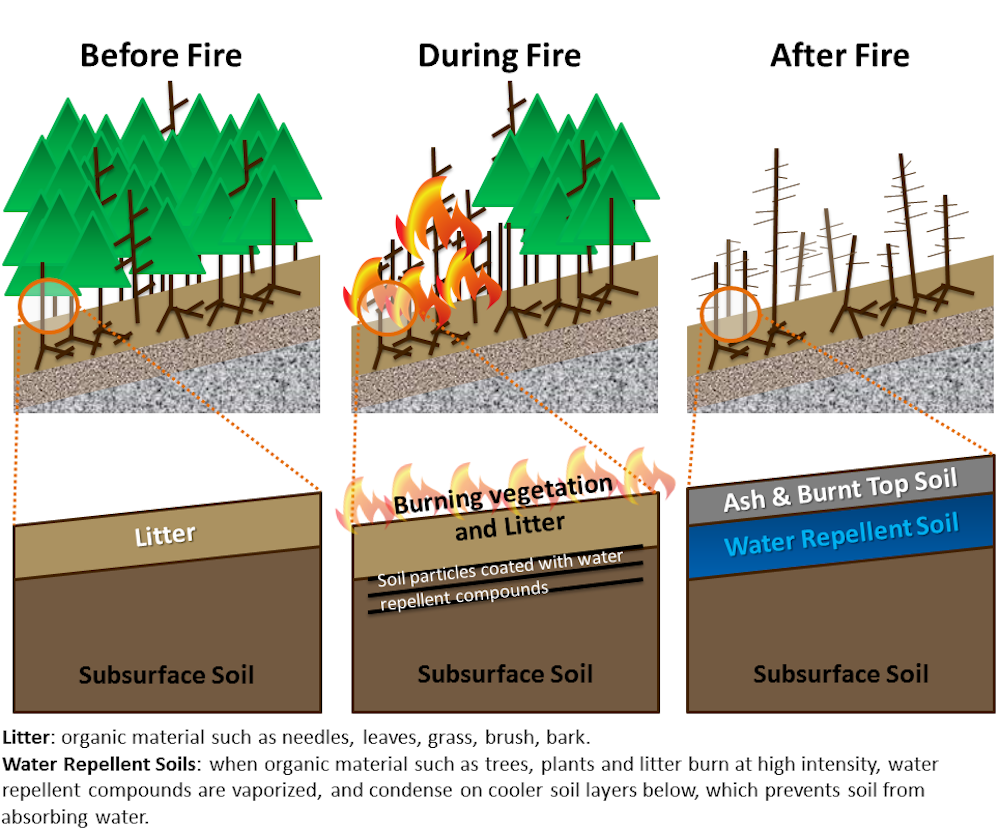
When severe fires burn hillslopes, the high heat from the fires, sometimes exceeding 1,000 degrees Fahrenheit (538 degrees Celsius), completely destroys trees, shrubs, grass and structures, leaving behind a moonscape of gray ash. Not only that, the heat of the fire actually burns and damages the soil, creating a water-repellent, or hydrophobic, layer.
What once was a vegetated hillslope, with leaves and trees to intercept rain and spongy soils to absorb water, is transformed into a barren landscape covered with ash, and burned soil where water cannot soak in.
When rain does fall on a burned area like this, water mixes with the ash, rocks and sediment to form a slurry. This slurry of debris then pours downhill in small gullies called rills, which then converge to form bigger and bigger rills, creating a torrent of sediment, water and debris rushing downhill. All this debris and water can transform small streams and usually dry gullies into a danger zone.
Because the concentration of sediment is so high, especially when there is a large amount of ash and clay, debris flows behave more like a slurry of wet cement than a normal stream. This fluid can pick up and move large boulders, cars, trees and other debris rapidly downhill.
In January 2018, a few weeks after the Thomas fire burned through the hills above Montecito, a storm triggered debris flows that killed 23 people and damaged at least 400 homes.
The geography of the land, burn severity, storm intensity and soil characteristics all play important roles in if, when and where debris flows occur.
Fire and debris flow scientists with the U.S. Geological Survey use these variables to create models to predict the likelihood and possible hazards from postfire debris flows. They are already developing maps to help residents, emergency managers and city officials prepare and predict postfire debris flows in 2025 burn areas in Los Angeles.
Some of the triggers of debris flows are literally part of the landscape.
For example, the slope angle in a watershed and the amount of clay in the soil are important. Watersheds with gentle slopes – generally less than about 23 degrees – and a lack of clay and silt-sized particles are unlikely to produce debris flows.
Other key factors that contribute to postfire debris flows relate to the proportion of the watershed that is severely burned and the intensity and duration of the rainstorm event.
Early important research in the field of pyrogeomorphology demonstrated that while large, intense storms are more likely to cause large, intense debris flows, even small rainstorms can produce debris flows in burned areas.
A whopping 21.8 million Americans live within 3 miles of where a fire burned during the past two decades, and that population more than doubled from 2000 to 2019. A recent study from central and northern California indicates that nearly all the observed increases in area burned by wildfires in recent decades are due to human-caused climate change.
The warming climate is also increasing the likelihood of more extreme downpours. The amount of moisture the atmosphere can hold increases by about 7% per degree Celsius of warming, leading to more intense downpours, particularly from ocean storms. In California, scientists project increases in rainfall intensity of 18% will result in an overall 110% increase in the probability of major debris flows.
Studies using models of fire, climate and erosion rates estimate that the amount of sediment flowing downhill after fires will increase by more than 10% in nine out of every 10 watersheds in the western U.S.
Even without rain, debris on fire-damaged slopes can be unstable. A small slide in Pacific Palisades shortly after a fire burned through the area split a home in two. A phenomenon called “dry ravel” is a dominant form of hillslope erosion following wildfires in chaparral environments in Southern California
Research on charcoal pieces from ancient debris flows has shown fires and erosion have shaped Earth’s landscape for at least thousands of years. However, the rising risk of wildfires near populated areas and the potential for increasingly intense downpours mean a greater risk of damaging and potentially deadly debris flows.
As their populations expand, community planners need to be aware of those risks and prepare.
This article, originally published Jan. 23, 2025, has been updated with a flash flood watch issued.
Jen Pierce receives funding from the National Science Foundation and is the chair of the Quaternary Geology and Geomorphology division of the Geological Society of America.
– ref. Rain on wildfire burn scars can trigger destructive debris flows − a geologist explains how – https://theconversation.com/rain-on-wildfire-burn-scars-can-trigger-destructive-debris-flows-a-geologist-explains-how-247770
Source: Government of Canada – Prime Minister
The Prime Minister, Justin Trudeau, today issued the following statement on unjustified U.S. tariffs against Canada:
“Today, after a 30-day pause, the United States administration has decided to proceed with imposing 25 per cent tariffs on Canadian exports and 10 per cent tariffs on Canadian energy. Let me be unequivocally clear – there is no justification for these actions.
“While less than 1 per cent of the fentanyl intercepted at the U.S. border comes from Canada, we have worked relentlessly to address this scourge that affects Canadians and Americans alike. We implemented a $1.3 billion border plan with new choppers, boots on the ground, more co-ordination, and increased resources to stop the flow of fentanyl. We appointed a Fentanyl Czar, listed transnational criminal cartels as terrorist organizations, launched the Joint Operational Intelligence Cell, and are establishing a Canada-U.S. Joint Strike Force on organized crime. Because of this work – in partnership with the United States – fentanyl seizures from Canada have dropped 97 per cent between December 2024 and January 2025 to a near-zero low of 0.03 pounds seized by U.S. Customs and Border Protection.
“Canada will not let this unjustified decision go unanswered. Should American tariffs come into effect tonight, Canada will, effective 12:01 a.m. EST tomorrow, respond with 25 per cent tariffs against $155 billion of American goods – starting with tariffs on $30 billion worth of goods immediately, and tariffs on the remaining $125 billion on American products in 21 days’ time. Our tariffs will remain in place until the U.S. trade action is withdrawn, and should U.S. tariffs not cease, we are in active and ongoing discussions with provinces and territories to pursue several non-tariff measures. While we urge the U.S. administration to reconsider their tariffs, Canada remains firm in standing up for our economy, our jobs, our workers, and for a fair deal.
“Because of the tariffs imposed by the U.S., Americans will pay more for groceries, gas, and cars, and potentially lose thousands of jobs. Tariffs will disrupt an incredibly successful trading relationship. They will violate the very trade agreement that was negotiated by President Trump in his last term.”
Source: The Conversation (Au and NZ) – By Duncan Caillard, Postdoctoral Research Fellow, School of Communication Studies, Auckland University of Technology
Director Sean Baker has made history by becoming the first person to win four Academy Awards in the same night for the same film – Anora – taking home prizes for original screenplay, film editing, directing and best picture.
Anora centres on Ani (Mikey Madison), a Brooklyn sex worker entangled with Ivan (Mark Eydelshteyn), the immature son of a Russian oligarch. After Ivan disappears, Ani searches through New York with his handler Toros (Karren Karagulian) to find him.
Baker’s Oscars sweep capped off a string of wins over the past year, but surprised many pundits who expected three-and-a-half hour epic The Brutalist to take home the top prize.
He’s made the 97th Academy Awards one for the history books. So who is Sean Baker?
Baker has been a fixture of the international film festival circuit for more than a decade. His films are carefully researched character studies, often focused on sex workers, immigrants and low-income communities.
Baker maintains creative control by working with ultra-low budgets, often serving as writer, director and editor simultaneously. He often casts new or non-professional actors and prefers to shoot on location with natural light.
His breakout film Tangerine (2015) followed two transgender African American sex workers in Los Angeles. Tangerine grapples with the complicated lives of its characters but also celebrates their humour and friendships. The film was a technical milestone: shot entirely on the iPhone 5S by cinematographer Radium Cheung. The total estimated budget was just US$100,000.
Baker’s next film, The Florida Project (2017), was a portrait of low-income children living in cheap motels near Walt Disney World. The film playfully frames its characters’ difficult childhoods as colourful and ecstatic, drawing an outstanding performance from six-year-old star Brooklynn Prince in her first film appearance.
Red Rocket (2021) centred on a retired porn star returning to his Texas home town, but struggled at the box office amid the COVID pandemic.
Baker’s film budgets have increased gradually over time, but have still remained very small by Hollywood standards. The Florida Project was produced on a measly budget of US$2 million, while Anora cost just US$6 million. For context, the production of last year’s best picture winner Oppenheimer (2023) cost Universal Pictures about US$100 million (before marketing costs).
Anora premiered at the Cannes Film Festival in May 2024, where it won the coveted Palme d’Or.
The Palme d’Or is widely considered the most prestigious award in international art cinema – and has launched previous Oscar winners such as Parasite (2019), The Zone of Interest (2023) and Anatomy of a Fall (2023). These awards play an important role in marketing and financing films outside the studio system.
The realities of independent filmmaking are harsher than the glittering appearance of awards season. Independent filmmakers are often precariously employed and earn modest incomes from their work.
In a speech delivered at the Director’s Guild of America Awards earlier this month, Baker laid out the financial difficulties associated with working as an indie director:
It’s just simply not enough to get by on in today’s world, especially if one is is trying to support a family. I personally do not have children, but I know for a fact that if I did, I would not be able to make the movies that I make.
Fellow nominee Brady Corbet, who made The Brutalist with about US$10 million, faced similar challenges, saying in an interview with Vanity Fair that he had made nothing from his two previous films.
Anora has arrived during a time of great upheaval in Hollywood. Studios and streaming giants are adjusting their business models to maximise profits.
Meanwhile, the industry is still recovering from strikes in 2023 by the Writers Guild of America and The Screen Actors Guild–American Federation of Television and Radio Artists, which shut down productions for months.
Hollywood has often turned to independent filmmakers in such moments of crisis. In the 1970s, independent filmmakers such as John Cassavetes, Roger Corman, George Lucas and David Lynch disrupted an industry that was stagnating after its Golden Age.
Today, distributors such as Neon (which distributed Anora) and A24 specialise in marketing independent films through careful awards campaigns and viral marketing strategies.
Baker’s win underscores the role of independent films — less constrained by commercial expectations — in shaping the industry’s future. By taking greater creative risks, his style of intimate filmmaking is a breath of fresh air in Hollywood’s stuffy, franchise-driven business model.
Duncan Caillard does not work for, consult, own shares in or receive funding from any company or organisation that would benefit from this article, and has disclosed no relevant affiliations beyond their academic appointment.
– ref. Who is Sean Baker, the indie filmmaker behind Oscar sweeper Anora? – https://theconversation.com/who-is-sean-baker-the-indie-filmmaker-behind-oscar-sweeper-anora-251272
Source: New Zealand Police (District News)
Canterbury Police issued 179 infringements over the weekend as we responded to antisocial road user behaviour in the district.
As predicted, the car enthusiast event was incredibly well-run with limited complaints or issues, the event organisers maintained a good line of communication with Police over the course of the weekend.
The issues arose following the event, with a small number of attendees, and many who just came for the activity post-event, deciding to engage in dangerous driving behaviour on our roads.
Police made it clear over the three nights, this activity would not be tolerated as we responded to unofficial ‘meets’ and antisocial road user activity as it arose.
Over the course of the weekend, a total of 179 infringements were issued, 6 vehicles were impounded, and 44 vehicles – deemed not to be road worthy – were ordered off the road.
Alongside this, one person was arrested for a warrant to arrest, 10 drivers were served licence suspension notices, six drivers were forbidden to drive for their offending on the night, and three drivers were processed for excess breath alcohol.
Police also collected information over the course of the weekend which will be used for future enforcement action.
Canterbury Police would like to thank the members of the public that reported unlawful driving behaviour throughout the weekend.
Anyone who witnesses any antisocial driving behaviour is urged to contact Police on 111 with as much information as they can safely gather.
Information can also be provided for non-emergencies online at 105.police.govt.nz clicking “Make a Report” or by calling 105.
ENDS
Issued by Police Media Centre
Source: New Zealand Police (National News)
Attribute to Detective Sergeant Joe Salisbury:
Police investigating a fatal crash near Woodville yesterday are seeking dashcam footage from the public.
The crash happened on Saddle Road about 11am on Monday 3 March, when a green-coloured truck overturned and hit a white Ford Transit van travelling in the opposite direction.
The driver of the van sadly died at the scene, while a passenger in the van was physically unharmed. The truck driver also received injuries and had to be cut from the vehicle. Police are providing support to those involved, and the family of the deceased.
The investigation into the cause of the crash will likely take some time, but we hope motorists or members of the public may have information that can help. We would like to hear from any motorists who have dashcam footage from that section of road around the time of the crash, or anyone who witnessed it.
If you have any information that could help our enquiries, please update us online now or call 105.
Please use the reference number 250303/5741.
While the investigation is ongoing, we are unable to comment further at this time.
ENDS
Issued by the Police Media Centre
US Senate News:
Source: The White House
class=”has-text-align-center”>Roosevelt Room
2:38 P.M. EST
THE PRESIDENT: Hello, everybody. Thank you very much.
Thank you very much. This is a very big day for a lot of reasons, but this gentleman is a very unique man. I think I can say, in the world of chips, certainly, but in the world pretty much of business, nobody has done what he’s done. For those of you that are into that world, you would say, “Wow, he’s a legend.” But he is a legend. And it’s an honor to be with you. Very great honor. Thank you very much.
MR. WEI: Thank you, Mr. President.
THE PRESIDENT: Thank you very much.
Welcoming, from TSMC — which is the biggest there is, at a level that you can’t even calculate, frankly — C.C. Wei, to the White House for a very historic announcement. This is a tremendous thing for our country and, hopefully, for his company.
We’re also pleased to be joined by Commerce Secretary Howard Lutnick and White House AI and crypto czar, David Sacks, another two very highly respected people. It’s great to have you guys involved. And, David, thank you very much for coming on.
David is sort of the king of intellect in that world. We have some good people. Today, Taiwan Semiconductor is announcing that they will be investing at least $100 billion dollars in new capital in the United States over the next short period of time to build state-of-the-art semiconductor manufacturing facilities. I think, mostly, it’s going to be in Arizona, which is what I understand, which is a great state. I like it because I won it. But I won most of them — (laughs) — actually. So — but I did. We won it, and we won it big.
The most powerful AI chips in the world will be made right here in America, and it’ll be a big percentage of the chips made by his company. But, as you know, they’re based mostly in Taiwan. And they’re far and away the biggest. There’s nobody even close.
This $100 billion in new investment will go into building five cutting-edge fabrication facilities in the great state that we just discussed, Arizona, and will create thousands of jobs — many thousands of jobs, and they’re high-paying jobs. In total, today’s announcement brings Taiwan Semiconductor investments to about $165 billion — they’ve started already — among the largest new foreign direct investments in United States.
Apple, as you know, made a big announcement last week of $500 billion, and we have some others that have announced.
We have many that want to announce. But I don’t have time to do all of these announcements, I tell you. But, for you, I’m doing the announcement.
MR. WEI: Thank you.
THE PRESIDENT: This will create hundreds of billions of dollars in economic activity and boost America’s dominance in artificial intelligence and beyond.
Semiconductors are the backbone of the 21st century economy — and, really, without the semiconductors, there is no economy — powering everything from AI to automobiles to advanced manufacturing. And we must be able to build the chips and semiconductors that we need right here, in American factories, with American skill and American labor. And that’s exactly what we’re doing.
As you know, Taiwan pretty much has a monopoly on that market. And I think “pretty much” is not a term that’s even appropriate. They do have a monopoly. And this is a tremendous move by the most powerful company in the world.
It’s a matter of economic security. It’s also a matter of national security for us. And, at the same time, Mr. Wei will be able to diversify and have his tremendous presence in another place and a very safe place. And I want to thank Taiwan Semiconductor for doing the announcement.
And I’d like to ask Mr. Wei to say a few words, if you might.
And I’d also like to ask Howard and David — you can say a couple of words. But maybe you should go first because, right now, he’s the most important man in the room. I’m sorry, fellas.
Please.
Thank you very much. Thank you. Great honor.
MR. WEI: Thank you, Mr. President.
THE PRESIDENT: Thank you.
MR. WEI: I’m a — I’m a little bit nervous, so I have to pull out my piece of paper.
Mr. President, Secretary Lutnick — and, David, I didn’t know that — your title, but — okay.
First, I want to thank — say thank you to Mr. President to give me this opportunity to announce our big project in the U.S.
TSMC is the world’s largest chip manufacturing, founded by Dr. Morris Chang in 1987. It’s now at the forefront of semiconductor technology, supporting AI advancement and industry growth.
In fact, I would like to wind back the time that in 2020 we have to thank President Trump’s vision and his support. So, TSMC start the journey of establishing the advanced chip manufacturing in Arizona. And now, let me proudly say, now the vision become reality.
In Phoenix, Arizona, with 3,000 employees, we are producing the most advanced chip made on U.S. soil with the success of our first fab.
So, we are now very happy to announce we are going to invest additional 100 billion U.S. dollar in addition to our current 65-billion-U.S.-dollars investment in Arizona. We are going to build three more new fab — be- — after we promised the three fabs already, and another two very advanced packaging fab, and, most important, an R&D center, also in Arizona.
For this, all the investment — $165 billion — is going to create thousand of the high-paid job, as the president just announced. And we are, most important — actually, we are going to produce many AI chips. We are going to produce many chips to support AI’s progress and to support the smartphone’s progress. And, again, with that, I want to thank President Trump again for his support. In addition, I also want to thank my customers in the U.S., such as Apple, Nvidia, AMD, Qualcomm, Broadcom. They all support TSMC’s manufacturing in the U.S. Without their support, we probably cannot make it true.
So, again, I want to thank them. Also, I’d like to thank the TSMC’s employee. Without their effort, we just cannot make it today.
That’s all I want to say. And thank you.
THE PRESIDENT: Thank you. That’s great. (Applause.) Thank you very much.
Howard, please. David.
SECRETARY LUTNICK: Sure.
THE PRESIDENT: Thank you.
SECRETARY LUTNICK: So, I’m thrilled to be here today, because President Trump has made it a fundamental objective to bring semiconductor chip manufacturing home to America.
Under the Biden administration, TSMC received a $6 billion grant, and that encouraged them to build $65 billion. So, America gave TSMC 10 percent of the money to build here. And now you’re seeing the power of Donald Trump’s presidency, because TSMC, the greatest manufacturer of chips in the world, is coming to America with $100 billion investment. And, of course, that is backed by the fact that they can come here because they can avoid paying tariffs.
So, the idea is: Come to America. Build greatness in America. Build for the American customers — the Apple, Nvidia, that whole list that Chairman Wei gave — in order to bring production to America. So, we’re really, really excited. This continues the most incredible path you’ve ever seen, in these first weeks and months of the Trump administration, of incredible manufacturing coming to America. The keys that the president has called out are coming here. They’re coming here in huge size because they want to be in the greatest market in the world, and they want to avoid the tariffs that, if they’re not here, they’d have to suffer.
So, I want to congratulate C.C. Wei for bringing in this incredible $100 billion investment, but it’s on the shoulders of our president, Donald Trump, which is why he’s coming.
So, thank you.
THE PRESIDENT: Thank you.
David.
MR. SACKS: Thank you, sir. Well, the products that TSMC makes are literally the most important products in the world. I mean, these advanced chips power everything. They power AI. They power your phone. They power your cars. And without them, the whole modern economy would stop, but they’re not made in the United States.
So, for TSMC to move here is a huge, huge development, and we owe that to President Trump’s leadership on the economy and Secretary Lutnick as well. And, C.C., thank you for — for coming here.
Thank you. Yeah.
THE PRESIDENT: Thank you, David.
So, thank you very much. A big percentage of chips with this investment will be made now — a big percentage. Worldwide, we had very little. Almost none. We used to have a lot with Intel. But we had very little. And we’ll be at close to 40 percent of the market with this transaction and a couple of others that we’re doing. That’s a tremendous leap — like, a leap that nobody would have really said was possible.
So, I just want to thank you all for being here. If you want a couple of questions.
(Cross-talk.)
Q On the —
THE PRESIDENT: Ideally on this subject.
Yes, please.
Q — specific number of jobs it will create. He said thousands —
THE PRESIDENT: They — yeah.
Q — but do you have a better —
THE PRESIDENT: They — you’re probably talking about 25,000 jobs. But it’ll get bigger and bigger with time. Knowing this gentleman, it’ll get bigger and bigger. There’ll be no stopping him. (Laughs.)
Q Mr. President, what more —
THE PRESIDENT: Yeah. Brian, go ahead.
Q Right. In addition to the jobs, you talked about national security, and that’s one thing I think a lot of Americans —
THE PRESIDENT: Yeah.
Q — at home don’t understand. Explain the national security aspect of this.
THE PRESIDENT: Well, without the chips and semiconductors, nothing runs today. You can’t buy a car without them. You can’t get a radio, a television, nothing — you can’t get anything. And we thought it was very important — obviously, business was, but we thought even to terms of national security, to have this large percentage of the chips, semiconductors, and other things that they make — the most important product, and not a product that you can really copy. It takes years and years.
You’re on the needle of a pin is total genius. I mean, they can put things — I mean, something the size of the needle, the point of a pin, they put information that is just not even believable.
So, if you would —
(Cross-talk.)
If you would see this, it’s just really something.
Yes, Brian.
Q Can I — one — one more aspect to that. Honda —
THE PRESIDENT: Yeah.
Q — announced they’re coming to Indiana because of the tariffs. Once again —
THE PRESIDENT: That’s right.
Q — you’re bringing additional jobs in manufacturing. Do you want to comment on that as well?
THE PRESIDENT: Well, Honda is coming, and I told you about Apple, that they’re going to be starting to build massively here — $500 billion. And we have many other companies. It’s going to be announced, but we had many that have already announced. And no, it’s going to be great. It’s looking — it’s looking really strong. I don’t think this country has ever seen anything like we’re seeing right now.
Now, the tariffs, as you know, it will start a week earlier than the reciprocal, which is going to be on — a couple of weeks earlier. Reciprocal tariffs start on April 2nd. And I wanted to make it April 1st, but I didn’t want to do — I didn’t want to go April Fool’s Day — (laughter) — because that cost me — that costs a lot of money, but — that one day. So, we’re going April 2nd.
But very importantly, tomorrow, tariffs — 25 percent on Canada and 25 percent on Mexico, and that’ll start. So, they’re going to have to have a tariff. So, what they’ll have to do is build their car plants, frankly, and other things in the United States — in which case, they have no tariffs. In other words, you build — and this is exactly what Mr. Wei is doing by building here. Otherwise, they’ll build — if they did them in Taiwan to send them here, they’ll have 25 percent or 30 percent or 50 percent or whatever the number may be someday. It’ll go only up. But by doing it here, he has no tariffs, so he’s way ahead of the game.
And I would just say this to people in Canada or Mexico, if they’re going to build car plants, the people that are doing them are much better off building here, because we have the market. We’re the market where they sell the most.
And so, I think it’s going to be very exciting. Very exciting for the automobile companies. Very exciting for — I can think of any — as an example, North Carolina, they had the great — I used to go there to buy furniture for hotels, and it’s been wiped out. That business all went to other countries, and now it’s all going to come back into North Carolina — the furniture manufacturing business.
Please.
Q Mr. President —
Q Is the Ukraine minerals deal now dead, or can it be revived? What — what’s your —
THE PRESIDENT: Well, I’ll let you know. We’re making a speech — you probably heard about it — tomorrow night, so I’ll let you know tomorrow night.
But, no, I don’t think so. I think it’s — look, it’s a great deal for us, because, you know, Biden very, very, foolishly — stupidly, frankly — gave $300 billion and — $350 billion, more accurately — to a country to fight and to try and do things. And you know what happened? We get nothing. We get nothing — just gave it.
We could have rebuilt our entire U.S. Navy with $350 billion. Think of it. Three hundred and fifty billion, we could have rebuilt our U.S. Navy.
So, he gave it away as fast as the money could be gone. And what we’re doing is getting that all back and a lot more than that. And what we need — it’s very important for this business that we’re talking about here, with chips and semiconductors and everything else — we need rare earths. And the deal we have is we have the finest rare earths that you can.
Q Sir, on Ukraine. Sir, on Ukraine.
Q Are you going to press back —
Q Thank you, Mr. President. What do you need to see from President Zelenskyy to restart these negotiations?
THE PRESIDENT: Well, I just think he should be more appreciative, because this country has stuck with them through thick and thin. We’ve given them much more than Europe, and Europe should have given more than us, because, as you know, that’s right there. That’s the border.
This country really was like the fence on the border. It was very important to Europe. And I’m not knocking Europe, I’m saying they’re just — they were a lot smarter than Joe Biden, because Joe Biden didn’t have a clue. He just gave money hand over a fist, and they should have been able to equalize with us.
In other words, if we gave a dollar, they should have given. Well, we gave $350 billion. They probably gave 100, but on top of it all, they get their money back, because they are doing it in the form of a loan, and it’s a secured loan.
So, when I saw that, which I’ve known about for a little while, I said, “It’s time for us to be smart.” At the same time, it’s great for them, because they get us in the country taking the rare earth, which is going to fuel this big engine, and especially the engine that we’ve, in a very short time, created. And we get something, and we’re in the — we’re there. We have a presence there.
With all of that being said, I want one thing to happen: I want all of those young people to stop being killed. They’re being killed by the thousands every single week. Last week, 2,700 were killed. Twenty-seven hundred young — in this case, just about, all young boys from Ukraine and from Russia. And that’s not young people from the United States, but it’s on a human basis.
I want to see it stop. The money is one thing, but the death. And they’re losing thousands of soldiers a week, and that’s not including the people that get killed every time a town goes down or a missile goes into a town.
(Cross-talk.)
We — and — and I want to see it stop.
Yes.
Q Mr. President, are you considering canceling military aid to Ukraine? And can we get a reaction to what the Kremlin just said, that your administration is bringing U.S. worldview in alignment with Moscow’s?
THE PRESIDENT: So, this is a deal that should have never happened. This is a deal that would have never happened, and it didn’t happen — for four years, it didn’t happen. It was never even close to happening. If I were president, would not have happened. And October 7th would have — would not have happened in Israel. And inflation wouldn’t have happened.
And Afghanistan, disastrous — the way they withdrew — not the fact that they withdrew but the way they withdrew — would have never happened. And we would have had Bagram right now instead of China having it. It was one hour away from where China makes their nuclear weapons. We would have kept Bagram — one of the biggest air bases in the world.
All of these things happened, and it’s a shame. But it is what it is, and now we’re here. I want to see it end fast. I don’t want to see this go on for years and years.
Now, President Zelenskyy supposedly made a statement today in AP — I’m not a big fan of AP, so maybe it was an incorrect statement — but he said he thinks the war is going to go on for a long time, and he better not be right about that. That’s all I’ll say.
Q Mr. President, is there any —
Q Could this project — could this minimize the impact of the U.S. with chips should China decide to isolate Taiwan or China decide to take Taiwan?
THE PRESIDENT: Well, it’s a very interesting point. It’s a great question, actually. But this would certainly — I can’t say “minimize.” That would be a catastrophic event, obviously. But it will at least give us a position where we have — in this very, very important business, we would have a very big part of it in the United States. So, it would have a big impact if something should happen with Taiwan.
Q And with Russia sanctions, are you looking at relieving Russian sanctions if there is a peace deal?
THE PRESIDENT: Well, we’re going to make deals with everybody to get this war, including Europe and European nations. And they’ve acted very well. You know, they’re good people. I know; most of them are friends of mine — the heads of state, the heads of the various countries, prime ministers from the different — I got four prime ministers and five presidents called me over the last two days, and they want to work it out. They want to get it worked out.
And I think they’re also — you know, they’re talking money, but the money is less important than the deaths. We’re talking thousands of young people a week. And people would say why do I care about Ukraine, young people; why do I care about — and not all young, but they’re pretty young. You know, Ukraine is running a little bit low, and they’re getting older. They’re recruiting older people. It’s a very, very sad thing that’s happening over there, and we want to get it finished. We want to stop the death.
(Cross-talk.)
Q Mr. President, on the tariffs. Is there any room left for Canada and Mexico to make a deal before midnight? And should we expect those Chinese tariffs, the extra 10 percent to take effect tomorrow?
THE PRESIDENT: No room left for Mexico or for Canada. No, the tariffs, you know, they’re all set. They go into effect tomorrow.
Q Mr. President, just a follow-up on my colleague’s question. Hearing —
THE PRESIDENT: And just so you understand, vast amounts of fentanyl have poured into our country from Mexico and, as you know, also from China, where it goes to Mexico and goes to Canada. And China also had an additional 10, so it’s 10 plus 10.
And it comes in from Canada, and it comes in from Mexico, and that’s a very important thing to say.
Yeah, please. Go ahead.
Q Have you decided if you’re going to suspend military aid to Ukraine? Have you made that decision?
THE PRESIDENT: Well, I haven’t even talked about that right now. I mean, right now, we’ll see what happens. A lot of things are happening right now, as we speak — I mean, literally as we speak. I could give you an answer and go back to my office — the beautiful Oval Office. I could go back into the Oval Office and find out that the answer is obsolete.
It’s like his business. It’s obsolete. You come up with a new chip, and it’s obsolete about two minutes later, right? But that’s what’s good about his business. That’s why he’s the only one that’s successful in it. But —
Q And on tariffs, sir.
Q Mr. President, just to follow up my colleague’s question from Russia is saying that your foreign policy is largely in line with their vision. Should that be concerning to Americans?
THE PRESIDENT: Said what?
Q Should that be concerning to Americans?
THE PRESIDENT: Read the statement.
Q That Russia — Russia says that your administration’s foreign policy is, quote, “largely in line” with their vision.
THE PRESIDENT: Well, I tell you what, I think it takes two to tango, and you’re going to have to make a deal with Russia, and you’re going to have to make a deal with Ukraine. You’re going to have to have the ascent, and you’re going to have to have the consent from the European nations, because I think that’s important, and from us.
I think everybody has to get into a room, so to speak, and we have to make a deal. And the deal could be made very fast. It should not be that hard a deal to make. It could be made very fast.
Now, maybe somebody doesn’t want to make a deal, and if somebody doesn’t want to make a deal, I think that person won’t be around very long. That person will not be listened to very long. Because I believe that Russia wants to make a deal. I believe, certainly, the people of Ukraine want to make a deal. They’ve suffered more than anybody else. We talk about suffering — they’ve suffered.
But if you think about it, under President Bush, they got Georgia, right? Russia got Georgia. Under President Obama, they got a nice, big submarine base, a nice big chunk of land where they have their submarines. You know that, right? Crimea. Under President Trump, they got nothing. And under President O-Biden, they tried to get the whole thing. They tried to get the whole big Ukraine, the whole thing. If I didn’t get in here, they would’ve gotten the whole thing.
So, I can only say — you can go back to Bush, you go back to Obama, and go back to Biden — they took a lot. The only one they didn’t get — you know what I gave them? I gave them anti-tank missiles. That’s what I gave them. I gave them sanctions on Russia — on Russia. I gave them Javelins. You know the Javelins? You know when they took out all those tanks?
You know, the tanks were heading to Kyiv by the hundreds, and they were unstoppable, and I gave them Javelins.
So, you know, I really — Putin is the one that will tell you this has not been so good for them. The fact is that I just want fairness. I want fairness.
But think of it. I gave Russia nothing except grief. I gave them nothing. I gave them sanctions and Javelins. That’s what I gave them.
Obama gave them sheets. And you heard that statement before. It’s a very famous — Trump gave them Javelins, and Obama gave them sheets. And then they say how close I am to Russia.
Let me tell you, we have to make a deal, because there are a lot of people being killed that shouldn’t be killed. But remember, Trump gave them nothing, and the other presidents gave them a lot. They gave them everything.
Q Mr. President, on trade. You met with president — Argentine President Javier Milei at CPAC. He wants to sign a free trade agreement —
THE PRESIDENT: Right.
Q — with the United States. Is that something that you would consider, even with Argentina, or any other country?
THE PRESIDENT: I’ll consider anything. And Argentina — I think he’s great, by the way. I think he’s a great leader. He’s doing a great job. He’s doing a fantastic job. Brought it back from oblivion.
Yeah, we’ll look at things. We’re looking at the UK with things. It doesn’t have to be tariffs. But tariffs are easy, they’re fast, they’re efficient, and they bring fairness.
For instance, when people kill their dollar, their equivalent of the dollar, whatever — whether it’s the yuan or the yen in Japan or the yuan in China — when they drop them down, that gives us — that puts us at a very unfair disadvantage. So, all I have to do is say, “Howard, we’re going to have to raise the tariffs a little bit.”
Because I’ve called President Xi, I’ve called the leaders of Japan to say, “You can’t continue to reduce and break down your currency. You can’t do it, because it’s unfair to us.” It’s very hard for us to make tractors — Caterpillar — here, when Japan, China, and other places are killing their currency, meaning driving it down.
So, all of these things add up, and the way you solve it very easily is with tariffs. Because when they do that, instead of having to make phone calls every day, like I used to do with certain leaders — President Xi, a little bit — a lot of phone calls talking about the fact that they’re lowering their yuan. They’re lowering it down. And that makes it very, very hard for us.
So, this way, I just say, “Look, let them do that, and we make up for it with the tariffs.” But —
Q Will you be speaking with Mexican President Claudia Sheinbaum about tariffs today?
THE PRESIDENT: Yeah, sure, I will. I have a lot of respect for her. I have a lot of respect for her.
(Cross-talk.)
Q After the 10 percent tariff take ef- —
THE PRESIDENT: Yeah.
Q — takes effect, it’ll be 20 percent on China now. How high are you willing to go against China?
THE PRESIDENT: Well, I can’t say. It depends on what they do with their currency. It depends on what they do in terms of a retaliation with some kind of an economic retaliation, which I don’t think they’re going to retaliate too much.
Hey, look, the United States has been taken advantage of for 40 years. The United States has been a laughing stock for years and years. That’s why this gentleman has built in Taiwan, instead of building here. It would have been better if he built here.
If we had a president that knew what they were doing — and we had a lot of them very bad on trade. Look, I’m a huge fan of Ronald Reagan, but he was bad on trade. Very bad on trade. He allowed a lot of people, a lot of businesses, to be taken. So, I say that with due respect, because I — he was so great on other things, but he was bad on trade.
We are setting records right now — records like nobody has ever seen before. When you have companies like this coming in and almost 40 percent of their company, in one signature, is going to be devoted to what he does, which is one of the most important — important businesses in the world, that’s an unbelievable thing. When Apple now is going to start building all of their plants here, all because of what we’ve done in terms of — it’s not because he likes me or they like me. They don’t probably like me at all. I don’t know. I think he likes me a little bit, at least. (Laughter.)
MR. WEI: No, I like you.
THE PRESIDENT: But you know what? It’s the incentive we’ve created or the negative incentive. I mean, it’s going to be very costly for people to take advantage of this country. They can’t come in and steal our money and steal our jobs and take our factories and take our businesses and expect not to be punished, and they’re being punished by tariffs.
It’s a very powerful weapon that politicians haven’t used because they were either dishonest, stupid, or paid off in some other form. And now we’re using them.
Q Have you spoken with President Xi?
Q Agriculture —
THE PRESIDENT: Say it.
Q Have you spoken with President Xi about this this term?
THE PRESIDENT: I don’t want to tell you that.
Q On those incentives, sir.
THE PRESIDENT: Thank you very much, everybody.
(Cross-talk.)
Thank you. Thank you very much.
END 3:07 P.M. EST
Source: United Kingdom National Police Chiefs Council
Over 100 arrests made as a result of national investigations through Opal
The fight against retail crime continues building momentum thanks to strong partnerships between policing and retailers and recent Government announcements to strengthen legislation.
The national team collating and coordinating intelligence from police forces and retailers across the country has now effected over 100 arrests (108) of individuals involved in organised retail crime, collectively responsible for over £5.2m in losses to businesses.
The team within Opal (policing’s national intelligence unit for serious organised acquisitive crime) has been operational since 1 May 2024 and is funded by the Pegasus Partnership, a joint initiative between the Home Office, policing and retailers and facilitated by PCC Katy Bourne. It coordinates the sharing of intelligence to gain a clearer picture of those who are behind the increase in retail crime.
Opal’s team receives referrals from police forces and retailers and builds intelligence packages, mapping out offending across the country and providing investigative support to bring the highest harm offenders to justice. A package will then be collated and shared with the most appropriate police force to progress the investigation and take action against offenders.
In addition, new legislation announced in the Crime and Policing Bill makes assault of a retail worker a standalone offence and alongside a change to ensure all offences of shop theft are tried as ‘general theft’, removing the perceived immunity granted to shop theft of goods to the value of £200 or less.
“We’re fast approaching a year since the organised retail crime team within Opal began accepting referrals and it’s positive to see so many results, with real impact being made. Behind each offender is not just a list of offences, but damage to businesses and all too often trauma experienced by retail workers who suffer abuse at the hands of these criminals.
“We want retailers, workers and the public to feel safe in our shops and to know that policing is doing everything we can to tackling the problem. Working in partnership with retailers, Opal can build a detailed picture of offending across borders so there is quite literally nowhere for these individuals and groups to hide.
“The recent announcements of a standalone offence for assault of a retail worker and the legislation change to ensure any shop theft offence is dealt with robustly, whatever the value, further strengthens our policing response and shows the seriousness of this criminality.
“In addition this dedicated work at a central level, we are seeing much progress in police forces developing their response to retail crime, working closely with their partners to improve the safety of our communities. From prevention to dealing with offenders, we must keep working collaboratively to drive this offending out of our high streets.”
“I’m thrilled that our Pegasus Partnership is working so well. The results so far from Opal’s Organised Retail Crime Team are impressive and demonstrate the value of the unique partnership between our major retailers and police to identify organised retailed crime gangs and prolific offenders.
“Momentum has been gathering since the start of Opal’s operations, leading to over 100 arrests across 31 different organized crime groups and £5.2 million of losses linked to offenders. I’m delighted that our Pegasus Partnership has been proven successful and the investment from retailers has clearly paid off as the Government has now allocated funding to Opal.
“Information and intelligence-sharing will remain vital if we want to target offenders and make our high streets and shops safer places for everyone. My congratulations and thanks to the Opal team and our local forces for these excellent results.”
Results from the Opal Organised Retail Crime team since 1 May include:
Source: Tasmania Police
Busy weekend for Western road police
Tuesday, 4 March 2025 – 11:19 am.
Western road police are calling for people to heed safety advice, following a series of offences detected over the weekend.
Acting Inspector Martin Parker said a range of drivers had been caught driving dangerously, drink driving, speeding and driving while disqualified.
“On Saturday evening a 32-year-old Penguin man was arrested after reportedly evading police, crossing train lines and driving into an apple orchard on Mersey Main Road at Spreyton,” he said.
“The vehicle’s registration had expired, the driver was unlicensed and he returned a positive drug test.”
“The man was charged with a range of offences and had his vehicle seized by police.”
“The same day, a 20-year-old man from Mountain River was charged with drink driving after he was intercepted on Edward Street, Devonport and returned a reading of 0.140.”
“Also on Saturday, a 29-year-old man from Wynyard was charged with evading police and speeding after being caught on Calder Road at Wynyard.”
“On Sunday, a 37-year-old man from Upper Burnie was caught driving while disqualified after a random intercept on Reeve Street, South Burnie.”
“Three men were also caught speeding on the Murchison Highway between Tullah and Waratah on Sunday.”
“A 34-year-old man and a 68-year-old man both from Victoria were each caught driving at 137 km/h in a 100 km/h zone.”
“A 31-year-old man from Shorewell Park was caught at 125 km/h.”
“Police will continue to enforce the road rules to keep everyone in our community safe.”
“If you’re committing an offence, you can expect to be caught.”
Source: Office of United States Attorneys
CORPUS CHRISTI, Texas – A 27-year-old Los Fresnos man has been ordered to prison for attempting to smuggle an illegal alien further into the country, announced U.S. Attorney Nicholas J. Ganjei.
Carlos Del Angel Bocanegra pleaded guilty Nov. 25, 2024.
U.S. District Judge David S. Morales has now ordered him to serve 24 months in federal prison to be immediately followed by three years of supervised release. At the hearing, the court heard evidence describing how Bocanegra had fled from law enforcement with four children in his vehicle. In handing down the sentence, the court noted the potential danger Bocanegra’s conduct posed the public and his passengers.
“Alien smuggling is an incredibly dangerous practice, both for the people smuggled and for innocent bystanders,” said Ganjei. “Fortunately, nobody was killed by Bocanegra’s actions, but the facts of this case could have easily turned tragic. I commend law enforcement for their excellent work in this case.”
On Aug. 27, 2024, Bocanegra approached the Border Patrol checkpoint near Kingsville driving a Chevy Tahoe with an adult passenger and four juveniles visibly present. Upon initial inspection, he denied having any contraband or unlawful people in his vehicle. However, authorities soon discovered an illegal alien concealed under a passenger row seat.
Bocanegra then immediately fled the checkpoint and led law enforcement on a chase down the highway. Authorities were able to end the pursuit quickly and took him into custody.
He has been and will remain in custody pending transfer to a U.S. Bureau of Prisons facility to be determined in the near future.
Border Patrol conducted the investigation with the assistance of the Texas Highway Patrol. Assistant U.S. Attorney John Lamont prosecuted the case.
Source: US State of Colorado
DENVER – President Trump plans to implement a new 25% tax on hardworking Americans through his disastrous tariff tax.
“Unless President Trump pulls back from tariffs on products from Mexico and Canada, starting at midnight, the President’s horrible sales tax will apply to all hardworking Coloradans. Trump’s tariffs are a costly sales tax that will raise the price of groceries, clothes, homes, technology, cars, and everyday items Americans rely on and hurt North American competitiveness. President Trump is playing chicken with people’s pocketbooks, small businesses, and our economy, and it is harmful. While Colorado is pushing ahead to lower costs, the President’s tariffs alone will cause economic devastation across America in their wake,” said Colorado Governor Polis.
Governor Polis has been outspoken in opposition to President Trump’s reckless tariff tax.
###
Source: New South Wales Premiere
A rare but highly disruptive problem for heavy vehicle operators on the Pacific Motorway is now a thing of the past following the installation of new technology and truck turning areas at the Tugun bypass tunnel.
Drivers of overheight vehicles would sometimes slip past warning signs and find themselves stuck at the northbound or southbound tunnel entrances.
It was a particular problem approaching the tunnel from the north because if an overheight vehicle reached the tunnel from the Queensland side, the driver would have to reverse his or her rig four kilometres back up the motorway before they could turn around.
And they had to have support from Transport for NSW, Transport and Main Roads Queensland and the police forces of the two states to resolve.
That chaos is now a thing of the past following the completion of a project to improve advance warning for drivers of overheight vehicles and the installation of new turning areas closer to the north and southbound entries to the Tugun Bypass tunnel.
This means that if any operators do happen to go past the warning signs, they will only have to reverse a short distance up the highway to reach an area where they can cross over.
Most of the work to fix the issue was carried out over two years during the quarterly maintenance tunnel closures to minimise impacts to motorists.
Quotes attributable to Minister for Regional Transport and Roads Jenny Aitchison:
“With the investment from the Minns Labor Government, overheight vehicles should never reach the tunnel, but if they do, they can be turned around with help from the Tugun incident response officer or a single police officer.
“The time and cost savings from this change are enormous and it will mean the lengthy delays when an overheight vehicle inadvertently entered the tunnel are a thing of the past.
“Transport for NSW put in new overheight detection systems to notify staff of a vehicle approaching the tunnel, so they can immediately activate variable speed limit signs to stop them reaching the tunnel.
“We’ve also installed five new advance warning signs and new traffic lights just short of where we’ve put in new heavy vehicle crossovers.
“The Tugun tunnel goes underneath the Coolangatta Airport, with the southern end of the tunnel in NSW and the northern end in Queensland, and we had great collaboration with the Queensland authorities to get the work done.
“The project has improved advance warning technology as well as the infrastructure, so if any overheight vehicles did get past the advance warning systems, they would be stopped and able to turn around at the entrance to the tunnel.”
Source: Australian Ministers 1
The Albanese Government is partnering with Goulburn Mulwaree Council to improve the safety of local roads, with $3.6 million in federal funding supporting the delivery of two new priority road upgrades.
$2.3 million in federal funding will support upgrading the surface of Lansdowne Street, along with line marking and kerb and guttering improvements – to ensure this heavy vehicle route keeps pace with increased traffic.
Construction is expected to commence by the end of this year, and be completed in September 2026.
$1.3 million from the Albanese Government will support replacing the ageing Glynmar Road Causeway with a higher concrete bridge.
Design works will be finalised by the end of this year, with construction expected to begin by September next year, and be completed by August 2027.
These two new projects are supported by the Albanese Government’s Safer Local Roads and Infrastructure Program, and the Roads to Recovery Program.
Goulburn Mulwaree Council is receiving $9.4 million in Roads to Recovery funding over five years for a pipeline of priority projects – a funding boost of over $4 million thanks to the Albanese Government.
Over $2.9 million under the Albanese Government’s Road Safety Program is also supporting a package of safety improvements on Crookwell Road, along with Albert, Deccan, Clifford, Goldsmith, Verner, and Faithful Streets.
Quotes attributable to Federal Member for Eden-Monaro, Kristy McBain MP:
“As someone that drives hundreds of thousands of kilometres across Eden-Monaro, I know how important it is to improve the safety of our local roads, which is why I’m proud to be delivering $3.6 million for repairs on Lansdowne Street, and to replace the Glynmar Road Causeway outside of Marulan.
“Lansdowne Street is under increasing pressure from heavy vehicles and this has caused parts of the road to deteriorate – something we’ll repair, to keep local freight businesses moving, and to make it safer for the 1,800 motorists that pass through this street every day.
“The Glynmar Road Causeway over Stony Creek is reaching the end of its operational life, and local property owners have said it needs to be replaced – which is exactly why we’re delivering a new concrete structure that’s both higher and wider.
“These two new projects build on a series of road safety upgrades we’re already delivering across the Goulburn Mulwaree region, as part of my commitment to working with council and the community to support their local priority projects.”
Quotes attributable to Mayor of Goulburn Mulwaree Council, Cr Nina Dillon:
“We welcome this additional funding from the Australian Government, because it means Goulburn Mulwaree Council can continue improving the safety of our local roads.
“Delivering these two new projects is a major win for our community – because we know how important it is that our local roads keep pace with increasing traffic.
“We have a strong partnership with the Australian Government, and this is what we can deliver for our community when we work together.”
Source: Ministers for Social Services
E&OE TRANSCRIPT
Topics: Laos methanol poisoning investigation; Rugby League in Las Vegas; Academy Awards.
CHARLES CROUCHER, HOST: Welcome back. The parents of Holly Bowles and Bianca Jones, who died of methanol poisoning in Laos, are urging travellers to boycott the country until it adequately investigates their daughter’s deaths. Joining us to discuss is Minister for Social Services Amanda Rishworth and Nationals Senator Bridget McKenzie. Good morning to you both. Amanda, I’m going to start with you. There are concerns that are boycott might discourage authorities there from doing the right thing by these families. How do we approach this?
AMANDA RISHWORTH, MINISTER FOR SOCIAL SERVICES: Firstly, I would say the Australian Government continues to stand with Holly and Bianca’s family and continues to of course press the Laos Government to fully and transparently investigate these circumstances. Of course, there are warnings on Smartraveller which is an important government resource to look at the risks. But we as a Government will continue to press for a full investigation because it is really important that any issues that emerge from that are addressed to make sure travellers are safe.
CHARLES CROUCHER: I guess the issue is, is there something more the Government can be doing if the parents are now encouraging travellers to do the lobbying for them?
AMANDA RISHWORTH: We have continued on an ongoing basis to have conversations and to continue to press the Laos Government and we will continue to do that. We’ve been providing consular support to Bianca’s and Holly’s families. We will continue to do everything we can as a Government to push this. But it’s important people are properly informed when they do travel overseas about what the risks are.
CHARLES CROUCHER: Bridget, can we be doing more?
BRIDGET MCKENZIE, NATIONALS SENATOR: Well, I think the Government’s outlined that it’s pursuing every diplomatic measure it can. It’s an absolute tragedy what happened to Holly and Bianca. We don’t want any other young Australians who go overseas for a great holiday to suffer the same fate. So, we need to be pushing for a full investigation so that the issues can be made clear. And you know, we back the Government all the way in their efforts to do that.
CHARLES CROUCHER: And we stay with the parents because it’s such a tough situation they’ve been in, and we’ve been sort of amazed at how brave they’ve been in speaking out as well. Well, we’re going to move on because the NRL’s Vegas gamble well and truly paid off. It reached, we’re told, an audience that was unprecedented and generated more than $100 million. Now the attention turns to the AFL which weather permitting, will kick off on Thursday. Bridget, you’re a Senator from Victoria. It’s the AFL home state. Are they getting beaten when it comes to launching the season by the people from up north.
BRIDGET MCKENZIE: Look, we know that NRL is a spectator sport that had the most successful seat opening since 2010. And I think what really resonated with the US was no helmets, no pads, all action, no timeout. And I mean, when you compare that to the NFL, the US rocked up in droves to actually see the NRL live. Obviously, Charles, I am from Victoria. We’ve got the G and we pack it out week in, week out to watch our great game. So, you know, I think it’s the difference between the two sports. One is, you know, best live and the other is building that, you know, a sustainable funding base going forward. Because we know if the NRL gets 1 per cent of the US market, it’ll be sustaining funding for them going forward, which is also good news in decades to come.
CHARLES CROUCHER: A great TV product, of course, and it’s on Nine as well, which shows. Amanda, Gather Round [AFL] is in South Australia. Never ruined that with an election on the same weekend, obviously. But should the AFL be doing more to make this round the number one?
AMANDA RISHWORTH: Well, you know, the Gather Round is an absolutely amazing round, I have to say. It brings a buzz not just to South Australia but to footy fans, to be all in the same place. I think the AFL has been looking at how they engage their audiences and I would say that Gather Round is a great example of that and will continue to do so. But congratulations to the NRL. And hopefully we’ll start seeing people in America wearing those NRL colours. But of course, I would like to see everyone in America wearing some AFL colours as well. And I think we can all work towards that.
CHARLES CROUCHER: All right, finally, from Conan O’Brien’s opening monologue to Anora’s sweeping success, the Oscars delivered a host of memorable moments. We’re sort of short on time, so I might even just go with a hands up approach here. But did anyone tune in and has anyone seen any of the movies that are nominated this year?
BRIDGET MCKENZIE: Too busy fighting Labor.
AMANDA RISHWORTH: I’ve seen Wicked.
BRIDGET MCKENZIE: Charles, I’m halfway through Conclave on a flight.
CHARLES CROUCHER: That’s probably the way you’re going to do it. And Amanda’s seen Wicked. So that’s a good sign of the way things are going for Conclave and Wicked – two brutal fights of political natures. And that shapes well for whatever’s to come in the next couple of weeks. Really lovely speaking to both you this morning.
Source: US Immigration and Customs Enforcement
BROWNSVILLE, Texas — A Houston woman was sentenced following her conviction for possession with intent to distribute fentanyl following an investigation conducted by U.S. Immigration and Customs Enforcement in coordination with U.S. Customs and Border Protection.
Alyssa Marie Maldonado, 40, was sentenced on Feb. 25 by U.S. District Judge Fernando Rodriguez to serve 36 months in federal prison to be immediately followed by three years of supervised release. At the hearing, the court heard additional testimony that detailed Maldonado’s culpability in the crime. In handing down the sentence, the court noted her connection to the smuggling through her actions to conceal the drugs within the vehicle. Maldonado pleaded guilty Oct. 16, 2024.
“Today’s sentencing underscores the serious consequences of fentanyl trafficking. ICE is committed to holding those responsible for distributing this deadly drug accountable and to working with our partners to protect communities from its devastating effects,” said ICE Homeland Security Investigations Rio Grande Valley Deputy Special Agent in Charge Mark Lippa.
According to court documents, on March 24, 2024, Mendoza applied for entry into the United States at the Brownsville and Matamoros International Port of Entry. At initial inspection, she made a negative declaration to any contraband within the vehicle and provided false statements concerning her reasons for visiting Mexico. Authorities referred her to secondary inspection where a K-9 soon alerted to the rear back seat area. They then discovered anomalies in the fuel tank and found 22 packages which field tested positive for fentanyl. The combined weight was 8.70 kilograms.
Previously released on bond, Maldonado was taken into custody following the sentencing where she will remain pending transfer to a U.S. Bureau of Prisons facility to be determined in the near future.
Assistant U.S. Attorney Zachary Blackmon from the Southern District of Texas prosecuted the case.
Source: Office of United States Attorneys
McALLEN, Texas – A 30-year-old Mexican national with a felony criminal history has been sentenced for illegally entering the county without authorization for the fourth time, announced U.S. Attorney Nicholas J. Ganjei.
Jesus Alberto Castro-Garza pleaded guilty Dec. 19, 2024.
U.S. District Judge Drew B. Tipton has now imposed a 106-month-term of imprisonment for Castro-Garza. Not a U.S. citizen, he is expected to again face removal proceedings following his imprisonment.
Castro-Garza has prior felony convictions for injury to a child, assault family violence impeding breath, evading with a vehicle and human smuggling. He was removed from the country first in 2019 and illegally returned three times. He was last removed Nov. 21, 2023.
Then on Dec. 24, 2023, authorities discovered him again in the United States in custody at a local jail.
Castro-Garza will remain in custody pending transfer to a U.S. Bureau of Prisons facility to be determined in the near future.
Immigrations and Customs Enforcement conducted the investigation. Assistant U.S. Attorney Amanda McColgan prosecuted the cases.
Source: Office of United States Attorneys
McALLEN, Texas – A 55-year-old Mexican citizen has been sentenced for exporting firearm parts from the United States into Mexico, announced U.S. Attorney Nicholas J. Ganjei.
Oscar Daniel Ramirez Gonzalez pleaded guilty Dec. 12, 2024.
U.S. District Judge Drew B. Tipton has how sentenced Ramirez Gonzalez to serve 24 months in federal prison. Not a U.S. citizen, he is expected to face removal proceedings following the sentence.
On Nov. 9, 2024, Ramirez Gonzalez attempted to exit the United States and enter Mexico through the Pharr Port of Entry.
Authorities referred him to secondary inspection where they conducted a search of the vehicle and found a firearm upper receiver, lower receiver, four bottles of gun powder and several thousand rounds of ammunition cartridges in various calibers.
Ramirez Gonzalez did not possess a license to export the items from the United States.
He has been and will remain in custody pending transfer to a U.S. Bureau of Prisons facility to be determined in the near future.
Customs and Border Protection conducted the investigation. Assistant U.S. Attorney Amanda McColgan prosecuted the case.
Source: Office of United States Attorneys
Lennox Vanvacter, 32, was convicted by a jury on October 10, 2024, after a three-day trial in federal court in Sioux City, to one count of prohibited person in possession of a firearm. The verdict was returned following about 7 hours of jury deliberations.
The evidence at trial and sentencing showed that on July 30, 2023, Fort Dodge/Webster County law enforcement officers observed Vanvacter operating a motor vehicle. Based on their observations and the fact Vanvacter had an active arrest warrant for a previous eluding charge, officers attempted to initiate a traffic stop and apprehend him. When emergency lights/sirens were activated, Vanvacter engaged in a high-speed driving-based attempt (approximately 30 minutes in duration) to elude law enforcement, including speeds of 70 mph or more in Fort Dodge and 100 mph or more outside city limits in Webster County. Two sets of spike strips were deployed by officers and ultimately helped stop the vehicle. Once stopped, Vanvacter attempted to flee from the officers on foot but was captured a short distance later. Officers located a firearm, a loaded Smith & Wesson 9mm pistol, near the end of the vehicle’s flight path. Later, officers determined by review of patrol car camera video, that the firearm was thrown from the vehicle by Vanvacter. Vanvacter had a history of leading law enforcement on high-speed driving pursuits.
Sentencing was held before United States District Court Judge Leonard T. Strand Vanvacter was sentenced to 144 months’ imprisonment and must serve a three-year term of supervised release following imprisonment. There is no parole in the federal system. Vanvacter remains in custody of the United States Marshal until he can be transported to a federal prison.
This case is part of Project Safe Neighborhoods (PSN), a program bringing together all levels of law enforcement and the communities they serve to reduce violent crime and gun violence, and to make our neighborhoods safer for everyone. On May 26, 2021, the Department launched a violent crime reduction strategy strengthening PSN based on these core principles: fostering trust and legitimacy in our communities, supporting community-based organizations that help prevent violence from occurring in the first place, setting focused and strategic enforcement priorities, and measuring the results.
The case was prosecuted by Assistant United States Attorney Shawn S. Wehde and was investigated by the Iowa Division of Narcotics Enforcement, Fort Dodge Police Department, Webster County Sheriff’s Office, Iowa DCI Laboratory, and Bureau of Alcohol, Tobacco, Firearms, and Explosives, as well as assisted by the Woodbury County Sheriff’s Office, the Sioux City Police Department, the Woodbury County Attorney’s Office, the Hamilton County Sheriff’s Office, and the Hamilton County Attorney’s Office.
Court file information at https://ecf.iand.uscourts.gov/cgi-bin/login.pl.
The case file number is 23-3037. Follow us on X @USAO_NDIA.
Source: Screen Australia
04 03 2025 – Media release
Crowded House
Screen Australia has announced support for eight documentaries that will share in $2.3 million of direct production funding. These projects reflect the incredible tenacity of local documentary makers to uncover stories in Australia and around the globe, from Western Sydney to Ecuador. The documentaries deep-dive into a wide array of topics, from the defining issues of our time to celebrating cultural icons and shining a light on marginalised or misunderstood communities.
Among the projects are Robodebt (working title), a three-part series for SBS that combines documentary storytelling with drama to reveal how ordinary Australians fought back against the notorious Robodebt scandal; Crowded House, which unravels the psychological complexities the iconic band faced in their extraordinary journey; End Game, following Tony Armstrong on a mission to tackle racism in Australian sports; and RISE, from writer/director Patrick Abboud, about participants preparing to compete on Western Sydney’s spectacular LGBTQIA+ ballroom scene.
Screen Australia Head of Documentary Richard Huddleston said, “These stories, spanning numerous genres and disciplines, are a reflection of the ambition, sophistication and creativity of the current Australian documentary sector. These projects will grow Australia’s reputation for innovative, premium storytelling and point to an exciting future of global partnerships.”
Projects supported:
Crowded House: A feature-length documentary that dives deep into the Crowded House journey, unravelling the psychological complexities they faced in the wake of their meteoric rise, and spotlighting the evolution of the current line-up that includes Neil’s two sons, Liam and Elroy Finn. Woven from a treasure-trove of never-before-seen family and band archive, candid interviews, and more, the narrative moves between the past, present and a dream-like place of investigation and analysis that has the genius of Neil Finn’s song writing at its core. Crowded House is a co-production between Ghost Pictures (Mystify: Michael Hutchence, Autoluminescent, In Bob We Trust) and Academy Award-nominated producer, Carthew Neal (Jojo Rabbit, Tickled) and his production company Fumes. Financed by the New Zealand Film Commission in association with the ABC and VicScreen. Produced with the support of Primary Wave and Nude Run. An Australian-New Zealand Co-production. Australia and New Zealand territories distributed by Madman.
RISE: With exclusive access into Western Sydney’s underground LGBTQIA+ ballroom scene, the documentary RISE follows participants as they prepare to compete at the iconic West Ball. In a world seeking to erase them, RISE will portray which of these queer rebels will finally have their moment on the cutthroat stage and transform their life. It is written and directed by Patrick (Pat) Abboud (Australia Uncovered: Kids Raising Kids), with Monique Keller and Billy Russell (The Role of a Lifetime) executive producing, and West Ball community leaders, Xander Khoury and Jamaica Moana co-executive producing.
Death of a Shaman: In the depths of the Ecuadorian Amazon, a renowned Shuar shaman selects his reluctant grandson as his apprentice in an attempt to preserve their tribe’s ancestral wisdom for another generation. Meanwhile, the shaman’s son leads an Indigenous uprising that seeks to overthrow the Ecuadorian president. What transpires next will foreshadow either the preservation or destruction of a people. The feature-length documentary Death of a Shaman is from writer/director/producer Dan Jackson (In the Shadow of the Hill) and executive producers Robert Fernandez (The Fog of War) and Dan Levinson. It is financed in association with Soundfirm, with Umbrella Entertainment distributing locally.
Silenced: A feature film from Stranger Than Fiction that follows internationally renowned human rights lawyer Jennifer Robinson as she goes inside courtrooms and behind the headlines, to reveal the tricks and tropes used to silence women all over the world. Silenced is from writer/director Selina Miles and producer Blayke Hoffman, whose credits include the acclaimed Harley & Katya. Jennifer Peedom (Sherpa, Mountain) is executive producing. It is financed in association with Minderoo Pictures and the ABC, with support from Screen NSW, the Shark Island Foundation and Soundfirm. Local distribution by Sharmill Films and international sales by Together Films.
Troublemaker: This feature film follows massacre survivor Wendy Scurr and South Australian writer/director Jared Nicholson (Starting from Scratch), as they slip down the rabbit hole of paranoia in a desperate search for solace and truth. Directing alongside Nicholson is Ben Lawrence, with Rebecca Barry, Scott Baskett, Madeleine Hetherton-Miau and Chris Kamen producing and Deanne Weir executive producing. It is financed in association with the Shark Island Foundation, with support from the Adelaide Film Festival Investment Fund, the South Australian Film Corporation, Screen NSW and WeirAnderson Films. Post, digital and visual effects are supported by the South Australian Film Corporation.
Digby & Camille: This feature film is an eight-year love story about Sydney artist and the documentary’s co-director Digby Webster and his girlfriend, trainee chef Camille Collins, who both live with Down Syndrome. Looking to take the next step in their relationship, the couple fervently wish to live together and marry. But complicating their dream of wedded bliss are the very real concerns and questions from those who love and support them most, their parents. Directing alongside Digby is Trevor Graham (Chef Antonio’s Recipes for Revolution), who is also producing with Lisa Wang (White Fever). It is written by Rose Hesp (Who Do You Think You Are?), with Mitzi Goldman (Knowing the Score), Roger Savage and Jenny Lalor executive producing. It is financed in association with the Melbourne International Film Festival (MIFF) Premiere Fund, with support from Screen NSW, the Shark Island Foundation, Soundfirm, the Andy Inc Foundation and Philanthropy via Documentary Australia. Local distribution by Bonsai Films.
Robodebt (working title): A three-part series for SBS that combines documentary storytelling with drama to reveal how ordinary Australians fought back against the notorious Robodebt scandal that struck at the heart of inequality and social cohesion in Australia. It is from director Ben Lawrence (Hearts and Bones) and writer Jane Allen (Troppo, In Our Blood). Executive producing is Paula Bycroft (Con Girl), Michael Cordell (Go Back to Where You Came From) and Andrew Farrell (Murder in the Outback, Undercurrent). It has received major production investment from SBS with support from Screen NSW.
End Game: This three-part series for the ABC follows Tony Armstrong on a global mission to find solutions to combat the rising tide of racism in Australian sports to create real change for future generations — unpicking his own experiences on a personal journey of discovery, surprise, passion and understanding. End Game is executive produced by Daniel Brown (The Hospital: In the Deep End), Steve Bibb (Matildas: The World at Our Feet) and Dean Gibson (First Weapons). It has received major production investment from the ABC, with support from Screenwest and Lotterywest. International sales by ABC Commercial.
Documentaries also announced and recently supported by Screen Australia include Stan Originals Death Cap, Into the Night and Zyzz & Chestbrah: The Poster Boys, as well as ABC’s Ages of Ice, and feature film The Golden Spurtle.
The full list of documentary blocklines is available here. The latest projects funded for documentary development are available here. For more information about Documentary funding at Screen Australia and to apply, click here.
Digby & Camille
Download PDF
Media enquiries
Maddie Walsh | Publicist
+ 61 2 8113 5915 | [email protected]
Jessica Parry | Senior Publicist (Mon, Tue, Thu)
+ 61 428 767 836 | [email protected]
All other general/non-media enquiries
Sydney + 61 2 8113 5800 | Melbourne + 61 3 8682 1900 | [email protected]
Source: Australian Executive Government Ministers
The Albanese Government will invest over $6 million to bring 11 regional airport projects to life across Queensland, under Round 4 of the Regional Airports Program.
Airports are vital for regional communities, providing critical access to emergency healthcare, as well as commerce, industry, tourism and education.
These projects will include runway, apron and taxiway upgrades, lighting installation, generator replacements and drainage works – which will improve airport safety and enhance accessibility.
In Hervey Bay, $234,631 will support Fraser Coast Regional Council to replace the perimeter fencing and emergency generator at Hervey Bay Airport.
This will ensure the airport’s ongoing safety and security, which provides vital aviation access for the community, tourism, essential workers and medical flights.
In Roma, nearly $1.16 million will flow to Maranoa Regional Council to upgrade the general aviation apron at Roma Airport, to support reliable and safer access for aero‑medical, firefighting, charter, freight, tourism and other general aviation services.
Other works to be funded under Round 4 in Queensland include:
More than $1 million for the Gladstone Airport Corporation to construct a fit-for-purpose patient transfer facility at Gladstone Airport, primarily to be used by the Royal Flying Doctor Service.
$795,097 for Gympie Regional Council to reseal the runway and taxiway, strengthen the apron, and do line marking and drainage works at Gympie Aerodrome, to improve pilot and aircraft safety while ensuring reliable access to the airstrip.
$426,196 for Southern Downs Regional Council to upgrade the lighting system at Stanthorpe Aerodrome, to meet safety standards and improve usability by aircraft – especially during low visibility conditions and night operations.
More information on the Regional Airports Program, including a full list of Round 4 projects in Queensland, can be found here.
Quotes attributable to Minister for Infrastructure, Transport, Regional Development and Local Government, Catherine King:
“We know how vital regional airports are to the communities they service, ensuring access to other towns, to markets, and to vital services such as emergency health care.
“That’s why we are investing in safety and other upgrades at regional airports across Queensland, to ensure they can continue to service communities for years to come.”
Quotes attributable to Assistant Minister for Regional Development and Senator for Queensland, Anthony Chisholm:
“Regional airports are critical for a decentralised state like Queensland. They’re a gateway for tourism and help connect locals with the rest of the country.
“Our funding to replace the perimeter fencing and emergency generator here Hervey Bay Airport will back the airport’s ongoing operations by boosting safety and security.
“This is just one of 11 projects we’re investing in across Queensland under Round 4 of the Regional Airports Program, which will make a real difference for communities.”
Quotes attributable to Fraser Coast Regional Council Mayor, George Seymour:
“The Hervey Bay Airport is an essential link for our region, providing essential services for tourism, business, and emergency medical flights.
“This funding will allow Council to replace the aging emergency generator, ensuring the airport remains operational during power outages and severe weather events. Upgrading the security fencing will also strengthen safety and compliance, helping to protect passengers, staff, and aircraft operations.
“These improvements will enhance the airport’s long-term sustainability and ensure it continues to serve our growing community well into the future.”
Source: US State of New York
overnor Kathy Hochul today urged New Yorkers to prepare for potential flooding due to warm temperatures and rainfall, starting Tuesday night and continuing through Thursday. Temperatures will increase across the State starting Tuesday, with some places seeing close to 60 degrees. Higher-than-normal temperatures combined with up to an inch of rainfall may result in localized flooding and elevated river flows with some ice jams, especially on creeks and streams in Western and northern Central New York.
“New York is no stranger to extreme weather and the potential danger of flooding,” Governor Hochul said. “My administration is monitoring the weather closely and will deploy resources if necessary to keep New Yorkers safe, and I encourage everyone to remain vigilant and watch the forecast closely over the next several days.”
There is a Flood Watch in effect for Western NY, the northern Finger Lakes, northern Central NY and the Tug Hill Plateau of the North Country from Tuesday afternoon through Thursday afternoon due to snow melt, rainfall and ice movement. Ice jam flooding will be possible, especially on creeks and streams where blockages have already been reported. For a complete listing of weather alerts, visit the National Weather Service website. New Yorkers are also encouraged to sign up for emergency alerts by subscribing to NY Alert — a free service providing critical emergency information to your cell phone or computer.
Agency Preparations
New York State Division of Homeland Security and Emergency Services
The Division’s Office of Emergency Management is in contact with their local counterparts and is prepared to facilitate requests for assistance. State stockpiles are staffed and ready to deploy emergency response assets and supplies as needed. The State Watch Center is monitoring statewide impacts closely. Flood safety tips can be found at www.dhses.ny.gov.
Department of Transportation
The State Department of Transportation is prepared to respond with more than 3,763 supervisors and operators. Department staff are actively monitoring known problem areas and are ready to take action as needed to mitigate flooding. Crews can be configured into any type of response needed, including flood response, chipper, load & haul, sewer jet, cut & toss, traffic signal, etc. DOT crews are also proactively clearing snowbanks, checking and clearing drains and culverts. All residencies in impacted locations will remain staffed with operators, supervisors and mechanics throughout the duration of the event and priority cleanup operations.
Statewide equipment numbers are as follows:
The need for additional resources will be re-evaluated as conditions warrant throughout the event.
For real-time travel information, motorists should call 511 or visit https://www.511ny.org/#:Alerts, New York State’s official traffic and travel information source.
Thruway Authority
The Thruway Authority has 693 operators and supervisors prepared to respond to any wind, flood, or weather-related issues across the State with small to large plow/dump trucks, medium sized excavators, large loaders, vacuum trucks, portable pumps, chainsaws, brush chippers and other equipment. In addition, Division Maintenance crews are proactively inspecting, clearing and maintaining ditches, culverts and storm drains to effectively channel storm water away from road surfaces and roadbeds to prevent flooding on the roadway.
Variable Message Signs and social media are utilized to alert motorists of weather conditions on the Thruway. The Thruway Authority encourages motorists to download its mobile app which is available for free on iPhone and Android devices. The app provides motorists direct access to real-time traffic information, live traffic cameras and navigation assistance while on the go. Motorists can also sign up for TRANSalert e-mails and follow @ThruwayTraffic on X for the latest traffic conditions along the Thruway.
New York State Police
State Police have instructed all Troopers to remain vigilant and will deploy extra patrols to affected areas as needed. All four-wheel drive vehicles are in service and all specialty vehicles, including Utility Terrain Vehicles, are staged and ready for deployment.
Department of Public Service
New York’s utilities have about 5,500 workers available statewide to engage in damage assessment, response, repair and restoration efforts across New York State, as necessary. Agency staff will track utilities’ work throughout the event and ensure utilities shift appropriate staffing to regions that experience the greatest impact.
New York State Department of Environmental Conservation
DEC Emergency Management staff, Environmental Conservation Police Officers, Forest Rangers and regional staff remain on alert and continue to monitor the developing situation and weather forecasts. Working with partner agencies, DEC is prepared to coordinate resource deployment of all available assets, including first responders, to targeted areas in preparation for potential impacts due to heavy rainfall and flooding.
Unpredictable weather and storms in the Adirondacks, Catskills and other backcountry areas, can create unexpectedly hazardous conditions. Visitors should be prepared with proper clothing and equipment for rain, snow, ice and the cold to ensure a safe outdoor experience. Trails have mixed conditions of snow, ice, slush and mud.
Hikers are advised to temporarily avoid all high-elevation trails, as well as trails that cross rivers and streams. Hikers in the Adirondacks are encouraged to check the Adirondack Backcountry Information webpages for updates on trail conditions, seasonal road closures and general recreation information. Backcountry visitors should Hike Smart and follow proper safety guidelines. Plan trips accordingly. In an emergency, call 9-1-1. To request Forest Ranger assistance, call 1-833-NYS-RANGERS.
With warmer temperatures expected throughout the week, DEC reminds any outdoor enthusiasts to be mindful of conditions when hiking and to use caution when venturing onto ice. While some waterways may appear frozen, DEC advises outdoor enthusiasts to review ice safety guidelines before heading out.
Office of Parks, Recreation and Historic Preservation
New York State Park Police and park personnel are on alert and closely monitoring weather conditions and impacts. Park visitors should visit parks.ny.gov, check the free mobile app, or call their local park office for the latest updates regarding park hours, openings and closings.
Flood Safety Tips
For a complete list of weather terms and preparation ideas before, during and after a flood, visit the Division of Homeland Security and Emergency Services website at https://www.dhses.ny.gov/flood-safety-tips.
US Senate News:
Source: United States Senator for Delaware Christopher Coons
WASHINGTON – U.S. Senators Chris Coons (D-Del.) and Jerry Moran (R-Kan.) reintroduced the Financing Our Energy Future Act, which expands certain financing tools to all types of energy resources and infrastructure projects. The legislation would allow clean energy resources and infrastructure projects to form as master limited partnerships (MLPs), a tax structure currently only available to traditional energy projects. Newly eligible energy sources would include advanced nuclear, sustainable aviation fuel, hydrogen, biodiesel, biomass, carbon capture, and more.
“At a time when the United States needs to boost domestic energy production to meet surging demand, Congress should ensure all energy sources are competing on a level playing field,” said Senator Coons. “The Financing our Energy Future Act is a straightforward, bipartisan solution that will bolster investment in American energy projects, create good-paying jobs, and accelerate our transition to cleaner energy sources.”
“Being energy independent requires an all-of-the-above approach to energy production,” said Senator Moran. “Emerging renewable energy companies currently do not have access to a number of tax incentives available to other energy companies. Expanding these incentives to more companies will increase U.S. energy production, spur innovation, and help reduce prices for consumers.”
“NIA thanks Senator Coons and Moran for recognizing the role master limited partnerships can play in supporting our nation’s advanced nuclear energy leadership,” said Judi Greenwald, Executive Director of the Nuclear Innovation Alliance. “Their bipartisan master limited partnerships legislation will help commercialize important innovations in advanced nuclear energy and other key technologies, increase U.S. competitiveness, and create jobs.”
“The Energy Infrastructure Council commends Senators Moran and Coons, along with Representatives Estes and Thompson, for their leadership in introducing the Financing Our Energy Future Act,” said Lori Ziebart, President and CEO of the Energy Infrastructure Council. “This bipartisan legislation is one step that Congress can take this year to grow the energy economy to benefit all working-class Americans. It expands the master limited partnership structure to include new and emerging energy sources such as hydrogen, alternative energy, carbon capture and sequestration, and renewable fuels. The MLP structure has proven to be an efficient, cost-effective method for raising capital to support the development of critical energy infrastructure and provides individuals another vehicle to invest in energy infrastructure similar to real estate investment through REITS. Expanding this framework is essential as all energy sources will be needed to ensure a reliable and secure energy future. This expansion deepens the capital pool, improves market efficiency, creates jobs, and drives down costs of energy in a way that will help all Americans.”
“To strengthen its economic base and create more reliable and affordable energy, the U.S. needs tax policies that reflect the depth and breadth of America’s energy sector,” said Frank Macchiarola, American Clean Power (ACP) Association Chief Advocacy Officer. “The Financing Our Energy Future Act offers an innovative, logical approach to that challenge that will make America’s energy sector stronger and better able to serve the needs of the nation.”
“BPC Action applauds the introduction of the Financing Our Energy Future Act, an important step in incentivizing the deployment of innovative energy technologies to increase U.S. economic growth and global competitiveness,” said Michele Stockwell, President of Bipartisan Policy Center Action (BPC Action). “We commend Sens. Moran’s and Coons’ bipartisan leadership to level the playing field for novel energy projects—including around carbon capture, utilization, and storage, energy storage, advanced nuclear, and waste-to-energy—to have the same tax-advantaged structures currently available to fossil fuels.”
“As the U.S. enters a period of increasing demand growth, it is important to include all forms of reliable energy in advantageous tax and financing structures to accelerate deployment and ensure grid reliability,” said Jeremy Harrell, CEO of ClearPath Action. “We are excited to see advanced nuclear included in this proposal to help catalyze the next generation of advanced reactors through access to master limited partnerships.”
An MLP is a business structure that is taxed as a partnership but whose ownership interests are traded like corporate stock on a market. Currently, MLPs are only available to investors in energy portfolios for oil, natural gas, coal extraction, and pipeline projects. For projects to be an MLP, at least 90 percent of the project’s income must come from these sources. This legislation would amend the Internal Revenue Code to extend the publicly traded partnership ownership structure to renewable energy power generation projects.
In addition to Senators Coons and Moran, this legislation is cosponsored by Senators Susan Collins (R-Maine), John Barrasso (R-Wyo.), Roger Marshall (R-Kan.), John Cornyn (R-Texas), Angus King (I-Maine), John Curtis (R-Utah), Kevin Cramer (R-N.D.), Pete Ricketts (R-Neb.), and Mark Warner (D-Va.).
The full legislation can be read here.
Source: New Zealand Police (National News)
An investigation has been launched into the death of a man on State Highway 6 after he was struck by a vehicle last night.
Emergency services were called to the scene near Kawerau Bridge Historic Reserve at around 10pm.
Sadly, the man was located deceased at the scene.
Work is now underway to understand what has occurred, as well as to formally identify the victim.
Police would like to speak with anyone who might have witnessed the incident.
We’d also like to hear from anyone who may have seen a man wearing black pants and a black shirt, walking on SH6 near the area before 10pm, or anyone who has captured dashcam footage from the incident or surrounding times.
If you have any information that may assist Police in our investigation, please contact us online at 105.police.govt.nz, clicking “Update Report” or by calling 105.
Please use the reference number 250304/8199.
Information can also be provided anonymously through Crime Stoppers at 0800 555 111.
ENDS
Issued by Police Media Centre
Source: New Zealand Police (District News)
A woman has been charged with manslaughter after a young girl died when she was struck by a vehicle in Hawke’s Bay earlier this year.
About 5.30pm on 25 January, Police were called to Chatham Road, Lochain, after a crash involving a car and a pedestrian.
The pedestrian, an 11-year-old girl, died at the scene.
An investigation has been carried out and in relation to the matter, a 34-year-old woman has now been charged with a number of offences, including manslaughter.
She is due to appear in Hastings District Court about 11.45am today, 4 March.
Other charges include breath alcohol level over 400, dangerous driving, and failing to stop to ascertain injury.
As the matter is now before the courts, Police are limited in what further comment can be provided.
ENDS
Issued by the Police Media Centre
Source: New Zealand Police (National News)
Police have charged a 20-year-old driver for allegedly causing the deaths of two of his passengers in January.
The crash on Butchers Road, Clarkville, on 11 January, killed a 20-year-old man and a 17-year-old woman, both of whom were in a vehicle being driven by the accused.
The car they were travelling in hit a concrete power pole with such force, the vehicle split in half. Both the victims were located deceased at the scene, while the driver sustained minor injuries.
Following an investigation into the cause of the crash, Police arrested the 20-year-old North Canterbury man on 26 February and charged him with two counts of causing death while under the influence of drugs. Police allege the driver was under the influence of a drug to such an extent that he was incapable of having proper control of the vehicle.
He is due to appear in the Christchurch District Court today, 4 March.
As the case is before the court, Police are unable to comment further.
ENDS
Issued by the Police Media Centre