Category: Vehicles

  • MIL-OSI: Medallion Bank Reports 2024 Fourth Quarter and Full-Year Results and Declares Series F Preferred Stock Dividend

    Source: GlobeNewswire (MIL-OSI)

    SALT LAKE CITY, Jan. 30, 2025 (GLOBE NEWSWIRE) — Medallion Bank (Nasdaq: MBNKP, the “Bank”), an FDIC-insured bank specializing in consumer loans for the purchase of recreational vehicles, boats, and home improvements, as well as loan products and services offered through fintech strategic partners, today announced its results for the quarter and year ended December 31, 2024. The Bank is a wholly owned subsidiary of Medallion Financial Corp. (Nasdaq: MFIN).

    2024 Fourth Quarter Highlights

    • Net income of $15.6 million, compared to $21.9 million in the prior year quarter.
    • Net interest income of $53.1 million, compared to $48.9 million in the prior year quarter.
    • Net interest margin of 8.28%, compared to 8.62% in the prior year quarter.
    • Total provision for credit losses was $20.5 million, compared to $9.7 million in the prior year quarter. Total provision for credit losses included $0.9 million of net taxi medallion recoveries, compared to $12.0 million of net taxi medallion recoveries in the prior year quarter.
    • Annualized net charge-offs were 3.28% of average loans outstanding, compared to 1.04% in the prior year quarter.
    • In December 2024, the Bank signed a letter of intent to sell up to $121 million of recreation loans at a premium to par value.

    2024 Full-Year Highlights

    • Net income of $60.6 million, compared to net income of $79.9 million in 2023.
    • Net interest income of $204.7 million, compared to $188.9 million in 2023.
    • Net interest margin of 8.48%, compared to 8.84% in 2023.
    • Total provision for credit losses was $75.8 million, compared to $36.5 million in 2023. Total provision for credit losses included $4.9 million of net taxi medallion recoveries, compared to $18.1 million of net taxi medallion recoveries in 2023.
    • Total net charge-offs were 2.82% of average loans outstanding, compared to 1.52% in 2023.
    • Return on assets and return on equity were 2.52% and 16.62%, respectively, compared to 3.74% and 24.57% in 2023.
    • Total loan portfolio grew 13% to $2.4 billion.
    • Total assets were $2.5 billion, total capital was $382.4 million, and the Tier 1 leverage ratio was 15.68% as of December 31, 2024.

    Donald Poulton, President and Chief Executive Officer of Medallion Bank, stated, “We finished 2024 on a solid note, with quarterly earnings of $15.6 million and net interest income above $53 million. Volumes in our strategic partnership business tripled to $124 million from $40 million in the third quarter. As anticipated, recreation and home improvement loan volumes slowed with the winter season, and loan delinquency and net charge-offs rose in the quarter as is expected. With record recreation loan originations of more than $526 million in 2024, we initiated another loan sale — our fifth since 2016 — in preparation for the projected demand from our customers in 2025. We view loan sales as an efficient method to recycle capital that can also generate earnings when demand exceeds our capacity. Reclassifying these recreation loans as held for sale resulted in a release of $3.9 million in related allowance for credit losses. As we look ahead, our priorities remain constant: loan originations of predictable credit quality and managed growth that continues to deliver increasing net interest income while maintaining or growing our market position.”

    Recreation Lending Segment

    • The Bank’s recreation loan portfolio grew 15% to $1.543 billion as of December 31, 2024, compared to $1.336 billion at December 31, 2023. Loan originations were $72.2 million in the fourth quarter 2024, compared to $62.7 million in the prior year quarter. For the year, loan originations were $526.6 million, compared to $447.0 million in 2023.
    • Net interest income was $39.4 million for the fourth quarter 2024, compared to $36.2 million in the prior year quarter. For the year, net interest income was $153.1 million, compared to $140.3 million in 2023.
    • Recreation loans were 65% of loans receivable as of December 31, 2024, compared to 64% at December 31, 2023.
    • Annualized net charge-offs were 4.35% of average recreation loans outstanding in the fourth quarter 2024, compared to 4.23% in the prior year quarter. For the year, total net charge-offs were 3.72% of average recreation loans outstanding, compared to 3.04% in 2023.
    • The provision for recreation credit losses was $17.7 million in the fourth quarter 2024, compared to $14.8 million in the prior year quarter. For the year, the provision for recreation credit losses was $68.0 million, compared to $44.6 million in 2023. The provisions for the three and twelve months ended December 31, 2024 included $3.9 million of allowance for credit losses released as $121 million of recreation loans were reclassified as held for sale.
    • The recreation allowance for credit losses was 5.00% of the outstanding balance as of December 31, 2024, compared to 4.31% of the outstanding balance as of December 31, 2023. The Bank does not record an allowance for loans held for sale, so the allowance as of December 31, 2024 relates only to the remaining recreation loans held for investment.

    Home Improvement Lending Segment

    • The Bank’s home improvement loan portfolio grew 9% to $827.2 million as of December 31, 2024, compared to $760.6 million at December 31, 2023. Loan originations were $82.5 million in the fourth quarter 2024, compared to $66.0 million in the prior year quarter. For the year, loan originations were $298.7 million, compared to $357.4 million in 2023.
    • Net interest income was $13.1 million for the fourth quarter 2024, compared to $12.2 million in the prior year quarter. For the year, net interest income was $50.2 million, compared to $46.6 million in 2023.
    • Home improvement loans were 35% of loans receivable as of December 31, 2024, compared to 36% at December 31, 2023.
    • Annualized net charge-offs were 1.75% of average home improvement loans outstanding in the fourth quarter 2024, compared to 1.67% in the prior year quarter. For the year, total net charge-offs were 1.78% of average home improvement loans outstanding, compared to 1.33% in 2023.
    • The provision for home improvement credit losses was $4.4 million in the fourth quarter 2024, compared to $6.9 million in the prior year quarter. For the year, the provision for home improvement credit losses was $13.5 million, compared to $17.6 million in 2023.
    • The home improvement allowance for credit losses was 2.48% of the outstanding balance at December 31, 2024, compared to 2.76% of the outstanding balance at December 31, 2023.

    Series F Preferred Stock Dividend

    On January 23, 2025, the Bank’s Board of Directors declared a quarterly cash dividend of $0.50 per share on the Bank’s Fixed-to-Floating Rate Non-Cumulative Perpetual Preferred Stock, Series F, which trades on the Nasdaq Capital Market under the ticker symbol “MBNKP.” The dividend is payable on April 1, 2025, to holders of record at the close of business on March 17, 2025.

    About Medallion Bank

    Medallion Bank specializes in providing consumer loans for the purchase of recreational vehicles, boats, and home improvements, along with loan origination services to fintech strategic partners. The Bank works directly with thousands of dealers, contractors and financial service providers serving their customers throughout the United States. Medallion Bank is a Utah-chartered, FDIC-insured industrial bank headquartered in Salt Lake City and is a wholly owned subsidiary of Medallion Financial Corp. (Nasdaq: MFIN).

    For more information, visit www.medallionbank.com

    Please note that this press release contains forward-looking statements that involve risks and uncertainties relating to business performance, cash flow, costs, sales (including loan sales), net investment income, earnings, returns and growth. These statements are often, but not always, made through the use of words or phrases such as “remains,” “anticipated,” “continue,” “may,” “maintain” or the negative versions of these words or other comparable words or phrases of a future or forward-looking nature. These statements may relate to our future earnings, returns, capital levels, sources of funding, growth prospects, asset quality and pursuit and execution of our strategy. Medallion Bank’s actual results may differ significantly from the results discussed in such forward-looking statements. For a description of certain risks to which Medallion Bank is or may be subject, please refer to the factors discussed under the captions “Cautionary Note Regarding Forward-Looking Statements” and “Risk Factors” included in Medallion Bank’s Form 10-K for the year ended December 31, 2023, and in its Quarterly Reports on Form 10-Q, filed with the FDIC. Medallion Bank’s Form 10-K, Form 10-Qs and other FDIC filings are available in the Investor Relations section of Medallion Bank’s website. Medallion Bank’s financial results for any period are not necessarily indicative of Medallion Financial Corp.’s results for the same period.  

    Company Contact:
    Investor Relations
    212-328-2176
    InvestorRelations@medallion.com

    MEDALLION BANK
    STATEMENTS OF OPERATIONS
    (UNAUDITED)
     
      Three Months Ended December 31,   For the Years Ended December 31,
    (In thousands) 2024   2023   2024   2023
    Interest income              
    Loan interest including fees $ 71,577   $ 61,668   $ 268,914   $ 231,496
    Investments   1,564     1,585     6,306     5,171
    Total interest income   73,141     63,253     275,220     236,667
    Interest expense   20,039     14,401     70,509     47,785
    Net interest income   53,102     48,852     204,711     188,882
    Provision for credit losses   20,500     9,717     75,845     36,457
    Net interest income after provision for credit losses   32,602     39,135     128,866     152,425
    Other non-interest income   16     839     2,134     2,102
    Non-interest expense              
    Salaries and benefits   5,014     4,997     19,985     19,001
    Loan servicing   3,173     2,903     12,248     11,626
    Collection costs   1,517     1,492     6,095     5,965
    Regulatory fees   969     692     3,795     3,176
    Professional fees   508     631     1,694     2,243
    Information technology   329     281     1,186     1,031
    Occupancy and equipment   541     206     1,167     830
    Other   938     818     3,624     3,524
    Total non-interest expense   12,989     12,020     49,794     47,396
    Income before income taxes   19,629     27,954     81,206     107,131
    Provision for income taxes   4,040     6,011     20,624     27,279
    Net income $ 15,589   $ 21,943   $ 60,582   $ 79,852
    Less: Preferred stock dividends   1,512     1,512     6,047     6,047
    Net income attributable to common shareholder $ 14,077   $ 20,431   $ 54,535   $ 73,805
                           
    MEDALLION BANK
    BALANCE SHEETS
    (UNAUDITED)
     
    (In thousands) December 31, 2024   December 31, 2023
    Assets      
    Cash and federal funds sold $ 126,196     $ 110,043  
    Investment securities, available-for-sale   54,805       54,282  
    Loans held for sale, at the lower of amortized cost or fair value   128,226        
           
    Loan receivables, inclusive of net deferred loan acquisition cost and fees   2,249,613       2,100,338  
    Allowance for credit losses   (91,638 )     (79,283 )
    Loans, net   2,157,975       2,021,055  
    Loan collateral in process of foreclosure   3,326       4,165  
    Fixed assets and right-of-use lease assets, net   9,126       8,140  
    Deferred tax assets   14,036       12,761  
    Accrued interest receivable   15,083       13,439  
    Other assets   40,326       38,171  
    Total assets $ 2,549,099     $ 2,262,056  
    Liabilities and Shareholders’ Equity      
    Liabilities      
    Deposits and other funds borrowed $ 2,125,071     $ 1,866,657  
    Accrued interest payable   5,586       4,029  
    Income tax payable   17,951       21,219  
    Other liabilities   17,204       17,509  
    Due to affiliates   910       849  
    Total liabilities   2,166,722       1,910,263  
    Shareholder’s Equity      
    Series E Preferred stock   26,303       26,303  
    Series F Preferred stock   42,485       42,485  
    Common stock   1,000       1,000  
    Additional paid in capital   77,500       77,500  
    Accumulated other comprehensive loss, net of tax   (4,480 )     (4,529 )
    Retained earnings   239,569       209,034  
    Total shareholders’ equity   382,377       351,793  
    Total liabilities and shareholders’ equity $ 2,549,099     $ 2,262,056  

    The MIL Network

  • MIL-OSI Security: Defense News: Gettysburg Holds At-Sea Change of Command Ceremony

    Source: United States Navy

    Hodges assumed command in February 2023 and led the crew throughout the workup cycle leading to the ship’s deployment on Sept. 23, 2024, to the U.S. European and Central Command areas of responsibility as the Air and Missile Defense Commander for the Harry S. Truman Carrier Strike Group (HSTCSG).

    “Serving as the commanding officer of this extraordinary crew has been the privilege of a lifetime,” said Hodges. “These amazing men and women represent all that is great about our Navy and it’s been an enormous honor to serve with them.”

    Lucas, Gettysburg’s new commanding officer, completed a successful tour on the Joint Staff, J7 Directorate, before reporting to the ship.

    “What struck me most about this crew was your attitude and resiliency,” said Lucas. “I am motivated, honored, and humbled to be your commanding officer.”

    USS Gettysburg was commissioned June 22, 1991, and is homeported in Norfolk, Virginia.

    MIL Security OSI

  • MIL-OSI Security: Mexican Citizen Pleads Guilty To Illegally Transporting Undocumented Aliens

    Source: Office of United States Attorneys

    Jacksonville, Florida – United States Attorney Roger B. Handberg announces that Angel Ramon Lopez-Hernandez (36), a citizen of Mexico, has pleaded guilty to being paid to transport undocumented aliens to further their illegal presence in the United States. He faces a maximum penalty of five years in federal prison. A sentencing date has not yet been scheduled.

    According to the plea agreement, on December 11, 2024, a trooper with the Florida Highway Patrol stopped a Ford Explorer on I-75 in Columbia County. Lopez-Hernandez was driving the vehicle, which contained four passengers. Because Lopez-Hernandez and the passengers did not appear to speak English and because the trooper suspected that Lopez-Hernandez was transporting aliens who were unlawfully present in the United States, he contacted U.S. Border Patrol agents for assistance. At the scene, the agents questioned Lopez-Hernandez and the passengers about their citizenship and immigration status. Lopez-Hernandez and two of the passengers stated that they were citizens of Mexico and that they were illegally present in the United States.

    The vehicle’s odometer showed that the mileage at the time of the stop was 401,996. Database checks reflected that Lopez-Hernandez had purchased the vehicle on September 22, 2022, and that the mileage at the time of the purchase was 158,016, meaning that the vehicle had been driven more than 9,000 miles per month since Lopez-Hernandez had purchased it.

    During later questioning, Lopez-Hernandez stated that he was being paid to transport the passengers and admitted that he had previously been paid to transport undocumented aliens, including from North Carolina to Florida. The passengers stated that they had entered the United States illegally and that they had paid for assistance in crossing the Mexican border and being transported to Florida, where they expected to find work.

    This case was investigated by the U.S. Border Patrol and the Florida Highway Patrol. It is being prosecuted by Assistant United States Attorney Arnold B. Corsmeier.

    MIL Security OSI

  • MIL-OSI Security: Deer Lake — RCMP Traffic Services West stops ATV in Deer Lake operated by suspended driver

    Source: Royal Canadian Mounted Police

    A 62-year-old suspended driver was stopped by RCMP Traffic Services West while operating an all-terrain vehicle (ATV) in Deer Lake on January 29, 2025.

    Shortly after 2:00 p.m. on Wednesday, a police officer with RCMP Traffic Services West observed the man driving an ATV on Chapel Hill in Deer Lake. A traffic stop was conducted and the officer determined that the ATV was uninsured. The man was ticketed under the Highway Traffic Act for operating a vehicle while suspended and for operating an uninsured vehicle. The ATV was seized and impounded.

    Operating an off-road vehicle on a road is a violation of the Off-Road Vehicles Act. If an off-road vehicle is used on the roadway, it is susceptible to the same legislation as a vehicle under the Highway Traffic Act.

    MIL Security OSI

  • MIL-OSI Security: Swift Current — Officers seize eight kilograms – potentially millions of doses – of fentanyl during traffic stop

    Source: Royal Canadian Mounted Police

    On January 28, 2025, officers from Saskatchewan RCMP’s Roving Traffic Unit (RTU) and the Province of Saskatchewan’s Saskatchewan Highway Patrol (SHP) were working together doing proactive patrols in the Swift Current area.

    An RTU officer conducted a traffic stop on Highway #1. As a result of continued investigation, the two occupants of the vehicle were detained for a drug trafficking investigation.

    During a search of the vehicle, officers located eight kilograms of fentanyl hidden under the spare tire. A photo of the fentanyl is attached.

    The vehicle’s occupants were arrested.

    SHP, Swift Current RCMP and Saskatchewan RCMP’s Saskatchewan Trafficking Response Team provided RTU valuable assistance during the traffic stop and subsequent investigation.

    As a result of that continued investigation, 26-year-old Swati Narula and 28-year-old Kunwardeep Singh, both from Calgary, are each charged with one count, trafficking, Section 5(1), Controlled Drugs and Substances Act and one count, possession for the purpose of trafficking, Section 5(2), Controlled Drugs and Substances Act. They appeared in Swift Current Provincial Court on January 29, 2025.

    The accused told investigators that they were travelling to Regina.

    “This is a significant fentanyl seizure. Keep in mind that only a few grains of fentanyl is enough to potentially cause a fatal overdose. We have prevented potentially millions of doses of this dangerous drug from entering our communities,” says Supt. Grant St. Germaine, Officer in Charge of Saskatchewan RCMP Traffic Services. “I hope this is a message to others who choose to transport illicit goods in our province. Our officers are watching out for you.”

    Here are just a few highlights of recent RTU work:

    January 23, 2025: RTU officers stopped a vehicle on Highway #16 near Lloydminster. A RTU police dog alerted the officer to the odour of narcotics in the vehicle. Further investigation led officers to seize approximately $400,000 from the vehicle. The driver is charged with possession of the proceeds of crime over $5,000. The investigation continues.

    January 22, 2025: RTU officers stopped a vehicle on Highway #13 near Ponteix. It was determined the vehicle was commercial and the driver was unable to provide a bill of lading, as required by law. As a result of continued investigation, officers located and seized approximately nine kilograms of illicit cannabis and a large sum of cash from the vehicle. The driver was charged with possession of property obtained by crime over $5,000 and possessing illicit cannabis for the purpose of trafficking, which is a charge under the Cannabis Act. The investigation continues.

    January 9, 2025: RTU officers stopped a vehicle on Highway #1 near Swift Current. Further investigation led to officers locating and seizing approximately 700 kilograms of illicit cannabis and a sum of cash in the vehicle. Further details are available here.

    November 19, 2024: RTU officers conducted a traffic stop on Highway #16 near Maidstone. A RTU police dog alerted the officer to the odour of narcotics in the vehicle. Further investigation led to officers locating and seizing approximately 50 kilograms of cocaine and a sum of cash from the vehicle. Further details are available here.

    “Based on investigation and intelligence, we know illicit drugs are being transported across provincial borders into Saskatchewan,” Supt. St. Germaine says. “That’s why we have dedicated Saskatchewan RCMP officers – who work in tandem with partner agencies – who make it their mission to disrupt the flow of illegal activity. Our communities are safer because of their action.”

    MIL Security OSI

  • MIL-OSI Europe: EIB Group invested €314 million in Hungary last year

    Source: European Investment Bank

    • EIB Group financing in Hungary totalled €314 million last year, with major investments to improve rail services, deliver power for local manufacturers and support small and medium enterprises
    • Latest annual figures bring total EIB Group investments in Hungary to more than €25 billion since 1991

    The European Investment Bank (EIB) Group’s new financing in Hungary last year amounted to €314 million, supporting projects to improve rail services, meet electricity demands from major local manufacturers and support small and medium enterprises (SME).  This includes financing from both members of the EIB Group – the EIB and the European Investment Fund (EIF).

    “Our 2024 results are good news for Hungary and the EU,” said EIB Vice-President Teresa Czerwinska. “They are a testament to our ability to support national and EU priorities and ensure our citizens and businesses can thrive, contribute towards a globally competitive, sustainable and green future and ensure equal opportunities and a higher quality of living.  With more than €25 billion invested in the country since 1991, the EIB Group has established itself as one of the most reliable sources of financial and advisory support for Hungary. We are ready to pursue this role in the years ahead.”

    Modern rail and power networks

    The biggest operation in Hungary to receive EIB Group funding last year was a €160 million EIB loan to regional railway operator GYSEV to improve network infrastructure and replace old diesel-powered trains with new electric ones. The loan will significantly improve the reliability of train connections between Hungary and Austria. The credit will also accelerate modernisation of the national rail network – a development priority for Hungary. In addition, the financing will boost economic activities in cohesion regions in western Hungary, reduce travel times and increase comfort for hundreds of thousands of rail commuters annually and cut air pollution.

    The EIB Group also provided a €90 million EIB financing to Hungary to support investments undertaken by the energy companies E.ON and MAVIR to expand power grids to meet the electricity needs of key industrial sites, including ones that will boost the European Union’s ability to produce electric vehicles strengthening the EU’s strategic autonomy in this area. The investment boosts economic activity in cohesion regions in Hungary.

    Some €64 million in EIB Group financing supported Hungarian small and medium-sized enterprises and Mid-Caps, the backbone of the national economy and a major source of employment for Hungarians.

    EIB Group Results

    For more details on EIB group results please visit EIB Group press conference on annual results

    MIL OSI Europe News

  • MIL-Evening Report: 5 games to play if you’re ‘not a gamer’ – or to introduce to the non-gamers in your life

    Source: The Conversation (Au and NZ) – By Marcus Carter, Professor in Human-Computer Interaction, ARC Future Fellow, University of Sydney

    Steam/ Monster Couch, Stonemaier Games

    Gaming is no longer a niche activity reserved for a select few – it’s a global pastime enjoyed by people of all ages, backgrounds and interests. In fact, studies show 81% of Australians engage in some form of gaming.

    But for those who don’t consider themselves “gamers”, it can be hard to know where to start. The idea of picking up a complex, console-focused title might feel intimidating.

    But fear not. Whether you’re looking for a game that’s mentally stimulating, addictive enough to help kill time, or simply something everyone can enjoy, there are plenty of options. Here are our top picks for beginners.

    1. Real Bird Fake Bird

    Since Wordle’s meteoric rise in 2022, we’ve seen a wave of daily browser games, including Tradle, Vulture’s Cinematrix and the New York Times’ Connections.

    The Melbourne-based developers behind the critically acclaimed Scrabble-esque Gubbins have created the newest addition to this list: Real Bird Fake Bird.

    The premise is simple. Each day you’re given a topic, and are supposed to guess whether seven different things are “real” or “fake” examples of that topic. For instance, Adele is a real example of a Grammy winner, but “sun condemnation” is a fake example of a yoga pose.

    Sounds simple, right? It’s harder than it seems. The lists often have devilish examples of fakes that seem real, and real things that seem fake, leaving you second-guessing.

    And just like with Wordle, you can share your score with friends once you’ve made all seven guesses. It’s a great way to spend a minute of your day.

    You can share your Real Bird Fake Bird score with your friends.
    Studio Folly

    You can play Real Bird Fake Bird through any device that can access a browser.

    2. Balatro

    Then there’s a hypnotic re-imagining of the card game poker, Balatro, (playable everywhere).

    Each round involves playing poker hands to hit a points target, but these hands can be upgraded and augmented by a deck of “jokers” that favour particular poker hands or combinations of cards. Hands swiftly ascend to scoring tens of thousands (if not millions) of points per hand, in a near-perfect gameplay loop that combines card-game logic with the immersive flow of games like Tetris.

    Balatro, largely developed by a single, anonymous developer, was one of 2024’s biggest hits. It sold more than 3,500,000 copies, won best indie game and best mobile game at the Game Awards 2024, and even secured a surprise nomination for game of the year.

    This is the gaming equivalent of an anonymous independent filmmaker getting a nod for Best Picture at the Oscars.

    3. The Case/Rise of the Golden Idol

    This recommendation is targeted at mystery lovers. If you, or someone you know, can’t get enough of films like Knives Out (2019) or mystery books like The Thursday Murder Club, then the Golden Idol series (2022 and 2024) may be the perfect fit.

    Each level shows the moment of a crime and it’s up to the player to interact with the characters and environment to fill in the blanks on a file explaining what happened.

    With simple controls and a retro art style recalling the classic LucasArts adventure games, much of the joy in the Golden Idol games comes from the devious logic puzzles the cases provide.

    One case revolves around placing the locations of all the house guests at an estate party, while another involves interpreting an entire language made out of dance moves. Combine these puzzles with a delightful sense of humour and a slightly mystical meta-narrative and these games will keep your inner detective occupied for hours.

    The original and sequel are both Netflix games, and are available through Netflix on mobile and tablet.

    4. Mouthwashing

    Heavily inspired by the films Alien (1979) and The Shining (1980) – and not for the faint-of-heart – Mouthwashing (2024) is perfect for horror fans who want to dip their toes into the gaming world.

    The cargo spaceship Tulpar is deliberately crashed by its captain mid-voyage. Unable to call for help, its five crew members can do nothing but wait for rescue. They open the hold in search of food or medicine, but instead find millions of bottles of mouthwash. Lost in space with minimal supplies, the crew begin to turn on each other – and wonder why their beloved captain crashed the ship in the first place.

    A haunting story of human fallibility, Mouthwashing tells its tale through “walking sim” gameplay: the player simply wanders around the wreck of the Tulpar, interacting with objects and characters, without any complicated controls.

    With a compelling cast, gorgeously surreal art direction and a focus on dread and despair (rather than jump scares), Mouthwashing is a wonderful introduction to the renaissance happening in horror games right now.

    The game is available for PC via Steam (A$19) and can be completed in 2-3 hours.

    5. Wingspan

    For those who have endless bird facts on hand, can identify a bird at a glance and look forward to the Aussie Bird Count each year, Wingspan is the perfect game.

    The goal of this competitive, card-driven board game (which also has a videogame version) is to attract the best birds to various habitats by gathering food and laying eggs. Each player also has a randomly determined individual goal, which they can use to score extra points, making Wingspan very re-playable.

    The best aspects of the game include the beautiful art and the delightful facts on each bird card. There is even an Oceania expansion, so you can gather and admire Australian birds, too!

    Wingspan can be purchased online or at major board game retailers. You can play the videogame version with friends via Steam.

    Wingspan is a relaxing and captivating strategy card game about birds.
    Steam

    Although Wingspan was released in 2018, last year its publisher, Stonemaier Games, also released Wyrmspan – a spiritual successor which focuses on hatching dragons instead of birds. Wyrmspan is more complex than Wingspan, though, and offers a steeper learning curve for less-experienced board game players.

    Acknowledgement: we would like to acknowledge the contributions of Mads Mackenzie to this article, director of the upcoming game Drăculești and co-director of the Freeplay Independent Games Festival.

    Marcus Carter is a recipient of an Australian Research Council Future Fellowship (#220100076) on ‘The Monetisation of Children in the Digital Games Industry’. He has previously received funding from Meta, TikTok and Snapchat, and has consulted for Telstra. He is a current board member, and former president, of the Digital Games Research Association of Australia.

    Taylor Hardwick is employed under funding by the Australian Research Council (Future Fellowship #220100076; DECRA #240101275). She is a board member of Freeplay, a Melbourne-based independent games festival.

    Finn Dawson and Ryan Stanton do not work for, consult, own shares in or receive funding from any company or organisation that would benefit from this article, and have disclosed no relevant affiliations beyond their academic appointment.

    ref. 5 games to play if you’re ‘not a gamer’ – or to introduce to the non-gamers in your life – https://theconversation.com/5-games-to-play-if-youre-not-a-gamer-or-to-introduce-to-the-non-gamers-in-your-life-244912

    MIL OSI AnalysisEveningReport.nz

  • MIL-OSI USA: Tuberville Speaks on Importance of Boosting U.S. Economy to Help Struggling Seniors

    US Senate News:

    Source: United States Senator Tommy Tuberville (Alabama)

    WASHINGTON – Yesterday, during a Senate Special Committee on Aging hearing, U.S. Senator Tommy Tuberville (R-AL) asked about common misconceptions surrounding tariffs and how they can be used to stimulate the economy and create job growth. During the discussion, Sen. Tuberville also focused on the unprecedented amount of credit card debt in our country and how Congress can help Americans return to financial stability. Sen. Tuberville also addressed reining in the unsustainable expansion of the federal welfare system.

    Read Senator Tuberville’s remarks below or watch on YouTube or Rumble.

    TUBERVILLE: “Thank you, Mr. Chairman. Thanks for being here this afternoon, fellas.

    Mr. Ferry, a lot of misconceptions about, floating around the media about tariffs and how they’ll hurt the American economy. Can you speak to how tariffs, if they’re done right, will boost the economy?”

    MR. JEFF FERRY: “Thank you for the question, Senator. That’s an absolutely true statement. Tariffs done right will stimulate our economy. I just want to say, following on from what Mr. Lawson said, that there is no money tree. The percentage of old people in our economy continues to grow, I’m sitting here as a living, breathing example of that. And we have fewer people in work earning, in a sense, less real wages than 50 years ago when we had four working people for every retired person. Now, we’re getting close to two, I think. So, we need to make this economy grow and we need to raise the real incomes and the value of the production of every single worker.

    Tariffs are a key way we can do that because what tariffs do is they handicap imports and they allow domestic production to grow. We want to tariff the high value, highly productive, high growth manufacturing sectors, which is roughly three quarters of the entire manufacturing sector in the United States. And by doing so, we will produce more cars, more computers, more machinery, more machine tools, more medical equipment, and more steel, and more aluminum and all of that. All those industries pay higher wages.

    As an example, the average large steel company is, today, paying its average steel worker over a hundred-thousand dollars a year. The average steel worker no longer works with hot molten metal. He works in a computer control room. And tariffs are a key way to stop the handicap this economy has due to an overvalued dollar and due to trade cheating, from countries like China and Germany. So, they’re an absolutely essential tool.”

    TUBERVILLE: “Do you do you see an increase in job opportunities with increased tariffs?”

    MR. JEFF FERRY: “Yes. I mean mathematically well, yes. We will see a higher labor force participation rate with increased tariffs because domestic production will rise, and those jobs will attract people to get off the sofa and go out and get those jobs. But most crucially, I see a transition from people working for places like Jimmy John’s at minimum wage, into high value jobs, which not only pay more today, but offer them career opportunities to get on a rising escalator.”

    TUBERVILLE: “Thank you. Mr. Antoni, Americans are upside down in credit card debt. 1.17 trillion dollars. Eighty-five percent of Americans have credit cards, eighty-five percent of Americans over 65 have a credit card. What can be done at the congressional level to encourage savings and keep more money in the pockets of Americans when it comes to credit.”

    MR. E.J. ANTONI: “Sir, thank you for the question. A big disincentive to save has historically been inflation because as your money is sitting there in the bank, or even if it’s in in equities, whatever the case may be, much of the growth that it’s experiencing is simply just the dollar losing value. So, it doesn’t really, there’s not really much of an incentive there. If you want to get rid of inflation and you want to not only incentivize people to save, but disincentivize them from borrowing, you got to get inflation down. And I think the way you have to do that is by cutting government spending.

    The only other thing I would add is to help the people who are already in so much credit card debt, who are suffering with the combination of high credit card debt and high interest rates, is you need to get the interest rates down. And the interest rate is simply a price. It’s the price to borrow money. If you want to reduce the price of something, reduce the demand. So, reduce the demand for borrowed money. All marginal spending by this congress is by definition borrowed. So, if you reduce that spending, you will also reduce the demand for borrowed money and help bring interest rates down.”

    TUBERVILLE: “Thank you. Mr. Bragdon, you talk a lot about this unsustainable expansion of the federal welfare programs that have caused massive increases in spending, particularly SNAP. SNAP spending has grown by more than seventy-three percent since the last Farm Bill. It’s predicted we’ll spend more on SNAP in the next ten years than we have in the last two decades. This is over the top.

    So, what’s your thoughts here on this massive increase in the TFP and what recommendation do you have to address this farm bill with SNAP?”

    MR. TARREN BRAGDON: “Senator, thank you for the question. I think it’s really twofold.

    One, the authority for setting the food stamp program, the SNAP program, really relies on Congress. And when you look at what the Biden administration did with the Thrifty Food Plan by just through guidance, literally, a bureaucrat with a pen and a power trip, dramatically increasing that benefit, and then that going, as my colleague said, into borrowed money and increasing interest rates.

    You also took away the incentive that people have to go into the workforce because it pays more not to work. And as I talked about, it drives even higher food inflation because SNAP benefits can only be used for food. And as we saw with the research that I cited, that drives increased demand and raises food prices.

    I think there’s really twofold things that need to be done within the SNAP program. One is greater anti-fraud measures. If you look at the improper payments, that’s fraud and waste within the SNAP program, that’s primarily driven by individuals who are receiving benefits, who are no longer eligible, either because an income change, they moved or some other benefit change or life change.

    The second piece is really looking at how do we effectively use work requirements for working age, able-bodied adults. We’ve seen this work well with adults with no kids and disabilities. We recommend that pro-work, anti-poverty policy be expanded to more working-age adults who have school age children.”

    Senator Tommy Tuberville represents Alabama in the United States Senate and is a member of the Senate Armed Services, Agriculture, Veterans’ Affairs, HELP, and Aging Committees.

    MIL OSI USA News

  • MIL-OSI Security: Venezuelan Man Charged with Being in the United States Illegally After Having Been Previously Removed by Immigration Officials

    Source: Office of United States Attorneys

    Burlington, Vermont – The United States Attorney’s Office for the District of Vermont stated that Jorge Humberto Moreno Martinez, 34, of Venezuela, has been charged by criminal complaint with being unlawfully present in the United States after having been previously removed by immigration officials.

    On January 28, 2025, Moreno appeared before United States Magistrate Judge Kevin J. Doyle, who ordered that Moreno be detained during the pendency of this matter.

    According to court records, Moreno was previously removed from the United States by immigration officials on November 15, 2016, after he completed a three-and-a-half-year prison sentence following his New York felony conviction for burglary in the second degree. At that time, Moreno was advised and acknowledged that due to his criminal history he was prohibited from entering or attempting to enter the United States. Despite that warning, Moreno re-entered the United States and his presence in the country thereafter was in violation of U.S. law.

    Court records also state that when agents from the Department of Homeland Security attempted to arrest Moreno at a parking lot in Williston, Vermont, on January 27, 2025, Moreno fled in a vehicle, hitting three law enforcement vehicles before travelling at more than 100 miles per hour on a busy street before he was apprehended. As he drove, items were discarded from Moreno’s vehicle. Law enforcement recovered some of those items, which tested presumptively positive for cocaine base and cocaine.

    The United States Attorney’s Office emphasizes that the complaint contains allegations only and that Moreno is presumed innocent until and unless proven guilty. Moreno faces up to 20 years’ incarceration if convicted. The actual sentence, however, would be determined by the District Court with guidance from the advisory United States Sentencing Guidelines and the statutory sentencing factors.

    Acting United States Attorney Michael P. Drescher commended the investigatory efforts of the United States Department of Homeland Security, including its Homeland Security Investigations (“HSI”), Enforcement and Removal Operations (“ERO”), and U.S. Customs and Border Protection (CBP”) divisions, with assistance from the United States Drug Enforcement Administration (“DEA”).

    The prosecutor is Assistant United States Attorney Colin Owyang. Moreno is represented by Brooks McArthur, Esq.

    MIL Security OSI

  • MIL-OSI: Mitsubishi HC Capital America Shares Predictions for 2025 in the Equipment Finance Industry

    Source: GlobeNewswire (MIL-OSI)

    CHICAGO, Jan. 30, 2025 (GLOBE NEWSWIRE) — With the start of a year that is expected to have less inflation, monetary easing and more economic growth, Mitsubishi HC Capital America, the largest non-bank, non-captive finance provider in North America, has outlined six key predictions that are likely to play a significant role in shaping the equipment finance industry in 2025.

    “The convergence of economic shifts and technological advancements in 2024 has created a unique financing landscape for 2025,” said Brian Rosa, President of Commercial Finance for Mitsubishi HC Capital America. “While many organizations may take a measured approach initially, we’re seeing that those who strategically leverage financing solutions – particularly for technology and sustainability initiatives – are positioning themselves for significant growth.”

    1. Banks pull back on small business lending

    Recent Federal Reserve data shows bank lending to small businesses dropped by 18% in 2024. However, the U.S. Chamber of Commerce reports 60% of small businesses plan to make significant capital investments in 2025, up from 42% two years ago.

    This divergence creates both challenges and opportunities for small businesses looking to secure financing in 2025. Small business owners should partner with independent lenders for creative and flexible financing options to stay competitive and thrive in the new year.

    2. AI and supercomputing needs will need financing support

    Much like the infinite nature of the scale that supercomputing projects offer the world, financing these projects feels equally as infinite. Large scale computing projects involving AI or cloud computing will become more frequent and larger in 2025 and in the years to come. Driven by hyperscalers and other large companies, these projects require a significant amount of time, capital and energy to complete. “Financing models that can support project completion and scale as the project grows will be a necessary lever for tech companies to support these projects,” adds Rosa.

    3. Technology enables new financing models and competitive advantage

    “Advancements in technology are revolutionizing equipment financing through enhanced usage analytics and “as-a-service” models,” explains Rosa. “Advanced IoT and telematics now provide real-time analytics and insights, enabling both financing providers and customers to make faster, more informed decisions about equipment utilization.”

    This technology allows lenders to develop more competitive rates based on actual usage patterns, while creating new opportunities for usage-based financing structures. Beyond basic implementation, organizations that can creatively apply these technological capabilities to develop innovative financing solutions will gain a competitive edge. The winners, he says, will be those who can leverage these tools to identify market trends faster and develop flexible financing arrangements that align with true operational needs.

    4. High inventory levels will make rentals attractive

    The flexibility of short-term leases and equipment rental opportunities are helping organizations take advantage of higher inventory levels and use new technology without a large payment or significant operating expense.

    Rosa explains, “Short-term leases provide organizations with more flexibility, and the financing landscape is evolving to support this trend.” He further says that the increasing popularity of these financing models will help organizations more accurately budget for a project, allowing them to buy the equipment they need without restricting their up-front cash flow. With an increase in demand for projects and an influx of equipment that is available, Rosa projects it will be less expensive and more flexible for companies to rent equipment.

    5. Business case for sustainability remains strong

    In recent years, both U.S. and Canadian governments and corporations have pulled back on sustainability initiatives. However, the business case for sustainability remains strong and we expect corporations to continue to fund sustainability programs, says Rosa.

    He adds, “Prioritizing sustainability initiatives that have a direct business case will aid organizations in making an impact not just on the world, but also their bottom line. From financing electric vehicle projects to supporting more sustainable manufacturing in supply chains, environmentally friendly investments will drive shareholder returns on clean energy targets.”

    6. Shifting Political Dynamics in the U.S. and Canada
    New leadership in the U.S. with talks of international tariffs, along with a very fluid political environment in Canada, will impact both countries in 2025, predicts Rosa. He expects governments in both countries to take a cautious approach to determine the next steps with rate cuts as economic data is released.

    “Organizations that position themselves to take advantage of new regulations or seize new opportunities quickly will be well suited in 2025,” Rosa anticipates.

    About Mitsubishi HC Capital America

    Mitsubishi HC Capital America is a commercial finance company that has extensive capabilities throughout North America with its affiliate, Mitsubishi HC Capital Canada, combining a consultative approach and expansive digital platform to help organizations of all sizes accelerate growth. With $7.5 billion in assets and more than 800 employees, the company is the largest non-captive, non-bank commercial finance company in North America. Mitsubishi HC Capital America partners with equipment manufacturers, dealers, and distributors, as well as end customers, in providing customized financial solutions, including transportation and commercial finance. Dedicated to improving the communities where it operates, the company is committed to the United Nations Sustainable Development Goals. Visit Mitsubishi HC Capital America for more information.

    The MIL Network

  • MIL-OSI Global: Red Sea crisis: supply chain issues set to continue despite Gaza ceasefire

    Source: The Conversation – UK – By Gokcay Balci, Lecturer in Sustainable Freight Transport and Logistics, University of Leeds

    A large container ship passing through the Suez Canal in Egypt. byvalet / Shutterstock

    The world’s major shipping companies say they won’t be sending vessels back to the Red Sea any time soon despite a pledge by Iran-backed Houthi militants in Yemen not to attack them as long as the ceasefire in Gaza holds.

    French shipping and logistics company CMA CGM said in a statement on January 25 that the improved stability was “a positive but fragile sign” for the industry, and that it would continue to prioritise alternative routes.

    Since November 2023, one month after the war in Gaza began, the Houthis have launched missile and drone attacks against roughly 190 commercial and naval ships in the Red Sea’s Bab al-Mandab Strait. The group claims to have carried out attacks on vessels connected with Israel, or heading to its ports, in solidarity with Palestinians in the Gaza Strip. Though this has not always been the case.

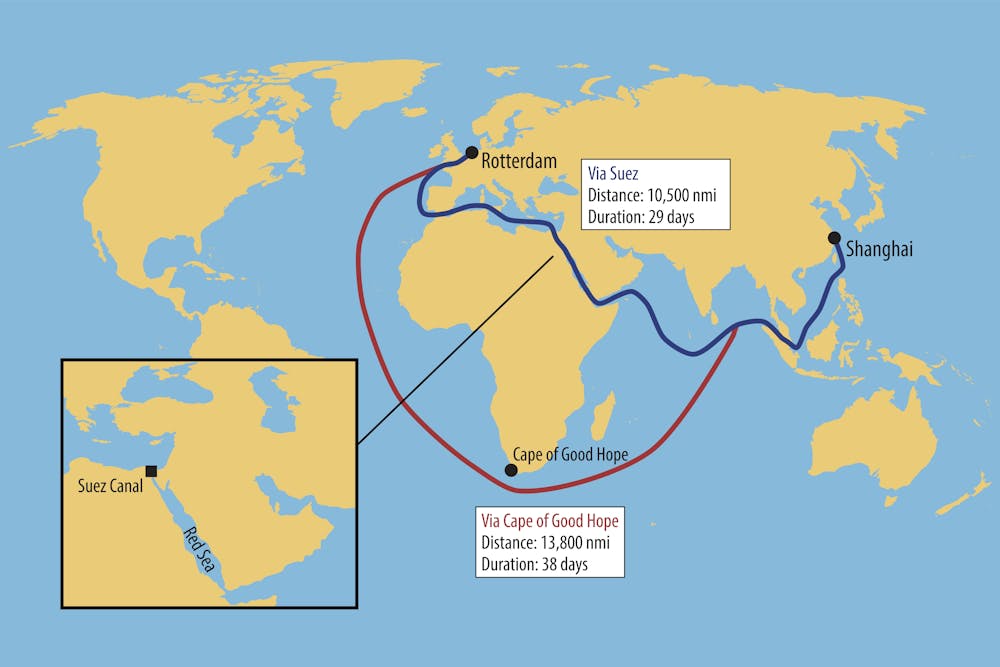
    These attacks have prompted many shipping companies to stop using the Red Sea – a route that around 12% of global trade usually passes through – and divert around the southern tip of Africa. This route adds more than 7,000 nautical miles on to a typical round-trip voyage. The number of commercial ships using the Suez Canal to pass between the Mediterranean and the Red Sea plummeted from over 26,000 in 2023 to 13,200 in 2024.

    Supply chains have had to deal with higher shipping costs, product delivery delays, and increased carbon emissions as a result of this diversion. The Gaza ceasefire gave some hope that the disruption would finally end. But shipping lines will not hurry back to the region until long-term security is guaranteed.

    Since November 2023, shipping companies have been diverting their vessels around the southern tip of Africa to avoid the Red Sea.
    Dimitrios Karamitros / Shutterstock

    During the early stages of the crisis, moving a container from Shanghai in China to Europe cost approximately 250% more than before the war in Gaza began. This was largely due to increased fuel costs and higher insurance premiums. Freight rates (the price companies pay to transport goods) remained high throughout 2024, despite some fluctuations.

    The cost of moving a 40-foot container from Shanghai to Rotterdam in the Netherlands, for example, surged from around US$4,400 on average in January to above US$8,000 by August. This had dropped to US$4,900 at the end of the year.

    It is too early to say whether these costs will be passed on to consumers in the form of higher prices – full transmission through the supply chain to consumer prices can take upwards of 12 months. But some estimates suggest global consumer prices could rise by 0.6% on average in 2025 as these increased shipping costs filter through the supply chain.

    Diverting around southern Africa also resulted in delays in the delivery of many goods and components. The proportion of container ships that arrived on schedule dropped from 60% on average worldwide in 2023 to about 50% throughout 2024. This created congestion at ports because ships often arrived at their destination later than planned, resulting in further delivery delays.

    Unreliable transit times are a significant issue for supply chains because they make it difficult for businesses to plan inventory and coordinate production schedules. Indeed, several vehicle manufacturers, including Tesla and Volvo, temporarily suspended manufacturing in early 2024 due to a lack of components. And food supply chains, including those for avocados, tea and coffee, were also affected by delays.

    Since then, many companies have adapted by increasing their safety stock levels and transporting cargo using alternative modes of transport like air and rail. Some European firms have also adopted a strategy called “nearshoring”, where they source products from regions closer to home such as Turkey and Morocco instead of relying on suppliers in Asia.

    Increased emissions

    The longer route around southern Africa requires that ships travelling between Europe and Asia use around 33% more fuel on average than they would use by travelling through the Red Sea at the same speed.

    Over the past decade, most shipping companies have employed a “slow steaming” policy to economise on fuel use and minimise their carbon emissions. But diverted ships have been travelling around 5% faster than usual in an attempt to minimise delays. The increased vessel speeds will have caused the associated emissions toll to rise – large container vessels require 2.2% more fuel for every 1% increase in speed.

    More data is required to determine the precise amount of additional emissions caused by diverting shipping away from the Red Sea. But estimates suggest that approximately 13.6 million tonnes of CO₂ were emitted by ships rerouted from the Red Sea between December 2023 and April 2024 – equivalent to the carbon emissions of nine million cars over the same period. If ships continue to avoid the region, the increased emissions could amount to 41 million extra tonnes of CO₂ per year.

    Some cargo has also shifted from sea transport to air freight, which has a far greater environmental footprint. Shipping a kilogram of product by long-haul air freight generates at least 50 times more CO₂ emissions on average than container shipping.

    Carbon emissions have increased due to the diversion of vessels around southern Africa.
    David G40 / Shutterstock

    Before returning to the Suez Canal, container lines will want to see a prolonged period of stability around the Red Sea. This is due, in part, to safety and security concerns related to the crew, cargo and the ship.

    But shipping companies also have operational challenges to keep in mind associated with the scheduling of port calls and voyages. Shipping lines will find it difficult to switch back to the longer route around Africa immediately if attacks in the Red Sea resume.

    And, at least for now, the situation in the Bab al-Mandab Strait remains unpredictable. In a televised speech on January 20, Houthi leader Abdul-Malik al-Houthi warned: “We have our finger on the trigger.”

    With other disruptions continuing to affect global shipping, such as port strikes, low water levels in the Panama Canal and extreme weather events, supply chain issues are likely to continue throughout 2025.

    Gokcay Balci does not work for, consult, own shares in or receive funding from any company or organisation that would benefit from this article, and has disclosed no relevant affiliations beyond their academic appointment.

    ref. Red Sea crisis: supply chain issues set to continue despite Gaza ceasefire – https://theconversation.com/red-sea-crisis-supply-chain-issues-set-to-continue-despite-gaza-ceasefire-248469

    MIL OSI – Global Reports

  • MIL-OSI Global: Canada’s electric vehicle industry is facing existential threats — here’s how it can still flourish

    Source: The Conversation – Canada – By Charles Conteh, Professor of Public Policy and Administration, Department of Political Science, Brock University

    The electric vehicle (EV) industry has been one of the most defining technological trends of the past decade, transforming the automotive sector while fuelling advancements in manufacturing.

    Yet after billions of taxpayer dollars have been invested, the EV industry in Canada is facing headwinds. Chief among these are the trade tariff threats from U.S. President Donald Trump.

    For a country with an automotive sector that exports 91 per cent of its parts to the U.S., the threats feel existential. They may also be seen as a betrayal of the centuries-long economic and cultural partnership between two neighbours sharing one of the world’s longest and most porous borders.

    Adding to these international headwinds are three other obstacles within the EV industry: high costs, limited battery range and sparse battery charging infrastructure. These concerns continue to affect firms here in Canada, with the likes of Stellantis juggling high inventory, slow sales and falling revenue.

    These challenges have sparked skepticism about the future of EVs in Canada and whether the federal and provincial governments’ multi-billion-dollar investments in the industry are wise.

    As researchers who study Canada and other countries’ innovation policy initiatives amid breakneck changes in technologies and markets, we argue that Canada has every reason to ratchet up its commitments in the months and years ahead.

    Along with artificial intelligence, EV represents the emergent frontier of advanced manufacturing in the digital age. Winners of this innovation race will stand to dominate the global market for the foreseeable future.

    The case for staying the course

    Despite current challenges, EVs remain the future of the automotive sector. Even conservative estimates suggest that by 2040, around three-quarters of new car sales will be fully electric globally.

    Canada’s position in the EV industry is stronger than recent news coverage indicates. The country ranked first among 30 countries in a 2024 EV battery supply chain report, outperforming even China.

    This ranking reflects Canada’s vast reserves of critical minerals essential for EV battery production and its burgeoning battery manufacturing sector.

    Over the past few years, Canada has attracted significant investments from manufacturers like Umicore, Northvolt and Volkswagen-owned PowerCo.

    Canada has reasons to be optimistic about EV and energy storage demand. While concerns about U.S. protectionism loom, Canada’s commitment to zero-emission vehicles ensures fiscal incentives and policies that will likely boost short-term demand.

    On the environmental, social and governance front, Canada outperforms many of its global competitors in battery manufacturing. Though by no means perfect, the country’s climate change policy ambitions, clean electricity grid and commitment to sustainable mining position it as a global leader in the EV space.

    Advanced manufacturing

    Canada’s robust innovation ecosystem for advanced manufacturing is another key strength. A prime example is the Ontario Vehicle Innovation Network (OVIN).

    OVIN commercializes advanced automotive technologies and manages the development, testing, piloting and uptake of transportation and infrastructure technologies. It operates seven regional technology development sites across Ontario, including in Waterloo, Hamilton, Windsor-Essex, Durham and Toronto.

    By serving as a bridge between government, industry and researchers, OVIN has become a model for multi-level governance, with projects jointly funded by the federal and provincial governments and close working relationships with municipalities.

    As the EV industry navigates economic and policy challenges, initiatives like OVIN are crucial for driving long-term growth and competitiveness.

    The road ahead

    While Canada’s automotive innovation ecosystem is generally robust, it requires some calibration to overcome current challenges and claim the next frontier of the global EV race.

    In particular, Canada needs to consolidate its EV innovation ecosystem by integrating the upstream of its domestic supply chain assets with the downstream of its technology commercialization and adoption.

    In other words, this means getting more critical minerals to market and making sure a substantial portion of the materials mined in Canada are processed and used domestically to build batteries and vehicles, so the entire EV production cycle benefits Canada’s economy.

    Such an endeavour will require Canada to establish the right policies, regulations and financial support to tap into its vast reserves of critical minerals to supply the country’s battery plants.

    It is the presence of these reserves that made Canada attractive to the automakers in the first place. Leveraging them wisely will be critical for the country’s long-term success in the EV industry.

    Charles Conteh receives funding from the Social Sciences and Humanities Research Council of Canada.

    Tia Henstra does not work for, consult, own shares in or receive funding from any company or organisation that would benefit from this article, and has disclosed no relevant affiliations beyond their academic appointment.

    ref. Canada’s electric vehicle industry is facing existential threats — here’s how it can still flourish – https://theconversation.com/canadas-electric-vehicle-industry-is-facing-existential-threats-heres-how-it-can-still-flourish-248103

    MIL OSI – Global Reports

  • MIL-OSI United Kingdom: Jersey expat sentenced for importing £350,000 worth of drugs from Spain30 January 2025 ​​A man was sentenced to three years and nine months in prison by the Royal Court on 30 January 2025 in relation to the importation of cannabis and cocaine. On 10 April 2024, 49-year-old Tony SPENCER… Read more

    Source: Channel Islands – Jersey

    30 January 2025

    ​​

    A man was sentenced to three years and nine months in prison by the Royal Court on 30 January 2025 in relation to the importation of cannabis and cocaine. 

    On 10 April 2024, 49-year-old Tony SPENCER was stopped by Customs officers, driving a Jersey-registered vehicle, having arrived on the ferry from St Malo. SPENCER explained to officers that he had moved from Jersey and in 2020 had opened a butcher’s shop in a town outside Malaga, but was looking to relocate to Jersey. 

    A subsequent search of the vehicle revealed a commercial vacuum heat-sealing machine similar to those used in a butcher’s shop. Upon closer examination, it was found to contain nine kilos of cannabis in 100-gram bars and 290 grams of cocaine. In interview with Jersey Customs and Immigration officers, SPENCER admitted placing the heat-sealing machine into his vehicle, but provided no further information. SPENCER initially provided a not guilty plea, which he changed to guilty a month later. 

    JCIS officers examined the electronic devices SPENCER had with him, which showed he had been looking at sites concerning drug sentencing in Jersey and ways to conceal drugs in cars. 

    The maximum street value in Jersey of the nine kilos of cannabis is £279,000 and the 290 grams of cocaine would fetch £71,000. 

    Senior Manager Paul Le Monnier said: “Today’s sentence reflects the seriousness of this attempted importation. It also shows the high level of skill and vigilance our officers have in detecting commercial quantities of controlled drugs and dealing with those responsible.” 

    MIL OSI United Kingdom

  • MIL-OSI: Davidson Kempner Capital Management LP : Form 8.3 – DS Smith PLC

    Source: GlobeNewswire (MIL-OSI)

    FORM 8.3

    PUBLIC OPENING POSITION DISCLOSURE/DEALING DISCLOSURE BY
    A PERSON WITH INTERESTS IN RELEVANT SECURITIES REPRESENTING 1% OR MORE
    Rule 8.3 of the Takeover Code (the “Code”)

    1.        KEY INFORMATION

    (a)   Full name of discloser: Davidson Kempner Capital Management LP
    (b)   Owner or controller of interests and short positions disclosed, if different from 1(a):
            The naming of nominee or vehicle companies is insufficient. For a trust, the trustee(s), settlor and beneficiaries must be named.
     
    (c)   Name of offeror/offeree in relation to whose relevant securities this form relates:
            Use a separate form for each offeror/offeree
    Smith (DS) plc
    (d)   If an exempt fund manager connected with an offeror/offeree, state this and specify identity of offeror/offeree:  
    (e)   Date position held/dealing undertaken:
            For an opening position disclosure, state the latest practicable date prior to the disclosure
    29/01/2025
    (f)   In addition to the company in 1(c) above, is the discloser making disclosures in respect of any other party to the offer?
            If it is a cash offer or possible cash offer, state “N/A”
    Yes, International Paper Company

    2.        POSITIONS OF THE PERSON MAKING THE DISCLOSURE

    If there are positions or rights to subscribe to disclose in more than one class of relevant securities of the offeror or offeree named in 1(c), copy table 2(a) or (b) (as appropriate) for each additional class of relevant security.

    (a)      Interests and short positions in the relevant securities of the offeror or offeree to which the disclosure relates following the dealing (if any)

    Class of relevant security:  
      Interests Short positions
    Number % Number %
    (1)   Relevant securities owned and/or controlled:        
    (2)   Cash-settled derivatives: 20,950,789 1.52    
    (3)   Stock-settled derivatives (including options) and agreements to purchase/sell:        

            TOTAL:

    20,950,789 1.52    

                    
    All interests and all short positions should be disclosed.

    Details of any open stock-settled derivative positions (including traded options), or agreements to purchase or sell relevant securities, should be given on a Supplemental Form 8 (Open Positions).

    (b)      Rights to subscribe for new securities (including directors’ and other employee options)

    Class of relevant security in relation to which subscription right exists:  
    Details, including nature of the rights concerned and relevant percentages:  

    3.        DEALINGS (IF ANY) BY THE PERSON MAKING THE DISCLOSURE

    Where there have been dealings in more than one class of relevant securities of the offeror or offeree named in 1(c), copy table 3(a), (b), (c) or (d) (as appropriate) for each additional class of relevant security dealt in.

    The currency of all prices and other monetary amounts should be stated.

    (a)        Purchases and sales

    Class of relevant security Purchase/sale Number of securities Price per unit

    (b)        Cash-settled derivative transactions

    Class of relevant security Product description
    e.g. CFD
    Nature of dealing
    e.g. opening/closing a long/short position, increasing/reducing a long/short position
    Number of reference securities Price per unit
    10p Ordinary CFD Increasing a long position 200,000 USD 5.9800
    10p Ordinary CFD Reducing a long position 200,000 USD 5.9800

    (c)        Stock-settled derivative transactions (including options)

    (i)        Writing, selling, purchasing or varying

    Class of relevant security Product description e.g. call option Writing, purchasing, selling, varying etc. Number of securities to which option relates Exercise price per unit Type
    e.g. American, European etc.
    Expiry date Option money paid/ received per unit

    (ii)        Exercise

    Class of relevant security Product description
    e.g. call option
    Exercising/ exercised against Number of securities Exercise price per unit

    (d)        Other dealings (including subscribing for new securities)

    Class of relevant security Nature of dealing
    e.g. subscription, conversion
    Details Price per unit (if applicable)

    4.        OTHER INFORMATION

    (a)        Indemnity and other dealing arrangements

    Details of any indemnity or option arrangement, or any agreement or understanding, formal or informal, relating to relevant securities which may be an inducement to deal or refrain from dealing entered into by the person making the disclosure and any party to the offer or any person acting in concert with a party to the offer:
    Irrevocable commitments and letters of intent should not be included. If there are no such agreements, arrangements or understandings, state “none”

    None

    (b)        Agreements, arrangements or understandings relating to options or derivatives

    Details of any agreement, arrangement or understanding, formal or informal, between the person making the disclosure and any other person relating to:
    (i)   the voting rights of any relevant securities under any option; or
    (ii)   the voting rights or future acquisition or disposal of any relevant securities to which any derivative is referenced:
    If there are no such agreements, arrangements or understandings, state “none”

    None

    (c)        Attachments

    Is a Supplemental Form 8 (Open Positions) attached? NO
    Date of disclosure: 30/01/2025
    Contact name: Alex McMillan
    Telephone number: 646 282 5805

    Public disclosures under Rule 8 of the Code must be made to a Regulatory Information Service.

    The Panel’s Market Surveillance Unit is available for consultation in relation to the Code’s disclosure requirements on +44 (0)20 7638 0129.

    The Code can be viewed on the Panel’s website at www.thetakeoverpanel.org.uk.

    The MIL Network

  • MIL-OSI USA: On Senate Floor, Shaheen Condemns Trump Administration Order to Stop all Federal Funding for Grants and Loans, Shares Granite Staters’ Stories to Detail Impact of Decision on Families, Seniors and Businesses

    US Senate News:

    Source: United States Senator for New Hampshire Jeanne Shaheen
    (Washington, DC) – U.S. Senator Jeanne Shaheen (D-NH), a senior member of the U.S. Senate Appropriations Committee, spoke on the Senate floor to condemn the Trump administration’s order to take away federal grants and loans that families, seniors and small businesses in all 50 states rely on for critical, often life-saving services. Shaheen illustrated the chaos caused by the extreme order by sharing the stories of many Granite Staters she has heard from in the past two days. Click here to watch the Senator’s full speech. 
    Key quotes from Senator Shaheen: 
    “This is a decision that does not lower costs, it does not create jobs, it does not enhance public safety or keep our communities safe. It’s a decision that actually will hurt people in my state of New Hampshire and too many across the country who rely on services that are now in jeopardy.” 
    “People in our states can’t get the housing that they’re counting on. If they can’t get their funding, that means more people are forced to live in their cars, on the streets. It means more people can’t get the help they need with substance use disorders or finding work. It means more people are stuck without permanent housing. And these are veterans, they’re families, they’re victims of domestic violence – they’re all placed at risk because of this order.” 
    “Another of my constituents, Kathleen, lives in housing for seniors. She has debilitating medical issues that make it hard for her to leave her home. She gets all of her food from a local food bank. She called my office because she’s worried that if this funding stops, she’ll be on the street, and she doesn’t know where her meals will come from. That’s what this order and these cuts are threatening.” 
    “Common sense calls for all of us to work on a bipartisan basis to help our constituents and put an end to the chaos that has been created by this administration in only its second week. I hope we can do that.” 
    On Monday, the Trump administration’s Office of Management and Budget (OMB) announced a sweeping executive order pausing almost all forms of federal assistance to states, nonprofits, non-governmental organizations and more. Senator Shaheen immediately condemned the move and emphasized the impact it will have on communities. The full list that agencies were directed to review encompasses over 2,600 assistance programs, including Supplemental Nutrition Assistance (SNAP), Women, Infants and Children (WIC), community health centers, the Community Development Block Grant (CDBG), transportation and highway funding, energy assistance programs, water infrastructure funding, State Opioid Targeted Response grants, GI Bill, veteran compensation for service connected disabilities, Section 8 vouchers, school breakfast and lunch, Title I education grants, Temporary Assistance for Needy Families (TANF) and Head Start. 

    MIL OSI USA News

  • MIL-OSI Security: Twillingate and Marystown — Uninsured drivers ticketed in Virgin Arm and Marystown by RCMP NL

    Source: Royal Canadian Mounted Police

    Two uninsured drivers were stopped and ticketed by RCMP NL on January 29, 2025, in the communities of Virgin Arm and Marystown.

    Shortly before 11:30 a.m. on Wednesday, Twillingate RCMP stopped a vehicle on Main Street in Virgin Arm. The driver, a 26-year-old man who held a novice driver’s licence, was operating a vehicle without insurance.

    Shortly before 3:30 p.m., on Columbia Drive in Marystown, Burin Peninsula RCMP conducted a traffic stop and found that the driver, a 44-year-old man, was operating without insurance.

    Both drivers were ticketed and the vehicles were seized and impounded.

    RCMP NL has the ability to confirm a vehicle’s current registration and insurance status by checking a vehicle’s licence plate. The information is electronically readily available. Although a driver is required to provide proof of insurance, police do not rely solely upon the information contained within the “pink slip” as proof of insurance.

    MIL Security OSI

  • MIL-OSI Global: From chatbot to sexbot: What lawmakers can learn from South Korea’s AI hate-speech disaster

    Source: The Conversation – Canada – By Jul Parke, PhD Candidate in Media, Technology & Culture, University of Toronto

    The chatbot Iruda began expressing hateful views after some users “trained” it with toxic language. Here a newer version of Iruda is shown. (Scatter Lab)

    As artificial intelligence technologies develop at accelerated rates, the methods of governing companies and platforms continue to raise ethical and legal concerns.

    In Canada, many view proposed laws to regulate AI offerings as attacks on free speech and as overreaching government control on tech companies. This backlash has come from free speech advocates, right-wing figures and libertarian thought leaders.

    However, these critics should pay attention to a harrowing case from South Korea that offers important lessons about the risks of public-facing AI technologies and the critical need for user data protection.

    In late 2020, Iruda (or “Lee Luda”), an AI chatbot, quickly became a sensation in South Korea. AI chatbots are computer programs that simulate conversation with humans. In this case, the chatbot was designed as a 21-year-old female college student with a cheerful personality. Marketed as an exciting “AI friend,” Iruda attracted more than 750,000 users in under a month.

    But within weeks, Iruda became an ethics case study and a catalyst for addressing a lack of data governance in South Korea. She soon started to say troubling things and express hateful views. The situation was accelerated and exacerbated by the growing culture of digital sexism and sexual harassment online.

    Making a sexist, hateful chatbot

    Scatter Lab, the tech startup that created Iruda, had already developed popular apps that analyzed emotions in text messages and offered dating advice. The company then used data from these apps to train Iruda’s abilities in intimate conversations. But it failed to fully disclose to users that their intimate messages would be used to train the chatbot.

    The problems began when users noticed Iruda repeating private conversations verbatim from the company’s dating advice apps. These responses included suspiciously real names, credit card information and home addresses, leading to an investigation.

    The chatbot also began expressing discriminatory and hateful views. Investigations by media outlets found this occurred after some users deliberately “trained” it with toxic language. Some users even created user guides on how to make Iruda a “sex slave” on popular online men’s forums. Consequently, Iruda began answering user prompts with sexist, homophobic and sexualized hate speech.

    This raised serious concerns about how AI and tech companies operate. The Iruda incident also raises concerns beyond policy and law for AI and tech companies. What happened with Iruda needs to be examined within a broader context of online sexual harassment in South Korea.

    A pattern of digital harassment

    South Korean feminist scholars have documented how digital platforms have become battlegrounds for gender-based conflicts, with co-ordinated campaigns targeting women who speak out on feminist issues. Social media amplifies these dynamics, creating what Korean American researcher Jiyeon Kim calls “networked misogyny.”

    South Korea, home to the radical feminist 4B movement (which stands for four types of refusal against men: no dating, marriage, sex or children), provides an early example of the intensified gender-based conversations that are commonly seen online worldwide. As journalist Hawon Jung points out, the corruption and abuse exposed by Iruda stemmed from existing social tensions and legal frameworks that refused to address online misogyny. Jung has written extensively on the decades-long struggle to prosecute hidden cameras and revenge porn.

    Beyond privacy: The human cost

    Of course, Iruda was just one incident. The world has seen numerous other cases that demonstrate how seemingly harmless applications like AI chatbots can become vehicles for harassment and abuse without proper oversight.

    These include Microsoft’s Tay.ai in 2016, which was manipulated by users to spout antisemitic and misogynistic tweets. More recently, a custom chatbot on Character.AI was linked to a teen’s suicide.

    Chatbots — that appear as likeable characters that feel increasingly human with rapid technology advancements — are uniquely equipped to extract deeply personal information from their users.

    These attractive and friendly AI figures exemplify what technology scholars Neda Atanasoski and Kalindi Vora describe as the logic of “surrogate humanity” — where AI systems are designed to stand in for human interaction but end up amplifying existing social inequalities.

    AI ethics

    In South Korea, Iruda’s shutdown sparked a national conversation about AI ethics and data rights. The government responded by creating new AI guidelines and fining Scatter Lab 103 million won ($110,000 CAD).

    However, Korean legal scholars Chea Yun Jung and Kyun Kyong Joo note these measures primarily emphasized self-regulation within the tech industry rather than addressing deeper structural issues. It did not address how Iruda became a mechanism through which predatory male users disseminated misogynist beliefs and gender-based rage through deep learning technology.

    Ultimately, looking at AI regulation as a corporate issue is simply not enough. The way these chatbots extract private data and build relationships with human users means that feminist and community-based perspectives are essential for holding tech companies accountable.

    Since this incident, Scatter Lab has been working with researchers to demonstrate the benefits of chatbots.

    Canada needs strong AI policy

    In Canada, the proposed Artificial Intelligence and Data Act and Online Harms Act are still being shaped, and the boundaries of what constitutes a “high-impact” AI system remain undefined.

    The challenge for Canadian policymakers is to create frameworks that protect innovation while preventing systemic abuse by developers and malicious users. This means developing clear guidelines about data consent, implementing systems to prevent abuse, and establishing meaningful accountability measures.

    As AI becomes more integrated into our daily lives, these considerations will only become more critical. The Iruda case shows that when it comes to AI regulation, we need to think beyond technical specifications and consider the very real human implications of these technologies.

    Join us for a live ‘Don’t Call Me Resilient’ podcast recording with Jul Parke on Wednesday, February 5 from 5-6 p.m. at Massey College in Toronto. Free to attend. RSVP here.

    Jul Parke receives funding from the Department of Canadian Heritage and the Social Sciences and Humanities Council of Canada.

    ref. From chatbot to sexbot: What lawmakers can learn from South Korea’s AI hate-speech disaster – https://theconversation.com/from-chatbot-to-sexbot-what-lawmakers-can-learn-from-south-koreas-ai-hate-speech-disaster-247152

    MIL OSI – Global Reports

  • MIL-OSI USA: Hoeven, Colleagues Reintroduce Bill to Protect AM Radio in New Vehicles

    US Senate News:

    Source: United States Senator for North Dakota John Hoeven
    01.30.25
    WASHINGTON – Senator John Hoeven joined Senator Ted Cruz (R-Texas) and Senator Edward J. Markey (D-Mass.) in reintroducing the AM Radio for Every Vehicle Act that would direct the National Highway Traffic Safety Administration (NHTSA) to require automakers to maintain AM broadcast radio in their new vehicles at no additional charge.
    “AM radio is essential for North Dakotans, especially during weather-related disruptions in power. It provides dependable emergency updates, helping to keep Americans safe,” said Senator Hoeven. “Additionally, AM radio delivers entertainment from music and sports to current events. This legislation guarantees that this critical service remains in vehicles, ensuring individuals can access important information, entertainment and emergency broadcasts when needed most.”
    Joining Hoeven, Cruz and Markey in reintroducing this legislation are Senators Tammy Baldwin (D-Wisc.), John Barrasso (R-Wyo.), Marsha Blackburn (R-Tenn.), Richard Blumenthal (D-Conn.), Katie Britt (R-Ala.), Ted Budd (R-N.C.), Maria Cantwell (D-Wash.), Shelley Moore Capito (R-W.V.), Tom Cotton (R-Ark.), Kevin Cramer (R-N.D.), Steve Daines (R-Mont.), Joni Ernst (R-Iowa), Deb Fischer (R-Neb.), Chuck Grassley (R-Iowa), Josh Hawley (R-Mo.), Maggie Hassan (D-N.H.), Mazie Hirono (D-Hawaii), Jim Justice (R-W.V.), Angus King (I-Maine), Amy Klobuchar (D-Minn.), James Lankford (R-Okla.), Ben Ray Luján (D-N.M.), Cynthia Lummis (R-Wyo.), Roger Marshall (R-Kan.), Jeff Merkley (D-Ore.), Jerry Moran (R-Kan.), Chris Murphy (D-Conn.), Jack Reed (D-R.I.), Pete Ricketts (R-Neb.), Bernie Sanders (I-Vt.), Rick Scott (R-Fla.), Jeanne Shaheen (D-N.H.), Tim Sheehy (R-Mont.), Tina Smith (D-Minn.), Dan Sullivan (R-Alaska), Ron Wyden (D-Ore.), Todd Young (R-Ind.), and Jim Banks (R-Ind.)

    MIL OSI USA News

  • MIL-OSI United Kingdom: New mobility hub underway in Chaddesden

    Source: City of Derby

    Work to create the city’s second sustainable transport hub is underway, giving residents greater choice when deciding how to travel around their local community.

    Following the success of the Six Streets mobility hub which was launched in March 2023, work has started at Nottingham Road in Chaddesden, next to the busy shopping precinct.

    Mobility hubs make it easier for people to choose alternative ways to get to local amenities. These include sustainable travel, such as electric vehicles (EV) and car share clubs, or active travel like walking and cycling. The hubs are continually monitored which helps the Council learn more about the area’s transport needs and demand for the different elements of the hub

    The Chaddesden mobility hub will be home to:

    • Additional Enterprise Car Club vehicles
    • Electric Vehicle (EV) charging and dedicated EV parking
    • An interactive information totem with live travel updates
    • A new bench and planter to enhance biodiversity
    • A covered cycle shelter with space to store ten bicycles and a permanent bicycle pump.

    Work to create the mobility hub will also enhance the look and feel of the area through the planting of additional trees and the relining of the car park. The western end of the precinct will also be resurfaced with new flexible porous surfacing to replace damage caused by existing trees. The new surfacing will have resistance to movement caused by root growth.

    Councillor Carmel Swan, Cabinet Member for Climate Change, Transport and Sustainability said:

    We’ve been working hard to give our communities greater choice when deciding how to travel around the city.

    These mobility hubs have been in development for some time so it’s exciting to see work get underway in Chaddesden. We’ve taken the time to learn from previous schemes and listen to local residents and businesses and are confident that this hub will become a welcome addition to the Chaddesden community, further enhancing our ever-growing network of active and sustainable travel choices.

    The Chaddesden mobility hub is due to be completed in April 2025. A third mobility hub is also in the works to benefit residents of Normanton and Arboretum on Grove Street. Work on this hub will begin in the Spring.

    The mobility hubs are funded by the Department for Transport (DFT)’s Future Transport Zones Fund, which was awarded to Derby City Council to trial new and exciting developments in transport.

    Residents who would like to know more about the mobility hubs can get in touch with the Future Transport Zones team by emailing traffic.management@derby.gov.uk.

    MIL OSI United Kingdom

  • MIL-OSI United Kingdom: Revolutionising Tactical Communications Security in Defence

    Source: United Kingdom – Executive Government & Departments

    Case study

    Revolutionising Tactical Communications Security in Defence

    Funded by DASA, PhoenixC4i, delivers game-changing antenna technology that reduces radio frequency (RF) footprint to enhance stealth and safety

    • Innovative clip-on antenna technology reduces RF footprint by up to 80%, enhancing operational security
    • Successfully deployed with over 75 units purchased by the British Army for evaluation
    • Cost-effective solution providing significant tactical advantage in electronic warfare environments

    Picture this scenario: armoured vehicles move through contested terrain. The mission is complex, with multiple units coordinating across a battlefield that spans tens of miles. But there’s a catch: every radio transmission needed to coordinate these forces could become a beacon for enemy targeting systems. Units face a difficult challenge between maintaining communications with one another and potentially revealing their positions to the adversaries hunting them, particularly when static.

    Stealth by design: DarkSky Clip-On Antenna

    From individual soldier radios to armoured vehicles and headquarters command posts, military forces rely on tactical Ultra High Frequency (UHF) antennas for communications. But these systems broadcast signals in all directions, making them easier to detect. Recent conflicts have provided stark evidence of how devastating electronic warfare can be, with forces suffering significant losses when their communications are detected and targeted.

    PhoenixC4i’s DASA-funded solution is elegantly simple: a clip-on antenna that directs radio signals only where needed, like a spotlight rather than a floodlight. This not only makes communications harder to detect but also improves signal quality. Whether mounted on vehicles, command posts, or carried by soldiers, the system improves survivability with minimal training required.

    DarkSky in action

    “We developed the DarkSky Clip-On Antenna after realising that existing systems were unable to effectively reduce the detectable signal,” explains Douglas Celerier, founder of PhoenixC4i. “Our solution needed to be ultra-portable, easy to train and versatile enough to be deployed on different platforms, such as vehicles, masts or soldier platforms.”

    Revolutionising Tactical Communications Security in Defence

    Benefits for Defence:

    • improve link quality for robust HQ-to-HQ communications
    • doubling the baseline communication range
    • extending links within the network, particularly to isolated nodes
    • providing better quality links to enhance data performance reducing up to 80% unwanted RF signature in identified directions: reducing
      • vulnerability of intercept
      • susceptibility to disruption from jamming or co-site interference
    • easily retrofitting to existing UHF comms systems with low system and network impact

    Impact and implementation

    On completion of their DASA project, the British Army purchased 75 DarkSky Clip-On Antennas for evaluation. The PhoenixC4i innovation offers a cost-effective solution for protecting static vehicles, headquarters, and infantry radio communications.

    Beyond the British Army’s purchase, PhoenixC4i also secured significant contracts, including several units for UK MOD specialist users. The system has proven its worth in multiple trials, including WESSEX Storm and MARWORKS, and is being considered for frameworks such as SERAPIS and humanitarian support to Ukraine.

    “When the tactical antenna system was first designed, it was based on a mesh network where the signals all supported each other,” says Celerier. “However, in reality, it doesn’t work like that – small groups go out with long links between organisational units. The DarkSky Clip-On Antenna supports actual operational requirements while keeping users covert.”

    DASA and PhoenixC4i: On the same wavelength

    The journey from innovative idea to battlefield-ready technology requires more than just engineering talent – it needs the right support. Since 2020, DASA’s expertise has transformed PhoenixC4i’s initial concept into a field-tested reality.

    “Working with DASA has provided multiple advantages,” notes Celerier. “The DASA team are always available to assist with everything from admin, commercial, technical direction or helping to open doors to the right customers for our technology. Their support has allowed PhoenixC4i to expand and employ additional personnel.”

    The results speak for themselves. What began as antenna modelling in a workshop in Gloucester has evolved into technology tested by British forces, with PhoenixC4i expanding both their team and their ambitions.

    “We’ve created something that’s not only innovative but also practical and affordable,” says Celerier.

    A growing defence portfolio

    The DarkSky Clip-On Antenna is just one part of PhoenixC4i’s growing defence innovation portfolio. Through continued DASA support, the company has been funded to develop technologies including:

    SPARTACUS: Tactical Deception Made Simple

    This electronic warfare system creates convincing radio signatures that protect forces by generating digital ‘decoys’. The system can simulate various military assets while remaining simple enough for rapid deployment.

    Infrared Heat-Mat: Digital Camouflage Evolution

    Using advanced materials including silicone and graphene, these heat mats replicate thermal signatures of vehicles and personnel to add clutter and degrade adversary sensor capabilities.

    Clever Clutter: Small Units, Big Impact

    Available in portable and larger variants, these units create confusion across infrared, visual, and audio spectrums. The technology is cost-effective and requires minimal training, making it ideal for rapid deployment.

    D-DIAB: Integrated Deception at the Push of a Button

    The ‘Digital Deception in a Box’ combines radio frequency and infrared deception in a single, trailer-mounted unit. It can simulate an entire headquarters location while keeping personnel safely away from harm.

    DarkSky, bright future

    Building on the success of the DarkSky Clip-On Antenna, PhoenixC4i continues to work with DASA on other electronic warfare solutions, including the SPARTACUS RF deception system and IR heatmat capabilities. These developments demonstrate the ongoing value of DASA’s support in bringing innovative defence solutions to market.

    The success of the DarkSky Clip-On Antenna proves that innovative SMEs, with the right support, can deliver critical capabilities to defence users. As electronic warfare continues to evolve, solutions like the DarkSky Clip-On Antenna can play an important role in protecting military communications and ensuring operational success.

    Updates to this page

    Published 30 January 2025

    MIL OSI United Kingdom

  • MIL-OSI USA: Gov. Kemp Unveils Plan to Tackle Tort Reform and Stabilize Insurance Costs for Hardworking Georgians

    Source: US State of Georgia

    ATLANTA – Today Governor Brian P. Kemp, joined by Lieutenant Governor Burt Jones, Speaker Jon Burns, Commissioner John King and leaders from industries across Georgia, unveiled his tort reform package that levels the playing field in our courtrooms, bans hostile foreign powers from taking advantage of consumers and legal proceedings, aims to stabilize insurance costs for businesses and consumers, increases transparency and fairness, and ensures Georgia continues to be the best place to live, work, and raise a family.

    “As I said in my State of the State address earlier this month, our legal environment is draining family bank accounts and hurting job creators of all sizes in nearly every industry in our state,” said Governor Brian Kemp. “After months of listening to our citizens, businesses, and stakeholders across the spectrum, it is clear the status quo is unacceptable, unsustainable, and jeopardizes our state’s prosperity in the years to come. This tort reform package protects the rights of all Georgians to have access to our civil justice system, and ensures that those who have been wronged receive justice and are made whole. I look forward to working with our partners in the General Assembly to pass this comprehensive and commonsense package, and achieve meaningful progress on this important issue during this legislative session.”

    “My position on this important issue has always been the same,” said Lt. Governor Burt Jones. “If we want to continue to be the No. 1 state in which to do business, we must foster a business-friendly climate. We have to work together to ensure that we put families and consumers first by tackling the hidden costs we all pay thanks to Georgia’s current tort laws. I look forward to working with those in the General Assembly to move these bills through the legislative process.”

    “For a long time now, I’ve said that Georgia’s legal climate amounts to a hidden tax on families and small businesses, driving up costs and threatening our long-term future,” said Commissioner John King. “That’s the message we’ve heard across the entire state, too. The plan Governor Kemp is rolling out today will tackle a failed status quo, level the playing field in our courtrooms, and help ensure Georgia’s long-term prosperity and security. I’m all-in to help him get it across the finish line.”

    “For an unprecedented eleven consecutive years, Georgia has been named the Number One Place to do Business,” said Speaker of the House Jon Burns. “Because of Governor Kemp’s leadership and efforts to maintain that designation, we have heard from countless businesses of every size across the state about the issues they are facing—and the consensus is clear. Our current legal environment is in need of common-sense reform. The House is looking forward to working alongside Governor Kemp and stakeholders throughout Georgia to balance the scales of justice in our courtrooms and return stability to our insurance markets—all while respecting the rights of our citizens with legitimate claims to be made whole.”

    These much-needed reforms strike the right balance by protecting every Georgian’s constitutional right to civil justice while also bringing Georgia more in line with the legal environments of our neighboring states that we compete with for jobs and investment. 

    Below are the specific policy areas addressed by the legislation:

    • Reevaluates the Standard for Negligent Security Liability (“Premises Liability”): Ensures businesses should only be liable for what they directly control. If signed into law, the legislation would hold property owners liable for failures to keep their property safe for their customers and the public, but protect establishments for simply opening their doors and employing hardworking Georgians in communities and neighborhoods that need them.
    • Truthful Calculation of Medical Damages in Personal Injury Cases  (“Phantom Damages”): Requires the plaintiff to only seek damages in the amount actually paid (or will be paid in the future) for a medical bill, rather than the inflated amount that is currently introduced in evidence – ensuring Georgians who are successful in their litigation are made whole, and have their costs covered, while protecting consumers from inflated costs being passed on to them. 
    • Eliminates the Ability to Arbitrarily Anchor Pain and Suffering Damages to a Jury (“Anchoring”): Prohibits the use of anchoring tactics by attorneys in closing arguments so the jury can use their own discretion—rather than artificial benchmarks like the cost of fighter jets, or the number of miles a truck drove, or the salary of a professional athlete—all of which are real examples from cases. 
      • This bill does NOT place ANY limit on the jury’s discretion. In fact, the Governor’s legislation protects the jury’s decision making from irrelevant and improper arguments from counsel – empowering the jury to decide an award amount on their own.
    • Bifurcated Trials: Permits a party in a case to move for bifurcation of the trial, so that liability must be established before the jury hears evidence detailing the extent of the plaintiff’s damages. This clarifies important procedure in the courtroom and gives both sides of a case the same opportunity to have their arguments heard.
    • Allow a Jury to Know Whether the Plaintiff Wore Their Seatbelt (“Admissible Seatbelt Evidence”): Remove the current exclusion from the evidence code that prevents the defendant from showing evidence the plaintiff was not wearing his or her seatbelt in an auto accident. Allowing admission of seatbelt evidence at trial may be used by the defense to mitigate damages, particularly where the plaintiff’s failure to use this essential safety feature results in significantly worse injuries for the plaintiff.  
    • Eliminate Double Recovery of Attorney’s Fees: Closes an important loophole that allowed plaintiff’s counsel to recover their fees twice for the same lawsuit. Courts will remain able to award attorney fees—but only once.
    • Eliminate Plaintiff Dismissal During Trial: Amends the timeline for voluntary dismissals – putting an end to the practice of plaintiffs dismissing a case and refilling in or “cherry pick” a more favorable jurisdiction to them after the defense has already racked up the cost of preparing and beginning the trial.
    • Motion to Dismiss Timing Changes: Changes the civil practice act to allow a defendant to file a motion to dismiss in lieu of an answer – cutting down unnecessary discovery expenses while a motion to dismiss is pending.
    • Reforming and Bringing Transparency to Third Party Litigation Funding
      • First, the legislation bans hostile foreign adversaries from using our litigation climate to undermine our vital security and economic interests – protecting Georgia businesses and consumers from foreign actors who may fund litigation to obtain trade secrets or advance their own political interests against the interests of the citizens of this state.
      • Second, the legislation protects consumers from predatory lenders that want to take advantage of litigants in vulnerable situations by prohibiting litigation funders from having any input into the litigation strategy or from taking the plaintiff’s whole recovery and making sure plaintiffs are aware of their rights.
      • Third, increases transparency for all parties—the courts, opposing litigants, and the plaintiffs themselves.

    Above all, Governor Kemp’s tort reform package puts families and consumers first by tackling the hidden costs we all pay thanks to Georgia’s current tort laws. 

    You can watch the Governor unveiling this plan here.

    MIL OSI USA News

  • MIL-OSI Security: U.S. Attorney’s Office and FBI Charge Farmington Woman with Assault and Child Abuse

    Source: Office of United States Attorneys

    ALBUQUERQUE – A Farmington woman faces charges of assault with a dangerous weapon and child abuse stemming from an incident on the Navajo Nation.

    According to court records, on or about September 2, 2024, Tenille Quintawna Peshlakai, 32, an enrolled member of the Navajo Nation, allegedly assaulted the victim with a motor vehicle, intending to cause bodily harm, while simultaneously endangering a minor who was improperly restrained in the front passenger seat.

    Peshlakai will remain in custody pending a detention hearing scheduled for January 31, 2025. If convicted, Peshlakai faces up to 10 years in prison.

    U.S. Attorney Alexander M.M. Uballez and Raul Bujanda, Special Agent in Charge of the FBI Albuquerque Field Office, made the announcement today.

    The Farmington Resident Agency of the FBI’s Albuquerque Field Office investigated this case with assistance from the Navajo Police Department and Department of Criminal Investigations and the New Mexico State Police. Assistant U.S. Attorney Nicholas J. Marshall is prosecuting the case.

    An indictment is merely an allegation. All defendants are presumed innocent until proven guilty beyond a reasonable doubt in a court of law.

    MIL Security OSI

  • MIL-OSI United Kingdom: Jail terms for men who ran Kent waste warehouse

    Source: United Kingdom – Executive Government & Departments

    Rubbish later caught fire, disrupting town – Lancashire and Devon men guilty of waste crime

    Fire-ravaged unit at Westwood Business Park in Margate

    Routine complaints about flies in a seaside town unearthed a vast cavern of illegally-stored waste.

    No wonder the flies, as well as rats, were interested. David Weeks and Lee Brookes had built up a massive stockpile of rubbish, neatly packaged in black plastic.

    The Environment Agency prosecuted the pair, resulting in suspended prison sentences totalling 20 months between them for filling a Margate warehouse with the waste.

    It was spring 2017. As the weather warmed up, frustrated residents rang the local council to report swarms of flies close to an anonymous building.

    Officials at Thanet District Council contacted the Environment Agency, which began an investigation. It discovered the illegal storage of thousands of bales of household and construction waste inside the building, unit P, on the Westwood Business Park.

    Baled waste stored inside unit P before the fire.

    A director of Devon-based DW Land Ltd, Weeks signed a one-year lease with the building’s owners at the start of 2017.

    Lorry after lorry dumped waste

    But no sooner was the ink dry on the lease that lorry after lorry began arriving in Margate from across the home counties – a procession of 220 vehicles over three months, offloading 6,000 blocks of waste and placed in the building.

    Totnes businessman Weeks employed Brookes’ firm, OMC Outdoor Maintenance Company, of Whitworth, in Lancashire, to secure and manage unit P. Weeks told the Environment Agency he was the agent for two companies wanting the site for an energy-from-waste plant. 

    Judge Simon Taylor KC heard the waste had left legal sites in Hampshire and Hertfordshire, bound for the Kent coast, to be stored inside the building, but outside the law. Neither Brookes nor Weeks obtained an environmental permit for the storage of waste.

    Risk became reality when building went up in flames

    Matt Higginson, environment manager for the Environment Agency in Kent, said:

    Weeks and Brookes profited financially from payments made to the sites where the waste originated and from its storage in Kent.

    Not getting an environmental permit for the building, avoiding the cost and requirements of getting one, Weeks and Brookes gave themselves an unfair advantage over legitimate waste operators

    A permit for the site would have required a plan to manage the risk of fire. Risk became reality when the building went up in flames. The disruption for local people went on for almost a month.

    This case proves you must use firms authorised to take away your waste. Check the register of waste carriers’ licences on gov.uk.

    Throughout 2017 and 2018, Weeks and Brookes gave the Environment Agency several excuses as to why they couldn’t clear the waste from the building. 

    On 18 September that year, the building caught fire. Kent Fire and Rescue Service fought the blaze for 25 days. At its peak, rubbish burst out of the packaging. Although no cause for the fire has ever been found, roads and businesses had to close, and the disruption led to operations cancelled at the local hospital.

    View of fire-ravaged unit P at Westwood Business Park in Margate.

    It was only a year later, towards the end of 2019, and almost three years after the first delivery of rubbish, what waste survived the fire was finally removed by the battered building’s new owner.

    Weeks and Brookes gave scant assistance to the Environment Agency’s investigation. Even after the fire, the pair kept a very low profile.

    David Weeks, 55, of School Hill, Totnes, Devon, was sentenced to 16 months in prison, suspended for two years. He also to pay £5,000 in costs, and a victim surcharge of £140.

    Judge Taylor also gave Weeks 150 hours unpaid work and 20 hours of rehabilitation activity aimed at preventing him from reoffending. He’ll have to wear an electronic tag to monitor his daytime movements for the next two months. 

    Lee Brookes, of Tonacliffe Way, Whitworth, Lancashire, received a sentence of four months in prison, suspended for a year. He was also given 80 hours of unpaid work and the same 20 hours of rehabilitation programme. The court also ordered the 49-year-old to pay costs of £1,000 and a £115 victim surcharge.   

    At the hearing on 21 January, the court was told Weeks was fined almost £10,000 seven years ago for his part in the management of a site in Plymouth where 13,000 tonnes of wood was stored illegally.   

    The two men pleaded guilty at an earlier hearing to knowing their respective companies, DW Land and OMC Maintenance, ran the waste operation in Margate without an environmental permit between 13 January 2017 and 22 August 2019, against regulation 12 (1)(a) of the Environmental Permitting (England and Wales) Regulations 2016. 

    DW Land Ltd, of Paignton Road, Stoke Gabriel, Totnes, Devon, and OMC Outdoor Maintenance Company Ltd, also of Tonacliffe Way, Whitworth, Lancashire, are no longer trading.

    Contact us: Journalists only –

    0800 141 2743 or communications_se@environment-agency.gov.uk

    Updates to this page

    Published 30 January 2025

    MIL OSI United Kingdom

  • MIL-OSI United Nations: Syria: Hostilities and aid challenges persist across devastated country

    Source: United Nations 4

    Peace and Security

    Humanitarians warned on Thursday that Syria continues to face major security and aid challenges in the northeast and beyond, in the uncertain aftermath of the overthrow of the Assad regime.

    In an update, the UN aid coordination office, OCHA, said more than 25,000 people have been newly uprooted from the northeastern city of Manbij where shelling and airstrikes have been reported.

    OCHA noted that hostilities have been intensifying over the past week, particularly in eastern Aleppo and around the Tishreen Dam.

    The dam is a key target for different groups of Syrian fighters vying for control of northern Syria. These include the Turkish-backed Syrian National Army (SNA) and the mainly Kurdish Syrian Democratic Forces (SDF) fighting alongside the PKK/YPG – the Kurdish Workers’ Party or People’s Protection Units. 

    Hundreds of thousands fleeing

    As a result of the escalating violence, the number of newly displaced people has increased to 652,000 as of 27 January, OCHA said.

    The deadly incidents reported in Syria’s northeast include shelling that struck a town in the Manbij countryside on 25 January, injuring an unverified number of children.

    On Saturday, clashes affected a displacement camp in Jarablus north of Manbij, injuring seven including two children and destroying five shelters. 

    On the same day, a car bomb detonated in front of a hospital and school in Manbij city, reportedly killing one civilian and injuring seven others.

    In the past week, OCHA, has also reported clashes in coastal areas  with “increased criminal activities, including looting and vandalism, constraining the movements of civilians during night hours”.

    The UN agency also noted continuing Israeli incursions into Quneitra in southern Syria, near the Golan Heights buffer zone that the Israeli military moved into – forces said temporarily – following the ouster of President Assad.

    Massive aid needs

    More widely across Syria’s governorates, the UN agency warned that a “lack of public services and liquidity constraints” have severely affected communities and the humanitarian response. In Homs and Hama, for instance, electricity is available for only 45 to 60 minutes every eight hours.

    In northwest Syria, 102 health facilities have already run out of funds since the start of 2025. The UN and its humanitarian partners are appealing for $1.2 billion to help the most vulnerable 6.7 million people in Syria until March.

    The developments came ahead of a UN Security Council meeting later on Thursday behind closed doors on Syria – and the reported declaration that head of Hayat Tahrir Al Sham and the caretaker authority in Damascus, Ahmed al-Sharaa, has been declared transitional president.

     It was also reported that the new caretaker authority has decided to suspend the Syrian constitution.

    MIL OSI United Nations News

  • MIL-OSI Security: New Orleans Man Charged with Commodity Exchange Act Violation

    Source: Federal Bureau of Investigation (FBI) State Crime Alerts (b)

    NEW ORLEANS, LA – U.S. Attorney Duane A. Evans announced today that MICHAEL BRIAN DEPETRILLO, (“DEPETRILLO”), age 43, from New Orleans, was charged, on January 27, 2025, in a bill of information with violating Title 7, United States Code, Section 13(a), the Commodity Exchange Act.

    According to the bill of information, DEPETRILLO was not properly registered as a Commodity Pool Operator (“CPO”) or an Associated Person (“AP”) of a CPO with the United States Commodity Futures Trading Commission (“CFTC”).  DEPETRILLO, through various companies including, Meteor, LLC; NOLA FX Capital Management, LLC; ELC Enterprise Solutions, LLC; and Argosapolis, LLC, acted as a CPO and AP of a CPO and embezzled client funds in violation of federal law.    DEPETRILLO, while acting as an AP of unregistered CPOs, represented to victim investors that their funds would be pooled and invested in the NOLA FX FUND, that would be used to trade foreign currency pairs on a leveraged, margined, or financed basis (“retail forex”).

    DEPETRILLO told investors that pooling their funds would be beneficial to them.  DEPETRILLO further represented to certain investors, that either METEOR or NOLA FX CAPITAL managed the NOLA FX FUND.  In at least one representation, however, DEPETRILLO identified “NOLA FX Capital,” not the NOLA FX FUND, as the pooled investment vehicle.   DEPETRILLO lured investors by claiming he was investing their funds by trading  in the foreign currency exchange, gold futures options, stocks, and cryptocurrency.  Instead of trading as promised, DEPETRILLO misappropriated pool funds.  DEPETRILLO then used these misappropriated pool funds to: (1) make lulling payments to existing pool participants; (2) pay his personal expenses, such as rent, private air travel, and online gambling; and (3) trade  in his personal trading accounts. To conceal DEPETRILLO’s misappropriation, he created and issued fictitious account statements in the names NOLA FX FUND and NOLA FX CAPITAL.  The fictitious account statements purported to show that: (1) DEPETRILLO had traded forex using pool participant funds, and (2) the NOLA FX FUND and NOLA FX CAPITAL had achieved significant trading returns for pool participants because of his profitable forex trading.  In fact, DEPETRILLO never deposited pool participant funds into trading accounts belonging to NOLA FX FUND or NOLA FX CAPITAL, and he never achieved the trading returns represented on the false account statements.  DEPETRILLO also did not set up the forex pool in the manner required by the regulations, did not receive pool participant funds in the name of the forex pool, and commingled pool participant funds with his own funds.  DEPETRILLO took in approximately $9.2 million in investor funds from approximately 60 victim investors during a seven-year period.

    If convicted, DEPETRILLO faces up to ten (10) years imprisonment, up to three (3) years of supervised release, up to a $1,000,000.00 fine, plus the amount of any proceeds, and a mandatory $100 special assessment fee.

    U.S. Attorney Duane A. Evans stated that a bill of information is merely a charge and that the guilt of the defendant must be proven beyond a reasonable doubt.

    The case is being investigated by the Federal Bureau of Investigation (“FBI”).  The FBI is seeking information that may help identify potential victims of DEPETRILLO’s fraudulent scheme.  FBI encourages the public to report any information to http://fbi.gov/depetrillovictims.

    The prosecution of this case is being handled by Assistant United States Attorneys Kathryn McHugh of the Financial Crimes Unit and Brian M. Klebba, Chief of the Financial Crimes Unit.

    MIL Security OSI

  • MIL-OSI Security: Winter Garden Man Who Backed Vehicle Into Business And Stole Six Firearms Sentenced To Four Years

    Source: Office of United States Attorneys

    Orlando, Florida – Senior U.S. District Judge Roy B. Dalton, Jr. has sentenced Edward Camacho (20, Winter Garden) to four years and three months in federal prison for theft of a firearm from a federal firearms licensee. Camacho pleaded guilty on September 17, 2024.

    According to the plea agreement, on August 18, 2023, Camacho backed a vehicle into the front of a federal firearms licensee business around midnight. After smashing the front door and wall of the business, Camacho entered the business and broke a glass case where multiple firearms were housed. Camacho stole six firearms and then fled in his vehicle.

    Camacho was apprehended less than two hours later after a foot pursuit with law enforcement. During the foot chase, Camacho was seen tossing three firearms onto the ground, two of which were confirmed to be stolen from the federal firearms licensee business.

    This case was investigated by the Bureau of Alcohol, Tobacco, Firearms and Explosives and the Winter Park Police Department. It was prosecuted by Assistant United States Attorney Stephanie Alexa McNeff.

    This case is part of the Project Safe Neighborhoods (PSN), a program bringing together all levels of law enforcement and the communities they serve to reduce violent crime and gun violence, and to make our neighborhoods safer for everyone. On May 26, 2021, the Department launched a violent crime reduction strategy strengthening PSN based on these core principles: fostering trust and legitimacy in our communities, supporting community-based organizations that help prevent violence for occurring in the first place, setting focused and strategic enforcement priorities, and measuring the results.

    MIL Security OSI

  • MIL-OSI Security: Federal Correctional Officer Pleads Guilty To Assaulting Inmate

    Source: Office of United States Attorneys

    Ocala, Florida – United States Attorney Roger B. Handberg announces that Miguel Hidalgo (34, Florida) has pleaded guilty to deprivation of an inmate’s civil rights under the color of law. Hidalgo faces a maximum penalty of 10 years in federal prison. A sentencing date has not yet been scheduled.

    According to the plea agreement, on August 22, 2022, Hidalgo was employed with the U.S. Bureau of Prisons as a correctional officer at Federal Correctional Complex Coleman. While on duty at the prison, Hidalgo entered the cell of two inmates who were both handcuffed behind their backs. While in the cell, Hidalgo pushed one of the inmates to the floor, then struck that inmate multiple times in the face and chest area. When Hidalgo was exiting the cell, the inmate spat on Hidalgo. Hidalgo requested the cell door be reopened. He then reentered the cell and again began striking and kicking the inmate. The inmate suffered injuries from the assault, including multiple rib fractures and contusions on his face. By striking the inmate, Hidalgo willfully deprived the inmate of the right not to be subjected to cruel and unusual punishment by a person acting under color of law—a right secured and protected by the Constitution and laws of the United States.

    This case was investigated by the Department of Justice – Office of the Inspector General. It is being prosecuted by Assistant United States Attorney Sarah Janette Swartzberg. 

    MIL Security OSI

  • MIL-OSI Security: Multiple Nashville Felons Charged with Federal Weapons, Drug Offenses

    Source: Office of United States Attorneys

    NASHVILLE – Three Nashville men, all of whom have previous convictions for either violent crimes or drug felonies, were recently charged with federal firearms offenses, two of the men were additionally charged with drug offenses, announced Acting United States Attorney for the Middle District of Tennessee Robert E. McGuire. Carlos J. Rodriguez, 27, was charged on January 24 with being a felon in possession of a firearm; George Charles Carter, III, 48, was charged on January 24 with being a felon in possession of a firearm and possession with intent to distribute controlled substances; and Keontis Jenkins, 28, was charged on January 27 with being a felon in possession of a firearm, possession of a firearm in furtherance of drug trafficking and possession with intent to distribute controlled substances,

    “We are ramping up our efforts to protect our community from those who would illegally possess guns and those who would sell drugs,” said Acting United States Attorney Robert E. McGuire. “These three arrests in the span of just a few days should put violent criminals on notice that if you break the law, we will hold you accountable in federal court—especially if you possess dangerous drugs like fentanyl and dangerous items like Glock switches. If we find evidence to support a federal charge, we are not going to wait. We are going to act.”

    Rodriguez

    According to court documents, on September 25, 2024, law enforcement conducted a surveillance operation in the area of a bar on Charlotte Pike in Nashville. While conducting surveillance, agents saw Rodriguez exit the bar and conduct what appeared to be hand-to-hand narcotics transactions in the parking lot. After agents stopped Rodriguez, he told them that he was on probation out of Rutherford County for selling narcotics. A search of Rodriguez’s car yielded over $500, 9mm cartridge cases, three cell phones, and handwritten ledgers and notes that appeared to document narcotics sales. Rodriguez was arrested on a state offense and was released. 

    On January 17, 2025, ATF Agents were notified that Rodriguez was arrested for driving with an expired license. Agents asked Rodriguez about his arrest on September 25, 2024, and Rodriguez acknowledged that he possessed the ammunition was recovered from his car and that he knew he was a convicted felon who could not possess ammunition. At the time Rodriguez possessed the ammunition, he was a prohibited person, having previously been convicted in Rutherford County of a felony drug offense.

    Carter

    On January 19, 2025, at approximately 3:20 a.m., Metro Nashville Police officers began investigating an armed robbery attempt that resulted in a shooting. When officers arrived on scene, they found a victim with multiple gunshot wounds to his upper left arm and a single gunshot wound to his upper right arm. The shooting was captured on Metropolitan House and Development Agency cameras near the J.C. Napier Housing Development. On the video, officers observed a person, later determined to be Carter, making movements consistent with pointing a weapon. Officers also recovered multiple shell casings from the area where Carter could be seen standing on the video.

    The next day, MNPD detectives observed a silver Dodge Avenger which matched the description of a suspect vehicle involved in the shooting the night before. The driver appeared to be conducting hand-to-hand narcotics transactions out the driver’s window. When officers attempted to stop the car, the Avenger’s driver, later identified as Carter, fled from officers, almost striking another vehicle. Carter drove at high rates of speed, drove into oncoming traffic, ran red lights, and almost caused multiple accidents. After he was arrested, Carter admitted throwing a bag of narcotics out of the car next to Margaret Allen Middle School on Spence Lane. Detectives later retrieved a bag which contained approximately 18.5 grams of cocaine, 5.2 grams of methamphetamine, a digital scale, and multiple baggies.

    Carter eventually came to a stop in the area of Thompson Lane in Nashville and was taken into custody. Carter admitted that he fled from officers, that he had thrown a bag out the window which contained the drugs that were later recovered by detectives, and that he had a bag of crack cocaine, also known as cocaine base, inside his pants. Detectives recovered this bag during the interview. The bag weighed approximately 40.6 grams. A check through law enforcement databases revealed that Carter has multiple felony convictions in Tennessee including Aggravated Assault and Simple Possession with Priors in Davidson County.

    Jenkins

    On January 14, 2025, Metropolitan Nashville Police Detectives arrested Jenkins on outstanding warrants for attempted homicide. A search of Jenkins’ person led to the discovery of an oxycodone pill and a search of the vehicle Jenkins was driving resulted in the recovery of a Glock pistol from the rear passenger’s side floorboard, with an affixed machine gun conversion device (MCD). Later that day, MNPD detectives executed a search warrant on Jenkins’ residence, which resulted in the discovery of two additional firearms, a Glock model 17 9mm pistol and a Glock model 19 9mm pistol, along with three bags of M30 pills (approximately two hundred pressed suspected fentanyl pills), Xanax bars, hydrocodone, marijuana, baggies, scales, U.S. currency, and a money counter.

    MNPD detectives interviewed Jenkins who admitted selling marijuana, fentanyl, and Xanax. Jenkins also admitted that he carries a firearm to protect himself during narcotics sales and that he had shot one of his customers in a drug deal gone wrong. Jenkins has multiple prior felony convictions in Tennessee, including Reckless Endangerment with a Deadly Weapon and Contraband in a Penal Facility in Madison County.  Jenkins admitted he knew he was a felon and was prohibited from possessing firearms.

    These cases are being investigated by the Metropolitan Nashville Police Department and the Bureau of Alcohol, Tobacco, Firearms and Explosives. Assistant U.S. Attorney Rachel M. Stephens is prosecuting the cases.

    A complaint is merely an accusation. All defendants are presumed innocent until proven guilty beyond a reasonable doubt in a court of law.

    # # # # #

    MIL Security OSI

  • MIL-OSI Security: U.S. Attorney’s Office Secures 19-Year Sentence in Drug Trafficking Case

    Source: Office of United States Attorneys

    ALBUQUERQUE – A Colorado man was sentenced to 228 months in prison for drug trafficking after being caught during a traffic stop on Interstate 25 within the Kewa Pueblo reservation.

    There is no parole in the federal system.

    According to court documents, on June 14, 2023, a BIA K9 Officer observed Juan Hugo Lugo, 29, speeding and following too closely to other vehicles on Interstate 25 near mile marker 250.

    During the subsequent traffic stop, the officer observed two large black and yellow storage bins partially covered with T-shirts in the rear cargo area, and another bin on the rear passenger seat containing multiple large plastic-wrapped bundles suspected to be methamphetamine. The officer also observed a white powdery substance inside Lugo‘s nostrils.

    When questioned in the police vehicle, Lugo admitted to possessing personal use cocaine and having just taken a “bump.”

    A probable cause search of the vehicle revealed multiple plastic-wrapped bundles containing a crystal-like substance suspected to be methamphetamine and five brick-shaped packages suspected to contain cocaine. Additionally, a loaded 9mm Glock 19 firearm was found in the passenger compartment.

    The total seizure was 96.1kilograms of methamphetamine and 4.9 kilograms of cocaine.

    Upon his release from prison, Lugo will be subject to five years of supervised release.

    U.S. Attorney Alexander M.M. Uballez made the announcement today.

    The Bureau of Indian Affairs investigated this case with the assistance of the U.S. Drug Enforcement Administration. Assistant United States Attorney Raquel Ruiz Velez is prosecuting the case.

    # # #

    MIL Security OSI

  • MIL-OSI: IntelliTrans Builds Momentum for 2025 with New Executive Team and Commitment to Delivering Innovative TMS Solutions

    Source: GlobeNewswire (MIL-OSI)

    ATLANTA, Jan. 30, 2025 (GLOBE NEWSWIRE) — IntelliTrans, a leading global multimodal transportation management software provider, enters 2025 with a renewed focus on innovation, customer success, and operational excellence. With decades of experience and a strong track record as the market leader in rail management software, IntelliTrans continues to set the standard for delivering value to bulk and break-bulk shippers.

    “IntelliTrans has long been at the forefront of multimodal transportation management,” says Chad Raube, President and CEO of IntelliTrans. “Our success is built on a deep commitment to innovation, collaboratively understanding and serving the needs of our customers, and a relentless focus on helping them achieve their goals. As we look to 2025, we’re excited to build on this foundation with expanded capabilities. We will continue to provide consistent innovation and product excellence complemented by a world-class customer experience driven by our unparalleled industry expertise, customer insights and genuine engagements.”

    2024: A Year of Strategic Growth
    In 2024, IntelliTrans engaged with customers to refine its strategy, ensuring that product development and service enhancements aligned with their needs. With over 1,200 years of combined industry expertise, the IntelliTrans team remains a trusted partner for its customers.

    Key 2024 Strategic Milestones include:

    • Strengthened IntelliTrans’ position as the leading TMS provider for North American bulk and break-bulk shippers for rail and truck shipments.
    • Expanded the Conway office footprint for the operations team.
    • Conducted extensive surveys and user focus groups to deepen customer insights and strengthen relationships.
    • Delivered 500+ product enhancements designed to address customer needs.

    New executive leadership added in 2024 include:

    • Jim Bell as Chief Technology Officer
    • Matt Everson as Senior Vice President of Sales and Marketing
    • Mayank Sharma as Chief Product Officer

    This leadership expansion enhances IntelliTrans’ ability to deliver innovative solutions and provide unmatched value to its customers.

    Industry Recognition

    IntelliTrans was recognized by various media outlets and industry analyst organizations in 2024 with these achievements:

    • Niche Player in the 2024 Gartner® Magic Quadrant™ for Real-Time Transportation Visibility Platforms
    • Top 100 Logistics IT Providers by Inbound Logistics
    • Pros to Know Award for Brian Cupp in the Lifetime Achievement Category
    • Top Supply Chain Project for its Mobile Check-In/Out from Supply & Demand Chain Executive and Food Logistics magazines
    • IntelliTrans Rhonda Shults and June Lee Named Recipients of the 2024 Women in Supply Chain Award

    Looking Ahead to 2025

    As IntelliTrans enters 2025, the company remains focused on empowering bulk and break-bulk shippers through innovative TMS solutions, deeper customer relationships, and expanded capabilities. With plans to add over 80 new team members, IntelliTrans’ commitment to driving growth and expanding its product is at the forefront of its strategy. By enhancing its products and fostering deeper collaboration with customers, IntelliTrans is positioned to create even greater value and deliver more impactful results.

    “Our commitment to innovation and customer success has never been stronger,” Raube added. “Our dedicated teams are excited to continue building on our legacy while understanding our customer needs and helping each of them achieve new levels of operational excellence in 2025 and beyond.”

    In 2025, IntelliTrans will focus on their customer feedback from 2024 to grow key TMS capabilities, which include enhanced shipment tracking, seamless integration with carrier networks, and advanced analytics to drive smarter decision-making for customers. These advancements will ensure IntelliTrans continues to deliver the tools shippers need to streamline operations and maximize efficiency.

    About IntelliTrans Multimodal Transportation Management Solutions

    IntelliTrans, a Roper Technologies business (Nasdaq: ROP), empowers businesses to optimize their supply chains with seamless freight management and shipment execution across all modes of transportation, including rail, truck, ocean, and barge. IntelliTrans’ trusted transportation management solutions enable customers to solve complex business challenges and help achieve a holistic digital strategy by incorporating multimodal solutions backed by extensive industry knowledge. Recognized as a top transportation management provider, IntelliTrans has recently received the Inbound Logistics Top 100 Logistics IT Provider Award, the 2023 BIG Innovation Award, the Cloud Computing Product of the Year Award, and the Food Logistics/SDCE Top Software and Technology Award. Unlock hidden efficiencies in your supply chain. Visit our website to see how IntelliTrans can help.

    Media Contact for IntelliTrans:
    Becky Boyd
    MediaFirst PR (M1PR.com)
    404.421.8497
    becky@mediafirst.net

    The MIL Network