Category: Weather

  • MIL-OSI Europe: Written question – Global Gateway and support for regional connectivity in Central Asia – E-001927/2025

    Source: European Parliament

    Question for written answer  E-001927/2025
    to the Commission
    Rule 144
    Thierry Mariani (PfE)

    Today, Central Asia is at the heart of the geo-economic recomposition between Europe and Asia, and regional connectivity is an essential lever for stability, trade integration and energy resilience.

    Against this backdrop, the President of the European Commission announced on 4 April 2025, at the inauguration of the Samarkand Climate Forum, that a further EUR 12 billion would be made available under the Global Gateway initiative.

    Can the Commission give details of the new regional projects envisaged, particularly with regard to regional connectivity, transport infrastructure, energy and transnational digital networks between the countries of Central Asia?

    Submitted: 14.5.2025

    Last updated: 23 May 2025

    MIL OSI Europe News

  • MIL-OSI USA: Following illegal Senate vote, California and 10 other states launch Affordable Clean Cars Coalition

    Source: US State of California 2

    May 23, 2025

    What you need to know: California is helping launch an 11-state coalition that will work together to sustain the transition to affordable clean cars.

    SACRAMENTO – Governor Gavin Newsom announced today that California would join an 11-state coalition to advance clean cars. This follows yesterday’s illegal vote in the U.S. Senate to attempt to revoke California’s authority to set its own clean air standards. 

    The Affordable Clean Cars Coalition — led by the U.S. Climate Alliance — will sustain America’s transition to cleaner and more affordable cars, support U.S. automotive manufacturers and workers, and preserve states’ clean air authority.

    Participating states include: California, Colorado, Delaware, Massachusetts, Maryland, New Jersey, New Mexico, New York, Oregon, Rhode Island, and Washington.  

    The federal government and Congress are putting polluters over people and creating needless chaos for consumers and the market, but our commitment to safeguarding Americans’ fundamental right to clean air is resolute.

    We will continue collaborating as states and leveraging our longstanding authority under the Clean Air Act, including through state programs that keep communities safe from pollution, create good-paying jobs, increase consumer choice, and help Americans access cleaner and more affordable cars.

    As we consider next steps for our clean vehicle programs, our states will engage stakeholders and industry to provide the regulatory certainty needed while redoubling our efforts to build a cleaner and healthier future.

    Governors Gavin Newsom, Jared Polis (CO), Matt Meyer (DE), Maura Healey (MA), Wes Moore (MD), Phil Murphy (NJ), Michelle Lujan Grisham (NM), Kathy Hochul (NY), Tina Kotek (OR), Dan McKee (RI), and Bob Ferguson (WA)

    States participating in the coalition will work together to develop solutions that make cleaner vehicles more affordable and accessible to all Americans who want them, including by reducing cost barriers, increasing availability of options, and expanding accessible charging and fueling infrastructure. They will also defend their longstanding authority under the Clean Air Act to adopt transportation solutions and explore options for next-generation standards.  

    The U.S. Climate Alliance is a bipartisan coalition of 24 governors representing approximately 60% of the U.S. economy and 55% of the U.S. population.

    California’s climate leadership

    Pollution is down and the economy is up. Greenhouse gas emissions in California are down 20% since 2000 – even as the state’s GDP increased 78% in that same time period.

    The state continues to set clean energy records. Last year, California ran on 100% clean electricity for the equivalent of 51 days – with the grid running on 100% clean energy for some period two out of every three days. Since the beginning of the Newsom Administration, battery storage is up to over 15,000 megawatts – a 1,900%+ increase.

    Press releases, Recent news

    Recent news

    News SACRAMENTO – Governor Gavin Newsom today announced the following appointments:Tala Khalaf, of San Carlos, has been appointed to the Physical Therapy Board of California. Khalaf has been a Senior Physical Therapist at the Stanford Orthopedic and Sports Medicine…

    News What you need to know: The state today began restoring shallow water habitats in the Salton Sea as part of California’s first major habitat restoration project in the region – a key step for improving local wildlife conditions and suppressing dust to improve air…

    News What you need to know: Governor Newsom announced California will fight the U.S. Senate’s illegal vote aiming to undo key parts of the state’s clean vehicles program in court. SACRAMENTO – Governor Gavin Newsom and Attorney General Rob Bonta announced today the…

    MIL OSI USA News

  • MIL-OSI USA: 2 Days Left To Apply for FEMA Assistance Following February Severe Storms and Flooding

    Source: US Federal Emergency Management Agency

    Headline: 2 Days Left To Apply for FEMA Assistance Following February Severe Storms and Flooding

    2 Days Left To Apply for FEMA Assistance Following February Severe Storms and Flooding

    FRANKFORT, Ky

    – Homeowners and renters in Breathitt, Clay, Estill, Floyd, Harlan, Johnson, Knott, Lee, Leslie, Letcher, Martin, Owsley, Perry, Pike, Simpson and Woodford counties who experienced damage or losses caused by the February severe storms and floods have 2 days to apply for federal disaster assistance

    The deadline to apply for federal assistance is May 25

     Survivors of the April storms still have until June 25 to Apply

    How To Apply for FEMA AssistanceThere are several ways to apply for FEMA assistance:Online at DisasterAssistance

    gov

    Visit any Disaster Recovery Center

    To find a center close to you, visit fema

    gov/DRC, or text DRC along with your Zip Code to 43362 (Example: “DRC 29169”)

    Use the FEMA mobile app

    Call the FEMA Helpline at 800-621-3362

    It is open 7 a

    m

    to 10 p

    m

    Eastern Time

    Help is available in many languages

    If you use a relay service, such as Video Relay Service (VRS), captioned telephone or other service, give FEMA your number for that service

    FEMA works with every household on a case-by-case basis

    A current phone number where you can be contacted

    Your address at the time of the disaster and the address where you are now staying

    Your Social Security Number

    A general list of damage and losses

    Banking information if you choose direct deposit

     If insured, the policy number or the agent and/or the company name

    FEMA representatives can explain available assistance programs, how to apply to FEMA, and help connect survivors with resources for their recovery needs

    When you apply, you will need to provide:Survivors should keep their contact information updated with FEMA as the agency may need to call to schedule a home inspection or get additional information

     Disaster assistance is not a substitute for insurance and is not intended to compensate for all losses caused by a disaster

    The assistance is intended to meet basic needs and supplement disaster recovery efforts

     Homeowners and renters in Woodford County may be eligible for federal assistance, if you had property damage or loss in Woodford County from the February severe incident, and then again from the April severe incident, you would need to complete two separate disaster assistance applications

    For an accessible video on how to apply for FEMA assistance, go to youtube

    com/watch?v=WZGpWI2RCNw

     For more information about Kentucky flooding recovery, visit www

    fema

    gov/disaster/4860

    Follow the FEMA Region 4 X account at x

    com/femaregion4

    martyce

    allenjr
    Fri, 05/23/2025 – 14:38

    MIL OSI USA News

  • MIL-OSI USA: 3 Days Left To Apply for FEMA Assistance Following February Severe Storms and Flooding

    Source: US Federal Emergency Management Agency

    Headline: 3 Days Left To Apply for FEMA Assistance Following February Severe Storms and Flooding

    3 Days Left To Apply for FEMA Assistance Following February Severe Storms and Flooding

    FRANKFORT, Ky

    – Homeowners and renters in Breathitt, Clay, Estill, Floyd, Harlan, Johnson, Knott, Lee, Leslie, Letcher, Martin, Owsley, Perry, Pike, Simpson and Woodford counties who experienced damage or losses caused by the February severe storms and floods have 3 days to apply for federal disaster assistance

    The deadline to apply for federal assistance is May 25

      Survivors of the April storms still have until June 25 to Apply

    How To Apply for FEMA AssistanceThere are several ways to apply for FEMA assistance:Online at DisasterAssistance

    gov

    Visit any Disaster Recovery Center

    To find a center close to you, visit fema

    gov/DRC, or text DRC along with your Zip Code to 43362 (Example: “DRC 29169”)

    Use the FEMA mobile app

    Call the FEMA Helpline at 800-621-3362

    It is open 7 a

    m

    to 10 p

    m

    Eastern Time

    Help is available in many languages

    If you use a relay service, such as Video Relay Service (VRS), captioned telephone or other service, give FEMA your number for that service

    FEMA works with every household on a case-by-case basis

    A current phone number where you can be contacted

    Your address at the time of the disaster and the address where you are now staying

    Your Social Security Number

    A general list of damage and losses

    Banking information if you choose direct deposit

     If insured, the policy number or the agent and/or the company name

    FEMA representatives can explain available assistance programs, how to apply to FEMA, and help connect survivors with resources for their recovery needs

    When you apply, you will need to provide:Survivors should keep their contact information updated with FEMA as the agency may need to call to schedule a home inspection or get additional information

     Disaster assistance is not a substitute for insurance and is not intended to compensate for all losses caused by a disaster

    The assistance is intended to meet basic needs and supplement disaster recovery efforts

     Homeowners and renters in Woodford County may be eligible for federal assistance, if you had property damage or loss in Woodford County from the February severe incident, and then again from the April severe incident, you would need to complete two separate disaster assistance applications

    For an accessible video on how to apply for FEMA assistance, go to youtube

    com/watch?v=WZGpWI2RCNw

     For more information about Kentucky flooding recovery, visit www

    fema

    gov/disaster/4860

    Follow the FEMA Region 4 X account at x

    com/femaregion4

    martyce

    allenjr
    Fri, 05/23/2025 – 12:22

    MIL OSI USA News

  • MIL-OSI Security: Convicted Sex Offender Indicted for Child Pornography Distribution

    Source: Office of United States Attorneys

    Richard G. Frohling, Acting United States Attorney for the Eastern District of Wisconsin, announced that on May 13, 2025, a federal grand jury indicted Randy Smith (age: 46) of Kenosha, Wisconsin, on two counts of distribution of child pornography in violation of Title 18, United States Code, Section 2252A(a)(2)(A).  

    The indictment alleges that on November 13, 2023, and again between approximately August 1, 2024, and August 5, 2024, Smith knowingly distributed child pornography using a means and facility of interstate and foreign commerce, that had been mailed, shipped, and transported in and affecting interstate and foreign commerce, and which contained material that have been shipped and transported by a means and facility of  interstate and foreign commerce, including by computer. Court records indicate that at the time of his offenses, Smith was a previously convicted sex offender.

    If convicted of either of the distribution charges, Smith faces a mandatory minimum of 15 years’ imprisonment and a maximum of 40 years’ imprisonment on each count. He also faces up to a $250,000 fine on each of the counts.

    This case was brought as part of Project Safe Childhood, a nationwide initiative to combat the growing epidemic of child sexual exploitation and abuse launched in May 2006, by the U.S. Department of Justice. Led by U.S. Attorneys’ Offices and the Child Exploitation and Obscenity Section (CEOS), Project Safe Childhood marshals federal, state and local resources to better locate, apprehend and prosecute individuals who exploit children via the Internet, as well as to identify and rescue victims. For more information about Project Safe Childhood, please visit www.projectsafechildhood.gov.

    This case was investigated by the Kenosha Police Department, the Racine Police Department and Homeland Security Investigations (HSI) in Milwaukee.  It will be prosecuted by Assistant United States Attorney Megan J. Paulson.  

    An indictment is only a charge and is not evidence of guilt.  The defendant is presumed innocent and is entitled to a fair trial at which the government must prove him guilty beyond a reasonable doubt.     

    # # #

    For Additional Information Contact:

    Public Information Officer

    Kenneth.Gales@usdoj.gov

    414-297-1700

    Follow us on Twitter

    MIL Security OSI

  • MIL-OSI USA: Senator Marshall Thanks President Trump for Delivering Kansas Relief Aid After Severe Storms

    US Senate News:

    Source: United States Senator for Kansas Roger Marshall

    Washington – U.S. Senator Roger Marshall, M.D. (R-Kansas) today released the following statement after President Donald Trump granted the state of Kansas’ request for a Major Disaster Declaration, triggering the release of federal resources that will help communities in Kansas recover from the severe winter storms, straight-line winds, flooding, and wildfires that swept through the state March 14 – 19, 2025.
    Following the storms, Senator Marshall led a letter from Republican members of the Kansas federal delegation asking President Trump to grant the Sunflower State’s Major Disaster Declaration request.
    “I can’t thank President Trump and his team enough for swiftly stepping up for Kansans in a time of great need,” Senator Marshall said. “Local governments and utility providers will now be empowered with federal resources as they respond to the devastation left by these storms. To all those impacted, please know my office and I stand ready to assist in any way we can.”
    The following counties are now eligible for public assistance:
    Barton, Chautauqua, Edwards, Elk, Ellis, Gove, Graham, Gray, Greeley, Hodgeman, Jewell, Lincoln, Logan, Ness, Norton, Osborne, Pawnee, Phillips, Rice, Rooks, Rush, Russell, Sheridan, Sherman, Smith, Stafford, Wallace, and Woodson.
    Background:

    From March 14 – 19, 2025, Kansas was impacted by two back-to-back, strong, mid-latitude cyclone storm systems that moved through the state. The systems brought strong winds, low humidity, blowing dust, and blizzard conditions. According to the National Weather Service, the near-record low pressure in one of the systems measured close to the pressure found in a category 1 hurricane.
    On May 21, 2025, President Trump granted a Major Disaster Declaration for the State of Kansas.
    Due to President Trump’s leadership, local governments and public utility providers will now be eligible to submit storm-related expenses to the Federal Emergency Management Agency (FEMA) for reimbursement.

    MIL OSI USA News

  • MIL-OSI Russia: Dmitry Patrushev took part in the XI Nevsky International Ecological Congress

    Translation. Region: Russian Federal

    Source: Government of the Russian Federation – An important disclaimer is at the bottom of this article.

    Previous news Next news

    Dmitry Patrushev took part in the XI Nevsky International Ecological Congress

    Deputy Prime Minister of the Russian Federation Dmitry Patrushev took part in the events of the XI Nevsky International Ecological Congress. After the plenary session, together with the Chairperson of the Federation Council Valentina Matviyenko and colleagues from foreign countries, Dmitry Patrushev planted a tree as part of the “Garden of Memory” campaign.

    “We pay great attention to forest restoration. In 2025, Russia plans to restore forests on an area of over 1.3 million hectares. This work is being carried out within the framework of a separate federal project of the national project “Ecological Well-being”. Volunteers – participants in environmental campaigns also contribute to it every year. Thus, the traditional environmental and patriotic campaign “Garden of Memory” is held throughout the country and abroad. It is dedicated to the memory of those who died during the Great Patriotic War. Such events, among other things, contribute to environmental education, preservation and transmission of historical memory of the exploits of our heroes to the younger generation. Over the five years of the campaign, millions of volunteers from 78 countries of the world have joined in planting memorial gardens, who, through joint efforts, have planted over 130 million memorial trees,” said Dmitry Patrushev.

    On the sidelines of the Nevsky International Ecological Congress, Dmitry Patrushev held two international meetings – with the Vice President of the Islamic Republic of Iran, head of the Environmental Protection Organization Shina Ansari and the representative of the President of the Republic of Azerbaijan on climate issues Mukhtar Babayev. Russia works with both countries within the framework of the Tehran Convention for the Protection of the Marine Environment of the Caspian Sea.

    Russia and Iran are actively strengthening ties in the field of environmental conservation. There are two working groups: on water management and on ecology. The two countries also continue to work together to restore the population of the Persian leopard. In 2016, the first two individuals, transferred by the Iranian side, were released into the wild. Currently, 12 leopards live in the wild in the Russian part of the Caucasus. Dmitry Patrushev invited his Iranian colleagues to visit the Leopard Restoration Center in Sochi.

    At a meeting with the representative of the President of the Republic of Azerbaijan on climate issues Mukhtar Babayev, the main topic was the shallowing of the Caspian Sea. Last year, a Russian-Azerbaijani working group was formed on this issue. Russia and Azerbaijan agreed to develop a joint program to solve this problem. Dmitry Patrushev said that it is planned to approve it this year.

    The Deputy Prime Minister also drew attention to the need to form a common regulatory framework for interaction between Russia and Azerbaijan in the field of environmental protection.

    Please note: This information is raw content directly from the source of the information. It is exactly what the source states and does not reflect the position of MIL-OSI or its clients.

    MIL OSI Russia News

  • MIL-OSI Europe: Minutes – Thursday, 22 May 2025 – Brussels – Final edition

    Source: European Parliament

    PV-10-2025-05-22

    EN

    EN

    iPlPv_Sit

    Minutes
    Thursday, 22 May 2025 – Brussels

     Abbreviations and symbols

    + adopted
    rejected
    lapsed
    W withdrawn
    RCV roll-call votes
    EV electronic vote
    SEC secret ballot
    split split vote
    sep separate vote
    am amendment
    CA compromise amendment
    CP corresponding part
    D deleting amendment
    = identical amendments
    § paragraph

    IN THE CHAIR: Antonella SBERNA
    Vice-President

    1. Opening of the sitting

    The sitting opened at 09:00.


    2. Choose Europe for Science (debate)

    Council and Commission statements: Choose Europe for Science (2025/2713(RSP))

    Ekaterina Zaharieva (Member of the Commission) made the statement on behalf of the Commission.

    The following spoke: Christian Ehler, on behalf of the PPE Group, Giorgio Gori, on behalf of the S&D Group, Catherine Griset, on behalf of the PfE Group, Piotr Müller, on behalf of the ECR Group, Valérie Hayer, on behalf of the Renew Group, Anna Strolenberg, on behalf of the Verts/ALE Group, Ilaria Salis, on behalf of The Left Group, Marc Jongen, on behalf of the ESN Group, Letizia Moratti, Lina Gálvez, Annamária Vicsek, Marion Maréchal, Christophe Grudler, Vladimir Prebilič, Catarina Martins, Zsuzsanna Borvendég, Diana Iovanovici Şoşoacă, Angelika Niebler, Sofie Eriksson, Jana Nagyová, Diego Solier, Oihane Agirregoitia Martínez, Anthony Smith, Hélder Sousa Silva, who also answered a blue-card question from João Oliveira, Bruno Gonçalves, who also answered a blue-card question from João Oliveira, Kris Van Dijck, Jüri Ratas, Elena Sancho Murillo and Eszter Lakos.

    The following spoke under the catch-the-eye procedure: Liudas Mažylis, Vytenis Povilas Andriukaitis and Sebastian Tynkkynen.

    IN THE CHAIR: Victor NEGRESCU
    Vice-President

    The following spoke under the catch-the-eye procedure: Helmut Brandstätter, João Oliveira and Lukas Sieper.

    The following spoke: Ekaterina Zaharieva.

    The debate closed.


    3. Deliberations of the Committee on Petitions in 2023 (debate)

    Report on the deliberations of the Committee on Petitions in 2023 [2025/2027(INI)] – Committee on Petitions. Rapporteur: Gheorghe Falcă (A10-0063/2025)

    Peter Agius (deputising for the rapporteur) introduced the report.

    The following spoke: Glenn Micallef (Member of the Commission).

    The following spoke: Rosa Estaràs Ferragut, on behalf of the PPE Group, Sandra Gómez López, on behalf of the S&D Group, Pál Szekeres, on behalf of the PfE Group, Kosma Złotowski, on behalf of the ECR Group, Jana Toom, on behalf of the Renew Group, Ana Miranda Paz, on behalf of the Verts/ALE Group, Marcin Sypniewski, on behalf of the ESN Group, Maria Walsh and Mireia Borrás Pabón.

    The following spoke under the catch-the-eye procedure: Elena Nevado del Campo, Juan Fernando López Aguilar, Sebastian Tynkkynen, Petras Gražulis, Maria Zacharia and Lefteris Nikolaou-Alavanos.

    The following spoke: Glenn Micallef and Peter Agius.

    The debate closed.

    Vote: 22 May 2025.

    (The sitting was suspended at 10:45.)


    IN THE CHAIR: Pina PICIERNO
    Vice-President

    4. Resumption of the sitting

    The sitting resumed at 11:01.

    The following spoke: Patryk Jaki.


    5. Voting time

    For detailed results of the votes, see also ‘Results of votes’ and ‘Results of roll-call votes’.


    5.1. Amending Regulation (EU) No 228/2013 as regards additional assistance and further flexibility to outermost regions affected by severe natural disasters and in the context of cyclone Chido devastating Mayotte ***I (vote)

    Proposal for a Regulation of the European Parliament and of the Council amending Regulation (EU) No 228/2013 as regards additional assistance and further flexibility to outermost regions affected by severe natural disasters and in the context of cyclone Chido devastating Mayotte (COM(2025)0190 – C10-0071/2025 – 2025/0104(COD)) – Committee on Agriculture and Rural Development

    REQUEST FOR AN URGENT DECISION by the AGRI Committee (Rule 170(6))

    Approved

    Vote: at a later part-session.

    Detailed voting results


    5.2. Amending Regulation (EU) 2023/956 as regards simplifying and strengthening the carbon border adjustment mechanism ***I (vote)

    Report on the proposal for a regulation of the European Parliament and of the Council amending Regulation (EU) 2023/956 as regards simplifying and strengthening the carbon border adjustment mechanism [COM(2025)0087 – C10-0035/2025 – 2025/0039(COD)] – Committee on the Environment, Climate and Food Safety. Rapporteur: Antonio Decaro (A10-0085/2025)

    The debate had taken place on 21 May 2025 (minutes of 21.5.2025, item 15).

    (Majority of the votes cast)

    COMMISSION PROPOSAL and AMENDMENTS

    Approved (P10_TA(2025)0108)

    REQUEST FOR REFERRAL BACK TO COMMITTEE

    Approved

    The following had spoken:

    Antonio Decaro (rapporteur), after the vote on the Commission proposal, to request that the matter be referred back to the committee responsible, for interinstitutional negotiations in accordance with Rule 60(4).

    Detailed voting results


    5.3. Modification of customs duties applicable to imports of certain goods originating in or exported from the Russian Federation and the Republic of Belarus ***I (vote)

    Report on the proposal for a regulation of the European Parliament and of the Council on the modification of customs duties applicable to imports of certain goods originating in or exported directly or indirectly from the Russian Federation and the Republic of Belarus [COM(2025)0034 – C10-0006/2025 – 2025/0021(COD)] – Committee on International Trade. Rapporteur: Inese Vaidere (A10-0087/2025)

    (Majority of the votes cast)

    COMMISSION PROPOSAL and AMENDMENTS

    Approved (P10_TA(2025)0109)

    Parliament’s first reading thus closed.

    The following had spoken:

    – Before the vote, Inese Vaidere (rapporteur), to make a statement on the basis of Rule 165(4).

    – Before the vote, Glenn Micallef (Member of the Commission), to make a statement.

    Detailed voting results


    5.4. Granting equivalence to Moldova and Ukraine for field inspections and seed production ***I (vote)

    Report on the proposal for a decision of the European Parliament and of the Council amending Council Decision 2003/17/EC as regards the equivalence of field inspections carried out in the Republic of Moldova on fodder plant seed-producing crops and on the equivalence of fodder plant seed produced in the Republic of Moldova, and as regards the equivalence of field inspections carried out in Ukraine on beet seed-producing crops and oil plant seed-producing crops and on the equivalence of beet seed and oil plant seed produced in Ukraine [COM(2024)0052 – C9-0026/2024 – 2024/0027(COD)] – Committee on Agriculture and Rural Development. Rapporteur: Veronika Vrecionová (A10-0043/2025)

    (Majority of the votes cast)

    PROPOSAL TO REJECT THE COMMISSION PROPOSAL

    Rejected

    COMMISSION PROPOSAL and AMENDMENTS

    Approved (P10_TA(2025)0110)

    Parliament’s first reading thus closed.

    Detailed voting results


    5.5. Amendments to the Capital Requirements Regulation as regards securities financing transactions under the net stable funding ratio ***I (vote)

    Amendments to Regulation (EU) No 575/2013 on prudential requirements for credit institutions as regards requirements for securities financing transactions under the net stable funding ratio (COM(2025)0146 – C10-0059/2025 – 2025/0077(COD)) – Committee on Economic and Monetary Affairs

    (Majority of the votes cast)

    PROPOSAL TO REJECT THE COMMISSION PROPOSAL

    Rejected

    COMMISSION PROPOSAL and AMENDMENTS

    Approved (P10_TA(2025)0111)

    Parliament’s first reading thus closed.

    Detailed voting results


    5.6. Euratom Research and Training Programme for the period 2026-2027 complementing Horizon Europe * (vote)

    Report on the proposal for a Council regulation establishing the Research and Training Programme of the European Atomic Energy Community for the period 2026-2027 complementing Horizon Europe – the Framework Programme for Research and Innovation and repealing Council Regulation (Euratom) 2021/765 [COM(2025)0060 – C10-0052/2025 – 2025/0035(NLE)] – Committee on Industry, Research and Energy. Rapporteur: Borys Budka (A10-0083/2025)

    (Majority of the votes cast)

    COMMISSION PROPOSAL TO THE COUNCIL

    Approved by single vote (P10_TA(2025)0112)

    Detailed voting results


    5.7. Partial renewal of Members of the Court of Auditors – HR nominee (vote)

    Report on the nomination of Ivana Maletić as a Member of the Court of Auditors [06874/2025 – C10-0049/2025 – 2025/0802(NLE)] – Committee on Budgetary Control. Rapporteur: Ondřej Knotek (A10-0088/2025)

    (Majority of the votes cast)
    (Secret ballot (Rule 133(3)))

    APPOINTMENT OF IVANA MALETIĆ

    Approved (P10_TA(2025)0113)

    The list of Members voting is annexed to these minutes (minutes of 22.5.2025 Annex 1).

    Detailed voting results


    5.8. Deliberations of the Committee on Petitions in 2023 (vote)

    Report on the deliberations of the Committee on Petitions in 2023 [2025/2027(INI)] – Committee on Petitions. Rapporteur: Gheorghe Falcă (A10-0063/2025)

    (Majority of the votes cast)

    MOTION FOR A RESOLUTION

    Adopted (P10_TA(2025)0114)

    The following had spoken:

    Fabienne Keller, to move an oral amendment to paragraph 35. Parliament had not agreed to put the oral amendment to the vote as more than 39 Members had opposed it.

    Detailed voting results

    8

    (The sitting was suspended for a few moments.)


    6. Resumption of the sitting

    The sitting resumed at 11:42.


    7. Explanations of vote


    7.1. Amending Regulation (EU) 2023/956 as regards simplifying and strengthening the carbon border adjustment mechanism (A10-0085/2025 – Antonio Decaro) (oral explanations of vote)

    Jadwiga Wiśniewska


    7.2. Written explanations of vote

    Explanations of vote submitted in writing under Rule 201 appear on the Members’ pages on Parliament’s website.


    8. Approval of the minutes of the part-session and forwarding of texts adopted

    In accordance with Rule 208(3), the minutes of that day’s sitting and those of the previous day’s sitting would be put to the House for approval at the start of the next sitting.

    With Parliament’s agreement, the texts adopted during the part-session would be forwarded to their respective addressees without delay.


    9. Dates of the next part-session

    The next part-session would be held from 16 June 2025 to 19 June 2025.


    10. Closure of the sitting

    The sitting closed at 11:46.


    11. Adjournment of the session

    The session of the European Parliament was adjourned.

    Alessandro Chiocchetti

    Roberta Metsola

    Secretary-General

    President


    LIST OF DOCUMENTS SERVING AS A BASIS FOR THE DEBATES AND DECISIONS OF PARLIAMENT


    I. Transfers of appropriations and budgetary decisions

    In accordance with Article 29 of the Financial Regulation, the Committee on Budgets had decided to approve transfer of appropriations INF1/2025 – Section VI – European Economic and Social Committee.

    In accordance with Article 29 of the Financial Regulation, the Committee on Budgets had decided to approve transfer of appropriations No 2/2025 – Section IX – European Data Protection Supervisor.

    In accordance with Article 31(6) of the Financial Regulation, the Committee on Budgets had decided to approve the Commission’s transfer of appropriations DEC 05/2025 – Section III – Commission.

    In accordance with Article 31(6) of the Financial Regulation, the Council of the European Union had decided to approve the Commission’s transfer of appropriations DEC 05/2025 – Section III – Commission.


    ATTENDANCE REGISTER

    Present:

    Abadía Jover Maravillas, Adamowicz Magdalena, Aftias Georgios, Agirregoitia Martínez Oihane, Agius Saliba Alex, Allione Grégory, Al-Sahlani Abir, Anadiotis Nikolaos, Anderson Christine, Andersson Li, Andrews Barry, Andriukaitis Vytenis Povilas, Androuët Mathilde, Angel Marc, Annemans Gerolf, Antoci Giuseppe, Arias Echeverría Pablo, Arimont Pascal, Arłukowicz Bartosz, Arnaoutoglou Sakis, Arndt Anja, Arvanitis Konstantinos, Asens Llodrà Jaume, Assis Francisco, Aubry Manon, Auštrevičius Petras, Azmani Malik, Bajada Thomas, Ballarín Cereza Laura, Bardella Jordan, Barley Katarina, Barrena Arza Pernando, Bartulica Stephen Nikola, Bartůšek Nikola, Bay Nicolas, Bay Christophe, Beleris Fredis, Bellamy François-Xavier, Benea Dragoş, Benifei Brando, Beňová Monika, Berendsen Tom, Berger Stefan, Berlato Sergio, Bernhuber Alexander, Biedroń Robert, Bielan Adam, Bischoff Gabriele, Blinkevičiūtė Vilija, Blom Rachel, Bloss Michael, Bocheński Tobiasz, Bogdan Ioan-Rareş, Bonaccini Stefano, Bonte Barbara, Borchia Paolo, Borrás Pabón Mireia, Borvendég Zsuzsanna, Boßdorf Irmhild, Bosse Stine, Botenga Marc, Boyer Gilles, Brandstätter Helmut, Brasier-Clain Marie-Luce, Brejza Krzysztof, Brudziński Joachim Stanisław, Bryłka Anna, Buchheit Markus, Buczek Tomasz, Buda Daniel, Buda Waldemar, Budka Borys, Bugalho Sebastião, Buła Andrzej, Bullmann Udo, Camara Mélissa, Canfin Pascal, Carberry Nina, Carême Damien, Casa David, Caspary Daniel, Cassart Benoit, Cavazzini Anna, Ceulemans Estelle, Chahim Mohammed, Chaibi Leila, Chastel Olivier, Chinnici Caterina, Christensen Asger, Ciccioli Carlo, Cifrová Ostrihoňová Veronika, Clausen Per, Corrado Annalisa, Costanzo Vivien, Cotrim De Figueiredo João, Cremer Tobias, Crespo Díaz Carmen, Cristea Andi, Crosetto Giovanni, Cunha Paulo, Dahl Henrik, Danielsson Johan, Dauchy Marie, Dávid Dóra, David Ivan, Decaro Antonio, de la Hoz Quintano Raúl, Della Valle Danilo, Deloge Valérie, De Masi Fabio, De Meo Salvatore, Demirel Özlem, Dibrani Adnan, Diepeveen Ton, Dieringer Elisabeth, Di Rupo Elio, Disdier Mélanie, Dobrev Klára, Doleschal Christian, Dömötör Csaba, Do Nascimento Cabral Paulo, Donazzan Elena, Dorfmann Herbert, Dostalova Klara, Dostál Ondřej, Droese Siegbert Frank, Düpont Lena, Dworczyk Michał, Ecke Matthias, Ehler Christian, Eriksson Sofie, Erixon Dick, Estaràs Ferragut Rosa, Everding Sebastian, Ezcurra Almansa Alma, Falcă Gheorghe, Farantouris Nikolas, Farreng Laurence, Farský Jan, Ferber Markus, Ferenc Viktória, Fidanza Carlo, Fiocchi Pietro, Firmenich Ruth, Flanagan Luke Ming, Fourlas Loucas, Fourreau Emma, Fragkos Emmanouil, Freund Daniel, Frigout Anne-Sophie, Fritzon Heléne, Froelich Tomasz, Fuglsang Niels, Funchion Kathleen, Furet Angéline, Gahler Michael, Gál Kinga, Galán Estrella, Gálvez Lina, Gambino Alberico, García Hermida-Van Der Walle Raquel, Geadi Geadis, Gedin Hanna, Geese Alexandra, Geier Jens, Geisel Thomas, Gemma Chiara, Georgiou Giorgos, Gerbrandy Gerben-Jan, Germain Jean-Marc, Gerzsenyi Gabriella, Gieseke Jens, Giménez Larraz Borja, Glück Andreas, Goerens Charles, Gomart Christophe, Gomes Isilda, Gómez López Sandra, Gonçalves Bruno, Gonçalves Sérgio, González Casares Nicolás, González Pons Esteban, Gori Giorgio, Gosiewska Małgorzata, Gotink Dirk, Gozi Sandro, Gregorová Markéta, Grims Branko, Griset Catherine, Groothuis Bart, Grossmann Elisabeth, Grudler Christophe, Gualmini Elisabetta, Guetta Bernard, Győri Enikő, Gyürk András, Hadjipantela Michalis, Hahn Svenja, Haider Roman, Halicki Andrzej, Hansen Niels Flemming, Hassan Rima, Hauser Gerald, Häusling Martin, Hava Mircea-Gheorghe, Heide Hannes, Heinäluoma Eero, Henriksson Anna-Maja, Herbst Niclas, Herranz García Esther, Hetman Krzysztof, Hojsík Martin, Holmgren Pär, Homs Ginel Alicia, Humberto Sérgio, Ijabs Ivars, Imart Céline, Incir Evin, Inselvini Paolo, Iovanovici Şoşoacă Diana, Jalloul Muro Hana, Jamet France, Jarubas Adam, Jerković Romana, Jongen Marc, Joński Dariusz, Joron Virginie, Joveva Irena, Juknevičienė Rasa, Junco García Nora, Jungbluth Alexander, Kabilov Taner, Kalfon François, Kaljurand Marina, Kalniete Sandra, Kamiński Mariusz, Kanev Radan, Kanko Assita, Karlsbro Karin, Kartheiser Fernand, Karvašová Ľubica, Katainen Elsi, Kefalogiannis Emmanouil, Kelleher Billy, Keller Fabienne, Kelly Seán, Kennes Rudi, Khan Mary, Kircher Sophia, Knafo Sarah, Knotek Ondřej, Kobosko Michał, Köhler Stefan, Kohut Łukasz, Kokalari Arba, Kolář Ondřej, Kols Rihards, Konečná Kateřina, Kopacz Ewa, Kovařík Ondřej, Kovatchev Andrey, Krištopans Vilis, Krutílek Ondřej, Kubín Tomáš, Kuhnke Alice, Kulmuni Katri, Kyllönen Merja, Kyuchyuk Ilhan, Lagodinsky Sergey, Lakos Eszter, Lalucq Aurore, Langensiepen Katrin, Laššáková Judita, László András, Laureti Camilla, Laykova Rada, Lazarov Ilia, Lazarus Luis-Vicențiu, Lenaers Jeroen, Liese Peter, Lins Norbert, Løkkegaard Morten, Lopatka Reinhold, López Javi, López Aguilar Juan Fernando, López-Istúriz White Antonio, Lövin Isabella, Lucano Mimmo, Luena César, Łukacijewska Elżbieta Katarzyna, Lupo Giuseppe, McAllister David, Maestre Cristina, Magoni Lara, Maij Marit, Maląg Marlena, Manda Claudiu, Mandl Lukas, Maniatis Yannis, Mantovani Mario, Maran Pierfrancesco, Marczułajtis-Walczak Jagna, Maréchal Marion, Mariani Thierry, Marino Ignazio Roberto, Marquardt Erik, Martín Frías Jorge, Martins Catarina, Martusciello Fulvio, Marzà Ibáñez Vicent, Mato Gabriel, Matthieu Sara, Mavrides Costas, Maydell Eva, Mayer Georg, Mazurek Milan, Mažylis Liudas, McNamara Michael, Mebarek Nora, Meleti Eleonora, Mendia Idoia, Mertens Verena, Mesure Marina, Metsola Roberta, Metz Tilly, Mikser Sven, Millán Mon Francisco José, Minchev Nikola, Miranda Paz Ana, Molnár Csaba, Montero Irene, Montserrat Dolors, Morace Carolina, Morano Nadine, Moratti Letizia, Moreira de Sá Tiago, Moreno Sánchez Javier, Moretti Alessandra, Motreanu Dan-Ştefan, Mularczyk Arkadiusz, Müller Piotr, Mureşan Siegfried, Muşoiu Ştefan, Nagyová Jana, Navarrete Rojas Fernando, Negrescu Victor, Nerudová Danuše, Nesci Denis, Neuhoff Hans, Neumann Hannah, Nevado del Campo Elena, Niebler Angelika, Niedermayer Luděk, Niinistö Ville, Nikolaou-Alavanos Lefteris, Nikolic Aleksandar, Ní Mhurchú Cynthia, Noichl Maria, Nordqvist Rasmus, Novakov Andrey, Nykiel Mirosława, Ódor Ľudovít, Oetjen Jan-Christoph, Oliveira João, Olivier Philippe, Omarjee Younous, Ondruš Branislav, Ozdoba Jacek, Paet Urmas, Pajín Leire, Palmisano Valentina, Papadakis Kostas, Papandreou Nikos, Pascual de la Parte Nicolás, Patriciello Aldo, Paulus Jutta, Pedro Ana Miguel, Pedulla’ Gaetano, Pellerin-Carlin Thomas, Peltier Guillaume, Penkova Tsvetelina, Pennelle Gilles, Pereira Lídia, Pérez Alvise, Peter-Hansen Kira Marie, Picaro Michele, Picierno Pina, Picula Tonino, Piera Pascale, Pietikäinen Sirpa, Pimpie Pierre, de la Pisa Carrión Margarita, Polato Daniele, Polfjärd Jessica, Pozņaks Reinis, Prebilič Vladimir, Princi Giusi, Protas Jacek, Pürner Friedrich, Rackete Carola, Radev Emil, Radtke Dennis, Rafowicz Emma, Ratas Jüri, Razza Ruggero, Rechagneux Julie, Regner Evelyn, Repasi René, Repp Sabrina, Ressler Karlo, Reuten Thijs, Riba i Giner Diana, Ridel Chloé, Riehl Nela, Ripa Manuela, Rodrigues André, Ros Sempere Marcos, Roth Neveďalová Katarína, Rougé André, Ruissen Bert-Jan, Rzońca Bogdan, Saeidi Arash, Salini Massimiliano, Salis Ilaria, Salla Aura, Sánchez Amor Nacho, Sanchez Julien, Sancho Murillo Elena, Saramo Jussi, Sardone Silvia, Šarec Marjan, Sargiacomo Eric, Satouri Mounir, Saudargas Paulius, Sberna Antonella, Schaldemose Christel, Schaller-Baross Ernő, Scheuring-Wielgus Joanna, Schieder Andreas, Schilling Lena, Schnurrbusch Volker, Schwab Andreas, Seekatz Ralf, Sell Alexander, Serrano Sierra Rosa, Sidl Günther, Sieper Lukas, Singer Christine, Sinkevičius Virginijus, Sippel Birgit, Sjöstedt Jonas, Śmiszek Krzysztof, Smith Anthony, Smit Sander, Sokol Tomislav, Solier Diego, Solís Pérez Susana, Sommen Liesbet, Sorel Malika, Sousa Silva Hélder, Søvndal Villy, Squarta Marco, Stancanelli Raffaele, Steger Petra, Stier Davor Ivo, Storm Kristoffer, Stoyanov Stanislav, Strada Cecilia, Streit Joachim, Strik Tineke, Strolenberg Anna, Sturdza Şerban Dimitrie, Stürgkh Anna, Sypniewski Marcin, Szekeres Pál, Szydło Beata, Tamburrano Dario, Tânger Corrêa António, Tarquinio Marco, Târziu Claudiu-Richard, Tavares Carla, Tegethoff Kai, Temido Marta, Teodorescu Georgiana, Terheş Cristian, Ter Laak Ingeborg, Terras Riho, Tertsch Hermann, Thionnet Pierre-Romain, Timgren Beatrice, Tinagli Irene, Tobback Bruno, Tobé Tomas, Tolassy Rody, Tomašič Zala, Tomaszewski Waldemar, Tomc Romana, Tonin Matej, Toom Jana, Toussaint Marie, Tovaglieri Isabella, Toveri Pekka, Tridico Pasquale, Trochu Laurence, Tsiodras Dimitris, Tudose Mihai, Tynkkynen Sebastian, Uhrík Milan, Ušakovs Nils, Vaidere Inese, Valchev Ivaylo, Vălean Adina, Valet Matthieu, Van Brempt Kathleen, Van Brug Anouk, Vandendriessche Tom, Van Dijck Kris, Van Leeuwen Jessika, Vannacci Roberto, Van Sparrentak Kim, Varaut Alexandre, Vasconcelos Ana, Vautmans Hilde, Vedrenne Marie-Pierre, Ventola Francesco, Verougstraete Yvan, Veryga Aurelijus, Vicsek Annamária, Vieira Catarina, Vigenin Kristian, Vilimsky Harald, Vincze Loránt, Vistisen Anders, Vivaldini Mariateresa, Volgin Petar, von der Schulenburg Michael, Vondra Alexandr, Voss Axel, Vrecionová Veronika, Vázquez Lázara Adrián, Waitz Thomas, Walsh Maria, Walsmann Marion, Warborn Jörgen, Warnke Jan-Peter, Wąsik Maciej, Wawrykiewicz Michał, Wcisło Marta, Weimers Charlie, Werbrouck Séverine, Wiesner Emma, Wiezik Michal, Winkler Iuliu, Winzig Angelika, Wiseler-Lima Isabel, Wiśniewska Jadwiga, Yar Lucia, Yon-Courtin Stéphanie, Zacharia Maria, Zajączkowska-Hernik Ewa, Zalewska Anna, Žalimas Dainius, Zan Alessandro, Zarzalejos Javier, Zdechovský Tomáš, Zdrojewski Bogdan Andrzej, Zijlstra Auke, Złotowski Kosma, Zoido Álvarez Juan Ignacio, Zver Milan

    Excused:

    Berg Sibylle, Burkhardt Delara, Hazekamp Anja


    ANNEX 1 – Partial renewal of Members of the Court of Auditors – HR nominee

    MEMBERS VOTING IN THE SECRET BALLOT

    ECR:
    Bartulica, Bay Nicolas, Berlato, Bielan, Bocheński, Brudziński, Cavedagna, Ciccioli, Ciriani, Crosetto, Donazzan, Dworczyk, Erixon, Fidanza, Fiocchi, Gambino, Geadi, Gemma, Gosiewska, Inselvini, Jaki, Junco García, Kamiński, Kanko, Kartheiser, Kols, Krutílek, Magoni, Maląg, Mantovani, Maréchal, Mularczyk, Müller, Nesci, Ozdoba, Peltier, Picaro, Polato, Pozņaks, Razza, Ruissen, Rzońca, Sberna, Solier, Squarta, Storm, Sturdza, Szydło, Târziu, Teodorescu, Terheş,Timgren, Tomaszewski, Torselli, Trochu, Tynkkynen, Valchev, Van Dijck, Ventola, Veryga, Vivaldini, Vondra, Vrecionová, Wąsik, Weimers, Wiśniewska, Zalewska, Złotowski

    ESN:
    Anderson, Arndt, Aust, Borvendég, Boßdorf, Buchheit, David, Droese, Froelich, Gražulis, Jongen, Jungbluth, Knafo, Laykova, Mazurek, Neuhoff, Schnurrbusch, Sell, Stoyanov, Sypniewski, Tyszka, Uhrík, Volgin, Zajączkowska-Hernik

    NI:
    Beňová, Braun, De Masi, Dostál, Firmenich, Iovanovici Şoşoacă, Kabilov, Konečná, Laššáková, Lazarus, Nikolaou-Alavanos, Ondruš, Panayiotou, Papadakis, Pérez, Pürner, Roth Neveďalová, Sieper, Sorel, von der Schulenburg, Warnke, Yoncheva, Zacharia

    PPE:
    Abadía Jover, Adamowicz, Aftias, Agius, Arias Echeverría, Arimont, Arłukowicz, Beleris, Bellamy, Bentele, Berendsen, Berger, Bernhuber, Bogdan, Brejza, Buda Daniel, Budka, Bugalho, Buła, Carberry, Casa, Caspary, Chinnici, Crespo Díaz, Cunha, Dahl, Dávid, de la Hoz Quintano, De Meo, Doherty, Doleschal, Do Nascimento Cabral, Dorfmann, Düpont, Ehler, Estaràs Ferragut, Ezcurra Almansa, Falcă, Falcone, Farský, Ferber, Gahler, Gasiuk-Pihowicz, Gerzsenyi, Geuking, Gieseke, Giménez Larraz, Gomart, González Pons, Gotink, Grims, Hadjipantela, Halicki, Hansen, Hava, Herbst, Herranz García, Hetman, Hohlmeier, Humberto, Imart, Jarubas, Joński, Juknevičienė, Kalniete, Kanev, Kefalogiannis, Kelly, Kircher, Köhler, Kohut, Kokalari, Kolář, Kopacz, Kovatchev, Kulja, Lakos, Lazarov, Lenaers, Liese, Lins, Lopatka, López-Istúriz White, Łukacijewska, McAllister, Mandl, Marczułajtis-Walczak, Mato, Maydell, Mažylis, Mertens, Millán Mon, Morano, Moratti, Motreanu, Mureşan, Navarrete Rojas, Nerudová, Nevado del Campo, Niebler, Niedermayer, Novakov, Nykiel, Pascual de la Parte, Pedro, Pereira, Pietikäinen, Polfjärd, Princi, Protas, Radev, Radtke, Ratas, Ressler, Ripa, Salini, Saudargas, Schneider, Schwab, Seekatz, Sienkiewicz, Smit, Sokol, Solís Pérez, Sommen, Sousa Silva, Stier, Szczerba, Ter Laak, Terras, Tobé, Tomašič, Tomc, Tonin, Toveri, Tsiodras, Vaidere, Vălean, Van Leeuwen, Vincze, Voss, Vázquez Lázara, Walsh, Walsmann, Warborn, Wawrykiewicz, Wcisło, Weber, Winkler, Winzig, Wiseler-Lima, Zdechovský, Zdrojewski, Zoido Álvarez, Zver

    PfE:
    Androuët, Annemans, Bardella, Bartůšek, Bay Christophe, Blom, Bonte, Borchia, Borrás Pabón, Brasier-Clain, Bryłka, Buczek, Ceccardi, Dauchy, Deloge, Diepeveen, Dieringer, Disdier, Dömötör, Dostalova, Ferenc, Frigout, Furet, Gál, Girauta Vidal, Griset, Győri, Gyürk, Haider, Hauser, Jamet, Joron, Knotek, Kovařík, Krištopans, Kubín, László, Leonardelli, Mariani, Martín Frías, Mayer, Moreira de Sá, Nagyová, Nikolic, Olivier, Patriciello, Pennelle, Piera, Pimpie, de la Pisa Carrión, Rechagneux, Rougé, Sanchez, Sardone, Schaller-Baross, Steger, Szekeres, Tânger Corrêa, Tertsch, Thionnet, Tolassy, Tovaglieri, Valet, Vandendriessche, Vannacci, Varaut, Vicsek, Vilimsky, Vistisen, Werbrouck, Zijlstra

    Renew:
    Agirregoitia Martínez, Allione, Al-Sahlani, Andrews, Auštrevičius, Azmani, Bosse, Boyer, Brandstätter, Canfin, Cassart, Chastel, Christensen, Cifrová Ostrihoňová, Cotrim De Figueiredo, Cowen, Devaux, Farreng, García Hermida-Van Der Walle, Gerbrandy, Glück, Goerens, Gozi, Groothuis, Grudler, Guetta, Hahn, Hayer, Henriksson, Hojsík, Ijabs, Joveva, Karlsbro, Karvašová, Katainen, Kelleher, Keller, Kulmuni, Kyuchyuk, Løkkegaard, McNamara, Minchev, Ní Mhurchú, Ódor, Oetjen, Paet, Šarec, Singer, Streit, Stürgkh, Toom, Van Brug, van den Berg, Vasconcelos, Vautmans, Vedrenne, Verougstraete, Wiesner, Wiezik, Wilmès, Yar, Yon-Courtin, Žalimas

    S&D:
    Agius Saliba, Andriukaitis, Angel, Assis, Bajada, Ballarín Cereza, Barley, Benea, Benifei, Biedroń, Bischoff, Blinkevičiūtė, Bonaccini, Bullmann, Ceulemans, Chahim, Corrado, Costanzo, Cremer, Cristea, Danielsson, Decaro, Dibrani, Di Rupo, Dobrev, Ecke, Eriksson, Fernández, Fritzon, Fuglsang, Gálvez, García Pérez, Geier, Germain, Glucksmann, Gomes, Gómez López, Gonçalves Bruno, Gonçalves Sérgio, González Casares, Gori, Grossmann, Gualmini, Heide, Heinäluoma, Homs Ginel, Incir, Jalloul Muro, Jerković, Kalfon, Kaljurand, Lalucq, Laureti, López, López Aguilar, Luena, Lupo, Maestre, Maij, Manda, Maniatis, Maran, Mebarek, Mendes, Mendia, Mikser, Molnár, Moreno Sánchez, Moretti, Muşoiu, Negrescu, Noichl, Pajín, Papandreou, Pellerin-Carlin, Penkova, Picula, Rafowicz, Regner, Repasi, Repp, Reuten, Ridel, Rodrigues, Ros Sempere, Sánchez Amor, Sancho Murillo, Sargiacomo, Schaldemose, Scheuring-Wielgus, Schieder, Serrano Sierra, Sidl, Sippel, Śmiszek, Strada, Tarquinio, Tavares, Temido, Tinagli, Tobback, Tudose, Ušakovs, Van Brempt, Vigenin, Zan

    The Left:
    Andersson, Antoci, Arvanitis, Aubry, Barrena Arza, Botenga, Boylan, Carême, Chaibi, Clausen, Della Valle, Demirel, Everding, Farantouris, Flanagan, Fourreau, Galán, Gedin, Hassan, Kennes, Lucano, Martins, Mesure, Montero, Morace, Oliveira, Omarjee, Palmisano, Pedulla’, Rackete, Saeidi, Salis, Schirdewan, Sjöstedt, Smith, Tamburrano, Tridico

    Verts/ALE:
    Andresen, Asens Llodrà, Bloss, Camara, Cavazzini, Cormand, Eickhout, Freund, Geese, Gregorová, Häusling, Holmgren, Kuhnke, Lagodinsky, Langensiepen, Lövin, Marino, Marquardt, Marzà Ibáñez, Matthieu, Metz, Miranda Paz, Neumann, Niinistö, Nordqvist, Orlando, Paulus, Peter-Hansen, Prebilič, Riba i Giner, Riehl, Satouri, Sbai, Schilling, Scuderi, Sinkevičius, Søvndal, Strik, Strolenberg, Tegethoff, Toussaint, Van Sparrentak, Vieira, Waitz

    MIL OSI Europe News

  • MIL-OSI Europe: Briefing – The EU and the Pacific Island countries: Between climate change and geopolitical rivalries – 20-05-2025

    Source: European Parliament

    The Pacific Islands region occupies almost 15 % of the Earth’s surface. The European Union (EU) recognises 15 Pacific Island Countries (PICs), mostly small developing states formed by archipelagos consisting of a large number of inhabited islands. The region includes three French Pacific Overseas Countries and Territories (OCTs) associated with the EU. Population dispersion and economic dependency on a narrow range of industries – particularly tourism and fishing – are common characteristics of these countries. Climate change poses an existential threat to the survival of these countries, whose progress towards the Sustainable Development Goals has been quite slow. The region has been largely neglected by the major powers, but it has recently emerged as one of the areas where the geopolitical rivalry between the United States (US) and China is playing out. Beijing’s outreach and influence in the region has been increasing, not least to exert pressure on some countries to abandon their diplomatic recognition of Taiwan. In 2022, the Pacific Islands Forum (PIF) – the main political and economic policy organisation of the region – launched the ‘2050 Strategy for the Blue Pacific Continent’. Traditional players in the Pacific – Australia, Japan, New Zealand, the United Kingdom (UK) and the US – welcomed the initiative and consequently launched the ‘Partners in the Blue Pacific’ initiative. The EU is the third largest donor of development assistance to the Pacific countries. EU relations with the PICs are based on the much wider framework of the Samoa Agreement, which covers relations with 79 African, Caribbean and Pacific countries. The EU has negotiated an EU-Pacific States Interim Economic Partnership Agreement (EPA), which entered into force with some PICs.

    MIL OSI Europe News

  • MIL-OSI Security: FBI Defeats U.S. Secret Service in Charity Hockey Game

    Source: US FBI

    The FBI won a hard-fought game against its longtime hockey rivals, the U.S. Secret Service, on Saturday night. Most importantly, the game was expected to raise around $20,000 for families of fallen law enforcement officers.

    Despite falling behind early, the FBI’s team rallied to win, 3-2.

    “It was a good, hard-fought battle. It’s always back and forth between our two teams. We know they’re a fast team; so we like to weather the storm with them…We fought back, got a couple goals in the third and took it to them and won,” said Kevin Weinstock, who skates for the FBI team even though he recently left the agency.

    While the on-ice action at Medstar Capitals Iceplex in Arlington, Virginia provided plenty of excitement, two special four-legged visitors stole the show. The FBI’s victim assistance dog, Wally, and retired Secret Service dog, Hurricane, both made appearances at the game. Hurricane participated in the ceremonial puck drop between U.S. Secret Service Chief Operating Officer George Mulligan and FBI Director Christopher Wray.

    The hockey rivalry was put on hold last year, in light of the COVID-19 pandemic. The previously annual tradition dates back to the early 2000s, when then-FBI Director Robert S. Mueller, III, a former hockey player, used to skate with the team in warmups.

    For both the players and the fans, the game offers an opportunity to support their agencies outside of the grueling demands of a typical workday, Weinstock said.

    “I think it gives employees a fun, social event that relates to work, but it’s outside of it,” he said. “It’s something fun you can feel a part of supporting your team.”

    MIL Security OSI

  • MIL-OSI Security: Mexican National Sentenced for Financially Benefiting from Forced Labor

    Source: US FBI

    FRANKFORT, Ky. – A Mexican National illegally residing in Lexington, Serafin Bayona, 35, was sentenced on Wednesday to 135 months by U.S. District Judge Gregory VanTatenhove for financially benefiting from forced labor.

    According to his plea agreement, Bayona participated in a venture to financially benefit through the forced labor of others. Specifically, Bayona would loan money to the victims, all Mexican nationals then living in Mexico, to be smuggled into the United States.  He would then coordinate the smuggling of these victims and arrange transportation to Lexington, where they would be housed in one of several properties he maintained. The victims would repay Bayona, after they obtained work in the United States, with interest that was added to their debt.  Bayona also would charge the victims other fees, including fees for rent, transportation, cleaning, food, clothing, and obtaining employment and false identification documents.  Ultimately, the amounts owed by the victims resulted in an endless cycle of debt. When the victims protested paying the continued fees, Bayona used threats of force on victims and the victims’ families, including instances of brandishing a firearm, to compel the victims to continue to work in order to pay him.  During the execution of search warrants at properties Bayona maintained, over $50,000 in cash was discovered, which he admitted was generated through his participation in this forced labor venture. 

    Under federal law, Bayona must serve 85 percent of his prison sentence. Upon his release from prison, he will be under the supervision of the U.S. Probation Office for three years.

    Paul McCaffrey, Acting United States Attorney for the Eastern District of Kentucky; Olivia Olson, Acting Special Agent in Charge, FBI, Louisville Field Office; Rana Saoud, Special Agent in Charge, Department of Homeland Security, Homeland Security Investigations (HSI); and Chief Lawrence Weathers, Lexington Police Department, jointly announced the sentence.

    The investigation was conducted by the FBI, HSI, and Lexington Police Department. Assistant U.S. Attorney Erin Roth is prosecuting the case on behalf of the United States.

    – END –

    MIL Security OSI

  • MIL-OSI Global: In 2025, Tornado Alley has become almost everything east of the Rockies − and it’s been a violent year

    Source: The Conversation – USA – By Daniel Chavas, Associate Professor of Atmospheric Science, Purdue University

    A deadly tornado hit London, Ky., on May 16, 2025, just a few weeks after another tornado outbreak in the state. Allison Joyce/AFP/Getty Images

    Violent tornado outbreaks, like the storms that tore through parts of St. Louis and London, Kentucky, on May 16, have made 2025 seem like an especially active, deadly and destructive year for tornadoes.

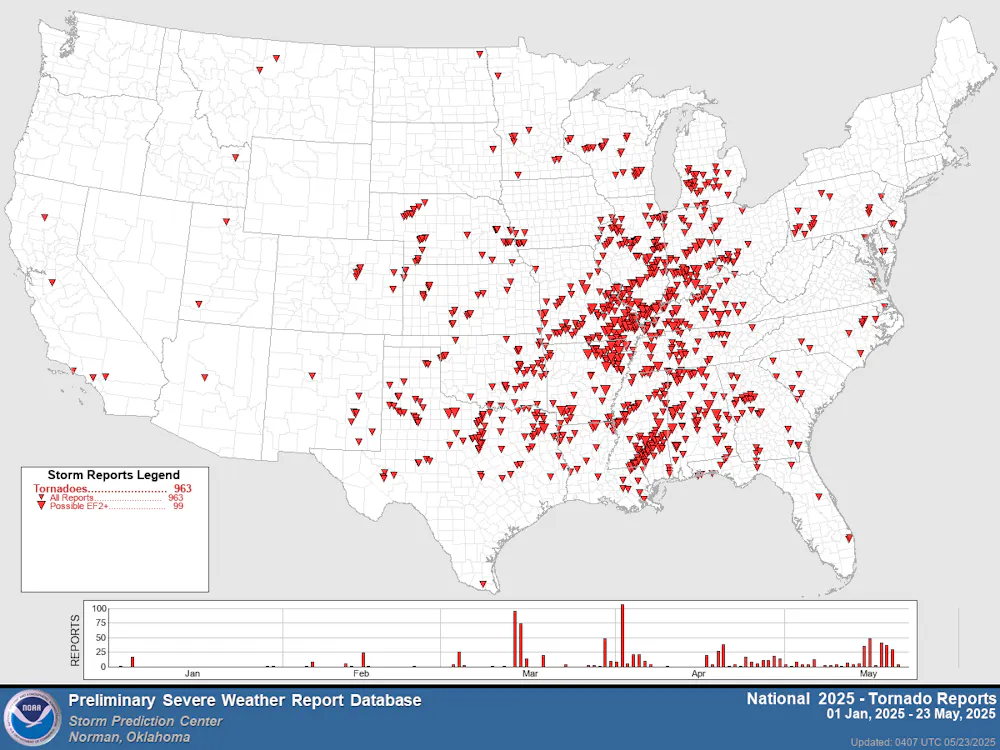
    The U.S. has had more reported tornadoes than normal – over 960 as of May 22, according to the National Weather Service’s preliminary count.

    That’s well above the national average of around 660 tornadoes reported by that point over the past 15 years, and it’s similar to 2024 – the second-most active year over that same period.

    The National Weather Service tracks reported tornadoes based on local storm reports, allowing for comparisons throughout the year. The red line shows 2025 through May 22.
    NOAA National Storm Prediction Center

    I’m an atmospheric scientist who studies natural hazards. What stands out about 2025 so far isn’t just the number of tornadoes, but how Tornado Alley has encompassed just about everything east of the Rockies, and how tornado season is becoming all year.

    Why has 2025 been so active?

    The high tornado count in 2025 has a lot to do with the weather in March, which broke records with 299 reported tornadoes – far exceeding the average of 80 for that month over the past three decades.

    March’s numbers were driven by two large tornado outbreaks: about 115 tornadoes swept across more than a dozen states March 14-16, stretching from Arkansas to Pennsylvania; and 145 tornadoes hit March 31 to April 1, primarily in a swath from Arkansas to Iowa and eastward. The 2025 numbers are preliminary pending final analyses.

    While meteorologists don’t know for sure why March was so active, there were a couple of ingredients that favor tornadoes:

    By April and May, however, those ingredients had faded. The weak La Niña ended and the Gulf waters were closer to normal.

    April and May also produced tornado outbreaks, but the preliminary count over most of this period, since the March 31-April 1 outbreak, has actually been close to the average, though things could still change.

    A tornado on May 18, 2025, tore apart homes in Bennett, Colorado.
    Helen H. Richardson/MediaNews Group/The Denver Post via Getty Images

    What has stood out in April and May is persistence: The jet stream has remained wavy, bringing with it the normal ebb and flow of stormy low-pressure weather systems mixed with sunny high-pressure systems. In May alone, tornadoes were reported in Colorado, Minnesota, Delaware, Florida and just about every state in between.

    Years with fewer tornadoes often have calm periods of a couple of weeks or longer when a sunny high-pressure system is parked over the central U.S. However, the U.S. didn’t really get one of those calm periods in spring 2025.

    Tornado Alley shifts eastward

    The locations of these storms have also been notable: The 2025 tornadoes through May have been widespread but clustered near the lower and central Mississippi Valley, stretching from Illinois to Mississippi.

    That’s well to the east of traditional Tornado Alley, typically seen as stretching from Texas through Nebraska, and farther east than normal. April through May is still peak season for the Mississippi Valley, though it is usually on the eastern edge of activity rather than at the epicenter. The normal seasonal cycle of tornadoes moves inland from near the Gulf Coast in winter to the upper Midwest and Great Plains by summer.

    Where local forecast centers reported tornadoes in 2025, through May 22. Data is preliminary, pending final analysis.
    NOAA Storm Prediction Center

    Over the past few decades, the U.S. has seen a broad shift in tornadoes in three ways: to the east, earlier in the year and clustered into larger outbreaks.

    Winter tornadoes have become more frequent over the eastern U.S., from the southeast, dubbed Dixie Alley for its tornado activity in recent years, to the Midwest, particularly Kentucky, Illinois and Indiana.

    Meanwhile, there has been a steady and stark decline in tornadoes in the “traditional” tornado season and region: spring and summer in general, especially across the Great Plains.

    It may come as a surprise that the U.S. has actually seen a decrease in overall U.S. tornado activity over the past several decades, especially for intense tornadoes categorized as EF2 and above. There have been fewer days with a tornado. However, those tornado days have been producing more tornadoes. These trends may have stabilized over the past decade.

    Deadlier tornadoes

    This eastward shift is likely making tornadoes deadlier.

    Tornadoes in the Southeastern U.S. are more likely to strike overnight, when people are asleep and cannot quickly protect themselves, which makes these events dramatically more dangerous. The tornado that hit London, Kentucky, struck after 11 p.m. Many of the victims were over age 65.

    The shift toward more winter tornadoes has also left people more vulnerable. Since they may not expect tornadoes at that time of year, they are likely to be less prepared. Tornado detection and forecasting is rapidly improving and has saved thousands of lives over the past 50-plus years, but forecasts can save lives only if people are able to receive them.

    Average number of tornadoes by month, 2000-2024. Source: NOAA

    This shift in tornadoes to the east and earlier in the year is very similar to how scientists expect severe thunderstorms to change as the world warms. However, researchers don’t know whether the overall downward trend in tornadoes is driven by warming or will continue into the future. Field campaigns studying how tornadoes form may help us better answer this question.

    Remember that it only takes one

    For safety, it’s time to stop focusing on spring as tornado season and the Great Plains as Tornado Alley.

    Tornado Alley is really all of the U.S. east of the Rockies and west of the Appalachians for most of the year. The farther south you live, the longer your tornado season lasts.

    Forecasters say it every year for hurricanes, and we badly need to start saying it for tornadoes too: It only takes one to make it a bad season for you or your community. Just ask the residents of London, Kentucky; St. Louis; Plevna and Grinnell, Kansas; and McNairy County, Tennessee.

    Listen to your local meteorologists so you will know when your region is facing a tornado risk. And if you hear sirens or are under a tornado warning, immediately go to your safe space. A tornado may already be on the ground, and you may have only seconds to protect yourself.

    Daniel Chavas receives funding from the National Science Foundation, NASA, and NOAA. He is a member of the American Geophysical Union and American Meteorological Society.

    ref. In 2025, Tornado Alley has become almost everything east of the Rockies − and it’s been a violent year – https://theconversation.com/in-2025-tornado-alley-has-become-almost-everything-east-of-the-rockies-and-its-been-a-violent-year-257169

    MIL OSI – Global Reports

  • MIL-OSI USA: Hinson Named Co-Chair of Biofuels Caucus, Will Use Position to Advocate for Iowa Biofuels

    Source: United States House of Representatives – Congresswoman Ashley Hinson (IA-01)

    Washington, D.C. – Today, Congresswoman Ashley Hinson was announced as a co-chair for the Congressional Biofuels Caucus alongside Representatives Angie Craig (D-MN), Adrian Smith (R-NE), Mark Pocan (D-WI), Julie Fedorchak (R-ND), and Nikki Budzinski (D-IL).

    “Biofuels are key to Iowa’s economy and key to American energy dominance,” said Co-chair Hinson. “Since coming to Congress, I have worked tirelessly to expand access to Iowa biofuels and support Iowa’s biofuels producers by fighting to secure permanent year-round E15, increase biofuels blending targets, and replace foreign energy with homegrown biofuels. I’m honored to co-lead the biofuels caucus and will continue working with President Trump and other caucus members to increase domestic energy production and support Iowa agriculture.”

    “Increasing the production and availability of homegrown biofuels is a critical piece of the puzzle when it comes to the all-of-the-above energy policy we need to stay ahead,” said Co-chair Craig. “I’m proud to be relaunching the Biofuels Caucus alongside my bipartisan colleagues this Congress so we can continue our work to lower prices at the pump, create opportunities for local producers and strengthen our energy security.”

    “American biofuel producers have an untapped ability to power the future of liquid fuels, whether ethanol blends, biodiesel, or sustainable aviation fuel,” said Co-chair Smith. “Advancing sound policy can unlock billions of dollars in savings at the pump and hundreds of thousands of added jobs for the American people. I thank Co-chairs Craig and Pocan and congratulate Co-chairs Hinson, Fedorchak, and Budzinski for joining me to strengthen this bipartisan caucus and continue working to inform our colleagues in the House of the value of biofuels for American energy abundance.”

    “I am glad to join my colleagues in the Congressional Biofuels Caucus,” said Co-chair Pocan. “Corn growers in Wisconsin deserve to have an even playing field in the market dominated by the oil and gas industry. This Caucus will showcase how biofuels can help us reach our emissions reduction goals while investing in rural jobs and infrastructure.”

    “Biofuels are a growing part of America’s energy strategy and another way North Dakota is helping fuel the world,” said Co-chair Fedorchak. “It’s an honor to serve as a co-chair of this bipartisan caucus to advance policies that will help expand domestic energy production, empower rural America, and deliver practical solutions for North Dakotans.”

    “I came to Congress to be a strong voice for the people of Central and Southern Illinois—especially our hardworking farmers. Few issues are more critical to their success than strengthening the biofuels industry and expanding market opportunities,” said Co-chair Budzinski. “That’s why promoting the use of homegrown, sustainable biofuels has been a central focus of my work in Congress, and I’m looking forward to continuing that commitment as co-chair of this bipartisan caucus.

    The Congressional Biofuels Caucus advocates for policies which reflect the capacity of American biofuels producers to meet the demand for reliable and affordable liquid fuels while growing rural economies, high-paying jobs, and value-added markets for agricultural commodities. The caucus recognizes biofuels are key to American energy independence and responsible stewardship of our resources.

    Additional members of the caucus include: Reps. Dusty Johnson (R-SD), Darin LaHood (R-IL), Jim Baird (R-IN), Scott Peters (D-CA), Tom Emmer (R-MN), Andre Carson (D-IN), Ann Wagner (R-MO), Emanuel Cleaver (D-MO), James Comer (R-KY), Brett Guthrie (R-KY), Marcy Kaptur (D-OH), Suzanne Bonamici (D-OR), Sam Graves (R-MO), Don Bacon (R-NE), Mike Bost (R-IL), Pete Stauber (R-MN), Michelle Fischbach (R-MN), Randy Feenstra (R-IA), Marianette Miller Meeks (R-IA), Zach Nunn (R-IA), Mike Flood (R-NE), Eric Sorensen (D-IL), Brad Finstad (R-MN), Tracey Mann (R-KS), Derrick Van Orden (R-WI), Mark Alford (R-MO), Sharice Davids (D-KS), Kristen McDonald Rivet (D-MI), Brian Jack (R-GA), and Mark Messmer (R-IN).

    ###

    MIL OSI USA News

  • MIL-OSI Global: Five ways to inspire ocean connection: reflections from my 40-year marine ecology career

    Source: The Conversation – UK – By Martin Attrill, Professor of Marine Ecology, University of Plymouth

    For 40 years, I’ve worked as a marine ecologist and, since 1992, I’ve been based in Plymouth, Devon – a global hub for coastal marine research and teaching. As I think back to how our understanding of life in our oceans has changed over that time, here are five lessons I have learnt.

    1. Start with the basics

    Back in the 1970s, the band America wrote: “The ocean is a desert with its life underground, and the perfect disguise above”. Many people I speak to actually don’t see much beyond that grey-blue surface.

    Back in 2014 my colleagues and I were quite shocked at the response to a big survey we did on public perception of the marine environment in the UK, particularly when we break out of our marine bubbles. If an organism was remotely colourful or interesting, most people assumed it didn’t live in UK waters.

    That reminded me not to underestimate how little most people know, or care, about UK seas. Make no assumptions.

    While Blue Planet and other beautiful TV series have undoubtedly helped raise the profile of the world’s seas, some have potentially reinforced this view of local waters – that you have to travel to far-off exotic locations to find any interesting and spectacular life.

    2. Inspire deep connection

    Research shows the almost unparalleled restorative power of being in, on, under or by the sea. You do not need to dive to feel a strong ocean connection – building sandcastles, catching crabs on a line in a harbour, skimming stones or letting the cold water wash over your feet can work wonders.

    Rockpooling is also an incredible window into the underwater world – suddenly all this weird and wonderful life opens up to us in a small, simple and accessible puddle.

    Rockpooling is a fun and easy way to explore marine life.
    Laura Schwormstedt/Shutterstock

    People need to be given more opportunities to form lasting connections with the ocean. Organisations such as Plymouth’s Ocean Conservation Trust and Devon Wildlife Trust are bringing young people to the sea, sometimes for the first time.

    Enabling ocean connection is just as important for people who don’t have the chance or ability to physically be there, for example through virtual reality. I’ve also been involved in transforming Plymouth Sound into the UK’s first national marine park – this concept is all about engaging people with this stretch of coastline, getting them connected to the ocean and inspiring them to care. And the marine park model could be replicated around the UK.


    Local science, global stories.

    This article is part of a series, Secrets of the Sea, exploring how marine scientists are developing climate solutions.

    In collaboration with the BBC, Anna Turns travels around the West Country coastline to meet ocean experts making exciting discoveries beneath the waves.


    3. Take the pressure off

    If you leave the ocean alone, it can recover. Very few shallow areas of our global ocean remain untouched. But, as demonstrated so well in David Attenborough’s latest film, Ocean, if you remove all the most damaging impacts (particularly physical fishing damage), then the sea has great powers of recovery.

    In the UK, bluefin tuna and humpback whales have returned as the pressure to hunt them has been better managed. The cold water reefs on the seabed in Lyme Bay off the south coast of England have recovered remarkably just four years after a ban on towed fishing gear was introduced.

    Today, there are so few properly protected areas where all damaging or extractive activities are completely removed to give nature a chance, particularly in the UK. Some habitats may need a bit of help from us – active restoration or replanting of seagrass beds and oyster reefs will help kickstart regrowth.

    What is seagrass? The Ocean Conservation Trust explains.

    4. Plastic is a distraction

    The flow of plastics into the ocean must certainly be stopped. But I worry that the plastic pollution problem is a bandwagon that so many businesses, media outlets and governments have jumped on. Has a decade-long focus on “solving” the plastic crisis been a troublesome distraction? Banning single-use straws can seem like an easy win because leaders can be seen to be taking action – but it does little to solve the ocean’s biggest problems.

    Meanwhile, the most complex and hard to resolve activities that seriously harm our seas, such as industrial overfishing, are still not being dealt with. The most damaging fishing practices such as trawling and dredging continue legally, astonishingly even within designated marine protected areas. Such highly damaging activities have no place near sensitive habitats and this has been so well demonstrated in Ocean.

    The recent UK ban on sandeel fishing gives me hope. This landmark decision was made to benefit nature (protecting food supply for seabirds), restricting a fishery that does not even supply food for humans. Sandeels are used to make fishmeal and fish oil to feed farmed fish and livestock.

    Yet, damaging fishing practices such as trawling and dredging continue legally, even within designated marine protected areas. Such highly damaging activities have no place near sensitive habitats.

    I firmly believe that the most effective and straightforward solution for the UK is to prohibit all towed fishing gear from within at least three miles of the coast – including developing a series of fully protected marine reserves.

    In Lyme Bay, this approach has led to a real win-win because the seas are now recovering, and local fishers, holidaymakers and coastal communities are benefiting too.


    Read more:
    David Attenborough’s Ocean reveals how bottom trawling is hurting sealife in horrifying detail


    5. Add a dose of ocean optimism

    Rising eco-anxiety, particularly in younger people, is not surprising given the state of the world. Faced with the nature and climate crisis, it is easy to feel utter despair.

    Climate change will undoubtedly change our planet. Yet, without oceans absorbing most of the carbon (while producing half the oxygen we breathe), this planet would already be uninhabitable for human civilisation. Making our oceans as healthy and resilient as possible is therefore crucial.

    Right now, we need some ocean optimism. Sharing the stories of progress and innovation that show how patches of the sea are recovering can demonstrate what’s possible and inspire further positive action. By showcasing areas now rich with diverse marine life now that industrial-scale damage has been stopped or whale populations that are booming now that harpoons are a thing of the past, a vision for a better, bluer future can become reality at scale.

    Listen to episode one of Secrets of the Sea here on BBC Sounds, presented by Anna Turns for The Conversation.


    Don’t have time to read about climate change as much as you’d like?

    Get a weekly roundup in your inbox instead. Every Wednesday, The Conversation’s environment editor writes Imagine, a short email that goes a little deeper into just one climate issue. Join the 45,000+ readers who’ve subscribed so far.


    Martin Attrill receives and has received funding from a series of government, NGO and private sector bodies, all of which is directed to the University of Plymouth, not personally. Current and recent funding includes from UK Government (NEIRF), Heritage Lottery Fund, Natural Environmental Research Council, EU INTERREG and ERDF. He is affiliated with Ocean Conservation Trust (Chief Scientific Advisor) and a trustee of the Manta Trust.

    ref. Five ways to inspire ocean connection: reflections from my 40-year marine ecology career – https://theconversation.com/five-ways-to-inspire-ocean-connection-reflections-from-my-40-year-marine-ecology-career-250162

    MIL OSI – Global Reports

  • MIL-OSI United Nations: 22 May 2025 Departmental update African Nations unite to eliminate visceral leishmaniasis and boost cross-border collaboration for NTDs

    Source: World Health Organisation

    In a powerful demonstration of country-driven leadership and cross-border solidarity, Ministry of Health representatives from various African countries pledged to intensify action to eliminate neglected tropical diseases (NTDs).

    At a side event held on the margins of the 78th World Health Assembly on Wednesday, 21 May 2025, under the leadership of the African Union Commission, several countries signed a landmark Memorandum of Understanding (MoU) to eliminate visceral leishmaniasis (VL), and endorsed a Call for Action to promote cross-border collaboration and accelerate progress towards elimination targets set for NTDs.

    Eliminating visceral leishmaniasis in eastern Africa

    With this MoU, the ministers or their representatives of Chad, Djibouti, Ethiopia, Somalia, South Sudan and Sudan agreed to invest resources, develop effective policies and collaborate closely to achieve the ambitious targets outlined in the VL strategic framework launched in June 2024.Additional eastern African countries are expected to sign the MoU in the near future. 

    “As the global community reaches the half-way point towards the road map targets and almost one year after we launched a strategic framework for the elimination of visceral leishmaniasis, the critical role of country-led efforts and cross-border collaboration in accelerating elimination cannot be over emphasized,” said Dr Ibrahima Socé Fall, Director of the

    WHO Global Neglected Tropical Diseases Programme  in his opening remarks.

    Of all the NTDs, VL is among the deadliest and most outbreak-prone diseases and is endemic in all six WHO regions, with 74% of its global burden in the eastern African epidemiological subregion. Half of the cases occur in children aged under 15 years. Also known as kala-azar, VL is a lethal parasitic disease that causes fever, weight loss, spleen and liver enlargement, and — if untreated — death.

    Ministers and delegates of Chad, Sudan, Somalia, South Sudan and Djibouti (left to right) holding the Memorandum of Understanding on elimination of visceral leishmaniasis in eastern Africa /© Orbisswiss Photos & Press

    Accelerating elimination of NTDs through cross-border collaboration

    Like VL, many NTDs are vector-borne or waterborne, making them easily transmissible across borders. The movement of people and animals  further facilitates this spread, posing a barrier to  national elimination goals and progress towards

    road map targets.

    This was the focus of the second significant moment of the event in which a Call for Action on NTD cross-border collaboration was issued by the Ministers of Health of Cameroon, Niger and Nigeria. They urged countries to share experiences in developing collaboration agreements and workplans and take collective action.

    To address this challenge, Member States are encouraged to coordinate efforts and endorse joint MoUs to enable synchronized interventions, surveillance and data-sharing across borders. Regional and multilateral agencies, along with international development partners, should advocate for increased financing, provide technical support and invest in data systems and innovation to strengthen cross-border initiatives towards elimination of all NTDs.

    Climate change adds urgency, as warming temperatures and extreme weather events create favourable conditions for the spread and re-emergence of diseases.  

    Strong cross-border coordination is therefore critical — not only to interrupt transmission in endemic areas but also to maintain elimination through effective post-elimination surveillance.

    “We know that diseases do not stop at borders — and neither should our response. More than 600 million people on our continent remain at risk of at least one of the NTDs,” said Dr Jean Kaseya, Director General of Africa CDC in a statement read by Dr Landry Tsague Dongmo, Africa CDC’s Director Center for Primary Health Care. “Africa CDC has been working to enhance cross-border surveillance platforms through the Integrated Disease Surveillance and Response framework, in close collaboration with WHO,” he added.

    Towards an NTD-free world

    This crucial side event underscored that while individual country successes are vital, the interconnected nature of NTD transmission necessitates robust cross-border approaches, particularly in the face of challenges like climate change. The commitment of east African nations to tackle VL head-on through unified action sets a compelling precedent for accelerating the elimination of other devastating NTDs.

    These efforts build on significant advances in the fight against NTDs across Africa. As of May 2025, 56 countries have eliminated at least one NTD globally, including Togo (four NTDs) and Benin, Ghana (three NTDs). In 2024 and 2025, several other African countries have achieved this target for one or two NTDs: most recently Chad, Guinea, Mauritania and Niger were acknowledged by WHO for eliminating an NTD.

    “To reach elimination, we need more medical innovation. VL patients and their communities urgently need new, improved oral treatments. The recent successes of South Asian countries, such as Bangladesh, in eliminating kala-azar show that global elimination of this dreadful disease is within our reach, and I would like to commend the inspiring leadership, unity, and commitment shown today by our African partners,” said Dr Luis Pizarro, Executive Director of the non-profit medical research organization Drugs for Neglected Diseases initiative (DNDi). 

    The event, themed “Accelerating NTD elimination through country-driven efforts and cross-border collaboration,” was spearheaded by the African Union Commission and the WHO-led Global Onchocerciasis Network for Elimination (GONE), and supported by The END Fund and the Drugs for Neglected Diseases initiative (DNDi).

    MIL OSI United Nations News

  • MIL-OSI USA: NCDHHS Emphasizes Summer Safety Practices as Temperatures Rise Across North Carolina

    Source: US State of North Carolina

    Headline: NCDHHS Emphasizes Summer Safety Practices as Temperatures Rise Across North Carolina

    NCDHHS Emphasizes Summer Safety Practices as Temperatures Rise Across North Carolina
    jawerner

    As summer approaches, the North Carolina Department of Health and Human Services is reminding residents to take simple, proactive steps to enjoy outdoor activities safely. With the arrival of warmer weather, NCDHHS is highlighting key tips on water safety, heat protection and food safety to help prevent illness, injury and death. 

    May is National Water Safety Month, and a timely reminder that drowning remains the leading cause of death for children ages one through four, but it is preventable.

    “Every North Carolinian deserves to enjoy the summer season without risk to their health or safety,” said Dr. Kelly Kimple, Interim State Health Director and NCDHHS Chief Medical Officer. “By taking small, thoughtful actions — like supervising children near water, staying cool during extreme heat and practicing safe grilling — we can all stay safe this summer.”

    Water Safety: Preventing Tragedy Before It Happens

    As families head to pools, lakes and beaches, NCDHHS urges everyone to keep these water safety practices in mind:

    • Actively Supervise: Drowning can happen silently and in seconds. Always keep a close eye on children near water.
    • Secure Pool Areas: Keep gates and doors closed and locked. Remove pool ladders when not in use.
    • Know the Water: Be aware of currents, depth changes and undertows at beaches, lakes and rivers.
    • Stay Healthy: Don’t swim when ill with diarrhea to prevent spreading germs.
    • Check Water Quality: Ensure pools are properly disinfected. Local health departments routinely inspect public pools, spas and splash pads.
    • Be Cautious in All Recreational Waters: Lakes and rivers may carry bacteria or harmful algae blooms. Check advisories before swimming.

    Heat Safety: Protecting Against Rising Temperatures 

    According to the North Carolina Climate Science Update, the state continues to experience an increasing number of extreme heat days — those reaching 95 degrees or higher. From May through September 2024, North Carolina recorded over 4,600 emergency department visits for heat-related illness.

    NCDHHS encourages all residents to: 

    • Watch for Symptoms: Nausea, dizziness, headache, confusion or a rapid pulse could indicate heat exhaustion or heat stroke.
    • Hydrate and Cool Down: Move to a cooler area, sip water slowly and seek medical help if symptoms persist.
    • Know Who’s at Risk: Children, older adults, pregnant individuals, outdoor workers, athletes and those without air conditioning are most vulnerable. 

    To stay informed, sign up for the NCDHHS Heat Health Alert System on the NC Climate and Health team webpage.

    Grill Smart: Avoid Foodborne Illness This Summer

    Summer gatherings often mean grilling and increased risk for foodborne illness. The majority of reported foodborne outbreaks in North Carolina occur between May and August.

    Stay safe with these grilling guidelines:

    • Wash Up: Scrub hands with soap and water for at least 20 seconds before and after handling food.
    • Separate Raw and Cooked Foods: Prevent cross-contamination by keeping raw meats apart from other foods.
    • Cook to Safe Temperatures: Use a food thermometer to ensure meats reach the correct internal temperature.
    • Store Leftovers Promptly: Refrigerate or freeze within two hours; consume within three to four days.
    • Clean the Grill: Sanitize surfaces and utensils before and after each use.

    For more information on healthy swimming practices, visit the U.S. Center for Disease Control and Prevention’s Healthy Swimming page, and for tips on safe grilling, visit Safe Grilling Tips. The CDC also has guidance for heat-related illness prevention. More summer safety tips are also available on the NCDHHS Division of Public Health website.

    A medida que se acerca el verano, el Departamento de Salud y Servicios Humanos de Carolina del Norte les recuerda a los habitantes que tomen medidas simples y proactivas para disfrutar las actividades al aire libre de manera segura. Con la llegada del clima más cálido, NCDHHS está destacando consejos clave sobre seguridad del agua, protección contra el calor y seguridad alimentaria para ayudar a prevenir enfermedades, lesiones y muertes.

    Mayo es el Mes Nacional de la Seguridad del Agua y es un recordatorio oportuno de que el ahogamiento sigue siendo la principal causa de muerte entre los niños de uno a cuatro años, pero se puede prevenir.

    “Todos los habitantes de Carolina del Norte merecen disfrutar de la temporada de verano sin riesgo para su salud o seguridad”, dijo la Dra. Kelly Kimple, Directora de Salud Estatal Interina y Directora Médica de NCDHHS. “Al tomar medidas pequeñas y reflexivas, como supervisar a los niños cerca del agua, mantener la calma durante el calor extremo, y asar a la parrilla con cuidado, todos podemos estar seguros este verano”.

    Seguridad del agua: prevenir la tragedia antes de que suceda

    Mientras las familias se dirigen a piscinas, lagos y playas, NCDHHS anima a todos a tener en cuenta estas prácticas de seguridad en el agua:

    • Supervisar activamente: El ahogamiento puede ocurrir en silencio y en segundos. Vigile siempre de cerca a los niños cerca del agua.
    • Asegure las areas de la piscina: Mantenga las puertas y portones cerrados con llave. Retire las escaleras de la piscina cuando no esté en uso.
    • Conozca el agua: Esté atento a las corrientes, cambios de profundidad y resacas en playas, lagos y ríos.
    • Manténgase saludable: No nade cuando esté enfermo con diarrea para evitar la propagación de gérmenes.
    • Compruebe la calidad del agua: asegúrese de que las piscinas estén desinfectadas correctamente. Los departamentos de salud locales inspeccionan rutinariamente las piscinas públicas, los spas y las áreas de chapoteo.
    • Tenga cuidado en todas las aguas recreativas: Los lagos y ríos pueden transportar bacterias o proliferacion de algas dañinas. Consulte las advertencias antes de nadar.

    Seguridad contra el calor extremo: protección contra el aumento de la temperatura 

    De acuerdo con la Actualización de la ciencia climática de Carolina del Norte, el estado continúa experimentando un número creciente de días de calor extremo, aquellos que alcanzan los 95 grados o más. Desde mayo a septiembre de 2024, Carolina del Norte registró más de 4600 visitas al departamento de emergencias por enfermedades relacionadas con el calor.

    NCDHHS anima a todos los habitantes a: 

    • Estar atento a los síntomas: Las náuseas, los mareos, el dolor de cabeza, la confusión o un pulso rápido podrían indicar agotamiento por calor o golpe de calor.
    • Hidratarse y refrescarse: Muévase a un área más fresca, beba agua lentamente y busque ayuda médica si los síntomas persisten.
    • Saber quién está en riesgo: Los niños, los adultos mayores, las personas embarazadas, los trabajadores al aire libre, los atletas y los que no tienen aire acondicionado son los más vulnerables.

    Para mantenerse informado, regístrese en el Sistema de Alerta de Salud por Calor de NCDHHS en la página web del equipo de Clima y Salud de NC.

    Haga parrillada inteligentemente: evite las enfermedades transmitidas por los alimentos este verano

    Las reuniones de verano a menudo significan asar a la parrilla y un mayor riesgo de enfermedades transmitidas por los alimentos. La mayoría de los brotes transmitidos por alimentos reportados en Carolina del Norte ocurren entre mayo y agosto.

    Manténgase seguro con estas pautas para asar a la parrilla:

    • Lavarse: Frote las manos con agua y jabón durante al menos 20 segundos antes y después de tocar los alimentos.
    • Separar los alimentos crudos y cocidos: evite la contaminación cruzada manteniendo las carnes crudas separadas de otros alimentos.
    • Cocinar a temperaturas seguras: Use un termómetro de alimentos para asegurarse de que las carnes alcancen la temperatura interna correcta.
    • Almacenar las sobras rápidamente: Refrigerar o congelar en dos horas; consumir en tres o cuatro días.
    • Limpiar la parrilla: Desinfectar las superficies y los utensilios antes y después de cada uso.

    Para obtener más información sobre prácticas de natación saludables, visite la página web de los Centros para el Control y la Prevención de Enfermedades (CDC, por sus siglas en inglés) Natación saludable, y para obtener consejos sobre hacer una parrillada segura, visite Consejos sobre la parrillada segura. Los CDC también tienen una guía para la prevención de enfermedades relacionadas con el calor. También hay más consejos de seguridad de verano disponibles en el sitio web de la División de Salud Pública de NCDHHS.

    May 23, 2025

    MIL OSI USA News

  • MIL-OSI United Kingdom: UK Government must ignore Trump’s call for North Sea oil drilling

    Source: Scottish Greens

    The UK’s energy strategy must not cost people and planet.

    The UK Government must ignore Donald Trump’s ‘century of drilling left’ comments and listen to climate experts, warn Scottish Greens. 

    The US president claims that more oil and gas exploration by drilling in the North Sea is the only way to bring energy prices down. 

    His remarks on the UK Government’s energy strategy come as Ofgem announced that the energy price cap would decrease by £129 per year from £1,849 to £1,720 per household.

    Trump has a long history of promoting climate conspiracy theories, and his support for more fossil fuel extraction comes despite the warnings of climate and energy experts globally.

    Scottish Greens co-leader and spokesperson for net zero, Patrick Harvie MSP, is calling for the Labour government to ignore Trump’s remarks and end our reliance on fossil fuels for good. 

    Mr Harvie said:

    “Household energy bills have been volatile because of our over-reliance on fossil fuels, and it’s critical that both governments cut fossil fuel consumption, increase investment in clean energy, and break the artificial link between gas prices and electricity so that bills come down faster.

    “Scotland’s renewable industry is generating cheap, clean, abundant power, but households are not getting the benefit in the bills they pay. 

    “Donald Trump’s dangerous ideas must be ignored. Climate breakdown already costs the average Scottish household over £3,000 a year. Failure to tackle the climate emergency would accelerate the damage, and keep people dependent on volatile energy prices.

    “There’s no surprise that a corrupt billionaire politician is putting the profits of fossil fuel multinationals ahead of the common good. 

    “We must stick to our net zero targets. We cannot backtrack any further or pander to a climate change denier like Trump, who ignores the extreme harm the fossil fuel industry has caused.

    “This Labour government has already shown they will make decisions that harm people; cutting winter fuel payment for pensioners and making disabled people struggle financially. I urge them to do the right thing and ignore the calls of billionaires like Trump who don’t accept scientific reality. 

    “What households and businesses need are bills that come down and stay down, and that means breaking our dependence on fossil fuels. Household bills are already far too high, with too many people being forced to freeze all winter so they can feed themselves.”

    Mr Harvie added:

    “Scotland is lucky to have such a vast amount of renewable energy. Jobs in renewables have surpassed oil and gas jobs both in Scotland and across the globe. Climate science experts are providing us with the information to reach net zero. This is the future and we must be ready to welcome it.”

    MIL OSI United Kingdom

  • MIL-OSI United Kingdom: Swift action by environment officer and fire service averts major wild 23 May 2025 Swift action by environment officer and fire service averts major wildfire in Sandown

    Source: Aisle of Wight

    A potentially devastating wildfire in Sandown was swiftly brought under control last week, thanks to the quick thinking of a local environment officer and the rapid response of Island firefighters.

    While on a routine inspection last Friday, Davide Fossa spotted smoke rising from the undergrowth near to Browns Golf and Dinosaur Isle.

    Recognising the danger, he immediately called 999 and began directing people away from the area to ensure their safety.

    “I knew every second counted,” said Davide. “I made the call, then focused on keeping people at a safe distance until the fire crews arrived. It could have spread so quickly.”

    Within minutes, firefighters arrived and launched what Davide described as a “military-style operation.”

    “They knew exactly what to do,” he said. “It was like watching a well-drilled unit in action. They moved with precision, coordinated their efforts seamlessly, and brought the fire under control before it had a chance to spread. It was incredibly impressive.”

    Thanks to their swift and strategic response, the blaze was contained and extinguished before it could threaten nearby homes, businesses, or the wider nature reserve.

    Davide is one of four dedicated environment officers working for the Isle of Wight Council. This small but highly skilled team play a vital role in safeguarding the Island’s natural environment and making the Island a cleaner, greener place to live and visit.

    The environment officers undertake a number of duties, including inspection of playgrounds, parks and open spaces, and enforcing Public Space Protection Orders (PSPOs).

    The team also enforces a range of environmental regulations, including those related to waste management, fly-tipping and littering, helping to maintain standards and prevent harm to the environment.

    In addition to their enforcement duties, they work closely with the community to promote sustainable practices, offering guidance and education to encourage greater environmental awareness and responsibility among residents and visitors alike.

    Their work often takes them into remote or ecologically sensitive areas, where early detection of issues like wildfires can make a critical difference.

    Some town, parish, and community councils — including Sandown — invest in an enhanced environment officer service, supplementing the core provision offered by the Isle of Wight Council.

    This enhanced service can include additional patrols, one of which led to the early discovery of the fire.

    Natasha Dix, service director for waste, environment and planning, said: “Davide’s vigilance and calm response under pressure made all the difference. And we are deeply grateful to the Isle of Wight Fire and Rescue Service for their swift and professional response.

    “Their teamwork ensured this incident didn’t escalate into something far more serious.”

    Sandown Mayor, Councillor Alex Lightfoot, said: “We are grateful for the actions taken by Sandown’s environment officer, and the swift response from our fire service.

    “This just demonstrates the value of our partnership working between Sandown Town Council and the Isle of Wight Council.”

    A spokesperson from Hampshire and Isle of Wight Fire and Rescue Service (HIWFRS) added: “Our crews worked extremely hard in the hot weather to contain and extinguish the fire and protect neighbouring heathland.

    “This fire destroyed a large area of grassland, and is just one example of the devastation these outdoor fires can have, damaging our green spaces.

    “Although we don’t know what caused this blaze, we ask that when you’re out enjoying the countryside that you do so responsibly and help prevent wildfires by following our safety guidance.”

    Authorities are reminding residents and visitors to remain vigilant during dry weather and to report any signs of smoke or fire immediately.

    Staying Safe During Dry Weather: Fire Prevention Tips

    With warmer, drier summers becoming more common, the risk of wildfires increases. Here are some simple but important steps everyone can take to help prevent fires:

    • Never leave barbecues and campfires unattended, and ensure they are fully extinguished after use.
    • Avoid using disposable barbecues in parks, nature reserves, or near dry grass.
    • Download the What3Words app on your phone to help the fire service pinpoint incidents.
    • Do not discard cigarettes or matches on the ground — use proper bins or take them with you.
    • Keep glass bottles out of direct sunlight, as they can magnify heat and ignite dry grass.
    • Report any signs of smoke or fire immediately by calling 999.
    • By staying alert and acting responsibly, we can all help protect our beautiful landscapes and communities.

    MIL OSI United Kingdom

  • MIL-OSI Asia-Pac: President Lai presides over fourth meeting of Healthy Taiwan Promotion Committee

    Source: Republic of China Taiwan

    Details
    2025-02-27
    President Lai presides over third meeting of Healthy Taiwan Promotion Committee
    On the afternoon of February 27, President Lai Ching-te presided over the third meeting of the Healthy Taiwan Promotion Committee. In his opening statement, the president stated that the best strategies to care for citizens’ health are to increase physical activity, boost food literacy, and improve the domestic food environment, preventing chronic diseases from the front end. The president said that the Ministry of Health and Welfare (MOHW) has upgraded preventive health services for adults this year, lowering the age eligibility to 30. He expressed hope that public-private sector cooperation can help reduce the incidence of chronic diseases and their associated disability risks and achieve the goal of lowering the standardized mortality rate for chronic diseases related to the “three highs”(high blood pressure, high cholesterol, and high blood sugar) by one-third by 2030. With regard to the hospital congestion issue, President Lai noted that through local health departments, the government will strengthen the supervision and distribution of emergency room beds, boost the distribution of inpatient beds in medical centers, and enhance joint prevention mechanisms among regional hospitals to reduce the pressure on emergency departments. The president said that the government will continue to incentivize hospitals to hire more nursing personnel and will consider adjusting health insurance coverage to encourage more hospitals to participate in emergency and critical care so as to reduce the pressure on medical institutions. By taking a multi-channel approach, the president said, we hope to resolve the problems facing healthcare in Taiwan, provide the public with better care, and achieve our vision of a Healthy Taiwan. A translation of President Lai’s opening statement follows: Today is the third meeting of the Healthy Taiwan Promotion Committee. First, I would like to thank both deputy conveners, our advisors and committee members, and our friends online for their continuing concern about the planning and implementation of the Healthy Taiwan initiative.        At the last meeting, we heard a report on enhancing cancer prevention and treatment strategies. Guided by the Executive Yuan, the scope of government-funded major cancer screenings will be expanded starting this year, including expanding the age parameters and the categories eligible for screening. Treatment efforts will focus on genetic testing and precision medicine, and a fund will be established that provides diversified coverage for new cancer drugs. We hope to achieve our goal of reducing the standardized cancer mortality rate by one-third by 2030.  At today’s meeting, the MOHW will deliver progress reports on certain items listed in the second committee meeting, as well as chronic disease prevention and treatment initiatives under the Healthy Taiwan plan including the development of models for healthy living, obesity prevention and treatment, and the 888 Program for prevention and treatment of the “three highs.”Among the top ten causes of death in Taiwan, seven are related to chronic diseases, and five of those seven are related to “three highs” chronic diseases. Annual spending related to treating “three highs” chronic diseases is up to NT$170 billion, and has become a tremendous medical burden.  According to the World Health Organization, most non-communicable diseases are the result of four particular behaviors: tobacco use, physical inactivity, unhealthy diet, and the harmful use of alcohol. The results of the Nutrition and Health Survey in Taiwan show that most citizens are getting low or moderate amounts of physical activity, and have unbalanced diets that include excessive amounts of sugar and salt, and inadequate amounts of fruits, vegetables, and dairy products.  Therefore, the best strategies to care for the health of our citizens are to increase physical activity, boost food literacy, and improve the domestic food environment, preventing chronic diseases from the front end.  In a few minutes, the MOHW will give complete explanations for the various chronic disease prevention and treatment strategies, from building healthy lifestyles at the front end to preventing and treating obesity in the middle stage, making every effort to prevent citizens from symptoms of the “three highs.” Beginning this year, the MOHW has upgraded preventive health services for adults, lowering the age eligibility to 30. Among people who already suffer from the “three highs,” the 888 Program for the prevention and treatment of those diseases will identify a target group and then conduct interventions, making every effort to improve symptoms and avoid the development of chronic disease.  This kind of action strategy needs to be promoted simultaneously in the workplace, the community, on campus, and in the military. Only through public-private sector cooperation can we reduce the incidence of chronic diseases and their associated disability risks. We have also set a goal to lower the standardized mortality rate for chronic diseases related to the “three highs” by one-third by 2030. I hope that through the expertise of our advisors and committee members, we can provide discussions and suggestions from multiple perspectives to enable the government to propose health policies that meet citizens’ needs. The government will also actively address the hospital congestion issue that everyone is concerned about. The MOHW, in addition to taking preventive measures such as purchasing additional flu vaccines before the Lunar New Year, is addressing the emergency department congestion that occurred from the Lunar New Year until recently, and has formulated a short-term response strategy as well as middle and long-term directions for reforms as directed by Premier Cho Jung-tai (卓榮泰). Through local health departments, we will strengthen the supervision and distribution of emergency room beds. At the same time, we will continue to boost the distribution of inpatient beds in medical centers, and give full play to our emergency medicine network to enhance joint prevention mechanisms among regional hospitals and reduce the pressure on emergency departments. We will also enhance the public’s access to information about tiered healthcare, and implement a tiered treatment system to make better use of resources.  To address middle- and long-term human resource issues, we will continue to incentivize hospitals to hire more nursing personnel to lighten their burdens. We will also consider adjusting health insurance coverage to encourage more hospitals to participate in emergency and critical care. To respond to the challenges of an aging society, home healthcare, acute hospital care at home, Long-term Care 3.0, and post-acute care programs need to be promoted together to reduce the pressure on medical institutions.    By taking a multi-channel approach, we hope to resolve the problems facing healthcare in Taiwan, provide the public with better care, and achieve our vision of a Healthy Taiwan. So let us keep working hard together. Thank you. Following his statement, President Lai heard a report on the progress of certain items listed in the second committee meeting from Minister of Health and Welfare Chiu Tai-yuan (邱泰源), who is also the committee’s executive secretary, and a report on chronic disease prevention and treatment initiatives under the Healthy Taiwan plan including the development of models for healthy living, obesity prevention and treatment, and the 888 Program for prevention and treatment of the “three highs” from Deputy Minister of Health and Welfare Chou Jih-haw (周志浩). Afterward, President Lai exchanged views with the committee members regarding the content of the reports.

    Details
    2024-11-28
    President Lai presides over second meeting of Healthy Taiwan Promotion Committee
    On the afternoon of November 28, President Lai Ching-te presided over the second meeting of the Healthy Taiwan Promotion Committee. In his opening statement, the president said that we are implementing mental health support programs this year to provide more support for young and middle-aged people, pointing out that the policy has served over 20,000 people since it was implemented just over three months ago. In terms of bolstering mental health resilience, the president said we still have much to do, our government must lead by example, and the public and private sectors must work together, making every effort to ensure that no one is left behind. Noting that our goal is to reduce the standardized cancer mortality rate by one-third by the year 2030, President Lai stated that next year’s budget for cancer screening will be increased to NT$6.8 billion. He also stated that plans are in the works to establish a fund for new cancer drugs, adding that in the general budget we will allocate NT$5 billion, which will gradually rise to NT$10 billion. At the same time, he said, we are also actively promoting genetic testing and precision medicine. He expressed confidence that expanding preventive screening at the front end and providing advanced treatments at the back end will effectively fight cancer and improve the overall health of our citizens. A translation of President Lai’s opening statement follows: Today is the second meeting of the Healthy Taiwan Promotion Committee. First, I want to thank our two deputy conveners, our advisors and committee members, and our friends online for their enthusiastic participation. I also want to welcome Committee Member Chien Wen-jen (簡文仁), who was on leave for the previous meeting. I would also like to introduce three new committee members: Let’s welcome Committee Member Huang Chin-shun (黃金舜), president of the Federation of Taiwan Pharmacists Associations. During the pandemic, he led the nation’s pharmacists in promoting services including name-based distribution systems for masks and rapid-test kits and home delivery of medications. I am sure that he will be able to provide many valuable views regarding pharmaceutical safety and supply resilience.    Let’s also welcome Committee Member Ko Fu-yang (柯富揚). During his time as secretary-general of the National Union of Chinese Medical Doctors’ Association, he led the Chinese medicine community in the transition from experience-based medicine to evidence-based medicine, and promoted the modernization of traditional Chinese medicine. With his participation, the committee will be able to spur research and development in both modern and traditional medicine. Our third new committee member is Liao Mei-nan (廖美南), president of the Taiwan Nurses Association, who was unable to be here today. She has long been dedicated to raising the quality of nursing care and actively promoting a high-quality, friendly work environment for nurses. The committee will rely on her experience to strengthen the link between policy and practice in nursing care. I want to thank all the members of the committee once again for working together with the government. Since the last committee meeting, under the guidance of Minister without Portfolio Chen Shih-chung (陳時中), the Ministry of Health and Welfare (MOHW) has implemented various policies. At the beginning of October, for example, three major AI centers were set up to resolve three key AI application issues: implementation, certification, and reimbursement, helping advance Taiwan’s smart healthcare ecosystem. At today’s meeting, the MOHW will first deliver a report on the progress of certain items listed in the first committee meeting, followed by a joint report by the MOHW and Ministry of Education on bolstering public mental health resilience and a report by the MOHW on enhancing cancer prevention and treatment strategies.  The World Health Organization has affirmed that “there is no health without mental health.” In a fast-changing, fast-paced society, the government should invest more resources in the field of mental health to safeguard the people’s overall health. We are therefore implementing mental health support programs this year and expanding the range of eligibility, from 15 to 30, to 15 to 45 years old, to provide more support for young and middle-aged people. That policy has served over 20,000 people since it was implemented just over three months ago. In terms of bolstering mental health resilience, we still have much to do. From the workplace to the campus and every corner of society, our government must lead by example, and the public and private sectors must work together, making every effort to ensure that no one is left behind.    Aside from mental health, in view of cancer being the leading cause of death in Taiwan for 42 consecutive years, our goal is to reduce the standardized cancer mortality rate by one-third by the year 2030. And so we must expand screening and advance treatment. Last year, the government subsidized screenings for five types of cancer, providing a total of 4.87 million screenings and detecting 11,000 cases of cancer and 52,000 cases of precancerous conditions. We have allocated an additional NT$4 billion beginning next year, bringing the total budget for cancer screening to NT$6.8 billion, to expand the scope of cancer screening eligibility and services.  Plans are also in the works to establish a fund for new cancer drugs. In next year’s general budget, we will allocate NT$5 billion, which will gradually rise to NT$10 billion, to provide reimbursement funding for a variety of new cancer drugs and reduce the economic burden on patients. These new measures will be reported on in detail moments from now by the MOHW. At the same time, we are also actively promoting genetic testing and precision medicine. Next generation sequencing, for example, has already been included in National Health Insurance coverage, which will help provide patients with precise, individualized treatment strategies. I am confident that expanding preventive screening at the front end and providing advanced treatments at the back end will effectively fight cancer and improve the overall health of our citizens. Today’s meeting will help the government understand viewpoints from many perspectives so we can promote policies that more closely meet the public’s needs. Let’s keep working hard together. Thank you.  Following his statement, President Lai heard a report on the progress of certain items listed in the first committee meeting from deputy executive secretary and National Health Insurance Administration Director General Shih Chung-liang (石崇良), a joint report on bolstering public mental health resilience from Deputy Minister of Health and Welfare Lin Ching-yi (林靜儀) and Deputy Minister of Education Lin Teng-chiao (林騰蛟), and a report on enhancing cancer prevention and treatment strategies from Deputy Minister of Health and Welfare Chou Jih-haw (周志浩). Afterward, President Lai exchanged views with the committee members regarding the content of the reports.

    Details
    2024-08-22
    President Lai presides over first meeting of Healthy Taiwan Promotion Committee
    On the afternoon of August 22, President Lai Ching-te presided over the first meeting of the Healthy Taiwan Promotion Committee. As the committee’s convener, the president presented committee members with their letters of appointment, and explained that the Healthy Taiwan Promotion Committee is not just about promoting a Healthy Taiwan, but also achieving a Balanced Taiwan. The president stated that the committee spans various areas of expertise, and also considers the balance of Taiwan’s northern, central, southern, and eastern regions. The president expressed confidence that by soliciting a wide range of suggestions, engaging in diverse dialogue, and forging a consensus, the committee can help to realize health equality and further elevate the standard of medical care in Taiwan. President Lai indicated that next year, the Ministry of Health and Welfare’s total budget will be increased, along with expanded investment in medical treatment and care. In addition, he reported that the central government budget has also added a National Health Insurance (NHI) financial assistance program, which will help to enhance the work environments of healthcare professionals. The president stated that we will also launch the Healthy Taiwan Cultivation Plan to help rear talent and develop smart medicine. These budgets and programs, President Lai stated, reflect the government’s determination to create a Healthy Taiwan, and prove that “Healthy Taiwan” is not just a slogan, and has already been turned into concrete action. A translation of President Lai’s opening statement follows: At the end of my first month in office, I announced that the Presidential Office will establish three committees in response to three major global issues of nationwide concern: climate change, health promotion, and social resilience. These committees will consolidate forces from different sectors to strategize on national development. At the beginning of this month, we convened the first meeting of the National Climate Change Committee. Today, we convene the first meeting of the Healthy Taiwan Promotion Committee. I would like to thank the three deputy conveners and all advisors and committee members for making a commitment to the Healthy Taiwan Promotion Committee. I also want to thank our fellow citizens and friends joining us online to follow the committee’s proceedings. During my campaign, I was constantly thinking about what I could contribute to our people that is different from past presidents if I were fortunate enough to be elected. After a lot of thought, I felt that as a physician, I should utilize my professional background in health care and work together with people from all sectors of society to help create a Healthy Taiwan. Healthy Taiwan is our goal, and health is both a basic human right and a universal value. Health promotion not only involves the well-being of a nation’s people, but is also of great concern to humankind so that we may survive and thrive. Taiwan is a responsible member of the international community. Amid the challenges of the pandemic over the past few years, we have shared disease prevention supplies, technology, and experience with countries around the world, and have continued to contribute to the global public health system. Going forward, Taiwan must actively address critical health-related challenges, including cancer, transnational communicable diseases of unknown origin, antibiotic-resistant superbugs, a low birth rate, and an aging society. We are confident that, sharing countermeasures and experience with countries around the world, we can keep people healthy and make the nation stronger so that the world embraces Taiwan. I want to thank former Superintendent of National Cheng Kung University Hospital Chen Jyh-hong (陳志鴻), who is also a mentor of mine, for organizing five regional forums and a national forum for the Healthy Taiwan Promotion Alliance this past March and April. Over 1,200 healthcare professionals from all over the country attended the forums and shared their views. Premier Cho Jung-tai (卓榮泰), Vice Premier Cheng Li-chiun (鄭麗君), and I were also invited to attend the national forum and participate in full. I also want to thank the experts from various fields for their suggestions throughout this process, which became key reference points for promoting policies after we took office on May 20. The position paper on the table in front of you is a compilation of those valuable insights, which will be the foundation of our future actions. To implement the Healthy Taiwan initiative, we must also achieve a Balanced Taiwan. Therefore, the Healthy Taiwan Promotion Committee established today not only spans various areas of expertise, but also considers the balance of Taiwan’s northern, central, southern, and eastern regions to achieve nationwide health equality. I want to thank the nine advisors here with us today: Superintendent Wu Ming-shiang (吳明賢), Superintendent Chen Wei-ming (陳威明), Chairman Cherng Wen-jin (程文俊), President Chiu Kuan-ming (邱冠明), and Chairman Chang Hong-jen (張鴻仁) from northern Taiwan; Superintendent Chen Mu-kuan (陳穆寬) from central Taiwan; Superintendent Lin Sheng-che (林聖哲) and President Yu Ming-lung (余明隆) from southern Taiwan; and Superintendent Lin Shinn-zong (林欣榮) from eastern Taiwan. Your participation will give us a better understanding of viewpoints from around the country. The objective of Healthy Taiwan is to raise the population’s average life expectancy while simultaneously reducing time spent living with illness or disability, while also caring for physical, mental, and spiritual health. The 20 members of the committee are therefore drawn from a variety of fields of professional expertise. We have Superintendent Chen Shih-ann (陳適安) in the field of smart medicine, Vice-Superintendent Susan Shur-fen Gau (高淑芬) in pediatric psychiatry, medical and long-term care service integration specialist Superintendent Chan Ding-cheng (詹鼎正), and emerging infectious disease specialist Director Shen Ching-fen (沈靜芬). We have also invited Professor Tsai Sen-tien (蔡森田) to provide suggestions on optimizing healthcare services and health insurance sustainability, and invited President Chou Ching-ming (周慶明) and President Huang Cheng-kuo (黃振國) to continue promoting The Family Doctors’ Plan 2.0 and report on primary care issues. We have also recruited President Li Yi-heng (李貽恒), who put forward the 888 Program for prevention and treatment of the “three highs” (high blood pressure, high cholesterol, and high blood sugar) and kidney disease, pediatric health specialist President Ni Yen-hsuan (倪衍玄), women’s health care specialist Secretary-General Huang Jian-pei (黃建霈), and President Hung Te-jen (洪德仁), who is focused on community development. We also have Dean Shan Yan-shen (沈延盛) from the field of cancer prevention and treatment, psychiatric and mental health specialist Professor Su Kuan-pin (蘇冠賓), epidemiology expert and Emeritus Research Fellow Ho Mei-shang (何美鄉), and biomedicine and regenerative medicine specialist Professor Patrick Ching-ho Hsieh (謝清河). The committee also includes specialist in nutrition and health for all ages President Kuo Su-e (郭素娥), and expert in the promotion of physical activity and health Vice Chairman Chien Wen-jen (簡文仁). I also want to thank Chairman Lin De-wen (林德文) for participating as we work together to enhance the health and well-being of indigenous peoples. In addition, public sector participants include Minister of National Development Liu Chin-ching (劉鏡清) and Minister of Education Cheng Ying-yao (鄭英耀), as well as Minister of Health and Welfare Chiu Tai-yuan (邱泰源), who is serving as executive secretary, and NHI Administration Director General Shih Chung-liang (石崇良) serving as deputy executive secretary. Over 80 percent of the committee’s members are from the private sector, and I will take advantage of this opportunity to continue to combine the strengths of all stakeholders throughout society to promote a healthy lifestyle for one and all, and enhance medical care for all ages. At today’s first meeting of the committee, the Ministry of Health and Welfare will brief us on two topics: the first is the Healthy Taiwan vision plan, illustrating Taiwan’s current challenges and opportunities, as well as an action blueprint. The second issue is reform and optimization for NHI sustainability. Next year will mark the 30th anniversary of our NHI system. NHI is the pride of Taiwan, because health insurance can free citizens from the vicious cycle of poverty caused by illness, or illness caused by poverty. Since 2020, the NHI system has achieved a public satisfaction rate of over 90 percent. Next year, Taiwan will also become a “super-aged society,” which means that one of every five people will be a senior citizen 65 or older. Due to new pharmaceuticals of all kinds, the development of new technologies, and citizen expectations for an optimized medical practice environment, many aspects of health insurance operations will face an increasing number of challenges. The NHI system’s core values are health equality and mutual assistance for all. Better care for everyone, however, depends on sustainable NHI operations. We closely monitor NHI system point values, but also want to embody the greater values of the system. The government will continue to refine the budget system and management, rationally distribute medical resources and stabilize point values, and continue to optimize NHI finances to enhance the efficiency and quality of services. We also look forward to working with everyone to achieve sustainable NHI development, enhance health equality, and further elevate the standard of medical care in Taiwan. I also want to report that next year, the Ministry of Health and Welfare’s total budget will reach NT$370.2 billion, an increase of NT$31.8 billion over this year. The total budget is expected to allocate NT$60.7 billion to expand investment in medical treatment and care to create a Healthy Taiwan. The central government budget has also added an NHI financial assistance program that includes incentives for maintaining specified nurse-patient ratios across all three shifts and rotating night-shift nursing staff, and promoting smart information upgrades at medical facilities to enhance the work environments of healthcare professionals. We will also launch the Healthy Taiwan Cultivation Plan, investing funds to support medical institutions at all levels nationwide, rear talent, and develop smart medicine. Regarding the fund for new cancer drugs that many cancer patients care deeply about, in next year’s general budget we will allocate NT$5 billion for health insurance funding. In 2026, that figure is expected to reach NT$10 billion. We will also promote the fifth-stage national plan for cancer prevention and treatment, and beginning next year the budget for cancer screening will be increased by NT$4 billion, reaching NT$6.8 billion, to boost screening rates. I want everyone to know that these budgets and programs reflect the government’s determination to create a Healthy Taiwan. Since I took office, the government has created plans and programs to increase nursing staff levels and promote public mental health. We also launched an Acute Hospital Care at Home pilot project to provide integrated long-term and medical care services. Once again, I would like to thank everyone here today for participating, and thank our fellow citizens for their support. I also want our fellow citizens to know that Healthy Taiwan is not just a slogan, and has already been turned into concrete action. These are all concrete, substantive actions by a government team that has been in office for less than 100 days. I am confident that with the support and participation of our committee members and advisors, and through soliciting a wide range of suggestions, engaging in diverse dialogue, and forging a consensus, our actions to create a Healthy Taiwan will more closely align with society’s expectations, and we will move more quickly and steadily toward realizing our vision. Thank you. Following his statement, President Lai presented letters of appointment to the committee members, heard a report from Minister Chiu illustrating the Healthy Taiwan vision plan, and heard a report from Director General Shih on reform and optimization for NHI sustainability. Afterward, President Lai exchanged views with the committee members regarding the content of the two reports and the Rules of Procedure for Meetings of the Office of the President Healthy Taiwan Promotion Committee.

    Details
    2024-06-20
    President Lai attends opening of International Conference on Emergency Medicine 2024
    On the morning of June 20, President Lai Ching-te attended the opening ceremony of the International Conference on Emergency Medicine (ICEM) 2024. In remarks, President Lai stated that one goal of his administration is to create an even healthier Taiwan and that we will continue to strengthen our capabilities in medicine and public health to enhance health for all and help make the world a better place. The president emphasized that the global disease prevention network is something every country should be a part of, and that if any country is missing from this network, the rest of the world will be at a disadvantage. The president then asked for the participants’ support for Taiwan to participate in the World Health Organization so that we may contribute even more to the global public health system. A transcript of President Lai’s remarks follows: I would like to begin by welcoming all guests from overseas to Taiwan. ICEM is the world’s largest conference on emergency medicine. Over 2,500 experts and academics from home and abroad have gathered here for this year’s conference. This not only underlines the importance of emergency medicine, but is also a testament to global cooperation in medicine. This year also marks TSEM’s [Taiwan Society of Emergency Medicine] 30th anniversary. I would like to thank Chairperson Ng Chip-jin (黃集仁), President Hsu Chien-chin (許建清), and everyone who helped bring ICEM to Taiwan. This conference will help expand people-to-people diplomacy, showing Taiwan’s development and contributions in emergency medicine to the world. I am confident that everyone here shares my belief that health is a basic human right. And to ensure this right, emergency medical professionals are indispensable. Before entering politics, I myself worked as a clinician. I know well that emergency rooms are at the frontline of hospitals, and often the last hope for those who need lifesaving care. Especially during the COVID-19 pandemic, we all witnessed the rapid response and important support of emergency medical professionals, who gave their all for the health of others. I want to take this opportunity to express my utmost respect for your work. The theme of ICEM 2024 is Glocalization of Emergency Medicine: Global Wisdom and Local Solution. With that in mind, I hope that through clinical research, public health, smart tech, and other strategies, we can help reduce disparities in emergency medicine around the world. Here in Taiwan, we have made major progress in emergency medicine, from developing a cutting-edge trauma care system to implementing advanced strategies for disaster response. We are also committed to training highly skilled professionals in the field, as well as developing an advanced medical infrastructure. This conference will give Taiwan the opportunity to share our experience, and allow everyone to exchange best practices, engage in discussions, and promote the global development of emergency medicine. One goal of my administration is to create an even healthier Taiwan. We will continue to strengthen our capabilities in medicine and public health to enhance health for all and help make the world a better place. A healthier Taiwan also means a booming medical sector, and an even higher quality and diversity of medical services. Taiwan has had, and will continue to have, many medical accomplishments to share with the world. Today, all of you gather here to continue making global contributions through emergency medicine. The mission of IFEM [International Federation for Emergency Medicine] is to create a world where all people, in all countries, have access to high quality emergency medical care. On this point, the global disease prevention network is something every country should be a part of. If any country is missing from this network, the rest of the world will be at a disadvantage. I would like to ask for your support for Taiwan to participate in the World Health Organization, so that we may contribute even more to the global public health system. And as President Hsu Chien-chin has said, although the road is long, if we travel together, we can travel far. With this vision as our guide, alongside our friends from around the world, Taiwan will strive to achieve our common goals and realize quality healthcare for all. I wish ICEM 2024 great success, and all participants a rewarding experience. I also invite you to travel around Taiwan during your stay, and get to know our beautiful nation. Following his remarks, President Lai and the distinguished guests took part in the kick-off ceremony for the conference. IFEM President Ffion Davies was also in attendance at the event.

    Details
    2024-06-01
    President Lai meets WHA action team
    On the morning of June 1, President Lai Ching-te met with members of Taiwan’s World Health Assembly (WHA) action team. In remarks, President Lai stated that standing on the front lines, the team fought for the human right to health for both Taiwan and the world. He also thanked the international community for their support for Taiwan. The president said that Taiwan is an indispensable member of the international community when it comes to ensuring global health security. In addition, he said that one of the new government’s goals is to create a healthier Taiwan, as we want our people to live longer and healthier, and that we want to leverage Taiwan’s strengths in public health and medicine. He said we will continue to deepen our partnerships with other countries as we build an even more resilient global public health system, and that a healthy Taiwan will help make the world a better place. A translation of President Lai’s remarks follows: I would like to warmly welcome our partners from the WHA action team back from Geneva, and express my appreciation for your hard work and efforts. Standing on the front lines, you fought for the human right to health for both Taiwan and the world, and we thank you for giving it your all. Your flight only just arrived at 7 a.m., but I can see that everyone is still in high spirits. You have truly put in your heart for Taiwan, and once again, I thank you all. It is regrettable that at this year’s WHA, constrained by political factors, a proposal item for Taiwan to join as an observer was not included in the agenda yet again. However, the hard work of our WHA action team over the years has already borne fruit. Last year, the Ministry of Health and Welfare signed MOUs with the public health agencies of the Czech Republic, Canada, and the United Kingdom, and bilateral talks this year included discussion on substantive cooperation. The bilateral talks carried out by our action team in Geneva were not only more numerous this year, but also involved officials of even higher level. The team also held professional forums addressing important issues of the WHA in cooperation with various medical and health organizations. This is all proof of Taiwan’s contribution toward global public health and the human right to health. The steps we take for Taiwan to participate in world health affairs will not falter. Support for Taiwan from the international community grows stronger year by year. This year, 26 member states of the World Health Organization and the European Union, which is an observer, directly or indirectly voiced their support for Taiwan’s participation in the WHA. Their support reaffirms that Taiwan is an indispensable member of the international community when it comes to ensuring global health security. Health knows no borders. Health is a basic human right. One of the new government’s goals is to create a healthier Taiwan. We want our people to live longer and healthier. And we also want to leverage Taiwan’s strengths in public health and medicine, as we deepen our cooperation with other countries and work together to advance the health of humankind and global sustainable development. I want to thank the member states for their support for Taiwan. I also want to once again thank the members of the WHA action team and our many friends, both here and outside of Taiwan, for their hard work on this issue. Moving forward, we will continue to deepen our partnerships with other countries as we build an even more resilient global public health system. So just as democratic Taiwan continues to shine its light upon the world, a healthy Taiwan will help make the world a better place. On that note, let us keep working together toward these goals. After President Lai concluded his remarks, Minister of Health and Welfare Chiu Tai-yuan (邱泰源) presented a photo collage to show President Lai some of the highlights of the action team’s activities in Geneva.

    Details
    2025-05-20
    President Lai interviewed by Nippon Television and Yomiuri TV
    In a recent interview on Nippon Television’s news zero program, President Lai Ching-te responded to questions from host Mr. Sakurai Sho and Yomiuri TV Shanghai Bureau Chief Watanabe Masayo on topics including reflections on his first year in office, cross-strait relations, China’s military threats, Taiwan-United States relations, and Taiwan-Japan relations. The interview was broadcast on the evening of May 19. During the interview, President Lai stated that China intends to change the world’s rules-based international order, and that if Taiwan were invaded, global supply chains would be disrupted. Therefore, he said, Taiwan will strengthen its national defense, prevent war by preparing for war, and achieve the goal of peace. The president also noted that Taiwan’s purpose for developing drones is based on national security and industrial needs, and that Taiwan hopes to collaborate with Japan. He then reiterated that China’s threats are an international problem, and expressed hope to work together with the US, Japan, and others in the global democratic community to prevent China from starting a war. Following is the text of the questions and the president’s responses: Q: How do you feel as you are about to round out your first year in office? President Lai: When I was young, I was determined to practice medicine and save lives. When I left medicine to go into politics, I was determined to transform Taiwan. And when I was sworn in as president on May 20 last year, I was determined to strengthen the nation. Time flies, and it has already been a year. Although the process has been very challenging, I am deeply honored to be a part of it. I am also profoundly grateful to our citizens for allowing me the opportunity to give back to our country. The future will certainly be full of more challenges, but I will do everything I can to unite the people and continue strengthening the nation. That is how I am feeling now. Q: We are now coming up on the 80th anniversary of the end of World War II, and over this period, we have often heard that conflict between Taiwan and the mainland is imminent. Do you personally believe that a cross-strait conflict could happen? President Lai: The international community is very much aware that China intends to replace the US and change the world’s rules-based international order, and annexing Taiwan is just the first step. So, as China’s military power grows stronger, some members of the international community are naturally on edge about whether a cross-strait conflict will break out. The international community must certainly do everything in its power to avoid a conflict in the Taiwan Strait; there is too great a cost. Besides causing direct disasters to both Taiwan and China, the impact on the global economy would be even greater, with estimated losses of US$10 trillion from war alone – that is roughly 10 percent of the global GDP. Additionally, 20 percent of global shipping passes through the Taiwan Strait and surrounding waters, so if a conflict breaks out in the strait, other countries including Japan and Korea would suffer a grave impact. For Japan and Korea, a quarter of external transit passes through the Taiwan Strait and surrounding waters, and a third of the various energy resources and minerals shipped back from other countries pass through said areas. If Taiwan were invaded, global supply chains would be disrupted, and therefore conflict in the Taiwan Strait must be avoided. Such a conflict is indeed avoidable. I am very thankful to Prime Minister of Japan Ishiba Shigeru and former Prime Ministers Abe Shinzo, Suga Yoshihide, and Kishida Fumio, as well as US President Donald Trump and former President Joe Biden, and the other G7 leaders, for continuing to emphasize at international venues that peace and stability across the Taiwan Strait are essential components for global security and prosperity. When everyone in the global democratic community works together, stacking up enough strength to make China’s objectives unattainable or to make the cost of invading Taiwan too high for it to bear, a conflict in the strait can naturally be avoided. Q: As you said, President Lai, maintaining peace and stability across the Taiwan Strait is also very important for other countries. How can war be avoided? What sort of countermeasures is Taiwan prepared to take to prevent war? President Lai: As Mr. Sakurai mentioned earlier, we are coming up on the 80th anniversary of the end of WWII. There are many lessons we can take from that war. First is that peace is priceless, and war has no winners. From the tragedies of WWII, there are lessons that humanity should learn. We must pursue peace, and not start wars blindly, as that would be a major disaster for humanity. In other words, we must be determined to safeguard peace. The second lesson is that we cannot be complacent toward authoritarian powers. If you give them an inch, they will take a mile. They will keep growing, and eventually, not only will peace be unattainable, but war will be inevitable. The third lesson is why WWII ended: It ended because different groups joined together in solidarity. Taiwan, Japan, and the Indo-Pacific region are all directly subjected to China’s threats, so we hope to be able to join together in cooperation. This is why we proposed the Four Pillars of Peace action plan. First, we will strengthen our national defense. Second, we will strengthen economic resilience. Third is standing shoulder to shoulder with the democratic community to demonstrate the strength of deterrence. Fourth is that as long as China treats Taiwan with parity and dignity, Taiwan is willing to conduct exchanges and cooperate with China, and seek peace and mutual prosperity. These four pillars can help us avoid war and achieve peace. That is to say, Taiwan hopes to achieve peace through strength, prevent war by preparing for war, keeping war from happening and pursuing the goal of peace. Q: Regarding drones, everyone knows that recently, Taiwan has been actively researching, developing, and introducing drones. Why do you need to actively research, develop, and introduce new drones at this time? President Lai: This is for two purposes. The first is to meet national security needs. The second is to meet industrial development needs. Because Taiwan, Japan, and the Philippines are all part of the first island chain, and we are all democratic nations, we cannot be like an authoritarian country like China, which has an unlimited national defense budget. In this kind of situation, island nations such as Taiwan, Japan, and the Philippines should leverage their own technologies to develop national defense methods that are asymmetric and utilize unmanned vehicles. In particular, from the Russo-Ukrainian War, we see that Ukraine has successfully utilized unmanned vehicles to protect itself and prevent Russia from unlimited invasion. In other words, the Russo-Ukrainian War has already proven the importance of drones. Therefore, the first purpose of developing drones is based on national security needs. Second, the world has already entered the era of smart technology. Whether generative, agentic, or physical, AI will continue to develop. In the future, cars and ships will also evolve into unmanned vehicles and unmanned boats, and there will be unmanned factories. Drones will even be able to assist with postal deliveries, or services like Uber, Uber Eats, and foodpanda, or agricultural irrigation and pesticide spraying. Therefore, in the future era of comprehensive smart technology, developing unmanned vehicles is a necessity. Taiwan, based on industrial needs, is actively planning the development of drones and unmanned vehicles. I would like to take this opportunity to express Taiwan’s hope to collaborate with Japan in the unmanned vehicle industry. Just as we do in the semiconductor industry, where Japan has raw materials, equipment, and technology, and Taiwan has wafer manufacturing, our two countries can cooperate. Japan is a technological power, and Taiwan also has significant technological strengths. If Taiwan and Japan work together, we will not only be able to safeguard peace and stability in the Taiwan Strait and security in the Indo-Pacific region, but it will also be very helpful for the industrial development of both countries. Q: The drones you just described probably include examples from the Russo-Ukrainian War. Taiwan and China are separated by the Taiwan Strait. Do our drones need to have cross-sea flight capabilities? President Lai: Taiwan does not intend to counterattack the mainland, and does not intend to invade any country. Taiwan’s drones are meant to protect our own nation and territory. Q: Former President Biden previously stated that US forces would assist Taiwan’s defense in the event of an attack. President Trump, however, has yet to clearly state that the US would help defend Taiwan. Do you think that in such an event, the US would help defend Taiwan? Or is Taiwan now trying to persuade the US? President Lai: Former President Biden and President Trump have answered questions from reporters. Although their responses were different, strong cooperation with Taiwan under the Biden administration has continued under the Trump administration; there has been no change. During President Trump’s first term, cooperation with Taiwan was broader and deeper compared to former President Barack Obama’s terms. After former President Biden took office, cooperation with Taiwan increased compared to President Trump’s first term. Now, during President Trump’s second term, cooperation with Taiwan is even greater than under former President Biden. Taiwan-US cooperation continues to grow stronger, and has not changed just because President Trump and former President Biden gave different responses to reporters. Furthermore, the Trump administration publicly stated that in the future, the US will shift its strategic focus from Europe to the Indo-Pacific. The US secretary of defense even publicly stated that the primary mission of the US is to prevent China from invading Taiwan, maintain stability in the Indo-Pacific, and thus maintain world peace. There is a saying in Taiwan that goes, “Help comes most to those who help themselves.” Before asking friends and allies for assistance in facing threats from China, Taiwan must first be determined and prepared to defend itself. This is Taiwan’s principle, and we are working in this direction, making all the necessary preparations to safeguard the nation. Q: I would like to ask you a question about Taiwan-Japan relations. After the Great East Japan Earthquake in 2011, you made an appeal to give Japan a great deal of assistance and care. In particular, you visited Sendai to offer condolences. Later, you also expressed condolences and concern after the earthquakes in Aomori and Kumamoto. What are your expectations for future Taiwan-Japan exchanges and development? President Lai: I come from Tainan, and my constituency is in Tainan. Tainan has very deep ties with Japan, and of course, Taiwan also has deep ties with Japan. However, among Taiwan’s 22 counties and cities, Tainan has the deepest relationship with Japan. I sincerely hope that both of you and your teams will have an opportunity to visit Tainan. I will introduce Tainan’s scenery, including architecture from the era of Japanese rule, Tainan’s cuisine, and unique aspects of Tainan society, and you can also see lifestyles and culture from the Showa era.  The Wushantou Reservoir in Tainan was completed by engineer Mr. Hatta Yoichi from Kanazawa, Japan and the team he led to Tainan after he graduated from then-Tokyo Imperial University. It has nearly a century of history and is still in use today. This reservoir, along with the 16,000-km-long Chianan Canal, transformed the 150,000-hectare Chianan Plain into Taiwan’s premier rice-growing area. It was that foundation in agriculture that enabled Taiwan to develop industry and the technology sector of today. The reservoir continues to supply water to Tainan Science Park. It is used by residents of Tainan, the agricultural sector, and industry, and even the technology sector in Xinshi Industrial Park, as well as Taiwan Semiconductor Manufacturing Company. Because of this, the people of Tainan are deeply grateful for Mr. Hatta and very friendly toward the people of Japan. A major earthquake, the largest in 50 years, struck Tainan on February 6, 2016, resulting in significant casualties. As mayor of Tainan at the time, I was extremely grateful to then-Prime Minister Abe, who sent five Japanese officials to the disaster site in Tainan the day after the earthquake. They were very thoughtful and asked what kind of assistance we needed from the Japanese government. They offered to provide help based on what we needed. I was deeply moved, as former Prime Minister Abe showed such care, going beyond the formality of just sending supplies that we may or may not have actually needed. Instead, the officials asked what we needed and then provided assistance based on those needs, which really moved me. Similarly, when the Great East Japan Earthquake of 2011 or the later Kumamoto earthquakes struck, the people of Tainan, under my leadership, naturally and dutifully expressed their support. Even earlier, when central Taiwan was hit by a major earthquake in 1999, Japan was the first country to deploy a rescue team to the disaster area. On February 6, 2018, after a major earthquake in Hualien, former Prime Minister Abe appeared in a video holding up a message of encouragement he had written in calligraphy saying “Remain strong, Taiwan.” All of Taiwan was deeply moved. Over the years, Taiwan and Japan have supported each other when earthquakes struck, and have forged bonds that are family-like, not just neighborly. This is truly valuable. In the future, I hope Taiwan and Japan can be like brothers, and that the peoples of Taiwan and Japan can treat one another like family. If Taiwan has a problem, then Japan has a problem; if Japan has a problem, then Taiwan has a problem. By caring for and helping each other, we can face various challenges and difficulties, and pursue a brighter future. Q: President Lai, you just used the phrase “If Taiwan has a problem, then Japan has a problem.” In the event that China attempts to invade Taiwan by force, what kind of response measures would you hope the US military and Japan’s Self-Defense Forces take? President Lai: As I just mentioned, annexing Taiwan is only China’s first step. Its ultimate objective is to change the rules-based international order. That being the case, China’s threats are an international problem. So, I would very much hope to work together with the US, Japan, and others in the global democratic community to prevent China from starting a war – prevention, after all, is more important than cure.

    MIL OSI Asia Pacific News

  • MIL-Evening Report: Antarctica has its own ‘shield’ against warm water – but this could now be under threat

    Source: The Conversation (Au and NZ) – By Ellie Ong, Research Fellow, ARC Centre of Excellence for 21st Century Weather, Monash University

    The Australian ice-breaker RSV Nuyina, cruising around Antarctica. Pete Harmsen/Australian Antarctic Division

    A little-known ocean current surrounds Antarctica, shielding it from warm water further north. But our new research shows Antarctica’s melting ice is disrupting this current, putting the continent’s last line of defence at risk.

    We found meltwater from Antarctica is speeding up the current, known as the Antarctic Slope Current. And it’s set to become even faster by mid-century.

    A faster current could be more unstable. This means eddies of warm water could eat away at Antarctica’s ice, posing a major concern for the stability of the Earth’s climate system.

    Faster ice-melt means faster sea-level rise. Humanity must act now to preserve this natural phenomena that helps Antarctica’s ice shelves remain intact.

    The Antarctic Slope Current moves ocean water westward over the continental slope, close to the coast.
    Ellie Ong

    Melting of Antarctic ice has global consequences

    Antarctica is melting as the world warms. This causes sea levels to rise. Even just a few centimetres of sea-level rise can double the chance of flooding in vulnerable coastal regions.

    Previous research has shown meltwater is also slowing the global network of deep ocean currents. These currents transport water, heat and nutrients around the planet, so a global slow-down has huge ramifications.

    It’s therefore crucial to reduce further loss of Antarctic ice, to stabilise our global climate system.

    The Antarctic Slope Current moves ocean water westward over the continental slope, close to the coast. It acts as a barrier, preventing warm waters from further north from reaching the ice.

    In this way, the current provides an important line of defence keeping warmer water at bay. It doesn’t stop Antarctica from melting, because warming air temperatures still cause this. But it slows the process.

    However, our research shows this defence is under threat.

    Ships cruising around Antarctica often encounter the Antarctic Slope Current.
    Pete Harmsen/Australian Antarctic Division

    What we did

    We wanted to find out how the Antarctic Slope Current will respond to changes in wind, heat, and meltwater as the climate changes. We did this using high-resolution ocean-sea ice models.

    The meltwater makes the ocean around Antarctica less salty. This makes the waters closer to the coast less dense, changing the structure of the Antarctic Slope Current and speeding it up.

    The models predicted a 14% increase in the speed of the current over the past 25 years and a 49% increase over the next 25 years.

    But meltwater from Antarctic ice has another effect too. We found the added water also slows down the movement of dense, salty coastal water in “waterfalls” running off the Antarctic coast that feeds into the global overturning current network.

    When these waterfalls of dense water slow down, warmer waters are able to flow closer to the Antarctic continent.

    Together, these changes compound and cause the Antarctic Slope Current to speed up even more.

    A complex story

    It might be assumed the changes we modelled would be a good thing for Antarctica. That’s because the stronger the Antarctic Slope Current, the stronger the barrier between Antarctica and the warm waters to the north.

    But there’s more to the story. When ocean currents flow faster, they become more turbulent –generating vigorous eddies or whirlpools.

    You can see this effect if you rapidly run your hand through a bathtub of water. Watch for the dynamic, circular whirlpools in your hand’s wake.

    Ocean eddies are also becoming more vigorous under climate change.

    Around Antarctica, whirlpools or eddies can move large amounts of warm water towards the poles. This can make melting worse.

    So although a stronger current might be expected to act as a better shield for Antarctica, the extra eddies in its wake can have the opposing effect. These eddies can amplify the transport of heat towards Antarctica, increasing melting.

    Eddies/whirlpools in the Southern Ocean around Antarctica.

    Why this matters

    No matter how uncertain Antarctica’s future may be, one thing is clear: this frozen frontier is crucial to the stability of our global climate.

    The Antarctic Slope Current was once a steadfast guardian of the icy continent. But now the current is being transformed by the very ice it protects.

    Humanity must act fast to preserve the current, by cutting carbon emissions. When it comes to Antarctica, this action isn’t optional — it’s the only way to hold the line.

    Ellie Ong receives funding from the Australian Research Council and an Australian Government Research and Training Program Scholarship.

    Edward Doddridge receives funding from the Australian Research Council.

    Matthew England receives funding from the Australian Research Council.

    Navid Constantinou receives funding from the Australian Research Council.

    ref. Antarctica has its own ‘shield’ against warm water – but this could now be under threat – https://theconversation.com/antarctica-has-its-own-shield-against-warm-water-but-this-could-now-be-under-threat-255738

    MIL OSI AnalysisEveningReport.nz

  • MIL-OSI USA: SPC – No MDs are in effect as of Fri May 23 06:05:02 UTC 2025

    Source: US National Oceanic and Atmospheric Administration

    Current Mesoscale DiscussionsUpdated:  Fri May 23 06:15:03 UTC 2025 No Mesoscale Discussions are currently in effect.

    Notice:  The responsibility for Heavy Rain Mesoscale Discussions has been transferred to the Weather Prediction Center (WPC) on April 9, 2013. Click here for the Service Change Notice.
    Archived Convective ProductsTo view convective products for a previous day, type in the date you wish to retrieve (e.g. 20040529 for May 29, 2004). Data available since January 1, 2004.

    MIL OSI USA News

  • MIL-OSI Canada: G7 Finance Ministers and Central Bank Governors’ Communiqué

    Source: Government of Canada News

    Statement

    Banff, May 20-22, 2025

    1. We, the G7 Finance Ministers and Central Bank Governors, met on May 20-22, 2025 in Banff, Canada together with the Heads of the International Monetary Fund (IMF), World Bank Group (WBG), Organisation for Economic Cooperation and Development (OECD), and Financial Stability Board (FSB). We were also joined by Ukrainian Finance Minister Sergii Marchenko and the President of the Financial Action Task Force (FATF) for parts of the meeting.
    2. We began by reiterating our shared commitment to the G7. After 50 years of working together, transcending national differences and promoting global prosperity, the value of the G7 is clear. We held a productive and frank exchange of views on the current global economic and financial situation, the risks and opportunities common to our countries, and ways to address them. This joint statement reflects the outcome of the discussion between G7 Finance Ministers and Central Bank Governors during the meeting.  

    Global Economy

    1. In the face of multiple complex global challenges, we are committed to pursuing our shared policy objectives. We agree that the G7 can leverage our strong economic relationships to advance our common goals. International organizations signaled at our last meeting that trade and economic policy uncertainty was high and weighing on global growth. We acknowledge that economic policy uncertainty has declined from its peak, and we will work together to achieve further progress. We also shared our concerns over unsustainable global macro imbalances.
    2. In this respect, we also underscore the need to address excessive imbalances and strengthen macro fundamentals, given potential global spillovers. We call on the IMF to continue to enhance its analysis of imbalances in both its bilateral and multilateral surveillance. We continue to engage with each other and with international partners to advance international cooperation and deliver prosperity.
    3. Strong and sustainable economic growth is the cornerstone of economic prosperity. We are committed to working together to achieve a balanced and growth-oriented macroeconomic policy mix that supports our economic security and resilience and ensures that all of our citizens can benefit from that growth. We are committed to maintaining well-functioning financial markets. We recognize that elevated uncertainty can have implications for the economy and for financial stability. We will continue to monitor and consult closely on these matters. Our central banks remain strongly committed to ensuring price stability, consistent with their respective mandates. We reaffirm our May 2017 exchange rate commitments.

    Economic Resilience and Security

    1. We recognize the need for a common understanding of how non-market policies and practices (NMPPs) aggravate imbalances, contribute to overcapacity, and impact the economic security of other countries. Building on our previous commitments and as guided by Leaders, we will contribute, as appropriate, to the monitoring of NMPPs, continuing to assess the distortions they cause in markets and their global spillovers. We agree on the importance of a level playing field and taking a broadly coordinated approach to address the harm caused by those who do not abide by the same rules and lack transparency.
    2. We call on international organizations to address data gaps and deepen our collective understanding of NMPPs and their domestic and global implications. We agree that joint analysis of market concentration and international supply chain resilience would be useful areas of future work. This analysis will inform our respective policy approaches, which will in part be shaped by our underlying industrial and consumer structures. Where appropriate and relevant, we will engage partners beyond the G7.
    3. We recognize a significant increase in international low-value shipments being sent to our economies in a decentralized manner, and the potential for this to overwhelm and take advantage of customs controls and duty and tax collection infrastructure. Collectively, we recognize the potential for illicit drug trafficking, the importation of counterfeit goods, the misclassification of merchandise, revenue leakage, inequity for our retailers, and significant environmental waste. We commit to exploring ways that our low-value importation systems could address these risks.

    Support for Ukraine

    1. We condemn Russia’s continued brutal war against Ukraine and commend the immense resilience from the Ukrainian people and economy. Ukraine has suffered significant destruction. The G7 remains committed to unwavering support for Ukraine in defending its territorial integrity and right to exist, and its freedom, sovereignty and independence toward a just and durable peace.
    2. We welcome ongoing efforts to achieve a ceasefire. If such a ceasefire is not agreed, we will continue to explore all possible options, including options to maximize pressure such as further ramping up sanctions. We reaffirm that, consistent with our respective legal systems, Russia’s sovereign assets in our jurisdictions will remain immobilized until Russia ends its aggression and pays for the damage it has caused to Ukraine.
    3. We agree that private sector mobilization will be important in the recovery and reconstruction of Ukraine, with costs estimated by the WBG at US$524 billion over the next decade. We collectively commit to help build investor confidence through bilateral and multilateral initiatives. To this end, in addition to the ongoing support through the MIGA SURE (Support for Ukraine’s Reconstruction and Economy) trust fund, we will work, including through the Ukraine Donor Platform, with the Government of Ukraine, international financial institutions (IFIs), and the insurance industry towards removing the blanket ban imposed on Ukraine as soon as possible. We will continue to coordinate support to promote the early recovery and reconstruction of Ukraine, including at the Ukraine Recovery Conference, which will take place in Rome on July 10-11, 2025. Further, we agree to work together with Ukraine to ensure that no countries or entities, or entities from those countries that financed or supplied the Russian war machine will be eligible to profit from Ukraine’s reconstruction.

    Bolstering Long-term Growth and Productivity

    1. We agree on the importance of pursuing public policies that spur innovation, raise productivity and promote greater labour force participation. In an environment of high public debt and increasing fiscal pressures, we also agree that raising long-term growth potential is essential to manage risks to fiscal sustainability and increase wages and living standards.
    2. We discussed and shared experiences on how best to pursue growth-enhancing policies in a fiscally prudent manner. We agree that structural reforms can help set the foundations for strong and sustainable economic growth. We recognize that specific growth policies need to be adapted to each country’s needs and circumstances. We agree that maintaining a stable and predictable macroeconomic environment is important for strong growth and productive long-term investment.

    Artificial Intelligence

    1. We deepened our understanding of prospects for AI to raise productivity growth, and of the policies needed to realize the benefits. We appreciate the framework provided by the OECD to better quantify and monitor AI-driven productivity gains. We recognized the benefits of AI for the financial sector and the need to monitor and assess potential risks to financial stability as AI adoption further increases.

    Financial Sector Issues

    1. We are committed to a strong, resilient and stable financial sector. We reiterate that a continued focus on financial stability and regulatory issues remains vital to ensure the effective functioning of the financial system. We noted our support for the important work of the FSB and Standard Setting Bodies. We focused on non-bank financial intermediaries, which play an increasingly important role in financing the real economy. Their activities can contribute to the efficiency of financial markets but can also pose risks to the global financial system. We discussed sources of potential risk, including those from liquidity mismatch, leverage and interconnectedness. We agree on the need to assess non-bank data availability, use and quality and to share knowledge and approaches to monitoring and assessing potential risks.
    2. Enhancing cross-border payments can have widespread benefits for citizens and economies worldwide. We remain committed to delivering cheaper, faster, more transparent and more accessible cross-border payments while maintaining their safety, resilience, and financial integrity. This includes supporting the implementation of the G20 Roadmap as well as appropriate future actions as necessary to meet these goals.
    3. Cyber risks threaten to disrupt global financial systems and the institutions that support them. To address the evolving cyber threat landscape, we will continue to take action to further strengthen our shared response capabilities and protocols in the event of a significant cyber incident. We look forward to the G7 Cyber Expert Group’s assessment of the risks and opportunities that AI presents for cybersecurity.
    4. The potential effects of quantum technologies on the global financial landscape are becoming increasingly visible. Our central banks will explore how we can identify, categorize and mitigate potential risks to data security and financial stability and promote economic resilience.

    Financial Crime Call to Action

    1. We remain steadfast in our commitment to tackling financial crime, including money laundering, terrorist financing and the financing of proliferation of weapons of mass destruction (AML/CFT/CPF). We endorse a “Financial Crime Call to Action” to spur further progress and collective efforts of the Financial Action Task Force (FATF) and its Global Network. By bringing together over 200 jurisdictions around the world, the FATF is the ultimate international standard setter, and we welcome its leadership in combatting financial crime since its creation by the G7 in 1989.
    2. Through strengthening our AML/CFT/CPF frameworks and enhanced international cooperation we will endeavor to stay abreast of emerging risks, understand the role of technology and deepen the responsible exchange of information to make it harder for criminals to access the financial system and evade detection.
    3. We recognize financial crime acts as a barrier to growth, development and stability, and support efforts to strengthen frameworks in lower capacity countries. We encourage the international community to join us in this Call to Action and strengthen our collective response to financial crime.

    Support for Developing Countries

    1. We reaffirm our commitment to the ongoing implementation of the World Bank-led Resilient and Inclusive Supply-Chain Enhancement (RISE) Partnership and recognize its progress toward better integrating low- and middle-income countries in the global supply chain of clean energy products, especially in Africa. We welcome the adoption of a country roadmap in Zambia. We encourage the World Bank to further advance this initiative, and we look forward to the launch of the first local and regional information platforms in Africa. We support the expansion of RISE’s activities to Latin America and the Caribbean, and a better integration of all segments of the critical mineral supply chain. We call on Multilateral Development Banks (MDBs) to strengthen collaboration on critical mineral supply chains amongst themselves and with other key stakeholders. We also highlighted linkages to G20 initiatives facilitating private sector development, such as the G20 Compact with Africa.
    2. We recognize that global crises, including health crises and natural disasters, pose significant challenges for all economies, with particularly severe impacts on vulnerable states, including small ones. We reaffirm the importance of strengthening support for these countries by facilitating domestic resource mobilization as well as the use and uptake of crisis preparedness and response tools, including Climate Resilient Debt Clauses and insurance, to help ease fiscal pressures. We encourage the IMF and MDBs to strengthen their focus on crisis prevention in order to reduce the incidence of crises materializing.
    3. We call on the international community to make efforts to support vulnerable countries facing debt challenges. We look forward to the G20 work on improving the implementation of the Common Framework for debt treatments in a predictable, timely, orderly, and coordinated manner. We also agree on the importance of advancing debt transparency to support sound economic governance and financial stability. We call on the international community to make efforts to support vulnerable countries whose debt is sustainable but face near-term liquidity challenges. We recognize the need for continued efforts with all partners, public and private, to enhance the availability and quality of debt data, including through the Data Sharing Exercise with the World Bank.
    4. We reaffirm our commitment to achieving more effective and impactful MDBs through reforms aiming to ensure that they work effectively as a system to address the most pressing global challenges, deliver on their core mandate, and use their resources as efficiently as possible, including by implementing the recommendations from the G20 Capital Adequacy Framework Review. We urge MDBs to continue to step up their efforts to mobilize private capital and enhance domestic resource mobilization in emerging markets and developing countries. We emphasize the importance of implementing quality-based procurement policies and procedures that promote efficiency, competition from the private sector, and transparency.

    G7 Financial Crime Call to Action

    The G7 Finance Ministers and Central Bank Governors remain steadfast in our commitment to tackling financial crime, including money laundering, terrorist financing and the financing of proliferation of weapons of mass destruction (AML/CFT/CPF).

    In 1989, the G7 created the Financial Action Task Force (FATF) to “prevent the utilization of the banking system and financial institutions for the purpose of money laundering” and was soon joined by many other countries and jurisdictions which shared the same concerns and volunteered for a global effort against financial crime. Since its establishment, the FATF’s mandate and standards have expanded to include the combatting of financing of terrorism and the financing of proliferation of weapons of mass destruction. The transnational nature of money laundering, malicious nature of its predicate crimes, and integrated nature of our economies necessitate a collective approach to combatting illicit finance. 2025 marks the 35-year anniversary of the FATF’s “40 Recommendations”, which were developed collectively by FATF members and are now being implemented in more than 200 jurisdictions worldwide thanks to the joint efforts of the FATF Global Network.

    The Intersection of Crime, Security, and Economic Prosperity

    Organized criminals, including cartels, are exploiting gaps in global AML safeguards to launder the profits of their criminal activities such as drug trafficking (including fentanyl and synthetic opioids), fraud, cybercrimes, and human smuggling that generate billions in illicit revenue annually. These crimes are not only having a devastating impact on our communities, but they are also impacting national security and economic integrity as profits are re-invested into vast criminal networks that seek to undermine the rule of law and destabilize our governments and economies.

    Financial crime is also harming global economic growth. The International Monetary Fund has found that illicit finance reduces productivity, widens inequality, inhibits legitimate investment and hinders an effective allocation of resources. The World Bank has found that financial crimes are a barrier to development sparking political instability, deterring private capital, undermining good governance and the rule of law, and generally eroding trust in governments and institutions. Illicit finance also robs treasuries of badly needed tax revenue at a time when so many economies around the world are facing historically high debt levels.

    The World Bank sees tackling illicit finance in low-capacity countries as vital to their development priorities and requiring sustained engagement. Strengthening AML/CFT/CPF capacity in developing and low-capacity countries would improve financial inclusion and further deprive international organized crime groups of opportunities to launder their illicit proceeds or finance terrorism.

    In this context, technically sound and effective AML/CFT/CPF frameworks contribute to safer communities, our collective security, and to stronger economies in the G7 and around the globe.  

    The Way Forward

    Under the Canadian G7 Presidency, Finance Ministers and Central Bank Governors have taken stock of the fight we launched in 1989 and identified areas for further action. Today, we endorse the present Financial Crime Call to Action to strengthen global security, protect financial sector integrity, and foster economic growth and economic development.

    Strengthening our Frameworks

    • We re-commit to the founding principles of the FATF and will continue to actively support the organization.
      • The FATF is the ultimate AML/CFT/CPF standard setter that catalyzes improvements in members’ AML/CFT/CPF regimes. It is essential to maintain the FATF’s role at the centre of the global fight against illicit finance.
      • We commit to ensuring that the FATF remains a technical body that produces in-depth and impartial peer reviews and research that inform our ongoing understanding of risk.
    • We commit to improving the effectiveness of our respective AML/CFT/CPF regimes. The G7 must lead by example.
      • G7 financial systems remain the most interconnected in the world and continue to represent attractive targets for bad actors seeking to launder ill-gotten gains. The G7 will continue to improve our effectiveness in preventing the proceeds of crime from entering our financial sectors, detecting and disrupting money laundering threats, sanctioning criminals and depriving them of their illegitimate proceeds in a manner consistent with our domestic legal frameworks.
      • Shell companies are enablers for criminals to hide proceeds of crime and engage in illicit activities, such as large-scale tax and sanctions evasion. Ensuring that competent authorities, particularly law enforcement, have sufficient resources and tools to investigate and prosecute money laundering, terrorist financing, and proliferation financing involving shell companies is critical to fighting financial crime.
      • The procurement of dual use and military technology through circumvention of sanctions violates United Nations Security Council Resolutions and undermines global security. We commit to enhancing implementation of our targeted financial sanctions and ensuring they are the most effective in the world.

    Enhancing International Cooperation

    • We will stay abreast of emerging risks tied to money laundering, terrorist financing and proliferation financing through research and the development of joint typologies and strategic intelligence.
      • We express our serious concerns that virtual asset thefts and scams, including by the Democratic People’s Republic of Korea, have reached unprecedented levels. These threats, as well as the methods used by criminals to launder their proceeds, must be better understood and addressed. This is necessary to raise awareness, enhance prevention, and mitigate money laundering as well as being critical to promoting responsible innovation in virtual assets and protecting virtual asset users in our jurisdictions. We will further research and exchange information such as typology work on emerging risks related to virtual assets, including from the perspectives of cybersecurity and AML/CFT/CPF, and take necessary measures.
      • We recognize that illicit actors will continue to take advantage of jurisdictional differences in approaches to countering sanctions evasion and the financing of proliferation. Therefore, we commit to work together to maintain an up-to-date and common understanding of relevant threats, vulnerabilities, and typologies to prevent and combat complex proliferation financing and sanctions evasion schemes.
    • We must break down silos and deepen the responsible exchange of information internationally to make it harder for criminals to access the financial system and evade detection.
      • Bad actors are exploiting silos within, and across, AML/CFT/CPF regimes to conceal their actions. In response, we will improve risk-based and secure information sharing internationally between our national competent authorities, and domestically amongst the private sector and between public and private sector partners, consistent with our domestic legal frameworks. Facilitating this type of information sharing supports G7 efforts to mitigate the negative impacts of fraud on our businesses and citizens and to combat illicit activities by transnational organized crime groups, including cartels.
      • Many of our financial institutions operate across G7 markets. We will encourage deeper cooperation between our regulators who supervise on a group-wide basis. We commit to ensuring that our AML/CFT/CPF supervision is risk-based, effective and focused on stopping financial crime. We will also ensure that sanctions for non-compliance are proportionate, dissuasive and effective.

    Addressing Financial Crime as a Barrier to Growth and Stability

    • We will support efforts to strengthen AML/CFT/CPF frameworks in lower capacity countries to foster growth and economic development.
      • This can be achieved through many channels, including bilateral and multilateral assistance and collaboration. This work will ensure the G7 together with other FATF members keep pace with evolving regional risks, and support asset recovery to further deprive criminals of illicit proceeds and reduce opportunities for money laundering.
      • The FATF and its Global Network of nine FATF-Style Regional Bodies (FSRBs), which bring together more than 200 jurisdictions and 20 observer international organizations, are at the heart of the global fight against financial crime. We reiterate our commitment to supporting the FSRBs in overseeing the consistent and effective implementation of the FATF standards worldwide, including in the next round of mutual evaluations.
    • We commit to supporting the effective implementation of AML/CFT/CPF measures that are risk-based and proportionate.
      • We recognize that a risk-based approach can promote economic development and financial inclusion by encouraging assessments of risk, identifying lower and higher risk scenarios, and implementing simplified AML/CFT/CPF measures in certain scenarios proportionate to the relevant risks. 
      • By implementing the revised FATF standards, we will facilitate legitimate funds continuing to move through the formal financial sector, promoting economic development and financial inclusion while mitigating unintended consequences.
    • We commit to exploring the role of technology in AML/CFT/CPF implementation.
      • We encourage adoption of new technologies that can more effectively detect, report and interdict illicit finance. This includes partnering with the private sector to understand how emerging technologies (including artificial intelligence) can be used to improve the efficiency and effectiveness of AML/CFT/CPF regimes. This should be consistent with our respective domestic legal frameworks and risk-based, while ensuring data protection and human rights.
      • We continue to support the FATF’s initiatives to accelerate global implementation of its standards on virtual assets and virtual asset service providers (VASPs) as well as its work on emerging risks, including those that arise from misuse of stablecoins and peer-to-peer transactions, offshore VASPs, and decentralized finance (DeFi) arrangements.
      • We are contributing to the FATF’s ongoing work to strengthen its Standards on Payment Transparency to adapt to changes in payment business models and messaging standards and to foster payment systems that are more transparent, inclusive, accessible, safe and secure, while enabling faster and cheaper transactions, including remittances. Consistent with this work, we also support the G20 Roadmap for Enhancing Cross-border Payments.

    Lastly, we commit to furthering this work under the French G7 Presidency in 2026, in coordination with all FATF members, and to report on the actions taken to implement the commitments in this Call to Action.

    We encourage all countries to join us in this Call to Action. The international community can, and must, strengthen our collective response to financial crime and its impact on communities, security, and prosperity.

    MIL OSI Canada News

  • MIL-OSI USA: THE PCH IS REOPENING: Governor Newsom, local partners will reopen the iconic roadway ahead of schedule and in time for Memorial Day Weekend

    Source: US State of California 2

    May 22, 2025

    What you need to know: The Pacific Coast Highway, which was closed following the Palisades Fire, will reopen to public travel ahead of schedule this Friday in advance of Memorial Day Holiday. 

    LOS ANGELES – Following through on his commitment to reopen a critical stretch of highway that connects beach communities and businesses in Los Angeles in time for the busy summer season, Governor Gavin Newsom today announced that State Route 1/Pacific Coast Highway (PCH) will reopen to all drivers at 8 a.m. Friday, May 23, in time for the Memorial Day weekend. 

    The opening comes ahead of schedule for the “end of May” deadline set by the Governor last month and with up to two lanes in each direction available to travelers. The roadway had previously only been open to first responders, construction crews and local residents. 

    “In California, we get stuff done, period. We’re opening the PCH back up early, with more lanes before Angelenos hit the road this Memorial Day. We are able to do this thanks to the tireless work of hundreds of construction and road crews and with help from our partners at the Army Corps of Engineers.”

    Governor Gavin Newsom

    The race to reopen the highway and clear parcels along the Pacific Ocean was performed in close coordination with local partners from the City and County of Los Angeles. All parties worked urgently to support local businesses who rely on summer visitors and tourism for critical revenue. 

    A robust security presence will remain at the neighborhood level following the highway reopening. Los Angeles Mayor Karen Bass has directed LAPD to continue its increased deployment in the Palisades, including staffing check points 24 hours a day. 

    “The reopening of Pacific Coast Highway marks an important step forward in our recovery effort in the Palisades, which is on track to be the fastest in state history,” said Los Angeles Mayor Karen Bass. “I thank Governor Newsom, the U.S. Army Corps of Engineers, and partners at all levels of government for their partnership and collaboration as we work around the clock to get families home and businesses reopened. As Pacific Coast Highway reopens, we will continue to protect the safety and security of Palisades neighborhoods through a strict security plan established in coordination with the State. All of us have a shared goal – to ensure residents can safely and quickly rebuild and return to their community. We will continue working together toward that goal and recommit to clearing any barrier that stands in the way of recovery.” 

    Last month, the Governor directed his Office of Emergency Services and Caltrans to work closely with the United States Army Corps of Engineers (USACE) to prioritize the cleanup of parcels along PCH by surging additional crews into the area so that these parcels can be cleared of debris quickly. 

    With the busy summer months along the coast fast approaching, crews have worked around the clock – literally 24/7 – to demolish the damaged and collapsed homes, remove toxic ash and soot, repair the roadways, and install new utility equipment. 

    “I’m grateful to Governor Newsom and the State for their unwavering partnership in keeping the Pacific Palisades safe over the past four and a half months. The reopening of PCH marks an important milestone in our recovery, but the work is far from over. As we enter this next phase, safety must remain our top priority — for residents, workers, and everyone traveling along the coast. I look forward to continuing this collaboration as we accelerate our rebuilding work.” said Los Angeles City Councilwoman Traci Park, who represents the Palisades. 

    “Instead of having to hang a u-turn on PCH, Angelenos can now ‘hang ten’ with Malibu businesses and residents. I want to offer a big thanks to federal, state, and local partners who made this happen!” said Assemblymember Jacqui Irwin. 

    “I’m grateful for the men and women who have worked day-in and day-out to get us to this point and the support from the Administration and local partners that has helped make this recovery effort move quickly. The reopening of PCH is an important milestone that will relieve badly impacted businesses and help impacted communities get back on their feet,” said State Senator Ben Allen.

    “As we recover from the Palisades Fire, Governor Newsom’s reopening of PCH marks an important step in reconnecting our communities. Safety remains our top priority. Our Sheriff’s Department will have elevated patrols to ensure that both our unincorporated communities and the City of Malibu receive the public safety support needed during this transition. We must stay vigilant as debris removal and recovery efforts continue,” said Los Angeles County Supervisor Lindsey Horvath. 

    “I’m extremely proud of our teams and partners whose relentless dedication has led to the successful completion of more than 5,500 properties—representing over half of all currently eligible properties in both areas impacted by these devastating wildfires. Clearing critical areas along the Pacific Coast Highway has been particularly vital, given its sensitive ecological importance and its role as a lifeline for local communities. This effort exemplifies our unwavering commitment to environmental stewardship and community resilience,” said Brig. Gen. William Hannan, Commanding General, U.S. Army Corps of Engineers, Task Force Phoenix.

    “The reopening of Pacific Coast Highway marks an important step in Malibu’s ongoing recovery from the recent wildfires. While significant challenges remain, this development helps restore limited access for residents and travelers along the coast. We recognize the coordinated efforts by Governor Newsom’s office, Caltrans, the LA County Sheriff’s Department, the Army Corps of Engineers, and the National Guard in addressing fire debris removal. Their involvement has contributed to making this reopening possible, though much work lies ahead. The City remains focused on ensuring public safety as we enter the summer season, and we continue to monitor conditions closely,” said Malibu Mayor Marianne Riggins.

    “Pacific Palisades Chamber of Commerce is deeply grateful to Governor Newsom for hastening the cleanup and reopening of Pacific Coast Highway, and to the National Guard for protecting Malibu so diligently. Opening PCH will be like the sun finally rising after a long, dark night for Malibu’s remaining businesses, which have struggled valiantly to survive. Truly this is a moment of truth. Here’s hoping visitors will drive out, ready to enjoy the gorgeous beaches and take time to shop and dine. Malibu’s iconic town is counting on it,” said Malibu Pacific Palisades Chamber CEO Barbara Bruderlin.

    “The reopening of PCH is great news for Santa Monica and all beachfront businesses. The business community is ready to welcome back everyone to stunning ocean views, culinary delights at local restaurants, peaceful getaways at coastal hotels, and loads of fun on the Santa Monica Pier. Easy access to our vibrant coastal community is critical for businesses to thrive now more than ever,” said Santa Monica Chamber CEO Judy Kruger.

    This rapid pace of reopening PCH is part of a broader effort by the state to accelerate the cleanup and recovery from the devastating LA Fires. Previously, more than 9,000 properties were cleared of hazardous materials in record time and already more than 7,600 homes sites have been cleared of ash, soot and debris across Los Angeles and 5,600 lots have been signed off. The governor has also signed numerous executive orders to expedite the rebuilding process and cut red tape on permitting. 

    As part of the cleanup on PCH and in the Pacific Palisades more than 100 USACE crews (consisting of excavators, metal crushing equipment, and dump trucks) continue working to clear parcels damaged along the PCH removing nearly 1,284 truckloads of debris per day.

    What to Expect for Travelers 

    • Be aware that repairs will continue even after two lanes in both directions are opened to the public.
    • For the safety of repair crews and first responders, drivers are asked to please use caution while driving through the area, Move Over if possible, and slow down. A 25 mile per hour speed limit will remain in effect. 
    • Due to the volume of traffic expected over the holiday weekend and ongoing construction, drivers should expect delays on PCH. Please allow extra time for travel or find an alternate route to your destination.
    • Caltrans and CHP reminds drivers that traffic fines can be doubled in an active work zone.

    To stay up to date on the latest and track progress in wildfire recovery visit: https://www.ca.gov/LAfires/

    Press releases, Recent news

    Recent news

    News Sacramento, California – Governor Gavin Newsom today issued a proclamation declaring May 22, 2025, as “Harvey Milk Day.”The text of the proclamation and a copy can be found below: PROCLAMATIONToday, we honor Harvey Milk – a hero for not just his own community,…

    News SACRAMENTO – Governor Gavin Newsom today announced the following appointments:Armen Meyer, of San Francisco, has been appointed Senior Deputy Commissioner for the Division of Consumer Financial Protection at the California Department of Financial Protection and…

    News SACRAMENTO – Governor Gavin Newsom today announced the following appointments:Matthew Read, of Sacramento, has been appointed Chief Counsel at the Governor’s Office of Land Use and Climate Innovation. Read has been Acting Chief Counsel at the Governor’s Office of…

    MIL OSI USA News

  • MIL-OSI USA: Governor Newsom proclaims Harvey Milk Day 2025

    Source: US State of California 2

    May 22, 2025

    Sacramento, California – Governor Gavin Newsom today issued a proclamation declaring May 22, 2025, as “Harvey Milk Day.”

    The text of the proclamation and a copy can be found below:

    PROCLAMATION

    Today, we honor Harvey Milk – a hero for not just his own community, but for every Californian fighting for freedom and equality. Born on this day in 1930, Milk settled in San Francisco and found a thriving LGBTQ community that faced widespread hostility and had no voice in government.

    In response to injustice in the community, Milk began to organize fearlessly, working with labor and civil rights activists. He built coalitions on the idea that freedom and dignity should extend to all human beings, regardless of sexual orientation or identity.  

    His fierce advocacy for the LGBTQ community, and the community as a whole, helped him win a seat on San Francisco’s Board of Supervisors in 1977, making him one of the first openly gay elected officials in the United States and the first openly gay person elected in California. Just a year into his term on the Board, Milk was struck down by an assassin’s bullet.

    Although his time in office was brief, the scale and scope of his legacy are remarkable. Despite death threats and prejudice, Milk would not compromise on his values or commitment to either the LGBTQ community or San Franciscans more broadly, fighting for anti-discrimination laws and better community services like day care centers for working mothers and affordable housing. Before he was elected, Milk declared: “I have tasted freedom. I will not give up that which I have tasted.” Fighting for all those he served and represented, and doing so without shame, Milk showed people what the world could look like if we recognize the humanity in each other. 

    Milk’s powerful legacy remains salient, a reminder that we cannot and will not go back, even as we weather relentless attacks on the LGBTQ community. California stands firmly with the LGBTQ community in the fight for equality, freedom, and acceptance for all.

    NOW THEREFORE I, GAVIN NEWSOM, Governor of the State of California, do hereby proclaim May 22, 2025 as “Harvey Milk Day.”

    IN WITNESS WHEREOF I have hereunto set my hand and caused the Great Seal of the State of California to be affixed this 21st day of May 2025.

    GAVIN NEWSOM
    Governor of California

    ATTEST:
    SHIRLEY N. WEBER, Ph.D.
    Secretary of State   

    Recent news

    News SACRAMENTO – Governor Gavin Newsom today announced the following appointments:Armen Meyer, of San Francisco, has been appointed Senior Deputy Commissioner for the Division of Consumer Financial Protection at the California Department of Financial Protection and…

    News SACRAMENTO – Governor Gavin Newsom today announced the following appointments:Matthew Read, of Sacramento, has been appointed Chief Counsel at the Governor’s Office of Land Use and Climate Innovation. Read has been Acting Chief Counsel at the Governor’s Office of…

    News What you need to know: Governor Newsom issued a statement today after U.S. Senate Republicans announced plans for an illegal vote this week that would undo California’s clean cars and trucks program. SACRAMENTO – Governor Gavin Newsom today issued a statement on…

    MIL OSI USA News

  • MIL-OSI USA: Pocan, Bipartisan Colleagues Relaunch Biofuels Caucus, Announce New Co-Chairs

    Source: United States House of Representatives – Congressman Mark Pocan (2nd District of Wisconsin)

    Washington, DC —Today, Congressional Biofuels Caucus Co-chairs Mark Pocan (D-WI), Adrian Smith (R-NE), Angie Craig (D-MN), Ashley Hinson (R-IA), Julie Fedorchak (R-ND), and Nikki Budzinski (D-IL) released the following statements celebrating the launch of the caucus for the 119th Congress and welcoming new Co-chairs Hinson, Fedorchak, and Budzinski. 

    “I am glad to join my colleagues in the Congressional Biofuels Caucus,” said Co-chair Pocan. “Corn growers in Wisconsin deserve to have an even playing field in the market dominated by the oil and gas industry. This Caucus will showcase how biofuels can help us reach our emissions reduction goals while investing in rural jobs and infrastructure.” 

    “American biofuel producers have an untapped ability to power the future of liquid fuels, whether ethanol blends, biodiesel, or sustainable aviation fuel,” said Co-chair Smith. “Advancing sound policy can unlock billions of dollars in savings at the pump and hundreds of thousands of added jobs for the American people. I thank Co-chairs Craig and Pocan and congratulate Co-chairs Hinson, Fedorchak, and Budzinski for joining me to strengthen this bipartisan caucus and continue working to inform our colleagues in the House of the value of biofuels for American energy abundance.” 

    “Increasing the production and availability of homegrown biofuels is a critical piece of the puzzle when it comes to the all-of-the-above energy policy we need to stay ahead,” said Co-chair Craig. “I’m proud to be relaunching the Biofuels Caucus alongside my bipartisan colleagues this Congress so we can continue our work to lower prices at the pump, create opportunities for local producers and strengthen our energy security.” 

    “Biofuels are key to Iowa’s economy and key to American energy dominance,” said Co-chair Hinson. “Since coming to Congress, I have worked tirelessly to expand access to Iowa biofuels and support Iowa’s biofuels producers by fighting to secure permanent year-round E15, increase biofuels blending targets, and replace foreign energy with homegrown biofuels. I’m honored to co-lead the biofuels caucus and will continue working with President Trump and other caucus members to increase domestic energy production and support Iowa agriculture.” 

    “Biofuels are a growing part of America’s energy strategy and another way North Dakota is helping fuel the world,” said Co-chair Fedorchak. “It’s an honor to serve as a co-chair of this bipartisan caucus to advance policies that will help expand domestic energy production, empower rural America, and deliver practical solutions for North Dakotans.” 

    “I came to Congress to be a strong voice for the people of Central and Southern Illinois—especially our hardworking farmers. Few issues are more critical to their success than strengthening the biofuels industry and expanding market opportunities,” said Co-chair Budzinski. “That’s why promoting the use of homegrown, sustainable biofuels has been a central focus of my work in Congress, and I’m looking forward to continuing that commitment as co-chair of this bipartisan caucus.

    The Congressional Biofuels Caucus advocates for policies which reflect the capacity of American biofuels producers to meet the demand for reliable and affordable liquid fuels while growing rural economies, high-paying jobs, and value-added markets for agricultural commodities. The caucus recognizes biofuels are key to American energy independence and responsible stewardship of our resources. 

    Additional members of the caucus include: Reps. Dusty Johnson (R-SD), Darin LaHood (R-IL), Jim Baird (R-IN), Scott Peters (D-CA), Tom Emmer (R-MN), Andre Carson (D-IN), Ann Wagner (R-MO), Emanuel Cleaver (D-MO), James Comer (R-KY), Brett Guthrie (R-KY), Marcy Kaptur (D-OH), Suzanne Bonamici (D-OR), Sam Graves (R-MO), Don Bacon (R-NE), Mike Bost (R-IL), Pete Stauber (R-MN), Michelle Fischbach (R-MN), Randy Feenstra (R-IA), Marianette Miller Meeks (R-IA), Zach Nunn (R-IA), Mike Flood (R-NE), Eric Sorensen (D-IL), Brad Finstad (R-MN), Tracey Mann (R-KS), Derrick Van Orden (R-WI), Mark Alford (R-MO), Sharice Davids (D-KS), Kristen McDonald Rivet (D-MI), Brian Jack (R-GA), and Mark Messmer (R-IN). 

    MIL OSI USA News

  • MIL-OSI USA: Smith, Bipartisan Colleagues Relaunch Biofuels Caucus, Announce New Co-Chairs

    Source: United States House of Representatives – Congressman Adrian Smith (R-NE)

    Washington, DC —Today Congressional Biofuels Caucus Co-chairs Adrian Smith (R-NE), Angie Craig (D-MN), Ashley Hinson (R-IA), Mark Pocan (D-WI), Julie Fedorchak (R-ND), and Nikki Budzinski (D-IL) released the following statements celebrating the launch of the caucus for the 119th Congress and welcoming new Co-chairs Hinson, Fedorchak, and Budzinski.

    “American biofuel producers have an untapped ability to power the future of liquid fuels, whether ethanol blends, biodiesel, or sustainable aviation fuel,” said Co-chair Smith. “Advancing sound policy can unlock billions of dollars in savings at the pump and hundreds of thousands of added jobs for the American people. I thank Co-chairs Craig and Pocan and congratulate Co-chairs Hinson, Fedorchak, and Budzinski for joining me to strengthen this bipartisan caucus and continue working to inform our colleagues in the House of the value of biofuels for American energy abundance.”

    “Increasing the production and availability of homegrown biofuels is a critical piece of the puzzle when it comes to the all-of-the-above energy policy we need to stay ahead,” said Co-chair Craig. “I’m proud to be relaunching the Biofuels Caucus alongside my bipartisan colleagues this Congress so we can continue our work to lower prices at the pump, create opportunities for local producers and strengthen our energy security.”

    “Biofuels are key to Iowa’s economy and key to American energy dominance,” said Co-chair Hinson. “Since coming to Congress, I have worked tirelessly to expand access to Iowa biofuels and support Iowa’s biofuels producers by fighting to secure permanent year-round E15, increase biofuels blending targets, and replace foreign energy with homegrown biofuels. I’m honored to co-lead the biofuels caucus and will continue working with President Trump and other caucus members to increase domestic energy production and support Iowa agriculture.”

    “I am glad to join my colleagues in the Congressional Biofuels Caucus,” said Co-chair Pocan. “Corn growers in Wisconsin deserve to have an even playing field in the market dominated by the oil and gas industry. This Caucus will showcase how biofuels can help us reach our emissions reduction goals while investing in rural jobs and infrastructure.”

    “Biofuels are a growing part of America’s energy strategy and another way North Dakota is helping fuel the world,” said Co-chair Fedorchak. “It’s an honor to serve as a co-chair of this bipartisan caucus to advance policies that will help expand domestic energy production, empower rural America, and deliver practical solutions for North Dakotans.”

    “I came to Congress to be a strong voice for the people of Central and Southern Illinois—especially our hardworking farmers. Few issues are more critical to their success than strengthening the biofuels industry and expanding market opportunities,” said Co-chair Budzinski. “That’s why promoting the use of homegrown, sustainable biofuels has been a central focus of my work in Congress, and I’m looking forward to continuing that commitment as co-chair of this bipartisan caucus.

    The Congressional Biofuels Caucus advocates for policies which reflect the capacity of American biofuels producers to meet the demand for reliable and affordable liquid fuels while growing rural economies, high-paying jobs, and value-added markets for agricultural commodities. The caucus recognizes biofuels are key to American energy independence and responsible stewardship of our resources.

    Additional members of the caucus include: Reps. Dusty Johnson (R-SD), Darin LaHood (R-IL), Jim Baird (R-IN), Scott Peters (D-CA), Tom Emmer (R-MN), Andre Carson (D-IN), Ann Wagner (R-MO), Emanuel Cleaver (D-MO), James Comer (R-KY), Brett Guthrie (R-KY), Marcy Kaptur (D-OH), Suzanne Bonamici (D-OR), Sam Graves (R-MO), Don Bacon (R-NE), Mike Bost (R-IL), Pete Stauber (R-MN), Michelle Fischbach (R-MN), Randy Feenstra (R-IA), Marianette Miller Meeks (R-IA), Zach Nunn (R-IA), Mike Flood (R-NE), Eric Sorensen (D-IL), Brad Finstad (R-MN), Tracey Mann (R-KS), Derrick Van Orden (R-WI), Mark Alford (R-MO), Sharice Davids (D-KS), Kristen McDonald Rivet (D-MI), Brian Jack (R-GA), and Mark Messmer (R-IN).

    ###

    MIL OSI USA News

  • MIL-OSI Security: Sheboygan Man Indicted for Child Pornography Production and Possession

    Source: Office of United States Attorneys

    Richard G. Frohling, Acting United States Attorney for the Eastern District of Wisconsin, announced that on May 13, 2025, a federal grand jury indicted Nolan M. Pitsch (age: 31) of Sheboygan, Wisconsin, on five counts of production of child pornography and one count of possession of child pornography, in violation of Title 18, United States Code, Sections 2251(a) & (e) & 2252A (a)(5)(B) &)(b)(2).

    The indictment alleges that between approximately March 1, 2024, and continuing until at least September 30, 2024, Pitsch knowingly employed, used, persuaded, induced, enticed, and coerced multiple minor children to engage in sexually explicit conduct for the purpose of producing a visual depiction of such conduct, knowing and having reason to know that such visual depiction was and would be produced and transmitted using materials that have been mailed, shipped, and transported in and affecting interstate and foreign commerce by any means, including by computer. 

    The indictment also alleges that on September 26, 2024, Pitsch knowingly possessed images of child pornography, including images of minors who were under the age of twelve years old.

    If convicted of any of the production charges, Pitsch faces a mandatory minimum of 15 years’ imprisonment and a maximum of 30 years’ imprisonment.

     If convicted of the possession charge, Pitsch faces up to 20 years’ imprisonment.   He also faces up to a $250,000 fine on all of the counts.

    This case was brought as part of Project Safe Childhood, a nationwide initiative to combat the growing epidemic of child sexual exploitation and abuse launched in May 2006, by the U.S. Department of Justice. Led by U.S. Attorneys’ Offices and the Child Exploitation and Obscenity Section (CEOS), Project Safe Childhood marshals federal, state and local resources to better locate, apprehend and prosecute individuals who exploit children via the Internet, as well as to identify and rescue victims. For more information about Project Safe Childhood, please visit www.projectsafechildhood.gov.

    This case was investigated by multiply offices of the DHS’s Homeland Security Investigations (HSI) offices in Albany, NY, and HSI Milwaukee, HSI Chicago and Indianapolis offices, as well as the Sheboygan Police Department and the St. Louis County Police Department. It will be prosecuted by Assistant United States Attorney Megan J. Paulson and Trial Attorney William Clayman from the Child Exploitation and Obscenity Section.

    An indictment is only a charge and is not evidence of guilt.  The defendant is presumed innocent and is entitled to a fair trial at which the government must prove him guilty beyond a reasonable doubt.     

    # # #

    For Additional Information Contact:

    Public Information Officer

    Kenneth.Gales@usdoj.gov

    414-297-1700

    Follow us on Twitter

    MIL Security OSI

  • MIL-OSI Security: Milwaukee Man Sentenced to 148 Months in Federal Prison for Involvement in Armed Robberies of U.S. Postal Carriers

    Source: Office of United States Attorneys

    Richard G. Frohling, Acting United States Attorney for the Eastern District of Wisconsin, announced that on May 22, 2025, Huria H. Abu (age 22) was sentenced to 148 months in federal prison for his role in multiple armed robberies of U.S. postal carriers that occurred between October 2022 and March 2023 in Milwaukee. After completing his prison sentence, Abu will also spend five years on supervised release.

    According to court records, Abu and his co-defendants (who named themselves the “Scamily”) robbed U.S. postal carriers at gunpoint for the postal carriers’ arrow keys, which were then used to steal U.S. mail from mail receptacles. The following co-defendants have also been sentenced in relation to their individual roles in this case:

    •          Jessie L. Cook (21): 94 months’ prison, followed by four years of supervised release (sentenced August 9, 2024);

    •          Abdi A. Abdi (24): 96 months’ prison, followed by three years of supervised release (sentenced April 14, 2024);

    •          Darrion M. Allison (24): 72 months’ prison, followed by five years of supervised release (sentenced November 8, 2024);

    •          Abdi I. Baba (27): 120 months’ prison, followed by three years of supervised release (sentenced July 24, 2024)

    This matter was investigated by the FBI’s Milwaukee Area Violent Crimes Task Force and the Milwaukee Police Department.

    It was prosecuted by Assistant United States Attorneys Abbey M. Marzick and Bill T. Berens.

    # #  #

    For Additional Information Contact:

    Public Information Officer

    Kenneth.Gales@usdoj.gov

    414-297-1700

    Follow us on Twitter

    MIL Security OSI

  • MIL-OSI USA: Rosen Celebrates Removal of Destructive Amodei Lands Proposal From Extreme House Budget Bill

    US Senate News:

    Source: United States Senator Jacky Rosen (D-NV)
    WASHINGTON, DC – U.S. Senator Jacky Rosen (D-NV) released the following statement applauding the news that Congressman Mark Amodei’s (R-NV-02) hastily-drafted and misguided proposal to sell off public lands in Nevada was removed from the House Republicans’ extreme budget reconciliation package that they passed this morning. 
    “It’s great news for Nevada that Congressman Amodei’s flawed, hastily-drafted proposal to sell our state’s public lands has been removed from the extreme House Republican budget that passed today. This proposal would have led to Nevada losing out on the opportunity for hundreds of millions of dollars in funding so that it could instead pay for more tax cuts for billionaires,” said Senator Rosen. “I’ll keep working in the Senate to make sure my Washoe and Pershing County Lands Bills, which have been endorsed by a wide range of stakeholders in Nevada, are passed.”
    The flawed amendment proposed by Congressman Amodei would have sold off nearly 16,000 acres of public lands in Washoe County and hundreds of thousands of acres of public lands in Pershing County to pay for Congressional Republicans’ budget reconciliation proposal. It would have abandoned key provisions in the Truckee Meadows Public Lands Management Act, also known as the Washoe County Lands Bill, and directed funds from public land sales in Nevada to the U.S. Treasury, instead of keeping the funding in Nevada. It also ignored the balance struck in the Pershing County Economic Development and Conservation Act.
    Senator Rosen’s Washoe County Lands Bill would: 
    Permanently protect a million acres of public lands, which Congressman Amodei cut in his proposal.
    Promote sustainable growth and economic development by directing over 15,200 acres of public lands to be made eligible for sale, all of which must be assessed for its suitability for new affordable housing. An additional 33 acres are set aside to only be sold for affordable housing. Any land sold for affordable housing would have to be sold at less than fair market value.
    Support local Tribal communities by expanding land held in trust by more than 8,400 acres for the Reno-Sparks Indian Colony, 11,300 acres for the Pyramid Lake Paiute Tribe, and over 1,000 acres for the Washoe Tribe of Nevada and California, none of which was in the Amodei proposal.
    Provide local governments over 3,700 acres for public purposes such as parks, water treatment facilities, fire stations, and schools, all of which was excluded from the Amodei proposal. Land is specifically conveyed to Washoe County, the City of Reno, the City of Sparks, the Incline Village General Improvement District, the Gerlach General Improvement District, the State of Nevada, the Truckee River Flood Management Authority, the Washoe County School District, and the University of Nevada, Reno.
    Keep proceeds from land sales in Nevada for priorities like education and restoration around the Truckee River.
    For years, Senator Rosen has worked closely with a wide range of stakeholders across Washoe County to develop this comprehensive legislation. In 2023, she unveiled a working draft of the bill and collected feedback from hundreds of Nevadans during a public comment period, which she then incorporated into this legislation, which was previously introduced last year with the support of local government officials, conservation advocates, and business leaders.

    MIL OSI USA News

  • MIL-OSI USA: Cassidy Delivers Floor Speech Calling for Affordable Flood Insurance Ahead of Hurricane Season

    US Senate News:

    Source: United States Senator for Louisiana Bill Cassidy

    [embedded content]

    WASHINGTON – U.S. Senator Bill Cassidy, M.D. (R-LA) delivered a speech on the U.S. Senate floor highlighting the need for the National Flood Insurance Program (NFIP) to remain affordable and the danger that Risk Rating 2.0 poses to low- and middle-income families’ ability to be enrolled in the program.
    “With Risk Rating 2.0 driving up costs for low- and middle-income families, about a fifth of those enrolled in NFIP will be forced to drop their coverage altogether over the next ten years,” said Dr. Cassidy.
    “If we really want to put Americans first, we start by making NFIP affordable now and keeping it affordable 10, 15 years from now,” continued Dr. Cassidy. 
    Background
    In April, Cassidy delivered a speech on the Senate floor calling for the continuation of FEMA’s Building Resilient Infrastructure and Communities (BRIC) grant program, which helps fund pre-disaster mitigation and flood prevention projects in Louisiana and nationwide.
    In March, Cassidy delivered a floor speech calling for a long-term extension of the National Flood Insurance Program (NFIP) and introduced legislation to extend the program through December 31, 2026. Cassidy also met with the Jefferson Business Council where he discussed his efforts to keep flood insurance affordable and extend NFIP long-term.
    In February, Cassidy introduced the Flood Insurance Affordability Tax Credit Act to give low- and middle-income households enrolled in the National Flood Insurance Program (NFIP) a 33% refundable tax credit to combat rising flood insurance premiums. Cassidy released a report last fall outlining the current state of the NFIP and the issues that have led to skyrocketing premiums for millions of homeowners.
    Last year, the U.S. Senate Banking Committee held a hearing on NFIP at the request of Cassidy. The hearing highlighted the urgent need for Congress to act and featured a Louisiana witness. Cassidy also participated in a roundtable hosted by GNO, Inc. and the Coalition for Sustainable Flood Insurance to hear from community leaders and advocates on the issue.
    Cassidy traveled St. Bernard Parish in 2023 to talk with residents about their flood insurance premiums, recording the second episode of his Bill on the Hill series.
    Cassidy’s remarks as prepared for delivery are below:
    Mr. President,
    Folks in Louisiana are preparing for hurricane season.
    I just had a meeting with the Calcasieu Parish Police Jury who sent me some photos of a few Lake Charles homes.
    To reduce flood risk and their monthly flood insurance premiums, people are paying to have their houses raised.
    That costs anywhere between 25,000 and 40,000 dollars.
    If your foundation needs repairs, you’re looking at up to 25,000 dollars in additional costs.
    A full replacement of the foundation can cost 100,000 dollars.
    It seems like a worthwhile investment.
    Lifting your home lowers your risk of flooding and insurance premiums go down, saving you money in the long run.
    But unfortunately, that is not the experience people in Louisiana are having under Risk Rating 2.0—FEMA’s current risk assessment program.
    Here are just two instances in Calcasieu Parish in which homeowners invested in flood mitigation to lower their flood insurance premiums.
    These people did everything right!
    They did what they were supposed to!
    These people are not going to flood. And yet, after Risk Rating 2.0, this is what happened to their premiums!
    You’d feel like you got ripped off if that happened to you.
    One pre-mitigation premium nearly doubled.
    This is bad news for all Americans, particularly lower-income families.
    When the number of families getting a bill like this goes up, the number of people able to afford flood insurance at all goes down.
    With Risk Rating 2.0 driving up costs for low- and middle-income families, about a fifth of those enrolled in NFIP will be forced to drop their coverage altogether over the next ten years.
    The pool of policyholders shrinking at this rate will force the program into what’s called an actuarial death spiral.
    Risk Rating 2.0 is like termites eating away at the foundation of a house.
    If we do nothing, it’s going to collapse.
    I introduced legislation back in February to give low- and middle-income households enrolled in NFIP a 33% reduction in their NFIP premium in the form of a refundable tax credit that would go directly to their premium payment at the time it’s due. 
    Hurricane season will not wait on those who need flood insurance to get it. Americans in my state and across the country need relief now.
    If we really want to put Americans first, we start by making NFIP affordable now and keeping it affordable 10, 15 years from now.
    The issue is a pocketbook issue for many families, but when you flood like so many in Louisiana have, it becomes a personal issue—an issue of loss.
    Since the start of 2025, at least 21 Americans across 8 states have been killed as a result of flooding and storms hitting their communities.
    Millions have been without power or evacuated from their homes.
    When you hear “flood insurance” you might think, “Well I don’t live in a coastal state like Louisiana, for example. My house won’t get destroyed by a flood. I don’t need flood insurance!”
    I wish that were true.
    States hit the hardest aren’t the only states hit.
    This is not a one-state problem.
    This is a one-nation problem.
    All fifty states have NFIP policyholders.
    And there are many who don’t have flood insurance who, unfortunately, wish they did.
    When more rain comes—and it will—all Americans need stability.
    The National Flood Insurance Program can provide that certainty.
    Maybe you won’t see flooding as extreme as losing your house—I hope you don’t.
    But I’m not just talking about the worst-case scenario.
    Let’s say you get a couple of inches of water in your living room.
    You’ve got to pull up your carpets and replace the drywall. You’re going to wish you had flood insurance.
    And you probably would if it were affordable.
    The National Flood Insurance Program, often the only flood insurance option for many communities, is broken.
    Right now, the very program designed to help Americans is failing them.
    And when millions of Americans are impacted, Washington must act.
    Let me be very clear: NFIP is a federal program—meaning we can change and improve it. We just need to have the will.
    I urge my colleagues to join me in working with President Trump’s Administration to end Risk Rating 2.0.
    In 2019, my office worked with the Trump administration to successfully delay Risk Rating 2.0 because of the lack of transparency on how FEMA was calculating rates.
    President Trump understood then and understands now that Americans are tired of being ripped off.
    When rivers swell, Americans should not have to fear the cost of rebuilding without insurance.
    Let’s make NFIP affordable for the homeowner, accountable to the taxpayer, and sustainable for future generations.
    Severe weather is relentless. We must be too.
    With that, I yield.

    MIL OSI USA News