Category: Weather

  • MIL-OSI USA: ICYMI: Senator Markey, Leader Schumer, Ranking Member Wyden Blast Republicans’ All-Out Assault on Clean Air and Climate

    US Senate News:

    Source: United States Senator for Massachusetts Ed Markey

    Senator Markey joined by Democratic Leader Schumer, Ranking Member Wyden, and climate advocates
    Washington (May 22, 2025) – Senator Edward J. Markey (D-Mass.), co-chair of the Senate Climate Change Task Force, Democratic Leader Chuck Schumer (D-N.Y.), and Senator Ron Wyden (D-Ore.), Ranking Member of the Senate Finance Committee, joined by climate advocacy groups, today hosted a press conference to blast Republicans’ all-out assault on efforts to combat the climate crisis, including unprecedented actions to revoke the California Clean Air Act waivers and repeal clean energy tax credits included in the Inflation Reduction Act.  
    “The Trump administration has made one thing painfully clear: They are putting Oil Above All—above the law, above the economy, and above the health and wallets of working families. The repeal of the Clean Air Act waivers is yet another historic example of the lawlessness of today’s Republican party; no rule, no norm, no standard is safe if it stands between them and what their Big Oil donors want. They’re breaking precedent, breaking Senate process, and breaking public trust. As a result, we will see more asthma. More heart disease. More early deaths. More cancer. That will be the Trump and Republican legacy,” said Senator Markey. “By repealing clean energy and environmental protection funding from the Inflation Reduction Act, Republicans are attacking clean air and clean energy with their tax bill. Republicans are seeking to destroy the tools and programs which are creating hundreds of thousands of jobs, easing costs for working families, and addressing air pollution in our communities. These attacks are dangerous and have far-reaching consequences for all.”
    “When it comes to clean energy and the Republican agenda, I don’t believe we’ve seen this kind of economic self-sabotage in modern American times. Republicans are raising Americans’ electrical bills, destroying thousands of good-paying jobs, and sacrificing our energy security all to pay for handouts to big corporations and ultra-wealthy Trump donors. Back in the campaign, Trump told a room full of oil and gas executives that he’d let them control the agenda if they helped put him back in the White House, and clearly, he’s delivering on that horribly corrupt promise,” said Ranking Member Wyden.
    “Congressional Republicans led a Big Oil-backed effort to circumvent their own rules in order to block California, and other states, from having stronger clean air standards for cars and trucks. This should not be a political or partisan issue, it’s about states’ ability to set standards – like the original tailpipe pollution limits set by Ronald Reagan – that deliver cleaner air for their citizens, said League of Conservation Voters’ Vice President of Federal Policy Matthew Davis. “At the same time, House Republicans have just passed their billionaire tax scam, the most anti-environmental bill in our nation’s history that will drive up families’ energy costs by hundreds of dollars per year. Right now, the Senate must stand up against the anti-environmental billionaire tax scam to protect our clean air and water, and cost-saving, jobs-creating clean energy.”
    “Today Congress has decided to fundamentally deny states their rights to reduce pollution and protect public health. In environmental justice communities, people of color and lower income face the greatest rates of asthma and cancer. This action enables a continued unjust assault on overburdened communities choking on diesel fumes. A clean transportation sector benefits us all and we will continue to fight for one that’s healthier, cheaper, and accessible to everyone,” said Yosef Robele, Federal Policy Manager, WE ACT for Environmental Justice.

    MIL OSI USA News

  • MIL-OSI USA: Padilla, Schiff, Murray, Cantwell Call Out Trump’s Outrageous, Partisan Decision to Slash Flood Protection Funding for Blue States

    US Senate News:

    Source: United States Senator Alex Padilla (D-Calif.)

    Padilla, Schiff, Murray, Cantwell Call Out Trump’s Outrageous, Partisan Decision to Slash Flood Protection Funding for Blue States

    Army Corps work plan zeroes out hundreds of millions of dollars for key California and Washington waterway construction projects, among others — steering hundreds of millions to red states

    WATCH: Padilla, Schiff blast the gutting of critical California water infrastructure funding

    WASHINGTON, D.C. — Today, U.S. Senators Alex Padilla and Adam Schiff (both D-Calif.), members of the Senate Committee on Environment and Public Works, joined the Washington state Senate delegation for a press conference calling out President Trump’s outrageous, overtly political decision to zero out critical funding for Army Corps of Engineers construction projects in blue states like California and Washington while steering hundreds of millions more to red states.

    Senators Padilla, Schiff, Patty Murray (D-Wash.), and Maria Cantwell (D-Wash.) criticized the Army Corps’ plan released late last week that announced their intention to zero out all Army Corps construction funding for California ($126 million), as well as cut $500 million for the Howard Hanson Dam in Washington state. This funding was included in the Corps’ Fiscal Year (FY) 2025 budget request, in the Senate’s bipartisan draft FY 2025 funding bill, and even in House Republicans’ draft FY 2025 funding bill. But the Trump Administration — using the new discretion afforded by the yearlong continuing resolution House Republicans drafted that was signed into law — ignored the draft bills and instead apportioned funding on a brazenly political basis.

    The four California flood control projects losing Army Corps funding include the American River Common Features Levee Improvement Project, the Pajaro River Flood Risk Management Project, the Lower San Joaquin River Project, and the West Sacramento Project. These projects will protect some of the most at-risk areas in the nation, including Sacramento County, which the Corps considers the most at-risk region for catastrophic flooding in the United States.

    “When anyone takes the oath of office, even Donald Trump as President of the United States, you become the president for all Americans — not just for red states or for blue states, but for every state and every community equally,” said Senator Padilla. “Yet, since the minute Donald Trump returned to office, he’s set out to politicize the office he holds, now trying to take hundreds of millions of dollars in flood prevention funding away from the states that happened to not vote for him and redirect them to projects in states that supported his election. It’s absolutely wrong. In California, that means cutting every last dollar of funding that was allocated for certain flood control projects. For a president so obsessed with fighting waste, fraud, and abuse, I know where he can find it. He just has to look in the mirror. Communities up and down California — including farmers and farm workers in the Central Valley and Pajaro — will now be at a higher risk of flooding because Donald Trump’s playing politics with federal funding.”

    “Natural disasters don’t discriminate based on whether a state is red or blue, and the administration and Congress shouldn’t either when it comes to protecting communities from natural disasters. This puts us on a very dangerous path, a path where anything can be on the chopping block for a partisan reason. Today, it’s funding for these projects. Tomorrow, it could be another form of funding meant to save lives. There will be a domino effect of threats aimed at blue states. When you’re elected to be president of the United States. You’re not a half president. You’re not president for only half of the country, not if you do the job right. These baseless attacks threaten millions of people from both parties whose lives are endangered by floods,” said Senator Schiff.

    Overall, the Army Corps’ plans would steer roughly $258 million more in construction funding to red states while ripping away roughly $437 million in construction funding for blue states, relative to the Corps’ FY 2025 request, which was fully funded in the draft FY 2025 bills that were produced on a bipartisan basis in the Senate and by Republicans in the House. These requests have historically been fully funded. Trump’s work plan steers two thirds of all Army Corps construction funding to red states while the budget request and House and Senate bills would have split that funding evenly to red and blue states.

    Padilla and Schiff voted against the continuing resolution earlier this year, which cut the Army Corps’ construction account by 44 percent.

    Senator Padilla has fought tirelessly for California communities devastated by atmospheric river flooding. Last spring, he urged the Biden Administration to prioritize sustained federal investment in the Pajaro River Flood Risk Management Project to protect disadvantaged communities along the central coast of California. In 2023, he met with families, small business owners, and farmers in Watsonville and Pajaro impacted by extreme storms after he and Representative Zoe Lofgren (D-Calif.-18) successfully led the California Congressional delegation in urging the Biden Administration to approve a Major Disaster Declaration.

    Additionally, Padilla successfully pushed for the inclusion of a study on the impact of extreme weather on Army Corps dams and levees in the Water Resources Development Act of 2024.

    Video of Senator Padilla’s full remarks is available here, and Senator Schiff’s full remarks can be viewed here.

    MIL OSI USA News

  • MIL-OSI New Zealand: Weather News – Weather set to turn on Sunday – MetService

    Source: MetService

    Covering period of Thursday 22nd – Monday 26th May – Weather set to turn on Sunday:

    •    Foggy and frosty in places this morning (Thursday)
    •    Settled weather for most to end the work week
    •    Potentially severe weather from Sunday
    •    Warmer nights early next week

    Most of New Zealand will enjoy settled and mostly sunny weather going into the weekend, thanks to a high-pressure system. After some cold nights and frosty mornings recently, temperatures are expected to go up a few notches over the next few days.

    MetService expects the chance of showers to persist in the west from today (Thursday), especially in the South Island, due to moist air coming in with southwesterly winds under the high-pressure system. However, the rest of the country should stay mostly clear with sunny skies through the weekend. MetService meteorologist Oscar Shiviti says, “People should enjoy the sunny weather through the weekend while they can, it’s great for outdoor activities, but things may change toward the end of the weekend”.

    On Sunday, clouds will increase over the South Island, mostly in the west, as a rain-bearing front approaches from the northwest. This could bring heavy rain and strong winds to southern parts of the country. Shiviti continues, “This system brings the potential for severe weather, so we encourage people to keep an eye on the MetService website for updates” (www.metservice.com).

    That said, Auckland should stay mostly dry with only some clouds during Saturday’s rugby match between New Zealand’s Black Ferns and the USA Women.

    “By early next week, the front will move north and may bring severe weather to those areas too. Warmer air with this system means nights will likely not be as cold as the new week begins” adds Shiviti. Next week’s weather will be quite different with cloudier, wetter and windier weather compared to the today’s conditions.

    MIL OSI New Zealand News

  • MIL-OSI Asia-Pac: Very Hot Weather Warning issued

    Source: Hong Kong Government special administrative region

    Attention TV/radio announcers:

    Please broadcast the following as soon as possible:

    The Hong Kong Observatory has issued the Very Hot Weather Warning.

    To prevent heat stroke, avoid prolonged activities outdoors.

    If engaged in outdoor work or activities, wear a wide-brimmed hat and light-coloured, loose-fitting clothes. Stay in shaded areas as much as possible.

    Drink plenty of water, and avoid beverages containing caffeine or alcohol.

    If you feel sick, consult a doctor right away.

    MIL OSI Asia Pacific News

  • MIL-OSI Security: FBI Personnel Assist in Hurricane Helene Response

    Source: US FBI

    Special Agents Durant and O’Hare relied heavily on the Mobile Biometrics Application (MBA) and Special Processing Center (SPC) teams to expedite the identification of victims. These specialized units, operating out of the FBI’s Criminal Justice Information Services Division in West Virginia, provided agents in the field with real-time support, often pulling fingerprints and running them through reference files within minutes. In some cases, results were returned in as little as 15 to 20 minutes, streamlining the identification process during critical moments.

    The MBA team, in particular, played a vital role by swiftly processing prints, actively monitoring quality control, and troubleshooting more difficult cases. When automated systems didn’t yield a match, the SPC team took over, applying manual processes to assist with identification. This seamless coordination between field agents and the FBI’s lab-based experts highlights the Bureau’s ability to deploy advanced technology in disaster zones, ensuring that victims’ families receive answers as quickly as possible.

    While working to bring closure to grieving families, the agents have also felt the storm’s personal impact. O’Hare’s daughter and grandchildren evacuated from North Carolina to stay with her in Upper East Tennessee after being displaced by power loss. “I joined the FBI to help people,” O’Hare said. “In situations like this, that’s why I am doing my very small part to try to provide some closure for the families of the victims.”

    As the FBI and its partners work to support communities impacted by Hurricane Helene, the Bureau issued a warning about scammers looking to exploit survivors and mislead charitable donors. Learn to spot the red flags of disaster fraud at fbi.gov/DisasterFraud.

    MIL Security OSI

  • MIL-OSI Security: FBI Director Announces Chinese Botnet Disruption, Exposes Flax Typhoon Hacker Group’s True Identity at Aspen Cyber Summit

    Source: US FBI

    The FBI and our partners disrupted a Chinese botnet and freed thousands of impacted devices from its clutches, Director Christopher Wray announced September 18. 

    The botnet, which was operated by a Chinese government-sponsored hacker group known as Flax Typhoon, targeted internet-connected devices such as storage devices, cameras, and video recorders to compromise victims’ systems and steal their confidential data, Director Wray said during a keynote at the 2024 Aspen Cyber Summit in Washington, D.C.

    “Ultimately, as part of this operation, we were able to identify thousands of infected devices, and, then, with court authorization, issued commands to remove the malware from them, prying them from China’s grip,” Wray said.  

    Approximately half of the devices under the botnet’s control were based in the United States, he noted. The hacker group’s targets included organizations in the public and private sectors, as well as academia and the media, he added. Wray also revealed the hacker group’s true identity to be an information security company known as the Integrity Technology Group. “But their chairman has publicly admitted that for years his company has collected intelligence and performed reconnaissance for Chinese government security agencies,” Wray added. 

    Wray called the cyber disruption a success but cautioned that the effort was “just one round in a much longer fight.” 

    “The Chinese government is going to continue to target your organizations and our critical infrastructure—either by their own hand or concealed through their proxies,” Wray said. “And we’ll continue to work with our partners to identify their malicious activity, disrupt their hacking campaigns, and bring them to light.” 

    Saving victims time and money 

    During his remarks, Wray also underscored the Bureau’s dedication to working with victims of cyber intrusions, whether they’re individuals or organizations. According to Wray, reporting ransomware attacks to the FBI can potentially help us: 

    • Recover ransomed data 
    • Negotiate-down ransoms demanded by cybercriminals—or spare victims from having to pay ransoms at all 
    • Help impacted organizations resume their normal operations in a speedy manner 

    “I’m extremely proud to report that, in just the past two years, the FBI has handed out nearly 1,000 decryptors, and we’ve saved victims around the world something like $800 million in ransom payments,” Wray said. 

    Decryptors—also known as decryption keys—function like passwords to unlock data that ransomware criminals hold captive. But, Wray explained, some of those keys require information about the victim to work.  

    So it’s paramount that organizations contact the FBI if they fall victim to ransomware attacks. Otherwise, he cautioned, the Bureau “might not be able to make that match—and we might not be able to save you that ransom payment.” 

    Wray also discussed how information sharing between the Bureau and our public and private sector partners can help the FBI combat ongoing cyberattacks and lessen the impact of future cyber incidents.  

    As an example, he pointed to a recent interagency effort to alert the private sector that a pro-Russian hacktivist group was targeting “operational technology networks.”  

    “They had set their sights across our critical infrastructure—from dams and wastewater systems to the energy, food, and agriculture sectors,” Wray explained.  

    But, he said, the FBI’s joint advisory about the cyber threat allowed private sector organizations to fix the vulnerability these bad actors were using to infiltrate networks, thereby protecting the companies and the American public, alike. 

    “So, if there’s only one thing you take away from my time here today, I hope it’s this: The FBI needs and wants to work with you,” Wray said. “Let us save you money, save you time, and save you from future attacks so that you can keep your organization’s focus where it should be: on your operations, and—together—we can help keep our nation safe.” 

    West Palm Beach investigation updates 

    During his remarks, Wray also addressed the Bureau’s investigation into the September 15 assassination attempt on former President Donald Trump.  

    “For the second time in just over two months, we’ve witnessed what appears to be an attempt to attack our democracy and our democratic process,” he said. “I’m relieved that former President Trump is safe, and I want the American people to know the men and women of the FBI are working tirelessly to get to the bottom of what happened.” 

    Wray acknowledged that the ongoing nature of the investigation limited how much the Bureau could say about the matter. 

    “What I can say is that we have dedicated the full force of the FBI to this investigation, and that runs the gamut from criminal to national security resources, from tactical support to Evidence Response Teams, from forensic scientists to operational technology personnel,” he said.“Together, we’re working around the clock to investigate this.” 

    MIL Security OSI

  • MIL-Evening Report: Disaster or digital spectacle? The dangers of using floods to create social media content

    Source: The Conversation (Au and NZ) – By Samuel Cornell, PhD Candidate in Public Health & Community Medicine, School of Population Health, UNSW Sydney

    Almost 700 rescues had been carried out in New South Wales by Friday morning as
    record-breaking rainfall pounds the state. Tragically, four people have died in floodwaters.

    Amid the chaos, videos posted on social media show people deliberately entering or standing above swollen rivers and flooded roads. It is a pattern of dangerous behaviour that occurs frequently during natural disasters in Australia.

    Filming unsafe acts for social media is not just risky for participants. It may inspire copycat behaviour, and, if things go wrong, can endanger the lives of rescuers. It’s a public health problem which requires new remedies.

    Selfies in floods: a risky business

    During a flood, water can be deceiving. Just 15cm of water can knock an adult off their feet or cause a car to lose traction and float. Submerged debris and contaminated water add to the dangers.

    Emergency services routinely warn the public not to enter floodwaters – on foot or in vehicles. But many people ignore the warnings, including those out to create social media content.

    In a startling example posted on Tiktok during the current floods, a young man stands on a mossy log which has fallen over a flooded river. The video, accompanied by dramatic music, shows swirling floodwaters surging beneath him. One wrong step, and the man could easily have drowned.

    In other examples posted on Tiktok in recent days, a woman wades through murky floodwaters, and a person films as the car they are travelling in drives down a flooded road.

    Similar behaviour was observed during floods in Townsville earlier this year. Residents filmed themselves diving and wading into floodwaters, and towing each other on inflatable rafts.

    And during ex-Tropical Cyclone Alfred, social media was filled with images of people in Queensland surfing dangerous swells and wading in rough surf.

    A worrying trend

    Our research explores the links between social media and adverse health outcomes.

    Selfie-related injury has become a public health concern. People are increasingly venturing off-trail, seeking out attractive but hazardous locations such as cliff edges and coastal rock platforms.

    These behaviours can lead to injury and death. They can also put emergency services personnel in harm’s way. In 2021, for example, a woman fell into a swollen river on Canberra’s outskirts while trying to take a selfie with friends, prompting a police official to warn:

    There is no photo or social media post that is worth risking your life to get. Any water rescue puts the lives of not only of yourself but those of emergency services personnel at risk.

    Getting to grips with the problem

    How should the problem be tackled? Previous research by others has recommended “no-selfie zones”, barriers, and signs as ways to prevent selfie incidents. But our research suggests these measures may not be enough.

    The phenomenon of selfie-related incidents requires a public health approach. This entails addressing the behaviour through prevention, education, and other interventions such as via social media platforms.

    In the latest floods, unsafe behaviour has occurred despite a series of official flood, weather and other warnings. Residents also continue to drive into floodwaters, despite repeated pleas from authorities.

    Official warnings compete with – and can lose out to – more emotionally compelling, visually rich content. If the public sees other people behaving recklessly and apparently unharmed, then even clear, fact-based warnings can be ignored.

    This is especially true in communities experiencing “alert-fatigue” after having gone through disasters before.

    Sometimes, vague terminology in warnings means the messages don’t necessarily cut through. We’ve seen this before in relation to surf safety. Technical phrases such as “hazardous swell” don’t change behaviour if people don’t understand what they mean.

    For warnings to work, they need to be clear and provide instruction – stating what the danger actually is, and what to explicitly do, or not do.

    For social media users, that might mean spelling out not to go into floodwaters to capture content for social media.

    We’ve also previously called on social media companies to be held more accountable for the dangerous content they publish – by flagging risky content and supporting in-app safety messaging, especially at high-risk locations or during extreme weather events.

    What to do right now

    If you’re in or near a flood zone, follow guidance from emergency services to keep yourself and your loved ones safe.

    When it comes to using social media in an emergency:

    • stay entirely out of floodwaters, even for a quick photo

    • think before you post. Your safety is more important than your content. No post is worth risking your life

    • avoid glamourising risk. Sharing risky photos or videos can influence others to do the same, potentially with worse outcomes

    • follow official advice. Floodwaters are unpredictable. Warnings are issued for a reason

    • use your platform for good. Share verified information, support affected communities and help amplify safety messages.

    As extreme weather becomes more frequent in Australia under climate change, so too will the urge to document them. But we risk turning disasters into digital spectacles – at the expense of our lives and that of rescuers.

    Samuel Cornell receives funding from Meta Platforms, Inc. His research is supported by a University of New South Wales Sydney, University Postgraduate Award. His research is supported by Royal Life Saving Society – Australia to aid in the prevention of drowning. Research at Royal Life Saving Society – Australia is supported by the Australian government. He has been affiliated with Surf Life Saving Australia and Surf Life Saving NSW in a paid and voluntary capacity.

    Amy Peden receives funding from the National Health and Medical Research Council, Meta Platforms, and NSW National Parks and Wildlife Service. She holds an honorary affiliation with Royal Life Saving Society – Australia.

    ref. Disaster or digital spectacle? The dangers of using floods to create social media content – https://theconversation.com/disaster-or-digital-spectacle-the-dangers-of-using-floods-to-create-social-media-content-257350

    MIL OSI AnalysisEveningReport.nz

  • Death toll in Australia floods rises to four, tens of thousands stranded

    Source: Government of India

    Source: Government of India (4)

    The body of a man was found in a car trapped in floodwaters in Australia’s southeast on Friday, raising the death toll to four, after three days of incessant rain cut off entire towns, swept away livestock and destroyed homes.

    Police said the man was found near Coffs Harbour, around 550 km (342 miles) north of Sydney. The search continued for a person missing since the deluge began early this week.

    Around 50,000 people are still isolated, emergency services personnel said, while residents returning to their flooded homes were warned to watch out for dangers.

    “Floodwaters have contaminants, there can be vermin, snakes … so you need to assess those risks. Electricity can also pose a danger as well,” state Emergency Services Deputy Commissioner Damien Johnston said during a media briefing.

    Television videos showed submerged intersections and street signs, cars up to their windshields in water, after fast-rising waters burst river banks in the Hunter and Mid North Coast regions of New South Wales, Australia’s most populous state.

    Debris from the floods, and dead and lost livestock, have washed up on the coast.

    Prime Minister Anthony Albanese said he had to cancel his planned visit to Taree, one of the worst-hit towns, due to floodwaters.

    “We did try … but that was not possible due to the circumstance, which I’m sure people understand,” Albanese told reporters from the town of Maitland in the Hunter region.

    “But our thoughts are with communities that are cut off at this point in time. And we’re here to basically say, very clearly, and explicitly you’re not alone.”

    Australia has been enduring more extreme weather events that some experts say are happening because of climate change. After droughts and devastating bushfires at the end of last decade, frequent floods have wreaked havoc since early 2021.

    “What once were rare downpours are now becoming the new normal – climate change is rewriting Australia’s weather patterns, one flood at a time,” Davide Faranda, weather researcher at ClimaMeter, said in a statement.

    DISRUPTIONS IN SYDNEY

    A wild weather system that dumped around four months of rain over three days shifted south towards Sydney on Thursday bringing heavy rain overnight, though the weather bureau, in its latest update, said it is expected to ease by Friday evening.

    Water on rail tracks impacted some suburban train lines in Sydney, including its airport line services, while Sydney Airport was forced to shut down two of its three runways for one hour on Friday morning due to strong winds, delaying flights.

    Warragamba Dam, which supplies 80% of Sydney’s water supply and is currently at around 96% of capacity, could spill over, officials said.

    REUTERS

  • MIL-OSI Security: Court-Authorized Operation Disrupts Worldwide Botnet Used by People’s Republic of China State-Sponsored Hackers

    Source: US FBI

    Note: View the affidavit here.

    The Justice Department today announced a court-authorized law enforcement operation that disrupted a botnet consisting of more than 200,000 consumer devices in the United States and worldwide. As described in court documents unsealed in the Western District of Pennsylvania, the botnet devices were infected by People’s Republic of China (PRC) state-sponsored hackers working for Integrity Technology Group, a company based in Beijing, and known to the private sector as “Flax Typhoon.”

    The botnet malware infected numerous types of consumer devices, including small-office/home-office (SOHO) routers, internet protocol (IP) cameras, digital video recorders (DVRs), and network-attached storage (NAS) devices. The malware connected these thousands of infected devices into a botnet, controlled by Integrity Technology Group, which was used to conduct malicious cyber activity disguised as routine internet traffic from the infected consumer devices. The court-authorized operation took control of the hackers’ computer infrastructure and, among other steps, sent disabling commands through that infrastructure to the malware on the infected devices. During the course of the operation, there was an attempt to interfere with the FBI’s remediation efforts through a distributed denial-of-service (DDoS) attack targeting the operational infrastructure that the FBI was utilizing to effectuate the court’s orders. That attack was ultimately unsuccessful in preventing the FBI’s disruption of the botnet.

    “The Justice Department is zeroing in on the Chinese government backed hacking groups that target the devices of innocent Americans and pose a serious threat to our national security,” said Attorney General Merrick B. Garland. “As we did earlier this year, the Justice Department has again destroyed a botnet used by PRC-backed hackers to infiltrate consumer devices here in the United States and around the world. We will continue to aggressively counter the threat that China’s state- sponsored hacking groups pose to the American people.”

    “Our takedown of this state-sponsored botnet reflects the Department’s all-tools approach to disrupting cyber criminals. This network, managed by a PRC government contractor, hijacked hundreds of thousands of private routers, cameras, and other consumer devices to create a malicious system for the PRC to exploit,” said Deputy Attorney General Lisa Monaco. “Today should serve as a warning to cybercriminals preying on Americans – if you continue to come for us, we will come for you.”

    “This dynamic operation demonstrates, once again, the Justice Department’s resolve in countering the threats posed by PRC state-sponsored hackers,” said Assistant Attorney General Matthew G. Olsen of the National Security Division. “For the second time this year, we have disrupted a botnet used by PRC proxies to conceal their efforts to hack into networks in the U.S. and around the world to steal information and hold our infrastructure at risk. Our message to these hackers is clear: if you build it, we will bust it.”

    “The disruption of this worldwide botnet is part of the FBI’s commitment to using technical operations to help protect victims, expose publicly the scope of these criminal hacking campaigns, and to use the adversary’s tools against them to remove malicious infrastructure from the virtual battlefield,” said FBI Deputy Director Paul Abbate. “The FBI’s unique legal authorities allowed it to lead an international operation with partners that collectively disconnected this botnet from its China-based hackers at Integrity Technology Group.”

    “The targeted hacking of hundreds of thousands of innocent victims in the United States and around the world shows the breadth and aggressiveness of PRC state-sponsored hackers,” said U.S. Attorney Eric G. Olshan for the Western District of Pennsylvania. “This court-authorized operation disrupted a sophisticated botnet designed to steal sensitive information and launch disruptive cyber attacks. We will continue to work with our partners inside and outside government, using every tool at our disposal, to defend and maintain global cybersecurity.”

    “The FBI’s investigation revealed that a publicly-traded, China-based company is openly selling its customers the ability to hack into and control thousands of consumer devices worldwide. This operation sends a clear message to the PRC that the United States will not tolerate this shameless criminal conduct,” said Special Agent in Charge Stacey Moy of the FBI San Diego Field Office.

    According to the court documents, the botnet was developed and controlled by Integrity Technology Group, a publicly-traded company headquartered in Beijing. The company built an online application allowing its customers to log in and control specified infected victim devices, including with a menu of malicious cyber commands using a tool called “vulnerability-arsenal.” The online application was prominently labelled “KRLab,” one of the main public brands used by Integrity Technology Group.

    The FBI assesses that Integrity Technology Group, in addition to developing and controlling the botnet, is responsible for computer intrusion activities attributed to China-based hackers known by the private sector as “Flax Typhoon.” Microsoft Threat Intelligence described Flax Typhoon as nation-state actors based out of China, active since 2021, who have targeted government agencies and education, critical manufacturing, and information technology organizations in Taiwan, and elsewhere. The FBI’s investigation has corroborated Microsoft’s conclusions, finding that Flax Typhoon has successfully attacked multiple U.S. and foreign corporations, universities, government agencies, telecommunications providers, and media organizations.

    A cybersecurity advisory describing Integrity Technology Group tactics, techniques and procedures was also published today by the FBI, the National Security Agency, U.S. Cyber Command’s Cyber National Mission Force, and partner agencies in Australia, Canada, New Zealand and the United Kingdom. 

    The government’s malware disabling commands, which interacted with the malware’s native functionality, were extensively tested prior to the operation. As expected, the operation did not affect the legitimate functions of, or collect content information from, the infected devices. The FBI is providing notice to U.S. owners of devices that were affected by this court-authorized operation. The FBI is contacting those victims through their internet service provider, who will provide notice to their customers.

    The FBI’s San Diego Field Office and Cyber Division, the U.S. Attorney’s Office for the Western District of Pennsylvania, and the National Security Cyber Section of the Justice Department’s National Security Division led the domestic disruption effort. Assistance was also provided by the Criminal Division’s Computer Crime and Intellectual Property Section. These efforts would not have been successful without the collaboration of partners, including French authorities, and Lumen Technologies’ threat intelligence group, Black Lotus Labs, which first identified and described this botnet, which it named Raptor Train, in July 2023.

    If you believe you have a compromised computer or device, please visit the FBI’s Internet Crime Complaint Center (IC3) or report online to CISA. You may also contact your local FBI field office directly.

    The FBI continues to investigate Integrity Technology Group’s and Flax Typhoon’s computer intrusion activities.

    MIL Security OSI

  • MIL-OSI USA: SPC Severe Thunderstorm Watch 311 Status Reports

    Source: US National Oceanic and Atmospheric Administration

    Search by city or zip code. Press enter or select the go button to submit request
    Local forecast by”City, St” or “ZIP” 

    SPC on Facebook

    @NWSSPC

    NCEP Quarterly Newsletter

    Home (Classic)SPC Products   All SPC Forecasts   Current Watches   Meso. Discussions   Conv. Outlooks   Tstm. Outlooks   Fire Wx Outlooks     RSS Feeds   E-Mail AlertsWeather Information   Storm Reports   Storm Reports Dev.   NWS Hazards Map   National RADAR   Product Archive   NOAA Weather RadioResearch   Non-op. Products   Forecast Tools   Svr. Tstm. Events   SPC Publications   SPC-NSSL HWTEducation & Outreach   About the SPC   SPC FAQ   About Tornadoes   About Derechos   Video Lecture Series   WCM Page   Enh. Fujita Page   Our History   Public ToursMisc.   StaffContact Us   SPC Feedback

    Watch 311 Status Reports

    Watch 311 Status Message has not been issued yet.

    Top/Watch Issuance Text for Watch 311/All Current Watches/Forecast Products/Home

    Weather Topics:Watches, Mesoscale Discussions, Outlooks, Fire Weather, All Products, Contact Us

    NOAA / National Weather ServiceNational Centers for Environmental PredictionStorm Prediction Center120 David L. Boren Blvd.Norman, OK 73072 U.S.A.spc.feedback@noaa.govPage last modified: May 22, 2025
    DisclaimerInformation QualityHelpGlossary
    Privacy PolicyFreedom of Information Act (FOIA)About UsCareer Opportunities

    MIL OSI USA News

  • MIL-OSI Canada: Environment and Climate Change Canada presents the 2025 hurricane season outlook

    Source: Government of Canada News

    Dartmouth, Nova Scotia – May 22, 2025 Media representatives are advised that Bob Robichaud, Warning Preparedness Meteorologist with Environment and Climate Change Canada’s (ECCC) Canadian Hurricane Centre, will present the outlook for the upcoming 2025 hurricane season.

    Please note this event will be the primary opportunity for journalists to connect with meteorologists from ECCC on this topic.

    The media availability will be held via Zoom. Following the briefing, media will have the opportunity to ask questions. This availability is for attribution and may be recorded.

    Event: Briefing and media availability (bilingual)
    Date: Friday, May 23, 2025
    Time: 10:00 a.m. (Atlantic Time)
    Location: Via Zoom

    Note to media: When joining the media availability on Zoom, media representatives interested in asking a question are asked to change their screen names to include their full name and media outlet. Unidentified participants will not be called upon.  

    MIL OSI Canada News

  • MIL-OSI USA: SBA Relief Still Available to Louisiana Private Nonprofits Affected by Hurricane Francine

    Source: United States Small Business Administration

    SACRAMENTO, Calif. – The U.S. Small Business Administration (SBA) is reminding eligible private nonprofit (PNP) organizations in Louisiana of the June 23 deadline to apply for low interest federal disaster loans to offset economic losses caused by Hurricane Francine occurring Sept. 9-12, 2024.

    The disaster declaration covers the Louisiana parishes of Ascension, Assumption, East Baton Rouge, East Feliciana, Iberville, Jefferson, Lafourche, Livingston, Orleans, Plaquemines, St. Bernard, St. Charles, St. Helena, St. James, St. John the Baptist, St. Martin, St. Mary, St. Tammany, Tangipahoa, Terrebonne, Washington and West Feliciana.

    Under this declaration, SBA’s Economic Injury Disaster Loan (EIDL) program is available to PNPs providing non-critical services of a governmental nature who suffered financial losses directly related to the disaster. Examples of eligible non-critical PNPs include, but are not limited to, food kitchens, homeless shelters, museums, libraries, community centers, schools and colleges.

    EIDLs are available for working capital needs caused by the disaster and are available even if the PNP did not suffer any physical damage. The loans may be used to pay fixed debts, payroll, accounts payable and other bills not paid due to the disaster.

    “SBA loans help eligible small businesses and private nonprofits cover operating expenses after a disaster, which is crucial for their recovery,” said Chris Stallings, associate administrator of the Office of Disaster Recovery and Resilience at the SBA. “These loans not only help business owners get back on their feet but also play a key role in sustaining local economies in the aftermath of a disaster.”

    The loan amount can be up to $2 million with interest rates as low as 3.25% and terms up to 30 years. Interest does not accrue, and payments are not due until 12 months from the date of the first loan disbursement. The SBA sets loan amounts and terms based on each applicant’s financial condition.

    The SBA encourages applicants to submit their loan applications promptly. Applications will be prioritized in the order they are received, and the SBA remains committed to processing them as efficiently as possible.

    Applicants may apply online and receive additional disaster assistance information at sba.gov/disaster. Applicants may also call SBA’s Customer Service Center at (800) 659-2955 or email disastercustomerservice@sba.gov for more information on SBA disaster assistance. For people who are deaf, hard of hearing, or have a speech disability, please dial 7-1-1 to access telecommunications relay services.

    Submit completed loan applications to the SBA no later than June 23.

    ###

    About the U.S. Small Business Administration

    The U.S. Small Business Administration helps power the American dream of business ownership. As the only go-to resource and voice for small businesses backed by the strength of the federal government, the SBA empowers entrepreneurs and small business owners with the resources and support they need to start, grow, expand their businesses, or recover from a declared disaster. It delivers services through an extensive network of SBA field offices and partnerships with public and private organizations. To learn more, visit www.sba.gov.

    MIL OSI USA News

  • MIL-OSI Global: NOAA’s 2025 hurricane forecast warns of a busy season – a storm scientist explains why and what meteorologists are watching

    Source: The Conversation – USA – By Colin Zarzycki, Associate Professor of Meteorology and Climate Dynamics, Penn State

    U.S. forecasters are expecting an above-normal 2025 Atlantic hurricane season, with 13 to 19 named storms, and 6 to 10 of those becoming hurricanes.

    Every year, the National Oceanic and Atmospheric Administration and other forecasters release preseason outlooks for the Atlantic’s hurricane season, which runs June 1 through November 30.

    So, how do they know what’s likely to happen months in the future?

    I’m an atmospheric scientist who studies extreme weather. Let’s take a look at what Atlantic hurricane forecasts are based on and why those forecasts can shift during the season.

    What goes into a seasonal forecast

    Think of the preseason hurricane forecast as the 30,000-foot view: It can’t predict if or when a storm will hit a particular location, but it can offer insight into how many storms are likely to form throughout the entire Atlantic, and how active the season overall might be.

    These outlooks rely heavily on two large-scale climate factors.

    The first is the sea surface temperature in areas where tropical cyclones tend to form and grow. Hurricanes draw their energy from warm ocean water. So when the Atlantic is unusually warm, as it has been in recent years, it provides more fuel for storms to form and intensify.

    Once water temperatures are 79 degrees Fahrenheit (26 degrees Celsius), hurricanes can form. Most of the Gulf was above that by late May 2025.
    NOAA/NESDIS

    The second key ingredient that meteorologists have their eye on is the El Niño–Southern Oscillation, which forecasters refer to as ENSO. ENSO is a climate cycle that shifts every few years between three main phases: El Niño, La Niña, and a neutral space that lives somewhere in between.

    During El Niño, winds over the Atlantic high up in the troposphere – roughly 25,000 to 40,000 feet – strengthen and can disrupt storms and hurricanes. La Niña, on the other hand, tends to reduce these winds, making it easier for storms to form and grow. When you look over the historical hurricane record, La Niña years have tended to be busier than their El Niño counterparts, as we saw from 2020 through 2023.

    We’re in the neutral phase as the 2025 hurricane season begins, and probably will be for at least a few more months. That means upper-level winds aren’t particularly hostile to hurricanes, but they’re not exactly rolling out the red carpet either.

    At the same time, sea surface temperatures are running warmer than the 30-year average, but not quite at the record-breaking levels seen in some recent seasons.

    Taken together, these conditions point to a moderately above-average hurricane season.

    It’s important to emphasize that these factors merely load the dice, tilting the odds toward more or fewer storms, but not guaranteeing an outcome. A host of other variables influence whether a storm actually forms, how strong it becomes, and whether it ever threatens land.

    The smaller influences forecasters can’t see yet

    Once hurricane season is underway, forecasters start paying close attention to shorter-term influences.

    These subseasonal factors evolve quickly enough that they don’t shape the entire season. However, they can noticeably raise or lower the chances for storms developing in the coming two to four weeks.

    One factor is dust lofted from the Sahara Desert by strong winds and carried from east to west across the Atlantic.

    These dust plumes tend to suppress hurricanes by drying out the atmosphere and reducing sunlight that reaches the ocean surface. Dust outbreaks are next-to-impossible to predict months in advance, but satellite observations of growing plumes can give forecasters a heads-up a couple weeks before the dust reaches the primary hurricane development region off the coast of Africa.

    Dust blowing in from the Sahara Desert can tamp down hurricane activities by shading the ocean over the main development region for hurricanes and drying out the atmosphere, just off the African coast. This plume spread over 2,000 miles in June 2020.
    NASA

    Another key ingredient that doesn’t go into seasonal forecasts but becomes important during the season are African easterly waves. These “waves” are clusters of thunderstorms that roll off the West African coast, tracking from east to west across the ocean. Most major storms in the Atlantic basin, especially in the peak months of August and September, can trace their origins back to one of these waves.

    Forecasters monitor strong waves as they begin their westward journey across the Atlantic, knowing they can provide some insight about potential risks to U.S. interests one to two weeks in advance.

    Also in this subseasonal mix is the Madden–Julian Oscillation. The MJO is a wave-like pulse of atmospheric activity that moves slowly around the tropics every 30 to 60 days. When the MJO is active over the Atlantic, it enhances the formation of thunderstorms associated with hurricanes. In its suppressed phase, storm activity tends to die down. The MJO doesn’t guarantee storms – or a lack of them – but it turns up or down the odds. Its phase and position can be tracked two or three weeks in advance.

    Lastly, forecasters will talk about the Loop Current, a deep river of warm water that flows from the Caribbean into the Gulf of Mexico.

    When storms pass over the Loop Current or its warm eddies, they can rapidly intensify because they are drawing energy from not just the warm surface water but from warm water that’s tens of meters deep. The Loop Current has helped power several historic Gulf storms, including Hurricanes Katrina in 2005 and Ida in 2021.

    The Loop Current stretched well into the Gulf in May 2022. The scale, in meters, shows the maximum depth at which temperatures were 78 F (26 C) or greater.
    Nick Shay/University of Miami, CC BY-ND

    But the Loop Current is always shifting. Its strength and location in early summer may look very different by late August or September.

    Combined, these subseasonal signals help forecasters fine-tune their outlooks as the season unfolds.

    Where hurricanes form shifts over the months

    Where storms are most likely to form and make landfall also changes as the pages of the calendar turn.

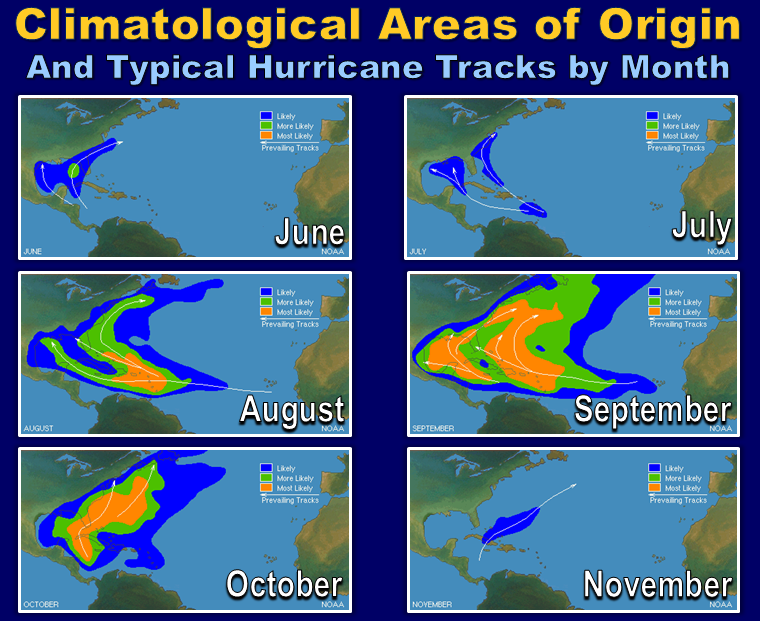
    In early summer, the Gulf of Mexico warms up faster than the open Atlantic, making it a notable hotspot for early-season tropical storm development, especially in June and July. The Texas coast, Louisiana, and the Florida Panhandle often face a higher early-season risk than locations along the Eastern seaboard.

    These are generally the busiest areas during each month of hurricane season, but that doesn’t mean hurricanes won’t make landfall elsewhere.
    NOAA

    By August and September, the season reaches its peak. This is when those waves moving off the coast of Africa become a primary source of storm activity. These long-track storms are sometimes called “Cape Verde hurricanes” because they originate near the Cape Verde Islands off the African coast. While many stay over open water, others can gather steam and track toward the Caribbean, Florida or the Carolinas.

    Later in the hurricane season, storms are more likely to form in the western Atlantic or Caribbean, where waters are still warm and upper-level winds remain favorable. These late-season systems have a higher probability of following atypical paths, as Sandy did in 2012 when it struck the New York City region and Milton did in 2024 before making landfall in Florida.

    At the end of the day, the safest way to think about hurricane season is this: If you live along the coast, don’t let your guard down. Areas susceptible to hurricanes are never totally immune from hurricanes, and it only takes one to make it a dangerous – and unforgettable – season.

    Colin Zarzycki’s research lab receives funding from the U.S. National Science Foundation, Department of Energy, and National Oceanic and Atmospheric Administration.

    ref. NOAA’s 2025 hurricane forecast warns of a busy season – a storm scientist explains why and what meteorologists are watching – https://theconversation.com/noaas-2025-hurricane-forecast-warns-of-a-busy-season-a-storm-scientist-explains-why-and-what-meteorologists-are-watching-257223

    MIL OSI – Global Reports

  • MIL-OSI United Kingdom: Joint Communique: UK-Mauritius Strategic Partnership Framework

    Source: United Kingdom – Government Statements

    News story

    Joint Communique: UK-Mauritius Strategic Partnership Framework

    Communiqué on the establishment of a Strategic Partnership Framework between the United Kingdom of Great Britain and Northern Ireland and the Republic of Mauritius.

    Today, with the conclusion of the agreement on the exercise of sovereignty over the Chagos Archipelago, relations between the United Kingdom of Great Britain and Northern Ireland and the Republic of Mauritius enter a new era. In recognition of this, we – the Secretary of State for Foreign, Commonwealth and Development Affairs for the United Kingdom, and the Minister of Foreign Affairs, Regional Integration and International Trade for Mauritius – agree to a new Strategic Partnership Framework, to cement and boost our flourishing relationship for the benefit of both nations.

    The United Kingdom and Mauritius enjoy deep historical ties and strong partnerships across a full range of shared strategic interests including economic growth, security, and climate change. We are both Commonwealth democracies, committed to upholding human rights, the rule of law, and the rules-based international system.

    Our new governments will work together to deliver the clear mandates for reform we were given in our elections last year, to support the change our people want to see. In agreeing to this partnership, we also demonstrate our continued shared commitment to the pursuit of a free and rules-based Indo-Pacific that delivers security and prosperity for all.

    From 2025, the United Kingdom and Mauritius will strengthen our cooperation, addressing the challenges and seizing the opportunities of our time, with a particular focus on: boosting mutual economic growth and trade, strengthening the international rules-based system, reinforcing maritime security, and tackling climate change.

    Building on our vibrant bilateral trade relationship currently worth £1.2 billion annually, we will increase mutual trade and investment to boost long-term growth for both our countries, supporting Mauritius’s aim to transition to a high income country and putting more money into hardworking people’s pockets. This will include:

    • deepening our existing trade relationship under the United Kingdom-Eastern and Southern Africa Economic Partnership Agreement

    • maximising growth and development by cooperating on competitive financing through UK Export Finance, with at least £5 billion in market risk appetite, to deliver British business opportunities and growth and jobs in Mauritius

    • new government-to-government initiatives on digital trade and health, and a United Kingdom/Mauritius Business Forum

    • delivering a set of formal partnerships with Mauritian and British institutions across priority sectors, including hospitals, the civil and public service, universities, and City of London financial institutions

    We also commit to work together to strengthen the international rules-based system and in particular to build resilience against corruption and illicit finance, including by enhancing Mauritius’s status as a regional financial hub and instilling further confidence in Mauritius as an investment destination. This will include:

    • developing a bilateral Economic Security Partnership to counter corruption and illicit finance, including measures to support Mauritius’s next Financial Action Taskforce review
    • expanding law enforcement cooperation, in particular cyber training and investigations, to reduce crime

    • identifying opportunities for Mauritian judicial reform and support

    We will explore ways to strengthen our democracies and shared values by forging deeper connections between our Parliaments and increasing our collaboration in international and multilateral fora such as the Commonwealth and regional Indian Ocean organisations.

    On maritime security and irregular migration, we will deepen our cooperation to fight the scourges of irregular migration, drugs trafficking, piracy, and illegal, unregulated and unreported fishing, supporting safer streets in our countries and protecting mutual prosperity. This will include:

    • cooperation agreements and capacity building to secure Mauritius’s Exclusive Economic Zone

    • consideration of patrolling capability across the Chagos Archipelago to support a secure maritime domain

    • cooperation to counter and manage irregular migration

    • provision of training and institutional partnerships to boost Mauritian maritime security capability and strengthen fisheries protection

    We further commit to tackle one of the defining global challenges of our time together: climate change. Our shared objectives are to deliver Mauritius’s transition to energy independence through sustainable renewable energy, to protect biodiversity including rare indigenous species, and to increase Mauritius’s long-term climate resilience. This will include:

    • a £12 million Access to Climate Finance programme, to unlock hundreds of millions of pounds through private sector partnerships and international green funds

    • mitigation and adaptation projects to tackle the immediate effects of climate change including coral restoration, coastal erosion and indigenous species conservation

    • technical expertise to develop and manage the Chagos Archipelago Marine Protected Area, pursuant to the agreement on the exercise of sovereignty over the Chagos Archipelago

    The new UK-Mauritius Strategic Partnership Framework will provide a comprehensive mechanism for delivering, together, for our countries. Our Ministers will meet in the coming months to finalise the partnership and will then meet in an Annual Strategic Dialogue to review and keep evolving it as necessary to support the security and prosperity of our countries into the future.

    Updates to this page

    Published 22 May 2025

    MIL OSI United Kingdom

  • MIL-OSI United Nations: Ms. Yasmine Fouad of Egypt – Executive Secretary of the United Nations Convention to Combat Desertification

    Source: United Nations MIL-OSI 2

    nited Nations Secretary-General António Guterres, following consultation with the Bureau of the Conference of the Parties to the United Nations Convention to Combat Desertification (UNCCD), announced today the appointment of Yasmine Fouad of Egypt as the next Executive Secretary of the UNCCD.  She will succeed Ibrahim Thiaw of Mauritania to whom the Secretary-General is deeply grateful for his dedicated service and outstanding commitment to the Organization.

    Serving as Minister of Environment of Egypt since 2018, Ms. Fouad is an expert in environmental diplomacy with over 25 years of experience in environmental governance, global environmental themes and international climate diplomacy.  She has a proven track record in designing and implementing institutional and systemic reforms for sustainable development.

    On the global stage, Ms. Fouad has played a pivotal role in multilateral environmental processes, serving as the President of the 14th Conference of the Parties to the Convention on Biological Diversity (CBD-COP 14) (2018-2021) and as the United Nations Framework Convention on Climate Change (UNFCCC) COP 27 Envoy (2021-2022).  She co-led the process for reaching consensus to draft the Global Biodiversity Framework 2030 and played a key role in advancing global initiatives on adaptation, food security, agriculture and nature-based solutions at COP 27. She also spearheaded the Presidential Global Initiative, which links the Rio Conventions launched at CBD COP 14.  She co-facilitated climate finance at five Climate COPs representing the interests of the global South in collaboration with Northern partners.

    Regionally, she has contributed to the Committee of African Heads of State and Government on Climate Change (CAHOSCC) and African Ministerial Conference on the Environment (AMCEN) (2015-2017) as Assistant Minister of Environment for Sustainable Development, Regional and International Cooperation.  She was instrumental in the technical preparation and coordination of the African Adaptation Initiative and the African Renewable Energy Initiative.  She co-chaired the New Partnership for Africa’s Development (NEPAD) Regional Flagship Programmes steering committee including Sustainable Land Management, Desertification, Biodiversity and Ecosystems-based Adaptation to Climate Change.

    As a visiting scholar at Columbia University, Ms. Fouad contributed to the Earth Institute, helping design a Centre of Excellence for Climate Change Adaptation in Egypt.  She holds a Ph.D.in Euro-Mediterranean Studies, Cairo University, and a M.Sc. in Environmental Science, Ain Shams University.  She is fluent in English and Arabic.

    MIL OSI United Nations News

  • MIL-OSI USA: Luttrell Introduces Legislation to Help Critical Businesses Stay Powered During Disasters

    Source:

    WASHINGTON — Congressman Morgan Luttrell (R-TX) introduced the Critical Businesses Preparedness Act, legislation that provides a 30% federal tax credit for critical businesses that purchase and install electric generators in high-risk disaster areas.

    “When Hurricane Beryl hit last year, communities across Montgomery, Liberty, and San Jacinto Counties were left without power for days,” said Congressman Luttrell. “Families couldn’t get gas, groceries, or medical care. “The lessons from Beryl and other natural disasters across the country are clear: We must harden our communities, not just react to emergencies after they happen. This bill empowers local businesses to keep their doors open and their communities running so people aren’t left in the dark or out in the cold next time.”

    The legislation amends the Internal Revenue Code to support businesses that are essential to emergency response and recovery. Under the bill, the tax credit would apply to generators placed in service by businesses operating in areas deemed at high risk for hurricanes or flooding, as determined by FEMA.

    Eligible businesses include, but are not limited to:

    • Hospitals and urgent care centers
    • Nursing homes and long-term care facilities
    • Grocery stores
    • Gas stations

    MIL OSI USA News

  • MIL-OSI Global: Hay fever: why symptoms are so bad this year – and what to do if your usual remedies aren’t working

    Source: The Conversation – UK – By Samuel J. White, Associate Professor & Head of Projects, York St John University

    Birch pollen affects around a quarter of hay fever sufferers in the UK. Dragana Gordic/ Shutterstock

    Hay fever can be annoying at the best of times. But this year, many people are reporting their usual symptoms are worse than ever before – with their normal go-to remedies doing little to provide relief.

    Here’s what you can do if you’re finding that nothing seems to be helping your itchy eyes, sneezing and runny nose this year.

    There are several reasons why hay fever is so bad right now. Climate change and pollution have lengthened and intensified pollen seasons, so trees and grasses now release allergens earlier and for longer. Urban smog may even make pollen grains more potent.

    In the UK, 2025’s unusually dry and warm spring has worsened conditions, leading to earlier and more intense tree pollen release. Birch pollen, which affects around 25% of UK hay fever sufferers, peaked sharply this year due to the high temperatures and low rainfall – two factors which increase pollen production and dispersal. The lack of rain has also prevented pollen from being cleared from the air, prolonging exposure and symptom severity.

    Another issue is timing. For full relief from hay fever symptoms, allergy medicines (especially steroid nasal sprays) should be started one to two weeks before pollen appears. So in the UK, steroid nasal sprays should ideally be started in early March for tree pollen or late April for grass pollen. Starting them late can make them seem ineffective.

    You can also develop new sensitivities, even as an adult. Pollen that didn’t bother you years ago might start causing symptoms now. Grass and birch pollen are among the most common types of seasonal pollen that start bothering people in adulthood.

    Managing symptoms

    If you’re finding allergy pills alone just aren’t cutting it this year, the best thing you can do to reduce symptoms is cut your pollen exposure wherever possible.

    Before going outdoors, check the local pollen forecast. Avoid exercising outside during peak pollen hours (usually mid-morning on dry, windy days).

    If you do go outside, wear a face mask (such as an N95 mask) when pollen counts are high. After coming inside, remove your shoes at the door, change your clothes and take a shower to wash off pollen.

    Inside, you can use a HEPA air purifier or high-MERV filters in your heating or cooling system. These will capture airborne pollen particles, which may help to reduce the severity of your symptoms during high-pollen seasons. On high-pollen days, keep windows and doors closed. You might also want to vacuum with a HEPA-filter vacuum and wash bedding often to remove any pollen.

    While these steps won’t cure allergies, they can sharply reduce your total exposure. This gives medications a better chance to work.

    Wearing a face mask while outdoors may help reduce symptoms.
    Blue Titan/Shutterstock

    While non-drowsy antihistamines such as loratadine, cetirizine and fexofenadine are common first-line treatments, research suggests fexofenadine may provide more consistent symptom relief for people with moderate to severe seasonal allergies compared to other types of antihistamines. However, each person will respond differently – so use whichever type provides you the most relief. Allergy tablets work best when taken daily and pre-emptively, ideally before peak exposure each morning.

    Nasal steroid sprays, such as fluticasone, are often more effective than antihistamines for nasal congestion. These should be started one to two weeks before the allergy season begins and used consistently.

    Allergy wipes and saline nasal rinses may also help reduce pollen exposure – though evidence of their benefit have only been shown in small studies, so larger, high-quality trials confirming their effectiveness are still needed.

    Some people may also decide to try at-home remedies for their symptoms. However, the science behind whether they really work is mixed.

    Take local honey, for example. The idea is that it exposes you to local pollen and helps build tolerance. In reality, the pollen that triggers hay fever is usually windborne and not present in honey. Studies haven’t shown eating it reduces allergy symptoms. At best, it may soothe a sore throat, but it’s not a proven remedy.

    You may have better luck by targeting your gut. Some research suggests a more diverse gut microbiome may help moderate allergic reactions. A recent meta-analysis also found that probiotic supplements can offer a small but measurable improvement in hay fever symptoms. Still, results vary by probiotic strain and treatment length. Probiotics should be seen as a complement to – not a replacement for – conventional allergy management.

    Longer-term fixes

    When symptoms stay severe, allergy immunotherapy – which helps desensitise a hay fever sufferer to pollen – can help. This works like an allergy “vaccine”. You receive tiny, gradually increasing doses of your specific allergen either by regular injection or as a daily under-the-tongue tablet or drop. This trains your immune system to tolerate the pollen and shifts your immune response by making your body better able to block allergens while simultaneously dampening the allergic response.

    In one study, around 90% of patients who underwent a full course of immunotherapy had major relief from symptoms – and this effect often lasted many years. The trade-off with immunotherapy is commitment: a typical course lasts 3–5 years under a specialist’s guidance. But for people with chronic hay fever, immunotherapy can dramatically improve their quality of life.

    Researchers are also refining immunotherapy to make it faster and more efficient. One method, which only requires a few small injections into a lymph node, can reduce symptoms by up to 40% within a season.

    Technology is also reshaping allergy care. Smart monitors and mobile apps can now track pollen and pollution in real time, while AI tools are being developed to identify specific pollen types from air samples. These tools could soon provide personalised alerts to help people avoid triggers before symptoms start.

    Pollen seasons are getting longer and stronger, so allergies can feel worse than in the past. But the good news is that science is keeping pace. By combining smart exposure-reduction strategies with the right medical treatment, most people can significantly reduce their hay fever misery.

    The authors do not work for, consult, own shares in or receive funding from any company or organisation that would benefit from this article, and have disclosed no relevant affiliations beyond their academic appointment.

    ref. Hay fever: why symptoms are so bad this year – and what to do if your usual remedies aren’t working – https://theconversation.com/hay-fever-why-symptoms-are-so-bad-this-year-and-what-to-do-if-your-usual-remedies-arent-working-256751

    MIL OSI – Global Reports

  • MIL-OSI USA: Senator Coons, colleagues introduce trio of bipartisan bills to advance American nuclear energy

    US Senate News:

    Source: United States Senator for Delaware Christopher Coons
    WASHINGTON – U.S. Senator Chris Coons (D-Del.) has introduced three bipartisan bills in recent days focused on strengthening U.S. nuclear energy policy and international collaboration. The legislation focuses on enhancing civil nuclear exports, financing, and streamlining the nuclear licensing process to reduce red tape.
    “To lower costs for consumers and combat climate change, the U.S. and the rest of the world need to be able to rely on sources of clean and abundant power, including nuclear energy,” said Senator Coons. “Right now, however, barriers that we have erected for domestic and international nuclear development stunt our energy independence here at home and give China and Russia the upper hand abroad. I’m pushing for these three bills because I know how important it is for the United States to on the cutting edge of clean, safe, affordable nuclear power.”
    The three bills Senator Coons has introduced are:
    The Efficient Nuclear Licensing Hearings Act with Senator Tim Scott (R-S.C.), which would remove the Nuclear Regulatory Commission’s (NRC) mandatory hearing requirement created by the Atomic Energy Act of 1954 without limiting opportunities for public engagement in order to enhance and boost the efficiency of the NRC in reviewing new reactor applications. The text of the bill is available here. 
    The International Nuclear Energy Act with Senator Jim Risch (R-Idaho), which would support the U.S. domestic nuclear energy industry’s leadership and offset China’s and Russia’s growing influence on international nuclear energy development. The bill would create an office to coordinate nuclear export strategies and financing, promoting regulatory harmonization and standardization, and enhancing safeguards and security. The bill would also form programs to support international nuclear energy collaboration and calls for a cabinet-level biennial summit focused on nuclear safety along with industry and government relationships. The text of the bill is available here.
    The International Nuclear Energy Financing Act with Senator Dave McCormick (R-Pa.), which would encourage more financing for nuclear energy projects to create more U.S. jobs. The legislation would do this by empowering the Treasury to leverage its influence to ensure that international financial institutions support U.S. nuclear exports. The text of the bill is available here.
    Senator Coons is a Co-Chair of the bipartisan Senate Climate Solutions Caucus.

    MIL OSI USA News

  • MIL-OSI USA: Kentucky’s Congressional Delegation Supports Gov. Beshear’s Request for a Third Presidential Disaster Declaration in 2025

    US Senate News:

    Source: United States Senator for Kentucky Mitch McConnell
    WASHINGTON, DC – Kentucky’s bipartisan federal delegation, led by Dean of the House Hal Rogers (KY-05), including U.S. Senators Mitch McConnell and Rand Paul, Congressmen Brett Guthrie (KY-02), Andy Barr (KY-06), James Comer (KY-01), Thomas Massie (KY-04) and Morgan McGarvey (KY-03), sent a letter to President Donald Trump expressing their support for Governor Andy Beshear’s request for the third major disaster declaration of the year for the Commonwealth of Kentucky. The request comes as a result of devastating storms, including an EF4 tornado that took the lives of at least 19 individuals in southern Kentucky since May 16, 2025.  
    “This severe weather event has resulted in catastrophic damage, and 19 Kentuckians have lost their lives. Entire neighborhoods have been destroyed or severely damaged, with homes, businesses and essential infrastructure suffering widespread loss. Critical roadways have been washed out, vital utilities disabled, and basic government services disrupted. The storm’s destruction spans more than 600 miles across the Commonwealth,” the letter stated. “We urge your swift approval of federal disaster assistance to help Kentucky communities begin the process of recovering and rebuilding.” 
    The National Weather Service’s final report confirmed an EF4 tornado traveled over 55 miles through Russell, Pulaski and Laurel counties, staying on the ground for an hour and a half with winds reaching a peak of 170 miles per hour.
    President Trump has already approved two major disaster declarations for Kentucky, including: 
    Declaration DR-4860 was approved after a deadly severe storm on February 14, 2025 that caused widespread flooding, resulting in the loss of least 22 lives in Kentucky. More than $43 million have been approved for Individual Assistance, with 6,895 applications approved.
    Declaration DR-4864 was approved after a deadly severe storm, beginning on April 2, 2025, that caused historic flooding, resulting in the loss of at least seven lives in Kentucky. The flooding, landslides, mudslides and tornadoes impacted 85 counties in Kentucky. 
    Click here to download the delegation’s joint letter to President Trump.

    MIL OSI USA News

  • MIL-OSI Video: Climate, Peace & Security on Protection of Civilians- Joint Security Council Media Stakeout

    Source: United Nations (Video News)

    Comments to the media by Georgios Gerapetritis, Minister of Foreign Affairs of the Hellenic Republic and President of the Security Council for the month of May, on behalf of the Security Council members signatories to the Joint Pledges related to Climate, Peace & Security on Protection of Civilians and Denmark, Guyana, Panama, Republic of Korea, Sierra Leone, Slovenia, and United Kingdom.

    https://www.youtube.com/watch?v=hwDtN1P39_o

    MIL OSI Video

  • Nationwide mass mobilization campaign launched against plastic pollution

    Source: Government of India

    Source: Government of India (4)

    Union Minister for Environment, Forest and Climate Change Bhupender Yadav on Thursday announced the launch of a nationwide mass mobilisation campaign against plastic pollution in the lead-up to World Environment Day.

    The campaign, titled ‘One Nation, One Mission: End Plastic Pollution’, aims to raise awareness, drive behaviour change, and promote sustainable alternatives to plastic use across the country. It is part of the government’s larger Mission LiFE (Lifestyle for Environment) initiative, envisioned by Prime Minister Narendra Modi, which encourages citizens to adopt environmentally conscious practices.

    “”In the run-up to #WorldEnvironmentDay, @moefcc has launched a nationwide mass mobilisation campaign against plastic pollution today. The campaign ‘One Nation, One Mission: End Plastic Pollution’ aims to nudge citizens to adopt eco-friendly alternatives as envisioned by PM Shri @narendramodi ji under Mission LiFE. Let’s move from awareness to action collectively by embracing sustainable living and #EndPlasticPollution,” Yadav posted on X.

    The key thrust areas of the campaign include spreading awareness about plastic pollution, reducing the use and generation of plastic waste, promoting efficient waste management, and encouraging the development and adoption of sustainable materials to replace single-use plastics.

    Activities under the campaign will take place across ministries, state and union territory governments, local bodies, schools, colleges, industries, civil society organisations, and community groups.

    Engagement efforts will span a variety of formats—from awareness drives on social media and street plays (nukkad nataks) to public pledges, poster and essay competitions, marathons, and cleanup drives at public places.

    Workshops, webinars, and educational activities on sustainable practices will also be organised to deepen understanding and support long-term change. Participating stakeholders have been urged to align their activities with the campaign’s goals and report them through the government’s ‘Meri LiFE’ portal.

    (With inputs from ANI)

  • MIL-OSI United Kingdom: From grey to green: Derby City Centre gets a makeover

    Source: City of Derby

    Derby City Centre has undergone a transformative green makeover thanks to funding from the Government’s Transforming Cities Fund.

    New planters have been installed around the city centre, giving a fresh and vibrant feel to the area.

    Many of the new planters have seating incorporated, which has been designed to be accessible to all visitors. Whether stopping for a quick rest or enjoying the sunshine, people can now experience Derby in a whole new way.

    Alongside the new planters, residents will already be familiar with the living roof bus shelters, which continue to be installed around the city. On top of being more visually appealing, these shelters also provide food sources and habitats for a wide variety of pollinating insects.

    Councillor Carmel Swan, Cabinet Member for Climate Change, Transport and Sustainability, said:

    This project marks a real step forward in making Derby a greener, more climate-conscious city. By adding trees, plants, and accessible seating, we’re turning grey spaces into greener, more welcoming areas.

    Over the last year I have been holding several events with schools across the city as part of the Derby Promise. Their voices have been clear; make our city greener. I hope that they like the new greening of our city.

    These changes not only improve the look and feel of our streets, but also support biodiversity, help tackle air pollution and create a more resilient urban environment for the future.”

    These new planters have been installed by Whitehouse on behalf of Derby City Council.

    In 2020, Derby City Council and Nottingham City Council secured £161m from the Transforming Cities Fund to invest in local transport infrastructure that will improve sustainable transport options, support growth, and encourage more low carbon journeys.

    As part of this wider vision, Derby’s city centre streets have been reimagined to provide improved access for road users and pedestrians, improve traffic flow, and reduce emissions. This includes new segregated cycle lanes, wider pavements, and improved traffic signals.

    The greenery and seating has been strategically placed where Transforming Cities infrastructure works were completed. These enhancements are not just aesthetic, but are helping to revive Derby’s city centre by creating a more pleasant environment that attracts visitors, supports local businesses, and encourages sustainable travel choices.

    The new planters and seating areas are the latest in our plans to make Derby a greener city. Six new pocket parks have recently been installed around Derby, providing an accessible, safe space for citizens to take a break.

    The Transforming Cities Fund works support actions in the Council’s Climate Change Action Plan to increase active and sustainable travel, increase biodiversity which in turn improves health and wellbeing whilst supporting the local economy.

    MIL OSI United Kingdom

  • MIL-OSI United Kingdom: FMQs: Polluters must pay to prevent climate breakdown

    Source: Scottish Greens

    Climate breakdown already costs households in Scotland over £3,000 a year on average.

    Climate inaction will cost Scottish households and the economy unless big polluters are made to pay, says Scottish Greens Co-Leader Lorna Slater MSP at First Minister’s Questions.

    Research by Global Witness has revealed that the costs of climate breakdown in the UK amount to an estimated £3,000 per household over the course of 2025.

    The cost of wildfires, flooding, crop losses, and more, means higher bills for households, such as insurance and everyday essentials, warns Tax Justice UK.

    Scottish Greens have long called for a windfall tax on the fossil fuel sector to pay for a Just Transition for North East workers, and to fund urgent climate action.

    In the Holyrood chamber, Ms Slater asked the First Minister:

    “Your Government has spent the last year ripping up policies designed to tackle the climate emergency. And I know the First Minister knows that delaying action on climate, actually costs a lot more in the long run.

    “Analysis from Global Witness shows that climate damage is already costing Scottish households £3,000 every year, on average, while multinational fossil fuel giants are still raking in billions of pounds of profit.

    “Unless polluters pay, communities will be worse off and the super rich will keep getting richer.

    “So that we can invest more now, not only to save money later, but to create green jobs and opportunities that we know will benefit Scotland, will the First Minister support policies to tax polluters?”

    Responding to Ms Slater, the First Minister did not set out any clear examples of climate action or attempts to make polluters pay his government would take.

    MIL OSI United Kingdom

  • MIL-OSI United Kingdom: Councillor Paul De Kort re-elected Leader of St Albans City and District Council

    Source: St Albans City and District

    Publication date:

    Councillor Paul De Kort has been re-elected Leader of St Albans City and District Council.

    He was voted to the role for the second year in succession at the annual meeting of the Full Council on Wednesday 21 May.

    Cllr De Kort will chair the Council’s Strategy and Resources Committee which has responsibility for the budget and other financial issues.

    He will also chair the Planning Policy and Climate Committee, which is overseeing the progress of the Local Plan.

    Cllr De Kort represents Harpenden East ward and has been a Councillor since 2021. He has previously held several key committee positions including Vice Chair of Resources and Chair of Audit.

    He said after the meeting confirmed his appointment:

    I am delighted to have been voted Leader again by my fellow Councillors. 

    During the coming year, we will continue our work on behalf of our residents to make St Albans District an even better place to live and work.

    Over the past 12 months, we have completed the construction of Jubilee Square, a landmark development in a sustainable location in the heart of the City. It has provided 30 new social rent homes for people on our housing register and it will also considerably increase footfall in the centre once the commercial space is occupied.

    In the year ahead, we are on track to get our Local Plan adopted, a blueprint for the sustainable growth of St Albans District over the next 16 years.

    This will allow for 15,000 much-needed new homes as well as £750 million of new infrastructure including new schools, better public transport, locations for 15,000 jobs, green spaces and health facilities.

    We will also remain committed to tackling the climate emergency, promoting inclusive communities and ensuring that our leisure facilities remain at a very high level. We have achieved all this despite the challenging financial climate.

    The Council meeting also agreed to the appointment of six other Lead Councillors who will each have a wide range of responsibilities. They are:

    Councillor Helen Campbell: Deputy Leader, Chair of the Public Realm Committee and Lead for car parking, parks and leisure.

    Councillor Terrie Smith: Vice-Chair of the Public Realm Committee and Lead for heritage, waste and recycling.

    Councillor Simon Johns: Chair of the Housing and Inclusion Committee and Lead for housing services and homelessness.

    Councillor Sarwar Shamsher: Vice-Chair of the Housing and Inclusion Committee and Lead for equality, inclusion and community safety.

    Councillor Giles Fry: Vice-Chair of the Strategy and Resources Committee and Lead for resources.

    Councillor Jacqui Taylor: Vice-Chair of the Planning Policy and Climate Committee and Lead for sustainability, climate and housing delivery.

    Contact for the media: John McJannet, Principal Communications Officer, 01727 819533, john.mcjannet@stalbans.gov.uk.

    MIL OSI United Kingdom

  • MIL-OSI Global: Anti-environmentalism is on the rise but it’s full of contradictions

    Source: The Conversation – UK – By Alastair Bonnett, Professor of Geography, Newcastle University

    Vadim Sadovski/Shutterstock

    Anti-environmentalism is gaining ground. Attacks on the net zero goal and hostility to conservation measures and anti-pollution targets are becoming more common. And, as recent election results have shown, these tactics are reshaping politics in Britain and across the west.

    Anti-environmentalism is a rejection of both environmental initiatives and activism. But despite its sudden rise and bold rhetoric, it is built on shaky foundations. The messages it offers are often contradictory and row against the tide of everyday experience.

    Take the US president, Donald Trump. He dismantled many environmental protections in his last term of office, and is now removing those that are left – including support for research that even mentions the word climate. Yet he told a rally in Wisconsin in 2024: “I’m an environmentalist. I want clean air and clean water. Really clean water. Really clean air.”


    Get your news from actual experts, straight to your inbox. Sign up to our daily newsletter to receive all The Conversation UK’s latest coverage of news and research, from politics and business to the arts and sciences.


    Some of the contradictions of anti-environmentalism reflect its departure from traditional conservatism. Although routinely identified as “conservative”, the populist anti-green politics of Republicans in the US and Reform in the UK, along with the AfD in Germany and National Rally in France, represent a radical challenge to the ideals of continuity and conservation that were once at the heart of conservatism.

    The Conservative Environment Network is an organisation which pitches itself as an “independent forum for conservatives in the UK and around the world who support net zero, nature restoration and resource security”. Much of this network’s work involves reminding people that important environmental protections, from America’s national parks to controls on pollution and climate change in Britain and elsewhere, were introduced by conservatives.

    But few on the right appear to be listening. A populist tide is washing this conservative tradition away, despite the fact that support for environmental protection remains very popular.

    Polling indicates that 80% of people in the UK worry about climate change. Public backing for the work of the US Environmental Protection Agency is also overwhelming, including among Republican voters.

    In part, this support reflects the fact that environmental damage is an everyday reality: unpredictable weather, the collapse of animal and insect populations, and a range of other challenges are not just on the TV, they are outside the window.

    In my research for a forthcoming book on environmental nostalgia across the world, I keep bumping into an irony. In western nations, voices from the right say they want their country back, yet appear hostile to environmental policies that would protect their country and ensure its survival.

    There are many reasons for this disconnect, including resentment against initiatives that require lifestyle and livelihood changes. However, the enmity and disengagement is more complicated than a simple rejection of nature.

    Many people – including Trump himself – claim they are environmentalists even when the evidence suggests otherwise. The signs and symbols of environmental care are knitted into every aspect of our commercial and cultural life: if wildlife could sue for copyright, there would a lot of rich bears.

    I argue that a distinction can be made between what I call “cold” and “hot” forms of environmentalism. The former values and mourns the loss of nature, but as a spectacle to be observed – a set of appealing images of flora and fauna – while the latter feels implicated and anxious.

    The former position allows people to claim they love nature yet be indifferent or even hostile to initiatives to save it. However, the line between cold and hot, or between anti- and pro-environmentalist, is neither fixed nor hard.

    Another quality of anti-environmentalism is that its beliefs are changeable, even quixotic. Climate change is an example.

    Reform’s leaders have long flirted with climate change denial. “Climate change has happened for millions of years,” explained former Reform UK leader Richard Tice in 2024, adding that “the idea that you can stop the power of the Sun or volcanoes is simply ludicrous”. Tice has not changed his views but later the same year, the party’s new leader, Nigel Farage, told the BBC that he was “not arguing the science”.

    Like other populist parties, Reform adopts a mobile position on the environment, moving between denying that climate change is happening or that humans are causing it, and the very different contention that anthropogenic climate change is real but that environmental targets are unreachable and unfair, given that other nations (China is often mentioned) supposedly do so little.

    A post-western paradox

    Researchers are only just starting to think about anti-environmentalism. One key analysis is environmental politics researcher John Hultgren’s The Smoke and the Spoils: Anti-Environmentalism and Class Struggle in the United States. This new book explains how Republicans managed to convince working-class voters that there is “zero-sum dichotomy between jobs and environmental protection, workers and environmentalists”.

    This kind of binary has also been found by contributors to The Handbook of Anti-Environmentalism, who identify and critique the stereotyping of environmentalism as middle-class and elite in several western countries.

    Yet the geographical focus of these pioneering works misses yet another of the paradoxes of anti-environmentalism: that although its rhetoric often accuses China and other non-western countries of doing little, there has been a significant environmental turn in both policy and public attitudes beyond Europe and the US.

    Environmentalism is becoming post-western. This is partly because the realities of environmental damage are so stark across much of Asia and Africa.

    Extreme temperatures and unpredictable rainfall are leading to food insecurity and community displacement. Environmentalism in the African Sahel and south Asia might better be called “survivalism”.

    And despite its continuing reliance on fossil fuels, China’s state-led vision of a transition to a conservationist and decarbonised “ecological civilisation” is positioning it as a global environmental leader.

    Stereotypes of environmentalism being primarily a western concern are crumbling. Because of this, along with the many contradictions that beset it, the rise of anti-environmentalism appears not only complex, but curious and unsustainable.


    Don’t have time to read about climate change as much as you’d like?

    Get a weekly roundup in your inbox instead. Every Wednesday, The Conversation’s environment editor writes Imagine, a short email that goes a little deeper into just one climate issue. Join the 45,000+ readers who’ve subscribed so far.


    Alastair Bonnett does not work for, consult, own shares in or receive funding from any company or organisation that would benefit from this article, and has disclosed no relevant affiliations beyond their academic appointment.

    ref. Anti-environmentalism is on the rise but it’s full of contradictions – https://theconversation.com/anti-environmentalism-is-on-the-rise-but-its-full-of-contradictions-256911

    MIL OSI – Global Reports

  • MIL-OSI USA: Trying to Reason with Hurricane Season: CPSC Tips to Keep Americans Safe

    Source: US Consumer Product Safety Commission

    WASHINGTON, D.C. – June 1 marks the start of the 2025 Atlantic hurricane season. The U.S. Consumer Product Safety Commission (CPSC) is warning consumers along the Atlantic Seaboard and the Gulf of America about the increased risk of carbon monoxide (CO) poisoning, fires and electric shock after hurricanes and severe storms hit.
    “These storms bring along with them power, devastation and destruction of their own,” said CPSC Acting Chairman Peter Feldman. “However, the dangers associated with these storms do not end when the winds and rain subside. I urge all Americans to follow CPSC’s safety tips this hurricane season to do their best to be safe before, during and after the storms.”
    Consumers need to be especially careful when storms knock out electrical power. CO poisoning from portable generators can kill whole families in minutes. CO is called the invisible killer because it is colorless and odorless, and its poisoning can happen in only a matter of minutes. Sadly, people can become unconscious even before recognizing symptoms of nausea, dizziness or weakness. 
    Unfortunately, CO poisoning claims the lives of hundreds of people each year. When we see these deaths occur from generators when the power is out, it makes the storm’s effects that much more devastating. To mitigate their risk of CO poisoning, consumers should follow these safety tips to protect their families, especially during the Atlantic hurricane season lasting from the beginning of June to the end of November. 
    Loss of Power—Using a Generator Safely

    NEVER use a portable generator inside a home, garage, basement, crawlspace, shed or other enclosed spaces, even with the doors open. Opening doors or windows will not provide enough ventilation to prevent the buildup of lethal levels of CO.
    Use portable generators outside only, at least 20 feet away from home and any other buildings. Don’t use a generator on a porch or in a carport; it’s too close to your home and puts your family at risk of CO poisoning. Direct the generator’s exhaust away from your home and other buildings where someone can enter. Close windows and seal off vent openings that are near the generator or in the path of its exhaust.
    Follow portable generator instructions about electrical shock hazards in inclement weather. These instructions may include use of an NFPA-rated non-combustible generator tent or may state to wait to use until rain passes.
    Regularly check and maintain your portable generator to ensure that it will work properly when needed. Read and follow all labels, instructions and warnings on the generator and in the owner’s manual.
    Look for portable generators that have a CO shut-off safety feature. This safety feature automatically shuts off the generator when high levels of CO are present around the generator. Models that are certified to the latest PGMA G300-2023 and UL 2201 safety standards are estimated to reduce deaths from CO poisoning by 86% and 100% respectively. 
    UL 2201 certified models have reduced CO emissions in addition to the CO shut-off feature.

    Check CO and Smoke Alarms

    Working smoke and CO alarms save lives! Install working CO and smoke alarms (battery-operated or with battery backup) on every level and outside sleeping areas at home. Interconnected alarms are best; when one sounds, they all sound. 
    Make sure smoke alarms are installed inside each bedroom.  
    Test CO and smoke alarms monthly to make sure they are working properly, and replace batteries, if needed. Never ignore an alarm when it sounds. Get outside immediately. Then call 911.

    Dangers with Charcoal and Candles

    Never use charcoal indoors. Burning charcoal in an enclosed space can produce lethal levels of carbon monoxide. Do not cook on a charcoal grill in a garage, even with the garage door open.
    Use caution when burning candles. Use flashlights or battery-operated candles instead. If using candles, do not burn them on or near anything that can catch fire. Never leave burning candles unattended. Extinguish candles when leaving the room and before sleeping.

    If Your Home Floods—Dangers with Wet Appliances

    Look for signs that your appliances have gotten wet. Do not touch wet appliances that are still plugged into an electrical source. 
    Before using your appliances, have a professional gas or electric company representative evaluate your home and replace all gas control valves, electrical wiring, circuit breakers, and fuses that have been under water.

    Dangers with Gas Leaks: 

    If you smell or hear gas leaking, leave your home immediately and contact local gas authorities from outside the home. Do not operate any electronics, such as lights or phones, before leaving.

    CPSC resources:
    Carbon Monoxide Safety Center
    PSA – One portable generator produces the same amount of Carbon Monoxide as hundreds of cars
    PSA – Una planta eléctrica produce la misma cantidad de monóxido de carbono como cientos de autos
    Link to broadcast quality video for media: 
    Hurricane B-Roll – https://spaces.hightail.com/space/XtFQ7YqK0x
    Individual Commissioners may have statements related to this topic.  Please visit www.cpsc.gov/commissioners to search for statements related to this or other topics.

    About the U.S. CPSCThe U.S. Consumer Product Safety Commission (CPSC) is charged with protecting the public from unreasonable risk of injury associated with the use of thousands of types of consumer products. Deaths, injuries, and property damage from consumer product-related incidents cost the nation more than $1 trillion annually. Since the CPSC was established more than 50 years ago, it has worked to ensure the safety of consumer products, which has contributed to a decline in injuries associated with these products. 
    Federal law prohibits any person from selling products subject to a Commission ordered recall or a voluntary recall undertaken in consultation with the CPSC.
    For lifesaving information:

    MIL OSI USA News

  • MIL-OSI USA: Governor Newsom announces appointments 5.21.25

    Source: US State of California 2

    May 21, 2025

    SACRAMENTO – Governor Gavin Newsom today announced the following appointments:

    Armen Meyer, of San Francisco, has been appointed Senior Deputy Commissioner for the Division of Consumer Financial Protection at the California Department of Financial Protection and Innovation. Meyer has held several positions at the American Fintech Council since 2021 including Co-Founder, Advisor, and Board Member. He has held several positions at Millenia Capital since 2021, including Advisor and General Partner. Meyer held multiple positions at LendingClub and LendingClub Bank from 2017 to 2023, including Head of the Public Policy and Government Affairs Team and Vice President of Regulatory Strategy and Policy. He held multiple positions at PriceWaterhouseCoopers from 2011 to 2017, including Managing Director for Financial Services Advisory, Director of Regulatory Strategy, and Chief of Staff for Financial Services Regulatory. Meyer held multiple positions at the New York Banking Department from 2009 to 2011, including Chief of Staff and Senior Advisor to the Superintendent. He held multiple positions in the New York Executive Office from 2007 to 2009, including Assistant Secretary for Economic Development and Communications Director to the Lieutenant Governor. Meyer is an Advisor to FS Vector, FairplayAI, Spring Labs, Pontoro, Raido Capital, University of California Berkeley SkyDeck, The AI Education Project, and Fordham University’s College at Lincoln Center. He is a Board Member of the Gaidz Foundation for Armenian heritage and Valt. Meyer is Head of Partnerships for the Harvard Business School Alumni Angels of Northern California, and a member of the National Community Reinvestment Coalition’s Innovation Council, the Exchequer Club of Washington DC, Armenian Assembly and Armenians in Banking and Finance, and supporter of The Mechanicals Theater Company. He earned a Juris Doctor degree from Harvard Law School, a Master of Public Administration degree from the Harvard Kennedy School of Government, and a Bachelor of Arts degree in Math from Fordham University. This position does not require Senate confirmation, and the compensation is $195,564. Meyer is a Democrat.

    Jacob Arkatov, of Los Angeles, has been appointed to the Medical Board of California. Arkatov has been an Associate at O’Melveny & Myers since 2022. He earned a Juris Doctor degree from Harvard Law School and a Bachelor of Arts degree in Government from Georgetown University. This position requires Senate confirmation, and the compensation is $100 per diem. Arkatov is a Democrat.

    Peter Brierty, of Highland, has been appointed to the Southwestern Low-Level Radioactive Waste Commission. Brierty has been a Retired Annuitant at the San Bernardino County Fire Department since 2025. He was a Project Manager at Pacific Heritage, Inc. from 2017 to 2023. Brierty held multiple positions at the San Bernardino County Fire Department from 1978 to 2013, including Fire Marshal, Assistant Chief, and Division Manager. Brierty is the President of the Childhood Cancer Foundation of Southern California and a Member of the Fire and Burn Foundation at the San Bernardino County Arrowhead Regional Medical Center. He earned a Bachelor of Science degree in Health Science from California State University, San Bernardino. This position requires Senate confirmation, and the compensation is $100 per diem. Brierty is a Democrat.

    Tom Hallinan, of Modesto, has been appointed to the California Board of Professional Engineers, Land Surveyors, and Geologists. Tom has been a Deputy District Attorney at the Stanislaus County District Attorney Office since 2024 and a Partner at White Brenner LLP since 2012. Hallinan earned a Juris Docter degree from Lincoln School of Law and a Bachelor of Arts degree in Philosophy from California State University, Fresno. He is a member of the Central Valley City Attorney’s Association. This position does not require senate confirmation, and the compensation is $100 per diem. Hallinan is a Democrat.

    Amanda Steidlmayer, of Woodland, has been appointed to the California Architects Board. Steidlmayer has been the Director of Professional Development at the University of California Davis School of Veterinary Medicine since 2022. She was a Program Manager for the University of California, Davis School of Veterinary Medicine from 2018 to 2022. She was a Strategic Initiatives Coordinator for the University of California, Davis Graduate Studies Office from 2013 to 2018. She was the Director of Academic Operations and Planning at the University of Davis, California Graduate School of Management from 2013 to 2016. Steidlmayer earned a Master of International Public Policy degree from the University of California, San Diego and a Bachelor of Science degree in Community and Regional Development from University of California, Davis. This position does not require senate confirmation, and the compensation is $100 per diem. Steidlmayer is a Democrat.

    Pamela Brief, of La Crescenta, has been reappointed to the Landscape Architects Technical Committee, where she has served since 2020. Brief has been President of Pamela Studios since 2012. She was Senior Principal at NUVIS from 2019 to 2020. Brief was Senior Principal at Jerde Partnership from 2007 to 2008. She was President of Schirmer Design from 2004 to 2007. Brief was a Landscape Designer and Principal at Walt Disney Imagineering from 1992 to 2004. Brief earned a Bachelor of Science degree in Landscape Architecture from Ohio State University. She is a member of the American Society of Landscape Architects, Association of Women in Architecture + Design, and Friends of the LA River. This position does not require Senate confirmation, and the compensation is $100 per diem. Brief is a Democrat.

    Press releases, Recent news

    Recent news

    News SACRAMENTO – Governor Gavin Newsom today announced the following appointments:Matthew Read, of Sacramento, has been appointed Chief Counsel at the Governor’s Office of Land Use and Climate Innovation. Read has been Acting Chief Counsel at the Governor’s Office of…

    News What you need to know: Governor Newsom issued a statement today after U.S. Senate Republicans announced plans for an illegal vote this week that would undo California’s clean cars and trucks program. SACRAMENTO – Governor Gavin Newsom today issued a statement on…

    News What you need to know: State and local law enforcement partners seized $123.5 million in illegal cannabis in the Central Valley. SACRAMENTO – In its largest operation to date, the state’s task force dedicated to eradicating illegal cannabis operations conducted a…

    MIL OSI USA News

  • MIL-OSI Europe: European Climate Change Adaptation 2025

    Source: European Union 2

    The European Climate Change Adaptation 2025 is one of the largest conferences on climate change adaptation. It is held every two years in Europe since 2013. The conference presents fundamental new research findings as well as implementation experiences from adaptation projects.

    MIL OSI Europe News

  • MIL-OSI United Kingdom: Six Inches of Soil documentary screening in Ashgabat

    Source: United Kingdom – Executive Government & Departments

    World news story

    Six Inches of Soil documentary screening in Ashgabat

    The United Kingdom and Turkmenistan explore sustainable agriculture through “Six Inches of Soil” screening and panel discussion.

    Discussion after the screening of the British documentary Six Inches of Soil.

    On 15 May, the British Embassy in Turkmenistan hosted another successful screening of the British documentary Six Inches of Soil as part of the official visit of Dr Undala Alam, FCDO’s Regional Central Asia Climate Adviser.

    Discussion with Dr Undala Alam, FCDO’s Regional Central Asia Climate Adviser, after the screening of the documentary Six Inches of Soil.

    The event brought together experienced farmers, agricultural entrepreneurs, senior government officials, academics, and researchers to discuss the critical role of regenerative agriculture in addressing today’s environmental and agricultural challenges.

    Screening of the British documentary Six Inches of Soil in Ashgabat.

    Following the film, Dr Alam led an interactive and thought-provoking discussion where participants raised insightful questions, shared local expertise, and expressed great interest in applying regenerative practices in Turkmenistan.

    Discussion with Dr Undala Alam, after the screening of the British documentary.

    This discussion underlined the region’s growing concern for climate resilience and food security. The UK Government remains committed to supporting the countries of Central Asia in their transition towards more sustainable and climate-friendly agricultural systems.

    Updates to this page

    Published 22 May 2025

    MIL OSI United Kingdom

  • MIL-OSI NGOs: Life of a firefly

    Source: Greenpeace Statement –

    When was the last time you saw a field full of fireflies? In Bill Angelo Bontigao’s “Life of a Firefly,” a poem written in his native Bicol, one of Greenpeace Philippines’ youngest activists ruminates on waning innocence, gradual loss, and how our neglect threatens to dim the little lights we take for granted.

    [In Bicolano]

    Buhay kan sarong Aninipot
    ni: Bill Angelo Bontigao

    Pag dulom an kalangitan,
    Warang ilaw hale sa mga kaharungan,
    Oras ko naman para magpahiling kan sakuyang kagayunan.
    Talentong sakong ighahambog sa gabos na insektong naglalayog.

    Hale sa kahoy na Mangga minsan sa dakulang kahoy na Naga.
    Kasabay kan mga Duliduli nagkakanta,
    Sakong iilawan ang lubot asin masayaw na maogma,
    Sarabay kami kan sakong mga amiga asin amigo liwanag samong ibabalangibog.

    Minasayaw nin pantomina, cha-cha asin minasabay sa tugtug kan gitara.
    Nagsasabay sa taghoy kan paros bahala na kun saen man madara.
    Pag na swetehan ko, sa kamot kan mga aki ako dadarakupon,
    Ihihinghing sako ang mga tugon dangan ako papalayugon.

    Dara ko ang mga kahilingan kan mga kasaradayan,
    habang pasildang na ang aldaw sakuya ining iataman,
    bago ako magkaturog sako ining ipangadyi sa kaitaasan,
    bako man kaya ako ang matupad kundi ang kagurangnan.

    Sa pagmuklat ko liwat kan sakong mga mata,
    Dae ko na bistado ang dating lugar kun saen ako nag-oogma.
    Dae ko na kayang makipagsabayan sa liwanag kan mga dalan,
    Dae ko na namamati ang preskong paros na sakuyang pigduduyanan.

    Dae na ako bistado kan mga kasaradayan,
    Dae na sakong nag-aabang sa mga gilid kan dalan,
    Maski sa mga kanta kan gamo-gamo nata bako na makukusog,
    Nata wara na akong gitarang nadadangog.

    Nata pagmati ko ako nagluluya,
    Siguro oras na para ako maghale na,
    Salamat sa mga oras na naging parte ako kan saimong pagdakula,
    Sa saimong mga maku-apo, ako saimo na sanang iistorya,

    Kun sana ako man makakapaghagad nin tugon saindo,
    kun ako mawara aram ko may mga amigo pa ako,
    Sana sinda atamanon nindo,
    Dae nindo pagpabayaang magpundi ang ilaw nyamo.


    [In Tagalog]

    Buhay ng Isang Alitaptap
    ni: Bill Angelo Bontigao
    Isinalin ni: Karl Orit

    Sa pagdilim ng kalangitan,
    Wala nang ilaw sa mga tahanan,
    Panahon ko na para ipamalas ang alindog kong tangan.
    Ipinagmamalaki sa lahat ng insektong lumilipad ang aking kakayahan.

    Minsan mula sa punòng Mangga, minsan sa punòng Nara.
    Kasabay ng mga umaawit na kuliglig,
    Pinaiilawan ko ang aking puwit at masayang nagsasasayaw,
    Kasabay ng aking mga kaibigan nangungutitap upang magpakitang-gilas.

    Sumasayaw ng pantomina, chacha, at sumasabay sa tugtog ng gitara.
    Sumasabay sa pagsipol ng hangin, bahala na kung saan kami dalhin.
    Kapag sinuwerte, sa kamay ng mga bata ako kukupkupin,
    Makikiusap para sa kanilang pinapangarap bago ako pakawalan muli.

    Bitbit ko ang kanilang mga hiling at ligayang lihim
    Na lubos kong iingatan, hanggang ang araw ay sumilip.
    Bago ako humimbing, magsusumamo ako sa langit,
    Bahala na ang Diyos sa mga katuparang di ko na aabutan.

    Sa aking muling pagdilat,
    Hindi ko na makikilala ang lugar na lunan ng aking sayá.
    Hindi ko na kakáyahing sumabay sa mga nagniningning sa daan,
    Hindi ko na madarama ang maginhawang simoy sa aking pinapasyalan.

    Kahit ang kabataan, hindi na ako kilala,
    Wala nang naghihintay sa akin sa gilid ng lansangan.
    Kahit ang awit ng mga kuliglig ay nawalan na ng sigla,
    Wala na ring naririnig na tugtog ng gitara.

    Nanghihina na yata ako,
    Marahil ito na ang panahon upang mamaalam.
    Salamat sa mga sandaling naging bahagi ako ng iyong paglaki,
    Ikuwento mo sana ako sa iyong magiging mga anak at apóng mumunti.

    At kung maaari, mag-iwan ako ng huling pakiusap sa inyo,
    Kapag wala na ako, alam kong may mga kaibigan pa ako.
    Alagaan din ninyo sana sila
    At huwag ninyo hayaang ang liwanag namin ay tuluyang mapundi.


    [In English]

    The Life of a Firefly
    by: Bill Angelo Bontigao
    Translated by: Pocholo Goitia

    When the sky turns dark,
    And no light shines from nearby houses,
    It is my time to show my beauty.
    Flaunt it to all the other insects soaring through the night.

    Sometimes I’m a glimmer from the Mango tree,
    sometimes from the towering Narra.
    Alongside the cicadas singing their gentle song,
    I light up my tail and dance happily,
    Together with my friends, we shine and show each other’s prowess.

    We sway to pantomina, to cha-cha, to the strum of the guitar,
    We follow the whistle of the wind—wherever it takes us.
    If I’m lucky, a child’s hand might catch me and cradle,
    Whisper to me their wishes before setting me free.

    I carry their desires and secret joys,
    I handle these with care until the slip of first light.
    Before I sleep, I make my own pleas to heaven,
    Not by my light, but by God’s grace, may they be granted.

    When I open my eyes again,
    I will no longer recognize the districts of my happiness.
    I won’t be able to keep up with the city’s shining streets,
    I won’t feel the cool breezes of my old gentle haunts.

    The children don’t know who I am,
    No one waits for me by the roadsides.
    Even the cicada songs have lost vigor,
    The sound of strumming guitars, gone.

    I feel myself growing weak,
    Perhaps it is time for me to leave.
    Thank you for the moments when I was part of your growth,
    Please tell your children and their children my story.

    If I could make one final request:
    I know friends who will remain, even after I go.
    I hope you look after them, as you’ve looked after me,
    Don’t let our light extinguish completely.

    If we continue to allow habitat loss to climate change and pollution, fireflies and other species will fade to memory. By taking action, we can help stem the decline and ensure they remain a part of our world.


    You might want to check out Greenpeace Philippines’ petition called Courage for Climate, a drive in support of real policy and legal solutions in the pursuit of climate justice.

    Courage for Climate

    The climate crisis may seem hopeless, but now is the time for courage, not despair. Join Filipino communities taking bold action for our planet.

    Make an Act of Courage Today!

    MIL OSI NGO