Category: Australia

  • MIL-OSI Australia: Interview – Afternoon Briefing with Patricia Karvelas

    Source: Australian Executive Government Ministers

    PATRICIA KARVELAS, HOST: To discuss this and more, let’s bring in one of our regulars, Early Childhood Education Minister Anne Aly, who’s also been promoted in the latest reshuffle. Welcome.

    MINISTER ANNE ALY: Thank you so much, Patricia. Great to be with you.

    KARVELAS: We’re going to start there because that’s the big talking point around the world. A bit of clarification from Marco Rubio. Does that sound like a better plan that the US would redevelop Gaza?

    ALY: Well, look, I want to start by first of all, Patricia, if I may, acknowledging the significant pain and distress that this caused to Palestinians across the world, particularly as they’re preparing to return to their homeland. You know, certainly I think there is, there needs to be a concerted effort across the world to rebuild Gaza. And in fact, when I was at the conference in Jordan last year, that was on the table already, the countries that were represented there were talking about psychosocial recovery and rebuilding Gaza – what happens in rebuilding Gaza. So, I think, you know, it will take significant effort from right around the world for rebuilding Gaza. But in terms of, you know, the position that this government has around a two-state solution, inherent in that two-state solution is a self-determination for Palestinian people and the right of return.

    KARVELAS: So, that means that you would never accept Gazans being pushed off or Palestinians being pushed off that land in Gaza.

    ALY: I think the response that we’ve had from across the world to President Trump’s statement yesterday makes it very clear that it is widely accepted that Palestinians have a right of return to their homeland.

    KARVELAS: But you mentioned, which I thought was really interesting. You often say interesting things, Minister —

    ALY: I do, do I?

    KARVELAS: You do, that you want to acknowledge the hurt and the concern because there was.

    ALY: There was right, it was, yeah.

    KARVELAS: Just talk to me about that concern.

    ALY: So, I think, you know, like just even talking to Palestinians in the community and to the community more broadly here in Australia, there was a real sense of shock and a real sense of, yeah, real concern that, you know, this could mean that there would basically an eradication of a Palestinian state when we’ve long held the principle of a two-state solution with a right of return and self-determination for Palestinian people. And I think, you know, if I were a Palestinian person preparing to return to my homeland, one of the things that we want to make sure of in Australia and you know, this government has done that consistently in the votes that we’ve done in the UN and the actions that we’ve taken is to ensure that this current ceasefire is sustainable and long-lasting and that there is an enduring peace for both Palestinians and Israelis.

    KARVELAS: So, given how strong your comments have been about the Palestinians right to return, there has been a criticism that the Prime Minister could have used stronger words. Other foreign leaders who are also allies of the United States have used stronger words. Do you understand that frustration?

    ALY: Look, I listened to the Prime Minister yesterday and I think he was quite correct in reiterating that we have a long-standing position that we’re not changing, which is a two-state solution. And I think, you know, anybody could listen to that and recognise what the Prime Minister is saying is that we believe in the right and we support the right of Palestine and Palestinians and Gazans to exist in their homeland.

    KARVELAS: And now you’re kind of, you know, being pretty empathetic about how people heard that and their ongoing concerns. Is it important that the government makes that clear? Because I saw all those concerns too.

    ALY: Yeah. And I think, I think, you know, we have made it clear, I think —

    KARVELAS: I feel like you’re making it clearer.

    ALY: Well, I think the actions that we’ve taken that the Foreign Minister, Penny Wong, has taken, the votes that we’ve had in the United Nations, have sent a very clear message that we stand for human rights and that we stand for justice and that we stand for a two-state solution and an everlasting peace.

    KARVELAS: I just want to move to some other issues because there are lots of issues in our country.

    ALY: So many.

    KARVELAS: There are. The Australian Federal Police has just spoken in a committee hearing. They have not given any detail as to, basically there’s no answers on when they briefed the Prime Minister on this caravan attack. Shouldn’t the Prime Minister just say it, or the Opposition says, call an inquiry?

    ALY: Well, I think what we need to do here is take the lead from the law enforcement agencies because in an investigation, it’s the law enforcement agencies that take the lead. And we have to, we absolutely have to respect the integrity of the law enforcement agencies and support them to do their work. As you know, Patricia, I’ve got a husband in law enforcement. I know exactly what he can and can’t tell me. Most of the time he can’t tell me anything. Like we do not talk about the investigations that he is undertaking in any capacity. So, when the law enforcement agencies say that we did not want this information out there because it is an ongoing investigation and could compromise the investigation, we need to respect that.

    KARVELAS: But telling the Prime Minister is a different thing.

    ALY: Well, I think, you know, I don’t think it’s here nor there. I’ve not had a single person say to me, hey, I want to know when the Prime Minister found out. So, I think it’s a little bit of a Canberra bubble —

    KARVELAS: Oh, a Canberra story.

    ALY: Yeah.

    KARVELAS: Ok. I don’t want to just labour on that because there are other things Labor did break with your policy, which is a national platform to oppose mandatory sentencing. Former Labor Senator Kim Carr has criticised the party and said, this is profoundly disappointing. What’s your response to that?

    ALY: Okay, so I’ve got a bit of a different response, Patricia, because I know the impact of hate crimes personally and as a member of a community that has been the target of hate crimes. That to me, hate crimes are some of the most heinous crimes. When you target an individual or a group because of who they are, because of their identity, whether it’s religious, racial, gender, sexual, whatever, to me, that’s one of the most heinous and cowardly crimes that you can commit. So, I want to see, I want to see us get tough on hate crimes. I support being tough on hate crimes and I think what we’ve seen recently, the escalation in the kinds of hate crimes that we’ve seen, warrants this kind of action by the Government.

    KARVELAS: So, you want. Instead of – because I know some people in the party are concerned, you want the mandatory sentences.

    ALY: I want to see us to be tough on hate crimes. And you know, I’ve been there. I know, I know the impact that it has. So, I want us to get tough on hate crimes and I know that right now Jewish Australians are the victims of a lot of hate crimes as well. And I want —

    KARVELAS: The Law Council says it’s bad policy.

    ALY: Well, people will have their different opinions. I will also say, though, that, you know, we know laws don’t change behaviour. The prevention of hate crimes and vilification in all its forms is a responsibility for every single person. It’s about societal change as well.

    KARVELAS: Okay, let’s get to some of your issues before we say goodbye. Child care is obviously one of the areas that you focus on. The government has decided to put this bill, which would mean three days of care without activity testing, where you get the rebate, essentially, through the Parliament. Do you expect it to pass in the next fortnight?

    ALY: I do. I hope it will pass [the House]. I know that there is widespread support for this from the sector. It is a recommendation of the PC Review. And you know what? It’s just good policy. It’s good policy that when you have people in a partnership, one works full time, one might work two days a week in casual, and they’re not eligible for subsidised care. It has locked out children from early childhood education and care and locked out families from being able to access the childcare subsidy. It’s good policy. It has good support, and I do, and I look forward to seeing it pass.

    KARVELAS: But it doesn’t have to pass. It doesn’t even start till next year. So, is it a wedge to try and get the Coalition to actively vote against it?

    ALY: Well, I don’t know what the Coalition’s position is —

    KARVELAS: They think that you should have to be earning or, you know, working or studying to get the activity test.

    ALY: Well, the thing is, you can be working or studying to get the activity test but still might not meet the activity test. And the other thing is the activity test, when it was introduced in 2018 by the Liberals, it was supposed to be to increase workforce participation. It did none of that. Instead, it locked out some of the most vulnerable children from early childhood education and care. We’re fixing that. We’re making sure that every child has access to opportunity because there should be no barriers to opportunity.

    KARVELAS: Anne Aly, always a pleasure to speak to you. Thanks for joining us.

    ALY: You too. Thanks so much, Patricia.
     

    MIL OSI News

  • MIL-OSI Australia: First paramedics in training for 2025 join NSW Ambulance

    Source: New South Wales Premiere

    Published: 7 February 2025

    Released by: Minister for Health


    NSW Ambulance has today welcomed 91 paramedics in training who were officially inducted into the service in a ceremony held at the State Operations Centre in Sydney, providing a further boost to frontline health services across the state.

    This marks the first induction ceremony of the year, with this cohort part of a Post Employment Tertiary Pathway (PETP) course. The paramedics in training are employed by NSW Ambulance while they complete a degree in paramedicine at university.

    They have just completed a comprehensive 12-week induction program at the NSW Ambulance Education Centre and begin their on-road training as paramedic students from tomorrow.

    The PETP course is facilitated over four years and provides an alternate pathway for people with no prior medical experience to become a paramedic with NSW Ambulance. Once these paramedics in training have completed their degree qualification, they can apply to be registered paramedics.

    Natalie Saridakis, formerly an emergency medical call-taker with NSW Ambulance, is one of 19 paramedic students who have joined this class after working in NSW Ambulance Control Centres.

    Brad Carr also starts his career as a paramedic student today, following in the footsteps of his paramedic father Dominic, who works as an educator for NSW Ambulance.

    Starting tomorrow, the paramedics in training will initially be posted across metropolitan and regional locations in NSW for the on-road training component of their course and will return to the NSW Ambulance Education Centre and their university regularly for additional training over the four-year course.

    Quotes attributable to Minister for Health, Ryan Park:

    “I’m thrilled to welcome 91 new paramedic students into the NSW Ambulance service, boosting frontline health services and playing a critical role in the health and wellbeing of the community.

    “By aspiring to join the paramedic ranks, these paramedics in training will become part of a legacy of service and dedication. The work they do not only changes lives but will uphold the values and standards of a profession that is deeply respected and admired.”

    Quotes attributable to NSW Ambulance Chief Executive Dr Dominic Morgan:

    “These paramedic students join an incredible team that is united by a shared commitment to provide emergency medical care and comfort to members of our community when it matters most.

    “Paramedics are not only healthcare providers but also trusted and respected individuals in our community.”

    Quotes attributable to Natalie Saridakis:

    “For many years I was a carer for my mum, having frequent contact with the local paramedics.

    “I was always impressed by their compassion and kindness that it really inspired me to join NSW Ambulance.

    “I started out as an emergency medical call-taker which was a great start, but right now I am so excited to begin this new chapter.”

    Quotes attributable to Brad Carr:

    “I am proud to continue a family legacy in becoming a paramedic.

    “My father has had a lengthy career, and I am looking forward to forging my own path.”

    MIL OSI News

  • MIL-Evening Report: Misleading and false election ads are legal in Australia. We need national truth in political advertising laws

    Source: The Conversation (Au and NZ) – By Yee-Fui Ng, Associate Professor, Faculty of Law, Monash University

    An ad falsely depicting independent candidate Alex Dyson as a Greens member. ABC News/Supplied

    The highly pertinent case of a little-known independent candidate in the Victorian seat of Wannon has exposed a gaping hole in Australia’s electoral laws, which allow for misleading political advertisements in the lead-up to an election campaign. It’s all entirely legal and is already being exploited to try to shape the outcome of the coming federal election.

    Conservative activist group Advance Australia has widely distributed digitally altered flyers attacking independent Alex Dyson, who is challenging senior frontbencher Dan Tehan.

    It’s part of a campaign to damage Dyson’s electoral prospects after he helped slash the Liberal Party’s margin in the seat at the last election to less than 4%.

    The material depicts Dyson ripping open his shirt in a “Superman” pose, to reveal a t-shirt bearing the official Greens party logo.

    Dyson is not a Greens candidate. So why are the ads permissible? And what does it tell us about the urgent need for truth in political advertising laws to prohibit material that lies to voters?

    Why are misleading ads allowed?

    Section 329 of the Electoral Act prohibits the publication of material likely to mislead or deceive an elector in casting their vote.

    But in a narrow interpretation by the Electoral Commission, the ban only applies after an election has been called by the prime minister.

    That means the Wannon ad, and maybe countless others like them from across the political spectrum, could be distributed for months without repercussion.

    Advance Australia has form when it comes to misleading material.

    At the 2022 election, it displayed placards that falsely depicted independents David Pocock and Zali Steggall as Greens candidates.

    In that case, the Electoral Commission ruled that because the corflutes were deployed during the campaign proper, they breached the electoral laws.

    It is absurd and dangerous to democracy to have a law that only bans ads that mislead voters in casting their vote during the official election period, and allows them to proliferate unchecked at other times.

    It should not be permissible to lie to voters just because of a technicality. In an era of permanent campaigning, voters can be influenced by political messages received well before a campaign officially starts.

    Furthermore, there is little justification for allowing political parties to mislead while banning corporations from engaging in misleading and deceptive conduct. If consumers and shareholders are protected from fraudulent and dishonest claims, why not electors, who have the solemn task of deciding who runs the country?

    How can the electoral laws be fixed?

    There are available remedies to the problem, starting with reforming the Electoral Act. It should be clearly specified that the provision on misleading electors applies to any material calculated to affect the result of an election, regardless of when it is distributed.

    Broader truth in political advertising provisions should also be introduced. This would cover a wider range of factually misleading ads beyond the existing narrow ambit of misleading a voter in the casting of their vote.

    If the Electoral Commission determines the material is false or misleading to a material extent, it would order a withdrawal and a retraction.

    Importantly, the laws would be confined to false or misleading statements of fact. Parties and other political players would still be free to express their opinions. Freedom of speech would not be impeded.

    Parliamentary stalemate

    The Albanese government has taken tentative steps to fix the problem. Truth in advertising laws introduced to parliament last year would have forced Advance Australia to retract and correct its dishonest flyers in Wannon.

    However, the bill was pulled due to a lack of support.

    Any doubters on the opposition benches should look to the experience in South Australia and the ACT, which have both enacted truth in advertising laws.

    My research has shown these laws operate effectively in both jurisdictions.

    What’s at stake

    Spreading political lies has the potential to cause harm on multiple fronts.

    The first is the damage to the candidate or political party in terms of their reputation and electoral prospects.

    The second danger is to the integrity of the electoral process if lies cause people to switch their votes to such an extent that it changes election outcomes.

    The spread of disinformation has become prevalent in an era of “fake news” and “alternative facts”, exacerbated by the rise of social media.

    In 2024, the World Economic Forum’s Global Risks Report ranked misinformation and disinformation as the most severe risk facing the world over the next two years.

    False information can alter elections, affect voting participation, silence minorities, and polarise the electorate. It is time to reform our electoral laws to mitigate the significant dangers to our democratic system.

    Yee-Fui Ng received funding from the Susan McKinnon Foundation on a project regarding the operation and effectiveness of truth in political advertising laws.

    ref. Misleading and false election ads are legal in Australia. We need national truth in political advertising laws – https://theconversation.com/misleading-and-false-election-ads-are-legal-in-australia-we-need-national-truth-in-political-advertising-laws-249279

    MIL OSI AnalysisEveningReport.nz

  • MIL-Evening Report: Rebels are continuing their march in eastern Congo – what is their long-term goal?

    Source: The Conversation (Au and NZ) – By Amani Kasherwa, School of Nursing, Midwifery and Social Work, The University of Queensland

    In late January, a rebel group that has long caused mayhem in the sprawling African nation of Democratic Republic of Congo took control of Goma, a major city of about 2 million people on the border with Rwanda in the country’s east.

    Nearly 3,000 people were killed in one of the deadliest weeks in the history of this mineral-rich country. The dead include 100 female prisoners who were reportedly raped by male inmates at a prison and then burned alive.

    As someone born and raised in the region, I’ve witnessed first-hand the devastating impact of this protracted war on communities. I’ve been in contact with residents in Goma, who have described unprecedented chaos – looting, criminality and a breakdown of essential services. One resident said:

    I’m feeling unsafe in my own house. Last night live bullets penetrated my kitchen, and thank God none of us were there at the time.

    More violence may lay ahead. The M23 rebel group, backed by neighbouring Rwanda, is marching south towards Bukavu, another major city, the provincial capital of South Kivu.

    Though unlikely, it has vowed to topple the government of President Felix Tshisekedi in the capital, Kinshasa, some 2,600 kilometres away.

    Tshisekedi has ruled out entering into dialogue with the rebel group, saying his government would not be “humiliated or crushed”.

    What is M23?

    Founded in 2012, M23 claims to protect the Tutsi ethnic minority group in Congo from discrimination, but it has recently begun pursuing broader political and economic ambitions. It is believed to have about 6,500 fighters, supported by another 4,000 troops from Rwanda.

    Last year, the group was restructured to include other Rwanda-backed militias and politicians in the region. Together, they formed the River Congo Alliance, led by Corneille Nangaa, the former head of Congo’s electoral body. It now appears the group has “longer-term objectives in holding and potentially expanding their territorial control”, one analyst says.

    A military court has issued an arrest warrant for Nangaa this week, alleging he is behind massacres in eastern Congo.

    Congo has one of the richest reserves of critical minerals in the world, including cobalt, copper, coltan, uranium and gold. M23’s advances have given it control over many lucrative mines and supply lines to Rwanda.

    In May 2024, M23 seized the mine in Rubaya, one of the world’s largest coltan reserves, which generates more than US$800,000 (A$1.2 million) in revenue a month.

    As of this week, M23 has also gained control over mining sites in North and South Kivu regions, where children and young people are forced to work in life-threatening conditions. Others have been recruited as child soldiers.

    Potential for a regional conflict

    The current situation echoes the tumult caused in 2012 when M23 briefly seized Goma. Back then, the international community reacted more diligently, suspending around US$200 million (A$318 million) in aid to Rwanda. US President Barack Obama personally called Rwandan President Paul Kagame, urging him to stop supporting the rebel group.

    In contrast, the current offensive has been met with a less coordinated international response.

    The resurgence of M23 has been largely attributed to the failure of regional peace talks, notably the Luanda and Nairobi peace processes.

    Rwanda has leveraged the legacy of the 1994 genocide to secure a continuous flow of Western aid, enabling its involvement in proxy wars in the Congo with little to no repercussions.

    Its involvement in supporting M23 is well documented, with evidence from reports by UN expert groups showing the group is receiving weapons, troops and logistical aid from the country.

    Uganda is also believed to be supporting the rebels, while Burundi is backing the Congolese government.

    This has many worried the current fighting could spiral into a regional conflict.

    What the world can do

    The ongoing crisis in Congo has been catastrophic for the local population, with more than 6.9 million people internally displaced and 1.1 million people fleeing to neighbouring countries.

    The crisis has disproportionately affected women and children. It has caused shortages of water, electricity and food supplies and the collapse of medical care, particularly for newborns and critically ill patients. There are also concerns about a new Ebola outbreak in the region.

    Rebel bombings, some launched from Rwanda, have targeted refugee camps, schools and hospitals. According to the UN and human rights groups, M23 is responsible for a massacre in the village of Kishishe, resulting in scores of killings and mass rapes.

    The international community has long ignored this region, providing only a bare minimum of aid to help the millions in need.

    An immediate ceasefire and massive influx of humanitarian aid are urgently needed. But a lasting peace will remain elusive if the main actors don’t address the root causes of the conflict and work towards sustainable, structural solutions that go beyond military interventions.

    In the past, Amani Kasherwa received funding from the Open Society Foundation for his academic research on the role of youth organisations in the peacebuilding process in the African Great Lakes Region (including DR Congo and Burundi).

    ref. Rebels are continuing their march in eastern Congo – what is their long-term goal? – https://theconversation.com/rebels-are-continuing-their-march-in-eastern-congo-what-is-their-long-term-goal-248672

    MIL OSI AnalysisEveningReport.nz

  • MIL-OSI Australia: 33-2025: *Cancelled* Scheduled Outage: Saturday 08 February to Sunday 09 February 2025 – Multiple Systems

    Source: Australia Government Statements – Agriculture

    07 February 2025

    Who does this notice affect?

    Approved arrangements operators who will be required to view and/or update details of their Approved Arrangement via the Approved Arrangement Management Product (AAMP).

    All clients required to use the Biosecurity Import Conditions System (BICON) during this planned maintenance period.

    All clients required to use the Export / Next Export Documentation (EXDOC/NEXDOC) systems during this planned maintenance period.

    MIL OSI News

  • MIL-OSI Australia: Collaboration the key to fuel reduction efforts at Cornish Hill

    Source: Victoria Country Fire Authority

    Midway through last year, the CFA West Region Community Safety Team was approached by the Friends of Cornish Hill in Daylesford, to look at the growth of gorse and other woody weeds in the reserve.

    CFA Vegetation Management Officer Kay Richardson attended with Forest Fire Management Victoria (FFMVic) and local CFA Captain Glenn Webster. Since that first meeting, collaborative efforts between FFMVic, the CFA Community Safety Team, and the Friends of Cornish Hill (FOCH) resulted in notable improvements in vegetation management and track maintenance.

    It has also offered significant opportunities to include the surrounding community in fire risk awareness discussions and shared responsibility.

    The FOCH ran a ‘Backing onto bush’ session in late November 2024 which was attended by 36 community members plus agency staff including Hepburn Shire, FFMVic, CFA and Landcare. 

    The day aimed to engage the community and highlight the fire risks they faced and what they could do to manage those risks as individuals and as a community. By the end of the session, the group was galvanised to assist the agencies to manage the fuel load on Cornish Hill as one way of preparing for fire.

    FFMVic has completed grooming and grading the tracks on Cornish Hill. This work has not only improved accessibility but has also enhanced safety for maintenance teams and the local community.

    Cath Matthews, Regional Vegetation Management Coordinator, expressed her gratitude to Midlands FFMVic for their work.

    “A big thanks to Midlands FFMVic for undertaking the mulching of the gorse-infested tracks through Cornish Hill. This will now greatly facilitate access for brigades, enabling quicker suppression if a fire starts in the reserve,” Cath said.

    Efforts to address invasive gorse, blackberry, and broom are ongoing, with the following key activities underway:

    • CFA is preparing to treat a block of woody weeds near the north-east corner of the hill.
    • The FOCH has engaged the ‘Gorsinator’ to remove old, hard-to-access gorse from the north-west corner.

    The progress achieved has been well-received by the community and stakeholders. At the FOCH Annual General Meeting, members expressed their encouragement with the rapid pace of work. Cath Matthews also highlighted the broader impact of these efforts.

    “This work has strengthened relationships between the many stakeholders involved, and hopefully we can build on this to ensure continued reduction of fire risk within this reserve and with the community.”

    The FOCH is now preparing funding applications to sustain the work that has been achieved.

    Submitted by Jude Atkinson

    MIL OSI News

  • MIL-Evening Report: Are eggs good or bad for our health?

    Source: The Conversation (Au and NZ) – By Lauren Ball, Professor of Community Health and Wellbeing, The University of Queensland

    Nik/Unsplash

    You might have heard that eating too many eggs will cause high cholesterol levels, leading to poor health.

    Researchers have examined the science behind this myth again, and again, and again – largely debunking the claim.

    A new study suggests that, among older adults, eating eggs supports heart health and even reduces the risk of premature death.

    Let’s unpack the details.

    What was the study?

    Researchers examined data from a large, ongoing study that is following older adults and tracking their health (the ASPREE study).

    In their analysis of more than 8,000 people, they examined the foods people usually eat and then looked at how many participants died over a six-year period and from what causes, using medical records and official reports.

    Researchers collected information on their diet through a food questionnaire, which included a question about how frequently participants ate eggs in the past year:

    • never/infrequently (rarely or never, 1–2 times per month)
    • weekly (1–6 times per week)
    • daily (daily or several times per day).

    Overall, people who consumed eggs 1–6 times per week had the lowest risk of death during the study period (29% lower for heart disease deaths and 17% lower for overall deaths) compared to those who rarely or never ate eggs.

    Eating eggs daily did not increase the risk of death either.

    How reputable is the study?

    The research was published in a peer-reviewed journal, meaning this work has been examined by other researchers and is considered reputable and defensible.

    Study participants reported their egg intake on an questionnaire.
    Sincerely Media/unsplash

    In the analysis, factors such as socioeconomic, demographic, health-related and clinical factors, and overall dietary quality were “adjusted” for, as these factors can play a role in disease and the risk of early death.

    Researchers received funding from a variety of national funding grants in the United States and Australia, with no links to commercial sources.

    What are the limitations of this study?

    Due to the type of study, it only explored egg consumption patterns, which participants self-reported. The researchers didn’t collect data about the type of egg (for example, chicken or quail), how it was prepared, or how many eggs are consumed when eaten.

    This analysis specifically looked for an association or link between egg consumption and death. Additional analyses are needed to understand how egg consumption may affect other aspects of health and wellbeing.

    Lastly, the population sample of older adults were relatively healthy, limiting how much findings can be applied to older adults with special needs or medical conditions.

    The study didn’t look at the type of eggs or serving sizes.
    Jakub Kapusnak/Unsplash

    What is ASPREE?

    ASPREE (ASPirin in Reducing Events in the Elderly) is an ongoing, large, randomised, placebo-controlled clinical trial involving more 19,000 participants in Australia and the US. This means some people in the trial were given an intervention and others weren’t but neither the participants nor the researchers knew who received the “placebo”, or dummy treatment.

    ASPREE started in 2010 to investigate whether low-dose aspirin (100 micrograms daily) could help prolong older adults’ health and lifespan, specifically by preventing heart disease and stroke. The first findings were published in 2018.

    One of the fundamental conclusions of the ASPREE trial was there was no benefit from taking aspirin to prevent cardiovascular disease (heart disease or stroke).

    ASPREE is still ongoing as a longitudinal study, which means it provides information on other aspects of healthy living and long-term outcomes in older adults – in this case, the link between egg intake and the chance of death.

    Why the focus on eggs?

    Eggs are a good source of protein, and contain B vitamins, folate, unsaturated fatty acids, fat-soluble vitamins (A, D, E and K), choline, and minerals.

    The fuss over eggs comes down to their cholesterol content and how it relates to heart disease risk. A large egg yolk contains approximately 275 mg of cholesterol — near the recommended daily limit of cholesterol intake.

    In the past, medical professionals warned that eating cholesterol-rich foods such as eggs could raise blood cholesterol and increase heart disease risk.

    But newer research shows the body doesn’t absorb dietary cholesterol well, so dietary cholesterol doesn’t have a major effect on blood cholesterol levels.

    Rather, foods such as saturated and trans fats play a major role in cholesterol levels.

    The body doesn’t absorb the cholesterol from eggs very well.
    Nichiiro/Unsplash

    Given these changing recommendations over time, and the nuances of nutrition science, it’s understandable that research on eggs continues.

    What does this mean for me?

    Whether you prefer boiled, scrambled, poached, baked or fried, eggs provide a satisfying source of protein and other key nutrients.

    While the science is still out, there’s no reason to limit egg intake unless specifically advised by a recognised health professional such as an accredited practising dietitian. As always, moderation is key.

    Lauren Ball receives funding from the National Health and Medical Research Council, Queensland Health and Mater Misericordia. She is a Director of Dietitians Australia, a Director of Food Standards Australia and New Zealand, a Director of the Darling Downs and West Moreton Primary Health Network and an Associate Member of the Australian Academy of Health and Medical Sciences.

    Karly Bartim is a member of Dietitians Australia and the Australian Association of Gerontology and is an Accredited Practising Dietitian.

    ref. Are eggs good or bad for our health? – https://theconversation.com/are-eggs-good-or-bad-for-our-health-249168

    MIL OSI AnalysisEveningReport.nz

  • MIL-OSI Australia: Further measles case in Victoria

    Source: Government of Victoria 3

    Key messages

    • A new case of measles has been reported in Victoria, with the total number of cases linked to travel in Vietnam since December 2024 now standing at eight. Growing outbreaks continue to be reported internationally including in Vietnam and Thailand.
    • Measles is a highly infectious viral illness that can spread from person-to-person and potentially lead to serious health complications.
    • This most recent case was infectious on VietJet Air flight VJC81/ VJ81 from Ho Chi Minh City to Melbourne, while at Melbourne Airport, and at Sunshine Hospital and The Royal Children’s Hospital.
    • Anyone who develops symptoms of measles should seek medical care. Wear a mask and call ahead to make sure you can be isolated from others.
    • People who have attended the listed exposure sites during the specified dates and times should monitor for symptoms of measles and follow the instructions below.
    • Healthcare professionals should be alert for measles in patients with fever and rash, particularly those who have recently returned from overseas or attended a listed exposure site during the specified period.
    • Suspected cases should be tested, advised to isolate, and notified to the Department of Health immediately by calling 1300 651 160.
    • All Victorians are eligible to receive the free measles-mumps-rubella (MMR) vaccine if born during or after 1966 and do not have documentation of having received two doses of measles-containing vaccine. Clinicians should vaccinate all individuals who are unsure of their vaccination history, regardless of Medicare status.
    • There is no need to check measles serology prior to vaccination.
    • Anyone planning overseas travel should make sure they have received appropriate travel vaccinations, including the MMR vaccine. This is especially important for anyone planning on travelling to South-East Asia, including Vietnam.

    What is the issue?

    A new case of measles has been identified in Victoria, after travel overseas to South-East Asia where there is an ongoing and large international outbreak. There have now been 17 cases of measles identified in Victoria in the last 12 months.

    Measles is a highly infectious viral illness that can lead to uncommon but serious complications, such as pneumonia and brain inflammation (encephalitis).

    There is currently a large measles outbreak in Vietnam. Vietnam’s Ministry of Health reported over 38,364 suspected measles cases for 2024, including 13 deaths. At the present time, any overseas travel could lead to exposure to measles, with outbreaks also reported in areas outside of Southeast Asia including India, Africa, Europe and the UK, the Middle East, and the USA.

    Active public exposures sites in Victoria for recent cases are listed in the table below.

    Date Time Location Monitor for onset of symptoms up to
    Sunday 26 January 2025 Arrival 12:45am

    VietJet Air flight VJC81/ VJ81

    Departure: Ho Chi Minh City

    Arrival: Melbourne

    Thursday 13 February 2025
    Sunday 26 January 2025 12:45am to 3:30am Melbourne Airport, VIC 3005 Thursday 13 February 2025
    Tuesday 28 January 08:15am to 10:50pm

    Sunshine Hospital Paediatric Emergency Department

    176 Furlong Rd, St Albans VIC 3021

    Saturday 15 February 2025
    Friday 31 January 9:00am to 1:50pm

    Sunshine Hospital Paediatric Emergency Department

    176 Furlong Rd, St Albans VIC 3021

    Tuesday 18 February 2025
    Monday 3 February 2025 5:55pm to 11:30pm

    The Royal Children’s Hospital Emergency Department

    50 Flemington Rd, Parkville VIC 3052

    Friday 21 February 2025
    Monday 3 February 2025 11:10pm to 00:00am (midnight)

    The Royal Children’s Hospital

    Sugar Glider Ward

    50 Flemington Rd, Parkville VIC 3052

    Friday 21 February 2025
    Tuesday 4 February 00:01am to 1:30pm

    The Royal Children’s Hospital

    Sugar Glider Ward

    50 Flemington Rd, Parkville VIC 3052

    Saturday 22 February 2025
    Wednesday 5 February 9:55am to 11:15am

    The Royal Children’s Hospital Emergency Department

    50 Flemington Rd, Parkville VIC 3052

    Sunday 23 February 2025

    Anyone who has attended a listed exposure site during the specified times above should monitor for symptoms and seek medical care if symptoms develop for up to 18 days after the exposure. Anyone who presents with signs and symptoms compatible with measles should be tested and notified to the Department of Health immediately. There should be an especially high level of suspicion if they have travelled overseas or visited any the sites listed above and are unvaccinated or partially vaccinated for measles.

    Who is at risk?

    Anyone born during or since 1966 who does not have documented evidence of having received two doses of a measles-containing vaccine, or does not have documented evidence of immunity, is at risk of measles.

    Unvaccinated infants are at particularly high risk of contracting measles.

    Young infants, pregnant women and people with a weakened immune system are at increased risk of serious complications from measles.

    Symptoms and transmission

    Symptoms of measles include fever, cough, sore or red eyes (conjunctivitis), runny nose, and feeling generally unwell, followed by a red maculopapular rash. The rash usually starts on the face before spreading down the body. Symptoms can develop between 7 to 18 days after exposure.

    Initial symptoms of measles may be similar to those of COVID-19 and influenza. If a symptomatic person tests negative for COVID-19 and/or influenza but develops a rash, they should be advised to continue isolating and be tested for measles.

    People with measles are potentially infectious from 24 hours prior to the onset of initial symptoms until 4 days after the rash appears. Measles is highly infectious and can spread through airborne droplets or contact with nose or throat secretions, as well as contaminated surfaces and objects. The measles virus can stay in the environment for up to 2 hours.

    Figures: Examples of a typical measles rash.

    Recommendations

    For the general public

    • Anyone who has attended a listed exposure site during the specified date and time should monitor for symptoms and seek medical care if symptoms develop for up to 18 days after the exposure.
    • Symptoms of measles can initially resemble a cold or flu and include fever, cough, sore or red eyes (conjunctivitis), runny nose, and feeling generally unwell, followed by a red rash. The rash usually starts on the face before spreading down the body.
    • Anyone who develops symptoms of measles should seek medical care. Call the health service beforehand to advise that you may have been exposed to measles and wear a mask.
    • The measles-mumps-rubella (MMR) vaccine provides safe and effective protection against measles. The MMR vaccine is available for free:
      • on the National Immunisation Program, routinely given at 12 months and 18 months of age.
      • for anyone born during or after 1966 who have not already received two doses of measles-containing vaccine, are unsure of their vaccination status, or do not have evidence of immunity to measles.
      • for young infants aged 6 to 12 months prior to overseas travel to countries where measles is endemic or where outbreaks of measles are occurring. If an infant receives an early dose of MMR vaccine prior to travel, they should still receive routine doses at 12 months and 18 months of age as per the National Immunisation Program schedule.
    • For further information, speak to your immunisation provider.
    • Anyone planning overseas travel should make sure they have received appropriate travel vaccinations.

    For health professionals

    • Anyone who is not fully vaccinated for measles may be eligible to receive the MMR vaccine if they present within 72 hours (3 days) of exposure. Anyone who is immunocompromised or pregnant and not fully vaccinated for measles may be eligible to receive normal human immunoglobulin (NHIG) if they present up to 144 hours (6 days) after close exposure to a measles case.
    • Clinicians are advised to be alert for measles in patients presenting with compatible illness, particularly those with overseas travel or who attended a listed exposure site during the specified dates and times or who are not fully vaccinated against measles.
    • Anyone who presents with signs and symptoms compatible with measles should be tested and notified to the Department of Health immediately. There should be an especially high level of suspicion if they have travelled overseas or visited any sites listed above and are unvaccinated or partially vaccinated for measles.
    • Suspected cases should be tested, isolated, and notified to the Department of Health immediately by calling 1300 651 160 and connecting to the relevant Local Public Health Unit.
    • Discuss the need for polymerase chain reaction (PCR) testing using nose and throat swabs with the Local Public Health Unit (PCR testing for measles does not attract a Medicare rebate).
    • Take blood samples for measles serology in all suspected cases.
    • Minimise the risk of measles transmission within your practice/department:
      • avoid keeping patients with fever and rash in shared waiting areas (send to a separate room).
      • if measles is suspected, give the patient a single use, fitted mask and isolate under airborne precautions until a measles diagnosis can be excluded.
      • leave all rooms that were used to assess the suspected case vacant for at least 30 minutes after the consultation.
    • Offer MMR vaccine to people born during or after 1966 who do not have documented evidence of receiving two doses of a measles-containing vaccine or documented evidence of immunity. Serology is not required before vaccinating. People who are not Medicare eligible can also receive the free MMR vaccine. Refer to the Australian Immunisation Handbook – MeaslesExternal Link for further guidance on immunisation.

    MIL OSI News

  • MIL-Evening Report: Belle Gibson built a ‘wellness’ empire on a lie about cancer. Apple Cider Vinegar expertly unravels her con

    Source: The Conversation (Au and NZ) – By Edith Jennifer Hill, Associate Lecturer, Learning & Teaching Innovation, Flinders University

    Netflix

    Netflix’s new limited series, Apple Cider Vinegar, tells the story of the elaborate cancer con orchestrated by Australian blogger Annabelle (Belle) Gibson.

    The first episode opens with Gibson’s character (played by Kaitlyn Dever) breaking the wall between the performance and the audience, saying:

    This is a true story based on a lie. Some names have been changed to protect the innocent. Belle Gibson has not been paid for the recreation of her story.

    And from these first few seconds, we know, Gibson herself is not innocent.

    A familiar story

    For anyone who followed Gibson during her rise to fame in the 2010s – or her spectacular fall – the show feels eerily familiar.

    From the clothing, to the makeup, to the food, Apple Cider Vinegar excels in set design and staging. Every effort has been made to ensure this true story, based on a lie, looks like it did when it was unfolding on our phone screens in 2010s.

    As someone who followed Gibson closely and spent months hunting down the recalled cookbook to see if the health claims were as outlandish as I’d heard (they were), this show was a treat to watch.

    The scenes are cut with recreations of Belle’s stylised Instagram pictures of green juices, beaches and food with “no nasties”. Belle’s account was removed from Instagram after the massive public ousting of her hoax.

    Apple Cider Vinegar has done an incredible job recreating this account and breathing life back into the deleted content.

    Even after being caught out, the real Gibson claimed ‘unscrupulous natural therapists duped her into believing she was dying’, according to 60 Minutes.
    Netflix

    The cancer con

    While the core story of Apple Cider Vinegar is unpacking Gibson’s lies and path to destruction, it also shows us a very real and heartbreaking side to cancer.

    Other prominent characters include fellow influencer, Milla Blake (played by Alycia Debnam-Carey) and follower Lucy (played by Tilda Cobham-Harvey). Both of these women are battling cancer. We learn about their relationships with Gibson and how her lies so easily bled into their lives.

    We witness how alluring Gibson’s lies were for people who were desperately looking to feel “well”. We understand her magnetism, and just as easily to feel the rage of the families who watched as their loved ones deteriorated. In the words of Lucy’s partner:

    I’m not letting some influencer with a nose ring undercut years of medical research.

    Apple Cider Vinegar demonstrates how one can be taken down a path of cancer treatment quackery. The allure of alternative medicine is presented compellingly when contrasted with the painful realities of traditional cancer treatment.

    Milla, suffering from an aggressive form of cancer, seeks out alternative options after doctors recommend an amputation. She says:

    I didn’t know the words to describe the rage I felt when the doctors looked at my body and only saw disease.

    While holistic approaches to many diseases can be helpful when combined with traditional treatment, Apple Cider Vinegar illustrates how toxic it can be to “moralise” health.

    When people assign moral properties to neutral health conditions such as cancer, AIDS or COVID, this can lead to stigmatisation and feelings of being “bad”. Some characters in the show talk about how their behaviours led them to sickness and how “healthy” actions would save them (rather than medical treatment).

    The show also regularly uses language that is prominent in online health communities, such as referring to certain foods as “good” or “toxic”. In one scene, we see a character fall into a panic and call a holistic health professional after her parent takes a pain killer.

    The real story

    Apple Cider Vinegar is based on the book The Woman Who Fooled the World by Beau Donelly and Nick Toscano, two journalists who were instrumental in uncovering Gibson’s lies.

    Creator Samantha Strauss crafts this story expertly. We see Gibson’s story from all sides. We feel sympathy for her – for her childhood and loneliness – before being put in the shoes of someone whose partner is dying because they followed Gibson’s advice.

    Some characters and scenes have clearly been fabricated, such as when Gibson claims to see a doctor named “Dr Phil”. But these fabrications seem acceptable, because we are told from the beginning that’s what this show would do: create and fictionalise some characters.

    Other scenes feel very real. The character Milla Blake, a fellow influencer, is heavily inspired by the real woman who died in 2015 from epithelioid sarcoma.

    She made a platform online by sharing how she rejected traditional cancer treatment in favour of alternative treatments (Gerson therapy). Like Belle, she was a part of the inspirational speaking and author circuit at the time.

    Alycia Debnam-Carey (left) plays Milla Blake, a character based on a real woman who died from epithelioid sarcoma in 2015.
    Netflix

    In their book The Woman Who Fooled the World, Donelly and Toscano speculate about how Belle got close to this influencer (to follow her pattern of success online) and to other cancer patients, including a young boy and his family (to mimic symptoms and appear more authentic).

    Apple Cider Vinegar shows us hints of this behaviour. We see Belle begin to mimic the language of other people sharing their experiences with cancer and act in similar ways.

    Whether or not you are already familiar Gibson’s story, Apple Cider Vinegar is a compelling watch. You’ll especially love it if you enjoy non-fiction productions that play with ideas of truth such as iTonya, the Tinder Swindler and Inventing Anna.

    Apple Cider Vinegar is streaming now on Netflix.

    Edith Jennifer Hill does not work for, consult, own shares in or receive funding from any company or organisation that would benefit from this article, and has disclosed no relevant affiliations beyond their academic appointment.

    ref. Belle Gibson built a ‘wellness’ empire on a lie about cancer. Apple Cider Vinegar expertly unravels her con – https://theconversation.com/belle-gibson-built-a-wellness-empire-on-a-lie-about-cancer-apple-cider-vinegar-expertly-unravels-her-con-248999

    MIL OSI AnalysisEveningReport.nz

  • MIL-Evening Report: Taking the ‘forever’ out of ‘forever chemicals’: we worked out how to destroy the PFAS in batteries

    Source: The Conversation (Au and NZ) – By Jens Blotevogel, Principal Research Scientist and Team Leader for Remediation Technologies, CSIRO

    Mino Surkala, Shutterstock

    Lithium-ion batteries are part of everyday life. They power small rechargeable devices such as mobile phones and laptops. They enable electric vehicles. And larger versions store excess renewable energy for later use, supporting the clean energy transition.

    Australia produces more than 3,000 tonnes of lithium-ion battery waste a year. Managing this waste is a technical, economic and social challenge. Opportunities exist for recycling and creating a circular economy for batteries. But they come with risk.

    That’s because lithium-ion batteries contain manufactured chemicals such as PFAS, or per- and polyfluoroalkyl substances. The chemicals carry the lithium – along with electricity – through the battery. If released into the environment, they can linger for decades and likely longer. This is why they’ve been dubbed “forever chemicals”.

    Recently, scientists identified a new type of PFAS known as bis-FASIs (short for bis-perfluoroalkyl sulfonimides) in lithium-ion batteries and in the environment. Bis-FASIs have since been detected in soils and waters worldwide. They are toxic – just one drop in an Olympic-size swimming pool can harm the nervous system of animals. Scientists don’t know much about possible effects on humans yet.

    Bis-FASIs in lithium-ion batteries present a major obstacle to recycling or disposing of batteries safely. Fortunately, we may have come up with a way to fix this.

    There’s value in our battery wastes

    Currently, Australia only recycles about 10% of its battery waste. The rest is sent to landfill.

    But landfill sites could leak eventually. That means disposal of battery waste in landfill may lead to soil and groundwater contamination.

    We can’t throw away lithium-ion batteries in household rubbish because they can catch fire.

    So once batteries reach the end of useful life, we must handle them in a way that protects the environment and human health.

    What’s more, there’s real value in battery waste. Lithium-ion batteries contain lots of valuable metals that are worth recycling. Lithium, cobalt, copper and nickel are critical and finite metal resources that are in high demand. The recoverable metal value from one tonne of lithium-ion battery waste is between A$3,000 and $14,000.

    As more lithium-ion batteries explode in flames, waste chiefs say change is necessary (7.30)

    What does this mean for recycling of batteries?

    Battery recycling in Australia begins with collection, sorting, discharging and dismantling, before the metal is recovered.

    Metal recovery can be done via mechanical, high-temperature, chemical or biological methods. But this may inadvertently release bis-FASI, threatening recycling workers and the environment.

    Pyrometallurgy is the most common technique for recycling lithium-ion batteries. This involves incinerating the batteries to recover the metals. Bis-FASIs are incinerated at the same time.

    Yet PFAS chemicals are stable and can withstand high temperatures. The exact temperature needed to destroy PFAS is the biggest unknown in lithium-ion battery recycling.

    Determining this temperature was the focus of our research.

    The solution is hot – very hot!

    We teamed up with chemistry professor Anthony Rappé at Colorado State University in the United States. We wanted to work out the temperature at which bis-FASIs can be effectively incinerated.

    But figuring this out is tricky, not only because of the danger of working with high temperatures.

    The inside of incinerators is a hot mess. Molecules get torn apart. Some recombine to form larger molecules, and others interact with ashes produced during the burning process. This could produce toxic new substances, which then exit through a smokestack into the air outside.

    We don’t want PFAS going out through the smokestack.
    HJBC, Shutterstock

    To make matters worse, it’s not possible to measure all the substances that bis-FASIs break down into, because many of them are unknown.

    To help, we applied the science of quantum mechanics and solved the problem on a computer without ever going into the lab. The computer can accurately simulate the behaviour of any molecules, including bis-FASIs.

    We found that at 600°C, bis-FASI molecules start to separate into smaller fragments. But these fragments are still PFAS chemicals and could be more harmful than their parent chemicals.

    As a consequence, the absence of bis-FASIs in stack exhaust is not enough to deem the process safe. Much higher temperatures of 1,000°C and above are needed to break down bis-FASIs completely into harmless products. This is likely to be much higher than temperatures currently used, although that varies between facilities.

    Based on these findings, we built an innovative model that guides recyclers on how to destroy bis-FASIs during metal recovery by using sufficiently high temperatures.

    How do we avoid future risks?

    We are now collaborating with operators of high-temperature metal recovery and incineration plants to use our model to destroy PFAS in batteries.

    Recycling plants will have to use much higher temperatures to avoid problematic fumes and this will require more energy and financial investment.

    After our new guidance is implemented, we will test the recovered metals, solid residues, and exhausts to ensure they are free from PFAS.

    While we can tackle the PFAS problem now, it remains an expensive undertaking. Metal recovery processes must be upgraded to safely destroy bis-FASIs. Ultimately, consumers are likely to foot the bill.

    However, sending lithium-ion battery waste to landfill will damage the environment and be more expensive in the long run. Landfilling of bis-FASI-containing waste should therefore be avoided.

    Clearly, the battery recycling rate must improve. This is where everyday people can help. In the future, manufacturers should avoid using forever chemicals in batteries altogether. Development of safer alternatives is a key focus of ongoing research into sustainable battery design.

    Jens Blotevogel receives funding from the United States Department of Defense’s Strategic Environmental Research and Development Program.

    Naomi Boxall receives funding from the Australian Government under the National Environmental Science Program.

    ref. Taking the ‘forever’ out of ‘forever chemicals’: we worked out how to destroy the PFAS in batteries – https://theconversation.com/taking-the-forever-out-of-forever-chemicals-we-worked-out-how-to-destroy-the-pfas-in-batteries-242769

    MIL OSI AnalysisEveningReport.nz

  • MIL-Evening Report: What is botulism? How this ‘nerve-paralysing illness’ can be linked to dodgy botox

    Source: The Conversation (Au and NZ) – By Thomas Jeffries, Senior Lecturer in Microbiology, Western Sydney University

    Tijana Simic/Shutterstock

    The news last week that three people in Sydney were hospitalised with botulism after receiving botox injections has raised questions about the regulation of the cosmetic injectables industry.

    The three women allegedly received injections of unregulated anti-wrinkle products from the same provider at a Western Sydney home in January.

    The provider, who is not a registered health practitioner, is allegedly also linked to a case of botulism that occurred following a botox injection in Victoria in 2024.

    The provider has been banned from performing cosmetic procedures in New South Wales and Victoria while the incidents are investigated. Meanwhile, health authorities in both states have issued warnings about the practitioner.

    So, what exactly is botulism? And how can it be linked to botox?

    Botox and botulism

    Botox, or botulinum toxin, is a drug made from a toxin produced by the bacterium Clostridium botulinum.

    The botox toxin is a neurotoxin, which means it prevents the functioning of cells in the central nervous system. Specifically, it blocks the messages your nerves send to your muscles telling them to contract. In this way it can temporarily reduce wrinkles.

    While botox is best known for its cosmetic applications, it can also be used in the treatment of certain medical conditions, such as chronic migraines and muscle spasms.

    The toxin is used in a highly diluted form in botox injections. Notwithstanding the possibility of side effects (such as temporary pain and swelling at the injection site), botox is generally considered safe when conducted by licensed health practitioners.

    Botulism is likewise caused by a toxin produced by the bacteria C. botulinum.

    Instances of botulism linked to botox injections in the past have been attributed to counterfeit or mishandled product. Mishandling might include contamination from the toxin source in the diluted product, leading to a higher dose of the toxin, or improper refrigeration. Poor injection technique can also be a factor.

    When the botulinum toxin is not handled properly, the toxin can enter the bloodstream. This is how botulism occurs.

    Botulism can also be a food-borne illness

    C. botulinum can form spores and survive in tough conditions, meaning it can withstand many food preparation techniques.

    People who consume homemade preserved foods such as vegetables, particularly those that are not cooked during preparation, can be at a higher risk of food-borne botulism. Lower levels of salt and acid, as is the case with mild fermentation, can also increase the risk of the toxin being present.

    Botulism can be picked up from food.
    Dale Jackson/Pexels

    C. botulinum can also survive in soil and water. In this way, botulism can also be caused by bacteria from the environment. This can present as wound infections, or intestinal infection with C. botulinum in infants specifically.

    Intravenous drug users are at a higher risk of wound-borne botulism, while infants tend to suffer from gastrointestinal botulism because their gut microbiomes are still developing.

    It’s extremely rare

    Botulism is very unusual, with generally only about one case reported annually in Australia.

    However it’s very serious. It’s commonly referred to as a nerve-paralysing illness.

    Symptoms can develop within a few hours to several days after exposure to the toxin, and include drooping eyelids, difficulty breathing, facial weakness, blurred vision, difficulty swallowing and slurred speech. In infants it can cause floppy limbs and a weak cry.

    It’s treated by supporting breathing if necessary, and urgently administering a botox antitoxin, which binds to the toxin, preventing it from attaching to nerve cells in the body.

    Usually patients recover, although in some cases they may need to be in hospital for months, and sometimes symptoms such as fatigue and trouble breathing can last years.

    Botulism is fatal in 5–10% of cases.

    Botulism is a serious illness.
    Jason Grant/Shutterstock

    Is there anything people can do to stay safe?

    The cosmetic injectables industry is estimated to be worth A$4.1 billion in Australia and forecast to grow by almost 20% annually until 2030. These recent incidents in NSW and Victoria highlight the need for stronger regulation in this booming industry.

    If you’re considering a cosmetic botox injection, make sure it’s administered by a trusted professional, ideally someone registered with the Australian Health Practitioner Regulation Agency.

    Asking your practitioner about the injectable they’re using, and ensuring the specific product is registered with the Therapeutic Goods Administration, can further limit any risk associated with botox procedures.

    If you make your own preserved foods, careful food production techniques and hygiene, as well as the addition of fermentation, acid, salt or heat treatment can limit the risk of food-borne botulism.

    Thomas Jeffries does not work for, consult, own shares in or receive funding from any company or organisation that would benefit from this article, and has disclosed no relevant affiliations beyond their academic appointment.

    ref. What is botulism? How this ‘nerve-paralysing illness’ can be linked to dodgy botox – https://theconversation.com/what-is-botulism-how-this-nerve-paralysing-illness-can-be-linked-to-dodgy-botox-248765

    MIL OSI AnalysisEveningReport.nz

  • MIL-OSI Australia: Regional Australia’s job market: A tale of two trends

    Source: Australia Jobs and Skills

    Regional Australia’s job market: A tale of two trends

    Linda


    News and updates
    Australia’s Food Bowl now with an ‘above average’ compared to the ‘below average’ and ‘average’ ratings in December 2023.

    MIL OSI News

  • MIL-OSI Australia: Two charged after police seize homemade firearms, drugs

    Source: Tasmania Police

    Two charged after police seize homemade firearms, drugs

    Friday, 7 February 2025 – 1:31 pm.

    Two people have been charged after police seized two homemade firearms, drugs, and stolen property during a targeted search at Kings Meadows.
    Members of Northern Drugs and Firearms Unit executed a search warrant at the residential address on Thursday 6 February, following reports of an aggravated assault the night prior.
    A man was reportedly inside a vehicle when a person known to him approached the vehicle while in possession of a firearm.
    Nobody was physically injured and the firearm was not discharged.
    As part of their investigations, police searched the Kings Meadows residence and located and seized a loaded homemade .22 pistol fitted with a silencer, a loaded homemade .22 pen gun, ammunition, quantities of methylamphetamine, MDMA, cocaine and prescription medication as well as a motorcycle and box trailer believed to have been stolen.
    A 39 year old Youngtown man was arrested and charged with multiple firearms offences, aggravated assault, unlawful possession of property, motor vehicle stealing and minor drug offences.
    He was detained to appear in the Launceston Magistrates Court today.
    A 24 year old Ravenswood woman was also arrested and charged with firearms offences, aggravated assault and minor drug offences.
    She will appear in the Launceston Magistrates Court in April.
    Detective Acting Inspector Jason Jones said homemade firearms were not only illegal, but dangerous and Tasmania Police remained committed to removing them from the community.
    “We encourage anyone in possession of illegal or homemade firearms to hand them over to police. Tasmania has a permanent firearms amnesty – this allows people with unregistered, unwanted firearms to hand them in without fear of prosecution. There are no penalties associated with surrendering firearms during an amnesty regardless of how they may have come into people’s possession,” he said.
    Anyone with information about illegal or homemade firearms should  contact police on 131 444 or Crime Stoppers anonymously by calling 1800 333 000 or online via crimestopperstas.com.au.

    MIL OSI News

  • MIL-OSI Australia: UPDATE #2: Arrests – Firearm incident – Coconut Grove

    Source: Northern Territory Police and Fire Services

    The Northern Territory Police Force has arrested a further three males in relation to a firearms incident in Coconut Grove on Tuesday evening.

    Around 5.40pm Thursday 6 February, police executed a search warrant at a residence in Karama where they arrested an adult male aged 19 and a 17-year-old male youth.

    A short time later, a third male aged 19 was arrested at an address in Palmerston.

    The 19-year-old arrested in Karama was charged with multiple offences including Recklessly endangering life – Aggravated, Aggravated robbery, Unlawfully cause serious harm and Go armed in public.

    He is due to face Darwin Local Court on 7 February 2025.

    The 19-year-old was later released pending further investigations, and the 17-year-old youth was conveyed into the care of a responsible adult.

    The Northern Territory Police Force can confirm that this arrest operation is not connected to the recently absconded prisoner arrest operation.

    MIL OSI News

  • MIL-Evening Report: WA Labor has thumping Newspoll lead a month before election; federal Labor improves

    Source: The Conversation (Au and NZ) – By Adrian Beaumont, Election Analyst (Psephologist) at The Conversation; and Honorary Associate, School of Mathematics and Statistics, The University of Melbourne

    The Western Australian state election will be held on March 8. A Newspoll, conducted January 29 to February 4 from a sample of 1,039, gave Labor a 56–44 lead, from primary votes of 42% Labor, 32% Liberals, 3% Nationals, 12% Greens, 4% One Nation and 7% for all Others.

    At the March 2021 WA election, Labor won 53 of the 59 lower house seats on a two-party vote of 69.7–30.3, a record high for either major party at any state or federal election. Labor won 59.9% of the primary vote.

    A 56–44 result in Labor’s favour would still be a thumping victory, but it would represent a 14% swing to the Liberals from 2021. Labor will lose many seats, but they are very likely to easily retain a lower house majority.

    Labor Premier Roger Cook had a net approval of +18, with 55% satisfied and 37% dissatisfied. Liberal leader Libby Mettam had a net approval of -2, with 41% dissatisfied and 39% satisfied. Cook led Mettam as better premier by 54–34.

    While this Newspoll is very good for state Labor, only 35% of WA voters said the Anthony Albanese federal Labor government deserved to be re-elected, while 50% said it was “time to give someone else a go”.

    Federal Essential poll: Coalition remains ahead on respondent preferences

    A national Essential poll, conducted January 29 to February 2 from a sample of 1,150, gave the Coalition a 49–47 lead by respondent preferences including undecided (48–47 in mid-January). The Coalition has led by one or two points in the past four Essential polls.

    Primary votes were 36% Coalition (down one), 30% Labor (steady), 12% Greens (steady), 8% One Nation (up one), 1% UAP (down one), 9% for all Others (up two) and 4% undecided (down one). These primary votes imply a Labor lead by about 50.5–49.5 by 2022 election preference flows.

    The poll graph below includes the latest polls from Essential and Morgan, but not the DemosAU poll. In the last two weeks, the Morgan poll has trended to Labor, with Labor’s two-party share using 2022 flows increasing from 48% to 50.5%.

    On action to combat antisemitism, 9% thought the government was doing too much, 30% said it was doing enough and 43% believed it was not doing enough. On the importance of antisemitism, 40% said it was a major issue, 48% a minor issue and 12% not an issue. Issue salience will be greatly overstated by questions that ask about one issue; it’s best to ask about various issues.

    By 37–31, respondents supported tax discounts of $20,000 for small businesses to pay for meals and entertainment for staff and clients. The question did not mention that this idea was proposed by Opposition Leader Peter Dutton.

    By 77–16, voters thought there should be laws requiring equal salaries for men and women in the same position, but by 49–45 they said gender equality has come far enough already. On social and economic inequality, 57% (down two since May 2024) thought it is increasing, 29% (up three) staying about the same and 10% (up one) decreasing.

    Core inflation dropped in December quarter

    The Australian Bureau of Statistics released inflation data for the December quarter on January 29. Headline inflation was up 0.2% in December, unchanged from the September quarter, with annual inflation down from 2.8% to 2.4%. The peak annual inflation was 7.8% in December 2022.

    Core (trimmed mean) inflation increased 0.5% in December, down from 0.8% in September, for an annual rate of 3.2%, down from 3.6% in September. Annual core inflation peaked at 6.8% in December 2022.

    The ABC’s report said financial markets thought there was now a 90% chance of an interest rate cut when the Reserve Bank board meets on February 17–18. A rate cut would be good news for the government.

    Morgan and DemosAU polls are tied

    A national Morgan poll, conducted January 27 to February 2 from a sample of 1,694, had a 50–50 tie by headline respondent preferences, a two-point gain for Labor since the previous poll. This is the first time the Coalition has not led in a Morgan poll since late November.

    Primary votes were 38.5% Coalition (down two), 30% Labor (up 0.5), 11.5% Greens (steady), 5.5% One Nation (down 0.5), 10.5% independents (up 1.5) and 4% others (up 0.5). By 2022 election flows, Labor led by 50.5–49.5, a 1.5-point gain for Labor.

    The previous Morgan poll, conducted January 20–26 from a sample of 1,567, gave the Coalition a 52–48 lead by respondent preferences, unchanged from the January 13–19 poll.

    Primary votes were 40.5% Coalition (down 1.5), 29.5% Labor (up one), 11.5% Greens (down 1.5), 6% One Nation (up two), 9% independents (up 0.5) and 3.5% others (down 0.5). By 2022 election flows, the Coalition led by 51–49, a one-point gain for Labor.

    A DemosAU national poll, conducted January 28 to February 1 from a sample of 1,238, had a 50–50 tie, unchanged since November. Primary votes were 38% Coalition (steady), 33% Labor (up one), 12% Greens (steady), 7% One Nation (steady) and 10% for all Others (down one).

    DemosAU is using 2022 election flows for its polls. The primary votes would be expected to give Labor a 51–49 lead, so rounding probably contributed to the tie.

    Freshwater breakdowns of young men and young women

    The Financial Review had breakdowns of voting intentions and other questions from the last three national Freshwater polls on January 28. These polls were conducted from November to January from an overall sample of 3,160. This analysis focused on differences between men and women aged 18–34.

    Among young women, Labor and the Greens each had 32% of the primary vote, while the Coalition was at just 25%. Among young men, Labor had 36%, the Coalition 32% and the Greens 20%. I estimate young women would vote Labor by about 65–35 and young men by 59–41 after preferences.

    While there is a difference between young men and women, Labor would easily win the overall youth vote in this poll. Labor’s problems in the overall polls are due to older voters skewing to the Coalition.

    Young women preferred Albanese as PM to Dutton by 58–27, while young men preferred Albanese by 55–37. With young women, Albanese was at net -11 approval and Dutton at net -22. With young men, Albanese was at net +6 approval and Dutton at net -6. Young men were much more positive than young women about the direction of the country and the economy.

    Adrian Beaumont does not work for, consult, own shares in or receive funding from any company or organisation that would benefit from this article, and has disclosed no relevant affiliations beyond their academic appointment.

    ref. WA Labor has thumping Newspoll lead a month before election; federal Labor improves – https://theconversation.com/wa-labor-has-thumping-newspoll-lead-a-month-before-election-federal-labor-improves-248437

    MIL OSI AnalysisEveningReport.nz

  • MIL-Evening Report: An ‘earthquake swarm’ is shaking Santorini. It could persist for months

    Source: The Conversation (Au and NZ) – By Dee Ninis, Earthquake Scientist, Monash University

    Greece’s government has just declared a state of emergency on the island of Santorini, as earthquakes shake the island multiple times a day and sometimes only minutes apart.

    The “earthquake swarm” is also affecting other nearby islands in the Aegean Sea. It began gradually with numerous very minor (less than magnitude 3) and mostly imperceptible earthquakes in late January. However, at the start of February, the seismic activity intensified as the quakes became larger and more frequent.

    So far, several thousand quakes have been recorded in the last two weeks. As many as 30 a day have been above magnitude 4.0 – most of them at less than 10km depth, which is large and shallow enough to be felt by people living on local islands.

    These larger earthquakes have resulted in rock falls along the islands’ coastal cliffs, as well as minor damage to vulnerable buildings. The largest earthquake so far was magnitude 5.1 on February 6, which was also felt in the capital city, Athens, as well as in Crete and in parts of Turkey more than 240km away.

    Usually a popular tourist destination, Santorini is now virtually empty. Over the past week, some 11,000 holidaymakers and locals have left the island, with many fearing the seismic activity may presage a volcanic eruption.

    So how exactly does an “earthquake swarm” happen? And what might happen in the coming days and weeks?

    No stranger to earthquakes

    This area of the world is no stranger to earthquakes. Greece is one of the most seismically active regions in Europe.

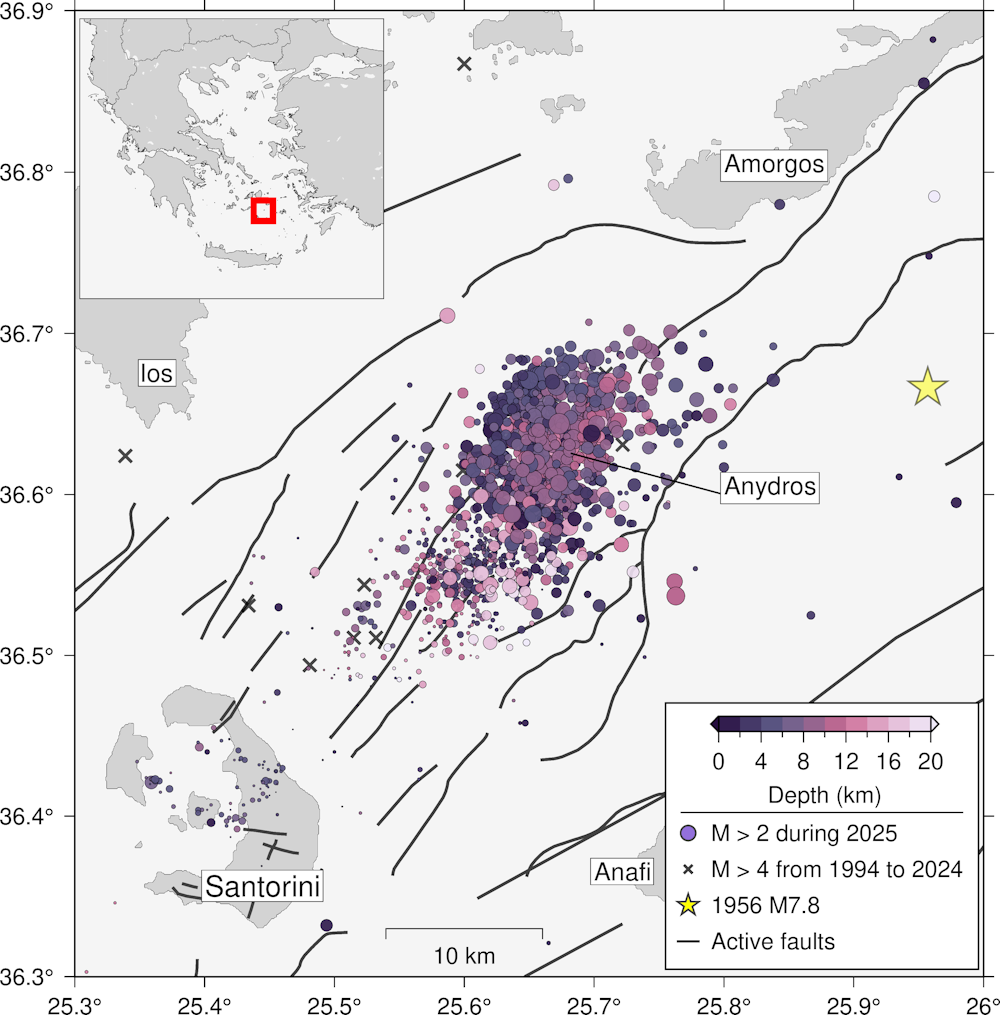
    The current seismic activity is located near Anydros, an uninhabited islet about 30km northeast of Santorini. This region lies within the volcanic arc of the “Hellenic subduction zone”, where the African tectonic plate is slowly sliding beneath the Eurasian plate (and specifically the Aegean microplate). The region hosts volcanoes as well as numerous weak zones in the crust – what earth scientists often call “faults”.

    Santorini itself is a mostly submerged caldera – a crater formed as a result of volcanic activity over the past 180,000 years, with its last eruption in the 1950s. Earthquakes can be connected to volcanic activity – specifically, the movement of magma beneath the surface.

    However, this earthquake sequence is not located beneath Santorini. And local scientists monitoring Santorini have reported no change to indicate the current seismic activity is a forerunner of another Santorini eruption. Instead, the earthquakes appear to align with faults lying between Santorini and the neighbouring island Amorgos.

    Nearby faults are known to have produced earthquakes before. For example, in 1956, a 7.8 magnitude earthquake here also produced a damaging tsunami and was soon followed by a magnitude 7.2 aftershock. More than 53 people died as a result of this earthquake and the aftershock and tsunami. Many more were injured.

    Earthquakes, shown as coloured circles, of the January-February 2025 Anydros swarm, near Santorini, Greece (Source: seismo.auth.gr) and known active faults, depicted as black lines (Source: https://zenodo.org/records/13168947).
    Dee Ninis & Konstantinos Michailos

    No single stand-out event

    Tectonic earthquakes occur when accumulating stress in Earth’s crust is suddenly released, causing a rupture along a fault and releasing energy in the form of seismic waves.

    Typically, moderate to major earthquakes (known as mainshocks) are followed by smaller quakes (known as aftershocks) that gradually diminish in magnitude and frequency over time. This is what seismologists call the mainshock–aftershock sequence.

    Some sequences behave differently and do not exhibit a single stand-out event. Instead, they involve multiple earthquakes of a similar size that take place over days, weeks, or even months. These types of sequences are what seismologists call “earthquake swarms”.

    The 1956 earthquake was a mainshock–aftershock sequence, with aftershocks lasting at least eight months after the mainshock. However, the current ongoing seismic activity near Santorini, at least as of February 7, features thousands of earthquakes, many with magnitudes ranging between 4.0 and 5.0.

    This suggests it is most likely an earthquake swarm.

    Earthquake swarms are often associated with fluid movement in the earth’s crust and the resulting seismic activity is usually less dramatic than the sudden movement of a strong mainshock.

    Seismologists are interested in distinguishing between mainshock–aftershock sequences and earthquake swarms as it can help them better understand the processes that drive these phenomena.

    A larger quake is still possible

    We cannot predict exactly what will come from the earthquake activity near Santorini. Global observations of earthquakes tell us that only a small fraction (about 5%) of earthquakes are foreshocks to larger earthquakes.

    That said, there could still be a possibility that a larger and potentially damaging earthquake could occur there soon.

    Although swarms typically involve earthquakes of lower magnitudes, they can last for days to weeks, or persist for months. They can even slow down, and then intensify again, unsettling locals with intermittent ground shaking.

    Dee Ninis works at the Seismology Research Centre, is Vice President of the Australian Earthquake Engineering Society, and a Committee Member for the Geological Society of Australia – Victoria Division.

    Konstantinos Michailos does not work for, consult, own shares in or receive funding from any company or organisation that would benefit from this article, and has disclosed no relevant affiliations beyond their academic appointment.

    ref. An ‘earthquake swarm’ is shaking Santorini. It could persist for months – https://theconversation.com/an-earthquake-swarm-is-shaking-santorini-it-could-persist-for-months-249278

    MIL OSI AnalysisEveningReport.nz

  • MIL-OSI Global: An ‘earthquake swarm’ is shaking Santorini. It could persist for months

    Source: The Conversation – Global Perspectives – By Dee Ninis, Earthquake Scientist, Monash University

    Greece’s government has just declared a state of emergency on the island of Santorini, as earthquakes shake the island multiple times a day and sometimes only minutes apart.

    The “earthquake swarm” is also affecting other nearby islands in the Aegean Sea. It began gradually with numerous very minor (less than magnitude 3) and mostly imperceptible earthquakes in late January. However, at the start of February, the seismic activity intensified as the quakes became larger and more frequent.

    So far, several thousand quakes have been recorded in the last two weeks. As many as 30 a day have been above magnitude 4.0 – most of them at less than 10km depth, which is large and shallow enough to be felt by people living on local islands.

    These larger earthquakes have resulted in rock falls along the islands’ coastal cliffs, as well as minor damage to vulnerable buildings. The largest earthquake so far was magnitude 5.1 on February 6, which was also felt in the capital city, Athens, as well as in Crete and in parts of Turkey more than 240km away.

    Usually a popular tourist destination, Santorini is now virtually empty. Over the past week, some 11,000 holidaymakers and locals have left the island, with many fearing the seismic activity may presage a volcanic eruption.

    So how exactly does an “earthquake swarm” happen? And what might happen in the coming days and weeks?

    No stranger to earthquakes

    This area of the world is no stranger to earthquakes. Greece is one of the most seismically active regions in Europe.

    The current seismic activity is located near Anydros, an uninhabited islet about 30km northeast of Santorini. This region lies within the volcanic arc of the “Hellenic subduction zone”, where the African tectonic plate is slowly sliding beneath the Eurasian plate (and specifically the Aegean microplate). The region hosts volcanoes as well as numerous weak zones in the crust – what earth scientists often call “faults”.

    Santorini itself is a mostly submerged caldera – a crater formed as a result of volcanic activity over the past 180,000 years, with its last eruption in the 1950s. Earthquakes can be connected to volcanic activity – specifically, the movement of magma beneath the surface.

    However, this earthquake sequence is not located beneath Santorini. And local scientists monitoring Santorini have reported no change to indicate the current seismic activity is a forerunner of another Santorini eruption. Instead, the earthquakes appear to align with faults lying between Santorini and the neighbouring island Amorgos.

    Nearby faults are known to have produced earthquakes before. For example, in 1956, a 7.8 magnitude earthquake here also produced a damaging tsunami and was soon followed by a magnitude 7.2 aftershock. More than 53 people died as a result of this earthquake and the aftershock and tsunami. Many more were injured.

    Earthquakes, shown as coloured circles, of the January-February 2025 Anydros swarm, near Santorini, Greece (Source: seismo.auth.gr) and known active faults, depicted as black lines (Source: https://zenodo.org/records/13168947).
    Dee Ninis & Konstantinos Michailos

    No single stand-out event

    Tectonic earthquakes occur when accumulating stress in Earth’s crust is suddenly released, causing a rupture along a fault and releasing energy in the form of seismic waves.

    Typically, moderate to major earthquakes (known as mainshocks) are followed by smaller quakes (known as aftershocks) that gradually diminish in magnitude and frequency over time. This is what seismologists call the mainshock–aftershock sequence.

    Some sequences behave differently and do not exhibit a single stand-out event. Instead, they involve multiple earthquakes of a similar size that take place over days, weeks, or even months. These types of sequences are what seismologists call “earthquake swarms”.

    The 1956 earthquake was a mainshock–aftershock sequence, with aftershocks lasting at least eight months after the mainshock. However, the current ongoing seismic activity near Santorini, at least as of February 7, features thousands of earthquakes, many with magnitudes ranging between 4.0 and 5.0.

    This suggests it is most likely an earthquake swarm.

    Earthquake swarms are often associated with fluid movement in the earth’s crust and the resulting seismic activity is usually less dramatic than the sudden movement of a strong mainshock.

    Seismologists are interested in distinguishing between mainshock–aftershock sequences and earthquake swarms as it can help them better understand the processes that drive these phenomena.

    A larger quake is still possible

    We cannot predict exactly what will come from the earthquake activity near Santorini. Global observations of earthquakes tell us that only a small fraction (about 5%) of earthquakes are foreshocks to larger earthquakes.

    That said, there could still be a possibility that a larger and potentially damaging earthquake could occur there soon.

    Although swarms typically involve earthquakes of lower magnitudes, they can last for days to weeks, or persist for months. They can even slow down, and then intensify again, unsettling locals with intermittent ground shaking.

    Dee Ninis works at the Seismology Research Centre, is Vice President of the Australian Earthquake Engineering Society, and a Committee Member for the Geological Society of Australia – Victoria Division.

    Konstantinos Michailos does not work for, consult, own shares in or receive funding from any company or organisation that would benefit from this article, and has disclosed no relevant affiliations beyond their academic appointment.

    ref. An ‘earthquake swarm’ is shaking Santorini. It could persist for months – https://theconversation.com/an-earthquake-swarm-is-shaking-santorini-it-could-persist-for-months-249278

    MIL OSI – Global Reports

  • MIL-OSI New Zealand: New Zealand Sugar Company fined almost $150,000 for importing and selling sugar products contaminated with lead

    Source: Ministry for Primary Industries

    New Zealand Sugar Company, trading as Chelsea Sugar, has been fined $149,500 for manufacturing, distributing and selling sugar products contaminated with lead.

    In November and December 2021, the company recalled thousands of packs of sugar products because of potential low level lead contamination.

    Media release: New Zealand Food Safety to investigate sugar recalls

    Two other product recalls were needed when it was later discovered New Zealand Sugar Company provided incorrect information to supermarkets, resulting in more sugar products being released to consumers.

    “These recalls had a significant impact on consumer access to certain sugar products, such as brown sugar. It also affected a large number of other businesses which had to recall products made with the contaminated sugar,” says New Zealand Food Safety deputy director general Vincent Arbuckle.

    In the Auckland District Court, the company was sentenced on 2 charges it pleaded guilty to in May last year, including breaching its National Programme (NP) – designed to manage any food risk to consumers – along with negligently endangering, harming, creating, or increasing risk to consumers by distributing its product.

    A sentencing hearing was held in September last year and the court has released its reserved decision today.

    “New Zealand Sugar Company knew what its responsibilities were to consumers – ensuring the safety and suitability of its products and managing any potential risk to consumers.

    “It failed to properly detect the extent of lead contamination until after the imported sugar had been used in production.

    “Offending at this scale is rare, and the Court’s sentence today sends a strong message that it will not be tolerated,” says Vincent Arbuckle.

    In September 2021, the New Zealand Sugar Company imported sugar from Australia that became contaminated with lead during sea transport. From this sugar it manufactured and distributed 971 tonnes of contaminated sugar products to businesses in New Zealand.

    The sugar had been freighted to New Zealand from Australia aboard the cargo ship Rin Treasure – a vessel that had been used to ship metal sulphide concentrates (lead and zinc) on its previous voyage.

    Before choosing this ship, New Zealand Sugar Company was advised the vessel failed a survey report on 3 September, meaning it was not fit to load and transport bulk sugar. Prior to its departure, the vessel was cleaned, and a cleanliness report certified the vessel’s hold was in a fit state for the stowage and carriage of raw sugar.

    However, the cleaning was not effective, and the cargo of sugar became contaminated with lead during the journey from Queensland. This contamination may have been potentially exacerbated by a broken pipe aboard the vessel that spilled water into the sugar during the cargo unloading process by contractors.

    Samples of the sugar were collected between 15 and 24 September for testing but New Zealand Sugar Company followed its normal process of producing sugar products from the cargo for distribution and sale.

    “The test result on 7 October showed high readings of lead contamination, but rather than take immediate action and stop production and distribution, they instead sought more testing which confirmed the same result.

    “Some of this product was sold between October and early November. We were not informed of the lead contamination until 3 November, which is unacceptable.

    “New Zealand Sugar Company’s lack of definitive action resulted in a consumer level recall of sugar products on 4 November – around 6 weeks after the contaminated product arrived in New Zealand.

    “Although the short-term exposure to increased lead levels through these sugar products  would not have endangered people’s health – we cannot afford to take a chance on public health,” says Vincent Arbuckle.

    If you have concerns about a food product, you can contact New Zealand Food Safety on 0800 008 333 or use our online food complaint tool

    For further information and general enquiries, email info@mpi.govt.nz

    For media enquiries, contact the media team on 029 894 0328.

    MIL OSI New Zealand News

  • MIL-OSI New Zealand: Universities – Green light for remote tech to sort the wood from the trees – Flinders

    Source: Flinders University

    New Zealand and Flinders University experts have deployed artificial intelligence and 3D laser scanning to accurately map planted pine (radiata) forests for most of NZ’s North Island.  

    The results, which distinguish planted large estates, small woodlots and newly established stands as young as three years old, showcase a new way of using remote sensing with other technology to reveal forest growth and update growth information.

    This approach is just as relevant for Australia, where radiata pine is also widely grown, says Dr Grant Pearse, Senior Lecturer in Remote Sensing and Geographic Information Systems (GIS) at Flinders University.

    “In New Zealand, where radiata pine plantations dominate the forestry sector, the current national forest description lacks spatially explicit information and struggles to capture data on small-scale forests,” says Dr Pearse, from the College of Science and Engineering at Flinders University in Adelaide, South Australia.

    “We combined deep learning-based forest mapping using high-resolution aerial imagery with regional airborne laser scanning data to map all planted forest and estimate key attributes.”

    The spatially explicit forest description provides wall-to-wall information on forest extent, age, and volume for all sizes of forest. This facilitates stratification by key variables for wood supply forecasting, harvest planning, and infrastructure investment decisions – applications equally valuable for other forestry industries.

    The research, with New Zealand timber industry researchers from Rotorua, Christchurch and Auckland, was carried out on planted forests in the Gisborne region, which has publicly available aerial imagery and airborne laser scanning data.

    This region is particularly significant as it was severely impacted by Cyclone Gabrielle in early 2023, which caused widespread landslides and forest debris flows.

    For such vulnerable terrain, knowing exactly where forests are located in the landscape, their age and condition is key to managing the risks of harvesting operations on the region’s steep slopes.

    “We propose satellite-based harvest detection and digital photogrammetry to continuously update the initial forest description. This methodology enables near real-time monitoring of planted forests at all scales and is adaptable to other regions with similar data availability,” researchers say in a new article.

    Along with the economic importance of NZ’s 1.8 million hectares of radiata pine forestry for export timber and fibre, these planted forests are a key part of the country’s emission trading scheme and are expected to play a significant role in achieving the government’s target of net-zero emissions by 2050.

    The forest map derived from artificial intelligence can be viewed at: www.forestinsights.nz

    In South Australia, plantation estates covering about 40,000 hectares support a $3 billion industry and employ 18,000 people as well as construction, manufacturing, tourism and regional communities.

    The article. ‘Developing a forest description from remote sensing: Insights from New Zealand’ (2024) byGrant D Pearse (Flinders University), Sadeepa Jayathunga, Nicolò Camarretta, Melanie E Palmer, Benjamin SC Steer, Michael S Watt (all Scion), Pete Watt and Andrew Holdaway (both Indufor Asia Pacific)  has been published in the journal Science of Remote Sensing. DOI: 10.1016/j.srs.2024.100183. (ref. https://www.forestinsights.nz/ )

    Acknowledgements: This project was funded through the Ministry of Business, Innovation and Employment (MBIE) Strategic Science Investment Fund (administered by Scion, the New Zealand Forest Research Institute Ltd) and through the MBIE Programme (grant number C04X2101).

    MIL OSI New Zealand News

  • MIL-OSI Australia: UniSA welcomes new leader for its Mount Gambier campus

    Source: University of South Australia

    07 February 2025

    Peta Crewe, incoming Regional Manager for UniSA’s Mount Gambier campus

    PIRSA regional development lead Peta Crewe is joining the University of South Australia to head up its Mount Gambier campus as new Regional Manager.

    From forestry to vines, livestock and community, Crewe’s connection to the Limestone Coast region spans a quarter of a century including roles in Government, at ForestrySA, and on strategic working groups and committees.

    Her current role is General Manager, Regions for SA’s Department of Primary Industries and Regions (PIRSA), where she oversees regional development across 11 regional offices.

    Crewe will commence in her UniSA role on 3 March.

    UniSA Vice Chancellor Professor David Lloyd is delighted to welcome her to the University community.

    “Peta has an outstanding track record delivering successful regional programs and addressing the key issues in regional communities, including workforce shortages, lack of affordable housing, industry development, and community capacity building,” Prof Lloyd says.

    “Her experience and connections in the Limestone Coast region, a region of enormous social, cultural and economic significance to SA, will be a great asset to our University and the local community.”

    Ian McKay, Mount Gambier’s current Regional Manager, will retire on 14 March after eight years in the role.

    “Ian has been a wonderful advocate and ambassador for UniSA and has made a significant impact in the Mount Gambier community,” Prof Lloyd says.

    “UniSA’s regional engagement and connections to the Mount Gambier community have greatly expanded under Ian’s leadership. On behalf of the University, I thank him for his contributions and wish him all the best in his future endeavours.”

    Crewe has an agriculture degree from the University of Adelaide and a Master in Forest Science. Her previous roles include PIRSA’s regional coordinator for the Limestone Coast. Among her many community roles and professional memberships, she is team manager for the Blue Lake Soccer Club’s Senior Women’s team.

    Media contact: Megan Andrews M: +61 434 819 275 142 E: megan.andrews@unisa.edu.au

    Other articles you may be interested in

    MIL OSI News

  • MIL-OSI Australia: Bathurst refuge expanded to support more women and children escaping domestic violence

    Source: New South Wales Government 2

    Headline: Bathurst refuge expanded to support more women and children escaping domestic violence

    Published: 7 February 2025

    Released by: Minister for Homelessness, Minister for Housing, Minister for the Prevention of Domestic Violence and Sexual Assault


    More than 30 women and children fleeing abusive relationships each year will benefit from the expansion of The Orchard in Bathurst, with three new emergency refuge units opening today.

    The first five units at The Orchard, Bathurst were developed and built by Housing Plus and opened in January 2023, with service delivery funded by the NSW Government’s Core and Cluster program.

    Since then, it has provided accommodation for over 100 women and children escaping violent and unsafe homes.

    An additional $1.95 million under the Core and Cluster program has enabled an additional three units to be built on the site.

    The Core and Cluster refuge model promotes independent living by providing self-contained accommodation located next to a ‘core’ of support that facilitates access to services such as counselling, legal assistance, education, and employment support.

    Plus Community, the community service arm of Housing Plus, will deliver tailored, on-site support to help victim-survivors rebuild their lives and heal from trauma.

    The Minns Labor Government is building a safer New South Wales by addressing domestic and family violence at all stages, including through primary prevention, early intervention, crisis responses and recovery.

    Ensuring women and children have access to safe housing and support when they leave violence is critical to helping them rebuild their lives.

    The NSW Government has invested $426.6 million over four years in the Core and Cluster program to support an additional 2,900 women and children fleeing domestic and family violence across the state each year.

    Minister for Housing and Homelessness Rose Jackson said:

    “No woman should have to choose between staying in an abusive relationship or becoming homeless.

    “This expanded refuge will help more domestic and family violence victim-survivors in the Bathurst region feel safe and supported as they leave violent situations and rebuild their lives.

    “Under the Core and Cluster program, the NSW Government has committed to building 49 new refuges across the state by 2026, helping to ensure that all women and children fleeing violence can find a safe place to call home.”

    Minister for the Prevention of Domestic Violence and Sexual Assault Jodie Harrison said:

    “Securing safe housing remains a critical hurdle to overcoming domestic and family violence.

    “The NSW Government is supporting women and children escaping domestic and family violence by making sure they have access to housing and support services, particularly in regional areas like Bathurst.

    “The Core and Cluster model not only provides safe and secure accommodation, but also tailored support on-site to help victim-survivors recover.

    “Emergency refuges like The Orchard are crucial in helping women and children take their first step towards escaping violence, regaining their confidence, and rebuilding their lives in their community.”

    Labor spokesperson for Bathurst Stephen Lawrence MLC said:

    “The funding for and opening of three new emergency refuge units at The Orchard today is welcome support for women and children fleeing abusive relationships in my duty electorate of Bathurst.

    “This a vital program funded by the Minns Labor Government securing the safety of victim survivors and supporting their recovery.”

    Justin Cantelo, CEO of Housing Plus and Plus Community, said:

    “The need for safe, supportive housing has never been more urgent.

    “We are proud to play a part in helping women and children find safety and start the journey towards healing in the aftermath of domestic violence.”

    Jenna Hattersley, Domestic Violence Services Manager at Plus Community, said:

    “The addition of these three units means more women and children will have the chance to escape violence and find refuge in a place where they feel safe and supported.

    “Every day, we see the difference that safe housing can make in helping people rebuild their confidence and their lives.”

    A resident of The Orchard Bathurst, said:

    “Thank you for everything.

    “Your dedication and support to women in need of help is where The Orchard stands out.”

    Support:

    If you or someone you know are in immediate danger, call the Police on Triple Zero / 000.

    If you or someone you know is experiencing domestic and family violence, call the NSW Domestic Violence Line on 1800 65 64 63 for free counselling and referrals, 24 hours a day, 7 days a week.

    For confidential advice, support, and referrals, contact 1800 RESPECT or 13 YARN.

    MIL OSI News

  • MIL-OSI New Zealand: Seventy-three graduate in first police wing for 2025

    Source: New Zealand Police (National News)

    Commissioner Richard Chambers, the Minister of Police, Hon Mark Mitchell, Associate Minister of Police Casey Costello and Wing Patron, Glenn Dunbier ONZM congratulated the 73 graduating constables from wing 381 today.
    Families and friends joined the newly attested constables at Te Rauparaha Arena, Porirua this morning to watch them parade out from their initial police training course.

    Constable Brent Edwards, Ngāti Awa, recipient of the Minister’s Award for top recruit of the wing, who was previously a police officer is pleased to be back on the front line; “I missed the job and the sense of satisfaction you get from helping people and holding offenders to account.  There is no other job like it.   But the main reason I’ve returned is the people, the organisation is full of good people, who are doing things for the right reasons.  It is great to be part of it again.”

    The Commissioner’s Award for Leadership and the Patron’s award was awarded to Constable Aleksandar Banjac. “This recognition is not a reflection of my individual efforts, but a testament to the hard work and commitment of the entire wing. This award is a shared achievement, and I accept it with deep respect and gratitude to my peers for the nominations.  I would like to thank everyone involved with their continued support in this journey.”

    All Awards:
    Minister’s Award recognising top student: Constable Brent Edwards, Ngāti Awa, posted to Tasman District. 
    Commissioner’s Award for Leadership and the Patron’s Award for second in wing, recognising second top student: Constable Aleksandar Banjac , posted to Auckland City District.
    Driver Training and Road Policing Practice Award: Constable Lucas Lowe posted to Bay of Plenty District.
    Physical Training and Defensive Tactics Award: Constable Eli Marsters, Ngāti Whanaunga,  posted to Bay of Plenty District.
    Firearms Award: Constable Michael Tooley, posted to Wellington District.

    Deployment:
    The new constables will start their first day of duty in their Police districts on Monday 17 February 2025 and will continue their training on the job as probationary constables.
    Northland 6, Tāmaki Makaurau a total of 23 and broken down as follows: Auckland – 5, Waitematā – 5, Counties Manukau – 13, Waikato – 4, Bay of Plenty – 8, Eastern – 9, Central – 3, Wellington – 9, Tasman – 2, Canterbury – 4, Southern – 5.

    Demographics:
    23.3 percent are female, 76.7 percent are male. New Zealand European make up 58.9 percent of the wing, with Māori 16.4 percent, Pasifika 8.2 percent, Asian 11.0 percent, LAAM 1.4 percent and Other is 4.1 percent.

    381 Wing Patron
    Former Deputy Commissioner Dunbier joined Police in 1985. He has worked across frontline, investigative, covert policing, and numerous leadership roles. He was appointed Area Commander for Eastern Waikato in 2006, District Commander for Bay of Plenty in 2010, then promoted to Deputy Commissioner in 2014. He served as lead police liaison officer in Turkey, coordinating the tri-lateral Australia – New Zealand – Turkey commemorations for the Anzac centenary of Gallipoli in 2015.
    Following a three-year secondment to the Australian Department of Defence in 2017, he became deputy commissioner of operations in early 2020, with responsibility for more than 10,000 New Zealand Police staff. Dunbier led the police response to the Covid-19 pandemic, which included the policing of lockdown restrictions, staffing and managing the managed isolation and quarantine facilities across the country and operating the alert level boundary checkpoints. In 2022, he was made an Officer of the New Zealand Order of Merit (ONZM) for services to New Zealand Police and the community.  Glenn retired from New Zealand Police in 2023.  He now volunteers with two organisations – one dedicated to combatting food poverty/food waste and the other caring for the aged, as well as participating on boards and committees.

    Watch out for our Ten One story coming soon with more images and stories.

    ENDS

    Issued by Police Media Centre

    MIL OSI New Zealand News

  • MIL-OSI USA: SPC Severe Thunderstorm Watch 4

    Source: US National Oceanic and Atmospheric Administration

    Note:  The expiration time in the watch graphic is amended if the watch is replaced, cancelled or extended.Note: Click for Watch Status Reports.
    SEL4

    URGENT – IMMEDIATE BROADCAST REQUESTED
    Severe Thunderstorm Watch Number 4
    NWS Storm Prediction Center Norman OK
    730 PM EST Thu Feb 6 2025

    The NWS Storm Prediction Center has issued a

    * Severe Thunderstorm Watch for portions of
    Southeast Kentucky
    Northeast Tennessee
    Extreme Southwest Virginia

    * Effective this Thursday night from 730 PM until Midnight EST.

    * Primary threats include…
    Scattered damaging wind gusts to 70 mph possible
    Scattered large hail events to 1.5 inches in diameter possible
    A tornado or two possible

    SUMMARY…Scattered intense storms will track southeastward across
    the watch area for the next few hours, capable of hail and damaging
    winds. A tornado or two is also possible.

    The severe thunderstorm watch area is approximately along and 45
    statute miles north and south of a line from 50 miles northwest of
    Knoxville TN to 30 miles north northeast of Hot Springs NC. For a
    complete depiction of the watch see the associated watch outline
    update (WOUS64 KWNS WOU4).

    PRECAUTIONARY/PREPAREDNESS ACTIONS…

    REMEMBER…A Severe Thunderstorm Watch means conditions are
    favorable for severe thunderstorms in and close to the watch area.
    Persons in these areas should be on the lookout for threatening
    weather conditions and listen for later statements and possible
    warnings. Severe thunderstorms can and occasionally do produce
    tornadoes.

    &&

    AVIATION…A few severe thunderstorms with hail surface and aloft to
    1.5 inches. Extreme turbulence and surface wind gusts to 60 knots. A
    few cumulonimbi with maximum tops to 450. Mean storm motion vector
    27030.

    …Hart

    SEL4

    URGENT – IMMEDIATE BROADCAST REQUESTED
    Severe Thunderstorm Watch Number 4
    NWS Storm Prediction Center Norman OK
    730 PM EST Thu Feb 6 2025

    The NWS Storm Prediction Center has issued a

    * Severe Thunderstorm Watch for portions of
    Southeast Kentucky
    Northeast Tennessee
    Extreme Southwest Virginia

    * Effective this Thursday night from 730 PM until Midnight EST.

    * Primary threats include…
    Scattered damaging wind gusts to 70 mph possible
    Scattered large hail events to 1.5 inches in diameter possible
    A tornado or two possible

    SUMMARY…Scattered intense storms will track southeastward across
    the watch area for the next few hours, capable of hail and damaging
    winds. A tornado or two is also possible.

    The severe thunderstorm watch area is approximately along and 45
    statute miles north and south of a line from 50 miles northwest of
    Knoxville TN to 30 miles north northeast of Hot Springs NC. For a
    complete depiction of the watch see the associated watch outline
    update (WOUS64 KWNS WOU4).

    PRECAUTIONARY/PREPAREDNESS ACTIONS…

    REMEMBER…A Severe Thunderstorm Watch means conditions are
    favorable for severe thunderstorms in and close to the watch area.
    Persons in these areas should be on the lookout for threatening
    weather conditions and listen for later statements and possible
    warnings. Severe thunderstorms can and occasionally do produce
    tornadoes.

    &&

    AVIATION…A few severe thunderstorms with hail surface and aloft to
    1.5 inches. Extreme turbulence and surface wind gusts to 60 knots. A
    few cumulonimbi with maximum tops to 450. Mean storm motion vector
    27030.

    …Hart

    Note: The Aviation Watch (SAW) product is an approximation to the watch area. The actual watch is depicted by the shaded areas.
    SAW4
    WW 4 SEVERE TSTM KY TN VA 070030Z – 070500Z
    AXIS..45 STATUTE MILES NORTH AND SOUTH OF LINE..
    50NW TYS/KNOXVILLE TN/ – 30NNE HSS/HOT SPRINGS NC/
    ..AVIATION COORDS.. 40NM N/S /44NW VXV – 25WSW HMV/
    HAIL SURFACE AND ALOFT..1.5 INCHES. WIND GUSTS..60 KNOTS.
    MAX TOPS TO 450. MEAN STORM MOTION VECTOR 27030.

    LAT…LON 36988464 36958261 35658261 35688464

    THIS IS AN APPROXIMATION TO THE WATCH AREA. FOR A
    COMPLETE DEPICTION OF THE WATCH SEE WOUS64 KWNS
    FOR WOU4.

    Watch 4 Status Report Message has not been issued yet.

    Note:  Click for Complete Product Text.Tornadoes

    Probability of 2 or more tornadoes

    Low (20%)

    Probability of 1 or more strong (EF2-EF5) tornadoes

    Low (5%)

    Wind

    Probability of 10 or more severe wind events

    Mod (50%)

    Probability of 1 or more wind events > 65 knots

    Low (20%)

    Hail

    Probability of 10 or more severe hail events

    Mod (50%)

    Probability of 1 or more hailstones > 2 inches

    Low (20%)

    Combined Severe Hail/Wind

    Probability of 6 or more combined severe hail/wind events

    High (80%)

    For each watch, probabilities for particular events inside the watch (listed above in each table) are determined by the issuing forecaster. The “Low” category contains probability values ranging from less than 2% to 20% (EF2-EF5 tornadoes), less than 5% to 20% (all other probabilities), “Moderate” from 30% to 60%, and “High” from 70% to greater than 95%. High values are bolded and lighter in color to provide awareness of an increased threat for a particular event.

    MIL OSI USA News

  • MIL-OSI Australia: Australia’s climate in 2024: 2nd warmest and 8th wettest year on record

    Source: Weather Warnings – Australia

    06/02/2025

    The Bureau of Meteorology has released its official record of Australia’s climate, water and notable weather events for 2024.

    The Annual Climate Statement 2024 outlines the climate conditions across Australia in 2024. It includes information on temperature, rainfall, water resources, oceans, atmosphere and notable weather events.

    The report confirms that 2024 was Australia’s second-warmest and eighth-wettest year on record.

    Climatology Specialist Nadine D’Argent said that it was warmer than average throughout the year across most of the country.

    “Nationally, spring was the warmest on record, winter was the second warmest on record and summer 2023–24 was the third warmest on record,” Ms D’Argent said.

    “It was the wettest year since 2011, with overall rainfall 28% above average,” Ms D’Argent said.

    “Tropical cyclones brought heavy rainfall to northern parts of Australia early in the year, where there was major flooding.”

    “While much of northern Australia and some inland areas had above average rainfall, it was much drier than usual in Victoria, parts of South Australia and some parts of the west.”

    These dry conditions and low inflows led to reduced water storage levels in some southern regions, including the Murray–Darling Basin. However, Australia’s total surface water storage volume was just under 73% at the end of 2024, which was similar to the end of the previous year.

    Ms D’Argent said Australia’s climate is influenced by global patterns in the oceans and atmosphere.

    “Sea surface temperatures in the Australian region, as well as globally, were the warmest on record in 2024,” Ms D’Argent said.

    “Warmer oceans can increase the amount of moisture available for rainfall in our weather systems.”

    Globally, 2024 was the warmest year on record and the warming in Australia is consistent with global trends.

    Further information about the impact of long-term climate trends is available in the State of the Climate 2024 released by the Bureau and CSIRO in October 2024.

    Facts at a glance:

    2024 was Australia’s second-warmest year on record. Australia’s warmest year on record was 2019.

    The national annual average temperature was 1.46 °C warmer than the long-term average and the warmest since 2019.

    Annual average temperatures were warmer than average for every state and the Northern Territory.

    Both national average maximum and minimum temperatures for the year were above average. The national average minimum temperature for the year was 1.43 °C warmer than the long-term average, making it the warmest annual minimum on record.

    Australia’s overall average rainfall was 596 mm, which is 28% above average.

    Rainfall across northern Australia was 42% above average, making it the fifth-wettest year on record.

    Rainfall across parts of southern Australia was below average.

    Annual sea surface temperatures for the Australian region were the warmest on record.

    The extent of Antarctic sea-ice, which is the area of ocean covered by sea-ice, was below the 1991–2020 average throughout 2024.

    For the full analysis and report on last year’s temperature, rainfall, water resources, climate influences and more:

    State and territory information

    Queensland

    • Queensland overall had 768 mm of rainfall in 2024, which is 23% above average.
    • Rainfall was above average to very much above average for large parts of Queensland, and below average for small parts of the state’s interior and central coast.
    • The annual average temperature for Queensland was 1.63 °C warmer than the long-term average, making 2024 Queensland’s warmest year on record.

    New South Wales (and the ACT)

    • New South Wales overall had 581 mm of rainfall in 2024, which is 4% above average.
    • Rainfall was above average to very much above average for inland areas of New South Wales, and below average for the south-eastern part of the state.
    • The annual average temperature for New South Wales was 1.55 °C warmer than the long-term average, making 2024 the third-warmest year on record for New South Wales.

    Victoria

    • Victoria overall had 529 mm of rainfall in 2024, which is 20% below average.
    • Rainfall was below average to very much below average for most of Victoria.
    • The annual average temperature for Victoria was 1.08 °C warmer than the long-term average, making 2024 Victoria’s equal fifth-warmest year on record.

    Tasmania

    • Tasmania overall had 1269 mm of rainfall in 2024, which is 6% below average.
    • Rainfall was below average to very much below average for western and southern coastal areas of Tasmania.
    • The annual average temperature for Tasmania was 0.77 °C warmer than the long-term average, making 2024 Tasmania’s equal fifth-warmest year on record.

    South Australia

    • South Australia overall had 218 mm of rainfall in 2024, which is 3% below average.
    • Rainfall was above average to very much above average for western and north-eastern parts of South Australia, but below average to very much below average for southern and south-eastern areas of the state.
    • The annual average temperature for South Australia was 1.60 °C warmer than the long-term average, making 2024 South Australia’s second-warmest year on record. South Australia’s warmest year on record was 2013.

    Western Australia

    • Western Australia overall had 461 mm of rainfall in 2024, which is 35% above average.
    • Rainfall was above average to very much above average for most of Western Australia, but below average to very much below average for parts of coastal south-west and north-west Western Australia.
    • The annual average temperature for Western Australia was 1.57 °C warmer than the long-term average, making 2024 Western Australia’s second-warmest year on record. Western Australia’s warmest year on record was 2019.

    Northern Territory

    • The Northern Territory overall had 898 mm of rainfall in 2024, which is 65% above average.
    • Rainfall was above average to very much above average for most of the Northern Territory.
    • Annual rainfall for the Northern Territory was the fourth highest on record, with the highest recorded being in 1974 with 1007 mm.
    • The annual average temperature for the Northern Territory was 0.95 °C warmer than the long-term average. 2024 was Northern Territory’s equal 11th-warmest year on record.

    [ENDS]

    MIL OSI News

  • MIL-OSI Australia: Sacred Aboriginal site and habitat for threatened species among additions to NSW national parks

    Source: New South Wales Government 2

    Headline: Sacred Aboriginal site and habitat for threatened species among additions to NSW national parks

    This is one of 12 land acquisitions made in 2024 to expand the network of national parks in NSW by just over 36,000 hectares. It makes more of our natural environment available to the public and delivers on the Minns Labor Government’s commitment to turn around biodiversity loss and restore habitats and ecosystems.

    The 31,500-hectare Broughton Vale Station includes the Kukirrka or Burkes Cave, a sacred Aboriginal birthing cave used for more than 2,000 years, and other significant cultural sites containing artworks and engravings.

    The cave and a nearby freshwater spring were also used by Burke and Wills during their 1860 expedition from Melbourne to the Gulf of Carpentaria, and as a Cobb and Co stopover between Broken Hill and Wilcannia.

    At least 70 threatened species have been recorded close to Broughton Vale Station including purple-wood wattle, Barrier Range dragon, pink cockatoo, Stimson’s python and the creeping Darling pea. It also includes vegetation types and landscapes not found in any other national park in NSW. More than half the property supports the Threatened Ecological Community Neila (Acacia loderi) tall shrubland.

    The property adjoins the recently created Langidoon-Medford State Conservation Area. Together these reserves will permanently protect around 92,000 hectares conserving threatened plant and animal species and cultural landscapes.

    NSW National Parks and Wildlife Service (NPWS) will work with Aboriginal communities to ensure the protection of important cultural sites. NPWS will also carry out feral animal and weed control and ensure fire trail access. Future visitor facilities could include a campsite and walking trails.

    In 2024, the NSW Government secured more than 36,000 hectares to expand existing parks, create new ones and protect critical habitats. Six acquisitions directly protect koala habitat, as part of the Minns Labor Government’s action to save koalas from extinction in NSW.

    The national parks estate covers about 10% of NSW and contains a diverse range of landscapes. NSW records more than 53 million domestic visits to national parks a year, plus many more by international travellers.

    Quote attributable to Minister for the Environment, Penny Sharpe:

    “The sacred site on Broughton Vale Station holds significant cultural and spiritual meaning for Aboriginal communities and we have taken action to preserve it for generations to come.

    “Adding this land to the national parks network is an important step forward in environmental and cultural conservation in NSW. It will also greatly enhance ecological, educational, cultural and tourism opportunities in our Far West.

    “The Minns Labor Government is committed to turning around the loss and restoring habitats, ecosystems and biodiversity, and expanding our national parks is one way we are delivering on that commitment.”

    Quote attributable to Minister for Aboriginal Affairs and Treaty, David Harris:

    “It cannot be understated how fundamental the preservation of this sacred land is for Traditional Owners and the broader community.

    “The Broughton Vale Station contains sites of enormous cultural significance to the local Aboriginal community and I am proud the Minns Labor Government has taken the steps to ensure this Country will be protected for generations to come.”

    Quote regarding Burkes Cave/Kukirrka, attributable to Barkandji elder, Dot Stephens:

    “We haven’t had access to Burkes Cave in many years and being able to return to the site I helped assess in the early 90s is so important in us being able to look after country.

    “When I was told that the Minister had purchased Burkes Cave, I burst into tears. The site is a spiritual place, a woman’s site, and it connects our country from Mutawintji to the Menindee Lakes and beyond.”

    Quote regarding Burkes Cave/Kukirrka, attributable to Barkandji elder, Feona Bates:

    “It is so important that National Parks purchase places like Broughton Vale as it allows us to look after the place.

    “There are men’s and women’s sites on the property, and we need to protect them.”

    Additional land added to the national park system in 2024:

    Koala habitat:

    • Addition to Guula Ngurra National Park

    589 hectares, 25km northwest of Mittagong, to connect Guula Ngurra National Park to Bangadilly National Park. It is in a stronghold area of a known high priority koala population. It is suitable habitat for 30 locally-threatened species including glossy black cockatoo and southern greater glider.

    • Addition to Nymboi-Binderay National Park

    40 hectares, 45km northwest of Coffs Harbour, which provides habitat for 21 threatened fauna species including koala, rufous bettong, gliders, bats, other mammals and birds.

    • Addition to Khatambuhl National Park

    Two areas totalling 1259 hectares, 50km northwest of Taree, linking Bretti Nature Reserve with Khatambuhl Nature Reserve. It is located in a corridor between three koala Priority Population Areas and 70% of the property contains koala feed trees. The habitat is suitable for more than 20 other threatened species including the Manning River helmeted turtle, southern greater glider, white-flowered wax plant, craven grey box, scrub turpentine and stuttering frog.

    • Addition to Cottan-Bimbang National Park

    Two areas, 398 hectares and 487 hectares, 45km northwest of Wauchope have been added to the national park. The land includes 4km of Ralfes Creek, a major tributary of the Hastings River. It is suitable for 22 threatened species, notably koala, southern greater glider, scrub turpentine, magenta lilly pilly and giant barred frog.

    • Addition to Dangelong Nature Reserve

    784 hectares, 20km southeast of Cooma, featuring high to very high-quality koala habitat in the Kybeyan Range, a Southern Tablelands koala hot spot. It is suitable habitat for 25 other threatened species including gang-gang cockatoo, little eagle, hooded robin, dusky woodswallow, spotted-tailed quoll and pale pomaderris.

    • Addition to Barrington Tops National Park

    867 hectares, 60km northeast of Muswellbrook, featuring koalas and glossy black cockatoos as well as habitat for 22 other threatened fauna species including the specked warbler and Davies tree frog which occurs only above 400m in the region.

    Highland wetlands:

    • Addition to Doodle Comer Swamp Nature Reserve

    41 hectares, 60km south of Wagga Wagga, featuring a wetland of national significance. Doodle Comer Swamp is a Declared Aboriginal Place with cultural significance to the Wiradjuri People. The acquisition protects cultural heritage sites, two threatened ecological communities and seven threatened species including the endangered Australasian bittern and Bush stone-curlew.

    • Addition to Little Llangothlin Nature Reserve

    18 hectares, 39km south of Glen Innes, which protects the remainder of the Ramsar-listed wetland Billy Bung Lagoon and its catchment. It contains four Threatened Ecological Communities.

    Cultural Heritage:

    • Butterfly Cave

    26 hectares at West Wallsend which protects the sacred Butterfly Cave and the surrounding cultural landscape, including vital aquifers, traditional journey paths, creeks, stone arrangements and food source areas.

    MIL OSI News

  • MIL-OSI Australia: $7 million for new health worker accommodation in Wyong

    Source: New South Wales Government 2

    Headline: $7 million for new health worker accommodation in Wyong

    Published: 7 February 2025

    Released by: Minister for the Central Coast, Minister for Regional Health


    The Wyong community is set to benefit from new Key Worker Accommodation which will help attract, recruit and retain more healthcare workers to the region.

    The Minns Labor Government will invest $7 million in health worker housing in Wyong as part of the Key Health Worker Accommodation program.

    The $200.1 million program supports more than 20 projects across rural, regional and remote NSW.

    The funding will secure approximately 120 dwellings across regional NSW, which includes the building of new accommodation, refurbishment of existing living quarters and the purchase of suitable properties such as residential units.

    The four-year program will support the recruitment and retention of more than 500 health workers and their families by providing a range of accommodation options.

    The program is one of a number of investments the NSW Government is making to strengthen the regional health workforce and builds on the success of the NSW Government’s $73.2 million investment in key health worker accommodation across five regional local health districts (Far West, Murrumbidgee, Southern NSW, Hunter New England and Western NSW).

    Quotes attributable to Minister for Regional Health, Ryan Park:

    “The Minns Labor Government is committed to investing in modern, sustainable accommodation options for key health workers who are the backbone of our regional, rural and remote communities.

    “Strengthening our regional health workforce is a key priority of our government and this $7 million investment in accommodation will support attraction of key healthcare workers to the Central Coast.

    “The Key Health Worker Accommodation program will support Central Coast Local Health District in providing high-quality health services to the community.”

    Quote attributable to Minister for the Central Coast, David Harris:

    “It can be difficult to find available housing for key health workers moving to the Central Coast, creating a barrier when recruiting new staff.

    “These new dwellings will support our efforts to attract skilled health professionals to our region and bolster our local healthcare network.” 

    MIL OSI News

  • MIL-OSI Australia: Boosting street-side EV charging across Australia

    Source: Australian Renewable Energy Agency

    The Australian Renewable Energy Agency (ARENA) has today committed $2.4 million in funding to EVX Australia Pty Ltd (EVX) for 250 public kerbside electric vehicle (EV) chargers in over 60 local government areas across Victoria, New South Wales and South Australia.

    Kerbside charging is critical to support uptake of EVs across Australia. By utilising existing power poles in urban and residential areas, charging will be more accessible to more people wanting to embrace EVs but struggling to find the infrastructure to do so.

    ARENA CEO Darren Miller said kerbside pole charging provided the perfect solution to increasing public EV chargers.

    “Not all electric vehicle owners have the ability to charge their vehicle at home or at work, which is why we’re excited to partner with EVX on this rollout that utilises kerbside charging poles, providing a great opportunity to pair with EV charging.

    “While sales of EVs are increasing, the expansion of public charging is vital in catering for future demand right across Australia.”

    The Australian-designed and made pole-mounted EV chargers were developed by EVX from the ground up to meet the technological limitations utility providers and local governments face in rolling out EV charging infrastructure sustainably while adhering to local electrical and planning regulations.

    By using AC power with smart charging capability, EVX chargers have a low impact on the local electricity grid while being installed on the existing utility pole infrastructure, negating the need for disruptive works and ensuring a streamlined rollout. This cutting-edge technology makes it easy for people to charge their vehicles using 100 per cent renewable energy.

    EVX CEO, Andrew Forster said this was essential community infrastructure for the future.

    “We are so excited that this partnership with ARENA is off the ground.”

    “The project will make EV charging more accessible for both residents and visitors to these regions, whilst also crucially allowing us to further test, adapt and develop the way we rollout this community charging infrastructure into the future.”

    EVX, supported by the Institute for Sustainable Futures at UTS, will lead the coordination of real-time reporting and will work with Ausgrid and Essential Energy on the development of flexible tariff structures. Endeavour Energy, SA Power Networks, Ausnet and CitiPower, Powercor and United Energy (CPPCUE) will also support the rollout, with Flow Power being the energy retailer for all 250 sites.

    The project will accelerate the development, manufacturing and installation of the chargers and will also allow EVX and EV charging app Wevolt to develop an open-access interface between utility systems and the public charging network, creating a user interface which will improve the customer’s charging experience.

    The funding is being delivered by the Driving the Nation Program. For more information including program guidelines, eligibility criteria, and how to apply, visit the funding page.

    ARENA media contact:

    media@arena.gov.au

    Download this media release (PDF 143KB)

    MIL OSI News

  • MIL-OSI Australia: Springer spaniels and biosecurity teams nose out knapweed

    Source: New South Wales Department of Primary Industries

    7 Feb 2025

    For the first time in Australia, weed-seeking scent detection dogs have this month sniffed out black knapweed (Centaurea x moncktonii) plants near Tenterfield as part of NSW Government actions to eradicate the invasive weed.

    NSW Department of Primary Industries and Regional Development (DPIRD) State Priority Weeds coordinator, Nicola Dixon, said late last month a team of nine biosecurity staff followed up the success of the springer spaniels, Connor and Maggie who found 18 knapweed plants, to uncover another 80 plants.

    “The dogs were invaluable in finding plants hidden by thick vegetation and small juvenile seedlings which were hard to see,” Ms Dixon said.

    “Our biosecurity team was able to cover more ground, 50 hectares, and easily spot the distinct lilac flowers of the summer-blooming weed.

    “Also known as meadow knapweed, it was first found in NSW near Tenterfield in 2019 and these surveillance operations ensure we find and remove plants to prevent them setting seed.

    “Since treating the original infestations, no signs of the weed have been found in five of the eight known infested sites for more than three years.”

    The survey operation was led by NSW DPIRD with biosecurity officers from Tenterfield and Inverell Shire Councils, Northern Tablelands Local Land Services and the New England Weeds Authority.

    This is the only known NSW population of black knapweed, which is difficult to control, produces chemicals to suppress nearby plants, is not eaten by livestock and invades pastures, crops and natural environments.

    Black knapweed is a herb, which looks like a thistle without sharp spines on its leaves. It is listed as prohibited matter under the NSW Biosecurity Act 2015 and must be reported if found.

    Ms Dixon said everyone can help rid NSW of black knapweed.

    “If you think you’ve seen knapweed, please call the NSW Biosecurity Helpline 1800 680 244 or your local council to identify and remove the weed,” she said.

    “Check paddocks, crops, fodder from Victoria, livestock feeding areas and areas where cropping machinery previously used in Victoria, before coming onto your property, has been.”

    Learn how to spot the weed with knapweed images and 3D models from the NSW WeedWise site.

    Media contact:  pi.media@dpird.nsw.gov.au

    MIL OSI News

  • MIL-OSI Australia: Recent decisions cast doubt on state-based trade mark removal actions

    Source: Allens Insights

    A low bar for ‘intention to use’ 6 min read

    The Australian Trade Marks Office recently decided two related actions for removal for non-use against registered marks owned by Mae Watson: the first, ‘Whiplash’, and the second ‘WHIPLASHED’, both for beauty salon and beauty-related services including lash extensions.

    The decisions shed light on whether an applicant can limit a removal action under section 92 of the Trade Marks Act 1995 (Cth) (TMA) to particular states in Australia and the threshold question of the ‘intention to use’ under s92(4)(a).

    In this Insight, we outline the details of each decision and what trade mark owners can do to avoid the risk of removal actions being brought.

    Key takeaways

    • If, after filing a s92 TMA removal action (which requires an applicant to be satisfied, on its enquiries into use, that the owner has not used the relevant mark in Australia), it becomes clear throughout the evidentiary process or at hearing that there is some use, but only in a specific geographical location, the applicant may, in certain circumstances seek that the Registrar invoke the s102 TMA discretion, and request that the mark remain on the register but be subject to a geographical limitation.
    • ‘Intention to use’ in a s92(4)(a) TMA removal action is a low bar. The act of filing the trade mark application combined with a positive statement by the owner confirming an intention can be enough to shift the onus to the removal applicant to show a lack of intention.

    Delegate declines two related non-use removal actions

    Beauty salon, Whiplash’d Pty Ltd (the Removal Applicant), brought two related removal actions against Mae Watson (the Owner)’s registered marks ‘Whiplash’ and ‘WHIPLASHED’:

    • an application for complete removal (excluding WA) of ‘Whiplash’, brought on the basis of non-use for a period of three years in all states except WA (s92(4)(b)); and
    • an application for complete removal of WHIPLASHED brought on the basis of a lack of intention to use in good faith and non-use in the relevant period (s92(4)(a)).

    Action for removal of ‘Whiplash’

    The Owner argued that she had used Whiplash in all states in Australia, predominately in WA, in connection with lash extension services throughout the relevant three-year period, and further that the COVID pandemic was an impediment to broader use of the mark in Australia.

    The Removal Applicant sought to qualify the removal action to removal except for the state of WA. The Delegate, however, considered that there is no provision in s92 for a removal application to be qualified in that manner. Section 92(4) requires that a removal applicant seek removal for all or any of the goods and/or services in respect of which the trade mark is registered in Australia (and not a part of Australia).

    Section 102 provides the Registrar with a discretion to impose a territorial restriction on the registration of a trade mark where there has been no use of the mark in a particular place in Australia for a three-year period, where certain conditions are met. These include that the applicant for such an action is either the registered owner of a trade mark that is:

    • substantially identical with or deceptively similar to the challenged mark,
    • registered in respect of the same goods and/or services specified in the application, and
    • subject to the condition that the use of the trade mark be restricted to a specific place in Australia;

    or the Registrar is of the opinion that the trade mark may be registered by the applicant with that condition or limitation.

    The quirk of s102 is that it can only be invoked if an applicant has a removal action (s92(4)(b)) on foot for all of Australia. In this case, as the Removal Applicant had not invoked s102, the Delegate considered the removal action as if it applied to all of Australia. The Owner exhibited evidence of use of the mark in respect of beauty salon services in the relevant period in (at least) WA. Given that the Delegate was satisfied there was use in WA, it was unnecessary to consider whether the mark had been used outside of WA. Further, even if that Applicant had invoked s102, it had not made any arguments that it would satisfy the criteria outlined above. Ultimately, the Delegate found the ‘Whiplash’ trade mark had been used in the three-year period in Australia, and so, could remain on the register unamended.

    Action for removal of ‘WHIPLASHED’

    To succeed in opposing the action against WHIPLASHED, the Owner had to rebut the allegation that, at the time of filing, she had no intention in good faith to use the mark, or show that the trade mark was used in good faith in the relevant period.

    The Delegate noted that the burden on the Owner of establishing the requisite intention is not high and that the filing of a trade mark is prima facie evidence of an intention to use the mark in respect of all the services claimed. The act of filing, combined with a positive statement by the Owner (such as ‘when I registered WHIPLASHED I was committed to using it’ or ‘I had an intention to provide services under the WHIPLASHED brand throughout Australia’) was sufficient to shift the onus to the Removal Applicant to prove a lack of intention. The Removal Applicant did not cast any doubt on the genuineness or reliability of the Owner’s evidence of intention to use, so the Delegate was satisfied that the intention was made out.

    In terms of demonstrating actual use, the Owner provided evidence of use in the relevant period in relation to beauty services and the Removal Applicant failed to cast doubt on this evidence. The Owner also provided evidence of use of ‘Whiplash’ in relation to beauty salon services, and the Delegate accepted that use of ‘Whiplash’ constituted use of WHIPLASHED under s100(2)(a), as it was use with ‘alterations not substantially affecting the identity’ of the mark.

    In the result, the Owner had established both an intention to use as at the filing date, and use of the mark during the relevant period, and the mark remained on the register.

    Actions you can take now

    • Companies seeking to limit a competitor’s registered trade mark to exclude the state in which they operate should consider if they meet the criteria to invoke s102 (for instance, whether they own a similar mark on the register that is itself subject to a geographical limitation). Removal applicants face somewhat of a conundrum, in that, the initial non-use removal application would have to be framed to claim that there is no use in Australia, and the subsequent invoking of s102 could then seek to limit the registration to a particular geographical location.
    • Once a company settles on branding, it should register any relevant marks it intends to use as soon as possible to avoid competing marks being entered onto the register and gaining priority.
    • If a competing mark has priority on the register, a company can nevertheless consider investigating whether the competing mark is being used in all the geographical locations, and in respect to all the goods and/or services for which it is registered, to inform whether to bring a non-use action.
    • Companies intending to operate Australia-wide should ensure that all relevant registered marks are being used as trade marks in all relevant jurisdictions—particularly where there are competing marks on the register subject to geographical limitations—to avoid the risk of a removal action being brought that invokes s102.

    MIL OSI News

  • MIL-OSI Australia: Minns Labor Government releases draft legislation to protect gig workers

    Source: New South Wales Premiere

    Published: 7 February 2025

    Released by: Minister for Industrial Relations


    The Minns Labor Government is seeking industry and stakeholder input as it looks to legislate protections for gig workers and other precarious workers in the transport sector to modernise the NSW Industrial Relations Act.

    Consultation on the draft bill will inform the development of the reforms which were a pre-election commitment. This will help ensure the changes are fit-for-purpose for the gig economy and the modern transport sector.

    The proposed changes will extend to gig workers the same legal protections already offered to owner driver truck drivers, couriers and taxi drivers under Chapter 6 of the Industrial Relations Act.

    The reforms will allow platform companies, employers and unions to apply to the Industrial Relations Commission for binding determinations on the workers’ pay and conditions of employment.

    The Commission is required to consider what is fair and reasonable while promoting efficiency and productivity in the economy of NSW.

    The NSW Government’s proposed changes will:

    • Allow the Commission to determine what is fair and reasonable pay and conditions for rideshare and other gig workers in the transport industry.
    • Correct the historical exemption that prevented milk, cream and bread delivery drivers from having the same protections.
    • Explore new offences of accessorial liability for those who break the law in a supply chain.
    • Ensure there are enforceable standards across road transport supply chains to make sure everyone, no matter how big or small, can recover their costs.

    Consistent with the approach of the Commonwealth Government, the existing exemptions for transport of livestock and produce will remain in place.

    The proposed changes will be complementary to the Federal Government’s gig workers reform.

    Minister for Industrial Relations Sophie Cotsis said:

    “We need to ensure our Industrial Relations system is fit for purpose.

    “The public relies on gig workers in the transport industry every day, and workers can rely on us for the same legal protections.

    “This is an important step in supporting the thousands of gig workers to ensure they have the same industrial rights to access the industrial relations commission.”

    MIL OSI News