Category: Baltics

  • MIL-OSI Global: One year on from Alexei Navalny’s death, what is his legacy for Russia?

    Source: The Conversation – UK – By Ben Noble, Associate Professor of Russian Politics, UCL

    A spontaneous memorial of flowers in St Petersburg, Russia, on the day of Alexei Navalny’s death, February 16 2024. Aleksey Dushutin/Shutterstock

    This is the best day of the past five months for me … This is my home … I am not afraid of anything and I urge you not to be afraid of anything either.

    These were Alexei Navalny’s words after landing at Moscow’s Sheremetyevo Airport on January 17 2021. Russia’s leading opposition figure had spent the past months recovering in Germany from an attempt on his life by the Russian Federal Security Service (FSB). Minutes after making his comments, Navalny was detained at border control. And he would remain behind bars until his death on February 16 2024, in the remote “Polar Wolf” penal colony within the Arctic Circle.

    “Why did he return to Russia?” That’s the question I’m asked about Navalny most frequently. Wasn’t it a mistake to return to certain imprisonment, when he could have maintained his opposition to Russia’s president, Vladimir Putin, from abroad?

    But Navalny’s decision to return didn’t surprise me. I’ve researched and written about him extensively, including co-authoring Navalny: Putin’s Nemesis, Russia’s Future?, the first English-language, book-length account of his life and political activities. Defying the Kremlin by returning was a signature move, reflecting both his obstinacy and bravery. He wanted to make sure his supporters and activists in Russia did not feel abandoned, risking their lives while he lived a cushy life in exile.


    The Insights section is committed to high-quality longform journalism. Our editors work with academics from many different backgrounds who are tackling a wide range of societal and scientific challenges.


    Besides, Navalny wasn’t returning to certain imprisonment. A close ally of his, Vladimir Ashurkov, told me in May 2022 that his “incarceration in Russia was not a certainty. It was a probability, a scenario – but it wasn’t like he was walking into a certain long-term prison term.”

    Also, Navalny hadn’t chosen to leave Russia in the first place. He was unconscious when taken by plane from Omsk to Berlin for treatment following his poisoning with the nerve agent Novichok in August 2020. Navalny had been consistent in saying he was a Russian politician who needed to remain in Russia to be effective.

    In a subsequent interview, conducted in a forest on the outskirts of the German capital as he slowly recovered, Navalny said: “In people’s minds, if you leave the country, that means you’ve surrendered.”

    Video: ACF.

    Outrage, detention and death

    Two days after Navalny’s final return to Russia, the Anti-Corruption Foundation (ACF) – the organisation he established in 2011 – published its biggest ever investigation. The YouTube video exploring “Putin’s palace” on the Black Sea coast achieved an extraordinary 100 million views within ten days. By the start of February 2021, polling suggested it had been watched by more than a quarter of all adults in Russia.

    Outrage at Navalny’s detention, combined with this Putin investigation, got people on to the streets. On January 23 2021, 160,000 people turned out across Russia in events that did not have prior approval from the authorities. More than 40% of the participants said they were taking part in a protest for the first time.

    But the Russian authorities were determined to also make it their last time. Law enforcement mounted an awesome display of strength, detaining protesters and sometimes beating them. The number of participants at protests on January 31 and February 2 declined sharply as a result.

    Between Navalny’s return to Russia in January 2021 and his death in February 2024, aged 47, he faced criminal case after criminal case, adding years and years to his time in prison and increasing the severity of his detention. By the time of his death, he was in the harshest type of prison in the Russian penitentiary system – a “special regime” colony – and was frequently sent to a punishment cell.

    The obvious intent was to demoralise Navalny, his team and supporters – making an example of him to spread fear among anyone else who might consider mounting a challenge to the Kremlin. But Navalny fought back, as described in his posthumously published memoir, Patriot. He made legal challenges against his jailers. He went on hunger strike. And he formed a union for his fellow prisoners.

    He also used his court appearances to make clear his political views, including following Russia’s full-scale invasion of Ukraine in February 2022, declaring: “I am against this war. I consider it immoral, fratricidal, and criminal.”

    Navalny’s final public appearance was via video link. He was in good spirits, with his trademark optimism and humour still on display. Tongue firmly in cheek, he asked the judge for financial help:

    Your Honour, I will send you my personal account number so that you can use your huge salary as a federal judge to ‘warm up’ my personal account, because I am running out of money.

    Navalny died the following day. According to the prison authorities, he collapsed after a short walk and lost consciousness. Although the Russian authorities claimed he had died of natural causes, documents published in September 2024 by The Insider – a Russia-focused, Latvia-based independent investigative website – suggest Navalny may have been poisoned.

    A mourner adds her tribute to Alexei Navalny’s grave in Moscow after his burial on March 1 2024.
    Aleksey Dushutin/Shutterstock

    Whether or not Putin directly ordered his death, Russia’s president bears responsibility – for leading a system that tried to assassinate Navalny in August 2020, and for allowing his imprisonment following Navalny’s return to Russia in conditions designed to crush him.

    Commenting in March 2024, Putin stated that, just days before Navalny’s death, he had agreed for his most vocal opponent to be included in a prisoner swap – on condition the opposition figure never returned to Russia. “But, unfortunately,” Putin added, “what happened, happened.”

    ‘No one will forget’

    Putin is afraid of Alexei, even after he killed him.

    Yulia Navalnaya, Navalny’s wife, wrote these words on January 10 2025 after reading a curious letter. His mother, Lyudmila Navalnaya, had written to Rosfinmonitoring – a Russian state body – with a request for her son’s name to be removed from their list of “extremists and terrorists” now he was no longer alive.

    The official response was straight from Kafka. Navalny’s name could not be removed as it had been added following the initiation of a criminal case against him. Even though he was dead, Rosfinmonitoring had not been informed about a termination of the case “in accordance with the procedure established by law”, so his name would have to remain.

    This appears to be yet another instance of the Russian state exercising cruelty behind the veil of bureaucratic legality – such as when the prison authorities initially refused to release Navalny’s body to his mother after his death.

    “Putin is doing this to scare you,” Yulia continued. “He wants you to be afraid to even mention Alexei, and gradually to forget his name. But no one will forget.”
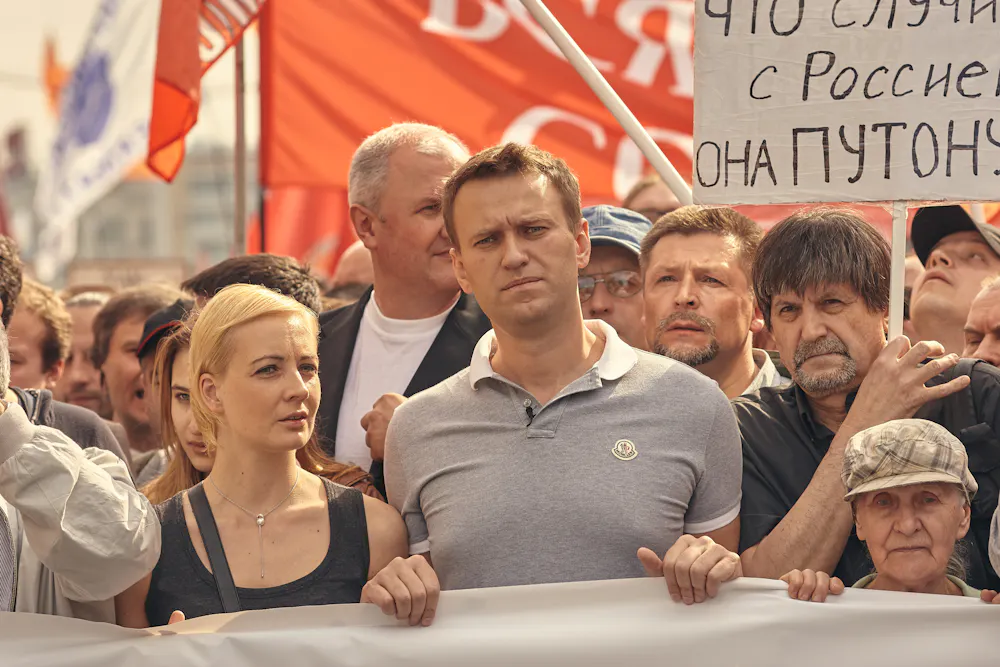
    Alexei Navalny and his wife, Yulia Navalnaya, at a protest rally in Moscow, May 2012.
    Dmitry Laudin/Shutterstock

    Today, Navalny’s family and team continue his work outside of Russia – and are fighting to keep his name alive back home. But the odds are against them. Polling suggests the share of Russians who say they know nothing about Navalny or his activities roughly doubled to 30% between his return in January 2021 and his death three years later.

    Navalny fought against an autocratic system – and paid the price with his life. Given the very real fears Russians may have of voicing support for a man still labelled an extremist by the Putin regime, it’s not easy to assess what people there really think of him and his legacy. But we will also never know how popular Navalny would have been in the “normal” political system he fought for.

    What made Navalny the force he was?

    Navalny didn’t mean for the humble yellow rubber duck to become such a potent symbol of resistance.

    In March 2017, the ACF published its latest investigation into elite corruption, this time focusing on then-prime minister (and former president), Dmitry Medvedev. Navalny’s team members had become masters of producing slick videos that enabled their message to reach a broad audience. A week after posting, the film had racked up over 7 million views on YouTube – an extraordinary number at that time.

    The film included shocking details of Medvedev’s alleged avarice, including yachts and luxury properties. In the centre of a large pond in one of these properties was a duck house, footage of which was captured by the ACF using a drone.

    Video: ACF.

    Such luxuries jarred with many people’s view of Medvedev as being a bit different to Putin and his cronies. As Navalny wrote in his memoir, Medvedev had previously seemed “harmless and incongruous”. (At the time, Medvedev’s spokeswoman said it was “pointless” to comment on the ACF investigation, suggesting the report was a “propaganda attack from an opposition figure and a convict”.)

    But people were angry, and the report triggered mass street protests across Russia. They carried yellow ducks and trainers, a second unintended symbol from the film given Medvedev’s penchant for them.

    Another reason why so many people came out to protest on March 26 2017 was the organising work carried out by Navalny’s movement.

    The previous December, Navalny had announced his intention to run in the 2018 presidential election. As part of the campaign, he and his team created a network of regional headquarters to bring together supporters and train activists across Russia. Although the authorities had rejected Navalny’s efforts to register an official political party, this regional network functioned in much the same way, gathering like-minded people in support of an electoral candidate. And this infrastructure helped get people out on the streets.

    The Kremlin saw this as a clear threat. According to a December 2020 investigation by Bellingcat, CNN, Der Spiegel and The Insider, the FSB assassination squad implicated in the Novichok poisoning of Navalny had started trailing him in January 2017 – one month after he announced his run for the presidency.

    Alexei Navalny on a Moscow street after having zelyonka dye thrown in his face, April 2017.
    Evgeny Feldman via Wikimedia, CC BY-NC-SA

    At the protests against Medvedev, the authorities’ growing intolerance of Navalny was also on display – he was detained, fined and sentenced to 15 days’ imprisonment.

    The Medvedev investigation was far from the beginning of Navalny’s story as a thorn in the Kremlin’s side. But this episode brings together all of the elements that made Navalny the force he was: anti-corruption activism, protest mobilisation, attempts to run as a “normal” politician in a system rigged against him, and savvy use of social media to raise his profile in all of these domains.

    Courting controversy

    In Patriot, Navalny writes that he always “felt sure a broad coalition was needed to fight Putin”. Yet over the years, his attempts to form that coalition led to some of the most controversial points of his political career.

    In a 2007 video, Navalny referred to himself as a “certified nationalist”, advocating for the deportation of illegal immigrants, albeit without using violence and distancing himself from neo-Nazism. In the video, he says: “We have the right to be Russians in Russia, and we’ll defend that right.”

    Although alienating some, Navalny was attempting to present a more acceptable face of nationalism, and he hoped to build a bridge between nationalists and liberals in taking on the Kremlin’s burgeoning authoritarianism.

    But the prominence of nationalism in Navalny’s political identity varied markedly over time, probably reflecting his shifting estimations of which platform could attract the largest support within Russia. By the time of his thwarted run in the 2018 presidential election, nationalist talking points were all but absent from his rhetoric.

    However, some of these former comments and positions continue to influence how people view him. For example, following Russia’s annexation of Crimea in 2014, Navalny tried to take a pragmatic stance. While acknowledging Russia’s flouting of international law, he said that Crimea was “now part of the Russian Federation” and would “never become part of Ukraine in the foreseeable future”.

    Many Ukrainians take this as clear evidence that Navalny was a Russian imperialist. Though he later revised his position, saying Crimea should be returned to Ukraine, some saw this as too little, too late. But others were willing to look past the more controversial parts of his biography, recognising that Navalny represented the most effective domestic challenge to Putin.

    Another key attempt to build a broad political coalition was Navalny’s Smart Voting initiative. This was a tactical voting project in which Navalny’s team encouraged voters to back the individual thought best-placed to defeat the ruling United Russia candidate, regardless of the challenger’s ideological position.

    The project wasn’t met with universal approval. Some opposition figures and voters baulked at, or flatly refused to consider, the idea of voting for people whose ideological positions they found repugnant – or whom they viewed as being “fake” opposition figures, entirely in bed with the authorities. (This makes clear that Navalny was never the leader of the political opposition in Russia; he was, rather, the leading figure of a fractious constellation of individuals and groups.)

    But others relished the opportunity to make rigged elections work in their favour. And there is evidence that Smart Voting did sometimes work, including in the September 2020 regional and local elections, for which Navalny had been campaigning when he was poisoned with Novichok.

    In an astonishing moment captured on film during his recovery in Germany, Navalny speaks to an alleged member of the FSB squad sent to kill him. Pretending to be the aide to a senior FSB official, Navalny finds out that the nerve agent had been placed in his underpants.

    How do Russians feel about Navalny now?

    It’s like a member of the family has died.

    This is what one Russian friend told me after hearing of Navalny’s death a year ago. Soon afterwards, the Levada Center – an independent Russian polling organisation – conducted a nationally representative survey to gauge the public’s reaction to the news.

    The poll found that Navalny’s death was the second-most mentioned event by Russian people that month, after the capture of the Ukrainian city of Avdiivka by Russian troops. But when asked how they felt about his death, 69% of respondents said they had “no particular feelings” either way – while only 17% said they felt “sympathy” or “pity”.

    And that broadly fits with Navalny’s approval ratings in Russia. After his poisoning in 2020, 20% of Russians said they approved of his activities – but this was down to 11% by February 2024.

    Video: BBC.

    Of course, these numbers must be taken for what they are: polling in an authoritarian state regarding a figure vilified and imprisoned by the regime, during a time of war and amid draconian restrictions on free speech. To what extent the drop in support for Navalny was real, rather than reflecting the increased fear people had in voicing their approval for an anti-regime figure, is hard to say with certainty.

    When asked why they liked Navalny, 31% of those who approved of his activities said he spoke “the truth”, “honestly” or “directly”. For those who did not approve of his activities, 22% said he was “paid by the west”, “represented” the west’s interests, that he was a “foreign agent”, a “traitor” or a “puppet”.

    The Kremlin had long tried to discredit Navalny as a western-backed traitor. After Navalny’s 2020 poisoning, Putin’s spokesman, Dmitry Peskov, said that “experts from the United States’ Central Intelligence Agency are working with him”. The Russian state claimed that, rather than a patriot exposing official malfeasance with a view to strengthening his country, Navalny was a CIA stooge intent on destroying Russia.

    Peskov provided no evidence to back up this claim – and the official propaganda wasn’t believed by all. Thousands of Russians defied the authorities by coming out to pay their respects at Navalny’s funeral on March 1 2024. Many, if not all, knew this was a significant risk. Police employed video footage to track down members of the funeral crowd, including by using facial recognition technology.

    The first person to be detained was a Muscovite the police claimed they heard shouting “Glory to the heroes!” – a traditional Ukrainian response to the declaration “Glory to Ukraine!”, but this time referencing Navalny. She spent a night in a police station before being fined for “displaying a banned symbol”.

    Putin always avoided mentioning Navalny’s name in public while he was alive – instead referring to him as “this gentleman”, “the character you mentioned”, or the “Berlin patient”. (The only recorded instance of Putin using Navalny’s name in public when he was alive was in 2013.)

    However, having been re-elected president in 2024 and with Navalny dead, Putin finally broke his long-held practice, saying: “As for Navalny, yes he passed away – this is always a sad event.” It was as if the death of his nemesis diminished the potency of his name – and the challenge that Navalny had long presented to Putin.

    Nobody can become another Navalny

    Someone else will rise up and take my place. I haven’t done anything unique or difficult. Anyone could do what I’ve done.

    So wrote Navalny in the memoir published after his death. But that hasn’t happened: no Navalny 2.0 has yet emerged. And it’s no real surprise. The Kremlin has taken clear steps to ensure nobody can become another Navalny within Russia.

    In 2021, the authorities made a clear decision to destroy Navalny’s organisations within Russia, including the ACF and his regional network. Without the organisational infrastructure and legal ability to function in Russia, no figure has been able to take his place directly.

    More broadly, the fate of Navalny and his movement has had a chilling effect on the opposition landscape. So too have other steps taken by the authorities.

    Russia has become markedly more repressive since the start of its war on Ukraine. The human rights NGO First Department looked into the number of cases relating to “treason”, “espionage” and “confidential cooperation with a foreign state” since Russia introduced the current version of its criminal code in 1997. Of the more than 1,000 cases, 792 – the vast majority – were initiated following Russia’s full-scale invasion of Ukraine in 2022.

    Russian law enforcement has also used nebulous anti-extremism and anti-terrorism legislation to crack down on dissenting voices. Three of Navalny’s lawyers were sentenced in January 2025 for participating in an “extremist organisation”, as the ACF was designated by a Moscow court in June 2021. The Russian legislature has also passed a barrage of legislation relating to so-called “foreign agents”, to tarnish the work of those the regime regards as foreign-backed “fifth columnists”.

    Mass street protests are largely a thing of the past in Russia. Restrictions were placed on public gatherings during the COVID pandemic – but these rules were applied selectively, with opposition individuals and groups being targeted. And opportunities for collective action were further reduced following the full-scale invasion of Ukraine.

    Freedom of speech has also come under assault. Article 29, point five of the Russian constitution states: “Censorship shall be prohibited.” But in September 2024, Kremlin spokesperson Peskov said: “In the state of war that we are in, restrictions are justified, and censorship is justified.”

    Legislation passed very soon after the 2022 invasion of Ukraine made it illegal to comment on the Russian military’s activities truthfully – and even to call the war a war.

    YouTube – the platform so central to Navalny’s ability to spread his message – has been targeted. Without banning it outright – perhaps afraid of the public backlash this might cause – the Russian state media regulator, Roskomnadzor, has slowed down internet traffic to the site within Russia. The result has been a move of users to other websites supporting video content, including VKontakte – a Russian social media platform.

    In short, conditions in Russia are very different now compared to when Navalny first emerged. The relative freedom of the 2000s and 2010s gave him the space to challenge the corruption and authoritarianism of an evolving system headed by Putin. But this space has shrunk over time, to the point where no room remains for a figure like him within Russia.

    In 2019, Navalny told Ivan Zhdanov, who is now director of the ACF: “We changed the regime, but not in the way we wanted.” So, did Navalny and his team push the Kremlin to become more authoritarian – making it not only intolerant of him but also any possible successor?

    There may be some truth in this. And yet, the drastic steps taken by the regime following the start of the war on Ukraine suggest there were other, even more significant factors that have laid bare the violent nature of Putin’s personal autocracy – and the president’s disdain for dissenters.

    Plenty for Russians to be angry about

    How can we win the war when dedushka [grandpa] is a moron?

    In June 2023, Evgeny Prigozhin – a long-time associate of Putin and head of the private military Wagner Group – staged an armed rebellion, marching his forces on the Russian capital. This was not a full-blown political movement against Putin. But the target of Prigozhin’s invective against Russia’s military leadership had become increasingly blurry, testing the taboo of direct criticism of the president – who is sometimes referred to, disparagingly, as “grandpa” in Russia.

    And Prigozhin paid the price. In August 2023, he was killed when the private jet he was flying in crashed after an explosion on board. Afterwards, Putin referred to Prigozhin as a “talented person” who “made serious mistakes in life”.

    In the west, opposition to the Kremlin is often associated with more liberal figures like Navalny. Yet the most consequential domestic challenge to Putin’s rule came from a very different part of the ideological spectrum – a figure in Prigozhin leading a segment of Russian society that wanted the Kremlin to prosecute its war on Ukraine even more aggressively.

    Video: BBC.

    Today, there is plenty for Russians to be angry about, and Putin knows it. He recently acknowledged an “overheating of the economy”. This has resulted in high inflation, in part due to all the resources being channelled into supporting the war effort. Such cost-of-living concerns weigh more heavily than the war on the minds of most Russians.

    A favourite talking point of the Kremlin is how Putin imposed order in Russia following the “wild 1990s” – characterised by economic turbulence and symbolised by then-president Boris Yeltsin’s public drunkenness. Many Russians attribute the stability and rise in living standards they experienced in the 2000s with Putin’s rule – and thank him for it by providing support for his continued leadership.

    The current economic problems are an acute worry for the Kremlin because they jeopardise this basic social contract struck with the Russian people. In fact, one way the Kremlin tried to discredit Navalny was by comparing him with Yeltsin, suggesting he posed the same threats as a failed reformer. In his memoir, Navalny concedes that “few things get under my skin more”.

    Although originally a fan of Yeltsin, Navalny became an ardent critic. His argument was that Yeltsin and those around him squandered the opportunity to make Russia a “normal” European country.

    Navalny also wanted Russians to feel entitled to more. Rather than be content with their relative living standards compared with the early post-Soviet period, he encouraged them to imagine the level of wealth citizens could enjoy based on Russia’s extraordinary resources – but with the rule of law, less corruption, and real democratic processes.

    ‘Think of other possible Russias’

    When looking at forms of criticism and dissent in Russia today, we need to distinguish between anti-war, anti-government, and anti-Putin activities.

    Despite the risk of harsh consequences, there are daily forms of anti-war resistance, including arson attacks on military enlistment offices. Some are orchestrated from Ukraine, with Russians blackmailed into acting. But other cases are likely to be forms of domestic resistance.

    Criticism of the government is still sometimes possible, largely because Russia has a “dual executive” system, consisting of a prime minister and presidency. This allows the much more powerful presidency to deflect blame to the government when things go wrong.

    There are nominal opposition parties in Russia – sometimes referred to as the “systemic opposition”, because they are loyal to the Kremlin and therefore tolerated by the system. Within the State Duma, these parties often criticise particular government ministries for apparent failings. But they rarely, if ever, now dare criticise Putin directly.

    Nothing anywhere close to the challenge presented by Navalny appears on the horizon in Russia – at either end of the political spectrum. But the presence of clear popular grievances, and the existence of organisations (albeit not Navalny’s) that could channel this anger should the Kremlin’s grip loosen, mean we cannot write off all opposition in Russia.

    Navalny’s wife, Yulia, has vowed to continue her husband’s work. And his team in exile maintain focus on elite corruption in Russia, now from their base in Vilnius, Lithuania. The ACF’s most recent investigation is on Igor Sechin, CEO of the oil company Rosneft.

    But some have argued this work is no longer as relevant as it was. Sam Greene, professor in Russian politics at King’s College London, captured this doubt in a recent Substack post:

    [T]here is a palpable sense that these sorts of investigations may not be relevant to as many people as they used to be, given everything that has transpired since the mid-2010s, when they were the bread and butter of the Anti-Corruption Foundation. Some … have gone as far as to suggest that they have become effectively meaningless … and thus that Team Navalny should move on.

    Navalny’s team are understandably irritated by suggestions they’re no longer as effective as they once were. But it’s important to note that this criticism has often been sharpest within Russia’s liberal opposition. The ACF has been rocked, for example, by recent accusations from Maxim Katz, one such liberal opposition figure, that the organisation helped “launder the reputations” of two former bank owners. In their response, posted on YouTube, the ACF referred to Katz’s accusations as “lies” – but this continued squabbling has left some Russians feeling “disillusioned and unrepresented”.

    So, what will Navalny’s long-term legacy be? Patriot includes a revealing section on Mikhail Gorbachev – the last leader of the Soviet Union, whom Navalny describes as “unpopular in Russia, and also in our family”. He continues:

    Usually, when you tell foreigners this, they are very surprised, because Gorbachev is thought of as the person who gave Eastern Europe back its freedom and thanks to whom Germany was reunited. Of course, that is true … but within Russia and the USSR he was not particularly liked.

    At the moment, there is a similar split in perceptions of Navalny. Internationally, he was nominated for the Nobel Peace Prize, awarded the Sakharov Prize by the European Parliament, and a documentary about him won an Oscar.

    But there are also those outside of Russia who remain critical: “Navalny’s life has brought no benefit to the Ukrainian victory; instead, he has caused considerable harm,” wrote one Ukrainian academic. “He fuelled the illusion in the west that democracy in Russia is possible.”

    Trailer for the Oscar-winning documentary Navalny.

    Inside Russia, according to Levada Center polling shortly after his death, 53% of Russians thought Navalny played “no special role” in the history of the country, while 19% said he played a “rather negative” role. Revealingly, when commenting on Navalny’s death, one man in Moscow told RFE/RL’s Russian Service: “I think that everyone who is against Russia is guilty, even if they are right.”

    But, for a small minority in Russia, Navalny will go down as a messiah-like figure who miraculously cheated death in 2020, then made the ultimate sacrifice in his battle of good and evil with the Kremlin. This view may have been reinforced by Navalny’s increasing openness about his Christian faith.

    Ultimately, Navalny’s long-term status in Russia will depend on the nature of the political system after Putin has gone. Since it seems likely that authoritarianism will outlast Putin, a more favourable official story about Navalny is unlikely to emerge any time soon. However, how any post-Putin regime tries to make sense of Navalny’s legacy will tell us a lot about that regime.

    While he was alive, Navalny stood for the freer Russia in which he had emerged as a leading opposition figure – and also what he called the “Beautiful Russia of the Future”. Perhaps, after his death, his lasting legacy in Russia remains the ability for some to think – if only in private – of other possible Russias.


    For you: more from our Insights series:

    To hear about new Insights articles, join the hundreds of thousands of people who value The Conversation’s evidence-based news. Subscribe to our newsletter.

    Ben Noble has previously received funding from the British Academy and the Leverhulme Trust. He is an Associate Fellow of Chatham House.

    ref. One year on from Alexei Navalny’s death, what is his legacy for Russia? – https://theconversation.com/one-year-on-from-alexei-navalnys-death-what-is-his-legacy-for-russia-249692

    MIL OSI – Global Reports

  • MIL-OSI United Kingdom: Travelling Gallery returns with new exhibition

    Source: Scotland – City of Edinburgh

    Travelling Gallery is delighted to be partnering with the University of St Andrews this February to present the exhibition Between Women.

    The exhibition features the work of Franki Raffles, Sylvia Grace Borda, Sandra George, Carolyn Scott and Niu Weiyu.

    Between Women takes images made by the photographer Franki Raffles from her base in Edinburgh during the 1980s and 1990s as a starting point to explore relationships between gender, labour, education, care and activism in documentary photography since the 1950s in Scotland and internationally. Raffles’ photographs will appear alongside images by Sylvia Grace Borda, Sandra George, Carolyn Scott and Niu Weiyu which together illuminate how gender is produced and reproduced through workplaces, housing, healthcare, and particularly schools, playgrounds and nurseries, across urban and rural landscapes.

    In examining the relationships and power structures between women, this exhibition takes inspiration from two projects by Raffles. The first is a trip Raffles made in 1984–85 to the Soviet Union and Asia, including an extended period in China, during which her concern with women at work crystallised. The second, Picturing Women, was part of a 1988–89 educational initiative organised by Stills Gallery, Edinburgh, aimed at helping young people analyse photographs, for which Raffles studied the working relationships between women at a school. These two projects provide a framework through which connections and comparisons with Niu Weiyu, Carolyn Scott, Sandra George and Sylvia Grace Borda’s photographs emerge.

    One of the few women photographers to gain professional recognition in twentieth-century China, Niu worked for state-run media organisations and produced a large number of photographs that portray women’s roles as workers throughout the 1950s, 1960s and 1970s. Carolyn Scott’s documentary photographs images of children and families in Newcastle’s Rye Hill area where she lived between 1967-68 observe the relationships and socialisation forged through play, but also the effects of deindustrialisation on the community. Sandra George’s photographs of Edinburgh during the 1980s and 1990s attest to the importance of community educational groups and spaces in activism and organising, alongside public demonstrations and gatherings. Sylvia Grace Borda’s studies of schools, leisure centres and nurseries in the New Town of East Kilbride reflect on the complex legacies of post-1945 Welfare State architecture from the perspective of the early 2000s.

    Together, these photographs highlight the possibilities for solidarity between women in sites and spaces spanning the local and the global, but also the importance of recognising differences and intersectional identities that account for the constructs of gender, sexuality, race, disability and class in activism and organising.

    Launching in Edinburgh at the Community Wellbeing Centre on Monday 17 February from 11am to 5pm, the exhibition will tour throughout the week visiting the following locations:

    • Tuesday 18 February, 10am – 4pm – Glasgow Women’s Library
    • Wednesday 19 February, 10am – 4pm – Dundee International Women’s Centre
    • Thursday 20 February, 10am – 4pm – Fluthers Car Park, Cupar
    • Friday 21 February, 10am – 4pm – East Sands Leisure Centre, St Andrews

    Between Women is curated by Vivian K. Sheng and Catherine Spencer, with support from the University of St Andrews Impact and Innovation Fund.

    Culture and Communities Convener, Councillor Val Walker said:

    It’s brilliant to see the Travelling Gallery return for 2025.

    It’s crucial that art and culture is as accessible to as many people as possible. I’m proud that through our ongoing support of the Travelling Gallery, and the recent increased Creative Scotland investment, art is brought straight into the hearts of towns and cities across Scotland. I hope everyone takes the opportunity to visit the exhibition, bringing together work which illuminates how gender is produced and reproduced through workplaces.

    Here in Edinburgh, we’re clear that that our residents should be able to easily access a variety of cultural activities, and this exhibition brings art closer to people’s communities.

    Louise Briggs, Curator, Travelling Gallery said:

    We’re delighted to be working with Vivian, Catherine, and the University of St Andrews to present this exhibition. We’re looking forward to discussing the work of each artist with our visitors, who we believe will have their own stories and experiences to share that chime with many of the references (and local sites) found in the work on display.”

    With thanks to the University of St Andrews Libraries and Museums, Edinburgh Napier University, Franki Raffles Estate, Craigmillar Now, Gaofan Photography Museum, Sylvia Grace Borda and Carolyn Scott.

    Travelling Gallery is a contemporary art gallery in a bus. Since 1978 it has been bringing exhibitions to communities throughout Scotland. We recognise that art can change lives and we create fair conditions and remove barriers to allow access and engagement to audiences in their own familiar surroundings. The gallery space offers an open and welcoming environment for people of all ages, backgrounds, and abilities to discover and enjoy contemporary art. Over the past forty years, Travelling Gallery has brought innovative exhibitions to every part of Scotland reaching hundreds of thousands of visitors and school pupils. Travelling Gallery is a ‘not for profit’ organisation, regularly funded by Creative Scotland and supported by the City of Edinburgh Council.

    For more information, please vist the Travelling Gallery website.        

    The gallery has ramp access for wheelchairs; hearing loop and will have large print format exhibition interpretation.

    Artist Biographies

    Sylvia Grace Borda is an artist working with photography, net art, video installation, and eco-art, who has undertaken projects in Canada, Finland, Northern Ireland, Latvia, Scotland, Ethiopia and Taiwan. Her artwork is concerned with establishing systems of public understanding that underpin literacy, advocacy, and action to conserve the built and natural environments. In Scotland, she focused on New Town architecture in EK Modernism (2005–10) and A Holiday in Glenrothes (2008), and created an edible photo artwork, the Lumsden Biscuit (2016–17). Her roles at Queen’s University Belfast (2008–10); University of Salford (2011), and University of Stirling (2012–15) have focused on visual arts and social histories, digital engagement and innovation. In 2023, she received the Mozilla Foundation Rise 25 award in recognition of her transformative media arts practice to democratize the web for communities. Exhibitions include National Galleries of Scotland, RIAS, Street Level Photoworks, and The Lighthouse, Glasgow.

    Sandra George (1957–2013) was an Edinburgh-based social documentary photographer, multi-disciplinary artist, and a community worker in Craigmillar. George studied Photography at Napier University, Drawing and Painting at Edinburgh College of Art, and Community Education at The University of Edinburgh. For over 30 years she worked extensively as a freelance photographer for organisations and publications including the Sentinel, Tollcross Community Newspaper, Shelter, Craigmillar Festival News, and Craigmillar Chronicle, and taught photography and art to communities across Edinburgh. She started working in community development in Wester Hailes in the 1980s, and in Craigmillar from the 1990s, and was an integral member of initiatives including McGovan house, the Thistle Foundation, and the Craigmillar Arts Centre. Alongside a commitment to community work, anti-racism and social justice, George’s photographs document children at play and their educational and leisure environments. George’s archive is held at Craigmillar Now, a community-led arts and heritage organisation in Craigmillar.

    Franki Raffles (1955–1994) was a feminist photographer specialising in social documentary. Raffles studied philosophy at the University of St Andrews from 1973–1977, where she was an active member of the Women’s Liberation Movement. After experimenting with photography while living on the Isle of Lewis, she moved to Edinburgh in 1983, and started documenting women at work, as well as organising and campaigning. Raffles frequently collaborated with Edinburgh District Council’s Women’s Committee, including on the project To Let You Understand: Women’s Working Lives in Edinburgh (1989) Zero Tolerance campaign against domestic violence in the early 1990s. She travelled widely throughout her career, including extended trips to Asia and the Soviet Union. Raffles’ work is currently the focus of a major exhibition Franki Raffles: Photography, Activism, Campaign Works at BALTIC Centre for Contemporary Art. Her archive is held at the University of St Andrews.

    Carolyn Scott is an artist working in photography, film and installation. She was raised in Edinburgh and now lives in Cupar, Fife. Carolyn lived in the Rye Hill district of Newcastle Upon Tyne in the late 1960s where, in the spring and early summer of 1968, using a twin-lens Rollieflex camera, she photographed the immediate area in which she lived. Her  Rye Hill Social Documentary Photography Collection images were unseen for nearly 40 years until she revisited them during her studies at Duncan of Jordanstone College of Art and Design, Dundee University, where she received a BA and MFA. Carolyn’s work has been shown in the Cupar Arts Festival, St Andrews Photography Festival, Royal Scottish Academy and The Centre for Theology and Inquiry, Princeton. The Rye Hill Social Documentary Photography Collection is now held at the University of St Andrews. 

    Niu Weiyu (牛畏予) (1927–2020) worked as a photojournalist and photographer for North China Pictorial, Southwest Pictorial, and the News Photography Bureau. She later joined the Xinhua News Agency, where she worked for various branches from the 1950s to the 1980s. Weiyu was one of the few women photographers during this period, who were often assigned to feature women workers, such as the first women pilots, as well as public figures and officials in the Chinese Communist Party, and she travelled extensively throughout her career.

    Vivian K. Sheng is an art historian working on contemporary Chinese and East Asian art in transnational contexts and an assistant professor in contemporary art at the University of Hong Kong. In Fall 2022, she was a Global Fellow hosted by the School of Art History at the University of St Andrews. Her research investigates the intricate interrelations between women, domesticity and art practices in contexts of ever more intensified cross-border movements and exchanges, provoking reflections on notions of identity, home and belonging beyond the territorial fixity of natio-state. Relevant issues are explored in her forthcoming monograph book— The Arts of Homemaking: Women, Migration and Transnational East Asia. Her writings have appeared in ASAP/Journal, Art Journal, PARSE Journal,Third TextSculpture Journal, Yishu and INDEX JOURNAL.

    Catherine Spencer is an art historian at the University of St Andrews. She is currently working on a book entitled Abstract Subjects: Art, Borders and ‘Britain’, and co-editing Grassroots Artmaking: Political Struggle and Activist Art in the UK, 1960–Present with Maryam Ohadi-Hamadani and Amy Tobin (Bloomsbury, forthcoming). Her writing on Franki Raffles has been published in Art History (2022) and the catalogue for the 2024–5 exhibition Franki Raffles: Photography, Activism, Campaign Works at BALTIC Centre for Contemporary Art. In 2021, she co-curated Life Support: Forms of Care in Art and Activism with Caroline Gausden, Kirsten Lloyd, and Nat Raha at Glasgow Women’s Library. Her essays have appeared in Art History, Art Journal, ARTMargins, Tate Papers, Parallax and Oxford Art Journal.

    MIL OSI United Kingdom

  • MIL-OSI Global: ‘Emilia Pérez’ was nominated for 13 Oscars. Why do so many people hate it?

    Source: The Conversation – USA – By Alejandra Marquez Guajardo, Assistant Professor of Spanish, Michigan State University

    Going by recent media coverage, you wouldn’t be remiss for assuming it had been nominated for a slew of Golden Raspberries. Netflix

    French director Jacques Audiard’s “Emilia Pérez” first made waves among critics at the Cannes Film Festival in May 2024, when it won multiple awards. It went on to receive 10 Golden Globe nominations, winning four, including best musical or comedy.

    “It is so beautiful to see a movie that is cinema,” gushed Mexican director Guillermo del Toro. Another Mexican filmmaker, Issa López, who directed “True Detective: Night Country,” called it a “masterpiece,” adding that Audiard portrayed issues of gender and violence in Latin America “better than any Mexican facing this issue at this time.”

    The film is a musical about a Mexican drug lord named Manitas del Monte, played by trans actress Karla Sofía Gascón. Del Monte hires a lawyer to facilitate her long-awaited gender transition. After her surgery, she fakes her death with her lawyer’s help and sends her wife, Jessi, played by Selena Gómez, and their children to Switzerland. Four years later, Manitas – now known as Emilia Pérez – tries to reunite with her family by posing as Manitas’ distant cousin.

    So why is it bombing among Mexican moviegoers?

    Modest research into a ‘modest’ language

    As a scholar of gender and sexuality in Latin America, I study LGBTQ+ representation in media, particularly in Mexico. So it’s been interesting to follow the negative reaction to a film that critics claim has broken new ground in exploring themes of gender, sexuality and violence in Mexico.

    Many of the film’s perceived errors seem self-inflicted.

    Audiard admitted that he didn’t do much research on Mexico before and during the filming process. And even though he doesn’t speak Spanish, he chose to use a Spanish script and film the movie in Spanish.

    Jacques Audiard speaks during the Santa Barbara International Film Festival on Feb. 10, 2025.
    Tibrina Hobson/Getty Images for Santa Barbara International Film Festival

    The director told French media outlet Konbini that he chose to make the film in Spanish because it is a language “of modest countries, developing countries, of poor people and migrants.”

    Not surprisingly, an early critique of the film centered on its Spanish: It uses some Mexican slang words, but they’re spoken in ways that sound unnatural to native speakers. Then there’s the film’s overreliance on clichés that border on racism, perhaps most egregiously when Emilia’s child sings that she smells of “mezcal and guacamole.”

    Of course, an artist need not belong to a culture in order to depict or explore it in their work. Filmmakers like Sergei Eisenstein and Luis Buñuel became renowned figures in Mexican cinema despite being born in Latvia and Spain, respectively.

    When choosing to explore sensitive topics, however, it is important to take into account the perspective of those being portrayed, both for accuracy’s sake and as a form of respect. Take Martin Scorsese’s “Killers of the Flower Moon.” The director collaborated with members of the Osage nation to further the film’s historical and cultural accuracy.

    Glossing over the nuance

    “Emilia Pérez” centers on how violence stems from the corruption prevalent in Mexico. Multiple musical numbers denounce the collusion between authorities and criminals.

    This is certainly true. But to many Mexicans, it feels like an oversimplification of the issue.

    The film fails to acknowledge the confluence of factors behind the country’s violence, such as U.S. demand for illegal drugs stemming from its opioid crisis, or the role that American guns play in Mexico’s violence.

    Professor and journalist Oswaldo Zavala, who has written extensively about Mexican cartels, argues that the film perpetuates the idea that Latin American countries are solely to blame for the violence of drug trafficking. Furthermore, Zavala contends that this perspective reinforces the narrative that the U.S.-Mexico border needs to be militarized.

    The musical features few male characters; the ones who do appear are invariably violent, and this includes Manitas before undergoing their transition. The cruelty of Manitas contrasts with Emilia’s kindness: She helps the “madres buscadoras,” which are the Mexican collectives made up of mothers searching for missing loved ones presumed to be kidnapped or killed by organized crime. One of these collectives, Colectivo de Víctimas del 10 de Marzo, criticized the film for depicting groups like theirs as recipients of money from organized crime and beneficiaries of luxurious galas attended by politicians and celebrities.

    The group’s leader, Delia Quiroa, announced that the group would send a letter to the academy to express its condemnation of the film.

    Members of the Madres Buscadoras de Sonora search for the remains of missing persons on the outskirts of Hermosillo, a city in northwestern Mexico, in 2021.
    Alfred Estrella/AFP via Getty Images

    Backlash on multiple fronts

    These political and cultural blind spots have spurred a backlash among Mexican moviegoers.

    When the movie premiered in Mexico in January 2025, it bombed at the box office, with some viewers demanding refunds. Mexico’s Federal Consumer Protection Agency had to intervene after the movie chain Cinépolis refused to honor its satisfaction-guarantee policy.

    Mexican writer Jorge Volpi called the movie “one of the crudest and most deceitful films of the 21st century.”

    Trans content creator Camila Aurora playfully parodied “Emilia Pérez” in her short film “Johanne Sacrebleu.” In scenes filled with stereotypical French symbols such as croissants and berets, it tells the story of an heiress who falls in love with a member of her family’s business rivals.

    While some viewers have nonetheless praised “Emilia Pérez” for its nuanced portrayal of trans women and the casting of a trans actress, the LGBTQ advocacy group GLAAD described it as “a step backward for trans representation.”

    One point of contention is the musical number Emilia sings, “medio ella, medio él,” or “half she, half he,” which insinuates that trans people are stuck between two genders. The movie also seems to portray the character’s transition as a tool for deception.

    A social media viper pit

    Meanwhile, Gascón’s historic nominations as the first trans actress recognized by the Oscars and other awards have been overshadowed by her controversial statements.

    She made headlines when she accused associates of Brazilian actress Fernanda Torres of disparaging her work. Torres is also an Oscar nominee for best actress.

    Gascón’s historic nomination for best actress has been overshadowed by sniping on social media.
    Yamak Perea/ Pixelnews/Future Publishing via Getty Images

    The latest controversy began in late January 2025 when Gascón’s old social media posts resurfaced. The now-deleted messages included attacks on Muslims in Spain and a post calling co-star Selena Gómez a “rich rat,” which Gascón has denied writing.

    “Emilia Pérez” is limping into the Oscars. Netflix and Audiard have distanced themselves from Gascón to try to preserve the film’s prospects at the annual Academy Awards ceremony.

    It could be too little too late.

    Alejandra Marquez Guajardo does not work for, consult, own shares in or receive funding from any company or organization that would benefit from this article, and has disclosed no relevant affiliations beyond their academic appointment.

    ref. ‘Emilia Pérez’ was nominated for 13 Oscars. Why do so many people hate it? – https://theconversation.com/emilia-perez-was-nominated-for-13-oscars-why-do-so-many-people-hate-it-248297

    MIL OSI – Global Reports

  • MIL-OSI: NordVPN verifies its no-logs assurance assessment for the fifth time

    Source: GlobeNewswire (MIL-OSI)

    LONDON, Feb. 14, 2025 (GLOBE NEWSWIRE) — NordVPN, a leading cybersecurity company, underwent an independent assurance engagement at the end of 2024. Seeking to maintain a high level of trust and transparency, NordVPN commissioned Deloitte Audit Lithuania, one of the market-leading Big Four firms, to conduct an assurance report on the configuration of its IT systems, supporting infrastructure, and no-logs claims.

    For the fifth time in NordVPN’s history, an independent team of researchers verified that the company’s no-logs statement is accurate and aligns with its privacy claims.

    “The trust we earn from our customers underscores everything we do in the cybersecurity industry. It’s a currency that’s hard to acquire and one we never take for granted. To maintain that trust, we not only strive each year to innovate and develop world-leading cybersecurity products, but we also fully commit to our promise not to monitor or record our users’ online traffic. Having this assurance reaffirmed by independent, globally respected researchers for the fifth time demonstrates that privacy isn’t just a buzzword at NordVPN — it’s in our DNA,” says Marijus Briedis, CTO at NordVPN.

    During the engagement process, Deloitte’s practitioners interviewed NordVPN’s employees and inspected server infrastructure, and technical logs. They had access to NordVPN services from November 18 until December 20, 2024 and reviewed privacy relevant configuration settings and deployment processes of standard VPN, Double VPN, Onion Over VPN, obfuscated servers, and P2P servers.

    Deloitte Audit Lithuania conducted the assessment in accordance with the International Standard on Assurance Engagements 3000 (Revised) (ISAE 3000), established by the International Auditing and Assurance Standards Board (IAASB) with the aim of examining NordVPN’s IT system configuration and management.

    NordVPN’s first independent no-log engagement was completed in 2018, followed by second, third, and fourth assessments in 2020, 2022, and 2023, showing the company’s continuous commitment to privacy.

    The full no-logs assurance engagement report is available to all NordVPN users, after logging in to their Nord Account user control panel.

    ABOUT NORDVPN

    NordVPN is the world’s most advanced VPN service provider, chosen by millions of internet users worldwide. The service offers features such as dedicated IP, Double VPN, and Onion Over VPN servers, which help to boost your online privacy with zero tracking. One of NordVPN’s key features is Threat Protection Pro™, a tool that blocks malicious websites, trackers, and ads and scans downloads for malware. The latest creation of Nord Security, NordVPN’s parent company, is Saily — a global eSIM service. NordVPN is known for being user friendly and can offer some of the best prices on the market. This VPN provider has over 6,400 servers covering 111 countries worldwide. For more information, visit  https://nordvpn.com.

    More information: brigita@nordsec.com

    The MIL Network

  • MIL-OSI: Bitget Secures Virtual Asset Service Provider license in Bulgaria Aligning with its EU Expansion Plans

    Source: GlobeNewswire (MIL-OSI)

    VICTORIA, Seychelles, Feb. 14, 2025 (GLOBE NEWSWIRE) — Bitget, the leading cryptocurrency exchange and Web3 company, has obtained a Virtual Asset Service Provider (VASP) license from Bulgaria’s National Revenue Agency. The official licensing now enables Bitget to offer a comprehensive suite of crypto services within Bulgaria, including the exchange, trading, transfer, custody, and public offering of crypto assets, as well as wallet services. This aligns with Bitget’s broader plans of obtaining EU’s Markets in Crypto-Assets (MiCA) license, which will boost its foothold in the region.

    The VASP license in Bulgaria aligns with Bitget’s strategic expansion across the European Union. The company is actively preparing for compliance with the EU’s MiCA framework, which seeks to establish a unified regulatory environment for crypto assets throughout the region.

    “The successful application of the VASP license in Bulgaria is a part of Bitget’s expansion strategy to serve users across the European Union,” said Hon Ng, Chief Legal Officer at Bitget. “As the EU continues to lead with regulatory frameworks like MiCA, we see strong potential for sustainable growth and innovation in the region while maintaining compliance. Bulgaria serves as a strategic gateway for our European expansion, offering crypto-friendly ecosystems the chance to accelerate crypto’s adoption.”

    Ng added, “In 2025, we are excited to continue to grow Bitget’s global regulatory footprint in partnership with various regulators around the world. We have a sharp focus on meeting compliance standards in every jurisdiction where we operate and we have been investing in our compliance programme from day one. We believe that our approach enhances user trust, ensures market integrity while at the same time increasing global adoption of digital assets and ensures long-term sustainable growth as we align our operations with emerging regulations worldwide.”

    Bitget views regulatory compliance as an integral part of its future success, which is evident through its acquisition of approvals in key markets such as Poland, Italy, Lithuania, UK and now Bulgaria.

    The VASP license in Bulgaria grants Bitget the regulatory approval to offer a wide array of services to cater to the needs of digital asset users in the region. These services include the exchange of crypto assets, enabling seamless conversion between crypto and fiat; trading and transfer of crypto assets, facilitating efficient and secure transactions; and custody services, providing a strong framework for safeguarding user assets. Additionally, the license permits the public offering of crypto assets, supporting the scope for innovative token launches and opportunities.

    In the last three months alone, Bitget has put forth major licensing and expansion updates. It has secured a BSP license in El Salvador, approval in the UK to provide digital asset services, and has powered a compliant Vietnam-based exchange BitEXC. Recently, Forbes has ranked Bitget as one of the world’s most trustworthy exchanges and with Bulgaria’s VASP license, Bitget continues to make significant progress in this area. The company plans to collaborate closely with European regulators to ensure its products meet all regulatory requirements while prioritizing the protection of user assets and data.

    About Bitget

    Established in 2018, Bitget is the world’s leading cryptocurrency exchange and Web3 company. Serving over 100 million users in 150+ countries and regions, the Bitget exchange is committed to helping users trade smarter with its pioneering copy trading feature and other trading solutions, while offering real-time access to Bitcoin price, Ethereum price, and other cryptocurrency prices. Formerly known as BitKeep, Bitget Wallet is a world-class multi-chain crypto wallet that offers an array of comprehensive Web3 solutions and features including wallet functionality, token swap, NFT Marketplace, DApp browser, and more.

    Bitget is at the forefront of driving crypto adoption through strategic partnerships, such as its role as the Official Crypto Partner of the World’s Top Football League, LALIGA, in EASTERN, SEA and LATAM market, as well as a global partner of Turkish National athletes Buse Tosun Çavuşoğlu (Wrestling world champion), Samet Gümüş (Boxing gold medalist) and İlkin Aydın (Volleyball national team), to inspire the global community to embrace the future of cryptocurrency.

    For more information, visit: Website | Twitter | Telegram | LinkedIn | Discord | Bitget Wallet

    For media inquiries, please contact: media@bitget.com

    Risk Warning: Digital asset prices may fluctuate and experience price volatility. Only invest what you can afford to lose. The value of your investment may be impacted and it is possible that you may not achieve your financial goals or be able to recover your principal investment. You should always seek independent financial advice and consider your own financial experience and financial standing. Past performance is not a reliable measure of future performance. Bitget shall not be liable for any losses you may incur. Nothing here shall be construed as financial advice.

    A photo accompanying this announcement is available at https://www.globenewswire.com/NewsRoom/AttachmentNg/3dafce49-6bd9-4e83-9453-e5503f7b4596

    The MIL Network

  • MIL-OSI: Coop Pank AS results for January 2025

    Source: GlobeNewswire (MIL-OSI)

    Coop Pank’s financial results in January 2025:

    • In January, number of the bank’s clients increased by 1,900 and number of active clients decreased by 700. By the end of the month number of clients reached 209,500 and number of active clients reached 98,800. Over the year, customer base has grown by 13%.
    • Volume of the bank’s customer deposits increased by 40 million euros, reaching 1.93 billion euros by the end of month. Deposits of corporate customers increased by 24 million and deposits of private customers increased by 3 million euros. The volume of deposits attracted from international platforms increased by 13 million euros. Over the year, volume of bank deposits increased by 11%.
    • The bank’s loan portfolio increased by 9 million euros over the month and reached 1.78 billion euros by the end of January. Home loans portfolio increased by 8 million euros, corporate loans increased by 2 million euros, leasing increased by 0.1 million euros and consumer financing decreased 0.3 million euros. Over the year, loan portfolio increased by 18%.
    • In January, the loan impairment cost was 0.1 million euros.
    • Compared to the first month of last year, the bank’s net income has decreased by 5% and expenses has increased by 4% during the same period this year.
    • The bank earned net profit of 2.7 million euros in January, that is 8% less than in the same period last year.
    • In January, Coop Pank’s return on equity was 15.2% and the cost-income ratio was 49%.
        

    Comment by Paavo Truu, Member of the Management Board and CFO of Coop Pank:

    “This year started strong for Coop Pank with a solid profit of 2.7 million euros. This was driven, among other factors, by the excellent business volume growth at the end of last year, which also contributed to increased revenues in January.

    We see that overall economic activity has picked up at the beginning of 2025, both in the private and business client segments. However, the car leasing market remains very quiet after last year’s turbulent end caused by the car tax. We believe this silence will continue, at least among private individuals, for the coming months and predict a revival in leasing market activity by the second half of the year at the latest.

    The overall market revival is supported by the ongoing downward trend in interest rates – the European Central Bank lowered its rates by 0.25 percentage points in January, and base rates are likely to continue declining. On one hand, this makes borrowing cheaper, but on the other, it also reduces the interest rates on term deposits in the local market.

    At the end of January, Coop Pank expanded its range of products for both private and business clients by introducing a convenient and environmentally friendly virtual card, which is currently offered by only a few universal banks in Estonia. Using a virtual card eliminates the need for a traditional plastic card, its activation is simple and fast, and the card is immediately ready for use. By adding the virtual card to a smart device’s Wallet, it can be used for payments anywhere that displays the contactless payment symbol or the Wallet logo.”

    More detailed quarterly reports of Coop Pank are available at: https://www.cooppank.ee/en/financial-reports

    Coop Pank, based on Estonian capital, is one of the five universal banks operating in Estonia. The number of clients using Coop Pank for their daily banking reached 209,500. Coop Pank aims to put the synergy generated by the interaction of retail business and banking to good use and to bring everyday banking services closer to people’s homes. The strategic shareholder of the bank is the domestic retail chain Coop Eesti, comprising of 320 stores.

    Additional information:
    Paavo Truu
    CFO
    Phone: +372 5160 231
    E-mail: paavo.truu@cooppank.ee

    Attachment

    The MIL Network

  • MIL-OSI China: Europe demands role in Ukraine peace talk

    Source: China State Council Information Office

    This photo taken on Aug. 15, 2024 shows a Ukrainian tank destroyed during Russian attacks in Toretsk. [Photo/Xinhua]

    The European Union (EU) and several European leaders have insisted on playing a key role in potential Ukraine peace negotiations, voicing concerns about being sidelined after U.S. President Donald Trump and his Russian counterpart, Vladimir Putin, held a phone talk on Wednesday.

    According to press release from both the White House and the Kremlin, the two leaders discussed a swift ceasefire in Ukraine without consulting the EU or Ukraine. In response, the EU officially demanded a seat at the negotiating table.

    “Ukraine’s security is Europe’s security,” Paula Pinho, chief spokesperson of the European Commission, said during a press briefing on Thursday. “If there is a discussion about Ukraine’s security, Europe is concerned. If there’s a discussion about Europe’s security, it also involves Ukraine,” she stressed.

    EU’s top diplomat Kaja Kallas reinforced this stance, sharing a joint statement from a meeting in Paris with her counterparts of France, Germany, Poland, Spain and Britain. The statement insisted on Ukraine’s and Europe’s participation in any relevant negotiations, highlighting the need for a peace that secures both European and Ukrainian interests while expressing willingness to engage with the United States.

    Finnish Prime Minister Petteri Orpo also emphasized the necessity of Europe’s involvement in any Ukraine peace process. “Ukraine cannot be agreed upon without Ukraine, and European security cannot be agreed without Europe,” he stated, urging for a unified European stand and proposing an extraordinary EU Summit on the matter.

    Following his call with Putin, Trump called Ukrainian President Volodymyr Zelensky, but when speaking to the U.S. press, he excluded Ukraine’s return to its pre-2014 borders — Kiev’s key precondition for talks with Moscow. Trump also voiced support for U.S. Secretary of Defense Pete Hegseth’s declaration in Brussels that Ukraine’s membership of the North Atlantic Treaty Organization (NATO) would be off the table as part of a negotiated settlement to end the Russia-Ukraine conflict.

    Trump’s stance, a stark departure from his predecessor’s policy, was perceived in Europe as a concession at Ukraine’s expense, sparking alarms among European leaders.

    “A dictated peace will never find our support,” German Chancellor Olaf Scholz said in a statement on Thursday, stressing that any peace agreement must ensure Ukraine’s sovereignty and endure over time. He emphasized that Germany and its partners must represent their interests confidently and committedly in the upcoming negotiations.

    Germany’s Defense Minister Boris Pistorius criticized the Trump administration’s public concessions before negotiations even began, calling them “regrettable” during a NATO defense ministers’ meeting in Brussels.

    Lithuanian President Gitanas Nauseda, following a phone call with Zelensky on Thursday, unscored that any peace talks must guarantee Ukraine’s independence, territorial integrity and the right to decide its own future. He called for Europe to participate in the talks with “strength” and urged decisive action on military support for Ukraine.

    President of Latvia Edgars Rinkevics echoed the concerns, stating on X: “Borders must not be changed by force. Europe must take full responsibility for its security by investing in its own defense. Ukraine, U.S. and EU must work together to achieve durable peace.”

    While foreign ministers of Latvia and Estonia also called for more investment in building on Europe’s defence capabilities, and meanwhile strengthening NATO and transatlantic relations, Slovak Premier Robert Fico took a more skeptical stance. He described the push for increased military investment as “military madness” and criticized the EU’s lack of an independent foreign policy.

    The EU is the second loser after Ukraine, he stated, arguing that Europe must “sober up quickly” and formulate its own stance. He predicted that Trump would roll back U.S. support for Ukraine, pressure Europe to purchase more American energy, and demand NATO allies raise defense spending to 5 percent of GDP.

    While some European leaders voiced alarm, others cautiously welcomed the prospect of a peace talk to end the conflict on the continent.

    Milorad Dodik, the president of Republika Srpska in BiH, praised U.S.-Russia discussions as a step toward peace. “Talks are the only means” to end the conflict while respecting the legitimate interests of both Russia and Ukraine, he said.

    Croatian Prime Minister Andrej Plenkovic, speaking ahead of the 61st Munich Security Conference, stressed that not just any peace would suffice.

    “The solution is one that respects the fundamental principles of international law, which are the territorial integrity and integrity of Ukraine, because every negative precedent will have its repercussions, without any dilemmas, later,” he stressed.

    As Europe grapples with Trump’s evolving stance on the war, the debate over the continent’s role in shaping peace continues to intensify.

    MIL OSI China News

  • MIL-OSI Submissions: Australia – Celebs, polis feature in new book about migrant journeys – AMES

    Source: AMES

    SA Premier Peter Malinauskas, former Socceroo Archie Thompson and leading contemporary artist Saidin Salkic feature in a new book that tells the stories of second-generation migrant Australians.

    Titled ‘At the Heart of Identity’, the book is a collection of reflections from Australians who share their families’ settlement journeys and their own search for identity.

    It includes inspirational and heart-wrenching stories of migrant families as well as the sense of hope and opportunity that characterises Australia’s migration history.

    Contributors include South Australian Premier Peter Malinauskas, whose family hails from Lithuania, and former Socceroo Archie Thompson, who has a New Zealand-born father and mother from Papua New Guinea.

    Also sharing their stories are federal MP Cassandra Fernando, whose parents are from Sri Lanka, and Victorian state MP Lee Tarlamis, who has Greek heritage.

    Artist Saidin Salkic, whose father was victim of the Srebrenica massacre in Bosnia, is also a contributor, along with others from Africa, Kurdistan, Vietnam, Malta, Yugoslavia, Burma, Italy and Ukraine.

    Launched in Parliament House, Canberra, this week as part of migrant and refugee settlement agency AMES Australia’s annual ‘Heartlands’ cultural project, the book is a reflection of Australia’s long and diverse history as a nation of migrants.

    AMES CEO Cath Scarth said the book was timely at a point in history when polarisation and divisiveness are on the rise across the globe.

    “Stories of settlement in Australia, no matter where you have come from, are things that unite us,” Ms Scarth said.

    “These stories are reflection of how migrants have helped to build Australia and helped to create the successful brand of multiculturalism we enjoy along with the high levels of social cohesion that we have built,” she said.

    One of the contributors is Carmen Capp-Calleya, who came to Australia from Malta with her parents in 1958 – surviving a shipwreck along the way.

    “The tragic incident, the first major shipping disaster since the end of WW11, had an enduring impact on me and my family. It left us with an indelible sense that we were indeed migrants who had crossed the seas to make a new life,” she says in the book.

    Former Socceroo Archie Thompson tells of his trouble childhood.

    “I grew up in country town in NSW and I was pretty much the only dark-skinned kid in town. That made things difficult at times, but I was able to find a community through football,” he says.


    SA Premier Peter Malinauskas’ family came to Australia in 1949 escaping war-torn Europe.

    “When my grandparents got married, they bought a block of land on Trimmer Parade, Seaton, where they built their home and, for many years, operated a fish and chip shop. I distinctly remember as a young boy standing at that fish and chip shop my grandfather built with his own bare hands as he told me about the importance of taking opportunities,” he says.

    Federal MP Cassandra Fernando tells of growing up in a vibrant multicultural community.


    “I loved the diversity in South-East Melbourne, a cultural melting pot of Greeks, Italians, Vietnamese, and more. Here, I learned the true meaning of community as people from

    different backgrounds came together,” she says.


    Victorian MP Lee Tarlamis tells of reconnecting with his heritage.


    “I became determined to reconnect with Greek culture. Embracing both the Greek community and my wife’s Vietnamese culture helped me value diversity and the importance of preserving it,” he says in the book.


    Park Ranger James Brincat, whose parts came from Malta in the 1950s, says racism was part of his childhood.


    “Growing up in a migrant family was challenging due to racism and being unsure of my identity because of the media’s mixed messages. These experiences strengthened me and now guide my work with refugee communities,” he says.


    Architect and artist Maru Jarockyj’s parents fled Ukraine after WWII and settled in the UK. She came to Australia as a young woman.


    “Russia’s illegal invasion of Ukraine and the subsequent devastating war has sparked some deep latent emotions in me and reignited a sense of patriotism. Ukrainian culture

    has always been important to me, and I’ve been involved in folk music and art throughout my life,” she says.

    MIL OSI – Submitted News

  • MIL-OSI Global: What we learned from Trump and Putin’s phone call – editor’s briefing

    Source: The Conversation – UK – By Jonathan Este, Senior International Affairs Editor, Associate Editor

    Annalena Baerbock, the German foreign minister, spoke for much of the European diplomatic community when she reacted to news of Donald Trump’s phone chat with Vladimir Putin: “This is the way the Trump administration operates,” she declared. “This is not how others do foreign policy, but this is now the reality.”

    The resigned tone of Baerbock’s words was not matched by her colleague, defence minister Boris Pistorius, whose criticism that “the Trump administration has already made public concessions to Putin before negotiations have even begun” was rather more direct.

    Their sentiments were echoed, not only by European leaders, but in the US itself: “Putin Scores a Big Victory, and Not on the Battlefield” read a headline in the New York Times. The newspaper opined that Trump’s call had succeeded in bringing Putin back in from the cold after three years in which Russia had become increasingly isolated both politically and economically.

    This was not lost on the Russian media, where commentators boasted that the phone call “broke the west’s blockade”. The stock market gained 5% and the rouble strengthened against the dollar as a result.

    Reflecting on the call, Putin’s spokesman, Dmitry Peskov, continued with operation flatter Donald Trump by comparing his attitude favourably with that of his predecessor in the White House, Joe Biden. “The previous US administration held the view that everything needed to be done to keep the war going. The current administration, as far as we understand, adheres to the point of view that everything must be done to stop the war and for peace to prevail.

    “We are more impressed with the position of the current administration, and we are open to dialogue.”

    Trump’s conversation with Putin roughly coincided with a meeting of senior European defence officials in Brussels which heard the new US secretary of defense, Pete Hegseth, outline America’s radical new outlook when it comes to European security. Namely that it’s not really America’s problem any more.

    Hegseth also told the meeting in Brussels yesterday that the Trump administration’s position is that Nato membership for Ukraine has been taken off the table, that the idea it would get its 2014 borders back was unrealistic and that if Europe wanted to guarantee Ukraine’s security as part of any peace deal, that would be its business. Any peacekeeping force would not involve American troops and would not be a Nato operation, so it would not involve collective defence.


    Sign up to receive our weekly World Affairs Briefing newsletter from The Conversation UK. Every Thursday we’ll bring you expert analysis of the big stories in international relations.


    International security expert David Dunn believes that the fact that Trump considers himself a consummate deal maker makes the fact that his administration is willing to concede so much ground before negotiations proper have even got underway is remarkable. And not in a good way.

    Dunn, who specialises in US foreign and security policy at the University of Birmingham, finds it significant that Trump spoke with Putin first and then called Ukraine’s president Volodymyr Zelensky to fill him in on the call. This order of priority, says Dunn, is a sign of the subordination of Ukraine’s role in the talks.

    He concludes that “for the present at least, it appears that negotiations will be less about pressuring Putin to bring a just end to the war he started than forcing Ukraine to give in to the Russian leader’s demands”.


    Read more:
    Trump phone call with Putin leaves Ukraine reeling and European leaders stunned


    Hegseth’s briefing to European defence officials, meanwhile, came as little surprise to David Galbreath. Writing here, Galbreath – who specialises in defence and security at the University of Bath – says the US pivot away from a focus on Europe has been years in the making – “since the very end of the cold war”.

    There has long been a feeling in Washington that the US has borne too much of the financial burden for European security. This is not just a Donald Trump thing, he believes, but an attitude percolating in US security circles for some decades. Once the Berlin Wall fell and the Soviet Union disintegrated, the focus for Nato become not so much collective defence as collective security, where “conflict would be managed on Nato’s borders”.

    But it was then the US which invoked article 5 of the Nato treaty, which establishes that “an armed attack against one or more [member states] in Europe or North America shall be considered an attack against them all”. The Bush government invoked Article 5 the day after the 9/11 attacks and Nato responded by patrolling US skies to provide security.

    Pete Hegseth dashes Ukraine’s hopes of a future guaranteed by Nato.

    Galbreath notes that many European countries, particularly the newer ones such as Estonia and Latvia, sent troops to Iraq and Afghanistan. “The persistent justification I heard in the Baltic states was “we need to be there when the US needs us so that they will be there when we need them”.

    That looks set to change.


    Read more:
    US says European security no longer its primary focus – the shift has been years in the making


    The prospect of a profound shift in the world order are daunting after 80 years in which security – in Europe certainly – was guaranteed by successive US administrations and underpinned, not just by Nato but by a whole set of international agreements.

    Now, instead of the US acting as the “world’s policeman”, we have a president talking seriously about taking control of Greenland, one way or another, who won’t rule out using force to seize the Panama Canal and who dreams of turning Gaza into a coastal “riviera” development.

    Meanwhile Russia is engaged in a brutal war of conquest in Ukraine and is actively meddling in the affairs of several other countries. And in China, Xi Jinping regularly talks up the idea of reunifying with Taiwan, by force if necessary, and is fortifying islands in the South China Sea with a view to aggressively pursuing territorial claims there as well.

    And we thought the age of empires was in the rear view mirror, writes historian Eric Storm of Leiden University. Storm, whose speciality is the rise of nation states, has discerned a resurgence of imperial tendencies around the world and fears that the rules-based order that has dominated the decades since the second world war now appears increasingly tenuous.


    Read more:
    How Putin, Xi and now Trump are ushering in a new imperial age


    Gaza: the horror continues

    In any given week, you’d expect the imminent prospect of the collapse of the Gaza ceasefire to be the big international story. And certainly, while Trump and Putin were “flooding the zone” (see last week’s round-up for the origins of this phrase) the prospects of the deal lasting beyond its first phase have become more and more uncertain.

    Hamas has recently pulled back from its threat not to release any more hostages. Earlier in the week it threatened to call a halt to the hostage-prisoner exchange, claiming that the Israel Defense Forces (IDF) had breached the terms of the ceasefire deal. Israeli prime minister, Benjamin Netanyahu, responded – with Trump’s backing – saying that unless all hostages were released on Saturday, all bets were off and the IDF would resume its military operations in the Gaza Strip. Trump added that “all hell is going to break out”.

    The US president has also doubled down on his idea for a redeveloped Gaza and has continued to pressure Jordan and Egypt to accept millions of Palestinian refugees. This, as you would expect, has not made the population of Gaza feel any more secure.

    Nils Mallock and Jeremy Ginges, behavioural psychologists at the London School of Economics, were in the region last month and conducted a survey of Israelis and Palestinians in Gaza to get a feel for how the two populations regard each other. It makes for depressing reading.

    The number of Israelis who reject the idea of a two-state solution has risen sharply since the October 7 2023 attacks by Hamas, from 46% to 62%. And roughly the same proportion of people in Gaza can now no longer envisage living side by side with Israelis. Both sides think that the other side is motivated by hatred, something which is known to make any diplomatic solution less feasible.


    Read more:
    We interviewed hundreds of Israelis and Gazans – here’s why we fear for the ceasefire


    We also asked Scott Lucas, a Middle East specialist at University College Dublin, to assess the likelihood of the ceasefire lasting into phase two, which is when the IDF is supposed to pull out of Gaza, allowing the people there room to being to rebuild, both physically and in terms of governance.

    He responded with a hollow laugh and a shake of the head, before sending us this digest of the key developments in the Middle East crisis this week.


    Read more:
    Will the Gaza ceasefire hold? Where does Trump’s takeover proposal stand? Expert Q&A


    We’ve become very used to seeing apocalyptic photos of the devastation of Gaza: the pulverised streets, choked with rubble, that make the idea of rebuilding seem so remote. But the people of Gaza also cultivated a huge amount of crops – about half the food they ate was grown there. Gazan farmers grew tomatoes, peppers, cucumbers and strawberries in open fields as well as cultivating olive and citrus trees.

    Geographers Lina Eklund, He Yin and Jamon Van Den Hoek have analysed satellite images across the Gaza Strip over the past 17 months to work out the scale of agricultural destruction. It makes for terrifying reading.


    Read more:
    Gaza: we analysed a year of satellite images to map the scale of agricultural destruction


    World Affairs Briefing from The Conversation UK is available as a weekly email newsletter. Click here to get our updates directly in your inbox.


    ref. What we learned from Trump and Putin’s phone call – editor’s briefing – https://theconversation.com/what-we-learned-from-trump-and-putins-phone-call-editors-briefing-249902

    MIL OSI – Global Reports

  • MIL-OSI Global: What we learned from Trump and Putin’s phone call

    Source: The Conversation – UK – By Jonathan Este, Senior International Affairs Editor, Associate Editor

    Annalena Baerbock, the German foreign minister, spoke for much of the European diplomatic community when she reacted to news of Donald Trump’s phone chat with Vladimir Putin: “This is the way the Trump administration operates,” she declared. “This is not how others do foreign policy, but this is now the reality.”

    The resigned tone of Baerbock’s words was not matched by her colleague, defence minister Boris Pistorius, whose criticism that “the Trump administration has already made public concessions to Putin before negotiations have even begun” was rather more direct.

    Their sentiments were echoed, not only by European leaders, but in the US itself: “Putin Scores a Big Victory, and Not on the Battlefield” read a headline in the New York Times. The newspaper opined that Trump’s call had succeeded in bringing Putin back in from the cold after three years in which Russia had become increasingly isolated both politically and economically.

    This was not lost on the Russian media, where commentators boasted that the phone call “broke the west’s blockade”. The stock market gained 5% and the rouble strengthened against the dollar as a result.

    Reflecting on the call, Putin’s spokesman, Dmitry Peskov, continued with operation flatter Donald Trump by comparing his attitude favourably with that of his predecessor in the White House, Joe Biden. “The previous US administration held the view that everything needed to be done to keep the war going. The current administration, as far as we understand, adheres to the point of view that everything must be done to stop the war and for peace to prevail.

    “We are more impressed with the position of the current administration, and we are open to dialogue.”

    Trump’s conversation with Putin roughly coincided with a meeting of senior European defence officials in Brussels which heard the new US secretary of defense, Pete Hegseth, outline America’s radical new outlook when it comes to European security. Namely that it’s not really America’s problem any more.

    Hegseth also told the meeting in Brussels yesterday that the Trump administration’s position is that Nato membership for Ukraine has been taken off the table, that the idea it would get its 2014 borders back was unrealistic and that if Europe wanted to guarantee Ukraine’s security as part of any peace deal, that would be its business. Any peacekeeping force would not involve American troops and would not be a Nato operation, so it would not involve collective defence.


    Sign up to receive our weekly World Affairs Briefing newsletter from The Conversation UK. Every Thursday we’ll bring you expert analysis of the big stories in international relations.


    International security expert David Dunn believes that the fact that Trump considers himself a consummate deal maker makes the fact that his administration is willing to concede so much ground before negotiations proper have even got underway is remarkable. And not in a good way.

    Dunn, who specialises in US foreign and security policy at the University of Birmingham, finds it significant that Trump spoke with Putin first and then called Ukraine’s president Volodymyr Zelensky to fill him in on the call. This order of priority, says Dunn, is a sign of the subordination of Ukraine’s role in the talks.

    He concludes that “for the present at least, it appears that negotiations will be less about pressuring Putin to bring a just end to the war he started than forcing Ukraine to give in to the Russian leader’s demands”.


    Read more:
    Trump phone call with Putin leaves Ukraine reeling and European leaders stunned


    Hegseth’s briefing to European defence officials, meanwhile, came as little surprise to David Galbreath. Writing here, Galbreath – who specialises in defence and security at the University of Bath – says the US pivot away from a focus on Europe has been years in the making – “since the very end of the cold war”.

    There has long been a feeling in Washington that the US has borne too much of the financial burden for European security. This is not just a Donald Trump thing, he believes, but an attitude percolating in US security circles for some decades. Once the Berlin Wall fell and the Soviet Union disintegrated, the focus for Nato become not so much collective defence as collective security, where “conflict would be managed on Nato’s borders”.

    But it was then the US which invoked article 5 of the Nato treaty, which establishes that “an armed attack against one or more [member states] in Europe or North America shall be considered an attack against them all”. The Bush government invoked Article 5 the day after the 9/11 attacks and Nato responded by patrolling US skies to provide security.

    Pete Hegseth dashes Ukraine’s hopes of a future guaranteed by Nato.

    Galbreath notes that many European countries, particularly the newer ones such as Estonia and Latvia, sent troops to Iraq and Afghanistan. “The persistent justification I heard in the Baltic states was “we need to be there when the US needs us so that they will be there when we need them”.

    That looks set to change.


    Read more:
    US says European security no longer its primary focus – the shift has been years in the making


    The prospect of a profound shift in the world order are daunting after 80 years in which security – in Europe certainly – was guaranteed by successive US administrations and underpinned, not just by Nato but by a whole set of international agreements.

    Now, instead of the US acting as the “world’s policeman”, we have a president talking seriously about taking control of Greenland, one way or another, who won’t rule out using force to seize the Panama Canal and who dreams of turning Gaza into a coastal “riviera” development.

    Meanwhile Russia is engaged in a brutal war of conquest in Ukraine and is actively meddling in the affairs of several other countries. And in China, Xi Jinping regularly talks up the idea of reunifying with Taiwan, by force if necessary, and is fortifying islands in the South China Sea with a view to aggressively pursuing territorial claims there as well.

    And we thought the age of empires was in the rear view mirror, writes historian Eric Storm of Leiden University. Storm, whose speciality is the rise of nation states, has discerned a resurgence of imperial tendencies around the world and fears that the rules-based order that has dominated the decades since the second world war now appears increasingly tenuous.


    Read more:
    How Putin, Xi and now Trump are ushering in a new imperial age


    Gaza: the horror continues

    In any given week, you’d expect the imminent prospect of the collapse of the Gaza ceasefire to be the big international story. And certainly, while Trump and Putin were “flooding the zone” (see last week’s round-up for the origins of this phrase) the prospects of the deal lasting beyond its first phase have become more and more uncertain.

    Hamas has recently pulled back from its threat not to release any more hostages. Earlier in the week it threatened to call a halt to the hostage-prisoner exchange, claiming that the Israel Defense Forces (IDF) had breached the terms of the ceasefire deal. Israeli prime minister, Benjamin Netanyahu, responded – with Trump’s backing – saying that unless all hostages were released on Saturday, all bets were off and the IDF would resume its military operations in the Gaza Strip. Trump added that “all hell is going to break out”.

    The US president has also doubled down on his idea for a redeveloped Gaza and has continued to pressure Jordan and Egypt to accept millions of Palestinian refugees. This, as you would expect, has not made the population of Gaza feel any more secure.

    Nils Mallock and Jeremy Ginges, behavioural psychologists at the London School of Economics, were in the region last month and conducted a survey of Israelis and Palestinians in Gaza to get a feel for how the two populations regard each other. It makes for depressing reading.

    The number of Israelis who reject the idea of a two-state solution has risen sharply since the October 7 2023 attacks by Hamas, from 46% to 62%. And roughly the same proportion of people in Gaza can now no longer envisage living side by side with Israelis. Both sides think that the other side is motivated by hatred, something which is known to make any diplomatic solution less feasible.


    Read more:
    We interviewed hundreds of Israelis and Gazans – here’s why we fear for the ceasefire


    We also asked Scott Lucas, a Middle East specialist at University College Dublin, to assess the likelihood of the ceasefire lasting into phase two, which is when the IDF is supposed to pull out of Gaza, allowing the people there room to being to rebuild, both physically and in terms of governance.

    He responded with a hollow laugh and a shake of the head, before sending us this digest of the key developments in the Middle East crisis this week.


    Read more:
    Will the Gaza ceasefire hold? Where does Trump’s takeover proposal stand? Expert Q&A


    We’ve become very used to seeing apocalyptic photos of the devastation of Gaza: the pulverised streets, choked with rubble, that make the idea of rebuilding seem so remote. But the people of Gaza also cultivated a huge amount of crops – about half the food they ate was grown there. Gazan farmers grew tomatoes, peppers, cucumbers and strawberries in open fields as well as cultivating olive and citrus trees.

    Geographers Lina Eklund, He Yin and Jamon Van Den Hoek have analysed satellite images across the Gaza Strip over the past 17 months to work out the scale of agricultural destruction. It makes for terrifying reading.


    Read more:
    Gaza: we analysed a year of satellite images to map the scale of agricultural destruction


    World Affairs Briefing from The Conversation UK is available as a weekly email newsletter. Click here to get our updates directly in your inbox.


    ref. What we learned from Trump and Putin’s phone call – https://theconversation.com/what-we-learned-from-trump-and-putins-phone-call-249902

    MIL OSI – Global Reports

  • MIL-OSI Global: Valentine’s Day: the economic value of romantic tradition

    Source: The Conversation – UK – By Sameer Hosany, Professor of Marketing, Royal Holloway University of London

    Evgeny Karandaev/Shutterstock

    We may never know if St Valentine, a martyr beheaded for officiating the forbidden weddings of persecuted Christians, was keen on chocolate and flowers. But we do know that millions of people around the world will be using those very items to celebrate his name on February 14.

    In the UK, it is estimated that 60% of the population will celebrate Valentine’s Day this year, each spending around £52 on gifts and other romantic gestures. The total spend in the US will be about US$27 billion (£22 bilion), including roughly $US500 million on roses.

    So the tradition of spending money on your romantic partner on February 14 seems fairly well established. But it is hard to know exactly when the link began.

    Up until the late 14th century, Valentine’s Day was solely a commemoration of his martyrdom. The shift toward an association with romantic love emerged in the Middle Ages, and is often attributed to the poet Geoffrey Chaucer, who linked Valentine’s Day to romance in his poem Parliament of Fowls.

    But it was the 19th century industrial revolution which brought about the mass production of romantic gifts. Cadbury was the first chocolate maker to commercialise the association between romance and confectionery by producing heart-shaped boxes of chocolates for Valentine’s Day in 1868. These boxes were decorated with images of Cupid, roses and hearts, and would sometimes be kept to store romantic letters and mementos.

    And while Hallmark did not invent the occasion, it played a big part in bolstering its popularity by selling Valentine’s Day postcards in 1910, and then printing its own greetings cards from 1916.

    Now in the US, around 145 million Valentine’s Day cards are exchanged each year, making it the second largest annual occasion for card giving (after Christmas).

    But it’s not just car sellers, florists and chocolate-makers who seek to benefit from the commercial opportunities Valentine’s Day provides. This year for example, IKEA has partnered with a dating app to give nine British couples a “once-in-a-lifetime” first date in an Ikea store, where they will share a meatball dinner for two in bed.

    Lego has launched a travelling campaign in major cities around the world to show off its floral designs, and Coca-Cola has teamed up with a fast-food brand to create a Valentine-themed drive-thru experience.

    Chocolate and marshmallows

    These kinds of one-off marketing campaigns are only possible thanks to a long history of Valentine’s traditions, which vary around the world.

    In Japan for example, it is a two-part celebration. On February 14, women often give “Giri-choco” (“obligation chocolate”) to friends and colleagues, while “home-choco” (“true-feeling chocolate”) is reserved for romantic partners. On March 14, known as White Day, men reciprocate by giving jewellery and less-expensive gifts that are white (marshmallows are a popular choice).

    Celebrations in South Korea are similar to those in Japan, but with the addition of Black Day on April 14 when single people gather at restaurants to eat black noodles (jajangmyeon). In the Philippines, Valentine’s Day is marked by mass weddings organised by the government.

    In Finland and Estonia, Valentine’s Day is known as “Friend’s Day” with the focus on celebrating non-romantic love and friendship. A similar idea, “Galentine’s Day”, which featured in a 2010 episode of the US sitcom Parks and Recreation, has become a popular way of celebrating female friendship.

    Love for sale

    Of course, not all consumers enjoy Valentine’s Day rituals. For many, there is pressure attached to romantic shopping, while for others it is just an unwelcome reminder of their single status.

    It can also bring social pressure, and lead to feelings of obligation and self-loathing.

    But there is a market for that too. Anti-Valentine’s day sentiment has inspired other ways to (not) celebrate, including a box of chocolates aimed at single people.

    And it can be a very valuable day for businesses, large and small. With high levels of participation and spending, Valentine’s Day brings a major surge in revenue for sectors including retail, hospitality and entertainment.

    So although it might not sound very romantic, it’s worth remembering that while money can’t buy you love, love can provide a significant boost to the economy.

    Sameer Hosany does not work for, consult, own shares in or receive funding from any company or organisation that would benefit from this article, and has disclosed no relevant affiliations beyond their academic appointment.

    ref. Valentine’s Day: the economic value of romantic tradition – https://theconversation.com/valentines-day-the-economic-value-of-romantic-tradition-248594

    MIL OSI – Global Reports

  • MIL-OSI USA: Two Estonian Nationals Plead Guilty in $577M Cryptocurrency Fraud Scheme

    Source: US State of North Dakota

    Scheme Victimized Hundreds of Thousands of People in United States and Abroad 

    Two Estonian nationals pleaded guilty yesterday for their operation of a massive, multi-faceted cryptocurrency Ponzi scheme that victimized hundreds of thousands of people from across the world, including in the United States. As part of the defendants’ guilty pleas, they agreed to forfeit assets valued over $400 million obtained during the conspiracy.

    According to court documents, Sergei Potapenko and Ivan Turõgin, both 40, sold contracts to customers entitling them to a share of cryptocurrency mined by the defendants’ purported cryptocurrency mining service, HashFlare. Cryptocurrency mining is the process of using computers to generate cryptocurrency, such as Bitcoin, for profit.

    Between 2015 and 2019, Hashflare’s sales totaled more than $577 million, but HashFlare did not possess the requisite computing capacity to perform the vast majority of the mining the defendants told HashFlare customers it performed. HashFlare’s web-based dashboard, which purported to show customers their mining profits, instead reflected falsified data. Potapenko and Turõgin used the proceeds of the fraud conspiracy to purchase real estate and luxury vehicles and maintained investment and cryptocurrency accounts. Potapenko and Turõgin have agreed to forfeit assets worth, as of the date of the plea, more than $400 million. The forfeited assets will be available for a remission process to compensate victims of the crime. Details about the remission process will be announced at a later date.

    Potapenko and Turõgin each pleaded guilty to one count of conspiracy to commit wire fraud. They are scheduled to be sentenced on May 8 and each face a maximum penalty of 20 years in prison. A federal district court judge will determine any sentence after considering the U.S. Sentencing Guidelines and other statutory factors.

    The Justice Department thanks the Cybercrime Bureau of the Estonian Police and Border Guard for its support with this investigation. The Estonian Prosecutor General and Ministry of Justice and Digital Affairs provided substantial assistance with the extradition. The Justice Department’s Office of International Affairs provided extensive assistance to the investigation and the extradition of the defendants.

    Supervisory Official Antoinette T. Bacon of the Justice Department’s Criminal Division, Acting U.S. Attorney Teal Luthy Miller for the Western District of Washington, Assistant Director Chad Yarbrough of the FBI’s Criminal Investigative Division, and Special Agent in Charge W. Mike Herrington of the FBI Seattle Field Office made the announcement.

    The FBI Seattle Field Office investigated the case.

    Trial Attorneys Adrienne E. Rosen and David Ginensky of the Criminal Division’s Money Laundering and Asset Recovery Section and Assistant U.S. Attorneys Andrew Friedman and Sok Jiang for the Western District of Washington are prosecuting the case. Assistant U.S. Attorney Jehiel Baer for the Western District of Washington is handling asset forfeiture aspects of the case.

    Individuals who believe they may have been a victim in this case should visit www.fbi.gov/hashflare.

    MIL OSI USA News

  • MIL-OSI Security: Two Estonian Nationals Plead Guilty in $577M Cryptocurrency Fraud Scheme

    Source: United States Attorneys General

    Scheme Victimized Hundreds of Thousands of People in United States and Abroad 

    Two Estonian nationals pleaded guilty yesterday for their operation of a massive, multi-faceted cryptocurrency Ponzi scheme that victimized hundreds of thousands of people from across the world, including in the United States. As part of the defendants’ guilty pleas, they agreed to forfeit assets valued over $400 million obtained during the conspiracy.

    According to court documents, Sergei Potapenko and Ivan Turõgin, both 40, sold contracts to customers entitling them to a share of cryptocurrency mined by the defendants’ purported cryptocurrency mining service, HashFlare. Cryptocurrency mining is the process of using computers to generate cryptocurrency, such as Bitcoin, for profit.

    Between 2015 and 2019, Hashflare’s sales totaled more than $577 million, but HashFlare did not possess the requisite computing capacity to perform the vast majority of the mining the defendants told HashFlare customers it performed. HashFlare’s web-based dashboard, which purported to show customers their mining profits, instead reflected falsified data. Potapenko and Turõgin used the proceeds of the fraud conspiracy to purchase real estate and luxury vehicles and maintained investment and cryptocurrency accounts. Potapenko and Turõgin have agreed to forfeit assets worth, as of the date of the plea, more than $400 million. The forfeited assets will be available for a remission process to compensate victims of the crime. Details about the remission process will be announced at a later date.

    Potapenko and Turõgin each pleaded guilty to one count of conspiracy to commit wire fraud. They are scheduled to be sentenced on May 8 and each face a maximum penalty of 20 years in prison. A federal district court judge will determine any sentence after considering the U.S. Sentencing Guidelines and other statutory factors.

    The Justice Department thanks the Cybercrime Bureau of the Estonian Police and Border Guard for its support with this investigation. The Estonian Prosecutor General and Ministry of Justice and Digital Affairs provided substantial assistance with the extradition. The Justice Department’s Office of International Affairs provided extensive assistance to the investigation and the extradition of the defendants.

    Supervisory Official Antoinette T. Bacon of the Justice Department’s Criminal Division, Acting U.S. Attorney Teal Luthy Miller for the Western District of Washington, Assistant Director Chad Yarbrough of the FBI’s Criminal Investigative Division, and Special Agent in Charge W. Mike Herrington of the FBI Seattle Field Office made the announcement.

    The FBI Seattle Field Office investigated the case.

    Trial Attorneys Adrienne E. Rosen and David Ginensky of the Criminal Division’s Money Laundering and Asset Recovery Section and Assistant U.S. Attorneys Andrew Friedman and Sok Jiang for the Western District of Washington are prosecuting the case. Assistant U.S. Attorney Jehiel Baer for the Western District of Washington is handling asset forfeiture aspects of the case.

    Individuals who believe they may have been a victim in this case should visit www.fbi.gov/hashflare.

    MIL Security OSI

  • MIL-OSI Global: One year on from Alexei Navalny’s death, what will his legacy be for Russia?

    Source: The Conversation – UK – By Ben Noble, Associate Professor of Russian Politics, UCL

    A spontaneous memorial of flowers in St Petersburg, Russia, on the day of Alexei Navalny’s death, February 16 2024. Aleksey Dushutin/Shutterstock

    This is the best day of the past five months for me … This is my home … I am not afraid of anything and I urge you not to be afraid of anything either.

    These were Alexei Navalny’s words after landing at Moscow’s Sheremetyevo Airport on January 17 2021. Russia’s leading opposition figure had spent the past months recovering in Germany from an attempt on his life by the Russian Federal Security Service (FSB). Minutes after making his comments, Navalny was detained at border control. And he would remain behind bars until his death on February 16 2024, in the remote “Polar Wolf” penal colony within the Arctic Circle.

    “Why did he return to Russia?” That’s the question I’m asked about Navalny most frequently. Wasn’t it a mistake to return to certain imprisonment, when he could have maintained his opposition to Russia’s president, Vladimir Putin, from abroad?

    But Navalny’s decision to return didn’t surprise me. I’ve researched and written about him extensively, including co-authoring Navalny: Putin’s Nemesis, Russia’s Future?, the first English-language, book-length account of his life and political activities. Defying the Kremlin by returning was a signature move, reflecting both his obstinacy and bravery. He wanted to make sure his supporters and activists in Russia did not feel abandoned, risking their lives while he lived a cushy life in exile.


    The Insights section is committed to high-quality longform journalism. Our editors work with academics from many different backgrounds who are tackling a wide range of societal and scientific challenges.


    Besides, Navalny wasn’t returning to certain imprisonment. A close ally of his, Vladimir Ashurkov, told me in May 2022 that his “incarceration in Russia was not a certainty. It was a probability, a scenario – but it wasn’t like he was walking into a certain long-term prison term.”

    Also, Navalny hadn’t chosen to leave Russia in the first place. He was unconscious when taken by plane from Omsk to Berlin for treatment following his poisoning with the nerve agent Novichok in August 2020. Navalny had been consistent in saying he was a Russian politician who needed to remain in Russia to be effective.

    In a subsequent interview, conducted in a forest on the outskirts of the German capital as he slowly recovered, Navalny said: “In people’s minds, if you leave the country, that means you’ve surrendered.”

    Video: ACF.

    Outrage, detention and death

    Two days after Navalny’s final return to Russia, the Anti-Corruption Foundation (ACF) – the organisation he established in 2011 – published its biggest ever investigation. The YouTube video exploring “Putin’s palace” on the Black Sea coast achieved an extraordinary 100 million views within ten days. By the start of February 2021, polling suggested it had been watched by more than a quarter of all adults in Russia.

    Outrage at Navalny’s detention, combined with this Putin investigation, got people on to the streets. On January 23 2021, 160,000 people turned out across Russia in events that did not have prior approval from the authorities. More than 40% of the participants said they were taking part in a protest for the first time.

    But the Russian authorities were determined to also make it their last time. Law enforcement mounted an awesome display of strength, detaining protesters and sometimes beating them. The number of participants at protests on January 31 and February 2 declined sharply as a result.

    Between Navalny’s return to Russia in January 2021 and his death in February 2024, aged 47, he faced criminal case after criminal case, adding years and years to his time in prison and increasing the severity of his detention. By the time of his death, he was in the harshest type of prison in the Russian penitentiary system – a “special regime” colony – and was frequently sent to a punishment cell.

    The obvious intent was to demoralise Navalny, his team and supporters – making an example of him to spread fear among anyone else who might consider mounting a challenge to the Kremlin. But Navalny fought back, as described in his posthumously published memoir, Patriot. He made legal challenges against his jailers. He went on hunger strike. And he formed a union for his fellow prisoners.

    He also used his court appearances to make clear his political views, including following Russia’s full-scale invasion of Ukraine in February 2022, declaring: “I am against this war. I consider it immoral, fratricidal, and criminal.”

    Navalny’s final public appearance was via video link. He was in good spirits, with his trademark optimism and humour still on display. Tongue firmly in cheek, he asked the judge for financial help:

    Your Honour, I will send you my personal account number so that you can use your huge salary as a federal judge to ‘warm up’ my personal account, because I am running out of money.

    Navalny died the following day. According to the prison authorities, he collapsed after a short walk and lost consciousness. Although the Russian authorities claimed he had died of natural causes, documents published in September 2024 by The Insider – a Russia-focused, Latvia-based independent investigative website – suggest Navalny may have been poisoned.

    A mourner adds her tribute to Alexei Navalny’s grave in Moscow after his burial on March 1 2024.
    Aleksey Dushutin/Shutterstock

    Whether or not Putin directly ordered his death, Russia’s president bears responsibility – for leading a system that tried to assassinate Navalny in August 2020, and for allowing his imprisonment following Navalny’s return to Russia in conditions designed to crush him.

    Commenting in March 2024, Putin stated that, just days before Navalny’s death, he had agreed for his most vocal opponent to be included in a prisoner swap – on condition the opposition figure never returned to Russia. “But, unfortunately,” Putin added, “what happened, happened.”

    ‘No one will forget’

    Putin is afraid of Alexei, even after he killed him.

    Yulia Navalnaya, Navalny’s wife, wrote these words on January 10 2025 after reading a curious letter. His mother, Lyudmila Navalnaya, had written to Rosfinmonitoring – a Russian state body – with a request for her son’s name to be removed from their list of “extremists and terrorists” now he was no longer alive.

    The official response was straight from Kafka. Navalny’s name could not be removed as it had been added following the initiation of a criminal case against him. Even though he was dead, Rosfinmonitoring had not been informed about a termination of the case “in accordance with the procedure established by law”, so his name would have to remain.

    This appears to be yet another instance of the Russian state exercising cruelty behind the veil of bureaucratic legality – such as when the prison authorities initially refused to release Navalny’s body to his mother after his death.

    “Putin is doing this to scare you,” Yulia continued. “He wants you to be afraid to even mention Alexei, and gradually to forget his name. But no one will forget.”

    Alexei Navalny and his wife, Yulia Navalnaya, at a protest rally in Moscow, May 2012.
    Dmitry Laudin/Shutterstock

    Today, Navalny’s family and team continue his work outside of Russia – and are fighting to keep his name alive back home. But the odds are against them. Polling suggests the share of Russians who say they know nothing about Navalny or his activities roughly doubled to 30% between his return in January 2021 and his death three years later.

    Navalny fought against an autocratic system – and paid the price with his life. Given the very real fears Russians may have of voicing support for a man still labelled an extremist by the Putin regime, it’s not easy to assess what people there really think of him and his legacy. But we will also never know how popular Navalny would have been in the “normal” political system he fought for.

    What made Navalny the force he was?

    Navalny didn’t mean for the humble yellow rubber duck to become such a potent symbol of resistance.

    In March 2017, the ACF published its latest investigation into elite corruption, this time focusing on then-prime minister (and former president), Dmitry Medvedev. Navalny’s team members had become masters of producing slick videos that enabled their message to reach a broad audience. A week after posting, the film had racked up over 7 million views on YouTube – an extraordinary number at that time.

    The film included shocking details of Medvedev’s alleged avarice, including yachts and luxury properties. In the centre of a large pond in one of these properties was a duck house, footage of which was captured by the ACF using a drone.

    Video: ACF.

    Such luxuries jarred with many people’s view of Medvedev as being a bit different to Putin and his cronies. As Navalny wrote in his memoir, Medvedev had previously seemed “harmless and incongruous”. (At the time, Medvedev’s spokeswoman said it was “pointless” to comment on the ACF investigation, suggesting the report was a “propaganda attack from an opposition figure and a convict”.)

    But people were angry, and the report triggered mass street protests across Russia. They carried yellow ducks and trainers, a second unintended symbol from the film given Medvedev’s penchant for them.

    Another reason why so many people came out to protest on March 26 2017 was the organising work carried out by Navalny’s movement.

    The previous December, Navalny had announced his intention to run in the 2018 presidential election. As part of the campaign, he and his team created a network of regional headquarters to bring together supporters and train activists across Russia. Although the authorities had rejected Navalny’s efforts to register an official political party, this regional network functioned in much the same way, gathering like-minded people in support of an electoral candidate. And this infrastructure helped get people out on the streets.

    The Kremlin saw this as a clear threat. According to a December 2020 investigation by Bellingcat, CNN, Der Spiegel and The Insider, the FSB assassination squad implicated in the Novichok poisoning of Navalny had started trailing him in January 2017 – one month after he announced his run for the presidency.

    Alexei Navalny on a Moscow street after having zelyonka dye thrown in his face, April 2017.
    Evgeny Feldman via Wikimedia, CC BY-NC-SA

    At the protests against Medvedev, the authorities’ growing intolerance of Navalny was also on display – he was detained, fined and sentenced to 15 days’ imprisonment.

    The Medvedev investigation was far from the beginning of Navalny’s story as a thorn in the Kremlin’s side. But this episode brings together all of the elements that made Navalny the force he was: anti-corruption activism, protest mobilisation, attempts to run as a “normal” politician in a system rigged against him, and savvy use of social media to raise his profile in all of these domains.

    Courting controversy

    In Patriot, Navalny writes that he always “felt sure a broad coalition was needed to fight Putin”. Yet over the years, his attempts to form that coalition led to some of the most controversial points of his political career.

    In a 2007 video, Navalny referred to himself as a “certified nationalist”, advocating for the deportation of illegal immigrants, albeit without using violence and distancing himself from neo-Nazism. In the video, he says: “We have the right to be Russians in Russia, and we’ll defend that right.”

    Although alienating some, Navalny was attempting to present a more acceptable face of nationalism, and he hoped to build a bridge between nationalists and liberals in taking on the Kremlin’s burgeoning authoritarianism.

    But the prominence of nationalism in Navalny’s political identity varied markedly over time, probably reflecting his shifting estimations of which platform could attract the largest support within Russia. By the time of his thwarted run in the 2018 presidential election, nationalist talking points were all but absent from his rhetoric.

    However, some of these former comments and positions continue to influence how people view him. For example, following Russia’s annexation of Crimea in 2014, Navalny tried to take a pragmatic stance. While acknowledging Russia’s flouting of international law, he said that Crimea was “now part of the Russian Federation” and would “never become part of Ukraine in the foreseeable future”.

    Many Ukrainians take this as clear evidence that Navalny was a Russian imperialist. Though he later revised his position, saying Crimea should be returned to Ukraine, some saw this as too little, too late. But others were willing to look past the more controversial parts of his biography, recognising that Navalny represented the most effective domestic challenge to Putin.

    Another key attempt to build a broad political coalition was Navalny’s Smart Voting initiative. This was a tactical voting project in which Navalny’s team encouraged voters to back the individual thought best-placed to defeat the ruling United Russia candidate, regardless of the challenger’s ideological position.

    The project wasn’t met with universal approval. Some opposition figures and voters baulked at, or flatly refused to consider, the idea of voting for people whose ideological positions they found repugnant – or whom they viewed as being “fake” opposition figures, entirely in bed with the authorities. (This makes clear that Navalny was never the leader of the political opposition in Russia; he was, rather, the leading figure of a fractious constellation of individuals and groups.)

    But others relished the opportunity to make rigged elections work in their favour. And there is evidence that Smart Voting did sometimes work, including in the September 2020 regional and local elections, for which Navalny had been campaigning when he was poisoned with Novichok.

    In an astonishing moment captured on film during his recovery in Germany, Navalny speaks to an alleged member of the FSB squad sent to kill him. Pretending to be the aide to a senior FSB official, Navalny finds out that the nerve agent had been placed in his underpants.

    How do Russians feel about Navalny now?

    It’s like a member of the family has died.

    This is what one Russian friend told me after hearing of Navalny’s death a year ago. Soon afterwards, the Levada Center – an independent Russian polling organisation – conducted a nationally representative survey to gauge the public’s reaction to the news.

    The poll found that Navalny’s death was the second-most mentioned event by Russian people that month, after the capture of the Ukrainian city of Avdiivka by Russian troops. But when asked how they felt about his death, 69% of respondents said they had “no particular feelings” either way – while only 17% said they felt “sympathy” or “pity”.

    And that broadly fits with Navalny’s approval ratings in Russia. After his poisoning in 2020, 20% of Russians said they approved of his activities – but this was down to 11% by February 2024.

    Video: BBC.

    Of course, these numbers must be taken for what they are: polling in an authoritarian state regarding a figure vilified and imprisoned by the regime, during a time of war and amid draconian restrictions on free speech. To what extent the drop in support for Navalny was real, rather than reflecting the increased fear people had in voicing their approval for an anti-regime figure, is hard to say with certainty.

    When asked why they liked Navalny, 31% of those who approved of his activities said he spoke “the truth”, “honestly” or “directly”. For those who did not approve of his activities, 22% said he was “paid by the west”, “represented” the west’s interests, that he was a “foreign agent”, a “traitor” or a “puppet”.

    The Kremlin had long tried to discredit Navalny as a western-backed traitor. After Navalny’s 2020 poisoning, Putin’s spokesman, Dmitry Peskov, said that “experts from the United States’ Central Intelligence Agency are working with him”. The Russian state claimed that, rather than a patriot exposing official malfeasance with a view to strengthening his country, Navalny was a CIA stooge intent on destroying Russia.

    Peskov provided no evidence to back up this claim – and the official propaganda wasn’t believed by all. Thousands of Russians defied the authorities by coming out to pay their respects at Navalny’s funeral on March 1 2024. Many, if not all, knew this was a significant risk. Police employed video footage to track down members of the funeral crowd, including by using facial recognition technology.

    The first person to be detained was a Muscovite the police claimed they heard shouting “Glory to the heroes!” – a traditional Ukrainian response to the declaration “Glory to Ukraine!”, but this time referencing Navalny. She spent a night in a police station before being fined for “displaying a banned symbol”.

    Putin always avoided mentioning Navalny’s name in public while he was alive – instead referring to him as “this gentleman”, “the character you mentioned”, or the “Berlin patient”. (The only recorded instance of Putin using Navalny’s name in public when he was alive was in 2013.)

    However, having been re-elected president in 2024 and with Navalny dead, Putin finally broke his long-held practice, saying: “As for Navalny, yes he passed away – this is always a sad event.” It was as if the death of his nemesis diminished the potency of his name – and the challenge that Navalny had long presented to Putin.

    Nobody can become another Navalny

    Someone else will rise up and take my place. I haven’t done anything unique or difficult. Anyone could do what I’ve done.

    So wrote Navalny in the memoir published after his death. But that hasn’t happened: no Navalny 2.0 has yet emerged. And it’s no real surprise. The Kremlin has taken clear steps to ensure nobody can become another Navalny within Russia.

    In 2021, the authorities made a clear decision to destroy Navalny’s organisations within Russia, including the ACF and his regional network. Without the organisational infrastructure and legal ability to function in Russia, no figure has been able to take his place directly.

    More broadly, the fate of Navalny and his movement has had a chilling effect on the opposition landscape. So too have other steps taken by the authorities.

    Russia has become markedly more repressive since the start of its war on Ukraine. The human rights NGO First Department looked into the number of cases relating to “treason”, “espionage” and “confidential cooperation with a foreign state” since Russia introduced the current version of its criminal code in 1997. Of the more than 1,000 cases, 792 – the vast majority – were initiated following Russia’s full-scale invasion of Ukraine in 2022.

    Russian law enforcement has also used nebulous anti-extremism and anti-terrorism legislation to crack down on dissenting voices. Three of Navalny’s lawyers were sentenced in January 2025 for participating in an “extremist organisation”, as the ACF was designated by a Moscow court in June 2021. The Russian legislature has also passed a barrage of legislation relating to so-called “foreign agents”, to tarnish the work of those the regime regards as foreign-backed “fifth columnists”.

    Mass street protests are largely a thing of the past in Russia. Restrictions were placed on public gatherings during the COVID pandemic – but these rules were applied selectively, with opposition individuals and groups being targeted. And opportunities for collective action were further reduced following the full-scale invasion of Ukraine.

    Freedom of speech has also come under assault. Article 29, point five of the Russian constitution states: “Censorship shall be prohibited.” But in September 2024, Kremlin spokesperson Peskov said: “In the state of war that we are in, restrictions are justified, and censorship is justified.”

    Legislation passed very soon after the 2022 invasion of Ukraine made it illegal to comment on the Russian military’s activities truthfully – and even to call the war a war.

    YouTube – the platform so central to Navalny’s ability to spread his message – has been targeted. Without banning it outright – perhaps afraid of the public backlash this might cause – the Russian state media regulator, Roskomnadzor, has slowed down internet traffic to the site within Russia. The result has been a move of users to other websites supporting video content, including VKontakte – a Russian social media platform.

    In short, conditions in Russia are very different now compared to when Navalny first emerged. The relative freedom of the 2000s and 2010s gave him the space to challenge the corruption and authoritarianism of an evolving system headed by Putin. But this space has shrunk over time, to the point where no room remains for a figure like him within Russia.

    In 2019, Navalny told Ivan Zhdanov, who is now director of the ACF: “We changed the regime, but not in the way we wanted.” So, did Navalny and his team push the Kremlin to become more authoritarian – making it not only intolerant of him but also any possible successor?

    There may be some truth in this. And yet, the drastic steps taken by the regime following the start of the war on Ukraine suggest there were other, even more significant factors that have laid bare the violent nature of Putin’s personal autocracy – and the president’s disdain for dissenters.

    Plenty for Russians to be angry about

    How can we win the war when dedushka [grandpa] is a moron?

    In June 2023, Evgeny Prigozhin – a long-time associate of Putin and head of the private military Wagner Group – staged an armed rebellion, marching his forces on the Russian capital. This was not a full-blown political movement against Putin. But the target of Prigozhin’s invective against Russia’s military leadership had become increasingly blurry, testing the taboo of direct criticism of the president – who is sometimes referred to, disparagingly, as “grandpa” in Russia.

    And Prigozhin paid the price. In August 2023, he was killed when the private jet he was flying in crashed after an explosion on board. Afterwards, Putin referred to Prigozhin as a “talented person” who “made serious mistakes in life”.

    In the west, opposition to the Kremlin is often associated with more liberal figures like Navalny. Yet the most consequential domestic challenge to Putin’s rule came from a very different part of the ideological spectrum – a figure in Prigozhin leading a segment of Russian society that wanted the Kremlin to prosecute its war on Ukraine even more aggressively.

    Video: BBC.

    Today, there is plenty for Russians to be angry about, and Putin knows it. He recently acknowledged an “overheating of the economy”. This has resulted in high inflation, in part due to all the resources being channelled into supporting the war effort. Such cost-of-living concerns weigh more heavily than the war on the minds of most Russians.

    A favourite talking point of the Kremlin is how Putin imposed order in Russia following the “wild 1990s” – characterised by economic turbulence and symbolised by then-president Boris Yeltsin’s public drunkenness. Many Russians attribute the stability and rise in living standards they experienced in the 2000s with Putin’s rule – and thank him for it by providing support for his continued leadership.

    The current economic problems are an acute worry for the Kremlin because they jeopardise this basic social contract struck with the Russian people. In fact, one way the Kremlin tried to discredit Navalny was by comparing him with Yeltsin, suggesting he posed the same threats as a failed reformer. In his memoir, Navalny concedes that “few things get under my skin more”.

    Although originally a fan of Yeltsin, Navalny became an ardent critic. His argument was that Yeltsin and those around him squandered the opportunity to make Russia a “normal” European country.

    Navalny also wanted Russians to feel entitled to more. Rather than be content with their relative living standards compared with the early post-Soviet period, he encouraged them to imagine the level of wealth citizens could enjoy based on Russia’s extraordinary resources – but with the rule of law, less corruption, and real democratic processes.

    ‘Think of other possible Russias’

    When looking at forms of criticism and dissent in Russia today, we need to distinguish between anti-war, anti-government, and anti-Putin activities.

    Despite the risk of harsh consequences, there are daily forms of anti-war resistance, including arson attacks on military enlistment offices. Some are orchestrated from Ukraine, with Russians blackmailed into acting. But other cases are likely to be forms of domestic resistance.

    Criticism of the government is still sometimes possible, largely because Russia has a “dual executive” system, consisting of a prime minister and presidency. This allows the much more powerful presidency to deflect blame to the government when things go wrong.

    There are nominal opposition parties in Russia – sometimes referred to as the “systemic opposition”, because they are loyal to the Kremlin and therefore tolerated by the system. Within the State Duma, these parties often criticise particular government ministries for apparent failings. But they rarely, if ever, now dare criticise Putin directly.

    Nothing anywhere close to the challenge presented by Navalny appears on the horizon in Russia – at either end of the political spectrum. But the presence of clear popular grievances, and the existence of organisations (albeit not Navalny’s) that could channel this anger should the Kremlin’s grip loosen, mean we cannot write off all opposition in Russia.

    Navalny’s wife, Yulia, has vowed to continue her husband’s work. And his team in exile maintain focus on elite corruption in Russia, now from their base in Vilnius, Lithuania. The ACF’s most recent investigation is on Igor Sechin, CEO of the oil company Rosneft.

    But some have argued this work is no longer as relevant as it was. Sam Greene, professor in Russian politics at King’s College London, captured this doubt in a recent Substack post:

    [T]here is a palpable sense that these sorts of investigations may not be relevant to as many people as they used to be, given everything that has transpired since the mid-2010s, when they were the bread and butter of the Anti-Corruption Foundation. Some … have gone as far as to suggest that they have become effectively meaningless … and thus that Team Navalny should move on.

    Navalny’s team are understandably irritated by suggestions they’re no longer as effective as they once were. But it’s important to note that this criticism has often been sharpest within Russia’s liberal opposition. The ACF has been rocked, for example, by recent accusations from Maxim Katz, one such liberal opposition figure, that the organisation helped “launder the reputations” of two former bank owners. In their response, posted on YouTube, the ACF referred to Katz’s accusations as “lies” – but this continued squabbling has left some Russians feeling “disillusioned and unrepresented”.

    So, what will Navalny’s long-term legacy be? Patriot includes a revealing section on Mikhail Gorbachev – the last leader of the Soviet Union, whom Navalny describes as “unpopular in Russia, and also in our family”. He continues:

    Usually, when you tell foreigners this, they are very surprised, because Gorbachev is thought of as the person who gave Eastern Europe back its freedom and thanks to whom Germany was reunited. Of course, that is true … but within Russia and the USSR he was not particularly liked.

    At the moment, there is a similar split in perceptions of Navalny. Internationally, he was nominated for the Nobel Peace Prize, awarded the Sakharov Prize by the European Parliament, and a documentary about him won an Oscar.

    But there are also those outside of Russia who remain critical: “Navalny’s life has brought no benefit to the Ukrainian victory; instead, he has caused considerable harm,” wrote one Ukrainian academic. “He fuelled the illusion in the west that democracy in Russia is possible.”

    Trailer for the Oscar-winning documentary Navalny.

    Inside Russia, according to Levada Center polling shortly after his death, 53% of Russians thought Navalny played “no special role” in the history of the country, while 19% said he played a “rather negative” role. Revealingly, when commenting on Navalny’s death, one man in Moscow told RFE/RL’s Russian Service: “I think that everyone who is against Russia is guilty, even if they are right.”

    But, for a small minority in Russia, Navalny will go down as a messiah-like figure who miraculously cheated death in 2020, then made the ultimate sacrifice in his battle of good and evil with the Kremlin. This view may have been reinforced by Navalny’s increasing openness about his Christian faith.

    Ultimately, Navalny’s long-term status in Russia will depend on the nature of the political system after Putin has gone. Since it seems likely that authoritarianism will outlast Putin, a more favourable official story about Navalny is unlikely to emerge any time soon. However, how any post-Putin regime tries to make sense of Navalny’s legacy will tell us a lot about that regime.

    While he was alive, Navalny stood for the freer Russia in which he had emerged as a leading opposition figure – and also what he called the “Beautiful Russia of the Future”. Perhaps, after his death, his lasting legacy in Russia remains the ability for some to think – if only in private – of other possible Russias.


    For you: more from our Insights series:

    To hear about new Insights articles, join the hundreds of thousands of people who value The Conversation’s evidence-based news. Subscribe to our newsletter.

    Ben Noble has previously received funding from the British Academy and the Leverhulme Trust. He is an Associate Fellow of Chatham House.

    ref. One year on from Alexei Navalny’s death, what will his legacy be for Russia? – https://theconversation.com/one-year-on-from-alexei-navalnys-death-what-will-his-legacy-be-for-russia-249692

    MIL OSI – Global Reports

  • MIL-OSI Global: US says European security no longer its primary focus – the shift has been years in the making

    Source: The Conversation – UK – By David J. Galbreath, Professor of International Security, University of Bath

    European defence ministers left their meeting in Brussels on February 12 in shock after the new US secretary of defence, Pete Hegseth, told them they could no longer rely on the US to guarantee their security.

    Hegseth said he was there “to directly and unambiguously express that stark strategic realities prevent the United States of America from being primarily focused on the security of Europe”.

    He also insisted that European countries provide the “overwhelming” share of funding for Ukraine in the future. The US has been the biggest source of military aid to Ukraine, with its weapons, equipment and financial assistance crucial in helping Kyiv resist the Russian invasion.

    Hegseth’s comments are in keeping with the stance of the US president, Donald Trump, on the Nato transatlantic military alliance. Trump sees Nato as an excessive financial burden on the US and has repeatedly called on its members to increase their defence spending.

    But Hegseth’s remarks could also be seen as a sign of America’s waning commitment to the terms of Nato’s founding treaty. Signed in 1949 by the US, Canada and several western European nations, Article 5 of the treaty requires member states to defend each other in the event of an armed attack.

    The US has the largest military – and the biggest stockpile of nuclear weapons – in Nato. So, on the face of it, efforts to recast the alliance appear a drastic shift in Europe’s security landscape in the post-cold war era.

    However, those familiar with the political sentiment around Nato and the defence of Europe in the US will see that this move follows in the footsteps of what others have sought to do – starting from the very end of the cold war.

    Changing over time

    In 1991, following the collapse of the Soviet Union, Nato was under considerable pressure to change for the new world order. A rising China was not yet on the minds of many in Washington, but the feeling was that the financial commitments the US had made to defend western Europe during the cold war could not continue.

    The so-called “peace dividend”, a slogan popularised by former US president George H.W. Bush and former UK prime minister Margaret Thatcher, allowed nearly all Nato states to reduce their military spending at this time.

    In 1992, almost as soon as European Nato countries were shrinking their forces and moving away from mass armies to professional soldiering, the alliance became actively engaged in maintaining a no-fly zone over Yugoslavia.

    A new Nato was becoming apparent. It was transitioning from being a collective defence organisation to one of collective security, where conflicts were managed on Nato’s borders.

    A US fighter jet at Aviano air base, Italy, after a mission over Bosnia to enforce the no-fly zone in 1993.
    Sgt. Janel Schroeder / Wikimedia Commons

    This collective security arrangement worked well to keep the alliance together until 2001, when the administration of George W. Bush entered the White House and involved the US in wars in Afghanistan and Iraq. Following the 9/11 terrorist attacks in the US, Nato invoked Article 5 and returned to the principle of collective defence.

    Many European countries, including the new, smaller Nato states like Estonia and Latvia, sent troops to Iraq and Afghanistan. The persistent justification I heard in the Baltic states was “we need to be there when the US needs us so that they will be there when we need them”.

    Yet in 2011, before the wars in Iraq and Afghanistan were over, the administration of Barack Obama introduced a foreign policy strategy known as the “pivot to Asia”. The implication was that the US would shift its attention from primarily the western hemisphere to China.

    By this point, China had become the second-largest economy in the world and was rapidly developing its military. The reaction to this US policy shift in European capitals was one of shock and disappointment. They saw it as the US deciding that its own security did not sit in Europe like it had since 1945.

    Then, in 2014, Russia invaded Crimea and the Donbas in eastern Ukraine. The pivot to Asia looked like it had stalled. But US interest and investment in European defence continued to decline, with American military bases across Europe closed down. The first Trump administration continued the pattern set by Obama.

    President Joe Biden, who entered office in 2021, used Russia’s invasion of Ukraine in 2022 to show European leaders that the US still saw its own security in Europe and that it would stand beside Ukraine.

    But the US continued to insist that European countries invest in their own defence. The UK, Poland and France have all committed to increase their defence spending over recent years – though spending by European Nato states as a whole continued to fall.

    There has been a long-held belief in the US that Europe is “freeriding” on American power. While the US saw its own security in Europe, this freeriding was allowed to continue.

    But as the perspective of the US has changed, with the focus now on countering China, it has been keen to suggest that European defence should increasingly become the job of Europe itself.

    Nato will not go out with a bang. It is much more likely to gradually disappear with a whimper. After all, who did Trump meet on his second day in office? Not Nato but the Quad: an alliance between Australia, India, Japan and the US in the Indo-Pacific.

    David J. Galbreath has received research funding from the UKRI.

    ref. US says European security no longer its primary focus – the shift has been years in the making – https://theconversation.com/us-says-european-security-no-longer-its-primary-focus-the-shift-has-been-years-in-the-making-249813

    MIL OSI – Global Reports

  • MIL-OSI: Baltic Horizon Fund plans to delist its SDR-s from Nasdaq Stockholm

    Source: GlobeNewswire (MIL-OSI)

    Northern Horizon Capital AS has decided to initiate the termination of Baltic Horizon Fund’s Swedish Depositary Receipts (the „SDR“) program and delist the SDRs from Nasdaq Stockholm. The delisting is expected to take place in August 2025 at the earliest.

    The reason behind the decision is that the number of SDRs held by Baltic Horizon Fund investors and trading on Nasdaq Stockholm has considerably decreased. As of 29 January 2025, the total amount of SDRs was 7,902,390, amounting to approximately 5.5% of all the outstanding units, compared to 24,077,945 SDRs as of 31 December 2023, approximately 25%.

    According to the information available to the fund manager, many of the Baltic Horizon Fund´s Swedish investors have already converted their SDRs to Estonian fund units and, thus, can trade on Nasdaq Tallinn. This, in turn has reduced the liquidity of the SDRs on Nasdaq Stockholm, as during 2024 only 4.8 % of all the trades done with Baltic Horizon Fund units were executed on Nasdaq Stockholm. During 2024, more than 15 million Baltic Horizon Fund units were traded over the stock exchanges.

    Considering the above, the fund manager finds the discontinuation of the SDR programme and secondary listing on Nasdaq Stockholm to be reasonable and in the collective interests of the investors as it also enables to decrease the fund’s cost base.

    Northern Horizon Capital AS will discuss a detailed step plan with the Swedish partners and advisors to ensure the SDR holders can convert their SDRs to fund units held in Nasdaq CSD or have sufficient time to dispose of them. More information about the process and a detailed timeline will be provided to the investors in the coming weeks.

    The envisaged plan has no effect on investors holding their investments in Baltic Horizon Fund units listed on Nasdaq Tallinn.

    For additional information, please contact:

    Tarmo Karotam
    Baltic Horizon Fund manager
    E-mail tarmo.karotam@nh-cap.com
    www.baltichorizon.com

    The Fund is a registered contractual public closed-end real estate fund that is managed by Alternative Investment Fund Manager license holder Northern Horizon Capital AS. 

    Distribution: GlobeNewswire, Nasdaq Tallinn, Nasdaq Stockholm, www.baltichorizon.com

    To receive Nasdaq announcements and news from Baltic Horizon Fund about its projects, plans and more, register on www.baltichorizon.com. You can also follow Baltic Horizon Fund on www.baltichorizon.com and on LinkedIn, FacebookX and YouTube.

    The MIL Network

  • MIL-OSI: WhiteBIT Freezes Over $150M: How the Exchange is Fighting Crypto Crime

    Source: GlobeNewswire (MIL-OSI)

    VILNIUS, Lithuania, Feb. 13, 2025 (GLOBE NEWSWIRE) — WhiteBIT cryptocurrency exchange announced today that it has successfully secured over $150 million in at-risk cryptocurrency funds in 2024, further solidifying WhiteBIT’s role as a key partner in the fight against digital crime.

    According to the Chainalysis 2024 Crypto Crime Report, stolen crypto funds reached $2.2 billion globally, a 21.07% increase from the previous year. The number of hacking incidents rose from 282 in 2023 to 303 over the same period, reflecting an ongoing challenge for the industry in preventing and addressing security breaches.

    High-Profile Recoveries

    WhiteBIT’s efforts have been central to resolving several significant cases involving stolen crypto assets. As a result of these efforts, the company has safeguarded $4.8 million in stolen funds.

    The exchange successfully secured funds tied to XRP in an investigation involving Ripple co-founder Chris Larsen. In response to the Coinspaid breach, WhiteBIT froze significant amounts of cryptocurrency, helping to mitigate losses for the affected users. Additionally, the exchange acted swiftly during the TAO Holder case, identified by blockchain investigator ZachXBT, blocking a large sum of USDC and supporting law enforcement efforts in their recovery process.

    In April, cryptocurrency exchange Rain.com fell victim to a $16 million hack orchestrated by the North Korean hacking group Lazarus. Investigators collaborating with the FBI traced $760,000 in stolen SOL to WhiteBIT. In September, WhiteBIT had successfully returned the funds to the FBI pursuant to a Court Order, further aiding in the recovery process.

    Anti-Money Laundering Practices 

    WhiteBIT is dedicated to collaborating with law enforcement agencies globally to enhance security and protect users from fraudulent activities. The team places a strong emphasis on transparency and streamlined communication, ensuring that law enforcement can easily connect when needed.

    “Our approach goes beyond standard AML practices,” stated a representative from WhiteBIT’s Compliance department. “We leverage OSINT (Open-Source Intelligence) to uncover suspicious activities meticulously, utilize custom-built monitoring systems to detect and halt fraudulent transactions, and conduct manual investigations to ensure detailed and accurate assessments of flagged cases.”

    Insights on Cybercrime in 2024

    According to experts from WhiteBIT’s Compliance Department, the most common types of incidents on the exchange are as follows:

    1. Hacking of wallets through technical means—such as phishing, viruses, keyloggers, and direct hacking—accounts for 40% of the incidents on the exchange;
    2. Social engineering scams: Another 40% is attributed to scams involving promises of easy investment returns, often disguised as legitimate opportunities. They typically involve sophisticated tactics, including fake websites and multiple individuals interacting with victims to build trust;
    3. Scrolling scams: 10% of victims are lured through crypto-related Telegram channels. Initially, they make small profits, which leads to repeated investments, but eventually, the scammers disappear with the funds;
    4. The remaining 10% of incidents involve fake versions of the WhiteBIT website and compromised accounts.

    WhiteBIT’s Compliance department representative explains: “Weak passwords and lack of two-factor authentication (2FA) significantly increase the risk of compromising the accounts. At WhiteBIT, we mitigate these risks by storing 96% of funds in cold wallets, enforcing 2FA, and securing private keys with advanced encryption protocols.”

    Security Standards

    WhiteBIT is ranked among the top 5 most secure crypto exchanges globally by CER.live and is the first crypto exchange to achieve the CCSS Level 3 certification—the highest security standard in the crypto industry at the moment. This distinction underscores the exchange’s proactive efforts to safeguard users and assets against increasingly sophisticated cyber threats.

    WhiteBIT remains at the forefront of crypto security, combining innovation, compliance, and swift action to tackle emerging threats. In a year marked by record-breaking crypto crime, WhiteBIT’s efforts have not only safeguarded millions but also set a benchmark for the entire industry.

    About WhiteBIT

    WhiteBIT is the second largest exchange globally by traffic, offering over 700 trading pairs, 330 assets, and supporting 9 fiat currencies. Founded in 2018, the platform is a part of WhiteBIT Group that serves more than 35 million customers worldwide. WhiteBIT collaborates with Visa, FACEIT, FC Barcelona, and the Ukrainian National Football team. WhiteBIT is among the five most secure crypto exchanges according to CER.live and is the first and only crypto exchange to achieve the CCSS Level 3 certification — the highest cryptocurrency security standard in the industry to date. The company is dedicated to driving the widespread adoption of blockchain technology worldwide.

    This material does not pertain solely to the company’s European transactions but applies to the activities of all WhiteBIT Group companies globally.

    Contact
    WhiteBIT
    pr@whitebit.com

    A photo accompanying this announcement is available at https://www.globenewswire.com/NewsRoom/AttachmentNg/e47ba98c-787c-4782-97d1-09ac56e68207

    The MIL Network

  • MIL-OSI: Coop Pank held an investor webinar to introduce unaudited results of Q4 and 12 month of 2024

    Source: GlobeNewswire (MIL-OSI)

    Today, on 13 February 2024 at 9 am (EET), Coop Pank held an investor webinar, where the Chairman of the Board Margus Rink and Chief Financial Officer Paavo Truu introduced the bank’s Q4 and 12 month of 2024 unaudited financial results. Webinar was held in Estonian language.  

    Coop Pank would like to thank all participants. Webinar recording is available here:
    https://youtu.be/XHWdTjDnFbo?si=-aAiISEtqk0FGk7G

    Coop Pank’s report for unaudited results of Q4 and 12 month of 2024 and the presentation is available here:
    https://view.news.eu.nasdaq.com/view?id=1342555&lang=en

    Coop Pank, based on Estonian capital, is one of the five universal banks operating in Estonia. The number of clients using Coop Pank for their daily banking has reached 208,000. Coop Pank aims to put the synergy generated by the interaction of retail business and banking to good use and to bring everyday banking services closer to people’s homes. The strategic shareholder of the bank is the domestic retail chain Coop Eesti comprising 320 stores.

    Additional information:
    Katre Tatrik
    Communication Manager
    Tel: +372 5151 859
    E-mail: katre.tatrik@cooppank.ee

    The MIL Network

  • MIL-OSI: Recording of the investor webinar introducing LHV Group’s Financial Plan

    Source: GlobeNewswire (MIL-OSI)

    To give an overview of the 2025 Financial Plan and the five-year financial forecast, LHV Group organised an investor meeting webinar on 13 February. An overview of the company’s plans was given by Madis Toomsalu, Chairman of the Management Board. A macro-economic outlook was presented by economist Triinu Tapver. 

    The live coverage was followed by 46 participants, the live feed of the presentation was broadcast over Zoom.

    Recording of the investor meeting (in Estonian) is available at: https://www.youtube.com/watch?v=o-pQJ-5WmXI.

    Presentation (in English) at: https://www.lhv.ee/assets/files/investor/LHV_Group_Financial_Plan_2025-EN.pdf

    LHV Group is the largest domestic financial group and capital provider in Estonia. LHV Group’s key subsidiaries are LHV Pank, LHV Varahaldus, LHV Kindlustus, and LHV Bank Limited. The Group employs over 1,200 people. As at the end of December, LHV’s banking services are being used by nearly 460,000 clients, the pension funds managed by LHV have 114,000 active clients, and LHV Kindlustus is protecting a total of 170,000 clients. LHV Bank Limited, a subsidiary of the Group, holds a banking licence in the United Kingdom and provides banking services to international financial technology companies, as well as loans to small and medium-sized enterprises.

    Priit Rum
    Communications Manager
    Phone: +372 502 0786
    Email: priit.rum@lhv.ee 

    The MIL Network

  • MIL-OSI Europe: Highlights – Mission to Finland and Estonia – Subcommittee on Tax Matters

    Source: European Parliament

    FISC Mission to Finland and Estonia – 25 to 27 February 2025 © Image used under the license from Adobe Stock

    Members of the FISC Subcommittee will travel to Helsinki (Finland) and Tallinn (Estonia) from 25 to 27 February 2025. The delegation, led by second Vice-Chair Ms. Regina Doherty, will meet with representatives of key institutions, such as the Ministries of Finances and national parliaments, and stakeholders from the private sector, trade unions, and civil society.

    The discussions will focus on topical international tax issues and challenges, such as the implementation of the OECD’s two-pillar tax reform, the simplification of the tax system and forwarding competitiveness, tax incentives, the situation of cross-border workers, energy taxation, and the implementation of EU Directives.

    MIL OSI Europe News

  • MIL-OSI Europe: Missions – Mission to Finland and Estonia – 25-02-2025 – Subcommittee on Tax Matters

    Source: European Parliament

    Members of the FISC Subcommittee will travel to Helsinki (Finland) and Tallinn (Estonia) from 25 to 27 February 2025. The delegation, led by second Vice-Chair Ms. Regina Doherty, will meet with representatives of key institutions, such as the Ministries of Finances and national parliaments, and stakeholders from the private sector, trade unions, and civil society.

    The discussions will focus on topical international tax issues and challenges, such as the implementation of the OECD’s two-pillar tax reform, the simplification of the tax system and forwarding competitiveness, tax incentives, the situation of cross-border workers, energy taxation, and the implementation of EU Directives.

    MIL OSI Europe News

  • MIL-OSI United Kingdom: The Walled City Music Festival returns this March for its seventeenth edition, bringing world-class

    Source: Northern Ireland – City of Derry

    The Walled City Music Festival returns this March for its seventeenth edition, bringing world-class

    13 February 2025

    Co-Artistic Directors Cathal Breslin (Derry) and Sabrina Hu (USA) have once again curated a fantastic feast of music welcoming guest artists Finghin Collins (piano), Kristīne Balanas (violin), Gerard McChrystal (saxophone), The Creviston Duo (saxophone/piano) and the Hellas Ensemble from Derry.

    Gala concerts will take place in the stunning setting of the Great Hall at Ulster University Magee and audiences will be treated to varied programmes of classical music from across the ages and right up to the present day.

    On Thursday 13 March, Finghin Collins and Cathal Breslin will present Mozart, Rachmaninov and Milhaud for two pianos, along with a very special performance of a selection of movements from Gustav Holst’s much-loved The Planets.

    Friday 14 March will see a dazzling display from two of the world’s top saxophone artists, Gerard McChrystal (Derry) and Christopher Creviston (USA), alongside pianist Hannah Creviston and WCMF Co-Artistic Director Sabrina Hu (flute). The ensemble will perform a brilliant programme of music from the Americas to Europe, including music by Jean-Baptiste Singelée, Charles Koechlin, Andy Scott, and Irish composers Linda Buckley and Michael McGlynn.

    On Saturday 15 March, Latvian street musician and rock singer turned virtuoso violinist, Kristīne Balanas, will delight with a passionate and elegant performance of Bach, Beethoven, Brahms and Ravel on her 1694 ‘Rutson’ Stradivarius violin alongside Co-Artistic Director Cathal Breslin (piano).

    Closing the Festival on Sunday 16 March, audiences can experience the beauty of music and poetry intertwined in a captivating lunchtime performance inspired by Seamus Heaney’s Sonnets from Hellas. The Hellas Ensemble, founded by Greek and Irish bouzouki players and composers Nikos Petsakos and Martin Coyle, celebrate Heaney’s love of Greece and its profound influence on his work, with narration from Derry-born TV and theatre actor, Ruairi Conaghan.

    For tickets and information visit walledcitymusic.com

    MIL OSI United Kingdom

  • MIL-OSI: LHV Group financial plan for 2025 and the five-year financial forecast

    Source: GlobeNewswire (MIL-OSI)

    The largest financial group based on Estonian capital will be driven this year by an increase in business volumes and client activity, and by more efficient operations. However, in an environment of falling interest rates, the net profit of LHV Group in 2025 will decrease compared to the previous year.

    Key indicators 2024 FP 2025
    Profit before taxes 175.1 153.3 -12%
    Net profit 150.3 125.1 -17%
    Deposits 6,910 7,558 9%
    Loans 4,552 5,345 17%
    Volume of funds 1,558 1,735 11%
    Number of payments related to financial intermediaries (million pcs) 75 75 0%
    Cost/income ratio 43.4% 47.7% +4.3 pp
    ROE* (before taxes; owners’ share) 28.7% 22.1% -6.6 pp
    ROE* (from net profit; owners’ share) 24.7% 18.1% -6.6 pp
    Capital adequacy 20.7% 21.0% +0.3 pp

    * Calculated on the basis of the average end-of-month equity volumes
     Business volumes in millions of euros

    According to the latest financial plan, LHV Group’s business volumes will continue to grow significantly this year. The consolidated loan portfolio is set to grow by 17%, i.e. EUR 793 million, over the year to EUR 5.35 billion. Of this, EUR 223 million will come from corporate banking in Estonia and EUR 278 million from retail loans, while in the United Kingdom the plan is to increase lending by EUR 292 million. As a result of the improving economic environment, write-down costs are planned to decrease to EUR 10.2 million in 2025.

    The focus remains on growing deposits. Consolidated deposits are expected to grow by EUR 648 million, i.e. 9%, to EUR 7.56 billion this year. Of the additional deposits, EUR 302 million are to be raised by LHV Pank in Estonia and EUR 388 by LHV Bank in the United Kingdom.

    LHV Pank’s interest income will decrease, but net fee and commission income is planned to increase mainly from higher business volumes resulting from the growth and activation of the client base. It is planned to reduce the bank’s expenses by 2% compared to the previous year, which will be helped by the automation of processes. The goal is to continue to provide the best service to clients in all channels by developing digital channels and supplementing services.

    The number of payments by financial intermediaries reached 75 million in 2024, and it will remain similar this year according to the financial plan.

    In the United Kingdom, in addition to corporate loans, the focus is on introducing retail offering to the market and, consequently, increasing the number of retail clients. In the first half of the year, deposits and direct debits will be added to the new bank app, and the issuance of bank cards will begin. The plans for the second half of the year include the inclusion of other currencies and the opening of accounts for corporate clients. In order to expand the offering, LHV Bank plans to apply for a consumer credit activity licence, join the real-time euro payments scheme, and develop additional payment collection solutions.

    According to the financial plan, the volume of funds managed by LHV will increase by 11% this year to EUR 1.74 billion, i.e. by EUR 177 million. The volumes are supported by increased contributions to the II pension pillar and the opening of the new LHV Euro Bond Fund. Varahaldus continues with an investment strategy that stands out clearly from its competitors, focusing on different high-yield asset classes. The forecast for 2025 does not include earning a success fee from pension funds.

    The gross premiums of LHV Kindlustus will increase by 11% this year to EUR 42 million. It is planned to increase sales volumes and improve efficiency. This should be supported by extending the provision of property insurance to businesses as well. The goal of LHV Kindlustus is to position itself as the most preferred insurance partner on the market.

    In summary, the financial plan for 2025 foresees a 7% decrease in the income of the LHV Group consolidation group to EUR 313 million. Expenditure is expected to increase by 2% to EUR 149.4 million. The company’s net profit for this year is estimated at EUR 125.1 million, which means a decrease of 17% compared to the previous record year. LHV Group’s return on equity (ROE) ratio will remain at 18.1% in 2025 and the company forecasts a cost/income ratio of 47.7%.

    This year, in addition to the decrease in base interest rates, the profitability of LHV Group is affected by the interest expense and increased tax rates associated with the revaluation of liabilities and the growth of volume, while positively increasing efficiency, increasing net fee and commission income and lower write-downs due to the improvement of the economic environment, as well as increasing efficiency.

    Comment by Madis Toomsalu, the Chairman of the Management Board at LHV Group:
    “In recent years, LHV has developed into a financial institution with a significant impact on the Estonian economy. Over the course of five years, the volume of LHV’s loans and deposits has increased by as much as 2.6 times, with new loans issued in Estonia in the amount of EUR 7.6 billion, while the loan portfolio has grown by EUR 2.5 billion during this period. The bank belonging to LHV Group in the United Kingdom has also entered the growth phase from the creation phase, with its share increasing.

    We will continue to be ambitious for the next five years. Of the business volumes, we expect our loan portfolio to double, including a fivefold increase in the loan portfolio in the United Kingdom. We also expect double growth from insurance activities, the volume of funds will increase more than one and a half times. Our goal is to provide the best access to financial services and capital through high-quality relations.

    We want to fulfil our long-term growth ambitions more effectively than before. In Estonia, we continue to innovate technology, the main keywords here are moving systems to the cloud and thoroughly updating the data strategy. In the United Kingdom, we are opening the direction of retail banking, and throughout the year we are developing new products there.

    In 2024, we will continue to grow business volumes to offset falling interest rates. However, the net profit will fall as planned, partly due to the increase in the advance income tax of the banks to 18%, which effectively is the taxation of current profits. The return on equity is influenced by capitalization that, supported by strong results, has grown above the optimal level and which, according to the financial plan, does not find fully efficient use within the group.”

    Financial forecast for 2025–2029

    AS LHV Group discloses its financial forecast for the next five years. The forecast has been prepared on the basis of the assumptions that the Estonian economy will grow from 2025, tax rates in Estonia will rise, and base interest rates will fall rapidly until mid-2025. It is expected that the long-term dividend policy will be maintained, that capital layers will be optimised, and that LHV Varahaldus will earn a success fee from 2026.

    Key indicators FP2025 FP2026 FP2027 FP2028 FP2029
    Profit before taxes  153.4 192.5 233.1 287.6 328.5
    Net profit 125.1 154.0 184.7 229.2 268.5
    Deposits  7,558 8,473 9,485 10,339 11,375
    Loans 5,345 6,227 7,099 7,956 8,865
    Volume of funds  1,735 1,978 2,233 2,497 2,774
    Number of payments related to financial intermediaries (million pcs) 75 75 75 76 76
    Cost/income ratio 47.7% 42.3% 38.3% 34.8% 32.9%
    ROE (before taxes; owners’ share) 22.1% 25.1% 26.8% 29.1% 29.6%
    ROE* (from net profit; owners’ share) 18.1% 20.1% 21.2% 23.2% 24.1%
    Capital adequacy 21.0% 20.4% 20.8% 20.6% 20.3%

    * Calculated on the basis of the average end-of-month equity volumes
    Business volumes in millions of euros

    According to the long-term forecast, all important business volumes of LHV will grow organically over the next five years. The volume of loans will increase 1.9 times to EUR 8.87 billion in five years, with corporate loans increasing by EUR 1.2 billion, home loans by EUR 1.4 billion, and the United Kingdom loan portfolio by EUR 1.4 billion. The volume of deposits will increase by 65% to EUR 11.38 billion. The volume of funds will increase by 78% to EUR 2.77 billion in five years.

    According to the financial forecast, within five years, revenue will grow faster than expenditure, with revenue from the United Kingdom taking on an increasing share. Costs are increasing mainly due to increased labour costs and IT costs. Due to changes in the economic environment and the growth of the credit portfolio, costs from write-downs will decrease in 2025, but they are expected to increase in the future.

    According to the five-year forecast, LHV’s consolidated net profit will reach nearly EUR 268.5 million by 2029, with an average annual growth of 12%. Although this year the return on equity will be below the long-term target of 20%, it is planned to exceed it in the coming years. The Group’s cost/income ratio continues to decline.

    LHV Group will amend the financial plan for 2025 if it becomes likely that the planned net profit will differ by more than 10% from the financial plan. The company will update its five-year forecast in early 2026.

    To access the reports of AS LHV Group, please visit the website at: https://investor.lhv.ee/en/reports/.

    To introduce the financial plan, LHV will organise an investor meeting (in Estonian) on 13 February at 9.00 via Zoom, the online seminar environment. Investors and interested parties are invited to register at: https://lhvbank.zoom.us/webinar/register/WN_h9xQnBP2Qj-Gaa3m6DIRnA.

    LHV Group is the largest domestic financial group and capital provider in Estonia. LHV Group’s key subsidiaries are LHV Pank, LHV Varahaldus, LHV Kindlustus, and LHV Bank Limited. The Group employs over 1,200 people. As at the end of December, LHV’s banking services are being used by nearly 460,000 clients, the pension funds managed by LHV have 114,000 active clients, and LHV Kindlustus is protecting a total of 170,000 clients. LHV Bank Limited, a subsidiary of the Group, holds a banking licence in the United Kingdom and provides banking services to international financial technology companies, as well as loans to small and medium-sized enterprises.

    Priit Rum
    Communications Manager
    Phone: +372 502 0786
    Email: priit.rum@lhv.ee 

    Attachment

    The MIL Network

  • MIL-OSI: Unaudited financial results of Coop Pank for Q4 and 12 months of 2024

    Source: GlobeNewswire (MIL-OSI)

    Coop Pank’s business results for 2024 were positively impacted by solid business volume growth – both the number of customers and the loan portfolio showed strong growth. The overall economic and interest rate environment had a negative impact on business results.

    Over the year, the number of Coop Pank customers increased by 26,000 (+14%) and the number of active customers increased by 17,400 (+21%). Of the new customers, 23,000 were private customers and 3,000 were business customers. By the end of 2024, the number of Coop Pank customers reached 208,000, of which 99,400 were active customers.

    By the end of 2024, deposits of Coop Pank reached 1.89 billion euros, increased by 164 million euros (+10%) over the year. Term deposits increased by 7% over the year and demand deposits by 15%. The bank’s financing cost increased over the year from the level of 2.4% to the level of 3.3%. The market share of the bank’s deposits increased from 6.0% to 6,1% over the year.

    By the end of 2024, loan portfolio of Coop Pank reached 1.77 billion euros, increased by 283 million euros (+19%) over the year. Business loans and home loans made the biggest contribution to portfolio growth. Business loans portfolio increased by 129 million euros (+20%) and home loan portfolio increased by 121 million euros (+20%). Leasing portfolio increased by 24 million euros (+16%) and consumer finance portfolio increased by 9 million euro (+9%). The market share of the bank’s loans increased from 6.0% to 6.3% over the year.

    In 2024, the quality of the loan portfolio remained very good, despite of the changes in the economic environment. To cover possible loan losses, 4.6 million euros provisions were made in 2024 – that was 26% less than a year earlier. The cost ratio for credit risk decreased from 0.5% to 0.3%.

    The net income of Coop Pank reached 81.9 million euros, decreased by 3.3 million euros (-4%) over the year. Net interest income decreased 3.7 million euros (-5%) over the year. Net service fee revenues decreased 0.5 million euros (-10%) over the year. The bank’s operating cost reached 40.6 million euros, increased by 5.4 million euros (+16%) over the year. Personnel, IT and marketing costs continued to make up the largest part of operating costs.

    Net profit of Coop Pank in 2024 was 32.2 million euros, decreased by 18% over the year. The bank’s cost / income ratio increased from 41% to 50% over the year and the return on equity decreased from the level from 23.5% to 16.2% – similar level was also seen in 2022.

    As of 31 December 2024, Coop Pank has 35,885 shareholders.

    Results in Q4

    In Q4 2024, the number of the bank’s customers increased by 6,000 (+3%), of which 5,000 were private customers and 1000 were corporate customers. By the end of the year 2024, Coop Pank had 208,000 daily banking customers.

    In Q4 2024, the volume of deposits increased by 47 million euros (+3%) and reached 1.89 billion euros by the end of the year. Over the quarter, the volume of demand deposits decreased by 14 million euros and the volume of term deposits increased by 61 million euros.

    The bank’s net loan portfolio increased by 113 million euros (+7%) over the quarter, reaching 1.77 billion euros by the end of the year. The volume of corporate loans increased by 73 million euros and the volume of home loans increased by 32 million euros. Consumer financing increased by 5 million euros and leasing by 4 million euros.

    In Q4 2024, Coop Pank earned a profit of 6.4 million euros, which is 26% less than in Q3 and 24% less than in the same period last year. Quarterly profitability was negatively impacted primarily by the interest rate environment, which was partially offset by business volume growth.

    Comments of the CEO of Coop Pank Margus Rink:

    “To evaluate Coop Pank’s activities and results in 2024, it is essential to consider the broader context. We operate in an environment shaped by rising base interest rates during 2022–2023, which resulted in decreased purchasing power, diminished corporate investment appetite, and a cooling economy. In 2024, we reached the bottom of the economic downturn, and gradually, signs began to emerge that set the stage for a cyclical turnaround: base interest rates are now declining, real wages have increased over recent quarters, tax changes have been fixed for the coming years, energy prices are stable, and entrepreneurs are dusting off business plans that were shelved.

    Based on this context, Coop Pank’s performance in 2024 was influenced by two factors. First – declining interest rates. This was an independent process beyond our control, which simultaneously significantly reduced both our interest income and interest expenses at the same time. Secondly, the growth of business volumes. This factor depended entirely on us. As a growth-focused bank, we worked hard and managed to increase business volumes (loan portfolio size, customer base) by approximately 19% during the year of economic downturn. This is 2–3 times higher than the overall Estonian banking market. This achievement is one we are proud of.

    In 2024, our customer base grew by 26 000 (+14% YoY). Increasingly, account openings are followed by customers switching their primary banking relationship to Coop Pank. At the same time, this also represents our greatest challenge moving forward. Primary banking relationships bring growth in demand deposits and help lower financing costs. Currently, demand deposits constitute only one-third of our total deposits.

    Coop Pank’s loan portfolio grew by 283 million euros (+19% YoY) in 2024. Throughout the year, home loans and car leasing showed strong growth, indicating that demand for personal loans remained solid despite the challenging economic environment. Demand for business loans was low during the first half of the year. In the fall, demand emerged, and in the final months of the year, we achieved significant growth in the business loan portfolio. Demand for consumer loans remained weak throughout the year. The quality of the loan portfolio remained strong all year.
    Coop Pank’s net profit for 2024 amounted to 32,2 million euros, decreasing 8%. The decline in profit was primarily caused by the low-interest economic environment, which could not be offset by 19% growth in business volumes.

    We adhered to our current dividend policy and distributed 25% of the consolidated group’s 2023 pre-tax profit as dividends, amounting to a net total of 8.9 million euros (8.7 cents per share, nearly double the amount of the previous year. In addition, 2 million euros in income tax on dividends was paid. Over 98% of the dividends were paid into the accounts of Estonian individuals and companies. By the end of the year, Coop Pank had 35 885 shareholders.

    In 2024, we further expanded our role as contributors to society. While we have previously contributed the advancement of life in Estonia primarily through our extensive branch network and Coop stores’ cash network, we have now begun directly supporting Estonia’s defense capabilities with the innovative Kaardivägi client program. Additionally, Coop Pank became a major sponsor of both the national volleyball team and Estonian decathletes. Furthermore, in collaboration with the TalTech Arengufond, we started awarding scholarships.

    Last year, a public discussion arose about teachers’ workload and salaries. We responded quickly and started offering teachers mortgage loans on favorable terms, a program we are continuing this year. In collaboration with the Estonian startup Montonio Finance, we also launched the most competitive e-commerce payment solution for merchants.

    Beginning of 2024, we secured a subordinated loan of 15 million euros to support the bank’s growth strategy. This is a capital instrument classified as part of the bank’s Tier 2 own funds.

    Eesti Pank designated Coop Pank as a systemically important credit institution, justifying its decision by stating that the bank’s significance in Estonia’s financial system has steadily increased in recent years. The rating agency Moody’s affirmed Coop Pank’s Credit rating on the level Baa2 and raised outlook to positive. This confirms that the bank is trustworthy with solid capital base and high quality of the loan portfolio even in difficult times and has shown good profitability.

    In November, on the proposal of Estonian Financial Supervision Authority, the European Central Bank granted to the bank an additional activity license enabling the issuance of covered bonds. The actual issuance, including the timing, volume, and other conditions, will be decided by the bank based on market conditions and the bank’s financing needs.

    Coop Pank’s strategic goal is to increase its market share in Estonia to 10% by the beginning of 2027 and grow its loan portfolio to at least 2 billion euros. This will position us as the primary bank for more than one in ten Estonians – amounting to at least 150 000 active customers. Through business volume growth, the bank aims to operate with high efficiency (cost-to-income ratio below 50%) and deliver a solid return on equity (ROE of at least 15%).

    I would like to thank all Coop Pank customers, shareholders, and employees for the year 2024. Our goal is to build Coop Pank into a success story for everyone: a success story for customers, shareholders, employees and society alike.”

    Income statement, in th. of euros Q4 2024 Q3 2024 Q4 2023 12M 2024 12M 2023
    Net interest income 19 148 20 021 20 594 77 570 81 265
    Net fee and commission income 1 303 1 040 1 489 4 358 4 847
    Net other income -483 167 -1 666 -45 -908
    Total net income 19 968 21 228 20 415 81 883 85 204
    Payroll expenses -6 007 -6 138 -5 495 -23 411 -20 234
    Marketing expenses -788 -593 -912 -2 690 -2 587
    Rental and office expenses, depr. of tangible assets -798 -729 -678 -3 097 -2 776
    IT expenses and depr. of intangible assets -1 731 -1 579 -1 363 -6 189 -4 803
    Other operating expenses -1 473 -1 221 -1 498 -5 189 -4 728
    Total operating expenses -10 797 -10 261 -9 948 -40 575 -35 128
    Net profit before impairment losses 9 171 10 967 10 468 41 306 50 076
    Impairment costs on financial assets -1 821 -1 022 -1 148 -4 643 -6 302
    Net profit before income tax 7 351 9 945 9 322 36 663 43 774
    Income tax expenses -957 -1 296 -935 -4 486 -4 570
    Net profit for the period 6 393 8 649 8 386 32 178 39 204
               
    Earnings per share, eur 0,06 0,08 0,08 0,31 0,38
    Diluted earnings per share, eur 0,06 0,08 0,08 0,31 0,38
    Statement of financial position, in th. of euros 31.12.2024 30.09.2024 31.12.2023
    Cash and cash equivalents 343 678 404 472 428 354
    Debt securities 37 751 37 445 36 421
    Loans to customers 1 774 118 1 661 152 1 490 873
    Other assets 33 066 31 956 30 564
    Total assets 2 188 614 2 135 025 1 986 212
    Customer deposits and loans received 1 886 145 1 838 626 1 721 765
    Other liabilities 27 683 28 026 28 435
    Subordinated debt 63 148 63 410 50 187
    Total liabilities 1 976 977 1 930 062 1 800 387
    Equity 211 637 204 963 185 825
    Total liabilities and equity 2 188 614 2 135 025 1 986 212

    The reports of Coop Pank are accessible at: https://www.cooppank.ee/aruandlus.

    Coop Pank will hold an Investor Webinar for the introduction of its financial results, which is scheduled at 09:00 on 13 February 2025. To participate, please register in advance via the following link: https://bit.ly/CP-veebiseminar-registreerimine-13-02-2025

    The webinar will be recorded and posted on the company’s website www.cooppank.ee and YouTube account.

    Coop Pank, which is based on Estonian capital, is one of the five universal banks operating in Estonia. The bank has 208,000 everyday banking customers. Coop Pank aims to put the synergy generated by the interaction of retail business and banking to good use and to bring everyday banking services closer to people’s homes. The strategic owner of the bank is the local retail chain Coop Estonia, which has a sales network of 320 stores.

    Further information:
    Margus Rink
    Chief Executive Office
    Email: margus.rink@cooppank.ee

    Attachments

    The MIL Network

  • MIL-OSI: The net asset value of EfTEN Real Estate Fund AS shares as of 31.01.2025

    Source: GlobeNewswire (MIL-OSI)

    EfTEN Real Estate Fund AS generated €2,556 thousand in consolidated rental income in January. In comparison, the fund’s rental income in December 2024 was €2,861 thousand, which included €238 thousand in turnover-based rent from shopping centers recognized at the end of the year. Rental income also decreased due to a rent discount agreement in Lithuania for the next six months, under which the tenant invested €135 thousand at their own expense in the improvement of rental premises.

    In January, the lease agreement between a  tenant of the office building at Pärnu mnt 102 and the fund’s subsidiary ended, resulting in 2,5 thousand sqm of vacant rental space. To meet market demand, the vacant office space will be converted into smaller units and leased gradually. The design work underlying the reconstruction of the rental premises has been completed, and construction work will begin shortly.

    In Menulio 11 office building, where the fund has the largest vacancy, negotiations with a potential tenant interested in 9% of the leasable area have reached the stage of redesigning the rental premises. and procurement of technical solutions.

    After the disclosure of the bankruptcy proceedings of the tenant at the Laagri Hortes gardening center, several prospective tenants and buyers have approached the fund. As a result, the fund’s management believes there are several good alternatives for further action.

    The fund’s consolidated EBITDA in January amounted to €2,043 thousand (December 2024: €2,448 thousand).

    The weighted average interest rate on the fund’s subsidiaries’ loans decreased to 4.78% by the end of January, down by 0.11 percentage points compared to the end of December. Since the peak in interest rates in December 2023, the weighted average interest rate on bank loans has fallen by a total of 1.13 percentage points.

    The fund’s consolidated cash balance increased by €1,119 thousand in January, reaching €21,626 thousand, including short-term deposits, as of January 31, 2025.

    As of January 31, 2025, the fund’s net asset value per share was €20.4905, and EPRA NRV was €21.3432. The net asset value per share increased by the usual 0.6% in January.

    Marilin Hein
    CFO
    Phone +372 6559 515
    E-mail: marilin.hein@eften.ee

    Attachment

    The MIL Network

  • MIL-Evening Report: Here’s why some people still evade public transport fares – even when they’re 50 cents

    Source: The Conversation (Au and NZ) – By Milad Haghani, Associate Professor & Principal Fellow in Urban Risk & Resilience, The University of Melbourne

    Public transport in Queensland now costs just 50 cents. Yet in the first six months of the trial, it’s been revealed that thousands of commuters were fined for fare evasion.

    More than 3,000 people received fines of A$322 each, amounting to more than $1 million in penalties. And more than 21,000 were issued warnings over this period.

    Queensland’s 50 cent fares trial was designed to boost ridership and ease cost-of-living pressures. Now it has exposed a paradox: why do people evade fares even when the price is nearly free?

    Fare evasion isn’t just a Queensland problem — it’s a nationwide challenge. Queensland’s experience raises bigger questions about enforcement, policy, and the role of public transport funding.

    A nationwide challenge

    Across the country, fare evasion drains millions from state public transport budgets. In New South Wales, for example, fare evasion costs the state government about $80 million each year.

    The latest NSW Fare Compliance Survey inspected 52,152 tickets, including Opal cards, contactless payments, and single-trip tickets, across the NSW public transport network.

    Fare evasion costs the NSW government $80 million a year.
    Gordon Bell/Shutterstock

    It found most non-compliance came down to passengers travelling without a valid ticket. This included not only those customers carrying no ticket at all, but also those who did have an Opal or other payment card but hadn’t tapped on.

    Another form of non-compliance was when passengers used concessions for which they weren’t eligible.

    The survey also highlighted variations in compliance – across different modes of transport, times of day and days of the week.

    Overall, compliance did not significantly differ between weekends and weekdays.

    Looking at weekday use, Sydney Metro had the highest compliance rate at 97%. This was followed by Sydney Ferries (95.9%), all trains (93.6%), Sydney Light Rail (91%) and all buses (89.2%).

    Who evades fares and why?

    Fare evasion isn’t just about people trying to save money. Research shows there are different types of fare evaders, ranging from habitual dodgers to those who evade unintentionally.

    An international study on Santiago’s Transantiago system found that evaders could be categorised into four groups:

    • radical evaders who view non-payment as a form of protest
    • strategic evaders who evade when they believe the risk of being caught is low
    • ambivalent evaders who sometimes pay but don’t always see the value in it
    • accidental evaders who forget or run into ticketing system barriers.

    A separate study in Melbourne also identified a wide spectrum of attitudes on fare evasion, from those who consider it morally wrong to those who take calculated risks based on enforcement patterns.

    Does lowering fares reduce evasion?

    Queensland’s 50-cent fare trial presents a real-world test of a long-standing question: does cheaper public transport reduce fare evasion?

    Our calculations using the state’s early data show a 27% drop in fare evasion fines since the trial began, compared with the same period in the previous year.

    This aligns with the idea that fare evasion is, at least partially, a rational economic decision. When the price is lower, the incentive to evade diminishes – though it does not completely disappear.

    Modelling evidence from Santiago’s bus system also suggests price sensitivity, but with caveats. A 10% increase in fares led to a two-percentage-point rise in fare evasion.

    The role of trust and public perception

    A surprising insight from research is that fare evasion isn’t just an economic decision. It’s a social one, too.

    When passengers perceive the system as unfair (due to factors such as unreliable service, high fares or lack of investment), fare evasion rises.

    Further, if fare dodging behaviour is normalised within a city or demographic, it spreads like contagion.

    Studies have suggested that permissive social attitudes toward fare evasion are as strong a predictor as actual financial hardship.

    The limits of enforcement

    Most transit agencies rely on two standard deterrents: more ticket inspections, and harsher fines for fare evaders.

    Does this approach work? Research suggests only to a point.

    All states and territories have had to grapple with the issue of fare evasion.
    Adam Calaitzis/Shutterstock

    Empirical evidence suggests that potential evaders are more deterred by the certainty of getting caught than by the size of the fine.

    In other words, the visibility of inspectors matters more than the penalty itself. For many, the social stigma of getting caught is a key factor, regardless of how big the penalty is.

    A crucial question in the Queensland debate is: if public transport is already nearly free, does fare evasion even matter?

    The lost revenue from the unpaid fares by those who were issued a fine over the period in question amounts to just $1,663.

    Depending on the level of crackdown, at such low fees, enforcement measures could easily end up costing more than the revenue lost. Security patrols, inspections and fine processing can amount to significant costs.

    Why it matters

    There are at least two key factors to consider in relation to whether cracking down on evaders is worth it.

    First, allowing widespread fare evasion could erode social norms around paying for public services. If the expectation of compliance disappears, what happens if fares rise again?

    And second, even when fares are zero or near-zero, requiring passengers to validate a ticket (such as by tapping on and off) allows transport agencies to track demand, plan services, and prevent system abuse.

    Even in Tallinn, Estonia — where residents ride for free — tap-ons are still required for data collection and preventing system abuse.

    Even at 50 cents a trip, authorities still expect public transport to function within a structured system, with rules that encourage accountability and predictability.

    But enforcement alone won’t solve fare evasion. Winning public trust is just as important as enforcing rules. Investing in better service quality, reliability and community engagement can be as effective as increasing inspections.

    The authors do not work for, consult, own shares in or receive funding from any company or organisation that would benefit from this article, and have disclosed no relevant affiliations beyond their academic appointment.

    ref. Here’s why some people still evade public transport fares – even when they’re 50 cents – https://theconversation.com/heres-why-some-people-still-evade-public-transport-fares-even-when-theyre-50-cents-249739

    MIL OSI AnalysisEveningReport.nz

  • MIL-OSI USA News: President Donald J. Trump Secures Release of Another American Held Hostage

    Source: The White House

    An American citizen held hostage in Belarus has been released thanks to the leadership of President Donald J. Trump and his administration — the second American released from captivity abroad in the past 24 hours and the eleventh since President Trump took office.

    The remarkable success in freeing American citizens comes as the United States displays a renewed strength under President Trump. In the words of Special Envoy for Hostage Affairs Adam Boehler, President Trump “has made bringing Americans home a top priority and people respond to that.”

    • Secretary of State Marco Rubio: “President Trump’s strong leadership has led to the release of an American unjustly detained in Belarus and two political prisoners … We remain committed to the release of other U.S. citizens in Belarus and elsewhere.”
    • Press Secretary Karoline Leavitt: “It speaks to President Trump’s dealmaking ability … It’s a remarkable victory on the heels of Marc Fogel returning to America last night.”
    • Special Envoy Adam Boehler: “It’s happening now because the President of the United States has made it a top priority — and he leads through strength.”
    • Deputy Assistant Secretary of State Chris Smith: “A huge win — and a response to President Trump’s Peace through Strength agenda … We’re going to keep working until we get all Americans out.”
    • U.S. Ambassador to Lithuania Kara McDonald: “It is a big day for Team America, for the President, for the Secretary of State…”

    Promises made, promises kept.

    MIL OSI USA News

  • MIL-OSI Europe: JOINT MOTION FOR A RESOLUTION on the further deterioration of the political situation in Georgia – RC-B10-0106/2025

    Source: European Parliament

    Rasa Juknevičienė, Michael Gahler, Andrzej Halicki, Sebastião Bugalho, David McAllister, Željana Zovko, Isabel Wiseler‑Lima, Antonio López‑Istúriz White, Wouter Beke, Krzysztof Brejza, Daniel Caspary, Andrey Kovatchev, Miriam Lexmann, Reinhold Lopatka, Ana Miguel Pedro, Davor Ivo Stier, Michał Szczerba, Alice Teodorescu Måwe, Inese Vaidere, Michał Wawrykiewicz
    on behalf of the PPE Group
    Yannis Maniatis, Nacho Sánchez Amor, Tobias Cremer
    on behalf of the S&D Group
    Adam Bielan, Rihards Kols, Małgorzata Gosiewska, Mariusz Kamiński, Sebastian Tynkkynen, Veronika Vrecionová, Ondřej Krutílek, Michał Dworczyk, Roberts Zīle, Marlena Maląg, Ivaylo Valchev, Alexandr Vondra, Jadwiga Wiśniewska, Assita Kanko
    on behalf of the ECR Group
    Urmas Paet, Petras Auštrevičius, Malik Azmani, Dan Barna, Helmut Brandstätter, Benoit Cassart, Olivier Chastel, Engin Eroglu, Bernard Guetta, Karin Karlsbro, Michał Kobosko, Ilhan Kyuchyuk, Nathalie Loiseau, Jan‑Christoph Oetjen, Marie‑Agnes Strack‑Zimmermann, Eugen Tomac, Hilde Vautmans, Sophie Wilmès, Dainius Žalimas
    on behalf of the Renew Group
    Reinier Van Lanschot
    on behalf of the Verts/ALE Group

    European Parliament resolution on the further deterioration of the political situation in Georgia

    (2025/2522(RSP))

    The European Parliament,

     having regard to its previous resolutions on Georgia, in particular that of 28 November 2024 on Georgia’s worsening democratic crisis following the recent parliamentary elections and alleged electoral fraud[1],

     having regard to Georgia’s status as an EU candidate country, granted by the European Council at its summit of 14 and 15 December 2023,

     having regard to Article 78 of the Georgian Constitution, which demands the implementation of all possible measures to guarantee Georgia’s complete integration into the EU and NATO,

     having regard to the final report of the Organization for Security and Co-operation in Europe (OSCE) on the parliamentary elections held in Georgia on 26 October 2024,

     having regard to Rules 136(2) and (4) of its Rules of Procedure,

    A. whereas the democratic backsliding in Georgia has dramatically accelerated since the parliamentary elections of 26 October 2024, which were deeply flawed and marked by grave irregularities, and failed to meet international democratic standards and Georgia’s OSCE commitments; whereas these elections violated the democratic norms and standards set for free and fair elections, failing to reflect the will of the people and rendering the resulting ‘parliament’, and subsequently the ‘president’, devoid of any democratic legitimacy; whereas from the very beginning of its activity, the current Georgian parliament has operated as a one-party (Georgian Dream) organ, which is incompatible with the essence of pluralistic parliamentary democracy;

    B. whereas Article 2 of the EU-Georgia Association Agreement[2] concerns the general principles of the agreement, which include democratic principles, human rights and fundamental freedoms;

    C. whereas Article 78 of the Georgian Constitution states that the constitutional bodies must take all measures within the scope of their competences to ensure the full integration of Georgia into the European Union;

    D. whereas the President of Georgia, Salome Zourabichvili, publicly condemned the parliamentary elections as rigged, declared that she would not recognise them and called for an international investigation; whereas the current Georgian regime, led by the Georgian Dream party and its founder, Bidzina Ivanishvili, has orchestrated an unconstitutional usurpation of power, systematically dismantling democratic institutions, undermining judicial independence and eroding fundamental freedoms and the rule of law, thereby deepening Georgia’s political and constitutional crisis;

    E. whereas Georgia has officially held the status of EU candidate country since December 2023; whereas on 28 November 2024, Irakli Kobakhidze announced that Georgia would delay initiating accession talks with the EU and reject its financial assistance until the end of 2028, disregarding the country’s constitutional commitment to European integration and effectively undermining Georgia’s sovereign Euro-Atlantic aspirations;

    F. whereas on 28 November 2024, peaceful mass anti-government protests began across the country, demanding new, free and fair elections, an end to political violence and repression, and the return of the country to its European path; whereas the protests have been taking place without interruption for over 75 days;

    G. whereas on 14 December 2024, the de facto parliament held a ‘presidential election’ with a single candidate from the Georgian Dream party, former footballer Mikheil Kavelashvili, elected with 224 out of 225 votes cast;

    H. whereas Georgia’s self-appointed authorities have plunged the country into a fully fledged constitutional and political crisis, as well as a human rights and democracy crisis; whereas this has been marked by the brutal repression of peaceful protesters, political opponents and media representatives, with judges, prosecutors and police officers actively fabricating politically motivated administrative and criminal charges against protesters, journalists and opposition figures detained during peaceful anti-government demonstrations; whereas, as of December 2024, more than 460 people have been arrested or punished since the protests began, with this number growing by the day;

    I. whereas riot police deliberately lacking force identification numbers have forcefully dispersed protesters with tear gas and water cannons; whereas numerous journalists have reported being targeted and beaten, and having their equipment destroyed and personal items stolen; whereas dozens of protesters have been brutally assaulted, and several hundred people have been arrested; whereas Georgia’s Public Defender has revealed that 80 % of those detained reported experiencing violence and inhumane treatment at the hands of law enforcement officers; whereas despite international condemnation, the illegitimate Georgian Government has awarded medals to officials involved in the crackdown;

    J. whereas independent media outlets, including TV Formula, TV Mtavari and TV Pirveli, face severe operational and financial constraints due to the regime’s interference, while dozens of media representatives are being subjected to various forms of intense physical and psychological pressure; whereas numerous violent attacks on journalists have been documented, including the severe beatings of Aleksandre Keshelashvili, Maka Chikhladze and Giorgi Shetsiruli, and the harassment of detained journalist Saba Kevkhishvili; whereas on 12 January 2025, the Georgian authorities arrested journalist Mzia Amaghlobeli, who has been in pre-trial detention since then and is on hunger strike in solidarity with all political prisoners in Georgia; whereas she faces between four and seven years in prison;

    K. whereas, on the night of 14 January 2025, Giorgi Gakharia, opposition leader of the For Georgia party and former Prime Minister, and Zviad Koridze, journalist and Transparency International activist, were physically assaulted by Georgian Dream officials in separate incidents at the same venue in Batumi;

    L. whereas on 2 February 2025, Nika Melia, a leader of the pro-European Akhali party, and Gigi Ugulava, the former mayor of Tbilisi, were arrested during the anti-government protests and subjected to physical violence in detention; whereas on 12 January 2025, Elene Khoshtaria, leader of the Droa political movement, was detained in Batumi;

    M. whereas the de facto Georgian authorities have used disproportionate force and excessive violence against peaceful protesters and resorted to arbitrary mass arrests to thwart dissent; whereas independent human rights organisations have reported the systemic mistreatment of detainees, including torture; whereas to date, not a single law enforcement official involved in the brutal crackdowns, arbitrary arrests and mistreatment has been brought to justice;

    N. whereas the self-appointed authorities introduced new draconian legislation that came into force on 30 December 2024 and amended the Criminal Code, the Code of Administrative Offences and the Law on Assemblies and Manifestations, imposing further arbitrary restrictions on the rights to freedom of expression and peaceful assembly, introducing, among other things, hefty fines for putting up protest slogans and posters, and granting police the power to detain individuals ‘preventively’ for 48 hours on suspicion of planning to violate the rules governing public assembly; whereas on 3 February 2025, the Georgian Dream party unveiled further draft legislation designed to tighten control, ramping up penalties for a variety of offences directly targeting protestors, critics and political dissent, such as harsher punishments for ‘insulting officials’, the criminalisation of road blocks and an increase in the duration of administrative detention from 15 to 60 days;

    O. whereas on 27 January 2025, the Council decided to suspend parts of the EU-Georgia visa facilitation agreement for Georgian diplomats and officials, but failed to impose individual sanctions in response to the continued crackdown; whereas the Hungarian and Slovak Governments have been consistently blocking impactful EU-wide sanctions, preventing the remaining 25 Member States (EU-25) from effectively introducing sanctions against the self-appointed Georgian authorities;

    P. whereas several Member States, including Lithuania, Estonia, Latvia and Czechia, have imposed bilateral sanctions on some Georgian politicians, judges and other officials responsible for the brutal crackdown on protesters, violations of human rights and abuse of the rule of law; whereas in December 2024, the United States sanctioned Bidzina Ivanishvili, alongside Georgia’s ‘Minister of Internal Affairs’ Vakhtang Gomelauri and Deputy Head of the Special Tasks Department Mirza Kezevadze, for their involvement in brutal crackdowns on media representatives, opposition figures and protesters; whereas the UK and Ukraine have imposed similar sanctions on high-level Georgian officials; whereas Ivanishvili, through hastily adopted laws tailored to his personal situation, is moving his offshore assets to Georgia in anticipation of further sanctions;

    Q. whereas on 29 January 2025, Georgian Dream announced that it would withdraw its delegation from the Parliamentary Assembly of the Council of Europe (PACE) after it demanded new, genuinely democratic parliamentary elections, the release of political prisoners and accountability for perpetrators of violence; whereas UN experts have condemned the pattern of repression and human rights violations in Georgia, while the OSCE has called this suppression a serious breach of the right to freedom of assembly;

    R. whereas the ruling Georgian Dream party convened the new parliament in violation of the country’s constitution, resulting in a boycott of parliament by the opposition; whereas on 5 February 2025, the self-appointed ‘parliament’ voted to approve the early termination of the mandates of 49 out of 61 members of parliament, representing the Coalition for Change, Strong Georgia and the United National Movement, in order to strip them of their immunity and facilitate their arrest and prosecution; whereas the same ‘parliament’ established a commission to punish former ruling party United National Movement;

    S. whereas a growing number of civil servants have been dismissed after speaking out against the halting of Georgia’s EU accession process; whereas Georgian Dream has amended laws on public service, simplifying procedures to dismiss public servants, several of whom have been dismissed for participating in protests, in a clear attempt to silence critical voices;

    1. Condemns the Georgian Dream ‘authorities’ and urges them to immediately cease the violent repression of peaceful protesters, political opponents and media representatives; underlines that Georgia’s self-appointed authorities are currently violating fundamental freedoms, basic human rights and the core international obligations of the country, thereby undermining decades of democratic reforms driven by the country’s political class and civil society; considers Georgia as a state captured by the illegitimate Georgian Dream regime; expresses deep regret over the fact that the ruling Georgian Dream party has abandoned its path towards European integration and NATO membership; recalls that the ongoing democratic backsliding and adoption of anti-democratic laws has effectively suspended Georgia’s EU integration process; reiterates its unwavering support for the Georgian people’s legitimate European aspirations and their wish to live in a prosperous and democratic country;

    2. Does not recognise the self-proclaimed authorities of the Georgian Dream party established following the rigged election of 26 October 2024, which was neither free nor fair, was held in violation of democratic norms and standards, and did not reflect the will of the people of Georgia; underlines that the extensive electoral fraud has undermined the integrity of the election process, cast doubt on the legitimacy of the result and eroded public trust, both domestically and internationally, in any new government;

    3. Calls for the EU and its Member States, as well as national parliaments and interparliamentary institutions, not to recognise the legitimacy of the Georgian Dream one-party parliament and their appointed president; calls, therefore, on the international community to join the boycott of the self-proclaimed Georgian authorities;

    4. Continues to recognise Salome Zourabichvili as the legitimate President of Georgia and representative of the Georgian people; praises her efforts to peacefully steer the country back towards a democratic and European path of development; calls on the President of the European Council to invite President Zourabichvili to represent Georgia at an upcoming European Council meeting and at the next European Political Community summit;

    5. Underlines that the settlement of the current political and constitutional crisis in Georgia can only be achieved by way of new parliamentary elections; demands that new elections take place in Georgia within the next few months in an improved electoral environment, overseen by an independent and impartial election administration and monitored through diligent international observation to guarantee a genuinely fair, free and transparent process; encourages the Member States and EU officials to firmly demand new elections and to make any future engagement explicitly conditional on setting a new date for parliamentary elections and establishing a mechanism to ensure they are free and fair;

    6. Calls on the Council and the Member States, particularly the EU-25 on a bilateral and coordinated basis, to impose immediate and targeted personal sanctions on Bidzina Ivanishvili, his family and his companies, and to freeze all his assets within the EU for his role in the deterioration of the political process in Georgia, enabling democratic backsliding and acting against the country’s constitutionally declared interests of Euro-Atlantic integration; calls on the French Government to strip Bidzina Ivanishvili of the Legion of Honour and impose individual sanctions on him; welcomes, in this regard, the sanctions imposed bilaterally by Estonia, Latvia, Lithuania and Czechia, as well as those already imposed by the US and the UK;

    7. Calls for the EU and its Member States, in particular the EU-25 on a bilateral and coordinated basis, to impose personal sanctions on the officials and political leaders in Georgia responsible for democratic backsliding, electoral fraud, human rights violations and the persecution of political opponents and activists, including Irakli Kobakhidze, Shalva Papuashvili, Vakhtang Gomelauri, Mayor of Tbilisi and Secretary General of the ruling Georgian Dream party Kakha Kaladze, and Chair of the Georgian Dream party Irakli Garibashvili; calls for them to extend these sanctions to judges, including those of the Constitutional Court of Georgia who are passing politically motivated sentences, and representatives of the law enforcement services, as well as to financial enablers tacitly or openly supporting the regime and the owners of regime-aligned media outlets, including TV Imedi, Pos TV and Rustavi 2 TV, for their role in spreading disinformation and seeking to manipulate public discourse in order to sustain the current ruling party’s authoritarian rule;

    8. Calls on the Council and the Member States to impose sanctions on Bidzina Ivanishvili’s network of enablers, elite entourage, corrupt financial operatives, propagandists and those facilitating the repressive state apparatus, including, among others, Ekaterine Khvedelidze, Uta Ivanishvili, Tsotne Ivanishvili, Bera Ivanishvili, Gvantsa Ivanishvili, Alexander Ivanishvili, Shmagi Kobakhidze, Ucha Mamatsashvili, Natia Turnava, Ivane Chkhartishvili, Sulkhan Papashvili, Giorgi Kapanadze, Tornike Rizhvadze, Ilia Tsulaia, Kakha Bekauri, Lasha Natsvlishvili, Vasil Maglaperidze, Grigol Liluashvili, Mikheil Chinchaladze, Levan Murusidze, Irakli Rukhadze, Tinatin Berdzenishvili, Tamaz Gaiashvili, Anton Obolashvili and Gocha Enukidze;

    9. Maintains the view that the measures taken so far by the EU in response to the flagrant democratic backsliding and reneging on previous commitments does not yet fully reflect the severity of the situation in Georgia and the latest developments; welcomes the Council’s decision to suspend visa-free travel for Georgian diplomats and officials, but considers it as only a first step, which must be followed by tougher measures; deplores the obstruction by the Hungarian and Slovak Governments of the Council decisions on introducing sanctions against individuals responsible for democratic backsliding in Georgia;

    10. Emphasises that respect for fundamental rights is vital to the EU’s visa liberalisation benchmarks; reiterates its call on the Commission and the Council to review Georgia’s visa-free status, with the possibility of suspension if it is considered that EU standards on democratic governance and freedoms are not being upheld;

    11. Strongly condemns the brutal violence and repression used by Georgia’s ruling regime against peaceful protesters since 28 November 2024; calls for the immediate and unconditional release of all political prisoners and those detained during the anti-government protests; demands the release of journalist Mzia Amaghlobeli, who has been on hunger strike for over four weeks now because of her unjust detention and risks facing critical, irreversible and life-threatening consequences; denounces the assault and beating of former Prime Minister Giorgi Gakharia, resulting in his hospitalisation, followed by the arrest on 2 February 2025 of political leaders including Nika Melia and Gigi Ugulava, as a shocking escalation of state-orchestrated violence by Georgian Dream and its allies against peaceful demonstrators and political opponents; reminds of the detention of Elene Khoshtaria on 12 January 2025 in Batumi; 

    12. Reiterates its solidarity with the people of Georgia and its vibrant civil society in fighting for their legitimate democratic rights and for a European future for their country; urges the Georgian Government to reverse its current political course and return to implementing the will of the Georgian people for continued democratic reforms that would reopen the prospect of future EU membership;

    13. Strongly condemns the enactment of draconian legislation that imposes unjustified restrictions on freedoms of expression and peaceful assembly, and demands the annulment of such recently adopted repressive legislation; urges the Georgian authorities to immediately and unconditionally release all individuals detained for peacefully exercising their fundamental rights to freedoms of expression and peaceful assembly, and to ensure prompt, thorough and impartial investigations into all allegations of unlawful and disproportionate use of force by the law enforcement agencies; considers that the Georgian justice system has been weaponised to stifle dissent, instil fear and silence free speech;

    14. Calls for the ‘Georgian authorities’ to take immediate action to ensure the safety and freedom of journalists and to investigate all instances of violence and misconduct by law enforcement agencies; emphasises the importance of fostering a democratic environment where media, civil society and the opposition can operate freely without fear of retaliation or censorship;

    15. Demands an independent, transparent and impartial investigation into police brutality and the excessive use of force against peaceful demonstrators; calls for those responsible for human rights violations, including law enforcement and government officials ordering acts of repression, to be held fully accountable before the law;

    16. Denounces the launch of an investigation by the Prosecutor’s Office on 8 February 2025 into non-governmental organisations accused of aggravated sabotage, attempted sabotage and assisting foreign and foreign-controlled organisations in hostile activities aimed at undermining the state interests of Georgia, for which they could receive multiple-year sentences; views this action as further escalation of repression by the regime, misuse of the judicial system and accelerated democratic backsliding;

    17. Condemns the broader campaign of attacks by the Georgian authorities vilifying civil society organisations and reputable international donors that support democracy, the rule of law and the protection of human rights in Georgia;

    18. Denounces the termination by Georgian Dream of the mandates of 49 opposition members of parliament as a sign of further democratic backsliding, and considers this the latest move in Georgian Dream’s attack on political pluralism in the country;

    19. Welcomes PACE’s decision to challenge the credentials of Georgia’s parliamentary delegation due to democratic backsliding and human rights abuses; supports PACE’s call for Georgia to immediately initiate an inclusive process involving all political and social actors, including the ruling party, the opposition and civil society, to urgently address the deficiencies and shortcomings noted during the recent parliamentary elections and to create an electoral environment conducive to new, genuinely democratic elections to be announced in the coming months;

    20. Notes that Georgia, once a front runner for Euro-Atlantic integration, is undergoing an accelerated process of democratic backsliding, in a seemingly deliberate attempt to demonstrate that the will of the Georgian people no longer determines the country’s future, which could result in the country taking the Belarussian path of political development, transitioning from the current authoritarian state to a dictatorial regime;

    21. Deplores the decision of Irakli Kobakhidze to suspend accession talks and reject EU funding until the end of 2028; recalls that all polls consistently show the overwhelming support of the Georgian population for a Euro-Atlantic future; expresses strong support for the Euro-Atlantic aspirations of the Georgian people;

    22. Calls for an immediate and comprehensive audit of EU policy towards Georgia due to the democratic backsliding; calls on the Commission to review the EU-Georgia Association Agreement in the light of the self-declared Georgian authorities’ breach of the general principles, as laid down in Article 2, namely respect for democratic principles, the rule of law and fundamental freedoms; points out that non-fulfilment of obligations may result in the conditional suspension of economic cooperation and privileges afforded by the Agreement;

    23. Welcomes the Commission’s decision to cease all budgetary support to the Georgian authorities and to suspend the initiation of any future investment projects; encourages the Commission to terminate all financial support for ongoing projects; calls for a moratorium on all investment projects in the field of connectivity; calls on the Commission to start identifying economic sectors of relevance to the oligarchic interests that support and sustain the current authoritarian rule, with a view to a potential future decision about restrictive measures or economic sanctions; calls on the Commission to start identifying connectivity projects that support and sustain the current authoritarian rule and to consider their suspension until a rerun of the parliamentary elections;

    24. Condemns the climate of intimidation and polarisation fuelled by statements by Georgian Government representatives and political leaders, as well as by attacks against political pluralism, including through disturbing cases of intimidation and violence against the Georgian democratic political forces and repeated threats to ban opposition parties, to arrest their leaders and even ordinary supporters, and to silence dissent; underlines that anything but the full restoration of Georgia’s democratic standards will entail a further deterioration of EU-Georgia relations, make any move towards EU accession impossible and result in additional sanctions;

    25. Calls on the Commission to swiftly redirect the frozen EUR 120 million originally intended as support for the Georgian authorities to enhance the EU’s support for Georgia’s civil society, in particular the non-governmental sector and independent media, which are increasingly coming under undue pressure from the ruling political party and the authorities, as well as to support programmes supporting democratic resilience and electoral integrity; calls for the EU’s funding mechanisms to be adjusted to take into account the needs that arise in a more hostile and anti-democratic environment; highlights the urgency of the need to support civil society in the light of growing repression and the suspension of activities of the US Agency for International Development (USAID), and therefore urges the Commission to ramp up support without delay;

    26. Expresses deep concern about the increasing Russian influence in the country and about the Georgian Dream government’s actions in pursuing a policy of rapprochement and collaboration with Russia, in spite of its creeping occupation of Georgian territory; deplores, in this regard, the growing anti-Western and hostile rhetoric of the Georgian Dream party’s representatives towards Georgia’s strategic Western partners, including the EU, and its MEPs and officials, and Georgian Dream’s promotion of Russian disinformation and manipulation;

    27. Strongly reiterates its urgent demand for the immediate release of former President Mikheil Saakashvili on humanitarian grounds, specifically for the purpose of seeking medical treatment abroad; emphasises that the self-appointed authorities bear full and undeniable responsibility for the life, health, safety and well-being of former President Mikheil Saakashvili and must be held fully accountable for any harm that befalls him;

    28. Instructs its President to forward this resolution to the Vice-President of the Commission / High Representative of the Union for Foreign Affairs and Security Policy, the Council, the Commission, the governments and parliaments of the Member States, the Council of Europe, the Organization for Security and Co-operation in Europe and the self-appointed authorities of Georgia.


    MIL OSI Europe News

  • MIL-OSI Europe: Written question – Paragon spyware scandal and the surveillance of European journalists and civil society organisations – P-000589/2025

    Source: European Parliament

    Priority question for written answer  P-000589/2025
    to the Commission
    Rule 144
    Sandro Gozi (Renew)

    Last week, Euractiv published an article entitled ‘EXCLUSIVE: Spyware firm behind new surveillance of journalists, civil society operates from the EU’[1] on the Paragon scandal involving the systematic surveillance of over a hundred European citizens’ mobile phones and WhatsApp accounts. The article reveals that individuals in various EU Member States, such as Austria, Belgium, Cyprus, Czechia, Denmark, Germany, Greece, Italy, Latvia, Lithuania, the Netherlands, Portugal, Spain and Sweden, including journalists and civil society organisations critical of national governments, are being spied on by unidentified actors.

    • 1.Is the Commission aware of this breach of fundamental rights and digital privacy of European citizens and has it started to conduct an analysis of who was targeted, why and by whom?
    • 2.What measures will the Commission take in order to respond to and address this breach of European citizens’ rights?
    • 3.Will the Commission follow up on the recommendations of the former European Parliament PEGA Committee[2], take immediate action to ensure full transparency and accountability, and address these spyware threats?

    Submitted: 10.2.2025

    • [1] https://www.euractiv.com/section/tech/news/exclusive-spyware-firm-behind-new-surveillance-of-journalists-civil-society-operates-from-the-eu/.
    • [2] https://www.europarl.europa.eu/doceo/document/A-9-2023-0189_EN.html.
    Last updated: 12 February 2025

    MIL OSI Europe News

  • MIL-OSI: Bigbank AS Renewed the Powers of the Members of the Supervisory Board

    Source: GlobeNewswire (MIL-OSI)

    On 11 February 2025, the general meeting of Bigbank AS adopted a resolution to extend the powers of Vahur Voll, Juhani Jaeger and Andres Koern as Supervisory Board members of Bigbank AS for the next two years, beginning on 26 February 2025 until 25 February 2027.

    Bigbank AS (www.bigbank.eu), with over 30 years of operating history, is a commercial bank owned by Estonian capital. As of 30 November 2024, the bank’s total assets amounted to 2.7 billion euros, with equity of 271 million euros. Operating in nine countries, the bank serves more than 150,000 active customers and employs over 500 people. The credit rating agency Moody’s has assigned Bigbank a long-term deposit rating of Ba1, as well as a baseline credit assessment (BCA) and adjusted BCA of Ba2.

    Argo Kiltsmann
    Member of the Management Board
    Tel: +372 53 930 833
    Email: Argo.Kiltsmann@bigbank.ee 
    www.bigbank.ee

    The MIL Network