The 1914 Waterous Steam Fire Pumper at the Remington Carriage Museum
The Remington Carriage Museum in Cardston is now home to a 1914 Waterous Steam Fire Pumper, which was donated by a local Calgary collector. Almost no others of its kind have remained intact. Adding to its rarity, the engine remains in fully functional condition.
The firefighting machine was built more than a century ago and spent some of its early years in Québec. It has since been painstakingly restored and donated to the museum where another smaller one like it is already housed.
Limo fit for a king
The 1939 McLaughlin Buick Royal Tour car at Reynolds Museum
Meanwhile, a new addition to the Reynolds Museum collection in Wetaskiwin is getting a royal welcome – a 1939 McLaughlin Buick Royal Tour car. The custom-made stretch convertible has carried every British monarch in their respective tours of Canada since the late 1930s.
Donated by Byron Reynolds, the vehicle was one of two built by General Motors in Ontario for use by King George VI and Queen Elizabeth II as they toured Canada in 1939.
It was used by Prince Charles and Princess Diana for the opening of Expo ’86 in Vancouver and by Queen Elizabeth II for the opening of the Commonwealth Games in Victoria in 1994.
Major additions to the collection
Both donations represent a significant addition to the provincial museum collection and carry stories of their use and restoration throughout the 20th century. Furthermore, both vehicles were originally made in Canada, a trait that sets them apart from their U.S. counterparts and adds to their uniqueness.
“Albertans value the stories of our shared past and the artifacts that help bring those stories to life. As our museum collections grow, so does the depth of our understanding of that past.”
“It is thrilling for the Reynolds and Remington to be the recipient of such amazing donations. These vehicles are each truly one of a kind and we thank the donors who made these historical treasures available for everyone to enjoy. I invite all Albertans to visit our museums to learn more about these, and many other, unique Alberta stories.”
Alberta’s government proudly owns and operates 20 museums and heritage sites as well as the Provincial Archives. Last year, Alberta’s government dedicated more than $52 million to the heritage sector to ensure Alberta’s rich history continues to be protected, promoted and celebrated.
Quick facts
The 1939 McLaughlin Buick was one of two built in Canada.
Built on a Buick limousine chassis, it includes a four-door convertible body, custom wood-grain dash and interior veneered moldings, tall canvas convertible top to accommodate ceremonial headgear, an electrically operated divider window, a dictograph with dash and signal light so riders in back and front can communicate, the Royal Crest, Shield and Standard, and a sterling silver vanity kit with co-ordinated umbrellas.
The Waterous Steam Fire Pumper was built around 1913 in Brantford, Ontario, and was bought second-hand by the Township of Pointe-aux-Trembles, Québec in 1917.
It was purchased by a Calgary collector in 1997 and was restored by a Michigan restorer. At that time, it was found to still be in working condition with no leaks. It includes 90 per cent original material with most of the restoration being cosmetic. Paint detailing was done based on uncovered paint layers found during the restoration process and archival photos of the engine during its use in Québec.
The Waterous Steam Fire Pumper is currently on display at the Remington Carriage Museum.
The Royal Tour car can be viewed at the Reynolds Museum as part of the behind-the-scenes tour program each summer.
The Reynolds Museum and the Remington Carriage Museum are open Tuesday through Sunday.
Related information
Remington Carriage Museum
Reynolds Museum
Les amateurs de véhicules historiques seront comblés, car deux musées de l’Alberta ont dévoilé leurs plus récents dons : une voiture de pompiers à vapeur tirée par des chevaux et une voiture franchement royale
L’autopompe à vapeur Waterous de 1914 au Remington Carriage Museum
Le musée Remington Carriage Museum de Cardston vient de s’enrichir d’une autopompe à vapeur Waterous de 1914, offerte par un collectionneur local de Calgary. Il existe très peu de véhicules du genre en parfait état. Pour ajouter à sa rareté, le moteur fonctionne toujours de façon impeccable.
Construit il y a plus d’un siècle, l’engin de lutte contre les incendies a passé une partie de ses premières années au Québec. Elle a depuis été minutieusement restaurée et offerte au musée, qui en abrite déjà une autre, plus petite.
Une limousine digne d’un roi
La McLaughlin Buick Royal Tour de 1939 au musée Reynolds
Ailleurs dans la province, un nouvel ajout à la collection du musée Reynolds Museum de Wetaskiwin a reçu un accueil royal ? une voiture McLaughlin Buick Royal Tour de 1939. Ce cabriolet extensible fait sur mesure a transporté tous les monarques britanniques lors de leurs tournées au Canada depuis la fin des années 1930.
Offert par Byron Reynolds, ce véhicule est l’un des deux construits par la General Motors en Ontario à l’intention du roi George VI et de la reine Elizabeth II lors de leur tournée au Canada en 1939.
La voiture a également été utilisée par le prince Charles et la princesse Diana lors de l’ouverture de l’Expo 86 à Vancouver et de nouveau par la reine Elizabeth II à l’ouverture des Jeux du Commonwealth tenus à Victoria en 1994.
Des ajouts importants à la collection de la province
Les deux dons représentent un ajout important à la collection muséale de la province. Les véhicules racontent l’histoire de leur utilisation et de leur restauration tout au long du 20e siècle. En outre, les deux véhicules ont été fabriqués au Canada, ce qui les distingue de leurs homologues américains et ajoute à leur caractère exceptionnel.
« Les Albertaines et les Albertains apprécient les récits de leur passé commun et les artefacts qui contribuent à donner vie à ces récits. Au fur et à mesure que nos collections muséales s’enrichissent, notre compréhension de ce passé s’approfondit. »
« Les musées Reynolds et Remington sont ravis d’avoir reçu des dons aussi extraordinaires. Ces véhicules sont véritablement uniques en leur genre et nous remercions leurs donateurs, qui ont mis ces trésors historiques à la disposition de tous. J’invite toute la population à visiter nos musées pour en apprendre davantage sur ces véhicules et sur une foule d’autres récits uniques de l’Alberta. »
Le gouvernement de l’Alberta est fier de posséder et de gérer 20 musées et sites patrimoniaux, ainsi que les archives de la province. L’année dernière, le gouvernement de l’Alberta a consacré plus de 52 millions de dollars au secteur du patrimoine pour s’assurer que la riche histoire de l’Alberta continue d’être protégée, promue et célébrée.
En bref
La Buick McLaughlin de 1939 est l’une de deux voitures du genre construites au Canada.
Bâtie sur un châssis de limousine Buick, elle comprend une carrosserie décapotable à quatre portes, un tableau de bord et des moulures intérieures en placage de bois, un haut toit décapotable en toile pour accueillir les coiffures de cérémonie, une fenêtre de séparation à commande électrique, un dictographe doté d’un tableau de bord et d’une lampe de signalisation pour que les passagers à l’arrière et à l’avant puissent communiquer, le cimier, l’écu et l’étendard royaux, ainsi qu’un ensemble de vanité en argent sterling accompagné de parapluies coordonnés.
L’autopompe à vapeur Waterous a été construite vers 1913 à Brantford, en Ontario, et a été achetée d’occasion par le Canton de Pointe-aux-Trembles, au Québec, en 1917.
Elle a été rachetée par un collectionneur de Calgary en 1997 et a été restaurée par un expert du Michigan. C’est à ce moment-là qu’on a constaté qu’elle était toujours en état de marche et qu’elle ne présentait aucune fuite. Le véhicule est composé à 90 % de matériaux d’origine, la majeure partie de la restauration ayant été d’ordre cosmétique. Les détails de la peinture ont été réalisés à partir des couches de peinture découvertes au cours du processus de restauration et de photos d’archives qui dataient de l’époque à laquelle il a été utilisé au Québec.
L’autopompe à vapeur Waterous est actuellement exposée au musée Remington Carriage Museum.
La voiture royale peut être vue au musée Reynolds dans le cadre de son programme de visite en coulisse chaque été.
Les musées Reynolds Museum et Remington Carriage Museum sont ouverts du mardi au dimanche.
RCMP Halifax Regional Detachment has arrested four people following shots fired in Upper Musquodoboit.
On February 1, at approximately 7:25 p.m., RCMP Halifax Regional Detachment, assisted by RCMP Southeast Traffic Services, Colchester County District RCMP and the RCMP’s Emergency Response Team (ERT) responded to a report of multiple shots fired near the 8800 block of Hwy. 224.
At the scene, RCMP officers observed two vehicles leaving the residence where the incident occurred and completed traffic stops. Both drivers, one of whom exhibited signs of impairment, and two passengers were safely arrested.
ERT then cleared the residence to ensure the safety of area residents and confirm no casualties inside the home. No injuries were reported.
The information and evidence gathered indicates that multiple firearms were shot outside the residence. It was determined that the shots were not targeted towards people.
The following day, investigators executed a search warrant at the property. They seized ammunition, empty casings and nine firearms.
Benjamin Henry Oakley, 29, from Upper Musquodoboit, has been charged with:
• Refusal to Comply with a Demand
• Possession of a Weapon for a Dangerous Purpose
• Unauthorized Possession of a Firearm (nine counts)
• Contravention of Storage Regulations (nine counts)
• Possession of a Firearm Knowing its Possession is Unauthorized (nine counts)
• Discharging a Firearm – Recklessness
Oakley was remanded into custody and will appear in Dartmouth Provincial Court later today.
The three other individuals, aged 26, 25 and 39, from Upper and Middle Musquodoboit, were later released on conditions. They will appear in court at a later date to face firearms offences.
During the dynamic response to the shots fired report, an RCMP officer lost two carbine magazines. They were later recovered, one of which crushed on the roadway; ten 5.56 mm rounds are currently unaccounted for.
On February 2, 2025 RCMP received a report of a missing 15year-old female, Jayda Crowe.
Jayda was last seen on February 2, 2025 at a residence in Jansen, Saskatchewan. She may also go by the name Jayda Pelletier.
Jayda is described as:
Height: 5’5″
Weight: 120 lbs
Eye colour: brown
Hair colour and style: long brown hair
Last seen wearing: grey hoodie, red sweat pants and white Nike runners.
Other descriptors: Jayda may be travelling in a 4-door Ford Fusion that is dark in color. Jayda is not dressed for cold weather conditions.
Jayda is known to travel to the Saskatoon area, but her current whereabouts are unknown.
If you have seen Jayda or know where she is, contact Humboldt RCMP at 310-RCMP. Information can also be submitted anonymously by contacting Saskatchewan Crime Stoppers at 1-800-222-TIPS (8477) or www.saskcrimestoppers.com.
Source: United States Senator for New Hampshire Maggie Hassan
(Washington, DC) – U.S. Senators Jeanne Shaheen (D-NH) and Maggie Hassan (D-NH), alongside Representatives Chris Pappas (NH-01) and Maggie Goodlander (NH-02), are sending a letter to President Donald Trump urging him not to impose 25 percent tariffs on Canada, the Granite State’s largest trading partner, and Mexico. Sweeping tariffs would dramatically increase costs for families in New Hampshire and around the nation. Home heating oil is New Hampshire’s largest import from Canada, and these tariffs are estimated to drive up energy prices for families in the middle of winter. It would also increase costs for essential items like groceries, housing, cars and more. Click here to read the fullletter.
In part, the delegation wrote: “During your campaign, you promised to ‘bring down the price of everything.’ Despite that promise, sweeping tariffs would be a tax on Americans that raises the cost of everything from cars and gas to housing and groceries. Tariff costs would be passed on to our consumers and businesses through higher costs for goods and services.”
They continued: “For the more than 350,000 households in New Hampshire who rely on heating oil, propane and wood to keep their homes warm and comfortable, adding these costs would be particularly cruel in the middle of a winter that has seen recent temperatures reach 20 below zero. Home heating oil is New Hampshire’s largest import from Canada, not because we don’t produce enough in the United States, but because it makes logistical and economic sense. The National Energy & Fuels Institute (NEFI), which represents wholesale and retail liquid heating fuel distributors throughout the Northeast, estimates that tariffs could increase heating costs by at least $375 per winter for a home in New Hampshire.”
They concluded: “These taxes would raise families’ grocery bills, too. The type of broad tariffs you’ve proposed could raise food costs by $200 per year for the average household. That’s because the U.S. imports 38 percent of our fresh vegetables, 60 percent of our fresh fruit, and more than 99 percent of our coffee. This is the last thing families need when they’re already struggling with record high prices for eggs or coffee […] We urge you to focus on bringing down prices and reconsider the wisdom of placing sweeping tariffs on imports that would raise prices for our constituents.”
Earlier this year, Shaheen introduced new legislation with U.S. Senators Ron Wyden (D-OR) and Tim Kaine (D-VA) to shield American businesses and consumers from rising prices imposed by tariffs on imported goods into the United States. The Senators’ legislation would keep costs down for imported goods by limiting the authority of the International Emergency Economic Powers Act (IEEPA)—which allows a President to immediately place unlimited tariffs after declaring a national emergency—while preserving IEEPA’s use for sanctions and other tools.
After the November election, a multitude of business leaders verified that, if the President placed sweeping tariffs as promised, they’d be forced to raise prices on consumers. The CEO of Best Buy said, “the vast majority of that tariff will probably be passed on to the consumer as a price increase.” The CFO of Walmart said, “there will probably be cases where prices will go up for consumers.” The CEO of Columbia Sportswear said, “we’re set to raise prices” and “it’s going to be very, very difficult to keep products affordable.” The CEO of AutoZone said, “if we get tariffs, we will pass those tariff costs back to the consumer.” The President of a Texas-based Lipow Oil Associates said, “The prices at the pump are going to go up.”
Source: The Conversation – Canada – By Carmela Cucuzzella, Dean, Faculty of Environmental Design, Université de Montréal, Full Professor School of Design, Université de Montréal
Those designing university courses should ensure issues of universal accessibility are embedded throughout a student’s academic journey.(Shutterstock)
People living with disabilities, ranging in severity, regularly face barriers. Oftentimes, built environments are designed in ways that fail to consider the needs of those in situations of disability. That can include improperly sized ramps for wheelchair users or public spaces that are not sensory friendly.
If our public spaces are not accessible to all, then they cannot be truly public. The first step in changing our built environment is to bring awareness to the different forms of disabilities that people in Canada experience.
As a professor in a school of design and the dean of the Faculty of Environmental Design at the Université of Montréal, I believe it’s urgently important to explore how faculties of architecture, design, landscape architecture and urbanism can inform design practices through the way we teach and conduct research.
Our objective must be to teach students how to make our built environment more inclusive and universally accessible through creative means rather than basic technological add-ons.
In 2022, the Canadian Survey on Disability showed that 27 per cent of Canadians aged 15 years and older had one or more disabilities that impacted their daily activities. (Shutterstock)
Standards exist for accessibility and inclusivity in Canada, but they are not systematically applied. Furthermore, when designing for universal accessibility, the emphasis is on conformity rather than experience, on separation rather than integration, and on functionality rather than fulfillment.
Take, for example, a multi-storey office building that provides separate entrances and facilities for people with disabilities. The building complies with the minimum accessibility requirements set by local building codes, but does so in a way that isolates people with disabilities rather than integrating their needs into the overall design. This building does not provide the same experience to all people and therefore separates rather than includes diverse populations.
The universal accessibility of public spaces and buildings is a complex design problem. It is especially difficult for retrofits, since solutions can quickly become costly, particularly in heritage buildings.
But if changes are managed carefully, costs can become manageable. Universal accessible design is also challenging for new buildings and spaces, but if universal design is prioritized right from the outset of a project, architects and developers can create inclusive environments that accommodate diverse needs without incurring substantial additional expenses.
Universities that offer teaching and research programs in universal accessible design can make a real difference. (Shutterstock)
How universities can help
Universal accessible design is not just a question of following a set of codes, but rather a question of designing for an equitable, qualitative accessible experience. This means ensuring that all people, regardless of their physical or mental situations, are offered equivalent spatial experiences.
Universities that offer teaching and research programs in a universal accessible design can make a real difference. But it’s integral that teaching is developed alongside the research, as understanding of needs and best practices are in continual renewal.
Faculties with such programs and courses could achieve this by enabling students through creative engagement of this difficult subject. Furthermore, being in these design environments allows students to understand these societal issues as leverage for innovative solutions, rather than just satisfying building codes.
Those designing university courses should ensure issues of universal accessibility are embedded throughout a student’s academic journey, and included in a way that helps empower the graduating students.
Students graduating from these programs will become the young professionals in the fields of design, architecture, urbanism or landscape architecture.
Unfortunately, the exact likelihood of students specializing in universal accessibility — and applying their knowledge in their careers — is challenging due to limited specific data. But there is an increasing recognition of the importance of accessibility in various sectors, leading to more roles that require expertise in universal design and inclusive practices.
Incorporating more discussion on universal accessibility in the classroom and in university research environments can help students apply their expertise in the design of our built environment throughout their careers.
By fostering dialogue between research, education and practice, universities can ensure a future where accessibility is seamlessly integrated into the every day.
Carmela Cucuzzella receives funding from FRQSC and SSHRC.
BC Wildfire Service (BCWS) crews have returned to B.C. after two weeks supporting the California Department of Forestry and Fire Protection (CAL FIRE) with wildfire fighting efforts in Los Angeles.
“In times of need, we will always be there for our friends; that’s who we are as British Columbians and as Canadians,” said Ravi Parmar, Minister of Forests. “Firefighters don’t ask questions, they run into fires. I want to express my deepest gratitude to each of the crew members who made the trip south.”
On Jan. 11, 2025, the BCWS deployed a senior management team of 13 technical specialists to support CAL FIRE’s efforts to control the fast-moving Palisades wildfire. Working directly alongside the American incident management team, B.C.’s team supported in planning, logistics, operations, aviation, fire weather and information roles.
“BCWS members integrated into the team, supporting various incident command system positions,” said David Scheurich, staff chief, CAL FIRE. “This collaboration highlighted differences in processes, paving the way for greater future integration between the agencies. As wildfires grow larger and more destructive worldwide, partnerships like these are essential, and we are grateful to our B.C. partners and all the other states and countries that lent their support.”
In addition, 22 front-line personnel and one agency representative from the BCWS arrived on Jan. 16, 2025, to provide a variety of wildland firefighting support roles. This crew participated in fire-readiness activities, rehabilitation work and front-line wildfire suppression on the Eaton and Hughes wildfires.
The top priority for the BCWS in California was to support CAL FIRE with expertise and personnel. They also gained valuable experience managing large fires in the wildland urban interface, which is the area where wilderness meets communities.
Working alongside American firefighters, B.C. crews were able to integrate with their operations and build familiarity with the terrain and processes by conducting response scenarios. This included dispatching, mapping, building a fire line with a variety of hand tools and fire-suppression techniques without the availability of water. By working together and co-ordinating processes, BCWS crews and their American partners will be better able to fight future wildfires in B.C.
Defendant Exploited Vulnerabilities in the KyberSwap and Indexed Finance Decentralized Finance Protocols to Steal from Investors
An indictment was unsealed today in federal court in Brooklyn charging Andean Medjedovic with wire fraud, computer hacking and attempted extortion for stealing approximately $65 million in cryptocurrency from the KyberSwap and Indexed Finance decentralized finance (DeFi) protocols, which are sophisticated financial platforms residing on cryptocurrency blockchains. Medjedovic is also charged with laundering the proceeds of the theft. He is currently at large.
John J. Durham, United States Attorney for the Eastern District of New York; Antoinette Bacon, Supervisory Official of the Justice Department’s Criminal Division; Harry T. Chavis, Jr., Special Agent in Charge, Internal Revenue Service Criminal Investigation, New York (IRS-CI); James E. Dennehy, Assistant Director in Charge, Federal Bureau of Investigation, New York Field Office (FBI); and William S. Walker, Special Agent in Charge, Homeland Security Investigations New York (HSI) announced the indictment.
“As alleged, the defendant executed a highly sophisticated scheme to exploit two decentralized finance protocols and steal tens of millions of dollars’ worth of cryptocurrency from investors,” stated United States Attorney Durham. “My Office remains at the forefront in prosecuting cutting-edge cases involving new and emerging technologies, demonstrating our commitment to protecting all financial markets, including the digital assets markets. Criminals like the defendant who take advantage of new technologies to harm investors will be held accountable no matter where in the world they carry out their schemes.”
Mr. Durham expressed his appreciation to the United States Securities and Exchange Commission’s Crypto Assets and Cyber Unit for their valuable assistance during the investigation.
“This was a sophisticated fraud that exploited vulnerabilities in ‘smart contracts’, resulting in the theft of millions of dollars in cryptocurrency,” stated IRS-CI New York Special Agent in Charge Chavis. “It’s alleged that Medjedovic executed a hack that stole nearly $65 million in crypto between two schemes, leaving liquidity pool investors in the red. In investigating this case, IRS-CI New York’s Cyber group worked closely with its federal partners while leveraging resources from IRS-CI’s Cyber Attaché at Europol and the J5 Cyber Group. Even with the complexities of DeFi, we tracked down who is responsible for this large-scale theft, and he is now a wanted man.”
“Hackers can at times be painted in a flattering light by pop culture, some admiring their skills and acumen. They’re stealing money that isn’t theirs, and they’re breaking the laws of this country. We allege Andean Medjedovic violated several of those laws, and he, along with all the other cyber criminals who believe they’re untouchable, will face justice,” stated FBI Assistant Director in Charge Dennehy.
“These charges are a result of HSI New York’s determination to disrupt Andean Medjedovic’s alleged sophisticated far-reaching transnational cybercrime and seek justice for the millions of dollars syphoned from financial platforms,” stated HSI New York Special Agent in Charge Walker. “Our global reach, experience and extensive knowledge of the cyber domain allow us to rapidly develop investigations into bad actors who seek to exploit the cryptocurrency market. Our federal partnerships across the globe made this investigation a success to include support from the HSI attaché offices in the Netherlands.”
KyberSwap and Indexed Finance were developers of automated market-making services called “liquidity pools” that allowed users to swap cryptocurrency tokens with each other. The liquidity pools were managed by computer code called “smart contracts” and relied on investor contributions of cryptocurrency. As alleged, Medjedovic used manipulative trading to exploit vulnerabilities in the KyberSwap and Indexed Finance smart contracts. These manipulative trades enabled Medjedovic to drain approximately $65 million in cryptocurrency that belonged to investors from the KyberSwap and Indexed Finance liquidity pools.
The KyberSwap Exploit
As alleged in the indictment, in 2023, Medjedovic planned and executed a scheme to exploit vulnerabilities in the KyberSwap protocol. KyberSwap was a DeFi protocol and developer of liquidity pools on several public blockchains, including the Ethereum and Arbitrum networks. Liquidity pools use user-contributed cryptocurrency to facilitate trading and market-making in cryptocurrencies. The KyberSwap liquidity pools were managed by computer code or “smart contracts” called automated market makers or “AMMs,” which set prices in the KyberSwap liquidity pools.
In November 2023, Medjedovic exploited vulnerabilities in the KyberSwap computer code to drain the KyberSwap liquidity pools. Medjedovic used hundreds of millions of dollars in borrowed cryptocurrency to create artificial prices in the KyberSwap liquidity pools. Medjedovic then calculated precise combinations of trades that would cause the KyberSwap AMM to “glitch,” in his words, allowing him to steal tens of millions of dollars in cryptocurrency from the liquidity pools. In total, Medjedovic stole approximately $48.8 million in investors’ cryptocurrency from 77 KyberSwap liquidity pools on six public blockchains.
Following the exploit, Medjedovic attempted to extort the developers of the KyberSwap protocol, as well as KyberSwap’s investors and the members of the de-centralized autonomous organization or “DAO” that governed the KyberSwap protocol. Medjedovic demanded control of the KyberSwap protocol and the KyberSwap DAO in exchange for which he would return approximately 50% of the cryptocurrency that he had stolen.
Medjedovic also attempted to launder the proceeds of his theft, including through “bridge” protocols used to transfer cryptocurrency from one blockchain to another, and through a cryptocurrency “mixer” used to conceal the source of digital assets. After one bridge protocol froze several of his transactions, Medjedovic agreed to pay an undercover law enforcement agent posing as a software developer approximately $80,000 to circumvent the bridge protocol’s restrictions and release approximately $500,000 in stolen cryptocurrency.
The Indexed Finance Exploit
As alleged in the indictment, Medjedovic committed a similar exploit of the Indexed Finance DeFi protocol. Indexed Finance liquidity pools are referred to as “index pools,” and function similarly to a mutual fund or exchange-traded fund in traditional finance. Instead of holding a basket of traditional equities, the index pools held an index of digital tokens contributed by users.
In October 2021, Medjedovic used manipulative trading to exploit two Indexed Finance liquidity pools on the Ethereum network. Medjedovic used hundreds of millions of dollars in borrowed cryptocurrencies to distort a process called “re-indexing,” which was used by the Indexed Finance smart contracts to add a new token to the liquidity pools. Medjedovic used the borrowed cryptocurrency to engage in manipulative trading to cause the Indexed Finance smart contracts to set artificial prices during the re-indexing process. He then stole approximately $16.5 million in investor cryptocurrency from the liquidity pools.
Beginning after the Indexed Finance exploit, in or around 2022, Medjedovic conspired with another person to launder the proceeds of his illegal conduct through cryptocurrency exchange accounts that were opened using false information, and by using a cryptocurrency mixer. Among other things, Medjedovic maintained a step-by-step playbook for moving large amounts of cryptocurrency through the mixer, which he titled a “moneyMovementSystem.” In other documents, Medjedovic discussed circumventing “know your customer” or “KYC” procedures and using cryptocurrency exchange accounts opened with false KYC information for “hacks and cashing out.”
The charges in the indictment are allegations and the defendant is presumed innocent unless and until proven guilty.
The government’s case is being handled by the Office’s Business and Securities Fraud and National Security and Cybercrime Sections, with the Justice Department Criminal Division’s National Cryptocurrency Enforcement Team (NCET). Assistant U.S. Attorneys Nick M. Axelrod and Andrew D. Reich of the Eastern District of New York and NCET Trial Attorney Tian Huang of the Criminal Division’s Fraud Section are prosecuting the case with assistance from Paralegal Specialists Liam McNett and Madison Bates. SEC Enforcement Attorney Daphna A. Waxman, formerly a member of the NCET, provided significant assistance.
Valuable assistance was provided by the Justice Department’s Office of International Affairs. The Office thanks the Netherlands’ Public Prosecution Service and the Dutch National Police’s Cybercrime Unit in The Hague and United States Customs and Border Protection, New York Field Office.
Professors and students alike argue that unrestricted use of generative AI threatens the purpose of an education in disciplines like philosophy, history or literature. They say that, as a society, we should care about this loss of intellectual competencies.
But why is it important that traditional learning not become obsolete — as some predict?
Today, when corrupt leaders promote AI development, AI reflects repressive political biases. There are serious concerns about AI disinformation, so it’s critical to consider the original purpose of modern universities.
The German term Bildung captures this broad understanding of the educational process, denoting the activity of shaping yourself according to your inner purpose.
For the philosophers of Bildung, self-development couldn’t take place in isolation but required a community of equals where mutual recognition and critical engagement with each other unlocked everyone’s potential.
They envisioned the university as a community of learners where teachers facilitate the self-development of students by supporting their critical faculties instead of adapting them to fulfil predetermined roles for society. They believed education should prepare for lifelong learning about the self and world.
It was Humboldt who turned these lofty ideals into concrete reforms, laying the groundwork for the modern university and its research-led teaching model. For Humboldt, the realm of Bildung had political significance.
Living under Prussian absolutism, he feared the paternalism of the state that turned its citizens into loyal subjects under the pretence of furthering their spiritual and material welfare.
He was critical of the attempt of Frederick the Great, the Prussian king, to regulate economic life and to control private consumption. Humboldt saw such a concentration of power as a despotic tendency that all forms of government could succumb to, including oligarchy and democracy. He therefore insisted on spaces for individual expression and free association. Literary salons were the initial community space for Bildung, and were a model for the modern idea of universities.
A drawing by Georg Melchior Kraus depicts the salon of Duchess Anna Amalia, showing, among others, writer Johann Wolfgang von Goethe in discussion. The image suggests the important role of women and community in the Bildungs context. (Wikimedia)
The Declaration of the Rights of Man and of the Citizen from 1789 restricted active citizenship to male property owners and did not abolish slavery. Advocacy for applying equal rights to all was soon taken up by members of oppressed groups to justify their emancipatory pursuits.
Early feminists in late 19th-century Germany, such as the philosopher and writer Hedwig Dohm, demanded access to educational institutions so that women could also “become who they are.”
We find a similar battle cry in the United States, where writer and educator Anna Julia Cooper regarded the higher education of Black women as a key step to social change.
I believe that the idea of Bildung still captures the value of humanities education. In-depth engagement with the complex manifestation of human cultures seen in philosophical ideas, forms of knowledge or literary texts fosters important skills necessary for self-development.
Students learn critical thinking, enabling them to question authorities and discern their own convictions from received values. They experience thinking as a process which takes time and demands the exploration of different points of view — similar to democratic decision-making.
Methods to understand others are therefore an important subject of the humanities. The humanities nurture the ability to connect and to develop solidarity with each other.
The classroom itself is a space where students experience understanding as a collaborative process by discussing with their peers and the instructor.
Instructors must actualize high-level pedagogical goals by creating concrete exercises through which intellectual skills can be learned and practised.
Assessing claims, justifying evaluations
Writing an essay has been the pinnacle of traditional humanities education, since it demands employing the full set of interpretative tools such as identifying sources, analyzing arguments, assessing claims and justifying evaluations independently. It also demands expressing oneself intellectually.
Basic analytic skills such as formulating an argument or giving an objection can be taught in class. But in-class assignments cannot replace pondering an issue over some time and expressing one’s interpretation of it.
The important exercise of individual study is deprived of its value when students use technological shortcuts to complete writing tasks. AI-driven chatbots undermine a key part of the learning process through which students improve their critical thinking. This happens through sustained engagement with complex issues, through which students grow by overcoming challenges and practising habits of thinking.
Relying on AI can undermine processes through which students improve their critical thinking. (Pexels/Cottonbro)
In the U.S., as seen recently in Donald Trump’s second presidential inauguration, the economic elite dominates the political system. Tech oligarchs have found a president who is using his vast powers to further their interests and is prepared to do so without checks and balances.
More than ever, we need citizens who have learned to think for themselves and developed capacities for paying attention to and caring about complex challenges in our ever-changing world.
At their best, the humanities are a laboratory to cultivate essential skills for critically assessing the status quo and imagining better alternatives in both political and economic life.
Johannes Steizinger does not work for, consult, own shares in or receive funding from any company or organisation that would benefit from this article, and has disclosed no relevant affiliations beyond their academic appointment.
As Nova Scotia’s Provincial Police, road safety is a top priority. In an effort to keep citizens informed about enforcement on our roadways, the RCMP is releasing statistics on stunting charges for the months of October to December 2024.
During this three-month period, Nova Scotia RCMP charged 55 drivers with stunting on a number of highways across the province. This includes 25 in October, 12 in November, and 18 in December. The following are examples of these offences:
182 Km/h in a 100 Km/h zone on Hwy. 105 in South Haven
197 Km/h while driving in Yarmouth (the newly licensed driver was drinking alcohol behind the wheel)
166 Km/h in a 100 Km/h zone on Hwy. 125 in Point Edward (newly licensed driver)
Anyone driving a motor vehicle 50 Km/hr or more over the speed limit may be charged with stunting.
The fine for stunting in Nova Scotia is $2,422.50 for a first offence, six points on your licence and an immediate seven-day roadside licence suspension.
Speed is one of the major causes of serious injury and fatal collisions on our roads. Road safety is a priority for the RCMP and drivers are reminded to make it their priority as well. If you see someone driving unsafely on our roads, please report it by calling the RCMP at 1-800-803-RCMP (7267). If you believe it’s an emergency, call 911.
In January, the United States’ Office of the Surgeon General, the country’s leading public health spokesperson, recommended warnings about alcohol’s cancer risks should be displayed on drink packaging.
So, do they work? And should we mandate them here?
Isn’t a glass of wine or two good for me?
Most of us know heavy drinking is unhealthy.
Yet the belief a few glasses of wine helps protect against heart disease and other conditions has persisted. That is despite evidence in recent years showing the benefits have been overestimated and the harms underplayed.
In fact, any level of alcohol use increases the risk for several types of cancer, including colorectal cancer (affecting the large intestine and rectum) and breast cancer.
One study estimated how many new cancer cases will develop across the lifetimes of the 18.8 million Australian adults who were alive in 2016. It predicted a quarter of a million (249,700) new cancers – mostly colorectal – will arise due to alcohol.
We know what causes this harm. For example, acetaldehyde – a chemical produced by the body when it processes alcohol – is carcinogenic.
Alcohol also increases cancer risk through “oxidative stress”, an imbalance in the body’s antioxidants and free radicals which causes damage to DNA and inflammation.
It can also affect hormone levels, which raises the risk for breast cancer in particular.
Australians unaware of the risk
While the harms are well-known to researchers, many Australians remain unaware.
This follows Ireland, the first country to mandate cancer labels for alcohol. From 2026, alcohol packaging will include the warning: “there is a direct link between alcohol and fatal cancers”.
Since 2017, alcohol producers in South Korea have had to choose between three compulsory warning labels – two of which warn of cancer risks. However they can instead opt for a label which warns about alcohol’s risks for dementia, stroke and memory loss.
Currently, whether to include warnings about alcohol’s general health risks is at the discretion of the manufacturer.
Many use vague “drink responsibly” messages or templates provided by DrinkWise, an organisation funded by the alcohol industry.
Pregnancy warning labels (“Alcohol can cause lifelong harm to your baby”) only became obligatory in 2023. Although this covers just one of alcohol’s established health effects, it has set an important precedent.
We now have a template for how introducing cancer and other health warnings might work.
Cancer warnings already feature on some tobacco products in Australia. Galexia/Shutterstock
Would it work?
We know the existing “drink responsibly”-style warnings are not enough. Research shows consumers find these messages ambiguous.
But would warnings about cancer be an improvement? Ireland’s rules are yet to come into effect, and it’s too early to tell how well South Korea’s policy has worked (there are also limitations give manufacturers can choose a warning not related to cancer).
But a trial of cancer warnings in one Canadian liquor store found they increased knowledge of the alcohol–cancer link by 10% among store customers.
Cancer messages would likely increase awareness about risks. But more than that – a 2016 study that tested cancer warnings on a group of 1,680 adults across Australia found they were also effective at reducing people’s intentions to drink.
It may take years before Australia changes its rules on alcohol labelling.
In the meantime, it’s important to familiarise yourself with the current national low-risk drinking guidelines, which aim to minimise harm from alcohol across a range of health conditions.
Rachel Visontay receives funding from the University of Sydney and the University of New South Wales.
Louise Mewton receives funding from the National Institutes of Health (NIH), Dementa Australia, Australian Rotary Health, National Health and Medical Research Council (NHMRC), Australian Government Department of Health and Aged Care (DoHAC).
A five-count criminal indictment was unsealed today in federal court in New York charging a Canadian man with exploiting vulnerabilities in two decentralized finance protocols to fraudulently obtain about $65 million from the protocols’ investors.
According to court documents, from 2021 to 2023, Andean Medjedovic, 22, allegedly exploited vulnerabilities in the automated smart contracts used by the KyberSwap and Indexed Finance decentralized finance protocols. Medjedovic borrowed hundreds of millions of dollars in digital tokens, which he used to engage in deceptive trading that he knew would cause the protocols’ smart contracts to falsely calculate key variables. Through his deceptive trades, Medjedovic was able to, and ultimately did, withdraw millions of dollars of investor funds from the protocols at artificial prices, rendering the victims’ investments essentially worthless.
Medjedovic also allegedly laundered the proceeds of his fraudulent schemes through a series of transactions designed to conceal the source and ownership of the funds, including through swap transactions, “bridging transactions,” and the use of a digital assets “mixer.” With others, Medjedovic also allegedly schemed to open accounts with digital assets exchanges using false and borrowed identifying information to conceal the source and true ownership of the proceeds. In around November 2023, after executing the KyberSwap exploit, Medjedovic also allegedly attempted to extort the victims of the KyberSwap exploit through a sham settlement proposal, in which he demanded complete control of the KyberSwap protocol and the decentralized autonomous organization that oversaw the KyberSwap protocol in exchange for returning 50 percent of the digital assets that he fraudulently obtained through his scheme.
Medjedovic is charged with one count of wire fraud, one count of unauthorized damage to a protected computer, one count of attempted Hobbs Act extortion, one count of money laundering conspiracy, and one count of money laundering. If convicted, he faces a maximum penalty of 10 years in prison on the unauthorized damage to a protected computer count and 20 years in prison on each of the other counts. A federal district court judge will determine any sentence after considering the U.S. Sentencing Guidelines and other statutory factors.
Supervisory Official Antoinette T. Bacon of the Justice Department’s Criminal Division, U.S. Attorney John J. Durham for the Eastern District of New York, Chief Guy Ficco of IRS Criminal Investigation (IRS-CI), Special Agent in Charge William S. Walker of Homeland Security Investigations (HSI) New York, and Assistant Director in Charge James E. Dennehy of the FBI New York Field Office made the announcement.
IRS-CI, HSI, and the FBI New York Field Office are investigating the case, with valuable assistance provided by U.S. Customs and Border Protection’s New York Field Office and the Justice Department’s Office of International Affairs. The Justice Department also thanks the Netherlands’ Public Prosecution Service and Cybercrime Unit — the Hague of the Dutch National Police for their significant assistance with the investigation.
Trial Attorney Tian Huang of the Criminal Division’s Fraud Section, who is a member of the National Cryptocurrency Enforcement Team (NCET), and Assistant U.S. Attorneys Nicholas Axelrod and Andrew Reich for the Eastern District of New York are prosecuting the case. SEC Enforcement Attorney Daphna A. Waxman, formerly a member of the NCET, provided significant assistance.
An indictment is merely an allegation. All defendants are presumed innocent until proven guilty beyond a reasonable doubt in a court of law.
Following a lengthy investigation conducted by the RCMP-RNC Integrated Internet Child Exploitation (IICE) Unit, 48-year-old Dennis Oliver was arrested on January 31, 2025, and is charged with online child exploitation offences.
In November of 2024, IICE executed a search warrant at a St. John’s home in relation to a report of online child exploitation activity. Electronics were seized and subsequently analyzed.
The results of the forensic analysis, as well as other evidence collected, led to Oliver’s arrest on Friday. He is charged with the following criminal offences:
Transmitting child pornography – one count
Possession of child pornography – one count
Accessing child pornography – one count
In accordance with arrest and release procedures, Oliver was released on conditions designed to protect the general public. He is scheduled to appear in Provincial Court in St. John’s on March 20, 2025.
Child pornography cases require complex forensic examination of seized electronics followed, by additional investigation actions. Consequently, criminal charges in these cases are often laid up to 9-12 months after the execution of a search warrant.
The RCMP-RNC IICE team encourages caregivers and youth to learn about current online threats and safety practices at cybertip.ca, protectchildren.ca, kidsintheknow.ca and dontgetsextorted.ca.
RCMP Halifax Regional Detachment’s Street Crime Enforcement Unit has seized drugs and arrested two people in relation to search warrants executed in the Halifax Regional Municipality.
On the morning of January 24, the RCMP Street Crime Enforcement Unit, assisted by the RCMP and Halifax Regional Police emergency response teams, executed simultaneous search warrants in Halifax and East Preston in relation to an ongoing firearms and drugs investigation.
At a residence on Upper Partridge Rd., near Hwy. 7 in East Preston, officers safely arrested a man and a woman. During a search of the property, officers seized a quantity of cocaine, scales, drug paraphernalia and two replica firearms.
The 21-year-old Lower Sackville woman was later released on conditions. She’s scheduled to appear in Dartmouth Provincial Court on March 19, at 9:30 a.m., to face a charge of Possession for the Purpose of Trafficking.
Roman Elroy Thompson, 35, from East Preston, has been charged with Possession for the Purpose of Trafficking. He was held in custody and released on conditions by the courts. He’s due to return in Dartmouth Provincial Court on February 28 at 9:30 a.m.
PITTSBURGH, Pa. – A resident of Russellton, Pennsylvania, has been indicted by a federal grand jury in Pittsburgh on charges of violating federal law regarding the sexual exploitation of minors, Acting United States Attorney Troy Rivetti announced today.
The two-count Indictment named Michael Rearick, 43, as the sole defendant.
According to the Indictment, from April 21, 2023, until April 23, 2023, Rearick traveled and transported a minor from the Commonwealth of Pennsylvania to Canada, with the intent that the minor engage in criminal activity and illicit sexual activity.
The law provides for a maximum total sentence of not less than 10 years and up to life in prison, a fine of $250,000, or both. Under the federal Sentencing Guidelines, the actual sentence imposed would be based upon the seriousness of the offenses and the prior criminal history, if any, of the defendant.
Assistant United States Attorney Heidi M. Grogan is prosecuting this case on behalf of the government.
Homeland Security Investigations-Pittsburgh, the Pennsylvania Office of Attorney General, and the West Deer Township Police Department conducted the investigation leading to the Indictment.
This case was brought as part of Project Safe Childhood, a nationwide initiative launched in May 2006 by the Department of Justice to combat the growing epidemic of child sexual exploitation and abuse. Led by the United States Attorneys’ Offices and the Criminal Division’s Child Exploitation and Obscenity Section, Project Safe Childhood marshals federal, state, and local resources to locate, apprehend, and prosecute individuals who sexually exploit children, and to identify and rescue victims. For more information about Project Safe Childhood, please visit www.justice.gov/psc.
An indictment is an accusation. A defendant is presumed innocent unless and until proven guilty.
A five-count criminal indictment was unsealed today in federal court in New York charging a Canadian man with exploiting vulnerabilities in two decentralized finance protocols to fraudulently obtain about $65 million from the protocols’ investors.
According to court documents, from 2021 to 2023, Andean Medjedovic, 22, allegedly exploited vulnerabilities in the automated smart contracts used by the KyberSwap and Indexed Finance decentralized finance protocols. Medjedovic borrowed hundreds of millions of dollars in digital tokens, which he used to engage in deceptive trading that he knew would cause the protocols’ smart contracts to falsely calculate key variables. Through his deceptive trades, Medjedovic was able to, and ultimately did, withdraw millions of dollars of investor funds from the protocols at artificial prices, rendering the victims’ investments essentially worthless.
Medjedovic also allegedly laundered the proceeds of his fraudulent schemes through a series of transactions designed to conceal the source and ownership of the funds, including through swap transactions, “bridging transactions,” and the use of a digital assets “mixer.” With others, Medjedovic also allegedly schemed to open accounts with digital assets exchanges using false and borrowed identifying information to conceal the source and true ownership of the proceeds. In around November 2023, after executing the KyberSwap exploit, Medjedovic also allegedly attempted to extort the victims of the KyberSwap exploit through a sham settlement proposal, in which he demanded complete control of the KyberSwap protocol and the decentralized autonomous organization that oversaw the KyberSwap protocol in exchange for returning 50 percent of the digital assets that he fraudulently obtained through his scheme.
Medjedovic is charged with one count of wire fraud, one count of unauthorized damage to a protected computer, one count of attempted Hobbs Act extortion, one count of money laundering conspiracy, and one count of money laundering. If convicted, he faces a maximum penalty of 10 years in prison on the unauthorized damage to a protected computer count and 20 years in prison on each of the other counts. A federal district court judge will determine any sentence after considering the U.S. Sentencing Guidelines and other statutory factors.
Supervisory Official Antoinette T. Bacon of the Justice Department’s Criminal Division, U.S. Attorney John J. Durham for the Eastern District of New York, Chief Guy Ficco of IRS Criminal Investigation (IRS-CI), Special Agent in Charge William S. Walker of Homeland Security Investigations (HSI) New York, and Assistant Director in Charge James E. Dennehy of the FBI New York Field Office made the announcement.
IRS-CI, HSI, and the FBI New York Field Office are investigating the case, with valuable assistance provided by U.S. Customs and Border Protection’s New York Field Office and the Justice Department’s Office of International Affairs. The Justice Department also thanks the Netherlands’ Public Prosecution Service and Cybercrime Unit — the Hague of the Dutch National Police for their significant assistance with the investigation.
Trial Attorney Tian Huang of the Criminal Division’s Fraud Section, who is a member of the National Cryptocurrency Enforcement Team (NCET), and Assistant U.S. Attorneys Nicholas Axelrod and Andrew Reich for the Eastern District of New York are prosecuting the case. SEC Enforcement Attorney Daphna A. Waxman, formerly a member of the NCET, provided significant assistance.
An indictment is merely an allegation. All defendants are presumed innocent until proven guilty beyond a reasonable doubt in a court of law.
Meteghan RCMP Detachment has charged three people after responding to a report of threats.
On January 30, at approximately 7:40 p.m., RCMP officers learned that two men approached a man at his Saulnierville home and threatened violence.
On February 2, in response to information gathered through the investigation, officers from the Meteghan RCMP, with assistance from the RCMP Emergency Response Team and Yarmouth Town RCMP, located and safely arrested 32-year old Zacharie David Jovitt Thibault of Digby; 65-year-old Eric David Thibault of Little Brook; and 32-year-old Kevin Eric Langford of Church Point.
All three men, who were remanded into custody, are charged with:
Uttering Threats (three counts)
Intimidation
Extortion without Firearm
In addition, Zacharie Thibault and Eric Thibault are both charged with Failure to Comply with a Court Order.
The men are due to appear in Digby Provincial Court today.
The investigation is ongoing.
Anyone with information on this incident or any other incident of violence in the Meteghan area is asked to contact Meteghan RCMP at 902-645-2326. Anonymous tips can be made by calling Nova Scotia Crime Stoppers, toll-free, at 1-800-222-TIPS (8477), submitting a secure web tip at www.crimestoppers.ns.ca, or using the P3 Tips app.
The new Ta’talu Elementary has created more than 500 student seats in Surrey.
“Ta’talu Elementary is part of our government’s commitment to meeting the needs of growing communities like Surrey,” said Lisa Beare, Minister of Education and Child Care. “Providing hundreds of new seats, Ta’talu Elementary ensures more students and families in Surrey have modern spaces to learn, grow and play.”
Ta’talu Elementary is the seventh new school to open in Surrey since 2017. The three-storey school has space for 655 students, in addition to child care space. Building the new Ta’talu Elementary school was funded with more than $39 million provided by the Province and $5 million from the Surrey School District.
“More families are settling down in Surrey and we need to make sure there are safe and comfortable schools to support their kids as they grow and learn,” said Bowinn Ma, Minister of Infrastructure. “That’s why we’re making record investments in schools, housing and health-care facilities so that families can get the services they need in their communities.”
This school is part of the government’s ongoing work over the past seven years to deliver new and expanded schools in Surrey. In the past few months, an 800-seat addition was announced for Fleetwood Park Secondary, as well as prefabricated additions for Old Yale Road Elementary, Latimer Road Elementary, William Watson Elementary and Martha Currie Elementary.
Construction is also underway for the new Snokomish Elementary, and additions at Semiahmoo Trail Elementary and South Meridian Elementary. These projects will create 3,500 new student seats in Surrey.
“Ta’talu is the perfect example of the kind of learning environment every single Surrey student deserves – a beautiful building with a gym, library, music room and dedicated space for students with diverse learning needs,” said Gary Tymoschuk, chair of the Surrey Board of Education. “This is exactly the type of investment our growing communities need so that students in Surrey can thrive and succeed.”
The school’s name was gifted to Surrey school district by Chief Harley Chappell of the Semiahmoo First Nation. Derived from the SENĆOŦEN language, it translates to “little arms.” It pays homage to the school’s location near Campbell River and its tributaries, often referred to as the little arms of the river.
Ta’talu Elementary is part of an investment of nearly $1 billion in schools in the area. To further support the growing population in Surrey, the Province is also building a new hospital and cancer centre, and expanding Surrey Memorial Hospital to include a new renal hemodialysis facility and new interventional cardiology and radiology suites. In addition, the Simon Fraser University Surrey campus is set to open Western Canada’s first medical school in 55 years in 2026.
Quotes:
Garry Begg, MLA for Surrey-Guilford –
“Surrey is a wonderful place to call home. This new school will be an excellent addition to the community and provide Surrey children and families with the infrastructure they need to thrive for generations to come.”
Jessie Sunner, MLA for Surrey-Newton –
“I’m thrilled to see the completion of Ta’talu Elementary. This school will be a modern, vibrant space for Surrey’s students, ensuring they have the safe, innovative and spacious learning environments they need to succeed.”
Jagrup Brar, MLA for Surrey-Fleetwood –
“Surrey is growing quickly, and the completion of another new school is great news for students and families in our community. This school will provide lasting benefits to the community for years to come.”
Amna Shah, MLA for Surrey City Centre –
“The opening of Ta’talu Elementary is part of the Province’s continued commitment to meet the needs of growing communities like Surrey. With hundreds of new seats, we are ensuring Surrey students have the spaces they need to learn and play.”
Learn More:
For more information about Surrey School District, visit: https://www.surreyschools.ca/
For more information about K-12 school capital projects in B.C., visit: https://www2.gov.bc.ca/gov/content/education-training/k-12/administration/capital
For more information about health capital projects in B.C., visit: https://www2.gov.bc.ca/gov/content/health/accessing-health-care/capital-projects
Source: The Conversation – UK – By Sofia Nilsson Warkander, PhD Candidate, 17th-Century Literature, Stockholm University
José Lourenço’s film adaptation of German author Johann Wolfgang von Goethe’s epistolary novel The Sorrows of Young Werther opens with a line on screen stating it is “based on the smash hit 1774 novel of tragic romance”. Set in contemporary Canada, it revolves around Werther (Douglas Booth), who falls tragically in love with Charlotte (Alison Pill), who is already engaged to Albert (Patrick J. Adams).
Goethe’s “smash hit” was written in a new literary landscape, where both readers and writers increasingly belonged to the growing middle class. It was one of the most influential works of the Sturm und Drang movement, also called Geniezeit (the age of genius), which cultivated individual emotion and expression, rejecting antiquated class structures in favour of an “aristocracy of feeling”.
The movement’s interest in the individual’s inner life was revolutionary at the time. Today, it has become an integral part of western ideology and culture, and is arguably part of the reason that romantic comedy is such a popular genre.
Looking for something good? Cut through the noise with a carefully curated selection of the latest releases, live events and exhibitions, straight to your inbox every fortnight, on Fridays. Sign up here.
In recent years, movie adaptations of early modern works have been made with a tongue-in-cheek style far removed from BBC adaptations of the 1990s. One notable example is Carrie Cracknell’s 2022 adaptation of Jane Austen’s Persuasion, where much of the original novel’s tone was changed for a strong flavour of the television series Fleabag. But still, successful reworkings generally show a director’s appreciation for the original.
Lourenço’s comedy, however, strips away much of the complexity of Goethe’s masterpiece. In I’ve Never Wanted Anyone More, the literary genius of The Sorrows of Young Werther is metamorphosed into tropes so contemporary that they already seem dated.
The jovial movie Werther is a trust-fund baby who loves gelato and bespoke tailoring. Instead of an artist, here he is an aspiring science-fiction writer. And although they share an enthusiasm for J.D. Salinger, the film’s Werther and Charlotte generally find more joy in sample sales and smoking joints than poetry.
The trailer for I’ve Never Wanted Anyone More.
The film also has a bizarre penis fixation. Werther’s confidant, Paul, has an obsession with semen, and his uncle repeatedly urges him to avoid condoms. In the moment of their greatest confrontation, Charlotte’s fiancé Albert and Werther agree that linden trees (a passing reference to the ones the literary Werther is buried between) smell like semen.
Apparently, after a fistfight, this is all two romantic rivals have to talk about. As the seminal male bond prevails, I can’t help feeling that the film would have been more credible without trying to be American Pie.
Adapting Goethe
Beyond passion, Goethe’s novel also depicts different social dilemmas. In the book, Werther leaves a promising bureaucratic career because he cannot overcome a sense of disgust at having to navigate social hierarchies with flattery and falseness. In fact, it often seems that it is this social order that he cannot survive, rather than his infatuation with Charlotte.
Unlike Werther, in the novel Charlotte can’t give in to her feelings, because of the expectations of female modesty of the time as well as her duty to provide for her younger siblings by marrying the well-to-do Albert.
In the film version, Charlotte is despondent about how much of her own life she has had to sacrifice to care for her family. The film’s exploration of this sacrifice, and her loneliness as Albert neglects her in favour of his work, shows the potential for a more nuanced characterisation of the heroine.
Unfortunately, I’ve Never Wanted Anyone More is typical of much contemporary screenwriting in its over-explanation of actions and desires, telling rather than showing.
Lourenço often appears inspired by Whit Stillman’s deftly crafted romantic comedies. Love and Friendship (2016), Stillman’s brilliantly funny adaptation of Jane Austen’s novella Lady Susan, could be a model for any attempt to rework centuries-old prose. However, I’ve Never Wanted Anyone More lacks the light touch and meticulous writing that made that adaptation glimmer, exposing original genius alongside the new version’s appeal.
Instead, the film turns both social analysis and tragedy into pat, moral lessons. The literary Werther’s reluctance to partake in a society still ruled by arbitrary privilege is excised from the movie. After being chastised by a friend for being unhappy instead of recognising the advantages he already possesses, Werther instead helps Albert and Charlotte improve their marital relationship.
This therapy speak seems oddly in touch with contemporary pop psychology touting the benefits of gratitude. Instead of suicide, in the film Werther’s despair is transmuted into an artistic breakthrough and an exultant trip to Berlin with Paul, as Charlotte and Albert settle into wedded bliss.
Touching on the novel’s social critique would have made for a more complex and satisfying adaptation. It also has its own interest in times of increasing income disparity and the eradication of the middle class. Keeping more such characteristic marks could have made this reworking stand out among blander cinematic fare.
I’ve Never Wanted Anyone More’s problem is that it cannot decide whether to be burlesque or emotional, whether it’s adapting a novel or its Sparknotes summary. Again, differences between model and adaptation might not be a work’s most important quality. But if the director wants to deviate so consistently, why choose a literary model at all?
Sofia Nilsson Warkander does not work for, consult, own shares in or receive funding from any company or organisation that would benefit from this article, and has disclosed no relevant affiliations beyond their academic appointment.
It has taken decades for some to accept the devastating effects of climate change on our planet. Despite scientific evidence that was available years ago, many people were reluctant to make the connection between increasing use of fossil fuels, rising global temperatures and devastating weather events.
A key reason for this reluctance is the dislocation of cause and effect, both in time and geography. And here there are clear parallels with another deadly human activity that is causing increasing levels of suffering across the planet: the production, trafficking and consumption of illicit drugs. Here are some troubling “highlights” from the UN’s latest World Drugs Report:
Cocaine production is reaching record highs, with production climbing in Latin America coupled with drug use and markets expanding in Europe, Africa and Asia.
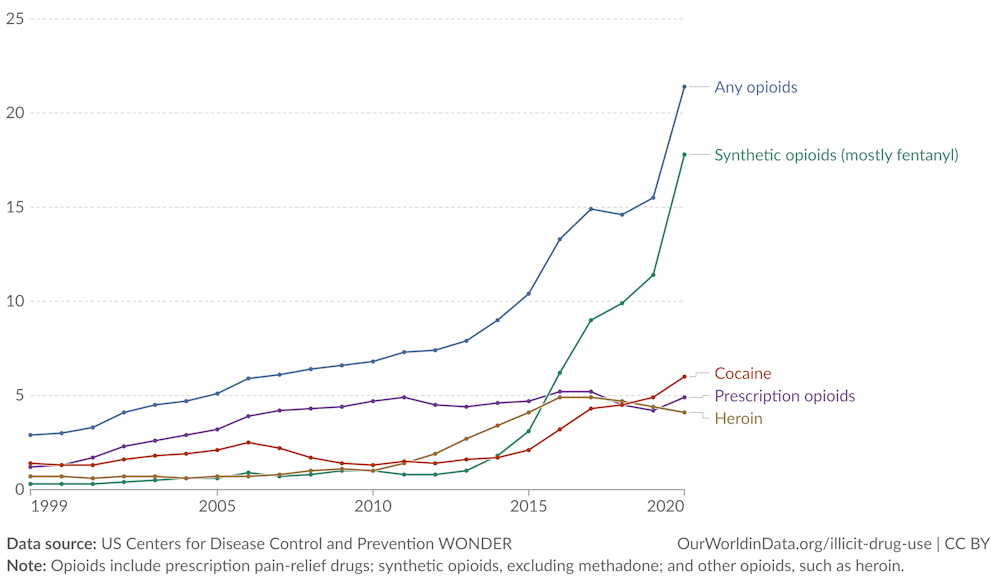
Synthetic drugs are also inflicting great harm on people and communities, caused by an increase in methamphetamine trafficking in south-west Asia, the near and Middle East and south-eastern Europe, and fentanyl overdoses in North America.
Meanwhile, the opium ban imposed by the de facto authorities in Afghanistan is having a significant impact on farmers’ livelihoods and incomes, necessitating a sustainable humanitarian response.
The report notes how organised criminal groups are “exploiting instability and gaps in the rule of law” to expand their trafficking operations, “while damaging fragile ecosystems and perpetuating other forms of organised crime such as human trafficking”.
Illicit drug use is damaging large parts of the world socially, politically and environmentally. Patterns of supply and demand are changing rapidly. In our new longform series Addicted, leading drug experts bring you the latest insights on drug use and production as we ask: is it time to declare a planetary emergency?
At every stage of the process of producing drugs such as cocaine, there are not only societal impacts but environmental ones too. An example of the interconnected relationship between climate change and drugs is demonstrated in the use of land.
Demand for cocaine has grown rapidly across many western countries, and meeting this can only be met by changing how land is used. Forests are cleared in South America to make way for growing coca plants. The refinement of coca into cocaine involves toxic chemicals that pollute the soil and nearby watercourses. This in turn compromises those living in these areas as access to clean water and fertile land is reduced.
Until this is reversed, these local communities will not be able to cultivate the land to earn an income or rely on water sources to live. And each year, some of their number will add to the hundreds of thousands of people around the world who die, directly or indirectly, as a result of illicit drug use.
People in the world with drug use disorders (1990-2021)
Having spent most of my career researching the human toll of drug use at almost every stage of the supply and consumption chain, I believe a complete shift in the way we think about the world’s drug problem is required.
We already have many years of evidence of the ways that drugs – both natural and (increasingly) synthetic – are destabilising countries’ legal and political institutions, devastating entire communities, and destroying millions of lives. My question is, as with climate change, why are we so slow to recognise the existential threat that drug use poses to humanity?
The disconnect between users and producers
For decades, problems with drugs have been viewed as a mainly western issue, affecting Europe, North America and Australasia in terms of drug taking. This perception was fostered in part by US president Richard Nixon’s “war on drugs” announcement in June 1971, when he declared drug abuse to be “public enemy number one”.
This western-centric focus has come at a cost – we still have little data and information about drug use and problems in Africa, for example. But we are beginning to see how far drugs and their associated devastation has reached beyond traditional western borders.
Illicit drug use has increased by 20% over the past decade, only partly due to population growth. Almost 300 million people are estimated to consume illicit drugs regularly, with the three most popular being cannabis (228 million users), opioids (60 million) and cocaine (23 million). According to the UN report:
The range of drugs available to consumers has expanded, making patterns of use increasingly complex and polydrug use a common feature in most drug markets. One in 81 people (64 million) worldwide were suffering from a drug use disorder in 2022, an increase of 3% compared with 2018.
There are multiple harmful consequences of drug use. The largest global burden of disease continues to be attributed to opioids, use of which appears to have remained stable at the global level since 2019, in contrast to other drugs.
In the same way that climate change has threatened whole populations, so too have drugs. Yet many of us remain disconnected from how they are produced and distributed – and the misery they cause throughout the supply chain, all over the world.
The production of cocaine, for example, is associated with violence and exploitation at every stage of the manufacturing process. Death threats to farmers and unwilling traffickers have all increased in parallel with the growing demand for cocaine in the US and Europe.
Global drug use disorder deaths by substance (2000-21):
Organised crime groups not only supply and distribute drugs but also trade in people, whether for the commercial sex trade or other forms of modern slavery. This makes sense as the infrastructure and contacts to move drugs are similar to those used to move humans across borders and even continents. Yet many cocaine users are oblivious – wilfully or otherwise – of the violence associated with how this drug is supplied to them. As the UK National Crime Agency points out:
Reducing demand is another critical factor in reducing the supply of illegal drugs. Many people see recreational drug use as a victimless crime. The reality is that the production of illegal drugs for western markets has a devastating impact in source countries in terms of violence, exploitation of vulnerable and indigenous people and environmental destruction.
While some of the suffering associated with the production of drugs like cocaine makes the headlines, it’s often overshadowed by the glamorisation of criminal drug gangs in films and on TV. To the extent that people worry about the impact of drugs, it’s usually focused on those in our immediate communities, such as people dependent on heroin who are sleeping rough and vulnerable to exploitation. But there have already been other victims before the drug reaches our streets.
Shifts in the global supply chain
Tracking heroin routes demonstrates the way that drug supply is an international effort which affects every community on its journey, from the Afghan farmer to officials who are bribed so the drug can cross borders or be let through ports without being seized, to the person injecting or smoking the finished product.
Much of Europe’s heroin is produced in Afghanistan by small farming operations growing opium, which is then transformed into the drug. Most Afghan farmers are simply surviving growing the crop, and don’t reap significant wealth from their harvest. It is those supplying and distributing the opium as heroin who can make serious money from it.
Meanwhile, following the return of the Taliban to power in Afghanistan in August 2021, those farmers’ livelihoods have faced a new threat.
The Taliban is ideologically opposed to the production of opium. Soon after assuming control, its leaders issued a decree banning farmers from growing opium. They have enforced this by destroying crops when farmers have ignored the ban – although there is still believed to be a significant stockpile of heroin in the country, meaning that as yet, there has not been a big impact on supply to Europe and the UK. But this could change amid the emergence of more deadly synthetic alternatives, including nitazenes and other new synthetic opioids.
Heroin trafficking flows based on reported seizures (2019-22):
Either way, the drug gangs who traffic heroin won’t worry about the opium farmers’ wellbeing. As so often happens with changes in the availability of illicit drugs, when there is a shortage, these groups prove adaptable and nimble at providing alternatives quickly.
While gathering intelligence about organised crime gangs is difficult and potentially dangerous, the European Union Drugs Agency (EUDA) has provided some insights about who these groups are and how they operate. The Netherlands remains an important hub for the distribution of heroin, with several Dutch criminal groups involved in importing and distributing heroin from Afghanistan.
But others are involved too: the EUDA’s intelligence shows that criminal networks with members from Kurdish background are central to the wholesale supply and have control over many parts of the supply chain. These professional, well-organised groups have established legal businesses throughout the route of supply that facilitate their illicit activities – largely along the Balkan route with hubs in Europe.
Intermediate & final recipients of heroin shipments (2019-22):
Unlike these organised crime gangs, governments and law enforcement appear to respond to emerging threats slowly and lack the flexibility and ingenuity that the gangs repeatedly demonstrate.
As drug detection techniques have improved, organised crime has shown how inventive it can be. Taking advantage of the COVID-19 pandemic, dealers used consignments of surgical masks to conceal large quantities of cocaine being trafficked to China and Hong Kong from South America.
And as western markets for cocaine become saturated, organised crime gangs have exploited new markets in Asia, where cocaine seizures, a proxy for use of cocaine, have increased. But the shifting landscape is also reflected in changes in consumption, with use of the synthetic stimulant methamphetamine growing rapidly in Asia – reflected in record levels of seizures in the region in 2023.
For the organised crime gangs, production and supply of synthetic drugs is in many ways easier, as it is not reliant on an agricultural crop in the way that heroin and cocaine are and can be manufactured locally. This reduces the distribution logistics and distance needed for an effective supply chain. According to the UN Office on Drugs and Crime, organised crime gangs are exploiting gaps in law enforcement and state governance to both traffic large volumes of drugs and expand their production in the region.
Where there is destabilisation, there is opportunity for those who seek to profit from drug addiction. In Syria, Russia and Ukraine, war has made some people very rich.
Syria and Russia: the new drug hotspots
The wars in Syria and Ukraine bear testament to the way drugs provide solutions to people who are experiencing the worst of times – and to governments that are ready to exploit evolving situations.
As the war in Syria progressed, the Bashar Al-Assad regime actively developed a strategy to dominate the captagon market in the Middle East and North Africa. First produced in the 1960s in Germany to treat conditions such as attention deficit disorders and narcolepsy and other conditions, captagon is a stimulant that staves off hunger and sleep, making it ideal for military use – particularly in countries where food supplies are inconsistent. It has been referred to as the “drug of jihad” used by Islamic fighters in the region.
As the war progressed in Syria, the country and its leader became increasingly isolated, its economy crashed creating the perfect conditions to develop the trade in captagon. Rather than drug production leading to the collapse of law and order, it was the other way round.
Isolated by the west and with a historically strained relationship with its neighbours including Saudi Arabia, the Assad regime – under the guidance, reportedly, of Assad’s brother Maher al-Assad– ruthlessly positioned itself as the world’s main producer and distributor of this drug, then used this position to leverage its influence and try to reintegrate into the Arab world.
Video by TRT World.
Captagon also provided much-needed revenue for the Assad regime. The drug was estimated to be worth US$5.7 billion annually to the Syrian economy – at a time when western governments have placed severe sanctions on the country, restricting its ability to raise revenue. Saudi Arabia was one of the main countries being supplied captagon by Syria. Until the fall of Assad, it was the senior leadership in Syria that controlled the supply and distribution of the drug – giving rise to the label “the world’s largest narco state”.
The Assad government achieved this position by making captagon good value – a viable alternative to alcohol in terms of price and for those who don’t drink. Exploiting many of its own citizens, the regime encouraged individuals and businesses to participate in manufacturing and distributing the drug.
The fall of Assad and his hurried escape to Russia left the rebel fighters to pick up vast hauls of captagon and other drug ingredients. “We found a large number of devices that were stuffed with packages of captagon pills meant to be smuggled out of the country. It’s a huge quantity,” one fighter belonging to the Hayat Tahrir al-Sham (HTS) group told the Guardian. What this will do to drug production and supply in the region is unclear.
While the latest UN World Drug Report highlights “a rapid increase in both the scale and sophistication of drug trafficking operations in the region over the past decade”, it goes on to highlight that “one of the most striking changes worldwide in drug trafficking and drug use over the past decade has taken place in Central Asia, Transcaucasia [Armenia, Azerbaijan and Georgia] and eastern Europe”, where there has been a shift “away from opiates, mostly originating in Afghanistan – towards the use of synthetic stimulants, notably cathinones … There is hardly any other region where cathinones play such a significant role.”
This is part of “a groundbreaking shift in the global drug trade, pioneered in Russia and now spreading globally,” according to the Global Initiative Against Transnational Organized Crime. This shift is changing the nature of drug sales, using “darknet markets and cryptocurrency for anonymous transactions, allowing buyers to retrieve drugs from hidden physical locations or ‘dead drops’, rather than direct exchanges.”
The rise of Russia’s dead drop drug trade stems from several unique national factors: restrictive anti-drug policies, strained western trade relations, and a strong technological foundation. Enabled by these conditions, the dead drop model has reshaped how drugs are distributed in Russia.
Drug transactions now involve no face-to-face interactions; instead, orders are placed online, paid for with cryptocurrency, and retrieved from secret locations across cities within hours. This system, offering convenience and anonymity, has seen synthetic drugs – especially synthetic cathinones like mephedrone – overtake traditional imported substances like cocaine and heroin in Russia … These potent synthetic drugs are cheap, easy to manufacture, and readily distributed through Russia’s vast delivery networks.
The report notes that this shift in drug distribution has been accompanied by rising levels of violence including punishment beatings, and a public health crisis.
Podcast by the Global Initiative Against Transnational Organized Crime.
Yet officially, there is very little reliable data about drug use in Russia. Under the premiership of Vladimir Putin, Russia has no sympathy with those who are dependent, viewing them as weak and without value. And its invasion of Ukraine three years ago has had ramifications for Ukraine’s users too.
Prior to the war, Ukraine had demonstrated an increasingly progressive policy towards those who had problems with drugs, establishing treatment centers and encouraging access to treatment. Since Russia invaded Ukraine in February 2022, this strategy has been severely set back, with many people who need access to substitute treatments such as methadone unable to secure consistent supply of these drugs.
Another global blind spot is China, where, like Russia, little is known about the extent or type of problems that drugs are causing. Both regimes are ideologically opposed to recreational or problem drug use and, as far as we know, there is no state-funded rehabilitation provided in either country; the approach is to criminalise people rather than offer health-based interventions.
We shouldn’t be too critical as many western countries, including the UK, also need to pivot from a criminal approach to drug problems towards a health-focused one. Portugal made such a policy change several years ago, recognising that people who develop problems with drugs such as dependency need help rather than punishment.
This radical shift in thinking has made a significant change to the way those using drugs are treated, in the main offered help and specialist support rather than being arrested and sent to jail, only to be released and then repeat the same cycle of drug use, arrest and prison.
The evidence of this policy change is impressive: not only have drug-related deaths fallen, but population-level drug use is among the lowest in Europe. Nowhere is this policy shift more urgent than the US.
North America: epicentre of the opioid crisis
In the US, the synthetic opioids fentanyl and oxycodone have contributed to more than 100,000 fatal overdoses each year since 2021. While there are signs this deaths toll is at last beginning to fall, the harm and pain of addiction and overdose affects every strata of American society – as shown in moving portrayals of America’s opioid crisis such as Painkiller and Dopesick. Most fatalities are caused by respiratory depression where breathing is significantly slowed or stops altogether.
Official trailer for Painkiller (Netflix)
Fentanyl is an analgesic drug that is 50-100 times more potent than heroin or morphine. Where China used to be the principal manufacturer and supplier of fentanyl to the US, Mexico is now the primary source. In December 2024, Mexican authorities announced “the largest mass seizure of fentanyl pills ever made” – amounting to more than 20 million doses of fentanyl pills worth nearly US$400 million. The pills were found in Mexico’s Sinaloa state, home of the Sinaloa drug cartel and a hub of fentanyl production,
“This is what makes us rich,” one fentanyl cook recently told the New York Times. He was scathing about the idea that Donald Trump would be able to stamp out the supply of fentanyl from Mexico to the US by threatening Mexico’s government with tariffs. “Drug trafficking is the main economy here.”
However, the introduction of synthetic opioids to the US came not via organised crime but through a deliberate strategy of the pharmaceutical industry. Upon launching its prescription opioid painkiller OxyContin (a brand name for oxycodone) in 1996, Perdue Pharma, owned by the Sackler family, devised a plan to increase prescriptions of the drug by incentivizing and rewarding doctors to give these drugs to their patients. On a business level, this was a success; on a human level, it has been a disaster.
As patients quickly developed tolerance to drugs such as OxyContin, they had to take higher doses to avoid withdrawal symptoms or the positive feelings it gave them. Taking more of these opiates increases the risk of accidental overdose, many of which proved to be fatal. It has also driven those dependent on drugs to the black market, and into the hands of organised drug gangs, as they seek the drugs in greater quantities.
Dependency on fentanyl and other opioids is all-consuming. When not using these drugs, people are entirely focused on ensuring sufficient supply of the next dose. This includes funding supply which can take people to places they thought they would never be, for example breaking the law, shoplifting or getting involved in commercial sex to make enough money to buy drugs.
Synthetic opiates like OxyContin and fentanyl have proved to be classless, ageless and sex blind. The first-hand experience of addiction and fatalities have radically altered the way many Americans think about drugs and the problems they cause. Canada, too, is suffering a major crisis.
Compounding this tragedy is the failure of the state to provide interventions and treatment that could have reduced fatal and non-fatal overdoses. It is only now that evidence-based interventions are beginning to be made widely available, such as access to Naloxone – a drug that can reverse the effects of opiates and potentially save a life.
Of course, it isn’t just hospitals and health professionals that are challenged by the results of widespread use of opioids, but public services like the police and fire service. In some areas of the US, there have been so many daily overdoses that every service was called on to try and deal with it. Local mayors have made it a priority to train police and fire personnel to be trained as first responders, such is the scale of the problem.
But it is not just in North America that we see the failure of politicians and the state to act when faced with growing problems with drugs. In the UK, where record numbers are dying because of using drugs such as heroin, the government has not invested in overdose prevention strategies. At a time when fatal overdoses increase year on year, budgets for specialist treatment have been reduced. It remains to be seen what the recently elected Labour government will do, if anything, to tackle the tragic rise in drug related fatalities.
What connects both examples from the US and UK is the attitude and perception of drug use many of us have. Drug use and the heavy use of prescription painkillers is still heavily stigmatised. Many of us still view this as something individuals bring on themselves or have a choice about.
So, if we don’t care about what happens to people who develop problems with drugs, why should our elected representatives? In part, it is our bigotry that is enabling the lack of timely intervention, despite us possessing the knowledge and evidence of how drug harms can be minimised.
Latin America: breakdown of the rule of law
Under the last Conservative government, the UK Home Office asserted that people who used cocaine recreationally are supporting violence not only in the UK but in the countries that produce its raw ingredients. It’s not clear if this has made any difference to those using cocaine in the UK – personally, I doubt many people consider or are aware of how cocaine is produced or its provenance.
Perhaps if those using cocaine, mainly in western countries, realised the extent of violence and suffering that cocaine manufacture causes they might think again. Latin America has suffered enormously, with few countries there not touched in some way by the violence and breakdown of law associated with drug production and supply. According to the latest UN World Drugs Report:
Global cocaine supply reached a record high in 2022, with more than 2,700 tons of cocaine produced that year, 20% more than in the previous year … The impact of increased cocaine trafficking has been felt in Ecuador in particular, which has seen a wave of lethal violence in recent years linked to both local and transnational crime groups, most notably from Mexico and the Balkan countries.
Cocaine seizures and homicide rates increased five-fold between 2019 and 2022 in Ecuador, with the highest such rates reported in the coastal areas used for trafficking the drug to major destination markets in North America and Europe.
Cocaine trafficking flows based on reported seizures (2019-22):
As with opium production in Afghanistan, it is small-scale farmers in Colombia, Peru and Bolivia that grow the coca plant that will be turned into cocaine. Like their Afghan counterparts, they grow coca as it is more profitable than alternatives such as coffee. While it may be profitable in the short term, there are greater costs to them and their society.
Cocaine production brings with it violence as those further up the drug production chain try to control its trade. Few parts of these societies are unscathed, from bribing local politicians through to whole regions that are controlled by organised crime. Keeping control means that the use of firearms and violence increases. Against this backdrop, it is unsurprising that basic health and social services suffer.
So, while a coca grower may have more money, every other aspect of their life is negatively impacted. Whether it is regional or state institutions, both are compromised by the drug trade and those that control it. While this may not lead to the total collapse of law and order, it does create injustice and distorts the rule of law in many areas of Latin America and the Caribbean, where competition between gangs has also resulted in an increase in homicides.
The impact is on all sectors of society, now and into the future. For example, while historically the role of women has been largely underrepresented in research and drug policy, the UN report recognises that this is changing:
As women increasingly participate in economic activities, the role that women play in the drug phenomenon may become increasingly important. For example, a shift away from plant-based drug production may affect many women in rural households involved in opium poppy and coca bush cultivation.
The UN also identifies the specific risk to young people and the drugs trade, highlighting:
Long-term efforts to dismantle drug economies must provide socioeconomic opportunities and alternatives, which go beyond merely replacing illicit crops or incomes and instead address the root structural causes behind illicit crop cultivation, such as poverty, underdevelopment, and insecurity. They must also target the factors driving the recruitment of young people into the drug trade, who are at particular risk of synthetic drug use.
Meanwhile, demand for treatment in Europe due to problems with cocaine has risen significantly in recent years, since 2011 there has been an 80% increase in treatment presentations. This reflects the growing number of people using cocaine and the rise in purity of the drug.
Amid what may seem to be a story of unrelenting despair and hopelessness, there are local initiatives and even a few state-wide policies that provide optimism that change is possible.
In my roles both as clinician and scientist, I’ve often been amazed by how ingenious people can be when faced with the apparently impossible. For example, the way some people use heroin to dampen their psychotic symptoms, such as auditory and visual hallucinations – or the development of Naloxone, a drug that can temporarily reverse the effects of opioids, providing a short window for emergency services to treat people who have overdosed.
Early in my career, I witnessed the emergence of HIV in the UK in the 1980s. The speed at which this disease spread was not matched by our ability to treat it. Our response to HIV was undoubtedly hampered by prejudice and stigma towards marginalised groups in society, namely gay men and those using drugs (particularly injecting them).
However, unexpectedly and courageously, the Conservative government recognised those who were most at risk of contracting HIV, and organised a package of measures to contain the spread of infection. One part of this was a media campaign based on public health messaging designed to reduce the risk of contracting the disease. But the government also invested in treatment for those who had been infected and engaged with people at high risk, such as those intravenously injecting drugs.
I worked in specialist HIV clinics for those using drugs. At the time, methadone and diamorphine were provided as an alternative to heroin. Regulations and protocols that restricted the prescribing of these medical opioids were eased, so we could ensure patients attending these clinics were given sufficient oral and injectable opioids that they didn’t need to source street heroin.
This meant they had access to medical grade opioids and, crucially, were given regular supplies of sterile injecting equipment. It was this that reduced the risk of contracting HIV, as some people would share injecting equipment when using heroin.
This impressive policy ran counter to the Conservative party’s ideology at the time, which was to punish rather than help those using drugs like heroin. It showed me how, even with traditional mindsets, it is possible to shift policy thinking in the face of a health crisis. And make no mistake, the global drug problem is an ongoing health crisis. Today, the UN points to the risks that intravenous users of drugs still face:
An estimated 13.9 million people injected drugs in 2022, with the largest number living in North America and East and South-East Asia … The relative risk of acquiring HIV is 14 times higher for those who inject drugs than in the wider population globally.
There are, though, signs of positive change in the way some countries and regions are changing their drug policies. Scotland recently opened a drug consumption facility in Glasgow – a safe place for people to use their drugs, usually injecting drugs like heroin. Such spaces provide access to sterile injecting equipment, reducing the risk of blood-borne infections such as HIV or Hepatitis. At the same time, they offer the opportunity to engage with people who have not accessed traditional health services.
Portugal, as mentioned earlier, has made substantial changes to the way it approaches drug use and the problems associated with it. This policy shift since 2000 has saved lives and brought a more humane way of treating people who develop problems with drugs.
Contrast this with the wasted effort and resources ploughed into the war on drugs – initiated by Nixon and followed by so many western governments ever since. My plea to policymakers is simple: employ the same evidence-based science you use for health issues towards drugs and problem drug use.
Science and research can help in many ways, if given the chance. Some of it might seem radical, like providing safe drug consumption spaces. Some of it is more mundane, but vital – like tackling inequality, a clear driver of problem drug use across the world.
But while we often look to politicians to take the lead on change, it is people – us – that really hold the solution. By far the greatest threat to people and society from drugs is ignorance and bigotry. So many lives have been lost to drugs because of shame, either as a driver of drug use or a barrier to seeking help.
Beliefs are notoriously difficult to shift. As with climate change, the most powerful driver of change is personal experience. We know that when a family or community is affected by a drug overdose, their beliefs and perceptions change. But this is not the way any of us should want to see change happen.
To hear about new Insights articles, join the hundreds of thousands of people who value The Conversation’s evidence-based news. Subscribe to our newsletter.
Ian Hamilton does not work for, consult, own shares in or receive funding from any company or organisation that would benefit from this article, and has disclosed no relevant affiliations beyond their academic appointment.
“Notes From the Field” news articles highlight the continued importance of bird banding. This article was contributed by Paul Link with Louisiana Department of Wildlife & Fisheries who began researching Black-bellied Whistling Ducks in 2011, and Pam Garrettson and Joshua Dooley with the U.S. Fish and Wildlife Service, who are assisting with the band-recovery data analyses.
Today, banding allows scientists to investigate bird behavior, migration, lifespans, populations, diseases and levels of environmental contaminants. Information gathered through the North American Bird Banding Program helps inform management and conservation decisions for game and non-game species, such as protecting or restoring habitat, setting hunting regulations and determining plans for human-led development.TheNorth American Bird Banding Programdepends on a network of over 10,000 permitted bird banders working in the United States, Canada and Trust Territories. Each year these banders help us add up to 1.2 million new banding records to our century-long dataset.
Holding banded Black-bellied Whistling Ducks are band resight extraordinaire Alvin Attenhofer on the left and on the right Paul Link, Research Program Manager of LA Department of Wildlife & Fisheries. Photo courtesy of Michael Slazer.
How do you use bird banding in your research?
We initiated our research in 2011 to answer questions related to the movement ecology and survival of Black-bellied Whistling Ducks in south Louisiana. We started out opportunistically banding this species with standard aluminum butt-end bands for a couple years, but upon realizing encounter rates were much lower than expected, we greatly increased our banding effort. We plan to utilize both live recaptures and dead recoveries to estimate annual survival. Our banding season is February through May, which is an ideal period for captures as the ducks are still gregarious prior to dispersing for nesting. At the onset of our research, we hypothesized that they migrated south to Texas or Mexico during winter, but we hope to use recovery data to better describe movements and habitat use throughout the annual cycle.
Why is your study species so interesting?
Black-bellied Whistling Ducks are found only in the Western Hemisphere. They are more arboreal than other whistling-ducks; they nest primarily in natural tree cavities and readily utilize artificial nest boxes, but also commonly nest on the ground. Unlike most ducks, both the male and female take part in incubation and brood rearing. In North America, this species historically nested mainly along Mexico and south Texas coasts. However, their range began expanding northward mid-20th century, with sightings in Arizona, Louisiana, and Florida by the 1960s. They are a game species with liberal regulations; however, they are only lightly harvested because of their nocturnal nature. Furthermore, traditional waterfowl surveys are inadequate for this species due to low detection probabilities. Many Black-bellied Whistling Ducks congregate in or under trees in urban, suburban, or industrial areas during fall and winter where they are difficult to harvest and/or survey, which makes estimating vital rates such as survival and harvest probabilities more challenging than for most other waterfowl species.
What have you found so far?
Since 2011, we have banded over 40,000 Black-bellied Whistling Ducks and have recaptured >4,200. Interestingly, we have similar numbers of resights versus shot or found dead. The vast majority of those resights are by a single citizen scientist that devotes most evenings for several months each year observing and documenting the ducks’ movements, pair associations, and family status. Roughly 80% of the banded Black-bellied Whistling Ducks are subsequently encountered in Louisiana, with 10% encountered in Mississippi (where we band ~150/year and the previously mentioned citizen scientist resights and reports individuals once per calendar year), 8% in Texas, and 1% or less in Arkansas, Florida, Tennessee, Alabama, and North Carolina. We’ve had just one report of a band recovered in Mexico, from a duck found dead in a grain cargo ship that set sail from the Port of New Orleans days earlier. Thus, most Black-bellied Whistling Ducks appear to be transient residents that concentrate in safe places during the fall and winter and disperse throughout Louisiana during spring and summer to breed. Their apparent survival rates (calculated using only live recapture data) were lower than expected; we are currently incorporating both live and dead recoveries to calculate actual annual survival. We’ve documented multiple large die-offs of up to 3,000 Black-bellied Whistling Ducks due to unintentional poisoning at water treatment and grain handling facilities. Avian cholera outbreaks are also common among this species. An unknown number are also killed via shooting or avicide under agricultural depredation and aircraft bird strike prevention orders. Due to their highly gregarious behavior, Black-bellied Whistling Ducks are particularly susceptible to communicable diseases. Thus, their population seems to self-regulate under conditions of minimal recreational harvest.
Why do you think projects like yours are so important?
This banding project will help us understand the movements and vital rates for a poorly understood, yet very common, waterfowl species along the Gulf Coast, improving population management options. Black-bellied Whistling Ducks are considered a nuisance by many (such as agriculture producers, golf course managers, and aircraft strike prevention personnel); however, amidst long-term declining trends in most resident and migratory waterfowl in Louisiana, waterfowl hunters welcome the sight of this relative newcomer on the landscape.
What are the next steps for your project?
We’ll continue to band a maintenance number of approximately 3,000 individuals per year to explore changes in vital rates amidst a rapidly changing landscape. We are also currently analyzing results from a pilot study utilizing satellite transmitters, as well as working with a transmitter manufacturer to design a miniaturized GPS/GSM device to collect higher quality and greater quantity movement data to better understand their local and long-range movements, use of habitats, nesting and non-breeding ecology, and seasonal survival rates.
Adult and juvenile Black-bellied Whistling Ducks in flight. Photo courtesy of John K. Flores.
The “Notes From the Field” series highlights current banding projects and the continued importance of bird banding and the Bird Banding Lab. Want to see your project featured in a future “Notes From the Field” article? Email Kyra Harveykharvey@usgs.govfor submission details.
Saskatchewan is investing a total of $3.8 million to 16 agencies over the next two years under the National Action Plan to End Gender-based Violence.
The investment will provide for enhanced programs, supports and tools in Saskatchewan communities. The funding includes money to build capacity in transition homes and second stage housing facilities, providing learning resources on healthy relationships to Saskatchewan residents, support enhanced early intervention for families at risk of violence, and develop additional tools to ensure appropriate responses to survivors and perpetrators of interpersonal violence.
“The funding and programming we are announcing today are a critical part of our ongoing work under the National Action Plan to End Gender-based Violence, and align strongly with the recommendations contained in the recently released Domestic Violence Death Review,” Justice Minister and Attorney General Tim McLeod said. “I am grateful to all our partner organizations for collaborating with us on this, and the work they do across Saskatchewan to address and prevent gender-based violence.”
“Saskatchewan’s implementation of the National Action Plan to End Gender-based Violence is focused on prevention, awareness, and building supports for survivors and their loved ones,” Minister Responsible for the Status of Women Alana Ross said. “Our government remains committed to preventing interpersonal violence and abuse in all forms.”
This funding will be provided to the following community-based partners and agencies to develop tools which can be used for outreach, programming and advocacy.
Natural Supports Program ($635,000): Saskatchewan Toward Offering Partnership Solutions to Violence;
Enhanced Early Intervention Supports ($1,100,000): Collaboration between Family Service Regina Inc. and Family Service Saskatoon;
Healthy Relationships Program ($513,000): The John Howard Society;
Adverse Childhood Experiences Awareness and Prevention ($485,000): Praxis Consulting Inc.;
Common Intimate Partner Violence Assessment Tool ($300,000): Provincial Association of Transition Houses and Services of Saskatchewan Inc. (PATHS); and
Human Trafficking Prevention Toolkit ($297,000): Saskatoon Downtown Youth Centre (EGADZ).
Second Stage Housing Capacity ($215,000):
Lloydminster Interval Home Society Inc. ($40,000);
Prince Albert Safe Shelter for Women Inc. ($40,000);
Sofia House Inc. ($40,000);
YWCA Regina Inc. ($38,855);
YWCA Saskatoon Inc. ($36,000); and
Saskatoon Interval House Inc. ($20,000).
Transition Home Capacity ($214,000):
Lloydminster Interval Home Society ($40,000);
Regina Transition House ($40,000);
YWCA Regina Inc. ($39,644);
YWCA Prince Albert Inc. ($39,000);
Moose Jaw Women’s Transition Association Inc. ($35,000);
Saskatoon Interval House Inc. ($20,000); and
Safe and Together Training ($42,000): PATHS.
Additional information about these programs is available in the attached backgrounder.
“The National Action Plan was developed with significant input from survivors, academics and community organizations including PATHS,” PATHS Regina Jo-Anne Dusel said. “The projects currently underway address root causes of violence, provide early intervention and promote the use of common language and tools to determine and manage risk. PATHS is privileged to be working with partners to develop a way for professionals across sectors to speak the same language, effectively identify and manage risk, and where possible, share risk information to reduce the incidence and impact of intimate partner and family violence in our communities. The National Action Plan is a collaboration between the provinces, territories and the federal government which included significant engagement with multiple stakeholder groups, including Saskatchewan Indigenous organizations.”
Under the plan, the federal government is providing a total of $539.3 million over four years in cost-sharing agreements with provinces and territories to implement the National Action Plan to End Gender-Based Violence.
This year, the Government of Saskatchewan is dedicating a total of $31.7 million to community-based partners that facilitate interpersonal violence programs and services. This includes the $14.2 million per year being provided to community-based partners, annualized funding for second-stage shelters and additional funding for Victims Services and other important supports.
Three motorists, one in Marystown, one in Bonavista and one in Deer Lake, were arrested for impaired driving this past weekend by RCMP NL.
On Saturday, February 1, 2025, shortly before 2:00 a.m., Burin Peninsula RCMP received a report of a suspected impaired driver at a commercial property in Marystown. Police attended the area, located the described vehicle and conducted a traffic stop. The driver, a 25-year-old man, showed signs of alcohol impairment, resisted arrest and threatened a police officer. At the detachment, the man provided breath samples that were twice the legal limit.
Later in the day, shortly after 7:30 a.m., Bonavista RCMP responded to the report of a motor vehicle crash on Route 230 near Bonavista. Officers attended the scene and observed a vehicle resting on its roof on the roadway. The driver, a 37-year-old man, failed to remain at the scene of the collision and departed prior to police arrival. He was located a short time later at a residence, showed signs of alcohol impairment and was arrested. At the detachment, the man provided breath samples that were more than one and a half times the legal limit.
The next day, on Sunday, February 2, 2025, shortly before 1:00 p.m., RCMP Traffic Services West stopped a vehicle on Commerce Street in Deer Lake. The driver, a 59-year-old man, showed signs of alcohol impairment, failed a roadside breath test and was arrested. At the detachment, the man provided breath samples that were more than twice the legal limit.
All three drivers are set to appear in court at later dates to answer to charges of impaired operation. One driver faces additional charges of resisting arrest and uttering threats. Another motorist was ticketed for failing to remain at the scene of a crash. The three drivers also received licence suspensions and their vehicles were seized and impounded.
RCMP NL has zero tolerance for those who choose to drive while impaired. Please report suspected impaired drivers to your local police detachment or call 911.
The way you see nutrition labels on food packaging is about to change. By 2025, new front-of-package labels will start appearing on grocery store shelves, and by January 2026, they’ll be mandatory.
Over the past two decades, nutrition labelling has evolved into a cornerstone of public health strategies worldwide. Traditional back-of-package labels, which provide comprehensive nutritional details, are often overlooked due to their complexity and placement, making them less effective in guiding consumer choices.
Front-of-package labels address this issue by simplifying key nutritional information and positioning it in a more prominent, visible space. This streamlined approach has proven successful in leading consumers toward healthier choices, as research indicates that simplified, visible labels can influence purchasing decisions.
Globally, front-of-package systems vary, with some countries employing warning symbols to flag excessive nutrient levels, while others use colour-coded “traffic light” systems or endorsement icons to promote healthier options.
Canadian policy
The Canadian government’s new policy requiring front-of-package nutrition symbols aims to guide consumers toward healthier food choices by highlighting foods high in sodium, sugars or saturated fats. These nutrients are closely linked to chronic conditions such as heart disease, diabetes and hypertension.
Designed for simplicity and consistency, the labels feature a black-and-white magnifying glass icon. This design’s uniformity in size, placement and bilingual presentation is intended to make it easily recognizable and understandable.
Fresh produce, plain dairy products and raw, single-ingredient meats are exempt from the regulations, acknowledging their inherent nutritional benefits.
The policy is intended to promote transparency and improve public health by helping Canadians make more informed food choices. With full implementation set for January 2026, further research and targeted actions such as meetings and correspondence on healthy eating by Health Canada are required to ensure the effectiveness of the policy.
Since 2016, extensive consumer testing, including focus groups, online surveys and in-store experiments, has informed decisions regarding the labels’ design, size and placement. As a result, the labels have been refined to better meet their goal of providing consumers with clearer, more actionable nutritional information.
While the initiative holds promise, several gaps could undermine its overall effectiveness. Varying levels of health literacy may hinder consumers’ ability to fully comprehend and act on the front-of-package labels, with some potentially unaware of the health risks associated with flagged nutrients like sodium, sugars and saturated fats.
Additionally, manufacturers face challenges in adhering to new labelling standards, reformulating products to meet healthier benchmarks and overcoming potential consumer resistance.
Addressing these issues requires significant investment in consumer education, alongside targeted support for manufacturers from the Canadian government in form of consultation in adapting to the new requirements.
The policy also presents an opportunity to engage consumers more deeply in their health choices. Education campaigns such as community workshops and public health initiatives, and point of sale posters that explain the purpose and interpretation of front-of-package labels, can empower consumers to make informed decisions.
These campaigns should address disparities in health literacy, ensuring that all Canadians benefit from the initiative regardless of socioeconomic status. Collaborative efforts among government agencies, health-care providers and community organizations could amplify these educational initiatives, reaching a wider audience.
Industry response
For manufacturers, the introduction of front-of-package labels often triggers efforts to reformulate products, reducing sodium, sugars or saturated fats to avoid negative labelling.
This process frequently involves ingredient substitution, recipe adjustments or portion size reductions. However, retaining the taste, texture and overall consumer satisfaction of a product while meeting nutritional targets requires significant innovation. If reformulated products fail to meet consumer expectations, brands risk losing loyalty and market share.
The stakes are particularly high for manufacturers whose flagship products are most at risk of being flagged. To overcome these challenges, collaboration with food scientists, ingredient suppliers and regulatory bodies is essential. Research and development efforts must focus on finding innovative solutions that meet regulatory requirements without sacrificing consumer preferences.
Beyond reformulation, compliance with front-of-package labelling requirements presents logistical and financial challenges. Packaging must be redesigned to incorporate the bilingual, standardized labels, often at significant cost. Smaller manufacturers with limited resources may find these changes particularly burdensome.
Updating supply chains to include new packaging materials and ensuring consistent application across product lines add further complexity. In addition to these financial and operational pressures, reformulation may affect production processes and shelf life, necessitating further adjustments.
Potential impact
Despite these challenges, front-of-package labelling has the potential to drive significant change within the food industry. By prioritizing healthier formulations, companies can gain a competitive advantage, particularly as consumer demand for health-conscious products grows.
Over time, this shift could lead to broader industry trends, pushing manufacturers toward greater transparency and accountability in their product offerings.
However, these positive outcomes require supportive policies. Tax incentives, subsidies for reformulation and clear regulatory guidance can help ease the financial and operational burdens faced by manufacturers, particularly smaller businesses.
While front-of-package labelling shows promise in promoting healthier choices and encouraging innovation, its long-term impact remains to be fully understood.
Key areas for future research include examining how manufacturers prioritize reformulation, tracking changes in nutrient composition over time, and analyzing consumer behaviour in response to labelled products. Studies that link front-of-package labels to dietary intake and health outcomes could provide a comprehensive view of their effectiveness in achieving public health goals.
This story was co-authored by Christopher Marinangeli. He is a nutrition scientist and regulatory expert with the Centre for Regulatory Research and Innovation at Protein Industries Canada, a not-for-profit organization and one of Canada’s five Global Innovation Clusters.
Zahra Saghafi receives funding from Arrell Food Institute, Protein Industries Canada, and Mitacs for her PhD research. She is affiliated with the Lang School of Business and Economics at the University of Guelph.
WASHINGTON, D.C. – Yesterday, House Foreign Affairs Committee Chairman Brian Mast joined Margaret Brennan on CBS’ “Face the Nation” to discuss the review of foreign assistance and the Biden State Department’s fixation on DEI.
WATCH HERE
-Transcript-
MARGARET BRENNAN: And we’re joined now by Florida Republican Congressman Brian Mast, who is the chairman of the Foreign Affairs Committee, which has oversight over the State Department and its programs.
He joins us from Fort Pierce, Florida.
Good morning to you.
CHAIRMAN BRIAN MAST (R-Florida): Good morning.
BRENNAN: I want to start first on the tariffs that were announced overnight by President Trump. You know there’s a free trade agreement with Mexico and Canada. President Trump negotiated it during his first term.
The tariffs may violate that deal. If he’s invoking tariffs on a national security basis, can you explain the threat posed by Canada?
CHAIRMAN MAST: Yes, and he was – President Trump, that is to say, was very specific in his executive order, outlined that it’s specifically related to fentanyl. It’s specifically related to human trafficking.
And there’s a trust, but verify situation that has to go on here.
BRENNAN: Through Canada?
CHAIRMAN MAST: Through Canada as well, absolutely, fentanyl through Canada, human trafficking through Canada, also with China in that mix for fentanyl as well.
That was specifically outlined in it. And until that comes to an end, this is what’s going to be on the table. And bear in mind as well that USMCA reauthorization is coming up in the coming-up months and years.
BRENNAN: So you don’t believe that this violates the trade agreement, the treaty?
CHAIRMAN MAST: The violation has been to the United States of America. It’s been to our sovereignty. It’s been to our people. We’ve been taken for granted.
BRENNAN: Right, but Congress votes on these things. So…
CHAIRMAN MAST: And I will make sure certainly, as the Foreign Affairs chairman, that we give every single authority as we go through State Department reauthorization, to make sure that this moves forward, as well as purging of people throughout the State Department, other agencies, where we’re freezing aid.
These are all very important and necessary steps to make sure that we secure America. And we’re going to support that.
BRENNAN: I’m sorry. Can I follow up on what you just said there?
CHAIRMAN MAST: Please do.
BRENNAN: You want to authorize purging of State Department personnel? What does that mean exactly?
CHAIRMAN MAST: Well, if you want to take a look at the State Department, where DEI has been a priority over, let’s say, diplomacy on many accounts, I can give you hundreds of examples of where they were authorizing…
BRENNAN: What proof do you have of that?
CHAIRMAN MAST: Sure, let’s list them off, half-a-million dollars to expand atheism in Nepal, $50,000 to do, let’s see, a transgender opera in Colombia, $47,000 to do an LGBTQ trans comic book in Peru, $20,000 a pop to do drag shows in Ecuador.
Shall I continue with more examples of where DEI was a priority?
BRENNAN: Oh, it certainly seems like there could be a review of things. Foreign aid, as you know, is less than 1 percent of the entire federal budget. So we’re talking small amounts of money by comparison. But when…
CHAIRMAN MAST: We’re still talking about tens and tens of billions of dollars.
And if you want to go to somebody else, on the other side of the aisle, Samantha Power, she had a worthy goal, although it was a stupid goal. She said she was hoping to get the amount of foreign aid, U.S. aid dollars that go to actual aid up to 30 cents on the dollar from 10 cents on the dollar. That’s a major problem that we have this agency that that’s all that goes abroad…
BRENNAN: I think you’re talking about…
CHAIRMAN MAST: … when it should be the American worker’s dollar.
BRENNAN: I think now you’re talking about the USAID, the aid agency…
CHAIRMAN MAST: Yes.
BRENNAN: … which is a – separate from the State Department currently and has about $40 billion worth…
CHAIRMAN MAST: Which is likely going to be rolled more closely under Secretary Rubio.
BRENNAN: Tell – yes, tell me about that, because that’s where I was going.
Has the Trump administration informed you of plans to dismantle or significantly shrink this agency?
CHAIRMAN MAST: This is something that I’m working on very specifically, in conjunction with Secretary Rubio, to make sure that there’s the appropriate command-and-control of these agencies, where, again, to make that same point, right now, maybe 10 to 30 cents…
BRENNAN: They already report to the secretary of state.
CHAIRMAN MAST: But 10 to 30 cents on the dollar is what actually goes to aid. So there’s not the right amount of command-and- control that’s going on with the way that it’s set up currently.
And let’s make another point on this as well.
BRENNAN: Congress – Congress authorizes and earmarks funding.
CHAIRMAN MAST: Most of these dollars – most of these dollars that go out of USAID, 70-plus percent don’t come from U.S. growers, U.S. farmers, U.S. ranchers, or go through us ports. And that’s another big problem for America.
BRENNAN: So – I’m sorry. If Congress already authorizes and earmarks the funding, just to be very clear, you’re not endorsing getting rid of USAID as a separate department, which already reports to the secretary of state, are you?
CHAIRMAN MAST: I would be absolutely for, if that’s the path we go down, removing USAID as a separate department and having it fall under one of the other parts of United States Department of State, because of its failure.
I just went over the numbers twice with you in the amount of aid that actually makes it into the hands. I mean, you could you could almost say – this is a little bit hyperbole – but there’s probably more dollars that go towards state dinners around the D.C. Beltway than what actually goes into rice and beans abroad.
That’s the state of what’s going on with USAID. And Samantha Power said no less herself.
BRENNAN: Well, I think every single administration authorizes reviews, could increase efficiencies. There are plenty of people who propose bringing it more under the authority of the State Department. Madeleine Albright tried to do that. That’s not a new MAGA idea.
I think the question here, though, is about how you do it. Do you still believe that in the law signed in the 1960s that Congress has to sign off on any changes to USAID? Or do you think President Trump can just make all of this happen through executive order?
CHAIRMAN MAST: So, all of those examples that you just gave of those historical figures, the difference is now the job is going to get done.
It’s going to be 99.99 percent of cents on the dollar actually go towards what it’s intended, instead of people around the Beltway.
BRENNAN: OK, so you’re talking about – you’re talking about…
CHAIRMAN MAST: That’s what’s going to happen. That’s the change.
BRENNAN: … efficiencies in aids versus restructuring.
So let me ask you about that. Well, like I said…
CHAIRMAN MAST: Well, that requires restructuring, 100 percent. You can’t create that efficiency just by wishing it into existence.
BRENNAN: Sure.
CHAIRMAN MAST: You have to restructure where the failures are and put the right things in place.
BRENNAN: Of course.
But what we’re hearing from many of these aid organizations and officials is that, can you restructure after you finish the review and not freeze funding now, immediately? I spoke to former USAID global health head Atul Gawande yesterday. He told me this isn’t a pause in foreign aid. It is a demolition of USAID.
As he put it, you can’t pause a flight in midair. That’s what’s happening.
CHAIRMAN MAST: Let’s…
BRENNAN: This immediate freeze in funding is stopping agencies in the field from being able to do the work they do.
CHAIRMAN MAST: Let’s say why that is so important. And let’s talk about the real facts on the ground.
The Trump administration comes in or representatives like myself that do oversight. The agencies will literally not tell us what they are writing grants for, literally, or they will lie about it, or they will tell the new political appointees under the Trump administration, I’m just not going to tell you that. Those are real things that have happened.
So the way that you make them come and answer for where they are actually sending dollars is to say, we’re freezing that. We’re putting it on hold. You need to come to us and explain what it is you’re doing, why you’re doing it and where it’s actually saving life. And guess what?
BRENNAN: But…
CHAIRMAN MAST: When they don’t come explain something, that also begs the question, why were they doing it in the first place?
BRENNAN: But the way these things work is, the contractors have to front the cash, then go to the U.S. government for reimbursement.
So when you put in an immediate freeze, that means drugs don’t get delivered. That means they don’t get distributed. That means bomb disposal units don’t get to go out there in places like Cambodia and remove ordnance or provide help to people who receive it.
That’s the pushback from aid organizations, who are saying they’re going to have to carry out layoffs in the thousands in the coming week. Does that concern you at all?
CHAIRMAN MAST: They will have an opportunity. It doesn’t concern me because of the grift that has been going on to the American taxpayer, the American worker.
That’s what needs to be answered for. And so you look at this. Let’s use PEPFAR as an example. You were talking about drugs going to individuals. There was a release of that hold that was put – that was authorized. But it shouldn’t be the case that the American people fund HIV and AIDS drugs for 20 million people across Africa, where many of these countries are working very directly with our adversaries like China.
That is an example of them taking us for granted. We need to be asking the question, should they be weaning off of this? Should we be paying it for these very expensive HIV and AIDS drugs?
BRENNAN: Yes.
CHAIRMAN MAST: Should the American worker be footing the bill for that? Those are real questions.
BRENNAN: Yes, real questions, but, in the meantime, people need their drugs while you ask those questions. So that’s where the disagreement is with the aid organizations.
But let me ask you about air traffic controllers and what’s happening here at home.
CHAIRMAN MAST: Not with all the leaders of other countries, though. I believe I saw the leader of Kenya as one step up and say, hey, this is an example where we need to step up for ourselves and show how we can take care of ourselves. And I believe that was the president there.
BRENNAN: I want to ask you, as I was saying, about another committee you sit on, Transportation Committee.
The FAA hiring policy for air traffic controllers, including under the first Trump administration, offered equal opportunity to those with targeted disabilities, including, as the president read, hearing, vision, missing extremities, partial paralysis, complete paralysis, severe intellectual debility – disability. Excuse me.
The president singled this out, this policy, as a contributor possibly to the crash. Do you agree with the diversity policy, or do you agree with the president? I know you lost two limbs serving this country in Afghanistan. Do you hear those words and take offense to them or…
CHAIRMAN MAST: No, no offense. Let’s unpack it.
Number one, I will use myself as an example, right? There are things that I am suited to do, no doubt. But flying an aircraft, to stick with the subject at hand, would not be one of them. I could fly a personal – a personal aircraft.
BRENNAN: This is air traffic controllers.
CHAIRMAN MAST: But to put me in charge of traffic or 150 lives, that would not be the right case for me personally, given my physical disabilities and foot pedals on an aircraft.
To go to the diversity side of it and the actual crash, yes, there were very real errors that took place both in the air traffic control tower and with the helicopter pilots, it seems. But, more systemically, is there a big hiring problem across all federal agencies, to include the FAA, where they made the priority diversity and inclusion…
BRENNAN: Yes.
CHAIRMAN MAST: … instead of excellence and performance? Yes, that’s the case. They made the priority appearance and lifestyle and not the big deal.
BRENNAN: Congressman, thank you for your time today.
The nomination period for the Lieutenant-Governor’s Award of Excellence for l’Acadie and Francophonie is now open.
The award recognizes individuals whose social, economic or cultural contributions have made a significant impact on the francophone community and Nova Scotia as a whole.
“I am proud to continue the tradition of honouring individuals who are making outstanding efforts to promote and preserve the French language and culture in our province,” said Lt.-Gov. Mike Savage. “I look forward to celebrating the vibrancy of Acadian and francophone communities through this year’s program.”
Recipients will be recognized in three categories:
francophone – a resident who identifies as francophone
francophile – a resident who does not identify as francophone but actively supports and promotes the French language and culture
youth – a resident under 25.
Nominations close March 21.
The selection committee includes representatives from Université Sainte-Anne, La Fédération acadienne de la Nouvelle-Écosse, L’Alliance Française, the Office of Acadian Affairs and Francophonie, a Francophone recipient of the Order of Nova Scotia or Order of Canada, a youth member and a former award recipient.
Quotes:
“The Lieutenant-Governor’s Award of Excellence for l’Acadie and Francophonie celebrates some of Nova Scotia’s most amazing Acadian and francophone residents. This award recognizes their individual efforts, but it also honours the broader contributions played by all Acadian and francophone Nova Scotians in making our province a richer, more welcoming place to live. If you know somebody who has dedicated themselves to the heritage and success of our Acadian and francophone communities, I encourage you to nominate them for this award.” — Colton LeBlanc, Minister of Acadian Affairs and Francophonie
Quick Facts:
the award was created in August 2020 by Arthur J. LeBlanc, the first Acadian lieutenant-governor of Nova Scotia
the award is administered by the Office of Acadian Affairs and Francophonie
Additional Resources:
More information and nomination forms are available at: https://acadien.novascotia.ca/en/lieutenant-governor-nova-scotia-francophonie-award
Source: United States Senator Ben Ray Luján (D-New Mexico)
Reporting Shows Tariffs Could Lead to Cost Increase for Gas, Groceries
Washington, D.C. – Today, U.S. Senator Ben Ray Luján (D-N.M.), a member of the Senate Committee on Finance, issued the following statement on President Trump’s announcement to impose 25% tariffs on Mexico and Canada and 10% tariffs on China:
“From the price at the pump to the cost of groceries, President Trump’s tariffs will leave New Mexico families footing the bill. The Trump Tariffs will drive up costs for groceries, gas, cars, and electronics that Americans depend on. At the same time President Trump is pushing a tax scam that benefits the wealthiest Americans, working families will be forced to pay the price.
“The Trump Tariffs will result in tariffs against American products, putting American jobs, businesses, and industries at risk. These tariffs will weaken the economy, raise prices for everyday families, and hurt the American people. Republicans and Democrats, and all Americans, should be concerned that the Trump administration is needlessly threatening the economy that we worked hard to rebuild and grow.
“My colleagues and I remain committed to combating the fentanyl crisis, and I have long called for increased resources to stop the flow of fentanyl and save lives, but these tariffs will not accomplish that.”
The Bank of Canada is pleased to announce the University of Ottawa has won the tenth annual Governor’s Challenge, a national student competition in which teams simulate the role of advisor to the Bank’s Governing Council. The winners were announced following the final round on Saturday, February 1, 2025.
Six teams competed in the final round, each one giving a presentation on the economic outlook for Canada and making a monetary policy recommendation to a panel of senior central bank officials.
The other finalists, in no particular order, were the teams from:
Université de Sherbrooke
University of Guelph
University of Alberta
Wilfrid Laurier University
Western University
The competition began on November 13, 2024, with a first round of presentations; more than 100 students from 26 Canadian universities participated. On November 25, six teams were selected to compete in the final round.
The Governor’s Challenge invites undergraduate students in economics and finance to develop a deeper understanding of the Canadian economy and the Bank’s role in it. Since the first competition, more than 60 participants have joined the Bank.
Health Minister Jeremy Cockrill has proclaimed February to be Therapeutic Recreation Awareness Month across Saskatchewan.
This month is an opportunity to recognize therapeutic recreation professionals who encourage, advance, and promote therapeutic recreation through health, wellness and sport.
“Therapeutic recreation professionals play a critical role in helping many regain strength, mobility and a higher quality of life,” Health Minister Jeremy Cockrill said. “I want to thank these professionals for their dedication across various health care settings, including rehabilitation services, mental health programs, long-term care facilities, and hospitals, where they make a meaningful difference in the lives of Saskatchewan residents.”
Therapeutic recreation is known to be important in long-term care and rehabilitation centres, and other settings, as it provides improved mental and physical health, cognitive stimulation, social interaction, increased independence, pain management and relaxation, improved self-esteem and confidence as well as an improved overall quality of life.
“Therapeutic Recreation Awareness Month is a vital opportunity to celebrate the incredible impact therapeutic recreation professionals have on enhancing quality of life across Saskatchewan,” Saskatchewan Association of Recreation Professionals (SARP) Executive Director Jordan Wall said. “At SARP, we are proud to support and advocate for this essential field, which fosters connection, well being, and innovation in care.”
The Saskatchewan Association of Recreation Professionals represents approximately 150 therapeutic recreation professionals and others committed to working in sectors such as sport, recreation, and culture, while promoting a consistent standard of care.
Saskatchewan has proclaimed February as African-Canadian/Black History Month to honour, celebrate and recognize the legacy of African-Canadians across the province.
“African-Canadian/Black History Month provides an opportunity to learn about the many accomplishments and contributions that people of African heritage have made to Saskatchewan,” Parks, Culture and Sport Minister Alana Ross said. “No matter where you live, we invite all residents to learn more about our African-Canadian communities, and how they continue to help build this great province.”
Saskatchewan’s motto: From Many Peoples Strength, emphasizes the importance of reflecting on the strong history and legacy of diverse communities in our province.
Minister Ross thanked the Saskatchewan African Canadian Heritage Museum (SACHM) for raising awareness on this important history and promoting diversity, inclusion and equity.
For 2025, the national theme is Black Legacy and Leadership: Celebrating Canadian History and Uplifting Future Generations.
“We appreciate the Government of Saskatchewan for recognizing and proclaiming African-Canadian/Black History Month in Saskatchewan,” SACHM Chair, Sharon-Ann Brown said. “It is important to acknowledge the contributions African-Canadians have made to our province and to understand the vital roles played in our history. With the theme Black Legacy and Leadership – SACHM’s hope is that all citizens will have an opportunity to celebrate African-Canadian history, heritage and stories through the many activities and educational opportunities taking place in Saskatchewan.”
SACHM will be kicking off African-Canadian/Black History Month with a number of events during the month, including a launch event held at the MacKenzie Art Gallery on February 1. Celebrations will conclude with a wrap-event at Government House on February 28.
For a list of upcoming events, visit the SACHM’s Facebook page at https://www.facebook.com/SACHMSaskatchewan.
Huit personnes de la Nouvelle-Écosse, dont un homme ayant perdu la vie lors d’un acte héroïque, ont reçu la plus haute distinction de bravoure de la Province lors d’une cérémonie qui avait lieu aujourd’hui, 22 octobre, à Halifax.
Le premier ministre, Tim Houston, a remis la Médaille de la bravoure de la Nouvelle-Écosse aux personnes suivantes :
Carl Comeau, Pointe-de-l’Église
Carl Deveau, Saulnierville
Terrence Leblanc, Saulnierville
Kevin Corkum, Middle LaHave
Conor Scott, Dartmouth
Nicholas (Nick) Holland, Ellershouse (posthume)
Bruce Lake, Hilden
Alexander (Alex) Munroe, Windsor Junction
« Notre province a dû affronter plusieurs épreuves au cours des dernières années, y compris des feux de forêt dévastateurs et des inondations extrêmes. Les gens de la Nouvelle-Écosse ont l’habitude de joindre leurs forces et de s’entraider, a rappelé le premier ministre, Tim Houston. Ces récipiendaires incarnent parfaitement l’esprit de communauté. Au nom de tous les gens de la Nouvelle-Écosse, je tiens à leur rendre hommage et à les remercier d’avoir repoussé leurs limites en agissant de façon si altruiste. »
La Médaille est décernée aux gens de la Nouvelle-Écosse qui sont allés au-delà de leurs responsabilités en risquant leur propre vie pour sauver la vie ou les biens d’autrui.
Voici les récipiendaires et leurs actes de bravoure :
Le 14 juin 2023, l’ambulancier Carl Comeau, qui n’était pas de service à ce moment-là, a téléphoné au 911 après avoir remarqué un incendie résidentiel à St-Bernard, dans le comté de Digby. Quand les ambulanciers Carl Deveau et Terrence Leblanc sont arrivés, les trois hommes ont rapidement pris la décision d’entrer dans la maison en flammes. Malheureusement, la femme qu’ils tentaient de sauver n’a pas survécu.
Le 28 mai 2023, un important feu de forêt s’est rapidement propagé à Hammonds Plains et à Upper Tantallon. Alors que les résidents évacuaient les lieux, le chef du service d’incendie de la Municipalité régionale d’Halifax, Kevin Corkum, et un pompier, Conor Scott, sont retournés dans la zone évacuée, bravant l’intense brasier pour secourir un homme qui se trouvait encore dans sa maison.
Le 22 juillet 2023, pendant des pluies torrentielles, Nicholas Holland se déplaçait en voiture sur la route 14, près de Brooklyn, dans le comté de Hants, en compagnie de trois autres personnes. Leur véhicule a été emporté par la crue et s’est rempli d’eau. M. Holland a libéré les personnes qui étaient coincées dans la voiture. Deux d’entre elles ont par la suite été secourues par les premiers intervenants. Malheureusement, M. Holland et la quatrième personne, une adolescente, n’ont pas survécu.
Le 19 août 2023, Bruce Lake, un policier de Truro qui n’était pas en service, faisait une randonnée avec des amis dans le parc national Fundy, au Nouveau-Brunswick, quand le groupe a remarqué une jeune femme en difficulté dans une rivière. M. Lake a bravé le fort courant et a ramené la femme en lieu sûr, sur la rive.
Le 6 mars 2023, les deux petits frères d’Alex Munroe jouaient dans la neige dans leur cour avant quand un chien a attaqué l’un des enfants. Quand Alex, qui avait alors 13 ans, s’est précipité dehors avec sa mère pour secourir les garçons, le chien s’en est pris à la mère. Alex a courageusement repoussé le chien, a aidé ses proches à se mettre à l’abri, et a téléphoné au 911, sauvant ainsi sa famille d’une attaque qui aurait pu être mortelle.
Citations
« Aujourd’hui, nous reconnaissons huit membres de nos collectivités néo-écossaises. Ces personnes, malgré des conditions difficiles et dangereuses, n’ont pas hésité à offrir leur aide à autrui. J’applaudis leurs gestes héroïques et inspirants. » — Barbara Adams, procureure générale et ministre de la Justice
Faits en bref
Il s’agit de la 14e cérémonie provinciale rendant hommage à des gens qui ont risqué leur vie pour aider quelqu’un. (La Médaille n’a pas été remise en 2020 en raison de la COVID-19.)
Depuis 2008, 55 personnes de la Nouvelle-Écosse ayant posé un geste courageux, dont les récipiendaires d’aujourd’hui, ont reçu la Médaille.
Ressources supplémentaires
Pour en savoir plus sur les récipiendaires de la Médaille et pour proposer la candidature d’une personne ayant fait preuve de bravoure en Nouvelle-Écosse : https://novascotia.ca/bravery (en anglais seulement)
À l’exception du recadrage, les photos de Communications Nouvelle-Écosse ne doivent être modifiées en aucune façon.