Category: Canada

  • MIL-OSI Submissions: ‘Making decisions closer to the wharf’ can ensure the sustainability of Canada’s fisheries and oceans

    Source: The Conversation – Canada – By Matthew Robertson, Research Scientist, Fisheries and Marine Institute, Memorial University of Newfoundland

    The harbour in Bonavista, Newfoundland. Major reforms could fundamentally reshape fisheries science and management in Canada (Sally LeDrew/Wikimedia commons), CC BY-SA

    During the federal election campaign, Canadian Prime Minister Mark Carney announced that if elected, he would look into restructuring Fisheries and Oceans Canada (DFO). Carney stated that he understood the importance of DFO and of “making decisions closer to the wharf.”

    Carney’s statement was made in response to protesting fish harvesters in Newfoundland and Labrador who decried recent DFO decision-making for multiple fisheries, including Northern cod and snow crab.

    Although addressing industry concerns is important, any change to DFO decision-making must serve the broader public interest, which includes commitments to reconciliation and conserving biodiversity.

    Major reforms could fundamentally reshape fisheries science and management in Canada, yet most Canadians are unaware of how DFO’s science-management process works, or why change might be needed.

    The DFO’s dual mandate

    DFO has long been criticized for its dual mandate, which involves both supporting economic growth and conserving the environment.

    For organizations like DFO to be trusted by the public, they need to produce information and policies that are credible, relevant and legitimate.

    However, DFO’s dual mandates have been viewed as antithetical and have at the least created a perceived conflict of interest. The issue at stake is how science advice from DFO can be considered independent, if it is also supposed to serve commercial interests.

    One solution to this problem would be to shift control over the economic viability of fisheries to provinces. This is not a radical idea by any means, as most of the economic value of the fishery arises after fish are brought to harbour.

    Fishing boats in the town of Clarke’s Harbour, located on Cape Sable Island, Nova Scotia in July 2011.
    (Dennis G. Jarvis/Wikimedia commons), CC BY-SA

    For example, licences to process groundfish like cod, haddock and halibut —which Nova Scotia has just announced will be opened for new entrants following decades of a moratorium — as well as policies governing the purchase of seafood already fall to provinces.

    In 2024, all 13 ministers from the Canadian Council of Fisheries and Aquaculture Ministers indicated a desire for “joint management” between provinces and DFO.

    This was driven driven by a concern that the department has not focused enough on provincial and territorial fisheries issues. This shouldn’t be seen as a criticism of DFO, but rather an opportunity to embrace differentiated responsibility.

    DFO could maintain regulatory control for fisheries, like enforcing the Fisheries Act, defining licence conditions and performing long-term monitoring and assessments. As included in the modernized Fisheries Act, it could still consider the social and economic objectives in decision-making.

    Regional decision-making

    DFO is structured into regions with their own science and management branches, but many decisions end up being made by staff at DFO headquarters in Ottawa. In addition, the federal fisheries minister retains ministerial discretion for almost every decision, something that has been criticized as being inequitable.

    During an interview with researchers looking into fisheries management policy, a regional manager stated that they no longer make decisions:

    “Because of…risk aversion, much more of the decision-making has now been bumped up to higher levels. So I like to facetiously state that I am no longer a manager, I am a recommender.”

    Centralized decision-making can limit communication between regional scientists and managers and federal government policymakers.

    This communication gap can make it difficult for managers to use the latest science and adjust policies quickly and it can also lead to recommended policies that are challenging to implement at the local level.

    Handing management decision-making power to regional fisheries managers could therefore benefit science and policy, and contribute to decisions that are deemed more equitable by those impacted.

    A map representing DFO’s regional structure.
    (Fisheries and Oceans Canada)

    Other countries use a regional management approach. In the United States, marine fisheries are managed by eight regional fishery management councils that use scientific advice from the National Marine Fisheries Service. Although not without their flaws, the successful rebuilding of overfished stocks in the U.S. has been attributed, in part, to the regional council system.

    Governance systems that have multiple but connected centres of decision-making are generally expected to be more participatory, flexible to respond to changes and have improved spatial fit between knowledge and policy actions.

    This type of approach could shift the focus of Ottawa-based managers and the fisheries minister to ensuring national consistency.

    Local stakeholder involvement

    Canada’s current methods for inclusion of social and economic considerations are limited and have produced scientific advice that is not fully separable from rights holder and stakeholder input.

    Most of DFO’s scientific peer-review process is focused on ecological science conducted by DFO scientists. The peer-review process often also involves rights holders and stakeholders. While Indigenous rights holders and community stakeholders may not be trained in the presented analyses, they often contribute to these meetings by describing their knowledge and experiences.

    However, because the meetings are focused on DFO ecological science, they are not designed to formally consider stakeholder and rights holder knowledge. This can lead to two key issues. First, it may blur the line between peer-reviewed science and rights holder and stakeholder input, reducing the credibility of the scientific advice.

    Second, the valuable information provided by rights holders and stakeholders may be overlooked since it is not shared in a setting designed to incorporate it.

    The lack of review of alternative Indigenous knowledge sources and social and economic science during peer-review processes inherently limits the advice that can be provided. It suggests that the government is not benefiting from the opportunity to incorporate diverse knowledge bases.

    These problems could be addressed by developing procedures through which stakeholders and rights holders contribute their local and traditional knowledge to better inform ecological and socio-economic considerations.

    By increasing the number of peer-review platforms, rights holder and stakeholder input could be reviewed similarly to ecological science. This change would likely increase the credibility, legitimacy and salience of information used to inform fishery managers.

    Regardless of how rights holders and stakeholders perspectives are included, the process should be clearly structured and documented.

    By reconsidering DFO’s mandate, decentralizing management decision-making and improving the scientific consideration of varied forms of knowledge, DFO could make decisions that are closer to the wharf.

    Matthew Robertson receives funding from the Canadian Natural Sciences and Engineering Research Council of Canada (NSERC) Discovery Grant and the Fisheries & Oceans Canada (DFO) Atlantic Fisheries Fund (AFF).

    Megan Bailey receives research funding from multiple sources, including NSERC, SSHRC, CIRNAC, Genome Atlantic, Nippon Foundation Ocean Nexus Centre, Ocean Frontier Institute (through a Canada First Research Excellence Fund), and the Canada Research Chairs program.

    Tyler Eddy receives funding from the Natural Sciences and Engineering Research Council of Canada (NSERC) Discovery Grant, Fisheries & Oceans Canada (DFO) Atlantic Fisheries Fund (AFF) and Sustainable Fisheries Science Fund (SFSF), the Canada First Research Excellence Fund (CFREF), and the Crown Indigenous Relations and Northern Affairs Canada (CIRNAC) Indigenous Community-Based Climate Monitoring (ICBCM) Program.

    ref. ‘Making decisions closer to the wharf’ can ensure the sustainability of Canada’s fisheries and oceans – https://theconversation.com/making-decisions-closer-to-the-wharf-can-ensure-the-sustainability-of-canadas-fisheries-and-oceans-254874

    MIL OSI

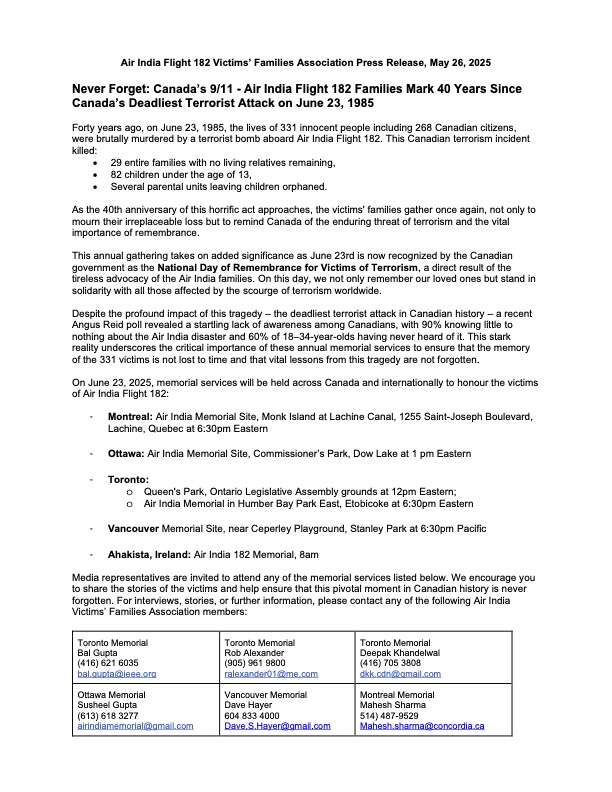
  • MIL-OSI Submissions: Air India crash in Ahmedabad sends reverberations to Canadian families of Air India Flight 182

    Source: The Conversation – Canada – By Chandrima Chakraborty, Professor, English and Cultural Studies; Director, Centre for Global Peace, Justice and Health, McMaster University

    The June 12 Air India crash in Ahmedabad, Gujarat, India, with 230 passengers and 12 crew members aboard is sending deep reverberations through a group of Canadians who know all too well the shock, grief and horror of losing loved ones in hauntingly similar circumstances.

    They are the families of those killed in the bombing of Air India Flight 182 en route from Canada to India 40 years ago this month.

    I work closely with these families as a researcher and advocate. I began interviewing these families in 2014 and have witnessed firsthand their pain, advocacy and emotional turmoil of living in the shadow of a historical event.

    As reports of the Ahmedabad crash came in, the WhatsApp account of the Air India Flight 182 families immediately flooded with expressions of shock, concern, sympathy and memories triggered by the latest incident.

    On June 23, 1985, Flight 182 was brought down by terrorist bombs created and planted on Canadian soil. The devastating mid-air explosion occurred over the Atlantic Ocean near Ireland. It killed all 329 passengers and crew, including 268 Canadians. The crew and most of the passengers were of Indian origin.

    Investigations into the causes of the crash of Air India Flight 171, en route to London’s Gatwick airport, shortly after take-off are still underway. At least 279 people died in the crash, which also impacted people on the ground.

    Acknowledging losses as significant

    A recent public conference at McMaster University commemorated the 40th anniversary of Flight 182, bringing together Indian and Canadian families, researchers, creative artists and community members.

    Book cover for ‘Remembering Air India The Art of Public Mourning,’ edited by Chandrima Chakraborty, Amber Dean and Angela Failler.
    University of Alberta Press

    The conference dealt with critical themes, including the challenge of Flight 182 families recovering from their losses within a climate of broad indifference among their fellow Canadians.

    Regardless of what may have caused the more recent crash in western India, these Canadian families know the shock and loss that a new set of victims’ families are facing, and how important it is to support them.

    Hopefully, the home countries of last week’s crash victims — most of them Indian and British citizens, with at least one Canadian reported to have been aboard — will regard their deaths as significant losses. If so, this would be unlike what the 1985 victims’ families experienced in Canada.

    A little-mourned Canadian tragedy

    In Canada, we have a national day to remember on June 23, 1985. The bombing has been called a Canadian tragedy in a public inquiry report.

    Yet according to a 2023 Angus Reid poll, “nine out of 10 Canadians say they have little or no knowledge of the worst single instance of the mass killing of their fellow citizens.” That essentially means the bombing has yet to penetrate the consciousness of everyday Canadians or evoke shared grief or public mourning.

    The families continue to carry the torch of remembrance as they organize annual memorial vigils every June 23. Few others attend. Many victims’ relatives have died since 1985. Some spouses, siblings or parents are now in their 80s, wondering why the bombing is still not widely discussed in schools or in public discourse.

    The grinding and unsatisfying criminal proceedings, the belated public inquiry and the welcome but lukewarm apology by the Canadian government 25 years after the fact have all contributed to the failure of this tragedy to adhere more solidly to the Canadian consciousness. In fact, many continue to deny the Canadian significance of Flight 182 and view the bombing as a foreign event.

    A torch of remembrance

    At last month’s conference, my research team launched the Air India Flight 182 archive to counter this collective amnesia and lack of acknowledgement.

    Canadian archival consultant and writer Laura Millar has said that archives act as “touchstones to memory” and can aid the process of transforming individual memories into collective remembering. Adopting NYU professor Carol Gilligan’s ethics of care for the archive, we have been consulting with families to find ways to share their grief with the public.

    The Flight 182 memory archive — both physical and digital — serves as a repository for artefacts, first-person narratives, memorabilia and creative works related to the tragedy produced by family members. Family donations of artefacts such as dance videos and pilot wings redirect notions of archives away from a documental deposit. Hopefully, they can move the public to learn and care for the impacts of the Flight 182 bombing.

    The archive is a publicly accessible record of the tragedy, where scholars and everyday citizens can learn about the victims and their families.

    Since the past involves both the present and the future, the archive will enable a meaningful recognition of marginalized voices and histories. It can offer a form of memory justice for those who would otherwise be forgotten by sustaining memory from generation to generation.

    While the archive articulates the demand from families that the bombing of Flight 182 and its aftermath be incorporated into Canadian national consciousness, establishing this archive alone will not be enough to elevate the memory of Flight 182 to the place it deserves.

    But at least it establishes a rich, permanent academic and personal legacy for the community of mourners, and for the Canadian and global public to find it, use it and learn from its many lessons.

    Families of those on board the 1985 flight are preparing to commemorate the 40th anniversary of the terror bombing of Flight 182 that has devastated their lives.

    As we learn more about the tragic Air India Flight 171 crash on June 12, the lessons of Flight 182 will hopefully prevent a new set of families from feeling the pain of indifference on top of the unimaginable agony of loss they’re already experiencing.

    Chandrima Chakraborty receives funding from the Social Sciences and Humanities Research Council of Canada.

    ref. Air India crash in Ahmedabad sends reverberations to Canadian families of Air India Flight 182 – https://theconversation.com/air-india-crash-in-ahmedabad-sends-reverberations-to-canadian-families-of-air-india-flight-182-258991

    MIL OSI

  • MIL-OSI Submissions: Plastics threaten ecosystems and human health, but evidence-based solutions are under political fire

    Source: The Conversation – Canada – By Tony Robert Walker, Professor, School for Resource and Environmental Studies, Dalhousie University

    Negotiations toward a global, legally binding plastics treaty are set to resume this summer, with the United Nations Environment Programme announcing that the Intergovernmental Negotiating Committee on plastic pollution will reconvene in August.

    The committee was established to develop an international legally binding instrument — known as the plastics treaty — to end plastic pollution, one of the fastest-growing environmental threats.


    Read more:
    Here’s how the new global treaty on plastic pollution can help solve this crisis


    Globally, 40 per cent of plastics production goes into the production of single-use plastic packaging, which is the single largest source of plastic waste and is a threat to wildlife and human health. Without meaningful action, global plastic waste is projected to nearly triple by 2060, reaching an estimated 1.2 billion tonnes.

    As the world prepares for another round of talks, Canada’s own plastic problem reveals what’s at stake, and what’s possible for the future.

    Canada’s plastic problem

    Canada is no exception to the global plastic crisis. Nearly half (47 per cent) of all plastic waste in Canada comes from the food and drink sector, contributing 3,268 million tonnes annually. Canadians use 15 billion plastic bags annually and nearly 57 million straws daily, yet only nine per cent of plastics are recycled — a figure that is not expected to improve.

    Most of Canada’s plastic — except for plastic bottles made of PET (polyethylene terephthalate) — are uneconomical or difficult to recycle because of the complexity of mixed plastics used in our economy. As a result, 2.8 million tonnes of plastic waste — equivalent to the weight of 24 CN Towers — end up in landfills every year.

    This is not a trivial problem, as Ontario is projected to run out of landfill space by 2035. Plastic pollution poses growing risks to both urban and rural infrastructure.

    In addition to landfill overflow, around one per cent of Canada’s plastic waste leaks into the environment. In 2016, this was 29,000 tonnes of plastic pollution. Once in the environment, plastics disintegrate into tiny particles, called microplastics (small pieces of plastic less than five millimetres long).

    We drink those tiny microplastic particles in our tap water, and eat them in our fish dinners. Some are even making their way into farmland.

    Plastics are everywhere, including inside us

    More than 93 per cent of Canadians have expressed concerns over single-use plastics used in food packaging and have supported government bans. There is a good reason for concern over the mounting levels of plastics in the environment, in our food and in us.

    Growing evidence indicates that plastics can cause harmful health effects in humans and animals. Microplastics and smaller nanoplastics (less than one micron in length) have been found in humans, including infants and breast milk. They can cause metabolic disorders, interfere with our immune and reproductive systems and cause behavioural problems.

    These health problems may be caused by chemicals added to plastics, including single-use plastics, of which 4,200 chemicals have been identified as posing a hazard to human and ecosystem health.

    It is for these reasons that the Canadian government introduced a ban on single-use plastics in 2022 as part of a plan to reach zero plastic waste in Canada by 2030.

    The decision was based extensive public and industry consultation, as well as decades of data on plastic pollution gathered from the Great Canadian Shoreline Cleanup. This data shows the most common plastic litter items found in the environment across Canada, known as the “dirty dozen” list.

    Six of these items were included in the federal ban. Three eastern Canadian provinces had already implemented single-use plastic bag bans before the federal government, with little to no public or industry opposition. Prince Edward Island was the first Canadian province to implement a province-wide plastic bag ban in July 2019, closely followed by Newfoundland and Labrador and Nova Scotia in October 2020.

    The politics of plastic

    Despite overwhelming scientific consensus, debates around plastic pollution are becoming increasingly politicized.

    In February in the United States, President Donald Trump signed an executive order directing the U.S. government to “stop purchasing paper straws and ensure they are no longer provided within federal buildings.”

    Trump told reporters at the White House: “I don’t think plastic is going to affect a shark very much, as they’re munching their way through the ocean.” Almost 2,000 peer-reviewed studies have reported, however, that more than 4,000 species have ingested or been entangled by plastic litter.

    In Canada, plastic has also become a political flashpoint. During the recent federal election, Conservative Leader Pierre Poilievre said he would scrap the federal government’s ban on single-use plastics and bring back plastic straws and grocery bags. He argued the government’s ban was about “symbolism” rather than “science,” saying, “the Liberals’ plastics ban is not about the environment, it’s about cost and control.”

    His promise would have harmed Canadians by dismissing the overwhelming scientific evidence showing that plastics in our bodies are linked to health impacts. Legislation to ban single-use plastics can be highly effective, ranging from 33 to 96 per cent reductions in plastic waste and pollution in the environment, depending on the policy and jurisdiction.

    Canada’s single-use plastics ban is a great example of evidence-based policymaking. The latest data from the conservation group Ocean Wise shows there was a 32 per cent drop in plastic straws found on Canadian shorelines in 2024 compared to the previous year.

    Science-based policies are needed

    It is indisputable that growing plastic production is directly related to plastic pollution in the environment and in human beings. Increasing plastic pollution is a global threat to human and ecosystem health, regardless of borders and political affiliation.

    As negotiators gear up for another round of talks to finalize a Global Plastics Treaty to end plastic pollution, the need for policies that are supported by scientific evidence is more urgent than ever.

    Future generations deserve a healthy and sustainable planet. The path towards a healthy and sustainable planet requires supporting action based on scientific evidence, not misinforming people with catchy phrases and political rhetoric.

    Tony Robert Walker receives funding from the Natural Sciences and Engineering Research Council of Canada, Canada Foundation for Innovation, and Research Nova Scotia. He is also a non-remunerated member of the Scientists’ Coalition for an Effective Plastics Treaty.

    Miriam L Diamond receives funding from Natural Sciences and Engineering Research Council, Ontario Ministry of Environment, Conservation and Parks, Future Earth, and Environment and Climate Change Canada. She is affiliated with the University of Toronto, serves as a paid expert for the Scientific and Technical Advisory Panel of the Global Environment Facility, and has non-remunerated positions with the International Panel on Chemical Pollution (Vice-Chair), is a member of the Scientist Coalition for an Effective Plastics Treaty, and sits on the board of the Canadian Environmental Law Association.

    ref. Plastics threaten ecosystems and human health, but evidence-based solutions are under political fire – https://theconversation.com/plastics-threaten-ecosystems-and-human-health-but-evidence-based-solutions-are-under-political-fire-256764

    MIL OSI

  • MIL-OSI Submissions: Decolonizing history and social studies curricula has a long way to go in Canada

    Source: The Conversation – Canada – By Sara Karn, Postdoctoral Fellow, Department of History, McMaster University

    In June 2015, 10 years ago, the Truth and Reconciliation Commission of Canada (TRC) called for curriculum on Indigenous histories and contemporary contributions to Canada to foster intercultural understanding, empathy and respect. This was the focus of calls to action Nos. 62 to 65.

    As education scholars, we are part of a project supported by the Social Sciences and Humanities Research Council called Thinking Historically for Canada’s Future. This project involves researchers, educators and partner organizations from across Canada, including Indigenous and non-Indigenous team members.

    As part of this work, we examined Canadian history and social studies curricula in elementary, middle and secondary schools with the aim of understanding how they address — and may better address in future — the need for decolonization.

    We found that although steps have been made towards decolonizing history curricula in Canada, there is still a long way to go. These curricula must do far more to challenge dominant narratives, prompt students to critically reflect on their identities and value Indigenous world views.


    Read more:
    Looking for Indigenous history? ‘Shekon Neechie’ website recentres Indigenous perspectives


    Reimagining curriculum

    As white settler scholars and educators, we acknowledge our responsibility to unlearn colonial ways of being and learn how to further decolonization in Canada.

    In approaching this study, we began by listening to Indigenous scholars, such as Cree scholar Dwayne Donald. Donald and other scholars call for reimagining curriculum through unlearning colonialism and renewing relationships.


    Read more:
    Leaked Alberta school curriculum in urgent need of guidance from Indigenous wisdom teachings


    The late Arapaho education scholar Michael Marker suggested that in history education, renewing relations involves learning from Indigenous understandings of the past, situated within local meanings of time and place.

    History, social studies curricula

    Curricula across Canada have been updated in the last 10 years to include teaching about treaties, Indian Residential Schools and the cultures, perspectives and experiences of Indigenous Peoples over time.

    Thanks primarily to the work of Indigenous scholars and educators, including Donald, Marker, Mi’kmaw educator Marie Battiste, Anishinaabe scholar Nicole Bell and others, some public school educators are attentive to land-based learning and the importance of oral history.

    But these teachings are, for the most part, ad hoc and not supported by provincial curriculum mandates.

    Our study revealed that most provincial history curricula are still focused on colonial narratives that centre settler histories and emphasize “progress” over time. Curricula are largely inattentive to critical understandings of white settler power and to Indigenous ways of knowing and being.

    Notably, we do not include the three territories in this statement. Most of the territorial history curricula have been co-created with local Indigenous communities, and stand out with regard to decolonization.

    For example, in Nunavut’s Grade 5 curriculum, the importance of local knowledge tied to the land is highlighted throughout. There are learning expectations related to survival skills and ecological knowledge.

    Members of our broader research team are dedicated to analyzing curricula in Nunavut, the Northwest Territories and the Yukon. Their work may offer approaches to be adapted for other educational contexts.

    Dominant narratives

    In contrast, we found that provincial curricula often reinforce dominant historical narratives, especially surrounding colonialism. Some documents use the term “the history,” implying a singular history of Canada (for example, Manitoba’s Grade 6 curriculum).

    Historical content, examples and guiding questions are predominantly written from a Euro-western perspective, while minimizing racialized identities and community histories. In particular, curricula often ignore illustrations of Indigenous agency and experience.


    Read more:
    Moving beyond Black history month towards inclusive histories in Québec secondary schools


    Most curricula primarily situate Indigenous Peoples in the past, without substantial consideration for present-day implications of settler colonialism, as well as Indigenous agency and experiences today.

    For example, in British Columbia’s Grade 4 curriculum, there are lengthy discussions of the harms of colonization in the past. Yet, there is no mention of the ongoing impacts of settler colonialism or the need to engage in decolonization today.

    To disrupt these dominant narratives, we recommend that history curricula should critically discuss the ongoing impacts of settler colonialism, while centring stories of Indigenous resistance and survival over time.

    Identity and privilege

    There are also missed opportunities within history curricula when it comes to critical discussions around identity, including systemic marginalization or privilege.

    Who we are informs how we understand history, but curricula largely does not prompt student reflection in these ways, including around treaty relationships.

    In Saskatchewan’s Grade 5 curriculum, students are expected to explain what treaties are and “affirm that all Saskatchewan residents are Treaty people.”

    However, there is no mention of students considering how their own backgrounds, identities, values and experiences shape their understandings of and responsibilities for treaties. Yet these discussions are essential for engaging students in considering the legacies of colonialism and how they may act to redress those legacies.

    A key learning outcome could involve students becoming more aware of how their own personal and community histories inform their historical understandings and reconciliation commitments.

    Indigenous ways of knowing and being

    History curricula generally ignore Indigenous ways of knowing and being. Most curricula are inattentive to Indigenous oral traditions, conceptions of time, local contexts and relationships with other species and the environment.

    Instead, these documents reflect Euro-western, settler colonial worldviews and educational values. For example, history curricula overwhelmingly ignore local meanings of time and place, while failing to encourage opportunities for land-based and experiential learning.

    In Prince Edward Island’s Grade 12 curriculum, the documents expect that students will “demonstrate an understanding of the interactions among people, places and the environment.” While this may seem promising, environmental histories in this curriculum and others uphold capitalist world views by focusing on resource extraction and economic progress.

    To disrupt settler colonial relationships with the land and empower youth as environmental stewards, we support reframing history curricula in ways that are attentive to Indigenous ways of knowing the past and relations with other people, beings and the land.

    Ways forward

    Schools have been, and continue to be, harmful spaces for many Indigenous communities, and various aspects of our schooling beg questions about how well-served both Indigenous and non-Indigenous students are for meeting current and future challenges.

    If, as a society, we accept the premise that the transformation of current curricular expectations is possible for schools, then more substantive engagement is required in working toward decolonization.

    Decolonizing curricula is a long-term, challenging process that requires consideration of many things: who sits on curriculum writing teams; the resources allocated to supporting curricular reform; broader school or board-wide policies; and ways of teaching that support reconciliation.

    We encourage history curriculum writing teams to take up these recommendations as part of a broader commitment to reconciliation.

    While not exhaustive, recommendations for curricular reform are a critical step in the future redesign of history curricula. The goal is a history education committed to listening and learning from Indigenous communities to build more inclusive national stories of the past, and into the future.

    This is a corrected version of a story originally published June 17, 2025. The earlier story said Michael Marker was from the Lummi Nation instead of saying he was an Arapaho scholar.

    Sara Karn receives funding from the Social Sciences and Humanities Research Council (SSHRC).

    Kristina R. Llewellyn receives funding from the Social Sciences and Humanities Research Council (SSHRC).

    Penney Clark receives funding from the Social Sciences and Humanities Research Council of Canada (SSHRC).

    ref. Decolonizing history and social studies curricula has a long way to go in Canada – https://theconversation.com/decolonizing-history-and-social-studies-curricula-has-a-long-way-to-go-in-canada-253679

    MIL OSI

  • MIL-OSI Submissions: B.C.’s mental health law is on trial — and so is our commitment to human rights

    Source: The Conversation – Canada – By Anne Levesque, Associate professor, Faculty of Law, L’Université d’Ottawa/University of Ottawa

    The British Columbia Supreme Court has begun hearing a long-awaited constitutional challenge to the province’s Mental Health Act.

    The case, nearly a decade in the making, is now drawing greater attention in the wake of the tragedy at the Filipino Lapu Lapu Day street festival earlier this year that left 11 people dead in Vancouver.

    The event has shaken many in the community, leaving behind grief and fear. Furthermore, in light of reports that the person accused of the crime was under Mental Health Act supervision, difficult questions arise. The pain is real, and any conversation about mental health must begin with compassion for all of those affected.


    Read more:
    Vancouver SUV attack exposes crowd management falldowns and casts a pall on Canada’s election


    At the same time, it’s important to ensure this moment of reckoning leads to thoughtful dialogue, not reactive policy. Unfortunately, much of the public discourse has become mired in fear and misinformation, creating a false and dangerous choice: that Canada must sacrifice individual rights in order to protect public safety.

    As a legal scholar in equality rights and public interest litigation, I don’t believe Canadians have to choose. A mental health system that respects Canada’s Charter of Rights and Freedoms can also promote safety.

    What’s the case is about?

    The case currently before the B.C. Supreme Court was initiated by the Council of Canadians with Disabilities (CCD), a national human rights organization led by people with disabilities. The group is fighting provisions in the province’s Mental Health Act that strip patients of any right to choose their own health care, or to appoint a loved one to make health care decisions on their behalf.

    The CCD’s motto — “Nothing about us without us” — reflects a longstanding commitment to ensuring that people most affected by policies and systems have a voice in shaping them. This litigation will amplify the voices of people who underwent psychiatric treatment without consent and to shine a light on the deep and lasting harms they have suffered.

    Let’s be clear about what this Charter challenge actually seeks and what it doesn’t. It doesn’t aim to eliminate involuntary hospitalization. It does not change who can be detained, how long they can be held or the legal criteria for involuntary admission.

    What it does seek is something far more modest and humane: to ensure that when psychiatric care is forced, it is delivered with dignity, oversight and the involvement of trusted supporters in accordance with the Canadian Charter of Rights and Freedoms.

    One of the key reforms that CCD has long advocated for is the right for people to name a family member or friend to be involved in treatment decisions. Far from undermining care, this kind of involvement can help bridge the gap between medical necessity and personal dignity.

    It’s a safeguard that respects patients’ values and builds trust, which the current system desperately lacks. And yes, it could even enhance public safety. Reports suggest that a family member of the man accused in the Lapu Lapu mass murders in April was concerned about his deteriorating mental health and had reached out for help just before the tragedy occurred. A more responsive system with the embedded involvement of trusted decision-makers might have made a difference.


    Read more:
    Fraudulent crowdfunding after the Lapu Lapu tragedy highlights the need for vigilance and oversight


    Reforming the Mental Health Act

    British Columbia is currently an outlier in Canada. It’s the only province where people detained under mental health laws are automatically deemed to consent to any treatment authorized by the facility — regardless of their actual wishes or capacity.

    There’s no right to name a substitute decision-maker, no ability to appeal a treatment decision, no independent oversight, and treatment is often imposed through isolation, physical restraints or security force.

    Advocates have been calling for change for decades. But in the wake of the Lapu Lapu attack, some politicians are proposing not a more compassionate or rights-respecting approach, but harsher, more coercive powers over people with mental health issues. That would be a mistake.

    The current system, which experts have long said is inconsistent with human rights, did nothing to prevent this tragedy. Violating the rights of people in crisis did not and will not keep the public safer.

    B.C. Premier David Eby has acknowledged the shortcomings in the current system, but has said that engaging in law reform while litigation is undergoing would pose a risk. Instead, he says it’s better to wait to hear what the court decides before changing the law.

    That logic is arguably akin to a citizen saying it’s risky to stop driving at a speed they know is over the lawful limit until they’re pulled over.

    Pointless to wait

    Waiting for the courts to force change wastes precious time, and public resources, that could be better spent on designing a new, Charter-compliant mental health system in collaboration with experts, service providers, families and people with lived experiences.

    Meanwhile, substantial public funds are being spent on government lawyers to fight a legal battle defending a regime that is clearly unconstitutional and fails both patients and public safety.

    That money would be far better spent consulting with experts, families and people with lived experiences and developing legislation that upholds constitutional rights and keeps communities safe.

    The time for delay is over. The B.C. government must act now to rewrite the Mental Health Act in order to protect the public and respect Charter rights.

    Anne Levesque is co-chair of the Disability Justice Litigation Initiative of the Council of Canadians with Disabilities.

    ref. B.C.’s mental health law is on trial — and so is our commitment to human rights – https://theconversation.com/b-c-s-mental-health-law-is-on-trial-and-so-is-our-commitment-to-human-rights-258671

    MIL OSI

  • MIL-OSI Submissions: Somaliland’s 30-year quest for recognition: could US interests make the difference?

    Source: The Conversation – Africa (2) – By Aleksi Ylönen, Professor, United States International University

    More than three decades after unilaterally declaring independence from Somalia, Somaliland still seeks international recognition as a sovereign state. Despite a lack of formal acknowledgement, the breakaway state has built a relatively stable system of governance. This has drawn increasing interest from global powers, including the United States. As regional dynamics shift and great-power competition intensifies, Somaliland’s bid for recognition is gaining new currency. Aleksi Ylönen has studied politics in the Horn of Africa and Somaliland’s quest for recognition. He unpacks what’s at play.


    What legal and historical arguments does Somaliland use?

    The Somali National Movement is one of the main clan-based insurgent movements responsible for the collapse of the central government in Somalia. It claims the territory of the former British protectorate of Somaliland. The UK had granted Somaliland sovereign status on 26 June 1960.

    The Somali government tried to stomp out calls for secession. It orchestrated the brutal killing of hundreds of thousands of people in northern Somalia between 1987 and 1989.

    But the Somali National Movement declared unilateral independence on 18 May 1991 and separated from Somalia.

    With the collapse of the Somali regime in 1991, the movement’s main enemy was gone. This led to a violent power struggle between various militias.

    This subsided only after the politician Mohamed Egal consolidated power. He was elected president of Somaliland in May 1993.

    Egal made deals with merchants and businessmen, giving them tax and commercial incentives to accept his patronage. As a result, he obtained the economic means to consolidate political power and to pursue peace and state-building. It’s something his successors have kept up with since his death in 2002.

    What has Somaliland done to push for recognition?

    Successive Somaliland governments continue to engage in informal diplomacy. They have aligned with the west, particularly the US, which was the dominant power after the cold war, and the former colonial master, the UK. Both countries host significant Somaliland diaspora communities.

    The US and the UK have for decades flirted with the idea of recognising Somaliland, which they consider a strategic partner. However, they have been repeatedly thrown back by their respective Somalia policies. These have favoured empowering the widely supported Mogadishu government to reassert its authority and control over Somali territories.

    This Somalia policy has been increasingly questioned in recent years, in part due to Mogadishu’s security challenges. In contrast, the Hargeisa government of Somaliland has largely shown it can provide security and stability. It has held elections and survived as a state for the last three decades, though it has faced political resistance and armed opposition.


    Read more:
    Somaliland elections: what’s at stake for independence, stability and shifting power dynamics in the Horn of Africa


    As new global powers rise, Somaliland administrations have pursued an increasingly diverse foreign policy, with one goal: international recognition.

    Hargeisa hosts consulates and representative offices of Djibouti, Ethiopia, Kenya, Taiwan, the UK and the European Union, among others.

    The government has also engaged in informal foreign relations with the United Arab Emirates. The Middle Eastern monarchy serves as a business hub and a destination of livestock exports. Many Somalilanders migrate there.

    Somaliland maintains representative offices in several countries. These include Canada, the US, Norway, Sweden, the UK, Saudi Arabia, Turkey and Taiwan. Hargeisa has alienated China because it has collaborated with Taiwan since 2020. Taiwan is a self-ruled island claimed by China.

    On 1 January 2024, Somaliland’s outgoing president Muse Bihi signed a memorandum of understanding with Ethiopian prime minister Abiy Ahmed for increased cooperation. Bihi implied that Ethiopia would be the first country to formally recognise Somaliland. The deal caused a sharp deterioration of relations between Addis Ababa and Mogadishu.

    Abiy later moderated his position and, with Turkish mediation, reconciled with his Somalia counterpart, President Hassan Mohamud.

    What’s behind US interest in Somaliland?

    The US, like other great powers, has been interested in Somaliland because of its strategic location. It is on the African shores of the Gulf of Aden, across from the Arabian Peninsula. Its geographical position has gained currency recently as Yemeni Houthi rebels strike maritime traffic in the busy shipping lanes. Somaliland is also well located to curb piracy and smuggling on this global trade route.

    The US Africa Command set up its main Horn of Africa base at Camp Lemonnier in Djibouti in 2002. This followed the 11 September 2001 attacks.


    Read more:
    Somaliland’s quest for recognition: UK debate offers hint of a sea change


    In 2017, China, which had become the main foreign economic power in the Horn of Africa, set up a navy support facility in Djibouti. This encouraged closer collaboration between American and Somaliland authorities. The US played with the idea of establishing a base in Berbera, which hosts Somaliland’s largest port.

    With Donald Trump winning the US presidential election in 2024, there were reports of an increased push for US recognition of Somaliland. This would allow the US to deepen its trade and security partnerships in the volatile Horn of Africa region.

    Since March 2025, representatives of the Trump administration have engaged in talks with Somaliland officials to establish a US military base near Berbera. This would be in exchange for a formal but partial recognition of Somaliland.

    What are the risks of US recognition of Somaliland?

    Stronger US engagement with Somaliland risks neglecting Somalia.

    Mogadishu depends on external military assistance in its battle against the advancing violent Islamist extremist group, Al-Shabaab. It also faces increasing defiance from two federal regions, Puntland and Jubaland.

    US recognition would reward Hargeisa for its persistent effort to maintain stability and promote democracy. However, it could encourage other nations to recognise Somaliland. This would deliver a blow to Somali nationalists who want one state for all Somalis.

    Aleksi Ylönen is affiliated with the Center for International Studies, Iscte-Instituto Universitário de Lisboa, and is an associate fellow at the HORN International Institute for Strategic Studies.

    ref. Somaliland’s 30-year quest for recognition: could US interests make the difference? – https://theconversation.com/somalilands-30-year-quest-for-recognition-could-us-interests-make-the-difference-255399

    MIL OSI

  • MIL-OSI Submissions: Dinosaur tracks, made 140 million years ago, have been found for the first time in South Africa’s Western Cape

    Source: The Conversation – Africa (2) – By Guy Plint, Professor Emeritus, Earth Sciences, Western University

    Guy Plint examines one of the dinosaur tracks, which is above his head. Annemarie Plint, CC BY-NC-ND

    Dinosaurs have captured people’s imagination ever since their bones and teeth were first scientifically described in 1822 by geologist and palaeontologist Gideon Mantell in England.

    Dinosaur bones have taught us a great deal about these animals from the “age of dinosaurs”, the Mesozoic Era, which stretched from approximately 252 million years ago to 65 million years ago. However, there’s something especially appealing about a different kind of dinosaur fossil: their tracks, which show researchers what the animals were doing while they were alive.

    Ichnology is the study of tracks and traces and, since 2008, the Cape South Coast Ichnology Project has documented more than 370 vertebrate tracksites on South Africa’s southern coast. These sites are from the Pleistocene Epoch, which stretched from approximately 2.6 million years ago to 11,700 years ago, much more recent than the Mesozoic.

    We knew that this coastline contained Mesozoic sedimentary rocks, some of which include non-marine sediments that could potentially preserve dinosaur tracks. We are both familiar with dinosaur tracks from our research in Canada, so we decided to investigate the possibility of tracks in South Africa’s Western Cape.

    We found some – and, once we knew what to look for, it was evident that the tracks were not rare. In a new paper published in the journal Ichnos, we describe our findings in detail, presenting evidence of tracks of sauropods (enormous plant-eating dinosaurs) and possibly ornithopods (another group of large herbivorous dinosaurs).

    The tracks were found in a rugged, remote, breathtakingly spectacular coastal setting. They were made by dinosaurs in a variety of estuarine settings. Some were walking on sandy, inter-tidal channel bars. Others walked on the bottom of tidal channels, their feet sinking down into soft mud forming the bed of the channel. Other vague “squishy” structures were formed by dinosaurs wading, or even wallowing in the muddy fill of abandoned channels.

    These tracks are around 140 million years old, from the very beginning of the Cretaceous period when the African and South American tectonic plates were starting to pull apart. Southern Africa has an extensive record of Mesozoic vertebrate fossils, but that record ends at around 180 million years ago in the Early Jurassic with the eruption of voluminous lava flows. To the best of our knowledge, all the southern African dinosaur tracks known until now are from the Triassic and Jurassic periods, so they pre-date these eruptions.

    That means these tracks are not only the first from the Western Cape. They also appear to be the youngest – that is, the most recent – thus far reported from southern Africa.

    Knowing where to look

    After deciding to hunt for potential dinosaur tracks, we visited a few likely sites on the Cape south coast in 2022, choosing areas with non-marine deposits of the appropriate age, mostly in the eastern coastal portion of the Western Cape. We found a few promising spots on that visit and, in 2023, undertook a dedicated examination.

    Large horizontal bedding surface exposures in this area are very rare. We knew that, if we were to find dinosaur tracks, they would be evident mostly in profile in vertical cliff exposures.


    Read more:
    Footprints take science a step closer to understanding southern Africa’s dinosaurs


    In the public imagination a dinosaur trackway extends across a level surface and toe impressions are visible. Some may also know that the infill of dinosaur tracks can occur on what are today the ceilings of overhangs or cave roofs. However, there are also distinctive features that allow tracks to be identified in profile. That’s because the animals’ footfalls deformed underlying layers in a distinctive manner.

    The problem is that other mechanisms, such as earthquakes, are capable of generating broadly similar deformation structures.

    The deposits we were examining had probably also been affected by seismic activity. The challenge was for us to differentiate between the two types of deformation.

    The Early Cretaceous rocks that we examined had been studied and reported on decades ago, and the deformation structures had been attributed to origins such as earthquakes rather than living organisms. Since then, however, scientists have developed a better appreciation of what dinosaur tracks look like in profile.

    After careful examination, our conclusion was straightforward: both dinosaur-generated and earthquake-generated types of deformation were present in the Cretaceous rocks.

    One of the sauropod tracks identified by the researchers. Scale bar is 20 cm.
    Guy Plint, CC BY-NC-ND

    Further evidence that we were looking at dinosaur tracks comes from the region’s bone fossil record. Cretaceous bone material has been reported from the region, mostly in the Kirkwood area in the Eastern Cape province. Two dinosaur bones have also been reported from the Knysna area in the Western Cape. One of these, a theropod tooth, was found – and correctly identified – by a 13-year-old boy.


    Read more:
    Dinosaur tracksite in Lesotho: how a wrong turn led to an exciting find


    Clearly, dinosaurs were present in the Western Cape area. That means our discovery of ichnological evidence of their presence is not entirely surprising, but it is still extremely exciting.

    Keep exploring

    Our team plans to keep exploring deposits of suitable age in the region for evidence of more dinosaur tracks. We also hope that our discovery will inspire a new generation of dinosaur trackers to continue the quest and keep exploring.

    The authors do not work for, consult, own shares in or receive funding from any company or organisation that would benefit from this article, and have disclosed no relevant affiliations beyond their academic appointment.

    ref. Dinosaur tracks, made 140 million years ago, have been found for the first time in South Africa’s Western Cape – https://theconversation.com/dinosaur-tracks-made-140-million-years-ago-have-been-found-for-the-first-time-in-south-africas-western-cape-250660

    MIL OSI

  • MIL-OSI United Nations: Multi-stakeholder Round Table 2: Leveraging Private Business and Finance

    Source: United Nations General Assembly and Security Council

    The Conference holds its second multi-stakeholder round table this morning on “Leveraging private business and finance”.

    Co-Chaired by Muhammad Aurangzeb, Federal Minister for Finance and Revenue of Pakistan, and Christopher MacLennan, Deputy Minister for International Development of Canada, it will feature a keynote address by Mahmoud Ali Youssouf, African Union Commission Chairperson.

    Antonio H. Pinheiro Silveira, Vice-President for the Private Sector, CAF, will moderate the discussion.

    Panellists will include:  Neal Rijkenberg Minister for Finance of Eswatini; Retselisitsoe Matlanyane, Minister for Finance and Development Planning of Lesotho; Situmbeko Musokotwane, Minister for Finance and National Planning of Zambia; and Boris Titov, Special Representative of the President of the Russian Federation for Relations with International Organizations for Achieving the Sustainable Development Goals, of the Russian Federation.

    Mary Beth Goodman, Deputy Secretary-General of the Organisation for Economic Cooperation and Development (OECD), and Eric Pelofsky, Vice-President of the Rockefeller Foundation, will be the discussants.

    MIL OSI United Nations News

  • MIL-OSI: BSTR Miner launches next-generation cloud mining platform: AI-driven, multi-currency support, Dogecoin mining threshold drops to a new low

    Source: GlobeNewswire (MIL-OSI)

    London, UK, July 01, 2025 (GLOBE NEWSWIRE) — In the wave of continued expansion of the global cryptocurrency market, BSTR Miner, which has been deeply involved in blockchain infrastructure for 6 years, officially launched a revolutionary cloud mining platform today. The platform uses patented adaptive revenue enhancement technology (A.R.E.T) to realize intelligent dynamic mining of mainstream currencies such as Bitcoin, Ethereum, and Dogecoin for the first time, lowering the threshold for passive crypto income to $100 and completely rewriting the rules of the game in the industry.

    Market pain points and technical breakthroughs
    After the Bitcoin halving in 2025, the computing power of the entire network will climb by 37%, and it will be more difficult for individual miners to make profits. BSTR Miner’s solution directly hits three core pain points:

    Zero hardware burden: users do not need to face the purchase, maintenance or high electricity costs of mining machines

    Intelligent income: A.R.E.T system analyzes 200+ blockchain indicators in real time (including network difficulty, gas fees and currency price fluctuations), and automatically switches to the currency with the highest current income for mining

    Democratization of Dogecoin mining: Deep optimization of DOGE’s Scrypt algorithm allows small investors to share the ecological dividends of meme coins

    BSTR Miner cloud mining platform advantages:
    Zero hardware: Instant mining of BTC, ETH and DOGE – no equipment or technical skills required.

    AI profit maximizer: patented A.R.E.T. algorithm, dynamically switches mining to the currency with the highest income (for example, DOGE mining rewards increased by 143% in June)
    Transparent income: blockchain verification every 8 hours
    Start mining with $100. Exclusive DOGE Mining Offer: New users get $10 bonus + 3% extra DOGE hashrate.

    How to start mining with BSTR Miner?
    1. Quick registration
    Visit www.bstrminer.com and register with your email/mobile phone number
    2. Zero configuration start
    Recharge $100+ to a crypto wallet (supports BTC/ETH/USDT) or use the $10 given by the platform for mining
    3. Select a contract
    The platform provides 11 contracts, choose the contract that suits you to purchase
    4. Enjoy daily income
    View income data in real time on the dashboard
    •Automatically distributed to the account every 24 hours
    • Withdraw at any time when the balance is over $100

    Real user testimony
    “As a full-time teacher, I obtained a stable monthly return of 5.1% in Q2 2025 through BSTR Miner’s Dogecoin mining contract,” James Chen, an early Canadian user, showed his dashboard data, “What’s more surprising is that the platform automatically switched 35% of its computing power to the skyrocketing BRC-20 token in June, with a daily increase of 300% in income.”

    Market positioning and strategy
    “Traditional cloud mining is experiencing a crisis of trust,” said Elena, CTO of BSTR Miner Rodriguez pointed out that “our real-time revenue tracing system makes every penny of output verifiable, which will become the new industry standard.” The platform has reserved $50 million for user growth funds, and new registrations can receive: $10 experience money (which can be directly invested in Dogecoin mining contracts)

    About BSTR Miner
    Founded in 2019, BSTR Miner operates 5 Tier-4 data centers in North America, with a computing power accounting for 1.98% of the global Bitcoin network. In 2024, it was certified by ISO/IEC 27001 and was named the “Most Innovative Blockchain Infrastructure Provider” by Yahoo Finance.

    For media enquiries, please contact:
    Company name: BSTR Miner
    Email: info@bstrminer.com
    Company address: Flat 5 Vincent Avenue, Welcombe Court, Stratford-Upon-Avon, England
    Company website: https://bstrminer.com

    Attachment

    The MIL Network

  • MIL-OSI Russia: G7 calls for resumption of Iran nuclear talks

    Translation. Region: Russian Federal

    Source: People’s Republic of China in Russian –

    Source: People’s Republic of China – State Council News

    OTTAWA, July 1 (Xinhua) — The Group of Seven (G7) foreign ministers on Monday called for a resumption of talks to reach a comprehensive, verifiable and lasting deal on Iran’s nuclear program.

    In a joint statement on Iran and the Middle East issued by Global Affairs Canada, the G7 foreign ministers called on Iran to urgently resume full cooperation with the International Atomic Energy Agency (IAEA) in accordance with its safeguards obligations and to provide the IAEA with verifiable information on all nuclear materials in Iran, including by providing access to IAEA inspectors.

    “We underscore the central importance of the Nuclear Non-Proliferation Treaty as the cornerstone of the global nuclear non-proliferation regime. It is critical that Iran remain a party to and fully implement its obligations under the Treaty,” the statement said.

    The foreign ministers of Canada, France, Germany, Italy, Japan, the United Kingdom and the United States, as well as the European Union’s high representative, met in The Hague on June 25 to discuss recent developments in the Middle East. –0–

    MIL OSI Russia News

  • MIL-OSI: Over half of sports fans are turning to AI or gen AI for more personalized content

    Source: GlobeNewswire (MIL-OSI)

    Press contact:
    Elsa Estager Bergerou
    Tel: +33 6 59 62 55 13
    Email: elsa.estager-bergerou@capgemini.com

    Over half of sports fans are turning to AI or gen AI for more personalized content

    • AI has overtaken traditional search engines as the main source for sports information, with 67% of fans wanting all sports data aggregated in one place.
    • Digital insights are filling gaps in the live sports experience, with nearly 70% of fans seeking stats related to team, players and playing conditions primarily pre-match and during breaks.
    • Spectators want balance between tech innovation and authenticity, with almost three out of five fans worrying that too much technology could impact the thrill of live sport.

    Paris, July 1, 2025 – The Capgemini Research Institute today released its latest report, “Beyond the game: The new era of AI-powered sports engagement”, revealing how AI and generative AI (gen AI) are reshaping the global fan experience. As AI-powered tools become the primary gateway for sports content and data, fans still seek the thrill of authentic, in-person moments, therefore highlighting the need to strike a balance between the digital and physical worlds of sport.

    AI and gen AI power the next era of fan engagement
    AI is redefining how fans interact with sports. Over half (54%) of them now use AI or gen AI tools as their main source of information with 59% trusting content generated by these technologies. From personalized match summaries to real-time highlights reels, fans increasingly expect AI and gen AI to aggregate all sports-related content – 67% want a single, streamlined platform where they can discover information aggregated from websites, search engines and social media.

    However, personalization and interactivity are key to ensuring a genuine and authentic fan experience. While the report finds fans are returning to stadiums since the pandemic, with 37% already having attended live matches this year, AI is transforming how fans engage with sports overall. The technology is delivering tailored updates that enhance their experience of the game, with stats and facts about their favorite teams, fixtures, and players.

    Indeed, 64% of fans want AI to provide updates customized to their preferences, a similar number want to compete against well-known players in a virtual space during live games, and 58% would like to replay matches using ‘what-if’ scenarios. Just over a quarter (27%) are even willing to pay a premium for these AI-driven, interactive experiences. For instance, Tour de France fans can now play and follow their Fantasy team in real time, vote and elect the most combative rider of the day or even experience the race from inside an official fans car.

    The true power of AI in sports, and especially gen AI, lies in its ability to transform how fans connect with the game, with athletes, and with each other,” explained Pascal Brier, Chief Innovation Officer at Capgemini and Member of the Group Executive Committee. “As technology evolves, unlocking new ways for fans to curate their own unique experience, will be a blend of real-time data with immersive, interactive opportunities. The challenge is to ensure that these innovations deepen the emotional connections that make sport so powerful for passionate supporters, while preserving the authenticity and integrity that defines the spirit of the game.”

    Balancing innovation with responsibility and the thrill of live sports
    Sports fans today are hungry for data but the report shows their digital engagement peaks before matches and during breaks, rather than during the live play itself. Nearly 70% of fans want access to player metrics and live match data, using these insights to enrich their understanding when the action pauses. By meeting fans’ appetite for insights at these key moments, data enriches the overall viewing experience while keeping the thrill of live sports intact.

    While digital innovation is widely embraced, nearly 60% of sports fans are concerned that too much technology could dampen the excitement of attending events, and over half fear it could diminish their overall enjoyment of the game or match. This highlights the importance of finding the right balance – leveraging technology to elevate the fan experience while preserving what makes live sports so uniquely compelling.

    The report finds that there is a lack of awareness about data privacy aspects of AI-powered sports viewing tools.
    For example, whereas about half of Gen Y and Gen Z fans are aware of the various kinds of data collected and explicitly consent to its storage, this is true for only 38% and 36% of baby boomers, respectively.

    There are also concerns about misinformation, as two-thirds of fans admit being worried that the spread of unverified content on AI or gen AI platforms could increase the risk of athletes being targeted or harassed by disgruntled supporters. What’s more, 57% of fans are concerned about the generation of false content resulting in the spread of misinformation about players or sports teams.

    Stadiums invest in tech to meet rising fan expectations
    The report finds that stadium operators are investing in apps and smart technologies to create smoother, more immersive experiences for digital-native audiences. Over half of attendees say ticketing, scheduling, and real-time apps enhance their stadium experience, while facial recognition entry and digital navigation are also valued.

    Download the full report here.

    Report methodology
    The Capgemini Research Institute surveyed f 12,017 sports fans across 11 countries, in March and April 2025: Australia, Brazil, Canada, France, Germany, Italy, Japan, Spain, Sweden, the UK, and the US. The research explored fan behaviors, attitudes, and expectations around AI, gen AI, and digital innovations in sports.

    About Capgemini
    Capgemini is a global business and technology transformation partner, helping organizations to accelerate their dual transition to a digital and sustainable world, while creating tangible impact for enterprises and society. It is a responsible and diverse group of 340,000 team members in more than 50 countries. With its strong over 55-year heritage, Capgemini is trusted by its clients to unlock the value of technology to address the entire breadth of their business needs. It delivers end-to-end services and solutions leveraging strengths from strategy and design to engineering, all fueled by its market leading capabilities in AI, generative AI, cloud and data, combined with its deep industry expertise and partner ecosystem. The Group reported 2024 global revenues of €22.1 billion.

    Get The Future You Want | www.capgemini.com

    About the Capgemini Research Institute
    The Capgemini Research Institute is Capgemini’s in-house think-tank on all things digital. The Institute publishes research on the impact of digital technologies on large traditional businesses. The team draws on the worldwide network of Capgemini experts and works closely with academic and technology partners. The Institute has dedicated research centers in India, Singapore, the United Kingdom and the United States. It was ranked #1 in the world for the quality of its research by independent analysts for six consecutive times – an industry first.

    Visit us at https://www.capgemini.com/researchinstitute/

    Attachment

    The MIL Network

  • MIL-Evening Report: ‘I’m going to send letters’: the deadline for Trump’s ‘reciprocal’ trade tariffs is looming

    Source: The Conversation (Au and NZ) – By Peter Draper, Professor, and Executive Director: Institute for International Trade, and Director of the Jean Monnet Centre of Trade and Environment, University of Adelaide

    Brendan Smialowski/AFP via Getty Images

    US President Donald Trump’s 90-day pause on implementing so-called “reciprocal” tariffs on some 180 trading partners ends on July 8.

    How are countries responding to the threat, and will the tariffs be re-applied from July 9?

    What the US thinks ‘reciprocal’ means

    The United States is demanding four things from all trading partners, while offering little in return. So these negotiations are anything but “reciprocal”.

    The main demand is to rebalance bilateral goods trade between the US and other countries. Nations with trade surpluses – meaning they export a greater value of goods than they import from the US – will be encouraged to import more from the US and/or export less to it.

    The US is also pushing countries to eliminate a range of “non-tariff barriers” that may affect US export competitiveness. These barriers are drawn from the United States Trade Representative’s (USTR) March 2025 report and include a variety of perceived “unfair” practices, from value-added taxes (such as the Goods and Services Tax) to biosecurity standards such as those Australia applies to agricultural imports.

    In a nod to the “tech bros”, (alleged) restrictions on digital trade services, such as Australia’s media bargaining code, and digital service taxes must be removed, along with taxes on the tech giants. On Monday, Canada dropped a new digital service tax on firms such as Google and Meta after Trump suspended trade talks.

    Amazon founder Jeff Bezos, Google CEO Sundar Pichai and Tesla CEO Elon Musk at President Trump’s inauguration ceremony.
    Saul Loeb/Pool/AFP via Getty Image

    Countries must also agree to reduce reliance on inputs from China in any exports to the United States. That means companies that moved manufacturing from China to countries such as Vietnam during President Trump’s first term trade wars will face challenges in sourcing input components from China.

    Put together, this is a difficult package for any government to accept without securing something in return.

    Who holds the cards?

    Trump has been fond of saying the United States holds “all the cards” in trade negotiations.

    It’s not known precisely how many countries are negotiating bilateral deals with Washington. Between 10 and 18 countries are priority “targets”, or to use an early, colourful phrase, were targeted as the “Dirty 15”.

    Category 1 likely comprises many more countries than those in the US’s naughty corner. These countries were saddled with large reciprocal tariffs despite the tariff formula’s evident shortcomings. To paraphrase Trump, these countries don’t hold the cards and have limited negotiating power.

    They have no choice but to make concessions. The smarter ones will take the opportunity to make reforms and blame the bully in Washington. Mostly these are developing countries, some with high dependency on the US market, including the poorest such as Bangladesh, Cambodia, and Lesotho.

    To make matters worse, they must keep one eye on China for fear of retribution in case Beijing perceives any promises to reduce dependence on Chinese inputs would compromise Chinese interests.

    Category 2 consists of countries that “hold cards”, or have some degree of leverage. Some, such as Canada, Japan, India and the EU, will secure limited US concessions although they may resort to retaliation to force this outcome. From discussions with our government and academic sources, Japan and India likely won’t retaliate, but Canada has previously and the EU likely will.

    Australia’s Prime Minister Anthony Albanese initially said he would not negotiate and has repeated US reciprocal tariffs “are not the act of a friend”.

    However, the Australian government is wisely looking to bolster its negotiation cards, such as creating a critical minerals strategic reserve.


    Read more:
    Plans to stockpile critical minerals will help Australia weather global uncertainty – and encourage smaller miners


    No doubt policy makers are also reminding the US of their favourable access to Australia’s military infrastructure which could be essential to any US-China military confrontation.

    China is category 3.

    The Chinese government is determined not to kowtow to Washington as they did in Trump’s first term. The so-called “Phase 1 deal” was signed but instantly forgotten in Beijing.

    Beijing has several cards, notably dominance of processed critical minerals and their derivative products, particularly magnets, and the US’s lack of short-term alternative supply options.

    After China expanded export controls on rare earths and critical minerals, shortages hit the auto industry around the world and Ford was forced to idle plants.

    What happens next?

    Kevin Hassett, director of the National Economic Council, suggested on Friday more deals may be signed before July 8. But Trump is likely to undermine and/or negate them as his transactional whims change.

    The British, after announcing their US deal that included relatively favourable automotive and steel export market access, watched in horror as Trump doubled tariffs on steel imports to 50%, and reimposed the 25% tariff on the UK.

    The UK government was reminded this US administration cannot be trusted. That is why countries negotiate binding trade treaties governed by domestic and international laws.

    Many countries are waiting on the outcomes from various US court battles testing whether the president or Congress should have the power to impose unilateral tariffs. After all, if there is a chance the Supreme Court rules Trump cannot change tariffs by decree, then why negotiate with a serially untrustworthy partner?

    The Japanese government, for example, recently announced it is pausing negotiations after the US demanded increased defence spending.

    ‘I’m going to send letters’

    Trump on Sunday suggested he would simply send letters to foreign nations setting a tariff rate. “I’m going to send letters, that’s the end of the trade deal,” he said.

    That does not bode well for countries negotiating in good faith. It’s likely tariffs will be reimposed and bilateral negotiations will drag on to September or beyond as Treasury Secretary Scott Bessent has said.

    After all, even the US government has limited bandwidth to process so many simultaneous negotiations. Category 2 trading partners will increasingly test their own political limits. And the rest of the world is hoping for a favourable Supreme Court ruling that may, like the character Godot in the play Waiting for Godot, never come.

    Nathan Gray receives funding from the Department of Foreign Affairs and Trade.

    Kumuthini Sivathas and Peter Draper do not work for, consult, own shares in or receive funding from any company or organisation that would benefit from this article, and have disclosed no relevant affiliations beyond their academic appointment.

    ref. ‘I’m going to send letters’: the deadline for Trump’s ‘reciprocal’ trade tariffs is looming – https://theconversation.com/im-going-to-send-letters-the-deadline-for-trumps-reciprocal-trade-tariffs-is-looming-259983

    MIL OSI AnalysisEveningReport.nz

  • MIL-Evening Report: ‘I’m going to send letters’: the deadline for Trump’s ‘reciprocal’ trade tariffs is looming

    Source: The Conversation (Au and NZ) – By Peter Draper, Professor, and Executive Director: Institute for International Trade, and Director of the Jean Monnet Centre of Trade and Environment, University of Adelaide

    Brendan Smialowski/AFP via Getty Images

    US President Donald Trump’s 90-day pause on implementing so-called “reciprocal” tariffs on some 180 trading partners ends on July 8.

    How are countries responding to the threat, and will the tariffs be re-applied from July 9?

    What the US thinks ‘reciprocal’ means

    The United States is demanding four things from all trading partners, while offering little in return. So these negotiations are anything but “reciprocal”.

    The main demand is to rebalance bilateral goods trade between the US and other countries. Nations with trade surpluses – meaning they export a greater value of goods than they import from the US – will be encouraged to import more from the US and/or export less to it.

    The US is also pushing countries to eliminate a range of “non-tariff barriers” that may affect US export competitiveness. These barriers are drawn from the United States Trade Representative’s (USTR) March 2025 report and include a variety of perceived “unfair” practices, from value-added taxes (such as the Goods and Services Tax) to biosecurity standards such as those Australia applies to agricultural imports.

    In a nod to the “tech bros”, (alleged) restrictions on digital trade services, such as Australia’s media bargaining code, and digital service taxes must be removed, along with taxes on the tech giants. On Monday, Canada dropped a new digital service tax on firms such as Google and Meta after Trump suspended trade talks.

    Amazon founder Jeff Bezos, Google CEO Sundar Pichai and Tesla CEO Elon Musk at President Trump’s inauguration ceremony.
    Saul Loeb/Pool/AFP via Getty Image

    Countries must also agree to reduce reliance on inputs from China in any exports to the United States. That means companies that moved manufacturing from China to countries such as Vietnam during President Trump’s first term trade wars will face challenges in sourcing input components from China.

    Put together, this is a difficult package for any government to accept without securing something in return.

    Who holds the cards?

    Trump has been fond of saying the United States holds “all the cards” in trade negotiations.

    It’s not known precisely how many countries are negotiating bilateral deals with Washington. Between 10 and 18 countries are priority “targets”, or to use an early, colourful phrase, were targeted as the “Dirty 15”.

    Category 1 likely comprises many more countries than those in the US’s naughty corner. These countries were saddled with large reciprocal tariffs despite the tariff formula’s evident shortcomings. To paraphrase Trump, these countries don’t hold the cards and have limited negotiating power.

    They have no choice but to make concessions. The smarter ones will take the opportunity to make reforms and blame the bully in Washington. Mostly these are developing countries, some with high dependency on the US market, including the poorest such as Bangladesh, Cambodia, and Lesotho.

    To make matters worse, they must keep one eye on China for fear of retribution in case Beijing perceives any promises to reduce dependence on Chinese inputs would compromise Chinese interests.

    Category 2 consists of countries that “hold cards”, or have some degree of leverage. Some, such as Canada, Japan, India and the EU, will secure limited US concessions although they may resort to retaliation to force this outcome. From discussions with our government and academic sources, Japan and India likely won’t retaliate, but Canada has previously and the EU likely will.

    Australia’s Prime Minister Anthony Albanese initially said he would not negotiate and has repeated US reciprocal tariffs “are not the act of a friend”.

    However, the Australian government is wisely looking to bolster its negotiation cards, such as creating a critical minerals strategic reserve.


    Read more:
    Plans to stockpile critical minerals will help Australia weather global uncertainty – and encourage smaller miners


    No doubt policy makers are also reminding the US of their favourable access to Australia’s military infrastructure which could be essential to any US-China military confrontation.

    China is category 3.

    The Chinese government is determined not to kowtow to Washington as they did in Trump’s first term. The so-called “Phase 1 deal” was signed but instantly forgotten in Beijing.

    Beijing has several cards, notably dominance of processed critical minerals and their derivative products, particularly magnets, and the US’s lack of short-term alternative supply options.

    After China expanded export controls on rare earths and critical minerals, shortages hit the auto industry around the world and Ford was forced to idle plants.

    What happens next?

    Kevin Hassett, director of the National Economic Council, suggested on Friday more deals may be signed before July 8. But Trump is likely to undermine and/or negate them as his transactional whims change.

    The British, after announcing their US deal that included relatively favourable automotive and steel export market access, watched in horror as Trump doubled tariffs on steel imports to 50%, and reimposed the 25% tariff on the UK.

    The UK government was reminded this US administration cannot be trusted. That is why countries negotiate binding trade treaties governed by domestic and international laws.

    Many countries are waiting on the outcomes from various US court battles testing whether the president or Congress should have the power to impose unilateral tariffs. After all, if there is a chance the Supreme Court rules Trump cannot change tariffs by decree, then why negotiate with a serially untrustworthy partner?

    The Japanese government, for example, recently announced it is pausing negotiations after the US demanded increased defence spending.

    ‘I’m going to send letters’

    Trump on Sunday suggested he would simply send letters to foreign nations setting a tariff rate. “I’m going to send letters, that’s the end of the trade deal,” he said.

    That does not bode well for countries negotiating in good faith. It’s likely tariffs will be reimposed and bilateral negotiations will drag on to September or beyond as Treasury Secretary Scott Bessent has said.

    After all, even the US government has limited bandwidth to process so many simultaneous negotiations. Category 2 trading partners will increasingly test their own political limits. And the rest of the world is hoping for a favourable Supreme Court ruling that may, like the character Godot in the play Waiting for Godot, never come.

    Nathan Gray receives funding from the Department of Foreign Affairs and Trade.

    Kumuthini Sivathas and Peter Draper do not work for, consult, own shares in or receive funding from any company or organisation that would benefit from this article, and have disclosed no relevant affiliations beyond their academic appointment.

    ref. ‘I’m going to send letters’: the deadline for Trump’s ‘reciprocal’ trade tariffs is looming – https://theconversation.com/im-going-to-send-letters-the-deadline-for-trumps-reciprocal-trade-tariffs-is-looming-259983

    MIL OSI AnalysisEveningReport.nz

  • MIL-OSI China: China loses to Canada at 2025 Men’s Volleyball Nations League

    Source: People’s Republic of China – State Council News

    Jiang Chuan (R) of China spikes during the Pool 5 match between China and Canada at the Men’s Volleyball Nations League (VNL) 2025 in Chicago, the United States, June 29, 2025. [Photo/Xinhua]

    The Chinese team lost 3-0 to Canada in the 2025 Men’s Volleyball Nations League (VNL) Chicago leg on Sunday.

    In the first set, the two teams were tied from 1-1 to 12-12 before Canada pulled away with five straight points to lead 17-12. China closed the gap to 20-21 with blocks from Zhang Zhejia and Li Yongzhen and powerful attacks by Jiang Chuan. However, Canada held on to take the set 25-23 with strong serving and offense.

    China fell behind 4-7 in the second set but responded with four straight points to lead 8-7. The teams stayed close until 16-16, when Canada pulled ahead to win 25-20. China committed more errors, saw a drop in offensive efficiency, and struggled to contain Canada’s momentum.

    In the third set, China trailed 6-1 early but narrowed the gap to 8-7 before losing steam. Led by captain Jiang Chuan, the team rallied to 19-17, but Canada held on to win the set 25-23 and seal the match.

    Zhang Jingyin missed the match due to a knee injury, while Jiang Chuan returned to the starting lineup. China had opportunities to tie or take the lead in both the first and third sets but fell short in key moments.

    The team continues to face challenges with first-pass stability, quick-attack execution from middle blockers, and setter variation.

    Ranked 11th in the world, Canada holds a clear advantage over 24th-ranked China. This latest defeat marks China’s fourth straight loss to Canada, compounding a psychological disadvantage.

    Jiang expressed his frustration. “Losing four matches in the Chicago leg is a wake-up call. We need to change some things in the next leg and strive for better performance,” he said.

    “We didn’t play our best match. One or two players did a good job, a lot of players could not bring what they can do,” said China’s Belgian head coach Vital Heynen. “But (for sports) sometimes you don’t play as good as you are. We have to accept.”

    “Seeing our whole situation, injuries, putting players coming back, some players have to take a lot of loads who are not used to do that, and cannot always bring that, that’s normal,” Heynen said. “I blame myself and the team, like we together are not good enough.”

    “I think every match is so difficult for us. So we will try next week to win at least one match, to have at least a good ending of this VNL.”

    Five national teams from China, the United States, Brazil, Italy and Canada competed in the Chicago leg of the 2025 VNL. China lost all four of its matches.

    The VNL group stage spans three weeks, with Chicago hosting the second week. The third week will take place in Gdansk, Poland; Ljubljana, Slovenia; and the Kanto region of Japan. The finals are scheduled for July 30 to August 3 in Ningbo Beilun, east China’s Zhejiang Province. 

    MIL OSI China News

  • MIL-OSI China: Defending champion Alcaraz labors to opening round win at Wimbledon

    Source: People’s Republic of China – State Council News

    Carlos Alcaraz reacts during the men’s singles first round match between Carlos Alcaraz of Spain and Fabio Fognini of Italy at Wimbledon Tennis Championship in London, Britain, June 30, 2025. [Photo/Xinhua]

    Men’s singles defending champion Carlos Alcaraz was dragged into a five-set marathon battle by Italy’s Fabio Fognini, as the Spaniard needed four hours and 37 minutes to progress from the first round at Wimbledon 7-5, 6-7(5) 7-5, 2-6, 6-1 here on Monday.

    Alcaraz, 22, struggled on his serve under the scorching sun, while 38-year-old Fognini, who was making his final Wimbledon appearance, showed great resilience and net skills.

    The world No. 2 was forced to play until the deciding set before extending his winning streak to 19 matches. The two-time defending champion will face British wildcard Oliver Tarvet in the second round.

    “I knew at the beginning that it was going to be really difficult playing against Fabio,” said Alcaraz who defended his French Open title earlier this month. “The talent that Fabio has is immense. In every match he can show his best tennis. I think today he has shown one of his best tennis.”

    Eighth seed Holger Rune of Denmark and ninth seed Daniil Medvedev were both knocked out of the first round.

    Rune lost to Nicolas Jarry of Chile 4-6, 4-6, 7-5, 6-3, 6-4, while Medvedev was defeated by France’s Benjamin Bonzi 7-6(2), 3-6, 7-6(3), 6-2.

    This is the first ever opening round exit for Medvedev at the grass-court Grand Slam.

    “I felt him playing very well. I felt like I didn’t play too bad. I don’t see much I could do better. I mean, it’s grass, so I could serve better on the tiebreak,” said the 29-year-old former US Open champion.

    In the women’s singles, top seed Aryna Sabalenka of Belarus saw off Canada’s Carson Branstine 6-1, 7-5 to set up a second round clash with Marie Bouzkova of the Czech Republic.

    Sabalenka admitted she met some challenges from her opponent as she could hardly read her serve.

    “I think the goal is to win as quickly, as easier as possible, so physically you’re more fresh in the next rounds. But I think it was really good for me to have this little fight in the second set just to see where my level is and if I’m mentally ready to fight,” said Sabalenka, who withdrew from Wimbledon last year due to a shoulder injury.

    But Sabalenka’s close friend Paula Badosa failed to reach the second round as the ninth seed from Spain was beaten by local favorite Katie Boulter 6-2, 3-6, 6-4.

    Chinese veteran Zhang Shuai, who entered the main draw by winning three qualifying matches, lost to Serbia’s Olga Danilovic 6-2, 6-4. Zhang’s compatriot Yuan Yue also exited after being defeated by Eva Lys of Germany, 6-4, 5-7, 6-2. 

    MIL OSI China News

  • MIL-OSI China: China firmly opposes forced closure of Hikvision’s business in Canada

    Source: People’s Republic of China – State Council News

    China is strongly dissatisfied with and firmly opposes Canada’s order to cease the operations of Chinese firm Hikvision in Canada, the Ministry of Commerce said Monday.

    China has noticed that the Canadian side has forcibly ceased Hikvision’s operations in Canada and banned Canadian government departments from purchasing or using Hikvision products under the pretext of “national security,” a spokesperson with the ministry said.

    The Canadian side’s so-called national security review lacks transparency and produces uncertain outcomes, the spokesperson said, calling it a typical act of overstretching the concept of national security.

    “Such a move undermines the legitimate rights and interests of Chinese enterprises, erodes the confidence for business cooperation between the both sides, and sabotages the normal economic and trade relations between the two countries,” the spokesperson added.

    China urges Canada to immediately rectify its erroneous actions, stop politicizing and overstretching the concept of national security in economic and trade issues, and provide an open, fair, just and non-discriminatory environment for businesses from all countries, including Chinese enterprises, to invest and operate in Canada, the spokesperson noted.

    China will take necessary measures to resolutely defend the legitimate rights and interests of Chinese enterprises, the spokesperson said.

    MIL OSI China News

  • Alcaraz survives Wimbledon scare, Sabalenka serene, but others feel the heat

    Source: Government of India

    Source: Government of India (4)

    Carlos Alcaraz survived Wimbledon’s hottest-ever opening day although the Spaniard was far from his sizzling best as he began his quest for a hat-trick of titles with a scare against Fabio Fognini at the All England Club on Monday.

    With air temperatures soaring to 32 degrees Celsius, Alcaraz needed more than four hours to subdue veteran Fognini, winning 7-5 6-7(5) 7-5 2-6 6-1 – the last set interrupted after a spectator became unwell in the heat and required assistance.

    Women’s top seed Aryna Sabalenka, bidding to win Wimbledon for the first time, had no trouble as she dispatched Canadian qualifier Carson Branstine 6-1 7-5 but last year’s runner-up, fourth seed Jasmine Paolini, was pushed hard by Latvia’s Anastasija Sevastova in a 2-6 6-3 6-2 win.

    While five-times Grand Slam champion Alcaraz, who won the Queen’s Club title in the build-up, lives to fight another day, several high-profile players departed the men’s draw.

    No arena at Wimbledon gets as hot as bowl-like Court Two and the conditions were clearly not to the liking of ex-world number one Daniil Medvedev as the ninth seed saw his hopes scorched by Frenchman Benjamin Bonzi, who won 7-6(2) 3-6 7-6(3) 6-2.

    Eighth seed Holger Rune of Denmark, yet to really make his mark at a Grand Slam, won the opening two sets against Chilean qualifier Nicolas Jarry but succumbed 4-6 4-6 7-5 6-3 6-4.

    Greece’s Stefanos Tsitsipas, twice a Grand Slam runner-up was left despondent after retiring with a back injury having fallen two sets behind against French qualifier Valentin Royer.

    American fifth seed Taylor Fritz looked to be on his way out before battling back to force a fifth set against big-serving Frenchman Giovanni Mpetshi Perricard before their match was suspended with the Grand Slam’s 11 p.m. curfew looming.

    German third seed Alexander Zverev summoned up similar fighting spirit to draw level at one set apiece with Arthur Rinderknech in another match scheduled to resume on Tuesday.

    WINNING STREAK

    Only two defending men’s champions had ever lost in the first round at Wimbledon, but there were moments when Alcaraz looked in danger of joining compatriot Manuel Santana on that short list as Fognini rolled back the years.

    Alcaraz arrived at Wimbledon on an 18-match winning streak, which included a spellbinding French Open final win over Jannik Sinner. But the spark was missing on Monday in front of a Centre Court crowd that included David Beckham.

    Heat is second nature to Alcaraz, but it was Fognini who flourished in the sun and when he broke serve twice to level the match at two sets apiece a massive shock looked possible.

    But Alcaraz, regularly using an ice towel to cool down, found an extra gear in the decider and even charmed the crowd by offering his water bottle to the distressed fan.

    He then led the warm applause for former top-10 player Fognini, for whom this was his final Wimbledon.

    “I don’t know why it’s his last Wimbledon because the level he has shown, you know, he can still play three or four more years. It’s unbelievable,” Alcaraz said of Fognini.

    Next up for Alcaraz is British qualifier Oliver Tarvet who marked his Grand Slam main draw debut with a superb 6-4 6-4 6-4 defeat of fellow qualifier Leandro Riedi of Switzerland.

    Tarvet is one of 23 British players in the singles draw, the most since 1984. The home charge was led Sonay Kartal who upset 20th seed and former French Open champion Jelena Ostapenko 7-5 2-6 6-2. She was joined in round two by British number one Emma Raducanu who comfortably passed a tricky test against Mingge Xu, one of three British teenaged wild cards to play on Monday.

    When Katie Boulter later knocked out Spanish ninth seed Paula Badosa 6-2 3-6 6-4 on Centre Court, seven British players had enjoyed victories, the most in a single day for the home nation in the professional era.

    Home hope Jacob Fearnley could not follow suit though as he was outshone 6-4 6-1 7-6(5) by Brazilian teenager Joao Fonseca, who showed why he is creating such a stir with carnival tennis on a steamy Court One.

    TOUGH WORKOUT

    World number one Sabalenka won the opening five games against part-time model Branstine but was given a far tougher workout after that as she moved into round two.

    The 27-year-old from Minsk missed last year’s event because of a shoulder injury and arrived this time with a point to prove after losing in the Australian and French Open finals this year.

    Several other women’s contenders sparkled in the sunshine, none more than 13th seeded American Amanda Anisimova who served up a dreaded ‘double-bagel’ 6-0 6-0 defeat to Yulia Putintseva.

    Ukraine’s Elina Svitolina beat Anna Boindar in straight sets while 2023 champion Marketa Vondrousova continued her return to form by knocking out American 30th seed McCartney Kessler, setting up a second-round clash with Raducanu.

    Australian Open champion Madison Keys, seeded sixth, battled for two hours and 41 minutes to beat Romania’s Elena Ruse and played down the impact of the heat.

    “It’s funny coming from the States, because this is quite literally a very typical summer day,” she said.

    Four-times Grand Slam champion Naomi Osaka overcame some first-round jitters to beat Australian qualifier Talia Gibson, prevailing 6-4 7-6(4).

    There was a sad end for Tunisia’s twice runner-up Ons Jabeur though as she retired against Viktoriya Tomova due to illness.

    (Reuters)

  • Alcaraz survives Wimbledon scare, Sabalenka serene, but others feel the heat

    Source: Government of India

    Source: Government of India (4)

    Carlos Alcaraz survived Wimbledon’s hottest-ever opening day although the Spaniard was far from his sizzling best as he began his quest for a hat-trick of titles with a scare against Fabio Fognini at the All England Club on Monday.

    With air temperatures soaring to 32 degrees Celsius, Alcaraz needed more than four hours to subdue veteran Fognini, winning 7-5 6-7(5) 7-5 2-6 6-1 – the last set interrupted after a spectator became unwell in the heat and required assistance.

    Women’s top seed Aryna Sabalenka, bidding to win Wimbledon for the first time, had no trouble as she dispatched Canadian qualifier Carson Branstine 6-1 7-5 but last year’s runner-up, fourth seed Jasmine Paolini, was pushed hard by Latvia’s Anastasija Sevastova in a 2-6 6-3 6-2 win.

    While five-times Grand Slam champion Alcaraz, who won the Queen’s Club title in the build-up, lives to fight another day, several high-profile players departed the men’s draw.

    No arena at Wimbledon gets as hot as bowl-like Court Two and the conditions were clearly not to the liking of ex-world number one Daniil Medvedev as the ninth seed saw his hopes scorched by Frenchman Benjamin Bonzi, who won 7-6(2) 3-6 7-6(3) 6-2.

    Eighth seed Holger Rune of Denmark, yet to really make his mark at a Grand Slam, won the opening two sets against Chilean qualifier Nicolas Jarry but succumbed 4-6 4-6 7-5 6-3 6-4.

    Greece’s Stefanos Tsitsipas, twice a Grand Slam runner-up was left despondent after retiring with a back injury having fallen two sets behind against French qualifier Valentin Royer.

    American fifth seed Taylor Fritz looked to be on his way out before battling back to force a fifth set against big-serving Frenchman Giovanni Mpetshi Perricard before their match was suspended with the Grand Slam’s 11 p.m. curfew looming.

    German third seed Alexander Zverev summoned up similar fighting spirit to draw level at one set apiece with Arthur Rinderknech in another match scheduled to resume on Tuesday.

    WINNING STREAK

    Only two defending men’s champions had ever lost in the first round at Wimbledon, but there were moments when Alcaraz looked in danger of joining compatriot Manuel Santana on that short list as Fognini rolled back the years.

    Alcaraz arrived at Wimbledon on an 18-match winning streak, which included a spellbinding French Open final win over Jannik Sinner. But the spark was missing on Monday in front of a Centre Court crowd that included David Beckham.

    Heat is second nature to Alcaraz, but it was Fognini who flourished in the sun and when he broke serve twice to level the match at two sets apiece a massive shock looked possible.

    But Alcaraz, regularly using an ice towel to cool down, found an extra gear in the decider and even charmed the crowd by offering his water bottle to the distressed fan.

    He then led the warm applause for former top-10 player Fognini, for whom this was his final Wimbledon.

    “I don’t know why it’s his last Wimbledon because the level he has shown, you know, he can still play three or four more years. It’s unbelievable,” Alcaraz said of Fognini.

    Next up for Alcaraz is British qualifier Oliver Tarvet who marked his Grand Slam main draw debut with a superb 6-4 6-4 6-4 defeat of fellow qualifier Leandro Riedi of Switzerland.

    Tarvet is one of 23 British players in the singles draw, the most since 1984. The home charge was led Sonay Kartal who upset 20th seed and former French Open champion Jelena Ostapenko 7-5 2-6 6-2. She was joined in round two by British number one Emma Raducanu who comfortably passed a tricky test against Mingge Xu, one of three British teenaged wild cards to play on Monday.

    When Katie Boulter later knocked out Spanish ninth seed Paula Badosa 6-2 3-6 6-4 on Centre Court, seven British players had enjoyed victories, the most in a single day for the home nation in the professional era.

    Home hope Jacob Fearnley could not follow suit though as he was outshone 6-4 6-1 7-6(5) by Brazilian teenager Joao Fonseca, who showed why he is creating such a stir with carnival tennis on a steamy Court One.

    TOUGH WORKOUT

    World number one Sabalenka won the opening five games against part-time model Branstine but was given a far tougher workout after that as she moved into round two.

    The 27-year-old from Minsk missed last year’s event because of a shoulder injury and arrived this time with a point to prove after losing in the Australian and French Open finals this year.

    Several other women’s contenders sparkled in the sunshine, none more than 13th seeded American Amanda Anisimova who served up a dreaded ‘double-bagel’ 6-0 6-0 defeat to Yulia Putintseva.

    Ukraine’s Elina Svitolina beat Anna Boindar in straight sets while 2023 champion Marketa Vondrousova continued her return to form by knocking out American 30th seed McCartney Kessler, setting up a second-round clash with Raducanu.

    Australian Open champion Madison Keys, seeded sixth, battled for two hours and 41 minutes to beat Romania’s Elena Ruse and played down the impact of the heat.

    “It’s funny coming from the States, because this is quite literally a very typical summer day,” she said.

    Four-times Grand Slam champion Naomi Osaka overcame some first-round jitters to beat Australian qualifier Talia Gibson, prevailing 6-4 7-6(4).

    There was a sad end for Tunisia’s twice runner-up Ons Jabeur though as she retired against Viktoriya Tomova due to illness.

    (Reuters)

  • MIL-OSI China: US stocks extend gains to conclude first half of 2025

    Source: People’s Republic of China – State Council News

    U.S. stocks continued to climb higher on Monday as signs of progress in trade negotiations buoyed investor sentiment, closing out one of the most volatile first halves in recent years.

    The Dow Jones Industrial Average rose 275.50 points, or 0.63 percent, to 44,094.77. The S&P 500 added 31.88 points, or 0.52 percent, to 6,204.95. The Nasdaq Composite Index increased 96.28 points, or 0.47 percent, to 20,369.73.

    Nine of the 11 primary S&P 500 sectors ended higher, with technology and financials leading the advance by rising 0.98 percent and 0.86 percent, respectively. Consumer discretionary and energy lagged behind, falling 0.86 percent and 0.66 percent.

    Monday’s gains came after Canada announced it would withdraw its digital services tax, a move widely seen as an effort to smooth relations with the United States just days after U.S. President Donald Trump declared an end to all trade discussions with Ottawa. The tax, which was set to take effect Monday, would have targeted major tech firms such as Google, Meta, and Amazon.

    Market participants are now looking ahead to the expiration of Trump’s 90-day tariff pause next week. Also on Monday, U.S. Treasury Secretary Scott Bessent said some countries are “negotiating in good faith,” though he warned that tariffs could return to previously announced levels if talks falter.

    Meanwhile, attention turned to the U.S. Senate, where lawmakers began a marathon session to debate amendments to Trump’s proposed 4.5 trillion U.S. dollars tax package. The Congressional Budget Office projected the bill could add 3.3 trillion dollars to the federal deficit over the next ten years.

    Despite the looming tariff deadline and uncertainty surrounding the tax legislation, analysts believe strong equity fundamentals and broader market participation could sustain the recent rally. Terry Sandven, chief equity strategist at U.S. Bank Wealth Management, noted that improving breadth supports the view that gains may continue into the second half of the year.

    “While the market has had much to digest the first six months of 2025, resiliency has prevailed,” Leslie Falconio, head of taxable fixed income strategy at UBS Financial Services, wrote last Friday. “However, we are not out of the woods just yet, as bouts of volatility and pockets of vulnerability are expected in the second half of the year.”

    Among individual movers, Apple surged 2.03 percent after Bloomberg reported the company may integrate AI technology from OpenAI or Anthropic into its Siri voice assistant. Broadcom rose 2.34 percent, while Nvidia, Microsoft, and Meta Platforms posted modest gains. On the downside, Amazon and Tesla fell nearly 2 percent, and Alphabet declined 0.49 percent. 

    MIL OSI China News

  • MIL-OSI China: G7 FMs call for resumption of negotiations on Iran’s nuclear program

    Source: People’s Republic of China – State Council News

    The Group of Seven (G7) foreign ministers on Monday called for the resumption of negotiations to reach a comprehensive, verifiable and durable agreement that addresses Iran’s nuclear program.

    In a joint statement on Iran and the Middle East issued by Global Affairs Canada, the foreign ministers called on Iran to urgently resume full cooperation with the International Atomic Energy Agency (IAEA) as required by its safeguards obligations and to provide the IAEA with verifiable information about all nuclear material in Iran, including by providing access to IAEA inspectors.

    “We underscore the centrality of the Nuclear Non-Proliferation Treaty (NPT) as the cornerstone of the global nuclear non-proliferation regime. It is essential that Iran remains party to and fully implements its obligations under the Treaty,” read the statement.

    G7 foreign ministers of Canada, France, Germany, Italy, Japan, the United Kingdom and the United States, as well as the high representative of the European Union, met in The Hague on June 25 and discussed recent events in the Middle East.

    MIL OSI China News

  • MIL-OSI: Acceleware Announces Non-Brokered Private Placement of Units and Shares for Debt Transactions

    Source: GlobeNewswire (MIL-OSI)

    CALGARY, Alberta, June 30, 2025 (GLOBE NEWSWIRE) — Acceleware® Ltd. (“Acceleware” or the “Company”) (TSX-V: AXE), a leading innovator of cutting-edge radio frequency (“RF”) power-to-heat technologies targeting process heat for critical minerals, amine regeneration (for carbon capture and other applications), and enhanced oil production, is pleased to announce a non-brokered private placement of units of the Company (the “Units”), at a price of $0.10 per Unit (the “Unit Price”), for gross proceeds of up to $1,500,000 (the “Private Placement”).

    Details of the Private Placement

    Pursuant to the Private Placement, each Unit will consist of (i) one (1) common share in the capital of the Company (a “Common Share”); and (ii) one (1) Common Share purchase warrant of the Company (a “Warrant”). Each Warrant will entitle the holder thereof to acquire one (1) Common Share at $0.20 for a period of twenty-four (24) months from the date of issuance of the Warrant. In the event that the Common Shares trade at a closing price at or greater than $0.30 per Common Share for a period of thirty (30) consecutive trading days, Acceleware may accelerate the expiry date of the Warrants by giving notice to the holders thereof, and in such case, the Warrants will expire on the thirtieth (30th) day after the date on which such notice is given by Acceleware.

    Details of the Shares for Debt Transactions

    In addition to the issuance of Units pursuant to the Private Placement, the Company intends to enter into certain shares for debt transactions to settle up to $300,000 in certain trade payables and interest payable on convertible debentures of the Company with Units (the “Shares for Debt Transactions”). The Units issued under the Shares for Debt Transactions are anticipated to be on the same terms as those issued under the Private Placement at a deemed price of $0.10 per Unit. Further details regarding the Shares for Debt Transactions will be provided in a subsequent news release in accordance with TSXV Policy 4.3 – Shares for Debt.

    Acceleware expects the Private Placement and Shares for Debt Transactions to close on or about July 22, 2025 (the “Closing Date”).

    Acceleware intends to use the net proceeds of the Private Placement and Shares for Debt Transactions to fund a portion of the Company’s RF XL 2.0 redeployment plan, to advance commercialization of new RF heating applications, including critical minerals applications and amine regeneration applications including carbon capture, and for general corporate purposes.

    Completion of the Private Placement and Share for Debt Transactions are subject to certain conditions including, but not limited to, the receipt of all necessary regulatory approvals including the approval of the TSX Venture Exchange (the “TSXV”). The TSXV has not approved the Unit Price and this remains subject to change. The Common Shares, Warrants and Common Shares underlying the Warrants will be subject to a four (4) month plus one day hold period in accordance with securities legislation.

    Acceleware expects certain insiders to participate in the Private Placement and Shares for Debt Transactions, which will make the Private Placement and Shares for Debt Transactions a related party transaction within the meaning of Multilateral Instrument 61-101 – Protection of Minority Security Holders in Special Transactions (“MI 61-101”). Acceleware intends to rely on the exemptions from the formal valuation and minority approval requirements of MI 61-101 based on a determination that the fair market value of the Private Placement and Shares for Debt Transactions, insofar as such transactions involve related parties, does not exceed 25% of the market capitalization of the Company.

    About Acceleware

    Acceleware is an advanced electromagnetic heating company with cutting-edge RF power-to-heat solutions for large industrial applications. The Company’s technologies provide an opportunity to electrify and decarbonize industrial process heat applications while reducing costs.

    The Company is working to use its patented and field proven Clean Tech Inverter to materially improve the efficiency of amine regeneration, and has partnered with a consortium of world-class potash partners seeking to decarbonize drying of potash ore and other critical minerals. Acceleware is actively developing other process heat applications and partnerships for RF heating.

    Acceleware’s RF XL is a patented low-cost, low-carbon RF thermal enhanced oil production technology for heavy oil that is materially different from any enhanced recovery technique used today.

    Acceleware is a public company listed on the TSXV under the trading symbol “AXE”. 

    Cautionary Statements  
    This news release contains forward-looking statements and/or forward-looking information (collectively, “forward-looking statements”) within the meaning of applicable securities laws. When used in this release, such words as “will”, “anticipates”, “believes”, “intends”, “expects” and similar expressions, as they relate to Acceleware, or its management, are intended to identify such forward-looking statements. Such forward-looking statements reflect the current views of Acceleware with respect to future events, and are subject to certain risks, uncertainties and assumptions. Many factors could cause Acceleware’s actual results, performance or achievements to be materially different from any expected future results, performance or achievement that may be expressed or implied by such forward-looking statements. Certain information and statements contained in this news release constitute forward-looking statements, which reflects Acceleware’s current expectations regarding future events, including, but not limited to the closing of the Private Placement and Shares for Debt Transactions, including the Unit Price, Closing Date, gross proceeds to be raised under the Private Placement, the amount of debt to be settled under the Shares for Debt Transactions and the use of proceeds under the Private Placement and Shares for Debt Transactions; the receipt of applicable approvals and exemptions (including the Company’s board of directors, shareholders, and regulatory approvals including approval of the TSXV) relating to the Private Placement and Shares for Debt Transaction, the statutory hold periods applicable to the Units and; the anticipated participation by insiders in the Private Placement and Shares for Debt Transactions.  

    Forward-looking statements are subject to known and unknown risks, uncertainties and other important factors that may cause the actual results, level of activity, performance or achievements of the Company to be materially different from those expressed or implied by such forward-looking statements, including but not limited to:, the availability of investment capital and other funding; receipt of necessary approvals; availability of financing for technology and project development; uncertainties and risks with respect to developing and adopting new technologies; general business, economic, competitive, political and social uncertainties; change in demand for technologies to be offered by the Company; obtaining required approvals of regulatory authorities and/or shareholders, as applicable; ability to access sufficient capital from internal and external sources. For a more fulsome list of risk factors please see the Company’s December 31, 2024, year-end Management Discussion and Analysis (“MD&A”) available on SEDAR+ at www.sedarplus.ca. 

    Management of the Company has included the above summary of assumptions and risks related to forward-looking statements provided in this release to provide shareholders with a more complete perspective on the Company’s current and future operations and such information may not be appropriate for other purposes. The Company has attempted to identify important factors that could cause actual results to differ materially from those contained in forward-looking statements, there may be other factors that cause results not to be as anticipated, estimated or intended. There can be no assurance that such statements will prove to be accurate, as actual results and future events could differ materially from those anticipated in such statements. Forward-looking statements included in this news release should not be read as guarantees of future performance or results. Accordingly, readers should not place undue reliance on forward-looking statements. The Company does not undertake to update any forward-looking statements, except in accordance with applicable securities laws. 

    Neither TSX Venture Exchange nor its Regulation Services Provider (as that term is defined in policies of the TSX Venture Exchange) accepts responsibility for the adequacy or accuracy of this release. 

    This press release is intended for distribution in Canada only and is not intended for distribution to United States newswire services or dissemination in the United States. 

    This press release does not constitute an offer to sell or a solicitation of an offer to buy any of the securities in the United States. The securities have not been and will not be registered under the United States Securities Act of 1933, as amended (the “U.S. Securities Act”) or any state securities laws and may not be offered or sold within the United States or to U.S. persons unless registered under the U.S. Securities Act and applicable state securities laws or an exemption from such registration is available. 

    For more information: 

    Geoff Clark 
    Tel: +1 (403) 249-9099 
    geoff.clark@acceleware.com 

    The MIL Network

  • MIL-OSI Canada: Tuesday, July 1, 2025

    Source: Government of Canada – Prime Minister

    Note: All times local

    National Capital Region, Canada

    9:45 a.m. The Prime Minister will have breakfast with members of the community for Canada Day.

    Note for media:

    • Pooled coverage

    12:00 p.m. The Prime Minister will attend the national Canada Day ceremony and deliver remarks.

    LeBreton Flats Park

    Note for media:

    • Open coverage

    MIL OSI Canada News

  • MIL-OSI Submissions: Kids should be encouraged to talk back – 5 tips for teaching them critical thinking skills

    Source: The Conversation – Africa – By Heidi Matisonn, Senior Lecturer in Bioethics, The EthicsLab, Department of Medicine, Faculty of Health Sciences, University of Cape Town

    Teaching kids to think critically sets them up well for life. eli_asenova

    Whenever school holidays loom, many parents find themselves caught in an emotional tug-of-war: on the one hand, relief at bidding farewell to homework battles, bedtime struggles, and the lamenting of lost lunchboxes; on the other, terror at the daunting prospect of a barrage of “whys” and “buts” from their relentless interrogators. To avoid logic-defying arguments and endless debates, it is often not long before they find themselves playing the ultimate parental trump card: “because I said so”.

    As a parent, I can relate. But I’m also a moral philosopher with almost two decades of teaching experience. In philosophy classes, students who question ideas – and sometimes, in doing so, challenge authority – are praised. Why isn’t the same true for children? Is a child who questions their parents “being cheeky”? Or are they flexing the mental muscles that are necessary for their intellectual growth and ability to navigate the world?

    The job of a moral philosopher is to grapple with ideas about right and wrong, good and bad, seeking to answer the ultimate question: “how ought we to live?” While we use a range of strategies to tackle these fundamental ethical questions, one of the most important tools at our disposal is critical thinking.

    Critical thinking is the ability to analyse and evaluate information and arguments in a clear, rational and objective manner. When we are confronted with information, critical thinking requires us to consider why this person is saying that. What could be their motive? Is there a different possible explanation?

    I’m not suggesting that the goal is to raise argumentative children. Rather, as philosopher, strategic thinker and author Peter Facione explains, it is to nurture inquisitive minds that can interpret, analyse, evaluate and infer from information. In other words, parents should raise their children to be curious, critical thinkers who question everything, even if this means they question us in the process.

    How can parents teach critical thinking at home? Here are my five top tips:

    1. Ask open-ended questions and encourage children to do the same.

    2. Provide children with opportunities to make decisions and solve problems rather than doing it for them.

    3. Discuss the reasoning behind rules and decisions you make for them.

    4. Encourage children to consider alternative perspectives rather than just their own.

    5. Model critical thinking by thinking aloud when approaching problems.

    Thinking about our thinking

    Critical thinking requires metacognition: thinking about our thinking.

    Reflecting on our own views gives us a chance to recognise that they too should be scrutinised and evaluated. If we choose to be vegan, for example, is it because we care about reducing harm to animals, the environment, or both; or because it’s fashionable to be vegan? Once we’ve worked out our reasons for something, we can then evaluate whether these are “good” reasons or not.

    Critical thinking also means evaluating other people’s reasons. This requires us to be open to others’ points of view – including our children’s – rather than being blinded by our own biases. At the same time, to be a critical thinker is to take seriously the fact that everyone “has an agenda” (which may not be explicit) and we should therefore not take everything at face value. We can teach our children to be critical thinkers by getting them to consider the quality of the evidence presented for a position.

    Put simply, parents and caregivers can promote critical thinking in children by encouraging them to ask questions, challenge assumptions and explore alternative perspectives. Critical thinking requires us not to passively accept everything we read, hear and see but rather to question, evaluate and make judgments.

    Here’s what that might look like in practice.

    A practical example

    Add a side of critical thinking to make vegetables more palatable.
    FAMILY STOCK/Shutterstock

    Let’s say your child asks why she needs to eat vegetables.

    You could respond by saying “That’s a good question. What do you think? Why do you suppose we eat vegetables?” This encourages the child to start thinking about the issue herself.

    She replies: “Because you said I have to.”

    To get her to think about whether there are reasons beyond parental authority that may be important, you might want to ask: “Is that the only reason? Let’s think about it some more. Do you know anyone else who thinks we should eat vegetables?”

    Then, to encourage her to explore alternatives, you could ask: “What do you think would happen if we never ate any vegetables? What if we only ate sweets instead?”

    It might also be useful to do some research with your child, to introduce the idea of seeking evidence and reliable information. You could suggest that the two of you look up some facts about what vegetables do for our bodies.

    Finally, you could pose the original question back to your child, giving her a chance to synthesise what she’s learnt and form her own conclusion.

    Throughout the process, you are guiding your child to question, think about, and arrive at a reasoned understanding, rather than simply accepting a statement at face value.

    Other resources

    Does this sound daunting? Relax – it’s not all up to you.

    Many schools incorporate critical thinking skills across their curricula. Some excellent programmes have been implemented in schools around the world. One example is Philosophy for Children (P4C), developed by educator and philosopher Matthew Lipman in the 1970s. This approach uses structured discussions about open-ended questions and can be used to develop critical thinking skills in children as young as six.

    I also like the work of Critical Thinking Consortium (TC2), a Canadian organisation which provides resources and professional development to help educators embed critical thinking in their teaching. Project Zero is another good resource. This research group at the Harvard Graduate School of Education has developed several thinking routines and frameworks, such as “visible thinking” and “artful thinking”.

    You could also advocate for your child’s school to introduce critical thinking skills into their curricula. Schools could partner with university philosophy departments to offer classes for low or no cost as a community engagement or social responsibility initiative.

    Ultimately, whether children are exposed to these skills at home or at school, the key is to create an environment where questioning, reasoning, and exploring ideas are encouraged and valued. The goal is to make critical thinking a natural part of the way we interact with our children so that it becomes a natural part of the way they interact with the world.

    Heidi Matisonn does not work for, consult, own shares in or receive funding from any company or organisation that would benefit from this article, and has disclosed no relevant affiliations beyond their academic appointment.

    ref. Kids should be encouraged to talk back – 5 tips for teaching them critical thinking skills – https://theconversation.com/kids-should-be-encouraged-to-talk-back-5-tips-for-teaching-them-critical-thinking-skills-238125

    MIL OSI

  • MIL-OSI Submissions: Fake online shops rely on tech skills: what drives Cameroon’s web developers to assist online fraudsters

    Source: The Conversation – Africa (2) – By Suleman Lazarus, Visiting Fellow, Mannheim Centre for Criminology, London School of Economics and Political Science

    When people discuss online fraud, the focus is often on those who directly deceive victims. Little attention is given to those who enable these crimes by providing the digital infrastructure necessary for deception.

    This digital infrastructure includes reliable access to electricity and the internet, as well as digital tools such as proxy servers, spoofing software, phishing kits and virtual private networks. Those involved must possess technical competencies in areas like web development, social engineering and systems maintenance, skills that are critical for sustaining fraudulent operations behind the scenes.

    Research on cybercrime is expanding in west Africa, particularly studies of Nigeria and Ghana. But Cameroon is understudied. This gap in research has obscured a pervasive problem in Cameroon: website developers who create digital storefronts for fraudsters.

    Pet scams are a particularly common type of online fraud perpetrated by Cameroonian fraudsters. This is a form of non-delivery fraud in which victims are tricked into paying for animals that do not exist. Typically, these fake pet websites target prospective pet buyers in countries like the US, Canada and Australia by advertising nonexistent pedigree puppies and kittens as well as exotic animals such as parrots, macaws and tortoises.

    Rather than focusing on the fraudsters themselves, our study examined the infrastructure that enables this fraud to happen and the hidden networks of actors who make deception possible. Our research sheds light on a little-known group of enablers: website developers in anglophone Cameroon who knowingly build fake shopping websites.

    Through interviews with 14 website developers engaged in this illicit trade, we explored the socio-economic and political forces that drive their participation.

    Our findings showed that a mix of economic hardship, social norms and cultural beliefs drive fraud enablement in Cameroon. Our study highlights the need for a more nuanced understanding of cybercrime. The website developers in Cameroon do not fit the typical profile of a fraudster. They see themselves as skilled workers navigating a complex socio-political landscape where survival often comes before morality, given that Cameroon, under Paul Biya’s presidency of more than 40 years, has experienced widespread poverty, instability and an uncertain succession struggle.

    To address fraud effectively, interventions must go beyond simply punishing offenders. Instead, efforts should focus on dismantling the structures that allow fraud to thrive, starting with those who enable it.

    Why fraudsters choose this activity

    A central theme emerging from our interviews was the impact of the Ambazonian Crisis, an ongoing separatist conflict in Cameroon’s anglophone regions. The crisis began as peaceful demonstrations in 2016 when trade unionists and lawyers protested against the mandatory use of the French language in schools and law courts. By 2017, these protests had turned violent as armed separatist groups emerged within the anglophone regions, engaging in sporadic conflict with government forces. The separatists called for the secession of the two anglophone regions, referring to them as Ambazonia. The conflict has since escalated. Reports estimate that the violence has led to approximately 6,000 civilian deaths, the displacement of 600,000 people within Cameroon, and the forced migration of over 77,000 people into Nigeria as refugees.

    The website developers we interviewed described how daily gunfire, displacement and political instability had made it difficult to secure stable employment and find clients.

    Interviewees cited frequent power outages and internet blackouts as barriers to working with legitimate clients.

    As one developer put it:

    There are times when we go without electricity or network for days. I might have a legitimate client, but if the power goes out, I lose the job. Fraudsters, on the other hand, don’t care about delays. They are always there with another request.

    Ghost-town protests, where separatists enforce economic shutdowns and force people to stay in their homes, further limit opportunities for legitimate business. In this unstable environment, undertaking website development for fraudsters became one of the few steady income streams.

    A second theme was spiritual beliefs. We found that spiritual beliefs had an impact on decision-making. Developers rationalised their work by distinguishing between fraud and fraud enablement. Directly perpetrating fraud against victims, they believed, carried spiritual consequences, while simply building websites for fraudsters did not. Some fraudsters in west Africa visit a so-called “juju priest”, who may demand animal sacrifice and even murder in return for their blessing. The website developers we spoke to did not want to get involved in this.

    One of the developers shared his fears about spiritual repercussions:

    Scammers who do rituals for money, they don’t last. Most of the time, you see them dying at the age of 20 or 30. I don’t want to be involved in that. But making websites? That’s different. I’m not the one taking the money.

    A third theme in our findings was the Big Boy culture, a subculture that glorifies online fraud as a symbol of success. In some west African communities, fraudsters who display their wealth through expensive cars, clothes and lifestyles are seen as role models rather than criminals.

    Vanesa, a developer, explained:

    Everybody wants to chill with the Big Boys. Fraudsters want to be seen as superstars, and that means spending money like celebrities.

    The normalisation of internet fraud in some circles has created a perception that financial success justifies the means by which it is achieved. While some developers disapproved of fraudsters’ extravagant lifestyles, others saw it as a model of economic survival to aspire to.

    Rethinking fraud prevention

    These findings challenge the simplistic notion that the internet inherently enables fraud. Instead, fraud thrives within a complex ecosystem that includes not just the perpetrators but also the enablers who facilitate deception for economic, political, and cultural reasons.

    A more effective fraud prevention strategy should address the enablers of cybercrime, not just the scammers.

    This means:

    The authors do not work for, consult, own shares in or receive funding from any company or organisation that would benefit from this article, and have disclosed no relevant affiliations beyond their academic appointment.

    ref. Fake online shops rely on tech skills: what drives Cameroon’s web developers to assist online fraudsters – https://theconversation.com/fake-online-shops-rely-on-tech-skills-what-drives-cameroons-web-developers-to-assist-online-fraudsters-252429

    MIL OSI

  • MIL-OSI Submissions: Threatening diversity, threatening growth: the business effects of Trump’s anti-DEI and anti-trans agendas

    Source: The Conversation – France – By Matteo Winkler, Professeur associé en droit et fiscalité, HEC Paris Business School

    Recent months have seen a dramatic shift in US policies on diversity, equity, and inclusion (DEI). These changes carry deep economic consequences. President Donald Trump’s executive orders aim to ban DEI initiatives in federal agencies and contractors, and private companies have felt pressure to weaken or drop their DEI programmes. Trump has framed what was once a corporate safeguard against discrimination as “illegal and immoral”, marking a stark reversal in legal and business norms. Federal judges have blocked some of Trump’s orders, or elements of them, and some legal processes are ongoing.

    Transgender rights have become a lightning rod in this shifting landscape. The barrage of federal directives seeks to challenge – or outright eliminate – protections in areas ranging from health care to education to the military. Beyond the immediate harm to trans individuals, these policies pose threats to multinational companies that have long defended inclusive workplace values. Their leaders must now navigate a cultural minefield where staying silent risks public backlash, while openly supporting trans employees can invite legal and political complications. The business repercussions of this moral issue could affect everything from brand reputation to talent retention.


    A weekly e-mail in English featuring expertise from scholars and researchers. It provides an introduction to the diversity of research coming out of the continent and considers some of the key issues facing European countries. Get the newsletter!

    The economic imperative of DEI initiatives

    There is a growing ensemble of research suggesting that DEI policies are not just nice-to-have but a corporate imperative. This year, the World Economic Forum reported that organizations that include DEI in their core business strategies improve performance, innovation and employee satisfaction. These findings are in line with other studies, which have consistently demonstrated that inclusive workplaces not only attract top talent but perform better financially and have higher returns on assets and net income.

    With regard to people identifying as LGBTI+, a 2024 report by the Organization for Economic Co-operation and Development highlighted that inclusive policies enable LGBTI+ individuals to achieve their full employment and productivity potential, benefiting both their well-being and society at large. Moreover, according to Open for Business, a think tank whose mission is making a case for LGBTQ+ inclusion in private and public settings, companies with “larger LGBTQ+ workforce benefit from diverse perspectives but also foster environments where innovation and productivity thrive”. It has also been found that human rights violations against LGBTI+ people diminish economic output at the micro level, suggesting that inclusive societies are more likely to experience robust economic growth.


    À lire aussi :
    Business schools are facing challenges to their diversity commitments. They must reinforce them to train leaders effectively


    Research has also shown that trans-inclusive business practices have long been associated with innovation, employee satisfaction and market competitiveness. Companies that provide gender-neutral bathroom access, introduce the inclusive use of pronouns and support employees’ gender transitions have been proven to foster relational authenticity in the workplace.

    Discrimination and exclusion, by contrast, not only harm individuals but also impede economic growth by limiting the available talent pool and reducing overall productivity. In September 2024, the American Civil Liberties Union (ACLU) reported that “laws and policies designed to restrict or prevent access or supports for transgender and nonbinary people” endanger LGBTQ+ individuals and their allies, leading to increased fear, lack of safety and a rise in anti-LGBTQ+ violence. More generally, these laws and policies can also deter businesses from investing in regions perceived as discriminatory. Also in September, the Movement Advancement Project identified that the lack of legal protection against discrimination contributes to economic instability for LGBTQ+ families, which can lead to wage gaps, job insecurity and reduced access to benefits, ultimately contributing to reduced consumer spending and lower economic participation.

    Language targeting trans rights and visibility

    Despite the benefits of DEI initiatives, the current US administration has sought to enact several policies aimed at dismantling them, resulting in organizations, both public and private, to suspend funding for DEI and outreach programmes. In Trump’s executive orders, anything – policy, programme or initiative – related to or benefitting trans people in access to healthcare, academic research, scientific inquiry, school policies, personal safety, participation in sports, and military service is now rejected as “gender ideology extremism”.

    Targeting sports, education and the military is functional to an ideological battle aimed at erasing spaces where trans people are most vulnerable. These spaces are also formative arenas in shaping national identity and the public perception of DEI initiatives. When they become politicized, they can also affect how businesses frame their values, manage risks and engage with their different stakeholders.


    À lire aussi :
    Anti-DEI guidance from Trump administration misinterprets the law and guts educators’ free speech rights


    The anti-trans executive orders begin by redefining the term “sex” for interpretations of federal law. According to the text of “Defending Women from Gender Ideology Extremism and Restoring Biological Truth to Federal Government”, a person is either male or female, which is determined by their reproductive cells at conception – a definition in which biology takes precedence over individual rights and legal protections. “Keeping Men Out of Women’s Sports” weaponizes this “biological truth” by threatening to cut off federal funds to schools that allow trans athletes to participate in them. “Prioritizing Military Excellence and Readiness” equates being transgender with medical or physical incapacity despite no evidence suggesting that trans service members negatively impact military readiness. “Ending Radical Indoctrination in K-12 Schooling” seeks to prevent schools from teaching about gender identity, which would strip trans youth of critical support systems. And “Protecting Children from Chemical and Surgical Mutilation” describes gender-affirming healthcare as “destructive”.

    The ripple effects of this anti-trans rhetoric extend into the private sector, compelling businesses to reevaluate their DEI strategies in fear of backlash or scrutiny. Even before the last US presidential election, companies such as Ford, Harley-Davidson and Lowe’s withdrew their participation in the Corporate Equality Index, a national benchmarking tool on corporate policies and practices related to LGBTQ+ workplace equality. In the wake of Trump’s anti-DEI and anti-trans orders, organizers of various Pride events in the US and Canada learned that some corporations, including longtime sponsors, had decided not to fund them. And according to the New York Times, some companies erased language and terms related to DEI from annual reports filed this year, including Dow Chemical, whose reference to LGBTQ+ employee resource groups disappeared from its public documents.

    Navigating between inclusive values and anti-DEI pressure

    Three patterns seem to be emerging on how companies are navigating the tension between values that are inclusive of LGBTI+ people and the growing pressure to scrub DEI commitments within the US context. For the moment, these patterns do not reflect formalized strategies but adaptive responses to an environment that has grown in complexity in a very short time. Some corporate actions reflect deliberate strategy aimed at protecting global consistency, while others appear more reactive, shaped by local market pressures.

    The first pattern involves establishing a sort of internal firewall between US and international operations. Banco Santander provides a clear example of this approach. Thus far, it has maintained global DEI commitments such as tying executive bonuses to increased gender equality in leadership. This group stated that such targets would not be applied to countries where governmental policies target DEI. In this pattern, DEI programmes are maintained abroad but are dismantled in the US to minimize political exposure in the latter.

    The second approach, observed at accounting firm Deloitte, is a cultural split between US operations and those overseas: while entities under the same global brand may still share data, practices, or strategic frameworks internally, they now adopt publicly distinct positions on DEI. Deloitte UK has remained vocal on its DEI commitments, highlighting the cultural and political fault lines that multinationals must now navigate.

    The third approach is a retraction of DEI altogether. Target offers a striking example. In 2023, under increased political and consumer pressure, the company rolled back some of its LGBTQ+ inclusion efforts by reducing the number of Pride-related items for sale. In 2025, four days after Trump’s inauguration, Target announced it would “end its three-year DEI goals”, cease reporting to the Corporate Equality Index and “end a program focused on carrying more products from Black- or minority-owned businesses”, as reported by CNBC. The moves resulted in considerable public criticism, and more notably, coincided with a marked drop in foot traffic – “nearly 5 million fewer visits” over a four-week period – revealing reputational and financial risks associated with the abandoning of DEI policies. By contrast, bulk retailer Costco, which said three days after the inauguration that its shareholders voted against a proposal seen as unfriendly to the company’s DEI programmes, “saw nearly 7.7 million more visits” during that same stretch.


    À lire aussi :
    A boycott campaign fuels tension between Black shoppers and Black-owned brands – evoking the long struggle for ‘consumer citizenship’


    In light of the evidence, it is clear that undermining DEI initiatives poses substantial risks – not just to human dignity, but to economic competitiveness. Businesses and policymakers must recognize that DEI is not merely a social or ethical imperative but a core strategy for growth and innovation. By fostering environments where all individuals can thrive, we unlock the full potential of our workforce and ensure sustainable economic growth.

    Conversely, discriminatory policies contribute to social instability, brain drain and economic stagnation. In the United States, the rollback of DEI initiatives and the marginalization of transgender individuals threaten to erode the nation’s ability to uphold human rights and maintain business competitiveness. History demonstrates that exclusionary policies ultimately harm societies rather than strengthen them. The question remains whether the US can afford to sacrifice social stability and economic growth in pursuit of ideological battles. The evidence suggests that it cannot.

    Matteo Winkler is a member of the Open for Business Academic Committee. He has received funding from the HEC Foundation.

    Marcelle Laliberté is a member of Women in Aerospace Europe and HEC We&Men, and a contributor to the UN`s High Advisory Board on Governing AI for Humanity.

    ref. Threatening diversity, threatening growth: the business effects of Trump’s anti-DEI and anti-trans agendas – https://theconversation.com/threatening-diversity-threatening-growth-the-business-effects-of-trumps-anti-dei-and-anti-trans-agendas-255040

    MIL OSI

  • MIL-OSI Submissions: Difficult work arrangements force many women to stop breastfeeding early. Here’s how to prevent this

    Source: The Conversation – Indonesia – By Andini Pramono, Research officer, Department of Health Economics, Wellbeing and Society, National Centre for Epidemiology and Population Health, Australian National University

    Research shows that six months of exclusive breastfeeding, and continuing until two years old or beyond, provide multiple benefits for the baby and mother.

    It can prevent deaths both in infants and mothers – including in wealthy nations like the United States. It also benefits the global economy and the enviroment.

    However, after maternity leave ends, mothers returning to paid work face many challenges maintaining breastfeeding. This often leads mothers to stop breastfeeding their children before six months – the duration of exclusive breastfeeding recommended by the World Health Organisation (WHO) and others.

    According to the WHO, less than half of babies under six months old worldwide are exclusively breastfed.

    In Indonesia, research shows 83% of mothers initiate breastfeeding, but only 57% are still breastfeeding at around six months. In Australia, 96% of mothers start breastfeeding, but then there is a rapid fall to only 39% by around three months and only 15% by around five months.

    Among the key reasons for low rates of exclusive breastfeeding are the difficult work conditions women face when they return to paid work.

    So how can governments and workplaces – especially in countries that have yet to do enough, like Indonesia and Australia – better support breastfeeding mothers, particularly at work?

    Half a billion reasons to change

    For more than a century, the International Labour Organization (ILO) has set global standards for maternity protection through the Maternity Protection Convention and accompanying recommendations, as well as the ILO Workers with Family Responsibilities Convention, aiming to protect female workers’ rights.

    So far, only 66 member states have ratified at least one of the Maternity Protection Conventions, while 43 have ratified the Workers with Family Responsibilities Convention. Unfortunately, Indonesia has not ratified either convention. So far, Australia has only ratified the family responsibilities convention.

    In some countries, protections are aligned with the ILO Conventions. For example, in Denmark and Norway, the governments offer maternity leave of at least 14 weeks. During leave, mothers’ earnings are protected at a rate of at least two-thirds of their pre-birth earnings. Public funds ensure this is done in a manner determined by national law and practice, so the employer is not solely responsible for the payment.

    A Canadian study highlights the proportion of mothers exclusively breastfeeding to six months increased by almost 40% when paid maternity leave was expanded from six to 12 months. At the same time, average breastfeeding duration increased by one month, from five to six months.

    Evidence shows paid maternity leave and providing an adequate lactation room at work both contribute positively to breastfeeding rates.

    Despite this, half a billion women globally still lack adequate maternity protections.

    For example, welfare reforms in the US encouraging new mothers’ return to work within 12 weeks led to a 16–18% reduction in breastfeeding initiation. It also saw a four to six week reduction in the time babies were breastfed.

    Indonesia and Australia aren’t doing enough

    Neither Indonesia or Australia are currently doing enough to meet the ILO’s maternity protection standards.

    In Indonesia, the 2003 Labour Law urges companies to give 12 weeks of paid maternity leave for women workers to support breastfeeding. Furthermore, the 2012 regulation on exclusive breastfeeding obligates workplace and public space management to provide a space or facility to breastfeed and express breast milk. However, the monitoring of its implementation is weak.

    In Australia, paid parental leave (PPL) policy supports parents who take time off from paid work to care for their young children.

    Eligible working mothers or primary carers are entitled to up to 20 weeks (or 22 weeks if the child is born or adopted from 1 July 2024) of government paid parental leave within the first two years of the birth or adoption of a child.

    In the Federal Budget announced on 15 May 2024, the Australian government has added payment of superannuation contributions to the parental leave package for births and adoptions on or after 1 July 2025. However, the PPL is a low amount, paid at the national minimum wage ($882.80 per week)].

    Some mothers can combine the government payment with additional paid leave from their employer. However in 2022-2023, only 63% of Australian employers offered this, leaving nearly half of new mothers with only minimum financial support.

    Unlike Indonesia, Australia has no legal requirement for employers to offer paid breastfeeding breaks in their workplace, so mothers can express and take home their breastmilk. This can badly impact women’s and children’s health.

    While Australia’s support for breastfeeding mothers is welcome, it’s still inadequate to meet the ILO’s international standard – particularly Australia’s low payment rate of government PPL (at the minimum wage, rather than two-thirds of previous earnings) and the lack of legislation for paid breastfeeding breaks.

    How employers and colleagues can help

    Globally, the barriers to maintain breastfeeding include not only lack of maternity leave duration and pay, but also unavailability of breastfeeding and breast pumping facilities at workplaces, sometimes unsupportive colleagues and supervisors, and lack of time at work to breastfeed or expressing breastmilk.

    Breastfeeding a baby should not preclude women from earning a living. In 2022, female workers were 39.5% of total workers globally, while in Australia and Indonesia they made up 47.4% and 39.5% respectively.

    An accessible facility or space for breastfeeding or breast pumping is vital to support breastfeeding working mothers.

    In Indonesia, a 2013 Ministry of Health regulation outlines the procedure for an employer to provide a space and facility for mothers to breastfeed and breast pump.

    The minimum specifications of this facility are described as a lockable, clean and quiet room, with a sink for washing, suitable temperature, lighting and flooring. While these specifications are technically mandatory, monitoring is weak, meaning if employers fail to meet the requirements there are no specific consequences.

    But a breastfeeding space alone is not enough. In many jobs, mothers cannot leave their tasks during working hours, even if there is a lactation room.

    Supportive employers need to regulate time and flexibility to breastfeed and express breastmilk, including providing flexible working arrangements and paid breastfeeding breaks during working hours. Supportive attitudes from co-workers and managers are also important.

    Suitable staff training on breastfeeding and policies supporting mothers, such as providing time and facility to express breastmilk in work hours, are crucial. Training on how to support co-worker can include anything from basic information breastfeeding, to what to say (or not say) with a breastfeeding co-worker.

    Access to supportive childcare is another issue globally.

    For those families who can access childcare, childcare centres can also help by:

    • encouraging and accommodating mothers to visit for breastfeeding
    • having written policies supporting breastfeeding
    • providing parents with resources on breastfeeding
    • and referring parents to community resources for breastfeeding support.

    Practical ways to support more families

    The Australian Breastfeeding Association has an accreditation program that helps workplaces to be breastfeeding-friendly. Workplace policies, including adequate time and space for pumping, are positively associated with longer breastfeeding duration.

    The program assesses workplaces for three aspects: time, space and supportive culture. This means, workplaces are encouraged to provide a special space and time for breastfeeding and breast pumping in a supportive culture and flexible working hours.

    Mothers should consider to prepare how to align breastfeeding with work early – during pregnancy. Start by discussing your breastfeeding goals with healthcare professionals and finding a baby-friendly hospital.

    Discuss your breastfeeding plan with your supervisor at work during your pregnancy, including finding out your maternity leave (paid and unpaid) entitlements. Also consider childcare arrangements that will work best for you with breastfeeding.

    For further information and support, you can find resources from local breastfeeding support groups, such as the Indonesian Breastfeeding Mothers Association and Australian Breastfeeding Association.

    Julie P. Smith is a qualified breastfeeding counselor and honorary member of the Australian Breastfeeding Association.

    Andini Pramono dan Liana Leach tidak bekerja, menjadi konsultan, memiliki saham, atau menerima dana dari perusahaan atau organisasi mana pun yang akan mengambil untung dari artikel ini, dan telah mengungkapkan bahwa ia tidak memiliki afiliasi selain yang telah disebut di atas.

    ref. Difficult work arrangements force many women to stop breastfeeding early. Here’s how to prevent this – https://theconversation.com/difficult-work-arrangements-force-many-women-to-stop-breastfeeding-early-heres-how-to-prevent-this-211831

    MIL OSI

  • MIL-OSI Submissions: If we don’t teach youth about sexual assault and consent, popular media will

    Source: The Conversation – Canada – By Shannon D. M. Moore, Assistant professor of social studies education, Department of Curriculum Teaching and Learning, Faculty of Education, University of Manitoba

    The sexual assault trial of five former World Juniors hockey players has spotlighted issues around sexual assault and consent.

    Sexual assault, intimate partner violence and other forms of gender-based violence aren’t inevitable. Kindergarten to Grade 12 public schools have an ethical obligation to enact sexuality education that is responsive to current contexts, respects human diversity, empowers young people and is rooted in human rights.

    We argue for harnessing popular media to advance sexuality education. Children and youth learn about a great deal about gender, relationships, sexuality and consent from popular media.

    Although there is strong theoretical rationale for using popular media to confront sexual assault, many teachers identify and experience barriers to putting this into practice in their classrooms.

    Let’s (not) talk about sex?

    Many factors shape the reality that comprehensive sex education remains wholly absent or inadequate in schools.

    Talking about sex in society and in schools is often taboo. Discussions of healthy relationships and consent are often highly controlled, minimized or relegated to a sexual education curriculum that is not universally taught. This is due to parental opt-outs/ins in many provinces.

    Some opponents of sexual education curriculum say parents should have full authority over the subject. Others exploit misunderstandings of age appropriateness and the presumed innocence of children and youth. Among the public at large, there is a lack of knowledge (or belief) about the high rates of sexual assault and other forms of gender-based violence experienced by youth within and beyond schools

    Not surprisingly, neglecting comprehensive sexuality education has many adverse consequences. Students learn that eliminating sexual violence is not a societal priority. Those who have experienced assault and other forms of violence learn that they are not important, as their stories are often silenced, ignored or distrusted.

    As a result, rape culture and gender-based violence remains unchallenged in schools, while it is normalized, legitimized and endorsed in popular media.


    Read more:
    ‘Adolescence’ on Netflix: A painful wake-up call about unregulated internet use for teens


    Meet your child’s other teacher

    In the absence or confines of comprehensive sex education in schools, youth identify popular media as their main source of information about sex and relationships.

    As professor of criminal justice, Nickie D. Phillips, writes, popular media is one of the “primary sites through which rape culture [is] understood, negotiated and contested.”

    What youth watch, play, listen to or create on social media has a significant role in teaching dominant understandings that normalize sexual violence, misogyny and the patriarchy.

    Critical media scholars Michael Hoechsmann and Stuart Poyntz emphasize that popular media “plays a central role in the socialization, acculturation and intellectual formation of young people. It is a … force to be reckoned with, and we ignore it at our peril.

    As teacher educators and educational researchers, the teachers we have worked with across grades and subject areas recognize how popular media is always and already present in classrooms, and many embrace the opportunities it affords for necessary conversations that are relevant to students.

    Challenges with using popular media

    The teacher participants in our study revealed that classroom culture wars have had a chilling impact on their practice, making them feel more wary about tackling particular topics.

    We found that despite research-informed rationale for using popular media to ground sexuality education, teachers encounter several barriers and complications in doing so.

    Teachers’ discomfort was exacerbated when school leaders did not support their efforts to advance these lessons, even though they were anchored to the provincial curriculum. Teacher participants also spoke of a lack of professional development or preparation to talk about healthy relationships and consent in teacher education contexts.

    Finally, they also raised concerns about teaching with and through violent, sexually suggestive or explicit popular media in classrooms. This is the case even though young people are learning about sex through limitless access to digital pornography and R-rated popular media outside of classrooms.

    Influencing healthy relationships

    There is limited research about how popular media content could be used to teach about sexual violence prevention. Through our ongoing research, we have identified several starting points for using popular media content to ground conversations about healthy relationships, boundaries and consent.

    1. Start with media constructions of gender: As popular media contributes to societal expectations of gender, students should begin by interrogating how masculinities and femininities are constructed and mobilized in popular media.

    This can include examining how male, female and non-binary characters are constructed and presented to audiences, their position within the broader storyline and their level of dialogue and how varied intersections of identity impact these depictions.

    Discussions of gender based violence must begin with intersectional discussions of gender, as these constructions contribute to the issue (for example, the hypersexualization and subordination of females, the exoticization and dehumanization of racialized women or the portrayal of males as powerful, aggressive and preoccupied with sex).

    2. Begin with unfamiliar content: Students can initially become defensive when they are asked to critically engage with media content that deeply connect with their identity and give them a sense of joy.

    While the goal is to move to the interrogation of students’ own media diets, it can positively generate student participation when educators begin analytical and critical discussions about media with unfamiliar, or at least not cherished, material (like popular songs, video or social media).

    This means students learn how to analyze content before connecting this analysis with themes related to gender-based violence, like: how popular media normalizes sexual violence against women and promotes unhealthy representations of romance and relationships; how popular media contributes to victim blaming or siding with perpetrators and promotes “himpathy” for males who commit sexual assault.

    3. Offer a feminist lens: As teacher educators, we recognize that there is no single method or approach that tends to every aspect of sexual assault and other forms of gender-based violence. Yet, we also know that educators seek resources to engage more meaningfully with students.

    Cards to foster conversation

    We constructed a deck of educational playing cards that educators can use to foster conversations about media portrayals of gender, healthy relationships and consent (or lack thereof).

    These cards employ a feminist lens, based on Sarah Ahmed’s Living a Feminist Life. We advocate for teachers to have time in professional learning spaces to try out the cards with other educators before they facilitate complex conversations related to gender-based violence with students.

    If as a society we want to see fewer instances of gender-based violence, teachers need provincial curriculum documents that align with the research on comprehensive sex education. They also need school leaders who will support their work and model consent in the broader school culture, and more professional development and preparation in teacher education.

    Shannon D. M. Moore receives funding from the Social Sciences and Humanities Research Council

    Jennifer Watt receives funding from the Social Sciences and Humanities Research Council .

    ref. If we don’t teach youth about sexual assault and consent, popular media will – https://theconversation.com/if-we-dont-teach-youth-about-sexual-assault-and-consent-popular-media-will-256741

    MIL OSI

  • MIL-OSI Submissions: AI applications are producing cleaner cities, smarter homes and more efficient transit

    Source: The Conversation – Canada – By Mohammadamin Ahmadfard, Postdoctoral Fellow, Mechanical & Industrial Engineering, Toronto Metropolitan University

    Artificial intelligence (AI) is quietly transforming how cities generate, store and distribute energy, acting as the invisible conductor that orchestrates cleaner, smarter and more resilient cities.

    By integrating renewables — from solar panels and wind turbines to geothermal grids, hydrogen plants, electric vehicles and batteries — AI can enable cities to manage diverse energy sources as a single, intelligent system.

    One striking example is the Oya Hybrid Power Station in South Africa. Here, AI-driven controls seamlessly co-ordinate solar, wind and battery storage to deliver reliable power to up to 320,000 households. Using AI makes this kind of integration not only possible, but dramatically more efficient.

    Recent research shows AI can also optimize how batteries, solar and the grid interact in buildings. A 2023 study found that deep learning and real-time data helped a boarding school in Turin, Italy increase low-cost energy purchases and cut its electricity bill by more than half.

    Cleaner, smarter energy grids

    AI models are increasingly able to predict weather with greater precision. These predictions allow electric grid operators to plan hours ahead, storing excess energy in batteries or adjusting supply to meet demand before a storm or heatwave hits.

    Using AI to respond strategically to weather is a game-changer. In Cambridge, England, a system called Aardvark uses satellite and sensor data to generate rapid, accurate forecasts of sun and wind patterns.

    Unlike traditional supercomputer-driven weather models, Aardvark’s AI can deliver precise local forecasts in minutes on an ordinary computer. This makes advanced weather prediction more accessible and affordable for cities, utilities and even smaller organizations — potentially transforming how communities everywhere plan for and respond to changing weather.

    AI models are increasingly able to predict weather with greater precision, allowing electric grid operators to plan ahead, storing excess energy in batteries or adjusting supply to meet demand before a storm or heat wave hits.
    (Shutterstock)

    AI for smarter district heating and cooling

    In Munich, Germany, AI is improving geothermal district heating by using underground sensors to monitor temperature and moisture levels in the ground.

    The collected data feeds into a digital simulation model that helps optimize network operations. In more advanced versions, during winter cold snaps, such systems can suggest lowering flow to underused spaces like half-empty offices and boosting heat where demand is higher, such as in crowded apartments.

    This intelligent, self-optimizing approach extends the life of equipment and delivers more warmth with the same energy input.

    This is a breakthrough with enormous potential for cities in cold climates with established geothermal networks, such as Winnipeg in Canada and Iceland’s Reykjavik.

    Although these cities have not yet adopted AI-driven monitoring systems, they could benefit from AI’s real-time improvements in efficiency, comfort and energy savings during harsh winters — a principle that holds true wherever geothermal district heating and cooling exists.

    Inside the home, AI-managed smart climate systems can factor in how many people are in each room, which appliances are in use, how much natural sunlight each space receives.
    (Shutterstock)

    Smart buildings

    Inside the home, AI-managed smart climate systems can factor in how many people are in each room, which appliances are in use, how much natural sunlight each space receives and how much electricity or heat a home’s solar panels generate throughout the day.

    Based on this, AI determines how to heat or cool rooms efficiently, and can transfer energy from one space to another, balancing comfort with minimal energy use.

    Coastal cities and those in wind-heavy regions are using AI in other creative ways. In Orkney, Scotland, excess wind and tidal energy are converted into green hydrogen. Instead of letting that surplus power go to waste, an AI system called HyAI controls when to generate hydrogen based on wind forecasts, electricity prices and how full the hydrogen storage tanks are.

    When winds are strong at night and electricity is cheap, the AI can divert surplus power to produce hydrogen and store it for later use. On calmer days, that stored hydrogen can power fuel cells or buses.

    Energy storage

    AI is transforming energy storage into a smart, revenue-generating force. In Finland, a startup called Capalo AI has developed Zeus VPP, an AI-powered virtual power plant that aggregates distributed batteries from homes, businesses and other sites.

    Zeus VPP uses advanced forecasting and AI algorithms to decide when batteries should charge or discharge, factoring in energy prices, local consumption and weather forecasts. This enables battery owners to earn revenue by participating in electricity markets, while also supporting grid stability and making better use of renewable energy.

    Utility companies are also using AI to monitor everything from high-voltage transmission lines to neighbourhood transformers, dramatically increasing reliability.

    AI-powered dynamic line rating adjusts how much electricity a line can carry in real time, boosting capacity by 15 to 30 per cent when conditions allow. This helps utilities maximize the use of existing infrastructure instead of relying on costly upgrades.

    At the local level, AI analyzes smart metre data to predict which transformers are overheating due to rising EV and heat pump use.

    By forecasting these stress points, utilities can proactively upgrade equipment before failures happen — a shift from reactive to predictive maintenance that makes the grid stronger and cities more resilient.

    AI-powered public transit and mobility

    Transportation innovation is becoming part of the energy solution, with AI at the centre of this transformation. In New York City, energy company Con Edison has installed major battery storage systems to help manage peak electricity demand and reduce reliance on polluting peaker plants, which supply energy only during high-demand periods.

    More broadly, Con Edison is deploying advanced AI-powered analytics software across its electric grid — optimizing voltage, enhancing reliability and enabling predictive maintenance. Together, these efforts show how combining energy storage and AI-driven analytics can make even the world’s busiest cities more resilient and efficient.

    AI is also powering “vehicle-to-grid” innovations in California, where an AI-driven platform manages electric school buses that can supply stored energy back to the grid during periods of high demand.

    By carefully managing when buses charge and discharge, these systems help keep the grid reliable and ensure vehicles are ready for their daily routes. As this technology expands, parked electric vehicles could serve as valuable backup resources for the electricity system.

    Transportation innovation is becoming part of the energy solution.
    (Shutterstock)

    AI for clean energy initiatives

    AI is rapidly transforming cities by revolutionizing how energy is used and managed. Google, for example, has slashed cooling energy at its data centres by up to 40 per cent using AI that fine-tunes fans, pumps and windows more efficiently than any human operator.

    Organizations like the Electric Power Research Institute (EPRI), in collaboration with NVIDIA, Microsoft and others, have launched the Open Power AI Consortium, which is creating open-source AI tools for utilities worldwide.

    These tools will enable even the most resource-constrained cities to deploy advanced AI capabilities, without having to start from scratch, helping to level the playing field and accelerate the global energy transition.

    The result is not just cleaner air and lower energy bills, but a path to fewer blackouts and more resilient homes.

    Mohammadamin Ahmadfard receives funding from the Natural Sciences and Engineering Research Council of Canada (NSERC) and Mitacs Inc. for his postdoctoral research at Toronto Metropolitan University.

    ref. AI applications are producing cleaner cities, smarter homes and more efficient transit – https://theconversation.com/ai-applications-are-producing-cleaner-cities-smarter-homes-and-more-efficient-transit-256291

    MIL OSI

  • MIL-OSI Submissions: 4 reasons to be concerned about Bill C-4’s threats to Canadian privacy and sovereignty

    Source: The Conversation – Canada – By Sara Bannerman, Professor and Canada Research Chair in Communication Policy and Governance, McMaster University

    In Canada, federal political parties are not governed by basic standards of federal privacy law. If passed, Bill C-4, also known as the Making Life More Affordable for Canadians Act, would also make provincial and territorial privacy laws inapplicable to federal political parties, with no adequate federal law in place.

    Federal legislation in the form of the Privacy Act and the Personal Information Protection and Electronic Documents Act sets out privacy standards for government and business, based on the fair information principles that provide for the collection, use and disclosure of Canadians’ personal information.

    At the moment, these laws don’t apply to political parties. Some provinces — especially British Columbia — have implemented laws that do. In May 2024, the B.C. Supreme Court upheld the provincial Information Commissioner’s ruling that B.C.’s privacy legislation applies to federal political parties. That decision is currently under appeal.

    Bill C-4 would undermine those B.C. rights. It would make inapplicable to federal parties the standard privacy rights that apply in other business and government contexts— such as the right to consent to the collection, use and disclosure of personal information — and to access and correct personal information held by organizations.

    Why should we be concerned about Bill C-4’s erasure of these privacy protections for Canadians? There are four reasons:

    1. Threats to Canada’s sovereignty

    In light of threats to Canadian sovereignty by United States President Donald Trump, the Canadian government and Canadian politicians must rethink their approach to digital sovereignty.

    Until now, Canadian parties and governments have been content to use American platforms, data companies and datified campaign tactics. Bill C-4 would leave federal parties free to do more of the same. This is the opposite of what’s needed.

    The politics that resulted in Trump being elected twice to the Oval Office was spurred in part by the datafied campaigning of Cambridge Analytica in 2016 and Elon Musk in 2024. These politics are driven by micro-targeted and arguably manipulative political campaigns.

    Do Canadians want Canada to go in the same direction?


    Read more:
    How political party data collection may turn off voters


    Are political parties spying and experimenting on Canadians via personal data collection?
    (Unsplash/Arthur Mazi), FAL

    2. Threats to Canada’s future

    Bill C-4 would undermine one of the mechanisms that makes Canada a society: collective political decisions.

    Datified campaigning and the collection of personal information by political parties change the nature of democracy. Rather than appealing to political values or visions of what voters may want in the future or as a society — critically important at this historical and troubling moment in history — datified campaigning operates by experimenting on unwitting individual citizens who are alone on their phones and computers. It operates by testing their isolated opinions and unvarnished behaviours.

    For example, a political campaign might do what’s known as A/B testing of ads, which explores whether ad A or ad B is more successful by issuing two different versions of an ad to determine which one gets more clicks, shares, petition signatures, donations or other measurable behaviour. With this knowledge, a campaign or party can manipulate the ads through multiple versions to get the desired behaviour and result. They also learn about ad audiences for future targeting.


    Read more:
    A/B testing: how offline businesses are learning from Google to improve profits


    In other words, political parties engaging in this tactic aren’t engaging with Canadians — they’re experimenting on them to see what type of messages, or even what colour schemes or visuals, appeal most. This can be used to shape the campaign or just the determine the style of follow-up messaging to particular users.

    University researchers, to name just one example, are bound by strict ethical protocols and approvals, including the principle that participants should consent to the collection of personal information, and to participation in experiments and studies. Political parties have no such standards, despite the high stakes — the very future of democracy and society.

    Most citizens think of elections as being about deliberation and collectively deciding what kind of society they want to live in and what kind of future they want to have together as they decide how to cast their ballots.

    But with datified campaigning, citizens may not be aware of the political significance of their online actions. Their data trail might cause them to be included, or excluded, from a party’s future campaigning and door-knocking, for example. The process isn’t deliberative, thoughtful or collective.

    3. Secret personal data collection

    Political parties collect highly personal data about Canadians without their knowledge or consent. Most Canadians are not aware of the extent of the collection by political parties and the range of data they collect, which can include political views, ethnicity, income, religion or online activities, social media IDs, observations of door-knockers and more.

    If asked, most Canadians would not consent to the range of data collection by parties.

    4. Data can be dangerous in the wrong hands

    Some governments can and do use data to punish individuals politically and criminally, sometimes without the protection of the rule of law.

    Breaches and misuses of data, cybersecurity experts say, are no longer a question of “if,” but “when.”

    Worse, what would happen if the wall between political parties and politicians or government broke down and the personal information collected by parties became available to governments? What if the data were used for political purposes, such as for vetting people for political appointments or government benefits? What if it were used against civil servants?

    What if it were to be used at the border, or passed to other governments? What if it were passed to and used by authoritarian governments to harass and punish citizens?

    What if it was passed to tech companies and further to data brokers?

    OpenMedia recently revealed that Canadians’ data is being passed to the many different data companies political parties use. That data is not necessarily housed in Canada or by Canadian companies.

    If provincial law is undermined, there are few protections against any of these problems.

    Strengthening democracy

    Bill C-4 would erase the possibility of provincial and territorial privacy laws being applied to federal political parties, with virtually nothing remaining. Privacy protection promotes confidence and engagement with democratic processes — particularly online. Erasing privacy protections threatens this confidence and engagement.

    The current approach of federal political parties in terms of datified campaigning and privacy law is entirely wrong for this political moment, dangerous to Canadians and dangerous to democracy. Reforms should instead ensure federal political parties must adhere to the same standards as businesses and all levels of government.

    Data privacy is important everywhere, but particularly so for political parties, campaigns and democratic engagement. It is important at all times — particularly now.

    Sara Bannerman receives funding from the Canada Research Chairs program, the Social Sciences and Humanities Research Council, and McMaster University. She has previously received funding from the Office of the Privacy Commissioner’s Contributions Program and the Digital Ecosystem Research Challenge.

    ref. 4 reasons to be concerned about Bill C-4’s threats to Canadian privacy and sovereignty – https://theconversation.com/4-reasons-to-be-concerned-about-bill-c-4s-threats-to-canadian-privacy-and-sovereignty-259331

    MIL OSI

  • MIL-OSI Submissions: Appeals court ruling grants Donald Trump broad powers to deploy troops to American cities

    Source: The Conversation – Canada – By Jack L. Rozdilsky, Associate Professor of Disaster and Emergency Management, York University, Canada

    Residents of Los Angeles will need to get used to federally controlled National Guard troops operating on their streets. Due to a ruling from an appeals court on June 19, United States President Donald Trump now has broad authority to deploy military forces in American cities.

    This is a troubling development. All presidents have held in their grasp extraordinary powers to deploy military troops domestically. But Trump stands apart with his apparent keen interest in manufacturing false emergencies to exploit extraordinary power.

    An 1878 law called the Posse Comitatus Act restricts using the military for domestic law enforcement. The broader principle being challenged by Trump’s actions in L.A. is the norm of the military not being allowed to interfere in the affairs of civilian governance.

    Injunctions and appeals

    Five months into Trump’s presidency, L.A. has been targeted for aggressive immigration enforcement. In their pluralistic city where dozens of languages and nationalities peacefully co-exist, some Angelenos believe the city is experiencing an attack on its most essential social fabric.

    On June 7, Trump acted under United States Code Title 10 provisions to take over command and control of California’s National Guard. Federalized military forces were deployed.

    The objective was to counter what Trump argued was a form of rebellion against the authority of the government of the United States. In fact, these “rebellions” were largely peaceful protests in downtown L.A.

    On June 9, the U.S. District Court for the Northern District of California granted an injunction restraining the president’s use of military force in L.A. The court order supported Gov. Gavin Newsom’s contention that Trump overstepped his authority.

    On June 19, a decision from a panel of judges at the U.S. Court of Appeals for the Ninth Circuit overturned the injunction.

    What this means at the moment is that Trump does not have to return control of the troops to Newsom. California has options to continue litigation by asking the Federal Appeals Court to rehear the matter, or perhaps directly asking the U.S. Supreme Court to intervene.

    Moving toward authoritarianism

    Trump’s June 7 memorandum facilitating his move to overrule Newsom’s authority and seize control of 2,000 National Guard troops was based on the president defining his own so-called emergency.

    He claimed incidents of violence and disorder following aggressive immigration enforcement amounted to a form of rebellion against the U.S.

    As Trump flexes his emergency power might, his second term has been called the 911 presidency. He has used extraordinary emergency powers at a pace well beyond his predecessors, pressing the limits to address his administration’s supposed sense of serious perils overtaking the nation.

    Issues arise when the level of actual danger locally is not at all representative of what the president suggests is a full-scale national emergency. For example, demonstrations over immigration raids occupied only a tiny parcel of real estate in L.A.’s huge metropolitan area. A Los Angeles-based rebellion against the U.S. was not occurring.

    As dissent over aggressive immigration enforcement actions grew, localized clashes with law enforcement did occur. Mutual aid surged into Los Angeles, where neighbouring California law enforcement agencies acted to assist one another. The law enforcement challenges never rose to the level of the governor of California requesting additional federal support.

    Shortly after the federal government took over the California National Guard, Newsom said the move was purposefully inflammatory.

    In addition to declaring dubious emergencies to amass power, stoking violence is a characteristic of authoritarian rulers. Creating fear, division and feelings of insecurity can lead to community crises. Trump did not need to wait for a crisis; it seems he simply invented one.

    No guardrails

    The expression “out of kilter” comes to mind as Trump inches closer to invoking the Insurrection Act of 1807. If so, the situation will look quite similar in practice to what is happening now in Los Angeles.

    Five years ago, Trump flirted with invoking the Insurrection Act during Black Lives Matter unrest in Washington, D.C., in and around Lafayette Park.

    As recent L.A. protests intensified, Trump stated: “We’re going to have troops everywhere.”

    Currently, there are few guardrails in place to prevent a rogue president from misusing the military in domestic civilian affairs. Trump has been coy about whether he would tap into the greater powers available to him under the Insurrection Act.

    Real emergencies presenting existential threats to America do persist. Nuclear proliferation, climate change and pandemics need serious leaders. But politically exploiting last-resort emergency laws designed to provide options to deal with genuine existential threats — not to weaponize them against protesters demonstrating against public policy — is absurd.

    Jack L. Rozdilsky receives support for research communication and public scholarship from York University. He also has received research support from the Canadian Institutes of Health Research.

    ref. Appeals court ruling grants Donald Trump broad powers to deploy troops to American cities – https://theconversation.com/appeals-court-ruling-grants-donald-trump-broad-powers-to-deploy-troops-to-american-cities-258894

    MIL OSI