Category: Climate Change

  • MIL-OSI Asia-Pac: Up To $1 Billion To Upgrade Hawker Centres And Build Five New Hawker Centres

    Source: Asia Pacific Region 2 – Singapore

    Singapore, 4 March 2025 – The Ministry of Sustainability and the Environment (MSE) and the National Environment Agency (NEA) will invest up to $1 billion over the next 20 to 30 years to upgrade existing hawker centres under the Hawker Centres Upgrading Programme 2.0 (HUP 2.0) and build another five new hawker centres.

    Ongoing Efforts to Upgrade Hawker Centres

    2            The Government first built hawker centres in the 1960s to resettle street hawkers. Over the decades, the Government has invested in infrastructural upgrades to ensure that our hawker centres continue to be community dining rooms where Singaporeans can easily access and enjoy affordable food in a clean and hygienic environment.

    3            Repairs and Redecoration (R&R) works are regularly carried out by NEA and the Town Councils at each hawker centre every six to eight years, to upkeep and maintain the existing infrastructure. These works typically include repainting, basic repairs and replacement of fixtures and fittings in the centres.  In 2021, learning from the COVID-19 pandemic, the Hawker Centres Transformation Programme (HTP) was piloted at Cheng San Market & Cooked Food Centre and Geylang Serai Market. The HTP aimed to address infrastructural issues beyond the typical R&R works and increase hygiene levels, such as through better seating configuration and fans to enhance ventilation, and toilet refurbishments for greater ease of cleaning and maintenance. We will incorporate lessons learnt from HTP in the Hawker Centres Upgrading Programme 2.0 (HUP2.0) [1].

    Future Proofing Our Hawker Centres through HUP 2.0

    4            Our hawker centres will require future proofing to cope with a warmer climate and an aging population. In particular, older hawker centres in mature estates need to be revitalised to meet the evolving needs of local communities, in tandem with rapid urban redevelopment in Singapore.

    5          To ensure our hawker centres continue to serve current and future generations of Singaporeans, the Government will allocate up to $1 billion over the next 20 to 30 years to upgrade hawker centres and build another five new hawker centres. HUP 2.0 [2] will upgrade hawker centre infrastructure to be more vibrant, accessible, and climate-resilient community spaces. Hawkers can also look forward to a more conducive work environment.

    Vibrant Community Spaces

    6            To make hawker centres a more pleasant space for multi-generational families and the community, NEA will optimise the use of space within hawker centres, such as through better stall configuration and centre layout. NEA will work closely with planning agencies such as HDB and URA to better plan and utilise common spaces so that they can serve the needs of the community more effectively. These spaces could be used for community activities and events which can help draw people to the hawker centres.  

    Accessible Hawker Centres for All

    7            NEA will also explore more elderly- and mobile-friendly features in hawker centres so that our hawker centres are more inclusive and accessible for all. These could include escalators, lifts, wider aisles, and greater digitalisation and adoption of technology. The features would take into account the demographic needs of the surrounding estate and feasibility of the site. With such features, NEA aims to make hawker centres more accessible to those who require mobility devices or young families with children in prams.

    Climate-resilient Infrastructure

    8            To adapt to rising temperatures and improve thermal comfort for patrons and stallholders, NEA will explore solutions to improve air circulation and reduce ambient temperatures, such as using high-volume-low-speed (HVLS) fans and greenery. With these efforts, patrons and stallholders can look forward to a more comfortable dining and working experience at hawker centres.

    9            While such future-proofing efforts can be implemented in most hawker centres through upgrading or refurbishment works, some older hawker centres in mature estates may need to be rebuilt. MSE and NEA are working closely with the relevant planning agencies to identify such hawker centres to dovetail their redevelopment works with estate development plans and ensure that they continue to serve the needs of surrounding residents and hawkers.

    10          To minimise disruptions to the hawkers and the community, the Government will engage hawkers and surrounding residents on the upgrading plans and timelines, and also provide appropriate support to hawkers affected by these plans.

    Five additional new hawker centres; Opening of New Hawker Centres at Bukit Batok West and Punggol Coast

    11          Since 2011, the Government has built and opened 14 new hawker centres in newer housing estates to ensure that our growing population has access to modern hawker centres with affordable food options. Examples include One Punggol Hawker Centre, Bukit Canberra Hawker Centre, Jurong West Hawker Centre and Woodleigh Village Hawker Centre.

    12        In 2025, two new hawker centres will open at Bukit Batok West and Punggol Coast [3]. Bukit Batok West Hawker Centre (469 Bukit Batok West Ave 9) will have 22 cooked food stalls and over 400 seats, while Punggol Coast Hawker Centre (84 Punggol Way) will have 40 cooked food stalls and over 680 seats.

    13          Complementing HUP 2.0, the Government will build another five new hawker centres to serve residents better. More details will be shared when ready.

    $600 rental support for SG60

    14        Hawker stallholders are a critical part of Singapore’s treasured hawker culture, which has shaped our national identity and heritage over the years. To recognise the contributions of our hawker stallholders, and in celebration of SG60 and the fifth anniversary of the inscription of Singapore’s Hawker Culture on the UNESCO Representative List of Intangible Cultural Heritage of Humanity, a one-off rental support of $600 per stall will be given to cooked food and market stallholders across hawker centres and markets managed by Government and Government-appointed operators, including those managed by NEA or NEA-appointed operators. Existing registered stallholders with an active tenancy as of 18 February 2025 will receive the $600 per stall. The $600 rental support will be disbursed progressively from April 2025.

    ——————-

    [1] HUP1.0 took place between 2001 and 2013, where we upgraded and rebuilt almost 100 hawker centres.

    [2] Possible features in existing Hawker Centres to be considered under Hawker Centres Upgrading Programme 2.0 are illustrated in Annex A.

    [3] Refer to the Annex B for images of the new hawker centres to be open in 2025.

    ~~ End ~~


    For more information, please submit your enquiries electronically via the Online Feedback Form or myENV mobile application.

    MIL OSI Asia Pacific News

  • MIL-OSI United Kingdom: Nuclear energy has no role in Scotland’s green future

    Source: Scottish Greens

    Nuclear energy is costly and toxic and will do nothing to cut bills.

    New nuclear power would cost Scottish households while diverting funding and resources from real climate action, says Scottish Green Co-leader Patrick Harvie.

    Speaking ahead of a Scottish Government debate on Scotland’s renewable future, Mr Harvie warned that Labour’s focus on nuclear power would risk increasing household bills and would be a gift to a toxic industry that is not offering the solutions we need.

    The UK Labour government has proposed building new nuclear power plants across the UK touting so-called ‘small modular reactors’, despite one never having been built and the long-running record of the nuclear power industry running over schedule and budget.

    The first nuclear power plant to be built in the UK for over 30 years, at Hinkley Point, is nearing £28 billion over budget and despite the construction phase beginning in 2016, it will likely not generate any electricity until at least 2029 but possibly 2031.

    Mr Harvie said:

    “This cold war era obsession with nuclear power shows just how out of touch Labour are with the real crisis we face. It is costly, takes years to go online and will leave a long and toxic legacy for future generations.

    “New nuclear power would cost billions of pounds at a time when Labour are telling the public that there is no money to tackle poverty or keep pensioners warm. These new reactors would do nothing to reduce the bills that Labour promised to cut during the election.

    “Hinkley Point is the perfect example of everything wrong with nuclear power. Its construction has been a disaster for the environment, requiring masses more concrete and steel than initially thought and it is now running significantly over budget and behind schedule. Does Keir Starmer really think the people want more of this?

    “It is a distraction from doing the real work that is so important in terms of investing in clean, green renewable energy that will make a big difference for people and planet.

    “Keir Starmer seems to have been sold up the river by his friends in the nuclear power industry who promise modular reactors, which have never been built to any kind of scale and don’t remove the major problem of highly toxic nuclear waste that will still scar our landscape for centuries to come.

    “Scotland can have a positive and prosperous green future, but nuclear energy has no part in it. We have the resources for a renewables revolution but we need all governments to commit to it rather than taking a big backwards step with nuclear.”

    MIL OSI United Kingdom

  • MIL-OSI United Nations: Press Release 04 March 2025 Report: How climate insights drive a more reliable renewable energy transition

    Source: World Meteorological Organization

    Highlights

    Renewable Energy Generation & Demand in 2023 (expressed as a percentage change from the 1991-2020 baseline)

    Figure: Global annual deviations for the four energy indicators – wind, solar, hydropower and energy demand – as presented in the report. Deviations are expressed as percentages for 2023 relative to the 1991-2020 reference period average and are aggregated by region. Hatching is used to highlight negative values for easier identification. 

    Note: The boundaries and names shown and the designations used on this map do not imply official endorsement or acceptance by WMO, the United Nations, IRENA or the European Union. 

    Key energy indicators – wind, solar, hydropower and energy demand – exhibited significant geographic variability in 2023 compared to the long-term climate average (1991-2020). Driven by drier and warmer El Niño conditions, South America experienced a 3.9% increase in solar photovoltaic (PV) capacity factor (CF), leading to an estimated 3.5 TWh/year of additional generation from the region’s 50 GW installed capacity. Similarly, East Asia saw a 4.1% positive anomaly in wind power, generating an estimated 45 TWh from its 420 GW of installed onshore capacity, with 95% of this in China.

    Climate informed energy planning: The report illustrates the potential applications of seasonal forecasts as a valuable tool for energy planning and management.  Seasonal climate forecasts empower stakeholders to anticipate supply–demand fluctuations, optimize grid operations and enhance energy system resilience. They also enable better preparation for extreme weather events, ensuring energy security and minimizing disruptions.

    Policy implications for achieving 2030 targets: Diversified energy portfolios, combining wind, solar and hydropower with emerging technologies such as geothermal and storage, are essential to mitigate the impact of climate variability and change on renewable power generation and management. 

    Regional collaboration and localized solutions will also play a key role in balancing supply–demand dynamics, optimizing cross-border energy flows and building resilient energy infrastructures.

    Comprehensive energy data collection and sharing are vital for advancing the understanding of climate variability’s impacts on energy supply and demand.

    Adopting a climate-informed, collaborative approach will accelerate progress toward a sustainable, net-zero future, says the report.

    It also recommends the creation of new market structures to account for the flexibility of new and clean power systems.

    Despite abundant renewable energy resources, Africa accounts for only 2% of global installed capacity. By integrating resource potential with climate information, countries can effectively develop renewable energy infrastructure to support industrialization and economic growth, accelerating sustainable development across the continent.

    Achieving the 1.5 °C climate target necessitates substantial increases in renewable energy capacities by 2030 and 2050.

    Wind power installed capacity surpassed 1 000 GW in 2023, a 13% increase compared with 2022). Solar power has been growing considerably faster than wind power, with an installed capacity reaching 1 420 GW in 2023, a 32% increase compared with 2022. Hydropower has grown slightly, with an installed capacity of about 1 410 GW in 2023, an increase of 1% compared with 2022.

    Wind power capacity is projected to reach approximately 3 000 GW by 2030 and 8 000 GW by 2050, solar power capacity is expected to expand to about 5 400 GW by 2030 and 18 000 GW by 2050, and hydropower capacity is anticipated to grow to 1 500 GW by 2030 and 2 500 GW by 2050.

    These figures are consistent with the targets established in the UAE Consensus during COP28 in 2023, which emphasized the need to triple RE capacity by 2030.

    Additionally, IRENA reported significant cost reductions in Renewable Energy technologies between 2010 and 2023, with solar energy costs decreasing by approximately 90% and wind energy costs by about 68%.

    The World Meteorological Organization (WMO) is a specialized agency of the United Nations responsible for promoting international cooperation in atmospheric science and meteorology.

    WMO monitors weather, climate, and water resources and provides support to its Members in forecasting and disaster mitigation. The organization is committed to advancing scientific knowledge and improving public safety and well-being through its work.

    MIL OSI United Nations News

  • MIL-OSI Asia-Pac: Vacancy : Project Manager

    Source: Government of Cook Islands

    The Marae Moana Coordination Office (MMCO), within the Office of the Prime Minister, is seeking to contract a Project Manager to manage the implementation of the Cook Islands Island-Scale MSP Project. This is a two-year appointment.

    The Project Manager will be integral to the success of Cook Islands efforts to build capacity and capability within Cook Islands for ‘Island-scale Marine Spatial Planning’. 

    This is part of the Government’s efforts to fulfil the obligations of the Marae Moana Act 2017. The two main outcomes of the project are:

    • Improved Capability of Individuals, at Government and community level, to deliver Climate and Biodiversity-smart Marine Spatial Planning.
    • Improved Capacity of organisations to deliver, gender sensitive, Climate and Biodiversity-smart Marine Spatial Planning.

    A copy of the Terms of Reference (TOR), including selection criteria and how to apply, can be found on the Marae Moana and NES websites: www.environment.gov.ck and www.maraemoana.gov.ck.

    Please email a cover letter and curriculum vitae to Maria Tuoro, Marae Moana Director, on [email protected].

    Submissions close: 4:00pm Friday 14th March 2025

    TOR Consultancy Project Coordinator Island Scale Marine Spatial Planning project in the Cook-Islands

    MIL OSI Asia Pacific News

  • MIL-Evening Report: Environment Minister Tanya Plibersek has been taken to court over 11 threatened species. Here’s why

    Source: The Conversation (Au and NZ) – By Euan Ritchie, Professor in Wildlife Ecology and Conservation, School of Life & Environmental Sciences, Deakin University

    Carnaby’s Black Cockatoo Imogen Warren/Shutterstock

    What do the Australian lungfish, ghost bat, sandhill dunnart and southern and central greater gliders have in common? They’re all threatened species that need a formal “recovery plan” – but do not have one.

    Today, environmental group the Wilderness Society launched a case in the Federal Court against Environment Minister Tanya Plibersek, arguing she and successive environment ministers have failed to meet their legal obligations to create threatened species recovery plans.

    Other species forming the basis of the case are Baudin’s cockatoo, the Australian grayling, Carnaby’s black cockatoo, red goshawk, forest red-tailed black cockatoo and the Tasmanian wedge-tailed eagle.

    Many other species and ecological communities also don’t have recovery plans. If successful, the case would set a precedent compelling future environment ministers to meet their legal obligations and improve Australia’s dire conservation record. This is a significant moment for conservation in Australia – testing how accountable environment ministers are in preventing species extinctions.

    Why do recovery plans matter?

    Threatened species recovery plans lay out very clearly why species or ecological communities are in trouble and the actions necessary to save them. Once a plan is in place, it can directly benefit the species by tackling threats and safeguarding habitat.

    Proposals such as a new farm, suburb or mining project can be assessed by the environment minister and rejected if they are inconsistent with recovery plans and place threatened species at increased risk of extinction. Recovery plans have helped dozens of species come back from the brink.

    Under Australia’s national environmental laws, the environment minister must decide whether a recovery plan is required for a species or ecological community listed as threatened.

    If a plan is ordered, it must typically be created within three years. But a 2022 Auditor-General’s report found just 2% of plans met this timeframe.

    Recovery is possible, but plans are vital

    Successive governments have failed to keep up with creating and implementing recovery plans in a timely manner. The perennial and chronic lack of funding for conservation means there’s little capacity to do the vital but time-consuming work of planning and recovery.

    As a result, the federal government has increasingly shifted to offering conservation advices in place of recovery plans. Conservation advices can be produced and updated faster than recovery plans. This is useful if, say, a new threat emerges and needs a rapid response.

    But there’s a key legal difference. When the environment minister is considering a project such as land clearing for new farmland or a mine, they need only consider any conservation advice in place. When a recovery plan is in place, the minister is legally obliged not to approve actions which are contrary to its objectives and would make the plight of a species or ecological community worse.

    A conservation advice can be thought of more like a fact sheet without the same legal weight or accountability that recovery plans have.

    In March 2022, the Morrison government scrapped recovery plans for 176 threatened species and habitats, despite thousands of submissions arguing against this.

    After the Albanese government took power in May 2022, it pledged to end “wilful neglect” of the environment and to introduce stronger environmental laws. Sadly, this commitment has not been honoured.

    The range of northern Australia’s ghost bats has shrunk significantly.
    Ken Griffiths/Shutterstock

    Why do we need recovery plans?

    Australia’s species protection record is unenviable. Since European colonisation, more than 100 species have been driven to extinction and more than 2,000 species and ecological communities are listed at risk of suffering the same fate.

    For a species to be considered threatened, its population has to have shrunk. The severity of the decline and hence its extinction risk will determine how it’s categorised, from vulnerable through to critically endangered. Recovery plans lay out the research required to actually recover these species, meaning helping their populations to grow out of the danger zone.

    A key role for these plans is to coordinate planning and action between relevant interest groups and agencies. This is especially important for species found across state and territory borders, such as the southern greater glider and the migratory swift parrot. The greater glider should have had a recovery plan in place since 2016, but does not.

    Are individual plans still worthwhile?

    Faced with so many species in need of protection and limited funding, prominent figures including former Environment Minister Peter Garrett have argued we should focus our efforts on protecting ecosystems rather than single species to make the best use of scarce funds.

    But there is a deeper issue. Australia is one of the wealthiest nations in the world. It has the capacity to greatly increase conservation spending without impoverishing humans, and should do so for the benefit of the economy, culture and our health and wellbeing.

    That’s not to say ecosystem protection isn’t worthwhile. After all, ecosystems are made up of species and their interactions with each other and their environment. You cannot have healthy species without healthy ecosystems and vice versa.

    But if we focus only on protecting large expanses of wetland, forest and grasslands, we risk overlooking a key issue. Two species in the same ecosystem can be very differently affected by a specific threat (predation by foxes, for instance). Some species can even have conflicting management needs. For some species, invasive species are the biggest threat, while climate change and intensified fire regimes threaten others the most.

    The sandhill dunnart is one of 11 species listed in the court case.
    Kristian Bell/Shutterstock

    Extinction is a choice

    As Australia’s natural world continues to deteriorate, climate change deepens and worsening wildlife woes abound, these issues will no doubt be front of mind for many in the upcoming federal election.

    It can be easy to see these trends as inevitable. But they are not – the collapse of nature is a choice. We have what we need for success, including traditional, ecological and conservation knowledge. What’s sorely needed is political will.

    There were once fewer than 50 northern hairy-nosed wombats alive. Today, that number exceeds 400. When supported, conservation can succeed.

    Almost all Australians want their government to do more to save our species. Let us hope whoever forms the next government takes up that challenge – even if it takes court cases to prompt action.

    Euan Ritchie receives funding from the Australian Research Council and the Department of Energy, Environment, and Climate Action. Euan is a Councillor within the Biodiversity Council, a member of the Ecological Society of Australia and the Australian Mammal Society, and President of the Australian Mammal Society.

    ref. Environment Minister Tanya Plibersek has been taken to court over 11 threatened species. Here’s why – https://theconversation.com/environment-minister-tanya-plibersek-has-been-taken-to-court-over-11-threatened-species-heres-why-219231

    MIL OSI AnalysisEveningReport.nz

  • MIL-OSI Australia: Emerging business risks in 2025

    Source: Allens Insights

    Navigating the challenges in a complex environment 7 min read

    We are in the midst of rapid technological advancements, shifting regulatory and political landscapes, evolving social expectations and visible impacts of climate change. In this context, Australian companies and their directors and officers are navigating an increasingly complex, inter-connected and unpredictable risk environment.

    Key takeaways

    As part of our ongoing CPD Series, Allens hosted a discussion with Christine Holman, a senior non-executive director with over 30 years of experience, on the emerging risks boards and management are facing in 2025. The session highlighted several key issues that are expected to shape the year ahead.

    • Geopolitical uncertainty is an increasingly prominent feature of the international landscape, threatening global supply chains and operational stability.
    • Inflation will continue to trouble economies around the world, spilling across borders and putting a strain on business financial performance.
    • Cyber incidents have escalated in frequency, scale, sophistication and severity.
    • Climate change is having increasingly tangible impacts on the natural environment in which Australian businesses operate.
    • Reputational issues tie directly to company value as they are scrutinised under a media spotlight of higher political, regulatory and social expectations.
    • Technological advancements are occurring faster than ever, requiring businesses to adapt quickly to respond to new opportunities whilst managing the risks they present.

    The discussion also touched on the practical steps companies can take to navigate these risks, not only to avoid exposure to downside scenarios, but to capitalise on the opportunities that lie ahead.

    Geopolitical uncertainty

    In recent years—and indeed just these last few days—there have been growing challenges to the post-World War II, rules-based world order, which has given way to increasing geopolitical instability around the world.

    Prolonged military conflicts have significantly impacted civilian populations through displacement, loss of life and heightened instability, whilst more broadly resulting in actions such as sanctions and supply disruptions. In addition, the rise of protectionist and nationalistic ideologies is now seeing the return of tariffs and pullback from previously settled global trade relationships. In this evolving environment, Australian businesses will need to remain vigilant given the importance of our trade relationship with China and our close security ties with the United States.

    In addition, as we move towards a federal election this year, there is the potential for these forces to manifest in domestic regulatory and economic policy settings as our politicians react to these global trends.

    Our experience has been that good governance, regular risk assessments and scenario planning, and appropriate management structures, assist to navigate these geopolitical challenges.

    Prolonged inflation

    At the same time, many economies including Australia have been experiencing pronounced and persistent inflation following global events such as the COVID-19 pandemic and the conflicts in Ukraine and the Middle East. These conditions have caused significant cost-of-living pressure at the individual household level, which is projected across the broader economy in the form of reduced demand and heightened uncertainty for businesses.

    In an environment like this, we see best practice involving companies seeking to plan for all scenarios. This often involves stress testing financial models and, if possible, looking to diversify supply chains to reduce exposure to economic fluctuations.

    Cybersecurity

    In 2024, the Australian Signals Directorate saw a cybercrime being recorded every six minutes. The growing frequency of major incidents in recent years has put a spotlight on the cyber vulnerabilities of Australian businesses and the huge consequences they can have for customers and shareholders.

    Cybersecurity has become a critical business continuity issue, though not all those in senior positions in Australian companies have experience in responding to cyber incidents. To bridge this gap, boards and senior management should be kept abreast of the relevant issues in this area both within and outside the company. Cyber strategies should not just be in place but be understood, and boards should challenge and validate the information they are given by management to test and assess these strategies where they see fit. This includes seeking out opportunities to learn from prominent examples in the market and undertaking live simulation exercises to test preparedness.

    Climate change

    Although climate change has been on the agenda for quite some time, it is an area that continues to evolve. Recent legislative reforms mean that certain Australian companies will soon publish their first mandatory sustainability reports. At the same time, we are seeing some stakeholders around the world signal a retreat from environmental initiatives and commitments, even as the physical effects of climate change continue to manifest in communities globally.

    Companies will need to be ready to comply with regulations in this space as they are introduced and, as part of good business planning, take steps to identify and mitigate their exposure to climate-related risks. From a risk mitigation perspective, this is particularly pertinent in Australia given it is the second-most popular jurisdiction globally for climate change litigation.

    Reputational matters

    Although a company’s reputation has always had intrinsic value, that value has become more tangible and apparent through the significant disruption and real financial consequences that some companies have felt when their reputation has come under the spotlight.

    Through this lens, there is an increasing sensitivity amongst customers and stakeholders to incidents or behaviour within companies that—whilst not necessarily illegal—falls below public expectations. Perceived shortcomings, whether justified or not, have seen some companies suffer significant loss in shareholder value, even if the financial performance of the company was otherwise sound.

    This focus has placed a spotlight on the role of the board in embedding and enforcing cultural expectations within the workplace.

    Artificial intelligence

    The continued development and adoption of artificial intelligence tools in the workplace has the potential to be one of the most important developments in the way we work in our lifetime. Companies that do not adapt quickly enough risk a competitive disadvantage, whilst those overly keen to embrace it need to ensure they understand the inherent risks in the technology and are attuned to the regulatory requirements and ethical considerations that flow from it.

    Understanding AI’s capabilities and limitations in the context of a specific business is critical, and key in informing the scale and pace at which the company should move. Companies are well placed to navigate these considerations where they foster a culture of lightweight R&D amongst their own people, including by investing in AI literacy at all levels of the organisation right up to the board.

    Responding to emerging risks

    Given the potential for emerging risks to evolve quickly and unpredictably, including those outlined above, managing these issues presents a formidable challenge, especially when directors and management are already grappling with significant responsibilities.

    With this in mind, we have seen companies position themselves to succeed when they do the following:

    Prioritise the information flowing to directors and streamline the issues they are being asked to consider and the decisions they are required to make. Information should be presented clearly and succinctly, so that directors can be confident they are getting the right information to make decisions and allocating their time appropriately across different issues.

    A management structure with clear allocation of responsibilities provides confidence that risks—including new ones—will be identified at the appropriate level and that they will be escalated and addressed as necessary. A good management structure is one which is explicit and transparent in its decision-making processes. It avoids relying on a leap of faith in the sufficiency of general policies and routine processes to adequately address more nuanced issues.

    Emerging risks can be highly complex and, by their very nature, involve new frontiers in dealing with issues that may be non-core or unfamiliar to the business. This underscores the importance of ongoing training programs and educational sessions for the board geared towards emerging risks and refreshing newer skills like digital and technology literacy. At the management level, it is necessary to consider the appropriateness of organisational structures and reporting lines to ensure they account for emerging risks. This could involve investing in personnel with expertise in particular areas of increasing prominence, such as cybersecurity and geopolitical strategy, who are equipped to execute strategy in practice, day to day.

    What’s next?

    Managing risk well can create opportunities as strategies and decisions play out in the global corporate landscape. We can expect all stakeholders—including regulators—to continue to keep a close eye on how Australian companies fare in 2025.

    The significance and complexity of a company’s emerging risk profile may be a daunting prospect to think about in abstract, but being informed and proactive are important early steps in identifying and managing these issues. When focusing on risks, it is instinctive to focus on possible downsides—however, the other side of the coin is the enormous opportunities that can be realised when strategies and decisions allow the company to effectively navigate these challenges.

    MIL OSI News

  • MIL-OSI China: How does China’s green development contribute to global climate action?

    Source: People’s Republic of China – State Council News

    BEIJING, March 4 — Recent years have witnessed record-breaking heatwaves worldwide, making it clear that global warming is not merely a distant warning but a harsh reality.

    Meanwhile, China, with its steadfast commitment and remarkable progress in green development, has emerged as a champion in the global transition to renewable energy, serving as a beacon of hope in the fight against climate change.

    What has China achieved so far? What does it mean to the world? Here is what to know.

    A GREENER CHINA

    China has been making concrete steps toward its commitment to peak carbon emissions before 2030 and achieve carbon neutrality before 2060.

    China’s carbon dioxide emissions per unit of GDP decreased by 50.9 percent in 2021 compared to 2005, the base year for the country’s climate contributions, according to recent reports submitted by China to the secretariat of the UN Framework Convention on Climate Change.

    The country has been growing literally greener. China’s forest coverage rate reached 25 percent by 2023, with forest stock exceeding 20 billion cubic meters. The annual carbon-sink capacity of China’s forests and grassland has exceeded 1.2 billion tons of carbon dioxide equivalents, ranking first in the world.

    Meanwhile, renewable energy expansion in China continues to set new records, with over 200 million kilowatts of newly installed capacity for renewable energy power generation in the first three quarters of 2024, accounting for more than 80 percent of total new installed capacity. In 2023, China accounted for 60 percent of the new renewable capacity added worldwide, according to World Energy Outlook 2024.

    Electricity generated from clean energy accounted for 39.7 percent of the country’s total power generation in 2023, up by around 15 percentage points from 2013, according to a white paper titled China’s Energy Transition issued in 2024.

    China is also a top player in reducing energy intensity, with 26 percent down since 2012. Its production and sales of new energy vehicles have topped the world for 10 consecutive years.

    China’s achievements in green development reflect its strong commitment to balancing economic development with environmental sustainability, said Naing Swe Oo, a senior advisory board member of Myanmar Institute of Strategic and International Studies.

    “Through the ambitious carbon neutrality goals, energy structure adjustments and industrial decarbonization efforts, China has made significant progress in the transition to a more sustainable economy,” he said.

    THE GREEN GROWTH

    Bearing fruitful achievements domestically, China has been assisting other countries in achieving green growth and strengthening their adaptation capacity for climate change.

    For years, China has aided the construction of clean energy and environmental protection projects in developing countries.

    For instance, under the China-Ethiopia-Sri Lanka Renewable Energy Technology Transfer Project, 11 green energy solutions have been installed covering 12 small and medium-sized demonstration sites and benefiting more than 50,000 people across five provinces in Sri Lanka and four regions in Ethiopia. They are expected to generate at least 70,000 kWh of energy — saving approximately 157,000 tons of greenhouse gas emissions every year.

    Moreover, clean energy stations with Chinese investments have taken off in both Kazakhstan and Mali. The Zhanatas Wind Farm in Kazakhstan generates 350 million kWh of clean electricity annually, equivalent to saving 109,500 tons of standard coal and cutting carbon emissions by 289,000 tons every year.

    The Gouina Hydropower Station in Mali has transformed West Africa’s energy landscape since its 2022 launch. Generating 687 million kWh annually, the hydropower plant provides enough power for 1 million residents across Mali, Senegal and Mauritania, replacing 240,000 tons of coal and reducing carbon emissions by 630,000 tons yearly.

    Kenya economist James Shikwati noted that China’s experience in green and sustainable development provides valuable inspirations for Kenya and other African countries. “If China can produce more green products within Africa, it would be a significant benefit for the continent,” he said.

    Boasting the world’s largest and most complete new-energy industrial chain, China is home to 70 percent of the photovoltaic components and 60 percent of wind power equipment worldwide. In 2023 alone, the country’s export of wind and photovoltaic products helped reduce carbon emissions by 810 million tons in recipient countries.

    “Solving China’s problems also helps solve problems for many other countries,” said Hoe Ee Khor, chief economist of the ASEAN+3 Macroeconomic Research Office.

    “If a country has effective and low-cost green technologies, is committed to a global ecological civilization, practices free trade, and is willing to share its green technologies, then it can play a key role in shaping a postmodern, ecological global civilization,” said Philip Clayton, president of the U.S. Institute for Ecological Civilization. “China can play and is playing this crucial role.”

    A GREEN FUTURE

    No matter how the international landscape evolves, China’s determination and action for proactive climate response never changes.

    It is one of the initial parties to the UN Framework Convention on Climate Change and among the first signatories and ratifiers of the Paris Agreement on climate change.

    From 2016 to 2023, China supported other developing countries with roughly 24.5 billion U.S. dollars in total climate-related funding.

    Over the years, China has been active in promoting a fair and more equitable global climate governance system. Within the framework of the Belt and Road Initiative (BRI), China has signed a memorandum of understanding (MoU) with the UN Environment Programme on building a green Belt and Road for 2017-2022, launched the Initiative for Belt and Road Partnership on Green Development together with 31 countries, and formed the Belt and Road Initiative International Green Development Coalition with more than 150 partners from more than 40 countries.

    “Through such initiatives as the BRI, China is helping other developing countries deploy green technologies, such as solar farms and wind power infrastructure. This not only promotes China’s influence, but also accelerates the global green transformation,” said Anna Malindog-Uy, vice president of the Asian Century Philippines Strategic Studies Institute, a Manila-based think tank.

    By October 2024, China, an active participant in South-South cooperation, had signed 53 MoUs on South-South cooperation addressing climate change with 42 developing countries, and had implemented nearly 100 projects focused on climate change mitigation and adaptation. Additionally, China had rolled out over 300 capacity-building programs in climate-related fields and provided training opportunities for over 10,000 participants from more than 120 developing countries.

    With climate change and green development listed among its eight key areas, the Global Development Initiative proposed by China has won the support of an increasing number of countries and regions around the world. It has established more than 30 cooperation platforms, with over 1,100 projects launched, covering all 17 of the United Nations’ sustainable development goals.

    “There’s no doubt that China’s commitment to green development has positioned itself as a leader in the global fight against climate change, which is critical to global decarbonization efforts,” said Malindog-Uy. “China’s continued leadership in this field is likely to shape the future of the global energy markets and climate policy.”

    MIL OSI China News

  • MIL-OSI Global: How satellites and AI help firefighters battle wildfires today

    Source: The Conversation – USA – By John W. Daily, Research Professor in Thermo Fluid Sciences, University of Colorado Boulder

    The wind and terrain can quickly change how a fire, like this one near Los Angeles in January 2025, behaves. AP Photo/Marcio Jose Sanchez

    When wildfires break out, fire crews count on fire-spotting technology and computer models to help them understand the rapidly changing environment.

    That technology has evolved over the years, yet some techniques are very similar to those used over 100 years ago.

    I have spent several decades studying combustion, including wildfire behavior and the technology used to track fires and predict where wildfires might turn. Here’s a quick tour of the key technologies used today.

    Spotting fires faster

    First, the fire must be discovered.

    Often wildfires are reported by people seeing smoke. That hasn’t changed, but other ways fires are spotted have evolved.

    In the early part of the 20th century, the newly established U.S. Forest Service built fire lookout towers around the country. The towers were topped by cabins with windows on all four walls and provided living space for the fire lookouts. The system was motivated by the Great Fire of 1910 that burned 3 million acres in Washington, Idaho and Montana and killed 87 people.

    Before satellites, fire crews watched for smoke from fire towers across the national forests.
    K. D. Swan, U.S. Forest Service

    Today, cameras watch over many high-risk areas. California has more than 1,100 cameras watching for signs of smoke. Artificial intelligence systems continuously analyze the images to provide data for firefighters to quickly respond. AI is a way to train a computer program to recognize repetitive patterns: smoke plumes in the case of fire.

    NOAA satellites paired with AI data analysis also generate alerts but over a wider area. They can detect heat signatures, map fire perimeters and burned areas, and track smoke and pollutants to assess air quality and health risks.

    Forecasting fire behavior

    Once a fire is spotted, one immediate task for firefighting teams is to estimate how the fire is going to behave so they can deploy their limited firefighting resources most effectively.

    Fire managers have seen many fires and have a sense of the risks their regions face. Today, they also have computer simulations that combine data about the terrain, the materials burning and the weather to help predict how a fire is likely to spread.

    Fuel models

    Fuel models are based on the ecosystem involved, using fire history and laboratory testing. In Southern California, for example, much of the wildland fuel is chaparral, a type of shrubland with dense, rocky soil and highly flammable plants in a Mediterranean climate. Chaparral is one of the fastest-burning fuel types, and fires can spread quickly in that terrain.

    For human-made structures, things are a bit more complex. The materials a house is made of – if it has wood siding, for example – and the environment around it, such as how close it is to trees or wooden fences, play an important role in how likely it is to burn and how it burns.

    How scientists study fire behavior in a lab.

    Weather and terrain

    Terrain is also important because it influences local winds and because fire tends to run faster uphill than down. Terrain data is well known thanks to satellite imagery and can easily be incorporated into computer codes.

    Weather plays another critical role in fire behavior. Fires need oxygen to burn, and the windier it is, the more oxygen is available to the fire. High winds also tend to generate embers from burning vegetation that can be blown up to 5 miles in the highest winds, starting spot fires that can quickly spread.

    Today, large computer simulations can forecast the weather. There are global models that cover the entire Earth and local models that cover smaller areas but with better resolution that provides greater detail.

    Both provide real-time data on the weather for creating fire behavior simulations.

    Modeling how flames spread

    Flame-spread models can then estimate the likely movement of a fire.

    Scientists build these models by studying past fires and conducting laboratory experiments, combined with mathematical models that incorporate the physics of fire. With local terrain, fuel and real-time weather information, these simulations can help fire managers predict a fire’s likely behavior.

    Examples of how computer modeling can forecast a fire’s spread. American Physical Society.

    Advanced modeling can account for fuel details such as ground-level plant growth and tree canopies, including amount of cover, tree height and tree density. These models can estimate when a fire will reach the tree canopy and how that will affect the fire’s spread.

    Forecasting helps, but wind can change fast

    All these tools are made available to firefighters in computer applications and can help fire crews as they respond to wildfires.

    However, wind can rapidly change speed or direction, and new fires can start in unexpected places, meaning fire managers know they have to be prepared for many possible scenarios – not just the likely outcomes they see on their computer screens.

    Ultimately, during a fire, firefighting strategy is based on human judgment informed by experience, as well as science and technology.

    John W. Daily receives funding from the Department of Defense for wildland fire research. He is affiliated with the Combustion Institute and the American Institute of Aeronautics and Astronautics. He is a Fellow of both organizations.

    ref. How satellites and AI help firefighters battle wildfires today – https://theconversation.com/how-satellites-and-ai-help-firefighters-battle-wildfires-today-248420

    MIL OSI – Global Reports

  • MIL-OSI Global: Rain on wildfire burn scars can trigger destructive debris flows − a geologist explains how

    Source: The Conversation – USA – By Jen Pierce, Professor of Geosciences, Boise State University

    A debris flow channel in a severely burned watershed in Idaho. Amirhossein Montazeri/Boise State University, CC BY-ND

    As the Los Angeles area cleaning up from devastating wildfires, city officials and emergency managers are worried about what could come next.

    Rain on burned hillslopes can trigger dangerous floods and debris flows. Those debris flows can move with the speed of a freight train, picking up or destroying anything in their path. They can move tons of sediment during a single storm, as Montecito, just up the coast from Los Angeles, saw in 2018.

    What causes debris flows, sometimes called mudflows, and why are they so common and dangerous after a fire? I am a geologist whose research focuses on pyrogeomorphology, which is how fire affects the land. Here’s what we know.

    How debris flows begin

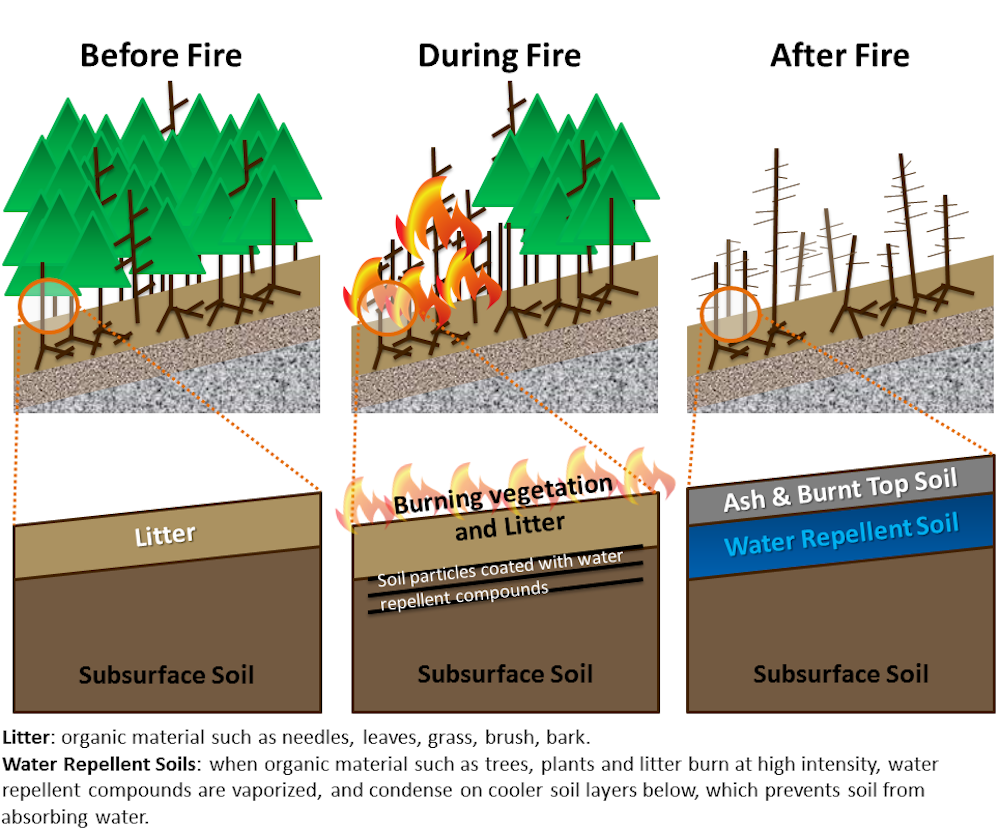
    When severe fires burn hillslopes, the high heat from the fires, sometimes exceeding 1,000 degrees Fahrenheit (538 degrees Celsius), completely destroys trees, shrubs, grass and structures, leaving behind a moonscape of gray ash. Not only that, the heat of the fire actually burns and damages the soil, creating a water-repellent, or hydrophobic, layer.

    What once was a vegetated hillslope, with leaves and trees to intercept rain and spongy soils to absorb water, is transformed into a barren landscape covered with ash, and burned soil where water cannot soak in.

    Illustrations show how fire can change the soil and landscape.
    National Weather Service

    When rain does fall on a burned area like this, water mixes with the ash, rocks and sediment to form a slurry. This slurry of debris then pours downhill in small gullies called rills, which then converge to form bigger and bigger rills, creating a torrent of sediment, water and debris rushing downhill. All this debris and water can transform small streams and usually dry gullies into a danger zone.

    Because the concentration of sediment is so high, especially when there is a large amount of ash and clay, debris flows behave more like a slurry of wet cement than a normal stream. This fluid can pick up and move large boulders, cars, trees and other debris rapidly downhill.

    A firefighter walks through knee-deep mud while checking for victims after a debris flow hit Montecito, Calif., in January 2018.
    Wally Skalij/Los Angeles Times via Getty Images

    In January 2018, a few weeks after the Thomas fire burned through the hills above Montecito, a storm triggered debris flows that killed 23 people and damaged at least 400 homes.

    What controls size and timing of debris flows

    The geography of the land, burn severity, storm intensity and soil characteristics all play important roles in if, when and where debris flows occur.

    Fire and debris flow scientists with the U.S. Geological Survey use these variables to create models to predict the likelihood and possible hazards from postfire debris flows. They are already developing maps to help residents, emergency managers and city officials prepare and predict postfire debris flows in 2025 burn areas in Los Angeles.

    The U.S. Geological Survey modeled debris flow risks after the Palisades Fire near Los Angeles. The map shows some of the highest-risk areas if hit by 15 minutes of rain falling at just under 1 inch (24 millimeters) per hour.
    USGS

    Some of the triggers of debris flows are literally part of the landscape.

    For example, the slope angle in a watershed and the amount of clay in the soil are important. Watersheds with gentle slopes – generally less than about 23 degrees – and a lack of clay and silt-sized particles are unlikely to produce debris flows.

    Other key factors that contribute to postfire debris flows relate to the proportion of the watershed that is severely burned and the intensity and duration of the rainstorm event.

    Early important research in the field of pyrogeomorphology demonstrated that while large, intense storms are more likely to cause large, intense debris flows, even small rainstorms can produce debris flows in burned areas.

    Debris flows are becoming more common

    A whopping 21.8 million Americans live within 3 miles of where a fire burned during the past two decades, and that population more than doubled from 2000 to 2019. A recent study from central and northern California indicates that nearly all the observed increases in area burned by wildfires in recent decades are due to human-caused climate change.

    The warming climate is also increasing the likelihood of more extreme downpours. The amount of moisture the atmosphere can hold increases by about 7% per degree Celsius of warming, leading to more intense downpours, particularly from ocean storms. In California, scientists project increases in rainfall intensity of 18% will result in an overall 110% increase in the probability of major debris flows.

    Jon Frye, of Santa Barbara Public Works, shows what happened in the January 2018 Montecito debris flow and why the risks to downslope communities would continue for several years. Source: County of Santa Barbara, 2018.

    Studies using models of fire, climate and erosion rates estimate that the amount of sediment flowing downhill after fires will increase by more than 10% in nine out of every 10 watersheds in the western U.S.

    Even without rain, debris on fire-damaged slopes can be unstable. A small slide in Pacific Palisades shortly after a fire burned through the area split a home in two. A phenomenon called “dry ravel” is a dominant form of hillslope erosion following wildfires in chaparral environments in Southern California

    Preparing for debris flow risks

    Research on charcoal pieces from ancient debris flows has shown fires and erosion have shaped Earth’s landscape for at least thousands of years. However, the rising risk of wildfires near populated areas and the potential for increasingly intense downpours mean a greater risk of damaging and potentially deadly debris flows.

    As their populations expand, community planners need to be aware of those risks and prepare.

    This article, originally published Jan. 23, 2025, has been updated with a flash flood watch issued.

    Jen Pierce receives funding from the National Science Foundation and is the chair of the Quaternary Geology and Geomorphology division of the Geological Society of America.

    ref. Rain on wildfire burn scars can trigger destructive debris flows − a geologist explains how – https://theconversation.com/rain-on-wildfire-burn-scars-can-trigger-destructive-debris-flows-a-geologist-explains-how-247770

    MIL OSI – Global Reports

  • MIL-OSI New Zealand: Te Aka Raataa: Regenerating Te Puhinui for a Greener Future

    Source: Auckland Council

    A major transformation is underway for Te Puhinui / Puhinui Stream, with Te Aka Raataa Stage 1 leading the charge to regenerate the mauri of this vital waterway and its surrounding communities.

    A Healthier Future for Manukau

    After years of declining water quality and environmental degradation, Te Aka Raataa is breathing new life into the stream and surrounding areas. This initiative reconnects people with nature, ensuring a healthier future for Manukau.

    As part of the Eke Panuku Transform Manukau regeneration programme, this project will revitalise Rata Vine Stream Reserve, creating green spaces that connect communities and link to the town centre, Hayman Park, and beyond.

    Councillor Daniel Newman is a strong advocate for seeing this investment in the south.

    “At its heart this project is about the health of urban streams and waterways, and how they relate to the neighbours and the surrounding community.” 

    “I am proud to have been able to help secure the budgets necessary to deliver these projects, and I know we can make a meaningful difference to the Puhinui Stream.

    My thanks to all of the staff and the contractors who are working on the front line to deliver a successful project, “says Councillor Daniel Newman.

    Also representing the Manurewa-Papakura ward, Councillor Angela Dalton sees the project as positive place-shaping for Auckland’s south.

    “I’m wholeheartedly behind Te Aka Raataa Stage 1 because it’s about shaping a sustainable future for our communities. By regenerating the awa, we’re making meaningful strides for the future – improving water quality, creating green spaces for people to reconnect with nature and each other, and strengthening links to the Manukau area. This is a wonderful opportunity to build a healthier, more resilient community, and I’m proud to be part of it.”  

    Te Whakaoranga o Te Puhinui: A Bold Regeneration Plan

    Te Puhinui, a cherished ecological and cultural taonga, has long been disconnected from its surrounding communities. The launch of Te Aka Raataa Stage 1 marks a significant milestone—an ambitious collaboration aimed at regenerating this natural treasure while transforming Manukau into a greener, more connected city.

    Grounded in mātauranga Māori, the initiative places iwi leadership at its heart, ensuring that the regeneration of Te Puhinui benefits future generations. Te Whakaoranga o Te Puhinui sets out a long-term vision for intergenerational well-being, emphasising the profound connections between people, place, and nature. This initiative is a key part of the broader Transform Manukau programme.

    Eke Panuku Priority Location Director, Richard Davison, says “This marks an exciting milestone in a project that has been years in the making as part of the Transform Manukau programme. Te Aka Raataa Stage 1 is about more than just regenerating a stream—it’s about reconnecting people with nature and strengthening community ties.

    “This first stage moves us closer to the vision of a continuous link from the Botanic Gardens to Hayman Park and Manukau city centre, creating a vibrant accessible pathway through a revitalised green space that everyone can enjoy, while also supporting new housing development in the area.”

    A Collaborative Effort for Lasting Change

    Bringing together Eke Panuku, Healthy Waters & Flood Resilience, Ngaati Tamaoho, Te Ākitai Waiohua, Ngaati Te Ata Waiohua, and the Manurewa Local Board, this project is a shared commitment to restoring the health of the Puhinui catchment and its people.  By restoring the stream to a more natural state, Eke Panuku and Auckland Council aim to improve water quality, support biodiversity, and create a healthier, more attractive and resilient environment for both people and wildlife.

    Local Board Chair Matt Winiata acknowledges the collaboration with iwi and wider community groups that have progressed this important kaupapa.

    “Undertaking a project like this would not be possible without the time, skill and mātauranga knowledge of our community.

    “Stage 1 is an exciting time for residents who live near the awa, the long-term benefits of a revitalised Puhinui Stream will be felt for generations to come.” 

    Project Benefits

    Awa-First approach: We’re helping the stream flow more like it used to by bringing back its natural state to improve its flow. By adding planting and wetlands, we’ll help protect the banks from washing away and improve the water quality.

    Revitalising green spaces: providing quality open spaces for people to relax, gather, learn and play.

    Connecting people to nature: Providing better community access to the stream with new boardwalks and improving connections with wider pathways for walking and cycling

    Supporting native wildlife: Creating healthy habitats for birds, insects, and aquatic life.

    This is just the beginning – Te Aka Raataa is laying the foundation for a greener, healthier Manukau, where both people and nature thrive together.  Works are scheduled to be completed by December 2025.

    MIL OSI New Zealand News

  • MIL-OSI Australia: $10 million for Cascade Pier upgrades

    Source: Australian Executive Government Ministers

    The Australian Government is investing in Norfolk Island’s shipping needs, with a $10 million project to repair and raise the Cascade Pier apron, as well as supporting future freight containerisation.

    The apron section of the Cascade Jetty sustained significant damage with large rocks being deposited on it from Cyclone Gabrielle in early 2023.

    The Australian Government’s investment will see this important commercial and recreational asset repaired and upgraded.  

    The project will see the apron raised and extended with storage and washdown facilities established for cargo containers, for the enhanced loading and unloading of materials, vessels and goods to and from the island. 

    It will improve cyclone resilience, marine access and shipping operations, along with safety for jetty users.

    The Norfolk Island community and stakeholders will have opportunities for input throughout the design and construction of the Cascade Pier upgrades, particularly in considering the needs of business, industry and pier users.

    Project design consultants will be on island for stakeholder engagement to support the detailed design works for the project in the next few months.

    The project to deliver two purpose-built Cargo Transfer Vessels (CTVs) is also now almost complete with construction being finalised and the CTVs anticipated to be delivered to the island by April this year. 

    The CTVs have been specifically constructed for Norfolk Island lighterage and delivered in partnership with Norfolk Island Regional Council to improve safety, efficiency and reliability, including for the crew loading and unloading the cargo. 

    Quotes attributable to Minister for Territories, Kristy McBain MP: 

    “As the first issue raised with me when I commenced as Minister, I understand the importance of reliable shipping to Norfolk Island.

    “Cascade Pier is not only critical for Norfolk’s sea freight supply, it’s an iconic part of the island’s coastline and heritage – which is why we’re investing in its future.

    “Upgrading the Cascade Pier apron is part of our Government’s commitment to supporting the long-term resilience and sustainability of Norfolk Island’s freight network.”

    Quotes attributable to the Member for Bean, David Smith MP: 

    “From fishing boats, to supply ships and cargo and lighterage vessels – Cascade Pier is a vital part of Norfolk Island.

    “These essential upgrades have the potential to reshape how freight is transported to and from the island, which is why I’m proud we’re delivering this targeted investment.

    “I’ll continue working with the community on ways we can support Norfolk Island’s distinct needs into the future.” 

    MIL OSI News

  • MIL-OSI USA: ICYMI: NBC: ‘L.A. fire captain who fought California wildfires to attend joint address to Congress’

    US Senate News:

    Source: United States Senator Alex Padilla (D-Calif.)

    ICYMI: NBC: ‘L.A. fire captain who fought California wildfires to attend joint address to Congress’

    Padilla and Líma survey the devastation of the Los Angeles fires [January 8, 2025] Additional photos of Senator Padilla and Captain Líma are available here.WASHINGTON, D.C. — In case you missed it, NBC recently highlighted U.S. Senator Alex Padilla’s (D-Calif.) announcement that Frank Líma, a longtime Los Angeles City fire captain and firefighter union leader, will be his guest at President Trump’s 2025 Address to a Joint Session of Congress. Captain Líma was on the frontlines in the fight against the devastating Los Angeles fires in January, including defending the Pacific Palisades fire station.
    The article focuses on Padilla and Líma’s push for a fully supported firefighting workforce as well as federal disaster relief for Southern California communities with no strings attached — as has always been the case for disaster aid from the federal government.
    Key Excerpts:
    Palisades and Eaton fire survivors still need help. That’s the message Sen. Alex Padilla, D-Calif., hopes to send to Congress next week at first joint address of President Donald Trump’s second term.
    Joining him at the address Tuesday will be union leader Frank Lima, a Los Angeles fire captain who helped defend the Pacific Palisades fire station when flames and scorching embers surrounded it on Jan. 7.
    “As President Trump outlines his priorities for our country, we want to make clear that Los Angeles County cannot be forgotten,” Padilla said in a statement. “The community faces a long road to recovery and we need a fully staffed and supported firefighting workforce and federal support without conditions.”
    Lima described the nearly weeklong siege “as a once-in-a-generation, biblical fire.” … Among the difficulties that week was persistent lack of resources, including water and staffing, within the overwhelmed fire department, whose ranks have dwindled in recent years. “We had more firefighters on duty in 1971 than we do today, yet our population doubled,” Lima told NBC News. “Our call load has increased fivefold per day. Our members are being run into the ground.”
    Padilla has repeatedly questioned the Trump administration’s approach to distributing disaster aid. He pushed Doug Burgum, who is now the interior secretary, at his confirmation hearing on the question of whether conditions should be placed on aid. “Each situation is different,” Burgum said. Padilla countered that there had never been strings attached to disaster relief. “And I certainly hope this is not the first case,” he said.
    Full text of the article is available here and below:
    L.A. fire captain who fought California wildfires to attend joint address to Congress
    By Alicia Victoria Lozano
    Palisades and Eaton fire survivors still need help.
    That’s the message Sen. Alex Padilla, D-Calif., hopes to send to Congress next week at first joint address of President Donald Trump’s second term.
    Joining him at the address Tuesday will be union leader Frank Lima, a Los Angeles fire captain who helped defend the Pacific Palisades fire station when flames and scorching embers surrounded it on Jan. 7.
    Attendees often bring guests who represent causes important to lawmakers.
    “As President Trump outlines his priorities for our country, we want to make clear that Los Angeles County cannot be forgotten,” Padilla said in a statement. “The community faces a long road to recovery and we need a fully staffed and supported firefighting workforce and federal support without conditions.”
    It has been nearly two months since deadly wildfires devastated the Los Angeles neighborhood of Pacific Palisades, the city of Altadena and surrounding communities in what is likely to be the costliest disaster in California’s history.
    At least 29 people died, and more than 16,000 structures were destroyed.
    Lima described the nearly weeklong siege “as a once-in-a-generation, biblical fire.” Hurricane-force winds ripped through large swaths of Los Angeles County, toppling trees and utility wires and sending thick smoke, ash and soot whirling across the county.
    Among the difficulties that week was persistent lack of resources, including water and staffing, within the overwhelmed fire department, whose ranks have dwindled in recent years.
    “We had more firefighters on duty in 1971 than we do today, yet our population doubled,” Lima told NBC News. “Our call load has increased fivefold per day. Our members are being run into the ground.”
    Amid ongoing tensions over how the fires were handled, Mayor Karen Bass ousted Fire Chief Kristin Crowley last week.
    The decision was made “in the best interests of Los Angeles’ public safety, and for the operations of the Los Angeles Fire Department,” Bass said in a statement.
    “We know that 1,000 firefighters that could have been on duty on the morning the fires broke out were instead sent home on Chief Crowley’s watch,” Bass said.
    On Thursday, Crowley appealed the decision, she said in a statement obtained by NBC Los Angeles.
    The blame game has been constant since January.
    When Trump viewed the destruction two weeks after the fires, he initially expressed shock and then pointed the finger at California Democratic leaders for failing to address the state’s ongoing wildfire threat.
    Trump argued that wildlife protections have impeded access to water in California and then suggested he could withhold disaster aid over disagreements about voter ID laws and water policies.
    Lima said Thursday: “Federal aid should not come with strings attached. Our firefighters and this community and the state need federal support.”
    A recent economic impact study estimated total damages of the Palisades and Eaton fires will top $53 billion. The study, released by the nonprofit Los Angeles County Economic Development Corporation, listed “federal funding uncertainty” as a primary recovery challenge.
    Padilla has repeatedly questioned the Trump administration’s approach to distributing disaster aid. He pushed Doug Burgum, who is now the interior secretary, at his confirmation hearing on the question of whether conditions should be placed on aid.
    “Each situation is different,” Burgum said.
    Padilla countered that there had never been strings attached to disaster relief.
    “And I certainly hope this is not the first case,” he said.
    Background:
    Senator Padilla has fought relentlessly to secure and protect Southern Californians’ access to desperately needed disaster relief aid. In the immediate aftermath of the Los Angeles fires, Padilla and Senator Adam Schiff (D-Calif.) led 47 bipartisan members of the California Congressional delegation in successfully urging President Biden to grant Governor Gavin Newsom’s request for a major disaster declaration to expedite timely relief to Los Angeles County residents impacted by these disasters. Padilla also delivered remarks on the Senate floor urging his Republican colleagues and President Trump to provide essential disaster recovery aid to California without conditioning it on the passage of partisan legislation.
    Last month, Padilla introduced bipartisan legislation to create a national Wildfire Intelligence Center to streamline federal response and create a whole-of-government approach to combat wildfires. He also announced a package of three bipartisan bills to bolster fire resilience and proactive mitigation efforts, including the Wildfire Emergency Act, the Fire-Safe Electrical Corridors Act, and the Disaster Mitigation and Tax Parity Act. In January, Padilla introduced another suite of bipartisan bills to strengthen wildfire recovery and resilience, including the Wildland Firefighter Paycheck Protection Act to protect firefighter pay.

    MIL OSI USA News

  • MIL-OSI USA: New Yorkers Urged to Prepare for Ice Jam Flooding

    Source: US State of New York

    overnor Kathy Hochul today urged New Yorkers to prepare for potential flooding due to warm temperatures and rainfall, starting Tuesday night and continuing through Thursday. Temperatures will increase across the State starting Tuesday, with some places seeing close to 60 degrees. Higher-than-normal temperatures combined with up to an inch of rainfall may result in localized flooding and elevated river flows with some ice jams, especially on creeks and streams in Western and northern Central New York.

    “New York is no stranger to extreme weather and the potential danger of flooding,” Governor Hochul said. “My administration is monitoring the weather closely and will deploy resources if necessary to keep New Yorkers safe, and I encourage everyone to remain vigilant and watch the forecast closely over the next several days.”

    There is a Flood Watch in effect for Western NY, the northern Finger Lakes, northern Central NY and the Tug Hill Plateau of the North Country from Tuesday afternoon through Thursday afternoon due to snow melt, rainfall and ice movement. Ice jam flooding will be possible, especially on creeks and streams where blockages have already been reported. For a complete listing of weather alerts, visit the National Weather Service website. New Yorkers are also encouraged to sign up for emergency alerts by subscribing to NY Alert — a free service providing critical emergency information to your cell phone or computer.

    Agency Preparations

    New York State Division of Homeland Security and Emergency Services
    The Division’s Office of Emergency Management is in contact with their local counterparts and is prepared to facilitate requests for assistance. State stockpiles are staffed and ready to deploy emergency response assets and supplies as needed. The State Watch Center is monitoring statewide impacts closely. Flood safety tips can be found at www.dhses.ny.gov.

    Department of Transportation

    The State Department of Transportation is prepared to respond with more than 3,763 supervisors and operators. Department staff are actively monitoring known problem areas and are ready to take action as needed to mitigate flooding. Crews can be configured into any type of response needed, including flood response, chipper, load & haul, sewer jet, cut & toss, traffic signal, etc. DOT crews are also proactively clearing snowbanks, checking and clearing drains and culverts. All residencies in impacted locations will remain staffed with operators, supervisors and mechanics throughout the duration of the event and priority cleanup operations.

    Statewide equipment numbers are as follows:

    • 1,610 large dump trucks
    • 349 large loaders
    • 90 chippers
    • 83 wheeled and tracked excavators
    • 15 vacuum trucks with sewer jets
    • 12 tree crew bucket trucks

    The need for additional resources will be re-evaluated as conditions warrant throughout the event.

    For real-time travel information, motorists should call 511 or visit https://www.511ny.org/#:Alerts, New York State’s official traffic and travel information source.

    Thruway Authority

    The Thruway Authority has 693 operators and supervisors prepared to respond to any wind, flood, or weather-related issues across the State with small to large plow/dump trucks, medium sized excavators, large loaders, vacuum trucks, portable pumps, chainsaws, brush chippers and other equipment. In addition, Division Maintenance crews are proactively inspecting, clearing and maintaining ditches, culverts and storm drains to effectively channel storm water away from road surfaces and roadbeds to prevent flooding on the roadway.

    Variable Message Signs and social media are utilized to alert motorists of weather conditions on the Thruway. The Thruway Authority encourages motorists to download its mobile app which is available for free on iPhone and Android devices. The app provides motorists direct access to real-time traffic information, live traffic cameras and navigation assistance while on the go. Motorists can also sign up for TRANSalert e-mails and follow @ThruwayTraffic on X for the latest traffic conditions along the Thruway.

    New York State Police

    State Police have instructed all Troopers to remain vigilant and will deploy extra patrols to affected areas as needed. All four-wheel drive vehicles are in service and all specialty vehicles, including Utility Terrain Vehicles, are staged and ready for deployment.

    Department of Public Service

    New York’s utilities have about 5,500 workers available statewide to engage in damage assessment, response, repair and restoration efforts across New York State, as necessary. Agency staff will track utilities’ work throughout the event and ensure utilities shift appropriate staffing to regions that experience the greatest impact.

    New York State Department of Environmental Conservation
    DEC Emergency Management staff, Environmental Conservation Police Officers, Forest Rangers and regional staff remain on alert and continue to monitor the developing situation and weather forecasts. Working with partner agencies, DEC is prepared to coordinate resource deployment of all available assets, including first responders, to targeted areas in preparation for potential impacts due to heavy rainfall and flooding.

    Unpredictable weather and storms in the Adirondacks, Catskills and other backcountry areas, can create unexpectedly hazardous conditions. Visitors should be prepared with proper clothing and equipment for rain, snow, ice and the cold to ensure a safe outdoor experience. Trails have mixed conditions of snow, ice, slush and mud.

    Hikers are advised to temporarily avoid all high-elevation trails, as well as trails that cross rivers and streams. Hikers in the Adirondacks are encouraged to check the Adirondack Backcountry Information webpages for updates on trail conditions, seasonal road closures and general recreation information. Backcountry visitors should Hike Smart and follow proper safety guidelines. Plan trips accordingly. In an emergency, call 9-1-1. To request Forest Ranger assistance, call 1-833-NYS-RANGERS.

    With warmer temperatures expected throughout the week, DEC reminds any outdoor enthusiasts to be mindful of conditions when hiking and to use caution when venturing onto ice. While some waterways may appear frozen, DEC advises outdoor enthusiasts to review ice safety guidelines before heading out.

    Office of Parks, Recreation and Historic Preservation

    New York State Park Police and park personnel are on alert and closely monitoring weather conditions and impacts. Park visitors should visit parks.ny.gov, check the free mobile app, or call their local park office for the latest updates regarding park hours, openings and closings.

    Flood Safety Tips

    • Learn the safest route from your home or business to high, safe ground should you have to leave in a hurry.
    • Develop and practice a ‘family escape’ plan and identify a meeting place if family members become separated.
    • Make an itemized list of all valuables including furnishings, clothing and other personal property. Keep the list in a safe place and consider maintainig photo and video documentation.
    • Stockpile emergency supplies of canned food, medicine and first aid supplies and drinking water. Store drinking water in clean, closed containers.
    • Plan what to do with your pets.
    • Have a portable radio, flashlights, extra batteries and emergency cooking equipment available.
    • Keep your automobile fueled. If electric power is cut off, gasoline stations may not be able to pump fuel for several days. Have a small disaster supply kit in the trunk of your car.
    • Find out how many feet your property is above and below possible flood levels. When predicted flood levels are broadcast, you can determine if you may be flooded.
    • Keep materials like sandbags, plywood, plastic sheeting and lumber handy for emergency waterproofing.
    • Check on your insurance coverage. Homeowners’ insurance policies generally do not cover flood damages. Only flood insurance can protect your home against flood damages. You can purchase flood insurance whether or not you live in a mapped flood zone.

    For a complete list of weather terms and preparation ideas before, during and after a flood, visit the Division of Homeland Security and Emergency Services website at https://www.dhses.ny.gov/flood-safety-tips.

    MIL OSI USA News

  • MIL-OSI USA: 35 Years Ago: STS-36 Flies a Dedicated Department of Defense Mission

    Source: NASA

    On Feb. 28, 1990, space shuttle Atlantis took off from NASA’s Kennedy Space Center in Florida on STS-36, the sixth shuttle mission dedicated to the Department of Defense. As such, many of the details of the flight remain classified. The mission marked the 34th flight of the space shuttle, the sixth for Atlantis, and the fourth night launch of the program. The crew of Commander John Creighton, Pilot John Casper, Mission Specialists Mike Mullane, David Hilmers, and Pierre Thuot flew Atlantis to the highest inclination orbit of any human spaceflight to date. During the four-day mission, the astronauts deployed a classified satellite, ending with a landing at Edwards Air Force Base in California.  

    In February 1989, NASA assigned astronauts Creighton, Casper, Mullane, Hilmers, and Thuot to the STS-36 mission. The mission marked the second spaceflight for Creighton, selected as an astronaut in 1978. He previously served as the pilot on STS-51G. Mullane, also from the class of 1978, previously flew on STS-41D and STS-27, while Hilmers, from the class of 1980, previously flew on STS-51J and STS-26. For Casper and Thuot, selected as astronauts in the classes of 1984 and 1985, respectively, STS-36 marked their first trip into space.  

    Atlantis returned from its previous flight, STS-34, in October 1989. The orbiter spent a then-record 75 days in the processing facility and assembly building, rolling out to Launch Pad 39A on Jan. 25, 1990. The astronauts arrived on Feb. 18 for the planned launch four days later. First Creighton, then Casper and Hilmers, came down with colds, delaying the launch to Feb. 25. Weather and hardware problems pushed the launch back to Feb. 28, giving the astronauts time to return to Houston for some simulator training. On launch day, winds and rain delayed the liftoff for more than two hours before launch controllers gave Atlantis the go to launch. 

    With mere seconds remaining in the launch window, Atlantis lifted off at 2:50 a.m. EST Feb. 28, to begin the STS-36 mission. Atlantis flew an unusual dog leg maneuver during ascent to achieve the mission’s 62-degree inclination. Once Atlantis reached orbit, the classified nature prevented any more detailed public coverage of the mission. The astronauts likely deployed the classified satellite on the mission’s second day. During the remainder of their mission, the astronauts conducted several experiments and photographed preselected areas and targets of opportunity on planet Earth. Their high-inclination orbit enabled them to photograph areas not usually seen by shuttle crews. 

    To maintain the mission’s confidentiality, NASA could reveal the touchdown time only 24 hours prior to the event. On March 4, Creighton and Casper brought Atlantis to a smooth landing at Edwards Air Force Base after 72 orbits of the Earth and a flight of four days, 10 hours, and 18 minutes. About an hour after touchdown, the astronaut crew exited Atlantis for the ride to crew quarters and the flight back to Houston. Later in the day, ground crews prepared Atlantis for the ferry ride back to Kennedy. Atlantis left Edwards on March 10 and three days later arrived at Kennedy, where workers began to prepare it for its next flight, STS-38 in November 1990. 

    MIL OSI USA News

  • MIL-OSI USA: Going With the Flow: Visualizing Ocean Currents with ECCO

    Source: NASA

    Historically, the ocean has been difficult to model. Scientists struggled in years past to simulate ocean currents or accurately predict fluctuations in temperature, salinity, and other properties. As a result, models of ocean dynamics rapidly diverged from reality, which meant they could only provide useful information for brief periods.
    In 1999, a project called Estimating the Circulation and Climate of the Ocean (ECCO) changed all that. By applying the laws of physics to data from multiple satellites and thousands of floating sensors, NASA scientists and their collaborators built ECCO to be a realistic, detailed, and continuous ocean model that spans decades. ECCO enabled thousands of scientific discoveries, and was featured during the announcement of the Nobel Prize for Physics in 2021.
    NASA ECCO is a powerful integrator of decades of ocean data, narrating the story of Earth’s changing ocean as it drives our weather, and sustains marine life.
    The ECCO project includes hundreds of millions of real-world measurements of temperature, salinity, sea ice concentration, pressure, water height, and flow in the world’s oceans. Researchers rely on the model output to study ocean dynamics and to keep tabs on conditions that are crucial for ecosystems and weather patterns. The modeling effort is supported by NASA’s Earth science programs and by the international ECCO consortium, which includes researchers from NASA’s Jet Propulsion Laboratory in Southern California and eight research institutions and universities.
    The project provides models that are the best possible reconstruction of the past 30 years of the global ocean. It allows us to understand the ocean’s physical processes at scales that are not normally observable.

    Large-scale wind patterns around the globe drag ocean surface waters with them, creating complex currents, including some that flow toward the western sides of the ocean basins. The currents hug the eastern coasts of continents as they head north or south from the equator: These are the western boundary currents. The three most prominent are the Gulf Stream, Agulhas, and Kuroshio. NASA Goddard’s Scientific Visualization Studio.

    Seafarers have known about the Gulf Stream — the Atlantic Ocean’s western boundary current — for more than 500 years. By the volume of water it moves, the Gulf Stream is the largest of the western boundary currents, transporting more water than all the planet’s rivers combined.
    In 1785, Benjamin Franklin added it to maritime charts showing the current flowing up from the Gulf, along the eastern U.S. coast, and out across the North Atlantic. Franklin noted that riding the current could improve a ship’s travel time from the Americas to Europe, while avoiding the current could shorten travel times when sailing back.

    Franklin’s charts showed a smooth Gulf Stream rather than the twisted, swirling path revealed in ECCO data. And Franklin couldn’t have imagined the opposing flow of water below the Gulf Stream. The countercurrent runs at depths of about 2,000 feet (600 meters) in a cold river of water that is roughly the opposite of the warm Gulf Stream at the surface. The submarine countercurrent is clearly visible when the upper layers in the ECCO model are peeled away in visualizations.
    The Gulf Stream is a part of the Atlantic Meridional Overturning Circulation (AMOC), which moderates climate worldwide by transporting warm surface waters north and cool underwater currents south. The Gulf Stream, in particular, stabilizes temperatures of the southeastern United States, keeping the region warmer in winter and cooler in summer than it would be without the current. After the Gulf Stream crosses the Atlantic, it tempers the climates of England and the European coast as well.

    The Agulhas Current flows south along the western side of the Indian Ocean. When it reaches the southern tip of Africa, it sheds swirling vortices of water called Agulhas Rings. Sometimes persisting for years, the rings glide across the Atlantic toward South America, transporting small fish, larvae, and other microorganisms from the Indian Ocean. 
    Researchers using the ECCO model can study Agulhas Current flow as it sends warm, salty water from the tropics in the Indian Ocean toward the tip of South Africa. The model helps tease out the complicated dynamics that create the Agulhas rings and large loop of current called a supergyre that surrounds the Antarctic. The Southern Hemisphere supergyre links the southern portions of other, smaller current loops (gyres) that circulate in the southern Atlantic, Pacific, and Indian oceans. Together with gyres in the northern Atlantic and Pacific, the southern gyres and Southern Hemisphere supergyre influence climate while transporting carbon around the globe. 

    In addition to affecting global weather patterns and temperatures, western boundary currents can drive vertical flows in the oceans known as upwellings. The flows bring nutrients up from the depths to the surface, where they act as fertilizer for phytoplankton, algae, and aquatic plants.
    The Kuroshio Current that runs on the west side of the Pacific Ocean and along the east side of Japan has recently been associated with upwellings that enrich coastal fishing waters. The specific mechanisms that cause the vertical flows are not entirely clear. Ocean scientists are now turning to ECCO to tease out the connection between nutrient transport and currents like the Kuroshio that might be revealed in studies of the water temperature, density, pressure, and other factors included in the ECCO model.

    When viewed through the lens of ECCO’s temperature data, western boundary currents carry warm water away from the tropics and toward the poles. In the case of the Gulf Stream, as the current moves to far northern latitudes, some of the saltwater freezes into salt-free sea ice. The saltier water left behind sinks and then flows south all the way toward the Antarctic before rising and warming in other ocean basins. 

    Currents also move nutrients and salt throughout Earth’s ocean basins. Swirling vortexes of the Agulhas rings stand out in ECCO temperature and salinity maps as they move warm, salty water from the Indian Ocean into the Atlantic.

    ECCO offers researchers a way to run virtual experiments that would be impractical or too costly to perform in real oceans. Some of the most important applications of the ECCO model are in ocean ecology, biology, and chemistry. Because the model shows where the water comes from and where it goes, researchers can see how currents transport heat, minerals, nutrients, and organisms around the planet. 
    In prior decades, for example, ocean scientists relied on extensive temperature and salinity measurements by floating sensors to deduce that the Gulf Stream is primarily made of water flowing past the Gulf rather than through it. The studies were time-consuming and expensive. With the ECCO model, data visualizers at NASA’s Goddard Space Flight Center in Greenbelt, Maryland, virtually replicated the research in a simulation that was far quicker and cheaper.

    The example illustrated here relies on ECCO to track the flow of water by virtually filling the Gulf with 115,000 particles and letting them move for a year in the model. The demonstration showed that less than 1% of the particles escape the Gulf to join the Gulf Stream. 
    Running such particle-tracking experiments within the ocean circulation models helps scientists understand how and where environmental contaminants, such as oil spills, can spread.

    Today, researchers turn to ECCO for a broad array of studies. They can choose ECCO modeling products that focus on one feature – such as global flows or the biology and chemistry of the ocean – or they can narrow the view to the poles or specific ocean regions. Every year, more than a hundred scientific papers include data and analyses from the ECCO model that delve into our oceans’ properties and dynamics. 

    [embedded content]
    Credits: Kathleen Gaeta Greer/ NASA’s Scientific Visualization Studio 

    Composed by James Riordon / NASA’s Earth Science News Team
    Information in this piece came from the resources below and interviews with the following sources: Nadya Vinogradova Shiffer, Dimitris Menemenlis, Ian Fenty, and Atousa Saberi.  

    Liao, F., Liang, X., Li, Y., & Spall, M. (2022). Hidden upwelling systems associated with major western boundary currents. Journal of Geophysical Research: Oceans, 127(3), e2021JC017649.
    Richardson, P. L. (1980). The Benjamin Franklin and Timothy Folger charts of the Gulf Stream. In Oceanography: The Past: Proceedings of the Third International Congress on the History of Oceanography, held September 22–26, 1980 at the Woods Hole Oceanographic Institution, Woods Hole, Massachusetts, USA on the occasion of the Fiftieth Anniversary of the founding of the Institution (pp. 703-717). New York, NY: Springer New York.
    Biastoch, A., Rühs, S., Ivanciu, I., Schwarzkopf, F. U., Veitch, J., Reason, C., … & Soltau, F. (2024). The Agulhas Current System as an Important Driver for Oceanic and Terrestrial Climate. In Sustainability of Southern African Ecosystems under Global Change: Science for Management and Policy Interventions (pp. 191-220). Cham: Springer International Publishing.
    Lee-Sánchez, E., Camacho-Ibar, V. F., Velásquez-Aristizábal, J. A., Valencia-Gasti, J. A., & Samperio-Ramos, G. (2022). Impacts of mesoscale eddies on the nitrate distribution in the deep-water region of the Gulf of Mexico. Journal of Marine Systems, 229, 103721.

    MIL OSI USA News

  • MIL-OSI USA: FEMA to Host Housing Resource Fair Mar. 8 in Coffee County

    Source: US Federal Emergency Management Agency

    Headline: FEMA to Host Housing Resource Fair Mar. 8 in Coffee County

    FEMA to Host Housing Resource Fair Mar. 8 in Coffee County

    FEMA is hosting a Housing Resource Fair from 9 a.m. to 5 p.m., Saturday, Mar. 8, in Coffee County at the following location:The Atrium114 North Peterson Ave Douglas, GA 31533                                                                                            The Housing Resource Fair will bring together federal, state and local agencies in one place to offer services and resources to families recovering from Hurricane Helene.  The goal of this collaborative effort is to help connect eligible disaster survivors with affordable housing along with valuable information and resources on their road to recovery.Survivors will meet with local housing organizations, property owners and landlords, as well as gain information on the HEARTS Georgia Sheltering Program, and U.S. Small Business Administration (SBA) loans.The Housing Resource Fair is an opportunity for survivors to: Explore affordable housing options and rental assistance programs. Meet with representatives from local housing organizations, landlords and property managers. Gain access to resources for displaced individuals and families. Learn about community partners that will provide educational funding resources to attendees. For FEMA Federal Coordinating Officer Kevin Wallace, the Housing Resource Fair will give survivors that needed one-on-one experience: “We want survivors to know we are here for them and want to see the best outcome, which is moving into safe, sanitary and functioning housing,” he said. “We will walk them through their options to ensure they are aware of the resources that are available to fit their need.”Anyone who was affected by Tropical Storm Debby or Hurricane Helene, whether they have applied for FEMA assistance or not, is welcome to attend.
    jakia.randolph
    Mon, 03/03/2025 – 13:17

    MIL OSI USA News

  • MIL-OSI USA: FEMA Mitigation Experts Offer Rebuilding Advice in Manatee and Sarasota Counties

    Source: US Federal Emergency Management Agency 2

    FEMA Mitigation Experts Offer Rebuilding Advice in Manatee and Sarasota Counties

    TALLAHASSEE, Fla.– As Floridians rebuild, survivors of Hurricanes Milton, Helene and Debby can get free advice on how to rebuild stronger and safer against storms. FEMA mitigation specialists will be available to answer questions and offer free home improvement tips and proven methods to prevent and lessen damage from future disasters.This information is geared for do-it-yourself work and general contractors.FEMA specialists will be available from March 3 through March 15 from 7:30 a.m. to 5:00 p.m. ET, Monday – Friday and on Saturday from 7:30 a.m. to 1:00 p.m. ET, at the following locations:Manatee County: Home Depot, 5820 E. State Road 64, Bradenton, FL 34208Sarasota County: Home Depot, 4111 Cattleman Road, Sarasota, FL 34233 Mitigation is an effort to reduce the loss of life and property damage by lessening the impact of a disaster through   construction and remodeling best practices.An insurance specialist will be present to answer National Flood Insurance Program (NFIP) questions. Disaster Survivor Assistance teams will be on hand to provide updates on FEMA applications and answer questions.Stay in Touch with FEMAIt is important to let FEMA know about any changes to your contact information. You may update contact information or check on the status of your application by:Visiting DisasterAssistance.govCalling FEMA directly at 800-621-3362Using the FEMA appFor the latest information about Hurricane Milton recovery, visit fema.gov/disaster/4834. For Hurricane Helene recovery information, visit fema.gov/disaster/4828. For Hurricane Debby, visit fema.gov/disaster/4806. Follow FEMA on X at x.com/femaregion4or on Facebook at facebook.com/fema.
    sixto.valentin…
    Mon, 03/03/2025 – 12:45

    MIL OSI USA News

  • MIL-OSI Asia-Pac: India’s Wildlife Conservation Milestones

    Source: Government of India

    India’s Wildlife Conservation Milestones

    Policies, Achievements and Global Commitments

    Posted On: 03 MAR 2025 6:47PM by PIB Delhi

    “Today, on World Wildlife Day, let’s reiterate our commitment to protect and preserve the incredible biodiversity of our planet. Every species plays a vital role—let’s safeguard their future for generations to come! We also take pride in India’s contributions towards preserving and protecting wildlife.”

    Shri Narendra Modi, Prime Minister of India[1]


    Introduction

    Every year on March 3rd, the world celebrates United Nations World Wildlife Day (WWD) to honour the vital role of wild animals and plants in our lives and the planet’s health. This day is a reminder of the need to protect and preserve biodiversity for future generations. The theme for WWD 2025 is “Wildlife Conservation Finance: Investing in People and Planet.” [2]

    [3]

    Prime Minister Shri Narendra Modi visited Gir National Park in Gujarat today to chair the 7th meeting of the National Board for Wildlife. The Board reviewed the Government’s key wildlife conservation efforts, including the expansion of protected areas and flagship programs like Project Tiger, Project Elephant, and Project Snow Leopard. Discussions also covered initiatives for the conservation of dolphins and Asiatic lions, along with the establishment of the International Big Cats Alliance.[4]

    [5]Prime Minister Shri Narendra Modi at Gir National Park

    India is one of the most biodiverse countries in the world, even though it covers only 2.4% of the Earth’s land. It is home to 7-8% of all known species, including over 45,000 types of plants and 91,000 types of animals. The country’s varied landscapes and climate have created different ecosystems like forests, wetlands, grasslands, deserts, and coastal and marine habitats. These ecosystems support rich biodiversity and benefit people in many ways. India also has 4 of the world’s 34 major biodiversity hotspotsthe Himalayas, the Western Ghats, the Northeast region, and the Nicobar Islands—making it an important region for global conservation.[6]

    The Government of India, primarily through the Ministry of Environment, Forest and Climate Change (MoEFCC), has instituted a comprehensive framework of policies, legislative measures, and initiatives aimed at conserving and protecting this natural heritage.

    Budgetary Allocations[7]

    In the Union Budget 2025-26, the Ministry of Environment, Forests, and Climate Change has been allocated ₹3,412.82 crores, which is 9% higher than the 2024-25 revised estimates of Rs. 3125.96 crores.

    • ₹3,276.82 crore (96%) is for revenue expenditure, which has increased by 8%.
    • ₹136 crore (4%) is for capital expenditure, which has risen by 46% from 93.25 crore from 2024-25 revised estimates.

    For 2025-26, the central government has allocated ₹450 crore for the Integrated Development of Wildlife Habitats under its centrally sponsored scheme. Additionally, ₹290 crore (64% of the total allocation) has been earmarked for Project Tiger and Elephant, reflecting an 18% increase from the 2024-25 revised estimates.[8]

    National Wildlife Database Cell

    The National Wildlife Database Centre of Wildlife Institute of India (WII) has been developing a National Wildlife Information System (NWIS) on the Protected Areas of the country. As of 27th November, 2023 India has a network of 1014 Protected Areas including 106 National Parks, 573 Wildlife Sanctuaries, 115 Conservation Reserves and 220 Community Reserves covering a total of 1,75,169.42 km2 of geographical area of the country which is approximately 5.32%. [9]


    Category

    Number

    National Parks

    106

    Wildlife Sanctuaries

    573

    Conservation Reserves

    115

    Community Reserves

    220

    Total

    1014


    The National Wildlife Database Centre (NWDC) is providing information on the conservation status of animal species, biogeographic regions, administrative units, habitat types and the network of protected areas in India, in a variety of formats and also providing an extensive bibliographic support for wildlife research.

    1. Legislative and Policy Framework

    • National Wildlife Action Plan (2017-2031): This strategic plan emphasizes landscape-level conservation, community involvement, and the integration of climate change considerations into wildlife management.[10]
    • National Human-Wildlife Conflict Mitigation Strategy and Action Plan: The National Human-Wildlife Conflict Mitigation Strategy and Action Plan (2021-26) (HWC-NAP) aims to systematically reduce human-wildlife conflict (HWC) while ensuring wildlife conservation, ecosystem protection, and sustainable development. Developed through a four-year consultative process under the Indo-German Project on HWC Mitigation, it integrates scientific, policy, and community-driven approaches to balance human well-being with wildlife protection. [11]

    2. Species-Specific Conservation Initiatives – Success Stories

    2.1 Project Dolphin: Key Developments and Conservation Efforts[12]

    Launched on 15th August 2020, Project Dolphin aims to conserve both marine and riverine dolphins, along with associated cetaceans, through habitat protection, scientific research, and community awareness. In 2022-23, ₹241.73 lakhs and in 2023-24, ₹248.18 lakhs were allocated under the CSS: Development of Wildlife Habitats for conservation activities. Key dolphin hotspots have been identified in Assam, Rajasthan, Madhya Pradesh, Punjab, and Lakshadweep, with focused efforts on species protection, habitat improvement, monitoring, patrolling, and awareness programs. A Comprehensive Action Plan (2022-2047) has been finalized and shared with relevant Ministries for execution.

    Policy & Governance Enhancements

    • The Wild Life (Protection) Act, 1972 was amended in December 2022, empowering the Indian Coast Guard with enforcement powers and recognizing Gangetic & Indus River Dolphins as distinct species under Schedule I.
    • The Project Dolphin Steering Committee was reconstituted, with the first committee meeting held on 6th September 2023, where the first edition of the Project Dolphin Newsletter was launched.
    • States have been urged to align with International Whaling Commission regulations, appointing Dolphin and Whaling Commissioners for conservation efforts.

    Scientific Research & International Engagement

    • Population estimation of riverine dolphins has been completed, with the report under finalization.
    • A meeting on Irrawaddy dolphins was conducted in Odisha with the Minister of Environment, Forest & Climate Change in attendance.
    • India participated in discussions on the Global Declaration for River Dolphins (23-24 October 2023, Bogotá, Colombia), reinforcing its commitment to global dolphin conservation.
    • Chambal River Conservation Zone: A 200 km stretch in Madhya Pradesh, Rajasthan, and Uttar Pradesh has been recommended for designation as a Dolphin Conservation Zone for targeted protection efforts.

    India’s First-Ever Ganges River Dolphin Tagging: A Historic Conservation Milestone[13]

    On 18th December 2024, India achieved a groundbreaking milestone by successfully satellite-tagging the first-ever Ganges River Dolphin (Platanista gangetica) in Assam under Project Dolphin. Led by the Wildlife Institute of India (WII) in collaboration with the Assam Forest Department and Aaranyak, and funded by the National CAMPA Authority (MoEFCC), this initiative marks a global first in dolphin conservation.

    • With 90% of the global population found in India, knowledge gaps on their movement and ecology have hindered conservation efforts.
    • This initiative will study their habitat use, migration patterns, and environmental stressors, aiding better conservation strategies.

    Technology & Future Steps

    • Advanced lightweight satellite tags compatible with Argos satellite systems enable tracking despite dolphins’ minimal surfacing time.
    • Plans are underway to expand tagging across other states, creating a comprehensive conservation roadmap.

    2.2  50 Years of Project Tiger: [14]

    Project Tiger, initiated in 1973, has been India’s flagship conservation initiative, successfully completing 50 years in 2023. Focused on tiger conservation through dedicated reserves and strict protection measures, it has played a crucial role in reviving tiger populations. Marking this milestone, the Prime Minister inaugurated a commemorative event in Mysuru, Karnataka, on April 9, 2023. As per the 5th cycle of All India Tiger Estimation 2022, India now hosts over 70% of the world’s wild tiger population, reaffirming its leadership in global tiger conservation.

    Statistic

    Value

    India’s Share of Global Wild Tigers

    Over 70%

    Minimum Tiger Population

    3,167

    Estimated Upper Limit

    3,925

    Average Population

    3,682

    Annual Growth Rate

    6.1%

    India has reaffirmed its position as a global leader in tiger conservation, with the tiger population rising to 3,682 (range 3,167-3,925) as per the All India Tiger Estimation 2022, marking a steady increase from 2,967 in 2018 and 2,226 in 2014. The population is growing at 6.1% per annum in consistently sampled areas.[15]

    To commemorate 50 years of Project Tiger, the Prime Minister released key reports, including the ‘Amrit Kaal Ka Vision for Tiger Conservation’, the 5th cycle of Management Effectiveness Evaluation (MEE) of Tiger Reserves, and the official summary of All India Tiger Estimation 2022. A commemorative coin was also issued.

    Major Conservation Efforts

    Tiger Reserve Expansion & Management

    • India now has 54 tiger reserves, covering over 78,000 sq. km (2.30% of the country’s geographical area), with Rani Durgavati Tiger Reserve (Madhya Pradesh) being the latest addition.
    • MEE 2022 assessed 51 reserves, ranking 12 as ‘Excellent’, 21 as ‘Very Good’, 13 as ‘Good’, and 5 as ‘Fair’.

    Reintroduction of Tigers in Extinct Areas

    • Tigers have been reintroduced in Rajaji (Uttarakhand), Madhav (Madhya Pradesh), Mukundra Hills (Rajasthan), and Ramgarh Vishdhari (Rajasthan) Tiger Reserves, with plans for Buxa Tiger Reserve next.

    Global Conservation Recognition & Collaboration

    • 23 Indian tiger reserves are now CA|TS-accredited, ensuring global best practices in conservation, with six new reserves receiving accreditation this year.
    • Pench and Satpura Tiger Reserves received the prestigious Tx2 Award for doubling their tiger populations.
    • India signed MoUs with Cambodia for tiger reintroduction and held bilateral discussions with Bangladesh for transboundary conservation in the Sundarbans.

    2.3 International Big Cat Alliance (IBCA) Becomes a Treaty-Based Organization[16]

    The International Big Cat Alliance (IBCA) officially became a treaty-based intergovernmental organization on January 23, 2025, with Nicaragua, Eswatini, India, Somalia, and Liberia ratifying the agreement. With 27 countries onboard, IBCA aims to drive global big cat conservation through cross-border collaboration.

    About IBCA

    • Launched by PM Narendra Modi on April 9, 2023, during the 50 Years of Project Tiger event.
    • Union Cabinet approved its establishment in February 2024, with headquarters in India.
    • Founded by the National Tiger Conservation Authority (NTCA) under MoEFCC on March 12, 2024.
    • Focuses on the conservation of seven big cat species: Tiger, Lion, Leopard, Snow Leopard, Cheetah, Jaguar, and Puma.

    Key Objectives & Impact

    • Enhances global collaboration among governments, conservationists, and NGOs.
    • Establishes a central fund and technical hub for research and conservation efforts.
    • Strengthens habitat protection, anti-poaching strategies, and wildlife law enforcement.
    • Combats illegal wildlife trade and promotes sustainable conservation practices.
    • Integrates climate change mitigation into conservation strategies.

    With IBCA’s legal status now formalized, it marks a historic milestone in global big cat conservation, fostering stronger international cooperation to protect these apex predators and their ecosystems.

    In collaboration with Kaziranga National Park and Tiger Reserve, the IBCA organized an executive course on capacity building for wildlife and conservation practitioners, bringing together officials from 27 countries, underscoring the shared global commitment to wildlife conservation and sustainable development. ​[17]

    2.4 Project Cheetah

    Project Cheetah is a landmark wildlife conservation initiative launched on September 17, 2022 aimed at reintroducing cheetahs to India after their extinction in the late 1940s and early 1950s. As the world’s first intercontinental large wild carnivore translocation project, it operates under the umbrella of Project Tiger and aligns with the Cheetah Action Plan to restore and conserve the species. Efforts are underway to expand suitable habitats, ensuring long-term survival and ecological balance in India’s grassland ecosystems.

     Key Achievements:

    • Transcontinental Relocation: In September 2022, eight cheetahs from Namibia were translocated to Kuno National Park, followed by twelve cheetahs from South Africa in February 2023. [18]
    • Successful Adaptation: The majority of these cheetahs have adapted well to their new environment, exhibiting natural behaviours such as hunting, territory establishment, and mating. Notably, a female cheetah gave birth to cubs on Indian soil after 75 years, with one surviving cub reported to be six months old and showing normal growth patterns as of September 2023.[19] On 3rd January, 2024 three cubs were born to Namibian Cheetah Aasha at the Kuno National Park.[20]
    • Community Engagement: The project has actively involved local communities, providing direct and indirect employment opportunities. Over 350 ‘Cheetah Mitras’ (Cheetah Friends) from surrounding villages have been engaged to educate the public on cheetah behaviour and human-wildlife conflict mitigation, fostering peaceful coexistence. [21]

    2.5 Project Elephant:

    India, home to over 60% of the global Asian elephant population, has undertaken significant measures to protect and conserve these majestic animals. Project Elephant, launched by the Government of India, is a flagship initiative aimed at ensuring the long-term survival of elephants in their natural habitats. This program focuses on habitat preservation, human-elephant conflict mitigation, and the welfare of captive elephants, reflecting India’s deep-rooted cultural and ecological commitment to elephant conservation. [22]

    Key Achievements and Initiatives

    1. Growing Elephant Population: India’s wild elephant population has increased from 26,786 (2018 census) to 29,964 in 2022, reinforcing the country’s successful conservation efforts.[23]

    Year

    Elephant Population in India

    2018

    26,786

    2022

    29,964

    2. Expanding Protected Areas: India has 33 Elephant Reserves across 14 states, covering a vast 80,777 km², ensuring elephants have safe migratory corridors and protected habitats.[24]

    3.Integrated Wildlife Protection: Elephant Reserves are often overlapping with Tiger Reserves, Wildlife Sanctuaries, and Reserved Forests, ensuring comprehensive protection under multiple forest and wildlife laws.[25]

    4. Financial Investment in Conservation: Under the 15th Finance Commission cycle, the Government has approved a total outlay of ₹2,602.98 crores for wildlife conservation, with ₹236.58 crores specifically allocated for Project Elephant to strengthen conservation measures and reduce human-elephant conflicts.[26]

    2.6 Conservation of the Asiatic Lion in India

    The Asiatic lion (Panthera leo persica), once teetering on the brink of extinction, has witnessed a remarkable resurgence in India, primarily within Gir National Park and its surrounding landscapes in Gujarat. This conservation success is attributed to dedicated efforts by the Government of India, the Gujarat State Government, and local communities.

    Key Initiatives

    • Project Lion:[27]
      Launched as a flagship initiative, Project Lion focuses on:
      • Landscape ecology-based conservation, ensuring sustainable lion habitats.
      • Habitat restoration and securing additional areas for lions.
      • Community participation, creating livelihood opportunities for local residents.
      • Disease management, establishing India as a global hub for big cat health research and treatment.


    Significance and Achievements

    1. Population Recovery:[28]
    Through rigorous conservation efforts, the Asiatic lion population has shown a consistent upward trend:

    • 2010: 411 lions
    • 2015: 523 lions
    • 2020: 674 lions
    1. Increased Conservation Funding:[29]
      The Gujarat Government has steadily increased its financial commitment to lion conservation, ₹155.53 crore in 2023-24.
    2. International Recognition:[30]
      Due to India’s conservation initiatives, the International Union for Conservation of Nature (IUCN) reclassified the Asiatic lion from “Critically Endangered” to ‘Endangered’ in 2008, acknowledging the success of India’s efforts.

    2.7 Conserving the One-Horned Rhinoceros in India

    The Government of India has implemented several strategic initiatives to conserve and protect the one-horned rhinoceros (Rhinoceros unicornis), leading to significant achievements in their population recovery and habitat preservation,

    Key Conservation Initiatives:

    • National Conservation Strategy for the Indian One-Horned Rhinoceros (2019): Launched by the Ministry of Environment, Forest and Climate Change in 2019, this strategy aims to repopulate rhinoceros populations in areas where they previously existed by augmenting existing conservation efforts through scientific and administrative measures. [31]
    • Indian Rhino Vision (IRV) 2020: This program focuses on increasing the rhino population and expanding their distribution by translocating individuals to suitable habitats, thereby enhancing genetic diversity and reducing the risk of localized threats. [32]

    Impact and Achievements:

    • Population Growth: As of 2022, Kaziranga National Park, a UNESCO World Heritage Site, is home to 2,613 greater one-horned rhinoceroses, reflecting effective conservation efforts.[33]
    • Global Significance: Assam’s rhino population accounts for approximately 68% of the world’s greater one-horned rhinoceroses, underscoring the state’s pivotal role in global conservation.[34]
    • Community Engagement: Initiatives such as World Rhino Day celebrations in Kaziranga National Park involve local communities and raise public awareness about rhino conservation, fostering a collective sense of responsibility towards protecting this iconic species. [35]

    3. Habitat and Ecosystem Conservation

    • Digitization of Flora, Fauna and herbarium records: In 2024, the Botanical Survey of India (BSI) and Zoological Survey of India (ZSI) has carried out the digitization of 16500 specimens with 45000 images of the Type and Non-Type of Indian Faunal specimens. ZSI has completed faunal documentation from 27 States and Union Territories as well as all of the 10 Biogeographic Zones across the country. Data of 6124 springs in 11 IHR States and 1 UT (J&K) has been geo-tagged spatially online on the HIMAL Geo portal.[36]
    • Mangrove Initiative for Shoreline Habitats & Tangible Incomes (MISHTI): Launched on World Environment Day 2024, MISHTI focuses on the restoration of mangroves to bolster coastal sustainability. Approximately 22,561 hectares of degraded mangroves have been restored across 13 states and union territories. [37]
    • National Mission for Green India (GIM): As part of the National Action Plan on Climate Change, GIM was launched in February, 2014 aiming to protect, restore, and enhance India’s forest cover, thereby contributing to climate change mitigation and adaptation.[38]
    • Integrated Development of Wildlife Habitats (IDWH): This centrally sponsored scheme provides financial and technical assistance to state and union territory governments for wildlife conservation activities. The scheme encompasses the development of wildlife habitats, Project Tiger, and Project Elephant, with a total outlay of ₹2,602.98 crores for the 15th Finance Commission cycle.[39]

    4. Research and Monitoring

    • Advanced Research Facilities: In December 2024, the MoEFCC inaugurated a Next Generation DNA Sequencing facility at the Wildlife Institute of India in Dehradun. This facility enhances research capabilities in wildlife genetics, aiding in the development of effective conservation strategies.[40]

    5. Community Involvement and Awareness

    • ‘Ek Ped Maa Ke Naam’ Campaign: Launched on World Environment Day 2024, this initiative encourages individuals to plant trees in honour of their mothers and Mother Earth. By December 2024, over 102 crore trees had been planted under this campaign, with a target of 140 crore trees by March 2025.[41]
    • World Wildlife Day Celebrations: The 2024 World Wildlife Day, themed “Connecting People and Planet: Exploring Digital Innovation in Wildlife Conservation,” was celebrated at Okhla Bird Sanctuary. The event featured eco-trails, poster-making competitions, and interactive sessions to raise awareness about wildlife conservation.[42]

    6. Conservation of Marine Species

    • National Marine Turtle Action Plan: Released by the MoEFCC, this plan focuses on the conservation of marine turtles and their habitats along the Indian coastline.[43]
    • Coastal Regulation Zone (CRZ) Notification, 2019: This regulation emphasizes the conservation of ecologically sensitive areas such as mangroves, coral reefs, and turtle nesting grounds, ensuring their protection from unregulated developmental activities.[44]

    7. Combating Wildlife Crime

    • Wildlife Crime Control Bureau (WCCB): Established to combat organized wildlife crime, the WCCB coordinates enforcement actions, gathers intelligence, and assists in international efforts to curb illegal wildlife trade. Between 2019 and 2023, the WCCB conducted 166 joint operations in the North Eastern Region, leading to the arrest of 375 wildlife offenders.[45]

    Key Announcements by the Government of India on World Wildlife Day 2025[46]

    • Release of India’s first-ever riverine dolphin estimation report, covering 28 rivers across eight states. Encouragement of local community participation in dolphin conservation.
    • Foundation stone laid for the National Referral Centre for Wildlife at Junagadh to enhance coordination in wildlife health management.
    • Establishment of a Centre of Excellence at the Wildlife Institute of India (WII) – SACON, Coimbatore to tackle human-wildlife conflict.
    • Deployment of Rapid Response Teams with advanced tracking technology, surveillance systems, and AI-driven intrusion detection.
    • Collaboration between Forest Survey of India, Dehradun, and BISAG-N to enhance forest fire prediction, detection, prevention, and control using space technology.
    • Integration of Artificial Intelligence (AI) and Machine Learning (ML) for wildlife conservation and conflict mitigation.
    • New sites identified for cheetah reintroduction, including Gandhisagar Sanctuary (Madhya Pradesh) and Banni Grasslands (Gujarat).
    • Announcement of a Tiger Conservation Scheme focused on protecting tigers and co-predators outside traditional tiger reserves.
    • Launch of a dedicated Project on Gharials to address their dwindling population.
    • Announcement of a National Great Indian Bustard Conservation Action Plan to upscale conservation efforts.
    • Documentation and research on India’s traditional forest and wildlife conservation practices using AI.
    • Expansion of India’s engagement with the United Nations Convention on the Conservation of Migratory Species of Wild Animals (CMS) for enhanced international cooperation.

    Conclusion

    India’s unwavering commitment to wildlife conservation, under the leadership of Prime Minister Shri Narendra Modi, is reflected in a series of transformative initiatives that blend tradition with cutting-edge technology. From strengthening flagship programs like Project Tiger and Project Elephant to pioneering new conservation efforts for species such as the gharial and the Great Indian Bustard, the Government has adopted a holistic and science-driven approach. The integration of artificial intelligence, geospatial mapping, and community-led conservation underscores India’s global leadership in biodiversity preservation. The remarkable resurgence of endangered species, strengthened legal frameworks, and a strategic integration of technology underscore the Government of India’s proactive approach to environmental stewardship. Moreover, India’s collaboration with international organizations, multilateral bodies, and conservation partners has reinforced its leadership in addressing global biodiversity challenges. By fostering cross-border cooperation, leveraging scientific innovation, and ensuring community participation, India continues to drive a holistic and inclusive conservation agenda. As we mark World Wildlife Day 2025, the nation reaffirms its resolve to protect and restore ecosystems, ensuring a sustainable and resilient future for generations to come.

    References

    Kindly find the pdf file 

    ***

    Santosh Kumar / Sheetal Angral / Vatsla Srivastava

    (Release ID: 2107821) Visitor Counter : 30

    MIL OSI Asia Pacific News

  • MIL-OSI Asia-Pac: 12th High-Level Regional 3R and Circular Economy Forum in Asia and the Pacific

    Source: Government of India (2)

    12th High-Level Regional 3R and Circular Economy Forum in Asia and the Pacific

    India’s Leadership in Circular Economy

    Posted On: 03 MAR 2025 5:22PM by PIB Delhi

    Introduction

    The 12th Regional 3R and Circular Economy Forum in Asia and the Pacific has been inaugurated today in Jaipur, India, marking a significant milestone in regional cooperation for sustainable waste management and circular economy initiatives. This Forum provides a critical platform for policymakers, industry leaders, researchers, and development partners to discuss and implement sustainable solutions for waste management and resource efficiency. As economies in the Asia-Pacific region experience rapid urbanization and industrialization, the need for a shift towards a circular economy model has never been more urgent.

    The Forum will focus on the principles of Reduce, Reuse, and Recycle (3R), aiming to create a roadmap for sustainable production and consumption patterns. Through insightful discussions, policy recommendations, and collaborative partnerships, the Forum will help strengthen global and regional commitments with a focus on resource efficiency, climate resilience, and environmental sustainability.

    The last Forum was hosted in 2023 by Cambodia. India has previously hosted the Forum in 2018, when the 8th edition was held in Indore.

    Inauguration of the 2025 Forum

    The inaugural session of the 2025 Forum was attended by the Union Minister of Housing & Urban Affairs, and the Chief Minister of Rajasthan. Further, international dignitaries of countries like Solomon Islands, Tuvalu, Maldives and Japan also joined the session. Prime Minister Shri Narendra Modi shared a special written message with the delegates of the Forum emphasising that India follows & strongly advocates the P-3 (Pro Planet People) approach. He has also mentioned that India has always been more than willing to share it experiences and learnings in its journey towards Circular Economy.

    Taking forward PM Modi’s vision, the Union Minister of Housing & Urban Affairs announced the Cities Coalition for Circularity (C-3), a multi-nation alliance for city-to-city collaboration, knowledge-sharing, and private sector partnerships.

    Further, during the event, a key Memorandum of Understanding (MoU) for CITIIS 2.0 was signed, marking a significant milestone in urban sustainability initiatives. CITIIS 2.0 is a flagship initiative driving integrated waste management and climate action. The Union Minister of Housing and Urban Affairs announced that agreements worth ₹1,800 crores will be signed under this initiative, benefiting 18 cities across 14 states, and serving as lighthouse projects for other urban areas.

    History of the High-Level Regional 3R and Circular Economy Forum in Asia and the Pacific

    The Regional 3R and Circular Economy Forum in Asia and the Pacific was launched in 2009 to promote sustainable waste management, resource efficiency, and circular economy principles across the region. Recognizing the environmental challenges posed by rapid economic growth, resource depletion, and rising waste generation, the Forum has served as a key platform for policy dialogue and capacity building. A major milestone was the adoption of the Hanoi 3R Declaration (2013-2023), which outlined 33 voluntary goals for shifting towards a more resource-efficient and circular economy. Over the years, the Forum has played a crucial role in aligning regional efforts with global sustainability commitments, including the UN Sustainable Development Goals (SDGs), the Paris Agreement, and the UN Decade on Ecosystem Restoration (2021-2030).

    Building on the momentum of past initiatives, the new 3R and Circular Economy Declaration (2025-2034) aims to catalyze transformational changes in resource and waste management. The Forum continues to support multi-stakeholder collaboration, particularly in tackling plastic pollution through initiatives such as the negotiations for a Global Plastics Treaty. With Asia-Pacific accounting for the largest share of global material use, the Forum emphasizes the region’s pivotal role in achieving carbon neutrality, environmental sustainability, and economic resilience.

    Key Details of the 2025 Forum


    Theme: Realizing Circular Societies Towards Achieving SDGs and Carbon Neutrality in Asia-Pacific.


    Dates: March 3-5, 2025


    Venue: Rajasthan International Centre, Jaipur, Rajasthan, India


    Organized by: Ministry of Housing and Urban Affairs (India), United Nations Centre for Regional Development (UNCRD), and Institute for Global Environmental Strategies (IGES).


    Supported by: United Nations Economic and Social Commission for Asia and the Pacific (UNESCAP), Japan’s Ministry of Environment, and various other international and regional organizations.


    The Forum will feature high-level plenary sessions, technical discussions, roundtables and knowledge-sharing opportunities to explore innovative policies, practices, institutional arrangements and technologies. A curtain-raiser event was organized on 24 February 2025 at the National Media Centre, New Delhi as a precursor to the main Forum.

    Objectives of the 2025 Forum

    The Forum serves as a collaborative platform to:

    • Promote circular economy principles for sustainable resource use.
    • Discuss circular economy policies and practices to accelerate achievement of the SDGs.
    • Discuss how circular economy strategies can be integrated into national and regional policies aimed at reducing carbon emissions and achieving net-zero targets.
    • Discuss how to strengthen regional cooperation and foster collaboration between governments, businesses, and civil society to accelerate the transition from traditional linear economy to more resource efficient and circular societies across Asia-Pacific.
    • Discuss challenges (policy regulatory gaps, financial barriers, infrastructure gaps, technological limitations) and opportunities in addressing circular economy principles for various sectors and waste streams.
    • Discuss and agree a new voluntary and legally non-binding 3R and Circular Economy Declaration (2025-2034) for achieving resource efficient, clean, resilient, sound material cycle and low-carbon society in Asia and the Pacific.
    • Discuss and pave way towards realization of a Circular Economy Alliance Network (CEAN) towards Zero Waste Cities and Societies – a digital multi-faceted collaboration platform involving key stakeholders – government (national and local), private and industry sector, including MSMEs, academic and research institutions, donors and development banks, and NGOs, among others, in support of the effective implementation of the new 3R and Circular Economy Declaration for Asia and the Pacific (2025-2034).

    Participants in the 2025 Forum

    Participation in the Forum is by invitation only. Approximately 500 delegates will be participating, including 300 international and 200 local participants. These will include:

    1. High level government representatives from Asia-Pacific countries and policy makers from relevant Indian Ministries such as Ministry of Environment, Ministry of Housing and Urban Affairs, Ministry of Industry, Ministry of Local Government, etc.
    2. City Mayors/Local Government representatives.
    3. Experts and international resource persons, including representatives of scientific and Research and Development (R&D) institutions in the areas of 3R/resource efficiency/waste management/life cycle assessment and management.
    4. Representatives of the UN and international organizations, including international financial institutions, multi-lateral development banks and donor agencies.
    5. Representatives of the private and business sector and NGOs etc.

    Key Theme and Discussion Points

    The key points to be discussed include:

    1. Policy and Governance

    Effective governance is key to achieving a successful circular economy. The Forum will examine the role of governments in fostering an enabling environment for sustainability.

    2. Technological Innovations in Waste Management

    Advancements in technology can play a transformative role in achieving sustainability goals. This segment will highlight new and emerging technologies in waste management.

    3. Financing Circular Economy and 3R Initiatives

    A successful circular economy transition requires strong financial backing. The discussion will revolve around investment opportunities and sustainable financing models.

    4. Circular Economy for Climate Action

    The Forum will explore how circular economy initiatives can contribute to climate resilience and emissions reduction.

    Highlights at the 2025 Forum

    1. Delegates will have an opportunity to undertake technical field visits to the solid and liquid waste management facilities and visit key heritage sites in Jaipur.
    2. A dedicated ‘India Pavilion’ will showcase India’s remarkable initiatives and achievements in the 3R and circular economy domain. This Pavilion will feature exhibitions from key line ministries and national missions, reflecting India’s whole-of-government approach to sustainable development. It will also serve as a hub for interactive knowledge-sharing, with sessions such as the ‘Ministers & Ambassadors Roundtable Dialogue,’ ‘Mayors’ Dialogue,’ ‘Policy Dialogue’ and the signing of agreements under the CITIIS 2.0 program.
    3. Multiple launches of knowledge products will take place at the Forum including a compendium of over 100 best practices put together by the National Institute of Urban Affairs (NIUA).
    4. The Forum will host an international ‘3R trade and technology exhibition’, providing a platform for over 40 Indian and Japanese businesses and start-ups to showcase best practices, ideas and solutions that support circularity and 3R principles while encouraging cross-learning.
    5. ‘Waste-to-wealth’ initiatives by NGOs and self-help groups across India will also be showcased at the Forum promoting sustainability-driven entrepreneurship and community engagement.

    India’s Leadership in Circular Economy and 3R Policies

    India has been at the forefront of promoting sustainable development and circular economy principles. The country has implemented several landmark policies and initiatives aimed at addressing waste management challenges. Some of the key initiatives include:

    • Swachh Bharat Mission (SBM-U) – Strengthening urban waste management with 3R principles. Under SBM-U, India has achieved 108.62% success in household toilet construction, where the mission target was 58,99,637 and the constructed number stands at 63,74,355 as of 27 February 2025. Further 80.29% of solid waste in India is being processed successfully.
    • GOBAR-Dhan Scheme – Promoting waste-to-wealth initiatives through biogas and organic waste processing. This scheme currently covers 67.8% of total number of districts in India, with 1008 biogas plants being fully operational as of 27 February 2025.
    • E-Waste Management Rules (2022) – Strengthening circular economy practices in electronic waste disposal. As of December 2024, for FY 2024-25, the quantity of e-waste collected and recycled stood at 5,82,769 MT and 5,18,240 MT respectively. The quantity of e-waste collected and recycled in the FY 2023-24 were 7,98,493 MT and 7,68,406 MT respectively.
    • Extended Producer Responsibility (EPR) for Plastic – Encouraging industries to take accountability for plastic waste. India banned single use plastic on 1st July 2022.

    Conclusion

    The 12th Regional 3R and Circular Economy Forum in Jaipur is a landmark Forum that will shape the future of waste management and circular economy strategies in Asia and the Pacific. As economies in the region seek sustainable solutions to address growing environmental challenges, this Forum will provide a critical avenue for knowledge-sharing, capacity-building, and policy advocacy.

    By fostering cross-sectoral collaborations, discussing innovative policy approaches, and advancing 3R principles, the Forum will contribute significantly to achieving a zero-waste and circular economy-driven future. The discussions and commitments made at this Forum will not only guide policy implementation but also drive investments in sustainable infrastructure and technological innovations.

    References

    https://uncrd.un.org/sites/uncrd.un.org//files/20240806_lldcs-consultation_p2-uncrd.pdf

    https://3rcefindia.sbmurban.org/

    https://uncrd.un.org/content/12th-3r-ce-Forum

    https://pib.gov.in/PressReleasePage.aspx?PRID=2105805

    https://uncrd.un.org/sites/uncrd.un.org//files/12th-3r-ce_draft-concecpt-note_prov-programme_24feb2025.pdf

    https://x.com/MoHUA_India/status/1894002736670056803

    https://gobardhan.sbm.gov.in/state-biogas

    https://sbmurban.org/

    https://greentribunal.gov.in/sites/default/files/news_updates/Report%20of%20CPCB%20in%20EA%20No.%2004%20of%202024%20IN%20OA%20No.%20512%20of%202018%20(Shailesh%20Singh%20Vs.%20State%20of%20U.P%20&%20Ors.).pdf

    https://pib.gov.in/PressReleaseIframePage.aspx?PRID=2107712

    Kindly find the pdf file 

    ****

    Santosh Kumar | Ritu Kataria | Rishita Aggarwal

    (Release ID: 2107789) Visitor Counter : 166

    MIL OSI Asia Pacific News

  • MIL-OSI Europe: Answer to a written question – ETS: Measures to protect the maritime transport sector and Europe’s islands – E-002754/2024(ASW)

    Source: European Parliament

    All sectors, including maritime transport, need to contribute to the EU’s climate neutrality goal by 2050. The EU Emissions Trading System (ETS) is a key policy to achieve this objective.

    The economic and social impacts due to the ETS extension to maritime transport were looked at in the impact assessment[1] that accompanied the legislative proposal in 2021.

    Regarding costs, the analysis showed that the estimated impact on commodity prices relevant to European trade was expected to be relatively small (less than one percent price increase by 2030), with a very low effect on demand.

    The Commission acknowledges the specific challenges faced by islands. The EU ETS contains derogations allowing Member States to exempt from ETS surrendering obligations until end-2030, voyages by passenger vessels between islands with fewer than 200 000 residents and other ports in the same Member State.

    Furthermore, in case of transnational public service contracts established by two Member States, one having no land border with another Member State and the other being the closest, shipping companies do not need to surrender allowances if the Member States decide to exempt such a line.

    The Commission will monitor and report biennially on the implementation of the ETS extension to shipping. These reports will analyse possible transport cost increases and impacts on shipping services that constitute essential services of territorial continuity.

    The first report will be published in March 2025. If appropriate, the Commission will propose measures to ensure the effective implementation of the system.

    Member States can also decide to use their ETS revenues to further encourage the decarbonisation of the maritime sector and may benefit projects connecting islands.

    • [1] https://eur-lex.europa.eu/legal-content/EN/TXT/?uri=SWD:2021:0601:FIN
    Last updated: 3 March 2025

    MIL OSI Europe News

  • MIL-OSI Europe: Answer to a written question – ‘Demographic change in Europe: a toolbox for action’ – support for rural areas – E-000217/2025(ASW)

    Source: European Parliament

    The Commission adopted on 27 March 2024 its report on the long-term vision for EU’s rural areas. Key achievements to date include: the rural revitalisation platform[1], the rural energy community advisory hub[2], the EU Rural Observatory[3], the Startup Village Forum platform[4] and the Rural toolkit[5], in addition to a number of concrete projects[6].

    In June 2024, the Commission designated 146 regions as Regional Innovation Valleys under the New European Innovation Agenda as a recognition to their commitment.

    The EU backed this initiative with EUR 116 million through the European Innovation Ecosystems (EIE) part of Horizon Europe and the Interregional Innovation Investments (I3) Instrument of the European Regional Development Fund.

    The I3 project implementation usually takes two to three years and cover a variety of technological and economic sectors relevant for the twin transition[7]. The EIE project implementation takes three to five years.

    Approximately 30 calls were launched under the Horizon Europe programme[8] between 2021 and 2024 for proposals with a direct impact on rural areas in three clusters (cluster 2 ‘Culture, creativity and inclusive society’, cluster 5 ‘Climate, energy and mobility’, cluster 6 ‘Food, bioeconomy, natural resources, agriculture and environment’).

    The 60 projects selected under the calls have a budget of EUR 253 million available for rural areas.

    • [1] https://ruralpact.rural-vision.europa.eu/rural-revitalisation_en
    • [2] https://rural-energy-community-hub.ec.europa.eu/index_en
    • [3] https://observatory.rural-vision.europa.eu/
    • [4] https://startup-forum.rural-vision.europa.eu/?lng=en
    • [5] https://ec.europa.eu/commission/presscorner/detail/en/ip_24_656
    • [6] E.g. 2025 Commission report on policy implications of demographic trends in the EU’s rural regions: https://publications.jrc.ec.europa.eu/repository/handle/JRC140514
    • [7] EU Funded projects: https://ec.europa.eu/info/funding-tenders/opportunities/portal/screen/opportunities/projects-results;programCode=I3?order=DESC&pageNumber=1&pageSize=50&sortBy=title&isExactMatch=true&frameworkProgramme=44416173
    • [8] https://research-and-innovation.ec.europa.eu/funding/funding-opportunities/funding-programmes-and-open-calls/horizon-europe_en
    Last updated: 3 March 2025

    MIL OSI Europe News

  • MIL-OSI Europe: Answer to a written question – Breach of legislation in building the wastewater treatment plant in northern Málaga and its impact – E-003020/2024(ASW)

    Source: European Parliament

    Based on public information, the plant would be expected to serve, among others, the agglomeration of Alhaurín el Grande. This is one of the agglomerations which were subject to an infringement case[1] under the Urban Wastewater Treatment (UWWT) Directive[2].

    1. Large[3] wastewater treatment plants must be subject to an assessment[4] of their significant effects, including on biodiversity, water, landscape and their vulnerability to risks of major accidents and/or disasters. Normal local climatic conditions as well as seasonal variations of the load must be considered when designing and constructing treatment plants[5]. Their vulnerability to extreme events also needs to be assessed[6]. Flood risk management plans[7] should consider relevant aspects such as spatial planning and land use.

    2. The Common Agricultural Policy Strategic plan and Rural Development Programmes[8] provide the general framework and EU funding for the implementation of measures, including in the field of organic farming. The Commission notes positively that Andalusia reached 27.4% of organic area in 2022.

    3. Under the Nature Restoration Regulation[9], Member States must determine how to achieve the targets and where they will put in place measures, considering obligations for habitats, the need to enhance urban green space, tree canopy cover and biodiversity in agricultural ecosystems. Only additional trees[10] count towards the objective of 3 billion trees.

    While the Commission attaches high importance to ensuring the effective application of EU law, it lacks enough information to determine the project’s compliance. National courts play a key role in enforcing EU law in individual cases[11]. The Commission welcomes more information on the project and legal proceedings.

    • [1] INFR (2004) 2031. More information available on the public register:
      https://ec.europa.eu/atwork/applying-eu-law/infringements-proceedings/infringement_decisions/?lang_code=en&langCode=EN&version=v1&typeOfSearch=byCase&page=14&size=10&order=ascending&sortColumns=memberState&infringementType=BAD&activeCase=true; J udgment of 14.04.2011 of the Court of Justice of the European Union (CJEU Case) C-343/10: https://eur-lex.europa.eu/legal-content/en/TXT/?uri=CELEX:62010CJ0343 and j udgment of 25.07.2018 of the CJEU- Case C-205/17: https://curia.europa.eu/juris/liste.jsf?language=en&num=C-205/17&td=ALL
    • [2] Council Directive 91/271/EEC of 21 May 1991 concerning urban waste-water treatment, OJ L 135, 30.5.1991, p. 40-52.
    • [3] With a capacity exceeding 150 000 population equivalent.
    • [4] Directive 2011/92/EU of the European Parliament and of the Council of 13 December 2011 on the assessment of the effects of certain public and private projects on the environment, OJ L 26, 28.1.2012, p. 1-21, as amended by Directive 2014/52/EU of the European Parliament and of the Council of 16 April 2014, OJ L 124, 25.4.2014, p. 1-18.
    • [5] Article 10 of the UWWT Directive.
    • [6] Article 13 of the revised UWWT Directive: Directive (EU) 2024/3019 of the European Parliament and of the Council of 27 November 2024 concerning urban wastewater treatment (recast), OJ L, 2024/3019, 12.12.2024.
    • [7] Articles 4, 8, 11 of Directive 2007/60/EC of 23 October 2007 on the assessment and management of flood risks, OJ L 288, 6.11.2007.
    • [8] https://agriculture.ec.europa.eu/common-agricultural-policy/rural-development_en
    • [9] Regulation (EU) 2024/1991 of the European Parliament and of the Council of 24 June 2024 on nature restoration and amending Regulation (EU) 2022/869, OJ L, 2024/1991, 29.7.2024.
    • [10] Article 13 of Regulation (EU) 2024/1991 of 24 June 2024 on nature restoration and amending Regulation (EU) 2022/869, OJ L, 2024/1991, 29.7.2024; ‘The 3 Billion Tree Planting Pledge For 2030’, SWD (2021) 651 final.
    • [11] Communication from the Commission ‘EU law: Better Results through Better Application’- C (2016) 8600 final.
    Last updated: 3 March 2025

    MIL OSI Europe News

  • MIL-OSI Europe: EIB Group Forum: Investing in a more sustainable and secure Europe

    Source: European Investment Bank

    • The third edition of the EIB Group Forum will be held in Luxembourg from 5-7 March, focusing on action to boost Europe’s prosperity, security, and fostering global cooperation.  
    • EIB Group President Nadia Calviño will open the Forum on 5 March, with EIB Chief Economist Debora Revoltella launching the EIB Investment Report, which analyses investment trends of more than 12,000 European companies.
    • President Nadia Calviño and European Commissioner for Energy and Housing, Dan Jorgensen, will outline latest joint efforts to support access to affordable housing in Europe. 
    • President Calviño will also participate in sessions alongside European Commissioners, national ministers, international partners and European business leaders.

    The European Investment Bank Group (EIB) President Nadia Calviño will open the EIB Group Forum on Wednesday, 5 March, in Luxembourg. The three-day event, held at the European Convention Centre, will bring together leaders and experts to discuss and put forward concrete solutions to the challenges and the opportunities facing Europe and the world today across the economy, society and global politics. 

    “Now is the time to act. The global order which has provided peace and prosperity for the last 80 years is changing. In these turbulent times it is more important than ever that Europe provides stability and certainty – founded on our strengths, with unity and determination”, said EIB President Nadia Calviño. “Europe is a superpower when it comes to trade, research and innovation. The EIB Group Forum offers a timely opportunity for European leaders and innovators to come together with companies and international partners to put concrete solutions on the table in key areas like green tech, health, security and defense, building a more secure, competitive, and prosperous future for all of us.”

    The Forum will feature a diverse lineup of speeches and panels over its three days. Highlights include:

    5 March:

    • A session on decarbonising Europe’s industry, with a keynote by Luca De Meo, CEO of Renault Group, one of the world’s largest carmakers.
    • Launch of the EIB Group Investment report, presenting insights on EU investment trends based the EIB Group’s annual survey of more than 12,000 companies.
    • Panels covering Europe’s increased need for security investments; the connection between digitalisation and growth; and the role of capital markets in advancing gender equality.

    6 March:

    • Keynote address by Antonio Costa, President of the European Council (by video).
    • Keynote by Teresa Ribera, Executive Vice-President of the European Commission, in charge of Clean, Just and Competitive Transition.
    • Keynote address by World Health Organisation Head Dr Ghebreyesus Tedros
    • A session on affordable and sustainable housing in Europe, featuring EIB President Nadia Calviño and European Commissioner for Energy and Housing, Dan Jørgensen, laying the foundations for a new pan-European affordable housing initiative

    6-7 March:

    • EIB Global Days: Sessions on Europe’s role in the world, including discussions on expanding the EU, support for Ukraine, energy transition beyond EU borders, critical raw materials, and health.
    • On the eve of International Women’s Day (8 March), discussions will focus on scaling up solutions for diversity, inclusion and economic growth with the second meeting of the Women Climate Leaders’ Network on the Forum margins.  

    For the full agenda and speakers please visit the EIB website. The Forum will be entirely livestreamed on the EIB YouTube channel, while the opening speech of the President and other key moments will be available on EBS.

    Journalists interested in interviews with Forum participants are invited to contact us. We will facilitate connections with their respective spokespersons where possible.

    Background information

    The European Investment Bank (ElB) is the long-term lending institution of the European Union, owned by its Member States. Built around eight core priorities, we finance investments that contribute to EU policy objectives by bolstering climate action and the environment, digitalisation and technological innovation, security and defence, cohesion, agriculture and bioeconomy, social infrastructure, the capital markets union, and a stronger Europe in a more peaceful and prosperous world. 

    The EIB Group, which also includes the European Investment Fund (EIF), signed nearly €89 billion in new financing for over 900 high-impact projects in 2024, boosting Europe’s competitiveness and security.   

    High-quality, up-to-date photos of our headquarters for media use are available here.

    MIL OSI Europe News

  • MIL-OSI United Kingdom: Works progressing on Whin Park Play area

    Source: Scotland – Highland Council

    Works are progressing well on the exciting changes taking place at Whin Park in Inverness. 

    Leader of Inverness and Area, Cllr Ian Brown said: “The works are moving with pace as eighty five percent of the equipment is in place and groundworks are continuing.”

    Chair of Communities and Place Committee Cllr Graham MacKenzie added: “This month, visitors to the park will see the progression of the groundworks and the installation of the play surfacing and you might even catch a glimpse of the Nessie play feature!”

    Weather dependant, the target is to have the works completed for Easter 2025. The park remains open during the works, but the main play area and a section of the car park in front of the shop are closed to allow the works to continue. This also includes the main entrance ramped area to the park. The path network from the Ness Islands and the path at the side of the public toilets also remain open enabling the public to view the works’ progress during this exciting period for this landmark location. 

    Funding for the contract has been awarded by the Scottish Government Play Area Fund (£234,988) which was allocated to the redevelopment of the park by Members of the Inverness, Central, Ness-side, Millburn, and Inverness West Wards.  In 2023, Inverness City Committee Members agreed £150,000 Inverness Common Good Funding; and in 2024 a further £100,000 from the Community Regeneration Fund towards the park development costs. 

    Watch the video of the latest works. On YouTube: https://youtu.be/nZswm-1T0vo  and look out for our next video update later in March.

    3 Mar 2025

    MIL OSI United Kingdom

  • MIL-OSI United Nations: Oceans of opportunity squeezed dry by unsustainable use

    Source: United Nations MIL OSI b

    Climate and Environment

    The booming ocean economy sustains hundreds of millions of people, but it is being squeezed dry by overfishing, pollution, climate change and waste, UN economists warned on Monday, in a call for smarter, more concerted action to protect the world’s vast marine spaces for future generations.

    In the run-up to the UN Ocean Conference 2025 in June, the UN trade and development agency, UNCTAD, emphasised that oceans are essential to all life, by sustaining biodiversity, regulating the climate and generating oxygen.

    Oceans also have massive untapped economic potential that is capable of delivering food security, creating jobs and driving global trade.

    “The amount of exports of ocean goods and services reached $2.2 trillion in 2023, so it’s growing very fast,” said David Vivas, UNCTAD Chief for Trade, Environment and the Sustainable Development Branch, on the sidelines of the 5th UN Ocean Forum in Geneva.

    According to the UN agency, the world’s ocean economies have grown 250 per cent since 1995, far outpacing the global economy, which grew by 190 per cent over the same period.

    Soundcloud

    Rising tide of potential

    Behind this growth is growing South-South trade, where fresh fish exports have increased by 43 per cent; processed fish exports have risen by a staggering 89 per cent from 2021 to 2023.

    Today, 600 million people are sustained by and therefore dependent on the fishing industry alone, most of them in developing countries.

    According to UNCTAD, two thirds of species living in the ocean have yet to be identified, offering the potential for the discovery of new antibiotics, low-carbon foods and other bio-based materials such as plastic substitutes, which provide a $10.8 billion market opportunity alone.

    In 2025, the marine biotechnology market is set to grow by more than 50 per cent this year, compared to 2023.

    © Unsplash/Benjamin L. Jones

    Seagrass, which evolved over 70 million years ago from terrestrial grass, is one of the most diverse and valuable marine ecosystems on the planet.

    Looming dangers

    However, despite this potential, the ocean economy faces imminent threats from poor governance, underinvestment and climate shocks.

    These include our already warming oceans, rising sea levels and extreme weather hazards which endanger marine ecosystems, fish populations, coastal infrastructure and shipping routes, particularly for coastal communities.

    And while most national climate plans do not take into account the ocean economy, UNCTAD’s Mr. Vivas underscored its importance in achieving the goals of the Paris Climate Agreement as an estimated 11 per cent of all emissions worldwide are caused by ocean-based activities.

    Drop in the ocean

    Beyond climate-related impacts, woeful underfunding for ocean preservation and harmful practices further threaten the industry.

    “While oceans represent 70 per cent of the biosphere, less than one per cent of the global development assistance is invested into its conservation and sustainable use,” Mr. Vivas told journalists in Geneva.

    Achieving the universally agreed Sustainable Development Goal 14 of protecting life below water requires $175 billion annually, yet only $4 billion has been contributed from national funds, philanthropists and private investment, making it the most underfunded sustainability goal (SDG).

    The sum “is nothing less than peanuts; basically, politicians are not putting their money where their mouth is,” Mr. Vivas said. “This huge part of the planet is totally invisible in terms of sustainable-use conservation for future generations.”

    This stands in stark contrast to $22 billion invested in harmful subsidies in the global fishing industry, which contributes to overfishing.

    Further obstacles limiting the potential of the marine economy involve extraordinarily high tariffs among developing countries. While high-income countries apply 3.2 per cent tariffs on fish products, developing countries on average apply 14 per cent tariffs among themselves, curbing trade heavily.

    © FAO/Evandro Semedo

    The Fazenda de Camarão shrimp farm in Calhau, Cabo Verde, aligns with goals of promoting sustainable agriculture and fisheries.

    Buoyed by innovation

    Among the UN agencies calling for action, UNCTAD recommends:

    • integrating ocean-based sectors into national climate and biodiversity plans
    • reducing trade barriers
    • expanding data collection on ocean-related emissions, trade and investment
    • ending harmful subsidies
    • finalising legally binding treaties on plastic pollution

    To drive urgently needed progress, the UN agency’s Ocean Forum will launch initiatives that include a renewed Ocean Trade Database to help analyse the fast-evolving sector, a proposal for a UN task force on seaweed development and a project on evidence-based ocean climate action.

    The latter, involving UNCTAD and the UN Department of Economic and Social Affairs (DESA), uses artificial intelligence (AI) and data innovations to support Caribbean small island developing States in particular.

    The UN Ocean Conference 2025 takes place in the French Riviera city of Nice from 9 to 13 June.

    MIL OSI United Nations News

  • MIL-OSI United Kingdom: Creativity is blossoming in Plymouth communities

    Source: City of Plymouth

    Communities across Plymouth are set to team up with local creatives and artists to create blossom-inspired art this spring.

    Plymouth City Council’s Green Communities team has partnered up with the National Trust’s Cotehele property to offer communities in Devonport, Keyham, and around Central Park, the opportunity to work with professional creatives.

    It is all part of the National Trust’s Blossom Together initiative – a multi-year programme that aims to get the UK celebrating its blossom season and help people connect with nature.

    After a competitive application process, four South West based creatives have been awarded the Green Communities Blossom Creative Commissions, funded by National Trust Blossom funding.

    The creatives have a broad range of skills to offer Plymouth communities, from powerful poetry to puppet making and from nature art to petal printing.

    The successful creatives are poet and performer Liv Torc, local storyteller and puppet maker Samantha Webb, nature artist and illustrator Devon Tipping, and printmaker, Grace Beswick. Between March and May, these four creatives will host workshops in Devonport, Keyham and Central Park, inspiring communities to celebrate and explore blossom as never before.

    Photograph of the artists

    The fruits of everyone’s work will be shown in a touring showcase at the end of May.

    Budding artists and participants will be able to see their artwork at Cotehele, Antony House, Saltram House, as well as in Devonport, Keyham, and Central Park, so watch this space…

    Councillor Tom Briars-Delve, Cabinet Member for the Environment and Climate Change, said: “As long-time supporters of the National Trust’s Blossom initiative, I’m so pleased that we are able to host this unique opportunity for communities to get involved in art projects in their area.

    “I look forward to seeing the creative pieces that come from the workshops and of course, visiting the showcase later in the year.”

    Also through the Blossom project, the Green Communities team and Cotehele will be offering skill sharing workshops and lots of other ways to get involved in springtime celebrations. To find out more about what’s happening go to www.greenmindsplymouth.com/greenhubs

    This project is made possible through the National Trust’s national Blossom funding.

    MIL OSI United Kingdom

  • MIL-OSI USA: Hickenlooper, Bennet, Neguse Demand Investigation Into NOAA Layoffs, Raise Alarm About Impact on Colorado

    US Senate News:

    Source: United States Senator for Colorado John Hickenlooper
    Laid off NOAA employees provided critical services like relaying emergency alerts in wildfires and supporting farmers’ drought mitigation efforts
    WASHINGTON – Today, U.S. Senators John Hickenlooper and Michael Bennet and Representative Joe Neguse sent a letter to the Deputy Inspector General at the Department of Commerce demanding an independent investigation into the dismantling of the National Oceanic and Atmospheric Administration (NOAA).
    “The work our scientists and civil servants do at NOAA is essential to U.S. national security, as well as the personal safety and daily lives of Americans. Dismantling NOAA or compromising its capabilities would put Americans across the country at great risk,” wrote the Colorado lawmakers.
    Their letter comes in response to recent reports that thousands of federal employees at the NOAA were laid off in the latest wave of mass firings by the Trump Administration.
    The lawmakers continued: “NOAA’s National Integrated Drought Information System (NIDIS) provides essential information and resources to farmers and ranchers across the U.S. to help them better prepare for, mitigate, and respond to the effects of drought…”
    NOAA, which oversees the National Weather Service (NWS), employs scientists and experts from across the state of Colorado to ensure accurate forecasting, issue severe weather alerts, and provide the community with emergency information relating to events such as wildfires.
    NOAA also works with other federal agencies to bolster national security, improve air safety, equip American farmers with critical information on drought mitigation, and much more.
    The full text of the letter is available HERE and below:
    Dear Deputy Inspector General Anderson,
    We write to implore you to investigate the ongoing efforts by the Department of Government Efficiency (DOGE) to dismantle the National Oceanic and Atmospheric Administration (NOAA). We’re also deeply concerned about recent reports of mass terminations at NOAA facilities in our home state of Colorado.
    The work our scientists and civil servants do at NOAA is essential to U.S. national security, as well as the personal safety and daily lives of Americans. Dismantling NOAA or compromising its capabilities would put Americans across the country at great risk.
    NOAA has a long standing and important partnership with the Department of Defense, which uses NOAA’s satellites to monitor atmospheric conditions and apply imagery from those satellites for military missions. These resources are critical to the effective coordination of military resources, and they contribute to sustained military readiness. NOAA’s Global Forecast System (GFS) and High-Resolution Rapid Refresh (HRRR) capabilities assist the Department of Defense in predicting battlefield weather conditions. NOAA works with the 557th Weather Wing to train military meteorologists in analyzing satellite data for operational use. NOAA’s Space Weather Prediction Center (SWPC) provides critical space weather data to DoD to protect military satellites, GPS, and communication networks from solar storms and geomagnetic disruptions. These are just a few of the critical functions NOAA serves in partnership with the Department of Defense that help keep Americans safe and our warfighters effective.
    NOAA also collaborates closely with the Federal Aviation Administration (FAA), airports, and airlines to provide them with critical information on turbulence, low-level wind shear, and fog, which are factors that can complicate landing and takeoff. By providing timely data, NOAA ensures smoother and safer air travel for American citizens. In addition, during the recent Palisades and Eaton fires, the National Weather Service’s red flag warnings and fire weather forecasts assisted federal, state, and local officials in their efforts to save lives and property. This collaboration strengthens our national safety and security, demonstrating the importance of leveraging NOAA resources for the benefit of the American people.
    Further, NOAA plays a critical role in protecting American technology, including GPS systems, from threats posed by solar flares and other space weather phenomena. Using cutting-edge data from satellites like NOAA’s GOES (Geostationary Operational Environmental Satellites), NASA’s Solar Dynamics Observatory (SDO), and the Deep Space Climate Observatory (DSCOVR), NOAA helps protect vital infrastructure that keeps our economy and military
    strong. NOAA also works with other federal agencies to monitor and mitigate GPS signal interference by using advanced techniques to pinpoint and neutralize sources of disruption, ensuring the reliability and accuracy of these critical systems. This proactive approach is vital for maintaining the strength and security of America’s technological capabilities.
    Moreover, NOAA’s National Integrated Drought Information System (NIDIS) provides essential information and resources to farmers and ranchers across the U.S. to help them better prepare for, mitigate, and respond to the effects of drought. NIDIS provides information on current drought conditions, forecasts, impacts, and risks to inform drought management and decision making. Upon direction from Congress, NIDIS is creating an early drought warning system for the nation. NOAA programs, like NIDIS, are essential to understanding and mitigating the risks to people, livelihoods, and communities that stem from complex environmental stresses, such as drought.
    Many of NOAA’s programs are authorized and funded through Congressional appropriations. The President does not have the authority to impound or otherwise withhold funds that were lawfully authorized and appropriated by the Congress. Further, the President also does not have the authority to grant unvetted individuals’ access to vital government systems at NOAA, as some reports suggest. Such actions are not only irresponsible but
    also unlawful and pose significant risks to national security and public trust.
    It is also incredibly shortsighted for DOGE to make mass terminations at NOAA facilities, as reports suggest. The scientists at NOAA facilities in Colorado and across the country have dedicated their lives and their careers to public service and innovation, and we should celebrate their contributions rather than putting our country at a disadvantage by purging the agency. The value of NOAA and its programs are clear. Any attempt to unilaterally halt them would constitute egregious overreach of executive power, jeopardizing the safety and well-being of countless Americans. For this reason, we strongly urge you to investigate the claims that suggest DOGE is seeking to dismantle NOAA or disrupt its operations and critical research through unauthorized access to IT systems and attempts to significantly reduce staffing levels. The American people deserve answers about what President Trump and DOGE have done and plan to do with this crucial agency, which has demonstrated tremendous effectiveness at saving lives and property and serving critical economic and strategic national interests.

    MIL OSI USA News

  • MIL-OSI USA: ICYMI: North Carolina’s Healthy Opportunities Pilots Receive National Recognition

    Source: US State of North Carolina

    Headline: ICYMI: North Carolina’s Healthy Opportunities Pilots Receive National Recognition

    ICYMI: North Carolina’s Healthy Opportunities Pilots Receive National Recognition
    hejones1

    This week, the success of the Department of Health and Human Services’ Healthy Opportunities Pilots was featured in the Journal of the American Medical Association. In just under three years, the first-of-its kind innovative program has been described as a “life changer” for thousands of North Carolina families. Healthy Opportunities proves the best way to lower health care costs and create healthier communities is to reduce the need for medical care in the first place.

    The program addresses people’s social needs with services like food, housing, transportation and assistance related to interpersonal violence and toxic stress. It is part of a broader set of initiatives — including Medicaid Expansion, medical debt relief, behavioral health investments, SNAP and WIC maximization, and integrating physical and behavioral health – that are focused on improving the health and economic well-being of North Carolinians. 

    “The Healthy Opportunities Pilots are a true example of how we carry out our department’s mission to create a healthier North Carolina for all,” said NC Health and Human Services Secretary Dev Sangvai. “As a physician, I have seen firsthand how factors outside of the exam room greatly affect whole-person health as people need food, shelter and safety to thrive. I look forward to working with the team and partners at the General Assembly to take this program statewide.”

    More than 819,000 services have been effectively delivered, and more than 38,000 NC Medicaid beneficiaries have enrolled across 33 predominantly rural counties in North Carolina since the Healthy Opportunities Pilots began providing services nearly three years ago. Participants are seeing the health benefits with fewer emergency room visits and hospital stays. Additionally, the state is seeing $1,020 in annual health care costs savings per Healthy Opportunities enrollee, and stronger local economies that are supported by local businesses from family farms to home repair. 

    “Thanks to the foresight of North Carolina lawmakers who saw the potential value and initially funded this program, people are healthier, local businesses are growing, and rural communities are stronger,” said NCDHHS Deputy Secretary for NC Medicaid Jay Ludlam. “Healthy Opportunities isn’t just about lowering health care costs, it’s about keeping dollars local, building on community strengths, and making sure North Carolinians have the resources they need to stay healthy.”

    The Healthy Opportunities Pilots currently operate in three regions of the state with the support of three Network Leads: Access East, Inc.; Community Care of the Lower Cape Fear; and Impact Health. Healthy Opportunities in western North Carolina is a critical partner in helping people in communities impacted by Hurricane Helene recover from the damage left behind. Late last year, our partners from the Centers for Medicaid & Medicare Services recognized the value in this innovative approach for lowering health care cost and approved a new 1115 waiver, renewing the Pilots, and giving North Carolina the option to expand statewide and make program improvements and changes. We are working with partners at the NCGA on options for expansion, so more people are able to access the critical services the program offers.

    To learn about the Healthy Opportunities Pilots and read more about how the program is benefiting people with Medicaid in North Carolina, visit the Healthy Opportunities Pilots webpage or the Healthy Opportunities Frequently Asked Questions.

    Mar 3, 2025

    MIL OSI USA News

  • MIL-OSI Global: We need to switch to heat pumps fast – but can they overcome this problem?

    Source: The Conversation – UK – By Jack Marley, Environment + Energy Editor, UK edition

    StockMediaSeller/Shutterstock

    People in the UK need to adopt heat pumps and electric vehicles as fast as they once embraced refrigerators, mobile phones and internet connection according to a new report by the Climate Change Committee (CCC).

    This government watchdog says the next 15 years will be critical for decarbonising the UK, one of the world’s largest (and earliest) carbon polluters. Eighty-seven percent of its climate-heating emissions must be eliminated by 2040 to keep the country on track for net zero emissions by mid-century, per the report. The majority (60%) of these cuts are expected to come via a single source: electricity.


    This roundup of The Conversation’s climate coverage comes from our award-winning weekly climate action newsletter. Every Wednesday, The Conversation’s environment editor writes Imagine, a short email that goes a little deeper into just one climate issue. Join the 40,000+ readers who’ve subscribed.


    Out of possible alternatives to a fossil fuelled economy, electrification has emerged as the favoured solution of experts at the CCC.

    Ran Boydell, an associate professor in sustainable development at Heriot-Watt University, agrees. “Home boilers will very soon move into the realm of nostalgia,” he says.


    Read more:
    UK ban on boilers in new homes rules out hydrogen as a heating source


    The reason why heat pumps are increasingly touted as the future of home heating – and not retooled boilers that burn hydrogen instead of methane – is efficiency.

    Boydell points out that green hydrogen fuel is made using electricity from solar and wind farms. We could eliminate emissions a lot quicker, he argues, if that electricity went directly to heat pumps instead.

    Electricity can be turned into a fuel – or power appliances directly.
    Piyaset/Shutterstock

    “This is because you end up with only two-thirds of the energy in the hydrogen that you started with from the electricity,” he says.

    Likewise, battery-powered vehicles have an advantage that has allowed them to race ahead of hydrogen fuel cells to comprise almost a fifth of all new vehicles sold in the UK in 2024.

    “An electric vehicle can be recharged wherever there is access to a plug socket,” say Tom Stacey and Chris Ivory, supply chain experts at Anglia Ruskin University. “The infrastructure that exists to support hydrogen vehicles is limited in comparison and will require extensive investment to introduce.”


    Read more:
    The days of the hydrogen car are already over


    If the route to zero emissions is largely settled, we need to travel it quickly.

    Electric dreams

    One of the fastest energy transitions in history occurred over a decade in South Korea, according to energy system researchers James Price and Steve Pye (UCL). Between 1977 and 1987, the generation of electricity from oil in the east Asian country collapsed – from roughly 7 million gigawatt-hours to nearly 7,000 – and was replaced with, among other sources, nuclear power.

    There are historic analogues for the rapid shift necessary to arrest climate change. But a zero-carbon power sector, which the UK government aims to achieve by 2030, is just the start.


    Read more:
    For developing world to quit coal, rich countries must eliminate oil and gas faster – new study


    “Wind and solar, which provide more than 28% of the UK’s electricity, will soon overtake gas as the main generation source as more wind farms come online,” say energy system modeller Andrew Crossland and engineer Jon Gluyas, both of Durham University.

    “But successive governments have failed to achieve the same result in homes and communities where so much high-carbon gas is burned, despite their decarbonisation being critical to net zero.”


    Read more:
    Is Britain on track for a zero-carbon power sector in six years?


    Crossland and Gluyas note that solar panels, batteries and heat pumps can be installed “in days” to rapidly cut emissions, and that doing so would create “skilled jobs across the country”. As things stand, however, it would also present a severe challenge to the grid.

    Mechanical engineer Florimond Gueniat of Birmingham City University predicts that converting UK transport to battery power wholesale would require expanding grid capacity by 46% – the equivalent of erecting 5,800 skyscraper-sized wind turbines. And that’s even accounting for the greater efficiency of electric vehicles, which waste less of the energy we put into them compared with oil-powered cars.


    Read more:
    Switching to electric vehicles will push the power grid to the brink


    A massive upgrade to the electricity network is needed, and ordinary people have a part to play. Charging cars could serve as batteries that grid operators draw from during a supply pinch. The same goes for the power generated by solar panels on top of houses.

    “Such policies in Germany have … already offset 10% of the national demand,” says Gueniat.

    Getting to net zero requires the public’s involvement. But some of the CCC’s advice may be difficult to swallow. Not least the implication that people will have to eat 35% less meat and dairy in 2050 compared with 2019.


    Read more:
    The UK must make big changes to its diets, farming and land use to hit net zero – official climate advisers


    So are people ready for a world that runs on electrons alone? Aimee Ambrose, a professor of energy policy at Sheffield Hallam University, thinks heat pumps will struggle to compete with the inviting warmth of wood stoves and coal fires. Over three years she spoke with hundreds of people in the UK, Finland, Sweden and Romania and found strong attachments to high-carbon fuels even among people committed to solving climate change.

    The allure of the wood stove is hard to ignore.
    Jaromir Chalabala/Shutterstock


    Read more:
    Heat pumps have a cosiness problem


    Human behaviour is the most difficult variable for experts who study climate change to model. There will certainly be drawbacks to abandoning fossil fuelled conveniences at breakneck speed. Yet, there are bound to be benefits too – some of which might only materialise once we get going.

    In mid-April 2020, while much of humanity was under some form of lockdown to halt the spread of COVID-19, atmospheric chemist Paul Monks of the University of Leicester was marvelling at the sudden drop in air pollution, which kills millions of people each year and is predominantly caused by burning coal, oil and gas.

    “If there is something positive to take from this terrible crisis, it could be that it’s offered a taste of the air we might breathe in a low-carbon future,” he said.


    Read more:
    Coronavirus: lockdown’s effect on air pollution provides rare glimpse of low-carbon future


    ref. We need to switch to heat pumps fast – but can they overcome this problem? – https://theconversation.com/we-need-to-switch-to-heat-pumps-fast-but-can-they-overcome-this-problem-249658

    MIL OSI – Global Reports

  • MIL-OSI USA: Summer Heat Wave in South America

    Source: NASA

    In February 2025, an area of high pressure parked over the southern Atlantic Ocean, causing temperatures to soar in parts of South America. In Brazil, the heat led officials in Rio Grande do Sul to delay the start of school and people in Rio de Janeiro to flock to the beach.
    The summer heat wave is depicted on this map, which shows air temperatures modeled at 2 meters (6.5 feet) above the ground on February 17. It was produced by combining satellite observations with temperatures predicted by a version of the GEOS (Goddard Earth Observing System) model, which uses mathematical equations to represent physical processes in the atmosphere. The darkest reds indicate areas where temperatures reached or exceeded 38 degrees Celsius (100 degrees Fahrenheit).
    The city of Rio de Janeiro saw especially warm conditions on February 17. According to news reports, a weather station in the Guaratiba neighborhood recorded temperatures of up to 44°C that day(111°F)—the hottest temperature measured since the development of the city’s climate alert system 10 years ago.
    Brazil’s National Institute of Meteorology (INMET) noted several other municipalities across the state of Rio de Janeiro where temperatures exceeded 40°C (104°F) on February 17, such as Silva Jardim, which hit 42°C (108°F). The region’s heat wave continued through the week before returning closer to normal as the focus of the heat shifted south into Argentina.
    Heat was already evident in northern Argentina on February 17, when the country’s National Weather Service (SMN-Arg) reported highs reaching up to 40°C. As of February 27, SMN-Arg noted that six provinces were under a red-level (very dangerous) alert for extreme heat.
     
    NASA Earth Observatory image by Michala Garrison, using GEOS-5 data from the Global Modeling and Assimilation Office. Story by Kathryn Hansen.

    MIL OSI USA News