Category: Climate Change

  • MIL-OSI United Nations: Senior UN aid officials sound alarm on Mozambique’s triple crisis

    Source: World Food Programme

    (New York/ Rome, 28 February 2025) Concluding a joint visit to Mozambique today, senior United Nations humanitarian officials are appealing for urgent global action to address a trio of crises – conflict, climate shocks, and a deteriorating socio-economic situation – confronting the country.

    The complex challenges have left millions of people in need of emergency food assistance. Continued fighting, the devastating impacts of recent tropical cyclones, and an El Niño-induced drought have also exacerbated the humanitarian situation, with women and girls being disproportionately affected.

    During their visit, Joyce Msuya, Assistant-Secretary-General for Humanitarian Affairs and Deputy Emergency Relief Coordinator, and Carl Skau, Deputy Executive Director of the World Food Programme (WFP), held talks with national and local Mozambican authorities, as well as with humanitarian partners, UN staff, donors and international financial institutions, to discuss the country’s urgent needs.

    They also traveled to the northern province of Cabo Delgado, meeting with people in the Macomia, Pemba and Mecufi districts, where conflict and climate shocks have devastated essential services, basic infrastructure and livelihoods.

    Escalating violence in northern Mozambique has displaced 715,000 people, while Cyclones Chido and Dikeledi having impacted 680,000 people.

    “Communities made it clear: Their main priorities are a lasting peace, durable housing solutions and education for their children,” said Ms. Msuya. “We look forward to continuing our partnership with the Government of Mozambique to help people in need who have been affected by conflict and climate disasters.”

    In Mecufi, Ms. Msuya and Mr. Skau visited a WFP-supported food distribution site which is run by local partners and is helping around 5,300 people struggling to recover from the destruction wrought by Tropical Cyclone Chido in December 2024.

    “The crisis in Mozambique requires more attention. We met families who had been devastated by conflict, only for Cyclone Chido to destroy what little they had left,” said Mr. Skau. “Humanitarian efforts to provide life-saving food and other assistance need more support. We also need to help people rebuild their lives to withstand these recurring crises.”

    Despite the surging humanitarian needs, just 3 per cent of the total amount of funding – US$619 million – needed to reach 2.4 million people in critical need of humanitarian aid this year has been received. Of this amount, WFP urgently requires $170 million to deliver life-saving assistance over the next six months to avert a full-scale hunger crisis.

    “Global humanitarian funding is under immense strain,” Ms. Msuya noted. “We cannot abandon Mozambicans at this critical juncture.”

    # # # 

    High resolution photos available here

    MIL OSI United Nations News

  • MIL-OSI: BDTCOIN: The Rising Star Defying Crypto Market Trend

    Source: GlobeNewswire (MIL-OSI)

    FERNANDINA BEACH, Fla., Feb. 28, 2025 (GLOBE NEWSWIRE) — The cryptocurrency market has been experiencing one of its most challenging phases. Even the biggest players, such as Bitcoin and Ethereum, have witnessed steep corrections of 15-30% from their recent highs. During such volatile times, most digital assets struggle to maintain value—but not BDTCOIN. Defying the odds, this emerging cryptocurrency has surged an astonishing 5x in just 15 days since its listing on LBank, turning heads in the crypto world.

    At a time when uncertainty looms over the industry, BDTCOIN is rewriting the narrative. It’s not just another token riding speculative waves—it’s a revolutionary digital asset with a purpose. Built on the principles of financial inclusion, cross-border accessibility, and blockchain transparency, BDTCOIN is proving that true innovation thrives even in bear markets.

    “In a sea of red, BDTCOIN’s performance is nothing short of extraordinary,” states renowned crypto analyst, Dr. Anya Sharma. “Its gold-backed foundation and quantum-resistant technology provide a level of security and stability that’s crucial in today’s volatile market. I am telling my clients that this is a must-have asset.”

    A Market Outperformer in a Bearish Climate

    Despite the ongoing market-wide correction, BDTCOIN has emerged as a beacon of resilience, showcasing strong demand and adoption. But what makes BDTCOIN stand out in a sea of digital assets? The answer lies in its unique value proposition—utility-driven innovation designed for real-world impact.

    Michael Carter, Senior Crypto Analyst, adds: “While most cryptocurrencies struggled amid February’s market crash, BDTCOIN stood strong, proving itself as one of the most resilient digital assets in the industry. Its gold-backed nature provides a unique hedge against volatility, making it a standout investment.”

    The BDTCOIN Difference: More Than Just a Coin

    BDTCOIN isn’t just another speculative asset; it’s a cryptocurrency built to redefine financial inclusion, streamline cross-border transactions, and foster economic empowerment. Unlike many cryptos that merely serve as digital gold or investment vehicles, BDTCOIN aims to bridge gaps in the financial ecosystem, making transactions seamless, accessible, and affordable.

    Financial Inclusion for the Unbanked : Millions worldwide remain excluded from the traditional banking system due to high costs, accessibility issues, and bureaucratic hurdles. BDTCOIN leverages blockchain technology to provide secure, low-cost financial services, allowing individuals to send remittances, save funds, and access credit without relying on traditional banks.

    Cross-Border Transactions Made Easy: Remittance services often charge high fees and take days to process transactions. BDTCOIN eliminates these inefficiencies with near-instant, low-cost cross-border payments, revolutionizing the way migrant workers send money home.

    Decentralized and Transparent: BDTCOIN operates on a decentralized blockchain, ensuring transparency and security. By reducing reliance on intermediaries, it minimizes fraud and corruption—critical factors in regions where trust in financial institutions is low.

    A Focus on Emerging Markets: While many cryptocurrencies primarily cater to developed nations and institutional investors, BDTCOIN is tailored for emerging markets, where financial innovation is most needed. The coin is gaining traction as a practical alternative to traditional banking systems from Africa to Southeast Asia.

    Raj Mehta, Financial Expert, affirms: “BDTCOIN is not just another cryptocurrency; it’s a financial revolution. In a market where volatility reigns, this asset has demonstrated unwavering strength, making it one of the top contenders for long-term adoption.”

    Transaction Processing: Speed, Security, and Scalability

    BDTCOIN’s underlying blockchain infrastructure is built for efficiency, ensuring rapid, secure, and cost-effective transactions.

    • Rapid confirmation times: Transactions are processed almost instantly, eliminating long wait times.
    • Minimal processing fees: Unlike traditional banking systems, BDTCOIN enables low-cost transfers, making financial transactions more accessible.
    • Scalable infrastructure: Designed for mass adoption, BDTCOIN’s blockchain can handle high transaction volumes without congestion.
    • 24/7 operation: No banking hours or delays—BDTCOIN transactions run around the clock, ensuring seamless financial interactions worldwide.

    The Road Ahead for BDTCOIN

    As the crypto market remains turbulent, BDTCOIN’s ability to not only withstand the downturn but thrive in it is a testament to its strong fundamentals and growing adoption. With a clear mission to democratize finance and a robust technological backbone, BDTCOIN is poised to redefine how people interact with money in a digital-first world.

    With increasing adoption, strategic partnerships, and a focus on real-world utility, BDTCOIN is more than just another cryptocurrency—it’s a movement towards a more inclusive and efficient financial system.

    Thus, In a world where the gap between the haves and the have-nots continues to widen, BDTCOIN offers a glimmer of hope. It’s a reminder that technology when used responsibly, can be a force for good.

    Disclaimer: Cryptocurrency investments are subject to market risks. Investors should conduct their own research before making any financial decisions.

    Company Details:

    Website: https://bdtcoin.co/

    Explorer: https://bdtcoin.info

    Development: https://bdtcoin.org

    Email: Admin@bdtcoin.co

    Disclaimer: This content is provided by BDTCOIN. The statements, views, and opinions expressed in this content are solely those of the content provider and do not necessarily reflect the views of this media platform or its publisher. We do not endorse, verify, or guarantee the accuracy, completeness, or reliability of any information presented. This content is for informational purposes only and should not be considered financial, investment, or trading advice. Investing in crypto and mining related opportunities involves significant risks, including the potential loss of capital. Readers are strongly encouraged to conduct their own research and consult with a qualified financial advisor before making any investment decisions. However, due to the inherently speculative nature of the blockchain sector–including cryptocurrency, NFTs, and mining–complete accuracy cannot always be guaranteed. Neither the media platform nor the publisher shall be held responsible for any fraudulent activities, misrepresentations, or financial losses arising from the content of this press release.

    Photos accompanying this announcement are available at:
    https://www.globenewswire.com/NewsRoom/AttachmentNg/c5eee057-fed6-4e39-b779-4a99722fb74a

    https://www.globenewswire.com/NewsRoom/AttachmentNg/2cfc07e0-4ddf-46a5-9217-a7b81722ab06

    The MIL Network

  • MIL-OSI Global: Delhi: how weather patterns and faraway mountains made this the world’s most polluted megacity

    Source: The Conversation – UK – By Ankit Bhandekar, Research Student — Atmosphere, Oceans and Climate, University of Reading

    Delhi is perhaps the most polluted of the world’s megacities. Every winter, the city’s 30 million residents breathe air so toxic that visibility drops to mere metres. If you stand on top of one of Delhi’s monuments you can barely make out buildings across the street as the thick, acrid smog burns your eyes and scratches your throat.

    But conditions can and do change rapidly. January 2025 offered a dramatic demonstration of how weather patterns can rapidly transform the city’s air quality.

    On January 5, favourable winds improved air quality enough to lift some restrictions. Yet by January 15, as winds calmed and temperatures dropped, pollution levels soared dramatically, forcing the city to implement its maximum “severe +” interventions. These include banning trucks from entering the city, restricting private vehicles and moving schools to online classes.

    Delhi didn’t suddenly have more cars, factories, power plants or construction sites from one week to the next. Those things are consistent sources of pollution. There are some events that add to air pollution in the shorter term, such as fireworks during Diwali, or the mass burning of unwanted crop debris (known as stubble), both of which take place in October or November.

    But that wasn’t what happened in January. Instead, the sudden reversal revealed how weather, not just emissions, dictates Delhi’s ability to breathe. Understanding this will be crucial if the city is to clean up its air.

    A meteorological prison

    Delhi is one of many large cities found in a flat and hugely fertile region spanning the Indian subcontinent to the south of the Himalayas. It’s known as the Indo-Gangetic plains, as it contains the floodplains of the Indus and Ganges-Brahmaputra rivers and their tributaries. More than a billion people live in this part of the world.

    Delhi specifically is also bordered by another mountain range to its south, the Aravallis. While modest compared to the Himalayas, these mountains contribute to the city sitting in a natural bowl-like area, which makes it harder for pollution to disperse.

    This geographical positioning means its location naturally collects airborne pollutants from surrounding agricultural areas. Even if Delhi somehow produced zero emissions, the region would still be likely to experience air quality problems during winter.

    In winter, Delhi experiences “temperature inversions” where warmer air sits above colder air like a lid on a pot. This phenomenon occurs naturally in the region but is intensified by the city’s heat-trapping urban landscape. Normally, temperature decreases with height, allowing air to mix vertically, since warm air rises. Under inversion conditions, this pattern reverses and pollutants are trapped near the ground.

    The height up to which pollutants can disperse, known as the “mixing height”, also dramatically reduces in winter. While summer allows mixing up to an altitude of about one kilometre, winter can compress this to just a few hundred meters, concentrating pollutants in a much smaller volume of air.

    Meanwhile the Himalayas block air from flowing northward, forcing pollution to travel the entire stretch of northern India before finding an exit over the Bay of Bengal. In cities, urban structures further complicate this by creating “surface roughness”, a frictional effect that slows pollution dispersion.

    Seasonal factors

    There are also seasonal factors that make pollution accumulate or disperse more at certain times of year.

    Satellite map showing smoky skies over northern India in November 2022 (Delhi is the small unlabelled region between Haryana and Uttar Pradesh). The red images show fires started by farmers to clear away unwanted crop residue. This ‘stubble burning’ is a big source of pollution downwind in Delhi.
    Nasa

    Delhi’s summer monsoon season runs from July to September, providing natural cleansing through rainfall. During post-monsoon months (October-November), rainfall is minimal. At the same time, wind speeds decrease, limiting ventilation. These conditions compress the atmospheric boundary layer — the lowest part of atmosphere influenced by Earth’s surface — trapping pollutants near ground level.

    Throughout winter (December-February), cooler surface temperatures intensify temperature inversions. This creates lots of fog, which combines with pollutants in the atmosphere to form Delhi’s characteristic smog. The reduced mixing height during this period severely restricts vertical dispersal of pollutants.

    In pre-monsoon months (March-May), strong westerly winds can blow additional dust from the Thar Desert and agricultural regions toward Delhi. However, higher temperatures increase vertical mixing, improving overall dispersion despite this additional dust.

    Season-specific approach

    India’s technological interventions, including smog towers and anti-smog guns,have shown limited effectiveness in addressing the causes of pollution. Even more ambitious proposals such as using cloud seeding to induce precipitation aren’t very practical. Cloud seeding is expensive, can only cover a limited area, and needs very specific meteorological conditions.

    An anti-smog gun in Delhi sprays water to suppress dust and reduce air pollution.
    PradeepGaurs / shutterstock

    To manage its air quality, Delhi needs a season-specific approach that anticipates weather patterns and pulses in emissions. Getting ahead of the smog could involve a few different things.

    Preventive planning would mean implementing stricter emission controls before the cold, still winter days when fog is likely, rather than reacting after pollution has already accumulated.

    It would involve solutions that span the whole of the Indo-Gangetic plains, rather than focusing just on Delhi (or indeed any other individual urban centre). After all, many of India’s most polluted cities share the same weather conditions, and the long-range transport of pollution can play a huge role.

    A season-specific approach would mean some fixed seasonal policies would instead adapt to forecast meteorological conditions. For instance, construction restrictions (building dust is a big source of air pollution) might be tightened when inversions are predicted, even on seemingly clear days.

    Finally, by combining meteorological and air quality monitoring, authorities could provide targeted warnings and interventions days before visible pollution accumulates.

    Understanding these natural constraints isn’t just an academic exercise – it’s essential for developing effective policies that can protect millions of residents year-round. As climate change potentially alters these meteorological patterns, the need for scientifically informed policy becomes even more critical.

    Ankit Bhandekar receives funding from Natural Environment Research Council (NERC).

    Laura Wilcox receives funding from the Natural Environment Research Council (NERC), the Norwegian Research Council, and Horizon Europe.

    ref. Delhi: how weather patterns and faraway mountains made this the world’s most polluted megacity – https://theconversation.com/delhi-how-weather-patterns-and-faraway-mountains-made-this-the-worlds-most-polluted-megacity-249894

    MIL OSI – Global Reports

  • MIL-OSI United Nations: Global biodiversity agreement mobilises $200 billion boost for nature

    Source: United Nations 2

    Climate and Environment

    Governments on Friday reached agreement on a strategy to raise an additional $200 billion each year to better protect the world’s flora and fauna by 2030.

    Delegates met in Rome this week for the resumption of the UN Biodiversity Conference to hammer out an agreement at COP16.2 after attempts to reach a deal on financing at COP16 in Cali, Colombia, fell short last November.

    It is hoped that the hard-won decisions made by parties to the UN Convention on Biological Diversity will shore up biodiversity and fragile ecosystems which are bearing the brunt of increased conflict, deforestation, mining, toxic waste dumping and other environmental impacts worldwide.

    “We very much welcome this announcement,” the UN Secretary-General’s Spokesperson Stéphane Dujarric said on Friday. “We need to mobilise at least $200 billion dollars a year by 2030 to close the global biodiversity finance gap.”

    However, discussions on who pays to protect the Earth’s biodiversity have long been a point of contention, while more than a million plant and animal species are now threatened with extinction.

    © Gregoire Dubois

    Hammering out an agreement

    These days of work in Rome have demonstrated the commitment of the parties to advance the implementation of the [Kunming-Montreal] Global Biodiversity Framework,” said COP16 president Susana Muhamad, referring to the landmark 2022 agreement and underscoring “the collective effort to reach consensus of key issues that were left pending in Cali”.

    Why is biodiversity important? Read our explainer here.

    Delegates worked through Friday morning following days of intense negotiation and reached decisions on outstanding issues including biodiversity finance, planning, monitoring, reporting and review.

    Negotiators also agreed on a set of indicators to measure global and national progress towards implementing the Global Biodiversity Framework.

    The framework was finalised a little over two years ago – a historic UN-driven agreement to guide global action on nature through to 2030, which was hashed out at meetings in Kunming, China, and Montreal, Canada, in 2022.

    Keeping promises made in Canada and China

    The Global Biodiversity Framework aims to address biodiversity loss, restore ecosystems and protect the rights of Indigenous Peoples, who suffer disproportionately from biodiversity loss and environmental degradation.

    The global framework also contains concrete measures to halt and reverse nature loss, including protection measures covering 30 per cent of the planet and 30 per cent of degraded ecosystems by 2030.

    Currently only 17 per cent of land and around eight per cent of marine areas are protected.

    Only by working together can we make peace with nature a reality,” said Ms. Muhamad.

    ‘Multilateralism works’

    Astrid Schomaker, Executive Secretary of the UN Convention on Biological Diversity, said the positive outcome in Rome shows that “multilateralism works” and is “the vehicle to build the partnerships needed to protect biodiversity and move us towards peace with nature”.

    After intense negotiations, parties to the convention agreed on a way forward in terms of resource mobilisation with a view to close the global biodiversity finance gap and achieve the target of at least $200 billion a year by 2030.

    This includes working to improve existing financial tools, especially to provide resources for developing countries, under the temporary leadership of UN agencies and partners.

    “We now have a clear mandate” for implementation, Ms. Schomaker said. “As we do this and implement the other supporting elements for resource mobilisation, the world will have given itself the means to close the biodiversity finance gap.”

    Call for pioneering investors

    On the margins of COP16.2, the Cali Fund, which was created in Colombia in late 2024, was officially launched, ushering in a new era for biodiversity financing.

    “Today’s launch is the culmination of multilateralism that delivers,” said Elizabeth Mrema, Deputy Executive Director of the UN Environment Programme (UNEP).

    The ball is now in the court of businesses around the world. Those who pay into the fund will go down in history as pioneers and will reap the benefits as the public increasingly recognises the importance of giving back to nature.”

    Here’s how the Cali Fund will benefit biodiversity:

    • Companies making commercial use of data from genetic resources in nature in a range of lucrative industries will be expected to contribute a portion of their revenue to the fund
    • Contributions to the Cali Fund will be used to implement the UN Biodiversity Convention, including by supporting the implementation of the Kunming-Montreal Global Biodiversity Framework
    • At least 50 per cent of the Cali Fund resources will be allocated to Indigenous Peoples and local communities, recognising their role as custodians of biodiversity

    MIL OSI United Nations News

  • MIL-OSI Europe: Global Gateway: Partnership between EBID and EIB to promote climate action and environmental sustainability projects in the ECOWAS region

    Source: European Investment Bank

    EIB

    The ECOWAS Bank for Investment and Development (EBID), the European Investment Bank (EIB), with the support of the European Union (EU), today announce a €100 million financial partnership to support climate action and environmental sustainability projects in the ECOWAS region.

    A project with a considerable impact on populations

    The EUR 100 million credit line signed under a EUR 150 million envelope is the EIB’s first operation with the EBID. It supports economic development, climate action and environmental sustainability in the ECOWAS region, which fills the financing gap in these areas and contributes to sustainable livelihoods and poverty reduction.

    This facility affirms joint EBID and EIB targeted support for sustainable investments across the ECOWAS region, with particular support for sectors contributing to climate mitigation. The projects which will be financed by this operation target particularly renewable energy including small and medium-sized photovoltaic projects, sustainable agriculture and water treatment.

    A project with a strategic vision

    This project – targeting total investments of at least EUR 300 million – is in line with the strategic priorities of the ECOWAS region and is part of the European Union strategy in Africa under the Africa-European Union Green Energy Initiative as well as the Global Gateway strategy, a model for how Europe can build more resilient connections with the world. It also responds to the ECOWAS Vision 2050 ambitions linked to the environment, economic growth, private sector development and regional integration as well as the ECOWAS Regional Climate Strategy and the Action Plan for 2022-2030.It contributes to various Sustainable Development Goals (SDGs), such as sustainable agriculture, health and quality education, clean water and sanitation, affordable and clean energy.

    “We appreciate this line of credit as an initiative of the European Investment Bank to help ECOWAS countries increase their growth and sustainable development,” said EBID Vice President Risk and Control, Dr. Mory Soumahoro. “This partnership demonstrates EBID’s commitment to supporting regional member countries’ access to sustainable sources of finance.”

    “I am very delighted to sign this first operation with the EBID to support economic development, climate action and environmental sustainability in the ECOWAS region. It will help to bridge the financial gap in this region while contributing to reduce poverty and ameliorate daily lives. “ said EIB Vice-President Ambroise Fayolle. He added: “By contributing financially to this project, the EIB demonstrates its commitment to regional integration and developed infrastructure for the benefit of local populations.  Through EIB Global, our branch dedicated to development, we aim to support the EU’s Global Gateway initiative and key sectors in the region such as innovation, digital economy, renewable energy, water, agriculture and transport.”

    “More than half a billion people in Africa still lack access to electricity. Our long-standing goal is to change that. The partnership between the ECOWAS Bank for Investment and Development (EBID) and the European Investment Bank (EIB) is a clear demonstration of our commitment to supporting sustainable development and climate action in Africa. By mobilising €300 million for projects that promote clean energy, we are empowering people in the ECOWAS region to build a greener and more prosperous future.” – Jozef Síkela, European Commissioner for International Partnerships

    The EIB loan will also be accompanied by technical assistance program of the EIB with climate action focused training and capacity building This is closely aligned with the EIB and EBID initiatives supporting sustainable development.

    Background information:

    EIB Global

    The European Investment Bank (EIB), whose shareholders are the Member States of the European Union (EU), is the EU’s long-term financing institution. It finances the implementation of investments which contribute to the major objectives of the EU.

    BEI Global is the specialist arm of the EIB Group dedicated to developing the impact of international partnerships and development finance, and a key partner of the Global Gateway strategy. It aims to support 100 billion euros of investment by the end of 2027 – around a third of the overall target of this EU strategy. Within Team Europe, EIB Global promotes strong and targeted partnerships, alongside other development finance institutions and civil society. BEI World brings the BEI Group closer to populations, businesses and institutions through its offices around the world.

    High-quality, up-to-date photos of our headquarters for media use are available here.

    About EBID

    ECOWAS Bank for Investment and Development (EBID) is the development finance institution of the Economic Community of West African States (ECOWAS) comprising fifteen (15) Member States namely, Benin, Burkina Faso, Cape Verde, Côte d’Ivoire, The Gambia, Ghana, Guinea, Guinea-Bissau, Liberia, Mali, Niger, Nigeria, Senegal, Sierra Leone and Togo. Based in Lomé, Togolese Republic, the Bank is committed to financing developmental projects and programmes covering diverse initiatives from infrastructure and basic amenities, rural development and environment, industry, and social services sectors, through its private and public sector windows. EBID intervenes through long, medium, and short-term loans, equity participation, lines of credit, refinancing, financial engineering operations, and related services. www.bidc-ebid.org

    MIL OSI Europe News

  • MIL-OSI Europe: Answer to a written question – Suspension of shipping services in Spanish and European ports – E-000221/2025(ASW)

    Source: European Parliament

    European ports, as critical gateways for international trade and important hubs of activity, are essential for the success of EU industry and economy as a whole.

    This has notably been recognised in the Commission’s priorities through the planning of a new strategy that will highlight the role that European ports and maritime industry will play in the future EU economy.

    All sectors, including maritime transport, need to contribute to the EU climate neutrality objective. While there may be many different economic and operational factors influencing shipping companies’ routes decisions, the Commission takes the possible risks of evasive behaviour very seriously.

    A specific preventive measure against such risks had already been agreed during co-decision: it consists in disregarding, for the purposes of the EU Emissions Trading System (ETS), stops by containerships at certain neighbouring container transhipment ports that meet specific criteria. Tanger Med and East Port Said have been identified as such ports.

    Furthermore, the EU ETS Directive[1] includes a reporting and review clause that obliges the Commission to monitor and to report every two years on the implementation of the ETS extension to maritime transport, notably with the objective to detect evasive behaviours at an early stage and if appropriate, to propose measures to ensure the effective implementation of the directive.

    The first report is expected in the coming weeks and the Commission will continue monitoring the situation very closely.

    • [1] Directive 2003/87/EC of the European Parliament and of the Council of 13 October 2003 establishing a system for greenhouse gas emission allowance trading within the Union and amending Council Directive 96/61/EC (OJ L 275 25.10.2003, p. 32).
    Last updated: 28 February 2025

    MIL OSI Europe News

  • MIL-OSI Security: Houstonian receives prison time for filing over $500,000 in fraudulent disaster relief loans

    Source: Office of United States Attorneys

    HOUSTON – A 27-year-old woman has been sentenced for conspiracy to commit wire fraud, announced U.S. Attorney Nicholas J. Ganjei.

    Khalia Douglas pleaded guilty June 13, 2024.

    U.S. District Judge Alfred H. Bennett has now ordered Douglas to serve 24 months in federal prison to be immediately followed by three years of supervised release. She must also pay $318,361.11 in restitution. At the hearing, the court heard additional evidence that described her criminal history and how her fraudulent scheme lasted 15 months. The court also heard how Douglas submitted applications for approximately 100 different individuals, and that without her, they would not have been possible. In handing down the sentence, the court noted her fraudulent scheme took advantage of programs that were designed to help those in need during a troubling time for the entire country.

    From March 2020 until June 2021, Douglas conspired with others to submit false and fraudulent applications to the Federal Emergency Management Agency (FEMA), Small Business Administration (SBA), the U.S. government and a bank for financial assistance.

    At the time of her plea, Douglas admitting to using her Instagram account “GoGettaKaee” to post multiple stories advertising her involvement in filing fraudulent SBA COVID-19 Economic Injury Disaster Loan (EIDL) applications. Such posts include “SBA is back open. $350 for method. Yes im doing applications $100 upfront & $2k when your money hit. You’ll need a real bank account.”

    Douglas accepted payment for her services via CashApp where her clients would make payments to her and send a screenshot of the completed payment as proof.

    She also submitted false EIDL applications for herself and false Paycheck Protection Program (PPP) applications for another.

    Further investigation revealed Douglas filed eight FEMA disaster assistance applications related to Hurricane Laura.

    Additionally, Douglas committed several other fraudulent acts like filing false unemployment benefits in Kansas, using another person’s name to rent her apartment and using another person’s bank account to deposit counterfeit checks.

    Authorities discovered her phone and computer contained a multitude of various documents and discussions of fraud in text messages, emails relating to fraudulent applications, false tax documents, images of counterfeit government identification documents and more.

    Due to her actions, the EIDL, PPP and the bank lost a total of $318,361.11 with an attempted loss amount of $514,415.

    Douglas received approximately $23,775 for her services.

    She was permitted to remain on bond and voluntarily surrender to a U.S. Bureau of Prisons facility to be determined in the near future.

    The Department of Homeland Security-Office of Inspector General conducted the investigation. Assistant U.S. Attorneys Rodolfo Ramirez and Elizabeth Wyman prosecuted the case.

    MIL Security OSI

  • MIL-OSI USA: Kennedy announces $2.7 million in Hurricane Ida aid for Delgado and Elaine Nunez Community Colleges, Southeastern Louisiana University

    US Senate News:

    Source: United States Senator John Kennedy (Louisiana)
    WASHINGTON – Sen. John Kennedy (R-La.), a member of the Senate Appropriations Committee, today announced $2,718,333 in a Federal Emergency Management Agency (FEMA) grant for permanent repairs to Delgado and Elaine Nunez Community Colleges and Southeastern Louisiana University.
    “Hurricane Ida dealt a tough blow to south Louisiana. This $2.7 million will help Louisianians cover the costs for repairs to Delgado Community College, Elaine Nunez Community College and Southeastern Louisiana University,” said Kennedy.
    The FEMA aid will fund the following:
    $2,718,333 to the Office of Risk Management for permanent repairs to Delgado Community College, Elaine Nunez Community College and Southeastern Louisiana University as the direct result of Hurricane Ida.
     

    MIL OSI USA News

  • MIL-OSI USA: SBA Relief Still Available to Arkansas Small Businesses and Private Nonprofits Affected by Spring Storms

    Source: United States Small Business Administration

    SACRAMENTO, Calif. – The U.S. Small Business Administration (SBA) is reminding eligible small businesses and private nonprofit (PNP) organizations in Arkansas of the March 31 deadline to apply for low interest federal disaster loans to offset economic losses caused by the adverse weather conditions occurring in the following counties last spring.

    Declaration

    Number

    Primary

    Counties

    Neighboring

    Counties

    Incident Type

    Incident Date

    Deadline

    20507 Ashley Bradley, Chicot, Drew and Union in Arkansas; Morehouse and Union in Louisiana. Excessive Rain, Hail and High Winds May 13-14, 2024 3/31/25
    20508 Boone Carroll, Marion, Newton and Searcy in Arkansas; Taney in Missouri. Hail and High Winds May 8-9, 2024 3/31/25
    20509 Carroll Benton, Boone, Madison and Newton in Arkansas; Barry, Stone and Taney in Missouri. Tornado, Flash Flood, Hail, High Winds and Lightning May 24-26, 2024 3/31/25
    20510 Lonoke Arkansas, Faulkner, Jefferson, Prairie, Pulaski and White in Arkansas. Excessive Rain, Hail and High Winds May 20-24, 2024 3/31/25
    20511 Madison Benton, Carroll, Crawford, Franklin, Johnson, Newton and Washington in Arkansas. Excessive Rain, Flash Flood, High Winds and Lightning April 26-29, 2024 3/31/25
    20512 Prairie Arkansas, Lonoke, Monroe, White and Woodruff in Arkansas. Hail and High Winds May 24-26, 2024 3/31/25

    Under these declarations, the SBA’s Economic Injury Disaster Loan (EIDL) program is available to eligible small businesses, small agricultural cooperatives, nurseries, and PNPs that suffered financial losses directly related to the disaster. The SBA is unable to provide disaster loans to agricultural producers, farmers, or ranchers, except for aquaculture enterprises.

    EIDLs are available for working capital needs caused by the disaster and are available even if the business or PNP did not suffer any physical damage. The loans may be used to pay fixed debts, payroll, accounts payable, and other bills not paid due to the disaster.

    “SBA loans help eligible small businesses and private nonprofits cover operating expenses after a disaster, which is crucial for their recovery,” said Chris Stallings, associate administrator of the Office of Disaster Recovery and Resilience at the SBA. “These loans not only help business owners get back on their feet but also play a key role in sustaining local economies in the aftermath of a disaster.”

    The loan amount can be up to $2 million with interest rates as low as 4% for small businesses and 3.25% for PNPs, with terms up to 30 years. Interest does not accrue, and payments are not due, until 12 months from the date of the first loan disbursement. The SBA sets loan amounts and terms based on each applicant’s financial condition.

    By law, SBA makes EIDLs available when the U.S. Secretary of Agriculture designates an agricultural disaster. The Secretary declared these disasters on July 29, 2024. Agricultural enterprises should contact the Farm Services Agency about the U.S. Department of Agriculture assistance made available by the Secretary’s declaration.

    The SBA encourages applicants to submit their loan applications promptly. Applications will be prioritized in the order they are received, and the SBA remains committed to processing them as efficiently as possible.

    To apply online visit sba.gov/disaster. Applicants may also call SBA’s Customer Service Center at (800) 659-2955 or email disastercustomerservice@sba.gov for more information on SBA disaster assistance. For people who are deaf, hard of hearing, or have a speech disability, please dial 7-1-1 to access telecommunications relay services.

    Submit completed loan applications to the SBA no later than March 31, 2025.

    ###

    About the U.S. Small Business Administration

    The U.S. Small Business Administration helps power the American dream of business ownership. As the only go-to resource and voice for small businesses backed by the strength of the federal government, the SBA empowers entrepreneurs and small business owners with the resources and support they need to start, grow, expand their businesses, or recover from a declared disaster. It delivers services through an extensive network of SBA field offices and partnerships with public and private organizations. To learn more, visit www.sba.gov.

    MIL OSI USA News

  • MIL-OSI United Kingdom: Plans to protect Edinburgh from climate effects

    Source: Scotland – City of Edinburgh

    Detailed plans have been produced outlining 66 steps the council and partners must take to get ‘climate ready’.

    Our Climate Ready Edinburgh Implementation Plan, published today (Friday 28 February), will be considered by members of the Policy and Sustainability Committee next month (Tuesday 11 March).

    Over the next two years, it is proposed that all actions in the plan are implemented to help Edinburgh adapt to the impacts of climate change.

    This could include working with partners to tackle the risks of flooding and coastal erosion and protecting the World Heritage Site, to planting trees and exploring transport systems to make the city resilient against weather extremes.

    It is hoped this work will help to protect homes from flooding and overheating, safeguard our buildings and support new climate skills and jobs, while increasing the resilience of our ancient city against the future risks of climate change.

    Some of the proposed steps to implement our Climate Ready Edinburgh Plan 2024-2030 include:

    • Identifying trigger points and action needed to prepare for weather extremes 
    • Making Edinburgh a Million Tree City by planting 25,000 new trees a year 
    • Prioritising street tree planting in areas prone to flooding and overheating
    • Increasing the tree canopy from 17% to 20% of the whole city by 2045
    • Establishing a Wilding Wee Spaces Schools programme
    • Undertaking a flood study to determine the long-term management of existing defences along the coast
    • Completing a surface water flood management project with Scottish Water in Craigleith by 2026
    • Delivery of new small-scale adaptation and energy retrofit pilot projects in the Old and New Towns of Edinburgh World Heritage Site by 2026
    • Monitoring issues of damp in Council housing, addressing most at risk properties
    • Working with providers to increase the resilience of Edinburgh’s transport systems.

    Council Leader, Jane Meagher, said:

    With architecture spanning 1,000 years and two World Heritage Sites, more trees than any other Capital city and a vast coastline, there is no question that Edinburgh’s natural and built environment is unique. Our Climate Ready plan has been designed to protect and enhance the place we are lucky enough to call home.

    Recent events have been a stark reminder of how disruptive weather can be to our city and to property. As such, we need to focus our efforts on adapting and preparing for such risks. 

    Where we face issues of flooding and dampness, it disproportionately affects disadvantaged households. Where buildings suffer from poor energy efficiency, this brings up the cost of bills. It is to this end that climate change goes hand in hand with poverty as the biggest challenge we face, and we cannot tackle one without the other. 

    With our businesses at risk as much as our homes, there is also a clear economic case for getting our capital ‘climate ready’. This report makes it clear that this work will require significant investment, but the costs of failing to prepare are higher. That is what has driven us to pledge an additional £2.9m to address our climate and nature emergencies in the budget we set last week. It is also why we have invested £500,000 into protecting our coastline with the successful introduction of new groynes at Portobello Beach.

    If approved next month by Committee, this detailed 66-step plan will further guide us and partners to become a ‘climate ready’ capital. Climate change is a major threat to our health and that of our ancient, coastal city and it is crucial that we work with partners to protect it.

    Gordon Reid, Scottish Water and chair of the Edinburgh Adapts Partnership that developed the plan, said:

    We are already seeing the impacts of a changing climate in Edinburgh, with more frequent severe storms causing flooding, damage to buildings and disruption to travel.

    If we don’t take action then we will see greater impacts to the people, buildings, economy and the services we all rely on in the city. Many of these impacts disproportionately effect disadvantaged households and we need to ensure that we act to deliver adaptation for everyone in society as part of the just transition to a climate changed future.

    In addition, we need to act to address the nature emergency and many of the actions in the plan will address adaption and nature, delivering multiple benefits for the city.

    Yann Grandgirard, Head of Climate Change at Edinburgh World Heritage and member of the Edinburgh Adaptation and Nature Partnership, said:

    Climate change is one of the biggest threats to the Old and New Towns of Edinburgh World Heritage Site, affecting its integrity, and undermining our efforts to preserve it and share its cultural values with current and future generations.

    Climate change impacts are diverse and not limited to physical damages to our historic buildings, streets and green spaces. They also affect our experience of this special part of the city – a vibrant place where people live, work, study and visit.

    The finalisation of the Edinburgh Climate Ready implementation plan is an important step in providing the necessary framework to protect and enhance both the World Heritage Site and the city through sensitive adaptation actions. It will act as a critical tool to prioritise climate actions, attract much needed funding and support partnerships across the city.

    MIL OSI United Kingdom

  • MIL-OSI USA: Padilla Announces LA Fire Captain, Union Leader Frank Líma as Guest for 2025 Presidential Address

    US Senate News:

    Source: United States Senator Alex Padilla (D-Calif.)

    Padilla Announces LA Fire Captain, Union Leader Frank Líma as Guest for 2025 Presidential Address

    Padilla and Líma survey the devastation of the Los Angeles fires [January 8, 2025] Additional photos of Senator Padilla and Captain Líma are available here.WASHINGTON, D.C. — Today, U.S. Senator Alex Padilla (D-Calif.), co-chair of the bipartisan Senate Wildfire Caucus, announced that Frank Líma, a longtime Los Angeles City fire captain and firefighter union leader, will be his guest at President Trump’s 2025 Address to a Joint Session of Congress. Líma serves as the 12th General Secretary-Treasurer of the International Association of Fire Fighters (IAFF) and is a past president of the United Firefighters of Los Angeles City, IAFF Local 112. Captain Líma was recently on the frontlines in the fight against the devastating Los Angeles fires in January.
    “Captain Frank Líma has dedicated his life to protecting Los Angeles residents as a firefighter and labor leader. As Secretary-Treasurer of the International Association of Fire Fighters, he fights tirelessly for the fair treatment and pay of the brave firefighters who risk their lives to keep our communities safe,” said Senator Padilla. “We recently witnessed Captain Líma’s leadership and dedication, as he heroically sprang into action during last month’s fires in Los Angeles, putting his life on the line to save lives, homes, and businesses. As President Trump outlines his priorities for our country, we want to make clear that Los Angeles County cannot be forgotten. The community faces a long road to recovery and we need a fully staffed and supported firefighting workforce and federal support without conditions. But thanks to heroes like Captain Líma and so many other firefighters and first responders, our communities will get through this, together.”
    “As we work to rebuild communities across Los Angeles, I am honored to join Senator Padilla as his guest to continue to put the spotlight on supporting our firefighters and our community,” said Captain Frank V. Líma. “Growing up in Los Angeles, I have lived out my lifelong dream of working as a union firefighter for our city. I have been proud to stand up for the rights of my sisters and brothers as an active Los Angeles City fire captain, current IAFF General Secretary Treasurer, and past President of the United Firefighters of Los Angeles City. Firefighters were in a fight for their lives last month against the once-in-a-generation fire that tore through our city — and we need all the federal support possible to help us recover. Los Angeles firefighters and Senator Padilla have always had the backs of our communities, and we need our country to do the same.”
    Growing up in Los Angeles, California, Líma has dedicated his life to family, firefighting, and organized labor. He worked three jobs in his life — all union jobs — as a truck driver, a building trades carpenter apprentice, and a firefighter for the Los Angeles City Fire Department (LAFD), which he joined in 1992.
    Líma began his career as a proud Los Angeles City Local 112 union fire fighter at the age of 19, working at one of the busiest stations in the nation. He rose through the ranks of the LAFD as a firefighter, apparatus operator, engine captain, and for the past 20 plus years, a truck company captain. He worked in specialized companies, including hazardous materials and Urban Search and Rescue (USAR). He was deployed to New York City on September 11 to work as a rescue worker at ground zero after the terrorist attacks, along with another deployment to Hurricane Katrina in August 2005. Now, in his third decade of service, Líma continues to be active in the field, picking up shifts at fire stations throughout Los Angeles. Líma’s work on the frontlines during floods and wildland disasters has provided much-needed disaster relief assistance to IAFF families.
    Líma was elected to the United Firefighters of Los Angeles City (UFLAC) Local 112 Executive Board as a director, vice president, lead negotiator, and eventually president in 2012. He also served as a vice president for the California Professional Firefighters (CPF). He has served for over 12 years as an elected Executive Board vice president of the Los Angeles County Federation of Labor AFL-CIO, and continues to be active on the California State Board of Fire Services, a Board that he was appointed to by both Governor Brown and Governor Newsom. He still serves as a principal member of the NFPA 1710 Technical Committee for career fire fighters. He was also elected to serve as the secretary of the California Electoral College by his peers.
    As Californians and Angelenos begin their recovery and rebuilding from the devastating fires, Líma will continue advocating for the communities he fought to protect and the firefighters who put everything on the line to save businesses, homes, and lives. As the past Union President for United Firefighters of Los Angeles City, he continues working for safer working conditions and better benefits for firefighters.
    Senator Padilla has fought relentlessly to secure and protect Southern Californians’ access to desperately needed disaster relief aid. In the immediate aftermath of the Los Angeles fires, Padilla and Senator Adam Schiff (D-Calif.) led 47 bipartisan members of the California Congressional delegation in successfully urging President Biden to grant Governor Gavin Newsom’s request for a major disaster declaration to expedite timely relief to Los Angeles County residents impacted by these disasters. Padilla also delivered remarks on the Senate floor urging his Republican colleagues and President Trump to provide essential disaster recovery aid to California without conditioning it on the passage of partisan legislation.
    Earlier this month, Padilla introduced bipartisan legislation to create a national Wildfire Intelligence Center to streamline federal response and create a whole-of-government approach to combat wildfires. He also announced a package of three bipartisan bills to bolster fire resilience and proactive mitigation efforts, including the Wildfire Emergency Act, the Fire-Safe Electrical Corridors Act, and the Disaster Mitigation and Tax Parity Act. Last month, Padilla introduced another suite of bipartisan bills to strengthen wildfire recovery and resilience, including the Wildland Firefighter Paycheck Protection Act to protect firefighter pay.

    MIL OSI USA News

  • MIL-OSI United Kingdom: Deputy Prime Minister speech at Convention of the North

    Source: United Kingdom – Executive Government & Departments

    Speech

    Deputy Prime Minister speech at Convention of the North

    The DPM gave the keynote address at the event in Lancashire.

    Thank you everyone, it’s an absolute pleasure to be here at the Convention of the North again.  

    I apologise if I go too Northern for you, but it’s good to be back in this region, and it is great to be here in Preston.  

    A year ago, I was stood in front of this same Convention at Leeds Dock – talking about the change this country so desperately needs.  A lot has changed!  

    But just like last year, we’re meeting today on the spot of real Northern success.  

    For two centuries, this university has opened its doors. Not just for students across the country, but for the people of the proud city too.  

    Over those last two centuries, this mill town – just like the rest of the North – has seen entire industries rise and fall.  

    Today, as I look out towards our fantastic Northern leaders, businesses and innovators, I want you to know that I am determined to fight for a future that’s brighter and more ambitious. 

    Just over 6 months ago, this government was elected to deliver change. I know that the North is as impatient as anyone for that change – as I am too.  

    The gears of change haven’t always been well-oiled, in fact, a decade of decline has seen them rusted.  As you work to improve the places you call home, you’re being resisted by a system that hoards power and investment away from where it needs to be – making regional inequalities worse, and not better.  

    The truth is that for all the promises of levelling up, central government’s first instinct is too often to hoard power and hold our economy back.  Too many decisions affecting too many people are made by too few.  I’m here to help you break that system, and build a fairer one in its place.  

     Last year I promised this Convention that I would be a Deputy Prime Minister for the North. And working with many of you sat here today, I’m proud of what we’ve achieved so far.  

    We’ve taken a hammer to business-as-usual in Whitehall, and within days of getting into government, Labour Secretaries of State were giving up newly won powers for the sake of our towns and cities, with the Prime Minister leading the charge.  It has not been comfortable!  But it wasn’t supposed to be.  After all, we are undergoing a generational power shift from Whitehall to the town hall.   

    We’re putting support for business at the heart of this with funding rolled into integrated settlements. An Office for Investment working with mayors to develop funding opportunities and regional innovation funding.  

    In just six short months we are on track to complete devolution in the North.  This means decisions for the North, will be made by the North. So that Northerners will no longer be dictated to from Whitehall.   And this change will be irreversible.  And that’s important, because I know first-hand that decisions are made best by those with skin in the game.  

     That’s what our English Devolution White Paper is all about. Nothing less than a total rewiring of power in England.  For all the techy talk of devolution, the goal is simple:  We will give mayors the power to drive growth, to use new levers over planning, housing and regeneration to Get Britain Building.  

    We are ending the begging bowl culture and giving local leaders flexibility over their spending. For the first time in British history, we have created a department-style integrated settlement giving Mayor Parker and Mayor Burnham over a billion pounds in flexible funding.  

     And next year, I am delighted that Liverpool, the North East, and South and West Yorkshire will all follow. This will be a game-changer for families across England, giving mayors the freedom and flexibility to make the right decisions for their place.  

     And you only need to look at what our Northern mayors are already achieving, to see why this is so important. Just look at Mayor Brabin’s SME Graduate Scheme, keeping homegrown talent in West Yorkshire, and her investment in bus routes getting people to work quicker and cheaper.  

    Or Mayor Coppard’s Pathways to Work Commission, putting 10,000 residents in South Yorkshire back to work.  In York and North Yorkshire, Mayor Skaith is investing millions in high streets, supporting local business to thrive.  Mayor Rotherham is bringing award-winning TV and film productions to Liverpool, with investment in new studios.  

    The success of our Northern mayors doesn’t stop there. In Greater Manchester, Mayor Burnham’s Bee Network is making it simpler and more affordable to get the bus and tram.  And further north, Mayor McGuinness has set up the first mayoral child support poverty reduction unit to support families across the North East.  

    A future for the North, built by those that call it home. Uniting under the banner of Great North and a vision for a new era of Northern cooperation. This isn’t about pitting place against place.  This is about understanding what our towns and cities can achieve together. It’s about releasing Britain’s untapped potential.  

    And don’t underestimate the effect of Cabinet Ministers having mayors at the end of the phone.  Let me tell you – not one of them will shy away from telling us how it is.  

    It isn’t by accident that devolution sits in my department.  It is by design.  Because mayors aren’t just a helpful tool to unlock housing, transport and infrastructure, they are a critical levers in our mission of growth.   

    Let me tell you why. All of you in this room are trying – like I am – to get Britain building again. Yes, building houses, but also building your business, building renewable energy, building data centres.   

    All too often, we are met by a system that says: “don’t bother”. Well, I am determined to break that system.  And I am handing mayors the sledgehammer!  

    Earlier this year we published a new national planning framework to break down the barriers to sustainable growth.  And today, I want to share more details on how we will go even further, in our Planning and Infrastructure Bill.  

    Mayors are at the centre of our plans to build 1.5 million homes, by giving them the powers they need, mayors are an army to take on the blockers. We are backing them to work across huge regional geographies to get the job done.  It’s why we’re giving them the powers to call in applications on those large, strategic sites that will really turn the wheel on growth.   

    And it’s why we’re putting grant funding for regeneration and housing in their hands. To enable mayors to deliver on their plans, we will forge a stronger partnership between them and Homes England. Over time, we will move Homes England to a more regionalised model so that the agency is even more responsive to the economic plan of an area.  

    We’ve already committed to strategic authorities for the entire country – but we can’t waste any time in building the homes we desperately need. That’s why I can confirm that the Planning and Infrastructure Bill I will introduce to Parliament in the weeks ahead will allow councils without a mayor to come together and set spatial development strategies.  

    This means bringing forward housebuilding powers as soon as we can.  I think there is huge potential here.  If we can get building, and boost productivity of just 11 city regions, we could add £20.5 billion each year to the Exchequer. Imagine the jobs, opportunities and growth that comes with it.  

    But devolving powers is only half the plan, if we’re not matching it with investment, we won’t see the results. The history of our Northern towns and cities is one of great industrialists, and workers who grafted for something better. And it’s in that same image, that the North today can provide the growth this country needs.  

    Here in Preston, people have decent jobs to be proud of – just look at the Eurofighter Typhoon programme. We cannot underestimate the impact that business investment like that can have on an area. This is a sector that is critical for our national security, and economic growth.  

    Over in West Yorkshire, we’re backing the new Mass Transit Scheme with two hundred million pounds of funding to support its development. Anyone who expects the businesses of Leeds to meet their economic potential without a proper transport network needs to ask themselves why they expect the North to settle for less.  

    And as we support the recreation of Doncaster-Sheffield Airport it’s the job of this government to ask how we can best support our nation’s regional airports. Teesside has shown that regional airports can prosper, and now it’s time to back South Yorkshire too.  

    Up in Blyth, plans are also being delivered for Europe’s biggest AI data centre.  These projects are not just about driving growth for the sake of it but driving growth in the places where potential is greatest.  The places which once built Britain, and once again deserve to be the centres of economic and industrial excellence.  

    [political content removed] I share the Chancellor’s determination to review the Green Book to properly recognise the potential of places across the country. This means a full review of what it means for a project to be value for money.  

    Alongside this, our industrial strategy led by the Business Secretary, will see a complete rewiring of the state. The mayors’ local growth plans are the bedrock of our industrial strategy, underpinning how we drive growth in every town and city. And finally, harness the great potential of the North. 

    These plans are already underway. Every mayor is working with government to align priorities. Time is of the essence, which is why we’re wasting no time in publishing local growth plans, setting out these blueprints to deliver the manufacturing and green jobs of the future.  

    That’s only part of our efforts to rebalance the economy. My Department and the Treasury are working with all strategic mayors with expert units laser-focused on unlocking devolution opportunities in skills, transport, and business support.  

    And as we kickstart growth, it is only right that the workers who fuel the economy, get back what they put in. This government’s Employment Rights Bill means the biggest upgrade to rights at work in a generation. A bill that takes the very best standards from the very best businesses – and extends it to millions more workers.   

    We are clear – better living standards is our number one mission. And we will succeed in our mission when working people can contribute to growth and benefit fairly from it. In some of the most deprived parts of the country – in places across the North – this legislation could save workers up to £600 in lost income.  

    Giving people a stable income, a chance to get a mortgage, putting more money in people’s pockets which in turn can be spent on the high streets and in local businesses. Boosting town centres and local economies with regenerative effects – this is about building a new route to prosperity from the bottom up, and the middle out, not the top down. 

    Managers and senior decision-makers agree that this bill will boost productivity. Which is good for workers, and good for business. We all know that treating workers decently is just what good businesses already do.  We are backing business to level the playing field so that good employers aren’t undercut. Encouraging businesses to compete on quality and innovation in a race to the top. 

    Without our bill, more working days will be lost through ill-health, costing businesses money. Inaction isn’t an option.  Businesses have everything to gain from this bill but I recognise it will be a big change which is why where businesses have raised concerns we have listened. It’s why we introduced a statutory probation period.  

    We want businesses to be able to hire with confidence whilst still extending new protections for workers. These are plans which are pro-business, as well as pro-worker, which is why I am hell bent on making work pay.  

     And just as we’ll leave no worker behind, we’ll also be fighting for every single town, village and estate. Too many neighbourhoods have been underestimated and overlooked for too long.   

    [political content removed]

    When I first stepped into government, we inherited a burnt-out shell that they called levelling up.  It promised to rebalance the North and South. But when I got into government, the truth is, the money didn’t exist.  There was this warped idea that all places needed was a lick of paint and a chess board in the park.  

    [political content removed]

    We’re doing away with the sticking plaster policies of old and working towards national renewal.  To achieve that, we need to start empowering people to drive change in their communities.  And to anyone who doubts this ambition, to anyone who doubts the North, I say that our region has been underestimated and overlooked for far too long.  

     This government is only giving the North what it’s owed, and what it deserves. For too long, our outdated system of council funding has been stacked against the north.  The days of Ministers expecting the North to go cap in hand ends now. That’s why with Jim McMahon, our Minister for English Devolution and Local Government, we are making simpler and clearer structures and will fix the foundations of local government. He is already beginning to replace the funding formula to give the North nearly £840 million more this year.  That brings the North’s total increase to just over 8 per cent – the biggest rise of all regions in England, by a good distance.  

    If this new formula had been applied under the last government, the North would’ve seen billions more in funding. Instead, councils saw cuts of 23 per cent. So we’re starting to right that wrong.  

    And we realise that every council has different needs. That’s why we’ve set aside a cash-terms increase for local government of 6.8 per cent. That’s over £69 billion for local government. All councils are facing pressures, but it’s particularly hard for those that bore the brunt of austerity. And this year’s settlement marks a clear direction of travel for the rest of the Parliament.  

     But I know that the change this country needs can’t be micromanaged from Whitehall. It’s people in this room today – mayors, councillors, business owners and investors – who will drive us forward.  And as that happens, I can promise that the full force of the government will be behind you.  

    Transferring power out of Westminster, getting Britain building, letting our towns and cities fire on all cylinders, doing whatever it takes to kickstart economic growth and leaving no one behind in that government-defining mission.  

    Thank you.

    Updates to this page

    Published 28 February 2025

    MIL OSI United Kingdom

  • MIL-OSI Global: The science behind airplane deicing – a mechanical engineer explains how chemistry and physics make flying a more uplifting experience

    Source: The Conversation – USA – By Andrew Sommers, Professor of Mechanical and Manufacturing Engineering, Miami University

    A worker deices an airplane at the airport in Brussels. AP Photo/Virginia Mayo

    If you are a frequent flyer, you’ve probably been at the airport waiting to jet somewhere on a winter trip when the voice of an airline employee announces over the intercom that there will be a slight delay while the plane gets deiced. But how does this process actually work, and why is it needed?

    As a mechanical engineer who studies frost growth and water droplets on surfaces, I have come to appreciate the importance of deicing planes. Indeed, deicing is an important safety step performed by the airlines on wintry days because of how snow and ice can affect the physics of flying.

    Why deice?

    In short, deicing is necessary because snow and ice on airplane wings can decrease lift by as much as 30%. Lift is the vertical upward force that keeps a plane in the sky. It is generated when air flows over the wings of a plane.

    Ice and snow can alter how air flows over the wings, which can affect a pilot’s ability to maneuver and control the aircraft. It can also increase the stall speed, which is not good either. Stall speed is the minimum speed needed by an aircraft to generate enough lift to keep it aloft.

    Additionally, ice on the wings can break off in flight, potentially damaging one or more of the flaps on the wings or an engine. Needless to say, deicing has become an indispensable part of flying, especially in the winter months.

    Operators apply green anti-icing fluid to the wing of a plane. The green hue, which indicates a Type IV fluid, helps the operators see which parts they might have missed.
    Orchidpoet/E+ via Getty Images

    Deicing chemicals

    Most people are familiar with the chemical deicers that are used on roads during the winter months. However, the salts in these products can be corrosive, so they’re not used on aircraft.

    Aircraft deicers consist of a water-based solution of glycol – a colorless, odorless organic liquid – mixed with various additives. These additives might include a thickening agent; a substance that prevents corrosion; a surfactant, which decreases the surface tension; a flame retardant, and a dye.

    Glycols are very good at lowering the freezing point of water, which makes it harder for water to freeze or stay frozen on surfaces. Propylene glycol and ethylene glycol are the two most common types used, typically making up 30% to 70% of the deicing solution.

    Glycols are made up of carbon, hydrogen and oxygen atoms. Pictured here is the chemical structure of ethlyene glycol.
    Cacycle/Wikimedia Commons, CC BY-SA

    For years, only ethylene glycol was used in deicers because of its low cost. However, because propylene glycol is less toxic to wildlife and humans, its adoption by commercial airlines has grown steadily since the 1980s.

    How does the deicing process work?

    Airlines use four standard fluid types when deicing aircraft. These fluids have different viscosities – viscosity is a measure of a fluid’s resistance to flow – and holdover times, which is the length of time the fluids are expected to protect the plane during snow or icing conditions.

    The deicing process includes both complex crew logistics and interesting science.

    In the United States, airlines typically use a two-step process before flying. First, they perform deicing using either a heated Type I fluid or a heated solution of Type I fluid and water.

    Deicing removes existing ice and snow from the wings of the plane, which is why airlines often heat the deicing fluid to around 140 to 150 degrees Fahrenheit (60 to 66 degrees Celsius) before application.

    Type I fluids are the thinnest of the deicing fluids, and they’re often red or orange. They spread the easiest on a plane’s surface because they have the lowest viscosity. Since they’re thin enough to flow off a plane when it’s not moving – or moving slowly – they can be applied to any aircraft.

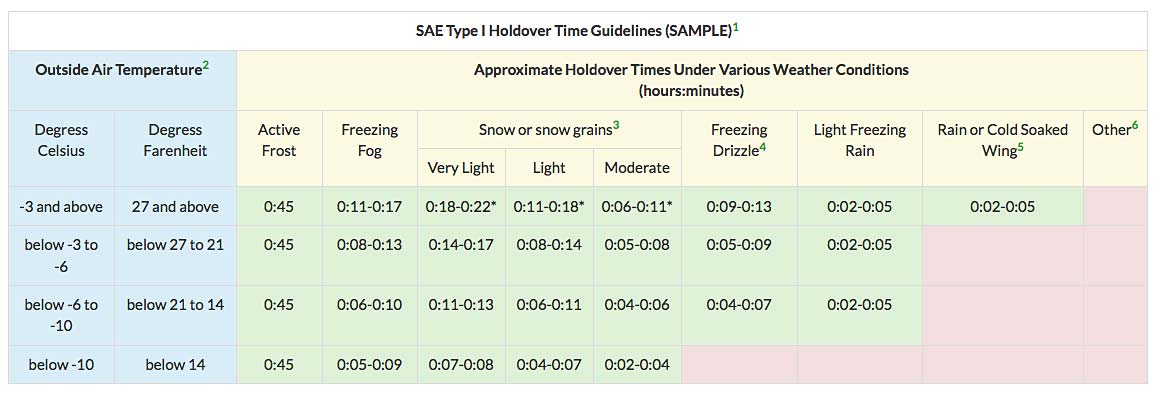
    But as a result, they also have the shortest holdover times, often less than 20 minutes depending on the weather conditions. These holdover times vary, though, and can be less than five minutes for snow if the outside air temperature is below 14 F (minus 10 C).

    Next, the ground crews will typically apply an anti-icing fluid to the aircraft – often Type II or Type IV. Anti-icing solutions are used to help prevent the future accumulation of snow and ice on the wings of planes.

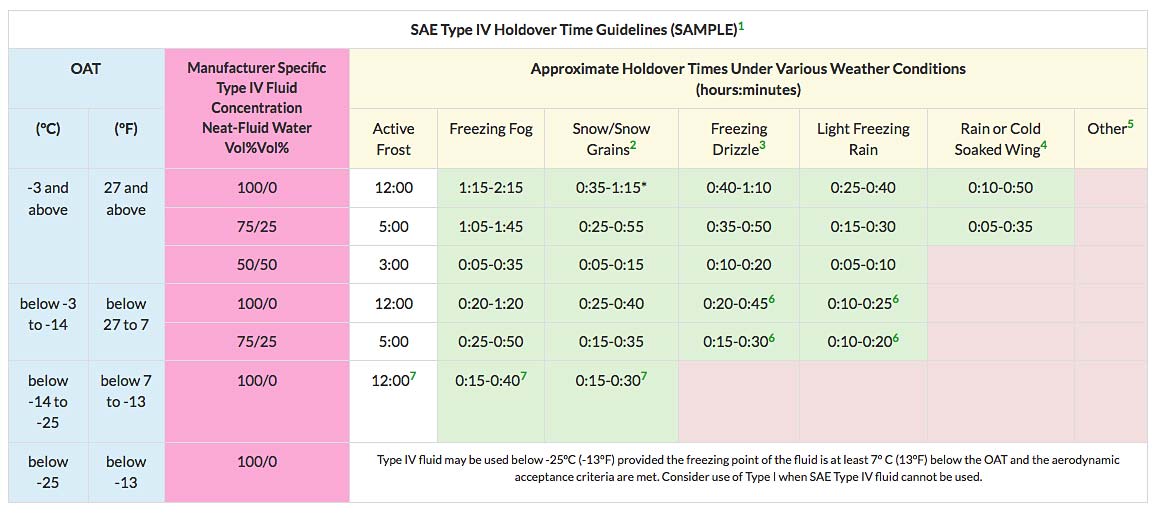
    Type II and Type IV fluids contain thickening agents that increase their viscosity. These thickeners allow the fluid to remain on the aircraft longer to help melt newly forming frost or ice. This translates to longer holdover times – often more than 30 minutes for snow – but it also means the plane needs to reach a higher speed to shear, or blow off, the fluid.

    Once applied, Type II and IV fluids will generally stay on the aircraft until the plane is taxiing down the runaway during takeoff. By then, it has gained enough speed to produce the shear force necessary to remove the fluid from the plane. Type II fluids are a clear or pale straw color, while Type IV fluids are generally green. Including a colored dye helps the ground crew clearly see what parts of the plane have been coated and which areas still need application.

    Type III fluids are not as common anymore. They are formulated to shear off at lower speeds and thus are sometimes used on small commuter aircraft since these planes typically don’t go as fast as commercial jetliners.

    Environmental impact of deicing

    Environmental considerations are also an important part of deicing. Glycols require a lot of oxygen to biodegrade, which can deplete dissolved oxygen in streams or lakes. This, in turn, can threaten aquatic life, like fish and other organisms, that need dissolved oxygen to breathe.

    In addition, ethylene glycol is toxic to wildlife, so the Environmental Protection Agency requires airports to monitor their stormwater runoff. For this reason, most airports collect and treat stormwater runoff on-site or send it to a municipal wastewater treatment facility.

    Airports are also increasingly starting to use fluid recovery systems to recycle the glycols and capture the additives in these fluids, which are often toxic, too. They’ll often use designated areas outside for deicing planes so they can collect and store the fluids after they run off the plane in holding tanks underground until they can be recycled.

    Atmospheric icing

    During flight, planes use other technologies to mitigate the icing risks. For example, most modern aircraft use bleed air systems, which channel hot air from the engine’s compressor through interior ducts to the leading edges of the wings and other critical areas to help prevent ice buildup while the plane is in the sky.

    Some planes also use electrically heated panels embedded in the aircraft’s wings to generate heat. These control systems typically cannot be used while the plane is on the ground, since they rely on cold air flowing across the wing’s surface. This airflow is usually achieved at cruising altitude and is necessary to prevent the plane’s surface from getting too hot.

    Airlines may sometimes also use icephobic coatings to help keep new ice from forming and sticking on the outside surfaces of planes. These coatings delay how soon new ice can form. They can also reduce how strongly the ice adheres to the surface.

    Icephobic polymer coatings can mitigate ice buildup and help reduce ice adhesion on surfaces.
    Hernández Rodríguez et al., 2024., CC BY-SA

    Smaller planes may also use inflatable rubber strips called pneumatic boots on the wings that can be inflated as needed to break off accumulated ice on the leading edge of the wings.

    Flying is truly a modern scientific marvel. A lot of engineering goes into not only getting planes off the ground but also keeping them ice-free during flight. So the next time you experience a weather-related delay at the airport, just remember that deicing is needed to ensure both a safe flight and a truly uplifting one.

    Andrew Sommers does not work for, consult, own shares in or receive funding from any company or organization that would benefit from this article, and has disclosed no relevant affiliations beyond their academic appointment.

    ref. The science behind airplane deicing – a mechanical engineer explains how chemistry and physics make flying a more uplifting experience – https://theconversation.com/the-science-behind-airplane-deicing-a-mechanical-engineer-explains-how-chemistry-and-physics-make-flying-a-more-uplifting-experience-248732

    MIL OSI – Global Reports

  • MIL-OSI Global: The UK’s food system is broken. A green new deal for agriculture could be revolutionary

    Source: The Conversation – UK – By Benjamin Selwyn, Professor of International Relations and International Development, Department of International Relations, University of Sussex

    William Edge/Shutterstock

    The UK’s food system was described as broken in a recent parliamentary report – and it’s not hard to see why. High living costs, a health crisis of diet-related chronic disease, farmers’ incomes squeezed and low pay across the agricultural sector all play their parts.

    And these elements are underpinned by an environmentally destructive mode of agricultural production – the longer the livestock-intensive system prevails, the greater the environmental, economic and social costs.

    The opportunity cost of not dealing with the food crisis is severe. The Food, Farming and Countryside Commission found that the price of the UK’s unhealthy food system is around £268 billion a year – almost equivalent to the government’s entire expenditure on health. And farmers are also worried about the sector as they face an unpredictable climate, smaller profits and changes to tax relief policies.

    I have researched how a green new deal for agriculture – namely a food system that complements rather than undermines the environment, while tackling social inequities – could begin to address these problems.

    In 2024 the UK’s farming sector experienced its second-worst harvest on record. Huge levels of rain last winter disrupted farmers’ ability to grow crops and reduced yields.

    The UK’s population faces a significant health crisis, exacerbated by the high cost of living. In 2022, around two-thirds of the population across all four nations were either overweight or obese.

    Retailers, processors and distributors grab an exorbitant share of the final value of many agricultural products. Sometimes farmers make as little as 1p profit for each item they produce. And farm workers’ earnings can sometimes leave them facing absolute poverty.

    What’s more, the UK farming sector is systemically inefficient. Dairy and meat products provide about 32% of calories consumed in the UK, and less than half (48%) of the protein. At the same time, livestock and their feed make up 85% of the UK’s total land use for agriculture.

    To make matters worse, land ownership is highly concentrated – about 25,000 landowners, typically corporations and members of the aristocracy, own about 50% of England, for example.

    What would change look like?

    A green new deal for agriculture would require a significant reorientation of policy, akin to the 1945 Labour government’s establishment of the welfare state. Critics might decry the costs and difficulties – but the longer the government waits, the greater the economic and environmental costs are likely to be.


    Read more:
    Britain’s unearned wealth has ballooned – a modest capital tax could help avoid austerity and boost the economy


    The government could introduce compulsory sale orders to spread land ownership more evenly. These would enable public bodies to obtain land that has been left derelict, vacant or that has been used in environmentally damaging ways. These measures could be supported by the establishment of community land trusts – non-profit, democratic organisations that own and work land for the benefit of local people.

    And a green new deal for agriculture could start with the government using its ecosystems service payments, where farmers and landowners are paid to manage their land in an environmentally beneficial way, to stimulate a transition to more plant-based proteins. This could combat hardship among farmers and agricultural workers, and tackle food poverty and ill health in the population. It would also establish the basis for a more sustainable agricultural system.


    Read more:
    Subsidised community restaurants could help tackle the UK’s broken food system – here’s how


    The UK think tank Green Alliance has mapped a green protein transition. It would entail an increase in “agro-ecologically” farmed land – that is, methods that bring a more ecological approach to farming. At present, this is about 3% of UK land, and it would have to rise to 60% by 2050. Under the plan, by 2030 10% of farmland would become semi-natural habitat, rising to one-third by 2050. This would protect land and facilitate natural restoration, and would also support agro-ecological farming methods.

    In this scenario, Britons would be projected to eat 45% less meat and dairy, replacing them with alternative proteins – plants and synthetic foods such as those made from precision fermentation. This is a revolutionary technology producing proteins that can be used in new alternatives to meat and dairy.

    Many conceptions of the protein transition from animal sources to more plant products ignore the necessity of improving farmers’ and agricultural workers’ incomes. But this will be crucial.

    Ecosystems service payments should be broadened to include a focus on sustainable incomes. Farms can be paid directly by government for sustainable production to combat farmer poverty. And the real living wage of £12.60 an hour should be compulsory for agricultural workers.

    As land use shifts from livestock grazing and feed crop production, more ground could be used for food crops for human consumption. There would then be more scope to change which food crops are produced – from wheat to legumes, for example.

    Flour made from broad beans – which can be grown in the UK – packs a bigger protein punch than traditional wheat flour.
    Narsil/Shutterstock

    Research has shown that flour made from broad beans is higher in key nutrients – protein, iron and fibre – than wheat flour. Bread, pasta, pizza, cakes and biscuits could increasingly be produced using broad bean flour, underpinning a shift towards more nutritious diets.

    A protein transition would also free up land for fruit and vegetable production for domestic consumption, reducing the UK’s heavy import dependence by using polytunnels and environmentally sustainable greenhouses.

    Climate breakdown means that the frequency of poor harvests will increase. And the volatile economic and political global picture means that affordable food imports cannot be taken for granted.

    A green new deal for agriculture could begin to remedy many of the problems the UK faces due to its broken food system. What’s needed is a coalition including courageous political parties, farmers, and workers within and beyond food production. Working together, these groups would be well placed to withstand the economic, political and environmental shocks that are on the horizon.

    Benjamin Selwyn does not work for, consult, own shares in or receive funding from any company or organisation that would benefit from this article, and has disclosed no relevant affiliations beyond their academic appointment.

    ref. The UK’s food system is broken. A green new deal for agriculture could be revolutionary – https://theconversation.com/the-uks-food-system-is-broken-a-green-new-deal-for-agriculture-could-be-revolutionary-250565

    MIL OSI – Global Reports

  • MIL-OSI United Kingdom: Join dazzling bike parade and help to Light Up Leicester!

    Source: City of Leicester

    A DAZZLING bike parade is being planned as part of next month’s Light Up Leicester festival – and everyone is invited to join in the pedal-powered fun!

    Leicester city centre will be lit up with some extraordinary illuminated artworks and nightly performances from Wednesday 12 to Saturday 15 March, as the world-class Light Up Leicester festival returns to the city for a third time.

    The Light Up Leicester Bike Parade takes place on Thursday 13 March and gives participants the chance to be part of the event! The route takes riders on a vibrant 1.5km tour of the city centre, featuring some of the stunning art installations that will be in place for the Light Up Leicester festival.

    Arrive at 5pm at Town Hall Square to ‘bling your bike’ at one of the workshops run by local artists from Graffwerk and Cyclone Works, where you can add lights, colours or sparkle to your bike and get creative, as well as watch live art being created by local street artists. Participants might also like to arrive with their own fairy lights or other novelty lights attached to their bikes, to form part of a glittering cycle parade!  

    Parades will start at 6.30pm, 7pm, 7.30pm and 8pm. Sign up for your chosen start time and meet at Town Hall Square to join the parade.

    Assistant city mayor for environment and transport Cllr Geoff Whittle said: “We are inviting people of all ages to join together and experience the city in a whole new light.

    “The circular bike parade route will meander through the heart of the Light Up Leicester Festival, showing glimpses of the fabulous installations. Our focus is on it being a family-friendly ride, inclusive of all ages and abilities.

    “This will also show people how easy it can be to navigate the city centre by bike – and after the ride, you can use the bike park at Town Hall Square to securely store your bike while you look around on foot. It promises to be a great showcase of our city and a really enjoyable experience for those on the rides – and it’s all free.”

    Leicester city mayor Peter Soulsby said: “We are really looking forward to this festival, which will bring together our diverse communities and promises to be great experience for people of all ages.  

    “Leicester will come alive with light and colour, with extraordinary performances and installations by international artists that people will be able to enjoy free of charge.

    “More than 80,000 people enjoyed Light Up Leicester last time we hosted this festival, in 2022. Thanks to the generous support of our funders and sponsors, this free festival will brighten up the dark winter nights for many thousands more.”

    Presented by Leicester City Council, BID Leicester, Leicester Cathedral and Art Reach, and with additional backing from headline sponsor Highcross Leicester and PPL PRS, Light Up Leicester 2025 will feature four nights of family-friendly performances and activities. Schools and communities are getting involved too, with partners Inspirate and Art Reach working with local groups on projects that will celebrate the city’s diversity and bring an extra dimension to the festival.

    A full festival programme is available at lightupleicester.com/home

    Sign up for the bike parade at www.letsride.co.uk/rides/light-up-ride-leicester-bike-parade and plan your journey into the city by bike at choosehowyoumove.co.uk/

    Light Up Leicester is committed to being a welcoming and accessible event for everyone. A range of adapted bikes, e-cycles and piloted rickshaws can be booked in advance for free by people who need extra support to take part – please email cycle-city@leicester.gov.uk before 6 March to arrange this. Find out more at lightupleicester.com/accessibility/

    MIL OSI United Kingdom

  • MIL-OSI Canada: Climate Change Funding for Seafood Companies; Another Call for Applications

    Source: Government of Canada regional news

    NOTE: The list of funding recipients and projects follows this release.

    Fourteen seafood companies and related organizations across the province are receiving funding to help reduce their carbon footprint.

    The projects, supported through the Fisheries and Aquaculture Energy Efficiency Innovation Fund, range from the first zero-emission electric lobster boat in Canada to solar power at lobster and bait facilities.

    “Addressing climate change continues to be a priority for our government,” said Kent Smith, Minister of Fisheries and Aquaculture. “Funding for these seafood organizations will help support our efforts to respond to climate change, reducing fossil fuel use and greenhouse gas emissions, as well as reduce costs for industry.”

    The fund is a $6.5-million, three-year program that supports new projects that reduce greenhouse gas emissions produced by boats, buildings and other commercial fisheries and aquaculture operations.

    The Province is now accepting applications for the fund’s second round. Examples of eligible projects include:

    • adapting emerging electric and hybrid technology for fishing vessels and fleets
    • installing renewable energy systems
    • reducing emissions through equipment upgrades and new technology
    • conducting research to enable future emission-reduction projects.

    The deadline for applications is April 11.


    Quotes:

    “The fisheries and aquaculture industry plays a vital role in Nova Scotia, generating significant economic benefits and employment opportunities across the province. Energy efficiency improves these economic benefits through cost reductions, helping organizations enhance long-term productivity and competitiveness. When organizations invest in energy efficiency, they can improve equipment lifespans, increase operational resilience and solidify their position as a global leader in the industry.”
    Stephen MacDonald, President and CEO, EfficiencyOne

    “This fund represents a direct investment into members of the Nova Scotia Seafood Alliance and the seafood sector to reduce their bottom line by increasing efficiency, mitigating greenhouse gas emissions and reducing the biggest costs they have for operation – energy. At the same time, the reputational benefits of moving the industry to a low-emission model will elevate Nova Scotia seafood products above their competitors on the shelves in premium markets worldwide. This is a win-win for everyone involved.”
    Kris Vascotto, Executive Director, Nova Scotia Seafood Alliance

    “The Province’s support to build and demonstrate the first all-electric lobster boat is an important step in developing Membertou’s sustainable fishery for future generations. The electric boat will play an important role in building trust in battery-electric propulsion as a viable solution for decarbonizing Canada’s commercial fishery.”
    Chief Terry Paul, CEO, Membertou


    Quick Facts:

    • the Nova Scotia Fisheries and Aquaculture Loan Board will make available $10 million over three years in dedicated lending to support eligible applicants
    • the fund is a commitment in Our Climate, Our Future: Nova Scotia’s Climate Change Plan for Clean Growth
    • the Department of Energy provided $2 million to the fund

    Additional Resources:

    More information on the Fisheries and Aquaculture Energy Efficiency Innovation Fund is available at: https://www.efficiencyns.ca/business/business-types/agriculture/fisheries-and-aquaculture-energy-efficiency-innovation-fund/

    Fisheries and Aquaculture Loan Board lending program: https://nsfishloan.ca/energy-efficiency

    Our Climate, Our Future: Nova Scotia’s Climate Change Plan for Clean Growth: https://climatechange.novascotia.ca/sites/default/files/uploads/ns-climate-change-plan.pdf


    Approved projects:

    • Bill and Stanley Oyster Company Ltd. – $250,000 to implement an electric work boat and electric forklift at a shellfish farm
    • BMC Seafoods Limited – $100,000 to implement an energy-efficient heat exchanger that will reduce electricity costs at a live lobster holding facility
    • Brazil Rock Lobster Association – $100,000 to install solar and wind-power on 18-member lobster vessels
    • Glas Ocean Electric – $198,225 towards a data logging study on five harbours/wharves which will involve 20 vessels
    • Havre Boucher Seafoods Inc. – $250,000 to implement a fully electric aluminum work boat with vessel-to-grid charging capability at a shellfish farm
    • Ignite (Atlantic) – $150,000 toward a study to develop a marine electrification roadmap for the communities of Digby and Sheet Harbour
    • L. Walker Seafoods – $30,000 toward an energy efficient condenser with floating head pressure control at a live lobster holding facility
    • Little Harbour Fisheries – $9,848 to install solar panels and convert energy usage to a renewable source at a bait storage facility
    • Membertou Fisheries Inc. – $250,000 toward the first zero-emission electric lobster fishing boat in Canada
    • NovaShell Fisheries – $70,000 toward an energy-efficient heat exchanger with floating head pressure control at a new live lobster holding facility
    • R. Baker Fisheries Limited – $86,500 to install advanced refrigeration units that will reduce energy consumption at a seafood processing facility
    • Red Fish Blue Fish Incorporated – $14,871 to install a solar photovoltaic system with battery storage at a commercial bait storage facility
    • Strait of Canso Superport Corporation – $250,000 toward a charging station for electric vessels
    • Yarmouth Bar Fisheries – $50,000 toward solar installation that will result in a net-zero seafood processing/live holding facility

    Other than cropping, Province of Nova Scotia photos are not to be altered in any way

    MIL OSI Canada News

  • MIL-OSI USA: Governor Newsom announces appointments 2.27.25

    Source: US State of California 2

    Feb 27, 2025

    SACRAMENTO – Governor Gavin Newsom today announced the following appointments:

    Aaron Maguire, of Roseville, has been appointed Executive Officer of the Board of State and Community Corrections, where he has been Acting Executive Officer at the Board of State and Community Corrections since 2024, and was previously Chief Deputy Director and General Counsel from 2022 to 2024, and General Counsel from 2016 to 2022. Maguire was Owner and Managing Partner at Maguire & Pank from 2014 to 2016. He was General Counsel and Legislative Representative at Warner & Pank, LLC from 2012 to 2016. Maguire was Assistant Secretary of Legislation at the California Department of Corrections and Rehabilitation in 2012. He was a Deputy Legislative Affairs Secretary in the Office of Governor Brown from 2011 to 2012. Maguire was a Deputy Legislative Affairs Secretary in the Office of Governor Schwarzenegger from 2009 to 2010. He was Deputy Attorney General in the Office of the California Attorney General from 2001 to 2009. Maguire earned a Juris Doctor degree from the University of California, Davis and a Bachelor of Arts in Literature from the University of California, San Diego. This position requires Senate confirmation, and the compensation is $219,156. Maguire is a Democrat. 

    Abby Edwards, of Sacramento, has been appointed Senior Deputy Director of State Planning and Policy at the Governor’s Office of Land Use and Climate Innovation. Edwards has held multiples roles at the Governor’s Office of Land Use and Climate Innovation since 2022, including Acting Senior Deputy Director, Deputy Director of Climate and Planning Programs, and Adaption Planning Program Manager. She was Program Development and Operations Manager at CivicWell from 2019 to 2022. Edwards was a Manager for Twisted Fields from 2018 to 2019. She was a Sustainable Agricultural Specialist at the Peace Corps from 2016 to 2018. Edwards was a Course Manager at the University of California, Santa Cruz from 2014 to 2016. She earned a Master of Public Administration degree in Environmental Policy and Management from University of Colorado, Denver and a Bachelor of Arts degree in Environmental Science from University of California, Santa Cruz. This position does not require Senate confirmation, and the compensation is $170,004. Edwards is a Democrat.

    Gareth Elliott, of Sacramento, has been reappointed to the University of California Board of Regents, where he has served since 2015. Elliott has been Partner at Sacramento Advocates, Inc. since 2015. He was Legislative Affairs Secretary in the Office of Governor Edmund Brown Jr. from 2011 to 2015. Elliott was Policy Director at the Office of State Senator Alex Padilla in the California State Senate from 2008 to 2011. He held multiple roles in the Office of State Senate President Pro Tempore Don Perata from 2004 to 2008, including Deputy Chief of Staff and Legislative Director. Elliott held multiple roles in the Office of State Senate Don Perata in the California State Senate from 1996 to 2004, including Legislative Director and Legislative Aide. He earned a Bachelor of Arts degree in Political Science from California State University, Humbolt. This position requires Senate confirmation, and there is no compensation. Elliott is a Democrat. 

    Darnell C. Grisby, of Oakland, has been reappointed to the California Transportation Commission, where he has served since 2021. Grisby has been Senior Vice President of Beneficial State Foundation since 2022. He was Executive Director of TransForm from 2020 to 2021. Grisby was Director of Policy Development and Research at the American Public Transportation Association from 2011 to 2020. He was Deputy Policy Director at Reconnecting America from 2010 to 2011. Grisby was Government Affairs Representative at Farmers Insurance from 2007 to 2010. He was Legislative Director in the Office of Assemblymember Mike Davis from 2006 to 2007. Grisby was a Budget and Policy Analyst at the New York Independent Budget Office from 2003 to 2006. He was Legislative Assistant in the Office of Assemblymember Jenny Oropeza from 2000 to 2001. He earned a Master of Public Policy degree from Harvard University, and a Bachelor of Arts degree in Political Science from the University of California, Los Angeles. This position requires Senate confirmation, and the compensation is $100 per diem. Grisby is a Democrat. 

    Press Releases, Recent News

    Recent news

    News SACRAMENTO – California and a consortium of 21 Brazilian states are partnering together to combat pollution and foster sustainable economic growth. Governor Gavin Newsom and Governor Renato Casagrande of the Brazilian state of Espírito Santo signed a Memorandum…

    News SACRAMENTO – Governor Gavin Newsom today announced multiple clemency actions. He granted pardons in three cases. He also sent multiple clemency cases to the Board of Parole Hearings, initiating the process for granting clemency in fifteen cases. He also sent two…

    News What you need to know: Governor Newsom today released a new economic vision for California’s future with a bold plan, realized locally. The unveiling comes alongside the announcement of more than $245 million in investments to help support workers statewide,…

    MIL OSI USA News

  • MIL-OSI USA: Governor Newsom partners with 21 Brazilian state governors to protect the environment, cut harmful pollution

    Source: US State of California 2

    Feb 27, 2025

    SACRAMENTO – California and a consortium of 21 Brazilian states are partnering together to combat pollution and foster sustainable economic growth. 

    Governor Gavin Newsom and Governor Renato Casagrande of the Brazilian state of Espírito Santo signed a Memorandum of Understanding (MOU) today that establishes a four-year partnership between California and the Brazilian consortium of states leading on environmental protections, Consórcio Brasil Verde (CBV).

    Together with these 21 Brazilian states, California is committed to advancing a bold, collaborative action plan that tackles pollution, protects public health and safety, and creates good-paying jobs.

    Governor Gavin Newsom

    This collaboration encompasses clean air, transportation and energy; adaptation; forest management; and more. The full text of the MOU is available here. R20 Regions of Climate Action – an organization founded by former Governor Arnold Schwarzenegger to support subnational climate work – played a key role in supporting this MOU.

    “This is a historic opportunity to join efforts and share knowledge between Brazilian states and California, which is a reference in combating climate change,” said Governor Renato Casagrande. “The partnership not only reaffirms our commitment to sustainability but also highlights the importance of active participation from everyone in building solutions that benefit our planet.”

    How we got here: California met its 2020 climate target six years ahead of schedule thanks to world-leading climate policies and partnerships across the U.S. and around the world, created to share best practices and support cooperation on climate work.

    • Last year, Governor Newsom welcomed a new international partnership with South Korea’s Gyeonggi Province to collaborate on climate and economic efforts. Also last year, Governor Newsom welcomed delegations from Sweden and Norway and signed renewed climate partnerships with the two governments.
    • In 2023, Governor Newsom led a California delegation to China, where California signed five MOUs – with China’s National Development and Reform Commission, the provinces of Guangdong and Jiangsu, and the municipalities of Beijing, and Shanghai. The trip also resulted in a first-of-its-kind declaration by China and California to cooperate on climate action like aggressively cutting greenhouse gas emissions, transitioning away from fossil fuels, and developing clean energy.
    • Also in 2023, California signed a MOU with the Chinese province of Hainan, as well as with Australia.
    • In 2022, California signed Memorandums of Cooperation with Canada, New Zealand and Japan, as well as Memorandums of Understanding with China and the Netherlands, to tackle the climate crisis. The Governor also joined with Washington, Oregon, and British Columbia to recommit the region to climate action.

    Press Releases, Recent News

    Recent news

    News SACRAMENTO – Governor Gavin Newsom today announced multiple clemency actions. He granted pardons in three cases. He also sent multiple clemency cases to the Board of Parole Hearings, initiating the process for granting clemency in fifteen cases. He also sent two…

    News What you need to know: Governor Newsom today released a new economic vision for California’s future with a bold plan, realized locally. The unveiling comes alongside the announcement of more than $245 million in investments to help support workers statewide,…

    News What you need to know: Governor Newsom today issued a statement in response to the Trump administration’s announcement that it had released more than $315 million of obligated money to create new water storage at the future Sites Reservoir and at the existing San…

    MIL OSI USA News

  • MIL-OSI Asia-Pac: English Translation of Opening Address by Prime Minister Shri Narendra Modi at the Plenary Session with the President of the European Commission (February 28, 2025)

    Source: Government of India

    Posted On: 28 FEB 2025 5:39PM by PIB Delhi

    Your Excellencies,

    I warmly welcome you all to India. The engagement of the EU College of Commissioners with a single country on such a broad scale is unprecedented.

    It’s the first time that so many of my ministers have collected together for any bilateral discussions. I remember how you said that India and the EU are natural partners at the Raisina Dialogue in 2022. And that strengthening and energizing ties with India, will be a priority for the EU in the coming decade.

    And now, you’re visiting India at the very beginning of your new term.This is a milestone moment for India and the EU.

    Excellencies,

    The world is currently undergoing unprecedented change. AI and emerging technologies are leading to socio-economic transformations.

    Geo-economic and political circumstances are rapidly evolving. And old equations are breaking down. In times like these, the partnership between India and the EU becomes even more important.

    A shared belief in democratic values, strategic autonomy, and rule-based global order unite India and the EU.Both countries are mega diverse market economies. In a sense, we are natural strategic partners.

    Excellencies,

    India and the EU have completed twenty years of strategic partnership. And with your visit, we are laying the foundation for the next decade.

    In this context, the remarkable commitment shown by both parties is commendable. About twenty ministerial level meetings have taken place in the last two days.

    The Trade and Technology Council meeting was also successfully organised this morning. Both teams will present a report on the ideas generated and the progress made.

    Excellencies,

    I would like to identify some priority areas of cooperation.

    The first is Trade and Investment. It is crucial to conclude a mutually beneficial FTA and Investment Protection Agreement as soon as possible.

    The second is strengthening the Supply Chain Resilience. Our capabilities can complement each other in sectors such as Electronics, Semiconductors, Telecom, Engineering, Defence, and Pharma.This will strengthen diversification and de-risking, and will aid in the creation of a secure, reliable and trusted supply and value chain.

    The third is Connectivity. The IMEC Corridor launched during the G20 Summit is a transformational initiative. Both the teams must continue working on it with strong commitment.

    The fourth is Technology and Innovation. To realise our shared vision of tech sovereignty, we must continue to make swift progress ahead. In areas such as DPI, AI, Quantum Computing, Space and 6G, both parties must work together to connect our industries, innovators, and young talents.

    The fifth is Climate Action and Green Energy Innovation. India and the EU have prioritised the Green transition. Through cooperation in sustainable urbanization, water, and clean energy, we can become drivers of global green growth.

    The sixth is Defence. We can fulfil each others’ needs through co-development and co-production. We must work to prioritise each other in export control laws.

    The seventh is Security. There is a need for greater cooperation on challenges arising from terrorism, extremism, maritime security, cyber security and space security.

    The eighth is People-to-People Ties. It should be a priority for both parties to make Migration, Mobility, Schengen Visas and EU Blue Cards simple and smooth. This stands to fulfil the needs of the EU. And India’s young workforce shall be able to make an even greater contribution to Europe’s growth and prosperity.

    Excellencies,

    For the next India-EU Summit, we must move forward with ambition, action and commitment.

    In today’s AI era, the future shall belong to those who demonstrate vision and speed.

    Excellency, I now invite you to share your thoughts.

    *****

    MJPS/ST

    (Release ID: 2106997) Visitor Counter : 84

    Read this release in: Hindi

    MIL OSI Asia Pacific News

  • MIL-OSI USA: Cyclone Flurry in the Southern Hemisphere

    Source: NASA

    Two different oceans were crowded with tropical cyclones in late February 2025. In the South Pacific, three storms were active at one point—an occurrence that is rare but not unheard of. Simultaneously, a trio of cyclones roiled in the neighboring Indian Ocean.
    Five tropical cyclones are visible in this false-color image, acquired on February 26 by the VIIRS (Visible Infrared Imaging Radiometer Suite) sensor on the NOAA-20 satellite. The image depicts infrared signals known as brightness temperature, which are useful for distinguishing cooler cloud structures (white and purple) from the warmer surface below (yellow and orange). The day before this image was acquired, a sixth storm, Tropical Cyclone Rae, was weakening east of the area shown here after bringing heavy rain to Fiji.
    Cyclones Alfred and Seru lurked alongside Rae in the South Pacific. Seru lingered offshore of Australia, reaching Category 1 strength on the Saffir-Simpson wind scale for a short time. Alfred was also forecast to stay offshore, according to the Australian Bureau of Meteorology, but was expected to bring hazardous coastal conditions to southern Queensland. The storm was at Category 2 strength on the day of this image but would intensify to Category 4 on February 27.
    Off Western Australia, Tropical Cyclone Bianca was on the tail end of its journey, having weakened to tropical storm status on February 26. The previous day, it had intensified to Category 3 but stayed far enough from land that mainland Australia and island communities were not expected to feel its effects.
    Bianca’s Indian Ocean cohabitants, Honde and Garance, posed more hazards to land. The island nation of Mauritius, east of Madagascar, shut down its airport on February 26 as Garance approached, according to news reports. The storm would strengthen from Category 2 that day to Category 3 the next, with wind speeds of 190 kilometers (120 miles) per hour. Meanwhile, Honde skirted south of Madagascar as a Category 1 storm. Heavy rain, strong winds, and storm surge were forecast for central and southern Madagascar, Mauritius, and Réunion island.
    Meteorologists noted that warm sea surface temperatures and weak wind shear conditions may have contributed to the proliferation of storms. A marine heat wave has lingered off of Western Australia since September 2024, and anomalously high sea surface temperatures warmed in the area in late February 2025. For the South Pacific, the Australian Bureau of Meteorology had predicted a higher-than-average likelihood of severe tropical cyclones this season due to expected warm ocean temperatures. Tropical cyclone season generally runs from November through April in the Southern Hemisphere.
    NASA Earth Observatory image by Michala Garrison, using MODIS and VIIRS data from NASA EOSDIS LANCE and GIBS/Worldview and the Joint Polar Satellite System (JPSS). Story by Lindsey Doermann.

    MIL OSI USA News

  • MIL-OSI USA: Public Invited to Appeal or Comment on Flood Maps in Tulsa County, Oklahoma

    Source: US Federal Emergency Management Agency

    Headline: Public Invited to Appeal or Comment on Flood Maps in Tulsa County, Oklahoma

    Public Invited to Appeal or Comment on Flood Maps in Tulsa County, Oklahoma

    DENTON, Texas – Revised Preliminary flood risk information and updated Flood Insurance Rate Maps (FIRMs) are available for review in Tulsa County, Oklahoma. Residents and business owners are encouraged to review the latest information to learn about local flood risks and potential future flood insurance requirements.The updated maps were produced in coordination with local, state and FEMA officials. Significant community review of the maps has already taken place, but before the maps become final, community residents can identify any concerns or questions about the information provided and participate in the 90-day appeal and comment period.The 90-day appeal and comment period will begin on or around Feb. 27, 2025. Appeals and comments may be submitted through May 28, 2025, for:The city of TulsaResidents may submit an appeal if they consider modeling or data used to create the map to be technically or scientifically incorrect.An appeal must include technical information, such as hydraulic or hydrologic data, to support the claim.Appeals cannot be based on the effects of proposed projects or projects started after the study is in progress.If property owners see incorrect information that does not change the flood hazard information — such as a missing or misspelled road name in the Special Flood Hazard Area or an incorrect corporate boundary — they can submit a written comment.The next step in the mapping process is to resolve all comments and appeals. Once these are resolved, FEMA will notify communities of the effective date of the final maps.To review the preliminary maps or submit appeals and comments, visit your local floodplain administrator (FPA). A FEMA Map Specialist can identify your community FPA. Specialists are available by telephone at 877-FEMA-MAP (877-336-2627) or by email at FEMA-FMIX@fema.dhs.gov.The preliminary maps may also be viewed online:The Flood Map Changes Viewer at http://msc.fema.gov/fmcvFEMA Map Service Center at http://msc.fema.gov/portalFor more information about the flood maps:Use a live chat service about flood maps at floodmaps.fema.gov/fhm/fmx_main.html (just click on the “Live Chat Open” icon).Contact a FEMA Map Specialist by telephone at 877-FEMA-MAP (877-336-2627) or by email at FEMA-FMIX@fema.dhs.gov.There are cost-saving options available for those newly mapped into a high-risk flood zone. Learn more about your flood insurance options by talking with your insurance agent or visiting floodsmart.gov.
    toan.nguyen
    Thu, 02/27/2025 – 20:14

    MIL OSI USA News

  • MIL-OSI USA: FEMA Calls in Florida May Come from Unknown Phone Numbers

    Source: US Federal Emergency Management Agency

    Headline: FEMA Calls in Florida May Come from Unknown Phone Numbers

    FEMA Calls in Florida May Come from Unknown Phone Numbers

    TALLAHASSEE, Fla.– FEMA may call Floridians who applied for disaster assistance from unknown phone numbers. It is important to answer these calls. Survivors should return any missed phone calls.FEMA may call applicants to discuss the status of their cases, or to obtain more information to continue processing their applications. Survivors should check to make sure all contact information is current. Homeowners and renters can update their contact information online at DisasterAssistance.gov, by using the FEMA App or by phone at 800-621-3362. Lines are open every day and help is available in most languages. For the latest information about Hurricane Milton recovery, visit fema.gov/disaster/4834. For Hurricane Helene, visit fema.gov/disaster/4828. For Hurricane Debby, visit fema.gov/disaster/4806. Follow FEMA on X at x.com/femaregion4 or on Facebook at facebook.com/fema.
    sixto.valentin…
    Thu, 02/27/2025 – 19:20

    MIL OSI USA News

  • MIL-OSI Europe: Italy: EIB and INWIT sign €350 million agreement to develop digital telecommunications infrastructure

    Source: European Investment Bank

    • EIB financing to support the deployment and dissemination of digital telecommunications infrastructure and improve mobile coverage and connectivity.

    The European Investment Bank (EIB) has granted INWIT €350 million in funding to boost digitalisation and connectivity in Italy, so improving mobile coverage even in the most rural areas. The agreement was signed today in Rome by EIB Vice-President Gelsomina Vigliotti and INWIT General Manager Diego Galli.

    The funding aims to support the development and implementation of macro-grid telecommunications infrastructure (raw land and rooftop towers), dedicated to enabling the connectivity of mobile network operators, including 5G and fixed wireless access (FWA) connections. Investments are also planned for micro-grid infrastructure, both outdoors (small cells) and indoors with multi-operator DAS (Distributed Antenna Systems) coverage, to improve mobile connectivity in locations such as hospitals, museums, shopping centres, underground lines and motorway tunnels.

    “This financing confirms the EIB’s commitment to supporting the development of digital infrastructure in Italy, fostering technological growth and the transition to increasingly advanced and efficient connectivity. The agreement further strengthens the partnership between the EIB and INWIT, validating the Bank’s strategic role in supporting telecommunications and promoting digital innovation in Italy,” said EIB Vice-President Gelsomina Vigliotti.

    “This partnership represents further recognition of our business model and the strategic value of our investment plan in digital and shared infrastructure, which drives economic and industrial efficiency across the value chain for the benefit of our customers. This agreement further strengthens the already solid and long-standing cooperation between INWIT and the EIB,” commented Diego Galli, General Manager of INWIT.

    Background information

    EIB 

    The European Investment Bank (ElB) is the long-term lending institution of the European Union, owned by its Member States. Built around eight core priorities, we finance investments that contribute to EU policy objectives by bolstering climate action and the environment, digitalisation and technological innovation, security and defence, cohesion, agriculture and bioeconomy, social infrastructure, high-impact investments outside the European Union, and the capital markets union.  

    The EIB Group, which also includes the European Investment Fund (EIF), signed nearly €89 billion in new financing for over 900 high-impact projects in 2024, boosting Europe’s competitiveness and security. The EIB Group signed 99 operations totalling €10.98 billion in Italy in 2024, helping to unlock almost €37 billion of investment in the real economy. All projects financed by the EIB Group are in line with the Paris Climate Agreement, as pledged in our Climate Bank Roadmap. Almost 60% of the EIB Group’s annual financing supports projects directly contributing to climate change mitigation, adaptation, and a healthier environment.  

    Fostering market integration and mobilising investment, the Group supported a record of over €100 billion in new investment for Europe’s energy security in 2024 and mobilised €110 billion in growth capital for startups, scale-ups and European pioneers. Approximately half of the EIB’s financing within the European Union is directed towards cohesion regions, where per capita income is lower than the EU average.

    High-quality, up-to-date photos of our headquarters for media use are available here.

    INWIT

    INWIT, Italy’s first tower company and one of the country’s digital infrastructure leaders, builds and manages digital shared infrastructure enabling mobile telecommunication connectivity. Its assets form part of an integrated ecosystem of macro-grids (around 25 000 towers) and micro-grids (some 600 dedicated indoor DAS roofs), including 4G and 5G of the main mobile operators, FWAs and IoT sensors. INWIT contributes to more efficient development of the telco ecosystem, which is key for the digital transition and 5G, and is also committed to reducing the digital divide via the implementation of the 5G national recovery and resilience plan. INWIT is listed on the Italian Stock Exchange (FTSE MIB – benchmark stock market index)

    MIL OSI Europe News

  • MIL-OSI Europe: Spain: EIB Group and Santander provide €163 million to support energy efficiency projects

    Source: European Investment Bank

    • The EIB Group has invested €121 million in an asset-backed securitisation operation by Santander.
    • This EIB Group investment will enable Santander to mobilise some €163 million to promote green loans for real estate.
    • The operation will support energy efficiency and sustainability projects in Spain’s residential real estate market.

    The EIB Group – made up of the European Investment Bank (EIB) and the European Investment Fund (EIF) – signed a new synthetic securitisation operation with Santander to provide financing for energy efficiency investments in the Spanish real estate sector, including the construction of new near zero-emission buildings and the renovation of existing residential properties to meet sustainability standards.

    The operation will allow new green and sustainable mortgages to be granted to individuals investing in the renovation or construction of buildings with high energy efficiency standards that meet the eligibility conditions set by the EIB.

    The projects financed by this operation will improve energy efficiency, reduce CO2 emissions and help mitigate climate change. The operation contributes to EIB Group priorities such as climate action, cohesion and developing the securitisation market in Europe.

    The EIB’s commitment amounts to around €76 million, while the EIF has committed €45 million. The full EIB Group investment is being executed in a single securitisation, optimally structured to give Santander capital relief on a portfolio of residential mortgages. Under the transaction, the EIB Group will provide a €121 million unfunded guarantee in a mezzanine tranche with the goal of enabling Santander to finance new energy efficiency investments for an amount equal to 1.34 times the size of the EIB Group guarantee.

    Background information  

    EIB 

    The European Investment Bank (ElB) is the long-term lending institution of the European Union, owned by its Member States. Built around eight core priorities, we finance investments that contribute to EU policy objectives by bolstering climate action and the environment, digitalisation and technological innovation, security and defence, cohesion, agriculture and bioeconomy, social infrastructure, high-impact investments outside the European Union, and the capital markets union.  

    The EIB Group, which also includes the European Investment Fund (EIF), signed nearly €89 billion in new financing for over 900 high-impact projects in 2024, boosting Europe’s competitiveness and security.  

    All projects financed by the EIB Group are in line with the Paris Climate Agreement, as pledged in our Climate Bank Roadmap. Almost 60% of the EIB Group’s annual financing supports projects directly contributing to climate change mitigation, adaptation, and a healthier environment.  

    Fostering market integration and mobilising investment, the Group supported a record of over €100 billion in new investment for Europe’s energy security in 2024 and mobilised €110 billion in growth capital for startups, scale-ups and European pioneers. Approximately half of the EIB’s financing within the European Union is directed towards cohesion regions, where per capita income is lower than the EU average.

    In Spain, the EIB Group signed €12.3 billion of new financing for more than 100 high-impact projects in 2024, helping power the country’s green and digital transition and promote economic growth, competitiveness and better services for inhabitants.

    High-quality, up-to-date photos of our headquarters for media use are available here.

    About Santander

    Banco Santander (SAN SM) is a leading commercial bank, founded in 1857 and headquartered in Spain and one of the largest banks in the world by market capitalization. The group’s activities are consolidated into five global businesses: Retail & Commercial Banking, Digital Consumer Bank, Corporate & Investment Banking (CIB), Wealth Management & Insurance and Payments (PagoNxt and Cards). This operating model allows the bank to better leverage its unique combination of global scale and local leadership. Santander aims to be the best open financial services platform providing services to individuals, SMEs, corporates, financial institutions and governments. The bank’s purpose is to help people and businesses prosper in a simple, personal and fair way. Santander is building a more responsible bank and has made a number of commitments to support this objective, including raising €220 billion in green financing between 2019 and 2030. At the end of 2024, Banco Santander had €1.3 trillion in total funds, 173 million customers, 8,000 branches and 207,000 employees.

    MIL OSI Europe News

  • MIL-OSI United Kingdom: Coming up next week at the London Assembly W/C 3 March

    Source: Mayor of London

    PUBLIC MEETINGS
      
    Tuesday 4 March
     
    Q&A with the Deputy Mayor for Environment and Energy
    Environment Committee
    – Chamber, City Hall, Kamal Chunchie Way, 10am

    The London Assembly Environment Committee will meet with the Deputy Mayor for Environment and Energy for a question and answer session, exploring the progress made in achieving the Mayor’s manifesto priorities, as well as wider progress on areas in the London Environmental Strategy and London’s 2030 net zero target.

    Other topics will include noise pollution, airport expansion, the proposed new green roots fund, and swimmable rivers.

    The guests are:

    • Mete Coban MBE, Deputy Mayor of London for Environment and Energy
    • Megan Life, Assistant Director for Environment and Energy, Greater London Authority (GLA)
    • Pete Daw, Head of Climate Change, GLA

    MEDIA CONTACT: Tony Smith on 07763 251727 / [email protected] 
     
    Wednesday 5 March
     
    End-of-life Care in London
    Health Committee – Chamber, City Hall, Kamal Chunchie Way, 10am

    The London Assembly Health Committee will ask guests about the state of end-of-life care provision in London, with a particular focus on end-of-life care for elderly people.

    The guests are:

    Panel 1: 10am – 11.25am

    •    Dr Katherine Buxton, Clinical Director for Palliative and End-of-Life Care Network, NHS England, London
    •    Dr Lyndsey Williams, General Practitioner and Clinical Lead for End-of-Life Care, North West London Integrated Care Board
    •    Sarah Scobie, Deputy Director of Research, Nuffield Trust

    Panel 2: 11.30am – 1pm

    • Becca Trower, Joint CEO and Clinical Director, St Raphael’s Hospice
    • Ruth Driscoll, Associate Director for Policy & Public Affairs, Marie Curie
    • Dr Armita Jamali, Consultant in Palliative Medicine, The Royal Marsden and Royal Brompton Hospitals
    • Dr Libby Sallnow, Associate Professor, Head of Marie Curie Palliative Care Research Department, University College London

    MEDIA CONTACT: Alison Bell on 07887 832918 / [email protected]  
     

    MIL OSI United Kingdom

  • MIL-OSI Video: When Climate Redefines Health | World Economic Forum Annual Meeting 2025

    Source: World Economic Forum (video statements)

    Research indicates that 3.6 billion people live in areas highly susceptible to climate change and, by 2050, the climate crisis could cause $1.1 trillion in extra costs to healthcare systems around the globe.

    How is the resilience of key sectors to climate change being measured and how are key actors responding to safeguard public health?

    This session is directly linked to the Climate and Health Initiative at the Centre for Health and Healthcare and the Centre for Nature and Climate of the World Economic Forum.

    Speakers: John Steenhuisen, Stéphane Bancel, John-Arne Røttingen, Liza Korsten, Shyam Bishen, David Knibbe, Celeste Saulo

    The 55th Annual Meeting of the World Economic Forum will provide a crucial space to focus on the fundamental principles driving trust, including transparency, consistency and accountability.

    This Annual Meeting will welcome over 100 governments, all major international organizations, 1000 Forum’s Partners, as well as civil society leaders, experts, youth representatives, social entrepreneurs, and news outlets.

    The World Economic Forum is the International Organization for Public-Private Cooperation. The Forum engages the foremost political, business, cultural and other leaders of society to shape global, regional and industry agendas. We believe that progress happens by bringing together people from all walks of life who have the drive and the influence to make positive change.

    World Economic Forum Website ► http://www.weforum.org/
    Facebook ► https://www.facebook.com/worldeconomicforum/
    YouTube ► https://www.youtube.com/wef
    Instagram ► https://www.instagram.com/worldeconomicforum/
    X ► https://twitter.com/wef
    LinkedIn ► https://www.linkedin.com/company/world-economic-forum
    TikTok ► https://www.tiktok.com/@worldeconomicforum
    Flipboard ► https://flipboard.com/@WEF

    #Davos2025 #WorldEconomicForum #wef25

    https://www.youtube.com/watch?v=mBK-Ul_HIlc

    MIL OSI Video

  • MIL-OSI Asia-Pac: President Lai presides over third meeting of Healthy Taiwan Promotion Committee

    Source: Republic of China Taiwan

    Details
    2024-11-28
    President Lai presides over second meeting of Healthy Taiwan Promotion Committee
    On the afternoon of November 28, President Lai Ching-te presided over the second meeting of the Healthy Taiwan Promotion Committee. In his opening statement, the president said that we are implementing mental health support programs this year to provide more support for young and middle-aged people, pointing out that the policy has served over 20,000 people since it was implemented just over three months ago. In terms of bolstering mental health resiliency, the president said we still have much to do, our government must lead by example, and the public and private sectors must work together, making every effort to ensure that no one is left behind. Noting that our goal is to reduce the standardized cancer mortality rate by one-third by the year 2030, President Lai stated that next year’s budget for cancer screening will be increased to NT$6.8 billion. He also stated that plans are in the works to establish a fund for new cancer drugs, adding that in the general budget we will allocate NT$5 billion, which will gradually rise to NT$10 billion. At the same time, he said, we are also actively promoting genetic testing and precision medicine. He expressed confidence that expanding preventive screening at the front end and providing advanced treatments at the back end will effectively fight cancer and improve the overall health of our citizens. A translation of President Lai’s opening statement follows: Today is the second meeting of the Healthy Taiwan Promotion Committee. First, I want to thank our two deputy conveners, our advisors and committee members, and our friends online for their enthusiastic participation. I also want to welcome Committee Member Chien Wen-jen (簡文仁), who was on leave for the previous meeting. I would also like to introduce three new committee members: Let’s welcome Committee Member Huang Chin-shun (黃金舜), president of the Federation of Taiwan Pharmacists Associations. During the pandemic, he led the nation’s pharmacists in promoting services including name-based distribution systems for masks and rapid-test kits and home delivery of medications. I am sure that he will be able to provide many valuable views regarding pharmaceutical safety and supply resilience.    Let’s also welcome Committee Member Ko Fu-yang (柯富揚). During his time as secretary-general of the National Union of Chinese Medical Doctors’ Association, he led the Chinese medicine community in the transition from experience-based medicine to evidence-based medicine, and promoted the modernization of traditional Chinese medicine. With his participation, the committee will be able to spur research and development in both modern and traditional medicine. Our third new committee member is Liao Mei-nan (廖美南), president of the Taiwan Nurses Association, who was unable to be here today. She has long been dedicated to raising the quality of nursing care and actively promoting a high-quality, friendly work environment for nurses. The committee will rely on her experience to strengthen the link between policy and practice in nursing care. I want to thank all the members of the committee once again for working together with the government. Since the last committee meeting, under the guidance of Minister without Portfolio Chen Shih-chung (陳時中), the Ministry of Health and Welfare (MOHW) has implemented various policies. At the beginning of October, for example, three major AI centers were set up to resolve three key AI application issues: implementation, certification, and reimbursement, helping advance Taiwan’s smart healthcare ecosystem. At today’s meeting, the MOHW will first deliver a report on the progress of certain items listed in the first committee meeting, followed by a joint report by the MOHW and Ministry of Education on bolstering public mental health resilience and a report by the MOHW on enhancing cancer prevention and treatment strategies.  The World Health Organization has affirmed that “there is no health without mental health.” In a fast-changing, fast-paced society, the government should invest more resources in the field of mental health to safeguard the people’s overall health. We are therefore implementing mental health support programs this year and expanding the range of eligibility, from 15 to 30, to 15 to 45 years old, to provide more support for young and middle-aged people. That policy has served over 20,000 people since it was implemented just over three months ago. In terms of bolstering mental health resiliency, we still have much to do. From the workplace to the campus and every corner of society, our government must lead by example, and the public and private sectors must work together, making every effort to ensure that no one is left behind.    Aside from mental health, in view of cancer being the leading cause of death in Taiwan for 42 consecutive years, our goal is to reduce the standardized cancer mortality rate by one-third by the year 2030. And so we must expand screening and advance treatment. Last year, the government subsidized screenings for five types of cancer, providing a total of 4.87 million screenings and detecting 11,000 cases of cancer and 52,000 cases of precancerous conditions. We have allocated an additional NT$4 billion beginning next year, bringing the total budget for cancer screening to NT$6.8 billion, to expand the scope of cancer screening eligibility and services.  Plans are also in the works to establish a fund for new cancer drugs. In next year’s general budget we will allocate NT$5 billion, which will gradually rise to NT$10 billion, to provide reimbursement funding for a variety of new cancer drugs and reduce the economic burden on patients. These new measures will be reported on in detail moments from now by the MOHW. At the same time, we are also actively promoting genetic testing and precision medicine. Next generation sequencing, for example, has already been included in National Health Insurance coverage, which will help provide patients with precise, individualized treatment strategies. I am confident that expanding preventive screening at the front end and providing advanced treatments at the back end will effectively fight cancer and improve the overall health of our citizens. Today’s meeting will help the government understand viewpoints from many perspectives so we can promote policies that more closely meet the public’s needs. Let’s keep working hard together. Thank you.  Following his statement, President Lai heard a report on the progress of certain items listed in the first committee meeting from deputy executive secretary and National Health Insurance Administration Director General Shih Chung-liang (石崇良), a joint report on bolstering public mental health resilience from Deputy Minister of Health and Welfare Lin Ching-yi (林靜儀) and Deputy Minister of Education Lin Teng-chiao (林騰蛟), and a report on enhancing cancer prevention and treatment strategies from Deputy Minister of Health and Welfare Chou Jih-haw (周志浩). Afterward, President Lai exchanged views with the committee members regarding the content of the reports.  

    Details
    2024-11-28
    President Lai presides over first meeting of Healthy Taiwan Promotion Committee
    On the afternoon of August 22, President Lai Ching-te presided over the first meeting of the Healthy Taiwan Promotion Committee. As the committee’s convener, the president presented committee members with their letters of appointment, and explained that the Healthy Taiwan Promotion Committee is not just about promoting a Healthy Taiwan, but also achieving a Balanced Taiwan. The president stated that the committee spans various areas of expertise, and also considers the balance of Taiwan’s northern, central, southern, and eastern regions. The president expressed confidence that by soliciting a wide range of suggestions, engaging in diverse dialogue, and forging a consensus, the committee can help to realize health equality and further elevate the standard of medical care in Taiwan. President Lai indicated that next year, the Ministry of Health and Welfare’s total budget will be increased, along with expanded investment in medical treatment and care. In addition, he reported that the central government budget has also added a National Health Insurance (NHI) financial assistance program, which will help to enhance the work environments of healthcare professionals. The president stated that we will also launch the Healthy Taiwan Cultivation Plan to help rear talent and develop smart medicine. These budgets and programs, President Lai stated, reflect the government’s determination to create a Healthy Taiwan, and prove that “Healthy Taiwan” is not just a slogan, and has already been turned into concrete action. A translation of President Lai’s opening statement follows: At the end of my first month in office, I announced that the Presidential Office will establish three committees in response to three major global issues of nationwide concern: climate change, health promotion, and social resilience. These committees will consolidate forces from different sectors to strategize on national development. At the beginning of this month, we convened the first meeting of the National Climate Change Committee. Today, we convene the first meeting of the Healthy Taiwan Promotion Committee. I would like to thank the three deputy conveners and all advisors and committee members for making a commitment to the Healthy Taiwan Promotion Committee. I also want to thank our fellow citizens and friends joining us online to follow the committee’s proceedings. During my campaign, I was constantly thinking about what I could contribute to our people that is different from past presidents if I were fortunate enough to be elected. After a lot of thought, I felt that as a physician, I should utilize my professional background in health care and work together with people from all sectors of society to help create a Healthy Taiwan. Healthy Taiwan is our goal, and health is both a basic human right and a universal value. Health promotion not only involves the well-being of a nation’s people, but is also of great concern to humankind so that we may survive and thrive. Taiwan is a responsible member of the international community. Amid the challenges of the pandemic over the past few years, we have shared disease prevention supplies, technology, and experience with countries around the world, and have continued to contribute to the global public health system. Going forward, Taiwan must actively address critical health-related challenges, including cancer, transnational communicable diseases of unknown origin, antibiotic-resistant superbugs, a low birth rate, and an aging society. We are confident that, sharing countermeasures and experience with countries around the world, we can keep people healthy and make the nation stronger so that the world embraces Taiwan. I want to thank former Superintendent of National Cheng Kung University Hospital Chen Jyh-hong (陳志鴻), who is also a mentor of mine, for organizing five regional forums and a national forum for the Healthy Taiwan Promotion Alliance this past March and April. Over 1,200 healthcare professionals from all over the country attended the forums and shared their views. Premier Cho Jung-tai (卓榮泰), Vice Premier Cheng Li-chiun (鄭麗君), and I were also invited to attend the national forum and participate in full. I also want to thank the experts from various fields for their suggestions throughout this process, which became key reference points for promoting policies after we took office on May 20. The position paper on the table in front of you is a compilation of those valuable insights, which will be the foundation of our future actions. To implement the Healthy Taiwan initiative, we must also achieve a Balanced Taiwan. Therefore, the Healthy Taiwan Promotion Committee established today not only spans various areas of expertise, but also considers the balance of Taiwan’s northern, central, southern, and eastern regions to achieve nationwide health equality. I want to thank the nine advisors here with us today: Superintendent Wu Ming-shiang (吳明賢), Superintendent Chen Wei-ming (陳威明), Chairman Cherng Wen-jin (程文俊), President Chiu Kuan-ming (邱冠明), and Chairman Chang Hong-jen (張鴻仁) from northern Taiwan; Superintendent Chen Mu-kuan (陳穆寬) from central Taiwan; Superintendent Lin Sheng-che (林聖哲) and President Yu Ming-lung (余明隆) from southern Taiwan; and Superintendent Lin Shinn-zong (林欣榮) from eastern Taiwan. Your participation will give us a better understanding of viewpoints from around the country. The objective of Healthy Taiwan is to raise the population’s average life expectancy while simultaneously reducing time spent living with illness or disability, while also caring for physical, mental, and spiritual health. The 20 members of the committee are therefore drawn from a variety of fields of professional expertise. We have Superintendent Chen Shih-ann (陳適安) in the field of smart medicine, Vice-Superintendent Susan Shur-fen Gau (高淑芬) in pediatric psychiatry, medical and long-term care service integration specialist Superintendent Chan Ding-cheng (詹鼎正), and emerging infectious disease specialist Director Shen Ching-fen (沈靜芬). We have also invited Professor Tsai Sen-tien (蔡森田) to provide suggestions on optimizing healthcare services and health insurance sustainability, and invited President Chou Ching-ming (周慶明) and President Huang Cheng-kuo (黃振國) to continue promoting the Family Medicine Plan and report on primary care issues. We have also recruited President Li Yi-heng (李貽恒), who put forward the 888 Program for prevention and treatment of the “three highs” (high blood pressure, high cholesterol, and high blood sugar) and kidney disease, pediatric health specialist President Ni Yen-hsuan (倪衍玄), women’s health care specialist Secretary-General Huang Jian-pei (黃建霈), and President Hung Te-jen (洪德仁), who is focused on community development. We also have Dean Shan Yan-shen (沈延盛) from the field of cancer prevention and treatment, psychiatric and mental health specialist Professor Su Kuan-pin (蘇冠賓), epidemiology expert and Emeritus Research Fellow Ho Mei-shang (何美鄉), and biomedicine and regenerative medicine specialist Professor Patrick Ching-ho Hsieh (謝清河). The committee also includes specialist in nutrition and health for all ages President Kuo Su-e (郭素娥), and expert in the promotion of physical activity and health Vice Chairman Chien Wen-jen (簡文仁). I also want to thank Chairman Lin De-wen (林德文) for participating as we work together to enhance the health and well-being of indigenous peoples. In addition, public sector participants include Minister of National Development Liu Chin-ching (劉鏡清) and Minister of Education Cheng Ying-yao (鄭英耀), as well as Minister of Health and Welfare Chiu Tai-yuan (邱泰源), who is serving as executive secretary, and NHI Administration Director General Shih Chung-liang (石崇良) serving as deputy executive secretary. Over 80 percent of the committee’s members are from the private sector, and I will take advantage of this opportunity to continue to combine the strengths of all stakeholders throughout society to promote a healthy lifestyle for one and all, and enhance medical care for all ages. At today’s first meeting of the committee, the Ministry of Health and Welfare will brief us on two topics: the first is the Healthy Taiwan vision plan, illustrating Taiwan’s current challenges and opportunities, as well as an action blueprint. The second issue is reform and optimization for NHI sustainability. Next year will mark the 30th anniversary of our NHI system. NHI is the pride of Taiwan, because health insurance can free citizens from the vicious cycle of poverty caused by illness, or illness caused by poverty. Since 2020, the NHI system has achieved a public satisfaction rate of over 90 percent. Next year, Taiwan will also become a “super-aged society,” which means that one of every five people will be a senior citizen 65 or older. Due to new pharmaceuticals of all kinds, the development of new technologies, and citizen expectations for an optimized medical practice environment, many aspects of health insurance operations will face an increasing number of challenges. The NHI system’s core values are health equality and mutual assistance for all. Better care for everyone, however, depends on sustainable NHI operations. We closely monitor NHI system point values, but also want to embody the greater values of the system. The government will continue to refine the budget system and management, rationally distribute medical resources and stabilize point values, and continue to optimize NHI finances to enhance the efficiency and quality of services. We also look forward to working with everyone to achieve sustainable NHI development, enhance health equality, and further elevate the standard of medical care in Taiwan. I also want to report that next year, the Ministry of Health and Welfare’s total budget will reach NT$370.2 billion, an increase of NT$31.8 billion over this year. The total budget is expected to allocate NT$60.7 billion to expand investment in medical treatment and care to create a Healthy Taiwan. The central government budget has also added an NHI financial assistance program that includes incentives for maintaining specified nurse-patient ratios across all three shifts and rotating night-shift nursing staff, and promoting smart information upgrades at medical facilities to enhance the work environments of healthcare professionals. We will also launch the Healthy Taiwan Cultivation Plan, investing funds to support medical institutions at all levels nationwide, rear talent, and develop smart medicine. Regarding the fund for new cancer drugs that many cancer patients care deeply about, in next year’s general budget we will allocate NT$5 billion for health insurance funding. In 2026, that figure is expected to reach NT$10 billion. We will also promote the fifth-stage national plan for cancer prevention and treatment, and beginning next year the budget for cancer screening will be increased by NT$4 billion, reaching NT$6.8 billion, to boost screening rates. I want everyone to know that these budgets and programs reflect the government’s determination to create a Healthy Taiwan. Since I took office, the government has created plans and programs to increase nursing staff levels and promote public mental health. We also launched an Acute Hospital Care at Home pilot project to provide integrated long-term and medical care services. Once again, I would like to thank everyone here today for participating, and thank our fellow citizens for their support. I also want our fellow citizens to know that Healthy Taiwan is not just a slogan, and has already been turned into concrete action. These are all concrete, substantive actions by a government team that has been in office for less than 100 days. I am confident that with the support and participation of our committee members and advisors, and through soliciting a wide range of suggestions, engaging in diverse dialogue, and forging a consensus, our actions to create a Healthy Taiwan will more closely align with society’s expectations, and we will move more quickly and steadily toward realizing our vision. Thank you. Following his statement, President Lai presented letters of appointment to the committee members, heard a report from Minister Chiu illustrating the Healthy Taiwan vision plan, and heard a report from Director General Shih on reform and optimization for NHI sustainability. Afterward, President Lai exchanged views with the committee members regarding the content of the two reports and the Rules of Procedure for Meetings of the Office of the President Healthy Taiwan Promotion Committee.

    Details
    2024-11-28
    President Lai attends opening of International Conference on Emergency Medicine 2024
    On the morning of June 20, President Lai Ching-te attended the opening ceremony of the International Conference on Emergency Medicine (ICEM) 2024. In remarks, President Lai stated that one goal of his administration is to create an even healthier Taiwan and that we will continue to strengthen our capabilities in medicine and public health to enhance health for all and help make the world a better place. The president emphasized that the global disease prevention network is something every country should be a part of, and that if any country is missing from this network, the rest of the world will be at a disadvantage. The president then asked for the participants’ support for Taiwan to participate in the World Health Organization so that we may contribute even more to the global public health system. A transcript of President Lai’s remarks follows: I would like to begin by welcoming all guests from overseas to Taiwan. ICEM is the world’s largest conference on emergency medicine. Over 2,500 experts and academics from home and abroad have gathered here for this year’s conference. This not only underlines the importance of emergency medicine, but is also a testament to global cooperation in medicine. This year also marks TSEM’s [Taiwan Society of Emergency Medicine] 30th anniversary. I would like to thank Chairperson Ng Chip-jin (黃集仁), President Hsu Chien-chin (許建清), and everyone who helped bring ICEM to Taiwan. This conference will help expand people-to-people diplomacy, showing Taiwan’s development and contributions in emergency medicine to the world. I am confident that everyone here shares my belief that health is a basic human right. And to ensure this right, emergency medical professionals are indispensable. Before entering politics, I myself worked as a clinician. I know well that emergency rooms are at the frontline of hospitals, and often the last hope for those who need lifesaving care. Especially during the COVID-19 pandemic, we all witnessed the rapid response and important support of emergency medical professionals, who gave their all for the health of others. I want to take this opportunity to express my utmost respect for your work. The theme of ICEM 2024 is Glocalization of Emergency Medicine: Global Wisdom and Local Solution. With that in mind, I hope that through clinical research, public health, smart tech, and other strategies, we can help reduce disparities in emergency medicine around the world. Here in Taiwan, we have made major progress in emergency medicine, from developing a cutting-edge trauma care system to implementing advanced strategies for disaster response. We are also committed to training highly skilled professionals in the field, as well as developing an advanced medical infrastructure. This conference will give Taiwan the opportunity to share our experience, and allow everyone to exchange best practices, engage in discussions, and promote the global development of emergency medicine. One goal of my administration is to create an even healthier Taiwan. We will continue to strengthen our capabilities in medicine and public health to enhance health for all and help make the world a better place. A healthier Taiwan also means a booming medical sector, and an even higher quality and diversity of medical services. Taiwan has had, and will continue to have, many medical accomplishments to share with the world. Today, all of you gather here to continue making global contributions through emergency medicine. The mission of IFEM [International Federation for Emergency Medicine] is to create a world where all people, in all countries, have access to high quality emergency medical care. On this point, the global disease prevention network is something every country should be a part of. If any country is missing from this network, the rest of the world will be at a disadvantage. I would like to ask for your support for Taiwan to participate in the World Health Organization, so that we may contribute even more to the global public health system. And as President Hsu Chien-chin has said, although the road is long, if we travel together, we can travel far. With this vision as our guide, alongside our friends from around the world, Taiwan will strive to achieve our common goals and realize quality healthcare for all. I wish ICEM 2024 great success, and all participants a rewarding experience. I also invite you to travel around Taiwan during your stay, and get to know our beautiful nation. Following his remarks, President Lai and the distinguished guests took part in the kick-off ceremony for the conference. IFEM President Ffion Davies was also in attendance at the event.

    Details
    2024-11-28
    President Lai meets WHA action team
    On the morning of June 1, President Lai Ching-te met with members of Taiwan’s World Health Assembly (WHA) action team. In remarks, President Lai stated that standing on the front lines, the team fought for the human right to health for both Taiwan and the world. He also thanked the international community for their support for Taiwan. The president said that Taiwan is an indispensable member of the international community when it comes to ensuring global health security. In addition, he said that one of the new government’s goals is to create a healthier Taiwan, as we want our people to live longer and healthier, and that we want to leverage Taiwan’s strengths in public health and medicine. He said we will continue to deepen our partnerships with other countries as we build an even more resilient global public health system, and that a healthy Taiwan will help make the world a better place. A translation of President Lai’s remarks follows: I would like to warmly welcome our partners from the WHA action team back from Geneva, and express my appreciation for your hard work and efforts. Standing on the front lines, you fought for the human right to health for both Taiwan and the world, and we thank you for giving it your all. Your flight only just arrived at 7 a.m., but I can see that everyone is still in high spirits. You have truly put in your heart for Taiwan, and once again, I thank you all. It is regrettable that at this year’s WHA, constrained by political factors, a proposal item for Taiwan to join as an observer was not included in the agenda yet again. However, the hard work of our WHA action team over the years has already borne fruit. Last year, the Ministry of Health and Welfare signed MOUs with the public health agencies of the Czech Republic, Canada, and the United Kingdom, and bilateral talks this year included discussion on substantive cooperation. The bilateral talks carried out by our action team in Geneva were not only more numerous this year, but also involved officials of even higher level. The team also held professional forums addressing important issues of the WHA in cooperation with various medical and health organizations. This is all proof of Taiwan’s contribution toward global public health and the human right to health. The steps we take for Taiwan to participate in world health affairs will not falter. Support for Taiwan from the international community grows stronger year by year. This year, 26 member states of the World Health Organization and the European Union, which is an observer, directly or indirectly voiced their support for Taiwan’s participation in the WHA. Their support reaffirms that Taiwan is an indispensable member of the international community when it comes to ensuring global health security. Health knows no borders. Health is a basic human right. One of the new government’s goals is to create a healthier Taiwan. We want our people to live longer and healthier. And we also want to leverage Taiwan’s strengths in public health and medicine, as we deepen our cooperation with other countries and work together to advance the health of humankind and global sustainable development. I want to thank the member states for their support for Taiwan. I also want to once again thank the members of the WHA action team and our many friends, both here and outside of Taiwan, for their hard work on this issue. Moving forward, we will continue to deepen our partnerships with other countries as we build an even more resilient global public health system. So just as democratic Taiwan continues to shine its light upon the world, a healthy Taiwan will help make the world a better place. On that note, let us keep working together toward these goals. After President Lai concluded his remarks, Minister of Health and Welfare Chiu Tai-yuan (邱泰源) presented a photo collage to show President Lai some of the highlights of the action team’s activities in Geneva.

    Details
    2024-11-28
    President Tsai meets World Medical Association President Lujain Alqodmani
    On the morning of December 11, President Tsai Ing-wen met with a delegation led by World Medical Association (WMA) President Dr. Lujain Alqodmani. In remarks, President Tsai thanked the WMA for its many years of speaking up for Taiwan on the international stage. President Tsai emphasized that we will continue to show how Taiwan can help by actively contributing to global health security. The president expressed her belief that with Taiwan’s achievements and capabilities in medicine and public health, we can join forces with many more countries to optimize the medical environment and make a more positive impact on the health of humankind. A translation of President Tsai’s remarks follows: I extend a warm welcome to President Alqodmani, who is visiting Taiwan once again. I am also glad to see WMA Secretary General Dr. Otmar Kloiber. Both of you are well acquainted with Taiwan and are our close friends. You have demonstrated your support through concrete actions. I would like to express my deepest thanks. The WMA is the largest international NGO that represents physicians. You staunchly defend health security and the rights and interests of physicians around the world with professionality and impartiality. I want to take this opportunity to thank the WMA on behalf of the Taiwanese people for its longstanding support of our participation in the World Health Organization (WHO) and World Health Assembly (WHA). This May, for example, our WHA action team collaborated with the WMA to hold a forum on emergency medicine in Geneva in the lead-up to the WHA. We will continue to show how Taiwan can help by actively contributing to global health security. During the COVID-19 pandemic, Taiwan demonstrated the resilience of its public healthcare system and shared its experiences in combating the pandemic with the world. We have also shared our medical services and construction capabilities, two areas in which we excel, with our diplomatic allies to help enrich the lives of their people and enhance the quality and environment of healthcare. We hope that President Alqodmani and Secretary General Kloiber will continue to speak up for Taiwan on the international stage. I believe that with Taiwan’s achievements and capabilities in medicine and public health, we can join forces with many more countries to optimize the medical environment. Together, we can make a more positive impact on the health of humankind. I also want to thank the Taiwan Medical Association (TMA) for serving as a bridge of communication between the government and the medical community, which helps us in implementing many of our policies. We look forward to the TMA further expanding exchanges and cooperation between the medical and international communities. I am looking forward to exchanging ideas with you today. Your visit to Taiwan will no doubt lay the groundwork for further cooperation. I wish you all a successful trip.

    Details
    2025-02-14
    President Lai holds press conference following high-level national security meeting
    On the morning of February 14, President Lai Ching-te convened the first high-level national security meeting of the year, following which he held a press conference. In remarks, President Lai announced that in this new year, the government will prioritize special budget allocations to ensure that Taiwan’s defense budget exceeds 3 percent of GDP. He stated that the government will also continue to reform national defense, reform our legal framework for national security, and advance our economic and trade strategy of being rooted in Taiwan while expanding globally. The president also proposed clear-cut national strategies for Taiwan-US relations, semiconductor industry development, and cross-strait relations. President Lai indicated that he instructed the national security and administrative teams to take swift action and deliver results, working within a stable strategic framework and according to the various policies and approaches outlined. He also instructed them to keep a close watch on changes in the international situation, seize opportunities whenever they arise, and address the concerns and hope of the citizens with concrete actions. He expressed hope that as long as citizens remain steadfast in their convictions, are willing to work hand in hand, stand firm amidst uncertainty, and look for ways to win within changing circumstances, Taiwan is certain to prevail in the test of time yet again. A translation of President Lai’s remarks follows: First, I would like to convey my condolences for the tragic incident which occurred at the Shin Kong Mitsukoshi department store in Taichung, which resulted in numerous casualties. I have instructed Premier Cho Jung-tai (卓榮泰) to lead the relevant central government agencies in assisting Taichung’s municipal government with actively resolving various issues regarding the incident. It is my hope that these issues can be resolved efficiently. Earlier today, I convened this year’s first high-level national security meeting. I will now report on the discussions from the meeting to all citizens. 2025 is a year full of challenges, but also a year full of hope. In today’s global landscape, the democratic world faces common threats posed by the convergence of authoritarian regimes, while dumping and unfair competition from China undermine the global economic order. A new United States administration was formed at the beginning of the year, adopting all-new strategies and policies to address challenges both domestic and from overseas. Every nation worldwide, including ours, is facing a new phase of changes and challenges. In face of such changes, ensuring national security, ensuring Taiwan’s indispensability in global supply chains, and ensuring that our nation continues to make progress amidst challenges are our top priorities this year. They are also why we convened a high-level national security meeting today. At the meeting, the national security team, the administrative team led by Premier Cho, and I held an in-depth discussion based on the overall state of affairs at home and abroad and the strategies the teams had prepared in response. We summed up the following points as an overall strategy for the next stage of advancing national security and development. First, for overall national security, so that we can ensure the freedom, democracy, and human rights of the Taiwanese people, as well as the progress and development of the nation as we face various threats from authoritarian regimes, Taiwan must resolutely safeguard national sovereignty, strengthen self-sufficiency in national defense, and consolidate national defense. Taiwan must enhance economic resilience, maintain economic autonomy, and stand firm with other democracies as we deepen our strategic partnerships with like-minded countries. As I have said, “As authoritarianism consolidates, democratic nations must come closer in solidarity!” And so, in this new year, we will focus on the following three priorities: First, to demonstrate our resolve for national defense, we will continue to reform national defense, implement whole-of-society defense resilience, and prioritize special budget allocations to ensure that our defense budget exceeds 3 percent of GDP. Second, to counter the threats to our national security from China’s united front tactics, attempts at infiltration, and cognitive warfare, we will continue with the reform of our legal framework for national security and expand the national security framework to boost societal resilience and foster unity within. Third, to seize opportunities in the restructuring of global supply chains and realignment of the economic order, we will continue advancing our economic and trade strategy of being rooted in Taiwan while expanding globally, strengthening protections for high-tech, and collaborating with our friends and allies to build supply chains for global democracies. Everyone shares concern regarding Taiwan-US relations, semiconductor industry development, and cross-strait relations. For these issues, I am proposing clear-cut national strategies. First, I will touch on Taiwan-US relations. Taiwan and the US have shared ideals and values, and are staunch partners within the democratic, free community. We are very grateful to President Donald Trump’s administration for their continued support for Taiwan after taking office. We are especially grateful for the US and Japan’s joint leaders’ statement reiterating “the importance of maintaining peace and stability across the Taiwan Strait as an indispensable element of security and prosperity for the international community,” as well as their high level of concern regarding China’s threat to regional security. In fact, the Democratic Progressive Party government has worked very closely with President Trump ever since his first term in office, and has remained an international partner. The procurement of numerous key advanced arms, freedom of navigation critical for security and stability in the Taiwan Strait, and many assisted breakthroughs in international diplomacy were made possible during this time. Positioned in the first island chain and on the democratic world’s frontline countering authoritarianism, Taiwan is willing and will continue to work with the US at all levels as we pursue regional stability and prosperity, helping realize our vision of a free and open Indo-Pacific. Although changes in policy may occur these next few years, the mutual trust and close cooperation between Taiwan and Washington will steadfastly endure. On that, our citizens can rest assured. In accordance with the Taiwan Relations Act and the Six Assurances, the US announced a total of 48 military sales to Taiwan over the past eight years amounting to US$26.265 billion. During President Trump’s first term, 22 sales were announced totaling US$18.763 billion. This greatly supported Taiwan’s defensive capabilities. On the foundation of our close cooperation with the past eight years’ two US administrations, Taiwan will continue to demonstrate our determination for self-defense, accelerate the bolstering of our national defense, and keep enhancing the depth and breadth of Taiwan-US security cooperation, along with all manner of institutional cooperation. In terms of bilateral economic cooperation, Taiwan has always been one of the US’s most reliable trade partners, as well as one of the most important cooperative partners of US companies in the global semiconductor industry. In the past few years, Taiwan has greatly increased both direct and indirect investment in the US. By 2024, investment surpassed US$100 billion, creating nearly 400,000 job opportunities. In 2023 and 2024, investment in the US accounted for over 40 percent of Taiwan’s overall foreign investment, far surpassing our investment in China. In fact, in 2023 and 2024, Taiwanese investment in China fell to 11 percent and 8 percent, respectively. The US is now Taiwan’s biggest investment target. Our government is now launching relevant plans in accordance with national development needs and the need to establish secure supply systems, and the Executive Yuan is taking comprehensive inventory of opportunities for Taiwan-US economic and trade cooperation. Moving forward, close bilateral cooperation will allow us to expand US investment and procurement, facilitating balanced trade. Our government will also strengthen guidance and support for Taiwanese enterprises on increasing US investment, and promote the global expansion and growth of Taiwan’s industries. We will also boost Taiwan-US cooperation in tech development and manufacturing for AI and advanced semiconductors, and work together to maintain order in the semiconductor market, shaping a new era for our strategic economic partnership. Second, the development of our semiconductor industry. I want to emphasize that Taiwan, as one of the world’s most capable semiconductor manufacturing nations, is both willing and able to address new situations. With respect to President Trump’s concerns about our semiconductor industry, the government will act prudently, strengthen communications between Taiwan and the US, and promote greater mutual understanding. We will pay attention to the challenges arising from the situation and assist businesses in navigating them. In addition, we will introduce an initiative on semiconductor supply chain partnerships for global democracies. We are willing to collaborate with the US and our other democratic partners to develop more resilient and diversified semiconductor supply chains. Leveraging our strengths in cutting-edge semiconductors, we will form a global alliance for the AI chip industry and establish democratic supply chains for industries connected to high-end chips. Through international cooperation, we will open up an entirely new era of growth in the semiconductor industry. As we face the various new policies of the Trump administration, we will continue to uphold a spirit of mutual benefit, and we will continue to communicate and negotiate closely with the US government. This will help the new administration’s team to better understand how Taiwan is an indispensable partner in the process of rebuilding American manufacturing and consolidating its leadership in high-tech, and that Taiwan-US cooperation will benefit us both. Third, cross-strait relations. Regarding the regional and cross-strait situation, Taiwan-US relations, US-China relations, and interactions among Taiwan, the US, and China are a focus of global attention. As a member of the international democratic community and a responsible member of the region, Taiwan hopes to see Taiwan-US relations continue to strengthen and, alongside US-China relations, form a virtuous cycle rather than a zero-sum game where one side’s gain is another side’s loss. In facing China, Taiwan will always be a responsible actor. We will neither yield nor provoke. We will remain resilient and composed, maintaining our consistent position on cross-strait relations: Our determination to safeguard our national sovereignty and protect our free and democratic way of life remains unchanged. Our efforts to maintain peace and stability in the Taiwan Strait, as well as our willingness to work alongside China in the pursuit of peace and mutual prosperity across the strait, remain unchanged. Our commitment to promoting healthy and orderly exchanges across the strait, choosing dialogue over confrontation, and advancing well-being for the peoples on both sides of the strait, under the principles of parity and dignity, remains unchanged. Regarding the matters I reported to the public today, I have instructed our national security and administrative teams to take swift action and deliver results, working within a stable strategic framework and according to the various policies and approaches I just outlined. I have also instructed them to keep a close watch on changes in the international situation, seize opportunities whenever they arise, and address the concerns and hope of the citizens with concrete actions. My fellow citizens, over the past several years, Taiwan has weathered a global pandemic and faced global challenges, both political and economic, arising from the US-China trade war and Russia’s invasion of Ukraine. Through it all, Taiwan has persevered; we have continued to develop our economy, bolster our national strength, and raise our international profile while garnering more support – all unprecedented achievements. This is all because Taiwan’s fate has never been decided by the external environment, but by the unity of the Taiwanese people and the resolve to never give up. A one-of-a-kind global situation is creating new strategic opportunities for our one-of-a-kind Taiwanese people, bringing new hope. Taiwan’s foundation is solid; its strength is great. So as long as everyone remains steadfast in their convictions, is willing to work hand in hand, stands firm amidst uncertainty, and looks for ways to win within changing circumstances, Taiwan is certain to prevail in the test of our time yet again, for I am confident that there are no difficulties that Taiwan cannot overcome. Thank you.

    MIL OSI Asia Pacific News

  • MIL-OSI USA: SBA Opens Business Recovery Centers in Florida to Assist Small Businesses and Private Nonprofits Affected by Hurricanes Helene and Milton

    Source: United States Small Business Administration

    ATLANTA –The U.S. Small Business Administration (SBA) announced the opening of three Business Recovery Centers (BRCs) in Manatee, Sarasota and Volusia counties to assist small businesses and private nonprofit (PNP) organizations who sustained economic losses from Hurricanes Helene and Milton.

    SBA customer service representatives will be on hand at the BRCs to answer questions about SBA’s disaster loan program, explain the application process and help individuals complete their application. Walk-ins are accepted, but you can schedule an in-person appointment in advance at appointment.sba.gov. The BRC’s opening dates and hours of operation are listed below.

    Business Recovery Center (BRC)  

    Manatee County  

    Tingley Memorial Library

    111 2nd St. N.  

    Bradenton Beach, FL 34217

    Opening: Friday, Feb. 28, 10 a.m. to 5 p.m.  

    Hours:         Monday – Friday, 8 a.m. to 5 p.m.  

     Closed:      Saturday and Sunday   

    Business Recovery Center (BRC)  

    Sarasota County  

     Sanford Information Center  

    (Entrance on Ringling Blvd)

     111 S. Orange Avenue

    Sarasota, FL 34236

     Opening: Monday, March 3, 10 a.m. to 5 p.m.  

     Hours:         Monday – Friday, 8 a.m. to 5 p.m.  

    Closed:       Saturday and Sunday  

    Business Recovery Center (BRC)  

    Volusia County  

    UCF Business Incubator Volusia County

    601 Innovation Way  

    Daytona Beach, FL 32114

    Opening: Friday, Feb. 28, 10 a.m. to 6 p.m.  

    Hours:         Monday – Friday, 8 a.m. to 5 p.m.  

    Closed:      Saturday and Sunday  

    “SBA’s BRCs have consistently proven their value to business owners following a disaster,” said Chris Stallings, associate administrator of the Office of Disaster Recovery and Resilience at the SBA. “Business owners can visit these centers to meet face-to-face with specialists who will guide them through the disaster loan application process and connect them with resources to support their recovery.

    The SBA’s Economic Injury Disaster Loan (EIDL) program is available to small businesses, small agricultural cooperatives, nurseries, and PNPs impacted by financial losses directly related to these disasters. The SBA is unable to provide disaster loans to agricultural producers, farmers, or ranchers, except for small aquaculture enterprises.

    EIDLs are available for working capital needs caused by the disaster and are available even if the business or PNP did not suffer any physical damage. The loans may be used to pay fixed debts, payroll, accounts payable, and other bills not paid due to the disaster.  

    The loan amount can be up to $2 million with interest rates as low as 4% for small businesses and 3.25% for PNPs, with terms up to 30 years. Interest does not accrue, and payments are not due, until 12 months from the date of the first loan disbursement. The SBA sets loan amounts and terms based on each applicant’s financial condition.

    To apply online and receive additional disaster assistance information visit sba.gov/disaster. Applicants may also call the SBA’s Customer Service Center at (800) 659-2955 or send an email to disastercustomerservice@sba.gov for more information on SBA disaster assistance. For people who are deaf, hard of hearing, or have a speech disability, please dial 7-1-1 to access telecommunications relay services.

    The deadlines to return economic injury applications are June 24, 2025, for Tropical Storm Debby and June 30, 2025, for Hurricane Helene.

    ###

    About the U.S. Small Business Administration

    The U.S. Small Business Administration helps power the American dream of business ownership. As the only go-to resource and voice for small businesses backed by the strength of the federal government, the SBA empowers entrepreneurs and small business owners with the resources and support they need to start, grow or expand their businesses, or recover from a declared disaster. It delivers services through an extensive network of SBA field offices and partnerships with public and private organizations. To learn more, visit www.sba.gov. 

    MIL OSI USA News

  • MIL-OSI USA: Cantwell Statement on Mass NOAA Layoffs

    US Senate News:

    Source: United States Senator for Washington Maria Cantwell
    02.27.25
    Cantwell Statement on Mass NOAA Layoffs
    WASHINGTON, D.C. – Today, the Trump Administration laid off at least 880 workers from the National Oceanic and Atmospheric Administration (NOAA). U.S. Senator Maria Cantwell (D-WA), ranking member of the Senate Committee on Commerce, Science, and Transportation and senior member of the Senate Finance Committee, issued the following statement:
    “The firings jeopardize our ability to forecast and respond to extreme weather events like hurricanes, wildfires, and floods—putting communities in harm’s way. They also threaten our maritime commerce and endanger 1.7 million jobs that depend on commercial, recreational and tribal fisheries, including thousands in the State of Washington. This action is a direct hit to our economy, because NOAA’s specialized workforce provides products and services that support more than a third of the nation’s GDP.”
    Last week, Sen. Cantwell sent a letter to Secretary of Commerce Howard Lutnick, calling on him to exempt the National Weather Service (NWS) from the federal hiring freeze, and protect all NOAA workers from firings “that would jeopardize the safety of the American public.”
    “Without NOAA’s workforce, communities will not be prepared for the next big Nor’easter, hurricane, wildfire, or drought,” wrote Sen. Cantwell. “Ships will not be able to safely navigate through our waterways. Farmers will not have the data they need to manage their crops. NOAA’s workforce keeps people alive and provides communities with the scientific support tools to protect their families and grow their businesses. I urge you to appreciate these critical government functions and reverse the hiring freeze and refrain from mass firings of these invaluable public servants—American lives depend on it.”
    Also last week, speaking in opposition to the nomination of now-Secretary Lutnick on the Senate floor, Sen. Cantwell cited his “tepid support” for NOAA as a key reason for her decision to vote against his confirmation.
    “When asked for the record, ‘Should NOAA be dismantled, as called for in Project 2025?’, Mr. Lutnick would only say he’ll figure it out once he’s confirmed,” Sen. Cantwell said. “We needed a bigger commitment to NOAA. NOAA already supplies a big, important aspect of what we deal with, with weather forecasting, tracking extreme weather, hurricanes, wildfires, managing our fisheries, operating ships that conduct important charting for national security. Mr. Lutnick gave very tepid support for NOAA.”
    Project 2025 calls for NOAA to be “dismantled and many of its functions eliminated,” calling it part of the “climate change alarm industry.” NOAA provides critical services to the nation including weather forecasts, extreme storm tracking and monitoring, tools to enable communities to adapt to sea level rise and climate change, supporting fisheries management, and conserving marine mammals and other protected species including salmon and orcas.
    Sen. Cantwell is a champion of NOAA and helped secure $3.3 billion in NOAA investments in the Inflation Reduction Act to help communities prepare for and adapt to climate change, boost science needed to understand changing weather and climate patterns, and invest in advanced computer technologies that are critical for extreme weather prediction and emergency response. Her Fire Ready Nation Act, bipartisan legislation to strengthen NOAA’s ability to help forecast, prevent, and fight wildfires, passed the Commerce committee unanimously earlier this month and now heads to the full Senate for consideration.

    MIL OSI USA News

  • MIL-OSI Australia: Bureau of Meteorology’s 2025 Autumn Long-Range Forecast

    Source: Weather Warnings – Australia

    27/02/2025

    The Bureau of Meteorology has released its long-range forecast for autumn 2025.

    While autumn is often a time for cooler weather to begin, this season is very likely to be warmer than average across Australia and summer heat may persist into early autumn.

    Rainfall is likely to be in the typical range for the season for most of Australia.

    However, for parts of the far north-west of the country there is a chance of above average rainfall.

    It’s also likely to be drier than usual for most of Queensland except for southern and south-east areas.

    Tropical cyclones, tropical lows, storms and active monsoon bursts are still possible in the north over the coming months, which can bring particularly heavy rain.

    The Australasian Fire and Emergency Services Authorities Council (AFAC) has identified areas with an increased risk of fire this season for southern areas of Victoria, Western Australia and South Australia.

    The Bureau updates the long-range forecast often and you can search the latest details for your location on the Bureau’s website, visit: Long-range forecasts and climate monitoring, Bureau of Meteorology

    2025 Autumn long-range forecast (states and territories)

    New South Wales and the ACT

    Most of NSW (including the ACT) is likely to have rainfall in the typical range for autumn.

    Average autumn rainfall in recent decades has been between 100 and 400 mm along most of eastern NSW, while western and central NSW have between 25 and 100 mm, and up to 600 mm in parts of the north coast.

    Warmer than usual autumn temperatures are very likely across the state.

    Victoria

    Most of Victoria is likely to have rainfall in the typical range for autumn.

    Average autumn rainfall in recent decades ranges between 50 mm in the state’s north-west and up to 300 mm in eastern and alpine areas

    Warmer than usual autumn temperatures are very likely across the state.

    Queensland

    Autumn is likely to be drier than usual for most of Queensland except for southern and south-east areas.

    The southern most quarter of the state is likely to have rainfall in the typical range for autumn.

    Average autumn rainfall in recent decades has been between 200 and 1,200 mm along most of the state’s east, while western and central Queensland have between 25 and 200 mm.

    Warmer than usual autumn temperatures are likely across the state.

    Western Australia

    Most of Western Australia is likely to have rainfall in the typical range for autumn.

    There’s an increased chance of above average rainfall this autumn for parts of the northern Kimberley.

    Average autumn rainfall in recent decades has been between 50 and 300 mm for most of the South West Land Division, between 50 and 200 mm mid-state, and up to 400 mm in the far north.

    Warmer than usual autumn temperatures are likely across the state.

    South Australia

    Most of South Australia is likely to have rainfall in the typical range for autumn.

    Average autumn rainfall in recent decades has been between 50 and 200 mm for urban and agricultural areas, and 10 to 50 mm for the pastoral districts.

    Warmer than usual autumn temperatures are very likely across the state.

    Tasmania

    Most of Tasmania is likely to have rainfall in the typical range for autumn.

    Average autumn rainfall in recent decades has been between 400 and 800 mm for western Tasmania, while eastern areas typically have between 100 and 300 mm.

    Warmer than usual autumn temperatures are very likely across the state.

    Northern Territory

    Most of the Territory is likely to have rainfall in the typical range for this time of year.

    Parts of the east may have below average rainfall.

    Average March to May rainfall in recent decades has been between 100 and 600 mm along most of the north, and inland areas have had between 25 and 100 mm.

    Warmer than usual temperatures are likely across most of the Territory.

    Summer – Preliminary Summary

    Summer has been much warmer than usual for most of Australia.

    Every state and territory had above-average daytime and night-time temperatures.

    Parts of the west and some central areas had their warmest summer on record.

    Summer has been wetter than usual for parts of the country’s east and north-west.

    Conditions have been drier than average across parts of the country’s south and central areas and large parts of the Northern Territory.

    The national summary for summer and February will be on the Bureau’s website from 3 March: News reports and summaries

    Detailed summaries for summer and February conditions for each state and capital city will be published on 5 March.

    ENDS

    MIL OSI News