MARKHAM, Ontario, March 03, 2025 (GLOBE NEWSWIRE) — Basements have evolved from mere storage spaces to integral parts of many homes, now equipped with state-of-the-art entertainment systems, expensive gym equipment and valuable furniture. However, these spaces remain highly susceptible to flooding, potentially leading to costly repairs. Recent data from the Insurance Bureau of Canada highlights 2024 as the most expensive year for severe weather-related losses in our country’s history, with flooding contributing to over $1 billion in losses.
In fact, Allstate Insurance Company of Canada (Allstate Canada) data reveals that water damage is one of the top reasons customers submit a home insurance claim, and the cost to repair a water-damaged basement has risen by nearly 20 per cent between 2019-2024. According to a recent Léger poll conducted on behalf of Allstate Canada, 80 per cent of Canadians who responded have a basement and one in 10 have experienced basement flooding. The survey also revealed that 61 per cent of responding homeowners have a bathroom, sink or access to running water in their basement, and 55 per cent use their basement to store a spare fridge or freezer. Additionally, 47 per cent have a bedroom, 30 per cent have a home gym or workout area, 23 per cent installed a home theatre system, 20 per cent a home office, and 25 per cent say their basement has a playroom for their children.
While Canadian homeowners use their basements in different ways, the results of the poll also show that:
41 per cent use their basements to store expensive sports gear such as skis and bikes;
Nearly one in three (32 per cent) store home entertainment equipment in their basement;
Basements are also commonly the site for priceless possessions, such as photo albums (40 per cent) and family heirlooms (24 per cent);
Other items stored in the basement include tools, extension cords and lightbulbs (65 per cent), seasonal items like patio furniture or holiday decorations (59 per cent), furniture (51 per cent), collectibles or memorabilia (31 per cent), important financial, legal or tax documents (28 per cent), computer equipment (23 per cent) and musical instruments (15 per cent).
Rethinking Home: A New Era for Basements
“Kitchens are often a central, social part of the home, but basements play an important role as a space to relax with hobbies, store gear between adventures, or to simply unwind,” says Odel Laing, Agency Manager at Allstate Canada. “Homeowners should consider how they can protect these valuable spaces from flooding, which can quickly affect plans as we approach the spring season.”
Protection and Remodeling Tips
Flooding typically occurs during warmer weather months, so Laing invites homeowners to consider taking steps to protect their basement and its contents.
Elevate high-quality, expensive entertainment systems on stands or hang them up on the wall. Alternatively, keep them on the main floor, if possible.
Swap cardboard boxes for plastic ones for storage.
Select waterproof cabinetry and shelving.
Review your home insurance policy to understand your coverage for water damage.
Consult a professional about landscaping opportunities to direct water away from the home’s foundation.
Install water or leak detectors compatible with your monitored home security system to notify owners of flooding quickly.
If owners are planning to finish or renovate their basement, discuss with your contractor how to best protect from flooding risks.
About the Léger poll Allstate commissioned Léger to conduct a study among Canadian homeowners to better understand their use of basements, storage habits, flood prevention measures, and overall preparedness for extreme weather events. In order to meet research objectives, an online survey was conducted with 1,000 Canadian homeowners, aged 18 and over, who could express themselves in French or English from January 23 to 27, 2025. It should be noted that due to the non-probabilistic nature of the sample (associated with any web survey), the calculation of the margin of error does not apply. For comparative purposes, a probabilistic sample of 1,000 respondents (web panel) would have a global margin of error of ± 3.1% 19 times out of 20. The margin of error would, however, increase for subgroups.
About Allstate Insurance Company of Canada Allstate Insurance Company of Canada is a leading home and auto insurer focused on providing its customers prevention and protection products and services for every stage of life. Serving Canadians since 1953, Allstate strives to reassure both customers and employees with its “You’re in Good Hands®” promise. Allstate is committed to making a positive difference in the communities in which it operates through partnerships with charitable organizations, employee giving and volunteerism. To learn more, visit www.allstate.ca. For safety tips and advice, visit www.goodhandsadvice.ca.
For more information, please contact: Jessica Hoffeldt Agnostic on behalf of Allstate Insurance Company of Canada 647-269-7438 jhoffeldt@thinkagnostic.com
Maude Gauthier (Quebec only) Capital-Image on behalf of Allstate Insurance Company of Canada 514-915-9469 mgauthier@capital-image.com
In his election campaign ahead of the May 2024 elections, the Mayor’s manifesto committed to ‘Making London Greener’, including to:
Help schools in London reach net zero.
Introduce a new Green Roots Fund for community green spaces.
Develop a bold plan for swimmable rivers within 10 years.[1]
Tomorrow, the London Assembly Environment Committee will meet with the Deputy Mayor for Environment and Energy for a question and answer session, exploring the progress made in achieving the Mayor’s manifesto priorities, as well as wider progress on areas in the London Environmental Strategy and London’s 2030 net zero target.
Other topics will include noise pollution, the expansion of Heathrow Airport, green roots fund, and swimmable rivers.
The guests are:
Mete Coban MBE, Deputy Mayor of London for Environment and Energy
Megan Life, Assistant Director for Environment and Energy, Greater London Authority (GLA)
Pete Daw, Head of Climate Change, GLA
The meeting will take place on Tuesday 4 March 2025 from 10am in the Chamber at City Hall, Kamal Chunchie Way, E16 1ZE.
Media and members of the public are invited to attend.
The meeting can also be viewed LIVE or later via webcast or YouTube.
Source: United States of America – Federal Government Departments (video statements)
Today, Interstate 40 reopens in North Carolina and Tennessee after a five month closure from Hurricane Helene. President Trump made rebuilding these states a priority. The U.S. Department of Transportation is committed to making that happen as fast and efficiently as possible.
There’s still a lot of work to do, but the reopening of I-40 today is a big step in the right direction.
DHAKA– The United Nations World Food Programme (WFP) welcomes a contribution of Japanese Yen 500 million (approx. US$ 3.2 million) from the Government of Japan to boost food security for communities impacted by Cyclone Remal and consecutive floods in 2024.
An agreement was signed by Shinichi Saida, Ambassador of Japan to Bangladesh and Domenico Scalpelli, WFP Representative and Country Director in Bangladesh.
“I’m hopeful that this project will rehabilitate infrastructure in the hardest-hit districts affected by floods and cyclones,” said Ambassador Saida. “This project is fundamental to scale up life-saving assistance and recovery efforts. Japan will continue to work towards sustainable solutions and will cooperate with international organizations such as WFP.”
The contribution goes towards addressing immediate food needs, while at the same time rebuilding assets that improve long-term food security. This includes roads, embankments and small-scale bridges, badly damaged by Cyclone Remal and severe flooding in 2024, a year of unprecedented climate emergencies which affected nearly 18 million people across the country.
The contribution will benefit half a million people in the districts most affected – Khulna, Satkhira, Cumilla, Borguna, Moulavibazar and Kurigram.
“Damaged infrastructure has hampered communities’ access to markets and essential services, slowing recovery and affecting people’s food security. By supporting their food security and building back critical infrastructure we will aid immediate recovery and help them withstand shocks better, ” said Domenico Scalpelli, WFP’s Country Director in Bangladesh.
In the aftermath of Cyclone Remal and the floods in Sylhet, Jamuna basin and the eastern regions, WFP provided immediate assistance to nearly 150,000 households in the 12 flood-affected districts of Bangladesh.
12th Regional 3R and Circular Economy Forum in the Asia & the Pacific kick starts in Jaipur On the occasion Prime Minister Shri Narendra Modi emphasizes on Pro Planet People Approach (P-3 Approach)
Union Minister Shri Manohar Lal announces Cities Coalition for Circularity(C-3), a digital platform for knowledge exchange for cities, technical institutions and tech providers
Agreements worth ₹1,800 crores to be signed under CITIIS 2.0 benefiting 18 cities across 14 States for effective waste management
Posted On: 03 MAR 2025 2:12PM by PIB Delhi
The 12th Regional 3R and Circular Economy Forum in Asia and the Pacific was inaugurated today in Jaipur. The inaugural session was attended by Shri Manohar Lal, Union Minister of Housing & Urban Affairs, Shri Bhajanlal Sharma, Chief Minister, Rajasthan. Mr. Trevor Hedley Manemahaga, Minister of Solomon Islands, Mr. Maina Vakafua Talia, Minister of Tuvalu, Mr. Ahmed Nizam, Deputy Minister of Climate Change of Maldives joined the session. Mr. Asao Keiichiro, Minister of Environment, Govt. of Japan joined the session through a virtual message.
Shri Prem Chand Agarwal, Minister of Urban Development, Govt. of Uttarakhand, Shri Vipul Goel, Minister of Urban Local Bodies, Govt. of Haryana, Shri Jhabbar Singh Kharra, Minister of Urban Development & Housing, Govt. of Rajasthan, Shri Kailash Vijayvargiya, Minister of Urban Development & Housing, Govt. of Madhya Pradesh also graced the occasion.
Prime Minister Shri Narendra Modi’s Message
On this occasion, Prime Minister Shri Narendra Modi shared a special written message with the delegates of the Forum emphasising that India follows & strongly advocates the P-3 (Pro Planet People) approach. He has also mentioned that India has always been more than willing to share it experiences and learnings in its journey towards Circular Economy.
In his message, he highlighted the role of 3R and Circular Economy principles in ensuring sustainable urban development and resource efficiency. He highlighted India’s leadership in global sustainability efforts, including Mission LiFE (Lifestyle for Environment) and the Panchamrit Goals announced at COP26, reinforcing India’s commitment to a net-zero future.
Union Minister’s Address
Inaugurating the event, Union Minister for Housing and Urban Affairs, Shri Manohar Lal, welcomed dignitaries, industry leaders, and international representatives. He expressed pride in India hosting the 12th edition of the forum, after the successful 8th forum in Indore. The Minister highlighted Jaipur as an ideal venue due to its deep-rooted traditions in sustainability, such as rainwater harvesting and handicrafts made from recycled materials. He thanked Hon’ble CM of Rajasthan Shri Bhajanlal Sharma for his leadership in making sustainability key pillar in the State’s development.
Launch of Cities Coalition for Circularity (C-3)
Taking forward PM Modi’s vision, Shri Manohar Lal announced the Cities Coalition for Circularity (C-3), a multi-nation alliance for city-to-city collaboration, knowledge-sharing, and private sector partnerships. He stated, “We propose that a working group of member nations be formed after this forum to finalize the coalition’s structure and operational framework.” This is expected to be a game changer in the city- city partnerships across nations. Shri Manohar Lal reaffirmed that this forum will act as a catalyst for resource efficiency and a low-carbon economy, strengthening collaboration between policymakers, industry leaders, and researchers to build a sustainable future.
During the inaugural address the Minister said “Circular Economy is not just an environmental responsibility but an economic necessity”. He pointed out that India has always practiced sustainable living, but industrialization led to an increase in waste and resource inefficiency. “Now is the time to modernize and integrate these traditional sustainable practices with technological advancements,” he said.
Shri Manohar Lal emphasized that under the leadership of Hon’ble Prime Minister Shri Narendra Modi, India is championing Circular Economy on the global stage. He highlighted key government initiatives such as:
✔ Mission LiFE (Lifestyle for Environment)
✔ Panchamrit Goals at COP26, committing India to net-zero emissions by 2070
The Minister also spoke about India’s focus on Bio-CNG, plastic waste management, and e-waste recycling, reaffirming the government’s resolve to create a low-carbon, resource-efficient society.
Jaipur Declaration (2025-2034)
Shri Manohar Lal announced that the forum will adopt the Jaipur Declaration (2025-2034), a non-political, non-binding commitment that will guide the next decade of efforts towards resource efficiency and sustainable urban growth.
3R India Pavilion – Showcasing Innovation
Shri Manohar Lal, along with Hon’ble Chief Minister Shri Bhajanlal Sharma, inaugurated the 3R India Pavilion. The pavilion features the International 3R Trade and Technology Exhibition, showcasing over 40 Indian and Japanese businesses and start-ups working on waste management and Circular Economy solutions.
Chief Minister’s Remarks
Hon’ble Chief Minister of Rajasthan, Shri Bhajanlal Sharma, mentioned that circular economy is not just a necessity for today but also for our future. He said that issues like climate change, biodiversity loss, and pollution are creating challenge for the planet Earth and Circular Economy is the most effective way to cope with these challenges.
He said that it is a system where waste is reused & recycled causing reduced energy consumption and renewable energy is promoted.
Highlighting the steps taken by Rajasthan Government Chief Minister said that the Rajasthan government is playing a leading role in this mission. An Environmental Management Cell (EMC) has been established so that waste management and recycling can be done more effectively.
Inauguration of the 3R India Pavilion
As part of the forum, the 3R India Pavilion was jointly inaugurated by Union Minister Shri Manohar Lal and Chief Minister Shri Bhajanlal Sharma. The pavilion features the International 3R Trade and Technology Exhibition, showcasing innovative waste management and circular economy solutions from over 40 Indian and Japanese businesses and start-ups. The exhibition serves as a platform for industry leaders to explore cutting-edge technologies in resource efficiency and recycling.
Signing of MoU for City Investments to Innovate Integrate and Sustain (CITIIS) 2.0
During the event, a key Memorandum of Understanding (MoU) for CITIIS 2.0 was signed, marking a significant milestone in urban sustainability initiatives. The Minister also spoke about CITIIS 2.0, a flagship initiative driving integrated waste management and climate action. He announced that agreements worth ₹1,800 crores will be signed under this initiative, benefiting 18 cities across 14 states, and serving as lighthouse projects for other urban areas.
The 12th Regional 3R and Circular Economy Forum will continue over the next few days, featuring expert discussions, policy dialogues, and collaborative initiatives to shape the future of sustainable urban development.
Source: Hong Kong Government special administrative region
Hong Kong to host Green Week in September Hong Kong to host Green Week in September *****************************************
The following is issued on behalf of the Hong Kong Monetary Authority: Hong Kong will host the second Hong Kong Green Week from September 8 to 12. The theme of this year is “Forging a Sustainable Future Together”. The week-long event will cover a wide array of sustainability-related topics, providing stakeholders from various regions and sectors with a platform for dialogue and collaboration. During the week, the Hong Kong Monetary Authority (HKMA) and the International Finance Corporation will co-host the anchor event, Climate Business Forum: Asia Pacific 2025. The Forum will bring together speakers at the forefront of sustainable business and finance for a deep dive into the region’s transition to low-carbon, resilient and inclusive growth. The HKMA will also co-ordinate other events such as conferences, roundtables, workshops and networking events hosted by international organisations, financial institutions, corporates, industry associations, academic institutions and others. Event details will be announced in due course.
Union Home Minister and Minister of Cooperation Shri Amit Shah to inaugurate “Workshop on Sustainability and Circularity in Dairy Sector” in Bharat Mandapam, New Delhi on 3 March The Workshop will witness signing of MoUs for setting up of Biogas plants in multiple states
Sustainability, efficiency and circularity in dairy sector will lead to realization of Prime Minister Shri Narendra Modi’s vision of ‘Sahkar se Samriddhi’
Workshop to discuss expansion of circular dairy practices and highlight the role of advanced technology in making dairy farming more efficient
Posted On: 02 MAR 2025 7:29PM by PIB Delhi
Union Home Minister and Minister of Cooperation Shri Amit Shah will inaugurate the “Workshop on Sustainability and Circularity in Dairy Sector”on 3rdMarch 2025 at Bharat Mandapam, New Delhi. The Workshop will focus on policies and initiatives of Ministry of Cooperation and the Ministry of Animal Husbandry, Dairying and fisheries aimed at promoting sustainable dairy farming while ensuring economic growth with environmental responsibility. Circularity is an economic concept that focuses on the reuse, regeneration, and recycling of resources, products, and materials to make the most environmentally friendly use of available resources.
The workshop will witness signing of Memorandums of Understanding (MoUs) for the establishment of biogas plants across multiple states, release of comprehensive guidelines aimed at promoting environmentally responsible practices in dairy farming and new financing initiatives under NDDB’s Large Scale Biogas/CBG projects and the Sustain Plus Project. The workshop will have technical sessions on sustainable manure management models which convert dairy waste into biogas, compressed biogas (CBG), and organic fertilizers.
Experts from NDDB, industry, and global organizations will discuss ways to expand circular dairy practices, explore financing options, carbon credit opportunities, and waste-to-energy solutions, and highlight the role of advanced technology in making dairy farming more efficient. Sustainability and circularity in dairy sector along with increased efficiency will lead to realization of Prime Minister Shri Narendra Modi’s vision of ‘Sahkar se Samriddhi’.
The workshop is being organized by the Department of Animal Husbandry & Dairying (DAHD), Government of India in coordination with National Dairy Development Board (NDDB). The event will bring together key dignitaries, including Union Minister for Fisheries, Animal Husbandry and Dairying Shri Rajiv Ranjan Singh alias Lalan Singh, Secretary of DAHD and senior officials of ministries such as New & Renewable Energy, Forest & Climate Change, Petroleum & Natural Gas, Chemicals & Fertilizers, Jal Shakti.
Indian Institute of Corporate Affairs (IICA) Hosts National Association of Impact Leaders (NAIL) Meet in Goa to Strengthen ESG Leadership in India Discussions underscored the need to align organizational strategies with evolving global frameworks, green technology adoption and the transformative power of technology
IICA announces the 3rd edition of the flagship ESG annual conference of IICA, the National Conference on Responsible Business Conduct (NCRBC), scheduled to be held on the 2nd and 3rd of July 2025
Posted On: 02 MAR 2025 12:38PM by PIB Delhi
The Indian Institute of Corporate Affairs (IICA), under the aegis of the Ministry of Corporate Affairs, Government of India, proudly hosted the inaugural National Association of Impact Leaders (NAIL) Meet 2025 in the picturesque setting of Goa. This landmark event, attended by over 100 participants, served as a confluence of eminent ESG professionals, policymakers, and thought leaders, all brought together to exchange insights, deliberate on emerging sustainability trends, and chart the course for a resilient and responsible corporate future. The event was held under the esteemed guidance of Shri Ajay Bhushan Prasad Pandey, DG & CEO, IICA and Chairman, National Financial Reporting Authority (NFRA).
Setting the stage for an intellectually stimulating discourse, the event commenced with a Welcome-and-Context-Setting session led by Prof. Garima Dadhich, Associate Professor and Head, School of Business Environment, IICA. She eloquently articulated the growing significance of ESG leadership in fostering corporate sustainability and underscored the need to align organizational strategies with evolving global frameworks.
Further enriching the dialogue, Ms. Aruna C. Newton, Vice President, Infosys Limited, presented an illuminating perspective on how robust governance frameworks can accelerate green technology adoption, ultimately fostering a culture of corporate sustainability. Her insights paved the way for Public Relations Associate, Private Sector Engagement, UNICEF, who provided an in-depth analysis of the social dimensions of Business Responsibility and Sustainability Reporting (BRSR) Core, reinforcing the imperative of inclusive and ethical business conduct.
Bringing a dynamic exchange of ideas to the fore, a panel discussion, expertly moderated by Prof. Garima Dadhich, engaged distinguished NAIL members, namely, Mr. J P Dash from Batch I, Mr. Ashok Sethi and Mr. Sridhar L from Batch II, Ms. Shalini Verma and Mr. Paritosh Chauhan from Batch III, in an invigorating deliberation. This stimulating discourse delved into the far-reaching implications of regulatory transformations, including SEBI’s new norms, the Corporate Sustainability Reporting Directive (CSRD), and the dissolution of Sustainability Accounting Standards Board (SASB) and Task Force on Climate-related Financial Disclosures (TCFD), highlighting both challenges and opportunities for the corporate sector. Elevating this dialogue further, senior official from Department of Debt and Hybrid Securities (DDHS) – PoD, SEBI, offered a deep dive into the evolving ESG rating landscape, illuminating investor expectations and the strategic adjustments corporates must make to remain compliant and competitive. Complementing these insights, the official representative from the corporate finance department at SEBI, provided an authoritative overview of industrial benchmarks set for BRSR Core and their tangible impact on businesses striving to enhance ESG compliance.
Highlighting the transformative power of technology, Senior Expert-ESG Practice from KPMG India, delivered a presentation on the role of artificial intelligence in revolutionizing ESG data analytics, reporting, and decision-making. This seamlessly transitioned into an engaging session led by Senior Expert WRI India, and Senior Expert CEEW-CEF, who provided a meticulous analysis of greenhouse gas accounting methodologies and underscored the critical role of carbon markets in facilitating a transition towards a net-zero future, respectively.
The event culminated with a heartfelt vote of thanks by Prof. Garima Dadhich, expressing gratitude to all esteemed speakers, participants, and stakeholders for their invaluable contributions, which was followed by an enriching networking session, where attendees engaged in stimulating conversations on sustainable finance, ESG audits, decarbonization strategies, and business-biodiversity integration.
During the event, IICA also announced the 3rd edition of the flagship ESG annual conference of IICA, organised with support from the Ministry of Corporate Affairs, the National Conference on Responsible Business Conduct (NCRBC), scheduled to be held on the 2nd and 3rd of July 2025. Registrations for the event will open in March 2025.
National Association of Impact Leaders (NAIL) is poised to emerge as a premier platform for IICA Certified ESG Professionals and Impact Leaders, continuously driving knowledge-sharing, impactful leadership, and meaningful change in the realm of corporate sustainability. For more information on NAIL and the flagship programme for ESG in India, the IICA Certified ESG Professional Impact Leader Programme, please log in to https://iica.nic.in/esgcsr/.
Source: The Conversation (Au and NZ) – By Taimoor Sohail, Postdoctoral Researcher, School of Geography, Earth and Atmospheric Sciences, The University of Melbourne
Flowing clockwise around Antarctica, the Antarctic Circumpolar Current is the strongest ocean current on the planet. It’s five times stronger than the Gulf Stream and more than 100 times stronger than the Amazon River.
It forms part of the global ocean “conveyor belt” connecting the Pacific, Atlantic, and Indian oceans. The system regulates Earth’s climate and pumps water, heat and nutrients around the globe.
But fresh, cool water from melting Antarctic ice is diluting the salty water of the ocean, potentially disrupting the vital ocean current.
Our new research suggests the Antarctic Circumpolar Current will be 20% slower by 2050 as the world warms, with far-reaching consequences for life on Earth.
The Antarctic Circumpolar Current is like a moat around the icy continent.
The current helps to keep warm water at bay, protecting vulnerable ice sheets. It also acts as a barrier to invasive species such as southern bull kelp and any animals hitching a ride on these rafts, spreading them out as they drift towards the continent. It also plays a big part in regulating Earth’s climate.
Unlike better known ocean currents – such as the Gulf Stream along the United States East Coast, the Kuroshio Current near Japan, and the Agulhas Current off the coast of South Africa – the Antarctic Circumpolar Current is not as well understood. This is partly due to its remote location, which makes obtaining direct measurements especially difficult.
Understanding the influence of climate change
Ocean currents respond to changes in temperature, salt levels, wind patterns and sea-ice extent. So the global ocean conveyor belt is vulnerable to climate change on multiple fronts.
Theoretically, warming water around Antarctica should speed up the current. This is because density changes and winds around Antarctica dictate the strength of the current. Warm water is less dense (or heavy) and this should be enough to speed up the current. But observations to date indicate the strength of the current has remained relatively stable over recent decades.
This stability persists despite melting of surrounding ice, a phenomenon that had not been fully explored in scientific discussions in the past.
What we did
Advances in ocean modelling allow a more thorough investigation of the potential future changes.
The model captures features others often miss, such as eddies. So it’s a far more accurate way to assess how the current’s strength and behaviour will change as the world warms. It picks up the intricate interactions between ice melting and ocean circulation.
In this future projection, cold, fresh melt water from Antarctica migrates north, filling the deep ocean as it goes. This causes major changes to the density structure of the ocean. It counteracts the influence of ocean warming, leading to an overall slowdown in the current of as much as 20% by 2050.
Far-reaching consequences
The consequences of a weaker Antarctic Circumpolar Current are profound and far-reaching.
As the main current that circulates nutrient-rich waters around Antarctica, it plays a crucial role in the Antarctic ecosystem.
Weakening of the current could reduce biodiversity and decrease the productivity of fisheries that many coastal communities rely on. It could also aid the entry of invasive species such as southern bull kelp to Antarctica, disrupting local ecosystems and food webs.
A weaker current may also allow more warm water to penetrate southwards, exacerbating the melting of Antarctic ice shelves and contributing to global sea-level rise. Faster ice melting could then lead to further weakening of the current, commencing a vicious spiral of current slowdown.
This disruption could extend to global climate patterns, reducing the ocean’s ability to regulate climate change by absorbing excess heat and carbon in the atmosphere.
Ocean currents around the world (NASA)
Need to reduce emissions
While our findings present a bleak prognosis for the Antarctic Circumpolar Current, the future is not predetermined. Concerted efforts to reduce greenhouse gas emissions could still limit melting around Antarctica.
Establishing long-term studies in the Southern Ocean will be crucial for monitoring these changes accurately.
With proactive and coordinated international actions, we have a chance to address and potentially avert the effects of climate change on our oceans.
The authors thank Polar Climate Senior Researcher Dr Andreas Klocker, from the NORCE Norwegian Research Centre and Bjerknes Centre for Climate Research, for his contribution to this research, and Professor Matthew England from the University of New South Wales, who provided the outputs from the model simulation for this analysis.
Taimoor Sohail receives funding from the Australian Research Council.
Bishakhdatta Gayen receives funding from Australian Research Council (ARC). He works at University of Melbourne as ARC Future Fellow and Associate Professor. He is also A/Prof. at CAOS, Indian Institute of Science.
Indonesia has developed several climate documents as pathways to curb climate change and adapt to its impacts. These impacts influence many elements of life, including displacement, the spread of infectious diseases, and even fatalities.
As a scholar in social development and environmental policy, I conducted a descriptive analysis of more than five Indonesia’s climate documents to learn how the concept of a just transition is being integrated into Indonesia’s climate policies. My analisis reveals that the current narrative in those documents is limited to the outcomes of climate-related approaches.
I found that these climate documents have failed to adequately address the social and environmental aspects that are fundamental to a ‘just transition’ — a global effort to combat climate change and shift towards a sustainable economy while improving the condition of people and the environment.
Indonesia’s climate action is important because the country is home to vast tropical forests and extensive peatlands, which act as important carbon sinks. Yet, it remains one of the world’s largest emitters.
Indonesia’s just transition is essential as it supports global efforts to mitigate climate change while ensuring that the shift is more sustainable and inclusive. Neglecting these factors in the transition can risk equity, justice, and inclusion for affected communities and ecosystems in Indonesia’s climate actions.
The risks it posed
So far, Indonesia’s just transition narrative concentrates mainly on the energy sector. For instance, the government’s white paper on just transition, released in September last year, centres solely on the energy aspect.
Additionally, the use of the word just in the Just Energy Transition Partnership (JETP) — an international partnership aiming at speeding Indonesia’s renewable energy development and coal phase-out — has helped popularise the notion.
A just transition should include broader efforts to limit and adapt to climate change, given these changes directly impact communities. Despite its increasing recognition in the energy sector, just transition remains a long way from being completely integrated into Indonesia’s climate initiatives.
In the forestry sector, Indonesia’s strategy to apply Sustainable Forest Management (SFM) practices, which includes selective logging practices to minimise damage, may lead to the prohibition of traditional slash-and-burn farming in some areas. This threatens local communities that have long practised controlled burning as a sustainable land management method.
Similarly, under FOLU Net Sink 2030 — Indonesia’s plan to reduce emissions from forestry and land-use — the government has introduced community forestry initiatives to improve livelihood. However, the strategy does not yet address the potential consequences for people who rely on forests for their livelihoods and cultural heritage, which could be jeopardised by by SFM practices.
Moreover, Indonesia’s climate resilience strategies for coastal communities overlook the socio-cultural importance of fishing as a key source of income. For example, the government plans to provide business development training to assist fishing families in diversifying their income in response to extreme weather conditions. However, without acknowledging the deep cultural and economic ties these communities have to fishing, such initiatives risk being ineffective.
The cost we bear
The lack of justice in Indonesia’s transition agenda has backfired, with negative consequences for both people and the environment.
For example, the energy shift demands Indonesia to exploit more of its abundant nickel resources for EV batteries, particularly in central and eastern Indonesia. To assist nickel mining and processing, the government has implemented several policies.
While the nickel boom has helped resource-rich provinces like North Maluku and Central Sulawesi boost their economic growth, it has also had serious impacts. Indonesia’s greenhouse gas emissions climbed by 20% between 2022 and 2023, owing to the dependency on coal for nickel processing facilities.
Beyond emissions, nickel mining has also led to deforestation and pollution, affecting local communities who rely on natural resources for their livelihoods and cultural preservation, while also harming biodiversity in mining areas.
The expense of the nickel rush demonstrates how an unjust energy transition can exacerbate challenges faced by vulnerable communities and further degrade the environment.
Next steps
To integrate just transition principles effectively, Indonesia must first redefine the term ‘just transition’ within its own context. Currently, the term has not been properly incorporated into any of Indonesia’s climate-related documents.
A clear and context-specific definition will allow Indonesia to pursue a transition that is both equitable and inclusive.
To accomplish this, the government must engage a wide range of stakeholders in defining and planning the transition to all climate-related initiatives. This encompasses, but is not limited to, all sectors. The goal is to secure broad participation — not only from the public and private sectors, but also from local communities, vulnerable groups including women and Indigenous peoples, as well as other key actors.
A more defined concept and well-structured plan will make it easier to implement, monitor, and evaluate the change. Simultaneously, this inclusive strategy should ensure a fair and equitable distribution of both benefits and burdens. All actors must be able to participate in decision-making and take action prior to and during the transition process.
Indonesia must also have a robust monitoring and evaluation mechanism in place to support its climate actions. The country can learn from Scotland, which has developed a just transition framework with clear outcomes and measurable indicators while ensuring participation and continuous learning from all stakeholders.
Drawing on insights from existing literature and reports will help Indonesia develop a framework that is well-suited to its unique context.
Wira A. Swadana tidak bekerja, menjadi konsultan, memiliki saham, atau menerima dana dari perusahaan atau organisasi mana pun yang akan mengambil untung dari artikel ini, dan telah mengungkapkan bahwa ia tidak memiliki afiliasi selain yang telah disebut di atas.
C-DAC’s HIMASHIELD 2024 grand challenge concludes on national science day at Thiruvananthapuram, showcasing India’s climate mitigation efforts Bannari Amman Institute of Technology, Tamil Nadu, Wins Top Prize; BITS Mesra & Wadia Institute, Dehradun, Declared First Runners-Up; IIT Bhubaneswar Secures Second Runners-Up Position.
Glofsense team wins Rs.5 lakh at HIMASHIELD 2024, Cryowizards team and Cryosense team,secure Rs.3 lakh and Rs.2 lakh as runners-up
Posted On: 01 MAR 2025 5:05PM by PIB Delhi
The HIMASHIELD 2024 Grand Challenge, organized by (Centre for Development of Advanced Computing) C-DAC Thiruvananthapuram under Ministry of Electronics and Information Technology research initiatives, successfully concluded on National Science Day in Thiruvananthapuram. Aimed at fostering innovation in Glacier Lake Outburst Flood (GLOF) mitigation, the challenge provided a platform for young researchers and innovators to develop indigenous, sustainable solutions to tackle this critical environmental challenge.
This nationwide grand challenge was launched on August 24, 2024 by Shri. S Krishnan IAS, Secretary, MeitY. The initial round of Himashield witnessed the participation of 151 teams. Thirty teams advanced to the next round. A total of seven teams participated in the final round.
The details of the winners are given below:
Winner (Rs 5 lakhs, Trophy & Certificates): GlofsenseTeamconsist of Venkatesh R, Naveen Krishnaa S and Nithish T from Bannari Amman Institute of Technology, Sathyamangalam, Tamil Nadu.
First Runners up (Rs 3 lakhs, Trophy & Certificates):CryoWizardsTeam consist of Sourabh Anand(Wadia Institute of Himalayan Geology,Dehradun) and Sunil Mahato, Sudip Banerjee, Nikita Roy Mukherjee(Birla Institute of Technology, Mesra)
Second Runners up (Rs 2 lakhs, Trophy & Certificates):CryoSenseTeam consist of Dr.Ashim Sattar, Dr.Sudipta Saha, Dr.Debajyoti Biswas, Abhinav A, Kattamuri Mohan Krishna, Kartick Cherukuri (IIT Bhubaneswar)
Award ceremony presided by
The award ceremony was presided over by Ms. Sunita Verma, Scientist G & Group Coordinator, R&D, MeitY. Dr. Kalai Selvan A, Director, C-DAC, Thiruvananthapuram, Shri. Arvind Kumar, CCA, MeitY. For awareness creation for the community and to embark Science-day technical talks were offered by Dr. D. D. Ray, Former Outstanding Scientist-H, Bhabha Atomic Research Centre; Shri D. G. Shreshta, Secretary, Department of Science & Technology, Government of Sikkim and Dr. Manoj Khare, Scientist-G & Group Head, High-Performance Computing – Earth Science Engineering and Geospatial Applications Group, C-DAC Pune.
About HIMASHIELD 2024 grand challenge
HIMASHIELD 2024is a grand challenge dedicated to tackling the growing threat of Glacier Lake Outburst Floods (GLOFs) caused by climate change-induced glacier melting. Organized to foster innovation, the challenge provides a platform for researchers, engineers, and innovators to develop cutting-edge solutions for monitoring and managing glacier lakes, designing early warning systems, and implementing effective engineering measures to mitigate flood risks. The goal is to create practical, scalable, and indigenous solutions that can safeguard vulnerable communities, protect critical infrastructure, and enhance disaster resilience. Through this challenge participants are invited to register their teams through the official HIMASHIELD website and submit proposals detailing their innovative systems, capabilities, and societal impact. Entries are evaluated based on innovation, technical feasibility, and real-world applicability. HIMASHIELD 2024 is an opportunity for visionary thinkers to push the boundaries of climate resilience and contribute to a safer, more sustainable future.
If you’re in southeast Queensland, brace yourself.
Tropical Cyclone Alfred is expected to cross the southeast Queensland coast late this Thursday as a Category 2 storm. The last tropical cyclone to make landfall in the region was ex-Tropical Cyclone Zoe in 1974, half a century ago.
Category 2 cyclones produce winds at levels considered damaging at best, destructive at worst – typically gusting as high as 164 kilometres per hour. It can cause minor damage to houses and significant damage to signs, trees and caravans. Power failures are common, while small boats can break moorings. Significant beach erosion is likely on the Sunshine Coast and Gold Coast.
Cyclone Alfred formed nine days ago in the Coral Sea, 900 kilometres north east of Cairns, then headed out to sea. Then it tracked south, reaching severe Category 4 status east of Mackay. In recent days, the storm weakened further as it meandered into the cooler waters of the southern Coral Sea. The cyclone seemed set to peter out, far offshore.
No longer. The latest forecasts show the storm sharply changing direction and making a beeline for heavily populated areas of southeast Queensland.
Its erratic path is not unexpected. Cyclones forming over the Coral Sea have the most unpredictable paths in the world, frustrating coastal Queensland residents, fishers, tourist operators and meteorologists themselves.
Alfred is a typically unpredictable Coral Sea cyclone. But unusually, it has maintained its cyclonic structure and intensity much further south, into subtropical latitudes.
Cyclones, hurricanes and typhoons are different names for the same intense, horizontally rotating tropical storms. They occur in seven tropical ocean basins, above and below the equator.
These storms need atmospheric heat. They only form over seas warmer than 27°C, where evaporation rates are high. They don’t occur in the cooler South Atlantic basin, and only rarely in the southeast Pacific, during strong El Niño events when sea surface temperatures are warmer.
The northwest Pacific – off eastern Asia and the Philippines – experiences the most frequent and intense tropical storms (known there as typhoons).
Australia averages about 13 cyclones a year. Most won’t make landfall and only a few are severe. The world’s hardest hit nation is China, where six cyclones make landfall annually.
This map shows the aggregated paths of the world’s tropical cyclone over the 150 years to 2006. Note: this map uses the Saffir-Simpson scale in measuring wind speeds, which differs slightly to the Australian scale. NASA, CC BY-NC-ND
In the north Pacific and north Atlantic, cyclones typically follow predictable tracks. They move westwards, steered by sub-tropical high pressure sytems to their north.
Cyclone paths are also fairly predictable off the northwest coast of Australia. They typically form over the Timor Sea and drift southwest before shifting south and crossing the coast. Some are severe, as we saw with Category 5 Cyclone Zelia last month.
By contrast, Coral Sea cyclones such as Alfred are much harder to predict.
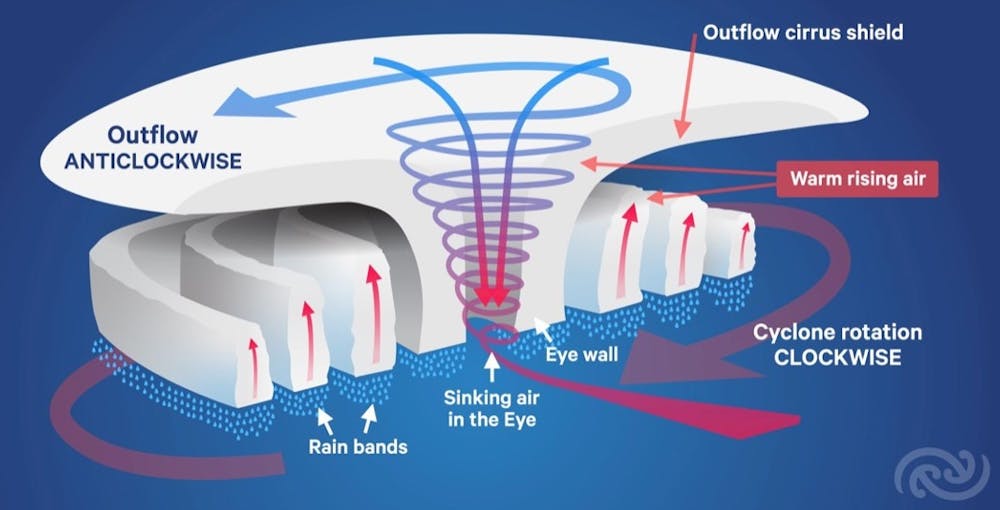
In the southern hemisphere, cyclones spin clockwise. This figure shows how cyclones form around a low pressure system over warm seawater. Depending on their intensity, tropical cyclones are steered by dominant winds in the lower, middle and upper layers of the atmosphere. Metservice New Zealand, CC BY-NC-ND
How cyclones are steered
Strong winds are the main force steering cyclones, determining direction and forward speed.
Severe tropical cyclones (categories 3–5) are characterised by deep convection currents, which form the famous eye at the centre of the storm, as well as feeder rainbands converging into their centre. Severe systems are generally steered by winds in the middle to upper levels.
By contrast, weaker cyclones (categories 1–2) are much shallower and often have little or no convection around their centre. They tend to be steered by winds in the lower to middle levels. At present, Cyclone Alfred looks to remain relatively weak.
Wind speed and direction can differ markedly in different levels of the atmosphere. Winds can also change direction at the same level. These competing influences are what lies behind the erratic paths of our cyclones.
Cyclones forming in the Coral Sea are more likely to be pushed in different directions by different winds and weather systems than their equivalents in other ocean basins. This is what makes them so hard to predict.
In our region, cyclones are largely steered by two high pressure systems.
The first pushes cyclones east, and the second steers them west. If both are present and roughly equal in strength, they can hold a cyclone near-stationary. We saw this with Cyclone Alfred for most of the last week.
Slow-moving tropical cyclones such as Alfred are more likely to wander, while faster-moving cyclones such as Severe Cyclone Yasi follow a stronger steering pattern and more predictable paths.
Quite often, cyclones travel south and east out to sea. There, they quietly die in a large area of ocean colloquially known as the cyclone graveyard, southeast of Brisbane. These cyclones are steered by different weather systems – upper troughs, cold masses of air from the Southern Ocean.
Cyclone Alfred was initially steered east by a near equatorial ridge to its northeast, then became stuck between this high pressure ridge and a sub-tropical ridge to its southwest. This is why it meandered very slowly south and built up strength to become severe.
An upper trough then pushed it southeast over the weekend. This week, it’s likely to turn sharply westward towards land, propelled by a high pressure ridge to the south.
Landfall – but where?
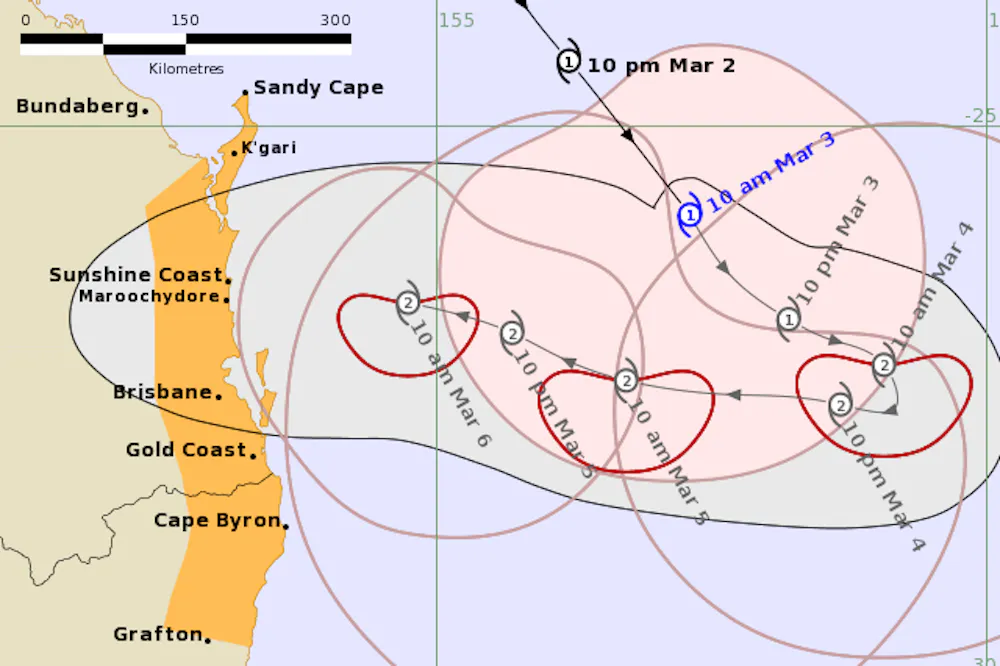
After meandering around the Coral Sea for more than a week, Cyclone Alfred’s forecast track now seems more certain.
The system is expected to intensify from a Category 1 to 2 tomorrow as it moves over warmer waters and draws in more moisture-laden air. This should see it maintain near Category 2 status until landfall. After it hits, it should rapidly weaken to a tropical low over southern Queensland into the weekend.
Alfred will bring a lot of rain, making flooded rivers and flash flooding likely. The Bureau of Meteorology has issued a flood watch for catchments all the way from Maryborough to the Northern Rivers area of New South Wales. These communities should prepare now.
Cyclone Alfred has a large area of gales, so will affect a wide swathe of coastline from K’gari (Fraser Island) to Byron Bay. Storm-force winds will cover a 100km wide area, mostly concentrated on its southern flank as it approaches and crosses the coast.
In the longer term, Alfred’s remnants will likely be captured by an approaching upper trough and taken back offshore, where it will die in the cyclone graveyard – gone, but not likely to be forgotten.
Steve Turton has previously received funding from the Australian Government.
Continuing with a long history of Indigenous storytelling, Murray has embedded the film with themes of identity, heritage and adventure. In doing so, she tells a story that is utterly heartwarming and wholly unique to place.
I didn’t have anything like this growing up. I had the things that reinforced the horrible narratives of Indigenous people globally. So, to have something there for the next generation, representation means everything.
The Lost Tiger is classic orphan story founded on identity. The main character is a thylacine (Tasmanian tiger) named Teo (voiced by Thomas Weatherall), whose hero’s journey starts when he begins to grapple with his differences.
Teo is found as a baby, alongside a mysterious crystal, by a couple from the gregarious wrestling kangaroo troupe Roomania. Young Teo struggles with his identity as he’s coming of age and wants to fit in.
After visiting a museum, Teo meets platypus and aspiring guild adventurer named Plato (Rhys Darby). Once Plato identifies Teo as one of the world’s last thylacines, he tells him of a legendary lost “Tiger Island” said to be inhabited by thylacines – and the two begin a quest to find the island.
The film critiques the “doctrine of discovery” through its antagonist, adventure guild explorer Quinella Quoll (Celeste Barber). The doctrine of discovery refers to a legal and ideological approach through which colonisers tried to justify the seizing of land, resources and objects by Indigenous peoples.
Quoll – who is always looking to “discover” powerful new artifacts for her museum collection – embodies all the extractive qualities of historical European explorers and museum founders.
This is an important message at a time when museums both nationally and internationally are reevaluating what they hold in their collections – and trying to address the historical injustices associated with colonial acquisitions.
With a simple but well-executed plot, the film allows for some fun colloquialisms such as “2-up” (an old Aussie gambling game) and “stop, drop and roll”, along with a slate of side characters that highlight the value of simply doing what’s right.
It taps into the universal truth that each person’s story is irrevocably connected to the stories of others, and that the effect of our choices go far beyond our own lives.
Visually, The Lost Tiger has a distinct texture, underpinned by a vivid vision of the bush. Murray, who is from the Kimberley region, was highly intentional in her portrayal of Australia’s dynamic landscapes. As she explains:
I grew up with red rocks, super white sand, and this aqua coloured ocean, and it looks just like a painting. And it wasn’t until I left Broome and came back, and went, ‘This country has such a juxtaposition’. One minute you can be in the desert, and then you walk into a rain forest with these waterfalls.
The animation itself is created on “stepped keys”, a process in which only every second frame is animated. So instead of seeing 24 frames of motion per second, as you would in a traditional computer-animated film, you see 12 frames per second. This pose-to-pose movement gives the film a stop-motion feel.
This unique approach is complemented by some whiz-bang moments sure to draw in younger viewers. The film’s wrestling scenes and action sequences, supported by animation director Tania Vincent, are choreographed with high levels of energy, leading to a climactic end.
Between two worlds
Animation has the unique ability to tell stories that are both inclusive and diverse – which acknowledge our differences, yet connect us through our shared loves and experiences.
The Lost Tiger does this beautifully by focusing on messages of respect, unity, connection to place and the importance of conserving precious resources on First Nations lands. It also taps into the difficulties of belonging (and struggling to belong) across different cultural worlds.
Murray’s film helps lead us towards an industry that embraces diverse voices, and which will be able to support the uniquely Australian voices of future generations.
The creators of the film acknowledge the Turrbal and Yuggera Peoples as the Traditional Owners and Custodians of the lands in Queensland on which the film was made.
The Lost Tiger is in cinemas now.
Ari Chand does not work for, consult, own shares in or receive funding from any company or organisation that would benefit from this article, and has disclosed no relevant affiliations beyond their academic appointment.
China is a critical force in the global energy transition and its involvement in international climate talks is essential, the head of the United Nations’ climate science panel said on Saturday. Jim Skea, chair of the Intergovernmental Panel on Climate Change, made the remarks ahead of the release of its findings from its 62nd plenary session, which concluded on Saturday in Hangzhou, Zhejiang province. Skea emphasized China’s leading role in deploying renewable energy, noting it has the world’s highest levels of solar and wind energy. “Without China’s participation, global efforts would be much less effective,” Skea said, highlighting the country’s importance in discussions under the UN Framework Convention on Climate Change and the Paris Agreement. The weeklong session focused on outlining reports for the IPCC’s seventh assessment cycle, covering the physical science of climate change, its impacts, adaptation, vulnerability and mitigation, as well as greenhouse gas inventories. The Hangzhou meeting stressed the importance of integrating climate action with economic growth and improved quality of life. “The idea of improving people’s well-being and quality of life is not opposed to taking climate change action. They actually go together,” Skea said. He praised China’s advancements in climate monitoring technologies, including early warning systems and meteorological satellites, which are crucial for tracking climate conditions, greenhouse gas emissions and socioeconomic changes, particularly in developing nations. Xiong Shaoyuan, deputy head of China’s delegation, said the nation will collaborate with other countries to build early warning platforms and share its experiences in meteorological services. Established in 1988, the IPCC provides scientific information to governments on climate change. For its current cycle, the IPCC will focus on climate change in urban areas and carbon dioxide removal technologies, including carbon capture, utilization and storage. The first meeting on urban climate change will be held from March 10 to 14 in Osaka, Japan, Skea said.
Tropical Cyclone Alfred is predicted to make landfall anywhere between Bundaberg and northern New South Wales this week. The Australian Bureau of Meteorology has warned it may bring severe hazards and “dangerous and life-threatening flash flooding”.
So, how do you prepare for a cyclone – and what do you do if it’s too late to leave?
How to prepare
Your starting point is to consider the risk to yourself and everyone in your household (including pets). Consider ensuring you have:
non-perishable food that everyone in the family will eat (enough for five to seven days)
water for drinking and cleaning (three litres per person per day)
medication (two weeks worth)
toiletries and first aid kit
pet food/supplies
torches
batteries
a back up battery for your phone
baby formula and nappies if needed
protective clothing and closed-in shoes
cash in small denominations
valuable documents such as passports, title deeds, ID, insurance details, photos (these can be photographed or packed in weather-proof container or envelope)
kids’ books, card games, board games, headphones
anything else you may need or really value (and isn’t too heavy to carry).
Make sure you have a grab-and-go kit that you can carry by yourself if authorities suddenly tell you to evacuate immediately.
Conventional wisdom used to be to prepare enough supplies for three days of disruption. Now, experts recommend having enough for five to seven days. After the initial disaster there may be road blockages or supply chain problems.
Ensure you have enough medication for a week or two, because pharmacies may take days or weeks to re-open. And remember that many medications, such as insulin, need to be refrigerated, so consider how you’d keep them cool if the power went out.
Fill containers with water and stick them in your freezer now; they can keep your freezer cool if you lose power. They can also become drinking water in future.
Talk to your neighbours. Do they have a generator or a camping fridge you can use? This is a great opportunity to get to know your community and pool your resources.
Ask yourself if you have friends with whom you or a pet can stay. One of the main reasons people don’t evacuate is because they can’t bring their pets (not all evacuation shelters allow them, so check in advance).
Consider what you can do now to prepare your house. One of the most common call-outs the SES receives is about blocked drains and gutters, so check if there’s time to clean your gutters now. You won’t be able to do it during the storm.
Stay informed – and don’t rely on hearsay
Have a plan for getting truthful information before, during and after the cyclone.
Rely on the information provided by official sources, as they will tell you when it’s too late to evacuate or when it’s safe to come out. This is highly context-specific and will depend on where you are located.
Get advice where possible from your local council’s disaster dashboard (most councils have one).
It should provide information such as where to get sandbags, which roads are closed (which can affect your evacuation plan) and evacuation centre openings and locations.
Anyone who monitors social media will see how many amateur meteorologists and maps are out there, but these are often not the best source. Always rely on official sources rather than hearsay, trending footage or amateur “experts”.
Always have an battery-operated AM-FM radio. If power goes out, relying on your phone to track information will drain your phone battery very quickly.
You may be able to charge it via your car or laptop, but telecommunications networks may not be active.
So having a battery-operated radio on hand – and plenty of batteries – is crucial.
What if the cyclone hits while you’re at home?
If it’s too late to evacuate, have a plan for sheltering in place.
Find the smallest room in your house with the least windows (which can shatter in a storm). This is often the bathroom, but it could be under the stairs. It is usually on the lowest level of the house.
Bring your food, water, radio, blankets and supplies there. Avoid walking around the house during the cyclone to fetch things; there could be glass on the floor or debris flying around.
It’s hard to predict how long you will need to shelter there, but it’s important not to leave until official sources say it is safe to do so.
Cyclones come in stages. They arrive from one direction, then comes an eerie calm as the “eye of the storm” passes over. Next, the other half of the cyclone arrives. Don’t go outside during the eye of the storm, because it’s not over.
Outside the house, there may be powerlines down, broken glass and other hazards. Don’t venture out until you get official clearance from the disaster dashboard or official sources on the radio saying it is safe.
For non-life threatening emergencies – such as a tree on your roof, or water running through your house – call the SES on 132 500 or register on the SES Assistance app (if you’re in Queensland). They will not come during the event itself but will come later.
If it’s a life threatening emergency, always call triple 0.
After the storm
After the storm, consider how to make your house more cyclone-ready in future. Many houses in North Queensland are designed for cyclone zones, but not as many further south will be.
Climate change means cyclones are likely to be more severe in future. These days, be cyclone-ready 365 days a year.
Yetta Gurtner has received funding in the past from the Bureau of Meteorology. She is a community engagement officer with the Queensland State Emergency Services.
Energy access and sustainable finance took center stage at the 2025 Finance in Common Summit, where two roundtable discussions addressed critical financing gaps and highlighted pathways to achieving universal energy access in Africa.
During the discussions, the African Development Bank reiterated its commitment to unlocking investment for Africa’s energy future and scaling climate financing as part of its recently-launch Mission 300 initiative, in anticipation of COP30.
With 600 million people in Sub-Saharan Africa still without electricity, the urgency of addressing energy access cannot be overstated. The first roundtable convened Local Finance Institutions (LFIs), national and local governments, utilities, and private sector leaders to explore solutions to financing constraints. Participants shared best practices, tackled investment bottlenecks, and discussed innovative de-risking mechanisms for energy projects.
“LFIs are the lifeblood of our economies, possessing a unique understanding of local contexts, needs, and opportunities,” noted African Development Bank Vice President, Nnenna Nwabufo, who moderated the session. “They are essential for mobilizing the necessary capital, fostering local entrepreneurship, and scaling sustainable energy projects.”
While significant progress has been made in expanding energy access across Africa, major challenges remain. In January 2025, the Mission 300 Energy Summit generated strong political momentum, with 48 African Heads of State committing to accelerating policy reforms, and 12 countries presenting National Energy Compacts outlining clear targets for energy access.
Backed by the World Bank, the African Development Bank and other development partners, Mission 300 aims to provide 300 million Africans with electricity access by 2030. “This ambitious goal is within reach, but it demands concerted action, innovative financing solutions, and strong partnerships,” emphasized Nwabufo.
However, financing remains a major bottleneck, particularly for last-mile connectivity and off-grid solutions. Public development banks and local finance institutions play a pivotal role in mobilizing the estimated $170 billion needed to achieve universal access. “Traditional financing models often fall short in meeting the specific needs of local communities and small-scale energy projects…this is where LFIs, with their local expertise, can make a transformative difference,” Nwabufo added.
Private funds such as the Gaia Energy Impact, a venture capital firm dedicated to renewable energy, are crucial for financing early-stage innovation and making projects investment-ready to attract more capital. “However, de-risking tools provided by public institutions, such as concessional funding, blended finance and guarantees, play a major role in leveraging private capital,” explained Hélène Demaegdt, President and Founder, of the impact fund.
A united vision for the future of energy access
The second roundtable shifted focus to Latin America and the Caribbean (LAC), where development banks have been at the forefront of climate finance. Experts from sovereign wealth funds, vertical funds, and private investors joined key institutional players to explore pathways for scaling sustainable financing.
With COP30 on the horizon, panelists emphasized the importance of a robust taxonomy to attract global capital. Brazil’s pioneering efforts—through initiatives like the Brazil Climate and Ecological Transformation Investment Platform (BIP) and Eco Invest Brazil—served as a model for emerging markets.
“As we move to COP30 we are committed to doubling down on looking at all sources of revenues and pulling all levers,” said Tatiana Rosito, Secretary for International Affairs for Brazil’s Ministry of Finance.
Discussions reinforced the necessity of blended finance models, philanthropic support, and sovereign wealth funds to bridge the climate adaptation and mitigation financing gap. The session set the stage for deeper engagements leading up to COP30, ensuring that emerging markets secure the capital needed for a just energy transition.
“COP30 will be a defining moment for Africa and the world. We cannot afford another cycle of pledges without action,” insisted Nwabufo.
“This needs to be an accountability COP,” echoed Mafalda Duarte, Executive Director of the Green Climate Fund. “We need less big announcements but more giving a sense of trust and confidence that we will focus deliberately on critical partnerships, implementation and results.”
Duarte also emphasized the need to broaden the investor base beyond multilateral development banks. “We know that the private investors are not doing as much as they could and should, so should be included as part of a more integrated narrative.”
“We must demonstrate that finance will not remain a barrier to Africa’s sustainable future but a catalyst for shared prosperity. It is not just about securing financing for Africa’s climate goals; it is about demonstrating that investing in Africa’s climate resilience is smart economics, benefitting both Africa and the global economy,” Nwabufo affirmed.
Covering period of Monday 3rd – Thursday 6th March – After a warm, dry end to meteorological summer, autumn announces itself in a chilly and wet fashion. MetService is forecasting a cool week for most, with wet and thundery weather, and biting southerlies along southern and eastern North Island coastlines. However, brighter weather returns by the end of the working week. Meanwhile, Tropical Cyclone Alfred now appears less likely to affect Aotearoa New Zealand.
A rain-bearing cold front moves up the South Island today (Monday), delivering heavier falls to eastern areas at times before clearing from the south and west this evening. On Tuesday, it’s the North Island’s turn with rain and showers, reaching Northland by the end of the day. Thunderstorms are also on the cards, particularly for the lower North Island and upper South Island.
MetService meteorologist Mmathapelo Makgabutlane explains, “Hail is likely from thunderstorms on Tuesday, especially for Nelson, Tasman, and Marlborough. While many areas have favourable conditions for thunderstorms, not everyone will see one. However, where they do occur, they could bring intense rainfall in a short period. After a dry start to the year, many places need rain, but a sudden downpour may not be the most beneficial way for it to arrive.”
Showers persist through Wednesday and Thursday for eastern regions and the lower North Island. By Friday, most places can expect brighter skies, aside from some cloud and showers in the far south of the South Island.
Alongside wet weather, a shift to cooler temperatures is on the way. “After highs in the upper 20s and even 30s over the weekend, mid-week temperatures will drop to the mid-teens, with cool nights as well. Parts of the Canterbury High Country may even see frost on Thursday morning, with Twizel forecast to dip to 2°C,” Makgabutlane says.
The cooler air is driven by southerlies, which could be strong at times in the eastern and lower North Island, leading to rough sea conditions. “Swell heights will be something to watch along the Gisborne and Hawke’s Bay coastlines from Thursday. Extra care is advised for anyone planning to be near the water,” Makgabutlane cautions.
Tropical Cyclone Alfred, which initially appeared to have the potential to turn towards Aotearoa, now looks more likely to track westward towards the Queensland coast of Australia. Our thoughts are with those who may be affected across the Tasman. MetService will continue to monitor developments, and more information on the cyclone’s impact in Australia can be found on the Bureau of Meteorology’s website: https://metservice.us11.list-manage.com/track/click?u=63982abb40666393e6a63259d&id=aec4796a6a&e=852c839bf9
Source: The Conversation (Au and NZ) – By Adrian Beaumont, Election Analyst (Psephologist) at The Conversation; and Honorary Associate, School of Mathematics and Statistics, The University of Melbourne
A poll of 20 marginal seats by Redbridge and Accent Research was conducted for the News Ltd tabloids on February 20–25, from a sample presumably over 1,000. The Coalition led by 50.5–49.5, a 1.5-point gain for Labor since the February 4–11 marginals poll.
Labor won the 2022 election by 52–48 and won the marginal seats polled by 51–49, implying a 1.5-point swing to the Coalition across these seats since the last election. If this poll were applied nationally, it suggests a Labor lead of 50.5–49.5.
Primary votes were 41% Coalition (down two), 34% Labor (up one), 12% Greens (steady) and 13% for all Others (up one). Anthony Albanese’s net favourability was up five points to -11 while Peter Dutton’s was down two to -13. By 50–33, voters thought things were headed in the wrong direction (55–27 previously).
While Labor improved overall in this poll, their position in the Victorian seats polled was dire, with an 8.4% two-party swing to the Coalition across the first two waves of this poll. State Labor is dragging down federal Labor.
Labor gains lead in Morgan poll
A national Morgan poll, conducted February 17–23 from a sample of 1,666, gave Labor a 51–49 lead by headline respondent preferences, a 2.5-point gain for Labor since the February 10–16 poll. This poll contrasted with the Resolve poll taken February 18–23 that gave the Coalition a 55–45 lead.
Primary votes were 36.5% Coalition (down three), 31.5% Labor (up 3.5), 13.5% Greens (up one), 5% One Nation (down 0.5), 10% independents (steady) and 3.5% others (down one). By 2022 election preference flows, Labor led by 53–47, a four-point gain for Labor.
By 49.5–34.5, voters said the country was going in the wrong direction (52.5–32.5 previously). The 15-point lead for wrong was the lowest since January 2024. Morgan’s consumer confidence measure jumped 4.7 points to 89.8.
The Morgan poll and the Redbridge marginal seats poll both suggest movement to Labor since the Reserve Bank reduced interest rates on February 18. While the Coalition retained a narrow lead in YouGov, the primary votes implied a little movement to Labor.
The graph below shows Labor’s two-party estimated vote in national polls, so the Redbridge marginals poll is excluded.
Labor has not recovered the lead in a polling average, but the latest polls are far better for them than the Resolve poll last week.
Coalition narrowly ahead in YouGov poll
A national YouGov poll, conducted February 21–27 from a sample of 1,501, gave the Coalition a 51–49 lead by preference flows from YouGov’s MRP polls, in which Greens and One Nation preferences are both weaker for Labor than at the 2022 election. There was no change from YouGov’s last MRP poll, conducted from late January to mid-February.
Primary votes were 37% Coalition (steady since the MRP poll), 28% Labor (down one), 14% Greens (up one), 8% One Nation (down one), 1% for Clive Palmer’s Trumpet of Patriots, 10% independents (up one) and 2% others (down one). By 2022 election preference flows, Labor would lead by about 50.5–49.5, a 0.5-point gain for Labor.
Albanese’s net approval was up three points since YouGov’s last non-MRP poll in January to -12, with 52% dissatisfied and 40% satisfied. Dutton’s net approval was up four points to -2. Albanese led Dutton as better PM by 42–40 (44–40 previously).
By 60–8, voters supported the government operating the Whyalla steelworks through a publicly owned company if no suitable private investor was found.
Additional Resolve questions and seat polls
The Resolve poll for Nine newspapers asked whether Donald Trump’s policies should be applied to Australia. Question wording has an impact: for example, “cutting waste from the public service” is a pro-Trump framing. A question that asked whether Australians approved or disapproved of Trump’s performance as US president would be preferable.
In past elections, seat polls have been unreliable. The Poll Bludger reported last Wednesday that three polls of Western Australian federal seats had been conducted by JWS Research for Australian Energy Producers from a combined sample of 2,529.
In Curtin, held by teal independent Kate Chaney, the Liberals held a huge primary vote lead of 56–28 over Chaney. In Bullwinkel, a new federal WA seat that is notionally Labor, Labnr’s primary vote had slumped 21 points to 15%, putting them in third place behind the Nationals and Liberals. However, there were only modest primary vote swings in Tangney, with Labor looking competitive to hold.
There were also two uComms NSW federal seat polls. In Wentworth, held by teal independent Allegra Spender, Spender held a 57.2–42.8 lead over the Liberals. This poll was taken for Climate 200 on February 12 from a sample of 1,068. In Labor-held Gilmore, the Liberals led by 52.8–47.2. This poll was taken for the Australian Forest Products Association February 17–20 from a sample of 684.
NSW Resolve poll: Labor’s primary vote slumps
A New South Wales state Resolve poll for The Sydney Morning Herald, conducted with the federal January and February Resolve polls from a sample of over 1,000, gave the Coalition 38% of the primary vote (up one since December), Labor 29% (down four), the Greens 14% (up three), independents 11% (down two) and others 8% (up one).
No two-party estimate was reported, but The Poll Bludger estimated a Coalition lead of about 51–49 from these primary votes. Labor incumbent Chris Minns led Liberal Mark Speakman by 35–14 as preferred premier (35–17 in December).
On the rail dispute between the NSW government and the train union, 43% wanted the government to negotiate a better deal with the union, 26% wanted the government to refuse the union’s demands and 16% thought they should agree to the union’s demands in full.
EMRS Tasmanian poll has little change
An EMRS Tasmanian state poll, conducted February 11–18 from a sample of 1,000, gave the Liberals 34% of the vote (down one since November), Labor 30% (down one), the Greens 13% (down one), the Jacqui Lambie Network 8% (up two), independents 12% (up one) and others 3% (steady). Tasmania uses a proportional system, so a two-party estimate is inapplicable.
Liberal Premier Jeremy Rockliff’s net favourability dropped five points to +10, while Labor leader Dean Winter was down eight to +6. Rockliff led Winter by 44–34 as preferred premier (43–37 in November).
Adrian Beaumont does not work for, consult, own shares in or receive funding from any company or organisation that would benefit from this article, and has disclosed no relevant affiliations beyond their academic appointment.
This month, as the weather stays high and you’re likely to want to stay under the air-conditioning, our experts have a cornucopia of shows and films they’re watching to suit every mood.
There is Robert de Niro’s romp through politics which “stretches the bounds of credibility”, new seasons of The Traitors from both the United Kingdom and the United States, three new Aussie productions and a new comedy from Aotearoa New Zealand. There is a documentary about Cyclone Tracy for the history buffs – and to round it all out, the intriguingly titled Nightbitch.
Zero Day
Netflix
It seems appropriate that Netflix’s attempt to create a show that captures the state of US politics should be as absurd and troubling as the first months of the Trump administration. Zero Day stretches the bounds of credibility, but, like Trump, it is hypnotic viewing.
A former president, George Mullen (Robert de Niro) is called upon to track down the source of a cyber-attack which turns off all power for one minute, leading to multiple deaths.
Mullen’s own family story becomes central to the plot, involving both his wife (Joan Allen) and daughter (Lizzy Caplan) – who conveniently happens to be a congresswoman, clearly inspired by left-wing congresswoman Alexandria Ocasio-Cortez.
Zero Day is full of such references, from the current president (Angela Bassett), a nod to Kamala Harris, to a populist radio host and a sinister tech tycoon.
American reviews have complained the series tries too hard to appeal across partisan lines, to suggest woke calls from the left is equivalent to extremism on the right. Yes, there’s a fuzziness to the politics of Zero Day. But I saw it as a cry of despair at the state of American public life which is also highly entertaining television.
– Dennis Altman
Optics
ABC iView
What does it mean to tell the truth? And how do we, as consumers of media, differentiate truth from fabrication? Optics, a new comedy series from the ABC, asks these questions through the setting of a public relations firm.
The show expertly balances humour with quick-wit, social media vernacular, and a level of marketing wordsmithing that makes you question if the news has ever told you a true story.
The show is based in the PR firm Fritz & Randell and opens with the death of its aging CEO Frank Fritz (Peter Carroll), in a men-only board meeting no less.
After Frank’s death, the son of the cofounder, Ian Randell (Charles Firth) makes a bid for top spot. But the owner of the firm, Bobby Bahl (Claude Jabbour) is concerned with “optics”, so he puts two young women in charge instead.
Their young, spunky attitude and social media prowess is seen as a massive advantage. And it is. But it soon becomes apparent this move is much more than a feminist fresh-take for the firm – and is rather a bid to push some skeletons further back in the closet.
With outrageous lines such as “is there an emoji for miscarriage”, you are guaranteed an entertaining watch. The show will have you questioning the stories you yourself are presented through news outlets. Further still, it will make you wonder how many hands those stories passed through before they hit the papers and screens.
N00b is a coming-of-age story set in small town Gore, New Zealand, a proverbial “arse-end” of the world. Under show creator Victoria Boult, the series bristles with a vibrancy and edginess.
It’s a familiar story of rugby jocks (“boys”) and popular kids, geeks, misfits, and their witless teachers. It’s something of a modest, reality snapshot of the teen dramas it so confidently riffs on, shows like Laguna Beach and The O.C.
But what makes this a courageous entry in the genre is N00b’s willingness to be both uproariously funny and caustically cynical. This is a very funny teen comedy, and yet it is also dark and provocative in ways I found refreshing and quite surprising.
Boult cut her teeth on film studies at the University of Sydney and then went on to work with Jane Campion on The Power of the Dog. The sureness of vision and the deftness of the way in which Boult understands genre is so impressive. The production is based on Boult’s viral TikTok series of the same name (which I can highly recommend).
I sincerely hope that N00b finds a major audience and perhaps even garners a cult following. Highly recommend.
– Bruce Isaacs
The Traitors US and UK, seasons three
TenPlay (Australia), ThreeNow (New Zealand)
The third seasons from The Traitors UK and US are fantastic companion pieces, with respective hosts Claudia Winkleman and Alan Cumming guiding the plucky contestants with their camp prowess.
With their third seasons, the creative teams behind each version have realised that the more theatrical the better, with Winkleman and Cumming leading the charge with their sass and eccentric fashion choices. The setting of Ardross Castle (for both series) in the Scottish Highlands helps.
The premise is simple: a cast of contestants must complete challenges to earn money for the kitty. Hidden among the faithful contestants are traitors. If a traitor makes it to the end, they keep the money for themselves.
Each episode, the faithfuls must banish a contestant who they think is a traitor. That evening, the traitors also meet in their turret, wearing mysterious cloaks of course, to “murder” a contestant in their sleep.
The British season has a diverse cast of everyday contestants, with standouts being one person who gives herself away as a traitor within seconds of being chosen, and another faking a Welsh accent to appear more down to earth.
The US season is vastly different with a cast of former reality television show icons. Here, it’s fascinating to see how contestants from different franchises, such as RuPaul’s Drag Race, Real Housewives, Survivor and Big Brother all approach the game differently.
Both the American and British versions of The Traitors are fantastic viewing and it’s a genuine shame that the Australian version was let down with substandard casting choices and an aesthetic that was the antithesis of camp.
– Stuart Richards
Cyclone Tracy
9 Now
On Christmas Eve 2024, Australia remembered the 50th anniversary of the destruction of Darwin wrought by Cyclone Tracy. Fittingly, the 9 Now streaming service marked this anniversary by featuring the 1986 miniseries Cyclone Tracy, a vivid depiction of 1970s Darwin and the terrible impact of the cyclone.
Cyclone Tracy stars Tracy Mann as Connie, a widow and mother of two who has just paid off the mortgage of her hotel, which serves as the central stage for the drama.
The series captures the cultural diversity of Darwin (though some portrayals veer towards caricature at times), and the city itself is beautifully evoked through archival footage and great production design. The cyclone itself is frightening, and its destructive power is powerfully evoked (the series’ director of photography, Andrew Lesnie, would later win an Oscar for cinematography).
In the mid-1980s, when this series first went to air, many viewers would have still been coming to terms with this terrible disaster: it was an act of storytelling for the nation. Watching it in 2025, Cyclone Tracy reminds us of the importance of these nation-making television programs that were once such an important part of Australian culture.
– Michelle Arrow
Apple Cider Vinegar
Netflix
Apple Cider Vinegar tells the story of the elaborate cancer con orchestrated by Australian blogger Annabelle (Belle) Gibson.
For anyone who followed Gibson during her rise to fame in the 2010s – or her spectacular fall – the show feels eerily familiar.
From the clothing, to the makeup, to the food, Apple Cider Vinegar excels in set design and staging. Every effort has been made to ensure this true story, based on a lie, looks like it did when it was unfolding on our phone screens in the 2010s.
As someone who followed Gibson closely and spent months hunting down the recalled cookbook to see if the health claims were as outlandish as I’d heard (they were), this show was a treat to watch.
The scenes are cut with recreations of Belle’s stylised Instagram pictures of green juices, beaches and food with “no nasties”. Belle’s account was removed from Instagram after the massive public ousting of her hoax.
Apple Cider Vinegar has done an incredible job recreating this account and breathing life back into the deleted content.
Whether or not you are already familiar with Gibson’s story, Apple Cider Vinegar is a compelling watch. You’ll especially love it if you enjoy non-fiction productions that play with ideas of truth such as iTonya, the Tinder Swindler and Inventing Anna.
Stan’s new series Invisible Boys follows four young gay men as they understand and explore their identities while living in Geraldton, a regional town in Western Australia.
Charlie Roth (Joseph Zada), Zeke Calogero (Aydan Calafiore), Kade “Hammer” Hammersmith (Zach Blampied) and Matt Jones (Joe Klocek) represent four very different young men. Yet they share the experience of feeling invisible because of their sexuality.
An adaptation of Holden Sheppard’s novel of the same name, the story challenges linear narratives of progress and typical ideals of queer life. It also shows how such mentalities can lead gay and bisexual men growing up in regional Australia to feel invisible, as they often don’t fit the neat narratives associated with “progress”.
No previous teen drama has been quite as truthful in its representation of some young gay and bisexual men’s experiences.
As someone who grew up gay in regional Australia, it feels like an authentic representation of my own experience. There’s something universal about Charlie, Zeke, Kade and Matt’s stories of not fitting in, and of being invisible to be safe.
Most striking is the way the series captures the complicated mix of joy and fear – the clash of opportunity and consequence – that accompanies becoming visibly gay in these environments.
“Motherhood,” the beleaguered stay-at-home mother of Nightbitch tells us in contemplative voice-over, “is probably the most violent experience a human can have aside from death itself”.
The film sets out to show motherhood is also far more savage and feral than the anodyne images posted on social media by retrograde tradwives or mumfluencers would have us believe.
As Nightbitch puts it, it’s “fucking brutal”.
Mother (Amy Adams) is an unnamed installation artist who places her career on hold to raise her young son. Wrung out by the demands of motherhood and increasingly furious with the lack of support she receives from her incompetent and often absent Husband (Scoot McNairy), Mother starts to spiral out of control, morphing into a dog complete with tail, sharpened canines, extra nipples and a ravenous desire for raw meat.
Nightbitch takes the fear of the reproductive woman literally, drawing on magic realism and horror tropes to show the visceral and psychological metamorphosis women undergo on becoming mothers. Unfortunately director Marielle Heller’s refusal to lean into the body horror results in a neutered narrative with more bark than bite.
Michelle Arrow receives funding from the Australian Research Council.
Bruce Isaacs, Damien O’Meara, Dennis Altman, Edith Jennifer Hill, Rachel Williamson, and Stuart Richards do not work for, consult, own shares in or receive funding from any company or organisation that would benefit from this article, and have disclosed no relevant affiliations beyond their academic appointment.
The government recently announced a framework to regulate carbon capture, utilisation and storage (CCUS) by New Zealand companies.
Energy and Climate Change Minister Simon Watts outlined new rules that would allow emitters to capture their carbon dioxide (CO₂) emissions and inject them underground for permanent disposal. They would then avoid having to pay for those emissions under the Emissions Trading Scheme.
Globally, CCUS is currently used mostly by coal or gas-fired power stations, liquefied natural gas plants and petroleum refineries. There are 41 commercial operations around the world, and they capture about 40 million tonnes of CO₂ annually.
Our peers (Australia, the United States and the European Union) already have CCUS frameworks and storage projects. The Intergovernmental Panel on Climate Change acknowledges CCUS’s role in curbing emissions, but highlights challenges in scaling and technology readiness.
New Zealand faces the challenge of reducing emissions from strategic industries such as steel, concrete, fossil fuels and their derivatives (methanol, ammonia). CCUS has been tabled as an interim solution, strongly supported by the fossil fuel industry. However, critics warn it could reduce incentives to phase out fossil fuels.
The government argues its CCUS framework aligns New Zealand with international standards. This claim has merit insofar as successful climate action is likely to require international collaboration and technology transfer.
CCUS in New Zealand could enable reinjection of CO₂ produced from the Kapuni gas field in Taranaki, with “utilisation” involving diverting some of the gas for use in the food and beverage or horticulture industries.
However, leakage of CO₂ from long-term disposal sites is a major technical risk and New Zealand’s framework must be clear on how it would deal with this liability.
Rules for CCUS projects generally require operators to monitor, report and remedy any leakage of CO₂. But because the industry is young, it is useful to take a broader look at geological leakage in the past to reveal how future challenges play out.
Lake Boehmer, in the the Permian Basin of West Texas, wasn’t always there. But 20 years ago an old irrigation well started leaking saltwater and hasn’t stopped since.
The well was drilled in 1951 by an oil and gas company. No oil was discovered so the well was handed over to the landowner for irrigation. The well produced water, but also poisonous hydrogen sulphide, enough to kill a farmhand in 1953.
In the 1990s, the well started leaking. Water from a deep aquifer had pushed its way up alongside the well through geological layers of salt. The water dissolved the salt, worsening the leak, and emerged from underground three times saltier than seawater.
The Railroad Commission, which regulates the oil and gas industry in Texas, says they are not liable to plug the well because they only have jurisdiction over oil wells. The original operator, which is claimed to have promised to plug the well “any time it becomes polluted with mineral water”, is no longer in business. No one can find the landowner.
After 20 years, Lake Boehmer has grown to 60 acres. Its shore is rimmed in salt crystals and the odd dead bird from hydrogen sulphide exposure. No one can agree who should fix it.
Could something similar happen with CCUS? Exacerbating factors in the Boehmer case include deterioration of an aged well – it’s almost 50 years since leakage started – and the absence of a backstop party as the final holder of liability. Both could happen with CCUS under the wrong circumstances.
Better ways of dealing with leakage
The Decatur CCUS project in the US state of Illinois has been injecting CO₂ produced from corn ethanol two kilometres deep into sandstone. Over about a decade, 4.5 million tonnes of CO₂ has been injected – emissions diverted from the atmosphere.
The US government imposes strict monitoring rules on CCUS projects. Special monitoring wells are drilled into the disposal aquifer to measure pressure changes and how far the CO₂ has travelled.
Unfortunately, one of these wells started to leak, possibly due to corrosion. It allowed about 8,000 tonnes of CO₂ to escape into overlying geological layers.
This is rightly concerning, but to put it into perspective, the size of the leak is 0.2% of the injected CO₂ volume and none of it has escaped to the atmosphere or shallow groundwater. The leak was detected, the US Environmental Protection Agency (EPA) intervened, issuing a notice that the leak be remediated, and the company plugged the well.
This illustrates a functioning CCUS framework. Monitoring requirements ensured the leak was discovered and the regulator was empowered to dictate remedial action.
However, critics have questioned the timeliness of the operator’s disclosure. The site remains on hold but may resume operations if the EPA is satisfied with the fix.
Lessons for New Zealand
A proposal circulated last year suggests the government will model its legislation on Australia and the EU, with CCUS operators being responsible for leaks during disposal operations and for a time after site closure.
This is like the Decatur situation. It makes sense for operators to fix leaks because they have the technical expertise and are the direct financial beneficiaries of emissions disposal.
It gets trickier on generational time frames. Companies can go out of business or might leave the country. In these cases, the government is liable for long-term leakage and may seek financial security from the operator to cover future costs.
A leak arising decades after closure could be more difficult to detect and costly to fix, especially if held up by a protracted fight around liability. This is the Lake Boehmer example.
Some CCUS seems inevitable if the world is to meet climate targets. It is therefore important to prepare for the possibility of a leak by having robust practices and clear responsibility.
Although it may seem unfair to burden future generations with looking after CO₂ disposal sites, we argue it is preferable to a legacy that has those same climate-warming gases in the atmosphere.
David Dempsey receives funding from MBIE for research into carbon dioxide removal.
Andrew La Croix receives funding from MBIE for research into carbon dioxide removal.
On Valentine’s Day 2025, heavy rains started to fall in parts of rural Appalachia. Over the course of a few days, residents in eastern Kentucky watched as river levels rose and surpassed flood levels. Emergency teams conducted over 1,000 water rescues. Hundreds, if not thousands of people were displaced from homes, and entire business districts filled with mud.
For some, it was the third time in just four years that their homes had flooded, and the process of disposing of destroyed furniture, cleaning out the muck and starting anew is beginning again.
Historic floods wiped out businesses and homes in eastern Kentucky in February 2021, July 2022 and now February 2025. An even greater scale of destruction hit eastern Tennessee and western North Carolina in September 2024, when Hurricane Helene’s rainfall and flooding decimated towns and washed out parts of major highways.
Scenes of flooding from several locations across Appalachia in February 2025.
Each of these events was considered to be a “thousand-year flood,” with a 1-in-1,000 chance of happening in a given year. Yet they’re happening more often.
The floods have highlighted the resilience of local people to work together for collective survival in rural Appalachia. But they have also exposed the deep vulnerability of communities, many of which are located along creeks at the base of hills and mountains with poor emergency warning systems. As short-term cleanup leads to long-term recovery efforts, residents can face daunting barriers that leave many facing the same flood risks over and over again.
Exposing a housing crisis
For the past nine years, I have been conducting research on rural health and poverty in Appalachia. It’s a complex region often painted in broad brushstrokes that miss the geographic, socioeconomic and ideological diversity it holds.
There is considerable local inequality that is often overlooked in a region portrayed as one-dimensional. Poverty levels are indeed high. In Perry County, Kentucky, where one of eastern Kentucky’s larger cities, Hazard, is located, nearly 30% of the population lives under the federal poverty line. But the average income of the top 1% of workers in Perry County is nearly US$470,000 – 17 times more than the average income of the remaining 99%.
This income and wealth inequality translates to unequal land ownership – much of eastern Kentucky’s most desirable land remains in the hands of corporations and families with great generational wealth.
When I first moved to eastern Kentucky in 2016, I was struck by the grave lack of affordable, quality housing. I met families paying $200-$300 a month for a small plot to put a mobile home. Others lived in “found housing” – often-distressed properties owned by family members. They had no lease, no equity and no insurance. They had a place to lay one’s head but lacked long-term stability in the event of disagreement or disaster. This reality was rarely acknowledged by local and state governments.
Eastern Kentucky’s 2021 and 2022 floods turned this into a full-blown housing crisis, with 9,000 homes damaged or destroyed in the 2022 flood alone.
“There was no empty housing or empty places for housing,” one resident involved in local flood recovery efforts told me. “It just was complete disaster because people just didn’t have a place to go.”
Most homeowners did not have flood insurance to assist with rebuilding costs. While many applied to the Federal Emergency Management Agency for assistance, the amounts they received often did not go far. The maximum aid for temporary housing assistance and repairs is $42,500, plus up to an additional $42,500 for other needs related to the disaster.
The federal government often provides more aid for rebuilding through block grants directed to local and state governments, but that money requires congressional approval and can take months to years to arrive. Local community coalitions and organizations stepped in to fill these gaps, but they did not necessarily have sufficient donations or resources to help such large numbers of displaced people.
Affordable rental housing is hard to find in much of Appalachia. When flooding wipes out homes, as Jackson, Ky., saw in July 2022 and again in February 2025, it becomes even more rare. Michael Swensen/Getty Images
With a dearth of affordable rentals pre-flood, renters who lost their homes had no place to go. And those living in “found housing” that was destroyed were not eligible for federal support for rebuilding.
The sheer level of devastation also posed challenges. One health care professional told me: “In Appalachia, the way it usually works is if you lose your house or something happens, then you go stay with your brother or your mom or your cousin. … But everybody’s mom and brother and cousin also lost their house. There was nowhere to stay.” From her point of view, “our homelessness just skyrocketed.”
The cost of land – social and economic
After the 2022 flood, the Kentucky Department for Local Government earmarked almost $300 million of federal funding to build new, flood-resilient homes in eastern Kentucky. Yet the question of where to build remained. As another resident involved in local flood recovery efforts told me, “You can give us all the money you want; we don’t have any place to build the house.”
It has always been costly and time-intensive to develop land in Appalachia. Available higher ground tends to be located on former strip mines, and these reclaimed lands require careful geotechnical surveying and sometimes structural reinforcements.
If these areas are remote, the costs of running electric, water and other infrastructure services can also be prohibitive. For this reason, for-profit developers have largely avoided many counties in the region. The head of a nonprofit agency explained to me that, because of this, “The markets have broken. … We have no [housing] market.”
Eastern Kentucky’s mountains are beautiful, but there are few locations for building homes that aren’t near creeks or rivers. Strip-mined land, where mountaintops were flattened, often aren’t easily accessible and come with their own challenges. Posnov/Moment via Getty Images
There is also some risk involved in attempting to build homes on new land that has not previously been developed. A local government could pay for undeveloped land to be surveyed and prepared for development, with the prospect of reimbursement by the U.S. Department of Housing and Urban Development if housing is successfully built. But if, after the work to prepare the land, it is still too cost-prohibitive to build a profitable house there, the local government would not receive any reimbursement.
Some counties have found success clearing land for large developments on former strip mine sites. But these former coal mining areas can be considerable distances from towns. Without robust public transportation systems, these distances are especially prohibitive for residents who lack reliable personal transportation.
Another barrier is the high prices that both individual and corporate landowners are asking for properties on higher ground.
The scarcity of desirable land available for sale, combined with increasingly urgent demand, has led to prices unaffordable for most. Another resident involved in local flood recovery efforts explained: “If you paid $5,000 for 30 acres 40 years ago, why won’t you sell that for $100,000? Nope, [they want] $1 million.” That makes it increasingly difficult for both individuals and housing developers to purchase land and build.
One reason for this scarcity is the amount of land that is still owned by outside corporate interests. For example, Kentucky River Properties, formerly Kentucky River Coal Corporation, owns over 270,000 acres across seven counties in the region. While this landholding company leases land to coal, timber and gas companies, it and others like it rarely permit residential development.
But not all unused land is owned by corporations. Some of this land is owned by families with deep roots in the region. People’s attachment to a place often makes them want to stay in their communities, even after disasters. But it can also limit the amount of land available for rebuilding. People are often hesitant to sell land that holds deep significance for their families, even if they are not living there themselves.
Rural communities are often tight-knit. Many residents want to stay despite the risks. AP Photo/Timothy D. Easley
One health care professional expressed feeling torn between selling or keeping their own family property after the 2022 flood: “We have a significant amount of property on top of a mountain. I wouldn’t want to sell it because my papa came from nothing. … His generation thought owning land was the greatest thing. … And for him to provide his children and his grandchildren and their great-grandchildren a plot of land that he worked and sweat and ultimately died to give us – people want to hold onto that.”
She recognized that land was in great demand but couldn’t bring herself to sell what she owned. In cases like hers, higher grounds are owned locally but still remain unused.
Moving toward higher ground, slowly
Two years after the 2022 flood, major government funding for rebuilding still has not resulted in a significant number of homes. The state has planned seven communities on higher ground in eastern Kentucky that aim to house 665 new homes. As of early 2025, 14 houses had been completed.
Progress on providing housing on higher ground is slow, and the need is great.
In the meantime, when I conducted interviews during the summer and fall of 2024, many of the mobile home communities that were decimated in the 2022 flood had begun to fill back up. These were flood-risk areas, but there was simply no other place to go.
Last week, I watched on Facebook a friend’s live video footage showing the waters creeping up the sides of the mobile homes in one of those very communities that had flooded in 2022. Another of my friends mused: “I don’t know who constructed all this, but they did an unjustly favor by not thinking how close these towns was to the river. Can’t anyone in Frankfort help us, or has it gone too far?”
With hundreds more people now displaced by the most recent flood, the need for homes on higher grounds has only expanded, and the wait continues.
Kristina Brant has received funding from the National Science Foundation and United States Department of Agriculture to support her past and ongoing research in rural Appalachia.
Kelly Greene, Minister of Emergency Management and Climate Readiness, has released the following statement on Search and Rescue Volunteer Memorial Day:
“Today, we recognize the incredible dedication of search and rescue volunteers and the sacrifices they have made while serving people in British Columbia.
“Our province is fortunate to have some of the most skilled, passionate and selfless search and rescue volunteers in the world. Together, the BC Search and Rescue Association, Royal Canadian Marine Search and Rescue, and PEP Air have saved the lives of thousands of people. They are heroes.
“Search and rescue volunteers are on call 24 hours a day, 365 days a year, providing their time and expertise to help people throughout British Columbia. While much of their work happens far from public view, their impact is felt across the entire province. They are the lifelines in our greatest moments of need, and we are incredibly grateful for their dedication. To all those volunteering on search and rescue teams, on behalf of all British Columbians, thank you. We are forever grateful.
“It takes a remarkable kind of person to be a search and rescue volunteer: someone who is driven, courageous and has an unwavering commitment to helping others. These search and rescue missions can come with an incredible cost. Since 1967, there have been 17 search-and-rescue volunteers who have lost their lives while serving British Columbians. Their sacrifices will never be forgotten.
“Today, on Search and Rescue Memorial Day, I would like to invite all British Columbians to reflect on those heroic volunteers who lost their lives in the pursuit of safety for others, their loves ones, and their service to the people of our province.”
Since 2015, youth mental health has noticeably declined. Currently, 1.25 million young people in Canada require mental health support. (Shutterstock)
Canada urgently needs to take action to support the well-being of young people and secure a healthier and more prosperous future for generations to come.
The recently published Lancet Psychiatry Commission on Youth Mental Health shows that this problem is global, and in part driven by megatrends — major and long-lasting societal changes such as climate change, insecure employment and growing intergenerational inequality. These issues are situated within decades of colonial and neoliberal political, social and economic policies.
To support youth mental health, Canada must work towards reversing these megatrends while also investing in youth mental health services.
The youth mental health problem is global, and in part driven by ‘megatrends’ — major and long-lasting societal changes such as climate change, insecure employment and growing intergenerational inequality. (Shutterstock)
We were inspired by The Lancet Psychiatry Commission on Youth Mental Health, which calls for global action to address this urgent mental health crisis affecting young people. This global initiative involved researchers from diverse fields, service providers and young people, and was co-led by Srividya Iyer (a co-author on this piece and Canada Research Chair in Youth, Mental Health, and Learning Health Systems). It advances a framework for improving youth mental health care, integrating all sectors providing services relevant to mental health (for example, community centres, stand-alone clinics, hospitals) and all types of interventions, ranging from prevention to specialized services for youth with long-term mental health problems.
The situation in Canada
Canada is a global leader in creating new mental health services for youth, which began with the creation of a network of programs for youth with psychosis. Lessons learned have inspired transformation in broader youth mental health services, called “Integrated Youth Services” (IYS).
Designed with input from youth and their families, IYS do not require transition from pediatric to adult care at age 18, which prevents youth from slipping through the cracks between the two systems. IYS integrate mental health, medical health and other social services; and create primary mental health care services.
These services and investments represent Canada’s critical commitment to youth mental health. However, there have been relatively fewer efforts to address other elements responding to factors contributing to worse youth mental health, such as the ongoing harms of colonization and the climatecrisis.
To truly address the youth mental health crisis, we must move beyond just creating services and into creating a world that supports young people to thrive. In these areas, young people themselves have shown us the way through initiatives like the Indigenous Climate Action Youth Leadership, the Anti-Racist Youth Lab and EveryChildNow, which takes action on youth poverty.
What can we do
Society must embrace a strong cultural shift that prioritizes a duty to young people. (Shutterstock)
To support young people, the Lancet report highlights that society must embrace a strong cultural shift that prioritizes a duty to young people, future generations and intergenerational equity, ensuring that present-day policies consider their long-term impacts. The influence of megatrends suggests that activism on any of these societal issues can benefit youth mental health.
For those who want to take action directly, advocating for increasing mental health and social service funding, supporting local organizations dedicated to young people, involving youth in decision-making processes, and fostering nurturing social communities are all important steps.
In light of the upcoming federal election, Canadians should demand that all political parties have a clear plan for youth mental health. Policymaking should prioritize youth, family and community needs. Policies should be evidence-based, especially since intuitively helpful but untested ideas may have unintended consequences (for example, negative effects of universal prevention efforts) or can be complicated (such as the relationship between social media use and youth mental health).
Continuous funding for mental health research can generate knowledge that can inform practice and policy, anticipate and respond to future priorities, test innovative interventions (like nature-based, social prescribing and intergenerational connection) and improve existing systems and interventions.
Young people are tomorrow’s leaders, innovators and contributors. Ignoring their mental health problems undermines their potential and jeopardizes Canada’s ability to build a prosperous, inclusive society. Prioritizing youth mental health is not just a strategic investment for the country’s resilience — it is an ethical imperative.
Tovah Cowan receives funding from CIHR for a Planning and Dissemination grant supporting a project related to improving learning health systems for youth mental health services. Her current salary is paid through a CIHR grant previously awarded to Dr. Iyer.
Camila Velez receives funding from the Canadian Institutes of Health Research (CIHR) through a Doctoral Scholarship and a Planning and Dissemination grant for an International Symposium on arts-based research in youth mental health. Her current research assistant salary is paid through a CIHR grant previously awarded to Dr. Iyer.
Nora Morrison’s current salary is paid through a CIHR grant previously awarded to Dr. Srividya Iyer.
Rubén Valle receives his salary from a CIHR grant previously awarded to Dr. Iyer.
Srividya N. Iyer is supported by the Canada Research Chairs Program (Tier 1) and has received peer-reviewed grants from the Canadian Institutes of Health Research, Fonds de Recherche du Québec – Santé and the International Development Research Centre.
Wildfire season in Canada has historically spanned from late April to August — with the most damaging of these fires typically burning in June and July. But in recent years, we’ve seen a significant change in when wildfires burning; they are no longer a seasonal phenomenon.
For example, in 2024, Alberta’s wildfire season started in February due to the province’s warm and dry conditions. Québec recorded its forth earliest wildfire since 1973 in mid-march of the same year. British Columbia then reported their first wildfires of the season shortly after.
In 2023, Canada had one of its most catastrophic wildfire years — with over 18.4 hectares of forest burned. These wildfires caused approximately 232,000 people to be evacuated from their homes in British Columbia, Alberta, Saskatchewan and Québec.
The huge number of wildfires that burned in 2023 released more than three times the total CO2 emissions of Canada’s entire transportation sector produces in a year. This catastrophic wildfire season also started burning far earlier than normal.
Changing wildfire patterns represent a growing danger to Canadians and our nation’s communities, ecosystems and air quality.
Recipe for a wildfire
The recipe for wildfire is simple and needs only three ingredients: fuel (combustible vegetation), ignition (either from human or natural causes — such as lightning) and favourable weather conditions (hot, dry and windy weather).
But drought can act as a key accelerating factor. As a professor who specializes in sustainable land and water management, I have spent over 15 years researching the impacts of climate change on natural disasters. My most recent research has highlighted the role that droughts play in wildfire vulnerability in Canada.
Droughts not only dry vegetation — which gives wildfires more fuel — they also prolong hot, dry and windy weather. This further creates a high-risk environment for wildfires to ignite and spread.
Canada may appear to be a water-rich country, with vast networks of lakes, rivers and considerable amounts of annual precipitation. But these rich resources suffer from significant seasonal and regional variations.
During 2023, there was a strong link between soil moisture levels measured between May and October and wildfire activity. Areas with the lowest soil moisture levels experienced heightened wildfire activity. This underscores the critical role of drought conditions in amplifying wildfire risks.
The total economic damage and losses are estimated to be more than $250 billion. This catastrophic crisis has clearly highlighted the growing impacts of climate change on densely populated areas at the interface of wildland and urban zones.
But another important factor that significantly contributed to the damage caused by these wildfires in California was the wildland-urban interface (WUI). These are areas where natural, undeveloped vegetation meets human development. This creates a high-risk zone where flammable plants and structures combine — increasing the chance of wildfires spreading from wildlands to communities.
In Canada, the WUI is rapidly expanding as large cities contend with population growth. But this is putting even more Canadians at risk from potentially detrimental wildfires. The recent, severe wildfires in California’s WUI areas offer a clear warning for Canada, highlighting an urgent need to address the risks associated with these rapidly growing zones.
Safeguarding strategies
One way of safeguarding Canada’s expanding WUI zones is by using the leaf area index (LAI). This is a measure of vegetation density.
The more dense the vegetation in a particular region (which means it has a higher LAI value), the greater that area’s risk of wildfire. This is because densely wooded areas contain significant fuel sources for wildfires, making them capable of sustaining and intensifying fire spread.
British Columbia’s coastline, Eastern Canada, Southern Ontario and parts of Nova Scotia and New Brunswick (including Halifax and Saint John) are all densely vegetated, highly populated areas that are highly susceptible to wildfire threats — especially during periods of drought and high temperatures.
By pinpointing Canada’s most vulnerable regions, targeted wildfire prevention strategies can be carried out to mitigate risks and enhance community resilience in the face of escalating wildfire threats. This might include reducing the amount of dry vegetation, carrying out controlled burns and building fire-resistant infrastructure.
Canada announced a new goal to build nearly 3.9 million houses by 2031. For these houses to be built, parts of WUI zones will need to be used. It will be important for planning and development policies to ensure resilience against wildfires.
Canada stands at a pivotal moment in wildfire risk management because of expanding WUI zones, prolonged drought conditions and intensifying fire weather converge. Without a multi-pronged strategy, wildfires will only continue to be a growing threat to ecosystems, infrastructure and public safety.
Hossein Bonakdari does not work for, consult, own shares in or receive funding from any company or organisation that would benefit from this article, and has disclosed no relevant affiliations beyond their academic appointment.
0:15 Online safety tips from cyber expert – Rupal Hollenbeck leads cybersecurity firm Check Point Software. Today’s online space is much more hyperconnected than it used to be, she says. Gen Z uses the internet in a different way to older users, says Hollenbeck, who may be alarmed at what young people choose to share online. But the cybersecurity industry needs to accept this new reality and ‘lean into it’, she says.
4:16 UN chief talks humanitarian crises – In December, the UN released its annual review of the scale of worldwide need. In total, 305 million people need urgent humanitarian aid from Syria and sub-Saharan Africa to Myanmar, Venezuela and Ukraine. At the same time, 2024 was the deadliest year ever to be a humanitarian worker. Tom Fletcher took over the UN humanitarian affairs office in October. He says that while the task is daunting, multilateral cooperation is essential to success.
8:49 How history can help leaders today – According to Mohit Joshi, CEO of Tech Mahindra, understanding history can shape better leaders by offering valuable insights into how societies adapt to change. As the world navigates the rapid transformation brought by the AI revolution, Joshi highlights how past events like the Industrial Revolution, the rise of railroads, and mechanization provide a template for understanding technological adoption and its long-term societal impact.
12:00 Climate scientists’ warning to business – Even as the world strives to hit net-zero targets, things will get worse before they get better. But for businesses that take action today, there will be opportunities amid the upheaval. Every $1 that businesses invest in climate adaptation and resilience today could generate up to $19 in returns tomorrow. These benefits will appear from several directions, says Johan Rockström, Director of Potsdam Institute for Climate Impact Research.
_____________________________________________
The World Economic Forum is the International Organization for Public-Private Cooperation. The Forum engages the foremost political, business, cultural and other leaders of society to shape global, regional and industry agendas. We believe that progress happens by bringing together people from all walks of life who have the drive and the influence to make positive change.
Cape Town, February 28, 2024 — Greenpeace Africa delivered on Friday 28th February a global petition on behalf of more than half a million people, calling on governments to force fossil fuel companies to “stop their climate wrecking activities” and “repair and pay for the damage they have caused.” The petition was handed over to a coalition of 17 countries and groups currently reviewing “polluter pays” levies [1] at the sidelines of the meeting of the Finance in Commons Summit in Cape Town.[2] In parallel, Cape Town’s iconic Table Mountain National Park is being consumed by wildfires, in the midst of the worst drought in more than 100 years across Southern Africa.[3]
Sherelee Odayar, Greenpeace Africa’s Oil and Gas Campaigner, said: “It is unfair to expect that ordinary people will face the climate crisis with cents and rands, while the polluters in chief will pocket billions. It is also impractical: Most world governments simply cannot afford to provide climate solutions at the needed scale. Drought, extreme heat, storms, floods and fires are disproportionately affecting Africa and other Global Majority countries. Science and technology can help bring relief, now governments must make polluters pay to deliver justice and raise the necessary funds.”
Signatures by people from Africa, the Middle East, Europe, North America, and Southeast Asia were collected between 2023-24, the two hottest years since records began, replete with extreme weather events fuelled by greenhouse gas emissions from the oil and gas industry. At the same, five oil and gas corporations alone reported over US$100 billion cumulatively in profit for last year.
The collective demand was presented to the secretariat of the Global Solidarity Levies Taskforce, a coalition of 17 countries and groups, co-led by Barbados, France, and Kenya. It contributes to a public process of consultation which started last month concerning a series of proposals being considered by the governments who are members of the Taskforce, including options to apply levies on fossil fuel industry profits and extraction to fund climate action.
A letter accompanying the petition reminds that oil and gas companies “knowingly lied about climate change and lobbied to slow action” and are failing to pay their fair share. “Super rich individuals and other polluting industries… should also be held to account. Making polluters pay for the damages they have caused is vital to help communities across the world to recover, rebuild and invest in climate solutions.”
The petition’s demands are in line with public polling across a range of geographies, including research recently commissioned by Greenpeace International, which has consistently demonstrated the strong popularity of increasing taxes on oil and gas profits.
Greenpeace Africa calls for designing tax and penalty mechanisms in a way that is fair and proportionate – including: ensuring a well-managed and just transition out of coal, oil and gas, while imposing more polluter taxes and fines on the industry to help fund the transition; taking steps to prevent knock-on increases in prices and the cost of living, especially for people living in poverty; and ensuring that people most impacted by climate change benefit the most from revenues raised.
[2] The 5th Finance in Common Summit (FiCS), co-hosted by the Development Bank of Southern Africa (DBSA) and the Asian Infrastructure Investment Bank (AIIB): https://www.financeincommonsummit2025.com/
We are strongly advising campers to consider leaving K’gari, Inskip and Cooloola camping areas, while it is still safe to do so, with Tropical Cyclone Alfred influences starting to be felt in South East coastal areas today, and forecast to intensify.
Queensland Parks and Wildlife Service (QPWS) is currently not accepting new camping bookings in these recreation areas, with refunds available for those who have already booked.
While there is increasing confidence by the Bureau of Meteorology that Tropical Cyclone Alfred will stay off shore, K’gari, Inskip and the Cooloola Coast are experiencing higher than normal tides, and coastal erosion due to worsening weather conditions.
Increased rainfall and strong gale force winds are expected to impact the region over the weekend.
The safety of campers in our national parks is our top priority and we will visit re-opening camping bookings when it is safe to do so.
We urge those leaving camping areas to drive safely, stay off the dunes and follow the instructions of QPWS rangers and emergency services.
Monitor Park Alerts for up-to-date information on protected area closures.
Source: United States Senator Alex Padilla (D-Calif.)
Padilla, Schiff, EPW Democrats Slam Zeldin’s Covert Push to Dismantle Climate Safeguards
Senators: “Your push to undermine the Endangerment Finding seems based not on sound science or legal reasoning, but rather on an agenda that prioritizes industry profits over public health, environmental protection, and climate safety.”
WASHINGTON, D.C. — Today, U.S. Senators Alex Padilla and Adam Schiff (both D-Calif.), along with all other Democratic members of the Senate Committee on Environment and Public Works (EPW), demanded answers about Environmental Protection Agency (EPA) Administrator Lee Zeldin’s secretive efforts to roll back the longstanding EPA endangerment finding that greenhouse gases are harmful to human health and welfare. The endangerment finding underpins greenhouse gas regulations, and repealing it would ignore scientific consensus while in effect gutting emissions standards for vehicles, power plants, airplanes, and more — which would increase harmful, toxic pollution.
During then-nominee Zeldin’s confirmation, he testified that he “strongly believe[s] we have a moral responsibility to be good stewards of our environment for generations to come,” and that he was “someone who believes strongly that we should work with the scientists, leaving the science to the scientists.” But this week, it was revealed that he — behind the scenes and away from public scrutiny — has been urging the Trump Administration to rescind the evidence-based endangerment finding. The fact that greenhouse gases harm public health was scientific fact when the endangerment finding was issued in 2009, and 16 years later, the evidence has only gotten stronger and the looming economic harms more dangerous. Since Administrator Zeldin’s confirmation, he has also announced plans to carry out a politically motivated purge of scientists from EPA and has overseen an illegal funding freeze that is threatening to kill jobs and drive up energy costs nationwide.
“This key finding underpins EPA’s ability to regulate emissions from motor vehicles, which EPA also found in 2009 to ‘contribute to the greenhouse gas pollution that threatens public health and welfare,’ as well as other pollution-emitting sources. Without the finding, EPA cannot fulfill its core mission and legal obligation of ensuring clean air for the American people,” wrote the Senators.
“As you surely know, any attempt to rescind the Endangerment Finding flies in the face of established science and EPA’s own findings. EPA has found that its greenhouse gas regulations generate billions of dollars in savings for Americans and huge reductions in premature deaths, emergency room visits, heart disease, cancer, stroke, asthma onset and symptoms, and missed workdays,” continued the Senators.
“Your recommendation to strike down the Endangerment Finding appears to be part of a broader effort to dismantle environmental protections at the behest of fossil fuel interests. Reporting and previous investigations of the Senate Committee on the Budget indicate that oil industry lobbyists pre-drafted executive orders that would weaken climate regulations in anticipation of a second Trump Administration. In short, the fossil fuel industry is now collecting the return on its investment in the 2024 election,” concluded the Senators. “… [Y]our push to undermine the Endangerment Finding seems based not on sound science or legal reasoning, but rather on an agenda that prioritizes industry profits over public health, environmental protection, and climate safety.”
Specifically, Zeldin recommended to the Office of Management and Budget that the EPA withdraw its 2009 finding under section 202(a) of the Clean Air Act that “the current and projected concentrations of the six key well-mixed greenhouse gases … in the atmosphere threaten the public health and welfare of current and future generations” (the ‘Endangerment Finding’).
Over the past 15 years, the scientific consensus supporting the endangerment finding has only strengthened, with successive National Climate Assessments and reports from the Intergovernmental Panel on Climate Change demonstrating extensive environmental and economic harms caused by climate change, including increased risks from flooding and wildfires. EPA’s endangerment finding is the foundation of subsequent endangerment findings for greenhouse gases emitted from power plants, aircraft engines, and oil and gas sector sources of methane.
Padilla and Schiff signed the letter, led by EPW Ranking Member Senator Sheldon Whitehouse (D-R.I.), along with Senators Angela Alsobrooks (D-Md.), Lisa Blunt Rochester (D-Del.), Mark Kelly (D-Ariz.), Edward J. Markey (D-Mass.), Jeff Merkley (D-Ore.), and Bernie Sanders (I-Vt.).
Full text of the letter is available here and below:
Dear Administrator Zeldin,
We write to express grave concern about your recommendation to the Director of the Office of Management and Budget (OMB) that the Environmental Protection Agency (EPA) withdraw its December 7, 2009, finding under section 202(a) of the Clean Air Act that “the current and projected concentrations of the six key well-mixed greenhouse gases . . . in the atmosphere threaten the public health and welfare of current and future generations” (the “Endangerment Finding”). This key finding underpins EPA’s ability to regulate emissions from motor vehicles, which EPA also found in 2009 to “contribute to the greenhouse gas pollution that threatens public health and welfare,” as well as other pollution-emitting sources. Without the finding, EPA cannot fulfill its core mission and legal obligation of ensuring clean air for the American people.
On February 20, 2025, President Trump issued Executive Order 3418, directing you, in collaboration with other agency heads, to submit joint recommendations to the OMB Director on the legality and continuing applicability of the Endangerment Finding. On February 26, 2025, the Washington Post reported that you had “privately urged the White House to strike down” the finding. President Trump’s directive and your recommendation, which follow years of legal precedent affirming the EPA’s authority to regulate greenhouse gas emissions under the Clean Air Act, raise serious concerns about the Administration’s commitment to respecting established science, following the law, and fulfilling EPA’s core mission of protecting clean air—all three of which you promised the Senate Environment and Public Works Committee you would do if confirmed as EPA Administrator.
In 2007, the Supreme Court ruled in Massachusetts v. EPA that greenhouse gases qualify as pollutants under the Clean Air Act, compelling the EPA to regulate them if they pose a threat to public health and welfare. Following a rigorous review of peer-reviewed scientific evidence and extensive public input, EPA then issued the Endangerment Finding in 2009, requiring it to regulate greenhouse gases. The 2012 D.C. Circuit ruling in Coalition for Responsible Regulation v. EPA reaffirmed that the Endangerment Finding is grounded in substantial scientific evidence. The Supreme Court declined to review that decision and, in 2014, reaffirmed the EPA’s ability to regulate GHG emissions in Utility Air Regulatory Group v. EPA. The Supreme Court has continued to decline to hear challenges to the Endangerment Finding, including as recently as December 11, 2023.
Over the intervening decade and a half, the scientific consensus supporting the Endangerment Finding has only strengthened, with successive National Climate Assessments and reports from the Intergovernmental Panel on Climate Change outlining in increasing detail the extensive harms caused by climate change. Multiple other sources echo these warnings, and extend them to coming economic harms, which we see already presenting themselves in a property insurance—and increasingly unpredictable—crisis driven by increased flooding and wildfire risk. This overwhelming evidence underpinned EPA’s promulgation of subsequent endangerment findings for greenhouse gases emitted from power plants, oil and gas sector sources of methane, and aircraft engines.
As you surely know, any attempt to rescind the Endangerment Finding flies in the face of established science and EPA’s own findings. EPA has found that its greenhouse gas regulations generate billions of dollars in savings for Americans and huge reductions in premature deaths, emergency room visits, heart disease, cancer, stroke, asthma onset and symptoms, and missed workdays. Any attempt to rescind the Endangerment Finding will face significant legal and procedural hurdles, and will create chaos and uncertainty for industries that are relying on existing regulations.
Your recommendation to strike down the Endangerment Finding appears to be part of a broader effort to dismantle environmental protections at the behest of fossil fuel interests. Reporting and previous investigations of the Senate Committee on the Budget indicate that oil industry lobbyists pre-drafted executive orders that would weaken climate regulations in anticipation of a second Trump Administration. In short, the fossil fuel industry is now collecting the return on its investment in the 2024 election. Nevertheless, you promised at your confirmation hearing that you would “work with the scientists, leaving the science to the scientists.” Despite that pledge, your push to undermine the Endangerment Finding seems based not on sound science or legal reasoning, but rather on an agenda that prioritizes industry profits over public health, environmental protection, and climate safety.
Accordingly, in order to assist in our understanding of your recommendation concerning the Endangerment Finding, please respond to the following questions and requests for production of documents no later than March 6, 2025:
1. Provide a copy of your correspondence with OMB and any other executive branch parties recommending that the Endangerment Finding be rescinded;
2. Identify the author(s) of any such correspondence;
3. Provide all scientific, legal, and economic analyses used to inform your recommendation to OMB regarding the Endangerment Finding;
4. Identify all individuals and organizations consulted as part of this review process, including meetings with industry representatives and external stakeholders;
5. Explain how the EPA intends to reconcile any proposed rescission of the Endangerment Finding with the Supreme Court’s ruling in Massachusetts v. EPA and subsequent legal precedent, which remains valid law;
6. Provide any communications (including but not limited to emails, text messages, and memoranda)—dating from November 1, 2024 to present—between and among the EPA and White House officials, members of the Trump 2024 campaign, members of the Trump-Vance Transition Team, OMB staff, Elon Musk, Russell Vought, Mandy Gunasekara, or Jonathan Brightbill regarding the review and potential withdrawal of the Endangerment Finding; and
7. Detail any plans the EPA has to conduct a formal rulemaking process to revise or rescind the Endangerment Finding.
The American people deserve transparency regarding policies that impact public health, the environment, and the stability of our climate. We expect your prompt and thorough response.
Source: United States Senator for Massachusetts Ed Markey
Senator is co-author of the provision that created the National Clean Investment Fund and Clean Communities Investment Accelerator
Funds for programs have been frozen for past two weeks with no explanation from Citibank or the EPA
Washington (February 28, 2025) – Senator Edward J. Markey (D-Mass.), a member of the Senate Environment and Public Works Committee, today released the following statement after revelations that the Federal Bureau of Investigation (FBI) has been questioning the Environmental Protection Agency (EPA) over the National Clean Investment Fund and Clean Communities Investment Accelerator. These programs, which are part of the Greenhouse Gas Reduction Fund, leverage private capital to cut energy bills for families and small businesses, improve resiliency against climate change-fueled disasters, and create local economic opportunity while combatting climate change. The affected $20 billion in funding was lawfully passed by Congress, based on Senator Markey’s National Climate Bank Act, and awarded to grantees around the country.
Earlier this month, the head of the criminal division at the U.S. Attorney’s office in the District of Columbia, Denise Cheung, was pressured to find evidence of a crime as a justification for freezing the release of the congressionally approved federal funds for the National Clean Investment Fund and the Clean Communities Investment Accelerator. When Cheung declined to pursue an unwarranted criminal investigation due to insufficient evidence, she was forced to resign. Trump Justice Department officials then took additional unprecedented steps to formally freeze this funding—steps which were subsequently rejected by a federal judge and refused by other federal prosecutors. Now, the Trump Justice Department has sent in the FBI.
“The Trump administration is carrying out a literal bank heist right now, and weaponizing the FBI to do so. First freezing funding, then cravenly searching for a non-existent crime, and now utilizing the FBI to target the climate bank is unfounded and is part of a broader effort by the Trump administration to dismantle the programs that keep Americans safe, healthy, and create jobs. A freeze on these investments would be, by far, the U.S. government’s largest confirmed financial seizure.
“This kind of illegal and unethical witch hunt is McCarthyesque and shows the Trump administration to be both un-American and deeply worried about the power of clean energy and climate investments. Grantees are already starting to distribute funding to finance projects that will cut energy bills, improve resiliency, and create local economic opportunity around the country.
“The FBI must immediately stop following the groundless, politicized directives of Trump and Musk and instead return to the important work of protecting the American people, not serving as Trump’s personal corrupt police force. And Citibank must immediately restart the flow of funds to recipients so they can continue to leverage private dollars for projects that will benefit Americans nationwide.”
Following the passage of the Inflation Reduction Act in 2022, Senators Markey and Chris Van Hollen (D-Md.) and Congresswoman Debbie Dingell (MI-06), the House lead on the climate financing legislation, welcomed the launch of the Greenhouse Gas Reduction Fund in April 2023.
Since the start of EPA Administrator Lee Zeldin’s unfounded attacks on the Greenhouse Gas Reduction Fund this month, Senator Markey issued a statement urging Citibank not to give into fearmongering, wrote a letter to the Department of Justice Inspector General about revelations that Assistant U.S. Attorney Denise Cheung was forced to resign after declining to pursue a criminal investigation, and signed onto a letter with the entire Environment and Public Works Committee Democrats demanding answers from the EPA.
OAKLAND – California Attorney General Rob Bonta today, leading a coalition of 23 states, asked the District Court for the District of Rhode Island to enforce its temporary restraining order (TRO) stopping the Trump Administration from implementing its unlawful federal funding freeze as to certain Federal Emergency Management Agency (FEMA) funding. The court granted an earlier motion to enforce amid reports of ongoing disruptions to infrastructure and energy funding. Still, despite multiple court orders, the Trump Administration has continued to block access hundreds of millions of dollars nationally in FEMA funding for critical emergency preparedness and recovery programs to address wildfires, floods, cybersecurity threats, and more.
“We have been closely monitoring the Trump Administration’s compliance with a court order stopping its radical and unlawful funding freeze,” said Attorney General Bonta. “Despite clear instructions form the court, some states are continuing to experience disruptions in accessing vital FEMA funding. We’re again asking the court to enforce its order and ensure that the Trump Administration immediately reinstates access to this funding for states across the country.”
In California, the motion to enforce addresses a FEMA grant awarded in 2022 to the Governor’s Office of Land Use & Climate Innovation under the National Flood Insurance Program, which was placed on hold on February 21, 2025.
BACKGROUND
Last month, a coalition of 23 attorneys general, led by the attorneys general of California, New York, Rhode Island, Illinois, and Massachusetts, sued the Trump Administration over its attempt to freeze up to $3 trillion in vital federal funding. The U.S. District Court for the District of Rhode Island quickly granted the attorneys general’s request for a temporary restraining order, blocking the freeze’s implementation until further order from the court. Soon after, the attorneys general filed motions for enforcement and a preliminary injunction to stop the illegal freeze and preserve federal funding that Congress appropriated and that families, communities, and states rely on. The court granted the motion for enforcement, ordering the Administration to immediately comply with the temporary restraining order and stop unlawfully freezing federal funds.
In just this fiscal year, California is expected to receive $168 billion in federal funds – 34% of the state’s budget – not including funding for the state’s public college and university system. This includes $107.5 billion in funding for California’s Medicaid programs, which serve approximately 14.5 million Californians, including 5 million children and 2.3 million seniors and people with disabilities. Additionally, over 9,000 full-time equivalent state employee positions are federally funded.
Attorney General Bonta is joined by the attorneys general of Arizona, Colorado, Connecticut, Delaware, the District of Columbia, Hawaii, Illinois, Maine, Maryland, Massachusetts, Michigan, Minnesota, Nevada, North Carolina, New Jersey, New Mexico, New York, Oregon, Rhode Island, Vermont, Washington, and Wisconsin in the seeking the preliminary injunction.
A copy of the motion to enforce is available here.