Category: Energy

  • MIL-OSI Europe: Answer to a written question – EU-Canada agreement on Horizon Europe: reciprocity and safeguarding strategic interests – E-002535/2024(ASW)

    Source: European Parliament

    1. The Agreement associating Canada to Pillar II, ‘Global Challenges and European Industrial Competitiveness’, of the Horizon Europe Programme[1], was signed on 3 July 2024 and published in the Official Journal on 26 July 2024[2]. The European Parliament Committee on Industry, Research and Energy was regularly informed on the negotiations. Reciprocity and the possibility for legal entities established in the EU to participate in projects, programmes and activities of Canada equivalent to those under Pillar II is expressly provided for in Article 3 of the Protocol to the Agreement and is thus one of the conditions for the association of Canada to Horizon Europe.

    2. Canadian entities participating in Horizon Europe must abide by the requirements set out in the calls for proposals and in the grant agreements. In addition, in line with Article 22(5) of the Horizon Europe Regulation[3], the EU can put restrictions on the participation of Canadian entities (or of any third country’s entities) in Horizon Europe actions related to EU strategic assets, interests, autonomy or security ( Article 2 of the Protocol to the Agreement) . Furthermore,the Commission may request specific information or assurances in this regard, including whether reciprocal access to equivalent Canadian projects, programmes and activities has been or will be granted to EU entities, before deciding on whether Canadian entities can be considered eligible to participate in such restricted actions.

    3. A non-exhaustive list of the existing equivalent Canadian projects, programmes and activities which are reciprocally open to the participation of EU entities is set out in Annex II of the Protocol.

    • [1] https://research-and-innovation.ec.europa.eu/funding/funding-opportunities/funding-programmes-and-open-calls/horizon-europe_en
    • [2] OJ L, 2024/2007, 26/07/2024.
    • [3] OJ L 170, 12/05/2021 .
    Last updated: 12 February 2025

    MIL OSI Europe News

  • MIL-OSI USA: Governor Stein Announces Additional Team Members

    Source: US State of North Carolina

    Headline: Governor Stein Announces Additional Team Members

    Governor Stein Announces Additional Team Members
    lsaito

    Raleigh, NC

    Today, Governor Stein announces additional staff as he continues to grow his team committed to building a safer, stronger North Carolina. 

    Adam Chandler, Policy Director 

    Adam Chandler is a native of Burlington, North Carolina, and a 12-year veteran of the U.S. Department of Justice, where he served most recently as Associate Deputy Attorney General and Chief of Staff to the Deputy Attorney General. Adam previously practiced at the Department as an appellate attorney, specializing in antitrust law, and served as a speechwriter for two attorneys general. He graduated from Yale Law School; the University of Oxford, where he studied as a Rhodes Scholar; and Duke University.   

    Kindl Detar, Senior Policy Advisor 

    Kindl Detar previously served as a Special Deputy Attorney General and the Director of the Public Protection Section at the North Carolina Department of Justice. Prior to her state government service, she worked at Foundation For The Carolinas and Robinson Bradshaw. Kindl is a graduate of the University of North Carolina at Chapel Hill and the University of Pennsylvania School of Law. A native of Concord, she resides in Charlotte with her husband and three children.

    Sadie Weiner, Senior Advisor 

    Sadie Weiner has worked in state and federal government and campaigns for almost two decades. She served in the Office of Governor Roy Cooper first as Communications Director and most recently as Director of External Affairs. Previously, Weiner was the Communications Director of the Democratic Senatorial Campaign Committee (DSCC), supporting campaigns across the country and picking up two Senate seats. She was also the Communications Director for U.S. Senator Kay Hagan in both her Senate office and her re-election campaign. Weiner lives in Raleigh with her husband and two children. 

    Awo Eni, Digital Director 

    Awo Eni returns to North Carolina after working on Cheri Beasley’s campaign for Senate in 2022 as the Deputy Digital Director. She most recently served as Director of Digital Content on Senator Sherrod Brown’s campaign for re-election in Ohio. Awo is a proud British-born Nigerian-American immigrant who calls Texas home. She is a graduate of the University of North Texas. 

    Liz Doherty, Policy Advisor 

    Liz Doherty joins the Stein Administration as a policy advisor in the Governor’s office. Prior to this role, she served as a policy advisor to Governor Roy Cooper and held various campaign roles, including as Governor Cooper’s communications director in 2020. She also serves as a board member on the NC Council for Women and completed a Master’s of Public Policy from the Duke University Sanford School in 2023.  

    Rania Hassan, Policy Analyst 

    Rania Hassan is a policy analyst in the Office of Governor Josh Stein. She previously worked as policy assistant and analyst in the Office of Governor Roy Cooper. She graduated from NC State University with a B.S. in Environmental Science and a minor in Environmental Policy and Justice. 

    Madhu Vulimiri, Senior Advisor for Health & Families Policy  

    Madhu Vulimiri joins the Governor’s Office from the North Carolina Department of Health and Human Services, where she served as the Deputy Director for the Division of Child and Family Well-Being overseeing nutrition programs that support children and families. Prior to that, she led cross-agency priority initiatives at NCDHHS, including in the COVID-19 response, in chief of staff and senior strategy roles to the Chief Deputy Secretary of NCDHHS and at NC Medicaid. She earned her Bachelor of Science in Public Health from the University of North Carolina-Chapel Hill, where she was a Morehead-Cain Scholar, and her Master of Public Policy from Duke University, where she was a Margolis Scholar in Health Policy and Management. 

    Elena Ashburn, Senior Advisor for Education Policy 

    Elena Ashburn joins the policy team after serving as an area superintendent in the Wake County Public School System, where she led 17,000 students in 23 schools. She began her career in education as a Teach For America teacher and later served as a middle and high school principal. Elena earned a doctorate in educational leadership from UNC Chapel Hill and was named the North Carolina Wells Fargo Principal of the Year in 2021.  

    Jonathan Moch, Senior Advisor for Climate & Energy Policy 

    Jonathan Moch was most recently Science and Technology Policy Advisor for the Office of the Special Presidential Envoy for Climate and Office of Global Change in the U.S. Department of State, where he designed, negotiated, and implemented international climate and energy initiatives and agreements. Prior to the State Department, he was an interdisciplinary Postdoctoral Fellow with joint appointments in Harvard’s engineering, public health, and government schools. Jonathan holds a Ph.D. in Earth and Planetary Sciences with a secondary field in Science, Technology and Society, a master’s in Environmental Science and Engineering from Harvard University, and an undergraduate degree from Princeton University. 

    P.J. Connelly, Director of the Governor’s Eastern North Carolina Office 

    P.J. Connelly will serve as the Director of the Governor’s Eastern North Carolina Office. He served in this role for former Governor Roy Cooper from 2022 to 2024. Prior to that, Connelly served North Carolina’s rural communities through the Governor’s Hometown Strong Initiative. He also served as Assistant Director of Boards and Commissions in the Office of the Governor from 2017 to 2019. Connelly is from New Bern, North Carolina. 

    Feb 12, 2025

    MIL OSI USA News

  • MIL-OSI Africa: Minister Itoua: Congo’s Energy Ambitions Set for Full Display at Congo Energy & Investment Forum (CEIF) 2025

    Source: Africa Press Organisation – English (2) – Report:

    BRAZZAVILLE, Congo (Republic of the), February 12, 2025/APO Group/ —

    Minister of Hydrocarbons of the Republic of Congo Bruno Jean-Richard Itoua has announced that the Ministry will leverage the upcoming inaugural Congo Energy & Investment Forum (CEIF) to support the country’s long-term view to becoming a major player in regional energy development.

    Taking place from March 24-26, 2025, in Brazzaville, CEIF 2025 will connect project developers with Congolese regulators and policymakers while enabling candid dialogue and facilitating new investments and deals in the country’s energy sector. Set to headline CEIF 2025, Minister Itoua’s leadership in Congo has been instrumental in driving forward ambitious reforms and initiatives aimed at maximizing the country’s energy potential.

    The inaugural Congo Energy & Investment Forum, set for March 24-26, 2025, in Brazzaville, under the patronage of President Denis Sassou Nguesso and supported by the Ministry of Hydrocarbons and Société Nationales des Pétroles du Congo, will bring together international investors and local stakeholders to explore national and regional energy and infrastructure opportunities. The event will explore the latest gas-to-power projects and provide updates on ongoing expansions across the industry.

    During CEIF 2025, the Ministry of Hydrocarbons will launch its 2025 licensing round, offering onshore, offshore and marginal acreage to potential investors and developers. This year’s licensing round aligns with the country’s strategy to increase oil production from the current 274,000 barrels per day (bpd) to 500,000 bpd by the end of this year.

    “We hope that through the conference, we will be able to launch a tender,” Minister Itoua stated. “We have many licenses available, and we will make them available for tender. We have very large areas in which we have information proving that we have high potential.”

    Meanwhile, the Ministry is also set to launch a new Gas Master Plan for the country at CEIF 2025. Originally announced by Minister Itoua at last year’s African Energy Week: Invest in African Energies 2024 in Cape Town, the Gas Master Plan aims to consolidate the position of existing exploration and production companies while attracting new investments to the country’s natural gas sector.

    “We hope to be a key player, especially in gas. We want to become a key player in terms of finding opportunities. Congo could be the biggest place for refining, not only for Africa, but also on an international level,” Minister Itoua added.

    CEIF 2025 will provide a platform for investors and industry leaders to explore the nation’s recent developments, which have been driven by the strategic leadership of Minister Itoua. Among these initiatives is the Marine XII LNG development, which exported its first cargo in early-2024 from the Tango FLNG facility and is projected to reach 3 million tons of LNG per year this year.

    Meanwhile, key players such as Trident Energy and Perenco have expanded their presence in Congo, acquiring major assets and driving upstream development in alignment with the Ministry’s efforts to foster an investment-friendly environment.

    The forum is expected to bring together policymakers, international oil companies, independent explorers and financiers to discuss strategies for maximizing the country’s hydrocarbon potential, expanding LNG production and advancing green energy solutions. As such, Minister Itoua’s participation will set the tone for discussions while highlighting the country’s vision for the energy sector and its plans to secure long-term partnerships.

    MIL OSI Africa

  • MIL-OSI: Richtech Robotics Launches the Richtech Accelerator Program to Bolster AI and Robotics Research at U.S. Universities

    Source: GlobeNewswire (MIL-OSI)

    Columbia University announced as first institution to join the program

    LAS VEGAS, Feb. 12, 2025 (GLOBE NEWSWIRE) — Richtech Robotics Inc. (Nasdaq: RR) (“Richtech Robotics”), a Nevada-based provider of AI-driven service robots, proudly announces the launch of the Richtech Accelerator Program. This initiative aims to bolster AI and robotics research at U.S. universities by integrating localized AI models with robotics hardware, marking a significant step forward in the advancement of localized AI systems for robots.

    The goal of this program is to provide AI and robotics research institutions with more technologically advanced development frameworks, granting them access to Richtech Robotics’ commercially-validated robotic systems. These include autonomous mobile robots (AMRs) and robotic arm platforms, which are equipped with machine vision and voice interaction modules and powered by NVIDIA Jetson Orin Nano. The program features notable robots, such as ADAM and Scorpion, which have gained significant media attention at CES multiple times.

    Through the Richtech Accelerator Program, research labs will be established in collaboration with participating universities to enhance machine vision, AI interaction, and robotic arm path planning – all deployed on a localized AI model. The ultimate goal is to help industries including manufacturing, healthcare, and the service sector, benefit from AI-powered robotic solutions by improving efficiency and addressing labor shortages.

    Columbia University is the first institution to join the program under the leadership of Associate Professor Zhou Yu from the Fu Foundation School of Engineering and Applied Science. Their research will focus on Natural Language Processing (NLP), aiming to localize NLP models within Richtech Robotics’ robotic systems. These integrations will enable seamless human-robot interaction with minimal setup, aligning with Richtech Robotics’ broader vision: enabling robots to understand and execute tasks through natural language rather than requiring specialized engineers to code each function.

    “We are thrilled to launch the Richtech Accelerator Program and proud to announce Columbia University as our first partner,” said Matt Casella, President of Richtech Robotics. “Our mission is to leverage AI robotics technology to reduce strenuous labor for humans, ultimately creating more freedom through technology. This program allows leading research institutions to directly develop localized AI models on Richtech Robotics’ commercially-validated robotic platforms, eliminating the need to build robotic structures from scratch and thus improving research efficiency and, potentially, success rates.”

    Participants in the Richtech Accelerator Program will also gain exclusive access to Richtech’s Application Programming Interfaces (APIs), enabling researchers to customize and enhance AI integration in unique ways and further advance groundbreaking research.

    With over 300 robots successfully deployed worldwide, Richtech Robotics seeks to collaborate with talented and innovative developers through this program, building an AI-driven robotics ecosystem and assisting institutions in successfully commercializing their research results.

    The Richtech Accelerator Program offers two types of funding: fully funded and partially funded. The fully funded option is limited to ten recipients, while the number of partially funded spots is unlimited.

    For universities and researchers interested in joining the Richtech Accelerator Program, please visit www.RichtechRobotics.com or contact Timothy Tanksley at press@richtechrobotics.com.

    About Richtech Robotics
    Richtech Robotics is a provider of collaborative robotic solutions specializing in the service industry, including the hospitality and healthcare sectors. Our mission is to transform the service industry through collaborative robotic solutions that enhance the customer experience and empower businesses to achieve more. By seamlessly integrating cutting-edge automation, we aspire to create a landscape of enhanced interactions, efficiency, and innovation, propelling organizations toward unparalleled levels of excellence and satisfaction. Learn more at www.RichtechRobotics.com and connect with us on X (Twitter), LinkedIn, and YouTube.

    Forward Looking Statements

    Certain statements in this press release are forward-looking within the meaning of the Private Securities Litigation Reform Act of 1995. These statements may be identified by the use of forward-looking words such as “anticipate,” “believe,” “forecast,” “estimate,” “expect,” and “intend,” among others. Forward-looking statements are predictions, projections and other statements about future events that are based on current expectations and assumptions and, as a result, are subject to risks and uncertainties. Such forward-looking statements include, but are not limited to, statements regarding the performance of Richtech Robotics’ products and the success of the Richtech Accelerator Program, including the likelihood of improving research efficiency and success rates.

    These forward-looking statements are based on Richtech Robotics’ current expectations and actual results could differ materially. There are a number of factors that could cause actual events to differ materially from those indicated by such forward-looking statements include, among others, risks and uncertainties related to the results of the Richtech Accelerator Program and the ability of AI-powered robotic solutions to improve efficiency. Investors should read the risk factors set forth in Richtech Robotics’ Annual Report on Form 10-K/A, filed with the SEC on February 7, 2025, the IPO registration statement and periodic reports filed with the SEC on or after the date thereof. All of Richtech Robotics’ forward-looking statements are expressly qualified by all such risk factors and other cautionary statements. The information set forth herein speaks only as of the date thereof. New risks and uncertainties arise over time, and it is not possible for Richtech Robotics to predict those events or how they may affect Richtech Robotics. If a change to the events and circumstances reflected in Richtech Robotics’ forward-looking statements occurs, Richtech Robotics’ business, financial condition and operating results may vary materially from those expressed in Richtech Robotics’ forward-looking statements.

    Readers are cautioned not to put undue reliance on forward-looking statements, and Richtech Robotics assumes no obligation and does not intend to update or revise these forward-looking statements, whether as a result of new information, future events or otherwise.

    Contact:

    Investors:
    CORE IR
    Matt Blazei
    ir@richtechrobotics.com

    Media: 
    Timothy Tanksley
    Director of Marketing
    Richtech Robotics, Inc
    press@richtechrobotics.com
    702-534-0050

    Attachment

    The MIL Network

  • MIL-OSI USA: Fischer Reintroduces EV Legislation to Ensure Fairness on the Roads

    US Senate News:

    Source: United States Senator for Nebraska Deb Fischer
    to support nationwide infrastructure investments and promote fairness among drivers. The Fair Sharing of Highways and Roads for Electric Vehicles (Fair SHARE) Act would ensure that electric vehicles (EVs) pay into the Highway Trust Fund (HTF) to support the construction and maintenance of U.S. roads and bridges.
    Gasoline-powered cars pay into the HTF through the gas tax, but as of now, EVs do not contribute to the HTF at all. However, the average EV is significantly heavier than its gas-powered counterpart due to the weight of large EV batteries. The Fair SHARE Act would require additional investment in the HTF for EVs with heavier batteries to account for the road damage and increased maintenance costs they cause.
    In addition to Senator Fischer, the legislation is cosponsored by U.S. Senators Cynthia Lummis (R-Wyo.) and Pete Ricketts (R-Neb.). U.S. Representative Dusty Johnson (S.D.–AL) introduced identical companion legislation in the House.
    “EVs can weigh up to three times as much as gas-powered cars, creating more wear and tear on our roads and bridges. It’s only fair that they pay into the Highway Trust Fund just like other cars do. The Fair SHARE Act will require EVs to pay their fair share for the upkeep of America’s infrastructure,” said Senator Fischer. 
    “EV drivers use our highways just as much as gas-powered vehicles,  yet they are currently exempt from paying into the Highway Trust Fund because the Biden administration wanted to score points with its radical climate change base. The days of liberal elites in their expensive EV’s getting a free pass are over; they are contributing to wear and tear on our roads, and they should be forced to pay their fair share in repairs just like the rest of us,” said Senator Lummis.
    “EVs are heavier than other consumer vehicles, and increase the wear and tear on our roads. EV drivers also don’t pay a gas tax like other drivers do,” said Senator Ricketts. “That’s wrong. This bill ensures Americans fueling their vehicles are not forced to pay for EV drivers.” 
    “The Highway Trust Fund is on the road to insolvency,” said Congressman Johnson. “It’s time to consider real changes and ensure EVs pay their fair share to maintain our roads and bridges. I’m grateful for Senator Fischer’s leadership on this bill that will undoubtedly create a more stable Highway Trust Fund, ensuring the government can continue to make meaningful investments in our road infrastructure needs.”
    “All Americans benefit from a robust and safe transportation system. When it comes to paying for the maintenance and expansion of our road network, no one should get a free ride,” said American Trucking Associations Senior Vice President of Legislative Affairs Henry Hanscom.  “The trucking industry makes up just four percent of the vehicles on our nation’s highways, yet we pay nearly half the tab into the federal Highway Trust Fund—all while moving over 70 percent of the domestic freight tonnage. Clearly trucks are doing their part to invest in the nation’s infrastructure, and it is reasonable to expect electric vehicles to do the same. As fuel efficiency rises and adoption rates for alternative fuels accelerate, we must find long-term, sustainable, and equitable sources of revenue for the HTF. We commend Senator Deb Fischer and Congressman Dusty Johnson for leading this effort to ensure that electric vehicles are paying their fair share.”
    “For nearly 70 years, purchasers of gasoline, diesel, gasohol, liquified natural gas and liquified petroleum gas have supported the maintenance and improvement of the nation’s roads and bridges. The lone exception to this user-fairness principle remains vehicles powered by electricity.  Thankfully, Senator Fischer and Representative Johnson have introduced the Fair SHARE Act to correct this oversight and improve mobility for all Americans,” said American Road & Transportation Builders Association President and CEO Dave Bauer.   
    “This measure will provide a sustainable, long-term revenue stream to the Highway Trust Fund, allowing the construction employers to maintain and rebuild our nation’s roads and bridges. The legislation will close a loophole for electric vehicles, which currently do not currently contribute to the Fund. Instead of giving them a free ride, this measure simply asked electric vehicle users to take part in the same user-pay approach that enabled the U.S. to build and maintain the highway network,” said Associated General Contractors of America CEO Jeff Shoaf. 
    “It is imperative that all vehicles share the responsibility of maintaining our roadways.  Senator Fischer’s Fair SHARE Act will ensure that by requiring EVs to contribute to the Highway Trust Fund, we can ensure that essential transportation infrastructure remains safe and accessible to everyone without any unfair burden placed upon any specific type of vehicle,” said National Association of County Engineers Executive Directors Kevan Stone.Full List of Stakeholder Support:
    American Trucking Associations, American Road and Transportation Builders Association, American Society of Civil Engineers, Associated General Contractors of America, National Association of Counties, National Association of County Engineers, and National League of Cities. 
    Background:The HTF supports over 90 percent of federal highway aid to states. The HTF was meant to befunded primarily by the federal gas tax. However, since the gas tax was last raised in 1993, the HTF faces insolvency due to more fuel-efficient vehicles on the roads, leading to reduced fuel consumption.
    EVs are not subject to the gas tax and do not contribute to the HTF. Furthermore, their heavy batteries (up to triple the weight of gas-powered cars) lead to more extensive road wear, causing more maintenance and greater costs.
    Senator Fischer’s legislation would fix this discrepancy by implementing a fee at the manufacturer level at the point of sale of EVs. This ensures that every vehicle on the road is paying into the HTF and supporting critical repairs to America’s infrastructure.
    Click 

    MIL OSI USA News

  • MIL-OSI USA: Durbin Condemns Tulsi Gabbard’s Nomination To Serve As Director Of National Intelligence

    US Senate News:

    Source: United States Senator for Illinois Dick Durbin
    February 12, 2025
    WASHINGTON – In a speech on the Senate floor, U.S. Senate Democratic Whip Dick Durbin (D-IL) outlined his serious concerns with Tulsi Gabbard, President Trump’s nominee to be the Director of National Intelligence ahead of her confirmation vote. Durbin began his remarks by highlighting the history of the Office of the Director of National Intelligence, which was established after the September 11th terrorist attacks.
    “[September 11 led to the creation] of the Office of the Director of National Intelligence, which oversees the 18 intelligence agencies that span the CIA, Defense Department, State Department, Energy Department, and others. It is now essential to modern safety in America. But yet, the President—Donald Trump—has selected a person who has little or no experience to lead this critical part of America’s security apparatus: her name is Tulsi Gabbard,” Durbin said.
    “During President Trump’s first term, he made clear his fondness for certain leaders of the world that are controversial such as Viktor Orban of Hungary, Vladimir Putin of Russia, and Kim Jong Un of North Korea. So, he ends up picking a person to run America’s intelligence network who shares similarly terrible judgment on critical security matters. Tulsi Gabbard is infamous fordefending despots and other autocratic leaders in the world—including Vladimir Putin and Bashar al-Assad—and traitors to the United States such as Edward Snowden. And her fondness for these oppressive, anti-democratic regimes does not go unreciprocated—they know her [and] they like her,” Durbin continued.  
    Durbin then highlighted examples on the floor of the anti-democratic regimes who are cheering for Ms. Gabbard’s confirmation—including hosts of Russian media who believe her nomination will “dismantle America,” and some on Russian state channels have even referred to her as their “girlfriend.” Russian state TV also called her a Russian “comrade” in President Trump’s emerging cabinet. A pro-Putin propagandist Vladimir Soloviev once called Gabbard “our friend.”  Later, when asked if she was “some sort of Russian agent?” Soloviev replied: “yes.” In a profile in a Russian state newspaper, it said of Gabbard’s nomination: “The C.I.A. and the F.B.I. are trembling,” noting that Ukrainians consider her “an agent of the Russian state.”
    “Imagine that. The person tapped to head America’s intelligence community—being called a puppet of an adversary’s country by that very same country. It seems too ridiculous to be true. But I’m sorry to say it is. To merely join America’s intelligence community—never mind lead it—candidates must go through vigorous background checks and earn security clearances… If Tulsi Gabbard was applying for an entry-level position, her relationship with Russia would disqualify her for the job. Why, then, would we trust her to [head the entire intelligence network] given the examples that abound of Tulsi Gabbard proving publicly, shamelessly, and carelessly her sympathies for nations that undermine U.S. interests and security. That is unexplainable and irresponsible,” Durbin continued.
    “Our allies depend on us as much as we depend on their security and to share critical intelligence. Now, they are looking at us in disbelief that we would let someone like Tusli Gabbard with such an appalling record anywhere near the leadership of the intelligence community. Intelligence professionals from Canada and the United Kingdom—which are members of the critical Five Eyes intelligence alliance along with the U.S., Australia, and New Zealand—have expressed concern about even working with her if she is in charge. In order to keep Americans safe throughout the world, we need to have the trust of our allies,” Durbin said.
    Durbin then spoke about the impacts Ms. Gabbard’s confirmation would have on supporting our Ukrainian ally and their defense against Russia. Since Russia’s full-scale invasion, Gabbard has taken Russia’s side—claiming ‘Russia had legitimate security concerns,’ and blaming NATO, one of our most significant security alliances.
    “Let me be clear: Supporting democracies has not historically been a partisan matter,” Durbin continued. “For example, contrast Tulsi Gabbard’s nonsense with former President Ronald Reagan’s clear-eyed understanding of the danger of the communist Russian empire. Nearly 40 years ago, he stood at the Brandenburg Gate in West Berlin and famously challenged the Soviet Union to ‘tear down this wall.’ Reagan understood the true nature and threat of the Russians. And we have all seen the horrific costs of Russia’s war in Ukraine and increasing attacks against NATO allies.” 
    “Is there a deal to be made to end this war? Perhaps. But doing so must be with the best intelligence available—a clear eye about who we are negotiating with and long-term guarantees of the security of Ukraine, of Europe, and the transatlantic alliance. One would think that any American president navigating such difficult waters would want a top official to serve as the head of National Intelligence. Tulsi Gabbard fails that test,” Durbin said.
    Durbin concluded, “Tulsi Gabbard would not be qualified for an entry-level position within our intelligence community. And she is not qualified to lead it. Period. Some of the President’s cabinet nominees are hard to imagine because they are so unqualified. But for the position of DNI—putting someone unqualified in charge is not funny at all. It is life or death dangerous.”
    Video of Durbin’s remarks on the Senate floor is available here.
    Audio of Durbin’s remarks on the Senate floor is available here.
    Footage of Durbin’s remarks on the Senate floor is available here for TV Stations.
    -30-

    MIL OSI USA News

  • MIL-OSI Security: Groundwater: How Scientists Study its Pollution and Sustainability

    Source: International Atomic Energy Agency – IAEA

    An aquifer is a porous rock that is water bearing and from which water can be extracted (Infographic: Adriana Vargas/IAEA).

    Groundwater accounts for around 30 per cent of the world’s freshwater, making it an important resource for addressing current global issues, such as world population growth, agricultural intensification and increased water use in different sectors like oil and gas extraction and mining, apparel and textile manufacturing and livestock farming. To protect groundwater from the threats of overextraction and pollution, and to manage it sustainably for the future, it is essential to understand where groundwater in specific locations is originating from, what its quality is and how quickly it replenishes. Scientists can perform this kind of research by analyzing the water ‘fingerprints’ called “isotopes”, which are variations of atoms in the water molecule.

    What is groundwater?

    Groundwater is water found underground. It can be hidden in the cracks and spaces within rocks and sediments, forming an underground resource, hosted in what is known as an “aquifer”. Depending on the characteristics or the aquifer, groundwater can be extracted, using pumping wells, for irrigation, drinking and industrial water supply and other human activities.

    How are aquifers formed and why should we use them wisely?

    Groundwater is part of the water cycle. Following rainfall, some water soaks into the soil and, driven by gravity, migrates downwards continuously through the subsoil and moves until it is eventually stopped by compact, impermeable rock, called an aquiclude. Many aquifers are connected to, and fed by, rivers and other surface water bodies, during the dry season. In the wet season, this system can be reversed with groundwater moving back into rivers and lakes and replenishing them.

    What are isotopes and how can they help scientists understand water?

    The water molecule is composed of atoms of oxygen and hydrogen. Some variations of the atoms of the same chemical element, called isotopes, can be used to study the water cycle, including groundwater.

    Isotopes are atoms of the same element with the same number of protons but a different number of neutrons.

    Different “isotopic” techniques are used to measure isotope amounts and proportions, and to trace their origin, history, sources and interactions in the environment.

    Water has a different or unique isotopic “fingerprint”, or “isotopic signature”, depending on where it comes from. Scientists analyze isotopes to track the movement and pollution sources of water along its path through the water cycle.

    How do scientists use isotopes to establish whether groundwater is being overused?

    Scientists use isotopes in large-scale studies on water, to assess its amount, age, and origins, and to establish whether the amount being used by people is sustainable.

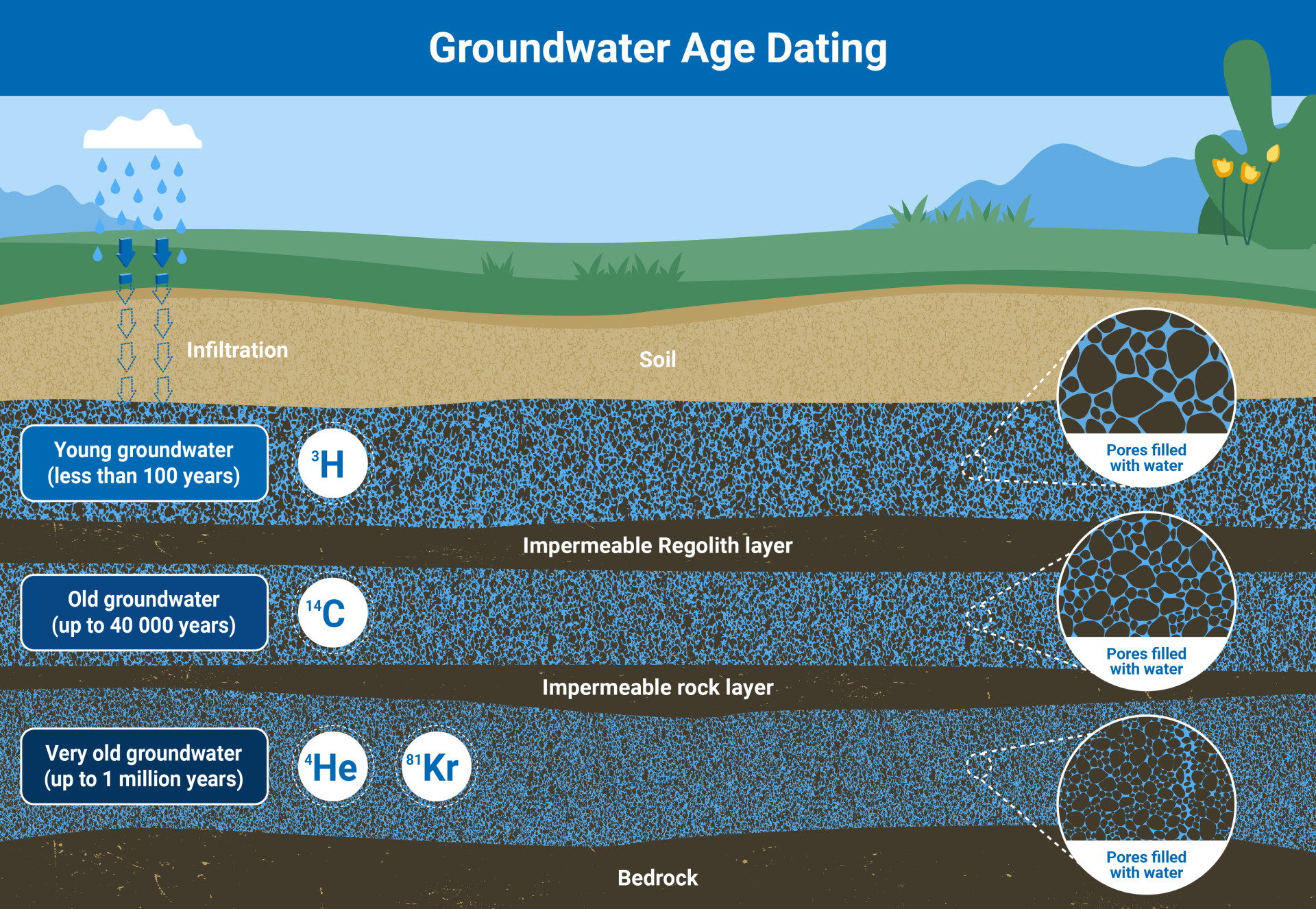
    For example, radioisotopes naturally present in groundwater, such as tritium, carbon-14, and noble gases helium-3, helium-4 and krypton-81, are used to learn more about how old groundwater is and the timescales of groundwater flow. By analyzing the concentration of different combinations of both stable and radio-isotopes, scientists can calculate when exactly the water is recharged in aquifers, how fast groundwater flows, and how long it takes to replenish. With this data, it is possible to establish, for example, whether or not agricultural activities in a specific area are demanding an amount of groundwater that will not be replenished fast enough to sustain irrigation needs in the long run.

    How do scientists use isotopes to study groundwater pollution?

    Scientists use specific isotopes like nitrogen-15, oxygen-18, and sulfur-34 to identify pollutants such as nitrate and sulphates. They also use these isotopes to establish whether the groundwater in a specific location is safe for human use.

    For example, scientists can establish whether water contaminated with an excessive amount of nitrate is being polluted by either human waste or by fertilizers. Nitrate ions are made up of nitrogen and oxygen, and nitrogen has two isotopes while oxygen has three. The ratio of these isotopes is different in human waste and in fertilizers. Therefore, the source of pollution can be identified based on these isotopic differences. Knowing the origins of pollutants is a milestone in addressing problems with water quality and working toward the sustainable management of water resources.

    What is the role of the IAEA?

    • The IAEA uses isotope hydrology to support Member States in water resources assessment and sustainable water management. The Agency also provides assistance and training to laboratories and scientists on analytical services through its Isotope Hydrology Laboratory.
    • Offering a wide range of courses, the IAEA provides training on the fundamentals of isotope hydrology and isotopic analyses of stable isotopes, tritium and noble gases.
    • Through its technical cooperation programme, the IAEA collaborates closely with its Member States to improve the availability and sustainability of freshwater resources through science-based, comprehensive water resources assessments.
    • Partnering with the World Meteorological Organization, the IAEA operates the Global Network of Isotopes in Precipitation, which contains scientific advice, logistics and technical support in isotope hydrology.

    This article was first published on 22 March 2023.

    MIL Security OSI

  • MIL-OSI Global: Many Canadian households are being shortchanged from retrofit programs — this needs to change

    Source: The Conversation – Canada – By Kareman Yassin, Assistant Professor, Hitotsubashi University

    Canada has set an ambitious goal to reduce greenhouse gas emissions by 45 to 50 per cent below 2005 levels. This puts pressure on the residential and commercial building sector, which is responsible for about 18 per cent of national greenhouse gas emissions, to help meet this target.

    Since most of Canada’s 16 million homes are expected to still be in use by 2050, the path to net-zero requires upgrading existing homes, not just constructing new net-zero ones.

    To address this, retrofit programs that improve home energy efficiency have become one of Canada’s main strategies to cut emissions in the housing sector. These programs focus on upgrades like air sealing, enhanced insulation, upgrading heating and cooling systems and installing energy-efficient windows and doors.

    But do these programs deliver on their promises of lower bills and reduced carbon emissions? Our recent study, forthcoming in Energy Economics, examined the outcomes of the federal ecoENERGY home retrofit program, a predecessor to the Greener Homes Initiative.

    Our findings shed light on where the program succeeded, where it fell short and what this all means for Canadian families and policymakers moving forward.

    Real-world energy savings

    Our study analyzed a decade of monthly electricity and natural gas consumption data from Medicine Hat, Alta., where residents participated in the federal ecoENERGY retrofit program that was in place between 2008 to 2012.

    We found that households undertaking comprehensive envelope retrofits — which includes insulation and air sealing — reduced their total energy use by an average of 25 per cent per household. Natural gas usage dropped by 35 per cent on average for these same households, and these savings lasted for at least 10 years after the retrofit.

    This suggests that such retrofits hold promise for meaningful, long-lasting energy reductions, especially for home heating, which makes up a large part of residential energy use in Canada.

    However, our study found that homes achieved only about 60 per cent of the predicted savings projected in pre-retrofit estimates. While measures like air sealing and attic and wall insulation were relatively effective, other upgrades, such as basement insulation and energy-efficient windows, showed zero effect on energy use.

    This gap between projected and actual savings suggests that the estimates shown to households during pre-retrofit audits might be overestimating the benefits. This could leave families with lower-than-expected savings on their energy bills after making significant financial investments. These findings align with similar studies in the United States and Europe, where realized energy savings hover at around 60 per cent of pre-retrofit projections.

    Despite this gap, there are promising opportunities for low-cost, high-return investments. Our research suggests that relatively cheap measures like air sealing generate high returns. Adopting electric heat pumps and fuel switching also show promise for delivering both energy savings and reductions in greenhouse gas emissions.

    The need for broader participation

    Our study also revealed significant gaps in program access and the distribution of benefits. Although the ecoENERGY program was available to all Canadian households, participation was highest among families of mid-valued houses.

    Participation among families in lower-valued houses was disappointingly low: about four per cent of the families in lowest-valued houses took part, even though they stood to benefit the most from reduced energy bills. Homes in our study saw bill savings ranging from eight to 17 per cent, based on a comparison of their actual consumption before and after the retrofit. The highest savings were observed in homes with assessed values of $100,000.

    Middle-valued homes with the highest retrofit program participant rate tended to save the least amount of money; this group had average gas bill reductions of approximately 10.5 per cent.

    The maximum amount that could be claimed under the ecoENERGY program was $5,000, yet the average rebate received was $1,100. This disparity not only limited the program’s potential to reduce emissions on a large scale, but also means Canada’s current approach to energy retrofits may be missing an opportunity to improve energy affordability for those who need it most.

    Room for improvement

    Energy-saving retrofits have significant potential, but current prediction models often overestimate the savings homeowners can achieve. Improving these models could allow homeowners to make better-informed choices, leading to greater efficiency and improved household welfare.

    Upfront costs also remain a significant barrier, particularly for lower-income families. Many cannot afford the upfront expenses associated with retrofitting their homes. Expanded financial support, such as rebates or no-interest loans, may provide much-needed support necessary to allow more households to participate, and more research is needed to evaluate how best to incentivize household participation.

    Another major challenge is a lack of awareness. Many Canadians are unaware of the benefits of deep retrofits. Public awareness campaigns, possibly delivered in collaboration with community organizations, may also help educate homeowners on the long-term value of retrofits and make the process more accessible and appealing.

    Our project is the first in Canada to use detailed household-level data to assess energy savings from retrofits in houses of various values. We were able to achieve this through partnerships between academia, utilities and the federal government. Such collaborations are crucial for advancing research that informs effective policies and programs.

    As Canada advances toward net-zero emissions by 2050, energy-efficient housing should remain central to its climate strategy. Achieving sustainable progress in this area will require retrofit programs that deliver on their promises by enhancing household welfare, addressing energy affordability and ensuring continued public support.

    Maya Papineau receives funding from Social Sciences and Humanities Research Council and the National Science and Engineering Research Council and the National Research Council of Canada.

    Nicholas Rivers receives funding from the Social Sciences and Humanities Research Council and the National Science and Engineering Research Council. He is affiliated with the Canadian Climate Institute.

    Kareman Yassin does not work for, consult, own shares in or receive funding from any company or organisation that would benefit from this article, and has disclosed no relevant affiliations beyond their academic appointment.

    ref. Many Canadian households are being shortchanged from retrofit programs — this needs to change – https://theconversation.com/many-canadian-households-are-being-shortchanged-from-retrofit-programs-this-needs-to-change-236388

    MIL OSI – Global Reports

  • MIL-OSI Africa: AMMAT Unpacks Strategic Approach to Optimizing Oil & Gas Operations in Congo

    Source: Africa Press Organisation – English (2) – Report:

    BRAZZAVILLE, Congo (Republic of the), February 12, 2025/APO Group/ —

    As part of the Republic of Congo’s strategy to double its oil production, the government is encouraging independent operators to revitalize mature fields and boost output. Companies like AMMAT – participating as a Platinum Sponsor at the inaugural Congo Energy & Investment Forum (CEIF) 2025 – are playing a key role in this effort. In an in-depth conversation with Energy Capital & Power (https://EnergyCapitalPower.com), AMMAT CEO Massimiliano Mignacca outlines the company’s approach to technological innovations, a focus on sustainability and optimizing oil and gas operations in mature fields in Congo.

    Can you provide an overview of AMMAT’s activities in Congo?

    When we began exploring opportunities in 2021, we focused on West Africa and found promising prospects in the Republic of Congo. The Congolese authorities recognized our potential and supported our asset management approach. By the end of 2022, we had officially established our presence in the country. In March 2023, we secured exploration and production permits for the Zatchi and Loango fields – mature assets previously operated by a joint venture between Eni and Total until 2021 – followed by a transition period under SNPC [Congo’s national oil company Société nationale des pétroles du Congo]. We commenced operations in July 2023, applying our proven asset management strategies from Italy to optimize production in Congo.

    How does your partnership with SNPC contribute to Congo’s plan to double oil production?

    We operate under a joint venture framework, where SNPC plays a key role alongside two Congolese companies that collectively hold a 25% stake. Managing mature fields presents significant challenges, requiring close coordination with SNPC at all levels. We conduct regular meetings to align on work plans, performance, and projects that enhance safety, boost production and improve asset management. Our close collaboration with SNPC’s leadership ensures that our initiatives contribute directly to Congo’s production growth targets.

    AMMAT employs a data-driven approach to reservoir management. What technologies and methodologies are you using?

    One major initiative is the modernization of the sea pipeline linking our Loango treatment platform to peripheral platforms. We are also implementing an environmental risk mitigation program in partnership with other operators. Additionally, we have launched a campaign to replace outdated pumps and reactivate wells, utilizing advanced workover techniques such as ESP pump upgrades to enhance production. In 2024, we successfully revamped three platforms in Loango and are currently rehabilitating two more in the Zatchi field. We remain committed to integrating cutting-edge technology into our operations to maximize efficiency and sustainability.

    What sustainable practices does AMMAT implement in its operations?

    Sustainability is at the core of our asset management approach. The [oil and gas] sector has been central to Congo’s economy since the 1970s, producing a strong engineering workforce. Recognizing this, we have initiated partnerships with local universities and currently host three graduates in our maintenance, IT and HSE [health, safety and environment] divisions. This initiative strengthens local talent and ensures the long-term sustainability of our operations.

    AMMAT will be a Platinum Sponsor at the Congo Energy & Investment Forum (CEIF) in March 2025. What do you aim to achieve at this event?

    Our primary objective [at CEIF 2025] is to showcase AMMAT as a reliable and committed partner in Congo. The country entrusted us with two crucial production fields, and we want to demonstrate how our asset management expertise adds value. Additionally, we are looking to expand our upstream presence in Congo and other markets. Being a Platinum Sponsor allows us to make a strong impact, emphasizing our commitment to compliance with local regulations, collaboration and sustainable operations. This event provides an excellent platform to engage with stakeholders and reinforce our role in driving growth in Congo’s oil and gas industry.

    MIL OSI Africa

  • MIL-OSI Global: Why ‘low carbon’ roses are flown around the world

    Source: The Conversation – UK – By Will de Freitas, Environment + Energy Editor, UK edition

    Grown in Ecuador (Équateur en français), sold in Paris. Robert Crum / shutterstock

    As you read this, planes full of roses are heading from east Africa and South America to almost every corner of the world. If you buy someone a rose this Valentine’s Day, it may be in the air right now or perhaps in a refrigerated warehouse in the Netherlands.

    A huge logistical operation ensures those flowers are timed to be perfectly in bloom on the 14th. From flower farm to bouquet can take just a few days. In all, hundreds of millions of roses will be shipped internationally this week, and many will die before they can be sold.

    Can all this flying be justified?

    You’re reading the Imagine newsletter – a weekly synthesis of academic insight on solutions to climate change, brought to you by The Conversation. I’m Will de Freitas, energy and environment editor, covering for my colleague Jack Marley who is lovesick. This week, we’re looking at flowers.

    Many people don’t realise just how far a Valentine’s rose has probably travelled. Though roses can be grown in the UK (and some species are native), most of them won’t flower for at least another few months.

    Jill Timms and David Bek, academics at the University of Coventry who have researched the global flower trade point out: “This sort of localised growing does not satisfy the demand for volume, variety and year-round supply, or indeed guarantee sustainability in terms of energy, pesticide use and so on.”

    This means most roses are imported from countries with more land, more sunshine, and a cheaper workforce. Major growers include Colombia, Ecuador, Kenya and Ethiopia. The Netherlands is actually the biggest exporter of roses, partly due to its own production in greenhouses but mostly thanks to its position as a crucial hub for the global trade. Flowers sent to the UK from the Netherlands were probably grown elsewhere.

    To ensure they stay fresh, those flowers are kept cool as they’re transported in a series of refrigerated lorries, planes or boats, while some are sprayed with chemicals to freeze them.

    “Geography matters,” say Timms and Bek. “Some flowers travel by sea, some cargo plane and others in the hold of passenger jets, all with very different carbon footprints.”


    Read more:
    Valentine’s Day: five ways to ensure your flowers are ethical


    Low-carbon flowers, a long way away

    Figuring out a flower’s carbon footprint is not straightforward. Jennifer Lavers and Fiona Kerslake from the University of Tasmania compared cut flowers grown in heated or refrigerated greenhouses in the Netherlands with those grown in Kenya.

    “Maintaining the controlled environmental conditions inside these [Dutch] buildings requires artificial light, heat and cooling, so each rose grown in The Netherlands contributes an average of around 2.91kg of CO₂ to the atmosphere.”

    “In contrast”, they write, “a single rose grown on a farm in Kenya contributes only 0.5kg. This is largely because Kenyan hot houses do not use artificial heating or lighting, and most farm workers walk or cycle to work. As a result, flowers grown in tropical regions are sometimes considered low-carbon (of course, this doesn’t always factor in international transport).”


    Read more:
    Sustainable shopping: your guilt-free guide to flowers this Valentine’s Day


    Paul D. Larson of the University of Manitoba points out that, while local production would ground some of the international flower flights, “growing flowers in greenhouses can use as much energy as shipping them [to North America] from Colombia by air freight”.

    Larson, a professor of supply chain management, does highlight one major issue with “low carbon” flowers in the global south, however:

    “Since flowers are not classified as edible, they are often exempt from pesticide regulations. Thus, many flower production workers in Ecuador and Colombia have suffered from respiratory problems, rashes and eye infections caused by exposure to toxic chemicals in fertilizers, fungicides and pesticides.”


    Read more:
    Valentine’s Day: COVID-19 wilted the flower industry, but sustainability still a thorny issue


    The flower trade in Ecuador and Colombia was actually engineered a few decades ago to try and stem the flow of cocaine into the US, says Jay L. Zagorsky, an associate professor at Boston University’s business school.

    “One part of the strategy was to convince farmers in Colombia to stop growing coca leaves – a traditional Andean plant that provides the raw ingredient for making cocaine – by giving them preferential access to US markets if they grew something else.”

    Whether this policy helped stop drug production is unclear, says Zagorsky, but American domestic rose growing has collapsed and “many businesses in Colombia and Ecuador started growing and shipping flowers north”.


    Read more:
    Americans spend millions of dollars on Valentine’s Day roses. I calculated exactly how much


    No one expects you to know exactly how a flower was grown, what conditions were like for workers, or to conduct a full “life cycle assessment” of their carbon footprint. But what can you do to help this Valentine’s Day?

    Timms and Bek, the flower trade experts at Coventry University, wrote about five ways to ensure your flowers are ethical. They contrast flowers grown in the Netherlands and Kenya and say that “your priorities need to guide your purchase: environmental issues include carbon footprint, chemical use, ecological degradation and water use; social issues include health and safety standards, gender discrimination, precarious employment and land rights.”

    ref. Why ‘low carbon’ roses are flown around the world – https://theconversation.com/why-low-carbon-roses-are-flown-around-the-world-249769

    MIL OSI – Global Reports

  • MIL-OSI USA: Governor Demands NYPA Suspend Proposed Rate Hike

    Source: US State of New York


    Skip to main content

    An official website of New York State

    Official websites use ny.gov

    A ny.gov website belongs to an official New York State government organization.

    Secure ny.gov websites use HTTPS

    A lock icon or https:// means you’ve safely connected to a ny.gov website. Share sensitive information only on official, secure websites.

    MIL OSI USA News

  • MIL-OSI Global: How the pollution of today will become the ‘technofossils’ of the far future

    Source: The Conversation – UK – By Jan Zalasiewicz, Professor of Palaeobiology, University of Leicester

    dimitris_k / shutterstock

    How might you make your mark on the world forever? Write a play more timeless than Shakespeare, or compose music to out-do Mozart, or score the winning goal in the next World Cup final, perhaps?

    There’s an easier way of leaving an indelible mark on our planet. Just finish a soft drink and toss the can (and the remains of the chicken dinner that went with it), ditch last year’s impulse purchases from your wardrobe, resurface that old patio, upgrade your mobile phone … simply carry on with everyday life, that is, and you’ll likely leave a fascinating legacy. It might last a billion years.

    We’re palaeontologists, and have spent our careers looking at the fossil record of the deep past, puzzling out how those magnificent animal and plant relics have been preserved as dinosaur bones, the carapaces of ancient crustaceans, lustrous spiralled ammonites, petrified flower petals and many more. Often they still have exquisite detail intact after millions of years.

    We’ve now turned our attention to the myriad everyday objects that we make and use, to see what kind of future fossils – we call them technofossils – they will make. We’ve written about this in our new book, Discarded: how technofossils will be our ultimate legacy. Here are some key messages:

    The first things that’ll catch the eye of any far-future palaeontologist are our manufactured objects – buildings, roads, machines and so on. In recent decades, they have rocketed in amount to over a trillion tonnes, to now outweigh all living things on Earth. That’s a lot of raw material for generating future fossils.

    Then, most things we make are designed to be durable, to resist corrosion and decay, and are significantly tougher than the average bone or shell. Just from that they have a head start in the fossilisation stakes.

    Many are new to the Earth. Discarded aluminium cans are everywhere, for instance, but to our planet, they’re a wondrous novelty, as pure aluminium metal is almost unknown in nature. In the past 70 years we’ve made more than 500 million tonnes of the stuff, enough to coat all of the US (and part of Canada) in standard aluminium kitchen foil.

    What’s going to happen to it? Aluminium resists corrosion, but not forever. Buried underground in layers of mud and sand, a can will slowly break down, but often not before there’s a can-shaped impression in these new rocks, lined with microscopic clay crystals newly-grown out of the corroding aluminium.

    Everyday items can be flushed onto a floodplain and be quickly buried under sediments. As they slowly degrade they may leave an impression on the soft muds and silts for future palaeontologists to puzzle over.
    Sarah Gabbott

    Having been shielded from ultraviolet light, the thin plastic liner inside the can may endure too. (Oil-based plastic is even more novel in geological terms, being entirely non-existent until the 20th century). These two materials compressed side-by-side represent future fossil signatures of our time on Earth.

    Billions of fossilised chicken thighs

    But what about bones – the archetypal fossil relic? There will be many of these as future fossils, stark evidence of our species’ domination over others.

    The standard supermarket chicken seems mundane. But it’s now by far the most common bird of all, making up about two-thirds of all bird biomass on Earth, and its abundance in life increases its fossilisation chances after death.

    We stack the odds further by tossing the bones into a plastic bin-bag, that’s then carted to the landfill site to join countless more bones for burial in neatly engineered compartments – also plastic-lined. There, the bones will begin to mummify, another useful step in the road to petrifaction. Our landfills are giant middens of the future and will be stuffed full of the bones of this one species.

    Geologists of the far future may conclude that chickens could only have existed thanks to a more intelligent species.
    dba87 / shutterstock

    These bones – super-sized but weak, riddled with osteoporosis, sometimes fractured and deformed – will tell their own grisly story. Future geologists will puzzle over a suddenly-evolved bird so abundant yet so physically helpless. Will they figure out the story of a broiler chicken genetically
    engineered to feed relentlessly to maximise weight gain, for slaughter just five or six weeks after hatching? We suspect the fossil evidence will be damning.

    Fossilised fleeces

    Fossilizeable fashion is also new. Humans have worn clothes for thousands of years, but archaeological clothes discoveries are rare, because made of natural fibres they are feasted on by clothes moths, microbes and other scavengers. Fossil fur and feathers are rare too, for the same reasons.

    But cheap, cheerful and hyper-abundant polyester fashion is quite different. There’s no need for mothballs with these garments because synthetic plastics are indigestible to most microbes. How long might they last? Some ancient fossil algae have coats of plastic-like polymers, and these have lasted, beautifully preserved, for many millions of years.

    Fossil clothes will surely perplex far-future palaeonologists, though: first to work out their shape from the crumpled and flattened remains, and then to work out what purpose they served. With throwaway fashion, we’re making some eternal puzzles.

    Concrete and computers

    The lumps of concrete from your old patio are not any old rocks. The recipe for concrete, involving furnace-baked lime, is rare on Earth (the minerals involved occasionally form in magma-baked rock), but humans have made it hyper-abundant. There are now more than half a trillion tonnes of concrete on Earth, mostly made since the 1950s – that’s a kilo per square metre averaged over the Earth. And concrete is hard-wearing even by geological standards: most of its bulk is sand and gravel, which have been survivors throughout our planet’s history.

    There’s nothing old about computers and mobile phones, but they are based on the same element – silicon – that makes up the quartz (silicon dioxide) of sand and gravel. A fossilised silicon chip will be tricky to decipher, though: the semiconductors now packed on to them are just nanometres across, tinier than most mineral forms geologists analyse today.

    But the associated paraphernalia, the burgeoning waste of keyboards, monitors, wiring, will form more obvious fossils. The patterns on these, like the QWERTY keyboard, resemble the fossil patterns seized upon by today’s palaeontologists as clues to ancient function. That would depend on the excavators, though: fossil keyboards would make more sense to hyper-evolved rats with five-fingered paws, say, than superintelligent octopuses of the far future.


    Read more:
    What species would become dominant on Earth if humans died out?


    It’s fun to conceptualise like this, and set the human story within the grand perspective of Earth’s history. But there’s a wider meaning. Tomorrow’s future fossils are today’s pollution: unsightly, damaging, often toxic, and ever more of a costly problem. One only has to look at the state of Britain’s rivers and beaches.

    Understanding how fossilisation starts now helps us ask the right questions. When plastic trash is washed out to sea, will it keep travelling or become safely buried, covered by marine sediments? Will the waste in coastal landfill sites stay put, or be exhumed by the waves as sea level rises? The answers will be found in future rocks – but it would help us all to work them out now.

    Sarah Gabbott is affiliated with Green Circle Nature Regeneration Community Interest Company 13084569.

    Jan Zalasiewicz does not work for, consult, own shares in or receive funding from any company or organisation that would benefit from this article, and has disclosed no relevant affiliations beyond their academic appointment.

    ref. How the pollution of today will become the ‘technofossils’ of the far future – https://theconversation.com/how-the-pollution-of-today-will-become-the-technofossils-of-the-far-future-248815

    MIL OSI – Global Reports

  • MIL-OSI: Exploring Molecular Switches Application In Modern Therapeutics Download Report

    Source: GlobeNewswire (MIL-OSI)

    Delhi, Feb. 12, 2025 (GLOBE NEWSWIRE) — Molecular switches are integral to cellular function, dictating key processes such as gene expression, signal transduction, and cellular response to stimuli. These switches operate by undergoing conformational changes in response to specific signals, which may involve the binding of small molecules, ions, or even other proteins. By toggling between an “on” and “off” state, molecular switches ensure that cellular functions are executed with precision. When these switches are deregulated, they can result in various diseases, including cancer, metabolic disorders, and autoimmune conditions. As a result, targeting these molecular switches has become an area of immense therapeutic interest.

    Molecular Switches As Therapeutic Targets, Drug Development, Drug Delivery Mechanism and Application By Indications Insight 2025 Research Insights:

    • Top 20 Drugs Sales Targeting Molecular Switches: 2022, 2023 and 2024
    • Molecular Switches Significance In Regenerative Medicine and Nanomedicine
    • Molecular Switches Significance In Drug Delivery and Release
    • Molecular Switches Significance As Therapeutic Targets
    • Molecular Switches In Cancer Therapeutics: Breast Cancer, Prostate Cancer, Lung Cancer, Colorectal Cancer, Gastric Cancer
    • Molecular Switches In Neurological Disorder: Parkinson’s Disease, Alzheimer’s Disease, Multiple Sclerosis
    • Molecular Switches In Autoimmune and Inflammatory Disorder: Diabetes, Arthritis, Lupus, Psoriasis

    Download Insight: https://www.kuickresearch.com/report-molecular-switches-cell-signaling-molecular-switches-applications

    One particularly compelling molecular switch is the Notch signaling pathway, which plays a crucial role in cell differentiation and proliferation. This pathway functions through the binding of ligands to the Notch receptor on the cell surface. Upon activation, the Notch receptor undergoes proteolytic cleavage, releasing its intracellular domain, which translocates to the nucleus to influence gene expression. Dysregulation of Notch signaling is often observed in cancers, particularly in hematological malignancies like T-cell acute lymphoblastic leukemia. In these cases, aberrant activation of Notch signaling leads to unchecked cell proliferation. As a result, drugs targeting Notch receptors or their downstream effectors are currently under investigation for cancer treatment, offering a promising strategy for the development of targeted therapies.

    Another important molecular switch is the Janus kinase (JAK)/signal transducer and activator of transcription (STAT) pathway, which is involved in mediating immune responses, hematopoiesis, and inflammation. In certain autoimmune disorders such as rheumatoid arthritis and psoriasis, the JAK/STAT pathway becomes hyperactivated, leading to chronic inflammation and tissue damage. JAK inhibitors, such as tofacitinib, have already shown effectiveness in treating these conditions by blocking the overactive signaling. The ability to inhibit the activation of JAK proteins represents a precise way to control aberrant immune responses. As research into JAK inhibitors expands, there may be even broader applications in treating diseases like inflammatory bowel disease and certain types of cancer.

    In addition to kinase and receptor-based switches, molecular switches involved in the regulation of apoptosis, or programmed cell death, offer another compelling avenue for therapeutic intervention. The BCL-2 family of proteins, which regulate the intrinsic apoptotic pathway, represents a class of switches that determine whether a cell survives or undergoes programmed cell death. Overexpression of anti-apoptotic proteins like BCL-2 is frequently seen in cancers, allowing tumor cells to evade death despite DNA damage or other cellular stress. By inhibiting BCL-2 with small molecules like venetoclax, researchers have made significant strides in treating hematologic cancers, particularly chronic lymphocytic leukemia (CLL). This drug’s ability to reactivate the apoptotic pathway in cancer cells demonstrates how targeting molecular switches can reverse disease-promoting cellular processes.

    The commercial landscape for therapies targeting molecular switches continues to expand. With the increasing recognition of their role in disease pathology, the pharmaceutical industry is heavily invested in developing drugs that can specifically target these switches. Drug pipelines are filled with promising candidates, and many of these are now undergoing clinical trials to evaluate their effectiveness in treating a variety of diseases. However, challenges remain in developing drugs that are not only effective but also selective, as off-target effects can lead to adverse outcomes. The development of more precise drug delivery mechanisms, such as nanoparticles or biologics, may help overcome some of these hurdles.

    Moreover, resistance to these targeted therapies is an emerging concern. Just as cancers can develop resistance to traditional chemotherapy, they can also evolve resistance to targeted therapies aimed at molecular switches. In some cases, mutations in the target protein or bypass mechanisms can render these therapies ineffective. To combat resistance, combination therapies that target multiple molecular switches or pathways are being explored. This multi-pronged approach may enhance treatment efficacy and reduce the likelihood of resistance developing.

    Despite these challenges, the therapeutic potential of molecular switches remains vast. As research continues to uncover the complex roles that these switches play in disease progression, new and innovative treatments will likely emerge, offering more effective and personalized options for patients. The future of molecular switch-based therapies looks promising, with the potential to address a wide range of conditions, from cancers to autoimmune disorders and beyond. As the field progresses, it may redefine the way we approach disease treatment and pave the way for a new era of precision medicine.

    The MIL Network

  • MIL-OSI USA: Gov. Pillen Appoints Jesse Bradley to be Interim Director of DEE and DNR

    Source: US State of Nebraska

    . Pillen Appoints Jesse Bradley to be Interim Director of DEE and DNR


    LINCOLN, NE – Today, Governor Jim Pillen announced his appointment of Jesse Bradley as interim director for the Department of Environment and Energy (DEE). Bradley will continue in his current role as interim director for the Department of Natural Resources (DNR). His duties overseeing DEE are effective immediately.

    Gov. Pillen called out Bradley’s steady leadership of DNR since assuming the position of interim director in August 2024. This is the second time Bradley has been interim director of that agency. He was appointed in 2020 as well.

    In his lead role at DNR, Bradley has worked with natural resources districts across the state to implement the Nitrogen Reduction Incentive Act. He has been part of the agency’s push to leverage new technologies to improve system processes to utilize data-informed management decisions.

    Bradley has been with DNR since 2006, when he started as an integrated water management analyst. In 2012, he became head of the Water Planning Division and two years later, was promoted to deputy director of DNR. He has degrees in environmental geology and hydrogeology and is a licensed professional geologist in Nebraska.

    “Water management is critical to the state of Nebraska – and we need to continue to innovate and improve water quantity and quality for the next seven generations,” said Gov. Pillen. “Jesse’s vast experience in that area, coupled with his ability to bridge the gap between local needs, the state and federal regulators, make him strongly qualified to lead DNR and DEE when they are combined through passage of LB317.”

    LB317, which has been introduced on behalf of the Governor by Senator Tom Brandt, proposes naming the newly formed agency the Department of Water, Energy and Environment. The bill will have a hearing before the Natural Resources Committee on Thursday, Feb. 13.

    The Environment Quality Council (EQC) provides names to the Governor for consideration as director of DEE. Gov. Pillen said he will continue to consult with the group as the legislation moves ahead.

    MIL OSI USA News

  • MIL-OSI Russia: Eastern Caribbean Currency Union: IMF Staff Concluding Statement of the 2025 Mission on Common Policies for Member Countries

    Source: IMF – News in Russian

    February 12, 2025

    A Concluding Statement describes the preliminary findings of IMF staff at the end of an official staff visit (or ‘mission’), in most cases to a member country. Missions are undertaken as part of regular (usually annual) consultations under Article IV of the IMF’s Articles of Agreement, in the context of a request to use IMF resources (borrow from the IMF), as part of discussions of staff monitored programs, or as part of other staff monitoring of economic developments.

    The authorities have consented to the publication of this statement. The views expressed in this statement are those of the IMF staff and do not necessarily represent the views of the IMF’s Executive Board. Based on the preliminary findings of this mission, staff will prepare a report that, subject to management approval, will be presented to the IMF Executive Board for discussion and decision.

    Washington, DC:

    The Eastern Caribbean Currency Union (ECCU) has been providing a strong anchor for macroeconomic stability in a shock-prone region, demonstrated most recently by Hurricane Beryl with its devastating impact on Grenada and Saint Vincent and the Grenadines. The recovery from successive external shocks has been strong, driven by a rebound in tourism, with ECCU economies expected to converge to modest pre-pandemic average growth rates over the medium term. To effectively manage downside risks while supporting long-term inclusive growth and the continued robustness of the quasi-currency board, policies should aim to address supply-side bottlenecks, build resilient fiscal frameworks to support fiscal sustainability, and continue to enhance financial system resilience and intermediation. Greater leveraging of synergies in regional data collection and processing could help strengthen data provision and thereby evidence-based policymaking.

    The ECCU has achieved a strong rebound from successive adverse shocks. A strong tourism season and continued infrastructure investments supported robust growth in 2024. Inflation has moderated in tune with global trends from a post-pandemic peak of more than 9 percent to less than 2 percent. Nevertheless, public debt remains high and generally well above the regional 2035 debt ceiling of 60 percent of GDP. Meanwhile, Citizenship-by-Investment (CBI) revenues have shown signs of slowing amidst heightened international scrutiny and regulatory tightening. The financial system remains stable, partly due to a prolonged period of cautious bank lending. Despite persistently elevated current account deficits, the ECCB’s reserve position has remained stable and currency backing ratio high, supporting confidence in the currency union.

    Going forward, GDP growth is set to moderate, and risks remain mostly on the downside. As most parts of the region approach full tourism capacity, average growth in the region is expected to slow from 6½ percent in 2021-24 to around 2½ percent in the medium term amid weak productivity growth and investment, a shrinking labor force, and reduced fiscal space. Moreover, given the region’s long-standing vulnerabilities of high dependence on energy imports, exposure to natural disasters (NDs), persistently high public debt, and some economies’ heavy reliance on uncertain CBI revenues, the outlook is subject to significant downside risks.

    Addressing Supply-Side Bottlenecks to Enhance Growth

    The ECCU economies have exhibited a trend slowdown in growth due to structural factors. Supporting strong, resilient, and inclusive growth is key to reducing fiscal and external imbalances and raising living standards. An updated growth accounting analysis finds that potential growth has dropped in recent decades, reflecting declines across all components of growth, notably total factor productivity (TFP). These trends reflect a series of persistent structural impediments to economic efficiency, such as impediments to credit growth, burdensome administrative and licensing processes, and labor force skills gaps and mismatches. Recurring NDs also impair productive infrastructure and hinder human capital formation, placing additional limits on TFP growth. Against this backdrop, the regional “Big Push” effort that calls for a doubling of ECCU GDP in the coming decade is a welcome aspirational initiative, both in sensitizing the membership to key growth impediments and in helping to build a regional consensus on a roadmap for reform.

    A multipronged and coordinated set of policies that build on ongoing efforts is recommended to alleviate major structural impediments to growth. Improving labor market outcomes requires a renewed effort to attune human capital to economic needs and development priorities. This involves expanding vocational training and modernizing education systems, supplemented by policies to alleviate youth and gender employment gaps, such as active labor market policies and greater access to child and elderly care. Enhancing efficient and resilient capital investment could be supported by coordinated regional efforts to accelerate the green energy transition (GET), safeguard and optimize the CBI funding model, and strengthen disaster preparedness of the capital stock. Regional mechanisms such as the ECCB’s Renewable Energy Infrastructure Investment Facility (REIIF) hold potential to scale up countries’ access to finance that can be usefully supported through regional frameworks to pool procurement and harmonize modern regulatory standards. Last year’s regional agreement to buttress the integrity of CBI regimes through enhanced regulatory, information exchange, and pricing frameworks is a welcome step to safeguard critical investment inflows. The planned regional CBI regulator provides an opportunity to address gaps in institutional reporting and strengthen accountability frameworks to ensure the productive allocation of all CBI inflows. Fallout from Hurricane Beryl highlights a potential role for common building standards across the region and the importance of prioritizing resilient infrastructure investment. Finally, policies to enhance the business environment—such as by digitalizing key services, streamlining cumbersome licensing and administrative processes, and improving financial intermediation—are essential to boost productivity and growth potential.

    Building Resilient Fiscal Frameworks to Support Fiscal Sustainability and Inclusive Growth

    The regional priority remains to rebuild fiscal buffers, reduce public debt levels consistent with the regional debt anchor, and improve fiscal resilience to shocks. Fiscal resilience is essential for macro stability and continuing to protect the quasi-currency board. The region’s high vulnerability to recurring NDs, coupled with periodic procyclical fiscal policies, are key drivers of the ECCU’s ongoing fiscal sustainability challenges. With 2035 only a decade away, sizable efforts are needed in some countries to achieve the regional debt target. Fiscal space is also needed to guard against risks and finance social spending and growth- and resilience-enhancing investment.

    This calls for a region-wide establishment of robust national fiscal resilience strategies and frameworks. Strong national medium-term fiscal frameworks (MTFFs), that incorporate well-designed country-specific fiscal rules, supported by specific fiscal measures and plans and strong fiscal institutions, will help instill prudence and create policy space. While many ECCU members have continued to upgrade their MTFFs, there is a need to enhance effective operational frameworks and underpinning fiscal policy and contingency plans that link fiscal operations with longer-term objectives. In addition, comprehensive ex-ante resilience strategies to enable resilient investment and adequate insurance against NDs would support debt sustainability and resilient growth. Integrating green budget tagging and a pipeline of projects into MTFFs will help anchor sustainable multi-year climate resilient investment plans and unlock global concessional financing. Expediting efforts to adopt a disaster risk financing strategy with self-insurance, contingent debt financing plans, and risk transfer arrangements will support liquidity for relief and reconstruction while safeguarding public finances. The relevant authorities should also consider frameworks with clear provisions for use of CBI revenue to avoid budget overreliance on these revenues given their potential volatility and to complement efforts with buffer and resilience building.

    Regional coordination and oversight of these efforts would help reinforce fiscal discipline and the credibility of the regional debt ceiling. To ensure the success of regional fiscal policy coordination, a strong governance framework to provide independent macroeconomic and budgetary projections and transparently assess fiscal plans, the implementation of fiscal rules, and fiscal sustainability would be beneficial. These efforts could be supported by national and/or regional independent fiscal oversight entities. International experience suggests that these entities have played an increasingly significant role in strengthening fiscal frameworks. A helpful first step could be to operationalize regular ECCB Monetary Council peer reviews of members’ fiscal strategies and progress toward the regional debt target.

    Safeguarding Financial Stability and Supporting Private Investment

    Banks’ legacy balance sheet weaknesses warrant continued policy focus. Close monitoring of agreed timelines and action plans for all extensions of implementing regional provisioning standards is important, and timely interventions should be made where necessary. Transitioning from reserve-based regulatory loan loss allowances to loss-bearing provisions would ensure appropriate recording and treatment of banks’ capital positions. Streamlining costly foreclosure and collateral sale processes and strengthening the capacity of the Eastern Caribbean Asset Management Company would support impaired asset disposal. Risks from rising overseas investments and some banks’ elevated local sovereign exposures warrant close monitoring.

    Stepped-up regional coordination would help mitigate non-bank financial system vulnerabilities. The continued rapid expansion of credit unions warrants strengthening provisioning standards, monitoring of forbearance measures, and enhancing supervisory capacity, including through greater sharing of best practices. The planned common minimum regulatory standards for non-bank financial institutions (NBFIs) under the recently endorsed Eastern Caribbean Financial Standards Board (ECFSB) represent an important opportunity to establish a more level regulatory playing field between credit unions and banks. More centralized NBFI supervision would support more efficient and effective region-wide financial stability monitoring and is more acutely needed for consolidated oversight of pan-ECCU insurance companies. The ECCU’s high dependence on global property reinsurance makes it vulnerable to the evolving reassessment of climate liability risks. The risk of more sustained hardening of the reinsurance market could worsen existing underinsurance by driving up costs and reducing capacity. Strengthening monitoring of reinsurance coverage, including through more targeted data collection, would support policy preparedness to manage these risks and narrow protection gaps.

    A more systematic approach is needed to strengthen financial intermediation and private investment. Slow bank lending growth, particularly in business credit, has long limited growth-supporting investment. Notwithstanding some recovery in construction and real estate credit, much of the high system liquidity is invested overseas and the unmet credit demand has partly fueled growth of the more risk-tolerant credit unions. The region has taken important steps to address credit access constraints through the ongoing rollout of the Credit Bureau and more demand-tailored products under the Eastern Caribbean Partial Credit Guarantee Corporation. Closer coordination of these regional initiatives and national MSME development policies would support development of regional best practices in enhancing small businesses’ bankability. This would also allow more efficient scaling up of active outreach programs to foster business formalization. Competing lending programs under national development banks should closely consider their risk-bearing capacity. Strengthening the collateral infrastructure through modernized foreclosure and insolvency frameworks, development of market-based real estate indices, and reviewing any policy impediments to secondary property market liquidity can help derisk local lending opportunities and reduce credit costs. The potential credit pricing distortions from the minimum savings rate should be reviewed alongside the ongoing efforts to encourage regional retail investment and capital market development.

    Strengthening of AML/CFT frameworks remains crucial amidst the scrutiny of CBI programs and thin correspondent banking relationships. This includes completing the long-pending designation of the ECCB as the AML/CFT supervisor for banks and centralization of AML/CFT regulatory standards under the ECFSB.

    Strengthening data provision

    Greater leveraging of synergies in regional data collection and processing could help address persistent resource and capacity gaps. Regional data provision has some shortcomings that somewhat hamper surveillance. While continued IMF/CARTAC technical assistance has proven valuable in improving data timeliness and quality, progress is often impeded by persistent staffing shortages and high turnover. A regional framework with centralization of data compilation and analysis could limit processing overlaps, enhance cross-country comparability, and better leverage the limited staffing resources.


    The IMF team thanks the authorities and private sector counterparts for their warm hospitality and insightful and constructive discussions.

    IMF Communications Department
    MEDIA RELATIONS

    PRESS OFFICER: Meera Louis

    Phone: +1 202 623-7100Email: MEDIA@IMF.org

    https://www.imf.org/en/News/Articles/2025/02/12/021225-mcs-east-carib-currency-union-imf-cs-2025-mission-on-common-policies-for-member-countries

    MIL OSI

    MIL OSI Russia News

  • MIL-OSI United Kingdom: ESFA Update: 12 February 2025

    Source: United Kingdom – Executive Government & Departments

    Latest information and actions from the Education and Skills Funding Agency for academies, schools, colleges, local authorities and further education providers.

    Applies to England

    Documents

    Details

    Latest for further education

    Article Title
    Information Update on post-16 funding arrangements
    Reminder Mid-year funding claim for 2024 to 2025

    Latest information for academies

    Article Title
    Action Submit your school resource management self-assessment checklist
    Information Update on post-16 funding arrangements
    Information Increase in employer National Insurance contributions
    Information Academy accounts return data from 2023 to 2024 is now available on the new financial benchmarking and insights tool
    Information Mid-year funding claim for 2024 to 2025
    Reminder View national funding formula for schools service is being retired
    Events and webinars Q&A drop-in sessions – academies chart of accounts and automation
    Events and webinars Financial management system (FMS) comparison matrix
    Events and webinars FMS comparison matrix
    Events and webinars Department for Education (DfE) academies chart of accounts mapping review workshop
    Events and webinars Risk protection arrangement (RPA) members only – summer fetes
    Events and webinars DfE energy for schools service  – simplified buying of gas and electricity
    Events and webinars Energy cost recovery services for your school
    Events and webinars RPA members only – mock trial
    Events and webinars Q&A drop-in session – academies chart of accounts and automation

    Latest information for local authorities

    Article Title
    Information Update on post-16 funding arrangements
    Information Increase in employer National Insurance contributions
    Information Updated early years benchmarking tool for 2024 to 2025
    Information Financial benchmarking and insights – conditions data, Cumbria and federations update
    Reminder Mid-year funding claim for 2024 to 2025
    Reminder View national funding formula for schools service is being retired
    Events and webinars Risk protection arrangement (RPA) members only – summer fetes
    Events and webinars Department for Education (DfE) energy for schools service – simplified buying of gas and electricity
    Events and webinars Energy cost recovery services for your school
    Events and webinars RPA members only – mock trial

    Updates to this page

    Published 12 February 2025

    Sign up for emails or print this page

    MIL OSI United Kingdom

  • MIL-OSI Global: Technofossils: how the pollution of today will become the fossils of the far future

    Source: The Conversation – UK – By Jan Zalasiewicz, Professor of Palaeobiology, University of Leicester

    dimitris_k / shutterstock

    How might you make your mark on the world forever? Write a play more timeless than Shakespeare, or compose music to out-do Mozart, or score the winning goal in the next World Cup final, perhaps?

    There’s an easier way of leaving an indelible mark on our planet. Just finish a soft drink and toss the can (and the remains of the chicken dinner that went with it), ditch last year’s impulse purchases from your wardrobe, resurface that old patio, upgrade your mobile phone … simply carry on with everyday life, that is, and you’ll likely leave a fascinating legacy. It might last a billion years.

    We’re palaeontologists, and have spent our careers looking at the fossil record of the deep past, puzzling out how those magnificent animal and plant relics have been preserved as dinosaur bones, the carapaces of ancient crustaceans, lustrous spiralled ammonites, petrified flower petals and many more. Often they still have exquisite detail intact after millions of years.

    We’ve now turned our attention to the myriad everyday objects that we make and use, to see what kind of future fossils – we call them technofossils – they will make. We’ve written about this in our new book, Discarded: how technofossils will be our ultimate legacy. Here are some key messages:

    The first things that’ll catch the eye of any far-future palaeontologist are our manufactured objects – buildings, roads, machines and so on. In recent decades, they have rocketed in amount to over a trillion tonnes, to now outweigh all living things on Earth. That’s a lot of raw material for generating future fossils.

    Then, most things we make are designed to be durable, to resist corrosion and decay, and are significantly tougher than the average bone or shell. Just from that they have a head start in the fossilisation stakes.

    Many are new to the Earth. Discarded aluminium cans are everywhere, for instance, but to our planet, they’re a wondrous novelty, as pure aluminium metal is almost unknown in nature. In the past 70 years we’ve made more than 500 million tonnes of the stuff, enough to coat all of the US (and part of Canada) in standard aluminium kitchen foil.

    What’s going to happen to it? Aluminium resists corrosion, but not forever. Buried underground in layers of mud and sand, a can will slowly break down, but often not before there’s a can-shaped impression in these new rocks, lined with microscopic clay crystals newly-grown out of the corroding aluminium.

    Everyday items can be flushed onto a floodplain and be quickly buried under sediments. As they slowly degrade they may leave an impression on the soft muds and silts for future palaeontologists to puzzle over.
    Sarah Gabbott

    Having been shielded from ultraviolet light, the thin plastic liner inside the can may endure too. (Oil-based plastic is even more novel in geological terms, being entirely non-existent until the 20th century). These two materials compressed side-by-side represent future fossil signatures of our time on Earth.

    Billions of fossilised chicken thighs

    But what about bones – the archetypal fossil relic? There will be many of these as future fossils, stark evidence of our species’ domination over others.

    The standard supermarket chicken seems mundane. But it’s now by far the most common bird of all, making up about two-thirds of all bird biomass on Earth, and its abundance in life increases its fossilisation chances after death.

    We stack the odds further by tossing the bones into a plastic bin-bag, that’s then carted to the landfill site to join countless more bones for burial in neatly engineered compartments – also plastic-lined. There, the bones will begin to mummify, another useful step in the road to petrifaction. Our landfills are giant middens of the future and will be stuffed full of the bones of this one species.

    Geologists of the far future may conclude that chickens could only have existed thanks to a more intelligent species.
    dba87 / shutterstock

    These bones – super-sized but weak, riddled with osteoporosis, sometimes fractured and deformed – will tell their own grisly story. Future geologists will puzzle over a suddenly-evolved bird so abundant yet so physically helpless. Will they figure out the story of a broiler chicken genetically
    engineered to feed relentlessly to maximise weight gain, for slaughter just five or six weeks after hatching? We suspect the fossil evidence will be damning.

    Fossilised fleeces

    Fossilizeable fashion is also new. Humans have worn clothes for thousands of years, but archaeological clothes discoveries are rare, because made of natural fibres they are feasted on by clothes moths, microbes and other scavengers. Fossil fur and feathers are rare too, for the same reasons.

    But cheap, cheerful and hyper-abundant polyester fashion is quite different. There’s no need for mothballs with these garments because synthetic plastics are indigestible to most microbes. How long might they last? Some ancient fossil algae have coats of plastic-like polymers, and these have lasted, beautifully preserved, for many millions of years.

    Fossil clothes will surely perplex far-future palaeonologists, though: first to work out their shape from the crumpled and flattened remains, and then to work out what purpose they served. With throwaway fashion, we’re making some eternal puzzles.

    Concrete and computers

    The lumps of concrete from your old patio are not any old rocks. The recipe for concrete, involving furnace-baked lime, is rare on Earth (the minerals involved occasionally form in magma-baked rock), but humans have made it hyper-abundant. There are now more than half a trillion tonnes of concrete on Earth, mostly made since the 1950s – that’s a kilo per square metre averaged over the Earth. And concrete is hard-wearing even by geological standards: most of its bulk is sand and gravel, which have been survivors throughout our planet’s history.

    There’s nothing old about computers and mobile phones, but they are based on the same element – silicon – that makes up the quartz (silicon dioxide) of sand and gravel. A fossilised silicon chip will be tricky to decipher, though: the semiconductors now packed on to them are just nanometres across, tinier than most mineral forms geologists analyse today.

    But the associated paraphernalia, the burgeoning waste of keyboards, monitors, wiring, will form more obvious fossils. The patterns on these, like the QWERTY keyboard, resemble the fossil patterns seized upon by today’s palaeontologists as clues to ancient function. That would depend on the excavators, though: fossil keyboards would make more sense to hyper-evolved rats with five-fingered paws, say, than superintelligent octopuses of the far future.


    Read more:
    What species would become dominant on Earth if humans died out?


    It’s fun to conceptualise like this, and set the human story within the grand perspective of Earth’s history. But there’s a wider meaning. Tomorrow’s future fossils are today’s pollution: unsightly, damaging, often toxic, and ever more of a costly problem. One only has to look at the state of Britain’s rivers and beaches.

    Understanding how fossilisation starts now helps us ask the right questions. When plastic trash is washed out to sea, will it keep travelling or become safely buried, covered by marine sediments? Will the waste in coastal landfill sites stay put, or be exhumed by the waves as sea level rises? The answers will be found in future rocks – but it would help us all to work them out now.

    Sarah Gabbott is affiliated with Green Circle Nature Regeneration Community Interest Company 13084569.

    Jan Zalasiewicz does not work for, consult, own shares in or receive funding from any company or organisation that would benefit from this article, and has disclosed no relevant affiliations beyond their academic appointment.

    ref. Technofossils: how the pollution of today will become the fossils of the far future – https://theconversation.com/technofossils-how-the-pollution-of-today-will-become-the-fossils-of-the-far-future-248815

    MIL OSI – Global Reports

  • MIL-OSI United Kingdom: Minister Peacock speech at the Beacon Philanthropy and Impact Forum

    Source: United Kingdom – Executive Government & Departments

    Speech by the Minister for Civil Society and Youth at on philanthropy and impact economy at the Beacon Philanthropy and Impact Forum.

    Good morning everyone, thank you Neil for that really kind introduction and thoughtful speech – the challenge you outlined is an important one.

    It’s great to be here with you at the Beacon Philanthropy and Impact Forum today.

    I want to start by thanking The Beacon Collaborative for organising this event, and the Charities Aid Foundation for sponsoring it and the City of London for hosting at this beautiful building.

    You’re here today, and are part of organisations like Beacon Collaborative, and Charities Aid Foundation, because you believe in the power of organisations and people using their resources to deliver social impact.
      And it’s a belief this Government shares. 

    The UK has a vibrant culture of service and generosity, and philanthropy is so often the outlet for that culture.

    Every week hundreds of thousands of people – in our villages, towns and cities – come together and do what they can to support others. They devote their time, their money or both, to improve the lives of people less fortunate than themselves.

    That is something we should never take for granted.

    Philanthropy sustains over 170,000 charities in the UK and thousands of others who are so small they’re not actually registered.

    And it does things Governments can’t do – reaching into communities, and applying local knowledge and insight.

    I see it all the time in my own area of Barnsley.

    I can tell you so many examples, organisations such as Barnsley Youth Choir, Barnsley Hospices and BIADS, a local dementia charity I am patron of, all rely on charitable donations and giving from the local community to sustain their vital work. As Neil said, they all have their own stories, as I know you all will.

    But you recognise, as I do, that more is possible.

    And forums like this are a vital opportunity for the sector to come together and look at how we take philanthropy in the UK to the next level.

    The instinct people have to help is always there. 

    It’s the job of the Government, working with organisations like the ones you represent, to find new, creative ways to make it not only easier to give, but more rewarding.

    That is part of why we started a new chapter in the relationship between Government and civil society through a Civil Society Covenant.

    We launched the Covenant at No10 Downing Street with the Prime Minister in October, in order to reset the relationship between Government and Civil Society. To make it a partnership that is built on a foundation of trust and respect.

    And it reflects our view that our charities, social enterprises and community groups have a huge and vital role to play in helping us deliver on this Government’s missions.

    Civil society groups can help make our streets safer, they can create opportunities for our young people, and they can reduce the burden on the NHS by supporting people to live healthier lives.

    And philanthropists, social investors and impact investors will have an important role to play in the Covenant, when it’s fully established in the coming months.

    This Government also recognises the enormous contribution social investors, philanthropists and businesses can provide in the delivery of our Plan for Change. 

    Our impact investment market, worth £76 billion, leads the way in Europe and really sets the standard, and it reflects the fact that people want to see a connection between their investment and real social impact on the ground.

    As the Minister responsible for the impact economy, encompassing both philanthropy and impact investment, I see not only the incredible work happening in this space, but the huge potential for growing the money invested in public good.

    That is why I’m proud we are building on the UK’s strong industry leadership in social impact investing and working in partnership with the Chief Secretary to the Treasury to establish the Government’s Social Impact Investment Advisory Group. And I was really pleased to speak to Darren Jones about this last night. 

    We are committed to backing private investment that delivers positive social impact right across the country, and this newly announced Advisory Group will help achieve this.

    Philanthropy is a vital part of the impact economy.

    So I’d like to be clear with everyone here today on our three priorities for philanthropy.

    Firstly, the Government wants to help to connect philanthropic investment with the places that need it most.

    Secondly, we want to unlock extra philanthropic investment.  

    Thirdly, we want to partner with civil society, communities, donors and businesses to celebrate a culture of giving. 

    On our first priority, this Government has been clear since our first day in office that we are committed to putting local people, communities and places first.

    Supporting philanthropic growth across the country is a really important route to generating more private capital that can deliver public good.

    That’s why the Secretary of State has committed to setting out a place-based philanthropy strategy so we can create an environment where the benefits of philanthropy are felt in communities everywhere.

    I know this is an area that many of you are invested in or connected to.

    Made-in-Stoke, which I was really pleased to visit a few months ago, Blackpool Pride of Place and Islington Gives are brilliant examples of what can be achieved with a place-based approach. I know many representatives of these networks are here with us today.

    By creating a community of philanthropists who are invested in the future of a city or town and who want to contribute to its success, they are blazing a trail for others to follow. And Neil, you rightly referenced the impact of place in your remarks. 

    In areas that need it most, these networks are delivering programmes supporting young people’s skills development, from sports activities to dance and ballet classes for children.

    We can learn a great deal from these models of giving – by people motivated by the idea of helping give back to the community that helped to shape them. 

    My officials and I will continue to explore how this Government can best support the growth of these innovative initiatives.  

    When it comes to the second priority of unlocking additional philanthropic investment, there are already some excellent examples of what philanthropy can deliver.

    Family Foundations such as the Reece’s Foundation in the North East are working to address some of the most complex problems in the region, supporting innovations like the National Geothermal Energy Centre whilst providing new opportunities for local people.

    But, as I said earlier, we need the right structures in place to make it as easy as possible for philanthropists to give more and would-be philanthropists to give for the first time.

    Gift Aid is a vital part of the already existing system, and it gives charities and donors important tax relief.

    And for businesses, payroll giving provides companies an easy way for employees to give in a tax-efficient way to the causes they care about.

    We want to raise awareness of just how straightforward that scheme is, and there couldn’t be a better time as February is Payroll Giving month, as I’m sure you all know.

    The final part of the equation is changing how we talk about and celebrate philanthropy.

    In 2023 we collectively gave £13.9 billion to charity. It’s a phenomenal amount of money and it’s testament to the generosity that exists across our country.

    But if you look deeper, you find that the number of donors is actually decreasing.

    Clearly there’s no one single reason why that would be the case, but I think it’s all of our responsibility to do our bit in championing and celebrating those who do donate.

    Last year I had the privilege of attending the Paris Olympics and Paralympics, seeing first hand some of our most exceptional athletes perform on the biggest stage of all.

    Over the last decades, philanthropists like Barrie Wells have supported the training success of athletes including Jessica Ennis-Hill, who started her career in Sheffield, just down the road from my constituency of Barnsley.

    After winning Gold at the 2012 Olympics in London, she went on to engage and inspire the next generation of young people through philanthropy funded workshops in the Athletes4Schools programme.

    Similarly, businesses continue to contribute to society, like Barclays, who support young people and create opportunities for all, through their community grass roots football grants.

    5,500 community groups have been supported across the UK with the aim of helping to reduce inequalities in football.

    If you look at a sector like the arts, that is one that’s always relied on a variety of funding sources.

    And that’s why, for over 20 years, DCMS has partnered with the Wolfson Foundation to deliver the DCMS/Wolfson Museums and Galleries Improvement Fund.

    But these are just some of the examples of what can be done when we work together to build things that deliver long term benefits.

    You share in our ambition to raise the amount donated and the number of people donating it, and I urge you all to talk loudly and proudly about some of the great work going on in the regions across the country.

    That just leaves me to thank you all, once again, for inviting me to join you all today.

    By working together we can fulfil the huge untapped potential that exists in the impact economy, in our civil society, and across our philanthropic landscape.

    There are no simple answers to how we do it but, by focussing on the areas I’ve set out today, I am certain we can meet the challenge head on.

    Together we can grasp the opportunity to improve people’s lives and give back to communities we all care deeply about.

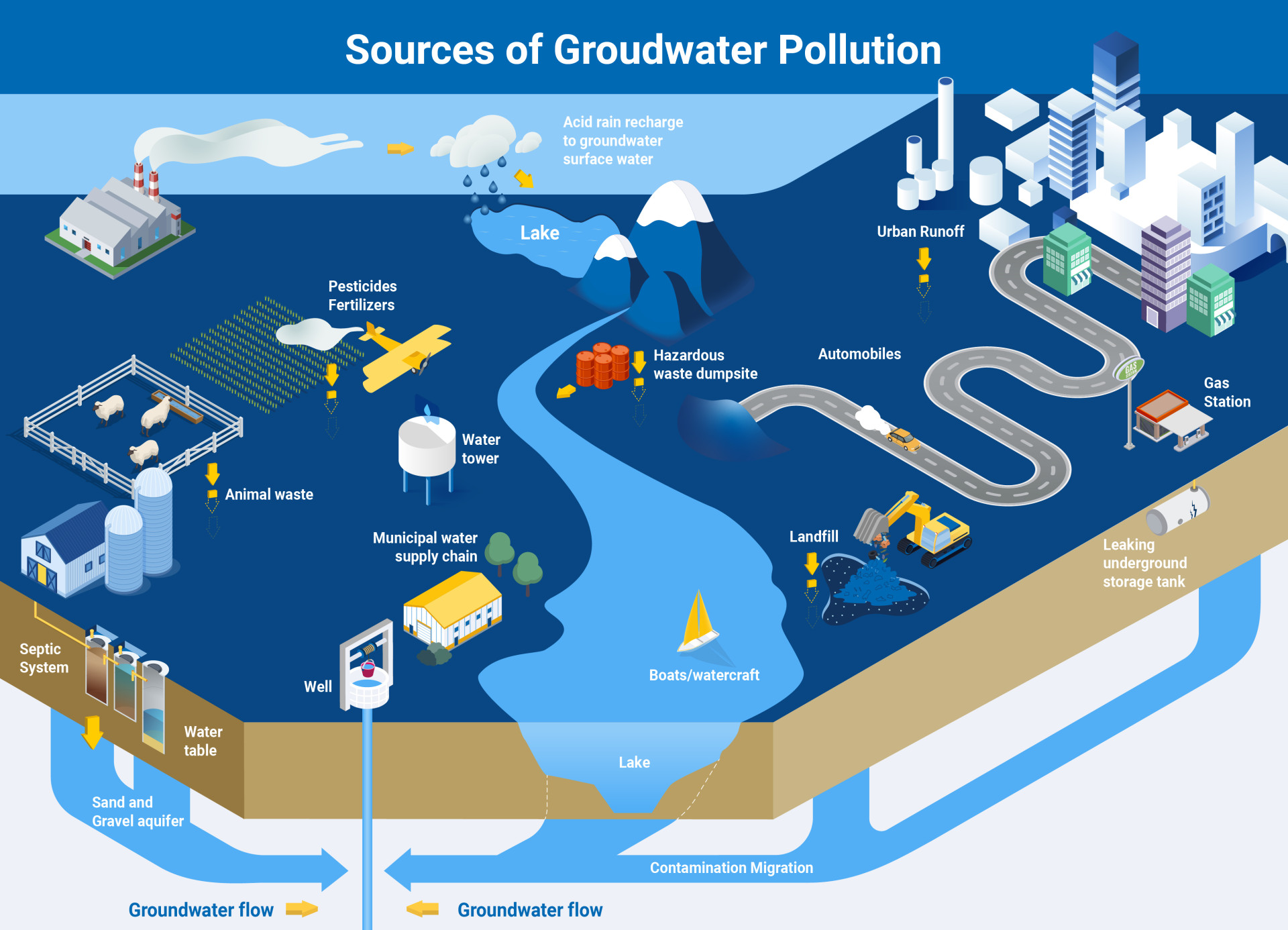
    Updates to this page

    Published 12 February 2025

    MIL OSI United Kingdom

  • MIL-OSI Africa: Sustainable economic growth in South Africa will come from renewables, not coal: what our model shows

    Source: The Conversation – Africa – By Andrew Phiri, Associate Professor of Economics, Nelson Mandela University

    Coal fired power stations produce 85% of South Africa’s electricity, making the country the biggest producer of harmful greenhouse-gas emissions in Africa. To move away from coal and meet its commitment to reaching net zero emissions by 2050, South Africa needs to dramatically increase production of renewable energy. New research by economics associate professor Andrew Phiri looked at the relationship between renewable and non-renewable energy consumption and GDP growth in South Africa to find out which energy source is most compatible with economic development.

    Non-renewables, renewables and economic growth: what’s there to know?

    We set out to discover whether renewable energy in South Africa, such as wind or solar power, supports sustainable economic growth. We also wanted to find out if renewables can replace non-renewable energy as a source and enabler of economic growth.

    Together with student Tsepiso Sesoai, I did research comparing the impact of renewable and non-renewable energy on economic growth in South Africa.

    South Africa currently faces a dual challenge when it comes to energy. It is heavily dependent on non-renewable energy (coal), which also worsens global warming and speeds up climate change. But it desperately needs to grow the economy at a faster rate, given very high unemployment, poverty and inequality.

    It’s therefore important to find out whether South Africa would be able to make a smooth transition from non-renewable energy to cleaner energy, and grow the economy at the same time.

    Past studies have looked into the role of energy in South Africa’s economic growth, but their methods have provided only limited information about whether South Africa can make a smooth transition from dirty to clean energy.


    Read more: African economic expansion need not threaten global carbon targets: study points out the path to green growth


    To get a deeper understanding, we conducted a modelling exercise. We used an analytical tool called “continuous complex wavelets” to see how renewable and non-renewable energy influences growth over time.

    Our model shows that an increased supply and higher consumption of non-renewable energy causes long-term economic growth over 10-15 year cycles. Renewables, at best, have short-term growth effects over six months to one year.

    After 2000, there was a very sharp increase of almost 25% in the use of renewable energy throughout the decade. According to our model, this sharp increase was enough to have an impact on economic growth over the short term but not over the long term.

    This is because South African energy regulators have not adopted strong enough measures for renewable energy to enable long-term growth. They have not funded the mass rollout of renewable energy, or connected renewables to the national grid. We found that renewables can only sustain growth over six to 12 month cycles whereas policymakers work towards longer cycles such as the 2030 and 2050 sustainable development goals.

    Economic growth and coal consumption: what did you find?

    In 2003, the government started taking climate change seriously with the release of the White Paper on Renewable Energy. The government started intentionally trying to increase the use of renewable energy while decreasing the use of dirty energy, such as coal. Before this, South Africa’s economic growth was heavily driven by coal consumption.

    Courtesy Andrew Phiri

    Renewable energy saw its biggest surge after the 2010 launch of the Renewable Energy Independent Power Producer Procurement Programme. This opened competitive bidding for renewable energy providers to supply electricity to the grid.

    The transition to renewable energy had begun. But coal-fired power, while declining, remained the main source of electricity.

    In 2019 carbon taxes were formally introduced. This resulted in a further slowdown in consumption of non-renewable energy. The COVID-19 pandemic in 2020 and 2021 coincided with severe power cuts. These two events combined caused a general slowdown in non-renewable and renewable energy use, and in economic growth.

    At this point, the drop in coal consumption was actively dragging down the economy. This in turn reduced society’s income, as measured by the gross national product. And because incomes were constrained, fewer private households purchased renewable energy systems. People didn’t spend on solar panels.

    What do your findings mean?

    Our research suggests that relying on non-renewable energy, like coal, won’t lead to long-term growth for South Africa. This is because non-renewables are not a reliable source of energy, as shown by loadshedding.

    Our research further suggests that renewable energy policies, subsidies and programmes made some positive short-term impacts on economic growth, measured as gross domestic product.

    Overall, our findings highlight that policymakers have treated renewables as a “nice-to-have” gesture for humanity, instead of a key driver of long-term economic growth.

    This has led to weak policies, poor regulation, and under-investment in renewable energy. These have held the sector back from making a bigger contribution to economic growth.


    Read more: Africa doesn’t have a choice between economic growth and protecting the environment: how they can go hand in hand


    For example, the government has not taken renewables seriously enough to include them in the power grid. This has largely limited the use of renewable energy to private homes and businesses. Coal-fired electricity from the country’s power utility, Eskom, is still cheaper for households than leaving the grid and purchasing their own renewable energy infrastructure (solar energy systems). The government has not funded the infrastructure needed to unlock South Africa’s vast renewable energy potential.

    The planet is at a critical state with global warming. The government should urgently set up policies and actions to overcome the barriers to using renewable energy. Only then will renewable energy have a permanent, positive influence on economic growth.

    South Africa has huge potential in renewables like solar, wind and biomass, thanks to its diverse geography. Yet, when people think about moving away from coal, they worry about job losses in the coal industry. But historically, energy transitions have never been instant. African countries that embraced the change early on reaped the benefits. They became more industrialised and prosperous.

    The South African government must act now if it wants to use renewable energy to drive future economic growth and stay ahead in the global shift to clean energy. Climate change affects us deeply. But it also presents a chance for Africa to leap ahead technologically.

    – Sustainable economic growth in South Africa will come from renewables, not coal: what our model shows
    – https://theconversation.com/sustainable-economic-growth-in-south-africa-will-come-from-renewables-not-coal-what-our-model-shows-239339

    MIL OSI Africa

  • MIL-OSI Global: Sustainable economic growth in South Africa will come from renewables, not coal: what our model shows

    Source: The Conversation – Africa – By Andrew Phiri, Associate Professor of Economics, Nelson Mandela University

    Coal fired power stations produce 85% of South Africa’s electricity, making the country the biggest producer of harmful greenhouse-gas emissions in Africa. To move away from coal and meet its commitment to reaching net zero emissions by 2050, South Africa needs to dramatically increase production of renewable energy. New research by economics associate professor Andrew Phiri looked at the relationship between renewable and non-renewable energy consumption and GDP growth in South Africa to find out which energy source is most compatible with economic development.

    Non-renewables, renewables and economic growth: what’s there to know?

    We set out to discover whether renewable energy in South Africa, such as wind or solar power, supports sustainable economic growth. We also wanted to find out if renewables can replace non-renewable energy as a source and enabler of economic growth.

    Together with student Tsepiso Sesoai, I did research comparing the impact of renewable and non-renewable energy on economic growth in South Africa.

    South Africa currently faces a dual challenge when it comes to energy. It is heavily dependent on non-renewable energy (coal), which also worsens global warming and speeds up climate change. But it desperately needs to grow the economy at a faster rate, given very high unemployment, poverty and inequality.

    It’s therefore important to find out whether South Africa would be able to make a smooth transition from non-renewable energy to cleaner energy, and grow the economy at the same time.

    Past studies have looked into the role of energy in South Africa’s economic growth, but their methods have provided only limited information about whether South Africa can make a smooth transition from dirty to clean energy.


    Read more:
    African economic expansion need not threaten global carbon targets: study points out the path to green growth


    To get a deeper understanding, we conducted a modelling exercise. We used an analytical tool called “continuous complex wavelets” to see how renewable and non-renewable energy influences growth over time.

    Our model shows that an increased supply and higher consumption of non-renewable energy causes long-term economic growth over 10-15 year cycles. Renewables, at best, have short-term growth effects over six months to one year.

    After 2000, there was a very sharp increase of almost 25% in the use of renewable energy throughout the decade. According to our model, this sharp increase was enough to have an impact on economic growth over the short term but not over the long term.

    This is because South African energy regulators have not adopted strong enough measures for renewable energy to enable long-term growth. They have not funded the mass rollout of renewable energy, or connected renewables to the national grid. We found that renewables can only sustain growth over six to 12 month cycles whereas policymakers work towards longer cycles such as the 2030 and 2050 sustainable development goals.

    Economic growth and coal consumption: what did you find?

    In 2003, the government started taking climate change seriously with the release of the White Paper on Renewable Energy. The government started intentionally trying to increase the use of renewable energy while decreasing the use of dirty energy, such as coal. Before this, South Africa’s economic growth was heavily driven by coal consumption.

    Renewable energy saw its biggest surge after the 2010 launch of the Renewable Energy Independent Power Producer Procurement Programme. This opened competitive bidding for renewable energy providers to supply electricity to the grid.

    The transition to renewable energy had begun. But coal-fired power, while declining, remained the main source of electricity.

    In 2019 carbon taxes were formally introduced. This resulted in a further slowdown in consumption of non-renewable energy. The COVID-19 pandemic in 2020 and 2021 coincided with severe power cuts. These two events combined caused a general slowdown in non-renewable and renewable energy use, and in economic growth.

    At this point, the drop in coal consumption was actively dragging down the economy. This in turn reduced society’s income, as measured by the gross national product. And because incomes were constrained, fewer private households purchased renewable energy systems. People didn’t spend on solar panels.

    What do your findings mean?

    Our research suggests that relying on non-renewable energy, like coal, won’t lead to long-term growth for South Africa. This is because non-renewables are not a reliable source of energy, as shown by loadshedding.

    Our research further suggests that renewable energy policies, subsidies and programmes made some positive short-term impacts on economic growth, measured as gross domestic product.

    Overall, our findings highlight that policymakers have treated renewables as a “nice-to-have” gesture for humanity, instead of a key driver of long-term economic growth.

    This has led to weak policies, poor regulation, and under-investment in renewable energy. These have held the sector back from making a bigger contribution to economic growth.


    Read more:
    Africa doesn’t have a choice between economic growth and protecting the environment: how they can go hand in hand


    For example, the government has not taken renewables seriously enough to include them in the power grid. This has largely limited the use of renewable energy to private homes and businesses. Coal-fired electricity from the country’s power utility, Eskom, is still cheaper for households than leaving the grid and purchasing their own renewable energy infrastructure (solar energy systems). The government has not funded the infrastructure needed to unlock South Africa’s vast renewable energy potential.

    The planet is at a critical state with global warming. The government should urgently set up policies and actions to overcome the barriers to using renewable energy. Only then will renewable energy have a permanent, positive influence on economic growth.

    South Africa has huge potential in renewables like solar, wind and biomass, thanks to its diverse geography. Yet, when people think about moving away from coal, they worry about job losses in the coal industry. But historically, energy transitions have never been instant. African countries that embraced the change early on reaped the benefits. They became more industrialised and prosperous.

    The South African government must act now if it wants to use renewable energy to drive future economic growth and stay ahead in the global shift to clean energy. Climate change affects us deeply. But it also presents a chance for Africa to leap ahead technologically.

    Andrew Phiri does not work for, consult, own shares in or receive funding from any company or organisation that would benefit from this article, and has disclosed no relevant affiliations beyond their academic appointment.

    ref. Sustainable economic growth in South Africa will come from renewables, not coal: what our model shows – https://theconversation.com/sustainable-economic-growth-in-south-africa-will-come-from-renewables-not-coal-what-our-model-shows-239339

    MIL OSI – Global Reports

  • MIL-OSI USA: The cost of transporting coal to the U.S. electric power sector fell slightly in 2023

    Source: US Energy Information Administration

    In-brief analysis

    February 12, 2025


    We released new data on the U.S. electric power sector’s coal transportation costs. The release incorporates final data for 2023 from Form EIA-923, which we collect from electric power plant owners and operators. The data release based on our Form EIA-923 includes tables with costs, in nominal and real (2023) dollars, across regions, states, and modes of transportation. These transportation rates are calculated as a weighted average of the difference between the commodity cost and total delivered cost of coal shipments to plants in the electric power sector. In addition, the rates are based on the primary transport mode that a plant’s owner or operator selects, but they may include other secondary or tertiary modes.

    Data highlights

    • After accounting for inflation, the average transportation cost for coal in the United States declined from $19.29 per ton in 2022 to $18.77 per ton in 2023 (in 2023 dollars). In nominal terms, it rose from $18.69 in 2022 to $18.77 in 2023.
    • The nominal average cost of transporting coal by railroad and waterway increased slightly in 2023, while the average cost of transporting coal by truck declined slightly.
    • On a regional basis, a mix of marginal increases and decreases in nominal prices existed across modes of transport and across states and coal supply basins. Overall, the average cost of rail transport increased in the Illinois Basin and in Appalachia. The cost decreased in the Western region. By truck and waterway, average costs decreased in Appalachia but increased in the Illinois Basin.
    • Price changes in real terms were more sizable in a few cases. For example:
      • The cost of rail transport from the Northern Appalachian coal basin to North Carolina increased in real terms from $31.99 in 2022 to $38.00 in 2023. This increase is similar to an inflation-adjusted increase in the cost of rail transport from Pennsylvania to North Carolina (from $31.23 in 2022 to $37.44 in 2023).
      • The cost of rail transport from the Central Appalachian coal basin to North Carolina increased in real terms from $25.08 in 2022 to $29.49 in 2023. This increase is similar to an inflation-adjusted increase in the cost of rail transport from West Virginia to North Carolina (from $26.98 in 2022 to $30.66 in 2023).
      • The cost of truck transport from the Northern Appalachian coal basin to Pennsylvania declined in real terms from $13.05 in 2022 to $8.50 in 2023. This decrease is similar to an inflation-adjusted decrease in the cost of intrastate truck transport in Pennsylvania (from $12.62 in 2022 to $8.50 in 2023).
      • The cost of rail transport from the Illinois Basin to Kentucky declined in real terms from $13.12 in 2022 to $7.62 in 2023. This decrease is similar to an inflation-adjusted decrease in the cost of intrastate rail transport in Kentucky (from $15.06 in 2022 to $7.92 in 2023).
    • The overall volume of coal transport decreased across all modes of transport in 2023 compared with 2022.

    Principal contributor: Jonathan Church

    MIL OSI USA News

  • MIL-OSI: Uni-Fuels Awarded International Sustainability and Carbon Certifications, Reinforcing Commitment to Sustainable Marine Fuel Trading

    Source: GlobeNewswire (MIL-OSI)

    SINGAPORE, Feb. 12, 2025 (GLOBE NEWSWIRE) — Uni-Fuels Holdings Limited (NASDAQ: UFG), (“Uni-Fuels” or the “Company”), a global provider of marine fuel solutions headquartered in Singapore, today announced that the Company’s wholly owned subsidiary, Uni-Fuels Pte Ltd (“Uni-Fuels Singapore”), has received both ISCC EU and ISCC PLUS certifications from the International Sustainability and Carbon Certification (ISCC), a globally recognized independent multi-stakeholder initiative and leading certification system supporting sustainable, fully traceable, deforestation-free and climate-friendly supply chains. These certifications highlight the Company’s commitment to sustainability and compliance with European Union (EU) regulations aimed at reducing greenhouse gas (GHG) emissions in the maritime industry.

    The ISCC certifications ensure that the biofuels traded by Uni-Fuels Singapore meet the requirements of the EU’s Renewable Energy Directive (RED II), including the provision of Proof of Sustainability (PoS). This important documentation ensures biofuels are sustainably sourced and produced, enabling full traceability from feedstock to final product.

    As the maritime sector moves toward greater decarbonization, it is essential for biofuel suppliers to demonstrate compliance with regulatory standards, including the EU Emissions Trading System (EU ETS) and FuelEU Maritime. PoS documentation ensures biofuels can be counted toward emissions reduction targets, as opposed to being treated as fossil fuels.

    Uni-Fuels Vice President, Operations Tan Guan Kai commented, “Achieving ISCC certifications demonstrates our commitment to supporting the global transition to cleaner fuels. With Proof of Sustainability documentation, we provide our customers with the assurance that the biofuels they rely on are responsibly produced and fully compliant with evolving regulations.”

    The PoS framework, combined with the ISCC EU and ISCC PLUS certifications, ensures customers that the biofuels they use are responsibly sourced, traceable, and produced with sustainability in mind. These certifications provide both regulatory compliance and enhanced transparency, helping to build trust in the biofuel market.

    About Uni-Fuels Holdings Limited

    Uni-Fuels is a fast-growing global provider of marine fuel solutions, helping shipping companies optimize fuel procurement across all markets and time zones. Founded in 2021, Uni-Fuels has evolved from modest beginnings into a dynamic, forward-thinking company. Backed by a passionate team and a growing presence across multiple locations, it has forged trusted partnerships with customers, supporting them in achieving their operational objectives with confidence, from shore to shore.

    For more information, visit www.uni-fuels.com.

    Forward-Looking Statements

    This press release contains “forward-looking statements” within the meaning of the “safe harbor” provisions of the Private Securities Litigation Reform Act of 1995, including statements regarding the completion and timing of closing of the offering and the intended use of the proceeds. You can identify forward-looking statements by the fact that they do not relate strictly to historical or current facts. These statements may include words such as “anticipate”, “estimate”, “expect”, “project”, “plan”, “intend”, “believe”, “may”, “will”, “should”, “can have”, “likely” and other words and terms of similar meaning. Forward-looking statements represent Uni-Fuels’ current expectations regarding future events and are subject to known and unknown risks and uncertainties that could cause actual results to differ materially from those implied by the forward-looking statements. These statements are subject to uncertainties and risks including, but not limited to, the uncertainties related to market conditions and the completion of the initial public offering on the anticipated terms or at all, and other factors discussed in the “Risk Factors” section of the registration statement filed with the SEC. For these reasons, among others, investors are cautioned not to place undue reliance upon any forward-looking statements in this press release. Additional factors are discussed in the Company’s filings with the SEC, which are available for review at www.sec.gov. The Company undertakes no obligation to publicly revise these forward-looking statements to reflect events or circumstances that arise after the date hereof.

    Contact Information

    For Investor Relations:

    Uni-Fuels Holdings Ltd
    Email: investors@uni-fuels.com

    Skyline Corporate Communications Group, LLC
    Email: info@skylineccg.com

    The MIL Network

  • MIL-OSI: Apollo Funds Acquire Bold Production Services, a Leading Provider of Production-Linked Contracted Gas Treatment Solutions

    Source: GlobeNewswire (MIL-OSI)

    HOUSTON and NEW YORK, Feb. 12, 2025 (GLOBE NEWSWIRE) — Apollo (NYSE:APO), today announced that funds managed by Apollo affiliates (the “Apollo Funds”) have acquired a majority interest in Bold Production Services, LLC (“Bold” or the “Company”), a provider of production-linked, contracted natural gas treatment solutions that enable the downstream use of natural gas, while reducing excess emissions and waste through proprietary equipment design.

    Founded in 2013, Bold’s fleet of 700+ owned assets, including dehydration units, H2S treating units and total flow coolers, serves a blue-chip customer base across the Permian and Eagle Ford basins. The investment from the Apollo Funds will support Bold’s continued growth as natural gas demand is expected to accelerate over the next decade, driven by secular trends associated with the industrial renaissance such as demand for power generation, LNG exports, data centers and other emerging natural gas applications. The Company will continue to be headquartered in Houston, Texas and led by Glen Wind, Chief Executive Officer, along with his team including Blake Maywald, President, Tim Burkett, Chief Financial Officer and Austin Traweek, Chief Operating Officer.

    Glen Wind, CEO of Bold, commented, “We are excited to work with Apollo in our efforts to continue serving our customers seeking reliable gas treatment solutions that help improve operational efficiency. Producers value high performance, scalable treatment services, and Bold remains committed to delivering best-in-class solutions that drive safer, cleaner operations with improved production yields and lower emissions. We look forward to building on our momentum alongside Apollo in the years ahead. We would like to acknowledge and thank the OFS Energy Fund team for their involvement and support in helping us reach this point.”

    Scott Browning, Partner at Apollo, said, “Bold has built a robust platform providing essential gas treatment solutions, with significant growth potential supported by strong customer relationships and attractive expansion opportunities. We are excited to partner with Glen, Blake and the rest of the Bold team in a market where we see the opportunity for significant investment given favorable secular tailwinds. Apollo brings deep expertise in the natural gas value chain and a proven track record supporting the growth of energy-related services that help to fuel the industrial renaissance.”

    Over the past five years, Apollo-managed funds and affiliates have committed, deployed, or arranged approximately $58 billioni into climate and energy transition-related investments, supporting companies and projects across clean energy and infrastructure.

    Vinson & Elkins LLP served as legal counsel to the Apollo Funds. Piper Sandler & Co. acted as financial advisor to Bold, and Troutman Pepper Locke, LLP served as Bold’s legal counsel. Bank OZK supported the transaction through a new credit facility.

    About Bold Production Services, LLC

    Bold Production Services, LLC is an oil & gas infrastructure resource company providing contract services in the treating and removal of impurities found in natural gas, oil, and water. Bold has grown its asset base to include production and treating equipment, as well as a non-triazine based H2S chemical scavenger. To learn more, please visit www.bps-llc.com.

    About Apollo Global Management, Inc.

    Apollo is a high-growth, global alternative asset manager. In our asset management business, we seek to provide our clients excess return at every point along the risk-reward spectrum from investment grade to private equity with a focus on three investing strategies: yield, hybrid, and equity. For more than three decades, our investing expertise across our fully integrated platform has served the financial return needs of our clients and provided businesses with innovative capital solutions for growth. Through Athene, our retirement services business, we specialize in helping clients achieve financial security by providing a suite of retirement savings products and acting as a solutions provider to institutions. Our patient, creative, and knowledgeable approach to investing aligns our clients, businesses we invest in, our employees, and the communities we impact, to expand opportunity and achieve positive outcomes. As of December 31, 2024, Apollo had approximately $751 billion of assets under management. To learn more, please visit www.apollo.com.

    Contact Information

    Noah Gunn
    Global Head of Investor Relations
    Apollo Global Management, Inc.
    (212) 822-0540
    IR@apollo.com

    Joanna Rose
    Global Head of Corporate Communications
    Apollo Global Management, Inc.
    (212) 822-0491
    Communications@apollo.com

    ___________________________

    i As of December 31, 2024. The firmwide targets (the “Targets”) to deploy, commit, or arrange capital commensurate with Apollo’s proprietary Climate and Transition Investment Framework (the “CTIF”), are (1) $50 billion by 2027 and (2) more than $100 billion by 2030 The CTIF, which is subject to change at any time without notice, sets forth certain activities classified by Apollo as sustainable economic activities (“SEAs”), and the methodologies used to calculate contribution towards the Targets. Only investments determined to be currently contributing to an SEA in accordance with the CTIF are counted toward the Targets. Under the CTIF, Apollo uses different calculation methodologies for different types of investments in equity, debt and real estate. For additional details on the CTIF, please refer to our website here: https://www.apollo.com/strategies/asset-management/real-assets/sustainable-investing-platform.

    The MIL Network

  • MIL-OSI Africa: Congo: CLG Experts Unpack Upcoming Gas Code and Investment Opportunities

    Source: Africa Press Organisation – English (2) – Report:

    BRAZZAVILLE, Republic of the Congo, February 12, 2025/APO Group/ —

    The matter of the gas code will undoubtedly be discussed at the Congo Energy & Investment Forum, taking place from March 24-26, 2025, in Brazzaville. This regulatory milestone aims to provide a clear and structured framework for gas exploration, production and commercialization, boosting investor confidence and unlocking the full potential of the country’s vast natural gas reserves. As part of the forum, CLG Congo, a leading legal and commercial advisory firm in the energy sector, will play a key role in discussions surrounding regulatory reforms. In an interview with Energy Capital & Power (ECP) (www.EnergyCapitalPower.com), Yves Ollivier, Managing Director and Daoudou Mohammad, Director of Tax & Legal at CLG, shared their insights on the country’s upcoming Gas Code, regulatory landscape and upcoming opportunities. 

    Please provide an overview of CLG’s current activities in the Congo, particularly in relation to the energy sector? 

    CLG Congo is a leading provider of legal, tax, and commercial advisory services, working closely with oil and gas companies. In 2024, CLG was involved in Trident Energy’s acquisition of Chevron and TotalEnergies’ interests in the Lianzi, Nkosa and Nsoko 2 and Moho Bilondo fields. Trident now holds15,75% in Lianzi field, 85% in Nkosa and Nsoko 2 fields and 21.5% in Moho-Bilondo. To expand our client base, we actively participate in major energy events, such as African Energy Week in Cape Town and are honored to partner with Capital Energy & Power as legal counsel for CEIF 2025. 

    How does the Republic of Congo’s legislative framework impact foreign investment in hydrocarbons? 

    Historically, about 80% of direct investments in the country come from oil and gas, reflecting its economic dependence on hydrocarbons. To enhance investment conditions, the government has created investment promotion structures, including a Public-Private Partnership (PPP) Agency and a dedicated Ministry for International Cooperation and for Public-Private Partnership. 

    The 2016 Hydrocarbons Code introduced competitive bidding for exploration rights, increasing transparency and investor confidence. However, a Gas Code is still needed to provide a specific legal framework for natural gas investments. The current draft, developed with international institutions, aims to secure foreign capital and streamline regulations for a more competitive and structured industry. 

    What fiscal incentives does Congo offer to attract energy investments? 

    The government provides among others, corporate tax exemptions and progressive tax reductions for oil and gas projects, negotiated within the Production Sharing Contracts. Companies also benefit from customs incentives, such as the IM5 temporary import regime, allowing tax-free equipment imports under the condition of re-export. These measures lower entry costs for investors and enhance profitability. 

    What are the key expectations from the Gas Code and how could the regulatory framework improve investment conditions? 

    The Gas Code, expected in 2025, will provide a clear legislative framework for gas monetization, fiscal terms, and resource management. The draft was presented to gas companies in late 2023, and after modifications, is set for final approval. Additionally, the Gas Master Plan, developed by SNPC and McKinsey, aims to boost investment and expand gas utilization in Congo. 

    Another key issue is the VAT decree (2023-1337), which extends VAT to previously exempt oil and gas operations. There are ongoing discussions between the government and industry players to find a compromise that suits all parties. 

    How does the regulatory framework impact local content development in the oil and gas industry? 

    Despite 2019 local content decrees, enforcement remains a challenge. The law mandates 70% Congolese employment in management roles, but lacks clear compliance mechanisms. Companies try to follow the guidelines, but without effective monitoring, implementation varies. Strengthening verification processes is essential for sustainable workforce development in the sector. 

    What are your key expectations for the Congo Energy & Investment Forum 2025? 

    We see this as an opportunity to engage with foreign investors and showcase Congo’s gas potential, which includes proven reserves of 284 billion cubic meters and significant ongoing projects such as Eni’s Tango FLNG and Wing Wah’s Banga Kayo Gas Project. The forum will allow direct dialogue with policymakers, enabling us to propose solutions for industry challenges such as the Gas Code finalization and fiscal reforms. We also aim to highlight investment opportunities and regulatory reforms. Discussing topics like the Gas Code, VAT decree, and Hydrocarbons Code updates is crucial to ensuring a competitive and attractive investment environment. 

    MIL OSI Africa

  • MIL-OSI Asia-Pac: SAIL declares financial results for Q3 and 9M FY’25

    Source: Government of India

    Posted On: 12 FEB 2025 12:21PM by PIB Delhi

    Steel Authority of India Limited (SAIL) has declared its financial results today for the quarter and nine month ending 31st December, 2024.

    Key highlights:

    Performance of Q3 FY 25 (Standalone) at a glance:

    Unit

    Q3 23-24

    Q2 24-25

    Q3 24-25

    Crude Steel Production

    Million Tonne

    4.75

    4.78

    4.63

    Sales Volume

    Million Tonne

    3.81

    4.10

    4.43

    Revenue from Operations

    Rs. Crore

    23,345

    24,675

    24,490

    Earnings Before Interest, Tax, Depreciation and Amortisation (EBITDA)

    Rs. Crore

    2,319

    3,174

    2,389

    Profit Before Exceptional Items and Tax

    Rs. Crore

    384

    1,113

    289

    Exceptional Items

    Rs. Crore

    76

    0

    29

    Profit Before Tax (PBT)

    Rs. Crore

    461

    1,113

    318

    Profit After Tax (PAT)

    Rs. Crore

    331

    834

    126


    Performance of 9M FY 25 (Standalone) at a glance:

    Unit

    9M 23-24

    9M 24-25

    Crude Steel Production

    Million Tonne

    14.22

    14.08

    Sales Volume

    Million Tonne

    12.46

    12.54

    Revenue from Operations

    Rs. Crore

    77,417

    73,162

    Earnings Before Interest, Tax, Depreciation and Amortisation (EBITDA)

    Rs. Crore

    8,451

    7,983

    Profit Before Exceptional Items and Tax

    Rs. Crore

    2,698

    1,728

    Exceptional Items

    Rs. Crore

    (339)

    (283)

    Profit Before Tax (PBT)

    Rs. Crore

    2,359

    1,445

    Profit After Tax (PAT)

    Rs. Crore

    1,722

    970

    SAIL’s revenue from operations and sales volume increased during the third quarter of the current financial year, along with a slight improvement in EBITDA compared to the corresponding period last year.

    Commenting on the financial results, Chairman SAIL, Shri Amarendu Prakash said, “In the face of a challenging steel market characterized by declining prices and an influx of cheap imports, SAIL has managed to achieve better EBITDA during the Q3FY25 compared to the corresponding period last year. We remain steadfast in our commitment to boost production and enhance cost efficiency, while simultaneously further explore and adopt greener technologies. We expect that with appropriate interventions, the issue of cheap imports will be addressed and government’s drive on infrastructure development will bode well for the domestic steel industry while driving the demand further”.

    *****

    TPJ/NJ

    (Release ID: 2102140) Visitor Counter : 71

    MIL OSI Asia Pacific News

  • MIL-OSI United Kingdom: Fourth UK-India Energy Dialogue: joint statement

    Source: United Kingdom – Executive Government & Departments

    This joint statement was released following the meeting between UK Energy Secretary, Ed Miliband and India’s Minister of Power, Manohar Lal.

    The Fourth India-UK Energy Dialogue, co-chaired by Shri Manohar Lal, Union Minister of Power, India and Mr Ed Miliband, Secretary for Energy Security and Net Zero for United Kingdom, was held in, New Delhi on Monday 10th February, 2025.

    The dialogue focused on reviewing progress made in the energy sectors of both nations, including power and renewable energy, and reaffirming the commitment to a sustainable, resilient, and inclusive energy future. including across the breadth of sectors represented. They expressed satisfaction over the progress made to support green and sustainable growth, alongside accelerating the clean energy transition and ensuring energy security. The Ministers underscored the importance of ensuring that the energy transition and economic growth proceed together, while maintaining affordable and clean energy access for all.

    The Ministers underscored the importance of ensuring energy security and sustainable development and emphasised expanding the cooperation in the areas of power distribution, sector reforms, industrial energy efficiency and de-carbonisation, and electric mobility while exploring new opportunities in the emerging fields such as energy storage, green data centres, and offshore wind, with an increased focus on MSMEs.

    The Ministers were pleased to announce the launch of Phase-2 of the India-UK bilateral Accelerating Smart Power & Renewable Energy in India programme. This phase will aim to provide technical support for ensuring round the clock power supply, expanding renewable energy initiatives, and accelerating industrial energy efficiency and de-carbonisation, in collaboration with the Ministry of Power (MOP) and Ministry of New and Renewable Energy (MNRE).

    The Ministers were pleased to observe the bilateral collaboration between the two sides to promote growth and jobs, through technical assistance cooperation and investment. They also discussed the progress of trade missions focusing on offshore wind and green hydrogen, as well as the cooperation between the UK’s Energy Systems Catapult and India’s Power Trading Corporation.

    Recognising the shared ambition for advancing offshore wind development, the Ministers announced the establishment of a UK-India Offshore Wind Taskforce, which will focus on advancing offshore wind ecosystem development, supply chains, and financing models in both countries. Mr Miliband commended India’s ambitious initiatives in the renewable energy sector and shown a strong interest in gaining insights from India’s experience in implementing the Solar Rooftop Programme (PM – Surya Ghar Muft Bijli Yojna).

    The Ministers agreed on the importance of power market regulations in driving the energy transition and ensuring greater energy security and access. To support this, they announced the continuation of the Power Sector Reforms programme under the UK Partnering for Accelerating Climate Change (UKPACT). Additionally, a new taskforce has been proposed between the UK’s Office of Gas and Electricity Markets and India’s Central Electricity Regulatory Commission to support renewable energy integration and grid transformation in India.

    Both Ministers emphasised the ongoing value of the India-UK Energy Dialogue in advancing mutual energy transition goals, ensuring energy access, and building secure and sustainable clean energy supply chains while aligning these efforts with economic growth.

    The Ministers expressed their intention to further strengthen their collaboration through the Comprehensive Strategic Partnership and looked forward to the fifth UK-India Energy Dialogue in 2026. The dialogue concluded with the launch of the ‘Best Practices Compendium of Industrial Energy Efficiency/Decarbonisation’ and a ‘Pathways for Energy Efficiency and Decarbonisation in the Indian Aluminium Sector’.

    Updates to this page

    Published 12 February 2025

    MIL OSI United Kingdom

  • MIL-OSI Asia-Pac: LCQ1: Action Plan on Green Maritime Fuel Bunkering

    Source: Hong Kong Government special administrative region

    LCQ1: Action Plan on Green Maritime Fuel Bunkering
    LCQ1: Action Plan on Green Maritime Fuel Bunkering
    **************************************************

         Following is a question by the Hon Chan Hak-kan and a reply by the Secretary for Transport and Logistics, Ms Mable Chan, in the Legislative Council today (February 12):Question:     Regarding the Action Plan on Green Maritime Fuel Bunkering (the Action Plan) promulgated by the Government last year, will the Government inform this Council:(1) given that the Action Plan proposes to “adopt a multi-fuel strategy”, but it is learnt that at present, there are many types of green maritime fuels in the market, and most of them are at an early stage of development, while investments in the diversified development of fuels will not only increase the operational burden on investors, but also reduce the cost-effectiveness of such investments, whether the authorities will expeditiously specify the “designated fuels” and set relevant standards, carbon reduction targets, timetables, etc, so that investors can concentrate their resources and carry out long-term development planning;(2) as it is learnt that at present, the Mainland is already one of the major producers of maritime fuels such as bio-diesel and green methanol, and the related technologies have become relatively mature, how the authorities will, through administrative measures, support Hong Kong enterprises in fully grasping the advantage of enjoying the strong support of the motherland to build Hong Kong into a maritime fuel bunkering centre; and(3) given that the Action Plan proposes to set up a Green Maritime Fuel Bunkering Incentive Scheme within this year to encourage pioneer companies to develop green maritime fuel bunkering business in Hong Kong, when the authorities will announce the details of the Scheme?Reply: President,     The maritime industry accounts for about three per cent of the world’s carbon emissions. In order to reduce maritime operations’ negative impact on the environment, the International Maritime Organization (IMO) has set out a target of achieving net-zero carbon emissions from international shipping by or around 2050. There are many ways to reduce emissions, including adoption of energy saving technologies, switching to more energy-efficient vessels, usage of smart maritime technologies, among which the use of green maritime fuels is by far the most effective. Therefore, the industry has started to switch to using low or even zero-carbon green maritime fuels. Hong Kong must enhance its green maritime fuel bunkering capabilities to respond to market needs, so as to give full play to our advantage of our excellent geographical location and our position as a major bunkering port in South China, consolidate Hong Kong’s position as an international maritime centre, and maintain the competitiveness of our port.     The Government promulgated the Action Plan on Green Maritime Fuel Bunkering (Action Plan) in November last year, setting out clear targets with five strategies and 10 action measures with an aim to develop Hong Kong into a green maritime fuel bunkering centre. The Government has received strong support from the industry and maintained positive communication with Legislative Council members since the promulgation of the Action Plan. Various domestic and international players from different parts of the green maritime fuel bunkering supply chain have also expressed their interest in developing relevant businesses in Hong Kong.     Regarding the Hon Chan Hak-kan’s questions, the reply is as follows: (1) Currently, a number of green maritime fuels, including biodiesel, liquefied natural gas (LNG), green methanol, green ammonia and hydrogen are being used or tested by the industry, but not a single type of green maritime fuel is being particularly favoured. According to publicly available information on new vessels on order, by 2030 we expect that there will be over 1 000 vessels capable of being powered by LNG and nearly 400 methanol ones by 2030, as well as a number of hydrogen and green ammonia vessels in the world. Meanwhile, as most of the vessels that can use green maritime fuels will likely have dual-fuel engines, these vessels as well as the other traditional ones not yet due for replacement will likely adopt biodiesel, which is cheaper than other green maritime fuels currently, to reduce emission in the short term.     Taking into consideration the current trend in the maritime industry to retrofit or build new vessels powered by different green maritime fuels, the aforementioned figures, the high investment involved in ordering or retrofitting vessels, and that new vessels can generally operate for around more than 20 years after delivery, we expect diversified development in the green maritime fuel bunkering market in the coming decades. On one hand, Hong Kong will adopt a “multi-fuel” strategy like major ports such as Singapore, Rotterdam and Shanghai. But on the other hand, as mentioned in Hon Chan Hak-kan’s questions, we aim to provide a clear orientation on fuel options to the industry and the society, including making biodiesel bunkering immediately available, developing LNG and green methanol bunkering in the short- and medium-term respectively, and considering the development of the bunkering of hydrogen and green ammonia in the long run.     Following the aforementioned orientation and development directions, there are several actions we are about to implement, including:  

    in terms of LNG, we issued the Code of Practice (CoP) on LNG bunkering in January and the trade will soon conduct the first ship-to-ship LNG bunkering in Hong Kong waters this week;
    on green methanol, we will within this year invite the industry to submit expressions of interest in relation to developing green methanol storage facilities on a site in Tsing Yi South, and complete the CoP on green methanol bunkering; and
    as for hydrogen and green ammonia, we will simultaneously commence a feasibility study on the future bunkering of these fuels within this year, with a view to setting out a clear development direction.

         As regards standards on green maritime fuels, the IMO expects to finalise a number of mid-term measures within this year, which are expected to enter into force around 2027 and among which the “Green House Gas (GHG) fuel standard” will require the phased reduction of the GHG intensity of maritime fuels. As an Associate Member of IMO, Hong Kong will respond and follow the requirements in this regard.(2) Establishing a stable green maritime fuel supply chain is one of the action measures set out in the Action Plan. Given Hong Kong’s proximity to the Mainland, which is a major producer of a number of green fuels, we expect that most of Hong Kong’s green maritime fuels will be imported from the Mainland. In fact, currently some Hong Kong companies have already set up production facilities in different provinces and cities in the Mainland, including Inner Mongolia and Foshan, to produce green maritime fuels, while some Hong Kong and Mainland producers have expressed interest in providing such fuels to Hong Kong. Such stable green maritime fuel supply chain can also allow Hong Kong to take advantage of its robust and resilient financial system, good business environment, and regulatory regime in line with international standards, to develop into an international green maritime fuel trading centre.     At present, the Government will actively foster the conclusion of green maritime fuel offtake agreements by shipping companies interested in bunkering such fuels in Hong Kong. The Marine Department has set up a dedicated team to provide one-stop services for relevant companies, so as to help build a systematic and organic supply chain in Hong Kong. (3) As for the Green Maritime Fuel Bunkering Incentive Scheme, it aims to encourage pioneer enterprises to start green maritime fuel bunkering businesses in Hong Kong. At present, we are formulating the details of the scheme, and expect to establish the scheme in 2025 and will announce it in due course.     Thank you, President.

     
    Ends/Wednesday, February 12, 2025Issued at HKT 16:22

    NNNN

    MIL OSI Asia Pacific News

  • MIL-OSI Asia-Pac: Coal Ministry Issues Letters of Award to Selected Applicants under Categories II of the Financial Incentive Scheme for Coal Gasification

    Source: Government of India (2)

    Posted On: 12 FEB 2025 12:58PM by PIB Delhi

    The Ministry of Coal has made a significant stride in India’s ambitious Coal Gasification Initiative with the issuance of Letters of Award (LOAs) to selected applicants under Category II of the ₹8,500 crore Coal Gasification Incentive Scheme.

    The LOAs were presented by Shri Vikram Dev Dutt, Secretary, Ministry of Coal, in the august presence of Additional Secretary, Ms. Vismita Tej, and OSD (Technical), Shri Asheesh Kumar and Director (Technical), Shri BK Thakur, Ministry of Coal.

    Awardees under the Scheme:

    Category II: Private Sector/ Government PSUs (For allocation of Rs 1,000 crore per project or 15% of capex, whichever is lower)

    • Jindal Steel and Power Limited: The 2MMTPA coal gasification project in Angul, Odisha, has been awarded ₹569.05 crore in financial incentives. The ₹3,793 crore project will convert coal into Direct Reduced Iron (DRI) through coal gasification while also setting up a carbon capture and utilization plant designed to capture 30 TPD of CO2 for conversion into valuable products.
    • New Era Cleantech Solution Private Limited: A financial incentive of ₹1,000 crore has been granted for New Era Cleantech’s coal gasification project in Bhadravati, Chandrapur, Maharashtra. With a total project cost of ₹6,976 crore, it aims to produce 0.33 MMTPA of Ammonium Nitrate and 0.1 MMTPA of Hydrogen. Additionally, the project will implement Carbon Capture, Utilization, and Storage (CCUS) technology, where captured CO2 will be utilized for methanol production. The proposed CO2-to-methanol plant will have a capacity of 3,000 TPD (1.0 MMTPA).
    • Greta Energy Limited: The Greta Energy Limited has been awarded ₹414.01 crore of financial incentive for its coal gasification project at MIDC Bhadravati, Chandrapur, Maharashtra. With a total investment of ₹2,763 crore, the project aims to produce 0.5 MTPA of Direct Reduced Iron (DRI).

    The Coal Gasification Incentive Scheme plays a pivotal role in India’s ambitious target of reaching 100 million tonnes of coal gasification by 2030. This initiative is designed to accelerate technological advancements in coal gasification, significantly reduce carbon emissions, bolster energy security, and create a foundation for a more sustainable energy landscape.

    ****

    Shuhaib T

    (Release ID: 2102157) Visitor Counter : 81

    MIL OSI Asia Pacific News

  • MIL-OSI Asia-Pac: PM Surya Ghar: Muft Bijli Yojana Turns One

    Source: Government of India

    PM Surya Ghar: Muft Bijli Yojana Turns One

    Powering India’s Solar Revolution

    Posted On: 12 FEB 2025 12:48PM by PIB Delhi

    Introduction

    On February 13, 2025, the PM Surya Ghar: Muft Bijli Yojana (PMSGMBY) will mark its first anniversary, celebrating a year of empowering households with affordable solar energy and accelerating India’s transition to a sustainable future. Launched by Prime Minister Narendra Modi on February 13, 2024, this groundbreaking initiative aims to provide free electricity to households by facilitating the installation of rooftop solar panels. The PMSGMBY, the world’s largest domestic rooftop solar initiative, is reshaping India’s energy landscape with a bold vision to supply solar power to one crore households by March 2027.

    As of January 27, 2025, the scheme has already benefitted 8.46 lakh households through rooftop solar installations. The rapid adoption of solar energy is evident in the tenfold increase in monthly installation rates, which now stand at around 70,000 installations per month, significantly surpassing pre-scheme levels. The scheme offers a subsidy of up to 40%, making renewable energy more affordable and accessible. So far, ₹4,308.66 crore has been disbursed as Central Financial Assistance (CFA) to 5.54 lakh residential consumers, with an average subsidy of ₹77,800 per household. Additionally, an estimated 45% of the beneficiaries are now receiving zero electricity bills, depending on their solar power generation and consumption patterns.

    Top 5 states with the highest number of households benefiting under the PM Surya Ghar: Muft Bijli Yojana.


    Key Benefits

    The PM Surya Ghar: Muft Bijli Yojana offers several significant benefits to participating households:

    • Free Electricity for Households: The scheme provides households with free electricity through the installation of subsidized rooftop solar panels, significantly reducing their energy costs.


    • Reduced Electricity Costs for the Government: By promoting the widespread use of solar power, the scheme is expected to save the government an estimated ₹75,000 crore annually in electricity costs.


    • Increased Use of Renewable Energy: The scheme encourages the adoption of renewable energy sources, contributing to a more sustainable and environmentally friendly energy mix in India.


    • Reduced Carbon Emissions: The transition to solar energy under this scheme will help lower carbon emissions, supporting India’s commitment to reducing its carbon footprint.

    Subsidy Details

    The subsidy provided under the scheme varies based on the household’s average monthly electricity consumption and the corresponding suitable rooftop solar plant capacity:

    Average Monthly Electricity Consumption (units)

    Suitable Rooftop Solar Plant Capacity

    Subsidy Support


    0-150

    1-2 kW

    ₹ 30,000/- to ₹ 60,000/-

    150-300

    2-3 kW

    ₹ 60,000/- to ₹ 78,000/-

    > 300

    Above 3 kW

    ₹ 78,000/-


    Subsidy Application and Vendor Selection: Households can apply for the subsidy through the National Portal, where they can also select a suitable vendor for installing rooftop solar. The National Portal will assist in decision-making by providing information on appropriate system sizes, a benefits calculator, vendor ratings, and other relevant details. With all credentials are entered correctly on the National Portal, the average time taken in processing the CFA is around 15 days after redemption request made by the consumer.


    Collateral-Free Loans: Households will have access to collateral-free, low-interest loans at around 7% interest for the installation of residential rooftop solar (RTS) systems up to 3 kW.

    Eligibility

    Application Process

    The application process involves following nine specific steps to ensure a smooth and efficient submission and approval of solar panel installation.

    Impact

    The   PM Surya Ghar: Muft Bijli Yojana is expected to have far-reaching outcomes, both for individual households and the nation as a whole:

    • Household Savings and Income Generation: Households will benefit from significant savings on their electricity bills. Additionally, they will have the opportunity to earn extra income by selling surplus power generated by their rooftop solar systems to DISCOMs. For instance, a 3-kW system can generate over 300 units per month on average, providing a reliable source of energy and potential revenue.


    • Expansion of Solar Capacity: The scheme is projected to add 30 GW of solar capacity through rooftop installations in the residential sector, significantly contributing to India’s renewable energy goals.


    • Environmental Benefits: Over the 25-year lifetime of these rooftop systems, it is estimated that the scheme will generate 1000 BUs of electricity while reducing CO2 emissions by 720 million tonnes, making a substantial positive impact on the environment.


    • Job Creation: The scheme is also expected to create approximately 17 lakh direct jobs across various sectors, including manufacturing, logistics, supply chain, sales, installation, operations and maintenance (O&M), and other services, thereby boosting employment and economic growth in the country.


    Model Solar Village

    Under the “Model Solar Village” component of the scheme, the focus is on establishing one Model Solar Village per district throughout India. This initiative aims to promote solar energy adoption and empower village communities to achieve energy self-reliance. An allocation of ₹800 crore has been designated for this component, with ₹1 crore provided to each selected Model Solar Village.

    To qualify as a candidate village, it must be a revenue village with a population of over 5,000 (or 2,000 in special category states). Villages are selected through a competitive process, evaluated on their overall distributed renewable energy (RE) capacity six months after being identified by the District Level Committee (DLC).

    The village in each district with the highest RE capacity will receive a central financial assistance grant of ₹1 crore. The State/UT Renewable Energy Development Agency, under the supervision of the DLC, will oversee the implementation, ensuring these model villages successfully transition to solar energy and set a benchmark for others across the country.

    Conclusion

    In conclusion, the PM Surya Ghar: Muft Bijli Yojana is set to significantly reshape India’s energy landscape by empowering millions of households with solar power. By March 2025, installations are expected to exceed 10 lakh, doubling to 20 lakh by October 2025, reaching 40 lakh by March 2026, and ultimately achieving the ambitious one crore target by March 2027. This transformative initiative is set to save the government ₹75,000 crores annually in electricity costs, reinforcing India’s leadership in clean energy innovation. Through substantial subsidies, accessible financing options, and a focus on renewable energy, the initiative will not only provide free electricity to households but also contribute to significant savings for the government, reduced carbon emissions, and job creation.

    The Model Solar Village initiative further supports rural areas in becoming energy self-reliant, underscoring the government’s commitment to sustainable development. This ambitious programme sets India on a path toward a greener, more energy-efficient future, reinforcing its leadership in renewable energy.

    References:

    v https://pib.gov.in/PressReleasePage.aspx?PRID=2005596

    v https://www.myscheme.gov.in/schemes/pmsgmb

    v https://www.pmsuryaghar.gov.in/whatIsNew

    v https://cdnbbsr.s3waas.gov.in/s3716e1b8c6cd17b771da77391355749f3/uploads/2024/08/2024080998431910.pdf

    v https://pib.gov.in/PressReleasePage.aspx?PRID=2080833

    v https://sansad.in/getFile/annex/266/AU945_gOv3Tm.pdf?source=pqars

    Kindly find the pdf file 

    ****

    Santosh Kumar/ Sarla Meena/ Anchal Patiyal

    (Release ID: 2102149) Visitor Counter : 38

    MIL OSI Asia Pacific News

  • MIL-OSI Asia-Pac: India’s Index of Industrial Production records growth of 3.2% in December 2024

    Source: Government of India (2)

    Posted On: 12 FEB 2025 4:00PM by PIB Delhi

    The Quick Estimates of Index of Industrial Production (IIP) are released on 12th of every month (or previous working day if 12th is a holiday) with a six weeks lag and compiled with data received from source agencies, which in turn receive the data from the producing factories/ establishments. These Quick Estimates will undergo revision in subsequent releases as per the revision policy of IIP.

    2.        Key Highlights:

    1.  The IIP growth rate for the month of December 2024 is 3.2 percent which was 5.2 percent (Quick Estimate) in the month of November 2024.
    2.  The growth rates of the three sectors, Mining, Manufacturing and Electricity for the month of December 2024 are 2.6 percent, 3.0 percent and 6.2 percent respectively.
    3.  The Quick Estimates of IIP stands at 157.2 against 152.3 in December 2023. The Indices of Industrial Production for the Mining, Manufacturing and Electricity sectors for the month of December 2024 stand at 143.1, 156.2 and 192.8 respectively.
    4.  Within the manufacturing sector, 16 out of 23 industry groups at NIC 2 digit-level have recorded a positive growth in December 2024 over December 2023. The top three positive contributors for the month of December 2024 are – “Manufacture of basic metals” (6.7%), “Manufacture of electrical equipment” (40.1%) and “Manufacture of coke and refined petroleum products” (3.9%).
    5.  In the industry group “Manufacture of basic metals”, item groups “MS blooms/ billets/ ingots/ pencil ingots “, “Galvanized products of Steel (including colour coated tin plates, TMBP and Tin free steel)”, “Pipes and tubes of Steel”, have shown significant contribution in growth.
    6. In the industry group “Manufacture of electrical equipment”, item groups “Electric heaters”, “Transformers (Small)”, “End facing connector for optical fibres and cables” have shown significant contribution in growth.
    7. In the industry group “Manufacture of coke and refined petroleum products” item groups “Diesel”, “Aviation Turbine Fuel (ATF)”, “Naphtha” have shown significant contribution in growth.
    8.  As per the use base classification, the indices stand at 157.7 for Primary Goods, 114.5 for Capital Goods, 169.3 for Intermediate Goods and 191.7 for Infrastructure/ Construction Goods for the month of December 2024. Further, the indices for Consumer durables and Consumer non-durables stand at 124.0 and 166.0 respectively.
    9.  The corresponding growth rates of IIP as per Use-based classification in December 2024 over December 2023 are 3.8 percent in Primary goods, 10.3 percent in Capital goods, 5.9 percent in Intermediate goods, 6.3 percent in Infrastructure/ Construction Goods, 8.3 percent in Consumer durables and (-)7.6 percent in Consumer non-durables (Statement III).  Based on use-based classification, top three positive contributors to the growth of IIP for the month of December 2024 are – Primary goods, Intermediate goods, and Infrastructure/ construction goods.
    10.   Monthly Indices and Growth Rate (in %) of IIP for the last 13 months

    3.       Along with the Quick Estimates of IIP for the month of December 2024, the indices for November 2024 have undergone the first revision and those for September 2024 have undergone final revision in the light of the updated data received from the source agencies. The Quick Estimates for December 2024, the first revision for November 2024 and the final revision for September 2024 have been compiled at weighted response rates of 91 percent, 95 percent and 96 percent respectively.

    4.     Details of Quick Estimates of the Index of Industrial Production for the month of December 2024 at Sectoral, 2-digit level of National Industrial Classification (NIC-2008) and by Use-based classification are given at Statements I, II and III respectively. Also, for users to appreciate the changes in the industrial sector, Statement IV provides month-wise indices for the last 13 months, by industry groups (as per 2-digit level of NIC-2008) and sectors.

    5.     Release of the Index for January 2025 will be on Wednesday, 12th March 2025.


    Note: –

    1. This Press release (English and Hindi Version) is also available at the Ministry’s Website –http://www.mospi.gov.in.
    2. Detailed information pertaining to IIP is available at https://mospi.gov.in/iip and https://esankhyiki.mospi.gov.in/


    STATEMENT I: INDEX OF INDUSTRIAL PRODUCTION – SECTORAL

    (Base: 2011-12=100)

    Month


    Mining

    Manufacturing

    Electricity

    General

    (100)

    (14.372472)

    (77.63321)

    (7.994318)


    2023-24

    2024-25

    2023-24

    2024-25

    2023-24

    2024-25

    2023-24

    2024-25

    Apr

    122.6

    130.9

    138.8

    144.6

    192.3

    212.0

    140.7

    148.0

    May

    128.1

    136.5

    143.1

    150.4

    201.6

    229.3

    145.6

    154.7

    Jun

    122.3

    134.9

    141.6

    146.6

    205.2

    222.8

    143.9

    151.0

    Jul

    111.9

    116.1

    142.1

    148.8

    204.0

    220.2

    142.7

    149.8

    Aug

    111.9

    107.1

    144.4

    146.1

    220.5

    212.3

    145.8

    145.8

    Sep

    111.5

    111.7

    141.5

    147.2

    205.9

    206.9

    142.3

    146.9

    Oct

    127.4

    128.5

    142.1

    148.3

    203.8

    207.8

    144.9

    150.2

    Nov

    131.3

    133.8

    139.3

    147.0

    176.3

    184.1

    141.1

    148.1

    Dec*

    139.5

    143.1

    151.6

    156.2

    181.6

    192.8

    152.3

    157.2

    Jan

    144.3


    150.8


    197.1


    153.6


    Feb

    139.7


    144.4


    187.2


    147.1


    Mar

    156.2


    156.2


    204.2


    160.0


    Average


    Apr-Dec

    122.9

    127.0

    142.7

    148.4

    199.0

    209.8

    144.4

    150.2

    Growth over the corresponding period of previous year#


    Nov

    7.0

    1.9

    1.3

    5.5

    5.8

    4.4

    2.5

    5.0

    Dec*

    5.2

    2.6

    4.6

    3.0

    1.2

    6.2

    4.4

    3.2

    Apr-Dec

    8.5

    3.3

    5.7

    4.0

    7.0

    5.4

    6.3

    4.0

    * Figures for December 2024 are Quick Estimates.

    NOTE: Indices for the months of September’24 and November’24 incorporate updated production data.


    STATEMENT II:  INDEX OF INDUSTRIAL PRODUCTION – (2-DIGIT LEVEL)

    (Base: 2011-12=100)

    Industry

    Description

    Weight

    Index

    Cumulative Index

    Percentage growth#

    code


    Dec’23

    Dec’24*

    Apr-Dec*


    Dec’24*

    Apr-Dec*


    2023-24

    2024-25


    2024-25

    10

    Manufacture of food products

    5.302

    160.8

    151.9

    128.9

    126.1

    -5.5

    -2.2

    11

    Manufacture of beverages

    1.035

    101.3

    104.0

    108.3

    111.9

    2.7

    3.3

    12

    Manufacture of tobacco products

    0.798

    82.7

    89.1

    81.4

    82.8

    7.7

    1.7

    13

    Manufacture of textiles

    3.291

    112.3

    113.8

    107.8

    108.6

    1.3

    0.7

    14

    Manufacture of wearing apparel

    1.322

    113.1

    119.2

    103.6

    112.5

    5.4

    8.6

    15

    Manufacture of leather and related products

    0.502

    95.9

    89.2

    94.1

    92.2

    -7.0

    -2.0

    16

    Manufacture of wood and products of wood and cork, except furniture; manufacture of articles of straw and plaiting materials

    0.193

    97.7

    114.5

    96.7

    102.0

    17.2

    5.5

    17

    Manufacture of paper and paper products

    0.872

    78.1

    76.5

    79.1

    79.1

    -2.0

    0.0

    18

    Printing and reproduction of recorded media

    0.680

    95.5

    86.7

    88.9

    83.8

    -9.2

    -5.7

    19

    Manufacture of coke and refined petroleum products

    11.775

    141.9

    147.4

    131.9

    136.1

    3.9

    3.2

    20

    Manufacture of chemicals and chemical products

    7.873

    127.5

    130.3

    127.0

    129.9

    2.2

    2.3

    21

    Manufacture of pharmaceuticals, medicinal chemical and botanical products

    4.981

    286.3

    259.2

    236.0

    232.9

    -9.5

    -1.3

    22

    Manufacture of rubber and plastics products

    2.422

    106.9

    106.6

    107.7

    112.5

    -0.3

    4.5

    23

    Manufacture of other non-metallic mineral products

    4.085

    147.1

    151.2

    140.9

    144.3

    2.8

    2.4

    24

    Manufacture of basic metals

    12.804

    220.2

    234.9

    210.7

    224.4

    6.7

    6.5

    25

    Manufacture of fabricated metal products, except machinery and equipment

    2.655

    98.1

    107.3

    89.2

    95.7

    9.4

    7.3

    26

    Manufacture of computer, electronic and optical products

    1.570

    111.6

    114.5

    119.9

    129.3

    2.6

    7.8

    27

    Manufacture of electrical equipment

    2.998

    116.6

    163.3

    104.0

    129.8

    40.1

    24.8

    28

    Manufacture of machinery and equipment n.e.c.

    4.765

    115.5

    127.6

    118.7

    122.0

    10.5

    2.8

    29

    Manufacture of motor vehicles, trailers and semi-trailers

    4.857

    118.5

    116.4

    125.8

    129.9

    -1.8

    3.3

    30

    Manufacture of other transport equipment

    1.776

    137.2

    142.0

    140.6

    159.2

    3.5

    13.2

    31

    Manufacture of furniture

    0.131

    197.4

    241.1

    176.8

    226.3

    22.1

    28.0

    32

    Other manufacturing

    0.941

    70.5

    77.6

    86.8

    82.2

    10.1

    -5.3


    05

    Mining

    14.372

    139.5

    143.1

    122.9

    127.0

    2.6

    3.3

    10-32

    Manufacturing

    77.633

    151.6

    156.2

    142.7

    148.4

    3.0

    4.0

    35

    Electricity

    7.994

    181.6

    192.8

    199.0

    209.8

    6.2

    5.4


    General Index

    100.00

    152.3

    157.2

    144.4

    150.2

    3.2

    4.0

    * Figures for Dec 2024 are Quick Estimates.


    STATEMENT III: INDEX OF INDUSTRIAL PRODUCTION – USE-BASED


    (Base :2011-12=100)


    Primary goods

    Capital goods

    Intermediate goods

    Infrastructure/ construction goods

    Consumer durables

    Consumer non-durables

    Month

    (34.048612)

    (8.223043)

    (17.221487)

    (12.338363)

    (12.839296)

    (15.329199)


    2023-24

    2024-25

    2023-24

    2024-25

    2023-24

    2024-25

    2023-24

    2024-25

    2023-24

    2024-25

    2023-24

    2024-25

    Apr

    142.2

    152.2

    92.4

    95.0

    152.0

    157.8

    169.8

    184.2

    108.1

    119.5

    154.7

    150.9

    May

    149.9

    160.9

    102.6

    105.3

    156.9

    162.4

    173.2

    186.3

    115.6

    130.2

    149.8

    154.0

    Jun

    146.7

    156.0

    107.4

    111.3

    154.2

    159.1

    170.9

    184.9

    116.8

    127.1

    146.7

    145.2

    Jul

    141.8

    150.1

    102.1

    114.0

    153.8

    164.6

    170.3

    179.7

    117.0

    126.6

    153.5

    147.1

    Aug

    145.4

    141.6

    107.4

    107.4

    157.4

    162.3

    176.8

    181.5

    123.2

    129.8

    148.3

    141.8

    Sep

    138.8

    141.3

    112.6

    116.5

    154.2

    160.8

    172.8

    178.8

    125.0

    132.9

    142.6

    145.7

    Oct

    146.1

    149.8

    106.1

    109.4

    157.5

    164.8

    175.9

    184.4

    123.0

    130.0

    142.4

    146.1

    Nov

    143.8

    147.7

    98.0

    106.6

    151.3

    158.6

    164.2

    177.5

    106.5

    121.5

    157.2

    157.9

    Dec*

    151.9

    157.7

    103.8

    114.5

    159.8

    169.3

    180.3

    191.7

    114.5

    124.0

    179.7

    166.0

    Jan

    154.3


    108.3


    163.8


    186.6


    121.4


    164.9


    Feb

    148.2


    106.7


    157.6


    179.5


    121.9


    149.9


    Mar

    163.1


    131.6


    169.2


    195.2


    129.9


    155.2


    Average


    Apr-Dec

    145.2

    150.8

    103.6

    108.9

    155.2

    162.2

    172.7

    183.2

    116.6

    126.8

    152.8

    150.5

    Growth over the corresponding period of previous year#


    Nov

    8.4

    2.7

    -1.1

    8.8

    3.4

    4.8

    1.5

    8.1

    -4.8

    14.1

    -3.4

    0.4

    Dec*

    4.8

    3.8

    3.7

    10.3

    3.7

    5.9

    5.5

    6.3

    5.2

    8.3

    3.0

    -7.6

    Apr-Dec

    6.9

    3.9

    7.1

    5.1

    4.8

    4.5

    10.7

    6.1

    1.1

    8.7

    5.4

    -1.5


    * Figures for December 2024 are Quick Estimates.


    NOTE: Indices for the months of Sept’24 and Nov’24 incorporate updated production data.


    STATEMENT IV:  MONTHLY INDEX OF INDUSTRIAL PRODUCTION – (2-DIGIT LEVEL)


    (Base: 2011-12=100)

    Industry code

    Description

    Weight

    Dec-23

    Jan-24

    Feb-24

    Mar-24

    Apr-24

    May-24

    Jun-24

    Jul-24

    Aug-24

    Sep-24

    Oct-24

    Nov-24

    Dec-24

    10

    Manufacture of food products

    5.3025

    160.8

    158.9

    151.9

    142.4

    119.8

    116.4

    118.3

    119.9

    122.3

    120.5

    129.5

    136.5

    151.9


    11

    Manufacture of beverages

    1.0354

    101.3

    112.6

    120.0

    124.2

    123.8

    136.4

    125.2

    112.9

    100.3

    101.8

    103.2

    99.4

    104.0


    12

    Manufacture of tobacco products

    0.7985

    82.7

    84.6

    77.3

    78.3

    61.1

    88.1

    83.2

    81.3

    78.5

    91.2

    92.3

    80.4

    89.1


    13

    Manufacture of textiles

    3.2913

    112.3

    109.7

    104.1

    106.9

    105.3

    107.0

    106.2

    109.1

    109.4

    109.3

    111.2

    106.4

    113.8


    14

    Manufacture of wearing apparel

    1.3225

    113.1

    117.3

    125.6

    143.0

    105.1

    123.6

    122.6

    111.7

    112.5

    103.7

    104.0

    110.2

    119.2


    15

    Manufacture of leather and related products

    0.5021

    95.9

    99.9

    96.8

    95.9

    89.3

    102.6

    99.2

    102.0

    94.3

    89.5

    87.6

    76.1

    89.2


    16

    Manufacture of wood and products of wood and cork, except furniture; manufacture of articles of straw and plaiting materials

    0.1930

    97.7

    96.4

    101.7

    111.4

    84.3

    100.3

    103.8

    99.1

    108.1

    106.7

    103.1

    98.2

    114.5


    17

    Manufacture of paper and paper products

    0.8724

    78.1

    79.1

    79.2

    83.0

    75.6

    81.0

    79.8

    81.7

    83.0

    81.2

    78.3

    74.9

    76.5


    18

    Printing and reproduction of recorded media

    0.6798

    95.5

    91.3

    88.8

    91.6

    82.1

    91.9

    85.3

    84.4

    83.3

    84.7

    78.6

    77.3

    86.7


    19

    Manufacture of coke and refined petroleum products

    11.7749

    141.9

    134.7

    131.2

    142.4

    135.4

    140.7

    132.2

    140.9

    130.8

    128.8

    132.8

    135.6

    147.4


    20

    Manufacture of chemicals and chemical products

    7.8730

    127.5

    127.6

    125.4

    132.3

    127.0

    133.2

    131.7

    135.2

    129.5

    129.4

    129.2

    123.3

    130.3


    21

    Manufacture of pharmaceuticals, medicinal chemical and botanical products

    4.9810

    286.3

    245.6

    205.6

    228.0

    244.4

    245.0

    218.8

    224.7

    212.6

    222.9

    216.8

    251.4

    259.2


    22

    Manufacture of rubber and plastics products

    2.4222

    106.9

    112.8

    110.3

    116.3

    108.9

    112.4

    114.5

    116.9

    115.5

    117.6

    116.6

    103.5

    106.6


    23

    Manufacture of other non-metallic mineral products

    4.0853

    147.1

    147.5

    147.7

    165.4

    148.7

    149.1

    154.1

    136.3

    139.8

    137.6

    144.8

    137.1

    151.2


    24

    Manufacture of basic metals

    12.8043

    220.2

    226.9

    213.2

    232.1

    220.7

    225.9

    219.2

    223.7

    225.6

    219.7

    227.9

    222.1

    234.9


    25

    Manufacture of fabricated metal products, except machinery and equipment

    2.6549

    98.1

    95.1

    95.7

    115.0

    85.0

    97.8

    89.5

    93.7

    92.8

    99.5

    100.3

    95.0

    107.3


    26

    Manufacture of computer, electronic and optical products

    1.5704

    111.6

    120.8

    125.8

    134.7

    114.2

    136.5

    134.8

    130.9

    146.6

    146.7

    123.8

    115.9

    114.5


    27

    Manufacture of electrical equipment

    2.9983

    116.6

    108.1

    111.5

    124.7

    110.4

    122.7

    136.8

    131.8

    127.7

    128.1

    126.2

    121.1

    163.3


    28

    Manufacture of machinery and equipment n.e.c.

    4.7653

    115.5

    116.4

    121.0

    145.4

    108.0

    118.1

    125.3

    126.2

    122.9

    131.7

    120.3

    117.7

    127.6


    29

    Manufacture of motor vehicles, trailers and semi-trailers

    4.8573

    118.5

    140.5

    130.4

    130.5

    126.5

    134.4

    128.9

    133.5

    129.2

    132.6

    133.4

    134.4

    116.4


    30

    Manufacture of other transport equipment

    1.7763

    137.2

    149.5

    145.8

    175.7

    140.3

    153.2

    153.4

    155.0

    156.4

    189.0

    184.5

    159.4

    142.0


    31

    Manufacture of furniture

    0.1311

    197.4

    199.0

    227.7

    296.4

    220.8

    246.0

    217.0

    209.2

    226.2

    246.6

    227.8

    201.9

    241.1


    32

    Other manufacturing

    0.9415

    70.5

    76.6

    76.4

    90.0

    96.5

    72.5

    74.6

    83.3

    86.9

    99.5

    91.8

    56.9

    77.6


    5

    Mining

    14.3725

    139.5

    144.3

    139.7

    156.2

    130.9

    136.5

    134.9

    116.1

    107.1

    111.7

    128.5

    133.8

    143.1


    10-32

    Manufacturing

    77.6332

    151.6

    150.8

    144.4

    156.2

    144.6

    150.4

    146.6

    148.8

    146.1

    147.2

    148.3

    147.0

    156.2


    35

    Electricity

    7.9943

    181.6

    197.1

    187.2

    204.2

    212.0

    229.3

    222.8

    220.2

    212.3

    206.9

    207.8

    184.1

    192.8


    General Index

    100

    152.3

    153.6

    147.1

    160.0

    148.0

    154.7

    151.0

    149.8

    145.8

    146.9

    150.2

    148.1

    157.2


    * Figures for December 2024 are Quick Estimates

      NOTE: Indices for the months of Sept’24 and Nov’24 incorporate updated production data.

    Click here to download PDF

    *******

    Samrat/Allen

    (Release ID: 2102261) Visitor Counter : 127

    MIL OSI Asia Pacific News