Commercial satellite imagery indicates the U.S. attack on Iran’s Fordow nuclear plant severely damaged – and possibly destroyed – the deeply-buried site and the uranium-enriching centrifuges it housed, but there was no confirmation, experts said on Sunday.
“They just punched through with these MOPs,” said David Albright, a former U.N. nuclear inspector who heads the Institute for Science and International Security, referring to the Massive Ordnance Penetrator bunker-busting bombs that the U.S. said it dropped. “I would expect that the facility is probably toast.”
But confirmation of the below-ground destruction could not be determined, noted Decker Eveleth, an associate researcher with the CNA Corporation who specializes in satellite imagery. The hall containing hundreds of centrifuges is “too deeply buried for us to evaluate the level of damage based on satellite imagery,” he said.
To defend against attacks such as the one conducted by U.S. forces early on Sunday, Iran buried much of its nuclear program in fortified sites deep underground, including into the side of a mountain at Fordow.
Satellite images show six holes where the bunker-busting bombs appear to have penetrated the mountain, and then ground that looks disturbed and covered in dust.
The United States and Israel have said they intend to halt Tehran’s nuclear program. But a failure to completely destroy its facilities and equipment could mean Iran could more easily restart the weapons program that U.S. intelligence and the U.N. International Atomic Energy Agency (IAEA) say it shuttered in 2003.
‘UNUSUAL ACTIVITY’
Several experts also cautioned that Iran likely moved a stockpile of near weapons-grade highly enriched uranium out of Fordow before the strike early Sunday morning and could be hiding it and other nuclear components in locations unknown to Israel, the U.S. and U.N. nuclear inspectors.
They noted satellite imagery from Maxar Technologies showing “unusual activity” at Fordow on Thursday and Friday, with a long line of vehicles waiting outside an entrance of the facility. A senior Iranian source told Reuters on Sunday most of the near weapons-grade 60% highly enriched uranium had been moved to an undisclosed location before the U.S. attack.
“I don’t think you can with great confidence do anything but set back their nuclear program by maybe a few years,” said Jeffrey Lewis of the Middlebury Institute of International Studies at Monterey. “There’s almost certainly facilities that we don’t know about.”
Arizona Sen. Mark Kelly, a Democrat and member of the Senate intelligence committee who said he had been reviewing intelligence every day, expressed the same concern.
“My big fear right now is that they take this entire program underground, not physically underground, but under the radar,” he told NBC News. “Where we tried to stop it, there is a possibility that this could accelerate it.”
Iran long has insisted that its nuclear program is for peaceful purposes.
But in response to Israel’s attacks, Iran’s parliament is threatening to withdraw from the Non-Proliferation Treaty, the cornerstone of the international system that went into force in 1970 to stop the spread of nuclear weapons, ending cooperation with the IAEA.
“The world is going to be in the dark about what Iran may be doing,” said Daryl Kimball, executive director of the Arms Control Association advocacy group.
‘DOUBLE TAP’
Reuters spoke to four experts who reviewed Maxar Technologies satellite imagery of Fordow showing six neatly spaced holes in two groups in the mountain ridge beneath which the hall containing the centrifuges is believed to be located.
General Dan Caine, chairman of the U.S. Joint Chiefs of Staff, told reporters that seven B-2 bombers dropped 14 GBU-57/B MOPs, 30,000-pound precision-guided bombs designed to drive up to 200 feet into hardened underground facilities like Fordow, according to a 2012 congressional report.
Caine said initial assessments indicated that the sites suffered extremely severe damage, but declined to speculate about whether any nuclear facilities remained intact.
Eveleth said the Maxar imagery of Fordow and Caine’s comments indicated that the B-2s dropped an initial load of six MOPs on Fordow, followed by a “double tap” of six more in the exact same spots.
Operation Midnight Hammer also targeted Tehran’s main uranium enrichment facility at Natanz, he said, and struck in Isfahan, the location of the country’s largest nuclear research center. There are other nuclear-related sites near the city.
Israel had already struck Natanz and the Isfahan Nuclear Research Center in its 10-day war with Iran.
Albright said in a post on X that Airbus Defence and Space satellite imagery showed that U.S. Tomahawk cruise missiles severely damaged a uranium facility at Isfahan and an impact hole above the underground enrichment halls at Natanz reportedly caused by a Massive Ordnance Penetrator bunker-busting bomb that “likely destroyed the facility.”
Albright questioned the U.S. use of cruise missiles in Isfahan, saying that those weapons could not penetrate a tunnel complex near the main nuclear research center believed to be even deeper than Fordow. The IAEA said the tunnel entrances “were impacted.”
He noted that Iran recently informed the IAEA that it planned to install a new uranium enrichment plant in Isfahan.
“There may be 2,000 to 3,000 more centrifuges that were slated to go into this new enrichment plant,” he said. “Where are they?”
After the United States bombed Iran’s three nuclear facilities on Sunday, US President Donald Trump said its objective was a “stop to the nuclear threat posed by the world’s number one state sponsor of terror”.
The president authorised a precision operation to neutralise the threats to our national interest posed by the Iranian nuclear program and the collective self-defence of our troops and our ally Israel.
Is this a legitimate justification for a state to launch an attack on another?
I believe, looking at the evidence, it is not.
Was it self defence?
Under the UN Charter, there are two ways in which a state can lawfully use force against another state:
the UN Security Council authorises force in exceptional circumstances to restore or maintain international peace and security under Chapter 7
the right of self defence when a state is attacked by another, as outlined in Article 51.
On the first point, there was no UN Security Council authorisation for either Israel or the US to launch an attack on Iran to maintain international peace and security. The security council has long been concerned about Iran’s nuclear program and adopted a series of resolutions related to it. However, none of those resolutions authorised the use of military force.
With regard to self defence, this right is activated if there is an armed attack against a nation. And there’s no evidence of any recent Iranian attacks on the US.
There have been incidents involving attacks on US assets by Iranian-backed proxy groups in the region, such as the Houthi rebels in Yemen and Hezbollah. In his address to the nation on Saturday night, Trump made reference to historical incidents the US believes the Iranians were responsible for over the years.
However, none of these actions is directly related to the strikes on Iran’s nuclear facilities.
What about a preemptive strike?
Another possible ground the US can use to mount a case for its bombardments is anticipatory or preemptive self defence.
Both of these aspects of self defence are controversial. They have never been clearly endorsed by the UN Security Council or the International Court of Justice.
The US has sought to assert a fairly wide-ranging, robust interpretation of the right of self defence over many years, including both anticipatory self defence and preemptive self defence (which is particularly relevant in the Iran strikes).
The major point of distinction between the two is whether a potential attack is imminent. Anticipatory self defence is in response to an attack on the brink of happening, such as when armed forces are massing on a border. Preemptive self defence is a step further removed, before a genuine threat materialises.
Famously, in 2002, the administration of President George W. Bush adopted what is known as the “Bush doctrine” following the September 11 terrorist attacks.
This doctrine was framed around the notion of preemptive self defence justifying a strike on another nation. This was one of the grounds the US used to justify its military intervention of Iraq in 2003 – that Iraq’s alleged program of weapons of mass destruction posed an imminent threat to the US.
However, this justification was widely discredited when no evidence of these weapons was found.
Did Iran pose an imminent threat?
With regard to Iran’s nuclear program, an imminent threat would require two things: Iran having nuclear weapons capability, and an intent to use them.
On capability, there have been debates about Iran’s transparency with respect to its cooperation with the International Atomic Energy Agency (IAEA).
But, importantly, the IAEA is the body that has the authorisation and capability to make judgements about a nation’s nuclear program. And it said, at this point in time, Iran did not yet have nuclear weapons capability.
As Rafael Grossi, the head of the IAEA told the BBC:
[…]whereas until the early 2000s there used to be […] a structured and systematic effort in the direction of a nuclear device, that is not the case now.
Trump’s statement in which he referred to the US military operation against Iran’s “nuclear enrichment facilities” was particularly striking. There was no reference to weapons. So, even the language coming out of the White House does not make reference to Iran possessing weapons at this point in time.
Trump’s address to the nation after the Iran strikes.
Further, many states have nuclear weapons capability, but they’re not necessarily showing intent to use them.
Iran has a long track record of aggressive rhetoric against Israel and the US. But the critical question here is whether this equates to an intent to strike.
What about collective defence?
Israel began its military campaign against Iran on June 13, also arguing for the need for anticipatory or preemptive self defence to counter the threat posed by Iran’s nuclear program.
If Israel is exercising its right to self defence consistently with the UN Charter, as it claims, it can legitimately call on the assistance of its allies to mount what is known as “collective self defence” against an attack.
On all the available evidence, there’s no doubt the Israelis and Americans coordinated with respect to the US strikes on June 22. At face value, this is a case of collective self defence.
But, importantly, this right is only valid under international law if the original Israeli right to self defence is legitimate.
And here, we encounter the same legal difficulties as we do with the US claim of self defence. Israel’s claim of an imminent attack from Iran is very dubious and contentious on the facts.
The overarching concern is these strikes can set a precedent. Other states can use this interpretation of the right of self defence to launch anticipatory or preemptive strikes against other nations any time they want.
If this practice is allowed to go unchecked and is not subject to widespread condemnation, it can seen by the international community as an endorsement – that this type of conduct is legitimate.
There are many states acquiring conventional weapons that could be seen to pose a potential threat to their neighbours or other states. And there are several states considering the acquisition of nuclear weapons.
One example is Japan, where there has been some debate about nuclear weapons as a deterrence to future possible threats from China.
So, how might Japan’s actions be seen by its neighbours – namely China and North Korea? And how might these countries respond in light of the precedent that’s been set by the US and Israel?
Should Australia condemn the US strikes?
Australia’s Foreign Minister Penny Wong has come out in support for the US action, saying “we cannot allow Iran to have a nuclear weapon”. She hasn’t, however, addressed the legality of the US strikes.
The Albanese government should be discussing this. There’s an expectation, in particular, on the part of Labor governments, given former leader Doc Evatt’s role in the creation of the UN Charter, that they show strong support for the rules-based international order.
Labor governments were very critical of the way in which the Howard government engaged in the US-led invasion of Iraq, asserting there was no basis for it under international law.
Accordingly, there’s an expectation that Labor governments should be holding all states accountable for egregious breaches of international law. And, when viewed through the lens of international law, there’s no other way you can characterise the US strikes on Iran.
Donald Rothwell receives funding from Australian Research Council
Iran’s parliament has unanimously approved a dramatic proposal to close the Strait of Hormuz—the world’s most critical oil and gas shipping route—in direct retaliation for U.S. airstrikes on Iranian nuclear facilities at Fordow, Natanz, and Isfahan. While the decision signals a potentially catastrophic escalation with global repercussions, final authority to implement the closure lies with Iran’s Supreme National Security Council, which has not yet issued a formal order.
U.S. Secretary of State Marco Rubio condemned the move as “economic suicide” and warned it would provoke a strong American and allied military response. He urged China to use its influence with Tehran to prevent the closure, citing Beijing’s heavy dependence on the waterway for oil imports. Oil prices have already begun spiking on global markets, with analysts predicting a surge well above $100 per barrel if the blockade is enforced.
The Strait of Hormuz handles approximately 20 percent of global oil exports and a significant share of liquefied natural gas shipments, making it one of the most strategically vital maritime chokepoints in the world. Senior Iranian lawmaker and Revolutionary Guards commander Esmaeil Kowsari confirmed that parliament concluded the strait should be closed but reiterated that the Supreme National Security Council holds final decision-making authority.
Economists warn that a full closure could trigger cascading effects on global inflation and economic stability. Major economies in Asia and Europe—heavily reliant on West Asian energy supplies—face the prospect of severe supply disruptions that could cripple industrial output and consumer markets.
The Chinese government now faces the delicate task of balancing its strategic partnership with Iran against the potentially devastating impact on its own energy security. While Beijing has not yet issued an official statement, American diplomats are actively engaging with Chinese counterparts to urge intervention before the crisis escalates further.
In response, U.S. military forces throughout the region have been placed on heightened alert. The Pentagon is reportedly preparing for potential naval confrontations, as any sustained closure of the Strait of Hormuz would pose an existential threat to global energy security.
The Iranian parliament’s decision marks the most serious threat to global energy supplies since the 1980s Tanker War, when Iran and Iraq targeted commercial shipping. Current tensions in West Asia have already disrupted aviation and shipping patterns, but a Hormuz closure would represent an unprecedented blow to the global economy amid an already volatile energy landscape.
Iran and Israel traded air and missile strikes as the world braced on Monday for Tehran’s response to the U.S. attack on its nuclear sites and U.S. President Donald Trump raised the idea of regime change in the Islamic republic.
Iran vowed to defend itself on Sunday, a day after the U.S. joined Israel in the biggest Western military action against the country since its 1979 Islamic Revolution, despite calls for restraint and a return to diplomacy from around the world.
Commercial satellite imagery indicated the U.S. attack on Saturday on Iran’s subterranean Fordow nuclear plant severely damaged or destroyed the deeply buried site and the uranium-enriching centrifuges it housed, but the status of the site remained unconfirmed, experts said.
In his latest social media comments on the U.S. strikes, Trump said “Monumental Damage was done to all Nuclear sites in Iran.”
“The biggest damage took place far below ground level. Bullseye!!!” he wrote on his Truth Social platform.
Trump earlier called on Iran to forgo any retaliation and said the government “must now make peace” or “future attacks would be far greater and a lot easier.”
The U.S. launched 75 precision-guided munitions including bunker-buster bombs and more than two dozen Tomahawk missiles against three Iranian nuclear sites, chairman of the Joint Chiefs of Staff, General Dan Caine, told reporters.
The U.N. nuclear watchdog, the International Atomic Energy Agency, said no increases in off-site radiation levels had been reported after the U.S. strikes. Rafael Grossi, the agency’s director general, told CNN that it was not yet possible to assess the damage done underground.
A senior Iranian source told Reuters that most of the highly enriched uranium at Fordow had been moved elsewhere before the attack. Reuters could not immediately corroborate the claim.
Tehran, which denies its nuclear programme is for anything other than peaceful purposes, sent a volley of missiles at Israel in the aftermath of the U.S. attack, wounding scores of people and destroying buildings in Tel Aviv.
But it had not acted on its main threats of retaliation, to target U.S. bases or choke off oil shipments that pass through the Strait of Hormuz.
Attempting to strangle Gulf oil supply by closing the strait could send global oil prices skyrocketing, derail the world economy and invite conflict with the U.S. Navy’s massive Fifth Fleet based in the Gulf.
Oil prices jumped on Monday to their highest since January. Brent crude futures rose $1.88 or 2.44% at $78.89 a barrel as of 1122 GMT. U.S. West Texas Intermediate crude advanced $1.87 or 2.53% at $75.71.
Iran’s parliament has approved a move to close the strait, which Iran shares with Oman and the United Arab Emirates. Iran’s Press TV said closing the strait would require approval from the Supreme National Security Council, a body led by an appointee of Iran’s Supreme Leader Ayatollah Ali Khamenei.
Caine said the U.S. military had increased protection of troops in the region, including in Iraq and Syria. The U.S. State Department issued a security alert for all U.S. citizens abroad, calling on them to “exercise increased caution.”
The United States already has a sizeable force in the Middle East, with nearly 40,000 troops and warships that can shoot down enemy missiles.
The Israeli military reported a missile launch from Iran in the early hours of Monday morning, saying it was intercepted by Israeli defences.
Air raid sirens blared in Tel Aviv and other parts of central Israel. Iran has repeatedly targeted the Greater Tel Aviv – a metropolitan area of around 4 million people – the business and economic hub of Israel where there are also critical military assets.
Iranian news agencies reported air defences were activated in central Tehran districts to counter “enemy targets”, and that Israeli air strikes hit Parchin, the location of a military complex southeast of the capital.
REGIME CHANGE
In a post to the Truth Social platform on Sunday, Trump raised the idea of regime change in Iran.
“It’s not politically correct to use the term, ‘Regime Change,’ but if the current Iranian Regime is unable to MAKE IRAN GREAT AGAIN, why wouldn’t there be a Regime change??? MIGA!!!” he wrote.
Trump’s post came after officials in his administration, including U.S. Vice President JD Vance and Defense Secretary Pete Hegseth, stressed they were not working to overthrow Iran’s government.
Israeli officials, who began the hostilities with a surprise attack on Iran on June 13, have increasingly spoken of their ambition to topple the hardline Shi’ite Muslim clerical establishment.
Iranian Foreign Minister Abbas Araqchi is expected to hold talks with Russian President Vladimir Putin in Moscow on Monday. The Kremlin has a strategic partnership with Iran, but also close links with Israel.
Speaking in Istanbul on Sunday, Araqchi said his country would consider all possible responses and there would be no return to diplomacy until it had retaliated.
Russia’s foreign ministry condemned the U.S. attacks which it said had undermined the Treaty on the Non-Proliferation of Nuclear Weapons.
“The risk of the conflict spreading in the Middle East, which is already gripped by multiple crises, has increased significantly,” it said.
The U.N. Security Council met on Sunday to discuss the U.S. strikes as Russia, China and Pakistan proposed the 15-member body adopt a resolution calling for an immediate and unconditional ceasefire in the Middle East.
U.N. Secretary-General Antonio Guterres told the Security Council the U.S. bombings in Iran marked a perilous turn in the region and urged a return to negotiations over Iran’s nuclear programme.
Statement by Australian Resources & Energy Employer Association CEO Steve Knott AM
AREEA welcomes today’s High Court decision backing the validity of the Federal Government’s action to administer the CFMEU and its branches.
In the interests of fairness and transparency – and ultimately, workforce conditions and productivity – enterprise agreements and all facets of contracting must comply with Australian law and regulation.
This is across the spectrum of industrial and employee relations and occupational health and safety – wherever jobs, sound management and the welfare of employees is concerned.
The High Court ruling returns a strong measure of certainty to the construction sector while sending a powerful message on unlawful conduct across industries.
In the land of the ‘fair go’, Australian lives and livelihoods must be free from coercion, intimidation and criminality.
Source: People’s Republic of China – State Council News
China’s permanent representative to the United Nations on Sunday condemned the United States for its strikes on Iranian nuclear sites at an emergency meeting of the Security Council.
“Yesterday (Saturday), the United States conducted attacks on three Iranian nuclear facilities in Fordow, Natanz and Isfahan. China strongly condemns the U.S. attacks on Iran and the bombing of nuclear facilities under the safeguards of the International Atomic Energy Agency,” said Fu Cong.
The U.S. move seriously violates the purposes and principles of the UN Charter and international law, as well as Iran’s sovereignty, security, and territorial integrity. It has exacerbated tensions in the Middle East and dealt a heavy blow to the international nuclear non-proliferation regime, he said.
The international community must uphold justice and make concrete efforts to cool down the situation and restore peace and stability, he said.
Fu called for an immediate ceasefire and an end to the hostilities.
“In the context of the abrupt escalation of tensions in the Middle East, China is deeply concerned about the risk of the situation getting out of control. The parties to the conflict, Israel in particular, should immediately cease fire to prevent a spiraling escalation and to resolutely avoid the spillover of the war,” he said.
“The parties concerned should abide by international law, curb the impulse to use force, and avoid exacerbating conflicts and adding fuel to fire,” he added.
Source: People’s Republic of China in Russian – People’s Republic of China in Russian –
Source: People’s Republic of China – State Council News
UNITED NATIONS, June 22 (Xinhua) — China’s permanent representative to the United Nations Fu Cong condemned the United States at an emergency meeting of the Security Council on Sunday for attacking Iran’s nuclear facilities.
“Yesterday (Saturday) the United States attacked three Iranian nuclear sites in Fordow, Natanz and Isfahan. China strongly condemns the US attacks on Iran and the bombing of nuclear sites under International Atomic Energy Agency (IAEA) safeguards,” the Chinese diplomat said. –0–
Source: People’s Republic of China in Russian – People’s Republic of China in Russian –
Source: People’s Republic of China – State Council News
UNITED NATIONS, June 22 (Xinhua) — China’s permanent representative to the United Nations Fu Cong condemned the United States at an emergency meeting of the Security Council on Sunday for attacking Iran’s nuclear facilities.
“Yesterday (Saturday) the United States attacked three Iranian nuclear sites in Fordow, Natanz and Isfahan. China strongly condemns the US attacks on Iran and the bombing of nuclear sites under International Atomic Energy Agency (IAEA) safeguards,” the Chinese diplomat said. –0–
Source: People’s Republic of China – State Council News
China strongly condemns the U.S. attacks on Iran and bombing of nuclear facilities under the safeguards of the International Atomic Energy Agency, a Chinese foreign ministry spokesperson said on Sunday.
The spokesperson made the remarks when asked to comment on U.S. President Donald Trump’s announcement that the United States carried out strikes on three nuclear facilities in Iran.
The actions of the United States seriously violated the purposes and principles of the UN Charter and international law, and have exacerbated tensions in the Middle East, the spokesperson said.
China calls on the parties to the conflict, Israel in particular, to reach a ceasefire as soon as possible, ensure the safety of civilians, and start dialogue and negotiation, the spokesperson said.
China stands ready to work with the international community to pool efforts together and uphold justice, and work for restoring peace and stability in the Middle East, the spokesperson said.
Remarks to the Security Council by Miroslav Jenča, Assistant Secretary-General for Europe, Central Asia and Americas, Departments of Political and Peacebuilding Affairs and Peace Operations, on threats to international peace and security.
—
Madam President,
On the evening of 21 June, the President of the United States announced that the US military conducted strikes against the Fordow, Natanz, and Isfahan nuclear facilities in Iran.
Shortly thereafter, the Atomic Energy Organization of Iran confirmed that the attacks around the nuclear sites had taken place. Iranian state media indicated the three sites had been evacuated and the highly enriched uranium stockpile transferred in advance. Iran has said there were no immediate signs of radioactive contamination at the three locations following the strikes.
The Crisis Management Bureau of Qom, where Fordow is located, stated that the perimeter of the Fordow nuclear site had been targeted. Iranian state media said only two tunnels—for entry and exit—were destroyed at Fordow. Preliminary open-source satellite imagery shows damage at various points at the facility.
I urge Iran to allow IAEA inspectors access to the sites to conduct damage assessments as soon as safety conditions allow. I also note that this Council will shortly hear from IAEA Director-General Grossi.
I reiterate the Secretary-General’s grave alarm over the use of force by the United States against Iran.
This latest development must be viewed with the utmost seriousness. It marks a dangerous escalation in a conflict that has already devastated many lives in both countries, in a region on the edge. It is a direct threat to international peace and security.
Madam President,
Under-Secretary-General DiCarlo opted before this Council only two days ago that we were teetering on the edge of a full-blown conflict. I fear we are now in that dangerous moment.
Meanwhile, the hostilities between Israel and Iran continue and are now in their 10th day.
Hours after the US strikes, the Islamic Revolutionary Guard Corps (IRGC) said it had launched some 40 missiles at Israel.
Israeli authorities reported that more than 85 people were injured in the barrage, and numerous structures in Tel Aviv and its southern suburbs sustained heavy damage, including many residential buildings and an elder care home.
Israel also said it had launched a series of strikes against military targets in Iran, including in Tehran, Tabriz and Yazd. The Israel Defense Forces (IDF) said 30 fighter jets had struck dozens of military targets across Iran. Iranian media reported several civilian fatalities, including children, and damage to homes and other civilian infrastructure. Earlier on 21 June, Israel attacked, for a second time since 13 June, the Isfahan nuclear complex, hitting six buildings.
According to Iran’s Ministry of Health, as of 21 June, 430 people have been killed and more than 3,500 others injured due to Israeli strikes across Iran. Most have been civilians.
According to Israeli authorities, 25 Israelis have been killed and 1,300 more have been injured since the beginning of exchanges with Iran.
Madam President,
The conflict risks engulfing the region in further instability and volatility. Some nonstate armed groups aligned with Iran warned against US involvement. The Houthis in Yemen and some armed groups in Iraq vowed to attack if the US intervened in the conflict between Israel and Iran.
Iran’s parliament unanimously expressed support for measures to close the Strait of Hormuz – a vital maritime route for global energy transit. Iran’s Supreme National Security Council would need to take the final decision.
I recall the rights and obligations of all States under international law in relation to maritime navigation.
Madam President,
The Middle East cannot afford yet another violent conflict where civilians pay the price of military confrontations. And the world will also not be spared from the ramifications of this dangerous conflict.
I echo the Secretary-General’s call on Member States, and on the members of the Security Council, to de-escalate and to uphold their obligations under the UN Charter, notably the obligation to settle their international disputes by peaceful means and other rules of international law. All states must live up to their nuclear commitments.
All parties to the conflict must also comply with the relevant rules of international humanitarian law in the conduct of their military operations.
There is no military solution to this conflict. We need diplomacy, de-escalation and confidence-building is now.
Statement to the Security Council by Rafael Mariano Grossi, Director General of the International Atomic Energy Agency (IAEA).
—
Attacks on nuclear sites in the Islamic Republic of Iran have caused a sharp degradation in nuclear safety and security in Iran. Though they have not so far led to a radiological release affecting the public, there is a danger this could occur.
The International Atomic Energy Agency has been monitoring closely the situation at Iran’s nuclear sites since Israel began its attacks a week ago. As part of its mission, the IAEA is the global nerve centre for information on nuclear and radiological safety, and we can respond to any nuclear or radiological emergency.
Based on information available to the IAEA, the following is the current situation at Iran’s nuclear sites.
The Natanz enrichment site contains two facilities. The first is the main Fuel Enrichment Plant. Initial attacks on the 13th of June targeted and destroyed electricity infrastructure at the facility, including an electrical sub-station, the main electric power supply building, and emergency power supply and back-up generators. On the same day, the main cascade hall appears to have been attacked using ground-penetrating munitions.
The second facility at Natanz is the Pilot Fuel Enrichment Plant. It consists of aboveground and underground cascade halls. On the 13th of June the above-ground part was functionally destroyed and the strikes on the underground cascade halls were seriously damaging.
The level of radioactivity outside the Natanz site has remained unchanged and at normal levels, indicating no external radiological impact on the population or the environment.
However, within the Natanz facility there is both radiological and chemical contamination. It is possible that Uranium isotopes contained in Uranium Hexafluoride, Uranyl Fluoride and Hydrogen Fluoride are dispersed inside the facility. The radiation, primarily consisting of alpha particles, poses a significant danger if inhaled or ingested. This risk can be effectively managed with appropriate protective measures, such as using respiratory devices. The main concern inside the facility is chemical toxicity.
Fordow is Iran’s main enrichment location for enriching uranium to 60%. The Agency is not aware of any damage at Fordow at this time.
At the Esfahan nuclear site, four buildings were damaged in last Friday’s attack: the central chemical laboratory, a uranium conversion plant, the Tehran reactor-fuel manufacturing plant, and the enriched uranium metal processing facility, which was under construction.
No increase of off-site radiation levels was reported. As in Natanz, the main concern is chemical toxicity.
The Khondab Heavy Water Research Reactor under construction in Arak, was hit on the 19th of June. As the reactor was not operational and did not contain any nuclear material, no radiological consequence is expected. The nearby Heavy Water Production Plant is also assessed to have been hit, and similarly no radiological consequence is expected.
As stated in the IAEA’s update of the 18th of June, at the Tehran Research Center, one building, where advanced centrifuge rotors were manufactured and tested, was hit. At the Karaj workshop, two buildings, where different centrifuge components were manufactured, were destroyed. There was no radiological impact, internally or externally.
Let me now refer to the Bushehr Nuclear Power Plant. This is the nuclear site in Iran where the consequences of an attack could be most serious. It is an operating nuclear power plant and as such it hosts thousands of kilograms of nuclear material. Countries of the region have reached out directly to me to express their concerns, and I want to make it absolutely and completely clear: In case of an attack on the Bushehr Nuclear Power Plant a direct hit could result in a very high release of radioactivity to the environment.
Similarly, a hit that disabled the only two lines supplying electrical power to the plant could cause its reactor’s core to melt, which could result in a high release of radioactivity to the environment. In their worst-case, both scenarios would necessitate protective actions, such as evacuations and sheltering of the population or the need to take stable iodine, with the reach extending to distances from a few to several hundred kilometres. Radiation monitoring would need to cover distances of several hundred kilometres and food restrictions may need to be implemented.
Any action against the Tehran Nuclear Research Reactor could have severe consequences, potentially for large areas of the city of Iran and its inhabitants. In such a case, protective actions would need to be taken.
I will continue to provide public updates about the developments at all these sites and their possible health and environmental consequences.
—
Full transcript of the statement: https://webtv.un.org/en/asset/k1w/k1wefaw024
Noon briefing by Stéphane Dujarric, Spokesperson for the Secretary-General.
Highlights:
Iran/Israel
Security Council/Afternoon
Ukraine
Occupied Palestinian Territory
Peacekeeping
Switzerland
Children and Armed Conflict
World Refugee Day
Sudan
Sri Lanka
International Days
Guests on Monday
IRAN/ISRAEL
Speaking to the Security Council this morning, the Secretary-General urged Israel and Iran to give peace a chance and warned Council members that we are not drifting toward crisis – we are racing toward it.
He said that the Non-Proliferation Treaty is a cornerstone of international security and Iran must respect it. The only way to bridge the trust gap with Iran, he added, is through diplomacy to establish a credible, comprehensive and verifiable solution – including full access to inspectors of the International Atomic Energy Agency.
Mr. Guterres warned that the only thing that is predictable is that the consequences of continuing this conflict are unpredictable.
Rosemary DiCarlo, the Under-Secretary-General for Political and Peacebuilding Affairs, told the Council that the scope and scale of attacks in Iran and Israel continue to widen, with grave consequences for civilians in both countries. The intensifying cycle of attacks and counterattacks has resulted in hundreds of civilian casualties, including fatalities, in both Iran and Israel.
She added that we are teetering on the edge of a full-blown conflict and a humanitarian crisis. International humanitarian law must be respected, including the principles of distinction, proportionality, and precaution in attack.
Ms. DiCarlo said that we welcome the talks between the Foreign Ministers of France, Germany, the UK, and Iran in Geneva today. We strongly encourage such efforts. We must pursue every possible opportunity to de-escalate, to cease the hostilities, to settle disputes by peaceful means, she said.
Rafael Grossi, the Director General of the IAEA, told the Council that attacks on nuclear sites in Iran have caused a sharp degradation in nuclear safety and security there. Though they have not so far led to a radiological release affecting the public, there is a danger this could occur, he said.
Mr. Grossi said that he is ready to travel immediately and to engage with all relevant parties to help ensure the protection of nuclear facilities and the continued peaceful use of nuclear technology in accordance with the Agency mandate, including by deploying Agency nuclear safety and security experts wherever necessary.
SECURITY COUNCIL/AFTERNOON
At 3:00 p.m., the Security Council will reconvene for a briefing on Maintenance of Peace and Security of Ukraine. Miroslav Jenča, the Assistant Secretary-General for Europe, Central Asia, and the Americas, and Edem Wosornu, the Director of Operations and Advocacy at OCHA, are expected to brief Council members.
UKRAINE
On Ukraine, our colleagues at the Office for the Coordination of Humanitarian Affairs tell us that today, attacks in the cities of Kharkiv and Odesa killed and injured civilians, including children and first responders. This is according to local authorities. Homes, education facilities and utility pipelines were also damaged. Additional casualties were reported in the regions of Donetsk, Kherson, and Dnipro. In Odesa and Kharkiv, humanitarian organizations, supporting local responders, provided hot meals, emergency shelter and psychosocial support.
Meanwhile, an inter-agency humanitarian convoy today delivered vital aid to the community of Bilozerka in the region of Kherson, in the south of the country. The supplies included hygiene items, bed linen, kitchen sets, first aid kits and a charging station. The area remains under constant shelling, and thousands of residents need humanitarian aid. This was the second humanitarian convoy to reach front-line areas of the Kherson region this week. Our humanitarian colleagues note that some 9.4 million Ukrainians are still displaced inside the country or abroad—more than four years since the full-scale invasion and over a decade into the war that began in 2014. This includes 5.6 million refugees globally, according to the UN Refugee Agency. The International Organization for Migration says that another 3.8 million people remain internally displaced.
Full highlights: https://www.un.org/sg/en/content/noon-briefing-highlight?date%5Bvalue%5D%5Bdate%5D=20%20June%202025
Noon briefing by Stéphane Dujarric, Spokesperson for the Secretary-General.
Highlights:
Iran/Israel
Security Council/Afternoon
Ukraine
Occupied Palestinian Territory
Peacekeeping
Switzerland
Children and Armed Conflict
World Refugee Day
Sudan
Sri Lanka
International Days
Guests on Monday
IRAN/ISRAEL
Speaking to the Security Council this morning, the Secretary-General urged Israel and Iran to give peace a chance and warned Council members that we are not drifting toward crisis – we are racing toward it.
He said that the Non-Proliferation Treaty is a cornerstone of international security and Iran must respect it. The only way to bridge the trust gap with Iran, he added, is through diplomacy to establish a credible, comprehensive and verifiable solution – including full access to inspectors of the International Atomic Energy Agency.
Mr. Guterres warned that the only thing that is predictable is that the consequences of continuing this conflict are unpredictable.
Rosemary DiCarlo, the Under-Secretary-General for Political and Peacebuilding Affairs, told the Council that the scope and scale of attacks in Iran and Israel continue to widen, with grave consequences for civilians in both countries. The intensifying cycle of attacks and counterattacks has resulted in hundreds of civilian casualties, including fatalities, in both Iran and Israel.
She added that we are teetering on the edge of a full-blown conflict and a humanitarian crisis. International humanitarian law must be respected, including the principles of distinction, proportionality, and precaution in attack.
Ms. DiCarlo said that we welcome the talks between the Foreign Ministers of France, Germany, the UK, and Iran in Geneva today. We strongly encourage such efforts. We must pursue every possible opportunity to de-escalate, to cease the hostilities, to settle disputes by peaceful means, she said.
Rafael Grossi, the Director General of the IAEA, told the Council that attacks on nuclear sites in Iran have caused a sharp degradation in nuclear safety and security there. Though they have not so far led to a radiological release affecting the public, there is a danger this could occur, he said.
Mr. Grossi said that he is ready to travel immediately and to engage with all relevant parties to help ensure the protection of nuclear facilities and the continued peaceful use of nuclear technology in accordance with the Agency mandate, including by deploying Agency nuclear safety and security experts wherever necessary.
SECURITY COUNCIL/AFTERNOON
At 3:00 p.m., the Security Council will reconvene for a briefing on Maintenance of Peace and Security of Ukraine. Miroslav Jenča, the Assistant Secretary-General for Europe, Central Asia, and the Americas, and Edem Wosornu, the Director of Operations and Advocacy at OCHA, are expected to brief Council members.
UKRAINE
On Ukraine, our colleagues at the Office for the Coordination of Humanitarian Affairs tell us that today, attacks in the cities of Kharkiv and Odesa killed and injured civilians, including children and first responders. This is according to local authorities. Homes, education facilities and utility pipelines were also damaged. Additional casualties were reported in the regions of Donetsk, Kherson, and Dnipro. In Odesa and Kharkiv, humanitarian organizations, supporting local responders, provided hot meals, emergency shelter and psychosocial support.
Meanwhile, an inter-agency humanitarian convoy today delivered vital aid to the community of Bilozerka in the region of Kherson, in the south of the country. The supplies included hygiene items, bed linen, kitchen sets, first aid kits and a charging station. The area remains under constant shelling, and thousands of residents need humanitarian aid. This was the second humanitarian convoy to reach front-line areas of the Kherson region this week. Our humanitarian colleagues note that some 9.4 million Ukrainians are still displaced inside the country or abroad—more than four years since the full-scale invasion and over a decade into the war that began in 2014. This includes 5.6 million refugees globally, according to the UN Refugee Agency. The International Organization for Migration says that another 3.8 million people remain internally displaced.
Full highlights: https://www.un.org/sg/en/content/noon-briefing-highlight?date%5Bvalue%5D%5Bdate%5D=20%20June%202025
New Zealand’s brightest young energy professionals are focused on raising their collective voice and bringing the energy sector closer together.
After a decade of fostering connection and careers within the energy sector, the Young Energy Professionals Network (YEPN) welcomes two new co-Chairs, Beca’s Industrial Energy Lead Andrew Wallace and Aurecon’s Lead Energy Consultant Danielle Manners.
Manners says she wants the professionals she represents to feel heard within the sector.
“Having ‘young’ in the title shouldn’t detract from the real value we bring to industry. Our members have proven themselves to be a switched-on bunch, who are eager to grow and collaborate together.
“There is so much enthusiasm, potential and fresh thinking that we can harness to really transform the energy sector.”
Her fellow Chairperson Wallace says he’s keen to further elevate the YEPN as a collaborative leader within the energy sector.
“The challenges and opportunities in front of us, including the hard conversations around energy, are best tackled together. I can’t wait to see what we can achieve as we engage with those currently in the network and those who will join us along the way.”
In a joint statement, outgoing co-Chairs Esther Evening and Elliott Powell say the network has grown significantly over their three years at the helm.
“It has been especially rewarding to see YEPN play a role in shaping career pathways, supporting high school and university engagement, and encouraging young people to consider a future in energy.
“The strength of the network today reflects the passion and commitment of the volunteers who have helped make it what it is, and we are proud to have been part of that journey.”
The YEPN was established by the BusinessNZ Energy Council (BEC) in 2015. Executive Director Tina Schirr says leading the YEPN is a strong commitment to the energy sector, and it’s incredible to see new Chairs eager to step up.
“Both Andrew and Danielle are welcome additions to the legacy of the YEPN, bringing fresh insights, new direction, and the kind of leadership needed to tackle energy issues of today.
“BEC thanks Esther and Elliott for their contributions and wishes a warm welcome to Danielle and Andrew. Ten years on, we are thrilled with the YEPN initiative and excited to see what’s next for this innovative group.”
Notes:
– The YEPN is a network designed to upskill its members through knowledge sharing and collaboration within the energy sector
– BEC is New Zealand’s only member organisation of the World Energy Council
Source: United Kingdom – Executive Government & Departments
Press release
Powering Britain’s future: Electricity bills to be slashed for over 7,000 businesses in major industry shake-up
Industrial Strategy sets out a ten-year plan to boost investment, create good skilled jobs and make Britain the best place to do business
Electricity costs for thousands of businesses to be slashed by up to 25%.
New Industrial Strategy to unlock billions in investment and support 1.1 million new well-paid jobs over the next decade.
Strategy developed in partnership with business, marking a new era of collaboration between government and high growth industries.
Strategy will make the UK the best country to invest in and grow a business, delivering on the Plan for Change.
More than 7,000 British businesses are set to see their electricity bills slashed by up to 25% from 2027, as the Government unveils its bold new Industrial Strategy today [Monday 23 June].
The modern Industrial Strategy sets out a ten-year plan to boost investment, create good skilled jobs and make Britain the best place to do business by tackling two of the biggest barriers facing UK industry – high electricity prices and long waits for grid connections.
British manufacturers currently pay some of the highest electricity prices in the developed world while businesses looking to expand or modernise have faced delays when it comes to connecting to the grid.
For too long these challenges have held back growth and made it harder for British firms to compete. Today’s announcement marks a decisive shift — with government stepping in to support industry and unlock the UK’s economic potential.
From 2027, the new British Industrial Competitiveness Scheme will reduce electricity costs by up to £40 per megawatt hour for over 7,000 electricity-intensive businesses in manufacturing sectors like automotive, aerospace and chemicals.
These firms, which support over 300,000 skilled jobs, will be exempt from paying levies such as the Renewables Obligation, Feed-in Tariffs and the Capacity Market — helping level the playing field and make them more internationally competitive. Eligibility and further details on the exemptions will be determined following consultation, which will be launched shortly.
The government is also increasing support for the most energy-intensive firms — like steel, chemicals, and glass — by covering more of the electricity network charges they normally have to pay through the British Industry Supercharger. These businesses currently get a 60% discount on those charges, but from 2026, that will increase to 90%. This means their electricity bills will go down, helping them stay competitive, protect jobs, and invest in the future.
This will help around 500 eligible businesses in sectors such as steel, ceramics and glass reduce their costs and protect jobs in industries that are the backbone of our economy and will be delivered at no additional cost to the taxpayer.
These reforms complement the government’s long-term mission for clean power, which is the only way to bring down bills for good by ending the UK’s dependency on volatile fossil fuel markets.
To ensure businesses can grow and hire without delay, the government will also deliver a new Connections Accelerator Service to streamline grid access for major investment projects — including prioritising those that create high-quality jobs and deliver significant economic benefits.
We will work closely with the energy sector, local authorities, Welsh and Scottish Governments, trade unions, and industry to design this service, which we expect to begin operating at the end of 2025. New powers in the Planning and Infrastructure Bill, currently before parliament, could also allow the Government to reserve grid capacity for strategically important projects, cutting waiting times and unlocking growth in key sectors.
The Industrial Strategy is a 10-year plan to promote business investment and growth and make it quicker, easier and cheaper to do business in the UK, giving businesses the confidence to invest and create 1.1 million good, well-paid jobs in thriving industries – delivering on this government’s Plan for Change.
Prime Minister Keir Starmer said:
This Industrial Strategy marks a turning point for Britain’s economy and a clear break from the short-termism and sticking plasters of the past.
In an era of global economic instability, it delivers the long term certainty and direction British businesses need to invest, innovate and create good jobs that put more money in people’s pockets as part of the plan for change.
This is how we power Britain’s future – by backing the sectors where we lead, removing the barriers that hold us back, and setting out a clear path to build a stronger economy that works for working people. Our message is clear – Britain is back and open for business.
Chancellor of the Exchequer Rachel Reeves said:
The UK has some of the most innovative businesses in the world and our Plan for Change has provided them with the stability they need to grow and for more to be created.
Today’s Industrial Strategy builds on that progress with a ten-year plan to slash barriers to investment. It’ll see billions of pounds for investment and cutting-edge tech, ease energy costs, and upskill the nation. It will ensure the industries that make Britain great can thrive. It will boost our economy and create jobs that put more money in people’s pockets.
Business and Trade Secretary Jonathan Reynolds said:
We’ve said from day one Britain is back in business under this government, and the £100 billion of investment we’ve secured in the past year shows our Plan for Change is already delivering for working people.
Our Modern Industrial Strategy will ensure the UK is the best country to invest and do business, delivering economic growth that puts more money in people’s pockets and pays for our NHS, schools and military.
Not only does this Strategy prioritise investment to attract billions for new business sites, cutting-edge research, and better transport links, it will also make our industrial electricity prices more competitive.
Tackling energy costs and fixing skills has been the single biggest ask of us from businesses and the greatest challenge they’ve faced – this government has listened, and now we’re taking the bold action needed. Government and business working hand in hand to make working people better of is what this Government promised and what we will deliver.
Energy Secretary Ed Miliband said:
For too long high electricity costs have held back British businesses, as a result of our reliance on gas sold on volatile international markets.
As part of our modern industrial strategy we’re unlocking the potential of British industry by slashing industrial electricity prices in key sectors.
We’re also doubling down on our clean power strengths with increased investment in growth industries from offshore wind to nuclear. This will deliver on our clean power mission and Plan for Change to bring down bills for households and businesses for good.
The Supercharger and British Industrial Competitiveness Scheme will be funded through reforms to the energy system. The government is reducing costs within the system to free up funding without raising household bills or taxes and intends to also use additional funds from the strengthening of UK carbon pricing, including as a result of linking with the EU carbon market.
We have set out an intention to link emissions trading systems, as part of our new agreement with the European Union to support British businesses. Without an agreement to do this, British industry would have to pay the EU’s carbon tax.
We intend to link our carbon pricing system with the EU’s, we will ensure that money stays in the UK—which allows us to support British companies and British jobs through these schemes.
Building on the Spending Review and the recently announced 10-Year Infrastructure Strategy, the Industrial Strategy is the latest step forward in our plans to deliver national renewal. It will include targeted support for the areas of the country and economy that have the greatest potential to grow, while introducing reforms that will make it easier for all businesses to get ahead.
The Strategy’s bold plan of action includes:
Slash electricity costs by up to 25% from 2027 for electricity-intensive manufacturers in our growth sectors and foundational industries in their supply chain, bringing costs more closely in line with other major economies in Europe.
Unlocking billions in finance for innovative business, especially for SMEs by increasing British Business Bank financial capacity to £25.6 billion, crowding in tens of billions of pounds more in private capital. The includes an additional £4bn for Industrial Strategy Sectors, crowding in billions more in private capital. By investing largely through venture funds, the BBB will back the UK’s most high-growth potential companies.
Upskilling the nation with an extra £1.2 billion each year for skills by 2028-29, and delivering more opportunities to learn and earn in our high-growth sectors including new short courses in relevant skills funded by the Growth and Skills Levy and skills packages targeted at defence digital and engineering.
Reducing regulatory burdens by cutting the administrative costs of regulation for business by 25% and reduce the number of regulators.
Supporting 5,500 more SMEs to adopt new technology through the Made Smarter programme while centralising government support in one place through the Business Growth Service.
Boosting R&D spending to £22.6bn per year by 2029-30 to drive innovation across the IS-8, with more than £2bn for AI over the Spending Review, and £2.8bn for advanced manufacturing over the next ten years. This will leverage in billions more from private investors. Regulatory changes will further clear the path for fast-growing industries and innovative products such as biotechnology, AI, and autonomous vehicles.
Attracting elite global talent to our key sectors, via visa and migration reforms and the new Global Talent Taskforce.
Deepening economic and industrial collaboration with our partners, building on our Industrial Strategy Partnership with Japan and recent deals with the US, India, and the EU.
Reducing planning timelines and cutting costs for developers, by hiring more planners, streamlining pre-application requirements and combining environmental obligations, removing burdens on businesses as well as accelerating house building.
Revolutionising public procurement and reducing barriers for new entrants and SMEs to bolster domestic competitiveness.
Supporting the UK’s city regions and clusters by increasing the supply of investible sites through a new £600m Strategic Sites Accelerator, enhanced regional support from the Office for Investment, National Wealth Fund, and British Business Bank, and more.
The plan focuses on 8 sectors where the UK is already strong and there’s potential for faster growth: Advanced Manufacturing, Clean Energy Industries, Creative Industries, Defence, Digital and Technologies, Financial Services, Life Sciences, and Professional and Business Services. Each growth sector has a bespoke 10-year plan that will attract investment, enable growth and create high-quality, well-paid jobs.
Dame Clare Barclay DBE, Chair of the Industrial Strategy Advisory Council and President of Enterprise & Industry EMEA at Microsoft said:
I welcome today’s Industrial Strategy, which sets out a clear plan to back the UK’s growth driving sectors. It is particularly positive to see the strong focus on skills in areas such as engineering, technology and defence. Commitments such as £187 million for the TechFirst programme will ensure the UK has the skills it needs to support our growth industries and seize transformative opportunities like AI.
Rain Newton-Smith, Chief Executive, CBI said:
Today’s Industrial Strategy announcement is a significant leap forward in the partnership between government and business that sets us on the path to our shared goal of raising living standards across the country.
It sends an unambiguous, positive signal about the nation’s global calling card as well as the direction of travel for the wider economy for the next decade and beyond.
The CBI has long been advocating for a comprehensive industrial strategy, based on the UK’s USP – the sectors and markets where we can compete to win on the global stage.
More competitive energy prices, fast-tracked planning decisions and backing innovation will provide a bedrock for growth. But the global race to attract investment will require a laser-like and unwavering focus on the UK’s overall competitiveness.
Today marks the beginning of delivering this strategy in close partnership, at pace, and with a shared purpose.
Stephen Phipson CBE, CEO at Make UK said:
British industry has been in desperate need for a government who understands our sector and had the strategic vision for a plan for growth. Today’s Industrial Strategy is a giant and much needed step forward taken by the Secretary of State who has seen the potential and provided the keys to help unlock it.
Make UK has led the campaign for a new industrial strategy for many years, highlighting the three major challenges that were diminishing our competitiveness, hampering growth and frustrating productivity gains: a skills crisis, crippling energy costs and, an inability to access capital for new British innovators.
The strategy announced today sets out plans to address all three of these structural failings. Clearly there is much to do as we move towards implementation but, this will send a message across the Country and around the world that Britain is back in business.
Tufan Erginbilgic, Rolls-Royce CEO, said:
The UK Government’s Industrial Strategy commitment to support our world-leading aerospace and nuclear industries shows long-term strategic foresight. Rolls-Royce’s highly differentiated technologies in gas turbines and nuclear capabilities- including SMRs and AMRs- are uniquely placed to deliver economic growth, skilled jobs and attract investment into the UK.
Mike Hawes OBE, SMMT Chief Executive said:
The publication of an Industrial Strategy – one with automotive at its heart – is the policy framework the sector has long-sought and Government has now addressed. Such a strategy – long-term, aligned to a trade strategy and supported by all of Government – is the basis on which the UK automotive sector can regain its global competitiveness. Making the UK the best place to invest now depends on implementation, and implementation at pace, because investment decisions are being made now against a backdrop of fierce competition and geopolitical uncertainty. The number one priority must be addressing the UK’s high cost of energy, enabling the sector to invest in the technologies, the products and the people that will give the UK its competitive edge.
Five sector plans have been published today:
Advanced Manufacturing – Backing our Advanced Manufacturing sector with up to £4.3 billion in funding, including up to £2.8 billion in R&D over the next five years, with the aim of anchoring supply chains in the UK – from increasing vehicle production to 1.35 million, to leading the next generation of technologies for zero emission flight.
Clean Energy Industries – Doubling investment in Clean Energy Industries by 2035, with Great British Energy helping to build the clean power revolution in Britain with a further £700 million in clean energy supply chains, taking the total funding for the Great British Energy Supply Chain fund to £1 billion.
Creative Industries – Maximizing the value of our Creative Industries through a £380 million boost for film and TV, video games, advertising and marketing, music and visual and performing arts will improve access to finance for scale-ups and increase R&D, skills and exports.
Digital and Technologies – Making the UK the European leader for creating and scaling Digital and Technology businesses, with more than £2 billion to drive the AI Action Plan, including a new Sovereign AI Programme, £187 million for training one million young people in tech skills and targeting R&D investment at frontier technologies such as cyber security in Northern Ireland, semiconductors in Wales and quantum technologies in Scotland.
Professional and Business Services – Ensuring our Professional and Business Services becomes the world’s most trusted adviser to global industry, revolutionising the sector across the world through adoption of UK-grown AI and working to secure mutual recognition of professional qualifications agreements overseas.
Notes to editors
The Industrial Strategy will be published on Gov.UK tomorrow.
The Defence, Financial Services and Life Sciences sector plans will be published shortly.
The 7000 businesses are an indicative estimate of how many businesses could be in scope of the scheme. The full scope and eligibility of the scheme will be determined following consultation.
The International Atomic Energy Agency (IAEA) can confirm that the Iranian nuclear sites of Fordow, Natanz and Esfahan have been hit, following U.S. aerial attacks overnight, Director General Rafael Mariano Grossi said today.
Based on an analysis of the information available to it, the IAEA assessed that there has been extensive additional damage at the sprawling Esfahan site, which had already been struck several times by Israel since it began targeting Iran’s nuclear facilities on 13 June, Director General Grossi said.
The IAEA had previously reported that several buildings at the Esfahan complex were damaged, some of which may have contained nuclear material.
“The latest attacks early this morning damaged other buildings in Esfahan. In addition, we have established that entrances to underground tunnels at the site were impacted,” Director General Grossi said.
The extent of damage to the Fordow uranium enrichment facility – built deep inside a mountain in central Iran – was not immediately possible to assess in view of its underground location and the penetrating nature of the bombs used.
“It is clear that Fordow was also directly impacted, but the degree of damage inside the uranium enrichment halls can’t be determined with certainty,” Director General Grossi said.
Iran’s other enrichment site, Natanz, which has previously been extensively damaged, was again attacked during the strikes last night with ground-penetrating munitions.
The Director General said the IAEA has been informed by the Iranian regulatory authorities that there has been no increase in off-site radiation levels after the latest attacks on the three Iranian nuclear sites.
Director General Grossi stressed the paramount importance of the countries involved urgently embarking on a diplomatic path aimed at ending the hostilities.
This would also enable the IAEA to resume its crucial verification activities in Iran, including of its stockpile of more than 400 kg of highly enriched uranium, which Agency inspectors last verified a few days before the military conflict began.
“We need to try to go back to the negotiating table as soon as possible. We have to allow the IAEA inspectors to return. The IAEA is ready to play its indispensable role in this process. We have been talking to Iran, we have been talking to the United States. We have to work for peace,” Director General Grossi said.
The International Atomic Energy Agency (IAEA) can confirm that the Iranian nuclear sites of Fordow, Natanz and Esfahan have been hit, following U.S. aerial attacks overnight, Director General Rafael Mariano Grossi said today.
Based on an analysis of the information available to it, the IAEA assessed that there has been extensive additional damage at the sprawling Esfahan site, which had already been struck several times by Israel since it began targeting Iran’s nuclear facilities on 13 June, Director General Grossi said.
The IAEA had previously reported that several buildings at the Esfahan complex were damaged, some of which may have contained nuclear material.
“The latest attacks early this morning damaged other buildings in Esfahan. In addition, we have established that entrances to underground tunnels at the site were impacted,” Director General Grossi said.
The extent of damage to the Fordow uranium enrichment facility – built deep inside a mountain in central Iran – was not immediately possible to assess in view of its underground location and the penetrating nature of the bombs used.
“It is clear that Fordow was also directly impacted, but the degree of damage inside the uranium enrichment halls can’t be determined with certainty,” Director General Grossi said.
Iran’s other enrichment site, Natanz, which has previously been extensively damaged, was again attacked during the strikes last night with ground-penetrating munitions.
The Director General said the IAEA has been informed by the Iranian regulatory authorities that there has been no increase in off-site radiation levels after the latest attacks on the three Iranian nuclear sites.
Director General Grossi stressed the paramount importance of the countries involved urgently embarking on a diplomatic path aimed at ending the hostilities.
This would also enable the IAEA to resume its crucial verification activities in Iran, including of its stockpile of more than 400 kg of highly enriched uranium, which Agency inspectors last verified a few days before the military conflict began.
“We need to try to go back to the negotiating table as soon as possible. We have to allow the IAEA inspectors to return. The IAEA is ready to play its indispensable role in this process. We have been talking to Iran, we have been talking to the United States. We have to work for peace,” Director General Grossi said.
Source: International Atomic Energy Agency (IAEA) –
The International Atomic Energy Agency (IAEA) can confirm that the Iranian nuclear sites of Fordow, Natanz and Esfahan have been hit, following U.S. aerial attacks overnight, Director General Rafael Mariano Grossi said today.
Based on an analysis of the information available to it, the IAEA assessed that there has been extensive additional damage at the sprawling Esfahan site, which had already been struck several times by Israel since it began targeting Iran’s nuclear facilities on 13 June, Director General Grossi said.
The IAEA had previously reported that several buildings at the Esfahan complex were damaged, some of which may have contained nuclear material.
“The latest attacks early this morning damaged other buildings in Esfahan. In addition, we have established that entrances to underground tunnels at the site were impacted,” Director General Grossi said.
The extent of damage to the Fordow uranium enrichment facility – built deep inside a mountain in central Iran – was not immediately possible to assess in view of its underground location and the penetrating nature of the bombs used.
“It is clear that Fordow was also directly impacted, but the degree of damage inside the uranium enrichment halls can’t be determined with certainty,” Director General Grossi said.
Iran’s other enrichment site, Natanz, which has previously been extensively damaged, was again attacked during the strikes last night with ground-penetrating munitions.
The Director General said the IAEA has been informed by the Iranian regulatory authorities that there has been no increase in off-site radiation levels after the latest attacks on the three Iranian nuclear sites.
Director General Grossi stressed the paramount importance of the countries involved urgently embarking on a diplomatic path aimed at ending the hostilities.
This would also enable the IAEA to resume its crucial verification activities in Iran, including of its stockpile of more than 400 kg of highly enriched uranium, which Agency inspectors last verified a few days before the military conflict began.
“We need to try to go back to the negotiating table as soon as possible. We have to allow the IAEA inspectors to return. The IAEA is ready to play its indispensable role in this process. We have been talking to Iran, we have been talking to the United States. We have to work for peace,” Director General Grossi said.
Source: The Conversation – USA – By Jeffrey Fields, Professor of the Practice of International Relations, USC Dornsife College of Letters, Arts and Sciences
People observe fire and smoke from an Israeli airstrike on an oil depot in Tehran, Iran, on June 15, 2025. Stringer/Getty Images
The two countries have been particularly hostile to each other since Iranian students took over the U.S. Embassy in Tehran in November 1979, resulting in economic sanctions and the severing of formal diplomatic relations between the nations.
Some of the major events in U.S.-Iran relations highlight the differences between the nations’ views, but others arguably presented real opportunities for reconciliation.
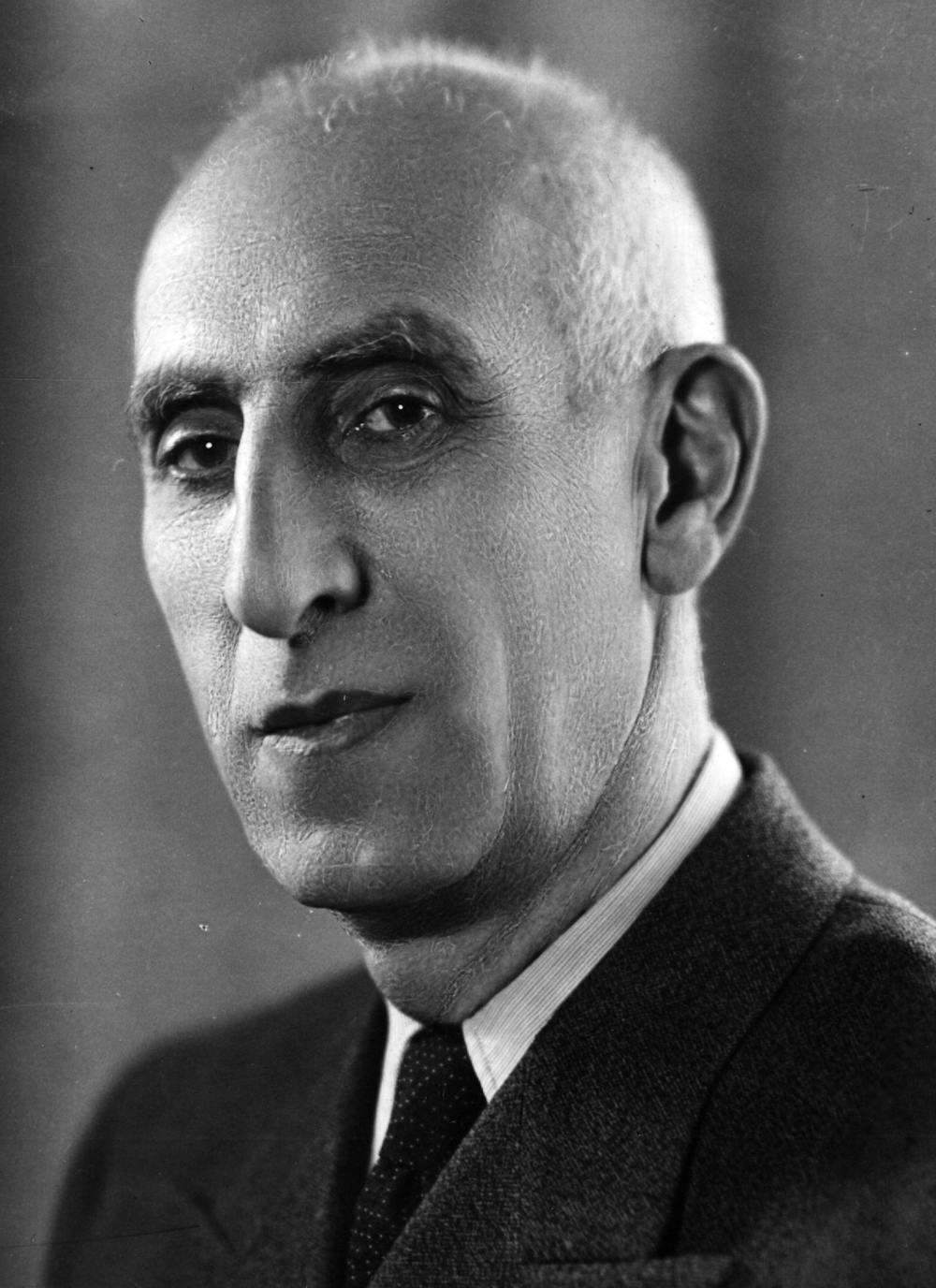
In 1951, the Iranian Parliament chose a new prime minister, Mossadegh, who then led lawmakers to vote in favor of taking over the Anglo-Iranian Oil Company, expelling the company’s British owners and saying they wanted to turn oil profits into investments in the Iranian people. The U.S. feared disruption in the global oil supply and worried about Iran falling prey to Soviet influence. The British feared the loss of cheap Iranian oil.
President Dwight Eisenhower decided it was best for the U.S. and the U.K. to get rid of Mossadegh. Operation Ajax, a joint CIA-British operation, convinced the Shah of Iran, the country’s monarch, to dismiss Mossadegh and drive him from office by force. Mossadegh was replaced by a much more Western-friendly prime minister, handpicked by the CIA.
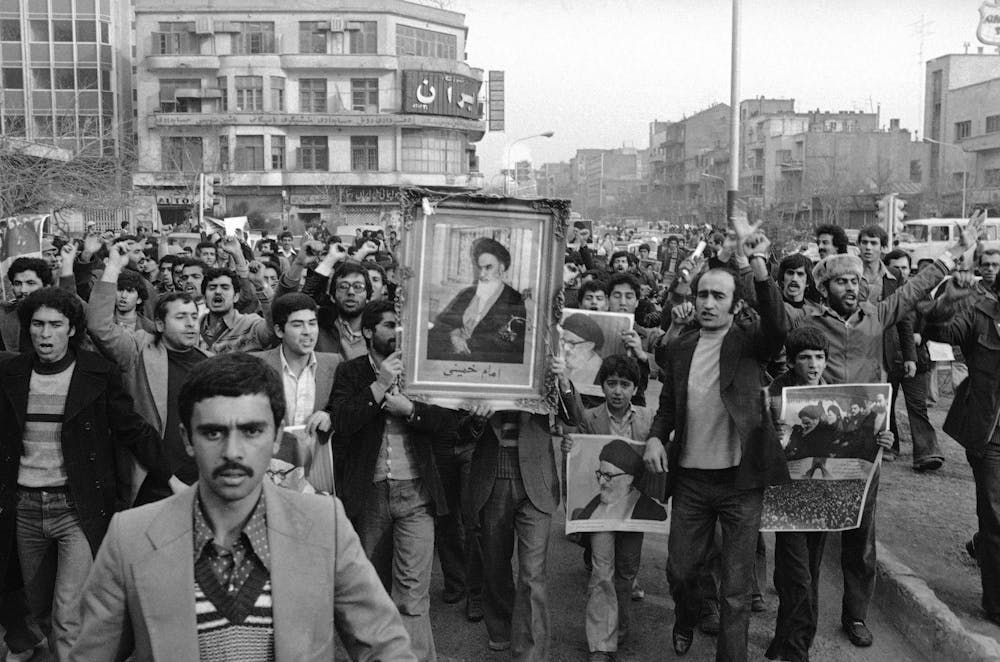
Demonstrators in Tehran demand the establishment of an Islamic republic. AP Photo/Saris
1979: Revolutionaries oust the shah, take hostages
After more than 25 years of relative stability in U.S.-Iran relations, the Iranian public had grown unhappy with the social and economic conditions that developed under the dictatorial rule of Shah Mohammad Reza Pahlavi.
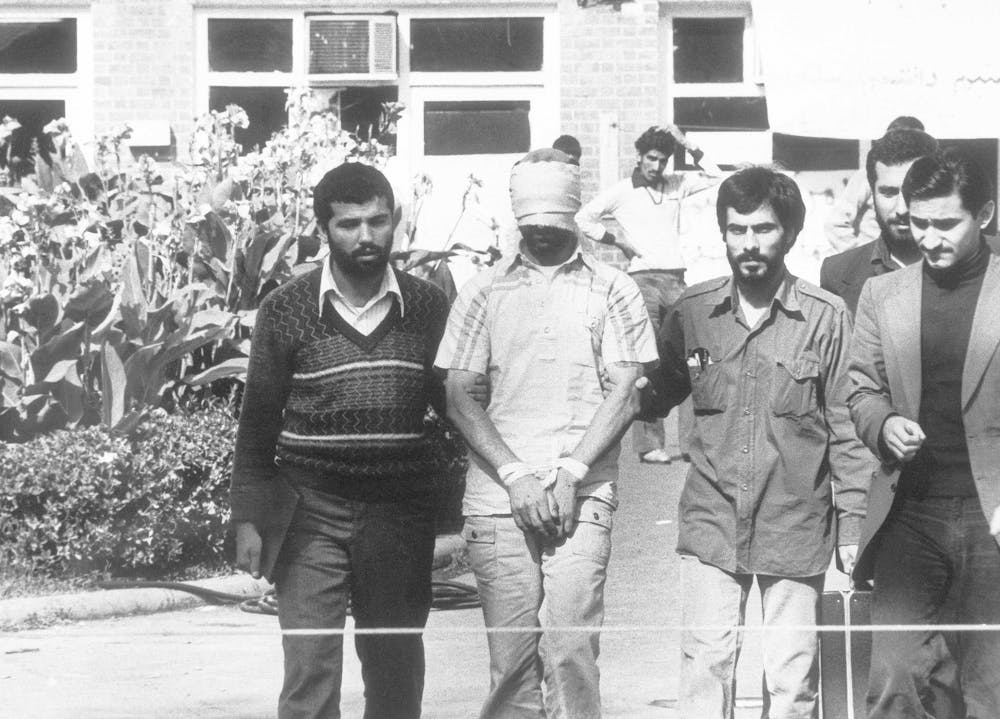
Iranian students at the U.S. Embassy in Tehran show a blindfolded American hostage to the crowd in November 1979. AP Photo
In October 1979, President Jimmy Carter agreed to allow the shah to come to the U.S. to seek advanced medical treatment. Outraged Iranian students stormed the U.S. Embassy in Tehran on Nov. 4, taking 52 Americans hostage. That convinced Carter to sever U.S. diplomatic relations with Iran on April 7, 1980.
Two weeks later, the U.S. military launched a mission to rescue the hostages, but it failed, with aircraft crashes killing eight U.S. servicemembers.
The shah died in Egypt in July 1980, but the hostages weren’t released until Jan. 20, 1981, after 444 days of captivity.
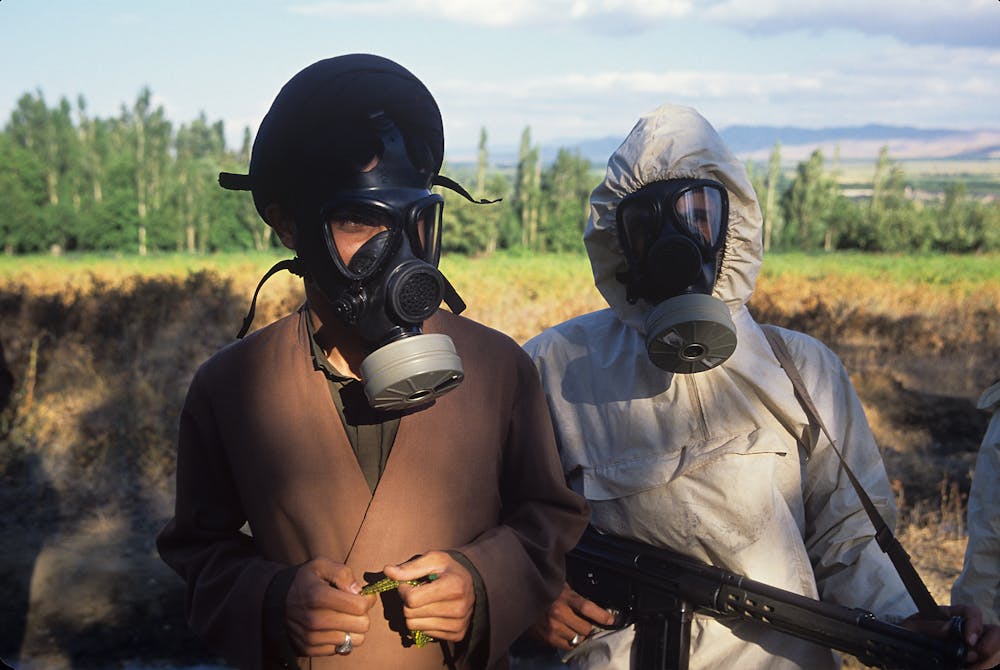
An Iranian cleric, left, and an Iranian soldier wear gas masks to protect themselves against Iraqi chemical-weapons attacks in May 1988. Kaveh Kazemi/Getty Images
The U.S. was concerned that the conflict would limit the flow of Middle Eastern oil and wanted to ensure the conflict didn’t affect its close ally, Saudi Arabia.
U.S. officials moderated their usual opposition to those illegal and inhumane weapons because the U.S. State Department did not “wish to play into Iran’s hands by fueling its propaganda against Iraq.” In 1988, the war ended in a stalemate. More than 500,000 military and 100,000 civilians died.
1981-1986: US secretly sells weapons to Iran
The U.S. imposed an arms embargo after Iran was designated a state sponsor of terrorism in 1984. That left the Iranian military, in the middle of its war with Iraq, desperate for weapons and aircraft and vehicle parts to keep fighting.
The last shipment, of anti-tank missiles, was in October 1986. In November 1986, a Lebanese magazine exposed the deal. That revelation sparked the Iran-Contra scandal in the U.S., with Reagan’s officials found to have collected money from Iran for the weapons and illegally sent those funds to anti-socialist rebels – the Contras – in Nicaragua.
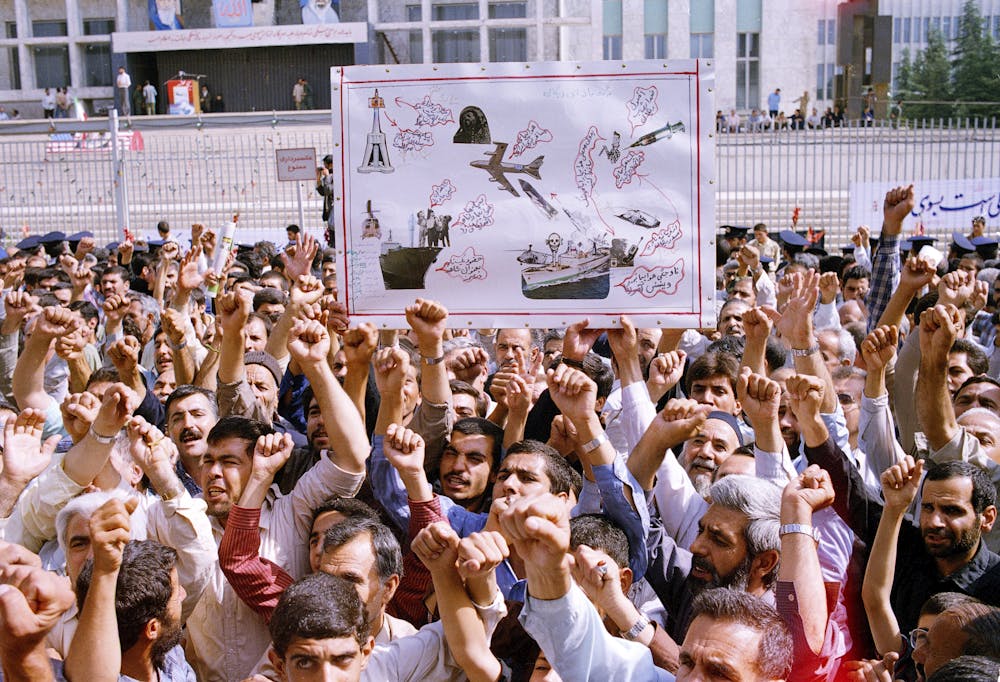
At a mass funeral for 76 of the 290 people killed in the shootdown of Iran Air 655, mourners hold up a sign depicting the incident. AP Photo/CP/Mohammad Sayyad
Either during or just after that exchange of gunfire, the Vincennes crew mistook a passing civilian Airbus passenger jet for an Iranian F-14 fighter. They shot it down, killing all 290 people aboard.
The U.S. called it a “tragic and regrettable accident,” but Iran believed the plane’s downing was intentional. In 1996, the U.S. agreed to pay US$131.8 million in compensation to Iran.
1997-1998: The US seeks contact
In August 1997, a moderate reformer, Mohammad Khatami, won Iran’s presidential election.
U.S. President Bill Clinton sensed an opportunity. He sent a message to Tehran through the Swiss ambassador there, proposing direct government-to-government talks.
Shortly thereafter, in early January 1998, Khatami gave an interview to CNN in which he expressed “respect for the great American people,” denounced terrorism and recommended an “exchange of professors, writers, scholars, artists, journalists and tourists” between the United States and Iran.
However, Supreme Leader Ayatollah Ali Khamenei didn’t agree, so not much came of the mutual overtures as Clinton’s time in office came to an end.
In his 2002 State of the Union address, President George W. Bush characterized Iran, Iraq and North Korea as constituting an “Axis of Evil” supporting terrorism and pursuing weapons of mass destruction, straining relations even further.
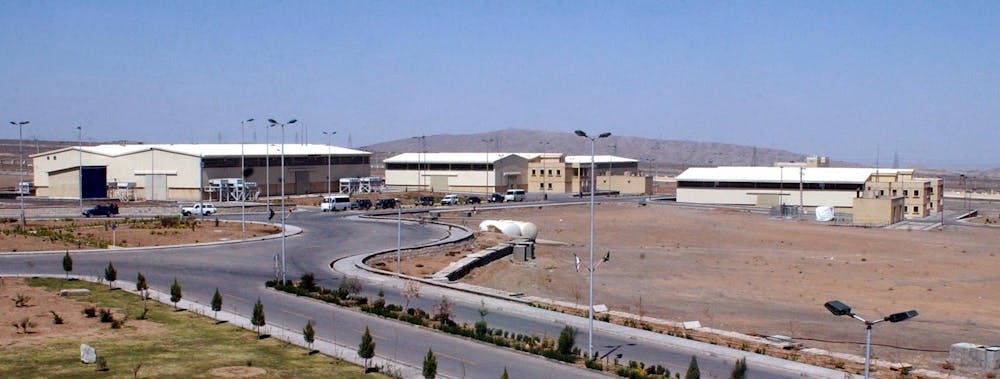
Inside these buildings at the Natanz nuclear facility in Iran, technicians enrich uranium. AP Photo/Vahid Salemi
That was a violation of the terms of the Nuclear Nonproliferation Treaty, which Iran had signed, requiring countries to disclose their nuclear-related facilities to international inspectors.
One of those formerly secret locations, Natanz, housed centrifuges for enriching uranium, which could be used in civilian nuclear reactors or enriched further for weapons.
Starting in roughly 2005, U.S. and Israeli government cyberattackers together reportedly targeted the Natanz centrifuges with a custom-made piece of malicious software that became known as Stuxnet.
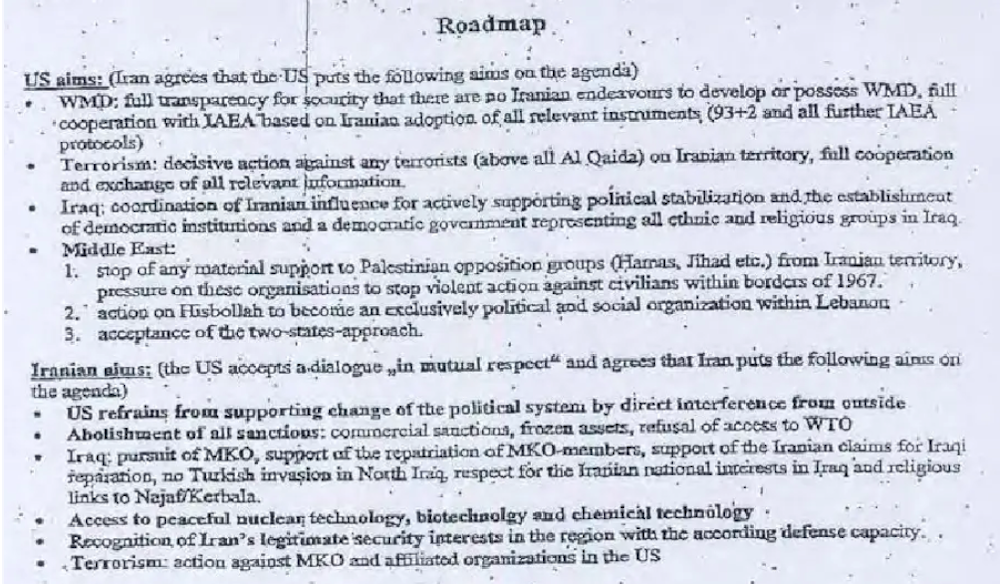
An excerpt of the document sent from Iran, via the Swiss government, to the U.S. State Department in 2003, appears to seek talks between the U.S. and Iran. Washington Post via Scribd
In May 2003, senior Iranian officials quietly contacted the State Department through the Swiss embassy in Iran, seeking “a dialogue ‘in mutual respect,’” addressing four big issues: nuclear weapons, terrorism, Palestinian resistance and stability in Iraq.
Hardliners in the Bush administration weren’t interested in any major reconciliation, though Secretary of State Colin Powell favored dialogue and other officials had met with Iran about al-Qaida.
When Iranian hardliner Mahmoud Ahmadinejad was elected president of Iran in 2005, the opportunity died. The following year, Ahmadinejad made his own overture to Washington in an 18-page letter to President Bush. The letter was widely dismissed; a senior State Department official told me in profane terms that it amounted to nothing.
After a decade of unsuccessful attempts to rein in Iran’s nuclear ambitions, the Obama administration undertook a direct diplomatic approach beginning in 2013.
Iran, the U.S., China, France, Germany, Russia and the United Kingdom signed the deal in 2015. It severely limited Iran’s capacity to enrich uranium and mandated that international inspectors monitor and enforce Iran’s compliance with the agreement.
In return, Iran was granted relief from international and U.S. economic sanctions. Though the inspectors regularly certified that Iran was abiding by the agreement’s terms, President Donald Trump withdrew from the agreement in May 2018.
2020: US drones kill Iranian Maj. Gen. Qassem Soleimani
At the time, the Trump administration asserted that Soleimani was directing an imminent attack against U.S. assets in the region, but officials have not provided clear evidence to support that claim.
Hamas’ brazen attack on Israel on Oct. 7, 2023, provoked a fearsome militarized response from Israel that continues today and served to severely weaken Iran’s proxies in the region, especially Hamas – the perpetrator of the attacks – and Hezbollah in Lebanon.
2025: Trump 2.0 and Iran
Trump saw an opportunity to forge a new nuclear deal with Iran and to pursue other business deals with Tehran. Once inaugurated for his second term, Trump appointed Steve Witkoff, a real estate investor who is the president’s friend, to serve as special envoy for the Middle East and to lead negotiations.
Negotiations for a nuclear deal between Washington and Tehran began in April, but the countries did not reach a deal. They were planning a new round of talks when Israel struck Iran with a series of airstrikes on June 13, forcing the White House to reconsider is position.
On June 22, in the early morning hours, the U.S. chose to act decisively in an attempt to cripple Iran’s nuclear capacity, bombing three nuclear sites and causing what Pentagon officials called “severe damage.” Iran vowed to retaliate.
This story has been updated to reflect the U.S. bombing of Iranian nuclear sites on June 22, 2025.
Jeffrey Fields receives funding from the Carnegie Corporation of New York and Schmidt Futures.
Source: People’s Republic of China in Russian – People’s Republic of China in Russian –
Source: People’s Republic of China – State Council News
ISTANBUL, June 22 (Xinhua) — Iranian Foreign Minister Abbas Araghchi on Sunday strongly condemned the U.S. military aggression against the Islamic Republic’s nuclear facilities, saying Tehran is considering multiple options to respond to the “crossing of a red line.”
“The US attack on Iran is a flagrant, serious and unprecedented violation of the fundamental principles of the UN Charter and international law,” A. Araghchi emphasized at a press conference in Istanbul.
The diplomat noted that the American administration, which “tramples on the law,” bears “sole and full” responsibility for the consequences of its act of “aggression.”
“Of course, the door to diplomacy should always be open. But this is not the case now. My country is under attack, aggression, and we must respond based on our legitimate right to self-defense. We will do this as long as necessary and necessary,” A. Araghchi said.
“We are now counting the damage,” he added, calling on the world and international organizations, including the International Atomic Energy Agency, to act in accordance with their responsibilities in the face of this “violation of international law.”
The Iranian Foreign Minister also said that he would meet with Russian President Vladimir Putin in Moscow on June 23 to discuss the developments in the aftermath of the American strikes.
Currently, A. Araghchi is in Turkey, where he arrived to participate in the 51st session of the Council of Foreign Ministers of the Organization of Islamic Cooperation in Istanbul. –0–
Source: United States House of Representatives – Representative Jonathan Jackson – Illinois (1st District)
FOR IMMEDIATE RELEASE
WASHINGTON, D.C. – Congressman Jonathan L. Jackson issued the following statement regarding the escalating tensions between Israel, Iran, and the United States:
“The current situation in the Middle East is deeply troubling. I have long maintained that Iran must never be allowed to possess nuclear weapons—nor should any nation in the region. Diplomacy, not unilateral military action, must guide our approach to preventing nuclear proliferation.
I supported the Joint Comprehensive Plan of Action (JCPOA), negotiated through U.S. leadership and in partnership with our allies. While imperfect, it was the most effective means of restraining Iran’s nuclear ambitions at the time. President Trump’s decision to unilaterally withdraw from the deal—against the counsel of our allies—undermined global security and allowed Iran to resume uranium enrichment at alarming levels.
Prime Minister Benjamin Netanyahu’s recent preemptive strike on Iran, on the eve of potential U.S.-Iran negotiations, was unnecessary and provocative. U.S. intelligence agencies and Rafael Grossi, Director General of the International Atomic Energy Agency (IAEA), have confirmed there is no evidence Iran is actively building a nuclear weapon.
Today’s U.S. military strikes on Iranian facilities were equally unjustified, as there was no imminent threat to American security. Moreover, the President failed to consult Congress—the sole branch of government with the constitutional authority to authorize such actions.
I demand that President Trump immediately brief Congress before taking any further military action. The American people deserve transparency. We cannot repeat the mistakes of the Iraq War, launched on false intelligence, which cost thousands of lives and billions of dollars.
It is time for restraint, accountability, and a return to diplomacy.”
Source: People’s Republic of China in Russian – People’s Republic of China in Russian –
Source: People’s Republic of China – State Council News
BEIJING, June 22 (Xinhua) — China strongly condemns the U.S. attacks on Iran and the U.S. bombing of nuclear facilities under International Atomic Energy Agency (IAEA) safeguards, a Chinese Foreign Ministry spokesman said Sunday.
The diplomat said this while commenting on the statement by US President Donald Trump that the United States had struck three nuclear facilities in Iran.
As the official representative noted, by its actions the United States seriously violated the purposes and principles of the UN Charter and international law, and also exacerbated tensions in the Middle East.
China calls on all parties to the conflict, first and foremost Israel, to cease fire as soon as possible, ensure the safety of civilians, and begin dialogue and negotiations, the official representative emphasized.
According to him, the Chinese side is ready to cooperate with the international community to consolidate efforts, defend justice, and contribute to the restoration of peace and stability in the Middle East. –0–
London, UK, June 22, 2025 (GLOBE NEWSWIRE) — RICH Miner, an intelligent cloud mining platform, has officially announced its global expansion and enhanced features, making it easier than ever for Robinhood users and crypto investors worldwide to earn daily passive income through clean-energy cloud mining.
With the increasing demand for sustainable, low-barrier crypto income streams, RICH Miner stands out by offering AI-driven mining allocation, 100% uptime, and a user-friendly experience — all without the need to purchase costly hardware or have technical expertise.
New users can register at https://richminer.com and instantly receive a $15 bonus, enabling them to start mining popular cryptocurrencies like Bitcoin (BTC) and Dogecoin (DOGE) with daily payouts from day one.
“At RICH Miner, our goal is to make cloud mining accessible, safe, and profitable for everyone, whether you’re a first-time investor or an experienced trader on platforms like Robinhood,” saidRICH, Emma Lesley, spokesperson for RICH Miner. “We combine intelligent mining, renewable energy, and robust fund security to deliver a worry-free passive income solution.”
Why RICH Miner is Gaining Global Popularity
✅ Zero Hassle, Daily Profits Users simply sign up, select a computing plan, and start earning. There’s no need for mining rigs, complex setups, or high electricity costs.
✅ Clean Energy Commitment RICH Miner’s mining farms operate on wind, hydro, and solar energy, supporting sustainable crypto production while minimizing carbon impact.
✅ AI Intelligent Allocation The platform uses AI to maximize mining efficiency and distribute computing power smartly, ensuring stable daily returns.
✅ Flexible Contract Plans With plans ranging from $100 to $180,800, users can choose contracts that match their budget and profit expectations — all details are transparently displayed on the official website.
✅ Proven Global Presence RICH Miner now serves over 5 million users across the United States, Japan, Europe, and Southeast Asia, with licensed operations in multiple regions.
For those interested in joining the fast-growing RICH Miner community, more information about plans and earnings potential can be found directly at https://richminer.com.
How to Get Started with RICH Miner
1️⃣ Register for free and claim your $15 bonus 2️⃣ Select a mining contract to suit your budget
Contract Potential Profit Table
Contract Price
Contract duration
Daily income
Total revenue
$100
2
$3
$100.00 + $6
$700
8
$8.68
$500.00 + $69.44
$1,600
15
$21.60
$1600.00 + $324
$3,300
18
$46.20
$3300.00 + $831.60
$5,600
22
$84.00
$5600.00 + $1848
$8,800
28
$140.80
$8800.00 + $3942.40
Completely transparent and open – control your wealth freedom anytime, anywhere, and download the official APP with one click.
Whether you’re managing your portfolio on Robinhood or looking for a diversified crypto income stream, RICH Miner offers a trusted, transparent, and eco-friendly way to build wealth with minimal effort.
About RICH Miner RICH Miner is a leading global cloud mining platform dedicated to providing simple, sustainable, and secure passive income opportunities through intelligent cloud mining solutions. Powered by clean energy and advanced AI, RICH Miner helps individuals worldwide profit from crypto mining without barriers or hidden costs.
Director General Rafael Mariano Grossi said he will call an emergency meeting of the IAEA Board of Governors on Monday in light of the “urgent situation” in Iran following the latest attacks on the country’s nuclear facilities.
“In view of the increasingly serious situation in terms of nuclear safety and security, the Board of Governors will meet in an extraordinary session tomorrow, which I will address,” Director General Grossi said.
The Director General said the IAEA has been informed by the Iranian regulatory authorities that there has been no increase in off-site radiation levels after the recent attacks on three Iranian nuclear facilities, including the Fordow uranium enrichment site.
“As of this time, we don’t expect that there will be any health consequences for people or the environment outside the targeted sites,” he said. “We will continue to monitor and assess the situation in Iran and provide further updates as additional information becomes available.”
According to the most recent information verified by the IAEA before the attacks on Iran began on 13 June, the three sites targeted by the United States – also including Esfahan and Natanz – contained nuclear material in the form of uranium enriched to different levels, which may cause radioactive and chemical contamination within the facilities that were hit.
As he did in his statement to the United Nations Security Council on Friday, Director General Grossi reiterated his call for military restraint and “indispensable work towards” a diplomatic solution.
“I have repeatedly stated that nuclear facilities should never be attacked,” he said.
There is a need for a cessation of hostilities so that the IAEA can resume its vital inspection work in the country, including the necessary verification of its stockpile of highly enriched uranium, he added.
Director General Grossi also stressed the importance of a continued and timely exchange of information with Iran regarding issues related to nuclear safety, security and safeguards.
The IAEA Board of Governors will convene a meeting at the Agency’s headquarters starting at 10:00 CEST on Monday, 23 June, in Board Room C, Building C, 4th floor, in the Vienna International Centre (VIC).
IAEA Director General Rafael Mariano Grossi has requested that a meeting of the Board be convened to consider the situation in Iran.
The Board of Governors meeting is closed to the press.
IAEA Director General Rafael Mariano Grossi will open the meeting with an introductory statement, which will be released to journalists after delivery and posted on the IAEA website. The IAEA will provide video footage of the Director General’s opening statement here and will make photos available on Flickr.
Photo Opportunity
There will be a photo opportunity with the IAEA Director General Rafael Mariano Grossi and the Vice-Chair of the Board, Ambassador Caroline Vermeulen of the Kingdom of Belgium, before the start of the Board meeting, on 23 June at 10:00 CEST in Board Room C, in the C building in the VIC.
Accreditation
Journalists are requested to register with the Press Office by 08:00 CEST on Monday, 23 June. Please email press@iaea.org.
Source: International Atomic Energy Agency (IAEA) –
Director General Rafael Mariano Grossi said he will call an emergency meeting of the IAEA Board of Governors on Monday in light of the “urgent situation” in Iran following the latest attacks on the country’s nuclear facilities.
“In view of the increasingly serious situation in terms of nuclear safety and security, the Board of Governors will meet in an extraordinary session tomorrow, which I will address,” Director General Grossi said.
The Director General said the IAEA has been informed by the Iranian regulatory authorities that there has been no increase in off-site radiation levels after the recent attacks on three Iranian nuclear facilities, including the Fordow uranium enrichment site.
“As of this time, we don’t expect that there will be any health consequences for people or the environment outside the targeted sites,” he said. “We will continue to monitor and assess the situation in Iran and provide further updates as additional information becomes available.”
According to the most recent information verified by the IAEA before the attacks on Iran began on 13 June, the three sites targeted by the United States – also including Esfahan and Natanz – contained nuclear material in the form of uranium enriched to different levels, which may cause radioactive and chemical contamination within the facilities that were hit.
As he did in his statement to the United Nations Security Council on Friday, Director General Grossi reiterated his call for military restraint and “indispensable work towards” a diplomatic solution.
“I have repeatedly stated that nuclear facilities should never be attacked,” he said.
There is a need for a cessation of hostilities so that the IAEA can resume its vital inspection work in the country, including the necessary verification of its stockpile of highly enriched uranium, he added.
Director General Grossi also stressed the importance of a continued and timely exchange of information with Iran regarding issues related to nuclear safety, security and safeguards.
Source: International Atomic Energy Agency (IAEA) –
The IAEA Board of Governors will convene a meeting at the Agency’s headquarters starting at 10:00 CEST on Monday, 23 June, in Board Room C, Building C, 4th floor, in the Vienna International Centre (VIC).
IAEA Director General Rafael Mariano Grossi has requested that a meeting of the Board be convened to consider the situation in Iran.
The Board of Governors meeting is closed to the press.
IAEA Director General Rafael Mariano Grossi will open the meeting with an introductory statement, which will be released to journalists after delivery and posted on the IAEA website. The IAEA will provide video footage of the Director General’s opening statement here and will make photos available on Flickr.
Photo Opportunity
There will be a photo opportunity with the IAEA Director General Rafael Mariano Grossi and the Vice-Chair of the Board, Ambassador Caroline Vermeulen of the Kingdom of Belgium, before the start of the Board meeting, on 23 June at 10:00 CEST in Board Room C, in the C building in the VIC.
Accreditation
Journalists are requested to register with the Press Office by 08:00 CEST on Monday, 23 June. Please email press@iaea.org.
Source: The Conversation – Canada – By Mohammadamin Ahmadfard, Postdoctoral Fellow, Mechanical & Industrial Engineering, Toronto Metropolitan University
Artificial intelligence (AI) is quietly transforming how cities generate, store and distribute energy, acting as the invisible conductor that orchestrates cleaner, smarter and more resilient cities.
By integrating renewables — from solar panels and wind turbines to geothermal grids, hydrogen plants, electric vehicles and batteries — AI can enable cities to manage diverse energy sources as a single, intelligent system.
One striking example is the Oya Hybrid Power Station in South Africa. Here, AI-driven controls seamlessly co-ordinate solar, wind and battery storage to deliver reliable power to up to 320,000 households. Using AI makes this kind of integration not only possible, but dramatically more efficient.
Recent research shows AI can also optimize how batteries, solar and the grid interact in buildings. A 2023 study found that deep learning and real-time data helped a boarding school in Turin, Italy increase low-cost energy purchases and cut its electricity bill by more than half.
Cleaner, smarter energy grids
AI models are increasingly able to predict weather with greater precision. These predictions allow electric grid operators to plan hours ahead, storing excess energy in batteries or adjusting supply to meet demand before a storm or heatwave hits.
Using AI to respond strategically to weather is a game-changer. In Cambridge, England, a system called Aardvark uses satellite and sensor data to generate rapid, accurate forecasts of sun and wind patterns.
Unlike traditional supercomputer-driven weather models, Aardvark’s AI can deliver precise local forecasts in minutes on an ordinary computer. This makes advanced weather prediction more accessible and affordable for cities, utilities and even smaller organizations — potentially transforming how communities everywhere plan for and respond to changing weather.
AI models are increasingly able to predict weather with greater precision, allowing electric grid operators to plan ahead, storing excess energy in batteries or adjusting supply to meet demand before a storm or heat wave hits. (Shutterstock)
AI for smarter district heating and cooling
In Munich, Germany, AI is improving geothermal district heating by using underground sensors to monitor temperature and moisture levels in the ground.
The collected data feeds into a digital simulation model that helps optimize network operations. In more advanced versions, during winter cold snaps, such systems can suggest lowering flow to underused spaces like half-empty offices and boosting heat where demand is higher, such as in crowded apartments.
This intelligent, self-optimizing approach extends the life of equipment and delivers more warmth with the same energy input.
This is a breakthrough with enormous potential for cities in cold climates with established geothermal networks, such as Winnipeg in Canada and Iceland’s Reykjavik.
Although these cities have not yet adopted AI-driven monitoring systems, they could benefit from AI’s real-time improvements in efficiency, comfort and energy savings during harsh winters — a principle that holds true wherever geothermal district heating and cooling exists.
Inside the home, AI-managed smart climate systems can factor in how many people are in each room, which appliances are in use, how much natural sunlight each space receives. (Shutterstock)
Smart buildings
Inside the home, AI-managed smart climate systems can factor in how many people are in each room, which appliances are in use, how much natural sunlight each space receives and how much electricity or heat a home’s solar panels generate throughout the day.
Based on this, AI determines how to heat or cool rooms efficiently, and can transfer energy from one space to another, balancing comfort with minimal energy use.
Coastal cities and those in wind-heavy regions are using AI in other creative ways. In Orkney, Scotland, excess wind and tidal energy are converted into green hydrogen. Instead of letting that surplus power go to waste, an AI system called HyAI controls when to generate hydrogen based on wind forecasts, electricity prices and how full the hydrogen storage tanks are.
When winds are strong at night and electricity is cheap, the AI can divert surplus power to produce hydrogen and store it for later use. On calmer days, that stored hydrogen can power fuel cells or buses.
Energy storage
AI is transforming energy storage into a smart, revenue-generating force. In Finland, a startup called Capalo AI has developed Zeus VPP, an AI-powered virtual power plant that aggregates distributed batteries from homes, businesses and other sites.
Zeus VPP uses advanced forecasting and AI algorithms to decide when batteries should charge or discharge, factoring in energy prices, local consumption and weather forecasts. This enables battery owners to earn revenue by participating in electricity markets, while also supporting grid stability and making better use of renewable energy.
AI-powered dynamic line rating adjusts how much electricity a line can carry in real time, boosting capacity by 15 to 30 per cent when conditions allow. This helps utilities maximize the use of existing infrastructure instead of relying on costly upgrades.
At the local level, AI analyzes smart metre data to predict which transformers are overheating due to rising EV and heat pump use.
By forecasting these stress points, utilities can proactively upgrade equipment before failures happen — a shift from reactive to predictive maintenance that makes the grid stronger and cities more resilient.
AI-powered public transit and mobility
Transportation innovation is becoming part of the energy solution, with AI at the centre of this transformation. In New York City, energy company Con Edison has installed major battery storage systems to help manage peak electricity demand and reduce reliance on polluting peaker plants, which supply energy only during high-demand periods.
More broadly, Con Edison is deploying advanced AI-powered analytics software across its electric grid — optimizing voltage, enhancing reliability and enabling predictive maintenance. Together, these efforts show how combining energy storage and AI-driven analytics can make even the world’s busiest cities more resilient and efficient.
AI is also powering “vehicle-to-grid” innovations in California, where an AI-driven platform manages electric school buses that can supply stored energy back to the grid during periods of high demand.
By carefully managing when buses charge and discharge, these systems help keep the grid reliable and ensure vehicles are ready for their daily routes. As this technology expands, parked electric vehicles could serve as valuable backup resources for the electricity system.
Transportation innovation is becoming part of the energy solution. (Shutterstock)
AI for clean energy initiatives
AI is rapidly transforming cities by revolutionizing how energy is used and managed. Google, for example, has slashed cooling energy at its data centres by up to 40 per cent using AI that fine-tunes fans, pumps and windows more efficiently than any human operator.
Organizations like the Electric Power Research Institute (EPRI), in collaboration with NVIDIA, Microsoft and others, have launched the Open Power AI Consortium, which is creating open-source AI tools for utilities worldwide.
These tools will enable even the most resource-constrained cities to deploy advanced AI capabilities, without having to start from scratch, helping to level the playing field and accelerate the global energy transition.
The result is not just cleaner air and lower energy bills, but a path to fewer blackouts and more resilient homes.
Mohammadamin Ahmadfard receives funding from the Natural Sciences and Engineering Research Council of Canada (NSERC) and Mitacs Inc. for his postdoctoral research at Toronto Metropolitan University.
Director General Rafael Mariano Grossi said he will call an emergency meeting of the IAEA Board of Governors on Monday in light of the “urgent situation” in Iran following the latest attacks on the country’s nuclear facilities.
“In view of the increasingly serious situation in terms of nuclear safety and security, the Board of Governors will meet in an extraordinary session tomorrow, which I will address,” Director General Grossi said.
The Director General said the IAEA has been informed by the Iranian regulatory authorities that there has been no increase in off-site radiation levels after the recent attacks on three Iranian nuclear facilities, including the Fordow uranium enrichment site.
“As of this time, we don’t expect that there will be any health consequences for people or the environment outside the targeted sites,” he said. “We will continue to monitor and assess the situation in Iran and provide further updates as additional information becomes available.”
According to the most recent information verified by the IAEA before the attacks on Iran began on 13 June, the three sites targeted by the United States – also including Esfahan and Natanz – contained nuclear material in the form of uranium enriched to different levels, which may cause radioactive and chemical contamination within the facilities that were hit.
As he did in his statement to the United Nations Security Council on Friday, Director General Grossi reiterated his call for military restraint and “indispensable work towards” a diplomatic solution.
“I have repeatedly stated that nuclear facilities should never be attacked,” he said.
There is a need for a cessation of hostilities so that the IAEA can resume its vital inspection work in the country, including the necessary verification of its stockpile of highly enriched uranium, he added.
Director General Grossi also stressed the importance of a continued and timely exchange of information with Iran regarding issues related to nuclear safety, security and safeguards.
The IAEA Board of Governors will convene a meeting at the Agency’s headquarters starting at 10:00 CEST on Monday, 23 June, in Board Room C, Building C, 4th floor, in the Vienna International Centre (VIC).
IAEA Director General Rafael Mariano Grossi has requested that a meeting of the Board be convened to consider the situation in Iran.
The Board of Governors meeting is closed to the press.
IAEA Director General Rafael Mariano Grossi will open the meeting with an introductory statement, which will be released to journalists after delivery and posted on the IAEA website. The IAEA will provide video footage of the Director General’s opening statement here and will make photos available on Flickr.
Photo Opportunity
There will be a photo opportunity with the IAEA Director General Rafael Mariano Grossi and the Vice-Chair of the Board, Ambassador Caroline Vermeulen of the Kingdom of Belgium, before the start of the Board meeting, on 23 June at 10:00 CEST in Board Room C, in the C building in the VIC.
Accreditation
Journalists are requested to register with the Press Office by 08:00 CEST on Monday, 23 June. Please email press@iaea.org.