Category: Europe

  • MIL-OSI Video: Session 1: How is AI transforming the labour market?

    Source: European Central Bank (video statements)

    Session 1: How is AI transforming the labour market?

    Session chair: Luc Laeven, ECB

    AI, task changes in jobs, and worker reallocation

    Christina Gathmann*, LISER, University of Luxembourg and CEPR
    Felix Grimm, LISER
    Erwin Winkler, University of Erlangen-Nuremberg, IZA and LASER
    Discussant: Antonio Dalla Zuanna, Banca d’Italia

    AI adoption and the demand for managerial expertise

    Liudmila Alekseeva*, KU Leuven
    José Azar, University of Navarra and IESE Business School
    Mireia Giné, IESE Business School
    Sampsa Samila, IESE Business School
    Discussant: Juan F. Jimeno, Banco de España

    https://www.youtube.com/watch?v=j5b1Er1KDyE

    MIL OSI Video

  • MIL-OSI United Kingdom: UN Human Rights Council 58: UK Core Group Statement to Introduce Item 4 Resolution on the Syrian Arab Republic

    Source: United Kingdom – Executive Government & Departments

    Speech

    UN Human Rights Council 58: UK Core Group Statement to Introduce Item 4 Resolution on the Syrian Arab Republic

    UK Core Group Statement to Introduce Item 4 Resolution on the Syrian Arab Republic. Delivered by the UK’s Permanent Representative to the WTO and UN, Simon Manley.

    Mr President,

    I have the honour to present draft resolution L.25 on the human rights situation in the Syrian Arab Republic, on behalf of France, Germany, the Netherlands, Qatar, Türkiye, and the UK. 

    Mr President,  

    For 14 years this Council has stood with the people of Syria.  

    As the Assad regime brought despair, death and destruction to its own population this Council did not stay silent.    

    In 2011, when the former regime unleashed brutal violence against peaceful protesters, this Council condemned it. When the regime began a campaign of executions, arbitrary detention, enforced disappearances, and torture, this Council established a Commission of Inquiry to bear independent witness to these atrocities.

    The Commission has rigorously documented the truth about the savagery of the last 14 years: the use of chemical weapons, sieges, and systematic torture and sexual violence intended to break the spirit of the Syrian people.

    But the Syrian people would not be broken, would not be defeated.

    And so, we present this draft resolution today, 4 months after the end of the Assad regime, and just days after the historic formation of a new Syrian Government, as reflected in revisions to the text. 

    We present this at a time of hope in Syria. Hope for peace. Hope for healing. Hope for reconciliation. And hope, finally, for Syrian-led, and Syrian-owned, justice and accountability.

    As Foreign Minister al-Shaibani said to this Council: justice in Syria is not a matter of political bargaining – it is a fundamental commitment we must uphold to ensure accountability and to combat impunity. 

    This draft resolution seeks to support this commitment whilst recognising the many challenges facing the new Government.

    Indeed, disturbing reports of mass killings of civilians in Syria’s coastal regions will have brought grief afresh to those who have suffered long enough, and are a chilling reminder of the deep wounds the years of conflict have inflicted. 

    We support the Syrian Government in setting out a path for accountability, that does justice to the victims and survivors, and which helps bring a peaceful future for all Syrians. And which brings truth to the families of the many thousands who remain missing.  It is crucial that Syrian mechanisms are independent, impartial, prompt, and transparent. International bodies stand ready to support this process.

    I thank all those who have engaged constructively on this resolution. In particular, I welcome the Syrian delegation’s active participation and vocal support for the Council’s efforts.  

    Let us adopt this resolution today. To renew the Commission of Inquiry, to maintain its independent reporting, to support the Syrian Government, and to stand in solidarity once again with the people of Syria.

    They have waited too long for this moment. It is time for justice, for accountability and for human rights.

    Thank you.

    Updates to this page

    Published 4 April 2025

    MIL OSI United Kingdom

  • MIL-OSI Global: Abolition wasn’t fueled by just moral or economic concerns – the booming whaling industry also helped sink slavery

    Source: The Conversation – USA – By Topher L. McDougal, Professor of Economic Development & Peacebuilding, University of San Diego

    An engraving of whalers at sea attacking a whale with a harpoon from 1820. Kean Collection/Getty Images

    Historians have long debated whether the end of slavery in the United States was primarily driven by moral campaigns or economic changes. But what if both perspectives are looking at only part of the puzzle?

    We are experts in economic development and social movements. Our new research uncovers what we believe to be a surprising and overlooked factor in the decline of slavery in the U.S. – the rise of the whaling industry.

    Starting around 1650, whaling expanded along the Northeast coast of the British American colonies. Whaling expeditions killed whales and brought back to port valuable animal products like oil, used for lamps and other items, and whalebone, used for products ranging from corsets to combs.

    Whalers also brought spermaceti, a waxy substance that comes from a sperm whale’s head and is used to produce candles and lubricants for precision machinery like watches and clocks.

    At its peak, in the 1850s, the American whaling industry alone employed 50,000 to 70,000 workers who worked on an estimated 700 to 800 ships.

    In the decades before cheap oil helped many industries truly take off, whaling played an important, but often overlooked, role in laying the groundwork for the antislavery movement.

    Black sailors made up perhaps 20% to 30% of whaling crews. Of these sailors, some were enslaved and used their hard-won earnings to buy their freedom. Some of these sailors went on to finance abolitionist efforts. Others built houses of worship.

    The whaling industry that produced oil to illuminate 19th-century lamps also added fuel to the fire of the antislavery movement. The city motto of New Bedford, Massachusetts – lucem diffundo, or “I diffuse light” in Latin – referred to the candles and lamps the whaling industry lit, as well as the moral clarity some whalers aspired to promote.

    Three Black whalers stand on a wharf in New Bedford, Mass., in an 1880 drawing.
    Smith Collection/Gado/Getty Images

    The missing link between whaling and abolition

    Slavery in the American colonies began in 1619 with a small enslaved population that grew to about 500,000 by the American Revolution in 1775. As slavery became institutionalized in law and American culture, the number of enslaved people grew, primarily in the South, to as many as 4 million in the years leading up to the Civil War in 1861.

    The first half of the 1800s saw a surge of abolitionist activism, rooted in early Quaker efforts and Indigenous wisdom. Abolitionism reshaped American politics into a fuller democracy, linking Black resistance, feminist struggles and labor rights to the broader fight for democracy and human rights.

    The decline and eventual abolition of slavery has been portrayed as the result of tireless activism and moral persuasion by early Quaker advocates like Benjamin Lay who considered slavery one of the worst sins. Abolitionists like Frederick Douglass would later go on to advocate for the Civil War to force a moral reckoning on the South.

    The result was an antislavery moral high ground from which the United Kingdom, and later the U.S., could measure other countries and monitor the high seas.

    Another common explanation for the end of slavery is the economic argument that slavery declined as fossil fuel-powered machinery replaced enslaved labor on farms and even in factories.

    Our research challenges this binary by showing that before steam engines transformed industry, whaling played an overlooked role in challenging the proposition that slavery was America’s most economically profitable form of labor organization at the time.

    Increased whaling, decreased slavery

    We analyzed data from U.S. Census records and the logbooks of American whaling voyages from 1790 to 1840 – systematized in a dataset maintained by the Mystic Seaport Museum and New Bedford Whaling Museum.

    This data came from well before the 1859 discovery and exploitation of oil in Pennsylvania.

    The results were striking: When the whaling industry brought back more oil, bone and spermaceti to specific ports, the proportion of enslaved people in the corresponding states declined.

    Statistically speaking, we saw a nearly perfect 1-to-1 inverse relationship between whaling and slavery.

    When whaling products went up 1%, slavery proportions went down by almost the same amount in that state in the following years. What’s more, we mapped these findings geographically and discovered that the more whaling occurred, the more widely decreases in slavery occurred in nearby states.

    In other words, our statistics suggest that increases in whaling led to decreases in slavery, and this effect diffused across state lines.

    Why whaling mattered

    Whaling was the first global industry in the colonies that eventually became the U.S.

    Whaling hubs like the Massachusetts towns of Nantucket and New Bedford and the island of Martha’s Vineyard became some of the wealthiest communities in the country.

    Whaling was also one of the few industries where Black Americans, both free and formerly enslaved, could make money and become wealthy. Individuals of all backgrounds could rise through the whaling industry ranks based on skill rather than birth.

    It also required a risk-embracing and entrepreneurial mindset, as immortalized in a song that the writer Herman Melville has the crew sing in the 1851 book Moby-Dick: “So, be cheery, my lads! may your hearts never fail! / While the bold harpooner is striking the whale!”

    By contrast, the plantation economy relied on rigid racial hierarchies and hereditary enslavement.

    Prince Boston was one example of an enslaved whaler, who, in 1773 at the age of 23, won the right in the local Nantucket court to purchase his own freedom from his owner, who lived locally, with the money he earned on a harpoon crew.

    This watershed moment saw the court make a precedent that was probably illegal at the time, but which supported and defended both the whaling industry as well as the aspirations of the people needed to make it thrive. Prince Boston’s free-born nephew, Absolom Boston, become the first Black whaling captain in 1822 – one of approximately 50 Black and Native captains in the American whaling industry throughout its history.

    Financing the fight against slavery

    The economic power generated by whaling helped fund the abolitionist movement in tangible ways.

    Wealthy Quaker merchants in whaling towns, like Martha’s Vineyard, were some of the earliest and most fervent supporters of abolition.

    Elihu Coleman, a Nantucket Quaker, wrote one of the first antislavery pamphlets in America in 1733. Douglass, the famed abolitionist and formerly enslaved man from Maryland, found refuge in New Bedford, a whaling town with a strong antislavery tradition.

    Whaling profits financed the construction of meeting houses and schools for free Black communities in these towns. The African Baptist Society in Nantucket, for example, was built by Black whalers who had achieved financial independence through their trade.

    Whalers cut pieces from a small whale on Long Island, N.Y., in 1900.
    Bettmann/Contributor/Getty Images

    Whaling’s vital role in ending slavery

    As an industry, whaling provided a meritocratic career path before fossil fuel mechanization made slavery obsolete. While industrialization eventually made enslaved labor less profitable by the mid- and late-1800s, whaling had already eroded slavery’s economic and social foundations decades earlier.

    Of course, whaling itself was not a morally pure endeavor. It was dangerous and devastating to whale populations. The American whaling industry killed perhaps 32,000 whales over the 74 years between 1835 and 1909. The global harvest of whales was many times greater. The U.S. officially outlawed whaling in 1971.

    Yet, whaling’s role in funding abolition and providing economic opportunities for free Black Americans is undeniable. It was, in many ways, a bridge between the world of forced labor and the energy-driven economy of the modern age.

    The authors do not work for, consult, own shares in or receive funding from any company or organization that would benefit from this article, and have disclosed no relevant affiliations beyond their academic appointment.

    ref. Abolition wasn’t fueled by just moral or economic concerns – the booming whaling industry also helped sink slavery – https://theconversation.com/abolition-wasnt-fueled-by-just-moral-or-economic-concerns-the-booming-whaling-industry-also-helped-sink-slavery-250980

    MIL OSI – Global Reports

  • MIL-OSI United Kingdom: New splash park and mini-wheels track open at Hinksey Park

    Source: City of Oxford

    Published: Friday, 4 April 2025

    A new splash park and mini-wheels track has opened at Hinksey Park this week, offering a free, family-friendly facility in the heart of Oxford.

    The new water play area was officially opened on Friday 4 April with five-year-old Felix from St Ebbe‘s Primary School pressing the activation button to start the play fountains and jets for the first time. 

    The splash park is free to use and will be open every day until the end of the summer. Alongside the splash play area is a ‘learn and play’ balance bike and scooter track designed for younger children. The track can be enjoyed all year round, even during colder months, when the splash area is not in use. 

    The £330,000 project was funded by a £100,000 grant from FCC Communities Foundation, with the remaining investment provided by Oxford City Council.  

    Work to redevelop the former water play area – a long-standing and popular feature of Hinksey Park – began in September 2024, after the previous equipment had deteriorated due to age. The new facility has been designed to be safe, fun and sustainable, with a range of interactive features and improvements to optimise water usage.  

    Hinksey Park is located off Abingdon Road, and also includes a large outdoor swimming pool, play area, tennis courts, a lake and open green spaces.  

    For more information about Hinksey Park and its facilities, please visit our website

    “We’re pleased to be able to provide this free leisure facility for families in Oxford. Water play has been part of Hinksey Park since the 1960s, and the new splash park continues that tradition with a modern, sustainable design. The addition of a mini-wheels track means there’s something for children to enjoy all year round. We’re proud to invest in our local community and play areas to support local communities and outdoor play.”  

    Jane Winfield, Director of Property and Assets, Oxford City Council 

    “We are delighted to have worked with the City Council to fund this project for the local community to enjoy. It’s great to see it now open and available for use, just in time for the Easter School holidays. Thank you to everyone who has worked so hard on this project.” 

    Cheryl Raynor, FCC Community Foundations grant manager  

    For more information about FCC Communities Foundation funding, visit https://fcccommunitiesfoundation.org.uk/ 

    MIL OSI United Kingdom

  • MIL-OSI Russia: Cognitive distortions: what they are and how to avoid them will be explained at the State University of Management

    Translartion. Region: Russians Fedetion –

    Source: State University of Management – Official website of the State –

    On April 8, we invite students to a lecture-training “Cognitive distortions”, which will be conducted by the Vice-Rector of the State University of Management Pavel Pavlovsky.

    Participants of the meeting will have the opportunity to hone their skills in building successful communication, which is necessary for anyone who strives for career heights.

    The Vice-Rector of the State University of Management will tell you what cognitive distortions are and how they affect decision-making, teach you to recognize them in yourself and others, and also share practical tools for effective communication that will help you avoid “thinking errors.”

    The meeting will take place on April 8 at 14:45 in the lobby of the Central Control Center.

    Pre-registration is required to participate.

    Don’t miss the opportunity to upgrade your brain and communication skills with GUU.

    Subscribe to the tg channel “Our State University” Announcement date: 04/8/2025

    Please note: This information is raw content directly from the source of the information. It is exactly what the source states and does not reflect the position of MIL-OSI or its clients.

    MIL OSI Russia News

  • MIL-OSI Security: CCTV still issued of man sought following vicious assault in Plaistow

    Source: United Kingdom London Metropolitan Police

    Detectives investigating a vicious assault in Plaistow have released an image of a man they want to identify.

    The incident happened at approximately 19:20hrs on Wednesday, 26 February as the victim – a man aged in his 50s – was waiting at a bus stop in Barking Road, near the junction with Tunmarsh Lane, E13.

    The male suspect walked up behind him and slashed him across the face with a knife before walking off. No words were exchanged prior to the incident and the victim did not recognise his attacker.

    The victim was taken to hospital for treatment but has been left with a large scar.

    Detective Constable Karen Barker leads the investigation and said:

    “This appears to have been a completely unprovoked attack which could easily have had far more serious consequences. We are appealing to anyone who was in this area of Barking Road around the time of the incident, or any road users with camera footage who may have captured the suspect or the incident, to come forward and speak to us. This person is extremely dangerous and needs to be caught.”

    Anyone with information is asked to call 101 or ‘X’ @MetCC and quote ref: 01/7208073/25. You can also provide information anonymously to the independent charity Crimestoppers on 0800 555 111.

    MIL Security OSI

  • MIL-OSI Security: Russell Brand charged by the Metropolitan Police Service

    Source: United Kingdom London Metropolitan Police

    The Crown Prosecution Service has authorised the Metropolitan Police Service to charge a man following an investigation by detectives.

    The Met has issued a charge and requisition to Russell Brand, 50 (04.02.1975), of Oxfordshire, in connection with the following offences –

    • One count of rape
    • One count of indecent assault
    • One count of oral rape
    • Two counts of sexual assault

    Detectives began investigating in September 2023 after receiving a number of allegations, which followed reporting by Channel 4’s Dispatches and The Sunday Times.

    It is alleged that –

    • In 1999 a woman was raped in the Bournemouth area
    • In 2001 a woman was indecently assaulted in the Westminster area of London
    • In 2004 a woman was orally raped and sexually assaulted in the Westminster area of London
    • Between 2004 and 2005, a woman was sexually assaulted in the Westminster area of London

    Russell Brand will appear at Westminster Magistrates’ Court on Friday, 2 May.

    Detective Superintendent Andy Furphy from the Metropolitan Police who is leading the investigation said: “The women who have made reports continue to receive support from specially trained officers.

    “The Met’s investigation remains open and detectives ask anyone who has been affected by this case, or anyone who has any information, to come forward and speak with police. A dedicated team of investigators is available via email at CIT@met.police.uk.

    “Support is also available by contacting the independent charity, Rape Crisis at 24/7 Rape and Sexual Abuse Support Line.”

    We urge responsible reporting in line with guidance from the Attorney General’s Office. Editors, publishers, and social media users should take legal advice to ensure they are in a position to fully comply with the obligations to which they are subject under the common law and Contempt of Court Act 1981.

    The charges relate to four separate women.

    MIL Security OSI

  • MIL-OSI Global: Life-size sculptures uncovered in Pompeii show that ancient women didn’t just have to be wives to make a difference

    Source: The Conversation – UK – By Emily Hauser, Senior Lecturer in Classics, University of Exeter

    Visitors to the site of Pompeii, the ancient Roman town buried (and so preserved for thousands of years) by the eruption of Mount Vesuvius in 79AD, don’t often think to look beyond the city walls. And it’s easy to understand why: there’s plenty on offer within this monumentally well-preserved town, from jewel-like wall paintings of myths and legends like Helen of Troy, to the majestic amphitheatre and sumptuously stuccoed baths.

    But step outside the gates for a moment, and you’re in a very different – yet no less important – world.

    For the ancient Romans, the roads and paths leading into and out of cities were crucial: not just for getting places, but as a very real kind of “memory lane”. Tombs lined these ancient byways – some simply bearing inscriptions to the memories of loved ones lost, others, more grand, accommodating space for friends and family to feast in remembrance of the dead.

    Some of the tombs even address the passerby directly, as if its occupant could speak again, and pass on what they’ve learned. Take one Pompeiian example, set up by the freedman Publius Vesonius Phileros, which opens with ineffable politeness: “Stranger, wait a while if it’s no trouble, and learn what not to do.”

    Going into Pompeii, and leaving it, was about being reminded of ways of living and ways of dying – as well as an invitation to tip your hat to those who trod the path before you, and to learn from their example.

    Which is why the recent discovery of a monumental tomb crowned by life-size sculptures of a woman and man, just outside the gates on the east side of the town, isn’t just a fascinating find in and of itself. It’s also a reminder to stop, and to remember the people who once lived and died in this bustling Italian town.


    Looking for something good? Cut through the noise with a carefully curated selection of the latest releases, live events and exhibitions, straight to your inbox every fortnight, on Fridays. Sign up here.


    The tomb’s main feature is a large wall, peppered with niches where cremated remains would have been placed, and surmounted by the astonishing relief sculpture of the woman and man. They’re standing side by side, but not touching.

    I rather like that she’s slightly taller than him, standing at 1.77m, while he’s 1.75m. She’s draped in a modest tunic, cloak and veil (symbols of Roman womanhood), and boasts a pronounced crescent-moon-shaped pendant at her neck called a lunula, that (through the age-old link with lunar cycles) tells a story about female fertility and birth. He, meanwhile, is dressed in the quintessentially Roman toga that instantly identifies him as a proud male citizen of Rome.

    Who do the statues depict?

    The status quo in archaeology, when a woman and a man are presented next to each other in tombs and burials like this, has always been to assume that she’s his wife. Yet here, there’s an unmissable clue that there’s more going on. That’s because, in her right hand, she’s holding a laurel branch – which was used by priestesses to waft the smoke of incense and herbs in religious rituals.

    Priestesses, in the Roman world, held unusual levels of power for women – and it’s been suggested that this woman might have been a priestess of the goddess Ceres (Roman equivalent of Demeter).

    So this high-status priestess is shown alongside a man. The inclusion of the symbols of her status (as priestess) alongside his (as a togatus, or “toga-wearing man”), shows that she’s there in her own right, as a contributing member of Pompeiian society. She might be his mother; she might even have been more important than him (which would explain why she’s taller). Without an inscription, we don’t know for sure. The point is: a woman doesn’t have to be a wife to be standing next to a man.

    What’s fascinating is this isn’t unique to Pompeii. In my new book, Mythica, which looks at the women not of Rome but of Bronze age Greece, I’ve found that new discoveries in archaeology are overturning the assumptions that used to be made about a woman’s place in society, and the value of their roles, all the time.

    One fascinating example is a royal burial in Late Bronze Age Mycenae: a woman and a man who’d been buried together in the royal necropolis, around 1700 years before the eruption of Mount Vesuvius decimated Pompeii. As is typical, this woman was immediately labelled, by the archaeologists who uncovered her, as the man’s wife. But then DNA analysis came into the picture.

    As recently as 2008, both skeletons were sampled for DNA – and came up with the game-changing result that they were, in fact, brother and sister. She’d been buried here as a member of a royal family by birth, not by marriage, in other words. She was there on her own terms.

    From golden Mycenae to the ash-blasted ruins of Pompeii: the remains from the ancient world are telling us a different story from the one we always thought. A woman didn’t have to be a wife to make a difference.

    So I think it’s worth listening to the advice of our friend Publius. Let’s look at the burials of the past, and learn.

    Emily Hauser does not work for, consult, own shares in or receive funding from any company or organisation that would benefit from this article, and has disclosed no relevant affiliations beyond their academic appointment.

    ref. Life-size sculptures uncovered in Pompeii show that ancient women didn’t just have to be wives to make a difference – https://theconversation.com/life-size-sculptures-uncovered-in-pompeii-show-that-ancient-women-didnt-just-have-to-be-wives-to-make-a-difference-253863

    MIL OSI – Global Reports

  • MIL-OSI Global: US and Russia squabble over Arctic security as melting ice opens up shipping routes

    Source: The Conversation – UK – By Stefan Wolff, Professor of International Security, University of Birmingham

    “You cannot annex another country.” This was the clear message given by the Danish prime minister, Mette Frederiksen, at a recent press conference with the outgoing and incoming prime ministers of Greenland. It did not appear aimed at Russian president Vladimir Putin, but at Donald Trump, the president of one of her country’s closest allies, who has threatened to take over Greenland.

    Frederiksen, speaking in Greenland’s capitak Nuuk, was stating something that is obvious under international law but can no longer be taken for granted. US foreign policy under Trump has become a major driver of this uncertainty, playing into the hands of Russian, and potentially Chinese, territorial ambitions.

    The incoming Greenlandic prime minister, Jens-Frederik Nielsen, made it clear that it was for Greenlanders to determine their future, not the United States. Greenland, which is controlled by Denmark, makes its own domestic policy decisions. Polls suggest a majority of islanders want independence from Denmark in the future, but don’t want to be part of the US.

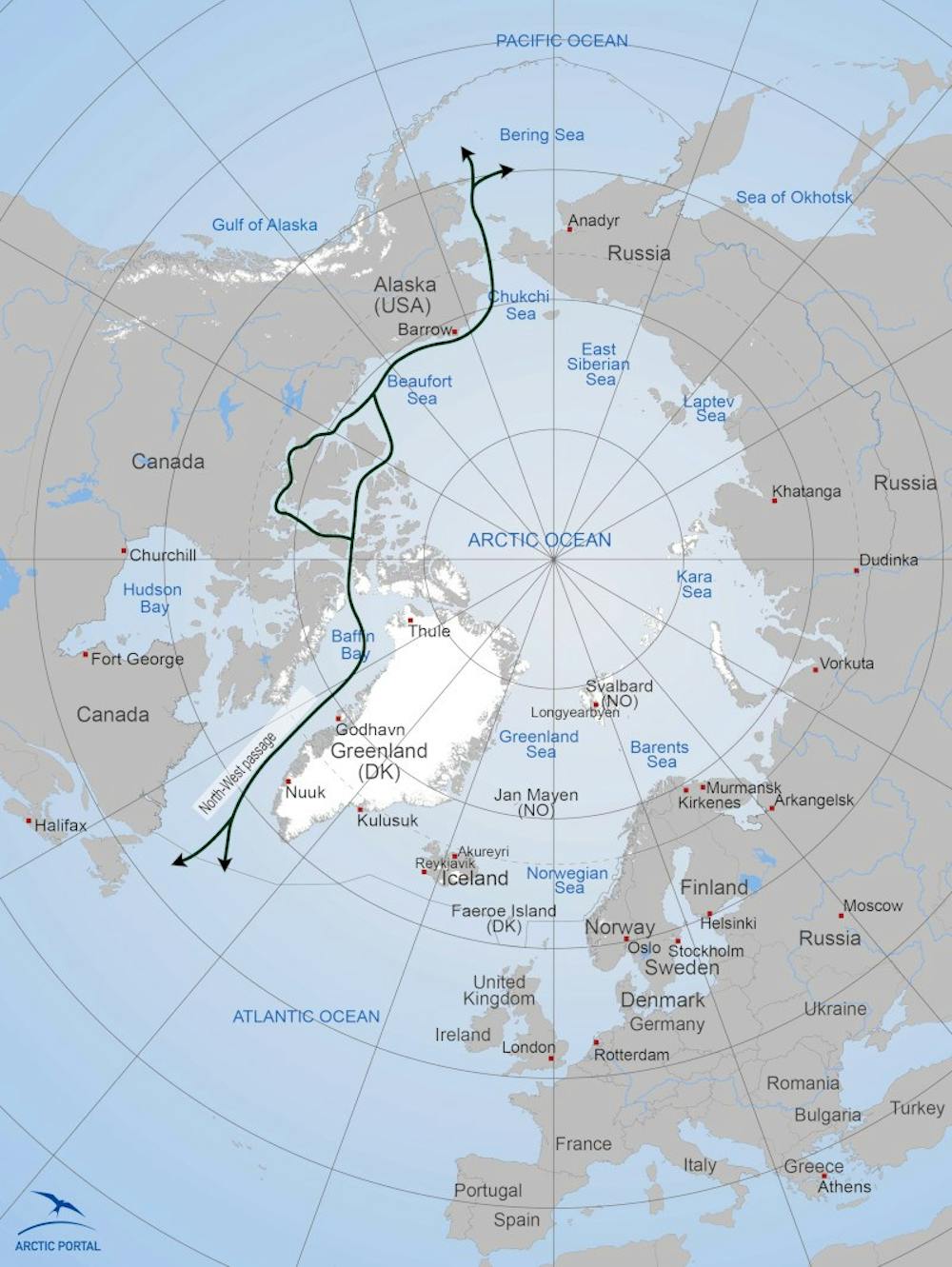
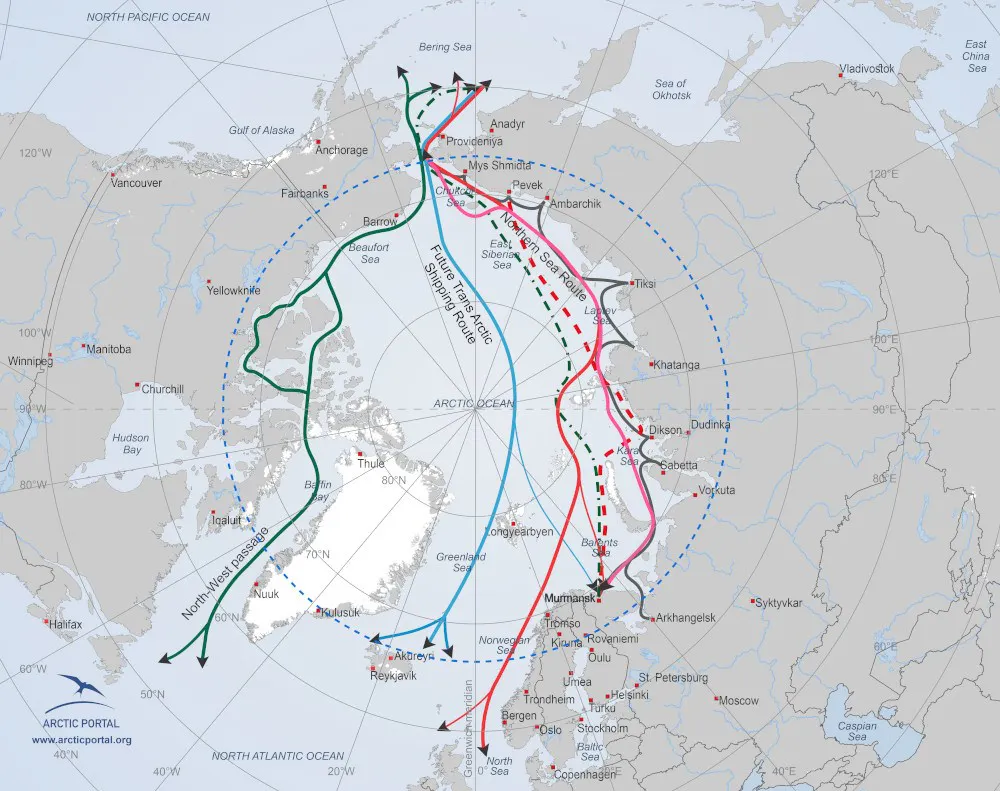
    Trump’s interest in Greenland is often associated with the island’s vast, but largely untapped, mineral resources. But its strategic location is arguably an even greater asset. Shipping routes through the Arctic have become more dependable and for longer periods of time during the year as a result of melting sea ice. The northwest passage (along the US and Canadian shorelines) and the northeast passage (along Russia’s Arctic coast) are often ice free now during the summer.


    Breaking the Ice: Arctic Development and Maritime Transportation, ArcticPortal.org

    This has increased opportunities for commercial shipping. For example, the distance for a container ship from Asia to Europe through the northeast passage can be up to three times shorter, compared to traditional routes through the Suez Canal or around Africa.

    Similarly, the northwest passage offers the shortest route between the east coast of the United States and Alaska. Add to that the likely substantial resources that the Arctic has, from oil and gas to minerals, and the entire region is beginning to look like a giant real estate deal in the making.

    Arctic assets

    The economic promise of the Arctic, and particularly the region’s greater accessibility, have also heightened military and security sensitivities.

    The day before J.D. Vance’s visit to Greenland on March 28, Vladimir Putin, gave a speech at the sixth international Arctic forum in Murmansk in Russia’s high north, warning of increased geopolitical rivalry.

    While he claimed that “Russia has never threatened anyone in the Arctic”, he was also quick to emphasise that Moscow was “enhancing the combat capabilities of the Armed Forces, and modernising military infrastructure facilities” in the Arctic.

    Equally worrying, Russia has increased its naval cooperation with China and given Beijing access, and a stake, in the Arctic. In April 2024, the two countries’ navies signed a cooperation agreement on search and rescue missions on the high seas.


    National Snow & Ice Data Center, Arctic Portal

    In September 2024, China participated in Russia’s largest naval manoeuvres in the post-cold war era, Ocean-2024, which were conducted in north Pacific and Arctic waters. The following month, Russian and Chinese coastguard vessels conducted their first joint patrol in the Arctic. Vance, therefore, has a point when he urges Greenland and Denmark to cut a deal with the US because the “island isn’t safe”.

    That the Russia-China partnership has resulted in an increasingly military presence in the Arctic has not gone unnoticed in the west. Worried about the security of its Arctic territories, Canada has just announced a C$6 billion (£3.2 billion) upgrade to facilities in the North American Aerospace Defense Command it operates jointly with the United States.

    It will also acquire more submarines, icebreakers and fighter jets to bolster its Arctic defences and invest a further C$420 million (£228 million) into a greater presence of its armed forces.


    Read more:
    Arctic breakdown: what climate change in the far north means for the rest of us


    Svalbard’s future role?

    Norway has similarly boosted its defence presence in the Arctic, especially in relation to the Svalbard archipelago (strategically located between the Norwegian mainland and the Arctic Circle). This has prompted an angry response from Russia, wrongly claiming that Oslo was in violation of the 1920 Svalbard Treaty which awarded the archipelago to Norway with the proviso that it must not become host to Norwegian military bases.

    Under the treaty, Russia has a right to a civilian presence there. The “commission on ensuring Russia’s presence on the archipelago Spitzbergen”, the name Moscow uses for Svalbard is chaired by Russian deputy prime minister Yury Trutnev, who is also Putin’s envoy to the far eastern federal district. Trutnev has repeatedly complained about undue Norwegian restrictions on Russia’s presence in Svalbard.

    From the Kremlin’s perspective, this is less about Russia’s historical rights on Svalbard and more about Norway’s – and Nato’s – presence in a strategic location at the nexus of the Greenland, Barents and Norwegian seas. From there, maritime traffic along Russia’s northeast passage can be monitored. If, and when, a central Arctic shipping route becomes viable, which would pass between Greenland and Svalbard, the strategic importance of the archipelago would increase further.

    From Washington’s perspective, Greenland is more important because of its closer proximity to the US. But Svalbard is critical to Nato for monitoring and countering Russian, and potentially Chinese, naval activities. This bigger picture tends to get lost in Trump’s White House, which is more concerned with its own immediate neighbourhood and cares less about regional security leadership.

    Consequently, there has been no suggestion – so far – that the US needs to have Svalbard in the same way that Trump claims he needs Greenland to ensure US security. Nor has Russia issued any specific threats to Svalbard. But it was noticeable that Putin in his speech at the Arctic forum discussed historical territorial issues, including an obscure 1910 proposal for a land swap between the US, Denmark and Germany involving Greenland.

    Putin also noted “that Nato countries are increasingly often designating the Far North as a springboard for possible conflicts”. It is not difficult to see Moscow’s logic: if the US can claim Greenland for security reasons, Russia should do the same with Svalbard.

    The conclusion to draw from this is not that Trump should aim to annex a sovereign Norwegian island next. Maritime geography in the north Atlantic underscores the importance of maintaining and strengthening long-established alliances.

    Investing in expanded security cooperation with Denmark and Norway as part of Nato would secure US interests closer to home and send a strong message to Russia. It would also signal to the wider world that the US is not about to initiate a territorial reordering of global politics to suit exclusively the interests of Moscow, Beijing and Washington.

    Stefan Wolff is a past recipient of grant funding from the Natural Environment Research Council of the UK, the United States Institute of Peace, the Economic and Social Research Council of the UK, the British Academy, the NATO Science for Peace Programme, the EU Framework Programmes 6 and 7 and Horizon 2020, as well as the EU’s Jean Monnet Programme. He is a Trustee and Honorary Treasurer of the Political Studies Association of the UK and a Senior Research Fellow at the Foreign Policy Centre in London.

    ref. US and Russia squabble over Arctic security as melting ice opens up shipping routes – https://theconversation.com/us-and-russia-squabble-over-arctic-security-as-melting-ice-opens-up-shipping-routes-253493

    MIL OSI – Global Reports

  • MIL-OSI Europe: Undersecretary of State to the Ministry of Infrastructure and Transport Antonio Iannone sworn in

    Source: Government of Italy (English)

    3 Aprile 2025

    Undersecretary of State to the Ministry of Infrastructure and Transport Antonio Iannone was sworn in at Palazzo Chigi this afternoon by the President of the Council of Ministers, Giorgia Meloni, in the presence of the Vice-President of the Council of Ministers and Minister of Infrastructure and Transport, Matteo Salvini, and Undersecretary of State to the Presidency of the Council of Ministers Alfredo Mantovano.

    Both personally and on behalf of the entire Government, President Meloni wished Undersecretary of State Iannone all the best in his role.

    MIL OSI Europe News

  • MIL-OSI Europe: The EBA publishes its annual assessment of banks’ internal approaches for the calculation of capital requirements

    Source: European Banking Authority

    The European Banking Authority (EBA) today published its 2024 Reports on the annual market and credit risk benchmarking exercises. For the first time, the EBA also released a specific Report on the fundamental review of the trading book Alternative Standardised Approach (FRTB ASA). These exercises aim at monitoring the consistency of risk weighted assets (RWAs) across all EU institutions authorised to use internal approaches for the calculation of capital requirements.

    Regarding market risk, the decline in the dispersion in the various risk measure is confirmed for this exercise. For credit risk, the variability of RWAs remained stable compared to the previous year, but for some asset classes a reduction could be observed in the longer run for some asset classes and parameters.

    Market Risk

    The Market Risk Benchmarking IMA Report presents the results of the 2024 supervisory benchmarking and summarises the conclusions drawn from a hypothetical portfolio exercise (HPE) conducted in 2023/24.

    The results confirm that most participating banks have seen a relatively low dispersion in the initial market valuation (IMVs), though slightly higher compared to 2023. However, a decline in the dispersion in risk measures submissions was noticed compared to the previous exercise.

    In general, variability has declined constantly through past exercises. This is likely due to better data submissions by the participating banks, as a result of improved instructions, knowledge of the portfolios and the resolution of issues encountered in the previous exercise.

    Regarding the single risk measures, the overall variability for value at risk (VaR) is lower than the observed variability for stressed VaR (sVaR) (14% and 21%, compared to 16% and 21% in 2023, and to 21% and 28% in the 2022 exercise). More complex measures, such as the incremental risk charge (IRC), show a higher level of dispersion (44%, it was 42% in 2023 exercise, 45% in the 2022).

    The assessment by competent authorities of the over- and underestimation of RWAs was encouraging as the latter were aware of and able to explain the causes of almost all deviations. While most of the causes were identified and actions put in place in order to reduce the unwanted variability of RWAs, the effectiveness of these actions can be evaluated only by competent authorities via constant monitoring of the benchmarking results.

    The benchmarking on the FRTB ASA will become even more critical in the future, as it will be extended to banks that apply the ASA methodology independently without the current requirement of having been granted permission to adopt internal models for market risk’s own funds requirements. One positive aspect of the ASA data collection is that the Own Funds Requirements (OFR) computed using this methodology is already significantly more consistent than the IMA methodology. On the other side, the Default Risk Charge (DRC), residual risk add-on (RRAO) and the validation portfolios highlighted some inconsistencies in the data submissions.

     
    Credit Risk exercise

    The relative share of the Exposure at Default (EAD) subject to the Internal Ratings Based (IRB) method appears slightly decreasing in the medium run but practically constant in the last years.

    Furthermore, the share of approved material model changes has increased for all asset classes, indicating that the implementation of the IRB roadmap is progressing.

    The Report shows a clear decreasing trend of variability, measured in terms of standard deviation, can be observed for the PD while for the LGD it more difficult to observe a clear trend. The Report also proves that, besides risk factors able to capture the underlying portfolio characteristics, prudential adjustments could potentially explain part of the variability.

    A specific analysis regarding the Retail portfolio shows the role that the type and degree of collateralisation can play in explaining the variability of the Loss Given Default (LGD). 


    Notes to the editors

    These annual benchmarking exercises contribute to improving the regulatory framework, increasing convergence of supervisory practices and, thus, restoring confidence in internal models. For credit risk internal models, the EBA has followed its roadmap for the implementation of the regulatory review of internal models.

    This exercise should be read in parallel with other efforts to reduce undue level of variability. In particular, the  EBA roadmap to Repair IRB models is a key component of the review of the IRB framework, along with the enhancements brought by the final Basel III framework assessed by the EBA in a set of recommendations as an answer to the call for advice of the European Commission.

    The exercises provide a regular supervisory tool based on benchmarks to support competent authorities’ assessments of internal models and produce comparisons with EU peers.

    MIL OSI Europe News

  • MIL-OSI Europe: ASIA/SOUTH KOREA – Bishops after President Yoon’s impeachment: “Now the time for politics begins”

    Source: Agenzia Fides – MIL OSI

    Friday, 4 April 2025

    Photo Yiho

    by Pascale RizkSeoul (Agenzia Fides) – After 111 days since his indictment on December 14, 2024, South Korea’s 20th President, Yoon Suk Yeol, was definitively removed from office today, April 4, at 11:22 a.m. (local time) by the Korean Constitutional Court, following a unanimous ruling by all eight judges.”First and foremost, we call on the State authorities to make every effort to regain the people’s trust and establish harmony. In particular, we urge politicians not to forget that they exist to serve the people and to promote a policy of mutual respect and listening, oriented towards coexistence,” said the country’s Catholic bishops following the Constitutional Court’s ruling impeaching President Yoon Suk-yeol. “The process of electing a responsible and moral leader with a view to social reconciliation and the common good must be conducted in a democratic and mature manner,” the bishops emphasized. New elections must now be held within the next 60 days.Impeachment proceedings have been initiated against the South Korean president after he ordered the imposition of martial law on the night of December 3rd to “eradicate pro-North Korean forces and protect the democratic constitutional order.” Unlike the impeachment trial of former President Park Geun-hye in 2017, which lasted 11 days, and the trial of former President Roh Moo-hyun in 2004, who was reinstated 14 days after the hearings, the verdict against Yoon came after six weeks, during which many Koreans continued to demonstrate in public squares against or for Yoon. Protests have intensified over the past three weeks in front of the Constitutional Court building in Songhyeon Square, where 2,000 clergy and believers from various faiths, including 200 Catholic priests, gathered on Monday, March 31.Today, more than 14,000 police officers were deployed in Seoul to prevent violent riots. The security distance from the court building, originally set at 100 meters, was extended to 300 meters, with police buses used as barricades. Yoon’s declaration of martial law late last night appeared to many analysts as the latest attempt to maintain control over the country’s political decision-making process after his People’s Power Party failed to get a bill passed through the opposition Democratic Party-controlled parliament. His actions sparked a response from numerous Koreans, who staged massive protests outside the National Assembly. Despite attempts by elements of the military to prevent parliamentarians from voting to lift martial law, it was lifted just six hours after its declaration, before sunrise on December 4, 2024. The president was arrested on the basis of an arrest warrant issued on New Year’s Eve. The arrest took place on January 15 by officers of the Corruption Investigation Office (CIO). Yoon’s defense team won the Seoul Central District Court’s overturning of the arrest on Friday, March 7, citing several procedural loopholes in the prosecution. “It is said that history repeats itself, but today our nation and our people are forced to painfully write an unfortunate page of history that no one ever wanted to see. For the second time in our history, the impeachment proceedings against a popularly elected president have been upheld,” reads the bishops’ letter to the Korean faithful. “Now the time for politics begins: We must combine our wisdom to elect a new President who will lead our nation. We must choose a leader who deeply recognizes that presidential power is a power delegated by the people, a power that serves the people, and who has the attitude and willingness to sacrifice himself at any time to protect the lives and property of the people.” Over the past six weeks, several appeals for calm have been made to citizens, and politicians have been called upon to work to help South Korea overcome the crisis. “Respect and accept the Constitutional Court’s decision so that this national crisis can be resolved smoothly,” read the appeal published on March 5 by the Association of Major Religious Denominations in South Korea, including the Catholic Church (represented by Bishop Matthias Ri Long-hoon, Chairman of the Catholic Bishops’ Conference of Korea and Bishop of Suwon). In their “Statement to the People Before the Impeachment Trial,” the representatives of the religious communities stressed that “democracy is based on respect for rules.” One of the final appeals to the Constitutional Court was launched a few days ago by Cardinal Lazaro You Heung-sik, Prefect of the Dicastery for the Clergy. In a message addressed to the faithful in Korea on March 21, the Cardinal called for them to “listen with a heart of despair for the Republic of Korea in crisis” and “to the voice of justice and conscience that dwells deep within us” and to no longer hesitate to “make a judgment of conscience.” The Korean Bishops’ Conference also issued a statement on April 1, after the Constitutional Court announced that it would hold the impeachment proceedings against President Yoon Seok-yeol on April 4: “We must adopt a stance that welcomes any decision of the Constitutional Court. Regardless of the decision, the Church in Korea will pray in the hope that all citizens will respect and accept the ruling. In this way, our country will take another step toward becoming a more mature democratic nation.” In recent months, South Korea has been more polarized than ever. From the very first evening, the bitter cold of December did not stop Koreans from taking to the streets to rebel against the first declaration of martial law since the military regime (1961-1987). There were also defenders of the deposed President Yoon, while the belief that the will of the people is the foundation of democratic political institutions remains undiminished. Now everyone hopes that the verdict will help overcome the period of political turmoil the country is currently experiencing, which has also been hit by natural disasters, including the crash of a Korean airliner on December 29, 2024, which killed a total of 179 people. (Agenzia Fides, 4/4/2025)
    Photo Vincent Park

    Photo RGS Corea

    Photo Vincent Park

    Photo Vincent Park

    Share:

    MIL OSI Europe News

  • MIL-OSI Europe: ASIA/MYANMAR – Cardinal Bo: “The Pope’s prayer is a balm of consolation for us”

    Source: Agenzia Fides – MIL OSI

    Yangon (Agenzia Fides) – “The earthquake has increased the tears and wounds of our people. Thousands of people have no food. Thousands have no drinking water. Fear has forced them to sleep in the streets, exposed to the scorching sun during the day and relentless heat at night. The people are in a state of physical and psychological prostration,” Cardinal Charles Maung Bo, President of the Bishops’ Conference of Myanmar and Archbishop of Yangon, told Fides, as people in the Southeast Asian country continue to suffer the consequences of the terrible earthquake that struck the center and north of the country on March 28.”There is an urgent need for food, water, shelter, and medicine for the thousands of injured,” he reported. And there are also moral and spiritual needs: “People who are suffering need the warmth of others who share their pain and tears and care for them. We are in a traumatized and wounded nation that does not want to give in to despair and is trying to react,” the Cardinal said.”The central part of Myanmar,” Cardinal Bo continued, “is completely devastated. Nearly 20% of our population is on the streets, still frightened and traumatized by what geologists call the largest earthquake of the century. More than 3,000 people have already lost their lives, and the death toll continues to rise. Many more are trapped under the rubble, and bodies continue to be recovered. It is terrible; the tears flow incessantly.”The Burmese Catholic community has approximately 700,000 members in a country with a total population of 51 million and a Buddhist majority. Catholics, along with the rest of the population, mourn the hundreds of families affected, while churches, institutes, seminaries, and pastoral structures have collapsed or been damaged: “Many churches and religious buildings have been destroyed, especially in the Diocese of Mandalay,” Cardinal Bo notes. “Many buildings have already been devastated by the war and must be demolished and rebuilt. But the greatest challenge, even more than the construction of new brick buildings, is to rebuild the Christian community with the ‘living stones’ of the People of God. This will require a long journey and patient work, with the help of the Holy Spirit, who creates the Church.” In this situation, Cardinal Bo acknowledges the work of “priests, religious, and catechists who have borne the burden of various forms of violence over the past four years”: “Many of them,” Cardinal Bo continued, “have been displaced. We have four displaced bishops (in the dioceses of Banmaw, Loikaw, Pekhon, and Lashio) who had to leave their cathedrals or episcopal sees because of the conflict. We are a Church in exodus, facing enormous challenges with courage and trust in God. I am happy to say that the priests, the consecrated men and women, and the pastoral workers are faithful companions of our people in a time of great trials. They are dedicated to serving their neighbors and are dispensers of mercy and hope.” Myanmar’s main hope today is for an end to the bloody violence: “We were the first to call for a ceasefire, which is now all the more urgent to facilitate humanitarian aid,” the Cardinal recalled. “So far, this call has gone unheeded. Now is the time to silence the guns, provide food and medical supplies, and treat the injured. I would like to recall that the country embarked on the path to democracy after Cyclone Nargis in 2008. And this time, too, the earthquake will pave the way, showing everyone that peace is our common destiny, that it is the only path we must pursue with all our hearts and with all our strength, in the interest of all.” In this effort, the people feel the support of Pope Francis: “After his visit to Myanmar in 2017,” said the Archbishop of Yangon, “Pope Francis seems to have fallen in love with our people. He has always followed the crisis in Myanmar and prayed for our country on several occasions. In a very touching gesture, after his recent illness, his first thought was of Myanmar, conveying his best wishes and prayers, which is a balm of consolation for us.” (PA) (Agenzia Fides, 4/4/2025)
    Share:

    MIL OSI Europe News

  • MIL-OSI Europe: AMERICA/USA – Kansas: Priest shot in rectory

    Source: Agenzia Fides – MIL OSI

    Friday, 4 April 2025

    Seneca (Agenzia Fides) – Father Arul Carasala, parish priest of the church of Saints Peter and Paul in Seneca, a city in the north east of Kansas, was shot dead by a man on Thursday, April 3, while in his rectory. According to initial reconstructions, the shooter was an elderly man unknown to the parishioners and is now in custody. The reasons for the attack, which are being investigated by the police, are still unknown. A total of three shots were fired at the priest, who died shortly after arriving at the hospital.Father Arlu Carasala was ordained a priest in his India, his country of origin, in 1994 and had been carrying out his pastoral ministry in Kansas since 2004. He became a US citizen in 2011, the year in which he became parish priest of the church of Saints Peter and Paul in Seneca, a town with a few thousand inhabitants.Archbishop Joseph Naumann of Kansas City described the murder on his social media channels as a “senseless act of violence” that left the community “in pain over the loss of a beloved priest” who was also “a friend.”The Archbishop clarified that there was “no threat to the community” of believers, but acknowledged that the priest’s death caused “pain and shock”: “Father Carasala was a dedicated and zealous pastor who faithfully served our Archdiocese for over 20 years, including as Dean of the Nemaha-Marshall Region.””His love for Christ and the Church was evident in the way he cared for the people of his parish with great generosity and dedication. He will be deeply missed by his parishioners, friends, and confreres.” (F.B.) (Agenzia Fides, 4/4/2025)
    Share:

    MIL OSI Europe News

  • MIL-OSI Europe: AFRICA/SUDAN – After two years of war: Khartoum is slowly returning to normality

    Source: Agenzia Fides – MIL OSI

    Khartoum (Agenzia Fides) – Khartoum, the capital of Sudan, which was recaptured on March 26 by the regular army (Sudan Armed Forces, SAF) from the Rapid Support Forces (RSF) militiamen, is slowly returning to normality.Today, April 4, citizens were able to cross the Omdurman Bridge into Khartoum for the first time since the outbreak of war in Sudan almost two years ago. Omdurman is a satellite city of Khartoum, which had been captured by the RSF since the outbreak of war on April 15, 2023, and which had taken control of large parts of the administrative districts, including the Presidential Palace.After recapturing the city, the Sudanese government is trying to restore normal life in the Khartoum area, which includes the city of the same name, Omdurman, and Bahrī.In its first meeting at Khartoum headquarters since the outbreak of the war, the Khartoum State Administration announced a package of urgent emergency measures on April 2, including resolving water and electricity supply problems, operating hospitals, providing urgent food aid, and improving environmental conditions. During their withdrawal from Khartoum State, RSF militants allegedly committed crimes against the civilian population. According to local authorities, at least 89 people were killed by the RSF on March 27 in some villages north of Omdurman. Meanwhile, RSF Deputy Commander Abdel Rahim Hamdan Daglo threatened in a video to invade two northern States, signaling his intention to continue the war despite recent defeats. (L.M.) (Agenzia Fides, 4/4/2025)
    Share:

    MIL OSI Europe News

  • MIL-OSI Europe: VATICAN – Archbishop Leo Boccardi appointed Member of the Dicastery for Evangelization

    Source: Agenzia Fides – MIL OSI

    Friday, 4 April 2025

    Vatican City (Agenzia Fides) – The Holy Father has appointed Archbishop Leo Boccardi, titular of Bitetto and apostolic nuncio, as member of the Dicastery for Evangelization, in the Section for First Evangelization and the new particular Churches. (Agenzia Fides, 4/4/2025)
    Share:

    MIL OSI Europe News

  • MIL-OSI Europe: Remarks by President António Costa at the joint doorstep with European Commission President Ursula von der Leyen following the First EU-Central Asia Summit

    Source: Council of the European Union

    At the end of the EU-Central Asia summit, European Council President António Costa held a joint press point with European Commission President Ursula von der Leyen. In his remarks, President Costa highlighted the summit as the beginning of a new chapter in the EU-Central Asia partnership, which was elevated to a strategic level.

    MIL OSI Europe News

  • MIL-OSI USA: King Introduces Legislation Banning Energy Exports to China and Other Foreign Adversaries

    US Senate News:

    Source: United States Senator for Maine Angus King

    WASHINGTON, D.C. U.S. Senator Angus King (I-ME), a member of the Senate Energy and Natural Resources Committee (ENR), has introduced legislation banning energy exports to China and other foreign adversaries. Having long warned that America is “exporting our principal advantage in the world economy,” Senator King joined with colleagues to introduce the Protecting American Households From Rising Energy Costs Act. The legislation would ban the export of crude oil or liquefied natural gas (LNG) to China, Russia, Iran, and North Korea.

    Senator King has repeatedly warned against “subsidizing Chinese manufacturing” by exporting natural gas to our adversaries without studying how it could be counterproductive for America’s domestic energy costs.

    “The Protecting American Households from Rising Energy Costs Act would ensure that America provides our nation with its power needs before subsidizing industries in adversarial countries. This is a commonsense approach that will support America’s national defense and help to keep energy costs lower for everyday Americans,” said Senator King.

    In 2021, 1.2 billion cubic feet per day of LNG were exported to China, making it the second largest destination for American LNG at 12.7 percent of exports. Exports to China dropped in the wake of Russia’s war on Ukraine, but China is locking up long-term LNG contracts from the U.S. for proposed projects. The Protecting American Households From Rising Energy Costs Act would increase American energy security and protect American consumers by ensuring that valuable national resources are not being exported to adversarial nations.

    In addition to King, this legislation is sponsored by Senators Jeff Merkley (D-OR) and Jack Reed (D-RI).

    Senator King has consistently worked to lower energy prices for Maine people. During his first term in Congress, Senator King introduced the Natural Consumer Gas Protection Act, which would have required the Department of Energy (DOE) to consider the effect that any natural gas export proposal would have on domestic prices and employment, regional impacts, and any impact on U.S. industrial competitiveness. Senator King has also worked to support the Low-Income Home Energy Assistance Program and to support Maine people struggling to heat their homes.

    MIL OSI USA News

  • MIL-OSI Europe: Aurora Pinelli, a Graduate at the Commission on the Status on Women in New York

    Source: Universities – Science Po in English

    Students in front of the entrance at 1 St-Thomas (credits: Pierre Morel)

    Virtual Undergraduate Open House day 2025

    Come meet our teams and students at our campuses.

    Sign-up

    Virtual Graduate Open House day 2025

    Meet faculty members, students and representatives and learn more about our 30 Master’s programmes.

    Sign-up

    MIL OSI Europe News

  • MIL-OSI United Kingdom: Government consents Rampion 2 Offshore Wind Farm

    Source: United Kingdom – Government Statements

    Press release

    Government consents Rampion 2 Offshore Wind Farm

    The Rampion 2 Offshore Wind Farm off the Sussex coast has been consented, securing 1.2 GW of clean, secure, homegrown power for British families.

    • Approval of Rampion 2 means that the government has consented enough clean energy to power 1.86 million homes, since July
    • Estimated 9,000 jobs created as a result of approving major offshore wind and solar projects
    • Delivers on government Plan for Change to make decisions on 150 Development Consent Order applications over this Parliament

    A major offshore wind farm capable of producing enough clean electricity to power the equivalent of one million homes – has today (Friday 4 April) been approved by the Energy Secretary Ed Miliband as part of the government’s Plan for Change.

    The Rampion 2 Offshore Wind Farm off the Sussex coast has been granted planning permission, securing 1.2GW of clean, secure, homegrown power for British families and businesses. 

    Seizing on the economic opportunity of the 21st century, accelerating towards clean energy will create the jobs of the future across the UK. The Rampion 2 developer estimates that this project alone will create 4,000 jobs in the construction of the 90 offshore turbines. 

    Approval moves the government a step closer to delivering clean power by 2030, putting the UK within 4 GW of the offshore wind range of 43-50 GW set out in the Clean Power Action Plan.  

    This step underlines the government’s commitment to unlocking vital infrastructure and backing growth and is the 15th Development Consent Order approved since July.

    This decision follows measures in the new Planning and Infrastructure Bill which will see dozens of clean energy projects, including wind and solar power, jump to the front of the queue for grid connections.  

    The Bill will pave the way for windfarms and other low carbon infrastructure to be approved and built faster as part of the government’s mission to deliver homegrown, clean power that Britain controls and lower energy bills for good.  

    Energy Security Secretary Ed Miliband said:  

    The UK has a boundless supply of wind that cannot be turned on and off at the whims of dictators and petrostates. 

    It’s time to get off the fossil fuel rollercoaster, roll out clean power, protect our energy security and bring down bills for good. 

    This project puts us within reach of our clean power offshore wind target. Through our Plan for Change we’re getting on with delivering the clean energy and jobs Britain needs.

    The government has already approved  a number of major energy infrastructure projects since July, including:  

    • Cottam Solar Farm: 600 MW, enough to power the equivalent of 180,000 homes and support over 1,000 jobs during construction
    • Heckington Fen Solar Farm: 500 MW, enough to power the equivalent of 150,000 homes and support over 1,000 jobs during construction
    • Mallard Pass Solar Farm: 350 MW, enough to power the equivalent of 100,000 homes and support around 400 jobs during construction
    • Sunnica Solar Farm: 250 MW, enough to power the equivalent of 150,000 homes and support around 1,690 jobs during construction
    • Gate Burton Solar Farm: 531 MW, enough to power the equivalent of 160,000 homes and support around 360 construction jobs
    • West Burton Solar Farm: 480 MW, enough to power the equivalent of 140,000 homes and support around 430 construction jobs

    In the last renewables auction round the government secured almost 5 GW of new offshore wind capacity, including the largest offshore windfarm project in Europe – the Hornsea 3 project off the Yorkshire coast. 

    Notes to editor 

    The details of the planning decision and the reasons for the decision are set out in the Secretary of State’s Decision Letter, which is published alongside the Report from the Examining Authority on the Planning Inspectorate website

    Updates to this page

    Published 4 April 2025

    MIL OSI United Kingdom

  • MIL-OSI United Nations: EU, IOM Senior Officials in Brussels for Eleventh Strategic Cooperation Meeting on Migration

    Source: International Organization for Migration (IOM)

    Brussels, 04 April 2025 – Senior officials from the European Union (EU) and the International Organization for Migration (IOM) met in Brussels today for their eleventh annual meeting under the EU-IOM Strategic Cooperation Framework.    

    The high-level exchange – co-chaired by Acting Director-General for Migration and Home Affairs, European Commission, Beate Gminder, and IOM Director General Amy Pope – centred on the importance of the strategic partnership between the EU and IOM to ensure well-managed migration policies that respond to emerging global challenges.  

    IOM Director General Amy Pope commended the EU’s long-standing support and reaffirmed IOM’s commitment to the dialogue and working with the EU on all aspects of migration and mobility.  

    “The partnership between IOM and the EU has been fundamental to serving the most vulnerable people in the world and assisting States to manage migration in a safe, orderly, and effective way,” said DG Pope. “More than ever, our cooperation needs to deliver. It should be focused, global in scope and comprehensive in practice.”   

    Acting DG Gminder emphasized how the historic agreement on the EU Pact on Migration and Asylum will contribute to more predictable and sustainable migration management and better rights protection in the EU, thanking IOM for its longstanding support.  She stressed the importance of continued cooperation in delivering on agreed policy and operational priorities working with partner countries along the migration routes to the EU.   

    “The International Organization for Migration is a key partner in our efforts to strengthen migration governance in the EU, to work towards safe, orderly and regular migration globally, and for finding and implementing sustainable solutions for existing and future challenges,” said B. Gminder.   

    Among the issues addressed, the senior officials focused on the latest developments in Ukraine, Syria and the region, a route-based approach to migration governance, effective return and reintegration in line with European and international law, and promoting regular pathways for migration.    

    Both sides also exchanged views on the new political and funding environment, confirming the EU as a strong and stable donor given its commitment to a strong multilateral system with the United Nations at its centre.  

    The EU and IOM agreed that enhanced partnerships and cooperation between countries are vital to address issues comprehensively at different points along the routes. This includes providing emergency assistance, humanitarian aid and protection, offering durable solutions to internal displacement, innovative approaches to climate mobility, and enhancing safe, regular pathways for migrants and displaced people, addressing irregular migratory flows and combating smuggling of migrants and trafficking in human beings.   

    Overall European Commission funding to IOM reached over EUR 590 million in 2024. Together with its Member States, the EU continues to be IOM’s key donor.   

    The EU-IOM meeting was hosted by the Directorate-General for Migration and Home Affairs (DG HOME). IOM Director General Amy Pope and senior IOM officials joined senior representatives from the Directorate-General for European Civil Protection and Humanitarian Aid Operations (DG ECHO), the Directorate-General for Enlargement and Eastern Neighbourhood (DG ENEST), the Directorate-General for International Partnerships (DG INTPA), the Directorate-General for Middle East, North Africa and the Gulf (DG MENA) and the European External Action Service (EEAS). On this occasion, DG MENA’s and DG ENEST’s participation in the Strategic Cooperation was also announced.  

    Background     

    In July 2012, the EU and IOM established a Strategic Cooperation Framework to enhance dialogue and collaboration on migration, development, humanitarian response and human rights issues. This built on their shared interest in bringing the benefits of well-managed international migration to migrants and society. Today’s meeting, the eleventh of its kind since the launch of the Strategic Cooperation, was one of the high-level discussions that advance cooperation between the two organizations. The first EU-IOM Senior Officials Meeting under the Strategic Cooperation Framework was held in Brussels on 3 May 2013.   

    For more information, please contact:  

    In Brussels: Ryan Schroeder, rschroeder@iom.int  

    MIL OSI United Nations News

  • MIL-OSI: Live Markets Announces LMGX Token, Setting the Stage for a Landmark Security Token Offering in 2027

    Source: GlobeNewswire (MIL-OSI)

    SOFIA, Bulgaria, April 04, 2025 (GLOBE NEWSWIRE) — Live Markets has officially announced the launch of LMGX, a blockchain-powered digital asset designed to drive financial and trading innovation. Operating under the esteemed LM Group umbrella, Live Markets benefits from the industry leadership and long-standing credibility of a financial powerhouse that has shaped the online trading and digital asset domains for over a decade.

    Live Markets, as the licensed entity responsible for the expansion and regulatory oversight of LMGX, is taking a bold step forward in blockchain-powered finance. Backed by LM Group’s robust financial infrastructure and extensive market presence, Live Markets operates at the intersection of traditional finance and blockchain technology.

    “Live Markets is not merely introducing another token. We are advancing a vision that redefines digital finance. LMGX is a financial instrument designed to provide a clear pathway from blockchain utility to structured equity. This launch is not just a product of innovation but of strategic foresight, ensuring that our investors have a real stake in the future of finance,” said a spokesperson from Live Markets.

    LMGX is a utility token designed to enhance transactions within the LM Group ecosystem. Built on blockchain technology, it offers lower fees and faster processing for seamless transactions, smart contract automation to reduce risk and increase efficiency, enhanced security to ensure transparency and fraud protection, and scalability for smooth integration across multiple platforms, such as online gaming.

    With a legacy of trust and success through LMFX and Crypto LMFX, LM Group has demonstrated stability, resilience, and industry leadership. This credibility is a crucial factor in ensuring the success of LMGX, as the token integrates into an ecosystem already trusted by traders, investors, and institutions worldwide.

    The launch of LMGX is a calculated evolution in the company’s growth strategy that is setting the foundation for an asset that will transform from a digital token into a regulated financial instrument.

    The LMGX Initial Coin Offering (ICO), scheduled from March to May 2025, will provide early investors access to the token, engineered for immediate utility and long-term financial transformation.

    The defining moment for LMGX, however, will come in 2027, when the Security Token Offering (STO) will allow LMGX holders to convert their tokens into equity shares, a first-of-its-kind transition for the company and a major milestone in digital asset history.

    “In 2027, we are introducing a new financial paradigm—one where blockchain assets seamlessly integrate with institutional finance. The LMGX STO will mark a shift in how digital investments evolve, offering our token holders the ability to transition from cryptocurrency investors to equity stakeholders. This is the natural evolution of digital finance, and Live Markets is leading the way,” the spokesperson stated.

    Unlike speculative cryptocurrencies that thrive on hype, LMGX is rooted in tangible functionality. Built on Ethereum’s secure and scalable blockchain, it facilitates low-cost transactions, high-speed processing, and secure interactions across financial and trading platforms. Token holders will have access to personalized loyalty programs, staking rewards, and seamless investment opportunities, enhancing engagement while ensuring the long-term stability of the ecosystem.

    The ICO framework reflects Live Markets’ commitment to fairness and transparency, eliminating private sales to ensure an equitable distribution model. Investors will acquire LMGX at a fixed rate of 1 LMGX = 1 USDC, with a total supply capped at 100 million tokens. Forty percent of the supply (i.e., 40,000,000 LMGX) will be allocated to the ICO, while the remainder will be distributed across liquidity reserves, product development, compliance funding, and operational expansion.

    The spokesperson stated, The token will first be listed on Crypto LMFX, providing immediate accessibility, before rolling out across major external exchanges to enhance liquidity and market presence.

    Regulatory groundwork for the STO is already underway, ensuring compliance with international financial regulations and reinforcing investor confidence in Live Markets’ long-term stability. Unlike many blockchain projects that operate in legal gray areas, Live Markets has structured LMGX with full regulatory oversight, ensuring that its transition to an equity-backed instrument aligns with global financial standards.

    With the ICO commencing in March 2025, Live Markets is inviting investors, institutions, and blockchain visionaries to take part in a transformative financial initiative, one that will bridge decentralized finance with structured investment frameworks.

    To participate in the LMGX ICO, visit lmgxtoken.com.

    For more information, follow us on our socials: X, Discord, Telegram, Instagram, and Facebook.

    For media inquiries, please contact:
    Kevin Scott
    Head of Media & Partnerships
    kevin.scott@lmgxtoken.com

    About Live Markets
    Live Markets is the licensed entity responsible for the regulatory oversight and expansion of Crypto LMFX and the LMGX Token. Operating under LM Group, a global financial powerhouse known for its industry-leading foreign exchange brokerage LMFX and rapidly expanding digital asset exchange Crypto LMFX, Live Markets is bringing evolution to blockchain-driven finance.

    Disclaimer: This press release is provided by Live Markets. The statements, views, and opinions expressed in this content are solely those of the content provider and do not necessarily reflect the views of this media platform or its publisher. We do not endorse, verify, or guarantee the accuracy, completeness, or reliability of any information presented. This content is for informational purposes only and should not be considered financial, investment, or trading advice. Investing in crypto and mining related opportunities involves significant risks, including the potential loss of capital. Readers are strongly encouraged to conduct their own research and consult with a qualified financial advisor before making any investment decisions. However, due to the inherently speculative nature of the blockchain sector–including cryptocurrency, NFTs, and mining–complete accuracy cannot always be guaranteed. Neither the media platform nor the publisher shall be held responsible for any fraudulent activities, misrepresentations, or financial losses arising from the content of this press release. Speculate only with funds that you can afford to lose. Neither the media platform nor the publisher shall be held responsible for any fraudulent activities, misrepresentations, or financial losses arising from the content of this press release. In the event of any legal claims or charges against this article, we accept no liability or responsibility.

    Legal Disclaimer: This media platform provides the content of this article on an “as-is” basis, without any warranties or representations of any kind, express or implied. We do not assume any responsibility or liability for the accuracy, content, images, videos, licenses, completeness, legality, or reliability of the information presented herein. Any concerns, complaints, or copyright issues related to this article should be directed to the content provider mentioned above.

    Photos accompanying this announcement are available at:

    https://www.globenewswire.com/NewsRoom/AttachmentNg/74ffd7c2-5319-4df4-9929-c53841121a76

    https://www.globenewswire.com/NewsRoom/AttachmentNg/aad4c828-6792-4bc4-823a-e75ea37c59fb

    The MIL Network

  • MIL-OSI Global: The problem with Trump’s takeover of the Kennedy Center isn’t the possibility of ‘Cats’

    Source: The Conversation – USA – By Joanna Dee Das, Associate Professor of Dance, Washington University in St. Louis

    Donald Trump visits the John F. Kennedy Center for the Performing Arts on March 17, 2025. Jim Watson/AFP via Getty Images

    When President Donald Trump announced that he was assuming control of the Kennedy Center for the Performing Arts, he described the move as a triumph over “wokey” programming. He subsequently fired the 17 board members appointed by President Joe Biden and installed himself as chairman.

    Some critics have reacted to the move by suggesting Trump doesn’t understand art.

    One protester declared that Trump has “no artistic bones in his body.” Theater aficionados claim that he misinterprets his favorite musicals, “Cats” and “Les Misérables.”

    The New Yorker magazine’s satirical description of the Kennedy Center’s 2025 programming under Trump included a fictional show called “Forbidden Branson.” The title plays on the show “Forbidden Broadway,” replacing New York’s storied theater district with the popular Ozarks tourist destination that has been maligned as a mecca of bad taste.

    To me, these responses play right into Trump’s hands, reinforcing his claims that liberals are out-of-touch elitists.

    I’ve spent the past seven years researching and writing a book about Branson, Missouri, a town that offers a plethora of live entertainment, including magic shows, country music performances and variety shows. Many of the productions have a conservative, Christian slant. In my view, a Branson-style show could – and should – belong among the offerings at the Kennedy Center.

    Rather than ridiculing the president’s taste, I think responses to the takeover would be better placed focusing on more fundamental questions about the role of the U.S. government in the nation’s artistic life.

    How can a national arts institution best reflect the country’s diverse range of people and interests? Prior to Trump, how well was the Kennedy Center doing at that?

    Historical opposition to arts funding

    For most of U.S. history, government had a very limited role in the arts.

    European royals had long patronized the arts. In contrast, the founders of the United States, fearful of tyranny, created a weak federal government that could barely impose taxes, let alone establish a national theater.

    Instead, artists of the 18th and 19th centuries operated in a for-profit marketplace. Their audiences rejected elitist cultural norms and watched Shakespeare mixed in with minstrel songs and comedy acts on the same program.

    At the end of the 19th century, the Second Industrial Revolution created a class of ultra-wealthy Americans who sought to imitate European royalty and their tradition of patronage. New cultural distinctions emerged. Opera, ballet and classical music were designated as high art; variety shows featuring comedians, popular songs and acrobatics were designated as low art. Musicals eventually found an uneasy niche as “middlebrow.” Performers who wished to avoid the grind of the commercial marketplace could now turn to private patrons. Nonwhite and working-class performers who lacked social connections to the upper crust had fewer opportunities to do so.

    The Great Depression compelled the U.S. government to fund artists for the first time. In 1935, President Franklin D. Roosevelt established Federal Project Number One, which included visual art, theater, music and writing programs. Its primary goal was to provide work for the unemployed. Its secondary purpose involved creating art that would be accessible to ordinary Americans both in terms of location – like murals in public buildings – and content, such as plays like “One Third of a Nation” that spoke to housing concerns.

    An audience enjoys a public Federal Theatre Project performance in New York in the late 1930s.
    Dick Rose/Library of Congress/Corbis/VCG via Getty Images

    Heated controversies over the program ensued. If the main criterion to receive a grant was need, not skill, would government funding churn out bad art?

    Conservative congressmen argued that Federal One artists were taking “unbridled license to ridicule American ideals and to suggest rebellion against our government.” In 1938, the newly formed House Committee on Un-American Activities accused the head of Federal One’s Theatre Project of supporting communism.

    Soon thereafter, the Federal One programs ended.

    The Cold War and the Kennedy Center

    The Cold War created a new opportunity for arts funding as the United States scrambled to counteract the Soviet Union’s depiction of America as “culturally barren.” Under President Dwight D. Eisenhower, the State Department began to sponsor American artists and fund international tours of their work.

    Even this modest attempt at public arts patronage – European nations were spending 20 to 40 times as much on the arts – faced pushback from conservatives, who cast the tours as a waste of taxpayer money. Nonetheless, Eisenhower persisted. In 1958, he signed the National Cultural Center Act to authorize a national arts complex.

    The act failed to provide enough money to actually build the center. In 1962, President John F. Kennedy embarked on a campaign to raise US$30 million in private money. Part of those fundraising efforts involved reassuring donors that their high-art tastes would be reflected.

    The Kennedy Center finally opened its doors in September 1971. Given the need for constant fundraising ever since, philanthropists have dominated its board.

    Today, the Kennedy Center receives $43 million as a public subsidy, or 16% of its budget. Ticket sales, facility rentals and donations comprise the other 84%. No government funds go to artistic programming, which has blunted potential criticism about censorship or propaganda. But this has also precluded the ability of regular people across the nation to weigh in about what appears onstage.

    With members of the Kennedy family looking on, President Lyndon B. Johnson shovels dirt during the groundbreaking ceremonies for the John F. Kennedy Center for the Performing Arts in 1964.
    Bettmann/Getty Images

    An uncertain future

    The Kennedy Center staff has attempted to work within the constraints of a philanthropy model to reach a broad audience and challenge high/middle/low distinctions. In its first year, the center appointed renowned choreographer Katherine Dunham as a technical adviser in intercultural communication. She aimed to “make the center more responsible to the community” and establish a model of local engagement in Washington that could be replicated throughout the country.

    It didn’t materialize. Programming remained in the traditional high art category until Kennedy Center President Deborah Rutter expanded into genres like hip-hop and comedy in the 2010s. In 2020, the center made progress toward Dunham’s vision with its Social Impact initiative, which focused on free performances and transportation to arts events for local Washington communities. Trump has since dissolved it.

    By declaring himself chairman and personally overseeing the programming, Trump has followed in the footsteps of Russian czars or monarchs like Louis XIV of France, who established arts institutions as extensions of royal power. In effect, it realizes 18th-century Americans’ fears about government involvement in the arts as a form of control.

    At the same time, the private philanthropy model has been far from perfect. It has left the Kennedy Center vulnerable to attacks of elitism. Perhaps future leaders can imagine more robust models of public support and stewardship that reflect America’s diverse and multifaceted national landscape – if they’re ever given an opportunity to do so.

    Joanna Dee Das does not work for, consult, own shares in or receive funding from any company or organization that would benefit from this article, and has disclosed no relevant affiliations beyond their academic appointment.

    ref. The problem with Trump’s takeover of the Kennedy Center isn’t the possibility of ‘Cats’ – https://theconversation.com/the-problem-with-trumps-takeover-of-the-kennedy-center-isnt-the-possibility-of-cats-253196

    MIL OSI – Global Reports

  • MIL-OSI Global: Insects are everywhere in farming and research − but insect welfare is just catching up

    Source: The Conversation – USA – By Bob Fischer, Professor of Philosophy, Texas State University

    Employees sort crickets by size at a farm in Thailand. AP Photo/Sakchai Lalit

    Did you know your lipstick might be made from beetles? Or that some cat food may soon be made from flies?

    People farm insects for all sorts of reasons: Farmers rear bees to pollinate billions of dollars of crops, textile companies raise silkworms for their cocoons, and cosmetic companies use cochineal beetles for dyes. Researchers also put insects to work in labs: Fruit flies have revolutionized genetics, cockroaches provide insights into neurobiology, and ants inspire AI-driven robots.

    On top of that, medical companies raise blowfly larvae to clean wounds, desert locusts for compounds that might help reduce the risk of heart disease, and lac insects for their secretions, which are used to coat pills.

    All told, trillions of insects are farmed each year across the globe – more than all other livestock combined. Each year, producers rear some 2.1 trillion black soldier flies alone – and, if industry trends hold, will be rearing three times as many in 2035. Currently, roughly 30 times as many insects are produced as the most-farmed “traditional” farm animal: the chicken.

    As an ethics professor, I think this raises pressing questions about what it means to treat insects humanely. Several years ago, I was skeptical that these questions were worth asking, as most questions about animal welfare center on pain – and I didn’t think there was much chance that insects could feel it. However, as science has uncovered more about insects’ abilities, the emerging field of insect welfare seems increasingly important.

    Dried, crushed female insects known as Dactylopius coccus, which will be used to produce natural red dye, at a farm in Mexico.
    AP Photo/Eduardo Verdugo

    New science of animal minds

    In the 17th century, many scientists believed that all nonhuman animals were mere machines that behaved as if they felt pain but didn’t actually experience it.

    While most scientists have long abandoned this view, researchers have not identified a definitive test for the capacity to feel pain in any nonhuman animal. There is no known brain structure or pattern of neural activity whose presence or absence settles the question. There’s no single behavior that decisively establishes pain, either.

    So, researchers look for several markers of pain that, taken together, support taking this possibility seriously. Some of these markers are neurobiological, such as specialized damage receptors and regions of the brain that integrate those signals with information from other senses. Some are behavioral, such as an animal making trade-offs between avoiding harm and pursuing rewards.

    Fruit flies, for example, are willing to cross electrical barriers that give them mild shocks to reach food. However, they won’t cross barriers that give them stronger shocks, even when very hungry. This suggests that there’s something more than simple reflexes at work: The animal is weighing different motivations to make a decision.

    Evidence like this keeps accumulating. Some bees can remember experiencing high heat and weigh this against the reward of sugar when it’s offered in hot containers. They also display emotion-like states, in that they respond to cognitive bias tests the way other animals do. These tests are used to assess how animals’ emotions influence their cognitive processes: Like people, animals handle uncertain situations differently if stressed or satisfied.

    Fruit flies become averse to temperatures that were once innocuous after researchers amputate their legs, just as some injuries in humans can lead to heightened pain sensitivity. Tobacco hornworm moth larvae and cockroaches tend to their wounds when hurt. And contrary to a common myth, many male praying mantises try to avoid being eaten by females; they don’t always just continue mating.

    Again, no single marker – or even the lot of them – proves that insects can feel pain. However, the accumulated evidence suggests that there’s at least a realistic possibility. This position is reflected in two scientific consensus statements: the 2012 Cambridge Declaration on Consciousness and the 2024 New York Declaration on Animal Consciousness, which are attempts to summarize the state of knowledge about many groups of animals.

    Humane practices?

    It’s widely acknowledged that it’s wrong to cause unnecessary pain in animals – an imperative codified in the ethical principles that U.S. federal agencies consult when making regulations about research. So, if insects can feel pain, as most Americans believe, then there is an ethical reason to protect their welfare.

    Of course, it isn’t certain that they can feel pain. So, precautionary reasoning becomes important: taking steps to reduce the risk of causing harm that are, in some sense, proportional to the magnitude of the risk. In other words, people who rear insects should take modest steps to reduce the risk that they are causing more pain than they need to cause.

    On some insect farms, a potential concern is injuries from cannibalism and aggression, which occur at greater rates when animals such as crickets are crowded together. The issue crops up in other farming systems as well: Chickens harm their flockmates when they don’t have sufficient room.

    There are also worries about slaughter. Typically, a humane death is fast, but many insects are killed using very slow methods, such as baking and microwaving. Grinding and boiling, by contrast, may be much quicker.

    Black soldier flies being grown as fish food live in laying-and-rearing aviaries at a factory in France.
    AP Photo/Aurelien Morissard

    In lab research, one potential concern is performing live dissections, once known as vivisection, without anesthetics or analgesics. The practice has been almost universally abandoned for vertebrate animals but is still routine with some insects. People have described many cases of insect neglect to me, including times when researchers have accidentally let insects starve or become fatally dehydrated after experiments conclude, rather than euthanizing them.

    Granted, it’s hard to be sure that any particular practice causes pain. If there’s a realistic possibility, however, then it’s worth considering alternative practices.

    As scientists have suggested, insect producers could reduce the number of animals in each container to reduce problems associated with crowding. They could investigate strategies for stunning insects before processing them, just as other animals are stunned before slaughter.

    In most countries, insect researchers are not legally required to follow the standard ethical guidelines for other animal researchers. But there is nothing to prevent insect researchers from following them voluntarily. These international guidelines recommend avoiding the use of live animals entirely when possible; using fewer live animals when they do need to be used; and refining practices to minimize the risk of pain and distress, such as giving insects anesthesia before dissection.

    It’s possible to treat insects more humanely. And since they may be able to feel pain, I believe it’s important to take reasonable steps to do so.

    Bob Fischer is on the board of the Insect Welfare Research Society and the Arthropoda Foundation.

    ref. Insects are everywhere in farming and research − but insect welfare is just catching up – https://theconversation.com/insects-are-everywhere-in-farming-and-research-but-insect-welfare-is-just-catching-up-249585

    MIL OSI – Global Reports

  • MIL-OSI Global: Hard work feels worth it, but only after it’s done – new research on how people value effort

    Source: The Conversation – USA – By Piotr Winkielman, Professor of Psychology, University of California, San Diego

    How many stairs would you climb for that payoff? Ozgur Donmaz/DigitalVision via Getty Images

    When deciding if something is worth the effort, whether you’ve already exerted yourself or face the prospect of work changes your calculus. That’s what we found in our new research, published in the Journal of Experimental Psychology: General.

    When you consider a future effort, more work makes the outcome less appealing. But once you’ve completed the work, more effort makes the outcome seem more valuable. We also discovered that hiding behind this general principle of timing there are individual differences in how future and past effort shapes people’s value for the fruits of their labor.

    What’s it worth to you?

    In our experiment, we gave participants a choice between a fixed amount of money and a household item – a mug – that they could take home if they exerted some amount of physical effort, roughly equivalent to walking up one, two or three flights of stairs.

    This setup allowed us to determine the value each person placed on the effort – did it add to or subtract from the value of the item? For instance, if putting in a little more effort made someone switch their decision and decide to go with the cash instead of the mug, we could tell that they valued the mug plus that amount of effort less than that sum of money.

    We also manipulated the time aspect of effort. When the effort was in the future, participants decided whether they wanted to go with the cash or get the mug with some effort. When the effort was in the past, participants decided whether they wanted to cash in the mug they had already earned with effort.

    As we had expected, future effort generally detracted from the value of the mug, but the past effort generally increased it.

    But these general trends do not tell the whole story. Not everyone responds to effort the same way. Our study also uncovered striking individual differences. Four distinct patterns emerged:

    1. For some people, extra effort always subtracted value.
    2. Others consistently preferred items with more work.
    3. Many showed mixed patterns, where moderate effort increased value but excessive effort decreased it.
    4. Some experienced the opposite: initially disliking effort, then finding greater value at higher levels.

    These changing patterns show that one’s relationship with effort isn’t simple. For many people, there’s a sweet spot – a little effort might make something more valuable, but push too far and the value drops. It’s like enjoying a 30-minute workout but dreading a 2-hour session, or conversely, feeling that a 5-minute workout isn’t worth changing clothes for, but a 45-minute session feels satisfying.

    Our paper offers a mathematical model that accounts for these individual differences by proposing that your mind flexibly computes costs and benefits of effort.

    Why violate the ‘law of less work?’

    Why should timing even matter for effort? It seems obvious that reason and nature would teach you to always avoid and dislike effort.

    A hummingbird that puts in lots of extra work to get the same amount of nectar won’t last long.
    Juan Carlos Vindas/Moment via Getty Images

    A hummingbird that prefers a hard-to-get flower over an easy equal alternative might win an A for effort, but, exhausted, would not last long. The cruel world requires “resource rationality” – optimal, efficient use of limited physical and mental resources, balancing the benefits of actions with the required effort.

    That insight is captured by the classic psychological “law of less work,” basically boiling down to the idea that given equivalent outcomes, individuals prefer easier options. Anything different would seem irrational or, in plain language, stupid.

    If so, then how come people, and even animals, often prize things that require hard work for no additional payoff? Why is being hard-to-get a route to value? Anyone who has labored hard for anything knows that investing effort makes the final prize sweeter – whether in love, career, sports or Ikea furniture assembly.

    Could the answer to this “paradox of effort” be that in the hummingbird example, the decision is about future effort, and in the Ikea effect, the effort is in the past?

    Our new findings explain seemingly contradictory phenomena in everyday life. In health care, starting an exercise regimen feels overwhelming when focusing on upcoming workouts, but after establishing the habit, those same exercises become a source of accomplishment. At work, professionals might avoid learning difficult new skills, yet after mastering them, they value their enhanced abilities more because they were challenging to acquire.

    John F. Kennedy supported space exploration efforts, ‘not because they are easy, but because they are hard.’
    Robert Knudsen. White House Photographs. John F. Kennedy Presidential Library and Museum, Boston, CC BY

    What still isn’t known

    Sayings like “No pain, no gain” or “Easy come, easy go” populate our language and seem fundamental to our culture. But researchers still don’t fully understand why some people value effortful options more than others do. Is it physical aptitude, past experiences, a sense of meaning, perception of difficulty as importance or impossibility, moralization of effort, specific cultural beliefs about hard work? We don’t know yet.

    We’re now studying how effort shapes different aspects of value: monetary value; hedonic value, as in the pleasure one gets from an item; and the aesthetic value, as in the sense of beauty and artistry. For instance, we’re investigating how people value artful calligraphy after exerting different amounts of effort to view it.

    This work may shed light on curious cultural phenomena, like how people value their experience seeing the Mona Lisa after waiting for hours in crowds at the Louvre. These studies could also help researchers design better motivation systems across education, health care and business.

    Piotr Winkielman received funding for this research from the University of California, San Diego, Academic Senate.

    Przemysław Marcowski received funding for this research from the National Science Centre Poland.

    ref. Hard work feels worth it, but only after it’s done – new research on how people value effort – https://theconversation.com/hard-work-feels-worth-it-but-only-after-its-done-new-research-on-how-people-value-effort-252684

    MIL OSI – Global Reports

  • MIL-OSI United Kingdom: Monitoring continues after disease threatens native species

    Source: United Kingdom – Executive Government & Departments

    Press release

    Monitoring continues after disease threatens native species

    The Environment Agency is continuing to monitor a disease outbreak which is putting the future of the native white clawed crayfish on the River Ure at risk.

    Images shows a native white clawed crayfish

    Crayfish plague, which is normally spread by invasive American signal crayfish, is deadly for the native species and can quickly wipe out populations.

    It was first discovered in late 2020 upstream of Aysgarth Falls in the Yorkshire Dales, and the Environment Agency has since been monitoring the spread.  

    While the majority of the native species in the main river has been lost, so far, some populations of white-clawed crayfish in tributaries remain unaffected.

    Obstructions such as weirs and waterfalls create barriers that break up the native crayfish populations, preventing the plague from spreading.

    Crayfish plague spores can be easily moved from one part of a river to another or between river catchments via boots, clothes and equipment, so people are being urged to play their part by following ‘check, clean, dry’ advice to help stop the spread.

    In this case, there is no evidence of the signal crayfish in the river above the waterfalls, which means it’s likely the disease spores were brought to the River Ure via another route.

    Plague has been ‘moving through the catchment’

    Tim Selway, Environment Agency biodiversity specialist and crayfish expert, said:

    With so few populations of native crayfish remaining across the country, we must do everything we can to protect the future of the species.

    We’ve been monitoring the spread of crayfish plague on the River Ure since it was first discovered, and it has been moving through the catchment. Thankfully, it hasn’t affected all populations of the native species.

    We want to make sure it stays this way. People should follow advice to make sure the disease is not spread to currently unaffected tributaries.

    If the plague does spread into the unaffected tributaries, the Environment Agency would look to create ‘ark’ sites, where unaffected crayfish could be moved to safety. 

    Check, clean, dry advice

    People should follow ‘check, clean and dry’ advice to make sure they check their boots and equipment, clean them and give them time to dry before moving between different rivers or tributaries.

    Tim added:

    This situation shows just how easy it is to spread a fatal disease which can put at risk an endangered population.

    I would urge people to think before they go into a watercourse – are their boots cleaned from previous walks or have they cleaned their water sports or fishing equipment, for example? All of this really matters.

    The Environment Agency and Yorkshire Dales Rivers Trust is working with Yorkshire Wildlife Trust, which hosts the Yorkshire Crayfish Forum, and the Yorkshire Invasive Species Forum to tackle this threat.

    Marie Taylor, chief executive of Yorkshire Dales Rivers Trust, added:

    The spread of crayfish plague to an area of the Ure catchment where, to our knowledge, the invasive American signal crayfish isn’t present is a serious cause for concern.

    This highlights the urgent need for strict biosecurity measures, as natural barriers alone are not sufficient to prevent the devastating impacts of this invasive species.

    We strongly urge all river users, anglers, and outdoor activity organisers to take proactive steps in preventing further spread. If you require guidance on biosecurity best practices or need biosecurity equipment for organised water-based activities, we are here to help.

    Please visit our website for guidance or contact us directly via email at enquiries@ydrt.co.uk to discuss how we can support your event and help safeguard our rivers.

    Native species has struggled to survive

    Rare white-clawed crayfish are the UK’s only native, freshwater crayfish, and are most at risk from the American signal crayfish, which spread crayfish plague and out compete the native species. 

    They have struggled to survive after the more aggressive signal crayfish population has taken hold across the country, spreading crayfish plague as they go.

    The endangered white-clawed crayfish plays a vital role in keeping waterways clean and as a source of food for other native species.

    Anything that has contact with the water and riverbank needs to be cleaned thoroughly and dried until it has been dry for 48 hours.

    If this is not possible, cleaning and the use of an environmentally-friendly aquatic disinfectant is recommended. This helps prevent the spread of aquatic diseases and invasive species.

    More information about ‘check, clean, dry’ can be found on the invasive non-native species (INNS) website.

    If you see any crayfish, alive or dead, leave it where it is and report it immediately to the Environment Agency on 0800 807060.

    If possible, take close-up photos of the crayfish to help identify the species. It is illegal to handle or remove crayfish from the water without the correct licences.   

    Sightings of the invasive American signal crayfish can also be recorded via the INNS Mapper App, which can be downloaded for android and iPhone via the app store. More details can be found at the INNS Mapper website.

    Find out more about the work to save Yorkshire’s native white clawed crayfish.

    Updates to this page

    Published 4 April 2025

    MIL OSI United Kingdom

  • MIL-OSI United Kingdom: British High Commission Accra hosts Ambassador for a Day Awards

    Source: United Kingdom – Executive Government & Departments

    World news story

    British High Commission Accra hosts Ambassador for a Day Awards

    6 young Ghanaian girls have been selected to shadow the High Commissioners of UK, Italy, Barbados and selected female CEOs for a day.

    Winners of the Ambassador for a Day Competition 2025

    The British High Commission is proud to announce winners for the fourth annual Ambassador for a Day (AfD) competition; a flagship initiative dedicated to empowering young women to assume leadership roles, advocate for women’s rights and play an active role in diplomacy. This year’s event is being held in partnership with the Barbados High Commission, the Italian Embassy, the UK-Ghana Chamber of Commerce, Omni Group of Companies, and Cyndex Limited.  

    The Ambassador for a Day (AfD) competition provides winners with an opportunity to spend a day with Female Heads of Missions- and for the first time, Female CEOs, as well as engage in other mentorship activities with them.  

    This year, the six (6) winners who topped the competition were: Fafali Dorgbetor (matched with the British High Commissioner), Emelia Yaabi (matched with the Barbados High Commissioner), Miriam Nasigri (matched with Italian Ambassador), Issahaku Barichisu (matched with the Executive Director of the UK-Ghana Chamber of Commerce), Deborah Jonah (matched with the Group Managing Director of the Omni Group of Companies) and Nafisa Osman (matched with the CEO of Cyndex Limited). They will have the opportunity to act as Ambassadors and Corporate Executives for a Day. They will also receive soft skills training to strengthen their leadership and advocacy skills.   

    The following Heads of Missions and Female corporate CEOs will participate as mentors in the 2025 AfD competition – British High Commissioner, H.E. Harriet Thompson, the Barbados High Commissioner, H.E. Juliette Bynoe-Sutherland, the Italian Ambassador, H.E. Laura Ranalli, Adjoba Kyiamah – Executive Director of the UK-Ghana Chamber of Commerce, Pamela Zormelo – Group Managing Director, Omni Group of Companies, Cynthia Johanna Baffour – Chief Executive Officer of Cyndex Limited. 

    Congratulating the winners at the Awards Ceremony, the British High Commissioner, H.E. Harriet Thompson said:  

    Ghana is charting a new course. The Affirmative Action Act and the historic election of your female Vice-President are powerful indicators of your commitment to gender equality. There is however more to do to achieve the full realisation of the tenets of the Affirmative Action Act and beyond.

    Ambassador for a Day, with its mentorship component, is a powerful platform to build ambition and momentum for future female leaders. It’s not just a matter of fairness; it’s a matter of national development. Investing in women, who make up over half our population, is an investment in Ghana’s future.

    The AfD competition, is part of the British High Commission’s ‘Ghana Gender and Equalities Month initiative;’ an annual campaign which takes place in March – where Ambassadors / High Commissioners and female CEOs unite to inspire and promote the leadership and entrepreneurial potential of selected young women in Ghana, while supporting the Sustainable Development Goal (SDG 5) to promote Gender Equality and Women’s Empowerment, not only as a fundamental human right, but a necessary foundation for a peaceful, prosperous and sustainable world. 

    Between March and December all 6 winners will participate in Mentorship Learning and Sharing engagements organised by participating missions and organisations.  

    The winners will serve as Community Based Ambassadors (CBAs), catalysts and champions of change advocating for gender equality and female empowerment within their own communities. 

    The British High Commission partnered with Women’s Right and Youth Organisations such as Power to Girls Foundation, Fulani Youth Association of Ghana (FUYAG), Foundation of Security Development in Africa (FOSDA), Campaign for Female Education (CAMFED), Plan Ghana, Amnesty International, United Nations Population Fund (UNFPA), Purim African Youth Development Platform (PAYDP), Eclectic Love, African Women Leaders Network (Ghana Chapter) and the Affirmative Action Youth Coalition who allowed the girls to participate in this year’s competition.

    Updates to this page

    Published 4 April 2025

    MIL OSI United Kingdom

  • MIL-OSI United Kingdom: Londoners’ chance to nurture nature

    Source: United Kingdom – Executive Government & Departments

    Press release

    Londoners’ chance to nurture nature

    Spring sunshine on time for ‘happy’ outdoor events

    Walkers stepping out for their health and wellbeing, as part of the Natural England Happier Outdoors Festival. Photo: Sally Oldfield

    Groucho Marx said: “Yesterday is dead, tomorrow hasn’t arrived yet. I have just one day, today, and I’m going to be happy in it.”

    And with the warm spring sunshine greeted by so many like a long-lost friend, Londoners are being urged to get outside and connect with so-called green and blue spaces.

    Over the next 2 weeks, the Happier Outdoors Festival highlights the chance to discover the London you might not know. The capital’s hidden nature nuggets rubbing shoulders with the hustle and bustle of city life.

    With green land and waterways making up about half of Greater London, there is every reason to mark the return of longer, lighter days by feeling, embracing and being part of nature.  

    But one in 5 Londoners say they haven’t recently visited a green space, lower than any region in England [i]

    More than 70 classes, groups and sessions make up the city celebration of the great outdoors – a mix of walks, clubs and events to relax or educate the mind and improve both your physical and mental state.

    From Tai Chi classes in Harrow or counting bird numbers in Haringey, to taking a gentle stroll around woods and gardens in Lewisham or Croydon, building hotels for bugs in Barnet, and maybe putting your back into some organised gardening in Ealing.       

    Laura Brown, Natural England’s lead health adviser for London, said:

    “The importance of open spaces cannot be underestimated. Nature can relax us, educate us, and help reduce anxiety and depression.

    “We know there are countless benefits to connecting with nature – it makes us feel better, physically and mentally. The second Happier Outdoors Festival builds on last year, promoting the connection between people and urban nature.

    “I’m excited for Londoners to discover natural spaces just minutes from their home or be inspired by a new outdoor hobby they had never considered before.”

    Natural England founded the Happier Outdoors network, a group of more than 30 organisations running events to encourage people in London to connect with nature for improved health and wellbeing. 

    All events are free, and have either been arranged especially for the festival or continue throughout the year.

    A full list of what’s on and how to get involved can be found at https://happieroutdoors.london/. The Happier Outdoors Festival runs between 7 and 16 April.

    The clarion call to get outside comes as a wide-ranging survey opens into how exposure to natural spaces affects people’s health, behaviour and attitude to the environment over an extended period of time.     

    The three-year study will involve a sample of approximately 18,000 adults across the country, in a partnership between Natural England, the University of Exeter and the Natural Environment Research Council, and developed by organisations from a range of sectors.

    [i] The People and Nature Survey for England 2024: https://www.gov.uk/government/statistics/the-people-and-nature-surveys-for-england-adults-data-y5q2-july-2024-september-2024.

    Contact us:

    Journalists only: 0800 141 2743 or communications_se@environment-agency.gov.uk

    Updates to this page

    Published 4 April 2025

    MIL OSI United Kingdom

  • MIL-OSI United Kingdom: Have you got what it takes? Dynamic and talented people wanted to lead our prisons, as exclusive leadership programme launches

    Source: United Kingdom – Executive Government & Departments

    News story

    Have you got what it takes? Dynamic and talented people wanted to lead our prisons, as exclusive leadership programme launches

    His Majesty’s Prison and Probation Service (HMPPS) has today (4 April) launched the Future Prison Leaders Programme to recruit and train the next generation of prison leaders.

    • Recruiting has begun for up to 35 talented individuals to lead our future prisons
    • New scheme to invest in talented individuals who have what it takes to lead and inspire prison teams

    His Majesty’s Prison and Probation Service (HMPPS) has today launched the Future Prison Leaders Programme to recruit and train the next generation of prison leaders.

    The three-year programme aims to recruit 35 talented individuals from diverse backgrounds to help shape the future of the prison service. It offers a clear career pathway to a senior leadership position in prisons. But only the best will make the final cohort if they can negotiate a selection process that’ll be as tough as the role itself. 

    If you can make it through, you’ll have the unique chance to shape the future of our prisons, lead with vision and play a key role in revolutionizing rehabilitation and reducing reoffending. 

    Lord Timpson OBE, Minister of State for Prisons, Probation and Reducing Reoffending, says:  

    This is a leadership role like no other and we’re looking for the best people to create the next generation of leaders to transform our prison system.   

    Prison staff play a vital role in keeping the public safe and helping us to reduce reoffending. This critical work means it is vital that we find extraordinary, resilient individuals who want to join a challenging but rewarding working environment and make a difference.

    Successful candidates will serve as Prison Officers learning the full range of operational duties on the wings, before progressing to a Custodial Manager in year two, when they’ll manage a team of Prison Officers, and then a Head of Function management role in year three, taking responsibility across a whole prison in areas such as security, operations, drug strategy, residency and staffing. 

    Upon completion, participants will be prepared to undertake assessments to become a Deputy Governor, a senior manager accountable for providing leadership and direction, making strategic decisions and managing risks in a prison. 

    Jenifer McKechnie, 43, is Deputy Governor of HMP Leicester. She successfully joined a fast-track governor scheme in 2018. A mother of three, Jenifer balances her career with a busy home life. She is keen to progress to a governor role. 

    She says:  

    The fast-track scheme gave me an opportunity to develop my leadership skills while gaining real-world experience, and despite the challenges, it’s been an incredible journey that has opened doors I never thought possible. 

    The skills I’ve gained, the network I’ve built, and the experiences I’ve had mean that I can go as far as I want. Whether it’s becoming a Governing Governor or taking on even bigger roles in the future, I know that the only barrier is how far I am willing to go. 

    If you are determined, resilient, and passionate about making a difference, I would encourage anyone to apply. The support and opportunities available are second to none.

    To apply, you need people management experience or a degree. You need to be able to motivate staff and lead from the front, have great communication skills, to be analytical, make decisions and have the ability to think on your feet. 

    Key features of the comprehensive training programme include a clear progression pathway to senior leadership, operational experience, line management responsibilities all supported by senior operational leaders.

    If you’re motivated by a desire to make an impact and be recognised for hard work; want a career that offers growth, development, and the opportunity to contribute to society and an interest in the criminal justice system, then we want to hear from you.   

    Having the right people to lead our prison service is vital if we want to protect the public and reduce reoffending through rehabilitation. If you have the integrity, skills and strength of character we’re looking for then this could be the start of a successful career. 

    There’s leadership. Then there’s setting the culture for prison staff to live by. Do you think you’ve got what it takes to be a prison leader of the future? If so, we want to hear from you. For more information, register your interest at Prison and Probation Jobs

    Further information

    Someone like you 

    Being a prison leader is an extraordinary job, and it can be done by someone like you. If you have the potential to lead and want to pursue it, while making a difference to society by reducing reoffending, promoting rehabilitation, maintaining security and protecting the public, this leadership scheme is for you. 

    The Future Prison Leaders Programme will see you fast-track your way from Prison Officer to a Senior Leader running your own prison department in just three years. With a dedicated training programme and clear progression path, you will gain first-hand experience of working in a variety of roles and prisons to give you the skills and knowledge you’ll need to be a future prison leader. Your first year will see you on the frontline as a Prison Officer. This is where you will learn the realities of working on the ground and building positive and meaningful relationships with prisoners. With thorough training, you will progress into leadership roles in years two and three. 

    Become a prison leader – an extraordinary job. Done by someone like you. 

    • You’ll need a degree or people management experience
    • Benefit from a three-year accelerated leadership programme
    • Gain first-hand experience of prison roles and environments to prepare you to lead in a prison
    • A bespoke training programme and progression path

    To find out more, go to Prison and Probation Jobs.

    Updates to this page

    Published 4 April 2025

    MIL OSI United Kingdom

  • MIL-OSI Russia: Get a grant and support for your project in the competition “My Country – My Russia”

    Translartion. Region: Russians Fedetion –

    Source: State University of Management – Official website of the State –

    The State University of Management invites you to take part in the All-Russian competition of youth author projects and projects in the field of education aimed at the socio-economic development of Russian territories, “My Country – My Russia”.

    The new season of the “My Country – My Russia” competition offers participants 14 nominations covering key areas of territorial development: from ecology to digital technologies. Particular attention is paid to the special nomination “My Country. My History. My Victory”, dedicated to the 80th anniversary of the Victory in the Great Patriotic War.

    Residents of all regions of Russia are invited to participate in the following categories:

    the first category – from 14 to 17 years old (inclusive), the second category – from 18 to 35 years old (inclusive), the third category – no age restrictions within the nominations “My Pedagogical Initiative”, “My Family: Continuity, Values and Meaning”, the fourth category – up to 13 years old (inclusive) within the special children’s nomination “Threads of My Family Tree”.

    Applications are accepted until May 11 on the official website of the competition. By May 26, the expert jury will select no more than 300 best works, the remote defense of which will take place from May 27 to June 15. Based on the results, the three best projects in each nomination, with the exception of the children’s category, will be published on the website.

    In 2025, the finalists of the My Country – My Russia project of the Russia – Country of Opportunities presidential platform will have a special opportunity to apply for the Rosmolodezh grant competition. This means that the authors of the best initiatives selected by experts will be able to apply for additional support to implement their ideas.

    The winners of the competition will receive comprehensive support, including grants for project implementation, additional points for admission to universities, internships and employment in partner companies, travel around Russia from the More Than Travel program, as well as educational programs and mentoring.

    Subscribe to the TG channel “Our GUU” Date of publication: 04.04.2025

    Please note: This information is raw content directly from the source of the information. It is exactly what the source states and does not reflect the position of MIL-OSI or its clients.

    MIL OSI Russia News