Category: Europe

  • MIL-OSI United Kingdom: 40mph to 30mph speed limit reduction implementation to begin across the city

    Source: Scotland – City of Edinburgh

    From Monday June 9, we’ll begin implementing a series of speed reduction measures, from 40mph to 30mph, in locations across the city.

    We will be installing the new speed limit signs through June and July, beginning with Biggar Road.

    Once the new 30mph speed limit signs are in place, the new speed limits will be enforceable.

    We’re urging motorists to look out for the new signage and respect the speed limit.  

    Transport and Environment Convener, Councillor Stephen Jenkinson said:

    Road safety is a key priority for us and I’m glad that we’re moving ahead with this important process. Whilst this has taken longer than we initially anticipated, I’m confident that these measures will make many of our roads across the city safer.

    The evidence is clear – lower speed limits make roads safer for everyone. A pedestrian or cyclist has twice the chance of surviving a collision at 30mph compared to 40mph. Any action that we can take to make sure all road users are safer is a positive step.

    You can view a map of the roads with new 30mph speed limits on our website.

    The full list of streets and road where we’re installing new signage and reducing the speed limit from 40mph to 30mph is below:

    • Biggar Road
    • Calder Road
    • Frogston Brae
    • Glasgow Road (East section)
    • Glasgow Road (West section and Old Liston Road)
    • Gogar Station Road
    • Hawes Brae and Bankhead Road
    • Hillhouse Road
    • Lang Loan (section at the junction with Lasswade Road)
    • Lasswade Road
    • Milton Road, Milton Road East and Milton Link
    • Queensferry Road
    • Riccarton Mains Road
    • Sir Harry Lauder Road
    • Seafield Road
    • South Gyle Broadway
    • Straiton Road
    • West Approach Road
    • Wester Hailes Road

    Published: May 26th 2025

    MIL OSI United Kingdom

  • MIL-OSI Russia: Vitaly Lazutkin: “We need to build quickly, efficiently, and intellectually capaciously”

    Translation. Region: Russian Federal

    Source: Saint Petersburg State University of Architecture and Civil Engineering – Saint Petersburg State University of Architecture and Civil Engineering – Speech by Vitaly Lazutkin

    The Chairman of the Leningrad Region Construction Committee Vitaly Lazutkin addressed the students of SPbGASU. The event was organized by the Center for Student Entrepreneurship and Career of our university.

    Vitaly Vitalyevich emphasized the importance of professionalism in the construction industry: “The level of tasks to be solved by a government customer is significantly higher than in a commercial organization. We need to build quickly, efficiently, and intellectually capaciously.”

    He noted that working in government bodies opens up great opportunities for ambitious and responsible young professionals: “The Leningrad Region Construction Committee is a serious professional start and a fundamentally new outlook on the industry and profession.”

    Much attention was paid to the industry’s prospects and requirements for young personnel: “Today, the construction industry is growing rapidly and places high demands on specialists. Modern construction is a complex industry that will continue to develop.”

    Students learned about the possibilities of practical training and internships in the committee, career paths in the civil service, and salary levels. In addition, the topic of targeted training as an effective mechanism for training specialists for state needs was touched upon. Students were told about the possibility of concluding a targeted contract, its advantages, and future employment prospects.

    Director of the Center for Student Entrepreneurship and Career Ekaterina Abolina emphasized the importance of such events: “Meetings like these help students better navigate professional opportunities and take the first step toward an informed career choice.”

    Please note: This information is raw content directly from the source of the information. It is exactly what the source states and does not reflect the position of MIL-OSI or its clients.

    MIL OSI Russia News

  • MIL-OSI Russia: D. Trump made tough statements against V. Putin and V. Zelensky

    Translation. Region: Russian Federal

    Source: People’s Republic of China in Russian – People’s Republic of China in Russian –

    Source: People’s Republic of China – State Council News

    LOS ANGELES, May 26 (Xinhua) — U.S. President Donald Trump on Sunday made harsh remarks about both Russian President Vladimir Putin and Ukrainian President Volodymyr Zelensky.

    “I’m not happy with what V. Putin is doing,” Trump told reporters before flying from Morristown, N.J., to Washington. “I don’t know what the hell happened to V. Putin.”

    “I’ve known him for a long time, I’ve always gotten along with him, but he’s sending missiles to cities and killing people, and I don’t like that at all. Fine. We’re talking, and he’s shooting missiles at Kyiv and other cities. I don’t like that at all,” he added.

    D. Trump made the comments after Russia and Ukraine launched massive missile and drone strikes against each other on Sunday.

    Later on Sunday evening, D. Trump wrote on the social network Truth Social that V. Putin “has completely lost his mind!”

    In response to statements made by V. Zelensky earlier on Sunday criticizing the US silence on the latest Russian attacks, D. Trump said that V. Zelensky “is not doing his country any good by speaking the way he does.”

    “Everything he says is problematic, I don’t like it, and it better stop,” D. Trump said about V. Zelensky. According to him, the Ukrainian side should not blame him, since “this is a war of V. Zelensky, V. Putin and J. Biden, not D. Trump.” –0–

    MIL OSI Russia News

  • MIL-OSI Russia: D. Trump demands Harvard to provide data on foreign students

    Translation. Region: Russian Federal

    Source: People’s Republic of China in Russian – People’s Republic of China in Russian –

    Source: People’s Republic of China – State Council News

    SAN FRANCISCO, May 26 (Xinhua) — U.S. President Donald Trump said Sunday that he wants to know the “names and countries” of the international students studying at Harvard University.

    The request comes just days after a federal judge blocked President Donald Trump’s administration from stripping Harvard University of its right to accept international students.

    “We want to know who these students are, which is a natural question since we fund Harvard with billions of dollars and Harvard is not very forthcoming,” he wrote on Thruth Social. “We want to know names and countries.”

    “Why doesn’t Harvard tell us that 31% of their students are foreigners, some of whom are not exactly friendly to the United States. And yet they don’t pay anything, and they don’t plan to,” Trump wrote on Sunday. “Nobody tells us this.”

    On Thursday, the Department of Homeland Security ordered the school to terminate its Student and Exchange Visitor Program (SEP) certification, effectively barring it from accepting foreign students. All international students must transfer from Harvard to other schools or lose their legal status in the United States.

    The university promptly filed a federal lawsuit against the administration. A federal judge in Massachusetts ordered a stay of the administration’s decision.

    Harvard data shows that international students made up more than 27 percent of the total student body as of the fall 2023 semester. The university currently has about 6,800 international students from more than 140 countries and regions.

    International student education is a significant source of revenue for U.S. universities. –0–

    MIL OSI Russia News

  • MIL-OSI Russia: “Family History. Immortal Memory”: When We Find Out the Names of the Winners

    Translation. Region: Russian Federal

    Source: State University of Management – Official website of the State –

    The application period for the competition “Family History. Immortal Memory” has ended. The initiative for holding the competition belongs to the State University of Management.

    A total of 745 applications were received from participants from all federal districts of the Russian Federation and the Republic of Belarus. Moscow and the Sverdlovsk Region were especially active.

    574 works were received in the Literature category and 171 applications in the Video category.

    It is worth noting that advertising on banners was launched throughout Moscow, which played an important role in informing citizens about the opportunity to participate in the competition.

    The stage of evaluating the works is now beginning. You will be able to learn the names of the winners on June 24 at the award ceremony.

    The official VK community will help you stay up to date with the latest news and important information about the Competition.

    The competition was organized by the State University of Management and the Moscow City Branch of the Russian Military Historical Society with the support of the Ministry of Science and Higher Education of the Russian Federation under the auspices of the activities of the Association of Student Patriotic Clubs “I am proud”.

    Please note: This information is raw content directly from the source of the information. It is exactly what the source states and does not reflect the position of MIL-OSI or its clients.

    MIL OSI Russia News

  • MIL-OSI USA: A new view of Biscuit Basin (literally!)

    Source: US Geological Survey

    Yellowstone Caldera Chronicles is a weekly column written by scientists and collaborators of the Yellowstone Volcano Observatory. This week’s contribution is from Michael Poland, geophysicist with the U.S. Geological Survey and Scientist-in-Charge of the Yellowstone Volcano Observatory.

    Aerial view of Biscuit Basin, Yellowstone National Park, showing debris deposited by the July 23, 2024, hydrothermal explosion from Black Diamond Pool.  Major features are labeled.  The main debris field (within dashed yellow line) has a gray appearance.  Photo taken by Joe Bueter, Yellowstone National Park, on July 23, 2024.

    On the morning of July 23, 2024, visitors to Biscuit Basin, about 2 miles northeast of Old Faithful Geyser, had to scramble for safety as a hydrothermal explosion occurred from Black Diamond Pool. The plume from the explosion rose 400–600 feet (120–180 meters) into the air, was visible for miles, and threw rocks that destroyed the nearby boardwalk and littered the landscape with debris.

    The rock ejected by the explosion was made up of glacial debris, sandstone, and siltstone, all of which are part of the geological deposit that makes up the immediate subsurface. None of the rhyolite bedrock was found, indicating that the explosion was rooted at very shallow levels (probably within 100 feet, or 30 meters, of the surface).  Also present in the debris was impermeable silica that was probably lining the hot water conduits feeding Black Diamond Pool.  Silica is dissolved in much of the water that feeds Yellowstone hot springs and geysers, and as that water nears the surface and cools, the silica precipitates out as a solid.  It can coat the conduits and, because it is impermeable, can seal the system.  This can cause pressure to build and might eventually lead to an explosion, like the one that occurred on July 23, 2024.

    In the weeks and months following the explosion, scientists from several institutions collaborated to install temporary monitoring stations around Black Diamond Pool, including trail cameras, seismometers, acoustic sensors, and electromagnetic instruments. The cameras often recorded changes—for example, that new rocks had been ejected from the pool—and the seismometers and acoustic sensors detected several dozen eruptions from the pool. Some of the eruptions were associated with surges of water that knocked over seismic nodes and moved them from their original locations or partially buried them in silt.

    Temporary webcam deployed on the boardwalk in Biscuit Basin, Yellowstone National Park.  The pan/tilt/zoom camera provides a static view every 15 minutes and records video on site for later download as needed.  Black Diamond Pool, site of a hydrothermal explosion on July 23, 2024, is in the background.  This work was completed under Yellowstone National Park research permit YELL-2025-SCI-5842.  U.S. Geological Survey photograph by Mike Poland, May 14, 2025.

    At least two small eruptions, expelling water, mud, and small rocks 20–30 feet (6–9 meters) into the air, were witnessed since the July 23, 2024, explosion.  One occurred on November 5, 2024, while scientists were collecting gas samples.  Another took place on January 3, 2025, and was observed by a tour group that was passing by the area.

    Since the July 23, 2024, explosion, Biscuit Basin has been closed to public visitation as Yellowstone National Park assesses damage and the potential for future hazardous events. To aid with the assessment, on May 14, 2025, Yellowstone Volcano Observatory scientists installed a new webcam in Biscuit Basin.  Static images from the camera are publicly available at https://www.usgs.gov/media/webcams/biscuit-basin-webcam, with images updated every 15 minutes. 

    The camera is a temporary deployment installed on the damaged boardwalk, so the picture is somewhat tilted due to the slope of the boardwalk itself.  Nevertheless, the view of Black Diamond Pool is clear, and the camera has pan, tilt, and zoom capabilities that allow the frame to be adjusted if activity warrants.  Because the deployment is not intended to be permanent, the camera might fail due to problems with power or telemetry systems.  If this happens, we will work to get the camera back online as soon as possible.  The camera is intended to operate at least throughout the summer of 2025, and if warranted may be hardened to last throughout the winter months.

    Bandwidth at the site is not sufficient at this time to support live streaming, but video is being recorded on site.  If the static images document the occurrence of an event (based on the appearance of new rocks or wet ground, for example), video can be downloaded for analysis.  If any such events are captured, we’ll be sure to post video clips to the YVO website.

    We hope that this new view is of interest to the public, and we are confident it will provide a new perspective on activity at Black Diamond Pool that will be useful for the ongoing assessment of hazards from the area.  Many thanks to Yellowstone National Park for supporting this deployment, which was completed under research permit YELL-2025-SCI-5842.

    Biscuit Basin remains closed due to the damaged caused on July 23, 2024, as well as hazards posed by potential future hazardous hydrothermal events.  So for those who would like a current close-up view of Black Diamond Pool, check out YVO’s new camera!  And stay tuned for more details about the July 23 explosion and subsequent activity as research efforts continue.

    Image from the webcam installed at Biscuit Basin in Yellowstone National Park.  The view is of Black Diamond Pool, where a hydrothermal explosion occurred on July 23, 2024 (many of the rocks behind and to the right of the pool were deposited during that event).  The background cliff is the Summit Lake rhyolite lava flow, which is about 111,000 years old.  The camera is a temporary deployment installed on a sloping and damaged boardwalk, which is why the view is somewhat tilted.  This image is from May 23, 2025, at 12:25 p.m. MDT.

    MIL OSI USA News

  • MIL-OSI USA: SPC May 26, 2025 0600 UTC Day 2 Convective Outlook

    Source: US National Oceanic and Atmospheric Administration

    SPC AC 260558

    Day 2 Convective Outlook
    NWS Storm Prediction Center Norman OK
    1258 AM CDT Mon May 26 2025

    Valid 271200Z – 281200Z

    …THERE IS A SLIGHT RISK OF SEVERE THUNDERSTORMS ACROSS PARTS OF
    THE SOUTHERN PLAINS AND LOWER MISSISSIPPI VALLEY…

    …SUMMARY…
    Scattered strong to severe storms are expected on Tuesday from parts
    of the southern Plains eastward into the Southeast. The greatest
    threat of large hail and wind damage will be over parts of southwest
    and south-central Texas. A locally greater threat for wind damage
    could also occur in the lower Mississippi Valley.

    …Southern Plains…
    A mid-level shortwave trough will move eastward into the Ozarks on
    Tuesday, as flow remains from a westerly direction across much of
    the southern Plains. At the surface, a cold front will advance
    southward into central and southwest Texas. Surface dewpoints near
    and to the south of the front will be in the lower to mid 70s F,
    which will contribute to strong destabilization in some areas by
    midday. As low-level convergence becomes focused near the boundary
    in the afternoon, thunderstorm development is expected. Scattered
    thunderstorms are forecast to develop and move southeastward across
    southwest and south-central Texas, where a severe threat appears
    likely.

    NAM forecast soundings late Tuesday afternoon near the instability
    maximum have MLCAPE peaking near 2500 J/kg, with 700-500 mb lapse
    rates near 8 C/km. In addition, 0-6 km shear is forecast to be
    around 35 knots, which should support supercells with large hail.
    Hailstones of greater than 2 inches in diameter will be possible,
    with supercells that develop intense cores. As the cluster expands
    in coverage, and moves eastward into south-central Texas, a
    wind-damage threat is also expected.

    Further eastward into southeast Texas, an MCS is forecast to move
    away from the area during the morning. It its wake, a slightly more
    stable airmass should keep convective development more isolated
    during the afternoon. A marginal severe threat will be possible with
    any cells that can initiate and persist as the airmass recovers.

    …Lower Mississippi Valley/Southeast…
    A mid-level shortwave trough will move eastward into the Ozarks on
    Tuesday, as flow remains southwesterly over the southeastern U.S. At
    the surface, a front is forecast to be located from the vicinity of
    southeast Texas extending east-northeastward into the central Gulf
    Coast states. A moist and unstable airmass is expected near and to
    the south of the boundary over the lower Mississippi Valley and
    central Gulf Coast. From the morning into early afternoon, a linear
    MCS is forecast to move from southeast Texas into south-central
    Mississippi. As surface temperatures warm ahead of the MCS, a
    wind-damage threat is expected to develop as the line gradually
    intensifies. Some models suggest that strong instability will
    develop across parts of the lower Mississippi Valley by midday,
    which would support a locally greater wind-damage threat.

    Further to the east, moderate instability will likely develop over
    parts Alabama and Georgia by afternoon. Although deep-layer shear is
    forecast to remain relatively weak, steep low-level lapse rates
    during the afternoon may be enough for marginally severe wind gusts.

    ..Broyles.. 05/26/2025

    CLICK TO GET WUUS02 PTSDY2 PRODUCT

    NOTE: THE NEXT DAY 2 OUTLOOK IS SCHEDULED BY 1730Z

    MIL OSI USA News

  • An ode to the fourth-largest economy of the world

    Source: Government of India

    Source: Government of India (4)

    In May 2025, India stands as the fourth-largest economy in the world, surpassing Japan and trailing only the United States of America, China, and Germany.

    With a Gross Domestic Product of over four trillion dollars, the economic might of the nation is now evident to the world. In the last decade, India’s GDP has more than doubled. To put things in perspective, it took India more than 65 years to reach its first two trillion dollars, and only eleven years to add the next two.

    The economic upliftment of rural India has been integral to this leap. For decades, the countryside was plagued by issues of food, shelter, and clothing. However, in the last eleven years, these challenges have been addressed through precise and people-centric policymaking.

    While an array of welfare programmes tells a compelling story, the simplest policy moves have been most effective. For instance, the Pradhan Mantri Garib Kalyan Anna Yojana has ensured an additional quota of foodgrains for more than 80 crore people. Before the Narendra Modi government took office, surplus foodgrains in government coffers were under contention, yet the previous government was unwilling to distribute them to those in need.

    Beyond welfare, this has had a significant economic impact. People in villages now have more disposable income, which they are using to buy consumer durables, processed foods, and foods with higher nutritional value. Aspirations are changing, and the success of the Mudra Yojana is a testament to this shift. No longer a liability, rural India is now an asset for a rising nation.

    Urban pockets are evolving as well. With every trillion dollars added to the economy, consumer demand is transforming. Earlier this month, Lego, one of the world’s largest toymakers, opened its first store in India in Gurugram, Haryana. Apple, the world’s leading technology company, is now embedded in urban markets, increasing its manufacturing volume and value within India.

    But India’s manufacturing story is not just about Apple; it encompasses millions of young and old entrepreneurs shifting to local production, moving beyond the role of traders. Near the Haryana border, in Delhi’s North-West district, lies Bawana, an example of this significant shift. The Prime Minister’s larger message of ‘Make in India, Make for India, and Make for the World’ has resonated with entrepreneurs here, who are leading the change.

    The greatest supplement to India’s growth over the last decade has been infrastructure. Prime Minister Narendra Modi has shown an unprecedented commitment to infrastructure development, rivaling Franklin D. Roosevelt in the 1930s.

    India’s infrastructure push over the last decade has been the most ambitious in any democracy in the past century. A simple litmus test is that every individual within a 50-kilometer radius can vouch for redevelopment and numerous greenfield infrastructure projects.

    These projects are empowering people in every state, enabling access to greater economic and employment opportunities. Projects like the Dedicated Freight Corridors, dormant under the previous government, are now instrumental in reducing export costs and enhancing the ease of doing business.

    In the northeastern part of the country, projects are opening new avenues for tourism and the regional economy. In the Himalayas, strategic infrastructure initiatives, from Arunachal Pradesh to Ladakh, are strengthening military capabilities.

    The government’s intent toward infrastructure is validated by its annual capital expenditure commitment. In recent years, the Centre has committed over Rs. 50 lakh crore to infrastructure development. This also serves as evidence of the government’s fiscal management, which has navigated the pandemic, the global supply chain crisis, and the Russia-Ukraine war. The focus has been on creating long-term assets to fuel economic growth.

    The dual impact of welfare and infrastructure is fostering a generation of job creators. These are citizens, born in the late 1980s, 1990s, and early 2000s, who are not seeking employment but creating it.

    This new generation is further empowered by the digitisation of the economy and the pan-India market it has opened. These include digital creators as well. Employing anywhere from two to two hundred professionals, these entrepreneurs are transforming the dynamics of the Indian job market.

    This is what makes India the largest free market in the world. Beyond geopolitical dynamics, the economic might of India’s market size cannot be underestimated. India’s market access alone can cripple foreign powers, as seen in 2020 when the government banned TikTok and in 2025 when it sent a stern message to Pakistan through Operation Sindoor. The world needs India more than India needs the world. That is the power of 140 crore people.

    India’s rise to the third-largest economy is certain and will occur before 2029. Then begins a long journey toward becoming one of the world’s most important economic centres, driven by its market and demography. If the last decade was about cementing the size of the economy, the next will witness sharp and steep progress in microeconomic fundamentals, from per capita income to changing expenditure dynamics.

    From being among the ‘Fragile Five’ in 2013, India has come a long way by 2025, ranking among the top five. The comeback has been remarkable, and the country retains the momentum to surge further ahead. In 2015, it was the story of an economy struggling to find its footing. In 2025, it is about an economy ready to rise like an albatross, and by 2035, the story will be of a ten-trillion-dollar economy, reclaiming its civilisational position in a brave new world.

    (Tushar Gupta is a Delhi-based journalist and a political commentator)

  • MIL-OSI China: Chinese director Bi Gan wins Special Prize at Cannes

    Source: People’s Republic of China – State Council News

    Chinese director Bi Gan won the Special Prize on May 25 at the 78th Cannes Film Festival for his epic fiction feature “Resurrection.”

    Director Bi Gan (center) poses with cast members of “Resurrection” on the red carpet at the film’s premiere during the 78th Cannes Film Festival in Cannes, France, May 22, 2025. [Photo courtesy of Lima Media]

    Visionary auteur Bi’s “Resurrection” premiered on Thursday at Cannes to a 10-minute standing ovation and widespread critical acclaim. The art house sensation, starring Yi Yangqianxi, Shu Qi, Mark Chao and Li Gengxi, represents the sole Chinese-language contender in the main competition.

    In his acceptance speech, Bi expressed gratitude to the festival, jurors and all those who contributed to his film’s creation on behalf of the cast and crew. 

    The film has not yet set a release date, but it has sold widely following its world premiere, with companies from Italy, Germany, Spain, Greece, Switzerland, South Korea and others acquiring distribution rights.

    “Resurrection” unfolds through labyrinthine-like six sensory chapters of “visual,” “auditory,” “gustatory,” “olfactory,” “tactile” and “consciousness,” mirroring the Buddhist philosophy of the six senses. Set in a world where humanity has lost the ability to dream, one creature remains entranced by fading illusions — until a woman with the rare gift of perception appears, and she ventures into the monster’s dreams to uncover their hidden truth. The director uses this two-hour-and-forty-minute film to showcase his love for cinema, while framing a century-spanning fever dream through sensory and mental dimensions.

    On May 23, Bi Gan and the creative team took part in a Cannes press conference to discuss the film’s creative process. When addressing his signature long takes, Bi called them his “most familiar technique,” while Yi Yangqianxi revealed their pivotal sequence took 15 consecutive days of midnight-to-sunrise filming, completed with “ideal weather conditions.” Bi elaborated on the leads: “Yi’s character Fantasmer drifts frenziedly through time and space, while Shu Qi’s embodies absolute rationality — yet becomes mesmerized by his character.”

    Within the film’s setting, Yi portrays five distinct roles across the chapters — marking his first multi-character performance. He meticulously crafted their unique voices, postures and movements to embody the director’s vision, creating instantly recognizable traits for these multiple identities.

    Renowned Chinese sci-fi writer Chen Qiufan, who served as script consultant for “Resurrection,” described the film as “sci-fi poetry cinema” at a Cannes event on May 19 and revealed his frequent discussions with the director about consciousness.

    The film is Bi Gan’s first feature since the 2018 festival sensation “Long Day’s Journey into Night,” a groundbreaking 3D experiment. Festival organizers described his work as a showcase of his evolving creativity that maintains the sensory and poetic qualities defining his style. They also noted that at just 35 years old, he has established himself as a major force in shaping China’s new generation of art house cinema since his directorial debut “Kaili Blues” a decade ago.

    At the post-closing ceremony press conference on May 25, jury president Juliette Binoche revealed the jury unanimously created this special award for Bi because of the film’s singular creativity, stating, “‘Resurrection’ is like a UFO — an amazing invention.”

    Binoche also remarked on the film’s uniqueness. “Visually, it really moved me. I found it extraordinary. This film allows for dreams, subtexts that we feel and that are real. It’s full of poetry and allows us to feel something within ourselves,” she said.

    Bi added, explaining his inspiration: “There should be a film about the cinema that can comfort people in this world full of changes.”

    This year’s Cannes Film Festival featured 22 films competing for its top honor — the Palme d’Or. The competition section awards were announced at the festival’s closing ceremony. The Palme d’Or went to Iranian director Jafar Panahi’s “Un Simple Accident.” Joachim Trier’s “Sentimental Value” received the Grand Prix, while the Jury Prize was shared by Oliver Laxe’s “Sirat” and Mascha Schilinski’s “Sound of Falling.” The night’s big winner was Brazil’s “The Secret Agent,” earning best director for Kleber Mendonça Filho and best actor for Wagner Moura. Best actress went to Nadia Melliti for “The Little Sister,” and Belgium’s Dardenne brothers claimed best screenplay for “Young Mothers.”

    MIL OSI China News

  • MIL-OSI United Kingdom: Housing Bill: No restrictions for renters to keep pets

    Source: Scottish Greens

    Renters should not be restricted by landlords from keeping pets

    Scottish Green MSP Maggie Chapman lodged amendments to the forthcoming Housing (Scotland) Bill that would make it easier for people in privately rented properties to keep pets and service animals.

    Currently, if a renter wants to keep a pet, they must make a request to their landlord who then has 42 days to respond. New proposals by the Greens would reduce the response time to 14 days, making the process fairer for renters, and taking no response at all from landlords as permission.

    Further amendments would also see an exemption for assistance animals, with no permission needed to keep them.

    These changes to the Bill are backed by charity organisations such as Dogs Trust, Cats Protection and  Sight Scotland.

    Ms Chapman said: 

    “Pets are part of the family, and in some cases, are working to keep people safe every day.

    “Dogs, cats and other animals are important for many people’s physical and mental health, and they play an important role in decreasing loneliness. In a world where many feel isolated, having a pet for companionship in return for our care can make us feel valued and get us out of the house more often too.

    “Renters have every right to keep pets in the homes they pay for without having to ask permission from landlords. Too often, requests are ignored or delayed which leads to uncertainty and stress for people with pets, or people hoping to have one. That is why I want to amend the Bill so that faster responses are given, and permission granted automatically if no response is received.

    “Guide dogs and service animals that detect seizures and other health conditions play a crucial role in the health and wellbeing of many. They are vital companions which landlords should not be able to forbid from living in homes where they are needed.

    “Every step the Scottish Greens are taking in this Bill is to boost renters’ rights to live in the homes they pay for and fully utilise the space, without having landlords call all of the shots. I hope my colleagues from across the Parliament will join me and support these changes to improve renters rights and lives overall.”

    MIL OSI United Kingdom

  • MIL-OSI Europe: Looking Back on King Willem-Alexander’s Visit to Expo 2025 Osaka

    Source: Government of the Netherlands

    On Wednesday, 21 May, and Thursday, 22 May, King Willem-Alexander of the Netherlands visited the World Expo in Osaka as part of his journey to Japan. Between 13 April and 13 October 2025, Expo 2025 Osaka, Kansai, Japan is expected to welcome no less than 28 million visitors. The Netherlands has its own pavilion at the Expo, which has already received many thousands of guests in its first month. The King’s visit marked the highlight of the Netherlands’ National Day at the Expo. He was accompanied by Minister Klever for Foreign Trade and Development and Minister Beljaarts of Economic Affairs, who are in Japan for an economic working visit and a trade mission focusing on high tech and digitalization.

    Enlarge image
    King Willem-Alexander and Minister Klever arrive at the Netherlands pavilion on 21 May

    National Day Celebrations

    National Day at the Expo is a special occasion hosted by each participating country. On 21 May, it was the Netherlands’ turn, and the King traveled to Osaka for the event. After signing the guestbook and attending an official ceremony—featuring the Dutch national anthem and flag-raising—King Willem-Alexander delivered a welcome address. In his speech, he emphasized the long-standing relationship between Japan and the Netherlands. In addition to Expo, 2025 also marks 425 years of Dutch–Japanese relations.

    Dance and Design on Display

    To mark National Day, the King attended a dance performance in the National Day Hall on the Expo grounds. Dutch ensemble Introdans collaborated with the Japanese group LAND FES for the occasion. Choreographers Adriaan Luteijn and Dai Matsuoka are pioneers in inclusive dance, creating performances where professional dancers share the stage with dancers with disabilities. The King also visited the temporary exhibition Arts & Crafts on Common Ground, where Dutch designers and Japanese artisans collaborated to create works that fuse contemporary and traditional techniques.

    Strengthening Economic Ties

    As part of the economic mission, a roundtable was held at the Netherlands Pavilion with CEOs from Dutch and Japanese companies. The meeting was attended by the King and co-hosted by the Kansai Economic Federation and the Confederation of Netherlands Industry and Employers (VNO-NCW). The goal: to encourage economic cooperation between the Netherlands and the Kansai region in western Japan—particularly in the fields of natural sciences, healthcare, and chemistry.

    Enlarge image
    Architect Thomas Rau, Ries Straver of Tellart design studio and Minister Beljaarts, among others, posing in front of the Netherlands pavilion

    Circular Pavilion

    The King concluded the day with a visit to the rest of the Netherlands Pavilion. A day earlier (20 May), AND BV, the design and construction consortium behind the pavilion, reached an agreement with the Japanese multinational Pasona Group to purchase and repurpose the pavilion after the Expo. This was always the intention: the Dutch pavilion is a model of circular construction—each part is registered and can be dismantled and reused elsewhere without loss. The day also included visits to the Japanese and Czech pavilions.

    Enlarge image
    At the exhibition on 425 years of Japanese-Dutch exchange in Osaka Castle, Consul-General Marc Kuipers tells the King about the earliest history between our two countries

    425 Years of Shared History

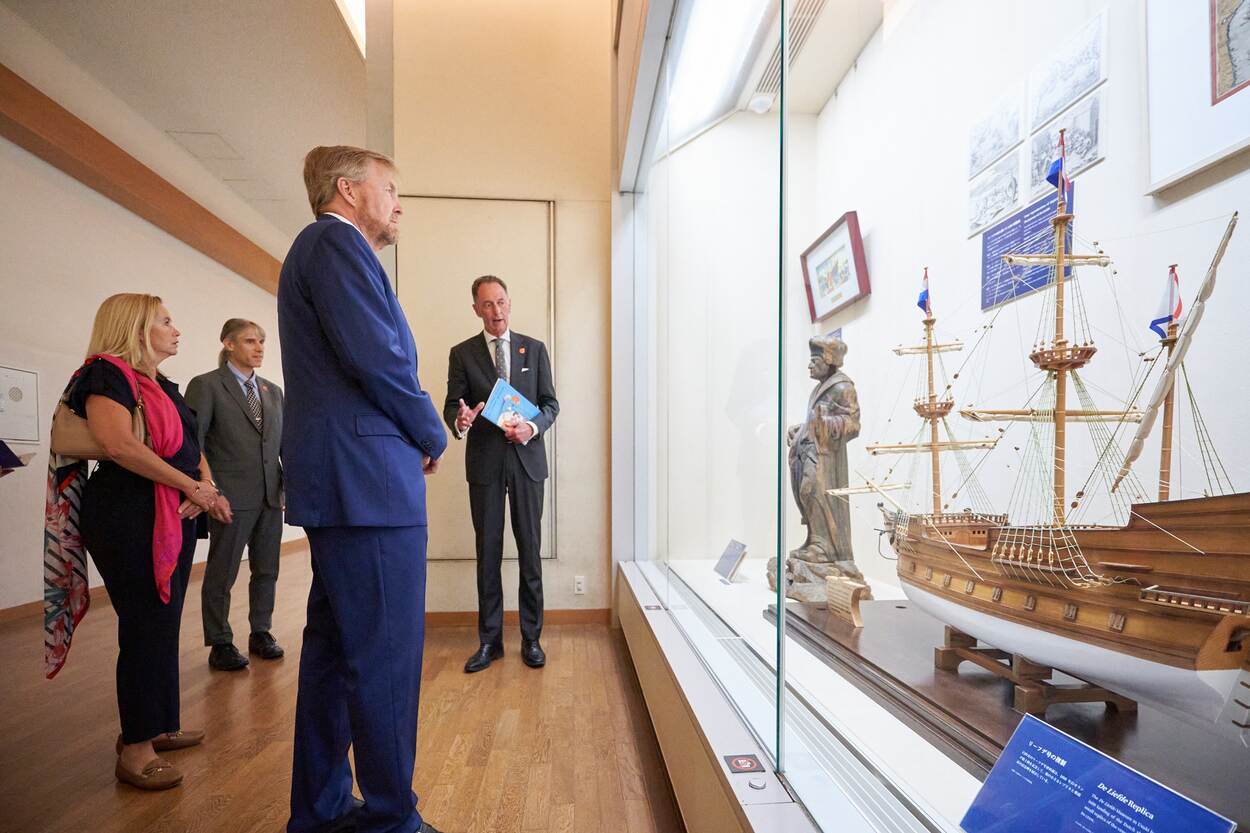
    Throughout May, Osaka Castle is spotlighting the long-standing relationship between Japan and the Netherlands. The exhibition A New Dawn on Common Ground: 425 Years of Exchange between Japan and the Netherlands features objects dating back to the year 1600. That year, the Dutch ship De Liefde arrived in Japan, carrying the first Dutchmen to make contact with the country. This meeting eventually led to an exclusive trading relationship that lasted more than 200 years. On the second day of his visit, the King visited this exhibition, which was organized by the Dutch Consulate in Osaka and features items from both Dutch and Japanese collections.

    Enlarge image
    At Tekijuku, the old Dutch school of Osaka, the King was welcomed by Osaka University students

    The Legacy of Rangaku

    Later that day, 22 May, the royal delegation visited Tekijuku, one of the most important Dutch-language schools in Japan. Until well into the 19th century, Japanese students studied Dutch there to access Western books. The presence of the Dutch in Japan offered a rare window to the rest of the world. Through Rangaku (Dutch Studies), the latest knowledge in fields such as medicine was introduced to Japan. Today, Tekijuku is part of Osaka University, where last year a new medical cooperation agreement was signed between Japan and the Netherlands. The King also visited Nakanoshima Qross, a new hub for research into the future of healthcare.

    Enlarge image
    At the Pasona pavilion, King Willem-Alexander and Minister Klever were introduced to the latest technology is regenerative medicine

    Innovation and Future Collaboration

    In the afternoon, King Willem-Alexander and Minister Klever joined the economic mission on high tech and digitalization, led by Minister Beljaarts. Around 70 Dutch companies were introduced to approximately 170 Japanese guests. Multiple partnership agreements were signed to promote cooperation in areas such as semiconductors, quantum computing, and 6G telecommunications. The day concluded with an Innovation Parade, where 19 Dutch and Japanese organizations presented their work to the King.

    MIL OSI Europe News

  • MIL-OSI Europe: Briefing – State of the Schengen area – 26-05-2025

    Source: European Parliament

    The development of the Schengen area is one of the major achievements of European integration. The removal of checks on persons at the Schengen states’ internal borders greatly facilitates the exercise of the EU freedoms of movement, which brings significant social and economic benefits. The Schengen area has come under increased stress in the past decade, owing to multiple challenges relating to increased migration into the EU, threats to internal security and the COVID 19 pandemic. In response to these challenges, many Schengen states decided to reintroduce checks at some or all of their internal borders. Despite the prescribed temporary nature of such measures, several Schengen states have prolonged these checks for years on end. The number of Schengen states with checks at internal borders reached its peak (18 states) during the first wave of the pandemic. In May 2025, 11 Schengen states had checks at internal borders owing to serious threats related to irregular migration and/or internal security. The Schengen area has expanded gradually in the past three decades and is now composed of 29 countries. In January 2025, Bulgaria and Romania were the latest two countries to fully join the Schengen area, 18 years after their accession to the EU. Cyprus is also legally bound to join the Schengen area, but the evaluation procedure for its full accession is still ongoing. This briefing presents key recent figures and developments in the Schengen area, focusing on the Schengen states’ measures to reintroduce checks at internal borders, and on the current situation regarding the completion of the Schengen area. This is an update of a briefing originally published in December 2023.

    MIL OSI Europe News

  • MIL-OSI Europe: Missions – 27-29 May: INTA Delegation to Washington, D.C. – 27-05-2025 – Committee on International Trade

    Source: European Parliament

    A delegation of eight Members of the Committee on International Trade (INTA) will travel to Washington, D.C. from 27 to 29 May 2025 to discuss political, trade and investment relations between the US and the EU.

    The delegation will be led by INTA Chair and standing rapporteur for EU-US trade relations, Bernd Lange.

    INTA Members are set to hold meetings with different departments of the US administration and with lawmakers. The meetings will also include US business organisations as well as major EU businesses active in the US. Members will also meet with US trade union representatives, consumer organisations, think tanks and academia.

    Members will hear from different interlocutors and stakeholders how the tariffs imposed by the US administration are being applied, how business is adapting to the tariffs and how can EU-US trade tensions be eased moving forward.

    MIL OSI Europe News

  • MIL-OSI Europe: Written question – Compensation for livestock farmers in Thessaly – Delays in payment – E-001985/2025

    Source: European Parliament

    Question for written answer  E-001985/2025
    to the Commission
    Rule 144
    Nikolaos Anadiotis (NI)

    Following the devastating floods of September 2023 in Thessaly, the European Commission approved significant financial support to Greece, aiming to relieve those affected and restore agricultural and livestock activity.

    Specifically, the following provision was made: a) EUR 43 million through the agricultural reserve for direct compensation to farmers and livestock farmers[1], b) EUR 101.5 million through the EU Solidarity Fund, with an advance payment of EUR 25.3 million approved in January 2024[2] and c) full coverage of damages to livestock and facilities, according to statements by the competent Minister of Rural Development.

    However, significant delays have been recorded in the payment of compensation to affected farmers. The 2nd equal instalment of just EUR 12.7 million was paid in March 2024[3], which raises reasonable questions about the efficient and timely use of European funds.

    In light of the above:

    • 1.Have the Greek authorities kept the Commission informed of progress and the reasons for the delays in the payment of compensation?
    • 2.Is the Commission monitoring the implementation of the relevant support measures and, if so, does it intend to request that the procedures be accelerated?
    • 3.In the event of continued delays on the part of the national authorities, does the Commission intend to provide further support or intervene?

    Submitted: 17.5.2025

    • [1] https://www.globaltradealert.org/state-act/83177/greece-european-commission-approves-compensation-package-for-farmers
    • [2] https://www.ekathimerini.com/economy/1247120/e101-5-mln-in-eu-aid-for-thessaly/
    • [3] https://www.archyde.com/thessaly-12-7-million-euros-were-paid-to-farmers-and-breeders-2024-03-25-215834/
    Last updated: 26 May 2025

    MIL OSI Europe News

  • MIL-OSI Europe: Written question – New Israeli bill seeking to impose 80 % tax on foreign donations to NGOs – E-001979/2025

    Source: European Parliament

    Question for written answer  E-001979/2025
    to the Commission
    Rule 144
    Chloé Ridel (S&D), Erik Marquardt (Verts/ALE), Barry Andrews (Renew), Estelle Ceulemans (S&D), Rima Hassan (The Left), Cecilia Strada (S&D), Alessandra Moretti (S&D), Mélissa Camara (Verts/ALE), Maria Walsh (PPE), Vladimir Prebilič (Verts/ALE), Marco Tarquinio (S&D), Mounir Satouri (Verts/ALE), Sandro Ruotolo (S&D), Leila Chaibi (The Left), João Oliveira (The Left), Francisco Assis (S&D), David Cormand (Verts/ALE), Nora Mebarek (S&D), Bruno Gonçalves (S&D), Thijs Reuten (S&D), Catarina Martins (The Left), Marit Maij (S&D), Annalisa Corrado (S&D), Pierre Jouvet (S&D), Matjaž Nemec (S&D), Nikos Papandreou (S&D), Tineke Strik (Verts/ALE), Pierfrancesco Maran (S&D), Irena Joveva (Renew), Javi López (S&D), Krzysztof Śmiszek (S&D), Alessandro Zan (S&D), Murielle Laurent (S&D), Damien Carême (The Left), Sandra Gómez López (S&D), Marta Temido (S&D), Leire Pajín (S&D), César Luena (S&D), Nela Riehl (Verts/ALE), Marc Botenga (The Left), Nicolás González Casares (S&D), Anna Strolenberg (Verts/ALE), Emma Rafowicz (S&D), Pasquale Tridico (The Left), Kai Tegethoff (Verts/ALE), Hilde Vautmans (Renew), Hana Jalloul Muro (S&D), Sérgio Gonçalves (S&D), Cynthia Ní Mhurchú (Renew)

    The Israeli Parliament has approved new legislation imposing an 80 % tax on foreign government funding to Israeli civil society organisations, while exempting government-supported organisations. This bill would effectively shut down many Israeli human rights groups and humanitarian NGOs carrying out crucial work, including in the occupied Palestinian territories (OPT), such as B’Tselem and Breaking the Silence.

    These NGOs have long been targeted by Israel’s right wing.  Almost all of them receive foreign funding, including from the EU and its Member States.

    This is unprecedented attack on Israeli civil society and democracy globally.

    • 1.How does the Commission intend to follow up on the recent announcement by the Vice-President of the Commission / High Representative of the Union for Foreign Affairs and Security Policy, Kaja Kallas, with regard to an increase in financial support for Israeli human rights groups targeted by the NGO bill?
    • 2.In view of the serious human rights violations committed by the Israeli Government, will the Commission move forward with considering the suspension of the EU-Israel Association Agreement?
    • 3.Does the Commission intend to take countermeasures against pressure groups defending the interests of the Israeli Government to the EU?

    Submitted: 16.5.2025

    MIL OSI Europe News

  • MIL-OSI Europe: Written question – Community funds for financing and strengthening the Transport Equivalent measure – E-001977/2025

    Source: European Parliament

    Question for written answer  E-001977/2025
    to the Commission
    Rule 144
    Emmanouil Kefalogiannis (PPE)

    Supporting island life – with particular emphasis on small islands – should be a priority. Using every means and financial tool, regional development should be promoted, local micro-economies stimulated, services and opportunities provided to the island world upgraded and inequalities between island and mainland Greece eliminated.

    A valuable measure to this end (especially nowadays, when the cost of living on the islands is very high) is the Transport Equivalent (TE). This measure, which has to date been financed exclusively from national resources, aims to contribute substantially to reducing the high transport costs borne by islanders. However, it has become clear that meeting needs exceeds national budgetary capabilities, with significant delays in the payment of aid. The Transport Equivalent measure remains outside the European framework for supporting island life, although it is fully aligned with European cohesion policies. In this context, manufacturing bodies have proposed its inclusion in European programmes, such as the Just Transition Programme 2021-2027, the Cohesion Fund and the European Regional Development Fund, etc.

    In view of this:

    • 1.What measures does the Commission intend to put in place to support island life?
    • 2.Which Community funds can finance the Transport Equivalent measure?

    Submitted: 16.5.2025

    Last updated: 26 May 2025

    MIL OSI Europe News

  • MIL-OSI Europe: Written question – Access to school canteens in Sicily and the use of ESF+ and NRRP funds – E-001981/2025

    Source: European Parliament

    Question for written answer  E-001981/2025
    to the Commission
    Rule 144
    Giuseppe Antoci (The Left)

    According to a recent survey of school canteens in Italy[1], rising canteen prices in Sicily (up 13 % and 8 % since last year in nurseries and primary schools respectively) have resulted in families on the island forking out an average of EUR 83 per child on school meals.

    In addition, it is extremely difficult to even access school meals in Sicily, where only 13.7 % of all schools have canteens, a figure which rises to 41.2 % and 43.1 % in central and northern Italy respectively.

    Although Italy’s National Recovery and Resilience Plan (NRRP) includes specific measures to remedy these kinds of inequalities, it has only allocated 37 % of its school canteen funding to southern Italy, Sicily and Sardinia.

    This state of affairs makes it extremely difficult for Sicilian children to access a healthy and adequate diet, which is one of the fundamental rights enshrined in the European Child Guarantee[2], which aims to ensure full access to essential services for children in vulnerable situations.

    In view of the above:

    • 1.Is the Commission aware of the situation concerning Sicily’s school canteens, and how does it assess the way in which the island’s NRRP allocation has been used?
    • 2.Which European Social Fund Plus (ESF+) instruments and resources could be used to guarantee that Sicilian pupils can regularly access school canteens?
    • 3.Will the Commission take further steps to reduce regional disparities and ensure that the European Child Guarantee is effectively implemented in Sicily?

    Submitted: 16.5.2025

    • [1] https://www.cittadinanzattiva.it/notizie/17124-viii-indagine-sulle-mense-scolastiche-circa-85-euro-il-costo-medio-mensile-servono-piu-risorse-contro-la-poverta-alimentare.html.
    • [2] https://commission.europa.eu/strategy-and-policy/policies/justice-and-fundamental-rights/rights-child/eu-strategy-rights-child-and-european-child-guarantee_en#european-child-guarantee.
    Last updated: 26 May 2025

    MIL OSI Europe News

  • MIL-OSI Europe: Written question – Infringement of Directive 1999/70/EC on insecure employment in schools – E-001987/2025

    Source: European Parliament

    Question for written answer  E-001987/2025
    to the Commission
    Rule 144
    Valentina Palmisano (The Left)

    Clause 5 of the Framework Agreement annexed to Directive 1999/70/EC imposes effective measures on Member States to prevent the misuse of successive fixed-term contracts, but Italy has not introduced effective, dissuasive and proportionate penalties to that end.

    Some 250 000 Italian teachers are precariously employed, despite the judgment of the Court of Justice of the European Union (CJEU) of 26 November 2014 that declared renewals of contracts of more than 36 months to cover schools’ permanent needs of to be unlawful.

    The Commission referred Italy to the CJEU (case INFR(2014)4231), noting its misuse of fixed-term contracts and discrimination in working conditions.

    Decree-Law No 131/2024 (‘the ‘Salva Infrazioni’ Decree’) does nothing more than increase compensation, without addressing the issue of recruitment or actually reducing precarious employment.

    What is more, Petition No 1264/2024, calling for the implementation of the EU directives on regulated contracts and professions, is currently open.

    In the light of the above:

    • 1.Will the Commission adopt binding guidelines to prevent further abuse of Italian school workers on insecure contracts?
    • 2.Is Decree-Law 131/2024 deemed to comply with Directive 1999/70/EC?
    • 3.Can the Commission confirm that Italy can use the twin-track system for recruitment for support positions but not for ordinary posts, and that this constraint is effectively imposed by the EU?

    Submitted: 18.5.2025

    Last updated: 26 May 2025

    MIL OSI Europe News

  • MIL-OSI Europe: Written question – Inquiry on DSA enforcement: TikTok’s algorithm and disinformation in Romania – P-001961/2025

    Source: European Parliament

    Priority question for written answer  P-001961/2025
    to the Commission
    Rule 144
    Dan Barna (Renew), Vlad Vasile-Voiculescu (Renew)

    A recent investigation by Global Witness has revealed concerning issues with TikTok’s algorithm ahead of the Romanian elections. The findings indicate that the platform disproportionately promoted far-right content to users, regardless of their initially balanced political interests. This raises questions about the spread of disinformation and the potential for algorithmic bias to impact democratic processes[1].

    The Digital Services Act (DSA) aims to create a safer and more transparent online environment, with specific obligations for very large online platforms (VLOPs) to mitigate systemic risks, including the dissemination of illegal content and disinformation, particularly during electoral periods. The DSA also emphasises the importance of algorithmic transparency and users’ rights to access diverse information.

    Given these circumstances, the provisions of the DSA and past investigations into TikTok, what specific measures are now being taken to further investigate and address the algorithmic amplification of potentially harmful or biased content on TikTok within the EU, especially in the context of the upcoming elections in Romania?

    Submitted: 15.5.2025

    • [1] https://globalwitness.org/en/campaigns/digital-threats/tiktok-algorithm-continues-to-push-multiple-times-more-far-right-content-to-users-ahead-of-romanian-election/.
    Last updated: 26 May 2025

    MIL OSI Europe News

  • MIL-OSI Europe: Written question – Urgent action required for the immediate closure of the Italian migrant detention centre in Trapani – E-001971/2025

    Source: European Parliament

    Question for written answer  E-001971/2025
    to the Commission
    Rule 144
    Leoluca Orlando (Verts/ALE), Ilaria Salis (The Left), Mélissa Camara (Verts/ALE), Cecilia Strada (S&D), Brando Benifei (S&D), Alessandro Zan (S&D), Marco Tarquinio (S&D), Saskia Bricmont (Verts/ALE), Anna Strolenberg (Verts/ALE), Reinier Van Lanschot (Verts/ALE), Cristina Guarda (Verts/ALE), Benedetta Scuderi (Verts/ALE), Ignazio Roberto Marino (Verts/ALE), Damien Carême (The Left), Pernando Barrena Arza (The Left), Rudi Kennes (The Left), Estelle Ceulemans (S&D), Sandro Ruotolo (S&D), Marie Toussaint (Verts/ALE), Rima Hassan (The Left), Mimmo Lucano (The Left)

    As highlighted by the European Committee for the Prevention of Torture and Inhuman or Degrading Treatment or Punishment (CPT) of the Council of Europe in April 2024[1], Italian migrant detention centres (CPRs) continue to perpetrate systematic human rights violations. The situation does not appear to have improved.

    During a surprise inspection at the Milo-Trapani CPR on 13 April 2025[2], Members of Parliament found detainees experiencing severe psychological and physical distress, with reports of physical violence and attempted suicides. The facility was in a dilapidated state, with no structured activities available, worsening detainees’ mental and physical condition. Access to medical care and legal support remains extremely limited.

    These conditions raise serious concerns about compliance with the Charter of Fundamental Rights of the European Union, particularly Article 1 (protection of human dignity) and Article 4 (prohibition of inhuman or degrading treatment).

    In light of these facts, the Commission is asked:

    • 1.What is its assessment of the human rights violations identified in Italian CPRs?
    • 2.Will it consider launching an infringement procedure against Italy for breaches of fundamental rights?
    • 3.How will it ensure compliance with detainees’ rights to health, legal assistance, family life and dignified living conditions?

    Submitted: 16.5.2025

    • [1] https://rm.coe.int/1680b2c7e7.
    • [2] https://palermo.repubblica.it/cronaca/2025/04/14/video/cpr_di_trapani_ilaria_salis_tortura_istituzionalizzata_va_chiuso_subito-424127661/.

    MIL OSI Europe News

  • MIL-OSI Europe: Answer to a written question – Mandatory identity verification (KYC) for social media accounts as part of the review of the Digital Services Act – follow-up to Petition 1428/2024 – P-001727/2025(ASW)

    Source: European Parliament

    The Commission acknowledges the importance of ensuring a safe, predictable and trusted online environment.

    Pursuant to Article 91(1), second subparagraph, of Regulation (EU) 2022/2065[1] (Digital Services Act, DSA) by 17 November 2025, the Commission must evaluate and report to the European Parliament, the Council and the European Economic and Social Committee on (a) the application of Article 33 of the DSA[2], including the scope of providers of intermediary services covered by the obligations applicable to very large online platforms (VLOPs) and very large online search engines (VLOSEs), and (b) the way that the DSA interacts with other legal acts, in particular those listed in Article 2(3) and (4) of the DSA.

    To this purpose, the Commission is preparing the report, prior to the launch for adoption and the formal transmission of the report to the European Parliament, the Council and the Economic and Social Committee.

    As the report due by 17 November 2025 is targeted to the specific scope established in Article 91(1) of the DSA, the potential requirement of mandatory identity verification for social media accounts is not in scope and will not be covered.

    This is without prejudice to other evaluation reports due by 17 November 2027 and five years thereafter pursuant to Article 91, paragraph 2 to 6, of the DSA.

    • [1]  OJ L  277, 27.10.2022, p. 1-102, ELI: http://data.europa.eu/eli/reg/2022/2065/oj.
    • [2] Article 33 sets out the threshold and process for the designation of very large online platforms (VLOPs) and very large online search engines (VLOSEs).
    Last updated: 26 May 2025

    MIL OSI Europe News

  • MIL-OSI Europe: Answer to a written question – Immediate impact of US funding cuts on civil society and LGBTI+ rights in the Western Balkans and Türkiye – E-001190/2025(ASW)

    Source: European Parliament

    The work of civil society organisations (CSOs), including those defending the lesbian, gay, bisexual, transgender, intersex, or queer (LGBTIQ) rights, provide an important contribution to partner countries’ reform efforts, including in view of their accession to the EU.

    Respect for human rights is an essential value upon which the EU is founded (Article 2 of the Treaty on EU). Also, judiciary and fundamental rights are at the heart of the EU accession negotiations[1].

    The Commission thus expects candidate countries to uphold these values, adopt and implement legislative reforms to that end. This notably includes ensuring that institutions promoting and protecting human rights and non-discrimination, such as equality bodies, are given the means to operate effectively.

    The Commission supports civil society and media freedom in the Western Balkans and Türkiye through the Instrument for Pre-accession, which for 2021-2027 earmarked circa EUR 470 million through dedicated programmes, namely the Civil Society Facility[2] and the Media Programme.

    CSOs in the region can also benefit from funding under the Thematic Programme on Human Rights and Democracy[3] under the Neighbourhood, Development and International Cooperation Instrument — Global Europe.

    These programmes provide essential support and contribute to countering the rhetoric in the region against human rights, democratic values, rule of law and free independent media.

    The Commission is actively monitoring the impact of the United States (U.S.) Agency for International Development’s withdrawal and broader international U.S. support, to identify critical needs in the region. The global scale of the challenge requires a collective response beyond the Commission.

    The Commission will continue to support the LGBTIQ community and human rights defenders, while reinforcing its political dialogue with enlargement partners .

    The Commission will renew its efforts to advance LGBTIQ equality, through the adoption of a new LGBTIQ Equality Strategy 2026-2030.

    • [1] Revised enlargement methodology.
    • [2] https://enlargement.ec.europa.eu/enlargement-policy/policy-highlights/civil-society_en.
    • [3] https://international-partnerships.ec.europa.eu/policies/peace-and-governance/human-rights_en.

    MIL OSI Europe News

  • MIL-OSI Europe: Written question – Purges of minorities in Syria – E-001811/2025

    Source: European Parliament

    Question for written answer  E-001811/2025/rev.1
    to the Commission
    Rule 144
    Emmanouil Fragkos (ECR)

    The terrorist organisation that has taken over Damascus – ruling most of Syria – is extremely dangerous. It is essential for the EU to take the first ‘writing on the wall’ into account and adjust its stance and not its values.

    In northwest Syria in early March, a mass purge of Alawites bearing the hallmarks of genocide was recorded. Hayat Tahrir al-Sham (HTS) terrorists targeted Alawite villagers, women and children. Recently, violent attacks against the Druze by regime terrorist and allied groups have intensified in southern Syria, following a fake audio video that ‘insulted the Prophet Muhammad’. Already, over 100 Druze have been murdered. Fortunately, Israel’s military presence has contributed to a less aggressive attitude towards the Druze.

    It is obvious that the Islamist, terrorist HTS has as its first goal the cleansing of non-Muslims. First the Alawites, who have social standing, then the Druze, who have a strategic position and alliance with Israel, and then HTS will turn against the Kurds, Shiites and Christians. The genocide of Christians in Türkiye is obviously the model for the like-minded HTS terrorists, so that Syria can be transformed into a Sunni caliphate.

    Can the Commission answer the following question: How many thousands of non-Muslims must be murdered for the EU to accept the true nature of those ruling Syria and intervene to overthrow them?

    Submitted: 6.5.2025

    Last updated: 26 May 2025

    MIL OSI Europe News

  • MIL-OSI Europe: Answer to a written question – Extending the duration of the concession for the A35 Brescia-Bergamo-Milan (Brebemi) motorway – E-001215/2025(ASW)

    Source: European Parliament

    Under Article 43(1)(a) of Directive 2014/23/EU[1], concessions may be modified during their term without a new procurement procedure where the modifications, irrespective of their monetary value, have been provided for in the initial concession documents in clear, precise and unequivocal review clauses, which may include value revision clauses, or options.

    Such clauses shall state the scope and nature of possible modifications as well as the conditions under which they may be used. They shall not provide for modifications or options that would alter the overall nature of the concession.

    In line with Article 291(1) of the Treaty on the Functioning of the European Union, the implementation of legally binding Union acts is in the first place the responsibility of the Member States.

    Pursuant to Article 19(1), second subparagraph, Member States shall provide remedies sufficient to ensure effective legal protection in the fields covered by EU law.

    It is therefore for national courts and review bodies referred to in the directives on remedies in public procurement[2] to assess the facts and determine whether the contracting authority respected its obligations under EU law.

    Based on the information provided, it is not possible to assess whether state aid rules are complied with in the present situation. It however belongs to the Member State to assess whether the extension of a concession for a tolled motorway entails new aid and therefore requires a notification to the Commission.

    • [1] https://eur-lex.europa.eu/legal-content/EN/TXT/?uri=celex%3A32014L0023.
    • [2] Directive 89/665/EEC — https://eur-lex.europa.eu/legal-content/EN/TXT/HTML/?uri=CELEX:01989L0665-20140417; and Directive 92/13/EEC — https://eur-lex.europa.eu/legal-content/EN/TXT/HTML/?uri=CELEX:31992L0013; as amended by Directive 2007/66/EC — https://eur-lex.europa.eu/legal-content/EN/TXT/HTML/?uri=CELEX:32007L0066 and Directive 2014/23/EU.
    Last updated: 26 May 2025

    MIL OSI Europe News

  • MIL-OSI Europe: Commission and national authorities urge SHEIN to respect EU consumer protection laws

    Source: EuroStat – European Statistics

    European Commission Press release Brussels, 26 May 2025 Today, following a coordinated investigation at European level, the Consumer Protection Cooperation (CPC) Network of national consumer authorities and the European Commission notified the online marketplace and e-retailer SHEIN of a number of practices on its platform that infringe EU consumer law.

    MIL OSI Europe News

  • MIL-OSI Europe: Briefing – The United Nations Ocean Conference, Nice, France, 9-13 June 2025 – 22-05-2025

    Source: European Parliament

    This briefing is prepared for the European Parliament delegation to the third United Nations Ocean Conference, which will take place in Nice, France, from 9-13 June 2025. It provides an overview of the initiatives at the international and European level that aim to conserve and sustainably use the oceans and presents the key topics that will be addressed at the conference.

    MIL OSI Europe News

  • MIL-OSI Europe: Sweden: EIB finances major expansion of Stockholm metro – one of Europe’s largest urban transport projects

    Source: European Investment Bank

    EIB

    • The European Investment Bank (EIB) is providing approximately 400 million euro in additional financing to the Region of Stockholm and the City of Stockholm.
    • The project, which will affect four municipalities, involves 30 km of new tracks, 18 metro stations, and the expansion of a depot.
    • This is one of the largest metro expansion projects currently underway in Europe.

    The European Investment Bank (EIB) is stepping up its support for a project to expand the Stockholm metro by providing additional loans to the Region of Stockholm and the City of Stockholm. The EIB will provide a total of SEK 4.5 billion in financing, which equates to around €400 million. Including these new loans, the EIB has provided a total of over SEK 12 billion (more than €1 billion) for the project in Sweden’s capital.

    The project to expand the Stockholm metro is one of the largest infrastructure projects in Sweden to have been funded by the European Union and is the largest investment that the EIB has ever made in public transport in Sweden.

    EIB Vice-President Thomas Östros said: “This investment boosts both sustainable mobility and regional development. By providing an additional loan, we are demonstrating our long-term commitment to climate-smart investments in Europe’s growing cities. This project is an excellent example of how EU funding can benefit both people and the climate.”

    The metro project involves three new 30-kilometre sections in the Region of Stockholm, of which 20 kilometres will be in double-track tunnels, as well as 18 new stations. 130 500 housing units will be built along these new sections.

    The project will be implemented in the municipalities of Stockholm, Nacka, Solna and Järfälla. This initiative is essential to provide sustainable and efficient public transport to meet the needs of the growing population. 730 000 people currently use public transport in the county every day.

    Region of Stockholm Director-General Emma Lennartson said: “The EIB’s support is essential for investment in the metro expansion project. Continuing to invest in, and rely on, public transport is an effective way of reducing greenhouse gas emissions in the Region of Stockholm.”

    Lennartson also added:

    “With the City of Stockholm and our other partners in the county, we are working hard to reduce greenhouse gas emissions by 12% every year, which is necessary for the county to do its part to meet the objectives of the Paris Agreement. Investing in the metro will help to increase our chances of reaching carbon neutrality by 2045.”

    The new EIB loan is divided between the two borrowers:

    • SEK 2.5 billion will go to the Region of Stockholm
    • SEK 2 billion will go to the City of Stockholm.

    City of Stockholm Director-General Fredrik Jurdell said: “The EIB’s continued commitment to this financial partnership reaffirms the importance of the metro expansion project for sustainable growth in the capital and the surrounding areas. The new metro meets the needs of future generations in terms of transport and mobility, but also with regard to housing, given that housing units will be built as part of the project.”

    Significant efforts to boost sustainability are at the heart of the project to expand the Stockholm metro. Ceequal, a leading certification system for civil engineering projects, has completed an audit of the project. Several parties involved in the project received the ‘Excellent’ rating – the highest possible rating. This highlights how ambitious the project is with regard to the environment and sustainable development, going beyond legal and sector-specific requirements.

    Background information  

    EIB 

    The European Investment Bank (ElB) is the long-term lending institution of the European Union, owned by its Member States. Built around eight core priorities, we finance investments that contribute to EU policy objectives by bolstering climate action and the environment, digitalisation and technological innovation, security and defence, cohesion, agriculture and bioeconomy, social infrastructure, high-impact investments outside the European Union, and the capital markets union.  

    The EIB Group, which also includes the European Investment Fund (EIF), signed nearly €89 billion in new financing for over 900 high-impact projects in 2024, boosting Europe’s competitiveness and security.  

    All projects financed by the EIB Group are in line with the Paris Climate Agreement, as pledged in our Climate Bank Roadmap. Almost 60% of the EIB Group’s annual financing supports projects directly contributing to climate change mitigation, adaptation, and a healthier environment.  

    Fostering market integration and mobilising investment, the Group supported a record of over €100 billion in new investment for Europe’s energy security in 2024 and mobilised €110 billion in growth capital for startups, scale-ups and European pioneers. Approximately half of the EIB’s financing within the European Union is directed towards cohesion regions, where per capita income is lower than the EU average.

    High-quality, up-to-date photos of our headquarters for media use are available here.

    MIL OSI Europe News

  • MIL-OSI Europe: EIB awards design services contract for West Campus Programme

    Source: European Investment Bank

    The European Investment Bank (EIB) has awarded the contract for design services for its West Campus Programme to a leading multi-national consortium, after a competitive tender process initiated in 2024.

    The selected consortium comprises Assar Universum Architects (Luxembourg), Assar BE Architects (Belgium), Schmidt Hammer Lassen Architects (Denmark), Paul Wurth Geprolux (Luxembourg), Tractebel Engineering (Belgium), Topotek 1 (Germany), and Papaya Urbanistes et Architectes Paysagistes (Luxembourg). Collectively, these firms bring extensive expertise in large-scale building design and renovation, with a particular focus on projects in Luxembourg.

    Under the signed Framework Agreement, the consortium will provide design services for an initial period of eight years, with the possibility of extension for up to three additional years. The agreement is valued at up to EUR 33 million.

    This milestone marks a significant step forward in the EIB West Campus Programme, which aims to renovate and extend the West Building (WKI) while preserving its historic façade. The consortium will be initially responsible for developing the preliminary design, for submission to the EIB’s governing bodies in early 2026.

    Commitment to Sustainability and Inclusion

    Aligned with the EIB’s commitment to sustainability and innovation, the West Campus Programme is designed to create a modern, comfortable, and inclusive work environment for staff and visitors. The project will prioritise climate action, energy efficiency, and circularity, in line with the EIB’s role as the EU Climate Bank. It will also reflect the principles of the New European Bauhaus, integrating sustainability, social inclusion, and aesthetics to deliver a beautiful and future-ready campus.

    MIL OSI Europe News

  • MIL-OSI Europe: EU Fact Sheets – The common fisheries policy: origins and development – 23-05-2025

    Source: European Parliament

    The common fisheries policy (CFP) has come a long way since it was first formulated in the Treaty of Rome. Initially linked to the common agricultural policy, it gradually developed a separate identity. The core area of the CFP – conservation and management of fish stocks – was launched in 1983. The policy was reformed in 1992, 2002 and 2013. The current framework, resulting from the 2013 reform, is aimed at ensuring that EU fisheries are sustainable – environmentally, economically and socially.

    MIL OSI Europe News

  • MIL-OSI Europe: EU Fact Sheets – Vocational education and training – 23-05-2025

    Source: European Parliament

    In accordance with the subsidiarity principle, primary responsibility for vocational education and training policies lies with the Member States, with the European Union having only a supporting role. However, some challenges are common to all Member States – green and digital transitions, skills shortages and mismatches in the labour market – and thus call for joint responses, with countries working together and learning from each other.

    MIL OSI Europe News