Category: Health

  • MIL-OSI Global: Water cooperation is essential when countries share lakes and rivers – yet it’s been deteriorating in many places, with serious consequences

    Source: The Conversation – USA – By Susanne Schmeier, Associate Professor of Water Law and Diplomacy, IHE Delft

    Lake Chad once provided adequate livelihoods for 20 million people in Africa, but it lost 90% of its surface area in 30 years. AP Photo/Christophe Ena

    Just over half the world’s population shares a river or lake basin with at least one other country. To sustainably manage those water resources for the health of people, ecosystems and economies, neighboring countries must work together.

    However, many countries have been less willing to cooperate in recent years, even to protect a resource as vital as freshwater.

    This trend away from multilateralism isn’t unique to water. The world is seeing a decline in the general willingness of countries to jointly solve many interstate, regional and global challenges. It shows as countries, like the U.S., pull out of the global institutions, such as the World Health Organization, and drop their support for global climate goals.

    The breakdown in cooperation can have severe consequences. If one country takes more water than agreed upon, and builds dams or pollutes the water, its neighbors and their people, cities, agriculture, energy production and wildlife can suffer. That can ultimately destabilize local communities, deteriorate relations between countries and endanger regional peace and stability.

    Water flowing into Africa’s Nile River affects several countries. A large dam being built by Ethiopia has led to concerns and disputes in the region.
    AP Photo/Amr Nabil

    We conduct research and work with governments and international organizations on environment and water law, policy and governance. The shift we’re seeing away from multilateral cooperation and rules-based order to more nationalistic tendencies, in which a country prioritizes itself to the detriment of all others, is raising concerns about the future.

    Thousands of years of water cooperation paid off

    More than 4,000 years ago, two Sumerian city-states – Lagash and Umma – were engaged in a fierce war over a strip of fertile land and a canal fed by the Tigris River in what today would be southern Iraq.

    The conflict ended in 2550 B.C. with the first known precursor to an international water treaty. The Mesilim Treaty included payments and agreements on collaborative water use. It didn’t hold the peace permanently, but it created a model that lasted.

    Conflict still occurs over shared waters; however, since the late 1800s, and particularly since the end of World War II, cooperation has been the dominant interaction between countries in the world’s 313 surface water basins, 468 transboundary aquifers and more than 300 transboundary wetlands.

    In Europe, for example, countries have worked together through treaties, data sharing and joint projects to improve water quality, including in the Rhine and Danube rivers.

    Nine countries work closely to protect the health of the Rhine River, which each depends on. In 2018, that cooperation became essential as water levels dropped to levels that interrupted ship travel.
    AP Photo/Martin Meissner

    Having cooperative processes in place also helps when disagreements arise. In Southeast Asia, negotiations and technical exchanges between countries that share the Mekong River have helped to ease tensions over the construction of dams in Laos.

    Unilateralism is rising

    Despite the proven benefits from cooperating over water resources, we’re seeing a troubling trend: Countries are increasingly taking actions that undermine water cooperation.

    Even in the Columbia River Basin, often considered a model of cross-border cooperation, the status of an updated treaty between the U.S. and Canada is in question after the Trump administration paused talks in March 2025.

    Since 1964, the U.S. has paid Canada to control the river’s flow to prevent flooding and to serve U.S. hydropower plants. The updated deal has been agreed to in principle, but is not signed. That’s raising questions about what will happen if the interim agreements expire in 2027 before the new treaty comes into force.

    Another example is in the Zambezi River Basin in southern Africa, where countries increasingly disregard agreements to notify one another before building projects that will affect the water flow. Similar behavior happens in the Nile and Aral Sea regions, among others.

    Ethiopia’s construction of a large hydroelectric damage on the Blue Nile has upset its downstream neighbors.

    As unilateral actions over shared water resources become more frequent, the willingness of governments to enter into agreements and establish joint institutions to guide that cooperation is declining. The rate of establishing multilateral agreements has significantly slowed since the 2010s. Only around 10 agreements have been signed since 2020, and only two joint institutions have been established. A large proportion of basins have no agreements or institutions at all.

    The few recent attempts to establish cooperative mechanisms have stalled or failed. The formal establishment of an organization to manage Lake Kivu and the Ruzizi River basin, shared by Congo, Rwanda and Burundi, was never formally ratified by its member countries. That left the once-promising organization a zombie.

    Even when institutions already exist, some governments are withdrawing from them. But moves made for short-term gain can have long-term repercussions.

    An example involves the Aral Sea, which has shrunk dramatically since the 1960s due to a combination of water demand for cotton crops and climate change drying the region.

    The International Fund for Saving the Aral Sea, IFAS, was created in 1993 by five countries to support projects designed to ensure water use remains possible along its rivers. However, in 2016, Kyrgyzstan froze its membership, arguing that the organization wasn’t taking Kyrgyzstan’s national interests into account. Kyrgyzstan contributes about 25% of water flowing into the region. Its frozen participation limits IFAS’ effectiveness.

    The Aral Sea in Central Asia has been shrinking since the 1960s, but dramatically lost water each year over the past two decades. The top left image is from 2000.
    NASA

    Similarly, Egypt and Sudan froze their participation in the Nile Basin Initiative in 2010 over a cooperative agreement that they saw as violating their historical water rights – established in colonial 1929 and 1959 agreements – in favor of governance centered on “equitable water allocations.” While Sudan resumed participation in the Nile Basin Initiative in 2012, Egypt’s participation remains frozen.

    Erosion of multilateralism

    The changes we’re seeing with water agreements and institutions reflect a broader decline in countries’ willingness to address shared problems through multilateral cooperation — a trend that seems to be rapidly increasing.

    In the United States, the Trump administration is pursuing expansionist foreign policies and protectionist trade policies. The administration has also publicly wavered on the U.S. commitment to NATO and announced it was leaving the World Health Organization.

    Argentina also announced it would withdraw from the WHO. Mali, Burkina Faso and Niger have withdrawn from the Economic Community of West African States, which promotes economic and political cooperation in the region.

    The environment has been particularly affected by this trend. The U.S. move to withdraw from the Paris climate agreement and the difficulty of reaching a global plastics treaty also reflect the growing difficulty in reaching cooperative solutions to benefit future generations.

    Harm to ecosystems, people and countries

    As climate change shrinks freshwater resources, and growing populations lead to overexploitation of water supplies, countries will increasingly need multilateral cooperation to avoid conflict.

    These agreements and institutions provide forums for communication and cooperation. Losing them can lead to less well-governed water resources, declining environmental, economic and health benefits, and increasing conflict.

    Lake Chad is a cautionary example. The Lake Chad Basin Commission was established in 1964 by Cameroon, Chad, Niger and Nigeria to oversee its water and other natural resources and coordinate projects related to the lake. But the countries never fully committed to cooperating.

    Since then, the lake has shrunk by around 90%, which has increased poverty by reducing people’s access to vital water resources to support their livelihoods. And that has created optimal conditions for terrorist group Boko Haram’s violent insurgency to succeed in recruiting young men who had limited livelihood options left.

    People collect water from a branch of Lake Chad in Ngouboua, Chad, which has been attacked by the terrorist group Boko Haram. People depend on the lake for water, but it has been shrinking.
    Philippe Desmazes/AFP via Getty Images

    We believe this decline in countries’ commitment to multilateral cooperation should be a wake-up call for everyone. If the world’s most precious resource is not managed cooperatively and sustainably across international boundaries, more than just water is at risk.

    Melissa McCracken has not received funding related to this article.

    Susanne Schmeier does not work for, consult, own shares in or receive funding from any company or organization that would benefit from this article, and has disclosed no relevant affiliations beyond their academic appointment.

    ref. Water cooperation is essential when countries share lakes and rivers – yet it’s been deteriorating in many places, with serious consequences – https://theconversation.com/water-cooperation-is-essential-when-countries-share-lakes-and-rivers-yet-its-been-deteriorating-in-many-places-with-serious-consequences-251864

    MIL OSI – Global Reports

  • MIL-OSI Global: A brief history of Medicaid and America’s long struggle to establish a health care safety net

    Source: The Conversation – USA – By Ben Zdencanovic, Postdoctoral Associate in History and Policy, University of California, Los Angeles

    President Lyndon B. Johnson, left, next to former President Harry S. Truman, signs into law the measure creating Medicare and Medicaid in 1965. AP Photo

    The Medicaid system has emerged as an early target of the Trump administration’s campaign to slash federal spending. A joint federal and state program, Medicaid provides health insurance coverage for more than 72 million people, including low-income Americans and their children and people with disabilities. It also helps foot the bill for long-term care for older people.

    In late February 2025, House Republicans advanced a budget proposal that would potentially cut US$880 billion from Medicaid over 10 years. President Donald Trump has backed that House budget despite repeatedly vowing on the campaign trail and during his team’s transition that Medicaid cuts were off the table.

    Medicaid covers one-fifth of all Americans at an annual cost that coincidentally also totals about $880 billion, $600 billion of which is funded by the federal government. Economists and public health experts have argued that big Medicaid cuts would lead to fewer Americans getting the health care they need and further strain the low-income families’ finances.

    As a historian of social policy, I recently led a team that produced the first comprehensive historical overview of Medi-Cal, California’s statewide Medicaid system. Like the broader Medicaid program, Medi-Cal emerged as a compromise after Democrats failed to achieve their goal of establishing universal health care in the 1930s and 1940s.

    Instead, the United States developed its current fragmented health care system, with employer-provided health insurance covering most working-age adults, Medicare covering older Americans, and Medicaid as a safety net for at least some of those left out.

    Health care reformers vs. the AMA

    Medicaid’s history officially began in 1965, when President Lyndon B. Johnson signed the system into law, along with Medicare. But the seeds for this program were planted in the 1930s and 1940s. When President Franklin D. Roosevelt’s administration was implementing its New Deal agenda in the 1930s, many of his advisers hoped to include a national health insurance system as part of the planned Social Security program.

    Those efforts failed after a heated debate. The 1935 Social Security Act created the old-age and unemployment insurance systems we have today, with no provisions for health care coverage.

    Nevertheless, during and after World War II, liberals and labor unions backed a bill that would have added a health insurance program into Social Security.

    Harry Truman assumed the presidency after Roosevelt’s death in 1945. He enthusiastically embraced that legislation, which evolved into the “Truman Plan.” The American Medical Association, a trade group representing most of the nation’s doctors, feared heightened regulation and government control over the medical profession. It lobbied against any form of public health insurance.

    This PBS ‘Origin of Everything!’ video sums up how the U.S. wound up with its complex health care system.

    During the late 1940s, the AMA poured millions of dollars into a political advertising campaign to defeat Truman’s plan. Instead of mandatory government health insurance, the AMA supported voluntary, private health insurance plans. Private plans such as those offered by Kaiser Permanente had become increasingly popular in the 1940s in the absence of a universal system. Labor unions began to demand them in collective bargaining agreements.

    The AMA insisted that these private, employer-provided plans were the “American way,” as opposed to the “compulsion” of a health insurance system operated by the federal government. They referred to universal health care as “socialized medicine” in widely distributed radio commercials and print ads.

    In the anticommunist climate of the late 1940s, these tactics proved highly successful at eroding public support for government-provided health care. Efforts to create a system that would have provided everyone with health insurance were soundly defeated by 1950.

    JFK and LBJ

    Private health insurance plans grew more common throughout the 1950s.

    Federal tax incentives, as well as a desire to maintain the loyalty of their professional and blue-collar workers alike, spurred companies and other employers to offer private health insurance as a standard benefit. Healthy, working-age, employed adults – most of whom were white men – increasingly gained private coverage. So did their families, in many cases.

    Everyone else – people with low incomes, those who weren’t working and people over 65 – had few options for health care coverage. Then, as now, Americans without private health insurance tended to have more health problems than those who had it, meaning that they also needed more of the health care they struggled to afford.

    But this also made them risky and unprofitable for private insurance companies, which typically charged them high premiums or more often declined to cover them at all.

    Health care activists saw an opportunity. Veteran health care reformers such as Wilbur Cohen of the Social Security Administration, having lost the battle for universal coverage, envisioned a narrower program of government-funded health care for people over 65 and those with low incomes. Cohen and other reformers reasoned that if these populations could get coverage in a government-provided health insurance program, it might serve as a step toward an eventual universal health care system.

    While President John F. Kennedy endorsed these plans, they would not be enacted until Johnson was sworn in following JFK’s assassination. In 1965, Johnson signed a landmark health care bill into law under the umbrella of his “Great Society” agenda, which also included antipoverty programs and civil rights legislation.

    That law created Medicare and Medicaid.

    From Reagan to Trump

    As Medicaid enrollment grew throughout the 1970s and 1980s, conservatives increasingly conflated the program with the stigma of what they dismissed as unearned “welfare.” In the 1970s, California Gov. Ronald Reagan developed his national reputation as a leading figure in the conservative movement in part through his high-profile attempts to cut and privatize Medicaid services in his state.

    Upon assuming the presidency in the early 1980s, Reagan slashed federal funding for Medicaid by 18%. The cuts resulted in some 600,000 people who depended on Medicaid suddenly losing their coverage, often with dire consequences.

    Medicaid spending has since grown, but the program has been a source of partisan debate ever since.

    In the 1990s and 2000s, Republicans attempted to change how Medicaid was funded. Instead of having the federal government match what states were spending at different levels that were based on what the states needed, they proposed a block grant system. That is, the federal government would have contributed a fixed amount to a state’s Medicaid budget, making it easier to constrain the program’s costs and potentially limiting how much health care it could fund.

    These efforts failed, but Trump reintroduced that idea during his first term. And block grants are among the ideas House Republicans have floated since Trump’s second term began to achieve the spending cuts they seek.

    Protesters in New York City object to Medicaid cuts sought by the first Trump administration in 2017.
    Erik McGregor/LightRocket via Getty Images

    The ACA’s expansion

    The 2010 Affordable Care Act greatly expanded the Medicaid program by extending its coverage to adults with incomes at or below 138% of the federal poverty line. All but 10 states have joined the Medicaid expansion, which a U.S. Supreme Court ruling made optional.

    As of 2023, Medicaid was the country’s largest source of public health insurance, making up 18% of health care expenditures and over half of all spending on long-term care. Medicaid covers nearly 4 in 10 children and 80% of children who live in poverty. Medicaid is a particularly crucial source of coverage for people of color and pregnant women. It also helps pay for low-income people who need skilled nursing and round-the-clock care to live in nursing homes.

    In the absence of a universal health care system, Medicaid fills many of the gaps left by private insurance policies for millions of Americans. From Medi-Cal in California to Husky Health in Connecticut, Medicaid is a crucial pillar of the health care system. This makes the proposed House cuts easier said than done.

    Ben Zdencanovic does not work for, consult, own shares in or receive funding from any company or organization that would benefit from this article, and has disclosed no relevant affiliations beyond their academic appointment.

    ref. A brief history of Medicaid and America’s long struggle to establish a health care safety net – https://theconversation.com/a-brief-history-of-medicaid-and-americas-long-struggle-to-establish-a-health-care-safety-net-251776

    MIL OSI – Global Reports

  • MIL-OSI United Kingdom: Secretary of State for Work and Pensions speech to the House of Commons on welfare reform

    Source: United Kingdom – Executive Government & Departments

    Speech

    Secretary of State for Work and Pensions speech to the House of Commons on welfare reform

    The Secretary of State for Work and Pensions the Rt Hon Liz Kendall MP delivered the below speech to the House of Commons on the 18 March 2025.

    INTRODUCTION

    Mr Speaker

    This Government is ambitious for our people and our country.

    And we believe that unleashing the talents of the British people is the key to our future success.

    But the social security system we inherited from [political content removed] is failing the very people it is supposed to help, and holding our country back.

    The facts speak for themselves.

    1 in 10 people of working age now claiming a sickness or disability benefit.

    Almost 1 million young people not in education, employment or training – that’s 1 in 8 of all our young people.

    2.8 million out of work due to long term sickness. 

    And the number of people claiming Personal Independence Payments set to double this decade, from 2 to 4.3 million…

    … with the growth in claims rising faster among young people and mental health conditions. 

    … and with claims up to 4 times higher in parts of the Midlands, Wales and the North where economic demand is weakest. Places that were decimated in the 80s and 90s, written off for years by successive Tory governments, and never given the chances they deserve. 

    And the consequences of this failure are there for all to see. 

    Millions of people who could work trapped on benefits… denied the income, hope, dignity and self-respect that we know good work brings.

    And taxpayers paying millions more on the costs of failure, with spending on working age sickness and disability benefits up £20 billion since the pandemic, set to rise by a further £18 billion by the end of this Parliament to £70 billion a year. 

    And it is not like this in most other comparable countries where spending on these benefits since the pandemic is either stable or falling – whilst ours continues to inexorably rise. 

    [political content removed]

    And today, Mr Speaker, we say – no more.

    Since we were elected, we have hit the ground running to get more people into good work through our Plan for Change. 

    We’re investing an extra £26 billion into the NHS to drive down waiting lists and get people back to health and back to work.

    We’re improving the quality of work and making work pay with our landmark Employment Rights legislation and increases in the national living wage.

    We’re creating more good jobs in every part of the country in clean energy and through our modern industrial strategy.

    And we are introducing the biggest reforms to employment support in a generation, with our £240 million Get Britain Working plan.

    Today, our Pathways to Work Green Paper sets out decisive action to fix the broken benefits system.

    Creating a more pro-active, pro-work system for those who can work. 

    And so we protect it for those who cannot work; now and for the long-term.

    Mr Speaker, I know as a constituency MP for 14 years, that there will always be people who can never work, because of the severity of their disability or illness. 

    Under this Government, the social security system will always be there for people in genuine need. That is a principle we will never compromise on.

    But disabled people and people with health conditions who can work should have the same rights, choices and chances to work as everybody else. That principle of equality is vital too.

    Because –  [political content removed] – many sick and disabled people want to work, with the right help and support.

    [political content removed]. 

    Mr Speaker, our first aim is to secure a decisive shift towards prevention and early intervention.

    Almost 4 million people are in work with a work limiting health condition, and around 300,000 fall out of work every year.

    So we’ve got to do far more to help people stay in work, and get back to work quickly – because your chances of returning are 5 times higher in the first year. 

    Our plans to give statutory sick pay for 1 million of the lowest paid workers and more rights to flexible working will help keep more people in work.

    The Work Well programme is trialling new approaches like GPs referring people to employment advisors, instead of signing them off sick.

    And our Keep Britain Working review, led by former John Lewis boss Sir Charlie Mayfield, will set out what government and employers can do together, to create healthier, more inclusive workplaces. 

    So we help more employers offer opportunities for disabled people, including through measures like reasonable readjustments, alongside our Green Paper consultation on reforming Access to Work so it is fit for the future. 

    And today I can announce another step. 

    Our Green Paper will consult on a major reform of contributory benefits …

    … merging contributions-based Jobseekers Allowance and Employment Support Allowance into a new time limited Unemployment Insurance, paid at a higher rate, without having to prove you cannot work in order to get it 

    … so if you have paid into the system you’ll get stronger income protection, while we help you get back on track.  

    Our second objective is to restore trust and fairness in the benefits system … 

    …. by fixing the broken assessment process and tackling the perverse incentives that drive people into welfare dependency.

    Now Members  [political content removed]  have long argued that the Work Capability Assessment is not fit for purpose.

    Going through the WCA is complex, time consuming and often stressful for claimants, especially if they also have to go through the PIP assessment.

    And more fundamentally, it’s based on a binary can / can’t work divide, when we know the truth is that many people’s physical and mental health conditions fluctuate.

    The consultation on  [political content removed] WCA proposals was ruled unlawful by the courts.

    So today I can announce we will not go ahead with their proposals.

    Instead we will scrap the WCA in 2028.

    In future, extra financial support for health conditions in Universal Credit will be available solely through the PIP assessment…

    .. so extra income is based on the impact of someone’s health condition or disability, not on their capacity to work.

    … reducing the number of assessments that people have to go through

    … and a vital step towards de-risking work.

    And, Mr Speaker, we will do more …

    by legislating for a ‘right to try’, guaranteeing that work in and of itself will never lead to a benefit reassessment. 

    Giving people the confidence to take the plunge and try work – without the fear this will put their benefits at risk.

    Mr Speaker, we will also tackle the perverse financial incentives –[political content removed] – which actively encourage people into welfare dependency.

    [political content removed]

    As a result, the health top up is now worth double the Standard Allowance, at more than £400 a month.

    And in 2017, they took away extra financial help for the group of people who could prepare for work. 

    So we’re left with a binary assessment of can or can’t work and a clear financial incentive to define yourself as incapable of work….

    …something the OBR, IFS and others say is a likely factor driving people onto incapacity benefits. 

    Today, we tackle this problem head on. 

    We will legislate to rebalance the payments in Universal Credit from April next year …

    … holding the value of the health top up fixed in cash terms for existing claimants and reducing it for new claimants

    … with an additional premium for people with severe, lifelong conditions that mean that they will never work – to give them the financial security they deserve. 

    And alongside this, Mr Speaker, we will bring in a permanent, above inflation rise to the standard allowance in Universal Credit… for the first time EVER, a £775 annual increase in cash terms by 2029/30. 

    And a decisive step to tackle the perverse incentives in the system.

    We will also fix the failing system of reassessments.

    [political content removed]  failed to switch reassessments back on after the pandemic, so they’re down by more than two thirds, with face to face assessments going from 7 in 10 to only 1 in 10.

    We will turn these reassessments back on at scale, and shift the focus back to doing more face to face, and we will ensure they are recorded as standard – to give confidence to claimants and taxpayers that they’re being done properly.

    And Mr Speaker I can also announce …

    … for people on Universal Credit with the most severe disabilities, and health conditions that will never improve, we want to ensure that they are never reassessed, to give them the confidence and dignity they deserve. 

    And we will fundamentally overhaul the DWP’s safeguarding approach to make sure all our processes and training are of the highest quality so we protect and support the most vulnerable people. 

    Mr Speaker, alongside these changes we will also reform disability benefits, so they focus support on those in greatest need and to ensure the social security system lasts for the long-term, into the future.

    Social and demographic change means more people are now living with a disability.

    But the increase in disability benefits is double the rate of increasing prevalence of working age disability in the country.

    With claims amongst young people up 150%.  For mental health conditions, up 190%. And claims for learning difficulties up over 400%, according to the IFS. 

    Every day, there are more than 1,000 new PIP awards. 

    That’s the equivalent of adding a population the size of Leicester every single year. 

    Mr Speaker, that is not sustainable long-term, above all, for the people who depend on this support. [political content removed]

    So today I can announce this Government will NOT bring in  [political content removed]  proposals for vouchers – because disabled people should have choice and control over their lives.

    We will not means-test PIP. Because disabled people deserve extra support, whatever their incomes.

    And Mr Speaker I can confirm we will not freeze PIP either.

    Instead, our reforms will focus support on those with the greatest needs.

    We will legislate for a change in PIP so people will need to score a minimum of 4 points in at least one activity to qualify for the daily living element of PIP from November 2026. 

    This will not affect the mobility component of PIP and only relates to the daily living element.  

    And alongside this, we will launch a review of the PIP assessment … 

    … led by my Right Honourable Friend, the Minister for Social Security and Disability, in close consultation with disabled people, the organisations that represent them and other experts

    … so we make sure PIP and the assessment process is fit for purpose, now and into the future. 

    And Mr Speaker, this is a significant reform package that is expected to save over £5 billion in 2029/30. And the OBR will set out their final assessment of the costings next week.

    Our third and final objective is to deliver personalised support to sick and disabled people who CAN work to get the jobs they need and deserve.

    We know  [political content removed] young people and the long-term unemployed – the difference that proper employment support can make.

    And more recent evidence – from the Work Choice programme and Additional Work Coach time – shows support can make a significant difference in the number of people getting work, keeping work, and improving their mental health and wellbeing too.

    This   [political content removed] Government believes that an active state can transform people’s lives. We know this because we have done it before.

    So today I can announce we will invest an additional £1 billion a year for employment support with the aim of guaranteeing high-quality, tailored and personalised support to help people on a Pathway to Work. 

    The largest ever investment in opportunities to work for sick and disabled people. 

    And alongside this – for those on the UC Health top up – we will bring in an expectation to engage and a new Support Conversation to talk about people’s goals and aspirations, combined with an offer of personalised health, skills and employment support. 

    And because being out of work or training when you’re young is so damaging for your future prospects, we will go further.

    In addition to funding our Youth Guarantee through the £240 million Get Britain Working plan…

    … we will consult on delaying access to the health top up in Universal Credit until someone is aged 22, with the savings reinvested into work support and training opportunities.  

    So every young person is earning or learning, and on a pathway to success. 

    CONCLUSION

    Mr Speaker  [political content removed]  … a broken benefit system that’s failing the people who depend on it, and our country as a whole.

    The status quo is unacceptable. 

    But it is not inevitable.

    We were elected on a mandate for change. 

    To end the sticking plaster approach… and tackle the root causes of problems in this country that have been ignored for too long. 

    Because we believe in the value and potential of every single person. 

    That we all have something positive to contribute and can make a difference. 

    Whether that’s in paid work, in our families or communities alongside our neighbours and friends. 

    We will unleash this potential in every corner of the land. 

    Because we are as ambitious for the British people as they are for themselves. 

    Today, we take decisive action. And I commend this statement to the House.

    Updates to this page

    Published 18 March 2025

    MIL OSI United Kingdom

  • MIL-OSI Global: Plastic pyrolysis − chemists explain a technique attempting to tackle plastic waste by bringing the heat

    Source: The Conversation – USA – By Kevin A. Schug, Professor of Analytical Chemistry, University of Texas at Arlington

    Large proportions of plastic waste don’t get recycled. Westend61 via Getty Images Plus

    In 1950, global plastic production was about 2 million tons. It’s now about 400 million tons – an increase of nearly 20,000%.

    As a material, it has seemingly limitless potential. Plastic is inexpensive to produce while being lightweight and sturdy. Its applications range from food and beverage packing to clothing and health care.

    When a plastic item ends its useful life, it can take a very long time to decompose, up to 500 years in some cases. Even then, the plastic pieces don’t disappear entirely – instead, they break down into smaller and smaller pieces, eventually becoming microplastics that end up in the soil where we grow food, the water we drink and the air we breathe.

    Research has linked these microplastics to health issues such as diabetes, heart disease and low male fertility.

    For years, local governments and manufacturers have relied on recycling as the answer to keep plastic waste from accumulating. However, despite their efforts to sort and separate recyclables, most plastics still end up in landfills – or worse, in green spaces and waterways.

    According to the U.S. Environmental Protection Agency, the overall recycling rate for plastics is 8.7%. About a third of milk jugs and plastic bottles are recycled – a higher rate than other types of plastic.

    Because plastic is so commonly used, finding new ways to manage and recycle plastic waste is becoming ever more important. Plastic waste pyrolysis is one technology that could help address this issue.

    This is a relatively new technique, so researchers still have only a limited knowledge of the pyrolysis process. As analytical chemists, we strive to understand the composition of complex mixtures, especially new creations from sources such as plastic waste pyrolysis.

    What is plastic pyrolysis?

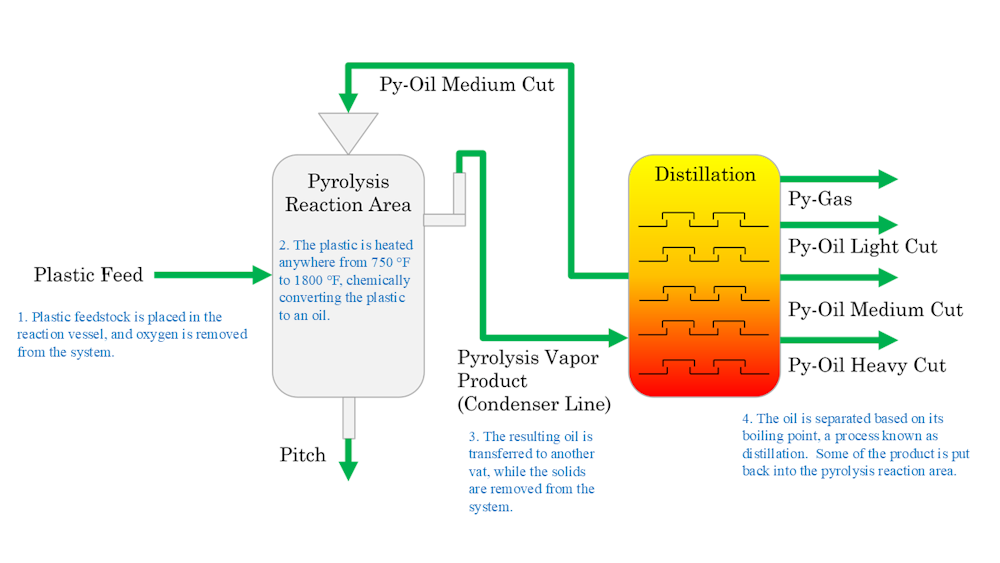
    Plastic pyrolysis is a chemical process that involves chemically breaking down plastics into other molecules by heating the plastics to extremely high temperatures in the absence of oxygen.

    Plastics are fed into the pyrolysis reactor, where they get hot and turn to oil. The oil moves to another vat where it’s boiled and distilled.
    Alexander Kaplitz and Kevin A. Schug

    Unlike traditional plastic recycling, pyrolysis theoretically isn’t limited to specific types of plastic. It could be made to accommodate many of them, although current technology is limited to a few types – polyethylene and polypropylene, used in food containers and bottles – at an industrial scale.

    So, plastic pyrolysis could help handle the waste from consumer products such as plastic bags, bottles, milk jugs, packaging materials, wet wipes and even discarded children’s toys. Pyrolysis can also handle more complex plastic waste such as tires and discarded electronics, although solid waste handlers and recyclers avoid certain plastic types in pyrolysis, such as polyvinyl chloride – or PVC, which is found in pipes and roofing products – and polystyrene, used in packaging, as these can create harmful byproducts.

    During pyrolysis, the plastic polymers are broken down into smaller molecules, resulting in the production of liquid oil, fuel source gases such as methane, propane and butane, and char.

    Char is the solid residue left at the end of the pyrolysis process. It can be used as a carbon-rich material for various applications, including adding it to soil to make it healthier for farming, as it increases soil moisture and pH, benefiting nutrient absorption. Char also has the ability to absorb harmful carbon gases from the air, which can help prevent climate change.

    The main downside of char is if it’s used too much it can increase soil alkalinity, which may hinder plant growth.

    Plastic pyrolysis uses heat to break down plastic, with the intent to convert plastic waste into usable materials.

    How pyrolosis works

    The plastic pyrolysis process typically involves several key steps.

    In the first step of pyrolysis, community recyclers collect the plastic waste and clean it to remove any contaminants. The plastic then gets shredded into smaller pieces to facilitate the pyrolysis process. Unlike traditional recycling, it needs only minimal sorting.

    Chemical recyclers operating pyrolysis plants feed the shredded plastic into a pyrolysis reactor, where they heat it to temperatures ranging from 600 to 1,600 degrees Fahrenheit (315 to 871 degrees Celsius). Without oxygen, plastics in the reactor don’t catch fire and emit fumes into the air. Instead, this high-temperature environment causes the plastic polymers to break down into smaller hydrocarbon molecules. These smaller molecules can be further refined.

    The high temperature turns some molecules into vapors, which condense into liquid oil. Chemical companies can further refine this oil to be used as fuel or as a raw material to make other chemicals or plastics.

    In addition to liquid oil, the pyrolysis process generates natural gases, such as methane, ethane, butane and propane. Pyrolysis operators then capture these gases, and they can sometimes use them as a source of energy to power the pyrolysis reactor or other industrial processes.

    Plastic pyrolysis generates oil, which engineers can use to create new materials or fuels.
    BASF, CC BY-NC-ND

    Benefits of pyrolysis

    When done effectively, plastic pyrolysis offers several benefits.

    By expanding recycling beyond just plastic bottles and milk jugs, pyrolysis could reduce the amount of plastic waste pollution that ends up in landfills and oceans.

    Additionally, converting plastic waste into usable products could help lower the production demand for new plastics from petroleum hydrocarbons. The byproducts could get used in recycled plastics.

    Some researchers are also testing pyrolysis oils to see whether they can use them instead of gasoline to fuel vehicles. The gases produced during pyrolysis can even generate energy that fuels the pyrolysis reactor, making the process more self-sustaining and reducing the need for external energy sources.

    Currently, about 15% to 20% of the pyrolysis products are recycled into new propylene and ethylene, while most – about 80% to 85% – becomes diesel fuel, hydrogen, methane and other chemicals.

    While plastic pyrolysis holds some promise, it also faces challenges. The cost of setting up and operating pyrolysis plants is high. How profitable the process is depends on the availability of suitable plastic waste, the market demand for the oils and gases produced, and the costs of energy and staff necessary to operate the reactor.

    Another issue is quality control. Most plastic types can undergo pyrolysis, but different plastics create oils with different chemical makeups. Scientists will need to understand the composition of these oils before industry can determine which plastic types to focus on and how each oil could create new materials.

    Pyrolysis oils have unique chemical compositions depending on the type of plastics used to create them.
    Alexander Kaplitz and Kevin A. Schug

    Researchers like us at The University of Texas at Arlington and our international colleagues are studying new chromatography-based oil-separation techniques that can successfully identify some types of pyrolysis oils. Chromatography is the process of separating components in a mixture by passing them through a stiff material.

    Different components in the mixture are attracted to this material to different degrees. So, they exit the chromatography system at different times, which separates them from one another.

    With more research into the technique’s efficiency and technological advancements to scale up pyrolysis, this technique could be one part of a sustainable solution to plastic waste management. In the meantime, pyrolysis is being used now, with one report estimating the market for pyrolysis plants at US$40 billion in 2024 and predicting it to grow to $1.2 billion by 2033.

    Kevin A. Schug receives funding from the National Science Foundation, the National Institutes for Health, ExxonMobil, and Weaver Consultants Group. He is affiliated with VUV Analytics, Inc. and Infinity Water Solutions as a member of their scientific advisory boards. Lummus Technology, LLC provided the funding for research on plastic waste pyrolysis oils at UT Arlington.

    Alexander Kaplitz does not work for, consult, own shares in or receive funding from any company or organization that would benefit from this article, and has disclosed no relevant affiliations beyond their academic appointment.

    ref. Plastic pyrolysis − chemists explain a technique attempting to tackle plastic waste by bringing the heat – https://theconversation.com/plastic-pyrolysis-chemists-explain-a-technique-attempting-to-tackle-plastic-waste-by-bringing-the-heat-234453

    MIL OSI – Global Reports

  • MIL-OSI Canada: Government of Yukon and Yukon Medical Association entering negotiations on next Memorandum of Understanding

    Source: Government of Canada regional news

    Government of Yukon and Yukon Medical Association entering negotiations on next Memorandum of Understanding
    jlutz
    March 17, 2025 – 11:45 am

    The Government of Yukon and the Yukon Medical Association (YMA) will soon begin negotiations for a new Memorandum of Understanding (MOU), reaffirming their commitment to collaboration and strengthening the sustainability of the Yukon’s health care system.

    The negotiations will focus on key priorities, including improving access to quality health care services across the territory, representational rights for physicians and any necessary legislative changes and ensuring fair and sustainable compensation. These discussions will also support broader system sustainability efforts, such as recruiting and retaining physicians, making it easier for Yukoners to find a family doctor and strengthening team-based care so people can see the right health care provider when they need it.

    These negotiations will also help align future agreements with the shift towards a territorial health authority, called Shäw Kwä’ą / Health and Wellness Yukon / Santé et mieux-être Yukon. This includes reducing administrative burdens for both physicians and government, ensuring health care information is accurate and reliable across the system and ensuring initiatives support the recommendations outlined in the Putting People First report.

    The Yukon Medical Association and the Government of Yukon have agreed the current MOU will remain in effect beyond March 31, 2025, until a new agreement is negotiated and ratified. The current MOU has contributed to improving equity in health care services and enhancing physician supports in the territory.

    The Government of Yukon is looking forward to beginning negotiations with the Yukon Medical Association. We are pleased to have a negotiating mandate that provides an opportunity to strengthen our partnership and advance key priorities, including representational rights and necessary legislative changes, to ensure a strong, accessible and sustainable health care system for all Yukoners.

    Minister of Health and Social Services Tracy-Anne McPhee

    The Yukon Medical Association looks forward to collaborating with the Government of Yukon to establish a new Memorandum of Understanding. By working together, we can prioritize improving access and attachment to family doctors, ensure sustainability of medical services and achieve equity across payment models. The YMA is confident that supporting representational rights will advance these priorities and improve medical care for Yukoners during the transformation of our health care system.

    President of the Yukon Medical Association Dr. Derek Bryant

    Quick facts

    • The Yukon Medical Association represents physicians across the territory, advocating for professional standards and the delivery of quality health care.

    • The current three-year Memorandum of Understanding, in effect from April 1, 2022, to March 31, 2025, includes initiatives such as the Attachment and Attraction Program, Equity, Diversity and Inclusion Learning Program and commitments to collaborative maternity and early years care.

    • The upcoming negotiations will focus on issues such as sustainable health care service delivery, representational rights and necessary legislative changes, and fee structures.

    Media contact

    Laura Seeley
    Cabinet Communications
    867-332-7627
    laura.seeley@yukon.ca

    Nigel Allan
    Communications, Health and Social Services
    867-332-9576
    nigel.allan@yukon.ca

    News release #:

    25-117

    Related information:

    Yukon Medical Association
    Shäw Kwä’ą / Health and Wellness Yukon / Santé et mieux-être Yukon

    MIL OSI Canada News

  • MIL-OSI United Kingdom: Biggest shake up to welfare system in a generation to get Britain working

    Source: United Kingdom – Executive Government & Departments 2

    Press release

    Biggest shake up to welfare system in a generation to get Britain working

    Largest welfare reforms for a generation to help sick and disabled people who can and have the potential to work into jobs – backed by a £1 billion investment, unveiled by the Work & Pensions Secretary today [Tuesday 18 March]. 

    • Work Capability Assessment to be scrapped and “right to try” work guarantee to be introduced in drive to tear down barriers to work
    • Changes will unlock work, boost employment, and tackle the broken benefits system to unlock growth as part of the government’s Plan for Change

    Record £1 billion employment support measures announced to help disabled and long-term sick people back into work.

    The new measures are designed to ensure a welfare system that is fit for purpose and available for future generations – opening up employment opportunities, boosting economic growth and tackling the spiralling benefits bill, while also ensuring those who cannot work get the support they need as part of the government’s Plan for Change.

    This will end years of inaction, which has led to one in eight young people not currently in work, education or training and 2.8 million people economically inactive due to long term sickness – one of the highest rates in the G7. 

    The number of people receiving one of the main types of health and disability benefit, Personal Independence Payments (PIP), has also risen rapidly and is becoming unsustainable. 

    Since the pandemic, the number of working-age people receiving PIP has more than doubled from 15,300 to 35,100 a month. The number of young people (16-24) receiving PIP per month has also skyrocketed from 2,967 to 7,857 a month. Over the next five years, if no action is taken, the number of working age people claiming PIP is expected to increase from 2 million in 2021 to 4.3 million, costing £34.1 billion annually. 

    All this has driven the spiralling health and disability benefits bill, forecast to reach £70 billion a year by the end of the decade, or more than £1 billion a week. This is equivalent to more than a third of the NHS budget, and more than three times as much as is spent on policing and keeping communities safe.

    Speaking in Parliament today, Liz Kendall announced a sweeping package of reforms to overhaul the system, so it better supports those who need it while tearing down barriers to work including:

    Ending reassessments for disabled people who will never be able to work and people with lifelong conditions to ensure they can live with dignity and security

    Scrapping the controversial Work Capability Assessment to end the dysfunctional process that drives people into dependency – delivering on the government’s manifesto commitment to reform or replace it

    Providing improved employment support backed by £1 billion – one of the biggest packages of employment support for sick and disabled people ever – including new tailored support conversations for people on health and disability benefits to break down barriers and unlock work

    Legislating to protect those on health and disability benefits from reassessment or losing their payments if they take a chance on work. 

    To ensure the welfare system is available for those with the greatest needs now and long into the future, the government has made bold decisions to improve its sustainability and protect those who need it most, including:

    • Reintroducing reassessments for people on incapacity benefits who have the capability to work to ensure they have the right support and aren’t indefinitely written off.
    • Targeting Personal Independence Payments for those with higher needs by changing the eligibility requirement to a minimum score of four on at least one of the daily living activities to receive the daily living element of the benefit, in addition to the existing eligibility criteria.
    • Rebalancing payment levels in Universal Credit to improve the Standard Allowance. Raising it above inflation by 2029/30, adding £775 annually in cash terms.
    • Consulting on delaying access to the health element of Universal Credit until someone is aged 22 and reinvesting savings into work support and training opportunities through the Youth Guarantee.

    Prime Minister Keir Starmer said:

    We inherited a fundamentally broken welfare system from the previous government. It does not work for the people it is supposed to support, businesses who need workers or taxpayers who foot the bill.

    This government will always protect the most severely disabled people to live with dignity. But we’re not prepared to stand back and do nothing while millions of people – especially young people – who have potential to work and live independent lives, instead become trapped out of work and abandoned by the system. It would be morally bankrupt to let their life chances waste away. 

    When I talk about opportunity for all, I mean it. That’s why we are bringing forward the biggest changes to the welfare system in a generation and improving support for those who need it. Ensuring those who can work do work is not only right, but it will also improve living standards and drive growth, the number one priority in our Plan for Change.

    Work and Pensions Secretary Liz Kendall said:

    Our social security system must be there for all of us when we need it, now and into the future. That means helping people who can work to do so, protecting those most in need, and delivering respect and dignity for all. 

    Millions of people have been locked out of work, and we can do better for them. Disabled people and those with health conditions who can work deserve the same choices and chances as everyone else.

    That’s why we’re introducing the most far-reaching reforms in a generation, with £1 billion a year being invested in tailored support that can be adapted to meet their changing circumstances – including their changing health – while also scrapping the failed Work Capability Assessment.

    This will mean fairness for disabled people and those with long term health conditions, but also for the taxpayers who fund it as these measures bring down the benefits bill. 

    At the same time, we will ensure that our welfare system protects people. There will always be some people who cannot work because of their disability or health condition. Protecting people in need is a principle we will never compromise on.

    In her statement to Parliament, the Work and Pensions Secretary outlined the clear case for change to the welfare system and set out her commitment to ensuring that disabled people and those with a health condition have the same opportunities to work as anyone else.

    In particular, she highlighted that the UK has one of the highest reported rates of working-age people out of work due to ill health in Western Europe and the UK is the only major economy whose employment rate hasn’t recovered since the pandemic – exacerbated by a broken NHS with millions of people on waiting lists. 

    The government has already made huge progress to fix the NHS, including by hitting the manifesto commitment to deliver over two million extra elective care appointments seven months early, and bringing forward a wider programme for NHS reform through the rollout of community diagnostic centres and 10-year plan. The Health Secretary has also sent crack teams spearheaded by top clinicians into areas of high economic inactivity, and the latest data shows waiting lists in these areas have reduced at almost double the rate of the rest of the country. 

    The reformed system will be built on a straightforward guarantee: any disabled person or person with a long-term health condition who is claiming out of work benefits will be able to access high quality, tailored help into a job. It will also mean that those who cannot work will always get the support they need. In Scotland and Wales, we will work closely with the devolved governments as we develop this package of support.

    The reforms are based on five key principles:

    Protecting disabled people who can’t and won’t ever be able to work and supporting them to live with dignity by:

    • Income Protection: Those currently in receipt of UC health will benefit from the increased standard allowance and will not be affected by plans to reduce UC health in future. 
    • Extra Financial Support: For people who receive the new rate of UC health in the future system, we are proposing a new premium for individuals with severe, life-long health conditions who will never be able to work. The details, eligibility criteria and rate of this premium will be set out in due course.
    • Ending Reassessments: Reassessments for disabled people and people with life-long conditions who will never be able to work will be scrapped.
    • Improving Safeguarding Practices: The government will look at how safeguarding practices for the most vulnerable can be improved and improve experiences with the system, working with stakeholders to identify areas for improvement. 

    Delivering better and more tailored employment support to get more people off welfare and into work. This includes: 

    • £1 Billion employment package to deliver tailored support for disabled people and those with long-term conditions.
    • New Support Conversations to provide earlier opportunities for people with health conditions to discuss work goals and available help.
    • Investing in the Youth Guarantee by delaying access to UC health element until age 22 and reinvesting savings into work support and training for young people.

    Stopping people from falling into long-term economic inactivity through early intervention and support by:

    • Access to Work Scheme: We will consult on improvements to help people start and stay in work with reasonable adjustments including aids, appliances and assistive technology. These would be the first substantive changes to Access to Work since its introduction in 1994
    • Unemployment Insurance: We will reform contributory benefits (ESA and JSA) into a single, non-means tested, time-limited benefit for those who have paid into the system to ensure people get the support they need to find a new job that makes the most of their skills, contributing to a dynamic and productive economy.

    Restoring trust and fairness in the system by fixing the broken assessment process that drives people into dependency on welfare by:

    • Scrapping the WCA to end the labelling of people as either ‘can or can’t work’ and consulting on a new single assessment. Under the new system, any extra financial support for health conditions (including PIP, ESA or UC health) will be assessed via a new single assessment which will be based on the PIP assessment – considering on the impact of disability on daily living, not on capacity to work.
    • Increasing Face-to-Face Assessments for PIP and the WCA to improve the quality of assessment decision while ensuring we continue to meet the needs of those with who may require a different method of assessment.
    • Longer term reform of the PIP Assessment – In the long term we will set out broader reforms to the PIP assessment, and intend first to carry out a review involving experts and stakeholders to adapt and improve it.
    • Right to Try Guarantee: which will ensure someone trying work or on a pathway towards employment will never lead to an immediate reassessment or award review.
    • Restarting Mandatory Reassessments: We will reintroduce reassessments for incapacity benefits, with exceptions for those who will never work and those under special rules for end-of-life care. Reassessments have largely been switched off since 2021, leaving people stuck on benefits when they could be helped into work and to improve their quality of life.

    Ensuring the system is financially sustainable to keep providing for those who need it most by:

    • Changing PIP Eligibility:  PIP will be targeted more on those with higher needs by requiring a minimum of four points on one daily living activity, in addition to the existing eligibility criteria.. DWP will work with DHSC to ensure that existing people who claim PIP who may no longer be entitled to the benefit following an award review under new eligibility rules have their health and eligible care needs met. The government is consulting on how best to achieve this.

    • Rebalancing Universal Credit: by improving the Standard Allowance to provide more adequate support. The government plans to raise the Standard Allowance above inflation by 2029/30, adding £775 in cash terms annually. This aims to avoid people having to choose between employment or adequate financial support. This change addresses the current issue where the health element rate is double that of the standard allowance, creating an incentive for people to prove they are unfit to work to claim the health element and access greater financial support.

    Further Information

    • This is a significant reform package that is expected to save over £5 billion in 2029 to 2030. The government will publish OBR-certified costings of individual measures at the Spring Statement on 26 March. 
    • The UC standard allowance increase of £775 per year is for a single person aged 25 or over. Equivalent percentage increases will be applied to the standard allowances of couples and those aged under 25.
    • This consultation applies to England, Wales and Scotland. Note that the proposals in the consultation will only apply to the UK Government’s areas of responsibility in Scotland and Wales.
    • We will bring forward primary legislation this session to enable delivery of the PIP additional eligibility requirement and UC rebalancing reforms from 26/27, subject to parliamentary approval. The Right to Work Guarantee will be delivered through separate primary legislation which will be introduced in due course. 
    • In Scotland, some elements of support for disabled people and people with health conditions remain reserved (for example, the health element in UC) and some have been devolved to the Scottish Government (for example PIP and DLA). The proposals in this paper would only apply directly to UK Government areas of responsibility in Scotland. The interactions between the reserved and devolved systems will need to be fully considered before they are implemented.

    • DWP and the Scottish Government both have powers to provide different types of employment support in Scotland. Some elements of our employment support offer will apply across Great Britain. We will respect the Scottish Government’s devolved powers in relation to skills, health and employment support and work with the Scottish Government as we work through the details of the package and what this will mean in terms of additional funding and delivery in Scotland.

    • In Wales, DWP is responsible for social security and employment support. Welsh Ministers also have powers to provide employment support outside Jobcentre Plus. Some elements of our employment support offer will apply across Great Britain. We will respect the Welsh Government’s devolved powers in relation to skills, health and employment support and work with the Welsh Government as we work through the details of the package and what this will mean in terms of additional funding and delivery in Wales.

    • Social security and employment support are transferred in Northern Ireland, although the UK government and the Northern Ireland Executive work closely together to maintain parity between their respective social security systems. However, the consultation welcomes comments from individuals and organisations in Northern Ireland, which will then be shared with the Department for Communities in Northern Ireland.

    Updates to this page

    Published 18 March 2025

    MIL OSI United Kingdom

  • MIL-OSI Global: Surf therapy for children with disabilities: how it’s changing lives in South Africa

    Source: The Conversation – Africa – By Roxy Davis, Doctor of philosophy, University of Cape Town

    Children with disabilities face significant challenges in South Africa. Firstly there are delayed diagnoses which can lead to complications. The high cost of healthcare and little financial support for their families can limit their access to healthcare services altogether.

    There is also little access to rehabilitation services. Inadequate facilities and a shortage of trained personnel are just some of the obstacles.

    I started thinking about ways to get over these obstacles when I noticed that people with disabilities weren’t well represented in my sport.

    As a competitive surfer and instructor, I had always celebrated the ocean’s ability to inspire confidence and resilience.

    Every day, the beach was alive with activity – surfers, families and ocean lovers. Yet among them, I rarely saw people with disabilities in the water.

    I began to notice that the beachfront itself, the infrastructure, the culture, and even my own surf school, weren’t actively creating space for inclusivity.

    This would eventually become the cornerstone of the Roxy Davis Foundation, established in 2019, and later my doctoral research focusing on ocean-based therapy for children with disabilities.

    I found surf therapy enhanced the mental, emotional, and physical well-being of these children.

    New therapy

    Surf therapy teaches people with disabilities to surf to promote psychological, physical and psychosocial well-being.

    The first peer reviewed publication on surf therapy appeared in 2010 and focused on Aboriginal children in Australia. It was about mitigating the inter-generational trauma suffered as a result of the government-sanctioned removal of Aboriginal children from their families, a policy that only ended in the 1970s.

    In 2020 a review of a 10-year period included 29 studies into war veterans and young adult cancer survivors, among others.

    One such study focused on children with autism spectrum disorder. The study took place in the north-west of Ireland. Children said they felt happier and free, while their parents said they were more relaxed and confident.

    A South African study with children with autism spectrum disorder explored the feasibility and unique benefits of an existing surf therapy programme and reported largely positive results.

    My own research involved an adapted surf therapy programme for children with a range of disabilities.

    Five children aged between 12 and 16 were enrolled. Altogether there were 35 participants including parents, counsellors, volunteers, physiotherapists and surf instructors.

    Four of the five children were from under-resourced communities in South Africa’s Western Cape province and all had either a physical, sensory, intellectual or cognitive impairment.

    None of the children had taken part in ocean sports before.

    Getting into the water

    For six weeks the children took part in a three-hour surf therapy session on a Friday afternoon.

    The first goal was to get the kids in the water. We used mobility mats, surfboards with handles and amphibious beach wheelchairs to help.

    Each child was taught now to surf according to their pace of learning and ability.

    There was also a “surfers’ circle” with a discussion topic for each session.

    After six weeks we conducted follow-up interviews to see what changes the children had experienced, and if these had any influence on their lives outside surfing.

    We also asked parents and counsellors to identify the most significant changes in the children.

    ‘I felt free and confident’

    Final interviews were completed one year later.

    Charlie, aged 12, with cerebral palsy: “If my brothers want to go surfing I don’t have to stay behind and just watch them, I can go surf with them. It is so cool to surf with my dad and my brothers.”

    Charlie’s teacher: “His self-awareness level and how he sees himself in the world has really improved.”

    Tala, aged 15, with cerebal palsy: “Once I started surfing, I felt free and confident. Even in other spaces, when I’m not surfing, like, ‘Yeah I can surf, I can do something like surfing that I didn’t know that I could do before.’ ”

    Tala’s school psychologist: “She went into this feeling very insecure, nervous and anxious. She said she will always remember who she was and how she felt before she went to the programme and how she came out of it … to be able to use that feeling and apply it to a different situation, that’s huge for her.”

    Princess, aged 15, with spina bifida: was determined to “wean” herself off using nappies after gaining confidence through surf therapy.

    Princess’s guardian described her experience as similar to “winning a gold medal … She was more confident in herself than ever. She is off that nappy completely now.”

    Thabo, aged 14, a leg amputee: “Before session one, I was feeling nervous and excited, but as soon as I got in the sea, the nerves disappeared. You look and realise you can actually do that. I feel like I belong in the ocean.”

    After the final session he said: “I can relax, I can be in control of my urges and my temper. I’m now not always thinking about what people think about me. I can be myself in many ways.”

    Rowan, aged 15, a quadruple amputee: “Before I started surfing, I was thinking I can’t do it until I tried it and just being there was like beyond being able to speak in my wildest dreams. I couldn’t believe I could surf in the ocean riding some waves.

    “On my first session, I was like ‘If I can do it, I can do it for the rest of my life’.”

    In his second interview he said: “My goal is to become a national champion and to become a Paralympic champion.”

    One year after the surf therapy programme he entered a provincial parasurfing competition, which he won. He was then selected to participate in the South African Para Surfing Championships in 2022, where he came second. Later that year he was selected to represent South Africa at the World Para Surfing Championships in California. Nineteen months after starting surfing, in December, on his 16th birthday, he competed in the World Championships and was placed 17th.

    Surf therapy demonstrates what’s possible when we focus on ability rather than limitation.

    Roxy Davis is affiliated with the Roxy Davis Foundation.

    ref. Surf therapy for children with disabilities: how it’s changing lives in South Africa – https://theconversation.com/surf-therapy-for-children-with-disabilities-how-its-changing-lives-in-south-africa-245290

    MIL OSI – Global Reports

  • MIL-OSI: LPL Welcomes Legacy Premier Wealth Management

    Source: GlobeNewswire (MIL-OSI)

    SAN DIEGO, March 18, 2025 (GLOBE NEWSWIRE) — LPL Financial LLC announced today that financial advisors Larry Hubbard, APMA™, Craig Conner, CFP®, APMA™, ChFC®, BFA™, and Jade Maasch, CFP®, BFA™, APMA™, have joined LPL Financial’s broker-dealer, Registered Investment Advisor (RIA) and custodial platforms. They reported serving approximately $275 million in advisory, brokerage and retirement plan assets* and join LPL from Ameriprise.

    The advisors are longtime colleagues who teamed up to create a full-service wealth management firm dedicated to helping motivated clients understand their entire financial picture. Formerly Alliance Financial Partners, the team has rebranded as Legacy Premier Wealth Management with the move to LPL. They are based out of Greeley, Colo., and Cheyenne, Wyo., and are supported by Chief Operating Officer Rob Timme.

    “We’re passionate about helping create a lasting legacy for our clients and their families,” Hubbard said. “Our mission is to educate and empower our clients, helping them navigate financial decisions with confidence.”

    As the team continued to evolve, the advisors sought a new firm that would best support their vision for the future. Their due diligence process led them to LPL.

    “By making this move, we have the flexibility to grow the practice in a way that will be seamless and non-disruptive for clients and our staff,” Hubbard said. “LPL does not offer proprietary investment products, which allows us to provide the products and services our clients need. Additionally, we appreciate LPL’s size and scale, along with its integrated, open architecture platform where we can access everything we need with a single sign-on.”

    The team is committed to building long-term relationships with both clients and their communities. They actively volunteer with United Way of Weld County, Kiwanis, Muley Fanatic Foundation, Michael Ray Lee Foundation, Rocky Mountain Elk Foundation and American Cancer Society.

    Scott Posner, LPL Executive Vice President, Business Development, said, “We welcome Larry, Craig and Jade to the LPL community and congratulate them on the launch of Legacy Premier Wealth Management. Advisors who join LPL have access to dedicated support teams and integrated capabilities that allow them to run high-performing practices, maintain operational efficiency and focus on their clients. We look forward to supporting the entire Legacy team for years to come.”

    Related

    Advisors, learn how LPL Financial can help take your business to the next level.

    About LPL Financial

    LPL Financial Holdings Inc. (Nasdaq: LPLA) is among the fastest growing wealth management firms in the U.S. As a leader in the financial advisor-mediated marketplace, LPL supports nearly 29,000 financial advisors and the wealth management practices of approximately 1,200 financial institutions, servicing and custodying approximately $1.7 trillion in brokerage and advisory assets on behalf of approximately 6 million Americans. The firm provides a wide range of advisor affiliation models, investment solutions, fintech tools and practice management services, ensuring that advisors and institutions have the flexibility to choose the business model, services, and technology resources they need to run thriving businesses. For further information about LPL, please visit www.lpl.com.

    Securities and advisory services offered through LPL Financial LLC (“LPL Financial”), a registered investment advisor and broker-dealer, member FINRA/SIPC. Legacy Premier Wealth Management and LPL are separate entities.

    Throughout this communication, the terms “financial advisors” and “advisors” are used to refer to registered representatives and/or investment advisor representatives affiliated with LPL Financial.

    We routinely disclose information that may be important to shareholders in the “Investor Relations” or “Press Releases” section of our website.

    *Value approximated as reported to LPL

    Media Contact: 
    Media.relations@LPLFinancial.com 

    Tracking #707704

    The MIL Network

  • MIL-OSI United Kingdom: Council cash boost welcomed for Health and Social Care partnership

    Source: Scotland – City of Aberdeen

    Aberdeen City Council’s budget approval of an additional £9.536 million in funding for the city’s Health and Social Care partnership was welcomed at today’s (Tuesday 18 March) meeting of the Integration Joint Board (IJB),

    The additional funding agreed at the Council’s Budget meeting on 5 March brings the local authority’s investment in the IJB to £140m for the coming 12 months and helps the Partnership balance its 2025/26 budget, deliver frontline services and transform its operations.  

    Councillor Alex McLellan, the Council’s Finance and Resources Convener, said: “Aberdeen City Council’s 2025/26 budget allocated a record £140 million, including an additional £9.5 million to protect services, to the Aberdeen City Health and Social Care Partnership to deliver health and social care services on behalf of the Council.”

    “These additional funds have ensured vital services, which are provided to some of the most vulnerable people in Aberdeen, by the Aberdeen City Health and Social Partnership are protected.   

    “There is clearly a need for the Integration Joint Board to go through a period of transformation, to reduce spend, embrace digital technology and find efficiencies but this approach needs to be a compassionate one and through a period of transition.” 

    MIL OSI United Kingdom

  • MIL-OSI: Alto Ingredients, Inc. Directors to Not Stand for Reelection

    Source: GlobeNewswire (MIL-OSI)

    PEKIN, Ill., March 18, 2025 (GLOBE NEWSWIRE) — Alto Ingredients, Inc. (NASDAQ: ALTO), a leading producer and distributor of specialty alcohols, renewable fuels and essential ingredients, today announced that two long-standing directors, Douglas L. Kieta and Michael D. Kandris, have decided they will not stand for reelection to the Alto Ingredients Board of Directors at the company’s 2025 Annual Meeting of Stockholders, scheduled for June 25, 2025.

    Bryon McGregor, President and Chief Executive Officer of Alto Ingredients said “Doug and Mike have been exceptional board members, and they have provided excellent service to the company and our stockholders. Doug’s depth and breadth of experience, intellectual curiosity, technical acumen, and unwavering determination has been pivotal to the many improvements and successes at Alto. Mike’s dedication to excellence as a board member, his sound leadership as Chief Operating Officer and CEO, and personal approach will leave an enduring positive impact on Alto’s culture and employees. On behalf of everyone at Alto Ingredients, I want to extend a heartfelt thanks to Doug and Mike for their remarkable years of service.”

    About Alto Ingredients, Inc.
    Alto Ingredients, Inc. (NASDAQ: ALTO) is a leading producer and distributor of specialty alcohols, renewable fuels and essential ingredients. Leveraging the unique qualities of its facilities, the company serves customers in a wide range of consumer and commercial products in the Health, Home & Beauty; Food & Beverage; Industry & Agriculture; Essential Ingredients; and Renewable Fuels markets. For more information, please visit www.altoingredients.com.

    Safe Harbor Statement under the Private Securities Litigation Reform Act of 1995
    Statements and information contained in this communication that refer to or include Alto Ingredients’ estimated or anticipated future results or other non-historical expressions of fact are forward-looking statements that reflect Alto Ingredients’ current perspective of existing trends and information as of the date of the communication. Forward-looking statements generally will be accompanied by words such as “anticipate,” “believe,” “plan,” “could,” “should,” “estimate,” “expect,” “forecast,” “outlook,” “guidance,” “intend,” “may,” “might,” “will,” “possible,” “potential,” “predict,” “project,” or other similar words, phrases or expressions. Such forward-looking statements include, but are not limited to, statements concerning Alto Ingredients’ projected outlook and future performance, including the timing and effects of its cost savings initiatives and its acquisition of a liquid carbon dioxide processor adjacent to its Columbia plant; Alto Ingredients’ capital projects, including its carbon capture and storage (CCS) project and opportunities to optimize carbon; and Alto Ingredients’ other plans, objectives, expectations and intentions. It is important to note that Alto Ingredients’ plans, objectives, expectations and intentions are not predictions of actual performance. Actual results may differ materially from Alto Ingredients’ current expectations depending upon a number of factors affecting Alto Ingredients’ business and plans. These factors include, among others adverse economic and market conditions, including for renewable fuels, specialty alcohols and essential ingredients; export conditions and international demand for the company’s products; fluctuations in the price of and demand for oil and gasoline; raw material costs, including production input costs, such as corn and natural gas; adverse impacts of inflation and supply chain constraints; and the cost, ability to fund, timing and effects of, including the financial and other results deriving from, Alto Ingredients’ repair and maintenance programs, plant improvements and other capital projects, including CCS, and other business initiatives and strategies. These factors also include, among others, the inherent uncertainty associated with financial and other projections and large-scale capital projects, including CCS; the anticipated size of the markets and continued demand for Alto Ingredients’ products; the impact of competitive products and pricing; the risks and uncertainties normally incident to the alcohol production, marketing and distribution industries; changes in generally accepted accounting principles; successful compliance with governmental regulations applicable to Alto Ingredients’ facilities, products and/or businesses; changes in laws, regulations and governmental policies, including with respect to the Inflation Reduction Act’s tax and other benefits Alto Ingredients expects to derive from CCS; the loss of key senior management or staff; and other events, factors and risks previously and from time to time disclosed in Alto Ingredients’ filings with the Securities and Exchange Commission including, specifically, those factors set forth in the “Risk Factors” section contained in Alto Ingredients’ Quarterly Report on Form 10-K filed with the Securities and Exchange Commission on March 13, 2025.

    Company IR and Media Contact:
    Michael Kramer, Alto Ingredients, Inc., 916-403-2755
    Investorrelations@altoingredients.com

    IR Agency Contact:
    Kirsten Chapman, Alliance Advisors Investor Relations, 415-433-3777
    altoinvestor@allianceadvisors.com

    The MIL Network

  • MIL-OSI: Liquidia Corporation Strengthens Financial Position by Amending HealthCare Royalty Agreement to Incrementally Add Up to $100 Million

    Source: GlobeNewswire (MIL-OSI)

    MORRISVILLE, N.C., March 18, 2025 (GLOBE NEWSWIRE) — Liquidia Corporation (NASDAQ: LQDA), a biopharmaceutical company developing innovative therapies for patients with rare cardiopulmonary disease, today announced that it has entered into a sixth amendment to its agreement with HealthCare Royalty (“HCRx”) to provide for up to an additional $100 million of financing in three tranches (the “Sixth Amendment”), subject to certain closing conditions including the funding conditions discussed below. Liquidia intends to use the proceeds to fund ongoing commercial development of YUTREPIA™ (treprostinil) inhalation powder for the potential treatment of pulmonary arterial hypertension (PAH) and pulmonary hypertension associated with interstitial lung disease (PH-ILD), continued development of YUTREPIA in other clinical trials, including but not limited to trials for pediatric patients and trials further evaluating the use of YUTREPIA in WHO Group 1 and WHO Group 3 patients, clinical development of L606 and for general corporate purposes.

    Under the terms of the Sixth Amendment, Liquidia will receive $25.0 million at closing with the potential to receive two additional tranches of funding: $50.0 million upon the first commercial sale of YUTREPIA following receipt of final FDA approval for the treatment of PAH and PH-ILD, so long as no injunction has been issued prohibiting Liquidia from commercializing YUTREPIA for either or both of PAH and PH-ILD, and $25.0 million upon the mutual agreement of the parties after achieving aggregate net sales of YUTREPIA in excess of $100 million at any time on or prior to June 30, 2026.

    Michael Kaseta, Liquidia’s Chief Financial Officer and Chief Operating Officer, said: “We appreciate the trust and commitment demonstrated by HCRx during the past several years. We are optimistic that the combination of the proceeds resulting from the Sixth Amendment, and a successful launch of YUTREPIA following the expiration of regulatory exclusivity in May 2025, could lead to Liquidia reaching profitability without the need for additional capital.”

    Clarke Futch, Chairman and Chief Executive Officer of HCRx added: “We continue to look forward to Liquidia’s potential receipt of final FDA approval of YUTREPIA. We strongly believe in YUTREPIA’s ability to address unmet medical needs in patients with PAH and PH-ILD, and we are eager for patients to have access to a new therapeutic option that has demonstrated great clinical promise.” 

    As consideration for the additional $25.0 million funded at closing, Liquidia has agreed to a fixed payment schedule that terminates in 2032. Payments on the last two tranches, when funded, would also follow a fixed payment schedule. The aggregate payments to HCRx are capped at 175% of the total amounts advanced by HCRx, but also include a potential true-up payment to be made by Liquidia if HCRx’s internal rate of return is less than a minimum rate of return on the date the cap is reached. The minimum rates of return for the three new tranches are 16%, 13% and 12%, respectively.

    About Liquidia Corporation
    Liquidia Corporation is a biopharmaceutical company developing innovative therapies for patients with rare cardiopulmonary disease. The company’s current focus spans the development and commercialization of products in pulmonary hypertension and other applications of its proprietary PRINT® Technology. PRINT enabled the creation of Liquidia’s lead candidate, YUTREPIA™ (treprostinil) inhalation powder, an investigational drug for the treatment of pulmonary arterial hypertension (PAH) and pulmonary hypertension associated with interstitial lung disease (PH-ILD). The company is also developing L606, an investigational sustained-release formulation of treprostinil administered twice-daily with a next-generation nebulizer, and currently markets generic Treprostinil Injection for the treatment of PAH. To learn more about Liquidia, please visit www.liquidia.com.

    About HealthCare Royalty
    HealthCare Royalty is a leading royalty acquisition company focused on commercial or near-commercial biopharmaceutical products. With offices in Stamford, Conn., San Francisco, Boston, London and Miami. HCRx has invested $5+ billion in over 90 biopharmaceutical products since inception. For more information, visit https://www.hcrx.com. HEALTHCARE ROYALTY® and HCRx® are registered trademarks of HealthCare Royalty Management, LLC.

    Cautionary Statements Regarding Forward-Looking Statements
    This press release may include forward-looking statements within the meaning of the Private Securities Litigation Reform Act of 1995. All statements contained in this press release other than statements of historical facts, including statements regarding our future results of operations and financial position, our strategic and financial initiatives, our business strategy and plans and our objectives for future operations, are forward-looking statements. Such forward-looking statements, including statements regarding clinical trials, clinical studies and other clinical work (including the funding therefor, anticipated patient enrollment, safety data, study data, trial outcomes, timing or associated costs), regulatory applications and related submission contents and timelines, including the potential for final FDA approval of the NDA for YUTREPIA, which may occur after the expiration of the exclusivity period of TYVASO DPI, if at all, the timelines or outcomes related to patent litigation with United Therapeutics in the U.S. District Court for the District of Delaware, litigation with United Therapeutics and FDA in the U.S. District Court for the District of Columbia or other litigation instituted by United Therapeutics or others, including rehearings or appeals of decisions in any such proceedings, the issuance of patents by the USPTO and our ability to execute on our strategic or financial initiatives, the potential for future advances by HCRx, our anticipated use of net proceeds funded under the HCR Agreement, our estimates regarding future expenses, capital requirements and needs for additional financing, and potential revenue and profitability of YUTREPIA, if approved, involve significant risks and uncertainties and actual results could differ materially from those expressed or implied herein. The favorable decisions of courts or other tribunals are not determinative of the outcome of the appeals or rehearings of the decisions. The words “anticipate,” “believe,” “contemplate,” “continue,” “could,” “estimate,” “expect,” “intend,” “may,” “might,” “plan,” “potential,” “predict,” “project,” “should,” “target,” “would,” and similar expressions are intended to identify forward-looking statements. We have based these forward-looking statements largely on our current expectations and projections about future events and financial trends that we believe may affect our financial condition, results of operations, business strategy, short-term and long-term business operations and objectives and financial needs. These forward-looking statements are subject to a number of risks discussed in our filings with the SEC, as well as a number of uncertainties and assumptions. Moreover, we operate in a very competitive and rapidly changing environment and our industry has inherent risks. New risks emerge from time to time. It is not possible for our management to predict all risks, nor can we assess the impact of all factors on our business or the extent to which any factor, or combination of factors, may cause actual results to differ materially from those contained in any forward-looking statements we may make. In light of these risks, uncertainties and assumptions, the future events discussed in this press release may not occur and actual results could differ materially and adversely from those anticipated or implied in the forward-looking statements. Nothing in this press release should be regarded as a representation by any person that these goals will be achieved, and we undertake no duty to update our goals or to update or alter any forward-looking statements, whether as a result of new information, future events or otherwise.

    Contact Information

    Investors:
    Jason Adair
    Chief Business Officer
    919.328.4350
    Jason.adair@liquidia.com

    Media:
    Patrick Wallace
    Director, Corporate Communications
    919.328.4383
    patrick.wallace@liquidia.com

    The MIL Network

  • MIL-OSI: Alto Ingredients, Inc. Enters into Letter Agreement with Bradley L. Radoff and Michael Torok

    Source: GlobeNewswire (MIL-OSI)

    PEKIN, Ill., March 18, 2025 (GLOBE NEWSWIRE) — Alto Ingredients, Inc. (NASDAQ: ALTO), a leading producer and distributor of specialty alcohols, renewable fuels and essential ingredients, today announced that it has entered into a letter agreement (the “Letter Agreement”) with Bradley L. Radoff and Michael Torok (collectively with their affiliates, the “Radoff/Torok Group”), under which the Radoff/Torok Group has agreed that during the period commencing on the date of the Letter Agreement until the date that is the earlier to occur of (i) thirty (30) days prior to the deadline for delivery of notice under the Company’s Amended and Restated Bylaws for the nomination of director candidates for election to the Board of Directors (the “Board”) at Alto Ingredients, Inc.’s (the “Company”) 2026 Annual Meeting of Stockholders (the “2026 Annual Meeting”) or (ii) one hundred twenty (120) days prior to the first anniversary of the 2025 Annual Meeting of Stockholders of the Company, currently scheduled for June 25, 2025 (the “Standstill Period”), at each annual or special meeting of the stockholders of the Company, the Radoff/Torok Group will cause all shares of the Company’s common stock beneficially owned by it in favor of all directors nominated by the Board for election and otherwise in accordance with the recommendations of the Board, and against the election of any director nominee not so recommended by the Board.

    Pursuant to the terms of the Letter Agreement, the Radoff/Torok Group has also agreed to customary standstill and other provisions. The full text of the Letter Agreement will be filed as an exhibit to a Current Report on Form 8-K with the U.S. Securities and Exchange Commission.

    About Alto Ingredients, Inc.
    Alto Ingredients, Inc. (NASDAQ: ALTO) is a leading producer and distributor of specialty alcohols, renewable fuels and essential ingredients. Leveraging the unique qualities of its facilities, the company serves customers in a wide range of consumer and commercial products in the Health, Home & Beauty; Food & Beverage; Industry & Agriculture; Essential Ingredients; and Renewable Fuels markets. For more information, please visit www.altoingredients.com.

    Safe Harbor Statement under the Private Securities Litigation Reform Act of 1995
    Statements and information contained in this communication that refer to or include Alto Ingredients’ estimated or anticipated future results or other non-historical expressions of fact are forward-looking statements that reflect Alto Ingredients’ current perspective of existing trends and information as of the date of the communication. Forward-looking statements generally will be accompanied by words such as “anticipate,” “believe,” “plan,” “could,” “should,” “estimate,” “expect,” “forecast,” “outlook,” “guidance,” “intend,” “may,” “might,” “will,” “possible,” “potential,” “predict,” “project,” or other similar words, phrases or expressions. Such forward-looking statements include, but are not limited to, statements concerning Alto Ingredients’ projected outlook and future performance, including the timing and effects of its cost savings initiatives and its acquisition of a liquid carbon dioxide processor adjacent to its Columbia plant; Alto Ingredients’ capital projects, including its carbon capture and storage (CCS) project and opportunities to optimize carbon; and Alto Ingredients’ other plans, objectives, expectations and intentions. It is important to note that Alto Ingredients’ plans, objectives, expectations and intentions are not predictions of actual performance. Actual results may differ materially from Alto Ingredients’ current expectations depending upon a number of factors affecting Alto Ingredients’ business and plans. These factors include, among others adverse economic and market conditions, including for renewable fuels, specialty alcohols and essential ingredients; export conditions and international demand for the company’s products; fluctuations in the price of and demand for oil and gasoline; raw material costs, including production input costs, such as corn and natural gas; adverse impacts of inflation and supply chain constraints; and the cost, ability to fund, timing and effects of, including the financial and other results deriving from, Alto Ingredients’ repair and maintenance programs, plant improvements and other capital projects, including CCS, and other business initiatives and strategies. These factors also include, among others, the inherent uncertainty associated with financial and other projections and large-scale capital projects, including CCS; the anticipated size of the markets and continued demand for Alto Ingredients’ products; the impact of competitive products and pricing; the risks and uncertainties normally incident to the alcohol production, marketing and distribution industries; changes in generally accepted accounting principles; successful compliance with governmental regulations applicable to Alto Ingredients’ facilities, products and/or businesses; changes in laws, regulations and governmental policies, including with respect to the Inflation Reduction Act’s tax and other benefits Alto Ingredients expects to derive from CCS; the loss of key senior management or staff; and other events, factors and risks previously and from time to time disclosed in Alto Ingredients’ filings with the Securities and Exchange Commission including, specifically, those factors set forth in the “Risk Factors” section contained in Alto Ingredients’ Quarterly Report on Form 10-K filed with the Securities and Exchange Commission on March 13, 2025.

    Company IR and Media Contact:                 
    Michael Kramer, Alto Ingredients, Inc., 916-403-2755
    Investorrelations@altoingredients.com

    IR Agency Contact:
    Kirsten Chapman, Alliance Advisors Investor Relations, 415-433-3777
    altoinvestor@allianceadvisors.com

    The MIL Network

  • MIL-OSI China: US military conducts fresh airstrikes on Yemen’s Houthi-held Red Sea port city

    Source: China State Council Information Office 3

    Demonstrators participate in a rally in Sanaa, Yemen, on March 17, 2025. On Monday, tens of thousands of people gathered in a massive rally in Sanaa, protesting against U.S. airstrikes in northern Yemen that have led to dozens of deaths. [Photo/Xinhua]

    The U.S. military launched a new wave of airstrikes on Yemen, targeting several sites in and around the Red Sea port city of Hodeidah Monday evening, Houthi-run al-Masirah TV said.

    “One airstrike targeted the Al-Arj area in Bajil district, east of the city, while another series of airstrikes hit and destroyed the Al-Habashi iron factory in the Salif district, northwest of the city,” the TV channel reported.

    Residents described the airstrikes as extremely violent with explosions heard from miles away.

    There were no immediate reports of casualties or the extent of the damage.

    On Monday, thousands of people gathered in a massive rally at Sabeen Square in the Houthi-held Yemeni capital Sanaa, protesting against U.S. airstrikes in northern Yemen that have led to dozens of deaths.

    Demonstrators, with many carrying snipers and Kalashnikov rifles, chanted slogans denouncing the administration of U.S. President Donald Trump, which ordered the airstrike campaign on Houthi targets starting Saturday evening.

    “Death to America, death to Israel,” protesters cried at the square decorated by huge billboards showing the group’s leader, and other leaders from what the group called the “resistance axis.”

    Addressing the crowd, Mohammed Ali al-Houthi, head of the group’s supreme revolutionary committee, said the group views the U.S. operations as “aggression and terrorism, and we will confront escalation with escalation.”

    Over the past two days, dozens of Houthi-controlled military sites, as well as dozens of residential houses, have been targeted and bombed by U.S. fighter jets across Sanaa, and several other northern and western provinces under Houthi control.

    Many families have fled the capital for fear of their lives.

    According to the latest statement from the Houthi-run Health Ministry, the death toll from the U.S. airstrikes has increased to 53, including five children and two women. Search operations under the rubble of residential buildings were still ongoing.

    In a televised speech Sunday, Houthi leader Abdulmalik al-Houthi threatened to launch attacks targeting U.S. naval and commercial ships if the U.S. military continued to conduct airstrikes on Houthi-held areas.

    The White House on Sunday said in a televised statement that the U.S. military targeted and killed several senior Houthi leaders during the airstrikes. The Houthi group has yet to comment.

    The U.S. airstrikes began Saturday evening as Trump vowed to continue air attacks until the Houthis stopped attacking international shipping lines and ships.

    He also warned the Houthis that if they do not stop their attacks “starting today … hell will rain down upon you like nothing you have ever seen before.”

    The renewed conflict comes after Israel halted the entry of goods and supplies into Gaza on March 2, coinciding with the end of the first phase of the ceasefire agreement.

    On Tuesday, the Houthi group announced that it would resume launching attacks against any Israeli ship in the Red Sea, Arabian Sea, the Gulf of Aden, and the Bab al-Mandab Strait until the crossings of the Gaza Strip are reopened and aid allowed in.

    From November 2023 to Jan. 19, the Houthi group launched dozens of drone and rocket attacks against Israel-linked ships and Israeli cities to show solidarity with Palestinians amid the ongoing Israel-Hamas conflict. The attacks later expanded to include U.S. and British ships after the U.S.-British navy coalition started to intervene, launching air raids and missile strikes against Houthi targets to deter the group. 

    MIL OSI China News

  • MIL-OSI Global: Long, unplanned stay in space will have taken a toll on minds and bodies of stranded astronauts

    Source: The Conversation – UK – By Craig Jackson, Professor of Occupational Health Psychology, Birmingham City University

    US astronauts Sunni Williams and Barry Wilmore have been stranded in low earth orbit onboard the International Space Station for nine months. They are now finally due to return to Earth. Their planned return from their one week mission was abandoned due to concerns with the return vehicle, the Boeing Starliner-1, and this resulted in them being in space for 290 days.

    Wilmore and Williams do not hold the record for the longest stay in orbit, which belongs to cosmonaut Valeri Polyakov, who spent 437 continuous days on the Soviet Mir space station. Nine other US astronauts have spent more than 200 days each in orbit during a single spaceflight – but Wilmore and Williams do hold the record for the longest unplanned spaceflight among US astronauts. Could the unplanned nature of their extended trip produce effects not seen in other planned long-term spaceflights?

    The risks and hazards of space flight are well understood by Nasa and referred to as “RIDGE” – short for Radiation, Isolation and confinement, Distance from Earth, Gravity effects and hostile Environments. Aerospace medicine takes such issues seriously.

    Some physical effects include blood clots and pooling, reductions in bone density, poor digestion, lower nutrient absorption, musculoskeletal atrophy (muscle and bone loss), and poorer cardiovascular function due to reduced blood pumping in zero gravity. Other impacts include changes to the eyeballs due to the pooling of fluids, pooled cerebrospinal fluid around the skull area, and a semi-permanent feeling of congestion.

    The reduced sense of smell may be a blessing, as many space capsules develop an unpleasant smell. Physical effects from fluids can be improved, but not entirely negated, by cuff compression (a fabric sleeve that compresses an area of the body) to relieve pain and swelling. Musculoskeletal atrophy can be reduced with the help of an aerobic treadmill and resistive exercises to help maintain the muscles and cardiovascular function.

    Exposure to radiation is a serious concern, and longer exposures can increase the likelihood of astronauts developing some cancers later in life. The health of Wilmore and Williams will be monitored for many years to come.

    While stranded, Wilmore and Williams will have been providing vital data to help measure the impacts of prolonged stays – every bladder and bowel movement they had will have been weighed and checked for any signs of illness and to monitor changes brought about by their unplanned extension.

    On their return to Earth, they will require gentle physiotherapy to regain muscle function and strength, and for cardiovascular rehabilitation, paced carefully due to the physical fatigue and limitations they will suffer for a few weeks. Dizzy spells, reduced muscle function, and visual disturbances will be common and even walking will take some practice. Their skin will be “baby soft” after nine months of not having their clothes rub against their bodies.

    Of more interest may be the psychological challenges they face, from their concerns over the “near miss” by not returning to Earth in the vehicle they arrived in because Nasa decided it was too risky, through to having to live in confined quarters with others for so long, with a lack of privacy, and enforced companionship.

    Confinement in restricted space, isolation and prolonged separation from family means it is more likely that behavioural problems or psychiatric conditions may develop.

    Problem solving mentality

    Behaviour in others that was initially a minor annoyance can quickly become serious sources of stress and irritation during enforced confinement. Astronauts are selected and screened based on temperament, personality, aptitude and their ability to cope when things go wrong. A problem solving mentality and a will to live, coupled with an ability to follow commands and maintain order in the most difficult of circumstances are what makes astronauts better than most of us.

    They are trained to cope under any situation, such as crash-landings in deserts, or technical failures on board the spacecraft. But despite excellent training, human fallibility and failings will emerge given time.

    Astronaut training also instils the importance of resilience, despite the most trying circumstances, and they will have been trained to keep their fears and anxieties hidden for the benefit of the mission. It might only be after their return that Wilmore and Williams may express their relief. Depression and anxiety can be common after returning to Earth according to others who have been there, with Buzz Aldrin admitting it happened to him and others in his 1973 autobiography Return to Earth.

    Keeping busy will have helped keep worries away.
    Nasa

    They may have experienced feelings of abandonment and questioned why they could not be rescued sooner, or may have developed an understandable lack of trust in technology, and a lack of faith in their fellow mission crew members. They will no doubt have missed important dates with their families, experienced homesickness and possibly even questioned if they could last until rescued.

    Video-link contact with family will have kept them going but will have also been painful and difficult at the same time. Knowing that their families are worried about them, yet equally unable to do anything about it must have been particularly difficult. Although keeping themselves busy as a distraction will have helped, there would have been downtime when their worries must have been almost overwhelming.

    Sleep disturbances and the inability to get regular sleep to allow their brains to rest will have led to cumulative fatigue – both physical and mental. Some astronauts struggle to ever get used to sleeping in space – resulting in lack of performance in the sufferer.

    Being stranded on the ISS and unable to get back home while being able to see home fly by with every rotation of the Earth presents a unique form of frustration. One positive effect reported by many astronauts is the “overview effect” where a sense of peace and oneness with the planet is experienced when viewing the Earth from a whole new perspective. The overview effect seems to have a permanent impact, staying with astronauts for the rest of their lives.

    A complication in understanding any psychological effects of spaceflight is that many astronauts hope to continue their careers and have more missions, and therefore may not be honest about any negatives they experienced. With Nasa planning missions to Mars at some point in the future, the unique experiences of Wilmore and Williams will be useful to behavioural scientists planning such future missions and trying to understand the best psychological characteristics for selecting astronauts for long term spaceflights.

    Craig Jackson does not work for, consult, own shares in or receive funding from any company or organisation that would benefit from this article, and has disclosed no relevant affiliations beyond their academic appointment.

    ref. Long, unplanned stay in space will have taken a toll on minds and bodies of stranded astronauts – https://theconversation.com/long-unplanned-stay-in-space-will-have-taken-a-toll-on-minds-and-bodies-of-stranded-astronauts-252528

    MIL OSI – Global Reports

  • MIL-OSI USA: UConn Study of Hashtag – #childhoodcancer – Shows Families Leading the Conversation

    Source: US State of Connecticut

    Fourteen minutes ago, the nonprofit advocacy group Children’s Cancer Cause posted on the social media app X that members were on Capitol Hill asking Congress for funding to fight #childhoodcancer.

    Three days ago, a special education teacher from Texas posted about a young girl, Caitlyn, who twice survived #childhoodcancer, along with a difficult bone marrow transplant. She included a link to the girl’s GoFundMe account.

    Seventeen hours ago, the chairman and CEO of a cancer response team sought prayers for Kellan, who’s in a battle with B-cell acute lymphoblastic leukemia and by virtue of his courage is heralded a “#childhoodcancer warrior.”

    These are just three posts from a search of the hashtag on X (formerly Twitter) in late February, a snapshot of the thousands – many, many thousands – shared on the app over the years. A new study from UConn researchers looked at 1,000 posts from October to December 2022 to understand who’s leading the conversation about childhood cancer and what they’re saying.

    “We found the largest number of tweets on childhood cancer were not from health care professionals, like oncologists. They were not from nonprofit organizations, like American Cancer Society. They were from individuals – parents, caregivers, and family members. These were the people actually doing the most in terms of raising awareness,” says Sherry Pagoto, allied health sciences professor and director of the UConn Center for mHealth & Social Media.

    Pagoto and human development and family sciences professor Keith Bellizzi, along with four students from the high school, undergrad, and graduate levels, recently published, “A Content Analysis of #Childhoodcancer Chatter on X,” in the Journal of Adolescent and Young Adult Oncology.

    They found that “educational” tweets and ones that discussed “science” accounted for a combined 28.1% of posts about childhood cancer. Next came “fundraising” with 21.2% of tweets – Twitter did not become X until mid-2023, after the study. “Advocacy” was most prominent in 20.2% of tweets, and “motivational” posts comprised 17.5%.

    “Cancer disrupts lives, bringing uncertainty and hardship to individuals and their families,” Bellizzi says. “These findings highlight how different stakeholders may reclaim a sense of control in a situation that often feels uncontrollable. By turning to social media, they are not just sharing stories, they are actively shaping the conversation, raising funds, spreading awareness, and building a supportive community.”

    The study says a total of 3,217 tweets were captured from that three-month period in late 2022 by searching on the hashtag, so researchers pared down the total and randomly selected 1,000 to review. They came from 454 unique accounts.

    We can study all these different sources of data, but social media gives us a unique form of data by showing us how patients, caregivers, and health care professionals talk about health in their natural environment. &#8212 Professor Sherry Pagoto

    Among those accounts, researchers found that family members of children with cancer accounted for most of the content on childhood cancer, making up 41.5% of the tweets that were reviewed. Nonprofit organizations were next at 38.6%, followed by health professionals at 8.7%, academic and/or medical centers at 4.2%, and for-profit companies at 3.5%.

    “We can study human behavior in a lot of ways,” Pagoto says. “We can do surveys. We can do focus groups. We can take blood samples. We can study all these different sources of data, but social media gives us a unique form of data by showing us how patients, caregivers, and health care professionals talk about health in their natural environment.”

    Cameron Cordaway ’23 (CLAS), who majored in physiology and neurobiology and worked on the study her last year at UConn, says she wasn’t surprised to find individuals sharing their stories, sometimes in great detail, on social media.

    After all, sharing experiences with others in a digital way is second nature for her generation, she says.

    “When I got into dental school, the first thing I did was text my whole family and post it on social media,” Cordaway says of her acceptance to the University of Pennsylvania School of Dental Medicine, where she’ll begin studies this fall. “For my generation, our whole lives are on social media. It’s second nature when something happens in your life to tell people on your phone in some way.”

    She continues, “Something as heavy as a cancer diagnosis, while it might not be the first thing you would post in public, people definitely would use social media to communicate, inform, and educate about it. It’s also a good way to let people know, ‘Hey, this is what’s going on with me. This is why I haven’t reached out or why I haven’t been as present.’”

    Pagoto says she and Bellizzi conceived the project after noticing that a father chronicling his young son’s cancer journey on Twitter had become a trending topic on the site.

    “It really enraptured Twitter users for months, as people watched from afar as this father shared his family’s journey through his child’s cancer treatment,” Pagoto says, explaining that got her thinking about how social media was being used among those thinking about, dealing with, and focused on childhood cancer.

    (Amanda Alamsyah / Adobe Stock)

    She and Bellizzi turned to digital natives like Cordaway, Cindy Pan ’24 MPH, clinical psychology grad student Jessica Foy, and Andie Napolitano ’28 (CAHNR) who was a high school junior when she worked on the project.

    Napolitano, who was a student at Amity Regional High School in Woodbridge, says the school offers a science research program that allows young teens in their sophomore year to start working with university-based researchers.

    That year she worked with a professor from the University of New Haven, she says. The last two years of high school, though, were spent with Pagoto and Bellizzi.

    She says she liked the idea of a research project dealing with social media and wanted to use the experience to test drive UConn as a potential for her undergraduate work. A bonus was that like the other students, she could be part of the project from start to finish.

    Pagoto notes that many research studies take many years to complete, thus students see only a small piece during the year or two they’re on board.

    Since tweets are in the public domain and searching Twitter back then was easy, data collection was almost effortless, and the four students could quickly get to work analyzing the tweets.

    That’s the fun stuff, they say.

    “I have an interest in social media research because people spend so much time on it and so many think it’s a bad thing and that only misinformation spreads online,” Napolitano says.

    Doing a project that looks at its benefits especially appealed to her.

    Pagato says that in addition to X, Facebook, Instagram, and TikTok also get heavy use from people using the platforms to talk about their other physical issues and even mental health problems.

    “There are influencers with Tourette syndrome, depression, cancer, and any condition you can imagine, and, yes, while there is misinformation on social media, there’s also community on social media and these influencers are sharing their experiences and garnering support,” she explains.

    “It’s a little like, ‘Here’s my experience. I have this diagnosis, and this is what my life is like,’” she continues. “Health influencers on social media destigmatize many disorders that have been hiding in the shadows, particularly mental health disorders.”

    Those with similar diagnoses, she says, can learn from others about what to expect, how to cope with side effects, how to find clinical trials, and what questions to ask.

    “Patients have a lot to say about their experience. They’re the ones who must live with the disease. Their voices matter. I wonder if that’s what draws them to social media – to be heard. Oftentimes, we’ll hear in studies that patients don’t feel heard by their doctors. They may not even feel heard by their family members,” Pagoto says.

    Napolitano agrees.

    “In today’s mainstream media environment, for a lot of reasons, stories don’t get heard. Social media is a way for people to make themselves be heard,” she says.

    And that includes the mother of a son treated for neuroblastoma in 1999 who posted four hours ago in a conversation about bringing a newborn into a crowded airport that she had to protect her young son from viral exposures the first eight years of his life: “This is what having a child w/ #childhoodcancer or a #survivor with vulnerable health is like.”

    MIL OSI USA News

  • MIL-OSI United Kingdom: Reappointment of Ex-Officio Member to the Senior Salaries Review Body

    Source: United Kingdom – Executive Government & Departments

    News story

    Reappointment of Ex-Officio Member to the Senior Salaries Review Body

    Zoë Billingham CBE has been reappointed as Ex-Officio Member.

    Zoë Billingham CBE has been reappointed as Ex-Officio Member of the Senior Salaries Review Body following the end of her term on 31 January 2025. 

    She has been reappointed to the role for another term of 3 years, starting on 1 February 2025. She will serve as Ex-Officio Member until 31st January 2028.

    The Senior Salaries Review Body is an independent body which provides advice to the Prime Minister, the Lord Chancellor, the Secretary of State for Defence, the Secretary of State for Health and the Home Secretary on the pay of Senior Civil Servants, the judiciary, senior officers of the armed forces, certain senior managers in the NHS, Police and Crime Commissioners and chief police officers.

    Read more about the Senior Salaries Review Body here.

    The board currently has 8 members. The Governance Code for Public Appointments sets out that no individual should serve in a single role for more than two terms or ten years.

    Zoë was appointed as a Non-Executive Director of the Security Industry Authority in December 2021, and Chair of the Police Remuneration Review Body and the National Crime Agency Remuneration Review Body in January 2022. 

    She was appointed temporary ex-officio member of the Senior Salaries Review Body in March 2024. 

    Zoë brings years of experience of working in policing, having previously served as HM Inspector of Constabulary.

    Updates to this page

    Published 18 March 2025

    MIL OSI United Kingdom

  • MIL-OSI United Kingdom: Expansion of Disease Reporting Requirements

    Source: United Kingdom – Government Statements

    News story

    Expansion of Disease Reporting Requirements

    From April 6, 2025, UKHSA requires medical professionals to report 8 more diseases, while labs must report 10 new pathogens to boost surveillance.

    The UK Health Security Agency (UKHSA) has expanded the list of notifiable diseases and pathogens that registered medical professionals and diagnostic laboratories in England must report.

    The updated Health Protection Notification Regulations (HPNR) requirements, which come into effect from 6 April 2025, will strengthen local and national surveillance and improve outbreak response capabilities for infectious diseases.

    Medical professionals will now be required to report 8 additional conditions, including Middle East respiratory syndrome (MERS) and zoonotic influenza strains. Likewise, laboratories processing human samples in England must report ten new causative agents.

    These changes are the result of a public consultation and assessment conducted jointly by UKHSA and the Department of Health and Social Care (DHSC) to enhance surveillance capabilities for current and emerging infectious diseases.

    Aside from existing infections, registered medical professionals will be required to report suspected cases of:

    • Middle East respiratory syndrome (MERS)
    • Influenza of zoonotic origin
    • Chickenpox (varicella)
    • Congenital syphilis
    • Neonatal herpes
    • Acute flaccid paralysis (AFP) or acute flaccid myelitis (AFM)
    • Disseminated gonococcal infection (DGI)
    • Creutzfeldt-Jakob disease (CJD)

    Diagnostic laboratories testing human samples in England will also be required to report an additional 10 pathogens, including:

    • Middle East respiratory syndrome coronavirus (MERS-CoV)
    • Non-human influenza A subtypes
    • Norovirus
    • Echinococcus spp
    • Tick-borne encephalitis virus (TBEV)
    • Toxoplasma (congenital toxoplasmosis)
    • Trichinella spp
    • Yersinia spp
    • Respiratory syncytial virus (RSV)
    • Candidozyma auris

    Dr William Welfare, UKHSA Director of Health Protection Operations said:

    These expanded reporting requirements will strengthen our ability to detect and respond to infectious disease outbreaks quickly and effectively. Robust disease surveillance is vital for effective public health response and the data gathered through this system is crucial for developing and implementing timely public health interventions and protecting communities across England.

    When registered medical practitioners report certain diseases, UKHSA’s Health Protection Teams will take action. This might include giving antibiotics to people who’ve been in contact with patients, offering vaccines, or advising people to self-isolate. For other diseases, the reports help UKHSA track how illnesses spread and how effective interventions are.

    UKHSA recently introduced an electronic NOIDs system, allowing medical professionals to submit notifications online. This digital system is faster than the old paper-based method, helping UKHSA respond more quickly to health threats and reducing the burden of reporting for healthcare professionals.

    All shared information is confidential and protected under the General Data Protection Regulations (GDPR). UKHSA only uses this information to track and prevent the spread of diseases.

    Updates to this page

    Published 18 March 2025

    MIL OSI United Kingdom

  • MIL-OSI United Nations: China CDC Weekly

    Source: UNISDR Disaster Risk Reduction

    Mission

    China CDC Weekly (Weekly) serves as a platform for China CDC, the national public health bulletin for China, and a platform to promote international collaboration for all issues related to global public health. The Weekly publishes authoritative professional information on national population health, disease and risk factor monitoring, investigation data, and important public health event investigation reports. China CDC will use the Weekly to share views, action plans, and suggestions regarding Chinese and global public health issues and to report relevant research and surveillance data, reviews, and opinions, etc. The Weekly will help guide public health and clinical practices to contribute to China CDC’s professional influence.

    The Weekly is managed by the National Disease Control and Prevention Administration, prepared by China CDC, and published by the editorial department of the Weekly set up by the China CDC. The Weekly is funded institutionally, and no advertisements are permitted nor considered.

    MIL OSI United Nations News

  • MIL-OSI Russia: NSU scientists are developing new materials to create memory elements of the future

    Translartion. Region: Russians Fedetion –

    Source: Novosibirsk State University – Novosibirsk State University –

    Research staff Analytical and technological research center “High technologies and nanostructured materials” Physics Department of NSU studied the mechanism of charge transport in metal-insulator-conductor structures based on germanosilicate glasses. They were the first in the world to discover the memristor effect or “memory effect” in these materials, studied their optoelectric properties, and are now investigating the processes that occur in them during the flow of current. The results of the research were published in the highly rated scientific journal of the first quartile Applied Physics Letters (Charge transport mechanism in [GeOx](z)[SiO2](1-z) based MIS structures, HTTPS: //d.org/10.1063/5.0240239).

    Silicon oxide is the most common dielectric, it is used to produce various microcircuits. Silicon-germanium glasses are a mixture of silicon oxide and germanium oxide. Previously, scientists studied silicon oxides or germanium oxides separately. Scientists from the NSU ATIC FF were the first to decide to combine the properties of these two substances. Germanium oxide is characterized by low binding energy. This means that a memristor created using this material will be easier to switch and therefore will be more energy efficient. Silicon oxide has a more stable structure, so it is more durable and long-lasting – it can “survive” a greater number of rewriting cycles, which makes it suitable for use in the creation of new, more reliable memory elements. These qualities, inherent in two different compounds, were combined in germanosilicate glasses.

    — Our research group has been studying germanosilicate glasses for over five years. At that time, we were the first in the world to discover the memristor effect in them, in other words, the memory switching effect, when a sample of germanosilicate film switches from one resistance state to another. And these states are stored for quite a long time. We observed several thousand switchings and came to the conclusion that it was necessary to study the mechanisms of transport transfer in such materials in order to further optimize the design of memristors based on them.

    Our colleagues previously studied the mechanisms of transport transfer in silicon oxides and germanium oxides, but we decided to study them in a mixture of these compounds. In our article, we described the results of our work aimed at deepening the study of this new material and its main characteristics, as well as establishing the physics and root cause of its properties observed by us. We need to understand the mechanisms that operate for germanosilicate film materials and find out what processes occur in them during the passage of current, – explained Vladimir Volodin, a leading researcher at the Laboratory of Functional Diagnostics of Low-Dimensional Structures for Nanoelectronics, Department of the ATIC, Physics Faculty, NSU, a leading researcher at the A.V. Rzhanov Institute of Semiconductor Physics, SB RAS, professor of the Department of General Physics, Doctor of Physical and Mathematical Sciences.

    To conduct the experiments, films of four compositions with different ratios of germanium and silicon oxides were grown. Then the scientists made special MIS structures (metal-insulator-semiconductor) with a very thin layer of germanosilicate glass and began conducting temperature studies of the current-voltage characteristics – the dependence of the current on the voltage. In this case, the researcher sets the voltage and then records the dependence of the current in the sample as it changes. The studies were conducted in a certain temperature range – from room temperature to 102 ° C. This range corresponds to the operating temperatures of the memristors. Based on these dependencies, the scientists modeled the properties of the studied samples, approximating the current-voltage characteristics using existing conductivity models. They used 8 recognized models of electrical conductivity in the world. One of them – the Current Limited by Space Charge (CLCS) – unlike the others, showed the most realistic parameters.

    — Using the TLC, we can theoretically predict the parameters of the future memristor as one of the new memory types. We also have the ability, based on the TLC model, to more accurately determine the electric voltage and switching, that is, the operating range of the device we are modeling. In addition, we can predict the currents in each specific sample based on the parameters of its chemical composition, the thickness of the dielectric layers, and other specified model parameters. By superimposing different models on the measured volt-ampere dependence, in the TLC model we determined the energy and concentration of traps involved in charge transport quite accurately. We studied a series of samples with different ratios of germanium oxide and silicon oxide. And according to this dependence, we found that with an increase in the proportion of silicon oxide in the samples, the depth of the traps monotonically decreases. We determined that the concentration of traps does not change, at least not noticeably. More significant changes – by an order of magnitude or more – could become a reason for a negative assessment of the applicability of the model, rejecting its validity, the impossibility of applying it to calculations and experimental values, which would be an undesirable result, said Ivan Yushkov, a junior research fellow at the Laboratory of Functional Diagnostics of Low-Dimensional Structures for Nanoelectronics at the ATIC PF NSU, and a postgraduate student at the A. V. Rzhanov Institute of Semiconductor Physics of the Siberian Branch of the Russian Academy of Sciences.

    The significance of the study is that its results allow researchers to determine the parameters of a memristor theoretically without growing a nanostructure. In addition, the main charge transport mechanism for most memristive dielectrics is also the SCLC. Firstly, this confirms that the SCLC model is applicable in silicon-germanium oxide films, as is mainly the case with memristors, and secondly, using such a model, it is possible to predict the parameters of future structures and devices, or at least regulate the parameters relative to the layered sample being grown.

    -Our study is of value for fundamental science, because we received the mechanisms of transport in these films the first in the world, but there is also practical significance: no one has yet explored German-Slacat glasses with this composition, but we would like to get modern memory elements from this material, which would exceed the usual flash memory in the number Circulation cycles, durability, effectiveness and reliability. Currently, the technologies have reached the line when humanity from the flash memory squeezed the “maximum”: the maximum number of rewriting cycles, the maximum duration of use, the maximum volumes in the container per element have been achieved. Further, using the same technology, it is not possible to multiply the memory parameters of electronic devices. A new type of memory, like a membrane, can help overcome these restrictions. There are other types of memory, but it is the membrane that differs in that when it is used, it is possible to increase the number of rewriting cycles compared to flash memory. The flash memory has a maximum of 10⁶ rewriting cycles, and the membrane has up to 10¹2. In addition, there are publications in which the authors show that the memoristors have one more brief cycle in terms of duration: if the flash memory has a microsekud share, then the membrane has dozens of nanoseconds or even piccicals, that is, a thousand and a million times faster, respectively. So with the help of membrane, memory can become much more “fast -acting,” explained Ivan Yushkov.

    Please note: This information is raw content directly from the source of the information. It is exactly what the source states and does not reflect the position of MIL-OSI or its clients.

    MIL OSI Russia News

  • MIL-OSI Russia: New courses in mathematics and natural sciences have been prepared for the capital’s schoolchildren

    Translartion. Region: Russians Fedetion –

    Source: Moscow Government – Government of Moscow –

    In the new academic year, additional city courses in mathematics, science and technology will be introduced for Moscow schoolchildren. They are designed for students in grades one through six. The initiative was supported by Moscow Expert Council for the Development of Mathematical and Natural Science Education. This was reported by the capital Department of Education and Science.

    “Any educational changes start in primary school. If there is no continuity, then it is too late to start in high school. Children must grow up, and their knowledge must accumulate from year to year,” said Igor Remorenko, chairman of the expert council for the development of mathematical and natural science education and rector of the Moscow City Pedagogical University.

    In the capital’s schools, an additional course “Mathematics and the World Around Us” will be introduced in the first through fourth grades. It will be held in the format of extracurricular activities. Schoolchildren will develop logic, mathematical thinking, and geometric intuition. Teachers who will teach according to the new program will undergo special training. In April next year, at the “Ready for Life in a Smart City” Olympiad, third- and fourth-graders will be able to demonstrate the knowledge they gained in additional classes.

    Children from the fifth and sixth grades will be engaged in developing mathematical and natural science literacy. Those interested in mathematics and natural sciences will be offered to attend clubs at the Center for Pedagogical Excellence. They are designed for schoolchildren from the fifth grade.

    In addition, as part of the initiative to strengthen the natural science and mathematical areas, a new city experimental Olympiad will appear. It is aimed at identifying the interest of schoolchildren in creative research and project activities.

    “The children will have interesting extracurricular classes in mathematics and natural sciences. They will be filled with bright, interesting stories, many of which echo the life of our smart metropolis, modern technologies and the history of the city. Of course, the children will get acquainted with modern professions, and they will be able to demonstrate their knowledge at new Olympiads – “Ready for Life in a Smart City” and the Moscow Experimental Olympiad,” said Ivan Yashchenko, scientific director of the Center for Pedagogical Excellence of the Moscow Department of Education and Science.

    Earlier, an expert council for the development of mathematical and natural science education was created in the capital. Its goal is to improve the quality of education in schools and support children’s interest in the exact sciences. The council will develop and examine teaching aids, refresher courses for teachers, and analyze best pedagogical practices.

    Today, the boundaries between disciplines are blurred: understanding biology is impossible without knowledge of the laws of chemistry and physics, noted the winner of the International Biology Olympiad, Associate Professor of the Moscow Institute of Physics and Technology Georgy Nosov. Therefore, it is important to consider these subjects in a complex, to reveal all aspects of the phenomenon. This will allow us to provide not only a high-quality school education, but also a holistic understanding of different areas, so that it will be easier for future graduates to choose a profession. Having become specialists, they will be able to implement new technologies, develop the sovereignty of the country and Russian science throughout the world.

    The Council will become a permanent body under the Moscow Department of Education and Science. It will be engaged in the development of mathematical and natural science education in the capital’s schools. It is headed by the rector of the Moscow City Pedagogical University, Doctor of Pedagogical Sciences Igor Remorenko. The composition includes leading specialists: coaches of Olympiad teams, teachers, scientists, methodologists, representatives of universities and industrial partners.

    Moscow schoolchildren regularly demonstrate high results. In 2024, more than half of the country’s gold medals at international Olympiads were won by participants from Moscow, and in terms of the absolute number of gold awards, the city entered the top ten world leaders. The share of graduates who scored over 220 points in three subjects on the Unified State Exam is 38 percent. In addition, the number of students choosing to take advanced-level mathematics, computer science, and physics is growing. In this regard, Sergei Sobyanin approved priorities for the development of Moscow educationIn particular, he made a decision to strengthen the mathematical and natural science training of schoolchildren in order to achieve technological leadership in the capital.

    Please note: This information is raw content directly from the source of the information. It is exactly what the source states and does not reflect the position of MIL-OSI or its clients.

    Please Note; This Information is Raw Content Directly from the Information Source. It is access to What the Source Is Stating and Does Not Reflect

    https: //vv.mos.ru/nevs/ite/151440073/

    MIL OSI Russia News

  • MIL-OSI Asia-Pac: Cluster of Candida auris cases in TWGHs Wong Tai Sin Hospital reported

    Source: Hong Kong Government special administrative region

    Cluster of Candida auris cases in TWGHs Wong Tai Sin Hospital reported 
         A male patient (aged 91), who previously stayed in a tuberculosis and chest ward of WTSH, was reported as a carrier of Candida auris without signs of infection on March 10. A contact tracing investigation was therefore conducted under prevailing guidelines and found that two more male patients (aged 62 and 79) from the same ward were also carrying Candida auris without signs of infection. Among them, one patient has been discharged earlier, the other is being treated in isolation and is in stable condition.
     
         The ward concerned has adopted the following enhanced infection control measures:
     
    1. enhanced patient and environmental screening procedures;
    2. applied stringent contact precautions and enhanced hand hygiene of staff and patients; and
    3. thorough cleaning and disinfection of the ward concerned.
     
         The hospital will continue the enhanced infection control measures and closely monitor the situation of the ward concerned. The cases have been reported to the Hospital Authority Head Office and the Centre for Health Protection for necessary follow up.
     
     
    Issued at HKT 18:17

    NNNN

    MIL OSI Asia Pacific News

  • MIL-OSI USA: Governor Newsom announces judicial appointments 3.17.25

    Source: US State of California 2

    Mar 17, 2025

    SACRAMENTO – Governor Gavin Newsom today announced his appointment of 10 Superior Court Judges: two in Alameda County; three in Los Angeles County; one in Merced County; one in Orange County; two in San Bernardino County; and one in San Francisco County.

    Alameda County Superior Court

    Doris Ng, of Alameda County, has been appointed to serve as a Judge in the Alameda County Superior Court. Ng has served as a Trial Attorney at the U.S. Department of Labor since 2023. She served multiple roles at the California Department of Industrial Relations, including Chief Counsel from 2020 to 2023 and Staff Attorney in 2007 and from 2013 to 2020. Ng worked as Supervising Attorney at the Asian Pacific Islander Legal Outreach from 2011 to 2013 and as a Staff Attorney at the Bay Area Legal Aid from 2008 to 2011. She was a Supervising Clinical Attorney at the Women’s Employment Rights Clinic from 2003 to 2007 and a Staff Attorney at Equal Rights Advocates from 1998 to 2003. Ng was an Associate at Rosen, Bien and Asaro from 1996 to 1998 and an Associate at Gough & Cohen from 1994 to 1995. Ng received a Juris Doctor degree from the University of California, Los Angeles School of Law. She fills the vacancy created by the retirement of Judge Gregory Syren. Ng is a Democrat.

    Jonathan Wolff, of Contra Costa County, has been appointed to serve as a Judge in the Alameda County Superior Court. Wolff has served as Chief Assistant Attorney General for the Civil Law Division at the California Attorney General’s Office since 2017, where he has held several other positions, including Senior Assistant Attorney General from 2008 to 2016, Supervising Deputy Attorney General from 2003 to 2008, and Deputy Attorney General from 2001 to 2003. He was an Associate at Kelly, Gill, Sherburne & Herrera, LLP from 1998 to 2001. Wolff received a Juris Doctor degree from Santa Clara University School of Law. He fills the vacancy created by the retirement of Judge Frank Roesch. Wolff is a Democrat.

    Los Angeles County Superior Court

    William Shin, of Los Angeles County, has been appointed to serve as a Judge in the Los Angeles County Superior Court. Shin has served as a Deputy Attorney General at the California Attorney General’s Office since 2005 and as a Staff Judge Advocate and Deputy Staff Judge Advocate at the California Air National Guard since 2019. Shin was an Assistant Staff Judge Advocate at the United States Air Force Reserve from 2011 to 2019. He was a Deputy District Attorney at the Riverside County District Attorney’s Office from 2004 to 2005 and an Associate at Franscell Strickland Roberts & Lawrence from 2001 to 2004. Shin received a Juris Doctor degree from Loyola Law School. He fills the vacancy created by the retirement of Judge Julie Fox Blackshaw. Shin is a Democrat.

    Kimberly Dotson, of Los Angeles County, has been appointed to serve as a Judge in the Los Angeles County Superior Court. Dotson has served as a Commissioner at the Los Angeles Superior Court since 2018. She was a Deputy Public Defender at the Los Angeles County Public Defender’s Office from 2002 to 2018. Dotson received a Juris Doctor degree from the University of West Los Angeles School of Law. She fills the vacancy created by the retirement of Judge Lee R. Bogdanoff. Dotson is a Democrat.

    Faye Chen Barnouw, of Los Angeles County, has been appointed to serve as a Judge in the Los Angeles County Superior Court. Barnouw has served as an Assistant Regional Director at the Federal Trade Commission since 2019, and was an Attorney there from 2001 to 2019.  She was a Trial Attorney with the Commodity Futures Trading Commission from 1997 to 2001, and an Associate at Parker Milliken Clark O’Hara & Samuelian from 1994 to 1997. She served as a Law Clerk for the Honorable Warren J. Ferguson at the U.S. Court of Appeals for the Ninth Circuit from 1993 to 1994. Barnouw received a Juris Doctor degree from the University of California, Berkeley School of Law. She fills the vacancy created by the retirement of Judge Deborah L. Sanchez. Barnouw is a Democrat.
     

    Merced County Superior Court

    Chamandeep Johal, of Merced County, has been appointed to serve as a Judge in the Merced County Superior Court. Johal has served as a Commissioner at the Mariposa County Superior Court since 2023 and as a Family Law Facilitator at the Merced County Superior Court since 2018. She was the Principal Attorney at Johal Law from 2010 to 2018. She was a Partner at Connich & Grewal, LLP from 2008 to 2010 and an Associate at the Law Offices of Michael J. Connich from 2004 to 2008. Johal received a Juris Doctor degree from the Santa Clara University School of Law. She fills the vacancy created by the retirement of Judge Donald Proietti. Johal is registered as no party preference.
     

    Orange County Superior Court

    Jennifer McCartney, of Orange County, has been appointed to serve as a Judge in the Orange County Superior Court. McCartney has worked as the Firm Director at the Children’s Law Center of California since 2019. She has held several roles at the Children’s Law Center of California since 2006, including Supervising Attorney from 2016 to 2019, Writ Attorney from 2015 to 2019, and Staff Attorney from 2006 to 2015. McCartney received a Juris Doctor degree from Whittier Law School. She fills the vacancy created by the elevation of Justice Nathan R. Scott to the Court of Appeal. McCartney is a Democrat.

    San Bernardino County Superior Court

    Cecilia Joo, of Riverside County, has been appointed to serve as a Judge in the San Bernardino County Superior Court. Joo has served as a Commissioner at the San Bernardino Superior Court since 2023. She has served in several roles at the San Bernardino District Attorney’s Office since 2007, including Supervising Deputy District Attorney and Deputy District Attorney. Joo received a Juris Doctor degree from the University of LaVerne College of Law. She fills the vacancy created by the retirement of Judge Michael R. Libutti. Joo is non-partisan.

    Dina Amani, of Riverside County, has been appointed to serve as a Judge in the San Bernardino County Superior Court. Amani has served as a Commissioner at the San Bernardino Superior Court since 2019. She was the Principal Owner at Farhat Law Firm, APC from 2014 to 2019. Amani was an Associate at Ewaniszyk Law Firm from 2005 to 2019 and an Associate at Rosin & Associates from 2003 to 2004. She was a Wealth Management Advisor at Merrill Lynch from 2000 to 2002. She worked as an Intern Law Clerk at the Chicago Stock Exchange in 1999. Amani was an Associate at Cline & Associates from 1997 to 1998. Amani received a Juris Doctor degree from the University of LaVerne College of Law. She fills the vacancy created by the retirement of Judge Brian S. McCarville. Amani is a Democrat.
     

    San Francisco County Superior Court

    Julia Cervantes, of San Francisco, has been appointed to serve as a Judge in the San Francisco County Superior Court. Cervantes has served as Managing Attorney at the San Francisco District Attorney’s Office since 2023. She was the District Attorney Representative at the San Francisco Innocence Commission from 2022 to 2023. Cervantes has held several positions at the San Francisco District Attorney’s Office, including Lead Attorney from 2022 to 2023, Managing Attorney from 2020 to 2021, and Assistant District Attorney from 2011 to 2020. She served as Vice President of the San Francisco County Juvenile Probation Commission in 2022. She was a Deputy District Attorney at the San Mateo County District Attorney’s Office from 2021 to 2022. Cervantes received a Juris Doctor degree from Brooklyn Law School. She fills the vacancy created by the retirement of Judge Richard B. Ulmer. Cervantes is a Democrat.

    The compensation for each of these positions is $244,727.

    Press Releases, Recent News

    Recent news

    News Sacramento, California – Governor Gavin Newsom today issued a proclamation declaring March 17, 2025 through March 23, 2025, as United States Navy Week.The text of the proclamation and a copy can be found below: PROCLAMATIONCalifornia proudly plays a crucial role…

    News SACRAMENTO – Governor Gavin Newsom today announced the following appointments:Janessa Goldbeck, of San Diego, has been appointed to the California Veterans Board. Goldbeck has been the Chief Executive Officer of Vet Voice Foundation since 2022 and the Principal…

    News What you need to know: Aided by $10 million from the State of California, LA Rises, Maersk and APM Terminals, LA-area grant program awards $2.7 million to fire-impacted small businesses, nonprofits and workers to navigate recovery and rebuilding.  LOS ANGELES –…

    MIL OSI USA News

  • MIL-OSI Asia-Pac: Union Minister of State for Health and Family Welfare, Smt. Anupriya Patel inaugurates the India Innovation Summit – Pioneering Solutions to End TB

    Source: Government of India (2)

    Union Minister of State for Health and Family Welfare, Smt. Anupriya Patel inaugurates the India Innovation Summit – Pioneering Solutions to End TB

    Under the visionary leadership of Prime Minister Shri Narendra Modi, India has embraced a multi-sectoral, innovation-driven approach to eliminating TB: Smt. Patel

    “The number of missing cases reduced from 15 lakh in 2015 to 2.5 lakhs in 2023; 25.5 lakh TB cases in 2023 and 26.07 lakh cases in 2024 notified, marking the highest no. of notified cases ever”

    “17.7% decline in incidence rate of TB in India, from 237 per lakh population in 2015 to 195 per lakh population in 2023; TB deaths reduced by 21.4% from 28 per lakh population in 2015 to 22 per lakh population in 2023”

    “Innovations are crucial for TB elimination, offering faster and more accurate diagnostics, improved treatment regimens, and better prevention strategies”

    India is resolved to eliminate 5 diseases in the coming 5 years that include: Leprosy, Lymphatic filariasis, Measles, Rubella and Kala-azar: Dr. VK Paul, Member, NITI Aayog

    Posted On: 18 MAR 2025 2:01PM by PIB Delhi

    Union Minister of State for Health and Family Welfare, Smt. Anupriya Patel inaugurated the India Innovation Summit – Pioneering Solutions to End TB, at Bharat Mandapam Convention Centre, here today. The Summit is being organized jointly by the Department of Health Research-Indian Council of Medical Research (DHR-ICMR) and the Central TB Division (CTD), Ministry of Health & Family Welfare (MoHFW). The summit aims to accelerate India’s progress towards TB elimination by 2025.

    Addressing the gathering, Smt. Anupriya Patel highlighted India’s remarkable progress in TB control and the pivotal role of innovation in this mission. She stated that “under the pathbreaking leadership of our Hon’ble Prime Minister, Shri Narendra Modi, India’s public health landscape has seen a remarkable transformation over the past decade and many of you have played a critical role in ensuring innovations and quality healthcare services reach the last mile.”

    Highlighting the achievements of the National TB Elimination Program (NTEP), Smt. Patel stated that “the Program is steadily progressing towards the goal of eliminating TB by 2025. The number of missing cases has been reduced from 15 lakh in 2015 to 2.5 lakhs in 2023. The programme was able to notify 25.5 lakh TB and 26.07 lakh cases in 2023 and 2024-the highest ever.”

    Citing the WHO’s Global TB Report 2024, Smt. Patel stated that “the incidence rate of TB in India has shown a 17.7% decline from 237 per lakh population in 2015 to 195 per lakh population in 2023. TB deaths have reduced by 21.4% from 28 per lakh population in 2015 to 22 per lakh population in 2023.” She also added that “TB treatment coverage in India increased by 32% in last eight years from 53% in 2015 to 85% in 2023.”

    The Union Minister of State also highlighted the new initiatives under NTEP.  She stated that “a shorter and safer oral Bedaquiline-containing drug resistant TB treatment regimen has been rolled out across all State/ UTs that has improved treatment success rates of drug-resistant TB patients from 68% in 2020 to 75% in 2022. A more efficacious treatment regimen, mBPaL (Bedaquiline, Pretomanid, Linezolid (300mg) has also been introduced for drug-resistant TB which is 80% more efficacious for multidrug-resistant tuberculosis (MDR TB)  and will reduce treatment duration to 6 months.”

    She also highlighted the Energy Dense Nutritional Support (EDNS), offered to under-nourished TB patients during the first 2 months of their treatment along with drugs. Talking about the Ni-kshay Mitra Initiative that was launched with the objectives to provide additional support to TB patients in order to improve treatment outcomes, augment community involvement and leverage Corporate Social Responsibility (CSR) activities, Smt. Patel stated that “this initiative was launched to bring together people from all backgrounds into a ‘Jan Andolan’ and escalate the progress toward TB elimination.” She further added that “the Government has doubled the financial assistance under Ni-kshay Poshan Yojana (NPY) for nutritional support to TB patients from Rs 500/per month/per patient to Rs 1,000 per month per patient effective from 1st November 2024 while the Ni-kshay Mitra Initiative has also been expanded wherein food baskets to TB patients and their household contacts are being provided.

    In addition to this, Smt. Patel also underscored the progress of the ongoing TB Mukt Bharat– 100 Days Intensified Campaign. Launched on 7th December 2024, the campaign covers 455 selected high priority districts and involves a comprehensive strategy to mobilise resources, raise awareness and intensify actions against TB across all prioritized districts. The campaign activities involve active TB case finding in vulnerable populations, early diagnosis, prompt treatment initiation and linkage to nutritional care. The report of the campaign will be released on World TB Day on 24th March 2025.

    Underlining the new Innovations rolled out under the program, Smt. Patel stated that “ICMR has validated three indigenous handheld X ray devices, which makes it possible to reach vulnerable population groups for TB screening. Hand-held devices offer advantages of low weight, portability, and low radiation exposure and are being used in the 100-day accelerated programme.” She also added that “ICMR partnered with Institute of Plasma Research, Ahmedabad, to develop DeepCXR, a tool for artificial intelligence-based reporting chest X ray films.  AI tools are expected to be a gamechanger in detecting presumptive TB patients and quick initiation of treatment.  ICMR also validated CyTb skin test for detection of latent TB infection, developed by Serum Institute of India Ltd. against Interferon gamma release assay (IGRA), which is the preferred test for latent TB detection. However, IGRA is expensive and it may not be feasible to be introduced in resource limited countries. Overall performance of CyTb was better than the currently used tuberculin skin test.”

    Smt. Patel further added that “ICMR conducted a multicentric validation of PathoDetectTM an indigenous molecular diagnostic NAAT test which can perform 32 tests simultaneously, detects MTB complex and first line drug resistance to rifampicin (RIF) and Isoniazid (INH) simultaneously as a one step process. Overall, the performance of PathoDetectTM was comparable to other molecular assays. Deployment of this test in the 100-day program, along with the already available TruNat test, has enhanced capacity of molecular diagnosis of TB and early detection of drug resistance. Moreover, the Quantiplus MTB FAST Detection Kit developed by Huwel Lifesciences is the first in world indigenous open system RTPCR kits developed in India and validated by ICMR. In comparison to the gold standard liquid culture, sensitivity of the kit is 86 % and specificity is 96 %. These kits are likely to be low-cost and have a potential to expand the outreach of TB molecular testing, including more than 3300 RTPCR machines used during the COVID-19 pandemic.”

    “Health Technology Assessment India under Department of Health Research has assessed the TB health Technologies like Truenat for TB diagnosis, BPAL/BPALM regime for MDR TB, Techo plus for tracking and managing TB health services, AI enabled chest X-ray diagnosis and TMEAD an adherence monitoring device for TB treatment”, she further added.

    Underlining the role of innovations in TB elimination, Smt. Patel stated that “innovations are crucial for TB elimination, offering faster and more accurate diagnostics, improved treatment regimens, and better prevention strategies. Use of digital health, artificial intelligence, data collection and health promotion will also play a critical role in reaching the “missing millions” of people with TB who go undiagnosed, and therefore untreated, each year.” In her concluding remarks, she encouraged all innovators “to continue their endeavour to develop useful tools for introduction into the program and help achieve the goal of TB elimination.”

    In his address, Dr. V. K Paul, Member NITI Aayog, stated that “the event is an important step in the direction of innovation-led push in achieving the goal of elimination of TB. The Summit is bringing together pioneers in TB research and technology to translate ideas into impactful solutions.

    He stated that “India has achieved tremendous success in the direction of eliminating TB under the leadership of Prime Minister Shri Narendra Modi.” India is resolved to eliminate 5 diseases in the coming 5 years that include: Leprosy, Lymphatic filariasis, Measles, Rubella and Kala-azar, he further stated.

    Dr. Paul also underlined the need of advanced and better tools for diagnosis of drug-resistant TB and underlined the potential of AI to provide solutions for TB detection and elimination. He further stated that for elimination of TB, technology that can be taken to scale is of high priority along with facilitation of newer technologies and their approval while ensuring funding for important innovations and identify areas for further research.

    He concluded his remarks by stating that “India’s efforts for TB elimination are truly global that will be beneficial globally”. He put emphasis on the need of bringing innovative ideas to the forefront that can “bring speed and scale to TB elimination and added that the summit will also help facilitate spin-offs for elimination of other diseases from the country.

    Speaking on the occasion, Dr. Rajiv Bahl, Secretary, DHR & Director General, ICMR, highlighted the transformative role of research and indigenous technologies in India’s TB elimination effort. Emphasizing the role of technology in detection, treatment, rehabilitation and prevention of TB, he stated that “scientific advancements have been at the forefront of our fight against TB. Through rigorous research, we have validated innovative diagnostics, treatment regimens, and AI-based tools that enhance early detection and improve patient outcomes.” He added that “the summit serves as a crucial platform to bring together stakeholders and fast-track the adoption of these solutions into national TB programs.” He underlined the crucial role played by homegrown innovations benefit not only India but also contribute to the global TB elimination mission.

    The one-and-a-half-day summit features over 200 groundbreaking innovations, including handheld X-ray devices for rapid TB screening, AI-powered diagnostic tools, and new molecular testing technologies. The event provides a platform for innovators to engage with policymakers, regulators, and experts, ensuring that promising solutions are integrated into national TB programs.

    With over 1,200 participants from academia, industry, healthcare, and research, the summit aims to foster crucial collaborations. A key focus is identifying innovations with potential for large-scale implementation and linking them with government initiatives for further development. The India Innovation Summit reaffirms the government’s unwavering commitment to eradicating TB by 2025, leveraging scientific advancements and community-driven efforts to accelerate progress toward this ambitious goal.

    More than 200 innovations shaping India’s fight against TB to be showcased at an exhibition along with over 30 scientific sessions on innovations, lectures, roundtable and panel discussions during the summit.

    Former Secretary DHR and DG ICMR Dr Soumya Swaminathan, Joint Secretary DHR Ms Anu Nagar, Sr DDG (Admin) ICMR MS Manisha Saxena and other senior officials and scientists from the Ministry and ICMR also participated in the summit. Among the global participants, Dr. Trevor Mundel, President, Global Health, Gates Foundation and Prof. Guy Marks (the Union) marked their presence at the inaugural event.

    ****

    MV

    HFW/MoS inaugurates India Innovation Summit- Pioneering Solutions to End TB /18March2025/1

    (Release ID: 2112158) Visitor Counter : 28

    MIL OSI Asia Pacific News

  • MIL-OSI Asia-Pac: CELEBRATION OF THE BIRTHDAY OF HIS MAJESTY THE EMPEROR OF JAPAN.- 21st February 2025.

    Source: Government of Western Samoa

    Share this:

    REMARKS by the Prime Minister, Honourable Fiame Naomi Mataafa On the occasion of the celebration of the Birthday of His Majesty the Emperor of Japan hosted by the Ambassador of Japan, H.E Ryotaro Suzuki

    (Friday, 21 February 2025 at 6.30-8.30pm, Taumeasina Island Resort)

    Reverend Semikueva Fa’atoafe Ugapo

    Afioga Tuimalealiifano Vaaletoa Sualauvi II and Masiofo

    Members of the Council of Deputies

    Cabinet Ministers

    Speaker of the House

    Leader of Opposition

    Members of Parliament

    Chief Justice and Members of the Judiciary

    H.E Ryotaro Suzuki, Ambassador of Japan

    Members of the Diplomatic Corps

    Ladies and Gentlemen.

    Talofa and a pleasant good evening to you all.

    I would like to thank Your Excellency, Ryotaro Suzuki, for the invitation to say a few words at this evening’s reception to celebrate the 65th birthday of His Majesty the Emperor of Japan, Emperor Naruhito.

    The celebrations this evening, is also about the relationship that both our countries established with the aim to nurture and enhance friendly relations.

    Japan and Samoa have developed strong cordial relations that have prospered over the years. Japan and Samoa established diplomatic relations in April 1973 and this year marks 52 years of mutually beneficial partnership.

    Like our other development partners, Japan’s generous assistance through development cooperation has ensured that programs which Samoa could not invest in nor manage without the requisite technical expertise were well accommodated and resourced to overcome the constraints. The JICA volunteer programme in Samoa is an integral aspect in our relationship. The deployment of JICA volunteers to critical areas such as education, health, water/sanitation and environmental management has contributed immensely to the development of these areas.

    Japan continues to provide key economic infrastructure with related heavy-duty equipment. Last year, we signed an MoU under Japan’s Grant Assistance for

    Economic and Social Development Programme for the procurement of a new drilling rig for the Samoa Water Authority and the Exchange of Notes for the new Health Science Campus and resource centre at Le Papaigalagala campus

    Japan is committed to funding small-scale projects that directly benefit our village communities contributing to their social and economic development. A number of valuable projects funded under Japan’s Grant Assistance for Grass Roots Human Security Projects recently, included the reconstruction of the Samatau Primary school, the building of the Avele College Hall, the construction of the Mental Health Facility of Goshen Trust Mental Health Services, the handover of a Mobile Dental Clinic to the Ministry of Health, the handover of water tank trucks and pumper water tanks to FESA and the handover of 5 Toyota Landcruisers to the Samoa Water Authority to assist with routine inspection and repair works. Two weeks ago, Japan and the Samoa Umbrella for Non-Governmental Organisations (SUNGO) signed an agreement for the construction of the Samoa Integrated Training Centre for Community Development.

    Your Excellency,

    Our bilateral relations have achieved much through people-to-people exchange activities and the comprehensive development efforts of both countries. The exchange of high-level visits plays a crucial role in enhancing cooperation and commitment in our bilateral relations. In February 2024, Samoa hosted the visit of Japan’s former Minister of Foreign Affairs, Hon Ms. Yoko Kamikawa. We also received a senior level visit from the Japanese Ministry of Justice in support of democratic governance with a reciprocal visit of our Minister of Justice and delegation to Japan.

    In July last year, I attended the 10th Pacific Islands Leaders Meeting (PALM10) in Tokyo and had the opportunity to meet bilaterally with Prime Minister Kishida discussing cooperation that are aligned with the “2050 Strategy for the Blue Pacific Continent” which would translate to activities addressing country needs and the delivery of assistance bilaterally.

    These are, but a few highlights of the remarkable partnership our two countries have engaged in recently that continue to foster effective cooperation for the development of Samoa and reap mutual benefits for our two countries.

    Your Excellency,

    To conclude, I would like to offer our warmest congratulations on the celebration of his Majesty Emperor Naruhito’s birthday.

    Excellencies, Ladies and Gentlemen, I invite you all to please raise your glasses with me and let us pay tribute: “for the continued good health and prosperity of His Majesty Emperor Naruhito, and to continuing good relations between Samoa and Japan.”

    Ia Manuia!

    Share this:

    MIL OSI Asia Pacific News

  • MIL-OSI Asia-Pac: President Lai meets Commander-in-Chief of US Veterans of Foreign Wars Alfred Lipphardt  

    Source: Republic of China Taiwan

    Details
    2025-02-17
    President Lai meets former United States Deputy National Security Advisor Matthew Pottinger
    On the morning of February 17, President Lai Ching-te met with a delegation led by former United States Deputy National Security Advisor Matthew Pottinger. In remarks, President Lai thanked the delegation for demonstrating staunch support for Taiwan through their visit. The president pointed out that increased cooperation between authoritarian regimes is posing risks and challenges to the geopolitical landscape and regional security. He emphasized that only by bolstering our defense capabilities can we demonstrate effective deterrence and maintain peace and stability across the Taiwan Strait and around the world. The president stated that moving forward, Taiwan will continue to enhance its self-defense capabilities. He also expressed hope of strengthening the Taiwan-US partnership and jointly building secure and resilient non-red supply chains so as to ensure that Taiwan, the US, and democratic partners around the world maintain a technological lead. A translation of President Lai’s remarks follows: I am delighted to welcome our good friends Mr. Pottinger and retired US Rear Admiral Mr. Mark Montgomery to Taiwan once again. Last June, Mr. Pottinger and Mr. Ivan Kanapathy came to Taiwan to launch their new book The Boiling Moat. During that visit, they also visited the Presidential Office. We held an extensive exchange of views on Taiwan-US relations and regional affairs right here in the Taiwan Heritage Room. Now, as we meet again eight months later, I am pleased to learn that Mr. Kanapathy is now serving on the White House National Security Council. The Mandarin translation of The Boiling Moat is also due to be released in Taiwan very soon. This book offers insightful observations from US experts regarding US-China-Taiwan relations and valuable advice for the strengthening of Taiwan’s national defense, security, and overall resilience. I am sure that Taiwanese readers will benefit greatly from it. I understand that this is Mr. Montgomery’s fourth visit to Taiwan and that he has long paid close attention to Taiwan-related issues. I look forward to an in-depth discussion with our two friends on the future direction of Taiwan-US relations and cooperation. Increased cooperation between authoritarian regimes is posing risks and challenges to the geopolitical landscape and regional security. One notion we all share is peace through strength. That is, only by bolstering our defense capabilities and fortifying our defenses can we demonstrate effective deterrence and maintain peace and stability across the Taiwan Strait and around the world. Moving forward, Taiwan will continue to enhance its self-defense capabilities. We also hope to strengthen the Taiwan-US partnership in such fields as security, trade and the economy, and energy. In addition, we will advance cooperation in critical and innovative technologies and jointly build secure and resilient non-red supply chains. This will ensure that Taiwan, the US, and democratic partners around the world maintain a technological lead. We believe that closer Taiwan-US exchanges and cooperation not only benefit national security and development but also align with the common economic interests of Taiwan and the US. I want to thank Mr. Pottinger and Mr. Montgomery once again for visiting and for continuing to advance Taiwan-US exchanges, demonstrating staunch support for Taiwan. Let us continue to work together to deepen Taiwan-US relations. I wish you a smooth and fruitful visit.  Mr. Pottinger then delivered remarks, first congratulating President Lai on his one-year election anniversary and on the state of the economy, which, he added, is doing quite well. Mentioning President Lai’s recent statement pledging to increase Taiwan’s defense budget to above 3 percent of GDP, Mr. Pottinger said he thinks that the benchmark is equal to what the US spends on its defense and that it is a good starting point for both countries to build deterrence. Echoing the president’s earlier remarks, Mr. Pottinger said that peace through strength is the right path for the US and for Taiwan right now at a moment when autocratic, aggressive governments are on the march. He then paraphrased the words of former US President George Washington in his first inaugural address, saying that the best way to keep the peace is to be prepared at all times for war, which captures the meaning of peace through strength. In closing, he said he looks forward to exchanging views with President Lai.

    Details
    2024-12-26
    President Lai presides over second meeting of Whole-of-Society Defense Resilience Committee
    On the afternoon of December 26, President Lai Ching-te presided over the second meeting of the Whole-of-Society Defense Resilience Committee. President Lai stated that the committee’s goal is to enhance overall resilience in terms of national defense, economic livelihoods, disaster prevention, and democracy through five key areas: civilian force training and utilization, strategic material preparation and critical supply distribution, energy and critical infrastructure operations and maintenance, social welfare, medical care, and evacuation facility readiness, and information, transportation, and financial network protection. That morning, he said, was the first time that central and local government officials, as well as civilian observers, gathered at the Presidential Office to conduct cross-disciplinary tabletop exercises, demonstrating cooperation between central and local governments to jointly enhance social resilience. President Lai also announced that the existing Wan An and Min An Exercises, which are air raid drills and disaster response drills, respectively, beginning from next year will be combined into the 2025 Urban Resilience Exercises, the nomenclature of which matches up with that of similar exercises carried out overseas. The exercises, he said, will strengthen the defensive mechanisms of the non-military sector, and verify the ability of civil defense and disaster preparedness systems to protect our nation’s people. The president emphasized that combining government and private-sector forces is the only way to strengthen Taiwan’s overall defense capabilities, jointly consolidate global democratic resilience, and maintain regional peace and stability. A translation of President Lai’s opening statement follows: Today, we are convening the second meeting of the Whole-of-Society Defense Resilience Committee, implementing the conclusions reached at the last meeting, conducting tabletop exercises, and verifying the preparedness of government agencies to address extreme situations. Looking back over the past year, circumstances at home and abroad have changed rapidly. Authoritarian states around the world continue to converge, threatening the rules-based international order, and they now present a collective challenge to the peace and stability of the entire first island chain. To address threats, whether natural disasters or ambitions for authoritarian expansion, we believe that as long as the government and all of society are prepared, we can respond. With determination, there is no need to worry. With confidence, our people can rest assured. This is the goal of whole-of-society defense resilience. Of course, these preparations are not easy. Taiwan’s society must race against time, and work together to build capabilities to respond to major disasters and threats, and deter enemy encroachment. Therefore, the goal of this committee is to formulate action plans through the five key areas: civilian force training and utilization, strategic material preparation and critical supply distribution, energy and critical infrastructure operations and maintenance, social welfare, medical care, and evacuation facility readiness, and information, transportation, and financial network protection, thereby verifying central and local government capacities to respond in times of disaster, and enhance overall resilience in terms of national defense, economic livelihoods, disaster prevention, and democracy. This morning at the Presidential Office, we conducted the first-ever cross-disciplinary tabletop exercises involving central and local government officials as well as civilian observers. Participating teams from central government departments were all led by deputy ministers, Tainan City Deputy Mayor Yeh Tse-shan (葉澤山) led a team, and Tainan Mayor Huang Wei-che (黃偉哲) also came to participate, demonstrating cooperation between central and local governments to jointly enhance social resilience. The exercises were based on Taiwan’s mature disaster prevention and relief system’s response to comprehensive threats. We had scenarios, but no scripts, so the participating units did not prepare notes in advance, but reacted on the spot. When presented with a problem, they proposed countermeasures, which is closer to a real crisis situation. To address the continued threat of authoritarian expansion to regional stability and order, in the first scenario we simulated that a high-intensity gray-zone operation occurred; for the second scenario, we simulated a state of being on the verge of conflict. The most important core objectives of the exercises were to ensure that people could carry on their daily lives and that society could function normally. I would like to thank our three deputy conveners for serving as exercise commanders, Minister of the Interior Liu Shyh-fang (劉世芳) and Minister without Portfolio of the Executive Yuan Chi Lien-cheng (季連成) for serving as deputy exercise commanders, and Deputy Secretary-General to the President Chang Tun-han (張惇涵) as well as National Security Council Deputy Secretary-General Lin Fei-fan (林飛帆) for serving as chief officials. I also want to thank all our advisors, committee members, and colleagues from government agencies at both the central and local levels for coming together to complete tabletop exercises aimed at testing out components of the five key areas. After conducting numerous exercises in the past, many government agencies improved their emergency response capabilities, and I want to recognize those achievements. However, I also want to emphasize that we must identify problems in our current systems, and then make improvements. Whether it be the central or the local level, we cannot just talk about the good things and sweep the unpleasant things under the rug. We have to rigorously ascertain numbers and make sure just how accurate the sources of our information are, because it is always a good thing when we discover problems in our exercises, and find places where improvements are needed. This means that our testing has achieved its purpose, and that there is much room for progress and improvement. I also want to report to you all that, over the past few years, due to the global pandemic and Russia’s invasion of Ukraine, countries throughout the world have been bolstering their defense resilience. NATO and the European Union, for example, have both adopted guidelines aimed at strengthening whole-of-society resilience. This shows that Taiwan is not a special case. The task of whole-of-society defense resilience is being addressed throughout the world. Taiwan’s ongoing efforts to strengthen its whole-of-society defense resilience is something the international community at large is wanting to see. This month I visited the Republic of the Marshall Islands, Tuvalu, and the Republic of Palau, all of which are Pacific allies of Taiwan, and I made transit stops in the United States islands of Hawaii and Guam. Friends in each of these places expressed firm support for Taiwan and repeatedly said they hope for peace and stability in the Taiwan Strait. We must continue taking action to respond to the international community’s support. Taiwan must have the capability to defend its own security. As president, I want to take this opportunity to emphasize to the international community that Taiwan is determined to defend regional peace and stability. We will accelerate the pace of efforts to build a more resilient Taiwan. I therefore wish to announce that our existing Wan An and Min An Exercises, which are air raid drills and disaster response drills, respectively, beginning from next year will be combined, and we will hold the 2025 Urban Resilience Exercises. This new nomenclature matches up with that of similar exercises carried out overseas, making it easier for others to understand the efforts that Taiwan is putting forth. In addition, the 2025 Urban Resilience Exercises will feature absolutely no reliance on military support, and will have a design that takes the latest international experiences into account. These resilience exercises will be distinct from the Han Kuang military exercises, and yet complementary at the same time. In other words, whole-of-society defense resilience must particularly strengthen the defensive mechanisms of the non-military sector, and must verify the ability of civil defense and disaster preparedness systems to protect our nation’s people. I want to emphasize once again that the more resilient we make Taiwan, like-minded nations around the world will be more willing to coordinate with us in responding to various challenges together. I realize that to defend democracy, we must gather together every bit of strength we have. The task of promoting whole-of-society defense resilience is a massive undertaking. The public sector must adopt a more open-minded attitude and be willing to tap into private-sector human resources, because combining government and private-sector forces is the only way to jointly respond to challenges arising under extreme conditions, and is the only way to strengthen Taiwan’s overall defense capabilities, jointly consolidate global democratic resilience, and maintain regional peace and stability. In just a few moments, Minister Liu will deliver a report on the progress of certain items listed in the first committee meeting, and Deputy Secretary-General Lin will deliver a report on the outcomes of the tabletop exercises held this morning. Next, let us engage in open discussions and examine and verify each component of the tabletop exercises, so that together we can improve whole-of-society defense resilience, make Taiwan more secure, and make the region more stable. Thank you. After listening to the report on the progress of certain items listed in the first committee meeting and the report on the outcomes of the tabletop exercises, President Lai exchanged views with the committee members regarding the content of the reports.123

    Details
    2024-11-30
    Presidential Office thanks Biden administration for announcing its 18th military sale to Taiwan
    On November 29 (US EST), the United States government announced that it had notified Congress of the sale to Taiwan of two military packages: a US$320 million sale of spare parts and support for F-16 aircraft and Active Electronically Scanned Array radar spare parts and support; and a US$65 million sale of Improved Mobile Subscriber Equipment Follow-on Support and related equipment. Presidential Office Spokesperson Karen Kuo (郭雅慧) stated that the Presidential Office is sincerely grateful to the US government for its unwavering commitment to continue to strengthen the cooperative partnership between Taiwan and the US and support Taiwan in enhancing self-defense capabilities in accordance with the Taiwan Relations Act and the Six Assurances.  Spokesperson Kuo stated that this marks the 18th military sale to Taiwan announced during the Biden administration since 2021, emphasizing that the deepening Taiwan-US security partnership is a critical cornerstone for peace and stability in the Indo-Pacific region. The spokesperson said that in the face of mounting security challenges in the region, Taiwan will continue to enhance self-defense capabilities and work alongside like-minded countries to jointly defend the values of freedom and democracy and ensure the peace and stability of the Indo-Pacific region.

    Details
    2024-10-26
    Presidential Office thanks Biden administration for announcing its 17th military sale to Taiwan
    On October 25 (US EST), the United States government announced that it had notified Congress of the US$1.988 billion sale to Taiwan of three military packages, including the National Advanced Surface-to-Air Missile System as well as L-band and non-L-band radar turnkey systems. Presidential Office Spokesperson Karen Kuo (郭雅慧) on October 26 stated that strengthening Taiwan’s self-defense capabilities is the foundation for maintaining regional stability. The spokesperson said that the Presidential Office is grateful to the US government for continuing to provide Taiwan with the weaponry it needs in accordance with the Taiwan Relations Act and the Six Assurances. Spokesperson Kuo stated that this marks the 17th military sale to Taiwan announced during the Biden administration since 2021, as well as the largest single military sale since President Biden took office, demonstrating the unwavering commitment of the US government to the security of Taiwan. She emphasized that Taiwan will continue to strengthen its self-defense capabilities as it works to maintain the rules-based international order, ensuring the peace, stability, and prosperity of the Indo-Pacific region.

    Details
    2024-09-26
    President Lai presides over first meeting of Whole-of-Society Defense Resilience Committee
    On the afternoon of September 26, President Lai Ching-te presided over the first meeting of the Whole-of-Society Defense Resilience Committee. As the committee’s convener, the president presented committee members with their letters of appointment, and explained that in order to build up our whole-of-society defense resilience, we will actively engage in comprehensive preparation to make our nation stronger and our people more confident. The president stated that we will enhance Taiwan’s response capabilities and expand cooperation between the public and private sectors. He stated that he looks forward to working together with everyone to establish a platform through which we can communicate and coordinate on our national resilience strategy, fostering a national consensus, and strengthening resilience throughout Taiwan in national defense, economic livelihoods, disaster prevention, and democracy. President Lai stated that a more resilient Taiwan will contribute more to global democracy, peace, and prosperity. He emphasized that as our society becomes better prepared, our nation grows more secure; and as Taiwan shows more determination to defend itself, the international community will feel more at ease. He expressed hope that we will engage in wide-ranging discussions and build a fortress of unity, making Taiwan a cornerstone for ensuring regional stability and democratic sustainability. A translation of President Lai’s opening statement follows: In order to consolidate forces from various sectors to strategize on national development, at the end of my first month in office, I announced that the Presidential Office will establish three committees in response to three major global issues: climate change, health promotion, and social resilience. Last month we convened the first meetings for two of those committees – the National Climate Change Committee and the Healthy Taiwan Promotion Committee. Today, we are convening the first meeting for the Whole-of-Society Defense Resilience Committee. I want to thank our three deputy conveners and all advisors and committee members for their joint commitment. I also want to thank our fellow citizens and friends for following the committee’s proceedings online. Climate change, large-scale natural disasters, and the threat to democracy posed by expanding authoritarianism are all challenges not just for Taiwan, but for the entire world. The operations and goals of these three committees are interrelated, and they are closely connected by the issue of national resilience. We intend to build up a more resilient Taiwan, proactively deal with challenges, and bring Taiwan into deeper cooperation with the international community. When former President Tsai Ing-wen was in office, the government took stock of resources in the public and private sectors in order to lay a solid foundation on which to build up our social resilience. Now, we will continue forward, from stocktaking to validation. This will entail three principles for whole-of-society defense resilience. The first principle is “preparedness through vigilance.” We will actively engage in comprehensive preparation to make our nation stronger and our people more confident. That way, in a disaster or emergency, the government and the public can quickly leverage their respective strengths and maintain the normal operation of society. The second principle is “enhanced response, fearlessness in action.” We will expand the training and utilization of civilian forces, enhance our strategic material preparation and critical supply distribution, and reinforce the operations and maintenance of energy and critical infrastructure. We will also improve the readiness of our social welfare, medical care, and evacuation facilities, and ensure the protection of information, transportation, and financial networks. All of this will enhance Taiwan’s response capabilities. The third principle is “orderly execution, methodical action.” At all levels of government, from central to local, we will conduct extensive validation and drilling, and we will expand connections with civil society groups and societal forces so that we can all work together, in a systematic and professional manner, to identify problems, propose solutions, and follow through with implementation. This is how we will resolve problems. The work involved in whole-of-society defense resilience is diverse and complex. Accordingly, this committee needs members from the public and private sectors who can work together in coordination. The members must be guided by practical experience, have interdisciplinary expertise, span different generations, and constitute a balance between the genders. These were the factors we took into consideration when we invited representatives from industry, government agencies, academia, and research institutions to serve as the four advisors and 23 members who make up this committee. Of the total committee membership, 67.7 percent are not government officials, and 32.3 percent are women.  First, I want to thank the committee advisors who have taken on that important responsibility. With us today we have Master Jing Yao (淨耀) of the Buddhist Association of the Republic of China; Huoh Shoou-yeh (霍守業), chairman of the Institute for National Defense and Security Research; and Lin Ming-hsiung (林敏雄), chairman of Chuan Lian Enterprise Co. I thank each of you for your participation, and look forward to seeing you provide the committee with broadly considered, professional views on such matters as civilian force preparedness, strategic frameworks, and supply distribution. I also want to introduce committee members who are here today. We have with us Wang Pao-tzong (王寶宗), chairman of the Holy Glory Temple; Chen Hsin-liang (陳信良), general secretary of the General Assembly Executive Committee of the Presbyterian Church in Taiwan; and Yen Po-wen (顏博文), CEO of the Tzu Chi Charity Foundation. I thank you all for your commitment and for giving us all the opportunity to learn how religious groups engage in disaster preparedness and relief efforts. Let me also thank James Liao (廖英熙), president of the National Defense Education Association; Enoch Wu (吳怡農), founder of the Forward Alliance; Hsiau Ya-wen (蕭雅文), honorary chairperson of the Taiwan Development Association for Disaster Medical Team; Liu Wen (劉文), chairperson of the Kuma Civil Defense Education Association; and Tseng Po-yu (曾柏瑜), consultant at Doublethink Lab. You have all been long involved in civil defense education, emergency medicine, and other fields, so I am quite confident that you will help the committee to better understand civilian force training and utilization. Let me also introduce Tu Wen-ling (杜文苓), distinguished professor in the Department of Public Administration at National Chengchi University, and Hsiao Hsu-chun (蕭旭君), associate professor of Computer Science and Information Engineering at National Taiwan University. I thank both of you for generously contributing your expertise to make Taiwan’s energy and critical infrastructure operations more robust. Also, I want to thank Wu Jong-shinn (吳宗信), director general of the Taiwan Space Agency; Kenny Huang (黃勝雄), chairman of the Taiwan Network Information Center; and Dai Chen-yu (戴辰宇), board member of the Association of Hackers in Taiwan. Your involvement will contribute immensely to the protection of information, transportation, and financial networks in Taiwan. Among our committee members we have the following six government representatives: Minister of National Defense Wellington Koo (顧立雄); Minister of Economic Affairs Kuo Jyh-huei (郭智輝), who could not attend today’s meeting; Minister of Transportation and Communications Chen Shih-kai (陳世凱); Minister of Agriculture Chen Junne-jih (陳駿季); Minister of Health and Welfare Chiu Tai-yuan (邱泰源); and Minister of Ocean Affairs Council Kuan Bi-ling (管碧玲). The committee has two executive secretaries, namely Chi Lien-cheng (季連成), minister without portfolio of the Executive Yuan, and Minister of the Interior Liu Shyh-fang (劉世芳). In addition, one member who will be joining us shortly is Bob Hung (洪偉淦), general manager of Trend Micro Taiwan. I also want to introduce one advisor and three committee members who could not attend today. They are, respectively, Robert Tsao (曹興誠), founder of United Microelectronics Corporation; Kuo Chia-yo (郭家佑), president of the Taiwan Digital Diplomacy Association; Liu Yu-hsi (劉玉晳), associate professor in the Department of Communications Management at Shih-Hsin University; and Tina Lin (林雅芳), managing director of sales and operations at Google Taiwan. I also thank them for participating in this committee’s operations and for contributing their valuable advice at today’s proceedings in written form. Last Saturday marked the 25th anniversary of the major earthquake that struck Taiwan on September 21, 1999. For the past 25 years, we have worked continuously to improve Taiwan’s disaster preparedness and relief capabilities. Today, our purpose in building up whole-of-society defense resilience is to enable each and every individual to realize, when an emergency arises, where to best make a contribution and how to protect themselves, contribute to society, or deter an approaching enemy. We want to enable all our citizens to feel utterly confident in the continuity and future of Taiwan’s society. Today, in this first meeting of the committee, the National Security Council (NSC) will brief us on the topic of “Whole-of-Society Defense Resilience: Planning and Challenges.” The NSC will familiarize all of us here, as well as our citizens and friends watching online, with the concepts and operations involved in whole-of-society defense resilience, the associated challenges and goals, and the progress we have made toward achieving our tasks. I have said before that a sudden natural disaster is like an acute cold, while climate change is more like a chronic disease. What whole-of-society defense resilience addresses is both the chronic and the acute. In addition to national disasters and emergencies, Taiwan has also been dealing for a long time with the challenges of gray-zone aggression and cognitive warfare. Located in the first island chain, Taiwan stands on the frontline of the democratic world. As such, we have always endeavored to safeguard regional peace and stability. I firmly believe that a more resilient Taiwan will contribute more to global democracy, peace, and prosperity. I also believe that when Taiwan is properly prepared and shows determination, our like-minded partners from around the world will be more willing to help Taiwan, jointly respond to all kinds of challenges, and work in concert to mitigate risks. As the people of Taiwan become more united, our nation grows more stable. As our society becomes better prepared, our nation grows more secure. And as Taiwan shows more determination to defend itself, the international community will feel more at ease. And so, I want to thank all of you once again for taking on the major task of enhancing our whole-of-society defense resilience. I look forward to working together with everyone, as we continue to observe global conditions, to establish a platform through which we can communicate and coordinate on our national resilience strategy, thereby fostering a nationwide consensus and strengthening resilience throughout Taiwan in national defense, economic livelihoods, disaster prevention, and democracy. Moving forward, let us engage in wide-ranging discussions, build a fortress of unity, and further empower our whole-of-society defense resilience, making Taiwan a cornerstone for ensuring regional stability and democratic sustainability. Thank you. Following his statement, President Lai presented letters of appointment to the committee members and heard a report from NSC Deputy Secretary-General Hsu Szu-chien (徐斯儉) on the topic of “Whole-of-Society Defense Resilience: Planning and Challenges.” Afterward, President Lai exchanged views with the committee members regarding the content of the report and the Rules of Procedure for Meetings of the Office of the President Whole-of-Society Defense Resilience Committee.

    Details
    2025-03-13
    President Lai holds press conference following high-level national security meeting
    On the afternoon of March 13, President Lai Ching-te convened a high-level national security meeting, following which he held a press conference. In remarks, President Lai introduced 17 major strategies to respond to five major national security and united front threats Taiwan now faces: China’s threat to national sovereignty, its threats from infiltration and espionage activities targeting Taiwan’s military, its threats aimed at obscuring the national identity of the people of Taiwan, its threats from united front infiltration into Taiwanese society through cross-strait exchanges, and its threats from using “integrated development” to attract Taiwanese businesspeople and youth. President Lai emphasized that in the face of increasingly severe threats, the government will not stop doing its utmost to ensure that our national sovereignty is not infringed upon, and expressed hope that all citizens unite in solidarity to resist being divided. The president also expressed hope that citizens work together to increase media literacy, organize and participate in civic education activities, promptly expose concerted united front efforts, and refuse to participate in any activities that sacrifice national interests. As long as every citizen plays their part toward our nation’s goals for prosperity and security, he said, and as long as we work together, nothing can defeat us. A translation of President Lai’s remarks follows: At many venues recently, a number of citizens have expressed similar concerns to me. They have noticed cases in which members of the military, both active-duty and retired, have been bought out by China, sold intelligence, or even organized armed forces with plans to harm their own nation and its citizens. They have noticed cases in which entertainers willingly followed instructions from Beijing to claim that their country is not a country, all for the sake of personal career interests. They have noticed how messaging used by Chinese state media to stir up internal opposition in Taiwan is always quickly spread by specific channels. There have even been individuals making careers out of helping Chinese state media record united front content, spreading a message that democracy is useless and promoting skepticism toward the United States and the military to sow division and opposition. Many people worry that our country, as well as our hard-won freedom and democracy and the prosperity and progress we achieved together, are being washed away bit by bit due to these united front tactics. In an analysis of China’s united front, renowned strategic scholar Kerry K. Gershaneck expressed that China plans to divide and conquer us through subversion, infiltration, and acquisition of media, and by launching media warfare, psychological warfare, and legal warfare. What they are trying to do is to sow seeds of discord in our society, keep us occupied with internal conflicts, and cause us to ignore the real threat from outside. China’s ambition over the past several decades to annex Taiwan and stamp out the Republic of China has not changed for even a day. It continues to pursue political and military intimidation, and its united front infiltration of Taiwan’s society grows ever more serious. In 2005, China promulgated its so-called “Anti-Secession Law,” which makes using military force to annex Taiwan a national undertaking. Last June, China issued a 22-point set of “guidelines for punishing Taiwan independence separatists,” which regards all those who do not accept that “Taiwan is part of the People’s Republic of China” as targets for punishment, creating excuses to harm the people of Taiwan. China has also recently been distorting United Nations General Assembly Resolution 2758, showing in all aspects China’s increasingly urgent threat against Taiwan’s sovereignty. Lately, China has been taking advantage of democratic Taiwan’s freedom, diversity, and openness to recruit gangs, the media, commentators, political parties, and even active-duty and retired members of the armed forces and police to carry out actions to divide, destroy, and subvert us from within. A report from the National Security Bureau indicates that 64 persons were charged last year with suspicion of spying for China, which was three times the number of persons charged for the same offense in 2021. Among them, the Unionist Party, Rehabilitation Alliance Party, and Republic of China Taiwan Military Government formed treasonous organizations to deploy armed forces for China. In a democratic and free society, such cases are appalling. But this is something that actually exists within Taiwan’s society today. China also actively plots ways to infiltrate and spy on our military. Last year, 28 active-duty and 15 retired members of the armed forces were charged with suspicion of involvement in spying for China, respectively comprising 43 percent and 23 percent of all of such cases – 66 percent in total. We are also alert to the fact that China has recently used widespread issuance of Chinese passports to entice Taiwanese citizens to apply for the Residence Permit for Taiwan Residents, permanent residency, or the Resident Identity Card, in an attempt to muddle Taiwanese people’s sense of national identity. China also views cross-strait exchanges as a channel for its united front against Taiwan, marking enemies in Taiwan internally, creating internal divisions, and weakening our sense of who the enemy really is. It intends to weaken public authority and create the illusion that China is “governing” Taiwan, thereby expanding its influence within Taiwan. We are also aware that China has continued to expand its strategy of integrated development with Taiwan. It employs various methods to demand and coerce Taiwanese businesses to increase their investments in China, entice Taiwanese youth to develop their careers in China, and unscrupulously seeks to poach Taiwan’s talent and steal key technologies. Such methods impact our economic security and greatly increase the risk of our young people heading to China. By its actions, China already satisfies the definition of a “foreign hostile force” as provided in the Anti-Infiltration Act. We have no choice but to take even more proactive measures, which is my purpose in convening this high-level national security meeting today. It is time we adopt proper preventive measures, enhance our democratic resilience and national security, and protect our cherished free and democratic way of life. Next, I will be giving a detailed account of the five major national security and united front threats Taiwan now faces and the 17 major strategies we have prepared in response. I. Responding to China’s threats to our national sovereignty We have a nation insofar as we have sovereignty, and we have the Republic of China insofar as we have Taiwan. Just as I said during my inaugural address last May, and in my National Day address last October: The moment when Taiwan’s first democratically elected president took the oath of office in 1996 sent a message to the international community, that Taiwan is a sovereign, independent, democratic nation. Among people here and in the international community, some call this land the Republic of China, some call it Taiwan, and some, the Republic of China Taiwan. The Republic of China and the People’s Republic of China are not subordinate to each other, and Taiwan resists any annexation or encroachment upon our sovereignty. The future of the Republic of China Taiwan must be decided by its 23 million people. This is the status quo that we must maintain. The broadest consensus in Taiwanese society is that we must defend our sovereignty, uphold our free and democratic way of life, and resolutely oppose annexation of Taiwan by China. (1) I request that the National Security Council (NSC), the Ministry of National Defense (MND), and the administrative team do their utmost to promote the Four Pillars of Peace action plan to demonstrate the people’s broad consensus and firm resolve, consistent across the entirety of our nation, to oppose annexation of Taiwan by China. (2) I request that the NSC and the Ministry of Foreign Affairs draft an action plan that will, through collaboration with our friends and allies, convey to the world our national will and broad social consensus in opposing annexation of Taiwan by China and in countering China’s efforts to erase Taiwan from the international community and downgrade Taiwan’s sovereignty. II. Responding to China’s threats from infiltration and espionage activities targeting our military (1) Comprehensively review and amend our Law of Military Trial to restore the military trial system, allowing military judges to return to the frontline and collaborate with prosecutorial, investigative, and judicial authorities in the handling of criminal cases in which active-duty military personnel are suspected of involvement in such military crimes as sedition, aiding the enemy, leaking confidential information, dereliction of duty, or disobedience. In the future, criminal cases involving active-duty military personnel who are suspected of violating the Criminal Code of the Armed Forces will be tried by a military court. (2) Implement supporting reforms, including the establishment of a personnel management act for military judges and separate organization acts for military courts and military prosecutors’ offices. Once planning and discussion are completed, the MND will fully explain to and communicate with the public to ensure that the restoration of the military trial system gains the trust and full support of society. (3) To deter the various types of controversial rhetoric and behavior exhibited by active-duty as well as retired military personnel that severely damage the morale of our national military, the MND must discuss and propose an addition to the Criminal Code of the Armed Forces on penalties for expressions of loyalty to the enemy as well as revise the regulations for military personnel and their families receiving retirement benefits, so as to uphold military discipline. III. Responding to China’s threats aimed at obscuring the national identity of the people of Taiwan (1) I request that the Ministry of the Interior (MOI), Mainland Affairs Council (MAC), and other relevant agencies, wherever necessary, carry out inspections and management of the documents involving identification that Taiwanese citizens apply for in China, including: passports, ID cards, permanent residence certificates, and residence certificates, especially when the applicants are military personnel, civil servants, or public school educators, who have an obligation of loyalty to Taiwan. This will be done to strictly prevent and deter united front operations, which are performed by China under the guise of “integrated development,” that attempt to distort our people’s national identity. (2) With respect to naturalization and integration of individuals from China, Hong Kong, and Macau into Taiwanese society, more national security considerations must be taken into account while also attending to Taiwan’s social development and individual rights: Chinese nationals applying for permanent residency in Taiwan must, in accordance with the law of Taiwan, relinquish their existing household registration and passport and may not hold dual identity status. As for the systems in place to process individuals from Hong Kong or Macau applying for residency or permanent residency in Taiwan, there will be additional provisions for long-term residency to meet practical needs. IV. Responding to China’s threats from united front infiltration into Taiwanese society through cross-strait exchanges  (1) There are increasing risks involved with travel to China. (From January 1, 2024 to today, the MAC has received reports of 71 Taiwanese nationals who went missing, were detained, interrogated, or imprisoned in China; the number of unreported people who have been subjected to such treatment may be several times that. Of those, three elderly I-Kuan Tao members were detained in China in December of last year and have not yet been released.) In light of this, relevant agencies must raise public awareness of those risks, continue enhancing public communication, and implement various registration systems to reduce the potential for accidents and the risks associated with traveling to China. (2) Implement a disclosure system for exchanges with China involving public officials at all levels of the central and local government. This includes everyone from administrative officials to elected representatives, from legislators to village and neighborhood chiefs, all of whom should make the information related to such exchanges both public and transparent so that they can be accountable to the people. The MOI should also establish a disclosure system for exchanges with China involving public welfare organizations, such as religious groups, in order to prevent China’s interference and united front activities at their outset. (3) Manage the risks associated with individuals from China engaging in exchanges with Taiwan: Review and approval of Chinese individuals coming to Taiwan should be limited to normal cross-strait exchanges and official interactions under the principles of parity and dignity, and relevant factors such as changes in the cross-strait situation should be taken into consideration. Strict restrictions should be placed on Chinese individuals who have histories with the united front coming to Taiwan, and Chinese individuals should be prohibited from coming to Taiwan to conduct activities related in any way to the united front. (4) Political interference from China and the resulting risks to national security should be avoided in cross-strait exchanges. This includes the review and management of religious, cultural, academic, and education exchanges, which should in principle be depoliticized and de-risked so as to simplify people-to-people exchanges and promote healthy and orderly exchanges. (5) To deter the united front tactics of a cultural nature employed by Chinese nationals to undermine Taiwan’s sovereignty, the Executive Yuan must formulate a solution to make our local cultural industries more competitive, including enhanced support and incentives for our film, television, and cultural and creative industries to boost their strengths in democratic cultural creation, raise international competitiveness, and encourage research in Taiwan’s own history and culture. (6) Strengthen guidance and management for entertainers developing their careers in China. The competent authorities should provide entertainers with guidelines on conduct while working in China, and make clear the scope of investigation and response to conduct that endangers national dignity. This will help prevent China from pressuring Taiwanese entertainers to make statements or act in ways that endanger national dignity. (7) The relevant authorities must adopt proactive, effective measures to prevent China from engaging in cognitive warfare against Taiwan or endangering cybersecurity through the internet, applications, AI, and other such tools. (8) To implement these measures, each competent authority must run a comprehensive review of the relevant administrative ordinances, measures, and interpretations, and complete the relevant regulations for legal enforcement. Should there be any shortcomings, the legal framework for national security should be strengthened and amendments to the National Security Act, Anti-Infiltration Act, Act Governing Relations between the People of the Taiwan Area and the Mainland Area, Laws and Regulations Regarding Hong Kong & Macao Affairs, or Cyber Security Management Act should be proposed. Communication with the public should also be increased so that implementation can happen as soon as possible. V. Responding to threats from China using “integrated development” to attract Taiwanese businesspeople and youth (1) I request that the NSC and administrative agencies work together to carry out strategic structural adjustments to the economic and trade relations between Taiwan and China based on the strategies of putting Taiwan first and expanding our global presence while staying rooted in Taiwan. In addition, they should carry out necessary, orderly adjustments to the flow of talent, goods, money, and skills involved in cross-strait economic and trade relations based on the principle of strengthening Taiwan’s foundations to better manage risk. This will help boost economic security and give us more power to respond to China’s economic and trade united front and economic coercion against Taiwan. (2) I request that the Ministry of Education, MAC, Ministry of Economic Affairs, and other relevant agencies work together to comprehensively strengthen young students’ literacy education on China and deepen their understanding of cross-strait exchanges. I also request these agencies to widely publicize mechanisms for employment and entrepreneurship for Taiwan’s youth and provide ample information and assistance so that young students have more confidence in the nation’s future and more actively invest in building up and developing Taiwan. My fellow citizens, this year marks the 80th anniversary of the end of the Second World War. History tells us that any authoritarian act of aggression or annexation will ultimately end in failure. The only way we can safeguard freedom and prevail against authoritarian aggression is through solidarity. As we face increasingly severe threats, the government will not stop doing its utmost to ensure that our national sovereignty is not infringed upon, and to ensure that the freedom, democracy, and way of life of Taiwan’s 23 million people continues on as normal. But relying solely on the power of the government is not enough. What we need even more is for all citizens to stay vigilant and take action. Every citizen stands on the frontline of the defense of democracy and freedom. Here is what we can do together: First, we can increase our media literacy, and refrain from spreading and passing on united front messaging from the Chinese state. Second, we can organize and participate in civic education activities to increase our knowledge about united front operations and build up whole-of-society defense resilience. Third, we can promptly expose concerted united front efforts so that all malicious attempts are difficult to carry out. Fourth, we must refuse to participate in any activities that sacrifice national interests. The vigilance and action of every citizen forms the strongest line of defense against united front infiltration. Only through solidarity can we resist being divided. As long as every citizen plays their part toward our nation’s goals for prosperity and security, and as long as we work together, nothing can defeat us.

    MIL OSI Asia Pacific News

  • MIL-OSI Global: ‘It’s not a vaccine, it’s a shot’: uncovering a new trend in vaccine scepticism

    Source: The Conversation – UK – By Elena Semino, Distinguished Professor in Linguistics and English Language, Lancaster University

    It has long been recognised that attitudes towards vaccines may be vaccine-specific, so that people may take up some, but not others.

    On July 26 2021, the following statement was posted on Twitter (later renamed X) about the COVID-19 vaccine:

    It’s not even a real vaccine. You can catch Covid and also spread it if you are vaccinated. You don’t catch polio or MMR after you are vaccinated.

    My colleagues and I came across this comment and many like it while analysing a nine-million-word dataset consisting of tweets about the COVID and MMR vaccines posted between 2008 and 2022, to learn more about vaccine scepticism. We discovered that the author of this tweet is not alone in questioning the status of the COVID-19 vaccines as vaccines, and comparing it to others.

    Vaccines (but not as you know them)

    Our study also investigated how, in the years of the pandemic, people compared the COVID-19 vaccines unfavourably with the MMR vaccine. Many described a perception that the COVID vaccines were not very effective at preventing infection:

    Yes because the covid vaccine is just like the MMR vaccine. NOT. MMR vaccine provides 99.8% protection from catching measles, mumps or rubella. Covid vaccine does NOT stop you from catching covid. Vaccinate away but it’s not going to stop covid.

    Some people go one step further and state that, therefore, the COVID-19 vaccines are not vaccines:

    How about we start with the fact that it’s not a vaccine, it’s a therapeutic. True vaccines immunize you from the virus. The COVID “vaccine” still allows you to catch COVID just with lesser symptoms. Not the same with polio, MMR, etc.

    In some tweets, posters use the term “shot” in contrast with “vaccine”, to suggest an inferior intervention, despite the fact they mean the same thing:

    Stop calling it a vaccine. It’s a shot.

    Over 20 years ago a discredited but still influential claim that the MMR vaccine may cause autism caused a wave of vaccine scepticism. But this is a new type of vaccine-specific scepticism.

    In our data, there is almost no evidence before 2020 of people claiming that some vaccines are not in fact vaccines. In the period 2020-2022, this form of scepticism increased rapidly in relation to the COVID-19 vaccines, and also applied to the flu vaccine:

    Can you tell me more about this “vaccine” for the flu that allows tens of thousands of deaths? That’s not a vaccine, it’s a flu shot. Much different than say a polio vaccine or MMR vaccine. I would argue that we do NOT have a flu vaccine.

    How can we explain this?

    Experts were already aware that some diseases, such as measles, are vaccine-preventable: if you are vaccinated, you are extremely unlikely to be infected. In contrast, other diseases, including influenza and COVID-19, are vaccine-modifiable: if you are vaccinated, you may still be infected, but you are much less likely to become seriously ill or die.

    This is not to do with the quality of the vaccines, never mind their status as vaccines, but with differences between, for example, more stable viruses and viruses that mutate over time, and between different rates at which immunity wanes.

    Nonetheless, definitions of vaccination by, for example, the World Health Organization and the UK’s National Health Service, tend to focus on the prevention of disease.

    Up until the pandemic, these definitions were mostly consistent with people’s experiences of vaccination. Even with flu, there was no easy access to tests that could show that you had been infected with the strain you had been vaccinated against.

    The COVID-19 pandemic changed all that. It became a common experience to test positive for COVID-19 even after receiving one or more vaccine doses. Our research found that for some people, this did not undermine confidence in the status of the COVID-19 vaccines as vaccines. For others it did.

    This probably explains the new type of scepticism my colleagues and I discovered. It is a scepticism that may be shared by people who normally take up vaccines, for themselves and for their children. The use of informal alternatives to the term “vaccine”, such as “shot”, in public health messaging may unintentionally contribute to this confusion about what counts as a vaccine.

    If left unaddressed, this new scepticism may affect the take up of seasonal flu and COVID-19 vaccines, as well as confidence in vaccines in future pandemics.

    Elena Semino receives funding from the Economic and Social Research Council, part of UK Research and Innovation (grant number: ES/V000926/1).

    ref. ‘It’s not a vaccine, it’s a shot’: uncovering a new trend in vaccine scepticism – https://theconversation.com/its-not-a-vaccine-its-a-shot-uncovering-a-new-trend-in-vaccine-scepticism-251938

    MIL OSI – Global Reports

  • MIL-OSI Asia-Pac: President Lai meets Japan-ROC Diet Members’ Consultative Council Chairman Furuya Keiji

    Source: Republic of China Taiwan

    Details
    2025-03-17
    President Lai addresses opening of 2025 Yushan Forum
    On the morning of March 17, President Lai Ching-te attended the opening of the 2025 Yushan Forum, the theme of which was “New Southbound Policy+: Taiwan, the Indo-Pacific, and a New World.” In remarks, President Lai stated that the New Southbound Policy has led to great success in economic and trade cooperation, professional exchanges, resource sharing, and building regional links. He said that in the past, Taiwanese industries went from moving westward across the Taiwan Strait, to shifting southbound, to working closer with the north, but that now, Taiwan is confidently stepping across the Pacific, reaching eastward, to the Americas and other regions. While staying firmly rooted in Taiwan, he said, Taiwan’s enterprises are expanding their global presence and marketing worldwide. The president stated that Taiwan will strive alongside its partners in democracy to bolster non-red supply chains and digital solidarity, and together respond to the threats and challenges posed by expanding authoritarianism. He indicated that the Yushan Forum is a place to share experiences, and more importantly, lay down firm foundations for exchanges and cooperation among participants’ countries to create greater stability for the region and greater prosperity for the world. A transcript of President Lai’s remarks follows: On behalf of all the people of Taiwan, I want to welcome our good friends joining us from around the world. Your presence shows support for a peaceful and stable Taiwan and a free and open Indo-Pacific region. The Yushan Forum has become more than just an important platform for the New Southbound Policy. Over these eight years, more than 3,600 participants from Taiwan and 28 other countries have helped deepen Taiwan’s connections with nations around the world. The New Southbound Policy has led to great success in economic and trade cooperation, professional exchanges, resource sharing, and building regional links. Looking ahead, the Yushan Forum will be taking on the important mission of carrying its legacy forward and transforming it into action. Not only must we turn consensus into action plans for close cooperation among countries in the region; we must also work with partners around the world to forge ahead with cooperative plans for mutual prosperity. We hope to envision a new world from Taiwan – and see Taiwan in this new world. We are also embracing an era of smart technology. The government sessions of this Yushan Forum are therefore centered around topics including smart healthcare, smart transportation, and resilient supply chains for semiconductors. Taiwan is intent on working side by side with other countries to face the challenges of this new era. Today’s Taiwan celebrates not only the democratic achievements that are recognized by the international community, but also our strengths in the semiconductor and other tech industries, which enable us to play a key role in restructuring global democratic supply chains and the economic order. We are building on Taiwan as a “silicon island” for semiconductors while accelerating innovation and AI applications for industry. These efforts will help Taiwan become an “AI island” as well. We are also developing forward-looking fields such as quantum technology and precision medicine, which will create an industry ecosystem that is highly competitive and innovative. The government will also develop economic models powered by innovation. This will help SMEs (small- and medium-sized enterprises) upgrade and transform through the power of digital transformation and net-zero transition. In the past, Taiwanese industries went from moving westward across the Taiwan Strait, to shifting southbound, to working closer with the north. But now, we are confidently stepping across the Pacific, reaching eastward, to the Americas and other regions. While staying firmly rooted in Taiwan, our enterprises are expanding their global presence and marketing worldwide. Taiwan will continue to engage with the world, and we welcome the world to come closer to Taiwan. As we gather here today, I am confident that we share the same goal: Through international cooperation, we hope to build an even more inclusive, resilient, prosperous Indo-Pacific, while jointly defending the democracy, freedom, and peace we so firmly believe in. I want to thank you all once again for supporting Taiwan. We will strive alongside our partners in democracy to bolster non-red supply chains and digital solidarity, and together respond to the threats and challenges posed by expanding authoritarianism. Yushan is also known as Jade Mountain. It is Taiwan’s highest peak and stands as firm as our unwavering spirit. During this critical time of global change and transformation, the Yushan Forum is a place where we can share our experiences, and more importantly, lay down firm foundations for exchanges and cooperation among our countries. This way, we can create greater stability for the region and greater prosperity for the world. I wish everyone a successful forum. Thank you. Also in attendance at the event were former Prime Minister of Denmark and Alliance of Democracies Foundation Chairman Anders Fogh Rasmussen, former Prime Minister of the Republic of Slovenia Janez Janša, Japan-ROC Diet Members’ Consultative Council Chairman Furuya Keiji, and American Institute in Taiwan Taipei Office Director Raymond Greene.

    Details
    2025-03-13
    President Lai attends Ministry of Foreign Affairs 2025 Spring Banquet  
    On the evening of March 13, President Lai Ching-te attended the Ministry of Foreign Affairs 2025 Spring Banquet for foreign ambassadors and representatives stationed in Taiwan. In remarks, President Lai thanked our diplomatic allies and like-minded countries for continuing to demonstrate their high regard and support for Taiwan at international venues. The president stated that a stronger Taiwan will be able to contribute even more to the world, explaining that is why he established the National Climate Change Committee, the Whole-of-Society Defense Resilience Committee, and the Healthy Taiwan Promotion Committee. He added that he hopes to pool our strengths so as to formulate national development strategies and enhance Taiwan’s international collaboration. The president also expressed hope of developing opportunities for cooperation with other countries across many domains to jointly advance democracy, peace, and prosperity throughout the region and around the world. A translation of President Lai’s remarks follows: Today is my first time attending the Ministry of Foreign Affairs Spring Banquet since becoming president. It is a pleasure to be able to meet and socialize with esteemed guests from other countries and good friends from all sectors of Taiwan. The global landscape has changed rapidly over the past year. Geopolitical volatility, the restructuring of supply chains, technological advancements, and other factors have had a profound impact on nations’ strategic plans. I want to take this opportunity to thank our diplomatic allies and like-minded countries for continuing to demonstrate their high regard and support for Taiwan at international venues. Last month, the leaders of the United States and Japan, the US secretary of state and the foreign ministers of Japan and the Republic of Korea, and the G7 foreign ministers all issued joint statements emphasizing the importance of peace and stability across the Taiwan Strait, underscoring Taiwan’s vital role in global progress and prosperity.  I would especially like to thank members of the diplomatic corps for working with us to build even closer partnerships between our countries. I have always believed that a stronger Taiwan will be able to contribute even more to the world. That is why, after taking office, I established the National Climate Change Committee, the Whole-of-Society Defense Resilience Committee, and the Healthy Taiwan Promotion Committee under the Office of the President. These committees continue to address global concerns and seek to solve important issues that impact our own people. I hope to pool our strengths so as to formulate national development strategies and enhance Taiwan’s international collaboration.  Last year, I visited our Pacific allies – the Republic of the Marshall Islands, Tuvalu, and the Republic of Palau. I deeply appreciated our friends’ warm hospitality and came to feel very deeply that we are like a family. Through local visits and mutual exchanges, we deepened our diplomatic alliances and cooperation, creating win-win outcomes. We also showed Taiwan’s determination to work with allies to tackle the many challenges related to climate change, net-zero transition, and digital transformation. At the start of this month, Taiwan hosted the first-ever workshop on whole-of-society defense resilience under the Global Cooperation and Training Framework. Experts and scholars from 30 countries participated in the discussions. I once again thank the diplomatic corps for their support and assistance. In the future, we look forward to developing opportunities for cooperation with other countries across many domains to jointly advance democracy, peace, and prosperity throughout the region and around the world. In the face of authoritarian expansion, Taiwan will continue to bolster its national defense capabilities. We will stand shoulder to shoulder with fellow democracies to demonstrate the strength of deterrence. We will also join hands to build non-red supply chains, strengthen our economic resilience, and promote an initiative on semiconductor supply chain partnerships for global democracies. All of this will ensure steady technological and economic development.  In my New Year’s Day address, I said that in this new year, we have many more brilliant stories of Taiwan to share with the world. Everyone gathered here tonight is a dear friend of Taiwan. And each of you plays an important role in the stories this land has to tell.  I am deeply grateful to you all for the incredible efforts you make in support of Taiwan. In so many ways, you connect Taiwan to the rest of the world and allow the world to see the many different sides of this amazing nation. I believe that through even deeper and more extensive cooperation, we will create many more wonderful stories of Taiwan and build an even brighter future together. I wish you all a pleasant evening. Also in attendance at the event were Dean of the Diplomatic Corps and Saint Vincent and the Grenadines Ambassador Andrea Clare Bowman and other members of the foreign diplomatic corps in Taiwan.

    Details
    2025-03-04
    President Lai meets US Heritage Foundation founder Dr. Edwin Feulner
    On the afternoon of March 4, President Lai Ching-te met with a delegation led by founder of the US-based Heritage Foundation Dr. Edwin Feulner. In remarks President Lai thanked the foundation for publishing the 2025 Index of Economic Freedom, in which Taiwan ranked fourth globally and which recognized Taiwan’s sound legal foundation and ideal investment environment. The president said that Taiwan and the United States are important economic and trade partners and engage closely in industrial exchange. The president also expressed hope to expand investment in and procurement from the US in such areas as high-tech, energy, and agricultural products, and to work with the US and other democratic partners to create more resilient and diverse semiconductor supply chains to address new circumstances. A translation of President Lai’s remarks follows: It is a pleasure to welcome Dr. Feulner back to Taiwan today. I recall meeting with Dr. Feulner and Heritage Foundation President Kevin Roberts here at the Presidential Office at the end of last February. We had a fruitful discussion on Taiwan-US relations and regional affairs. When President Donald Trump was elected for his first term, Dr. Feulner played a crucial role in the administration’s transition team. Today, I look forward to hearing his thoughts on possible ways to further deepen relations between Taiwan and the US. I would like to thank the Heritage Foundation for publishing the 2025 Index of Economic Freedom, in which Taiwan ranked fourth globally. The report also recognized Taiwan’s sound legal foundation and ideal investment environment. Taiwan and the US are important economic and trade partners and engage closely in industrial exchange. The Taiwan Semiconductor Manufacturing Company’s (TSMC) historic US$65 billion investment in Arizona–negotiated and finalized during President Trump’s first term–is a case in point. And today, TSMC Chairman C.C. Wei (魏哲家) and President Trump jointly announced that the company would be expanding its investment in the US with new facilities. Looking ahead, we hope to expand investment in and procurement from the US in such areas as high-tech, energy, and agricultural products. We also look forward to working with the US and other democratic partners to create more resilient and diverse semiconductor supply chains to address new circumstances. At present, we continue to face authoritarian expansionism. As a country that deeply loves and staunchly defends freedom, Taiwan will collaborate with the US and other like-minded countries to maintain regional peace and stability. I would like to thank President Trump for his recent joint statement with Japanese Prime Minister Ishiba Shigeru, which emphasized the importance of maintaining peace and stability across the Taiwan Strait. And last month, the US was also part of a G7 foreign ministers’ statement in which “they strongly opposed any attempts to change unilaterally the status quo using force.” We firmly believe that only peace attained through one’s own strength can truly be called peace. Currently, Taiwan’s defense budget stands at approximately 2.5 percent of GDP. Going forward, the government will prioritize special budget allocations to ensure that Taiwan’s defense budget exceeds 3 percent of GDP. Also, we will continue to reform national defense in the conviction that help comes most to those who help themselves. This will allow us to contribute even more to regional peace and stability. In closing, I once again thank Dr. Feulner for visiting and for demonstrating support of Taiwan. I wish you all a smooth and successful trip. Dr. Feulner then delivered remarks, first stating that on behalf of his successor, President Roberts, and all of his colleagues at the Heritage Foundation, it is his pleasure to present President Lai with the first copy of the 2025 Index of Economic Freedom. Pointing out that in the Index the Republic of China (Taiwan) is number four of 176 countries around the world in terms of its economic freedom, Dr. Feulner extended his congratulations to President Lai.  Dr. Feulner said he looks forward to a discussion about the present situation and how we can improve relations between the US and Taiwan. Dr. Feulner expressed his gratitude on hearing the wonderful announcement from TSMC, which was released right before his visit, that it will be expanding its investment in the US. In past trips, he said, he has had the opportunity to visit the TSMC headquarters in Taiwan, and fairly recently he has had the opportunity to view the site in Arizona where the construction continues and where the initial operations are beginning. He stated that they are proud to have TSMC now as an integral part of our responsible bilateral relationship. Dr. Feulner noted that while TSMC is of course very big, he also wants to express appreciation for all of the hundreds and hundreds of Taiwan-based companies that are strong, close partners throughout the US with American companies and with American people in terms of making a close and unified alliance of two freedom-loving countries.

    Details
    2025-03-04
    President Lai attends opening ceremony of GCTF Workshop on Whole-of-Society Resilience Building, Preparation, and Response
    On the morning of March 4, President Lai Ching-te attended the opening ceremony of the Global Cooperation and Training Framework (GCTF) Workshop on Whole-of-Society Resilience Building, Preparation, and Response. In remarks, President Lai stated that global challenges such as extreme weather, pandemics, and energy crises continue to emerge, and growing authoritarianism presents a grave threat to freedom-loving countries. These challenges have no borders, he said, and absolutely no single country can face them alone. The president said that as a responsible member of the international community, Taiwan is both willing and able to contribute even more to the democracy, peace, and prosperity of the world, and that the GCTF is an important platform where Taiwan can make those contributions by sharing its experiences with the rest of the world. President Lai indicated that Taiwan will join the forces of the central and local governments to enhance social resilience across the board, enhance disaster response capabilities in the community, and leverage its strengths to make contributions to the international community. He said that we are demonstrating to the world our determination to create an even more resilient Taiwan, and expressed hope to advance mutual assistance and exchanges with all the countries involved, so that we can together promote stability and prosperity around the world. A transcript of President Lai’s remarks follows: To begin, I would like to welcome more than 60 distinguished guests from 30 countries, as well as experts from Taiwan. You are all here for this GCTF workshop to discuss whole-of-society resilience building, preparation, and response. As a responsible member of the international community, Taiwan is both willing and able to contribute even more to the democracy, peace, and prosperity of the world. The GCTF is an important platform where Taiwan can make those contributions by sharing its experiences with the rest of the world. I want to thank our full GCTF partners, the United States, Japan, Australia, and Canada. Over the past several years, we have worked with even more countries through this framework and have expanded our exchanges into even more fields. Together, we have met all kinds of new challenges. I am confident that as our cooperation grows stronger, so will our ability to promote global progress. Each of today’s guests is contributing a vital force in that regard. I extend my sincere thanks to you all. Global challenges such as extreme weather, pandemics, and energy crises continue to emerge. And growing authoritarianism presents a grave threat to freedom-loving countries. These challenges have no borders, and absolutely no single country can face them alone. Taiwan holds a key position on the first island chain, and stands at the very frontline of the defense of democracy. With this joint workshop, we are demonstrating to the world our determination to create an even more resilient Taiwan. We are also aiming to advance our mutual assistance and exchanges with all the countries involved, so that we can make our societies more resilient and together promote stability and prosperity around the world. Moving forward, we will continue advancing the following three initiatives: First, we will join the forces of the central and local governments to enhance social resilience across the board. Just last year, I established the Whole-of-Society Defense Resilience Committee at the Presidential Office. Civilian force training, strategic material preparation, and critical infrastructure operation and maintenance are all key discussion areas for our committee. These aim to enhance Taiwan’s resilience in national defense, economic livelihoods, disaster prevention, and democracy. They are also items on the agenda for this GCTF workshop. To cover all the bases, Taiwan must unite and cooperate as a team. Last year, our committee held the very first cross-sector tabletop exercise at the Presidential Office which included central and local government officials as well as civilian observers. We aim to test the government’s emergency response capabilities in high-intensity gray-zone operations and near-conflict situations. We will continue to hold exercises to help the central and local governments work together more efficiently, and strengthen Taiwan’s overall disaster response capabilities. Second is to enhance disaster response capabilities in the community. We fully understand that to build whole-of-society resilience, we must help people increase risk awareness, know how to respond to disasters, and develop abilities to help themselves, help one another, and work together. We are grateful to the American Institute in Taiwan (AIT) for collaborating with the Taiwan Development Association for Disaster Medical Teams to host “Take Action” workshops around the country since 2021. A 2.0 version is already in practice, and continues to train the public in first aid skills. Director of the AIT Taipei Office Raymond Greene and I took part in a Take Action event in New Taipei City last year and personally saw the positive outcomes of the training. In addition to the Take Action workshops, the government is also providing Disaster Relief Volunteer training for ages 11 to 89, and is continuing to expand its target audience. We have also set up Taiwan Community Emergency Response Teams at key facilities nationwide, enhancing the ability of these important facilities to respond independently to disasters. Civilian training will continue to be refined and expanded so that members of the public can serve as important partners in government-led disaster prevention and relief. Third, we will leverage Taiwan’s strengths to make contributions to the international community. The inspiration for our Disaster Relief Volunteer training comes from a similar program run by The Nippon Care-Fit Education Institute in Japan. I am confident that through exchanges like this workshop, Taiwan and other countries can also inspire one another in many areas, and enhance whole-of-society resilience in multiple ways. Taiwan also excels in information and communications and advanced technology. We will set up even more robust cybersecurity systems, expand usage of emerging technologies, and improve the ways we maintain domestic security. We hope that by leveraging our capabilities and sharing our experiences, Taiwan can contribute even more to the international community. I want to welcome all our partners once again, and thank AIT for co-hosting this event. Let’s continue down the path of advancing global security and developing resilience together. Because together, we can travel farther, and we can travel longer. Also in attendance at the event were Japan-Taiwan Exchange Association Deputy Representative Takaba Yo, Australian Office in Taipei Representative Robert Fergusson, and Canadian Trade Office in Taipei Executive Director Jim Nickel.

    Details
    2025-02-24
    President Lai meets Japanese House of Representatives Member Tamaki Yuichiro
    On the afternoon of February 24, President Lai Ching-te met with Japanese House of Representatives Member Tamaki Yuichiro. In remarks, President Lai noted that Taiwan and Japan are important trading partners. The president expressed hope that, in addition to semiconductors, Taiwan and Japan can also bolster cooperation in the fields of hydrogen energy and drones and build non-red supply chains, thus creating economic win-win situations and maintaining peace and stability in the Indo-Pacific region and globally. A translation of President Lai’s remarks follows: I would like to start by warmly welcoming Representative Tamaki on his first trip to Taiwan. Now is a key moment for the cooperative ties between Taiwan and Japan, and the fact that Representative Tamaki has chosen to take time out of his busy schedule to make this trip demonstrates his especially meaningful support for Taiwan. For this I want to express my deepest gratitude. At the beginning of this month, Japan and the United States held a summit meeting. In the post-summit joint leaders’ statement the government of Japan reiterated the importance of maintaining peace and stability across the Taiwan Strait, opposed any attempts to unilaterally change the status quo by force or coercion, and expressed support for Taiwan’s meaningful participation in international organizations. I would like to thank the government of Japan for these statements. Taiwan and Japan are both responsible members of the international community. I welcome an even firmer friendship between Japan and the US and hope to see cooperation among Taiwan, Japan, and the US become a solid force in consolidating peace and stability in the Indo-Pacific region. In addition to complex international conditions, we now also face the threat of China’s red supply chain. More and more countries are becoming increasingly concerned about such issues as economic security and supply chain resilience. As authoritarianism consolidates, democratic nations must also come closer in solidarity. Taiwan and Japan are important trading partners. I hope that, in addition to semiconductors, Taiwan and Japan can also bolster cooperation in the fields of hydrogen energy and drones, and that we can build non-red supply chains, thus creating economic win-win situations and maintaining peace and stability in the Indo-Pacific region and globally. Lastly, I would like once again to welcome Representative Tamaki to Taiwan and wish him a successful visit. I hope he departs Taiwan with a deep impression and that he will visit again. Representative Tamaki then delivered remarks, noting that this was his first visit to Taiwan and thanking President Lai and officials of the Taiwan government for their warm welcome. Pointing out that Taiwan-Japan ties are closer than ever thanks to the major efforts made on this front by President Lai since taking office, Representative Tamaki expressed his admiration and gratitude. Representative Tamaki pointed out that in a changing global landscape, Taiwan, Japan, and the Indo-Pacific region all face major changes, but he firmly believes that Taiwan-Japan relations will develop even further. Recalling President Lai’s previous remarks, the representative said that Japan and the US recently held a summit meeting that yielded important results. In the joint leaders’ statement, he noted, the two sides made a clear commitment regarding peace and stability across the Taiwan Strait and firmly opposed any attempts to unilaterally change the status quo by force or coercion. Representative Tamaki said that the ruling Liberal Democratic Party and the Komeito did not win a majority in last year’s House of Representatives general elections, while the number of seats held by his own Democratic Party for the People quadrupled. This result, he said, has filled him with a feeling of great responsibility. Moving forward, he intends to continue promoting Taiwan-Japan cooperation and strengthening relations. Also in attendance at the meeting was Japan-Taiwan Exchange Association Taipei Office Chief Representative Katayama Kazuyuki.

    Details
    2025-03-13
    President Lai holds press conference following high-level national security meeting
    On the afternoon of March 13, President Lai Ching-te convened a high-level national security meeting, following which he held a press conference. In remarks, President Lai introduced 17 major strategies to respond to five major national security and united front threats Taiwan now faces: China’s threat to national sovereignty, its threats from infiltration and espionage activities targeting Taiwan’s military, its threats aimed at obscuring the national identity of the people of Taiwan, its threats from united front infiltration into Taiwanese society through cross-strait exchanges, and its threats from using “integrated development” to attract Taiwanese businesspeople and youth. President Lai emphasized that in the face of increasingly severe threats, the government will not stop doing its utmost to ensure that our national sovereignty is not infringed upon, and expressed hope that all citizens unite in solidarity to resist being divided. The president also expressed hope that citizens work together to increase media literacy, organize and participate in civic education activities, promptly expose concerted united front efforts, and refuse to participate in any activities that sacrifice national interests. As long as every citizen plays their part toward our nation’s goals for prosperity and security, he said, and as long as we work together, nothing can defeat us. A translation of President Lai’s remarks follows: At many venues recently, a number of citizens have expressed similar concerns to me. They have noticed cases in which members of the military, both active-duty and retired, have been bought out by China, sold intelligence, or even organized armed forces with plans to harm their own nation and its citizens. They have noticed cases in which entertainers willingly followed instructions from Beijing to claim that their country is not a country, all for the sake of personal career interests. They have noticed how messaging used by Chinese state media to stir up internal opposition in Taiwan is always quickly spread by specific channels. There have even been individuals making careers out of helping Chinese state media record united front content, spreading a message that democracy is useless and promoting skepticism toward the United States and the military to sow division and opposition. Many people worry that our country, as well as our hard-won freedom and democracy and the prosperity and progress we achieved together, are being washed away bit by bit due to these united front tactics. In an analysis of China’s united front, renowned strategic scholar Kerry K. Gershaneck expressed that China plans to divide and conquer us through subversion, infiltration, and acquisition of media, and by launching media warfare, psychological warfare, and legal warfare. What they are trying to do is to sow seeds of discord in our society, keep us occupied with internal conflicts, and cause us to ignore the real threat from outside. China’s ambition over the past several decades to annex Taiwan and stamp out the Republic of China has not changed for even a day. It continues to pursue political and military intimidation, and its united front infiltration of Taiwan’s society grows ever more serious. In 2005, China promulgated its so-called “Anti-Secession Law,” which makes using military force to annex Taiwan a national undertaking. Last June, China issued a 22-point set of “guidelines for punishing Taiwan independence separatists,” which regards all those who do not accept that “Taiwan is part of the People’s Republic of China” as targets for punishment, creating excuses to harm the people of Taiwan. China has also recently been distorting United Nations General Assembly Resolution 2758, showing in all aspects China’s increasingly urgent threat against Taiwan’s sovereignty. Lately, China has been taking advantage of democratic Taiwan’s freedom, diversity, and openness to recruit gangs, the media, commentators, political parties, and even active-duty and retired members of the armed forces and police to carry out actions to divide, destroy, and subvert us from within. A report from the National Security Bureau indicates that 64 persons were charged last year with suspicion of spying for China, which was three times the number of persons charged for the same offense in 2021. Among them, the Unionist Party, Rehabilitation Alliance Party, and Republic of China Taiwan Military Government formed treasonous organizations to deploy armed forces for China. In a democratic and free society, such cases are appalling. But this is something that actually exists within Taiwan’s society today. China also actively plots ways to infiltrate and spy on our military. Last year, 28 active-duty and 15 retired members of the armed forces were charged with suspicion of involvement in spying for China, respectively comprising 43 percent and 23 percent of all of such cases – 66 percent in total. We are also alert to the fact that China has recently used widespread issuance of Chinese passports to entice Taiwanese citizens to apply for the Residence Permit for Taiwan Residents, permanent residency, or the Resident Identity Card, in an attempt to muddle Taiwanese people’s sense of national identity. China also views cross-strait exchanges as a channel for its united front against Taiwan, marking enemies in Taiwan internally, creating internal divisions, and weakening our sense of who the enemy really is. It intends to weaken public authority and create the illusion that China is “governing” Taiwan, thereby expanding its influence within Taiwan. We are also aware that China has continued to expand its strategy of integrated development with Taiwan. It employs various methods to demand and coerce Taiwanese businesses to increase their investments in China, entice Taiwanese youth to develop their careers in China, and unscrupulously seeks to poach Taiwan’s talent and steal key technologies. Such methods impact our economic security and greatly increase the risk of our young people heading to China. By its actions, China already satisfies the definition of a “foreign hostile force” as provided in the Anti-Infiltration Act. We have no choice but to take even more proactive measures, which is my purpose in convening this high-level national security meeting today. It is time we adopt proper preventive measures, enhance our democratic resilience and national security, and protect our cherished free and democratic way of life. Next, I will be giving a detailed account of the five major national security and united front threats Taiwan now faces and the 17 major strategies we have prepared in response. I. Responding to China’s threats to our national sovereignty We have a nation insofar as we have sovereignty, and we have the Republic of China insofar as we have Taiwan. Just as I said during my inaugural address last May, and in my National Day address last October: The moment when Taiwan’s first democratically elected president took the oath of office in 1996 sent a message to the international community, that Taiwan is a sovereign, independent, democratic nation. Among people here and in the international community, some call this land the Republic of China, some call it Taiwan, and some, the Republic of China Taiwan. The Republic of China and the People’s Republic of China are not subordinate to each other, and Taiwan resists any annexation or encroachment upon our sovereignty. The future of the Republic of China Taiwan must be decided by its 23 million people. This is the status quo that we must maintain. The broadest consensus in Taiwanese society is that we must defend our sovereignty, uphold our free and democratic way of life, and resolutely oppose annexation of Taiwan by China. (1) I request that the National Security Council (NSC), the Ministry of National Defense (MND), and the administrative team do their utmost to promote the Four Pillars of Peace action plan to demonstrate the people’s broad consensus and firm resolve, consistent across the entirety of our nation, to oppose annexation of Taiwan by China. (2) I request that the NSC and the Ministry of Foreign Affairs draft an action plan that will, through collaboration with our friends and allies, convey to the world our national will and broad social consensus in opposing annexation of Taiwan by China and in countering China’s efforts to erase Taiwan from the international community and downgrade Taiwan’s sovereignty. II. Responding to China’s threats from infiltration and espionage activities targeting our military (1) Comprehensively review and amend our Law of Military Trial to restore the military trial system, allowing military judges to return to the frontline and collaborate with prosecutorial, investigative, and judicial authorities in the handling of criminal cases in which active-duty military personnel are suspected of involvement in such military crimes as sedition, aiding the enemy, leaking confidential information, dereliction of duty, or disobedience. In the future, criminal cases involving active-duty military personnel who are suspected of violating the Criminal Code of the Armed Forces will be tried by a military court. (2) Implement supporting reforms, including the establishment of a personnel management act for military judges and separate organization acts for military courts and military prosecutors’ offices. Once planning and discussion are completed, the MND will fully explain to and communicate with the public to ensure that the restoration of the military trial system gains the trust and full support of society. (3) To deter the various types of controversial rhetoric and behavior exhibited by active-duty as well as retired military personnel that severely damage the morale of our national military, the MND must discuss and propose an addition to the Criminal Code of the Armed Forces on penalties for expressions of loyalty to the enemy as well as revise the regulations for military personnel and their families receiving retirement benefits, so as to uphold military discipline. III. Responding to China’s threats aimed at obscuring the national identity of the people of Taiwan (1) I request that the Ministry of the Interior (MOI), Mainland Affairs Council (MAC), and other relevant agencies, wherever necessary, carry out inspections and management of the documents involving identification that Taiwanese citizens apply for in China, including: passports, ID cards, permanent residence certificates, and residence certificates, especially when the applicants are military personnel, civil servants, or public school educators, who have an obligation of loyalty to Taiwan. This will be done to strictly prevent and deter united front operations, which are performed by China under the guise of “integrated development,” that attempt to distort our people’s national identity. (2) With respect to naturalization and integration of individuals from China, Hong Kong, and Macau into Taiwanese society, more national security considerations must be taken into account while also attending to Taiwan’s social development and individual rights: Chinese nationals applying for permanent residency in Taiwan must, in accordance with the law of Taiwan, relinquish their existing household registration and passport and may not hold dual identity status. As for the systems in place to process individuals from Hong Kong or Macau applying for residency or permanent residency in Taiwan, there will be additional provisions for long-term residency to meet practical needs. IV. Responding to China’s threats from united front infiltration into Taiwanese society through cross-strait exchanges  (1) There are increasing risks involved with travel to China. (From January 1, 2024 to today, the MAC has received reports of 71 Taiwanese nationals who went missing, were detained, interrogated, or imprisoned in China; the number of unreported people who have been subjected to such treatment may be several times that. Of those, three elderly I-Kuan Tao members were detained in China in December of last year and have not yet been released.) In light of this, relevant agencies must raise public awareness of those risks, continue enhancing public communication, and implement various registration systems to reduce the potential for accidents and the risks associated with traveling to China. (2) Implement a disclosure system for exchanges with China involving public officials at all levels of the central and local government. This includes everyone from administrative officials to elected representatives, from legislators to village and neighborhood chiefs, all of whom should make the information related to such exchanges both public and transparent so that they can be accountable to the people. The MOI should also establish a disclosure system for exchanges with China involving public welfare organizations, such as religious groups, in order to prevent China’s interference and united front activities at their outset. (3) Manage the risks associated with individuals from China engaging in exchanges with Taiwan: Review and approval of Chinese individuals coming to Taiwan should be limited to normal cross-strait exchanges and official interactions under the principles of parity and dignity, and relevant factors such as changes in the cross-strait situation should be taken into consideration. Strict restrictions should be placed on Chinese individuals who have histories with the united front coming to Taiwan, and Chinese individuals should be prohibited from coming to Taiwan to conduct activities related in any way to the united front. (4) Political interference from China and the resulting risks to national security should be avoided in cross-strait exchanges. This includes the review and management of religious, cultural, academic, and education exchanges, which should in principle be depoliticized and de-risked so as to simplify people-to-people exchanges and promote healthy and orderly exchanges. (5) To deter the united front tactics of a cultural nature employed by Chinese nationals to undermine Taiwan’s sovereignty, the Executive Yuan must formulate a solution to make our local cultural industries more competitive, including enhanced support and incentives for our film, television, and cultural and creative industries to boost their strengths in democratic cultural creation, raise international competitiveness, and encourage research in Taiwan’s own history and culture. (6) Strengthen guidance and management for entertainers developing their careers in China. The competent authorities should provide entertainers with guidelines on conduct while working in China, and make clear the scope of investigation and response to conduct that endangers national dignity. This will help prevent China from pressuring Taiwanese entertainers to make statements or act in ways that endanger national dignity. (7) The relevant authorities must adopt proactive, effective measures to prevent China from engaging in cognitive warfare against Taiwan or endangering cybersecurity through the internet, applications, AI, and other such tools. (8) To implement these measures, each competent authority must run a comprehensive review of the relevant administrative ordinances, measures, and interpretations, and complete the relevant regulations for legal enforcement. Should there be any shortcomings, the legal framework for national security should be strengthened and amendments to the National Security Act, Anti-Infiltration Act, Act Governing Relations between the People of the Taiwan Area and the Mainland Area, Laws and Regulations Regarding Hong Kong & Macao Affairs, or Cyber Security Management Act should be proposed. Communication with the public should also be increased so that implementation can happen as soon as possible. V. Responding to threats from China using “integrated development” to attract Taiwanese businesspeople and youth (1) I request that the NSC and administrative agencies work together to carry out strategic structural adjustments to the economic and trade relations between Taiwan and China based on the strategies of putting Taiwan first and expanding our global presence while staying rooted in Taiwan. In addition, they should carry out necessary, orderly adjustments to the flow of talent, goods, money, and skills involved in cross-strait economic and trade relations based on the principle of strengthening Taiwan’s foundations to better manage risk. This will help boost economic security and give us more power to respond to China’s economic and trade united front and economic coercion against Taiwan. (2) I request that the Ministry of Education, MAC, Ministry of Economic Affairs, and other relevant agencies work together to comprehensively strengthen young students’ literacy education on China and deepen their understanding of cross-strait exchanges. I also request these agencies to widely publicize mechanisms for employment and entrepreneurship for Taiwan’s youth and provide ample information and assistance so that young students have more confidence in the nation’s future and more actively invest in building up and developing Taiwan. My fellow citizens, this year marks the 80th anniversary of the end of the Second World War. History tells us that any authoritarian act of aggression or annexation will ultimately end in failure. The only way we can safeguard freedom and prevail against authoritarian aggression is through solidarity. As we face increasingly severe threats, the government will not stop doing its utmost to ensure that our national sovereignty is not infringed upon, and to ensure that the freedom, democracy, and way of life of Taiwan’s 23 million people continues on as normal. But relying solely on the power of the government is not enough. What we need even more is for all citizens to stay vigilant and take action. Every citizen stands on the frontline of the defense of democracy and freedom. Here is what we can do together: First, we can increase our media literacy, and refrain from spreading and passing on united front messaging from the Chinese state. Second, we can organize and participate in civic education activities to increase our knowledge about united front operations and build up whole-of-society defense resilience. Third, we can promptly expose concerted united front efforts so that all malicious attempts are difficult to carry out. Fourth, we must refuse to participate in any activities that sacrifice national interests. The vigilance and action of every citizen forms the strongest line of defense against united front infiltration. Only through solidarity can we resist being divided. As long as every citizen plays their part toward our nation’s goals for prosperity and security, and as long as we work together, nothing can defeat us.

    MIL OSI Asia Pacific News

  • MIL-OSI: NBPE Announces February Monthly NAV Estimate

    Source: GlobeNewswire (MIL-OSI)

    THE INFORMATION CONTAINED HEREIN IS NOT FOR RELEASE, PUBLICATION OR DISTRIBUTION IN OR INTO AUSTRALIA, CANADA, ITALY, DENMARK, JAPAN, THE UNITED STATES, OR TO ANY NATIONAL OF SUCH JURISDICTIONS

    St Peter Port, Guernsey   18 March 2025

    NB Private Equity Partners (NBPE), the $1.2bn1, FTSE 250, listed private equity investment company managed by Neuberger Berman, today announces its 28 February 2025 monthly NAV estimate.

    NAV Highlights (28 February 2025)

    • NAV per share was $27.16 (£21.57), a total return of 0.2% in the month
    • Approximately 87% of fair value based on private company valuation information as of Q4 2024 or based on 28 February 2025 quoted prices
    • Based on information received so far, private company valuations increased by 3.1% during Q4 2024 on a constant currency basis
    • NBPE expects to receive additional updated Q4 2024 financial information which will be incorporated in the monthly NAV updates in the coming weeks
    • $279 million of available liquidity at 28 February 2025
    • ~220k shares repurchased during February 2025 at a weighted average discount of 27% which were accretive to NAV by ~$0.04 per share. Year to date, NBPE has repurchased ~359k at a weighted average discount of 28% which were accretive to NAV by ~$0.06 per share
    As of 28 February 2025 Year to Date One Year 3 years 5 years 10 years
    NAV TR (USD)*
    Annualised
    2.7% 1.6% (0.2%)
    (0.1%)
    72.3%
    11.5%
    165.3%
    10.3%
    MSCI World TR (USD)*
    Annualised
    2.8% 16.1% 35.8%
    10.7%
    96.4%
    14.5%
    168.9%
    10.4%
               
    Share price TR (GBP)*
    Annualised
    1.6% (0.1%) 11.3%
    3.6%
    77.8%
    12.2%
    205.5%
    11.8%
    FTSE All-Share TR (GBP)*
    Annualised
    6.9% 18.4% 27.7%
    8.5%
    53.4%
    8.9%
    82.7%
    6.2%

    * All NBPE performance figures assume re-investment of dividends on the ex-dividend date and reflect cumulative returns over the relevant time periods shown. Three-year, five-year and ten-year annualised returns are presented for USD NAV, MSCI World (USD), GBP Share Price and FTSE All-Share (GBP) Total Returns.

    Portfolio Update to 28 February 2025

    NAV performance during the month driven by:

    • 0.3% NAV increase ($3 million) from the value of quoted holdings (which now constitute 6% of portfolio fair value)
    • 0.1% NAV decrease ($2 million) attributable to expense accruals
    • Immaterial NAV change from new private company valuation information and changes in FX

    $29 million of realisations in 2025 year to date

    • $26 million of realisations received during the month of February, consisting primarily of exit proceeds from NBPE’s investment in USI and a partial realisation in Tendam

    $279 million of total liquidity at 28 February 2025

    • $69 million of cash and liquid investments with $210 million of undrawn credit line available

    2025 Share Buybacks

    • ~220k shares repurchased in February 2025 at a weighted average discount of 27%; buybacks were accretive to NAV by ~$0.04 per share
    • On 19 February 2025, NBPE’s board announced that it had reserved $120 million for buybacks over the next three years
    • Year to date, NBPE has repurchased ~359k at a weighted average discount of 28% which were accretive to NAV by ~$0.06 per share

    Portfolio Valuation

    The fair value of NBPE’s portfolio as of 28 February 2025 was based on the following information:

    • 6% of the portfolio was valued as of 28 February 2025
      • 6% in public securities
    • 81% of the portfolio was valued as of 31 December 2024
      • 81% in private direct investments
    • 13% of the portfolio was valued as of 30 September 2024
      • 13% in private direct investments

    For further information, please contact:

    NBPE Investor Relations        +44 (0) 20 3214 9002
    Luke Mason        NBPrivateMarketsIR@nb.com  

    Kaso Legg Communications        +44 (0)20 3882 6644

    Charles Gorman        nbpe@kl-communications.com
    Luke Dampier
    Charlotte Francis

    Supplementary Information (as at 28 February 2025)

    Company Name Vintage Lead Sponsor Sector Fair Value ($m) % of FV
    Action 2020 3i Consumer 74.8 5.9%
    Osaic 2019 Reverence Capital Financial Services 68.9 5.4%
    Solenis 2021 Platinum Equity Industrials 60.0 4.7%
    BeyondTrust 2018 Francisco Partners Technology / IT 50.0 3.9%
    Monroe Engineering 2021 AEA Investors Industrials 42.6 3.3%
    Business Services Company* 2017 Not Disclosed Business Services 40.1 3.1%
    Branded Cities Network 2017 Shamrock Capital Communications / Media 39.2 3.1%
    GFL (NYSE: GFL) 2018 BC Partners Business Services 35.5 2.8%
    Mariner 2024 Leonard Green & Partners Financial Services 34.8 2.7%
    FDH Aero 2024 Audax Group Industrials 33.0 2.6%
    True Potential 2022 Cinven Financial Services 32.2 2.5%
    Staples 2017 Sycamore Partners Business Services 31.6 2.5%
    Marquee Brands 2014 Neuberger Berman Consumer 31.2 2.4%
    Fortna 2017 THL Industrials 28.7 2.3%
    Auctane 2021 Thoma Bravo Technology / IT 28.7 2.3%
    Viant 2018 JLL Partners Healthcare 27.1 2.1%
    Stubhub 2020 Neuberger Berman Consumer 26.5 2.1%
    Benecon 2024 TA Associates Healthcare 26.0 2.0%
    Agiliti 2019 THL Healthcare 25.3 2.0%
    Solace Systems 2016 Bridge Growth Partners Technology / IT 24.4 1.9%
    Engineering 2020 NB Renaissance / Bain Capital Technology / IT 24.1 1.9%
    Addison Group 2021 Trilantic Capital Partners Business Services 23.8 1.9%
    Kroll 2020 Further Global / Stone Point Financial Services 23.6 1.8%
    Qpark 2017 KKR Transportation 22.0 1.7%
    Excelitas 2022 AEA Investors Industrials 21.9 1.7%
    CH Guenther 2021 Pritzker Private Capital Consumer 21.4 1.7%
    Exact 2019 KKR Technology / IT 21.4 1.7%
    AutoStore (OB.AUTO) 2019 THL Industrials 19.5 1.5%
    Bylight 2017 Sagewind Partners Technology / IT 19.5 1.5%
    Real Page 2021 Thoma Bravo Technology / IT 18.5 1.5%
    Total Top 30 Investments                             $976.2 76.5%

    *Undisclosed company due to confidentiality provisions.

    Geography % of Portfolio
    North America 78%
    Europe 21%
    Asia / Rest of World 1%
    Total Portfolio 100%
       
    Industry % of Portfolio
    Tech, Media & Telecom 23%
    Consumer / E-commerce 21%
    Industrials / Industrial Technology 17%
    Financial Services 14%
    Business Services 12%
    Healthcare 8%
    Other 4%
    Energy 1%
    Total Portfolio 100%
       
    Vintage Year % of Portfolio
    2016 & Earlier 10%
    2017 16%
    2018 15%
    2019 14%
    2020 12%
    2021 18%
    2022 5%
    2023 2%
    2024 8%
    Total Portfolio 100%

    About NB Private Equity Partners Limited
    NBPE invests in direct private equity investments alongside market leading private equity firms globally. NB Alternatives Advisers LLC (the “Investment Manager”), an indirect wholly owned subsidiary of Neuberger Berman Group LLC, is responsible for sourcing, execution and management of NBPE. The vast majority of direct investments are made with no management fee / no carried interest payable to third-party GPs, offering greater fee efficiency than other listed private equity companies. NBPE seeks capital appreciation through growth in net asset value over time while paying a bi-annual dividend.

    LEI number: 213800UJH93NH8IOFQ77

    About Neuberger Berman
    Neuberger Berman is an employee-owned, private, independent investment manager founded in 1939 with over 2,800 employees in 26 countries. The firm manages $508 billion of equities, fixed income, private equity, real estate and hedge fund portfolios for global institutions, advisors and individuals. Neuberger Berman’s investment philosophy is founded on active management, fundamental research and engaged ownership. The firm’s leadership in stewardship and sustainable investing is recognized by the PRI based on its consecutive above median reporting assessment results. Neuberger Berman has been named by Pensions & Investments as the #1 or #2 Best Place to Work in Money Management for each of the last eleven years (firms with more than 1,000 employees). Visit www.nb.com for more information. Data as of 31 December 2024, unless otherwise noted.


    1Based on net asset value.

    This press release appears as a matter of record only and does not constitute an offer to sell or a solicitation of an offer to purchase any security.

    NBPE is established as a closed-end investment company domiciled in Guernsey. NBPE has received the necessary consent of the Guernsey Financial Services Commission. The value of investments may fluctuate. Results achieved in the past are no guarantee of future results. This document is not intended to constitute legal, tax or accounting advice or investment recommendations. Prospective investors are advised to seek expert legal, financial, tax and other professional advice before making any investment decision. Statements contained in this document that are not historical facts are based on current expectations, estimates, projections, opinions and beliefs of NBPE’s investment manager. Such statements involve known and unknown risks, uncertainties and other factors, and undue reliance should not be placed thereon. Additionally, this document contains “forward-looking statements.” Actual events or results or the actual performance of NBPE may differ materially from those reflected or contemplated in such targets or forward-looking statements.

    Attachment

    The MIL Network

  • MIL-OSI Global: Robert F. Kennedy Jr says vitamin A protects you from deadly measles. Here’s what the study he cites actually says

    Source: The Conversation – Global Perspectives – By Evangeline Mantzioris, Program Director of Nutrition and Food Sciences, Accredited Practising Dietitian, University of South Australia

    RobsPhoto/Shutterstock

    Robert F. Kennedy Jr, who oversees the health of more than 340 million Americans, says vitamin A can prevent the worst effects of measles rather than urging more people to get vaccinated.

    In an opinion piece for Fox News, the US health secretary said he was “deeply concerned” about the current measles outbreak in Texas. However, he said the decision to vaccinate was a “personal one” and something for parents to discuss with their health-care provider.

    Kennedy mentioned updated advice from the Centers for Disease Control (CDC) to treat measles with vitamin A. He also cited a study he said shows vitamin A can reduce the risk of dying from measles.

    Here’s what the vitamin A study actually says and why public health officials are so concerned about Kennedy’s latest statement.

    Why is a measles outbreak so worrying?

    Measles is a highly contagious disease caused by a virus. It spreads easily including when an infected person breathes, coughs or sneezes.

    Measles initially infects the respiratory tract and then the virus spreads throughout the body. Symptoms include a high fever, cough, red eyes, runny nose and a rash all over the body.

    Measles can also be severe, can cause complications including blindness and swelling of the brain, and can be fatal. Measles can affect anyone but is most common in children.

    The Texan health department has confirmed 150-plus cases of measles and one death of an unvaccinated child during the current outbreak. While this is by far the largest measles outbreak in the US in 2025, the CDC has reported smaller outbreaks in several other states so far this year.

    Why vitamin A?

    Vitamin A is essential for our overall health. It has many roles in the body, from supporting our growth and reproduction, to making sure we have healthy vision, skin and immune function.

    Foods rich in vitamin A or related molecules include orange, yellow and red coloured fruits and vegetables, green leafy vegetables, as well as dairy, egg, fish and meat. You can take it as a supplement.

    Vitamin A can also be used therapeutically. In other words, doctors may prescribe vitamin A to treat a deficiency. Vitamin A deficiency has long been associated with more severe cases of infectious disease, including measles. Vitamin A boosts immune cells and strengthens the respiratory tract lining, which is the body’s first defence against infections.

    Because of this, the CDC has recently said vitamin A can also be prescribed as part of treatment for children with severe measles – such as those in hospital – under doctor supervision.

    One key message from the CDC’s advice is that people are already sick enough with measles to be in hospital. They’re not taking vitamin A to prevent catching measles in the first place.

    The other key message is vitamin A is taken under medical supervision, under specific circumstances, where patients can be closely monitored to prevent toxicity from high doses.

    Vitamin A toxicity can cause birth defects and increase the risk of fractures in elderly people. Vitamin A and beta-carotene (which the body turns into vitamin A) from supplements may also increase your risk of cancer, especially if you smoke.

    Taking too much vitamin A can lead to toxicity and cause birth defects.
    ChameleonsEye/Shutterstock

    How about the study Kennedy cites?

    Kennedy cites and links to a 2010 study, a type known as a systematic review and meta-analysis. Researchers reviewed and analysed existing studies, which included ones that looked at the effectiveness of vitamin A in preventing measles deaths.

    They found three studies that looked at vitamin A treatment by specific dose. There were different doses depending on the age of the children, measured in IU (international units). Having two doses of vitamin A (200,000IU for children over one year of age or 100,000IU for infants below one year) reduced mortality by 62% compared to children who did not have vitamin A.

    The 2010 study did not show vitamin A reduced your risk of getting measles from another infected person. To my knowledge no study has shown this.

    To be fair, Kennedy did not say that vitamin A stops you from catching measles from another infected person. Instead, he used the following vague statement:

    Studies have found that vitamin A can dramatically reduce measles mortality.

    It’s easy to see how a reader could misinterpret this as “take vitamin A if you want to avoid dying from measles”.

    We know what works – vaccines

    The World Health Organization recommends all children receive two doses of measles vaccine.

    The CDC states two doses of the measles vaccine (measles-mumps-rubella or MMR vaccine) is 97% effective against getting measles. This means out of every 100 people who are vaccinated only three will get it, and this will be a milder form.

    But these facts were missing from Kennedy’s statement. Should we be surprised? Kennedy is well known for his vaccine sceptism and for undermining vaccination efforts, including for the measles vaccine.

    As Sue Kressly, president of the American Academy of Pediatrics, told the Washington Post:

    relying on vitamin A instead of the vaccine is not only dangerous and ineffective […] it puts children at serious risk.

    Evangeline Mantzioris is affiliated with Alliance for Research in Nutrition, Exercise and Activity (ARENA) at the University of South Australia. Evangeline Mantzioris has received funding from the National Health and Medical Research Council, and has been appointed to the National Health and Medical Research Council Dietary Guideline Expert Committee.

    ref. Robert F. Kennedy Jr says vitamin A protects you from deadly measles. Here’s what the study he cites actually says – https://theconversation.com/robert-f-kennedy-jr-says-vitamin-a-protects-you-from-deadly-measles-heres-what-the-study-he-cites-actually-says-251465

    MIL OSI – Global Reports

  • MIL-Evening Report: PSNA calls on NZ govt to condemn renewed Israel air strikes on Gaza – 230 killed

    Asia Pacific Report

    A national Palestinian advocacy group has called on the Aotearoa New Zealand government to immediately condemn Israel for its resumption today of “genocidal attacks” on the almost 2 million Palestinians trapped in the besieged Gaza enclave.

    Media reports said that more than 230 people had been killed — many of them children — in a wave of predawn attacks by Israel to break the fragile ceasefire that had been holding since mid-January.

    The renewed war on Gaza comes amid a worsening humanitarian crisis that has persisted for 16 days since March 1.

    This followed Israeli Prime Minister Netanyahu’s decision to block the entry of all aid and goods, cut water and electricity, and shut down the Strip’s border crossings at the end of the first phase of the ceasefire agreement.

    “Immediate condemnation of Israel’s resumption of attacks on Gaza must come from the New Zealand government”, said co-national chair John Minto of the Palestine Solidarity Network Aotearoa (PSNA) in a statement.

    “Israel has breached the January ceasefire agreement multiple times and is today relaunching its genocidal attacks against the Palestinian people of Gaza.”

    Israeli violations
    He said that in the last few weeks Israel had:

    • refused to negotiate the second stage of the ceasefire agreement with Hamas which would see a permanent ceasefire and complete withdrawal of Israeli troops from Gaza;
    • Issued a complete ban on food, water, fuel and medical supplies entering Gaza — “a war crime of epic proportions”; and
    • Cut off the electricity supply desperately needed to, for example, operate desalination plants for water supplies.

    ‘Cowardly silence’
    “The New Zealand government response has been a cowardly silence when the people of New Zealand have been calling for sanctions against Israel for its genocide,” Minto said.

    “The government is out of touch with New Zealanders but in touch with US/Israel.

    “Foreign Minister Winston Peters seems to be explaining his silence as ‘keeping his nerve’.

    Minto said that for the past 17 months, minister Peters had condemned every act of Palestinian resistance against 77 years of brutal colonisation and apartheid policies.

    “But he has refused to condemn any of the countless war crimes committed by Israel during this time — including the deliberate use of starvation as a weapon of war.

    “Speaking out to condemn Israel now is our opportunity to force it to reconsider and begin negotiations on stage two of the ceasefire agreement Israel is trying to walk away from.

    “Palestinians and New Zealanders deserve no less.”

    A Netanyahu “Wanted” sign at last Saturday’s pro-Palestinian rally in “Palestinian Corner”, Auckland . . . in reference to the International Criminal Court arrest warrants issued last November against the Israeli Prime Minister and former defence minister Yoav Gallant. Image: APR

    ‘Devastating sounds’
    Al Jazeera reporter Maram Humaid said from Gaza: “We woke up to the devastating sounds of multiple explosions as a series of air attacks targeted various areas across the Gaza Strip, from north to south, including Jabalia, Gaza City, Nuseirat, Deir el-Balah and Khan Younis.”

    “The strikes hit homes, residential buildings, schools sheltering displaced people and tents, resulting in a significant number of casualties, including women and children, especially since the attacks occurred during sleeping hours.

    The Palestinian Ministry of Health in Gaza said at least 232 people had been killed in today’s Israeli raids.

    The Palestinian resistance group Hamas called on people of Arab and Islamic nations — and the “free people of the world” — to take to the streets in protest over the devastating attack.

    Hamas urged people across the world to “raise their voice in rejection of the resumption of the Zionist war of extermination against our people in the Gaza Strip”.

    MIL OSI AnalysisEveningReport.nz