Category: housing

  • MIL-OSI Global: LA gets rain, but also risk of flooding and debris flows from wildfire burn scars – a geologist explains the threat

    Source: The Conversation – USA – By Jen Pierce, Professor of Geosciences, Boise State University

    A debris flow channel in a severely burned watershed in Idaho. Amirhossein Montazeri/Boise State University, CC BY-ND

    While firefighters work to extinguish the Los Angeles-area wildfires, city officials and emergency managers are also worried about what could come next.

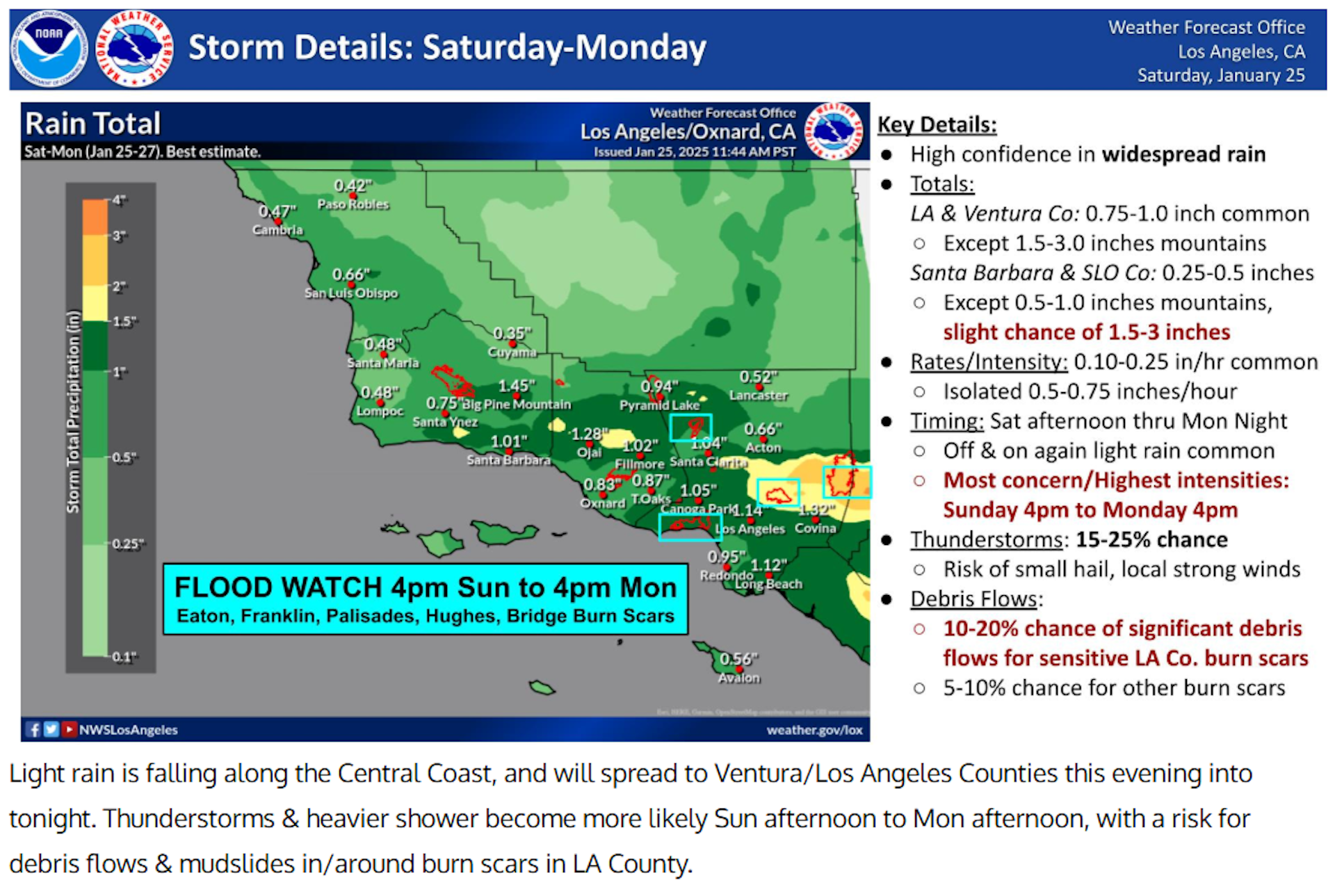
    Light rain began falling on Jan. 25, 2025, helping firefighters who have been battling fires for nearly three weeks, but rain can also trigger dangerous floods and debris flows on burned hillslopes. The National Weather Service issued a flood watch for the burned areas through Jan. 27.

    Debris flows can move with the speed of a freight train, picking up or destroying anything in their path. They can move tons of sediment during a single storm, as Montecito, just up the coast from Los Angeles, saw in 2018.

    What causes these debris flows, sometimes called mudflows, and why are they so common and dangerous after a fire? I am a geologist whose research focuses on pyrogeomorphology, which is how fire affects the land. Here’s what we know.

    How debris flows begin

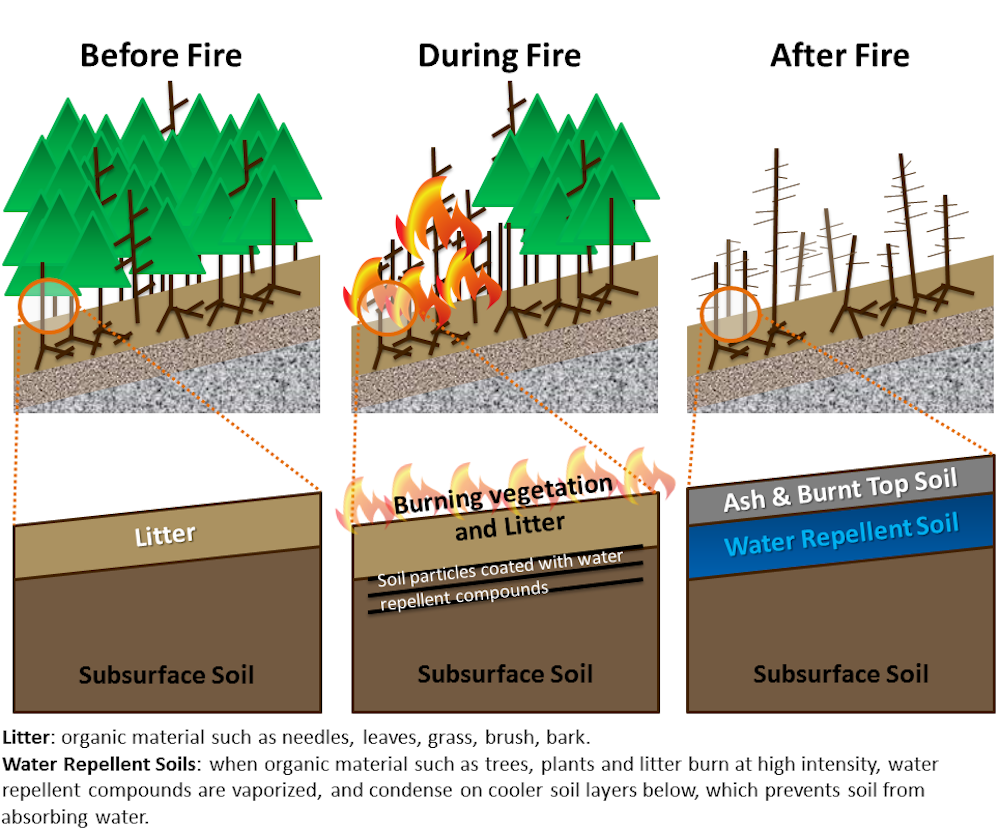
    When severe fires burn hillslopes, the high heat from the fires, sometimes exceeding 1,000 degrees Fahrenheit (538 degrees Celsius), completely destroys trees, shrubs, grass and structures, leaving behind a moonscape of gray ash. Not only that, the heat of the fire actually burns and damages the soil, creating a water-repellent, or hydrophobic, layer.

    What once was a vegetated hillslope, with leaves and trees to intercept rain and spongy soils to absorb water, is transformed into a barren landscape covered with ash, and burned soil where water cannot soak in.

    Illustrations show how fire can change the soil and landscape.
    National Weather Service

    When rain does fall on a burned area like this, water mixes with the ash, rocks and sediment to form a slurry. This slurry of debris then pours downhill in small gullies called rills, which then converge to form bigger and bigger rills, creating a torrent of sediment, water and debris rushing downhill. All this debris and water can transform small streams and usually dry gullies into a danger zone.

    Because the concentration of sediment is so high, especially when there is a large amount of ash and clay, debris flows behave more like a slurry of wet cement than a normal stream. This fluid can pick up and move large boulders, cars, trees and other debris rapidly downhill.

    A firefighter walks through knee-deep mud while checking for victims after a debris flow hit Montecito, Calif., in January 2018.
    Wally Skalij/Los Angeles Times via Getty Images

    In January 2018, a few weeks after the Thomas fire burned through the hills above Montecito, a storm triggered debris flows that killed 23 people and damaged at least 400 homes.

    What controls size and timing of debris flows

    The geography of the land, burn severity, storm intensity and soil characteristics all play important roles in if, when and where debris flows occur.

    Fire and debris flow scientists with the U.S. Geological Survey use these variables to create models to predict the likelihood and possible hazards from postfire debris flows. They are already developing maps to help residents, emergency managers and city officials prepare and predict postfire debris flows in 2025 burn areas in Los Angeles.

    The U.S. Geological Survey modeled debris flow risks after the Palisades Fire near Los Angeles. The map shows some of the highest-risk areas if hit by 15 minutes of rain falling at just under 1 inch (24 millimeters) per hour.
    USGS

    Some of the triggers of debris flows are literally part of the landscape.

    For example, the slope angle in a watershed and the amount of clay in the soil are important. Watersheds with gentle slopes – generally less than about 23 degrees – and a lack of clay and silt-sized particles are unlikely to produce debris flows.

    Other key factors that contribute to postfire debris flows relate to the proportion of the watershed that is severely burned and the intensity and duration of the rainstorm event.

    Early important research in the field of pyrogeomorphology demonstrated that while large, intense storms are more likely to cause large, intense debris flows, even small rainstorms can produce debris flows in burned areas.

    Debris flows are becoming more common

    A whopping 21.8 million Americans live within 3 miles of where a fire burned during the past two decades, and that population more than doubled from 2000 to 2019. A recent study from central and northern California indicates that nearly all the observed increases in area burned by wildfires in recent decades are due to human-caused climate change.

    The warming climate is also increasing the likelihood of more extreme downpours. The amount of moisture the atmosphere can hold increases by about 7% per degree Celsius of warming, leading to more intense downpours, particularly from ocean storms. In California, scientists project increases in rainfall intensity of 18% will result in an overall 110% increase in the probability of major debris flows.

    Jon Frye, of Santa Barbara Public Works, shows what happened in the January 2018 Montecito debris flow and why the risks to downslope communities would continue for several years. Source: County of Santa Barbara, 2018.

    Studies using models of fire, climate and erosion rates estimate that the amount of sediment flowing downhill after fires will increase by more than 10% in nine out of every 10 watersheds in the western U.S.

    Even without rain, debris on fire-damaged slopes can be unstable. A small slide in Pacific Palisades shortly after a fire burned through the area split a home in two. A phenomenon called “dry ravel” is a dominant form of hillslope erosion following wildfires in chaparral environments in Southern California

    Preparing for debris flow risks

    Research on charcoal pieces from ancient debris flows has shown fires and erosion have shaped Earth’s landscape for at least thousands of years. However, the rising risk of wildfires near populated areas and the potential for increasingly intense downpours mean a greater risk of damaging and potentially deadly debris flows.

    As their populations expand, community planners need to be aware of those risks and prepare.

    This article, originally published Jan. 23, 2025, has been updated with rainfall in Los Angeles.

    Jen Pierce receives funding from the National Science Foundation and is the chair of the Quaternary Geology and Geomorphology division of the Geological Society of America.

    ref. LA gets rain, but also risk of flooding and debris flows from wildfire burn scars – a geologist explains the threat – https://theconversation.com/la-gets-rain-but-also-risk-of-flooding-and-debris-flows-from-wildfire-burn-scars-a-geologist-explains-the-threat-247770

    MIL OSI – Global Reports

  • MIL-OSI Global: Rain falling on wildfire burn scars can trigger deadly debris flows – a geologist explains how

    Source: The Conversation – USA – By Jen Pierce, Professor of Geosciences, Boise State University

    A debris flow channel in a severely burned watershed in Idaho. Amirhossein Montazeri/Boise State University, CC BY-ND

    While firefighters work to extinguish the Los Angeles-area wildfires, city officials and emergency managers are also worried about what could come next.

    Light rain began falling on Jan. 25, 2025, helping firefighters who have been battling fires for nearly three weeks, but rain can also trigger dangerous floods and debris flows on burned hillslopes. The National Weather Service issued a flood watch for the burned areas through Jan. 27.

    Debris flows can move with the speed of a freight train, picking up or destroying anything in their path. They can move tons of sediment during a single storm, as Montecito, just up the coast from Los Angeles, saw in 2018.

    What causes these debris flows, sometimes called mudflows, and why are they so common and dangerous after a fire? I am a geologist whose research focuses on pyrogeomorphology, which is how fire affects the land. Here’s what we know.

    How debris flows begin

    When severe fires burn hillslopes, the high heat from the fires, sometimes exceeding 1,000 degrees Fahrenheit (538 degrees Celsius), completely destroys trees, shrubs, grass and structures, leaving behind a moonscape of gray ash. Not only that, the heat of the fire actually burns and damages the soil, creating a water-repellent, or hydrophobic, layer.

    What once was a vegetated hillslope, with leaves and trees to intercept rain and spongy soils to absorb water, is transformed into a barren landscape covered with ash, and burned soil where water cannot soak in.

    Illustrations show how fire can change the soil and landscape.
    National Weather Service

    When rain does fall on a burned area like this, water mixes with the ash, rocks and sediment to form a slurry. This slurry of debris then pours downhill in small gullies called rills, which then converge to form bigger and bigger rills, creating a torrent of sediment, water and debris rushing downhill. All this debris and water can transform small streams and usually dry gullies into a danger zone.

    Because the concentration of sediment is so high, especially when there is a large amount of ash and clay, debris flows behave more like a slurry of wet cement than a normal stream. This fluid can pick up and move large boulders, cars, trees and other debris rapidly downhill.

    A firefighter walks through knee-deep mud while checking for victims after a debris flow hit Montecito, Calif., in January 2018.
    Wally Skalij/Los Angeles Times via Getty Images

    In January 2018, a few weeks after the Thomas fire burned through the hills above Montecito, a storm triggered debris flows that killed 23 people and damaged at least 400 homes.

    What controls size and timing of debris flows

    The geography of the land, burn severity, storm intensity and soil characteristics all play important roles in if, when and where debris flows occur.

    Fire and debris flow scientists with the U.S. Geological Survey use these variables to create models to predict the likelihood and possible hazards from postfire debris flows. They are already developing maps to help residents, emergency managers and city officials prepare and predict postfire debris flows in 2025 burn areas in Los Angeles.

    The U.S. Geological Survey modeled debris flow risks after the Palisades Fire near Los Angeles. The map shows some of the highest-risk areas if hit by 15 minutes of rain falling at just under 1 inch (24 millimeters) per hour.
    USGS

    Some of the triggers of debris flows are literally part of the landscape.

    For example, the slope angle in a watershed and the amount of clay in the soil are important. Watersheds with gentle slopes – generally less than about 23 degrees – and a lack of clay and silt-sized particles are unlikely to produce debris flows.

    Other key factors that contribute to postfire debris flows relate to the proportion of the watershed that is severely burned and the intensity and duration of the rainstorm event.

    Early important research in the field of pyrogeomorphology demonstrated that while large, intense storms are more likely to cause large, intense debris flows, even small rainstorms can produce debris flows in burned areas.

    Debris flows are becoming more common

    A whopping 21.8 million Americans live within 3 miles of where a fire burned during the past two decades, and that population more than doubled from 2000 to 2019. A recent study from central and northern California indicates that nearly all the observed increases in area burned by wildfires in recent decades are due to human-caused climate change.

    The warming climate is also increasing the likelihood of more extreme downpours. The amount of moisture the atmosphere can hold increases by about 7% per degree Celsius of warming, leading to more intense downpours, particularly from ocean storms. In California, scientists project increases in rainfall intensity of 18% will result in an overall 110% increase in the probability of major debris flows.

    Jon Frye, of Santa Barbara Public Works, shows what happened in the January 2018 Montecito debris flow and why the risks to downslope communities would continue for several years. Source: County of Santa Barbara, 2018.

    Studies using models of fire, climate and erosion rates estimate that the amount of sediment flowing downhill after fires will increase by more than 10% in nine out of every 10 watersheds in the western U.S.

    Even without rain, debris on fire-damaged slopes can be unstable. A small slide in Pacific Palisades shortly after a fire burned through the area split a home in two. A phenomenon called “dry ravel” is a dominant form of hillslope erosion following wildfires in chaparral environments in Southern California

    Preparing for debris flow risks

    Research on charcoal pieces from ancient debris flows has shown fires and erosion have shaped Earth’s landscape for at least thousands of years. However, the rising risk of wildfires near populated areas and the potential for increasingly intense downpours mean a greater risk of damaging and potentially deadly debris flows.

    As their populations expand, community planners need to be aware of those risks and prepare.

    This article, originally published Jan. 23, 2025, has been updated with rainfall in Los Angeles.

    Jen Pierce receives funding from the National Science Foundation and is the chair of the Quaternary Geology and Geomorphology division of the Geological Society of America.

    ref. Rain falling on wildfire burn scars can trigger deadly debris flows – a geologist explains how – https://theconversation.com/rain-falling-on-wildfire-burn-scars-can-trigger-deadly-debris-flows-a-geologist-explains-how-247770

    MIL OSI – Global Reports

  • MIL-OSI United Nations: UN officials call for ceasefire compliance after 15 people killed in Lebanon

    Source: United Nations 4

    Peace and Security

    Top UN officials in Lebanon are calling for compliance with the ongoing ceasefire after reports that Israeli forces killed 15 people, including a Lebanese soldier, along the buffer zone with Israel, which Israel was due to withdraw from on Sunday under the agreement.

    The timelines envisaged in the November ceasefire agreement “have not been met”, according to a joint statement by UN Special Coordinator for Lebanon Jeanine Hennis-Plasschaert and head of the UN peacekeeping mission, UNIFIL, and force commander Aroldo Lázaro.

    The agreement between Israel and armed group Hezbollah had been reached after more than a year of fighting, stemming from the Israeli war in Gaza.

    As seen tragically this morning, conditions are not yet in place for the safe return of citizens to their villages along the Blue Line,” they said, referring to the buffer zone between Israel and Lebanon.

    Israel warned Lebanese civilians not to return to their homes in the south this weekend, stating it would not withdraw due to alleged violations of ceasefire terms. 

    Violations of resolution 1701 recorded daily

    “Displaced communities, already facing a long road to recovery and reconstruction, are therefore once again being called on to exercise caution. Also, violations of UN Security Council resolution 1701 continue to be recorded daily.”

    That landmark resolution, adopted in 2006, called for the creation of a buffer zone between the countries and the withdrawal of Israeli forces.

    By the terms of the November ceasefire agreement, Israel was meant to have fully withdrawn its forces from the area by Sunday.

    ‘So much at stake’

    The Special Coordinator and UNIFIL chief said “compliance by both parties with their obligations under the November agreement and the full implementation of resolution 1701 constitute the only way to bring closure to the recent, dark chapter of conflict and open a new one, heralding security, stability and prosperity on both sides of the Blue Line.”

    At the same time, the UN will continue to engage all actors towards this end and remains ready to support any action consistent with resolution 1701 and the efforts of the Implementation Mechanism to achieve the objectives of the November Understanding. 

    “With so much at stake for both Lebanon and Israel, recommitment is urgently needed from all sides,” they said in the statement.

    Much has changed since ceasefire

    The UN officials said much has changed in Lebanon since the Cessation of Hostilities Understanding came into force on 27 November 2024.

    Violence has dramatically decreased, and in many areas of southern Lebanon, hundreds of thousands of people have been able to return to their towns and villages.

    The Lebanese Armed Forces (LAF) have shown resolve in deploying to positions from which the Israel Defense Forces (IDF) are withdrawing, the UN officials said.

    Supported by UNIFIL, the Lebanese forces are helping to restore services and facilitating humanitarian access to communities most affected by conflict, they said.

    The ongoing government formation process, following the election of a president and the designation of a prime minister, is a critical step in building trust between Lebanese citizens and the State, they explained. These developments also augur well for prospective support to the full extension of state authority over all Lebanese territory and for the country’s recovery, reconstruction and growth.

    UNIFIL troops stand ready

    The UN Interim Force in Lebanon (UNIFIL) remains very concerned about reports of Lebanese civilians returning to villages where Israeli Defense Forces (IDF) are still present and of casualties due to Israeli fire, according to a statement by the mission on Sunday.

    At Lebanese Armed Forces request, UNIFIL peacekeepers are deploying to areas indicated by the Lebanese forces across the mission’s area of operations to monitor the situation and help prevent any further escalation.

    “However, the management of crowds remains outside our mandate,” according to UNFIL, which is tasked with supporting the implementation of resolution 1701.

    ‘IDF must stop firing on civilians in Lebanon’

    “It is imperative to avoid further deterioration of the situation,” the UN peacekeeping mission said, calling on the Lebanese population to adhere to the directives of the LAF, which aim to protect lives and prevent an escalation of violence in southern Lebanon.

    “The IDF must avoid firing at civilians within Lebanese territory. Further violence risks undermining the fragile security situation in the area and prospects for stability ushered in by the cessation of hostilities and the formation of a Government in Lebanon,” UNIFIL said.

    The UN mission emphasised the critical importance of fully implementing resolution 1701 and the cessation of hostilities arrangements through established mechanisms, which includes the complete withdrawal of the IDF from Lebanon, the removal of any unauthorised weapons and assets south of the Litani river, the redeployment of the Lebanese Armed Forces in all of south Lebanon and ensuring the safe and dignified return of displaced civilians on both sides of the Blue Line.

    MIL OSI United Nations News

  • MIL-OSI Security: Officer commended for bravery after disarming knife-wielding man

    Source: United Kingdom London Metropolitan Police

    An officer has been praised for his outstanding bravery in single-handedly tackling a suspect armed with a knife who was trying to stab another man.

    PC Morgan Younger managed to take him to the ground and disarm and restrain him while calling for further assistance.

    The incident happened at a petrol station in Lee High Road, Lewisham at around 15:00hrs on Saturday, 25 January.

    Deputy Assistant Commissioner Jon Savell, in charge of policing London this weekend, said: “This is outstanding work from an officer who was on patrol alone, saw a very violent crime in progress and, without hesitation, raced in to assist.

    “I cannot overstate how proud we are in the Met today of his quick-thinking and bravery. He was calm and professional and everything we want our police officers to be.

    “I have no doubt without his intervention, the victim would have been seriously injured.”

    PC Younger, who is attached to South East Command Unit and has five years’ service, was on patrol when he stopped at the petrol station to quickly buy a drink. At the entrance, he saw a man grab the victim around the throat and try to stab him with a large knife.

    The officer immediately responded, took hold of the suspect and struggled with him while he continued to wield the knife.

    He managed to bring him to the floor and disarm him without any help.

    He then restrained him single-handedly while calling for back-up and still managing to arrest the man for attempted murder and possession of an offensive weapon.

    He kept the man under control for five minutes until further officers arrived to help.

    The man, in his 60s, remains in custody at this stage. He was further arrested for handling stolen goods and being concerned in the supply of Class A drugs, after a quantity of drugs was found at his home address.

    The victim, aged in his 40s, was not injured thanks to PC Younger’s swift work.

    MIL Security OSI

  • MIL-OSI Australia: Emissions reduction plan

    Source: Australian Department of Revenue

    Accountable Authority sign off

    The Australian Taxation Office (ATO) recognises it has a role to play in addressing climate change by implementing the Government’s Net Zero in Government Operations Strategy. We understand that our operations affect climate change, and we are committed to leading by example in the transition towards a low-carbon future.

    This Emissions Reduction Plan builds upon our agency’s previous targets and action plans to minimise our carbon footprint and contribute to the nation’s broader climate goals.

    Our plan reflects our commitment to transparency, accountability, and continuous improvement in our environmental performance.

    As the Commissioner of Taxation, I am the Accountable Authority for the Australian Taxation Office listed entity, which is comprised of the ATO, the Tax Practitioner’s Board and the Australian Charities and Not-for-profits Commission (the ACNC), including the ACNC Advisory Board.

    Through this plan, we pledge to:

    • substantially reduce our greenhouse gas emissions
    • improve energy efficiency across our operations
    • transition to renewable energy sources
    • promote sustainable practices in our operations
    • foster a culture of environmental responsibility among our staff.

    ‘The ATO is committed to achieving net zero emissions by 2030. Together, we can create a more sustainable future for our nation and contribute to the global fight against climate change.’

    Rob Heferen
    Commissioner of Taxation
    Registrar of the Australian Business Register, Australian Business Registry Services, and
    Register of Foreign Ownership of Australian Assets.

    Acknowledgement of Country

    We acknowledge the Traditional Owners and Custodians of Country throughout Australia and their continuing connection to land, waters and community. We pay our respects to them, their cultures, and Elders past and present.

    We recognise the unique relationship Aboriginal and Torres Strait Islander people have to Country, culture, and community, and the important role this plays in us all walking together as Australians.

    MIL OSI News

  • MIL-OSI Global: California depends on prison labour to deal with climate disasters — Canada must avoid a similar model

    Source: The Conversation – Canada – By Jordan House, Assistant Professor, Labour Studies, Brock University

    As wildfires continue to burn in and around Los Angeles, the fact that many of the firefighters battling the blazes are inmates from California’s prison system has drawn significant attention in news coverage.

    While the California Department of Corrections and Rehabilitation (CDCR) claims their fire camp program is voluntary and provides prisoners with meaningful opportunities, research demonstrates otherwise.

    Critics, including the American Civil Liberties Union (ACLU), argue that the program exploits incarcerated individuals, labelling it as “modern-day slavery.” One ex-prisoner described it as “involuntary servitude.”

    An inmate shares his experience fighting California wildfires (ABC News).

    The use of prison labour is particularly concerning, given Black Americans are incarcerated at nearly five times the rate of white Americans in state prisons. In 12 states, more than half of the prison population is Black.

    California prisoners are denied access to minimum wage provisions, prevented from forming labour unions and denied access to other workplace safety regulations. They’re also more likely to be injured or to die on the job than non-incarcerated firefighters. Their wages are capped at US$29.80 per day, compared to non-incarcerated firefighters, who earn up to US$358 daily, not including overtime.

    While serving in a fire crew gives prisoners the chance to shave time off of their sentences and have records expunged, neither of these benefits is guaranteed. Both are contingent on the CDCR or county jails deeming the service in a fire camp to be “successful.” This leaves prisoners vulnerable to being denied these benefits, despite risking injury or death.

    Prison labour in the Canadian context

    Some Canadian coverage of the L.A. fires has noted that provincial prisoners in British Columbia also work in a wildfire suppression program. However, little has been said about how that work relates to the larger system of prison labour in the country.

    Like their counterparts south of the border, Canadian prisoners are engaged in various forms of labour, including wildfire management, but are denied basic rights as workers.

    In 1975, Donald Griggs, then-superintendent of Ontario’s Monteith Correctional Complex, told the Globe and Mail that prison labour had been used in response to fires from time immemorial: “When a fire got bad, the jails were emptied and the men were shoved out on the fire line.”

    By the late 1960s, programs for prisoners to support wildfire suppression had become more formalized. During that time, for example, prisoners at Beaver Creek, a federal prison in Ontario, participated in regional bushfire response efforts. Working in the program offered prisoners, who were paid $1.25 an hour, a chance at some “action.”

    By the mid-1970s, some Ontario prisoners earned up to $50 a day battling wildfires. Today, however, most prisoners don’t earn anything close to those wages. Federal prisoner pay maxes out at $6.90 per day.

    In the rare situations where prisoners are relatively well-compensated, prison labour still offers employers unique benefits. Prisoners’ lack of freedom and limited ability to refuse work is touted as an advantage. Correctional Service of Canada (CSC) officials have argued that, compared to volunteer firefighters, prisoners “are always in one place and available for duty.”

    Prison labour in British Columbia

    Canada’s most prominent use of prison labour to manage wildfires is in B.C. While prisoners served in direct firefighting roles in the past, today provincial prisoners, who make between $2 and $8 per day, play a critical support role for wildfire-fighting crews by maintaining equipment and fire camps.

    Notably, all the participating prisoners have “open custody” status, having “behaved exceptionally well during previous experience on other community work crews.”

    In Canada, prisoners are supposed to work as part of their rehabilitation, not as punishment. However, the reality often prioritizes the needs of employers over the rehabilitation of prisoners. A review of the CSC’s Federal Work Release Program, which was established in 1992 and included a firefighting component, notes:

    “It is not necessary that the work be directly related to the offender’s correctional plan…work release is a very flexible program that allows correctional managers to respond to community projects and local needs for labour.”

    This is particularly concerning given that ex-prisoners often struggle to secure gainful employment upon release, despite their participation in employment programming.

    Prison labour as a response to climate disasters

    While the idea of keeping people incarcerated to maintain a labour force to fight disasters might sound like something out of science fiction, it’s not mere speculation. Responses to climate catastrophes like the L.A. fires demand huge amounts of resources and labour.

    Former U.S. vice-president Kamala Harris, as California attorney general, led a campaign to defy a U.S. Supreme Court order to reduce the state’s prison population partly because decarceration would “severely impact fire camp participation.”

    In Canada, prison labour has similarly been used in disaster responses. Most recently, CORCAN, the federal prison industry program, has been contracted to build temporary housing for people displaced by the 2024 wildfires in Jasper, Alta.

    Just as Black, Indigenous and racialized people in the U.S. are more likely to become incarcerated, these are also the populations that suffer disproportionately from the impacts of wildfires. Studies have shown that Indigenous communities in Canada are the hardest hit by wildfires, while Indigenous Peoples make up the fastest growing prison populations.

    Much like the U.S., Canada also disproportionately incarcerates Black, Indigenous and racialized people, while also depriving incarcerated labourers of access to minimum wage rights, workplace safety provisions and the right to unionize.

    The root cause of many of these disasters — climate change — is disproportionately driven by the world’s wealthiest elites. The use of prison labour to fight wildfires only further perpetuates the systemic inequalities exacerbated by climate injustice and reflects a continuation of indentured servitude.

    The authors do not work for, consult, own shares in or receive funding from any company or organisation that would benefit from this article, and have disclosed no relevant affiliations beyond their academic appointment.

    ref. California depends on prison labour to deal with climate disasters — Canada must avoid a similar model – https://theconversation.com/california-depends-on-prison-labour-to-deal-with-climate-disasters-canada-must-avoid-a-similar-model-248099

    MIL OSI – Global Reports

  • MIL-OSI Global: The legacy of anti-Black racism: The public health crisis of racial trauma

    Source: The Conversation – Canada – By Ingrid Waldron, Professor, Faculty of Humanities, HOPE Chair in Peace & Health, McMaster University

    The police killing of George Floyd in 2020 in the United States was an appalling act involving a group of officers who did not place much, if any, value on the life of a Black man. In the agonizing nine minutes before he died under the knee of Derek Chauvin, Floyd cried out for air and for his mother.

    Those moments, recorded by a passerby and shared widely and repeatedly over the days that followed, shocked the consciences of many Americans and others, triggering protests across the United States and in other countries, many of them led by the Black Lives Matter movement.

    Chauvin was convicted of murder, and three other officers were convicted of other serious crimes.


    Read more:
    How to deal with the pain of racism — and become a better advocate: Don’t Call Me Resilient EP 2


    While there is now greater awareness and scrutiny of racism and violence in policing, there is also a long record of reverting to old ways. Indeed, deeply entrenched racial bias is rooted in the soul and psyche of North American society and globally.

    When we think about Black Lives Matter, we typically think of criminal justice, but the movement also started a conversation about the lingering mental health impacts of police brutality on those who experience it directly, as well as those who experience it vicariously.

    Black trauma

    The traumatizing after-effects of anti-Black racism also result from Black people’s experiences within other social structures, such as employment, education and health care.

    The trauma resulting from multiple forms of anti-Black racism has a legacy that took root during the colonial era and has endured, impacting the spiritual, emotional, psychological and mental well-being of Black people in societies harmed by colonialism, such as Canada, the U.S. and the United Kingdom.

    I am a professor and the HOPE Chair in Peace and Health in the Global Peace and Social Justice Program at McMaster University. I have been studying Black trauma for almost 20 years, and recently published a book on the subject, From the Enlightenment to Black Lives Matter: Tracing the Impacts of Racial Trauma in Black Communities from the Colonial Era to the Present.

    The book documents that since the colonial era, Black bodies have been receptacles for trauma that carry the weight of the past and the present. Black trauma is deep, complex and continuing, and has harmful impacts on the mental health of Black people. It includes the dehumanizing and lingering consequences of the slave trade, the social and economic subjugation of Black people in Jim Crow America and the racist social structures that persist there and in Canada, the U.K. and elsewhere.

    For Black people, trauma results from racist assaults to their spiritual, emotional, mental, psychological and physical well-being. When racism resides in the body in these visceral ways, it manifests as emotional pain and rage, and its lingering after-effects endure over generations.

    Public health crisis

    Addressing the public health crisis of racial trauma for Black people requires that racism be recognized as a legitimate issue in health education and training, research, clinical practice, mental health services and policy, and in the mental health system more broadly.

    It also requires that mental health professionals not only become more culturally competent, but also develop skills in structural competency.

    That means being prepared to play a role in dismantling the inequities embedded within our social structures, including addressing the impact of upstream factors (poverty, poor public infrastructure, etc.) on the mental health of Black and other marginalized populations.

    Addressing racial trauma experienced by Black people also demands an analysis that appreciates racism’s inter-generational and multifaceted features. This analysis would examine how racism not only manifests itself over generations, but also at different levels, such as through everyday interactions between people (individual racism), within institutions (institutional racism), or through cultural dominance (cultural racism).

    Challenging legacies

    Addressing racial trauma experienced by Black people also demands an analysis that appreciates racism’s inter-generational and multifaceted features.
    (Shutterstock)

    For too long, efforts to address disparities between Black and white people in education, labour, employment, health and other social structures have focused on attributing these disparities to pathologies presumed to be inherent to Black culture and Black people. Instead, these efforts must be focused on identifying, dismantling and resolving the pathologies embedded within these social structures and peeling back the systems of power that impact mental health and well-being in Black communities.

    Resolving structural pathologies that harm Black people must be accompanied by a willingness to understand and appreciate the complexities of Black life, Black trauma and Black responses to trauma that may appear maladaptive to many, but that are normal and natural responses to racism’s intergenerational, multi-faceted and multilevel manifestations.

    Finally, resolving Black trauma must involve challenging the colonial and imperial legacies that reside within psychiatry and other mental health professions.

    Ingrid Waldron receives funding from CIHR, SSHRC.

    ref. The legacy of anti-Black racism: The public health crisis of racial trauma – https://theconversation.com/the-legacy-of-anti-black-racism-the-public-health-crisis-of-racial-trauma-246104

    MIL OSI – Global Reports

  • MIL-OSI Global: Online platforms risk becoming ideological echo chambers that undermine meaningful dialogue

    Source: The Conversation – Canada – By Alexander Martin, PhD Student, Science and Technology Studies, York University, Canada

    The migration to Bluesky, especially after the 2024 U.S. presidential election, reflects a growing dissatisfaction with centralized platforms and their handling of political content. (Shutterstock)

    There has recently been a shift online from centralized platforms like X (formerly Twitter) to decentralized alternatives like Bluesky. In particular, many users unhappy with the politics and antics of X owner Elon Musk are moving to Bluesky.

    Users migrating from X have cited a rise in bots and hate speech as the reason for leaving the site. Journalist Cory Doctorow termed this the idea of “enshittification,” a process where platforms get worse by focusing on profit and spreading harmful content.

    Under Musk, X has seemingly shifted to promote more extreme accounts, making the platform less welcoming to others. These users are looking for more control, transparency, and less manipulation.

    However, this migration raises an important question. Is this shift towards platforms like Bluesky limiting cross-ideological conversation and increasing political polarization? If so, what does this mean for the health of democracy in the digital age?

    The migration to Bluesky, especially after the 2024 U.S. presidential election, reflects a growing dissatisfaction with centralized platforms and their handling of political content. Understanding this trend is essential, as it could shape how future political debates and movements unfold online.

    Social media and political discourse

    Social media platforms are now central to political discourse. Amid recent political movements, including Donald Trump’s rise, social media has emerged as a key player in shaping political narratives. Figures like Musk and Meta CEO Mark Zuckerberg are increasingly close to Trump.

    Meta donated $1 million to Trump’s inauguration fund, as did other tech companies. Both Zuckerberg and Musk made appearances at Trump’s inauguration, signalling support for Trump’s ascent to power. This demonstrates the tech industry’s close proximity to political power and centralized social media’s potential to amplify certain political agendas.

    The shift from X to Bluesky is part of a larger trend. Left-leaning users are moving to Bluesky because of concerns over political bias and misinformation on X.

    Musk’s acquisition of X in 2022 changed its content moderation policies. This change amplified conservative voices and pushed away users who already felt marginalized. This resulted in an initial exodus to another decentralized social media site called Mastodon, where the user count surged from 3,400 to 113,400 in a single day.

    Commentators have pointed out that many users want a platform with less bias, few manipulations and more freedom of expression.

    Bluesky’s open-source, federated structure provides a space where users have more control over their online experience. This has helped Bluesky grow rapidly, with the platform gaining 2.5 million new users in just two months and seeing a 500 per cent increase in traffic following the U.S. election.

    The platform’s appeal lies in its promise of transparency and user autonomy, qualities that users increasingly value as centralized platforms like X and Meta face scrutiny over political bias and misinformation.

    Tara McGowan discusses the migration of liberals from X to Bluesky.

    May fuel more polarization

    While Bluesky offers an alternative to X’s perceived political bias, it may also deepen political polarization. Its decentralized nature gives users control over what they see, which could reinforce ideological silos.

    Research being done on Mastodon shows that this model can contribute to the democratization of social media by offering more control. As left-leaning users flock to Bluesky while right-leaning users stay on X and Meta, the divide between these groups deepens, further entrenching political silos.

    One of the main reasons for the migration to Bluesky is dissatisfaction with content moderation practices on centralized platforms like X and Meta. Under Musk’s leadership, X has scaled back content moderation and reinstated controversial accounts, raising concerns about the spread of misinformation.

    Similarly, Meta has relaxed its content guidelines by introducing community notes, similar to X. This makes it easier for harmful content to spread. With the community notes, the platform decides what content is considered factual. While this gives users more freedom, it could also enable the spread of false and misleading information.


    Read more:
    Meta is abandoning fact checking – this doesn’t bode well for the fight against misinformation


    Bluesky offers a decentralized model that gives users more control over the content they see. Users can curate their own feeds, creating a more personalized experience.

    Though this model faces challenges, like bot activity and misinformation, it moves away from algorithm-driven approach of platforms like X and Meta. In an era where users worry about bias and censorship, Bluesky’s model offers a potential solution for those seeking more transparency and control over the content they see.

    However, all misinformation threatens the integrity of public discourse. As users gravitate toward platforms that reinforce their existing beliefs, they become more vulnerable to misinformation campaigns.

    This has the potential to undermine public trust in political institutions and the democratic process. Unchecked false information could have serious consequences for democratic participation and the legitimacy of the political process.

    A threat to democracy?

    Bluesky’s decentralized model offers an alternative to traditional centralized platforms that are increasingly seen as biased or manipulative.

    However, this migration also highlights the dangers of political polarization and echo chambers. As users move to platforms that align with their beliefs, space for cross-ideological dialogue shrinks, weakening public discourse.

    This growing division could make it harder for people to have informed, open debates about important issues that matter most. Moving to decentralized platforms like Bluesky may provide more control over the content, but it still requires careful attention to how platforms shape political narratives and the future of democratic engagement.

    Alexander Martin does not work for, consult, own shares in or receive funding from any company or organisation that would benefit from this article, and has disclosed no relevant affiliations beyond their academic appointment.

    ref. Online platforms risk becoming ideological echo chambers that undermine meaningful dialogue – https://theconversation.com/online-platforms-risk-becoming-ideological-echo-chambers-that-undermine-meaningful-dialogue-247982

    MIL OSI – Global Reports

  • MIL-OSI Global: Canada’s claim that it champions human rights is at odds with its mining practices

    Source: The Conversation – Canada – By Véronique Plouffe, PhD candidate in Feminist and Gender Studies, L’Université d’Ottawa/University of Ottawa

    Canada presents itself as a gender equality and human rights champion both at home and abroad. But it’s also a global leader in mining, an industry with an abysmal human rights record.

    Under the previous Conservative federal government, Canadian foreign aid was more directly aligned with mining and commercial interests. But when Liberal Justin Trudeau was elected in 2015, it appeared to signal a return to more “progressive” values.


    Read more:
    Justin Trudeau’s resignation creates a progressive void in Canada, part of a long-established cycle


    The launch of the Feminist International Assistance Policy in 2017 was a powerful symbol in this direction. But despite Canadian mining companies being accused of environmental and human rights violations in various countries, the Liberal government continues to actively support mining abroad.

    Canada is a global mining powerhouse, home to almost half of the world’s publicly listed mining and mineral exploration companies.

    According to 2023 data, Canadian mining companies operate in 95 foreign countries and the value of Canadian mining assets totalled $336.7 billion. Half of Canadian foreign mining assets are located in Latin America and the Caribbean.

    Canadian mining in Peru

    Peru is a key mining partner; 71 firms operate in the country and Canada has nearly $10 billion of mining assets in the South American country. Canada has the largest number of mining exploration projects in Peru at 24, and ranks third (after the United Kingdom and Peru itself) in terms of mining exploration investments.

    At last year’s Asia-Pacific Economic Cooperation meeting in Lima, Trudeau announced investments to create “a better future by focusing on a healthier planet and equal opportunities for all.” These included initiatives to support women’s and girls’ rights as well as improving access to the justice system for Indigenous and Afro-Peruvian communities.

    Trudeau also announced the creation of a Canada-Peru Dialogue of Critical Minerals and Mining Sustainability.

    But can Canada be both a human rights champion and a global mining leader? While Canada describes its mining industry as sustainable and socially responsible, human rights organizations paint a different picture.

    Backing Boluarte government

    Canadian mining companies have been accused in Peru of environmental contamination, criminalizing community leaders, land dispossession and the violation of Indigenous self-determination. Canada has also supported Peruvian mining law reforms in favour of foreign mining investment.

    Canada’s support of the current and highly unpopular Dina Boluarte government, which ousted left-wing president Pedro Castillo in 2022, points to the ongoing prioritization of mining interests over human rights, even those of Canadian citizens.

    Castillo meanwhile had proposed a plan to renegotiate mining contracts with multinational companies so that more profits stayed in Peru.

    The impact on women

    Reports have shown that women bear the brunt of mining’s negative impacts, which include gender violence, economic and food insecurity and health problems.

    Women human rights defenders confronting extractive industries also face gender-specific risks and challenges. Indigenous women are often at the forefront of resisting extractive projects.

    Despite the bold ambitions of Canada’s Feminist International Assistance Policy to promote a “more peaceful, more inclusive and more prosperous world,” critics have highlighted several weaknesses and challenges.

    Among them: insufficient funding, its instrumentalist approach (when women are used for broader economic and political goals), as well as its emphasis on neoliberal capitalist growth and the private sector.

    Some have also highlighted its lack of coherence with other policy areas, including trade and security, its support for Israel and its treatment of Indigenous women in Canada.


    Read more:
    Canada’s inaction in Gaza marks a failure of its feminist foreign policy


    Structural causes not addressed

    My ongoing research with civil society organizations in Peru suggests that Canada is providing much-needed and highly appreciated support for women’s rights, LGTBQ+ and Indigenous women’s organizations, namely through its Women’s Voice and Leadership Program. The positive impacts of such initiatives should not be overlooked.

    But even though these projects — often short-term — may benefit some people and some organizations, they often fail to tackle the structural causes of poverty and gender inequality. They also neglect to take into account Canada’s role in creating and maintaining global inequalities through its disruptive mining activities.


    Read more:
    The role of Canadian mining in the plight of Central American migrants


    For years, Canadian civil society organizations have been demanding greater accountability and regulation for Canadian overseas corporations. Despite promises to hold companies accountable for abuses abroad with the creation of the Ombudsperson for Responsible Enterprise, the Trudeau government has been criticized for failing to deliver on these pledges.

    With the possible election of a Conservative federal government in the coming months, it’s unlikely that tightening regulations for private Canadian companies operating in other countries will be a priority.

    Despite its feminist ambitions, taking a closer look at Canada’s role in countries where it has significant mining interests reveals a more complex and nuanced image of Canada in the world.

    Véronique Plouffe receives funding from the Social Sciences and Humanities Research Council (SSHRC).

    ref. Canada’s claim that it champions human rights is at odds with its mining practices – https://theconversation.com/canadas-claim-that-it-champions-human-rights-is-at-odds-with-its-mining-practices-246757

    MIL OSI – Global Reports

  • MIL-Evening Report: Trump’s ‘free speech’ vision comes at expense of press freedom

    Pacific Media Watch

    Among his first official acts on returning to the White House, President Donald Trump issued an executive order “restoring freedom of speech and ending federal censorship”.

    Implicit in this vaguely written document: the United States is done fighting mis- and disinformation online, reports the Paris-based global media watchdog Reporters Without Borders (RSF).

    Meanwhile, far from living up to the letter or spirit of his own order, Trump is fighting battles against the American news media on multiple fronts and has pardoned at least 13 individuals convicted or charged for attacking journalists in the 6 January 2021 insurrection.

    An RSF statement strongly refutes Trump’s “distorted vision of free speech, which is inherently detrimental to press freedom”.

    Trump has long been one of social media’s most prevalent spreaders of false information, and his executive order, “Restoring Freedom of Speech and Ending Federal Censorship,” is the latest in a series of victories for the propagators of disinformation online.

    Bowing to pressure from Trump, Mark Zuckerberg, whose Meta platforms are already hostile to journalism, did away with fact-checking on Facebook, which the tech mogul falsely equated to censorship while throwing fact-checking journalists under the bus.

    Trump ally Elon Musk also dismantled the meagre trust and safety safeguards in place when he took over Twitter and proceeded to arbitrarily ban journalists who were critical of him from the site.

    ‘Free speech’ isn’t ‘free of facts’
    “Free speech doesn’t mean public discourse has to be free of facts. Donald Trump and his Big Tech cronies like Elon Musk and Mark Zuckerberg are dismantling what few guardrails the internet had to protect the integrity of information,” said RSF’s USA executive director Clayton Weimers.

    “We cannot ignore the irony of Trump appointing himself the chief crusader for ‘free speech’ while he continues to personally attack press freedom — a pillar of the First Amendment — and has vowed to weaponise the federal government against expression he doesn’t like.

    “If Trump means what he says in his own executive order, he could start by dropping his lawsuits against news organisations.”

    Trump recently settled a lawsuit out of court with ABC News parent company Disney, but is still suing the Des Moines Register and its parent company Gannett for publishing a poll unfavourable to his campaign, and the Pulitzer Center board for awarding coverage of his 2016 campaign’s alleged ties with Russia.

    Trump should immediately drop both lawsuits and refrain from launching others while in office.

    After a campaign where he attacked the press on a daily basis, Trump has continued to berate the media and dismissed its legitimacy to critique him.

    During a press conference the day after he took office, Trump reproached NBC reporter Peter Alexander for questions about Trump’s blanket pardons of the January 6th riot participants, saying, “Just look at the numbers on the election.

    “We won this election in a landslide, because the American public is tired of people like you that are just one-sided, horrible people, in terms of crime.”

    An incoherent press freedom policy
    The executive order also flies in the face of his violent rhetoric against journalists.

    The order asserts that during the Biden administration, “the Federal government infringed on the constitutionally protected speech rights of American citizens across the United States in a manner that advanced the government’s preferred narrative about significant matters of public debate.”

    It goes on to state, “It is the policy of the United States to ensure that no Federal Government officer, employee, or agent engages in or facilitates any conduct that would unconstitutionally abridge the free speech of any American citizen.”

    This stated policy, laudable in a vacuum, even if made redundant by the First Amendment, is rendered meaningless by Trump’s explicit threats to weaponise the government against the media, which have recently included threats to revoke broadcast licenses in political retaliation, investigate news organizations that criticise him, and jail journalists who refuse to expose confidential sources.

    Instead, the policy appears designed to amplify disinformation, which benefits a President of the United States who has proven willing to spread disinformation that furthered his political interests on matters small and large.

    “If Trump is serious about his stated commitment to free speech, RSF suggests he begin by ensuring his own actions serve to protect the free press, rather than censoring or punishing media outlets,” the watchdog said.

    “The United States has seen a steady decline in its press freedom ranking in RSF’s World Press Freedom Index over the past decade to a current ranking of 55th out of 180 countries, with presidents from both parties presiding over this backslide.

    “While Trump is not entirely responsible for the present situation, his frequent attacks on the news media have no doubt contributed to the decline in trust in the media, which has been driven partly by partisan attitudes towards journalism.

    “Trump’s violent rhetoric can also contribute to real-life violence — assaults on journalists nearly doubled in 2024, when his campaign was at its apex, compared to 2023.”

    Pacific Media Watch collaborates with RSF.

    MIL OSI AnalysisEveningReport.nz

  • MIL-OSI Russia: A new building of the St. Petersburg HSE has opened in the historic building of the Rope Shop

    Translartion. Region: Russians Fedetion –

    Source: State University Higher School of Economics – State University Higher School of Economics –

    The famous monument of constructivism — the Rope Shop of the Krasny Gvozdilshchik Plant — has become the new building of the National Research University Higher School of Economics — Saint Petersburg. About four thousand students will study in the building on the 25th Line of Vasilievsky Island.

    Press service of the National Research University Higher School of Economics

    The grand opening ceremony of the new building, timed to coincide with Russian Students’ Day, took place on Saturday, January 25. The event was attended by government officials, members of the HSE – St. Petersburg Board of Trustees, industrial partners, students and teachers. The symbolic red ribbon was cut by the Minister of Education of the Russian Federation Sergey Kravtsov, Vice-Governor of St. Petersburg Vladimir Knyaginin, Rector of HSE Nikita Anisimov and Director of HSE – St. Petersburg Anna Tyshetskaya.

    The new educational space “Rope Workshop” is more than 20 thousand square meters of modern classrooms, coworking spaces, rooms for practical and project work, museum and exhibition spaces. The building will accommodate students of the joint School of Informatics, Physics and Technology with VK, the School of Design, as well as educational programs in the areas of “Media Communications”, “Sociology”, “State and Municipal Administration”.

    “Today is a significant event not only for St. Petersburg, but for our entire country — the opening of the new building of the Higher School of Economics. I would like to thank the government of St. Petersburg for the attention paid to the city’s education system. Today, the Higher School of Economics is one of the leading Russian universities. It has very high quality and standards of education, a very strong teaching staff and, accordingly, high competition for admission. I am sure that students from all regions of our country, as well as from other countries, will study in the new building of the university. It is important that the areas that will be presented here are very relevant and in demand by the leading sectors of the domestic economy,” emphasized the Minister of Education of the Russian Federation Sergey Kravtsov.

    Vice-Governor of Saint Petersburg Vladimir Knyaginin congratulated the students of the Saint Petersburg HSE on the holiday and noted the importance of integrating the educational space into the urban environment. “I am pleased that engineers, builders, designers, architects treated the heritage with care, and we really have a pearl of constructivism that will work for the city, for students, for all of us. The Higher School of Economics in Saint Petersburg is growing with such wonderful objects, and I am looking forward to the opening of the Patriotic Institute building. It seems to me that these will be two wonderful architectural masterpieces, newly opened to the city, its residents and tourists,” Vladimir Knyaginin noted.

    HSE Rector Nikita Anisimov emphasized that Russian Students’ Day is an important holiday for everyone, and celebrating it in St. Petersburg is especially symbolic, because it is here that the traditions of Russian education were formed. “Dear students, teachers, graduates, friends, honored guests! I sincerely congratulate you on our common holiday: St. Tatyana’s Day, Russian Students’ Day. The day when we open our hearts to the future. You, students, are our future. Of course, we pass on our experience, our knowledge, our opportunities to you, but the future is yours. The spirit of education has always lived and will live within the university walls. The traditions of this day were laid here, in the capital of the Russian Empire, in St. Petersburg, in the city where we are opening this building today. Remember – our university is always open for you 24/7, this is your home. Happy holiday!” HSE Rector Nikita Anisimov addressed the students.

    Director of the National Research University Higher School of Economics in St. Petersburg Anna Tyshetskaya congratulated those gathered on the occasion and noted that the opening of the building in the historic building of the Rope Workshop will become an incentive for the development of new areas. “Together with our partners, we are presenting a new approach to organizing the educational process. The key concept is the integration of the competencies of the Higher School of Economics and leading technology companies. In addition to standard classrooms and laboratories, we have created spaces that unite the educational and business environment. The new building will house an IT cluster, media communications, and design. In 2025, several new areas of training will open, including a program in architecture. Thus, a new technological and creative educational cluster is being formed on Vasilievsky Island,” emphasized Director of the National Research University Higher School of Economics in St. Petersburg Anna Tyshetskaya.

    The restoration of the famous constructivist monument, where the students of the HSE in St. Petersburg will study, was carried out by the Setl Group company. The Chairman of the Board of Directors of the holding company, Maxim Shubarev, is a member of the Board of Trustees of the National Research University Higher School of Economics – St. Petersburg. “It is pleasant to realize that the restoration of the Rope Shop allowed us not only to return an iconic cultural heritage site to the city, but also, thanks to our long-standing partner, the Higher School of Economics, to fill its space with the spirit of science and education. The architectural monument has become an Alma Mater and today opened its doors to students of this respected educational institution. I hope that the amazing and rich history of this building will create a special atmosphere here that motivates knowledge, and will contribute to new discoveries, achievements and creative processes,” said Maxim Shchubarev.

    After the ceremony, HSE St. Petersburg Director Anna Tyshetskaya gave guests a tour of the Rope Workshop. The first floor of the educational space houses the workshops and studios of the School of Design. In 2025, the educational program “Architecture” will open here in partnership with leading design companies and museum institutions of the federal level.

    Part of the Rope Workshop space will be occupied by representative offices of industrial partners of the HSE St. Petersburg: VK, BIOCAD, t2, Yadro, 1C, Yandex, Gazprom Neft, Lesta Igri, RBC and others. The integration of the business environment into the educational process will allow students from the first year to work on real cases and tasks of leading Russian companies.

    As part of a strategic partnership with VK, a new School of Informatics, Physics and Technology will begin operating in 2025, where information systems developers, system architects, ML researchers and ML developers will be trained. The programs were designed under the guidance of leading experts from HSE – St. Petersburg and VK and will allow future specialists to gain relevant knowledge and practical business experience.

    In addition, in 2025, the new building will open the “Programming and Engineering of Computer Games” program. The leading game developer in the CIS, “Lesta Igri”, will act as an industrial partner. On the day of the opening of the Rope Workshop, the Director of Business Development of the group of companies, Gaukhar Aldyyarova, and the Director of the National Research University Higher School of Economics – St. Petersburg, Anna Tyshetskaya, signed an agreement on strategic partnership aimed at developing research activities and training specialists.

    The Yakov Chernikhov Museum of Architecture is located under the unique metal trusses of the Rope Shop. The cultural and educational space is being created to popularize Russian architecture and the legacy of Yakov Chernikhov, whose work is inextricably linked with Leningrad. It is planned to hold open educational events for residents of St. Petersburg and tourists on the museum site.

    After the tour of the new building, guests, students and teachers took part in a large-scale cultural and educational marathon. The celebration in honor of Russian Students’ Day was opened by musician, presenter and blogger Alexander Pushnoy. He moderated the discussion “Artificial Intelligence in Education, Creativity and Content”. VK and industry experts, designers, scientists, teachers and students of the HSE St. Petersburg discussed the role, application and benefits of AI in various professional fields. The event was broadcast exclusively on VK Video. About two thousand people will be able to attend master classes, lectures, expert discussions with leading representatives of science, business and the media sphere throughout the day.

    Please note: This information is raw content directly from the source of the information. It is exactly what the source states and does not reflect the position of MIL-OSI or its clients.

    MIL OSI Russia News

  • MIL-OSI NGOs: Negosyo napamura nang husto mga produkto sa pagtanggal ng single-use plastic

    Source: Greenpeace Statement –

    Video grab from Rico Ibarra / Greenpeace

    QUEZON CITY, Philippines — Kapag sinabing “environmentally friendly” ang isang produkto, iniisip na mahal, sosyal, at pangmayaman ito nang marami. Pero ang isang negosyo, may sikreto kung bakit abot-kaya ang kanilang sustainable cleaning products — ang pagtanggal ng single-use plastic (SUP) mula sa produksyon.

    Hulyo 2022 nang magsimula ang kwento ng Sabon Express, sa layuning mahikayat ang publikong gumamit ng boteng matatagpuan na sa kanilang bahay sa tuwing bibili ng sabong panlinis. Ani Mellany Zambrano, Chief Executive Officer (CEO) ng kumpanya, talamak kasi ang bentahan ng household cleaning materials sa plastic sachet at mga boteng itatapon lang din.

    “Our campaign is towards [a] refill revolution,” sabi ni Mellany sa panayam ng Greenpeace Philippines. “So ‘yun ‘yung pangarap namin, na ‘yung mga Pilipino ay magiging responsable sa paggamit ng mga plastic na bote at mga lalagyan. Hindi ‘yung wala lang tayong pakialam na we are after convenience, na bumibili tayo, bumibili, kumukonsumo, at nagtatapon ng plastic.”

    “So ang gusto natin is bumili tayo consciously, magkonsumo tayo at maging responsable tayo na hindi tayo makadagdag sa lumalalang plastic pollution.”

    Video grab from Rico Ibarra / Greenpeace

    “Sachet country” kung ituring ng ilan ang mga bansang Third World gaya ng Pilipinas. Aabot sa 164 milyong sachet ang ginagamit sa bansa araw-araw, bagay na naiipon sa mga landfill, kanal at karagatan. Ito ay dahil sa walang-tigil na produksyon ng SUPs ng mga malalaking korporasyon at kawalan ng batas para  rito. 

    Marami rito’y pinaglagyan ng personal care (19%) o household cleaning products (17%). Hindi ito nabubulok at bumabara sa mga estero, bagay na nagpapalala sa baha tuwing may bagyo. Nadudurog lang ito hanggang sa maging microscopic. Pwede itong malanghap, mainom, o makain bilang “microplastic” na siyang nagdudulot ng pagkabaog at cancer.

    ‘Di gaya ng mararangyang bayan, limitado ang kakayahan ng mga Pinoy na bumili nang bultuhan. Dahil dito, pumatok ang konsepto ng “tingi” na siyang sinakyan ng mga dambuhalang kumpanya lalo na’t hindi ito mabigat sa bulsa. Nakapako kasi sa P645 kada araw ang minimum wage sa Metro Manila — ang pinakamataas sa buong Pilipinas — samantalang P1,205 kada araw ang kinakailangang kita ng pamilyang may limang miyembro para mabuhay nang disente.

    Plastic packaging: salarin sa mahal na produkto?

    Isa sa appeal ng plastic ay ang “mababang presyo” nito. Pero alam n’yo bang malaking bahagi ng binabayaran ng consumer sa mga produkto ay packaging?

    Karaniwang 10% hanggang 40% ng kabuuang retail price ng iyong binibili ay dahil sa lalagyan nito. Gayunpaman, dedepende ito sa uri ng packaging material na ginamit, laki at bigat ng produkto, at production process. Ito’y nasa porma ng plastic na bote, galon, sticker labels, shrink plastics o sachet na madalas itinatapon matapos ang isang gamit.

    Video grab from Rico Ibarra / Greenpeace

    Sa pagtalikod ng Sabon Express sa SUPs at pag-engganyo sa customers magdala ng sariling bote at lalagyan, nagawa tuloy nilang makapaglabas ng produktong mas mura kaysa sa mga ibinebenta sa malls at supermarkets. 

    “Every time na bumibili kayo ng inyong mga produkto na gumagamit ng mga single-use plastics… at itinatapon niyo, hindi lang kayo nakakadagdag sa polusyon kundi actually nagsasayang po kayo ng pera,” prangkahang pagbabahagi ni Mellany.

    “Kami po as manufacturer, ito po ay tapat na sinasabi namin sa inyo. Kayo po actually ay nagsasayang ng minimum 30% to a maximum of 70% [ng presyo ng produkto] sa packaging na itinatapon ninyo… So, imagine ninyo po ‘yung mase-save po ninyo [oras na umiwas kayo rito] at imagine din po ninyo yung perang itinatapon ninyo every time po nagpa-patronize kayo yung single-use plastic.”

    Sa halagang P20, makabibili ka na ng 400 milliliters na dishwashing liquid sa Sabon Express. Ang kailangan mo lang gawin, magdala ng sariling bote o lalagyang ire-refill. Malayo ang presyo nito kumpara sa mahigit-kumulang P100 halagang dishwashing liquid (355 ml sachet refill pack) na mabibili gaya ng kilalang brand na Joy.

    Video grab from Rico Ibarra / Greenpeace

    Ang Sabon Express ay isang case study ng University of Portsmouth sa United Kingdom bilang bahagi ng research at campaign nito sa pagbubuo ng isang Global Plastics Treaty. Una nang sinabi ni Mellany na naging katuwang nila ang Department of Science and Technology (DOST) sa pagtitimpla ng kanilang mga produkto.

    Gayunpaman, aminado si Mellany na wala pang insentibo mula sa gobyerno para itulak ang mga negosyong maging plastic-free. Malaki raw sana ang magagawa ng pagpapababa ng buwis para mga negosyong gaya ng kanila para maeengganyo ang iba pa. Bukod pa rito, mainam daw kung mapapadali ang pagproproseso ng business permits atbp. dokumento.

    ‘Kulturang tingi’ pwede palang eco-friendly

    Isa ang kulturang “tingi” ng mga Pilipino — o pagbili ng mga produkto sa maliitang sukat — sa isinisisi ng ilan sa pamamayagpag ng mga plastic sachet atbp. SUPs sa bansa. Pero alam n’yo bang environmentally-sustainable ang pinagmulan nito bago i-hijack ng mga korporasyon gamit ang mga plastic na pakete? 

    Tradisyunal na nagdadala ng kani-kanilang mga bote, garapon at bayong ang mga Pinoy noon sa mga palengke at sari-sari store na siya nilang pinupuno ng produkto sa tuwing bibili. Ang “reuse and refill” practice na ito ang nais ibalik ng mga negosyo gaya ng Sabon Express, bagay na kanilang minomodernisa sa pamamagitan ng mga makabagong kagamitan.

    Kaugnay nito, nagdisenyo sila ng mga agaw-pansing vendo machines para mapadali ang proseso ng refilling sa kanilang mga tindahan. Hindi inumin o pagkain ang iniluluwa nito kundi dishwashing liquid, fabric conditioner, liquid detergent at hand soap. Puwede itong sahurin gamit ang mga lalagyang dala ng customer kontra plastic pollution.

    Tumatanggap ang kanilang mga makina ng P5, P10, at P20 barya.

    Video grab from Rico Ibarra / Greenpeace

    “Our dream is to be visible in all supermarkets, convenience stores, public markets, grocery stores,” patuloy ni Mellany. 

    “Pangarap po namin na laging merong Sabon Express dispensing machines or vendo machines na makakapag-offer ng murang produkto para sa mga Pilipino, para sa mga consumers na magdadala ng sarili nilang [containers]… para mabigyan po ng pagkakataon ‘yung lahat ng Pilipino na makabili ng produkto na high quality pero very affordable.” 

    ‘Plastics Treaty’ at insentibo sa sustainable MSMEs

    Bahagi ang Sabon Express, sampu ng iba pang progresibong negosyo, sa lumalawak na koalisyong Champions of Change. Layon nitong pagbuklurin ang mga Micro, Small and Medium Enterprises (MSME) atbp. negosyong lumalaban sa krisis ng SUPs. Nabuo ito sa inisyatiba ng Greenpeace International, Plastic Pollution Coalition and the Break Free From Plastic.  

    Lumaki ang grupo sa hanay ng mga entrepreneur habang hindi pa rin napagkakaisahan ng mga kasapi ng United Nations ang isang Global Plastics Treaty. Itinutulak dito ng Greenpeace ang hindi bababa sa 75% na pagbabawas sa produksyon ng plastic kasabay ng SUP bans. 

    Ayon kay Mellany, malaki ang maitutulong ng isang malakas na tratado sa pagsugpo ng plastic pollution para makapagbalangkas ng polisya ang mga bansang aayon at raratipika rito.

    “A more concrete [example of this would be] sana… ma-incentivize ‘yung mga MSMEs na kagaya namin at magkaroon ng solid support ng government sa mga negosyo [na plastic-free],” paliwanag niya nang matanong kung ano ang nais niyang makita sa kasunduan.

    Video grab from Rico Ibarra / Greenpeace

    Dagdag pa niya, responsibilidad ng mga negosyong maging kampeon ng kalikasan upang matiyak na malinis at mapakikinabangan ito ng mga susunod na henerasyon. Aniya, walang “satellite Earth” na malilikasan ang mga tao kung saka-sakaling tumindi ang krisis.

    Napipintong plantsahin ng huling pagpupulong ng Intergovernmental Negotiating Committee (INC) ang isang Global Plastics Treaty sa darating na 2025. Nananawagan ang Greenpeace Philippines sa UN member states na pagkaisahan ang isang tratadong magtitiyak ng karapatan sa kalusugan at ligtas na kapaligiran habang hinihikayat ang publikong suportahan ang mga negosyong tumatalikod sa plastic wala pa mang kasunduan. 

    Pumirma rito para ipakita ang suporta.

    ###

    Support a strong Plastics Treaty!

    Help build a plastic-free future.

    SIGN THE PETITION

    MIL OSI NGO

  • MIL-OSI Africa: Secretary-General’s message on the International Day of Clean Energy [scroll down for French version]

    Source: United Nations – English

    his year, renewables are projected to become the world’s largest source of electricity generation for the first time.  Meanwhile, their prices keep plummeting.  

    On the International Day of Clean Energy, we celebrate this revolution. But we also recognise the challenges ahead.

    The end of the fossil fuel age is certain. But governments must ensure that it comes swiftly and fairly.  This is crucial to save us from the worst of the climate crisis, and to connect every person to clean energy – lifting millions out of poverty.

    This year offers an unparalleled opportunity for countries to align their climate ambitions with their national energy and development strategies. All countries have committed to produce new national climate action plans aligned with limiting global temperature rise to 1.5 degrees Celsius.  They must deliver with plans that cover all greenhouse gases and sectors; map a just fossil fuel phase-out; and contribute to the global goal to triple renewables capacity by 2030. 

    The G20 have the largest capacities and responsibilities – they must lead. All this must be achieved in line with the principle of common but differentiated responsibilities. But all countries must do more. 

    We also need action to get finance flowing to the renewables revolution in emerging markets and developing economies. That includes increasing the lending capacity of Multilateral Development Banks, tackling the high cost of capital, and taking effective action on debt.

    On the International Day of Clean Energy, let’s commit to an international era of clean energy with speed, justice, and collaboration at its core.

    ***

    Cette année, pour la première fois, les sources d’énergie renouvelables devraient devenir la plus grande source de production d’électricité au monde, et leur prix ne cesse de baisser.

    En cette Journée internationale des énergies propres, nous célébrons cette révolution, tout en étant conscients des défis qui nous attendent.

    Il est certain que l’ère des combustibles fossiles va prendre fin. Mais les gouvernements doivent veiller à ce que cette fin arrive rapidement et qu’elle soit juste. Ceci est essentiel pour nous protéger des pires conséquences de la crise climatique et donner à chacun et à chacune les moyens d’accéder à une énergie propre – sortant des millions de personnes de la pauvreté.

    Cette année offre aux pays une occasion unique d’intégrer leurs ambitions climatiques dans leurs stratégies nationales en matière d’énergie et de développement. Tous les pays se sont engagés à élaborer de nouveaux plans d’action nationaux pour le climat qui soient compatibles avec l’objectif de limiter la hausse de la température mondiale à 1,5 degré Celsius. Ils doivent présenter des plans qui couvrent tous les gaz à effet de serre et tous les secteurs, organiser un abandon progressif et juste des combustibles fossiles et contribuer à l’objectif mondial de tripler la capacité en sources d’énergie renouvelables d’ici à 2030.

    Le Groupe des 20 a les plus grandes capacités et les plus importantes responsabilités en la matière : il doit jouer le rôle de chef de file. Tout ceci doit être réalisé conformément au principe des responsabilités communes mais différenciées. Cependant, tous les pays doivent en faire davantage.

    Il faut également faire le nécessaire pour assurer le financement de la révolution des sources d’énergie renouvelables dans les économies émergentes et les économies en développement. Il s’agit notamment d’accroître la capacité de prêt des banques multilatérales de développement, de s’attaquer au coût élevé du capital et de prendre des mesures efficaces pour agir sur la dette.

    En cette Journée internationale des énergies propres, engageons-nous à favoriser l’avènement dans le monde entier d’une ère des énergies propres, avec en son cœur la rapidité, la justice et la collaboration.
     

    MIL OSI Africa

  • MIL-OSI United Nations: Secretary-General’s message on the International Day of Clean Energy [scroll down for French version]

    Source: United Nations secretary general

    This year, renewables are projected to become the world’s largest source of electricity generation for the first time.  Meanwhile, their prices keep plummeting.  

    On the International Day of Clean Energy, we celebrate this revolution. But we also recognise the challenges ahead.

    The end of the fossil fuel age is certain. But governments must ensure that it comes swiftly and fairly.  This is crucial to save us from the worst of the climate crisis, and to connect every person to clean energy – lifting millions out of poverty.

    This year offers an unparalleled opportunity for countries to align their climate ambitions with their national energy and development strategies. All countries have committed to produce new national climate action plans aligned with limiting global temperature rise to 1.5 degrees Celsius.  They must deliver with plans that cover all greenhouse gases and sectors; map a just fossil fuel phase-out; and contribute to the global goal to triple renewables capacity by 2030. 

    The G20 have the largest capacities and responsibilities – they must lead. All this must be achieved in line with the principle of common but differentiated responsibilities. But all countries must do more. 

    We also need action to get finance flowing to the renewables revolution in emerging markets and developing economies. That includes increasing the lending capacity of Multilateral Development Banks, tackling the high cost of capital, and taking effective action on debt.

    On the International Day of Clean Energy, let’s commit to an international era of clean energy with speed, justice, and collaboration at its core.

    ***

    Cette année, pour la première fois, les sources d’énergie renouvelables devraient devenir la plus grande source de production d’électricité au monde, et leur prix ne cesse de baisser.

    En cette Journée internationale des énergies propres, nous célébrons cette révolution, tout en étant conscients des défis qui nous attendent.

    Il est certain que l’ère des combustibles fossiles va prendre fin. Mais les gouvernements doivent veiller à ce que cette fin arrive rapidement et qu’elle soit juste. Ceci est essentiel pour nous protéger des pires conséquences de la crise climatique et donner à chacun et à chacune les moyens d’accéder à une énergie propre – sortant des millions de personnes de la pauvreté.

    Cette année offre aux pays une occasion unique d’intégrer leurs ambitions climatiques dans leurs stratégies nationales en matière d’énergie et de développement. Tous les pays se sont engagés à élaborer de nouveaux plans d’action nationaux pour le climat qui soient compatibles avec l’objectif de limiter la hausse de la température mondiale à 1,5 degré Celsius. Ils doivent présenter des plans qui couvrent tous les gaz à effet de serre et tous les secteurs, organiser un abandon progressif et juste des combustibles fossiles et contribuer à l’objectif mondial de tripler la capacité en sources d’énergie renouvelables d’ici à 2030.

    Le Groupe des 20 a les plus grandes capacités et les plus importantes responsabilités en la matière : il doit jouer le rôle de chef de file. Tout ceci doit être réalisé conformément au principe des responsabilités communes mais différenciées. Cependant, tous les pays doivent en faire davantage.

    Il faut également faire le nécessaire pour assurer le financement de la révolution des sources d’énergie renouvelables dans les économies émergentes et les économies en développement. Il s’agit notamment d’accroître la capacité de prêt des banques multilatérales de développement, de s’attaquer au coût élevé du capital et de prendre des mesures efficaces pour agir sur la dette.

    En cette Journée internationale des énergies propres, engageons-nous à favoriser l’avènement dans le monde entier d’une ère des énergies propres, avec en son cœur la rapidité, la justice et la collaboration.
     

    MIL OSI United Nations News

  • MIL-OSI China: Presidential election kicks off in Belarus

    Source: China State Council Information Office

    The presidential election kicked off in Belarus on Sunday with polling stations opening at 8:00 a.m. (0500 GMT) and closing at 8 p.m. (1700 GMT).

    Five candidates, including incumbent President Alexander Lukashenko, have been registered for the presidential election.

    Voters will cast their ballots at 5,325 polling stations nationwide and the number of voters stands at about 6.9 million, according to the country’s Central Election Commission.

    Elections are considered valid if more than half of the citizens included in the voter list cast their ballots. The head of state is considered elected if a candidate is supported by more than half of the voters who took part in the voting.

    Early voting for the country’s presidential election took place from Jan. 21 to 25. The Central Election Commission said Saturday that 41.81 percent of eligible voters have cast their ballots during the five-day early voting session, which is organized for those unable to vote on the election day.

    MIL OSI China News

  • MIL-OSI Global: Finding ‘Kape’: How Language Documentation helps us preserve an endangered language

    Source: The Conversation – Indonesia – By Francesco Perono Cacciafoco, Associate Professor in Linguistics, Xi’an Jiaotong-Liverpool University

    Shiyue Wu, a member of Francesco Perono Cacciafoco’s research team at Xi’an Jiaotong-Liverpool University (XJTLU), who is currently developing intensive fieldwork in Alor Island to document and preserve endangered languages, discovered and first documented Kape during a Language Documentation fieldwork in August 2024 and therefore actively contributed to this study.


    As of 2025, more than 7000 languages are spoken across the world. However, only about half of them are properly documented, leaving the rest at risk of disappearing.

    Globalisation has propelled languages such as English and Chinese into the mainstream, and they now dominate global communication.

    Parents today prefer their children learn widely-spoken languages. Meanwhile, indigenous languages, such as Copainalá Zoque in Mexico and Northern Ndebele in Zimbabwe, are not even consistently taught in schools.

    Indigenous people generally did not use writing for centuries and, therefore, their languages do not have ancient written records. This has contributed to their gradual disappearance.

    To prevent the loss of endangered languages, field linguists – or language documentarists – work to ensure that new generations have access to their cultural heritage. Their efforts reveal the vocabulary and structure of these languages and the stories and traditions embedded within them.

    My research team and I have spent over 13 years documenting endangered Papuan languages in Southeast and East Indonesia, particularly in the Alor-Pantar Archipelago, near Timor, and the Maluku Islands. One of our significant and very recent discoveries is Kape, a previously undocumented and neglected language spoken by small coastal communities in Central-Northern Alor.

    Not only is the discovery important for mapping the linguistic context of the island, but it also highlights the urgency of preserving endangered languages by employing Language Documentation methods.

    The discovery of Kape

    In August 2024, while working with our Abui consultants, Shiyue Wu, my Research Assistant at Xi’an Jiaotong-Liverpool University, discovered a previously-ignored, presumably undocumented Papuan language from Alor, ‘Kape’.

    At the time, she was gathering information about the names and locations of ritual altars known as ‘maasang’ in the Abui area, with assistance from our main consultant and several native speakers. In Central Alor, every village has a ‘maasang’.

    During conversations about the variants in altar names across Alor languages and Abui dialects, some speakers mentioned the name of the ‘maasang’ (‘mata’) in Kape—a language previously unrecorded and overlooked in linguistic documentation.

    ‘Kape’ translates to ‘rope’, symbolising how the language connects its speakers across the island, from the mountains to the sea. Geographically and linguistically, it is associated with Kabola in the east and Abui and Kamang in Central Alor.

    At this stage, it is unclear whether Kape is a distinct language or a dialect of Kamang, as the two are mutually intelligible. Much of Kape’s basic lexicon (the collection of words in one language), indeed, shares cognates (related words among languages) with Kamang.

    However, Kape is spoken as the primary (native) language by the whole Kape ethnic group of Alor, and the speakers consider themselves an independent linguistic and ethnic community. This could serve as an element for regarding Kape as a language.

    Kape also shows connections with Suboo, Tiyei, and Adang, other Papuan languages from Alor Island. The speakers, known as ‘Kafel’ in Abui, are multilingual, fluent, to some extent, in Kape, Kamang, Bahasa Indonesia, Alor Malay, and, sometimes, Abui.

    So far, no historical records have been found for Kape, though archival research may reveal more about its origins. Based on its typology and lexical characteristics, Kape appears as ancient as other languages spoken in Alor. Like many Papuan languages, it is critically endangered and requires urgent documentation to preserve its legacy.

    Documenting languages: An ongoing challenge

    Language Documentation aims to reconstruct the unwritten history of indigenous peoples and to guarantee the future of their cultures and languages. This is accomplished by preserving endangered, scarcely documented or entirely undocumented languages in disadvantaged and remote areas.

    External sources, like diaries by missionaries and documentation produced by colonisers, can help reconstruct some historical events. However, they are insufficient for providing reliable linguistic data since the authors were not linguists.

    My research team and I document endangered languages, starting with their lexicon and grammar. Eventually, we also explore the ancient traditions and ancestral wisdom of the native speakers we work with.

    We have contributed to the documentation of several Papuan languages from Alor Island, especially Abui, Kula, and Sawila. These languages are spoken among small, sometimes dispersed communities of indigenous peoples belonging to different but related ethnic clusters.

    They communicate with each other mostly in Bahasa Indonesia and Alor Malay. This is because their local languages are almost never taught in schools and are rarely used outside their groups.

    Over time, in addition to documenting their lexicons and grammars, we worked to reconstruct their place-names and landscape names, oral traditions, foundation myths, ancestral legends and the names of plants and trees they use.

    We also explored their traditional medical practices and local ethnobotany, along with their musical culture and number systems.

    Safeguarding Kape is not just linguistically relevant. Its preservation and documentation are not just about attesting its existence – they also contribute to revitalising the language, keeping it alive, and allowing the local community to rediscover its history, knowledge, and traditions to pass down to the next generations.

    This journey has just begun, but my team and I – with the indispensable collaboration from our local consultants and native speakers – are prepared to go all the way towards its completion.

    Francesco Perono Cacciafoco received funding from Xi’an Jiaotong-Liverpool University (XJTLU): Research Development Fund (RDF) Grant, “Place Names and Cultural Identity: Toponyms and Their Diachronic Evolution among the Kula People from Alor Island”, Grant Number: RDF-23-01-014, School of Humanities and Social Sciences (HSS), Xi’an Jiaotong-Liverpool University (XJTLU), Suzhou (Jiangsu), China, 2024-2025.

    ref. Finding ‘Kape’: How Language Documentation helps us preserve an endangered language – https://theconversation.com/finding-kape-how-language-documentation-helps-us-preserve-an-endangered-language-247465

    MIL OSI – Global Reports

  • MIL-OSI: Infinera Corporation Reports Third Quarter 2024 Financial Results

    Source: GlobeNewswire (MIL-OSI)

    SAN JOSE, Calif., Nov. 05, 2024 (GLOBE NEWSWIRE) — Infinera Corporation (NASDAQ: INFN) today released financial results for its third quarter ended September 28, 2024.

    GAAP revenue for the quarter was $354.4 million compared to $342.7 million in the second quarter of 2024 and $392.4 million in the third quarter of 2023.

    GAAP gross margin for the quarter was 39.8% compared to 39.6% in the second quarter of 2024 and 40.3% in the third quarter of 2023. GAAP operating margin for the quarter was (3.1)% compared to (8.7)% in the second quarter of 2024 and 2.0% in the third quarter of 2023.

    GAAP net loss for the quarter was $(14.3) million, or $(0.06) per diluted share, compared to net loss of $(48.3) million, or $(0.21) per diluted share, in the second quarter of 2024, and net loss of $(9.4) million, or $(0.04) per diluted share, in the third quarter of 2023.

    Non-GAAP gross margin for the quarter was 40.4% compared to 40.3% in the second quarter of 2024 and 41.9% in the third quarter of 2023. Non-GAAP operating margin for the quarter was 3.5% compared to (1.3)% in the second quarter of 2024 and 7.7% in the third quarter of 2023.

    Non-GAAP net income for the quarter was $0.3 million, or $0.00 per diluted share, compared to non-GAAP net loss of $(14.0) million, or $(0.06) per diluted share, in the second quarter of 2024, and non-GAAP net income of $19.9 million, or $0.08 per diluted share, in the third quarter of 2023.

    During the three-months ended September 28, 2024, the Company generated positive cash flow from operations of $44.5 million and ended the quarter with cash, cash equivalents and restricted cash of $115.6 million.

    A further explanation of the use of non-GAAP financial information and a reconciliation of each of the non-GAAP financial measures to the most directly comparable GAAP financial measure can be found at the end of this press release.

    Infinera CEO, David Heard said “Our team delivered another quarter with continued sequential improvements in our financial metrics and critical service provider and webscaler design wins across our ICE-X coherent pluggables, next-generation line systems, software, and ICE7 solutions. In addition, in October we signed a non-binding preliminary memorandum of terms with the U.S. Department of Commerce for an award under the CHIPS and Science Act that, together with other federal and state incentives, could result in more than $200 million in funds for Infinera.”

    “Looking ahead, our customers remain excited about our pending acquisition by Nokia as they look forward to the combined company accelerating the pace of innovation in the industry. We are making good progress on the steps required to close the transaction, including receiving stockholder approval and attaining U.S. antitrust and CFIUS approval. There are still other regulatory approvals pending, but we believe we remain on track to close the deal in the first half of 2025,” continued Mr. Heard.

    Pending Merger with Nokia

    On June 27, 2024, Infinera, Nokia Corporation, a company incorporated under the laws of the Republic of Finland (“Nokia”) (NYSE: NOK) and Neptune of America Corporation, a Delaware corporation and wholly owned subsidiary of Nokia (“Merger Sub”) entered into an Agreement and Plan of Merger (as it may be amended, modified or waived from time to time, the “Merger Agreement”) that provides for Merger Sub to merge with and into Infinera (the “Merger”), with Infinera surviving the Merger as a wholly owned subsidiary of Nokia. The transaction is expected to close in the first half of 2025.

    In light of the proposed transaction with Nokia, and as is customary during the pendency of an acquisition, Infinera will not be providing financial guidance during the pendency of the acquisition.

    Third Quarter 2024 Investor Slides to be Made Available Online

    Investor slides reviewing Infinera’s third quarter of 2024 financial results will be furnished to the U.S. Securities and Exchange Commission (“SEC”) on a Current Report on Form 8-K and published on Infinera’s Investor Relations website at investors.infinera.com.

    Contacts:

    Media:
    Anna Vue
    Tel. +1 (916) 595-8157
    avue@infinera.com

    Investors:
    Amitabh Passi, Head of Investor Relations
    Tel. +1 (669) 295-1489
    apassi@infinera.com 

    About Infinera

    Infinera is a global supplier of innovative open optical networking solutions and advanced optical semiconductors that enable carriers, cloud operators, governments, and enterprises to scale network bandwidth, accelerate service innovation, and automate network operations. Infinera solutions deliver industry-leading economics and performance in long-haul, submarine, data center interconnect, and metro transport applications. To learn more about Infinera, visit www.infinera.com, follow us on X and LinkedIn, and subscribe for updates.

    Infinera and the Infinera logo are registered trademarks of Infinera Corporation.

    Forward-Looking Statements

    This press release contains certain forward-looking statements within the meaning of Section 27A of the Securities Act of 1933 and Section 21E of the Securities Exchange Act of 1934. Forward-looking statements generally relate to future events or Infinera’s future financial or operating performance. In some cases, you can identify forward-looking statements because they contain words such as “anticipate,” “believe,” “could,” “estimate,” “expect,” “intend,” “may,” “should,” “will,” and “would” or the negative of these words or similar terms or expressions that concern Infinera’s expectations, strategy, priorities, plans or intentions. Forward-looking statements in this press release include, but are not limited to, statements regarding the amount Infinera could receive in government funding; and statements related to the Merger, including the timing of completion of the Merger and the future performance and benefits of the combined business.

    These forward-looking statements are based on estimates and information available to Infinera as of the date hereof and are not guarantees of actual or future performance; actual results could differ materially from those stated or implied due to risks and uncertainties. The risks and uncertainties that could cause Infinera’s results to differ materially from those expressed or implied by such forward-looking statements include statements related to the Merger, including whether the Merger may not be completed or completion may be delayed, and if the Merger Agreement is terminated, there may be a required payment of a significant termination fee by either party; the receipt of necessary approvals to complete the Merger; the possibility that due to the Merger, and uncertainty regarding the Merger, Infinera’s customers, suppliers or strategic partners may delay or defer entering into contracts or making other decisions concerning Infinera; the significance and timing of costs related to the Merger; the impact on us of litigation or other stockholder action related to the Merger; the effects on us and our stockholders if the Merger is not completed; demand growth for additional network capacity and the level and timing of customer capital spending and excess inventory held by customers beyond normalized levels; delays in the development, introduction or acceptance of new products or in releasing enhancements to existing products; aggressive business tactics by Infinera’s competitors and new entrants and Infinera’s ability to compete in a highly competitive market; supply chain and logistics issues and their impact on our business, and Infinera’s dependency on sole source, limited source or high-cost suppliers; dependence on a small number of key customers; product performance problems; the complexity of Infinera’s manufacturing process; Infinera’s ability to identify, attract, upskill and retain qualified personnel; challenges with our contract manufacturers and other third-party partners; the effects of customer and supplier consolidation; dependence on third-party service partners; Infinera’s ability to respond to rapid technological changes; failure to accurately forecast Infinera’s manufacturing requirements or customer demand; failure to secure the funding contemplated by grants Infinera may receive from governments, agencies or research organizations, or failure to comply with the terms of those grants; Infinera’s future capital needs and its ability to generate the cash flow or otherwise secure the capital necessary to meet such capital needs; the effect of global and regional economic conditions on Infinera’s business, including effects on purchasing decisions by customers; the adverse impact inflation and higher interest rates may have on Infinera by increasing costs beyond what it can recover through price increases; restrictions to our operations resulting from loan or other credit agreements; the impacts of any restructuring plans or other strategic efforts on our business; Infinera’s international sales and operations; the impacts of foreign currency fluctuations; the effective tax rate of Infinera, which may increase or fluctuate; potential dilution from the issuance of additional shares of common stock in connection with the conversion of Infinera’s convertible senior notes; Infinera’s ability to protect its intellectual property; claims by others that Infinera infringes on their intellectual property rights; security incidents, such as data breaches or cyber-attacks; Infinera’s ability to comply with various rules and regulations, including with respect to export control and trade compliance, environmental, social, governance, privacy and data protection matters; events that are outside of Infinera’s control, such as natural disasters, acts of war or terrorism, or other catastrophic events that could harm Infinera’s operations; Infinera’s ability to remediate its recently disclosed material weaknesses in internal control over financial reporting in a timely and effective manner, and other risks and uncertainties detailed in Infinera’s SEC filings from time to time; and statements of assumptions underlying any of the foregoing. More information on potential factors that may impact Infinera’s business are set forth in Infinera’s periodic reports filed with the SEC, including its Annual Report on Form 10-K for the year ended December 30, 2023, filed with the SEC on May 17, 2024, and its Quarterly Report on Form 10-Q for the quarter ended June 29, 2024, as filed with the SEC on August 2, 2024, as well as subsequent reports filed with or furnished to the SEC from time to time. These SEC filings are available on Infinera’s website at www.infinera.com and the SEC’s website at www.sec.gov. Infinera assumes no obligation to, and does not currently intend to, update any such forward-looking statements.

    Use of Non-GAAP Financial Information

    In addition to disclosing financial measures prepared in accordance with U.S. Generally Accepted Accounting Principles (“GAAP”), this press release and the accompanying tables contain certain non-GAAP financial measures that exclude in certain cases stock-based compensation expense, amortization of acquired intangible assets, restructuring and other related costs, warehouse fire recovery, merger-related charges, foreign exchange (gains) losses, net, and income tax effects. Infinera believes these adjustments are appropriate to enhance an overall understanding of its underlying financial performance and also its prospects for the future and are considered by management for the purpose of making operational decisions. In addition, the non-GAAP financial measures presented in this press release are the primary indicators management uses as a basis for its planning and forecasting of future periods. The presentation of this additional information is not meant to be considered in isolation or as a substitute for gross margin, operating expenses, operating margin, net income (loss) and net income (loss) per common share prepared in accordance with GAAP. Non-GAAP financial measures are not based on a comprehensive set of accounting rules or principles and are subject to limitations.

    For a description of these non-GAAP financial measures and a reconciliation to the most directly comparable GAAP financial measures, please see the table titled “GAAP to Non-GAAP Reconciliations” and related footnotes.

    Infinera Corporation
    Condensed Consolidated Statements of Operations
    (In thousands, except per share data)
    (Unaudited)

      Three months ended   Nine months ended
      September
    28, 2024
      September
    30, 2023
      September
    28, 2024
      September
    30, 2023
    Revenue:              
    Product $ 276,214     $ 316,613     $ 778,008     $ 931,057  
    Services   78,184       75,756       226,051       229,615  
    Total revenue   354,398       392,369       1,004,059       1,160,672  
    Cost of revenue:              
    Cost of product   170,693       190,312       494,248       577,152  
    Cost of services   42,515       40,209       121,910       124,889  
    Amortization of intangible assets         3,528             10,621  
    Restructuring and other related costs   (24 )           652        
    Total cost of revenue   213,184       234,049       616,810       712,662  
    Gross profit   141,214       158,320       387,249       448,010  
    Operating expenses:              
    Research and development   73,283       76,846       225,223       237,234  
    Sales and marketing   35,715       41,075       118,357       124,406  
    General and administrative   34,160       29,368       101,114       89,762  
    Amortization of intangible assets   2,257       2,976       6,769       10,088  
    Merger-related charges   6,954             15,471        
    Restructuring and other related costs   (157 )     400       4,105       2,621  
    Total operating expenses   152,212       150,665       471,039       464,111  
    Income (loss) from operations   (10,998 )     7,655       (83,790 )     (16,101 )
    Other income (expense), net:              
    Interest income   874       546       2,789       1,734  
    Interest expense   (8,764 )     (7,608 )     (25,556 )     (21,795 )
    Other gain (loss), net   8,485       (7,540 )     (8,910 )     10,586  
    Total other income (expense), net   595       (14,602 )     (31,677 )     (9,475 )
    Loss before income taxes   (10,403 )     (6,947 )     (115,467 )     (25,576 )
    Provision for income taxes   3,910       2,466       8,528       12,510  
    Net loss $ (14,313 )   $ (9,413 )   $ (123,995 )   $ (38,086 )
    Net loss per common share:              
    Basic $ (0.06 )   $ (0.04 )   $ (0.53 )   $ (0.17 )
    Diluted $ (0.06 )   $ (0.04 )   $ (0.53 )   $ (0.17 )
    Weighted average shares used in computing net loss per common share:              
    Basic   235,832       228,077       233,905       225,465  
    Diluted   235,832       228,077       233,905       225,465  
     

    Infinera Corporation
    GAAP to Non-GAAP Reconciliations
    (In thousands, except percentages)
    (Unaudited)

      Three months ended   Nine months ended
      September
    28, 2024
      
      June 29,
    2024
      
      September
    30, 2023
      September 
    28, 2024
      September 
    30, 2023
    Reconciliation of Gross Profit and Gross Margin:                                      
    GAAP as reported $ 141,214     39.8 %   $ 135,594     39.6 %   $ 158,320   40.3 %   $ 387,249     38.6 %   $ 448,010     38.6 %
    Stock-based compensation expense(1)   2,084     0.6 %     1,777     0.5 %     2,515   0.7 %     5,754     0.5 %     7,672     0.7 %
    Amortization of acquired intangible assets(2)       %         %     3,528   0.9 %         %     10,621     0.9 %
    Restructuring and other related costs(3)   (24 )   (0.0) %     703     0.2 %             652     0.1 %         %
    Warehouse fire recovery(4)       %         %       %         %     (1,985 )   (0.2) %
    Non-GAAP as adjusted $ 143,274     40.4 %   $ 138,074     40.3 %   $ 164,363   41.9 %   $ 393,655     39.2 %   $ 464,318     40.0 %
                                           
    Reconciliation of Operating Expenses:                                      
    GAAP as reported $ 152,212         $ 165,403         $ 150,665       $ 471,039         $ 464,111      
    Stock-based compensation expense(1)   12,305           8,024           13,230         32,967           41,721      
    Amortization of acquired intangible assets(2)   2,257           2,256           2,976         6,769           10,088      
    Restructuring and other related costs(3)   (157 )         3,948           400         4,105           2,621      
    Merger-related charges(5)   6,954           8,517                   15,471                
    Non-GAAP as adjusted $ 130,853         $ 142,658         $ 134,059       $ 411,727         $ 409,681      
                                           
    Reconciliation of Income (Loss) from Operations and Operating Margin:                                      
    GAAP as reported $ (10,998 )   (3.1) %   $ (29,809 )   (8.7) %   $ 7,655   2.0 %   $ (83,790 )   (8.3) %   $ (16,101 )   (1.4) %
    Stock-based compensation expense(1)   14,389     4.1 %     9,801     2.8 %     15,745   3.9 %     38,721     3.8 %     49,393     4.3 %
    Amortization of acquired intangible assets(2)   2,257     0.6 %     2,256     0.7 %     6,504   1.7 %     6,769     0.7 %     20,709     1.8 %
    Restructuring and other related costs(3)   (181 )   (0.1) %     4,651     1.4 %     400   0.1 %     4,757     0.5 %     2,621     0.2 %
    Warehouse fire recovery(4)       %         %       %         %     (1,985 )   (0.2) %
    Merger-related charges(5)   6,954     2.0 %     8,517     2.5 %       %     15,471     1.5 %         %
    Non-GAAP as adjusted $ 12,421     3.5 %   $ (4,584 )   (1.3) %   $ 30,304   7.7 %   $ (18,072 )   (1.8) %   $ 54,637     4.7 %
     
        Three months ended   Nine months ended
        September
    28, 2024
          June
    29, 2024
          September
    30, 2023
          September
    28, 2024
          September
    30, 2023
    Reconciliation of Net Income (Loss):                                    
    GAAP as reported   $ (14,313 )       $ (48,287 )       $ (9,413 )       $ (123,995 )       $ (38,086 )
    Stock-based compensation expense(1)     14,389           9,801           15,745           38,721           49,393  
    Amortization of acquired intangible assets(2)     2,257           2,256           6,504           6,769           20,709  
    Restructuring and other related costs(3)     (181 )         4,651           400           4,757           2,621  
    Warehouse fire recovery(4)                                             (1,985 )
    Merger-related charges(5)     6,954           8,517                     15,471            
    Foreign exchange (gains) losses, net(6)     (8,039 )         11,690           7,527           10,099           (9,903 )
    Income tax effects(7)     (788 )         (2,604 )         (894 )         (3,775 )         2,072  
    Non-GAAP as adjusted   $ 279         $ (13,976 )       $ 19,869         $ (51,953 )       $ 24,821  
                                         
    Weighted Average Shares Used in Computing GAAP Net Income (Loss) per Common Share:                                    
    Basic     235,832           234,349           228,077           233,905           225,465  
    Diluted(8)     235,832           234,349           228,077           233,905           225,465  
                                         
    Weighted Average Shares Used in Computing Non-GAAP Net Income (Loss) per Common Share:                                    
    Basic     235,832           234,349           228,077           233,905           225,465  
    Diluted(9)     240,502           234,349           257,219           233,905           228,735  
                                         
    Reconciliation of Adjusted EBITDA (10):                                    
    Non-GAAP net income (loss)   $ 279         $ (13,976 )       $ 19,869         $ (51,953 )       $ 24,821  
    Add: Interest expense, net     7,890           7,370           7,062           22,767           20,061  
    Less: Other gain (loss), net     446           507           (13 )         1,189           683  
    Add: Income tax effects     4,698           2,529           3,360           12,303           10,438  
    Add: Depreciation     13,501           13,285           13,498           39,975           38,694  
    Non-GAAP as adjusted   $ 25,922         $ 8,701         $ 43,802         $ 21,903         $ 93,331  
                                         
    Net Income (Loss) per Common Share: GAAP                                    
    Basic   $ (0.06 )       $ (0.21 )       $ (0.04 )       $ (0.53 )       $ (0.17 )
    Diluted(8)   $ (0.06 )       $ (0.21 )       $ (0.04 )       $ (0.53 )       $ (0.17 )
                                         
    Net Income (Loss) per Common Share: Non-GAAP                                    
    Basic   $ 0.00         $ (0.06 )       $ 0.09         $ (0.22 )       $ 0.11  
    Diluted(9)   $ 0.00         $ (0.06 )       $ 0.08         $ (0.22 )       $ 0.11  
     
    (1)  Stock-based compensation expense is calculated in accordance with the fair value recognition provisions of Financial Accounting Standards Board Accounting Standards Codification Topic 718, Compensation – Stock Compensation effective January 1, 2006. The following table summarizes the effects of stock-based compensation related to employees and non-employees (in thousands):
     
          Three months ended   Nine months ended
          September 28,
    2024
      June 29,
    2024
      September 30,
    2023
      September 28,
    2024
      September 30,
    2023
    Cost of revenue   $ 2,084   $ 1,777   $ 2,515   $ 5,754   $ 7,672  
    Research and development     4,623     4,497     5,734     14,232     17,557  
    Sales and marketing     3,241     2,611     3,706     9,139     11,371  
    General and administration     4,441     916     3,790     9,596     12,793  
    Total operating expenses     12,305     8,024     13,230     32,967     41,721  
      Total stock-based compensation expense   $ 14,389   $ 9,801   $ 15,745   $ 38,721   $ 49,393  
     
    (2) Amortization of acquired intangible assets consists of developed technology and customer relationships acquired in connection with the acquisitions of Coriant and Transmode AB. GAAP accounting requires that acquired intangible assets are recorded at fair value and amortized over their useful lives. As this amortization is non-cash, Infinera has excluded it from its non-GAAP gross profit, operating expenses and net income measures. Management believes the amortization of acquired intangible assets is not indicative of ongoing operating performance and its exclusion provides a better indication of Infinera’s underlying business performance.
    (3) Restructuring and other related costs are primarily associated with the reduction of headcount and the reduction of operating costs. In addition, this includes accelerated amortization on operating lease right-of-use assets due to the cessation of use of certain facilities. Management has excluded the impact of these charges in arriving at Infinera’s non-GAAP results as they are non-recurring in nature and its exclusion provides a better indication of Infinera’s underlying business performance.
    (4) Warehouse fire losses were incurred due to inventory destroyed in a warehouse fire in the third quarter of fiscal year 2022. Recoveries are recorded when they are probable of receipt. Management has excluded the impact of this loss and subsequent recoveries in arriving at Infinera’s non-GAAP results as it is non-recurring in nature and its exclusion provides a better indication of Infinera’s underlying business performance.
    (5) Merger-related charges represent costs incurred directly in connection with the pending merger with Nokia. Management has excluded the impact of these charges in arriving at Infinera’s non-GAAP results as they are non-recurring in nature and the exclusion of these charges provides a better indication of Infinera’s underlying business performance.
    (6) Foreign exchange (gains) losses, net, have been excluded from Infinera’s non-GAAP results because management believes that this expense is not indicative of ongoing operating performance and its exclusion provides a better indication of Infinera’s underlying business performance.
    (7) The difference between the GAAP and non-GAAP tax provision is due to the net tax effects of above non-GAAP adjustments. Management believes the exclusion of these tax effects provides a better indication of Infinera’s underlying business performance.
    (8) The GAAP diluted shares include potentially dilutive securities from Infinera’s stock-based benefit plans and convertible senior notes. These potentially dilutive securities are added for the computation of diluted net income per share on a GAAP basis in periods when Infinera has net income on a GAAP basis, as its inclusion provides a better indication of Infinera’s underlying business performance.
     

    For purposes of calculating GAAP diluted earnings per share, we used the following net loss and weighted average common shares outstanding (in thousands, except per share data):

        Three months ended   Nine months ended
        September
    28, 2024
      June 29,
    2024
      September
    30, 2023
      September
    28, 2024
      September
    30, 2023
    GAAP net loss for basic earnings per share   $ (14,313 )   $ (48,287 )   $ (9,413 )   $ (123,995 )   $ (38,086 )
    Interest expense related to the convertible senior notes, net of tax                              
    GAAP net loss for diluted earnings per share   $ (14,313 )   $ (48,287 )   $ (9,413 )   $ (123,995 )   $ (38,086 )
                         
    Weighted average basic common shares outstanding     235,832       234,349       228,077       233,905       225,465  
    Dilutive effect of restricted and performance share units                              
    Dilutive effect of 2024 convertible senior notes(a)                              
    Dilutive effect of 2027 convertible senior notes(b)                              
    Dilutive effect of 2028 convertible senior notes(c)                              
    Weighted average dilutive common shares outstanding     235,832       234,349       228,077       233,905       225,465  
                         
    GAAP net loss per common share:                    
    Basic   $ (0.06 )   $ (0.21 )   $ (0.04 )   $ (0.53 )   $ (0.17 )
    Diluted   $ (0.06 )   $ (0.21 )   $ (0.04 )   $ (0.53 )   $ (0.17 )
                                                 
      (a)    For the three-months ended September 28, 2024, June 29, 2024, and September 30, 2023, there were 1.4 million, 1.9 million and 1.9 million shares, respectively, excluded from the calculation of diluted net loss per share, due to their anti-dilutive effect. For the nine-months ended September 28, 2024, and September 30, 2023, there were 1.7 million, and 7.1 million shares, respectively, excluded from the calculation of diluted net loss per share, due to their anti-dilutive effect.
      (b)    For each of the three-months ended September 28, 2024, June 29, 2024, and September 30, 2023, there were 26.1 million shares excluded from the calculation of diluted net loss per share, due to their anti-dilutive effect. For each of the nine-months ended September 28, 2024, and September 30, 2023, there were 26.1 million shares excluded from the calculation of diluted net loss per share, due to their anti-dilutive effect.
      (c)    For each of the three-months ended September 28, 2024, June 29, 2024, and September 30, 2023, there were no shares excluded from the calculation of diluted net loss per share. For the nine-months ended September 28, 2024, there were no shares excluded from the calculation of diluted net loss per share. For the nine-months ended September 30, 2023, there were 1.2 million shares excluded from the calculation of diluted net loss per share, due to their anti-dilutive effect.
    (9) The non-GAAP diluted shares include the potentially dilutive securities from Infinera’s stock-based benefit plans and convertible senior notes. These potentially dilutive securities are added for the computation of diluted net income per share on a non-GAAP basis in periods when Infinera has net income on a non-GAAP basis as its inclusion provides a better indication of Infinera’s underlying business performance. Refer to the diluted earnings per share reconciliation presented below.
       

    For purposes of calculating non-GAAP diluted earnings per share, we used the following net income (loss) and weighted average common shares outstanding (in thousands, except per share data):

            Three months ended   Nine months ended
            September 28, 2024   June 29, 2024   September 30, 2023   September 28, 2024   September 30, 2023
    Non-GAAP net income (loss) for basic earnings per share   $ 279   $ (13,976 )   $ 19,869   $ (51,953 )   $ 24,821  
    Interest expense related to the convertible senior notes, net of tax               1,359            
    Non-GAAP net income (loss) for diluted earnings per share   $ 279   $ (13,976 )   $ 21,228   $ (51,953 )   $ 24,821  
                             
    Weighted average basic common shares outstanding     235,832     234,349       228,077     233,905       225,465  
    Dilutive effect of restricted and performance share units     4,670           1,123           2,005  
    Dilutive effect of employee stock purchase plan                         70  
    Dilutive effect of 2024 convertible senior notes(a)               1,899            
    Dilutive effect of 2027 convertible senior notes(b)               26,120            
    Dilutive effect of 2028 convertible senior notes(c)                         1,195  
    Weighted average dilutive common shares outstanding     240,502     234,349       257,219     233,905       228,735  
                             
    Non-GAAP net income (loss) per common share:                    
    Basic   $ 0.00   $ (0.06 )   $ 0.09   $ (0.22 )   $ 0.11  
    Diluted   $ 0.00   $ (0.06 )   $ 0.08   $ (0.22 )   $ 0.11  
                                             
      (a)    For the three-months ended September 28, 2024, and June 29, 2024, there were 1.4 million, and 1.9 million shares, respectively, excluded from the calculation of diluted net income (loss) per share, due to their anti-dilutive effect. For the three-months ended September 30, 2023, there were no shares excluded from the calculation of diluted net income per share. For the nine-months ended September 28, 2024, and September 30, 2023, there were 1.7 million, and 7.1 million shares, respectively, excluded from the calculation of diluted net income (loss) per share, due to their anti-dilutive effect.
      (b)    For each of the three-months ended September 28, 2024, and June 29, 2024, there were 26.1 million shares excluded from the calculation of diluted net income (loss) per share, due to their anti-dilutive effect. For the three-months ended September 30, 2023, there were no shares excluded from the calculation of diluted net income per share. For each of the nine-months ended September 28, 2024, and September 30, 2023, there were 26.1 million shares excluded from the calculation of diluted net income (loss) per share, due to their anti-dilutive effect.
      (c)    For each of the three-months ended September 28, 2024, June 29, 2024, and September 30, 2023, there were no shares excluded from the calculation of diluted net income (loss) per share. For each of the nine-months ended September 28, 2024, and September 30, 2023, there were no shares excluded from the calculation of diluted net income (loss) per share.
    (10) Adjusted EBITDA is a non-GAAP supplemental measure of operating performance that does not represent and should not be considered an alternative to operating loss or cash flow from operations, as determined by GAAP. Infinera’s adjusted EBITDA is calculated by excluding the above non-GAAP adjustments, interest expense, net, other gain (loss), net, income tax effects and depreciation expenses. Management believes that adjusted EBITDA is an important financial measure for use in evaluating Infinera’s financial performance, as it measures the ability of our business operations to generate cash.
       

    Infinera Corporation
    GAAP to Non-GAAP Reconciliations
    (In thousands)
    (Unaudited) 

    Free Cash Flow

    We define free cash flow as net cash provided by (used in) operating activities in the period minus the purchase of property and equipment made in the period.

    Free cash flow is considered a non-GAAP financial measure under the SEC’s rules. Management believes that free cash flow is an important financial measure for use in evaluating Infinera’s financial performance, as it measures our ability to generate additional cash from our business operations. Free cash flow should be considered in addition to, rather than as a substitute for, net loss as a measure of our performance or net cash provided by (used in) operating activities as a measure of our liquidity. Additionally, our definition of free cash flow is limited and does not represent residual cash flows available for discretionary expenditures due to the fact that the measure does not deduct the payments required for debt service and other obligations. Therefore, we believe it is important to view free cash flow as supplemental to our entire statement of cash flows.

        Three months ended   Nine months ended
        September
    28, 2024
      June 29,
    2024
      September
    30, 2023
      September
    28, 2024
      September
    30, 2023
    Net cash provided by (used in) operating activities   $ 44,563     $ (59,954 )   $ (29,793 )   $ 8,635     $ (30,142 )
    Purchase of property and equipment     (24,090 )     (14,582 )     (13,318 )     (46,748 )     (40,900 )
    Free cash flow   $ 20,473     $ (74,536 )   $ (43,111 )   $ (38,113 )   $ (71,042 )
     

    Infinera Corporation
    Condensed Consolidated Balance Sheets
    (In thousands, except par values)
    (Unaudited)

      September 28,
    2024
      December 30,
    2023
    ASSETS      
    Current assets:      
    Cash and cash equivalents $ 115,089     $ 172,505  
    Short-term restricted cash   42       517  
    Accounts receivable, net   288,265       381,981  
    Inventory   356,119       431,163  
    Prepaid expenses and other current assets   162,560       129,218  
    Total current assets   922,075       1,115,384  
    Property, plant and equipment, net   231,190       206,997  
    Operating lease right-of-use assets   39,359       39,973  
    Intangible assets, net   18,050       24,819  
    Goodwill   237,509       240,566  
    Long-term restricted cash   446       837  
    Other long-term assets   57,128       50,662  
    Total assets $ 1,505,757     $ 1,679,238  
    LIABILITIES AND STOCKHOLDERS’ EQUITY      
    Current liabilities:      
    Accounts payable $ 259,225     $ 299,005  
    Accrued expenses and other current liabilities   137,078       110,758  
    Accrued compensation and related benefits   48,683       85,203  
    Short-term debt, net   10,473       25,512  
    Accrued warranty   12,635       17,266  
    Deferred revenue   116,332       136,248  
    Total current liabilities   584,426       673,992  
    Long-term debt, net   667,205       658,756  
    Long-term accrued warranty   12,554       15,934  
    Long-term deferred revenue   21,626       21,332  
    Long-term deferred tax liability   1,770       1,805  
    Long-term operating lease liabilities   44,563       47,464  
    Other long-term liabilities   39,767       43,364  
    Commitments and contingencies      
    Stockholders’ equity:      
    Preferred stock, $0.001 par value
    Authorized shares – 25,000 and no shares issued and outstanding
             
    Common stock, $0.001 par value
    Authorized shares – 500,000 as of September 28, 2024 and December 30, 2023   
    Issued and outstanding shares – 236,296 as of September 28, 2024 and 230,994 as of December 30, 2023
      236       231  
    Additional paid-in capital   2,012,820       1,976,014  
    Accumulated other comprehensive loss   (30,409 )     (34,848 )
    Accumulated deficit   (1,848,801 )     (1,724,806 )
    Total stockholders’ equity   133,846       216,591  
    Total liabilities and stockholders’ equity $ 1,505,757     $ 1,679,238  
     

    Infinera Corporation
    Condensed Consolidated Statements of Cash Flows
    (In thousands)
    (Unaudited)

      Nine months ended
      September 28,
    2024
      September 30,
    2023
    Cash Flows from Operating Activities:      
    Net loss $ (123,995 )   $ (38,086 )
    Adjustments to reconcile net loss to net cash provided by (used in) operating activities:      
    Depreciation and amortization   46,744       59,403  
    Non-cash restructuring charges and other related costs   32       1,183  
    Amortization of debt issuance costs and discount   2,750       2,970  
    Operating lease expense   6,905       6,402  
    Stock-based compensation expense   38,721       49,393  
    Other, net   139       (683 )
    Changes in assets and liabilities:      
    Accounts receivable   92,364       89,248  
    Inventory   74,527       (82,983 )
    Prepaid expenses and other current assets   (48,141 )     16,811  
    Accounts payable   (57,127 )     (27,798 )
    Accrued expenses and other current liabilities   (5,386 )     (46,163 )
    Deferred revenue   (18,898 )     (59,839 )
    Net cash provided by (used in) operating activities   8,635       (30,142 )
    Cash Flows from Investing Activities:      
    Purchase of property and equipment   (46,748 )     (40,900 )
    Net cash used in investing activities   (46,748 )     (40,900 )
    Cash Flows from Financing Activities:      
    Proceeds from issuance of 2028 Notes, net of discount         98,751  
    Repayment of 2024 Notes   (18,747 )     (83,446 )
    Payment of debt issuance cost         (2,108 )
    Proceeds from asset-based revolving credit facility   50,000        
    Repayment of asset-based revolving credit facility   (40,000 )      
    Repayment of mortgage payable   (354 )     (381 )
    Principal payments on finance lease obligations   (469 )     (784 )
    Payment of term license obligation   (7,882 )     (7,720 )
    Proceeds from issuance of common stock   5       14,931  
    Tax withholding paid on behalf of employees for net share settlement   (1,860 )     (2,217 )
    Net cash (used in) provided by financing activities   (19,307 )     17,026  
    Effect of exchange rate changes on cash   (862 )     (8,551 )
    Net change in cash, cash equivalents and restricted cash   (58,282 )     (62,567 )
    Cash, cash equivalents and restricted cash at beginning of period   173,859       189,203  
    Cash, cash equivalents and restricted cash at end of period(1) $ 115,577     $ 126,636  
     

    Infinera Corporation
    Condensed Consolidated Statements of Cash Flows
    (In thousands)
    (Unaudited)

      Nine months ended
      September 28,
    2024
      September 30,
    2023
    Supplemental disclosures of cash flow information:      
    Cash paid for income taxes, net $ 18,205   $ 9,955  
    Cash paid for interest $ 25,967   $ 21,579  
    Supplemental schedule of non-cash investing and financing activities:      
    Property and equipment included in accounts payable and accrued liabilities $ 26,779   $ 18,529  
    Transfer of inventory to fixed assets $   $ 1,207  
    Unpaid term licenses (included in accounts payable, accrued liabilities and other long-term liabilities) $ 16,380   $ 16,510  


    (1) Reconciliation of cash, cash equivalents and restricted cash to the condensed consolidated balance sheets (in thousands):

      September 28,
    2024
      September 30,
    2023
    Cash and cash equivalents $ 115,089   $ 123,927  
    Short-term restricted cash   42     1,725  
    Long-term restricted cash   446     984  
    Total cash, cash equivalents and restricted cash $ 115,577   $ 126,636  
     

    Infinera Corporation
    Supplemental Financial Information
    (Unaudited)

          Q4’22   Q1’23   Q2’23   Q3’23   Q4’23   Q1’24   Q2’24   Q3’24
    GAAP Revenue $(Mil)   $ 485.9     $ 392.1     $ 376.2     $ 392.4     $ 453.5     $ 306.9     $ 342.7     $ 354.4  
    GAAP Gross Margin %     37.1 %     37.5 %     38.0 %     40.3 %     38.6 %     36.0 %     39.6 %     39.8 %
      Non-GAAP Gross Margin %(1)     38.7 %     38.8 %     39.3 %     41.9 %     39.6 %     36.6 %     40.3 %     40.4 %
    GAAP Revenue Composition:                                
    Domestic %     61 %     60 %     58 %     59 %     68 %     54 %     58 %     60 %
    International %     39 %     40 %     42 %     41 %     32 %     46 %     42 %     40 %
    Customers >10% of Revenue     1             1       1       1                   2  
    Cash Related Information:                                
    Cash from Operations $(Mil)   $ (0.6 )   $ (1.8 )   $ 1.4     $ (29.7 )   $ 79.6     $ 24.0     $ (59.9 )   $ 44.5  
    Capital Expenditures $(Mil)   $ 8.3     $ 16.8     $ 10.8     $ 13.3     $ 21.4     $ 8.1     $ 14.6     $ 24.0  
    Depreciation & Amortization $(Mil)   $ 19.8     $ 19.6     $ 19.8     $ 20.0     $ 19.4     $ 15.4     $ 15.6     $ 15.7  
    DSOs(2)     79       78       79       76       77       79       76       74  
    Inventory Metrics:                                
    Raw Materials $(Mil)   $ 48.7     $ 67.6     $ 85.4     $ 110.4     $ 133.6     $ 132.5     $ 119.4     $ 105.2  
    Work in Process $(Mil)   $ 66.6     $ 71.8     $ 71.9     $ 69.9     $ 68.4     $ 68.6     $ 68.7     $ 67.6  
    Finished Goods $(Mil)   $ 259.6     $ 273.6     $ 270.1     $ 276.6     $ 229.2     $ 219.6     $ 196.1     $ 183.3  
    Total Inventory $(Mil)   $ 374.9     $ 413.0     $ 427.4     $ 456.9     $ 431.2     $ 420.7     $ 384.2     $ 356.1  
    Inventory Turns(3)     3.4       2.4       2.2       2.1       2.5       1.8       2.0       2.3  
    Worldwide Headcount     3,267       3,351       3,365       3,369       3,389       3,323       3,334       3,340  
    Weighted Average Shares Outstanding (in thousands):                                
    Basic     219,921       222,393       225,922       228,077       230,509       231,533       234,349       235,832  
    Diluted     258,030       265,921       262,712       257,219       259,210       260,980       265,591       267,999  
       
    (1) Non-GAAP adjustments include stock-based compensation expense, amortization of acquired intangible assets, restructuring and other related costs and warehouse fire recovery. For a description of this non-GAAP financial measure, please see the section titled, “GAAP to Non-GAAP Reconciliations” of this press release for a reconciliation to the most directly comparable GAAP financial measures. For reconciliations of prior periods that are not otherwise provided herein, see the prior period earnings releases available on our Investor Relations webpage.
    (2) Infinera calculates DSO based on 91 days. Fiscal year 2022 was 53 weeks and the fourth quarter of fiscal year 2022 was 98 days. When calculation is based on 98 days, DSO was 85 days for the fourth quarter of fiscal year 2022.
    (3) Infinera calculates non-GAAP inventory turns as annualized non-GAAP cost of revenue, which is calculated as GAAP cost of revenue less stock-based compensation expense, amortization of acquired intangible assets, restructuring and other related costs and warehouse fire recovery, as illustrated in the reconciliation of gross profit above, divided by the average inventory for the quarter.
       

    The MIL Network

  • MIL-OSI: Key Tronic Corporation Announces Results for the First Quarter of Fiscal Year 2025

    Source: GlobeNewswire (MIL-OSI)

    SPOKANE VALLEY, Wash., Nov. 05, 2024 (GLOBE NEWSWIRE) — Key Tronic Corporation (Nasdaq: KTCC), a provider of electronic manufacturing services (EMS), today announced its results for the quarter ended September 28, 2024.

    For the first quarter of fiscal year 2025, Key Tronic reported total revenue of $131.6 million, compared to $150.1 million in the same period of fiscal year 2024. Revenue in the first quarter of fiscal year 2025 was adversely impacted by customer-driven design and qualification delays of three programs that we believe impacted revenue by approximately $9 million. These delays have since been resolved on two of these programs and shipments have resumed in the second quarter.   Production in Key Tronic’s Mexico facilities in the first quarter of fiscal year 2025 increased by approximately 10% sequentially from the prior quarter.  

    The Company saw significant improvement in its production efficiencies compared to the first quarter of fiscal year 2024, primarily as a result of recent headcount reductions, continued improvements in the supply chain and a favorable decline in the exchange rate of the Mexican Peso. Gross margins were 10.1% and operating margins were 3.4% in the first quarter of fiscal year 2025, up from 7.2% and 2.2%, respectively, in the same period of fiscal year 2024.

    Net income was $1.1 million or $0.10 per share for the first quarter of fiscal year 2025, compared to net income of $0.3 million or $0.03 per share for the same period of fiscal year 2024.   Adjusted net income was $1.2 million or $0.11 per share for the first quarter of fiscal year 2025, compared to $0.0 million or $0.00 per share for the same period of fiscal year 2024. See “Non-GAAP Financial Measures,” below for additional information about adjusted net income and adjusted net income per share.

    “While we did not meet revenue expectations in our first quarter of fiscal 2025 due to unavoidable delays for a few programs, we are pleased to see our improved operating efficiencies, margins, and liquidity,” said Brett Larsen, President and CEO. “The recent workforce reductions in Mexico, trimming of non-profitable programs, and making a concerted effort to improve working capital are starting to pay off.   We also continued to reduce our inventories, which are now much more in line with our revenue levels. Over the longer term, we expect that these strategic changes will improve our overall profitability.”  

    “During the first quarter, we also continued to win new business, including new programs in manufacturing equipment, vehicle lighting, and commercial pest control.   We believe we are well positioned for increased growth and profitability in coming periods.”

    The financial data presented for the first quarter of fiscal 2025 should be considered preliminary and could be subject to change, as the Company’s independent auditor has not completed their review procedures.

    Business Outlook

    For the second quarter of fiscal 2025, Key Tronic expects to report revenue in the range of $130 million to $140 million and earnings in the range $0.05 to $0.15 per diluted share. These expected results assume an effective tax rate of 20% in the coming quarter.

    Conference Call

    Key Tronic will host a conference call to discuss its financial results at 2:00 PM Pacific (5:00 PM Eastern) today. A broadcast of the conference call will be available at www.keytronic.com under “Investor Relations” or by calling 888-394-8218 or +1-313-209-4906 (Access Code: 7268667). The Company will also reference accompanying slides that can be viewed with the webcast at www.keytronic.com under “Investor Relations”. A replay will be available at www.keytronic.com under “Investor Relations”.

    About Key Tronic

    Key Tronic is a leading contract manufacturer offering value-added design and manufacturing services from its facilities in the United States, Mexico, China and Vietnam. The Company provides its customers with full engineering services, materials management, worldwide manufacturing facilities, assembly services, in-house testing, and worldwide distribution. Its customers include some of the world’s leading original equipment manufacturers. For more information about Key Tronic visit: www.keytronic.com

    Forward-Looking Statements

    Some of the statements in this press release are forward-looking statements within the meaning of the Private Securities Litigation Reform Act of 1995. Forward-looking statements include, but are not limited to those including such words as aims, anticipates, believes, continues, estimates, expects, hopes, intends, plans, predicts, projects, targets, will, or would, similar verbs, or nouns corresponding to such verbs, which may be forward looking. Forward-looking statements also include other passages that are relevant to expected future events, performances, and actions or that can only be fully evaluated by events that will occur in the future. Forward-looking statements in this release include, without limitation, the Company’s statements regarding its expectations with respect to financial conditions and results, including revenue and earnings, cost savings from headcount reduction and the Mexican Peso exchange rate, demand for certain products and the effectiveness of some of its programs, business from customers and programs, and impacts from operational streamlining and efficiencies. There are many factors, risks and uncertainties that could cause actual results to differ materially from those predicted or projected in forward-looking statements, including but not limited to: the future of the global economic environment and its impact on our customers and suppliers; the availability of components from the supply chain; the availability of a healthy workforce; the accuracy of suppliers’ and customers’ forecasts; development and success of customers’ programs and products; timing and effectiveness of ramping of new programs; success of new-product introductions; the risk of legal proceedings or governmental investigations relating to the previously reported financial statement restatements and related material weaknesses, the May 2024 cybersecurity incident and the subject of the internal investigation by the Company’s Audit Committee and related or other unrelated matters; acquisitions or divestitures of operations or facilities; technology advances; changes in pricing policies by the Company, its competitors, customers or suppliers; impact of new governmental legislation and regulation, including tax reform, tariffs and related activities, such trade negotiations and other risks; and other factors, risks, and uncertainties detailed from time to time in the Company’s SEC filings.

    Non-GAAP Financial Measures

    To supplement our consolidated financial statements, which are prepared in accordance with generally accepted accounting principles in the United States (GAAP), we use certain non-GAAP financial measures, adjusted net income and adjusted net income per share, diluted. We provide these non-GAAP financial measures because we believe they provide greater transparency related to our core operations and represent supplemental information used by management in its financial and operational decision making. We exclude (or include) certain items in our non-GAAP financial measures as we believe the net result is a measure of our core business. We believe this facilitates operating performance comparisons from period to period by eliminating potential differences caused by the existence and timing of certain income and expense items that would not otherwise be apparent on a GAAP basis. Non-GAAP performance measures should be considered in addition to, and not as a substitute for, results prepared in accordance with GAAP. We strongly encourage investors and shareholders to review our financial statements and publicly-filed reports in their entirety and not to rely on any single financial measure. Our non-GAAP financial measures may be different from those reported by other companies. See the table below entitled “Reconciliation of GAAP to non-GAAP measures” for reconciliations of adjusted net income to the most directly comparable GAAP measure, which is GAAP net income, and the computation of adjusted net income per share, diluted.

     
    KEY TRONIC CORPORATION AND SUBSIDIARIES
    CONSOLIDATED STATEMENTS OF OPERATIONS
    (In thousands, except per share amounts)
    (Unaudited)
     
      Three Months Ended
      September 28, 2024   September 30, 2023
    Net sales $ 131,558     $ 150,112  
    Cost of sales   118,255       139,250  
    Gross profit   13,303       10,862  
    Research, development and engineering expenses   2,289       2,241  
    Selling, general and administrative expenses   6,570       5,784  
    Gain on insurance proceeds, net of losses         (431 )
    Total operating expenses   8,859       7,594  
    Operating income   4,444       3,268  
    Interest expense, net   3,263       3,011  
    Income before income taxes   1,181       257  
    Income tax (benefit) provision   57       (78 )
    Net income $ 1,124     $ 335  
    Net income per share — Basic $ 0.10     $ 0.03  
    Weighted average shares outstanding — Basic   10,762       10,762  
    Net income per share — Diluted $ 0.10     $ 0.03  
    Weighted average shares outstanding — Diluted   10,762       11,003  
     
    KEY TRONIC CORPORATION AND SUBSIDIARIES
    CONSOLIDATED BALANCE SHEETS
    (In thousands)
    (Unaudited)
     
        September 28, 2024   June 29, 2024
    ASSETS        
    Current assets:        
    Cash and cash equivalents   $ 6,555     $ 4,752  
    Trade receivables, net of credit losses of $3,129 and $2,918     133,984       132,559  
    Contract assets     23,626       21,250  
    Inventories, net     95,845       105,099  
    Other, net of credit losses of $1,642 and $1,679     28,273       24,739  
    Total current assets     288,283       288,399  
    Property, plant and equipment, net     27,910       28,806  
    Operating lease right-of-use assets, net     14,612       15,416  
    Other assets:        
    Deferred income tax asset     18,394       17,376  
    Other     6,735       5,346  
    Total other assets     25,129       22,722  
    Total assets   $ 355,934     $ 355,343  
    LIABILITIES AND SHAREHOLDERSEQUITY        
    Current liabilities:        
    Accounts payable   $ 83,768     $ 79,394  
    Accrued compensation and vacation     6,870       6,510  
    Current portion of long-term debt     3,057       3,123  
    Other     18,450       15,149  
    Total current liabilities     112,145       104,176  
    Long-term liabilities:        
    Long-term debt, net     109,675       116,383  
    Operating lease liabilities     9,573       10,312  
    Deferred income tax liability     74       263  
    Other long-term obligations     124       219  
    Total long-term liabilities     119,446       127,177  
    Total liabilities     231,591       231,353  
    Shareholders’ equity:        
    Common stock, no par value—shares authorized 25,000; issued and outstanding 10,762 and 10,762 shares, respectively     47,351       47,284  
    Retained earnings     78,045       76,921  
    Accumulated other comprehensive income (loss)     (1,053 )     (215 )
    Total shareholders’ equity     124,343       123,990  
    Total liabilities and shareholders’ equity   $ 355,934     $ 355,343  
             
    KEY TRONIC CORPORATION AND SUBSIDIARIES
    Reconciliation of GAAP to non-GAAP measures
    (In thousands, except per share amounts)
    (Unaudited)
     
      Three Months Ended
      September 28, 2024   September 30, 2023
    GAAP net income $ 1,124     $ 335  
    Gain on insurance proceeds (net of losses)         (431 )
    Stock-based compensation expense   67       59  
    Income tax effect of non-GAAP adjustments (1)   (13 )     74  
    Adjusted net income: $ 1,178     $ 37  
           
    Adjusted net income per share — non-GAAP Diluted $ 0.11     $ 0.00  
    Weighted average shares outstanding — Diluted   10,762       11,003  
           
    (1) Income tax effects are calculated using an effective tax rate of 20%, which approximates the statutory GAAP tax rate for the presented periods.
             
    CONTACTS:   Tony Voorhees   Michael Newman
        Chief Financial Officer   Investor Relations
        Key Tronic Corporation   StreetConnect
        (509)-927-5345   (206) 729-3625

    The MIL Network

  • MIL-OSI: Institute for Catastrophic Loss Reduction formally opens Winnipeg Climate Resilience Centre

    Source: GlobeNewswire (MIL-OSI)

    WINNIPEG, Manitoba, Nov. 05, 2024 (GLOBE NEWSWIRE) — The Institute for Catastrophic Loss Reduction (ICLR) is very pleased to announce the formal launch of its Climate Resilience Centre in downtown Winnipeg. The centre was made possible through generous contributions from Wawanesa, including the provision of office space in the company’s former executive office at 191 Broadway and operating funds.

    “ICLR is thrilled to partner with Wawanesa on this trailblazing facility,” said Paul Kovacs, Executive Director of the Institute for Catastrophic Loss Reduction. “After this year’s horrendous series of storm and wildfire-related losses that have led to a record $8 billion in insurance claims, it has never been more clear that all facets of Canadian society must work together to foster resilience to extremes. In the context of making Canadian homes, both existing and new, stronger against nature’s extremes, we know what features need to be added. The new ICLR Climate Resilience Centre in Winnipeg allows attendees to see these features in action.”

    “As Canada’s leading property and casualty mutual insurer, we see firsthand the devastating impact of severe weather across the country,” said Jeff Goy, President & CEO of Wawanesa. “Driven by our commitment to building stronger, more resilient communities, Wawanesa is proud to support the Institute for Catastrophic Loss Reduction’s new Climate Resilience Centre in our former executive office in Winnipeg. This facility will serve as a critical resource in equipping Canadians with the knowledge to better protect themselves against the growing threats of climate change, helping them to reduce their risk of loss.”

    The Climate Resilience Centre will serve as a destination for various stakeholders, such as insurers, reinsurers, brokers, home builders, building code officials and others to come together and learn about best practices and the issues involved in becoming more climate resilient. This includes:

    • Developing programming with national reach, distributing information to various stakeholders that is relevant to climate risks across the country.
    • Free attendance, allowing groups to book the premises for education sessions, host events and to collaborate in person.
    • Multimedia and other hands-on displays highlighting practical strategies for property loss mitigation developed by ICLR and sponsored by Wawanesa. The displays will be able to travel to communities for education events to address hazards such as basement flooding/sewer backup, wildfire, overland flooding, extreme wind, and hail.
    • A dedicated space sponsored by Wawanesa that will encourage attendees to come together to share knowledge and learn.

    Tours of the ICLR Climate Resilience Centre can be booked, and inquiries about borrowing the displays can be made by visiting www.iclr.org/climatecentre/.

    About The Institute for Catastrophic Loss Reduction (ICLR)
    Canada’s leading disaster research institute, the Institute for Catastrophic Loss Reduction (ICLR), was established by the insurance industry in 1997 as an independent, not-for-profit research and outreach institute to champion disaster resilience in Canada. ICLR is an international centre of excellence affiliated with Western University, London, Ontario. The Institute develops and champions evidence-based disaster safety solutions that can be implemented by homeowners, businesses and governments to enhance their disaster resilience. Visit www.iclr.org for more information.

    About The Wawanesa Mutual Insurance Company
    The Wawanesa Mutual Insurance Company, founded in 1896, is one of Canada’s largest mutual insurers, with over $3.5 billion in annual revenue and assets of $10 billion. Wawanesa Mutual, with its National Headquarters in Winnipeg, is the parent company of Wawanesa Life, which provides life insurance products and services throughout Canada, and Western Financial Group, which distributes personal and business insurance across Canada. Wawanesa proudly serves more than 1.7 million members in Canada. The company actively gives back to organizations that strengthen communities, donating more than $3.5 million annually to charitable organizations, including over $2 million annually in support of people on the front lines of climate change. Learn more at wawanesa.com.

    For more information:
    Michel Rosset
    Manager, Corporate Communications & Media Relations
    The Wawanesa Mutual Insurance Company
    media@wawanesa.com

    Photos accompanying this announcement are available at

    https://www.globenewswire.com/NewsRoom/AttachmentNg/2b304c1a-bceb-4c48-81ab-b15fbf482fd5

    https://www.globenewswire.com/NewsRoom/AttachmentNg/df5d68f1-6b5a-4a3e-aef0-b2630d979275

    https://www.globenewswire.com/NewsRoom/AttachmentNg/ec5a4ca6-49a7-425f-a354-f6b7a926aa64

    The MIL Network

  • MIL-OSI Security: Two National MS-13 Gang Leaders and Other MS-13 Members and Associates Indicted for Murders in Queens and Long Island

    Source: Federal Bureau of Investigation (FBI) State Crime Alerts (c)

    Superseding Indictment Adds Charges Relating to Three Murders, Including Charges Against National Gang Leaders Edenilson Velasquez Larin and Hugo Diaz Amaya

    A 49-count superseding indictment was unsealed today in federal court in Brooklyn that includes new charges relating to murders allegedly ordered and committed by national leaders, members and associates of the violent transnational criminal organization La Mara Salvatrucha, also known as MS-13.  To date, multiple MS-13 members and associates have been charged in the case for numerous crimes including the murders of Andy Peralta in 2018, Victor Alvarenga in 2018, Abel Mosso in 2019 and Eric Monge in 2020.  The superseding indictment filed today includes new charges against the following MS-13 members and associates:

    • Edenilson Velasquez Larin, also known as “Agresor,” “Saturno,” “Tiny,” “Erick” and “Paco,” allegedly a national leader of MS-13 and the Fulton Locos Salvatruchas (Fulton) clique, who is charged with the 2016 murder of Kenney Reyes and for ordering the murders of Monge in 2020 and Oswaldo Gutierrez Medrano in 2022.
    • Hugo Diaz Amaya, also known as “21” and “Splinter,” allegedly another national leader of MS-13 and the Park View Locos Salvatruchas clique, who is charged with racketeering conspiracy and the murder of Gutierrez Medrano in 2022.
    • Numerous other members of the Fulton clique, all of whom were previously charged in the case, have also now been charged with the murders of Reyes, Monge and Gutierrez Medrano.  

    Breon Peace, United States Attorney for the Eastern District of New York, James E. Dennehy, Assistant Director in Charge, Federal Bureau of Investigation, New York Field Office (FBI), William S. Walker, Special Agent in Charge, Homeland Security Investigations (HSI), New York, Thomas G. Donlon, Interim Commissioner, New York City Police Department (NYPD), and Patrick Ryder, Commissioner, Nassau County Police Department (NCPD), announced the arrests and charges.

    “My Office and our law enforcement partners have worked tirelessly to hold MS-13 accountable for the unspeakable harm it has done to its victims and our communities.  As these charges make clear, our pursuit of those responsible will not be deterred by the passage of time or by the leaders of MS-13’s futile attempts to hide in the shadows,” stated United States Attorney Peace.  “This indictment strikes yet another blow at MS-13’s leadership and demonstrates our work to dismantle MS-13 from top to bottom.”

    Mr. Peace also thanked the FBI Baltimore Field Office’s Cross Border Task Force, the Nassau County District Attorney’s Office and the Suffolk County District Attorney’s Office for their valuable coordination with the investigation.

    “Edenilson Velasquez Larin and Hugo Diaz Amaya, national MS-13 leaders, allegedly assumed the role of executioner by ordering and participating with the other charged defendants in a series of brutal murders to achieve status and revenge. These alleged conspiracies highlight the fearmongering and callousness in which MS-13 leaders and members operate. May today’s charges reflect the FBI’s commitment to continue its close collaboration with our law enforcement partners to rigorously dismantle the MS-13 hierarchy and disrupt all gang violence terrorizing our communities,” stated FBI Assistant Director in Charge Dennehy.

    “The defendants’ ruthless violence, in furtherance of the MS-13 gang, has no place in society and our communities,” said Special Agent in Charge William S. Walker. “Everyday, HSI New York and our law enforcement partners are utilizing every tool at our disposal to dismantle transnational gangs that jeopardize the safety of New Yorkers, as demonstrated with today’s announcement. No stone will be left unturned in our pursuit of justice on behalf of the victims slain by MS-13 gang members.”

    “These new charges highlight the NYPD’s relentless pursuit of individuals terrorizing our communities,” stated NYPD Interim Commissioner Donlon. “We and our law enforcement partners must continue to find and dismantle the gangs that fuel crime on our streets, and we must hold their members accountable for their senseless acts of violence. I express my gratitude to all of our federal, state, and local partners for their steadfast dedication to our shared public safety goal.”

    “We want to thank our partners in federal law enforcement, particularly the United States Attorney’s Office, for this collaborative effort to bring these violent and destructive criminals to justice,” stated Nassau County Police Commissioner Patrick Ryder.  “From our patrol officers on the street to the dedicated investigators in our Detective Division, the Nassau County Police Department is committed to fighting gang violence and rooting out those who bring destruction to our communities.”

    The U.S. Program

    As alleged in court filings, MS-13 is an extraordinarily violent street gang operating through “cliques” or chapters in Queens, Long Island and communities across the United States, as well as El Salvador, Honduras and other countries in the Americas and Europe.  The gang primarily makes money through drug trafficking and extortion, and is known for its gruesome murders of perceived gang rivals and gang members and associates who have violated the gang’s rules.  MS-13 has been responsible for dozens of murders in the Eastern District of New York alone.

    Since approximately 2021, virtually all MS-13 cliques in the United States have been united under a single hierarchy known as the “U.S. Program.”  The U.S. Program is led by a group of senior gang leaders, most of whom are incarcerated, known as “La Mesa” or “The Table.”  La Mesa, among other roles, allegedly authorizes and directs murders throughout the country, including in New York.  Prior to their arrests, Velasquez Larin and Diaz Amaya were allegedly two of the few members of La Mesa outside of prison — Velasquez Larin was living in Colorado and Diaz Amaya was living in Kansas — and were among the top leaders responsible for the gang’s operations on the East Coast.

    Murder of Kenny Reyes

    The superseding indictment adds charges for the 2016 murder in Uniondale, New York, of 18-year-old Kenny Reyes, who had recently come to the United States from Honduras.  As alleged in court filings, Fulton clique member Jose Espinoza Sanchez befriended Reyes and learned that he had been associated with the 18th Street gang, rivals of MS-13.  Velasquez Larin and Espinoza Sanchez plotted with other members of MS-13 in Nassau County to murder Reyes to increase their positions in the gang.  On May 23, 2016, Velasquez Larin, Espinoza Sanchez and two others lured Reyes to a wooded area to smoke marijuana, where they killed him with machetes and buried his body.  For years after the murder, Velasquez Larin bragged about their roles in the killing to other MS-13 members.

    Murder of Eric Monge

    The superseding indictment charges Velasquez Larin and Espinoza Sanchez for their roles in ordering the murder of Eric Monge, and Jose Guevara Aguilar, Jose Arevalo Iraheta and Erick Zavala Hernandez for their participation in the murder.  As alleged, in the early morning hours of September 6, 2020, Guevara Aguilar and fellow Fulton clique member Oscar Hernandez Baires shot and killed Monge while he was seated in the front passenger seat of his parked car near his home in Queens. Monge’s wife had just returned to the car after bringing their young children inside their residence when Hernandez Baires and Guevara Aguilar began shooting.  After the shooting, Guevara Aguilar and Hernandez Baires ran back to a car where Arevalo Iraheta and Zavala Hernandez were waiting to help them escape. As they fled to the car, Guevara Aguilar dropped his hat, which was later found to have his DNA on it.

    Murder of Oswaldo Gutierrez Medrano

    The superseding indictment also adds charges relating to the 2022 murder in Nassau County of 20-year-old Oswaldo Gutierrez Medrano, a member of the Sailors clique of MS-13.  As alleged, Velasquez Larin and Diaz Amaya ordered the murder of Gutierrez Medrano, and Diaz Amaya coordinated luring Gutierrez Medrano to meet other MS-13 members under the false pretense that he would be receiving a promotion within MS-13. In Nassau County, on February 13, 2022, Gutierrez Medrano allegedly met with those other members of MS-13, including defendants Arevalo Iraheta, Carlos Alvarado, Erick Galdamez Leon and Jose Mejia Hernandez, who allegedly killed him with machetes and knives, dismembered his body and buried him in a wooded area.

    The charges in the superseding indictment are allegations, and the defendants are presumed innocent unless and until proven guilty.

    This case was investigated as part of the ongoing efforts by the OCDETF, a partnership that brings together the combined expertise of federal, state and local law enforcement agencies.  The principal mission of the OCDETF program is to identify, disrupt and dismantle the most serious drug trafficking, weapons trafficking and money laundering organizations, and those primarily responsible for the nation’s illegal drug supply.

    Today’s charges are the latest in a series of federal prosecutions by the United States Attorney’s Office for the Eastern District of New York targeting members of the MS-13.  Since 2003, hundreds of MS-13 members, including dozens of clique leaders, have been convicted on federal felony charges in the Eastern District of New York.  A majority of those MS-13 members have been convicted on federal racketeering charges for participating in murders, attempted murders and assaults.  Since 2009, this Office has obtained indictments charging MS-13 members with carrying out more than 70 murders in the district and has convicted dozens of MS-13 leaders and members in connection with those murders.  These prosecutions are the product of investigations led by our law enforcement partners.

    The government’s case is being handled by the Office’s Organized Crime and Gangs Section. Assistant United States Attorneys Jonathan Siegel, Michael W. Gibaldi, Anna L. Karamigios and Sophia M. Suarez are in charge of the prosecution, with the assistance of Paralegal Specialist Eleanor Jaffe-Pachuilo.

    New Defendant:

    HUGO DIAZ AMAYA (also known as “21” and “Splinter”)
    Age:  36
    Kansas City, Kansas

    Defendants Previously Indicted:

    RAMIRO GUTIERREZ (also known as “Cara de Malo”)
    Age:  31
    Flushing, New York

    VICTOR LOPEZ (also known as “Curioso”)
    Age:  26
    Flushing, New York

    TITO MARTINEZ-ALVARENGA (also known as “Imprudente”)
    Age:  24
    Flushing, New York

    ISMAEL SANTOS-NOVOA (also known as “Profe” and “Travieso”)
    Age:  36
    Flushing, New York

    EDENILSON VELASQUEZ LARIN (also known as “Agresor,” “Saturno,” “Tiny,” “Erick” and “Paco”)
    Age:  35
    Thornton, Colorado

    CHRISTIAN ALAS LEON (also known as “Pata de Chucho”)
    Age:  26
    Westbury, New York

    CARLOS ALVARADO (also known as “Brayle” and “Danny”)
    Age:  21
    Westbury, New York

    JOSE AREVALO IRAHETA (also known as “Splinter,” “Inesperado” and “Daniel”)
    Age:  27
    Queens, New York

    JOSE ESPINOZA SANCHEZ (also known as “Cable,” “Bleca,” “Clave,” “Fantasma” and “Victor”)
    Age:  25
    Carrboro, North Carolina

    ERICK GALDAMEZ LEON (also known as “Truco,” “Burro,” and “Chicle”)
    Age:  24
    Westbury, New York

    JOSE GUEVARA AGUILAR (also known as “Tranquilo,” “Malhechor,” and “Angel”
    Age:  25
    Queens, New York

    KEILA HERNANDEZ MAY
    Age:  37
    Carrboro, North Carolina

    YONATHAN HERNANDEZ
    Age:  25
    Hempstead, New York

    JOSE MEJIA HERNANDEZ (also known as “Mismo” and “Timbre”)
    Age:  22
    Westbury, New York

    JOSE PEREZ OVANDO (also known as “Domino” and “Incompleto”)
    Age:  24
    Westbury, New York

    ERICK ZAVALA HERNANDEZ (also known as “Berry,” “Berro,” and “Alex”)
    Age:  26
    Queens, New York

    E.D.N.Y. Docket No. 20-CR-228 (S-3) (LDH)

    MIL Security OSI

  • MIL-OSI Security: Springhill — Cumberland County District RCMP investigating suspicious circumstances

    Source: Royal Canadian Mounted Police

    Cumberland County District RCMP is seeking assistance to identify a man following a suspicious incident in Springhill.

    On November 4, RCMP officers responded to a report of a suspicious person on Pine St. Investigators learned that at approximately 5:00 p.m., a man driving a truck stopped on the roadway and waved to a child outside a nearby home in an attempt to have them approach his vehicle.

    Based on there having been a significant distance between the child and the road, the child is not believed to have been at risk of physical harm during this incident. The child quickly informed an adult, and the vehicle left the area. Police did patrols but the vehicle was not located.

    “This child did the right thing by immediately telling an adult about this incident,” says Sgt. Brian Cameron, Operations NCO of Cumberland County District RCMP. “We don’t know the driver’s intent and would like to hear from him.”

    The male driver had brown hair and a mask that covered his nose and mouth. He was wearing a sweater and pants, possibly blue and green. The pick-up truck was silver in colour.

    Police want to speak with people who have information about this incident, as well as anyone who has witnessed or experienced a similar incident in the area. Anyone with information is asked to contact Cumberland County District RCMP at 902-243-2181. To remain anonymous, contact Nova Scotia Crime Stoppers, toll-free, at 1-800-222-TIPS (8477), submit a secure web tip at www.crimestoppers.ns.ca, or use the P3 Tips app.

    MIL Security OSI

  • MIL-OSI: Steven Crowder’s MugClub Community Joins Rumble Premium Ahead of the “Election Livestream of the Century: The Rumble on Rumble”

    Source: GlobeNewswire (MIL-OSI)

    LONGBOAT KEY, Fla., Nov. 05, 2024 (GLOBE NEWSWIRE) — Rumble (NASDAQ:RUM), the video-sharing platform and cloud services provider, today announced that the popular content creator Steven Crowder will host an Election Night livestream – titled the “The Election Livestream of the Century: The Rumble on Rumble” – beginning at 6:00 p.m. EST and will promote Rumble Premium, the platform’s ad-free subscription product, as his new home for exclusive content. Rumble users who are already subscribers to Crowder’s MugClub will receive access to Rumble Premium automatically. Crowder currently has over 1.6 million subscribers to his Rumble channel.

    “Rumble is the destination for millions of people who want unfiltered coverage of current events and breaking news, and Steven Crowder is one of the favorite content creators they’re looking for,” said Rumble Chairman and Chief Executive Officer Chris Pavlovski. “In addition to an improved ad-free experience, Rumble Premium will give subscribers access to exclusive content.”

    “The coverage of the 2024 United States presidential election promises to be the most watched in world history and people are eager to consume news and commentary free from the influence of corporate media and censors of all kinds. Rumble is the world’s leading free speech video-sharing platform providing access to the content that people seek,” Pavlovski added.

    ABOUT RUMBLE

    Rumble is a high-growth video platform and cloud services provider that is creating an independent infrastructure. Rumble’s mission is to restore the internet to its roots by making it free and open once again. For more information, visit: corp.rumble.com.

    Contact: press@rumble.com

    The MIL Network

  • MIL-OSI: Oak Valley Community Bank Receives Approval On $125,000 in Grants Submitted to Support Turlock Gospel Mission and Habitat for Humanity of Tuolumne County

    Source: GlobeNewswire (MIL-OSI)

    OAKDALE, Calif., Nov. 05, 2024 (GLOBE NEWSWIRE) — Oak Valley Community Bank, a wholly-owned subsidiary of Oak Valley Bancorp (NASDAQ: OVLY), announced they have received approval on two 2024 AHEAD grants which were submitted to the Federal Home Loan Bank of San Francisco (FHLBank San Francisco) on behalf of Turlock Gospel Mission and Habitat for Humanity of Tuolumne County for $100,000 and $25,000, respectively.

    The communities in Stanislaus and Tuolumne counties are one step closer to getting a needed boost in affordable housing and job training. This highly impactful grant will support Turlock Gospel Mission to create new jobs and purchase equipment for their workforce development and job training program, Volente Coffee Roasters. The grant will support Habitat for Humanity’s digital reach and community engagement in Sonora, CA, by upgrading their communication infrastructure.

    As a sponsor of FHLBank San Francisco’s Community Investment Programs and advocate for the services Turlock Gospel Mission and Habitat for Humanity of Tuolumne County provide to our community, Oak Valley Community Bank authored and provided supplemental input for this grant. Jose Sabala, Oak Valley’s Community Reinvestment Officer, remarked, “We are deeply honored to facilitate these grants for Turlock Gospel Mission and Habitat for Humanity of Tuolumne County. As a community-driven bank, we are dedicated to forging partnerships that create meaningful, lasting change within our communities. The support from FHLBank San Francisco underscores a shared commitment to directing vital resources to the communities we proudly serve, and we are grateful for the chance to make a tangible impact together.”

    “These grants delivered in partnership with our member Oak Valley Community Bank will help boost economic opportunity and create access to vital services and support that can be life-changing for people engaged with these programs serving Stanislaus and Tuolumne counties,” said Eric Cicourel, community investment officer for FHLBank San Francisco. “We’re proud that for 20 years and counting, the AHEAD Program continues to make a positive impact throughout the communities we serve.”

    AHEAD economic development grants enable FHLBank San Francisco member financial institutions like Oak Valley Community Bank to fund economic development projects that target pressing community needs and bring greater opportunity to underserved populations. AHEAD grants support innovative, targeted initiatives that will create new economic opportunity by expanding proven development models or piloting new interventions. Grants are awarded annually to the Bank’s members partnering with local nonprofits to meet diverse local needs. The grant is part of a $7.3 million disbursement of AHEAD funds awarded to 84 innovative economic development projects in Arizona, California, and Nevada. A full list of 2024 AHEAD grants are available on the FHLBank San Francisco website.

    About Turlock Gospel Mission:

    Turlock Gospel Mission is a 501(c)(3) non-profit organization, founded in 2007. Turlock Gospel Mission offers three meals per day, emergency overnight shelter for men, women, and their children, both Men’s and Women’s Restoration Program, and guest services including case management, transportation, clothes closet, shelter from inclement weather, on-site pet kennels, pastoral counseling, and culinary job training. For more information, call (209) 656-1033 or visit turlockgospelmission.org.

    About Habitat for Humanity of Tuolumne County:

    Habitat for Humanity of Tuolumne is a 501(c)(3) non-profit organization, founded in 1999. They are dedicated to eliminating substandard housing through constructing homes, advocating for fair and just housing policies, and providing training and access to resources to help families become self-reliant and successful homeowners. For more information, call (209) 536-0970 or visit www.habitattuolumne.org.

    About Oak Valley Community Bank:

    Oak Valley Bancorp operates Oak Valley Community Bank & their Eastern Sierra Community Bank division, through which it offers a variety of loan and deposit products to individuals and small businesses. They currently operate through 18 conveniently located branches: Oakdale, Turlock, Stockton, Patterson, Ripon, Escalon, Manteca, Tracy, Sacramento, Roseville, two branches in Sonora, three branches in Modesto, and three branches in their Eastern Sierra division, which includes Bridgeport, Mammoth Lakes, and Bishop. For more information, call 1-866-844-7500 or visit www.ovcb.com.

    Contact:      Chris Courtney/Rick McCarty
    Phone:   (209) 848-BANK (2265)
    Toll Free (866) 8447500
    www.ovcb.com
         

    The MIL Network

  • MIL-OSI: DLC Releases Q3-2024 Results; Achieves $19.7 Billion in Funded Volumes for Q3-2024 (11% Increase over Prior Year)

    Source: GlobeNewswire (MIL-OSI)

    VANCOUVER, British Columbia, Nov. 05, 2024 (GLOBE NEWSWIRE) — Dominion Lending Centres Inc. (TSX:DLCG) (“DLCG” or the “Corporation”) is pleased to report its financial results for the three (“Q3-2024”) and nine months ended September 30, 2024. For complete information, readers should refer to the interim financial statements and management discussion and analysis which are dated November 5, 2024 and are available on SEDAR+ at www.sedarplus.ca and on the Corporation’s website at www.dlcg.ca. All amounts are presented in Canadian dollars unless otherwise stated.

    DLCG includes the Corporation and its three main subsidiaries: MCC Mortgage Centres Canada Inc. (“MCC”), MA Mortgage Architects Inc. (“MA”), and Newton Connectivity Systems Inc. (“Newton”). 

    Gary Mauris, Executive Chairman and CEO, commented, “The DLC Group maintained its strong momentum from the first half of the year, achieving an 11% increase in funded volumes and a 13% increase in revenues for Q3-2024 compared to Q3-2023. We are pleased that the adoption of our technology connectivity platform ‘Velocity’ continues to grow, increasing to 73% of DLCG-submitted volumes in Q3-2024.  As we look ahead, we are focused on our core objectives of recruitment and retention of franchises and brokers, and onboarding of brokers onto Velocity. The DLC Group, its franchisees, and its mortgage professionals have worked hard to achieve the continued success, and we feel well positioned to capitalize on market conditions as interest rates decline.” 

    Q3-2024 Summary:

    • Q3-2024 funded volumes of $19.7 billion, representing an 11% increase as compared to Q3-2023;
    • Q3-2024 revenue of $22.1 million, representing a 13% increase compared to Q3-2023;
    • Q3-2024 adjusted EBITDA of $12.2 million as compared to $10.1 million in Q3-2023;
    • The Corporation’s Q3-2024 net income of $5.3 million is consistent with Q3-2023, primarily from higher income from operations from increased funded volumes, and increased revenues offset by higher non-cash finance expense on the Preferred Share liability;
    • The Corporation declared a quarterly dividend of $0.03 per class A common share (“Common Share”), resulting in a dividend payment of $1.4 million in Q3-2024; and
    • On October 2, 2024, the Corporation entered into an acquisition agreement with KayMaur Holdings Ltd. and certain minority holders to acquire (“Proposed Acquisition”) all of the issued and outstanding Preferred Shares in exchange for $137 million payable as follows: 30,500,000 class “A” common shares (having a 20 day volume weighted average price of $4.00 per share on the date of announcement) and an aggregate cash payment of $15.0 million. The Proposed Acquisition is subject to a number of conditions, including approval by the Exchange.  If such conditions are met, the Corporation anticipates closing to occur at or near the end of 2024.       

    Selected Consolidated Financial Summary:
    Below is a summary of our financial results for the three and nine months ended September 30, 2024 and September 30, 2023.

      Three months ended Sept. 30, Nine months ended Sept. 30,
    (in thousands, except per share and KPIs)   2024   2023 Change   2024   2023 Change
    Revenues $ 22,073 $ 19,578 13% $ 54,497 $ 46,759 17%
    Income from operations   10,215   8,879 15%   21,063   14,397 46%
    Adjusted EBITDA (1)   12,218   10,116 21%   25,746   17,913 44%
    Adjusted EBITDA margin   55%   52% 3%   47%   38% 9%
    Free cash flow attributable to common shareholders (1)   5,609   4,607 22%   10,529   5,424 94%
    Net income (2)   5,271   5,271   11,987   2,067 480%
    Adjusted net income (1)   3,754   3,115 21%   7,792   4,973 57%
    Diluted earnings per Common Share (2)   0.11   0.11   0.25   0.04 525%
    Adjusted diluted earnings
     per Common Share (1)
      0.08   0.06 33%   0.16   0.10 60%
    Dividends declared per share $ 0.03 $ 0.03 $ 0.09 $ 0.09
     
    Funded mortgage volumes (3)   19.7   17.7 11%   47.8   42.3 13%
    Number of franchises (4)   521   526 (1%)   521   526 (1%)
    Number of brokers (4)   8,784   8,081 9%   8,784   8,081 9%
    % of DLCG funded mortgage volumes submitted through Velocity   73%   64% 9%   72%   63% 9%
    (1) Please see the Non-IFRS Financial Performance Measures section of the accompanying MD&A for additional information.
    (2) Net income for the three and nine months ended September 30, 2024 includes $2.0 million and $4.5 million of non-cash finance expense on the Preferred Share liability (September 30, 2023 – $0.9 million and $8.0 million expense). The Preferred Share liability is revalued at the end of each reporting period to reflect our most recent outlook and forecast. Refer to the Preferred Shares section of the accompanying MD&A for additional information.
    (3) Funded mortgage volumes are presented in billions.
    (4) The number of franchises and brokers are as at the respective period end date (not in thousands).
       

    During the three and nine months ended September 30, 2024, the Corporation saw an increase in revenues over the three and nine months ended September 30, 2023 from higher Newton revenues primarily due to an increase in Velocity adoption and lender contract renewals. In addition, revenue increased from an increase in mortgage brokers under a DLC Corporate franchise contributing to higher revenues from the brokering of mortgages. Further, our funded mortgage volumes increased during the three and nine month periods when compared to 2023’s equivalent periods, which contributed to increased revenues during those periods.

    As the Corporation’s operating expenses are largely fixed in nature and are not necessarily proportionate to changes in revenues, changes in the Corporation’s revenues have a more pronounced impact on adjusted net income, adjusted EBITDA, and adjusted EBITDA margins. As such, these metrics have increased, with higher revenues during the three and nine months ended September 30, 2024 when compared to the three and nine months ended September 30, 2023.

    Income from operations increased from higher revenues but was partly offset by an increase in operating expenses during the three and nine months ended September 30, 2024 when compared to the three and nine months ended September 30, 2023. The increase in operating expenses is primarily from an increase in direct costs from higher franchise recruiting and support costs.

    Net income increased during the nine months ended September 30, 2024, and was consistent for the three months ended September 30, 2024 compared to the prior year periods. The increase during the nine-month period is primarily from higher revenue and lower other expenses. Other expenses decreased during the nine months ended September 30, 2024, primarily from period-over-period variances in finance expense on the Preferred Share liability (refer to Preferred Shares section the accompanying MD&A for additional information), finance expense, gain on disposal of an equity-accounted investment, and other income. During the three months ended September 30, 2024, higher revenue was partly offset by higher operating expenses and higher other expenses. Other expenses increased during the three months ended September 30, 2024, primarily from period-over-period variances in finance expense on the Preferred Share liability (refer to Preferred Shares section of the accompanying MD&A for additional information).

    On April 25, 2024, the Corporation disposed of its 52% interest in Cape Communications International Inc. (operating as “Impact”) for cash proceeds of $3.7 million which was used to fully repay the Junior Credit Facility. The $0.7 million gain on disposal of an equity-accounted investment for the nine months ended September 30, 2024 relates to cumulative amounts arising on foreign exchange translation of Impact that were previously recognized in other comprehensive income (loss) and were reclassified to income on the sale of Impact. Other income for the nine months ended September 30, 2024 includes $1.0 million related to reversal of the liquidation rights liability on the sale of Impact (refer to Related Party section of the accompanying MD&A for additional information).

    Free cash flow increased during the three months ended September 30, 2024, primarily from higher adjusted cash flows from operations (in turn from higher income from operations), and partly offset by higher maintenance CAPEX. Free cash flow increased during the nine ended September 30, 2024, primarily from higher adjusted cash flows from operations (in turn from higher income from operations), and lower maintenance CAPEX.

    Non-IFRS Financial Performance Measures
    Management presents certain non-IFRS financial performance measures which we use as supplemental indicators of our operating performance. These non-IFRS measures do not have any standardized meaning, and therefore are unlikely to be comparable to the calculation of similar measures used by other companies and should not be considered in isolation or as a substitute for measures of performance prepared in accordance with IFRS. Non-IFRS measures are defined and reconciled to the most directly-comparable IFRS measure. Non-IFRS financial performance measures include adjusted EBITDA, adjusted net income, adjusted earnings per share, and free cash flow. Please see the Non-IFRS Financial Performance Measures section of the Corporation’s MD&A dated November 5, 2024 for further information on key performance indicators. The Corporation’s MD&A is available on SEDAR+ at www.sedarplus.ca.

    The following table reconciles adjusted EBITDA from income before income tax, which is the most directly-comparable measure calculated in accordance with IFRS:

       Three months ended Sept. 30, Nine months ended Sept. 30,
    (in thousands)   2024   2023   2024   2023
    Income before income tax $ 7,926 $ 7,445 $ 17,013 $ 5,033
    Add back:                
    Depreciation and amortization   1,117   939   2,994   2,848
    Finance expense   605   832   2,072   2,329
    Finance expense on the Preferred Share liability   2,025   880   4,539   7,991
        11,673   10,096   26,618   18,201
    Adjustments:                
    Share-based payments expense (recovery)   453   (12)   531   (333)
    Promissory note income   (21)   (40)   (78)   (116)
    Foreign exchange loss    3   6   26   26
    Loss on contract settlement   16   (10)   36   58
    Gain on disposal of equity-accounted investment       (681)  
    Non-cash impairment of equity-accounted investments       198  
    Other expense (income) (1)   94   76   (904)   77
    Adjusted EBITDA (2) $ 12,218 $ 10,116 $ 25,746 $ 17,913
    (1) Other expense (income) for the three and nine months ended September 30, 2024 relates to the reversal of the liquidation rights liability on the sale of Impact (see the Related Party Transactions section of the accompanying MD&A) and costs associated with the Proposed Acquisition. Other expense (income) for the three and nine months ended September 30, 2023 relates to a loss on the disposal of an intangible asset.
    (2) Amortization of franchise rights and relationships of $1.3 million and $3.9 million for the three and nine months ended September 30, 2024, respectively (September 30, 2023 – $1.1 million and $3.7 million) is classified as a charge against revenue and has not been added back for adjusted EBITDA.
       

    The following table reconciles free cash flow from cash flow from operating activities, which is the most directly-comparable measure calculated in accordance with IFRS:

       Three months ended Sept. 30, Nine months ended Sept. 30,
    (in thousands)   2024   2023   2024   2023
    Cash flow from operating activities $ 11,289 $ 9,243 $ 26,929 $ 13,653
    Changes in non-cash working capital and other non-cash items   (620)   (382)   (2,929)   2,952
    Cash provided from operations excluding changes in non-cash working capital and other non-cash items   10,669   8,861   24,000   16,605
    Adjustments:                
    Distributions from equity-accounted investees     125   285   275
    Maintenance CAPEX   (886)   (630)   (4,349)   (6,039)
    Lease payments   (117)   (160)   (343)   (476)
    Loss on contract settlement   16   (10)   36   58
    Share-based payments   68     68  
    NCI portion of cash provided from operations excluding changes in non-cash working capital   (242)     (311)  
    Other non-cash items (1)   76     (956)   1
        9,584   8,186   18,430   10,424
    Free cash flow attributable to Preferred Shareholders (2)   (3,975)   (3,579)   (7,901)   (5,000)
    Free cash flow attributable to common shareholders $ 5,609 $ 4,607 $ 10,529 $ 5,424
    (1) Other non-cash items for the three and nine months ended September 30, 2024 represents foreign exchange losses and promissory note income. The three and nine months ended September 30, 2023 includes losses on disposal of an intangible asset.
    (2) Free cash flow attributable to the Preferred Shareholders is determined based on free cash flow of the Core Business Operations (as defined in the Preferred Shares section of the accompanying MD&A).
       

    The following table reconciles adjusted net income from net income, which is the most directly-comparable measure calculated in accordance with IFRS:

       Three months ended Sept. 30, Nine months ended Sept. 30,
    (in thousands)   2024   2023   2024   2023
    Net income $ 5,271 $ 5,271 $ 11,987 $ 2,067
    Adjustments:                
    Gain on sale of an equity-accounted investment       (681)  
    Non-cash impairment of equity-accounted investments       198  
    Foreign exchange loss    3   6   26   26
    Finance expense on the Preferred Share liability (1)   2,025   880   4,539   7,991
    Loss on contract settlement   16   (10)   36   58
    Promissory note interest income   (21)   (40)   (78)   (116)
    Other expense (income) (2)   94   76   (904)   77
    Income tax effects of adjusting items   (25)   (1)   (29)   (4)
        7,363   6,182   15,094   10,099
    Income attributable to Preferred Shareholders (3)   (3,609)   (3,067)   (7,302)   (5,126)
    Adjusted net income   3,754   3,115   7,792   4,973
    Adjusted net income attributable to common shareholders   3,673   3,113   7,655   4,957
    Adjusted net income attributable to non-controlling interest   81   2   137   16
    Diluted adjusted earnings per Common Share $ 0.08 $ 0.06 $ 0.16 $ 0.10
    (1) The Preferred Share liability is revalued at the end of each reporting period to reflect our most recent outlook and forecast. Refer to the Preferred Shares section of the accompanying MD&A.
    (2) Other expense (income) for the three and nine months ended September 30, 2024 relates to the reversal of the liquidation rights liability on the sale of Impact (see the Related Party Transactions section of the accompanying MD&A) and costs associated with the Proposed Acquisition. Other expense (income) for the three and nine months ended September 30, 2023 relates to a loss on the disposal of intangible assets.
    (3) Adjusted net income attributable to the Preferred Shareholders is determined based on adjusted net income of the Core Business Operations (as defined in the Preferred Shares section of the accompanying MD&A).
       

    Forward-Looking Information
    Certain statements in this document constitute forward-looking information under applicable securities legislation. Forward-looking information typically contains statements with words such as “anticipate,” “believe,” “estimate,” “will,” “expect,” “plan,” or similar words suggesting future outcomes or outlooks. Forward-looking information in this document includes, but is not limited to, our anticipation of further interest rate reductions.

    Such forward-looking information is based on many estimates and assumptions, including material estimates and assumptions, related to the following factors below that, while considered reasonable by the Corporation as at the date of this press release considering management’s experience and perception of current conditions and expected developments, are inherently subject to significant business, economic, and competitive uncertainties and contingencies. Known and unknown factors could cause actual results to differ materially from those projected in the forward-looking statements. Such factors include, but are not limited to:

    • Changes in interest rates;
    • The DLC Group’s ability to maintain its existing number of franchisees and add additional franchisees;
    • Changes in overall demand for Canadian real estate (via factors such as immigration);
    • Changes in overall supply for Canadian real estate (via factors such as new housing-start levels);
    • At what period in time the Canadian real estate market stabilizes;
    • Changes in Canadian mortgage lending and mortgage brokerage laws and regulations;
    • Changes in the Canadian mortgage lending marketplace;
    • Changes in the fees paid for mortgage brokerage services in Canada; and
    • Demand for the Corporation’s products remaining consistent with historical demand.

    Many of these uncertainties and contingencies may affect our actual results and could cause actual results to differ materially from those expressed or implied in any forward-looking statements made by, or on behalf of, us. Readers are cautioned that forward-looking statements are not guarantees of future performance. All forward-looking statements made in this document are qualified by these cautionary statements. The foregoing list of risks is not exhaustive. The forward-looking information contained in this document is made as of the date hereof and, except as required by applicable securities laws, we undertake no obligation to update publicly or revise any forward-looking statements or information, whether because of new information, future events or otherwise.

    About Dominion Lending Centres Inc.
    Dominion Lending Centres Inc. is Canada’s leading network of mortgage professionals. DLCG operates through Dominion Lending Centres Inc. and its three main subsidiaries, MCC Mortgage Centre Canada Inc., MA Mortgage Architects Inc. and Newton Connectivity Systems Inc., and has operations across Canada. DLCG extensive network includes over 8,500 agents and over 500 locations. Headquartered in British Columbia, DLC was founded in 2006 by Gary Mauris and Chris Kayat.

    DLCG can be found on X (Twitter), Facebook and Instagram and LinkedIn @DLCGmortgage and on the web at www.dlcg.ca

    Contact information for the Corporation is as follows:

    Eddy Cocciollo
    President
    647-403-7320
    eddy@dlc.ca 
    James Bell
    EVP, Corporate and Chief Legal Officer
    403-560-0821
    jbell@dlcg.ca
       

    NEITHER THE TSX EXCHANGE NOR ITS REGULATION SERVICES PROVIDER (AS THAT TERM IS DEFINED IN THE POLICIES OF THE TSX EXCHANGE) ACCEPTS RESPONSIBILITY FOR THE ADEQUACY OR ACCURACY OF THIS RELEASE.

    The MIL Network

  • MIL-OSI Global: No, America’s battery plant boom isn’t going bust – construction is on track for the biggest factories, with thousands of jobs planned

    Source: The Conversation – USA – By James Morton Turner, Professor of Environmental Studies, Wellesley College

    Workers install battery packs in a BMW X5 in South Carolina. A new battery plant under construction nearby will supply BMW factories. BMW

    The United States is in the midst of the biggest boom in clean energy manufacturing investments in history, spurred by laws like the bipartisan Infrastructure Investment and Jobs Act and the Inflation Reduction Act.

    These laws have leveraged billions of dollars in government support to drive private sector investments in clean energy supply chains across the country.

    For several years, one of us, Jay Turner, and his students at Wellesley College have been tracking clean energy investments in the U.S. and sharing the data at The Big Green Machine website. That research shows that companies have announced 225 projects, totaling US$127 billion in investment, and more than 131,000 new jobs since the Inflation Reduction Act became law in 2022.

    You may have seen news stories that said these projects are at risk of failure or significant delays. In August 2024, the Financial Times reported that 40% of more than 100 projects it evaluated were delayed. These included battery manufacturing, renewable energy projects and metals and hydrogen projects, as well as semiconductor manufacturing plants. More recently, The Information, which covers the technology industry, warned that 1 in 4 companies were walking away from government-supported grants for battery investments.

    Workers assemble battery packs for electric vehicles in Spartanburg, S.C. New battery plants in the state will help move the supply chain closer to U.S. EV factories.
    BMW

    We checked up on all 23 battery cell factories announced or expanded since the Inflation Reduction Act was signed – almost all of them gigafactories, which are designed to produce over 1 gigawatt-hour of battery cell capacity. These factories have some of the largest employment potential of any project supported by the act.

    We wanted to find out if the boom in U.S.-based clean energy manufacturing is about to go bust. What we have learned is mostly reassuring.

    The biggest battery factories are on track

    While the exact investment totals are challenging to pin down, our research shows that planned capital expenditures add up to $52 billion, which would support 490 gigawatt-hours of battery manufacturing capacity per year – enough to put roughly 5 million new electric vehicles on the road.

    While not all 23 companies have announced their hiring plans, these facilities are expected to support nearly 30,000 new jobs, with projects mostly in the U.S. Southeast, Midwest and Southwest.

    We wanted to know if these projects are on track or experiencing delays or problems.

    To do that, we first reached out to local and state economic development agencies. In many instances, local and state tax incentives are supporting these projects. Where possible, we sought to confirm the project’s status through public data or formal announcements. In other instances, we looked for news stories to see if there is evidence of construction or hiring.

    Of the 23 projects, our research shows that 13 appear to be on track, with total planned capital investments in excess of $40 billion and nearly 352 gigawatt-hours per year of capacity. Importantly, these include most of the biggest projects with the largest investments and projected production.

    By our count, 77% of the total planned capital investment, 79% of the proposed jobs and 72% of the planned battery production are on track, which means that a project is likely to happen, roughly on time, and generally with their expected level of investment and employment.

    Three projects are on the bubble. These have shown progress but experienced delays in construction or financing.

    Five others show deeper signs of distress. We don’t yet have enough information to draw a conclusion on two projects.

    An example of a project that is on track is Envision AESC’s battery factory in Florence, South Carolina. Its scale has been expanded twice since it was first announced in December 2022. It is now a $3 billion investment intended to manufacture 30 gigawatt-hours of batteries annually to supply BMW’s factory in Woodruff, South Carolina.

    In early October 2024, South Carolina Secretary of Commerce Harry Lightsey conducted a tour of the Envision site and posted a video. Construction on the plant started in February 2024, and 850 workers are working six days a week to finish the 1.4 million-square-foot facility by August 2025. Once it goes into full production, the project is expected to employ 2,700 people.

    2024 election could end or accelerate the boom

    But a lot hinges on what happens in the upcoming elections.

    Our data suggests the real risk that these projects and projects like them face isn’t slow demand for electric vehicles, as some people have suggested – in fact, demand continues to climb. Nor is it local opposition, which has slowed only a few projects.

    The biggest risk is policy change. Many of these projects are counting on Advanced Manufacturing Tax Credits authorized by the Inflation Reduction Act through 2032.

    On the campaign trail, Republicans up and down the ticket are promising to repeal key Biden-led legislation, including the Inflation Reduction Act, which includes grant funding and loans to support clean energy as well as tax incentives to support domestic manufacturing.

    While full repeal of the act may be unlikely, an administration hostile to clean energy could divert its unspent funds to other purposes, slow the pace of grants or loans by slow-walking project approvals, or find other ways to make the tax incentives harder to get. While our research has focused on the battery industry, this concern extends to investments in wind and solar power too.

    So, is the big boom in U.S.-based clean energy manufacturing about to go bust? Our data is optimistic, but the politics is uncertain.

    Joshua Busby receives funding from the U.S. Department of Defense. He is affiliated with the Center for Climate and Security and the Chicago Council on Global Affairs.

    James Morton Turner and Nathan Jensen do not work for, consult, own shares in or receive funding from any company or organization that would benefit from this article, and have disclosed no relevant affiliations beyond their academic appointment.

    ref. No, America’s battery plant boom isn’t going bust – construction is on track for the biggest factories, with thousands of jobs planned – https://theconversation.com/no-americas-battery-plant-boom-isnt-going-bust-construction-is-on-track-for-the-biggest-factories-with-thousands-of-jobs-planned-242567

    MIL OSI – Global Reports

  • MIL-OSI New Zealand: Base Woodbourne resolution with Kurahaupō Iwi

    Source: New Zealand Government

    The Government and three Kurahaupō Iwi have signed a $25.2million agreement to resolve the post-Treaty settlement issue of contaminated land at RNZAF Base Woodbourne. 

    Ngāti Apa ki te Rā Tō Trust, Rangitāne o Wairau Settlement Trust, and Te Rūnanga o Ngāti Kuia each received $8.4 million after contaminated soil at Base Woodbourne near Blenheim prevented the three Iwi from purchasing a substantial part of the site as originally intended in their Treaty settlement redress.

    The NZDF as the landholding agency and Te Arawhiti, as the responsible agency to ensure the durability of Treaty settlements, worked together to resolve the issue and an agreement was signed with Iwi on 14 October 2024.

    Māori Crown Relations Minister Tama Potaka praised the three Iwi for their ongoing commitment to resolving the issue.

    “I know this mahi has presented everyone involved with challenges, and I particularly want to acknowledge and thank the Iwi for their resolution to move forward.

    “Upholding Treaty settlement commitments is a priority for this government. In this case, the negotiated settlement redress could not be delivered as intended and it was incumbent on us to work with Iwi to find a mutually agreeable solution.”

    Contamination from per- and poly-fluoroalkyl substances (PFAS) contained in firefighting foams, was found in the soil at Woodbourne as part of the Crown’s ‘due diligence’ phase of engagement between the Iwi and the New Zealand Defence Force in 2019.

    PFAS can accumulate in the human body and does not break down in the environment, posing potential health and environmental risks.

    “The $25.2m confirmed in Budget 2024 compensates the Iwi for being unable to purchase the remainder of the site due to the extent of the contamination, which includes the operational land and housing block as intended,” Mr Potaka says.

    “National has a proud history of delivering settlements with Iwi and we will continue to build on that legacy.”

    Kua ea te take e pā ana ki te whenua o Base Woodbourne ki te taha o ngā iwi o Kurahaupō

    Kua hainatia e te Kāwanatanga me ngā iwi e toru o te waka o Kurahaupō tētahi whakaaetanga e $25.2 miriona te nui o te pūtea, hei whakaea i tētahi take e pā ana ki ngā matū kino kei te whenua o RNZAF Base Woodbourne.

    E $8.4 miriona te nui o te pūtea i whakawhiwhia ki ia iwi, arā, ki a Ngāti Apa ki te Rā Tō Trust, ki a Rangitāne o Wairau Settlement Trust, ki Te Rūnanga o Ngāti Kuia hoki i te mea kāore rātou i āhei ki te hoko i tētahi wāhi nui o ngā whenua i tāpuia mā ngā iwi e toru nei i raro i tō rātou whakataunga Tiriti nā te whakakinotanga o te one ki Base Woodbourne e pātata ana ki Te Waiharakeke.

    I mahitahi Te Ope Kātua o Aotearoa i raro i tōna tūranga hei kaipupuri whenua me Te Arawhiti hei kaiwhakapūmau o ngā whakataunga Tiriti ki te whakatutuki i te kaupapa, ā, ka hainatia tētahi whakaaetanga ki te taha o ngā iwi i te 14 o Oketopa i te tau 2024.

    Ka mihia ngā iwi e toru e te Minita o Te Arawhiti, e Tama Potaka i tō rātou manawanui ki te whakatutuki i tēnei take.

    “Kei te mōhio au ki ngā uauatanga i tau atu ki runga i ngā tāngata katoa i whai wāhi mai ki tēnei mahi, ā, kei te mihi atu au ki ngā iwi i tō rātou whakaae ki te ahu whakamua.

    “Ko te whakamanatanga o ngā whakataunga Tiriti tētahi o ngā whāinga matua a tēnei kāwanatanga. Kāore mātou i āhei ki te hoatu i te paremata i whiriwhiringia i roto i te whakataunga, nō reira nō mātou anō te haepapa ki te mahi ngātahi ki ngā iwi ki te kimi i tētahi whakautu e pai ana ki ngā rōpū e rua.”

    I kitea ngā paitini nā ngā matū kino o te pāhuka patu ahi, e kīia ana ko te PFAS, ki roto i te one ki Woodbourne i te Karauna e takatū ana mō ngā whakawhitinga kōrero i waenga i ngā iwi me Te Ope Kātua o Aotearoa i te tau 2019.

    Ka noho tonu te PFAS ki roto i te tinana, ā, e kore hoki e popo i te au tūroa, nā reira he matū mōrearea rawa tēnei ki te tangata me te taiao.

    “I tohua te $25.2m i te Tahua Pūtea o te tau 2024 hei utu paremata ki te iwi i te mea kāore rātou i āhei ki te hoko i te toenga o te whenua nā te nui o ngā matū kino ki reira, arā, e kapi katoa ana tērā i te whenua e whakamahia ana e Te Ope Kātua me tētahi huinga whare i tāpaea i mua,” te kī a Mr Potaka.

    “E tū whakahīhī ana a Nāhinara i te whakatutukinga o te huhua o ngā whakataunga ki te taha o ngā iwi i roto i ngā tau, ā, ka haere tonu tērā mahi.”

    MIL OSI New Zealand News

  • MIL-OSI Canada: Ensuring fair electoral representation for Albertans

    Source: Government of Canada regional news

    .
    .

    [embedded content]

    The Justice Statutes Amendment Act, 2024, would amend several pieces of legislation, including the Electoral Boundaries Commission Act, the Public’s Right to Know Act, the Critical Infrastructure Defence Act and the Alberta Evidence Act. Proposed amendments would increase access to justice and address the current needs of Albertans.  

    Electoral Boundaries Commission Act

    If passed, amendments to the Electoral Boundaries Commission Act would direct the commission to increase the number of electoral divisions in Alberta from 87 to 89 and clarify the list of factors the commission may consider when drawing up the new electoral boundaries.

    Under the Electoral Boundaries Commission Act, the population of each electoral division in Alberta must not be more than 25 per cent above or more than 25 per cent below the average population of all the proposed electoral divisions. Currently, the populations of nine electoral divisions in Alberta are greater than 25 per cent of the average electoral division population. 

    Proposed amendments would help address the significant increase in Alberta’s population since the most recent provincial election, and ensure Albertans have effective representation in the legislature.

    “The amendments we are proposing are essential to keeping up with Alberta’s significant population growth and ensuring fair, effective representation for all Albertans in the legislature. By increasing the number of electoral divisions, we demonstrate our commitment to balanced and equitable representation for all Albertans.”

    Mickey Amery, Minister of Justice and Attorney General

    Public’s Right to Know Act

    The Public’s Right to Know Act legislates public reporting of crime data to make it easier for Albertans to know what’s happening in their community. Proposed amendments would allow the minister of justice to require government departments, municipalities and police services to provide up-to-date data, which will foster greater sharing of information and a better understanding of the criminal justice system.

    Critical Infrastructure Defence Act

    The Critical Infrastructure Defence Act protects essential infrastructure by creating offences for trespassing, interfering with operations or causing damage. Proposed amendments would incorporate the health care facilities currently identified in the regulation into the act, ensuring the definition of essential infrastructure is contained in one place. The definition of essential infrastructure is currently contained in both the act and the Critical Infrastructure Defence Regulation. With this amendment, the Critical Infrastructure Defence Regulation, which initially added “prescribed health care facilities” into the definition of essential infrastructure, will no longer be needed and will be repealed.  

    Alberta Evidence Act

    The Alberta Evidence Act sets out a process for individuals to give evidence to the court either orally or in writing. Proposed amendments would give Albertans simpler and more modern processes for confirming the truth of the information they provide to the courts. These amendments would save Albertans time and money by allowing them to certify information electronically rather than visiting a courthouse or paying to swear or affirm an oath in person. Processes will still be available for those who prefer in-person and paper-based execution of documents. 

    Quick facts

    • Between July 1, 2023 and July 1, 2024, Alberta’s population grew by around 204,000 people or 4.4 per cent. This is the highest annual growth rate since 1981 and the highest among all provinces.
    • The populations of nine electoral divisions currently exceed 25 per cent of the average population of each electoral division, which is the maximum deviation allowed under the legislation. 
    • An Electoral Boundaries Commission reviews existing electoral boundaries and makes proposals to the legislative assembly about area, boundaries and names of the electoral divisions.
    • A new Electoral Boundaries Commission is appointed eight to ten years after the appointment of the previous commission.
    • When drawing up the new electoral boundaries, the commission must consider the requirement for effective representation for all Albertans. In addition, the commission may consider:
      • The sparsity and density of population.
      • Communities of interest, including municipalities, regional and rural communities, Indian reserves and Metis settlements.
      • Geographical features, including the availability and means of communication and transportation between various parts of Alberta.
      • The desirability of understandable and clear boundaries.
      • The rate of population growth.
      • Any other factors the commission considers appropriate.

    Related information

    • Ensuring fair electoral representation
    • Bill 31: Justice Statutes Amendment Act, 2024

    Multimedia

    • Watch the news conference
    • Listen to the news conference


    MIL OSI Canada News

  • MIL-OSI New Zealand: Near four-year high unemployment reveals dire need for new direction

    Source: Green Party

    Today, Statistics New Zealand’s latest labour market report revealed that unemployment has reached 4.8 per cent, the highest rate since late 2020, during the COVID pandemic.

    “The Government’s economy for the rich is leaving thousands behind,” says the Green Party’s Spokesperson for Social Development and Employment, Ricardo Menéndez-March.

    “We can build an economy that works for everyone and leaves nobody behind by investing in the public services and infrastructure which support our communities as well as programmes like jobs for nature that provide people with meaningful and stable work. 

    “The unemployment rate has hit the highest level since COVID, and this is down to the coalition government relying on making people unemployed to lower inflation while prioritising tax cuts, slashing public investment, and undermining the construction industry.

    “Losing a job shouldn’t condemn families to poverty, yet successive Governments have set benefit levels below the poverty line and pushed ahead with sanctions that entrench hardship. 

    “Instead of punching down on those doing it the toughest and pushing more children into hardship, the Greens will lift all families out of poverty with a Guaranteed Minimum Income. 

    “This Government’s punitive approach to welfare and public investment is clearly not working. The Government has engineered an economy that punches down on our communities, one without jobs that simultaneously punishes people for not being able to find work. 

    “Poverty is a political choice, one that successive governments have chosen not to address. However, with unemployment rising and households experiencing wave after wave of financial strain, there is no better time than the present to end poverty and introduce an Income Guarantee. 

    “This is a policy we campaigned on and will continue to push as disparities in wealth widen and the incomes of people on the breadline stagnate. 

    “The Income Guarantee is a commitment to every New Zealander that no matter what, your income will never fall below $390 per week, after tax. For couples, our Income Guarantee will be at least $780, and a single parent will always have an income of at least $750.

    “The Greens would support people into work with a supportive welfare system, more training opportunities, and restarting public investment in healthcare, schools, and houses that create good jobs,” says Ricardo Menéndez-March.

    • Statistics NZ data for the September quarter can be found here
    • The Reserve Bank’s Financial Stability report can be found here
    • The Income Guarantee 2023 election policy can be found here. Rates have been adjusted for inflation.

    MIL OSI New Zealand News

  • MIL-OSI USA: Hancock and Sevier Counties Eligible for FEMA Public Assistance

    Source: US Federal Emergency Management Agency

    Headline: Hancock and Sevier Counties Eligible for FEMA Public Assistance

    Hancock and Sevier Counties Eligible for FEMA Public Assistance

    FEMA has added Hancock and Sevier counties to the Oct. 2 major presidential declaration for Tropical Storm Helene, meaning state and local governments and certain nonprofit organizations in both counties may seek funding under FEMA’s Public Assistance program. Hancock and Sevier counties are now authorized to recover eligible costs under FEMA Public Assistance funding for emergency work including debris removal and emergency protective measures; and permanent work that includes projects to permanently restore community infrastructure affected by Helene.FEMA had previously approved Carter, Claiborne, Cocke, Grainger, Greene, Hamblen, Hawkins, Jefferson, Johnson, Sullivan, Unicoi and Washington counties for Public Assistance funding for Helene, which swept across Eastern Tennessee Sept. 26-30.The Public Assistance program is FEMA’s largest grant program, providing funding to help communities pay for emergency work to save lives and protect property, for debris removal, and for repairs to roads, bridges, water control facilities, public buildings, public utilities, parks and recreational facilities.Federal funding is typically available on a cost-sharing basis, with FEMA reimbursing Tennessee applicants 75% of eligible costs and the state responsible for the non-federal share, or up to 25%. For Helene damage in Tennessee, President Biden authorized 100% federal funding for emergency work generated by the disaster. This means FEMA may cover all eligible costs incurred during any 45-day period of the state’s choosing during the first 120 days from the start of the disaster, or Sept. 26. This allows communities to maximize cost savings by selecting the 45 days when the greatest costs occurred.FEMA’s Public Assistance program provides reimbursement for eligible costs to local and state government agencies, and certain private nonprofits including houses of worship. Learn about Assistance for Governments and Private Non-Profits After a Disaster | FEMA.gov.
    kwei.nwaogu
    Tue, 11/05/2024 – 22:03

    MIL OSI USA News

  • MIL-OSI: Hut 8 Operations Update for October 2024

    Source: GlobeNewswire (MIL-OSI)

    20.1 EH/s and 967 MW under management in mining with path to ~35 EH/s

    Vega site buildout advancing on track for Q2 2025 energization

    MIAMI, Nov. 05, 2024 (GLOBE NEWSWIRE) — Hut 8 Corp. (Nasdaq | TSX: HUT) (“Hut 8” or the “Company”), a leading, vertically integrated operator of large-scale energy infrastructure and one of North America’s largest Bitcoin miners, today released its operations update for October 2024.

    “Following the announcement of our partnership with BITMAIN to launch the U3S21EXPH with a 15 EH/s hosting deployment, progress continues on our 205-megawatt Vega site, which will feature the custom rack-based architecture we developed in-house for the project,” said Asher Genoot, CEO of Hut 8. “With groundwork progressing rapidly, we are on track to energize the site in Q2 2025. Our hosting agreement with BITMAIN is expected to generate up to $135 million in annualized revenue on a fully ramped basis.”

    “In parallel, we are preparing our existing sites for a near-term fleet upgrade as we finalize a commercial agreement. At Salt Creek, we launched an immersion cooling pilot as we continue to advance our technological innovation efforts. More broadly, we are focused on identifying further opportunities for technical and commercial innovation as we advance discussions for large-scale AI data center development opportunities across multiple sites in our development pipeline.”

    Highlights:

    • Groundwork at Vega progressing on track for Q2 2025 energization with ~15 EH/s hosting deployment of U3S21EXPH ASIC miner
    • Began preparing existing sites for expected near-term ASIC fleet upgrade
    • Launched immersion cooling pilot at Salt Creek as part of continued technological innovation efforts
    • Advanced discussions for large-scale AI data center development opportunities across multiple sites in development pipeline

    Operating Metrics

    Average during the period unless otherwise noted October 2024 September 2024
    Total energy capacity under management (mining)1,2 967 MW3 762 MW
    Total deployed miners under management4 194.2K 189.9K
    Total hashrate under management5 20.1 EH/s 19.5 EH/s
         
    Self-Mining6    
    Deployed miners7 57.1K 58.6K
    Deployed hashrate8 5.6 EH/s 5.6 EH/s
    Bitcoin produced1,9 100 BTC 85 BTC
    Bitcoin on balance sheet1 9,110 BTC 9,106 BTC
         
    Managed Services10    
    Energy capacity under management1 582 MW 582 MW
    Deployed miners under management 146.5K 140.8K
    Hashrate under management 15.5 EH/s 14.9 EH/s
         
    Hosting    
    Deployed miners under management11,12 76.7K 76.7K
    Hashrate under management13 8.5 EH/s 8.6 EH/s
         

    Energy Infrastructure Platform1

            Current/Contracted Revenue Stream(s)14
    Site Location Owner15 Power
    Capacity
    Self-
    Mining
    Managed
    Services
    Hosting HPC Power
    Sales
    Vega16 Texas Panhandle Hut 8 205 MW     Yes17    
    Medicine Hat Medicine Hat, AB Hut 8 67 MW Yes        
    Salt Creek Orla, TX Hut 8 63 MW Yes        
    Alpha Niagara Falls, NY Hut 8 50 MW Yes   Yes    
    Drumheller18 Drumheller, AB Hut 8 42 MW          
    Kelowna Kelowna, BC Hut 8 1.1 MW       Yes  
    Mississauga Mississauga, ON Hut 8 0.9 MW       Yes  
    Vaughan Vaughan, ON Hut 8 0.6 MW       Yes  
    Vancouver II Vancouver, BC Hut 8 0.5 MW       Yes  
    Vancouver I Vancouver, BC Hut 8 0.3 MW       Yes  
    King Mountain19 McCamey, TX Hut 8 (JV) 280 MW Yes Yes Yes   Yes
    Iroquois Falls20 Iroquois Falls, ON Hut 8 (JV) 120 MW         Yes
    Kingston20 Kingston, ON Hut 8 (JV) 110 MW         Yes
    North Bay20 North Bay, ON Hut 8 (JV) 40 MW         Yes
    Kapuskasing20 Kapuskasing, ON Hut 8 (JV) 40 MW         Yes
    Cedarvale3,16 Barstow, TX Managed 215 MW   Yes      
    East Stiles Midland, TX Managed 30 MW   Yes      
    Rebel Midland, TX Managed 25 MW   Yes      
    Stiles Midland, TX Managed 20 MW   Yes      
    Garden City Midland, TX Managed 12 MW   Yes      
    Total     1,322 MW          
                     

    Conference Call to Discuss Third Quarter 2024 Results

    Who: Analysts, media, and investors are invited to attend.
    What: Hut 8 executives will review the Company’s financial results for the third quarter of 2024.
    When: Results will be shared via media release and on the Company’s website at https://hut8.com/investors/ on November 13 2024. The conference call and webinar will begin at 8:30 a.m. ET.
    Where: The webcast can be viewed at: https://www.hut8.com/q3-2024/.
      Analysts can register here.
       

    Upcoming Conferences & Events:

    • November 13–14, 2024: Cantor Fitzgerald Crypto, Digital Assets & AI Infrastructure Conference 2024
    • November 19, 2024: Craig-Hallum 15th Annual Alpha Select Conference
    • November 19, 2024: Benzinga Future of Digital Assets Conference 2024

    Notes:

    (1) As of the end of the period
    (2) Energy capacity under management (mining) includes (i) 180 MW of self-mining sites comprised of Alpha, Medicine Hat, and Salt Creek, (ii) 205 MW of hosting capacity at Vega, which is currently under construction, (iii) 280 MW of capacity under management at King Mountain, and (iv) 302 MW from Hut 8’s Managed Services agreement with Ionic, assuming full 215 MW of capacity at Cedarvale, which was first energized in April and is currently under construction.
    (3) Starting October 2024, Hut 8 includes the full 205 MW of capacity at Vega as energy capacity under management (mining) as Vega is expected to host miners for BITMAIN. This was not reflected in Hut 8’s September 2024 figure.
    (4) Includes all miners that are racked with power and networking, rounded to the nearest 100, in Self-Mining, Managed Services, and Hosting infrastructure with power and networking, including all miners at the King Mountain site.
    (5) Includes all Self-Mining, Managed Services, and Hosting hashrate, including 100% of the hashrate at the King Mountain site.
    (6) Self-Mining operations for Hut 8 include 100% of operations at the King Mountain site.
    (7) Deployed miners are defined as those physically racked with power and networking, rounded to the nearest 100; deployed self-mining miners net of the 50% share of the King Mountain JV held by Hut 8’s joint venture partner was 48.2K during October and 49.6K during September.
    (8) Indicates the target hashrate of all deployed miners; deployed self-mining hashrate net of the 50% share of the King Mountain JV held by Hut 8’s joint venture partner was 4.7 EH/s during September and August, respectively.
    (9) Bitcoin produced net of the 50% share of the King Mountain JV held by Hut 8’s joint venture partner was 83 BTC during October and 72 BTC during September.
    (10) Managed services include (i) 280 MW of capacity under management at King Mountain and (ii) 302 MW from Hut 8’s Managed Services agreement with Ionic, assuming full 215 MW of capacity at Cedarvale, which was first energized in April and is currently under construction.
    (11) Miners are rounded to the nearest 100.
    (12) 42.6K deployed miners under management net of the 50% share of the King Mountain JV held by Hut 8’s joint venture partner during October and September, respectively.
    (13) 4.7 EH/s under management net of Hut 8’s joint venture partner’s 50% share of the King Mountain JV during October and September, respectively.
    (14) Reflects revenue sources to Hut 8, its subsidiaries, and/or joint ventures in which they participate.
    (15) Owned denotes ownership of power infrastructure at owned or leased data center locations, except for HPC sites where owned denotes ownership of mechanical and electrical infrastructure at leased data center locations.
    (16) Site is currently under development.
    (17) Anticipated to begin generating revenue by Q2 2025.
    (18) Site currently shut down; Hut 8 maintaining lease with option value of re-energizing site.
    (19) Owned by a JV between Hut 8 and a Fortune 200 renewable energy producer in which Hut 8 has an approximately 50% membership interest.
    (20) Owned by a JV between Hut 8 and Macquarie in which Hut 8 has an approximately 80% membership interest.
       

    About Hut 8

    Hut 8 Corp. is an energy infrastructure operator and Bitcoin miner with self-mining, hosting, managed services, and traditional data center operations across North America. Headquartered in Miami, Florida, Hut 8 Corp. has a portfolio comprising twenty sites: ten Bitcoin mining, hosting, and Managed Services sites in Alberta, New York, and Texas, five high performance computing data centers in British Columbia and Ontario, four power generation assets in Ontario, and one non-operational site in Alberta. For more information, visit www.hut8.com and follow us on X (formerly known as Twitter) at @Hut8Corp.

    Cautionary Note Regarding Forward–Looking Information

    This press release includes “forward-looking information” and “forward-looking statements” within the meaning of Canadian securities laws and United States securities laws, respectively (collectively, “forward-looking information”). All information, other than statements of historical facts, included in this press release that address activities, events or developments that Hut 8 expects or anticipates will or may occur in the future, including such things as future business strategy, competitive strengths, goals, expansion and growth of the business, operations, plans and other such matters is forward-looking information. Forward-looking information is often identified by the words “may”, “would”, “could”, “should”, “will”, “intend”, “plan”, “anticipate”, “allow”, “believe”, “estimate”, “expect”, “predict”, “can”, “might”, “potential”, “predict”, “is designed to”, “likely” or similar expressions. Specifically, such forward-looking information included in this press release includes statements relating to the execution, timing and potential revenues for the hosting deployment at our Vega site, the timing and completion of a fleet upgrade, and the advancement of the Company’s pipeline.

    Statements containing forward-looking information are not historical facts, but instead represent management’s expectations, estimates and projections regarding future events based on certain material factors and assumptions at the time the statement was made. While considered reasonable by Hut 8 as of the date of this press release, such statements are subject to known and unknown risks, uncertainties, assumptions and other factors that may cause the actual results, level of activity, performance or achievements to be materially different from those expressed or implied by such forward-looking information, including but not limited to, security and cybersecurity threats and hacks; malicious actors or botnet obtaining control of processing power on the Bitcoin network; further development and acceptance of the Bitcoin network; changes to Bitcoin mining difficulty; loss or destruction of private keys; increases in fees for recording transactions in the Blockchain; erroneous transactions; reliance on a limited number of key employees; reliance on third party mining pool service providers; regulatory changes; classification and tax changes; momentum pricing risk; fraud and failure related to digital asset exchanges; difficulty in obtaining banking services and financing; difficulty in obtaining insurance, permits and licenses; internet and power disruptions; geopolitical events; uncertainty in the development of cryptographic and algorithmic protocols; uncertainty about the acceptance or widespread use of digital assets; failure to anticipate technology innovations; the COVID19 pandemic, climate change; currency risk; lending risk and recovery of potential losses; litigation risk; business integration risk; changes in market demand; changes in network and infrastructure; system interruption; changes in leasing arrangements; failure to achieve intended benefits of power purchase agreements; potential for interrupted delivery, or suspension of the delivery, of energy to mining sites and other risks related to the digital asset mining and data center business. For a complete list of the factors that could affect Hut 8, please see the “Risk Factors” section of Hut 8’s Transition Report on Form 10-K, available under the Company’s EDGAR profile at www.sec.gov, and Hut 8’s other continuous disclosure documents which are available under the Company’s SEDAR+ profile at www.sedarplus.ca and EDGAR profile at www.sec.gov.

    Hut 8 Corp. Investor Relations
    Sue Ennis
    ir@hut8.com

    Hut 8 Corp. Media Relations
    media@hut8.com

    The MIL Network