Category: housing

  • MIL-OSI USA: Secretary Hegseth’s Message to the Force

    Source: United States Department of Defense

    It is the privilege of a lifetime to lead the warriors of the Department of Defense, under the leadership of our Commander in Chief Donald J. Trump. We will put America First, and we will never back down.
     
    The President gave us a clear mission: achieve Peace through Strength. We will do this in three ways — by restoring the warrior ethos, rebuilding our military, and reestablishing deterrence.   
     
    o    We will revive the warrior ethos and restore trust in our military.  We are American warriors. We will defend our country.  Our standards will be high, uncompromising, and clear. The strength of our military is our unity and our shared purpose.  
     
    o    We will rebuild our military by matching threats to capabilities. This means reviving our defense industrial base, reforming our acquisition process, passing a financial audit, and rapidly fielding emerging technologies. We will remain the strongest and most lethal force in the world. 
     
    o    We will reestablish deterrence by defending our homeland — on the ground and in the sky. We will work with allies and partners to deter aggression in the Indo-Pacific by Communist China, as well as supporting the President’s priority to end wars responsibly and reorient to key threats. We will stand by our allies — and our enemies are on notice.
     
    All of this will be done with a focus on lethality, meritocracy, accountability, standards, and readiness.
     
    I have committed my life to warfighters and their families.  Just as my fellow soldiers had my back on the battlefield, know that I will always have your back. We serve together at a dangerous time.  Our enemies will neither rest nor relent.  And neither will we.  We will stand shoulder to shoulder to meet the urgency of this moment.    
     
    Like each of you, I love my country and swore an oath to defend the Constitution. We will do that each and every day, as one team.  Together we will accomplish the President’s mission to deter war, and if necessary, defeat and destroy our enemies. Godspeed!

    MIL OSI USA News

  • MIL-OSI USA: Senate Confirms Kristi Noem as Secretary of the Department of Homeland Security

    US Senate News:

    Source: United States Senator Kevin Cramer (R-ND)

    WASHINGTON, D.C. – By a vote of 59 to 34, the United States Senate confirmed Kristi Noem as Secretary of the Department of Homeland Security (DHS). U.S. Senator Kevin Cramer (R-ND) voted in support of her nomination. Noem and Cramer served in the U.S. House of Representatives together for three terms. The South Dakota Governor asked Cramer to serve as her Senate “Sherpa,” helping her navigate the confirmation process.

    “Kristi Noem is tough and determined, and the right person to implement President Trump’s number one promise to the American people,” said Cramer. “We need her leadership now more than ever to crack down on illegal immigration, stop the devastating flow of drugs, secure our borders, and restore safety to communities across the nation. I applaud the Senate for swiftly confirming her nomination, and I look forward to working with my friend and fellow Dakotan to Make America Safe Again.”

    Cramer joined Senate Majority Leader John Thune in introducing Noem during the Senate Homeland Security and Governmental Affairs Committee hearing, advocating for her qualifications and experience. In his introduction Cramer said, “Securing the homeland is our first Constitutional priority. It is the number one priority of the voters, and it is the top priority for President Trump. Naturally, he asked the toughest, smartest, most capable protector he knows, Kristi Noem, to lead DHS. She’s a rancher, mom, and grandmother from the prairies who knows how to protect her own.”

    Last week, Noem’s nomination passed out of committee with a 13-2 vote. During her confirmation hearing, Cramer highlighted the overwhelming support for Noem’s leadership, pointing to letters of endorsement from key stakeholders, including leaders from the Standing Rock Sioux Tribe located in North Dakota and South Dakota, who emphasized the importance of her commitment to strengthening national security and community safety.

    MIL OSI USA News

  • MIL-OSI Asia-Pac: CE kicks off year-end caring visits

    Source: Hong Kong Information Services

    With the Lunar New Year just around the corner, the Government’s principal officials started travelling to all 18 districts throughout the city today to visit different families for four consecutive days and distribute blessing bags in celebration of the festival.

    The year-end caring visits in 18 districts are co-ordinated by the Home Affairs Department.

    Chief Executive John Lee and Secretary for Home & Youth Affairs Alice Mak, accompanied by representatives from the District Services & Community Care Team, visited singleton elderly households living in Oi Man Estate, Ho Man Tin to learn more about their daily lives, wishing them a healthy and happy Year of the Snake.

    Financial Secretary Paul Chan visited an elderly family and an ethnic minority family living on Oak Street in Tai Kok Tsui and Reclamation Street in Mong Kok respectively to understand their daily lives and needs.

    Additionally, Secretary for Financial Services & the Treasury Christopher Hui visited grassroots families and elderly people living in Yat Tung (l) Estate, Tung Chung.

    Meanwhile, Secretary for Health Prof Lo Chung-mau and Under Secretary for Health Dr Libby Lee visited singleton and doubleton elderly households living in Wah Fu Estate, Southern District.

    MIL OSI Asia Pacific News

  • MIL-OSI: GameFi’s Rising Star: Monsta Mash Surpasses $1M Milestone

    Source: GlobeNewswire (MIL-OSI)

    LONDON, Jan. 25, 2025 (GLOBE NEWSWIRE) — The GameFi sector, a fusion of gaming and decentralized finance (DeFi), has emerged as a groundbreaking space within blockchain technology. Among the standout projects transforming this industry is Monsta Mash, a GameFi ecosystem that has achieved an extraordinary milestone by raising over $1 million in its presale stage. With its innovative approach and ambitious roadmap, Monsta Mash is carving its place as a leader in the GameFi landscape.

    GameFi, short for “Game Finance,” merges traditional gaming elements with blockchain to offer players unique opportunities to earn real-world rewards through gameplay. Leveraging models like Play-to-Earn (P2E) and Tap-to-Earn (T2E), players can acquire cryptocurrencies or other digital assets. This combination of entertainment and financial incentives has fueled exponential growth in the sector, which is expected to reach $126.17 billion by 2032, according to market forecasts.

    The Monsta Ecosystem: A GameFi Powerhouse

    Monsta Mash distinguishes itself by combining action-packed gaming with blockchain technology. Built on the fast and scalable Solana network, the platform delivers an immersive gaming experience that overcomes the limitations of traditional GameFi projects. Its utility token, $MASH, is the core of this ecosystem, enabling players to convert in-game victories into tangible rewards.

    The app, “Cryptids – Monsta Mash,” is available on both the Google Play Store and Apple App Store, with download milestones demonstrating its growing popularity among blockchain gaming enthusiasts. With a $0.00365 token presale price, Monsta Mash has attracted significant investor interest, including cryptocurrency whales, setting the stage for its projected price surge to $8 by the end of 2025.

    The Journey Through Presale Stages

    Monsta Mash’s presale journey is a testament to its potential and strong investor confidence. The platform had already secured over $1 million in funding. As it progresses through subsequent presale stages, the $MASH token price is projected to rise, offering early investors significant returns. Analysts predict $MASH will exceed $4 by mid-2025, making it one of the most promising tokens in the blockchain gaming space.

    Monsta Mash’s rise reflects broader trends in the GameFi industry, which has seen remarkable growth in unique active wallets and user engagement. As blockchain gaming evolves, Monsta Mash is positioning itself as a leader by providing a blend of financial opportunity and engaging gameplay. Its innovative use of Solana’s capabilities ensures scalability and a seamless user experience, further solidifying its competitive edge over established ecosystems like Gala and The Sandbox.

    Why Join the GameFi Movement with Monsta Mash?

    For those eager to explore the GameFi industry, Monsta Mash offers a gateway to unparalleled opportunities. With its robust ecosystem, exciting gameplay, and the potential for financial gains, Monsta Mash invites players and investors alike to be part of the next big wave in blockchain gaming. Whether you’re a seasoned crypto enthusiast or new to decentralized technology, Monsta Mash provides an accessible and rewarding entry point into the dynamic world of GameFi.

    Don’t miss your chance to join this revolution. Dive into the Monsta Mash ecosystem today and embrace the future of gaming and finance. Visit their official website and secure your $MASH tokens before the next big leap! Use Code “MONSTA50” for an additional 50% bonus.

    Contact Us:

    Name: Mukul Anand
    Email: support@cryptidsgame.io
    PR Manager

    Disclaimer: This content is provided by “Cryptids Game”. The statements, views and opinions expressed in this column are solely those of the content provider. The information provided in this press release is not a solicitation for investment, nor is it intended as investment advice, financial advice, or trading advice. It is strongly recommended you practice due diligence, including consultation with a professional financial advisor, before investing in or trading cryptocurrency and securities. Please conduct your own research and invest at your own risk.

    A photo accompanying this announcement is available at https://www.globenewswire.com/NewsRoom/AttachmentNg/1323a748-dbcf-41e1-b0a7-52acccfbf8f6

    The MIL Network

  • MIL-OSI USA: Possible Rainfall Poses New Concerns for Wildfire Survivors

    Source: US Federal Emergency Management Agency

    Headline: Possible Rainfall Poses New Concerns for Wildfire Survivors

    Possible Rainfall Poses New Concerns for Wildfire Survivors

    LOS ANGELES – Wildfires have burned through more than 50,000 acres of Los Angeles County since January 7. Now, weather authorities are forecasting possible rain showers for the weekend. It may be a good time for residents of areas impacted by the wildfires to prepare for the hazardous by-products of fire and rain: flooding, debris flows and mudslides. Large-scale Wildfires Can Lead to Flooding and Debris Flows Where intense fires occur, soils can develop a top layer that repels water due to charred remnants of organic material. Normally, live vegetation sucks up rain, reducing runoff, but wildfires leave the ground barren. Unable to absorb the rain, the soil succumbs to flooding. The flood risk can remain elevated from two to five years. Debris flows are fast-moving slurries of material — water, rock, soil, vegetation, and even boulders and trees — that rush downhill. Mudslides flow down slopes that become saturated and collapse. Californians who live downhill or downstream from burnt areas are at the greatest risk for dangerous debris flows. Even smaller debris flows can be dangerous.What Individuals in Burn-scarred Areas Can DoPost-fire flooding can be unpredictable because surface changes from the fire are not always obvious. Wildfire survivors should learn to recognize the signs of coming flood events: soil that is crunchy to walk on; increased slope erosion; or even unusual sounds from the surrounding terrain — mudslides and debris flows can be loud.  When the rain comes:With rain in the forecast, elevate your valuables to higher points in your home, pack a “go-bag” and make an exit plan.Watch where the water goes. If you see gullies, rapid flooding, debris flows or mudslides in your area, check local media for alerts and prepare to evacuate. The California Governor’s Office of Emergency Services (Cal OES) actively monitors flooding activity and issues alerts when an area is at risk. Avoid debris; it can include sharp and heavy hidden objects that can cause serious injury and worse. Heed the guidance of local authorities. With flooding events come health hazards, including broken utility lines and disrupted infrastructure. Sign up for local emergency alerts.Just one inch of floodwater can cause costly damage to your home, but most homeowners insurance does not cover flood damage. You may consider purchasing flood insurance from the National Flood Insurance Program (NFIP), which is managed by FEMA. You can purchase flood insurance coverage at any time. However, there is a 30-day waiting period after you’ve paid the premium before the policy becomes effective. For more information about the NFIP, visit fema.gov/flood-insurance or call 877-336-2627.
    barbara.murien…
    Sat, 01/25/2025 – 13:49

    MIL OSI USA News

  • MIL-Evening Report: NZ Palestinian network co-founder Janfrie Wakim praises ‘heroic Gaza’, calls for more action

    Asia Pacific Report

    A co-founder of a national Palestinian solidarity network in Aotearoa New Zealand today praised the “heroic” resilience and sacrifice of the people of Gaza in the face of Israel’s ruthless attempt to destroy the besieged enclave of more than 2 million people.

    Speaking at the first solidarity rally in Auckland Tāmaki Makaurau since the fragile ceasefire came into force last Sunday, Janfrie Wakim of the Palestine Solidarity Network Aotearoa (PSNA) also paid tribute to New Zealand protesters who have supported the Palestine cause for the 68th week.

    “Thank you all for coming to this rally — the first since 7 October 2023 when no bombs are dropping on Gaza,” she declared.

    “The ceasefire in Gaza is fragile but let’s celebrate the success of the resistance, the resilience, and the fortitude — the sumud [steadfastness] — of the heroic Palestinian people.

    “Israel has failed. It has not achieved its aims — in the longest war [15 weeks] in its history — even with $40 billion in aid from the United States. It has failed to depopulate the north of Gaza, it has a crumbling economy, and 1 million Israelis [out if 9 million] have left already.”

    Wakim said that the resistance and success in defeating Israel’s “deadly objectives” had come at a “terrible cost”.

    “We mourn those with families here and in Gaza and now in the West Bank who made  the ultimate sacrifice with their lives — 47,000 people killed, 18,000 of them children, thousands unaccounted for in the rubble and over 100,000 injured.

    Grieving for journalists, humanitarian workers
    “We grieve for but salute the journalists and the humanitarian workers who have been murdered serving humanity.”


    Janfrie Wakim speaking at today’s Palestine rally in Tamaki Makaurau. Video: APR

    She said the genocide had been enabled by the wealthiest countries in the world and the Western media — “including our own with few exceptions”.

    “Without its lies, its deflections, its failure to report the agonising reality of Palestinians suffering, Israel would not have been able to commit its atrocities,” Wakim said.

    “And now while we celebrate the ceasefire there’s been an escalation on the West Bank — air strikes, drones, snipers, ethnic cleansing in Jenin with homes and infrastructure being demolished.

    “Checkpoints have doubled to over 900 — sealing off communities. And still the Palestinians resist.

    “And we must too. Solidarity. Unity of purpose is all important. Bury egos. Let humanity triumph.”

    Palestinian liberation advocate Janfrie Wakim . . . “Without its lies, its deflections, its failure to report the agonising reality of Palestinians suffering, Israel could not have been able to commit its atrocities.” Image: David Robie/APR

    90-year-old supporter
    During her short speech, Wakim introduced to the crowd the first Palestinian she had met in New Zealand, Ghazi Dassouki, who is now aged 90.

    She met him at a Continuing Education seminar at the University of Auckland in 1986 that addressed the topic of “The Palestine Question”. It shocked the establishment of the time with Zionist complaints and intimidation of staff which prevented any similar academic event until 2006.

    Wakim called for justice for the Palestinians.

    “Freedom from occupation. Liberation from apartheid. And peace at last after 76 years of subjugation and oppression by Israel and its allies,” she said

    She called on supporters to listen to what was being suggested for local action — “do what suits your situation and energy. Our task is to persist, as Howard Zinn put it”.

    “When we organise with one another, when we get involved, when we stand up and speak out together, we can create a power no government can suppress,” she said.

    “We don’t have to engage in grand, heroic actions to participate in the process of change. Small acts, when multiplied by millions of people, can transform the world.”

    Introduced to the Auckland protest crowd today . . . Ghazi Dassouki, who is now aged 90.

    As a symbol for peace and justice in Palestine, slices of water melon and dates were handed out to the crowd.

    Calls to block NZ visits by IDF soldiers
    Among many nationwide rallies across Aotearoa New Zealand this weekend, were many calls for the government to suspend entry to the country from soldiers in the Israeli Defence Forces (IDF).

    “New Zealand should not be providing rest and recreation for Israeli soldiers fresh from the genocide in Gaza,” said PSNA national chair John Minto.

    “We wouldn’t allow Russian soldiers to come here for rest and recreation from the invasion of Ukraine so why would we accept soldiers from the genocidal, apartheid state of Israel?”

    As well as the working holiday visa, since 2019 Israelis have been able to enter New Zealand for three months without needing a visa at all.

    This visa-waiver is used by Israeli soldiers for “rest and recreation” from the genocide in Gaza.

    Minto stressed that IDF soldiers had killed at least 47,000 Palestinians — 70 percent of them women and children.

    The International Court of Justice (ICJ) has declared Israeli actions a “plausible genocide”; Amnesty International, and Human Rights Watch have branded the continuous massacres as genocide and extermination; and the latest report from UN Special Rapporteur on Human Rights in the Occupied Palestine Territories Francesca Albanese has called it “genocide as colonial erasure”.

    Watermelon slices for all . . . a symbol of peace, the seed for justice. Image: David Robie/APR

    War crimes red flags
    Also, the International Criminal Court (ICC) has issued arrest warrants for Israeli Prime Minister Benjamin Netanyahu and former Israeli Defence Minister Yoav Gallant for war crimes and crimes against humanity.

    “All these red flags for genocide have been visible for months but the government is still giving the green light to those involved in war crimes to enter New Zealand,” Minto said.

    Last month, PSNA again wrote to the government asking for the suspension of travel to New Zealand for all Israeli soldiers and reservists.

    Meanwhile, 200 Palestinian prisoners held in Israeli jails have been set free under the terms of the Gaza ceasefire deal between Israel and Hamas. Seventy of them will be deported to countries in the region, reports Al Jazeera.

    Masses of people have congregated in Ramallah, celebrating the return of the released Palestinian prisoners.

    A huge crowd waved Palestinian flags, shouted slogans and captured the joyful scene with their phones and live footage shows.

    The release came after Palestinian fighters earlier handed over four female Israeli soldiers who had been held in Gaza to the International Red Cross in Palestine Square.

    The smiling and waving soldiers appeared to be in good health and were in high spirits.

    MIL OSI AnalysisEveningReport.nz

  • MIL-OSI USA: Senator Murray Statement on Trump Reinstating Expanded Global Gag Rule, Targeting Reproductive Health Care

    US Senate News:

    Source: United States Senator for Washington State Patty Murray

    Washington, D.C. — Tonight, U.S. Senator Patty Murray (D-WA), a senior member and former Chair of the Senate Health, Education, Labor and Pensions (HELP) Committee, issued the following statement on President Donald Trump reinstating the expanded Global Gag Rule or “Mexico City Policy,” from his first term—which had detrimental effects on women, providers, and public health partners around the world. The Global Gag Rule prevents foreign organizations receiving U.S. global health assistance from providing information, referrals, or services for legal abortion or advocating for access to abortion services in their country—even with their own money.

    Trump also issued a second executive order tonight that rescinds President Biden’s Executive Orders 14076 and 14079, which were issued to protect reproductive health in the U.S. following the Supreme Court’s 2022 decision to overturn Roe v. Wade. Executive Order 14076 directed the Department of Health and Human Services (HHS), Federal Trade Commission (FTC), and Department of Justice (DOJ) to take and consider steps to protect reproductive health care services and access, including expanding access to contraceptives. Executive Order 14079, which took further steps to protect access to reproductive health care, including providing technical assistance for providers and directing the Secretary of HHS to advance access through Medicaid for patients traveling across state lines for care.  

    “It is unsurprising, but extremely telling, that some of the very first moves of Donald Trump’s second administration prioritize attacking reproductive health care and targeting vulnerable women and girls around the world.

    When we invest in a safer and healthier world, that pays dividends for America. Make no mistake: this dangerous policy prevents NGOs from using their own resources to provide lifesaving reproductive health services, and it forces organizations to make impossible choices that restrict access to care for some of the most desperate people across the globe.

    “There is nothing ‘pro-life’ about reinstating a policy that, during Trump’s first term, undermined lifesaving public health work, caused widespread fear and confusion among health workers, and led to worse health outcomes and more unsafe abortions. And in the wake of the Dobbs decision here at home, the Trump administration is also pulling back important executive orders that directed agencies to protect access to reproductive health services.”

    “These are just some of the first of many attacks on reproductive health care we can expect to see from the Trump administration—Democrats will fight back every way we can, but we need everyone to raise their voices to prevent these blatant attacks from going unnoticed, or worse, becoming normalized.”

    Senator Murray has long pushed to repeal the Global Gag Rule, and is a longtime cosponsor of the bipartisan Global Health, Empowerment and Rights (HER) Act, which would permanently repeal the rule, put an end to the back-and-forth between administrations, and provide stability for global health NGOs and the women around the world who rely on them for critical health services. As the top Democrat on the HELP Committee from 2015-2022, Senator Murray spoke out forcefully against the expanded Global Gag Rule Trump issued at the beginning of his first administration.  

    MIL OSI USA News

  • MIL-OSI United Kingdom: “Sudan must not be forgotten” David Lammy announces political and humanitarian action to address “catastrophe” in Sudan

    Source: United Kingdom – Executive Government & Departments

    Foreign Secretary announces £20 million in additional funding while visiting the Adré on the Chad-Sudan border.

    • Foreign Secretary to drive new international commitment to a political process towards ending this conflict
    • On first UK Foreign Secretary visit ever, David Lammy sees impact of UK aid supporting nearly 800,000 on Chad-Sudan border town of Adré
    • UK addresses upstream drivers of migration as the FCDO continues its drive to secure borders

    Refugees fleeing war-torn Sudan will receive further UK support to increase food production and lifesaving sexual and reproductive health services, as Foreign Secretary announces £20 million in additional funding while visiting the Adré on the Chad-Sudan border.

    This builds on the doubling of UK aid in November to address the humanitarian emergency in Sudan to £226.5 million. These UK funds are providing emergency food assistance to nearly 800,000 displaced people, of whom over 88% are women and children, as well as improving access to shelter, drinking water, emergency health care and education.

    Not only is this aid vitally needed on humanitarian grounds, but it will also help people to stay within their immediate region meaning that they are better able to return when conditions allow. Since the conflict began, 3.6 million refugees have fled to neighbouring countries, with a significant number travelling on to Europe and the UK.

    Unscrupulous smuggling gangs are looking to profit from the misery in Sudan. And the longer this war lasts, the greater its ripple effect. We must give credit to countries like Egypt, Chad, and South Sudan for managing this crisis alongside others nearby.

    Nearly 2,000 Sudanese nationals arrived on small boats in the year ending September 2024. As part of the Plan for Change, the Government is determined to reduce the number of people making dangerous small boat crossings across the Channel and net migration.

    Foreign Secretary David Lammy said: 

    Sudanese people are facing violence on an unimaginable scale. This is the biggest humanitarian crisis in the world.

    Millions have already fled their homes – in the face of a struggle for power that has led to abhorrent atrocities against civilians and famine on an unconscionable scale. 

    The international community must wake up and act urgently to avoid this horrific death toll escalating further in the coming months, driving instability and irregular migration into Europe and the UK. Under this government’s Plan for Change, we are addressing upstream drivers of migration to secure UK borders.

    The UK will not let Sudan be forgotten. To do so would be unforgiveable.

    Working with partners, the Foreign Secretary is determined to re-energise a political process on this issue. He plans to convene a meeting of Foreign Ministers to galvanise international efforts to work towards an end to the conflict and get aid to where it is needed the most.

    This builds on the UK and Sierra Leone’s resolution at the UN in November, which gained the support of every UN Security Council member except Russia. He will build consensus on how the international community can support region-led mediation efforts that have Sudanese voices at the centre.   

    The UK is calling for greater access so aid can get to where it is needed most and will continue to push for every border crossing and route to be open, accessible, and safe.

    Media enquiries

    Email newsdesk@fcdo.gov.uk

    Telephone 020 7008 3100

    Contact the FCDO Communication Team via email (monitored 24 hours a day) in the first instance, and we will respond as soon as possible.

    Updates to this page

    Published 25 January 2025

    MIL OSI United Kingdom

  • MIL-OSI Asia-Pac: Principal Officials of HKSAR Government commence year-end caring visits in 18 districts (with photos)

    Source: Hong Kong Government special administrative region

         With the Chinese New Year just around the corner, Principal Officials (POs) of the Hong Kong Special Administrative Region (HKSAR) Government have started travelling to all 18 districts throughout Hong Kong today (January 25) to visit different families for four consecutive days (January 25 to 28) to chat with them, learn about their living conditions, distribute blessing bags in celebration of the Chinese New Year, share the festive joy and celebrate the Chinese New Year together. The year-end caring visits in 18 districts are co-ordinated by the Home Affairs Department.
     
         Accompanied by the District Officer (Kowloon City), Mr Ivanhoe Chang, the Chief Executive, Mr John Lee, and the Secretary for Home and Youth Affairs, Miss Alice Mak, together with Kowloon City District Council members and representatives from the District Services and Community Care Team (Care Team) (Kowloon City) visited singleton elderly households living in Oi Man Estate today to understand their daily lives. The officials presented them with Chinese New Year blessing bags and wished them a healthy and happy Year of the Snake.
     
         Accompanied by the District Officer (Yau Tsim Mong), Mr Edward Yu, the Financial Secretary, Mr Paul Chan, together with Yau Tsim Mong District Council members and representatives from the Care Team (Yau Tsim Mong) and the Ethnic Minority Care Team, visited an elderly family and an ethnic minority family living on Oak Street and Reclamation Street respectively to understand their daily lives and needs, and share the festive joy together.
     
         In addition, accompanied by the District Officer (Islands), Miss Amy Yeung, the Secretary for Financial Services and the Treasury, Mr Christopher Hui, together with an Islands District Council member and representatives from the Care Team (Islands) visited grassroots families and elderly people living in Yat Tung (l) Estate. Accompanied by the Acting District Officer (Southern), Miss Samantha Chan, the Secretary for Health, Professor Lo Chung-mau, and the Under Secretary for Health, Dr Libby Lee, together with Southern District Council members and representatives from the Care Team (Southern) visited singleton/doubleton elderly households living in Wah Fu Estate.
     
         The POs of the Government will continue to pay home visits in various districts during the coming three days to extend care and blessings, and bring festive joy to the public.                        

    MIL OSI Asia Pacific News

  • MIL-OSI Global: Why ancient Mesopotamians would have used a sheep’s liver to predict Donald Trump’s election odds

    Source: The Conversation – UK – By Selena Wisnom, Lecturer in the Heritage of the Middle East, University of Leicester

    With one week to go, the US presidential election race is on a knife-edge. Jonah Elkowitz / Shutterstock

    I’m standing in a basement kitchen prodding at a sheep’s liver, looking for marks on its smooth surface. People crowd around to film the proceedings, since I’m here to ask a question that everyone wants to know the answer to: will Donald Trump win the US election?

    I’m following instructions that were first written down by the ancient Babylonians 4,000 years ago, and still survive today. Every crease on the liver has a meaning, and cuneiform tablets discovered in modern-day Iraq explain how to interpret them.

    Armed with this knowledge, it’s possible to calculate the answer to any question, so long as it is yes or no, by adding up the number of positive or negative signs and seeing which comes out on top.

    Since this liver had an overwhelming number of bad omens in it, I concluded that it declared no for Trump this time. Though in 2016 this method predicted a win well before he had won the Republican nomination, and in 2020 foretold that he would not be reelected that year.

    Will Trump win the US election?

    What started as an entertaining talk for a university open day has since become a serious part of my research – not because I sincerely believe in it, but because it gives us some of the earliest evidence in history for how human beings reason and think.

    Looking at livers also makes a serious underlying point about how humans have coped with uncertainty throughout history, and still struggle to today. People have developed techniques as varied as astrology, tarot cards and even peering into entrails in response to the agony of not knowing, or the strain of trying to make a difficult decision.

    Given the level of feeling invested in this election, it’s a unique moment where perhaps we can appreciate that, in this respect, we are not so different from those who lived thousands of years ago, even if our methods of looking into the future are different.

    Asking the entrails

    Developed in its classic form in Babylon, entrail divination was practised throughout ancient Mesopotamia, the written history of which spans from the 3rd millennium BC to the 1st century AD.

    It was enormously important in all sections of society – a standard part of political decision-making at the royal court, but accessible to all. Budget options were even available for those who could not afford a sheep.

    People addressed their questions directly to the gods and believed that at the moment of asking, the answer would be written on the entrails. This could then be “read” by a diviner trained in this esoteric language.

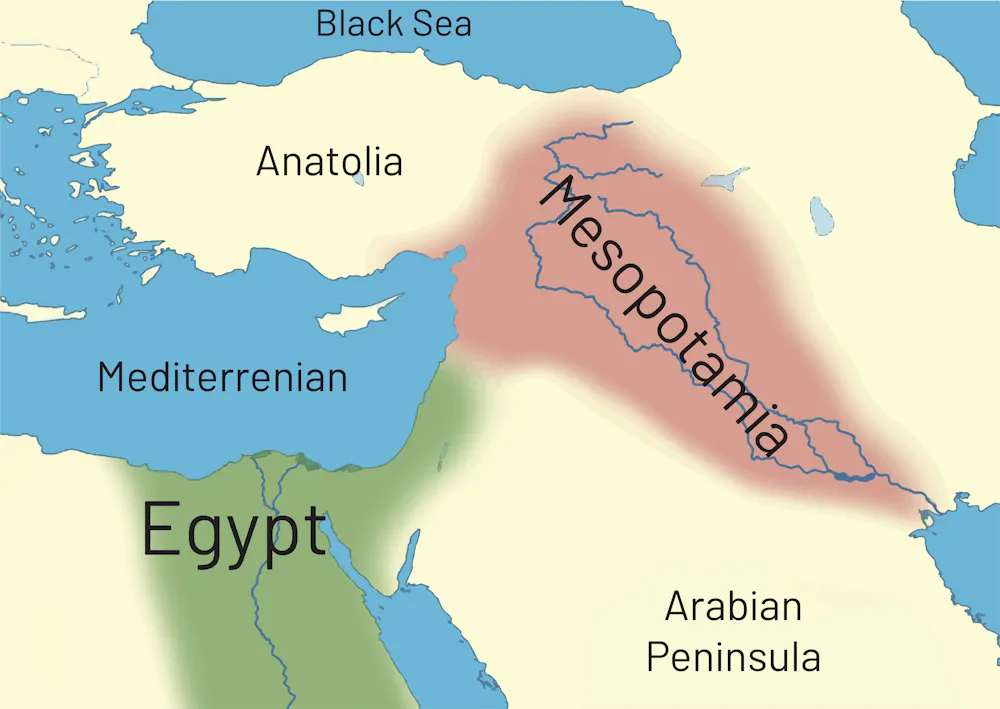
    A map of Mesopotamia, a historical region in modern-day Iraq.
    aipsidtr / Shutterstock

    Sitting in the British Museum is an archive of real questions that were asked by the king of Assyria (a kingdom in northern Mesopotamia) in the 7th century BC. All kinds of affairs of state were put before the gods. Are the Egyptians going to attack? Has the enemy taken the town under siege? And will the governors return home safely?

    Reading the archive, you get a real sense of nerves on a knife-edge as the king waited for news from far away, wanting to know what had happened to his troops and trying to decide what to do next.

    Not only did he ask them about what would happen in the future, but he also consulted them on possible courses of action. Should the Assyrian army go to war? Should the king send a messenger to make peace? Asking the opinion of the gods would have helped him feel more confident in his next steps.

    The Babylonians did not have elections. But that did not mean the king could do whatever he wanted. It was important for his public image to have the gods onside, as well as for his own reassurance.

    Whenever a powerful official was appointed, the entrails would be read to ensure the gods approved. The head of the army, high priests and other important positions were all subject to this requirement. On one occasion, even the choice of crown prince – and hence the future king of Assyria – was put to this test.

    Interpreting the entrails was held to almost scientific standards of exactitude. Diviners worked in pairs or groups of up to 11, checking each other’s work to make sure they got it right. This was not a vague or woolly process, but a real attempt to ensure “accuracy” that could not be manipulated to simply come up with the answer that the king wanted to hear.

    Modern forecasting

    We all want to know what the future has in store, and have come up with ingenious ways of trying to find out, from opinion polls and data modelling to Paul the octopus, who developed a reputation for picking the winners of football matches during the 2010 World Cup. But are our methods really any better than looking inside a sheep?

    As all investors are warned, past performance does not guarantee future results. Yet the only data we have to inform our predictions comes from the past, and most of our models can’t take into account “unknown unknowns”.

    As many experts have found, predicting the future is a difficult business: opinion polls can lie and people change their minds, while economists have often been blindsided by a sudden crash.


    Read more:
    Harris nudges ahead of Trump in the polls – but could the economy prove her downfall?


    A Babylonian clay liver used for divination in Mesopotamia from 2050–1750 BC.
    Science Museum Group Collection, CC BY-NC-ND

    Since liver divination only answers “yes” or “no”, it is going to be right 50% of the time just through the law of averages. Despite its randomness, its success rate may well have seemed convincing at the time.

    And when we trust the authority of the source, it’s easy to find a way to explain away a wrong result – the prediction got halfway there, answered a different question, or would have been right if x hadn’t happened.

    We shouldn’t be blind to the weaknesses of our own methods. We are often wrong, and the Babylonians could sometimes be right.

    Selena Wisnom does not work for, consult, own shares in or receive funding from any company or organisation that would benefit from this article, and has disclosed no relevant affiliations beyond their academic appointment.

    ref. Why ancient Mesopotamians would have used a sheep’s liver to predict Donald Trump’s election odds – https://theconversation.com/why-ancient-mesopotamians-would-have-used-a-sheeps-liver-to-predict-donald-trumps-election-odds-242251

    MIL OSI – Global Reports

  • MIL-OSI Global: Small Things Like These: Magdalene laundries drama is a powerful rumination on compassion – and its limits

    Source: The Conversation – UK – By Ruth Barton, Professor in Film Studies, Trinity College Dublin

    In 2021, Ireland’s then Taoiseach (prime minister), Enda Kenny, delivered a formal apology to the survivors of the Magdalene laundries. The laundries were religious institutions where unmarried mothers and other “fallen” women were forced into slave labour.

    “It struck me,” he said, “that for generations Ireland had created a particular portrait of itself as a good living God-fearing nation. Through this and other reports we know this flattering self-portrait to be fictitious … by any standards it was a cruel, pitiless Ireland distinctly lacking in a quality of mercy.”

    His words might well serve as a prologue to the new film adaptation of Claire Keegan’s 2020 novella, Small Things Like These. So too might a brief moment in the equally excoriating, if less nuanced film, The Magdalene Sisters (2002). In it, one of the young women begs a local delivery boy to help her escape, but in the end he lets her down.

    History films work in various ways. One is to comfort the viewer that such a time is consigned to the past. Melodramas like The Magdalene Sisters and that other notable Magdalene story, Philomena (2013), find a form of closure when their victims confront their oppressors.

    Another is to refuse a neat ending, to force us to imagine what might happen in the lives of the protagonists after the final credits have rolled. In Small Things Like These, that protagonist is coal-man, Bill Furlong (Cillian Murphy), who finds himself inexplicably troubled as he is finishing off his delivery business in the days before Christmas 1985.

    All is well at home, where his five daughters quarrel amicably around the kitchen table as they do their homework under the eye of his wife, Eileen (Eileen Walsh). Money is tight but they’re getting by.

    Making a delivery to the local convent, he comes across a young woman, Sarah (Zara Devlin), locked in the coal shed. The discovery sets off his own memories of being brought up by a single mother, and, after her death, by a wealthy landowner, Mrs Wilson (Michelle Fairley). The film confronts kindly Bill with a dilemma: to shut his eyes, as do the other inhabitants of New Ross, to what is going on in the convent, or to aid the young woman.

    The mother superior, Sister Mary (Emily Watson), knows that the stooped coal-man standing uneasily in her office is no match for her. As she warns him, the future education of his younger daughters in the school adjacent to the convent is not guaranteed. Other of the villagers, who sense his confusion, tell him not to involve himself. His wife, even as she doesn’t fully understand what is going through his head, is horrified by the merest suggestion that he will disrupt the status quo.

    The price of compassion

    In a less nuanced film, this advice might prompt the viewer to further empathise with Bill, egging him on to action. But here, the suffocating moral blanket that lies over the city – visually rendered as a thick fog that merges into a drizzle and occasional snow, and the narrow, constricting streets through which he moves – remind us that nonconformity comes with a heavy price.

    The community may pile into the church for Christmas mass but, as Eileen admonishes Bill, there is no point in helping the starving child he meets on the road with the spare coins from his pocket – his father will only drink the money. What small closure comes at the film’s end is fragile and contingent.

    The trailer for Small Things Like These.

    Another risk of telling stories from history is to sacrifice the particular for the universal. Small Things Like These manages, through its visuals and its achingly believable performances (Murphy’s most of all) to be a film rooted in the Ireland that Kenny evoked in his speech. At the same time, it prompts us to question the limits of compassion – how much easier is it to conform to social norms than step outside them.

    The film ends fittingly with a tribute to the more than 56,000 young women who were sent to Magdalene institutions for “penance and rehabilitation” between the years 1922 and 1996. And the children who were taken from them.

    It is not history’s job to impose lessons on the present. But at the same time, it would be inadequate for viewers not to ask what we would have done in Bill’s place. And, more uncomfortably, what, faced with the knowledge of the multiple injustices of our own society, we ourselves are doing now.


    Looking for something good? Cut through the noise with a carefully curated selection of the latest releases, live events and exhibitions, straight to your inbox every fortnight, on Fridays. Sign up here.


    Ruth Barton does not work for, consult, own shares in or receive funding from any company or organisation that would benefit from this article, and has disclosed no relevant affiliations beyond their academic appointment.

    ref. Small Things Like These: Magdalene laundries drama is a powerful rumination on compassion – and its limits – https://theconversation.com/small-things-like-these-magdalene-laundries-drama-is-a-powerful-rumination-on-compassion-and-its-limits-242057

    MIL OSI – Global Reports

  • MIL-OSI Security: Defense News: Cybersecurity Awareness Month 2024: A message from the Chief of Naval Operations to Warfighters

    Source: United States Navy

    As we wrap up the 20th anniversary of Cybersecurity Awareness Month, I want to take a moment to reflect on the critical messaging our Cyber Warriors have shared this month and reiterate the key ways we can all contribute to safeguarding our Navy’s information and communications technology. Every member of the Navy team – active and reserve Sailors and Navy civilians – is integral to the Navy’s cybersecurity efforts and ensuring America’s Warfighting Navy remains the world’s pre-eminent warfighting force.

    The growing threats from adversaries in the cyber domain are real and rapidly evolving. These threats have direct and significant implications for our operational readiness, with the potential to affect our ability to fight and win in a cyber-contested environment. To ensure we remain ready to defend our Nation, our information systems must deliver secure, interoperable, and effective mission performance during peacetime and sustained combat operations.

    Every day, our adversaries seek to exploit vulnerabilities in the systems you rely on to execute our national security objectives. It’s our responsibility to identify and reduce those vulnerabilities. Whether you’re operating ships, submarines, or shore-based infrastructure, understanding the cyber risks within our systems and actively working to mitigate them is essential. We must always remain vigilant, reporting any cyber threats we encounter and acting quickly to neutralize them.

    Our greatest strength in this fight is our people – you are our true secret weapon. Our Sailors and Navy civilians are our most valuable assets in defending against cyber threats, and it’s up to each of us to contribute.  By practicing good cyber hygiene, continually educating ourselves on emerging threats, and empowering our shipmates with the knowledge and tools they need, we fortify our collective defense.

    Every day each of us stands as the first line of defense in protecting our Nation’s critical information systems and networks. Whether at home, at work, or while deployed, the choices we make online can have far-reaching impacts on our Navy’s readiness and operational security.

    I urge all of you to stay vigilant and stay informed on the evolving cyber landscape. Together, through awareness, education, and teamwork, we can uphold our Navy’s—and our Nation’s—high standard of cybersecurity.

    MIL Security OSI

  • MIL-OSI Global: The next president will play a key role in shaping US trade policy – here’s what voters need to know

    Source: The Conversation – USA – By Bedassa Tadesse, Professor of Economics, University of Minnesota Duluth

    From the ports of Los Angeles to the cornfields of Iowa, the U.S.’s international trade policy is a force that shapes the lives of every American. With the presidential election looming in November 2024, discussing trade policy isn’t just an academic exercise – it’s a civic responsibility.

    As an economist, I have spent years studying this topic. Trade policy has profound effects on how industries operate, from production locations to competitive dynamics. These changes impact everyday life, from the cost of your morning coffee to the job security in your local community.

    And, because the president has extensive control over trade policy, every presidential election is a referendum on the issue.

    The two most recent administrations – President Donald Trump and Vice President Mike Pence from 2017 to 2021 and President Joe Biden and Vice President Kamala Harris from 2021 to today – have had starkly different approaches to trade policy. The contrast shows how a president’s economic philosophy can reshape the nation’s global business strategy.

    Both Trump and Harris are on the ballot in November. Harris is expected to carry on Biden’s trade policies if she wins. This comparison offers insight into how the next U.S. president will govern on trade.

    2017-2021: Trump and Pence on trade

    Trump pursued a protectionist trade agenda during his time in office.

    Protectionism refers to government policies that limit international trade to benefit domestic industries. These measures include tariffs – taxes on imported goods – quotas and regulations that make imports more expensive.

    One of Trump’s first acts in office was withdrawing from the Trans-Pacific Partnership — a colossal 12-nation pact that would have covered 40% of global output. His decision cost America both access to lucrative Asian markets and a powerful counterweight to China’s economic influence.

    Closer to home, Trump renegotiated the North American Free Trade Agreement (NAFTA) into the United States-Mexico-Canada Agreement,
    tightening rules for automakers. The effect? While wages for workers in the automotive industry and vehicle prices for American consumers increased, it barely spurred any additional domestic car production.

    Trump also launched a tariff-driven trade war with China and the European Union, asserting it would address unfair practices and reduce the U.S. trade deficit. The strategy, however, prompted retaliatory tariffs, resulting in higher consumer prices and job losses in U.S. industries dependent on imported components. While some sectors benefited from the approach, American farmers suffered due to export losses, necessitating government subsidies.

    Trump and his new running mate, JD Vance, have signaled their intent to revive the “America First” trade strategy. Their campaign platform calls for sweeping tariffs, including a blanket 10% tariff on all goods and a more aggressive 60% tariff specifically targeting Chinese products.

    2021-today: Biden and Harris on trade

    In contrast, the Biden-Harris administration adopted a multilateral approach emphasizing cooperation between countries.

    The administration maintained most of Trump’s tariffs on Chinese goods and some on steel and aluminum imports from other countries. However, they reframed the measures as part of a broader push to rein in climate change and protect workers’ rights.

    The administration also launched initiatives like the Indo-Pacific Economic Framework for Prosperity, or IPEF, signaling a return to Obama-era trade strategies prioritizing regional partnerships in the Pacific. The IPEF aims to strengthen economic ties with Asian countries by coordinating policies to enhance supply chain resilience and promote clean energy rather than focusing solely on tariff reductions.

    The Biden-Harris approach emphasizes international cooperation while valuing domestic job creation, particularly in clean energy and manufacturing. However, maintaining many of Trump’s tariffs on Chinese goods, steel and aluminum has kept costs high for some U.S. businesses and consumers.

    Building on the Biden administration’s policies, the Harris campaign has signaled its aim to shield lower- and middle-income households from new tariffs that could raise prices while maintaining a tough stance on China through existing tariffs and trade restrictions.

    Presidential powers and influence on trade

    The president plays a critical role in setting America’s trade policy.

    The president can negotiate international trade deals, although Congress must approve them to become law. The executive branch also controls tariffs; under statutes such as the Trade Act of 1974, the president can impose them without congressional approval.

    In addition, the president can declare national emergencies related to trade, appoint trade representatives, issue executive orders to manage federal trade policies, and impose sanctions that can influence global trade dynamics.

    Free trade agreements can boost exports and promote economic growth, but they may also displace certain workers. In contrast, tariffs on imports protect some domestic industries but raise prices for American consumers. Studies show that tariffs imposed under Trump, and continued by Biden, have led to higher prices, reduced output and lower employment, harming the U.S. economy.

    Trade policies also affect diplomatic relationships and global supply chains. So, as voters sift through the candidates’ trade policy positions, they must look beyond the soundbites. Understanding how each approach affects job markets, consumer prices and global competitiveness will help voters cast an informed ballot that aligns with their vision for the country’s future.

    In the world of trade, every vote counts.

    Bedassa Tadesse does not work for, consult, own shares in or receive funding from any company or organization that would benefit from this article, and has disclosed no relevant affiliations beyond their academic appointment.

    ref. The next president will play a key role in shaping US trade policy – here’s what voters need to know – https://theconversation.com/the-next-president-will-play-a-key-role-in-shaping-us-trade-policy-heres-what-voters-need-to-know-241301

    MIL OSI – Global Reports

  • MIL-OSI Security: Defense News: VCNO Visits Students, Navy Leadership in Newport

    Source: United States Navy

    Vice Chief of Naval Operations Adm. Jim Kilby visited Newport, R.I., to meet with students and Navy leadership, Oct. 30.

    While addressing students and staff at Surface Warfare Schools Command, Kilby stressed the achievements and lessons learned the schoolhouse has played since the Navy’s role in the Red Sea.

    “In the last year, this community has witnessed firsthand the importance of what you learn at SWSC,” said Kilby. “It’s proved that you are ready to response in crisis and able to adapt to the longest sustained attacks at sea we’ve seen since World War II.”

    “This may not be the high-end fight, but the speed and scale of response will carry lessons learned for the Navy throughout our Fleet,” he continued. “I could not be more proud and more impressed with the work being done here.”

    SWSC’s mission is to ready sea-bound warriors to serve on surface combatants as officers, enlisted engineers and enlisted navigation professionals in order to fulfill the Navy’s mission to maintain global maritime superiority.

    The school maintains state-of-the-art technology in classrooms and trainers to ensure the surface warfare community remains ready for any fight to defend our nation and freedom of the seas.

    During his time at Naval Station Newport, Kilby spoke with leadership attending the Senior Enlisted Academy and the Naval Leadership and Ethics Center and stressed the leaders’ role in CNO’s Navigation Plan 2024.

    “You are all a critical piece of executing CNO’s NAVPLAN,” said Kilby. “Whether it’s from ensuring our Sailor’s Quality of Service to maintaining our platforms, you are the leaders out there getting it done. I thank you for your sacrifice and ownership entering this new level of responsibility and accountability… congratulations.”

    The SEA is the Navy’s only professional military education institution dedicated to senior enlisted personnel, focusing on management, leadership, national security and physical fitness.

    NLEC provides training for the foundational principles of ethical leadership across the naval profession, guiding the development of leaders who possess a deep, unwavering sense of responsibility, authority, and accountability. 

    Kilby also met with Rear Adm. Darryl Walker, president of the U.S. Naval War College (NWC), at the institution’s Newport campus where the NAVPLAN was announced earlier this year.

    Established in 1884, NWC is the oldest institution of its kind in the world. The college delivers excellence in education, research, and outreach, informing today’s decision makers, educating tomorrow’s leaders, and engaging partners and allies on all matters of naval power in order to preserve the peace, respond in crisis, and win decisively in war.

    Naval Station Newport is home to 50 different commands and is the Navy’s premier site for training and educating officers, officer candidates, senior enlisted personnel and midshipman candidates into future leaders, as well as testing and evaluating advanced undersea warfare and development systems.

    MIL Security OSI

  • MIL-OSI Global: Tariffs are back in the spotlight, but skepticism of free trade has deep roots in American history

    Source: The Conversation – USA – By Erik Guzik, Assistant Clinical Professor of Management, University of Montana

    Noted economic nationalist Alexander Hamilton. Douglas Sacha/Getty Images

    One of the more surprising developments in recent American politics has been the backlash against free trade.

    As recently as a decade ago, Democrats and Republicans alike generally favored free trade. But with the 2024 presidential election just days away, both Republican Donald Trump and Democrat Kamala Harris are leaning hard on protectionism. The Trump campaign in particular is promoting tariffs that would be difficult to imagine coming from a Republican presidential candidate just a decade ago.

    This new post-neoliberal moment might seem confounding. But it hearkens back to economic policies – and political parties – from around the time of the nation’s founding, and it offers clues to our divided present.

    Back in the late 18th century, the Founding Father Alexander Hamilton helped put in place a set of policies designed to encourage U.S. industry and to promote economic development and innovation.

    That arrangement, which laid the groundwork for what became known as the “American System,” emerged in part as a counterbalance to British conceptions of free trade. And the American System quickly grew as accepted economic policy as a young America developed its industrial strength.

    Hamilton’s economic nationalism

    In the early years of the republic, the U.S. didn’t have much of a trade policy at all.

    When the U.S. officially achieved independence in 1783 with the signing of the Treaty of Paris, the Articles of Confederation – the nation’s first constitution – greatly limited the federal government’s powers, including its ability to regulate foreign trade.

    These restrictions reflected the reality of 13 very different states that had been more united against the British – and their trade controls – than in support of a common vision of economic development.

    The economic conditions within this loosely connected nation quickly worsened. A deepening economic crisis, rising debt, inflation, cheap British manufactured goods and rising bankruptcy soon emerged. Such changing conditions gave rise to calls for a new national economic policy.

    This economic strain was an important factor leading to the drafting of the U.S. Constitution, ratified in 1789. The Constitution gave the federal government the capacity to regulate trade with foreign countries and, for the first time, to collect taxes. Both were privileges once held exclusively by sovereign American states.

    The ‘second American revolution’

    A strengthened American Congress made passing a national Tariff Act one of its first tasks. When it was ratified in 1789, a national import tax replaced customs previously enacted by the states. Perhaps indicating the magnitude of this change, supporters called it “the Second American Revolution,” passed as it was on July 4, 1789. In effect, it helped create a new conception of the American political and economic system, with a much stronger role for the state in economic matters.

    Duties were levied on 30 commodities, including hemp and textiles. Perhaps foreshadowing trade policy of a future era, the Tariff Act also placed duties of 12.5% on goods imported from China and India.

    The main architect of this new industrial policy was Hamilton, who released his seminal work on economic policy, Report on Manufactures, in 1791. Hamilton’s ideas were based on transforming a predominantly agricultural nation into one defined, at least in part, by growing and diversified industry.

    Though often overlooked, Hamilton’s Report on Manufactures also contained a grander vision – it sought to encourage the development of American invention and ingenuity as a form of economic policy and argued for unlocking “the genius of the people” so that “the wealth of a nation may be promoted.”

    To promote this spirit of national enterprise, Hamilton encouraged promoting technological progress, subsidizing research, attracting migrants, supporting a new financial system and implementing a patent system to promote invention. Such policies were in many ways an extension of previous policy enshrined in Section 8 of the Constitution.

    Tariffs and their discontents

    As the use of tariffs continued in the decades following Hamilton’s plan, policymakers turned increasingly protective in an attempt to more directly promote American industry. They enacted tariffs to insulate growing American industries from foreign competition, primarily from the U.K.

    By the early 19th century, this growing protectionist movement coalesced around the powerful Kentucky legislator Henry Clay and his Whig Party. Clay, who first referred to the American System by name, and his allies were instrumental in raising average national tariff rates to 20% in 1816.

    Those sweetmeats will cost you.
    Library of Congress

    When crisis appeared during the Panic of 1819, a collapse in cotton prices, a tightening of credit, widespread foreclosures and rising unemployment followed. In response, Clay and his allies raised tariff rates again, to 50% in 1828.

    The increasing use of tariffs provoked a fierce response from some in the nation’s agricultural and slave-owning class, who objected to perceived Northern dominance and a strong federal government. One prominent Southern critic at the time referred to the 1828 tariff as the “tariff of abominations.”

    Indeed, opposition to elements of the American System was one of the chief policy goals of early Democratic politicians such as Andrew Jackson, and fights over the system presaged later sectional fights leading up to the Civil War.

    As an industrial revolution took root in American society in the decades that followed, tariffs remained a cornerstone of U.S. economic policy. By the late 1850s, tariffs had become integrated into the policy of the newly formed Republican Party and an important plank of Abraham Lincoln’s economic platform.

    Toward the end of the 19th century, a changing Democratic Party, supported increasingly by a strong agricultural populist movement, continued to largely oppose the tariff system, arguing it benefited powerful industrialists at the expense of the working class while offering little to counter economic crisis.

    The breakup of the American System − and why it matters today

    Between 1861 and 1933, tariffs were a standard tool of U.S. economic policy. During this period, tariffs on dutiable goods often averaged 40% to 50%, especially in the late 19th and early 20th centuries. U.S. policymakers didn’t seriously question tariffs as a form of industrial policy until the deepening of the Great Depression in the 1930s.

    Following World War II, the U.S. decisively shifted away from tariffs. The Smoot-Hawley Tariff Act was widely blamed for deepening the Great Depression and contributing to the international conflicts of the 1930s and 1940s, effectively ending the protectionist era of U.S. industrial history.

    The establishment of the Federal Reserve in 1913 provided policymakers with a novel tool – monetary policy – to deal with economic downturns. The Keynesian revolution provided still another policy response for governments to consider during periods of economic crisis: spending as fiscal stimulus to create jobs and income.

    Finally, as postwar American policy embraced open global trade, American economic policy pursued more direct mechanisms to foster national innovation and entrepreneurship – effectively breaking up policy once dependent on activist trade intervention. With the elimination of tariffs, one of the great periods of American economic growth and innovation followed.

    In 2024, the Republican platform has, in many ways, returned to its origins by offering tariffs as a key economic strategy. Likewise, the Democratic platform, with its skepticism of concentrated corporate power, coupled with a renewed focus on financial support for small businesses and entrepreneurship, echoes its own earlier generation.

    As Americans head to the polls, it’s worth asking how current economic proposals with deep roots in the American System of old might help shape economic policy in the future.

    Erik Guzik does not work for, consult, own shares in or receive funding from any company or organization that would benefit from this article, and has disclosed no relevant affiliations beyond their academic appointment.

    ref. Tariffs are back in the spotlight, but skepticism of free trade has deep roots in American history – https://theconversation.com/tariffs-are-back-in-the-spotlight-but-skepticism-of-free-trade-has-deep-roots-in-american-history-241311

    MIL OSI – Global Reports

  • MIL-OSI Global: Rust Belt voters aren’t all white, but election coverage of the region often ignores the concerns of people of color there

    Source: The Conversation – USA – By Christabel Devadoss, Assistant Professor in Global Studies and Human Geography, Middle Tennessee State University

    Wisconsin voters lining up to cast their ballots in the 2022 midterm election, Oct. 25, 2022, in Milwaukee. Scott Olson/Getty Images

    Every four years, national media turn their attention to the Rust Belt, a term that describes Midwestern industrial and manufacturing states whose economies were decimated by the decline of those industries in the 1970s. This region contains the coveted states of Ohio, Michigan, Wisconsin and Pennsylvania.

    Many rural parts of these states have a majority of white residents. The broader Rust Belt, however, also has long and important Black and Indigenous histories and contains some of the nation’s fastest-growing minority populations – in particular Latino, Arab and Asian communities.

    Yet when reporters descend on the rural Rust Belt to understand voters, the people they talk to are almost exclusively white.

    I am a geographer who studies the experiences of communities of color in the rural Rust Belt. Rural is a relative term, but when it comes to policy research, it usually refers to nonmetropolitan areas. From 2021 to 2023, I interviewed 35 people who live or lived in Ohio, Pennsylvania, Michigan and Indiana and identified as Black, Indigenous or people of color.

    I found that these Rust Belt residents have pressing concerns of political importance. Some of these issues are shared by white residents – and, as such, are well documented. But Rust Belt residents of color have additional problems that politicians and the media have long overlooked.

    Local impacts

    My interviewees described typical rural Rust Belt struggles.

    They complained of limited internet access, few or no grocery stores, declining roads and other infrastructure-related challenges. Jobs and opportunities for career advancement were scarce in their communities, while death and suicide rates were high.

    These difficulties are faced by white Rust Belt residents as well. But other struggles they mentioned are less often considered part of the rural experience.

    They described feeling socially isolated and discriminated against at work and school. Many had experienced racial or ethnic profiling by potential employers and police and been verbally harassed.

    One man, Miguel, who worked in carpentry, said his colleagues openly used racial slurs against him.

    “I was putting away some boxes, and they said, ‘Oh that’s because you w–backs are good at packing things in trucks,’” he told me.

    All names used here are pseudonyms; research ethics require me to protect the identity of my subjects.

    “A lot gets brushed under the rug,” said Bao, a Vietnamese American woman whose father also works in a hostile environment. “All the management folks are white,” so “if you speak up, you lose your job or are ignored.”

    These comments conveyed an overall sense of not “belonging.”

    As one woman from rural Pennsylvania explained, people regularly ask her, “No, really, where you from?”

    “They want to hear ‘Asian’ or ‘Korean,’” she said. “It’s very uncomfortable for me.”

    These racial tensions worsen during election periods. Some people I interviewed reported having been turned away or threatened at voting stations – harassment they attributed to their religious, cultural and political backgrounds, or the way they looked.

    Many Rust Belt voters of color already lack political power because they live in racially gerrymandered districts. When news coverage of the region ignores their voices, too, it compounds that feeling of not belonging.

    In 2017, The Washington Post visited the small town of Jefferson, Ohio, in Ashtabula County, to interview voters described as “rural Americans who fear they’re being forgotten” after Donald Trump’s election. Their coverage focused almost exclusively on white residents.

    “How did you go to Ashtabula County and not see Black people?” asked Belle, a resident who identified as African American.

    Not always Republican

    In the past three presidential elections, Ashtabula County has followed state trends: It backed Obama in 2008 and 2012, then voted for Trump in 2016 and 2020.

    Trump won Ashtabula with 60% of the vote in 2020. That’s 26,890 votes, which means that 16,497 people still voted for Democrat Joe Biden. In the years since, Ashtabula County residents have also voted with the state in two Democratic-backed initiatives: to protect abortion rights and legalize marijuana.

    In other words, just because a state or district backs a Republican for president doesn’t mean everyone is Republican, or that Republican voters always vote the party line. They can split their votes, and have.

    Even Ohio’s largely Republican delegation in the House of Representatives is misleading about the state’s political makeup. Ohio is a heavily gerrymandered state where voting districts have been drawn to benefit Republican candidates.

    U.S. Senate elections show more diversity in Ohio’s voting base.

    In 2018, Democrat Sen. Sherrod Brown won 53% of all votes in Ohio, including 51% of those cast in Ashtabula County. Four years later, both the state and Ashtabula County picked Republican JD Vance over Democrat Tim Ryan to replace the outgoing Republican Sen. Rob Portman.

    Why it matters

    In September 2024, Vance – now Trump’s vice presidential running mate – claimed that Haitian migrants in Springfield, Ohio, were kidnapping and eating cats and dogs. After Trump echoed that false claim on the debate stage, the city got 30-plus bomb threats and other threats of violence, and had to close multiple schools.

    During the pandemic, Trump’s derogatory branding of COVID-19 as the “Chinese virus” and “Kung Flu” led to increased hate crimes against immigrants and people of color.

    In my interviews, several participants mentioned how local restaurants and stores owned by Asian Americans had been vandalized. One woman, Lanh, who lived outside Springfield, said her favorite restaurant had to close.

    “They started vandalizing the restaurant, writing graffiti and set the restaurant on fire,” she said.

    The owners were from Thailand, but, Lanh said, the vandals “thought they were Chinese. Folks around the local community like my parents didn’t feel safe,” she added. “I didn’t feel safe.”

    Hateful political rhetoric is known to increase hate crimes against immigrants and people of color.

    When the Rust Belt is stereotyped as red and white, such experiences go unheard.

    So do some good news stories.

    The emergence of Black-owned bee farms in northeast Ohio, for instance, is one small example in a host of businesses started by people of color. Together, they are helping to boost the region’s beleaguered economy, much as Haitian immigrants have been fueling Springfield’s growth.

    Rural America is nuanced

    Nationwide, 24% of rural Americans identified as people of color in the 2020 census.

    That figure is probably low because the census tends to undercount nonwhite respondents – a problem that was particularly evident in 2020. Even so, that’s a quarter of rural residents who don’t fit the national stereotype of rural America.

    Rural America is white and Republican. It’s also trans, queer, Black, Hispanic, Indigenous, South Asian, Democratic and much more. Even if some are Republican, they still aren’t the rural Rust Belt Republicans portrayed in the national media.

    Ignoring these nuances reinforces stereotypes that the rural Rust Belt is the exclusive domain of white conservativism. But this region isn’t now, and never has been, simply red and white.

    Christabel Devadoss received funding from the American Council of Learned Societies (ACLS).

    ref. Rust Belt voters aren’t all white, but election coverage of the region often ignores the concerns of people of color there – https://theconversation.com/rust-belt-voters-arent-all-white-but-election-coverage-of-the-region-often-ignores-the-concerns-of-people-of-color-there-224466

    MIL OSI – Global Reports

  • MIL-OSI Global: Independent voters think for themselves and stay out of politics – 3 essential reads

    Source: The Conversation – USA – By Jeff Inglis, Politics + Society Editor, The Conversation US

    Jessie Harris, left, a registered independent voter in South Carolina, casts a ballot in February 2024. Joe Lamberti for The Washington Post via Getty Images

    In the 2024 election, the two major-party campaigns and many news reporters are spending a lot of time talking about independent voters – those who are neither aligned with the Republican Party nor the Democratic Party. Despite the power that political independents are anticipated to have over the election results, there’s a lot that remains unknown about this group.

    The Conversation U.S. has published several articles about what is known, and why it’s hard to know much more. Here are selections from some of those articles:

    1. How many independent voters are there?

    It’s very hard to answer that question, wrote Thom Reilly, a professor of public affairs at Arizona State University. Part of the problem is figuring out how to define who independent voters are. Surveys often ask people if they are Republicans, Democrats or independents, and if they answer that they are independents, the surveys ask how strongly they might lean toward one party or the other. But this muddies the waters of political identity, Reilly wrote:

    It’s possible that some voters identify as independent but really just have weaker political preferences than party die-hards, while still maintaining some loyalty to one party or the other. And some independent voters change their political identification from one cycle to another. That makes it hard to tell who an independent voter is and how many of them exist.”

    Those changing alignments, Reilly wrote, “may require scholars, media outlets and the public to shift their traditional two-party view of American politics.”


    Read more:
    Why is it so hard to know how many independent voters there are?


    2. Independent voters think for themselves

    Independent voters exhibit a key quality that most Americans expect of their fellow citizens: They base their views on their life experiences.

    Unfortunately, as politics scholars Shanna Pearson-Merkowitz at the University of Maryland and Joshua J. Dyck at UMass Lowell explained, this is an attribute almost unique to political independents:

    In contrast, Democrats’ and Republicans’ ideas of what problems deserve government attention and how to solve them are much less likely to be based on their own life experiences, and instead simply mirror the information they have gained from leading political figures on social media, on cable news networks or through other partisan information outlets.”

    For instance, independents living in neighborhoods with high levels of gun violence are far more likely to report being concerned about gun violence than independents who live in safer areas. But, Pearson-Merkowitz and Dyck wrote,

    “for Democrats and Republicans, there is no relationship between where they live and their level of concern about gun violence: Whether they live in a relatively dangerous community or a relatively safe one, their views on gun violence reflect their party’s messages on the issue.”


    Read more:
    Politics is still both local and personal – but only for independents, not for Democrats or Republicans


    3. Independents less likely to engage in any politics

    Research into independents’ political activity finds them tending to stay away from politics, wrote Julio Borquez, a political science scholar at the University of Michigan-Dearborn:

    “Perhaps most importantly, pure independent voters are simply less likely to vote than those who express any degree of partisan attachment. In the 2020 presidential election, reported turnout among pure independents was about 20 percentage points lower than turnout among other voters, including independents who lean toward a party.”

    Research has found members of this group “tend to be genuinely put off by partisan conflict and party labels,” Borquez wrote. Different studies have found, for instance, that they prefer photos of neighborhoods that did not show political yard signs over the same photos of the same neighborhoods with homes displaying political yard signs. And they pay less attention to campaigns and partisan social media than people with partisan affiliations.

    So they are indeed independent – but the question remains whether they will be uninvolved in 2024 or motivated to cast their ballots and make their views known.


    Read more:
    Independent voters are few in number, influential in close elections – and hard for campaigns to reach


    ref. Independent voters think for themselves and stay out of politics – 3 essential reads – https://theconversation.com/independent-voters-think-for-themselves-and-stay-out-of-politics-3-essential-reads-241193

    MIL OSI – Global Reports

  • MIL-OSI Global: Americans own guns to protect themselves from psychological as well as physical threats

    Source: The Conversation – USA – By Nick Buttrick, Assistant Professor of Psychology, University of Wisconsin-Madison

    Many gun owners cite protection as a reason to carry a firearm. RJ Sangosti/MediaNews Group/The Denver Post via Getty Images

    Kamala Harris, Donald Trump, Tim Walz and JD Vance all have something in common. All four of them, along with an estimated 42% of American adults, have lived in a home with at least one gun.

    Gun ownership in the United States is widespread and cuts across all sorts of cultural divides – including race, class and political ideology. Like all mass experiences in American life, owning a gun can mean very different things to different people.

    One thing that American gun owners tend to agree on, no matter their differences, is that guns are for personal protection. In a 2023 Pew survey, 72% of gun owners reported that they owned a firearm at least in part for protection, and 81% of gun owners reported that owning a gun helped them to feel safer. This perspective contrasts to that of gun owners in other developed economies, who generally report that guns are more dangerous than safe and that they own a gun for some other reason.

    I’m a psychologist who studies contemporary society. In the lab, my colleagues and I have been investigating this feeling of safety that American gun owners report. We’re trying to get a more complete sense of just what people are using their firearms to protect against. Our research suggests it goes much deeper than physical threats.

    Social scientists are exploring the motivations and effects of owning a gun.
    Cécile Clocheret/AFP via Getty Images

    Protection goes beyond the physical

    By combining social-scientific research on firearms ownership with a raft of interviews we’ve conducted, we’ve developed a theory that gun owners aren’t just protecting against the specific threat of physical violence. Owners are also using a gun to protect their psychological selves. Owning a gun helps them feel more in control of the world around them and more able to live meaningful, purposeful lives that connect to the people and communities they care for.

    This sort of protection may be especially appealing to those who think that the normal institutions of society – such as the police or the government – are either unable or unwilling to keep them safe. They feel they need to take protection into their own hands.

    This use of a deadly weapon to provide comfort and solace may come at a cost, however, as firearms often bring a heightened sense of vigilance with them. Firearm instructors frequently teach owners to be especially aware of their environment and all the potential dangers and threats within. When gun owners look for danger, they often are more likely to find it.

    Gun owners may end up perceiving the world as a more dangerous place, institutions as more uncaring or incompetent, and their own private actions as all the more important for securing their lives and their livelihoods.

    How gun owners feel during daily life

    What does this cycle of protection and threat look like in everyday life? My colleagues and I recently ran a study to investigate. We’re still undergoing peer review, so our work is not final yet.

    We recruited a group of over 150 firearms owners who told us that they regularly carry their guns, along with over 100 demographically matched Americans who have never owned a gun. Over two weeks, our research team texted the participants at two random times each day, asking them to fill out a survey telling us what they were doing and how they were feeling.

    To get a sense of how guns change the psychological landscape of their owners, we divided our gun-carrying group into two. When we texted one half of the group, before we asked any other questions, we simply asked whether they had their gun accessible and why they’d made that decision. For the other half of our gun-owning participants, and for our non-gun-owning control group, firearms and firearm carrying never came up.

    When subtly reminded of guns in general – regardless of whether their gun was accessible – our participants reported feeling more safe and in control and that their lives were more meaningful. Thanks to our random-assignment procedure, we can be pretty confident that it was thinking about guns, as opposed to any differences in the underlying groups themselves, that caused this particular increase in psychological well-being.

    About half of the times that we texted, the gun owners told us that they had a gun accessible at that moment. When a gun was handy, our participants told us that they were feeling more vigilant and anxious, and that their immediate situation was more chaotic. This result didn’t seem to be driven by owners choosing to have guns available when they were putting themselves into objectively more dangerous situations: We found the same pattern when we looked just at moments when our participants were sitting at home, watching television.

    Raising fear and promising rescue

    Contemporary American gun ownership may have conflicting messages embedded within it. First, a gun is a thing you can use to bolster your fundamental psychological needs to feel safe, to feel in control and to feel like you matter and belong. Second, having a gun focuses your attention on the dangers of the world.

    By both fueling a sense of danger and holding out the promise of rescuing you from the fear, messaging around guns may end up locking some owners into a sort of doom loop.

    A sense of responsibility goes along with gun ownership for the vast majority of Americans who own a firearm.
    Matt McClain/The Washington Post via Getty Images

    My collaborators and I are currently exploring whether stressing other parts of gun ownership may help owners to move beyond this negative spiral. For instance, while owners often talk about “danger,” they also talk frequently about “responsibility.”

    Being a responsible gun owner is central to many owners’ identities. In one study, 97% of owners reported that they were “more responsible than the average gun owner,” and 23% rated themselves as being in the top 1% of responsibility overall. This, of course, is statistically impossible.

    To more fully understand the many ways responsible firearm ownership can look, we are in the process of interviewing gun owners from all around the state of Wisconsin, a notably diverse state when it comes to gun ownership. We’re tapping into as many of the ways of owning a gun as we can, talking with protective owners, hunters, sport shooters, collectors, folks in urban areas, folks in rural areas, men, women, young people, old people, liberals, conservatives, and, of course, trying to capture the complex ways that race shapes ownership.

    Who do gun owners feel they are responsible for? What kinds of actions do they think responsible owners take?

    We hope to learn more about the many different ways that people conceptualize what a gun can do for them. American gun cultures are complex and distinct things. By exploring the worldviews that support firearm ownership, we can better understand what it means to live in the U.S. today.

    Nick Buttrick receives funding from the National Science Foundation and the Wisconsin Department of Justice.

    ref. Americans own guns to protect themselves from psychological as well as physical threats – https://theconversation.com/americans-own-guns-to-protect-themselves-from-psychological-as-well-as-physical-threats-239363

    MIL OSI – Global Reports

  • MIL-OSI Global: In Hawaii, parasites and viruses team up in the battle against fruit flies – an entomologist explains the implication for global pest control

    Source: The Conversation – USA – By Kelsey Coffman, Assistant Professor of Entomology & Plant Pathology, University of Tennessee

    Diachasmimorpha longicaudata, a parasitoid wasp that helps control pests. Sheina Sim, CC BY

    Take a stroll along one of the beaches on Hawaii Island in late summer, and you’ll likely stumble upon almond-shaped fruits lying in the sand. Known as false kamani nuts, or tropical almonds, they fall from tall, shady Terminalia catappa trees that line the many picturesque ocean views on the island.

    But what may not be clear to the casual beachgoer is that there’s a fight for survival occurring within the flesh of these unassuming fruits. Tropical almonds are one of many active battlegrounds in a war between a global agricultural pest, a parasitic wasp and a beneficial virus.

    As an entomologist who studies insect viruses, I want to untangle the complex interactions that insects have evolved with microbes. The findings might help researchers tackle global food security issues.

    A global pest challenge

    At the center of this conflict are invasive fruit flies in the family Tephritidae, many of which have spread across the globe and wreak havoc on hundreds of commercial fruits and vegetables.

    In Hawaii, several species of tephritid fruit fly invaded, starting in the late 1800s. They have caused major economic losses to fruit production across the islands. Scientists and fruit growers have undertaken enormous efforts to control these flies since their initial introductions, but they remain a serious economic problem.

    One reliable method of control has been to release tiny insects called parasitoid wasps into the wild that can hunt down immature fruit flies and target them for annihilation. The term parasitoid describes an organism that spends its development as a parasite and eventually kills its host.

    Parasitoid wasps use an elongated stinger, known as an ovipositor, to drill into fruits where flies are developing and pierce the fly’s body to lay an egg within. Wasp eggs hatch inside the fly host and gradually devour the entire fly from the inside out.

    Human use of parasitoid wasps or other natural enemies to control pest populations is known as biological control, or biocontrol. It was so successful in Hawaii that several species of parasitoid wasp have established wild populations on the islands. They have helped continuously suppress multiple fruit fly pests to this day.

    The release of nonnative insects for biocontrol could have unforeseen negative consequences for local ecosystems. Therefore, federal agencies like the U.S. Department of Agriculture have strict regulations for new and existing biocontrol programs.

    The enemy of my enemy is my friend

    So, how do wasps achieve the impressive feat of reducing fruit fly pest populations? Once laid inside a fly host, the wasp must face the fly’s immune system, which will try to suffocate the egg before it hatches.

    This inhospitable environment has forced wasps to evolve an arsenal of microscopic substances, also known as molecular factors, to combat fly defenses. These include a cocktail of different molecules introduced by the wasp mother at the time of egg-laying.

    The goal of these factors is to manipulate the fruit fly’s physiological processes, like its development from egg to adult and its immune response to invading parasites. By interacting with molecular components, like proteins, that make up insect physiological pathways, parasitoid wasp factors can delay insect host development and suppress host immunity to allow the wasp offspring to feed on fly tissue unharmed.

    This is the origin story of an unlikely partnership that many species of parasitoid wasp have formed with beneficial viruses. Virus particles multiply to massive quantities within the reproductive organs of female wasps during their development. Wasp mothers then use their ovipositor like a hypodermic needle to inject virus particles into host insects during egg-laying.

    The virus particles turn into biological weapons that infect cells of the wasp’s host. This infection disrupts processes like the fly’s immune response. Developing wasps benefit from the virus’s activity and return the favor by passing on the virus to future wasp generations.

    Not all heroes wear capes

    Diachasmimorpha longicaudata is a small, bright orange wasp with a distinctively long ovipositor. The literal translation of longicaudata is “long-tailed” in Latin. But don’t let its charismatic appearance fool you.

    D. longicaudata is ferocious in its ability to feast on several species of fruit fly pests, such as the Mediterranean fruit fly, Ceratitis capitata, and the oriental fruit fly, Bactrocera dorsalis. Because of D. longicaudata’s ability to attack a wide variety of fruit fly pests, pest management specialists around the world have released the wasps into agricultural ecosystems, where they dependably establish new populations and provide sustained pest control.

    Like many parasitoids, D. longicaudata has formed an alliance with a virus known as Diachasmimorpha longicaudata entomopoxvirus, or DlEPV.

    DlEPV replicates within the venom gland of female wasps, which stores billions of virus particles. Virus particles are so densely packed in there that they often cause the venom gland to appear iridescent blue.

    DlEPV particles are highly lethal when injected into flies in the lab. The virus freezes the fly’s development and replicates with abandon until the fly’s ultimate demise.

    In contrast, the alliance between wasp and virus is so strong that curing D. longicaudata wasps of their resident DlEPV infection causes the wasp offspring to die inside the fly hosts.

    A new potential path forward

    My colleagues and I published a study showing that DlEPV may play a critical role in helping D. longicaudata make a meal out of so many different fruit fly pests. We found a link between D. longicaudata survival and DlEPV lethality within different fruit fly host species.

    When we infected C. capitata and B. dorsalis flies with DlEPV, the virus successfully replicated and killed large swaths of fly hosts. However, DlEPV couldn’t replicate within the melon fly, Zeugodacus cucurbitae, a fly species that D. longicaudata wasps cannot use as hosts.

    These findings shine new light on the effect viruses have on host-parasite rivalries. The presence of these viruses could influence how useful parasitoid wasps are in getting rid of fruit fly pests. In the case of D. longicaudata, its associated virus may be responsible for the decades of reliable aid this wasp has provided to fruit fly biocontrol programs around the world.

    This work has also revealed a new potential tool in the war against fruit fly pests. DlEPV is now known as a lethal enemy for several of the world’s most destructive pest species. If researchers can determine precisely how DlEPV exploits fly hosts at a molecular level, they could one day incorporate the same strategies that this virus uses into new fruit fly pest control methods.

    Kelsey Coffman receives funding from USDA National Institute of Food and Agriculture (NIFA).

    ref. In Hawaii, parasites and viruses team up in the battle against fruit flies – an entomologist explains the implication for global pest control – https://theconversation.com/in-hawaii-parasites-and-viruses-team-up-in-the-battle-against-fruit-flies-an-entomologist-explains-the-implication-for-global-pest-control-234780

    MIL OSI – Global Reports

  • MIL-OSI Russia: Young scientists from the State University of Management presented the results of their research at the All-Russian forum “Science of the Future – Science of the Young”

    Translation. Region: Russian Federation –

    Source: State University of Management – Official website of the State –

    From October 29 to November 1, the IX All-Russian Youth Scientific Forum “Science of the Future – Science of the Young” is being held at the Samara National Research University named after Academician S.P. Korolev.

    The forum is attended by more than 500 Russian and foreign researchers, winners of the mega-grant program, heads of world scientific schools and laboratories, young scientists, students and postgraduates.

    At the opening ceremony, the participants were addressed with welcoming words by the Head of the Department of the Presidential Administration of Russia for Scientific and Educational Policy Tatyana Gracheva, the Director of the Department of State Policy in the Sphere of Scientific and Technological Development of the Ministry of Education and Science of Russia Anton Shashkin, the Chairperson of the Committee on Education and Science of the Samara Regional Duma Svetlana Ilyina, the President of Samara University, Academician of the Russian Academy of Sciences Viktor Soyfer, the Rector of Samara University Vladimir Bogatyrev and the Scientific Director of Samara University, Academician of the Russian Academy of Sciences Evgeny Shakhmatov.

    The main topics of the forum’s business program were the search for effective ways to attract young people to solve the problems outlined in the Strategy for Scientific and Technological Development of the Russian Federation, and the formation of an effective system of interaction between science, technology and production. At the plenary sessions, leading scientists and experts spoke about new trends in aircraft manufacturing and space exploration, quantum technologies and artificial intelligence, problems of neurodegeneration and how young researchers can build a successful career in science.

    The State University of Management was represented at the forum by Associate Professor of the Innovation Management Department Denis Serdechny and Director of the Business Incubator Dmitry Rogov.

    Denis Serdechny spoke at the opening of the Information Technology and Mathematics section with a scientific report on software and hardware systems and intelligent platform digital solutions in the field of agro-industrial technologies. In his report, the associate professor of the Department of Innovation Management spoke about the competencies of the State University of Management in building ecosystems and platform solutions for business, as well as about the results of research within the framework of a large scientific project – developed methods for assessing the digital maturity of agricultural enterprises, the concept of a data parser for a digital platform and the concept of an intelligent decision support system for computer vision for agricultural tasks.

    Dmitry Rogov opened the Engineering Sciences section by presenting a report on the application of mass service theory tools to optimize the operation of transport infrastructure facilities. Particular attention was paid to simulation modeling, which is used both at the design stage of new infrastructure facilities, which are complex mass service systems, and to optimize the operation of existing ones. The SMU postgraduate student demonstrated to the meeting participants a transport hub model created in the AnyLogic environment, formed on the basis of several logical layers: a two-dimensional scheme, a process diagram, and 3D visualization, and presented the results of an assessment of the qualitative indicators of the system’s functioning, necessary for further analysis and management decision-making.

    Subscribe to the TG channel “Our GUU” Date of publication: 10/31/2024

    Please note: This information is raw content directly from the source of the information. It is exactly what the source states and does not reflect the position of MIL-OSI or its clients.

    MIL OSI Russia News

  • MIL-OSI USA: Gov. Kemp: SOLARCYCLE Accelerates Plans for Polk County Operation

    Source: US State of Georgia

     Atlanta, GA – Governor Brian P. Kemp today announced that SOLARCYCLE, an advanced technology-based solar recycling company, will accelerate its expansion into Polk County to meet increasing demand for solar panel recycling services. The company is investing an additional $62 million to increase its panel recycling capacity to 10 million solar panels per year and create 640 new full-time jobs.

    “As Georgia continues to lead the nation in attracting jobs from emerging industries, we’re thankful SOLARCYCLE is moving up creation of these opportunities in northwest Georgia, benefitting that entire region’s economy,” said Governor Brian Kemp. “I want to thank our local and state partners who made this accelerated growth in Polk County possible, and I look forward to its impact in the years to come.”

    The facility is located directly across the street from the company’s previously announced 1.1-million-square-foot solar glass factory that will employ an additional 617 people. The factory will use recycled materials from retired solar panels from the recycling facility to make five to six gigawatts worth of solar glass every year. The factory positions the company as one of the first manufacturers of specialized glass for crystalline-silicon (c-Si) photovoltaics in the U.S.

    “We are pleased to accelerate our work in Cedartown in partnership with Governor Kemp and Polk County. In response to continued demand for solar recycling and domestic manufacturing, we will be able to scale operations and begin hiring sooner than originally planned,” said Suvi Sharma, CEO and Co-Founder at SOLARCYCLE. “We applaud Governor Kemp for his leadership supporting clean energy policy that has made it possible to scale solar manufacturing in the state, and bring good jobs and meaningful investment to local communities as a result. This is exactly what the future of American manufacturing looks like and SOLARCYCLE is proud to be at the helm.”

    SOLARCYCLE has acquired an existing building at 270 North Park Boulevard in Cedartown, adjacent to the new facility under construction at Cedartown North Business Park, a Georgia Ready for Accelerated Development (GRAD) certified site. The existing 255,000-square-foot building will be renovated to house the company’s solar panel recycling operations.

    The facility is move-in-ready and will be operational in the second half of 2025. SOLARCYCLE is hiring full-time jobs in manufacturing, engineering, management, research and design, and support staff. Open roles are available at www.solarcycle.us/careers.

    “The decision by SOLARCYCLE to expedite their manufacturing process by refurbishing a currently vacant facility and creating additional employment opportunities is a true testament to their commitment as a long-term corporate sponsor in Cedartown-Polk County,” said Chris Thomas, President and CEO of Development Authority of Polk County. “This expansion not only underscores the confidence that businesses have in our community as a place to invest but also promises significant economic benefits.  We are excited about the opportunities this expansion brings and remain dedicated to supporting SOLARCYCLE’s continued growth and success.”

    Senior Regional Project Manager Lori Dowdy represented the Georgia Department of Economic Development’s (GDEcD) Global Commerce team on this competitive project in partnership with the Development Authority of Polk County, Georgia Power, and Georgia Quick Start.

    “SOLARCYCLE’s technology is important because it takes materials that would otherwise end up in a landfill and puts them back in the supply chain, effectively reducing our reliance on importing new materials,” said GDEcD Commissioner Pat Wilson. “Northwest Georgia has been a center of manufacturing in Georgia for decades – from providing the flooring we use in our homes and offices to now producing technology for clean energy to power those same buildings. We are excited that our partners and SOLARCYCLE were able to work together to bring the company’s recycling operations online earlier.”

    Georgia is a Top Ten state for installed solar, ranking seventh by cumulative solar capacity, according to the Solar Energy Industries Association. Georgia’s energy solutions providers are helping to accelerate the development of renewable energy products by lowering risks, reducing costs, providing access to innovative industry research, and investing in a superior infrastructure network.

    About SOLARCYCLE

    SOLARCYCLE is a technology-driven platform designed to maximize solar sustainability by offering solar asset owners a low-cost, eco-friendly, comprehensive process for recycling retiring solar panels and technologies and repurposing them for new uses. The company’s proprietary technology allows it to extract 95% of the value from solar panels, such as silver, silicon, copper, and aluminum, and to recycle or repurpose panels for new uses. Experts in solar technology, recycling, and sustainability founded SOLARCYCLE in 2022 to accelerate the circular economy for solar and renewables. www.SOLARCYCLE.us.

    MIL OSI USA News

  • MIL-OSI USA: Statement from President Joe  Biden on September 2024  PCE

    US Senate News:

    Source: The White House
    Inflation has now fallen to 2.1%—nearly at its 2% target. While critics said we needed a recession to lower inflation, instead inflation has come down while our economy has grown more than 12% over the course of my Administration—the fastest rate of any presidential term in the 21st century. Incomes are up almost $4,000 after accounting for inflation, and gas prices are down to $3.13 per gallon and below $3 in 21 states.
    We have more to do. We will keep fighting to lower costs by building millions of new homes, lowering health insurance premiums, and making child care more affordable. Congressional Republicans are fighting for tax breaks for billionaires and big corporations, while raising costs on families by nearly $4,000 a year with across-the-board tariffs that would cause inflation to skyrocket. They have a cost-raising agenda—we have a cost-cutting agenda.

    MIL OSI USA News

  • MIL-OSI Canada: Premier’s statement on Diwali

    Source: Government of Canada regional news

    Media Contacts

    Office of the Premier

    Media Relations
    premier.media@gov.bc.ca

    https://news.gov.bc.ca/31763

    MIL OSI Canada News

  • MIL-OSI: Chimoney Launches a cash app for Canadians: Interledger-Powered Global Payments with Just an Email or Phone Number

    Source: GlobeNewswire (MIL-OSI)

    Toronto, Oct. 31, 2024 (GLOBE NEWSWIRE) — As Canadians increasingly seek affordable, digital solutions for local and cross-border payments, Chimoney, a Techstars-backed Canadian startup, is thrilled to announce the launch of the Chimoney App, designed specifically for Canadians who want seamless payments in Canada and internationally. Using just an email address or phone number, Chimoney’s app empowers Canadians to send money to over 100 countries quickly and easily and is one of the first Canadian platforms to integrate the open Interledger Protocol (ILP), reinforcing Chimoney’s mission of unlocking economic opportunities for everyone, everywhere.

    “With Canadians conducting over $10.8 trillion in total payment transactions in 2021, the Chimoney App is uniquely positioned to meet the rising demand for seamless payments designed specifically for Canadians in Canada and those living and traveling abroad,” said Uchi Uchibeke, Founder and CEO of Chimoney. “Our integration with Interledger is part of our commitment to giving people financial freedom, letting them send and receive money worldwide without the usual friction.”

    Key Features That Make the Chimoney App Unique

    1. Send Money Globally with Just a Tap
      Canadians can now send money to over 100 countries with only an email or phone number. Chimoney removes the need for traditional bank information, making payments as easy as sending a text message. This feature is especially important for Canadians traveling and looking to share bills, like Dinner bills, between themselves and non Canadians.
    2. Multi-Currency Wallets
      With support for CAD, USD, and NGN, Chimoney App users can hold, manage, and exchange multiple currencies instantly at competitive rates.
    3. Flexible Payment Options
      Recipients choose how they want to receive their funds:
      • Bank account
      • Mobile money
      • Airtime
      • Gift cards
      • Other local options. This flexibility makes Chimoney an ideal solution for anyone receiving international payments.
    4. Universal Payment Links and CAD Bank Accounts
      Freelancers, businesses, and international students can receive payments from clients worldwide with Chimoney’s universal payment links, while CAD bank accounts help Canadians manage their finances locally while connecting globally.
    5. Open Payments with Interledger Integration
      Chimoney is one of the first companies to integrate Interledger, providing Canadians with secure, interoperable payments across borders. With Interledger integration, users can complete transactions on web monetization-enabled pages and receive payments from anyone online.

    Chimoney is Built For Supporting Canadians and Strengthening the Economy

    • Everyday Canadians and Small Businesses
      Chimoney understands the realities Canadians face with rising costs for housing, groceries, and daily expenses. Built for hard-working Canadians and local businesses, Chimoney’s mix of CAD bank accounts, currency exchange, and simple payment solutions provides an affordable way to manage finances and support a stable economy. Whether it’s sending funds across borders or sharing bills, Chimoney offers the financial tools that Canadians deserve.
    • Freelancers and Remote Workers
      Canada’s talented freelance and remote workforce deserves payment options that keep up with their global demand. Chimoney’s Universal Payment Links (UPA) and multi-currency wallets ensure Canadians working for international clients receive payments smoothly and on time while reinforcing Canada’s role as a hub for global talent.
    • International Students Who Respect Canada’s Values
      Chimoney recognizes that Canada attracts top-tier students from around the world, and we’re here to support those who contribute positively to our communities. With Chimoney, international students can manage their finances without additional bank accounts, so they can focus on education and contribute to our society without adding strain on local resources.
    • Canadian Associations and Community Groups
      Chimoney is proud to support Canadian associations, local organizations, and community groups. With dedicated partnership benefits, we’re here to help Canadian-based groups manage finances efficiently while offering perks to their members. For groups that want reliable, Canadian-focused financial tools, Chimoney is an ideal choice to support their unique needs.

    Interledger Protocol Support: Secure, Open, and Reliable The Chimoney App is powered by the open Interledger Protocol, providing Canadians with a secure, fast, and reliable way to transfer funds across borders. This interoperability enables seamless financial inclusion, a groundbreaking feature that sets Chimoney apart from other Canadian payment apps.

    “We’re thrilled to bring this to Canadians,” said Uchi Uchibeke, Founder and CEO of Chimoney. “Our integration with Interledger is part of our commitment to giving people financial freedom, letting them send and receive money worldwide without the usual friction.”

    Download the Chimoney App Today

    Experience seamless, cross-border payments today—download Chimoney on the App Store or Google Play Store.

    About Chimoney: Chimoney is a Toronto-based, Techstars-backed fintech company providing multi-currency Wallets API and infrastructure for cross-border Payments. Through innovative products like the Chimoney App, Chimoney aims to provide unparalleled financial services that promote inclusivity and economic empowerment. With support for payouts in over 100 countries, empowers individuals and businesses to connect financially across borders. With access to over 100 countries, multi-currency wallets, and a focus on innovation and inclusivity, Chimoney serves as a bridge between local simplicity and global reach.

    The MIL Network

  • MIL-OSI Canada: Keynote – 2024 Nuclear Law School

    Source: Government of Canada News

    On October 25, 2024, Pierre Tremblay, CNSC President and CEO, delivered the keynote address at the Canadian Nuclear Law Organization’s Nuclear Law School 2024, held in Toronto, Ontario. In his remarks, he spoke about areas of focus for the CNSC and the important function the CNSC’s Legal Services team plays in supporting Canada’s nuclear regulator.  

    – Check against delivery – 

    Introduction

    Good afternoon, everyone. Thank you for that kind introduction.  

    Bonjour. Merci pour cette aimable présentation. 

    I would like to acknowledge that we are gathered here today on the traditional territory of many nations, including the Mississaugas of the Credit, the Anishnabeg, the Chippewa, the Haudenosaunee and the Wendat peoples, and on what is now home to many diverse First Nations, Inuit, and Métis peoples. 

    I am honoured to work with and learn from communities across unceded lands throughout Canada, and want to acknowledge all First Nations, Inuit, and Métis peoples who’s original and treaty territories we stand upon across Turtle Island.

    As mentioned, I am Pierre Tremblay, President of the 

    Canadian Nuclear Safety Commission, or CNSC. I have now had the privilege of leading the CNSC for almost 3 months, and I could not be happier to be speaking to you all today on behalf of the regulator. 

    I’m so pleased you have also had the opportunity to hear from some of the CNSC’s many experts, with Pascale Bourassa speaking about the practical considerations around compliance with and enforcement of the nuclear regulatory requirements for Canadian export controls. 

    And from Catherine Howlett on the role of the regulator and how we intend to manage licensing decisions in the context of the Impact Assessment Act. 

    I myself have 40 years in Canada’s nuclear sector, all of which have been very rewarding. My career has given me a deep appreciation and respect for the people who work in the sector and their shared focus on safety and the culture that supports it. 

    My new position with the CNSC is affording me the opportunity to play an essential role in the nuclear sector by serving the public in protecting Canada’s environment and its people. 

    The CNSC is a world class nuclear regulator and I’m honoured to be leading this organization through such an exciting period for the nuclear sector. 

    For my remarks this afternoon, I’d like to speak about the work the CNSC is doing to fulfil our important mandate, while ensuring our readiness for the future.

    Important Work of the Regulator

    As Canada’s nuclear regulator, the CNSC oversees the full lifecycle of nuclear facilities and activities, regulating the use of nuclear energy and materials to protect the health, safety, and security of people and the environment while ensuring Canada’s respect for its international obligations, including non-proliferation. 

    All licensing decisions are made by the Commission, a quasi-judicial, independent tribunal set up at arm’s length from government, and with no ties to the nuclear industry. 

    This is an interesting and crucial time for Canada’s nuclear sector. With a growing global energy demand, driven by electrification and our collective response to climate change, the potential for nuclear as a reliable baseload energy source is significant.

    Given Canada’s long history and expertise in the nuclear field, there is of course a strong interest in maintaining its competitive advantage, and to keep pace with countries that are heavily investing in nuclear.

    While the CNSC is independent and impartial, we are aware of and engaged with the external environment in which nuclear operates. 

    The increased attention on and priority of nuclear are important factors motivating the CNSC to ensure regulatory readiness and efficiency. 

    This is particularly true as we prepare for the eventual deployment of advanced and small modular reactor technologies.

    In regulating to ensure safety, readiness and efficiency is achievable with no corners being cut. Our expectations for industry are the same. Together, we can all ensure the safe deployment of nuclear projects.

    The possibility of the broad deployment of small modular reactors – or SMRs – requires us to be ready in new and different ways.

    This is just one driver to modernize our regulatory framework and practices. 

    As a part of our modernization efforts, we undertook a full strategic review of the CNSC’s regulatory framework to identify gaps and opportunities for improvement to ensure clarity of requirements for SMRs, such as shifting from a prescriptive approach to a technology-neutral performance-based approach.

    This includes proposed Nuclear Security Regulations that respond to changes in security threats and adapt to technological advancements. 

    The current regulations do not in our view adequately consider a risk-informed approach – nor do they consider different technologies, sizes, locations, and alternative approaches to address potential security threats and risks. 

    This could prevent licensees and proponents from using new security technologies or innovative practices that meet – or exceed – the regulatory objective to delay potential adversaries. 

    Mind you, modernizing our regulations isn’t new. It is a continuation of years of work and something the CNSC is always in the process of doing.

    For example, in 2020, following extensive consultation, the Radiation Protection Regulations were updated to enhance protections for nuclear sector works, including accommodations for workers who are breastfeeding, and a lower annual limit for radiation doses to the lens of the eye.

    This is just one example where we have leveraged over 20 years of experience with the Nuclear Safety and Control Act and advances in science to ensure our regulatory framework reflects our current and modern reality.

    By necessity, this work is ongoing. As the sector evolves, so does the regulatory landscape.

    We are also ensuring we do not work in isolation. As we modernize and ready ourselves for new technologies, we continue to look for ways to collaborate and coordinate with other government agencies here at home, as well as our regulatory counterparts around the world. 

    For example, the CNSC is working closely with the Impact Assessment Agency of Canada to ensure processes are well aligned to reduce duplication of work. 

    The CNSC recognizes the vital role of the Impact Assessment Agency of Canada. The renewed emphasis on nuclear in the pursuit of clean growth requires many agencies to play equally important roles.

    We remain committed to supporting the work of our partners and the Government’s action plan – Building Canada’s Clean Future – while continuing to honour our own commitment of being efficient as the nuclear safety regulator.

    It’s not just coordination at home. International cooperation has far-reaching benefits for world-wide nuclear safety and helps to ensure a streamlined and safe approach to deployment for these projects. 

    CNSC along with our colleagues in the US and UK have taken essential steps to enable the sharing of knowledge and best practices to foster the safe deployment of nuclear technologies worldwide. 

    Agreements such as the trilateral Memorandum of Cooperation between the CNSC, the US Nuclear Regulatory Commission and the UK’s Office for Nuclear Regulation support collaboration on the technical reviews of advanced reactor and SMR technologies.

    Under this agreement we work together to develop shared technical assessment approaches, collaborate on pre-application activities to ensure mutual preparedness, and collaborate on research, training, and in the development of regulatory approaches. 

    Preparing for the future is a global effort. When we join forces with international organizations, our collective expertise can grow considerably and accelerate our progress, while also enhancing our primary focus on safety. 

    Together, we will be well-equipped to manage any challenges that we may face. 

    The CNSC’s mandate also includes communicating objective scientific, technical, and regulatory information to the public. 

    As the regulator, we must instill confidence in Canadians that decisions are risk-informed, evidence- and science-based. And that the safety of Canadians and the environment are at the forefront of all that we do. 

    We do this by communicating and engaging with the public we serve – and by disseminating objective information to the public. 

    Nuclear technologies and activities are not limited by Canada’s provincial and territorial borders. 

    And so, we share information with and provide opportunities for engagement to all Canadians, not just those in the traditional nuclear-host communities. 

    The CNSC also encourages open dialogue through consultation and engagement, with staff from across our organization engaging with communities and stakeholders nationwide.

    In practice, this includes participating in community events, engaging with the public and intervenors during Commission proceedings, delivering educational presentations, and continuing to prioritize relationship-building with Indigenous Nations and communities through continued and meaningful engagement, consultation and mutual learning.

    Effective communication and engagement build trust through openness, transparency and listening – and public trust is critical. 

    We are doing our part and expect industry to do the same. 

    The CNSC has outlined such expectations clearly in our regulatory documents for Indigenous engagement and public information and disclosure. 

    Proponents and industry have the responsibility to develop meaningful, long-term relationships with Indigenous Nations and communities whose treaty lands, territories, and potential and established rights could be impacted by nuclear activities. 

    They must also develop and maintain programs that ensure effective communication with the public as a licensing condition. 

    Only through such efforts will they earn trust and support for their projects. 

    We as the regulator will be watching and expect performance to be maintained as new technologies are sought after. 

    Internal efforts

    I have mentioned a few times today, that safety is our top priority. A strong safety culture is an essential component, helping to build trust within the organization, as well as with the public we serve.

    That is why the CNSC continues to prioritize understanding and strengthening our regulatory safety culture through various mechanisms, most recently through the Independent Safety Culture Assessment led by the International Atomic Energy Agency, or IAEA. 

    With almost 80 years of nuclear safety and security in Canada, our long history has taught us the importance of self-reflection and the need for continuous improvement, and that complacency is the enemy of excellence.

    We know that a culture for safety is an ongoing journey, which is why we continue to look for opportunities such as this mission to support our reflection and self-improvement. The IAEA recognized this in their preliminary findings, noting that we demonstrate a continued commitment for external review to help continuously improve. They recognized the strong personal commitment of staff to the CNSC safety mission, and our recognition that we face a significant amount of change in the coming years which we will need to continue to prepare for.

    The CNSC has also worked to better understand the important role diversity and inclusion play in safety culture. We know that diverse voices lead to better decision-making and better safety outcomes. 

    While I may not have faced the challenges in my career that some have, I am very aware of the need to direct our energies and efforts to ensure diversity in the talent pipeline. 

    Efforts such as this will let us engage the best and the brightest. It will foster innovation and improve our regulatory decisions. Complex challenges like those we face in the nuclear sector require varied perspectives. 

    Conclusion

    Many of you may be wondering, where do I fit? What role do I have to play? 

    There is value in gaining operational experience, which can be obtained in many ways. We live in a dynamic world, and our legislative framework is ever evolving. Embrace that uncertainty and the change that comes with it and challenge yourselves to continuously grow and learn. 

    The CNSC’s Legal Services team is a great example of this. They are an integral part of our organization, both in day-to-day operations as well as part of our management team. They act as counsel at Commission hearings and represent the CNSC in litigation. 

    Our Legal Services team directly supports the business of the CNSC as the regulator and, as such, contributes to the broader nuclear sector. 

    They do this by providing in-house legal advice to the CNSC, including advice on the interpretation of the Nuclear Safety and Control Act and its related regulations and other legislation that may affect CNSC operations. With their experience and knowledge, they assist the Commission in its modernization efforts to find ever more effective means of delivering on its mandate.

    As lawyers, you know that you do not make policy. You interpret the law and give advice. You are not in a position to dictate outcomes; rather you provide strategic legal perspectives that bring valuable insight and contributions through your work.

    There is a necessary balance here. Courageous decision-making is needed at this time, and your legal advice to your clients can help them advance their important priorities. 

    We are at a critical point in history. And we have lots to do. 

    I can reassure you that the CNSC will be here making sure that safety remains top of mind for everyone. 

    There is a strong foundation in place and a great deal of work already underway to ensure we are ready. I am eager to guide the CNSC as an organization as we continue this journey.

    This is a very exciting time for the nuclear sector, and I look forward to what the future holds.

    Thank you again for inviting me to speak at your 2024 Nuclear Law School, I look forward to answering any questions you may have. 

    MIL OSI Canada News

  • MIL-OSI: Glen Burnie Bancorp Announces Third Quarter 2024 Results

    Source: GlobeNewswire (MIL-OSI)

    GLEN BURNIE, Md., Oct. 31, 2024 (GLOBE NEWSWIRE) — Glen Burnie Bancorp (“Bancorp”) (NASDAQ: GLBZ), the bank holding company for The Bank of Glen Burnie (“Bank”), announced today net income of $129,000, or $0.04 per basic and diluted common share for the three-month period ended September 30, 2024, compared to net income of $551,000, or $0.19 per basic and diluted common share for the three-month period ended September 30, 2023.   Bancorp reported a net loss of $72,000, or $0.02 per basic and diluted common share for the nine-month period ended September 30, 2024, compared to net income of $1.3 million, or $0.44 per basic and diluted common share for the same period in 2023. On September 30, 2024, Bancorp had total assets of $368.4 million. Bancorp is the oldest independent commercial bank in Anne Arundel County.

    “The Company’s positive earnings results for the third quarter 2024 reflect efficient and productive operations, a focus on disciplined loan growth, and balance sheet management. However, our financial performance for the year 2024 is disappointing and represents the challenges inherent in navigating the interest rate environment of the last several years. The Company is focused on generating additional interest earning assets at higher current market and rebuilding our base of core, low-cost deposits,” said Mark C. Hanna, President, and Chief Executive Officer. “Despite the challenges of declining net interest income, the Company’s financial strength is reflected in a strong capital position, available liquidity and prudent expense management. Although interest expense increased significantly in year over year comparisons, prompt adjustments to rates on loans contributed to expanded interest income and higher yields on earning assets that partially offset higher interest expense and helped mitigate margin compression.”

    In closing, Mr. Hanna added, “To invest in strategic opportunities that will benefit the long-term performance of the Bank, the difficult decision was made to change the longstanding practice of approving quarterly cash dividends for shareholders. As the Bank evaluates our next 75 years, we are committed to our business model and the economic strength of the communities we serve. To better serve the evolving needs of our clients, there is a need to reinvest in our people, technology, products and facilities. Based on our capital levels, conservative underwriting policies, on-and off-balance sheet liquidity, strong loan diversification, and current economic conditions within the markets we serve, management expects to navigate the uncertainties and remain well-capitalized. We will continue to execute on our strategic priorities to generate organic loan and deposit growth.”

    Highlights for the First Nine Months of 2024

    Despite growth in loans and deposits in the first nine months of the year, net interest income decreased $1.1 million, or 11.54% to $8.2 million through September 30, 2024, as compared to $9.2 million during the same period of 2023. The decrease resulted primarily from a $2.4 million increase in interest expense. The increase in interest on deposits was driven by the higher cost of money market deposit balances. The increase in interest on borrowings was driven by a $25.6 million increase in the average balance of borrowed funds due to the elevated level of deposit runoff that occurred in 2023.

    Due to growth of $30.7 million in the loan portfolio and a 0.11% increase in the current expected credit loss (“CECL”) percentage, the Company added $591,000 to its allowance for credit losses on loans in the first nine months of 2024, as compared to a $68,000 release of allowance for credit losses in the first nine months of 2023. While this provision negatively impacted earnings in the first half of the year, the growth in loan balances should generate additional interest revenue in future periods. The Company expects that its strong liquidity and capital positions, along with the Bank’s total regulatory capital to risk weighted assets of 16.72% on September 30, 2024, as compared to 18.10% for the same period of 2023, will provide ample capacity for future growth.

    Return on average assets for the three-month period ended September 30, 2024, was 0.14%, as compared to 0.61% for the three-month period ended September 30, 2023. Return on average equity for the three-month period ended September 30, 2024, was 2.63%, as compared to 12.47% for the three-month period ended September 30, 2023. Lower net income and a higher average asset balance primarily drove the lower return on average assets, while lower net income and a higher average equity balance primarily drove the lower return on average equity.

    The cost of funds increased 0.86% when comparing September 30, 2024, to the same period in 2023, rising from 0.46% to 1.32%. This 0.86% increase was primarily due to the change in the funding mix between lower cost interest-bearing and noninterest-bearing deposit balances and higher cost borrowed funds and money market deposit balances.

    On September 30, 2024, the Bank remained above all “well-capitalized” regulatory requirement levels. The Bank’s tier 1 risk-based capital ratio was approximately 15.47% on September 30, 2024, as compared to 17.37% on December 31, 2023. Liquidity remained strong due to managed cash and cash equivalents, borrowing lines with the FHLB of Atlanta, the Federal Reserve and correspondent banks, and the size and composition of the bond portfolio.

    Balance Sheet Review

    Total assets were $368.4 million on September 30, 2024, an increase of $13.0 million or 3.66%, from $355.4 million on September 30, 2023.   Investment securities decreased by $22.7 million or 15.94% to $120.0 million as of September 30, 2024, compared to $142.7 million for the same period of 2023.   Loans, net of deferred fees and costs, were $207.0 million on September 30, 2024, an increase of $32.2 million or 18.41%, from $174.8 million on September 30, 2023. Cash and cash equivalents increased $7.9 million or 54.68%, from September 30, 2023 to September 30, 2024.

    Total deposits were $314.2 million on September 30, 2024, a decrease of $600,000 or 0.18%, from $314.8 million on September 30, 2023. Despite the year-over-year decline, deposit balances have increased $14.2 million or 4.73% from December 31, 2023. Noninterest-bearing deposits were $115.9 million on September 30, 2024, a decrease of $11.0 million or 8.64%, from $126.9 million on September 30, 2023.   Interest-bearing deposits were $198.3 million on September 30, 2024, an increase of $10.4 million or 5.53%, from $187.9 million on September 30, 2023. Total borrowings were $30.0 million on September 30, 2024, an increase of $5.0 million or 20.00%, from $25.0 million on September 30, 2023.  
    As of September 30, 2024, total stockholders’ equity was $21.2 million (5.74% of total assets), equivalent to a book value of $7.29 per common share. Total stockholders’ equity on September 30, 2023, was $13.2 million (3.70% of total assets), equivalent to a book value of $4.57 per common share.

    Asset quality, which has trended within a narrow range over the past several years, has remained sound as of September 30, 2024. Nonperforming assets, which consist of nonaccrual loans, restructured loans to borrowers with financial difficulty, accruing loans past due 90 days or more, and other real estate owned (“OREO”), represented 0.08% of total assets on September 30, 2024, compared to 0.15% on December 31, 2023, demonstrating positive asset quality trends across the portfolio. The allowance for credit losses on loans was $2.75 million, or 1.33% of total loans, as of September 30, 2024, compared to $2.16 million, or 1.22% of total loans, as of December 31, 2023. The allowance for credit losses for unfunded commitments was $597,000 as of September 30, 2024, compared to $473,000 as of December 31, 2023.

    Review of Financial Results

    For the three-month periods ended September 30, 2024, and 2023

    Net income for the three-month period ended September 30, 2024, was $129,000, as compared to net income of $551,000 for the three-month period ended September 30, 2023. The decrease is primarily the result of a $614,000 increase in interest expense on deposits and a $126,000 increase in interest expense on short-term borrowings, a $287,000 decrease in interest and dividends on securities, a $170,000 increase in the provision for credit losses on loans and a $197,000 increase in noninterest expenses. These decreases were partially offset by an increase of $763,000 in loan interest income and fees, and a $133,000 increase in interest on deposits with banks. The Company’s need to defend its deposit base as well as grow interest-earning asset balances necessitated a strategic change in direction that resulted in the increased interest expense.

    Net interest income for the three-month period ended September 30, 2024, totaled $2.8 million, a decrease of $131,000 from the three-month period ended September 30, 2023. The decrease in net interest income was due to a $740,000 increase in the cost of interest-bearing deposits and borrowings driven by a $17.3 million increase in the average balance of interest-bearing funds and a $16.6 million decrease in the average balance of noninterest-bearing deposits. The higher expenses were partially offset by a $609,000 increase in total interest income due to a 0.66% increase in the yield of interest earning assets.

    Net interest margin for the three-month period ended September 30, 2024, was 3.06%, compared to 3.21% for the same period of 2023.   Higher average interest-bearing funds, lower average noninterest-bearing funds, and higher cost of funds, partially offset by higher average yields and balances on interest-earning assets were the primary drivers of year-over-year results. The average balance of interest-bearing funds and noninterest-bearing funds increased $17.3 million and decreased $16.6 million, respectively, and the cost of funds increased 0.86%, when comparing the three-month periods ending September 30, 2023, and 2024. The average balance of interest-earning assets increased $0.8 million while the yield increased 0.66% from 3.64% to 4.30%, when comparing the three-month periods ending September 30, 2023, and 2024, respectively.

    The average balance of interest-bearing deposits in banks and investment securities decreased $25.3 million from $188.2 million to $162.9 million for the third quarter of 2024, compared to the same period of 2023, while the yield remained unchanged during that same period.

    Average loan balances increased $26.1 million to $203.3 million for the three-month period ended September 30, 2024, compared to $177.2 million for the same period of 2023, while the yield increased 0.89% from 4.80% to 5.69% during that same period. The increase in loan yields for the third quarter of 2024 reflected the runoff of the lower yielding loans and the origination of higher yielding loans in the current higher rate environment.

    The provision of allowance for credit loss on loans for the three-month period ended September 30, 2024, was $78,000, compared to a release of allowance for credit loss of $92,000 for the same period of 2023. The $170,000 increase in the provision for the three-month period ended September 30, 2024, when compared to the three-month period ended September 30, 2023, primarily reflects a $32.0 million increase in the reservable balance of the loan portfolio and a 0.13% increase in the current expected credit loss percentage.

    For the three-month period ended September 30, 2024, noninterest expense was $3.0 million, compared to $2.8 million for the three-month period ended September 30, 2023, an increase of $200,000. The primary contributors to the $200,000 increase, when compared to the three-month period ended September 30, 2023, were increases in legal, accounting, and other professional fees, data processing and item processing services, advertising and marketing related expenses, and other expenses (primarily allowance for unfunded commitments), offset by decreases in salary and employee benefits.

    For the nine-month periods ended September 30, 2024, and 2023

    Net loss for the nine-month period ended September 30, 2024, was $72,000, as compared to net income of $1.3 million for the nine-month period ended September 30, 2023. The decrease is primarily the result of a $460,000 decrease in interest and dividends on securities, a $1.0 million increase in interest expense on short-term borrowings, a $1.4 million increase in interest expense on deposits and a $780,000 increase in the provision for credit losses on loans, partially offset by an increase of $1.3 million in loan interest income and fees, a $535,000 increase in interest on deposits with banks and a $569,000 decrease in the provision for income taxes.

    Net interest income for the nine-month period ended September 30, 2024, totaled $8.2 million, a decrease of $1.1 million from the nine-month period ended September 30, 2023. The decrease in net interest income was due to a $2.4 million increase in the cost of interest-bearing deposits and borrowings driven by a $17.3 million increase in the average balance of interest-bearing funds and a $20.0 million decrease in the average balance of noninterest-bearing deposits. The higher expenses were partially offset by a $1.3 million increase in total interest income due to a 0.51% increase in the yield of interest earning assets.

    Net interest margin for the nine-month period ended September 30, 2024, was 2.98%, compared to 3.35% for the same period of 2023. Higher average interest-bearing funds, lower average noninterest-bearing funds, and higher cost of funds, partially offset by higher average yields on interest-earning assets, were the primary drivers of year-over-year results. The average balance of interest-bearing funds and noninterest-bearing funds increased $17.3 million and decreased $20.0 million, respectively, and the cost of funds increased 0.94%, when comparing the nine-month periods ending September 30, 2023, and 2024. The average balance of interest-earning assets decreased $2.7 million, while the yield increased 0.51% from 3.59% to 4.10%, when comparing the nine-month periods ending September 30, 2023, and 2024, respectively.

    The average balance of interest-bearing deposits in banks and investment securities decreased $10.1 million from $187.9 million to $177.8 million for the first nine months of 2024, compared to the same period of 2023, while the yield increased 0.20% from 2.51% to 2.71% during that same period. The increase in yields is attributed to the higher interest rate environment and its positive impact on cash balances and investment yields.

    Average loan balances increased $7.4 million to $188.6 million for the nine-month period ended September 30, 2024, compared to $181.2 million for the same period of 2023, while the yield increased 0.72% from 4.70% to 5.42% during that same period. The increase in loan yields for the first nine months of 2024 reflected the runoff of the lower yielding loans and origination of higher yielding loans in the current higher rate environment.

    The Company recorded a provision of allowance for credit loss on loans of $773,000 for the nine-month period ending September 30, 2024, compared to a release of allowance for credit loss of $7,000 for the same period in 2023. The $780,000 increase in the provision in 2024, compared to 2023, primarily reflects a $32.0 million increase in the reservable balance of the loan portfolio and a 0.13% increase in the current expected credit loss percentage.   As a result, the allowance for credit loss on loans was $2.75 million on September 30, 2024, representing 1.33% of total loans, compared to $2.09 million, or 1.20% of total loans on September 30, 2023.

    For the nine-month period ended September 30, 2024, noninterest expense was $8.8 million, compared to $8.7 million for the nine-month period ended September 30, 2023. The primary contributors when comparing to the nine-month period ended September 30, 2023, were increases in occupancy and equipment expenses, legal, accounting, and other professional fees, advertising and marketing related expenses, and other expenses (primarily allowance for unfunded commitments), offset by decreases in salary and employee benefits costs.

    Glen Burnie Bancorp Information

    Glen Burnie Bancorp is a bank holding company headquartered in Glen Burnie, Maryland. Founded in 1949, The Bank of Glen Burnie® is a locally owned community bank with 8 branch offices serving Anne Arundel County. The Bank is engaged in the commercial and retail banking business including the acceptance of demand and time deposits, and the origination of loans to individuals, associations, partnerships, and corporations. The Bank’s real estate financing consists of residential first and second mortgage loans, home equity lines of credit and commercial mortgage loans. The Bank also originates automobile loans through arrangements with local automobile dealers. Additional information is available at www.thebankofglenburnie.com.

    Forward-Looking Statements

    The statements contained herein that are not historical financial information may be deemed to constitute forward-looking statements within the meaning of the Private Securities Litigation Reform Act of 1995. Such statements are subject to certain risks and uncertainties, which could cause the company’s actual results in the future to differ materially from its historical results and those presently anticipated or projected. These statements are evidenced by terms such as “anticipate,” “estimate,” “should,” “expect,” “believe,” “intend,” and similar expressions. Although these statements reflect management’s good faith beliefs and projections, they are not guarantees of future performance and they may not prove true. For a more complete discussion of these and other risk factors, please see the company’s reports filed with the Securities and Exchange Commission.

    For further information contact:

    Jeffrey D. Harris, Chief Financial Officer
    410-768-8883
    jdharris@bogb.net
    106 Padfield Blvd
    Glen Burnie, MD 21061

    GLEN BURNIE BANCORP AND SUBSIDIARY
    CONSOLIDATED BALANCE SHEETS
    (dollars in thousands)
                   
      September 30,   June 30,   December 31,   September 30,
        2024       2024       2023     2023  
      (unaudited)   (unaudited)   (audited)   (unaudited)
    ASSETS              
    Cash and due from banks $ 2,255     $ 1,804     $ 1,940     2,380  
    Interest-bearing deposits in other financial institutions   20,207       14,982       13,301     12,142  
    Total Cash and Cash Equivalents   22,462       16,786       15,241     14,522  
                   
    Investment securities available for sale, at fair value   119,958       117,180       139,427     142,705  
    Restricted equity securities, at cost   246       246       1,217     980  
                   
    Loans, net of deferred fees and costs   206,975       201,500       176,307     174,796  
    Less: Allowance for credit losses(1)   (2,748 )     (2,625 )     (2,157 )   (2,094 )
    Loans, net   204,227       198,875       174,150     172,702  
                   
    Premises and equipment, net   2,723       2,833       3,046     3,177  
    Bank owned life insurance   8,789       8,744       8,657     8,614  
    Deferred tax assets, net   6,879       8,329       7,897     10,187  
    Accrued interest receivable   1,478       1,358       1,192     1,373  
    Accrued taxes receivable   497       552       121     189  
    Prepaid expenses   486       355       475     538  
    Other assets   614       458       390     377  
    Total Assets $ 368,359     $ 355,716     $ 351,813     355,364  
                   
    LIABILITIES              
    Noninterest-bearing deposits $ 115,938     $ 109,631     $ 116,922     126,898  
    Interest-bearing deposits   198,335       196,235       183,145     187,943  
    Total Deposits   314,273       305,866       300,067     314,841  
                   
    Short-term borrowings   30,000       30,000       30,000     25,000  
    Defined pension liability   329       328       324     322  
    Accrued expenses and other liabilities   2,597       2,051       2,097     2,040  
    Total Liabilities   347,199       338,245       332,488     342,203  
                                 
    STOCKHOLDERS’ EQUITY                            
    Common stock, par value $1, authorized 15,000,000 shares, issued and outstanding 2,900,681; 2,893,648; 2,882,627; 2,877,084 shares as of September 30, 2024, June 30, 2024, December 31, 2023, and September 30,2023 respectively.   2,901       2,894       2,883     2,877  
    Additional paid-in capital   11,037       11,014       10,964     10,940  
    Retained earnings   22,921       23,081       23,859     23,980  
    Accumulated other comprehensive loss   (15,699 )     (19,518 )     (18,381 )   (24,636 )
    Total Stockholders’ Equity   21,160       17,471       19,325     13,161  
    Total Liabilities and Stockholders’ Equity $ 368,359     $ 355,716     $ 351,813     355,364  
                   
    GLEN BURNIE BANCORP AND SUBSIDIARY
    CONSOLIDATED STATEMENTS OF INCOME
    (dollars in thousands, except per share amounts)
    (unaudited)
                   
        Three Months Ended
    September 30,
      Nine Months Ended
    September 30,
        2024       2023       2024       2023  
    Interest income              
    Interest and fees on loans $ 2,908     $ 2,145     $ 7,648     $ 6,368  
    Interest and dividends on securities   814       1,101       2,605       3,065  
    Interest on deposits with banks and federal funds sold   237       104       1,004       469  
    Total Interest Income   3,959       3,350       11,257       9,902  
                   
    Interest expense              
    Interest on deposits   730       116       1,716       337  
    Interest on short-term borrowings   408       282       1,363       320  
    Total Interest Expense   1,138       398       3,079       657  
                   
    Net Interest Income   2,821       2,952       8,178       9,245  
    Provision (release) of credit loss allowance   78       (92 )     773       (7 )
    Net interest income after provision of credit loss provision   2,743       3,044       7,405       9,252  
                   
    Noninterest income              
    Service charges on deposit accounts   36       40       109       120  
    Other fees and commissions   273       233       584       560  
    Income on life insurance   45       42       132       120  
    Total Noninterest Income   354       315       825       800  
                   
    Noninterest expenses              
    Salary and employee benefits   1,654       1,691       4,872       5,089  
    Occupancy and equipment expenses   327       329       996       955  
    Legal, accounting and other professional fees   267       194       769       692  
    Data processing and item processing services   263       206       755       755  
    FDIC insurance costs   41       40       119       122  
    Advertising and marketing related expenses   40       26       88       72  
    Loan collection costs   5       10       11       13  
    Telephone costs   41       38       110       113  
    Other expenses   380       287       1,052       880  
    Total Noninterest Expenses   3,018       2,821       8,772       8,691  
                   
    Income (loss) before income taxes   79       538       (542 )     1,361  
    Income tax (benefit) expense   (50 )     (13 )     (470 )     99  
                   
    Net income (loss) $ 129     $ 551     $ (72 )   $ 1,262  
                   
    Basic and diluted net income (loss) per common share $ 0.04     $ 0.19     $ (0.02 )   $ 0.44  
                   
    GLEN BURNIE BANCORP AND SUBSIDIARY
    CONSOLIDATED STATEMENT OF CHANGES IN STOCKHOLDERS’ EQUITY
    For the nine months ended September 30, 2024 and 2023
    (dollars in thousands)
    (unaudited)
                       
                  Accumulated    
          Additional       Other   Total
      Common   Paid-in   Retained   Comprehensive   Stockholders’
      Stock   Capital   Earnings   Loss   Equity
    Balance, December 31, 2022 $ 2,865   $ 10,862   $ 23,579     $ (21,252 )   $ 16,054  
                       
    Net income           1,262             1,262  
    Cash dividends, $0.30 per share           (861 )           (861 )
    Dividends reinvested under                  
       dividend reinvestment plan   12     78                 90  
    Other comprehensive loss                 (3,384 )     (3,384 )
    Balance, September 30, 2023 $ 2,877   $ 10,940   $ 23,980     $ (24,636 )   $ 13,161  
                       
                       
                  Accumulated    
          Additional       Other   Total
      Common   Paid-in   Retained   Comprehensive   Stockholders’
      Stock   Capital   Earnings   (Loss) Income   Equity
    Balance, December 31, 2023 $ 2,883   $ 10,964   $ 23,859     $ (18,381 )   $ 19,325  
                       
    Net loss           (72 )           (72 )
    Cash dividends, $0.30 per share           (866 )           (866 )
    Dividends reinvested under                  
       dividend reinvestment plan   18     73                 91  
    Other comprehensive income                 2,682       2,682  
    Balance, September 30, 2024 $ 2,901   $ 11,037   $ 22,921     $ (15,699 )   $ 21,160  
                       
    THE BANK OF GLEN BURNIE
    CAPITAL RATIOS
    (dollars in thousands)
    (unaudited)
     
                  To Be Well
                  Capitalized Under
            To Be Considered   Prompt Corrective
            Adequately Capitalized Action Provisions
      Amount Ratio   Amount Ratio   Amount Ratio
    As of September 30, 2024:                
    Common Equity Tier 1 Capital $ 36,755 15.47 %   $ 10,691 4.50 %   $ 15,443 6.50 %
    Total Risk-Based Capital $ 39,729 16.72 %   $ 19,006 8.00 %   $ 23,758 10.00 %
    Tier 1 Risk-Based Capital $ 36,755 15.47 %   $ 14,255 6.00 %   $ 19,006 8.00 %
    Tier 1 Leverage $ 36,755 10.11 %   $ 14,539 4.00 %   $ 18,173 5.00 %
                     
    As of June 30, 2024:                
    Common Equity Tier 1 Capital $ 36,896 15.59 %   $ 10,652 4.50 %   $ 15,386 6.50 %
    Total Risk-Based Capital $ 39,857 16.84 %   $ 18,937 8.00 %   $ 23,671 10.00 %
    Tier 1 Risk-Based Capital $ 36,896 15.59 %   $ 14,202 6.00 %   $ 18,937 8.00 %
    Tier 1 Leverage $ 36,896 10.10 %   $ 14,617 4.00 %   $ 18,271 5.00 %
                     
    As of December 31, 2023:                
    Common Equity Tier 1 Capital $ 37,975 17.37 %   $ 9,840 4.50 %   $ 14,213 6.50 %
    Total Risk-Based Capital $ 40,237 18.40 %   $ 17,493 8.00 %   $ 21,867 10.00 %
    Tier 1 Risk-Based Capital $ 37,975 17.37 %   $ 13,120 6.00 %   $ 17,493 8.00 %
    Tier 1 Leverage $ 37,975 10.76 %   $ 14,113 4.00 %   $ 17,641 5.00 %
                     
    As of September 30, 2023:                
    Common Equity Tier 1 Capital $ 38,053 17.12 %   $ 10,004 4.50 %   $ 14,450 6.50 %
    Total Risk-Based Capital $ 40,227 18.10 %   $ 17,785 8.00 %   $ 22,231 10.00 %
    Tier 1 Risk-Based Capital $ 38,053 17.12 %   $ 13,338 6.00 %   $ 17,785 8.00 %
    Tier 1 Leverage $ 38,053 10.56 %   $ 14,420 4.00 %   $ 18,026 5.00 %
                     
    GLEN BURNIE BANCORP AND SUBSIDIARY
    SELECTED FINANCIAL DATA
    (dollars in thousands, except per share amounts)
                   
      Three Months Ended   Year Ended
      September 30, June 30,   September 30,   December 31,
        2024       2024       2023       2023  
      (unaudited)   (unaudited)   (unaudited)   (unaudited)
                   
    Financial Data              
    Assets $ 368,359     $ 355,716     $ 355,364     $ 351,813  
    Investment securities   119,958       117,180       142,705       139,427  
    Loans, (net of deferred fees & costs)   206,975       201,500       174,796       176,307  
    Allowance for loan losses   2,748       2,625       2,094       2,157  
    Deposits   314,273       305,866       314,841       300,067  
    Borrowings   30,000       30,000       25,000       30,000  
    Stockholders’ equity   21,160       17,471       13,161       19,325  
    Net income (loss)   129       (204 )     551       1,429  
                   
    Average Balances              
    Assets $ 364,127     $ 366,071     $ 360,767     $ 361,731  
    Investment securities   142,972       148,690       177,856       173,902  
    Loans, (net of deferred fees & costs)   203,316       186,650       177,223       179,790  
    Deposits   312,019       307,427       321,318       330,095  
    Borrowings   30,001       38,891       19,946       12,580  
    Stockholders’ equity   19,559       17,369       17,548       17,105  
                   
    Performance Ratios              
    Annualized return on average assets   0.14 %     -0.22 %     0.61 %     0.40 %
    Annualized return on average equity   2.63 %     -4.72 %     12.47 %     8.35 %
    Net interest margin   3.06 %     3.02 %     3.21 %     3.31 %
    Dividend payout ratio   224 %     -142 %     52 %     80 %
    Book value per share $ 7.29     $ 6.04     $ 4.57     $ 6.70  
    Basic and diluted net income per share   0.04       (0.07 )     0.19       0.50  
    Cash dividends declared per share   0.10       0.10       0.10       0.40  
    Basic and diluted weighted average shares outstanding   2,897,929       2,891,203       2,875,329       2,873,500  
                   
    Asset Quality Ratios              
    Allowance for loan losses to loans   1.33 %     1.30 %     1.20 %     1.22 %
    Nonperforming loans to avg. loans   0.14 %     0.17 %     0.33 %     0.29 %
    Allowance for loan losses to nonaccrual & 90+ past due loans   937.5 %     827.1 %     359.4 %     409.3 %
    Net charge-offs annualize to avg. loans   -0.09 %     -0.14 %     0.09 %     0.06 %
                   
    Capital Ratios              
    Common Equity Tier 1 Capital   15.47 %     15.59 %     17.12 %     17.37 %
    Tier 1 Risk-based Capital Ratio   15.47 %     15.59 %     17.12 %     17.37 %
    Leverage Ratio   10.11 %     10.10 %     10.56 %     10.76 %
    Total Risk-Based Capital Ratio   16.72 %     16.84 %     18.10 %     18.40 %

    The MIL Network

  • MIL-OSI Africa: Presidents, Energy Ministers, Investors and Independent Power Producers (IPP) to Meet in Togo for West Africa Energy Cooperation Summit

    Source: Africa Press Organisation – English (2) – Report:

    LOMÉ, Togo, October 31, 2024/APO Group/ —

    The West Africa Energy Cooperation Summit (WA-ECS) is set to tackle project development bottlenecks across the ECOWAS region and drive sustainable energy development across West Africa from 3-5 December 2024, in Lomé, Togo. The response from the private sector, who are actively looking for energy projects, but often frustrated by the pace of development, tells us this meeting is long overdue.

    Under the distinguished patronage of the President of the Togolese Republic, H.E. Honourable Faure Essozimna Gnassingbé, WA-ECS will address regional infrastructure and the energy projects critical to economic growth, driving forward West Africa’s critical mineral resource expansion programme in cooperation with power generation, and encouraging cross-border cooperation that will bolster regional energy development.

    With success stories and blueprints from Senegal, Nigeria, Benin, Cote d’Ivoire and Togo itself, WA-ECS is urging greater collaboration between countries, sectors, private and public, to create new pathways and to reduce risk.  

    The theme for the summit is ‘Empowering West Africa’s Growth Through Strategic Energy Partnership’. In recent years, the pace of large-scale projects has stalled due to the disruptive pace of getting projects green-lit. It is, therefore, vital for all stakeholders to be more direct in their dialogue to reverse this tide and restart the region’s mineral-centric economies, and solar, wind, hydro, and gas IPPs sit firmly at the centre of this initiative.

    “As the developers behind Togo’s first utility-scale renewable energy project, AMEA Power is excited to be part of this pivotal summit, and we anticipate fruitful discussions and solutions that will advance renewable energy in West Africa,” said Hussein Matar, Senior Director, AMEA Power, the lead sponsor of WA-ECS. 

    Positive signs are already visible with the ongoing development of the Lobito Corridor, the Nigeria-Morocco gas pipeline, solar projects in Mauritania, Togo, and Mali, and the regional Battery Energy Storage System (BESS) programme, which is set to become operational in 2025.

    However, the 2030 renewable energy goals to enhance trade through the West African Power Pool (WAPP) are still a long way from being on track, underscoring the need for private sector involvement and deeper collaboration with governments and the mining sector. A series of multilateral and independent investor, utility, and ministerial boardroom discussions will follow the Presidential Day of the summit, pushing energy access up the political agenda at the highest levels.

    Ministers from The Gambia and Benin will be attending and speaking, alongside a strong contingent from the private and financial sectors. Kekeli Efficient Power, Genesis Energy, World Bank, BII, Shell Energy, Proparco, and Masdar are just some of the many who will contribute their unique perspective.

    H.E. Honourable Robert Koffi Messan Eklo, Togo’s Minister of Mines and Energy Resources, says, “As a pivotal energy hub in West Africa, our country is uniquely positioned to lead in advancing regional energy cooperation. The West Africa Energy Cooperation Summit will be a cornerstone event where we can collectively shape the future of energy infrastructure, fostering growth that transcends borders and benefits all.”

    MIL OSI Africa

  • MIL-OSI United Kingdom: Report by the Co-ordinator of OSCE Economic and Environmental Activities: UK response, October 2024

    Source: United Kingdom – Executive Government & Departments

    Ambassador Holland says the OSCE is uniquely placed to view the climate crisis though a security lens.

    It has been more than six months since your inaugural address in your new role, and we continue to remain dismayed by the devastating economic and environmental effects Russia’s war of choice against Ukraine are having on our region.  

    We are pleased that your office continues to work on assessing the environmental impact of Russia’s war. The careful documentation of environmental damage provided by this project and its recommendations will be invaluable in holding Russia to account and supporting Ukraine’s recovery efforts after the war. 

    Water management was the theme of EEDIM earlier this week. As I said there, we must recognise that rivers, lakes, aquifers and glaciers often straddle borders, so regional cooperation and cross-border solutions are crucial to prevent conflicts over control of water resources.   

    At the same time, the scarcity of this natural resource is tied up with the threats posed by climate change. The OSCE is uniquely placed to view the climate crisis though a security lens, and we welcome the work your office has done via your climate security project to identify where these risks are most acute.   

    Alongside conflict and economic opportunity, climate change is one of many drivers of migration. If migration is not safe, orderly and regular it can make those on the move vulnerable to risks, put a strain on communities, and undermine public confidence in states’ and the international community’s ability to manage migration effectively.  

    In this vein, the UK is pleased to be able to contribute to the project “Strengthening the evidence-based understanding of the climate change, migration and security nexus in South-Eastern Europe”, which, as you highlight in your report, should improve our understanding of the interlinkages between climate change and human mobility, as well as of the impacts of emigration and depopulation on the environment. 

    Our work to combat money laundering and illicit finance is made more challenging by innovations in digital finance and the increasing use of virtual assets, including by serious organised crime. The UK co-funds the ExB project “Innovative Policy Solutions to Mitigate Money Laundering Risks of Virtual Assets” to build capacity in Central Asia, Eastern Europe and the South Caucasus, to deal with this fast-evolving area. 

    Finally, I would like to take this opportunity to pay tribute to the outgoing chair of the second dimension committee and thank Ambassador Raunig for chairing this committee so ably, including by keeping the war against Ukraine a focus of the committee’s work. We look forward to working with the new chair of the second dimension committee in addressing the most pressing economic and environmental issues facing our region. 

    Ambassador, thank you again for your report, and we look forward to supporting you and your able team in the months ahead.

    Updates to this page

    Published 31 October 2024

    MIL OSI United Kingdom

  • MIL-OSI USA: Golden, colleagues urge the release of untapped LIHEAP funding

    Source: United States House of Representatives – Congressman Jared Golden (ME-02)

    WASHINGTON — Congressman Jared Golden (ME-02) yesterday joined a bipartisan group of House members requesting that U.S. Department of Health and Human Services Secretary Xavier Becerra release the maximum dispersal of Low Income Home Energy Assistance Program (LIHEAP) funding made available from the recent government funding package.

    Golden joined 15 House colleagues in sending a letter to the secretary today, as agencies in Maine are ringing alarm bells about a lack of adequate LIHEAP funds

    “To prevent a lapse in eligible families’ ability to afford their home energy bills this fall, we urge you to immediately release the highest possible amount of LIHEAP funding made available by the Continuing Resolution,” the lawmakers wrote. “It is vital to ensure our seniors and low-income families are provided sufficient resources as temperatures cool in the months ahead.”

    Congress passed a temporary spending deal in September to delay a possible government shutdown through December 20. While this agreement included LIHEAP funding at the annualized rate of over $4 billion, none of that money has been dispersed for LIHEAP recipients to date.

    “As temperatures dip below freezing at night, our agency is inundated with calls from area residents in fuel emergencies. In Aroostook County alone, the number of households qualifying for the Federal Home Energy Assistance Program has increased by 60 percent in five years,”Jason Parent, executive director and CEO of the Aroostook County Action Program said.“At the same time the average household benefit has decreased by nearly $200.  This program is a critical lifeline for so many of our vulnerable seniors and families with children in Maine.”

    “Unfortunately, the demand for this program is more than we can fund. That means more people will have a benefit, but it is going to be a smaller benefit. With higher heating costs, higher grocery and gas costs, that means real people have less money to live,” Megan Hannan, executive director of the Maine Community Action Partnership said. “Our goal is to serve as many households as possible, and to make the benefits worth the work to receive it. We hope Congress understands that people are at risk without enough money to keep their homes warm.”

    Nationwide, an estimated 5 million households receive assistance with heating and cooling costs through LIHEAP, including over 45,000 Maine households. LIHEAP is administered by states and accessed through local Community Action Agencies. Eligibility for LIHEAP is based on income, family size, and the availability of resources. More information on the LIHEAP application process can be found here.   

    Golden has successfully led several efforts to increase Mainers’ access to LIHEAP, including last Congress when he and Senator Collins secured a total of $6.1 billion for the program in FY 2023. Last September, he and the rest of Maine’s Congressional Delegation secured an additional $38 million for Mainers in FY 2024, including $1.4 million for Maine’s tribes.

    Full text of Golden’s letter can be found here, and is included below in full:


    +++


    October 30, 2024

    The Honorable Xavier Becerra
    Secretary
    U.S. Department of Health and Human Services 
    330 C Street, SW
    Washington, D.C. 20416

    Dear Secretary Becerra:

    We write to urge the immediate release of the highest possible amount of Low-Income Home Energy Assistance Program (LIHEAP) funding available under the September 2024 Continuing Resolution (PL 118-83).

    As you well know, LIHEAP helps households unable to afford to heat their homes in the winter and cool their homes in the summer, providing assistance to at-risk seniors and families. In Fiscal Year 2023 (FY23), more than five million households across the country relied on critical heating assistance from the LIHEAP program. For LIHEAP recipients, this funding is a lifeline, helping prevent them from having to make an impossible choice between staying warm and putting food on the table or affording their medications.

    With the winter months rapidly approaching, releasing the highest amount of funding from the recent government funding package is critically needed to address the growing number of households unable to pay their energy bills. Continued escalation in the Middle East and Russia’s ongoing war in Ukraine have increased uncertainty in the energy market and raised concerns about potential spikes in energy prices. These shifts disproportionately harm those who already struggle to heat their homes and underscore the need for robust funding for LIHEAP. Historically, LIHEAP has been an underfunded and oversubscribed program. This remained true in FY23, with only around 15 percent of qualifying households nationwide receiving heating assistance through the program.

    To prevent a lapse in eligible families’ ability to afford their home energy bills this fall, we urge you to immediately release the highest possible amount of LIHEAP funding made available by the Continuing Resolution. It is vital to ensure our seniors and low-income families are provided sufficient resources as temperatures cool in the months ahead.

    Thank you for your attention to this matter, and we look forward to working with you further on this crucial program.

    Sincerely,


    ###

    MIL OSI USA News

  • MIL-OSI USA: Middlesex Biotech Alum Publishes Fruit-fly Research

    Source: US State of Connecticut

    Jacqueline Guillemin, originally from the town of East Hampton, was homeschooled before deciding to pursue higher education. She wanted to further her studies but was unsure of which path to take. Her mother suggested CT State Middlesex (at that time Middlesex Community College), and it felt like an ideal choice, providing a smooth transition from homeschooling into college life.

    While at Middlesex, Jackie balanced being a full-time student with a part-time job. For a brief period, she also attended UConn as a full-time student while continuing her studies and work at Middlesex. At first, she was an environmental science major, driven by her interest in nature. However, her interests expanded when she enrolled in a biology course with Middlesex professor Frank Stellabotte, Ph.D.

    “When I took Dr. Stellabotte’s introductory biology course, I learned that the natural world had so much more to offer,” said Jackie.

    Jackie also added she was fortunate to study under several inspiring professors at Middlesex.

    “Clearly Dr. Stellabotte made an amazing impact on my education, introducing me to the topics I study today. Additionally, I would not be where I am without the support from [chemistry professor] Dr. Kimberly Thomas, who helped me find my passion for teaching in the sciences. Professor [Emerita] Donna Hylton, who gave me great guidance while working with the Computer Club as president,” Jackie said. “Honestly, I could list so many mentors from Middlesex as favorites!”

    Jackie recalls several standout Middlesex memories—from exploring genetics and zebrafish research with Dr. Stellabotte to hosting and gaming at Computer Club LAN nights.

    “Middlesex offered many opportunities to build a community and to truly feel connected which was very impactful to me,” said Jackie, who graduated from Middlesex in 2017 with an associate degree in biotechnology.

    When it came time to transfer to UConn to complete a four-year degree, Jackie again received strong support from Dr. Stellabotte along with advisor Emily Canto, who helped her build a compelling resume. Most of Jackie’s credits from Middlesex transferred smoothly, preparing her well for upper-level courses at UConn.

    Jackie went on to earn a bachelor’s degree in biology/biological sciences from UConn in 2019.

    Today, Jackie lives just outside of Burlington, VT, having chosen the University of Vermont (UVM) Department of Biology for her doctoral studies.

    “It’s a nice community of students and a broad biology program, which I appreciated for building my knowledge for a more integrative understanding of biology,” Jackie mentioned.

    At UVM’s Stanley Lab, Jackie’s research focuses on how fruit flies choose their food. She said she investigates feeding behaviors on a cellular and molecular level, seeking to understand how internal factors, like previous meals, influence their preferences.

    “We can use our knowledge of the fruit fly taste system to understand how humans integrate taste information and ways to decrease pest damage,” Jackie said.

    Jackie recently published an article in Cell Reports journal (Guillemin, 2023) describing previously unknown cellular functions in fruit flies, using innovative techniques to observe their taste response behaviors. Her findings revealed that certain cells activate upon detecting amino acids, prompting the flies to stop eating and lay eggs.

    “We use tools that allow us to modify the flies to piece together what parts are needed for taste and taste-related behaviors. Using these tools, I was able to ‘turn on’ the cell function and see what the fly does in response to that signal being sent to the brain,” Jackie explained. “Further, I can look at the brain in live flies and offer them different tastes and observe if the cell turns on to those tastes. We found that these cells turn on when in contact with protein building blocks called amino acids, and that they tell the fly to stop eating and instead lay eggs where ever they detect them.”

    Looking ahead, Jackie aims to complete her doctoral degree and hopes to secure a postdoctoral position that allows her to pursue independent research. Ultimately, she envisions a career that combines both research and teaching, passions she discovered during her time at Middlesex.

    During her time at Middlesex a decade ago, Jackie held various roles, including working in the Academic Success Center, serving as an educational assistant, and supporting the after-school STEAM Train computer training programs with Professor Hylton. At UVM, Jackie actively participates in her department’s social committee and holds a leadership position with the Out in STEM (OSTEM) group. Her teaching experience spans multiple semesters, covering subjects from genetics to comparative invertebrate physiology.

    This past summer, Jackie presented her research at the International Conference of Olfaction and Taste in Iceland, and in the fall, she attended the Society of Neuroscience conference in Chicago to showcase her latest findings for her next research paper.

    For prospective Middlesex students, Jackie encourages them to embrace every learning opportunity.

    “It may just feel like a class or two, but you are making connections for life in those classrooms. Relish in the time you have to talk with your professors about all of your favorite topics from that class,” advised Jackie. “And, most importantly, there is no such thing as a stupid question.”

    October 2024

    MIL OSI USA News