Category: Latin America

  • MIL-OSI Security: New York Man Pleads Guilty to Role in International Money Laundering Conspiracy

    Source: Federal Bureau of Investigation FBI Crime News (b)

    BOSTON – A New York man pleaded guilty yesterday to his involvement in a sophisticated international money laundering and drug trafficking organization.

    Yanbing Chen, 30, of Brooklyn, N.Y., pleaded guilty to conspiracy to commit money laundering and conspiracy to distribute five kilograms or more of cocaine. U.S. District Judge Angel Kelley scheduled sentencing for Jan. 21, 2025.

    In May 2023, a federal grand jury in Boston returned a superseding indictment charging 12 individuals from Massachusetts, Rhode Island, New York and California for their alleged involvement in a sophisticated international money laundering and drug trafficking organization. Jin Hua Zhang, based in Staten Island, was identified as the leader of the organization along with a number of his criminal associates. The investigation revealed that, for a fee, Zhang laundered bulk cash for drug dealers and laundered profits from other illegal businesses. In less than one year, Zhang and his organization laundered at least $25 million worth of drug proceeds and funds from other illegal businesses through undercover agents.

    In July 2022, on Zhang’s behalf, Chen delivered $50,000 in drug funds to undercover agents to be laundered. Those funds were converted to Tether, a type of cryptocurrency, and transferred to Zhang, the organization’s leader, minus a fee. Funds were eventually traced from the Zhang organization to Hong Kong and elsewhere in China, India, Cambodia and Brazil, among other locations. Cash and cryptocurrency in accounts tied to Zhang were seized at the conclusion of the investigation.

    In addition, in two separate meetings in August and September 2022, Zhang sent Chen to meet with cooperating witnesses near South Station in Boston. Chen was recorded by the undercover agents as he delivered a total of five kilograms of cocaine at Zhang’s direction.

    Zhang pleaded guilty and is scheduled to be sentenced on Jan. 15, 2024.

    The charge of money laundering conspiracy provides for a sentence of up to 20 years in prison, up to three years of supervised release and a fine of up to $500,000, or twice the amount involved, whichever is greater. The charge of conspiracy to distribute five kilograms of cocaine calls for a sentence of up to life in prison, a minimum of five years of supervised release, and a $10 million fine. Sentences are imposed by a federal district court judge based upon the U.S. Sentencing Guidelines and statutes which govern the determination of a sentence in a criminal case.

    Acting United States Attorney Joshua S. Levy and Jodi Cohen, Special Agent in Charge of the Federal Bureau of Investigation, Boston Division made the announcement today. Valuable assistance was also provided by the Quincy Police Department. Assistant U.S. Attorneys Christopher Pohl, Brian A. Fogerty and Meghan C. Cleary of the Criminal Division are prosecuting the case.

    The details contained in the indictment are allegations. The remaining defendants are presumed innocent unless and until proven guilty 
     

    MIL Security OSI

  • MIL-OSI Banking: 4 foundational ways that AI is transforming government

    Source: Microsoft

    Headline: 4 foundational ways that AI is transforming government

    Of the many ways you might measure the potential value of AI on governments, one statistic jumps out. According to Gartner®, 2027 spend on AI software by use case, digital government services, is projected to reach USD41.8 billion in 2027. That tops all other industry sectors, with banking coming in second at USD28.2 billion.1 This represents a significant shift in priorities, as governments recognize the potential of AI to enhance public sector efficiency, transparency, and citizen engagement.

    As Microsoft’s global government lead, I am inspired that so many agencies and organizations are not hedging their bets with AI, as was sometimes the case with prior waves (cloud computing and the rise of mobility come to mind). Instead, many governments are taking thoughtful early steps to explore AI and invest in early innovation.

    Microsoft for Government

    Achieve your mission with Microsoft.

    How AI is transforming government IT

    At Microsoft for Government, our job is to help governments make the most of their AI investments with best-in-class solutions that are tailored to their unique needs and brought to life through our global network of technology partners. Since the advent of generative AI in late 2022, we have worked closely with a wide array of agencies and organizations to develop targeted use cases designed to improve everything from citizen services to cybersecurity.

    This level of innovation is even more impressive considering the unique pressures facing governments. Leaders must deliver results within constrained budgets and limited resources, respond to shifts in societies and workforces, and protect some of the most heavily cyber-attacked data and systems in the world.

    Here’s a brief look at four essential areas where AI is helping to empower customers and reshape the impact of government around the world.

    1. Delivering personalized experiences

    Unproductive interactions with automated call centers and outdated websites are the bane of many constituents’ relationships with their government agencies. Well-intended at the core, too many of these services fail to connect with constituents, recognize their needs, and deliver useful information in a timely way.

    Generative AI is revolutionizing these resources with self-service portals and contact centers that provide modern, user-friendly digital experiences. The combination of natural language processing (which enables machines to understand and generate human language), and semantic search (which goes beyond simple keyword matching to comprehend the meaning of a query) makes it possible to readily create chatbots and agents that interact smoothly with people and reason over vast amounts of data to instantly provide solutions.

    An amazing example is a chatbot in India called Jugalbandi, built on Microsoft Azure OpenAI Service. Jugalbandi has bridged the nation’s vast linguistic divide by understanding spoken and typed questions, then responding in the user’s local language, all on widely used mobile devices. By covering 10 of India’s 22 official languages and 171 government programs (so far), it makes important information more accessible and reduces cost and friction for constituents and employees alike.

    2. Empowering the government workforce

    Ensuring that employees can focus on meaningful work is key to government success. In public service, many people are motivated by the opportunity to help others and solve important societal challenges. When subpar technology solutions create inefficiencies and cause unintended problems, productivity and morale suffer.

    Government workers, like employees everywhere, welcome services and solutions that reduce friction, keep them connected, and make them more productive. Solutions that use generative AI’s unique predictive analytics and forecasting capabilities can help employees improve their decision-making and overall efficiency.

    In the United Arab Emirates, the Dubai Electricity and Water Authority (DEWA) DWEA) built a new Business Requirement Document Generator using Microsoft Azure AI Services that enables employees to enter minimal information and easily generate important documents. Trained on 500 billion parameters, it proactively suggests required information and fills in gaps and other important information. What used to take one week can now be done in one day, including reviews. Complementing the solution, the Authority also boosted productivity by adopting Microsoft 365 Copilot, which is proving invaluable in helping employees to work faster and effectively, notably on research tasks.

    3. Modernizing government operations

    In many organizations and agencies, the journey to cloud computing has been hindered by important considerations unique to government, including cost, security, and a reliance on legacy systems which are often regarded as so critical that they can’t be modernized, despite being slow, complex, and vulnerable. As cloud and AI solutions become more mature and available, however, the barriers to modernization are dropping, while the price of inaction only rises.

    Generative AI’s code generation capabilities (which empower non-developers to readily create AI applications) make it possible to manage critical workloads in the cloud, while gaining new benefits in flexibility, scalability, and resilience across agencies. This can unlock critical data stuck in silos and drive better decision-making for officials who, for example, can make more informed decisions on proposed legislation. Likewise, for citizens, it can turn the process of obtaining a building permit into a productive interaction with a helpful virtual agent, rather than a gauntlet of arcane rules and regulatory snags.

    When Gamle Oslo realized that a district manager needed to log into 25 different systems to find relevant data for the city’s kindergarten services, they decided to build a unified data platform using Microsoft Fabric. The solution collects and analyzes all of the district’s data on housing, employment, health care, and public services, which had formerly been disconnected. Unified data with Fabric has improved many processes and opened the door to new benefits and insights, including setting the stage for new AI innovation.

    4. Securing data and protecting resources

    More than any other industry sector, governments are prime targets for cyberattacks. According to Microsoft’s Digital Defense Report for 2023, 53% of attacks worldwide focused on government organizations and critical infrastructure2. Over the last 18 months, public sector organizations have seen a 150% increase in cyberattacks3 due to the combination of escalating geo-political conflicts and increasing financial motivations.

    This dangerous threat landscape urgently requires governments to improve their ability to safeguard critical systems, enhance data protection, and maintain compliance with a host of regulations. Making the challenge even more difficult for governments is the growing demand for skilled cybersecurity staff. Worldwide, there is a shortage of 4 million cybersecurity professionals4, and the problem can be worse for governments, who often struggle to attract and retain talent.

    Cloud and AI technology can help level the cybersecurity playing field in a number of important ways. First, the Microsoft Cloud platform provides built-in security and resilience, reflecting our commitment to making security and compliance our top priority. Also, our comprehensive security offerings help an organization craft its own strategy using end-to-end products and tools. And finally, Microsoft Copilot for Security uses generative AI to empower security analysts to rapidly assess an organization’s security posture and create actionable insights and solutions at much greater speed than current approaches.

    When the Dominican Republic’s National Cybersecurity Center (CNCS) recognized increases in both frequency and sophistication of cyberattacks, they responded by modernizing the government’s information system and in national critical infrastructure. Their comprehensive approach included adopting a variety of Microsoft solutions to monitor, analyze, manage, and respond to cyber threat cases across the country. The benefits of modern cybersecurity were soon evident, as the event correlation system running on Microsoft Sentinel established relationships between indicators of compromise four times faster than earlier approaches.

    See AI in government for yourself

    Beyond these transformational benefits, the explosion of AI innovation in government is also advancing the move to modern cloud and data platforms, which is not only essential for enabling AI but also delivers broader benefits in efficiency, productivity, and security.

    The insights and examples shared here only just scratch the surface of what our customers are creating and learning. We’re discovering new and amazing things on a daily basis, and we invite you to become engaged.

    To see for yourself and learn more:

    • Attend the Microsoft AI Tour—a free, one-day event with experts, industry leaders, and peers to explore how AI can drive growth and create lasting value. Events are happening worldwide through March 2025.
    • Visit us at Smart City Expo World Congress in Barcelona, Spain, November 5–7, 2024. I will present on the topic of “Next-Gen Tech Leading the New Urban Era​,” and other Microsoft for Government sessions will be presented by Kathleen Mitford, Kirk Arthur, Jeremy Goldberg, Doug Priest, and Hannah Prior.
    • To discover how the city of Madrid is innovating to become a smarter, more sustainable city, download the new SmartCitiesWorld City Profile. And for a discussion of the new profile, including a new AI-driven virtual assistant, register for a SmartCitiesWorld webinar on October 22, 2024.

    Sources:

    1Gartner, Compare AI Software Spending in the Government Industry, 2023-2027, By Daniel Snyder, James Ingham, Inna Agamirzian, 27 March 2024. GARTNER is a registered trademark and service mark of Gartner, Inc. and/or its affiliates in the U.S. and internationally and is used herein with permission. All rights reserved.

    2Microsoft Digital Defense Report 2023

    3Statista, December 2023

    4ISC2 Cybersecurity Workforce Study, November, 2023

    MIL OSI Global Banks

  • MIL-OSI Global: Flooded industrial sites and toxic chemical releases are a silent, growing threat in hurricanes like Milton and Helene

    Source: The Conversation – USA – By James R. Elliott, Professor of Sociology, Rice University

    An industrial storage tank overturned by Hurricane Helene in Asheville, N.C., shows the power of fast-moving floodwater. Sean Rayford/Getty Images

    Hundreds of industrial facilities with toxic pollutants are in Hurricane Milton’s path as it heads toward Florida, less than two weeks after Hurricane Helene flooded communities across the Southeast.

    Milton, expected to make landfall as a major hurricane late on Oct. 9, is bearing down on boat and spa factories along Florida’s west-central coast, along with the rubber, plastics and fiberglass manufacturers that supply them. Many of these facilities use tens of thousands of registered contaminants each year, including toluene, styrene and other chemicals known to have adverse effects on the central nervous system with prolonged exposure.

    Farther inland, hundreds more manufacturers that use and house hazardous chemicals onsite lie along the Interstate 4 and Interstate 75 corridors and their feeder roads. And many are in the path of the storm’s intense winds and heavy rainfall.

    Black dots indicate facilities in EPA’s 2022 Toxic Release Inventory within Hurricane Milton’s projected impact zone.
    Rice University Center for Coastal Futures and Adaptive Resilience, CC BY-ND

    Helene’s heavy rainfall in late September 2024 flooded industrial sites across the Southeast. A retired nuclear power plant just south of Cedar Key, Florida, was flooded by Helene’s storm surge.

    In disasters like these, the industrial damage can unfold over days, and residents may not hear about releases of toxic chemicals into water or the air until days or weeks later, if they find out at all.

    Yet pollution releases are common.

    After Hurricane Ian broadsided Florida’s western coast in 2022, runoff that included hazardous materials from damaged storage tanks and local fertilizer mining facilities, in addition to millions of gallons of wastewater, was visible from space, spilling across the coastal wetlands into the Gulf of Mexico. A year earlier, Hurricane Ida triggered more than 2,000 reported chemical spills.

    During Hurricane Harvey in 2017, floodwater surrounded chemical facilities near Houston. Some caught fire as cooling systems failed, releasing huge volumes or pollutants into the air. Emergency responders and residents, who didn’t know what risks they might face, blamed the chemicals for causing respiratory illnesses.

    Many types of toxic material can spread, settle and change the long-term health and environmental safety of surrounding communities – often with little notice to residents. Our team of environmental sociologists and anthropologists has mapped hazardous industrial sites across the country and paired them with hurricanes’ projected impact maps to help communities hold nearby facilities accountable.

    Major polluters on Gulf Coast at high risk”

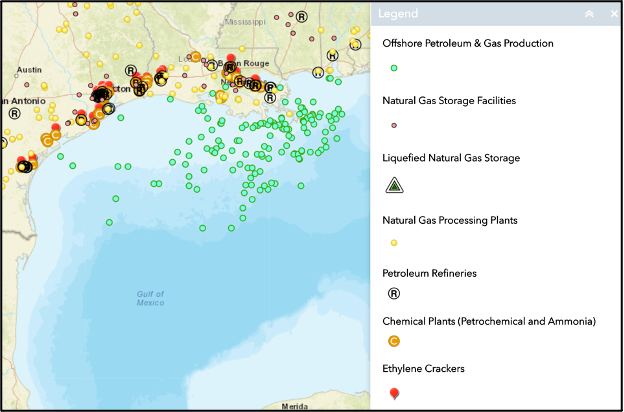
    The risks from industrial facilities are most obvious along the U.S. Gulf Coast, where many major petrochemical complexes are clustered in harm’s way. These refineries, factories and storage facilities are often built along rivers or bays for easy shipping access.

    But those rivers can also bring storm surge flooding that can raise the ocean by several feet during hurricanes. The storm surge from Helene was over 10 feet above ground level in Florida’s Big Bend and over 6 feet in Tampa Bay. With Milton, forecasters warning of a 10- to 15-foot storm surge at Tampa Bay.

    A boom surrounds flooded railcars to try to contain leaks at a chemical plant in Braithwaite, La., after Hurricane Isaac in 2012.
    AP Photo/David J. Phillip

    A recent study found evidence of two to three times more pollution releases during hurricanes in the Gulf of Mexico than during normal weather from 2005 to 2020.

    The effects of these pollution releases fall disproportionately on low-income communities and people of color, further exacerbating environmental health risks.

    Why residents may not hear about toxic releases

    The statistics are disconcerting, yet they get little attention. That is because hazardous releases remain largely invisible due to limited disclosure requirements and scant public information. Even emergency responders often don’t know exactly which hazardous chemicals they are facing in emergency situations.

    The U.S. Environmental Protection Agency requires major polluters to file only very general information about chemicals and on-site risks in their risk management plans. Some large-scale fuel storage facilities, such as those holding liquefied natural gas, are not even required to do that.

    These risk management plans outline “worst-case” scenarios and are supposed to be publicly accessible. But, in reality, we and others have found them difficult to access, heavily redacted and housed in federal reading rooms with limited access. The reason local officials and national scientific review panels often give for the secrecy is to protect the facilities from terrorist attack.

    Oil storage tanks and industrial facilities line the Houston Ship Channel, which is vulnerable to storm surge from Gulf of Mexico hurricanes.
    AP Photo/David J. Phillip

    Adding to this opacity is the fact that many states – including those along the Gulf – suspend restrictions on pollution releases during emergency declarations. Meanwhile, real-time incident notifications from the National Response Center – the federal government’s repository for all chemical discharges into the environment – typically lag by a week or more,

    We believe this limited public information on rising chemical threats from our changing climate should be front-page news every hurricane season. Communities should be aware of the risks of hosting vulnerable industrial infrastructure, particularly as rising global temperatures increase the risk of extreme downpours and powerful hurricanes.

    Mapping the risks nationwide to raise awareness

    To help communities understand their risks, our team at Rice University’s new Center for Coastal Futures and Adaptive Resilience investigates how industrial communities in flood-prone areas nationwide can better adapt to such threats, socially as well as technologically.

    Our interactive map shows where elevated future flood risks threaten to inundate major polluters that we identify using the EPA’s Toxic Release Inventory.

    The U.S. has several hot spots with clusters of flood-prone polluters. Houston’s Ship Channel, Chicago’s waterfront steel industries and the harbors at Los Angeles and New York/New Jersey are among the biggest.

    Three of the biggest hot spots, where large numbers of industrial facilities with toxic materials face elevated future flood risks, are in the Northeast, the northwestern Gulf Coast and the southern end of the Great Lakes.
    Rice University Center for Coastal Futures and Adaptive Resilience, CC BY-ND

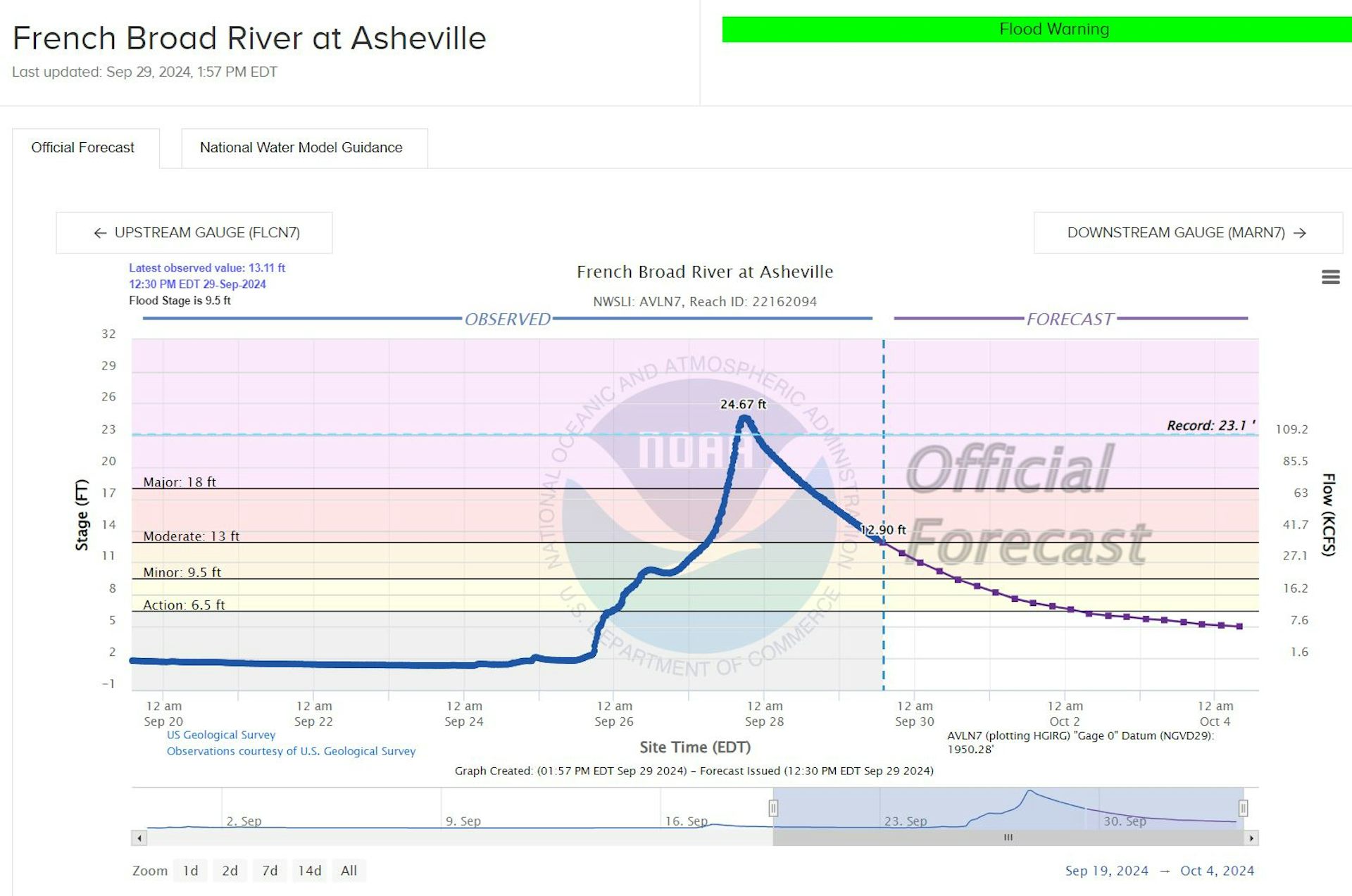
    But, as Helene revealed, there can also be great concern in less obvious spots. Inland, particularly in the mountains, runoff can quickly turn normally tame rivers into fast-rising torrents. The French Broad River at Asheville, North Carolina, rose about 12 feet in 12 hours during Helene and set a new flood stage record.

    When hurricanes and tropical storms are headed for the U.S., our interactive maps show where major polluters are located in the storm’s projected cone of impact. The maps identify hazardous flood-prone facilities down to the address, anywhere in the country.

    Knowledge is the first step

    Knowing where these sites are located is only the first step. Often, it’s up to communities themselves, many of them already overexposed and historically underserved, to raise concerns and demand strategies for mitigating the health, economic and environmental risks that industrial sites at risk of flooding and other damage can pose.

    These discussions can’t wait until a disaster is on the way. By knowing where these risks may be, communities can take steps now to build a safer future.

    This article, originally published Sept. 30, has been updated with Hurricane Milton.

    James R. Elliott receives funding from the National Science Foundation and the National Renewable Energy Lab.

    Dominic Boyer receives funding from the National Science Foundation, NOAA and Texas Sea Grant.

    Phylicia Lee Brown has nothing to disclose.

    ref. Flooded industrial sites and toxic chemical releases are a silent, growing threat in hurricanes like Milton and Helene – https://theconversation.com/flooded-industrial-sites-and-toxic-chemical-releases-are-a-silent-growing-threat-in-hurricanes-like-milton-and-helene-239977

    MIL OSI – Global Reports

  • MIL-OSI Security: Family members sent to prison for sex trafficking women in cantina backroom

    Source: United States Department of Justice (Human Trafficking)

    HOUSTON – A Mexican national illegally residing in Houston and a relative have been sentenced following their convictions of several sex trafficking crimes, announced U.S. Attorney Alamdar S. Hamdani.

    Maria Botello-Morales, 57, and her son Edgar Adrian Botello, 31, Houston, pleaded guilty in 2023.

    U.S. District Judge Andrew S. Hanen has now imposed a 280-month-term of imprisonment for Botello-Morales, while Botello received a total of 180 months. Restitution will be determined at a later date. Not a U.S. citizen, Botello-Morales is expected to face removal proceedings following her imprisonment, while Botello will serve 15 years on supervised release following completion of his prison term. During that time, he will have to comply with numerous requirements designed to restrict his access to children and the internet. Both will also be ordered to register as sex offenders.

    “Cantina cases shine a light on a unique form of trafficking where mostly undocumented women are sexually exploited for the financial benefit of the traffickers,” said Hamdani. “These individuals stole the American dream from the victims. This form of trafficking takes advantage of the fear these victims live in and we are grateful for the hard work of the Texas Alcohol and Beverage Commission (TABC) and Homeland Security Investigations (HSI) in bringing them justice.”

    “TABC is proud to work with the Office of the U.S. Attorney and our other partners in the effort to end human trafficking in Texas,” said TABC Chairman Kevin J. Lilly. “We join our fellow Texans in denouncing this heinous crime and reaffirming our pledge to help free the victims of human trafficking.”

    At the time of the pleas, Botello-Morales admitted to sex trafficking with force, fraud or coercion and conspiracy to do so as well as sex trafficking of a minor. Botello pleaded guilty to conspiracy to commit sex trafficking with force, fraud or coercion, two counts of sex trafficking of adults as well as possession of child pornography.

    In 2007, Botello-Morales recruited a minor female from Mexico. She caused the minor to engage in commercial sex and took payment directly from the commercial sex buyers.

    Botello-Morales ran Puerto Algre with Botello and others from 2015 to 2020. Puerto Algre was a cantina where numerous females were forced to engage in commercial sex in backrooms built specifically for that purpose. Botello-Morales, Botello and others threatened and intimidated these victims with violence to manipulate them into engaging in commercial sex for their own financial benefits.

    The victims reported they started at the bar as waitresses. However, Botello-Morales soon told them they had to engage in commercial sex. If they refused, she threatened them with violence.  

    Some witnessed violence and weapons at the bar and in the back area where the sex acts occurred. Each described how they had to take customers to the backrooms through a door and hidden from view of the bar. They were given a condom wrapped in a paper towel, were to spend no more than 15 minutes in the room and charge approximately $70. On the way out, they had to turn the money over to whoever was guarding the room.

    During the investigation, one victim also explained when she refused to come to work, Botello-Morales sent someone to physically assault her.

    The victims explained that Botello, who regularly carried a weapon, was the enforcer. He would also pass out the condoms and collect the money. During the execution of a search warrant at the home Botello-Morales and Botello shared, law enforcement found several loaded firearms in his room along with a computer containing child pornography.

    Another co-conspirator, Esteban Toribio, 65, Houston, pleaded guilty June 17 and held the liquor license for the bar. Toribio reported the conduct to authorities in an attempt to help him gain control of the cantina. Also convicted in relation to the conspiracy was Arian Botello, 26, the nephew of Botello-Morales.

    Both will remain in custody pending transfer to a U.S. Bureau of Prisons facility to be determined in the near future.

    TABC and HSI conducted the investigation with the assistance of the Houston Police Department (HPD) as part of the Human Trafficking Rescue Alliance (HTRA). Assistant U.S. Attorney Sherri L. Zack prosecuted the case.

    HTRA law enforcement includes members of the HPD; FBI; HSI; Texas Attorney General’s Office; IRS-Criminal Investigation; Department of Labor (DOL); DOL – Wage and Hour Division; Department of State; Federal Air Marshals; TABC; Texas Department of Public Safety; Texas Rangers; Texas Parks and Wildlife; Social Security Administration – OIG; Texas Department of Licensing and Regulation; Texas Department of Family and Protective Services as well as police departments in Houston Independent School District (ISD), Conroe ISD and Missouri City; Harris County constables offices – Precincts one and four; sheriff’s offices in Harris, Montgomery, Fort Bend, Brazoria and Waller counties in coordination with District Attorney’s offices in Harris, Montgomery, Fort Bend and Galveston counties. They work in coordination with victim service providers such as YMCA, United Against Human Trafficking and Texas Forensic Nurse Examiners.

    Established in 2004, the United States Attorney’s office in Houston formed HTRA to combine resources with federal, state and local enforcement agencies and prosecutors, as well as non-governmental service organizations to target human traffickers while providing necessary services to those that the traffickers victimized. Since its inception, HTRA has been recognized as both a national and international model in identifying and assisting victims of human trafficking and prosecuting those engaged in trafficking offenses.

    MIL Security OSI

  • MIL-Evening Report: Republicans once championed immigration in the US. Now, under Trump, an ugly nativism has been normalised

    Source: The Conversation (Au and NZ) – By Prudence Flowers, Senior Lecturer in US History, College of Humanities, Arts, and Social Sciences, Flinders University

    It might seem surprising today in the era of Donald Trump, but Republicans in the United States once championed immigration and supported pathways to citizenship for undocumented Americans.

    In January 1989, Ronald Reagan’s final speech as president was an impassioned ode to the immigrants who made America “a nation forever young, forever bursting with energy and new ideas”.

    Contrast this with Trump, who has normalised dehumanising rhetoric and policies against immigrants. In this year’s presidential campaign, for instance, he has referred to undocumented immigrants as “animals” who are “poisoning the blood of our country”.

    Both Trump and his vice presidential running mate, JD Vance, also repeated a false story about Haitian “illegal aliens” eating pets in Springfield, Ohio.

    Perhaps most troubling, Trump has pledged to launch “the largest deportation operation in the history of our country”, if he’s elected.

    Immigration policies throughout history

    Nativism, or anti-immigrant sentiment, has a long history in American politics.

    In 1924, a highly restrictive immigration quota system based on racial and national origins was introduced. This law envisaged America as a white, Anglo-Saxon, Protestant nation.

    However, there was no restriction on immigrants from the Western Hemisphere. The agricultural and railroad sectors relied heavily on workers from Mexico.

    In 1965, the quota system was replaced by visa preference categories for family and employment-based migrants, along with refugee and asylum slots.

    Then, as violence and economic instability spread across Central America in the 1970s, there was a surge in undocumented immigration to the US.

    Scholar Leo Chavez argues that in the late 1980s and early 1990s, an alarmist “Latino threat narrative” became the dominant motif in media discussions of immigration.

    This narrative was frequently driven by Republican politicians in states on the US-Mexico border, who derived electoral advantage from amplifying voter anxieties.

    The growing popularity of this negative discourse coincided with a significant increase in income inequality – a byproduct of neo-liberal policies championed by Reagan and other Republicans.


    Read more:
    Before Trump, there was a long history of race-baiting, fear-mongering and building walls on the US-Mexico border


    A dramatic shift in Republican rhetoric

    In the early-to-mid 20th century, Democrats were often the party that supported restrictive immigration and border policies.

    However, most Republicans at the national level – strongly supported by business – tended to endorse policies that encouraged the easy flow of workers across the border and increased levels of legal immigration.

    Prominent conservative Republicans also rejected vilifying rhetoric towards undocumented Americans. They presented all immigrants as pursuing opportunities for their families, a framing that emphasised a shared vision of the American dream. In this telling, their labour contributed to the economy and America’s growth and prosperity.

    George H. W. Bush And Ronald Reagan debate immigration in a Republican primary debate in 1980.

    Reagan, the most influential conservative of the late 20th century, opposed erecting a border wall and supported amnesty over deportation.

    Reagan also strongly supported bipartisan immigration reform. In 1986, Congress passed an immigration act that increased border security funding, but also ensured 2.7 million undocumented immigrants, primarily of Latino background, were able to gain legal status.

    Twenty years later, President George W. Bush and Republican Senator John McCain lobbied for a bipartisan bill that would have tightened border enforcement while simultaneously “legalising” an estimated 12 million undocumented immigrants. It was narrowly defeated.

    This vocal support for immigrants by leading Republicans was striking because for much of the period between the late 1980s and the early 2000s, a majority of Americans actually wanted immigration levels reduced.

    Then, around 2009, a dramatic shift in political rhetoric took place. The Tea Party movement brought border security and “racial resentment” towards immigrants centre stage, challenging conservative Republicans from the populist right.

    As a result, more and more Republicans began to voice restrictionist and xenophobic rhetoric and support legislation aimed at cracking down on illegal immigration.

    What’s surprising, though, is the number of undocumented immigrants in the US was actually declining at this time, from 12.2 million in 2007 to 10.7 million in 2016.

    Donald Trump and the new nativism

    In this worsening anti-immigrant climate, Trump descended a golden escalator in mid-2015 to launch his presidential campaign.

    In his speech that day, immigration was front and centre. Trump vowed to “build a great wall” and accused Mexico of sending “rapists” and “criminals” to America.

    His speeches during the presidential campaign were marked by frequent anti-Mexican assertions and calls for Islamophobic visa policies. This hostile stance on immigration was central to his victory in both the Republican primaries and the general election against Hillary Clinton.

    Once in office, Trump then adopted a “zero tolerance” stance towards undocumented immigration. His administration pursued a heartrending family separation policy that split children and their undocumented parents at the border. This approach was celebrated on conservative media outlets such as Fox News.

    During his presidency, he also reduced legal immigration by almost half, drastically cut America’s refugee intake, and introduced bans on people from Muslim-majority countries.

    Policy expert David Bier concluded the goal of Republican lawmakers had shifted:

    It really looks like the entire debate about illegality is not the main issue anymore for Republicans in both chambers of Congress. The main goal seems to be to reduce the number of foreigners in the United States to the greatest extent possible.

    Indeed, Trump’s vision of the nation had overtly racial overtones.

    In one 2018 meeting, he asked why America should accept immigrants from “shithole countries” like Haiti, El Salvador or the African continent. His preference was for Norwegian migrants.

    Immigration as a major election theme

    From 2021–2023, undocumented US-Mexico border crossings surged due to natural disasters, economic downturns and violence in many Latin American and Caribbean nations. Many of the recent arrivals are asylum seekers.

    Though the numbers have fallen sharply in 2024, immigration and the border are still one of the top issues for voters across the political spectrum. The issue is particularly important in the key swing state of Arizona.

    In 2024, Trump’s central immigration promise was encapsulated by the beaming delegates waving signs calling for “Mass Deportations Now” at the Republican National Convention.

    The Trump-Vance ticket has blamed undocumented immigrants for almost every economic and social problem imaginable. The two candidates present them as a dangerous and subversive “other” that cannot be assimilated into mainstream American culture.

    Yet Trump, as both president and candidate, has worked to prevent the passage of border security legislation. Turmoil on the border benefits him.

    And his nativism now encompasses all forms of immigration – he has pledged to curb legal channels for people to enter the country, as well.

    All of this rhetoric has had a dramatic impact on public opinion. Between 2016 and 2024, the number of people supporting the deportation of undocumented immigrants jumped from 32% to 47%.

    In July 2024, 55% of Americans also said they wanted to see immigration levels decrease, a 14-point increase in one year.

    Many Americans do not perceive immigration as a source of vitality and renewal as they had in the past. Instead, reflecting Trump’s language, they are viewing immigrants as an existential threat to the country’s future.

    Prudence Flowers does not work for, consult, own shares in or receive funding from any company or organisation that would benefit from this article, and has disclosed no relevant affiliations beyond their academic appointment.

    ref. Republicans once championed immigration in the US. Now, under Trump, an ugly nativism has been normalised – https://theconversation.com/republicans-once-championed-immigration-in-the-us-now-under-trump-an-ugly-nativism-has-been-normalised-239836

    MIL OSI AnalysisEveningReport.nz

  • MIL-OSI USA: Gov. Justice, National Guard deploy search and recovery team, engineers to Florida for Hurricane Milton response

    Source: US State of West Virginia

    CHARLESTON, WV — Gov. Jim Justice has activated approximately 40 members of the West Virginia National Guard to support response and recovery efforts for Hurricane Milton, which is projected to make landfall in Florida on October 9, 2024. 

    Approximately 10-12 Airmen from the 130th Airlift Wing headquartered in Charleston, West Virginia, will deploy to assist the State of Florida with potential search and recovery operations. 

    Additionally, approximately 30 engineers from the 821st Engineer Construction Company headquartered in Summersville, along with support equipment such as skid steers and front loaders from the 601st Engineer Support Company headquartered in Buckhannon, will also deploy to assist with debris removal and management Operations.

    Both groups will initially stage in northern Florida under the command of the Florida National Guard and will deploy to impacted communities as determined by state and local officials. They are expected to spend approximately 12 days on the ground in a State Active Duty status.

    “When our neighbors put out the call for help, time and time again, we answer,” Gov. Justice said. “We supported our friends in Kentucky last year, and now we’re running to the fire in Florida. That’s what we do in West Virginia–we pull the rope together and help our neighbors. So, I’m proud we can join forces with the Florida National Guard in their response efforts. My thoughts and prayers are with our amazing men and women traveling south, all the first responders in the area, and everyone dealing with this challenging hurricane season. Let’s continue to take care of each other.”

    “With the devastation of Hurricane Helene still present, Florida is now under threat of a storm with even deadlier potential,” Maj. Gen. Bill Crane, Adjutant General of the West Virginia National Guard, said. “Our Soldiers and Airmen will be there to help support response and relief efforts as needed, support first responders and officials, help citizens survive, and help stabilize communities in the aftermath of Milton. One of the most important missions of our National Guard is neighbors helping neighbors. With the strong support of Gov. Jim Justice, we are ready to provide any and all assistance we can render.”

    West Virginia National Guard assistance was formally requested through the Emergency Management Assistance Compact, or EMAC process. EMAC is a mutual aid agreement among states and territories of the United States that enables states to request resources during naturaland man-made disasters, complementing the national disaster response system. The requesting state is responsible for covering the costs of the provided aid.

    Hurricane Milton is expected to make landfall in the Tampa Bay region of Florida late Wednesday evening as a Category 3 storm. Milton is forecast to bring potentially catastrophic storm surges along the western coast of Florida, torrential rains and flash flooding, damaging hurricane-force winds, tornadoes, and massive power outages as it makes its way across the state before reemerging as a Category 1 hurricane in the Atlantic Ocean. Currently wavering between a Category 4 and Category 5 storm as it churns in the Gulf of Mexico, Milton is forecast to bring ashore rainfall in excess of 15 inches and coastal surges of more than 10-15 feet. 

    Milton will impact Florida communities still reeling from the impacts of Hurricane Helene, which battered the southeastern United States, killing at least 225 people. Fifty-one of 67 counties in Florida are now under emergency warnings as Milton approaches, and massive mandatory evacuations are underway.

    MIL OSI USA News

  • MIL-OSI Security: U.S. Attorney’s Office Announces Sentencing of Albuquerque Man for Violent Crime Spree

    Source: Federal Bureau of Investigation (FBI) State Crime Alerts (c)

    ALBUQUERQUE – An Albuquerque man has been sentenced to 200 months in prison for a violent crime spree that included a series of armed robberies and assaults across New Mexico, culminating in the carjacking and shooting of a 62-year-old veteran.

    There is no parole in the federal system.

    According to court documents, on November 12, 2021, Procopio Montoya Atkinson, 26, robbed a Dollar General store in Northwest Albuquerque. Atkinson feigned a cash purchase of flavored water, and when the female cashier opened the register to give him change, he reached over the counter to take the money. When she shut the drawer, Atkinson escalated his actions by walking behind the counter and demanding money while pointing a firearm at her. Atkinson discharged the firearm toward the ceiling, causing panic. The manager complied with Atkinson’s demands as he began a verbal countdown. Ultimately, Atkinson took $192 from the register and fled.

    The crime spree continued on December 6, 2021, when Atkinson shoplifted clothing and an entire display case full of pocketknives from a Love’s Travel Stop in Belen. Atkinson was confronted by two female employees outside and physically assaulted them while attempting to hit them with his vehicle. Just three days later, on December 9, Atkinson assaulted another female employee at a Walmart in Belen after loading a cart with clothing and tools.

    Atkinson approaching the display case full of pocketknives.

    Atkinson picking up the display case full of pocketknives.

    The discarded display case.

    On December 13, law enforcement obtained an arrest warrant for Atkinson related to the armed robbery from November 12. On December 17, members of the U.S. Marshals Service fugitive task force established surveillance on his home for his arrest. As they moved in to apprehend him at a gas station, Atkinson displayed awareness of their presence by retrieving binoculars to monitor law enforcement movements. Atkinson drove toward one task force officer while pointing a pistol at him before abandoning his pursuit when backup arrived.

    The crime spree culminated on December 20 when John Doe 3 was driving alone in his vintage Chevrolet truck with his wife and daughter following behind in another vehicle. They were stopped at a traffic light when Atkinson approached John Doe 3’s wife and daughter with a pistol and demanded they exit their vehicle. After they refused to open their doors, Atkinson turned his attention to John Doe 3’s truck, a beautifully restored ’62 Chevrolet. He opened the passenger door and, after a brief struggle, shot John Doe 3 in the back.

    A photo of the scene.

    Responding officers successfully blocked the truck in following an unsuccessful escape attempt by Atkinson and John Doe 3 was airlifted to the hospital.

    John Doe 3 survived his injuries, but the emotional toll of that day has left lasting scars; he experiences ongoing pain and anxiety whenever near that intersection or driving through similar situations, and his beloved truck now sits dormant.

    Upon his release from prison, Atkinson will be subject to five years of supervised release.

    U.S. Attorney Alexander M.M. Uballez and Raul Bujanda, Special Agent in Charge of the Federal Bureau of Investigation, made the announcement today.

    The Gallup Resident Agency of the FBI Albuquerque Field Office investigated this case with assistance from the United States Marshal Service, Belen Police Department, Bernalillo County Sheriff’s Office, Albuquerque Police Department, Rio Rancho Police Department and the New Mexico State Police. Assistant U.S. Attorney Timothy Trembley is prosecuting the case.

    # # #

    MIL Security OSI

  • MIL-Evening Report: Unprecedented peril: disaster lies ahead as we track towards 2.7°C of warming this century

    Source: The Conversation (Au and NZ) – By Thomas Newsome, Associate Professor in Global Ecology, University of Sydney

    You don’t have to look far to see what climate change is doing to the planet. The word “unprecedented” is everywhere this year.

    We are seeing unprecedented rapidly intensifying tropical storms such as Hurricane Helene in the eastern United States and Super Typhoon Yagi in Vietnam. Unprecedented fires in Canada have destroyed towns. Unprecedented drought in Brazil has dried out enormous rivers and left swathes of empty river beds. At least 1,300 pilgrims died during this year’s Hajj in Mecca as temperatures passed 50°C.

    Unfortunately, we are headed for far worse. The new 2024 State of the Climate report, produced by our team of international scientists, is yet another stark warning about the intensifying climate crisis. Even if governments meet their emissions goals, the world may hit 2.7°C of warming – nearly double the Paris Agreement goal of holding climate change to 1.5°C. Each year, we track 35 of the Earth’s vital signs, from sea ice extent to forests. This year, 25 are now at record levels, all trending in the wrong directions.

    Humans are not used to these conditions. Human civilisation emerged over the last 10,000 years under benign conditions – not too hot, not too cold. But this liveable climate is now at risk. In your grandchild’s lifetime, climatic conditions will be more threatening than anything our prehistoric relatives would have faced.

    Our report shows a continued rise in fossil fuel emissions, which remain at an all-time high. Despite years of warnings from scientists, fossil fuel consumption has actually increased, pushing the planet toward dangerous levels of warming. While wind and solar have grown rapidly, fossil fuel use is 14 times greater.

    This year is also tracking for the hottest year on record, with global daily mean temperatures at record levels for nearly half of 2023 and much of 2024.

    Next month, world leaders and diplomats will gather in Azerbaijan for the annual United Nations climate talks, COP 29. Leaders will have to redouble their efforts. Without much stronger policies, climate change will keep worsening, bringing with it more frequent and more extreme weather.


    Bad news after bad news

    We have still not solved the central problem: the routine burning of fossil fuels. Atmospheric concentrations of greenhouse gases – particularly methane and carbon dioxide – are still rising. Last September, carbon dioxide levels in the atmosphere hit 418 parts per million (ppm). This September, they crossed 422 ppm. Methane, a highly potent greenhouse gas, has been increasing at an alarming rate despite global pledges to tackle it.

    Compounding the problem is the recent decline in atmospheric aerosols from efforts to cut pollution. These small particles suspended in the air come from both natural and human processes, and have helped cool the planet. Without this cooling effect, the pace of global warming may accelerate. We don’t know for sure because aerosol properties are not yet measured well enough.

    Other environmental issues are now feeding into climate change. Deforestation in critical areas such as the Amazon is reducing the planet’s capacity to absorb carbon naturally, driving additional warming. This creates a feedback loop, where warming causes trees to die which in turn amplifies global temperatures.

    Loss of sea ice is another. As sea ice melts or fails to form, dark seawater is exposed. Ice reflects sunlight but seawater absorbs it. Scaled up, this changes the Earth’s albedo (how reflective the surface is) and accelerates warming further.

    In coming decades, sea level rise will pose a growing threat to coastal communities, putting millions of people at risk of displacement.

    Accelerate the solutions

    Our report stresses the need for an immediate and comprehensive end to the routine use of fossil fuels.

    It calls for a global carbon price, set high enough to drive down emissions, particularly from high-emitting wealthy countries.

    Introducing effective policies to slash methane emissions is crucial, given methane’s high potency but short atmospheric lifetime. Rapidly cutting methane could slow the rate of warming in the short term.

    Natural climate solutions such as reforestation and soil restoration should be rolled out to increase how much carbon is stored in wood and soil. These efforts must be accompanied by protective measures in wildfire and drought prone areas. There’s no point planting forests if they will burn.

    Governments should introduce stricter land-use policies to slow down rates of land clearing and increase investment in forest management to cut the risk of large, devastating fires and encourage sustainable land use.

    We cannot overlook climate justice. Less wealthy nations contribute least to global emissions but are often the worst affected by climate disasters.

    Wealthier nations must provide financial and technical support to help these countries adapt to climate change while cutting emissions. This could include investing in renewable energy, improving infrastructure and funding disaster preparedness programs.

    Internationally, our report urges stronger commitments from world leaders. Current global policies are insufficient to limit warming to 1.5°C above pre-industrial levels.

    Without drastic changes, the world is on track for approximately 2.7°C of warming this century. To avoid catastrophic tipping points, nations must strengthen their climate pledges, reduce dependence on fossil fuels, and accelerate the transition to renewable energy.

    Immediate, transformative policy changes are now necessary if we are to avoid the worst effects of climate change.

    Climate change is already here. But it could get much, much worse. By slashing emissions, boosting natural climate solutions and working towards climate justice, the global community can still fend off the worst version of our future.

    Thomas Newsome receives funding from the Australian Research Council. He is immediate past-president of the Australasian Wildlife Management Society and President of the Royal Zoological Society of New South Wales.

    William Ripple receives funding from the CO2 Foundation and University of Oregon donor Roger Worthington.

    ref. Unprecedented peril: disaster lies ahead as we track towards 2.7°C of warming this century – https://theconversation.com/unprecedented-peril-disaster-lies-ahead-as-we-track-towards-2-7-c-of-warming-this-century-240549

    MIL OSI AnalysisEveningReport.nz

  • MIL-OSI USA: Rep. Gabe Vasquez Votes to Pass Bipartisan Spending Bill to Fund Government, Avert Shutdown

    Source: United States House of Representatives – Representative Gabe Vasquez’s (NM-02)

    WASHINGTON, D.C. – On September 25, 2024, U.S. Representative Gabe Vasquez (N.M.-02) voted to pass a bipartisan spending bill to keep the government funded through a continuing resolution.

    “The bipartisan spending bill ensures the federal government can continue providing essential services to every corner of New Mexico. From wildfire response to veteran support to nutritional assistance for families, we are protecting the programs that our communities depend on,” said Vasquez.“This bill is just the start—we must continue to work towards a long-term funding solution that provides stability for our government, our economy and the people we serve. Americans deserve a government that doesn’t jump from crisis to crisis.  I remain committed to coming to the table to work with my colleagues across the aisle to keep the government open.”

    The continuing resolution would protect the U.S. Forest Service’s ability to fight wildfires and prioritize fire suppression efforts, while extending the deadline for Hermit’s Peak/Calf Canyon Fire Assistance. It also extends the U.S. Department of Agriculture’s authority to provide benefits to those who have had their SNAP benefits stolen to ensure all New Mexicans still have access to the full SNAP benefits they need.

    The resolution also grants emergency funding for the Department of Defense to use funds for military construction projects and provides critical funding to the Secret Service to protect presidential candidates. 

    Vasquez will continue fighting for additional disaster aid to ensure New Mexicans affected by natural disasters receive the funding and support they deserve. 

    ###

    MIL OSI USA News

  • MIL-OSI USA: Rep. Gabe Vasquez Delivers Critical Federal Funding to Strengthen Public Safety, Community Development and Energy Resilience in Southwestern New Mexico

    Source: United States House of Representatives – Representative Gabe Vasquez’s (NM-02)

    LORDSBURG, N.M. – On Monday, October 7, U.S. Representative Gabe Vasquez (N.M.-02) spent the day meeting with officials from Lordsburg and Deming to deliver critical funding for southwestern New Mexico’s communities. Vasquez secured federal investments for the Luna County Mobile Command Center, Lordsburg Community Center and the Southline Transmission Project to strengthen public safety, community development and energy resilience. 

    “After listening to constituents and local leaders, I’m proud to deliver these investments to ensure the safety, well-being and future prosperity of our communities,” said Vasquez. “From improving public safety with the Luna Mobile Command Center, to providing a hub for families in Lordsburg, to modernizing our energy infrastructure with the Southline Transmission Project, we are building a stronger, more resilient New Mexico. In Congress, I’ll continue to fight for the federal support our district deserves to grow and thrive.”

    Vasquez secured $500,000 for the Luna Mobile Command Center Project, a crucial investment in public safety that will directly support law enforcement and first responders. The new command center will ensure that emergency personnel have access to better equipment and communication tools to respond swiftly and effectively. This project underscores Vasquez’s commitment to strengthening public safety initiatives, ensuring that local agencies are fully equipped to protect the community and manage emergencies with the highest level of coordination and efficiency.

    “We are so appreciative of Representative Gabe Vasquez, who has always been a good neighbor. I’ve seen him down here countless times and he is always in contact with us. And when it comes to public safety, this is not just a county mobile command unit for the county, but also for state police and Deming police. Without this funding from Representative Vasquez, we could not afford something like this. When you get $500,000, it just shows you the tremendous support we’ve got from Representative Vasquez,” said Luna County Manager Chris Brice.

    “I am really appreciative that Luna County was awarded $500,000 to help provide upgrades for law enforcement and the incident command unit. It’s time for an upgrade, and I appreciate Congressman Vasquez for getting this money down to Luna County,” said Luna County Commissioner Ray Trejo.

    In Lordsburg, Vasquez also delivered a $500,000 check for the renovation of the Lordsburg Community Center, a key investment in supporting families and strengthening rural communities. The renovated center will provide expanded recreational opportunities for local families and youth, offering a safe and welcoming space for children. It will also serve as a hub for community gatherings and events, creating new opportunities for residents to come together. This project reflects Vasquez’s commitment to enhancing quality of life in rural New Mexico. 

    “I want to commend Representative Gabe Vasquez and the City of Lordsburg for taking the initiative to make some community improvements here. In rural New Mexico it seems like we are always forgotten. When we have someone like Representative Vasquez looking out for our small community, we know that we’ll see some economic growth here,” said Hidalgo County Manager Tisha Green.

    Vasquez was also joined by leaders for the Southline Transmission Project to highlight a significant step forward for New Mexico’s clean energy future. Last week, the Department of Energy (DOE) announced that the Southline Transmission Project has been chosen as one of five recipients as part of a $1.5 billion commitment to improve the electric grid nationwide. With this funding, Southline will construct the second phase of its project to deliver 1,000 megawatts of new capacity between Hidalgo County and Las Cruces, lowering utility bills for New Mexicans. As one of his first acts in office, Vasquez wrote to DOE in support of the Southline Transmission Project to bring high-paying jobs to rural communities and invest in New Mexico’s renewable energy future.

    “I’m very appreciative of Representative Vasquez and our Congressional Delegation for doing the work to bring money back to rural New Mexico. The Transmission Siting and Economic Development grant program is going to create great economic opportunities for the city of Lordsburg and the residents of Hidalgo County through infrastructure improvement, downtown revitalization and entrepreneur training. We’re excited to have this here in Lordsburg and ready to get started,” saidEmily Gojkovich, Lordsburg Economic Development Specialist.

    Since serving New Mexico in Congress, Vasquez has been fighting for our district’s fair share of funding. Each year, Congress is responsible for passing Appropriations legislation to fund federal agencies. After hearing directly from constituents about what the federal budget should prioritize, Vasquez submitted 15 proposals for Community Project Funding each year on an array of issues ranging from supporting families to public safety investments to infrastructure improvements. 

    ###

    MIL OSI USA News

  • MIL-Evening Report: AI is a multi-billion dollar industry. It’s underpinned by an invisible and exploited workforce

    Source: The Conversation (Au and NZ) – By Ganna Pogrebna, Executive Director, AI and Cyber Futures Institute, Charles Sturt University

    Olena Yakobchuk/Shutterstock

    In dusty factories, cramped internet cafes and makeshift home offices around the world, millions of people sit at computers tediously labelling data.

    These workers are the lifeblood of the burgeoning artificial intelligence (AI) industry. Without them, products such as ChatGPT simply would not exist. That’s because the data they label helps AI systems “learn”.

    But despite the vital contribution this workforce makes to an industry which is expected to be worth US$407 billion by 2027, the people who comprise it are largely invisible and frequently exploited. Earlier this year nearly 100 data labellers and AI workers from Kenya who do work for companies like Facebook, Scale AI and OpenAI published an open letter to United States President Joe Biden in which they said:

    Our working conditions amount to modern day slavery.

    To ensure AI supply chains are ethical, industry and governments must urgently address this problem. But the key question is: how?

    What is data labelling?

    Data labelling is the process of annotating raw data — such as images, video or text — so that AI systems can recognise patterns and make predictions.

    Self-driving cars, for example, rely on labelled video footage to distinguish pedestrians from road signs. Large language models such as ChatGPT rely on labelled text to understand human language.

    These labelled datasets are the lifeblood of AI models. Without them, AI systems would be unable to function effectively.

    Tech giants like Meta, Google, OpenAI and Microsoft outsource much of this work to data labelling factories in countries such as the Philippines, Kenya, India, Pakistan, Venezuela and Colombia.

    China is also becoming another global hub for data labelling.

    Outsourcing companies that facilitate this work include Scale AI, iMerit, and Samasource. These are very large companies in their own right. For example, Scale AI, which is headquartered in California, is now worth US$14 billion.

    Cutting corners

    Major tech firms like Alphabet (the parent company of Google), Amazon, Microsoft, Nvidia and Meta have poured billions into AI infrastructure, from computational power and data storage to emerging computational technologies.

    Large-scale AI models can cost tens of millions of dollars to train. Once deployed, maintaining these models requires continuous investment in data labelling, refinement and real-world testing.

    But while AI investment is significant, revenues have not always met expectations. Many industries continue to view AI projects as experimental with unclear profitability paths.

    In response, many companies are cutting costs which affect those at the very bottom of the AI supply chain who are often highly vulnerable: data labellers.

    Low wages, dangerous working conditions

    One way companies involved in the AI supply chain try to reduce costs is by employing large numbers of data labellers in countries in the Global South such as the Philippines, Venezuela, Kenya and India. Workers in these countries face stagnating or shrinking wages.

    For example, an hourly rate for AI data labellers in Venezuela ranges from between 90 cents and US$2. In comparison, in the United States, this rate is between US$10 to US$25 per hour.

    In the Philippines, workers labelling data for multi-billion dollar companies such as Scale AI often earn far below the minimum wage.

    Some labelling providers even resort to child labour for labelling purposes.

    But there are many other labour issues within the AI supply chain.

    Many data labellers work in overcrowded and dusty environments which pose a serious risk to their health. They also often work as independent contractors, lacking access to protections such as health care or compensation.

    The mental toll of data labelling work is also significant, with repetitive tasks, strict deadlines and rigid quality controls. Data labellers are also sometimes asked to read and label hate speech or other abusive language or material, which has been proven to have negative psychological effects.

    Errors can lead to pay cuts or job losses. But labellers often experience lack of transparency on how their work is evaluated. They are often denied access to performance data, hindering their ability to improve or contest decisions.

    Making AI supply chains ethical

    As AI development becomes more complex and companies strive to maximise profits, the need for ethical AI supply chains is urgent.

    One way companies can help ensure this is by applying a human right-centreed design, deliberation and oversight approach to the entire AI supply chain. They must adopt fair wage policies, ensuring data labellers receive living wages that reflect the value of their contributions.

    By embedding human rights into the supply chain, AI companies can foster a more ethical, sustainable industry, ensuring that both workers’ rights and corporate responsibility align with long-term success.

    Governments should also create new regulation which mandates these practices, encouraging fairness and transparency. This includes transparency in performance evaluation and personal data processing, allowing workers to understand how they are assessed and to contest any inaccuracies.

    Clear payment systems and recourse mechanisms will ensure workers are treated fairly. Instead of busting unions, as Scale AI did in Kenya in 2024, companies should also support the formation of digital labour unions or cooperatives. This will give workers a voice to advocate for better working conditions.

    As users of AI products, we all can advocate for ethical practices by supporting companies that are transparent about their AI supply chains and commit to fair treatment of workers. Just as we reward green and fair trade producers of physical goods, we can push for change by choosing digital services or apps on our smartphones that adhere to human rights standards, promoting ethical brands through social media, and voting with our dollars for accountability from tech giants on a daily basis.

    By making informed choices, we all can contribute to more ethical practices across the AI industry.

    Ganna Pogrebna does not work for, consult, own shares in or receive funding from any company or organisation that would benefit from this article, and has disclosed no relevant affiliations beyond their academic appointment.

    ref. AI is a multi-billion dollar industry. It’s underpinned by an invisible and exploited workforce – https://theconversation.com/ai-is-a-multi-billion-dollar-industry-its-underpinned-by-an-invisible-and-exploited-workforce-240568

    MIL OSI AnalysisEveningReport.nz

  • MIL-OSI Economics: WTO Chairs Programme expands academic network to under-represented regions

    Source: World Trade Organization

    Following the addition of these five universities, the programme’s network will comprise a total of 40 Chairs. This expansion is anticipated to strengthen the impact of regional and global initiatives within the network and to promote deeper collaboration and knowledge sharing among academics, policymakers and trade experts.

    The five selected institutions will join the programme’s next four-year cycle, which is slated to begin in 2025. They will contribute to the programme’s research, curriculum development and outreach and will benefit from mentoring provided by other Chairs to ease their integration into the network. They will also engage in collaborative events, conferences and seminars to extend the academic and practical impact of their work on trade policies at the national and international levels.

    The fourth cycle of the WTO Chairs Programme also marks a transition to a more frequent admission of institutions into the network to further the global reach and impact of the programme. Greater synergies with the WTO’s other technical assistance activities are also anticipated.

    This expansion builds on the WTO’s longstanding efforts to ensure that academic institutions play a crucial role in shaping trade policy and deepening the understanding of the multilateral trading system. Funded by France, Austria, the Republic of Korea and Australia, the WTO Chairs Programme has grown from strength to strength as it seeks to address current and emerging global trade challenges.

    The selection of universities follows a rigorous review process of applications led by the WTO Chairs Programme Academic Advisory Board.

    More information about the Chairs Programme is available here.

    Selected institutions

    Member

    Academic Institution

    Dominican Republic

    Universidad Iberoamericana

    Nigeria

    Nnamdi Azikiwe University

    Qatar

    Hamad Bin Khalifa University

    Togo

    Université de Lomé

    Vanuatu

    National University of Vanuatu

    Share

    MIL OSI Economics

  • MIL-OSI Europe: Written question – Concern regarding the judicial reform launched by the outgoing President of Mexico – E-001790/2024

    Source: European Parliament

    Question for written answer  E-001790/2024
    to the Vice-President of the Commission / High Representative of the Union for Foreign Affairs and Security Policy
    Rule 144
    Jorge Martín Frías (PfE)

    Mexico’s President López Obrador recently managed to push through a controversial judicial reform that is provoking street protests because of the attack on the rule of law and on the separation of powers in the country that this reform entails.

    The reform constitutes a serious attack on the independence of Mexico’s judiciary, as it seeks to centralise power and reduce existing balances in order to have greater government control over the judiciary and limit the autonomy of judges.

    The new proposal for the election of judges that is being enacted contravenes fundamental democratic standards by including a direct selection process for judges and lowering the criteria required for appointment as a judge, seriously casting doubt on legal certainty in the country and the independence of judges.

    In light of the above:

    • 1.What is the opinion of the Vice-President / High Representative regarding the proposal for judicial reform put forward by López Obrador?
    • 2.Does the Vice-President / High Representative consider this reform to be a further attack on the separation of powers and on the rule of law in Mexico?
    • 3.Does the Vice-President / High Representative believe that the Mexican leaders of the MORENA party, such as López Obrador or Claudia Sheinbaum, may be taking a dangerously anti-democratic path?

    Submitted: 23.9.2024

    Last updated: 8 October 2024

    MIL OSI Europe News

  • MIL-OSI USA: USGS experts responding simultaneously to two major natural hazards

    Source: US Geological Survey

    RESTON, Va. – As U.S. Geological Survey staff prepare for Hurricane Milton to hit Florida’s west coast as soon as Wednesday, agency experts are still dealing with the after-effects of Hurricane Helene that made landfall in Florida late last month and continued a path of destruction north through Georgia, North Carolina, South Carolina and Tennessee.

    While USGS experts are deploying wave sensors and forecasting coastal change in anticipation of Milton’s arrival, many of their agency colleagues have been hard at work mapping landslides, repairing and replacing damaged streamgages, and analyzing sensor data to provide the science information needed to help emergency responders and local officials with ongoing Helene recovery efforts.

    “Thank you to all our USGS employees and our partners for their dedication and commitment in supporting hurricane response efforts throughout the region,” said Holly Weyers, USGS Southeast Regional Director. “I’ve seen remarkable resiliency exhibited by our entire team in the face of incredible challenges. I’m proud of all our USGS employees and our partners and their ability to work together to find effective solutions, even in the most demanding situations, as we continue to support the needs of the communities in the affected areas. You have all made a remarkable difference.”

    To meet requests for local technical assistance, USGS activated its landslide event team last week to collect remotely sensed imagery and map landslides to gain a better picture of the extent and severity of landslide impacts. USGS continues to support requests from the North Carolina and Tennessee geological survey offices to identify landslide locations and landslide impacts to state transportation networks and the infrastructure environments. Hurricanes are known to lead to landslide and debris flow hazards in the southern Appalachian Mountains so experts at the USGS Geologic Hazards Science Center helped create a multi-agency Landslides Observations Dashboard to map landslides associated with Helene and aid state officials in determining the extent and severity of landslide occurrence and impacts. At time of publication, the dashboard shows more than 450 landslides across North Carolina, South Carolina, Tennessee and Virginia, with nearly 320 of these having impacted rivers, roads or structures. 

    Two USGS landslide experts conducted aerial reconnaissance flights between October 3 and October 5 in partnership with U.S. Fish & Wildlife Services to obtain a better understanding of the extent and severity of landslide impacts in the southern Appalachian region. USGS experts continue to review the data and imagery from these flights to confirm locations of some landslides and assist local authorities as they work to protect lives and vital infrastructure. 

    Locations of landslides identified by the team can be viewed on the USGS Landslide Observations Dashboard.

    Well before deadly Hurricane Helene made landfall September 26 on the Florida Big Bend region, USGS water monitoring, coastal storm hazards, and modeling experts were preparing for its arrival and gathering data needed to help emergency managers and communities prepare for and respond to the onset of the large and powerful storm.

    Days prior to the storm striking, hydrographers from the USGS Caribbean Florida Water Science Center in Davie, Florida, deployed wave sensors and barometric pressure sensors to monitor large waves and surge along the coasts. USGS also activated seasonal hurricane real-time gauges in Florida and USGS crews in several other states in Helene’s projected track maintained streamgages critical to helping with flood forecasting. 

    After making landfall as a Category 4 storm with 140 mph winds, Hurricane Helene caused coastal flooding along the entire west coast of Florida and damaged multiple gauging stations that are operated out of the Caribbean Florida Water Science Center. Due to the speed of the storm, the state did not receive a high amount of rainfall, so there was minimal inland flooding and USGS teams were not deployed for high water measurements. 

    Helene quickly moved north and further inland, bringing heavy rain and destructive winds across Georgia and the southern Appalachian region, resulting in widespread power outages. Areas such as Atlanta, eastern Tennessee, and western North Carolina experienced extreme or record high river levels, flash floods, landslides, and extensive river flooding. The mountainous terrain around Asheville, North Carolina, and upstate South Carolina worsened the flooding, creating dangerous conditions for local communities.

    The storm saturated the region and many USGS streamgages recorded extreme and historic water levels. Several gauges exceeded the peak of record in north Georgia and western parts of the Carolinas. According to the USGS Asheville field office, dozens of sites serviced by the office observed peak gauge heights that exceeded the current ratings following the storm runoff. Major basins affected included the French Broad and Catawba Basins in western North Carolina, urban tributaries of the Chattahoochee Basin in low-lying parts of Atlanta, and the Ogeechee and Savannah River Basin in Georgia and South Carolina. USGS officials estimated 10 to 20 gauges in Asheville and the upstate South Carolina area were damaged or inundated because of the storm.

    USGS experts from the South Atlantic Water Science Center and the Lower Mississippi-Gulf Water Science Center conducted post-storm field operations at safely accessible sites, obtaining high-flow measurements, completing repairs and needed equipment checks, and conducting verifications for streamgages that were inundated but not destroyed during the catastrophic flooding. USGS crews from the Virginia-West Virginia Water Science Center field offices in Marion and Leetown conducted discharge measurements and water-quality sampling in the New River, Shenandoah, and Potomac basins. The most significant flooding was found in the New River basin, with the peak at New River at Galax reaching the second highest peak of record ever documented. New River at Glen Lynn, at the West Virginia border, reached the fourth highest peak on record, which dates back over 100 years.

    With federal and state emergency response agencies conducting extensive rescue and recovery operations, and numerous washed out and blocked roads in the region causing unsafe conditions, it’s no surprise that USGS teams were limited in their immediate ability to assess damage to streamgage networks and replace equipment in several states. Response team members estimate that some locations where streamgages are located still won’t be accessible for at least several weeks. 

    Despite some limitations, dozens of USGS experts were able to safely deploy to other areas to collect sensors, repair gauges and gather scientific data about the storm surge and flooding Helene caused. A USGS team retrofitted a radar gauge at the Nolichucky River below the Nolichucky Dam in Tennessee to bring data back online, while a second team conducted survey work to verify peaks of record at several locations in Tennessee where crest stage gauges were either overtopped or destroyed. In North Carolina, crews from the USGS Asheville and Raleigh field offices continue to repair damaged gauges, flag and survey high water marks, and conduct post-storm field operations for completion of indirect discharge measurements needed for more than 40 streamgages.

    USGS scientists and field crews in Florida continue to access the damage to the streamgage network and replace equipment across three of the hardest hit counties in the state. Crews also retrieved the 13 wave sensors that were deployed between Venice and Panama City days before the hurricane hit the Florida coast. The sensors measure water levels and provide insight on wave height and frequency, storm tide and storm surge. USGS scientists are analyzing the collected data to help identify areas hit the hardest by storm surge and guide emergency responders and local officials with recovery efforts. The resulting information can be used to fine-tune future storm surge and coastal change forecasts during what is proving to be a busy hurricane season. 

    MIL OSI USA News

  • MIL-OSI Global: Hurricane Milton explodes into a powerful Category 5 storm as it heads for Florida − here’s how rapid intensification works

    Source: The Conversation – USA – By Zachary Handlos, Atmospheric Science Educator, Georgia Institute of Technology

    Hurricane Milton rapidly intensified into a dangerous Category 5 hurricane on Oct. 7, 2024, as it headed across the Gulf of Mexico toward Florida. Twenty-four hours earlier, it was barely a Category 1 storm.

    As its wind speed increased, Milton became one of the most rapidly intensifying storms on record. And with 180 mph sustained winds and very low pressure, it also became one of the strongest storms on the planet in 2024.

    Less than two weeks after Hurricane Helene’s devastating impact, this kind of storm was the last thing Florida wanted to see. Hurricane Milton was expected to make landfall as a major hurricane late on Oct. 9 or early Oct. 10 and had already prompted widespread evacuations.

    Hurricane Milton’s projected storm track, as of midday Oct. 7, 2024, shows how quickly it grew from formation into a major hurricane (M). Storm tracks are projections, and Milton’s path could shift as it moves across the Gulf of Mexico. The cone is a probable path and does not reflect the storm’s size.
    National Hurricane Center

    So, what exactly is rapid intensification, and what does global climate change have to do with it? We research hurricane behavior and teach meteorology. Here’s what you need to know.

    What is rapid intensification?

    Rapid intensification is defined by the National Weather Service as an increase in a tropical cyclone’s maximum sustained wind speed of at least 30 knots – about 35 mph within a 24-hour period. That increase can be enough to escalate a storm from Category 1 to Category 3 on the Saffir-Simpson scale.

    Milton’s wind speed went from 80 mph to 175 mph from 1 p.m. Sunday to 1 p.m. Monday, and its pressure dropped from 988 millibars to 911.

    The National Hurricane Center had been warning that Milton was likely to become a major hurricane, but this kind of rapid intensification can catch people off guard, especially when it occurs close to landfall.

    Hurricane Michael did billions of dollars in damage in 2018 when it rapidly intensified into a Category 5 storm just before hitting near Tyndall Air Force Base in the Florida Panhandle. In 2023, Hurricane Otis’ maximum wind speed increased by 100 mph in less than 24 hours before it hit Acapulco, Mexico. Hurricane Ian also rapidly intensified in 2022 before hitting just south of where Milton is projected to cross Florida.

    What causes hurricanes to rapidly intensify?

    Rapid intensification is difficult to forecast, but there are a few driving forces.

    • Ocean heat: Warm sea surface temperatures, particularly when they extend into deeper layers of warm water, provide the energy necessary for hurricanes to intensify. The deeper the warm water, the more energy a storm can draw upon, enhancing its strength.
    Sea surface temperatures have been warm in the Gulf of Mexico, where Hurricane Milton was crossing just northwest of the tip of Mexico’s Yucatan Peninsula on Oct. 7, 2024. A temperature of 30 degrees Celsius is equivalent to 86 degrees Fahrenheit.
    NOAA
    • Low wind shear: Strong vertical wind shear – a rapid change in wind speed or direction with height – can disrupt a storm’s organization, while low wind shear allows hurricanes to grow more rapidly. In Milton’s case, the atmospheric conditions were particularly conducive to rapid intensification.

    • Moisture: Higher sea surface temperatures and lower salinity increase the amount of moisture available to storms, fueling rapid intensification. Warmer waters provide the heat needed for moisture to evaporate, while lower salinity helps trap that heat near the surface. This allows more sustained heat and moisture to transfer to the storm, driving faster and stronger intensification.

    • Thunderstorm activity: Internal dynamics, such as bursts of intense thunderstorms within a cyclone’s rotation, can reorganize a cyclone’s circulation and lead to rapid increases in strength, even when the other conditions aren’t ideal.

    Research has found that globally, a majority of hurricanes Category 3 and above tend to undergo rapid intensification within their lifetimes.

    How does global warming influence hurricane strength?

    If it seems as though you’ve been hearing about rapid intensification a lot more in recent years, that’s in part because it’s happening more often.

    The annual number of tropical cyclones in the Atlantic Ocean that achieved rapid intensification each year between 1980-2023 shows an upward trend.
    Climate Central, CC BY-ND

    A 2023 study investigating connections between rapid intensification and climate change found an increase in the number of tropical cyclones experiencing rapid intensification over the past four decades. That includes a significant rise in the number of hurricanes that rapidly intensify multiple times during their development. Another analysis comparing trends from 1982 to 2017 with climate model simulations found that natural variability alone could not explain these increases in rapidly intensifying storms, indicating a likely role of human-induced climate change.

    How future climate change will affect hurricanes is an active area of research. As global temperatures and oceans continue to warm, however, the frequency of major hurricanes is projected to increase. The extreme hurricanes of recent years, including Beryl in June 2024 and Helene, are already raising alarms about the intensifying impact of warming on tropical cyclone behavior.

    Zachary Handlos receives funding from the National Science Foundation. He is affiliated with the American Meteorological Society as the incoming chair of their Board on Higher Education. He is also an academic faculty partner of the Georgia Climate Project.

    Ali Sarhadi receives funding from NSF and Georgia Tech.

    ref. Hurricane Milton explodes into a powerful Category 5 storm as it heads for Florida − here’s how rapid intensification works – https://theconversation.com/hurricane-milton-explodes-into-a-powerful-category-5-storm-as-it-heads-for-florida-heres-how-rapid-intensification-works-240754

    MIL OSI – Global Reports

  • MIL-OSI USA: Una gerente de proyectos de la NASA rinde homenaje a la influencia de su madre

    Source: NASA

    Read this story in English here.
    Patricia Ortiz está orgullosa de ser una salvadoreña americana de primera generación. Su madre, nacida y criada en El Salvador, vino a Estados Unidos por una oportunidad mejor sin conocer a nadie ni el idioma inglés.
    En su función de gerente de proyectos y asociaciones espaciales en el Centro de Investigación de Vuelo Armstrong de la NASA en Edwards, California, Ortiz dirige diversos proyectos espaciales y aeronáuticos de nuevas tecnologías que van desde las primeras fases hasta su ejecución. Esto implica reunirse con los socios, trabajar con directivos y dirigir el proyecto para lograr el rendimiento y el éxito de la misión.
    Al reflexionar sobre su trayectoria hacia la NASA, Ortiz rinde honores a su madre por su tenacidad y por el impacto que tuvo en ella. “Mi madre se enfrentó a muchos obstáculos al venir a este país, pero vino a este país para que yo pudiera hacer esto”. Su valiente decisión de desplazarse a un lugar desconocido fue lo que le abrió las puertas a Ortiz para acabar trabajando en la NASA.
    A Ortiz le gusta mantenerse unida a sus raíces salvadoreñas y una forma de hacerlo es a través de la comida. Su plato favorito: la pupusa. “Mi madre hace las mejores pupusas con chicharrón, queso y curtido. ¡Están deliciosas!”
    La NASA celebra el Mes de la Herencia Hispana compartiendo las ricas historias, culturas y pasiones de los empleados que contribuyen al avance de la misión y el éxito de la agencia en beneficio de toda la humanidad. Esta celebración anual, que dura un mes, honra y reconoce a los hispanos y latinos estadounidenses que han influido positivamente y enriquecido nuestra nación y nuestra sociedad.

    MIL OSI USA News

  • MIL-OSI USA: NASA Project Manager Honors Mother’s Impact

    Source: NASA

    Lee esta historia en Español aquí.
    Patricia Ortiz is proud to be a first-generation Salvadoran American. Her mother, born and raised in El Salvador, came to the United States for a better opportunity despite not knowing anyone or the English language.
    As a project manager for Space Projects and Partnerships at NASA’s Armstrong Flight Research Center in Edwards, California, Ortiz manages various space and aeronautics projects for new technologies that begin from the early stages to the execution. This involves meeting with partners, working with leadership and managing the project for performance and mission success.
    While reflecting on her journey to NASA, Ortiz honors her mother for her resiliency and the impact she had on her. “My mom faced a lot of hardship in coming to this country, but she came to this country so that I could do this.” This brave decision to move to an unfamiliar place was what opened the door for Ortiz to eventually work for NASA.
    Ortiz enjoys staying connected to her Salvadoran roots and one way she does this is through food. Her favorite dish: the pupusa. “My mom makes the best pupusas with chicharrón [pork], cheese, and curtido [cabbage slaw]. It’s so delicious!”
    NASA is celebrating Hispanic Heritage Month by sharing the rich histories, cultures and passions of employees who contribute to advancing the agency’s mission and success for the benefit of all humanity. This month-long, annual celebration honors and recognizes the Hispanic and Latino Americans who have positively influenced and enriched our nation and society.

    MIL OSI USA News

  • MIL-OSI USA: Readout of Secretary of Defense Lloyd J. Austin III’s Call With Argentine Minister of Defense Luis Petri

    Source: United States Department of Defense

    Pentagon Press Secretary Maj. Gen. Pat Ryder provided the following:

    Secretary of Defense Lloyd J. Austin III and his Argentine counterpart, Minister of Defense Luis Petri, spoke by phone today to reaffirm the importance of the defense partnership between the United States and Argentina. Secretary Austin thanked Minister Petri for Argentina’s joining of the Ukraine Defense Contact Group, and the two leaders reaffirmed both countries’ commitment to supporting a democratic, independent, and sovereign Ukraine that can defend itself and deter Russian aggression.  

    The two leaders noted with satisfaction the deepening of defense ties between the United States and Argentina, to include Argentina’s interest in becoming a NATO Global Partner, Argentina’s decision to join the Combined Maritime Forces in the Middle East, and Argentina’s resumption of its participation in the State Partnership Program with the Georgia National Guard. Secretary Austin thanked Minister Petri for hosting the XVI Conference of Defense Ministers of the Americas, which will convene in Mendoza, Argentina on October 13-16, 2024.  

    The two leaders agreed to continue engaging on the important role that the Western Hemisphere plays in defending a rules-based world order.

    MIL OSI USA News

  • MIL-OSI New Zealand: Mexico & United States: Hurricane Milton

    Source: New Zealand Ministry of Foreign Affairs and Trade – Safe Travel

    Hurricane Milton, a Category 5 hurricane is expected to impact the northern coast of the Yucatan Peninsula with dangerous hurricane-force winds, life-threatening storm surges, and heavy rainfall in the coming days.

    The National Water Commission of Mexico (CONAGUA) and the Mexican Civil Defence agency are issuing advice on their X accounts @conagua_mx and @CNPC_MX.

    You can also track the information in English on the National Oceanic and Atmospheric Administration website: HURRICANE MILTON (noaa.gov).

    Hurricane Milton is then expected to make landfall in Florida on Wednesday 9 October as a Category 4 hurricane or stronger.  The National Hurricane Centre (NHC) is issuing advice on their website: https://www.nhc.noaa.gov/ and additional information is available on the State of Florida’s website: 
    https://www.stateofflorida.com/articles/hurricane-preparedness-guide

    We also advise New Zealanders in the affected areas to follow the advice of local authorities at all times (including any evacuation orders) and seek suitable shelter. Visitors and tourists staying in travel accommodation should follow the guidance of hotel/resort management. It is considered sensible practice not to venture outdoors during a hurricane and remain well away from the sea and rivers. We recommend you stay informed of developments by monitoring local news and weather reports.

    Please also ensure you keep your family and friends in New Zealand informed of your safety and well-being, including after the hurricane has passed.

    New Zealanders in Mexico or the United States requiring emergency assistance should contact the local emergency services by calling 911.

    If you require consular assistance, please contact:

    New Zealand Embassy in Mexico City on: +52 55 5283 9460 or nzmexico@mfat.govt.nz

    New Zealand Embassy in Washington DC on: +1 202 438 4800 or WSHinfo@mfat.govt.nz

    For consular emergencies only after-hours on +64 99 20 20 20.

    Associated Advisories:

    Share this page:

    Share this page:

    Latest News features

    MIL OSI New Zealand News

  • MIL-OSI China: NASA, SpaceX postpone Europa Clipper mission launch

    Source: China State Council Information Office

    NASA and SpaceX are standing down from the launch attempt of the agency’s Europa Clipper mission due to anticipated hurricane conditions in the area, NASA said on Monday.

    The mission was originally planned to launch on Oct. 10 from the Kennedy Space Center in Florida.

    Hurricane Milton is expected to move from the Gulf of Mexico this week eastward to the Space Coast. High winds and heavy rain are expected in the Cape Canaveral and Merritt Island regions on Florida’s east coast.

    Launch teams have secured Europa Clipper spacecraft in SpaceX’s hangar at Launch Complex 39A at the Kennedy Space Center ahead of the severe weather, and the center began hurricane preparations Sunday, according to NASA.

    NASA will determine the next launch opportunity. Europa Clipper has launch windows until Nov. 6.

    The mission’s main science goal is to determine whether there are places below the surface of Jupiter’s icy moon, Europa, that could support life, according to NASA.

    Europa Clipper spacecraft will conduct detailed reconnaissance of Europa and investigate whether the icy moon could have conditions suitable for life. The spacecraft will perform dozens of close flybys of Europa, gathering detailed measurements to investigate the moon, according to NASA. 

    MIL OSI China News

  • MIL-OSI United Nations: Paraguay achieves inter-institutional commitment to risk management in the Jesuit Guarani Missions

    Source: UNESCO World Heritage Centre

    Presentation events were held to present the results of the project with technical assistance from UNESCO and financed by the Netherlands Funds-in-Trust.

    Asunción hosted on 6 August the presentation of the initial results of the project ‘Design and implementation of the Risk Management Plan for the Jesuit Missions of Santísima Trinidad de Paraná and Jesús de Tavarangüe, World Heritage site in Paraguay’, financed by the Netherlands Funds-in-Trust and implemented by the National Secretariat of Tourism-SENATUR and UNESCO Montevideo, in coordination with the Latin America and Caribbean Unit of the UNESCO World Heritage Centre. 

    The participation of the National Secretariat of Culture and other national and local stakeholders in this process was fundamental in the framework of the technical assistance project for the elaboration of a risk management plan for the Jesuit Missions of Santísima Trinidad de Paraná and Jesús de Tavarangüe, a site included in the World Heritage List since 1993. 

    ‘This document is intended to be a National Risk Plan due to the responsibility that all Paraguayans have towards World Heritage and the different risks that have been identified and those that will continue to be added,’ said Paraguay’s Minister of Tourism, Angie Duarte

    The work carried out for the preparation of the risk management plan document through various workshops and training sessions lays the foundations for a long-term inter-institutional commitment between SENATUR and the National Secretariat of Culture-SNC, as well as coordination with local and departmental governments and other key institutions of the central administration, such as the Ministry of Environment and Sustainable Development, Ministry of Foreign Affairs, National Emergency Secretariat, National Institute of Indigenous People, Armed Forces, National Police, INTERPOL Paraguay, among others. 

    This cooperation will continue in the future to further develop risk prevention and risk management protocols that will prevent or reduce the negative effects of potential disasters on the World Heritage property and thus protect its outstanding universal value. 

    In this sense, the Minister of Culture, Adriana Ortiz underlined the relevance of the project implemented in view of the need to ‘continuously promote and coordinate this type of action to preserve this world heritage that distinguishes us as unique’.

    Subsequently, on 8 August, two presentations of the results of the project were held in the Mission of Jesus and the Mission of Trinidad, respectively, in the presence of national authorities from SENATUR, local authorities and officials from the Missions, as well as members of local communities, civil society, universities and the Church. 

    During the event, a message was delivered by Elma Stoffelen, Head of Policy, Press and Culture of the Netherlands Representation in Buenos Aires, who stressed: ‘The identification and mitigation of risks is key to the management of world heritage and for this reason we are grateful for the cooperation we have with the State of Paraguay for the implementation of this project and for the participation of other state agencies’. 

    Alcira Sandoval Ruiz, Culture Specialist at UNESCO’s Regional Office in Montevideo, said that ‘with this project, Paraguay is fulfilling one more of the requirements established for the proper conservation of the site’ and thanked the national consultants and the international consultant in charge of the implementation of the plan in coordination with the counterparts. 

    The project has also enabled the preparation of a carrying capacity study at the World Heritage site, as well as a climate change impact study, relevant documents that complement the risk management plan and align with the provisions of the 2014-2024 Action Plan for World Heritage in the Latin America and Caribbean Region and the Policy Document on Climate Action for World Heritage

    A second stage is planned, in which working groups will be held to elaborate protocols for action and responsibilities with the partners who have participated in the process. 

    The project’s consulting team was made up of Francisco Vidargas, Bettina Bray and Edgar García.

    MIL OSI United Nations News

  • MIL-OSI: TGS Q3 2024 Operational Update

    Source: GlobeNewswire (MIL-OSI)

    OSLO, Norway (8 October 2024) – TGS, a leading global provider of energy data and intelligence routinely publishes a quarterly operational update six working days after quarter-end.

    The table below shows TGS’s normalized Ocean Bottom Node (OBN) crew count:  


    2022


    2023


    2024

    Q1 Q2 Q3 Q4 Q1 Q2 Q3 Q4 Q1 Q2 Q3
    Normalized crewcount1  

    2.9


    3.2


    3.2


    2.3


    2.6


    3.2


    3.2


    1.9


    1.9


    2.7


    3.8

    1) The table shows average number of crews in operation when assuming a normalized crew size. In Q3 2024 all crews were used for contract work. If crews are used for multi-client in the future that will be disclosed.
      
    The table below shows TGS’s streamer vessel allocation:

    Allocation of active seismic 3D vessel capacity2  


    2022


    2023


    2024

      Q1 Q2 Q3 Q4 Q1 Q2 Q3 Q4 Q1 Q2 Q3
    Contract 39% 41% 60% 63% 51% 34% 16% 25% 36% 28% 20%
    Multi-client 16% 24% 28% 12% 23% 41% 70% 31% 30% 36% 57%
    Steaming 8% 14% 8% 16% 11% 13% 6% 18% 7% 14% 6%
    Yard 6% 9% 3% 3% 2% 10% 4% 14% 6% 6% 2%
    Stacked/Standby 31% 12% 1% 6% 13% 2% 4% 12% 21% 16% 15%
    Number of vessels 6 6 6 6 6 6 7 7 7 6 6

    2) The statistics include only active seismic 3D vessels (capacity working on New Energy Solutions projects are excluded). The Ramform Victory was brought into operation in Q3 2023, and the Ramform Vanguard was converted to a dual-purpose seismic and offshore wind vessel in Q2 2024. The two cold-stacked vessels are excluded from the statistics.

    Based on a preliminary financial review TGS expects Q3 2024 multi-client investment to be approximately USD 132 million.

    The table below shows pro-forma multi-client investment:

    In USD million  

    2022


    2023


    2024

      Q1 Q2 Q3 Q4 Q1 Q2 Q3 Q4 Q1 Q2 Q3
    Multi-client investment  

    60


    70


    129


    90


    163


    125


    181


    106


    106


    92


    132

    Kristian Johansen, CEO at TGS, commented: “I am very pleased to see strong utilization of our OBN crews in Q3, where we had one crew in West Africa, two crews in the Gulf of Mexico and one crew in Europe. Demand for our OBN services continues to be strong and we achieved a solid order inflow during the quarter. Our seismic streamer vessel utilization in Q3 ended at 77%, a sequential increase, but still below the approximately 85% level we consider full utilization, when adjusting for steaming and yard time. Active tenders for streamer contract work have increased significantly over the summer. We expect that higher contract bidding activity in combination with the synergy effects of a larger multi-client project portfolio, will improve our streamer vessel utilization going forward.”

    TGS will release its Q3 2024 results at 07:00 a.m. CEST on 24 October 2024. CEO Kristian Johansen and CFO Sven Børre Larsen will present the results at 09:00 a.m. CEST during a live presentation and webcast. The presentation will take place at House of Oslo, Ruseløkkveien 34, 0251 Oslo and is open to the public.

    The webcast can be followed live via this link:
    https://channel.royalcast.com/landingpage/hegnarmedia/20241024_5/

    For more information, visit TGS.com (http://www.tgs.com) or contact:

    Bård Stenberg, VP IR & Communication
    Tel.: +47 992 45 235
    E-mail: investor@tgs.com

    About TGS
    TGS provides advanced data and intelligence to companies active in the energy sector. With leading-edge technology and solutions spanning the entire energy value chain, TGS offers a comprehensive range of insights to help clients make better decisions. Our broad range of products and advanced data technologies, coupled with a global, extensive and diverse energy data library, make TGS a trusted partner in supporting the exploration and production of energy resources worldwide. For further information, please visit http://www.tgs.com (https://www.tgs.com/).

    Forward Looking Statement
    All statements in this press release other than statements of historical fact are forward-looking statements, which are subject to a number of risks, uncertainties and assumptions that are difficult to predict and are based upon assumptions as to future events that may not prove accurate. These factors include volatile market conditions, investment opportunities in new and existing markets, demand for licensing of data within the energy industry, operational challenges, and reliance on a cyclical industry and principal customers. Actual results may differ materially from those expected or projected in the forward- looking statements. TGS undertakes no responsibility or obligation to update or alter forward-looking statements for any reason.

    The MIL Network

  • MIL-OSI USA: Kugler, The Global Fight Against Inflation

    Source: US State of New York Federal Reserve

    Thank you, Isabel, and thank you for the opportunity to speak here at the ECB today.1 I am particularly pleased to be part of this year’s conference because the theme you have chosen has, for some time now, also been a theme of my career as an academic and public servant. Every day, of course, central bankers must bridge science and practice, drawing on the insights that research provides, specifically, because the economy and the world are continuously subject to new circumstances. We must do so, and put those insights into practice, because everyone in the United States, and in Europe, and around the world, depends on a healthy and growing economy, and depends on policymakers making the right decisions to help keep it that way.

    But well before I came to the Federal Reserve, I was also bridging science and practice. First, as a labor economist, when, for example, I was exploring how employment, productivity, and earnings are influenced not only by educational attainment and experience, but also by policies. Later, as chief economist at the Department of Labor, I brought science to bear in carrying out its mission of supporting workers. As the U.S. representative at the World Bank, economic science was likewise crucial in deciding how to best direct the institution’s resources to where they were needed the most. In each of these roles, I have learned a bit more about the need to balance rigorous scientific understanding of the problems that people face with the real-world experiences of those people, which sometimes do not fit so neatly into an economic theorem or principle.
    Most recently, my colleagues and I on the Federal Open Market Committee (FOMC) have been focused on the very practical task of reducing inflation while keeping employment at its maximum level. To understand the recent experience of high inflation in the United States, it is helpful to consider how inflation behaved around the world after the advent of the COVID-19 pandemic. In the remainder of my remarks, I will discuss the global dimensions of the recent bout of high inflation in different economies, both comparing similarities and contrasting differences, with a special emphasis on the factors that enabled the United States to achieve disinflation while having stronger economic activity relative to its peers. I will then conclude with some comments on the U.S. economic outlook and the implications for monetary policy.
    Starting with the similarities in our inflationary experiences, in early 2020, a worldwide pandemic disrupted the global economy and ultimately caused a surge of inflation around the world. Global goods production was hobbled, transportation and other aspects of supply chains became entangled, and there were significant labor shortages, all combining to cause a severe imbalance between supply and demand in much of the world. Sharp increases in commodity prices were exacerbated by Russia’s invasion of Ukraine. The result was a global escalation of inflation. As you can see by the black line on slide 2, a measure of world headline inflation in 26 economies accounting for 60 percent of global gross domestic product (GDP) rose to a degree that had not been experienced since the early 1980s.
    This worldwide increase of inflation was synchronized and widespread across advanced and emerging economies. To measure the synchronization and breadth of this inflationary period, Federal Reserve Board researchers have employed a dynamic factor model to estimate a common component of inflation across these 26 economies.2 As you can see by the blue line on slide 2, the estimated global component accounts for a large share of the variation of headline inflation among these economies after inflation began rising sharply in 2021. This evidence is consistent with the familiar story of widespread lockdowns, shutdowns of manufacturing plants in different parts of the world, disrupted logistic networks, increases in shipping costs, and longer delivery times. In the recovery, we also saw globally higher demand for commodities, intermediate inputs, and final goods and services, with demand exceeding a still-constrained supply.
    Indeed, one important contributor to the recent co-movement in inflation across the world has been food and energy prices. As you know, most of the time variations in inflation are heavily influenced by food and energy prices, which tend to be more volatile than the prices for other goods and services. Because many food and energy commodities are traded internationally, retail prices paid by consumers also tend to have some degree of global synchronization. Thus, as you would expect, the black line in the left chart on slide 3 shows that food and energy inflation faced by consumers around the world—here called noncore inflation—rose substantially in the recent inflationary episode. Moreover, world noncore inflation is largely accounted for by its global component in yellow, thus also showing a high degree of global synchronization.
    Another thing we can say about the recent worldwide escalation of inflation is how widely diffused it was across different price categories. Core inflation excludes food and energy prices, and it includes many categories more exposed to domestic conditions such as housing and medical services. Yet, as shown by the black and red lines in the right chart on slide 3, the recent rise in core inflation showed a high degree of global synchronization, with the global component accounting for a large share of the post-pandemic inflation. Looking back in history, this is the first time since the 1970s that we saw a rise in core inflation so widespread across such a large number of countries. Moreover, underlying this rise in core inflation in the United States and other advanced economies, research carried out by Federal Reserve Board economists shows that there was a widespread rise in prices across the whole range of categories within the core basket.3
    Academics and policymakers have debated about the possible reasons explaining the recent co-movement of inflation around the world. The COVID-19 pandemic was a global phenomenon and had effects on supply and demand that were similar in many countries. On the supply side, businesses closed, affecting goods production and the provision of services. There were labor shortages due to illness, social distancing, early retirements, and declines in immigration, with all of these factors making it harder to produce goods and services.4 Production disruptions and labor shortages propagated around the world due to long and intricate supply chains forged over several decades of growing globalization in trade. The imbalance between supply and demand widened as consumers switched their spending from services to goods, straining transportation capacity that further disrupted supply chains.5 This re-allocation of demand from services to goods also strained the ability of firms to produce, as they struggled to find qualified workers due to the needed re-allocation of workers across sectors.6 This demand was also likely fueled by the fiscal response to COVID-19 in 2020 and 2021. All of these factors drove up costs, and there were others. Russia’s war on Ukraine intensified the increases in energy and food commodity prices during the recovery from the pandemic. And the interaction of these different forces also likely played a role.7 For example, as Asia increased production to meet higher demand for goods in the U.S., this may have driven up wages and other input costs in Asia, increasing demand for imports from other places and, in turn, raising costs there, and so on. My assessment is that both supply and demand contributed to the recent global inflationary episode, including in the United States, with international trade of goods, including commodities, and services playing an important role in disseminating these forces around the world.
    One salient aspect of past inflationary episodes is the observation that core inflation typically falls more slowly than it increases. As we can see by the red lines on slide 4, world core inflation rose more quickly than it decreased in the three most recent episodes of significant inflation and disinflation—from a trough in 1972 to a new trough in 1978; from 1978 to a trough in 1986; and then the recent episode, from the end of 2020 through the first quarter of 2024. In these episodes, the escalation of four-quarter core inflation increased by an average of 7/10 percentage point per quarter to its peak, while it decreased by an average of only 3/10 percentage point per quarter to the trough.8
    Still, it is important that central bankers not only compare similarities across economies in the recent inflation fight, but also contrast the differences. Notably, another important feature of the last three inflation and disinflation periods is that though the share of core inflation explained by the common component increases when inflation rises, this share decreases when inflation falls, as can be seen by the black shaded areas of the three panels on slide 4. This suggests that while the reasons underlying the co-movement of inflation across the world—such as global supply disruptions and commodity price shocks—may have been important when prices were increasing, they have been less important when prices have decreased. This evidence indicates that factors that vary from economy to economy become more relevant in the disinflationary period.
    Economic researchers have raised several possible explanations for the different inflation trajectories experienced by different economies during this post-pandemic period. For example, some point to differences in the magnitudes of the demand and supply imbalances driven by the shutdown and reopening of each economy, with this imbalance possibly playing a larger role on inflation in the euro area relative to the United States.9 While noting that differences in the size of fiscal stimulus in different countries were likely important, the targeting of that stimulus also differed, in some cases with a greater emphasis on addressing supply disruptions.10 Global factors also affect various economies differently, with studies showing that the exposures to fluctuations in commodity prices are an important issue.11 For instance, Europe was heavily affected by natural gas shortages related to Russia’s war on Ukraine, while gas supplies in the United States were more plentiful during this period. Also, supply chains were untangled at different speeds in different parts of the world, with, for instance, low water levels in the Panama Canal and attacks in the Red Sea by Houthi rebels affecting different shipping routes differently around the world. And, last but not least, differences in labor market tightness very likely played a role, with evidence pointing to its importance in the United States in driving up nominal wage growth, a factor that likely helped keep employment and economic activity at healthy levels.12
    Researchers at the Board of Governors also find that differences in the pace of disinflation across countries have been largely driven by different trajectories of services price inflation.13 As shown on slide 5, they find that the dispersion of inflation across countries peaked in 2023 and has been declining since then for headline and core goods, but not so much for core services inflation, with housing developments helping to account for the differences in services inflation. Other cross-country research suggests that wage developments help explain services inflation dynamics.14 Indeed, services inflation from both the United States and the euro area have been elevated. Still, while U.S. housing services inflation has been running higher than the wage-driven nonhousing component, the reverse is true in the euro area.
    While the cross-country differences during the recent bout of high inflation have emerged more prominently during the disinflationary period, economic growth has been very heterogenous since the onset of the COVID-19 pandemic. Generally speaking, the U.S. has experienced a significantly stronger recovery than other advanced economies. As we can see in the left panel on slide 6, real GDP has grown substantially more in the United States since 2021. This is also the case with respect to the larger components of GDP, such as consumption and investment, shown in the right two panels.
    In explaining why the U.S. has managed to bring down inflation and experience strong economic activity, I believe that the combination of restrictive monetary policy together with convex supply curves can help explain these developments.15 In addition, there are three supply-related factors that have also made significant contributions to the combination of rapid disinflation together with continued and resilient growth.
    First, there are important factors that have affected total factor productivity differently across countries. For instance, the U.S. has seen greater business dynamism, as reflected in a higher rate of new business formation, shown in the left panel on slide 7. This is important because while most new firms fail, a small share of those that survive grow rapidly and make significant contributions to aggregate productivity.16 Moreover, the pandemic-era business creation surge has been particularly strong in high-tech sectors, such as computer systems design as well as research and development services.17 In fact, we have also seen greater growth in total factor productivity in the U.S. relative to other advanced economies, as shown in the right figure on slide 7. In addition, while the artificial intelligence (AI) technology is still in its nascency, U.S. businesses across different sectors of the economy are investing in and adopting AI. According to the Business Trends and Outlook Survey of the Census, more than 20 percent of companies in 15 sectors have adopted AI.18 It may be too early to tell, but additional productivity gains may be coming from tasks that are enhanced by AI through process improvements.19
    Second, we have seen a stronger rate of labor productivity growth in the United States as shown in the left panel on slide 8.20 The economic policy response to the pandemic in the U.S. was robust, but it was different from the response in many other advanced economies. In other economies, the emphasis was on maintaining employment, and specifically keeping workers employed in their existing firms when the pandemic arrived. This was the case, for example, in the euro area, and the middle panel indeed shows that the unemployment rate peaked several times higher in the United States. This approach minimized euro-area job losses, but it may have limited the flow of workers to more-productive sectors of the economy, which is supported by Federal Reserve Board research showing substantially more sectoral re-allocation of workers in the United States compared to the euro area, as seen in the right figure on slide 8.21
    Third, the U.S. labor supply has grown in the post-pandemic period. The labor force participation rate increased solidly, especially from the beginning of 2021 through the middle of 2023, and the U.S. population increased strongly because of high levels of immigration. While recent immigration flows into some European countries have been comparable in proportion to those into the U.S., as seen in the left figure on slide 9, new immigrants may have contributed relatively more to U.S. growth because they often integrate more quickly into the labor force, as seen in the right figure.22
    Finally, and turning our focus to monetary policy, this stronger economic performance, with falling inflation, has allowed the FOMC to be patient about the timing in reducing our policy rate. This performance gave us time to strongly focus on the inflation side of our mandate. And this, together with the bump in inflation early this year, helps explain why we began to ease monetary policy to less-restrictive levels only after other central banks of advanced economies had done so. But now, the combination of significant ongoing progress in reducing inflation and a cooling in the labor market means that the time has come to begin easing monetary policy, and I strongly supported the decision by the FOMC in our September meeting to cut the federal funds rate by 50 basis points.
    Looking ahead, while I believe the focus should remain on continuing to bring inflation to 2 percent, I support shifting attention to the maximum-employment side of the FOMC’s dual mandate as well. The labor market remains resilient, but I support a balanced approach to the FOMC’s dual mandate so we can continue making progress on inflation while avoiding an undesirable slowdown in employment growth and economic expansion. If progress on inflation continues as I expect, I will support additional cuts in the federal funds rate to move toward a more neutral policy stance over time.
    Still, my approach to any policy decision will continue to be data dependent and to rely on multiple and diverse sources of data to form my view of how the economy is evolving. For instance, I am closely monitoring the economic effects from Hurricane Helene and from geopolitical events in the Middle East, since these could affect the U.S. economic outlook. If downside risks to employment escalate, it may be appropriate to move policy more quickly to a neutral stance. Alternatively, if incoming data do not provide confidence that inflation is moving sustainably toward 2 percent, it may be appropriate to slow normalization in the policy rate.
    As I have described, the escalation of inflation unleashed by the pandemic was global in scope, and the fight to reduce inflation has also been global. Each of our economies faces its own unique mixture of challenges, but by comparing our similarities and contrasting our differences, I believe we can learn from each other’s experiences.
    In conclusion, let me thank those of you in this room who contribute to bridging science and practice. For those working on the policy side, thank you for the hard work you do each day to analyze the economic data that allows not only policymakers like me, but also consumers and businesses to gain a better understanding of ongoing developments in the global economy. On the academic side, thank you for your creativity and ingenuity in asking policy-relevant questions and pushing the boundaries of our understanding of an ever-changing economic landscape.

    1. The views expressed here are my own and are not necessarily those of my colleagues on the Federal Reserve Board or the Federal Open Market Committee. Return to text
    2. See Danilo Cascaldi-Garcia, Luca Guerrieri, Matteo Iacoviello, and Michele Modugno (2024), “Lessons from the Co-Movement of Inflation around the World,” FEDS Notes (Washington: Board of Governors of the Federal Reserve System, June 28). Return to text
    3. I refer to updated estimates from the following works: Hie Joo Ahn and Matteo Luciani (2020), “Common and Idiosyncratic Inflation,” Finance and Economics Discussion Series 2020-024 (Washington: Board of Governors of the Federal Reserve System, March; revised August 2024); and Eli Nir, Flora Haberkorn, and Danilo Cascaldi-Garcia (2021), “International Measures of Common Inflation,” FEDS Notes (Washington: Board of Governors of the Federal Reserve System, November 5). Return to text
    4. See Danilo Cascaldi-Garcia, Musa Orak, and Zina Saijid (2023), “Drivers of Post-Pandemic Inflation in Selected Advanced Economies and Implications for the Outlook,” FEDS Notes (Washington: Board of Governors of the Federal Reserve System, January 13). Return to text
    5. See Gianluca Benigno, Julian di Giovanni, Jan J.J. Groen, and Adam I. Noble (2022), “The GSCPI: A New Barometer of Global Supply Chain Pressures,” Staff Reports 1017 (New York: Federal Reserve Bank of New York, May). Return to text
    6. See Francesco Ferrante, Sebastian Graves, and Matteo Iacoviello (2023), “The Inflationary Effects of Sectoral Reallocation,” Journal of Monetary Economics, vol. 140, supplement (November), pp. S64–S81. Return to text
    7. See Paul Ho, Pierre-Daniel Sarte, and Felipe Schwartzman (2022), “Multilateral Comovement in a New Keynesian World: A Little Trade Goes a Long Way (PDF),” Working Paper Series 22-10 (Richmond: Federal Reserve Bank of Richmond, November). Return to text
    8. For the 1972–78 period, we define the inflation ascent path as 1972:Q3 to 1974:Q4, while its descent path is 1975:Q1 to 1978:Q2. For the 1978–86 period, we define the inflation ascent path as 1978:Q3 to 1980:Q2, while its descent path is 1980:Q3 to 1986:Q2. For the 2020–24 period, we define the inflation ascent path as 2021:Q1 to 2022:Q4, while its descent path is 2023:Q1 to 2024:Q1 because it is the latest available data. Return to text
    9. See Domenico Giannone and Giorgio Primiceri (2024), “The Drivers of Post-Pandemic Inflation,” NBER Working Paper Series 32859 (Cambridge, Mass.: National Bureau of Economic Research, August). Return to text
    10. For the economic effects on the size of fiscal stimuli, see Oscar Jorda and Fernanda Nechio (2023), “Inflation and Wage Growth since the Pandemic,” European Economic Review, vol. 156, 104474. Return to text
    11. See Christiane Baumeister, Gert Peersman, and Ine Van Robays (2010), “The Economic Consequences of Oil Shocks: Differences across Countries and Time (PDF),” in Renee Fry, Callum Jones, and Christopher Kent, eds., Inflation in an Era of Relative Price Shocks (Sydney: Reserve Bank of Australia), pp. 91–128; and Andrea De Michelis, Thiago Ferreira, and Matteo Iacoviello (2020), “Oil Prices and Consumption across Countries and U.S. States,” International Journal of Central Banking, vol. 16 (March), pp. 3–43. Return to text
    12. For the effects of labor market tightness on price and wage inflation, see Olivier J. Blanchard and Ben S. Bernanke (2022), “What Caused the U.S. Pandemic-Era Inflation?” NBER Working Paper Series 31417 (Cambridge, Mass.: National Bureau of Economic Research, June); Olivier J. Blanchard and Ben S. Bernanke (2024), “An Analysis of Pandemic-Era Inflation in 11 Economies,” NBER Working Paper Series 32532 (Cambridge, Mass.: National Bureau of Economic Research, May). Return to text
    13. See Maria Aristizabal-Ramirez, Dylan Moore, and Eva Van Leemput (forthcoming), “What Goes Up Together Must Not Come Down Together: An Analysis of Services Disinflation,” Forthcoming as an International Finance Discussion Paper (Washington: Board of Governors of the Federal Reserve System). Return to text
    14. See Pongpitch Amatyakul, Deniz Igan, and Marco Jacopo Lombardi (2024), “Sectoral Price Dynamics in the Last Mile of Post-COVID-19 Disinflation,” BIS Quarterly Review, March, pp. 45–57. Return to text
    15. See Adriana D. Kugler (2024), “Disinflation without a Rise in Unemployment? What Is Different This Time Around,” speech delivered at the 2024 Stanford Institute for Economic Policy Research Economic Summit, Stanford University, Stanford, Calif., March 1. Return to text
    16. See Titan Alon, David Berger, Robert Dent, and Benjamin Pugsley (2018), “Older and Slower: The Startup Deficit’s Lasting Effects on Aggregate Productivity Growth,” Journal of Monetary Economics, vol. 93 (January), pp. 68–85; and Ryan Decker, John Haltiwanger, Ron Jarmin, and Javier Miranda (2014), “The Role of Entrepreneurship in U.S. Job Creation and Economic Dynamism,” Journal of Economic Perspectives, vol. 28 (Summer), pp. 3–24. Return to text
    17. See Ryan Decker and John Haltiwanger (2024), “High Tech Business Entry in the Pandemic Era,” FEDS Notes (Washington: Board of Governors of the Federal Reserve System, April 19). Return to text
    18. In data released September 23, 2024, the share of firms reporting the use of AI to perform tasks previously done by employees in producing goods or services was 27 percent. Return to text
    19. See Lisa D. Cook (2024), “Artificial Intelligence, Big Data, and the Path Ahead for Productivity,” speech delivered at “Technology-Enabled Disruption: Implications of AI, Big Data, and Remote Work,” a conference organized by the Federal Reserve Banks of Atlanta, Boston, and Richmond, Atlanta, October 1. Return to text
    20. See Francois de Soyres, Joaquin Garcia-Cabo Herrero, Nils Goernemann, Sharon Jeon, Grace Lofstrom, and Dylan Moore (2024), “Why Is the U.S. GDP Recovering Faster than Other Advanced Economies?” FEDS Notes (Washington: Board of Governors of the Federal Reserve System, May 17). Return to text
    21. See Joaquin García-Cabo, Anna Lipińska, and Gaston Navarro (2023), “Sectoral Shocks, Reallocation, and Labor Market Policies,” European Economic Review, vol. 156 (July), 104494. Return to text
    22. See Courtney Brell, Christian Dustmann, and Ian Preston (2020), “The Labor Market Integration of Refugee Migrants in High-Income Countries,” Journal of Economic Perspectives, vol. 34 (Winter), pp. 94–121. Return to text

    MIL OSI USA News

  • MIL-OSI Russia: Project “AtomPro”: foreign students of SPbPU learned about advanced technologies of Rosatom

    MILES AXLE Translation. Region: Russian Federation –

    Source: Peter the Great St Petersburg Polytechnic University – Peter the Great St Petersburg Polytechnic University –

    Experts from the company “Rusatom – International Network” Polytechnic and held an expert meeting within the framework of the “AtomPro” project for foreign students of the Institute of Energy, dedicated to advanced technologies of water treatment, water purification and desalination.

    The meeting was attended by students from Afghanistan, Turkey, Egypt, Algeria, China, Nigeria, Cameroon, Kenya, Iraq, Madagascar, Zambia, Ghana, Pakistan, Sudan, Paraguay, Cambodia, Rwanda. The AtomPro project is aimed at popularizing knowledge about Russian nuclear technologies through a series of expert lectures by representatives of businesses of the Rosatom State Corporation with foreign students of flagship universities.

    The meeting discussed key areas of Rosatom’s activities in the field of water treatment, desalination and environmental safety.

    Anna Belyakova, Senior Manager of Product Development Management at Rusatom International Network, touched upon several areas of the corporation’s work in this area. Modern desalination systems can be integrated with nuclear power plants. This allows for the efficient use of their heat and electricity to obtain fresh water, making the process more economical. Autonomous desalination plants were also presented, which are especially important for remote regions where access to water is limited.

    Representatives of the private institution “RMS” shared their experience of implementing water purification technologies at international facilities, emphasizing the importance of reusing water in industry to reduce its consumption. These solutions not only save resources, but also help minimize the impact on the environment, reducing environmental risks.

    Particular attention was paid to hybrid desalination technologies that combine evaporation and membrane filtration methods, which increases the reliability and efficiency of the process. At the end of the meeting, an interactive business game was held for foreign students. The best team received memorable prizes.

    The expert meeting became part of the developing cooperation between the university and Rosatom, aimed at popularizing Russian scientific and engineering thought among foreign students. Such an alliance in the international arena helps not only to attract students, but also creates a comfortable environment for development and adaptation both in education and in a professional career.

    Please note: This information is raw content directly from the source of the information. It is exactly what the source states and does not reflect the position of MIL-OSI or its clients.

    Please note; This information is raw content directly from the information source. It is accurate to what the source is stating and does not reflect the position of MIL-OSI or its clients.

    https://vvv.spbstu.ru/media/nevs/partnership/project-atompro-foreign-students-spbpo-learned-about-advanced-technologies-rosatom/

    EDITOR’S NOTE: This article is a translation. Apologies should the grammar and or sentence structure not be perfect.

    MIL OSI Russia News

  • MIL-OSI Russia: Polytechnic University chess players held a large-scale tournament

    MILES AXLE Translation. Region: Russian Federation –

    Source: Peter the Great St Petersburg Polytechnic University – Peter the Great St Petersburg Polytechnic University –

    The Botvinnik Chess Club of SPbPU organized an open international interuniversity online chess tournament INTER SEP-24 as part of the Interuniversity Team Battles series. More than 1,000 people took part in the event.

    The chess players included representatives from Russia, Turkey, Bangladesh, Argentina, Kenya, Australia, Switzerland, Fiji, Brazil, India, Ghana, South Africa, Great Britain, Kazakhstan, Liberia and Mexico.

    The organization and conduct of the tournament was carried out by Polytech students Ruslan Barseghyan, Makari Yanchev, Alexey Arkhipovsky, Alexander Khvoshchev, Alena Makovkina, Alexey Aktyufeev, Daniil Agalakov, Lev Bystritsky, Artem Mkrtchyan, Elizaveta Khazagaeva, Anna Sukhova, Anastasia Kotova, Daniil Podreshetnikov, Bogdan Sivov, Angelina Velichko, Anastasia Bulyuk, Denis Zhdanov and Anastasia Kondratyeva.

    As a result, the AITU team from Astana took first place. The representatives of the Baikal State University from Irkutsk came in second. The third place was awarded to the TUSUR team from Tomsk.

    Once again, the largest inter-university tournament brought together representatives from 16 countries. We intend to develop and expand this event further to make it part of the international university culture, – shared the head of the SPbPU chess club Pavel Martynov.

    The final table of the international interuniversity chess tournament INTER SEP-24 can be seen atlink.

    Please note: This information is raw content directly from the source of the information. It is exactly what the source states and does not reflect the position of MIL-OSI or its clients.

    Please note; This information is raw content directly from the information source. It is accurate to what the source is stating and does not reflect the position of MIL-OSI or its clients.

    https://vvv.spbstu.ru/media/nevs/sport/chess-players-Polytechnic-held-a-large-scale-tournament/

    EDITOR’S NOTE: This article is a translation. Apologies should the grammar and or sentence structure not be perfect.

    MIL OSI Russia News

  • MIL-OSI Security: IAEA Experts Find Evidence of Microplastic Pollution in Antarctica from NUTEC Plastics Research Mission

    Source: International Atomic Energy Agency – IAEA

    The NUclear TEChnology for Controlling Plastic Pollution (NUTEC Plastics) initiative uses nuclear-derived tools and technology to fight global plastic pollution on two fronts: at point of source, by introducing new technologies to improve plastic upcycling; and to monitor plastic pollution in the ocean, where the bulk of plastic waste ends up. IAEA NUTEC experts work for and with countries to address this growing threat and ensure that they have the knowledge and capacity they need to assess, monitor and mitigate plastic pollution.

    Sharing preliminary findings at a side event of the 68th IAEA General Conference last week, NUTEC Plastics experts informed the delegates about the process of developing protocols and analysing these microplastic particles.

    “While microplastics have been studied for a few years now, we are now addressing the presence of microplastics even smaller than what previous research has been able to analyse. As the techniques and protocols have never been harmonized for microplastics of this size, it can take significant time to test or develop these methods and ultimately apply them”, said IAEA Research Scientist Marc Metian. “Preparation and analysis can take up to twenty days for just one sample.”

    Preliminary results show that every sample analysed to date, contained microplastics, namely Teflon, polyvinyl chloride (PVC), polypropylene (PP) and polyethylene terephthalate (PET). Once the analysis of all samples collected will have been completed, the results will be published and shared with the Scientific Committee for Antarctic Research, an interdisciplinary body of the International Science Council which provides scientific advisory to the Antarctic Treaty.

    Speaking at the side event, Argentine Foreign Minister Diana Mondino said: “Our country’s commitment to the Antarctic environment, as well as to international and scientific cooperation, is clearly demonstrated. We believe that the NUTEC Portal will be a valuable and effective tool to support the IAEA’s efforts to address shared challenges through the peaceful applications of nuclear energy”.

    (From right) Deputy Director General Najat Mokhtar, IAEA Director General Rafael Mariano Grossi, Argentine Minister of Foreign Affairs H Diana Mondina and Director Luis Longoria Gandara attend the side event “NUTEC Plastics Outlook and the Antarctic Mission” at the 68th General Conference of the IAEA in Vienna, Austria, 16 September 2024.  (Photo: D. Calma/IAEA)

    Representatives of Australia, Malaysia, Peru and the United States of America also made speeches. IAEA experts shared progress made in both aspects of NUTEC, including an updated roadmap for upscaling regional and national capacity to use irradiation technology for recycling and a revamped NUTEC portal for Member States to access up-to-date information.

    The Antarctic mission is part of the IAEA’s ongoing action to build capacity in laboratories worldwide to generate information on plastic pollution levels and sources of plastic pollution through marine microplastic monitoring, and is a key step in advancing an overarching goal of developing a global marine monitoring network.

    MIL Security OSI

  • MIL-OSI United Kingdom: The journey of a dreamer from Oaxaca with a Chevening scholarship

    Source: United Kingdom – Executive Government & Departments

    Learn how Chevening transformed the life of Crisna Cuchcatla, a former scholarship recipient from San Pedro Pochutla, a rural community in Oaxaca, Mexico.

    I grew up in San Pedro Pochutla, Oaxaca, a municipality with more than 130 localities and marginalisation. More than 80% of the population have only completed basic education and almost 35% live in poverty.  As a result, I have seen many friends and family members migrate to the United States in search of a better life. Although at one point I thought about leaving, I decided to stay to improve the situation in my village.

    Chevening and rural communities

    When I heard about the Chevening scholarships from a former Chevening scholar. Initially, I did not dare to apply because I thought that indigenous youth from a rural area would not have the same opportunity as others. So, I decided to apply 2 years later, because I wanted to prove to myself, my family and the scholarship coordinators that a person from a rural area can study at a university abroad with a prestigious scholarship.

    Applying for the Chevening scholarship can be intimidating. However, I am convinced that young people from rural areas have unique qualities that are beneficial for such schemes.

    We have the resilience and the will to keep improving. I kept working on many of my skills that seemed ordinary to me, but in the end, they helped me to get the scholarship.

    Leadership and teamwork

    My leadership and teamwork skills were key to getting the scholarship. I developed these partly through the influence of my family, such as my father, who organised a football team in our town to keep children and young people away from drugs and alcohol, or my brother, who organises the largest running club in the municipality.

    The sense of community in my village is so important that even to learn English, my father paid a neighbour to teach me English after he had returned from the United States. I then took university classes, invested in private lessons and took advantage of digital platforms to reach the level of English I have today.

    In 2023 I managed to get the Chevening scholarship, move to the UK and study at one of the most renowned universities in the world. That is not the pinnacle of my dream, but a big step towards building a better society in my homeland.

    My plan is to return to Mexico and establish an organisation dedicated to social policy issues, helping the most vulnerable communities, such as Pochutla.

    Chevening represents for me the fulfilment of a dream, but also a valuable tool in this longer-term goal, allowing me to acquire knowledge and networks that will contribute significantly positively to my community.

    Tenacity and support

    My success is the result of my tenacity, the support of my family and the mentors who accompanied me. Work and education are important, but in a country like Mexico you also need perseverance and courage. I would advise all young people to dare.

    Dare to dream bigger, dare to learn on their own, even if it takes time, and to dare to ask for help. There will always be someone willing to listen and give good advice.

    People like me have managed to get ahead, but we are still committed to creating a better society.

    Updates to this page

    Published 8 October 2024

    MIL OSI United Kingdom

  • MIL-OSI United Kingdom: UN Human Rights Council 57: Interactive dialogue on Honduras

    Source: United Kingdom – Executive Government & Departments

    UK Statement for the Interactive dialogue on technical cooperation in Honduras. Delivered by the UK’s Human Rights Ambassador, Eleanor Sanders.

    Thank you Mrs Vice-President,

    We welcome the openness of Honduras in its request for technical assistance made last year. However, we share the disappointment that the implementation of activities has been delayed.

    We remain concerned about the increased militarisation of public security and the penitentiary system in Honduras including the ongoing State of Emergency which suspends some constitutional rights. There is a need to balance the reduction of violent crime with the continued protection of human rights.

    We are also worried by the levels of intimidation and violence directed against human rights and environment defenders, including high rates of killings. The difficulties victims of such crimes face in obtaining justice is unacceptable.

    We urge the Honduran authorities to adopt effective measures to protect these defenders and, where there are violations, to investigate these promptly and thoroughly. There is also a need to ensure transparency and accountability, including by strengthening key anti-corruption institutions and ensuring their independence.

    Director Salazar,

    What steps can be taken to address corruption and increase transparency in public institutions?

    Updates to this page

    Published 8 October 2024

    MIL OSI United Kingdom

  • MIL-OSI: Red Cat Secures $1.6 Million In Contracts for its FlightWave Edge 130 Blue

    Source: GlobeNewswire (MIL-OSI)

    SAN JUAN, Puerto Rico, Oct. 08, 2024 (GLOBE NEWSWIRE) — Red Cat Holdings, Inc. (Nasdaq: RCAT) (“Red Cat”), a drone technology company integrating robotic hardware and software for military, government, and commercial operations, today announced it secured $1.6 million in contracts for Edge 130 Blue drones, FlightWave’s Blue UAS approved military-grade tricopter to the U.S. Customs & Border Protection (CBP). The contract was secured through Darley, a leading distributor of equipment and technology to first responders and the military, and was coordinated for procurement by the U.S. Defense Logistics Agency (DLA) on behalf of CBP.

    FlightWave, an industry-leading provider of VTOL drone, sensor and software solutions was acquired by Red Cat in September 2024. The acquisition brings FlightWave’s flagship drone, the Edge 130 Blue into its family of low-cost, portable unmanned reconnaissance and precision lethal strike systems. FlightWave’s size, weight and vertical take off capabilities makes it ideal for maritime operations and littoral environments. FlightWave’s recent TACFI award will accelerate advanced enhancements to the Edge 130 Blue.

    “We are excited to continue our relationship with the U.S. Customs & Border Protection, the largest federal law enforcement agency that already uses our Teal 2 drones for enhanced situational awareness with supplemental airborne reconnaissance, surveillance and tracking,” said Jeff Thompson, Red Cat CEO. “Following our playbook from the acquisition and growth of our flagship Teal drones, we are well positioned to scale up production and get the Edge 130 Blue into the hands of our current customers like the CBP, as well as other security and defense forces around the world.”

    The Edge 130 Blue is a UAS-certified military-grade tricopter for long-range mapping, inspection, surveillance, and reconnaissance needs. Designed specifically for government and military applications, the Edge 130 Blue can be assembled and hand-launched in just one minute by a single user to capture high-accuracy aerial imagery with medium-range autonomy. Weighing in at only 1200g, the Edge has a 60+ minute flight time in forward mode, an industry-leading endurance among all other Blue UAS-approved drones available.

    About Red Cat, Inc.
    Red Cat (Nasdaq: RCAT) is a drone technology company integrating robotic hardware and software for military, government, and commercial operations. Through two wholly owned subsidiaries, Teal Drones and FlightWave Aerospace, Red Cat has developed a bleeding-edge Family of ISR and Precision Strike Systems including the Teal 2, a small unmanned system offering the highest-resolution thermal imaging in its class, the Edge 130 Blue Tricopter for extended endurance and range, and FANG™, the industry’s first line of NDAA compliant FPV drones optimized for military operations with precision strike capabilities. Learn more at http://www.redcat.red.

    Forward Looking Statements
    This press release contains “forward-looking statements” that are subject to substantial risks and uncertainties. All statements, other than statements of historical fact, contained in this press release are forward-looking statements. Forward-looking statements contained in this press release may be identified by the use of words such as “anticipate,” “believe,” “contemplate,” “could,” “estimate,” “expect,” “intend,” “seek,” “may,” “might,” “plan,” “potential,” “predict,” “project,” “target,” “aim,” “should,” “will” “would,” or the negative of these words or other similar expressions, although not all forward-looking statements contain these words. Forward-looking statements are based on Red Cat Holdings, Inc.’s current expectations and are subject to inherent uncertainties, risks and assumptions that are difficult to predict. Further, certain forward-looking statements are based on assumptions as to future events that may not prove to be accurate. These and other risks and uncertainties are described more fully in the section titled “Risk Factors” in the Form 10-K filed with the Securities and Exchange Commission on July 27, 2023. Forward-looking statements contained in this announcement are made as of this date, and Red Cat Holdings, Inc. undertakes no duty to update such information except as required under applicable law.

    Contact:

    INVESTORS:
    E-mail: Investors@redcat.red

    NEWS MEDIA:
    Phone: (347) 880-2895
    Email: peter@indicatemedia.com

    The MIL Network

  • MIL-OSI United Nations: New Permanent Representative of Ecuador Presents Credentials to the Director-General of the United Nations Office at Geneva

    Source: United Nations – Geneva

    Marcelo Vàzquez Bermúdez, the new Permanent Representative of Ecuador to the United Nations Office at Geneva, today presented his credentials to Tatiana Valovaya, the Director-General of the United Nations Office at Geneva.

    Prior to his appointment to Geneva, Mr. Vàzquez Bermúdez had served as the Legal Adviser of the Ministry of Foreign Affairs of Ecuador since 2020. From 2014 to 2019, he was Ecuador’s Deputy Permanent Representative to the Organization of American States.  He was Legal Adviser of the Vice Minister of Foreign Affairs of Ecuador from 2011 to 2013, and the Permanent Delegate of Ecuador to the United Nations Educational, Scientific and Cultural Organization from 2006 to 2011.  He also served as Legal Adviser of the Ministry of Foreign Affairs from 2003 to 2006, and Legal Adviser of the Permanent Mission of Ecuador to the United Nations in New York from 1998 to 2003.

    Mr. Vàzquez Bermúdez has been First Vice-Chairman and then Chairman of the International Law Commission of the United Nations since 2023, and has served as its Special Rapporteur for General Principles of Law since 2018.  He has held other positions with the Commission over the years.  He has also lectured at several Universities and has published books and articles on international law.

    Mr. Vàzquez Bermúdez is a Doctor of Law and Attorney at Law, School of Law of the Pontificia Universidad Católica del Ecuador, Quito.  He also holds a Master of Laws in International Law from the School of Law of the Pontificia Universidad Católica del Perú, Lima; a graduate diploma from Andrés Bello Diplomatic Academy, Chile; and he studied international law at Columbia University, New York.


    Produced by the United Nations Information Service in Geneva for use of the media; 
    not an official record. English and French versions of our releases are different as they are the product of two separate coverage teams that work independently.


    CR24.038E

    MIL OSI United Nations News