Category: Natural Disasters

  • MIL-OSI Russia: Heavy rains affect nearly 5,000 people in China’s Yunnan province

    Translation. Region: Russian Federal

    Source: People’s Republic of China in Russian – People’s Republic of China in Russian –

    Source: People’s Republic of China – State Council News

    KUNMING, June 1 (Xinhua) — Rain-triggered floods and geological disasters have hit Gongshan County in southwest China’s Yunnan Province, affecting 4,857 people as of 9 p.m. Saturday, local authorities said.

    According to the county flood and drought control headquarters, 1,342 people have been evacuated, and no casualties have been reported yet.

    At least 27 homes were damaged and 16 bridges were blown up or destroyed. Road traffic was interrupted in 97 places, with 54 of them restored.

    According to preliminary estimates, economic losses amounted to about 87.54 million yuan (about 12.18 million US dollars).

    Two tourist attractions in the county were temporarily closed, leaving 638 tourists stranded in the tourist areas. Of these, more than 500 people who remained in Bingzhongluo Township have already started returning home.

    Damage assessment and subsequent disaster relief efforts are still ongoing. -0-

    MIL OSI Russia News

  • MIL-OSI Russia: Three killed, dozens injured in hospital fire in Hamburg, Germany

    Translation. Region: Russian Federal

    Source: People’s Republic of China in Russian – People’s Republic of China in Russian –

    Source: People’s Republic of China – State Council News

    BERLIN, June 1 (Xinhua) — A fire broke out overnight at a hospital in the Hohenfelde district of Hamburg in northern Germany, killing three patients and injuring more than 50 others, local authorities confirmed Sunday.

    According to the Hamburg Fire Department, two victims are in life-threatening condition, another 16 people were seriously injured and 36 were slightly injured.

    The fire started in the geriatric ward on the first floor of the hospital and spread to the second floor. Firefighters received information about the fire shortly after midnight.

    Thick smoke from the fire spread through all floors of the building, prompting a massive emergency response. Firefighters carried out rescue operations through open windows and the fire was completely extinguished early Sunday morning.

    The cause of the fire is being investigated. –0–

    MIL OSI Russia News

  • MIL-OSI Africa: KZN learners shine at South African Youth Water Prize finals

    Source: South Africa News Agency

    The Department of Water and Sanitation has crowned two Grade 11 learners from Adam’s College in KwaZulu-Natal as the 2025 national winners of the South African Youth Water Prize. 

    The department hosted the 2025 National South African Youth Water Prize (SAYWP) finals on Friday at the Protea Hotel Rhodesfield in Kempton Park where Elihle Msomi and Snazo Nzama claimed top honours.

    In a statement on Saturday, the department said this prestigious competition continues to empower young South Africans to become future leaders in the water and sanitation sector through science and innovation.

    Their project, titled “The Aqua Crusader”, is an innovative water education and awareness campaign aimed at promoting responsible water use within communities.

    As national champions, Msomi and Nzama will represent South Africa at the international Stockholm Junior Water Prize in Sweden this August. Their achievement marks a significant milestone in youth participation in science-led solutions to environmental challenges. 

    Deputy Director-General Dr. Risimati Mathye praised the learners, teachers, and parents for their dedication, saying the competition showcased the depth of talent among the country’s youth.

    “It is truly inspiring to witness such passion and innovation from young people. As a country facing water scarcity, climate change and drought, we need this kind of energy and thinking. We are committed to creating more opportunities for young people to get involved in the water and sanitation sector,” he said.

    The Department of Water and Sanitation reaffirmed its strong commitment to attracting young talent to the sector. All provincial SAYWP winners were awarded a total of 16 bursaries to pursue careers in science, engineering and related fields that are essential for the future of the country’s water resources.

    Speaking with joy and pride, Nzama said: “I am truly excited and over the moon. I never imagined we would achieve this, but through God’s grace and the support of our families, teachers and friends, we made it. I can now follow my dream of becoming a microbiologist. I hope our story inspires others. We are the future of this country, and we must lead by example.”

    Msomi added: “When they announced that KwaZulu-Natal had won, it felt like a dream. All our hard work and sleepless nights were worth it. I am especially grateful for the bursary, which will allow me to pursue civil engineering and make a real impact in the sector.”

    As the department congratulated the two young innovators, it also celebrated the role of educators and mentors who help unlock the potential of young South Africans. 

    “The department will continue working closely with the Department of Basic Education to strengthen water education and create more pathways for young people to participate meaningfully in the sector,” it said. – SAnews.gov.za


    MIL OSI Africa

  • MIL-OSI China: County in China’s Liaoning promotes ecological and industrial transformation

    Source: People’s Republic of China – State Council News

    County in China’s Liaoning promotes ecological and industrial transformation

    Updated: June 1, 2025 17:39 Xinhua
    An aerial drone photo taken on May 30, 2025 shows an ecological comprehensive management project in Daleng Township of Zhangwu County in Fuxin, northeast China’s Liaoning Province. Located on the southern edge of the Horqin sandy land, Zhangwu County was once plagued by sand and dust storms. For more than 70 years, people here have made unremitting efforts in transforming the ecological environment of this area to win the tough battle against desertification. The forest coverage rate of Zhangwu has increased from 2.9 percent to more than 30 percent, while the number of dusty days per year has fallen to single digits. In recent years, Zhangwu County has promoted its ecological and industrial transformation, and increased local income by developing forestry and under-forest economy. [Photo/Xinhua]
    An aerial drone photo taken on May 29, 2025 shows a willow-silkworm cultivation project in sandy field in Dade Township of Zhangwu County in Fuxin, northeast China’s Liaoning Province. [Photo/Xinhua]
    A staff member checks the growth of a grafted pine tree of a demonstration project in Dade Township of Zhangwu County in Fuxin, northeast China’s Liaoning Province, May 29, 2025. [Photo/Xinhua]
    An aerial drone photo taken on May 29, 2025 shows a seedling cultivation base of Liaoning Research Institute of Sand Control and Utilization in Zhangwu County of Fuxin, northeast China’s Liaoning Province. [Photo/Xinhua]
    An aerial drone photo taken on May 29, 2025 shows villagers maintaining irrigation device at a wheat and soybean rotation planting field in Xinglongshan Township of Zhangwu County in Fuxin, northeast China’s Liaoning Province. [Photo/Xinhua]
    An aerial drone photo taken on May 29, 2025 shows a photovoltaic and sand-control project in Zhanggutai Township of Zhangwu County in Fuxin, northeast China’s Liaoning Province. [Photo/Xinhua]
    A villager checks the growth of wheat at a wheat and soybean rotation planting field in Xinglongshan Township of Zhangwu County in Fuxin, northeast China’s Liaoning Province, May 29, 2025. [Photo/Xinhua]
    An aerial drone photo taken on May 30, 2025 shows a wild jujube plantation project in Wufeng Township of Zhangwu County in Fuxin, northeast China’s Liaoning Province. [Photo/Xinhua]

    MIL OSI China News

  • Bridges collapse in 2 Russian regions bordering Ukraine, 7 dead

    Source: Government of India

    Source: Government of India (4)

    Two bridges collapsed in different Russian regions bordering Ukraine, derailing trains and killing at least seven people and injuring dozens, Russian authorities said early on Sunday, while a Russian politician called Kyiv a “terrorist enclave”.

    Reuters could not independently confirm whether the incidents in the neighbouring regions were related. The areas in Russia’s south have been subject to frequent attacks by Ukraine during the war that Russia started with its full-scale invasion more than three years ago.

    Seven people were killed and 69 injured when a highway bridge collapsed onto railway tracks, derailing an approaching train in the Bryansk region late on Saturday, Russian emergency ministry and regional officials said.

    Russia’s Railways initially posted on the Telegram messaging app that the Bryansk bridge collapse was the result of an “illegal interference in the operation of transport”, but the post was later removed.

    Bryansk Governor Alexander Bogomaz said on Telegram that 47 people were hospitalised. Three children were among those injured with one in serious condition, he said.

    The collapse in the Kursk region occurred early on Sunday while a freight train was crossing the bridge, Alexander Khinshtein, acting governor of the region, and Russian Railways said on Telegram.

    “Part of the train fell onto a road underneath the bridge,” Khinshtein said. He added that the locomotive caught fire, which was quickly extinguished. One of the drivers sustained leg injuries, and he and the team operating the train were taken to a local hospital, Khinshtein added.

    He posted a photo of derailed carriages on a damaged bridge over a road.

    Andrei Klishas, a senior member of the Federation Council, Russia’s upper chamber of parliament, said on the Telegram messaging app that the incident in Bryansk shows that “Ukraine has long lost the attributes of a state and has turned into a terrorist enclave.”

    Russia’s Baza Telegram channel, which often publishes information from sources in the security services and law enforcement, reported, without providing evidence, that according to preliminary information, the Bryansk bridge had been blown up.

    Prominent Russian military blogger Semyon Pegov, who uses the name War Gonzo, called the Bryansk collapse “sabotage.”

    Since the war began in February 2022, there have been continued cross-border shelling, drone strikes and covert raids from Ukraine into the Bryansk, Kursk and Belgorod regions that border Ukraine.

    Russia’s Ministry of Emergency Situations said on Telegram that efforts to find and rescue victims in the Bryansk incident continued throughout the night, and that some 180 personnel were involved in the operation.

    Among those killed was the locomotive driver, Russia’s state news agencies reported, citing medics.

    Social media pictures and videos showed passengers trying to help others climb out of the Bryansk train’s damaged carriages in the dark and firefighters looking for ways to reach passengers.

    The train was going from the town of Klimovo to Moscow, Russian Railways said. It collided with the collapsed bridge in the area of a federal highway in the Vygonichskyi district of the Bryansk region, Bogomaz said. The district lies some 100 km (60 miles) from the border with Ukraine.

    U.S. President Donald Trump has urged Moscow and Kyiv to work together on a deal to end the war, and Russia has proposed a second round of face-to-face talks with Ukrainian officials in Istanbul on Monday.

    Ukraine has not committed to attending the talks, saying it first needed to see Russia’s proposals, while a leading U.S. senator warned Moscow it would be “hit hard” by new U.S. sanctions.

    (Reuters)

  • Operation Sindoor: India’s Military Doctrine of Offensive Defence

    Source: Government of India

    Source: Government of India (4)

    In the annals of India’s military history, Operation Sindoor marks a decisive departure from the doctrine of strategic restraint. Triggered by the barbaric Pahalgam terror attack that claimed the lives of Indian civilians and tourists, this operation was meticulously crafted as a calibrated military-political response. It did not seek territorial gain nor a prolonged conflict it was a limited, high-impact military reprisal meant to enforce deterrence, inflict punitive costs, and collapse the artificial distinction between so-called “non-state actors” and the Pakistani state that harbours, trains, and directs them. This operation represents a maturing Indian statecraft where kinetic power is exercised with precision, proportionality, and political clarity. India’s strategic objective was not war it was redefinition. By shifting the cost-benefit calculus of cross-border terrorism and signalling that every future provocation will invite asymmetric retaliation, Operation Sindoor has ushered in a new era in subcontinental geopolitics.

    Precision Strikes: Surgical, Not Symbolic

    The first phase of Operation Sindoor commenced in the early hours of May 7, 2025. Leveraging a composite air package of Rafale multirole fighters, Sukhoi-30MKIs, and Mirage-2000 aircraft, the Indian Air Force conducted precise, intelligence-led strikes deep inside Pakistani territory. These were not blind retaliations they were carefully selected targets identified through layered ISR (Intelligence, Surveillance, Reconnaissance) systems, including satellite imagery, HUMINT, and SIGINT.

    The use of SCALP missiles from Rafales and BrahMos supersonic missiles from air platforms ensured surgical delivery with minimal collateral damage. Terrorist enclaves in Bahawalpur, Muridke, and Kotli, Skardu etc., regions long known to host training camps, ammunition dumps, and communication nodes were decimated. Over 100 confirmed militant casualties, including senior leadership figures from proscribed outfits like Jaish-e-Mohammed and Lashkar-e-Taiba, marked a devastating blow to the Pakistani terror-industrial complex. What distinguished these strikes from past episodes was their surgical nature and strategic framing. India did not seek to provoke full-scale war, nor did it act in anger. It acted with method, legality, and legitimacy framing the strikes as a response to an act of war perpetrated through proxy actors by a complicit state. This legitimacy ensured global understanding, if not overt support.

    The Dogfight: Honouring the Fog of War

    Later that night, tensions escalated into an aerial dogfight over contested between two countries. Both sides scrambled assets, leading to a kinetic engagement involving BVR (Beyond Visual Range) and close-range exchanges. India lost some air assets, and so did Pakistan. However, all Indian pilots were accounted for, is a testament to India’s rapid SAR protocols, operational preparedness, and strong morale. The air engagement is a reminder that operations however well-planned carry risks. Air dominance is not simply about superior machines but real-time decision-making, jamming, radar countermeasures, and pilot skill. India emerged from the engagement with its credibility intact. The enemy was bloodied, morale hit, and escalation managed.

    Air Defence Triumph: Holding the Line

    On May 8 and 9, 2025, Pakistan attempted retaliatory missile strikes and indulged in drone warfare by Turkish drones but India’s integrated air defence network held firm. Systems like the indigenous Akash SAMs, S-400 Triumf batteries, L-70 anti-aircraft guns, and the command-and-control network Akashteer worked in seamless coordination to intercept and neutralize incoming aerial threats. These systems represented a layered shield—short, medium, and long-range defences working in tandem. Not many Indian casualties were reported across these two days. While it is tempting to credit hardware alone, this success was equally a victory for Indian military doctrine, training, radar discipline, and force synergy across the Army, Air Force, and strategic command. The S-400 system, sourced from Russia, showed its full battlefield integration with Indian command doctrine, while Akash and L-70 systems, developed by DRDO and BEL, demonstrated India’s growing self-reliance in air defence. These engagements proved that India is no longer reactive. It can now predict, pre-empt, and neutralize threats without waiting for external validation or international permission.

    Airbases Neutralized: A Blow to Pakistani Air Power

    The most daring component of Operation Sindoor came in the early hours of May 10, 2025. In a pre-dawn mission, India struck eleven Pakistani airbases with BrahMos cruise missiles and stand-off weapons. Airstrips, hardened aircraft shelters, radar systems, and command centers were targeted based on precise ISR data. These strikes disrupted the Pakistan Air Force’s sortie capability, grounded multiple squadrons, and paralyzed operational momentum.

    These weren’t merely punitive. They were strategic de-capacitation measures, designed to ensure that Pakistan could not sustain a second or third wave of escalation. Post-strike imagery, open-source analysis, and leaked intercepts confirm major damages at bases like Rahim Yar Khan, Sargodha, Bholari, Jacobabad & Nur Khan Airbase. Significant PAF infrastructure, including JF-17 hangars, SAAB Awacs, and early-warning systems, were taken offline.

    As per noted Defence & Security expert Shishir Gupta in HT, “India’s S-400 air defence system in Adampur went into action no less than 11 times during Operation Sindoor and destroyed a Pakistani SAAB-2000 airborne early warning system as far as 315 kilometres away deep in Pakistan”. He further goes on to report that “Indian Air Force also has proof of its missiles having downed one C-130 J medium lift aircraft, a JF-17 and two F-16 fighters on ground and in the air” & “..The Indian strikes took out a Chinese-made LY-80 air defence system using a HARPY kamikaze drone at Lahore, while an Indian missile took out the prized HQ-9 (Chinese version of S-300) at Malir in Karachi.”

    This phase also demonstrated India’s maturing offensive deterrence posture. The use of standoff missiles allowed deep strikes without exposing aircraft to enemy radar or engagement zones. The message was clear: India possesses both the will and the capability to cripple Pakistan’s retaliatory framework without boots on the ground.

    Redefining Deterrence: The End of “Plausible Deniability”

    Perhaps the most far-reaching impact of Operation Sindoor is the collapse of the false firewall Pakistan erected between its army and its jihadi proxies. For decades, GHQ Rawalpindi operated in the grey zone training, equipping, and deploying terrorists while pretending innocence. India, until now, often responded diplomatically, seeking proof and global condemnation. That model is now obsolete. By treating the Pahalgam attack as a state-sanctioned act of war, India has established a new doctrine: no differentiation between non-state actors and the state that shelters them. This strategic redefinition collapses the ambiguity that Pakistan exploited for decades and forces it to absorb the consequences of proxy warfare. This is more than retaliation it is deterrence by punishment. The world, too, is watching. While global powers may issue standard calls for restraint. The legitimacy of India’s counter-strikes is enhanced by its commitment to proportionality, non-targeting of civilian infrastructure, and avoidance of war escalation.

    Indus Waters Treaty in Abeyance: Weaponizing Asymmetry

    One of the boldest geopolitical moves during Operation Sindoor was India’s decision to place the Indus Waters Treaty (IWT) in abeyance. Long hailed as an example of transboundary cooperation, the IWT has persisted even through wars. However, in the face of repeated Pakistani provocation, it has become a one-sided symbol of Indian restraint. By moving to suspend water flows or delay data sharing and project clearances, India has signalled that economic levers are now part of the strategic toolkit. This asymmetric tool non-lethal but deeply consequential gives India leverage without inviting kinetic escalation. It allows New Delhi to exert economic, agricultural, and psychological pressure on Pakistan’s heartland in a prolonged conflict scenario. This step also sends a larger message: India will now integrate all dimensions of national power military, diplomatic, economic, technological into its response architecture.

    A Strategic Template for the Future

    Operation Sindoor is not just a successful operation it is a template. India has for the first time demonstrated where there was Rapid force mobilization with surgical precision, multi-platform integration of air, missile-based assets, Resilience and transparency in combat engagements, Defensive superiority using indigenous and imported systems, Asymmetric escalation through economic and hydrological tools and Geopolitical signalling without diplomatic fallout. This holistic approach marks India’s arrival as a mature regional power capable of defending its interests across the spectrum from grey-zone threats to full-spectrum deterrence. It is no longer about reactive diplomacy. India now leads with strength, speed, and clarity.

    Noted International Defence Expert, John Spencer in his Article, “India’s Wake-Up Call: Why US Defense Reform Must Match the Speed of Modern War”, in Small War Journal has quoted as below:

    “India’s overwhelming success demonstrated something more enduring than airpower. It validated a national defense doctrine built around efficient domestic industrial strength. And most significantly, it delivered a clear message to its strategic rival. Pakistan a Chinese proxy by armament, alignment, doctrine was completely outmatched. Its Chinese-made air defense systems could not stop, detect, or deter India’s precision strikes. In Sindoor, India didn’t just win. It demonstrated overwhelming military superiority against a Chinese-backed adversary.”

    Reflecting on the Brahmos strikes of Indian Russian joint venture and its integration with domestic Indian systems under Make in India Program, he goes on to highlight that, “In the skies over Pakistan, India didn’t just dominate. It redefined regional deterrence. India didn’t just talk about reform. It executed it. And it won. India has become a master of the physics of lethality. The United States can learn from their success and model some of their changes for its own needs. India’s success—and Ukraine’s innovation—should be a wake-up call. They are building the warfighting models of the future. The US is still operating with Cold War machinery and Gulf War assumptions.”

    Further in an Article dt 29th May 2029 on X, titled “India’s Operation Sindoor: A Battlefield Verdict on Chinese Weapons—And India’s Victory”, John Spencer goes on to write about India’s weapon systems used and exclaimed that:

     “India fought as a sovereign power wielding precision tool it designed, built, and deployed with unmatched battlefield control. Pakistan fought as a proxy force, dependent on Chinese hardware that was built for export, not for excellence. When challenged, these systems failed—exposing the strategic hollowness behind Islamabad’s defense posture. ….Operation Sindoor wasn’t just a military campaign. It was a technology demonstration, a market signal, and a strategic blueprint. India showed the world what self-reliance in modern warfare looks like and proved that “Atmanirbhar Bharat” works under fire.”

    Conclusion: Sindoor as a Strategic Line Drawn

    One of the articles written by Royal United Services Institute titled, “Calibrated Force: Operation Sindoor and the Future of Indian Deterrence”, on 21st May 2025 sums it up perfectly. It states that rather than serious analysis of India’s targeting methodology, command intent, or escalation thresholds, the western media coverage has focused instead on the air-to-air engagement that led to the probable loss of some Indian Air Assets. Undue prominence was given to the performance of specific platforms, with little regard for the broader operational context or the rules of engagement that shaped the encounter. Arguably more impressive than the operation’s reach was its restraint on the first day.

    The article on goes on say, “According to Indian officials, pilots operated under strict rules of engagement that prohibited initiating attacks on Pakistani aircraft or pre-emptively suppressing air defence systems. It suggests a political leadership determined to signal its intent with clarity: India was not interested in initiating a conflict with the Pakistani state, but rather in degrading a specific ecosystem of terrorist violence that exists in the country. In effect, India accepted heightened operational risk in pursuit of clear strategic messaging. Such discipline in the face of a capable adversary is neither automatic nor easy. Yet it may well have prevented a broader escalation spiral. That alone deserves more analytical attention than it has received”.

    There is a media narrative of Chinese experts in Bloomberg exulting on performance of Chinese platforms presents a distorted narrative as part of information warfare. The target here is to drown the Indian strategic success and overwhelming air-superiority of the Indian Airforce crippling Pakistani Airbases and infrastructure, taking out Chinese defence systems of which we have clear satellite imagery and proof. In any air-combat there are bound to be losses, the Americans have faced F-16 losses operated by Ukraine, American MQ-9 reaper drones were taken out by Houthis in Yemen, even the Chinese air defence systems of Pakistan were taken out by Indian Airforce in Operation Sindoor. Many of these narratives in international media are shaped by commercial interests of respective military-industrial complexes.

    However, what should matter is that the overall objective of targeted military operation carried out by India between 7th to 10th May 2025 has been achieved. Indian strategic objectives have been met without getting trapped into an elongated war like Vietnam, Afghanistan, Syria or Ukraine. Pakistan must remember that Operation Sindoor is not over yet and no amount of aid from IMF, World Bank, military aid from China (amounting to 80% its military hardware) or a Crypto deal with US corporations would be able to protect it from Indian response to state sponsored terrorism abetted by Pakistani military-intelligence apparatus.

    Operation Sindoor is a watershed in India’s military and geopolitical evolution. It transformed tragedy into a moment of clarity, demonstrating that the Indian state will no longer absorb terror as the cost of diplomacy. Every attack will now invite disproportionate retaliation measured not in rhetoric but in military and economic terms. By operationalizing deterrence, neutralizing terror nodes, blunting enemy retaliation, and avoiding escalation into war, India has delivered a sophisticated, high-impact campaign that redefines conflict dynamics in South Asia. The message is now loud and clear: There will be no safe havens. No immunity through proxies. And no peace without accountability. India has drawn a red line in blood and steel. Operation Sindoor thus showcases clinical execution of India’s military doctrine of Offensive Defence


  • MIL-OSI Russia: Israeli army confirms killing of Hamas leader and two commanders in Gaza

    Translation. Region: Russian Federal

    Source: People’s Republic of China in Russian – People’s Republic of China in Russian –

    Source: People’s Republic of China – State Council News

    JERUSALEM, June 1 (Xinhua) — The Israeli military on Saturday confirmed the death of Mohammed Sinwar, a senior Hamas commander and head of the group’s military wing in Gaza, in an airstrike earlier this month.

    A joint statement from the Israel Defense Forces (IDF) and the country’s Shin Bet security service said Sinwar was killed on May 13 in a targeted attack on an underground command center located beneath the European Hospital in the southern Gaza Strip. The Israeli military accused Hamas of using the hospital as a cover, putting civilians at risk.

    According to the IDF, M. Sinwar, 49, is one of Hamas’s most senior and longest-serving military leaders, and played a key role in planning the October 7, 2023 attack on Israel that led to the current conflict.

    Israeli Prime Minister Benjamin Netanyahu announced Sinwar’s death earlier this week in a speech to the Israeli parliament.

    The strike also killed two other senior Hamas commanders: Muhammad Shabana, who led the Rafah Brigade, and Mahdi Quara, commander of the Khan Younis Battalion. The IDF said both men were involved in the October 7, 2023, attack and later led attacks on Israeli troops, including hostage-taking and rocket fire.

    Earlier, Gaza health authorities said the Israeli strike had killed at least six people and wounded 40. Hamas has not issued an official statement confirming Sinwar’s death.

    M. Sinwar was the younger brother of Yahya Sinwar, the former leader of the Hamas movement in the Gaza Strip, who was killed in a clash with the IDF in October 2024. –0–

    MIL OSI Russia News

  • MIL-OSI Global: Sexism in science: 7 women whose trailblazing work shattered stereotypes

    Source: The Conversation – Africa – By Christa Kuljian, Research Associate, WiSER, University of the Witwatersrand

    Seven women were part of a trailblazing network of feminist scientists in the 1970s, 1980s, and 1990s in the Boston area in the US. Christa Kuljian is a science writer and historian of science who focuses much of her research on issues of science and society, gender and race. She is the author of two previous books of narrative nonfiction – Sanctuary and Darwin’s Hunch. In her new book Our Science, Ourselves she focuses on the life stories of the seven women. We asked her about her book.

    How did you choose the scientists you focused on in the book?

    I grew up in the Boston area in the 1970s, and in high school, my parents gave me a copy of the revolutionary guide to women’s health, Our Bodies, Ourselves, which was published by the Boston Women’s Health Book Collective. In the early 1980s, I studied the history of science at Harvard and took a course with Ruth Hubbard called Bio 109: Biology and Women’s Issues.

    Hubbard, in 1974, was the first woman to achieve tenure in biology at Harvard, and she features in the book. Her course taught about how scientists, including Charles Darwin, promoted stereotypes and myths about women’s biology. The idea for Our Science, Ourselves grew from that formative experience in Hubbard’s course.

    But it also had roots in another, more recent experience. In 2016, I published Darwin’s Hunch: Science, Race and the Search for Human Origins, about the history of palaeoanthropology in South Africa. The book explores questions that some of my history of science professors might have asked. What influence did the social and political context of colonialism and apartheid have on the search for human origins?

    After it was published, I was struck by several stories that brought science and sexism into the popular media. In July 2017, James Damore at Google wrote that “the gender gap in tech” likely existed because of biological differences between men and women, and he received support from popular psychologist Jordan Peterson.

    In September 2018, an Italian physicist, Alessandro Strumia, said that the low number of women in physics was proof that women were innately less capable than men. He suggested that male scientists were being discriminated against to give opportunities to women.

    These statements reminded me of what former Harvard president Larry Summers had said back in 2005. Drawing on the work of psychologist and popular writer Steven Pinker, Summers spoke of women having a “different availability of aptitude” in science and math.

    Why were these myths about women’s biology still having an impact in the 21st century? I decided to go back to my class notes and look more closely at Hubbard’s research. Who had she worked with at the time? What were other scientists with a feminist awareness saying in the 1970s and 1980s?

    As a result of many interviews, and research in the archives, I discovered a fascinating network of women, all of whom contributed to feminist critiques of science, and ultimately to the field of feminist science studies.

    Our Science, Ourselves follows the lives of Ruth Hubbard, Rita Arditti, Evelyn Fox Keller, Evelynn Hammonds, Anne Fausto-Sterling, Banu Subramaniam and Nancy Hopkins.

    None of these women scientists were born in Boston, but they all moved there to study, take a job, conduct research, or network with other scientists. Part of what made Boston interesting to me was the critical mass of colleges, universities and scientists, but also the presence of social movements that influenced these women, including Science for the People, the Combahee River Collective and others.

    Could you tell us about one or two of these women’s stories?

    One of them is Rita Arditti. An Argentinian geneticist at Harvard Medical School, she led a protest in December 1969 at the annual conference of the American Association for the Advancement of Science in Boston. Along with 12 colleagues carrying posters and pamphlets, she arrived unannounced at a special luncheon for women scientists, calling for an end to discrimination against women in science. Most of the women ignored Arditti, but Hubbard was in the audience and paid attention. The protest did have a ripple effect on the association.

    Over time, Arditti and Hubbard became friends, became active in a new organisation called Science for the People, and began to write not only about discrimination against women scientists, but also about how science portrayed women’s biology in stereotypical ways.

    Another is Evelynn Hammonds, who studied physics at Spelman College, a historically Black women’s college in Atlanta. In 1976, she read an important report, The Double Bind: The Price of Being a Minority Woman in Science, co-authored by Shirley Malcom and published by the American Association for the Advancement of Science.

    With Malcom’s encouragement, Hammonds applied to and was accepted at MIT in the Boston area. Over time, she joined a growing network of women who were critiquing their science. She became a teaching assistant for Hubbard and rented an apartment from Arditti, and became a foundational influence in gender, race and the history of science.

    Hammonds emphasised that when speaking out against scientific sexism it was important to speak out against scientific racism as well, and that it was critical to address both.

    How do the current US administration policies on science and diversity relate to your book?

    Sudip Parikh, the CEO of the American Association for the Advancement of Science, said in testimony before the US Senate appropriations committee on 30 April 2025:

    The scientific community is in paralysis right now.

    The current attack on science has had a major impact, ending funding for important scientific research. Young scientists and science students are concerned for their future. The US administration’s policy of cutting funds to any programmes related to diversity or equity is an onslaught on decades of progress in this area, and will have a grave impact on the scientific research agenda.

    There is a growing list of words that have been scrubbed from US government websites and documents, including “women”, “race”, “racism”, “feminism”, “activist” and “bias”. The use of any of these words in scientific research proposals can result in federal funding being cut. For example, the US Food and Drug Administration published an announcement in mid-2024 that discussed the importance of diversity in clinical trials. That document is no longer available on the website.

    The women in Our Science, Ourselves made important contributions by highlighting how scientific institutions historically have been exclusionary. They also shone a light on how scientific research questions and analysis can be biased (rather than always neutral or objective), thereby affecting the knowledge they produce.

    The tools that feminist science studies has developed are critical to the sciences because they ask new questions, and develop new methodologies that help science account for gender and racial bias. Who is doing science? Who decides on the research questions? Who offers analysis and who benefits?

    The US administration’s actions are a major setback for science and scientific research, as well as gender, race and sexuality studies, which have made vital contributions to science, medicine and technology. The history of these fields and the life stories of some of the dynamic women in them, can offer readers inspiration for the present moment.

    Our Science, Ourselves is available from University of Massachusetts Press and Amazon in the US, on Kindle, and from Love Books in Johannesburg, South Africa.

    Christa Kuljian received research funding from Harvard University’s Schlesinger Library on the History of Women in America and from the Consortium for History of Science, Technology and Medicine (CHSTM) in Philadelphia. She is a member of the History of Science Society.

    ref. Sexism in science: 7 women whose trailblazing work shattered stereotypes – https://theconversation.com/sexism-in-science-7-women-whose-trailblazing-work-shattered-stereotypes-257265

    MIL OSI – Global Reports

  • MIL-OSI Africa: Sexism in science: 7 women whose trailblazing work shattered stereotypes

    Source: The Conversation – Africa – By Christa Kuljian, Research Associate, WiSER, University of the Witwatersrand

    Seven women were part of a trailblazing network of feminist scientists in the 1970s, 1980s, and 1990s in the Boston area in the US. Christa Kuljian is a science writer and historian of science who focuses much of her research on issues of science and society, gender and race. She is the author of two previous books of narrative nonfiction – Sanctuary and Darwin’s Hunch. In her new book Our Science, Ourselves she focuses on the life stories of the seven women. We asked her about her book.

    How did you choose the scientists you focused on in the book?

    I grew up in the Boston area in the 1970s, and in high school, my parents gave me a copy of the revolutionary guide to women’s health, Our Bodies, Ourselves, which was published by the Boston Women’s Health Book Collective. In the early 1980s, I studied the history of science at Harvard and took a course with Ruth Hubbard called Bio 109: Biology and Women’s Issues.

    Hubbard, in 1974, was the first woman to achieve tenure in biology at Harvard, and she features in the book. Her course taught about how scientists, including Charles Darwin, promoted stereotypes and myths about women’s biology. The idea for Our Science, Ourselves grew from that formative experience in Hubbard’s course.

    But it also had roots in another, more recent experience. In 2016, I published Darwin’s Hunch: Science, Race and the Search for Human Origins, about the history of palaeoanthropology in South Africa. The book explores questions that some of my history of science professors might have asked. What influence did the social and political context of colonialism and apartheid have on the search for human origins?

    After it was published, I was struck by several stories that brought science and sexism into the popular media. In July 2017, James Damore at Google wrote that “the gender gap in tech” likely existed because of biological differences between men and women, and he received support from popular psychologist Jordan Peterson.

    In September 2018, an Italian physicist, Alessandro Strumia, said that the low number of women in physics was proof that women were innately less capable than men. He suggested that male scientists were being discriminated against to give opportunities to women.

    These statements reminded me of what former Harvard president Larry Summers had said back in 2005. Drawing on the work of psychologist and popular writer Steven Pinker, Summers spoke of women having a “different availability of aptitude” in science and math.

    Why were these myths about women’s biology still having an impact in the 21st century? I decided to go back to my class notes and look more closely at Hubbard’s research. Who had she worked with at the time? What were other scientists with a feminist awareness saying in the 1970s and 1980s?

    As a result of many interviews, and research in the archives, I discovered a fascinating network of women, all of whom contributed to feminist critiques of science, and ultimately to the field of feminist science studies.

    Our Science, Ourselves follows the lives of Ruth Hubbard, Rita Arditti, Evelyn Fox Keller, Evelynn Hammonds, Anne Fausto-Sterling, Banu Subramaniam and Nancy Hopkins.

    None of these women scientists were born in Boston, but they all moved there to study, take a job, conduct research, or network with other scientists. Part of what made Boston interesting to me was the critical mass of colleges, universities and scientists, but also the presence of social movements that influenced these women, including Science for the People, the Combahee River Collective and others.

    Could you tell us about one or two of these women’s stories?

    One of them is Rita Arditti. An Argentinian geneticist at Harvard Medical School, she led a protest in December 1969 at the annual conference of the American Association for the Advancement of Science in Boston. Along with 12 colleagues carrying posters and pamphlets, she arrived unannounced at a special luncheon for women scientists, calling for an end to discrimination against women in science. Most of the women ignored Arditti, but Hubbard was in the audience and paid attention. The protest did have a ripple effect on the association.

    Rita Arditti in the lab circa late 1960s. Courtesy Federicho Muchnik.

    Over time, Arditti and Hubbard became friends, became active in a new organisation called Science for the People, and began to write not only about discrimination against women scientists, but also about how science portrayed women’s biology in stereotypical ways.

    Ruth Hubbard and student Kathy Kleeman in the lab, circa early 1970s. Photography by Starr Ockenga, courtesy Schlesinger Library, Harvard University.

    Another is Evelynn Hammonds, who studied physics at Spelman College, a historically Black women’s college in Atlanta. In 1976, she read an important report, The Double Bind: The Price of Being a Minority Woman in Science, co-authored by Shirley Malcom and published by the American Association for the Advancement of Science.

    Evelynn Hammonds at the podium, 1994. Courtesy MIT Museum.

    With Malcom’s encouragement, Hammonds applied to and was accepted at MIT in the Boston area. Over time, she joined a growing network of women who were critiquing their science. She became a teaching assistant for Hubbard and rented an apartment from Arditti, and became a foundational influence in gender, race and the history of science.

    Hammonds emphasised that when speaking out against scientific sexism it was important to speak out against scientific racism as well, and that it was critical to address both.

    How do the current US administration policies on science and diversity relate to your book?

    Sudip Parikh, the CEO of the American Association for the Advancement of Science, said in testimony before the US Senate appropriations committee on 30 April 2025:

    The scientific community is in paralysis right now.

    The current attack on science has had a major impact, ending funding for important scientific research. Young scientists and science students are concerned for their future. The US administration’s policy of cutting funds to any programmes related to diversity or equity is an onslaught on decades of progress in this area, and will have a grave impact on the scientific research agenda.

    There is a growing list of words that have been scrubbed from US government websites and documents, including “women”, “race”, “racism”, “feminism”, “activist” and “bias”. The use of any of these words in scientific research proposals can result in federal funding being cut. For example, the US Food and Drug Administration published an announcement in mid-2024 that discussed the importance of diversity in clinical trials. That document is no longer available on the website.

    The women in Our Science, Ourselves made important contributions by highlighting how scientific institutions historically have been exclusionary. They also shone a light on how scientific research questions and analysis can be biased (rather than always neutral or objective), thereby affecting the knowledge they produce.

    The tools that feminist science studies has developed are critical to the sciences because they ask new questions, and develop new methodologies that help science account for gender and racial bias. Who is doing science? Who decides on the research questions? Who offers analysis and who benefits?

    The US administration’s actions are a major setback for science and scientific research, as well as gender, race and sexuality studies, which have made vital contributions to science, medicine and technology. The history of these fields and the life stories of some of the dynamic women in them, can offer readers inspiration for the present moment.

    Our Science, Ourselves is available from University of Massachusetts Press and Amazon in the US, on Kindle, and from Love Books in Johannesburg, South Africa.

    – Sexism in science: 7 women whose trailblazing work shattered stereotypes
    – https://theconversation.com/sexism-in-science-7-women-whose-trailblazing-work-shattered-stereotypes-257265

    MIL OSI Africa

  • MIL-OSI Russia: The bridge collapse occurred in the Zheleznogorsk district of the Kursk region of Russia

    Translation. Region: Russian Federal

    Source: People’s Republic of China in Russian – People’s Republic of China in Russian –

    Source: People’s Republic of China – State Council News

    Moscow, June 1 /Xinhua/ — A bridge collapsed on Sunday night in the Zheleznogorsk district of the Kursk region at the 48th km of the Trosna-Kalinovka highway. This was reported by the acting governor of the region Alexander Khinshtein on his Telegram channel.

    According to the report, part of the train fell down onto the road, which was located under the bridge. The Ministry of Emergency Situations managed to localize the fire of the diesel locomotive. The remaining trains are on the railway platform.

    One of the locomotive drivers has injured his legs, the acting governor of Kursk Oblast added. –0–

    MIL OSI Russia News

  • Doue dazzles as PSG humble Inter 5-0 to win first European Cup

    Source: Government of India

    Source: Government of India (4)

    Teenager Desire Doue scored twice to inspire Paris St Germain to their first European Cup triumph with a crushing 5-0 victory over Inter Milan on Saturday, the biggest winning margin in the final of the continent’s premier club competition.

    After losing the 2020 final to Bayern Munich, Luis Enrique’s PSG side, who teetered on the brink of elimination in the league phase, finally claimed the trophy their Qatari owners have craved since taking over the French capital club in 2011.

    PSG’s young team achieved what the likes of Lionel Messi, Neymar and Kylian Mbappe could not do in their colours as they became only the second French side to win the trophy after Olympique de Marseille in 1993.

    “Making history was a goal from the start of last season,” Luis Enrique said.

    “I really felt a connection with the players and the fans, a very strong connection that we saw throughout the season. We were able to handle the tension and excitement in the best possible way.”

    PSG put on a masterclass which the more experienced Inter team had no answer to, scoring twice in the opening 20 minutes through former Inter defender Achraf Hakimi and Doue.

    The 19-year-old Doue was on target again in the 63rd minute, Khvicha Kvaratskhelia scored 10 minutes later and substitute Senny Mayulu netted three minutes from time to complete the rout in Munich.

    Before kickoff the Italian fans sang “There’s Only Inter”, the club’s anthem, but on the pitch their side went missing and PSG ran riot to secure a richly deserved win.

    PSG bossed the game from the start, maintaining possession with their slick passing, every player constantly searching for an opening, which they found in the 12th minute when Vitinha played a pass into Doue in the box.

    Inter defenders appealed for offside but Federico Dimarco played the PSG man onside and the youngster kept his cool to roll the ball across goal and hand Hakimi the simplest of tap-ins.

    “We have made history, we have written our names in the history of this club,” Hakimi said.

    “For a long time this club deserved it, we are very happy. We have created a great family.”

    The second came eight minutes later from a quick PSG counter which found Ousmane Dembele on the left wing.

    Dembele drove forward before floating the ball to the far side and Doue had time to control the ball on his chest and his shot took a deflection off Dimarco to beat the wrong-footed Yann Sommer.

    GAME OVER

    Inter had to try to attack in the second half but PSG killed off the game with a third goal when Vitinha slid the ball through to Doue in the area and the 19-year-old coolly slipped the ball past Sommer.

    Inter were shell-shocked but things only got worse.

    Dembele’s defence-splitting pass from his own half sent Kvaratskhelia haring away before beating Sommer at his near post, a goal which brought the PSG bench, including Luis Enrqiue, onto the pitch.

    Luis Enrique became the second manager, after his former Barcelona teammate Pep Guardiola, to win the continental treble of League, Cup and Champions League in one season twice, both winning their first with Barca and their second by beating Inter.

    “He is the man who has changed everything at PSG. Since he came here, he has changed the way football is seen. He is a loyal man, he deserves it more than anyone else,” Hakimi said.

    PSG still had time for a fifth as Mayulu fired past Sommer from close range after a pass from substitute Bradley Barcola and the final whistle was greeted with huge roars from the French fans who had been singing loudly all game.

    Inter had high hopes of making up for their defeat two years ago by Manchester City in Istanbul but finished the season trophyless.

    “It absolutely didn’t feel like my Inter out there, and the players are the first to know it, but I’m proud of the journey we’ve taken,” Inter manager Simone Inzaghi said.

    Luis Enrique, visibly emotional after the final whistle and wearing a T-shirt with a tribute to his daughter Xana who died in 2019, has turned PSG from a side of superstars into a group of humble players finally playing as a team.

    (Reuters)

  • PM Modi virtually inaugurates Satna and Datia airports in Madhya Pradesh

    Source: Government of India

    Source: Government of India (4)

    Prime Minister Narendra Modi on Saturday virtually inaugurated the newly constructed Satna Airport and the upgraded Datia Airport in Madhya Pradesh, marking a major step towards enhancing regional connectivity and infrastructure development under the UDAN scheme.

    The inauguration events were held simultaneously at both airport sites in the presence of state and local officials. The development is expected to significantly benefit the Bundelkhand and Baghelkhand regions by providing improved access to air travel and boosting regional growth.

    Satna Airport: A New Regional Hub
    Developed by the Airports Authority of India at a cost of ₹36.96 crore, the Satna Airport is designed to serve as a key regional hub in the northeastern part of Madhya Pradesh. Known for its cultural and industrial importance, Satna will now have enhanced connectivity to important centres such as Chitrakoot and Maihar.

    The airport features a terminal building spread across 768 square metres, capable of handling 50 passengers during peak hours and accommodating up to 2.5 lakh passengers annually. The facility includes a recarpeted runway, parking bays for Dornier-228 aircraft, an Air Traffic Control tower, and a fire station.

    The airport is equipped with sustainable features such as 100% LED lighting, solar-powered streetlights, and a treated water reuse system for horticulture.

    Datia Airport: Boosting Religious and Cultural Tourism
    The upgraded Datia Airport has been developed at a cost of ₹60.63 crore. It connects the historic town of Datia—known for the Peetambara Peeth and the Datia Palace—to the national aviation network.

    The terminal building, also measuring 768 square metres, can accommodate 150 peak-hour passengers, with a projected annual capacity of 2.5 lakh passengers. The airport is currently equipped to operate ATR-72 aircraft, with future plans to support Airbus A-320 operations.

    Key infrastructure includes a recarpeted runway, apron bays, ATC tower, and firefighting facilities. Sustainability measures such as rainwater harvesting systems and energy-efficient lighting have also been incorporated.

    Driving Economic and Social Growth
    The operationalisation of both airports is expected to bring considerable economic and social benefits, including enhanced mobility, job creation, and growth in sectors such as tourism, hospitality, retail, education, and healthcare.

    The projects reflect the Government of India’s commitment to making air travel accessible to all, as envisioned under the Ude Desh ka Aam Naagrik (UDAN) scheme, and to ensuring balanced regional development by strengthening last-mile infrastructure.

  • IMD issues alert for heavy rainfall in four Kerala districts, fishermen advised caution

    Source: Government of India

    Source: Government of India (4)

    The India Meteorological Department (IMD) on Sunday issued a yellow alert for four districts in Kerala, forecasting heavy rainfall and cautioning local authorities and residents to remain alert for weather-related disruptions.

    The districts under alert include Kasaragod, Kannur, Ernakulam, and Alappuzha, where rainfall is likely to range between 7 cm and 11 cm, according to the latest IMD bulletin.

    The rest of the state is expected to receive moderate rainfall as monsoon conditions continue to strengthen over Kerala. The yellow alert serves as a precautionary warning, advising public preparedness and administrative readiness.

    Kasaragod district witnessed the most intense rainfall in the state during the 24-hour period ending at 8:30 a.m. on May 31. While the exact rainfall recorded in Muliyar was not disclosed, Kudlu received 14 cm and Panathur registered 12 cm of rainfall, indicating heavy and widespread downpours in the region.

    The IMD has also warned of strong winds reaching up to 55 kmph along the Kerala coast on Sunday. Fishermen have been advised not to venture into the sea and are urged to stay updated with official bulletins.

    Additionally, the weather office has warned of isolated lightning activity across the state. Residents, especially in vulnerable regions, have been advised to avoid open areas during thunderstorms and to take necessary precautions.

    The State Disaster Management Authority has been alerted to monitor the evolving situation. Local bodies in the districts under yellow alert have been advised to keep emergency response teams on standby and to closely watch low-lying and flood-prone areas.

    -IANS

  • MIL-OSI China: China strongly deplores, firmly opposes U.S. Defense Secretary’s negative remarks related to China at Shangri-La Dialogue: FM spokesperson

    Source: People’s Republic of China – State Council News

    China strongly deplores and firmly opposes the negative remarks related to China made by U.S. Defense Secretary Pete Hegseth, at the 22nd edition of the Shangri-La Dialogue, a Chinese foreign ministry spokesperson said on Saturday.

    The spokesperson said Hegseth deliberately ignored the call for peace and development by countries in the region, and instead touted the Cold War mentality for bloc confrontation, vilified China with defamatory allegations, and falsely called China a “threat.”

    “The remarks were filled with provocations and intended to sow division. China deplores and firmly opposes them and has protested strongly to the United States,” said the spokesperson.

    The spokesperson said that no country in the world deserves to be called a hegemonic power other than the United States itself, who is also the primary factor undermining the peace and stability in the Asia-Pacific. To perpetuate its hegemony and advance the so-called “Indo-Pacific strategy,” the United States has deployed offensive weaponry in the South China Sea and kept stoking flames and creating tensions in the Asia-Pacific, which are turning the region into a powder keg and making countries in the region deeply concerned.

    Noting that the Taiwan question is entirely China’s internal affair, the spokesperson said no country is in a position to interfere. “The United States should never imagine it could use the Taiwan question as leverage against China. The United States must never play with fire on this question. China urges the United States to fully abide by the one-China principle and the three China-U.S. joint communiques, and stop supporting and emboldening the ‘Taiwan independence’ separatist forces,” the spokesperson said.

    “On the South China Sea, there has never been any problem with regard to freedom of navigation and overflight there,” the spokesperson said, adding China has always been committed to working with countries concerned to properly handle differences through dialogue and consultation, while safeguarding China’s territorial sovereignty and maritime rights and interests in accordance with laws and regulations. “It is the United States who is the primary factor that is hurting the peace and stability in the South China Sea,” said the spokesperson.

    China urges the United States to fully respect the efforts of countries in the region to maintain peace and stability, stop deliberately destroying the peaceful and stable environment cherished by the region, and stop inciting conflict and confrontation and escalating tensions in the region, the spokesperson said.

    MIL OSI China News

  • MIL-OSI United Kingdom: Single use vape ban comes into force

    Source: Scottish Government

    Powers to ban the sale and supply in Scotland.

    Single-use vapes will no longer be stocked or sold in Scotland under new legislation which comes into force today (Sunday 1 June).

    The UK-wide ban has been introduced to prevent the environmental damage disposable vapes cause and to address health concerns associated with vaping as Scotland moves towards a tobacco-free generation by 2034.

    An estimated 26 million disposable vapes were thrown away in Scotland in 2023. Of these, more than half were not recycled properly and around 10% were littered. The batteries used within disposable vapes are difficult to recycle, leak harmful waste and can cause fires in waste facilities.

    Acting Net Zero Secretary Gillian Martin said: “Scotland was the first nation in the UK to commit to taking action on single use vapes.

    “It’s estimated that over half of disposable vapes are incorrectly disposed of each year in Scotland – creating a fire risk and littering our beautiful environment. They also contain nicotine which is highly addictive.

    “This change to the law fulfils a Programme for Government commitment and will help tackle the threat that single-use vapes pose to our environment as well as to our public health.

    “We have worked closely across the four nations to ensure a consistent approach to a ban on the sale and supply of single-use vapes and will continue to work with regulators regarding enforcement once in force.”

    Moves to raise the age of sale of tobacco products and regulate the displays, flavours and packaging of reusable vapes, are being taken forward separately through the 4-nations Tobacco and Vapes Bill.  

    Background

    The ban on single-use vapes has been taken forward using powers under the Environmental Protection Act 1990. This approach has been used in the past to ban other items such as microbeads, cotton buds and single use plastics.

    A ban on single-use vapes was recommended in the four nation consultation ‘Creating a Smokefree Generation and Tackling Youth Vaping’ which ran in 2023.


    MIL OSI United Kingdom

  • MIL-OSI Global: Forecasters expect a busy 2025 hurricane season – a storm scientist explains why and what meteorologists are watching

    Source: The Conversation – USA – By Colin Zarzycki, Associate Professor of Meteorology and Climate Dynamics, Penn State

    U.S. forecasters with the National Oceanic and Atmospheric Administration are expecting an above-normal 2025 Atlantic hurricane season, with 13 to 19 named storms, and 6 to 10 of those becoming hurricanes.

    But, how do they know what’s likely to happen months in the future?

    I’m an atmospheric scientist who studies extreme weather. Let’s take a look at what Atlantic hurricane forecasts are based on and why those forecasts can shift during the season, which runs from June 1 to Nov. 30.

    What goes into a seasonal forecast

    Think of the preseason hurricane forecast as the 30,000-foot view: It can’t predict if or when a storm will hit a particular location, but it can offer insight into how many storms are likely to form throughout the entire Atlantic, and how active the season overall might be.

    These outlooks rely heavily on two large-scale climate factors.

    The first is the sea surface temperature in areas where tropical cyclones tend to form and grow. Hurricanes draw their energy from warm ocean water. So when the Atlantic is unusually warm, as it has been in recent years, it provides more fuel for storms to form and intensify.

    Once water temperatures are 79 degrees Fahrenheit (26 degrees Celsius), hurricanes can form. Most of the Gulf was above that by late May 2025.
    NOAA/NESDIS

    The second key ingredient that meteorologists have their eye on is the El Niño–Southern Oscillation, which forecasters refer to as ENSO. ENSO is a climate cycle that shifts every few years between three main phases: El Niño, La Niña, and a neutral space that lives somewhere in between.

    During El Niño, winds over the Atlantic high up in the troposphere – roughly 25,000 to 40,000 feet – strengthen and can disrupt storms and hurricanes. La Niña, on the other hand, tends to reduce these winds, making it easier for storms to form and grow. When you look over the historical hurricane record, La Niña years have tended to be busier than their El Niño counterparts, as we saw from 2020 through 2023.

    We’re in the neutral phase as the 2025 hurricane season begins, and probably will be for at least a few more months. That means upper-level winds aren’t particularly hostile to hurricanes, but they’re not exactly rolling out the red carpet either.

    At the same time, sea surface temperatures are running warmer than the 30-year average, but not quite at the record-breaking levels seen in some recent seasons.

    Taken together, these conditions point to a moderately above-average hurricane season.

    It’s important to emphasize that these factors merely load the dice, tilting the odds toward more or fewer storms, but not guaranteeing an outcome. A host of other variables influence whether a storm actually forms, how strong it becomes, and whether it ever threatens land.

    The smaller influences forecasters can’t see yet

    Once hurricane season is underway, forecasters start paying close attention to shorter-term influences.

    These subseasonal factors evolve quickly enough that they don’t shape the entire season. However, they can noticeably raise or lower the chances for storms developing in the coming two to four weeks.

    One factor is dust lofted from the Sahara Desert by strong winds and carried from east to west across the Atlantic.

    These dust plumes tend to suppress hurricanes by drying out the atmosphere and reducing sunlight that reaches the ocean surface. Dust outbreaks are next-to-impossible to predict months in advance, but satellite observations of growing plumes can give forecasters a heads-up a couple weeks before the dust reaches the primary hurricane development region off the coast of Africa.

    Dust blowing in from the Sahara Desert can tamp down hurricane activities by shading the ocean over the main development region for hurricanes and drying out the atmosphere, just off the African coast. This plume spread over 2,000 miles in June 2020.
    NASA

    Another key ingredient that doesn’t go into seasonal forecasts but becomes important during the season are African easterly waves. These “waves” are clusters of thunderstorms that roll off the West African coast, tracking from east to west across the ocean. Most major storms in the Atlantic basin, especially in the peak months of August and September, can trace their origins back to one of these waves.

    Forecasters monitor strong waves as they begin their westward journey across the Atlantic, knowing they can provide some insight about potential risks to U.S. interests one to two weeks in advance.

    Also in this subseasonal mix is the Madden–Julian Oscillation. The MJO is a wave-like pulse of atmospheric activity that moves slowly around the tropics every 30 to 60 days. When the MJO is active over the Atlantic, it enhances the formation of thunderstorms associated with hurricanes. In its suppressed phase, storm activity tends to die down. The MJO doesn’t guarantee storms – or a lack of them – but it turns up or down the odds. Its phase and position can be tracked two or three weeks in advance.

    Lastly, forecasters will talk about the Loop Current, a deep river of warm water that flows from the Caribbean into the Gulf of Mexico.

    When storms pass over the Loop Current or its warm eddies, they can rapidly intensify because they are drawing energy from not just the warm surface water but from warm water that’s tens of meters deep. The Loop Current has helped power several historic Gulf storms, including Hurricanes Katrina in 2005 and Ida in 2021.

    The Loop Current stretched well into the Gulf in May 2022. The scale, in meters, shows the maximum depth at which temperatures were 78 F (26 C) or greater.
    Nick Shay/University of Miami, CC BY-ND

    But the Loop Current is always shifting. Its strength and location in early summer may look very different by late August or September.

    Combined, these subseasonal signals help forecasters fine-tune their outlooks as the season unfolds.

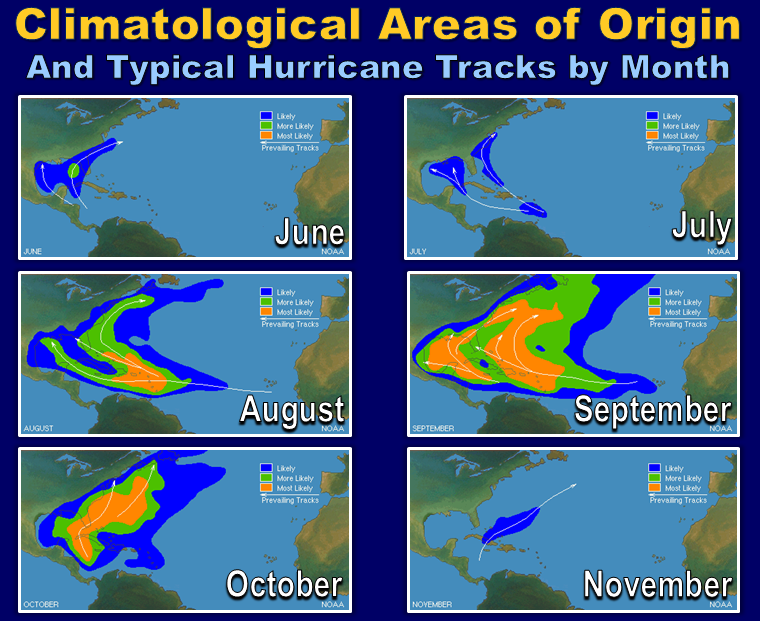
    Where hurricanes form shifts over the months

    Where storms are most likely to form and make landfall also changes as the pages of the calendar turn.

    In early summer, the Gulf of Mexico warms up faster than the open Atlantic, making it a notable hotspot for early-season tropical storm development, especially in June and July. The Texas coast, Louisiana, and the Florida Panhandle often face a higher early-season risk than locations along the Eastern seaboard.

    These are generally the busiest areas during each month of hurricane season, but that doesn’t mean hurricanes won’t make landfall elsewhere.
    NOAA

    By August and September, the season reaches its peak. This is when those waves moving off the coast of Africa become a primary source of storm activity. These long-track storms are sometimes called “Cape Verde hurricanes” because they originate near the Cape Verde Islands off the African coast. While many stay over open water, others can gather steam and track toward the Caribbean, Florida or the Carolinas.

    Later in the hurricane season, storms are more likely to form in the western Atlantic or Caribbean, where waters are still warm and upper-level winds remain favorable. These late-season systems have a higher probability of following atypical paths, as Sandy did in 2012 when it struck the New York City region and Milton did in 2024 before making landfall in Florida.

    At the end of the day, the safest way to think about hurricane season is this: If you live along the coast, don’t let your guard down. Areas susceptible to hurricanes are never totally immune from hurricanes, and it only takes one to make it a dangerous – and unforgettable – season.

    Colin Zarzycki’s research lab receives funding from the U.S. National Science Foundation, Department of Energy, and National Oceanic and Atmospheric Administration.

    ref. Forecasters expect a busy 2025 hurricane season – a storm scientist explains why and what meteorologists are watching – https://theconversation.com/forecasters-expect-a-busy-2025-hurricane-season-a-storm-scientist-explains-why-and-what-meteorologists-are-watching-257223

    MIL OSI – Global Reports

  • MIL-OSI USA: SBA Offers Disaster Assistance to Kansas Small Businesses, Private Nonprofits and Residents Affected by May Storms

    Source: United States Small Business Administration

    SACRAMENTO, Calif. – The U.S. Small Business Administration (SBA) announced the availability of low interest federal disaster loans to Kansas small businesses, private nonprofits and residents to offset physical and economic losses from the severe storm and tornado occurring May 18. The SBA issued a disaster declaration in response to a request SBA received from Gov. Laura Kelly on May 28.

    The disaster declaration covers the Kansas counties of Gove, Graham, Lane, Logan, Ness, Scott, Sheridan, Thomas and Trego.

    Businesses and nonprofits are eligible to apply for business physical disaster loans and may borrow up to $2 million to repair or replace disaster-damaged or destroyed real estate, machinery and equipment, inventory, and other business assets.

    Homeowners and renters are eligible to apply for home and personal property loans and may borrow up to $100,000 to replace or repair personal property, such as clothing, furniture, cars, and appliances. Homeowners may apply for up to $500,000 to replace or repair their primary residence.

    Applicants may be eligible for a loan increase of up to 20% of their physical damages, as verified by the SBA, for mitigation purposes. Eligible mitigation improvements include insulating pipes, walls and attics, weather stripping doors and windows, and installing storm windows to help protect property and occupants from future disasters.

    SBA’s Economic Injury Disaster Loan (EIDL) program is available to eligible small businesses, small agricultural cooperatives, nurseries and private nonprofit (PNP)organizations impacted by financial losses directly related to this disaster. The SBA is unable to provide disaster loans to agricultural producers, farmers, or ranchers, except for aquaculture enterprises.

    EIDLs are for working capital needs caused by the disaster and are available even if the business or PNP did not suffer any physical damage. They may be used to pay fixed debts, payroll, accounts payable, and other bills not paid due to the disaster.

    Interest rates are as low as 4% for businesses, 3.62% for nonprofits, and 2.81% for homeowners and renters with terms up to 30 years. Interest does not begin to accrue, and payments are not due until 12 months from the date of the first loan disbursement. The SBA sets loan amounts and terms based on each applicant’s financial condition.

    “When disasters strike, SBA’s Disaster Loan Outreach Centers play a vital role in helping small businesses and their communities recover,” said Chris Stallings, associate administrator of the Office of Disaster Recovery and Resilience at the SBA. “At these centers, SBA specialists assist business owners and residents with disaster loan applications and provide information on the full range of recovery programs available.”

    Beginning Tuesday, June 3, SBA customer service representatives will be on hand at the Disaster Loan Outreach Center (DLOC) to answer questions about SBA’s disaster loan program, explain the application process and help each individual complete their application. Walk-ins are accepted, but you can schedule an in-person appointment in advance at appointment.sba.gov.

    The DLOC hours of operations are as follows.

    GOVE COUNTY
    Disaster Loan Outreach Center
    Grinnell Senior Center
    105 S. Adams St.
    Grinnell, KS  67738

    Opens at 11 a.m., Tuesday, June 3

    Mondays – Fridays, 8:00 a.m. – 4:30 p.m.

    Closes at 4:30 p.m., Wednesday, June 25

    To apply online, visit sba.gov/disaster. Applicants may also call SBA’s Customer Service Center at (800) 659-2955 or email disastercustomerservice@sba.gov for more information on SBA disaster assistance. For people who are deaf, hard of hearing, or have a speech disability, please dial 7-1-1 to access telecommunications relay services.

    The deadline to return physical damage applications is July 28, 2025. The deadline to return economic injury applications is March 2, 2026.

    ###

    About the U.S. Small Business Administration

    The U.S. Small Business Administration makes the American dream of business ownership a reality. As the only go-to resource and voice for small businesses backed by the strength of the federal government, the SBA empowers entrepreneurs and small business owners with the resources and support they need to start, grow or expand their businesses, or recover from a declared disaster. It delivers services through an extensive network of SBA field offices and partnerships with public and private organizations. To learn more, visit www.sba.gov.

    MIL OSI USA News

  • MIL-OSI USA: SBA Opens Disaster Loan Outreach Center in Benton

    Source: United States Small Business Administration

    SACRAMENTO, Calif. – The U.S. Small Business Administration (SBA) announced today the opening of a Disaster Loan Outreach Center (DLOC) in Saline County to assist small businesses, private nonprofit (PNP) organizations and residents affected by severe storms, tornadoes and flooding occurring April 2-22.

    Beginning Monday, June 2, SBA customer service representatives will be on hand at the Disaster Loan Outreach Center in Benton to answer questions and assist with the disaster loan application process. No appointment is necessary, walk-ins are welcome. Those who prefer to schedule an in-person appointment in advance can do so at appointment.sba.gov.

    The center’s hours of operation are as follows:

    SALINE COUNTY
    Disaster Loan Outreach Center
    Saline County Career and Technical Campus
    Conference Room B202
    13600 I-30 North
    Benton, AR  72015

    Opens at 8:00 a.m., Monday, June 2

    Mondays – Fridays, 8:00 a.m. – 4:30 p.m.

    Closes at 4:30 p.m., Friday, June 20

    The following DLOCs are open and continue to serve survivors:

    SHARP COUNTY
    Disaster Loan Outreach Center
    City Hall – Cave City
    Conference Room
    Entrance and parking at back of building
    201 S. Main St.
    Cave City, AR  72521

    Mondays – Fridays, 9:00 a.m. – 6:00 p.m.
    Saturdays, 9:00 a.m. – 1:00 p.m.

    SHARP COUNTY
    Disaster Loan Outreach Center
    Hardy Fire Station
    203 Church St.
    Hardy, AR  72542

    Mondays – Fridays, 9:00 a.m. – 6:00 p.m.
    Saturdays, 9:00 a.m. – 1:00 p.m.

    “When disasters strike, SBA’s Disaster Loan Outreach Centers perform an important role by assisting small businesses and their communities,” said Chris Stallings, associate administrator of the Office of Disaster Recovery and Resilience at the U.S. Small Business Administration. “At these centers, our SBA specialists help business owners and residents apply for disaster loans and learn about the full range of programs available to support their recovery.”

    Businesses and nonprofits are eligible to apply for business physical disaster loans and may borrow up to $2 million to repair or replace disaster-damaged or destroyed real estate, machinery and equipment, inventory, and other business assets.

    Homeowners and renters are eligible to apply for home and personal property loans and may borrow up to $100,000 to replace or repair personal property, such as clothing, furniture, cars, and appliances. Homeowners may apply for up to $500,000 to replace or repair their primary residence.

    Applicants may be eligible for a loan increase of up to 20% of their physical damages, as verified by the SBA, for mitigation purposes. Eligible mitigation improvements include insulating pipes, walls and attics, weather stripping doors and windows, and installing storm windows to help protect property and occupants from future disasters.

    The SBA’s Economic Injury Disaster Loan (EIDL) program is available to small businesses, small agricultural cooperatives, nurseries, and private nonprofit organizations impacted by financial losses directly related to these disasters. The SBA is unable to provide disaster loans to agricultural producers, farmers, or ranchers, except for small aquaculture enterprises.

    EIDLs are available for working capital needs caused by the disaster and are available even if the business or PNP did not suffer any physical damage. The loans may be used to pay fixed debts, payroll, accounts payable, and other bills not paid due to the disaster.

    Interest rates are as low as 4% for small businesses, 3.62% for nonprofits, and 2.75% for homeowners and renters with terms up to 30 years. Interest does not begin to accrue, and payments are not due until 12 months from the date of the first loan disbursement. The SBA determines eligibility and sets loan amounts and terms based on each applicant’s financial condition.

    To apply online, visit sba.gov/disaster. Applicants may also call SBA’s Customer Service Center at (800) 659-2955 or email disastercustomerservice@sba.gov for more information on SBA disaster assistance. For people who are deaf, hard of hearing, or have a speech disability, please dial 7-1-1 to access telecommunications relay services.

    The deadline to return physical damage applications is July 21, 2025. The deadline to return economic injury applications is Feb. 23, 2026.

    ###

    About the U.S. Small Business Administration

    The U.S. Small Business Administration helps power the American dream of business ownership. As the only go-to resource and voice for small businesses backed by the strength of the federal government, the SBA empowers entrepreneurs and small business owners with the resources and support they need to start, grow, expand their businesses, or recover from a declared disaster. It delivers services through an extensive network of SBA field offices and partnerships with public and private organizations. To learn more, visit www.sba.gov.

    MIL OSI USA News

  • MIL-OSI Russia: Hamas sends response to US ceasefire proposal

    Translation. Region: Russian Federal

    Source: People’s Republic of China in Russian – People’s Republic of China in Russian –

    Source: People’s Republic of China – State Council News

    GAZA, May 31 (Xinhua) — Palestinian Hamas movement on Saturday said it has conveyed to mediators its response to the recent ceasefire proposal in the Gaza Strip put forward by U.S. Special Envoy for the Middle East Steven Witkoff.

    “After holding a round of national consultations and out of deep responsibility to our people and their suffering,” Hamas sent the mediators its response to Witkoff’s latest proposal, the movement said in a statement.

    “Under the agreement, ten living Israeli hostages held by Hamas will be released, and the bodies of 18 dead hostages will also be handed over in exchange for an agreed number of Palestinian prisoners,” the movement said.

    It added that the proposal was aimed at achieving a permanent ceasefire, a complete withdrawal of Israeli troops from the Gaza Strip and ensuring the flow of aid to the enclave’s population.

    Hamas politburo member Basem Naim said in a statement on Thursday that the movement had received Israel’s response to the US proposal.

    According to him, Israel’s position does not take into account the basic demands of the Palestinians, including a complete cessation of hostilities and the lifting of the long-term blockade of Gaza. -0-

    MIL OSI Russia News

  • MIL-OSI Australia: Funding boost to save Grassland Earless Dragon

    Source: Northern Territory Police and Fire Services

    Found only in the Canberra region, the Canberra Grassland Earless Dragon is one of the Territory’s most critically endangered species.

    In brief:

    • The Canberra Grassland Earless Dragon is facing extinction.
    • A significant ACT Government investment will help conserve the local species.
    • This article looks at ways the funds will be used and what has been done already to save the species.

    New ACT Government funding will help prevent extinction of the Canberra Grassland Earless Dragon.

    The unique lizard is found only in the Canberra region. It is one of the Territory’s most critically endangered species.

    The Government will invest $4.5 million to support a recovery plan to help conserve the species. This builds on $2.7 million already invested since 2020.

    How will the funds be used?

    The additional $4.5 million will support:

    • $2.4 million for program operations. This includes ACT Government staffing to manage the Tidbinbilla breeding colony and deliver recovery actions.
    • $2 million to expand the breeding colony at Melbourne Zoo. The aim is for up to 200 breeding individuals.
    • $120,000 for ongoing release of Dragons bred in captivity back into the wild.

    What has been done already?

    The additional investment builds on previous government investment starting in 2020. This has been for:

    • habitat restoration
    • trial reintroductions
    • population viability modelling
    • cutting-edge genetic matchmaking to ensure a healthy, genetically diverse population.

    The ACT Government has been running a captive breeding program.

    The new funding will help expand recovery efforts.

    Why is Melbourne Zoo involved?

    Melbourne Zoo has a captive colony of Dragons.

    Improving the species’ genetic diversity is key to ensuring its recovery.

    Genetic analysis and matchmaking programs are essential to address inbreeding.

    As such, the ongoing partnership with the zoo is crucial.

    Melbourne Zoo provides animals for release and research.

    It has also shared expertise in husbandry and breeding techniques.

    What else should I know about the Dragon?

    The Canberra Grassland Earless Dragon measures just 15cm and weighs 5–9 grams.

    It was only recognised as a distinct species in 2019. It is now listed as critically endangered.

    The Dragon population has declined dramatically due to:

    • habitat loss
    • fragmentation
    • altered fire and grazing regimes
    • climate impacts.

    Wild populations are now found only in:

    • the Majura Valley
    • the Jerrabomberra Valley
    • parts of Queanbeyan.

    The new investment will ensure continued conservation action.

    It aims to give the Dragon a real chance to thrive again in Canberra grasslands.

    Learn more about the Canberra Grassland Earless Dragon on the Environment website.

    Read more like this


    Get ACT news and events delivered straight to your inbox, sign up to our email newsletter:


    MIL OSI News

  • MIL-OSI: Starscope: Does Starscope Monocular Really Work for Stargazing & Hiking? Read Full Starscope Monocular Telescope Consumer Report!

    Source: GlobeNewswire (MIL-OSI)

    San Diego, CA, May 31, 2025 (GLOBE NEWSWIRE) — Introduction: Why the Starscope Monocular Is Gaining Popularity in 2025

    Whether you’re a nature lover, hiker, hunter, or stargazer, having the right optical gear can make or break your outdoor experience. In 2025, one compact device has been making waves among adventurers and outdoor enthusiasts alike — the Starscope Monocular.

    This rugged, pocket-sized monocular telescope has sparked major attention across the US, UK, Canada, and Australia. Why? Because it’s delivering high-powered vision, smartphone adaptability, and military-grade durability — all at a fraction of the size and weight of traditional binoculars or telescopes.

    From birdwatching on weekend hikes to spotting distant wildlife or gazing at the moon, Starscope promises ultra-clear, zoomed-in views without the bulk. It’s not just a camera add-on — it’s a full-on telescope designed for your hand.

    But does the Starscope Monocular actually live up to the hype? Can it truly replace bulky binoculars or expensive spotting scopes?

    In this in-depth Starscope Monocular review, we’ll uncover:

    • How it works and what makes it different
    • Real-world reviews from actual users in 2025
    • Key specs and performance in outdoor settings
    • Updated pricing and bundle deals
    • Where to buy it safely (and avoid knockoffs)

    Let’s zoom into the facts and see if Starscope really is the best monocular telescope worth your money this year.

    What Is Starscope? A Closer Look at This Trending Monocular Telescope

    The Starscope Monocular is a high-definition optical device designed to give users a clear, zoomed-in view of distant objects — whether you’re exploring mountains, observing wildlife, attending sports events, or simply stargazing. Marketed as a compact alternative to bulky binoculars and traditional telescopes, Starscope is engineered for both convenience and clarity.

    What Makes It Stand Out?

    Unlike conventional monoculars that often compromise on image quality or build strength, Starscope combines 10x magnification, BAK-4 prisms, and multi-coated lenses in a single rugged unit. It’s built using advanced military-grade materials that make it water-resistant, fog-proof, and shockproof, making it suitable for rough outdoor conditions.

    Smartphone Compatibility

    One of the standout features of the Starscope monocular is its smartphone adapter compatibility. You can easily attach your smartphone to capture stunning long-range photos and videos — perfect for wildlife photography, sightseeing, or even amateur astronomy.

    Compact, Travel-Ready Design

    At just under 300 grams, the Starscope monocular fits easily into your palm, pocket, or backpack. Its lightweight build and ergonomic grip allow for one-hand use, making it a practical choice for adventurers on the go.
    Don’t Miss Out: The Starscope Monocular Is Selling Fast – See What You’ve Been Missing!

    Who Is It Made For?

    Starscope is ideal for:

    • Hikers and backpackers
    • Hunters and birdwatchers
    • Sports fans
    • Stargazers and amateur astronomers
    • Travelers exploring scenic views

    Starscope Monocular Features & Technical Specifications

    The Starscope Monocular isn’t just another gadget — it’s an all-in-one optical solution engineered for sharp clarity, long-range zoom, and outdoor resilience. Below, we break down the core features and specifications that make this monocular a standout choice in 2025.

    Optical Power & Precision

    • 10x Magnification Power
      Starscope allows you to zoom in on distant objects with crystal-clear detail — up to 10 times closer. Whether it’s a mountaintop or a distant stadium seat, the detail remains sharp and focused.
    • 42mm Objective Lens Diameter
      The large 42mm lens collects more light for brighter images, especially in low-light settings like early morning or dusk. It enhances your visual experience when birdwatching or stargazing.
    • Field of View
      Starscope offers a wide field of view, making it easier to scan landscapes or follow moving targets without frequent repositioning.

    Advanced Lens & Prism Technology

    • BAK-4 Prism
      Built with professional-grade BAK-4 (Barium Crown Glass) prisms, which provide greater light transmission and edge-to-edge sharpness — reducing distortion and glare.
    • Multi-Coated Lens
      Each lens surface is coated to enhance image brightness, reduce reflections, and improve contrast. This ensures a vibrant, high-resolution image even in bright sunlight.

    Discover the Best Monocular of 2025 – The Starscope Telescope Is All You Need Outdoors

    Rugged, Outdoor-Ready Construction

    • Weatherproof Design
      Starscope is sealed to resist water, fog, and dust — perfect for hiking, camping, or kayaking. You don’t have to worry about a sudden downpour or misty mornings.
    • Shock-Resistant Casing
      The exterior shell is made from a durable polymer composite that absorbs impact, making the device drop-resistant and travel-friendly.
    • Slip-Resistant Grip
      Ergonomic texture provides a firm hold, even in wet conditions or while wearing gloves.

    Smartphone Compatibility

    • Universal Phone Adapter
      Easily attaches to most smartphones to transform the Starscope into a powerful telephoto lens. Capture distant landscapes, record HD video, or take zoomed-in wildlife shots without blur.
    • Tripod Mount Ready
      A standard mount allows you to attach it to a tripod for long sessions or time-lapse recordings.

    How Does the Starscope Telescope Work?

    Starscope uses high-powered optics to deliver a detailed image of faraway scenes. It works by channeling light through precision-engineered lenses and a BAK-4 prism system, which enhances brightness, sharpness, and contrast.

    When light enters the objective lens, it travels through a series of internal glass prisms and coatings that reduce glare and distortion. The result is a magnified, high-definition view that looks vibrant and realistic, even at long distances.

    The monocular’s alignment with your smartphone camera adds further functionality — turning your phone into a zoom lens for pictures and video.

    Over 100,000 Sold – Is Starscope the Best Monocular in 2025? See Real Results

    How To Use Starscope Monocular?

    To use the Starscope Monocular effectively, follow these steps:

    1. Remove Lens Caps: Take off both the front and rear lens caps to prepare the monocular for use. 
    2. Adjust the Eyecup: If you wear glasses, twist the eyecup down; if not, keep it extended for optimal viewing comfort. 
    3. Hold the Monocular Properly: Grip the monocular with one hand, placing your index finger on the focus adjustment dial and your pinky near the front for stability.
    4. Focus the Image: Look through the eyepiece and rotate the focus dial with your index finger until the image becomes sharp and clear.
    5. Attach to a Tripod (Optional): For extended viewing sessions or increased stability, mount the monocular onto a tripod using the built-in 1/4″ thread. 
    6. Connect to a Smartphone (Optional): Use a compatible smartphone adapter to align your phone’s camera with the monocular’s eyepiece, allowing you to capture distant images or videos.
    7. Maintenance Tips:
      • Cleaning: Use a soft lens brush or blower to remove dust. For smudges, gently wipe with a microfiber cloth in a circular motion. 
      • Storage: Store the monocular in a cool, dry place and avoid exposing it to extreme temperatures or moisture.

    Safety Precaution: Never look directly at the sun through the monocular, as this can cause serious eye damage. 

    By following these steps, you can maximize your experience with the Starscope Monocular, whether you’re observing wildlife, enjoying scenic views, or stargazing.

    Zoom In Like Never Before – Grab the Starscope Monocular at 50% Off Today Only!

    Starscope Monocular Benefits: Why People Are Choosing It Over Binoculars

    • Ultra Lightweight: Fits in your pocket or backpack without bulk.
    • One-Hand Operation: Perfect for trekking or scouting terrain.
    • Crisp Image Quality: See vivid details from hundreds of yards away.
    • Photo & Video Ready: Use with your phone to capture distant sights.
    • Durability: Survives drops, splashes, and harsh weather.
    • Low-Light Visibility: Great for sunrise or twilight exploration.

    How to Use the Starscope Monocular for Hiking, Hunting, Stargazing & Travel

    1. Hold with one hand and align the eyepiece with your dominant eye.
    2. Twist the focus ring slowly until the image is sharp.
    3. Attach your smartphone using the provided adapter.
    4. Use your phone’s camera to zoom further, take pictures, or record.
    5. Optionally mount it to a tripod for steady viewing.

    Starscope Price & Where to Buy the Starscope Monocular

    Starscope is available exclusively through the official website. Avoid third-party platforms like Amazon or eBay, which may sell unauthorized or fake versions.

    • 1x Monocular: $47.99 (was $106.64)
    • 2x Monoculars: $95.99 (was $213.29)
    • 3x Monoculars: $107.99 (was $319.93)
    • 4x Monoculars: $143.99 (was $426.58)

    All packages may include bonus accessories like tripods or smartphone adapters. Discounts reflect 50%–62% savings.

    Shipping, Delivery Time & Refund Policy

    • Shipping: Worldwide delivery available.
    • Delivery Time: 5–12 business days depending on region.
    • Refund Policy: 30-day money-back guarantee. Unused items may be returned for a full refund (minus shipping & handling).

    Disclaimer: Prices & return policy are subject to change. Always check the official website for the most accurate and up-to-date pricing before purchasing.

    Real Customer Experiences from the USA, UK, Canada & Australia

    Sarah – Denver, USA: “Used the Starscope on a solo hiking trip in Colorado. I spotted wildlife from a mile away. The view was sharp and steady even without a tripod.”

    James – Perth, Australia: “Took mine on a camping trip. Loved the phone attachment. Captured amazing photos of distant cliffs and birds.”

    Michael – Toronto, Canada: “It’s so much easier to carry than my old binoculars. Feels solid and works even in light rain. Definitely my go-to for birding.”

    Lucy – Manchester, UK: “Perfect for stargazing in rural England. I could clearly see lunar craters and Jupiter’s moons — very impressed.”

    Explore Farther with the Starscope Telescope – Perfect for Stargazing, Hiking & Travel

    Starscope FAQs – Common Questions Answered

    Q: Can I buy Starscope on Amazon or Walmart?
    A: No. Starscope is exclusively sold through its official website. Any listings on Amazon, Walmart, or eBay may be counterfeit or unauthorized, and they do not qualify for the official warranty or refund policy.

    Q: Does it work at night?
    A: It does well in low-light but not total darkness. Great for dawn/dusk.

    Q: Is it suitable for people who wear glasses?
    A: Yes. It has adjustable eye relief.

    Q: What’s the warranty?
    A: 30-day satisfaction guarantee, with optional extended warranty at checkout.

    Q: Is Starscope compatible with all smartphones?

    A: Yes — most smartphones can be used with Starscope via the universal phone adapter included in bundle deals. Some manual adjustment may be required depending on your phone’s camera position.

    Q: Can I use it for stargazing?

    A: Absolutely. While not a full telescope, it provides a crisp view of the moon, planets, and stars, making it suitable for amateur astronomy.

    Q: Is it waterproof?

    A: Yes. Starscope is water-resistant, fog-proof, and shockproof, making it reliable in rugged outdoor environments. However, it should not be fully submerged in water.
    Turn Your Phone into a Pro Camera with the Starscope Monocular – Limited Stock Left!

    Environmental Impact: Is the Starscope Monocular Eco-Friendly?

    In an era where sustainability is paramount, evaluating the environmental impact of products like the Starscope Monocular is essential.

    ♻️ Materials and Manufacturing

    The Starscope Monocular is constructed using durable materials, including a BAK4 prism and multi-coated lenses, ensuring longevity and reducing the need for frequent replacements. Its robust design contributes to a longer product lifespan, which can mitigate environmental impact over time.

    Sustainable Practices

    While specific details about the manufacturing processes and sourcing of materials for the Starscope Monocular are limited, the product’s durability suggests a focus on quality. However, without explicit information on eco-friendly practices or certifications, it’s challenging to fully assess its environmental friendliness.

    Energy Efficiency

    The monocular operates without batteries or electricity, relying solely on optical components. This energy-free operation minimizes its carbon footprint during use, aligning with sustainable practices.

    Packaging and Distribution

    Information regarding the packaging materials and distribution methods is not readily available. Eco-conscious consumers may wish to inquire directly with the manufacturer for details on packaging sustainability and shipping practices.
    Get the Best Monocular for Outdoor Adventures – Order Your Starscope Before It’s Gone
    Common Starscope Problems & How to Fix Them
    Even high-quality devices like the Starscope Monocular can encounter minor issues. Here are some common problems users have reported — and how to resolve them quickly:

    Problem: Blurry or Out-of-Focus Image

    Fix:

    • Rotate the focus ring slowly while looking through the eyepiece.
    • Make sure the lens is clean and free of fingerprints or smudges.
    • If using with a smartphone, ensure the adapter is properly aligned.

    Problem: Smartphone Adapter Doesn’t Fit Properly

    Fix:

    • Loosen and adjust the clamp arms carefully — most adapters are universal but may require repositioning for multi-lens phones.
    • Try removing your phone case to improve alignment.

    Problem: Double Vision or Image Distortion

    Fix:

    • Clean both lenses with a microfiber cloth.
    • Make sure the monocular isn’t fogged up (especially when moving between temperature zones).
    • Check if the internal lens is misaligned due to a drop — in rare cases, customer support may need to assist.

    Problem: View Is Too Dark or Dim

    Fix:

    • Ensure you are not using it in complete darkness — Starscope is optimized for daylight and low-light, but not for nighttime use.
    • Wipe off any moisture or condensation from the lens.

    Problem: Can’t See Anything Through the Eyepiece

    Fix:

    • Remove all lens caps.
    • Adjust your eye position — the exit pupil must align with your eye.
    • Twist the eyecup if you’re wearing glasses.

    Problem: Scratched or Smudged Lens

    Fix:

    • Use only soft, non-abrasive cloths (preferably microfiber).
    • Avoid using paper towels, shirts, or abrasive materials that could damage the lens coating.

    When to Contact Support

    If none of the above solutions help, or if your monocular is damaged during shipping, contact Starscope’s official support through their website for warranty service or a replacement.
    The #1 Trending Starscope Telescope Is Back – See Why Outdoor Enthusiasts Swear by It

    Starscope for Amateur Astronomy: Can It Replace a Telescope?

    While Starscope isn’t a professional-grade telescope, it’s surprisingly capable for casual astronomy. With 10x magnification and a 42mm lens, users can observe:

    • The moon’s surface with visible craters
    • Bright planets like Jupiter or Saturn (as small dots)
    • Star clusters and constellations

    It’s an excellent tool for beginners who want to explore the night sky without investing in bulky gear. For best results, use Starscope in low-light rural settings away from city pollution.Starscope Monocular for Birdwatching: A Birder’s Perspective
    Birdwatchers praise Starscope for its:

    • Silent operation (no clicking or zoom noise)
    • Sharp detail from long distances
    • Ability to quickly scan trees or open fields

    Whether you’re spotting hummingbirds in your backyard or waterfowl across a lake, the wide field of view and smartphone camera compatibility make bird identification much easier.

    Pros and Cons of Starscope Monocular

    Pros

    • High-Quality Optics
      Equipped with BAK-4 prism and multi-coated lenses for sharp, bright images.
    • 10x Magnification
      Ideal for long-distance viewing — from wildlife to stargazing.
    • Lightweight & Portable
      Weighs less than 300g and fits in your pocket or backpack.
    • Smartphone Compatible
      Easily attaches to most phones for HD photo and video capture.
    • Durable & Weather-Resistant
      Water-resistant, fog-proof, and shockproof — built for outdoor use.
    • Easy One-Hand Operation
      Ergonomic grip and simple focus adjustment make it user-friendly.
    • Affordable Compared to Binoculars or Telescopes
      Offers telescope-like performance without the high cost.
    • Tripod-Compatible
      Great for steady shots or long observation sessions.

    Cons

    • Not for Complete Darkness
      Performs well in low light but isn’t night-vision capable.
    • No Digital Zoom or Auto-Focus
      Manual focus only; relies on user adjustment.
    • Limited Availability
      Only sold via the official website — not available on Amazon or retail stores.
    • Best for Casual Use
      May not satisfy professional wildlife photographers or astronomers.
    • Phone Adapter Fit May Vary
      Some users may need to adjust alignment for specific phone models.

    Upgrade Your View – The Starscope Monocular Delivers Zoom Like Nothing Else

    How Starscope Enhances Smartphone Photography

    Transform your phone into a pro-level camera by attaching Starscope. It works like a telephoto zoom lens, ideal for:

    • Wildlife photography at long distances
    • Capturing landscapes or cliffs
    • Recording sports or outdoor events

    Tips:

    • Use a tripod for steady shots
    • Clean the lens before attaching
    • Zoom only slightly with your phone to reduce pixelation

    Maintenance Tips: How to Care for Your Starscope Monocular

    To ensure your Starscope lasts for years:

    • Clean lenses gently using microfiber cloths only
    • Avoid touching the glass with fingers
    • Store in a dry case to prevent moisture buildup
    • Use lens caps when not in use
    • Don’t submerge it, even though it’s water-resistant

    Starscope Safety and Usage Guidelines

    • Never look at the sun through the monocular.
    • Use caution when using near children (small parts, strap).
    • Avoid dropping it — though durable, internal alignment may shift.
    • Adjust the eyecup if you wear glasses.

    Over 100,000 Sold – Is Starscope the Best Monocular in 2025? See Real Reviews

    Starscope Gift Ideas: Who It’s Perfect For in 2025

    Looking for a thoughtful gift? Starscope is ideal for:

    • Outdoor lovers (hikers, campers)
    • Retirees or dads who enjoy nature
    • Kids interested in science or astronomy
    • Travelers and explorers

    With its sleek design and practical value, it makes a great gift for birthdays, holidays, or Father’s Day.
    Starscope for Travel Photography: A Backpacker’s Tool
    For photographers on the move, bulky lenses and gear are a hassle. That’s where the Starscope Monocular becomes a game-changer. Its compact build and powerful optics make it an ideal companion for travel photography, particularly in rugged or remote areas.
    Whether you’re hiking in Patagonia, road-tripping across the U.S., or exploring historical ruins abroad, Starscope helps you:

    • Zoom in on distant scenes with clarity
    • Snap close-ups of wildlife or architectural details
    • Use your smartphone to record landscapes that feel larger than life

    Its lightweight frame fits easily in a backpack side pocket, and unlike DSLR zoom lenses, there’s no need to worry about lens swapping, battery life, or electronic failure.
    Lightweight. Powerful. Unmatched. Get the Starscope Monocular and Explore More Today!
    Starscope for Sports & Events: Get Closer to the Action
    Want front-row views from the cheap seats? Starscope lets you see the game, match, or concert like you’re sitting VIP.
    The monocular is perfect for:

    • Live sports: football, baseball, racing, etc.
    • Outdoor concerts or festivals
    • Parades and fireworks

    With 10x zoom and smartphone connectivity, users can record their experience with surprisingly clear footage. Many reviewers praise its ability to zoom in on player movements, stage performances, or racing cars without blur or distortion.
    No more pixelated phone zooms or asking someone else for binoculars — Starscope brings the action to you in real time, wherever you’re seated.

    Who Should Buy the Starscope Monocular? Final Verdict

    If you’re someone who loves the outdoors, wants to explore farther without carrying bulky gear, and values crisp visuals from afar — Starscope is a smart buy in 2025. Its powerful zoom, rugged build, and mobile compatibility make it a practical investment.

    Highly recommended for:

    • Hikers
    • Travelers
    • Stargazers
    • Birdwatchers
    • Outdoor sports fans

    Media Contact:
    Company nameStarscope
    7864 Ronson Roa, Ste A San Diego 92111
    https://www.monostarscope.com/

    E-mail: support@monostarscope.com

    Disclaimer: The statements have not been evaluated by the Food and Drug Administration. This product is not intended to diagnose, treat, cure, or prevent any disease. Individual results may vary. Always consult a healthcare professional before taking any dietary supplements.
    Disclosure: This article is for informational purposes only and does not constitute medical advice. The content may include affiliate links, meaning we may earn a commission if you purchase through recommended links. Always consult a healthcare professional before starting any new supplement regimen.

    Content Accuracy Disclaimer
    Every effort has been made to ensure the accuracy of the information presented in this article. However, due to the dynamic nature of product formulations, promotions, and availability, details may change without notice. The publisher makes no warranties or representations as to the current completeness or accuracy of any content, including product claims, pricing, or ingredient lists.
    It is the responsibility of the reader to verify product information directly through the official website or manufacturer prior to making a purchasing decision. Any reliance placed on the information in this article is done strictly at your own risk.

    Affiliate Disclosure
    This article may contain affiliate links. If you purchase a product or service through these links, the publisher may earn a commission at no additional cost to you. These commissions help support the creation of in-depth reviews and educational wellness content.
    The publisher only promotes products that have been independently evaluated and deemed potentially beneficial to readers. However, this compensation may influence the content, topics, or products discussed in this article. The views and opinions expressed are those of the author and do not necessarily reflect the official policy or position of any affiliate partner or product provider.

    Related Link
    Power Saver Pro

    Attachment

    The MIL Network

  • MIL-OSI Russia: Death toll from central Nigeria floods rises to 151

    Translation. Region: Russian Federal

    Source: People’s Republic of China in Russian – People’s Republic of China in Russian –

    Source: People’s Republic of China – State Council News

    ABUJA, May 31 (Xinhua) — The death toll from devastating floods triggered by heavy rains in Nigeria’s central Niger state has risen to at least 151, local authorities said Saturday.

    Ibrahim Hussaini, head of operations at the Niger State Disaster Management Agency, told Xinhua by telephone that more than 50 more bodies were found in Mokwa district, where the disaster occurred, on Saturday.

    I. Hussaini said 11 victims were rescued and taken to a nearby hospital. “So far, 318 people have been affected, as well as at least 503 households.

    He added that the search for bodies continues, with local divers and volunteers assisting in the rescue operation.

    Heavy rains on Thursday night caused chaos in Mokwa, flooding and washing away dozens of residential buildings, some of which still had people inside, I. Hussaini told reporters on Thursday.

    Earlier this week, the Nigerian Meteorological Agency issued a forecast warning of thunderstorms and heavy rainfall in the central part of the country, including Niger State. The agency said more rainfall was expected in the next 24 hours, with localized showers also possible in the southern region. –0–

    MIL OSI Russia News

  • Delhi records wettest May; IMD issues ‘Orange Alert’ for May 31

    Source: Government of India

    Source: Government of India (4)

    Delhi recorded a minimum temperature of 34.8 degrees Celsius on Saturday morning, marking one of the warmer days of the season. However, despite the high morning temperature, this May has been unusual in many ways, including below-normal daytime temperatures, unprecedented frequent rainfall, and the absence of any heatwave conditions.

    In terms of precipitation, May 2025 has been historic for Delhi, with the capital receiving 188.9 mm of rainfall — the highest-ever recorded in the month of May. This is over 202 percent more than the normal monthly average of 62.6 mm. In contrast, May 2024 saw just 0.4 mm of rain, which was 99 percent below average, with not a single rainy day recorded.

    According to the India Meteorological Department (IMD), this is only the third time in the last five years that Delhi has seen the mercury stay below 40 degrees Celsius throughout May. Not a single day this month recorded conditions severe enough to be classified as an intense heatwave, making it a rare exception in the typically scorching summer month.

    The current spell of unusual weather is being attributed to the early arrival of the monsoon in Mumbai, which has had a ripple effect on weather systems in northern India, including Delhi. However, meteorologists have clarified that the monsoon has not yet arrived in the national capital, even though conditions have turned significantly cooler and wetter.

    The IMD has issued an ‘Orange Alert’ for Delhi-NCR for tonight, warning residents to stay alert as thunderstorms and heavy rain are likely. An ‘Orange Alert’ signals potentially disruptive weather, and people are advised to prepare for sudden changes in conditions.

    The forecast suggests that rain, accompanied by thunder and strong winds, will continue across Delhi and surrounding areas till June 4. A ‘Yellow Alert’ is also in place for Saturday, with the possibility of rain showers at any time during the day.

    Meanwhile, the Air Quality Index (AQI) stood at 167, placing it in the ‘moderate’ category, according to the Central Pollution Control Board (CPCB).

    The AQI scale defines values between 101–200 as ‘moderate,’ 201–300 as ‘poor,’ and 301–400 as ‘very poor.’

    With unpredictable weather continuing, Delhiites are advised to remain cautious and plan accordingly as the city experiences one of its most unusual Mays in recent history.

    —IANS

  • MIL-OSI: Online Crypto Casinos: All iGaming Reveals the Top Sites for Crypto Gamblers in 2025

    Source: GlobeNewswire (MIL-OSI)

    Jersey City, NJ, May 31, 2025 (GLOBE NEWSWIRE) —  – These days, the internet is flooded with crypto casinos all claiming to offer the best games, biggest bonuses, and fastest payouts. But finding a truly reputable crypto casino isn’t about luck- it’s about knowing where to look. All iGaming, a respected name in online gambling reviews, has been guiding players since its founding, providing independent and expert insights into safe, licensed, and high-performing crypto casino platforms.

    FIND OUT THE BEST CRYPTO CASINOS – SAFE, FAIR, AND LICENSED

    All iGaming is committed to providing unbiased reviews of the best crypto casinos, guiding players through the dynamic world of blockchain-based gambling. Beyond ranking operators, All iGaming serves as a comprehensive resource, offering insights into legal frameworks, responsible gaming practices, and the nuances of cryptocurrency gambling. Whether you’re seeking the best Bitcoin casino or exploring the best Bitcoin casinos without verification, All iGaming ensures informed choices with confidence.

    This article outlines All iGaming ’s rigorous evaluation process for identifying the best BTC casinos, emphasizing transparency, player safety, and seamless user experiences to deliver recommendations tailored to player needs.

    The Trust Factor: Why All iGaming Stands Out

    All iGaming is built on trust and transparency. Every best BTC casino is evaluated based on criteria that matter most, offering a balanced perspective that highlights strengths and potential drawbacks.

    All iGaming earns trust by adhering to strict standards, ensuring every review of a legal crypto casino provides clear, objective insights. This approach guarantees players can  confidently select trusted crypto casinos that align with their gaming preferences, whether they prioritize speed, privacy, or game variety.

    Ranking Criteria: All iGaming ’s Player-First Approach

    All iGaming ’s multi-layered ranking system evaluates the best crypto casinos based on key pillars that enhance the player experience. From game fairness to transaction security, every factor is scrutinized to ensure only the best bitcoin casinos without verification make the cut. Here’s a detailed breakdown of the criteria:

    • Licensing and Regulation: Player safety is non-negotiable. All iGaming only recommends trusted crypto casinos licensed by reputable authorities like Curaçao eGaming or Anjouan. Each legal crypto casino is verified for compliance with fairness and security standards, ensuring players are protected from unregulated operators.
    • Provably Fair Gaming: The hallmark of trusted casinos is provably fair games, allowing players to verify outcomes using blockchain technology. All iGaming examines cryptographic algorithms and Return to Player (RTP) rates to confirm fairness across slots, table games, and live dealer options in every best Bitcoin casino.
    • Transaction Speed and Security: Fast, secure crypto transactions define the crypto casinos. All iGaming assesses deposit and withdrawal speeds, ensuring support for cryptocurrencies like Bitcoin, Ethereum, Tether, and Litecoin. Robust encryption, two-factor authentication (2FA), and secure wallet integration are critical for a legal crypto casino.
    • Bonus Transparency: Bonuses attract players, but hidden terms can mislead. All iGaming analyzes wagering requirements, minimum deposits, and bonus conditions to ensure the best crypto casinos offer transparent, player-friendly promotions, such as welcome bonuses, free spins, and rakeback deals.
    • Game Variety and Quality: The best BTC casinos feature diverse libraries from top providers like Pragmatic Play, Evolution Gaming, NetEnt, and BGaming. All iGaming evaluates slots, table games, live dealer options, and provably fair games for quality and strong RTPs to ensure an engaging experience.
    • User Interface and Accessibility: Seamless navigation and mobile compatibility are essential. All iGaming tests platforms to ensure the best crypto casinos without verification provide intuitive interfaces, easy access to games, deposits, and support across devices, enhancing the overall user experience.
    • Customer Support Excellence: Reliable support is crucial for resolving issues quickly. All iGaming evaluates the availability of 24/7 live chat, email, Telegram, and FAQ sections, ensuring trusted crypto casinos offer responsive, professional assistance to players worldwide.
    • Anonymity and KYC Policies: For privacy-conscious players, All iGaming highlights the crypto casinos without verification, ensuring secure, low-KYC or no-KYC options that maintain compliance with licensing requirements while prioritizing player privacy.

    EXPLORE TOP CRYPTO CASINOS – YOUR ULTIMATE GUIDE

    All iGaming ’s rankings are dynamic,updated in real-time to reflect the latest performance of the best crypto casinos. If a platform fails to meet All iGaming ’s high standards, its ranking adjusts to maintain accuracy, ensuring players have access to trustworthy recommendations for trusted crypto casinos. This commitment to real-time updates helps players avoid outdated information and choose platforms that deliver consistently.

    The Importance of Choosing a Trusted Crypto Gambling Source

    Relying on a credible source like All iGaming is critical for navigating the crowded crypto gambling market. Unlike unregulated platforms, legal crypto casinos prioritize player protection, fair gaming, and transparent policies. All iGaming ’s thorough reviews protect players from scams, unfair terms, or delayed payouts, ensuring a safe and enjoyable experience at the best crypto casinos.

    By evaluating platforms against strict criteria, All iGaming helps players avoid the pitfalls of unreliable operators. Whether you’re chasing the best Bitcoin casino or seeking the best crypto casinos without verification, All iGaming ’s expertise ensures a rewarding gambling experience tailored to your needs.

    TOP ONLINE CASINOS RANKED – SEE WHO COMES OUT ON TOP

    All iGaming: Beyond Casino Reviews

    In an industry rife with misleading content, All iGaming stands as a beacon of reliability. Beyond ranking the best crypto casinos, the platform offers a wealth of educational resources to empower players, including:

    • Step-by-step guides on understanding crypto casino bonuses and wagering requirements
    • Insights into blockchain technology and its role in provably fair gaming
    • Tips for managing cryptocurrency wallets for secure gambling transactions
    • Risks associated with unregulated or unlicensed crypto casinos
    • Latest trends, news, and innovations in crypto gambling
    • Strategies for responsible gambling and setting personal limits

    COMPARE THE BEST CRYPTO CASINO SITES – COMPLETE 2025 GUIDE

    Understanding Crypto Gambling Regulations

    All iGaming ensures that recommended best crypto casinos operate under licenses from trusted jurisdictions like Curaçao or Anjouan. These legal crypto casinos adhere to stringent regulations, including:

    • Robust player protection measures, such as secure account management and data privacy
    • Provably fair game outcomes verified through blockchain technology
    • High-level security with SSL encryption, 2FA, and secure crypto transactions
    • Transparent policies for deposits, withdrawals, and bonus terms
    • Commitment to responsible gambling through tools like deposit limits and self-exclusion
    • Regular audits by independent regulatory bodies to ensure compliance

    All iGaming simplifies the complexities of crypto gambling regulations, offering clear guides on legal requirements, Know Your Customer (KYC) policies, and tax implications for cryptocurrency winnings. This ensures players can focus on enjoying the best crypto casinos without navigating legal jargon alone.

    Why Crypto Casinos Are the Future of Online Gambling

    The best crypto casinos are redefining online gambling with their unique advantages. Unlike traditional platforms, trusted crypto casinos leverage blockchain technology for unmatched transparency, allowing players to verify game fairness in real-time. Cryptocurrency transactions eliminate intermediaries, enabling near-instant deposits and withdrawals with minimal fees, a key reason players flock to the best BTC casinos.

    Privacy is a major draw. Many best crypto casinos without verification allow players to gamble anonymously, bypassing lengthy KYC processes while maintaining security through blockchain protocols. Additionally, the global accessibility of cryptocurrencies means players can enjoy the best crypto casinos from anywhere, unrestricted by fiat currency limitations.

    Tips for Choosing the Best Crypto Casino

    To maximize your experience at the best crypto casinos, consider these tips from All iGaming :

    • Verify Licensing: Choose a legal crypto casino licensed by a reputable authority to ensure fairness and security.
    • Check Game Fairness: Opt for platforms with provably fair games, a hallmark of trusted crypto casinos.
    • Review Bonus Terms: Look for clear, reasonable wagering requirements to avoid surprises at the best BTC casinos.
    • Test Customer Support: Ensure 24/7 support through live chat or Telegram for quick resolutions.
    • Prioritize Security: Select the best crypto casinos with SSL encryption, 2FA, and secure wallet integration.
    • Explore Anonymity Options: For privacy, choose the best crypto casinos without verification that balance security and minimal KYC.

    TOP 5 BEST CRYPTO CASINOS TO PLAY IN 2025 – VERIFIED & NO KYC REQUIRED

    Conclusion: All iGaming ’s Commitment to Crypto Gamblers

    Navigating the world of crypto gambling can be overwhelming, but All iGaming simplifies the journey with a transparent, player-first approach. By prioritizing safety, fairness, and informed decision-making, All iGaming ensures players find the best crypto casinos that deliver exceptional gaming experiences. Whether you’re seeking the best Bitcoin casino, a legal crypto casino, or the best crypto casinos without verification, All iGaming is your trusted guide to smarter, safer gambling.

    About All iGaming :

    All iGaming is an independent authority on cryptocurrency gambling, offering unbiased reviews of the best crypto casinos based on rigorous, player-focused criteria. Through its platform, All iGaming promotes responsible gambling with educational resources, self-assessment tools, and expert insights to foster healthy gaming habits.

    FULL ONLINE CASINO BREAKDOWN – DON’T MISS OUT

    Frequently Asked Questions

    1. Is All iGaming a reliable source for finding crypto casinos?

    Yes, All iGaming delivers impartial rankings of trusted crypto casinos, featuring only licensed platforms that prioritize fairness, security, and responsible gambling.

    1. How does All iGaming ensure the safety of recommended crypto casinos?

    All iGaming evaluates the crypto casinos based on licensing, provably fair games, SSL encryption, 2FA, transparent bonuses, and responsive support.

    1. Does All iGaming promote responsible gambling?

    Absolutely. All iGaming offers tools like self-assessment tests and guides to help players gamble responsibly, accessible on the platform.

    1. Can I play anonymously at crypto casinos?

    Yes, many best crypto casinos without verification allow anonymous gameplay, balancing privacy with secure, licensed operations.

    Affiliate Disclosure & Disclaimer:

    All iGaming is a free, independent comparison platform supported by affiliate partnerships. We may earn a commission if you sign up or deposit through our links, but our rankings are based on expert analysis and strict criteria. All featured best crypto casinos are licensed by reputable authorities. Gambling carries financial risk and can be addictive. Play responsibly. For support, visit GambleAware.org or GamCare.org.uk.

    Contact
    All iGaming
    https://all-igaming.com/ 
    support@alligaming.com
    18+ Only. Gambling carries risks. Play responsibly and check local laws.
    Brand website:https://all-igaming.com/
    Project Name: All iGaming
    Full company Address: Oceanview Street 12, Sunnyville, Atlantis
    Postal Code:7299
    Media Contact:
    Full Name -Max Fraser
    Company website:https://all-igaming.com/
    Email:support@alligaming.com

    Attachment

    The MIL Network

  • MIL-OSI Russia: More than 6.4 thousand heads of cattle died as a result of steppe fires in Mongolia

    Translation. Region: Russian Federal

    Source: People’s Republic of China in Russian – People’s Republic of China in Russian –

    Source: People’s Republic of China – State Council News

    ULAN BATOR, May 31 (Xinhua) — More than 6,400 heads of livestock have died in steppe fires in Mongolia between January and May 2025, the country’s General Administration of Emergency Situations said on Saturday.

    During the specified period, a total of 54 families were left homeless in 12 Mongolian aimags.

    In view of this, the General Administration of Emergency Situations has once again warned residents of Ulaanbaatar and 21 Mongolian aimags not to light fires or throw cigarette butts on the ground in the current drought conditions.

    As of Saturday, firefighters are working to contain one steppe fire in Mandal soum of Mongolia’s Selenge aimag, an official statement said. –0–

    MIL OSI Russia News

  • MIL-OSI Russia: Israel Calls on Hamas to Accept US Envoy’s Gaza Ceasefire Offer

    Translation. Region: Russian Federal

    Source: People’s Republic of China in Russian – People’s Republic of China in Russian –

    Source: People’s Republic of China – State Council News

    JERUSALEM, May 31 (Xinhua) — Israeli Defense Minister Israel Katz on Friday called on Hamas to accept the ceasefire offer in Gaza made by U.S. Special Envoy for the Middle East Steven Witkoff “or be destroyed.”

    According to media reports, Witkoff’s proposal includes the release of 10 surviving Israeli hostages and the handover of the bodies of 18 dead in two stages in exchange for a 60-day ceasefire in Gaza. In return, the Israeli side will release 1,236 Palestinian detainees and hand over the bodies of 180 Palestinians.

    In a statement released by his office, I. Katz said the Israeli military was continuing operations in Gaza at full force, carrying out attacks from the air, land and sea on an unprecedented scale “to provide maximum protection to our soldiers in preparation for the deployment of maneuver forces to each area.”

    In a statement released on Friday, the Israeli military said the Israeli Air Force and ground forces had struck dozens of targets in the Gaza Strip since Thursday, “killing terrorists, destroying weapons, terrorist infrastructure and underground infrastructure.”

    It is added that during the military operations, two rocket-propelled grenades were fired at Israeli troops, resulting in three soldiers receiving minor injuries.

    Of the 251 hostages taken during the Hamas attack in October 2023, 57 remain in Gaza, 34 of whom are presumed dead, according to the Israeli army. –0–

    MIL OSI Russia News

  • MIL-OSI USA: Warner & Kaine Slam Department of Homeland Security for Issuing Erroneous List of ‘Sanctuary Jurisdictions’ in Virginia

    US Senate News:

    Source: United States Senator for Virginia Tim Kaine
    WASHINGTON, D.C. – Today, U.S. Senators Mark R. Warner and Tim Kaine (both D-VA) issued the following statements slamming an erroneous list released by the Department of Homeland Security (DHS) that includes 20 counties—including Martinsville County, which does not exist—and 13 “cities”—including Duffield, a town with roughly 70 residents and no dedicated police department—as being “sanctuary jurisdictions defying federal immigration law.” There are no sanctuary cities in Virginia and various jurisdictions, including Martinsville and Tazewell County, have released statements to share their confusion regarding being included on the list.
    “This list is further proof that the Trump administration’s obsession with government efficiency is nothing but cheap talk. The White House should get its basic facts straight before attempting to come after Virginia’s localities and its hardworking public servants,” said Warner. 
    “The list is riddled with egregious errors—Martinsville isn’t a county and Duffield isn’t a city,” said Kaine. “Coupled with the Department of Health and Human Services’ report this week that cites nonexistent studies, I’m concerned that the Administration is turning to artificial intelligence to replace the work of dedicated civil servants that are being fired. This is yet another reminder of why it’s important that agencies be staffed by experts, because putting inaccurate information out only sows chaos and confusion, and puts commonsense solutions to real problems further out of reach.”

    MIL OSI USA News

  • MIL-OSI Russia: Increasing the number of weapons on the battlefield will only prolong the Russian-Ukrainian conflict – Deputy Permanent Representative of China to the UN

    Translation. Region: Russian Federal

    Source: People’s Republic of China in Russian – People’s Republic of China in Russian –

    Source: People’s Republic of China – State Council News

    UNITED NATIONS, May 31 (Xinhua) — China’s deputy permanent representative to the United Nations Geng Shuang warned on Friday that increasing the number of weapons on the battlefield will only prolong the Russia-Ukraine conflict.

    At present, when direct negotiations are underway between Russia and Ukraine, more and more lethal weapons with increased lethal force are appearing on the battlefield, which only intensifies the confrontation and prolongs the fighting, the Chinese representative said.

    “This is not conducive to achieving a ceasefire and ending the war, and is contrary to the common expectations of the international community,” Geng Shuang told the UN Security Council. “We urge all parties to actively shape an environment conducive to peace talks by creating conditions and providing support. We also call on the parties to the conflict to work collectively to de-escalate and find a political solution, rather than continue military confrontation and attacks.”

    He rejected the US representative’s accusations against China regarding the Russian-Ukrainian conflict.

    “Just now, the US representative once again spread disinformation and slandered China. This is completely unacceptable,” Geng Shuang said.

    The US attacks on China are not based on facts and are not aimed at solving any problems at all. Rather, they are based on their own political agenda, and this is pure political manipulation, the Chinese official added.

    According to him, China has never supplied lethal weapons to any of the parties to the conflict, strictly controls dual-use goods and resolutely opposes any unfounded accusations and political manipulation.

    The United States bears the primary responsibility for the outbreak and continuation of the conflict, and must make efforts and play its role in ending it as soon as possible. China urges the United States to focus on ongoing diplomatic efforts and stop the boring blame game, Geng Shuang said. –0–

    MIL OSI Russia News

  • MIL-OSI Africa: Suspect in Mongale case dies in fire exchange with police 

    Source: South Africa News Agency

    Friday, May 30, 2025

    The main suspect in the murder of Olorato Mongale has been shot and killed by police in KwaZulu-Natal.

    Philangenkosi Makhanya was found by the police in Amanzimtoti, south of Durban and when approached, he shot at the police who then returned fire killing him.

    At the time of the shooting, Makhanya was hiding out at a flat in Amanzimtoti. 

    He is believed to be the main suspect in the Mongale case, following her killing. Her body was found dumped on the side of the road in Lombardy West, Johannesburg last week.

    According to the South African Police Service (SAPS) spokesperson Athlenda Mathe, the suspect’s parents were arrested.

    “His mother was arrested for tipping him that the police were looking for him while his father was arrested as it was established that he is the owner of the white VW Polo used in the commission of crime,” Mathe said.

    A multidisciplinary team led by the SAPS’ anti-kidnapping task team seized the vehicle at a panel beater workshop in Phoenix, Durban.

    The mother’s actions allowed their son to evade arrest on Wednesday evening.

    The police are still searching for two additional suspects linked to the case.

    Mongale was last seen on Sunday when she went on a date with her alleged killer, who picked her up from her residential complex in Athol, Johannesburg, driving a white VW Polo with a cloned number plate that belonged to a Toyota Hilux.

    READ | Police find VW Polo used in Mongale’s murder

    Mongale’s body was later found in Lombardy West on the same day by the police with the assistance of community members.

    Two suspects believed to be involved in the murder are in custody. The investigation first led the team to a lodge in Kew, Johannesburg where two suspects had booked a room. – SAnews.gov.za  

    MIL OSI Africa

  • MIL-OSI USA: SPC May 31, 2025 0100 UTC Day 1 Convective Outlook

    Source: US National Oceanic and Atmospheric Administration

    SPC AC 310100

    Day 1 Convective Outlook
    NWS Storm Prediction Center Norman OK
    0800 PM CDT Fri May 30 2025

    Valid 310100Z – 311200Z

    …THERE IS A SLIGHT RISK OF SEVERE THUNDERSTORMS FOR PARTS OF THE
    MID ATLANTIC…

    …SUMMARY…
    Scattered severe storms remain possible this evening across the Mid
    Atlantic, with a threat of wind damage and a couple of tornadoes.

    …Mid Atlantic into southern New England…
    A vigorous mid/upper-level shortwave trough is moving across the
    Allegheny Plateau region this evening. A strengthening surface
    cyclone will move eastward toward eastern PA and NJ this evening,
    and approach southern New England by the end of the forecast period.
    A cluster of storms with embedded supercell structures will
    accompany the deepening cyclone this evening. Hodographs remain
    relatively enlarged, with 0-1 km SRH of 100-150 m2/s2, and
    occasional low-level rotation may continue through the evening. Some
    tornado and wind-damage threat will spread east-northeast in
    conjunction with these storms into parts of southeast PA, DE, and
    NJ, before diminishing surface-based instability results in an
    eventual weakening trend later tonight.

    A couple strong storms cannot be ruled out overnight into southern
    New England. However, the severe threat appears increasingly limited
    with northeastward extent, due to a lack of surface-based
    instability, and only modest elevated buoyancy.

    …Southeast WI into northern IL/northwest IN…
    Storms moving southward across eastern WI earlier produced
    marginally severe hail, and some localized threat for hail and
    strong gusts may spread southward into northeast IL/northwest IN
    this evening, in conjunction with a southward-moving midlevel
    shortwave trough. This activity should generally weaken later
    tonight as it encounters weaker instability.

    …Carolinas into the Southeast and Florida…
    In the wake of earlier storms, weak convection is ongoing this
    evening across parts of the Carolinas, near a southeast-moving cold
    front. Substantial redevelopment appears unlikely due to the
    stabilizing influence of earlier convection, but strong low-level
    flow could support gusty winds with this weaker convection before it
    dissipates or moves offshore.

    Farther south/west, isolated strong storms remain possible this
    evening near the immediate Gulf coast near the front. With time,
    convection will spread into parts of the northern/central FL
    Peninsula, with sufficient deep-layer shear to support modest storm
    organization and an isolated severe threat.

    ..Dean.. 05/31/2025

    CLICK TO GET WUUS01 PTSDY1 PRODUCT

    NOTE: THE NEXT DAY 1 OUTLOOK IS SCHEDULED BY 0600Z

    MIL OSI USA News