Category: Reportage

  • MIL-OSI Global: Many stable atoms have ‘magic numbers’ of protons and neutrons − 75 years ago, 2 physicists discovered their special properties

    Source: The Conversation – USA – By Artemis Spyrou, Professor of Nuclear Physics, Michigan State University

    The linear accelerator at the Facility for Rare Isotope Beams, where researchers study rare isotopes of elements. Facility for Rare Isotope Beams

    The word magic is not often used in the context of science. But in the early 1930s, scientists discovered that some atomic nuclei – the center part of atoms, which make up all matter – were more stable than others. These nuclei had specific numbers of protons or neutrons, or magic numbers, as physicist Eugene Wigner called them.

    Maria Goeppert Mayer won the 1963 Nobel Prize in physics.
    Argonne National Laboratory, CC BY-NC-SA

    The race to figure out what made these nuclei so stable began. Understanding these magic numbers would allow scientists to predict the properties of other nuclei, such as their mass or how long they are expected to live. With that, scientists could also predict which combinations of protons and neutrons can result in a nucleus.

    The solution to the puzzle came in 1949 from two directions simultaneously. In the U.S., physicist Maria Goeppert Mayer published an explanation, at the same time as a group of scientists led by J. Hans D. Jensen in Germany found the same solution.

    Hans Daniel Jensen won the 1963 Nobel Prize in physics.
    The Nobel Foundation

    For their discovery, the two physicists each got a quarter of the 1963 Nobel Prize in physics. We’re two nuclear scientists whose work is built on Goeppert Mayer’s and Jensen’s discoveries 75 years ago. These magic numbers continue to play an important role in our research, only now we can study them in nuclei that live for just a fraction of a second.

    Stability in the atom

    The atom is a complex system of particles. It’s made up of a central nucleus consisting of protons and neutrons, called nucleons, with electrons orbiting around the nucleus.

    Nobel prize-winning physicist Niels Bohr described these electrons in the atom as existing in a shell structure. The electrons circulate around the nucleus in particular energy levels, or orbits. These orbits have specific energies, and each orbit can hold only so many electrons.

    Chemical reactions result from interactions between the electrons in two atoms. In Bohr’s model, if an electron orbit is not already filled, then it’s easier for the atoms to exchange or share those electrons and induce chemical reactions.

    The Bohr model of the atom.
    AG Caesar/Wikimedia Commons, CC BY-SA

    One class of elements, the noble gases, hardly ever react with other elements. In noble gases, the electrons occupy completely filled orbits, and as a result the atoms greedily hold onto their electrons instead of sharing and undergoing a chemical reaction.

    In the 1930s, scientists wondered whether protons and neutrons might also occupy orbits, like electrons. But nobody could show this conclusively. For more than a decade, the scientific community was unable to describe the nucleus in terms of individual protons and neutrons. Scientists used a more simplified picture, one that treated protons and neutrons as one single system, like a drop of water.

    Magic numbers

    In 1949, Goeppert Mayer and Jensen developed the so-called shell model of the nucleus.
    Protons and neutrons occupy particular orbits, analogous to electrons, but they also have a property called spin – similar to a spinning top. Goeppert Mayer and Jensen found that when combining the two properties in their calculations, they were able to reproduce the experimental observations.

    Through some experiments, they found that nuclei with certain magic numbers of neutrons or protons are unusually stable and hold onto their nucleons more than researchers previously expected, just like how noble gases hold onto their electrons.

    The magic numbers known to scientists are 2, 8, 20, 28, 50, 82 and 126. They are the same for both protons and neutrons. When a nucleus has a magic number of protons or neutrons, then the particular orbit is filled, and the nucleus is not very reactive, similar to the noble gases.

    For example, the element tin has a magic number of protons. Tin always has 50 protons, and its most common isotope has 70 neutrons. Isotopes are atoms of the same element that have a different number of neutrons.

    There are nine other stable isotopes of tin that can exist – it’s the element with the largest number of stable isotopes. A stable isotope will never spontaneously change into a different element, which is what happens to radioactive isotopes.

    Helium, with two protons and two neutrons, is the lightest “doubly magic” nucleus. Both its neutron count and its proton count are a magic number. The forces that hold the helium-4 nucleus together are so strong that it’s impossible to attach another proton or neutron. If you tried to add another proton or neutron, the resulting atom would fall apart instantaneously.

    On the other hand, the heaviest stable nucleus in existence, lead-208, is also a doubly magic nucleus. It has magic numbers of 82 protons and 126 neutrons.
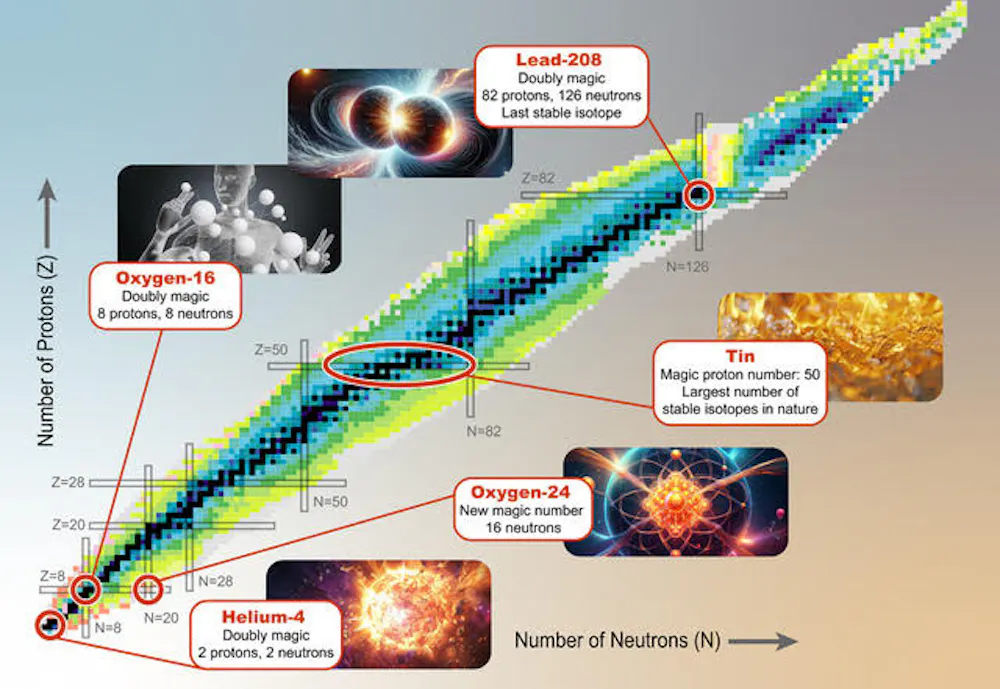
    Many stable isotopes have magic numbers of protons and neutrons.
    The Facility for Rare Isotope Beams

    Examples of magic numbers and stable nuclei exist everywhere – but scientists couldn’t explain them without the introduction of the shell model.

    Stable nuclei in nature

    The shell structure in nuclei tells researchers about how elements are distributed across the Earth and throughout the universe.

    One of the most abundant elements on our planet and in the human body is oxygen, in particular the isotope oxygen-16.

    With eight protons and eight neutrons, oxygen-16 has an extremely stable nucleus. A nearby star produced the oxygen we find on Earth through nuclear reactions in its core sometime before the solar system was formed.

    Since oxygen nuclei are doubly magic, these nuclei in the star did not interact very much with other nuclei. So more oxygen was left around to eventually act as an essential ingredient for life on Earth.

    In her Nobel lecture, Maria Goeppert Mayer talked about the work she did with physicist Edward Teller. The two had attempted to describe how these elements formed in stars. In the 1930s, it was impossible for them to explain why certain elements and isotopes were more abundant in stars than others. She later found that the increased abundances corresponded to nuclei with something in common: They all had magic numbers of neutrons.

    With the shell model and the explanation of magic numbers, the production of elements in stars was possible and was published in 1957.

    Scientists today continue to use ideas from the nuclear shell model to explain new phenomena in nuclear science. A few accelerator facilities, such as the Facility for Rare Isotope Beams, where we work, aim to create more exotic nuclei to understand how their properties change compared with their stable counterparts.

    At the Facility for Rare Isotope Beams, scientists produce new isotopes by accelerating stable isotopes to about half the speed of light and smashing them at a target. Out of the pieces, we select the rarest ones and study their properties.

    Possibly the most profound modern discovery is the fact that the magic numbers change in exotic nuclei like the type we create here. So, 75 years after the original discovery, the race to discover the next magic number is still on.

    Artemis Spyrou receives funding from the US National Science Foundation.

    Sean Liddick receives funding from the Department of Energy, Office of Science and the Department of Energy, National Nuclear Security Administration.

    ref. Many stable atoms have ‘magic numbers’ of protons and neutrons − 75 years ago, 2 physicists discovered their special properties – https://theconversation.com/many-stable-atoms-have-magic-numbers-of-protons-and-neutrons-75-years-ago-2-physicists-discovered-their-special-properties-239690

    MIL OSI – Global Reports

  • MIL-OSI Global: South Africa’s unity government is being tested – the toppling of a mayor in a key city exposes faultlines

    Source: The Conversation – Africa – By Susan Booysen, Visiting Professor and Professor Emeritus, University of the Witwatersrand

    South Africa’s long-governing party, the ANC, performed disastrously in the country’s May 2024 elections. Its electoral fortunes are now tied to regaining support in Gauteng, the most populous and economically important province, which it had governed with outright majorities since 1994. In 2024 the ANC’s Gauteng result of 34.8%, along with its 17% in KwaZulu-Natal, sealed the party’s loss of its national outright majority. We asked political scientist Susan Booysen for her perspective on the ANC’s battle for Tshwane, the administrative seat of the national government, where the party used a newly constituted coalition to topple the Democratic Alliance mayor, Cilliers Brink.

    What lies behind the Gauteng ANC’s toppling of the DA mayor of Tshwane?

    For the ANC (African National Congress) to regain majority electoral support, much will depend on the Gauteng province’s populous base. The three Gauteng metropolitan municipalities of Tshwane, Johannesburg, and Ekurhuleni are key in this project. Besides constituting South Africa’s financial hub and having huge budgets, these metropolitan councils (metros) symbolise the country’s cultural heartbeat, and are a gateway to the rest of the continent.

    The ANC’s political control of these bases has been lessening. It fears further lapses may make the losses irreversible. It lost outright control of the Gauteng metros in 2016: it slipped to 49% in Ekurhuleni, 46% in Johannesburg and 41% in Tshwane. The 2021 local elections confirmed both the ANC’s slide and rule by unstable coalition governments.

    Since the 2021 elections, the metros have had multiple coalition governments. The ANC has, through coalition, reclaimed control of the top council positions in Johannesburg and Ekurhuleni.

    What does the toppling of Brink say about internal ANC party dynamics?

    Following their national coalition agreement of June 2024, parties to the coalition government have been discussing cascading the agreement to the provincial and local levels. These talks have been inconclusive.

    The ouster of the mayor of Tshwane was not explicitly or publicly condoned by the ANC’s national leadership. Neither did they stop it. The Tshwane crisis exposes the ANC’s internal party dynamics.

    The ANC in the province and in the Tshwane council constituted an alternative alliance – between the party, Economic Freedom Fighters (EFF) and ActionSA. ActionSA broke its previous alignment with the Democratic Alliance in favour of the ANC.

    Jointly the ANC, EFF and ActionSA hold 117 out of the 214 Tshwane council seats. They used this majority to pass a motion of no confidence against Brink and, in effect, his entire mayoral committee. A small band of one-seat parties reinforced Brink’s ejection.

    The Tshwane development highlighted one of the key faultlines in the government of national unity: the Gauteng ANC’s disdain for the unity government agreement. The national unity government comprises the ANC, DA, Inkatha Freedom Party, Patriotic Alliance, Freedom Front Plus and five other tiny parties. The agreement has the support of the majority in the ANC’s national executive committee (NEC), its highest decision-making body between elective conferences.

    The NEC had originally been strongly divided on forming a coalition with the DA.

    After being elected Gauteng premier with the support of the DA, Panyaza Lesufi constituted the Gauteng executive with the Patriotic Alliance, Rise Mzansi and Inkatha Freedom Party. It excludes the DA.

    Lesufi had offered the DA executive posts that would have placed it in a minor and subjected position in the province. The ANC’s national leadership accepted this. The DA rejected it.

    What are the implications for ANC-DA cooperation in the national government and other municipalities?

    The DA is fighting to have Cilliers Brink reinstated as mayor of Tshwane. It argues that the ANC’s capturing of the position threatens the unity government.

    The DA appears to be angling for a fairer dispensation within the overall coalition formation, given its importance as the second largest party in the coalition government, rather than rejection of the GNU government. The DA needs the coalition as much as the ANC does.

    The coalition government’s statement of intent, and how it is reflected in the lower provincial and municipal levels, are the key issue at stake.

    The Tshwane crisis stands in the context of other local governments where new alliances are forming outside the formula of the national coalition government.

    The crisis is in all probability not threatening the national coalition. But it may result in the fleshing out of the generally vaguely defined and minimalist Statement of Intent (the coalition agreement). In recent weeks more clarity has already emerged regarding conflict resolution in the unity government. The Tshwane crisis is likely to show whether and how the national level agreement resonates provincially and locally.

    In fact, the lesson from the Tshwane coalition fiasco might be that there ought to be no expectations that the coalition government’s formula of approximate proportionality among its constituent parties will be reflected in the executives of the lower-level structures.

    The DA stressed at the time of Brink’s removal that it had been in discussions with ANC national secretary general Fikile Mbalula and ANC negotiator David Makhura – and progress had been made for the two parties to jointly “stabilise” the Gauteng metros (read “exercise power-sharing”). It may have entailed the DA supporting the ANC in Ekurhuleni, and the ANC the DA in Tshwane.

    But the proposal came to naught when the ANC proceeded to capture Tshwane, which it last governed in 2016.

    The effect of the Tshwane fallout is likely to be heightened instability in South Africa’s metro councils. Without ANC-DA cooperation, much of the coalitions detente that had become possible in the wake of the national coalition agreement may dissipate. Instead, alternating coalition governments, through motions of no confidence, may proliferate.

    The instability caused by such party political tit-for-tats and coalition musical chairs, both in the large metropolitan councils and the local municipalities, will contribute to citizens suffering poor delivery of services – although it is not the sole cause.

    What does the ANC’s failure to sing from the same hymn book mean for the party?

    The Tshwane crisis goes to the heart of the struggles unfolding in the ANC.

    The ANC of 2024 is inherently unstable as it fights for electoral survival.

    Its national executive committee and presidency act in ways that hint at them lacking the power to call the shots in relation to coalitions in some provinces and municipalities; and reining in its Gauteng premier and provincial executive committee.

    This, as the party is trying to position itself favourably, through leadership changes, ahead of its national general council meeting next year, and its elective conference of 2027, in the hope of reversing electoral declines in local, provincial and national elections.

    Besides KwaZulu-Natal’s centrality to this process, Gauteng holds the base of ANC succession given that it is political home to its deputy president, Paul Mashatile, and Lesufi.

    The search for a new mayor for Tshwane unleashed a candidacy contest within the ANC. ANC mayoralty candidates are proliferating. They are emerging from the ranks of the politically powerful, anointed by high-level ANC power holders, along with candidates in the local ANC party structures and in the council itself.

    The legacy of the 2016 violent struggles and mayhem in the city amid anger about succession are invoked to justify some proposals. These struggles seem oblivious to new coalition contexts, and the ANC’s loss of majority power.

    Unless the fractious and divided ANC finds a united and consistent voice on coalitions, it may lose out on the possibility of using coalitions to regain electoral support. Unless the ANC in Gauteng is using the metros to confirm its alternative to the national formula.

    Susan Booysen in the past had received funding from HSRC, via various (completed) university projects; and has until recently been employed full-time by MISTRA.

    ref. South Africa’s unity government is being tested – the toppling of a mayor in a key city exposes faultlines – https://theconversation.com/south-africas-unity-government-is-being-tested-the-toppling-of-a-mayor-in-a-key-city-exposes-faultlines-239986

    MIL OSI – Global Reports

  • MIL-OSI Global: The youth-led research giving voice to teen mothers in Uganda

    Source: The Conversation – Canada – By Doris Kakuru, Professor, School of Child and Youth Care, University of Victoria

    Pregnancy can be a stressful enough time for any expecting mother, but it can be even more so for teenage girls navigating the added challenges they face. (Shutterstock)

    The global rate of teen pregnancies has been decreasing in recent decades. According to the World Health Organization, worldwide adolescent birth rates have decreased from 64.5 births per 1,000 women aged 15–19 years in 2000 to 41.3 births per 1,000 women in 2023.

    However, those numbers can differ significantly by region. Every year, around 21 million teenage girls in developing countries become pregnant, and around 12 million give birth.

    In Uganda, the teenage pregnancy rate remains among the highest in Sub-Saharan Africa, at 25 per cent. Cultural and religious norms often make adolescent sexuality a highly sensitive subject. Many girls can be ostracized or face marginalization if they become pregnant. And the long-term impacts on their lives can be significant. Almost 60 per cent of school dropouts in Uganda are due to pregnancy, and many never return to the education system.

    Pregnancy can be a stressful enough time for any expecting mother, but it can be even more so for a pregnant teenager in places where engaging in sexual relations is taboo, especially for girls.

    Along with colleagues in Uganda and Canada, we are conducting a community-engaged research project to understand the experiences of young mothers. Our project, Centering Marginal Voices, aims to build research and advocacy skills for young mothers in Uganda.

    A clip outlining the Centering Marginal Voices project.

    Community-engaged research

    Community-engaged research has emerged in social work as an important approach that empowers communities experiencing particular issues to make decisions concerning those issues. This approach cultivates long-term relationships and promotes the development of sustainable solutions for community problems.

    One form of this approach focuses on engaging youth in researching about their experiences with the issues affecting their lives. This can boost our understanding as researchers and make young people feel heard and empowered.

    Engaging young people in research requires clear communication, the use of appropriate channels of communication, constant feedback and listening. It can also mean providing logistical support like transportation or food, among other things. It is vital for researchers to listen to young people when they describe what they need to be participants in the research process.

    Many adolescent girls already face vulnerabilities and challenges when it comes to their reproductive health. Pregnancy can often add another layer of complexity to those challenges.

    While there is much discussion about teenage pregnancy in Uganda, rarely are young mothers given platforms to speak their truths to help policymakers understand and address the root causes. Their voices are muted and their lived experiences are not represented in policy.

    Teen motherhood presents girls with numerous challenges. They must navigate parenthood while still at a young age. They must figure out ways to support their children while still being dependents themselves. They also have to make important decisions and provide child care with limited experience to draw from, and manage their health needs alongside maternal care, among others.

    Their ability to conduct research may be influenced by a combination of these factors and by the skills they have, how they navigate relational dynamics, and the stigmatization they face being teen mothers.

    A webinar with the researchers and young mothers on the Centering Marginal Voices project.

    Centering young mothers in research

    As we began the research process, we held consultative meetings with community leaders who identified 40 young mothers from urban and rural parts of Uganda. We engaged the young mothers in discussions about their life journeys and in team building exercises. We later divided them into groups based on their villages. Each group then selected two peers to continue on the project as 12 youth peer researchers.

    When conducting this kind of community-engaged project, it is important for researchers to consider the ways they approach and include youth participants:

    Consent — Our first aim with the 12 selected young mothers was to seek consent from their parents or guardians. The young mothers also told us to speak with their live-in partners, whom we had not initially considered. They spoke to their parents or guardians, who were already expecting our team and eased the consent process for us.

    Communication — Young mothers in the capital Kampala preferred phone calls, WhatsApp and physical meetings. However, those in the rural areas did not all have smartphones or understand social media. This posed a challenge as our project entailed them conducting surveys using smartphones. We therefore revised our training to include basics on how to use the smartphone.

    Designing tools — We further engaged the youth peer researchers to refine our research tools. They helped us rephrase questions in local languages, especially those related to sexual relations.

    Mutual support — The youth peer researchers were trained to lead a survey and collect quantitative data from 766 participants in total. They prioritized teamwork and support, with some collecting more data than others. They also requested autonomy in scheduling their data collection to balance their research activities with their maternal duties and caring for their families.

    Navigating environments — The young mothers provided us with a descriptive tour of their environments. They advised us on where to go and how to behave when visiting. They always accompanied us within their community, acting as our guides.

    Young mothers know best about their own experiences, and this accords them a legitimate space in research as researchers. Practitioners and planners should be intent on being open to meaningfully engaging them while learning from them.

    Doris Kakuru has received funding from the Social Sciences and Humanities Research Council of Canada. The Centering Marginal Voices project is supported by a consortium partnership of Makerere University, Nascent Research and Development Organization, and the University of Victoria.

    Jacqueline Nassimbwa does not work for, consult, own shares in or receive funding from any company or organisation that would benefit from this article, and has disclosed no relevant affiliations beyond their academic appointment.

    ref. The youth-led research giving voice to teen mothers in Uganda – https://theconversation.com/the-youth-led-research-giving-voice-to-teen-mothers-in-uganda-239876

    MIL OSI – Global Reports

  • MIL-OSI Global: Wealthier Canadians live longer and are less likely to be dependent as they age, new research finds

    Source: The Conversation – Canada – By Marie-Louise Leroux, Professeure titulaire en Sciences Economiques, Université du Québec à Montréal (UQAM)

    Population aging is a growing challenge for developed countries like Canada, with significant implications for health care and long-term care systems. In OECD (Organisation for Economic Co-operation and Development) countries, the population of people aged 80 and above is projected to more than double by 2050, reaching 9.8 per cent of the population.

    This demographic shift highlights the increasing demand for high-quality long-term care services. Older individuals frequently experience limitations in daily living activities, such as dressing, washing and household tasks.

    By 2050, half of people aged 65 or older in OECD nations are expected to report some limitation in daily living, and dementia cases are projected to reach 42 million. Canada is not exempt from this trend.


    Read more:
    Enabling better aging: The 4 things seniors need, and the 4 things that need to change


    In Québec, for instance, around 315,000 individuals require help with daily activities — a number expected to nearly double by 2050.

    As the number of elderly people needing care grows, the demand for long-term care services will present significant financial challenges for both individuals and governments. Understanding the economic and demographic factors driving long-term care needs, as well as their implications, is crucial for building a more equitable and robust care system.

    Low-income individuals face double penalty

    Research has shown that while life expectancy has increased, it’s unevenly distributed across socioeconomic groups. Factors such as age, ethnicity, gender, income and education play a significant role in determining longevity.

    In Canada, men in the top five per cent of earners live, on average, 11 per cent longer than those in the bottom five per cent. For women, the longevity gap between those with the highest earnings and the lowest earnings is 3.6 years. These findings are consistent with research from other countries, including the United States.

    However, research on the relationship between income and loss of autonomy is still limited. Some studies suggest that lower socioeconomic status is associated with poorer health outcomes and higher disability rates among older adults.

    In the United Kingdom and the U.S., individuals in the bottom third of wealth distribution live seven to nine fewer years without disability compared to those in the top third. Similarly, in Europe, less wealthy individuals have a higher likelihood of becoming dependent and they remain dependent longer.

    Understanding these socioeconomic disparities is crucial for shaping public policy and identifying which groups are the most vulnerable. Low-income individuals face a double penalty: they are both more likely to need long-term care and they are less financially equipped to bear the associated costs.

    As a result, public long-term care policies might consider prioritizing the support of low-income individuals, since wealthier individuals can more easily afford care.

    High-income Canadians live longer

    Our research explored the relationships between longevity, dependency and income using data from a 2016 survey of 2,000 Canadians aged 50 to 69.

    The data combined both subjective self-reports with objective data about the likelihood of living to age 85, developing limitations in daily living activities or entering a nursing home. Financial resources were measured through reported income and savings.

    Our findings show that Canadians with higher incomes are more likely to live to age 85 and are less likely to become dependent. After controlling for several socioeconomic factors, we found that a one per cent increase in income was associated with the following:

    • nearly a five per cent increase in survival probability;
    • a one per cent decrease in the likelihood of having limitations in daily living activities;
    • and a two per cent decrease in the likelihood of entering a long-term care home.

    The relationship between income and dependency was particularly strong among individuals in the top third of the income distribution. This suggests that financial resources play a significant role in extending life and maintaining independence as people age.

    Interestingly, despite their lower objective likelihood of needing nursing home care, higher-income individuals perceived themselves as more likely to require it. A one per cent increase in income was associated with a four per cent increase in the self-reported probability of entering a nursing home, even though the actual probability of this happening dropped by two per cent.

    This discrepancy may be explained by wealthier individuals considering other factors, such as their financial resources and the possibility of receiving care at home from a professional caregiver.

    Targeted support is needed

    The socio-demographic relationships from our study have important implications for designing equitable long-term care policies. Wealthier individuals tend to live longer and are less often dependent, meaning they are in a better position to pay for long-term care expenses.

    On the other hand, low income individuals are more likely to become dependent and may experience greater financial strain if they need to pay for long-term care costs over an extended period, potentially driving them into poverty.

    Our findings recommend that provincial and territorial governments should adopt redistributive policies for long-term care. These policies could involve providing additional subsidies aimed at low-income older individuals, either as a preventive measure or when they first become dependent.

    This approach aligns with the proposal made by Québec Health Minister Réjean Hébert in 2015, who suggested implementing “autonomy insurance” to help retirees above a certain age manage long-term care costs.

    Redistributive policies are critical not only because low-income individuals have fewer financial resources, but also because they face a higher likelihood of dependency. Without targeted support, these individuals could be left struggling to afford the care they need. Designing policies that recognize these disparities can help ensure a more equitable and sustainable long-term care system in Canada.

    Marie-Louise Leroux receives funding from FRQSC and SSHRC-CRSH. She is affiliated with CIRANO (Montréal) and CESifo (Munich).

    Marie Connolly receives funding from FRQSC and SSHRC-CRSH. She is affiliated with CIRANO (Montréal).

    ref. Wealthier Canadians live longer and are less likely to be dependent as they age, new research finds – https://theconversation.com/wealthier-canadians-live-longer-and-are-less-likely-to-be-dependent-as-they-age-new-research-finds-240081

    MIL OSI – Global Reports

  • MIL-OSI Global: Smokers have a higher level of harmful bacteria in the mouth – new study

    Source: The Conversation – Africa – By Yvonne Prince, PhD in Biomedical Science (Microbiology), Cape Peninsula University of Technology

    A recent report by the World Health Organization (WHO) estimated that 8 million people die annually from smoking related complications. Despite efforts by governments and various organisations to create awareness about the dangers, around 1.3 billion people still use some form of tobacco and 80% of them live in low to middle income countries.

    There is no safe level of smoking. Even second-hand smoke can lead to serious complications such as cardiovascular disease and cancer.

    The mouth (oral cavity) is the first port of entry to the rest of the body and is home to a complex and diverse community of microorganisms, known as the oral microbiome. These organisms live in harmony with one another. They protect the normal oral environment, aid digestion, regulate the immune system and promote health.

    If this balance is disturbed however, it can lead to the development of periodontitis (gum infections), inflammation and serious diseases, such as heart disease, cancer, liver and renal disease.

    Changes to the bacterial composition of the mouth can be caused by several factors, such as bad oral hygiene, diet, alcohol and smoking.

    We’ve looked into exactly what types of bacteria are affected. Our research did this by examining the oral health of 128 individuals who had participated in a 2014/2016 study of vascular and metabolic health.

    We found clear differences in the bacteria present in the mouths of smokers compared to non-smokers.

    Smokers had higher levels of harmful bacteria – like Fusobacterium, Campylobacter and Tannerella forsythia – in their mouths.

    These bacteria can cause gum disease and may increase the risk of heart disease because they can trigger inflammation and other harmful effects in the body.

    How smoking affects the oral biome

    Tobacco and cigarettes contain several toxic substances which include nicotine, tar, radioactive chemicals, lead and ammonia. Many of these are formed from burning the tobacco. As a cigarette is smoked, these chemicals enter the oral cavity and change the surrounding environment by reducing oxygen levels, changing the pH (level of acidity) and preventing adequate production of saliva.

    Saliva not only keeps the mouth moist and helps digestion, but also has important antibacterial properties which assist in destroying dangerous germs and keeping the oral cavity healthy.

    A dry mouth together with low oxygen levels in the mouth allows harmful bacteria to multiply.

    The overgrowth of these organisms destroys the balance of the healthy bacteria normally found on the surfaces of the teeth, tongue and palate.

    Nicotine

    One common chemical found in cigarettes is nicotine. This toxin can increase the number of proteins on the surface of certain harmful bacteria such as P. gingivalis.

    These proteins or receptors give the bacteria an advantage over the normal microorganisms and allows them to attach firmly to surfaces where they multiply into colonies and form biofilms. Dental biofilms are a complex community of microorganisms which can form on the teeth and other hard surfaces. If not controlled, they can lead to plaque formation, periodontitis, gum disease and tooth decay.

    Smoking and serious diseases

    These abnormal colonies can influence the immune system, leading to slow healing, inflammation and even antibiotic resistance. The chronic inflammation caused by gum disease can lead to tooth loss and the destruction of gum tissue, which has been linked to systemic diseases such as cardiovascular disease.

    Another bacterium, Streptococcus mutans, can also become abundant in people who smoke heavily. This organism is often present in healthy conditions but when the environment is disrupted, it can multiply and form part of dental biofilms,
    leading to tooth decay and oral cancer.

    Vaping and e-cigarettes

    Electronic cigarettes or vapes operate with a battery and heating element which heats up a liquid. This produces an aerosol which is inhaled by the user. The liquid contains different flavourings as well as harmful chemicals such as nicotine and lead.

    Early research seems to suggest that e-cigarettes are not a good alternative to smoking tobacco. Although their effects on the oral microbiota have not been well studied, the increased growth of bacteria such as Fusobacterium and Bacteroidales has been observed in people who vape.

    Both of these bacteria can cause periodontitis (gum disease).

    Can these changes be reversed?

    It is clear that the harmful chemicals in cigarettes and other forms of tobacco can lead to serious diseases which often begin in the oral cavity. The good news is that these can be prevented and the risk reduced.

    Although it may take time, the healthy diversity of the oral biome can be restored by quitting smoking. This reduces the risk of gum disease, promotes the production of saliva and improves health.

    Prevention is better than cure and governments and organisations such as the WHO need to continue to create awareness around the dangers of smoking, particularly among the youth.

    Glenda Mary Davison receives funding from the National Research Foundation as the Interim DSI-NRF Nedbank SARChI chair.

    Tandi Matsha-Erasmus and Yvonne Prince do not work for, consult, own shares in or receive funding from any company or organisation that would benefit from this article, and have disclosed no relevant affiliations beyond their academic appointment.

    ref. Smokers have a higher level of harmful bacteria in the mouth – new study – https://theconversation.com/smokers-have-a-higher-level-of-harmful-bacteria-in-the-mouth-new-study-239250

    MIL OSI – Global Reports

  • MIL-OSI Global: Children in west Africa are often sent to live with other families to help them get ahead – but fostering may be doing the opposite

    Source: The Conversation – Africa – By Pearl S. Kyei, Senior lecturer, University of Ghana

    In west Africa, it’s common for families to foster children informally. This helps ease the burden on parents and can give children from poorer families a chance to improve their lives.

    An estimated 20% to 40% of mothers in the region have sent at least one child to live with another household for an extended period. That household acts as a “social parent”.

    Education is one of the leading reasons for the practice: children can be in households with more resources for schooling or closer to schools.

    Whether this fostering is beneficial or harmful depends on how much the host families are willing to support and invest in the fostered children.

    The practice of child fostering differs from the formal foster care systems that are common in many parts of the world. Fostering arrangements in sub-Saharan Africa are typically informal and unregulated. Without legal or economic incentives, there’s a risk that host households may not be as invested in the welfare of fostered children, including their education, as they are in their own.

    My research studied the relationship between fostering and school attendance. I looked at how this has changed over time and whether it is affected by how wealthy a fostering household is.

    I found that in some west African countries, fostered children were less likely to attend school than children who were not fostered. And children fostered by wealthier households were the least likely to attend school compared to their non-fostered counterparts.

    The findings highlight the need to set up or improve systems to monitor how fostered children are doing. They also suggest more research is needed to understand fostering in wealthier families.

    Comparing change over time

    The research used data from five countries that conducted similar surveys about a decade apart, in 2005/06 and 2017/18. The countries were The Gambia, Ghana, Guinea-Bissau, Sierra Leone and Togo.

    The sample comprised 86,803 children aged 6 to 12 whose biological parents were alive. The analysis compared school enrolment of fostered children with children who were not fostered over the two periods.

    In 2005/06, 16.7% of the children in the sample were fostered. In 2017/18, 19.4% were fostered.

    I expected to find that fostered children would be less likely to attend school than children who were not fostered. This is because it is possible that the purposes for which parents send their children away may not align exactly with the reasons the host households agree to have them.

    I also expected that the difference in school attendance between fostered and non-fostered children would decrease over time, because free primary education policies were being introduced.

    But instead, the findings showed that in 2017/18, children who were fostered were much less likely to have ever attended school than was the case in 2005/06. In 2017/18, fostered children were 0.49 times as likely to have ever attended school compared to children who were not fostered. In 2005/06, there was no difference between fostered and non-fostered children.

    I also expected that wealthier households would be able to invest more in children – both fostered and their own.

    However, this was not the case. It was only in the poorest hosting households that foster children were more likely to attend school in 2005/06 and in 2017/18 compared to children who were not fostered. In wealthier households, foster children faced greater disadvantages in school attendance as the household’s wealth increased.

    Worrying inequalities

    The findings are worrying because they suggest that wealthier families might take in children not necessarily to improve their welfare, but to use them for household chores. There is some research suggesting that households’ decisions to foster in children are driven by demand for child labour. This could prevent foster children from attending school regularly.

    It is also possible that poor parents might not have the power to step in if the wealthier hosting households are disrupting their children’s education.

    The results indicate that there has been an increase in the proportion of children who have ever attended school over the two periods. However, the finding that more than one-tenth of children in the sample have never attended school in the most recent period is suggestive of challenges in the implementation of free education policies.

    The challenges include:

    • competing demands for children’s time in households where child labour is required

    • the inability of households to pay for transport, books and uniforms.

    The observed disparity in school attendance by foster status, particularly for richer households, highlights inequality in education. This has implications for achieving Sustainable Development Goal 4, which targets equitable education. The African Union declared 2024 the Year of Education, further highlighting the importance of ensuring all children on the continent attend school.

    Pearl S. Kyei does not work for, consult, own shares in or receive funding from any company or organisation that would benefit from this article, and has disclosed no relevant affiliations beyond their academic appointment.

    ref. Children in west Africa are often sent to live with other families to help them get ahead – but fostering may be doing the opposite – https://theconversation.com/children-in-west-africa-are-often-sent-to-live-with-other-families-to-help-them-get-ahead-but-fostering-may-be-doing-the-opposite-239865

    MIL OSI – Global Reports

  • MIL-OSI Global: Palestinians want to choose their own leaders – a year of war has distanced them further from this democratic goal

    Source: The Conversation – USA – By Maha Nassar, Associate Professor in the School of Middle Eastern and North African Studies, University of Arizona

    A Palestinian university student casts a ballot in Gaza City in 2006. Abid Katib/Getty Images

    Over the summer as Israel continued to bombard Gaza, representatives from 14 Palestinian factions, including the two main parties – Hamas and Fatah – met in China. Following the most inclusive talks in years, all the parties agreed to a future unity government and to hold national elections.

    Such talk of “day after” governance may seem fanciful as the current war marks its first anniversary. The idea of holding Palestinian elections seems a long way off given the current destruction and humanitarian crisis, especially in the Gaza Strip. Meanwhile, any democratic process including Hamas – whose leadership Israeli forces have spent a year trying to eliminate following the the group’s attack of Oct. 7, 2023 – would be vehemently opposed by Israel. As such, it should come as little surprise that 72% of Palestinians recently polled said they saw no hope of the provisions agreed to in China being implemented any time soon.

    But the alternative “day after” plan for Gaza reconstruction being pushed by the United States – “revitilzing” the Palestinian Authority, the Fatah-led body that semi-governs parts of the West Bank – also seems like a non-starter. Critics of that plan warn that a simple reshuffling of existing figures would further delegitimize the deeply unpopular authority.

    As a scholar of Palestinian history and politics, I see talk of reforming existing bodies or propping up a unity government made up of the same players as missing a larger point: Palestinians are increasingly frustrated by their political representation; they want the opportunity to choose their own leaders.

    Even before the attack of Oct. 7, surveys showed that Palestinians were dissatisfied with governance they viewed as corrupt and dysfunctional. And as the war drags into a second year, the latest polls indicate that support for Hamas has dropped moderately; yet support for its main rival, Fatah, has risen only slightly. More than a third of those polled do not support either party.

    Divided leadership

    Despite talk of a unity government, Palestinian leadership is as bitterly divided as it has been for decades.

    Following a brief conflict in 2007, the Palestinian Authority split into two. The secular Fatah party, led by Mahmoud Abbas, controlled the authority in the West Bank, while its Islamist rival, Hamas, governed in Gaza.

    Since then, Palestinian representatives have held over a dozen reconciliation talks to try to bridge the divide, the last taking place in Beijing in July 2024. While several of these meetings have yielded joint agreements, such as the recent “Beijing Declaration,” none have led to the different factions working more closely together.

    A generation of Palestinians have never experienced a national vote.
    Hani Alshaer/Anadolu via Getty Images

    The current Palestinian Authority president, 88-year-old Abbas, is especially unpopular. First elected in 2005 to a four-year term, he unilaterally extended his term in 2009, declaring he would remain in office until the next election. But he has not allowed elections to be held since then. Summing up the views of many, analyst Khaled Elgindy described Abbas today as “an erratic and small-minded authoritarian with a virtually unbroken record of failure.”

    That helps explain why, according to a September 2024 poll conducted by the Palestinian Center for Policy and Survey Research, 84% of Palestinians in the West Bank and Gaza Strip want Abbas to resign.

    When asked about a hypothetical presidential election between the leaders of both Hamas and Fatah, 45% of Palestinians reported they would rather just sit out the election. The question had to be hypothetical – elections are not even on the horizon. In fact, Palestinians in the West Bank or Gaza have not voted in presidential or legislative elections since 2006. And three-quarters of Palestinians see no prospect of elections taking place any time soon.

    Absence of elections

    That pessimism among Palestinians over having a democratic say in how they are governed has grown in recent years. It has no doubt been knocked further by a year of relentless Israeli bombardment and internal political dysfunction.

    A glimmer of hope for greater democratic representation had appeared in January 2021, when Abbas announced that legislative elections would be held later that year.

    Many on the candidate lists then were third-party figures and independents. Young Palestinians were especially excited – half of all eligible voters would have been aged 18 to 33, and it would have been their first opportunity to chose leaders who could claim to speak for them.

    But with less than one month before election day, Abbas postponed the vote indefinitely. While he blamed Israel for the postponement, other Palestinians also pointed to interference from Egypt and Jordan.

    Palestinian men cast ballots in 2006, the last time Palestinians were able to vote in national elections.
    Menahem Kahana/AFP via Getty Images

    With no elections in sight, Palestinians have undertaken several grassroots initiatives to try to enact democratic reforms from the ground up.

    For example, in November 2022, a Palestinian Popular Conference was held in several cities. It called for reforming Palestinian institutions to be more democratically representative of the 14 million Palestinians living around the world. Meetings were held in Gaza and Haifa, and Palestinians from around the world joined in person and virtually.

    But Palestinian Authority forces in the West Bank violently cracked down on the gathering in Ramallah and detained several conference leaders. The harsh repression signaled to many that Abbas and the Palestinian Authority were scared of an alternative, democratically elected Palestinian leadership emerging.

    Maintaining the occupation

    Many Palestinians see Abbas and his government as a “puppet authority,” propped up by Israel and the United States.

    Despite its name, the body does not have the “authority” that governments typically have. It cannot collect its own taxes, control its own border or protect its own citizens. Rather, Israel collects taxes in the West Bank and decides when – and whether – to hand them over to the Palestinian Authority. Israel has to authorize what enters and exits the West Bank and Gaza Strip.

    And, as has been evident throughout the current war, the Israeli military has pretty much free rein to invade “Area A”, the parts of the West Bank that are supposed to be under full Palestinian Authority security control.

    Yet Palestinians in the West Bank are not even able to express their opposition to these measures. In recent years, the Palestinian Authority has grown increasingly repressive, arresting a growing number of Palestinians on political grounds.

    Moreover, in the year since the Oct. 7 attacks, the Palestinian Authority has allowed Israel to arrest and detain over 7,000 Palestinians in the West Bank. Many are held for months without charge or trial and subjected to widespread torture and sexual abuse, according to Israeli human rights group B’Tselem.

    As such, the Palestinian Authority is viewed by many Palestinians as little more than a “subcontractor” of the Israeli occupation.

    Looking ahead

    So what does the the “day after” the conflict look like for Palestinians, and their hopes for democratic political representation?

    The International Court of Justice’s recent ruling that Israel’s occupation is illegal and that settlers must withdraw from the West Bank has given added legitimacy to Palestinians’ demand to end the occupation once and for all.

    But a future Palestinian government will only be credible if it represents the will of the people.

    Mussa Abu Marzuk, a senior member of Hamas, signs the Beijing Declaration as China Foreign Minister Wang Yi and Fatah Vice Chairman Mahmoud al-Aloul look on.
    Pedro Pardo/AFP via Getty Images

    To be sure, holding Palestinian elections to achieve this aim would be difficult given the ongoing Israeli occupation and the widespread destruction in Gaza. But it is clear that elections are what Palestinians want. When elections were last touted in 2021, 93.3% of eligible voters registered – only to have their hopes later dashed.

    At the reconciliation talks held in Beijing, all 14 Palestinian parties agreed to “prepare for the holding of general elections under the supervision of the Palestinian Central Elections Committee as soon as possible.”

    While Israel, the U.S. and regional actors worry that elections could legitimize Hamas’ rule over the Gaza Strip, that would not necessarily be the case. The latest polls show that only 36% of respondents in Gaza said they would prefer that outcome.

    For now, many Palestinians believe the first step should be the formation of a national reconciliation government that can negotiate reconstruction.

    But to have any chance of succeeding, such a body would need to be Palestinian-led. A government consisting of the same old actors forced upon Palestinians by the U.S. or Israel would suffer from crippling legitimacy problems.

    One thing is certain: The death and destruction of the past year have shown that the old approaches to Palestinian politics have not worked. Perhaps it is time for a new approach, one that centers Palestinian representation.

    Maha Nassar was a 2022 Palestinian non-resident fellow at the Foundation for Middle East Peace and currently serves on its board of directors.

    ref. Palestinians want to choose their own leaders – a year of war has distanced them further from this democratic goal – https://theconversation.com/palestinians-want-to-choose-their-own-leaders-a-year-of-war-has-distanced-them-further-from-this-democratic-goal-239463

    MIL OSI – Global Reports

  • MIL-OSI Global: Gen Z knowledge about the Holocaust matters for ongoing reconciliation with a troubled history

    Source: The Conversation – Canada – By Regan Lipes, Extended Sessional Instructor, English and Comparative Literature, MacEwan University

    Since last Oct. 7, the world has seen mass death catalyzed by terrorist attacks in Israel, Israel’s mission to recover hostages still being detained and retaliation in Gaza — and now a long-dreaded war erupting through the Middle East.

    As a scholar of Jewish and Holocaust literature, in the past year following Oct. 7, I have been aware that how students engage with the history of the Holocaust has been impacted.

    Eighty thousand Israelis remain displaced from their homes in the north. Over 40,000 Palestinians have now been killed in Gaza, and and following a United Nations expert accusing Israel of acts of genocide, UN delegates have amplified calls for an immediate ceasefire.

    Others assert Israel’s actions are a defensive response. While all Israeli citizens have been affected by violence in Israel, Israel is a Jewish state, and the kind of violence and hate directed at Israel is being felt by Jews globally. For many Jews the Oct. 7 attacks themselves resonated hauntingly of Kristallnacht, with the Jewish people again put in a position of needing to defend their right to exist.


    Read more:
    Holocaust comparisons are overused — but in the case of Hamas’ Oct. 7 attack on Israel they may reflect more than just the emotional response of a traumatized people


    The definition of genocide acknowledged in the international Genocide Convention drew on the term coined by Polish-born lawyer Raphael Lemkin who fled persecution of the meticulously orchestrated genocide against European Jewry during the Second World War.

    Globally, we are seeing a time of re-aligning geopolitics, including both the Global South and West becoming increasingly aware of pro-Palestinian perspectives. Many Gen Zs have been quick to rally against Zionism.

    At the same time, Holocaust denialism, antisemitic hate acts and terrorist threats have accompanied a rise in anti-Israel sentiment — with frightening effects on Jews globally, sometimes fanned by propagandists seeking to exploit and augment conflict and polarization.

    Even before events of the past year, as the 1940s recede in time, fewer and fewer Gen Zs have identified themselves as feeling knowledgeable about the Holocaust. The way knowledge is transmitted must adapt with the times.

    Memory through time

    In 2019 I was the faculty fellow for a partnership between the Auschwitz Jewish Center and the Museum of Jewish Heritage (MJH). As a scholar I have had the benefit of meeting with Holocaust survivors to learn about their experiences.

    During my fellowship, the ongoing question rattling in my brain was how to safeguard the lived testimonies of survivors as their numbers dwindle.

    When I teach literature of the Holocaust and second-generation efforts to preserve memory, I have noticed students’ limited knowledge of the Holocaust when I do an informal poll of what they know already. Many students admit an awareness limited exclusively to Hollywood films.

    Six-part documentary

    Director Joe Berlinger’s recent documentary Hitler and the Nazis: Evil on Trial is conscious of deficits in Gen Z education and seeks to remedy this.

    ‘Hitler and the Nazis: Evil on Trial,’ documentary by Joe Berlinger.

    Berlinger’s six-part Netflix documentary takes a unique approach to examining and exploring Hitler’s rise to power and the lasting global impact.

    He frames this analysis by using the writings and broadcasts of journalist and foreign corespondent William L. Shirer, who authored the iconic The Rise and Fall of the Third Reich (1960), in concert with narration from Shirer’s granddaughter, Deirdre van Dyk.

    Within the context of her grandfather’s historically significant coverage of the European political landscape throughout the 1930s and 40s, van Dyk is able to offer insights regarding how Shirer spoke about this period going beyond his public writings.

    Preserving history

    On an online discussion panel organized by the MJH in July 2024, Berlinger acknowledged the plethora of documentaries examining the Second World War, but explained that this work is a targeted effort to preserve history while connecting and resonating with Gen Z viewers.

    Van Dyk’s participation plays a key role in bridging the present with the lived experience of Shirer, a witness of Nazi corruption and totalitarianism.

    Similarly second- and third-generation Holocaust survivors are instrumental in ensuring that their parents and grandparents’ suffering and trauma can be used to caution current learners who will be the politicians, jurists and educators of the future about dangers of antisemitism.

    Online discussion with director Joe Berlinger with Museum of Jewish Heritage.

    Alberta initiative

    An initiative in Alberta, the Second Voices Project is working to help Gen Z students understand the Holocaust in a way that feels authentic and less like distant history.

    The initiative, with the support of the Government of Alberta, uses video testimony given by survivors, and pairs this with discussion, commentary and observations provided by their children and grandchildren.

    Robert Jackson, chief counsel of the International Military Tribunal (IMT) at Nuremberg, noted in his opening statement at the Nuremberg Trial in 1945:

    “The wrongs which we seek to condemn and punish have been so calculated, so malignant and so devastating that civilization cannot tolerate their being ignored because it cannot survive their being repeated.”

    Jackson’s remarks now seem prophetic as society reexamines how best to impart this vital knowledge.

    Increased consciousness

    When the Second Voices Project travels to secondary and post-secondary institutions it is with the hope that seeds for increased tolerance and social consciousness be planted.

    ‘The Pages In Between’ by Erin Einhorn.
    (Simon and Schuster)

    During the winter 2024 semester, in a Jewish literature course I taught, I saw the Second Voices Project in action. The course sees students examine the search for resolution in untenable situations, with reporter Erin Einhorn’s The Pages In Between.

    They grapple with depictions of trauma and extreme loss in Cynthia Ozick’s short story The Shawl and examine how American-born Jews negotiated feelings of misplaced guilt following learning about the extent of the Holocaust.

    Accompanied by a Holocaust education specialist from the Jewish Federation of Edmonton, my students met second-generation survivor and retired physician Dr. Francie Cyngiser.

    Cyngiser’s parents survived the Nazi concentration camps, and she brought her father, Sidney Cyngiser’s, recorded Shoah Foundation testimony, narrated by her son and nephew, to my class.

    Sidney Cyngiser was dedicated to combating Holocaust denial by sharing his story. Instead of simply watching a video of Cyngiser testifying, the documentary was contextualized for students by inter-generational survivors not much younger than their parents.

    Addressing trauma fatigue

    Although Berlinger’s viewers cannot speak directly with van Dyk the way my students did with Dr. Cyngiser, his documentary is an important innovation to engage Gen Z learners.

    To appeal to this targeted viewership, the Shirer family consented to use AI voice approximations of William Shirer’s writings to help narrate Berlinger’s documentary. Although original recordings from his news broadcasts also feature prominently, many of his diaries, smuggled out of Nazi Germany at great risk, needed vocalization for the film.

    By adapting, Holocaust educators can also combat trauma fatigue which can impair capacity for awareness, recognition and response. In Germany, where Holocaust education is mandatory, feelings of frustration over inherited guilt for the Holocaust can breed apathy and resentment.

    Both pro-Zionist and Zionist-critical Jews have highlighted that such sentiments are dangerous in the current global climate.

    Apathy fails to serve any humanitarian function and dangerously anaesthetises all sides to the pain of others.


    Read more:
    Middle East student dialogue: As an expert in deep conflict, what I’ve learned about making conversation possible


    The German term Vergangenheitsbewältigung describes the process of ongoing reconciliation with a troubled history. The past is a reality that humanity as whole must contend with, but a lack of understanding is fertile ground for denial, revisionism and antisemitism.

    I cannot help but wonder if greater awareness of Holocaust history, and political and cultural histories of how to safeguard human rights, would promote more tolerance and compassion universally.

    Regan Lipes does not work for, consult, own shares in or receive funding from any company or organisation that would benefit from this article, and has disclosed no relevant affiliations beyond their academic appointment.

    ref. Gen Z knowledge about the Holocaust matters for ongoing reconciliation with a troubled history – https://theconversation.com/gen-z-knowledge-about-the-holocaust-matters-for-ongoing-reconciliation-with-a-troubled-history-235296

    MIL OSI – Global Reports

  • MIL-OSI Global: Why heart patients have trouble sticking to a healthy diet, and 3 things that help them eat better

    Source: The Conversation – Canada – By Gabriela Ghisi, Affiliate Scientist, KITE Research Institute, Adjunct Professor, Department of Physical Therapy, University of Toronto

    Following nutritional recommendations is vital for managing cardiovascular disease, but it’s not always easy, especially for those with limited resources. (Shutterstock)

    Cardiovascular disease remains a leading cause of death worldwide, and managing it effectively requires more than just medical intervention: what you eat plays a crucial role in your heart’s health.

    For cardiac patients, following nutritional recommendations isn’t just a suggestion; it’s a lifeline. A heart-healthy diet can help control risk factors like high blood pressure, cholesterol levels and obesity, all of which are key contributors to heart disease.

    For cardiac patients, following nutritional recommendations isn’t just a suggestion; it’s a lifeline.
    (Shutterstock)

    A healthy diet will help you prevent new heart problems, which is called secondary prevention, and it will help improve functional capacity and quality of life, giving you more independence for daily activities. But for many patients, adhering to these dietary guidelines can be a significant challenge even while they are in a cardiac rehabilitation program. This is especially challenging for those who live in low-resourced settings (areas or communities with few resources and little support for health and wellness).


    Read more:
    Cardiac rehab is a proven but underused therapy in women, but tailored resources aim to change that


    Cardiac rehab is an interdisciplinary approach focused on interventions for secondary prevention and improving cardiovascular prognosis, to reduce the global impact of cardiovascular disease. We recently conducted a study aimed at understanding the barriers and facilitators that low-resourced patients face when trying to follow nutritional recommendations in cardiac rehab.

    The findings underscore how critical, yet complex, it is for patients to maintain a heart-healthy diet. The results of this study are not just informative — they are a call to action for health-care providers, policymakers and communities alike.

    The cost of healthy eating

    Many heart-healthy foods — like fresh fruits, vegetables, and lean proteins — can be expensive, especially for individuals or families living on a tight budget.
    (Shutterstock)

    One of the primary barriers we identified is the cost of healthy foods. Many heart-healthy foods — like fresh fruits, vegetables, and lean proteins — can be expensive, especially for individuals or families living on a tight budget. In low-income areas, access to these foods is often limited, with more affordable but less healthy options readily available.


    Read more:
    Why are grocery bills so high? A new study looks at the science behind food price reporting


    This economic reality makes it difficult for patients to consistently choose foods that support their heart health. In the last few years the cost of healthy food in Canada, a high-income setting, has been rising due to high food inflation. Despite that, the current Canada’s Food Guide is less expensive for adults to follow compared to the previous ones.

    Another significant barrier is the complexity of nutritional information. Patients are often bombarded with a wealth of dietary guidelines, which can be confusing and overwhelming. Without proper guidance, including education and individualization, it’s easy for someone to feel lost or discouraged, particularly if they lack basic nutritional knowledge. This can lead to frustration and, ultimately, poor adherence to dietary recommendations.

    Cultural factors also play a role. In many cases, traditional diets may not align with the standard dietary guidelines recommended for heart health. Patients may find it challenging to adapt their eating habits without feeling like they are losing an important part of their cultural identity. This disconnect can make it even harder for patients to stick to a heart-healthy diet.

    Empowering patients to eat better

    Despite these challenges, our study also highlighted several facilitators that can make a significant difference. One of the most effective is community support. Programs that provide affordable access to healthy foods, like food banks or community gardens, can help alleviate some of the financial pressures.

    Additionally, accessible information sources that break down complex nutritional advice into simple, actionable steps can empower patients to make healthier choices.

    Programs that provide affordable access to healthy foods, like food banks or community gardens, can help alleviate some of the financial pressures of healthy eating.
    (Shutterstock)

    Importantly, incorporating culturally relevant foods into dietary plans can make the transition to a heart-healthy diet more manageable and acceptable. When patients see that their traditional foods can be part of their diet, they are more likely to embrace and maintain the recommended changes.

    Our findings emphasize the importance of a tailored approach to nutritional guidance in cardiac rehab, especially for low-resourced patients. It’s not enough to simply tell patients what to eat — health-care providers need to listen and understand the unique challenges patients face and provide practical, sustainable solutions. This means working closely with patients, offering personalized advice that considers their financial situation, providing access to resources and considering cultural preferences.

    Making heart-healthy diets accessible

    The implications of our research extend beyond individual patient care. They highlight the need for systemic changes that make healthy eating more accessible for everyone. This could include policies that subsidize healthy foods, increase the availability of fresh produce in underserved areas or create educational programs that are accessible to all.

    Following nutritional recommendations is vital for managing cardiovascular disease, but it’s not always easy, especially for those with limited resources. Identifying and addressing the specific barriers these patients face can help them make lasting, positive changes to their diet and, ultimately, their heart health.

    This research underscores the need for a more equitable approach to health care, one that ensures all patients have the support they need to live healthier, longer lives.

    The authors do not work for, consult, own shares in or receive funding from any company or organisation that would benefit from this article, and have disclosed no relevant affiliations beyond their academic appointment.

    ref. Why heart patients have trouble sticking to a healthy diet, and 3 things that help them eat better – https://theconversation.com/why-heart-patients-have-trouble-sticking-to-a-healthy-diet-and-3-things-that-help-them-eat-better-239172

    MIL OSI – Global Reports

  • MIL-OSI Global: The chemistry behind beer brewing is still shrouded in mystery, but tiny microfluidic chips could change that

    Source: The Conversation – Canada – By Katherine Elvira, Associate Professor and Canada Research Chair, Department of Chemistry, University of Victoria

    As the brewing industry expands and new beer styles, such as hazy pale ales, emerge, brewers are constantly looking for new ways to analyze the composition of their beers to preserve the carefully crafted sensory quality of their products.

    However, analyzing how the molecules in beer affect its flavour is challenging because of the sheer amount of different types of molecules present in the beverage. To address this issue, our research team at the University of Victoria has developed a user-friendly lab-on-a-chip device to investigate how we can add more hop flavours to beer by making oil-in-beer emulsions.

    Lab-on-a-chip, or microfluidic, technologies are tiny devices usually made from a transparent, rubbery material that can be used to transport and analyze liquids in pipes the size of a human hair.

    While these technologies are not commonly used in the food sciences, they are perfectly suited for the creation of emulsions, which are widely used in the food industry. Emulsions are formed by creating tiny drops of one liquid in another immiscible liquid.


    Read more:
    Microfluidics: The tiny, beautiful tech hidden all around you


    For example, salad dressing is usually made by mixing oil and vinegar, a water-like liquid. Oil and water do not mix, so to create an oil-in-vinegar emulsion, a stabilizer like mustard or egg is added. This allows tiny oil drops to be suspended in the vinegar, giving a pleasant texture to the salad dressing.

    Similarly, in beer, hop oils (essential oils from hops) are stabilized in the water-like beer. Understanding the type of molecule responsible for this stabilization could help brewers create more highly hop-flavoured beers.

    Katherine Elvira explains how her lab makes and uses microfluidic devices. Video by Julian Sketchley.

    Creating a new method

    Brewing beer requires a precise understanding of four main ingredients: malted barley, hops, water and yeast. Each of these ingredients contains a complex mixture of components, and their interactions, while used by humans for thousands of years, are still not well-understood chemically.

    The wealth of ingredients in beer makes it hard to tease out the behaviour and interactions of specific molecules, and how these relate to the flavour and composition of the beverage. Each ingredient interacts with others in complex ways, influencing the brewing process and the final product.


    Read more:
    Brewing Mesopotamian beer brings a sip of this vibrant ancient drinking culture back to life


    This is where our lab-on-a-chip device comes in. Our research, conducted in lead author Katherine Elvira’s laboratory at the University of Victoria’s Department of Chemistry, was done in collaboration with local microbrewery Phillips Brewing and Malting Co.

    The new method for making oil-in-beer emulsions was developed by undergraduate students Danielle Hanke, Jaling Kersen, Alexandra Schauman, Caitland Stagg and Nicole York, and graduate students Alex McDonald, Jaime Korner and Kaitlyn Ramsay.

    Together, they created a simple microfluidic platform designed to be usable by non-experts in the academic and industrial sectors, making it a valuable tool for advancing the science of brewing.

    Unlocking new possibilities

    Our research explored the role of gluten, a protein present in beer, in stablizing hop oil emulsions. By gaining a better understanding of this, brewers can fine-tune the composition of their ingredients to influence the final visual and sensory quality of beer.

    We tested two different hop oils, alpha-terpene and linalool, that are commonly present in hoppy beers. The two hop oils differed in droplet stability with protein and enzyme treatment, suggesting this effect may also be dependent on the type of hop oils present.

    This research could help brewers decide which types of grains and hops to include in their hazy beers — a style characterized by their cloudy appearance and strong hop flavour — to create the most shelf-stable and flavoursome beers.

    The future of brewing

    Our beer-on-a-chip platform can be used to generate experimental conditions that reflect full-scale brewing operations on a smaller, more manageable scale. By doing this, we can gain better insight into the brewing process, which still contains many chemical mysteries.

    Traditionally, these technologies have not been widely used in the brewing industry, but our research shows how microfluidic platforms can be more widely used in the food sciences to study emulsions.

    Whether it’s developing new beer styles, improving the shelf life of existing ones or enhancing flavour profiles, this technology could become an invaluable tool for brewers worldwide. Future work on microfluidic brewing may yet reveal more interesting and delicious insights into brewing.

    Alex McDonald, a graduate of the Master of Science in Chemistry program from the University of Victoria, co-authored this story.

    Katherine Elvira received funding from the Natural Sciences and Engineering Research Council of Canada (NSERC) Engage program to fund this research.

    ref. The chemistry behind beer brewing is still shrouded in mystery, but tiny microfluidic chips could change that – https://theconversation.com/the-chemistry-behind-beer-brewing-is-still-shrouded-in-mystery-but-tiny-microfluidic-chips-could-change-that-238182

    MIL OSI – Global Reports

  • MIL-OSI Global: Canada has always had a ‘tap on, tap off’ immigration policy aimed primarily at filling jobs

    Source: The Conversation – Canada – By Thomas Klassen, Professor, School of Public Policy and Administration, York University, Canada

    The federal government will soon announce its immigration plan and immigration levels for the next three years. Prime Minister Justin Trudeau’s Liberals have already signalled, however, that the number of immigrants will decline from the levels of the past several years.

    The government has been under fire for its immigration policy and must move carefully with a federal election likely next year. The increase in housing costs is cited by critics as consequence of too many immigrants arriving in Canada over a short period of time.


    Read more:
    What’s behind the dramatic shift in Canadian public opinion about immigration levels?


    Sharp increases and decreases in the number of immigrants are nothing new in Canada’s history. Historically, immigration policy has been “tap on, tap off,” with immigration levels increased when the unemployment rate falls and reduced when unemployment rises. Immigration has always been thinly veiled labour market policy; that is, a way to fill jobs.

    Influx of immigrants

    In 1913, an estimated 400,900 immigrants arrived in Canada, accounting for five per cent of the country’s population. At that time, the government sought farmers to settle the Prairies and allow the western expansion of Canada.

    It took more than a century — until 2021 under Trudeau — before a larger number of immigrants was accepted in a single year; 406,000 were admitted.

    But those who came in 2021 accounted for only one per cent of the nation’s much larger population, rather than five per cent in 1913.

    When the Liberals came to power in late 2015, the national unemployment rate was seven per cent and dropping. By 2019, it was under six per cent, a level not experienced for nearly half a century.

    The economy was humming with low unemployment and inflation, allowing the immigration tap to be turned on. From 2017-19, 300,000 immigrants were accepted each year, but from 2021 to 2023, that increased to a record high of about 430,000 annually.

    In the past decade, employers have benefited from high levels of immigration and voiced few complaints. Businesses know that labour costs are kept low when immigrants flood into the job market.

    International students

    What has made the nation’s immigration policy distinct under Trudeau is that the tap has also been turned on for international students. These students are not immigrants, but rather are allowed to enter Canada and, initially, remain only during the time they are studying.

    In the past several decades Canada, Australia, the United Kingdom and the United States have become extraordinarily attractive for college and university students.

    Middle-class families in China, India, Brazil and other countries are willing to spend what is required to send their children to study abroad.

    Universities and colleges covet international students as a source of income since they pay twice or more what local students pay in tuition.

    The additional income earned by post-secondary institutions from international students has allowed provincial governments to limit tuition fee increases for Canadian students. For example, the Ontario government reduced tuition fees by 10 per cent in 2019 and has kept tuition frozen for local students ever since.

    Permanent citizenship pathways

    When the Liberals came to power, there were about 300,000 international students in Canada. Last year, that number reached one million. Immigration rules were tweaked in the past decade to open paths to permanent citizenship for some international students and their families.

    Some believe the combination of high immigration rates and a large number of international students has created an unsustainable situation as housing costs in many parts of Canada increase significantly over the past several years.


    Read more:
    International students are not to blame for Canada’s housing crisis


    Suddenly, earlier this year, the federal government placed limits on the number of student visas it would issue annually to reduce the flow of students coming from abroad. Provinces and educational institutions were furious, especially by the lack of advance notice and the loss of expected revenues.

    However, rapid swings in immigration policy are a feature of Canada’s history. After welcoming 400,000 immigrants in 1913, only 10 per cent of that number were granted entry five years later.

    Sharp U-turns

    The causes that necessitated the recent sharp U-turn in the number of international student visas — and limiting the pathways to students and their dependants to become immigrants — are instructive.

    The federal government ignored the fact that colleges and universities were not equipped for the massive ramp-up of foreign student enrolment. Some post-secondary institutions, particularly those operated for profit, took advantage of incoming students by providing sub-standard education.

    A closer monitoring of the impact of high numbers of international students would have allowed the federal government to more gradually adjust the visa tap. More consultation between all levels of government would have permitted problems to quickly reach the appropriate decision-makers.

    Moving forward, the federal government would do well to better monitor the impacts of immigration levels. More consultation with other levels of government, employers and stakeholders will result in more gradual adjustments to the number of newcomers who are — and always have been — critical to Canada’s economic and cultural successes.

    Thomas Klassen does not work for, consult, own shares in or receive funding from any company or organisation that would benefit from this article, and has disclosed no relevant affiliations beyond their academic appointment.

    ref. Canada has always had a ‘tap on, tap off’ immigration policy aimed primarily at filling jobs – https://theconversation.com/canada-has-always-had-a-tap-on-tap-off-immigration-policy-aimed-primarily-at-filling-jobs-239896

    MIL OSI – Global Reports

  • MIL-OSI Global: ‘Carbon contracts for difference’ are not a silver bullet for climate action

    Source: The Conversation – Canada – By Daniel Rosenbloom, Assistant Professor and Rosamond Ivey Research Chair in Sustainability Transitions, Carleton University

    Canadian federal climate policies and investments look increasingly fragile. Could ‘carbon contracts for difference’ help ensure the survival of long-term climate action in Canada? (Shutterstock)

    With the end of the supply-and-confidence agreement and plummeting support for the Liberals, Canada’s climate policy mix is becoming increasingly unstable with the future of everything from investment tax credits to carbon pricing seemingly in flux.

    Given this uncertainty, some industrial emitters have stated they will refrain from making final investment decisions for major emission reducing projects until they receive certain guarantees. Their rationale is that the potential reversal of any climate policy risks the return on investment for their proposed projects.

    Experts have pointed to an obscure mechanism known as a carbon contracts for difference (CCfDs) as an opportunity to allay such concerns.


    Read more:
    Emotions may matter more than facts in shaping individual support for renewable energy, new study shows


    Carbon contracts for difference

    CCfDs are contractual agreements designed to provide price stability for projects that reduce emissions. Under CCfDs, a government entity guarantees a fixed price for the emissions reductions achieved by an industrial project based on established climate policy (for example, the existing or future carbon price).

    If the market price for those reductions falls below this fixed price, the government pays the difference to the project proponents. If the market price exceeds the fixed price, the excess is paid back to the government.

    This type of mechanism is used by a number of governments around the world, including the United Kingdom, and some experts have suggested that a “broad-based contracts for difference program is the key to unlocking billions of dollars of investment in industrial decarbonization.”

    The elegance and deceptive simplicity of this instrument has made it a policy winner in the eyes of many.

    The Canada Growth Fund has allocated up to $7 billion for the issuance of CCfDs to unlock decarbonization projects. In theory, using a CCfD agreement gives an industry partner price stability on investment while the government gets to advance its goals of large emissions reducing projects. Seemingly, a win-win.

    However, growing interdisciplinary research suggests that CCfDs may not always be the obvious win many assume they are.

    Feedback

    There is a long-held understanding in political science that policies produce important feedback patterns that can either reinforce or erode their durability. For example, the social security program in the United States has created a significant voting bloc of beneficiaries that makes it difficult for policymakers to propose cuts to the program.

    Bridging these insights with transition perspectives, my research indicates that harnessing these positive feedbacks can play an important role in building durable climate action.


    Read more:
    What does the end of the Liberal-NDP agreement mean for Canadians?


    In Germany, scholars have found that incentives for new renewable energy (such as in the form of tariffs) helped build coalitions around alternative energy innovations. These coalitions in turn placed pressure upon leaders to ensure continued policy support. Similarly, scholars have shown that industrial policies that support alternative energy innovations and their networks can create positive feedbacks for the climate policy mix.

    Translating these insights to the broad-based use of CCfDs reveals that this instrument risks undermining positive feedbacks or encouraging industrial decarbonization projects with limited ability to contribute to a long-term transition to net-zero.

    Not a perfect solution

    There are three main issues with a CCfD-based approach.

    First, as CCfDs protect the recipient’s bottom line, they are not necessarily incentivized to support existing climate policy. Some experts suggest that a way around this issue is to set the guaranteed price for carbon below the genuine carbon pricing policy. However, it is unclear how low such a discounted price would need to be to maintain positive feedbacks, or if the proposed difference would be sufficient to motivate final investment decisions.

    Second, providing CCfDs for certain emissions reduction projects (such as carbon capture and storage) may inadvertently support industries that have an interest in reversing the direction of climate policy. This focus on opportunities that extend current systems or deliver least-cost emissions reductions reflects a common tendency in policymaking to misunderstand the climate crisis as simply a market failure, and not an issue requiring whole systems change.


    Read more:
    Why do we need a Net Zero Economy Authority? And how can it fulfil its promise?


    Third, the time required to issue CCfDs on a case-by-case basis may actually encourage industrial actors to hold off on making final investment decisions until they receive a guarantee, delaying action further.

    What this shows is that while CCfDs may have a targeted role to play in advancing critical emission reduction projects (such as those that unlock systems change in key sectors), policymakers should be wary of relying too heavily on this instrument.

    A more strategic approach is needed that involves charting pathways between where sectors are now and long-term desirable net-zero outcomes — an approach that is being actively advanced by Canada’s Transition Accelerator. A strategic approach would focus support on industries willing to hitch their carts to the future of the climate policy mix and defend climate action no matter who is in office.

    As the Ivey Research Chair in Sustainability Transitions, Daniel Rosenbloom would like to acknowledge the generous support of the Ivey Foundation. Rosenbloom is also a Steering Group member of the Sustainability Transitions Research Network, which is a scholarly network working toward the advancement of transition scholarship.

    ref. ‘Carbon contracts for difference’ are not a silver bullet for climate action – https://theconversation.com/carbon-contracts-for-difference-are-not-a-silver-bullet-for-climate-action-237437

    MIL OSI – Global Reports

  • MIL-OSI Global: Little kids, too little movement: Global study finds most children don’t meet guidelines for physical activity, screen time and sleep

    Source: The Conversation – Canada – By Mark S Tremblay, Professor of Pediatrics in the Faculty of Medicine and Senior Scientist at the CHEO Research Institute, L’Université d’Ottawa/University of Ottawa

    A recent study found that only 14 per cent of preschoolers around the world are meeting movement recommendations for physical activity, sleep and screen time. (Shutterstock)

    Appropriate levels of physical activity, sedentary behaviour and sleep (collectively termed movement behaviours) are essential for the healthy growth and development of preschool-aged children.

    This was the impetus for creating the Canadian 24-Hour Movement Guidelines for the Early Years (birth to four years). Likewise, this is why the World Health Organization adopted the Canadian guidelines when creating the global guidelines on physical activity, sedentary behaviour and sleep for children under five years of age.

    Considering the extensive benefits of movement behaviours, it is very alarming that a recent study found that only 14 per cent of preschoolers around the world are meeting movement behaviour guideline recommendations.

    A 24-hour day in the life of a preschooler meeting the guideline recommendations includes:

    • three or more hours of total physical activity (including at least one hour of energetic play or activities that make them slightly out of breath),
    • one hour or less of screen time, and
    • 10 to 13 hours of good quality sleep

    Importantly, preschoolers who meet these guidelines gain health benefits such as reduced risk of obesity, improved social and emotional skills, and proficient motor skills.

    Global levels

    Preschoolers with healthy movement behaviour habits meeting these guideline recommendations gain health benefits such as reduced risk of obesity, improved social and emotional skills, and proficient motor skills.
    (Pixabay/Oleksandr Pidvalnyi)

    A new global study shows most children around the world don’t meet these guidelines. The study included more than 7,000 preschoolers from 33 different countries, including Canada. The countries represented various World Bank income groups (e.g., high, middle and low income countries); and the geographical regions of Africa, Americas, Eastern Mediterranean, Europe, Southeast Asia and Western Pacific.

    When looking at each movement behaviour individually for preschoolers around the world, 49 per cent met the physical activity recommendations, 42 per cent met the screen time recommendation, and 81 per cent met the sleep recommendation.

    That most young children are not meeting each of these basic recommendations separately is cause for concern; that 86 per cent are not meeting all guideline recommendations combined is alarming and places preschoolers around the world at risk of sub-standard health and development.

    Globally, 81 per cent of preschoolers met sleep recommendations.
    (Shutterstock)

    Seventeen per cent of boys met all the guideline recommendations, compared to 13 per cent of girls. This slight difference was driven by more boys meeting the physical activity recommendation (56 per cent boys, 42 per cent girls), and protected from being even worse by more girls meeting the screen time (45 per cent girls, 38 per cent boys) and sleep (82 per cent girls, 79 per cent boys) recommendations.

    The fact that boys had more screen time and less good quality sleep could be related, as previous research has found screen time overall and screen time in the evening is associated with less sleep and lower sleep quality.

    Better screen time and sleep habits for girls protected their overall movement behaviour adherence from being even worse, showcasing the various paths to health through different movement behaviour combinations. However, the low number meeting all movement behaviour recommendations demonstrates the need for all preschoolers to routinely be more active, reduce screen time and accumulate good quality sleep in a day.

    By income

    Screen time in the evening is associated with less sleep and lower sleep quality.
    (Shutterstock)

    Low-income countries had the highest movement behaviour guideline adherence levels (17 per cent), compared to middle-income (12 per cent) and high-income (14 per cent) countries.

    While children from high-income countries were more active and had more quality sleep, they also had the worst screen time behaviours compared to low- and middle-income countries. It is a double-edged sword that in higher-income countries, children have more access to physical activity opportunities and quality sleep environments, but also more access to screen time devices.

    Likewise, middle-income countries with the lowest movement behaviour adherence rates could symbolize a region’s development transition where infrastructure in the homes and communities cannot yet support more physical activity and good quality sleep, but availability of cell phones, televisions and other screens leads to increased sedentary behaviours.

    By region

    The African and European regions had the highest movement behaviour adherence (24 per cent), while the Americas region had the lowest (eight per cent). With 17 per cent meeting the screen time recommendations and 68 per cent meeting the physical activity recommendations, the Americas region had the worst screen time and best physical activity.

    The physical activity levels of the Americas region preschoolers are higher compared to the 39 per cent of older Canadian children and youth as reported in the ParticipACTION Report Card on Physical Activity for Children and Youth. But these older Canadian children and youth did have slightly better, albeit still poor, screen time behaviours with 27 per cent meeting the guidelines.

    Sixty-eight per cent of preschool-aged children in the Americas were meeting the physical activity recommendations, compared to only 26 per cent of Southeast Asian children. However, it remains a concern that roughly half of all young children around the world are at risk of sub-optimal health and development from lack of physical activity.

    Roughly half of all young children around the world are at risk of sub-optimal health and development from lack of physical activity.
    (Shutterstock)

    Guidance for improvements can be drawn from the World Health Organization’s Global Action Plan on Physical Activity, where the goal of a 15 per cent relative reduction in global physical inactivity rates by 2030 relies on capacity-building collaborations within research organizations and alliances to strengthen our global understanding of movement behaviours.

    Along with the best movement behaviours overall, the African region had the best screen time levels with 63 per cent meeting the recommendations. This is potentially explained by limited access to screen time devices.

    However, to better understand why screen time behaviours are better in Africa, initiatives like the Active Healthy Kids Global Alliance Global Matrix project should be used as a model. Within the Global Matrix, region-level differences are an opportunity to learn the strengths of other regions, while addressing regional weaknesses at home.

    For instance, Canada could be a model for less active countries, while attempting to model the African region’s reduced screen time lifestyles. Further, projects such as the SUNRISE study — where researchers from more than 70 countries are collaborating to measure preschoolers’ movement behaviours, health and development — are excellent venues for this necessary capacity-building and global learning.

    Take home

    The WHO has Global Movement Guidelines for preschool children and a Global Action Plan to increase physical activity. Canada has similar guidelines and a similar plan.

    However, health movement behaviour levels in Canada and across the globe are unsatisfactory and forecast further global health challenges, inequalities, and distancing from United Nations Sustainable Development Goals. It’s time to get our little ones a little more active.

    Mark S Tremblay has received research funding from the Canadian Institutes of Health Research and the Public Health Agency of Canada for research distally related to this article. He is affiliated with the Canadian Society for Exercise Physiology who created the Canadian 24-hour Movement Guidelines for the Early Years, under his leadership. He was also on the expert panel for the World Health Organization for the development of the global guidelines cited in the article.

    Nicholas Kuzik does not work for, consult, own shares in or receive funding from any company or organisation that would benefit from this article, and has disclosed no relevant affiliations beyond their academic appointment.

    ref. Little kids, too little movement: Global study finds most children don’t meet guidelines for physical activity, screen time and sleep – https://theconversation.com/little-kids-too-little-movement-global-study-finds-most-children-dont-meet-guidelines-for-physical-activity-screen-time-and-sleep-240421

    MIL OSI – Global Reports

  • MIL-OSI Global: Iran’s strike on Israel was retaliatory – but it was also about saving face and restoring deterrence

    Source: The Conversation – USA – By Aaron Pilkington, Fellow at the Center for Middle East Studies, University of Denver

    Israel and Iran are at war. In truth, the two sides have been fighting for decades, but the conflict has played out largely under the cover of covert and clandestine operations.

    The recent actions of both sides in this once “shadow war” have changed the nature of the conflict. It is not clear that de-escalation is on the horizon.

    On Oct 1, 2024, Iran launched a massive, direct attack against Israel notionally in retribution for Israel’s dual assassinations of Hamas leader Ismail Haniyeh and Hezbollah’s chief, Secretary General Hassan Nasrallah.

    It was the second such barrage in six months.

    By many accounts, the previous Iranian attack against Israel on April 13 – which consisted of over 300 ballistic and cruise missiles and attack drones – caused very little damage to Israel. Perhaps because of this, and likely in part due to U.S. encouragement of restraint, Israel’s immediate military response then – an airstrike against a single advanced Iranian air defense system in the Isfahan province – was somewhat measured.

    Many onlookers saw the calibrated exchange in April as a possible indication that both sides would prefer to de-escalate rather than engage in ongoing open warfare.

    But further Israeli military operations since then have prompted escalatory Iranian military responses, forcing the conflict back out of the shadows.

    With Hamas’ capabilities and leadership degraded in the Gaza Strip, Israel’s military leaders announced in June that they were “ready to face” Hezbollah – the Iranian-backed Lebanese militant group whose persistent rocket attacks against northern Israel have caused tens of thousands to evacuate the area.

    Israel pivots north

    Israel’s pivot from Gaza toward Lebanon coincided with the July 31, 2024, assassination of Hamas’ political bureau chairman, Haniyeh, during his stay in Tehran. The purported Israeli operation was seen as an affront to Iran’s sovereignty. It was also an embarrassment that highlighted the vulnerability and permeability of Iran’s internal security apparatus.

    Even though Iran Supreme Leader Ayatollah Khamenei vowed a “harsh response” against Israel, by September Iran had taken no action.

    Tehran’s inaction caused many Middle East analysts to question if the Iranian response would ever materialize – and by extension, what that would mean for Khamenei’s commitment to his proxy forces.

    If indeed Iran’s leadership opted for restraint following the assassination of Hamas’ top political leader, the same could not be said for its reaction to Israel’s multiphase operation against Hezbollah in mid-September.

    Israel began with a clandestine operation to sow chaos and confusion in Hezbollah’s command and control through the means of sabotaged explosive communications devices. Israel then carried out airstrikes eliminating Hezbollah’s top leaders including Nasrallah. The Israeli military then launched what the country’s leaders describe as a “limited [ground] operation” into southern Lebanon to remove Hezbollah positions along the northern border.

    Tehran’s Oct 1. attack in response against Israel was, according to many Middle East experts and indeed Iranian military leaders, primarily a retaliation for the two high-profile assassinations against Hamas and Hezbollah leaders.

    These were certainly key factors. But as an expert on Iran’s defense strategy, I argue that Iran’s leaders also felt compelled to attack Israel for three equally, if not more important, reasons: to slow Israel’s advance in Lebanon, to save face, and to restore deterrence.

    Challenging Israel’s advance

    Iran hopes to slow and potentially reverse Israel’s successes against Hezbollah, especially as Israel embarks on ground operations into southern Lebanon. Of course, Israeli ground troops must now deal with what is perhaps the world’s most capable guerrilla fighting force – one that performed quite successfully during the 2006 Israel-Hezbollah war.

    Nevertheless, Israel’s ability to achieve a tactical surprise and eliminate Hezbollah’s top leaders – even in the midst of an ongoing localized war, and even after Israel’s leaders announced their intention to engage Hezbollah – reveals a far superior Israeli strategy and operational planning and execution capability than that of Hezbollah.

    And that presents a huge blow to what is seen in Iran as the Islamic Republic’s crown jewel within its “Axis of Resistance.”

    In this respect, the Oct. 1 retaliatory strike by Iran can be seen as an attempt to afford Hezbollah time to appoint replacement leadership, regroup and organize against Israel’s ground invasion.

    The brutal art of save face?

    It also serves to help Iran save face, especially in how it’s seen by other parts of its external proxy network.

    Orchestrated by the Islamic Revolutionary Guards Corps, or IRGC – Tehran’s primary arm for coordinating external operations – Iranian money, training, guidance and ideological support enabled and encouraged the Oct. 7, 2023, Hamas attack against Israel – even, as it has claimed, Iran had no prior warning of the assault.

    Since then, Hamas fighters have received almost no real-time support from Tehran. This lack of support has no doubt contributed to Hamas being successfully degraded as a threat by Israel, with many of its members either dead or in hiding and unable to mount a coherent offensive campaign, leading Israel’s military leaders to claim the group has been effectively defeated.

    Unsurprisingly, Iran is glad to enable Palestinians to fight Tehran’s enemies and absorb the human costs of war, because this arrangement primarily benefits the Islamic Republic.

    Once the fighting in Gaza started, the IRGC was nowhere to be found.

    Rockets fired from Iran are seen over Jerusalem on Oct. 1, 2024.
    Wisam Hashlamoun/Anadolu via Getty Images

    Now that Israel has shifted its attention to Lebanon and scored several initial tactical successes against Hezbollah, Iran cannot afford to stand back and watch for two main reasons. First, a year of fighting in Gaza has demonstrated that Israel is willing to do whatever it takes to eliminate threats along its borders – including a willingness to withstand international political pressure or operate within Iran’s borders.

    And second, Iran’s proxy groups elsewhere are watching to see if Tehran will continue supporting them – or will abandon them, as it seemingly has done with Hamas.

    Reclaiming deterrence

    Perhaps above all, in Tehran’s calculus over how to respond is Iran’s need to restore a deterrence.

    The two defining features of Iran’s interrelated external, or “forward defense,” and deterrence strategies is its regional network of militant proxies and its long-range weapons arsenal, which includes a large number of advanced ballistic missiles, cruise missiles and attack-capable drones.

    These Iranian defense strategies seek to dissuade enemies from attacking Iran proper in two ways: first, by threatening Israel and other regional U.S. allies with punishment via proxy militia or long-range weapon attacks; and second, by offering scapegoat targets against which Iran’s enemies can express their rage. In effect, Iran’s proxy forces act as proxy targets that pay the costs for Iran’s hostile policies.

    Israel’s degradation of Hamas and ongoing operations against Hezbollah threaten to undermine Iran’s ability to deter attacks against the homeland. For the Islamic Republic’s leaders, this is an unacceptable risk.

    Who plays the next move?

    These interweaving imperatives likely prompted Iran’s leaders to launch a second massive, direct missile attack on Oct. 1 against Israel. How effective the strike will be in achieving any of Tehran’s aims is unknown.

    The Islamic Republic claimed that as many as 90% of the ballistic missiles reached their intended targets, while Israel and the United States characterize the attack as having been “defeated and ineffective,” despite unverified cellphone videos showing several ballistic missiles detonating after reaching land in Israel.

    What is almost certain, however, is that this will not be the last move in the conflict. Israel is unlikely to halt its Lebanon operation until it achieves its border security objectives. And Israeli Prime Minister Benjamin Netanyahu has vowed retaliation against Iran for its latest retaliatory attack.

    IRGC leaders met this warning with a counterthreat of their own that if Israel responds to the Oct. 1 attack militarily, Iran will again respond with unspecified “crushing and destructive attacks.”

    Rhetorically, neither side is backing down; militarily this may be true, too. The nature and scope of Israel’s next move will dictate how the war with Iran develops – but make no mistake, it is a war.

    Dr. Aaron Pilkington is a U.S. Air Force analyst of Middle East affairs and a non-resident fellow at the Center for Middle East Studies at the University of Denver’s Korbel School of International Studies. Dr. Pilkington will soon join the Military & Strategic Studies department at the U.S. Air Force Academy. The views expressed are those of the author and do not reflect the official position of the Department of Defense, Department of the Air Force, the United States Air Force Academy, or any other organizational affiliation.

    ref. Iran’s strike on Israel was retaliatory – but it was also about saving face and restoring deterrence – https://theconversation.com/irans-strike-on-israel-was-retaliatory-but-it-was-also-about-saving-face-and-restoring-deterrence-240302

    MIL OSI – Global Reports

  • MIL-OSI Global: Pharma company funding for patient advocacy groups needs to be transparent

    Source: The Conversation – Canada – By Joel Lexchin, Professor Emeritus of Health Policy and Management, York University, Canada

    As a first step in determining whose interests patient groups align with, we need more transparency about the source of their revenue. (Shutterstock)

    Patient groups should be playing a central role in Canada’s health-care system, advocating for their members by promoting the visibility of their conditions, pushing for more rapid and accurate diagnoses and lobbying for the introduction and funding of new treatments and drugs that may help relieve their members’ symptoms and extend their lives.

    However, all of this requires resources. In the past, groups could turn to the federal government for funding, but that option dried up in the late 1980s and early 1990s.

    Pharmaceutical industry funding

    In response, patient groups looked to the pharmaceutical industry to be able to continue functioning. How much money Canadian groups get from drug companies is largely unknown.

    Neither the federal government nor the major industry association, Innovative Medicines Canada (IMC), require companies to report on payments to groups and similarly there are no rules saying that patient groups must reveal who gives them money or how much. Even if groups are registered charities, that type of granular information is not collected in reports they have to file with the Canada Revenue Agency.

    How much money Canadian patient advocacy groups get from drug companies is largely unknown.
    (Shutterstock)

    There is one source of partial information that has not been investigated until now. Since 2016, six companies have voluntarily released detailed annual statements about which groups they give money to and the value of those payments — GlaxoSmithKline, Merck, Novartis, Roche, Sanofi and Teva.

    I have analyzed the available reports from these companies. Because pharma companies have a history of trying to buy influence — a topic I’ve researched extensively — it’s important to look at what and who they are funding. All told, from 2016 to 2023, they gave more than $30 million in 671 separate payments to 263 groups. The $30 million figure is a minimum because not all of the six companies report in any individual year. There are also an additional 42 member companies in IMC that don’t file any reports. (Teva does not belong to IMC.)

    The median amount that a patient group received was $26,000 but that number hides the extremes. The Black Health Alliance received a single payment of $250 in 2023 from Novartis whereas the World Federation of Hemophilia, based in Montréal, got over $4.5 million from Roche and Sanofi between 2020 to 2023. Fourteen groups accounted for almost one-half of all payments groups received. Although Novartis only reported in three years (2021-23) it gave the largest amount of money, over $7.5 million.

    Conflicts of interest

    Receiving money creates a conflict-of-interest (COI), where a COI is defined by the U.S. Institute of Medicine (now the National Academy of Medicine) as “a set of circumstances that creates a risk that…judgment or actions regarding a primary interest will be unduly influenced by a secondary interest.” In this case, that would mean that the patient group was looking out for the interests of the drug company that gave it money as opposed to the interests of its patient members.

    However, just because groups received money from drug companies does not necessarily equate to the positions and actions that they took. There is a wide range of positions taken by patient groups that have received pharma funding, and when their positions align with those of their sponsors, these associations do not establish cause and effect.

    The Canadian Organization for Rare Disorders that received just shy of $450,000 between 2018 and 2023 from a combination of GlaxoSmithKline, Novartis, Roche and Sanofi has publicly criticized the legislation that potentially creates the first steps to a universal, first-dollar coverage pharmacare plan.

    Twenty-eight patient groups, including Save Your Skin Foundation and Myeloma Canada, lobbied the Patented Medicine Prices Review Board to try to stop the board from instituting reforms to how it regulated drug prices. Save Your Skin Foundation got just over $750,000 in drug company money and Myeloma Canada got $831,000.

    Pharma companies have a history of offering funding and other resources that have been shown to influence health-care professionals.
    (Shutterstock)

    Some groups that take drug company money do not necessarily align with the interests of their funders. The president of the Canadian Spondylitis Association (CSA) pulled his organization out of a focus-group project organized by Janssen and AbbVie because he refused to sign off on a report claiming that patients were strongly opposed to switching from the medication Humira, sold by AbbVie, to a less expensive biosimilar.

    Arthritis Consumer Experts (ACE) used to receive grants from Janssen and AbbVie until it also came out in favour of switching to biosimilars. (CSA received over $100,000 from Merck and Novartis, while ACE $267,000 from Merck and Novartis as well as Teva.)

    How pharma funds buy influence

    Pharma companies have a history of offering funding and other resources that have been shown to influence health-care professionals, which has extended the reach of pharma companies’ interests into virtually all aspects of health care. Funding patient groups may be another strategy to further extend the reach of those interests, which do not always align with those of patients and the public.

    As a first step in trying to determine whose interests patient groups align with, we need more transparency about the source of their revenue. The European Federation of Pharmaceutical Industries and Associations (EFPIA) code requires that member companies disclose on their websites a list of patient organizations to which they provide financial support, the amount of the payment and a description of the nature of the support or services provided.

    However, a study of industry payments in Nordic countries concluded that the EFPIA code fails to ensure transparency and compliance. EFPIA allows national industry associations the freedom to determine how its code will be implemented and how much oversight is required, leading to disparate transparency practices. EFPIA has not created a disclosure template to standardize reporting. Finally, EPFIA’s code does not apply to companies that are not members.

    Industry codes are not the answer.

    Before the Ontario election in 2019, the government was finalizing regulations for Bill 160 that required all drug and device manufacturers to disclose payments to patient groups. The legislative process stopped when the government changed post-election. The federal government should pick up the mandate on this issue and pass similar legislation to make reporting mandatory on a national basis.

    Between 2021-2024, Joel Lexchin received payments for writing a brief on the role of promotion in generating prescriptions for a legal firm, for being on a panel about pharmacare and for co-writing an article for a peer-reviewed medical journal. He is a member of the Boards of Canadian Doctors for Medicare and the Canadian Health Coalition. He receives royalties from University of Toronto Press and James Lorimer & Co. Ltd. for books he has written.

    ref. Pharma company funding for patient advocacy groups needs to be transparent – https://theconversation.com/pharma-company-funding-for-patient-advocacy-groups-needs-to-be-transparent-239197

    MIL OSI – Global Reports

  • MIL-OSI Global: Lebanon: the killing of Hassan Nasrallah leaves Hezbollah leaderless and vulnerable

    Source: The Conversation – UK – By Ori Wertman, Research fellow, Faculty of Life Sciences and Education, University of South Wales

    The assassination of Hezbollah chief, Hassan Nasrallah, in an Israeli airstrike on September 28 is a decisive blow – not only to Hezbollah, but also to Iran, which has lost its greatest ally in the Middle East.

    In recent days, the conflict between Israel and Hezbollah has risen to its most intense level since the end of the second Lebanon war in the summer of 2006. The day after Hamas’ brutal October 7 terror attack, in which 1,200 Israelis were massacred – many of them civilians murdered in their homes in towns near the Gaza border or at the nearby Nova music festival – Hezbollah opened another front against Israel.

    Hezbollah, which has been designated by the US and UK governments as a terror organisation, was quick to express support and solidarity with Hamas and immediately began launching rockets at civilian and military targets in northern Israel.

    Fearing that Hezbollah might carry out a similar incursion in Galilee, resulting in a massacre of the Jewish civilian population, the Israeli government evacuated roughly 100,000 citizens living near the Lebanese border. These people have now been displaced from their homes for a year.

    Until recently, the fighting between the parties was characterised by a relatively low intensity. Hezbollah has launched thousands of rockets and drones at Israeli civilian and military targets. These have mainly been in the north of the country, killing dozens of Israelis since October 2023. The IDF has responded with airstrikes and artillery fire against Hezbollah targets in Lebanon, including rocket depots and other military infrastructure. But to an extent, the exchanges were seen as being below the level that might escalate into all-out war betweeen Israel and Hezbollah.

    In July, a Hezbollah rocket attack killed 12 children in a football field in the Druze village of Majdal Shams in the Golan Heights. In response, three days later, Israel assassinated Hezbollah’s most senior commander, the head of its strategic unit, Fuad Shukr, in an airstrike in Beirut.

    The violence has steadily escalated since. On August 25, as Hezbollah was preparing a major rocket attack on the north and centre of Israel, the IDF launched a preemptive strike against Hezbollah missile launchers that were poised to strike at targets within Israel. In mid-September, the Israeli security cabinet announced it had added the return of displaced residents from the cuntry’s north to its war goals.

    Days later, in a highly complex operation thousands of Hezbollah pagers exploded, killing dozens and wounding thousands of Hezbollah militants. The following day Hezbollah’s network of walkie talkies was targeted in the same way. Israel has not claimed responsibility for either of these incidents, but what cannot be denied is that they caused considerable damage to Hezbollah’s command and control.

    Two days after that, on September 20, Shukr’s successor, Ibrahim Akil, was killed in an Israeli airstrike in the Dahieh suburb of Beirut, along with dozens of senior commanders of Hezbollah’s elite Radwan force.

    Operation Northen Arrows

    Yet all these moves were only the prelude to Operation Northern Arrows, which began on September 23. The Israeli air force attacked 1,600 Hezbollah targets, including thousands of rocket and missile launchers that had been stored among the civilian population throughout Lebanon.

    Hezbollah has responded by firing rockets at Israel, most of which were intercepted by Israel’s air defence systems. It is estimated that Hezbollah had an arsenal of 150,000 rockets, including medium and long-range missiles. Many of these have now been eliminated by Israeli airstrikes. Hezbollah still has precision-guided munitions and drones, but recent Israeli strikes have eliminated much of Hezbollah’s chain of command and severely disrupted its operational equilibrium. The assassination of many of Hezbollah’s senior leadership – and now Nasrallah himself – has all but destroyed the group’s military chain of command.

    So far there has been no sign from Tehran that Iran intends to intervene militarily to help Hezbollah. This must call into question the advantage of acting as one of the country’s most important proxies in the region. In this context, many in Beirut, Damascus, Sana’a and Gaza are surely asking themselves now what is the advantage of being Iran’s emissaries, if the latter leaves them alone to face Israel.

    Ceasefire unlikely?

    As a result, the main hope for Hezbollah – and Lebanon itself, into whose economic and political structures Hezbollah has become so firmly embedded – is that the international community will impose a ceasefire on both sides in an effort to avoid this becoming a wider regional conflict. The US and France have pushed for a 21-day ceasefire. But it seems that, like its fight against Hamas in Gaza, Israel is determined to continue the military operation against Hezbollah.

    Now the world is waiting to see whether Israel will send troops into in Lebanon. Already thousands of citizens in the south of the country have fled north. But despite a statement from IDF chief of staff, Maj Gen Herzi Halevi, that the IDF is preparing to launch a ground operation in Lebanon, it is not at all certain that Israel wants to return to Lebanese soil.

    In May 2000 the IDF pulled back from southern Lebanon to the international border after 18 years of occupation and in 2006 it did the same in compliance with UN security council resolution 1701.

    There’s also a good chance that, given the success of its campaign of airstrikes in neutralising the military threat from Hezbollah, an actual ground invasion may be postponed for now.

    The US and other countries, including the UK, have urged Israel to put a hold on any invasion plans and agree a ceasefire. It presents the Biden administration, which is keenly aware of the need to keep both Jewish and Arab voters onside, with a tough choice. But it is hard to believe that Biden, especially during an election campaign and in light of the special relationship between the countries, will put pressure on Jerusalem to stop its fight against Iranian proxy terrorism.

    Ori Wertman does not work for, consult, own shares in or receive funding from any company or organisation that would benefit from this article, and has disclosed no relevant affiliations beyond their academic appointment.

    ref. Lebanon: the killing of Hassan Nasrallah leaves Hezbollah leaderless and vulnerable – https://theconversation.com/lebanon-the-killing-of-hassan-nasrallah-leaves-hezbollah-leaderless-and-vulnerable-239992

    MIL OSI – Global Reports

  • MIL-OSI Global: How Lebanon’s national identity is exploited to justify violence against it

    Source: The Conversation – Canada – By Rayyan Dabbous, PhD student, Centre for Comparative Literature, University of Toronto

    The Lebanese armed group Hezbollah confirmed on Sept. 28 that its leader, Hassan Nasrallah, had been killed in an Israeli airstrike in Beirut a day earlier. Nasrallah is the highest-ranking Hezbollah leader to have been killed since Israel began targeting the group’s leadership.

    Several Hezbollah commanders, and hundreds of Lebanese civilians, have been killed in Israeli attacks in recent weeks. On Sept. 20, Israel launched its heaviest aerial bombing on Lebanon since 2006, killing hundreds of civilians. The attack followed the Sept. 17 coordinated explosions of hand-held wireless pagers allegedly carried by members of Hezbollah (but still also carried by many medical professionals). That assault maimed thousands of Lebanese people.

    Israel says the violent strikes were necessary to preemptively thwart Hezbollah from launching rockets into northern Israel. Israel’s Prime Minister Benjamin Netanyahu addressed the Lebanese population: “Israel’s war is not with you, it’s with Hezbollah,” which has long “been using you as human shields.”

    The Telegraph in the United Kingdom proclaimed Israel’s war against Hezbollah as a brave move on behalf of the “West” to “uphold civilization.” Other news outlets, both western and Israeli, also framed the conflict as one for civilization. They also mentioned religion.

    Wars have always required these types of false dichotomies: Christian and Muslim, civilization and barbarism, West and East.

    Generations of Orientalists from the “West” constructed the “East” as a place with distinct cultural identities and values, and one over which the West must triumph.

    The way East and West has historically been framed in Lebanon can help us understand the way the conflict there is being discussed in the Global North. To do this, I briefly outline three time periods to attempt to shed some light on how this framing can be used to justify violence against the nation.

    1. Premodern times: Caught between two empires

    Lebanon has frequently been a battleground between West and East. For aristocracies and clergies in France and Italy, Lebanon first became part of the East under Byzantium (the eastern half of the Roman empire). Later, Lebanon became part of the Islamic and Ottoman empires. It was not religion that defined these West/East splits but aspirations for wealth, resources, power and hegemony.

    Following the collapse of the Roman Empire, in which modern-day Lebanon was situated, economic and political power remained in Christian hands but was transferred from Rome to Constantinople (modern day Istanbul). After eight major waves of Crusades, notorious for their pillages and “collateral damage” even in Christian cities, Western observers came to regard the East as a “treasure” that had been regained.

    In his seminal book Europe and Islam, first published in French in 1978, pre-eminent Tunisian historian Hichem Djaït showed how Christianity in Europe was, from its inception, a political project aimed to both unite against and catch up to Islamic cultural, scientific and economic advancement.

    The East, Djaït emphasized, was regarded as a deformed West, a “parvenu” and “a primitive newcomer” whose civilization was an aberration in Medieval Christian eyes. They regarded Islam’s prophet Muhammad as an internal traitor rather than an external threat. For example, in Dante’s Inferno Muhammad is punished for contributing to the West/East schism.

    Western interest in the East was also, for Djaït, rooted in an envy for how diverse groups co-existed for centuries in the east but not the west.

    II. Caught within colonial expansion

    Following the defeat of the Ottoman Empire in the First World War, Lebanon came under French rule. By this point, the Ottomans had been regarded as “the Sick Man of Europe” since at least the mid-19th century. Global powers exploited this characterization of Lebanon and were activated to send missionaries, build missionary schools, and revamp ports. The French also intervened with the work of sectarian groups. Therefore, especially in the 1920s, the French led a rapid modernizing of Lebanon, characterized as a trade-off between West and East.

    The Syrian playwright Saadallah Wannous dramatized this trade-off in The Drunken Days in a dialogue between an old Lebanese man in his Eastern headwear, the tarbush, and a young Lebanese woman urging him to wear a Western hat:

    Him: The tarbush is a symbol of religion.

    Her: The hat is a symbol of urbanization.

    Him: The tarbush indicates devotion.

    Her: The hat indicates civilization.

    Lebanese intellectuals at the time were aware of this dangerous equation of West with civilization. Palestinian-Lebanese writer May Ziadeh actively worked in the 1920s and 1930s to dispel the false dichotomy between West and East. She encouraged her students to “learn Western languages without forgetting their own” and she believed that “not a single nation in the world has been able to create itself without the input of others.”

    Ziadeh belonged to a time referred to as the Nahda, or Arab Renaissance, when Arab writers wanted to revive the human flourishing once experienced in the medieval Islamic world. These intellectuals favoured a balanced approach between West and East and recognized the modernity the West ushered as a continuation of Eastern achievements.

    III. 1975-2005: Caught between civil war and 9/11

    Whereas questioning the West/East divide united a previous generation of Lebanese Christians and Muslims, the generations that went through the Lebanese civil war (1975–1990) affirmed that divide.

    Western media capitalized on the newly divided allegiances of Lebanese Christians and framed them as torn in a West/East clash.

    Some Lebanese political leaders also promoted this narrative and appealed to the West for support. Meanwhile, the emergence of Hezbollah after Israel’s 1982 invasion of Lebanon became synonymous with a resistance against the West.

    But this narrative obscures the realities of how and why these divides were created. These divides are created by Lebanese groups, including Hezbollah, as well as the West. They boosted, hindered and created each other. For example, in 2018, western media ignored claims of election fraud in Lebanon and instead sensationalized Hezbollah’s victory.

    In a 1985 piece for the London Review of Books, Edward Said, author of Orientalism, cautioned against seeing Beirut as the Paris of the Middle East and Lebanon as its Switzerland, comparisons popular since the 1960s. Such comparisons have been recently recirculated and mourned by both Israeli and Lebanese media.

    For Said, this representation of Lebanon threatened solidarity movements with Arabs and Palestinians by characterizing it as something fundamentally different from the rest of the Arab world.

    But two years after the end of the Lebanese Civil War, American political scientist Samuel P. Huntington promoted the simplistic logic Said warned against and declared a clash of civilizations. The aftermath of the Sept. 11 attacks saw a resurgence of Huntington’s theory. It revived in the West the Medieval Christian view of the East, and a desire to act as crusaders who export human rights and defend the world against terrorists.

    We need to once and for all dispose of the West and the East as a clash of civilizations. Militaries and militias should not have to race to eliminate either side. They should instead realize that their fate is as intertwined as their past, and that only dialogue can solve conflict.

    Rayyan Dabbous does not work for, consult, own shares in or receive funding from any company or organisation that would benefit from this article, and has disclosed no relevant affiliations beyond their academic appointment.

    ref. How Lebanon’s national identity is exploited to justify violence against it – https://theconversation.com/how-lebanons-national-identity-is-exploited-to-justify-violence-against-it-239697

    MIL OSI – Global Reports

  • MIL-OSI Global: Only the United States benefits from renegotiating the Canada-U.S.-Mexico trade deal

    Source: The Conversation – Canada – By Blayne Haggart, Associate Professor of Political Science, Brock University

    There is a ticking time bomb at the heart of the North American economy. And this is the year that it begins to detonate.

    Over the past several months, Canadian businesses and analysts have been pressuring the federal government to better prepare for the mandated renegotiation of the Canada-United States-Mexico Agreement (CUSMA) that regulates trade and economic activity among the three North American countries.

    Article 34.7 of the pact effectively commits the three countries to undertake a review of the new agreement every six years, in 2026 (the agreement went into force in 2020).

    This might not seem like a big deal. Canada has negotiated many trade agreements, and a regular review of our most important trade agreement may seem reasonable.

    But CUSMA is no regular trade agreement, in large part because this highly unusual review process undermines the very security and stability that trade agreements are supposed to provide.


    Read more:
    The winners and losers in the new NAFTA


    Eviscerating Canadian policy autonomy

    In 2018, in the depths of the first Donald Trump presidency, Canada, the U.S. and Mexico renegotiated the North American Free Trade Agreement (NAFTA) that had governed continental economic relations since 1994.

    The agreement — called the United States Mexico Canada Agreement (USMCA) in the U.S., the Tratado entre México, Estados Unidos y Canadá (T-MEC) in Mexico and CUSMA in Canada — was largely greeted with relief throughout Canada.

    Negotiated under duress with a Trump administration that was threatening to tear up NAFTA, the three governments seemingly preserved a rules-based approach to managing economic relations with our most important trading partner. Free trade had been saved.

    But there was a twist due to the deal’s requirement that the three countries review the pact every six years.

    Trade agreements are bigger than their specific rules. Their real importance lies in how they provide the smaller partners with certainty and protection from the coercive power of the larger partners.

    The promise of greater market access, and the threat of restricting this access, has always been the American trump card in its international economic relations. American negotiators use this threat/promise to convince partners to adopt, change or eliminate policies in the U.S. interest.

    But once an agreement is signed, the U.S. loses this leverage — which is good for smaller countries’ policy autonomy.

    American interests

    As I detail in my 2014 book Copyfight: The Global Politics of Digital Copyright Reform, Canada demonstrated significant policy autonomy in its 2000s-era copyright reforms. In contrast, Mexico’s 1990s-era digital copyright reforms related to software reflected American interests.


    Read more:
    More means less: Extended copyright benefits the corporate few, not the public


    The difference? Canada’s negotiations took place after NAFTA had been negotiated, while Mexico’s reforms were the result of the NAFTA negotiations, when the U.S. was using market access as a negotiating tactic.

    Having a trade agreement with a renegotiation clause is like having no agreement at all because everyone knows that, once renegotiations start, everything is back on the table.

    As I argued in two 2018 articles for The Conversation Canada, the renegotiation requirement significantly reduces smaller countries’ overall policy autonomy. Knowing that renegotiation is on the horizon will mean that the threat of economic blackmail will hang over all policies as they become pawns to be sacrificed to preserve the Holy Grail: access to the U.S. market.


    Read more:
    Make no mistake: The USMCA is an America-first trade deal


    ‘Regulatory chill’

    Knowing that any policy could be effectively targeted by the U.S. means that Canada and Mexico run the risk of widespread regulatory chill: governments, anticipating retaliation, become excessively cautious in their regulatory efforts.

    These chilling effects can already be seen, two years away from the start of formal renegotiations. In early September, the Business Council of Canada called on the federal government to revoke its new three per cent digital services tax on foreign tech giants for fear it might “imperil” the upcoming talks.

    The implications of the CUSMA time bomb are beginning to be understood in Canada.

    In a recent editorial, The Globe and Mail argued that Canada should make some enormous policy concessions — eliminate the new digital services tax, end the agriculture supply management system and crack down on forced labour in supply chains — in exchange for eliminating regular CUSMA reviews.

    The myth of free trade

    Editorialists are labouring under the belief that free trade is still in play. It’s not.

    Ideologically, the U.S. is no longer the free-trade champion it was.

    More pragmatically, any concessions are highly unlikely to convince the U.S. — regardless of which party is in power — to surrender the most potent weapon it has in its arsenal to pressure its neighbours to adopt its preferred policies. Policy reform, simply put, leads to U.S. market access.

    While the U.S., Canada and Mexico will continue to sign trade and economic agreements, these deals are no longer reliable tools to deliver the certainty and protection enjoyed under NAFTA for three decades prior to 2018. Renegotiated deals will merely restructure Canada’s continental relationship, they won’t preserve Canadian autonomy.

    The 2018 CUSMA didn’t preserve free trade in North America. It signalled its demise and the return of power politics to our most important economic relationship.

    Blayne Haggart has received funding from the Social Sciences and Humanities Research Council of Canada (SSHRC).

    ref. Only the United States benefits from renegotiating the Canada-U.S.-Mexico trade deal – https://theconversation.com/only-the-united-states-benefits-from-renegotiating-the-canada-u-s-mexico-trade-deal-239170

    MIL OSI – Global Reports

  • MIL-OSI Global: Out of the archive: A collection of stories about Mount Elgin Indian Residential School

    Source: The Conversation – Canada – By Mary Jane Logan McCallum, Professor of History, University of Winnipeg

    Brown Tom’s Schooldays, is a semi-autobiographical collection of stories about growing up in a residential school in Ontario in the early 1900s.

    The author is the late Enos Montour, a Delaware writer from Six Nations of the Grand River. As the title suggests, it is an ironic play on Tom Brown’s Schooldays (1857), Thomas Hughes’s popular novel about his boyhood in an English school.

    In Brown Tom’s Schooldays, instead of the main character being an English boy at an elite private boarding school, he is Tom Hemlock, a First Nations boy attending Mount Elgin Indian Residential School between 1910 and 1915. Montour’s narrative is the only known substantive writing by a Mount Elgin student. His stories unfold school life, illuminating the physical and social world of Mount Elgin in powerful ways.

    A new edition of Brown Tom’s Schooldays has recently been published by the University of Manitoba Press Series called First Voices, First Texts. This series aims to reconnect contemporary readers with some of the most important Indigenous literature of the past, much of which has been unavailable for decades.

    The series reveals the richness of these works by providing re-edited texts that give readers new insights into the cultural contexts of these unjustly neglected classics. The diversity and complexity of Indigenous writers and their work was not appreciated by publishers when authors like Montour attempted to have his book published in the 1970s and 80s.

    As a historian and Canada Research Chair in Indigenous People, History and Archives at the University of Winnipeg, and band member of the Munsee Delaware Nation who has been engaged in community-based projects chronicling the history of Mount Elgin, I led the project.

    In my introduction, I document Montour’s fascinating life and work and detail Brown Tom’s Schooldays’ publication history, drawing from documents from the United Church of Canada Archives, Trent and McGill University Archives, Library and Archives Canada, private correspondence and other sources. I also show how the book provides insight into the operations of Mount Elgin, as well as social and linguistic histories of the First Nations communities in the area.

    20th century Indigenous print cultures

    Montour, a minister with the United Church of Canada, published several of the early chapters of Brown Tom in United Church magazines.

    After he retired, he gathered these and other Mount Elgin stories together and sought a church or trade publisher for the book. When no publishers moved, Montour felt frustrated that his work might be read as too “mild” for a reading public who expected sensationalized depictions of First Nations life.

    In declining health, Montour ensured a legacy for the book by asking anthropologist Elizabeth Graham to transcribe, edit and photocopy the manuscript. Copies were made for family and friends. One copy of the manuscript was sent by Graham to the National Library in Ottawa. Until this fall, that was the only publicly accessible copy of the work.

    For this new edition of Brown Tom’s Schooldays, with University of Manitoba Press editor Jill McConkey, I consulted with Graham, as well as Montour’s two granddaughters, Mary I. Anderson and Margaret McKenzie, about how we might frame the book. Using archival correspondence between herself and Montour, Graham wrote a new preface. Anderson and McKenzie shared family records, including photos, and wrote an afterword to the book.

    This new edition of Montour’s book is a good reminder that formal published work accounts form a small fraction of the literature by and about Indigenous people and history. A much more representative field is produced in copy shops, and this self-published, limited-run “grey literature” is now held in archives across the country.


    Read more:
    Looking for Indigenous history? ‘Shekon Neechie’ website recentres Indigenous perspectives


    Industrial School from perspective of young boy

    Brown Tom’s Schooldays is based solidly in a real place and draws from lived experiences. Like the central tension of Tom Brown’s Schooldays, Montour’s book is about moving toward adulthood and the meaning of that for First Nations students at the time. Montour’s layered story shows how, for “Brown Tom,” this journey involved learning and then working through self-doubt and prejudice and confronting the impossible choice of a white or Indian adulthood.

    ‘Brown Tom’s Schooldays,’ by Enos Montour.
    (University of Manitoba Press)

    Montour’s formal education at Mount Elgin was based on set curriculum that endorsed colonial domination, racism and discrimination against people of colour and Indigenous people. Moreover, a federal Indian Residential School, Mount Elgin’s purpose was to facilitate assimilation of First Nations children, and this happened in an underfunded, carceral and abusive setting. Mount Elgin, like other residential schools, emphasized children’s manual labour more than academics.


    Read more:
    Seeing histories of forced First Nations labour: the ‘Nii Ndahlohke / I Work’ art exhibition


    In spite of this early education, Montour loved reading and writing, and he brought this love to his stories of Mount Elgin and the surrounding area, giving the school character and beauty and students humour and agency. The stories are at times strikingly sentimental.

    When I first read this collection, I did not know what to think of it. For me, Montour’s consistent references to the Bible and classic works of English literature did not fit with what I expected in an Indian Residential School memoir. I chaffed when reading Montour’s characters written in terms that seem to accept standard racist stereotypes of First Nations at the time. His representation of the early 20th century seemed too funny, or rosy, too Anglophile and too naive.

    At the same time, I knew that Montour wrote stories true to his experience, as he understood it, and by his ironic play on English literature through the eyes of a First Nations boy. This way of writing is a window into a sense of humour and way of telling what mattered that reminded me of people of my great-grandfather’s generation.


    Read more:
    How stories about alternate worlds can help us imagine a better future: Don’t Call Me Resilient EP 7


    There is backlash to Indian Residential School historical research and a hardcore fringe who deny that the research of the National Truth and Reconciliation Commission and trained professional historians is reliable. They deny systemic harms of the Indian Residential School system primarily by likening it to a slightly harsher version of boarding schools.

    But I don’t think Montour would have feared how the book would be received and read. He writes compellingly about youth, school life and friendship, but also about the callous and disorienting experience of arriving at Mount Elgin and the everyday pervasive hunger and homesickness felt there.

    He also describes extraordinary moments, including the death of a fellow student, Noah, who had tuberculosis. Short, moving and profoundly troublesome, this chapter shows the pervasive apathy towards student life at Mount Elgin and the ungreivablity of student death.

    Ultimately, even in retirement and ill health, Montour insisted on completing the book and making it accessible because the stories mattered to him. And they matter to us, too.

    Brown Tom’s Schooldays can be purchased from anywhere you buy books.

    Mary Jane Logan McCallum receives funding from the Social Science and Humanities Research Council of Canada

    ref. Out of the archive: A collection of stories about Mount Elgin Indian Residential School – https://theconversation.com/out-of-the-archive-a-collection-of-stories-about-mount-elgin-indian-residential-school-237099

    MIL OSI – Global Reports

  • MIL-OSI Global: Reflections on the Canadian Medical Association’s apology to Indigenous Peoples

    Source: The Conversation – Canada – By Marcia Anderson, Assistant Professor, Faculty of Health Sciences, University of Manitoba

    On Sept. 18, I was on the traditional territory of the Songhees and Xwsepsum Nations to stand with my Indigenous physician family as the Canadian Medical Association (CMA) delivered its apology to Indigenous Peoples in Victoria, B.C. This wasn’t the first time that we have stood together to witness a collective apology.

    In June 2008, many of us were at a gathering of the Pacific Region Indigenous Doctors Congress in Kauai, Hawaii. Our hosts ensured that we had time and space to watch Prime Minister Stephen Harper issue an apology on behalf of Canada to Indigenous Peoples for Indian Residential Schools.

    As Harper said sorry for the federal government’s attempt to “kill the Indian in the child,” Canadians had a range of reactions from ignorance to collective humility to ongoing residential school denialism.

    That day, we hoped the apology signalled a turning point and that a new day was coming. What we’ve seen since, as evidenced by multiple reports on progress on reconciliation, is that it takes a long time for that new day to come, and progress on reparations and reconciliation is not linear or always forward-moving.

    I carried the lessons from that 2008 experience with me to Victoria to witness the apology from CMA — Canada’s national association of physicians — and knew this would be different for me. My experiences of racism in the health-care system are significantly more direct than my experiences of residential schools.

    Racism in health care

    I navigated medical education as a Cree-Anishinaabe woman, experiencing significant amounts of both non-malicious and malicious racism. This ranged from being asked if there were polar bears where I grew up (the North End of Winnipeg) to being asked by an attending emergency room physician if I had to “jump out of the Indian Posse” to transfer from Winnipeg to Saskatoon.


    Read more:
    As an Indigenous doctor, I see the legacy of residential schools and ongoing racism in today’s health care


    I have experienced racism when seeking health care myself (like when a training physician commented on my reading ability even though I was already a practising physician and national Indigenous health leader) and when my father needed emergency care while having a massive heart attack.

    Collective apology

    What would this collective apology for systemic racism in health care mean to me, an Indigenous physician, who has and continues to experience racism from my physician peers?

    So when the CMA said “we are deeply ashamed” for the deplorable racism that Indigenous patients and health-care providers face I wondered who was included in that “we.”

    Did/does the ER physician whose behaviour escalated to include putting his hand in the back pocket of my jeans when I was on call to both grope me and “check if I had stolen their reflex hammer” feel deep shame? Probably not, and that disconnect impacted how the apology landed.


    Read more:
    We curated a podcast playlist for you: National Day for Truth and Reconciliation


    Within “the national voice of the medical profession” are those of us who have experienced and continue to experience anti-Indigenous racism; those we work with in consensual solidarity or allyship to dismantle white supremacy within the profession; and those who are actively perpetuating the spread of false and harmful anti-Indigenous stereotypes that contribute to the unequal health care we receive. Many of these behaviours are described in British Columbia’s In Plain Sight Report

    A collective apology cannot speak to this range of experiences or contributions to harm. As racism operates at multiple levels, so must accountability.

    This is why on the day of the apology I was apprehensive and feeling somewhat pressured to respond positively to it, to make a show of unity. Since the apology hadn’t really spoken to the breadth and depth of experiences of racism I’ve had or that I know many of my Indigenous physician colleagues have had, I was not ready for that. I suspected some of my colleagues felt the same.

    After the apology was delivered, in a small group that included many of the Indigenous physicians who were there, I shared my feelings. I said, “An apology has been offered. Whatever your reaction is to what was said today is valid. You don’t have to accept this apology today, tomorrow or ever. It’s okay to wait and see what comes next.” I saw people nodding and tears being shed.

    I sat with that feeling, and then a couple days later I was reading Cole Arthur Riley’s This Here Flesh. Riley is a Black American author and founder of the incredibly popular Black Liturgies Instagram account. Her writing of Black liberation and the reparations needed for the Trans-Atlantic Slave Trade and other injustices strongly parallel the need for Canada’s ongoing truth and reconciliation work — which we will be recognizing on Sept. 30.

    This passage from This Here Flesh resonated with me when reflecting on this latest apology:

    “There are some of us who have grown weary of talk of reconciliation. This is probably because it comes to us on the tongues of men who have paid no time to the process of true repair. It is both ego and shame concealed in shallow unity-speak that regresses any progress that has been made.”

    Racism, reconciliation and repair

    Anti-Indigenous racism is embedded across and within all institutions of the Canadian state, and the medical profession is no different.

    Based on the fallout after the Indian Residential School apology, we can accurately predict the actions following this apology will not be linear with forward progress.

    As Indigenous physicians we know both ourselves and our relatives are vulnerable to ongoing harms while the organizational level actions unfold.

    If we are hesitant to fully accept this most recent apology, it is because we have learned the hard way that our safety, and sometimes our survival, depends on first seeing the integrity of the other party we are in union with.


    Read more:
    Québec’s cultural awareness training makes flawed assumptions that do not prioritize the safety of Indigenous people


    There is a deep social contract between the medical profession and the public we serve. There is an individual contract between each physician and each patient they see. There is also a contract between physicians as colleagues, teachers and learners, embedded in our Modern-Day Physician’s Pledge.

    This apology is meaningful because it addresses a tragic breach between the medical profession and the public. The CMA has committed to followup actions.

    This, however, does not offer “true repair” for the past breaches, and the ones still to come, in all of these contracts. That is a gap that remains to be closed and without it we will not see the end of anti-Indigenous racism in health care.

    Marcia Anderson received funding from Health Canada to develop Indigenous Cultural Safety and Anti-Racism Training.

    ref. Reflections on the Canadian Medical Association’s apology to Indigenous Peoples – https://theconversation.com/reflections-on-the-canadian-medical-associations-apology-to-indigenous-peoples-239716

    MIL OSI – Global Reports

  • MIL-OSI Global: It would be a mistake for Israel to invade Lebanon – here’s why

    Source: The Conversation – UK – By Vanessa Newby, Assistant Professor, Leiden University

    The death of Hezbollah’s leader, Hassan Nasrallah, in an Israeli airstrike in Beirut on September 27 has left the militant Lebanese organisation leaderless at a critical time. Two days earlier in a speech broadcast around the world, the head of the Israel Defense Forces’ (IDF) northern command, Lt. Gen. Herzi Halevi, had told his soldiers to prepare for a possible incursion into Lebanon.

    There is every reason to believe Friday’s airstrike, which targeted Hezbollah’s headquarters building in the southern Beirut suburb of Dahiyeh, was in preparation for a possible incursion. It came after days of strikes which Israel claims have eliminated much of Hezbollah’s senior leadership.

    Halevi told his troops on September 25 that they would “go in, destroy the enemy there, and decisively destroy” Hezbollah’s infrastructure. As Hezbollah is embedded within the Lebanese population, this strategy promises the deaths of innocent civilians.

    Since 2006, both Hezbollah and the IDF have sought to avoid a direct confrontation. For years, they have played tit-for-tat with the rationale of proportionality to prevent an all-out war.

    Although the horrific October 7 attacks on Israel by Hamas triggered a resumption of hostilities, until last week both sides were calling for restraint. What has changed? Is a ground invasion now inevitable? And if so, what would that mean for Hezbollah and Lebanon?

    Israel has a track record of engaging in military adventures in Lebanon that have only ever served to make its opponents stronger in the long term. The destruction of the Palestine Liberation Organisation (PLO) did not prevent the emergence of Hamas – indeed, it helped to create it. Similarly, Israel’s pursuit of the PLO in south Lebanon triggered the creation of Hezbollah. Despite five invasions since 1978, Israel has shown itself incapable of successfully occupying even the smallest sliver of Lebanese land.

    While both sides have been preparing for a new conflict for years, the trigger for the escalation began on September 18, when Israel struck the first blow by detonating thousands of pagers and mobile devices owned by Hezbollah operatives, killing at least 32 and injuring several thousand people.

    This technological attack had been years in the making and could be described as a strategic masterstroke to disable the enemy. The timing appears to have been because Hezbollah was becoming suspicious about the devices, so the IDF had to act or lose the “surprise”. This suggests operational considerations are taking precedence over strategic and political ones, which research suggests is rarely a good idea.

    Nonetheless, these strikes are believed to have crippled Hezbollah’s command in the short term, and emboldened the IDF’s leadership. On September 18, Israel’s defence minister, Yoav Gallant, told Israeli troops: “We are at the start of a new phase in the war — it requires courage, determination and perseverance.” While he made no mention of the exploding devices, he praised the work of Israel’s army and security agencies, noting their results were excellent.

    A tactic used in recent days by the IDF is one that has been developed over many years on the “Blue Line” – the de facto border that divides Israel and Lebanon. Emboldened by the failure of the IDF to defeat it in the July war of 2006, Hezbollah’s senior operatives have been active and visible on the Blue Line, which is monitored closely by the IDF.

    This has enabled the IDF to photograph, identify and track senior Hezbollah leadership, which is why since October 7 we have seen a succession of assassinations of its key operatives, including Ibrahim Aqeel, a commander of Hezbollah’s elite Radwan force, and more recently, Mohammed Sarour in Beirut, as well as many others.

    The IDF now believes it has Hezbollah on its knees – or at least, on one knee. The escalation we are currently witnessing is because the IDF is driving home its advantage and applying the same strategy as in Gaza: bombing any area it can plausibly claim to be a Hezbollah target.

    This has had devastating consequences for the Lebanese population. The Health Ministry stated on Friday that 1,540 people had been killed since October 8 2023, with thousands of innocent civilians injured. Over 70,000 civilians have reportedly registered in 533 shelters across Lebanon, with an estimated 1 million people having been displaced from their homes.

    Can Hezbollah fight back?

    The death of Nasrallah has left Hezbollah temporarily leaderless, while the killing of several of its senior figures has deprived it of seasoned commanders, many of whom had recent combat experience in Syria. And the bombing of south Lebanon is reducing Hezbollah’s supply of rockets and other weapons.

    However, Israel should not assume that Hezbollah is out of the game or underestimate the group. Hezbollah’s real strength has always lain in its ability to melt into the population – and it will be ready to commence a war of attrition with hit-and-run tactics if the IDF makes the mistake of putting boots on the ground again. The fact that all five previous invasions failed should be an indication that the outcome may be a repeat of what occurred between 1982 and 2006.

    Furthermore, while Iran’s response to the escalation has been muted thus far, it is unlikely to abandon Hezbollah. A long, drawn-out, low-intensity conflict would favour the kind of asymmetric tactics used by the “axis of resistance”, which also includes Lebanon’s neighbour, Syria.

    By bombing and displacing the Lebanese population, the IDF aims to reduce morale. It is now destroying private homes and public buildings on the grounds they are Hezbollah ammunition and weapons depots.

    In Lebanon, the Palestine issue has always been regarded as the primary cause of the civil war that took place from 1975 to 1990. As such, the IDF is banking on Lebanese people turning against Hezbollah for bringing a new war down on them as a result of its rocket barrages into northern Israel, in solidarity with Hamas since the October 7 attack.

    But, while there are many people in Lebanon who do not support Hezbollah and its activities in south Lebanon, the IDF should remember the past. Even if sentiment against Hezbollah is high today, indiscriminate bombing of the kind we are currently witnessing in Lebanon will not be tolerated by the population indefinitely.

    It’s worth noting that in 1982, when the IDF invaded south Lebanon, some Lebanese welcomed them with rice and flowers – viewing them as liberators from the PLO. But that welcome did not last long.

    In 2006, the IDF applied a similar strategy, targeting civilian evacuation convoys and UN compounds. And once again, the tide of public opinion swiftly swung back in favour of “al-muqawimah” (the resistance).

    The stated IDF aim is to drive Hezbollah back north of the Litani river, to force it to comply with UN resolution 1701 and allow displaced people in northern Israel to return to their homes. But it is naive of Israel and the IDF to think that an invasion or a bombing campaign, no matter how successful in the short term, will enable Israeli civilians to live in peace along the Blue Line for the long term.

    Ultimately, the only way forward is for both parties to come to the table and negotiate. The human cost of Israel’s current strategy in Lebanon is appalling to contemplate, and in all likelihood will create more hatred – fostering a new generation of anti-Israel fighters, rather than creating the basis for a durable peace.

    The authors do not work for, consult, own shares in or receive funding from any company or organisation that would benefit from this article, and has disclosed no relevant affiliations beyond their academic appointment.

    This article was written with assistance from John Molloy, lt. col. (rtd.) Irish Defence Forces and former senior Unifil political & civil affairs officer, 2008-2017.

    ref. It would be a mistake for Israel to invade Lebanon – here’s why – https://theconversation.com/it-would-be-a-mistake-for-israel-to-invade-lebanon-heres-why-240028

    MIL OSI – Global Reports

  • MIL-OSI Global: Lasting peace in Ethiopia? More needs to be done to stop Tigray conflict from flaring up again

    Source: The Conversation – Africa – By Madhav Joshi, Research Professor & Associate Director, Peace Accords Matrix (PAM), Kroc Institute for International Peace Studies and Keough School of Global Affairs, University of Notre Dame

    It has been nearly two years since the African Union brokered a peace deal that put an end to the war between the Ethiopian state and the Tigray regional government. The signing of the Cessation of Hostilities Agreement in November 2022 brought an end to a deadly two-year conflict.

    The agreement has achieved a number of outcomes. These include:

    • an end to the fighting between Tigrayan and Ethiopian armed forces

    • the creation of a transitional government in Tigray, run by the Tigray People’s Liberation Front

    • the demobilisation of 50,000 Tigrayan troops

    • the Tigray People’s Liberation Front regaining its legal status as a political party registered under special conditions

    • the approval in Addis Ababa of a transitional justice policy

    • the establishment of an AU-led monitoring and verification mission.

    But a great deal still remains to be done if the peace is going to last. We have studied 42 comprehensive and 236 partial peace agreements in the last three decades. Based on this experience, we argue that urgent issues remain to be addressed in the Ethiopian agreement. If left unattended, they raise the risk of a return to war.

    Empirical research suggests that a higher overall implementation rate of civil war peace agreements leads to sustainable peace. It is the only proven pathway for resolving remaining conflicts in a country. Doing what was agreed is necessary for post-war recovery.

    In Ethiopia, the disarmament and demobilisation of Tigrayan combatants needs urgent attention. So do the protection of civilians and returnees in disputed territories in western and northern Tigray, and the restoration of basic infrastructure in the region. The state also needs to ensure the smooth delivery of humanitarian aid, the withdrawal of foreign troops from Tigray and the representation of the Tigray People’s Liberation Front in the federal government.

    The gaps

    A substantial reason for the lack of progress in building sustainable peace is that the Cessation of Hostilities Agreement has holes in it.

    Firstly, only the immediate cessation of hostilities, and the demobilisation and disarmament of the Tigray People’s Liberation Front combatants, were set out clearly. Other principles – such as civilian protections, delivery of humanitarian aid and ensuring accountability for the conflict – were left to “good faith implementation”.

    The peace agreement and its implementation process in Tigray lack safeguard mechanisms. These are procedures involving the power-sharing government, dispute resolution and robust mechanisms to verify the implementation of the agreement. However, only the verification mechanism is in place among these three pillars, and it’s very weak. Safeguard mechanisms create ownership, inclusion and accountability. They amplify the urgency of implementing peace deals.

    Secondly, the underlying causes of conflict and grievances haven’t been dealt with as agreed. These include the withdrawal of foreign troops from Tigray, the reconstruction of conflict-affected communities and the Tigrayan government’s representation in the federal government. Addressing these grievances might create the mutual trust that is necessary to revive the stalled process of building peace.


    Read more:
    What is federalism? Why Ethiopia uses this system of government and why it’s not perfect


    Thirdly, while the overt conflict with Tigrayan forces has subsided, the political dialogue between the regional and national governments hasn’t happened. This dialogue is key to addressing ambiguities in the peace deal. The agreement’s success depends on actions at the federal level – such as the reparation of internally displaced persons. Yet, the Tigray People’s Liberation Front isn’t represented at this level.

    Fourth, conflict-displaced Tigrayans are slowly returning to their communities. But insecurity remains acute because it’s not clear if all Tigrayan combatants are demobilised and all troops from Eritrea withdrawn. The monitoring mechanism in place is weak and cannot independently verify what’s been achieved.

    Fifth, the Ethiopian government’s transitional justice policy is unclear. It doesn’t provide guidance on who to prosecute as there are still ongoing conflicts in Ethiopia. The policy also avoids international scrutiny. It lacks critical aspects to prevent the recurrence of atrocities by adhering to international standards.

    Political factors

    The lack of progress in building lasting peace can also be put down to a lack of political will on the part of both parties.

    The federal government lacks resources for reconstruction. For example, there has been little rebuilding of basic infrastructure. The cost of recovery from the war in Tigray is estimated to be over US$44 billion.

    For its part, the Tigray People’s Liberation Front is in the throes of a growing rift between its chairman, Debretsion Gebremichael, and the deputy chairman and head of the interim government in Tigray, Getachew Reda. This has diverted attention to managing intra-party rivalries rather than pressuring the federal government to take necessary actions.

    Debretsion is prioritising the Tigray People’s Liberation Front’s return to its past glory with control over the political structure in Tigray. Getachew is pushing for a reconciliatory approach with the government and showing a willingness to compromise the party’s position for peace and security.

    What remains to be done

    Ethiopia is facing a watershed moment. The peace agreement can be carried out faster if the Tigray People’s Liberation Front maintains its cohesiveness. When broken into factions, it cannot hold the Abiy Ahmed regime accountable.

    Research shows that rebel movements such as the Tigray People’s Liberation Front often form factions after signing peace deals because of disagreements on the compromises made to reach a deal. A slow implementation process can further divide a rebel movement as it cannot cater to its supporters, or justify the war and unaddressed humanitarian and human rights abuses.

    Factions weaken the party, create instabilities and hurt the peace building process.

    The Tigray People’s Liberation Front’s unity is crucial for the success of the deal and its aspiration to return to political power in Tigray.

    The authors do not work for, consult, own shares in or receive funding from any company or organisation that would benefit from this article, and have disclosed no relevant affiliations beyond their academic appointment.

    ref. Lasting peace in Ethiopia? More needs to be done to stop Tigray conflict from flaring up again – https://theconversation.com/lasting-peace-in-ethiopia-more-needs-to-be-done-to-stop-tigray-conflict-from-flaring-up-again-239847

    MIL OSI – Global Reports

  • MIL-OSI Global: South Africa’s municipalities aren’t fixing roads, supplying clean water or keeping the lights on: new study explains why

    Source: The Conversation – Africa – By Ramos Emmanuel Mabugu, Professor, Sol Plaatje University

    South Africa has a massive infrastructure problem. Roads, electricity supply and water management are just three areas in which there is mounting evidence of collapse and decay. This is true for big cities like Johannesburg as well as small towns and rural areas.

    This is a problem because infrastructure like this has huge economic benefits. Having water and electricity enables firms to run smoothly. Local roads improve mobility and access to markets.

    A study by South Africa’s Financial and Fiscal Commission in 2018 showed that infrastructure spending had a statistically significant positive impact on local employment and economic growth.

    Responsibility for maintaining these essential services lies with South Africa’s 257 municipalities. Funding comes from two pots: central government allocation; and revenue raised locally through the delivery of services.

    The national government has increased its financial transfers to municipalities for infrastructure investment by more than 3.5 times in local currency over the past 14 years. In that period municipalities have received almost R600 billion (US$45,5 billion) from national government.

    Why do local governments have little to show for it?

    We have been researching South Africa’s public finances and intergovernmental fiscal relations issues for many years. In a recent paper we evaluated how municipalities have managed the delivery of infrastructure.

    We found that:

    • municipalities have failed to effectively use increased infrastructure allocations

    • municipalities have not chosen the right infrastructure projects

    • projects have not been implemented cost effectively

    • projects have not been completed on time and within budget

    • infrastructure was not being operated efficiently

    • existing infrastructure was not being maintained.

    The failures

    We identified the following failures.

    People resources: Most of South Africa’s 257 municipalities lack the required capacity for managing infrastructure. Only a few have fully resourced project management units. In addition, there are cumbersome and costly infrastructure planning processes and legislative requirements. For instance, municipalities must conduct a feasibility study and appoint a steering committee for each project. The resources required for this are overwhelming for many and the process simply shifts the limited resources away from the actual infrastructure work.

    These problems have persisted despite many years of reforms and increased technical and financial support.

    Poor allocation of funds: Most allocations by national government for infrastructure have been in the form of conditional grants. These stipulate conditions for what type of infrastructure the money can be spent on.

    However, this hasn’t stopped the grants being allocated to prolonged or abandoned projects. The result is that many municipalities have been using recurring budget allocations to rectify poor workmanship and abandoned projects.

    Political interference: Where infrastructure has been built it is not well maintained. This is partly because politicians tend to prefer new infrastructure which comes with opportunities for ribbon cutting ceremonies. But some of this infrastructure doesn’t match the needs of communities, and becomes a white elephant.

    Bureaucracy: Municipalities share responsibility with national and provincial governments for some local infrastructure investments. But joint planning and budgeting is lacking. So water and electricity reticulation networks are often installed without sufficient bulk supply from the relevant providers.

    Service delays then lead to community protest and infrastructure vandalism.

    The role of national government departments also creates problems. They are the custodians of conditional infrastructure grant funding. In this role they often interfere and dictate priorities for municipalities while attaching stringent conditions to funding.

    Lack of ownership: Frustrated by the ongoing inability to spend infrastructure funds, national government is increasingly carrying out projects on behalf of municipalities, often using indirect grants. The result is that municipalities have no sense of ownership of the infrastructure and are not keen to maintain it. Some of the landfill sites and sport facilities constructed by the national departments of environmental affairs and sports have been neglected.

    We also found that municipalities are battling to keep up with growing populations, rising input costs and the vandalisation of infrastructure.

    Our findings are confirmed by reports of the auditor-general which highlight weak municipal infrastructure delivery management.

    The 2021–2022 auditor-general’s report found that the average delay in completing infrastructure projects ranged from 17 to 26 months.

    It also found that all 257 municipalities had spent only R18 billion (US$1.2 billion) on infrastructure maintenance. This represents 4% of the total value (R450 billion or US$30.6 billion) of municipal assets. This low spend increases the risk of infrastructure breakdown and reduces service level standards.

    It also rapidly increases the pace and cost of infrastructure upgrading and replacement.

    The solutions

    The failure to deliver infrastructure has itself affected the financial stability of municipalities. This is because they can generate their own revenue from selling water and electricity to residents. A collapse of these services means this income is lost.

    But debates on municipal infrastructure in South Africa have largely focused on funding shortfalls. This ignores weaknesses or a lack of municipal capacity to manage infrastructure projects. Giving municipalities money for infrastructure does not guarantee quality and long-lasting infrastructure.

    Municipalities need to:

    • focus on the full life cycle management of infrastructure instead of just rolling out new projects

    • plan for relevant infrastructure that responds to local circumstances

    • maintain old and new infrastructure

    • refurbish infrastructure that is nearing the end of its useful life.

    None of this can be achieved without competent and prescient local government leadership.

    Eddie Rakabe is affiliated with Mapungubwe Institute for Strategic Reflections.

    Ramos Emmanuel Mabugu does not work for, consult, own shares in or receive funding from any company or organisation that would benefit from this article, and has disclosed no relevant affiliations beyond their academic appointment.

    ref. South Africa’s municipalities aren’t fixing roads, supplying clean water or keeping the lights on: new study explains why – https://theconversation.com/south-africas-municipalities-arent-fixing-roads-supplying-clean-water-or-keeping-the-lights-on-new-study-explains-why-233499

    MIL OSI – Global Reports

  • MIL-OSI Global: What makes a person seem wise? Global study finds that cultures do differ – but not as much as you’d think

    Source: The Conversation – Africa – By Maksim Rudnev, Research Associate, Department of Psychology, University of Waterloo

    We all admire wise people, don’t we? Whether it’s a thoughtful teacher, a compassionate doctor, or an elder in the community, we recognise wisdom when we see it. But have you ever thought about how people in different cultures perceive wisdom? Does someone in Morocco view a wise person in the same way as someone in Ecuador? Our recent study explored how people across cultures think of wisdom.

    This large-scale project required a joint effort of 34 researchers across fields of philosophy, psychology, anthropology, social science and psychometrics – and from all over the world, connected in a research consortium called The Geography of Philosophy.

    What we found was somewhat surprising. Wisdom may appear to be shaped by cultural differences, but the core aspects of what makes someone wise are largely the same across cultures. From urban college students in Japan to villagers in South Africa, participants associated wisdom with two key characteristics: reflective orientation and socio-emotional awareness. We explain what that means below.

    Contrary to widespread stereotypes, people recognise wisdom in a similar way across east and west, south and north. Despite the divisions of the world, we see wisdom in the same individuals and associate it with similar traits. Are we indeed more alike than we are different, when it comes to how we perceive wisdom? And what characterises wise people?

    These are the characteristics of wise people

    There are two key characteristics. Reflective orientation is about people who think before acting, carefully consider different perspectives, and use logic and past experiences to guide their decisions. They’re the type of person who keeps their cool in difficult situations, taking time to weigh all the options before making a move.

    The second is socio-emotional awareness. Wise people are good at understanding and caring about the thoughts and feelings of others. They pay attention to emotions and consider different views on the situation. Such an individual might be skilled at mediating conflicts by understanding each party’s point of view, or be adept at providing emotional support during difficult times.

    Together, these two dimensions combine to form the global image of wisdom. The study suggests that the wisest people are those who balance both, showing strong abilities in reasoning while also being emotionally and socially aware.

    A highly reflective person who is suppressing their own emotions but doesn’t notice the social context of the problem wouldn’t be called wise. Likewise, someone who is entirely driven by emotion and the social environment but fails to make logical connections wouldn’t be called wise either. Real wisdom, according to our study, is about finding a balance between thoughtful reasoning, social understanding, and emotional awareness.

    Cultures do differ, but not as much as you might think

    To uncover these dimensions, we employed a method sometimes called experimental philosophy. Participants across 16 different cultures in 12 countries on five continents compared a set of targets to each other. For example, one of the questions asked participants to compare whether a doctor or a religious person was more likely to think logically when making a hard life decision with no right or wrong answers. Our participants also rated themselves. Then we asked how wise each of these persons were.

    When we started this project, we expected to find big differences between cultures. Previous research suggested that people in “the west” use and value analytical thinking, which tends to dismiss social and emotional parts of the situation. In contrast, individuals in “the east” emphasise holistic thinking, that is, all-encompassing views of complex situations.

    But that’s not what we found. While there were some small differences – people in South Africa, for example, placed more importance on nature and divinity when thinking about socio-emotional awareness – the overall picture was strikingly similar. Across the globe, people rated individuals who were both reflective and socially and emotionally aware as the wisest. For instance, they named a doctor and a 75-year-old person as the wisest, and at the same time the highest on both dimensions.

    What was particularly fascinating was that people tended to rate themselves differently from how they rated others. Most people saw themselves as less reflective but more socially and emotionally aware than the “wise” figures they were asked to rate. In other words, people were ready to admit a moderate level of their own intellectual capabilities, but they were quite confident in their ability to understand and care for others.

    Why this matters

    This research defies stereotypes of a cold analytical ideal of “the west” and a social-minded and emotionally driven image of “the east” and “the south”. The idea that wisdom is purely intellectual, or conversely, purely social or divine, is too simplistic. It also highlights that wisdom manifests in a balance of traits traditionally attributed to different cultures.

    In a time when global cooperation is more important than ever, recognising our shared appreciation for certain qualities can help bridge cultural divides.

    The study opens up new avenues for research. Could these dimensions of wisdom help us understand how to solve global problems? Are people more likely to trust leaders who show both reflective thinking and socio-emotional awareness? And how do these qualities affect the way we handle personal relationships, difficult decisions, or conflicts?

    One thing is clear: wisdom is something we all value, no matter where we come from. By understanding it better, we can not only become wiser ourselves but also learn to appreciate wisdom in others, wherever they may be.

    Veli Mitova receives funding from the John Templeton Foundation and the National Institute for Humanities and Social Sciences.

    Maksim Rudnev does not work for, consult, own shares in or receive funding from any company or organisation that would benefit from this article, and has disclosed no relevant affiliations beyond their academic appointment.

    ref. What makes a person seem wise? Global study finds that cultures do differ – but not as much as you’d think – https://theconversation.com/what-makes-a-person-seem-wise-global-study-finds-that-cultures-do-differ-but-not-as-much-as-youd-think-238808

    MIL OSI – Global Reports

  • MIL-OSI Global: Joan: ITV drama introduces a magnetic anti-heroine you can’t help but root for

    Source: The Conversation – UK – By Laura Minor, Lecturer in Television Studies, University of Salford

    This article contains minor spoilers for episode one of Joan.

    The new six-part ITV crime series, Joan, opens with The Pretenders’ rebellious rock anthem Brass in Pocket. It’s a fitting choice that immediately sets the tone for the series. As Chrissie Hynde’s vocals kick in, we’re introduced to our protagonist – a woman who, like the song, will soon exude self-assurance and a touch of defiance, even in the face of overwhelming adversity.

    Sophie Turner stars as Joan Hannington, whose journey from impoverished victim to notorious jewel thief unfolds in 1980s London. Based on true events, the series chronicles Hannington’s transformation into “the godmother” – the most infamous woman in the city’s criminal underworld.

    The first episode establishes Hannington’s dire circumstances and the spark that ignites her criminal career. She is trapped in an abusive marriage to a violent man who physically abuses her and neglects their six-year-old daughter, Kelly. When he goes on the run, Hannington seizes the opportunity to escape, but not before facing the harsh realities of her situation – from being assaulted by gangsters to whom her husband owes money, to being pressured by undercover police to inform on him.

    Circumstances force Hannington to place Kelly with an emergency foster family. This decision is made all the more poignant by the revelation of Joan’s own childhood in care, which explains her fierce determination to provide a better life for her daughter. Their relationship forms the first episode’s emotional core. It is why Joan takes her first tentative steps into illegality, beginning with stealing a car to visit Kelly at her new home.

    The trailer for Joan.

    This initial transgression evolves into more sophisticated cons. Her method of learning about jewellery by eavesdropping on wealthy women before landing a job at a jeweller’s offers a pointed commentary on class barriers. Hannington’s ability to mimic the accents and mannerisms of the affluent underscores the performative nature of social class and foreshadows her future success in high-end theft.

    Joan doesn’t shy away from the darker aspects of its world, where the threat of male violence is a constant shadow. From her husband’s brutal abuse to the unwelcome advances of her new boss at the jewellers, the series portrays a reality where Hannington’s safety is perpetually at risk.

    Yet these very threats fuel her determination to carve out a safer life for herself and Kelly. We watch as she takes increasingly bold steps, culminating in a scene where she swallows several diamonds to smuggle them out of the store. This moment marks a turning point for Hannington, signalling her commitment to her new life of crime.

    Anti-heroines in British crime drama

    Joan takes its place in a rich tradition of anti-heroines in British crime TV, a lineage that has been slowly but steadily growing since the turn of the millennium.

    As noted by professor of television studies, Milly Buonanno in Television Antiheroines: Women Behaving Badly in Crime and Prison Drama (2017), it wasn’t until the noughties that “the rule of male prominence and power [was] challenged by a wave of anti-heroines who have made inroads into the criminal underworlds and have provided evidence of women’s capacity to be ‘good at being bad’ against the myth of female innocence”.

    Hannington joins this pantheon of complex female characters, trail-blazed in the 90s by Jane Tennison (Helen Mirren) from Prime Suspect (1991). As TV critic Rebecca Nicholson has observed, Tennison’s influence “looms larger than is often acknowledged within modern television”. More recent additions to this lineage include characters such as Alice (Ruth Wilson) in Luther (2010) and Villanelle (Jodie Comer) in Killing Eve (2018) – each pushing the boundaries of how female characters are portrayed in British crime dramas.

    Speaking about bringing Hannington to life on screen, Turner has said that she “was captivated by the character of Joan, she’s such a complex and extraordinary woman, both vulnerable and strong. She makes some terrible choices, unfortunately, but I think someone that a lot of people can relate to, and I just wanted to read more and more about her.”

    Turner’s words encapsulate the hallmarks of the anti-heroine archetype – moral ambiguity, inner conflict, and a strange magnetism that draws viewers in despite (or perhaps because of) the character’s flaws. Her emphasis on Hannington’s relatability – even in the face of “terrible choices” – speaks to the human core of these anti-heroine stories.

    But it’s crucial to approach these characters with a sense of discernment. As Buaonanno cautions, we should refrain from “uncritically celebrating characters of women in the business of crime”. The mere presence of criminal anti-heroines doesn’t equate to feminist achievement. But Joan does offer an opportunity for a nuanced exploration of themes such as gender, class and morality.

    Whether Hannington’s journey will serve as a cautionary tale or a celebration of resilience remains to be seen. One thing is certain: Joan will challenge audiences to grapple with moral ambiguities as it explores the story of a working-class woman who forges her own path in the ruthless world of organised crime.


    Looking for something good? Cut through the noise with a carefully curated selection of the latest releases, live events and exhibitions, straight to your inbox every fortnight, on Fridays. Sign up here.


    Laura Minor does not work for, consult, own shares in or receive funding from any company or organisation that would benefit from this article, and has disclosed no relevant affiliations beyond their academic appointment.

    ref. Joan: ITV drama introduces a magnetic anti-heroine you can’t help but root for – https://theconversation.com/joan-itv-drama-introduces-a-magnetic-anti-heroine-you-cant-help-but-root-for-239673

    MIL OSI – Global Reports

  • MIL-OSI Global: Maggie Smith was a formidable actor with a biting wit and a fearsome ability to deliver lines

    Source: The Conversation – UK – By Jen Harvie, Professor of Contemporary Theatre and Performance, Queen Mary University of London

    It is a testament to the power of the late British actress Dame Maggie Smith that other eminent actors – though only male ones, as far as I can see – accused her of upstaging them.

    Richard Burton complained that in Anthony Asquith’s 1963 film The VIPs, she didn’t merely steal a big scene with him, “she committed grand larceny”. After making the 1978 Neil Simon film California Suite with her (for which Smith won her second Academy Award), Michael Caine is reported to have phoned Michael Palin, who was to be her co-star in the 1982 film The Missionary. “Watch her,” Caine reportedly warned. “She’ll have that scene from under your feet.”

    More recent audiences will recognise Smith’s arresting power in her portrayal of Violet Crawley, Dowager Countess of Grantham, in the long-running television series Downton Abbey and its two films. For film critic Peter Bradshaw, even “in the smallest of roles she set her own terms and every other actor was her satellite”.

    A prominent part of what gave Smith her power was her caustic humour, an acerbic put-down, and that withering look – from huge eyes set over pursed lips. New York Times critic Frank Rich praised her ability to “italicise a line as prosaic as ‘Have you no marmalade?’ until it sounds like a freshly minted epigram by Coward or Wilde.”

    But there was so much more to Maggie Smith than this. Her range was huge, and her power was built on craft.

    The social satire and commentary of her performances could be conveyed through anything from minxy humour to world-weariness, but always intelligence. In a review of her portrayal of Ibsen’s Hedda Gabler in a 1970 National Theatre production directed by Ingmar Bergman, the Evening Standard’s Milton Shulman described her as “haunt[ing] the stage like some giant portrait by Modigliani, her alabaster skin stretched tight with hidden anguish”.

    So, if you only know her work through recent blockbusters like Downton and the Harry Potter film franchise, in which she played Professor Minerva McGonagall, take a look at her vast and wonderful back catalogue. It’s a sustained masterclass in acting, as well as some of the very best explorations of the lived experiences of British middle-class women in the mid-to late-20th century. Two good places to start are the 1969 film The Prime of Miss Jean Brodie and the 1988 Alan Bennett television play A Bed Among the Lentils.

    In The Prime of Miss Jean Brodie – adapted by Jay Presson Allen from Muriel Spark’s 1961 novel– Smith played the eponymous heroine and won her first Academy Award, for best actress. Miss Brodie is a vivacious, romantic teacher at a repressive girls’ school in Edinburgh, Scotland. Confident that she knows what’s best for “her girls”, she fails to recognise how her approach to teaching is as controlling and potentially more damaging than that of the conservative head mistress.

    Smith sails through the film, moving from haughty grandeur through charming coquettishness to anguished despair. With just a hint of delicious melodrama, the film captures Miss Brodie’s hubris, but also the strict social limits of the times on girls’ and women’s freedoms and dreams.

    A Bed Among the Lentils is one of playwright Alan Bennett’s Talking Heads series of television monologues, written mostly for women. Smith plays Susan, the secretly alcoholic wife of an aspirational vicar. She is clearly under-stimulated by a life spent hosting visiting clerics at lunch and competing with other local women at flower-arranging for the altar. Her life shifts when she meets a kind, young and attractive Asian shopkeeper. He helps her to gain a different perspective on what gods can stand for and discovers what she wants and desires from life.

    Smith’s performance under Bennett’s direction is sometimes achingly slow, though it poignantly captures the emptiness of Susan’s life. (Smith reports in the 2018 tribute film Nothing Like a Dame that Laurence Olivier once criticised her for line delivery so slow she “bored him off the stage”. When it came to their next performance, she says, “I went so fast he didn’t know if it was Wednesday or Christmas.”)

    Again and again across an extraordinary career, Smith gave us painfully accurate portraits of British women, from steely and haughty to fragile and vulnerable – often simultaneously. She captured women’s fatigue with the social constraints imposed upon them and showed stunning glimpses of a world beyond those limitations, full of other potentials and possibilities.

    Jen Harvie does not work for, consult, own shares in or receive funding from any company or organisation that would benefit from this article, and has disclosed no relevant affiliations beyond their academic appointment.

    ref. Maggie Smith was a formidable actor with a biting wit and a fearsome ability to deliver lines – https://theconversation.com/maggie-smith-was-a-formidable-actor-with-a-biting-wit-and-a-fearsome-ability-to-deliver-lines-240135

    MIL OSI – Global Reports

  • MIL-OSI Global: Wuthering Heights casting row: most adaptations struggle with picking the right Heathcliff and Cathy, but we deserve better in 2024

    Source: The Conversation – UK – By Adelene Buckland, Reader in Nineteenth-Century Literature, King’s College London

    How do you cast Wuthering Heights, Emily Bronte’s 1847 novel about a child so brutalised by his adoptive family that he drives his pregnant love to death? Not, it would seem, like Emerald Fennell, the latest director to attempt it.

    Fennell’s previous projects include the Oscar-winning A Promising Young Woman (2020) and Netflix hit Saltburn (2023), but she has been under fire for casting Jacob Elordi and Margot Robbie in the lead roles of Heathcliff and Catherine, two teenagers on the wild, 19th-century Yorkshire moors. As tanned Australian actors aged 27 and 34, best known for playing Elvis and Barbie, it is hard to imagine how they can pull this off.

    But has anybody ever got Heathcliff and Catherine right?

    Lawrence Olivier was nominated for an Oscar for playing Heathcliff in 1939, but his clipped, Royal Shakespeare Company gentlemanliness hardly befitted the “savage vehemence” of the role. Heathcliff is an orphan, probably picked up on the Liverpool docks, bullied for looking like “a dark-skinned gypsy”, “a little Lascar, or an American or Spanish castaway” (a lascar was a sailor or militiaman often from Asia). Among his many eventual crimes, he tortures puppies and beats children. But the Olivier movie staged the novel as a classic Hollywood romance.

    Until very recently other directors followed suit, cutting the story’s more brutal elements (including most of its second half) and casting dashing (white) leads like Timothy Dalton (1970) and then-newcomer Ralph Fiennes (1992). In the latter film, Juliette Binoche’s Catherine had a notably French accent. (Maybe best not to mention Cliff Richard’s 1996 musical, in which, at 56, he was panned for playing a teenage Heathcliff as a pop idol.)

    As the director of a 2011 BBC Radio Three adaptation put it, Wuthering Heights is not supposed to be “a Vaseline-lensed experience”. But it has been mostly sold that way.

    Perhaps the only director to capture the nightmarishness of Bronte’s text is Andrea Arnold, who in 2011 cast untrained actors in the central roles, including a black actor, James Howson, as Heathcliff. At the time, some critics even found that decision controversial. But the casting was a turning point, and Arnold’s bleak, almost wordless, adaptation changed the game.

    In 2024, audiences are more aware that casting a white actor like Elordi as Heathcliff is not only to undersell the novel as romance, but to wilfully ignore the imperialism in the text.

    There is evidence to suggest that Heathcliff’s story was at least partly inspired by a local slave-owning family, the Sills, who, as well as making their money from sugar plantations in Jamaica, had 30 enslaved Africans working on their home estate in Yorkshire.

    Also, as mentioned, characters speculate about Heathcliff’s race throughout. For instance, Nelly Dean, Cathy’s family’s servant, wonders whether “[his] father was Emperor of China, and [his] mother an Indian queen.” He is clearly not white.

    Still, in going in the opposite direction to Arnold, Fennell’s film might offer us something new.

    The novel is difficult to film not only because it depicts human beings at their most primal, but also because it is so strangely told. Bronte rarely shows us Catherine or Heathcliff firsthand. We learn their tale through an uninitiated southerner, Lockwood, who himself hears much of the story from a servant with unreliable passions of her own.

    Key scenes in the novel have an emotional realism drawn not only from the rough-hewn Yorkshire rocks but also from gothic melodrama: Catherine’s ghost literally bleeds as it grasps Lockwood through a window; Heathcliff digs up Catherine’s grave just “to have her in my arms again”. If this is realism, it is so extreme it borders on the theatrical.

    And this is where Fennell excels. Saltburn’s bathtub scene is infamous for body horror, but mostly it depicts an urgent need to consume and be consumed by another. Saltburn also has its own graveside scene, which clearly echoes Heathcliff’s necrophiliac desires in Wuthering Heights.

    I would argue there can be no justification for casting a white actor as Heathcliff, and it is to be hoped that Fennell rethinks this decision. But perhaps there is also something to be gained from having a Heathcliff and Catherine with the glitzy theatricality of Elvis and Barbie. Fennell isn’t going to give us the Catherine and Heathcliff we have come to expect, but it is possible she will evoke the passion the characters deserve.


    Looking for something good? Cut through the noise with a carefully curated selection of the latest releases, live events and exhibitions, straight to your inbox every fortnight, on Fridays. Sign up here.


    Adelene Buckland does not work for, consult, own shares in or receive funding from any company or organisation that would benefit from this article, and has disclosed no relevant affiliations beyond their academic appointment.

    ref. Wuthering Heights casting row: most adaptations struggle with picking the right Heathcliff and Cathy, but we deserve better in 2024 – https://theconversation.com/wuthering-heights-casting-row-most-adaptations-struggle-with-picking-the-right-heathcliff-and-cathy-but-we-deserve-better-in-2024-240128

    MIL OSI – Global Reports

  • MIL-OSI Global: Eric Adams indictment: How campaign finance violations often grow into dramatic scandals

    Source: The Conversation – USA – By Charlie Hunt, Assistant Professor of Political Science, Boise State University

    New York City Mayor Eric Adams has been charged with bribery and fraud following a spiraling federal investigation into his administration.

    Among other accusations, federal prosecutors alleged in their September 2024 indictment that Adams received campaign donations from the Turkish government for his 2021 mayoral race and sought to conceal these illegal foreign contributions.

    Adams is New York’s first mayor to be charged with a crime, but he is hardly the only politician to run afoul of rules that govern how political campaigns can raise and spend funds in U.S. elections.

    And as we document in our new podcast, “Scandalized,” discovering campaign finance violations is often just the first chapter in a much wilder story.

    Why campaign finance law matters

    The U.S. has federal rules that govern how political campaigns can raise and spend money in U.S. elections. For example, they limit how much money individuals and groups can contribute to candidates’ campaigns. Federal rules also restrict how campaign funds may be used and require the disclosure of all campaign expenditures, ensuring candidates can’t spend campaign money on whatever they want.

    Legally, candidates may use campaign donations on expenses directly related to their race for office. Allowable expenditures include advertising, travel and costs related to fundraising, such as renting an event space or buying food for guests. Candidates may use excess campaign funds after the election is over to pay down outstanding loans, or they can transfer it to other campaigns or party organizations.

    Campaign funds may not, however, be spent at any time on purely personal expenses. Candidates cannot pay their mortgage or rent out of their election war chest, or purchase clothing or household supplies.

    The disgraced former U.S. Rep. George Santos, a Republican from New York, was a particularly egregious violator of the rules related to personal expenses.

    Santos pleaded guilty in August 2024 to nearly two dozen counts of campaign finance violations – a smorgasbord of crimes. According to The New York Times, he rerouted “tens of thousands of dollars of campaign money toward personal expenses, including luxury goods, Atlantic City casinos, rent payments and a website primarily known for explicit sexual content.”

    Santos, who served for just under a year until he was expelled from Congress in December 2023, is a prime example of how the complicated U.S. campaign finance system can unearth other, even more scandalous actions by politicians.

    Former U.S. Rep. George Santos outside court after pleading guilty to 23 felony counts on Aug. 19, 2024, in West Islip, N.Y.
    Michael M. Santiago/Getty Images

    A window into bigger scandals

    A key element of campaign finance law is disclosure. Candidates must publicly report donations over US$200, for example, and document everything they spend those donations on during and after their campaigns.

    For former U.S. Rep. Duncan Hunter Jr., a California Republican, failure to comply with disclosure laws during his 2016 election campaign resulted in a federal investigation. The Justice Department found that Hunter used campaign donations to fund family vacations, video game purchases and hotel rooms for multiple extramarital affairs. In 2020, he was sentenced to 11 months in prison.

    Former President Donald Trump’s longtime lawyer and fixer, Michael Cohen, also failed to disclose a contribution to his boss’s 2016 presidential campaign. But the real scandal was what that money actually went for: paying adult film actress Stormy Daniels for her silence about an alleged affair with Trump in 2006. Cohen pleaded guilty in 2018 to making an unlawful contribution.

    Many, if not most, campaign finance violations are minor. Small mistakes such as filing a late donor disclosure report or miscategorizing an expense usually incur little more than a small fine.

    When technical campaign finance violations shed light on a big scandal, however, they attract attention. Voters and the media latch onto the fact that not only are donors’ funds not going where they intended, but in many cases the money has been spent to subsidize candidates’ personal misbehavior and corrupt activity.

    High-profile political scandals erode the public trust

    Just about every recent survey shows Americans’ levels of faith and trust in government at historic lows. In the 1960s, three-quarters of voters said they trusted the government to do the right thing most or all of the time. Today, only one-fifth do.

    Unseemly behavior by politicians, including by candidates who misspend their supporters’ donations, may contribute to this declining trust. Americans have real fears about money in politics. For example, 84% of Americans worry that wealthy lobbyists and interest groups have undue influence on elections, and 80% say campaign donations have corrupting effects on politicians.

    Even when candidates aren’t technically breaking the law, they often use campaign funds in ways donors may not realize – or appreciate.

    Sometimes, investigations into seemingly technical campaign violations uncover a wilder story.
    Filo via Getty

    In the 2024 election, for example, political campaigns, both major parties and private fundraising entities on both sides of the aisle have spent millions in campaign funds on the legal fees of candidates fighting court battles over allegations of serious criminal misconduct.

    Beneficiaries include Trump, who has been indicted for suspected mishandling of classified documents, and New Jersey’s Democratic U.S. Sen. Robert Mendendez, who was recently convicted on federal corruption charges.

    The bottom line: Donations made to help a candidate win their race are not always going where donors actually intended or believed they would.

    Still, the U.S. political climate is so polarized that these scandals may not dramatically affect voters’ decision-making. Political scientists sometimes refer to today’s voters as “calcified” in their partisan identities, meaning they are so loyal to their own party that campaign-finance violations and other scandals cannot change their views much.

    Research shows voters are also increasingly motivated not so much by their support or affection for their own party but rather by their fear and loathing of the other party. As a result, partisan voters are willing to accept or forgive scandalous behavior from their own side in the interest of beating the opposition. Hardcore partisans are also adept at finding ways to justify or rationalize these transgressions.

    With record amounts of money flowing in and out of political campaigns in 2024, the coming months are bound to bring more campaign finance scandals. But our research indicates they are unlikely to have major effects at the polling station.

    The authors do not work for, consult, own shares in or receive funding from any company or organization that would benefit from this article, and have disclosed no relevant affiliations beyond their academic appointment.

    ref. Eric Adams indictment: How campaign finance violations often grow into dramatic scandals – https://theconversation.com/eric-adams-indictment-how-campaign-finance-violations-often-grow-into-dramatic-scandals-238971

    MIL OSI – Global Reports

  • MIL-OSI Global: Oil pollution in North Sea is ‘grossly underestimated’, suggests new report

    Source: The Conversation – UK – By Rosie Williams, Postdoctoral Researcher, Toxicology, Institute of Zoology, Zoological Society of London

    Kichigin/Shutterstock

    Growing up in Aberdeen, Scotland, the shadow of the Piper Alpha disaster loomed large over our community. The tragic explosion of the oil rig platform in 1988 claimed the lives of 167 people. Back then, I was blissfully unaware of the ecological ramifications of that disaster. But the spill of 670 tonnes of oil wreaked havoc on marine life and had a lasting impact on the marine environment that I love to explore.

    In recent decades, there has been a gradual decline in the number of oil spills and the volume of oil discharged from tankers, rigs, wells and offshore platforms. While incidents continue to occur globally – often in less scrutinised regions than the North Sea – the UK has, thankfully, not experienced another disaster of Piper Alpha’s magnitude since.

    Does this mean that the UK’s oil and gas sector have cleaned up their act? They would certainly like you to think so. But ocean pollution isn’t just about large oil slicks that spread across the water’s surface.

    As a new report, Sea Slick, from marine conservation charity Oceana explains, the extent of frequent, small-scale spills are still being grossly underestimated, even though big oil spills are less frequent.

    The report reveals what it claims is the true scale and impact of chronic oil pollution in the UK, showing that for many years the North Sea has been subjected to hundreds of unaccounted for “chronic oiling events”. These are where oil is frequently released in lower volumes than those associated with large spills. This issue stems from a poorly regulated oil and gas sector and a lack of transparency in reporting, allowing oil and gas companies to mark their own homework.

    Currently, a certain amount of oil pollution is permitted as part of routine operations for oil and gas developments. Companies can apply for oil discharge permits, which allow them to release a set volume or concentration of oil or chemicals into the ocean. This waste output is referred to as “produced water”. Produced water is a by-product of the oil and gas sector, which returns to the surface of the ocean as wastewater during oil and gas production. Produced water may be treated before release but still contains finely dispersed oil and toxic heavy metals, such as mercury and arsenic.

    Oil and gas companies are regularly breaching their legal produced water permit allowances, Oceana’s report claims. Yet, in line with official government reporting requirements, these breaches are not registered as accidental oil spills. Indeed, Sea Slick counts a total of 723 permit breaching incidents in the last three-and-a-half years – that’s equivalent to 17 oil or chemical spills each month.

    Currently these permit breaches aren’t counted as accidents. They’re not really counted as anything – other than permit breaches. If these unaccounted-for permit breaches are factored into official government data for accidental oil spills, Oceana estimates that the volume of oil spilling into UK seas increases by at least 43%.

    The oil and gas sector are keen to reassure the public that chronic oil pollution can be quickly dispersed and poses a low risk to marine life or human health. Certainly, if incidents were rare, this might be a more persuasive argument. But they aren’t. Over time, the incremental release of toxic chemicals has a negative environmental effect. An estimated 248 spills from permit breaches took place within the UK’s network of marine protected areas between January 2021 and May 2024.

    Why does this matter? Marine protected areas are regions of the ocean which have been given special designations to help preserve marine life and habitats. They have been created to protect rare, threatened and important habitats or species.

    Marine wildlife is at great risk of harm from oil pollution, but a substantial number of oil spills occur within marine protected areas.
    werbefotos_com/Shutterstock

    The release of produced water into areas, which have been singled out as especially important for protection, is shocking. Contaminants associated with chronic oiling have been shown to have a range of effects on marine life. The list is long: damaging cells and cell membranes, DNA damage (a common cause of cancer), the changing of gene expression and the disruption of reproductive functions. The steady leaching of toxic oil and chemical byproducts poses risks to human health too as toxic chemicals enter the food chain through farmed and wild-caught fish.

    Getting serious about sanctions

    Oceana’s research highlights that oil and gas companies have only been fined on two occasions in the last five years. One was for just £7,000.

    The new government’s water (special measures) bill will force water companies to clean up the UK’s rivers and oceans. A failure to cooperate or any attempts to cover up data around sewage spills could see bosses jailed for up to two years. Water company bosses are finally being held to account. Will the UK government apply the same rules to the bosses of oil and gas companies who are also polluting our seas?

    As the Sea Slick report notes, there is overwhelming public support for polluters to be held to account. By regulating and fining oil companies properly for chronically polluting UK seas, the government could enact and make permanent their commitment to end new oil and gas licenses. It’s time to take action.


    Don’t have time to read about climate change as much as you’d like?

    Get a weekly roundup in your inbox instead. Every Wednesday, The Conversation’s environment editor writes Imagine, a short email that goes a little deeper into just one climate issue. Join the 35,000+ readers who’ve subscribed so far.


    Rosie Williams receives funding from the Natural Environment Research Council.

    ref. Oil pollution in North Sea is ‘grossly underestimated’, suggests new report – https://theconversation.com/oil-pollution-in-north-sea-is-grossly-underestimated-suggests-new-report-239455

    MIL OSI – Global Reports

  • MIL-OSI Global: Ukraine recap: Putin’s nuclear sabre-rattling becomes more ominous

    Source: The Conversation – UK – By Jonathan Este, Senior International Affairs Editor, Associate Editor

    In recent months, Vladimir Putin and his proxies have been foreshadowing a change in Russia’s nuclear doctrine. This is the set of rules that spells out when and how his country might resort to the use of its nuclear arsenal, which is currently the largest in the world. Most recently his deputy foreign minister, Sergei Ryabkov, said the revisions to the rulebook were “connected with the escalation course of our western adversaries”. In other words: it’s not us, it’s you.

    You don’t have to read too much between the lines to discern a connection between the growing clamour by some in the west to allow Ukraine to use western long-range missiles against targets deep inside Russia and Russia’s decision to reconsider under what circumstances it would use its nuclear arsenal.

    Over the past couple of years – since shortly after he initiated Russia’s full-scale invasion of Ukraine – Putin and his inner circle have regularly invoked Russia’s nuclear deterrent, writes Christoph Bluth, an expert in nuclear proliferation and international security at the University of Bradford. All it seems to take is for the west to agree another large package of funding, or change the terms of its aid to Kyiv for the Kremlin to dust off the doomsday scenario.

    So it comes as little surprise that, shortly after Volodymr Zelensky gave his impassioned speech to the United Nations general assembly yesterday restating his country’s urgent need for more support and more latitude in how to use it, Putin announced his country’s new “draft” nuclear doctrine. Henceforth, he said, Russia would consider using nuclear weapons if it was attacked by any state with conventional weapons. The trigger for the launch of nuclear missiles against Ukraine or any of its allies, he said, would be “reliable information about a massive launch of aerospace attack means and their crossing of our state border”.


    Read more:
    Ukraine war: Vladimir Putin ups the ante on his nuclear blackmail – the big question is how the west will respond


    Bluth recounts how, earlier this month, one of Putin’s proxies, Alexander Mikhailov, the director of the Bureau of Military Political Analysis, recently called for Russia to “bomb plywood mock-ups of London and Washington to simulate a nuclear attack, so that it would ‘burn so beautifully that it will horrify the world’.” Vyacheslav Volodin, the speaker of Russia’s lower house, said that any attacks against Russia would prompt it to respond with nuclear weapons. He is reported to have added – with what appears to have been ghastly relish – that the European parliament in Strasbourg was “only a three-minute flight for a Russian nuclear missile”.

    It’s tempting to dismiss Russia’s threats as just so much sabre-rattling. And there have been plenty of voices in the west urging leaders to defy Putin’s threats. After Ukraine launched its lightning raid into Russia’s Kursk province in August, Zelensky said it was clear that Russia’s red lines were a bluff. He said: “The naive, illusory concept of so-called red lines regarding Russia, which dominated the assessment of the war by some partners, has crumbled apart these days.”

    Colin Alexander, a specialist in political commnunications at Nottingham Trent University, believes that since the end of the cold war the focus of what he calls “fear propaganda” has changed. It has moved away from the prospect of nuclear annihilation to “other threats, such as extremism, pandemics and migration”.

    But anyone who grew up during the cold war will remember the omnipresent fear of the “three-minute warning” regularly reinforced by government messaging, TV documentaries and dramas. These all served to remind everyone that a nuclear holocaust was only a series of wrongheaded decisions away. It’s that atmosphere of peril, writes Alexander, which makes a leader’s threats believable.

    And the “madman theory” which holds that only an unstable leader would contemplate pushing the button, has helped lull people into the idea that a nuclear conflict is indeed unthinkable, because surely no leader would be mad enough. But Alexander concludes by citing the one leader who actually did drop a nuclear bomb in an enemy:

    US president Harry S. Truman pushed the button in 1945. He was then given detailed reports of the death and destruction that his decision caused to Hiroshima. Then he pushed the button again to annihilate Nagasaki.


    Read more:
    The world isn’t taking Putin’s nuclear threats seriously – the history of propaganda suggests it should


    Zelensky’s plea

    Zelensky’s speech to the UN general assembly was compelling and moving in equal measure. He warned of intelligence reports that Russia was preparing to target Ukraine’s nuclear power plants as part of its campaign to wreck the country’s energy infrastructure before winter. He mourned for the children of Ukraine, who “are learning to distinguish the sounds of different types of artillery and drones because of Russia’s war”. And he restated his ten-point plan for peace, which involves Russia withdrawing from all the lands it has occupied since 2014.

    But, Stefan Wolff notes, a growing number of countries are lining up behind a peace plan proposed earlier in the year by China and Brazil, which would freeze the conflict along the existing frontlines before proceeding to negotiations.

    The state of the conflict in Ukraine as at September 25.
    Institute for the Study of War

    Wolff, an expert in international security at the University of Birmingham, believes this plan is deeply flawed. For one thing it would inevitably involve Kyiv being forced to give up territory illegally annexed by Russia. It would also give Russia time to regroup, rearm and train extra troops and would almost certainly not guarantee a lasting peace, but would simply stave off another Russian assault on Ukraine.

    But Zelensky faces two key problems which make his diplomatic mission that much harder. His voice is in danger of being drowned out by the conflict in the Middle East, which appears almost inevitably bound for a ground war in Lebanon in days to come. And the prospect of Donald Trump winning a second term in about six weeks’ time, means that the days of Washington as Kyiv’s staunchest partner could well be coming to an end.


    Read more:
    Ukraine war: Zelensky’s pleas for help are getting drowned out in the clamour from the Middle East


    As the conflict drags on – 31 months and counting – there is evidence that some Ukrainians would give up territory in return for peace and an end to the killing. Our team of political scientists, Kristin M. Bakke of UCL, Gerard Toal of Virginia Tech and John O’Loughlin of University of Colorado Boulder, have been polling Ukrainians since the invasion and have detected a definite shift in attitudes towards the conflict.

    While most Ukrainians still hate the idea of having to give up territory to Russia, support for the proposition that Ukraine should “continue opposing Russian aggression until all Ukrainian territory, including Crimea, is liberated” had fallen from 71% in 2022 to 51% now. And, while in 2022 just 11% of respondents agreed with “trying to reach an immediate ceasefire by both sides with conditions and starting intensive negotiations”, that number had almost tripled in the most recent polling.

    Interestingly, the researchers note, while most people they spoke with professed unchanged support for their country’s war effort, a growing number said they were worried that their fellow Ukrainians were beginning to suffer from war-weariness.


    Read more:
    Growing number of war-weary Ukrainians would reluctantly give up territory to save lives, suggests recent survey


    Land grabs

    Russia is already calling for more territory in eastern Ukraine in the form of a “buffer zone” around Ukraine’s second city, Kharkiv in the north-east of the country. This, the Kremlin claims, is to protect Russian towns from shelling and missile attacks from Ukrainian territory.

    Interestingly, writes Iain Farquharson, a security expert and military historian at Brunel University London, Israel has also proposed setting up a buffer zone in southern Lebanon, to protect Israelis living near the the country’s northern border from Hezbollah missile barrages.

    Farquharson considers the history of buffer zones in the Middle East and beyond. Firstly, buffer zones rarely live up to their supposed function – as Afghanistan’s misfortune to be between British India and southern Russia in the 19th century and Lebanon’s bad luck to be between Syria and Israel in the 1960s and 1970s amply demonstrate.

    But what Russia and Israel are proposing are not so much buffer zones as land grabs, pure and simple. There’s no sense that either country is willing to contribute any of its own territory to these so-called demilitarised areas (or that they’ll actually be demilitarised). They should, he writes, “instead primarily be seen as a way of formalising control over contested territory to protect their home bases, which would give them a military advantage”.


    Read more:
    When Russia and Israel talk about setting up ‘buffer zones’ what they are really talking about is a land grab


    ref. Ukraine recap: Putin’s nuclear sabre-rattling becomes more ominous – https://theconversation.com/ukraine-recap-putins-nuclear-sabre-rattling-becomes-more-ominous-239974

    MIL OSI – Global Reports