Category: Sport

  • MIL-OSI Russia: LADA Sport ROSNEFT won 2 victories at the Russian Circuit Racing Series stage near St. Petersburg

    Translation. Region: Russian Federal

    Source: Rosneft – Rosneft – An important disclaimer is at the bottom of this article.

    The LADA Sport ROSNEFT racing team took two victories on the first day of the second stage of the Russian Circuit Racing Series. The event is taking place this weekend on the Igora Drive track near St. Petersburg.

    In the most powerful class of SMP TCR Russia, LADA Sport ROSNEFT pilot Ivan Chubarov won a convincing victory, finishing with an advantage of more than 30 seconds over his pursuers. Even stronger results were shown by the team’s pilots in the Super-Production class – Leonid Panfilov and Andrey Petukhov won the first two places and the team cup following the results of the race.

    The second stage of the RCRS racing series will continue on June 22.

    Rosneft has been the general sponsor of LADA Sport ROSNEFT since 2015. During this time, the team has achieved impressive results in all classes of circuit racing, classic rally and karting, winning 45 championship titles. Thanks to this cooperation, the market received a number of innovative products: high-octane gasoline Pulsar-100 and sports racing oil Rosneft Magnum Racing. Since 2021, the LADA Sport ROSNEFT team has been using this engine oil, which provides increased engine protection in extreme competition conditions. Technologies tested on race tracks are available to motorists. Pulsar fuel and Magnum Racing oil can be purchased at Rosneft filling stations

    Department of Information and Advertising of PJSC NK Rosneft June 21, 2025

    Please note: This information is raw content directly from the source of the information. It is exactly what the source states and does not reflect the position of MIL-OSI or its clients.

    MIL OSI Russia News

  • MIL-OSI Asia-Pac: Cultural and Creative Industries Development Agency leads industry delegation to participate in Beijing International Book Fair (with photos)

    Source: Hong Kong Government special administrative region – 4

    The Cultural and Creative Industries Development Agency (CCIDA) of the Culture, Sports and Tourism Bureau led an industry delegation to participate in the 31st edition of the Beijing International Book Fair (BIBF) and organised the Hong Kong Pavilion themed “Strolling through Hong Kong: Intangible Cultural Heritage and Urban Memories”. Through showcasing a wide range of Hong Kong intangible cultural heritage (ICH) and diverse Hong Kong cultural and creative works as well as publications and printed matters, the Hong Kong Pavilion presented profound Chinese culture and its inheritance and innovation in Hong Kong, at the same time exhibited the charms of literary excellence of Hong Kong, enhancing the reach of Hong Kong publishing and printing industries in market development and further promoting Hong Kong as an East-meets-West centre for international cultural exchange. The Hong Kong Pavilion was successfully held from June 18 to 22, with enthusiastic responses and a total of about 120 000 visitors recorded in the pavilion over the five-day fair period.
     
    The Commissioner for Cultural and Creative Industries, Mr Victor Tsang, said that the Hong Kong Pavilion demonstrated the continuous strengthened collaborative efforts of the Hong Kong Special Administrative Region Government (HKSARG) and the publishing industry, with the aim of showcasing the power of profound Chinese culture by highlighting the substantial achievements among Hong Kong publications. The Hong Kong Pavilion also unveiled the logo of the World Chinese Literature Festival and marked the launching in Beijing for the eight wordless illustration books published under the Hong Kong Picture Book Publishing Support Programme.
     
    The Hong Kong Pavilion comprised four zones, among which the themed exhibition zone, the zone “A Glimpse of Hong Kong Writers” and the Hong Kong Illustration Zone exhibited over 500 items of Hong Kong publications, printed works and other cultural and creative products, attracting the attention of substantial audiences and publishers in the Mainland; while the zone for business negotiation had more than 50 Hong Kong publishers and printing companies exhibiting their latest creations and engaging in business discussions with potential business partners from around the world. Picture book illustrators sponsored to participate in the fair also visited various publishers during the fair period to broaden their business network and open up more business opportunities.
     
    A number of Hong Kong ICH bearers were invited to the fairground in Beijing to host a series of workshops and demonstrations, so as to enable audiences to gain an in-depth understanding and experience of the ICH. Two printing industry seminars were also conducted at the Hong Kong Pavilion to promote the latest printing product control practices and discuss industry developments.
     
    The Hong Kong Pavilion was presented by the CCIDA, with the Hong Kong Publishing Federation and the Hong Kong Printers Association as joint implementation organisations, the Beijing Office of the HKSARG, the Innovative Entrepreneur Association, the World Chinese Literature Foundation, the Hong Kong Professionals (Beijing) Association and the Advanced Printing Technology Centre as supporting organisations. Upon completion of the exhibition, the CCIDA donated part of the books exhibited to the Capital Library to sustain the cultural exchange between Beijing and Hong Kong.
     
    A virtual version of the 31st edition of the BIBF Hong Kong Pavilion is also available online (Website: 2025bookfair.hkbibf.com) until the end of 2025 and beyond, allowing more potential business partners and readers to access outstanding Hong Kong publications and printed works. All members of the public are welcome to visit the website.

    MIL OSI Asia Pacific News

  • MIL-OSI Asia-Pac: Chinese Culture Festival 2025’s “Encountering Chinese Culture” Carnival held today

    Source: Hong Kong Government special administrative region

    Chinese Culture Festival 2025’s “Encountering Chinese Culture” Carnival held today

    The Chinese Culture Festival (CCF) 2025, organised by the Leisure and Cultural Services Department (LCSD), will hold the “Encountering Chinese Culture” Carnival on June 22 (Sunday) at Sha Tin Town Hall and New Town Plaza. Through stage performances rich in Chinese cultural characteristics, “Vibrant ICH” performances, booth activities and more, the Carnival will bring fine traditional Chinese culture and intangible cultural heritage (ICH) items into the community for public enjoyment and raise people’s awareness of and interest in Chinese culture as well as ICH. Members of the public are invited to join for free. “Vibrant ICH” performances and booth activities are also programmes of Hong Kong ICH Month 2025.

    The Carnival will kick off with a fire dragon dance by the Pok Fu Lam Village Fire Dragon Association at 2pm at the Entrance Arena at L1, Phase 1 of New Town Plaza, followed by a number of performances by outstanding arts groups and ICH practitioners from the Mainland and Hong Kong. Audience members can preview highlighted excerpts from some of this year’s CCF programmes, including the Museum Series: “The Sounds from Cultural Relics”, the “Ancient Styles ‧ Modern Chants” Classical Literature × Contemporary Dance and the “Taisheng and Huayin Lao Qiang: Big Uncle, Second Uncle are All His Uncles” Concert with collaboration from the China Federation of Literary and Art Circles Hong Kong Member Association.

    Coinciding with the Hong Kong ICH Month organised by the LCSD’s Intangible Cultural Heritage Office (ICHO) is held in June, a series of “Vibrant ICH” song and dance performances as well as a puppetry show will be presented in the Carnival at the Entrance Arena of New Town Plaza. The Gannan Art and Creative Institute of Jiangxi Province will present multiple ICH performances, including Xingguo folk songs, a Gannan tea-plucking opera as well as Hakka folk songs and dances. Hong Kong puppeteer Wong Fai will perform the puppet show “Journey to the West – Flaming Mountain”, while two members of the Sai Kung Hakka Folk Song Group will present local Hakka songs.

    The Carnival specially features multiple “Vibrant ICH” interactive experiential booth activities at the Exhibition Gallery and Foyer of Sha Tin Town Hall as well as the West Wing at L1, Phase 1 of New Town Plaza, showcasing various ICH-related craftsmanship, including Chinese brush making, Hong Kong cheongsam making, puppetry, fishing net plaiting, movable-type printing, patterned band weaving and gold leaf decoration. Members of the public can watch demonstrations and participate in workshops to explore the essence of ICH.

    The “Mobile ICH” vehicle from the ICHO and a “Library-on-Wheels” from the Hong Kong Public Libraries will arrive at the Plaza of Sha Tin Town Hall on that day. The “Mobile ICH” will introduce Hong Kong’s ICH items through on-board exhibitions and interactive devices, while the “Library-on-Wheels” will offer a selection of Chinese culture-themed collections for the public to borrow on-site. Story ambassadors will host engaging storytelling sessions at the West Wing at L1, Phase 1 of New Town Plaza to promote reading. The Carnival will also hold “ICH Story-telling” sessions at the Foyer of Sha Tin Town Hall, using illustrated books on ICH to help participants of all ages learn about ICH items in Hong Kong.

    A trainee’s ensemble from the Music Office of the LCSD will perform on pipa, erhu and dizi at the Entrance Arena of New Town Plaza. The ensemble will also stage Chinese instrumental performances at the Foyer of Sha Tin Town Hall.

    In addition, the “Mystery of Chinese Writing” Roving Exhibition will be held on the same day at the Exhibition Gallery of Sha Tin Town Hall. The exhibition will use simple writings and images of artefacts to showcase the development and cultural connotations of Chinese characters. The Ganzhou Municipal Bureau of Culture, Media and Tourism will also set up Jiangxi ICH booths and a photo exhibition at the Plaza and Exhibition Gallery of Sha Tin Town Hall, introducing the “Genesis and Spirit – Treasures of Nature · Extraordinary Hakka: Intangible Cultural Heritage Exhibition of Jiangxi” currently being held in Hong Kong Central Library along with other aspects of Jiangxi culture.

    For the venue and time of each carnival activity, please visit www.ccf.gov.hk/en/programme/encountering-chinese-culture/.

    The CCF, presented by the Culture, Sports and Tourism Bureau (CSTB) and organised by the Chinese Culture Promotion Office under the LCSD, aims to promote Chinese culture and enhance the public’s national identity and cultural confidence. It also aims to attract top-notch artists and arts groups from the Mainland and other parts of the world for exchanges in Chinese arts and culture. The CCF 2025 is held from June to September. Through over 280 performing arts programmes in various forms and related extension activities, the festival provides members of the public and visitors with more opportunities to enjoy distinctive programmes that showcase fine traditional Chinese culture, thereby facilitating patriotic education and contributing to the inheritance, transformation and development of traditional Chinese culture in Hong Kong. For details, please visit www.ccf.gov.hk.

    Hong Kong ICH Month 2025 is presented by the CSTB and organised by the ICHO of the LCSD with ICH June as the strategic partner. Delightful programmes include 80 ICH performances, 60 interactive experiential booths and 20 “ICH Highlight Tours”, covering over 100 ICH items and bringing together over 50 ICH practitioners, including representative bearers of the national ICH. For details, please visit www.icho.hk/en/web/icho/hk_ich_month_2025.html.

    Ends/Tuesday, June 17, 2025
    Issued at HKT 14:30

    MIL OSI Asia Pacific News

  • MIL-OSI United Nations: Jeonbuk Hyundai Motors FC and WFP team up in support of Zero Hunger

    Source: World Food Programme

    SEOUL – Jeonbuk Hyundai Motors FC and the United Nations World Food Programme (WFP) have joined forces to raise awareness about the global food crisis and inspire action through the power of sport. Announced at the Jeonju World Cup Stadium on 21 June, this partnership marks the first time a K League club will feature the WFP logo on its official team uniforms — sending a powerful message of hope and solidarity both on and off the field.

    As part of the collaboration, Jeonbuk Hyundai will donate a portion of jersey sales to support WFP’s humanitarian efforts around the world. This initiative sets a new precedent in the Republic of Korea for nonprofit partnerships in professional sports, showcasing how sport can be a force for positive change.

    “This partnership is a unique example of how sports and humanitarianism come together,” said Angie Lee, Director of the WFP Seoul Office. “Jeonbuk Hyundai’s support will help WFP raise greater awareness of global hunger and inspire action by connecting with fans and communities who can make a real difference. We warmly welcome Jeonbuk Hyundai, a club with a strong and passionate fanbase in the Republic of Korea, as our partner in delivering messages of hope.” 

    “With millions facing hunger around the world, we feel a strong responsibility to contribute through sport,” said Dohyeon Lee, Director of Jeonbuk Hyundai FC. “This partnership goes beyond performance on the field; it’s about making a real difference for people in need. Together with our fans, we hope to show that football can truly be a language that changes the world.”

    WFP has been expanding its private sector partnerships to address rising food insecurity driven by conflict, climate change and economic instability. Son Heung-min, captain of both the Republic of Korea’s national football team and Tottenham Hotspur, also serves as a WFP Goodwill Ambassador, helping to amplify humanitarian messages through sport.

    Jeonbuk Hyundai’s parent company, Hyundai Motor Company, is also supporting WFP’s efforts to enhance sustainability in humanitarian operations.

    #                        #                   #

    The United Nations World Food Programme is the world’s largest humanitarian organization saving lives in emergencies and using food assistance to build a pathway to peace, stability and prosperity for people recovering from conflict, disasters and the impact of climate change.

    Follow us on X via @wfp_media and on Instagram via @worldfoodprogramme, @wfpkorea

    MIL OSI United Nations News

  • MIL-OSI Africa: President Ramkalawan Commends Spirit of Sportsmanship at International Boxing Tournament


    Download logo

    The three-day International Boxing Tournament, jointly organised by Tides Seychelles and the Seychelles Boxing Federation, concluded on Sunday with resounding success, marking a significant moment for the local sporting calendar.

    The President of the Republic of Seychelles, Mr. Wavel Ramkalawan, attended the entire tournament at the Paradise Arena, lending his wholehearted support to the event and to the athletes representing Seychelles and the six other participating nations: Sri Lanka, India, Russia, Mauritius, South Africa, and Réunion.

    In a show of unwavering encouragement, President Ramkalawan applauded the courage, discipline and determination demonstrated by all athletes, and extended profound congratulations to the organisers for delivering a professional and uplifting event.

    Speaking in an interview after the tournament, the President remarked:

    “It was a pleasure to be back at Paradise Arena to see our people once again come together in unity to support our local boxers. The energy, the pride, and the encouragement from the crowd have been incredible. This tournament has not only offered our athletes vital exposure to international competition but also given us a realistic reflection of our current level of performance. It is through such experiences that we learn where we stand and where we must go from here. Let us use this as a stepping stone to invest more in training, discipline, and development so that Seychelles continues to grow stronger in the world of boxing.”

    President Ramkalawan further encouraged Team Seychelles to remain committed to their journey, reminding them that the entire nation stands behind them.

    The tournament brought together talents from seven countries and served as a platform for athletic excellence, international camaraderie, and the promotion of boxing in Seychelles. It also highlighted the growing potential of the Paradise Arena as a regional hub for sports events.

     The Government of Seychelles continues to support initiatives that empower youth and strengthen sports development across the country.

    Distributed by APO Group on behalf of State House Seychelles.

    MIL OSI Africa

  • MIL-OSI China: City cruise into Club World Cup knockouts with 6-0 win

    Source: People’s Republic of China – State Council News

    Manchester City and Juventus reached the last 16 of the FIFA Club World Cup on Sunday while Real Madrid moved closer with a gritty win over Pachuca despite playing nearly the entire match with 10 men.

    Pachuca, Al Ain and Wydad Casablanca joined previously eliminated Auckland City, Ulsan, Urawa Red Diamonds and Los Angeles FC in exiting the tournament in the United States.

    In Philadelphia, 20-year-old Turkiye international forward Kenan Yildiz scored twice as Juventus routed Morocco’s Wydad Casablanca 4-1 to clinch a knockout phase spot with a game to spare.

    Abdelmounaim Boutouil gifted the Italian club the lead with a sixth-minute own goal and Yildiz doubled the advantage by thumping a 20-yard effort into the top-right corner.

    Thembinkosi Lorch narrowed the deficit, lifting a shot over goalkeeper Michele Di Gregorio after Nordin Amrabat’s defense-splitting pass.

    The impressive Yildiz made it 3-1 as he wrong-footed Boutouil before calmly side-footing into the far corner.

    Serbian striker Dusan Vlahovic put the result beyond doubt by converting a 94th-minute penalty after being fouled by Guilherme Ferreira.

    Juventus now has six points from its two games while Wydad is eliminated irrespective of its last group-stage fixture against Al Ain.

    “It was a different kind of match, also because of the [early] kick-off time and the tempo was lower,” Juventus manager Igor Tudor said afterwards. “They had prepared for us as well. We scored early and that helped us. But in football, you never know, you always have to stay alert.

    “I’m never calm, not even at 3-1 or 4-1. I always see danger. Credit to the boys, two good wins. Tonight they’ll have an evening off and a dinner out. They’ve earned it. Now we prepare for City, which will be a great challenge,” he added.

    In Charlotte, Real Madrid registered its first win of the tournament with a 3-1 defeat of Mexican side Pachuca.

    The Spanish giants were reduced to 10 men in the seventh minute after Raul Asencio was shown a straight red card for pulling down Salomon Rondon when the Venezuela international was through on goal.

    Despite the numerical disadvantage, Real Madrid took the lead through Jude Bellingham, who charged into the box after Fran Garcia’s pass before lashing low into the far corner.

    Arda Guler doubled the lead with a clinical finish after combining with Gonzalo Garcia and Federico Valverde made it 3-0 by volleying home at the far post following Brahim Diaz’s lofted pass.

    Pachuca pulled one back through Elias Montiel’s deflected strike 10 minutes from time.

    The victory lifted Real Madrid to the top of Group H with four points while Pachuca is last and cannot advance to the next stage.

    “We had to defend with one less player in a low block and in that situation you have to know how to suffer and have the humility to find the right moment,” Real Madrid manager Xabi Alonso said.

    “We weren’t able to show what we’ve been working on but the defensive line held strong and we had good periods of possession. We took a lot of positives from the game, especially the three points.”

    In Atlanta, Ilkay Gundogan struck twice as Manchester City trounced Al Ain of the United Arab Emirates 6-0.

    Claudio Echeverri, Oscar Bobb, Rayan Cherki and Erling Haaland were also on target – the latter from the penalty spot – as City secured its place in the next round.

    Al Ain had only 26% of the possession and managed only one shot on target, sealing its early exit from the competition.

    “We spoke a lot before the game about how to maintain our pressure so that we could score the goals that we did,” Manchester City manager Pep Guardiola said.

    “The guys that played today took their opportunity. We are fortunate to have a lot of talented players that are waiting for their chance.”

    In Sunday’s other fixture, Austria’s RB Salzburg drew 0-0 with Saudi Arabian club Al Hilal at Audi Field in Washington D.C.

    Al Hilal had 58 percent of the total possession but managed only four shots on target while Salzburg had six attempts saved by Morocco international goalkeeper Yassine Bounou.

    The result leaves Salzburg second in Group H with four points, two ahead of third-placed Al Hila

    MIL OSI China News

  • MIL-OSI: Bitget Onboards on India’s I4C’s Sahyog Portal to Support Local Law Enforcement

    Source: GlobeNewswire (MIL-OSI)

    NEW DELHI, June 23, 2025 (GLOBE NEWSWIRE) — Bitget, the leading cryptocurrency exchange and Web3 company, has officially onboarded onto India’s Sahyog portal, a key interface under the Indian Cyber Crime Coordination Centre (I4C) framework. The portal facilitates direct and structured communication between law enforcement agencies and digital service providers. This development marks an important step in enhancing cooperation between virtual asset platforms and Indian authorities engaged in cybercrime investigations.

    The Sahyog portal serves as a centralized system that allows law enforcement to submit legal requests for data disclosure in accordance with Section 94 of the Bharatiya Nagarik Suraksha Sanhita (BNSS) and Section 79(3)(b) of the Information Technology Act. These provisions enable Indian authorities to seek access to digital evidence, user data, and transaction records from service providers in connection with active investigations. Bitget’s integration ensures that future requests can be managed through an established, secure, and legally compliant channel.

    Global exchanges are being actively onboarded onto the Sahyog system to improve investigative capabilities and reduce procedural delays. Alongside Bitget, other major global platforms have also been onboarded onto the Sahyog system in furtherance of the system’s robustness. The main aim is to provide investigators with aggregated access to essential data that supports timely enforcement actions in cases involving virtual assets.

    Bitget has taken multiple steps in recent months  to align with regional compliance frameworks across key jurisdictions, with India representing a particularly strategic market. Participation in official law enforcement portals is a good example of Bitget’s  proactive stance in aligning operations with local regulatory expectations. It aligns with the exchange’s broader aim to assist in creating a transparent and accountable environment for digital asset trading, particularly as authorities globally increase scrutiny of crypto transactions.

    “Operating responsibly in all jurisdictions remains a priority for Bitget. India’s regulatory and enforcement landscape around digital assets is evolving quickly, and aligning with initiatives like Sahyog highlights a practical step forward. Bitget will continue to engage constructively with local regulators to ensure that our systems deliver the legal and technical requirements to support such agencies,” said Hon NG, Chief Legal Officer at Bitget.

    As the global digital asset sector expands, increased engagement between crypto service providers and governments has become important to operate sustainably. Integration into frameworks such as Sahyog allows exchanges like Bitget to deliver timely and structured responses to legal requests, reducing friction in cross-border cooperation and ensuring that law enforcement agencies have access to the tools necessary for digital evidence collection.

    India’s growing emphasis on formalizing its approach to virtual assets has brought renewed focus on the role of foreign exchanges operating within its borders. Compliance with data disclosure provisions and participation in platforms like Sahyog are expected to play an important role in defining the future relationship between crypto firms and national authorities. Bitget’s onboarding adds to the growing list of global entities now accessible via Sahyog, signaling the broader direction of increased regulatory coordination across the industry.

    About Bitget

    Established in 2018, Bitget is the world’s leading cryptocurrency exchange and Web3 company. Serving over 120 million users in 150+ countries and regions, the Bitget exchange is committed to helping users trade smarter with its pioneering copy trading feature and other trading solutions, while offering real-time access to Bitcoin price, Ethereum price, and other cryptocurrency prices. Formerly known as BitKeep, Bitget Wallet is a leading non-custodial crypto wallet supporting 130+ blockchains and millions of tokens. It offers multi-chain trading, staking, payments, and direct access to 20,000+ DApps, with advanced swaps and market insights built into a single platform. Bitget is at the forefront of driving crypto adoption through strategic partnerships, such as its role as the Official Crypto Partner of the World’s Top Football League, LALIGA, in EASTERN, SEA and LATAM markets, as well as a global partner of Turkish National athletes Buse Tosun Çavuşoğlu (Wrestling world champion), Samet Gümüş (Boxing gold medalist) and İlkin Aydın (Volleyball national team), to inspire the global community to embrace the future of cryptocurrency.

    For more information, visit: Website | Twitter | Telegram | LinkedIn | Discord | Bitget Wallet

    For media inquiries, please contact: media@bitget.com

    Risk Warning: Digital asset prices are subject to fluctuation and may experience significant volatility. Investors are advised to only allocate funds they can afford to lose. The value of any investment may be impacted, and there is a possibility that financial objectives may not be met, nor the principal investment recovered. Independent financial advice should always be sought, and personal financial experience and standing carefully considered. Past performance is not a reliable indicator of future results. Bitget accepts no liability for any potential losses incurred. Nothing contained herein should be construed as financial advice. For further information, please refer to our Terms of Use.

    A photo accompanying this announcement is available at https://www.globenewswire.com/NewsRoom/AttachmentNg/0956e457-f148-4c31-b579-b6261058c890

    The MIL Network

  • MIL-OSI China: Wang caps ‘dream week’ in Berlin with breakthrough

    Source: People’s Republic of China – State Council News

    Despite a hard-fought loss in her first-ever WTA Tour singles final, China’s Wang Xinyu is leaving Berlin with a career-best result and a “dream week” to build on.

    In a grueling three-set final, Wang was edged out by former Wimbledon champion Marketa Vondrousova, 7-6 (10), 4-6, 6-2 in the WTA 500 Berlin Open final on Sunday, but the 23-year-old delivered a career-best performance on grass and signaled her growing presence among the game’s elites.

    Wang Xinyu capped off a milestone week at the WTA 500 Berlin Open with a runner-up finish on Sunday, following a fierce three-set battle against former Wimbledon champion Marketa Vondrousova.

    “This week has been a dream for me. I’ve been playing unbelievable tennis here,” Wang said.

    It marked Wang’s first appearance in a tour-level singles championship match after six previous attempts ended in the semifinal stage.

    The journey to the final was a story of resilience and giant-killing upsets.

    After navigating two rounds of qualifying, the Chinese ousted world No. 16 Daria Kasatkina in the first round, then stunned newly-crowned French Open champion and world No. 2 Coco Gauff 6-3, 6-3 for her first career victory against a top-two player.

    In the quarterfinals, Wang took the first set 6-1 before Paula Badosa was forced to retire due to injury. Wang’s subsequent 6-4, 6-1 win over Liudmila Samsonova in the semifinals marked her fourth consecutive victory over a top-20 opponent this week.

    But Wang’s week almost ended before it truly began.

    Behind this string of victories was a moment of doubt that almost sent her home. Wang revealed that her team had to practically force her to continue playing during that first qualifying match.

    “Coming to this match [the semifinal], and coming to every match here I wasn’t expecting anything. For me, it’s really just to enjoy the stage. They [My team] literally pushed me back out there [in the first qualifying round]. I was walking towards the net, thinking, ‘That’s it, it’s not my day,’ but they said, ‘No, no, no, get back out there and play!’” Wang said.

    She got back out there, and reeled off six straight wins.

    “Enjoy the match” became her mantra throughout the week. Even after the final loss, Wang was quick to focus on the positives she had built.

    “People might focus more on the parts of the match where you didn’t play well, and you remember the tough losses,” Wang reflected. “But I have to remind myself to remember the great shots I played this week, to focus on the positive aspects, and to enjoy the upcoming tournaments.”

    This resilient mindset isn’t new.

    At the 2024 Paris Olympics, Wang and her mixed doubles partner Zhang Zhizhen made a surprise run to the final. The Chinese mixed doubles pair lost a nailbiter 6-2, 5-7, 10-8 to the Czech Republic’s Tomas Machac and nine-time Grand Slam doubles winner and Tokyo women’s doubles gold medalist Katerina Siniakova.

    A day later, Wang had already come to terms with the result.

    “We had many opportunities to take the lead, and we did our best in those moments. Of course, there are some regrets,” she said at the time. “But looking back, I think we need to give ourselves more encouragement and affirmation.”

    It is this calm nature that allows Wang to take wins and losses in stride.

    In her own words, it’s a simple philosophy that keeps her moving forward –“If you lose a match, there’s always a new opportunity next week to go chase a victory.”

    MIL OSI China News

  • MIL-Evening Report: How do I get started in the gym lifting weights?

    Source: The Conversation (Au and NZ) – By Mandy Hagstrom, Senior Lecturer, Exercise Physiology. School of Health Sciences, UNSW Sydney

    Thomas Barwick/Getty

    So you’ve never been to a gym and are keen to start, but something’s holding you back. Perhaps you don’t know what to actually do in there or feel like you’ll just look stupid in front of everyone. Maybe you’re worried about injuring yourself.

    It’s OK. Everyone starts somewhere. I did, too.

    Resistance exercise (such as weight lifting) is really good for your health. Benefits include a reduced risk of osteoporosis-related fractures, reduced risk factors for chronic diseases such as diabetes, better sleep, improved mental health and, of course, stronger and bigger muscles.

    So, how do people get started in the gym? Here’s what you need to know, and what the research says.

    Worried about injury?

    Don’t be. It’s probably less risky than lots of other forms of exercise you might already do or did in the past.

    Team sports such as rugby and soccer, and strength-based sports such as powerlifting, weightlifting, and cross fit all have similar injury rates. They’re all in the vicinity of three to four injuries per 1,000 hours of participation.

    Going to the gym has almost half this rate of injuries, at about 1.8 per 1,000 hours.

    Let’s put that into context.

    If you go to the gym three times per week for a one-hour session – and you do that every week of the year – you achieve approximately 156 hours of resistance training exercise a year.

    So if the injury rate is about 1.8 injuries per 1,000 hours, that means that you could exercise for years in the gym without even a little niggle!

    Some groups, such as young men under 40, may be at a greater risk of injury in the gym. So if that’s you, you may want to be a little more conscious about how fast you progress, and the types of exercises you do in the gym.

    Compare these injury risk stats to the known risks of sedentary lifestyles, and the worry should go out the door.

    In short, it’s a lot more dangerous to be sedentary than it is to go to the gym.

    OK, how do I get started?

    It’s fine to begin with what you feel most comfortable with. You don’t have to go straight to a ridiculously complex or challenging program.

    However, that doesn’t mean you don’t need to put in the effort!

    Most gyms can start you off by designing a workout program for you (you might have to pay for a personal training session). If you have a medical condition, find an accredited exercise physiologist. They’re trained to help you exercise safely.

    It’s OK to start with gym machines, which are designed to make it easier to keep your movements consistent.

    But keep your mind open about trying the free weights section (where the dumbbells, barbells and mirrors are). Benefits from this type of training may vary from what you get via machines.

    That’s because a lot of the moves you do with free weights are what’s called compound exercises, meaning they work a lot of muscles and joints together at the same time. They’re really good for you. Examples of compound exercises include:

    • squats
    • lunges
    • deadlifts
    • bench presses
    • hip thrusts
    • kettle bell swings.
    Most gyms can connect you with a trainer to show you what to do.
    PeopleImages.com – Yuri A/Shutterstock

    How much should I do in the gym?

    Standard government physical activity recommendations state you should do muscle strengthening twice per week.

    If you are new to the gym, you can make progress with a minimalist approach. For example, you may choose to only lift once or twice per week, compared with many seasoned gym-goers who might lift four or five times per week.

    Recent research shows even those people already consistently lifting in a gym can maintain or slowly improve by doing just two sessions per week, in which each exercise is only performed for one set and the whole session lasts just 30 minutes or so.

    So if you can stick to one hour per week (made up of two challenging half-hour sessions) then you will still be making progress.

    How do I make my habit stick?

    Sticking to the habit after the novelty has worn off is where many come unstuck.

    Some research suggests it takes six weeks to form a gym habit, and that the more frequent the attendance in those first six weeks, the more likely the habit will stick.

    At the one-year mark, the biggest predictor of regular attendance (defined as twice per week) was enjoyment. This was followed closely by the concept of self-efficacy (believing in yourself and your ability to stick to it), and social support.

    This is really important.

    Find what you like about the gym. Train the way that you enjoy. Find a friend to join the gym with. That will help you create the habit.

    From there, you can progress the types and intensity of gym exercises you do.

    It’s OK if it’s hard at first.
    I love photo/Shutterstock

    I feel like a duck out of water

    Every gym-goer felt this at first. I did too.

    The confusion about which bit of the machine to sit on, pull, or push, is a tad overwhelming.

    The sense of security in sticking to the familiar, shying away from the free weight area.

    Remember: everyone is there to improve themselves and is on their own journey.

    Most people won’t even notice that you are there, and most experienced gym-goers will be delighted to help if you’re unsure.

    If that’s not your experience at your local gym, perhaps look for a new and more welcoming environment. Not all gyms and gym cultures are created equal.

    Mandy Hagstrom is affiliated with Sports Oracle, a company that delivers the International Olympic Committee diploma in Strength and Conditioning.

    ref. How do I get started in the gym lifting weights? – https://theconversation.com/how-do-i-get-started-in-the-gym-lifting-weights-258291

    MIL OSI AnalysisEveningReport.nz

  • MIL-OSI China: Let’s move! China celebrates Olympic Day in fitness-for-all activities

    Source: People’s Republic of China – State Council News

    500 participants join a 4.5-kilometer race during a fitness-for-all activity to celebrate International Olympic Day in Beijing, China, June 21, 2025. (Xinhua)

    As an integral part of Beijing Marathon’s classic route, the central avenue between China’s capital city’s iconic dual Olympic venues “Bird’s Nest” and “Water Cube” has long been an attraction for runners.

    On Saturday morning, 500 participants started an event here on the avenue, which was one of the fitness-for-all activities held nationwide to celebrate the upcoming International Olympic Day, which falls on June 23.

    The 4.5-kilometer race took place mainly around the National Stadium, known as the Bird’s Nest, where both the opening and closing ceremonies of the 2008 Beijing Olympics and the 2022 Beijing Winter Olympics were staged. The finish line was near the Beijing Olympic Museum, located south of the stadium.

    Wang Shuchuan, a former triathlete, came to the starting area early in the morning to prepare for his vlog. “I kept exercising and participating in marathon events after my athletic career had ended. I hope to lead more people to join in sporting events through my videos and enlarge our running community,” he said.

    Runner poses for pictures in the central avenue between Beijing’s dual Olympic venues. (Xinhua/Dai Mingxuan)

    The race also attracted the likes of Italy’s Paola Marras, who took part in an event at Beijing’s Olympic Park. “I work in Beijing. During the 2022 Winter Olympics, I watched competitions on TV. The sports atmosphere in Beijing is good, and I like the [tennis] China Open in particular,” she said.

    During the activity, Chinese Olympic champions Ma Long and Zhang Yufei sent their best wishes to sports lovers in an interview.

    China’s swimmer Zhang Yufei (front left) and table tennis player Ma Long (front right) interact with sports lovers. (Xinhua/Dai Mingxuan)

    “Physical exercise is relevant to health. I can feel the public’s enthusiasm for sports. The outstanding performance of Chinese athletes on the international stage is inspiring more people to get involved. Exercise is a lifelong hobby. I hope people can find the sports they love and practice in a healthy and scientific way,” said Ma, 36, China’s most decorated Olympian with six gold medals.

    Swimmer Zhang reflected on her Olympic journey, saying, “At the 2016 Rio Games, I might not have fully understood the significance of the Olympics. Then, after winning gold at Tokyo [2020], I felt the power of our teamwork. Last year at the Paris Olympics, I realized that even though I had made the utmost effort, it was still hard to get corresponding rewards. That is sport.”

    Zhang Yufei (L) takes a group photo with staff members. (Xinhua/Dai Mingxuan)

    “However, what remains unchanged is that the Olympic spirit leads me to pursue my next goal,” Zhang added.

    Established in 1948, the Olympic Day is a global celebration of sport and takes place on June 23 each year to commemorate the day the International Olympic Committee was founded in 1894 – the birth of the modern Olympic Games.

    With the theme of “Let’s Move,” the celebrating activities of Olympic Day were held in 12 cities in China on Saturday, also including Shenzhen, Nanjing, Ningbo, Zhangjiakou and Chengde. A variety of activities such as hiking, running, cycling, football, basketball and table tennis had a wide participation all over the country.

    Li Jing, Deputy Director of the General Administration of Sport of China, said, “At the Paris Olympics, the Chinese delegation achieved its best results in the history of participating in the Olympics abroad, which interpreted the Olympic motto of ‘Faster, Higher, Stronger – Together’ and demonstrated the confidence, optimism, passion, and friendliness of Chinese youth.”

    “Those remarkable moments of Chinese athletes at the Olympics motivated more people to embrace sports activities. Looking ahead, we hope the Chinese sports spirit will continue to shine at the 2026 Milan-Cortina Winter Olympics,” Li noted. 

    MIL OSI China News

  • MIL-OSI Australia: LGBTIQA+ guide to Canberra

    Source: Northern Territory Police and Fire Services

    • Canberra is Australia’s most welcoming city for the LGBTIQA+ communities.
    • This article lists art and entertainment, events, sports and activities and health related information for LGBTIQA+ communities.

    As the Capital of Equality, Canberra offers a lot for LGBTIQA+ people who call it home.

    For people living here, this isn’t just a saying — it’s something you can see and feel every day. Whether you’ve lived in Canberra your whole life or just moved here, there are many ways to feel safe, meet others, and be yourself.

    Across the city, there are support services, social groups, and events that celebrate LGBTIQA+ communities. You can find places to connect, have fun, and get help if you need it.

    This guide will help you discover a glimpse of what’s out here and how to get involved.

    Art and entertainment

    Canberra Qwire is Canberra’s own LGBTIQA+ choir which celebrates a common love of music and singing. With 120+ members from all walks, you can join the choir or attend a concert.

    SpringOUT is Canberra’s own pride festival held annually in November. While still a little away, the applications to run a range of LGBTIQA+ events or to hold a stall at the Fair Day will soon open.

    FLESH: Queer Life Drawing sessions feature a life model run by and for LGBTIQA+ folks. Join the relaxed, social atmosphere to pursue your own creative approaches.

    Queer Variety Show is a bi-monthly event featuring LGBTIQA+ and disabled performers held at Smith’s Alternative.

    Smith’s Alternative is one of Canberra’s most iconic and loved performance venues. The bar and performing arts cafe celebrate queerness and local culture. Smiths is known for providing a safe and inclusive space. It offers live music, poetry, comedy, burlesque, theatre, drag, queer shows, cabaret, art exhibitions and dance parties.

    She Shapes History is on a mission to promote gender equality through tourism. Join their walking tour to learn about women’s and LGBTIQA+ history of Canberra. You can also listen to the She Shapes History Queer Past podcast about Canberra’s queer history.

    Tuggeranong Arts Centre is a creative hub and gathering place in South Canberra. The centre aims to connect people, create new experiences and celebrate the arts. Keep an eye out for events and workshops.

    Belconnen Arts Centre is an inner-north hub for visual and performing arts classes. As part of the many LGBTIQA+ events and workshops they run, Kaleidescope, an annual exhibition, celebrating LGBTIQA+ experiences.

    Sport and the outdoors

    Queer run CBR is an inclusive community of runners, riders, rollers and strollers. If you are looking to find a space that celebrates LGBTIQA+ folks and allies, look no further.

    ACT Water Polo is an inclusive and diverse club that promotes physical activity and friendship in a safe and judgement free space.

    Pink Tennis is a welcoming group of LGBTIQA+ individuals who encourages people of all abilities to pick up a racquet and join a bunch of queer people in Canberra who like to play tennis.

    Rainbow Racquets Squash is a squash group for LGBTIQA+ people and their allies. They create a relaxed and inclusive space to enjoy squash and connect.

    Canberra Roller Derby League are a competitive flat track roller derby club run by the skaters, for the skaters. They are dedicated to promoting health, sport, community and inclusion.

    Pride Fitness Canberra is a business focused on providing a safe space for community to meet and get active. They offer bootcamp, running meets and post workout coffees.

    Support for LGBTIQA+ communities and their families

    A Gender Agenda is a community organisation that supports intersex, trans, and gender diverse people. Check out their resources and support services.

    Meridian is a community organisation that provides health and social support services to LGBTIQA+ communities.

    Seahorse Playgroup is a local playgroup and community space for LGBTIQA+ parents, carers, and their children.

    Community and support for young LGBTIQA+ people

    Encampment 2025 is a locally run initiative that brings LGBTIQA+ young people aged 13-17 years old together. They help to navigate gender identities and sexualities and strengthen their connection to the community. Check their application dates for 2025/26.

    Bit Bent offers weekly culturally safe and participant-led groups for LGBTIQA+ young people aged 10 to 25. Whether you’re looking for resources, connections, or simply a place to hang out and be with like-minded individuals, they have you covered.

    Rainbow Mob is a local community organisation run for and by Aboriginal and Torres Strait Islander LGBTIQASB+ young people.

    Variations in sex characteristics is a psychosocial service at Canberra Health Services that provides support to children and young people born with sex characteristics that do not fit the typical definitions for male or female bodies.

    Sexual Health and Family Planning ACT (SHFPACT) supports public, private and faith-based schools in Canberra with age-appropriate, accurate and sexuality education. View their resources and education workshops.

    Stun Magazine is a Canberra born and bred queer magazine. New to the scene but already making a huge impact. The magazine covers readers across Sydney, Canberra, Wollongong and Newcastle with high-quality entertainment and queer content.

    FUSE Magazine is a national gay, lesbian bisexual, transgender, intersex and queer lifestyle magazine. It covers everything from news, entertainment, fashion health and social issues.

    LGBTIQA+ Directory is exactly what is sounds like. If you are looking for LGBTIQA+ support, businesses, or community-based connections, look no further.

    ACT Government 

    The Office of LGBTIQA+ Affairs run a community grants program called Capital of Equality Grants, hosts LGBTIQA+ events and engages with LGBTIQA+ communities to help make Canberra the capital of equality.

    For more information visit their website, follow their Facebook page for the Office of LGBTIQA+ Affairs or subscribe to their newsletter.

    MIL OSI News

  • MIL-OSI Australia: Australia’s most friendly and welcoming city for the LGBTIQA+ communities

    Source: Northern Territory Police and Fire Services

    • Canberra is Australia’s most welcoming city for the LGBTIQA+ communities.
    • This article lists art and entertainment, events, sports and activities and health related information for LGBTIQA+ communities.

    As the Capital of Equality, Canberra offers a lot for LGBTIQA+ people who call it home.

    For people living here, this isn’t just a saying — it’s something you can see and feel every day. Whether you’ve lived in Canberra your whole life or just moved here, there are many ways to feel safe, meet others, and be yourself.

    Across the city, there are support services, social groups, and events that celebrate LGBTIQA+ communities. You can find places to connect, have fun, and get help if you need it.

    This guide will help you discover a glimpse of what’s out here and how to get involved.

    Art and entertainment

    Canberra Qwire is Canberra’s own LGBTIQA+ choir which celebrates a common love of music and singing. With 120+ members from all walks, you can join the choir or attend a concert.

    SpringOUT is Canberra’s own pride festival held annually in November. While still a little away, the applications to run a range of LGBTIQA+ events or to hold a stall at the Fair Day will soon open.

    FLESH: Queer Life Drawing sessions feature a life model run by and for LGBTIQA+ folks. Join the relaxed, social atmosphere to pursue your own creative approaches.

    Queer Variety Show is a bi-monthly event featuring LGBTIQA+ and disabled performers held at Smith’s Alternative.

    Smith’s Alternative is one of Canberra’s most iconic and loved performance venues. The bar and performing arts cafe celebrate queerness and local culture. Smiths is known for providing a safe and inclusive space. It offers live music, poetry, comedy, burlesque, theatre, drag, queer shows, cabaret, art exhibitions and dance parties.

    She Shapes History is on a mission to promote gender equality through tourism. Join their walking tour to learn about women’s and LGBTIQA+ history of Canberra. You can also listen to the She Shapes History Queer Past podcast about Canberra’s queer history.

    Tuggeranong Arts Centre is a creative hub and gathering place in South Canberra. The centre aims to connect people, create new experiences and celebrate the arts. Keep an eye out for events and workshops.

    Belconnen Arts Centre is an inner-north hub for visual and performing arts classes. As part of the many LGBTIQA+ events and workshops they run, Kaleidescope, an annual exhibition, celebrating LGBTIQA+ experiences.

    Sport and the outdoors

    Queer run CBR is an inclusive community of runners, riders, rollers and strollers. If you are looking to find a space that celebrates LGBTIQA+ folks and allies, look no further.

    ACT Water Polo is an inclusive and diverse club that promotes physical activity and friendship in a safe and judgement free space.

    Pink Tennis is a welcoming group of LGBTIQA+ individuals who encourages people of all abilities to pick up a racquet and join a bunch of queer people in Canberra who like to play tennis.

    Rainbow Racquets Squash is a squash group for LGBTIQA+ people and their allies. They create a relaxed and inclusive space to enjoy squash and connect.

    Canberra Roller Derby League are a competitive flat track roller derby club run by the skaters, for the skaters. They are dedicated to promoting health, sport, community and inclusion.

    Pride Fitness Canberra is a business focused on providing a safe space for community to meet and get active. They offer bootcamp, running meets and post workout coffees.

    Support for LGBTIQA+ communities and their families

    A Gender Agenda is a community organisation that supports intersex, trans, and gender diverse people. Check out their resources and support services.

    Meridian is a community organisation that provides health and social support services to LGBTIQA+ communities.

    Seahorse Playgroup is a local playgroup and community space for LGBTIQA+ parents, carers, and their children.

    Community and support for young LGBTIQA+ people

    Encampment 2025 is a locally run initiative that brings LGBTIQA+ young people aged 13-17 years old together. They help to navigate gender identities and sexualities and strengthen their connection to the community. Check their application dates for 2025/26.

    Bit Bent offers weekly culturally safe and participant-led groups for LGBTIQA+ young people aged 10 to 25. Whether you’re looking for resources, connections, or simply a place to hang out and be with like-minded individuals, they have you covered.

    Rainbow Mob is a local community organisation run for and by Aboriginal and Torres Strait Islander LGBTIQASB+ young people.

    Variations in sex characteristics is a psychosocial service at Canberra Health Services that provides support to children and young people born with sex characteristics that do not fit the typical definitions for male or female bodies.

    Sexual Health and Family Planning ACT (SHFPACT) supports public, private and faith-based schools in Canberra with age-appropriate, accurate and sexuality education. View their resources and education workshops.

    Stun Magazine is a Canberra born and bred queer magazine. New to the scene but already making a huge impact. The magazine covers readers across Sydney, Canberra, Wollongong and Newcastle with high-quality entertainment and queer content.

    FUSE Magazine is a national gay, lesbian bisexual, transgender, intersex and queer lifestyle magazine. It covers everything from news, entertainment, fashion health and social issues.

    LGBTIQA+ Directory is exactly what is sounds like. If you are looking for LGBTIQA+ support, businesses, or community-based connections, look no further.

    ACT Government 

    The Office of LGBTIQA+ Affairs run a community grants program called Capital of Equality Grants, hosts LGBTIQA+ events and engages with LGBTIQA+ communities to help make Canberra the capital of equality.

    For more information visit their website, follow their Facebook page for the Office of LGBTIQA+ Affairs or subscribe to their newsletter.

    MIL OSI News

  • MIL-OSI Australia: ACT Budget 2025-26: Delivering for Molonglo, Weston Creek and Woden

    Source: Australian National Party

    As part of ACT Government’s ‘One Government, One Voice’ program, we are transitioning this website across to our . You can access everything you need through this website while it’s happening.

    Released 21/06/2025 – Joint media release

    The 2025-26 ACT Budget continues the Government’s significant investment in infrastructure and services to meet the needs of rapidly growing communities in Molonglo, Weston Creek and Woden.

    This Budget delivers new investment in suburban upgrades, sport and recreation facilities, and active travel infrastructure, while also progressing planning and early works for major community precincts like the Molonglo Town Centre and Stromlo Forest Park.

    Treasurer Chris Steel said the Budget would ensure that community infrastructure keeps pace with growth in the region.

    “This Budget delivers a strong pipeline of infrastructure and local upgrades across Woden, Weston Creek and Molonglo, supporting growing communities and improving the services people rely on,” Minister Steel said.

    2025-26 Budget initiatives for Molonglo, Weston Creek and Woden include:

    Better Footpaths and Safer Streets:

    • Improvements to footpaths across Woden and Weston Creek.
    • Lighting upgrades to improve safety and visibility.

    Revitalised Local Shops:

    • Upgrades to the public spaces around Mawson Group Centre

    Investing in Sport and Recreation:

    • Mawson, Phillip and Hughes will benefit from female-friendly changeroom upgrades, part of Territory-wide investment in inclusive sports facilities.
    • Changeroom and toilet upgrades at North Curtin Oval.
    • Improved lighting at Waramanga Oval.
    • Stage 1 of the Stromlo Forest Park Tracks and Trails Master Plan, including new trails and signage.

    “We are delivering on Labor’s commitment to upgrade Mawson shops, with improved pedestrian access, landscaping and other improvements to make it an even better place to visit our thriving local businesses,” Minister Steel said.

    “The investment in tracks and trails at UC Stromlo will ensure that park continues to offer range of new experiences for mountain bikers and other users, based directly on their feedback in the master plan.”

    Minister for Women, Dr Marisa Paterson said these upgrades would make a meaningful difference for local families and sports clubs.

    “These investments in community sport and recreation facilities will create spaces where everyone feels welcome, supported and inspired to participate, especially women and girls,” Minister Paterson said.

    Canberrans of all ages will benefit from the ACT Government’s expanded path renewal program, over the next four years in active travel infrastructure will be upgraded across the city.

    Dr Paterson said delivering safe and accessible footpaths and bike paths was one of her key priorities for the region.

    “I’ve been advocating for better path networks and improved lighting across our suburbs, so I’m thrilled to see this funding in the Budget to help keep our community connected, safe and active.”

    – Statement ends –

    Chris Steel, MLA | Marisa Paterson, MLA | Media Releases

    «ACT Government Media Releases | «Minister Media Releases

    MIL OSI News

  • MIL-OSI New Zealand: Research – NZ’s Elite Athlete Breaking Point Research to be Shared with Five Eyes Nations

    Source: Impact PR for Vantaset

    A world-first performance transformation framework developed in New Zealand from research into the psychological breaking point of elite athletes has caught the attention of police forces in North America and the United Kingdom, with a number of trials in discussion.

    The move follows the inking of long-term contracts with global law enforcement advisory organisation World Policing in the UK, which provides governance and technical advice to thousands of police forces around the world, and a specialist consulting firm that supports Government security and law enforcement agencies throughout Europe and North America, including the FBI.

    Vantaset, founded by performance expert Craig Steel, whose team includes a former All Blacks manager and two Olympians, has unveiled a platform-as-a-service (PaaS) model designed to optimise workplace performance using a scientifically engineered system to help athletes deliver personal bests on demand.

    The global interest from global law enforcement and defence agencies in the company’s platform, which took seven years and $7 million to develop, follows the success of an earlier iteration of the framework with the New Zealand Police under former commissioner Mike Bush.

    The process, which was credited by Bush as helping him achieve what was described as one of the most successful Government sector transformations in history, not only lifted staff engagement and public trust in the organisation, it helped him reduce crime by over 20%.1

    Steel says discussions are underway with a number of North American police chiefs and defence experts who have identified their process as a potential solution to address plummeting engagement and retention issues they are facing.

    “They told us this was the most promising process they’ve seen to address what they describe as a leadership and engagement crisis affecting critical agencies globally, so piloting the process is the logical next step in demonstrating its effectiveness in this environment.”

    Bernard Rix, chairman of World Policing says, “Given the demonstrable impact Vantaset’s technology had on New Zealand Police, we’re confident it can be implemented in other law enforcement agencies around the world to help them improve the performance of their respective forces, which is why we’ve partnered with them.”

    Steel’s work began three decades ago as a study into ‘athlete capitulation’, the moment top athletes psychologically collapse under pressure. By reverse engineering the process he identified that caused it, Steel developed a repeatable framework that helped New Zealand athletes amass over 20 World Cup and World Championship equivalent titles.

    Described as ‘one of the single greatest breakthroughs in human performance,’ the framework delivered unparalleled results, enabling athletes to achieve personal bests 87% of the time they competed in Tier 1 events compared to the international average of 8-10%.

    “What began as a system for world-class athletes is now changing the way organisations develop and engage their workforce,” says Steel.

    “We’re focused on helping organisations, including the Police, improve the impact and effectiveness of their staff as their personal performance is vital to the nations they represent.

    Kiwi Olympians Moss Burmester and advisor Anthony Moss are part of the team looking to take the same high-performance principles that helped them succeed on the world stage into boardrooms, government agencies and frontline services.

    Steel says too many organisations default to a risk-averse mindset, building internal frameworks focused on controlling resources which stifles ingenuity.

    “Our work began with high-performance sport. But when we were invited to trial it in business, the results were just as transformative.

    Steel’s system codifies elite performance enabling leaders to support every level of their organisation. “It’s about unlocking the potential that already exists in their business as opposed to just trying to mitigate its risks, which crushes innovation,” he says.

    “In elite sport, the goal is never to avoid failure, it’s to produce something exceptional. But in the business world, most performance management systems are built to manage issues when they occur rather than amplifying the organisation’s capacity to perform. Steel says Vantaset’s platform ‘flips the script’ by embedding performance principles drawn from decades of helping top-tier athletes win on the world stage.

    “What we’ve done is build a high-performance operating system that organisations can scale across their entire workforce so they can embed a proven way of working that brings out the best in everyone. The focus isn’t on minimising mistakes, it’s on helping people be the most effective versions of themselves, as that’s what drives growth and improvement.”

    Over 100 organisations and around 30,000 employees have benefited from Steel’s process to date, although their new digital platform will enable Vantaset to scale globally. The firm has assisted both public and private sector clients across New Zealand and Australia for over a decade but plans to expand into other Five Eyes nations in the years ahead.

    “We’ve chosen to focus on the Five Eyes nations because we recognise that when it comes to working with defence forces and critical government agencies, trust and national security considerations are paramount.

    “If we were to work with non-aligned or competing jurisdictions, it could close doors to the agencies in the nations we’re best positioned to support. This strategic alignment should ensure our eligibility to work with the most sensitive public sector environments, where human performance is most vital.”

    Vantaset is also engaging with international consulting firms to act as distribution partners to accelerate its global expansion, given its applicability to Government agencies and the private sector.

    1 International consulting group McKinsey and Co’s Centre for Government focuses on helping the public sector tackle complex challenges, modernise organisations and improve services. This group identified NZ Police’s change process as “one of the most successful Government sector transformations in history”.

    MIL OSI New Zealand News

  • MIL-OSI Global: How to stay safe during heat waves – and heat stroke warning signs to watch for

    Source: The Conversation – USA – By Brian Bossak, Professor of Public Health, College of Charleston

    Extreme heat can become lethal quickly. A young man cools off at Washington, D.C.’s Yards Park during a heat wave in 2021. Olivier Douliery/AFP via Getty Images

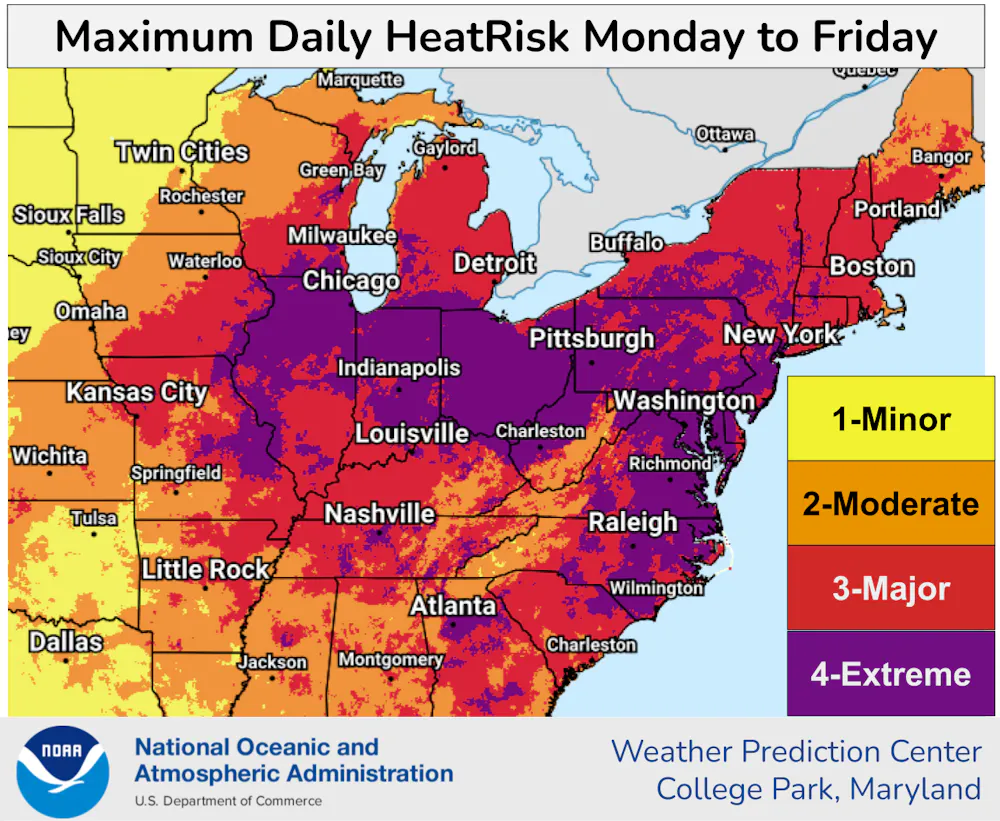
    Summer is just getting started, and millions of people are under heat advisories as a major heat wave spreads across large parts of the central and eastern U.S. in June 2025.

    For many people, summer is their favorite season, a time for cookouts, beach trips and other outdoor activities. However, summer also brings the risk of dangerously high temperatures and humidity.

    In the U.S., hundreds of people working or playing outside – even those who seem healthy – succumb to heat-related illnesses each year. Older adults and people in areas that historically haven’t needed air conditioning tend to see the highest rates of illnesses during heat waves, as Chicago saw in 1995 when at least 700 people died in a heat wave.

    The Weather Prediction Center’s heat forecast shows the maximum temperatures states can expect to see at some point during the week of June 23-27, 2025.
    NOAA Weather Prediction Center

    Even in places where heat is recognized as a dangerous health threat, people can be caught off guard as the thermometer creeps higher, on average, each year. In some cases, dangerous heat can arise quickly. In 2021, a young family died of heat stroke on a California trail after setting out for a hike when temperatures were still in the 70s Fahrenheit (low to mid 20s Celsius).

    I study health risks in a warming climate as a professor of public health, and I’ve seen heat become a growing concern. Here are some of the key warning signs to watch for when temperatures rise – and ways to keep cool when the heat and humidity get too high.

    Signs of heat-related illness to watch for

    Heat-related illnesses occur across a spectrum, and mild heat stress can quickly progress to life-threatening heat stroke if a person is exposed to dangerous conditions for too long.

    Mild forms of heat-related illness include heat cramps and heat rash, both of which can be caused by extensive sweating during hot conditions. Cooling the body and drinking cool fluids can help.

    When heat-related illnesses progress into heat exhaustion, the situation is more serious. Heat exhaustion includes symptoms such as dizziness, nausea, excessive sweating, feeling weak, thirst and getting a headache.

    Construction workers are often out in the heat for long periods of time, including during this heat wave in Los Angeles in July 2024.
    Etienne Laurent/AFP via Getty Images

    Heat exhaustion is a signal that the body is losing its ability to maintain a stable core temperature. Immediate action such as moving to a cool, ideally air-conditioned space, drinking liquids, loosening clothes and applying wet cloths are some of the recommended steps that can help keep heat exhaustion from progressing to the most dangerous form of heat-related illness, heat stroke.

    Heat stroke is a medical emergency. At this point, the body can no longer maintain a stable core temperature. A body with heat stroke can reach 106 degrees Fahrenheit or higher rapidly, and that heat can quickly damage the brain, heart and kidneys.

    Signs of heat exhaustion and heat stroke, from the National Weather Service and Centers for Disease Control and Prevention.
    NOAA/CDC

    Typically, someone suffering heat stroke has exhausted their reserves of sweat and salt to stay cool, so sweating eventually stops during heat stroke. Their cognitive ability fails, and they cannot remove themselves from danger. Heat stroke can cause seizures or put someone into a coma as their core temperature rises. If the condition is not treated immediately, and the core temperature continues to rise, heat stroke becomes fatal.

    Because heat exhaustion can lead to heat stroke, addressing heat-related illnesses before they progress is vital.

    How to tell when the heat is too high

    Heat risk isn’t just about temperature – humidity also increases the risk of heat-related illnesses because it affects how well sweating will cool the human body when it gets hot.

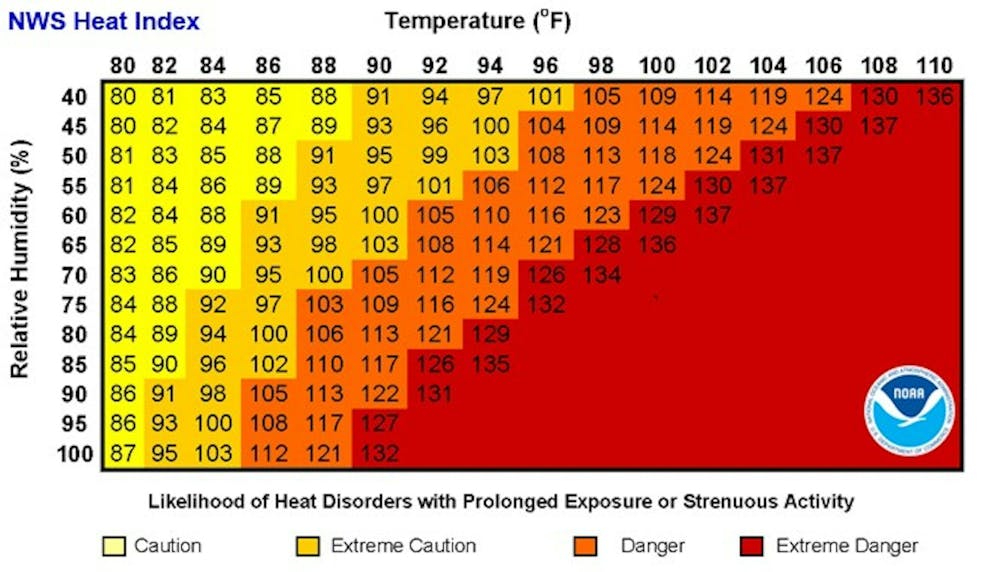
    Instead of just looking at temperature when planning outdoor activities, check the heat index, which accounts for heat illness risk associated with temperature and relative humidity.

    It doesn’t take very high temperatures or very high humidity for the heat index to enter dangerous territory.

    A heat index chart shows how heat and humidity combine for dangerous conditions.
    NOAA

    However, the heat index is still a conservative measure of the impact of heat on humans, particularly for outdoor workers and athletes at summer practices. This is because temperature measurements used in weather forecasting are taken in the shade and are not exposed to direct sunlight. If someone is outside and exposed to the direct sun, the actual heat index can be as much as 15 F higher than the heat index chart indicates.

    A more sophisticated measurement of heat effects on human health is what’s known as the wet-bulb globe temperature, which takes into account other variables, such as wind speed and cloud cover. Neither takes into account a person’s physical exertion, which also raises their body temperature, whether working at a construction site or playing soccer.

    Tips for staying safe in a heat wave

    How can you stay cool when heat waves set in? The answer depends in part on where you are, but the main points are the same:

    • Avoid strenuous outdoor activities in high temperatures if possible. If you start to feel symptoms of heat-related illnesses, drink fluids that will hydrate you. Find shade, rest, and use cool, damp cloths to lower your body temperature. If you see signs of heat stroke in someone else, call for medical help.

    • Be careful with fans. Fans can be useful if the temperature isn’t too high because they wick sweat away from the body and induce evaporative cooling. But at very high temperatures, they can accelerate heat buildup in the body and lead to dangerous conditions. If indoor temperatures reaches 95 degrees or higher, using fans can actually be dangerous and raise the risk of heat-related illnesses.

    • Find a cooling center, library or community center where you can get inside and rest in an air-conditioned space in the hottest hours. In places such as Phoenix, where high temperatures are a regular hazard, cooling centers are typically opened in summer. Northern cities are also opening cooling centers as heat waves occur there more frequently than they did in the past. Urban areas with a lot of pavement and buildings – known as heat islands – can have temperatures well above the city’s average.

    • Hydrate, hydrate, hydrate! Drink plenty of fluids, and don’t forget about the importance of electrolytes. Heat-related dehydration can occur when people sweat excessively, losing water and necessary salts from the body. Some sports drinks or rehydration fluids restore electrolytes and hydration levels.

    Older adults and people with disabilities often face higher risks from heat waves, particularly if they can’t easily move to a cooler environment. Communities and neighbors can help protect vulnerable populations by providing cooling centers and bottled water and making regular wellness checks during high heat.

    Summer can be a season of fun. Just remember the risks, keep an eye on your friends and neighbors when temperatures rise, and plan ahead so you can beat the heat.

    This article, originally published June 19, 2025, has been updated with new heat advisories and forecasts.

    Brian Bossak is not currently receiving relevant external funding for heat-related illness research. In 2017-2019, he served as a consultant on a heat-related research award from the Southeastern Coastal Center for Agricultural Health and
    Safety at the University of Florida.

    ref. How to stay safe during heat waves – and heat stroke warning signs to watch for – https://theconversation.com/how-to-stay-safe-during-heat-waves-and-heat-stroke-warning-signs-to-watch-for-257708

    MIL OSI – Global Reports

  • MIL-OSI: Bitget Partners with MotoGP for a High-Speed Collision of Tech and Speed

    Source: GlobeNewswire (MIL-OSI)

    SCARPERIA E SAN PIERO, Italy, June 22, 2025 (GLOBE NEWSWIRE) — Bitget, the leading cryptocurrency exchange and Web3 company, is teaming up with MotoGP, the highest class of motorcycle road racing events, in a high-octane partnership that merges the breakneck speed of racing with the high-stakes precision of crypto trading. As the newly minted Regional Partner for select Grand Prix events across Europe and Southeast Asia, Bitget is bringing crypto onto the track, and into the fast lane.

    Kicking off at the iconic Mugello Circuit during the Italian Grand Prix, the collaboration marks a new era where precision engineering meets algorithmic agility, and where every second, like every trade, has the power to make it count.

    Bitget’s partnership will speed across multiple marquee MotoGP events in 2025, including Italy, Germany, Spain, and Indonesia, bringing together fans of motorsport and crypto under one roaring banner of performance, resilience, and speed.

    “Racing is a sport of milliseconds; crypto is a market of micro-decisions. This partnership is our way of showing the world that success — on the track or on the charts — comes down to smart moves and fearless execution,” said Gracy Chen, CEO at Bitget. “We’re excited to join MotoGP in putting power, precision, and potential into the hands of every user and every fan.”

    At the heart of the campaign is three-time MotoGP World Champion Jorge Lorenzo, whose relentless pursuit of perfection makes him a fitting icon for Bitget’s iconic “Make It Count” slogan.

    “I’ve always believed that you win races not just on instinct — but by making every lap, every line, every second count. It’s the same mindset Bitget brings to trading, and I’m proud to be part of this story,” said Jorge Lorenzo. “The worlds of MotoGP and crypto aren’t as different as they seem — they both reward those who stay sharp and think fast.”

    The campaign features trackside activations, exclusive VIP experiences, and a series of cross-platform digital initiatives. At Mugello, KOLs and media will get behind-the-scenes access to the paddock and rider interactions, blending all the high-octane energy of race weekend, wrapped in a sleek, Bitget-branded experience.

    “MotoGP is built on precision, innovation, and high-speed decisions — values that align naturally with Bitget,” agreed MotoGP CCO Dan Rossomondo.

    This collaboration follows Bitget’s headline partnerships with Lionel Messi, Juventus, and LALIGA, reinforcing its track record in bridging the gap between crypto and culture. With over 120 million users globally and a daily trading volume topping $20 billion, Bitget continues to shift the narrative from volatility to victory.

    About Bitget

    Established in 2018, Bitget is the world’s leading cryptocurrency exchange and Web3 company. Serving over 120 million users in 150+ countries and regions, the Bitget exchange is committed to helping users trade smarter with its pioneering copy trading feature and other trading solutions, while offering real-time access to Bitcoin priceEthereum price, and other cryptocurrency prices. Formerly known as BitKeep, Bitget Wallet is a leading non-custodial crypto wallet supporting 130+ blockchains and millions of tokens. It offers multi-chain trading, staking, payments, and direct access to 20,000+ DApps, with advanced swaps and market insights built into a single platform. Bitget is at the forefront of driving crypto adoption through strategic partnerships, such as its role as the Official Crypto Partner of the World’s Top Football League, LALIGA, in EASTERN, SEA and LATAM markets, as well as a global partner of Turkish National athletes Buse Tosun Çavuşoğlu (Wrestling world champion), Samet Gümüş (Boxing gold medalist) and İlkin Aydın (Volleyball national team), to inspire the global community to embrace the future of cryptocurrency.

    For more information, visit: WebsiteTwitterTelegramLinkedInDiscordBitget Wallet

    For media inquiries, please contact: media@bitget.com

    Risk Warning: Digital asset prices are subject to fluctuation and may experience significant volatility. Investors are advised to only allocate funds they can afford to lose. The value of any investment may be impacted, and there is a possibility that financial objectives may not be met, nor the principal investment recovered. Independent financial advice should always be sought, and personal financial experience and standing carefully considered. Past performance is not a reliable indicator of future results. Bitget accepts no liability for any potential losses incurred. Nothing contained herein should be construed as financial advice. For further information, please refer to our Terms of Use.

    About MotoGP

    Faster. Forward. Fearless. Since 1949, MotoGP™ has grown into a global sports and entertainment brand with an incredible legacy and an even more exciting future. Each season, the greatest riders from across the globe come together to race the fastest prototype motorcycles on some of the world’s greatest racetracks – creating the most exciting sport on Earth.

    Photos accompanying this announcement are available at
    https://www.globenewswire.com/NewsRoom/AttachmentNg/03b113c6-2186-4508-9d93-c4a9a4891cff

    https://www.globenewswire.com/NewsRoom/AttachmentNg/40b635c2-4097-40b8-ab76-6b7f11ff6cf0

    The MIL Network

  • MIL-OSI: Bitget Partners with MotoGP for a High-Speed Collision of Tech and Speed

    Source: GlobeNewswire (MIL-OSI)

    SCARPERIA E SAN PIERO, Italy, June 22, 2025 (GLOBE NEWSWIRE) — Bitget, the leading cryptocurrency exchange and Web3 company, is teaming up with MotoGP, the highest class of motorcycle road racing events, in a high-octane partnership that merges the breakneck speed of racing with the high-stakes precision of crypto trading. As the newly minted Regional Partner for select Grand Prix events across Europe and Southeast Asia, Bitget is bringing crypto onto the track, and into the fast lane.

    Kicking off at the iconic Mugello Circuit during the Italian Grand Prix, the collaboration marks a new era where precision engineering meets algorithmic agility, and where every second, like every trade, has the power to make it count.

    Bitget’s partnership will speed across multiple marquee MotoGP events in 2025, including Italy, Germany, Spain, and Indonesia, bringing together fans of motorsport and crypto under one roaring banner of performance, resilience, and speed.

    “Racing is a sport of milliseconds; crypto is a market of micro-decisions. This partnership is our way of showing the world that success — on the track or on the charts — comes down to smart moves and fearless execution,” said Gracy Chen, CEO at Bitget. “We’re excited to join MotoGP in putting power, precision, and potential into the hands of every user and every fan.”

    At the heart of the campaign is three-time MotoGP World Champion Jorge Lorenzo, whose relentless pursuit of perfection makes him a fitting icon for Bitget’s iconic “Make It Count” slogan.

    “I’ve always believed that you win races not just on instinct — but by making every lap, every line, every second count. It’s the same mindset Bitget brings to trading, and I’m proud to be part of this story,” said Jorge Lorenzo. “The worlds of MotoGP and crypto aren’t as different as they seem — they both reward those who stay sharp and think fast.”

    The campaign features trackside activations, exclusive VIP experiences, and a series of cross-platform digital initiatives. At Mugello, KOLs and media will get behind-the-scenes access to the paddock and rider interactions, blending all the high-octane energy of race weekend, wrapped in a sleek, Bitget-branded experience.

    “MotoGP is built on precision, innovation, and high-speed decisions — values that align naturally with Bitget,” agreed MotoGP CCO Dan Rossomondo.

    This collaboration follows Bitget’s headline partnerships with Lionel Messi, Juventus, and LALIGA, reinforcing its track record in bridging the gap between crypto and culture. With over 120 million users globally and a daily trading volume topping $20 billion, Bitget continues to shift the narrative from volatility to victory.

    About Bitget

    Established in 2018, Bitget is the world’s leading cryptocurrency exchange and Web3 company. Serving over 120 million users in 150+ countries and regions, the Bitget exchange is committed to helping users trade smarter with its pioneering copy trading feature and other trading solutions, while offering real-time access to Bitcoin priceEthereum price, and other cryptocurrency prices. Formerly known as BitKeep, Bitget Wallet is a leading non-custodial crypto wallet supporting 130+ blockchains and millions of tokens. It offers multi-chain trading, staking, payments, and direct access to 20,000+ DApps, with advanced swaps and market insights built into a single platform. Bitget is at the forefront of driving crypto adoption through strategic partnerships, such as its role as the Official Crypto Partner of the World’s Top Football League, LALIGA, in EASTERN, SEA and LATAM markets, as well as a global partner of Turkish National athletes Buse Tosun Çavuşoğlu (Wrestling world champion), Samet Gümüş (Boxing gold medalist) and İlkin Aydın (Volleyball national team), to inspire the global community to embrace the future of cryptocurrency.

    For more information, visit: WebsiteTwitterTelegramLinkedInDiscordBitget Wallet

    For media inquiries, please contact: media@bitget.com

    Risk Warning: Digital asset prices are subject to fluctuation and may experience significant volatility. Investors are advised to only allocate funds they can afford to lose. The value of any investment may be impacted, and there is a possibility that financial objectives may not be met, nor the principal investment recovered. Independent financial advice should always be sought, and personal financial experience and standing carefully considered. Past performance is not a reliable indicator of future results. Bitget accepts no liability for any potential losses incurred. Nothing contained herein should be construed as financial advice. For further information, please refer to our Terms of Use.

    About MotoGP

    Faster. Forward. Fearless. Since 1949, MotoGP™ has grown into a global sports and entertainment brand with an incredible legacy and an even more exciting future. Each season, the greatest riders from across the globe come together to race the fastest prototype motorcycles on some of the world’s greatest racetracks – creating the most exciting sport on Earth.

    Photos accompanying this announcement are available at
    https://www.globenewswire.com/NewsRoom/AttachmentNg/03b113c6-2186-4508-9d93-c4a9a4891cff

    https://www.globenewswire.com/NewsRoom/AttachmentNg/40b635c2-4097-40b8-ab76-6b7f11ff6cf0

    The MIL Network

  • MIL-OSI Africa: Nigeria secure historic double as first African flag football champions

    Nigeria’s women’s and men’s teams have been crowned the inaugural IFAF African Flag Football champions as the sport marked a major milestone on its journey to a first Olympic Games appearance in Los Angeles 2028.

    The Nigerian men edged a thrilling final game, winning 13-12 to claim gold over hosts Egypt in front of a loud and high-spirited home crowd inside the Club One Stadium in Maadi, Cairo, where distinguished guests included Egypt’s Minister of Youth and Sport Dr Ashraf Sobhi.

    In the women’s tournament, Nigeria put out a confident performance to take victory over Morocco 26-12 in the final, with two decisive second half touchowns thrown by quarterback Anuoluwapo Bello. Bronze medalists Tunisia (men) and Egypt (women) completed the historic podiums.

    In total, 11 teams from eight nations, spanning the African continent, participated in Africa Flag – the first of IFAF’s continental championships series for 2025 and the starting point for what will be the biggest and most important competition cycle in flag football history, culminating in the Olympic Games LA28.

    As African champions, Nigeria’s men and women qualify directly to the IFAF Flag Football World Championships in 2026. The event also saw 10 national teams earn their first official world rankings.

    “This is a great achievement for us and I’m proud of every woman out here,” said Nigeria women’s gold medallist Anuoluwapo Bello. “I feel excited for the girls here. There is an opportunity to go to the World Championships and show everyone what we can do.”

    “It’s amazing, it’s surreal, it’s history, it’s unbelievable,” said Nigeria men’s quarterback Hayes Obinna-Uzoh. “We’ve made history.”

    Egypt men’s quarterback Mahmoud Aboushady said: “We went for it, but we came up just short. The crowd was awesome, and it was a big crowd who were all cheering and that was really touching.”

    Morocco women’s center, silver medallist Sonia Mouimen added: “We usually don’t see crowds of this size making so much noise unless it is at soccer matches. I am very proud of my team.”

    One of the world’s fastest-growing sports, flag football is developing quickly across Africa, with many of IFAF’s member federations in the continent recording more than 100% growth in participation last year.

    The Africa Flag 2025 tournament was delivered in partnership with the NFL, who are working with IFAF to drive the development of flag football in Africa.

    In an effort to ensure the event builds on the legacy for American football across the continent, the NFL is hosting a series of wraparound activities in Cairo. These include:

    • a continental NFL Flag youth championships for U12’s boys and girls teams from across Africa;
    • an NFL talent indentification session, with the potential for players to advance to the NFL Africa-Europe Academy and International Player Pathway (IPP) program;
    • in partnership with IFAF and including the participation of NFL/ IFAF Global Flag football Abassador Elisa de Santis (FRA), a coaching education clinic for aspiring female coaches from Africa.

    Two current NFL players, New York Giants’ Bobby Okereke (Nigeria) and Tanoh Kpassagnon (Ivory Coast/Uganda) have traveled to Cairo to join these activities and were present to witness the historic finals session alongside two-time Super Bowl winner and NFL Africa lead Osi Umeniyora.

    “The first African Continental Championship was a tremendous success, and Egypt proved to be the perfect host as we continue our journey to grow flag football across Africa,” said Umenyiora. “It was inspiring to see nations from across the continent come together for the two-day event and showcase the incredible talent of their young athletes. The NFL is proud to partner with IFAF to help grow the game of flag football, especially as we look ahead to its debut at the LA28 Olympic Games.”

    IFAF President Pierre Trochet said: “Every player and official who set foot on the field in Cairo this week can claim a piece of history. I’m enormously proud and grateful to our Egyptian federation, who have hosted this milestone event with great professionalism and warmth. But the history is less important than the future and what this tournament has demonstrated is the enormous talent and passion for the game that exists right across the African continent. We know this event is just the start and, together with our NFL partners, we are committed to ensuring it acts as a springboard to the long-term development of our game.”

    The IFAF African Flag Football World Championships were hosted over two days (June 20-21) by the Egyptian Federation of American Football, whose President Ali Rafeek said: “No words can truly capture the emotion of this moment. It was a world-class competition filled with outstanding performances and, above all, incredible energy. We’ve been building toward this moment for a while with IFAF leadership and our fellow federations, and we’re proud to see that hard work come to life. Africa is officially on the flag football map, and we’re only getting started.”

    The event in Cairo also witnessed the kick-off of IFAF’s new, comprehensive partnership with the International Testing Agency, whose staff were present to deliver anti-doping education activities for participating athletes and team officials.

    The IFAF Flag Football Continental Championship series will continue in September with the EURO FLAG 2025 event in Paris, France.

    RESULTS AND FINAL STANDINGS

    IFAF Africa Flag 2025  – men’s tournament

    Gold Medal Game
    Nigeria 13 Egypt 12

    Bronze Medal Game
    Tunisia 36 Morocco 14

    5th Place Game: Cameroon 45 Senegal 13
    7th Place Game: South Africa 60 Uganda 0

    Semifinals
    Egypt 21 Morocco 12
    Tunisia 18 Nigeria 40

    Final Placing

    1. Nigeria
    2. Egypt
    3. Tunisia
    4. Morocco
    5. Cameroon
    6. Senegal
    7. South Africa
    8. Uganda

    IFAF Africa Flag 2025 – women’s tournament

    Gold Medal Game
    Nigeria 26 Morocco 12

    Playoff
    Egypt 13 Morocco 19

    Final Placing

    1. Nigeria
    2. Morocco
    3. Egypt

    Distributed by APO Group on behalf of National Football League (NFL).

    Photography and Video Assets: https://apo-opa.co/44rRoJY
    *Rights-released for editorial use. Please credit IFAF

    MIL OSI Africa

  • MIL-OSI Russia: Report “Development of the “Central Asia-China Spirit”: achievements, opportunities and prospects for regional cooperation” /1/

    Translation. Region: Russian Federal

    Source: People’s Republic of China in Russian – People’s Republic of China in Russian –

    Source: People’s Republic of China – State Council News

    ASTANA, June 22 (Xinhua) — The Xinhua Research Institute on Sunday released a report in the Kazakh capital Astana titled “Development of the Central Asia-China Spirit: Achievements, Possibilities, and Prospects of Regional Cooperation.” The full text of the report is given below.

    Development of the “Central Asia-China Spirit”:

    achievements, opportunities and prospects of regional cooperation

    Xinhua News Agency Research Institute

    Table of contents

    Preface

    Chapter 1. Results of cooperation between China and Central Asia

    1.1 Strengthening trade and economic ties

    1.2 Infrastructure development and deepening interconnectivity

    1.3 Accelerated development of cooperation along the entire production chain in the energy industry

    1.4 Innovative cooperation towards a green transition

    1.5 Promoting the formation of internal development potential in the countries of Central Asia

    1.6 Dialogue of civilizations as a solid spiritual basis for cooperation

    1.7 Peace, security and stability as a basis for sustainable development

    Chapter 2. Opportunities and Challenges in China-Central Asia Cooperation

    2.1 New Opportunities as a Result of China’s Opening Up

    2. Potential for cooperation in the field of green economy and digital technologies

    2.3 Regional cooperation as a factor of geo-economic expansion

    2.4 Risks and challenges in the field of development and security

    Chapter 3. Looking to the Future: Strengthening the Regional Community of Shared Destiny

    3.1 Mutual support as the basis of a regional community of common destiny

    3.2 Joint development for the sake of regional prosperity

    3.3 Formation of a common security barrier for stability of the entire region

    3.4 Friendship of peoples in the spirit of the times as a guarantee of mutual understanding

    Conclusion

    Explanatory note and thanks

    Preface

    Central Asia is the heart of Eurasia, closely linked to China by a common nature and destiny, like two banks of a single river: different, but inseparable. This region is a crossroads of ancient civilizations, where different peoples and customs meet and merge. The region serves as a hub of interregional connections and a real “melting pot” of human culture.

    Looking back, we can see how China, together with the peoples of Central Asia, contributed to the establishment and prosperity of the great Silk Road, leaving behind vivid evidence of cooperation over the centuries: “Caravans stretched to the horizon, and overseas merchants flocked to the border outposts day after day.”

    In the new era, China and the Central Asian countries have become good neighbors, reliable friends, partners and brothers bound by a common destiny. Together, they are opening a new page of “friendly, safe and prosperous neighborhood” in the Eurasian space, developing and shaping the “Central Asia-China Spirit” characterized by mutual respect, mutual trust, mutual benefit, mutual assistance and promoting joint modernization through high-quality development.

    They are creating a model example of regional cooperation for the entire world.

    Since Chinese President Xi Jinping put forward the Belt and Road Initiative in 2013, China and Central Asian countries have been working together to promote the comprehensive revival of the Silk Road and build a close partnership for the future. Bilateral relations have entered a new era and reached an unprecedented level. President Xi Jinping has paid nine visits to Central Asia, visiting all five countries and eight cities, and established strong friendship with the leaders of the region. The video summit to mark the 30th anniversary of the establishment of diplomatic relations and the first China-Central Asia Summit have become important milestones in the history of bilateral ties. Based on the interests of their peoples and striving for a brighter future, China and the Central Asian countries have made a historic choice to build a closer community of shared destiny, which once again underscores their determination to develop cooperation at a higher level, with higher standards and on a qualitatively new basis.

    The recently concluded second China-Central Asia Summit marked a new start in the development of cooperation between China and the countries of the region. At this historic moment, this report offers a comprehensive overview of the key achievements, existing opportunities and challenges of the China-Central Asia partnership in the new era, as well as forecasts and analytical assessments of the prospects for further cooperation.

    The report notes that since the beginning of the new era, cooperation between China and Central Asian countries has borne rich fruit in seven major areas: trade and economic cooperation, infrastructure development, energy cooperation, new areas of partnership, enhancing development potential, mutual cultural enrichment, and joint promotion of peace and stability. China’s high-quality development, high level of its openness, as well as a new round of scientific and technological revolution and industrial transformation create unique opportunities for expanding China-Central Asian cooperation. At the same time, the partnership faces a number of challenges, including unilateral actions, rising protectionism, geopolitical risks, and threats in the field of non-traditional security.

    Looking to the future, the report stressed that cooperation between China and Central Asian countries should be based on the concept of building a community with a shared future for mankind and follow the three global initiatives. Mutual support, common development, common security and friendship passed down from generation to generation should remain the fundamental principles, aiming to strengthen the regional community with a shared future, jointly create a new chapter of regional prosperity, build a common security shield and deepen the cordial affinity between the peoples.

    We believe that in the new era, cooperation between China and Central Asia will bring sustainable development and more benefits to the peoples of the region, bring stability and positive energy to the troubled world, and become an important example of regional partnership in building a community with a shared future for mankind.

    Chapter 1. Results of cooperation between China and Central Asia

    Our cooperation is rooted in more than two thousand years of friendly relations, is reinforced by solidarity and mutual trust that has been established for 30 years since the establishment of diplomatic relations, and is significantly moving forward thanks to mutually beneficial cooperation in the new era. Many years of experience and practice have enabled us to develop and shape the “Central Asia-China Spirit”, characterized by mutual respect, mutual trust, mutual benefit, mutual assistance and the promotion of joint modernization through high-quality development.

    — Chairman of the People’s Republic of China Xi Jinping

    1.1 Strengthening trade and economic ties

    In recent years, trade and economic cooperation between China and the Central Asian countries has been steadily developing in both quantitative and qualitative terms. China has become the largest trading partner and the main source of investment for the countries in the region. After the first China-Central Asia Summit was held in 2023, the Chinese side took additional measures to promote trade, ensuring the stable flow of goods and expanding the supply of products from the Central Asian countries. As a result, bilateral trade is becoming increasingly diversified, the potential for economic cooperation continues to be actively realized, and the scale of trade is reaching new levels. The total volume of trade between China and the Central Asian countries reached 94.8 billion US dollars in 2024, an increase of 5.4 billion compared with the previous year, representing an increase of 7.2%. Compared with the initial period of establishing diplomatic relations, when this figure was only 460 million dollars, it has increased more than a hundredfold.

    Strategic alignment of the parties. An important feature of cooperation between China and the Central Asian countries is the strategic alignment of key plans and initiatives in the field of economic development. The parties strive for in-depth coordination and alignment of the Belt and Road initiative with the national development programs of the countries of the region: the New Economic Policy of Kazakhstan, the National Development Program of Kyrgyzstan until 2026, the National Development Strategy of Tajikistan for the period up to 2030, the Revival of the Silk Road strategy of Turkmenistan and the Development Strategy of the new Uzbekistan for 2022-2026. Such alignment strengthens practical cooperation in various fields and contributes to the formation of a new model of complementary and mutually beneficial partnership. During the second China-Central Asia Summit, China and the five Central Asian countries signed a treaty on eternal good-neighborliness, friendship and cooperation, which enshrined the principle of friendship between generations in legal form and became a new milestone in the history of relations between the six countries.

    Practical cooperation enters the “highway”. As China-Central Asia cooperation deepens, practical cooperation enters the “highway”. The two sides improve trade policies and work hard to ensure a stable, fair, transparent and sustainable investment climate, making trade, investment and business environment even more attractive. As of December 2024, China’s accumulated direct investment in Central Asian countries exceeded US$17 billion, and the total volume of completed contract work amounted to more than US$60 billion. Cooperation covers such areas as oil and gas production, interconnected infrastructure, manufacturing and the digital economy.

    In the Xinjiang-Uygursky Autonomous Region of China, bordering the countries of Central Asia, optimizing the work of border crossings with Kazakhstan, Kyrgyzstan and Tajikistan, passes are more quickly and more efficient. The first cross -border cooperation zone of Horgos, jointly created by China and Kazakhstan, has been operating in the innovative model of “inside the country – outside the customs territory (or“ within the country, but outside customs borders ”). This International Center has become a flagship project of bilateral economic cooperation as part of the“ One Belt, One Way. ”The starting point of the ancient shalk track. – Shensi’s province forms the center of trade in widespread consumption, such as grain, fruits and vegetables, together with the countries of the region, China develops international logistics nodes and logistics parks The Center in the north-west of the Ciano International Port, introduced the RFID radio frequency technology, which allowed to reduce the assembly time of new energy cars and increase the efficiency of organizing trains on the route China-Europe.

    Chinese -made products, including everyday goods, machine -building equipment and electronic products, are in sustainable demand among consumers in Central Asia. Products from the category of “new three types” became the basis of Chinese exports to the region. At the same time, energy resources and agricultural products from Central Asia countries are expanding the Chinese market, expanding the choice for consumers. China discovered eight “green corridors” for accelerated customs clearance of agricultural products, completely covering all car border crossings. The trade in agricultural products between the parties is rapidly developing. Export to China of high -quality agricultural goods from Central Asia, such as lemons from Tajikistan and cherries from Uzbekistan, is growing rapidly. At the same time, fresh peaches from Hebei province and Yanan apples first entered the tables of consumers in Central Asia. The Kerekhovaya and oil and fat industrial group “Aiju Grain and Oil Group), effectively using complementarity in agrarian cooperation between China and the countries of Central Asia, built and commissioned the logistics and agro-industrial park with a capacity of 1 million tons in the North Kazakhstan region. Chinese standards in the field of equipment, technology, management and service have brought real benefits to the local population. Such interaction contributes to mutually beneficial cooperation in the field of food security. Thanks to the joint efforts of China and the countries of Central Asia, the stability and effectiveness of regional production and logistics chains are ensured.

    1.2 Infrastructure development and deepening interconnectivity

    Connectivity development is a priority area of cooperation between China and Central Asian countries. The two sides make full use of the region’s geographical advantages to build “fast corridors” for the free movement of people and improve “green corridors” for the efficient movement of goods. These measures help transform Central Asian countries from “landlocked” to “land-connected,” strengthening their position as an important transportation hub on the Eurasian continent. Such infrastructure development improves people’s living conditions and stimulates the unleashing of the potential of higher-level connectivity, including the Internet of Things and other areas of digital integration between China and Central Asia.

    China and Central Asian countries have been pioneers in jointly implementing the Belt and Road Initiative, accelerating the construction of the China-Central Asia Transport Corridor and forming a multi-layered and diversified system of regional connectivity. This has resulted in the implementation of many mutually beneficial infrastructure projects. China’s construction of the Kamchik Pass Tunnel of the Angren-Pap Railway, the longest in Central Asia, has eliminated the need to bypass third countries when transporting through Uzbekistan, radically changing the mode of transportation for tens of millions of people. The China-Kyrgyzstan-Uzbekistan Highway, which crosses the Tien Shan Mountains, and the China-Tajikistan-Uzbekistan Highway, which passes through the Pamir Plateau, form a dense network of routes for freight transportation between China and Central Asian countries, significantly improving logistics and bringing tangible benefits to the people of the region.

    On December 27, 2024, the construction of the China-Kyrgyzstan-Uzbekistan railway officially began. The route of the new line starts in Kashgar, passes through the territory of Kyrgyzstan and enters Uzbekistan, with the prospect of further construction in the direction of West and South Asia. Once completed, the railway will become an important part of the southern route of the New Eurasian Continental Bridge. It will provide a convenient transport corridor connecting East and Southeast Asia with Central, West Asia, North Africa and Southern Europe. This will significantly reduce the costs of international trade for the participating countries and increase their level of integration into the world economy.

    China has signed intergovernmental air transport agreements with all five Central Asian countries, and the opening up of the aviation market continues to progress. Air traffic between Xi’an and the countries in the region has evolved from no routes at all to covering seven cities in all five countries. Currently, eight passenger flights are operating regularly, connecting China with seven cities in Central Asia. These airlines provide a strong link between the economic zones of China and Central Asia, promoting the effective integration of industrial and social supply chains.

    The China-Europe and China-Central Asia trains, which operate non-stop day and night, effectively ensure the stability and continuity of international logistics chains. On April 23, a China-Europe freight train with 55 containers of consumer goods and electronic components departed from the Khorgos border station in Xinjiang to the Polish city of Malaszewicze. This trip was a landmark one, as the number of trains passing through the Khorgos railway checkpoint exceeded 3,000, and this figure was reached 27 days earlier than last year. This was a new historical record, exceeding the figure of last year by 28.7%. According to statistics, 19 thousand China-Europe trains were sent in 2024, which is 10% more than in the previous year, and the volume of transportation amounted to 2.07 million TEU (conventional containers), which is 9% higher than the same indicator last year. 12 thousand trains were sent on the China-Central Asia route (an increase of 10%), 880 thousand TEU were transported (an increase of 12%). Currently, the China State Railway Corporation has approved 44 regular routes in the direction of Central Asia, thereby forming new international transport corridors in the Eurasian space.

    The Trans-Caspian International Transport Corridor starts in China, passes through Kazakhstan, the Caspian coast, Azerbaijan and Georgia, and then stretches to Turkey and European countries. In July 2024, Chinese President Xi Jinping and Kazakh President Kassym-Jomart Tokayev jointly attended the launch ceremony of the China-Europe direct express route via video link. For the first time, Chinese vehicles reached a Caspian port via a direct road route, which marked the official formation of a multi-level and multi-vector interconnected system combining road, rail, air and pipeline transport.

    The China-Europe train consolidation centers are developing at an accelerated pace, forming a more efficient and convenient transportation system. In February 2024, the Kazakhstan terminal in Xi’an, built in cooperation between Xi’an Free Trade Port Construction and Operation Co., Ltd. and KTZ Express JSC, began operating. In just one year, the terminal handled over 150 thousand tons of cargo, which contributes to the accelerated consolidation and distribution of Kazakhstani goods undergoing import and export operations through Xi’an. In addition, the terminal has become the embodiment of Kazakhstan’s initiative to accelerate the creation of a trade and logistics center in China. With the commissioning of the China-Kazakhstan logistics hub in Almaty on June 10 this year, the hub-to-hub transport corridor has moved to a new level.

    1.3 Accelerated development of cooperation along the entire production chain in the energy industry

    Central Asian countries are important oil and gas producers, and have a high degree of complementarity with China in such aspects as natural resource conditions and industrial structure. In recent years, China and Central Asian countries, through a mutually beneficial cooperation model, have been jointly building multi-vector, safe and efficient energy corridors, consistently expanding cooperation in such basic areas as energy and mining.

    Chinese enterprises attach great importance to the development of energy cooperation with the Central Asian countries, building long-term and strong partnerships with relevant government agencies and energy companies in the region. Back in 1997, the China National Petroleum Corporation (CNPC) successfully won a tender for the development of the Akzhuba oil field in Kazakhstan, which marked the beginning of cooperation between China and Kazakhstan in the oil and gas sector. Over the past years, Akzhubin has grown from an enterprise with an annual oil production volume of just over 2 million tons into a large oil and gas company with an annual production of over 10 million tons of oil and gas. On its basis, a full chain of the industry cycle was formed, including oil and gas exploration and production, pipeline construction and operation, oil refining and petroleum product trading, engineering and construction services, oil and gas equipment production and transportation, information technology and logistics support. The project also contributed to the creation of over 20 thousand jobs for the local population.

    In Tajikistan, Chinese energy equipment manufacturing companies built and commissioned the Thermal Power Plant No. 2 in Dushanbe, which made it possible to permanently resolve the problem of electricity shortages in the capital in winter. In Kyrgyzstan, with the support of the Chinese side, the modernization of the Bishkek Thermal Power Plant was completed, as a result of which its annual electricity generation increased from the previous 262 million kilowatt-hours to 1.74 billion, and the volume of heat supply almost doubled. In Turkmenistan, as part of the project to develop natural gas fields in the Amu Darya basin, implemented with the participation of the China National Petroleum Corporation, a production level equal to tens of millions of tons of oil equivalent per year has already been achieved, and the annual capacity of natural gas supplies exceeds 10 billion cubic meters. The implementation of a number of such large-scale projects contributes to the steady expansion of oil and gas trade between China and the countries of Central Asia, as well as to the deepening of cooperation along the entire production chain of the energy industry.

    Thanks to many years of practical cooperation between China and Central Asian countries, the network of pipeline infrastructure construction and operation is gradually improving. Lines A, B and C of the China-Central Asia gas pipeline, running through endless deserts, have been successfully put into operation and connected to the II and III stages of China’s West-East mainline. The construction of Line D is proceeding at an accelerated pace, bringing real benefits to the people of the countries along the route. In addition, the Kazakhstan-China oil pipeline has become the first international energy corridor directly connecting Kazakhstan with foreign end markets. Its implementation has made a significant contribution to the diversification of Kazakhstan’s energy exports.

    With the steady advancement of the Belt and Road Initiative, energy cooperation between China and Central Asian countries continues to deepen. It not only helps improve the region’s energy infrastructure and inject new impetus into the socio-economic development of both sides, but also makes a significant contribution to optimizing the region’s energy structure and ensuring sustainable ecological development.

    1.4 Innovative cooperation towards a green transition

    Fossil fuels currently account for about 95% of the energy supply in the five Central Asian countries. Against the backdrop of increasing climate change and the global energy transition, the region’s countries are showing growing interest in cooperation in the areas of renewable energy and green economy. However, due to limited financial resources, a shortage of specialists, and an insufficient level of technological development, the implementation of a green transition faces certain difficulties.

    During the first China-Central Asia Summit, China and the five countries in the region reached a number of agreements, including launching a joint initiative on green and low-carbon development, as well as deepening cooperation on sustainable development and combating climate change. In support of the Central Asian countries’ course towards ecological transformation, China, using its governance and production advantages in the field of new energy, is actively promoting the region’s significant potential in the field of renewable energy resources.

    In early April 2025, the Bash and Dzhankeldy wind energy projects, implemented with the investment and operational participation of China Southern Power Grid, were officially commissioned in Uzbekistan. These facilities have become the largest completed wind farms in Central Asia. Their annual output is expected to be about 3 billion kilowatt-hours of clean electricity, which will reduce carbon dioxide emissions by 1.6 million tons annually.

    More and more Chinese companies are investing in the construction of enterprises and the development of green energy in Central Asian countries, actively expanding cooperation in the field of renewable energy sources. In Uzbekistan, a 100-megawatt solar power plant was commissioned in Navoi, in Kazakhstan – a wind farm in Zhanatas, a hydroelectric power station in Turgu-Sun and a solar power plant in Almaty. The Chinese energy corporation China Huadian Group has begun construction of a gas turbine power plant in Aktau and a solar power plant in Sheli. These projects not only provide Central Asian countries with stable and sustainable green electricity, but also contribute to the modernization of local industries and create a significant number of jobs.

    China is actively developing international cooperation with Central Asian countries in combating desertification. The practical experience and scientific approaches developed in the framework of ecological recovery of the “Three Norths”, including Ningxia Hui Autonomous Region, Inner Mongolia and other regions, as well as the experience of developing the Taklamakan Desert have become a reference point for Central Asian countries that are facing similar problems of land degradation. Such cooperation not only offers real solutions in the field of sustainable development, but also opens up broad prospects for promoting the green direction within the framework of the “One Belt, One Road” initiative.

    The Aral Sea, located on the border of Uzbekistan and Kazakhstan, was previously considered the fourth largest lake in the world. But due to half a century of large-scale development of land and water resources, its area has shrunk from about 67,000 square kilometers in 1960 to about 6,000 square kilometers in 2020. This has caused serious environmental consequences: desertification, soil salinization, loss of biodiversity, and other problems. In the face of the environmental crisis, China and Central Asian countries have joined forces to implement comprehensive measures to restore the ecosystem of the Aral region. The Institute of Ecology and Geography of the Xinjiang Branch of the Chinese Academy of Sciences signed a cooperation agreement with the government of Uzbekistan and specialized organizations aimed at the ecological rehabilitation of the Aral Sea. In 2023, a pilot site was organized in the city of Nukus in western Uzbekistan, where drip irrigation technology under a film with the simultaneous supply of water and fertilizers for growing cotton was tested. Already in the first year, the yield reached a record level for this region. Currently, the institute’s specialists continue to work in the city of Muynak, located on the shallow coast. Here, salt- and drought-resistant plant species are being selected, which will become the basis for the future “greening” of the dried-up seabed and the restoration of the region’s ecosystems.

    1.5 Promoting the formation of internal development potential in the countries of Central Asia

    “China’s experience in overcoming poverty clearly shows that with persistence, step-by-step implementation of a unified plan, and persistence like a drop breaking through a rock, the problem of poverty in developing countries can be solved. Even the weakest bird can fly first – and fly high. If China can do it, other developing countries can too.” These are the words with which Chinese President Xi Jinping shared China’s experience in combating poverty with the world community at the G20 Leaders’ Summit in Rio de Janeiro in November 2024.

    Poverty is a long-standing problem of human society and a common challenge facing the entire world. China’s experience in combating poverty has attracted the attention of the international community and has become an important source of inspiration for Central Asian countries. China’s cooperation with the countries of the region has gradually shifted from the traditional one-sided “donor aid” to a model of mutual development based on technology transfer, industrial modernization, personnel training and other forms of assistance. This contributes to the joint formation of internal potential for sustainable growth and social stability.

    Implementation of targeted projects on poverty reduction with an emphasis on technology localization in accordance with the needs of Central Asian countries. China and the Central Asian countries are actively developing specialized cooperation in the field of scientific and technological support for poverty alleviation. Taking into account regional characteristics and industry constraints, the parties are accelerating the transfer of technologies to upgrade production in areas such as agricultural modernization, energy transition and infrastructure development. Within the framework of the first China-Central Asia summit, China and Uzbekistan agreed to establish a subcommittee on cooperation in the field of poverty reduction under the Intergovernmental Cooperation Committee. This is the first such subcommittee established by China in the format of interstate cooperation. Since the launch of the China-Uzbekistan cooperation mechanism on poverty reduction, the parties have achieved significant results in the areas of institutional development, personnel training and exchange of practical experience. These efforts not only contribute to the socio-economic development of Uzbekistan, but also significantly expand the content of the bilateral partnership. According to a joint study conducted by the National Statistics Committee of the Republic of Uzbekistan and the World Bank, in 2024, 719 thousand people overcame the poverty line, and the overall poverty level in the country decreased to 8.9%.

    In recent years, Northwest University of Agricultural and Forestry Science and Technology of China, based on its strong scientific areas (crop breeding, plant protection from diseases and pests, water-saving irrigation, veterinary medicine and animal husbandry, development of saline lands and food processing), has established eight overseas agricultural research and demonstration parks in Central Asian countries. One of them, a demonstration park for the technology of breeding elite varieties of fruit trees, was founded in Kyrgyzstan in 2023 in cooperation with local universities and enterprises. Taking into account the hot and dry climate of the region, which is unfavorable for growing apple trees, Chinese agricultural experts developed and selected variety-rootstock combinations. These combinations showed higher efficiency of moisture use and better survival rate compared to traditional seedlings, which made it possible to significantly increase yields and contribute to an increase in the income of local gardeners.

    Implementation of technical skills development programs as a basis for building domestic development potential. The Lu Ban Workshops, named after the legendary Chinese craftsman Lu Ban, have become a new platform for international cooperation in vocational education. In Central Asian countries, these workshops develop technical training programs based on the actual needs of local development, providing sustainable support for industrialization and poverty reduction in the region.

    Kazakhstan has become the first country in Central Asia to introduce electric vehicles on new energy sources on a large scale. However, despite the rapid growth of this sector, the country is experiencing a serious shortage of qualified specialists capable of servicing such vehicles. In December 2023, the first “Lu Ban Workshop” began operating in Kazakhstan. The first educational program was “Vehicles and Technologies”. Four training and production zones were created for practical training: on vehicle maintenance, traditional (fuel) transport systems, vehicles on new energy sources, and intelligent network transport systems. In response to the needs of the local labor market, in 2024 the workshop developed a number of new courses, including “Transmission and Intelligent Vehicle Control Technologies”, “Driver Assistance Systems (ADAS)”, and others. In addition, a new educational program “Smart Transport and Artificial Intelligence” was launched. Graduates of the Lu Ban Workshop are in high demand, and are actively invited to work by the largest automakers, as well as enterprises in the metallurgical and mining industries of Kazakhstan. In July 2024, China decided to open a second Lu Ban Workshop in the country, which will focus on training personnel for the rapidly developing artificial intelligence industry.

    At the same time, Lu Ban Workshops is implementing a “dual education” model – a combination of Chinese language training and professional skills development, which helps integrate the education system with the real needs of industry. In the context of the implementation of the “One Belt, One Road” initiative, Chinese enterprises are actively being created in Central Asian countries, which opens up broad employment opportunities for local people. The “Chinese language professional skills” model effectively improves the skills of local people through short-term courses, extra-academic and formal vocational training programs. This not only helps partially solve the problem of shortage of qualified personnel for enterprises with Chinese participation, but also promotes job creation, and thus contributes to socio-economic development and improving the standard of living in the region.

    1.6 Dialogue of civilizations as a solid spiritual basis for cooperation

    More than two thousand years ago, the civilization of central China and the cultures of Central Asia entered an era of deep integration thanks to the ancient Silk Road. This historical process laid the foundation for mutually beneficial cultural exchange and coexistence, becoming a solid foundation for modern inter-civilizational dialogue and cultural solidarity. Today, civilizational interaction between China and the Central Asian countries continues at a new level. It not only preserves and develops the cultural genes of the Silk Road era, but also serves as a powerful spiritual resource for promoting the idea of a community with a common destiny for humanity in the context of global transformation.

    A thousand-year-old friendship with the aroma of medicine remains forever. Since the emergence of the Silk Road, traditional Chinese medicine began to spread to the countries of Central Asia along with trade caravans, gradually integrating with local medical practices and contributing to their development. The Xi’an Declaration of the first China-Central Asia Summit particularly emphasized the need to “promote the establishment of traditional Chinese medicine centers, develop cooperation in the field of growing and processing medicinal herbs, and jointly pave the “Healthy Silk Road”.” In recent years, China’s cooperation with the Central Asian countries in the field of traditional medicine has been actively expanding on the basis of a number of specific joint projects. A multi-layered partnership network is being formed, covering healthcare, education and scientific research. Traditional Chinese medicine is becoming an important link, strengthening humanitarian ties and mutual understanding between the peoples of China and Central Asia.

    In March 2023, the Fourth Clinical Hospital of Xinjiang Medical University (regional hospital of traditional Chinese medicine), together with the Institute of Physical and Chemical Technology of the Xinjiang Branch of the Chinese Academy of Sciences, founded the first Center for Treatment and Training of Specialists in Traditional Chinese Medicine in Central Asia in Tashkent. As part of the project, 14 Chinese therapy methods, including acupuncture and Tuina massage, were successfully integrated into the regional healthcare system. In September of the same year, the above-mentioned hospital won a tender for the implementation of a national project to establish a China-Uzbekistan Center for Traditional Chinese Medicine. And in October, a course in Chinese medicine became a mandatory discipline in the bachelor’s degree program in traditional medicine at Tashkent State Medical University. This became the first full-fledged introduction of Chinese medicine into the higher education system of Central Asia, opening the way for the systematic training of specialized personnel locally.

    Culture as a bridge to bring hearts together.

    The Year of Tourism, the Year of Culture and the Central Asian Art Festival have been very popular with the Chinese people, and Chinese TV series such as “Minning City” and “My Altai” have resonated with Central Asian viewers. In order to implement key high-level agreements, China and Turkmenistan organized mutual Years of Culture in 2023-2024, thereby demonstrating their desire to strengthen humanitarian cooperation. Both countries have rich cultural heritage and centuries-old history. Through dance, vocal and theatrical arts, the parties presented their national identity and artistic originality, which contributed to deep cultural integration and rapprochement of peoples.

    The Nauryz holiday is an ancient tradition of the peoples of Central Asia. In March 2025, an art group from the Samarkand region of Uzbekistan presented a vibrant festive program at the Silk Road Happy World Cultural Park in the Chinese city of Xi’an. Through songs and dances, the artists conveyed the atmosphere of spring renewal, and the treat of national dishes turned the performance into a real gastronomic holiday. In April, the Consulate General of the Republic of Kazakhstan in Xi’an organized festive events in honor of Nauryz. The program included a friendly mini-football match, traditional national games, a talent contest, as well as performances of Kazakh folk music and dance. The goal of the holiday was to promote ethnocultural traditions, deepen people’s diplomacy and expand platforms for multilateral humanitarian exchange.

    Cultural and tourist exchange on the Silk Road is a movement towards each other. Tourism is becoming one of the most dynamically developing areas of cooperation between China and the Central Asian countries. The basis for this is not only favorable natural conditions and geographical proximity, but also a common historical and cultural heritage, as well as the complementary needs of the tourism markets of both sides. Deepening political trust, coordinated use of tourism resources and active market interaction make it possible to form a balanced and mutually respectful model of tourism as a form of humanitarian partnership. This gives new energy to the construction of a regional community of a common destiny and strengthens the cultural relationship between peoples.

    Central Asia is one of the fastest growing and most promising regions for inbound tourism to China. At the same time, China remains a key source of tourist flow for the countries of the region. All five Central Asian states are already fully included in the list of priority destinations for outbound tourism for Chinese citizens. In order to expand cross-border tourism, the Central Asian countries are consistently implementing measures to liberalize the visa regime. Since 2021, Uzbekistan has become the first country in the region to grant Chinese citizens the right to a visa-free stay for up to 10 days; to enter, it is enough to have a valid passport and confirmation of the travel itinerary. In November 2023, China and Kazakhstan signed an agreement on a full mutual visa-free regime, providing for the possibility of staying in the partner’s territory for up to 30 days without the need for a visa. Kyrgyzstan and Tajikistan have introduced electronic visa systems, significantly simplifying the entry procedure. On June 1, 2025, the “Agreement between the Government of the People’s Republic of China and the Government of the Republic of Uzbekistan on the mutual abolition of visas” came into force, which became another step towards strengthening humanitarian ties and facilitating mutual travel between the two countries.

    By holding tourism presentations, thematic exhibitions and other promotional activities, both sides consistently increase the recognition of tourism brands, which contributes to the growth of the attractiveness of cross-border tourism. 2024 was declared the Year of Kazakhstan Tourism in China. Thanks to the introduction of a mutual visa-free regime, there was a sharp increase in tourist flow in both directions, the number of Kazakhstani tourists visiting China increased by 31%, and the number of Chinese citizens visiting Kazakhstan increased by more than 50%. On May 29, 2025, the first cultural and tourist train “China – Central Asia” was launched, opening a new route for humanitarian interaction in the Eurasian space. This project not only strengthened the transport interconnectivity between the regions, but also gave new content to the humanitarian dimension of Chinese-Central Asian cooperation.

    1.7 Peace, security and stability as a basis for sustainable development

    At the first China-Central Asia Summit held on May 19, 2023, Chinese President Xi Jinping emphasized that the sovereignty, security, independence and territorial integrity of Central Asian countries must be reliably protected. The development path freely chosen by the peoples of the region should be respected. Central Asia’s efforts to ensure peace, good-neighborliness and stability deserve full and comprehensive support.

    In the Xi’an Declaration of the First China-Central Asia Summit, all parties unanimously noted the exceptional importance of ensuring national security, political stability and constitutional order. Any interference in the internal affairs of other states, regardless of form and pretext, including attempts to undermine the legitimate state power and organize so-called “color revolutions”, was strongly condemned. The parties also expressed firm rejection of all forms of terrorism, separatism and extremism, and confirmed their readiness to jointly combat the “three evil forces”, as well as drug trafficking, transnational organized crime, cybercrime and other types of threats. At the same time, the summit participants declared their intention to strengthen the exchange of experience on ensuring the security of key facilities and large-scale events, as well as jointly promote the safe and sustainable implementation of strategically significant projects.

    In recent years, China and the Central Asian countries have been developing comprehensive and multi-level cooperation in maintaining regional peace and stability in order to build a security community. The parties are actively increasing cooperation in the fight against terrorism, developing effective formats for multilateral interaction, and seeking new, innovative solutions in the field of security. Cooperation has been consistently expanding in key areas such as border control, countering terrorism in cyberspace, and conducting joint operations. These efforts contribute to the formation of a reliable regional security network and give a powerful impetus to ensuring long-term stability.

    In September 2024, the mechanism of the first meeting of the ministers of public security and internal affairs of China and Central Asian countries was officially launched in Lianyungang. The parties reached a number of agreements on countering transnational crime, extremism and cybercrime, and agreed to establish a permanent mechanism for exchanging information and conducting joint operations. In the same month, a meeting of the chief justices of the Supreme Courts of China and Central Asian countries was held in Urumqi, during which the parties agreed to intensify international judicial cooperation and joint efforts to combat violent extremism and terrorism. Representatives of Uzbekistan, Kazakhstan and other countries shared their experiences in the field of anti-terrorism legislation and its enforcement, which gave impetus to the formation of a new format for regional coordination in the fight against terrorism. In April 2025, at the sixth meeting of China-Central Asia foreign ministers, the participants expressed support for the establishment of the SCO Anti-Drug Center in Dushanbe. The center will operate in conjunction with the Central Asian Regional Information and Coordination Center for Combating Illicit Drug Trafficking, which will strengthen measures to identify drug trafficking and combat transnational crime.

    At the same time, China and the Central Asian countries are making efforts to deepen the institutionalization of cooperation in law enforcement and security. Multilateral and bilateral joint exercises and border patrols are held on a regular basis, which significantly reduces the space for the so-called “three evil forces”. This set of measures effectively promotes the protection of common interests in the field of security and makes a significant contribution to maintaining peace and stability in the region.

    The Xinjiang Uygur Autonomous Region of China borders on Central Asian countries. Since the first China-Central Asia Summit, China has consistently promoted security cooperation between Xinjiang and neighboring countries, strengthening cross-border cooperation mechanisms and jointly building a reliable border security line aimed at protecting peace and stability in the region. Given the complex geographical conditions and special challenges in border control in the border areas between China and Kazakhstan, Kyrgyzstan and Tajikistan, local authorities and relevant departments of both sides have been implementing innovative cooperation models.

    In November 2024, the first meeting of the Chinese-Kazakh mechanism of coordination of the activities of local authorities on the International Center for Border Cooperation “Horgos” was held in Sinjiang in the city of Horgos. The parties discussed the joint promotion of the high-quality development of the Center, as well as the strengthening of the interregional interaction between the Xinjiang-Uyghur Autonomous Region and the Zhetysu region of Kazakhstan. During the meeting, the participants exchanged views on a number of key areas of cooperation, including infrastructure development, organizing cross -border tourism, normalizing the border market environment, expanding interaction in the field of phytosanitary and veterinary control, as well as joint measures to combat crime. According to the results of the meeting, “Protocol of the first meeting of the mechanism for coordination of the activities of local authorities” and “Memorandum on the creation of a zone of cooperation in the field of cross -border tourism“ Horgos ”” were signed. In January 2025, the first meeting of the joint Sino-Kazakh commission on state border issues took place in Beijing. The parties officially announced the creation of the commission, approved its charter and highly appreciated the current state of bilateral relations, as well as the progress in the implementation of the “agreement between China and Kazakhstan on the regime of managing the state border”. It was noted that between the two countries, clearly certain boundaries were established, the border areas retain the atmosphere of stability, peace and good neighborliness. Both parties expressed their readiness to use the creation of a commission as an important impulse to further deepen cooperation in the field of border control, thereby making a contribution to the sustainable development of a comprehensive strategic partnership between China and Kazakhstan.

    Today, a stable, united and peaceful region is rapidly emerging in Central Asia, making a significant contribution to peace and stability, thereby creating a solid foundation for building a closer community with a shared future “China-Central Asia”. In March 2025, Kyrgyzstan, Tajikistan and Uzbekistan signed a border alignment agreement, finally settling border issues, which became a model for strengthening peace, stability and prosperity in the region. /follows/

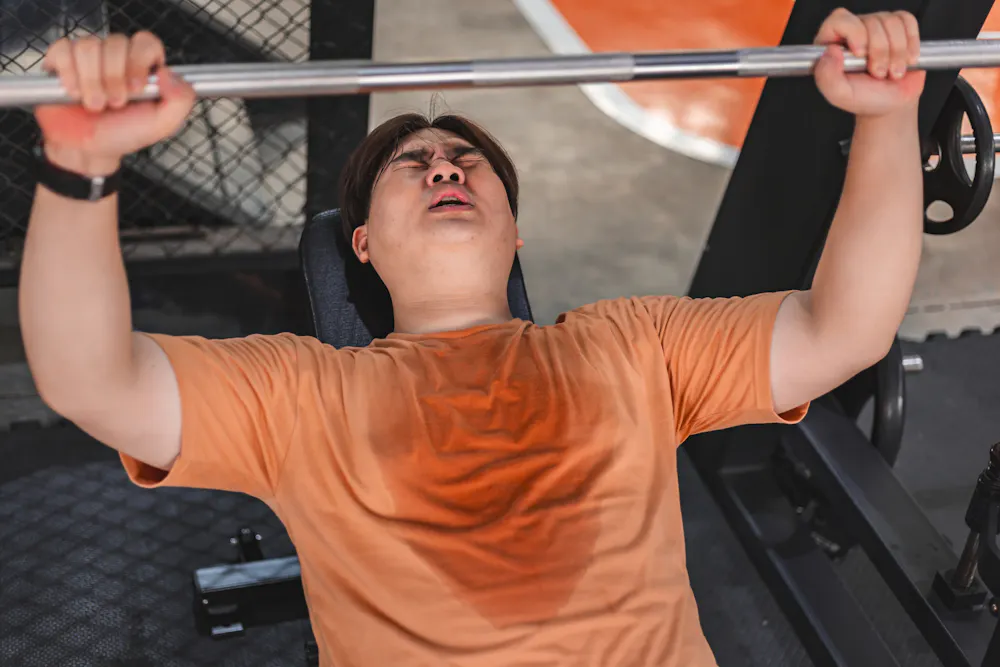
    MIL OSI Russia News

  • Over 1,000 Participate in 11th International Day of Yoga Celebrations in Qatar

    Source: Government of India

    Source: Government of India (4)

    The 11th International Day of Yoga was celebrated in Qatar with enthusiastic participation from over 1,000 people, bringing together members of the Indian community and yoga practitioners in a vibrant display of unity and well-being. Organized by the Indian Embassy in collaboration with the Indian Sports Centre, the event took place at Ideal Indian School in Doha. The program featured a rhythmic yoga display by children, a yoga quiz, a challenge session, guided meditation, and a mass yoga practice based on the Common Yoga Protocol. The event highlighted yoga’s growing global appeal and reinforced its role in fostering physical, mental, and cultural harmony.

  • MIL-OSI United Nations: Statement by IAEA Director General Rafael Mariano Grossi on the Occasion of the International Conference on Nuclear Security 2024

    Source: International Atomic Energy Agency (IAEA)

    When we met the last time, at ICONS 2020, many of us could not have imagined the momentous change we would experience between then and today, change that would affect billions of people, international peace and security, and nuclear security. A global pandemic was in the making and a war – in Ukraine – for first time soon would be fought among the facilities of one of Europe’s biggest nuclear power programmes.

    Meanwhile, profound technological advances have been made. Assessing their impact on nuclear security is a crucial task. Artificial Intelligence, and unmanned vehicles pose both a threat to nuclear security and offer new tools with which to enhance it. In the nuclear field itself, Small Modular Reactors promise new opportunities for applications such as desalination and power brought to remote communities via barge, but also require us to consider new security elements.

    The use of nuclear science and technology, often facilitated by the IAEA, has come on in leaps and bounds. Climate change and the drive for energy security are fuelling a desire for nuclear power. At this past Conference of the Parties to the UN Framework Convention on Climate Change, COP28, world leaders – those whose states use nuclear power and those whose do not – for the first time in nearly 30 years of COP meetings agreed nuclear power must be part of the transition to net zero. More than 20 countries have signed a pledge towards tripling nuclear power capacity and at the IAEA’s Nuclear Energy Summit in March heads of state agreed on the urgent need for conducive financial conditions. 

    Nuclear security is relevant throughout all the steps of the nuclear fuel cycle and is part of the social contract that underpins the existence and growth of nuclear power. Nuclear power programmes require national nuclear security threat assessments and “security by design”. Nurturing relevant research and a strong security culture are key, not only in countries with NPPs.

    The use of life-saving and life-affirming applications of nuclear science and technology is growing, from cancer patients gaining access to radiotherapy to farmers benefiting from new crop varieties developed with the help of irradiation. IAEA initiative such as Rays of Hope: Cancer care for all; Nutec Plastics; Zoonotic Disease Integrated Action (ZODIAC); and Atoms4Food are key vehicles facilitating wider access.

    All these opportunities to use nuclear and radioactive material depend on a strong and adaptive global nuclear security regime. For countries new to using nuclear and radioactive material, this means building up legal infrastructure, practices and culture that bolster nuclear security.  Nationally and across borders, collaboration and laser-focused vigilance are key to preventing groups with malicious intent from using nuclear and radioactive material to cause panic and harm.

    The threats to nuclear and other radioactive material and associated facilities are real and varied. The international nuclear security threat landscape keeps evolving. Today, anyone can type a few words into a computer and generative AI can create images of nuclear Armageddon, meaning it is now possible to spread panic about radiation fallout without a nuclear device. Risk scenarios include theft of nuclear and other radioactive material for use in improvised devices and sabotage at nuclear installations or during transport of nuclear and radioactive material. The risk of cyber-attacks requires the implementation of computer security programmes by those who use nuclear power and those who don’t. Risks come from outsiders and from those within the fold who are disgruntled or have been corrupted.

    Nuclear security is the national responsibility of individual states, but it also benefits enormously from close collaboration and the enabling role of the IAEA.  ICONS, which started in 2013, has been the place for ministers, policymakers, senior officials, and experts to gather to assesses current priorities, prepare for new challenges, and engage in scenario-based policy discussions. ICONS 2024, presided over by the co-presidents, HE Tim Watts, Assistant Minister for Foreign Affairs of Australia and HE Sungat Yessimkhanov, Vice-Minister of Energy of the Republic of Kazakhstan, covers the themes of policy, law and regulation; technology and infrastructure for prevention, detection and response; capacity building; and cross-cutting areas, such as the interface between nuclear security and nuclear safety. ICONS is the most important high-level international meeting on nuclear security. At this time of heightened tensions, it is imperative that there remains a unity of purpose and that nuclear security does not become a political football.

    This year marks the 10-year anniversary of the IAEA’s Division of Nuclear Security. The IAEA is at the forefront of adapting nuclear security to new challenges, including war. The seven indispensable pillars for ensuring nuclear safety and security have broad international support. They have brought crucial clarity at a time of war and are testament to the adaptiveness of the IAEA and the security regime.

    Those seven pillars are backed up by an enormous ongoing effort by the IAEA to support Ukraine, including through the continuous presence of IAEA experts at all of Ukraine’s nuclear power plants, including Zaporizhzhya NPP on the front lines of the war. When there were allegations of nuclear security breaches, the IAEA was there to investigate with impartiality and science. We set the facts straight that no nuclear material had been diverted, cutting through the fog of war, and diffusing a tense situation.   

    Not all our efforts require quite as much courage as our experts have shown in Ukraine, nor do they make international headlines. But every day, the IAEA – the Secretariat and the Member States – work together fastidiously to underpin nuclear security, never resting, always learning.

    Radioactive sources are extensively used in many domains, including medicine, industry, agriculture and research. An incident in one State can have far-reaching consequences for others, so security for one is security for all. That means supporting States with no, or less developed nuclear security infrastructure makes everyone safer. That support, which often comes via the IAEA, includes making lawmakers aware of their responsibilities.

    Nuclear Security requires the implementation of appropriate and robust legislative regulatory frameworks. In 2022, the first Conference of the Parties to the Amendment to the Convention on the Physical Protection of Nuclear Material (A/CPPNM) was held under the auspices of the IAEA. Reflecting the global importance of the legal framework and of nuclear security, parties managed to agree an outcome document and for the IAEA convene a subsequent conference. Since 2020, 14 new parties have joined the A/CPPNM bringing the total to 136. Five new Parties joined the CPPNM, bringing that total to 164. In addition to the A/CPPNM, political commitment to legally non-binding instruments, like the Code of Conduct on the Safety and Security of Radioactive Sources and its supplementary guidance, is a strong indication of radiation safety and nuclear security culture.

    But legal frameworks are just the beginning. They must be implemented. The IAEA plays a central role in assisting its Members States so they are able to do that. Last year we inaugurated the most visible symbol of our collaboration: the Nuclear Security Training and Demonstration Centre (NSTDC). This first-of-its-kind space, made possible by 15 donors, is a cornerstone for capacity building amid the growing need for sophisticated hands-on nuclear security training using advanced, specialized equipment. The NSTDC is part of a wide range of services offered by the IAEA, including peer reviews, such as the International Physical Protection Advisory Service (IPPAS), of which there have now been more than 100, and Advisory Missions on Regulatory Infrastructure for Radiation Safety and Nuclear Security (RISS), a service we launched in 2022. Our Incident and Trafficking Database (ITDB) now has 145 members and has enabled the reporting of more than 600 incidents in which nuclear or radioactive material went out of regulatory control.  Almost 8,000 people have benefited from our training in nuclear security, and we continue to work very hard to remove barriers that prevent talent from entering the field.  In March 2021, we launched the Women in Nuclear Security Initiative (WINSI) to support the achievement of gender equality in nuclear security. Meanwhile, the IAEA’s Marie Sklodowska Curie Fellowship Programme financially supports women pursuing a master’s degree in nuclear subjects and offers them internships, while our Lise Meitner offers women in the early and middle part of their career enriching opportunities within the field.   

    As the use of nuclear and other radioactive material around the world increases, more and more States are needing to increase their level of nuclear security. Nuclear security is as important as nuclear safety – we must put it on equal footing in terms of reliability of funding and the robustness of implementation.

    At ICONS 2024 we are – as the name of the conference indicates – “shaping the future”, not only of nuclear security, but of the world our children will inherit. That is because nuclear security is about more than preventing nuclear terrorism. It is an enabler to providing, through nuclear science and technology, the clean energy; cutting-edge medicine; nutritious food and hope for a better tomorrow.

    MIL OSI United Nations News

  • MIL-OSI Security: Defense News: Fighting for glory: Soldiers prepare for Fort Hood Fight Night

    Source: United States Army

    FORT HOOD, Texas — The smack of boxing gloves, the tap of feet and quick breaths break the silence in an open room June 11 at Warrior Way Fitness Center as several Soldiers trained for Fight Night.

    Fight Night is being held 6 p.m. June 27 at Abrams Physical Fitness Center. With 14 fighters and 7 bouts with two-minute rounds, there will be plenty to see for those who wish to attend. It serves as an opportunity for service members to pursue something greater than themselves, said Command Sgt. Maj. Loyd Rhoades, U.S. Army Garrison-Fort Hood command sergeant major.

    “These events are more than just competitions; they embody the spirit of resilience, camaraderie and dedication that define military life at Fort Hood, affectionately known as ‘The Great Place,’” he said. “By engaging in these bouts, participants not only hone their physical skills but also strengthen the bonds that unite them in service to our nation.

    “With each punch and cheer, we honor the tradition of excellence that has been built over generations,” Rhoades added.

    Soldiers participating have been practicing three times a week at Warrior Way. For some, they are refining skills. For others, they are learning a new sport entirely.

    “I learned a lot since I’ve been doing it — started like a month ago,” said Spc. Darius Miller, 1st Battalion, 82nd Field Artillery Regiment, 1st Armored Brigade Combat Team, 1st Cavalry Division, who is a first-time boxer. “I feel like I got way better conditioning actually, learning technique (and) knowing exactly what to do. I still got a lot to go, but I’m getting better, so it’s not too bad.”

    Boxing is harder than it looks, Miller said.

    “I don’t want to say I thought it was easy, but it’s way harder than it looks,” he expressed. “Like, cornered in the ring, even if it’s for one minute, it’s way harder than what it seems like.”

    Spc. Javier Cordova, 1st Battalion, 62nd Air Defense Artillery Regiment, 69th Air Defense Artillery Brigade, has boxed previously, but said this would be his first time competing.

    “Since the Army’s running it, and since I’m more confident in how I’ve been training, I just feel like I’m ready to compete, especially for the Army, which is even better,” he said.

    “(I have been) learning more defense, been learning more head movements,” Cordova added. “I’ve been going the extra mile, especially not even at practice after practice, running two miles or so, actually still weightlifting after practice. So, I’m here at Warrior Way three times a day.”

    Sgt. 1st Class Roman Davis, 2nd Battalion, 12th Cavalry Regiment, 1st ABCT, 1st Cav. Div., has been mentoring and helping the competing Soldiers and said they have shown much progress.

    “Some of these guys didn’t know much about (boxing), but once they started training here, they’re really developing and getting much, much, much better,” he said.

    “Their technique has improved overall,” Davis said. “Some of them, when they first got here, just (threw) punches, but now they’re getting more technical about it, understanding the fundamentals of boxing and also their defense is getting much better as well.”

    Boxing has several benefits, he noted.

    “It’s great for your mental health,” he said. “It’s great for your physical health. Keeps you in shape, keeps your mind right and I encourage it.”

    Those considering boxing should try, Cordova said.

    “Noone knows if they’re a good boxer until they come out and practice, and don’t judge it by the first day of practice because you’re going to be a beginner at most,” he said. “You probably won’t know how to do … the footwork, how to throw an actual punch or how to defend yourself, but the coaches here will actually teach you and actually work and build your way up. So I say, do it; don’t get cold feet. Don’t let the first practice leave a mark on you because everyone’s first days aren’t the best, but at least showing up matters.”

    Leading into Fight Night, Cordova hopes for a win.

    “I want to stay humble,” he expressed. “I don’t expect to win, I don’t expect to lose, I just expect to be my best.”

    Miller expects nothing less than victory.

    “I expect for myself to perform and win,” he said. “Nothing against my opponent — the best to him — but I want to win. I want to compete.”

    Rhoades expressed he is excited to see the camaraderie around Fight Night.

    “I’m thrilled to witness the unwavering support of our Soldiers’ units as they rally behind their teammates during this event,” he said. “It’s inspiring to see such dedication and camaraderie in action.

    Looking ahead, this event is poised to grow beyond the garrison’s scope,” he continued. “By this time next year, we anticipate the competition expanding to the III Armored Corps level, with boxers from all divisions converging at Fort Hood to vie for the prestigious Phantom Fight Night Trophy. This evolution underscores the event’s significance and the collective spirit of excellence within our ranks.”

    Fight Night is free and open to anyone. Those without access to the installation but wish to attend must obtain a visitor’s pass.

    MIL Security OSI

  • Over 1,500 join Union Sports Minister in Yogathon marking International Yoga Day

    Source: Government of India

    Source: Government of India (4)

    Union Minister for Youth Affairs and Sports, Dr. Mansukh Mandaviya, on Saturday participated in a mass yoga event at the Indira Gandhi Stadium in the national capital to mark the 11th International Day of Yoga. The event, part of the Ministry of Ayush’s ‘Yoga Sangam’ initiative, witnessed the enthusiastic participation of over 1,500 yoga practitioners, including more than 400 volunteers from the My Bharat programme.
     
    Held inside the Cycling Velodrome of the stadium, the event was also supported by the Sports Authority of India (SAI), which organised similar yoga activities across its regional centres, national centres of excellence, and Khelo India training hubs. The day’s theme, ‘Yoga for One Earth, One Health’, set the tone for the event which aimed to reinforce the message of holistic well-being through yoga.
     
    Dr. Mandaviya, joined by sportspersons and celebrities alike, performed several yoga asanas including Surya Namaskar. Among those who joined him were former Indian hockey captain and Padma Shri awardee Rani Rampal, Commonwealth Games silver medallist Priyanka Goswami, and actors Jackky Bhagnani, Rakul Preet Singh, and Madhurima Tuli.
     
    In a gesture aimed at further popularising the Fit India Movement, Dr. Mandaviya conferred the title of ‘Fit India Icons’ on actor-producer duo Jackky Bhagnani and Rakul Preet Singh, handing them certificates in recognition of their advocacy for fitness and healthy living.
     
    The minister, while addressing the gathering, extended his wishes on the occasion of International Yoga Day and called upon citizens to incorporate yoga into their daily lives. “Yoga is our cultural heritage. It is a mantra for fitness and a healthy life. Through initiatives like the Fit India Cult Yogathon, we aim to promote yoga as a way of life for all,” he said.
     
    In Jalgaon, Maharashtra, Minister of State for Defence Nikhil Khadse led a parallel event under Yoga Sangam in the presence of State Ministers Girish Mahajan and Sanjay Savkare. The event there witnessed participation from over 3,000 yoga practitioners, reflecting the national scale of the celebration.
     
    Rani Rampal lauded the efforts of the Ministry of Ayush and the Sports Ministry for taking yoga to the masses. Reflecting on her own discipline as an athlete, she said yoga was essential not just for sportspersons but for every citizen. “A fit and healthy nation is the foundation of a Viksit Bharat, as our Prime Minister has said. When our Sports Minister himself makes time for fitness weekly, we too must follow his example,” she added.
     
    Olympian Priyanka Goswami spoke of yoga’s impact on mental strength, particularly in endurance sports like race walking. “During long races, it becomes very difficult to control the mind. Daily meditation helps me stay focused. I appeal to the youth to choose physical activity and proper nutrition over harmful distractions,” she said.
  • UAE Minister Sheikh Nahyan Attends International Day of Yoga Celebrations at Abudhabi

    Source: Government of India

    Source: Government of India (4)

    The Embassy of India in Abu Dhabi hosted a large-scale celebration of the 11th International Day of Yoga on Friday at the Abu Dhabi National Exhibition Centre (ADNEC), in partnership with the Abu Dhabi Sports Council. Contrary to earlier mentions, the event was held exclusively at ADNEC and not at the Louvre Abu Dhabi. Held under the global theme “Yoga for One Earth, One Health,” the event aligned with the UAE’s Year of the Community initiative and drew wide participation from yoga enthusiasts across the emirate.

    The morning session was graced by UAE Minister of Tolerance and Coexistence Sheikh Nahyan Mabarak Al Nahayan as chief guest, with Indian tennis star Sania Mirza joining as guest of honor. Indian Ambassador to the UAE, Sunjay Sudhir, also took part in the celebration. Yoga sessions were led by renowned international instructors, catering to participants of all levels, and aimed at promoting holistic wellness and intercultural harmony. The Embassy has been organizing such events annually since the United Nations adopted India’s proposal to designate June 21 as International Day of Yoga in 2014, with growing interest each year underscoring the universal relevance and appeal of yoga.

  • UAE Minister Sheikh Nahyan Attends International Day of Yoga Celebrations at Abudhabi

    Source: Government of India

    Source: Government of India (4)

    The Embassy of India in Abu Dhabi hosted a large-scale celebration of the 11th International Day of Yoga on Friday at the Abu Dhabi National Exhibition Centre (ADNEC), in partnership with the Abu Dhabi Sports Council. Contrary to earlier mentions, the event was held exclusively at ADNEC and not at the Louvre Abu Dhabi. Held under the global theme “Yoga for One Earth, One Health,” the event aligned with the UAE’s Year of the Community initiative and drew wide participation from yoga enthusiasts across the emirate.

    The morning session was graced by UAE Minister of Tolerance and Coexistence Sheikh Nahyan Mabarak Al Nahayan as chief guest, with Indian tennis star Sania Mirza joining as guest of honor. Indian Ambassador to the UAE, Sunjay Sudhir, also took part in the celebration. Yoga sessions were led by renowned international instructors, catering to participants of all levels, and aimed at promoting holistic wellness and intercultural harmony. The Embassy has been organizing such events annually since the United Nations adopted India’s proposal to designate June 21 as International Day of Yoga in 2014, with growing interest each year underscoring the universal relevance and appeal of yoga.

  • MIL-OSI Africa: Pan-African Youth Take the Lead at CorpsAfrica’s 2025 All-Country Conference in Nairobi

    In a powerful convergence of hope, action, and purpose, more than 1,000 young change-makers, policymakers, philanthropists, and development partners from across Africa came together in Nairobi on Wednesday to mark the opening of CorpsAfrica’s (www.CorpsAfrica.org) 2025 All-Country Conference (ACC 2025).

    Download document (1): https://apo-opa.co/3ZIHAbQ

    Download document (2): https://apo-opa.co/3ZJ4Pm9

    Under the theme ‘Leading with Ubuntu: African Youth Transforming the Continent,’ speakers at the ACC 2025 unanimously called for African governments to institutionalize youth volunteerism as a pillar of national development. They urged policymakers to create enabling environments while aligning volunteer programs with broader socio-economic objectives, including job creation, civic engagement, and education.

    “At a time when Africa’s youth are calling for meaningful opportunities and a voice in shaping their future, we stand firm in our belief that they are the solution. Our vision is to cultivate a generation of African leaders—rooted in community and committed to sparking sustainable change from the grassroots up,” said Liz Fanning, Founder and CEO of CorpsAfrica.

    CorpsAfrica’s ACC 2025 is the organisation’s flagship biennial gathering, uniting diverse stakeholders to champion and accelerate youth-driven development across Africa. Building on the momentum of the ACC 2023 in Kigali, Rwanda, this year’s five-day summit aims to elevate the role of African youth—not just as leaders of tomorrow but as present-day catalysts for community-led, youth-driven transformation.

    Hosted at the Kenya School of Government, ACC 2025 brings together CorpsAfrica Volunteers, alumni, and staff from all 11 operating countries—Kenya, Malawi, Ghana, Rwanda, Morocco, Senegal, Ethiopia, Uganda, The Gambia, South Africa, and Côte d’Ivoire —marking a continental milestone in celebrating the power of volunteerism, African philanthropy, and youth innovation.

    “Since 2011, we’ve deployed over 1,000 African volunteers to under-resourced rural communities—not to impose solutions, but to listen, collaborate, and implement low-cost, high-impact community-led projects rooted in Indigenous knowledge. These aren’t just projects; they’re transformative platforms for human-centered design and asset-based community development,” emphasized Dr. Samora Otieno, CorpsAfrica’s Chief of Programs.

    The results speak volumes: CorpsAfrica volunteers have spearheaded more than Over 10,500 social and economic activities and 425 small-scale, high-impact community projects since 2021, improving the lives of nearly 2 million people. From education and clean water access to food security and youth entrepreneurship, these grassroots efforts tackle Africa’s most pressing challenges—one community at a time.

    CorpsAfrica’s ACC 2025 convenes in Nairobi at a pivotal moment, as Africa’s youth champion calls for expanded access to employment, entrepreneurship, and meaningful economic inclusion. Africa is the world’s youngest continent, with more than 70% of sub-Saharan Africa’s population under the age of 30 – yet faces a youth unemployment crisis of staggering proportions.

    For example, Kenya’s youth unemployment rate exceeds 38%, while Nigeria and South Africa grapple with even higher rates of 42% and 46% respectively.

    The conference aligns with global recognition of volunteerism’s transformative potential—including the UN Volunteers’ 2022 State of the World’s Volunteerism Report, which urges nations to formally recognize volunteer time as a measurable national economic asset.

    “We must reframe volunteerism – not as unpaid work, but as transformative leadership and professional development that accelerates public service for the 21st century” emphasized Dr. Patricia King’ori-Mugendi, Country Director of CorpsAfrica/Kenya. ”

    CorpsAfrica envisions ACC 2025 as the catalyst for a fundamental shift—harnessing African philanthropy to scale grassroots innovation across the continent. The June 16-20, 2025 gathering embodies Ubuntu principles through its commitment to pan-African knowledge exchange and collaborative action.

    Beyond conventional conferences, ACC 2025 delivers actionable outcomes: from youth investment policy dialogues to hands-on social enterprise incubators and community innovation demonstrations. This initiative re-frames the youth empowerment conversation, positioning volunteerism not as an alternative but as a strategic springboard to meaningful employment, entrepreneurial success, and values-driven leadership.  

    Participants attended robust professional development workshops and received a professional certificate to accelerate their careers on completion of their Volunteer service and become CorpsAfrica Alumni.

    The Government of Kenya reaffirmed its commitment to youth empowerment and innovation during the conference. Hon. Salim Mvurya, Cabinet Secretary for Youth Affairs, Creative Economy and Sport, challenged African nations to break free from donor dependency, urging a collaborative approach where governments, local businesses, diaspora networks, and communities jointly invest in youth volunteerism programs that deliver tangible opportunities, social inclusion, and dignity.

    ‘Africa’s youth have spoken with unmistakable clarity,’ Mvurya declared. ‘They want jobs – not handouts; platforms – not patronage; and action – not promises. As policymakers, we recognize this reality. Young people aren’t waiting – they’re building. CorpsAfrica’s model proves what happens when we equip youth with both trust and tools to lead.’

    As the premier organization equipping young Africans to lead sustainable change in their communities, CorpsAfrica demonstrates a transformative model of development – conceived by Africans, led by Africans, and implemented by  Africans.

    ‘The All-Country Conference sends a clear message to our youth. As Africa’s true transformation architects, your place isn’t just in boardrooms – it’s in villages, farms, classrooms, and clinics. Real leadership begins where people live, work, and struggle@, concluded Dr. King’ori-Mugendi.

    CorpsAfrica is redefining volunteerism as a powerful professional pathway. By embedding service into education curricula, employment systems, and national development frameworks, CorpsAfrica is creating an ecosystem where community-driven solutions become Africa’s sustainable growth engine.

    Distributed by APO Group on behalf of CorpsAfrica.

    About CorpsAfrica:
    Founded in 2011, CorpsAfrica recruits and trains ambitious young Africans to serve as volunteers in remote, under-resourced communities in their own countries. These volunteers facilitate small-scale, high-impact projects that are identified by local people and designed through a process of community-led development and human-centered design. Learn more at www.CorpsAfrica.org.

    MIL OSI Africa

  • Over 500 gather in Riyadh for 11th International Day of Yoga celebration

    Source: Government of India

    Source: Government of India (4)

    The Embassy of India in Riyadh celebrated the 11th International Day of Yoga with remarkable enthusiasm at the Prince Faisal bin Fahd Sports City Stadium on Friday, drawing over 500 yoga enthusiasts from across Saudi Arabia. The event, organized in collaboration with the Saudi Yoga Committee and local partners, highlighted this year’s theme, “Yoga for One Earth, One Health,” emphasizing yoga’s role in promoting individual well-being and global harmony. Ambassador of India to Saudi Arabia, Dr. Suhel Ajaz Khan, expressed heartfelt appreciation for the extraordinary turnout and warm support from Saudi authorities, describing yoga as more than just exercise but as a bridge between cultures and civilizations that transcends boundaries.

    The celebration featured prominent speakers who underscored the growing popularity of yoga in the Kingdom and its integration into Saudi Arabia’s evolving health and wellness landscape. Padma Shri awardee Ms. Nouf Al-Marwaai, President of the Asian Yogasana Sports Federation and a pioneering yoga advocate in Saudi Arabia, praised the Embassy’s continued efforts in spreading awareness and fostering cross-cultural engagement. Mr. Ahmed Alsady, CEO of the Saudi Yoga Committee, reaffirmed his organization’s mission to promote yoga as an integral component of Saudi wellness culture, while Ms. Shahad Al-Mufti, Director at the Saudi Ministry of Sport, also graced the event with her presence.

    The main attraction was the Common Yoga Protocol session, led by two women yoga instructors, Ms. Nervin Ashram and Ms. Seema Ghanam, who guided participants of all skill levels through foundational yoga postures and breathing techniques. The iconic stadium setting provided an ideal atmosphere for attendees to immerse themselves in various yoga asanas and experience their rejuvenating effects firsthand. The International Day of Yoga, proclaimed by the United Nations and celebrated globally each June 21, underscores the timeless relevance of yoga as a practice that harmonizes body, mind, and spirit.

    Friday’s main event represented the culmination of a month-long series of yoga activities organized by the Embassy throughout the Kingdom. The celebrations began with a curtain-raiser event at the Embassy on May 17, followed by multiple sessions in early June under the “Yoga for One Earth, One Health” theme. A particularly notable event took place at the iconic Edge of the World on June 8, showcasing yoga against a breathtaking natural backdrop that perfectly embodied the connection between human wellness and environmental harmony.

    The week leading up to the main celebration saw extensive participation from Indian school students across six Saudi cities — Riyadh, Jeddah, Taif, Jubail, Khafji, and Tabouk — who took part in yoga sessions from June 14 to 20. Their enthusiasm and unity reflected the spirit of wellness, harmony, and togetherness that yoga promotes, demonstrating how the ancient practice continues to resonate with younger generations. The widespread participation across multiple cities and the strong collaboration between Indian and Saudi institutions highlight the deepening cultural ties between the two nations and the universal appeal of yoga as a tool for physical, mental, and emotional well-being.


  • MIL-OSI Africa: Kirsty Coventry Unveils Collaborative & Inclusive International Olympic Committee (IOC) Leadership Vision at First Public Media Roundtable

    Source: Africa Press Organisation – English (2) – Report:

    In her first major media appearance since being elected President of the International Olympic Committee (IOC), Kirsty Coventry offered a strikingly human portrait of the leader she intends to be: humble, collaborative, and unwaveringly grounded in the values of sport, equity, and Olympism, as she addressed international media during an online open roundtable on Zoom this afternoon.

    FIRST WOMAN & AFRICAN Speaking candidly for over an hour, the Zimbabwean reflected on the life journey that brought her from the pools of Harare to the corridors of Olympic power in Lausanne. Her presidency, set to begin officially on Olympic Day, 23 June 2025, will mark a historic moment as she becomes the first woman and first African to lead the IOC.

    GROUNDED LEADERSHIP Coventry made it clear that her leadership will not be rooted in authority, but in consensus and a collaborative, human-centred vision: ”In both my personal and professional career, I’ve always had incredible people around me to keep me grounded and humble; those are people whom I will continue to keep around me.” 

    She added: “Values are at the core of our daily business, they’re incredibly important in today’s communities, and I hold this very close to my heart.”

    WHY IOC FORUMS MATTER Replying to a question from Japan’s Wakako Yuki on the role of IOC Forums in attribute Conventry’s vision as president, “I have a vision that I would like to see, but I want to do it in a collaborative way. The Athletes Forum, eSport, Olympism365, the two ASOIF and WOF General Assemblies have been great platforms to listen to people, to hear topics that are important to them.”

    2ND MEDIA ROUNDTABLE IN SIGHT Coventry announced that immediately following the IOC Session on June 23-24, she has invited members to stay for a two-day “pause and reflect” workshop, an opportunity for honest dialogue about the IOC’s challenges and future direction: 

    “I’ve invited the IOC members to stay two extra days so that I can hear what is on their mind and what they see as our opportunities and what they may see as our challenges, as we move into the future and come up with different ideas. This is the first point in a longer consultation process with all stakeholders, including yourselves as media, where we’ll create another round table where I’ll get to ask you all a bunch of questions. That will strengthen the Olympic movement in a collaborative way.”

    VALUES CARRIED TO IOC PRESIDENCY Nadine Hassan from Jordan asked Kirsty, looking back on her journey, from Olympic champion to minister and now IOC President, which moments off the podium had the greatest impact in shaping the person she is today? “I’ll need a moment to properly reflect on this. I think I’d have to go back to my roots. Growing up in Zimbabwe played a huge role. It’s a small community in many ways. We’re a big country geographically, but we’re just 15 million people, and we lean on each other.

    “I think that kind of upbringing, maybe a bit more sheltered, surrounded by strong values and close-knit support, helped me understand the importance of having grounded, humble, genuine people around me. And it’s those people who’ve consistently reminded me of where I come from. That’s been one of the most powerful influences throughout my journey.

    CHALLENGES, AND DIFFICULT MEN.. New York Times reporter Tariq Panja referenced Coventry’s previous remarks about dealing with “difficult men.” She smiled knowingly and recounted the pressures she faced as a young Olympic medallist representing Zimbabwe during politically turbulent times: 

    “As athletes, we had a lot of pressure coming from different government officials in Zimbabwe, and you know, it was hard. To look at others and trying to say, I’m an athlete, I don’t believe in the politics in sport. I want to just focus on performing well,” She said, without names mentioned, “Looking back now, it taught me a lot about how to work with people, how to be respectful of differing opinions and still move forward on a shared agenda.”

    WOMEN SUPPORT WOMEN USA’s Rachel Axon asked, How has your career been shaped by other women at various career points, adding the gender equality initiatives to your role as female IOC President. Conventry highlighted the women who shaped her path, from her mother and grandmother to her university head swim coach, even Olympic trailblazers like Donna de Varona:

    She said, “My grandfather passed away when Mom was in her late teens. And so my grandmother was a single mom for most of her life, with three kids, and both were just incredibly strong women who raised families, and I think my mom’s pretty great, and my uncle and aunt. She did a great job, but she also had a successful career in fashion. My mum got to see her doing that, so she was always an incredible role model for my sister and I.”

    She adds: “My swim coach, Kim, who became a Division I coach while her husband was deployed overseas, with two very young kids, watching how she balanced that was inspiring. When we were preparing for the 2004 Olympics, her eldest came to Athens as a baby.. Again, I’ve been fortunate in my life to have very strong women around me who have shown me that it’s possible. It’s not always easy, but it’s possible,” noting her hope to pay that inspiration forward, especially for her two daughters.

    AFRICAN HERITAGE A question from China’s Mandan Zhu touched on Coventry’s rich international background and the impact of her African heritage, coming from Harare to Lausanne as a little girl with big dreams,“I can remember exactly where I was standing in my parents’ living room. I was still in my swimsuit, feeling cold after swimming in the pool, only to stand in front of the TV and watch divers compete. I would say that there’s never a dream too big.

    “You know, where there is a will to achieve, there’s a way. And don’t let someone talk you out of having that dream of what could be the best thing that happens to you. It’s quite powerful.”

    WEIGHT OF BEING ‘FIRST’ British journalist Jamie Gardner asked Coventry about the significance of becoming the IOC’s first female president at this particular moment in history. While she admitted it wasn’t something she initially focused on, the outpouring of messages from women around the world has since left a powerful mark: “I had a coworker tell me that his mum said, ‘Never in my lifetime did I think I’d see a woman lead the movement you work for.’” That moment, she admitted, hit her deeply. “It’s not just an exciting day, it’s a day with a lot of responsibility.”

    FROM SYDNEY TO BRISBANE Australia, particularly the Sydney 2000 Games, remains a defining touchstone for Coventry’s Olympic journey. Asked about her journey coming full circle, from a wide-eyed young swimmer at Sydney 2000 to President for Brisbane 2032, Coventry shared a funny tale about struggling to put on her first Speedo sharkskin suit, helped up by none other than Australian legend Susie O’Neill:

    “When we arrived in Sydney, I went into the changing room to try my Speedo suit on, and it turned into a total disaster. I had one leg in, was struggling to get the other in, lost my balance completely, and toppled over. Mortifying. Then this amazing person next to me leans down to help, and as I look up, I realise… It’s Susie. I never forget that moment because she was a role model to me, those Games, changed everything for me,” she recalled. “Now I hope Brisbane will show the world the warmth and passion of Australia, and inspire the next generations like Sydney did for me.”

    LIFTING VOICES As the media roundtable with IOC President-elect Kirsty Coventry progressed, her clarity of purpose sharpened further. In a movement often shaped by the world’s most powerful nations, Coventry made a point of bringing attention to her roots, and how they shape her priorities: “I come from a much smaller NOC, a developing country,” she said of Zimbabwe. “And I understand the challenges our athletes face. How do we close that gap? How do we ensure that athletes from all walks of life, if not with the same opportunities, at least have equal opportunities?”

    Coventry affirms that she intends to elevate voices often left on the margins. Her presidency, she hinted, will focus as much on inclusion as it will on innovation.

    LEARNING FROM YOUNG GENERATIONS Perhaps the most poignant reminder of who Coventry is, and who she intends to be as IOC President, came when she spoke about her own children. “They’re a daily reminder of our responsibility to keep sport relevant, and to listen, really listen, to what young people think is important. Kids are honest,” she said with a smile. “And sometimes that’s a very good thing.”

    Her two young daughters, she explained, are constant reminders that sport must remain relevant and engaging for younger generations. Despite the gravity of her new role, Coventry remains adamant about keeping her family grounded: “We won’t be staying in the Lausanne Palace. I want my kids to grow up doing the same things I did, making their beds, doing house chores, and just being kids.”

    ROAD AHEAD As Kirsty Coventry prepares to officially assume the role on June 23, her message is one of optimism, inclusivity, and integrity. With the weight of history on her shoulders and the wind of lived experience at her back, she is poised not just to lead the Olympic Movement but to reshape it for the modern age, starting by one athlete, one story, one honest conversation at a time.

    – on behalf of International Sports Press Association (AIPS).

    Media files

    Download logo

    MIL OSI Africa

  • PM Modi made yoga a global wellness movement: Chandrababu Naidu

    Source: Government of India

    Source: Government of India (4)

    Andhra Pradesh Chief Minister N. Chandrababu Naidu called Prime Minister Narendra Modi a visionary for transforming yoga into a global wellness movement.

    The Chief Minister highlighted the global recognition of the International Day of Yoga since its adoption by the United Nations. He credited Prime Minister Modi’s leadership for this achievement, noting that Yoga Day is now celebrated at over 12 lakh venues across 175 countries, with participation from 10 crore people worldwide.

    Naidu was speaking at the 11th International Day of Yoga celebrations in Visakhapatnam, where he joined the Prime Minister, central and state ministers, the Governor, and others in performing the Common Yoga Protocol.

    Naidu praised PM Modi for popularizing yoga not only in India but around the world.

    “Yoga is accepted by everyone, irrespective of nationality, region, religion, or language. Yoga unites the body, mind, and spirit. It benefits physical health, mental well-being, and stress management; boosts immunity; and enhances self-confidence, self-discovery, personal growth, mindfulness, and inner peace. This leads to reduced violence and promotes peace,” said Naidu.

    He noted that technologies like Artificial Intelligence have made yoga more inclusive and accessible.

    Naidu thanked the Prime Minister for giving Andhra Pradesh the opportunity to host the event, calling it historic. He pointed out that over 3 lakh people participated in a yoga session held along a 28-km stretch from Visakhapatnam to Bhogapuram.

    He added that during the month-long campaign ‘Yogandhra’, more than 1.44 lakh yoga teachers were trained. The campaign registered over 2.17 crore participants at 1.4 lakh locations, with 1.7 crore certificates being issued.

    He announced that 22,122 tribal students created a Guinness World Record by simultaneously performing Surya Namaskar in Visakhapatnam on Friday.

    Expressing delight over the organization of global competitions focused on yoga, Naidu said the Yoga Super League would be held in September.

    He also urged the Prime Minister to use his influence to include yoga in the Asian Games, Commonwealth Games, and eventually, the Olympic Games. He remarked that the Prime Minister can “break any record and make history.”

    “Yoga has achieved mass momentum. We must ensure it becomes a part of our daily lives,” the Chief Minister said, appealing to the youth to practice yoga for one hour every day.

    “Young people should see yoga not just as exercise but as a powerful tool to enhance focus, discipline, and creativity in a rapidly evolving digital world. With regular practice, you will witness a miracle in your lives,” he said.

    Stating that a healthy, wealthy, and happy Andhra Pradesh is the goal of the Swarnandhra vision, he added that it aligns with Viksit Bharat.

    Naidu noted that PM Modi has revived yoga, naturopathy, and Ayurveda, and is promoting green energy, Swachh Bharat, and natural farming. He said the Prime Minister’s vision extends beyond a healthy global community to a healthy planet.

    IANS

  • FIFA Club World Cup: Bayern beat Boca to progress to knockouts

    Source: Government of India

    Source: Government of India (4)

    Bayern Munich rekindled their European pride at the Club World Cup with a gritty 2-1 win over Boca Juniors on Friday, booking their place in the last 16 after a tense and fiery clash.

    In front of a passionate crowd dominated by Boca supporters—who transformed the Hard Rock Stadium into a mini “Bombonera”—the Argentine side fought tooth and nail. But Bayern’s determination prevailed late in the game.

    Harry Kane opened the scoring for the German champions early in the first half, only for Boca to hit back through Miguel Merentiel. With the game hanging in the balance, Michael Olise struck a late winner to send Bayern to the top of Group C with six points, two clear of Benfica. Boca, with just one point, remain in contention and will face Auckland City in their final group game, while Bayern take on Benfica.

    The win was a timely boost for European clubs, who have recently struggled in the tournament, with Porto, PSG, and Chelsea all suffering defeats.

    The match crackled with intensity, particularly in the second half, as Boca pressed high and disrupted Bayern’s rhythm with physical, high-tempo football.

    Bayern started brightly and thought they had taken the lead when Olise’s curling corner found the net, but the goal was ruled out by VAR for a foul on the goalkeeper. The breakthrough came in the 18th minute when a deflected clearance fell to Kane, who calmly slotted the ball into the bottom corner after a cross from Konrad Laimer—his first goal of the tournament after being held scoreless in the 10-0 rout of Auckland City.

    Bayern nearly doubled their lead soon after, as Serge Gnabry sent a ball across the face of goal, but Kingsley Coman missed a golden opportunity to tap in. At the other end, Manuel Neuer made a pair of sharp saves to deny Kevin Zenon, as Boca continued to pose a threat.

    After the break, Boca ramped up their intensity, unsettling Bayern with relentless pressing and spirited tackling. Their efforts paid off in the 66th minute when Merentiel was played through on the right, danced past Josip Stanisic, and beat Neuer with a composed finish—sending the Boca fans into a frenzy.

    But Bayern held their nerve. In the 84th minute, Olise curled a precise shot into the bottom corner after being teed up by Kane, sealing a crucial win and securing their spot in the knockout stages.

    IANS