Category: Tourism

  • MIL-OSI Russia: “Active Citizens” will choose the best routes of the “Show Moscow!” competition

    Translation. Region: Russian Federal

    Source: Moscow Government – Government of Moscow –

    The Active Citizen project has begun vote for the best tourist route of the “Show Moscow!” competition. This was reported by Natalia Sergunina, Deputy Mayor of Moscow.

    Traditionally, residents of the capital will determine the winners in each of the 12 administrative districts, and the jury will determine the five most creative ideas.

    “Participants from six to 87 years old sent more than 800 applications to the competition. Compared to last year, their number has grown by a third. The most popular topics were history, culture, architecture and ecology. At the same time, the authors presented different formats of excursions – from walking, cycling and river to metro trips,” said Natalia Sergunina.

    Most of the presented routes pass through the Central, Eastern and North-Eastern administrative districts.

    Thus, during one of the walks, tourists are offered to ride a tram from Severnoye Medvedkovo to the Ostankinsky District, stopping at temples, parks and the Rostokinsky Aqueduct. Participants will learn why the Babushkinsky District is named this way, see zodiac signs made of metal structures and try legendary donuts.

    Another competition entry is dedicated to the architect Ivan Kondratenko, known as the creator of the famous cloud cutters.

    Another excursion invites you to immerse yourself in the world of Soviet cinema. All those who wish will get acquainted with places in the southwest of the capital, which many times became living decorations for legendary films, including “Moscow Does Not Believe in Tears” and “You Never Dreamed of It…”.

    The finalists were determined by members of the expert jury. It included representatives of the Museum of Moscow, the tourism industry, capital departments and winners of previous seasons.

    Sergei Sobyanin: Leading Moscow guides to take part in “My District” excursions“Show Moscow!”: How Muscovites Create Unique City Tours

    The “Show Moscow!” competition has been held since 2020. Over the course of its history, participants have developed more than 2,500 original routes to interesting places in the capital.

    The Active Citizen project has been running since 2014. It has already been joined by 7.2 million people. Decisions supported by city residents are implemented in the city.

    Get the latest news quickly official telegram channel the city of Moscow.

    Please note: This information is raw content directly from the source of the information. It is exactly what the source states and does not reflect the position of MIL-OSI or its clients.

    Please Note; This Information is Raw Content Directly from the Information Source. It is access to What the Source Is Stating and Does Not Reflect

    https: //vv.mos.ru/nevs/ite/155491073/

    MIL OSI Russia News

  • MIL-OSI Russia: Interview with Alexey Overchuk for the Vedomosti newspaper.

    Translation. Region: Russian Federal

    Source: Government of the Russian Federation – An important disclaimer is at the bottom of this article.

    Alexey Overchuk: “A change in the technological order is taking place”

    Deputy Prime Minister Alexei Overchuk discusses the nature of the changes taking place in international trade, the struggle of countries for access to rare earth minerals, and the establishment of new trade relations for Russia in an interview with Vedomosti.

    Interview with Alexey Overchuk for the Vedomosti newspaper

    Question: Vedomosti, together with Roscongress and economists, prepared a report for the SPIEF on the topic of “Global Development Opportunities.” The main trend that experts are currently noting is the fragmentation of the global economy. In your opinion, what balance of power may be established in the near future?

    A. Overchuk: Indeed, fragmentation of the world economy, or deglobalization, is happening. This has an economic background.

    Globalization emerged in the late 1940s and early 1950s as a response to the economic and social successes of the socialist economy. In the United States, it was seen as a threat to a way of life based on private property.

    In this global confrontation, the USSR and its allies were excluded from global supply chains, financial restrictions were imposed on them, export controls were applied, obstacles were created to obtaining export revenues, and conditions were created for the diversion of resources to unproductive expenditures, such as the arms race and peripheral military conflicts. The policy of containment put the USSR in a position where its revenue opportunities were narrowed and its expenditure obligations increased. The calculation was that at some point the country’s budget, formed on the basis of a strict planning system, would cross the break-even point and the state would not be able to fulfill its obligations to the Soviet people.

    At the same time, in exchange for participating in the containment policy, the United States created the most favorable conditions for the development of the countries that supported them. They were provided with access to cheap finance, technology, education, and security guarantees. Thus, these countries were freed up funds that could be used for development, and market conditions and freedom of capital movement made it possible to build the most effective international supply chains. Investments were placed where they gave the greatest return, which made it possible to better saturate the market with goods. An international trade system was formed that sought to ensure free access of goods to foreign markets, including the most capacious consumer market on the planet.

    The United States bore the burden of maintaining this system for decades, but also, thanks to the strength of its domestic market, it was able to turn a blind eye to tariff restrictions and barriers to American exports in the markets of friendly countries. Many of these countries took advantage of globalization, which demonstrated the advantages of a market economy. It was not emphasized that this success was financed by the largest economy in the world. The outcome of the confrontation between the two economic systems is known, and, obviously, the point of further bearing these costs has diminished. Today, countries that have enjoyed the benefits of globalization for 70 years are forced to pay their own bills, costs and their structure are changing, and this is pushing the world to find a new balance.

    Question: Why did fragmentation begin now?

    A. Overchuk: These processes are long and are now just becoming noticeable. Over the past 30 years, there has been a series of economic crises and regional conflicts that have diverted resources and influenced the growth of national debt. The United States allowed a trade imbalance and barriers to its exports. Trust in the dollar-based international financial system has been undermined. The freezing of Russian foreign assets and talk of their confiscation have called into question the security of property rights. New technologies have emerged. Internal problems have accumulated. Apparently, [US President Donald] Trump wondered: why continue to bear this global burden when solving the accumulated internal problems requires corresponding expenses? All this has a complex effect.

    In addition, the pandemic has highlighted the weaknesses of the global economy. China has gone into isolation, causing supply disruptions to global markets. The vulnerability of international commodity flows and dependence on foreign suppliers, for example, of the same chips, began to be perceived as a security threat. There has come an understanding that the global economy does not always work as we would like, it is necessary to reduce the transport shoulder, move production closer to consumers, and even better, especially when it comes to security issues, not to transfer technology and develop our own production.

    Question: How would you identify the potential fault lines of global economic fragmentation?

    A. Overchuk: The modern world is connected by complex economic threads, and if they begin to break, their recreation in other regions will require very large investments, the justification of which will often be questionable. At the same time, processes have already been launched that are throwing the global system out of balance and forcing the formation of new cooperation chains and the search for new balances. In this environment, countries will be attracted to the largest economies of their regions. Obviously, such factors as the presence of domestic consumer demand capable of ensuring the necessary level of sustainable independent development, the presence of science and a production base that supports technological sovereignty, own resources necessary to ensure food and energy security, as well as the development of a new economy will play a role here. Availability of water will be critical. The presence of a civilizational community and a common language for communication will play a role. Not many regions of the planet that, despite fragmentation, will continue to maintain ties with each other fall under this description.

    Question: The trade deficit has been the main reason for the double- and triple-digit tariffs in the US. What are the long-term consequences of the US tariffs?

    A. Overchuk: They will negotiate and look for a balance of interests. First, they announced an increase in tariffs and made it clear to their partners how everything could suddenly change and become bad, and then they rolled back and negotiations began. Tariffs are a double-edged sword. Their growth entails an increase in prices for imported consumer goods, which affects inflation, leads to a drop in real incomes, etc. It is unlikely that anyone wants to go this route completely, but some positions of American exports may improve. The main goal of these efforts is to create conditions for the relocation of production to North America. A self-sufficient macro-region with a huge consumer market and global export opportunities is being formed here. Such shifts do not happen quickly, so the coming years will be spent in a joint search for new equilibrium points, which will be very dynamic. Agreements will be reached and quickly revised.

    Question: We discussed with experts how difficult it will be for China to overcome this. They are focused on the domestic market, but the export economy still accounts for a significant part of the GDP. How will this hit China, even if they agree to reduce duties to reasonable levels?

    A. Overchuk: China is making a lot of efforts to improve people’s living standards and increase domestic consumption. Its progress in this area is obvious. On the other hand, it is, of course, an export-oriented economy that has extracted maximum benefits from globalization and has become one of the most technologically advanced on the planet. The international trade system has made the economies of the United States and China interdependent like no other. The state of relations between them determines the well-being of the entire world, and both countries understand the consequences of their abrupt rupture. At the same time, it is known that China’s growth is now perceived in the United States as a threat to its leadership. Hence the use of export control measures and the withdrawal of assets of American companies. In addition, recreating the international supply chains formed in and around China will require attracting an unbearable volume of investment. This will take time. So there will be agreements on some positions.

    At the same time, China is actively diversifying its export markets. As a country with a strategic vision, China has been working on implementing its Belt and Road Initiative for over 10 years, creating favorable conditions for promoting its goods, services, technologies, and knowledge to foreign markets. This is a global project. Geography does not allow us to talk about it as a macro-region, but rather as a global network structure with the center of economic gravity in China.

    Question: It used to be that the production process was distributed across different countries: raw materials were mined here, processing and assembly took place – design and software work took place there… If the value chains were to be broken, how would production and international trade take place?

    A. Overchuk: It will not come to a complete break. The world is very complex now. Hundreds and thousands of individual components and parts are produced in dozens of countries and cross state borders dozens of times before they are put together into a final product that is consumed on some completely different side of the world. The changes that are taking place lead to changes in the cost structure of production and delivery of goods and services to end consumers, which does not go unnoticed by investors and they react to it. In addition, the global economic system has shown its vulnerabilities. Some things will continue to be created as a product resulting from coordinated global efforts, while others will be localized within individual macro-regions and countries. Much of this is based on economic calculations, while others are dictated by the current global situation.

    Particular attention should be paid to new types of resources for the new economy. After all, countries with technologies do not always have a sufficient resource base. Therefore, international supply chains connecting different regions of the world are likely to receive new content. Countries with technologies will strive to develop their own production, and therefore the need for cross-border knowledge transfer will decrease. End consumers will have access to user devices connected to computing power located in countries that own technological solutions and intellectual property rights. The main flows of global income will also be directed there. Such technological dependence will be avoided by those who can independently develop the relevant competencies and protect their market. Potentially, there are three or four macro-regions on the planet that are already doing this or will be able to do so.

    Question: Is it economically feasible to do everything in one country?

    A. Overchuk: It is economically expedient to optimize costs, i.e. to distribute production in such a way that the best competitive conditions are achieved for each specific product on the consumer market. This is how it worked under globalization. On the other hand, there are factors of technological sovereignty, food and energy security. Some countries can afford greater dependence on external circumstances, some less. Their income level will also depend on this.

    Question: So this is a question of national security and sovereignty?

    A. Overchuk: This is at the intersection of interests, ambitions and opportunities.

    Question: If we resume trade relations with the US, is it possible to increase trade turnover? Last year it was a 30-year low – $3.5 billion. Compared to the economies these are, one could say there was simply no trade turnover.

    A. Overchuk: Our trade turnover with one of the two largest economies in the world (China. – Vedomosti) exceeds $244 billion. With Belarus we have $51 billion, with Armenia it exceeded $12 billion. Therefore, as they say, when there is practically nothing, Russian-American mutual trade has good potential. Taking into account the low base effect, trade turnover with the USA will grow rapidly if such decisions are made.

    The United States is currently attracting investors to its country and seeking to create new production facilities. Even taking into account the capacity of the North American market, the United States will be interested in increasing its exports. From this point of view, the EAEU is about 190 million consumers with good purchasing power living within the perimeter of the common customs contour. In other words, this is a promising market for the United States. As for the reverse flow of goods from the EAEU, we see interest in access to critical minerals and rare earths, which Central Asia, located between China, Afghanistan, Iran, the Caspian Sea and Russia, is rich in. Investing in the creation of modern high-tech production facilities in North America requires ensuring guaranteed supplies of raw materials, which makes the existence of secure supply chains critically necessary. The most cost-effective and secure route from Central Asia to North America lies north of Kazakhstan to the Baltic and the Barents Sea. There are other areas of mutual interest, so there is certainly potential.

    Question: This year marks the 10th anniversary of the Greater Eurasian Partnership idea. It was planned that the EAEU would be “coupled” with other associations that already exist on the continent. Which ones have more prospects?

    A. Overchuk: Various integration associations are being formed on the large Eurasian continent today. There is the EU, the EAEU, the CIS, and ASEAN. China is developing its Belt and Road project. The SCO has recently been paying increasing attention to issues of improving transport connectivity on the continent and creating common investment mechanisms for development. These are already mechanisms for linking participating economies.

    If we talk about the EAEU, work is underway to develop international transport corridors that will play a central role in the overall transport framework of Greater Eurasia, integration with the Chinese Belt and Road initiative is being carried out, industrial cooperation projects that build value chains are being supported, trade barriers are being reduced, and the free trade zone is being expanded. This is what is already being done.

    Of particular importance for the EAEU is the development of trade relations with the countries of the Global South and the formation of better conditions for promoting exports from our countries to this market, as well as saturating our common market with their products. These efforts contribute to the development of mutual trade with India, Iran, Pakistan, Afghanistan, and further – with Southeast Asia, with Africa. These are all rapidly developing markets with good demographics, and there is prospect there.

    Question: Since you mentioned Afghanistan… The Supreme Court lifted the terrorist status of the Taliban, the de facto authorities of the country. How do you think this could change the approaches to the implementation of international projects in the country and Russia’s participation in them?

    A. Overchuk: Russia has a varied history with this country, and many people have questions about the normalization of relations with the Taliban movement. What should be understood here? For the first time in many years, a situation has developed in Afghanistan where the central government controls the entire territory of the country and seeks to ensure peaceful conditions. Representatives of Afghanistan say that they are interested in living in peace with their neighbors and developing their own economy. The results of these efforts are already noticeable. Automobile transit from Russia, from Central Asia through Afghanistan to Pakistan has begun.

    The Afghans have proposed a list of projects: from the construction of residential buildings to power plants, from road construction to the production and processing of agricultural products. Any government interested in improving life in its country will take such actions. It is in our interests for Afghanistan to be a peaceful state, and for people to be engaged in peaceful life. We want to contribute to this. Especially since the leadership of this country demonstrates a positive attitude towards Russia.

    Question: On the issue of Eurasian transport corridors. There is North-South. Iraq has spoken about its intention to build a branch from Iran. There is Turkey’s “Development Road” project – from the Persian Gulf through Iraq to Turkey and Europe. Can this also be connected somehow? Or are they competitors?

    A. Overchuk: There are many initiatives in the transport and logistics sector on the continent. Countries are striving to develop international transport corridors. As a result, a single transport framework of Greater Eurasia will be formed. The totality of these efforts, even competing with each other, will strengthen transport connectivity in the macro-region and promote the development of its economies. Everyone in Greater Eurasia will benefit from this. But peace is needed for this.

    Question: We have a free trade zone with Vietnam. Are there any similar agreements planned with India, with which our trade is growing?

    A. Overchuk: The purpose of such agreements is to simplify trade conditions, reduce costs for business by improving the accessibility of foreign markets, which leads to an increase in mutual trade, complementarity and growth of the economies of the participating countries. The EAEU member states view India as the largest and geographically closest market in Eurasia to our union, with which it is possible to conclude a free trade agreement. Together with our partners in the EAEU and the CIS, we are working to improve transport connectivity with India and create better conditions for the mutual movement of goods between our markets. Afghanistan, Iran and Pakistan are also interested in developing such infrastructure. The free trade agreement with Iran entered into force in May this year. Preparations were underway with Pakistan to launch the first freight train between our countries. Our vision of Greater Eurasia, among other things, includes the formation of a continental transport framework, which, where possible, will be supported by free trade agreements. It is clear that what is now starting to happen between Iran and Israel is pushing this prospect back and slowing down the economic development of the countries in the region.

    Consultations are underway on the issue of the agreement with India. We see that India is also working in this direction, concluding agreements with other countries, for example with the UAE or, most recently, in May, with Britain, developing trade and economic ties with the USA. The totality of such efforts of many countries is forming a new network of mutually beneficial ties and relations between states and international integration associations.

    Question: What are the positions of the parties?

    A. Overchuk: The positions of the parties will be set out in the signed document.

    Question: You said that it is important to strengthen good-neighborly relations in order to counter external challenges that are growing every year. In this regard, what prospects do you see for the development of the EAEU? Is it possible to expand the number of its participants?

    A. Overchuk: The EAEU has already reached a very high level of economic integration. Five equal member states have access to a large common market, have put in place a mechanism to support industrial cooperation and are jointly expanding the free trade zone, providing better competitive conditions for their exports. In general, the EAEU has resolved the problems of food and energy security, and transport connectivity is being strengthened. Last year, the GDP growth rates of the EAEU member states exceeded the world average. All this does not go unnoticed, and an increasing number of countries are showing interest in closer cooperation with our integration association.

    As for the accession of new states to the EAEU, this is always their sovereign decision, taken based on an analysis of the pros and cons that the respective economies will receive. Countries comprehensively assess the impact of integration on individual sectors of their economy, investment attraction, the labor market, their foreign economic and foreign policy relations with other countries. For our part, we also consider these models, assess how the opening of our markets to potential member states will affect our economies, as well as how the structure of their economies will be transformed. We understand that for the economies of our closest neighbors, joining the EAEU will create new opportunities for growth and development.

    Question: We have observer countries in the EAEU. As if joining is the next step for them?

    A. Overchuk: Observer states in the EAEU are Uzbekistan, Iran, Cuba. This status gives the country the opportunity to gain access to materials, documents, have the opportunity to participate at the expert level in working meetings, can state their positions there, and also take part in regular meetings at the level of heads of government and heads of state. The EAEU is the largest economic integration association in our region, and, understanding its logic, they can make more informed decisions for interaction and development of their economies.

    The EAEU is a leading trading partner, for example, for Uzbekistan. At the same time, Uzbekistan is a member of the CIS, where there is also a free trade zone for goods and services. In addition, Uzbekistan has certain advantages in customs clearance of goods going to our markets. Russian business is actively investing in the economy of this country. Our countries have a flexible set of economic integration tools and have the choice to act as they see fit. If any country ever considers it promising to join the EAEU, it will make a corresponding request, and the EAEU member states will consider it.

    Question: There is also the issue of distribution of duties in the EAEU. Could this be a barrier for countries to join?

    A. Overchuk: The system of distribution of customs duties is designed in such a way that the accession of a new member state will require a revision of the existing shares due to each state. This is part of the accession process, during which all countries will agree on a new distribution formula, which directly affects the size of customs revenues of each participant in the integration association. However, even if we imagine that the country will incur losses, it will still ultimately benefit from access to a larger market, participation in cooperation chains, resources and the economic growth associated with all this. All this is taken into account, and the experience of the EAEU shows that agreements are always found. So there is no barrier here – there will be negotiations, and this is normal.

    Question: It seems that there is a threat of the opposite process – a reduction in the number of EAEU participants. Armenia recently adopted a law on striving to join the EU. At the end of 2024, you said that Yerevan’s trade with it was falling, while with the EAEU it was growing. The Armenian Foreign Ministry said in May that they had not submitted applications to the EU and intended to work in the EAEU. How do you assess such conflicting signals?

    A. Overchuk: In 2014, before joining the EAEU, Armenia’s per capita GDP was approximately $3,850. Thanks to barrier-free access to the EAEU market, this figure exceeded $8,500 in 2024. Mutual trade with the EAEU in 2024 reached $12.7 billion. For comparison: the volume of mutual trade between Armenia and the EU in 2024 was $2.3 billion. Providing the republic with food and energy on favorable terms also contributes to the sustainable and dynamic development of Armenia as our ally. Armenia’s economic success is a demonstration of the advantages of the interaction model within the EAEU. On the one hand, this is what shapes reality in Armenia, and on the other hand, there are people in Armenia who believe that developing relations with the EU opens up more prospects for their country than interaction with the EAEU. Ultimately, this will be the choice of the Armenian people, and we will always respect it.

    Currently, there is a discussion in Armenia and practical measures are being taken to get closer to the EU. This is already having a negative economic effect. Back in September of last year, I drew the attention of my colleagues to the fact that due to the rapprochement with the EU, Russian entrepreneurs are starting to be more cautious about doing business with Armenia. According to our estimates, our mutual trade turnover last year already lost about $2 billion. This year, we have already lost $3 billion, and the overall decline by the end of the year will obviously be $6 billion. For a country with a GDP of about $26 billion, these are very noticeable figures. And this is only the reaction of Russian business to the Armenian discussion about rapprochement with the EU.

    It is obvious that the EAEU and the EU are incompatible. It is impossible to be in two unions at the same time. Moreover, Brussels, despite the fact that many in Armenia do not want a break, will not allow Yerevan to have normal relations with Russia in the current conditions. Therefore, when the people of Armenia go to make their choice, they will need to imagine how this will affect the lives of ordinary people and what will happen next.

    For example, in 2022, Brussels closed the skies of Europe to Russian air carriers. The European perspective means that Yerevan will also have to stop air traffic with Russia, since decisions will be made elsewhere. Of course, people will adapt and start flying via Tbilisi, but this means that families will not be able to communicate with their loved ones in Russia as easily, or grandchildren from Russia cannot simply be put on a direct flight to Yerevan and sent to their relatives for the summer. Of course, the flow of tourists from Russia – and this is the main source of tourist income – will come to naught, which will affect the hotel and restaurant business, and this will also affect retail.

    Europe has closed for Russian hauliers and retaliatory measures have been introduced against European hauliers. Today, at the borders of the Union State of Russia and Belarus with the EU, cargo is being re-coupled, and then it is pulled by a vehicle with Russian or Belarusian license plates. The European perspective means that Armenian trucks will also come to Verkhniy Lars, re-coupled and return back to Armenia. There may be many such everyday examples in the future.

    This year, the dynamics of Armenia’s trade with the EU has shown growth, while Armenian exports to the EU are declining. Unfortunately, Armenia has already made a decision to simplify the procedure for processing documents on conformity assessment of food products imported to Armenia from non-EAEU member states. Because of this seemingly inconspicuous decision, in addition to the fact that foreign goods will begin to create competition within Armenia and displace Armenian producers, Russia will need to assess the threats to its market. The authors of this document expect that the EAEU will not be able to open its market to goods that do not meet its requirements, which means that Russia will need to strengthen control in Upper Lars, which will be felt by many bona fide Armenian producers selling their goods to Russia, and this will cause their dissatisfaction with the actions of Russia and the EAEU. We are being placed in such conditions, and the ultimate goal of these efforts, as the EU wants, is a complete break between Russia and Armenia. Whether the Armenians want this is a question they will have to answer. In today’s reality, given the state of relations between Russia and the EU, this is exactly how life looks, and people need to know about it.

    The law declaring the beginning of the process of joining the EU has already been adopted, and we have a tradition of taking the law seriously. It is a difficult situation: once again, it will be the choice of the people of Armenia, and we will respect it. We want to develop multifaceted ties with Armenia. Armenian employers and regions are also in favor of developing ties with Russia, they are talking about the urgent need to increase the number of checkpoints.

    Question: From the point of view of global development trends, can the EU somehow be part of the Greater Eurasian space?

    A. Overchuk: Someday, maybe. The main problem of the European Union is the lack of its own resources, and Europeans have long understood this well. Every time the world stood on the threshold of a new industrial revolution, the question of access to resources arose. If you recall the Treaty of Versailles, then significant attention was paid to coal, and if you recall the post-war agreements in the 20th century, then the discussion was about gas and oil. In the context of the transition to a new economic order, Europe is seeking to gain access to resources that it does not have, but which are necessary to maintain its position in the new world.

    The EU is the largest developed market with high purchasing power of the population. In the current conditions, the EU ceases to be a purely economic union, while it is losing its production base, in a number of important positions it depends on foreign technologies, and the most effective transport routes pass through the Union State. A more sober assessment of the situation would help Brussels peacefully fit into global trends, become part of Greater Eurasia and largely maintain its standard of living.

    Question: BRICS, which includes Brazil, Russia, India, China, South Africa, the UAE, Iran, Egypt, Ethiopia and Indonesia, has been expanding very rapidly in recent years – up to and including 2024. What opportunities does Russia have in BRICS? Is further expansion possible?

    A. Overchuk: BRICS is a unique platform: there are no big, small, senior or junior. It appeared relatively recently and, one might say, is still feeling out possible options for interaction, comparing the positions of the parties and, due to its global nature and respectful attitude to the opinions of all partners, is careful in forming institutional mechanisms for interaction. Discussions take place on an equal footing, without mentoring, moralizing or imposing someone else’s positions. Everyone has the opportunity to convey their point of view, and if others share it, it is reflected in the final documents, which, as a rule, reflect positions on issues on the global agenda, and also define a joint vision of development.

    BRICS does not oppose itself to the existing international institutions and does not seek to replace them, most likely, it develops a joint position for work within them. At the same time, without opposing itself to the existing international structures, BRICS does not exclude the creation of alternative structures. For example, the New Development Bank has been created. There is an exchange of experience, knowledge, approaches, and certain positions are being developed at the interdepartmental level. There is in-depth interaction along the lines of finance ministries, central banks, tax authorities, transport workers and other areas. This in itself is very valuable and, in the case of joint interest, can begin to acquire specifics.

    Other important points that are probably not paid much attention to: BRICS does not include countries whose relations were burdened by a colonial past, and there is no division into developed and developing countries. All this makes it attractive for many countries of the world.

    Question: The BRICS countries are very geographically divided by regions: there are integration associations that are geographically more compact – the EAEU, the EU, NAFTA. That is, this is not an integration process and organization, but rather a club, like the G20 or an alternative to the G7?

    A. Overchuk: The advantage of BRICS is that it is not really a regional association. Its wide geographical distribution ensures the presence of various points of view on this platform, reflecting regional characteristics and vision. Countries that play a leading role in their regions participate there. Many of them are centers of economic attraction in their regions, and in this sense BRICS can become a coordinating support for the interaction of future macro-regions. And this gives BRICS additional weight, not to mention the fact that BRICS is today economically larger than the G7.

    Question: What are Russia’s prospects with the Association of Southeast Asian Nations (ASEAN)? Is a free trade zone possible with this association?

    A. Overchuk: Interaction in the EAEU-ASEAN format is developing. EAEU and ASEAN days are held at the ASEAN and EEC venues. Last year, a session on “Economic Integration and Connectivity of ASEAN and Northern Eurasia Macroregions” was held as part of the ASEAN Business Investment Summit, where the conjugation of their economic potentials was discussed. Over the past 10 years, mutual trade between Russia and ASEAN countries has grown by more than 80%. Cooperation will develop, but, of course, the relocation of production, changes in tariff policy, and the need to create conditions for development in the EAEU member states require a careful assessment of the consequences of concluding free trade agreements, which our five countries always do.

    And then there is APEC, which includes the USA, China, Japan, Mexico, Canada, Australia and other countries of the Pacific Ocean basin, where the idea of creating a free trade zone was also previously promoted. The world is trying out interaction in various formats, in which, in principle, everyone shares common points of view regarding a set of global challenges.

    Question: You have previously predicted that there will be a struggle between countries for access to rare earth minerals. The United States and Ukraine recently signed an agreement on access to them. Why have rare earth minerals become such an important resource?

    A. Overchuk: The fall in the cost of memory storage and the data streams continuously generated by the Internet of Things, along with the ability to work with unstructured data, have pushed the corporate world to create digital services based on algorithms and predictive analytics methods that allow us to predict the behavior of both various systems and individual users. In turn, all this has paved the way for the development of large language models and artificial intelligence, which requires a lot of energy. A little earlier, global concern about the growth of the average temperature on the planet and the need to switch to clean energy sources became more acute. The synergy of these changes leads to a point beyond which, as famous classics wrote, other production forces and production relations begin to operate. All this began to move actively about 15-17 years ago. So if you follow these processes, what is happening becomes clear.

    The technological order is changing, and this always requires new resources. When we depended – still depend, however – on the internal combustion engine, oil was the main resource. Today, the world is changing – and critical minerals and rare earths are becoming priority resources. But no serious investor will start investing until they have calculated all the risks and are completely confident in the control over the uninterrupted supply of raw materials.

    In the modern world, everyone strives to breathe fresh air, have access to clean water and prevent the planet’s temperature from rising. Achieving these noble goals requires restructuring the economy, closing old and organizing new production facilities, which creates a new demand and structure for the consumption of raw materials. For example, the transition to electric vehicles entails an increase in demand for lithium, copper, nickel and other so-called critical materials. Previously, these resources were not needed in such quantities, but today the situation has changed. Therefore, an assessment is made of global reserves, in which countries they are located, to what extent they will be able to meet the expected demand.

    There are studies that suggest that maintaining someone’s usual level of consumption, for example, two cars in each family, may raise the issue of a shortage of critical materials on the planet. It is clear that the economy of shared consumption has arrived and it is becoming more convenient to order a taxi or rent a car through an app than to buy one, but nevertheless, the issue of resource shortage is present. Therefore, those who have the appropriate technologies and an understanding of the development vector are striving to gain control over critical materials and rare earths. What happened in Ukraine with the signing of the well-known agreement is one illustration of the process. This is really very critical for the development of society, ensuring leadership positions in the global economy and maintaining the usual level of consumption. Those who do not yet fully understand this – enter into contracts with foreign companies to develop their reserves.

    Question: In addition to new types of resources, the issue of world hunger is also being discussed. It is believed that consumption will change, food preferences will change. For example, there is an opinion that there will not be enough meat for everyone, there will be plant food.

    A. Overchuk: At the recent Astana Forum, the FAO Director General said that Kazakhstan could theoretically feed 1 billion people. This is a very serious figure, given that the area under grain crops in Kazakhstan is about 15 million hectares, while in the world it is about 700 million hectares. This is only about Kazakhstan. Russia has more areas, better water supply, and higher yields. In addition, if we talk about the production and export of fertilizers to global markets, Russia and Belarus have strong positions here. Our macro-region is very well positioned in terms of ensuring its own food security and has unique export potential. If we are not hindered in receiving income from the sale of grain and food, then the problems of hunger in the world will be less acute.

    And of course, it is necessary to help needy countries develop food production, overcome poverty and increase incomes. This potential has not yet been exhausted either.

    Question: Another trend that is being talked about all over the world is the demographic problem: the aging population, the declining birth rate, even in India. This also directly affects the economy through labor resources, demand. How can we solve this problem here in Northern Eurasia? Attract labor from South Asia, ASEAN, Africa?

    A. Overchuk: A decrease in the supply of labor in the labor market leads to an increase in its cost and inflation. The import of cheap labor allows us to solve current problems, but in the longer term it reduces incentives to increase labor productivity, transition to new technologies and leads to economic backwardness. Given the advantages that Northern Eurasia has, it is already attracting migrants from South Asia and Africa.

    In some places, the demographic problem is considered to be population decline, while in others, on the contrary, it is population growth. Some places experience a labor shortage, while in others, there is an oversupply and pressure on social infrastructure. In general, Northern Eurasia looks rather balanced. Uzbekistan, Tajikistan and Kazakhstan are recording rapid growth: for example, in Uzbekistan in 2024, with a population of almost 38 million people, 962,000 children were born. So the problems are different everywhere.

    Northern Eurasia is a single civilizational space with a common language of communication and worldview. This unity is the greatest advantage of all the peoples inhabiting our region, and therefore it is very important to preserve and support it. It is these efforts, as well as technological development and increased labor productivity, that will allow us to preserve our uniqueness and provide what is necessary for the further development of our macro-region in the new world.

    Question: Now the status of the world’s factory belongs to China. There is the US, which is transferring production to itself with the help of a trade war. There is ASEAN, for example, where even China is transferring production because there is cheap labor there. There is Africa. What new future layouts for the global division of labor do you see?

    A. Overchuk: These processes are constantly happening in the world. 70 years ago, the main production facilities were located in the USA and Europe. Then they moved to Japan, then to South Korea and China. Now the ASEAN countries are growing, and Africa is starting to develop. Every time one of the countries reached a certain level of development and income, investors had a question about the advisability of moving assets to economies that require lower costs. The impetus for making such decisions, as a rule, is a change in the cost of labor and, for example, tariff measures. Access to water and energy, the environment for doing business are also important. China has now reached a point of development where it itself has begun to move its production, and not only to the ASEAN countries, but also to the North American free trade zone, and is actively working with Africa.

    This process has been repeated in one form or another in different countries at different times. Assessing the features of the current stage, it is necessary to pay attention to the reduction in the share of live labor in the cost structure, which is happening due to the widespread introduction of new technologies, including artificial intelligence. This is what makes it possible to return production to highly developed countries with traditionally high labor costs. The advantage will be with those who master the technology and access to resources, but this will also increase the income gap, which will pose very serious social issues for these countries, including the need for a wider distribution of private property and the income it creates.

    Question: What will this changing world be like in the medium and long term, and what will be Russia’s role in it?

    A. Overchuk: In terms of purchasing power parity, Russia is one of the four leading economies in the world, which makes it the center of economic gravity of Northern Eurasia. Russia and its allies in the EAEU and the CIS have everything they need for confident development in the world of the future. Together, we have a literate and relatively large population, we have technologies and all the necessary resources, including water, we do not have acute problems with food and energy security, and we are expanding the free trade zone. The CIS countries have everything they need for success, which will be possible if we complement each other, develop integration, and jointly build ties with other macro-regions of the emerging world.

    Please note: This information is raw content directly from the source of the information. It is exactly what the source states and does not reflect the position of MIL-OSI or its clients.

    MIL OSI Russia News

  • MIL-OSI United Kingdom: HMS Unicorn on board with the Living Wage

    Source: Scotland – City of Dundee

    A major visitor attraction in Dundee has committed to fair pay and secure work by joining the Dundee Living Wage Family.

    HMS Unicorn, located in Dundee’s City Quay, is a well-known tourist destination and is much loved by locals, attracting around 10,000 visitors every year.

    At just over 200 years old, HMS Unicorn is Scotland’s oldest ship. She was built at Chatham Dockyard in 1824 and due to not being used in active service, remains one of the most original wooden ships of her time.

    The post-Napoleonic war frigate is an iconic piece of Dundee’s maritime history first docking in the city in 1873 and after many different locations, uses, and even a change in name, she has been a part of the city’s tourist offering for around 50 years.

    Owned and operated by The Unicorn Preservation Society, who are in charge of her conservation, they employ 12 staff and because of their recent accreditation have been able to uplift 3 of those workers to the real living wage, which is currently £12.60 per hour.

    Appointed this year, Andrew Tibbs is The Unicorn Preservation Society’s Chief Executive and has been a driving force behind their recent accreditation.

    Andrew said: “Becoming Living Wage accredited was an easy decision and I am incredibly proud that we as an organisation have taken this step as it’s vitally important for our staff. Paying the real Living Wage makes them feel more valued and secure in their role.

    “This announcement also brings benefits to our visitors and will add to their experience on board. It also enhances our reputation as an employer.

    “As we look to the future plans we have for HMS Unicorn, it is clear that investing in our people is also key to her long term success as an attraction.”

    Along with members of the Dundee Living Wage action group, Councillor Steven Rome, Convener of the council’s Fair Work, Economic Growth and Infrastructure committee visited the vessel for a tour and to meet with Andrew. He presented an accreditation certificate and heard more about the preservation efforts and future plans for the ship.

    Cllr Rome said: “Visiting HMS Unicorn to formally welcome the preservation society to the Dundee Living Wage family has reminded me of what an asset it is to the city, and I am delighted they have committed to this enhanced rate of pay.

    “Speaking with Andrew and hearing him speak so passionately about both the ship and the reasoning behind becoming accredited, it was clear to me this will have a huge benefit to staff, visitors, and the city as a whole.”

    “I would encourage any business out there thinking of becoming accredited to get in touch. Living Wage Scotland and the action group are always ready to help and support you to become a Living Wage accredited employer.”

    There are over 120 Living Wage accredited employers headquartered in Dundee collectively employing over 43,000 thousand workers.

    Lynn Anderson, Living Wage Scotland Manager said: “We’re delighted that The Unicorn Preservation Society (HMS Unicorn) has become an accredited Living Wage employer. They join a growing movement of employers across Dundee whose commitment strengthens ambitions to Make Dundee a Living Wage Place.

    “The security of a real Living Wage can help create a happier, healthier and more motivated workforce, something which is recognised by employers from across all sectors and industries. We hope to see many more join the Unicorn Preservation Society in going further than the minimum.”

    More information about the ‘Making Dundee A Living Wage Living City’ campaign as well as contact details for the action group can be found on the council’s website.
     

    MIL OSI United Kingdom

  • MIL-OSI Russia: Participants of the International Day of Yoga at VDNKh will be able to receive city points for the “Million Prizes” program

    Translation. Region: Russian Federal

    Source: Moscow Government – Government of Moscow –

    Moscow will join the celebration on June 21 International Day of Yoga. Free open-air classes, lectures on Ayurveda and meditation, thematic master classes and performances by Indian groups will be held near the Michurinsky Garden at VDNKh. The event is being organized jointly with the Indian Embassy in Russia as part of a large-scale project “Summer in Moscow”.

    For the guests of the holiday project “City of tasks” prepared something exciting exercise. Participants who successfully complete it will be able to receive 360 points of the city loyalty program “A Million Prizes”To do this, you need to register on Yoga Festival at VDNKh using the digital tourism service Russpass.

    On the day of the event, you need to take a photo in any asana in the photo zone with mirrors “Look inside” or “Lotus” and then publish the photo on the social network specified in the description of the task, with hashtags

    After making sure that the data on the social network page and the profile in the “City of Tasks” match, the user must fill out a special reporting form on the website or in the project application, attach a link to the post, not forgetting to give consent to view and process the publication, and send the task for verification. It is available to all residents of the capital who have a full account on the mos.ru portal.

    City points can be used to obtain goods and services presented on the website showcase “A Million Prizes”For example, participants can receive an ice cream mold from the collection “Hot Season” or a shopping bag, tickets for a historical tour of Zaryadye Park or the Cosmonautics Museum, promo codes for discounts in pharmacies and stores, or donate points to charity.

    Project “City of Tasks” has been operating since January 2022. With its help, Muscovites can monitor the activities of city services, participate in environmental, cultural, sports and other events. Residents of the capital have already completed more than 2.9 million tasks. The project is being developed by the State Institution “New Management Technologies” and the Moscow Department of Information Technology.

    Project “Summer in Moscow”— the main event of the season. It brings together the most vibrant events of the capital. Every day, charity, cultural and sports events are held in all districts of the city, most of which are free. The Summer in Moscow project is being held for the second time, and the new season will be more eventful: new, original and colorful festivals and events will be added to the traditional ones.

    Get the latest news quicklythe city’s official telegram channel Moscow.

    Please note: This information is raw content directly from the source of the information. It is exactly what the source states and does not reflect the position of MIL-OSI or its clients.

    Please Note; This Information is Raw Content Directly from the Information Source. It is access to What the Source Is Stating and Does Not Reflect

    https: //vv.mos.ru/nevs/ite/155399073/

    MIL OSI Russia News

  • MIL-OSI Europe: Written question – Support for islands facing abandonment, overtourism and migratory pressure – E-002060/2025

    Source: European Parliament

    Question for written answer  E-002060/2025/rev.1
    to the Commission
    Rule 144
    Galato Alexandraki (ECR)

    Island regions face major challenges such as abandonment, overtourism and migratory pressure. Some islands receive tourists at a rate of around 150 per inhabitant, while – at the same time – islands in the Eastern Aegean continue to face significant migration flows, placing a strain on local communities. Other islands (which are essentially EU borders) are confronted with depopulation due to a lack of infrastructure and the resulting deterioration in living standards.

    The EU recognises the specificities of island regions in Article 174 of the Treaty on the Functioning of the European Union, which provides for particular attention for regions with permanent natural or demographic handicaps, such as islands. However, the implementation of specific support policies and measures remains limited.

    Can the Commission therefore answer the following:

    Does it intend to adopt a special tax regime for the smaller Aegean islands in order to strengthen their economic viability?

    Submitted: 22.5.2025

    Last updated: 19 June 2025

    MIL OSI Europe News

  • MIL-OSI Economics: Ambassador of the Italian Republic to ASEAN presents Credentials to the Secretary-General of ASEAN

    Source: ASEAN – Association of SouthEast Asian Nations

    JAKARTA, 19 June 2025 — Ambassador Roberto Colaminè presented his Letter of Credence to the Secretary-General of ASEAN, Dr. Kao Kim Hourn, at the ASEAN Headquarters/ASEAN Secretariat today, assuming his post as the Ambassador of the Italian Republic to ASEAN.
     
    Secretary-General Dr. Kao congratulated Ambassador Colaminè on his assumption of office and reiterated the ASEAN Secretariat’s readiness to work closely with him and the Embassy of the Italian Republic in Jakarta in further strengthening the ASEAN-Italy Development Partnership. In response, Ambassador Colaminè confirmed Italy’s commitment to ASEAN and the wider Indo-Pacific region and referred to the successful completion of key initiatives to promote Italy-ASEAN relations.
     
    Secretary-General Dr. Kao took the opportunity to encourage Ambassador Colaminè to engage with the diplomatic community in Jakarta, especially with the Permanent Missions of the ASEAN Member States to ASEAN. Both sides noted the significance of expanding and exploring cooperation in areas of mutual interest under the ASEAN-Italy Practical Cooperation Areas (2022-2026), such as space technology, agriculture, renewable energy, eco-tourism, and sustainable coastal and maritime development.
     
    Italy accredited its first Ambassador to ASEAN in 2009. Ambassador Colaminè succeeds Ambassador Benedetto Latteri, who completed his tenure in December 2024.
     
    ###
     

    The post Ambassador of the Italian Republic to ASEAN presents Credentials to the Secretary-General of ASEAN appeared first on ASEAN Main Portal.

    MIL OSI Economics

  • MIL-OSI Africa: Africa Future Hospitality Summit underway in Cape Town

    Source: South Africa News Agency

    Western Cape MEC for Agriculture, Economic Development, and Tourism, Dr Ivan Meyer, has welcomed delegates from across the world to the Future Hospitality Summit Africa which is currently underway in Cape Town.

    For over a decade the Future Hospitality Summit Africa – previously known as AHIF – has served as a launchpad for hospitality investment across the continent, driving growth, connecting visionaries, and transforming Africa’s tourism and hospitality landscape. 

    The summit, which began on Tuesday at the Cape Town International Convention Centre (CTICC), gathers global investors, developers, operators, and industry leaders who are dedicated to turning potential into reality. The summit concludes on Thursday, 19 June.

    In his address, Meyer emphasised the province’s dynamic role in shaping the future of the hospitality and tourism sectors.

    “Cape Town is not just a backdrop; it is a beacon of possibility. But our world-class infrastructure, stable governance, and vibrant economic ecosystem make the Western Cape Africa’s gateway to investment,” Meyer said. 

    The MEC also touched on the upcoming Western Cape Investment Summit 2025, which is set to take place from 5-7 November.

    This summit serves as a transformative platform aimed at connecting global capital with high-impact opportunities.

    Aligned with the province’s Growth for Jobs Strategy, the summit seeks to attract R200 billion in direct investment, to develop an inclusive R1 trillion economy that grows at an annual rate of 3-5% by 2035.

    According to the provincial department, the hospitality and tourism sectors are essential components of this vision.

    In April 2025, Cape Town’s hotels recorded an impressive occupancy rate of 72.5%, along with a 20.1% year-on-year increase in revenue per available room (RevPAR).

    Meanwhile, the luxury properties led the charge, reinforcing the city’s status as a global tourism hub.

    The summit will showcase investment-ready projects across nine sectors, with tourism and hospitality offering premium experiences, cultural capital, and tech-driven innovation. 

    The gathering will provide streamlined regulatory support, expedited approvals, and direct access to key decision-makers.
    Meyer concluded with a call to action to join the Western Cape Investment Summit 2025, aiming to shape the future of hospitality and tourism in Africa.

    “Together, we can create jobs, uplift communities, and position the Western Cape as Africa’s investment leader.” – SAnews.gov.za
     

    MIL OSI Africa

  • MIL-OSI Russia: Shanghai and Almaty Established Sister City Relations

    Translation. Region: Russian Federal

    Source: People’s Republic of China in Russian – People’s Republic of China in Russian –

    Source: People’s Republic of China – State Council News

    BEIJING, June 19 (Xinhua) — The Chinese metropolis of Shanghai and Kazakhstan’s largest city Almaty have officially established sister city relations.

    The agreement on establishing sister city relations between the cities of Shanghai and Almaty was concluded within the framework of the 2nd China-Central Asia Summit, which took place on June 16-18, 2025 in the capital of Kazakhstan, Astana, according to the official website of the Shanghai city government.

    Thus, the number of cities in China and Central Asian countries that have established sister city relations has exceeded 100 pairs.

    In accordance with the agreement, in order to promote the joint prosperity and development of the cities of Shanghai and Almaty, contacts will be strengthened and cooperation will be intensified in such areas as economics and trade, science and technology, education, healthcare and tourism.

    The parties also agreed to open a direct flight from Shanghai to Almaty in July of this year.

    The establishment of sister city relations between Shanghai and Almaty will undoubtedly contribute to improving the quality and level of practical cooperation between the two cities and create a new incentive for ensuring high-quality development of relations between China and Kazakhstan and the formation of an even closer community of shared destiny between China and Central Asia, the city’s press service added. -0-

    MIL OSI Russia News

  • MIL-OSI Africa: Liberia to Host Major Trade and Investment Conference in Monrovia


    Download logo

    The Ministry of Foreign Affairs, in collaboration with the National Investment Commission (NIC) and the Liberia Chamber of Commerce (LCC), is proud to announce the upcoming Liberia Trade and Investment Conference under the theme “Bridge to Prosperity.” Scheduled to take place from June 17 to 21, 2025 in Monrovia, the five-day event will bring together a delegation of prominent U.S. investors and business leaders to explore trade and investment opportunities across Liberia’s key economic sectors. This flagship initiative is a hallmark of the Ministry’s economic diplomacy agenda, under the leadership of H.E. Sara Beysolow Nyanti, and is closely aligned with the Trump Administration’s renewed commercial diplomacy efforts in Africa. The five-day conference will welcome a delegation of prominent U.S. investors and business leaders, targeting companies with interest in key sectors across Liberia’s economy.

    A special reception will be hosted in their honor by the U.S. Ambassador to Liberia, underscoring the significance of this bilateral investment initiative. As part of the U.S. business delegation’s visit, participating companies will engage in sector specific site visits, project briefings, and one-on-one meetings with public and private sector leaders. The event will feature a dynamic lineup of panel discussions, business-to-business networking sessions, site visits, and government briefings, all designed to provide U.S. investors with comprehensive insights into Liberia’s economic potential and investment friendly climate. This conference underscores Liberia’s commitment to expanding its economic frontiers by leveraging international partnerships to drive sustainable development, job creation, and infrastructure growth. Key sectors to be showcased include agriculture, energy, infrastructure, tourism, mining, and digital economy, among others.

    The “Bridge to Prosperity” conference is also a strategic pillar of the ARREST Agenda for Inclusive Development (AAID), Liberia’s national development framework. The event underscores the government’s commitment to mobilizing international investment as a means to accelerate job creation, infrastructure development, and economic transformation. Participants will include senior government officials, international development partners, private sector leaders, U.S. trade delegations, and representatives from multilateral institutions. The event aims to generate concrete commitments that will translate into job creation, technology transfer, and inclusive development. With this initiative, Liberia continues to chart a forward looking path in economic diplomacy, positioning itself as a gateway for U.S. investors into West Africa.

    Distributed by APO Group on behalf of Ministry of Foreign Affairs of Liberia.

    MIL OSI Africa

  • MIL-OSI Russia: About fifty yoga masters will conduct free open-air classes at VDNKh

    Translation. Region: Russian Federal

    Source: Moscow Government – Government of Moscow –

    The capital will host a celebration on June 21 International Day of Yoga as part of the Summer in Moscow project. Joint practices, creative workshops and an introduction to Indian culture will be organized for city residents and tourists at the site near the Michurinsky Garden at VDNKh.

    From 09:00 to 19:00, guests will enjoy a rich program that will begin with a welcome from the Ambassador of India to Russia Vinay Kumar. Participation is free, but pre-registration is required at digital tourism service Ruspass.

    Open-air classes will be held by about fifty masters. Those interested will get acquainted with various exercise complexes: yoga for joint health and recovery from injuries, for young mothers and stress relief. TV presenter Nikolai Drozdov will talk about the benefits of such classes for longevity, and Australian singer Peruqua, who practices vocal yoga, will perform musical compositions.

    The event is organized by the Government of Moscow and the Embassy of the Republic of India.

    Project “Summer in Moscow”— the main event of the season. It brings together the most vibrant events of the capital. Every day, charity, cultural and sports events are held in all districts of the city, most of which are free. The Summer in Moscow project is being held for the second time, and the new season will be more eventful: new, original and colorful festivals and events will be added to the traditional ones.

    Get the latest news quickly official telegram channelthe city of Moscow.

    Please note: This information is raw content directly from the source of the information. It is exactly what the source states and does not reflect the position of MIL-OSI or its clients.

    Please Note; This Information is Raw Content Directly from the Information Source. It is access to What the Source Is Stating and Does Not Reflect

    https: //vv.mos.ru/nevs/ite/155440073/

    MIL OSI Russia News

  • MIL-OSI Russia: Kola Peninsula and Yamal: more than 20 expeditions carried out by pupils of the Moscow Palace of Pioneers

    Translation. Region: Russian Federal

    Source: Moscow Government – Government of Moscow –

    This academic year, more than 600 students from the Moscow Palace of Pioneers took part in 23 research expeditions and hiking trips. The children studied the nature of different places in Russia – from Murmansk to Yamal.

    “The Moscow Palace of Pioneers has opened more than three thousand children’s clubs. Among them are over 30 sections dedicated to tourism. Expeditions throughout Russia are organized for the children who attend them. This is an opportunity not only to see the nature of our country, but also to take their first steps in science. Such trips help to deepen knowledge in the field of biology, geography and ecology, and also teach teamwork,” the press service of the capital’s

    Department of Education and Science.

    Thus, the center for environmental education of the Moscow Palace of Pioneers organized three expeditions, where schoolchildren studied climate and soil. Practical classes and field research took place in the Moscow region – for example, the children identified species of animals, plants and mushrooms. Students from the third to the 11th grade took part in the trips.

    Young geographers from the Na Donskoy center have been on six trips. For example, in the spring they studied the northern taiga and the White Sea coast in the Murmansk region. The children took water samples, analyzed the soil composition and studied rare birds from the Red Book. They compiled their observations into scientific articles, which they have already published. At the end of June, the schoolchildren will go on a new expedition – to Yamal.

    “The expedition to the Kola Peninsula was the most interesting for me! This is not the first time I have participated in scientific trips – I study lichens and mushrooms. This time I discovered several species that had not been seen in these places before. Now this data will be published in a scientific journal,” shared his impressions Miron Alfimenkov, a pupil of the “Na Donskoy” center.

    The Young Paratroopers Club held 14 hikes around the Moscow region. Schoolchildren learned to navigate the terrain, set up camp, and cover multi-kilometer routes. In addition, high school students completed special tasks – they transmitted coordinates and adjusted routes using maps and mobile applications.

    Sobyanin: The number of military-patriotic clubs in schools and colleges has doubledMoscow schoolchildren and college students will follow the routes of famous travelers

    Supplementary education programs develop creative and critical thinking in schoolchildren, and form skills that will be useful to them in their future profession. The events held within the framework of such classes contribute to the project “All the best for children” of the national project “Youth and Children”.

    Get the latest news quicklyofficial telegram channel the city of Moscow.

    Please note: This information is raw content directly from the source of the information. It is exactly what the source states and does not reflect the position of MIL-OSI or its clients.

    Please Note; This Information is Raw Content Directly from the Information Source. It is access to What the Source Is Stating and Does Not Reflect

    https: //vv.mos.ru/nevs/ite/155445073/

    MIL OSI Russia News

  • MIL-OSI Analysis: Jaws at 50: how a single movie changed our perception of white sharks forever

    Source: The Conversation – Global Perspectives – By John Long, Strategic Professor in Palaeontology, Flinders University

    Shane Myers Photography/Shutterstock

    It’s been 50 years since Steven Spielberg’s movie Jaws first cast a terrifying shadow across our screens.

    At a low point during production, Spielberg worried he’d only ever be known for “a big fish story”. The film, however, did not tank.

    Jaws broke box office records and became the highest-grossing movie at the time, only surpassed by the first Star Wars released two years later in 1977.

    A combination of mass advertising, familiar “hero” tropes and old-school showmanship launched Jaws as the first modern blockbuster.

    Hollywood, and our relationship to oceans and the sharks within them, would never be the same.

    The novel Jaws was based on was a bestseller in its own right.
    Snap Shot/Shutterstock

    An unrealistic monster

    In Peter Benchley’s 1974 novel that Jaws is based on, the shark is 6 metres long. For added screen excitement, in the movie it grew to a whopping 7.6 metres.

    However, that’s unrealistically large.

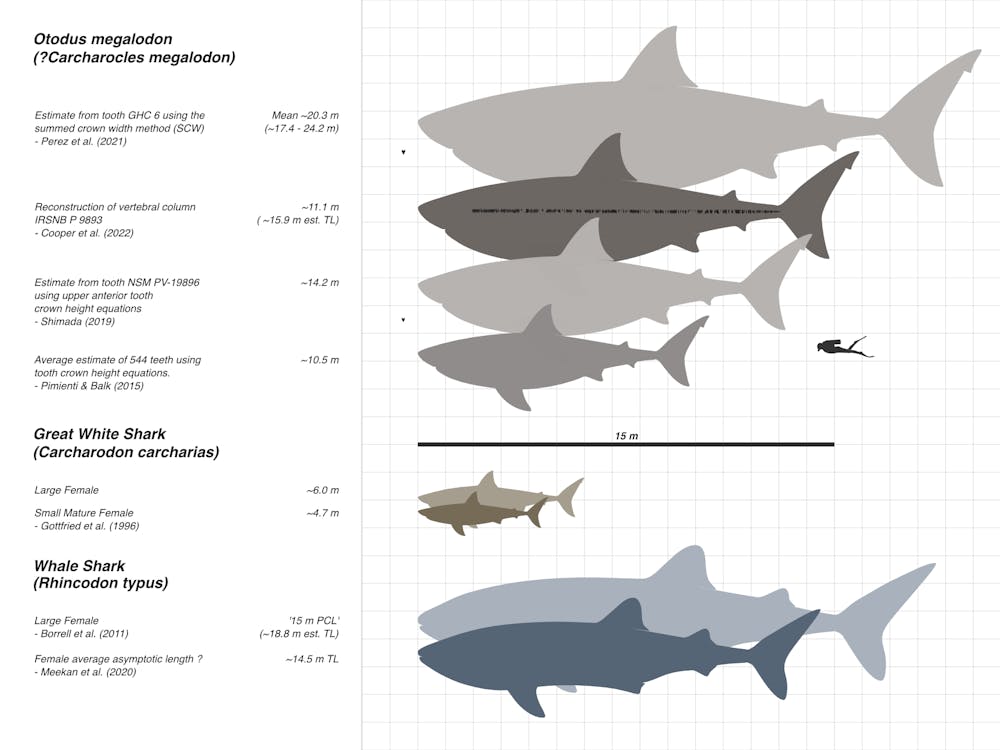
    The average size of a mature great white (Carcharodon carcharias, also known as the white shark) is between 4.6 and 4.9 metres for female sharks and up to 4 metres for male sharks.

    The largest recorded living specimens peak at about 6 metres, with one monster specimen caught in Cuba in 1945 reaching 6.4 metres.

    Earth’s oceans have seen bigger predatory sharks in the past. The biggest one of all time was the megalodon (Otodus megalodon) which lived from 23 to 3 million years ago, and may have been up to 24 metres in length. However, it looked nothing like the modern white shark.

    We don’t know precisely how big the megalodon was, but certainly larger than the great white shark.
    Steveoc 86/Wikimedia Commons, CC BY-SA

    They’re not even directly related – another thing scientists learned quite recently.

    Who was the megalodon, then?

    White sharks first evolved between 6 and 4 million years ago in the shadows of the megalodon. A recent study showed the megalodon’s large serrated teeth show signs of it being a supreme opportunistic super-predator.

    That means it ate just about anything, but especially liked whales and marine mammals.


    Read more:
    Friday essay: Giant shark megalodon was the most powerful superpredator ever. Why did it go extinct?


    But white sharks are not directly related to the megalodon, whose lineage began with a shark called Cretalamna during the age of dinosaurs about 100 million years ago.

    By contrast, the white shark lineage began with an ancient mako shark, Carcharodon hastalis. It was 7 to 8 metres long and had large, similarly shaped teeth to the modern white shark but lacking serrated edges.

    A fossil intermediate species, Carcharodon hubbelli shows the transition over time from weakly serrated to strongly serrated teeth.

    White shark fossil species. Left, the serrated fossil tooth teeth of the extant white shark; right, a similarly shaped unserrated tooth of the extinct giant mako shark which gave rise to white sharks.
    John Long, CC BY

    How did Jaws affect white shark populations?

    Last year, the International Shark Attack File reported 47 unprovoked shark bites to humans worldwide, resulting in seven fatalities. This was well below the previous ten-year average of 70 bites per year; your chances of getting bitten by a shark are extremely rare.

    Following the movies that made up the Jaws franchise, there was an increase in hunting and killing sharks – with a particular focus on great white sharks that were already going into a decline due to overfishing, trophy hunting and lethal control programs.

    Between 80% and 90% of white sharks have disappeared globally since the middle of the 20th century. Recent estimates calculate there are probably less than 500 individual white sharks in Australian waters right now.

    When Jaws first aired, scientists didn’t know how long sharks took to reproduce, or how many offspring a white shark could have each year. We now know it takes about 26 years for a male and 33 years for a female to sexually mature before they can start having pups.

    Data about white shark births is sparse, but recently a 5.6-metre-long female caught on a drum line off the coast of Queensland had just four large pups inside her. This is a very small number. Some large sharks, such as the whale shark, can give birth to up to 300 young.

    Now that we know just how slow they are to breed, it’s clear it will take many decades to reestablish the “pre-Jaws” population of white sharks – important apex predators in the marine ecosystem.

    Charlie Huveneers from Flinders University about to take a tissue sample for research on white sharks. There is still a lot we don’t know about their biology.
    Andrew Fox, Adelaide, CC BY

    Will white sharks survive?

    White sharks are currently listed as vulnerable.

    This classification means if we don’t change the current living conditions for white sharks, including impacts caused by human activities such as commercial fishing, and the impacts of climate change and ocean pollution, they will continue to decline and eventually could go extinct.

    Currently, white sharks are protected in several countries and form the basis for an important tourist industry in Australia, South Africa, western United States and most recently Nova Scotia, Canada.

    These sharks are iconic apex predators that fascinate people. One of us (John) went cage diving with them recently off the Neptune Islands of South Australia and can attest to how breathtaking it is to watch them in their natural environment.

    In terms of economic impact, they are worth far more alive than dead.

    White sharks are a growing tourism draw in several countries.
    Andrew Fox, Adelaide, CC BY

    There’s still much we don’t know about white sharks

    The complete white shark genome was first published only in 2019. It has 4.63 billion base pairs, making it much larger than the human genome (3.2 billion base pairs).

    The genome revealed some surprising things, like how white sharks show strong molecular adaptations for wound-healing processes, and a suite of “genome stability” genes – those used in DNA repair or DNA damage response.

    The transcriptome (or sum total of the messenger RNA) of the white shark showed greater similarity to the human transcriptome than to that of other fishes. This hints that “unexpressed genes” in the shark could one day play a role in uncovering genetic pathways for potential cures in human diseases.

    Jaws and its sequels certainly brought white sharks to the attention (and nightmares) of humans, with devastating impacts on how we treated them as a species.

    Our relationship with white sharks reflects our relationship with nature more broadly – a feared antagonist within the current capitalist paradigm; an enemy to be tamed, contained or consumed.

    As we learn more of the peril and potential of these remarkable creatures, we can learn how to live with them, to see beyond our fears and value their role within our delicate ocean ecosystems.

    John Long receives funding from The Australian Research Council.

    Heather L. Robinson does not work for, consult, own shares in or receive funding from any company or organisation that would benefit from this article, and has disclosed no relevant affiliations beyond their academic appointment.

    ref. Jaws at 50: how a single movie changed our perception of white sharks forever – https://theconversation.com/jaws-at-50-how-a-single-movie-changed-our-perception-of-white-sharks-forever-258306

    MIL OSI Analysis

  • MIL-OSI New Zealand: Luxon wraps up successful Shanghai visit

    Source: New Zealand Government

    Prime Minister Christopher Luxon has concluded the successful Shanghai leg of his official visit to China, accompanied by Ministers Louise Upston and Mark Mitchell and a delegation of senior New Zealand business leaders from across the food and beverage, health and wellbeing, education, and tourism sectors.

    “Our bilateral trade relationship with China is one of our most important, with two-way trade exceeding NZ$39 billion in the year ending March 2025. 

    “This relationship accounts for more than 20 per cent of New Zealand’s total goods and services exports,” Mr Luxon says.

    “It’s been great to see $400 million of commercial agreements signed today between New Zealand businesses and their Chinese partners. This is a clear sign of the strength and momentum in our trade relationship.

    “We also announced we would be making it easier for Chinese nationals to transit via New Zealand by removing the need to get a transit visa, instead being able to get a New Zealanders Electronic Travel Authority (NZeTA), significantly cutting costs and time for visitors. 

    “This resulted in one of the major announcements in Shanghai, that China Eastern Airlines was launching twice weekly flights to South America via Auckland.” 

    Mr Luxon participated in a tourism livestream event watched by over 10 million people, to promote New Zealand travel offerings.

    “New Zealand welcomed 248,000 visitors from China in the past year, with holiday arrivals up 31 per cent. We’ve made recent changes to visa settings to make it easier for Chinese visitors to enjoy New Zealand’s natural beauty and warm hospitality,” Mr Luxon says.

    Mr Luxon also visited Fudan University, one of China’s most prestigious academic institutions, to promote New Zealand as a destination for world-class research, study, and partnership.

    “We’re focused on deepening our education links through student connections, institutional partnerships, and joint research that benefits both countries,” Mr Luxon says.

    Mr Luxon also met with Shanghai Party Secretary Chen Jining to discuss Shanghai as a gateway for a high proportion of New Zealand goods, services and people-to-people flows, and other bilateral issues.

    The Prime Minister will now travel to Beijing, where he will meet with China’s leaders.

    MIL OSI New Zealand News

  • MIL-OSI New Zealand: Otago students to benefit from more classrooms

    Source: New Zealand Government

    The Government’s ensuring hundreds more students in Otago benefit from new, safe, warm and dry classrooms.
    A $27 million investment into new infrastructure will help make sure schools meet the needs of their communities and gets ahead of new growth.
    It will support the construction of:

    Six new teaching spaces at Dunstan High School
    A twelve-teaching space expansion at Te Kura Whakatipu o Kawarau

    The investment is in addition to the purchase of a site at Ladies Mile in Queenstown last year, which will accommodate a new primary school in the area.
    “Queenstown in particular, has had strong and steady growth over the last decade, and we are committed to ensuring they are equipped to teach the basics brilliantly. Planning for the two growth projects is underway and is expected to begin in the next 12 months. This means that students, families and the Otago community can benefit sooner,” Education Minister Erica Stanford says.
    “Funding for the construction of the new primary school at Ladies Mile will be considered in future years. Securing the land at this time means that we will be able to hit ‘go’ on construction when capacity is needed.” 
    This announcement builds on the Government’s commitment to ongoing investment in school property, and follows recent announcements to support growth in Canterbury, the Central North Island and provision of specialist education. 
    “Quality education is crucial to growing the regions. These new classrooms are an investment in the future of young learners in Otago Central Lakes and builds on the 120 new classrooms announced for Canterbury in the last month,” South Island Minister James Meager says.
    “There is huge potential for Otago Central Lakes to become a hub for digital and tech investors, alongside our traditional backbone industries of tourism and agriculture. To enable that investment, we need to foster brilliance in our young people by investing in their future and building for growth. We also need a high-quality education infrastructure to attract the best quality workforce to our regions.”
    “Our efficiencies in school property delivery allows more schools, communities and children benefit sooner. The use of standardised building designs and offsite manufacturing have lowered the average cost of a classroom by 28%, allowing 30% more classrooms to be delivered last year compared to 2023. We will continue to drive costs down so more Kiwi kids can thrive,” Ms Stanford says.

    MIL OSI New Zealand News

  • MIL-OSI New Zealand: Largest maritime navigation system upgrade in decades

    Source: New Zealand Government

    The Government is making New Zealand more attractive to international shipping lines with the first major investment in navigation services in more than 30 years.

    Land Information Minister Chris Penk says the $28.6 million Budget 2025 funding secures the future of shipping, tourism and the maritime economy – highlighting the Government’s commitment to back economic growth.

    “The investment enables safer and faster access to New Zealand’s ports, keeping trade flowing smoothly and reliably and provides confidence in shipping. This is key as more than 99 percent of our imports and exports move by sea.

    “Land Information New Zealand (LINZ) and Maritime New Zealand are working together to create high-tech digital navigation tools based on the global S-100 standard. These tools will make navigation more precise, helping ships save fuel and cut costs while operating in our waters.

    “The initiative will transform how mariners access and use data such as electronic charts, water levels, ocean surface currents and navigational warnings.”

    Associate Transport Minister James Meager says the investment benefits both economic growth and maritime safety.

    “Modern digital maritime data and services will enable freight-efficient, environmentally responsible shipping routes that boost trade and investment across the Pacific.

    “The investment in high-tech infrastructure ensures our maritime and tourism sectors are ready to thrive, while enhancing safety and efficiency.

    “Importantly, it positions New Zealand at the forefront of the shift to digital navigation technology, and signals to the world that we’re serious about supporting innovation, sustainabilitty and welfare at sea.

    “Beyond New Zealand’s coastline, this initiative supports safer, more efficient shipping across our wider maritime region – including Antarctica and South-West Pacific nations such as the Cook Islands, Samoa, Tonga, Niue, and Tokelau.

    “As we celebrate Matariki and reflect on New Zealand’s rich cultural history of navigating by the stars, now is the perfect time to look ahead toward building a resilient maritime economy for future generations.”

    MIL OSI New Zealand News

  • MIL-OSI USA: Pallone, Huffman, Castor, Booker, Reed, and Padilla Lead Charge to Block Trump’s Dangerous Offshore Drilling Plan

    Source: United States House of Representatives – Congressman Frank Pallone (6th District of New Jersey)

    Washington, D.C. – Today, U.S. House Energy and Commerce Ranking Member Frank Pallone (D-New Jersey), U.S. House Natural Resources Committee Ranking Member Jared Huffman (D-Calif.), Rep. Kathy Castor (D-Fla.), Senator Alex Padilla (D-Calif.), Senator Cory Booker (D-N.J.), and Senator Jack Reed (D-R.I.) along with 40 Democratic colleagues in the House and Senate submitted formal comments to the Bureau of Ocean Energy Management (BOEM), opposing any new or expanded offshore oil and gas leasing in the Trump administration’s proposed updates to the Outer Continental Shelf (OCS) oil and gas leasing program.

    In their letter to Interior Secretary Doug Burgum, the lawmakers warned that more offshore drilling would threaten our national security, coastal communities, marine life, and local economies – all while handing more giveaways to an industry already sitting on millions of acres of unused leases. They urged the agency to exclude any new leasing in the final program. 

    “New or expanded oil and gas leasing poses risks to the health and livelihoods of our constituents, jeopardizes our tourism, fishing, and recreational economies, and threatens the marine life that inhabits our coastlines” the members wrote. “New, unnecessary lease sales will lock in decades more of pollution and climate impacts from an industry that already holds more than 2,000 offshore leases covering more than 12 million acres of federal water, of which only 469 leases are currently producing oil and gas. The United States is already the number one producer of oil and gas in the world. There is no need for increased leasing, especially when oil and gas companies continue to impose environmental and climate consequences, public health risks, and billions of dollars in cleanup costs on the American people.”

    Members also reminded the Secretary of the long-standing legal restrictions that prevent the administration from offering lease sales in protected areas. 

    “We remind the agency that it cannot offer sales in areas permanently protected under Section 12(a) of OCSLA, including areas off the Atlantic coast, the Pacific off the coast of California, Oregon, and Washington, the Eastern Gulf of Mexico, and portions of the Artic Ocean, including the Beaufort Sea and Chukchi Sea planning areas. In 2017, during his first term, President Trump attempted to reverse President Obama’s Arctic and Atlantic withdrawals, but Judge Sharon Gleason for the District Court of Alaska determined that Section 12(a) does not give the president authority to revoke prior withdrawals. President Trump does not have the authority to reverse the Obama and Biden withdrawals, and his Executive Order of January 2025, which attempts to do so, is unlawful.”

    During his first term, the Trump administration proposed 47 lease sales over five years, covering nearly every U.S. coastline. Fortunately, this program was never finalized due to litigation and strong bipartisan opposition. But now, with the Biden administration’s leasing plan under review and Secretary Burgum signaling that protections may be on the chopping block, lawmakers are raising the alarm once again.

    At a budget hearing last week, Secretary Burgum refused to commit to protecting Florida’s Gulf Coast from new oil and gas leasing, saying only that “the administration may be considering opportunities.” This region has long been protected by both bipartisan legislation and administrative withdrawals – protections that are now under threat. 

    Read the full letter here.

    MIL OSI USA News

  • MIL-OSI China: Xi’s attendance at 2nd China-Central Asia Summit renews friendship, charts course for development: Chinese FM

    Source: People’s Republic of China – State Council News

    Xi’s attendance at 2nd China-Central Asia Summit renews friendship, charts course for development: Chinese FM

    BEIJING, June 18 — Chinese President Xi Jinping attended the second China-Central Asia Summit in the Kazakh capital of Astana, where he renewed traditional friendship and drew a blueprint for development with heads of state of the five Central Asian countries, Chinese Foreign Minister Wang Yi said on Wednesday.

    Wang, also a member of the Political Bureau of the Communist Party of China Central Committee, made the remarks while briefing reporters on the conclusion of Xi’s trip.

    In Astana, Xi and the Central Asian leaders have discussed cooperation plans and achieved more than 100 cooperation outcomes, Wang said.

    Wang noted that the most prominent highlight of this summit is Xi’s announcement of the China-Central Asia Spirit, which connotes four aspects of practices, namely practicing mutual respect and treating each other as equals; seeking to deepen mutual trust and enhancing mutual support; pursuing mutual benefit and win-win cooperation and striving for common development; helping each other in time of need and standing together through thick and thin.

    The Central Asian leaders unanimously agreed to uphold this spirit, he added.

    Wang said that China and the five Central Asia countries are all developing countries and have always been partners on the path of modernization.

    The most distinctive theme at the summit is that the six heads of state together designated 2025 and 2026 as the Years of High-Quality Development of China-Central Asia Cooperation, said Wang.

    All parties will focus their cooperation on the six priority areas of smooth trade, industrial investment, connectivity, green mining, agricultural modernization and personnel exchanges to strive for more tangible outcomes, he said.

    Xi, together with the heads of state of the five Central Asian countries, witnessed the signing of an action plan for high-quality Belt and Road cooperation, Wang said, noting that this is the first time that China signed Belt and Road cooperation documents with all countries in a neighboring region as a whole.

    China is the most important trade and investment partner of Central Asian countries, said Wang. All parties agreed that there is no winner in tariff wars or trade wars, and unilateralism and protectionism will lead nowhere, he noted.

    In response to the urgent desire of Central Asia for revitalization and boosting self-development capacities, Xi announced the establishment of three cooperation centers, i.e. on poverty reduction, on education exchange, and on desertification prevention and control, under the China-Central Asia cooperation framework, pledging to provide 3,000 training opportunities to Central Asian countries in the next two years, Wang said.

    The most important pioneering initiative in this summit is the signing of a treaty on eternal good-neighborliness, friendship and cooperation by the heads of state of the six countries to enshrine the principle of everlasting friendship in the form of law, which demonstrates that political mutual trust between China and Central Asian countries has reached a new height, Wang noted.

    During the summit, China and Central Asian countries reached a series of new cooperation outcomes in areas including subnational cooperation, personnel exchanges, educational exchanges and cultural tourism, among others, he said.

    The heads of state of the six countries witnessed the signing of multiple sister city agreements, thus the pairs of sister cities between China and the five Central Asian countries have exceeded 100, fulfilling the goal of an initiative proposed by Xi three years ago, Wang added.

    MIL OSI China News

  • MIL-OSI USA: Rosen Secures More Than $7 Million to Strengthen Reno-Tahoe Airport’s Infrastructure

    US Senate News:

    Source: United States Senator Jacky Rosen (D-NV)

    WASHINGTON, DC – Today, U.S. Senator Jacky Rosen (D-NV) announced that she secured over $7.6 million for Reno-Tahoe International Airport to allow the airport to accommodate more overnight aircraft operations and improve overall airfield efficiency. The funding comes from the Airport Infrastructure Grant program, established under the Bipartisan Infrastructure Law that Senator Rosen helped write and pass. This funding will help add 8,850 square yards of ramp at the airport.
    “Reno-Tahoe International Airport is vital to Northern Nevada’s economy — bringing visitors from around the world who contribute to our economy,” said Senator Rosen. “I’m proud to have secured this funding to support the airport’s expansion and ensure it has the infrastructure it needs to meet growing demand. I’ll continue working to deliver the federal resources to boost Nevada’s tourism economy.”
    Senator Rosen continues delivering federal resources to support Nevada’s airport infrastructure. Last year, she announced nearly $28 million for airport safety and runway upgrades at Harry Reid International Airport. In February 2024, Rosen secured $7 million for terminal expansion at Reno–Tahoe International Airport through the Airport Terminal Program —which she personally helped create in the Bipartisan Infrastructure Law. And in November 2023, Senator Rosen secured $60.9 million for Nevada airports, directing more than $6.9 million to Reno–Tahoe International Airport and over $46 million to Harry Reid International Airport.

    MIL OSI USA News

  • MIL-OSI New Zealand: Economic surprise great news for Kiwis

    Source: New Zealand Government

    Today’s surprise economic result is great news for workers, families and businesses, Finance Minister Nicola Willis said today.
    “Stats NZ reported today that the economy grew 0.8 per cent in the first three months of the year, twice the rate forecast by the Treasury and the Reserve Bank a short time ago. 
    “This is the second consecutive quarter in which growth outstripped forecasters’ assumptions and confirms the economy was gaining momentum late last year and at the start of this year.
    “Since then, global conflict has increased and new tariffs have been introduced, but New Zealanders should take heart that the country is back on track after six years of economic mismanagement that fuelled inflation, discouraged investment and ratcheted up prices.
    “I know many households and businesses are still doing it tough but the steps the Government has taken to stop wasteful spending, grow the economy and provide more support to households are paying dividends. So are the efforts of the private sector.
    “It is also pleasing to see that Gross Domestic Product per person grew by 0.5 per in the quarter, the highest rate since September 2022 and the second consecutive quarter of growth after eight quarters of negative or no growth.  
    “Inflation is down, interest rates are down, and many families have a little more money in their pockets. 
    “That money is flowing through to business tills aided by the steps the Government has taken to reduce red tape, incentivise investment and boost tourism, and the export records being set by New Zealand farmers and growers,” Nicola Willis says.     

    MIL OSI New Zealand News

  • MIL-OSI USA: SCHUMER, GILLIBRAND ANNOUNCE $12+ MILLION IN FEDERAL FUNDING FOR PROJECTS ACROSS UPSTATE NEW YORK THROUGH THE NORTHERN BORDER REGIONAL COMMISSION

    US Senate News:

    Source: United States Senator for New York Charles E Schumer

    Communities From North Country, Finger Lakes, CNY, Capital Region Win Funding For Critical Community Projects Such As Upgrading Wastewater Infrastructure, Expanding Access To Healthcare & More 

    Schumer, Gillibrand: Fed $$ Is Flowing To Improve Upstate NY Infrastructure, Expand Healthcare & Create Jobs!

    U.S. Senator Chuck Schumer and U.S. Senator Kirsten Gillibrand today announced $12,349,291 in federal funding for 14 projects across Upstate New York through the Northern Border Regional Commission (NBRC), which the senators recently fought to reauthorize and expand. Schumer and Gillibrand said these projects will help address critical needs across the region, including upgrading wastewater infrastructure, expanding access to healthcare services, and more to improve quality of life and spur economic development in the region.

    “From expanding wastewater systems in the Finger Lakes Region to boosting access to healthcare in the North Country, this $12+ million in federal money via the excellent Northern Border Regional Commission will support major infrastructure upgrades and increase in vital services in Upstate New York. These federal investments will help create new jobs, strengthen our infrastructure, expand healthcare and boost quality of life across the region,” said Senator Schumer. “I have long fought to secure and increase funding for the Northern Border Regional Commission and expand this important federal support because it has played a unique and pivotal role in spurring economic development, upgrading infrastructure, improving quality of life, and creating jobs in communities across Upstate New York. I’m proud to have delivered this critical funding to help families and communities lay the foundation for a better future here in Upstate New York.”

    “These federal investments will support essential upgrades to infrastructure, expand access to health care, create jobs, and drive economic growth across Upstate New York,” said Senator Gillibrand. “The Northern Border Regional Commission has already backed more than 75 projects in our state, and this additional $12 million will build on that progress and help communities thrive. I’m proud to have helped secure this funding, and I’ll keep fighting to protect the NBRC to ensure our families, workers, and small businesses have the resources they need to succeed.”

    A full list of projects can be found below:

    Recipient

    Region

    County

    Amount

    Description

    Town of Hunter

    Capital Region

    Greene

    $1,000,000

    The Town of Hunter will design, construct, and equip the Mountaintop Community Hall, supporting workforce development, business incubation, community programming, and emergency preparedness.

    Village of Whitehall

    Capital Region

    Washington

    $1,000,000

    The Village of Whitehall will upgrade its water infrastructure following a State of Emergency due to water supply disruptions. This project will safeguard drinking water for residents and businesses by enhancing the Pine Lake reservoir and Village Water Treatment Plant with modern monitoring and control systems.

    East Hill Family Medical, Inc

    Central NY

    Cayuga

    $1,000,000

    East Hill Family Medical, Inc will transform a newly acquired site in Sennett, NY into a state-of-the-art healthcare facility. The project will improve access to primary care, behavioral health, and dental services, serving an estimated 4,500 additional patients and addressing regional provider shortages.

    Town of Schroeppel

    Central NY

    Oswego

    $80,000

    The Town of Schroeppel will conduct a comprehensive water infrastructure feasibility study, ensuring long-term access to safe and reliable water for residents and businesses.

    Town of Webb

    Mohawk Valley

    Herkimer

    $485,000

    The Town of Webb will modernize its aging wastewater collection system, addressing critical infrastructure deficiencies and environmental risks. This project will rehabilitate high-risk sewer lines, improve wastewater conveyance, and enhance treatment facility operations.

    Lake Champlain-Lake George Regional Planning Board

    North Country

    Essex

    $240,000

    The Lake Champlain-Lake George Regional Planning Board will identify development sites, conduct buildout analyses, and complete pre-development work for workforce housing in four Essex County communities. This initiative will address housing shortages while supporting workforce growth, economic stability, and community sustainability in the region.

    City of Plattsburgh

    North Country

    Clinton

    $100,000

    The City of Plattsburgh will conduct a feasibility study of its wastewater system in the Rugar Street corridor, ensuring capacity for future development. This study will assess infrastructure needs to support 150 new workforce housing units, additional commercial growth, and industrial expansion at the former Clinton County airport.

    Lake Placid Association for Music, Drama and Art

    North Country

    Essex

    $1,000,000

    Lake Placid Association for Music, Drama and Art will renovate and modernize a 52-year-old theatre, enhancing accessibility, energy efficiency, and performance capabilities. This revitalization will transform the auditorium, expand stage space, upgrade theatre technology, and improve visitor experience, ensuring the venue remains a vital hub for cultural tourism and community engagement.

    United Cerebral Palsy Association of the North Country, Inc.

    North Country

    St.Lawrence

    $615,625.72

    United Cerebral Palsy Association of the North Country, Inc. will expand pediatric healthcare services at its Federally Qualified Health Centers in Canton and Ogdensburg, NY. This project will increase clinic capacity by constructing exam rooms, improving patient flow, and enhancing access to preventive care, vaccinations, and chronic disease management for children in medically underserved communities.

    Village of Waddington

    North Country

    St.Lawrence

    $793,000

    The Village of Waddington will replace deteriorating water mains in its downtown district, ensuring reliable access for residents and businesses while preventing further economic decline.

    Livingston County Water and Sewer Authority

    Rochester Finger-Lakes

    Livingston

    $1,000,000

    Livingston County Water and Sewer Authority will implement the LCWSA/Geneseo Water Interconnection Project, enhancing water system capacity, resiliency, and regional connectivity across multiple municipalities in Livingston County, NY.

    Village of Dansville

    Rochester-Finger Lakes

    Livingston

    $1,979,586.00

    The Village of Dansville will construct a public sewer extension, pedestrian infrastructure, and ADA-accessible playground equipment, improving community health and economic development. This project will provide wastewater service to Noyes Memorial Hospital and the planned YMCA, facilitating expansion and workforce growth, while new sidewalks, a walking trail, and a pedestrian bridge will enhance accessibility and safety.

    Village of Waterloo

    Rochester-Finger Lakes

    Seneca

    $3,000,000

    Village of Waterloo will improve storm sewer infrastructure, road drainage, sidewalks, and curbing, ensuring resilience against frequent flooding and supporting downtown revitalization efforts. These upgrades complement the Village’s recent $10 million Downtown Revitalization Initiative (DRI) funding, enhancing economic stability, pedestrian safety, and stormwater management.

    Genesee Finger Lakes Regional Planning Commission

    Rochester-Finger Lakes

    Wyoming

    $56,080

    The Genesee Finger Lakes Regional Planning Commission will conduct a Housing Needs Assessment and Market Analysis, evaluating demographic and economic trends to inform comprehensive housing strategies. This study will identify gaps in the housing market and guide planning for projects that address the needs of low-to-moderate-income households, seniors, veterans, and individuals with disabilities.

    After years of advocacy, Schumer and Gillibrand announced late last year that they had successfully reauthorized the Northern Border Regional Commission (NBRC) for another 5 years, increasing funding and expanding the critical grant program that has delivered tens of millions of dollars for the North Country and Upstate NY. Despite the wide bipartisan support to reauthorize the NBRC, President Trump’s recent budget for Fiscal Year 2026 calls for the elimination of this program, an effort that the senators are actively pushing back against to ensure NBRC continues to be funded to provide critical investment to Upstate NY. From 2010-2024, the NBRC has invested in over 78 projects, totaling more than $48 million in federal funding for Upstate New York. Schumer introduced the Northern Border Regional Commission (NBRC) Reauthorization Act of 2023 which paved the way for these key changes.

    In addition to reauthorizing the NBRC for an additional 5 years, the bill that passed into law at the end of last year also increased funding for the program from $33 million to $40 million. The bill made critical enhancements to the range of projects the NBRC is able to support to foster growth in the region, including a new program focused on addressing childcare and healthcare needs, increasing support for addiction treatment, and new support for capacity building for business retention, job training, and job creation. The NBRC reauthorization was included as part of the Economic Development Administration reauthorization in the bipartisan, bicameral Water Resources Development Act.

    Schumer and Gillibrand have a long history of championing the Northern Border Regional Commission and its positive economic impacts on Upstate New York. In 2021, the senator successfully secured $150 million for the NBRC, over triple its funding from previous years, through the Bipartisan Infrastructure Investment & Jobs Act.

    Established in 2008, the NBRC is a federal-state partnership focused on the economic revitalization of communities across the Northern Border region, which includes New York, Maine, New Hampshire, and Vermont. The Commission is composed of the governors of the four Northern Border states and a federal co-chair and provides financial and technical assistance to communities in the region to support entrepreneurs, improve water, broadband, and transportation infrastructure, and promote other initiatives to improve the region’s economy. The northern border region of New York State currently includes 30 counties: Cayuga, Clinton, Essex, Franklin, Fulton, Genesee, Greene, Hamilton, Herkimer, Jefferson, Lewis, Livingston, Madison, Montgomery, Niagara, Oneida, Orleans, Oswego, Rensselaer, Saratoga, Schenectady, Schoharie, Seneca, St. Lawrence, Sullivan, Washington, Warren, Wayne, Wyoming, and Yates. 

    MIL OSI USA News

  • MIL-OSI Russia: IMF Executive Board Concludes 2025 Article IV Consultation with Mauritius

    Source: IMF – News in Russian

    June 18, 2025

    • The Mauritian economy continues to exhibit resilience with growth at 4.7 percent in 2024 and contained inflation. The growth outlook remains favorable, though risks are to the downside.
    • Mauritius needs to recalibrate the macroeconomic policy mix to rebuild fiscal space. The monetary policy framework needs to be strengthened while continued monitoring of macro-financial risks is essential to maintain financial stability.
    • Advancing key reforms to foster external competitiveness and private sector-led growth while enhancing climate resilience will reduce external imbalances.

    Washington, DC: The Executive Board of the International Monetary Fund (IMF) completed the Article IV Consultation for Mauritius.[1]

    Mauritius’ economy remains resilient. Real GDP grew by 4.7 percent in 2024, from 5.0 percent in 2023, driven by services, construction, and tourism. Headline inflation (12-month average) declined to
    2.5 percent in March 2025 from 7.0 percent in 2023, helped by easing international food and energy prices and lower fuel excise duties. The external current account deficit widened in 2024 to
    6.5 percent of GDP, mostly reflecting higher imports and freight costs. Gross foreign reserves increased to US$8.5 billion by end-2024, covering almost 12 months of imports. Looking ahead, the country needs to address fiscal and structural challenges, notably the high public debt, significant public investment needs, low productivity, and an ageing society.

    The outlook for growth is favorable. Real GDP growth is projected to soften to 3.0 percent in 2025 due to weakening external demand, easing tourism activity, and the drought. Over the medium term, growth is expected at around 3.4 percent, reflecting demographic headwinds and labor shortages. Inflation is projected to average 3.6 percent in 2025 and remain within BOM’s target range over the medium term. The external current account deficit is projected to reduce to 4.7 percent of GDP in 2025—reflecting lower oil prices, as exports grow modestly amid the slowdown in global demand—and to increase in 2026 due to subdued exports, but gradually decline thereafter. The primary fiscal deficit (excluding grants) for FY24/25 is projected to worsen by 3.4 ppt of GDP relative to FY23/24, to 6.5 percent of GDP, mostly driven by higher compensation of employees, social benefits, and grants and transfers. The stock of public sector debt is projected at around 88 percent of GDP at end-June 2025, and to gradually decline in the medium term.

    Risks to the outlook are on the downside, including from global uncertainty, tariff wars, higher-than-anticipated fuel and food prices, and extreme climate shocks.


    Executive Board Assessment[2]

    The economy has recovered solidly from the pandemic and the outlook is favorable, but fiscal and structural challenges remain. The recovery has been driven by services, construction, and tourism. The medium-term outlook is favorable but held back by demographic headwinds and labor shortages. Mauritius is facing fiscal and structural challenges from high public debt, significant public investment needs for climate, low productivity, and an ageing society. Risks to the outlook are on the downside including from high global uncertainty, highlighting the importance of addressing fiscal and external imbalances to increase the resilience of the economy.

    Fiscal policy should pursue frontloaded growth-friendly consolidation to shore up fiscal credibility, helping rebuild fiscal space while protecting the most vulnerable. Tax revenue should be increased and current and ESFs’ spending contained while safeguarding critical social spending and growth-enhancing capital spending. Pension system reform remains key to support fiscal sustainability, especially given the ageing of Mauritius’ population. Strengthening public financial management, including by streamlining ESFs, will support fiscal consolidation, transparency, and good governance.

    BOM should start to gradually phase out its ownership of MIC and strengthen the implementation of the monetary policy framework by resuming uncapped issuance of 7-Day BOM bills (at the key policy rate). BOM should stand ready to tighten the monetary policy stance should inflationary pressures reemerge. BOM should adopt amendments to the BOM Act, including to ensure fiscal backing, to protect central bank independence. Ministry of Finance and BOM are encouraged to strengthen the commitment on their mutual agreement for BOM independence. Mauritius should continue to rely on exchange rate flexibility and FX purchases when opportunities arise, and in line with the monetary policy framework, to help further build foreign reserves buffers to ensure ability to respond to large external shocks. 

    Mauritius’ external position at end-2024 is assessed as weaker than the level implied by fundamentals and desirable policies, and structural reforms to foster external competitiveness are needed to reduce external imbalances. Steady progress in strengthening the AML/CFT framework is welcome and should be sustained, including provisions related to non-resident and cross-border activity. Financial sector risks should continue to be closely monitored including of the real estate sector. Ongoing efforts to improve external sector statistics, including measurement of the GBCs sector, should be sustained. Statistical gaps and discrepancies should be addressed to improve the quality and credibility of macroeconomic statistics.

    Mauritius should advance structural reforms that boost investment and innovation to secure longer-term private sector-led growth. Priorities include strengthening workers’ skills through better education and narrowing gender gaps as well as advancing climate adaptation efforts to support economic resilience.


    Mauritius: Selected Economic Indicators


    2020

    2021

    2022

    2023

    2024

    2025

    2026

    2027

    2028

    2029

    2030


    Est.

    Proj.

    Proj.

    Proj.

    Proj.

    Proj.

    Proj.


    (Annual percent change, unless otherwise indicated)


    National income, prices and employment


    Real GDP


    -14.5

    3.4

    8.7

    5.0

    4.7

    3.0

    3.4

    3.4

    3.4

    3.4

    3.4


    Real GDP per capita


    -14.6

    3.6

    8.9

    5.1

    4.9

    3.2

    3.6

    3.6

    3.6

    3.7

    3.8


    GDP per capita (in U.S. dollars)


    9,011

    9,087

    10,235

    11,188

    11,883

    12,448

    13,287

    14,183

    15,128

    16,131

    17,190


    GDP deflator


    2.6

    3.2

    9.6

    6.6

    3.8

    3.8

    3.7

    3.7

    3.6

    3.6

    3.6


    Consumer prices inflation (period average)


    2.5

    4.0

    10.8

    7.0

    3.6

    3.6

    3.6

    3.5

    3.5

    3.5

    3.5


    Consumer prices inflation (end of period)


    2.7

    6.8

    12.2

    3.9

    2.9

    3.9

    3.5

    3.5

    3.5

    3.5

    3.5


    Unemployment rate (percent)


    9.2

    9.1

    6.8

    6.1

    5.8

    5.9

    5.9

    5.9

    5.9

    5.9

    5.9


    (Annual percent change)


    External sector


    Exports of goods and services, f.o.b.


    -23.8

    5.2

    45.7

    4.0

    3.0

    1.7

    2.3

    7.1

    6.2

    6.5

    7.4


    Of which: tourism receipts


    -73.8

    -23.8

    313.1

    29.7

    6.0

    -4.6

    5.3

    7.7

    8.6

    8.1

    7.7


    Imports of goods and services, f.o.b.


    -29.1

    16.0

    32.9

    -0.3

    6.4

    0.7

    4.7

    5.3

    4.9

    4.3

    5.3


    Nominal effective exchange rate (annual average)


    -8.0

    -8.0

    3.6

    0.5

    -1.4


    Real effective exchange rate (annual average)


    -7.6

    -7.5

    6.2

    1.7

    -0.6


    Terms of trade


    5.1

    -12.0

    -5.1

    8.3

    0.0

    2.3

    2.0

    0.7

    0.5

    0.5

    0.4


    Money and credit


    Net foreign assets


    16.4

    18.6

    -3.6

    -0.3

    18.3

    1.5

    2.7

    2.5

    2.1

    2.2

    3.0


    Domestic credit


    7.9

    15.6

    13.1

    9.7

    13.7

    7.2

    6.5

    6.3

    6.1

    6.0

    5.9


    Net claims on government


    8.8

    34.8

    24.6

    26.1

    31.3

    13.2

    7.7

    6.0

    5.3

    4.5

    3.7


    Credit to non-government sector


    2.7

    0.4

    -0.6

    8.0

    8.3

    6.0

    6.9

    7.2

    7.1

    7.1

    7.1


    Broad money


    17.7

    8.6

    4.1

    7.8

    12.9

    6.4

    7.6

    8.5

    8.4

    8.4

    7.9


    Income velocity of broad money (M2)


    0.8

    0.8

    0.9

    0.9

    0.9

    0.9

    0.9

    0.9

    0.9

    0.9

    0.9


    (Percent of GDP, unless otherwise indicated)


    Central government finances 1


    Overall borrowing requirement 2


    -22.1

    -5.5

    -4.7

    -6.1

    -10.4

    -5.4

    -3.7

    -3.4

    -2.9

    -2.4

    -2.0


    Primary balance (excluding grants) 


    -16.5

    -4.9

    -2.7

    -3.1

    -6.5

    -3.0

    -1.3

    -0.3

    0.1

    0.4

    0.5


    Revenues (incl. grants)


    21.6

    24.2

    24.5

    24.0

    25.7

    27.0

    27.3

    27.5

    27.5

    27.5

    27.4


    Expenditure, excl. net lending


    40.4

    31.1

    29.4

    29.7

    35.2

    32.3

    31.2

    30.3

    29.9

    29.4

    28.9


    Domestic debt of central government


    67.5

    61.9

    57.3

    58.7

    64.4

    65.8

    65.7

    65.3

    64.5

    64.0

    63.7


    External debt of central government


    15.8

    14.0

    13.8

    12.7

    14.8

    14.9

    14.8

    14.7

    14.6

    14.3

    13.9


    Investment and saving 4


    Gross domestic investment


    18.2

    19.8

    19.8

    20.2

    21.0

    22.0

    22.4

    22.5

    22.5

    22.5

    22.5


    Public


    4.1

    4.1

    3.9

    3.9

    3.8

    4.1

    4.2

    4.3

    4.3

    4.3

    4.3


    Private 3


    14.1

    15.7

    15.8

    16.3

    17.2

    17.9

    18.2

    18.2

    18.2

    18.2

    18.2


    Gross national savings


    11.6

    12.6

    17.1

    22.4

    23.4

    23.8

    25.0

    26.1

    26.5

    26.2

    26.4


    Public


    -7.9

    -5.6

    -2.0

    -2.4

    -4.5

    -4.0

    -1.7

    -0.7

    -0.1

    0.4

    0.8


    Private


    19.5

    18.2

    19.2

    24.8

    28.0

    27.8

    26.7

    26.8

    26.6

    25.9

    25.6


    External sector


    Balance of goods and services


    -10.7

    -16.1

    -14.8

    -11.7

    -13.2

    -12.3

    -13.0

    -12.2

    -11.6

    -10.5

    -9.6


    Exports of goods and services, f.o.b.


    35.1

    36.7

    47.6

    45.3

    43.9

    42.7

    41.0

    41.2

    41.1

    41.2

    41.7


    Imports of goods and services, f.o.b.


    -45.8

    -52.7

    -62.4

    -56.9

    -57.2

    -55.0

    -54.0

    -53.4

    -52.7

    -51.7

    -51.2


    Current account balance


    -8.9

    -13.1

    -11.1

    -5.1

    -6.5

    -4.7

    -6.1

    -5.0

    -4.3

    -3.7

    -3.0


    Capital and financial account


    3.3

    23.3

    13.4

    -0.9

    14.5

    6.1

    9.1

    6.7

    5.9

    5.2

    4.6


    Overall balance


    -4.4

    10.2

    2.8

    -5.5

    7.3

    1.4

    2.9

    1.8

    1.6

    1.5

    1.6


    Total external debt


    110.7

    134.0

    132.2

    131.6

    139.2

    128.9

    119.3

    110.8

    102.2

    94.1

    87.1


    Gross international reserves (millions of U.S. dollars)


    7,242

    7,805

    7,740

    7,254

    8,510

    8,675

    9,163

    9,475

    9,781

    10,083

    10,420


    Months of imports of goods and services, f.o.b.


    14.3

    11.6

    11.6

    10.2

    11.8

    11.6

    11.6

    11.4

    11.3

    11.2

    11.1


    Memorandum items:


    GDP at current market prices (billions of Mauritian rupees)


    448.9

    478.8

    570.3

    638.3

    694.0

    742.3

    796.0

    853.3

    914.0

    979.0

    1,048.7


    GDP at current market prices (millions of U.S. dollars)


    11,408

    11,484

    12,908

    14,101

    14,953

    15,641

    16,662

    17,748

    18,890

    20,082

    21,326


    Public sector debt, fiscal year (percent of GDP)4


    91.9

    86.1

    81.8

    81.5

    88.3

    89.1

    88.1

    86.9

    85.3

    83.9

    82.7


    Foreign and local currency long-term debt rating (Moody’s)


    Baa1

    Baa2

    Baa3

    Baa3

    Baa3

    Baa3


    Sources:  Country authorities; and IMF staff estimates and projections.


    1GFSM 2001 concept of net lending/net borrowing, includes special and other extrabudgetary funds. Fiscal data reported for fiscal years (e.g, 2019=2019/20).


    2 Following the GFSM 2014, Sections 5.111.5.116, the transfers from the BOM to the

    Central Government are considered as financing.


    Excludes changes in inventories in 2022 and outer years.


    4 The public debt series has been reclassified starting in the 2024 AIV Mission to allow

    consolidation of central government securities held by non-financial
    public corporations


    [1] Under Article IV of the IMF’s Articles of Agreement, the IMF holds bilateral discussions with members, usually every year. A staff team visits the country, collects economic and financial information, and discusses with officials the country’s economic developments and policies. On return to headquarters, the staff prepares a report, which forms the basis for discussion by the Executive Board.

    [2] The Executive Board takes decisions under its lapse-of-time procedure when the Board agrees that a proposal can be considered without convening formal discussions.

    IMF Communications Department
    MEDIA RELATIONS

    PRESS OFFICER: Kwabena Akuamoah-Boateng

    Phone: +1 202 623-7100Email: MEDIA@IMF.org

    https://www.imf.org/en/News/Articles/2025/06/18/pr-25204-mauritius-imf-concludes-2025-article-iv-consultation

    MIL OSI

    MIL OSI Russia News

  • MIL-OSI New Zealand: Backing biodiversity protection for Kaimai Mamaku

    Source: New Zealand Government

    A $750,000 investment into Iwi and community led biodiversity protection at Kaimai Mamaku Conservation Park will benefit the environment and sustainable tourism, Conservation Minister Tama Potaka says.

    “We’re backing much-needed protection for one of Aotearoa New Zealand’s most unique conservation parks and southern-most kauri habitats through work to eradicate destructive wild goats, contributing to a healthier and scenic visitor experience near Tauranga,” Mr Potaka says.

    “Browsing animals, like wild goats affect forest regeneration significantly, and are considered a potential spreader of kauri dieback through soil they carry. 

    This funding from the International Visitor Levy will enable contractors and Iwi/hapū professional pest animal control teams developed through the Kaimai Mamaku Restoration Project to carry out ground and aerial hunting over three years.

    “We must protect the precious flora and fauna at this park. The park marks the northern limit of plants such as kāmahi, red and silver beech, and the southern limit of kauri, making the forest precious and unique for its diverse ecosystem. It is also home to various native species, including kōkako, pekapeka, and Hochstetter’s frog, kākā, kiwi, and kārearea.”

    Mr Potaka says that in addition to conserving nature, the investment delivers tourism, recreation and economic benefits for the area.

    “It’s a natural gateway between Auckland and Rotorua and has many tracks including family friendly walks, significant heritage sites, huts, camping, hunting and mountain biking.

    “This work will also mean that visitors will be able experience the lush, thriving ecosystems that they expect to see in Aotearoa New Zealand.

    “From the gold mining history of Karangahake Gorge in the north, down almost to tourism-hotspot Rotorua in the south, Kaimai Mamaku is steeped in history and culture. 

    “It’s a great place for people to get outdoors, with over 360 kilometres of walking tracks and numerous hunting opportunities, and I encourage people to get to the park to enjoy the unique, beautiful nature that Aotearoa New Zealand is so loved for.”

    Note to editor

    The funding comes from the 2024/25 biodiversity portion of the International Visitor Conservation and Tourism Levy. Priorities for these investments are focused on restoring unique wildlife and supporting thriving landscapes in National Parks and visitor sites. 

    MIL OSI New Zealand News

  • MIL-Evening Report: Jaws at 50: how a single movie changed our perception of white sharks forever

    Source: The Conversation (Au and NZ) – By John Long, Strategic Professor in Palaeontology, Flinders University

    Shane Myers Photography/Shutterstock

    It’s been 50 years since Steven Spielberg’s movie Jaws first cast a terrifying shadow across our screens.

    At a low point during production, Spielberg worried he’d only ever be known for “a big fish story”. The film, however, did not tank.

    Jaws broke box office records and became the highest-grossing movie at the time, only surpassed by the first Star Wars released two years later in 1977.

    A combination of mass advertising, familiar “hero” tropes and old-school showmanship launched Jaws as the first modern blockbuster.

    Hollywood, and our relationship to oceans and the sharks within them, would never be the same.

    The novel Jaws was based on was a bestseller in its own right.
    Snap Shot/Shutterstock

    An unrealistic monster

    In Peter Benchley’s 1974 novel that Jaws is based on, the shark is 6 metres long. For added screen excitement, in the movie it grew to a whopping 7.6 metres.

    However, that’s unrealistically large.

    The average size of a mature great white (Carcharodon carcharias, also known as the white shark) is between 4.6 and 4.9 metres for female sharks and up to 4 metres for male sharks.

    The largest recorded living specimens peak at about 6 metres, with one monster specimen caught in Cuba in 1945 reaching 6.4 metres.

    Earth’s oceans have seen bigger predatory sharks in the past. The biggest one of all time was the megalodon (Otodus megalodon) which lived from 23 to 3 million years ago, and may have been up to 24 metres in length. However, it looked nothing like the modern white shark.

    We don’t know precisely how big the megalodon was, but certainly larger than the great white shark.
    Steveoc 86/Wikimedia Commons, CC BY-SA

    They’re not even directly related – another thing scientists learned quite recently.

    Who was the megalodon, then?

    White sharks first evolved between 6 and 4 million years ago in the shadows of the megalodon. A recent study showed the megalodon’s large serrated teeth show signs of it being a supreme opportunistic super-predator.

    That means it ate just about anything, but especially liked whales and marine mammals.


    Read more:
    Friday essay: Giant shark megalodon was the most powerful superpredator ever. Why did it go extinct?


    But white sharks are not directly related to the megalodon, whose lineage began with a shark called Cretalamna during the age of dinosaurs about 100 million years ago.

    By contrast, the white shark lineage began with an ancient mako shark, Carcharodon hastalis. It was 7 to 8 metres long and had large, similarly shaped teeth to the modern white shark but lacking serrated edges.

    A fossil intermediate species, Carcharodon hubbelli shows the transition over time from weakly serrated to strongly serrated teeth.

    White shark fossil species. Left, the serrated fossil tooth teeth of the extant white shark; right, a similarly shaped unserrated tooth of the extinct giant mako shark which gave rise to white sharks.
    John Long, CC BY

    How did Jaws affect white shark populations?

    Last year, the International Shark Attack File reported 47 unprovoked shark bites to humans worldwide, resulting in seven fatalities. This was well below the previous ten-year average of 70 bites per year; your chances of getting bitten by a shark are extremely rare.

    Following the movies that made up the Jaws franchise, there was an increase in hunting and killing sharks – with a particular focus on great white sharks that were already going into a decline due to overfishing, trophy hunting and lethal control programs.

    Between 80% and 90% of white sharks have disappeared globally since the middle of the 20th century. Recent estimates calculate there are probably less than 500 individual white sharks in Australian waters right now.

    When Jaws first aired, scientists didn’t know how long sharks took to reproduce, or how many offspring a white shark could have each year. We now know it takes about 26 years for a male and 33 years for a female to sexually mature before they can start having pups.

    Data about white shark births is sparse, but recently a 5.6-metre-long female caught on a drum line off the coast of Queensland had just four large pups inside her. This is a very small number. Some large sharks, such as the whale shark, can give birth to up to 300 young.

    Now that we know just how slow they are to breed, it’s clear it will take many decades to reestablish the “pre-Jaws” population of white sharks – important apex predators in the marine ecosystem.

    Charlie Huveneers from Flinders University about to take a tissue sample for research on white sharks. There is still a lot we don’t know about their biology.
    Andrew Fox, Adelaide, CC BY

    Will white sharks survive?

    White sharks are currently listed as vulnerable.

    This classification means if we don’t change the current living conditions for white sharks, including impacts caused by human activities such as commercial fishing, and the impacts of climate change and ocean pollution, they will continue to decline and eventually could go extinct.

    Currently, white sharks are protected in several countries and form the basis for an important tourist industry in Australia, South Africa, western United States and most recently Nova Scotia, Canada.

    These sharks are iconic apex predators that fascinate people. One of us (John) went cage diving with them recently off the Neptune Islands of South Australia and can attest to how breathtaking it is to watch them in their natural environment.

    In terms of economic impact, they are worth far more alive than dead.

    White sharks are a growing tourism draw in several countries.
    Andrew Fox, Adelaide, CC BY

    There’s still much we don’t know about white sharks

    The complete white shark genome was first published only in 2019. It has 4.63 billion base pairs, making it much larger than the human genome (3.2 billion base pairs).

    The genome revealed some surprising things, like how white sharks show strong molecular adaptations for wound-healing processes, and a suite of “genome stability” genes – those used in DNA repair or DNA damage response.

    The transcriptome (or sum total of the messenger RNA) of the white shark showed greater similarity to the human transcriptome than to that of other fishes. This hints that “unexpressed genes” in the shark could one day play a role in uncovering genetic pathways for potential cures in human diseases.

    Jaws and its sequels certainly brought white sharks to the attention (and nightmares) of humans, with devastating impacts on how we treated them as a species.

    Our relationship with white sharks reflects our relationship with nature more broadly – a feared antagonist within the current capitalist paradigm; an enemy to be tamed, contained or consumed.

    As we learn more of the peril and potential of these remarkable creatures, we can learn how to live with them, to see beyond our fears and value their role within our delicate ocean ecosystems.

    John Long receives funding from The Australian Research Council.

    Heather L. Robinson does not work for, consult, own shares in or receive funding from any company or organisation that would benefit from this article, and has disclosed no relevant affiliations beyond their academic appointment.

    ref. Jaws at 50: how a single movie changed our perception of white sharks forever – https://theconversation.com/jaws-at-50-how-a-single-movie-changed-our-perception-of-white-sharks-forever-258306

    MIL OSI AnalysisEveningReport.nz

  • PM Modi thanks Croatia for backing India’s fight against terrorism

    Source: Government of India

    Source: Government of India (4)

    Prime Minister Narendra Modi thanked Croatia for backing India’s fight against terrorism as both nations began a new chapter in bilateral relationship during his historic visit to the country – the first-ever by an Indian PM – on Wednesday.

    PM Modi held “productive discussions” with his Croatian counterpart Andrej Plenkovic in Zagreb as both leaders reviewed the full spectrum of India-Croatia bilateral relations and explored avenues to deepen collaboration in sectors like digital technologies, space, renewable energy, defence, maritime infrastructure, tourism and hospitality, amongst others.

    Asserting that India and Croatia are bound by shared values such as democracy, rule of law, pluralism, and equality, PM Modi thanked Croatia for its “steadfast support” to India in fighting cross-border terrorism. Both leaders also called for further deepening India-EU strategic ties.

    “We agree that terrorism is the enemy of humanity and opposed to those forces who believe in democracy. We are deeply grateful to Prime Minister Plenkovic and the Government of Croatia for their condolences on the terrorist attack in India on April 22. In such difficult times, the support of our friendly countries has been very valuable to us,” said PM Modi after the delegation-level talks.

    He added that both countries have agreed to enhance cooperation in many areas to boost bilateral trade and create reliable supply chains.

    “We will promote cooperation in pharma, agriculture, information technology, clean technology, digital technology, renewable energy, semiconductors. Cooperation will also be increased in shipbuilding and cyber security,” remarked PM Modi.

    In a gesture signifying the centuries-old close cultural links between the two countries, Prime Minister Modi received from his Croatian counterpart a reprint of Vezdin’s Sanskrit grammar – the first printed Sanskrit grammar written in Latin in 1790 by Croatian scientist and missionary Filip Vezdin during his time spent in India.

    “To the Prime Minister of India Narendra Modi, I handed over a reprint of Vezdin’s Sanskrit grammar – the first printed Sanskrit grammar, written in Latin in 1790 by the Croatian scientist and missionary Filip Vezdin (1748-1806), based on the knowledge he gained during his stay in India from Kerala Brahmins and local manuscripts. With this pioneering work, Filip Vezdin became one of the first European scientists to seriously devote himself to Indian languages and culture. At the same time, this is a symbol of early cultural ties between Croatia and India,” said Plenkovic.

    An Indologist of Croatian nationality, Ivan Filip Vezdin came to Malabar as a missionary in 1774 and later became the Vicar-General on the Malabar Coast.

    He is credited with publishing the first printed Sanskrit grammar in 1790. A plaque to commemorate him was unveiled in Trivandrum in 1999.

    Plenkovic also handed over a book titled ‘Croatia and India, Bilateral Navigator for Diplomats and Business’ to PM Modi, written by Croatian diplomat Sinise Grgica.

    “Grgica in a unique and comprehensive way gives a comparative view of our two countries and explores all dimensions of bilateral relations. This book reflects our achievements, as well as the potential we can still realise, and we believe that it will inspire and encourage the strengthening of our future cooperation and contribute to the further deepening of the mutual friendship between Croatia and India,” said Plenkovic.

    Earlier, Prime Minister Modi received a rousing welcome by the vibrant Indian community in Zagreb as he began his landmark visit to Croatia – the first-ever by an Indian Prime Minister to the country – on Wednesday.

    Zagreb is the last stop on PM Modi’s three-nation tour, which also included visits to Cyprus en route to Canada for Tuesday’s G7 Summit in Kananaskis.

    Prime Minister Modi had emphasised that the three-nation tour is also an opportunity to thank partner countries for their steadfast support to India in India’s fight against cross-border terrorism, and to galvanise global understanding on tackling terrorism in all its forms and manifestations.

    In a special gesture, PM Modi was warmly received by Plenkovic at the Franjo Tudman Airport with a ceremonial welcome.

    Members of the Indian diaspora, waiting to catch a glimpse of PM Modi, were seen gathered in huge numbers as the PM’s motorcade drove through the city.

    Hundreds of people, including locals, also gave a grand welcome to PM Modi as he arrived at his hotel.

    Amid chants of “Modi-Modi”, “Bharat Mata Ki Jai” and “Vande Mataram”, PM Modi witnessed vibrant and energy-filled cultural performances from people present at the venue.

    PM Modi joined a group of locals chanting Vedic shlokas and also interacted with a few in the gathering while getting inside the building.

    “The bonds of culture are strong and vibrant! Here is a part of the welcome in Zagreb. Happy to see Indian culture has so much respect in Croatia,” said PM Modi.

    “Croatia’s Indian community has contributed to Croatia’s progress and also remained in touch with their roots in India. In Zagreb, I interacted with some members of the Indian community, who accorded me an unforgettable welcome. There is immense enthusiasm among the Indian community here about this visit and its impact in making the bond between our nations stronger than ever before,” he added.

    PM Modi was then warmly received by Plenkovic at the iconic St. Mark’s Square and accorded a ceremonial welcome.

    It was followed by delegation-level bilateral talks between the two leaders.

    Plenkovic said that PM Modi’s significant visit comes at a pivotal moment.

    “We welcomed the Indian Prime Minister Narendra Modi to Zagreb! This is the first visit by the Prime Minister of India – the most populous country in the world, and it comes at an important geopolitical moment. We are starting a new chapter in Croatia-India relations and creating the conditions for strengthening bilateral cooperation in a number of areas,” the Croatian Prime Minister commented.

    Analysts reckon that the first-ever visit by an Indian PM to Croatia will help in fostering stronger political and economic collaboration with Croatia. It will also provide a crucial opportunity to expand bilateral cooperation in various sectors including trade, innovation, defence, ports, shipping, science and tech, cultural exchange, and workforce mobility.

    (IANS)

  • MIL-OSI Russia: Xi Jinping’s participation in the 2nd China-Central Asia Summit helped strengthen friendly ties and chart a course for development – Chinese Foreign Minister

    Translation. Region: Russian Federal

    Source: People’s Republic of China in Russian – People’s Republic of China in Russian –

    Source: People’s Republic of China – State Council News

    BEIJING, June 18 (Xinhua) — Chinese President Xi Jinping attended the 2nd China-Central Asia Summit in Astana, Kazakhstan, where he and the heads of five Central Asian states discussed traditional friendship and worked out a plan for further development, Chinese Foreign Minister Wang Yi said on Wednesday.

    Wang Yi, also a member of the Politburo of the CPC Central Committee, made the statement during a briefing for journalists following Xi Jinping’s visit.

    The Chinese diplomat noted that in Astana, Xi Jinping and the leaders of Central Asian countries discussed cooperation plans and achieved more than 100 cooperation results.

    According to the head of the Chinese Foreign Ministry, the most notable highlight of this summit was Xi Jinping’s introduction of the concept of “China-Central Asian spirit”, which is expressed in four aspects: mutual respect and equal treatment; deep mutual trust and mutual support; mutual benefit and joint development; mutual assistance and joint overcoming of difficulties.

    Central Asian leaders unanimously agreed to adhere to this spirit, Wang Yi said.

    The head of the Chinese Foreign Ministry stated that China and the five Central Asian countries are developing countries that always follow the path of modernization together.

    The most prominent theme of the summit, Wang Yi continued, was the joint announcement by the heads of the six states of 2025 and 2026 as the Years of High-Quality Development of China-Central Asian Cooperation.

    The two sides will focus cooperation on six priority areas: unimpeded trade, industrial investment, connectivity, green resources, agricultural modernization and facilitating people-to-people exchanges, to achieve new tangible results, the Chinese diplomat said.

    Wang Yi said that Xi Jinping attended the signing of the action plan for high-quality cooperation under the Belt and Road Initiative together with the heads of five Central Asian states. This was the first time that China signed a single document on cooperation under the Belt and Road Initiative with all countries in a neighboring region.

    The head of the Chinese Foreign Ministry recalled that China is the most important trade and investment partner of the Central Asian countries. All parties agreed that there are no winners in tariff and trade wars, and unilateralism and protectionism have no prospects.

    Responding to Central Asia’s urgent need to boost and enhance its capacity for independent development, Xi Jinping announced the establishment of three cooperation centers within the framework of China-Central Asia cooperation – on poverty alleviation, on educational exchanges, and on desertification prevention and control, and promised to provide 3,000 educational places for Central Asian countries in the next two years.

    The most important innovative initiative of this summit, as Wang Yi stated, was the signing by the heads of six states of the Treaty of Eternal Good-Neighborliness, Friendship and Cooperation, which enshrines the principle of eternal friendship in legal form and indicates that political mutual trust between China and the Central Asian countries has reached a new height.

    During the summit, China and Central Asian countries also achieved a number of new cooperation results in areas such as inter-regional cooperation, people-to-people exchanges, educational exchanges and cultural tourism.

    In addition, the six heads of state attended the signing of a number of sister city agreements. Wang Yi noted that this brought the number of sister city pairs between China and the five Central Asian countries to more than 100, achieving the goal of the initiative put forward by Xi Jinping three years ago. –0–

    MIL OSI Russia News

  • MIL-OSI Russia: Denis Manturov met Indonesian President Prabowo Subianto at St. Petersburg airport

    Translation. Region: Russian Federal

    Source: Government of the Russian Federation – An important disclaimer is at the bottom of this article.

    First Deputy Prime Minister of Russia Denis Manturov met Indonesian President Prabowo Subianto at Pulkovo Airport, who arrived on an official visit to hold talks with Russian President Vladimir Putin and participate in the XXVIII St. Petersburg International Economic Forum.

    Let us recall that First Deputy Prime Minister Denis Manturov, as the chairman of the Russian part of the Russian-Indonesian Joint Commission on Trade, Economic and Technical Cooperation, visited Jakarta in April of this year to hold the 13th meeting of the commission.

    The high dynamics of bilateral contacts contribute to the successful development of cooperation between Russia and Indonesia in a wide range of areas, including trade, industry, agriculture, energy, transport, tourism, as well as humanitarian spheres, in particular education, culture and sports.

    By the end of 2024, the volume of trade turnover between Russia and Indonesia amounted to 4.3 billion dollars.

    Please note: This information is raw content directly from the source of the information. It is exactly what the source states and does not reflect the position of MIL-OSI or its clients.

    MIL OSI Russia News

  • MIL-OSI Russia: Alexey Overchuk took part in a joint meeting of the State Duma committees

    Translation. Region: Russian Federal

    Source: Government of the Russian Federation – An important disclaimer is at the bottom of this article.

    Alexey Overchuk took part in a joint meeting of the State Duma committees (photo by the State Duma press service).

    Deputy Prime Minister Alexey Overchuk spoke at a joint meeting of the State Duma committees on CIS affairs, Eurasian integration and relations with compatriots, culture, education, family protection, fatherhood, motherhood and childhood, civil society development, public and religious associations and control.

    The meeting was held as part of preparations for a government hour dedicated to the development of cooperation between Russia and the CIS countries in the humanitarian sphere and the strengthening of common spiritual and moral values.

    The Deputy Prime Minister informed parliamentarians about the comprehensive work being carried out to preserve the common cultural space of the Commonwealth of Independent States and the implementation of measures in the areas of education and science, culture and tourism, and also answered questions from deputies.

    In his speech, the Deputy Prime Minister emphasized that Russia intends to deepen partnership with the CIS countries, combining economic cooperation with the preservation of a common cultural and civilizational space. The Government’s priorities in this area remain work with youth, the development of education and the popularization of traditional values and the preservation of the Russian language as a common language and means of international communication of the countries of Northern Eurasia.

    Please note: This information is raw content directly from the source of the information. It is exactly what the source states and does not reflect the position of MIL-OSI or its clients.

    MIL OSI Russia News

  • MIL-OSI Canada: Alberta’s tourism soars past national average

    Source: Government of Canada regional news (2)

    MIL OSI Canada News

  • MIL-OSI Russia: IMF Executive Board Concludes 2025 Article IV Consultation with Iceland

    Source: IMF – News in Russian

    June 18, 2025

    • Growth decelerated in 2024 but is expected to rise to 1.6 percent in 2025 and 2.2 percent in 2026, while inflation is projected to decline to the Central Bank of Iceland’s 2.5 percent target in the second half of 2026. The direct impact of escalating global trade tensions is projected to be limited.
    • The authorities’ plans to turn the fiscal deficit in 2024 into a surplus by 2028 are appropriate given the need to rebuild buffers; details on the planned fiscal measures to achieve these targets have enhanced the credibility of the consolidation. Monetary policy is suitably tight given still elevated inflation, but the monetary stance should be reduced as inflation declines. Efforts to raise foreign exchange reserve coverage are welcome.
    • Investments in physical and human capital, alongside continued efforts to promote innovation and reduce skills mismatches are needed to support medium-term growth. Taxation can play a supportive role in reducing housing market imbalances.

    Washington, DC: The Executive Board of the International Monetary Fund (IMF) completed the Article IV Consultation for Iceland.[1] The authorities have consented to the publication of the Staff Report prepared for this consultation.[2]

    The economy decelerated in 2024 to 0.5 percent due largely to weak exports from a disappointing fishing season and constraints on energy supply that curtailed aluminum production. Growth is expected to rebound to 1.6 percent in 2025 and 2.2 percent in 2026, driven by a recovery in exports, higher real wages, and continued monetary easing that more than offsets the impact of a moderately contractionary fiscal impulse. The impact of escalating global trade tensions is projected to be limited given that most goods exports are destined for Europe. Inflation is expected to gradually decline to the Central Bank of Iceland’s 2.5 percent target in the second half of 2026. Medium-term prospects are favorable, with continued diversification of the economy toward higher value-added export-oriented sectors anticipated to bolster productivity growth and inflows of foreign labor expected to support a modest increase in employment growth.

    Risks to growth are tilted to the downside while risks to inflation are broadly balanced. In particular, the impact of rising global trade tensions could be larger than anticipated if tariffs are extended to currently exempted items (e.g., pharmaceuticals) or if a reduction in travel to and from the US negatively affects tourism. Inflation could increase if trade tensions trigger supply disruptions or capital outflows, if a premature loosening of monetary policy further de-anchors inflation expectations, or as result of second-round effects from higher wage growth. Conversely, capital inflows could result in an appreciation of the exchange rate that would weaken competitiveness and put downward pressure on inflation.

    Executive Board Assessment[3]

    Executive Directors agreed with the thrust of the staff appraisal. They welcomed the prudent macroeconomic policies, which have helped to reduce imbalances. While noting that medium‑term growth prospects are favorable, Directors observed that risks are tilted to the downside, notably from rising trade tensions. They emphasized the need to ensure macroeconomic stability and gradually rebuild fiscal buffers, while supporting stronger growth and reducing vulnerability to shocks.

    Directors welcomed the ambitious fiscal targets and the improved transparency and credibility around the planned consolidation. They highlighted that increased infrastructure spending would help to close gaps in transport and energy and bolster growth prospects. Directors saw merit in implementing additional measures, if necessary, to achieve fiscal objectives. Noting the need to reduce procyclicality in fiscal policy, Directors supported the planned activation of revised fiscal rules in 2026. They also recommended measures to strengthen the Fiscal Council and increase the coverage and frequency of fiscal data. 

    Directors noted that price pressures remain elevated and agreed that tight monetary policy remained appropriate. They encouraged the Central Bank of Iceland (CBI) to gradually loosen the policy stance as inflation declines towards target and expectations become reanchored. Directors saw merit in transitioning to a more forecast‑based inflation targeting framework as uncertainty declines. Noting the importance of increasing reserves to more prudent levels, Directors welcomed the CBI’s decision to commence regular purchases of foreign exchange.  

    Directors welcomed that systemic risks in the financial sector are contained. They highlighted the need to remain vigilant to potential vulnerabilities in the housing market and the corporate sector, and to continue strengthening operational resilience. Directors saw scope to ease macroprudential policies should systemic risks recede as anticipated. While welcoming the progress on implementing FSAP recommendations, Directors urged further efforts to enhance pension fund governance, strengthen AML/CFT supervision of banks, and safeguard the independence and effectiveness of the CBI’s supervisory activities. 

    Directors emphasized the importance of reforms to bolster productivity and diversify the economy, including by improving infrastructure and supporting innovation. Important measures include reducing skill mismatches, maximizing the efficiency of R&D incentives, and promoting AI while mitigating related risks. Directors welcomed plans to increase housing supply and improve housing affordability. 

    It is expected that the next Article IV consultation with Iceland will be held on the standard 12‑month cycle. 

    Table 1. Iceland: Selected Economic Indicators, 2024–30


    2024

    2025

    2026

    2027

    2028

    2029

    2030


    Proj.

    Proj.

    Proj.

    Proj.

    Proj.

    Proj.


    (Percentage change unless otherwise indicated)

    National Accounts (constant prices)


    Gross domestic product

    0.5

    1.6

    2.2

    2.4

    2.4

    2.4

    2.4

    Total domestic demand

    2.3

    1.5

    0.6

    2.2

    2.4

    2.4

    2.3

    Private consumption

    0.6

    2.2

    2.4

    2.5

    2.6

    2.6

    2.6

    Public consumption

    2.5

    1.5

    1.3

    1.0

    1.0

    1.0

    1.0

    Gross fixed investment

    7.5

    4.1

    -3.2

    2.8

    3.2

    3.2

    3.2

    Net exports (contribution to growth)

    -1.8

    -0.3

    1.6

    0.3

    0.1

    0.0

    0.2

    Exports of goods and services

    -1.2

    3.3

    3.0

    3.3

    3.1

    3.0

    3.2

    Imports of goods and services

    2.7

    3.9

    -0.7

    2.7

    2.9

    2.9

    2.9

    Output gap (percent of potential output)

    1.0

    0.2

    0.0

    0.0

    0.0

    0.0

    0.0


    Selected Indicators


    Unemployment rate (percent of labor force)

    3.4

    3.9

    4.0

    4.0

    4.0

    4.0

    4.0

    Employment

    4.1

    0.4

    0.9

    1.1

    1.1

    1.1

    1.1

    Labor productivity

    -3.3

    1.2

    1.3

    1.3

    1.3

    1.3

    1.3

    Real wages

    0.5

    1.4

    1.3

    1.3

    1.3

    1.3

    1.3

    Nominal wages

    6.4

    4.9

    4.4

    3.8

    3.8

    3.9

    3.8

    Consumer price index (average)

    5.9

    3.5

    3.0

    2.5

    2.5

    2.5

    2.5

    Consumer price index (end period)

    4.7

    3.6

    2.5

    2.5

    2.5

    2.5

    2.5

    ISK/€ (average)

    164


    Money and Credit (end period)


    Credit to nonfinancial private sector

    8.1

    5.6

    5.6

    5.6

    5.6

    5.6

    5.7

    Central bank 7 day term deposit rate 1/

    8.50

    7.50


    (Percent of GDP unless otherwise indicated)

    General Government Finances 2/

    Revenue

    42.8

    43.2

    42.4

    42.4

    42.4

    42.5

    42.6

    Expenditure

    46.3

    44.5

    43.2

    42.9

    42.8

    42.7

    42.7

    Overall balance 3/

    -3.5

    -1.3

    -0.7

    -0.5

    -0.3

    -0.2

    -0.1

    Cyclically-adjusted primary balance

    -1.5

    0.7

    0.9

    1.2

    1.4

    1.6

    1.7

    Structural primary balance 4/

    0.7

    1.1

    1.1

    1.3

    1.4

    1.6

    1.7

    Gross debt

    59.1

    47.7

    45.4

    43.6

    41.7

    39.9

    38.1


    Balance of Payments


    Current account balance

    -2.5

    -2.6

    -0.5

    0.0

    0.4

    0.7

    1.0

    Gross external debt

    67.0

    65.4

    61.6

    58.5

    55.4

    52.4

    49.5

    Sources: Central Bank of Iceland; Ministry of Finance; Statistics Iceland; and IMF staff projections.

    1/ For 2025, policy rate as of May.

    2/ In April 2025, an agreement was reached on the settlement of remaining outstanding liabilities in the IL Fund (HFF).

    3/ For 2024, the deficit now includes 1.2 percent of GDP in costs related to the purchase of houses in Grindavík that in the 2024 Article IV were classified below the line due to uncertainty about the correct statistical treatment.

    4/ Cyclically-adjusted primary balance excluding one offs.

    [1] Under Article IV of the IMF’s Articles of Agreement, the IMF holds bilateral discussions with members, usually every year. A staff team visits the country, collects economic and financial information, and discusses with officials the country’s economic developments and policies. On return to headquarters, the staff prepares a report, which forms the basis for discussion by the Executive Board.

    [2] Under the IMF’s Articles of Agreement, publication of documents that pertain to member countries is voluntary and requires the member consent. The staff report will be shortly published on the www.imf.org/iceland page.

    [3] At the conclusion of the discussion, the Managing Director, as Chairman of the Board, summarizes the views of Executive Directors, and this summary is transmitted to the country’s authorities. An explanation of any qualifiers used in summings up can be found here: http://www.IMF.org/external/np/sec/misc/qualifiers.htm.

    IMF Communications Department
    MEDIA RELATIONS

    PRESS OFFICER: Boris Balabanov

    Phone: +1 202 623-7100Email: MEDIA@IMF.org

    https://www.imf.org/en/News/Articles/2025/06/18/pr-25201-iceland-imf-executive-board-concludes-2025-article-iv-consultation

    MIL OSI

    MIL OSI Russia News

  • MIL-OSI Russia: The Gambia: IMF Executive Board Approves Resilience and Sustainability Facility Arrangement and Completes the Third Review Under the Extended Credit Facility Arrangement

    Source: IMF – News in Russian

    June 18, 2025

    • The IMF Executive Board approved a new 18-month arrangement under the Resilience and Sustainability Facility (RSF) for The Gambia for an amount equivalent to about US$63.55 million, to help the authorities improve macroeconomic resilience and build policy buffers against climate shocks. The Executive Board also completed the third review under the existing Extended Credit Facility (ECF) arrangement, enabling immediate disbursement of about US$16.95 million.
    • Despite substantial downside risks, The Gambia’s economic outlook remains positive, with growth expected to reach 5.7 percent in 2025 and inflation returning to single digits.
    • The Gambia has made good progress in implementing their economic reform program despite fiscal policy challenges. Key priorities include increasing domestic revenue and advancing with fiscal consolidation to safeguard debt sustainability while strengthening social and spending.

    Washington, DC: The Executive Board of the International Monetary Fund (IMF) has approved an 18-month arrangement under the Resilience and Sustainability Facility (RSF) for The Gambia in the amount of SDR 46.65 million (about US$63.55 million), with disbursements to begin when the first review of the arrangement is completed. The RSF arrangement will help the authorities tackle challenges posed by climate change and reinforce the country’s long-term resilience by strengthening the legal framework and institutional environment, green public finance management, climate data and transition taxonomy, adaptation and resilience, and the energy transition.

    The Executive Board also completed the third review of The Gambia’s Extended Credit Facility (ECF) arrangement, approved on January 12, 2024, supporting reforms to address long-standing structural impediments to inclusive growth. The completion of the review allows for the immediate disbursement of SDR 12.44 million (about US$16.95 million), bringing total disbursements under this arrangement to SDR 37.31 million (about US$50.82 million).

    The Gambia’s economic outlook remains positive, with real GDP estimated to expand by 5.7 percent in 2025, supported by continuous recovery in the tourism sector and good performance in the agricultural and construction sectors. Headline inflation has gradually declined, reaching 8.1 percent by end-April 2025. The outlook is subject to significant downside risks stemming from global uncertainty.

    While the authorities remain committed to the objectives set out in the ECF arrangement and revenue collection has been strong, unbudgeted spending pressures including from the National Water and Electricity Corporation (NAWEC) continue to weigh on fiscal balances. Going forward, steadfast implementation of the policy and reform agenda will be essential to safeguard macroeconomic gains and debt sustainability.

    The Executive Board approved the authorities’ request for waivers of nonobservance of the performance criterion on the end-June 2024 floor on the domestic primary balance and the end-December 2024 ceiling on net domestic borrowing, based on corrective actions taken.

    Following the Executive Board’s discussion, Deputy Managing Director Bo Li issued the following statement:

    “The Gambia’s economic momentum remains robust, with resilient growth and gradually declining inflation. Program implementation has been mixed, showing satisfactory adherence to quantitative performance criteria and indicative targets but delays in meeting structural benchmarks. The authorities have reiterated their commitment to their reform agenda despite ongoing global geopolitical uncertainties.

    “The authorities plan to offset the carryover of 2024 spending commitments and unbudgeted transfers by restraining non-priority spending in 2025. Adhering to the fiscal consolidation and fiscal targets for 2025 is vital for reducing fiscal risks and ensuring debt sustainability. Enhancing revenue collection to build additional fiscal buffers is also critical. Improving public financial management to prevent domestic arrears and better control multi-year commitments will support fiscal discipline and accountability. Furthermore, it is essential to limit fiscal risks from state-owned enterprises and public-private partnerships.

    “The Central Bank of The Gambia’s tight and data-dependent monetary policy is appropriate and should ensure that inflation converges to the medium-term target. The foreign exchange market is functioning smoothly following the new foreign exchange policy implementation, and it is crucial to maintain an exchange rate that reflects market forces. The central bank’s commitment to cease direct financial support to public entities is a welcome measure to protect its balance sheet. Strengthening its regulatory capacity and risk-based supervision is essential to preserve the financial sector’s stability.

    “Progress with structural reforms is necessary to enhance governance and improve the business environment, thereby promoting private sector development and job creation. Implementation of recommendations from the recent governance diagnostic and prompt appointment of an anti-corruption commission are essential. 

    “Steadfast implementation of the authorities’ climate agenda under the newly approved Resilience and Sustainability Facility (RSF) arrangement will complement the Extended Credit Facility in bolstering economic resilience and reducing balance of payment risks. The RSF is expected to foster tighter coordination among domestic stakeholders and development partners. It will be important to carefully sequence reforms under both arrangements, supported by targeted capacity development.”

    IMF Communications Department
    MEDIA RELATIONS

    PRESS OFFICER: Kwabena Akuamoah-Boateng

    Phone: +1 202 623-7100Email: MEDIA@IMF.org

    https://www.imf.org/en/News/Articles/2025/06/18/pr-25202-gambia-imf-apprv-resil-sustain-facil-arrange-completes-the-3rd-rev-under-ecf-arrange

    MIL OSI

    MIL OSI Russia News