Category: Tourism

  • MIL-OSI Russia: Shanghai’s Foreign Tourist Inflow Up More Than 50 Percent in First Half

    Translation. Region: Russian Federal

    Source: People’s Republic of China in Russian – People’s Republic of China in Russian –

    An important disclaimer is at the bottom of this article.

    Source: People’s Republic of China – State Council News

    SHANGHAI, July 21 (Xinhua) — Some 3.12 million foreign tourists visited the east Chinese city of Shanghai in the first half of 2025, up 53.3 percent year on year, the city’s Bureau of Culture and Tourism said Monday.

    Rapid growth was driven by key Asian tourism markets, led by the Republic of Korea with 424,000 trips (up 130.7 percent), Thailand with 254,000 trips (up 140 percent), and Japan with 291,000 trips (up 58.5 percent).

    The flow of tourists from distant countries such as the USA, Russia and Australia also showed significant growth.

    Among the key factors that make Shanghai attractive to foreign tourists are the simplified visa regime and improved service quality, clean streets, efficient transportation and creative souvenirs. In addition, tourists are attracted by the new Legoland amusement park, the city’s cosmopolitan atmosphere, diverse attractions and modern infrastructure.

    To strengthen its position as the “first stop” for inbound tourism in China, Shanghai has launched a tourism promotion initiative aimed at enhancing interactive engagement with travelers from around the world. The initiative is themed “This is Shanghai” and includes promotional films featuring “city ambassadors,” a “cultural passport” guidebook, and specially designed tourist routes.

    Efforts are underway to integrate the “first-time experience” with immersive storytelling, which will help position Shanghai as a world-class tourism destination with global appeal, city officials said. –0–

    Please note: This information is raw content obtained directly from the source of the information. It is an accurate report of what the source claims and does not necessarily reflect the position of MIL-OSI or its clients.

    .

    MIL OSI Russia News

  • MIL-OSI Russia: Shanghai’s Foreign Tourist Inflow Up More Than 50 Percent in First Half

    Translation. Region: Russian Federal

    Source: People’s Republic of China in Russian – People’s Republic of China in Russian –

    An important disclaimer is at the bottom of this article.

    Source: People’s Republic of China – State Council News

    SHANGHAI, July 21 (Xinhua) — Some 3.12 million foreign tourists visited the east Chinese city of Shanghai in the first half of 2025, up 53.3 percent year on year, the city’s Bureau of Culture and Tourism said Monday.

    Rapid growth was driven by key Asian tourism markets, led by the Republic of Korea with 424,000 trips (up 130.7 percent), Thailand with 254,000 trips (up 140 percent), and Japan with 291,000 trips (up 58.5 percent).

    The flow of tourists from distant countries such as the USA, Russia and Australia also showed significant growth.

    Among the key factors that make Shanghai attractive to foreign tourists are the simplified visa regime and improved service quality, clean streets, efficient transportation and creative souvenirs. In addition, tourists are attracted by the new Legoland amusement park, the city’s cosmopolitan atmosphere, diverse attractions and modern infrastructure.

    To strengthen its position as the “first stop” for inbound tourism in China, Shanghai has launched a tourism promotion initiative aimed at enhancing interactive engagement with travelers from around the world. The initiative is themed “This is Shanghai” and includes promotional films featuring “city ambassadors,” a “cultural passport” guidebook, and specially designed tourist routes.

    Efforts are underway to integrate the “first-time experience” with immersive storytelling, which will help position Shanghai as a world-class tourism destination with global appeal, city officials said. –0–

    Please note: This information is raw content obtained directly from the source of the information. It is an accurate report of what the source claims and does not necessarily reflect the position of MIL-OSI or its clients.

    .

    MIL OSI Russia News

  • Centre launches SASCI scheme to develop iconic tourist destinations at global standards

    Source: Government of India

    Source: Government of India (4)

    The Ministry of Tourism has rolled out operational guidelines for the ‘Special Assistance to States for Capital Investment – Development of Iconic Tourist Centres to Global Scale’ (SASCI) scheme, aimed at transforming select tourist destinations into globally competitive attractions.

    Under the scheme, the Centre intends to provide funding support for comprehensive development of iconic sites, with a focus on enhancing the end-to-end tourist experience. This includes strengthening the entire tourism value chain—from infrastructure to branding, sustainability, and operations.

    Project proposals submitted by state governments were evaluated based on parameters such as site connectivity, ecological sustainability, existing tourism infrastructure, carrying capacity, management models, potential impact, and marketing plans. Final selection and approval of projects have been made in line with the institutional framework laid out in the SASCI guidelines.

    While the government will provide financial support for the projects until March 31, 2026, the implementation and management of the sanctioned projects will rest with the respective State Governments. Each project is expected to be completed within a two-year period.

    The Ministry of Tourism will also support the promotion of these destinations through its ongoing domestic and international campaigns, including digital platforms, events, and social media.

    Union Tourism and Culture Minister Gajendra Singh Shekhawat shared this information in a written reply in the Lok Sabha on Monday.

  • MIL-OSI Africa: Afreximbank Annual Meetings record project preparation deals expected to unlock about US$ 1.0 billion in investments

    Source: APO

    The 32nd Annual Meetings of African Export-Import Bank (Afreximbank) (www.Afreximbank.com), also known as AAM2025, witnessed a flurry of deal signings with four project preparation transactions signed between the Bank and various entities that are expected to unlock investments valued at about US$ 1.0 billion.

    In an agreement signed by Mrs. Kanayo Awani, Executive Vice President, Intra-African Trade and Export Development, for Afreximbank, and Mrs. Temwani Simwaka, CEO, for NBS Bank Plc (NBS), Malawi, the two institutions executed a Joint Project Preparation Facility Framework Agreement under which they will pool resources to provide early project preparatory financing to progress projects in Malawi from pre-feasibility stage to bankability in a timely manner.

    As set out in the agreement, Afreximbank and NBS will support public and private sector investors by availing financing and technical support services to de-risk projects in priority sectors, including energy, transport and logistics, logistical platforms (such as special economic zones and industrial parks), manufacturing, agro-processing, hospitality and tourism, extractives, solid minerals, and services (such as ICT, healthcare, and creative economy). Embedded in the framework agreement is a capacity building programme that will empower NBS staff to undertake project preparation activities in the medium term.

    Afreximbank and NBS expect to bring onstream investments of about US$ 300 million in Malawi in the near term.

    In another transaction, Afreximbank signed a US$ 4.4-million Project Preparation Facility Agreement in favour of Med Aditus Pharmaceutical Kenya Limited. The facility will be deployed to finance the preparation of feasibility and bankability studies towards the development of a state-of-the-art fill and finish pharmaceutical manufacturing plant, with a production capacity of at least two billion tablets and capsules per annum, located in Kibos, Kisumu County, Kenya.

    The project will improve access to quality, affordable life-saving medicines across the Great Lakes region, contributing to better health outcomes in a region that contends with heavy loads of infectious and other diseases. The project will also facilitate medical and manufacturing blockchain technology transfer to Africa, supporting the long-term growth and strengthening the wider region’s health sector. The project preparation facility will bring onstream assets of about US$ 40 million.

    Mrs. Kanayo Awani, Executive Vice President, Intra-African Trade and Export Development, signed the agreement on behalf of Afreximbank while Dr. Dhiren Thakker, Founder and CEO of Med Aditus Pharma, signed for his company.

    Afreximbank also signed a Heads of Terms agreement for a US$4.4-million project preparation facility in favour of Green Hybrid Power Private Limited. The facility will be deployed towards the preparation of bankability and feasibility studies and procurement of transaction advisors for a 1-Gigawatt (GW) hybrid floating solar photovoltaic power system on Lake Kariba, Zimbabwe.

    The project, to be implemented in two phases, includes a pilot phase targeting a generation capacity of 500 MW to be sold wholly to the Intensive Energy Users Group, a consortium of blue-chip industrial and mining energy users in Zimbabwe, under a “take-or-pay” 20-year power purchase agreement with a cost-reflective tariff. The project is expected to supply affordable and reliable power that will support value-addition and beneficiation of Zimbabwe’s minerals, thereby boosting the country’s foreign exchange earnings.

    The project preparation facility will unlock an investment estimated at US$ 350 million.

    Signing the agreement were Mrs. Kanayo Awani, Executive Vice President, Intra-African Trade and Export Development, on behalf of Afreximbank, and Mr. Eddie Cross, Chairman, for Green Hybrid Power Private Limited.

    Afreximbank, in addition, signed a Project Preparation Facility Heads of Terms Agreement of US$ 4.0 million in favour of Proton Energy Limited, a Nigerian independent power producer. The facility will be deployed towards financing the preparation of feasibility studies and procurement of transaction advisory services for the development of a grid-connected gas-fired power plant with a nameplate capacity of 500 MW in Sapele, Nigeria. The project will commence with an initial generation capacity of 150 MW.

    The project will evacuate the electricity generated primarily to Eko Electricity Distribution Company under a 20-year power purchase agreement with a cost-reflective tariff.

    The facility is expected to bring on stream assets estimated at US$ 300 million.

    Signing the agreement were Mrs. Kanayo Awani, Executive Vice President, Intra-African Trade and Export Development, on behalf of Afreximbank, and Mr. Oti Ikomi, Executive Vice Chairman and CEO, for Proton Energy Limited.

    AAM2025 took place from 25 to 28 June and attracted an estimated 8,000 participants, including presidents, prime ministers, ministers and business leaders, from across Africa, the Caribbean and beyond. It ended with the Annual General Meeting of Shareholders where Dr. George Elombi was appointed the next President of the Bank who succeeds Prof. Benedict Oramah whose tenure is ending after two five-year terms in the position.

    Distributed by APO Group on behalf of Afreximbank.

    Media Contact:
    Vincent Musumba
    Communications and Events Manager (Media Relations)
    Email: press@afreximbank.com

    Follow us on:
    X: https://apo-opa.co/44Siid2
    Facebook: https://apo-opa.co/40t0h3A
    LinkedIn: https://apo-opa.co/44SigSs
    Instagram: https://apo-opa.co/4lDQ0dk

    About Afreximbank:
    African Export-Import Bank (Afreximbank) is a Pan-African multilateral financial institution mandated to finance and promote intra- and extra-African trade. For over 30 years, the Bank has been deploying innovative structures to deliver financing solutions that support the transformation of the structure of Africa’s trade, accelerating industrialisation and intra-regional trade, thereby boosting economic expansion in Africa. A stalwart supporter of the African Continental Free Trade Agreement (AfCFTA), Afreximbank has launched a Pan-African Payment and Settlement System (PAPSS) that was adopted by the African Union (AU) as the payment and settlement platform to underpin the implementation of the AfCFTA. Working with the AfCFTA Secretariat and the AU, the Bank has set up a US$10 billion Adjustment Fund to support countries effectively participating in the AfCFTA. At the end of December 2024, Afreximbank’s total assets and contingencies stood at over US$40.1 billion, and its shareholder funds amounted to US$7.2 billion. Afreximbank has investment grade ratings assigned by GCR (international scale) (A), Moody’s (Baa2), China Chengxin International Credit Rating Co., Ltd (CCXI) (AAA), Japan Credit Rating Agency (JCR) (A-) and Fitch (BBB-). Afreximbank has evolved into a group entity comprising the Bank, its equity impact fund subsidiary called the Fund for Export Development Africa (FEDA), and its insurance management subsidiary, AfrexInsure (together, “the Group”). The Bank is headquartered in Cairo, Egypt.

    For more information, visit: www.Afreximbank.com

    Media files

    .

    MIL OSI Africa

  • MIL-OSI Analysis: Rightwing populist Sanseitō party shakes Japan with election surge

    Source: The Conversation – UK – By Rin Ushiyama, Lecturer in Sociology, Queen’s University Belfast

    Japan held elections for its upper house, the House of Councillors, on July 20. The vote proved a challenge for the conservative ruling Liberal Democratic party (LDP), which has been reeling from corruption scandals, rising prices and US tariffs on Japanese exports.

    The ruling coalition, composed of the LDP and its junior partner, Kōmeitō, lost its majority in the house. While the centre-left Constitutional Democratic party maintained its position as the largest opposition group, the breakout success of the election was that of Sanseitō, an ultranationalist populist party.

    Sanseitō successfully framed immigration as a central issue in the election campaign, with the provocative slogan “Japanese First”. The party won 14 seats in the 248-seat chamber, a substantial jump from the single seat it won in the last election in 2022.

    Sanseitō calls itself a party of “ordinary Japanese citizens with the same mindset who came together”. It was formed in 2020 by Sōhei Kamiya, a conservative career politician who served as a city councillor in Suita, a city in Osaka Prefecture, before being elected to the House of Councillors.

    Although Sanseitō was initially known for its stance against the COVID-19 vaccine, it has more recently campaigned on an anti-foreigner and anti-immigration platform. The party, which also holds three seats in the powerful lower house, has quickly gained seats in regional and national elections. It most recently won three seats in Tokyo’s prefectural elections in June 2025.

    Sanseitō is “anti-globalist”, urging voters to feel proud of their ethnicity and culture. Polls suggest the party is popular among younger men aged between 18 and 30.

    Throughout the most recent election campaign, Kamiya repeatedly spread far-right conspiracy theories and misinformation. This included arguing multinational corporations caused the pandemic, as well as that foreigners commit crimes en masse and can avoid paying inheritance tax. Social media has amplified Sanseitō’s xenophobic messaging.

    Sanseitō’s electoral success is reminiscent of other right-wing populist parties across Europe and North America, which also place immigration as a core issue.

    Kamiya denies being a xenophobe. But he has expressed support for the Republican party in the US, Reform in the UK, Alternativ für Deutschland in Germany and Rassemblement National in France. Echoing other right-wing populist leaders, Kamiya has promised tax cuts, home-grown industries, regulation of foreigners and patriotic education.

    However, while Sanseitō rides the global wave of right-wing populism, it also has deeply Japanese roots. Following Japan’s defeat in the second world war, a distinct current of right-wing thought developed, defending “traditional values” and glorifying Japan’s imperial past.

    Tensions have flared periodically over issues such as history education and official visits to Yasukuni Shrine, where those who died in service of Japan – including military leaders convicted of war crimes – are commemorated. There have also been disputes around the memorialisation of so-called “comfort women”, who were forced into sex slavery by Japanese forces before and during the war.

    Building on these currents, Sanseitō represents a new generation of Japanese conservatism, not just an emulation of foreign populist leaders.

    What happens next?

    Sanseitō’s rise could have a pivotal influence on Japan’s political landscape. While the prime minister, Shigeru Ishiba, has indicated he will not resign, the ruling coalition has now lost control of both houses. Ishiba may need to seek support from other parties and may face leadership challenges.

    He also must respond to issues Sanseitō has raised. LDP policymakers are now aware of public anxieties surrounding migration, excessive tourism and cultural integration. Seeking to co-opt some of Sanseitō’s proposals, the government has already banned tourists from driving and set up a new government agency to address concerns about non-Japanese nationals. It has also pledged to reduce illegal immigration to zero.

    But the government is facing steep economic and demographic challenges, such as US tariffs, a rapidly ageing and declining population, and a record-low birth rate. So it cannot afford to cut immigration dramatically. Policymakers will have to balance economic needs with hardening public attitudes towards foreigners.

    It’s not just immigration that will be at stake. Ishiba will need to navigate wedge issues that could split the LDP’s conservative support base. These include same-sex marriage, the use of separate surnames by married couples, and female succession to the throne.

    It’s too early to say whether Sanseitō can sustain its momentum. Numerous populist leaders in Japan before Kamiya have succeeded in turning mistrust of the political class into votes at the ballot box. However, few have been able to translate it into meaningful political change across multiple election cycles.

    For instance, Shinji Ishimaru made headlines in 2024 after placing second in the race for Tokyo governor. But his Path to Reform party, which promised educational reform, struggled in the latest election. Reiwa Shinsengumi, the left populist party led by Tarō Yamamoto, also enjoyed success in previous elections but remains small.

    Only time will tell if Sanseitō will become a major political party or yet another minority group on the fringes. But it’s clear anti-immigration populism has arrived in Japan. And it looks like it’s here to stay.

    Rin Ushiyama does not work for, consult, own shares in or receive funding from any company or organisation that would benefit from this article, and has disclosed no relevant affiliations beyond their academic appointment.

    ref. Rightwing populist Sanseitō party shakes Japan with election surge – https://theconversation.com/rightwing-populist-sanseito-party-shakes-japan-with-election-surge-261303

    MIL OSI Analysis

  • MIL-OSI Canada: Sask Parks Reminds All Residents to Stay Water Safe During Drowning Prevention Week

    Source: Government of Canada regional news

    Released on July 21, 2025

    The Government of Saskatchewan has proclaimed July 20 to 26, 2025 as Drowning Prevention Week in Saskatchewan. While provincial parks and recreational sites remain popular summer destinations, the Ministry of Parks, Culture and Sport reminds all residents to make water safety a priority wherever they live, work or play. 

    “Each year, countless families and friends head out to enjoy Saskatchewan’s beautiful lakes, rivers and beaches,” Parks, Culture and Sport Minister Alana Ross said. “But water safety is not just important for park visitors. It is critical for everyone who spends time around water, whether it is boating on the lake, swimming in a backyard pool or fishing on a quiet river.”

    A key safety initiative in provincial parks is the Lifejacket Loaner Station program. Launched in 2016 in partnership with the Lifesaving Society, the program has continued to grow and now offers free lifejackets in a range of sizes, from infants to adults, at 24 stations throughout the province.

    “Personal flotation devices (PFD) add a level of protection for swimmers and non-swimmers alike, whether they are worn in a boat or while swimming in open water,” Lifesaving Society Saskatchewan CEO Shelby Rushton said. “Donning a PFD from one of the loaner stations is an easy way to stay safe and an added bonus is that the PFDs are free to use; just put them back at the station once you are done.” 

    Water safety tips recommended by the Lifesaving Society include: 

    • Always swim with a buddy. 
    • Always keep children within arm’s reach. 
    • Avoid alcohol while swimming or boating. 
    • Wear a properly fitted life jacket or PFD whenever on or near open water. 

    “I encourage everyone to have a safe and enjoyable time on the water this summer, creating lasting memories with loved ones,” Minister Ross said.

    Sask Parks encourages everyone to learn more about safety practices and how to respond in an emergency. A full list of Lifejacket Loaner Station locations can be found at: saskparks.tourismsaskatchewan.com/beaches?filters=filter-lifejacket_loaner_station

    -30-

    For more information, contact:

    MIL OSI Canada News

  • MIL-OSI Submissions: Ghana has a rare treasure, a crater made when a meteor hit Earth: why it needs to be protected

    Source: The Conversation – Africa – By Marian Selorm Sapah, Senior lecturer, University of Ghana

    Impact craters are formed when an object from space such as a meteoroid, asteroid or comet strikes the Earth at a very high velocity. This leaves an excavated circular hole on the Earth’s surface.

    It is a basic geological process that has shaped the planets from their formation to today. It creates landscapes and surface materials across our solar system. The moon is covered with them, as are planets like Mercury, Mars and Venus. On Earth, impacts have influenced the evolution of life and even provided valuable mineral and energy resources. However, very few of the impact craters on Earth are visible because of various processes that obscure or erase them.

    Most of the recognised impact craters on Earth are buried under sediments or have been deeply eroded. That means they no longer preserve their initial forms.

    The Bosumtwi impact crater in Ghana is different, however. It is well preserved (not deeply eroded or buried under sediments). Its well-defined, near-circular basin, filled by a lake, is surrounded by a prominent crater rim that rises above the surface of the lake and an outer circular plateau. This makes it a target for several research questions.

    As an Earth scientist, I joined a research team from 2019 to better understand the morphology of the crater. We carried out a morphological analysis of the crater (a study of its form, structure and geological features).

    This study concluded that the activities of illegal miners are a threat to the sustainability of the crater. We also discovered that the features of the Bosumtwi impact crater can be considered as a terrestrial representation for a special type of impact crater known as rampart craters. These are common on the planets Mars and Venus and are found on icy bodies of the outer solar system (like Ganymede, Europa, Dione, Tethys and Charon).

    For future studies, the Bosumtwi impact crater can be used to help understand how rampart craters form on Mars and Venus. So the Bosumtwi impact crater should be protected and preserved.


    Read more:
    Curious Kids: Why are there so few impact craters on Earth?


    The crater

    The Bosumtwi impact crater is in Ghana’s mineral-rich Ashanti gold belt. It is the location of the only natural inland lake in Ghana. As one of the world’s best-preserved young meteorite impact craters it is designated as an International Union of Geological Sciences geoheritage site.

    It is one of only 190 confirmed impact crater sites worldwide, one of only 20 on the African continent. Its lake is one of six meteoritic lakes in the world, recognised for their outstanding scientific value.

    At almost 1.07 million years old, the crater offers unparalleled opportunities for studying impact processes, climate history and planetary evolution. It’s an irreplaceable natural laboratory for researchers and educators.

    Beyond its scientific importance, the crater holds cultural significance for the Ashanti people of Ghana. The lake at its centre serves as a sacred site and spiritual landmark. The crater’s breathtaking landscape also supports eco-tourism and local livelihoods, contributing to Ghana’s economic development while maintaining exceptional aesthetic value.

    The research

    As part of further research work on the 2019 study, in 2025 we have discovered through field work and satellite data analysis that illegal artisanal mining is prevalent in the area and threatening the crater. This refers to informal, labour-intensive extraction of minerals, primarily gold. It is conducted by individuals or small groups using basic tools and rudimentary machinery. The use of toxic chemicals such as mercury and cyanide, and practices such as river dredging, cause severe environmental harm.

    Illegal miners are encroaching on and around the crater rim, posing severe threats to its environment and sustainability. Their activities have become more prevalent over the course of less than 10 years, indicating a growing problem. If unchecked, it could lead to irreversible damage to the crater.

    These mining operations risk contaminating the lake with toxic heavy metals. The consequences of these are grave. They include destroying critical geological evidence, accelerating deforestation, and degrading the land. All this damages the crater’s scientific, cultural and economic value.

    The International Union of Geological Sciences geoheritage designation of the crater underscores the urgent need for protection measures. The loss of this rare geological wonder would represent not just a national tragedy for Ghana, but a blow to global scientific heritage.

    Immediate action is required. This includes enhanced satellite monitoring (tracking illegal mining, deforestation and environmental changes) using optical imagery (such as Sentinel-2, Landsat, PlanetScope). These tools can detect forest loss, identify mining pits and sediment runoff, and analyse changes over time.

    Stricter enforcement of mining bans, and community engagement programmes, will help preserve the Bosumtwi impact crater’s unique attributes for future generations of scientists, students, tourists and local communities who depend on its resources.

    Marian Selorm Sapah does not work for, consult, own shares in or receive funding from any company or organisation that would benefit from this article, and has disclosed no relevant affiliations beyond their academic appointment.

    ref. Ghana has a rare treasure, a crater made when a meteor hit Earth: why it needs to be protected – https://theconversation.com/ghana-has-a-rare-treasure-a-crater-made-when-a-meteor-hit-earth-why-it-needs-to-be-protected-260600

    MIL OSI

  • MIL-OSI Analysis: Johannesburg’s creative hubs are booming: how artists are rejuvenating a failing inner city

    Source: The Conversation – Africa – By Mariapaola McGurk, Lecturer in Innovation & Entrepreneurship, University of Auckland, Waipapa Taumata Rau

    Johannesburg is weathering a storm of crises. Nowhere is its complex tangle of challenges more visible than in the inner city, where crime, overcrowding, and infrastructure collapse – such as roads literally exploding – paint a grim picture. Cultural institutions haven’t been spared either, with long-standing landmarks like the Johannesburg Art Gallery caught in cycles of neglect and crisis.


    Read more:
    South Africa doesn’t need new cities: it needs to focus on fixing what it’s got


    Yet, while many avoid the inner city or speak only of its decline, the creative and cultural practitioners of Johannesburg never left. In fact, artists, architects, fashion designers, animators, musicians and the like have been hard at work. They’re building, dreaming and shaping a new urban reality that could become the beacon of hope this city needs.

    As a researcher and visual artist, I recently completed a PhD study that focused on Johannesburg’s cultural and creative industries. My research revealed that a clear understanding of the existing structures and dynamics within this industry is essential for developing effective strategies to strengthen its role in local economic development.

    Here I explore one such opportunity: creative hubs. I argue that they represent a low-hanging fruit for the inner city’s growth and revitalisation.

    Urban renewal

    Numerous articles have explored strategies for the city’s economic development and urban renewal. One group of scholars recently outlined four critical focus areas: coordinated efforts across government levels; an active civil society; a shift in political culture; and restored leadership in a revitalised administration.

    These are vital interventions, but they still beg a deeper question. What is the new “gold” of the “City of Gold”, the mining town founded in 1886 and on track to become a megacity by 2030?

    What is it that truly sets Johannesburg apart, nationally and globally? What strengths already exist that, if nurtured, could help address the city’s challenges? The answer may not lie in building something entirely new, but in recognising and investing in what already thrives. The city’s people, its culture, and its extraordinary creativity.

    In 2004, Unesco launched the Creative Cities Network. Today it comprises 246 cities in 80 member states. South Africa has three cities in the network: Cape Town (design), Durban (literature) and Overstrand (gastronomy). Johannesburg has never applied to belong.

    Cities are acknowledging the economic and social value of the cultural and creative industries, particularly in addressing challenges such as youth unemployment, micro-enterprise growth, equity and community development.

    Yet cities globally are grappling with how to retain creative professionals. This is the case in cities like Toronto, Sydney, Los Angeles, Cologne or Barcelona. Rising property prices, the redevelopment of industrial areas into commercial or luxury spaces, and short-term rental agreements are displacing these professionals from the urban cores they help energise. Cities are coming up with incentives and programmes to correct this.

    A recent World Cities Cultural Forum report offers a solution in the form of Creative Land Trusts. These permanently hold land and assets at affordable rates for creatives. They take property out of speculative real estate markets. They’re designed to support not galleries or theatres, but the studios and workspaces where creative production actually happens.

    Similar initiatives are happening in London, Helsinki and San Francisco.

    Mapping Johannesburg’s creative hubs

    Unlike cities that are trying to reverse the exodus of creatives, Johannesburg’s inner city has seen a recent surge in creative hub development.

    A creative hub is a physical or digital space (in this case physical) designed to bring together cultural and creative professionals for studio space, collaboration, networking and the exchange of ideas.

    Over the last year, 21 creative hubs have been mapped in the city, the majority newly established. Notable examples include Transwerke Studios, Asisebenze Art Atelier, Victoria Yards and Oovookoo. Remarkably, 19 of the 21 hubs identified in my open-source mapping process are in the inner city. Only two are government run – Transwerke and Downtown Music Hub.

    Across Johannesburg, creative hubs buzz with independent activity, yet share a common commitment to cultivating talent, business support and community impact. They are evidence of innovative partnerships between creatives and property developers.

    Inside these spaces, artists and creatives get opportunities through gallerist and investor visits (access to markets). They build practical and entrepreneurial skills through tailored workshops. And they collaborate on projects that place social upliftment at their heart.

    Some hubs focus on offering studio spaces, while others extend their reach beyond their walls, blending artistic expression with community development and public engagement.

    By actively building community and opportunity, creative hubs are becoming

    lighthouses for the new urban economy.

    They are small business incubators, urban beautification engines and potential cultural tourism hotspots. An event like Contra Fair opens the doors of art studio hubs once a year. Entrepreneur and social activist Tebogo Moalusi has now taken the lead in the establishment of Creative20. This will become a platform for revitalising Johannesburg’s creative cities campaign.

    Neglected by the city

    And yet the cultural and creative industries remain almost entirely absent from the city’s strategic planning. The Johannesburg 2040: Growth and Development Strategy fails even to mention the sector.

    This is despite Gauteng, the province that houses Johannesburg, being the epicentre of South Africa’s creative economy. It contributes 46.3% of the industry’s gross domestic product and generates the highest employment impact. Johannesburg hosts the majority of creative businesses in the province.


    Read more:
    The real Johannesburg: 6 powerful photos from a gritty new book on the city


    The Gauteng 2030 Strategy highlights three high-growth sectors: agro-processing, cultural and creative industries, and high-tech/knowledge sectors, including digital and gaming. Two of these directly involve the creative economy. Yet there’s been little effort to integrate them into Johannesburg’s urban development agenda.

    If Johannesburg is serious about inclusive economic development and sustainable urban growth, it must recognise and invest in the cultural and creative industries which are already thriving within its borders.

    Mariapaola McGurk consults to Creative20 Organisation

    ref. Johannesburg’s creative hubs are booming: how artists are rejuvenating a failing inner city – https://theconversation.com/johannesburgs-creative-hubs-are-booming-how-artists-are-rejuvenating-a-failing-inner-city-260224

    MIL OSI Analysis

  • MIL-OSI Africa: Johannesburg’s creative hubs are booming: how artists are rejuvenating a failing inner city

    Source: The Conversation – Africa – By Mariapaola McGurk, Lecturer in Innovation & Entrepreneurship, University of Auckland, Waipapa Taumata Rau

    Johannesburg is weathering a storm of crises. Nowhere is its complex tangle of challenges more visible than in the inner city, where crime, overcrowding, and infrastructure collapse – such as roads literally exploding – paint a grim picture. Cultural institutions haven’t been spared either, with long-standing landmarks like the Johannesburg Art Gallery caught in cycles of neglect and crisis.


    Read more: South Africa doesn’t need new cities: it needs to focus on fixing what it’s got


    Yet, while many avoid the inner city or speak only of its decline, the creative and cultural practitioners of Johannesburg never left. In fact, artists, architects, fashion designers, animators, musicians and the like have been hard at work. They’re building, dreaming and shaping a new urban reality that could become the beacon of hope this city needs.

    As a researcher and visual artist, I recently completed a PhD study that focused on Johannesburg’s cultural and creative industries. My research revealed that a clear understanding of the existing structures and dynamics within this industry is essential for developing effective strategies to strengthen its role in local economic development.

    Here I explore one such opportunity: creative hubs. I argue that they represent a low-hanging fruit for the inner city’s growth and revitalisation.

    Urban renewal

    Numerous articles have explored strategies for the city’s economic development and urban renewal. One group of scholars recently outlined four critical focus areas: coordinated efforts across government levels; an active civil society; a shift in political culture; and restored leadership in a revitalised administration.

    These are vital interventions, but they still beg a deeper question. What is the new “gold” of the “City of Gold”, the mining town founded in 1886 and on track to become a megacity by 2030?

    Work by artist Candice Kramer at Bag Factory Artists Studios. Mark Straw

    What is it that truly sets Johannesburg apart, nationally and globally? What strengths already exist that, if nurtured, could help address the city’s challenges? The answer may not lie in building something entirely new, but in recognising and investing in what already thrives. The city’s people, its culture, and its extraordinary creativity.

    In 2004, Unesco launched the Creative Cities Network. Today it comprises 246 cities in 80 member states. South Africa has three cities in the network: Cape Town (design), Durban (literature) and Overstrand (gastronomy). Johannesburg has never applied to belong.

    Cities are acknowledging the economic and social value of the cultural and creative industries, particularly in addressing challenges such as youth unemployment, micro-enterprise growth, equity and community development.

    Artist Mankebe Seakoe at Contra Fair. Mark Straw

    Yet cities globally are grappling with how to retain creative professionals. This is the case in cities like Toronto, Sydney, Los Angeles, Cologne or Barcelona. Rising property prices, the redevelopment of industrial areas into commercial or luxury spaces, and short-term rental agreements are displacing these professionals from the urban cores they help energise. Cities are coming up with incentives and programmes to correct this.

    A recent World Cities Cultural Forum report offers a solution in the form of Creative Land Trusts. These permanently hold land and assets at affordable rates for creatives. They take property out of speculative real estate markets. They’re designed to support not galleries or theatres, but the studios and workspaces where creative production actually happens.

    Similar initiatives are happening in London, Helsinki and San Francisco.

    Mapping Johannesburg’s creative hubs

    Unlike cities that are trying to reverse the exodus of creatives, Johannesburg’s inner city has seen a recent surge in creative hub development.

    A creative hub is a physical or digital space (in this case physical) designed to bring together cultural and creative professionals for studio space, collaboration, networking and the exchange of ideas.

    Some creative hubs offer gallery spaces. Mark Straw

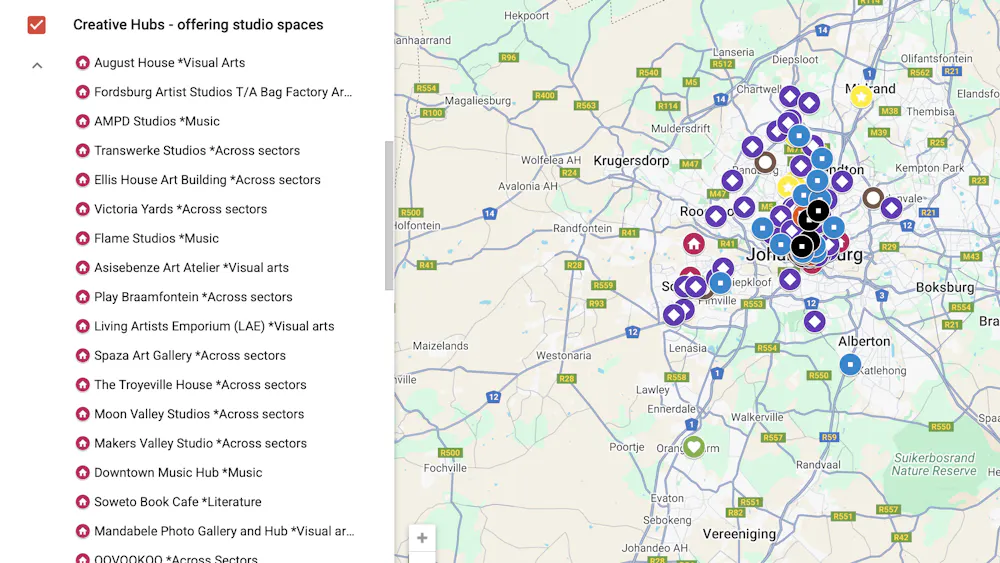
    Over the last year, 21 creative hubs have been mapped in the city, the majority newly established. Notable examples include Transwerke Studios, Asisebenze Art Atelier, Victoria Yards and Oovookoo. Remarkably, 19 of the 21 hubs identified in my open-source mapping process are in the inner city. Only two are government run – Transwerke and Downtown Music Hub.

    Across Johannesburg, creative hubs buzz with independent activity, yet share a common commitment to cultivating talent, business support and community impact. They are evidence of innovative partnerships between creatives and property developers.

    Mapping Johannesburg’s creative hubs. Google Maps/Mariapaola McGurk

    Inside these spaces, artists and creatives get opportunities through gallerist and investor visits (access to markets). They build practical and entrepreneurial skills through tailored workshops. And they collaborate on projects that place social upliftment at their heart.

    Some hubs focus on offering studio spaces, while others extend their reach beyond their walls, blending artistic expression with community development and public engagement.

    By actively building community and opportunity, creative hubs are becoming

    lighthouses for the new urban economy.

    They are small business incubators, urban beautification engines and potential cultural tourism hotspots. An event like Contra Fair opens the doors of art studio hubs once a year. Entrepreneur and social activist Tebogo Moalusi has now taken the lead in the establishment of Creative20. This will become a platform for revitalising Johannesburg’s creative cities campaign.

    Neglected by the city

    And yet the cultural and creative industries remain almost entirely absent from the city’s strategic planning. The Johannesburg 2040: Growth and Development Strategy fails even to mention the sector.

    Bag Factory Artists Studios hosting a public event. Mark Straw

    This is despite Gauteng, the province that houses Johannesburg, being the epicentre of South Africa’s creative economy. It contributes 46.3% of the industry’s gross domestic product and generates the highest employment impact. Johannesburg hosts the majority of creative businesses in the province.


    Read more: The real Johannesburg: 6 powerful photos from a gritty new book on the city


    The Gauteng 2030 Strategy highlights three high-growth sectors: agro-processing, cultural and creative industries, and high-tech/knowledge sectors, including digital and gaming. Two of these directly involve the creative economy. Yet there’s been little effort to integrate them into Johannesburg’s urban development agenda.

    If Johannesburg is serious about inclusive economic development and sustainable urban growth, it must recognise and invest in the cultural and creative industries which are already thriving within its borders.

    – Johannesburg’s creative hubs are booming: how artists are rejuvenating a failing inner city
    – https://theconversation.com/johannesburgs-creative-hubs-are-booming-how-artists-are-rejuvenating-a-failing-inner-city-260224

    MIL OSI Africa

  • MIL-OSI Africa: Ghana has a rare treasure, a crater made when a meteor hit Earth: why it needs to be protected

    Source: The Conversation – Africa – By Marian Selorm Sapah, Senior lecturer, University of Ghana

    Impact craters are formed when an object from space such as a meteoroid, asteroid or comet strikes the Earth at a very high velocity. This leaves an excavated circular hole on the Earth’s surface.

    It is a basic geological process that has shaped the planets from their formation to today. It creates landscapes and surface materials across our solar system. The moon is covered with them, as are planets like Mercury, Mars and Venus. On Earth, impacts have influenced the evolution of life and even provided valuable mineral and energy resources. However, very few of the impact craters on Earth are visible because of various processes that obscure or erase them.

    Most of the recognised impact craters on Earth are buried under sediments or have been deeply eroded. That means they no longer preserve their initial forms.

    The Bosumtwi impact crater in Ghana is different, however. It is well preserved (not deeply eroded or buried under sediments). Its well-defined, near-circular basin, filled by a lake, is surrounded by a prominent crater rim that rises above the surface of the lake and an outer circular plateau. This makes it a target for several research questions.

    As an Earth scientist, I joined a research team from 2019 to better understand the morphology of the crater. We carried out a morphological analysis of the crater (a study of its form, structure and geological features).

    This study concluded that the activities of illegal miners are a threat to the sustainability of the crater. We also discovered that the features of the Bosumtwi impact crater can be considered as a terrestrial representation for a special type of impact crater known as rampart craters. These are common on the planets Mars and Venus and are found on icy bodies of the outer solar system (like Ganymede, Europa, Dione, Tethys and Charon).

    For future studies, the Bosumtwi impact crater can be used to help understand how rampart craters form on Mars and Venus. So the Bosumtwi impact crater should be protected and preserved.


    Read more: Curious Kids: Why are there so few impact craters on Earth?


    The crater

    The Bosumtwi impact crater is in Ghana’s mineral-rich Ashanti gold belt. It is the location of the only natural inland lake in Ghana. As one of the world’s best-preserved young meteorite impact craters it is designated as an International Union of Geological Sciences geoheritage site.

    It is one of only 190 confirmed impact crater sites worldwide, one of only 20 on the African continent. Its lake is one of six meteoritic lakes in the world, recognised for their outstanding scientific value.

    Satellite view of the Bosumtwi Impact Crater showing areas of Artisanal and Small scale Gold Mining activities. David Baratoux

    At almost 1.07 million years old, the crater offers unparalleled opportunities for studying impact processes, climate history and planetary evolution. It’s an irreplaceable natural laboratory for researchers and educators.

    Beyond its scientific importance, the crater holds cultural significance for the Ashanti people of Ghana. The lake at its centre serves as a sacred site and spiritual landmark. The crater’s breathtaking landscape also supports eco-tourism and local livelihoods, contributing to Ghana’s economic development while maintaining exceptional aesthetic value.

    The research

    As part of further research work on the 2019 study, in 2025 we have discovered through field work and satellite data analysis that illegal artisanal mining is prevalent in the area and threatening the crater. This refers to informal, labour-intensive extraction of minerals, primarily gold. It is conducted by individuals or small groups using basic tools and rudimentary machinery. The use of toxic chemicals such as mercury and cyanide, and practices such as river dredging, cause severe environmental harm.

    Illegal miners are encroaching on and around the crater rim, posing severe threats to its environment and sustainability. Their activities have become more prevalent over the course of less than 10 years, indicating a growing problem. If unchecked, it could lead to irreversible damage to the crater.

    These mining operations risk contaminating the lake with toxic heavy metals. The consequences of these are grave. They include destroying critical geological evidence, accelerating deforestation, and degrading the land. All this damages the crater’s scientific, cultural and economic value.

    The International Union of Geological Sciences geoheritage designation of the crater underscores the urgent need for protection measures. The loss of this rare geological wonder would represent not just a national tragedy for Ghana, but a blow to global scientific heritage.

    Immediate action is required. This includes enhanced satellite monitoring (tracking illegal mining, deforestation and environmental changes) using optical imagery (such as Sentinel-2, Landsat, PlanetScope). These tools can detect forest loss, identify mining pits and sediment runoff, and analyse changes over time.

    Stricter enforcement of mining bans, and community engagement programmes, will help preserve the Bosumtwi impact crater’s unique attributes for future generations of scientists, students, tourists and local communities who depend on its resources.

    – Ghana has a rare treasure, a crater made when a meteor hit Earth: why it needs to be protected
    – https://theconversation.com/ghana-has-a-rare-treasure-a-crater-made-when-a-meteor-hit-earth-why-it-needs-to-be-protected-260600

    MIL OSI Africa

  • MIL-OSI Submissions: I watched a simulated oil spill in the Indian Ocean – here’s how island and coastal countries worked together to avoid disaster

    Source: The Conversation – UK – By Kate Sullivan de Estrada, Associate Professor in the International Relations of South Asia, University of Oxford

    Preparing to react to a maritime ’emergency’. Romuald Robert, CC BY

    The coils of black hose, drum skimmers designed to collect oil from the ocean’s surface, and orangey-red containment booms all looked out of place on the white sand of Mombasa’s touristy Nyali beach. But on July 9, dozens of emergency responders in red and orange hi-vis gear took over a portion of this beach. They were braving the wind and choppy Indian Ocean waves as they mock up the onshore response to a simulated oil spill at sea.

    I research how countries in the western Indian Ocean cooperate to make the seas around them safer, and I was there to observe a field training exercise that brought together around 200 participants from ten coastal and island states for one week in east Africa’s largest port city. Codenamed MASEPOLREX25, it put two types of emergency response to the test.

    The first was Kenya’s national-level response to marine oil pollution, guided by its national contingency plan. The second was a regional-level response that can bring in outside help from other nations. The organiser of the exercise, the Indian Ocean Commission (IOC) – an intergovernmental group of Western Indian Ocean islands headquartered in Mauritius – wanted the countries of the region to rehearse a joint response to marine pollution.

    Preparations begin on Kenya’s Nyali beach for the emergency exercise.
    Romuald Robert., CC BY

    The exercise put two IOC-designed regional centres through their paces. Think of them like a pair of regional helpdesks for ocean security, each with a distinct purpose.

    How does it unfold?

    The exercise began the day before with a briefing on the marine pollution scenario. The Kenyan authorities had received a distress call from the fictional captains of two damaged vessels.

    An oil tanker with a deadweight tonnage of 50,000 had collided with a feeder ship in Tanzanian waters, just south of Kenya’s maritime zone. The captain of the tanker suspected that 3,000-to-4,000 metric tonnes of intermediate fuel oil (persistent, thick oil that won’t evaporate by itself) had spilled into the ocean.

    Such an incident is plausible. A 2023 IOC-commissioned internal study pinpointed the Kenya-Tanzania border as a hotspot for marine pollution risk. Two major ports sit in close proximity in a busy maritime transit corridor.

    Clustered around an incident board, Kenya’s incident management team mounted their national response. Nuru Mohammed, liaison officer for the Kenya Maritime Authority, explained that the assessment of the size of the spill and expectations of its behaviour had already led the team to anticipate the need for regional support. At this time of year, the sea current would carry the slick northward into Kenyan waters.

    At the back of everyone’s minds was the 2020 Wakashio incident, in which a bulk carrier owned by a Japanese shipping company but flagged to Panama ran aground to the southeast of Mauritius. An estimated 800-to-1,000 tonnes of fuel oil spilled into the sea, affecting 30km of Mauritian coastline. The cost to marine life, food security and human health were compounded by economic and connectivity challenges posed by the COVID pandemic.

    Responders prepare oil-spill equipment on the beach near Mombasa.
    Romuald Robert, CC BY-SA

    For the exercise, aerial surveillance of the mock spill triggered the first attempt at containment. A live video feed of the offshore national response showed rice husks, a substitute for the oil, afloat on the waves. Two vessels sprayed simulated oil-spill dispersants in challenging winds.

    In real life, as in this exercise, oil properties determine how the spill will behave. IOC consultant Peter Taylor warned that churning waves could mix with the oil forming emulsions that were viscous and not dispersible.

    We turned our attention to the chat feed on SeaVision, an information-sharing platform. A notification popped up. The Regional Maritime Information Fusion Centre (RMIFC) in Madagascar had shared mapped and timestamped projections of the drift of the oil slick for the following 72 hours. The centre’s director, Alex Ralaiarivony, later explained how it could provide other technical support such as satellite imagery, and could calculate the proportions of oil that were likely to become submerged, evaporate, remain adrift and reach the shoreline.

    By July 9, the fictional oil spill had reached the coast. The team on Nyali beach hurried to deploy an oil containment boom, a floating barrier that can shield sensitive areas such as shorelines.

    Back at headquarters, SeaVision was busy with messages. The other centre, the Regional Coordination of Operations Centre (RCOC) in Seychelles, was urgently requesting more shoreline equipment to help with oil spills, such as booms, from regional partners. Mauritius and Madagascar both made offers to help that Kenya accepted, and the RCOC coordinated a Dornier aircraft from Seychelles for collection and delivery.

    How does the emergency response work?

    The two centres help countries in the Western Indian Ocean secure their maritime zones against threats such as piracy, illegal, unreported and unregulated fishing, the trafficking of illicit goods – and marine pollution incidents.

    In Madagascar, the RMIFC gathers and analyses maritime data from multiple sources to detect potential threats at sea. This enables early warning of threats like oil spills, as well as suspicious ships or boats engaged in illicit maritime activities.

    The RCOC in Seychelles responds to these threats. It draws on a shared pool of aircraft and ships belonging to its members, using these to coordinate joint responses – whether through sea patrols, boarding and inspecting ships, or laying the legal groundwork to prosecute offenders.

    The two regional centres serve seven states: IOC island members Comoros, Madagascar, Mauritius, Seychelles and France — through its island territory of La Réunion — as well as East African coastal states Kenya and Djibouti.

    On July 10, the exercise ended with an evaluation. One takeaway was that the two regional centres could have been used even more – for instance, to coordinate technical assistance from different partners. But a key purpose of the exercise was to help participating countries understand what the centres offer, and get them used to a regional-level response.

    Coastal and island states thousands of kilometres apart are being brought closer by maritime threats in their shared ocean. And the two centres are building their operational capacity to support the whole region, while also creating trust among countries. This matters in a geopolitical context of strategic competition in the Indian Ocean, where islands and East African coastal states sometimes want to put their own needs first.

    At the end of the exercise, IOC officer-in-charge Raj Mohabeer reminded participants that the island and coastal states of the Western Indian Ocean have vast maritime zones and face multiple seaborne security threats to their economies, ecologies and livelihoods. “No developing country can deal with a significant marine pollution event alone.”

    Kate Sullivan de Estrada receives funding from Research England’s Policy Support Fund allocation to the University of
    Oxford via the Public Policy Challenge Fund. Her project under the Fund is titled “Balancing ‘Sovereignty Trade-offs’ in Small-State Maritime Security Co-operation: The Case of the Indian Ocean Commission.”

    ref. I watched a simulated oil spill in the Indian Ocean – here’s how island and coastal countries worked together to avoid disaster – https://theconversation.com/i-watched-a-simulated-oil-spill-in-the-indian-ocean-heres-how-island-and-coastal-countries-worked-together-to-avoid-disaster-260895

    MIL OSI

  • MIL-OSI Submissions: Filipino sailors dock in Mexico … and help invent tequila?

    Source: The Conversation – USA (2) – By Stephen Acabado, Professor of Anthropology, University of California, Los Angeles

    Bottles of tequila now command premium prices in trendy bars. On Instagram, celebrity-backed brands of the agave-based Mexican spirit jostle for attention. And debates over cultural appropriation and agave sustainability swirl alongside booming tourism in Jalisco, the western Mexican state that serves as the world’s tequila distillation hub.

    But behind the spirit’s flash of marketing and growing popularity lies a rarely asked question: Where did the knowledge to distill agave come from in the first place?

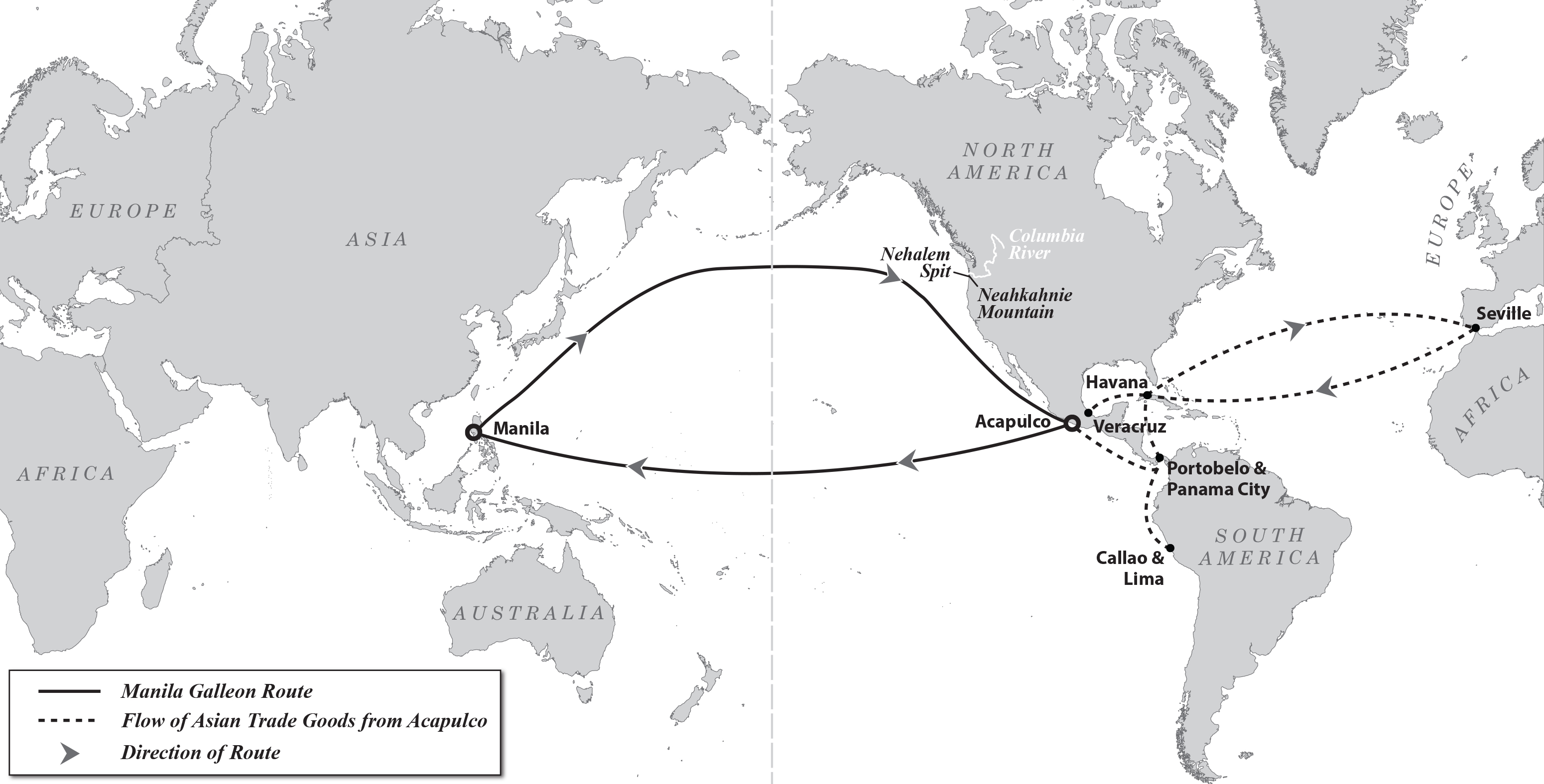
    In recent years, scholars studying how Indigenous communities responded to colonialism and global trade networks have begun to look more closely at the Pacific world. One key focus is the Manila-Acapulco galleon trade route, which linked Asia and the Americas for 250 years, from 1565 to 1815.

    The Manila-Acapulco galleon trade route.
    Jesse Nett/Oregon Encylopedia

    After Spain colonized the Philippines in 1565, Spanish galleons – towering, multidecked sailing ships – carried Chinese silk and Mexican silver across the ocean. But far more than goods traveled aboard those ships. They moved people, ideas and technologies.

    Among them was the craft of distillation.

    This overlooked connection may help explain how distilled agave spirits such as tequila came into being. While tequila is unmistakably a Mexican creation, the techniques used to produce it may owe something to Filipino sailors, who brought with them deep knowledge of transforming coconut sap into a potent spirit known as lambanog.

    3 competing theories

    For centuries, the rise of tequila has been credited to the Spanish. After the conquest of Mexico in the 16th century, colonizers introduced alembic stills, which are based on Moorish and Arabic technology. Unlike simple boiling, distillation requires managing heat and capturing purified vapor. These stills represented a major technological leap, allowing people to transform fermented drinks into distilled spirits.

    Agave, long used to make the fermented drink pulque, soon became the base for something new: tequila and mezcal.

    Colonial records, including the “Relaciones Geográficas,” a massive data-gathering project initiated by the Spanish Crown in the late 16th century, describe local Mesoamerican communities learning distillation from Spanish settlers. This version is well documented. But it assumes that technology moved in only one direction, from Europe to the Americas.

    A second idea suggests that Mesoamerican communities already had some understanding of vapor condensation. Archaeologists have found ceramic vessels in western Mexico that may have been used to capture steam. While distillation requires additional steps, this prior knowledge may have primed Indigenous groups to more readily adopt new techniques.

    As Mexican ethnobotanists Patricia Colunga-GarcíaMarín and Daniel Zizumbo-Villarreal have argued, “The adoption of distillation was likely not simply imposed, but creatively adapted to local knowledge systems.”

    A third perspective, which other researchers and I are exploring, traces a potential Filipino influence. The galleon trade brought thousands of Filipino sailors and laborers to Mexico, particularly along the Pacific coast. In places such as Guerrero, Colima and Jalisco, Filipino migrants introduced methods for fermenting and distilling coconut sap into lambanog, the coconut-based spirit.

    The stills they used, sometimes called Mongolian stills, were built with clay and bamboo and included a condensation bowl. Historian Pablo Guzman-Rivas has noted that these stills more closely resemble the earliest Mexican agave distillation setups than European alembics. He has also documented oral traditions in some coastal Mexican communities to link local distillation practices to their Filipino ancestors.

    The still on the left in Jalisco, Mexico, has similarities to the lambanog on the right from Infanta, Quezon, Philippines.
    Photo on left courtesy of Patricia Colunga-GarcíaMarín and Daniel Zizumbo-Villarreal; photo on right courtesy of Sherry Ann Angeles and Rading Coronacion, CC BY-SA

    Beyond the bottle

    Filipino influence extends beyond the distilling pot.

    In Colima and other Pacific port towns, traces of the Manila galleon trade ripple through daily life – in kitchens, cantinas and even in architecture. The word “palapa,” used in Mexico and Central America today to describe rustic thatched roofs, is exactly the same as the term for coconut fronds that’s primarily used in the Bicol Region of the Philippines.

    Filipino migrants in Mexico also shared knowledge of boatbuilding, fermentation and food preservation. Coconut vinegar, fish sauce and palm sugar-based condiments became part of Mexican cuisine. One of the most enduring legacies is tuba, the fermented coconut sap still popular in coastal areas of the Mexican state of Guerrero, where Filipino sailors once settled. Known locally by the same name, tuba is sold in markets and along roadsides, often enjoyed as a refreshing drink or as a cooking ingredient.

    A replica of a galleon, the Spanish trading ship that traversed the world’s oceans from the 16th century to the 18th century.
    Dennis Jarvis/flickr, CC BY-SA

    Exchange moved both ways. Filipino vessels carried corn, peanuts, sweet potatoes and cacao back across the Pacific, reshaping food in the Philippines. These exchanges took place under the shadow of colonialism and forced labor, but their legacies endure in language, in taste and even in the roofs over people’s heads.

    Technical knowledge rarely travels through official channels alone. It moves with cooks in ship galleys, with carpenters below deck, with laborers who desert ships to settle in unfamiliar ports. Sometimes it was a way to build a roof or preserve a flavor. Other times, it was a method for turning a fermented plant into a spirit that could keep for long voyages. And by the early 1600s, new types of distilled agave spirits were being made in Mexico.

    Tequila is unmistakably a product of Mexico. But it is also a product of movement. Whether Filipino migrants directly introduced distillation methods or whether they emerged from a mix of Indigenous experimentation and European tools, every time you sip tequila, you’re tasting an echo of those long ocean crossings from many centuries ago.

    Stephen Acabado receives funding from the Henry Luce Foundation and the National Science Foundation.

    ref. Filipino sailors dock in Mexico … and help invent tequila? – https://theconversation.com/filipino-sailors-dock-in-mexico-and-help-invent-tequila-258166

    MIL OSI

  • MIL-OSI Russia: Presidents of Kyrgyzstan and Mongolia discussed key areas of bilateral cooperation

    Translation. Region: Russian Federal

    Source: People’s Republic of China in Russian – People’s Republic of China in Russian –

    An important disclaimer is at the bottom of this article.

    Source: People’s Republic of China – State Council News

    BISHKEK, July 21 (Xinhua) — Talks were held in Bishkek on Monday between Kyrgyz President Sadyr Japarov and Mongolian President Ukhnaagiin Khurelsukh as part of the latter’s state visit to the Kyrgyz Republic, the Kyrgyz president’s Telegram channel reported.

    The parties discussed key areas of bilateral cooperation, including politics, trade and economics, transport and agriculture. Particular attention was paid to digitalization, the development of cultural and humanitarian ties and tourism.

    S. Japarov emphasized that Kyrgyzstan and Mongolia are states historically linked by ties of friendship, the roots of which go back to ancient times. “Comprehensive cooperation with Mongolia is one of the priority areas of development of Kyrgyzstan’s foreign policy,” he noted.

    The President of Kyrgyzstan expressed confidence that the visit of the head of Mongolia will give a powerful impetus to further strengthening political dialogue, expanding trade and economic ties and developing cultural and humanitarian cooperation.

    In turn, U. Khurelsukh emphasized that this visit provides a good opportunity to jointly with the President of Kyrgyzstan to sum up the 30-year path of bilateral relations, assess the implementation of the agreements reached, and also determine priority areas and prospects for cooperation filled with specific economic content.

    “For Mongolia, Kyrgyzstan is an important partner in Central Asia and a kind of bridge connecting the region. We strive to develop mutually beneficial cooperation in all areas, especially in the trade and economic sphere,” the President of Mongolia noted.

    Following the talks, the heads of the two states signed a Joint Declaration on the establishment of a comprehensive partnership between Kyrgyzstan and Mongolia, as well as a number of other documents aimed at increasing cooperation. –0–

    Please note: This information is raw content obtained directly from the source of the information. It is an accurate report of what the source claims and does not necessarily reflect the position of MIL-OSI or its clients.

    .

    MIL OSI Russia News

  • MIL-OSI Russia: Deputy Minister of Economic Development inspected the infrastructure of the Mamison resort

    Translation. Region: Russian Federal

    Source: Ministry of Economic Development (Russia) – Ministry of Economic Development (Russia) –

    An important disclaimer is at the bottom of this article.

    On July 17, 2025, Deputy Minister of Economic Development of Russia Sergey Nazarov visited North Ossetia on a working visit. The main point of the trip was the all-season tourist and recreational complex “Mamison”, where an off-site meeting was held with the participation of the Minister of Economic Development of the Republic of North Ossetia Alania Marat Sokayev and representatives of “Kavkaz.RF”.

    During the meeting, key areas of further development of the resort were discussed, including the pace of construction of facilities and connection to utility networks. Sergey Nazarov inspected the transport, utilities and tourism infrastructure, including ski slopes, hotels, glampings and tent camps. In addition, the meeting participants tested the new Mamihdon trail from the upper cable car station to the tent camp (length over 4 km).

    Today, the resort has two cable cars, 14 km of ski slopes, hotels, cafes and year-round recreation facilities. Due to the national project “Tourism and Hospitality Industry”, 590 million rubles were allocated for infrastructure development in 2023-2024. In 2025-2027, financing in the amount of 150 million rubles is planned.

    Construction and installation works at the 110/10 kV Mamison substation have been fully completed. In December 2024, an agreement was concluded between JSC Kavkaz.RF and PJSC Rosseti North Caucasus, ensuring the technological connection of the resort facilities. The redistribution of capacity in the amount of 4480 kW allows for the launch of the infrastructure in normal mode.

    The main gas pipeline, 14.5 km long, is 90% complete, and 100% within the resort. Gas supply via this route is expected in the fourth quarter of 2025.

    The water intake unit with a capacity of 4,500 m³/day has been operating since 2014 and was transferred to the balance of the republican water utility in 2024. The resort is connected to the centralized water supply according to a temporary scheme: water comes directly from wells, bypassing reservoirs. This ensures the functioning of the facilities, but requires additional measures to modernize the system.

    “The creation of the Mamison resort is not only a contribution to the tourist attractiveness of North Ossetia, but also to the development of the entire economy of the region. Over the past two years, we have managed to overcome infrastructure barriers and move to the stage of stable operation. Today, the task is to ensure the stable operation of all engineering systems, involve investors and continue the comprehensive development of the resort,” emphasized Sergey Nazarov.

    Please note: This information is raw content obtained directly from the source of the information. It is an accurate report of what the source claims and does not necessarily reflect the position of MIL-OSI or its clients.

    .

    MIL OSI Russia News

  • MIL-OSI Russia: Dmitry Chernyshenko: The plan for the Decade of Science and Technology is aimed at achieving technological leadership

    Translation. Region: Russian Federal

    Source: Government of the Russian Federation – Government of the Russian Federation –

    An important disclaimer is at the bottom of this article.

    A meeting of the Coordination Committee for the Decade of Science and Technology was held under the chairmanship of Deputy Prime Minister Dmitry Chernyshenko. Participants discussed the interim results of the Decade’s initiatives for 2025 and preparations for the V Congress of Young Scientists.

    “The Decade of Science and Technology, announced by President Vladimir Putin, is aimed at strengthening the role of science and technology in solving key development problems of the country. Its main goal is to achieve technological leadership of Russia. To achieve this, a special plan has been developed, which provides for the popularization of modern scientific knowledge and obtaining a real socio-economic effect. One of the main annual events – the Congress of Young Scientists – has been included in the national project “Youth and Children” since this year. The event will traditionally bring together representatives of the scientific community, business leaders, as well as representatives of state and public organizations from Russia and other countries,” said Deputy Prime Minister, Co-Chairman of the Coordination Committee for the Decade of Science and Technology Dmitry Chernyshenko.

    Last year, more than 7,000 people from 85 regions of Russia and abroad took part in the Congress of Young Scientists.

    The Decade’s initiatives strengthen the human resources potential of the scientific and technological sphere.

    “Holding the Decade of Science and Technology in Russia is, of course, a very important initiative of the President of the Russian Federation Vladimir Putin. It is aimed at popularizing scientific achievements and creating conditions for doing science. I believe that the organizers and all participants of the Decade of Science and Technology are, on the whole, successfully coping with these tasks,” said Gennady Krasnikov, President of the Russian Academy of Sciences.

    Minister of Education and Science Valery Falkov noted that the Decade of Science and Technology forms the correct perception of science and the profession of a scientist. According to surveys, the proportion of parents who welcome their children’s choice of a career in the scientific field is increasing, now there are more than 60%.

    “We also see a growing interest among young people in engineering specialties, which is associated with the extensive work within the Decade of Science and Technology. Compared to 2022, admission to engineering programs in 2024 increased by 7% – from 213 thousand to 228 thousand people,” the minister emphasized.

    Deputy Minister of Science and Higher Education Denis Sekirinsky reported that scientific volunteering is developing, the study of the legacy of the Soviet scientific school continues, the network of scientific playgrounds for children is expanding – today there are 55 of them in 41 cities in Russia. In the “Science and Innovation” domain, 26 services are available for the research community. In Russia, 12 new routes for popular science tourism have been launched in the regions, and in general, there are 87 of them in the country.

    “Since the beginning of 2025, more than 3,000 events of the Decade of Science and Technology have been held, reaching more than 4 million people. This reflects the scale of the work done and sets a high bar for the second half of the year. The development of existing formats continues, new areas are emerging so that more and more young people see science as an opportunity for professional growth and participation in the future of the country,” he said.

    Sofia Malyavina, Director General, spoke about the work of the operator of the Decade of Science and Technology, ANO National Priorities: “Since the beginning of the Decade of Science and Technology in 2022, we have organized more than a hundred excursions and lectures “Science is Nearby”, created dozens of thematic TV projects and podcasts, and attracted over 100 thousand schoolchildren and students to participate in competitions. Since the beginning of 2025 alone, over 24 thousand publications about science have been published – on television, radio, in the press, and online. Interest in this topic is growing, and our task is to ensure that as many people as possible learn about scientific achievements and the specialists behind them.”

    The head of Rosmolodezh Grigory Gurov noted that the scientific volunteer community consists of more than 60 thousand people, and in 2025, more than 3 thousand volunteers joined it: “Rosmolodezh, together with the “Movement of the First”, is implementing the direction “Science and Technology. “DARE AND DISCOVER”, which helps popularize science among children and young people, including through the flagship project “First in Science”. This year, we plan to launch at least 600 “First” scientific clubs in 30 pilot regions. We support young people who strive to develop in science, we create conditions so that children and young people can implement their ideas and propose innovative projects within the framework of the national project “Youth and Children”, launched on the initiative of the President of Russia.”

    Anton Kobyakov, Advisor to the President and Head of the Interdepartmental Working Group for the Preparation and Holding of the Congress of Young Scientists and Associated Events, spoke about the preparations for the anniversary V Congress of Young Scientists to be held on November 26–28, 2025.

    “Special attention in 2025 is being paid to expanding the international component of the Congress of Young Scientists – active work is underway to invite foreign scientists from friendly countries to participate in the congress. As part of the international promotion, the congress was presented at external communication platforms, including off-site events and presentation sessions of the SPIEF in Mexico, Turkey, India, and Arab countries. Also this year, the partner of the invitation campaign is Friends for Leadership – an association created following the XIX World Festival of Youth and Students, which operates in 130 countries. As a result of the work, to date, more than 1.6 thousand participants have submitted applications to participate in the congress,” said Anton Kobyakov.

    Among the innovations of the upcoming congress, the Presidential Advisor named the holding of the BRICS Social and Humanitarian Research Forum on the sidelines of the congress. In addition, exhibition clusters dedicated to industry, technological development, healthcare, ecology, and digitalization will be organized within the framework of the congress exhibition.

    The Director General of the State Corporation Rosatom, Alexey Likhachev, spoke about the events of the V Congress of Young Scientists related to the topic of the atom and the 80th anniversary of the nuclear industry.

    The Governor of the Yamalo-Nenets Autonomous Okrug Dmitry Artyukhov paid attention to the regional experience of implementing the Decade’s initiatives.

    The director of the National Center “Russia” Natalia Virtuozova spoke about the activities of the National Center “Russia” to implement the tasks of the Decade. According to her, one of the strategic areas was the popularization of science fiction – through exhibition projects, international discussion platforms and educational programs. The flagship of this work was the international symposium “Creating the Future”.

    The head of the Educational Foundation “Talent and Success” Elena Shmeleva, the rector of the Lomonosov Moscow State University Viktor Sadovnichy, the rector of the Presidential Academy Alexey Komissarov put forward a number of proposals for holding projects and events within the framework of the Decade and the Congress of Young Scientists.

    Please note: This information is raw content obtained directly from the source of the information. It is an accurate report of what the source claims and does not necessarily reflect the position of MIL-OSI or its clients.

    .

    MIL OSI Russia News

  • MIL-OSI Russia: Conversation between Mikhail Mishustin and the Governor of the Amur Region Vasily Orlov

    Translation. Region: Russian Federal

    Source: Government of the Russian Federation – Government of the Russian Federation –

    An important disclaimer is at the bottom of this article.

    Current issues of the region’s socio-economic development were discussed.

    From the transcript:

    M. Mishustin: Dear Vasily Alexandrovich!

    Previous news Next news

    Conversation between Mikhail Mishustin and the Governor of the Amur Region Vasily Orlov

    Not so long ago, about five years ago, we met here and spoke in detail about the infrastructure elements that were sorely needed in the Amur Region. I remember very well, then we looked at the bridge towards Heihe, talked about checkpoints, a new airport, coastal protection, the creation of modern embankment elements and much more.

    Today, these projects are being implemented systematically. The result of this was a twofold increase in the regional domestic product. This is a very good result. Today, we have seen from the implementation that everything is going as usual.

    The airport we visited is almost ready. I hope that it will welcome and serve the millionth passenger in the new terminal in December, as planned.

    Drive

    The projects “Golden Mile”, “Silver Mile”, the expo center, the hotel, the cable car, all the elements on the embankment, which we also discussed in detail with you – they are all being implemented, and I hope on time.

    It is also pleasing to see the creation of infrastructure for the movement of goods and, of course, for passenger transportation, tourism – both within the country and for tourism towards China. You are a border city.

    And here it is very important that Kanikurgan, as an infrastructure, as a customs and logistics warehouse, as a checkpoint, will become, I think, an anchor for the expansion of the entire transport and logistics system of the Far East.

    To be continued…

    Please note: This information is raw content obtained directly from the source of the information. It is an accurate report of what the source claims and does not necessarily reflect the position of MIL-OSI or its clients.

    .

    MIL OSI Russia News

  • MIL-OSI Russia: Mikhail Mishustin visited the city center “Tribuna Hall” in Blagoveshchensk

    Translation. Region: Russian Federal

    Source: Government of the Russian Federation – Government of the Russian Federation –

    An important disclaimer is at the bottom of this article.

    The Prime Minister inspected the Russian-Chinese Friendship House under construction and watched a presentation of key objects of the Blagoveshchensk master plan and the project for coastal protection and embankment reconstruction.

    Previous news Next news

    Mikhail Mishustin visited the city center “Tribuna Hall” in Blagoveshchensk. With the Governor of the Amur Region Vasily Orlov

    The key objects of the Blagoveshchensk master plan are located in the central part of the city on the Golden Mile section of the Amur embankment, which includes the House of Russian-Chinese Friendship, a cross-border cable car, an international congress and exhibition center, a premium hotel complex, the Fountain Alley, the Amur Dino Park and other objects.

    The entire territory of the Golden Mile is reclaimed and was formed as a result of the implementation of a large-scale project for coastal protection and improvement of the embankment of the city of Blagoveshchensk (implemented in the period from 2013 to 2024 on 10 sites, which are grouped into 3 key clusters – Golden Mile, Silver Mile and Cote d’Azur).

    The project was created using funds from a single subsidy, the regional budget and with the participation of partners (SBER). Within the framework of the project, the largest fountain complex in Eurasia was created, the House of Russian-Chinese Friendship with an observation deck, a dino park were built, and the central square of Blagoveshchensk was landscaped.

    Drive

    Mikhail Mishustin inspected the automobile checkpoint across the state border Kani-Kurgan

    Mikhail Mishustin inspected the new airport complex of the Blagoveshchensk International Airport (Ignatievo) named after N.N. Muravyov-Amursky

    The House of Russian-Chinese Friendship is a separate building with a complex architectural elliptical shape with variable number of storeys and a protruding cornice-spoiler. The area of the object is 6.3 thousand square meters, 2 floors, the roof of the building serves as an observation deck. Finishing works are currently underway at the object, completion is scheduled for September 2025.

    The cross-border cableway across the Amur River between the cities of Blagoveshchensk (Russia) and Heihe (China) is the world’s first cableway between two countries, Russia and China, and opens up great prospects for the development of international tourism and business. The cableway is being built under an intergovernmental agreement signed on September 3, 2015. The construction period is 2019–2025, with commissioning scheduled for May 2026. Technical readiness as of July 2025 is 80%.

    The length of the cable car is 976 meters, it consists of two independent lines with two cabins with a capacity of up to 110 people each, the throughput capacity is 6.8 thousand people per day in each direction, the throughput capacity of the checkpoint across the state border is up to 2.5 million people per year (in both directions).

    On the Russian side, a four-level passenger terminal with a total area of 26 thousand square meters is being built to accommodate the cable car terminal station, a platform and technological equipment, a checkpoint across the state border, a duty-free shop, restaurants, shopping and entertainment facilities. Commissioning is scheduled for May 2026.

    The construction of a multifunctional congress and exhibition center is included in the long-term plan for the comprehensive socio-economic development of Blagoveshchensk for the period up to 2030. The planned start date for construction is the first quarter of 2026, and the completion of work is 2028. International events will be held here (the Russian-Chinese Economic Forum “AmurExpo”, congresses, concerts, exhibitions), a center for Russian-Chinese business cooperation will be created, and a permanent export fair of Russian goods (from food to industrial equipment) for foreign guests will be organized.

    The construction of five-star hotels is planned on the territory adjacent to the cross-border cableway under construction, in the immediate vicinity of the planned international congress and exhibition center.

    The Alley of Fountains is the largest fountain complex in Eurasia, which has become the new calling card of the capital of the Amur Region. It is a pedestrian fountain with an area of 3 thousand square meters with a fogging system and 2114 jets. It was put into operation in May 2024.

    In the evening, the fountain jets “dance” to music, being painted in different colors thanks to the spotlights installed next to the nozzles. Spectators can see “swan wings”, “hearts”, and other water figures.

    The Amur Dinopark is an immersive area that will feature more than 20 exhibits, such as animatronic dinosaurs in jungle-like interiors. Finishing work is currently underway in the new building, with completion scheduled for May 2026.

    Please note: This information is raw content obtained directly from the source of the information. It is an accurate report of what the source claims and does not necessarily reflect the position of MIL-OSI or its clients.

    .

    MIL OSI Russia News

  • MIL-OSI Russia: Total number of internet users in China exceeds 1.12 billion people /detailed version-1/

    Translation. Region: Russian Federal

    Source: People’s Republic of China in Russian – People’s Republic of China in Russian –

    An important disclaimer is at the bottom of this article.

    Source: People’s Republic of China – State Council News

    BEIJING, July 21 (Xinhua) — The number of internet users in China will reach more than 1.12 billion as of June 2025, according to a report released Monday by the China Internet Information Center.

    The document also notes that by the end of June 2025, the internet penetration rate in China will reach 79.7 percent, an increase of 1.1 percentage points compared to December 2024.

    According to the report, China has made significant progress in internet development during the 14th Five-Year Plan period (2021-2025). In particular, efforts to expand internet access have enabled key groups such as the elderly and those living in rural areas to benefit from this progress.

    As of June 2025, the number of internet users aged 60 and above in China reached 161 million, while the number of internet users in rural areas reached 322 million. Moreover, the internet penetration rate among these two groups of the Chinese population reached 52% and 69.2%, respectively.

    Meanwhile, China’s continued internet development has played a key role in promoting Chinese culture both domestically and abroad, the report said, highlighting the booming expansion of Chinese online literature and games into overseas markets and the deepening integration between popular web series and related tourism destinations. -0-

    Please note: This information is raw content obtained directly from the source of the information. It is an accurate report of what the source claims and does not necessarily reflect the position of MIL-OSI or its clients.

    .

    MIL OSI Russia News

  • MIL-OSI Russia: Hunchun checkpoint becomes “golden corridor” for import of king crabs from Russia

    Translation. Region: Russian Federal

    Source: People’s Republic of China in Russian – People’s Republic of China in Russian –

    An important disclaimer is at the bottom of this article.

    Source: People’s Republic of China – State Council News

    BEIJING, July 21 (Xinhua) — Trucks loaded with king crabs and other seafood line up at the Hunchun port in northeast China’s Jilin Province in the height of summer to clear customs before entering China.

    Truck driver Chen Chen said he can transport up to four tons of king crabs at a time.

    According to the Zhongxinshe news agency, more than 1.5 million units of Kamchatka crabs from Russia are imported into China through the Hunchun checkpoint every year, which accounts for about 80 percent of the country’s total market. Hunchun has truly become a key gateway for China to import this seafood delicacy.

    With the continuous improvement of cross-border logistics and transportation efficiency in recent years, Russian-produced Kamchatka crabs have become part of the daily life of Chinese people.

    Over the past decade, Kamchatka crabs have been sold not only in northeast China, but also served on tables in major cities such as Beijing, Shanghai, Guangzhou and Shenzhen.

    To meet the high market demand, Hunchun City also focused on promoting the Northeast Asia Fresh Seafood Park project with a total investment of over 600 million yuan (about 83.6 million US dollars).

    The park will not only be used for temporary storage of imported seafood, but also to stimulate the development of processing trade to build an important hub for processing and distributing fresh seafood in northern China, said Liu Yansong, head of the park.

    Now tasting king crabs has become a tourist specialty of Hunchun.

    Previously, imported Russian king crabs had to be transported to China via Busan, a city in the southeast of the Republic of Korea. After Hunchun was approved as a specialized checkpoint for importing chilled seafood and edible aquatic animals, this “golden corridor” for importing king crabs into the country was opened. In addition, the Kamchatka-Zarubino-Hunchun route made the transportation of aquatic products between China and Russia more stable and uninterrupted.

    To ensure the freshness of imported seafood, Hunchun Customs has opened a “green channel” to provide inspection and release services by appointment all year round and around the clock, speeding up customs clearance.

    In recent years, Chinese consumers’ interest in Russian Kamchatka crabs has grown rapidly. According to the General Administration of Customs of China, the total value of China’s imports of live, fresh and frozen crabs from Russia exceeded US$1.14 billion last year, up 16.7 percent from the previous year. -0-

    Please note: This information is raw content obtained directly from the source of the information. It is an accurate report of what the source claims and does not necessarily reflect the position of MIL-OSI or its clients.

    .

    MIL OSI Russia News

  • MIL-OSI United Kingdom: Summer of gigs will boost the economy and show why London is the undisputed capital of music

    Source: Mayor of London

    • Coldplay, Beyoncé, Oasis and Billie Eilish among worldwide stars performing more times in London than anywhere else in the world
    • Capital’s major arenas and stadiums welcoming more 3.6m fans over the summer, with fans travelling from across the world
    • London attracts 7.5m music fans each year, bringing in £2.7bn in revenue

    The Mayor of London, Sadiq Khan, has today celebrated the capital’s incredible summer of gigs that show why London is the undisputed capital of music.

    This Friday, Oasis will become the latest act this year to perform, with more concerts in London than anywhere else in the world. It follows:

    • Beyoncé performing six times at Tottenham Hotspur Stadium in June;
    • Billie Eilish concluding a six-date run at The O2 last week;
    • And Usher performing a 10-night residency at The O2 earlier this year.

    Next month Coldplay will also start a record run of 10 dates at Wembley Stadium.

    Other headlines from the capital’s huge summer of music include Tottenham Hotspur Stadium welcoming Stray Kids and Wembley Stadium hosting BLACKPINK for their only UK performances. BST Hyde Park welcomed more than 500,000 people across its eight sold-out shows, with Noah Kahan playing his largest headline show to date and Zach Bryan and Sabrina Carpenter playing their biggest ever UK shows.

    These world-leading runs from global stars show why London welcomes millions of music fans from across the world. UK Music estimates that 7.5m music tourists attended concerts and festivals in London last year, accounting for £2.7bn of the country’s total £10bn revenue.

    Recent analysis of concert ticket sales by Live Nation has revealed that 61 per of fans have travelled from across the UK to come to London for gigs so far this summer, with 16 per cent from abroad. Figures from AEG Europe show that the O2 – the world’s busiest live entertainment arena – is on track for its biggest year yet, with 1.4m tickets sold already this year.

    London’s 179 grassroots music venues are also hosting a huge range of performances this summer, providing a stage for the next generation of talent and boosting the capital’s economy and nightlife. In the last year, grassroots venues welcomed more than 4.2m audience members, hosted performances by more than 328,000 artists, employed nearly 7,000 people and contributed £313m to the economy.

    In May, London united to champion the incredible impact of the capital’s grassroots music scene with the first ever special Grassroots Music Tube Map, which celebrates all aspects of the capital’s music scene and connects Londoners and visitors with grassroots gigs. The Mayor also continues to encourage councils and businesses to offer more al fresco dining and late-night openings this summer to boost our economy and tourism and offer even more hospitality options for those enjoying the fantastic gigs in our capital.

    The Mayor of London, Sadiq Khan, said: “This summer, some of the world’s biggest music stars are performing more times in London than anywhere else – showing why we are the undisputed capital of music. Our world-renowned venues are drawing more than 3.6m people to enjoy unforgettable experiences and boost our hospitality industry, from Beyoncé’s exclusive performances at the Tottenham Stadium and Billie Eilish’s six-night run at the O2 to Coldplay’s upcoming dates at Wembley Stadium. At the same time, our incredible grassroots venues continue to provide a wide range of performances every night of the week for music fans to enjoy. From the very best stadium and festival headliners to upcoming stars at grassroots venues, I’m proud that London’s music scene is leading the way as we continue to build a better London for everyone.”

    Justine Simons OBE, London’s Deputy Mayor for Culture and Creative Industries, said: “From tens of thousands singing along to their favourite chorus to intimate crowds discovering a new act for the very first time, music has incredible power to bring people together. Nowhere else is that shown more clearly than in London where this summer music-fans can unite to enjoy so many genres of music across a huge variety of venues. There really is something for everyone!”

    Tom Kiehl, Chief Executive of UK Music, said: “London is a global superpower when it comes to the strength and incredibly diversity of our music industry which attracts talent from across the world and draws millions of visitors to the capital. Our latest UK Music figures show that a total of 7.5 million domestic and overseas music tourists came to London in 2024 and spent £2.7 billion enjoying stadium-filling acts like Taylor Swift, festivals like All Points East and British Summer Time and our iconic grassroots venues. The Oasis reunion and Beyoncé tour means that London has another spectacular summer lined up for music fans who deliver a tremendous boost for the capital’s economy by spending in the city’s restaurants, bars and shops to make the most of all that London has to offer. It’s vital that we all continue to celebrate and support the ecosystem that makes up the city’s music scene to deliver jobs, growth and unforgettable experiences for millions of people.”

    John Langford, Chief Operating Officer of AEG Europe, said: “We’re experiencing another phenomenal year of success across our portfolio of iconic venues and festivals. In just the first half of this year alone, The O2 arena has sold over 1.4 million tickets and hosted 115 performances — testament to London’s status as the global capital of live music. From legendary, sold-out headliners like Billie Eilish to emerging voices taking the stage for the first time – 25 debut artists in total already – our line-up has celebrated the full spectrum of talent and genres, from rock and pop to metal and beyond. The energy, diversity, and creativity on display truly reflect the spirit of London. As we celebrate The O2’s 18th anniversary and top the Billboard mid-year charts for both shows and attendance, it’s clear: London is not just participating in the global music scene — it’s leading it.”

    Denis Desmond, Chairman of Live Nation UK & Ireland, said: “This year marks Live Nation’s busiest summer season ever in the UK with over two million attendees in London alone. The growing demand for events is evident with fans continuing to value live experiences – that feeling of seeing your favourite artist in a crowd alongside 90,000 people is unlike anything else. This summer we’re particularly pleased to see artists that we’ve worked with since the beginning of their careers, like Beyonce, Dua Lipa, Imagine Dragons, Kendrick Lamar, Lana Del Rey, Post Malone, Guns N Roses, and Coldplay all performing at stadium level.”

    James Barton, co-founder of Superstruct – the London-based live entertainment group behind events including Field Day, Mighty Hoopla and Cross The Tracks – said: “London remains the most significant and influential music city in Europe with its diversity giving rise to an unprecedented range of festivals catering to different musical tastes. That gives incredible opportunities for artists and music fans and has led to the development of a rich ecosystem of suppliers and technical expertise, supporting thousands of jobs.”

    Kate Nicholls, Chair of UK Hospitality, said: “This year’s summer of music shows that London is the best place in the world to see your favourite musicians and bands, with millions flocking to shows across the capital. The additional visits to pubs, bars and restaurants from show-goers will deliver a huge boost to hospitality businesses and shows the impact live music can have on the wider economy.”

    MIL OSI United Kingdom

  • When you butcher civilians, you don’t get pass but justice: US House Committee on TRF ban

    Source: Government of India

    Source: Government of India (4)

    The US House Committee on Foreign Affairs has strongly backed the recent designation of The Resistance Front (TRF) as a Foreign Terrorist Organization (FTO), emphasising that the group’s violent actions warrant international condemnation and justice, not leniency.

    Posting on its official handle on X, the committee stated: “President Trump calls it like it is. The Resistance Front is a foreign terrorist organization and deserves the designation. When you butcher civilians, you don’t get a pass—you get JUSTICE.”

    The remarks came after the US Department of State officially designated TRF, a proxy of the Pakistan-based terror outfit Lashkar-e-Taiba (LeT), as both a Foreign Terrorist Organization (FTO) and a Specially Designated Global Terrorist (SDGT).

    The group claimed responsibility for the April 22 Pahalgam terror attack, in which 26 civilians, mostly tourists, were brutally killed in one of the deadliest attacks on Indian soil since the 2008 Mumbai attacks.

    In its official statement, the US Department of State said: “The Department of State is adding The Resistance Front (TRF) as a designated Foreign Terrorist Organization (FTO) and Specially Designated Global Terrorist (SDGT). TRF, a Lashkar-e-Tayyiba (LeT) front and proxy, claimed responsibility for the April 22, 2025, Pahalgam attack, which killed 26 civilians. This was the deadliest attack on civilians in India since the 2008 Mumbai attacks conducted by LeT. TRF has also claimed responsibility for several attacks against Indian security forces, including most recently in 2024.”

    The department emphasised that these actions reflect the Trump Administration’s commitment to national and global security.

    “These actions taken by the Department of State demonstrate the Trump Administration’s commitment to protecting our national security interests, countering terrorism, and enforcing President Trump’s call for justice for the Pahalgam attack.”

    The TRF designation comes amid increasing international pressure on Pakistan to curb terror groups operating from its soil. India has long accused Pakistan of sheltering and supporting LeT and its front organisations, including TRF, which emerged in 2019 as a shadow group to avoid international scrutiny.

    (IANS)

  • PM Modi shares article commending progress in Meghalaya

    Source: Government of India

    Source: Government of India (4)

    Prime Minister Narendra Modi on Sunday shared an article highlighting progress made by the state of Meghalaya.

    In response to an article shared by Finance Minister Nirmala Sitharaman, PM Modi said on X, “Union Finance Minister Nirmala Sitharaman highlights Meghalaya’s remarkable transformation driven by tourism, youth empowerment, women-led SHGs, initiatives like the PM Suryaghar Muft Bijli Yojana, the Vibrant Village Programme and more. With strong government support and vibrant community spirit, the state stands as a blueprint for a resilient and self-reliant India.”

    In her article, FM Sitharaman highlighted Meghalaya’s remarkable progress across infrastructure, youth empowerment, agriculture, and cultural preservation – from smooth highways connecting Guwahati to Shillong, to the scenic Umiam Lake being developed as a world-class tourism hub under the SASCI scheme.

    FM Sitharaman said that her visits to local Farmer Producer Organisations (FPOs) and Self-Help Groups (SHGs) revealed a dynamic entrepreneurial spirit, with Meghalaya’s farmers and women leaders turning into business owners. The export of pineapples to Dubai and the cultivation of shitake mushrooms with Japanese collaboration are just a few indicators of agricultural innovation.

    She added that the heritage conservation is also thriving in Meghalaya. In the village of Siej, community members are preserving the iconic living root bridges, with efforts underway for UNESCO World Heritage recognition. Her journey culminated in Sohbar and Cherrapunji (Sohra), where vibrant border villages and institutions like the Ramakrishna Ashram embody a blend of tradition, service, and self-reliance.

    The visit reaffirmed Meghalaya’s position as a beacon of inclusive development, where community spirit and government initiatives together are building a confident, sustainable, and Aatmanirbhar Bharat.

  • MIL-OSI Africa: Ghana: President Mahama flags off work on second phase of Blekusu sea defence project

    Source: APO – Report:

    .

    President John Dramani Mahama was in Agavedzi on Saturday for a groundbreaking ceremony for the second phase of the Blekusu Coastal Protection Project.

    The project, a significant initiative that will protect lives and livelihoods in the Ketu South Municipality of the Volta Region, was met with palpable joy and deep gratitude from the chiefs and people of the Some and Aflao Traditional Areas, who gathered to witness the realisation of a long-awaited development.

    The ceremony saw an emotional outpouring of appreciation, as community members sang praises and danced, celebrating the President’s commitment to addressing their decades-long struggle against severe tidal erosion.

    Upon completion in four years, the project, which will protect an 8-kilometre stretch of coastline, is set to bring immense relief to the communities of Blekusu, Agavedzi, Salakope, Amutsinu, and Adina.

    Messrs Amandi Holding Limited is the contractor and will deliver 37 groins, extensive dune restoration, reinforced embankments, and other critical shoreline defence structures.

    President Mahama stated that the project is a comprehensive one that will extend beyond mere coastal protection.

    “Aside from the coastal protection works, government has incorporated vital development projects to enhance the lives of the people in the affected area,” he noted.

    These integrated initiatives include a modern fish market, cold storage and processing facilities for fisherfolk, dedicated spaces for fish drying and smoking, a car park, and a lorry station. Additionally, public sanitation facilities and a comprehensive waste collection system will be provided.

    “The sea has taken a lot from this community. It has taken land, it has taken livelihoods, and it has taken our peace of mind. But today, I stand here to say no more will the sea consume our land”, the President said.

    “We are here to reclaim what has been lost, to rebuild stronger, to offer our children a future where they are not forced to flee their homes because of rising tidal waves.”

    President Mahama added that the Blekusu Coastal Protection Project and other ongoing infrastructure developments reflect his government’s strong dedication to building a better Ghana.

    “This is not merely symbolic,” he asserted, “but a clear demonstration of what responsive leadership can do when it listens, when it cares, and when it acts.”

    Phase I of the project, covering 4.3 kilometres of coastal defence works, commenced in 2015 under the Presidency of Mahama to mitigate the serious threat of tidal erosion in Ketu South.

    While that phase offered significant relief, the President lamented, “Unfortunately, for nearly a decade after this, the second phase of the project stalled. Despite repeated appeals by residents, Members of Parliament, traditional authorities, and civil society, the project did not commence.”

    The President specifically referenced the devastating tidal waves that pounded the communities in 2017 and again in 2021, recalling the harrowing images.

    I can still picture the videos and photos showing the aftermath of these tidal waves,” he said, highlighting “the pain, the anxiety, the fear that was etched on the faces of our fellow citizens.”

    He reaffirmed the pledge he made earlier this year during his visit to the Volta Region, promising swift action.

    “And today, I am proud to say that this commitment is being fulfilled. Your cries have not been in vain. Your voices will no longer be ignored. Today is your day – a day of renewal and a day of reassurance.”

    President Mahama also announced progress on the West Africa Coastal Areas (WACA) Programme, designed to enhance coastal resilience across the sub-region.

    Currently awaiting approval, the WACA project is envisioned to extend coastal protection from where the Blekusu project ends, all the way to Aflao, securing Ghana’s vital 550-kilometre coastline, which supports countless livelihoods through fishing, trade, and tourism.

    – on behalf of The Presidency, Republic of Ghana.

    MIL OSI Africa

  • Japan’s shaky government loses upper house control

    Source: Government of India

    Source: Government of India (4)

    Japan’s ruling coalition lost control of the upper house in an election on Sunday, further weakening Prime Minister Shigeru Ishiba’s grip on power even as he vowed to remain party leader, citing a looming tariff deadline with the United States.

    While the ballot does not directly determine whether Ishiba’s administration will fall, it heaps pressure on the embattled leader who also lost control of the more powerful lower house in October.

    Ishiba’s Liberal Democratic Party (LDP) and coalition partner Komeito returned 47 seats, short of the 50 seats it needed to ensure a majority in the 248-seat upper chamber in an election where half the seats were up for grabs.

    That comes on top of its worst showing in 15 years in October’s lower house election, a vote which has left Ishiba’s administration vulnerable to no-confidence motions and calls from within his own party for leadership change.

    Speaking late on Sunday evening after exit polls closed, Ishiba told NHK he “solemnly” accepted the “harsh result”.

    “We are engaged in extremely critical tariff negotiations with the United States…we must never ruin these negotiations. It is only natural to devote our complete dedication and energy to realizing our national interests,” he later told TV Tokyo.

    Asked whether he intended to stay on as premier, he said “that’s right”.

    Japan, the world’s fourth largest economy, faces a deadline of August 1 to strike a trade deal with the United States or face punishing tariffs in its largest export market.

    The main opposition Constitutional Democratic Party finished second with 22 seats.

    Meanwhile, the far-right Sanseito party announced its arrival in mainstream politics, adding 14 seats to one elected previously. Launched on YouTube a few years ago, the populist party found wider appeal with its ‘Japanese First’ campaign and warnings about a “silent invasion” of foreigners.

    ‘HAMMERED HOME’

    Opposition parties advocating for tax cuts and welfare spending struck a chord with voters, as rising consumer prices – particularly a jump in the cost of rice – have sowed frustration at the government’s response.

    “The LDP was largely playing defence in this election, being on the wrong side of a key voter issue,” said David Boling, a director at consulting firm Eurasia Group.

    “Polls show that most households want a cut to the consumption tax to address inflation, something that the LDP opposes. Opposition parties seized on it and hammered that message home.”

    The LDP has been urging fiscal restraint, with one eye on a very jittery government bond market, as investors worry about Japan’s ability to refinance the world’s largest debt pile. Any concessions the LDP must now strike with opposition parties to pass policy will only further elevate those nerves, analysts say.

    “The ruling party will have to compromise in order to gain the cooperation of the opposition, and the budget will continue to expand,” said Yu Uchiyama, a politics professor at the University of Tokyo.

    “Overseas investors’ evaluation of the Japan economy will also be quite harsh.”

    Sanseito, which first emerged during the COVID-19 pandemic spreading conspiracy theories about vaccinations and a cabal of global elites, is among those advocating fiscal expansion.

    But it is its tough talk on immigration that has grabbed attention, dragging once-fringe political rhetoric into the mainstream.

    It remains to be seen whether the party can follow the path of other far-right parties with which it has drawn comparisons, such as Germany’s AfD and Reform UK.

    “I am attending graduate school but there are no Japanese around me. All of them are foreigners,” said Yu Nagai, a 25-year-old student who voted for Sanseito earlier on Sunday.

    “When I look at the way compensation and money are spent on foreigners, I think that Japanese people are a bit disrespected,” Nagai said after casting his ballot at a polling station in Tokyo’s Shinjuku ward.

    Japan, the world’s fastest aging society, saw foreign-born residents hit a record of about 3.8 million last year.

    That is still just 3% of the total population, a much smaller fraction than in the United States and Europe, but comes amid a tourism boom that has made foreigners far more visible across the country.

    (Reuters)

  • Parliament’s Monsoon Session to begin today amid opposition heat over Operation Sindoor, electoral roll row

    Source: Government of India

    Source: Government of India (4)

    The Monsoon Session of Parliament is set to begin on Monday, marking the first sitting since Operation Sindoor, India’s precision airstrikes targeting terror camps in Pakistan in the wake of the deadly Pahalgam terror attack. Prime Minister Narendra Modi is scheduled to address both Houses before proceedings officially commence.

    The session, running from July 21 to August 21, will include 21 sittings over 32 days. Both Houses will be adjourned from August 12 to August 17 for Independence Day celebrations and reconvene on August 18.

    This session is set against a tense political backdrop, with the Opposition demanding answers on several key national issues. Chief among them is Operation Sindoor, launched following the April 22 terror attack in Pahalgam that killed 26 people, most of them tourists. The Opposition is pressing for a detailed statement from the Prime Minister and clarity on the operation’s strategic objectives and aftermath. Additionally, it has called on the government to respond to U.S. President Donald Trump’s repeated claims of mediating peace between India and Pakistan — a claim New Delhi has consistently denied.

    Another issue expected to dominate the debate is the ongoing Special Intensive Revision (SIR) of electoral rolls in Bihar. Opposition parties have raised concerns over the timing and transparency of the exercise, alleging that it is a politically motivated move to influence the upcoming state elections. The government has denied these allegations, stating that the revision is part of routine electoral procedures.

    Despite these contentious matters, the government is prepared to push ahead with an ambitious legislative agenda. Several key bills are slated for introduction, including legislation on GST reforms, amendments to taxation laws, public trust regulation, sports governance, ports and minerals management, and the preservation of geo-heritage sites. A parliamentary panel report on the proposed Income Tax Bill, 2025, is also scheduled to be tabled in the Lok Sabha, signaling a possible overhaul of the country’s tax framework.

    Adding to the already weighty agenda, Parliament is also expected to take up a proposal concerning the removal of a judge, further heightening political sensitivities during the session.

    In a high-level all-party meeting held on Sunday, chaired by Union Minister Jagat Prakash Nadda and convened by Parliamentary Affairs Minister Kiren Rijiju, 54 leaders from 40 political parties discussed the agenda and key concerns for the session. Rijiju reiterated the government’s commitment to discussing all issues of national importance, including Operation Sindoor, within the rules and conventions of Parliament.

    “We are very open to a discussion on important issues like Operation Sindoor. These are issues of great national importance. The government is not shying away and will never shy away, but is open to discussions within rules and conventions,” said Rijiju.

    (With agencies inputs)

  • MIL-OSI China: Qinghai-Tibet Plateau a timeless magnet for travelers

    Source: People’s Republic of China – State Council News

    Dressed in vibrant outfits, Li Xiaochao and her daughter beamed at the camera, joyfully exclaiming, “We’re at Namtso, and we’re so excited!” The dazzling blue lake shimmered behind them, framed by the snow-capped Mount Nyainqentanglha.

    Located in southwest China’s Xizang Autonomous Region, Namtso Lake is regarded by Tibetans as the “heavenly lake.” Standing at an elevation of 4,718 meters, it is the highest saltwater lake in the world.

    Traveling all the way from Cangzhou in north China’s Hebei Province, Li and her group spent the past week exploring some of Xizang’s most famous landmarks, including the Jokhang Temple, Potala Palace, the Yarlung Zangbo River Grand Canyon, and the Mount Qomolangma scenic area.

    “This is actually my second time in Xizang, and my first visit was back in 2008,” Li said.

    “The changes over the past 17 years have been incredible. The development here has been rapid, the locals are as warm and welcoming as ever, and the infrastructure has improved tremendously. Even after all these years, my experience this time has been just as wonderful,” she added.

    Renowned for its breathtaking scenery, Namtso Lake attracted 5.11 million domestic and international tourists between 2014 and 2024.

    “As of mid-July this year, we have welcomed about 150,000 tourists,” said Zhang Longquan, chairman of the Namtso Lake scenic area protection and development company, noting that the company’s revenue has boosted local livelihoods by creating jobs, such as hiring herdsmen to provide horses and yaks for tourists, and by distributing dividends to them.

    “I earn about 9,000 yuan (about 1,259 U.S. dollars) per month without having to work far from home,” said Sigya, 26, a resident of a nearby village.

    To better protect the lake’s ecosystem, the company has upgraded the surrounding infrastructure, including introducing eco-friendly public toilets and electric sightseeing buses. “Wildlife diversity in the area has significantly increased in recent years,” Zhang said.

    About 500 km away, the Sapukonglagabo Mountain scenic area in Biru County, Nagqu City, is famous for its magnificent snow-capped mountains, spectacular glaciers, and abundant wildlife. Its main peak soars to nearly 7,000 meters above sea level.

    Wang Liming and her family, who have been on a road trip through several provinces, arrived at the scenic area on Saturday.

    “Despite the challenges of altitude sickness, the stunning landscapes of the Qinghai-Tibet Plateau always leave us in awe. The climate here is wonderful and the intangible cultural heritage performances by Tibetan artists are truly unique,” said Wang, who comes from northeast China’s Liaoning Province. “The exhaustion of the long drive was absolutely worth it.”

    Drolma, a local resident of Biru County, spent her weekend picnicking with family in the scenic area. “We are so happy to see more tourists from home and abroad visiting Xizang. Many locals have jumped on the tourism bandwagon, increasing their incomes as the industry grows,” she added.

    “The Qinghai-Tibet Plateau, known as ‘world’s third pole,’ spans vast regions including Xizang and Qinghai Province, boasting unique natural resources and magnificent landscapes that have long captivated global travelers,” said Luo Hui, an associate researcher of the China Tibetology Research Center.

    “In recent years, the central government and local authorities in Xizang have vigorously promoted the high-quality development of the tourism industry. Through measures such as introducing supportive policies, creating distinctive tourism brands, and optimizing diverse travel routes, they are striving to make the region a world-class tourist destination,” Luo added.

    In the first half of this year, Xizang saw 31.28 million tourist visits, up 11.67 percent year on year, according to the regional culture and tourism department. Of the total, inbound tourist arrivals surged 31.2 percent to 196,400.

    Tourism revenue in the region totaled 31.55 billion yuan in the same period, marking a 10.18 percent year-on-year increase. 

    MIL OSI China News

  • MIL-Evening Report: Cook Islanders flock from outer islands for 60th anniversary celebrations

    By Caleb Fotheringham, RNZ Pacific journalist

    The Cook Islands’ outer islands, or Pa Enua, are emptying as people make the pilgrimage to Rarotonga for constitution celebrations.

    This year is particularly significant, August 4 marks 60 years of the Cook Islands being in free association with New Zealand.

    Cook Islands Secretary of Culture Emile Kairua said this year’s Te Maeva Nui, which is the name for the annual celebrations, is going to be huge.

    “For the first time in a long time, we are able to bring all our people together for a long-awaited reunion, from discussions with the teams that have already arrived, there’s only handful of people that’s been left on each of our outer islands,” Kairua said.

    “Basically, the outer islands have been emptied out.”

    According to the Ministry of Finance and Economic Management, more than 900 people are making the trip to Rarotonga from the Pa Enua which are spread across an area similar to the size of Mexico.

    Cook Islands News reports that the government has allocated $4.1 mllion for event transport.

    Biggest calendar event
    Kairua said Te Maeva Nui is the biggest event on the Cook Islands’ calendar.

    “Te Maeva Nui has become an iconic event for the Cook Islands, for the nation, as well as the diaspora.”

    A comparable event was in 2015 when 50 years was marked.

    Kairua said for many people it will be the first time visiting Rarotonga since the start of the covid-19 pandemic.

    “Sixty years looks like it’s going to be a lot bigger than 50 for a number of reasons, because we’ve had that big gap since covid hit. If we liken it to covid it’s like the borders being lifted, and everyone now has that freedom to come to Raro.”

    Two ships, one from Tonga and the other from Tuvalu, are tasked with transporting people from the Northern Group islands to Rarotonga.

    While, Air Rarotonga has the job of moving people from the Southern Group.

    Tourist season peak
    The airline’s general manager Sarah Moreland said Te Maeva Nui comes during the peak of the tourism season, making July a very busy month.

    “We’ve got about 73 people from Mauke, 76 passengers from Mangaia, 88 from Aitutaki, 77 from Atiu and even 50 coming from the small island of Mitiaro, Nukuroa,” Moreland said.

    She said transporting people for Te Maeva Nui is a highlight for staff.

    “They love it, I think it’s so cool that we get to bring the Pa Enua from the islands, they just come to Rarotonga, they bring a whole different vibe. They’re so energetic, they’re ready for the competition, it just adds to the buzz of the whole Te Maeva Nui, it’s actually awesome.”

    The executive officer of Atiu Taoro Brown said two months of preparation had gone into the performances which represents the growth of the nation over the past 60 years.

    “It’s an exciting time, we come together, we’re meeting all our cousins and all our families from all the other islands, our sister islands, it’s a special moment.”

    Brown said this year the island had given performance slots to people from Atiu living in Rarotonga, Australia and New Zealand.

    “We wanted everybody from around the region to participate in celebrations.”

    Friendly competition
    Food is another big part of the event, an area Brown said there’s a bit of friendly competition in between islands.

    Pigs, taro, and “organic chicken” had all been sent to Rarotonga from Atiu.

    “Everyone likes to think they’ve got this the best dish but the food I feel, it’s all the same, you know, the island foods, it’s about the time that you put in.”

    For Kairua and his team at the Ministry of Culture, he said they needed to mindful to not allow the event to pass in a blur.

    “Otherwise we end up organising the whole thing and not enjoying it.

    “This is not our first big rodeo, or mine. I was responsible for taking away probably the biggest contingency to Hawai’i for the FestPAC and because we got so busy with organising it and worrying about the minor details, many of us at the management desk forgot to enjoy it, but this time, we are aware.”

    Turbulent relationship
    In the backdrop of celebrations, the Cook Islands and New Zealand’s relationship is in turbulent period.

    Last month, New Zealand paused $18.2 million in development assistance funding to the nation, citing a lack of consultation over several controversial deals with China.

    Unlike for the 50th celebrations, New Zealand’s prime minister and foreign minister will not attend the celebrations, with the Governor-General representing New Zealand.

    A statement from the Cook Islands Office of the Prime Minister last week said officials from the country have reconfirmed their commitment to restore mutual trust with New Zealand in a meeting on 10 July.

    This article is republished under a community partnership agreement with RNZ.

    MIL OSI AnalysisEveningReport.nz

  • MIL-OSI Russia: International pop music festival kicks off on the shores of Lake Issyk-Kul

    Translation. Region: Russian Federal

    Source: People’s Republic of China in Russian – People’s Republic of China in Russian –

    An important disclaimer is at the bottom of this article.

    Source: People’s Republic of China – State Council News

    Cholpon-Ata, Kyrgyzstan, July 20 (Xinhua) — The 4th International Pop Music Festival “Making Asia” opened at the hippodrome in Cholpon-Ata, Issyk-Kul region of Kyrgyzstan on Sunday.

    Talented artists from more than 20 countries of Asia and Europe came to the event. Among them were performers from Kazakhstan, Turkey, Russia, as well as the best representatives of the Kyrgyz stage.

    As reported, the festival guests will have a rich program, which includes performances and cultural exchanges. The event is aimed at promoting the international image of Kyrgyzstan, its integration into the global tourism and humanitarian space.

    The festival will run until July 22. –0–

    Please note: This information is raw content obtained directly from the source of the information. It is an accurate report of what the source claims and does not necessarily reflect the position of MIL-OSI or its clients.

    .

    MIL OSI Russia News

  • MIL-OSI Russia: Vietnam tourist boat death toll adjusted to 35

    Translation. Region: Russian Federal

    Source: People’s Republic of China in Russian – People’s Republic of China in Russian –

    An important disclaimer is at the bottom of this article.

    Source: People’s Republic of China – State Council News

    HANOI, July 20 (Xinhua) — Thirty-five people have been confirmed dead and four are missing after a tourist boat sank in Halong Bay off the coast of Quang Ninh Province in northern Vietnam, local authorities said Sunday.

    The Quang Ninh Provincial People’s Committee released the above figures at a press conference on Sunday afternoon, adding that 10 people had been rescued.

    Previously, 37 people were reported dead, but after verification, the number was adjusted to 35 people.

    The Vietnam News Agency clarified that there were 46 passengers and three crew members on board the plane, all Vietnamese citizens. Earlier it was announced that there were 53 people on board.

    The ship capsized on Saturday during an excursion after being caught in a storm.

    The search area has been expanded to locate the four missing persons. –0–

    Please note: This information is raw content obtained directly from the source of the information. It is an accurate report of what the source claims and does not necessarily reflect the position of MIL-OSI or its clients.

    .

    MIL OSI Russia News