Category: Vehicles

  • MIL-OSI USA: Despite Trump Slump, Governor Newsom’s revised budget delivers on housing, education, water, and jobs

    Source: US State of California 2

    May 14, 2025

    Tax cut for military retirees
    Universal pre-kindergarten for all 
    Expanded before school, after school, & summer school
    Free school meals for all kids 
    Boosting literacy & reading
    Building more housing, ASAP
    More water for Californians
    Lowering drug costs
    Expanding medication abortion access with CalRx
    Historic firefighting & public safety investments

    SACRAMENTO — Governor Gavin Newsom today released his May Revision proposal for the 2025–26 state budget, putting forward a balanced plan that strengthens California’s future — despite economic disruptions caused by federal instability. While adjusting for a projected $11.95 billion shortfall driven by a “Trump Slump” — tariffs disruption, market volatility, and a decline in international tourism that have directly resulted in a staggering $16 billion estimated hit to the state’s revenues — and health care cost pressures, the Governor’s proposal remains focused on forward-looking investments in housing, education, and infrastructure, while curtailing unsustainable spending.

    “California’s fundamental values don’t change just because the federal winds have shifted. Even as the Trump Slump slows the economy and hits our revenues, we’re delivering bold proposals to build more housing, lower costs for working families, and invest in our kids.”

    Governor Gavin Newsom

    More housing, faster

    As part of his revised budget, the Governor is proposing a sweeping legislative package to slash red tape, align permitting timelines, and unlock faster, smarter housing development. The proposal streamlines Coastal Commission approvals to match the timelines of other permitting agencies, prioritizes infill and transit-oriented development to reduce toxic pollution and vehicle miles traveled, and support for incorporating pending legislation that would reform CEQA for infill housing and other development projects, along with a housing and infrastructure bond to build more homes, faster.

    Lower drug costs and reproductive freedom

    California is shining a light on the middlemen who inflate prescription drug prices, while protecting access to essential medications, including abortion pills. The Governor’s revised budget leads efforts to license and regulate Pharmacy Benefit Managers (PBMs) for the first time, increasing transparency and accountability in the pharmacy supply chain. It also expands CalRx’s authority to procure brand-name drugs and respond to politically motivated supply disruptions, helping shield access to critical medications like mifepristone.

    Securing water for all of California

    With climate extremes intensifying, the Governor is fast-tracking modernization of the State Water Project through the Delta Conveyance Project. His proposal streamlines permits and reduces litigation delays to accelerate construction, while protecting water access for 27 million Californians and preparing for a future marked by more severe droughts, floods, and climate volatility.

    Students and families

    The Governor’s revised budget continues transformational investments that make education more accessible. Universal transitional kindergarten is now fully funded for all four-year-olds. Free school meals remain available to every student, and expanded before school, after school, and summer programming will benefit children across the state. The budget also invests $545 million in literacy programs to boost reading outcomes, with a strong focus on supporting multilingual learners.

    Public safety and veterans

    The Governor’s revised budget also includes historic funding in firefighting and emergency response to match escalating wildfire risks, and a tax cut for military retirees, recognizing their service and supporting their financial security.

    Smart government, Cap-and-Invest

    The budget reflects the Governor’s push for a more effective government — including a new state agency to better coordinate housing and homelessness programs, and continued progress on California’s Cap-and-Invest program to fund major climate projects like high-speed rail and a utility credit that will put up to $60 billion back into the pockets of Californians through 2045. 

    Additional details on the May Revise proposal can be found at ebudget.ca.gov.  

    Para leer este comunicado en español, haga clic aquí.

    Press releases, Recent news

    Recent news

    News Reducción de impuestos para jubilados militaresPre-kinder universal para todosAmpliación de programas antes y después de clases y cursos de veranoAlimentación escolar gratuita para todos los niñosImpulso de la alfabetización y la lecturaConstruyendo más…

    News “We’re done with barriers. Let’s get this built.”   What you need to know: Governor Newsom today, as part of the May Revise, is announcing a significant proposal to fast-track infrastructure improvements to the State Water Project — saving the state billions…

    News What you need to know: The consolidation of the Tombstone water system location in California’s Central Valley will benefit residents who rely on domestic wells. Since Governor Newsom took office, the number of Californians who don’t have access to clean drinking…

    MIL OSI USA News

  • MIL-OSI Russia: 11 killed in Ethiopia truck crash

    Translation. Region: Russian Federal

    Source: People’s Republic of China in Russian – People’s Republic of China in Russian –

    Source: People’s Republic of China – State Council News

    ADDIS ABABA, May 14 (Xinhua) — At least 11 people were killed and 25 others injured in a road accident in southern Ethiopia, local authorities said.

    A truck carrying 42 people and goods lost control and overturned in West Hararghe area of Oromia region, state broadcaster Fana reported on Tuesday.

    West Hararghe communications director Farid Yishak said 25 people with serious and minor injuries were taken to nearby health facilities following the tragedy. –0–

    MIL OSI Russia News

  • MIL-OSI Global: Trump administration moves to undo appliance efficiency standards that save consumers billions, reduce pollution and fight climate change

    Source: The Conversation – USA – By David J. Vogel, Professor Emeritus of Business Ethics and Political Science, University of California, Berkeley

    Refrigerators were the target of the very first energy efficiency standards for appliances, back in 1974. Justin Sullivan/Getty Images

    The Trump administration has begun the process of undoing decades of regulations that improved energy efficiency in American household appliances. In a statement announcing the move, the U.S. Department of Energy said those regulations are “driving up costs and lowering quality of life for the American people.”

    The legality of this effort is problematic, however, as federal law prohibits the Department of Energy from reversing already approved appliance efficiency standards.

    And as a scholar of environmental regulations, I know those regulations were created to save energy and lower utility bills for consumers. I also know that many companies and consumers have supported federal regulation to strengthen energy efficiency standards and generally have opposed weakening them.

    The first government-set energy efficiency standards for appliances were issued by California in 1974. They were initially for refrigerators, the household appliance that used the most energy. Subsequently, several other household appliances were added. During the next decade, more states issued standards, as saving energy would help avoid the costs of constructing new power plants.

    The proliferation of state standards led the federal government to prohibit states from issuing appliance efficiency standards once the federal government had done so. The first federal standards, in 1987, applied to 13 household products, including refrigerators.

    Since then, the federal government has created standards for additional products and tightened existing ones. Those changes have progressively made home appliances and business and industrial equipment more efficient, saving consumers billions of dollars, decreasing air pollution from power plants and reducing carbon dioxide emissions that contribute to climate change.

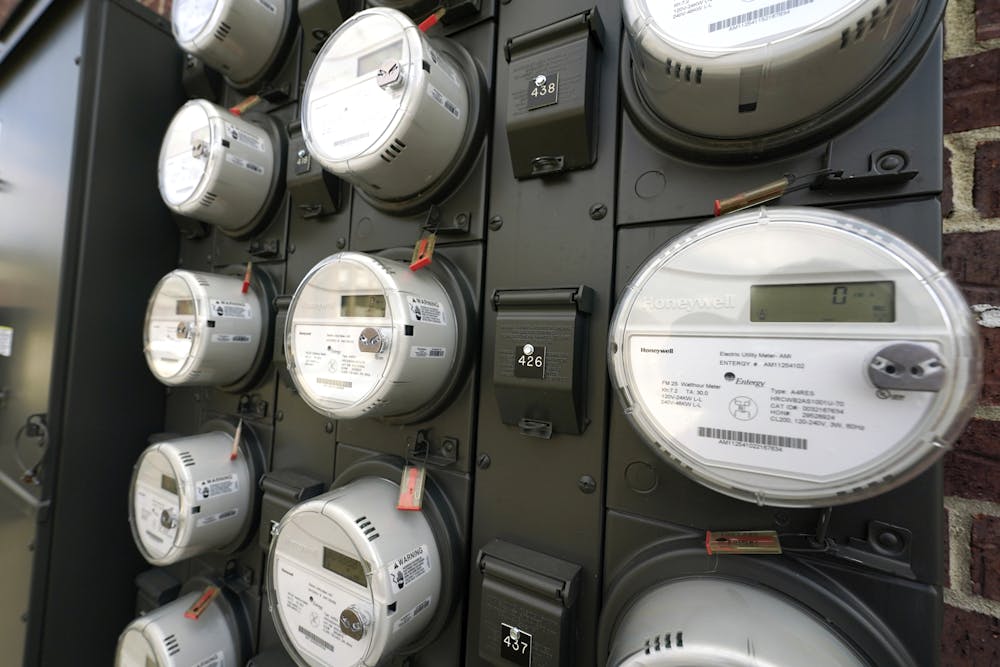
    Electric meters like these at a Mississippi apartment complex keep track of how much – or how little – electricity residents use.
    AP Photo/Rogelio V. Solis

    Broad application

    Federal data indicates that 40% of total U.S. energy consumption – and 28% of U.S. carbon dioxide emissions – is attributable to household and industrial appliances, such as heating and cooling systems, refrigerators, lighting and various kinds of equipment, such as computers, printers and electric motors.

    At present, the U.S. Department of Energy’s Appliance and Equipment Standards Program covers more than 70 products that the government estimates consume about 90% of energy used in homes, 70% of energy in commercial buildings and 30% of energy used in industry. The government estimates the standards saved American consumers $105 billion just in 2024 – with a typical household saving about $576 over the expenses if there were no efficiency standards.

    Appliance energy efficiency standards now in place are cumulatively expected by the Department of Energy to reduce U.S. greenhouse gas emissions by approximately 2 billion metric tons over 30 years. That’s as much carbon dioxide as 15 million gas-powered cars would emit in that same period.

    Many federal standards, including on light bulbs, electric motors and commercial heating and cooling equipment, have been based on those previously adopted by one or more states. Federal law permits states to issue standards for products that the federal government has not yet regulated: As of 2024, 18 states had set efficiency rules for a total of 22 types of appliances, including computers and televisions.

    Additional benefits

    These appliance standards have reduced American energy use, including electricity. The existing national standards are projected to reduce overall national energy consumption by 10% between 2025 and 2035.

    Those standards also improve public health, because there is less need to build new fossil-fuel power plants or operate existing ones. As a result, power generators have been able to reduce their emissions of dangerous pollutants such as nitrogen oxides, sulfur dioxide and mercury.

    Energy efficiency standards reduce the need for fossil fuel-powered electric plants, like this one in Ohio.
    Jim West/UCG/Universal Images Group via Getty Images

    A popular policy

    Making appliances more energy efficient has proved popular. A national survey released by the Consumer Federation of America in 2018 found that 71% of Americans “support the idea that the government should set and update energy efficiency standards for appliances.” Significantly, 72% of those surveyed named lowering electrical bills and 57% stated that avoiding construction of new power plants to keep electricity rates from rising were important reasons to increase appliance efficiency.

    Support remains strong: A June 2024 YouGov poll found that 60% of Americans support tougher appliance efficiency standards.

    From 1987 through 2007, more than three-quarters of national appliance energy efficiency standards were passed into law by Congress, with the rest created by administrative processes under existing laws. These legal standards received bipartisan support and were signed into law by Republican Presidents Ronald Reagan, George H.W. Bush and George W. Bush.

    But more recently, partisanship has affected the setting of standards. Since 2008, whether standards improve or remain unchanged has depended on whether Democrats or Republicans occupied the White House.

    Political back-and-forth

    The Obama administration enacted among the most ambitious energy efficiency standards for appliances and equipment to date. New standards for commercial air conditioners and furnaces affected heating and cooling equipment for half of the square footage used by the nation’s businesses. The rules were projected to reduce energy costs to businesses by $167 billion over the life of the regulated products.

    But during the first Trump administration, improvements in existing standards came to a halt.

    When Joe Biden became president, his administration resumed issuing new standards, most notably phasing out incandescent light bulbs. The Biden administration also issued new standards for furnaces, residential water heaters, stoves, washing machines and refigerators.

    Electric induction stoves, like this one, are more energy efficient than gas stoves.
    Hans Gutknecht/MediaNews Group/Los Angeles Daily News via Getty Images

    Controversy continues

    A new Biden rule for electric motors, which are widely used in manufacturing and processing equipment, incorporated recommendations from businesses and advocacy organizations. The rule was slated to take effect in 2028 and was expected to save businesses and consumers up to $8.8 billion over a 30-year period.

    But the Trump administration has withdrawn this standard, along with others issued by the Biden administration, including for ceiling fans, dehumidifers and external power supplies. The administration has postponed the effective dates of other standards that had been finalized before Trump took office. The administration said the reversals would “slash unnecessary red tape and regulations that raise prices, reduce consumer choice, and frustrate the American people.”

    Another set of politically controversial standards Biden introduced sought to encourage consumers to switch from stoves, furnaces and water heaters that use natural gas or propane to electric ones. The electric versions of those appliances are more energy efficient, while gas cooking emits toxic chemicals into the home. Switching can be expensive, and many consumers prefer gas-powered appliances, as of course does the natural gas industry, which has opposed these federal efforts.

    And in early April 2025, Republicans in Congress used their legislative authority to overturn the regulations for natural gas water heaters. But most of the federal standards – and all of the state ones – remain in effect, at least for now.

    This article, originally published April 17, 2025, was updated on May 14, 2025, to reflect the Trump administration’s latest move on efficiency standards.

    David J. Vogel does not work for, consult, own shares in or receive funding from any company or organization that would benefit from this article, and has disclosed no relevant affiliations beyond their academic appointment.

    ref. Trump administration moves to undo appliance efficiency standards that save consumers billions, reduce pollution and fight climate change – https://theconversation.com/trump-administration-moves-to-undo-appliance-efficiency-standards-that-save-consumers-billions-reduce-pollution-and-fight-climate-change-253673

    MIL OSI – Global Reports

  • MIL-OSI USA: Senator Peters Helps Introduce Bipartisan Bill to Support American Innovation and Outcompete China

    US Senate News:

    Source: United States Senator for Michigan Gary Peters
    Published: 05.14.2025
    Bill Would Provide Assistance to Michigan Small Businesses and Startups to Invest in R&D

    WASHINGTON, DC – U.S. Senator Gary Peters (MI) helped introduce the American Innovation and Jobs Act, bipartisan legislation that would expand and strengthen research and development (R&D) incentives for American small businesses and startups. The bill – which Peters reintroduced with U.S. Senators Todd Young (R-IN) and Maggie Hassan (D-NH) – would help the U.S. outcompete and out-innovate our global competitors, particularly China, who are significantly investing in R&D. 
    “From putting the world on wheels to producing the aircraft and vehicles that led the Allied Forces to victory in World War II, Michigan has long excelled at developing cutting-edge technologies that have kept our state and nation competitive on the world stage,” said Senator Peters. “This bipartisan, commonsense bill would help ensure Michigan small businesses and startups can continue to spearhead innovation that keeps us competitive against our adversaries like China by boosting federal support for R&D, while creating good jobs for Michigan workers in the process.”
    Businesses and startups that invest in R&D have long been able to either claim a tax credit or deduct their investments. This support enables them to invest in developing new, innovative products that help create jobs and build a stronger economy. With the goal of increasing investment in cutting-edge American technologies, the American Innovation and Jobs Act would restore and make permanent U.S. businesses’ ability to deduct their R&D costs from their taxable income in the year in which those costs were incurred. In addition, the bill would also expand the cap for the refundable R&D tax credit, which is a critical tool for small businesses that are just getting off the ground. Prioritizing R&D investment is essential now more than ever as U.S. foreign adversaries like China are attempting to out-innovate the United States.  
    Specifically, the American Innovation and Jobs Act would:

    Expand support for innovative startups by immediately doubling the current cap on the refundable R&D tax credit to $500,000, and ultimately raising it to $750,000 over ten years. The bill would also expand access to the R&D tax credit for startups by lowering certain thresholds needed to qualify.

    Expand the number of startups eligible to use the refundable R&D tax credit by increasing the eligibility threshold from $5 million to $15 million in in annual revenue. It would also extend the period during which startups can claim the credit from 5 years to 8 years after beginning to generate at least $25,000 in revenue.

    The legislation is endorsed by the R&D Coalition, which includes numerous organizations such as Business Roundtable, National Association of Manufacturers, Information Technology Industry Council, and the U.S. Chamber of Commerce. 
    Peters has long led efforts to support American innovation and help U.S. businesses compete in the global marketplace. Peters helped craft and pass into law the CHIPS and Science Act, which invested $170 billion in research and development for cutting-edge scientific advancements. This law also invested heavily in strengthening our domestic supply chains for critical semiconductor technologies to create good-paying American jobs and keep the U.S. competitive on the world stage. Peters additionally helped pass the Inflation Reduction Act, which will strengthen domestic manufacturing, onshore our supply chains, and create millions of American jobs. 

    MIL OSI USA News

  • MIL-OSI Security: Ferryland — Two men arrested after fleeing from Ferryland RCMP and crashing in St. John’s

    Source: Royal Canadian Mounted Police

    Following the report of a break and enter in progress in Bay Bulls, two men — 44-year-old Grant Payne and 42-year-old Matthew Payne, both of Grand Falls-Windsor — were arrested after fleeing from police and crashing a vehicle in St. John’s.

    Shortly before 9:00 p.m. on Tuesday, May 13, 2025, Ferryland RCMP responded to a report of a break and enter in progress at a commercial property in Bay Bulls. The suspect vehicle, a Ford F150, was located by police after it fled the scene of the crime. Ferryland RCMP attempted a traffic stop, however the vehicle continued to drive in a dangerous manner and failed to stop for police. The vehicle was last seen heading east on the Trans-Canada Highway. Information about the vehicle, its last known location and its involvement in a crime was shared with the Royal Newfoundland Constabulary (RNC).

    Information received confirmed that the suspect vehicle crashed on Pitts Memorial Highway and that the two occupants fled on foot. RCMP and RNC officers conducted a foot chase and located the two men, Grant and Matthew Payne, who were arrested without further incident.

    The pair attend court today, each charged with the following criminal offences:

    • Break and enter
    • Flight from police
    • Dangerous operation
    • Breach of a release order

    Matthew Payne is charged with an additional count for breach of a release order.

    The investigation is continuing.

    Working together, RCMP and RNC police officers are dedicated to the protection of pubic safety and enforcement of the law in Newfoundland and Labrador.

    MIL Security OSI

  • MIL-OSI Security: 5 Defendants Federally Charged in Los Angeles, Orange Counties as Part of Nationwide Crackdown on Child Sexual Abuse Offenders

    Source: Office of United States Attorneys

    LOS ANGELES – Attorney General Pamela Bondi and FBI Director Kash Patel recently announced an unprecedented national initiative to protect the most vulnerable members of our communities. The FBI launched a coordinated effort with all field offices in a sweeping action to identify, track and arrest child sex predators.

    Since the end of April, the FBI arrested 205 subjects across the country and rescued 115 children during Operation Restore Justice. These subjects are accused of various crimes including the production, distribution, and possession of child sexual abuse material, online enticement and transportation of minors, and child sex trafficking. They include school leaders and registered sex offenders, among others. 

    In the Central District of California, a seven-county jurisdiction that includes Los Angeles and Orange counties, five defendants were charged with federal crimes as follows:

    • Andrew Castillon, 47, of El Monte, was arrested May 1 on a federal criminal complaint charging him with possession of child pornography. A federal magistrate judge ordered him released on $5,000 bond. Castillon’s arraignment is scheduled for May 27 in United States District Court in Los Angeles. Assistant United States Attorney Thi H. Ho of the General Crimes Section is prosecuting this case.
    • Jose Olvera, 34, of North Hollywood, was arrested May 1 on a federal indictment charging him with two counts of distribution of child pornography and five counts of possession of child pornography. He pleaded not guilty to all charges at his arraignment and a June 23 trial was scheduled in this case. A federal magistrate judge ordered him jailed without bond. Assistant United States Attorney Mikaela W. Gilbert-Lurie of the General Crimes Section is prosecuting this case.
    • Steven Martin Nuss, 66, of San Juan Capistrano, was arrested May 9 on a two-count federal grand jury indictment charging him with distribution of child pornography and possession of child pornography. He pleaded not guilty to both charges and a federal magistrate judge ordered him jailed without bond. He is scheduled to go to trial on July 1. Assistant United States Attorney Melissa S. Rabbani of the Orange County Office is prosecuting this case.
    • David Eugene Parker, 55, of La Palma, was arrested April 30 on federal grand jury indictment charging him with two counts of possession of child pornography. He pleaded not guilty to the charge and a federal magistrate judge ordered him released on $100,000 bond. A June 24 trial date is scheduled in this matter. Assistant United States Attorney Lauren E. Border of the General Crimes Section is prosecuting this case.
    • Gregory Cole Jr., 30, of Lancaster, was arrested April 30 in Arizona after he failed to appear at his trial earlier last month in which a jury found him guilty in absentia of one count of production of child pornography, one count of enticement of a minor to engage in criminal sexual activity, and one count of receipt of child pornography. His sentencing hearing is scheduled for June 23, at which time he will face a mandatory minimum sentence of 15 years in federal prison and a statutory maximum sentence of life in federal prison. Assistant United States Attorney Derek R. Flores of the Violent and Organized Crime Section is prosecuting this case.

    Two additional individuals were arrested in Los Angeles for sexual exploitation of a child and charges of coercion and enticement, respectively; however, those cases are being prosecuted in separate districts.

    “Sexual predators who target children leave emotional scars that can last a lifetime,” said United States Attorney Bill Essayli. “Along with our law enforcement partners, we seek to bring a measure of solace to victims and put criminals on notice that they risk lengthy prison sentences and severe penalties for harming children.”

    “The amount of child predators arrested during Operation Restore Justice should shock the conscience of any law-abiding citizen and parents or guardians, in particular,” said Akil Davis, the Assistant Director in Charge of the FBI’s Los Angeles Field Office.  “Each day, our agents are tackling criminal allegations involving children, whether it be online dangers such as ‘sextortion,’ emerging nihilist extremist networks such as ‘764,’ or children being groomed by someone close to them. We urge caretakers of all children to educate themselves about these constant threats targeting the most vulnerable members of our society.”

    As the nation marked National Child Abuse Prevention month in April, the timing of this effort was a culmination of countless hours by hundreds of FBI agents. It further underscores the FBI’s unwavering commitment to protecting children and raising awareness about the dangers they face. While the Bureau works relentlessly to investigate these crimes every day, April serves as a powerful reminder of the importance of prevention and community education.

    The FBI takes a proactive approach to identify unknown individuals involved in the sexual exploitation of children and the production of child sexual abuse material. We do that through our Child Exploitation and Human Trafficking Task Forces (CEHTTFs) located in each field office. This allows the FBI to combine resources with federal, state, and local law enforcement agencies. The FBI also partners with the nonprofit National Center for Missing and Exploited Children (NCMEC), which receives and shares tips about possible child sexual exploitation received through its 24-hour hotline at 1-800-THE-LOST and on missingkids.org

    In 2004, the FBI created the Endangered Child Alert Program (ECAP) to identify individuals involved in the sexual abuse of children and the production of child sexual abuse material. The program is a collaborative effort between the FBI and the NMCEC.

    The FBI also offers resources for parents and caregivers to stay engaged with their children’s online and offline activities. The FBI’s Safe Online Surfing (SOS) program teaches students in grades 3 to 8 how to navigate the web safely.

    The FBI urges the public to remain vigilant and report suspected exploitation of a child through our tiplines at 1-800-CALL-FBI (225-5324), tips.fbi.gov, or by calling your local FBI field office. 

    Other online resources:

    • Electronic Press Kit:

    MIL Security OSI

  • MIL-OSI Security: Stanislaus County Man Sentenced to over 15 Years in Prison for Transportation of a Minor with Intent to Engage in Criminal Sexual Activity

    Source: Office of United States Attorneys

    Cristian Ceja, 28, of Turlock, was sentenced yesterday by United States District Judge John A. Mendez to 15 years and eight months in prison for transportation of a minor with intent to engage in criminal sexual activity, Acting U.S. Attorney Michele Beckwith announced.

    According to court documents, between Aug. 27, 2023, and Jan. 3, 2024, Ceja transported a minor victim from the Eastern District of California to Idaho with the intent to engage in criminal sexual activity. Ceja met the minor victim when Ceja was working as a delivery driver and delivered food to the minor’s house. Ceja thereafter used the minor victim’s phone number to track her down on social media and communicate with her. Ceja began a lengthy sexual relationship with the minor victim who, at that time, was 15. During the course of their sexual relationship, Ceja would sneak into the minor victim’s bedroom to have sex with her without being detected by her parents. On at least two occasions, Ceja video recorded himself engaging in sexual contact with the minor victim. Ceja kept used condoms and used feminine hygiene products in his storage unit as souvenirs of his relationship with the minor victim.

    On Aug. 26, 2023, the minor victim’s mother contacted law enforcement because she found provocative photographs of the minor victim in her bedroom and was concerned her daughter was having a sexual relationship with an adult. In the early morning hours of Aug. 27, 2023, Ceja took the minor victim and fled to avoid detection and to continue the sexual relationship. While on the run, Ceja attempted to evade detection by placing stolen license plates on his vehicle, obliterating the VIN from his vehicle’s dashboard, spray painting the vehicle a different color, and adopting a false name. In order to avoid detection, Ceja discarded his cellphone while in flight and used a “burner” phone.

    Ceja first took the minor victim to Nevada where they lived in his vehicle for approximately one week. Ceja then took the minor victim to a rural part of Idaho where they lived for several months in a small camper trailer without running water or heat. Law enforcement found the minor victim after she contacted a family member via social media to let her family know that she wanted to come home but could not leave on her own. On Jan. 3, 2024, law enforcement officers arrived at the camper trailer, rescued the minor victim, and arrested Ceja

    This case was the product of an investigation by the Stanislaus County Sheriff’s Office and Homeland Security Investigations. Assistant U.S. Attorney Shea J. Kenny prosecuted the case.

    This case was brought as part of Project Safe Childhood, a nationwide initiative launched in May 2006 by the Department of Justice to combat the growing epidemic of child sexual exploitation and abuse. Led by the United States Attorneys’ Offices and the Criminal Division’s Child Exploitation and Obscenity Section, Project Safe Childhood marshals federal, state, and local resources to locate, apprehend, and prosecute those who sexually exploit children, and to identify and rescue victims. For more information about Project Safe Childhood, please visit www.usdoj.gov/psc. Click on the “resources” tab for information about internet-safety education.

    MIL Security OSI

  • MIL-OSI USA: Illegal alien sentenced for prohibited person in possession of a firearm, following ICE, local law enforcement partner investigation

    Source: US Immigration and Customs Enforcement

    LINCOLN, Neb. — Michael Alexander Ayala-Ramirez, 20, an illegal alien from El Salvador, was sentenced on May 8, 2025, in federal court in Lincoln, Nebraska for one count of prohibited person in possession or a firearm or firearms, following a U.S. Immigration and Customs Enforcement, local law enforcement investigation.

    U.S. District Judge Susan M. Bazis sentenced Ayala-Ramirez to a total of 70 months’ imprisonment. There is no parole in the federal system. After Ayala-Ramirez’s release from prison, he will begin a 3-year term of supervised release and will face removal from the United States.

    “This case is a stark reminder of why strong collaboration between federal and local law enforcement is non-negotiable,” said ICE Homeland Security Investigations Kansas City Special Agent in Charge Mark Zito. “A convicted felon and illegal alien in possession of firearms isn’t just breaking the law — he’s a direct threat to the people of Lincoln. When dangerous individuals enter and remain in this country illegally, they put all of us at risk. HSI will “aggressively” investigate, dismantle, and bring to justice anyone who endangers American lives.”

    On July 4, 2024, a pickup truck was reported stolen from the Denver International Airport. On July 6, 2024, an Ogallala police officer observed the stolen truck and attempted to contact it. The stolen truck had three occupants, Michael Ayala-Ramirez, codefendant Pablo Escobar-Alas, and codefendant Selvin Escobar-Rivera. The driver of the vehicle, Ayala-Ramirez, attempted to flee from law enforcement, which lead to a high-speed chase through multiple counties and involved multiple law enforcement agencies. Stop sticks were successfully deployed near the Deuel and Keith County line and the truck ended up in a ditch near a farmyard in Deuel County.

    Ayala-Ramirez and Escobar-Alas were the driver and front seat passenger. They got out of the vehicle carrying bags and attempted to hide under another vehicle in the farmyard momentarily. The bags were later found to contain a Smith & Wesson pistol that was reported stolen, a Sig Sauer pistol, a Glock pistol, and a Del Ton DTI-15 rifle. Ayala-Ramirez and Escobar-Alas then stole a pickup truck from the farmyard, which lead to another high-speed chase. They were arrested after stop sticks were successfully deployed once again.

    Escobar-Rivera was in the backseat of the first stolen truck and he fled on foot after the initial stop. He was later arrested, and a second Smith & Wesson pistol was found on the floorboard of the backseat where he had been sitting. This pistol was also reported stolen.

    All three of the defendants have previously been deported and have no legal basis to return to the United States.

    Pablo Escobar-Alas and Selvin Escobar-Rivera’s cases are still active and pending.

    This case was investigated by ICE HSI, Nebraska State Patrol, Deuel County Sheriff’s Office, Ogallala Police Department, and the Denver Police Department.

    MIL OSI USA News

  • MIL-OSI Security: Macon Mafia Member Sent Back to Prison for Illegally Possessing AR-Style Rifle

    Source: Office of United States Attorneys

    Defendant at Fatal 2024 Gang-Related Shooting in Macon; Deputies Seized Machinegun

    MACON, Ga. – A convicted felon and confirmed member of the Macon Mafia criminal organization who was serving supervised release for a prior federal conviction in West Virginia when a gang-related fatal shooting occurred at a Macon gas station in 2024 was sentenced to federal prison for illegally possessing a firearm.

    Nekoase Antwan Vinson, 41, of Macon, was sentenced to serve a total of 107 months in prison to be followed by three years of supervised release by U.S. District Judge Marc Treadwell on May 12. Vinson previously pleaded guilty to one count of possession of a firearm by a convicted felon on Feb. 20 in Case No. 5:24-CR-64-001 (sentence of 71 months imprisonment). In addition, Vinson’s supervised release was revoked in Case No. 3:09-CR-99-002 from the Southern District of West Virgina, for which he pleaded guilty to one count of conspiracy to distribute cocaine base (sentence of 36 months imprisonment). There is no parole in the federal system.

    “A man lost his life as a result of a gang-related shooting where convicted felons illegally possessed rapid-fire guns capable of killing many people,” said Acting U.S. Attorney C. Shanelle Booker. “Our office will use every federal resource available to lawfully hold repeat felons accountable for illegally arming themselves and endangering our community.”

    “This case is a tragic example of the mayhem that results when criminal gang members with illegally possessed firearms try to settle scores in public,” said Bibb County Sheriff David Davis. “We can be grateful that for almost nine years Nekoase Vinson will not be able to spew violence which might harm law abiding citizens.”

    According to court documents and statements made in court, Vinson and Joshua Teone Curry were present at the Marathon gas station on Napier Avenue in Macon on July 20, 2024, when gang-related violence broke out. Video surveillance showed Curry exchanged fire with unknown individuals using a fully automatic pistol, and Vinson brandished an AR-style rifle. Vinson and Curry left together in Vinson’s black Cadillac Escalade. Vinson wore a large “M4L” (Mafia 4 Life) medallion. That night, RaQuavian Smith, an associate of Vinson and Curry’s who was present at the Marathon, died from gunshot wounds sustained in the violence.

    Both firearms seen on video were seized by law enforcement, together with an additional pistol, on August 23, 2024. On August 23, law enforcement executed a search warrant on Roy Street at a location controlled by Vinson and Curry, taking both men into custody. Law enforcement found two firearms beneath a mattress: a Glock, Model 23, .40 caliber pistol with an extended magazine containing 21 rounds of ammunition and a switch plus a Sig Sauer, Model P320, .45 caliber pistol with a magazine containing five rounds of ammunition. Officers recovered various Macon Mafia memorabilia, including t-shirts and hats. Hanging around Vinson’s neck was the M4L chain and medallion he wore during the July 20, 2024, shooting. Inside Curry’s vehicle, officers found a Del-Ton, Model DTI-15, AR-style caliber rifle.

    This case is part of Operation Take Back America, a nationwide initiative that marshals the full resources of the Department of Justice to repel the invasion of illegal immigration, achieve the total elimination of cartels and transnational criminal organizations (TCOs) and protect our communities from the perpetrators of violent crime. Operation Take Back America streamlines efforts and resources from the Department’s Organized Crime Drug Enforcement Task Forces (OCDETFs) and Project Safe Neighborhood (PSN).

    The case was investigated by the Department of Homeland Security Investigations with assistance from the Bibb County Sheriff’s Office.

    Criminal Chief Leah E. McEwen prosecuted the case for the Government.

    MIL Security OSI

  • MIL-OSI Security: Federal Jury Convicts a Former Armed-Robber of Possessing a Firearm while on Supervised Release

    Source: Office of United States Attorneys

    ELIZABETH CITY, N.C. – A federal jury convicted a Raleigh man on Tuesday on charges of possession of a firearm by a felon.  Cawajalin Kavin McNeil, age 30, will face up to 15 years of imprisonment when sentenced later this year.

    According to court records and evidence presented at trial, in the early morning hours of March 16, 2024, while heading home from work, an eyewitness saw McNeil in a confrontation with a young woman. When the eyewitness attempted to intervene, McNeil pointed a 9mm pistol at him.  He then backed away to his vehicle where he called 911 to report the incident near North Carolina State University.  The eyewitness described the black car the defendant got into, gave a nearly complete license plate number, and a physical description of McNeil.

    When Officers with the Raleigh Police Department (RPD) responded, they found McNeil seated in a black vehicle matching the description of the car from the eyewitness. That vehicle’s license plate was nearly an exact match of the one given to 911 and McNeil himself matched the description of the individual who had pointed the gun at the eyewitness. A search of the vehicle found a 9mm pistol wedged between the front passenger seat and the center console. The gun was similar to the gun pointed at the 911 caller. McNeil was then arrested for not having a conceal-carry permit.

    During processing at the Wake County Detention Center, officers located a razor blade in McNeil’s shoe and felt an unusual object near the defendant’s groin. A subsequent search uncovered a second 9mm pistol hidden in McNeil’s underwear. It was later determined that McNeil was a convicted felon who had previously plead guilty to conspiracy to commit Hobbs Act Robbery and using and carrying a firearm in furtherance of a federal crime of violence. McNeil had been sentenced to 180 months in prison, had been released in November 2023, and was on supervised release when this incident occurred.

    Daniel P. Bubar, Acting U.S. Attorney for the Eastern District of North Carolina made the announcement after U.S. District Judge Terrence W. Boyle accepted the verdict. The RPD and the Bureau of Alcohol, Firearms, Tobacco and Explosives are investigating the case and Assistant U.S. Attorney Logan Liles is prosecuting the case.

    A copy of this press release is located on our website. Related court documents and information can be found on the website of the U.S. District Court for the Eastern District of North Carolina or on PACER by searching for Case No.5:24-cr-00271.

    ###

    MIL Security OSI

  • MIL-OSI Russia: The Quest for Public Debt Transparency in EMDEs

    Source: IMF – News in Russian

    Keynote Speech by IMF Financial Counsellor and Director of the Monetary and Capital Markets Department
    IMF Conference: Public Debt Transparency—Aligning the Law with Good Practices

    May 14, 2025

    Opening – Scope of the Speech

    Good afternoon, everyone. It is a privilege to be here with you. Behind many sovereign debt crises there is often a simple, but difficult truth: the full picture of public debt and contingent liabilities which migrated to sovereign balance sheets was not visible to the public until it was too late. Transparency, therefore, is not just ideal—it is essential.

    This Conference demonstrates the Fund’s shared commitment to turning transparency from a goal into a reality in our member countries. I want to thank our IMF Legal Department for this timely initiative and inviting me to speak today.

    I would like to address the importance of transparency from the vantage point of the markets and the sovereign borrowers—specifically, the debt managers. I’ll first address why transparency matters, and why now more than ever. I’ll then delve into where countries stand today, the obstacles we face, and some possible solutions. I’ll give you a brief tour of how the Fund works to improve transparency in our three core activities of surveillance, lending, and capacity development—and finally, offer some thoughts on the path forward.

    The Difficult Backdrop Calls for Greater Transparency

    As you have already heard from our IMF Managing Director this morning, ensuring public debt transparency remains critical to monitor debt vulnerabilities, at a time of historically high public debt in emerging market (EM) and developing economies.

    The current global environment presents challenges for many countries to access capital markets. EMs are already facing the highest real financing costs in a decade and will have to continue issuing government debt, including meeting new fiscal spending needs. Small middle-income countries and frontier economies face a more difficult situation. Several frontier economies would find it difficult to issue a Eurobond at current levels. Meeting external financing needs will be challenging for many frontier borrowers if official development assistance is reduced. Domestic market funding may not be sufficient to substitute for external borrowing. So, the stakes are high.

    Why Transparency Matters

    Transparency is foundational—in periods of both calm and stress.

    In normal times, it builds credibility and fosters trust. It helps countries reduce borrowing costs and reinforces accountability to a country’s citizens. Transparent debt management operations, backed by clear strategies, predictable borrowing plans, and regular reporting pays off in improved market confidence and lower credit risk. Transparency also pays off by providing better access to sovereign debt markets.

    Even under sovereign stress, transparency acts as a stabilizing force. Opacity might offer short-term breathing space, but it raises long-term borrowing costs. “Debt surprises” damage trust, increase the cost of borrowing and increase the severity of crises. Conversely, sovereigns that disclose the full picture early—and align this with credible fiscal plans—can stabilize expectations. And at the extreme, for countries facing default, when public debt becomes too high and the government cannot borrow at sustainable terms, transparency also has a role to play in negotiations with creditors by enabling a faster resolution of debt problems during debt restructuring

    To ensure adequate public debt transparency, stakeholders should be able to count on the availability of timely, accurate, and comprehensive information on public debt stock and flows. You can think of this as the outcome of a country’s debt management. But from the perspective of Fund work, the concept of public debt management transparency is broader—it also encompasses the availability of key procedures and policies on public debt and of sound legal frameworks to support them. This should cover both the central and the general government.

    The Current State of Public Debt Transparency in EMDEs

    Evaluated against these metrics, sovereigns in advanced economies generally abide to high standards of debt transparency. Advanced economies typically finance themselves in markets, which impose market discipline. The process for sharing information on their borrowings is well established and institutionalized, and as a result, data on public debt is readily accessible. Some emerging markets are as transparent as advanced economies on their general government debt. However, governments in many emerging markets and developing economies rely significantly on external loans as well as on non-marketable domestic debt which can make their debt less transparent.

    Many factors explain the opaqueness of government borrowings in emerging markets and developing economies. These include lenders’ preferences, persistently large borrowing needs, low accountability, aversion to transparency, shallow bond markets, and lack of capacity. While inadequate public debt transparency is often the result of an interplay between several factors, analyzing them separately allows identifying potential solutions that are most urgently needed. Allow me to highlight a few key factors and what can be done to address them.

    First, lender preferences. Some resource-exporting countries use collateralized debt structures at the behest of creditors, involving special purpose vehicles that conceal the nature and seniority of these debt structures. Importantly, collateralized debt is often undertaken with confidentiality and non-disclosure agreements that impede reporting and disclosure.

    Solutions to address this type of opacity require establishing a legal and policy framework that discourages such borrowing structures. Legal frameworks can also help tackle this problem by limiting the scope of confidentiality agreements the executive can enter into and mandating a minimum level of disclosure regarding the financial terms of these debt liabilities.

    Second, the reticence of sovereign borrowers to disclose their borrowings. This can be an intentional under-reporting of public debt liabilities. However, it is often more subtle: some sovereigns rely on financing by state-owned enterprises (SOEs) or other entities that are effectively backed by the government, but whose debt liabilities are kept off-budget.

    Finding solutions to this problem is a difficult challenge. The solution is stronger governance, supported by stronger legal frameworks around the entire public financial management ecosystem. Such frameworks would warrant disclosure of all public debt liabilities and new borrowings, including by SOEs, and extra-budgetary entities supplemented with full fiscal transparency of the government and the SOEs balance sheets.

    Third, there can be gaps in the framework for public debt transparency. Such gaps mostly reflect shortcomings in the governance, reporting, and the institutional and policy framework of public debt. In many countries, this is a function of fragmented debt management responsibilities even within the central government. Inadequate transparency in such countries does not imply a lack of willingness by the sovereign to disclose its debt liabilities, but rather a deficiency in its ability to be adequately transparent. We see many such cases in our work.

    Addressing these gaps requires a broad-based approach, starting from the legal and governance framework, and weaving through institutional arrangements and the policy framework for public debt management. We have seen some countries make tangible progress that we have supported with capacity development, although more needs to be done across our membership.

    Leveraging Marketable Debt for Transparency and Sound Financing

    While much of the global discussion related to transparency has focused on external debt. I will take this opportunity to speak about debt issued in the local market and how greater reliance on marketable debt could drive better transparency and sound financing. Domestic debt transparency is an overlooked issue in the debt discussions on low-income countries (LICs).

    Large emerging markets typically have well-developed domestic government securities markets characterized by strong transparency practices. As in advanced economies, the cost of borrowing in large EMs reflect market forces. In the last decade or so, sovereigns from smaller emerging markets and LICs have relied more heavily on domestic debt. However, in these countries, transparency practices in domestic debt markets are often weak. And since in some cases the development of local debt markets is still evolving, many borrowers rely on non-marketable debt to fill part of their domestic financing needs. Non-marketable borrowing tends to be more insulated from price signals and inherently less transparent.

    There is a solution: accepting market prices. Transparency is a prerequisite for markets to operate well. Transparency on primary market issuances is crucial for price discovery and predictability for investors. And transparency in secondary market pricing and transactions is important for market liquidity. Such steps could create a self-reinforcing dynamic to improve transparency.    

    IMF Work on Debt Transparency

    Against this background, let me now give you a brief account of what we do in the Fund to promote debt transparency by sovereign borrowers. These efforts span the three key areas of Fund activity: bilateral surveillance, lending, and capacity development.

    Within bilateral surveillance, the IMF last year decided to expand the scope of mandatory reporting on debt by member countries. Members will be required to report on general government debt stock from this year (2025) and to report its detailed composition from 2027.

    In the context of our lending programs, the IMF Debt Limits Policy has raised the bar on debt disclosure. Where countries have critical debt data disclosure gaps, these should be addressed upfront in IMF-supported programs. And every IMF program staff report is now required to provide granular information on debt holders and debt service by creditor for a period of three years as well as information on the stock of collateralized debt.

    Our work on Capacity Development (CD), supports efforts to enhance transparency by sovereign borrowers. Over the years, debt transparency has increasingly been mainstreamed across many areas including support on public debt management, fiscal transparency assessments, debt sustainability assessments, the domestic legal framework on public debt management, and statistical dissemination of public debt. Further, debt transparency has now been added as an explicit outcome in our Results-based Management framework, which we use to monitor the effectiveness of our CD delivery.

    The Fund has stepped up its CD work on public debt reporting and monitoring, publication of medium-term debt management strategies and annual borrowing plans, and fiscal risk assessments—all of which will contribute to enhance transparency by our member countries. For this purpose, staff from different departments—including staff from MCM, as well as the IMF’s Fiscal Affairs, Statistics and Legal Departments—work closely with officials across our membership from the Ministries of Finance, Debt Management Offices, Central Banks, and Audit Institutions.

    Our policy and analytical work—including papers like Making Public Debt Public, and those on Sovereign Investor Relations and Legal Foundations of Public Debt Transparency—shape global thinking and inform Fund policy. At the same time, our longstanding guidance—like the IMF-World Bank Guidelines on Public Debt Management and the Fund’s Fiscal Transparency Codeas well as statistical standards—continues to provide an anchor for sound debt transparency practices across our membership.

    Conclusion

    As you carry forward your discussion today and tomorrow on the legal reforms needed to promote transparency of sovereign debt, I would like to leave you with four key messages.

    First, public debt transparency helps a sovereign, both in good and bad times.

    Second, enhancing debt transparency is all the more critical under the current global environment.

    Third, debt transparency must be designed and not assumed as a default setting.

    Fourth, it must be embedded in law, institutions, and incentives—across the full spectrum of public borrowing.

    To achieve this, countries should develop a strong governance mechanism on public debt supported by robust legal and institutional frameworks. Such frameworks should not only cover central government debt but also extend across the general government and state-owned enterprises. The goal is clear. However, we must acknowledge that this would be a big ask and long-term project, especially given the capacity constraints in many emerging and developing economies.

    A well-sequenced approach to upgrade the transparency framework will be crucial. For many countries, starting with central government debt and expanding outward in a phased, realistic way could be the right approach. Enhancing transparency on general government debt and the wider public sector would be the next priority.

    The Fund remains a committed partner in this journey—helping countries move from fragmented systems and hidden risks to integrated frameworks and informed policy choices.

    Thank you—and I wish you a productive remainder of the conference.

    IMF Communications Department
    MEDIA RELATIONS

    PRESS OFFICER:

    Phone: +1 202 623-7100Email: MEDIA@IMF.org

    https://www.imf.org/en/News/Articles/2025/05/14/sp051425-the-quest-for-public-debt-transparency-in-emdes

    MIL OSI
    MIL OSI Russia News

  • MIL-OSI Video: Arizona National Guard Soldiers support drug interdiction at the southern border

    Source: US National Guard (video statements)

    Arizona National Guard Soldiers assigned to the Arizona Counterdrug Task Force inspect railcars at the Rio Rico train station near Nogales, Ariz., April 30, 2025. The rail teams work alongside U.S. Customs and Border Protection under Task Force Stopping Arizona Fentanyl Epidemic (Task Force SAFE) to help detect and deter the smuggling of narcotics at the southern border. (U.S. Army video by Sgt. 1st Class Christy Sherman)

    https://www.youtube.com/watch?v=WqCpK0EVvwY

    MIL OSI Video

  • MIL-OSI United Kingdom: Liz Saville Roberts MP: ‘Starmer’s PMQs outburst shows he knows I’m right’

    Source: Party of Wales

    ‘The only principle the PM defends is whichever he last heard in a focus group’ – Plaid Cymru

    Plaid Cymru Westminster Leader Liz Saville Roberts MP today challenged Prime Minister Keir Starmer over his shifting stance on migration, accusing him of abandoning principles for political convenience.


    Keir Starmer responded by attacking Ms Saville Roberts for “talking rubbish”. The Plaid Cymru MP said the Prime Minister’s response showed she had “struck a nerve”, and that the faces of Labour MPs in the chamber suggested that “plenty of them know [she] was right”.


    Liz Saville Roberts MP:

    “This Prime Minister once spoke of compassion and dignity for migrants, and defending free movement. Now he talks of ‘islands of strangers’ and ‘taking back control’.

    “Somebody here has to call this out, Mr Speaker. It seems the only principle he consistently defends is whichever he last heard in a focus group.

    “So I ask him: is there any belief he holds which survives a week in Downing Street?”


    Keir Starmer responded:

    “Yes – the belief that she talks rubbish. Mr Speaker, I want to lead a country where we pull together and walk into the future as neighbours and as communities, not as strangers. The loss of control of migration by the last government put all that at risk – that’s why we’re fixing the system based on principles of control, selection and fairness.”


    Speaking after the session, Liz Saville Roberts MP added:

    “The Prime Minister’s outburst showed that my question struck a nerve. The expressions on the faces of many Labour MPs told their own story – plenty of them know I was right. If his convictions change with the political weather, it’s no surprise that support for Labour in Wales, as across Britain, is falling through the floor.”

    MIL OSI United Kingdom

  • MIL-OSI Security: St. John’s — Four drivers arrested by RCMP NL for impaired driving offences this past weekend

    Source: Royal Canadian Mounted Police

    Over this past weekend, RCMP NL arrested four individuals for impaired driving offences. Drivers were stopped in Harbour Grace, Roddickton, Marystown and Philips Head.

    Shortly before 10:00 p.m. on Friday, May 9, 2025, Harbour Grace RCMP responded to the report of a suspected impaired driver. The described vehicle was located and stopped on Water Street in Harbour Grace. The driver, a 67-year-old woman, showed signs of alcohol impairment and was arrested. Back at the detachment, the woman refused to provided breath samples. She now faces charges of impaired operation and refusing to provide a breath sample.

    Approximately 40 minutes later, Roddickton RCMP stopped a vehicle in front of the detachment on Cloud Drive in Roddickton. The driver, a 56-year-old man, showed signs of drug impairment. The man performed poorly on roadside field sobriety tests and was arrested for drug impaired driving. He was transported to White Bay Central Health Centre in Roddickton where a blood sample was obtained. Police await the results of the testing to determine if charges of drug impaired driving are appropriate.

    Shortly after 2:00 a.m. on Sunday, May 11, Burin Peninsula RCMP stopped a vehicle on Columbia Drive in Marystown. The vehicle was uninsured and had expired registration. The driver, 44-year-old man, showed signs of alcohol impairment and failed a roadside breath test. He was arrested and was transported to the detachment where he provided further breath samples that were above the legal limit. He faces charges of impaired operation and was ticketed under the Highway Traffic Act for operating a vehicle without insurance and registration.

    Later that day, at approximately 12:30 p.m., Grand Falls-Windsor RCMP responded to the report of a suspected impaired driver. The described vehicle was located and stopped on Route 352 in Philips Head. The driver, a 51-year-old man, failed a roadside breath test and was arrested. At the detachment, the man provided further breath samples that were more than twice the legal limit. He faces charges of impaired operation.

    All drivers were released from custody and those who are set to face charges are scheduled to appear in court at later dates. Licence suspensions and vehicle seizures occurred where appropriate.

    This week, during Canada Road Safety Week, RCMP NL remain focussed on road safety, including the enforcement of those who choose to drive while impaired. If you suspect a driver is impaired, please contact your local detachment or 911 to make a report.

    MIL Security OSI

  • MIL-OSI USA: Baldwin, Cornyn Introduce Bill to Support U.S. Manufacturing, Bar Taxpayer Funds on Chinese-Made Buses and Rail Cars

    US Senate News:

    Source: United States Senator for Wisconsin Tammy Baldwin

    WASHINGTON, D.C. – U.S. Senators Tammy Baldwin (D-WI) and John Cornyn (R-TX) led a bipartisan group of their colleagues in introducing the Safeguarding Transit Operations to Prohibit (STOP) China Act to support American manufacturing and workers and stop the U.S. government from buying Chinese buses and rail cars. The bill will protect domestic transit supply chains from malign Chinese influence by preventing any U.S. Department of Transportation (DOT) funds from being awarded for the purchase of Chinese government transit buses or rail cars.

    “When we invest American taxpayer dollars, we should be supporting our Made in America economy and American workers, not opening our checkbook to adversaries like China,” said Senator Baldwin. “I’m proud to work with Republicans and Democrats to support our workers and companies, keep the United States safe, and close a loophole that Chinese companies are exploiting to win government contracts and undercut American workers.”

    “It is China’s mission to infiltrate and dominate every aspect of American society, including our transit systems, and we cannot let them succeed,” said Senator Cornyn. “By preventing American tax dollars from being used to purchase Chinese government transit buses or rail cars, our legislation would help protect U.S. transportation infrastructure from the CCP.”

    “Companies controlled by the Chinese Communist Party have no business receiving a penny of American federal taxpayer dollars,” said Teamsters General President Sean M. O’Brien. “The STOP China Act strengthens federal law meant to ensure that our transportation programs don’t fund these corporations and will help protect the jobs of hardworking Teamsters who manufacture buses against unfair state-sponsored competition.”

    Congress passed the Transportation Infrastructure Vehicle Security Act (TIVSA), which prohibits companies with ties to China’s government from receiving taxpayer-funded contracts from the Federal Transit Administration (FTA) to build U.S. rail cars and buses, as part of the Fiscal Year 2020 National Defense Authorization Act.

    However, China has taken advantage of other government funds in the law to continue competing for transit business in the U.S. The STOP China Act would prevent any appropriated funds to the DOT from being awarded to grantees for the purchase of Chinese government transit buses. It would also require the United States Trade Representative (USTR), in consultation with the U.S. Attorney General, to produce a list of prohibited entities headquartered or affiliated with China.

    In addition to Senator Baldwin, the bill is cosponsored by Senators Rick Scott (R-FL), Tina Smith (D-MN), Pete Ricketts (R-NE), Marsha Blackburn (R-TN), Gary Peters (D-MI) and Senator Shelley Moore Capito (R-WV).

    The legislation is endorsed by Alliance for American Manufacturing, Steel Manufacturers Association, International Brotherhood of Teamsters, United Steelworkers, International Association of Machinists and Aerospace Workers, and Transport Workers Union of America.

    Full text of the bill is available here. 

    MIL OSI USA News

  • MIL-OSI USA: Lee Honors Law Enforcement Officers for National Police Week

    US Senate News:

    Source: United States Senator for Utah Mike Lee
    WASHINGTON – U.S. Senator Mike Lee (R-UT) honored Utah’s law enforcement officers this week supporting two resolutions recognizing their service and the observance of National Police Week.
    “The courageous men and women of law enforcement put their lives on the line every day to protect our families and our communities,” said Senator Mike Lee. “In the face of outrageous attacks against these American heroes, we salute them, we thank them, and we pray for them.”
     
    Badges from each of Utah’s police departments are displayed in honor of National Police Week.
    Senator Lee cosponsored two pieces of legislation honoring the work of law enforcement officers. A resolution introduced Tuesday recognizes the sacrifices and impact made by police officers across the country – particularly those whose lives were lost in the line of duty – and calls for increased support for officers’ work and wellbeing. Another resolution passed unanimously on Tuesday with a large bipartisan coalition calling for the observance of National Police Week on May 11-17, 2025.
    Approximately 800,000 law enforcement officers in the United States – and over 5,000 in Utah – risk their lives every day to protect and serve their communities. Utah’s dedicated police departments have decreased the rates of violent crime, homicide, property crime, and vehicle theft at a faster pace than the national average since 2020. Yet while police forces have successfully brought crime rates down, increasing partisan hostility puts them in more danger than ever. Over the past 10 years, over 2,500 American law enforcement officers have died in the line of duty, with assaults peaking in 2023 as 79,000 officers suffered attacks by criminals. These resolutions reaffirm Congress’s commitment to support law enforcement officers in their service to Americans.
    Read the resolution in support of law enforcement here.
    Read the resolution on National Police Week here.

    MIL OSI USA News

  • MIL-OSI USA: ICE Los Angeles announces 239 illegal aliens were arrested during recent operation

    Source: US Immigration and Customs Enforcement

    LOS ANGELES – U.S. Immigration and Customs Enforcement arrested 239 illegal aliens during a weeklong operation from May 4 to May 10 focused on bolstering public safety in the greater Los Angeles area.

    ICE Enforcement and Removal Operations and interagency partners, identified, detained and removed dangerous criminals throughout Los Angeles and surrounding cities. Criminal aliens in the U.S. illegally should utilize the CBP Home app to self-deport and avoid arrest by ICE.

    Among the criminal aliens arrested during the operation included:

    • Lan Pham, 49, of Vietnam, convicted involuntary manslaughter, assault with a deadly weapon, parole violations, drug violations and more.

    • Manuel Angel Rodriguez Martinez, 40, of El Salvador, accused of aggravated rape of a minor or incapacitated individual in the category of continuing crime in his home country.

    • Jorge Artero Meza-Rodriquez, 52, of Mexico, convicted of vehicle theft, assault with a deadly weapon and illegal reentry to the United States.

    • Sung Park, 52, of Korea, convicted of voluntary manslaughter.

    Several federal law enforcement agencies assisted ICE during the operation including the Drug Enforcement Administration, the FBI, the ATF, and the U.S. Marshals Service, along with state and local law enforcement partners.

    Members of the public can report crime and suspicious activity by calling 866-347-2423 or completing the online tip form. Follow us on X at @ICEgov to learn more about ERO’s missions and operations.

    Learn more about ICE Los Angeles’ mission to increase public safety in your community on X at @EROLosAngeles.

    Download b-roll of an arrest made during the operation.

    MIL OSI USA News

  • MIL-OSI Russia: 2 people killed, 17 injured in road accident in Kursk region of Russia – acting governor

    Translation. Region: Russian Federal

    Source: People’s Republic of China in Russian – People’s Republic of China in Russian –

    Source: People’s Republic of China – State Council News

    Moscow, May 14 (Xinhua) — Two people were killed and 17 others were injured in a collision between a bus and two cars on Wednesday near the village of Mikhailovka in the Zheleznogorsk district of Russia’s Kursk region, acting governor of the region Alexander Khinshtein said on his Telegram channel.

    “To our great sorrow, the drivers of both cars died. According to preliminary data, 17 people received injuries of varying severity, two people are in serious condition,” the statement said.

    “All victims are being sent to Zheleznogorsk and Kursk regional hospitals. All necessary assistance will definitely be provided,” said A. Khinshtein, adding that the circumstances of the accident are being established. –0–

    MIL OSI Russia News

  • MIL-OSI Canada: Government of Saskatchewan Prepares for Possible Canada Post Strike

    Source: Government of Canada regional news

    Released on May 14, 2025

    The Government of Saskatchewan is preparing for a possible postal strike that could begin as early as May 22, 2025. Ministries, Crowns and agencies have put contingency plans in place to limit service disruptions.

    The government encourages all clients, suppliers and businesses to switch to direct deposit, as those payments will not be impacted by any changes to postal services.

    Social Services Payments

    Building on the experience with the 2024 Canada Post service disruption, the Ministry of Social Services is preparing contingency plans for clients who receive benefit cheques by mail. Most ministry clients already receive benefit payments by direct deposit and these payments will continue as usual. We encourage clients to switch to direct deposit.

    Drug Plan and Extended Benefits 

    Residents requiring letters to submit to their private insurance providers for Special Support, Seniors’ Drug Plan, or Exception Drug Status may submit the request through the online Saskatchewan Formulary. Letters will be mailed once the Canada Post service disruption is resolved. 

    Health Cards and Vital Statistics Certificates

    Incoming and outgoing mail delays may affect applications for health cards and certificates for births, deaths or marriages. Visit eHealthsask.ca for options to minimize delays, including ordering online. 

    Crop Insurance/AgriStability Information and Payments 

    The Saskatchewan Crop Insurance Corporation (SCIC) will work with customers to determine alternate options for accessing information typically delivered through Canada Post, such as faxing, emailing or delivering to a local SCIC office for pick-up. Producers are encouraged to sign-up for direct deposit for receiving program payments. The direct payment form is available on SCIC’s website. 

    Payments to Government of Saskatchewan Suppliers

    The Ministry of Finance will make supplier cheques available for pickup in Regina for suppliers unable to register for direct deposit. Suppliers should call 306-787-7450 to make arrangements.

    Taxes, Refunds and Grant Payments

    In the event of a postal dispute, businesses are expected to ensure they file and pay taxes to the Ministry of Finance on time. Mail delays do not change tax deadlines or the assessment of penalties and interest. For more information, please review the Information Notice – IN 2025-03, Filing and Paying Provincial Taxes in the Event of a Postal Disruption.

    Tax clients are encouraged to sign up for the secure and convenient Saskatchewan eTax Services (SETS) online portal to file and pay taxes electronically and avoid any delays in meeting tax obligations. 

    Tax refunds and grant payments sent by direct deposit will not be delayed. Those who do not use direct deposit can call 1-800-667-6102 to set it up, delay the refund or grant payment, or request a courier delivery at their own cost.

    Crown Utility Accounts, Bills and More

    SGI, SaskTel, SaskPower and SaskEnergy invite customers to sign up for online billing and notifications to ensure they receive information about their utility bills, driver’s licence and vehicle registration renewals and other important communications. This helps avoid delays in receiving bills and account updates. Longer than usual wait times for customer service representatives are anticipated in the event of postal service disruptions, so customers are encouraged to visit the respective Crown websites or to call for more information regarding customer service options. Information is also available online regarding options for paying outstanding bills in the event mail-in payments are not possible.   

    Public Guardian and Trustee 

    The Public Guardian and Trustee’s office is preparing backup options for clients and client service providers who get payment cheques by mail. Many clients and service providers already use direct deposit and will not be affected. Clients and service providers are encouraged to switch to direct deposit as soon as possible. They can do so by contacting their trust officer or the Public Guardian and Trustee’s office at 1-877-787-5424 or by email at pgt@gov.sk.ca. 

    In the event of a postal strike, clients and suppliers and businesses can visit www.saskatchewan.ca/postal-strike for more detailed information.  

    -30-

    For more information, contact:

    MIL OSI Canada News

  • MIL-OSI Security: Guatemalan national and prior felon receives over 15 years for three gunpoint robberies

    Source: United States Bureau of Alcohol Tobacco Firearms and Explosives (ATF)

    HOUSTON – A 29-year-old legal permanent resident from Guatemala who lived in Houston has been sentenced for multiple counts of robbery and one count of brandishing a firearm, announced U.S. Attorney Nicholas J. Ganjei.

    Josue Castro-Gomez pleaded guilty Oct. 1, 2024.

    U.S. District Judge George C. Hanks Jr. has now sentenced Castro-Gomez to 98 months in federal prison for the robberies as well as a consecutive 84 months for the firearms conviction. He is also expected to lose his status in the United States and face removal proceedings following his total 182-month-term of imprisonment. At the hearing, the court heard how Castro-Gomez would commit the robberies by first pretending to be a customer and then taking the store employees by surprise.

    In November and December 2023, Castro-Gomez robbed two gas stations and one Houston-area smoke shop at gunpoint.

    On Nov. 25, 2023, Castro-Gomez entered a Korner Food Mart located in Houston, brandished a firearm and demanded the store clerk give him cash from the register. He proceeded to discharge the firearm, shooting above the clerk’s head, but fled from the scene without taking any money.

    On Dec. 11-12, 2023, Castro-Gomez went to a Circle K gas station and a Vape City, respectively, and demanded cash from the register. He received money on both occasions and fled the scenes.

    On Dec. 12, law enforcement located Castro-Gomez and found him to be in possession of a .32 caliber handgun.

    During the investigation, authorities matched a spent shell casing from the Nov. 25 robbery to the firearm in Castro-Gomez’s possession at the time of his arrest.

    Castro-Gomez has prior felony convictions from 2015 and 2017 for unauthorized use of a motor vehicle and possession of a controlled substance, respectively. As a convicted felon, he is prohibited from possessing firearms or ammunition per federal law.

    He will remain in custody pending transfer to a Federal Bureau of Prisons facility to be determined in the near future.

    The Bureau of Alcohol, Tobacco, Firearms and Explosives (ATF) conducted the investigation with assistance from the Houston Police Department and Harris County Sheriff’s Office. Assistant U.S. Attorney Francisco J. Rodriguez prosecuted the case.

    This case was made possible by investigative leads generated from the ATF’s National Integrated Ballistic Information Network (NIBIN). NIBIN is the only national network that allows for the capture and comparison of ballistic evidence to aid in solving and preventing violent crimes involving firearms. NIBIN is a proven investigative and intelligence tool that can link firearms from multiple crime scenes, allowing law enforcement to quickly disrupt shooting cycles. For more information on NIBIN, visit https://www.atf.gov/firearms/national-integrated-ballisticinformation-network-nibin.

    MIL Security OSI

  • MIL-OSI USA: Crapo Statement at Hearing on Trade in Critical Supply Chains

    US Senate News:

    Source: United States Senator for Idaho Mike Crapo
    Washington, D.C.–U.S. Senate Finance Committee Chairman Mike Crapo (R-Idaho) delivered the following remarks at a hearing entitled, “Critical Supply Chains.”
    As prepared for delivery:
    “Trade has the ability to increase productivity, incomes and the availability of goods.  While we talk often about how the increased supply and choice of goods that come from international trade benefit our consumers, we sometimes forget that this also benefits our producers. 
    “In fact, a majority of what we import each year is reinvested into more manufacturing, processing and farming activity.  Efficient and reliable supply chains help American businesses, farmers and workers expand their production and focus their resources on the high-value aspects of an industry.
    “The issue we must be wary about is when supply chains turn unreliable, in particular because they are controlled by countries that refuse to follow free-market rules, such as China.  As we are all aware, China continues its march toward expanding control over key resources and goods, and thus over the world’s supply chains.   
    “For example, advanced semiconductors increasingly rely on the rare earths mineral dysprosium.  Ninety-nine percent of dysprosium comes from China. 
    “This is not an isolated case where China has dominance over a strategic resource.  China controls over ninety percent of global processing for rare earths minerals and seventy percent for cobalt, which is used in batteries for electric cars, smartphones and other components.
    “The way China uses trade and investment to expand its control over resources outside its own borders is particularly concerning.  Indonesia has 40 percent of the world’s reserves for nickel, the largest of any single country.  Yet, Chinese firms control about 75 percent of Indonesia’s nickel refining capacity. 
    “We need to take a hard look at the reality of our situation and develop an aggressive strategy to counter China. 
    “Our domestic policies are at fault in some instances.  There are things we can produce efficiently here, but burdensome and unnecessary regulation stalls development of many important projects. 
    “We should not have to learn from another economic shock, like the oil embargo of the 1970s—to realize that where we have resources or potential for investment, it must be unleashed. 
    “Both sides of the aisle agree that we need a strong semiconductor industry.  In Asia, new semiconductor fabs are being built and deployed in under three years. 
    “In the United States, the semiconductor industry—one of the safest manufacturing sectors for workers—must contend with a myriad of permitting measures that provide only marginal, if any, benefit.  These permits, however, guarantee increased delays and costs, often adding years to projects. 
    “As part of its economic policy, the Trump Administration has prioritized deregulation as a means to drive economic growth, and I look forward to working with them to rationalize our regulatory system.  
    “In many other cases, geography and geology do not provide the United States with all the natural resources that we require.  Here, the fault rests mainly with the failure to develop an affirmative trade policy.  An affirmative trade policy ensures our consumers and manufacturers have access to the resources that our nation needs to be secure and independent. 
    “Here, for example, the Trump Administration was correct to exempt Canadian potash—a key nutrient for our corn and soy farmers, from recent tariffs.
    “Another key to the Administration’s economic approach is to renegotiate global trade deals, including deals that reclaim America’s lead over China.
    “Critically, these deals will be particularly useful in strengthening supply chains, if they improve market access opportunities.  Our trading partners must respect American investment and afford it the same treatment given to their own companies. 
    “Our partners must also realize that it bolsters their security when they do not inhibit access to cutting-edge American technology, like our state-of-the-art medical devices. 
    “Unfortunately, a number of trading partners use price controls, technology theft, weak intellectual property protections or unreasonable government procurement policies to keep these devices out of their markets.  Such actions only undermine the health of their own citizens, while leaving a strategic opening for China.
    “Today, we have an opportunity to consider these issues carefully.  Our four witnesses are experts on industries critical to America’s economic security.  We should encourage thoughtful debate on how to advance a trade policy that strengthens the security of our supply chains and creates opportunities for all Americans.”

    MIL OSI USA News

  • MIL-OSI Security: UPDATE: Warrant of further detention granted

    Source: United Kingdom London Metropolitan Police

    UPDATE On Wednesday, 14 May, a warrant of further detention was obtained at Westminster Magistrates’ Court, meaning the man can be detained for an additional 36 hours.

    +++

    A man arrested in connection with a series of arson attacks remains in police custody.

    The 21-year-old was arrested in the early hours of Tuesday, 13 May on suspicion of arson with intent to endanger life.

    He was arrested at an address in Sydenham.

    The man was taken to a London police station, where he currently remains in police custody.

    The arrest relates to three incidents.

    On Monday, 12 May at 01:35hrs, police were alerted by the London Fire Brigade to reports of a fire at a residential address in NW5.

    Officers attended the scene. Damage was caused to the property’s entrance, nobody was hurt.

    As a precaution and due to the property having previous connections with a high-profile public figure, officers from the Met’s Counter Terrorism Command are leading the investigation into this fire. Enquiries are ongoing to establish what caused it.

    The investigation team are also considering two other incidents – a vehicle fire in NW5 on Thursday, 8 May and a fire at the entrance of a property in N7 on Sunday, 11 May – and are investigating whether they may be linked to the fire in NW5 on 12 May.

    All three fires are being treated as suspicious at this time, and enquiries remain ongoing.

    Commander Dominic Murphy, Head of the Met’s Counter Terrorism Command, said: “We are working at pace and continue to explore various lines of enquiry to establish the cause of the fires, and any potential motivation for these. A key line of enquiry is whether the fires are linked due to the two premises and the vehicle all having previous links to the same high-profile public figure.

    “We recognise that this investigation may cause concern to other public figures – particularly MPs. The protection of MPs is something we take extremely seriously across the whole of policing and I would encourage any MP who is concerned about their own safety to get in touch with their dedicated local Operation Bridger officer, who can provide further advice and support.

    “In the meantime, our investigation remains ongoing and we will continue to work closely with local officers in the areas affected. Residents can expect to see an increased police presence in those areas over the coming days, but if anyone has concerns, then please speak with a local officer, or call us.”

    Anyone with information that could assist the investigation should call police on 101 quoting CAD 441/12 May.

    We would ask the public to remain vigilant and if they see or hear anything that doesn’t look or feel right, then to report it to police – either by calling police, in confidence, on 0800 789 321 or via www.gov.uk/ACT

    In an emergency, always dial 999.

    MIL Security OSI

  • MIL-OSI USA: Judicial Branch Seeks $9.4 Billion in FY 2026 Budget Request

    Source: United States Courts

    Two federal judges told Congress that the Judiciary has been negatively affected by two straight years of flat funding in most accounts, and they said a 9.3 percent increase in appropriations for the upcoming fiscal year is needed to ensure that the Judiciary can perform its essential constitutional functions.

    “More than half of the branch’s accounts are operating … on funding levels that have not been adjusted since FY 2023,” said Seventh Circuit Judge Amy J. St. Eve, chair of the Budget Committee of the Judicial Conference of the United States. “An effective and efficient Judiciary is foundational to the system of government envisioned by our founders. … Adequate and consistent funding is absolutely critical to the conduct of those responsibilities.” 

    St. Eve testified (pdf) before the House Appropriations Subcommittee on Financial Services and General Government. Also testifying (pdf) was Judge Robert J. Conrad Jr., director of the Administrative Office of the U.S. Courts and secretary of the Judicial Conference. 

    The federal Judiciary is seeking $9.4 billion in discretionary funding from Congress for fiscal year 2026, according to the Judiciary’s budget request, which was made public on April 25. An additional $872 million in mandatory funding covers judicial salaries and retirement costs. 

    In written submissions that accompanied their oral testimony, Judges St. Eve and Conrad said funding is needed to maintain existing services, protect judges and courthouses, and bolster IT security. 

    St. Eve said the funding shortages are especially critical for defender services. Federal defender organizations are under a hiring freeze until at least Oct. 1. And due to insufficient funding this year, voucher payments to court-appointed private lawyers will be suspended in late July, two months before the end of the 2025 fiscal year. That will delay an estimated $93 million in payments until Oct. 1, when the new fiscal year starts. 

    “These disruptions in panel attorney payments negatively affect our panel attorneys,” St. Eve said, “potentially reducing their willingness to accept future appointments and jeopardizing the ability to provide necessary and timely representation.”  

    The Judiciary is requesting $1.8 billion for defender services, an increase of $315 million (22 percent) over the FY 2025 hard-freeze  level. This includes funding to cover the deferred payments to attorneys in the current fiscal year, St. Eve said. The request will also enable federal defender organizations to hire staff to address workload needs.

    “Fewer than 10 percent of federal defendants have the financial means to afford an attorney, and so the Judiciary’s Defender Services program provides representation in the overwhelming majority of cases,” St. Eve said. “In doing so, we not only protect that constitutional and statutory right for the accused, but we also improve the overall operation of the federal court system.”

    The judges noted that security funding has remained flat for two years, creating a growing safety threat to both judges and courthouses. For the Court Security account, the Judiciary is requesting $892 million, an increase of $142 million (19 percent) over the FY 2025 enacted level.

    Conrad cited the growing incidence of physical threats and public attacks on judges for decisions they make in the courtroom. 

    “The independence of the Judicial Branch is jeopardized when judges are threatened with harm or impeachment for their rulings,” Conrad said. “Our constitutional system depends on judges who can make decisions free from threats and intimidation. This is essential not just for the safety of judges and their families, but also to protect our democracy.” 

    The judges noted that courts have deferred significant amounts of critically needed new security systems and equipment spending in order to avoid reducing Court Security Officer staffing or the funds dedicated to protecting judges from threats and attacks.

    “This is one of the Judiciary’s accounts that is now operating at a hard freeze level for the second year in a row despite a dynamic and very active threat environment,” St. Eve said. “At a time when dozens of individuals have been criminally charged in connection with threats against judges and the U.S. Marshals Service (USMS) is taking extraordinary security measures to ensure judges’ safety, these reductions in security capabilities are extremely worrying.”

    Specific requests for security funding include: 

    • $91 million in increases for critical systems and equipment needs. This includes emergency management equipment, vehicle barriers and mobile guard booths, radios, screening equipment, as well as video management systems that enable visual monitoring of all areas of a courthouse and systems that restrict access to non-public areas like judges’ chambers.
    • An additional $4 million for the Judiciary’s Vulnerability Management Program, which serves as a resource to judges to enhance their personal security and that of their court facilities. A key function is helping judges remove personally identifiable information on the internet that can make judges vulnerable to attack. 
    • $ 7 million in new courthouse hardening funds to protect courthouses from external attacks, such as during public disturbances. 
    • An additional $2 million to add a targeted number of Court Security Office (CSO) positions to those circuits and districts that have been identified as short on CSOs relative to the approved staffing standard.

    Conrad said protecting courts from cyber-attacks also requires funding support. 

    “These attacks pose risks to our entire justice system, including civil and criminal court proceedings, law enforcement and national security investigations planned or underway, and trade secrets for businesses involved in bankruptcy proceedings or patent and trademark litigation,” Conrad said. “The Judiciary has been modernizing its cybersecurity operations and is continually strengthening its cybersecurity posture.  Sustaining these efforts and implementing additional security-related initiatives continues to require significant resources.”

    St. Eve closed by stressing the Judiciary’s commitment to containing costs. 

    “The Judiciary takes very seriously its commitment to the responsible stewardship of its funds. We have had a formal and active cost containment program in place for more than twenty years,” St. Eve said. “This cost containment mindset has become thoroughly ingrained into the Judiciary’s governance practices, and we are proud of our successes.”

    She added, “I understand that the FY 2026 budget we have put forward is a large one that requires serious investment. That is because such an investment is necessary to carry out our constitutional and statutory missions, and to support the fair, efficient, and secure administration of justice in this country.” 

    MIL OSI USA News

  • Qatar Airways signs deal for 160 Boeing jets during Trump visit

    Source: Government of India

    Source: Government of India (4)

    State carrier Qatar Airways signed a deal on Wednesday to purchase jets from U.S. manufacturer Boeing during President Donald Trump’s visit to the Gulf Arab country.
     
    Trump said the deal was worth $200 billion and included 160 jets. Trump and Qatar’s Emir Sheikh Tamim bin Hamad Al-Thani witnessed the signing ceremony in Doha.
     
    The deal was signed during Trump’s second stop on a tour of Gulf states after he struck a string of deals with Saudi Arabia on Tuesday.
     
    Trump said Boeing CEO Kelly Ortberg, who signed the deal with Qatar Airways CEO Badr Mohammed Al-Meer next to Trump and the Qatari emir, told him “it’s the largest order of jets in the history of Boeing, that’s good”.
     
    Trump added: “It’s over $200 billion but 160 in terms of the jets, that’s fantastic. So that’s a record, Kelly, and congratulations to Boeing. Get those planes out there, get them out there.”
     
    It’s not clear which Boeing aircraft models would be part of the deal and whether the orders from Qatar are firm, which require a deposit and several contractual obligations, or are options.
     
    Boeing no longer issues catalogue prices but based on the most recent published value for its most expensive jet, the 777X, a deal for 160 of the long-range aircraft would be worth some $70 billion. Aviation analysts say that airlines typically get large discounts for bulk deals.
     
    Boeing was not immediately available for comment. Qatar Airways did not immediately respond to a request for clarification or comment.
     
    (Reuters)
  • MIL-OSI: ESFI Spreads Awareness of Overhead Power Line Safety With “Always Look Up” Campaign

    Source: GlobeNewswire (MIL-OSI)

    ARLINGTON, Va., May 14, 2025 (GLOBE NEWSWIRE) — Data compiled and analyzed by the Electrical Safety Foundation International (ESFI) shows that the most significant category of workplace electrical fatalities is non-electrical workers coming into contact with overhead power lines. Many of these accidents involve workers with little or no electrical safety training. Contact with overhead power lines is also one of the leading causes of electrical fatalities outside of the workplace across the United States.

    In fact, overhead power line contact accounts for 48% of all workplace electrical fatalities, 57% of electrical fatalities in non-electrical occupations, and 30% of all electrical fatalities that occur in the United States. The Centers for Disease Control (CDC) reports that between 2018 and 2023, there were 538 total fatalities caused by overhead power lines in the U.S. A large number of these incidents can be avoided with heightened awareness of outside surroundings. “Overhead power line contacts are unique because in many cases the fatality occurred when the power line was clearly visible,” said Daniel Majano, ESFI’s Program Director.

    In response, ESFI launched an update to its “Always Look Up” campaign in May to spread awareness to key groups. This year, as part of its National Electrical Safety Month efforts, ESFI is releasing several new materials, including a new infographic, to remind the public to be aware of overhead power lines in their surroundings.

    Some of the key groups targeted in this campaign are homeowners, heavy truck operators, tree trimmers, and roofers. Here are some ways that individuals can find themselves in danger due to overhead power lines:

    • At home: Individuals working on their roofs or gutters or using ladders to set up decorations, such as holiday lights, can inadvertently come into contact with power lines around their home. Before starting any work around your house, be aware of overhead power lines and the electrical service entrance to your home. Stay at least 10 feet away from all power lines.
    • Heavy truck operators: Workers operating trucks with extendable truck beds can unknowingly raise their truck beds into low-hanging overhead power lines.
    • Tree trimmers: Tree trimming workers often perform their work using elevating work platforms or using trimming tools with long handles, allowing them to make contact with tree branches far above the ground. When tree branches grow out and become entangled with overhead power lines, trimmers can inadvertently contact the lines with their tools.
    • Roofers and painters: Individuals doing work on the exterior of a building can make contact with power lines while carrying or setting up ladders.

    ESFI encourages everyone to “always look up, in all ways” to avoid contact with overhead power lines. Some additional best practices include carrying ladders horizontally, avoiding touching anything in contact with power lines, and staying 35 feet away from downed power lines.

    “We believe that this is an issue where we can save a lot of lives through raising awareness and emphasizing the simple principle of ‘Always Look Up’”, said ESFI Executive Director Jennifer LeFevre, adding, “It’s great advice for anyone doing work outside.”

    The new materials for National Electrical Safety Month 2025 include the following, which are free to use and distribute:

    ABOUT ESFI

    The mission of the Electrical Safety Foundation International (ESFI) is to prevent electrically related injuries, deaths, and fires through public education and outreach by being the trusted voice on electrical safety. For free safety materials that you can share throughout your community, visit esfi.org.

    Contact:
    Evan Jones
    Electrical Safety Foundation International
    703.841.3247
    evan.jones@esfi.org 

    The MIL Network

  • MIL-OSI Canada: Travelling for Victoria Day or Memorial Day? The CBSA gives tips for a smooth trip

    Source: Government of Canada News (2)

    May 14, 2025
    Ottawa, Ontario

    The Canada Border Services Agency (CBSA) reminds travellers to plan ahead when crossing the border over the upcoming Victoria Day and the U.S. Memorial Day long weekends.

    Every day, the CBSA works hard to protect Canadians, support the economy and ensure the safe and efficient movement of people and goods across the border. In 2024, we welcomed over 93.4 million travellers, stopped over 34,400 kg of illegal drugs from entering our communities and kept more than 17,200 weapons and 930 firearms off our streets.

    The CBSA plans and prepares for long weekends and summer travel. We monitor traveller volumes and prioritize efficient processing of travellers at land ports of entry and at international airports, without compromising safety and security. If you encounter wait times at the border, it is likely because we are working behind the scenes to conduct examinations, seize drugs, firearms or stolen vehicles or prevent high-risk individuals from entering Canada.

    Here are some travel tips to help you plan for your trip:

    • Driving into Canada? Check border wait times to plan your route.
      • Early mornings are the best time to cross the border to avoid wait times.
      • The Monday of holiday long weekends tend to be the busiest.
      • Consider an alternative port of entry with shorter wait times or less traffic.
      • Check the port of entry’s hours of operation on the official CBSA Directory of Offices and Services.
      • If you are using a GPS application (such as Google Maps, Apple Maps or Waze) to direct you to a port of entry, consider checking different navigation options (such as fastest and shortest routes) to determine the preferred route of travel.
    • Have your travel documents handy. This will speed up processing times at the border.
    • Be prepared to declare. Declare everything you have with you upon entry into Canada. If arriving by land, you are responsible for everything inside your vehicle.
      • Goods purchased abroad: If you are a resident of Canada, personal exemptions allow you to bring goods, including alcohol and tobacco (up to a certain value), back to Canada without paying regular duty and taxes. Make sure you know how much you are bringing back in Canadian dollars and have your receipts readily available for the officer.
      • Surtaxes on certain U.S. goods. If you’ve purchased goods in the U.S. and are bringing them into Canada, you may have to pay a 25% surtax in addition to regular duties and taxes. For residents of Canada, this surtax applies only to goods exceeding your personal exemptions limit. Consult the lists of products surtaxed: complete lists of goods subject to the surtax. Visit the CBSA website for more details on how these surtaxes apply at the border
    • Flying into Canada? Use Advance Declaration and make your customs and immigration declaration up to 72 hours in advance of your arrival into Canada at participating airports.
    • When travelling with children, who are not your own or for whom you don’t have full legal custody, we recommend you have a consent letter from the parent or legal guardian authorizing you to travel with the child. We are always watching for missing children, and in the absence of the letter, officers may ask additional questions.
    • Know before you go: review the restricted and prohibited goods to avoid the possibility of penalties, including fines, seizure or prosecution. Make sure you have the information you need before attempting to bring items into Canada.
    • Leave behind: firearms, weapons, narcotics, and cannabis.

    We encourage you to read and follow all of our travel tips before arriving at the border.

    Not sure? Ask a CBSA officer. The best way to save time is to be open and honest with the border services officer. If you are not sure about what to declare, don’t hesitate to ask!

    For more information, visit the CBSA website or call us at 1-800-461-9999.

    MIL OSI Canada News

  • MIL-OSI Security: Happy Valley-Goose Bay — Family of five stranded on Route 510 during recent blizzard safely rescued by RCMP and partners

    Source: Royal Canadian Mounted Police

    A family of five who were stranded on Route 510 outside of Happy Valley-Goose Bay during a severe winter storm were safely rescued on May 10, 2025. Happy Valley-Goose Bay RCMP, Happy Valley-Goose Bay Ground Search and Rescue (GSAR), and Grey Rock Mining worked together to respond to this challenging situation.

    On Saturday, Happy Valley-Goose Bay RCMP responded to a report of a stranded motorist on Route 510, approximately 55 kilometers outside of Happy Valley-Goose Bay. The vehicle, carrying five occupants, was stuck in the snow. Weather conditions were extremely poor with high winds, heavy snowfall and frigid temperatures. One of the occupants, a woman, departed the vehicle to seek help.

    RCMP officers responded in two separate police vehicles, and encountered dangerous road conditions and low visibility. Police activated GSAR for assistance, who in turn engaged Grey Rock Mining to request the deployment of snowplows to support the rescue effort.

    Approximately 45 kilometers outside of town, the two officers exited their vehicle and walked the highway in an effort to locate the woman. The officers located the woman a short distance away, covered in snow and extremely cold and covered her in their clothing to help shield her from the weather. She was escorted to a police vehicle, and officers contacted the emergency department at Labrador Health Centre for direction while waiting for paramedics to arrive.

    A short time later GSAR and paramedics — led by snowplow — arrived at the location. The woman was treated on scene by paramedics for suspected hypothermia.

    Grey Rock Mining dispatched a second snowplow to help reach the remaining four occupants of the stranded vehicle. The vehicle was freed, and all occupants were safely accounted for. The snowplows then led the convoy of all parties back to Happy Valley-Goose Bay, ensuring their safe return.

    RCMP NL thanks the responding police officers, Happy Valley-Goose Bay Ground Search and Rescue (GSAR) and Grey Rock Mining for their collaboration and effort in safely rescuing this family.

    MIL Security OSI

  • MIL-OSI USA: Congressman Issa Congratulates 2025 Congressional Art Competition Winner from Murrieta

    Source: United States House of Representatives – Congressman Darrell Issa (CA-50)

    ESCONDIDO, CA – Today, Congressman Darrell Issa (CA-48) announced that Murrieta Valley High School student Connor Main is the winner of the 2025 Congressional Art Competition for California’s 48th District. Connor’s winning entry is entitled The Dire Wolf.

    “Connor’s piece immediately struck me as uniquely creative and serves as a representation of CA-48’s brightest high school artists. I’m eager for it to be celebrated in our local community and presented in the U.S. Capitol, where it will be on display for the year ahead,” said Rep. Issa.

    Connor is a freshman in high school, and the artwork is constructed solely from charcoal pencils. His parents have expressed their pride in Connor’s work being honored by Congressman Issa in the US Capitol. 

    Connor’s art instructor, Jessica Hoxmeier, stated that the freshman spent countless hours to painstakingly complete every detail of the piece. 

    The runner-up submission was painted by Murrietta Valley High School Junior Hannah Maronde entitled Progress of Patience. Hannah’s work will be displayed in Congressman Issa’s office in Washington, D.C. for guests to enjoy when visiting. 

    Congressman Issa’s office received dozens of creative and inspiring submissions from throughout the region, including watercolors, photographs, drawings, and original paintings.

    Each spring, the Congressional Institute sponsors a nationwide high school student art competition to encourage and recognize artistic talent throughout the country. Students from the 48th Congressional District submit entries for consideration and the winning entry is displayed in the U.S. Capitol for one year. Additionally, the winner is invited to a celebratory reception in Washington, D.C

    MIL OSI USA News

  • MIL-OSI Security: Bakersfield, California, Man Pleads Guilty to Striking a Sheriff Helicopter with a Laser

    Source: Federal Bureau of Investigation (FBI) State Crime Alerts (b)

    Brett Curtis Hair, 23, of Bakersfield, pleaded guilty today to aiming the beam of a laser pointer at an aircraft, Acting U.S. Attorney Michele Beckwith announced.

    According to court documents, on Sept. 11, 2024, at approximately 12:17 a.m., Kern County Sheriff’s Office helicopter Air 1 was on routine patrol when the cockpit was struck by a bright green laser beam. The Tactical Flight Officer pinpointed the source of the laser emanating from a residence within the Federal Aviation Administration’s (FAA) Critical Flight Zone of Bakersfield’s Meadow Field Airport. At least 15 additional laser strikes appeared to be intentional as the light tracked and struck the helicopter. Once Air 1 arrived above the residence, Hair exited the garage and immediately began striking the helicopter’s cockpit again with the high-powered laser. During the laser strikes, the pilot and Tactical Flight Officer experienced visual interference as the laser repeatedly struck and illuminated the cockpit, making it difficult to see the aircraft’s instruments.

    According to the FAA, aiming a laser at an aircraft is a serious safety risk, because many high-powered lasers can incapacitate pilots and interfere with the safe operation of their aircraft. In 2024, pilots reported 12,840 laser strikes to the FAA.

    This case is the product of an investigation by the Federal Bureau of Investigation and the Kern County Sheriff’s Office. Assistant U.S. Attorney Karen Escobar is prosecuting the case.

    Hair is scheduled for sentencing on Aug. 4, 2025. He faces a maximum statutory penalty of five years in prison and a $250,000 fine. The actual sentence, however, will be determined at the discretion of the court after consideration of any applicable statutory factors and the Federal Sentencing Guidelines, which take into account a number of variables.

    MIL Security OSI

  • MIL-OSI Security: 189 Arrested in Immigration Crackdown Under the ‘Make D.C. Safe and Beautiful’ Initiative

    Source: United States Bureau of Alcohol Tobacco Firearms and Explosives (ATF)

    Authorities Made Arrests as Part of Coordinated Effort to Restore Order and Uphold Immigration Laws.

    WASHINGTON – U.S. Attorney Ed Martin Jr. joined with other federal law enforcement leaders to announce today that as a result of a joint federal law enforcement initiative, authorities arrested 189 individuals following a joint federal immigration-related enforcement operation in the District of Columbia over the past week.

    As part of the operation, authorities apprehended 189 illegal aliens during an enhanced targeted immigration enforcement operation focusing on egregious criminal alien offenders operating in and around Washington, D.C., May 6–9.

    “Thanks to President Trump’s leadership and this administration’s focus on law and order, these arrests represent a major step forward in making Washington, D.C., safer for legal citizens and their families,” said U.S. Attorney Martin. “These arrests make clear that violating our nation’s immigration laws will not be ignored.”

    “The District of Columbia is exponentially safer today because of countless hours of investigative work and dedication to duty displayed by ICE Washington, D.C., and our law enforcement partners,” said ICE Enforcement and Removal Operations Washington, D.C., Field Office Director Russell Hott. “Working with our partner agencies, ICE officers and agents arrested 189 illegal aliens and removed them from the streets of our Nation’s Capital. Throughout this enhanced enforcement operation, we targeted the most dangerous alien offenders in some of the most crime-infested neighborhoods in the city of Washington, D.C. Evil is powerless if the good are unafraid. I commend the efforts of everyone involved, as all were truly committed to the success of this operation. ICE Washington, D.C., remains dedicated to our mission of prioritizing public safety by arresting and removing criminal offenders from our Nation’s Capital and surrounding communities.”

    Among those arrested during the enhanced targeted operation include the following:

    • A 47-year-old illegally present Guatemalan alien whose criminal history includes drug possession, illegal reentry, aggravated assault, trespassing, disorderly conduct, and sexual assault. His current criminal charges include unlawful reentry of a previously deported alien, disorderly conduct, lewd acts, possession of a controlled substance, sex abuse, assault with a dangerous weapon, and possessing an open container. Additionally, he has numerous gang-affiliated tattoos on his arms, legs, and chest.

    • A 25-year-old illegally present Guatemalan alien whose criminal history includes threat to kidnap, attempted possession of a prohibited weapon, threats to bodily harm, and simple assault. He is currently charged with alien present without admission or parole.

    • A 30-year-old illegally present Salvadoran alien whose criminal history includes simple assault, driving while intoxicated, brandishing a machete, and unauthorized use of a vehicle. He is currently charged with alien present without admission or parole.

    • A 36-year-old illegally present Mexican alien whose criminal history includes misdemeanor larceny, misdemeanor indecent exposure, possession of an open container, simple assault, theft, unlawful entry, and possession of a prohibited weapon (knife). He is currently charged with alien present without admission or parole.

    This law enforcement activity is part of President Donald Trump’s Make D.C. Safe and Beautiful Executive Order. The Executive Order directs a coordinated federal effort to reduce crime, enhance public safety, and restore pride in the nation’s capital through targeted enforcement, improved policing, and strategic partnerships. It also calls for the beautification of public spaces, stricter enforcement of quality-of-life laws, and the removal of graffiti and encampments on federal lands to ensure D.C. remains clean, secure, and reflective of America’s strength and heritage.

    Participating agencies include U.S. Immigration and Customs Enforcement; Virginia Department of Corrections; the Federal Bureau of Investigation, Washington Field Office; Bureau of Alcohol, Tobacco, Firearms and Explosives; Drug Enforcement Administration; U.S. Marshals Service; and U.S. State Department Diplomatic Security Service.

    Members of the public can report crimes and suspicious activity by dialing 866-DHS-2-ICE (866-347-2423) or completing the online tip form.

    All charges are merely an allegation. All defendants are presumed innocent until proven guilty beyond a reasonable doubt in a court of law. 

    MIL Security OSI