NewzIntel.com

    • Checkout Page
    • Contact Us
    • Default Redirect Page
    • Frontpage
    • Home-2
    • Home-3
    • Lost Password
    • Member Login
    • Member LogOut
    • Member TOS Page
    • My Account
    • NewzIntel Alert Control-Panel
    • NewzIntel Latest Reports
    • Post Views Counter
    • Privacy Policy
    • Public Individual Page
    • Register
    • Subscription Plan
    • Thank You Page

Category: Vehicles

  • MIL-Evening Report: Bougainville woman Cabinet minister battling nine men to hold her seat

    INTERVIEW: By Don Wiseman, RNZ Pacific senior journalist

    One of the first women to hold an open seat in Bougainville, Theonila Roka Matbob, is confident she can win again.

    Bougainville goes to the polls in the first week of September, and Roka Matbob aims to hold on to her Ioro seat in central Bougainville, where she is up against nine men.

    The MP, who is also the Minister of Community Government, recently led the campaign that convinced multinational Rio Tinto to clean up the mess caused by the Panguna Mine.

    RNZ Pacific asked her if she is enjoying running for a second election campaign.

    THEONILA ROKA MATBOB: Very, very much, yes. I guess compared to 2020, it is because it was my first time. I had a lot of butterflies, I would say. But this time has been very different. So I am more relaxed, more focused, and also I am more aware of issues that I can actually concentrate on.

    DON WISEMAN: And one of those issues you’ve been concentrating on is the aftermath of the Panguna Mine and the destruction and so on caused both environmentally and socially. And I guess that sort of work is going to continue for you?

    TRM: Yes, so the work is continuing. I had three platforms when I was contesting in 2020: leadership, governance, institutional governance and the accountability on the issues, legacy issues of Panguna Mine. I thought that the third one was going to be very challenging, given that it involved international stakeholders.

    But I would say that the one that I thought was going to be very challenging was actually the one that got a lot of traction, and it’s already in motion while I’m like back on the trail, defending my seat.

    DW: In terms of the work that has been undertaken on an assessment of the environmental damage, the impact that the process had had, and the report that has come out, and the obligations that this now places on Rio Tinto?

    TRM: The recommendations that were made by the report was on a lot of like imminent survey areas that is like on infrastructure that were built by the company back then in the operation days that is now tearing down.

    And also a lot more than that, there was a call for more intrusive assessment to be done on health and bloodstreams as well for the people, but those other things and also now to into the remediation vehicle, what is it going to look like?

    These are clear responsibilities that are at the overarching highest level of engagement through the what we call this process, the CP process. It has put the responsibility on Rio Tinto to now tell us, what does the remediation vehicle look like.

    At the moment, Rio Tinto is looking into that to be able to engage expertise in communication with us, to see how the design for the remediation vehicle would look. It is from the report that the build-up is now coming up, and there is more tangible or visible presence on the ground as compared to the time we started.

    DW: So that process in terms of the removal of the old buildings that’s actually got underway, has it?

    TRM: That process is already underway, the demolition process is underway, and BCL [Bougainville Copper Limited] is the one that’s taking the lead. It has engaged our local expertise, who are actually working abroad, but they have hired them because under the process we have local content policy where we have to do shopping for experts from Bougainville, before we’ll look into experts from overseas.

    Apart from that as well, one of the things that I have seen is there is an increased interest from both international and national and local partners as well in understanding the areas where the report, assessment report has pointed out.

    There is quite a lot happening, as compared to the past years when, towards the end of our political phase in parliament, usually there is always silence and only campaigns go on. But for now, it has been different.

    A lot of people are more engaged, even participating on the policy programmes and projects.

    DW: Yes, your government wants to reopen the Panguna Mine and open it fairly soon. You must have misgivings about that?

    TRM: I have been getting a lot of questions around that, and I have been telling them my personal stance has never changed.

    But I can never come in between the government’s interest. What I have been doing recently as a way of responding and uniting people, both who are believers of reopening and those that do not believe in reopening, like myself.

    We have created a platform by registering a business entity that can actually work in between people and the government, so that there is more or less a participatory approach.

    The company that we have registered is the one that will be tasked to work more on the politics of economics around Panguna and all the other prospects that we have in other natural resources as well.

    I would say that whichever way the government points us, I can now, with conviction, say that I am ready with my office and the workforce that I have right now, I can comfortably say that we can be able to accommodate for both opinions, pro and against.

    DW: In your Ioro electorate seat it’s not the biggest lineup of candidates, but the thing about Bougainville politics is they can be fairly volatile. So how confident are you?

    TRM: I am confident, despite the long line up that we have about nine people who are against me — nine men, interestingly, were against me. I would say that, given the grasp that I have and also building up from 2020, I can clearly say that I am very confident.

    If I am not confident, then it will take the space of giving opportunity for other people and also on campaign strategies as well. I have learnt my way through in diversifying and understanding the different experiences that I have in the constituency as well.

    This article is republished under a community partnership agreement with RNZ.

    MIL OSI Analysis – EveningReport.nz –

    July 27, 2025
  • MIL-OSI United Kingdom: UK high-altitude research and intelligence balloon soars to new heights

    Source: United Kingdom – Government Statements

    Press release

    UK high-altitude research and intelligence balloon soars to new heights

    The UK has successfully trialed high-altitude balloons which can conduct intelligence, surveillance and reconnaissance missions.

    • UK Defence is developing use of uncrewed, high-altitude balloons to conduct intelligence, surveillance and reconnaissance (ISR) missions, boosting national security and delivering on the government’s Plan for Change.
    • Test flight balloons each travel over 2,000 nautical miles at an operating altitude between 60,000 and 80,000 feet, double that of a commercial aircraft.
    • The trial balloons operated as a constellation for the first time and provided near-continuous ISR coverage of nearly a month, far exceeding the endurance of each balloon.

    The UK could benefit from the collection of military intelligence, surveillance and reconnaissance from the stratosphere following the successful trials of new high-altitude balloons flying between 60,000 and 80,000 feet above the Earth – higher than most military aircraft operate. 

    The uncrewed balloons offer a low-cost surveillance and communications capability alternative to traditional solutions. They can travel uninterrupted at extreme altitudes for long periods, without maintenance, boosting national security and delivering on the government’s Plan for Change.

    The future use of such balloons could include support to operations and reliable communication and fast internet connection to disaster zones or remote areas with no coverage, while also providing information for weather forecasting and climate research.

    With an ISR payload capacity of up to 3kg and with some modules that include weather sensors weighing as little as a European robin, the test vehicles can operate continuously for over five days.

    The cost-effective system can be operated by a single person in challenging weather conditions, demonstrating advanced capabilities and precise navigation and station keeping.

    Minister for Defence Procurement and Industry, Rt Hon Maria Eagle MP, said:

    This innovation is about giving our Armed Forces the edge – better awareness, better communications, and lower maintenance needs – supporting the government’s Plan for Change.

    Stratospheric technology like this could transform how we operate in complex environments, keeping our people safer and better informed than ever before.

    This successful trial is another example of UK defence pushing boundaries, with real potential to strengthen our future capabilities.

    The trials took place in the South Dakota, USA earlier this year as part of Project AETHER, a concept development initiative supported by the Ministry of Defence’s procurement body, Defence Equipment & Support (DE&S).

    The activity was led by UK company Voltitude in partnership with Landguard Systems (UK) and Aerostar (US).

    Head of UK Defence Innovation, Prove and Exploit team, James Gavin, said:

    Defence procurement is making strides in the innovation space and DE&S is looking more at the art of the possible, pushing the boundaries and scoping new technologies. 

    These latest trials have been incredibly fruitful and pave the way for more collaborative working with our allies to develop capabilities that will benefit our Armed Forces.

    The UK-developed technology provides continuous Intelligence, Surveillance, and Reconnaissance capability whilst maintaining remarkably low operating costs. It represents a significant advancement in stratospheric surveillance platforms for defence applications.

    The Ministry of Defence is exploring future assessment operational use of the stratosphere, not only with this class of balloon, but also with vehicles capable of carrying significantly higher payloads for mission durations of 6-12 months.

    Share this page

    The following links open in a new tab

    • Share on Facebook (opens in new tab)
    • Share on Twitter (opens in new tab)

    Updates to this page

    Published 27 July 2025

    MIL OSI United Kingdom –

    July 27, 2025
  • Man United beat West Ham 2-1 in Premier League Summer Series

    Source: Government of India

    Source: Government of India (4)

    Manchester United made a winning start to the Premier League Summer Series, defeating West Ham United 2-1 at the MetLife Stadium.

    Bruno Fernandes scored both goals — a penalty early in the game and a second-half strike — to secure three points in the tournament. Jarrod Bowen pulled one back for the Hammers with a clinical finish and was only denied an equaliser by a sharp save from Altay Bayindir in the dying moments.

    United made a blistering start, nearly scoring in the opening minute. Fernandes’s through ball found Rasmus Hojlund, who advanced toward goal and fired a left-footed shot that struck the outside of the post.

    Just three minutes later, Alphonse Areola fumbled a high ball that ricocheted off El Hadji Malick Diouf’s back and fell to Ayden Heaven. Though the defender was moving away from goal, he was brought down by the Hammers’ keeper, leading to a clear penalty, according to Manchester United’s official report.

    Amorim’s men continued to press forward. Hojlund lashed a decent chance over the bar after his pass was cut out and rebounded back to him. On the half-hour mark, Fernandes fired a dipping shot over the bar from outside the box after receiving a pass from Amad. West Ham’s only notable effort came from James Ward-Prowse, whose acrobatic attempt — following a deep cross from ex-Red Aaron Wan-Bissaka and a header by Tomas Soucek — came to nothing.

    United did find the net again in the 38th minute when the impressive Manuel Ugarte broke through and set up Amad. The Ivorian’s calm finish, however, was disallowed for offside in what appeared to be a marginal call.

    Amorim’s side kept up the pressure after the break, and within four minutes, Max Kilman was dispossessed by Hojlund. Fernandes latched onto the loose ball and raced clear for a one-on-one with Areola. However, his strike lacked power and precision, allowing the goalkeeper to save. Kobbie Mainoo followed up with a shot that deflected for a corner.

    From the set-piece, Matthijs de Ligt’s header — from Fernandes’s looping ball into the box — was well saved by Areola. Just minutes later, with 52 on the clock, Mainoo capitalised on a poor pass from Areola. Fernandes received the ball and floated in a beautiful finish, taking full advantage of the keeper’s poor positioning.

    West Ham pulled one back in the 63rd minute through Bowen, who smashed home a powerful shot after Jean-Clair Todibo found Soucek, who in turn teed up the England international.

    In the 66th minute, Amorim changed his entire outfield lineup, and West Ham also made several substitutions. The game lost some rhythm, but Luis Guilherme came close in the 84th minute with a fierce drive that flew over Bayindir’s bar.

    The Hammers nearly equalised in stoppage time when Bowen fired goalwards again, but Bayindir produced a stunning save to preserve the win and three points for United — ahead of their next match against Bournemouth, who earlier beat Everton 3-0.

    IANS

    July 27, 2025
  • Indian Railways boosts connectivity and safety in Jammu & Kashmir with track and coach upgrades

    Source: Government of India

    Source: Government of India (4)

    Jammu & Kashmir is witnessing a major transformation in its railway infrastructure with the Indian Railways undertaking extensive upgrades in track maintenance and passenger coach facilities. The inauguration of the Udhampur-Srinagar-Baramulla Railway Link by Prime Minister Narendra Modi on June 6, 2025, marked a turning point in connecting the Kashmir Valley with the rest of the country. This new link, which includes the engineering marvels of the Chenab and Anji bridges, has paved the way for the deployment of advanced machinery and modern amenities in the region.

    The introduction of modern track maintenance machines in the Kashmir Valley has replaced the earlier manual methods, significantly enhancing the quality and safety of railway operations. Since early June, a tamping machine has been in operation, aligning and stabilising railway tracks by packing ballast underneath. This machine has covered around 88 kilometres of track so far, contributing to smoother train rides. Additionally, four Ballast Cleaning Machines (BCMs) have been deployed, with two of them joining the fleet in July. These machines have deep-screened nearly 14 kilometres of track, ensuring cleaner and more stable track conditions.

    To support these efforts, 17 ballast rakes carrying stone chips were sent from depots in Kathua, Qazigund, Madhopur, and Jind. Approximately 19,000 cubic metres of ballast have been laid across the valley’s railway tracks.

    Track Recording Car and Oscillation Monitoring System runs were conducted in June and July respectively to assess the quality of the tracks. These assessments have helped in identifying areas that need further attention, ensuring targeted maintenance for optimal performance.

    Union Railway Minister Ashwini Vaishnaw highlighted the role of technology in improving safety and working conditions for railway staff. He said that the government is focusing on upgrading track fittings and adopting scientific maintenance practices using ultrasound fracture detection machines, road-cum-rail vehicles, and AI-based defect detection systems.

    These changes are expected to significantly improve the overall safety of train operations. As of early 2025, around 78 percent of the country’s tracks support speeds of 110 kmph or more, compared to just 39 percent in 2014. This growth is particularly notable given the increase in total track length to over 1 lakh kilometres, up from 79,342 kilometres a decade ago.

    Parallel to the track upgrades, Indian Railways has also launched an overhaul of the passenger coaches operating in the Kashmir Valley. Earlier, due to the absence of a direct rail link, DEMU and MEMU rakes had to be transported on road trailers from Budgam to Lucknow for maintenance. This was not only cumbersome but also inefficient. With the new rail link operational, these rakes are now being brought to the Charbagh workshop in Lucknow and the Jalandhar shed through rail for periodic overhauling.

    Several rakes have already undergone or are currently undergoing maintenance. One MEMU rake has been fully overhauled and is back in service, while another is expected to be ready by the end of July. Two DEMU rakes have been or are being serviced at Charbagh, with one set to return by mid-August. Another DEMU rake under renovation in Jalandhar is expected to be operational by the end of July. Four additional DEMU rakes are scheduled for upgradation in the coming weeks.

    The upgraded rakes are being fitted with enhanced features to improve passenger comfort and safety. These include anti-graffiti PU exterior painting, bio-toilets with new water pumps, refurbished polycarbonate seating, new standing handles, renewed PVC flooring, buffed stainless steel fixtures, upgraded hopper windows, functional passenger information systems, better mobile charging sockets, and improved power panels for uninterrupted water system operation.

    All passenger coach upgradation works in the valley are expected to be completed by August 31, 2025. With these developments, Indian Railways is not only ensuring better travel experiences for passengers in Jammu & Kashmir but is also reinforcing its role as the backbone of the nation’s transportation network. The opening of the Jammu-Srinagar rail link and the ongoing enhancement efforts are poised to become a new lifeline for the people of the region.

    July 27, 2025
  • Yellow alert in nine Kerala districts as heavy rain causes widespread disruption

    Source: Government of India

    Source: Government of India (4)

    A yellow alert has been issued in nine districts of Kerala — Ernakulam, Idukki, Thrissur, Palakkad, Malappuram, Kozhikode, Wayanad, Kannur, and Kasaragod — as the state continues to experience intense rainfall and strong surface winds.

    The India Meteorological Department (IMD) has warned that the heavy downpour is likely to persist until July 30 due to a low-pressure area over the Bay of Bengal.

    The IMD has also predicted strong surface winds, reaching speeds of 50–60 kmph over Kerala and Lakshadweep on July 27, and 40–50 kmph between July 28 and 29.

    Very heavy rainfall (12–20 cm in 24 hours) is expected at isolated locations, while heavy rainfall (7–11 cm) is likely in various parts of the state through July 30. A high alert has been sounded for hilly and coastal regions. The relentless rain has triggered damage across the state — trees have been uprooted, houses have collapsed, vehicles have been damaged, and roads have been affected. In many areas, the situation has led to power outages and traffic disruptions.

    Mudslides were reported in several highland regions, including Makkimala and Arala.

    Speaking to the media, State Revenue Minister K. Rajan said the rainfall is expected to ease from Monday as the low-pressure system weakens. He confirmed that 163 houses have been fully destroyed in the recent spell of rain and assured that compensation will be provided to all affected families.

    With rivers overflowing, several dams, including Sholayar and Kakkayam, have been opened. An orange alert has been issued for major rivers such as the Manimala and Pampa in Pathanamthitta, Vamanapuram in Thiruvananthapuram, Pallikkal in Kollam, Achankovil in Alappuzha, Thodupuzha in Idukki, Chalakudy in Thrissur, Valapattanam in Kannur, and the Kabani in Wayanad.

    Residents living along riverbanks have been urged to stay vigilant and move to safer locations if necessary.

    In Ernakulam and Alappuzha districts, several homes have been flooded due to the continuous rainfall. Two relief camps have been opened in Ernakulam to accommodate those displaced by the floods.

    —IANS

    July 27, 2025
  • MIL-OSI China: Floods can’t stop the fun — China’s ‘Village Super League’ roars back

    Source: People’s Republic of China – State Council News

    China’s renowned “Village Super League,” also known as Cun Chao, has made a triumphant return with a gratitude-themed restart ceremony staged in Rongjiang County, Guizhou Province, on late Saturday, drawing tens of thousands of spectators. The celebration comes after devastating floods weeks ago, when the stadium and much of the county were submerged in floodwaters.

    Four matches, including three friendship matches, were held on Saturday, of which many players from all walks of life contributed to the flood fighting in late June.

    International stars, Roberto Baggio from Italy and Roberto Carlos from Brazil, also showed up during the halftime. “Although China is half a globe away from Europe, here I can feel that the passion for football is exactly the same,” said Baggio on the scene.

    Li Sha, head of the county cultural center and a member of the event’s organizing committee, said that in just one month, Cun Chao is back in full swing. “This would not have been possible without nationwide support.”

    An aerial drone photo taken on July 26 shows the restart ceremony of the “Village Super League,” also known as Cun Chao, staged in Rongjiang County, Guizhou Province in southwest China. (Xinhua/Liu Xu)

    Launched in May 2023, Cun Chao has become one of China’s most prominent grassroots football events. Boosted by the sports event, Rongjiang County, home to a population of 385,000, attracted 7.6 million tourists in 2023 and over 9.4 million in 2024.

    The third season kicked off in early January this year, with over 3,000 players from 108 village teams competing for the champion.

    On June 24 and 28, rain-triggered floods hit the county hard, leading to the suspension of the league. The floods impacted 145,000 people and prompted 92,000 evacuations. Six people were killed.

    This combined photo shows the newly re-constructed football field of the “Village Super League” in Rongjiang County, southwest China’s Guizhou Province, July 25, 2025 (Top, aerial drone photo) and the field under the impact of severe flooding on June 25, 2025 (Bottom, aerial drone photo). (Xinhua/Yang Wenbin)

    GRATEFUL RETURN

    At the ceremony in the newly renovated stadium with donated turf, repaired lighting and rebuilt corridors, a performance titled “Rebirth” reenacted scenes of firefighters, armed police, electricians and medical workers from nationwide joining in the rescue.

    “When floods raged, seeing rescuers from across China made us feel assured,” said 55-year-old Yang Changrong, a performer from the Changba residential community, one of the worst-hit areas.

    Yang recalled that the rescuers worked in extreme heat, carrying supplies by hand where vehicles could not reach. “When exhausted, they simply rested by the roadside. It was heart-wrenching yet inspiring.”

    Figures show that over 30,000 rescuers rushed to aid the county and donations — nearly 80 million yuan (about 11 million U.S. dollars) in funds and 2.2 million relief items — poured in for the disaster relief work.

    Liang Xiaolei attended the ceremony as part of the parade team that participated in the relief efforts.

    The veteran rescuer called Rongjiang’s flood fight an experience that moved him the most. “From elderly folks to schoolchildren, everyone pitched in — cooking meals and clearing rubble,” he said. “Every time we opened the boxed meals and saw the tightly packed food, we felt their care.”

    Cheerleading squad in ethnic costumes attend the restart ceremony of the “Village Super League,” also known as Cun Chao, staged in Rongjiang County, Guizhou Province in southwest China, July 26, 2025. (Photo by Long Jianrui/Xinhua)

    REBUILDING HOPE

    The restart of the league, a major sign of Rongjiang’s post-disaster recovery, has brought strong hope to people in their efforts to restore normal life.

    As the football matches are back on schedule, hotels are fully booked, and schools have been made available to temporarily accommodate about 6,000 visitors.

    Wearing the iconic yellow costume of the Brazilian national team, He Yufeng from Chongqing Municipality headed to Rongjiang with his family to see Roberto Carlos and watch the matches.

    Also an amateur player, the 37-year-old plays football every weekend in Chongqing. “The atmosphere here is great. I’ll come back to play with my team if I get the chance,” he said.

    Roberto Baggio (R) and Roberto Carlos (L) attend the “Village Super League,” also known as Cun Chao, staged in Rongjiang County, Guizhou Province in southwest China, July 26, 2025. (Photo by Long Jianrui/Xinhua)

    Fruit vendor Yan Jiafu, who suffered much economic loss in the floods, reopened his shop after obtaining a 500,000 yuan government-subsidized loan in mid-July. “Cun Chao has brought back our confidence,” he said.

    The county has coordinated with banks to provide financial support and state-owned properties to waive six-month rentals to related businesses. As of Friday, more than 90 percent of some 6,800 affected businesses had reopened.

    After the gratitude-themed restart, Rongjiang will resume the league with full force and host all the delayed matches, said Xu Bo, the county’s Party chief.

    “Bearing gratitude in mind, we will move on, bringing Cun Chao’s passion, vitality and joy to people across the country again,” Xu said. 

    MIL OSI China News –

    July 27, 2025
  • MIL-OSI China: Peace and plenty blossom in east China’s revolutionary heartland

    Source: People’s Republic of China – State Council News

    An aerial drone photo shows people cycling among plum blossoms in Changxing County, Huzhou City, east China’s Zhejiang Province, March 2, 2025. (Photo by Wu Zheng/Xinhua)

    Over eighty years ago, the rolling hills where Jiangsu, Zhejiang, and Anhui provinces converge echoed with gunfire as New Fourth Army soldiers repelled Japanese invaders. Today, those same landscapes pulse to a new rhythm: the drumbeat of high-quality development.

    In the verdant hills of Guangde City, Anhui, stands the solemn grave of martyr Zheng Dafang. In a local battle in March 1944, Zheng, then a 23-year-old soldier, sacrificed his life while leading a charge against retreating Japanese invaders.

    The soil once hallowed by his sacrifice now nurtures an advanced manufacturing cluster the young martyr could never have envisioned in his wildest dreams.

    Within the fully automated production facility of Guangde Yatai Automobile Intelligent Braking System Co., Ltd., a smart monitoring platform continuously tracks real-time production metrics while a fleet of over 300 robotic arms operate round-the-clock.

    “Our fully automated process enables us to manufacture brake discs with significant advantages in cost-effectiveness and reliability,” said Wu Xinzhong, general manager of Guangde Yatai.

    The company’s brake disc output surpassed 10 million units in 2024, accounting for approximately one-tenth of the country’s market share, supplying prominent new energy vehicle manufacturers such as Geely and BYD, according to Wu.

    The firm anchors Guangde’s signature automotive ecosystem — a constellation of 77 major parts producers that collectively generated 13.62 billion yuan (about 1.91 billion U.S. dollars) last year.

    From assembly lines to heritage trails, a quiet renaissance is unfolding across the tri-province borderlands. Rural and red tourism now surge alongside advanced manufacturing, drawing vitality from revolutionary legacies and pastoral beauty.

    In Zhejiang’s Changxing County, summer unveils idyllic countryside vistas where general Su Yu’s troops once garrisoned.

    “Weekends are fully booked until September,” said 38-year-old Wang Yunlu, who runs a homestay in Yangfeng Village. “Parents from nearby cities like to bring their kids here to hike the old guerrilla trails, fish the streams, and fall asleep under the same stars the soldiers once watched.”

    Between boutique homestays, teahouses and farm-to-table kitchens, the village has re-invented itself as an experience economy. “Our villagers’ per capita disposable income hit 46,000 yuan in 2024,” said Li Yan, party secretary of the Yangfeng village.

    Across the provincial border into Jiangsu, the city of Liyang operated as the nerve center for New Fourth Army operations throughout Southern Jiangsu during wartime, directing resistance efforts from its Shuixi village headquarters.

    Today, Liyang’s No. 1 Road — winding through densely forested mountains and marked by red, yellow and blue lines — has become one of eastern China’s signature scenic routes.

    This 365 km artery links over 220 rural attractions and connects seven neighboring counties, transforming the landscape into a seamless tourism circuit. Viewing decks, campgrounds and cafes dot the road, enriching traveler experiences.

    By binding once-isolated hamlets, the route has lifted nearly 100,000 villagers into renewed prosperity. In 2024 Liyang welcomed 30 million visitors and generated nearly 35 billion yuan in tourism revenue.

    Better roads and a booming rural-travel market are also giving Liyang entrepreneurs new reasons to return home; to date, 26 returnee projects have secured 5.98 billion yuan in investment.

    “Future initiatives will deepen revolutionary heritage engagement through curated thematic routes,” said Liu Li, deputy director of Liyang’s transportation bureau. “We’re transforming historical legacy into dynamic cultural tourism assets and economic catalysts.”

    MIL OSI China News –

    July 27, 2025
  • MIL-OSI China: Shanghai unveils plan to build leading zone for high-level autonomous driving

    Source: People’s Republic of China – State Council News

    SHANGHAI, July 26 — Shanghai’s latest action plan to build a leading zone for high-level autonomous driving was released on Saturday, during the ongoing World Artificial Intelligence Conference in the city.

    The plan aims to see Level 4 autonomous vehicles make over 6 million passenger trips by 2027, open more than 5,000 kilometers of roads for autonomous driving, and ensure that over 90 percent of the city’s new vehicles are equipped with Level 2 and Level 3 autonomous driving functions.

    Autonomous driving is categorized from Level 0 to Level 5. The higher the level, the more advanced and intelligent the technology. Vehicles with Level 4 autonomy can drive themselves in most conditions without a human backup driver.

    Shanghai will accelerate its construction of a globally leading zone for high-level autonomous driving through multi-dimensional collaboration involving data platforms, training bases, key technologies and policy frameworks, according to Han Dadong, director of the Shanghai Municipal Commission of Economy and Informatization’s automotive industry division.

    The plan also proposes the expansion of open areas for autonomous driving, the realization of full coverage for autonomous driving in the Pudong New Area, and the progressive opening-up of other districts such as Fengxian and Minhang.

    Shanghai will establish third-party platforms, including a key laboratory for intelligent connected vehicle traffic safety, to improve its validation process for autonomous driving systems and operational services, according to the plan.

    To facilitate the construction of its leading zone for high-level autonomous driving, Shanghai plans to deploy 500 data-collection ride-hailing vehicles and establish an evaluation system for large-scale autonomous driving models, achieving mass production applications for end-to-end intelligent driving models.

    MIL OSI China News –

    July 27, 2025
  • MIL-OSI Submissions: Which wildfire smoke plumes are hazardous? New satellite tech can map them in 3D for air quality alerts at neighborhood scale

    Source: The Conversation – USA (2) – By Jun Wang, Professor of Chemical and Biochemical Engineering, University of Iowa

    Smoke from Canadian wildfires prompted air quality alerts in Chicago as it blanketed the city on June 5, 2025. Scott Olson/Getty Images

    Canada is facing another dangerous wildfire season, with burning forests sending smoke plumes across the provinces and into the U.S. again. The pace of the 2025 fires is reminiscent of the record-breaking 2023 wildfire season, which exposed millions of people in North America to hazardous smoke levels.

    For most of the past decade, forecasters have been able to use satellites to track these smoke plumes, but the view was only two-dimensional: The satellites couldn’t determine how close the smoke was to Earth’s surface.

    The altitude of the smoke matters.

    If a plume is high in the atmosphere, it won’t affect the air people breathe – it simply floats by far overhead.

    But when smoke plumes are close to the surface, people are breathing in wildfire chemicals and tiny particles. Those particles, known as PM2.5, can get deep into the lungs and exacerbate asthma and other respiratory and cardiac problems.

    An animation on May 30, 2025, shows a thick smoke plume from Canada moving over Minnesota, but the air quality monitors on the ground detected minimal risk, suggesting it was a high-level smoke plume.
    NOAA NESDIS Center for Satellite Applications and Research

    The Environmental Protection Agency uses a network of ground-based air quality monitors to issue air quality alerts, but the monitors are few and far between, meaning forecasts have been broad estimates in much of the country.

    Now, a new satellite-based method that I and colleagues at universities and federal agencies have been working on for the past two years is able to give scientists and air quality managers a 3D picture of the smoke plumes, providing detailed data of the risks down to the neighborhood level for urban and rural areas alike.

    Building a nationwide smoke monitoring system

    The new method uses data from a satellite that NASA launched in 2023 called the Tropospheric Emissions: Monitoring of Pollution, or TEMPO, satellite.

    Data from the TEMPO satellite shows the height of the smoke plume, measured in kilometers. Light blue areas are closest to the ground, suggesting the worst air quality. Pink areas suggest the smoke is more than 2 miles (3.2 kilometers) above the ground, where it poses little risk to human health. The data aligns with air monitor readings taken on the ground at the same time.
    NOAA NESDIS Center for Satellite Applications and Research

    TEMPO makes it possible to determine a smoke plume’s height by providing data on how much the oxygen molecules absorb sunlight at the 688 nanometer wavelength. Smoke plumes that are high in the atmosphere reflect more solar radiation at this wavelength back to space, while those lower in the atmosphere, where there is more oxygen to absorb the light, reflect less.

    Understanding the physics allowed scientists to develop algorithms that use TEMPO’s data to infer the smoke plume’s altitude and map its 3D movement in nearly real time.

    Aerosol particles in high smoke plumes reflect more light back into space. Closer to Earth’s surface, there is more oxygen to absorb light at the 688 nanometer wavelength, so less light is reflected. Satellites can detect the difference, and that can be used to determine the height of the smoke plume.
    Adapted from Xu et al, 2019, CC BY

    By combining TEMPO’s data with measurements of particles in the atmosphere, taken by the Advanced Baseline Imager on the NOAA’s GOES-R satellites, forecasters can better assess the health risk from smoke plumes in almost real time, provided clouds aren’t in the way.

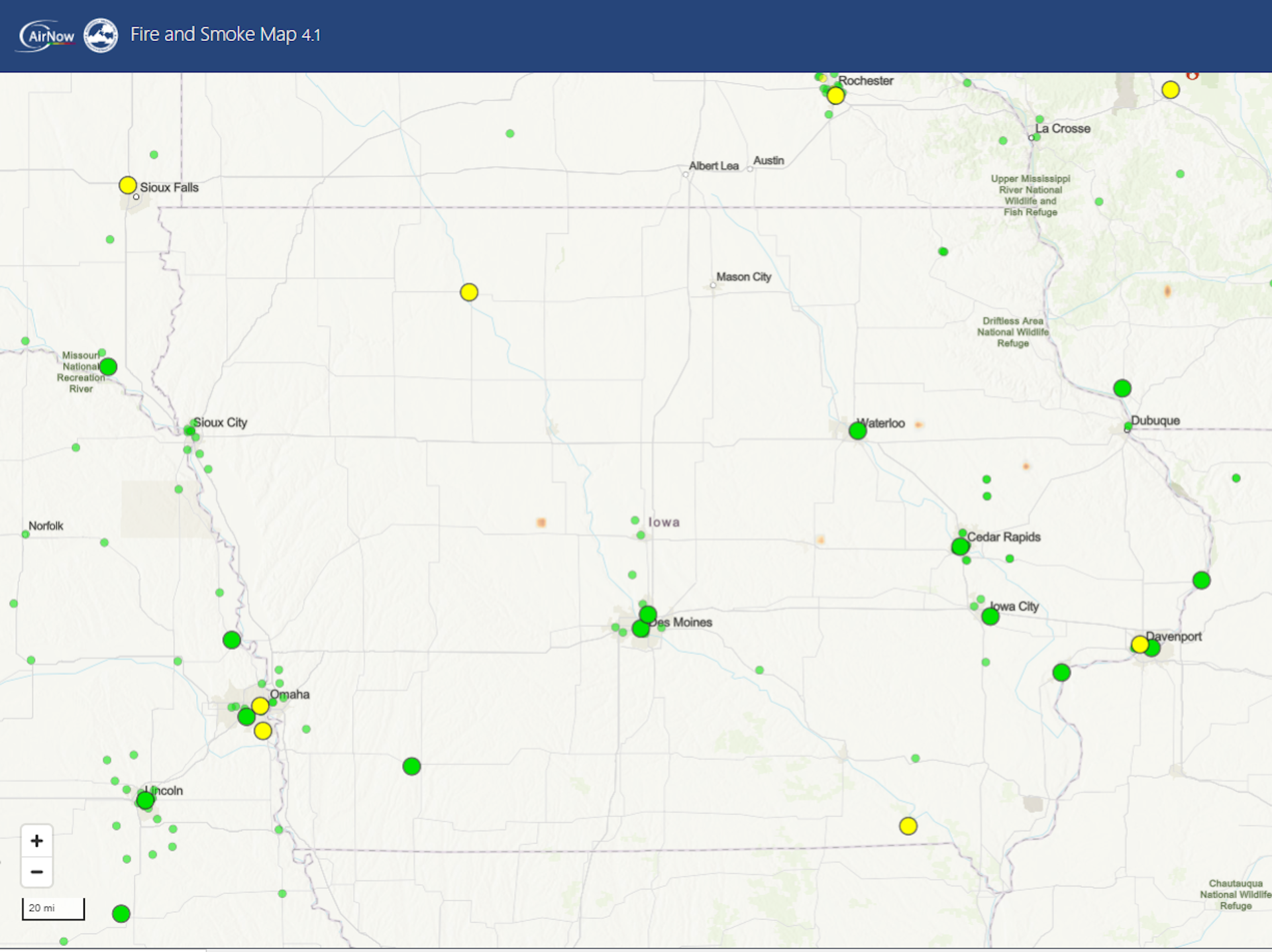
    That’s a big jump from relying on ground-based air quality monitors, which may be hundreds of miles apart. Iowa, for example, had about 50 air quality monitors reporting data on a recent day for a state that covers 56,273 square miles. Most of those monitors were clustered around its largest cities.

    NOAA’s AerosolWatch tool currently provides a near-real-time stream of wildfire smoke images from its GOES-R satellites, and the agency plans to incorporate TEMPO’s height data. A prototype of this system from my team’s NASA-supported research project on fire and air quality, called FireAQ, shows how users can zoom in to the neighborhood level to see how high the smoke plume is, however the prototype is currently only updated once a day, so the data is delayed, and it isn’t able to provide smoke height data where clouds are also overhead.

    Wildfire health risks are rising

    Fire risk is increasing across North America as global temperatures rise and more people move into wildland areas.

    While air quality in most of the U.S. improved between 2000 and 2020, thanks to stricter emissions regulations on vehicles and power plants, wildfires have reversed that trend in parts of the western U.S. Research has found that wildfire smoke has effectively erased nearly two decades of air quality progress there.

    Our advances in smoke monitoring mark a new era in air quality forecasting, offering more accurate and timely information to better protect public health in the face of these escalating wildfire threats.

    Prof. Wang’s group have been supported from NOAA, NASA, and Naval ONR to develop research algorithm to retrieve aerosol layer height. The compute codes of the research algorithm were shared with colleagues in NOAA.

    – ref. Which wildfire smoke plumes are hazardous? New satellite tech can map them in 3D for air quality alerts at neighborhood scale – https://theconversation.com/which-wildfire-smoke-plumes-are-hazardous-new-satellite-tech-can-map-them-in-3d-for-air-quality-alerts-at-neighborhood-scale-259654

    MIL OSI –

    July 27, 2025
  • Musk ordered shutdown of Starlink satellite service as Ukraine retook territory from Russia

    Source: Government of India

    Source: Government of India (4)

    During a pivotal push by Ukraine to retake territory from Russia in late September 2022, Elon Musk gave an order that disrupted the counteroffensive and dented Kyiv’s trust in Starlink, the satellite internet service the billionaire provided early in the war to help Ukraine’s military maintain battlefield connectivity.

    According to three people familiar with the command, Musk told a senior engineer at the California offices of SpaceX, the Musk venture that controls Starlink, to cut coverage in areas including Kherson, a strategic region north of the Black Sea that Ukraine was trying to reclaim.

    “We have to do this,” Michael Nicolls, the Starlink engineer, told colleagues upon receiving the order, one of these people said. Staffers complied, the three people told Reuters, deactivating at least a hundred Starlink terminals, their hexagon-shaped cells going dark on an internal map of the company’s coverage. The move also affected other areas seized by Russia, including some of Donetsk province further east.

    Upon Musk’s order, Ukrainian troops suddenly faced a communications blackout, according to a Ukrainian military official, an advisor to the armed forces, and two others who experienced Starlink failure near the front lines. Soldiers panicked, drones surveilling Russian forces went dark, and long-range artillery units, reliant on Starlink to aim their fire, struggled to hit targets.

    As a result, the Ukrainian military official and the military advisor said, troops failed to surround a Russian position in the town of Beryslav, east of Kherson, the administrative center of the region of the same name. “The encirclement stalled entirely,” said the military official in an interview. “It failed.”

    Ultimately, Ukraine’s counteroffensive succeeded in reclaiming Beryslav, the city of Kherson and some additional territory Russia had occupied. But Musk’s order, which hasn’t previously been reported, is the first known instance of the billionaire actively shutting off Starlink coverage over a battlefield during the conflict. The decision shocked some Starlink employees and effectively reshaped the front line of the fighting, enabling Musk to take “the outcome of a war into his own hands,” another one of the three people said.

    The account of the command counters Musk’s narrative of how he has handled Starlink service in Ukraine amid the war. As recently as March, in a post on X, his social media site, Musk wrote: “We would never do such a thing.”

    Musk and Nicolls didn’t respond to requests from Reuters for comment.

    A SpaceX spokesperson said by email that the news agency’s reporting is “inaccurate” and referred reporters to an X post earlier this year in which the company said: “Starlink is fully committed to providing service to Ukraine.” The spokesperson didn’t specify any inaccuracies in this report or answer a lengthy list of questions regarding the incident, Starlink’s role in the Ukraine war, or other details regarding its business.

    The office of Ukrainian President Volodymyr Zelenskiy and the country’s Ministry of Defence didn’t respond to requests for comment. Starlink still provides service to Ukraine, and the Ukrainian military relies on it for some connectivity. Zelenskiy as recently as this year has publicly expressed gratitude to Musk for Starlink.

    It isn’t clear what prompted Musk’s command, when exactly he gave it, or precisely how long the outage lasted. The three people familiar with the order said they believed it stemmed from concerns Musk expressed later that Ukrainian advances could provoke nuclear retaliation from Russia. One of the people said the shutoff transpired on September 30, 2022. The two others said it was around then, but didn’t recall the exact date. Some senior U.S. officials shared Musk’s concerns that Russia would make good on threats to escalate, one former White House staffer told Reuters.

    Musk’s order was an early glimpse of the power the magnate now wields in geopolitics and global security because of Starlink, a fast-growing satellite internet service that barely existed early this decade and now provides connectivity even in remote areas of the world. Even before his brief role as financial backer and advisor to U.S. President Donald Trump, the success of Starlink – and the unrivaled connectivity it offers across the planet – had given Musk increasing influence with political leaders, governments and militaries worldwide.

    Musk’s sway in military affairs in Washington and beyond – through Starlink’s dominance in satellite communications and SpaceX’s clout in space launches – has reached a dimension previously limited to sovereign governments, alarming some regulators and lawmakers. “Elon Musk’s current global dominance exemplifies the dangers of concentrated power in unregulated domains,” Martha Lane Fox, a member of Britain’s upper house of parliament, said during a debate earlier this year. The parliamentarian is a businesswoman and former board member at Twitter, the social media site that Musk acquired in 2022 and rebranded as X.

    “Its control,” Lane Fox said of Starlink, “rests solely with Musk, allowing his whims to dictate access to vital infrastructure.”

    Musk’s political influence, and his massive business with the U.S. federal government, are now being put to the test. Since leaving his role advising Trump, Musk has publicly feuded with the president, announced plans to create a new political party, and criticized a signature spending bill that he said will expand the budget deficit and destroy jobs. Trump, for his part, has threatened to end government contracts and subsidies for Musk’s companies, including lucrative new defense projects.

    Whatever the reason for Musk’s decision, the shutoff over Kherson and other regions surprised some involved with the Ukraine war – from troops on the ground to U.S. military and foreign policy officials, who after Russia’s full-scale invasion that February had worked to secure Starlink service for Ukrainian forces. Panicked calls by Ukrainian officials during the outage to seek information from Pentagon counterparts, five people familiar with the incident said, were met with few explanations for what could have caused it.

    The U.S. Department of Defense declined to comment. Reuters couldn’t determine whether White House or Pentagon officials after the shutdown had any exchanges with Musk over the outage.

    The Kherson episode is distinct from an earlier report of an incident that purportedly occurred that same September, involving Crimea just to the south, and raised concerns about Musk’s ability to influence the conflict in Ukraine.

    In his 2023 biography of Musk, author Walter Isaacson reported that the tycoon had ordered Starlink to disable coverage in Crimea, which Russia had annexed from Ukraine after a 2014 invasion that the international community condemned as illegal. Musk, Isaacson wrote, believed a planned Ukrainian attack on Russian vessels in the Crimean port of Sevastopol could prompt nuclear retaliation.

    After the book was published, Musk denied a shutdown, saying that there had never been coverage in Crimea to begin with. He said he had, rather, rejected a Ukrainian request to provide service ahead of Kyiv’s planned attack. Isaacson later conceded his account was flawed. A spokesperson at Isaacson’s publisher declined to comment or make him available for an interview.

    SpaceX also said in 2023 that it had taken unspecified steps to prevent Ukraine from using Starlink for certain activities, including drone attacks. “Our intent was never to have them use it for offensive purposes,” Gwynne Shotwell, the company’s president, said at a conference in Washington in February of that year. “There are things that we can do, and have done” to prevent it, she added, without providing further detail.

    Reuters couldn’t determine if the shutdown affecting Kherson was among the steps she was referring to. Shotwell didn’t respond to requests for comment for this article.

    Following the start of the Kherson shutdown, word of an outage emerged in some media reports. At the time, it wasn’t clear to those who lost connectivity whether a technical problem, sabotage or some other factor was responsible. Early in the war, Russia had orchestrated a large cyberattack that disrupted service of another satellite operator, Western officials have said, creating suspicions around any outage and leaving a void quickly filled by Starlink. Russia has denied it conducts offensive cyberattacks.

    As of April 2025, according to Ukrainian government social media posts, Kyiv has received more than 50,000 Starlink terminals. Easily transported and deployed, the pizza-box-sized devices communicate with thousands of SpaceX satellites now circling the globe. An initial batch of terminals was provided to Ukraine by SpaceX itself. Further terminals have arrived from donors including Poland, the United States and Germany.

    This account of the outage, and the growing dependence on Musk by governments and militaries worldwide, is based on interviews with more than three dozen people with knowledge of SpaceX’s operations and the company’s technology. These people included current and former employees, U.S. and European military officials, and senior politicians and diplomats.

    The reporting puts a spotlight on Musk’s control of services now critical to countries including the U.S., which has about $22 billion in contracts with SpaceX. Underscoring the point himself during his recent dispute with Trump, Musk threatened to decommission a SpaceX spacecraft the U.S. now relies upon to transport astronauts and critical cargo.

    His threat, later retracted, unnerved attorneys at the National Aeronautics and Space Administration, who felt forced to explore whether Musk’s warning could be considered a notice of contract termination, according to two people familiar with the matter. NASA didn’t respond to Reuters’ requests for comment.

    “There needs to be some contractual assurances” that Musk won’t cut off services to the U.S. government, said Lori Garver, a former deputy administrator of the agency. “We will need to consider how comfortable the U.S. will be at putting SpaceX in the critical path on national security.”

    As countries increasingly rely on tech companies for everything from cyber defense to data storage, the question of dependence on one or a few dominant service providers will apply to other nations, too. “Governments have to think through what that means,” said Marcus Willett, former deputy head of Britain’s Government Communications Headquarters intelligence agency and now a senior adviser to the International Institute for Strategic Studies, a London-based think tank.

    “WE NEED ASSURANCES”

    SpaceX is the first company to establish an extensive network of communication satellites in low-Earth orbit, a region of space that is closer to the planet than areas where such satellites historically reside. The proximity of satellites that now make up the company’s constellation allows Starlink to offer space-based wireless connectivity that is faster than any previously available.

    Starlink on Thursday suffered a rare global outage of several hours, the company said, because of an internal software problem. A Ukrainian military commander in a social media post said “Starlink is down across the entire front,” updating the post two and a half hours later to say connectivity had returned.

    With more than 7,900 satellites now in orbit, SpaceX has become the world’s largest satellite operator. Its devices, which relay signals among each other to create a network that communicates with the ground, account for about two-thirds of all active satellites in space, according to Jonathan McDowell, an astronomer at the Center for Astrophysics, Harvard & Smithsonian.

    Starlink began rolling out service in 2020 and now has more than six million customers in over 140 countries, territories and markets, according to a June Starlink social media post. Novaspace, a consulting firm near Paris, estimates that Starlink in 2025 will generate about $9.8 billion in revenue for SpaceX, or about 60% of the company’s income. SpaceX is privately held and doesn’t disclose financial information, but Musk recently said he expects the rocket company to post revenues of about $15.5 billion this year.

    Rivals are scrambling to get in on the market.

    OneWeb, a European service owned by Eutelsat, a French company, is the furthest along, boasting about 650 satellites in low-Earth orbit. Amazon this year launched its first satellites for Project Kuiper, a $10 billion effort to compete. China is developing multiple networks, including a state-backed venture known as SpaceSail.

    Still, Starlink has made much of its first-mover advantage. Its terminals, priced as low as a few hundred dollars for standard models, are known for being affordable and easy to use. “There is no existing system right now to replace Starlink,” said Grace Khanuja, an analyst at Novaspace, the consultancy near Paris.

    Compared to the geostationary satellites historically used for communications, the sheer number of SpaceX satellites helps make Starlink less vulnerable to jamming and attacks. Its far reach makes it valuable in remote and hostile terrain – from battlefields to airspace to high seas. In Ukraine, it has facilitated activities including communications, intelligence and drone piloting.

    Some Western militaries not engaged in conflict are also using the service. Britain’s armed forces, for instance, three years ago began using Starlink for “welfare purposes,” including personal communications for troops, the Ministry of Defence said in response to a freedom of information request. The ministry said it has fewer than 1,000 Starlink terminals and doesn’t employ them for sensitive military communications. Spain’s navy is also using Starlink, but only for recreation and leisure of troops, a spokesperson said.

    “That will change,” said Chris Moore, a retired air vice-marshal in the British military, speaking about high-speed space-based connectivity. Moore also worked as a OneWeb executive and is now a defense industry consultant. Satellites in low-Earth orbit, he said, offer too many advantages for militaries to ignore, especially for modern developments such as drone warfare, a signature element of the Ukraine conflict.

    Some leaders are leery.

    In Taiwan, ever wary of conflict with China, officials have expressed concern about Musk’s extensive business interests on the mainland, including a major factory for Tesla, the electric vehicle company he controls. Eager for communications backups in the event of war, Taiwan is developing its own low-Earth orbit satellite network. Taiwanese officials have said the government could partner with Amazon’s Kuiper, too.

    Spokespersons for the Taiwanese government said it welcomes international satellite providers but that Starlink hasn’t applied for a license in Taiwan. They didn’t respond to questions about Taipei’s relationship with Musk.

    In Italy, the government is evaluating whether to employ Starlink for secure communications among the government, defense and other officials. But some officials, including President Sergio Mattarella, remain unconvinced by SpaceX’s assurances that its service would be secure and free from meddling by Musk. “More than Musk’s word, we need assurances that we can’t be shut down, and especially that he can’t access the data,” said a person familiar with the views of the president, who is an influential figure with the armed forces.

    Poland, a major donor to Ukraine, told Reuters it employs Starlink as well as other military and commercial satellite systems. A mix of providers, Polish officials have said, offers the most security, even if at high cost.

    “In peacetime, you want the best product at the best price,” Foreign Minister Radoslaw Sikorski said in response to a question from Reuters at a press conference in April. “In wartime, you want redundancy. You want security. You want duplicated systems, so that if one fails, you can still use the other.”

    “THERE WAS NOT A CONNECTION”

    Even before the conflict began, documents reviewed by Reuters show, SpaceX had already been in discussions with the U.S. government about providing Starlink in Ukraine. Rollout began after Russian troops crossed the border on February 24, 2022.

    Two days later, Mykhailo Fedorov, a deputy prime minister in Ukraine, requested Musk’s help. “We ask you to provide Ukraine with Starlink stations,” he wrote on Twitter.

    Musk responded in 10 hours. “Starlink service is now active in Ukraine,” he tweeted. “More terminals en route.”

    Poland was also instrumental in the early days of the war, shipping thousands of terminals to Ukraine shortly after the invasion. Warsaw this year said it has purchased about 25,000 Starlink terminals for the effort – roughly half the total now in Ukraine – and that it is paying the subscription costs to keep them connected. So far, it has spentabout $89 million on Starlink for Ukraine.

    The equipment has made a critical difference for Ukraine.

    Day-to-day bureaucracy has also benefited. Early in the conflict, Ukraine stored state data in the cloud and relied on Starlink to access it, helping keep some government operations running. “We wouldn’t be anywhere without Starlink,” said Vadym Prystaiko, Ukraine’s ambassador to Britain until 2023. “The whole state was preserved.”

    On the battlefield, Ukraine quickly deployed Starlink to enable front-line troops to communicate with commanders. The service also allowed drone operators to transmit surveillance video streams and locate and attack Russian targets. Reuters couldn’t establish just when such attacks may have become a concern for Musk or SpaceX.

    By September 2022, a major Ukrainian counteroffensive was underway. Kyiv’s forces were pushing back into territories, including Kherson, that Russia had captured. The drive threatened Russian supply lines, prompting Moscow to threaten the West, including oblique references to Starlink.

    That month, in a statement to the United Nations, Russia noted the use of “elements of civilian, including commercial, infrastructure in outer space for military purposes.” It warned that “quasi-civilian infrastructure may become a legitimate target for retaliation.”

    It isn’t clear whether Russia has tried to attack any Starlink facilities. Musk has said, however, that Moscow has repeatedly sought to block its connectivity. “SpaceX is spending significant resources combating Russian jamming efforts,” Musk wrote on X last year. “This is a tough problem.”

    The Kremlin declined to comment on whether it has sought to interfere with Starlink. The Ministry of Defence didn’t respond to a request for comment. Starlink isn’t licensed for either civilian or military use in Russia.

    As Ukraine’s counterattack intensified, Russian President Vladimir Putin on September 21, 2022, ordered a partial mobilization of reservists, Russia’s first since World War II. He also threatened to use nuclear weapons if Russia’s own “territorial integrity” were at risk.

    Around this time, Musk engaged in weeks of backchannel conversations with senior officials in the administration of President Joe Biden, according to three former U.S. government officials and one of the people familiar with Musk’s order to stop service. During those conversations, the former White House staffer told Reuters, U.S. intelligence and security officials expressed concern that Putin could follow through on his threats. Musk, this person added, worried too, and asked U.S. officials if they knew where and how Ukraine used Starlink on the battlefield.

    Soon after, he ordered the shutdown.

    Reuters couldn’t ascertain the full geographic extent of the outage, but the three people familiar with the stoppage said that it covered regions that had recently been taken by Russia. Starlink coverage prior to the order, they said, had been active up to what had been Ukraine’s border with Russia before the full-scale invasion.

    Taras Tymochko, a Ukrainian military signals specialist stationed in the Kherson region at the time, said an outage disrupted communications for troops, including colleagues on the front, for several hours. “If you were using Starlink to provide surveillance of the front line, you pretty much would be blind,” said Tymochko, who is now a consultant to Come Back Alive, a non-governmental organization that procures military equipment for Ukraine’s armed forces.

    Maryna Tsirkun, a drone expert at Aerorozvidka, an aerial reconnaissance organization that works closely with the Ukrainian military, was also in southern Ukraine at the time. Starlink signals failed as Ukrainian troops began to push toward terrain seized by Russia, she told Reuters. “When we started to proceed there was not a connection,” she said. The outage she and colleagues experienced lasted several days.

    On October 3, Musk angered Zelenskiy and other Ukrainian officials by tweeting a suggestion that locals in regions annexed by Russia vote on whether they should remain a part of Ukraine. A day later, Musk tweeted his concern about the conflict spiraling. “I still very much support Ukraine,” he tweeted, “but am convinced that massive escalation of the war will cause great harm to Ukraine and possibly the world.”

    Three days later, following one media report about a Starlink outage, Musk tweeted that “what’s happening on the battlefield, that’s classified.” He added that SpaceX by the end of 2022 was on track to spend $100 million on Ukraine. Although the Polish and U.S. governments by then had begun donations of their own, the billionaire complained about the cost of the equipment and services SpaceX was providing.

    SpaceX “cannot fund the existing system indefinitely,” Musk wrote in a mid-October post. The next day, in another tweet, he reversed course. “To hell with it,” he wrote, “we’ll just keep funding Ukraine govt for free.”

    After the outage, Kyiv worked to charm Musk.

    In November 2022, Fedorov, the government minister, publicly expressed trust in the service. Months later – just after Shotwell, the SpaceX president, said the company had taken steps to prevent Ukraine from using Starlink for drone attacks – Fedorov in an interview with a Ukrainian news site recognized Starlink’s ability to “geofence” coverage, selectively limiting signals in some areas.

    By February 2023, however, Starlink was fully functional in Ukraine, he said. “All the Starlink terminals in Ukraine work properly,” Fedorov told Ukrainska Pravda, the news site. Fedorov, who recently assumed the title of first deputy prime minister, didn’t respond to a request for comment about Ukraine’s use of Starlink in the war.

    In mid-2023, the U.S. Department of Defense signed an agreement with SpaceX to pay for Starlink coverage in Ukraine. Terms of the contract weren’t disclosed, but Quilty Space, a Florida-based research firm, said the Pentagon has an ongoing $537 million agreement with SpaceX to provide satellite communications to Ukraine. It’s not clear whether SpaceX is still footing the bill for any equipment or connectivity.

    As the war has evolved, so has Ukraine’s use of Musk’s technology.

    Ukrainian drone specialists and Prystaiko, the former ambassador to Britain, said some attack devices, including maritime and bomber drones, now have Starlink antennas fitted to them. The antennas, in the case of sea drones, help operators guide the devices and view video feeds to classify targets, said Sidharth Kaushal, a senior research fellow at Royal United Services Institute, a London-based defense think tank.

    It’s uncertain whether such use contravenes SpaceX’s desire that Starlink not be employed for offense.

    Ukraine continues to explore alternatives that could complement or back up Starlink if the service became unavailable, a senior government official told Reuters. Ukraine’s government has expressed interest in European satellite projects, European Commission spokesperson Thomas Regnier told Reuters. That includes GOVSATCOM, an EU project to pool satellite resources from member states and industry to provide services to governments, he said.

    Privately, though, some Ukrainian officials say the existing alternatives to Starlink have limitations. “It takes time, it takes money,” the senior government official told Reuters. With Starlink, he added, “we have a working system.”

    Musk himself has boasted of Starlink’s importance to Kyiv. “My Starlink system is the backbone of the Ukrainian army,” he wrote on X in March. “Their entire front line would collapse if I turned it off.”

    (Reuters)


    July 26, 2025
  • MIL-OSI Australia: Fatal crash, Forth

    Source: New South Wales Community and Justice

    Fatal crash, Forth

    Saturday, 26 July 2025 – 6:12 pm.

    At approximately 12.40pm today, emergency services responded to reports of a crash on Wilmot Road where a tree had fallen onto a 4WD utility as it was travelling on the roadway.
    Sadly, the driver of the vehicle, a man in his 50s died at the scene.
    The passenger in the vehicle, a woman in her 50s was provided medical assistance at the scene and was being flown to the Royal Hobart Hospital with serious injuries.
    Our thoughts and condolences are with everyone affected by the crash.

    MIL OSI News –

    July 26, 2025
  • MIL-OSI Australia: Concern for welfare – Kakadu

    Source: Northern Territory Police and Fire Services

    The Northern Territory Police Force hold concerns for the welfare of Nicholas, who was last seen on Thursday evening at the Karnamarr Campground, near Jim Jim Falls, Kakadu National Park.

    Nicholas arrived at the camp on Wednesday 23 July and paid for one night. On Friday 25 July, the campground manager noticed that his vehicle and camp were still at the location. After conducting initial enquiries around the camp he contacted Kakadu National Park management and the concerns were later escalated to Police. Kakadu National Park Rangers began conducting search operations early Saturday morning, utilising their experienced Rangers and a JetRanger Helicopter.

    At 9am on Saturday, the Northern Territory Police Search and Rescue Section were notified and began coordinating search efforts.

    A large search operation is underway in the vicinity of the campground and within the Jim Jim Falls region involving ground and aerial teams. Police are working closely with Kakadu National Park Rangers and Traditional Owners.

    Anyone who was in the area since Wednesday 23 July who may have dashcam footage or have seen or spoken to the Nicholas is asked to contact NT Police on 131444 and quote reference number P25199346.

    MIL OSI News –

    July 26, 2025
  • MIL-OSI Security: Vehicle Theft Investigation Leads to 33-Year Federal Prison Sentence for Production of Child Pornography

    Source: Office of United States Attorneys

    An Arlington resident was sentenced to 405 months in federal prison for Production of Child Pornography and Illegal Possession of a Machinegun, announced Acting United States Attorney for the Northern District of Texas Nancy E. Larson.

    Court documents revealed that in late September 2024, the Bedford Police Department began investigating a theft of a truck that belonged to a business in Bedford, Texas.  A few days later, the Arlington Police Department recovered the vehicle and returned it to the owners.  Multiple bags containing cell phones and illegal firearms that belonged to Carlos Isaac Barrientos were found in the vehicle.  A forensic review of the devices by agents from the Bureau of Alcohol Tobacco and Firearms located images and videos of child pornography on the devices.  Barrientos, 36, of Arlington, Texas, was arrested, charged, and subsequently pled guilty to production of child pornography and illegal possession of a machinegun on April 16, 2025.  On July 24, 2025, Barrientos was sentenced to 405 months in federal prison by United States District Judge Reed O’Connor.

    The investigation was conducted by the Arlington Police Department, Bedford Police Department, Bureau of Alcohol, Tobacco and Firearms, and Department of Homeland Security. Assistant United States Attorney Allyson Monte prosecuted the case.
     

    MIL Security OSI –

    July 26, 2025
  • MIL-OSI Security: Two New Orleans Men Plead Guilty to Multiple Drug and Gun Offenses

    Source: Office of United States Attorneys

    NEW ORLEANS, LOUISIANA – Acting United States Attorney Michael M. Simpson announced that HENRY MITCHELL (“MITCHELL”), age 35, and JAYLAN WASHINGTON (“WASHINGTON”), age 30, both residents of New Orleans, were sentenced on July 22, 2025, by United States District Judge Greg G. Guidry pursuant to their pleas of guilty to federal drug and gun charges.  Listed below are the charges to which each Defendant pled guilty, and the sentence received:

    CHARGE

    DEFENDANT

    SENTENCE

    Conspiracy to Distribute and Possess with Intent to Distribute marihuana, Fentanyl, tapentadol and tramadol (21 U.S.C. § 846) MITCHELL 151 months, 3 years of supervised release
    Possession With Intent to Distribute marihuana, Fentanyl, tapentadol and tramadol (21 U.S.C. §§ 841(a)(1) & (b)(1)(C)) MITCHELL 151 months, 3 years of supervised release
    Felon in Possession of a Firearm (18 U.S.C. § 922(g)(1)) MITCHELL 151 months, 3 years of supervised release
    Possession of a Machine Gun (18 U.S.C. § Section 922(o)) MITCHELL 120 months, 3 years of supervised release
    Possession of a Machine Gun (18 U.S.C. § 922(o)) MITCHELL 120 months, 3 years of supervised release
    Conspiracy to Distribute and Possess with Intent to Distribute marihuana, Fentanyl, tapentadol and tramadol (21 U.S.C. § 846) WASHINGTON 120 months, 3 years of supervised release
    Possession with Intent to Distribute marihuana, and tapentadol (21 U.S.C. § 841(a)(1) and (b)(1)(C) WASHINGTON 120 months, 3 years of supervised release
    Felon in Possession of a Firearm (18 U.S.C. § 922(g)(1)) WASHINGTON 120 months, 3 years of supervised release
    Possession of a Machine Gun (18 U.S.C. § 922(o)) WASHINGTON 120 months, 3 years of supervised release

    All sentences were ordered to run concurrently with each other.  Judge Guidry also ordered MITCHELL to pay $500.00 in mandatory special assessment fees and ordered WASHINGTON to pay $400 in mandatory special assessment fees. 

    Court documents reflect that MITCHELL and WASHINGTON were openly selling various controlled substance in the Plum Orchard Neighborhood of New Orleans. Federal Bureau of Investigation Violent Crime Task Force Officers (TFO) observed this activity after receiving multiple citizen complaints. The TFOs notified New Orleans Police Department Officers who surrounded the area and arrested MITCHELL and WASHINGTON.  A search of their vehicles revealed both controlled substances and firearms.  Officers also recovered “Glock switches” that convert semiautomatic weapons into fully automatic ones.  These switches are considered machineguns under federal law.  Additionally, both MITCHELL and WASHINGTON have several prior felony convictions including ones for violation of drug and firearm laws.

    This case is part of Project Safe Neighborhoods (PSN), a program bringing together all levels of law enforcement and the communities they serve to reduce violent crime and gun violence, and to make our neighborhoods safer for everyone.  On May 26, 2021, the Department launched a violent crime reduction strategy strengthening PSN based on these core principles: fostering trust and legitimacy in our communities, supporting community-based organizations that help prevent violence from occurring in the first place, setting focused and strategic enforcement priorities, and measuring the results.

    The case was investigated by Federal Bureau of Investigation Violent Crime Task Force, and the New Orleans Police Department.  Assistant United States Attorney Mark A. Miller of the Narcotics Unit is assigned the prosecution.

    MIL Security OSI –

    July 26, 2025
  • MIL-OSI Australia: Major upgrades for the heart of the Scenic Rim

    Source: Australian Civil Aviation Safety Authority

    The Beaudesert community (west of the Gold Coast) is benefitting from major town centre upgrades and vital infrastructure improvements delivering safer streets and greener public spaces.

    The Albanese and Crisafulli governments have partnered with the Scenic Rim Council to fund these upgrades with around $22.4 million of total support.

    Beaudesert Town Centre Revitalisation

    The Town Centre Revitalisation has delivered a new community space featuring an amphitheatre, open parklands, public toilet facilities, off-street carparks, and large parking bays for caravans, buses and trailers.

    It was jointly funded by more than $4.19 million from the Australian Government, $3.75 million from the Queensland Government and more than $6.43 million from Scenic Rim Regional Council.

    New stormwater infrastructure on Brisbane and Eaglesfield streets

    New stormwater infrastructure has been delivered on Brisbane and Eaglesfield streets from William Street to Selwyn Street.

    This will improve flood resilience for town centre businesses and increase safety for pedestrians and vehicles during and following weather events, as well as enabling activity to resume more quickly.

    It was supported by more than $2.17 million from the Australian Government under the Local Roads and Community Infrastructure (LRCI) Program and nearly $1.26 million from Scenic Rim Regional Council.

    Brisbane and Selwyn Street roundabout

    The new Brisbane and Selwyn Street roundabout is complete, increasing pedestrian safety with street upgrades and traffic calming devices.

    The project upgraded parkland facilities, transport and stormwater infrastructure, as well as landscaping and footpaths.

    Works were funded with more than $660,000 from the Queensland Government and nearly $3.94 million from Scenic Rim Regional Council.

    Quotes attributable to Minister for Regional Development, Local Government and Territories, the Hon Kristy McBain MP:

    “These upgrades mark significant investments in Beaudesert’s main street and will be a massive boost for the Scenic Rim region.

    “I’m especially looking forward to seeing locals enjoy the fantastic new town centre facilities.

    “It’s another great example of how we are partnering across all levels of government to deliver communities the infrastructure they need and deserve.”

    Quotes attributable to Senator for Queensland Corinne Mulholland:

    “The Albanese Government is committed to funding projects that make a real difference in local liveability, and this impressive town centre revitalisation will be enjoyed for generations to come.

    “Our investment not only provides an immediate stimulus for the local economy and jobs, it also invests in the pride locals feel about the aesthetic and amenities in this beautiful town.

    “Mayor Sharp toured me around the Scenic Rim earlier this month and it was clear the council is successfully delivering on its commitment to a back-to-basics focus on the services and infrastructure ratepayers expect, while also keeping a forward-looking focus on how to keep this beautiful region moving forward.”

    Quotes attributable to Qld Minister for Local Government, Ann Leahy: 

    “The Crisafulli Government is committed to delivering the infrastructure to support growing communities.

    “These upgrades in the Scenic Rim are a great example of what can be achieved when all three levels of government work together with the shared goal to deliver for local communities.”

    Quotes attributable to Mayor of Scenic Rim Regional Council, Tom Sharp:

    “The upgrades have redefined Beaudesert’s role as a vibrant and thriving centre for the Scenic Rim community.

    “These projects reflect years of planning and community input, resulting in safer streets, greener spaces, better parking, and a town centre that truly reflects who we are.”

    MIL OSI News –

    July 26, 2025
  • MIL-OSI Australia: Crews on the move for vital upgrade of flood-prone Youngs Crossing

    Source: NGARKAT HIGHWAY, NGARKAT (Grass Fire)

    Work crews and equipment have started arriving on site as works begin on the Youngs Crossing upgrade; a project which will significantly enhance the reliability of this key transport connection in the City of Moreton Bay.  

    The upgrade will include the construction of a new four-lane bridge west of the existing Youngs Crossing bridge, as well as three new signalised intersections and improved pedestrian and active transport connections. 

    For generations, heavy rain events and water flows into the North Pine River and Sideling Creek have led to the closure of Youngs Crossing Road, causing delays and congestion on surrounding roads.

    The road is used by more than 20,000 vehicles a day and since 2021 the crossing has been closed for an average of 12 days a year. This year, the road has already been closed for a total of 14 days.

    Works will now begin on the $86 million program of works to be delivered by Seymour Whyte.

    With construction beginning this month, the project is expected to be completed in mid-2027, weather permitting.   

    As work gets underway residents and road users are encouraged to register for project updates. For the latest on the project, visit www.moretonbay.qld.gov.au/youngs-crossing and register via the ’Stay Connected’ link.  

    Quotes attributable to Federal Minister for Infrastructure, Transport, Regional Development and Local Government Catherine King:

    “Each and every flood event at this crossing impacts both residents and businesses – sometimes for days on end.  

    “With Moreton Bay experiencing rapid growth, this project will deliver much-needed flood immunity and cater for increasing volumes of traffic on this stretch of road. 

    “The Australian Government is working in partnership with the Queensland Government and the City of Moreton Bay to deliver this crucial upgrade.”  

    Quotes attributable to Queensland Minister for Transport and Main Roads Brent Mickelberg:

    “We’re committed to delivering the vital transport infrastructure communities across our state need to ensure safety, reliability, and connectivity.

    “Part of the upgrade includes improvements to the Dayboro Road intersection, which includes boosting its turning capacities and the inclusion of additional lanes, new cyclist and pedestrian facilities and safety improvements.” 

    Quotes attributable to Federal Member for Dickson Ali France:

    “I know just how much sudden road closures due to rain impact our community. 

    “This significant road update will help people in Dickson get home faster, so they can spend more time with their families and less time on the road. This project will be felt for generations to come.  

    “In 2024 the Albanese Government announced it would commit an additional $18.9 million towards the project, bringing our total commitment to $51.6 million and demonstrating our support for this critical project.”

    Quotes attributable to City of Moreton Bay Mayor Peter Flannery: 

    “It is an historic day, with the countdown to the 2027 opening of the new-four lane bridge and road officially underway. This is what happens when all levels of Government work together for their communities.

    “The site will become a hive of activity over the coming weeks as crews from our principal contractor, Seymour Whyte Constructions, work towards delivering this important flood-immune river crossing for City of Moreton Bay and its communities.

    “This highly anticipated upgrade is one of the most extensive road infrastructure projects to be delivered by Council, with other improvements including new pedestrian, cycling and safety features. 

    “I’m pleased that our Council has been able to pull this project out of the ‘too hard basket’ where it has been stuck for decades.” 

    MIL OSI News –

    July 26, 2025
  • MIL-OSI Australia: From plans to pavement: federal and state governments to deliver a major upgrade for the M5 and Western Sydney

    Source: Workplace Gender Equality Agency

    The Albanese and Minns governments are getting on with delivering the critical infrastructure Western Sydney needs, with the NSW government today signing a contract with Seymour Whyte to upgrade an infamous traffic chokepoint in Sydney’s south west. 

    The project includes a new three lane toll-free bridge over the Georges River and train lines at Liverpool, improving the connections between the M5 Motorway, Moorebank Avenue and the Hume Highway. 

    The upgrade includes the removal of the weave on the M5 Motorway between Moorebank Avenue and the Hume Highway to improve safety and traffic flow for road users entering and exiting the M5 Motorway. 

    The project will also include a new underpass at Moorebank Avenue, connecting the M5 Motorway westbound to the Hume Highway, and upgrade the intersection between the M5 Motorway and Moorebank Avenue. 

    The existing bridge over the Georges River, which connects the M5 Motorway to the Hume Highway and Moorebank Avenue, sees more than 2,500 trucks a day move from the Moorebank Intermodal Terminal Precinct onto the Sydney motorway network.

    Afternoon peak sees traffic bank up, as cars and trucks entering the motorway westbound at Moorebank Avenue attempt to merge with traffic already on the motorway that is looking to exit at the Hume Highway. Truck numbers on the interchange are also expected to increase as new sections of the expansive Moorebank Intermodal Terminal Precinct come online. 

    The Albanese and Minns governments are partnering to build a better NSW through investments in major infrastructure. Both have each committed $190 million towards this project as part of the ongoing Western Sydney infrastructure blitz. 

    Quotes attributable to Infrastructure, Transport, Regional Development and Local Government Minister Catherine King: 

    “This upgrade will ensure the conga-line of trucks coming in and out of the Moorebank Intermodal Terminal Precinct can flow more freely, keeping goods moving to their destinations, while delivering real benefits for commuters during peak periods. 

    “Western Sydney is growing quickly and the Albanese Government is investing over $19 billion to deliver the transport infrastructure Western Sydney needs.” 

    Quotes attributable to Acting NSW Premier Ryan Park: 

    “Western Sydney is the economic powerhouse of our state, and investments like this M5 upgrade ensure we’re building the infrastructure backbone to support continued growth and prosperity. 

    “We’re not just building roads, we’re building opportunities for families, businesses and freight operators who depend on efficient connections across the growing region.” 

    Quotes attributable to NSW Roads Minister Jenny Aitchison: 

    “Today’s contract signing is a major milestone that brings us one step closer to getting shovels in the ground on the infrastructure Western Sydney needs. 

    “This upgrade will slash congestion and create a safer driving environment for the thousands of motorists who use this critical interchange every day. 

    “The contract is signed, the builders are ready, and soon we’ll be improving connections across our region. The extra lanes will remove the need for around 3,900 vehicles per day to weave between lanes, making journeys safer and faster for families and freight operators alike.” 

    Quotes attributable to Federal Member for Hughes David Moncrieff: 

    “This is fantastic news for my community in south west Sydney. For too long, locals have been stuck in traffic at this congestion pinch point, especially during afternoon peak periods. 

    “This upgrade will eliminate a major bottleneck and help traffic flow along the M5, making a real difference to the daily lives of families and workers in our area. It’s great to see both levels of government working together to deliver the infrastructure we need.” 

    Quotes attributable to Federal Member for Werriwa Anne Stanley: 

    “This is great news for residents of Werriwa who utilise this road every day. 

    “The improvement in traffic flow will save commuters time and stress. I look forward to the completion of this long awaited and necessary section of road.”

    MIL OSI News –

    July 26, 2025
  • MIL-OSI Australia: Press conference, Sydney

    Source: Workplace Gender Equality Agency

    ANNE STANLEY: Hi, everyone. Thank you for being here this morning. My name is Anne Stanley. I’m the Federal Member for Werriwa. This is a fantastic start to more roads that will make sure that this part of the world is not in gridlock all the time. It will get trucks moving around our part of the world. And it is fantastic that the New South Wales Labor Government and the Federal Labor Government are finally doing what we’ve been waiting over 20 years to happen. So I’m just going to hand over now to Minister King to talk to you. 

    CATHERINE KING: Great, thanks very much. And first, can I just say to Anne and to David, our new Member for Hughes, it’s so fantastic to be here. I think this is the first event that I’ve done with David here in this space, but it’s great to be here with both of you. But also, of course, Ryan Park as Acting Premier and my friend and colleague, Jenny Aitchison who worked so closely together on projects such as this. 

    Well, we know that driving westbound along the M5 has become quite difficult for people. As the Moorebank Intermodal Precinct has come online, the weave that happens as trucks are trying to get on to the M5 to then get on to the Hume to get our goods to and from market. They’re also obviously competing with the many people and many commuters who live in this area who are finding that they are often queued back for almost a kilometre as we do that weave to try and get through this intersection. And really, the announcement today, this $380 million announcement, 50-50 funding, State and Federal Government working in partnership together, is about untangling that weave, untangling that intersection to make sure that commuters can get to and from work faster, that our trucks can get to market, and to move around this precinct more efficiently, because we know that economic activity is incredibly important here in this part of Sydney, and we also want to make sure people are able to move about efficiently and safely. Any time that a family is spending in a car or a worker is spending in a car, it’s time that they are not spending at home with their families. So this upgrade, it’s a complex piece of work. The fact that we’re here today getting the contracts signed for the delivery of this project, it’s been a long time coming, but I’m really delighted. And it’s taken, really, a federal and state Labor government who really don’t just talk about projects, we actually deliver them. We do the hard work, we do the planning, we do the design work, and we actually deliver projects, and I’m delighted to be here as part of that.

    I’ll hand over to Jenny, and then I think the Acting Premier is going to say a few words, take some questions, and then they’re going to sign a contract. Thanks everybody.

    JENNY AITCHISON: Thanks everyone. It’s great to be here today with Catherine King, Minister for Infrastructure federally, and federal colleagues Anne and David, and of course, my state colleagues, Acting Premier Ryan Park and the Member for Liverpool, Charishma Kaliyanda.

    It is a great day, a great announcement, $380 million to ensure that the success that we are seeing with freight and ensuring that our goods get to market is delivered. So we’ve just been over at the Moorebank Intermodal, and this will be a critical piece of infrastructure that will realise the potential of that development. Getting those vehicle movements to stop weaving between the lanes, the interchange to be grade-separated will be a major game-change. There will be upgrades to rail and also to pedestrian infrastructure. This will make this a much better piece of transport for all road users and stop that interweaving that we’re seeing of up to 2900 vehicles a day doing that. We’re looking at 2500 trucks using this, so it is really important for safety, for congestion busting, that we get this right.

    The Minns Labor Government is building better communities right across Western Sydney and indeed all of New South Wales, and this is a significant step forward. I’m really pleased that we’ll be signing the contract today with Seymour Whyte. It’s a design and construct contract, so they will be doing that design work. But people will start to see work happening soon as the geotechnical investigations happen, and then we will hope to have shovels in the ground very shortly after that. So, it is a major piece of investment in our communities of Western Sydney that have been crying out for so long for assistance with reducing those traffic snares. As Minister King said, every minute in the car is a minute away from friends, from family, from that wonderful time we have of recreation and rest. And most importantly, it’s the safety aspects of this to ensure that once the cars and the trucks are using this infrastructure, they are able to do so safely without creating issues.

    I’m going to pass over now to Acting Premier Ryan Park, and he can give you a few comments as well

    ACTING PREMIER RYAN PARK: Thank you, Minister, and thank you, Minister King, for being here. It’s delightful that you’re in this portfolio again. I know it’s one that you’re very passionate about. It’s great for New South Wales to continue their partnership and relationship with the Albanese Labor Government in Canberra and to Catherine King, who’s a very experienced Minister when it comes to the delivery of infrastructure. Thank you to Minister Aitchison and the team from Transport for New South Wales, local members at both the state and federal level. Anne Stanley was saying to me earlier that this is something that has been around since 2008, so no doubt the people of South Western Sydney can’t wait for this to happen.

    A $380 million investment in an important part of the road network essentially improves efficiency, improves safety, improves travel times for people moving in and around this area, but also in particular for freight. That’s a very important part of what happens in this South Western Sydney component. This is a major freight hub, not just for New South Wales but the entire country. And what we know is we need to continue to invest in the road infrastructure to make sure that we are delivering roads that are safe, performing efficiently and effectively for local community members, as well as those moving in and around there from other areas.

    I do want to speak a little bit overnight about a report that I’ve received from Dr Chant in relation to influenza, COVID, and RSV. Influenza continues to rise. We are continuing to see significant cases of influenza being presented to our local emergency departments. I can’t stress this enough right now: as we are heading to the peak or just on peak of influenza, we need people to get vaccinated. We need children to get vaccinated. We are still seeing not enough people, both over the age of 65 and young children, getting that vaccination. We need to take pressure off our emergency departments as we head through the winter months. And what we can all want to do over the winter here in New South Wales and, of course, in Sydney, is enjoy our surroundings, enjoy being with family. You can’t do that if you have the flu. So I’m saying to people today, once again, we are reaching or on the verge of reaching the peak in terms of influenza, but that is an important message to get through about making sure you go and get vaccinated. That includes young children and particularly includes older people.

    We’ve also got to emphasise with this much influenza around, RSV and of course COVID, which has started to stabilise – we’ve probably reached the peak of COVID – please don’t go to aged care facilities if you’re unwell. Please stay at home. Please don’t go to hospitals. What we want to do is make sure that our system can perform for those who need our hospital system. What we don’t want to do is people stuck in our hospital system with serious case of influenza, RSV or COVID. We can all do our thing and what we can do is go and get vaccinated.

    CATHERINE KING: I’ll leave questions to you. Any questions?

    JOURNALIST: You mentioned that shovels will be in the ground shortly. Do you have any more indication of when that would be?

    RYAN PARK: Well, I understand we’ve got to sign the contract today, and then we’ve got to make sure that, as all state governments do, we spend the Commonwealth’s money as quickly and as fast as we can.

    [Laughter]

    CATHERINE KING: On time and on budget. 

    RYAN PARK: That’s always the way. Never get in the road of a state government minister and some federal government money, but it’ll happen very, very soon. Shovels in the ground, and we’ll be proceeding with this project I imagine in the next few weeks.

    JOURNALIST: How long will the construction take?

    JENNY AITCHISON: Yep. So, the project will, the actual construction will start in early 2026. By the time the design elements are done, it will take probably two years to do that. Obviously, we will be working to expedite that as much as possible with the contractors and, you know, the way that we have been working in New South Wales on ensuring that our infrastructure spend is spent in a much more measured and considered way will help us to keep to those time frames. But obviously, you know, weather and other factors can come in.

    JOURNALIST: And how long do you expect it to take once the construction starts in early 2026?

    JENNY AITCHISON: Yeah, so we’re expecting that it will take a couple of years to get construction finalised. Obviously, that depends on a range of factors of weather and things like that. But, you know, we know that we have been working very hard to get our construction timelines back under control to ensure that things are being built on time and ready for the public. We know that during this time there is often disruptions for local communities. We thank them for their patience during that time.

    JOURNALIST: And those disruptions that will happen, they’re obviously necessary, so to speak, but what impact do you expect to have for traffic?

    JENNY AITCHISON: Look, what will happen is that there will be the usual construction impact, so that may be lane closures at particular times to keep workers safe. Everything these days- we know that there have been some really big challenges for construction work on roads. We’re really urging cars to travel to those roadside- roadworks speed limits. One of the things I’ve been very disappointed to see in some of our projects is people speeding through work zones. That is not acceptable. We have really worked to minimise those across all of our projects, those speed limits, but we want to make sure that drivers are driving to conditions.

    JOURNALIST: So we will see some traffic impact on those lanes around where you need to widen the road?

    JENNY AITCHISON: Yes, certainly there will be some, and we will use all the elements at our disposal, things like working at night where there’s less traffic, ensuring that we’ve got proper signalling and all that sort of thing in place so that we can minimise that disruption, but it is always a challenge. There’s, as we like to say, no gain without pain, but we are doing everything we can to minimise it and we’re really grateful to those members of the public who assist us in that by driving to the conditions.

    JOURNALIST: And do you have any sort of forecast on how this will help improve traffic, like any time reductions or anything like that?

    JENNY AITCHISON: Look, I don’t have specific time reductions here, but I think the main point is really the safety benefits. And we know at the moment there is queuing, so there will obviously be those timings. I can’t give you exact numbers right off the top of my head, but the main thing is not having that situation where a vehicle turning left then going right has only got a couple of hundred metres to do it, or conversely coming right and going left. They won’t be working together on the same piece of roadway. The grade separation will enable that to be a much safer transition.

    JOURNALIST: Acting Premier, does it really pass the pub test that taxpayers are paying for gym memberships and picnic days for rail workers while there are still so many public sector workers waiting for pay rises?

    RYAN PARK: Well, look, government reaches agreements through the bargaining process with unions and their trade union movement and representatives. The nature of those arrangements will become very, very clear as a part of the fair work process. We’re not trying to hide anything here. The reality is what we wanted to do was get an agreement, and we had to strike a balance between making sure that we provided fair work and conditions and pay for working men and women on our transport system, but at the same time making sure that we can get a transport system operating at its very highest capacity, and operating as efficiently and effectively for passengers and commuters every single day.

    JOURNALIST: Some pretty funny perks. Was it a matter of offer them the funny perks, just so that they can stop striking?

    RYAN PARK: Well, look, no one wants rail workers striking. We want working men and women who work in our transport system to be paid well with good conditions. We’re not going to apologise for that. As a part of the bargaining process, that’s how and which you agree to conditions or disagree with conditions. For us, the process is about making sure that we got the balance right between ensuring that we had a well-run, well-operated and efficient and maintained transport system, at the same time making sure that working men and women had their conditions and pay recognised. We think we’ve got the balance right.

    As the Health Minister, I’ll continue to work with those workers in the healthcare sector over the weeks and months ahead to make sure that we can strike a deal in relation to their paying conditions as well.

    JOURNALIST: As you know, all public sector groups were asked to find to help pay for their pay rises. Do you know if the rail union did have a productivity offsets down and what they might be?

    JENNY AITCHISON: Look, certainly there were savings provisions and productivity provisions within that bargaining process. The enterprise agreement, as is required and as has long been government policy, will be published by the Fair Work Commission, so everyone will be able to see what those are. But as an example, you know, moving to one rail, ensuring we have efficiencies there is really important. Even the consultation periods, you know, we had the former government that had rolling stock on the tracks, sitting idle for literally years because they couldn’t negotiate and consult with the union. We have a fair, open and transparent agreement. We’ve got three years of that. It will provide certainty to the travelling public, It will provide certainty to the travelling public, certainty to the rail workers and certainty to everyone who is- you know, taxpayers who want to see value for money.

    We can always cherry-pick parts of the agreements for things that we might not think are important but the reality is here, we’ve got a very good deal for the taxpayers of New South Wales that has got the unions back to work. It’s been very substantially and overwhelmingly agreed to by the unions, 92 per cent agreement, a very high participation in the ballot. 

    So, I think this is, what we’ve got, is a good agreement that strikes the balance. It’s going to Fair Work now to get that final tick off and check everything’s right. But we have done this in a very open and transparent manner and that’s what’s important here. 

    JOURNALIST: Minister, can I ask you about those offsets? And the consolidation I suppose with one rail. There’s been some suggestion from the opposition that the agreement results in 100 job losses. Toby Warnes was asked the other day whether that would be the case [indistinct]. Are we expecting 100 job losses over the next few years, for Transport for New South Wales to pay the union?

    JENNY AITCHISON: Look, we are working very closely with the union to ensure efficiency and productivity. No-one likes job losses, we know that. But the reality is, where there’s efficiency gains that can be made they will happen because we want to have a better service for commuters. We want to have a reliable, stable service that is resilient and is well maintained. The One Rail initiative is really important for the regions, because what it does is really go back to the idea that we have one rail network in NSW that services everyone. 

    We’ve been working on that right across transport over the last two years, to deliver one transport for all of New South Wales The idea that there’s a binary system of transport in New South Wales, whether it’s in rail or road, is done. We have one transport for New South Wales We have one road network. We have one rail network. There will be efficiencies in that. And we hope to grow the task for transport. We hope to grow services for commuters. 

    So, what we’re saying is we should be investing in growth of the services, and we need to ensure that we have the maximum productivity. And that’s what this agreement’s giving us. 

    JOURNALIST: How much does the agreement cost? What’s the cost of it? Obviously, it’s been struck – we’ve seen it, we’ve gone through the clauses. How much is it? 

    JENNY AITCHISON: Look, the overall quantum is still being finalised. Obviously as you can agree, until that goes through the final stages of the Fair Work Commission process, it would be premature to put a final figure on it. We need to make sure that we have one figure out there that everyone is aware of, but we are working on that and we will come back with that when it’s the appropriate time. 

    JOURNALIST: Ryan, I understand that you are just a seat warmer this week, but the Premier did make a bet with the Queensland Premier that he would record a tourism ad for Queensland if we lost the Origin. Is that something you’ll be doing this week?

    RYAN PARK: Well, well, well. Yes, he gave me one job, hey? I’ve let him down within 48 hours. So, no doubt, I won’t be doing this job again for a little while. No, disappointing last night. Boys put up an incredible fight, but an inspirational performance by Cameron Munster, given what he’s been dealing with over the course of the last few days. They were just too good for us, no doubt. We’ll have to do the add and we’ll do it a lot quicker than what Queensland haven’t paid New South Wales for their COVID bill – it’s about 115 million bucks but, yeah, maybe we can call it quits.

    JOURNALIST: You haven’t put your hand up to record it while he’s away?

    RYAN PARK: No doubt I’ll have to do it. I’ll take that huge load on. It was tough watching New South Wales last night. It was tough being the Acting Premier, but if he wants me to do it, I’m a team player, I’ll do it.

    JOURNALIST: You’re at the bargaining table for nurses, have they put gym memberships on the table, are you open to that one?

    RYAN PARK: Look, I want to get the nurses resolved as quickly as possible. Everyone knows that that’s what I’m trying to do, we’re not there yet, we’re not at the stage. They haven’t put those types of incentives to me, but if they do, like every other arrangement, we’ll have a look at what things come forward as a part of that. That’s not something we’re looking at the moment. Our focus is to try and make sure that we can get a deal. We’ve got the independent umpire in place to make a determination if we can’t do it before then.

    JOURNALIST: I know this isn’t quite in your wheelhouse, but there’s been some issues around with the new bail consolidation, basically a massive backlog of matters before the courts, especially with the Downing Centre being out of action, and people languishing in cells for longer. Has anyone raised with you this week, because you’re the Acting Premier, that there have been these teething issues?

    RYAN PARK: I’ve had raised just very, very briefly, actually by the Governor of New South Wales the other day, given her legal background in relation to the Downing Court and some challenges there. I understand that repairs and some refurbishments as a result of the damage is currently underway. I understand that judicial officers and court staff are looking to make sure those cases are moved around to other areas. It’s an important part of our democracy, the delivery of justice, and justice needs to be delivered as quickly as possible. That’s what we always try and do. It is a challenge in relation to the Downing Centre, given the extensive nature of the appearances and the hearings that are held there and the number of lists that are done there but we’re working through that.

    JOURNALIST: Is it a concern that there are these people that are being kept longer than they should themselves before they get a bail hearing?

    RYAN PARK: Well it’s always concerning when there’s ever delay in any part of the justice system. That’s always a concern for members of the community no matter who they are and what side of the issue they’re on, that’s always a concern. But we will obviously work through that. The Attorney-General with New South Wales Police and Corrections are no doubt working through those issues in relation to court challenges. The Downing Centre situation has made it difficult, but I understand judicial officers and court staff are working through that process to try and get as many people through those other facilities as we can.

    JOURNALIST: Also not really in your wheelhouse, but we know for many people rents have gone up by around $20 per week, for some people that means cutting back on essentials. What do you say to those people who are struggling right now?

    RYAN PARK: Well, we know very clearly that’s it’s tough out there. It’s really tough. For many, many people, cost of living is certainly the biggest challenge they talk to me about as a local member in their own community. Things are tough. The decision not to drop interest rates is tough on people with mortgages that can correspondingly make it challenging for people in rental properties.

    What we’ve tried to do over the last few years is introduce a number of reforms in the rental space to try and make it as easy and as cost effective for people to rent as possible. We know close to 40 per cent of people now rent. That’s very, very different even in the times period since I’ve been in public office. That’s really changed. So we are going to, as a government and future governments at all levels, we’ll continue to have to look at ways to make renting affordable, to make it as efficient and effective as possible. Because it now deals with a very large group of people.

    JOURNALIST: And I guess just on the missing surfer, he was found after about [indistinct]. 

    RYAN PARK: Yeah. See, that is that is absolutely amazing. As a local member of parliament on a coastal sea, unfortunately, we see this frequently. And very rarely do we get the outcome that we’ve been made aware of today. Absolute remarkable case. Phenomenal that our emergency personnel were able to rescue him. Phenomenal that he is still alive. That is obviously not the outcome that is often we see, that often we see in these types of incidents when they take place, and that is a fantastic result for him, his family, but I’m sure the people of the North Coast are just thrilled when they’ve heard that news.

    CATHERINE KING: Thank you.

    MIL OSI News –

    July 26, 2025
  • MIL-OSI Russia: Chinese company Sinotruk unveils new truck models in Kenya

    Translation. Region: Russian Federal

    Source: People’s Republic of China in Russian – People’s Republic of China in Russian –

    An important disclaimer is at the bottom of this article.

    Source: People’s Republic of China – State Council News

    NAIROBI, July 26 (Xinhua) — Chinese heavy-duty truck maker Sinotruk on Thursday launched its H2 light truck and H3 medium truck models in Kenya, which are locally distributed by CFAO Mobility.

    CFAO Mobility General Manager Sarfraz Premji told reporters here that these models will revolutionise the transport industry as they have higher payload capacity and larger fuel tanks, which reduces the need for frequent refuelling and enables longer hauls, ultimately resulting in overall fuel savings.

    “These trucks have proven reliability and durability to be leaders in the light and medium duty truck category,” said Premji.

    Chinese trucks are gaining popularity in the Kenyan market because they are designed to suit Africa’s road infrastructure, he added. –0–

    Please note: This information is raw content obtained directly from the source of the information. It is an accurate report of what the source claims and does not necessarily reflect the position of MIL-OSI or its clients.

    .

    MIL OSI Russia News –

    July 26, 2025
  • MIL-OSI Australia: Bulleen Road Interchange opening: A huge step for North East Link

    Source: Australian Civil Aviation Safety Authority

    A section of the Bulleen Road Interchange has opened as part of the Allan and Albanese Labor governments’ North East Link – the first permanent section of road to open as part of the congestion-cutting project. 

    The new connection will allow traffic to keep moving while crews build the North East Link tunnel entrance and massive interchange that will connect the Eastern Freeway to the 6.5-kilometre tunnels. 

    To build the new 270-metre section of Bulleen Road, crews installed more than 100 of the largest ‘Super T’ beams ever built in Victoria, each up to 43 metres long and weighing up to 126 tonnes. 

    Work is ramping up on the major upgrade to the Eastern Freeway, which includes new express lanes, managed motorway technology and Melbourne’s first dedicated busway. 

    In the coming months, crews will replace two key pedestrian bridges over the Eastern Freeway at Estelle Street (Balwyn) and Heyington Avenue (Doncaster), to improve connections for walkers and bike riders who cross over the freeway, and provide connections to the Koonung Creek Trail. 

    To safely replace the existing bridges, sections of the Eastern Freeway will close at times overnight from late July to September. 

    In September, there will also be a planned weekend full closure of the Eastern Freeway between Doncaster and Tram roads to safely lift the new Heyington Avenue bridge over the freeway without endangering traffic below. Major delays of up to 90 minutes are expected, with motorists strongly encouraged to avoid the area. 

    The North East Link tunnels will connect the upgraded Eastern Freeway to the completed M80 Ring Road – cutting travel times by 35 minutes, skipping 18 sets of traffic lights and taking 15,000 trucks off local roads daily. 

    This project is jointly funded by the Australian and Victorian governments, and will be complete in 2028. 

    Quote attributable to Federal Minister for Infrastructure and Transport, Regional Development and Local Government Catherine King:

     “The North East Link will take thousands of trucks off local roads and slash travel times across Melbourne’s suburbs.” 

    Quote attributable to Victorian Minister for Transport Infrastructure Gabrielle Williams: 

    “The North East Link has been talked about for decades and we are getting on and delivering it – creating thousands of jobs in the process.” 

    Quote attributable to Federal Member for Menzies Gabriel Ng: 

    “This is an important step, for the Albanese and Allan Labor Governments, in delivering safer, faster transport options for locals” 

    Quote attributable to Victorian Member for Ivanhoe Anthony Carbines: 

    “We are getting on with delivering this important project which will improve traffic flow and take trucks off local roads.”

    MIL OSI News –

    July 26, 2025
  • MIL-OSI China: UN warns of worsening humanitarian crisis in Gaza

    Source: People’s Republic of China – State Council News

    Philippe Lazzarini, head of the UN agency for Palestinian refugees, on Friday warned of a deteriorating humanitarian situation in the Gaza Strip, calling for urgent measures to avert further hunger-related deaths.

    In a post on social media platform X, Lazzarini expressed concern over the aid distribution mechanism led by the Gaza Humanitarian Foundation, a private organization backed by the United States and Israel.

    “The flawed distribution system is not designed to address the humanitarian crisis. It’s serving military and political objectives. It’s cruel as it takes more lives than it saves lives,” he said.

    Earlier on Friday, the Israeli military said it had agreed to allow countries to begin airdropping aid into Gaza. Lazzarini, however, described airdrops as “the most expensive and inefficient way” to deliver humanitarian assistance.

    According to the UN official, approximately 6,000 trucks loaded with food and medical supplies remain stalled in Egypt and Jordan. “The unfolding famine can only be reversed by a political will,” he emphasized.

    Lazzarini further warned that failure to act effectively in Gaza could set a dangerous precedent for future humanitarian responses elsewhere.

    “If we fail the Palestinians in Gaza, others are likely to be let down in the future,” he said.

    Gaza’s health authorities on Friday reported nine additional deaths from hunger and malnutrition in the past 24 hours, raising the total number of related fatalities to 122 since the start of the ongoing conflict in October 2023.

    MIL OSI China News –

    July 26, 2025
  • MIL-OSI USA: Murphy Joins Senate Colleagues in Calling On Administration to Conduct Independent, U.S.-led Investigation Into Death of American Citizen in West Bank

    US Senate News:

    Source: United States Senator for Connecticut – Chris Murphy

    WASHINGTON—U.S. Senator Chris Murphy (D-Conn.), a member of the U.S. Senate Foreign Relations Committee, today joined 28 of his Senate colleagues in a letter to Secretary of State Marco Rubio and Attorney General Pam Bondi calling on the Administration to conduct an independent investigation into the death of Saifullah Kamel Musallet, an American citizen recently killed near the West Bank town of Sinjil. The senators pointed to the repeated lack of accountability in the deaths of other American citizens killed in the West Bank since January 2022, including Shireen Abu Akleh, Omar Assad, Tawfic Abdel Jabbar, Mohammad Ahmed Mohammad Khdour, Aysenur Ezgi Eygi, and Amer Mohammad Saada Rabee. The senators also asked for an update on the status of any investigations into the killings of these six other Americans.

    “We write with grave concern regarding the brutal killing of a Palestinian-American, Saifullah Kamel Musallet, near the West Bank town of Sinjil, on July 11, 2025. The U.S. government must conduct a credible and independent investigation into his death and hold all perpetrators accountable. Protecting and supporting U.S. citizens abroad is one of the foremost responsibilities of the U.S. government. The United States Government has failed to secure accountability for the killing of respected Palestinian American journalist Shireen Abu Akleh, or any of the other five American citizens – Omar Assad, Tawfic Abdel Jabbar, Mohammad Ahmed Mohammad Khdour, Aysenur Ezgi Eygi, and Amer Mohammad Saada Rabee – killed in the West Bank since January 2022. Following the Trump Administration’s sudden revocation of all U.S. sanctions against extremist settlers in the West Bank, the first five months of 2025 have seen the highest rate of settler attacks in years and the killing of another American. We urge you to pursue a different approach,” wrote the senators.

    “Saifullah Kamal Musallet is the seventh American citizen killed in the West Bank since January 2022 — and the fifth in just the last nineteen months. The killings of these Americans in the West Bank have been met by a lack of accountability from the Netanyahu government and an inability to secure justice by the U.S. government. These failures have contributed to an unacceptable culture of impunity when it comes to incidents where civilians have been killed in the West Bank, including Americans,” they continued.

    “The Netanyahu government has failed to hold anyone accountable for any of these seven killings of Americans and the United States government has failed in its responsibility to protect American citizens overseas and demand justice for their deaths,” the senators noted.

    “It is long past time for the U.S. government to demand accountability in these killings of Americans. To that end, we urge you to immediately launch an independent investigation into the brutal killing of Saifullah Kamel Musallet, including the circumstances that blocked ambulances from reaching him. We also ask that you provide us with an update on the status of any investigations into the killings of the six other Americans who have been killed since January 2022, and provide us with a briefing on actions you are taking to ensure accountability for their deaths and to prevent future killings of Americans in the West Bank,” the senators closed.

    U.S. Senators Chris Van Hollen (D-Md.), Patty Murray (D-Wash.), Tim Kaine (D-Va.), Dick Durbin (D-Ill.), Jack Reed (D-R.I.), Jeanne Shaheen (D-N.H.), Brian Schatz (D-Hawaii), Jeff Merkley (D-Ore.), Bernie Sanders (I-Vt.), Mark Warner (D-Va.), Elizabeth Warren (D-Mass.), Maria Cantwell (D-Wash.), Peter Welch (D-Vt.), Tina Smith (D-Minn.), Tammy Baldwin (D-Wis.), Ed Markey (D-Mass.), Raphael Warnock (D-Ga.), Ben Lujan (D-N.M.), Jon Ossoff (D-Ga.), Andy Kim (D-N.J.), Martin Heinrich (D-N.M.), Tammy Duckworth (D-Ill.), Amy Klobuchar (D-Minn.), Sheldon Whitehouse (D-R.I.), Mazie Hirono (D-Hawaii), Cory Booker (D-N.J.), Angela Alsobrooks (D-Md.), and Lisa Blunt Rochester (D-Del.) also signed the letter.

    Full text of the letter is available HERE and below.

    Dear Secretary Rubio and Attorney General Bondi,

    We write with grave concern regarding the brutal killing of a Palestinian-American, Saifullah Kamel Musallet, near the West Bank town of Sinjil, on July 11, 2025. The U.S. government must conduct a credible and independent investigation into his death and hold all perpetrators accountable. Protecting and supporting U.S. citizens abroad is one of the foremost responsibilities of the U.S. government. The United States Government has failed to secure accountability for the killing of respected Palestinian American journalist Shireen Abu Akleh, or any of the other five American citizens – Omar Assad, Tawfic Abdel Jabbar, Mohammad Ahmed Mohammad Khdour, Aysenur Ezgi Eygi, and Amer Mohammad Saada Rabee – killed in the West Bank since January 2022. Following the Trump Administration’s sudden revocation of all U.S. sanctions against extremist settlers in the West Bank, the first five months of 2025 have seen the highest rate of settler attacks in years and the killing of another American. We urge you to pursue a different approach.

    Saifullah Kamal Musallet is the seventh American citizen killed in the West Bank since January 2022 — and the fifth in just the last nineteen months. The killings of these Americans in the West Bank have been met by a lack of accountability from the Netanyahu government and an inability to secure justice by the U.S. government. These failures have contributed to an unacceptable culture of impunity when it comes to incidents where civilians have been killed in the West Bank, including Americans.

    Saifullah Kamel Musallet, a 20-year-old U.S. citizen from Florida, was visiting family in the West Bank when he was beaten to death by extremist Israeli settlers during a settler attack on the town of Sinjil. Reports indicate that ambulances could not reach the injured for more than two hours, with eyewitness accounts stating that settlers and Israeli forces impeded ambulance access. In April of this year, a 14-year-old boy from New Jersey, Amer Mohammad Saada Rabee, was also killed in the West Bank. Amer was reportedly shot at the entrance to Turmus Ayya by Israeli security forces. Reports suggest that Amer was shot a total of 11 times and two other Americans were also shot in the incident.

    Last year, three other U.S. citizens were killed in the West Bank, including two teenagers. Tawfic Abdel Jabbar and Mohammad Ahmed Mohammad Khdour were both 17-year-old U.S. citizens visiting their families in the West Bank when they were shot and killed in separate incidents. In both cases they were shot in the head while they were traveling in vehicles. The third U.S. citizen killed in the West Bank last year was Aysenur Ezgi Eygi, a 26-year-old American citizen raised in Seattle who, according to reports, was shot in the head by an Israeli soldier from a distance of 200 meters.

    The Netanyahu government has failed to hold anyone accountable for any of these seven killings of Americans and the United States government has failed in its responsibility to protect American citizens overseas and demand justice for their deaths.

    It is long past time for the U.S. government to demand accountability in these killings of Americans. To that end, we urge you to immediately launch an independent investigation into the brutal killing of Saifullah Kamel Musallet, including the circumstances that blocked ambulances from reaching him. We also ask that you provide us with an update on the status of any investigations into the killings of the six other Americans who have been killed since January 2022, and provide us with a briefing on actions you are taking to ensure accountability for their deaths and to prevent future killings of Americans in the West Bank.

    We respectfully ask for a response within two weeks.

    Sincerely,

    MIL OSI USA News –

    July 26, 2025
  • MIL-OSI China: Tourists visit Hexigten Banner of Chifeng City, China’s Inner Mongolia

    Source: People’s Republic of China – State Council News

    Tourists visit Hexigten Banner of Chifeng City, China’s Inner Mongolia

    Updated: July 26, 2025 07:46 Xinhua
    Tourists visit a stone forest scenic spot in Hexigten Banner of Chifeng City, north China’s Inner Mongolia Autonomous Region, July 24, 2025. [Photo/Xinhua]
    A sightseeing helicopter flies over a stone forest scenic spot in Hexigten Banner of Chifeng City, north China’s Inner Mongolia Autonomous Region, July 24, 2025. [Photo/Xinhua]
    Tourists ride grassland sightseeing vehicles on a grassland in Hexigten Banner of Chifeng City, north China’s Inner Mongolia Autonomous Region, July 24, 2025. [Photo/Xinhua]
    This photo taken on July 24, 2025 shows a homestay at a grassland in Hexigten Banner of Chifeng City, north China’s Inner Mongolia Autonomous Region. [Photo/Xinhua]

    MIL OSI China News –

    July 26, 2025
  • MIL-OSI Security: DHS Statement on Arrest of Man Charged with Assaulting ICE Law Enforcement Officers

    Source: US Department of Homeland Security

    The second person charged, Danielle Nadine Davila, is still at large

    WASHINGTON – Today, the U.S. Department of Homeland Security (DHS) released the following statement regarding two medical staffers in southern California who are facing charges for assaulting and obstructing U.S. Immigration and Customs Enforcement (ICE) officers.  

    The U.S. Attorney’s Office for the Central District of California today announced federal charges against Jose de Jesus Ortega and Danielle Nadine Davila. DHS law enforcement arrested Ortega today and is seeking the arrest of Davila following charges for assaulting a federal officer and conspiracy to prevent by force and intimidation a federal officer from discharging his duties. 

    “The media attempted to demonize ICE agents by saying that our agents were arresting individuals inside a medical center—but that is completely FALSE. On July 8, ICE officers conducted a targeted enforcement operation where one of the illegal aliens fled on foot to evade law enforcement and ended up near the Ontario Advanced Surgery Center in San Bernadino County. Surgical Center staff members Jose de Jesus Ortega and Danielle Nadine Davila obstructed and assaulted ICE agents,” said Assistant Secretary Tricia McLaughlin. “Today, these individuals are being charged for their crime. Anyone who actively obstructs or assaults law enforcement, including U.S. citizens, will face consequences which include arrest.”

    On July 8, 2025, ICE officers conducted a targeted enforcement operation to arrest two illegal aliens. Officers in clearly marked ICE bullet proof vests approached the illegal alien targets as they exited a vehicle. One of the illegal aliens, Denis Guillen-Solis who is from Honduras, fled on foot to evade law enforcement. He ended up near the Ontario Advanced Surgical Center where hospital staff assaulted law enforcement and dragged the officer and illegal alien into the facility.  

    The two staff members attempted to obstruct law enforcement’s arrest by locking the door, blocking law enforcement vehicles from moving and calling police claiming there was a “kidnapping.”  

    ICE encourages the public to report crimes or suspicious activity by contacting the ICE tip line at 1-866-DHS-2-ICE or visiting www.ice.gov.   

    MIL Security OSI –

    July 26, 2025
  • MIL-OSI: America Must Win the Energy War: CrowdPoint Unveils Strategic Blueprint to Reinvent the U.S. Power Grid

    Source: GlobeNewswire (MIL-OSI)

    Austin, TX, July 25, 2025 (GLOBE NEWSWIRE) — In a bold new vision titled “America Must Win the Energy War—Here is How We Reinvent the Grid Before It Breaks Us,”Akhtar lays out a national imperative to transform the power grid from a vulnerable utility into an intelligent, sovereign infrastructure system. The stakes, he argues, are nothing less than national security.

    “America’s freedom does not run on ideology—it runs on electrons. And our grid is dangerously brittle,” Akhtar warns. “The next war will be fought not just with bombs and boots—but with bits and volts.”

    From Utility to Battlefield: The New Energy Doctrine

    The U.S. power grid—centralized, outdated, and opaque—is increasingly failing under the strain of climate events, cyber threats, and growing demand from electric vehicles and digital infrastructure. Akhtar contends that America’s energy system must adopt the mindset and strategy of military defense: speed, autonomy, and coordination.

    CrowdPoint Technologies’ answer? Optimal Energy™—a next-generation energy intelligence platform that turns traditional infrastructure into a synchronized, software-defined Virtual Power Plant (VPP).

    “We don’t just move power—we command it,” says Akhtar. “This is energy as orchestration. Every home, EV, battery, and data center becomes a sovereign, real-time node in a larger battlefield strategy.”

    Software as Strategic Defense

    Unlike conventional grid upgrades that rely on massive physical infrastructure projects, CrowdPoint’s platform uses edge-based intelligence and predictive software to forecast, allocate, and route energy based on microsecond decision-making. The system behaves more like a financial market than a utility—anticipating spikes, preventing failures, and maximizing value.

    The platform’s capabilities include:

    • Microsecond-level control of energy dispatch
    • Distributed autonomy at the edge
    • AI-driven demand forecasting
    • Military-grade coordination across vast energy assets
    • Real-time anomaly detection and preemptive rerouting

    “This is not about disruption—it’s about elevation. We’re elevating electrons into assets, software into defense, and power into sovereignty,” said Akhtar.

    The New Eisenhower Moment

    Echoing the transformative impact of the Interstate Highway System in the 1950s, Akhtar calls for a modern equivalent: a national grid modernization doctrine built through strong public-private collaboration.

    “Just like highways once unified and protected America, an intelligent, adaptive energy network must do the same today,” he said. “What we need now is federal alignment—fast-tracked approvals, strategic infrastructure prioritization, and a wartime mindset.”

    Why It Matters Now

    As adversaries like China invest in resilient, decentralized energy architectures, the U.S. risks being left behind—or worse, exposed. With the grid now a strategic vulnerability, Akhtar emphasizes that energy independence is no longer about generation—it’s about control.

    “This is not a green dream—it’s a red, white, and blue necessity,” he asserts. “America must win the energy war—not just for comfort, but for continuity. Not just for savings, but for sovereignty.”

    The Mission: Make America Unbreakable

    CrowdPoint is calling on stakeholders in government, utilities, and industry to adopt its blueprint and move with urgency. The technology exists. The threat is clear. The only question that remains is whether the nation is ready to act.

    “If the grid fails, the Republic falters. Energy is destiny. The mission is simple: Make America Unbreakable.”

    Read the complete article here.

    The MIL Network –

    July 26, 2025
  • MIL-OSI United Nations: Syria: Deadly sectarian violence displaces thousands in Sweida; healthcare attacked

    Source: United Nations 4

    Since 13 July, around 176,000 people have been displaced from Sweida,  according to the UN Office for the Coordination of Humanitarian Affairs (OCHA).

    Mostly migrating to neighbouring Dar’a and Rural Damascus governorates, civilians are fleeing violent clashes between Bedouin tribal fighters, Syrian caretaker government forces and Druze militias.

    Meanwhile in the north of the country, local authorities reported that a large explosion struck an ammunition depot in Ma’arrat Tasmarin, in Idleb Governorate, on Thursday, reportedly killing six people and injuring at least 140 others.

    Although Syrian Civil Defense teams attempted to evacuate people and transfer the injured for medical care, secondary explosions in the vicinity significantly hindered emergency response efforts.

    Attacks on healthcare

    In Sweida, health facilities are under immense strain, with staff operating in extremely difficult conditions, while access to healthcare remains a challenge.

    As WHO confirmed five attacks on healthcare, including the killing of at least two doctors, the organization also reported on the obstructions to and targeting of ambulances as well as the temporary occupation of hospitals.

    “We know healthcare must never be a target. In fact, health facilities, patients and health workers must be actively protected,” said Dr. Christina Bethke, WHO acting representative in Syria, speaking from Damascus to journalists at the UN in Geneva on Friday.

    Dr. Bethke said that Sweida’s hospitals are facing shortages of staff, electricity, water, and basic supplies, with the morgue at the city’s main hospital reaching capacity earlier this week.

    “Ensuring that doctors, nurses and supplies can reach people safely is not just vital for saving lives, it is a responsibility under international law that all sides must uphold,” Dr. Bethke said.

    Limited access

    As different groups control different pathways, poor security conditions are restricting access to Sweida, limiting the ability of the UN and partners to deliver aid to those affected by the violence.

    While access to the city remains limited, WHO has been able to deliver vital supplies to health facilities in Dar’a and Damascus governorates, including trauma supplies, essential medicine and hospital support.

    In response to rising violence both in Sweida and in the north, UN humanitarian coordinator in Syria Adam Abdelmoula  launched an extension of the 2025 humanitarian appeal, which is currently less than 12 per cent funded. 

    MIL OSI United Nations News –

    July 26, 2025
  • MIL-OSI: ECN Capital Schedules Q2-2025 Conference Call

    Source: GlobeNewswire (MIL-OSI)

    TORONTO, July 25, 2025 (GLOBE NEWSWIRE) — ECN Capital Corp. (TSX: ECN) (“ECN Capital” or “the Company”) announced today that it intends to file its financial statements and management discussion and analysis for the three-month period ended June 30, 2025, after markets close on Thursday, August 7, 2025.

    The Company will host an analyst briefing to discuss these results commencing at 5:30 PM (ET) on Thursday, August 7, 2025. The call can be accessed as follows:

    A telephone replay of the conference call may also be accessed until September 8, 2025, by dialing 1-800-645-7964 and entering the passcode 5036#.

    About ECN Capital Corp.

    With managed assets of US$7.2 billion, ECN Capital Corp. (TSX: ECN) is a leading provider of business services to North American based institutional investor, insurance company, pension plan, bank and credit union partners (collectively our “Partners”). ECN Capital originates, manages and advises on credit assets on behalf of its Partners, specifically consumer (manufactured housing and recreational vehicle and marine) loans and commercial (floorplan and rental) loans. Our Partners are seeking high quality assets to match with their deposits, term insurance or other liabilities. These services are offered through two operating segments: (i) Manufactured Housing Finance, and (ii) Recreational Vehicles and Marine Finance.

    Contact

    Katherine Moradiellos
    561-631-8739
    kmoradiellos@ecncapitalcorp.com

    The MIL Network –

    July 26, 2025
  • MIL-OSI: ECN Capital Schedules Q2-2025 Conference Call

    Source: GlobeNewswire (MIL-OSI)

    TORONTO, July 25, 2025 (GLOBE NEWSWIRE) — ECN Capital Corp. (TSX: ECN) (“ECN Capital” or “the Company”) announced today that it intends to file its financial statements and management discussion and analysis for the three-month period ended June 30, 2025, after markets close on Thursday, August 7, 2025.

    The Company will host an analyst briefing to discuss these results commencing at 5:30 PM (ET) on Thursday, August 7, 2025. The call can be accessed as follows:

    A telephone replay of the conference call may also be accessed until September 8, 2025, by dialing 1-800-645-7964 and entering the passcode 5036#.

    About ECN Capital Corp.

    With managed assets of US$7.2 billion, ECN Capital Corp. (TSX: ECN) is a leading provider of business services to North American based institutional investor, insurance company, pension plan, bank and credit union partners (collectively our “Partners”). ECN Capital originates, manages and advises on credit assets on behalf of its Partners, specifically consumer (manufactured housing and recreational vehicle and marine) loans and commercial (floorplan and rental) loans. Our Partners are seeking high quality assets to match with their deposits, term insurance or other liabilities. These services are offered through two operating segments: (i) Manufactured Housing Finance, and (ii) Recreational Vehicles and Marine Finance.

    Contact

    Katherine Moradiellos
    561-631-8739
    kmoradiellos@ecncapitalcorp.com

    The MIL Network –

    July 26, 2025
  • MIL-OSI USA: Senate Appropriations Committee Advances Interior And Transportation, Housing, & Urban Development Funding Bills With Illinois Priorities Secured By Durbin, Duckworth

    US Senate News:

    Source: United States Senator for Illinois Dick Durbin
    July 25, 2025
    The Senate Appropriations Committee passed Interior, Environment, & Related Agencies; and Transportation, Housing, & Urban Development, & Related Agencies government funding bills
    SPRINGFIELD – U.S. Senate Democratic Whip Dick Durbin (D-IL), a member of the Senate Appropriations Committee, and U.S. Senator Tammy Duckworth (D-IL) announced that the Senate Appropriations Committee advanced a funding bill for Interior, Environment, and Related Agencies, as well as for Transportation, Housing and Urban Development, and Related Agencies for Fiscal Year 2026 (FY26). Durbin and Duckworth worked to secure various priorities for Illinois in the appropriations bills, both through Congressionally Directed Spending requests and through the programmatic appropriations process.
    “It is the responsibility of Congress to fund our government programs and agencies through the appropriations process. Rather than rely on continuing resolutions, I hope that we can prioritize a true bipartisan process to pass these funding bills through the Senate in a timely process,” said Durbin. “While the Trump Administration continues to drain resources from critical programs, I will fight for the funding and support for the programs Illinoisans rely on.”
    “Our state and our nation are stronger when we invest in our communities and families—and that’s what these bipartisan funding bills do,” Duckworth said. “Appropriating federal funding is the primary role of Congress, and it’s critical this responsibility remains in the legislative branch. I’m proud I was able to help secure critical support for projects throughout Illinois that help modernize our state’s infrastructure, clean up our water, improve accessibility and more.”
    The two funding bills include the following Illinois priorities secured by Congressionally Directed Spending requests:
    Interior, Environment, and Related Agencies
    · City of Chester, Chester, Illinois. $1.2 million to the City of Chester to help fund the Route 150 water main replacement.
    · City of Markham, Markham, Illinois. $1.5 million to the City of Markham to help fund water system infrastructure improvements.
    · Infrastructure Improvements, Lockport, Illinois. $250,000 to the Bonnie Brae Forest Manor Sanitary District to fund water main infrastructure improvement projects.
    · Lead Service Line Replacements, Chicago, Illinois. $2 million to the City of Chicago to replace more than 200 lead service lines. Chicago has more lead service lines than any other municipality in the country and the majority of properties in Chicago receive their water from lead service lines.
    · Lead Service Line Replacements, Macomb, Illinois. $1 million to the City of Macomb to replace lead drinking water service lines in various locations throughout the City.
    · PFAS Remediation, Rockford, Illinois: $1 million to Winnebago County to help fund water infrastructure upgrades to address PFAS contamination in Rockford.
    · Stormwater and Flooding Mitigation Project, Carbondale, Illinois. $1.5 million for the City of Carbondale to replace storm sewer piping. The failing pipes cause frequent flooding during significant rain events and is also causing pavement failures on an arterial street that is heavily traveled.
    · Wastewater Improvements, Paris, Illinois. $500,000 to the City of Paris to help fund wastewater treatment plant upgrades.
    · Water Main Extension, Winnebago County, Illinois. $600,000 to Winnebago County to extend a water main to provide water to additional areas of the County.
    · Water Main Improvements, Park Forest, Illinois. $1.45 million to the Village of Park Forest to replace the highest priority water main.
    · Water Main Replacement, Springfield, Illinois. $900,000 to the City of Springfield to replace a water main on South Seventh Street in downtown Springfield. The water main was installed in 1931 and has had 27 breaks and is need of replacement. The main serves the historic downtown Springfield area, including Lincoln’s Home National Historic Site Visitor Center, the Illinois State Police Memorial Park, Springfield Clinic, and the Elijah Iles House.
    · Well Reconstruction and Water Treatment, Machesney Park and Roscoe, Illinois. $1 million to North Park Public Water District for the reconstruction of Roscoe and Machesney Park’s well to accommodate PFAS treatment. This funding will ensure continued access to a reliable source of safe, plentiful, and affordable drinking water for the communities of Machesney Park and Roscoe in Winnebago County, Illinois.
     
    Transportation, Housing and Urban Development, and Related Agencies
    · Accessibility Upgrades, Chicago, Illinois. $750,000 to Boys & Girls Clubs of Chicago to help fund accessibility upgrades at the Boys and Girls Club True Value in Little Village.
    · Affordable Housing, Edwardsville, Illinois. $1 million to Home First Housing to help expand affordable housing units in Edwardsville.
    · Affordable Housing, Joliet, Illinois: $1 million to Volunteers of America Illinois to help fund the expansion of Hope Manor Village Joliet’s housing development initiative.
    · Capital Improvements, Chicago, Illinois. $500,000 to Boys & Girls Clubs of Chicago to make capital improvements at the Bartlett J. McCartin Boys & Girls Club in the Bridgeport neighborhood of Chicago.
    · City of Marseilles, Marseilles, Illinois. $1.5 million to the City of Marseilles to help fund the Sycamore Street Bridge rehabilitation.
    · Construction of the National Institute for Advanced Manufacturing, Chicago, Illinois. $2.5 million to Illinois Institute of Technology to fund construction of a facility to serve as the National Institute for Advanced Manufacturing (NIAM). The NIAM on IIT’s Bronzeville Campus will train more than 4,000 students in advanced manufacturing fields through in-person instruction and online curricula.
    · Economic Hub Project, Carbondale, Illinois. $693,000 to Carbondale Community Arts, Inc. (d.b.a. Artspace 304) to make facility improvements for an economic hub.
    · Equipment Upgrades, Chicago, Illinois. $722,000 to Navy Pier Inc. to upgrade the Pier’s surveillance apparatus to ensure the safety of the Pier’s guests and businesses.
    · Environmental Justice Institute, Chicago, Illinois. $900,000 to People for Community Recovery to help fund the development of the Hazel M. Johnson Institute for Sustainability and Environmental Justice.
    · Facilities Improvements and Technology Upgrades, Carbondale, Illinois. $500,000 to Southern Illinois University’s (SIU) Center for Teaching Excellence to revitalize learning spaces at the SIU campus and community colleges throughout Southern Illinois.
    · Facility Improvements, Springfield, Illinois. $450,000 to the Lincoln Presidential Foundation for facility improvements at the Visitor Center at the Lincoln Home National Historic Site.
    · Fire Truck, North Chicago, Illinois. $861,000 to the City of North Chicago to purchase a new fire truck, as the City’s current fire truck has exceeded its useful life by nearly 10 years.
    · Food Security Project, Hamilton, Illinois. $2.5 million to the City of Hamilton to establish a rural health village, in partnership with Memorial Hospital, to address food insecurities in the region by offering meal subscription/prescription programming, home-delivered meals, and more.
    · Infrastructure Developments, Chicago, Illinois: $1.6 million to North Lawndale Catalyst Impact Initiative, Inc. to help fund infrastructure developments in Chicago’s North Lawndale community.
    · Infrastructure Updates, Mascoutah, Illinois. $4 million to MidAmerica St. Louis Airport to help fund infrastructure upgrades at airport.
    · Land Remediation, Will County, Illinois. $3 million to the State of Illinois, in coordination with the State of Michigan, to remediate 3.6 acres of land on the bank of the channel of the Des Plaines River needed for construction of the Brandon Road Lock and Dam Interbasin Project.
    · Station Improvements, Macomb, Illinois. $134,000 to the Illinois Department of Transportation to make improvements to Macomb’s Amtrak Station, including HVAC upgrades, electrical work, and painting.
    · Supportive Housing Development, Arlington Heights, Illinois. $750,000 to Full Circle Communities for construction of a housing development to support veterans and people with disabilities.
    · Track Reconstruction Design, Chicago, Illinois. $2 million to the Chicago Transit Authority (CTA) to fund design of track reconstruction of CTA’s Blue Line Forest Park Branch from Western Avenue to Lathrop Avenue, a roughly 6.5-mile section of the line. This reconstruction is needed in order to improve safety and on-time performance of the Forest Park Branch.
    · Trail Extension, Normal, Illinois. $1.9 million to the Town of Normal to fund engineering and construction of a trail connection. This will close a gap in pedestrian and bicycle accommodations between the existing Constitution Trail network and major employers located in west Normal, and promote safe multimodal travel by separating pedestrians and cyclists from motor vehicles.
    · Transit Improvements; Vermilion County, Williamson County, and Jackson County; Illinois. $3.711 million to the Illinois Department of Transportation to fulfill ongoing transit needs, including vehicle and equipment purchases, maintenance, and other improvements for transit agencies serving Carbondale, Marion, and Danville.
    · Transitional Shelter, Chicago, Illinois. $650,000 to BEDS Plus, Inc. to help fund the expansion of transitional shelter services at BEDS Plus Inc.
    · Transportation Center Pedestrian Access Improvements, Normal, Illinois. $1.6 million to Connect Transit to improve pedestrian access to the City of Bloomington’s Downtown Transportation Center.
    · Unhoused Population Support, Carbondale, Illinois: $2 million to the City of Carbondale to help fund the development of a new homeless center facility in Carbondale.
    · Workforce Accelerator Program, Chicago, Illinois. $1 million to the North Lawndale Employment Network to transform a vacant lot across the street from its workforce development campus to offer an agricultural and environmental workforce accelerator program.
    · Youth Mentoring, Springfield, Illinois. $1 million to The Outlet Mentoring Program to help fund the development of a youth mentoring center in Springfield.
     
    The two funding bills include additional Illinois priorities secured through the programmatic appropriations process:
    Interior, Environment, and Related Agencies
    Department of Interior
    Bureau of Land Management (BLM)
    Plant Conservation Activities. $20.6 million for conservation activities and includes language supporting BLM’s continued support of the Seed Strategy, the interagency Native Plant Materials Development Program, the Seeds of Success program, the Plant Conservation Alliance, and regional native plant materials development programs.
    o Urban and Community Forestry (Chicago Region Trees Initiative). Includes language prioritizing multi-organizational collaborations to support conservation and offset climate change for urban and community forestry grants.
    o Migratory Bird Management Program, Incidental Take. Includes language supporting an incidental take authorization program for the Migratory Bird Treaty Act, which will help bird species that are experiencing population decline.
     
    National Park Service
    New Philadelphia National Historic Site. Includes language directing the National Park Service to ensure park operation begins in a reasonable timeframe for the newly established New Philadelphia site.
    Springfield Race Riot Site. Includes language directing the National Park Service to work with the community to complete the Foundation Document for the Springfield 1908 Race Riot National Monument and provide for park planning.
    Land and Water Conservation Fund
    Hackmatack National Wildlife Refuge. Includes language supporting federal land acquisition by the National Fish and Wildlife Service for the Hackmatack National Wildlife Refuge
    Environmental Health Program. $30.5 million for the program and includes language that sets aside $1 million for addressing PFAS contamination in the Great Lakes.
     
    Environmental Protection Agency
    Clean Water State Revolving Funds (CWSRF). $1.6 billion to provide critical investments that create jobs, repair crumbling wastewater infrastructure, and protect public health and environmental quality. Ten percent of CWSRF may be used as grants to address lead exposure.
    Drinking Water State Revolving Funds (SRF). $1.13 billion to help water systems and states to ensure clean and safe drinking water is reliably delivered to communities. Fourteen percent of DWSRF may be used as grants to address lead exposure.
    EPA Compliance. $97.7 million to enable EPA and co-regulators to undertake inspections and other monitoring activities to determine if regulated entities are complying with environmental statutes as well as applicable regulations and permit conditions.
    EPA Enforcement. $284.9 million to ensure consistent and fair enforcement of all major environmental statutes and numerous regulations implementing each of those statutes. Includes report language supporting EPA in addressing PFAS contamination through National Enforcement and Compliance Initiatives and incorporating Supplemental Environmental Projects (SEPs) in settlements.
    Bubbly Creek. Includes report language on the inclusion of the restoration Bubbly Creek in EPA’s Lakewide Management Plan (LAMP) and directs EPA to maximize its partnerships and resources to ensure no further delays.
    Great Lakes Restoration Initiative (GLRI). $368 million for GLRI and includes report language to allow funds from the program to be used for projects in the Chicago River Watershed. Congress established the GLRI to provide funding to states, tribes, local governments, and federal agencies to protect the Great Lakes. The program has provided $4 billion since 2010 to fund projects that restore habitat, fight invasive species, clean up toxic pollution, and reduce pollution runoff.
    Lake Explorer II Support Vessel Decommission. Includes language regarding the importance of EPA replacing the Great Lakes research vessel Lake Explorer II so the agency may continue uninterrupted water quality and biological monitoring of the Great Lakes.
    Coal Combustion Residual Permit Program. Includes language requesting $9 million for federal and state permitting programs for coal combustion residuals (CCR, coal ash).
    Transportation, Housing, and Urban Development
    Department of Transportation
    Capital Investment Grants (CIG). $1.95 billion for grants to fund the extension and improvements of existing transit systems. This amount would fully fund the Chicago Transit Authority’s Red Line Extension Project for FY26.
    Protections for the Chicago Transit Authority’s Red Line Extension Project. Includes language protecting Chicago’s FY26 allocation of $350 million and requiring disbursement within 120 days of enactment.
    Amtrak. $2.43 billion in nationwide funding to support Amtrak operations, with $1.57 billion for the National Network.
    BUILD (formerly RAISE) Grants. $250 million to fund innovative transportation projects that will create jobs and have a significant impact on the nation, a region, or a metropolitan area.
    Passenger Rail Grant Programs. The two rail grant programs were reauthorized in the Infrastructure Investment and Jobs Act (IIJA) and address gaps in supporting and growing our nation’s rail infrastructure:
    Consolidated Rail Infrastructure and Safety Improvements (CRISI) Grants. $151.52 million for the CRISI program.
    Federal-State Partnerships for Intercity Passenger Rail Grant (FSP) Program. $75 million for FSP grants for capital improvement projects that expand or establish intercity passenger rail service.

    Midwest Rail Commission Study. Includes report language directing GAO to examine the establishment of a federally authorized commission for the purposes of developing a long-term delivery strategy for Midwest rail. The study would identify lessons learned from the establishment of the Northeast Corridor Commission that could be applied to a Midwest Rail Commission, it also would examine any Federal resources necessary to establishment of the commission.
    FRA Rail Research & Development Center of Excellence (COE). Supports the FRA’s intent to use no less than $2.5 million of its and development funding for the FRA COE, which Durbin established in IIJA and secured funding for in FY22, FY23, and FY24 (FY25’s full-year CR did not have a report, so the COE was not funded in the CR). The University of Illinois Urbana-Champaign was competitively selected to host the COE.
    Blocked Crossings Causes & Solutions Identification. Includes report language directing the FRA to include in its annual report potential solutions and best practices to improve safety, mobility, and emergency response capabilities at highway-rail crossings. This would require the FRA to consider technology’s potential role in detecting the highest risk areas and to explore what role train length plays in blocked crossings, among other measures.
    Emergency Response Blocked Crossing Reports. Includes report language urging the FRA to require states receiving track inspection funding to require first responders to report verified blocked crossing incidents to the FRA’s blocked crossings portal, which you established through previous appropriations legislation. It also directs the FRA to continue working with stakeholders to identify root causes of blocked crossings and identify meaningful solutions.
    Federal Aviation Administration (FAA). $22.4 billion for the FAA. This includes $13.8 billion for FAA operations and $4 billion for facilities and equipment. This funding will allow the FAA to hire 2,500 additional air traffic controllers; improve air traffic control facilities, equipment, and systems; improve the aircraft certification process; improve hazardous materials transport oversight, and more.
    Airport Improvement Program. More than $4 billion for airport improvement grants for capital improvements at the nation’s airports, including investments that emphasize capacity development, safety improvements, and security needs.
    Digital Alert Technologies. Includes report language urging National Highway Traffic Safety Administration (NHTSA) to deploy digital alert technologies, with local law enforcement, that can provide up-to-date information about dynamic road conditions to drivers.
    NHTSA Rulemakings. Includes language directing NHTSA to continue to provide quarterly briefings on the status of all major rulemakings to the House and Senate Committees on Appropriations. In 2023, DOT implemented a key provision of Durbin and Duckworth’s Protecting Roadside First Responders Act by proposing a rule to require automatic emergency braking (AEB) on all new cars and light trucks, and finalizing this rule in April 2024. The provision, which was passed in the bipartisan Infrastructure Investment and Jobs Act, aims to reduce the number of traffic fatalities and injuries. According to NHTSA, the rule could save more than 360 lives and prevent more than 24,000 injuries each year. The Trump Administration has delayed the effective date of this rule.
    Automated Track Inspections. Includes no less than $21.6 million to support the FRA’s fleet of advanced inspection vehicles that accompany its field inspectors to validate the railroads’ inspection programs and advance research priorities, with a special emphasis on routes transporting passengers and hazardous materials.
    Department of Housing and Urban Development
    HEAL Initiative Pilot Program. Includes $5 million to support efforts underway between HUD and HHS to provide direct technical assistance to communities leveraging programs like Medicaid to cover and provide housing-related supportive services and behavioral healthcare. Includes report language acknowledging that several studies have demonstrated that interventions based on social determinants of health can help support housing permanency.
    Lead Hazard Control and Healthy Homes. $295.6 million to provide funding to state and local governments to develop cost-effective ways to reduce lead-based paint hazards.
    Housing Opportunities for Persons with AIDS (HOPWA). $529 million to help cities and states address the housing crisis facing people living with HIV/AIDS.
    Homeless Assistance Grants. $4.5 billion to provide funding to state and local governments for emergency shelters, rapid re-housing, permanent supportive housing, and other crisis response programs.
    Housing Counseling. $57.5 million to enable housing counseling organizations to provide foreclosure prevention counseling, mortgage counseling before and after purchase, rental counseling, homelessness prevention counseling, and fair housing education.
    Fair Housing and Equal Opportunity (FHEO). $86.36 million to provide resources to nonprofit fair housing organizations that tackle discrimination and predatory lending and ensure that our nation’s fair housing laws are enforced.
    Community Development Block Grant (CDBG). $3.1 billion to provide states and localities with resources to meet the needs of low-income communities, including housing rehabilitation, supportive services, public improvements, and economic development projects.
    Home Investment Partnerships Program (HOME). $1.25 billion to provide state and local governments the funding necessary to provide affordable housing in low-income communities.
    Public Housing Capital and Operating Funds. $3.2 billion for Capital Funds and $4.87 billion for Operating Funds. This includes $30 million for emergency capital needs; $10 million for safety and security measures, with report language supporting safety and security improvements to protect tenants; and $65 million for lead remediation grants.
    Section 8 Tenant-Based Rental Assistance. $37.35 billion for Section 8 Tenant-Based rental assistance. This includes $429 million for new Tenant Protection Vouchers, $15 million to expand the HUD-VASH program, and $30 million for new Family Unification Program vouchers.
    Self-Help Homeownership Opportunity Program (SHOP) and Rural Capacity Building Program (RCB). $13 million for SHOP and $5 million for RCB. Both programs support affordable housing in rural communities.
    Section 4 Capacity Building Program. $49 million for Section 4 Capacity Building Program. This program allows HUD to partner with national nonprofit community development organizations to provide education, training, and financial support to local community development corporations (CDCs) across the country.
    Choice Neighborhoods Program. $40 million to provide funding for the transformation, rehabilitation, and replacement of distressed public and HUD-assisted housing, as well as support for communities working to revitalize neighborhoods of concentrated poverty.
    Family Self-Sufficiency (FSS) Program. $156.4 million to provide funding for an asset-building program to serve more households, both within already-established Public Housing and Housing Choice Voucher FSS Programs
    Neighborhood Reinvestment Corporation (NeighborWorks). $158 million to create opportunities for Americans to live in affordable and safe homes by providing community development organizations in all fifty states with financial resources and counseling services.
    -30-


    MIL OSI USA News –

    July 26, 2025
  • MIL-OSI Canada: Keating Cross Road flyover will improve safety, traffic flow

    Source: Government of Canada regional news

    The new northbound flyover on Patricia Bay Highway connecting to Keating Cross Road will be open for drivers on Monday, July 28, 2025, bringing significant safety and traffic-flow improvements to the region.

    “People driving through this region need to be able to count on safe and smooth travel when they’re heading to their homes, work, the airport or ferries,” said Mike Farnworth, Minister of Transportation and Transit. “Opening the Keating Cross Road flyover means we’ve removed a dangerous left turn and have made travel safer for families, commuters, tourists and commercial transport drivers who rely on this corridor every day.”

    While moving traffic onto the new flyover is the most significant milestone, final work on the broader project will continue through summer 2025 and conclude in fall 2025. This will include paving the southbound on-ramp toward Victoria, drainage improvements and landscaping. Once complete, the project will include a new sidewalk on Keating Cross Road to improve safety and will support future bus rapid transit to reduce congestion further.

    “The opening of the Keating Cross Road flyover is a tremendous achievement for the Saanich peninsula,” said Lana Popham, MLA for Saanich South. “This investment makes travel on this busy corridor safer and more reliable for families, commuters and commercial drivers. It also strengthens ties to our local business community and supports the region’s growth well into the future.”

    The total project budget is $76.8 million, with the Government of British Columbia contributing $57.6 million, the Government of Canada contributing $16.7 million and the District of Central Saanich providing $2.5 million.

    “With the Keating Cross Road flyover open, drivers and pedestrians in Central Saanich will benefit from improved safety and better access to the region,” said Will Greaves, member of Parliament for Victoria. “Our government is proud to invest in projects that support the expansion of local public transit and make life easier and safer for all Canadians.”

    More than 52,000 vehicles use this part of the Patricia Bay Highway every day, with more than 4,000 vehicles per hour at peak travel times. The flyover project was identified as a priority in the South Island Transportation Strategy and supports the Province’s commitment to improving safety, expanding transit infrastructure and building strong, connected communities.

    “The new flyover aims to make travel through the Saanich peninsula faster and our neighbourhoods safer. It’s an important connection to the Keating Business District, a key industrial and business centre for our region,” said Ryan Windsor, mayor, District of Central Saanich. “This has been a long-standing priority for our community. We’re grateful to the provincial and federal governments for recognizing its importance and we’re thrilled to see the flyover opening.”

    Learn More:

    To keep up to date with the latest progress on the Keating Cross Road flyover, visit: https://www2.gov.bc.ca/gov/content/transportation-projects/other-transportation-projects/highway-17-keating-cross-overpass

    To learn more about the South Island Transportation Strategy, visit: https://www2.gov.bc.ca/gov/content/transportation/transportation-reports-and-reference/reports-studies/vancouver-island/south-island-transportation-strategy

    MIL OSI Canada News –

    July 26, 2025
←Previous Page
1 … 6 7 8 9 10 … 532
Next Page→
NewzIntel.com

NewzIntel.com

MIL Open Source Intelligence

  • Blog
  • About
  • FAQs
  • Authors
  • Events
  • Shop
  • Patterns
  • Themes

Twenty Twenty-Five

Designed with WordPress