Category: housing

  • MIL-OSI: Bitfarms Announces Results of Annual General and Special Meeting of Shareholders

    Source: GlobeNewswire (MIL-OSI)

    This news release constitutes a “designated news release” for the purposes of the Company’s second amended and restated prospectus supplement dated December 17, 2024, to its short form base shelf prospectus dated November 10, 2023.

    TORONTO, Ontario, July 01, 2025 (GLOBE NEWSWIRE) — Bitfarms Ltd. (Nasdaq/TSX: BITF) (the “Company”), a global vertically integrated Bitcoin data center company, today announces the results of its annual general and special meeting of shareholders (the “Meeting”), held virtually on June 30, 2025. A total of 224,085,154 common shares, representing 43.9% of the issued and outstanding common shares (“Common Shares”) of the Company, were represented at the Meeting in person or by proxy. All items of business set forth in the Management Information Circular dated May 23, 2025 (the “Circular”) were approved by shareholders at the Meeting.

    Based on the proxies received and the votes cast at the Meeting, six directors (the “Directors”) were elected for the ensuing year. The following is a tabulation of the votes submitted:

    Nominee Votes For Votes Withheld*
    Brian Howlett 151,857,664 6,458,730
    Andrew J. Chang 151,870,218 6,446,175
    Amy Freedman 151,872,656 6,443,738
    Ben Gagnon 151,064,598 7,251,797
    Edie Hofmeister 151,042,254 7,274,141
    Fanny Philip 149,617,634 8,698,761

    *Proxies representing a total of: (i) 85,768,759 Common Shares were not voted in respect of the elections of Benjamin Gagnon, Edith Hofmeister, and Fanny Philip as director; (ii) 85,768,760 Common Shares were not voted in respect of the elections of Brian Howlett and Amy Freedman as director; and (iii) 85,768,761 Common Shares were not voted in respect of the elections of Andrew J. Chang as director.

    Shareholders also voted in favor of reappointing PricewaterhouseCoopers LLP as independent auditors of the Company for the ensuing year and authorized the Directors to fix their remuneration, with votes “For” totaling 236,832,671 Common Shares and votes “Withheld” totaling 7,252,479 Common Shares.

    With votes “For” totaling 131,083,589 Common Shares and 27,232,799 “Against”, shareholders voted in favor of an ordinary resolution approving the Company’s new omnibus incentive plan and the unallocated entitlements thereunder for a period of three (3) years, as more particularly described in the Circular.

    With votes “For” totaling 202,494,926 common shares and 41,590,225 “Against”, shareholders voted in favor of a special resolution to approve a future consolidation of the Common Shares on the basis of one (1) post-consolidation Common Share for up to ten (10) pre-consolidation Common Shares, if, and at such time following the date of the Meeting up to and including June 30, 2027, as may be determined by the board of directors of the Company in its sole discretion, as more particularly described in the Circular.

    About Bitfarms Ltd.
    Founded in 2017, Bitfarms is a North American energy and compute infrastructure company that develops, owns, and operates vertically integrated data centers. Bitfarms currently operates 15 data centers situated in four countries, which currently mine Bitcoin: the United States, Canada, Argentina and Paraguay.

    To learn more about Bitfarms’ events, developments, and online communities:

    www.bitfarms.com
    https://www.facebook.com/bitfarms/
    http://x.com/Bitfarms_io
    https://www.instagram.com/bitfarms/
    https://www.linkedin.com/company/bitfarms/

    Forward-Looking Statements  
    This news release contains certain “forward-looking information” and “forward-looking statements” (collectively, “forward-looking information”) that are based on expectations, estimates and projections as at the date of this news release and are covered by safe harbors under Canadian and United States securities laws. The statements and information in this release regarding the results of the Meeting, adoption of the Company’s new omnibus incentive plan, the consolidation of the Company’s common shares, growth opportunities and prospects for the Company, and other statements regarding future growth, plans and objectives of the Company are forward-looking information.

    Any statements that involve discussions with respect to predictions, expectations, beliefs, plans, projections, objectives, assumptions, future events or performance (often but not always using phrases such as “expects”, or “does not expect”, “is expected”, “anticipates” or “does not anticipate”, “plans”, “budget”, “scheduled”, “forecasts”, “estimates”, “prospects”, “believes” or “intends” or variations of such words and phrases or stating that certain actions, events or results “may” or “could”, “would”, “might” or “will” be taken to occur or be achieved) are not statements of historical fact and may be forward-looking information. This forward-looking information is based on assumptions and estimates of management of Bitfarms at the time they were made, and involves known and unknown risks, uncertainties and other factors which may cause the actual results, performance, or achievements of Bitfarms to be materially different from any future results, performance or achievements expressed or implied by such forward-looking information. Such factors, risks and uncertainties include, among others: an inability to apply the Company’s data centers to HPC/AI opportunities on a profitable basis; a failure to secure long-term contracts associated with HPC/AI customers on terms which are economic or at all; the construction and operation of new facilities may not occur as currently planned, or at all; expansion of existing facilities may not materialize as currently anticipated, or at all; an inability to satisfy the Panther Creek location related milestones which are conditions to loan drawdowns under the Macquarie Group financing facility; an inability to deploy the proceeds of the Macquarie Group financing facility to generate positive returns at the Panther Creek location; the construction and operation of new facilities may not occur as currently planned, or at all; expansion of existing facilities may not materialize as currently anticipated, or at all; new miners may not perform up to expectations; revenue may not increase as currently anticipated, or at all; the ongoing ability to successfully mine digital currency is not assured; failure of the equipment upgrades to be installed and operated as planned; the availability of additional power may not occur as currently planned, or at all; expansion may not materialize as currently anticipated, or at all; the power purchase agreements and economics thereof may not be as advantageous as expected; potential environmental cost and regulatory penalties due to the operation of the former Stronghold plants which entail environmental risk and certain additional risk factors particular to the former business and operations of Stronghold including, land reclamation requirements may be burdensome and expensive, changes in tax credits related to coal refuse power generation could have a material adverse effect on the business, financial condition, results of operations and future development efforts, competition in power markets may have a material adverse effect on the results of operations, cash flows and the market value of the assets, the business is subject to substantial energy regulation and may be adversely affected by legislative or regulatory changes, as well as liability under, or any future inability to comply with, existing or future energy regulations or requirements, the operations are subject to a number of risks arising out of the threat of climate change, and environmental laws, energy transitions policies and initiatives and regulations relating to emissions and coal residue management, which could result in increased operating and capital costs and reduce the extent of business activities, operation of power generation facilities involves significant risks and hazards customary to the power industry that could have a material adverse effect on our revenues and results of operations, and there may not have adequate insurance to cover these risks and hazards, employees, contractors, customers and the general public may be exposed to a risk of injury due to the nature of the operations, limited experience with carbon capture programs and initiatives and dependence on third-parties, including consultants, contractors and suppliers to develop and advance carbon capture programs and initiatives, and failure to properly manage these relationships, or the failure of these consultants, contractors and suppliers to perform as expected, could have a material adverse effect on the business, prospects or operations; the digital currency market; the ability to successfully mine digital currency; it may not be possible to profitably liquidate the current digital currency inventory, or at all; a decline in digital currency prices may have a significant negative impact on operations; an increase in network difficulty may have a significant negative impact on operations; the volatility of digital currency prices; the anticipated growth and sustainability of hydroelectricity for the purposes of cryptocurrency mining in the applicable jurisdictions; the inability to maintain reliable and economical sources of power to operate cryptocurrency mining assets; the risks of an increase in electricity costs, cost of natural gas, changes in currency exchange rates, energy curtailment or regulatory changes in the energy regimes in the jurisdictions in which Bitfarms operates and the potential adverse impact on profitability; future capital needs and the ability to complete current and future financings, including Bitfarms’ ability to utilize an at-the-market offering program ( “ATM Program”) and the prices at which securities may be sold in such ATM Program, as well as capital market conditions in general; share dilution resulting from an ATM Program and from other equity issuances; the risks of debt leverage and the ability to service and eventually repay the Macquarie Group financing facility; volatile securities markets impacting security pricing unrelated to operating performance; the risk that a material weakness in internal control over financial reporting could result in a misstatement of financial position that may lead to a material misstatement of the annual or interim consolidated financial statements if not prevented or detected on a timely basis; risks related to the Company ceasing to qualify as an “emerging growth company”; risks related to unsolicited investor interest, takeover proposals, shareholder activism or proxy contests relating to the election of directors; risks relating to lawsuits and other legal proceedings and challenges; historical prices of digital currencies and the ability to mine digital currencies that will be consistent with historical prices; and the adoption or expansion of any regulation or law that will prevent Bitfarms from operating its business, or make it more costly to do so. For further information concerning these and other risks and uncertainties, refer to Bitfarms’ filings on www.sedarplus.ca (which are also available on the website of the U.S. Securities and Exchange Commission (the “SEC“) at www.sec.gov), including the Company’s annual information form for the year ended December 31, 2024, management’s discussion & analysis for the year-ended December 31, 2024 and the management’s discussion and analysis for the three months ended March 31, 2025. Although Bitfarms has attempted to identify important factors that could cause actual results to differ materially from those expressed in forward-looking statements, there may be other factors that cause results not to be as anticipated, estimated or intended, including factors that are currently unknown to or deemed immaterial by Bitfarms. There can be no assurance that such statements will prove to be accurate as actual results, and future events could differ materially from those anticipated in such statements. Accordingly, readers should not place undue reliance on any forward-looking information. Bitfarms does not undertake any obligation to revise or update any forward-looking information other than as required by law. Trading in the securities of the Company should be considered highly speculative. No stock exchange, securities commission or other regulatory authority has approved or disapproved the information contained herein. Neither the Toronto Stock Exchange, Nasdaq, or any other securities exchange or regulatory authority accepts responsibility for the adequacy or accuracy of this release.

    Investor Relations Contact:
    Laine Yonker
    lyonker@bitfarms.com

    Media Contact:
    Caroline Brady Baker
    cbaker@bitfarms.com
    The MIL Network

  • MIL-OSI United Kingdom: Cost of Primary Care Services to reduce by £1001 July 2025 ​​​​From 1 July 2025, Islanders will benefit from a new £10 subsidy on appointments with Nurses, Pharmacists, Paramedics, Health Care Assistants, and for telephone consultations in general practice.… Read more

    Source: Channel Islands – Jersey

    01 July 2025

    ​​​​From 1 July 2025, Islanders will benefit from a new £10 subsidy on appointments with Nurses, Pharmacists, Paramedics, Health Care Assistants, and for telephone consultations in general practice. 

    This follows previous reductions in the cost of GP appointments, which saw £20 removed in 2023 and £30 in 2024, to make primary care more affordable for Islanders. 

    Reducing GP service fees is a government priority helping to ease financial pressures on households and supporting Islanders to access GP care early, without fear of high costs.

    The expanded subsidy does not apply to out-of-hours services provided by Jersey Doctors on Call, as well as patients in the Health Access Scheme who pay fixed reduced fees for GP services. 

    The Minister for Social Security, Deputy Lyndsay Feltham, said: “I’m pleased to introduce this new support, which extends financial relief to patients accessing a broader range of primary care professionals, including nurses and telephone consultations. 

    “I’m grateful to general practice for working with us to deliver this important expansion. Together, we are working to strengthen a high-quality, accessible, and flexible primary care system for all Islanders.” 

    Dr Gordon Callander from the Primary Care Body said: “Costs for providing healthcare continue to rise. Practices continue to do all they can to minimise the impact on patients.

    “Many practices now offer consultations with other healthcare professionals who can often meet patients’ needs. It is great that the important work of practice nurses, healthcare assistants, paramedics and pharmacists is recognised by Employment, Social Security and Housing ​to allow the evolution of services offered to patients. 

    “In addition, the use of remote consultations by phone or video has proved invaluable to a number of patients. We are grateful to government for recognising and encouraging new ways of working which reflect modern General Practice.”​

    MIL OSI United Kingdom

  • MIL-OSI Analysis: With fresh songs and a spectacular set, Disney’s Hercules musical goes the distance

    Source: The Conversation – UK – By Emma Stafford, Professor of Greek Culture, University of Leeds

    “Whose daring deeds are great theatre? Hercules!” So sing the Muses, as they close act one of Disney’s Hercules, which opened at London’s Theatre Royal, Drury Lane last week.

    The 1997 Disney animation this new show is based on is, of course, already a successful musical film. The hit song Go the Distance was nominated for a Golden Globe and an Academy Award. The new West End version includes all the film’s familiar musical numbers, notably The Gospel Truth (which is reprised as many as six times) but also I Won’t Say (I’m In Love), Zero to Hero and A Star is Born.

    There are plenty of new original songs, too, by the composer Alan Menken and lyricist David Zippel.

    Some of the changes to the film’s story, however, are puzzling. In place of adoptive mortal parents Amphitryon and Alcmene, Hercules is born to a single mother, who is given a new (modern Greek) name and her own song: Despina’s Lullaby.


    Looking for something good? Cut through the noise with a carefully curated selection of the latest releases, live events and exhibitions, straight to your inbox every fortnight, on Fridays. Sign up here.


    More understandable is the skipping over of Hercules’ childhood, allowing Luke Brady’s engaging Hercules to emerge fully grown not too long into the show.

    Likewise, Meg (Mae Ann Jorolan) is made even feistier than her 1990s incarnation. Instead of being in the clutches of the centaur Nessus when Hercules first meets her, she has two Hydra-venom traders in a headlock, and she sings “let me tell you a little something about saving women who don’t need to be saved” in the great new duet Forget About It.

    Fans of the film may be disappointed that Pegasus – Hercules’s trusty flying steed – has been written out. Though he is nicely referenced through a topiary cameo. But there was effective use of puppetry for a suitably dramatic Hydra – the monster who grows two more heads for every one Hercules cuts off.

    Other highlights of stage-trickery include the contributions of air sculptor Daniel Wurtzel. The spirits of the dead are represented by light material floating in a stream of air, and statues of Zeus and Hera appeared to come to life – I really don’t know how they did it.

    In another controversial change, the shape-shifting comedy sidekicks Pain and Panic have been downgraded to the humans Bob (Craig Gallivan) and Charles (Lee Zarrett). They are an endearing pair nonetheless, who get their own new song Getting Even.

    Indeed, there’s more of an emphasis on both humanity and community throughout the show. In place of Danny de Vito’s satyr Philoctetes, with his hero-training facility based on a remote island, Phil (Trevor Dion Nicholas) operates out of his local pub – Medusa’s bar – with the help of a whole bunch of neighbours from Hercules’ hometown of Thebes.

    Also toned down is Hades, at least compared to James Wood’s flamboyant character in the animated film. Stephen Carlisle (previously seen as Scar in Lion King) plays Hades more in the tradition of the upper-class British villain we all love to boo. At the end of the show, however, he becomes literally larger-than-life as a giant puppet. The animation’s battle of the gods against the Titans is turned into a highly stylised confrontation between this turbo-charged Hades and everyone else.

    The trailer for Hercules.

    The show’s visuals, masterminded by Dane Laffrey, are undeniably impressive. Even before the curtain goes up, the theatre’s usual proscenium arch has been transformed into a monumental Greek temple facade. Thereafter the sets are dominated by four massive pairs of Doric columns, which glide smoothly into different formations. The backdrop to the gods’ home on Olympus is a giant gold sunburst motif, and everything to do with the gods is golden.

    Video-projected backgrounds (by George Reeve) feature further temples and a mosaic texture – really a Roman touch. But a more properly Greek element is the use of vases in the Attic black-figure style. These are seen especially in the early “young Hercules” scene in the market-place and again to go with the Zero to Hero line “they slapped his face on every vase”.

    And finally, the real stars of the show are the five Muses (played by Sharlene Hector, Brianna Ogunbawo, Robyn Rose-Li, Kamilla Fernandes and Kimmy Edwards the evening I attended).

    Their role – as a cross between the chorus of a Greek tragedy and a gospel choir – is even bigger here than in the animation, of which they were such an innovative feature. They must spend the whole evening on costume changes, appearing in a series of fabulous frocks (designed by Gregg Barnes and Sky Switser), each more spectacular than the last.

    Some early reviews have been critical of the show as lacking in emotional depth, and it’s true that the more serious theme of “finding where I belong” is subservient to the high-octane razzmatazz – but I suspect this won’t matter to the majority of West End audiences. Disney’s Hercules is indeed great (musical) theatre.

    Emma Stafford has received funding from the AHRC for the Hercules Project (https://herculesproject.leeds.ac.uk/).

    ref. With fresh songs and a spectacular set, Disney’s Hercules musical goes the distance – https://theconversation.com/with-fresh-songs-and-a-spectacular-set-disneys-hercules-musical-goes-the-distance-260024

    MIL OSI Analysis

  • MIL-OSI United Kingdom: Coventry City Council achieves balanced budget and invests £128.8m in city’s future

    Source: City of Coventry

    The Council has delivered a balanced budget for 2024/25 and investing more than £125m in the city’s future, despite the significant national pressures affecting local authorities across the country.

    The Council’s final outturn position represents a remarkable turnaround from the predicted £7 million overspend projected at Quarter 3, demonstrating strong financial management and disciplined budget control throughout the challenging financial year.

    The Council successfully delivered a substantial £128.8 million capital investment programme during 2024/25, with an impressive 65% funded through external grants – demonstrating the authority’s success in securing funding that reduces the burden on local taxpayers.

    Key investments included:

    • £22 million in transport and highways infrastructure, including completion of the 220-meter Coventry Very Light Rail test track
    • £18.3 million across the city’s school estate, focusing on additional secondary school capacity
    • £16.5 million in climate change initiatives covering green homes and decarbonisation projects
    • £6.6 million supporting registered housing providers to tackle housing issues

    Councillor Richard Brown, Cabinet Member for Strategic Finance and Resources, said:

    “This strong financial performance demonstrates our commitment to sound fiscal management while continuing to invest in Coventry’s future.

    “Despite the challenging environment facing all local authorities and through the efforts of finance colleagues, we have ended the year with a balanced budget.”

    The Council’s commercial investments delivered exceptional returns, with the Asset Management Revenue Account generating a surplus exceeding £10 million.

    Strong dividend performance from Birmingham Airport and Coventry & Solihull Waste Disposal Company contributed to this success.

    Total commercial income of £27.7 million helps support the delivery of essential services for Coventry residents, representing approximately 10% of the Council’s net service expenditure.

    Like councils across the country, Coventry faced significant pressures in children’s and adult social care services due to increased demand, case complexity, and market challenges.

    The Council successfully managed these pressures through careful financial planning and the use of one-off income sources.

    The authority’s strong balance sheet position enabled it to manage budget variations while maintaining its ambitious capital programme, positioning the Council well to continue improving services for residents and investing in the city.

    The capital programme demonstrates the Council’s commitment to Coventry’s long-term prosperity:

    • Infrastructure preparation for the West Midlands Investment Zone focusing on advanced manufacturing
    • Continued progress on major regeneration projects including City Centre South
    • Sustainable transport improvements including cycling infrastructure that has enabled the city to avoid a city centre congestion charge
    • Digital and ICT improvements to enhance service delivery

    Cllr Brown added:

    “The authority’s success in attracting external funding and maintaining strong commercial returns demonstrates effective financial stewardship that benefits all Coventry residents.”

    Published: Tuesday, 1st July 2025

    MIL OSI United Kingdom

  • MIL-OSI Russia: /China Spotlight/ Young Generation Z Farmers in China Embrace Smart Farming

    Translation. Region: Russian Federal

    Source: People’s Republic of China in Russian –

    Source: People’s Republic of China – State Council News

    TAIYUAN, July 1 (Xinhua) — From AI-powered data analytics platforms to drones roaming the skies, young Generation Z farmers in China are actively adopting modern farming methods, redefining the very essence of being a farmer.

    Zoomers are generally defined as people born between 1995 and 2009 who grew up with access to the internet and digital technologies from an early age.

    Born and raised in a farming family in Yicheng County, north China’s Shanxi Province, 21-year-old Wang Huan still remembers the hardships of traditional farming in the pre-drone era of his childhood.

    “Back then, my family members had to carry tanks on their backs, manually spraying pesticides and fertilizers in the scorching summer sun. It seemed like there would be no end to the work,” he says.

    For Wang Huan, now an experienced drone pilot, the technology has revolutionized his life and work. He says a drone can spread two tons of fertilizer in just over a day, compared to four to five days it used to take farmers to do the same amount of work.

    In addition to drones, the young farmer also mastered other modern agricultural equipment: combines, seeders and balers.

    Stories like these are common across rural China. Ding Zehui, a native of Wanrong County in Shanxi Province, returned to his hometown after graduating from college last year to become a farmer.

    The 22-year-old joined a local cooperative that provides agricultural machinery rental services. He also convinced his family to buy an unmanned seed drill equipped with a Beidou navigation system, as it can operate around the clock, greatly improving the accuracy and efficiency of sowing.

    “Agricultural machinery is becoming more sophisticated, with air-conditioned cabins and more convenient controls. This has significantly improved working conditions,” the young man noted.

    As momentum for rural revitalization and agricultural modernization gathers pace in China, a new generation of tech-savvy young farmers like Wang Huan and Ding Zehui are aggressively adopting artificial intelligence, big data, advanced technology and smart machines to transform traditional farming methods once based on simple tools and backbreaking physical labor.

    Official data shows that the comprehensive mechanization rate of cultivation, planting and harvesting of agricultural crops in China has exceeded 75 percent. Moreover, as of 2024, more than 2.2 million units of agricultural machinery across the country have been equipped with the Beidou navigation system, helping them achieve world-leading levels of efficiency and precision in operation.

    The rise of smart farming is also giving farming a new, attractive image that is attracting young Chinese to the field. Unlike older generations, who often viewed farming as a humble, physically demanding job, today’s young Gen Z farmers bring a greater sense of pride and purpose to the job.

    “When you see a sea of wheat ready to be harvested at the end of a hard day’s work, no words can describe the sense of satisfaction you feel at that moment,” says Ding Zehui.

    Hashtags like “Zoomer tractor drivers” and “Zoomers transform their farm” regularly trend on Chinese social media, while creative videos like “drone farmer’s diary” and “AI pig farming vlog” go viral, racking up countless views. Last year, a video of young Chinese farmer Gao Yinghao arriving at his own wedding in a combine harvester caused a wave of admiration online.

    Wang Shumin, Wang Huan’s father and head of a local agricultural cooperative, said three of his son’s classmates, inspired by his example, joined the cooperative this year and quickly learned to operate various types of farm machinery.

    “They learn quickly, are genuinely passionate about farming and aren’t afraid of hard work,” he said. “Their results have exceeded my expectations.” -0-

    MIL OSI Russia News

  • MIL-OSI Russia: US Tightens Policy on Cuba

    Translation. Region: Russian Federal

    Source: People’s Republic of China in Russian – People’s Republic of China in Russian –

    Source: People’s Republic of China – State Council News

    HOUSTON, July 1 (Xinhua) — U.S. President Donald Trump on Monday signed a memorandum to tighten policies toward Cuba, including restrictions on some financial transactions and travel.

    According to a White House fact sheet, the memo prohibits tourist travel by U.S. citizens to Cuba, requires mandatory records of all travel-related transactions for at least five years and regular compliance audits.

    The Trump administration seeks to end economic practices that disproportionately benefit the Cuban government, military, intelligence, and security services.

    The memorandum prohibits direct or indirect financial transactions with entities controlled by the Cuban military, such as Grupo de Administracion Empresarial SA /GAESA/ and its subsidiaries. A growing number of Cubans and entities are now prohibited from doing business with Americans as the decades-long U.S. economic embargo intensifies.

    D. Trump has always taken a tough stance on Cuba. On the first day of his second term, he returned the island nation to the U.S. list of state sponsors of terrorism, reversing the decision of his predecessor, Joseph Biden.

    In the final days of his first presidential term in 2021, D. Trump called Cuba a “state sponsor of terrorism.”

    Cuban Foreign Minister Bruno Rodriguez Parrilla called the memorandum “criminal behavior that violates the human rights of the entire nation.”

    “The presidential memorandum against Cuba, released today by the US government, intensifies the aggression and economic blockade that punishes the entire Cuban people and is the main obstacle to our development,” Minister X wrote on social media. –0–

    MIL OSI Russia News

  • MIL-OSI Europe: The EBA publishes its final Guidelines on Acquisition, Development and Construction exposures to residential property under the standardised approach of credit risk

    Source: European Banking Authority

    The European Banking Authority (EBA) today published its final Guidelines on the treatment of Acquisition, Development and Construction (ADC) exposures to residential property under the Capital Requirements Regulation (CRR). The Guidelines specify the conditions under which institutions may apply a risk weight of 100% instead of 150% to ADC exposures that meet defined credit risk-mitigating requirements. These Guidelines form part of the first phase of the EBA’s roadmap on credit risk implementation of the EU Banking Package. The Guidelines follow a public consultation launched in May 2024 and take into account stakeholder feedback as well as data collected through the related 2024 Quantitative Impact Study (QIS).

    The Guidelines specify further the two conditions introduced in the CRR for ADC exposures to residential property to benefit from a risk weight of 100% instead of 150%:

    • Condition 1: a significant portion (at least 50%) of total contracts are either:
      • pre-sale contracts with a cash deposit equal to or above 10% of the sale price, or
      • pre-lease contracts with a cash deposit equal to or above three times the monthly lease rate, or
      • sale and lease contracts.
    • Condition 2: the obligor has substantial equity at risk, i.e. obligor-contributed equity amounting to at least 25% of the residential property’s value upon completion.

    While the first condition remains unchanged compared to the consultation, the second condition has been revised, lowering the equity threshold from 35% to 25% in response to industry feedback and leveraging on QIS data.

    In addition, the Guidelines now offer more flexibility for public housing projects, allowing them to meet the first condition if applicant demand exceeds unit supply, even at municipality level. Furthermore, the equity requirement for public housing has been reduced to 20%, and the scope of eligible equity broadened to include committed subsidies, grants, and preferential junior loans. These changes aim to better reflect the specific characteristics of public housing while maintaining a prudential approach.

    Legal basis and background

    The draft Guidelines have been developed according to Article 126a(3) of Regulation (EU) No 575/2013 (CRR), as amended by the CRR3. 

    MIL OSI Europe News

  • MIL-OSI Africa: Operation Shanela nets 15 248 suspects

    Source: South Africa News Agency

    Operation Shanela nets 15 248 suspects

    Operation Shanela has netted over 15 000 suspects around the country in its latest sting, said the South African Police Service (SAPS).

    As part of a nationwide move to combat and prevent crime, 15 248 suspects were arrested for various crimes.  

    These crime-fighting activities included tracking operations, roadblocks, high visibility patrols, stop and searches, as well as tracing of wanted suspects. 

    According to the police, 2 441 wanted suspects were arrested for various serious and violent crimes such as murder, attempted murder, rape, business and house robberies. Additionally, 170 suspects were arrested for murder with KwaZulu-Natal recording the highest figure (47), followed by Gauteng (34) and the Western Cape (32).

    Police also arrested 106 suspects for attempted murder and 145 people for rape. A total 233 drug dealers were arrested, while 2 234 suspects were arrested for being in possession of drugs, with the highest arrests in the Western Cape (1 214).

    The long arm of the law also caught up with 96 suspects, who were arrested for being in the illegal possession of firearms while 1 460 illegal foreign nationals were also arrested.

    Additionally, 772 drivers were arrested for drunken driving, said the SAPS in a statement on Monday.

    Under recoveries and confiscations, police registered the following successes: 
    •    115 firearms were confiscated in the past week
    •    2 394 rounds of ammunition were also confiscated
    •    81 hijacked and stolen vehicles were also recovered during this week’s operations. 

    Highlights of major takedowns and other successes include the following:

    •    Eastern Cape: On 23 June 2025, six-armed extortion suspects were shot and killed in a shootout with police on the R61 between Mthatha and Ngcobo.
    •    Northern Cape: Police seized illicit cigarettes worth R2.8 million in a storage facility at Groblershoop in Upington, on 23 June 2025
    •    KwaZulu-Natal: Police recovered drugs worth over R10 million and arrested a 37-year-old foreign national during an intelligence-led operation, on 25 June 2025
    •    Free State: Police arrested three suspects on charges of kidnapping and rescued a 19-year-old Kamogelo Baukudi in Wepener, on 27 June 2025
    •    Western Cape: Anti-Gang Unit arrested a 68-year-old man for unlawful possession of seven different calibre firearms and ammunition in Gulden Crescent, Cape Town, on 23 June 2025
    •    Limpopo: Police arrested a 40-year-old man for the gruesome murder of his 87-year-old mother after her body parts were found in plastic buckets in Sebora Village in the Mashashane area, on 28 June 2025.
    •    Last week alone, the SAPS Anti-Kidnapping Task Team rescued a 30-year-old man and arrested three kidnappers during an operation in Germiston. In a separate case, on 27 June 2025, Gauteng police rescued an 82-year-old Businessman and arrested five suspects aged between 25 and 31 years in Roodepoort.

    “Police will continue with their operations by asserting the authority of the state to ensure the safety and security of all South Africans and visitors to the country,” the police said. – SAnews.gov.za

    Edwin

    MIL OSI Africa

  • MIL-OSI Analysis: Row over damage to Iran’s nuclear programme raises questions about intelligence

    Source: The Conversation – UK – By Robert Dover, Professor of Intelligence and National Security & Dean of Faculty, University of Hull

    The ongoing debate over whether Iranian nuclear sites were “obliterated”, as the US president and his team insist, or merely “damaged”, as much of the intelligence suggest, should make us pause and think about the nature and purpose of intelligence.

    As Donald Rumsfeld famously said “if it was a fact it wouldn’t be called intelligence”.

    The recorded fate of the Iranian nuclear sites will be decided by the collection and assessment of difficult to reach raw intelligence feeds. These will include imagery, technical, communications and human intelligence, among many secret techniques.

    The classified conclusions of these efforts are unlikely to make their way into the public realm, unless there is Congressional or Senate inquiry, like the one held after 9/11.

    So, why does it matter?

    There has been strong public interest in intelligence assessments since 9/11 and the 2003 invasion of Iraq. Intelligence is often only seen in public when something has gone wrong – either that something was missed or the public has been misled. Inquiries into 9/11 criticised intelligence agencies for not putting together single strands of intelligence into a whole picture, revealing the plot and the attack.

    Inquiries into the approach to the 2003 Iraq war suggested intelligence agencies had allowed their assessments to become shaped by political need, or had failed to adequately caution about what they did not know.

    Successful intelligence operations nearly always mean that something damaging to the country or the public has been prevented. If agencies celebrated these successes loudly they might reveal something about their techniques and reach that is useful to our adversaries. So, our understanding of intelligence tends to be framed by popular culture – or by the inquiries around intelligence failures.

    From these two sources, intelligence is simultaneously all-seeing and deeply flawed. Add in narratives around the “deep state” – a shorthand that accuses unnamed and publicly unaccountable government officials of frustrating the will of the people – and it should be no surprise that the public and politicians are sometimes confused about security intelligence and published assessmements.

    In the case of the Iranian nuclear facilities, the importance of the intelligence picture is focused around politics, diplomacy and security. Donald Trump would obviously prefer an official narrative that his decision and orders have put back the Iranian nuclear programme by years. This is why he talks about the sites being obliterated. And it’s why his director of national intelligence, Tulsi Gabbard, has affirmed that her intelligence-led assessment agrees. That said, she has opted not to give testimony to the Senate.

    When it comes diplomacy, the judgement of intelligence officials could do one of two things. It could either place Iran in a poorer negotiating position with no nuclear programme to provide it with the ultimate security. Or it could allow Tehran to present the country as an emerging nuclear power, with the added muscle that implies. This judgement will have an impact on Israel’s need to preemptively contain Iran. And in security terms, the classified judgement will also help to shape the next steps of the US president, his diplomats and his armed forces.

    Tulsi Gabbard, the US director of niitonal intellgence, delivers the annual threat assessment. She testifies that Iran is not actively building a nuclear weapon.

    The assessment given to the public may well be different from the one held within the administration. While uncomfortable for us outside of government circles, this is often a perfectly reasonable choice for a government to make. Security diplomacy is best done behind closed doors. Or at least, this used to be the case. Now Trump appears to be remaking the art of statecraft in public with his TruthSocial posts and his earthy and authentic language in press conferences.

    Misinformation and public mistrust

    Having a large gap between the secret intelligence assessment and the publicly acknowledged position can have stark consequences for a government. The 1971 Pentagon Papers are a good example of this.

    These were prepared for the government about the progress of the Vietnam war and leaked to the press. The leaks highlighted the inaccuracy in government reporting to the American public about the progress of the war. The fallout included a number of official inquiries that shone a negative light on intelligence agencies. They also resulted in a strengthening of media freedoms.

    Similarly, the 2003 Iraq war damaged the credibility of the US intelligence community. It became clear to that the unequivocal statements about Iraqi possession of weapons of mass destruction turned out to be overstated and under-evidenced. The loss of trust, limitations on the executive use of intelligence and the losses to the US in blood and treasure in the Iraq campaign are still being felt in American politics.

    Last, the Snowden leaks of 2013 highlighted the mismatch between what was understood about intelligence intrusion into private communications data, including internet browsing activities, and what was happening in the National Security Agency through programmes such as Prism.

    The Snowden leaks had an impact on America’s standing with its allies and resulted in the USA Freedom Act in 2015. This imposed some limits on the data that US intelligence agencies can collect on American citizens and also clarified the use of wiretaps and tracking “lone wolf” terrorists.

    The Snowden affair also fuelled a growing narrative about unaccountable deep state activity that has foregrounded online phenomena such as the conspiracy site QAnon. It has also boosted some populist politics that point to, and feed off the public suspicion on, mass surveillance and hidden government activities.

    The lessons for the current debate are clear. The first is that using intelligence assessments to justify military actions contain enduring hazards for governments, given the propensity among public servants for leaking.

    From that, it naturally follows that when published intelligence is shown to be incorrect, the unintended consequence for governments is a loss of trust and having fewer freedoms to make use of intelligence to protect the nation state.

    Robert Dover has previously received research funding from the AHRC to examine lessons that can be drawn from intelligence and he and Michael Goodman published an edited collection from this project.

    ref. Row over damage to Iran’s nuclear programme raises questions about intelligence – https://theconversation.com/row-over-damage-to-irans-nuclear-programme-raises-questions-about-intelligence-260021

    MIL OSI Analysis

  • MIL-OSI Analysis: Row over damage to Iran’s nuclear programme raises questions about intelligence

    Source: The Conversation – UK – By Robert Dover, Professor of Intelligence and National Security & Dean of Faculty, University of Hull

    The ongoing debate over whether Iranian nuclear sites were “obliterated”, as the US president and his team insist, or merely “damaged”, as much of the intelligence suggest, should make us pause and think about the nature and purpose of intelligence.

    As Donald Rumsfeld famously said “if it was a fact it wouldn’t be called intelligence”.

    The recorded fate of the Iranian nuclear sites will be decided by the collection and assessment of difficult to reach raw intelligence feeds. These will include imagery, technical, communications and human intelligence, among many secret techniques.

    The classified conclusions of these efforts are unlikely to make their way into the public realm, unless there is Congressional or Senate inquiry, like the one held after 9/11.

    So, why does it matter?

    There has been strong public interest in intelligence assessments since 9/11 and the 2003 invasion of Iraq. Intelligence is often only seen in public when something has gone wrong – either that something was missed or the public has been misled. Inquiries into 9/11 criticised intelligence agencies for not putting together single strands of intelligence into a whole picture, revealing the plot and the attack.

    Inquiries into the approach to the 2003 Iraq war suggested intelligence agencies had allowed their assessments to become shaped by political need, or had failed to adequately caution about what they did not know.

    Successful intelligence operations nearly always mean that something damaging to the country or the public has been prevented. If agencies celebrated these successes loudly they might reveal something about their techniques and reach that is useful to our adversaries. So, our understanding of intelligence tends to be framed by popular culture – or by the inquiries around intelligence failures.

    From these two sources, intelligence is simultaneously all-seeing and deeply flawed. Add in narratives around the “deep state” – a shorthand that accuses unnamed and publicly unaccountable government officials of frustrating the will of the people – and it should be no surprise that the public and politicians are sometimes confused about security intelligence and published assessmements.

    In the case of the Iranian nuclear facilities, the importance of the intelligence picture is focused around politics, diplomacy and security. Donald Trump would obviously prefer an official narrative that his decision and orders have put back the Iranian nuclear programme by years. This is why he talks about the sites being obliterated. And it’s why his director of national intelligence, Tulsi Gabbard, has affirmed that her intelligence-led assessment agrees. That said, she has opted not to give testimony to the Senate.

    When it comes diplomacy, the judgement of intelligence officials could do one of two things. It could either place Iran in a poorer negotiating position with no nuclear programme to provide it with the ultimate security. Or it could allow Tehran to present the country as an emerging nuclear power, with the added muscle that implies. This judgement will have an impact on Israel’s need to preemptively contain Iran. And in security terms, the classified judgement will also help to shape the next steps of the US president, his diplomats and his armed forces.

    Tulsi Gabbard, the US director of niitonal intellgence, delivers the annual threat assessment. She testifies that Iran is not actively building a nuclear weapon.

    The assessment given to the public may well be different from the one held within the administration. While uncomfortable for us outside of government circles, this is often a perfectly reasonable choice for a government to make. Security diplomacy is best done behind closed doors. Or at least, this used to be the case. Now Trump appears to be remaking the art of statecraft in public with his TruthSocial posts and his earthy and authentic language in press conferences.

    Misinformation and public mistrust

    Having a large gap between the secret intelligence assessment and the publicly acknowledged position can have stark consequences for a government. The 1971 Pentagon Papers are a good example of this.

    These were prepared for the government about the progress of the Vietnam war and leaked to the press. The leaks highlighted the inaccuracy in government reporting to the American public about the progress of the war. The fallout included a number of official inquiries that shone a negative light on intelligence agencies. They also resulted in a strengthening of media freedoms.

    Similarly, the 2003 Iraq war damaged the credibility of the US intelligence community. It became clear to that the unequivocal statements about Iraqi possession of weapons of mass destruction turned out to be overstated and under-evidenced. The loss of trust, limitations on the executive use of intelligence and the losses to the US in blood and treasure in the Iraq campaign are still being felt in American politics.

    Last, the Snowden leaks of 2013 highlighted the mismatch between what was understood about intelligence intrusion into private communications data, including internet browsing activities, and what was happening in the National Security Agency through programmes such as Prism.

    The Snowden leaks had an impact on America’s standing with its allies and resulted in the USA Freedom Act in 2015. This imposed some limits on the data that US intelligence agencies can collect on American citizens and also clarified the use of wiretaps and tracking “lone wolf” terrorists.

    The Snowden affair also fuelled a growing narrative about unaccountable deep state activity that has foregrounded online phenomena such as the conspiracy site QAnon. It has also boosted some populist politics that point to, and feed off the public suspicion on, mass surveillance and hidden government activities.

    The lessons for the current debate are clear. The first is that using intelligence assessments to justify military actions contain enduring hazards for governments, given the propensity among public servants for leaking.

    From that, it naturally follows that when published intelligence is shown to be incorrect, the unintended consequence for governments is a loss of trust and having fewer freedoms to make use of intelligence to protect the nation state.

    Robert Dover has previously received research funding from the AHRC to examine lessons that can be drawn from intelligence and he and Michael Goodman published an edited collection from this project.

    ref. Row over damage to Iran’s nuclear programme raises questions about intelligence – https://theconversation.com/row-over-damage-to-irans-nuclear-programme-raises-questions-about-intelligence-260021

    MIL OSI Analysis

  • MIL-OSI United Kingdom: Holiday Activity programme sets out summer of fun for Manchester’s kids

    Source: City of Manchester

    A range of free holiday activities are on offer for eligible families this summer.

    Through the Holiday Activity and Food programme (HAF) there is a huge number of things to help keep the kids active during the summer break.

    From arts and crafts, sporting events and other physical activities there is a host of entertaining things to do, making sure no one gets bored over the holidays.

    Funded through the Department for Education, HAF’s goal is to ensure that some of the most vulnerable children and young people in Manchester – aged between 5-16 years old – get the support they need when the school term is over.

    The HAF is primarily for families whose children are in receipt of free school meals – but eligibility can be checked via the MCRactive website.

    During the previous financial year via the HAF, Manchester City Council has supported 29,224 children in accessing 3,971 holiday sessions. Additional support is also on offer for children with special educational needs as well as children in care and young carers.

    A free and nutritious meal is also provided as part of this programme ensuring that no child has to endure holiday hunger.

    A range of families will be eligible for HAF – details of which can be found by visiting the MCRactive website here – mcractive.com/haf – where you can register for free.

    The Council knows that the HAF can make a huge difference for the families who take part. 98% of the children who take part say they came home having met a new friend, and parents have provided feedback telling us that their child comes home feeling more engaged and less likely to spend time using electronic equipment.

    On top of the HAF programme parents and families can find an extensive range of other free or low-cost activities that are taking place in Manchester this summer by visiting our Loads to Do website. They can enjoy great events like Parktastic, a new series of free, drop-in play sessions run by the council and its youth delivery partners taking place at parks all over the city.

    There is also a range of support available for anyone in Manchester who has been struggling due to the cost-of-living crisis, with a free advice line operating to anyone in need of additional help. Details can be found here.

    Councillor Julie Reid, Executive Member for Early Years, Children and Young People said: “We know the holidays can be a real pinch point for families which is why schemes such as the HAF programme are so important.

    “Providing free activities can be a real boost for children of all ages throughout the holidays, allowing them to meet new friends and try out new things – both hugely significant in terms of their personal wellbeing and mental health.

    “A huge amount of work has taken place in recent years to address the inequality around early years development and we’re proud to be able to have schemes in place that will help us achieve this aim.

    “There are a lot of great events that will be running over the summer holidays with a free meal or snack included, so if you have not already been contacted to take part I’d urge families to have a look at our Loads to Do website and see what they think their child would enjoy over the break.”


    Manchester as a Child Friendly City

    Manchester is determined to make the city the very best place for children and young people to grow up in. A place where children’s rights are understood, respected and actioned in the everyday life of the city and in decision making. A place also where children and young people are given a voice and where their ideas and opinions matter.

    In 2023 it therefore set itself the target of becoming a UNICEF recognised Child Friendly City.

    The city’s bid to be recognised by UNICEF as a Child Friendly City will see the council and local partners putting children’s rights into practice over a time frame of three to five years, as they work together towards the shared goal.

    As part of this the council, in consultation with children and young people, has had to identify areas of particular focus – known as ‘badges’ – that it must work towards before it can be recognised as a UNICEF Child Friendly City.

    The top three badges identified by Manchester’s children and young people for the city to focus on are: Safe and Secure, Place, and Healthy. In addition to these the city must also focus on a further three core badges – Culture, Co-operation and leadership, and Communication – and has also set itself the extra challenge of including a seventh badge, Equal and Included, as a cross-cutting golden thread through all its work in each of the different badge areas.

    With over 200 languages spoken in Manchester and as the only city outside London to have residents in each of the 90 listed ethnic groups in the census, city leaders agreed that the Equal and Included priority should as a necessity underpin all of the work undertaken towards becoming a Child-Friendly City.

    For more information visit childfriendlymanchester.co.uk

    Making Manchester Fairer

    Making Manchester Fairer is a five-year action plan initiated by the Manchester City Council aimed at addressing health inequalities and improving fairness in the city. The plan focuses on eight key themes:

    1. Early years, children, and young people
    2. Poverty, income, and debt
    3. Work and employment
    4. Prevention of ill health and preventable death
    5. Homes and housing
    6. Places, transport, and climate change
    7. Tackling systemic and structural racism and discrimination
    8. Communities and power

    This initiative is part of a broader Anti-Poverty Strategy that seeks to produce evidence-based recommendations to tackle poverty and its consequences.

    MIL OSI United Kingdom

  • MIL-OSI Submissions: Haiti on the brink: Gangs fill power vacuum as current solutions fail a nation in crisis

    Source: The Conversation – Canada – By Greg Beckett, Associate Professor of Anthropology, Western University

    Haiti is facing a multifaceted crisis unlike any in the country’s modern history.

    Haiti recently marked the one-year anniversary of Haiti’s Presidential Transitional Council’s (CPT) new government — an internationally backed effort to restore governance in the country after Prime Minister Ariel Henry was ousted by gangs.

    But rather than charting a path to stability, the CPT remains mired in dysfunction as Haiti’s crisis deepens with no end in sight. Armed gangs now control most of the capital, more than a million Haitians have been displaced and half the country faces acute food insecurity.

    Criminal gangs have taken control of most of the capital city of Port-au-Prince and significant parts of the country. Since 2021, gangs have killed more than 15,000 people and forcibly displaced over a million people.

    Beyond the security situation, there is a dire humanitarian emergency as more than half the country faces severe food insecurity.

    The United Nations says the country may be reaching a point of no return and risks falling into “total chaos.”

    Haitian friends tell me their whole country feels as blocked as the barricaded streets and choke points used by the gangs to control the capital.

    A security crisis paralyzing everything

    The impasse is undoubtedly shaped by entrenched gang violence. Armed groups have been used by political players for political ends in Haiti for decades.

    But now, new, well-organized armed gangs have emerged as political entities in their own right.

    For example, the G9 Alliance, the most notorious of gangs — actually a federation of gangs — is led by former police officer Jimmy “Barbecue” Chérizier.

    Chérizier presents himself on social media as a revolutionary figure fighting the elites, but in the streets of Port-au-Prince most, see him as a violent criminal.

    Last year, the G9 merged with rivals to form a coalition called Viv Ansamn (Live Together). Led by Chérizier and others, the group forced Prime Minister Ariel Henry from power. Henry had become prime pinister after the assassination of Haiti’s last elected head of state, President Jovenel Moïse, in July 2021, despite himself being implicated in the assassination.

    Both Henry and Moïse were accused of paying gangs to maintain control.

    Viv Ansamn’s takeover of the capital confirms gangs have become an autonomous political force. They have since expanded their power through their control over fuel supplies, critical infrastructure and key choke points.

    It’s telling that the gangs have become so powerful despite the presence of a UN-approved, Kenya-led Multinational Security Support (MSS) mission. The mission has been in Haiti since shortly after Henry was forced out of power.

    But with limited scope and funding from donor countries, including the United States, Canada and Ecuador, the mission has failed to achieve any major successes. Indeed, by the UN’s own estimates, gang violence continues to have a “devastating impact” on the population, despite the presence of the mission.

    Last month, the U.S. government designated Viv Ansamn and Gran Grif, Haiti’s two most powerful armed gangs, as terrorist organizations. Canada and others have also imposed sanctions on politicians and gang leaders, and perhaps this could lead to more sanctions against those who most directly benefit from the crisis. But for residents of Port-au-Prince, little has changed on the ground, where many feel the gangs are holding the country hostage.

    Democratic vacuum with no clear path forward

    A common saying in Haiti goes like this: peyi’m pa gen leta, my country has no state. Once a criticism of a particular government, it now feels literal. Haiti has no elected national officials.

    The CPT was established by the Organization of American States after Henry’s ousting, but has has done little to restore democracy. Elections are impossible under the current security conditions.

    Instead, the CPT has become another obstacle to resolution. Mired in internal conflict, some members have been accused of bribery. With no framework for political compromise, the council reflects a system where some key players actually benefit from the political impasse.

    Governing structures that can’t govern

    Haiti is now in uncharted territory. The CPT operates in a legal vacuum, making decisions without a clear mandate or authority.

    Still, the council is moving forward with a controversial plan to rewrite the Haitian constitution. The proposed changes will fundamentally alter Haiti’s government structure, including abolishing the senate and the prime minister, allowing presidents to hold consecutive terms, changing election procedures and allowing dual citizens and Haitians living abroad to run for office.

    This constitutional reform highlights the paradox at the heart of Haiti’s crisis: an institution with questionable legitimacy is attempting to redesign the very framework that would determine its own authority.

    These aren’t just procedural problems: they represent fundamental questions about who has the authority to govern and how decisions get made in a country where democratic institutions have always been fragile.

    International responses miss the mark

    International groups, including the UN, the Organization of American States and the Core Group that includes the United States, Canada and France, have overseen Haiti’s politics for decades. But their influence has often backfired. Many in Haiti see the international community as directly responsible for the current crisis.

    Whatever internal problems have given rise to the current crisis, the role played by the international community in Haiti has undoubtedly contributed to the impasse.

    The MSS mission is a stop gap at best and a liability at worst. It is insufficient for the scale of the crisis.

    Some observers have called for a full UN peacekeeping mission, but there is little support for it and such a mission would likely face resistance within Haiti given the country’s fraught history with international interventions.

    Can the international community undo the damage it has already done? And can Haiti make it through the impasse without the international community?

    Beyond the impasse: What needs to change

    There are no easy solutions. Addressing gang violence without legitimate governing institutions won’t create lasting stability. Yet the path to a legitimate government remains unclear as organizing elections without basic security is unrealistic.

    The international community must stop treating Haiti as a series of separate crises requiring separate responses. The current piecemeal approach treats symptoms while ignoring the underlying causes that block political resolutions.

    For Haitians, the stakes could not be higher. The question isn’t whether change is needed, but whether the international community and Haitian leaders can move beyond the impasse before the situation deteriorates even further.

    Greg Beckett receives funding from the Social Sciences and Humanities Research Council of Canada.

    ref. Haiti on the brink: Gangs fill power vacuum as current solutions fail a nation in crisis – https://theconversation.com/haiti-on-the-brink-gangs-fill-power-vacuum-as-current-solutions-fail-a-nation-in-crisis-257948

    MIL OSI

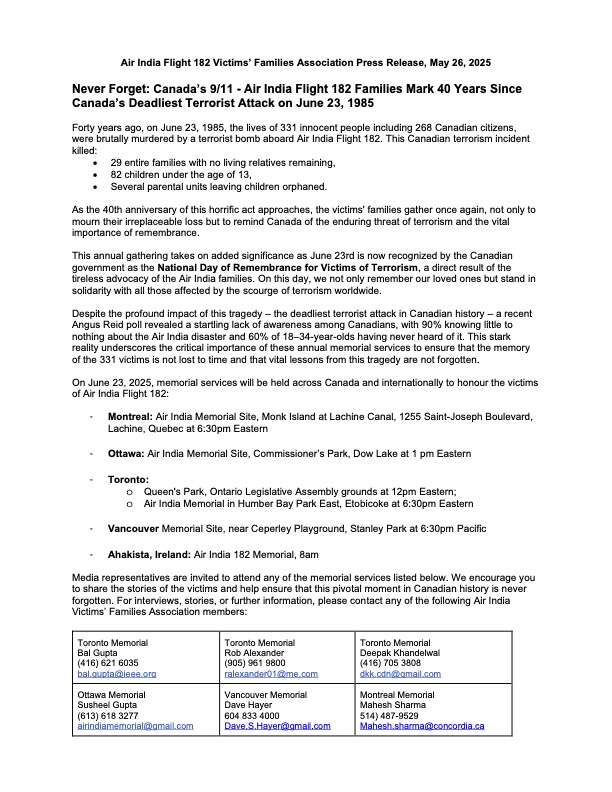
  • MIL-OSI Submissions: Air India crash in Ahmedabad sends reverberations to Canadian families of Air India Flight 182

    Source: The Conversation – Canada – By Chandrima Chakraborty, Professor, English and Cultural Studies; Director, Centre for Global Peace, Justice and Health, McMaster University

    The June 12 Air India crash in Ahmedabad, Gujarat, India, with 230 passengers and 12 crew members aboard is sending deep reverberations through a group of Canadians who know all too well the shock, grief and horror of losing loved ones in hauntingly similar circumstances.

    They are the families of those killed in the bombing of Air India Flight 182 en route from Canada to India 40 years ago this month.

    I work closely with these families as a researcher and advocate. I began interviewing these families in 2014 and have witnessed firsthand their pain, advocacy and emotional turmoil of living in the shadow of a historical event.

    As reports of the Ahmedabad crash came in, the WhatsApp account of the Air India Flight 182 families immediately flooded with expressions of shock, concern, sympathy and memories triggered by the latest incident.

    On June 23, 1985, Flight 182 was brought down by terrorist bombs created and planted on Canadian soil. The devastating mid-air explosion occurred over the Atlantic Ocean near Ireland. It killed all 329 passengers and crew, including 268 Canadians. The crew and most of the passengers were of Indian origin.

    Investigations into the causes of the crash of Air India Flight 171, en route to London’s Gatwick airport, shortly after take-off are still underway. At least 279 people died in the crash, which also impacted people on the ground.

    Acknowledging losses as significant

    A recent public conference at McMaster University commemorated the 40th anniversary of Flight 182, bringing together Indian and Canadian families, researchers, creative artists and community members.

    Book cover for ‘Remembering Air India The Art of Public Mourning,’ edited by Chandrima Chakraborty, Amber Dean and Angela Failler.
    University of Alberta Press

    The conference dealt with critical themes, including the challenge of Flight 182 families recovering from their losses within a climate of broad indifference among their fellow Canadians.

    Regardless of what may have caused the more recent crash in western India, these Canadian families know the shock and loss that a new set of victims’ families are facing, and how important it is to support them.

    Hopefully, the home countries of last week’s crash victims — most of them Indian and British citizens, with at least one Canadian reported to have been aboard — will regard their deaths as significant losses. If so, this would be unlike what the 1985 victims’ families experienced in Canada.

    A little-mourned Canadian tragedy

    In Canada, we have a national day to remember on June 23, 1985. The bombing has been called a Canadian tragedy in a public inquiry report.

    Yet according to a 2023 Angus Reid poll, “nine out of 10 Canadians say they have little or no knowledge of the worst single instance of the mass killing of their fellow citizens.” That essentially means the bombing has yet to penetrate the consciousness of everyday Canadians or evoke shared grief or public mourning.

    The families continue to carry the torch of remembrance as they organize annual memorial vigils every June 23. Few others attend. Many victims’ relatives have died since 1985. Some spouses, siblings or parents are now in their 80s, wondering why the bombing is still not widely discussed in schools or in public discourse.

    The grinding and unsatisfying criminal proceedings, the belated public inquiry and the welcome but lukewarm apology by the Canadian government 25 years after the fact have all contributed to the failure of this tragedy to adhere more solidly to the Canadian consciousness. In fact, many continue to deny the Canadian significance of Flight 182 and view the bombing as a foreign event.

    A torch of remembrance

    At last month’s conference, my research team launched the Air India Flight 182 archive to counter this collective amnesia and lack of acknowledgement.

    Canadian archival consultant and writer Laura Millar has said that archives act as “touchstones to memory” and can aid the process of transforming individual memories into collective remembering. Adopting NYU professor Carol Gilligan’s ethics of care for the archive, we have been consulting with families to find ways to share their grief with the public.

    The Flight 182 memory archive — both physical and digital — serves as a repository for artefacts, first-person narratives, memorabilia and creative works related to the tragedy produced by family members. Family donations of artefacts such as dance videos and pilot wings redirect notions of archives away from a documental deposit. Hopefully, they can move the public to learn and care for the impacts of the Flight 182 bombing.

    The archive is a publicly accessible record of the tragedy, where scholars and everyday citizens can learn about the victims and their families.

    Since the past involves both the present and the future, the archive will enable a meaningful recognition of marginalized voices and histories. It can offer a form of memory justice for those who would otherwise be forgotten by sustaining memory from generation to generation.

    While the archive articulates the demand from families that the bombing of Flight 182 and its aftermath be incorporated into Canadian national consciousness, establishing this archive alone will not be enough to elevate the memory of Flight 182 to the place it deserves.

    But at least it establishes a rich, permanent academic and personal legacy for the community of mourners, and for the Canadian and global public to find it, use it and learn from its many lessons.

    Families of those on board the 1985 flight are preparing to commemorate the 40th anniversary of the terror bombing of Flight 182 that has devastated their lives.

    As we learn more about the tragic Air India Flight 171 crash on June 12, the lessons of Flight 182 will hopefully prevent a new set of families from feeling the pain of indifference on top of the unimaginable agony of loss they’re already experiencing.

    Chandrima Chakraborty receives funding from the Social Sciences and Humanities Research Council of Canada.

    ref. Air India crash in Ahmedabad sends reverberations to Canadian families of Air India Flight 182 – https://theconversation.com/air-india-crash-in-ahmedabad-sends-reverberations-to-canadian-families-of-air-india-flight-182-258991

    MIL OSI

  • MIL-OSI Submissions: Plastics threaten ecosystems and human health, but evidence-based solutions are under political fire

    Source: The Conversation – Canada – By Tony Robert Walker, Professor, School for Resource and Environmental Studies, Dalhousie University

    Negotiations toward a global, legally binding plastics treaty are set to resume this summer, with the United Nations Environment Programme announcing that the Intergovernmental Negotiating Committee on plastic pollution will reconvene in August.

    The committee was established to develop an international legally binding instrument — known as the plastics treaty — to end plastic pollution, one of the fastest-growing environmental threats.


    Read more:
    Here’s how the new global treaty on plastic pollution can help solve this crisis


    Globally, 40 per cent of plastics production goes into the production of single-use plastic packaging, which is the single largest source of plastic waste and is a threat to wildlife and human health. Without meaningful action, global plastic waste is projected to nearly triple by 2060, reaching an estimated 1.2 billion tonnes.

    As the world prepares for another round of talks, Canada’s own plastic problem reveals what’s at stake, and what’s possible for the future.

    Canada’s plastic problem

    Canada is no exception to the global plastic crisis. Nearly half (47 per cent) of all plastic waste in Canada comes from the food and drink sector, contributing 3,268 million tonnes annually. Canadians use 15 billion plastic bags annually and nearly 57 million straws daily, yet only nine per cent of plastics are recycled — a figure that is not expected to improve.

    Most of Canada’s plastic — except for plastic bottles made of PET (polyethylene terephthalate) — are uneconomical or difficult to recycle because of the complexity of mixed plastics used in our economy. As a result, 2.8 million tonnes of plastic waste — equivalent to the weight of 24 CN Towers — end up in landfills every year.

    This is not a trivial problem, as Ontario is projected to run out of landfill space by 2035. Plastic pollution poses growing risks to both urban and rural infrastructure.

    In addition to landfill overflow, around one per cent of Canada’s plastic waste leaks into the environment. In 2016, this was 29,000 tonnes of plastic pollution. Once in the environment, plastics disintegrate into tiny particles, called microplastics (small pieces of plastic less than five millimetres long).

    We drink those tiny microplastic particles in our tap water, and eat them in our fish dinners. Some are even making their way into farmland.

    Plastics are everywhere, including inside us

    More than 93 per cent of Canadians have expressed concerns over single-use plastics used in food packaging and have supported government bans. There is a good reason for concern over the mounting levels of plastics in the environment, in our food and in us.

    Growing evidence indicates that plastics can cause harmful health effects in humans and animals. Microplastics and smaller nanoplastics (less than one micron in length) have been found in humans, including infants and breast milk. They can cause metabolic disorders, interfere with our immune and reproductive systems and cause behavioural problems.

    These health problems may be caused by chemicals added to plastics, including single-use plastics, of which 4,200 chemicals have been identified as posing a hazard to human and ecosystem health.

    It is for these reasons that the Canadian government introduced a ban on single-use plastics in 2022 as part of a plan to reach zero plastic waste in Canada by 2030.

    The decision was based extensive public and industry consultation, as well as decades of data on plastic pollution gathered from the Great Canadian Shoreline Cleanup. This data shows the most common plastic litter items found in the environment across Canada, known as the “dirty dozen” list.

    Six of these items were included in the federal ban. Three eastern Canadian provinces had already implemented single-use plastic bag bans before the federal government, with little to no public or industry opposition. Prince Edward Island was the first Canadian province to implement a province-wide plastic bag ban in July 2019, closely followed by Newfoundland and Labrador and Nova Scotia in October 2020.

    The politics of plastic

    Despite overwhelming scientific consensus, debates around plastic pollution are becoming increasingly politicized.

    In February in the United States, President Donald Trump signed an executive order directing the U.S. government to “stop purchasing paper straws and ensure they are no longer provided within federal buildings.”

    Trump told reporters at the White House: “I don’t think plastic is going to affect a shark very much, as they’re munching their way through the ocean.” Almost 2,000 peer-reviewed studies have reported, however, that more than 4,000 species have ingested or been entangled by plastic litter.

    In Canada, plastic has also become a political flashpoint. During the recent federal election, Conservative Leader Pierre Poilievre said he would scrap the federal government’s ban on single-use plastics and bring back plastic straws and grocery bags. He argued the government’s ban was about “symbolism” rather than “science,” saying, “the Liberals’ plastics ban is not about the environment, it’s about cost and control.”

    His promise would have harmed Canadians by dismissing the overwhelming scientific evidence showing that plastics in our bodies are linked to health impacts. Legislation to ban single-use plastics can be highly effective, ranging from 33 to 96 per cent reductions in plastic waste and pollution in the environment, depending on the policy and jurisdiction.

    Canada’s single-use plastics ban is a great example of evidence-based policymaking. The latest data from the conservation group Ocean Wise shows there was a 32 per cent drop in plastic straws found on Canadian shorelines in 2024 compared to the previous year.

    Science-based policies are needed

    It is indisputable that growing plastic production is directly related to plastic pollution in the environment and in human beings. Increasing plastic pollution is a global threat to human and ecosystem health, regardless of borders and political affiliation.

    As negotiators gear up for another round of talks to finalize a Global Plastics Treaty to end plastic pollution, the need for policies that are supported by scientific evidence is more urgent than ever.

    Future generations deserve a healthy and sustainable planet. The path towards a healthy and sustainable planet requires supporting action based on scientific evidence, not misinforming people with catchy phrases and political rhetoric.

    Tony Robert Walker receives funding from the Natural Sciences and Engineering Research Council of Canada, Canada Foundation for Innovation, and Research Nova Scotia. He is also a non-remunerated member of the Scientists’ Coalition for an Effective Plastics Treaty.

    Miriam L Diamond receives funding from Natural Sciences and Engineering Research Council, Ontario Ministry of Environment, Conservation and Parks, Future Earth, and Environment and Climate Change Canada. She is affiliated with the University of Toronto, serves as a paid expert for the Scientific and Technical Advisory Panel of the Global Environment Facility, and has non-remunerated positions with the International Panel on Chemical Pollution (Vice-Chair), is a member of the Scientist Coalition for an Effective Plastics Treaty, and sits on the board of the Canadian Environmental Law Association.

    ref. Plastics threaten ecosystems and human health, but evidence-based solutions are under political fire – https://theconversation.com/plastics-threaten-ecosystems-and-human-health-but-evidence-based-solutions-are-under-political-fire-256764

    MIL OSI

  • MIL-OSI Submissions: Digital government can benefit citizens: how South Africa can reduce the risks and get it right

    Source: The Conversation – Africa (2) – By Busani Ngcaweni, Visiting Adjunct Professor, Wits School of Governance, University of the Witwatersrand

    The digital revolution is reshaping governance worldwide. From the electronic filing of taxes to digital visa applications, technology is making government services more accessible, efficient and transparent.

    South Africa is making progress in its digital journey. In 2024 it climbed to 40th place out of 193 countries, from 65th place in 2022, in the United Nations e-Government Index. This improvement makes the country one of Africa’s digital leaders, surpassing Mauritius and Tunisia.

    South Africa has identified more than 255 government services for digitisation. Already, 134 are available on the National e-Government Portal. This achievement is remarkable. Nevertheless, the shift to digitisation comes with challenges and risks.

    Some countries have weakened the state’s role by rapidly outsourcing key government functions. But South Africa has the opportunity to build a model of digital transformation that strengthens public institutions rather than diminishes them.

    New technologies must bring tangible benefits for citizens. Digital transformation can improve public administration. But, if mismanaged, it could burden taxpayers with costs.

    Benefits

    Digital transformation comes at a cost. This is particularly true if the state fails to use its procurement power to negotiate reasonable prices. Infrastructure upgrades, cybersecurity measures, software licensing and system maintenance require substantial financial investment.

    The question is whether these expenses are a necessary step towards a more efficient and accessible government.

    Two South African examples illustrate that digital transformation can save money and enhance service delivery quality.

    The first is the South African Revenue Service. Its goal is to ensure that taxpayers and tax advisers can use the service from anywhere and at any time. The changes made more than a decade ago show that digital systems can yield substantial financial gains. After introducing e-filing in 2006, the revenue service streamlined tax processes, reduced inefficiencies and led to higher compliance rates. Ultimately this led to improved revenue collection.

    Similarly, digitising social grant payments has had a number of positive effects. In a chapter of a recent edited volume on public governance, my colleagues and I wrote a case study about how the South African Social Security Agency used basic technologies and platforms like WhatsApp and email to process a grant during the COVID pandemic. It allowed over 14 million people to apply, paid grants to over 6 million beneficiaries during the first phase of the project.

    South African Social Security Agency annual reports show that over 95% of grant beneficiaries receive their payouts electronically through debit cards, instead of going to cash points. This improves security and lets beneficiaries decide when to get and spend their money.

    There are fears that automation could result in massive job losses. But global experience has shown that digitalisation does not necessarily lead to large-scale retrenchments. Instead it can shift the nature of work to other responsibilities.

    The South African Social Security Agency provides a compelling case. Its transition to digital grant payments did not lead to job losses. Similarly, the expansion of e-filing at the revenue service has not resulted in workforce reductions. In both cases efficiencies improved.

    These cases highlight that digital transformation is reshaping roles rather than displacing employees. Public servants are moving into areas such as cybersecurity, data analysis and AI-driven decision-making.

    Shortcomings and pitfalls

    A number of inefficiencies are at play in government services.

    Firstly, most government digital operations still work with outdated paper-based systems. The lack of a uniform digital identity creates bureaucratic inefficiencies and delays.

    Secondly, fragmented procurement of equipment in government has led to duplicated efforts, increased costs and fruitless expenditure.

    Thirdly, different departments often use isolated and incompatible digital systems. This reduce the mutual benefits of digital transformation. The State IT Agency has been blamed for inefficiencies, procurement failures and questionable spending.

    Fourthly, South Africa’s public service remains fragmented. Citizens still struggle to access government services seamlessly. They often move between departments to complete what should be a single transaction.

    Without a centralised system, departments operate in isolation, duplicating efforts, increasing costs and eroding public trust.


    Read more:
    South Africa’s civil servants are missing skills, especially when it comes to technology – report


    Fifth, a lack of skills. Increasing reliance on digital tools requires expertise in data analytics, cloud computing and automation. Many public servants lack the training to take on these new roles. The National Digital and Future Skills Strategy was introduced in September 2020 to bridge this gap, but its effectiveness depends on its implementation.

    Introducing it in 2020 at the height of the COVID-19 pandemic forced government to make digital leaps which otherwise might have taken longer. To sustain services, technology had to be rapidly adopted, including basic things like holding Cabinet meetings online, using a system rapidly developed by the State Information Technology Agency.

    Sixth, security concerns complicate the transformation. As government systems become digital, they become vulnerable to cyberattacks. South Africa must put in place cybersecurity infrastructure to prevent identity theft, data breaches and service disruptions. A cyberattack on one department could affect the entire public sector.

    What needs to be done

    Government must streamline procurement, improve coordination and eliminate inefficiencies to ensure interdepartmental collaboration.

    A single, integrated e-government platform would:

    • cut red tape

    • reduce queues

    • increase efficiency.

    Government needs to upskill civil servants and improve their digital literacy.

    Government must create a seamless e-government system that connects services while protecting citizens’ personal information. The success of digitalisation depends on technological advancements as well as the level of trust citizens have in government systems. Without strong security measures, transparency and accountability, even the most sophisticated digital tools will fail to gain public confidence.

    South Africa has the chance to demonstrate that a strong, capable state can successfully integrate technology while safeguarding public interests. It should take full advantage of offers by Microsoft, Amazon and Huawei to support digital skills training in the public sector in a way that does not advantage one company’s technologies over others. Choices of technology must be user-centric, not based on preferences of accounting officers and chief information officers. Leaders of public institutions must be measured on their ability to digitally transform their organisations.

    Busani Ngcaweni is affiliated with the National School of Government, Wits and Johannesburg Universities.

    ref. Digital government can benefit citizens: how South Africa can reduce the risks and get it right – https://theconversation.com/digital-government-can-benefit-citizens-how-south-africa-can-reduce-the-risks-and-get-it-right-254089

    MIL OSI

  • MIL-OSI Submissions: Digital government can benefit citizens: how South Africa can reduce the risks and get it right

    Source: The Conversation – Africa (2) – By Busani Ngcaweni, Visiting Adjunct Professor, Wits School of Governance, University of the Witwatersrand

    The digital revolution is reshaping governance worldwide. From the electronic filing of taxes to digital visa applications, technology is making government services more accessible, efficient and transparent.

    South Africa is making progress in its digital journey. In 2024 it climbed to 40th place out of 193 countries, from 65th place in 2022, in the United Nations e-Government Index. This improvement makes the country one of Africa’s digital leaders, surpassing Mauritius and Tunisia.

    South Africa has identified more than 255 government services for digitisation. Already, 134 are available on the National e-Government Portal. This achievement is remarkable. Nevertheless, the shift to digitisation comes with challenges and risks.

    Some countries have weakened the state’s role by rapidly outsourcing key government functions. But South Africa has the opportunity to build a model of digital transformation that strengthens public institutions rather than diminishes them.

    New technologies must bring tangible benefits for citizens. Digital transformation can improve public administration. But, if mismanaged, it could burden taxpayers with costs.

    Benefits

    Digital transformation comes at a cost. This is particularly true if the state fails to use its procurement power to negotiate reasonable prices. Infrastructure upgrades, cybersecurity measures, software licensing and system maintenance require substantial financial investment.

    The question is whether these expenses are a necessary step towards a more efficient and accessible government.

    Two South African examples illustrate that digital transformation can save money and enhance service delivery quality.

    The first is the South African Revenue Service. Its goal is to ensure that taxpayers and tax advisers can use the service from anywhere and at any time. The changes made more than a decade ago show that digital systems can yield substantial financial gains. After introducing e-filing in 2006, the revenue service streamlined tax processes, reduced inefficiencies and led to higher compliance rates. Ultimately this led to improved revenue collection.

    Similarly, digitising social grant payments has had a number of positive effects. In a chapter of a recent edited volume on public governance, my colleagues and I wrote a case study about how the South African Social Security Agency used basic technologies and platforms like WhatsApp and email to process a grant during the COVID pandemic. It allowed over 14 million people to apply, paid grants to over 6 million beneficiaries during the first phase of the project.

    South African Social Security Agency annual reports show that over 95% of grant beneficiaries receive their payouts electronically through debit cards, instead of going to cash points. This improves security and lets beneficiaries decide when to get and spend their money.

    There are fears that automation could result in massive job losses. But global experience has shown that digitalisation does not necessarily lead to large-scale retrenchments. Instead it can shift the nature of work to other responsibilities.

    The South African Social Security Agency provides a compelling case. Its transition to digital grant payments did not lead to job losses. Similarly, the expansion of e-filing at the revenue service has not resulted in workforce reductions. In both cases efficiencies improved.

    These cases highlight that digital transformation is reshaping roles rather than displacing employees. Public servants are moving into areas such as cybersecurity, data analysis and AI-driven decision-making.

    Shortcomings and pitfalls

    A number of inefficiencies are at play in government services.

    Firstly, most government digital operations still work with outdated paper-based systems. The lack of a uniform digital identity creates bureaucratic inefficiencies and delays.

    Secondly, fragmented procurement of equipment in government has led to duplicated efforts, increased costs and fruitless expenditure.

    Thirdly, different departments often use isolated and incompatible digital systems. This reduce the mutual benefits of digital transformation. The State IT Agency has been blamed for inefficiencies, procurement failures and questionable spending.

    Fourthly, South Africa’s public service remains fragmented. Citizens still struggle to access government services seamlessly. They often move between departments to complete what should be a single transaction.

    Without a centralised system, departments operate in isolation, duplicating efforts, increasing costs and eroding public trust.


    Read more:
    South Africa’s civil servants are missing skills, especially when it comes to technology – report


    Fifth, a lack of skills. Increasing reliance on digital tools requires expertise in data analytics, cloud computing and automation. Many public servants lack the training to take on these new roles. The National Digital and Future Skills Strategy was introduced in September 2020 to bridge this gap, but its effectiveness depends on its implementation.

    Introducing it in 2020 at the height of the COVID-19 pandemic forced government to make digital leaps which otherwise might have taken longer. To sustain services, technology had to be rapidly adopted, including basic things like holding Cabinet meetings online, using a system rapidly developed by the State Information Technology Agency.

    Sixth, security concerns complicate the transformation. As government systems become digital, they become vulnerable to cyberattacks. South Africa must put in place cybersecurity infrastructure to prevent identity theft, data breaches and service disruptions. A cyberattack on one department could affect the entire public sector.

    What needs to be done

    Government must streamline procurement, improve coordination and eliminate inefficiencies to ensure interdepartmental collaboration.

    A single, integrated e-government platform would:

    • cut red tape

    • reduce queues

    • increase efficiency.

    Government needs to upskill civil servants and improve their digital literacy.

    Government must create a seamless e-government system that connects services while protecting citizens’ personal information. The success of digitalisation depends on technological advancements as well as the level of trust citizens have in government systems. Without strong security measures, transparency and accountability, even the most sophisticated digital tools will fail to gain public confidence.

    South Africa has the chance to demonstrate that a strong, capable state can successfully integrate technology while safeguarding public interests. It should take full advantage of offers by Microsoft, Amazon and Huawei to support digital skills training in the public sector in a way that does not advantage one company’s technologies over others. Choices of technology must be user-centric, not based on preferences of accounting officers and chief information officers. Leaders of public institutions must be measured on their ability to digitally transform their organisations.

    Busani Ngcaweni is affiliated with the National School of Government, Wits and Johannesburg Universities.

    ref. Digital government can benefit citizens: how South Africa can reduce the risks and get it right – https://theconversation.com/digital-government-can-benefit-citizens-how-south-africa-can-reduce-the-risks-and-get-it-right-254089

    MIL OSI

  • MIL-OSI Submissions: Somaliland’s 30-year quest for recognition: could US interests make the difference?

    Source: The Conversation – Africa (2) – By Aleksi Ylönen, Professor, United States International University

    More than three decades after unilaterally declaring independence from Somalia, Somaliland still seeks international recognition as a sovereign state. Despite a lack of formal acknowledgement, the breakaway state has built a relatively stable system of governance. This has drawn increasing interest from global powers, including the United States. As regional dynamics shift and great-power competition intensifies, Somaliland’s bid for recognition is gaining new currency. Aleksi Ylönen has studied politics in the Horn of Africa and Somaliland’s quest for recognition. He unpacks what’s at play.


    What legal and historical arguments does Somaliland use?

    The Somali National Movement is one of the main clan-based insurgent movements responsible for the collapse of the central government in Somalia. It claims the territory of the former British protectorate of Somaliland. The UK had granted Somaliland sovereign status on 26 June 1960.

    The Somali government tried to stomp out calls for secession. It orchestrated the brutal killing of hundreds of thousands of people in northern Somalia between 1987 and 1989.

    But the Somali National Movement declared unilateral independence on 18 May 1991 and separated from Somalia.

    With the collapse of the Somali regime in 1991, the movement’s main enemy was gone. This led to a violent power struggle between various militias.

    This subsided only after the politician Mohamed Egal consolidated power. He was elected president of Somaliland in May 1993.

    Egal made deals with merchants and businessmen, giving them tax and commercial incentives to accept his patronage. As a result, he obtained the economic means to consolidate political power and to pursue peace and state-building. It’s something his successors have kept up with since his death in 2002.

    What has Somaliland done to push for recognition?

    Successive Somaliland governments continue to engage in informal diplomacy. They have aligned with the west, particularly the US, which was the dominant power after the cold war, and the former colonial master, the UK. Both countries host significant Somaliland diaspora communities.

    The US and the UK have for decades flirted with the idea of recognising Somaliland, which they consider a strategic partner. However, they have been repeatedly thrown back by their respective Somalia policies. These have favoured empowering the widely supported Mogadishu government to reassert its authority and control over Somali territories.

    This Somalia policy has been increasingly questioned in recent years, in part due to Mogadishu’s security challenges. In contrast, the Hargeisa government of Somaliland has largely shown it can provide security and stability. It has held elections and survived as a state for the last three decades, though it has faced political resistance and armed opposition.


    Read more:
    Somaliland elections: what’s at stake for independence, stability and shifting power dynamics in the Horn of Africa


    As new global powers rise, Somaliland administrations have pursued an increasingly diverse foreign policy, with one goal: international recognition.

    Hargeisa hosts consulates and representative offices of Djibouti, Ethiopia, Kenya, Taiwan, the UK and the European Union, among others.

    The government has also engaged in informal foreign relations with the United Arab Emirates. The Middle Eastern monarchy serves as a business hub and a destination of livestock exports. Many Somalilanders migrate there.

    Somaliland maintains representative offices in several countries. These include Canada, the US, Norway, Sweden, the UK, Saudi Arabia, Turkey and Taiwan. Hargeisa has alienated China because it has collaborated with Taiwan since 2020. Taiwan is a self-ruled island claimed by China.

    On 1 January 2024, Somaliland’s outgoing president Muse Bihi signed a memorandum of understanding with Ethiopian prime minister Abiy Ahmed for increased cooperation. Bihi implied that Ethiopia would be the first country to formally recognise Somaliland. The deal caused a sharp deterioration of relations between Addis Ababa and Mogadishu.

    Abiy later moderated his position and, with Turkish mediation, reconciled with his Somalia counterpart, President Hassan Mohamud.

    What’s behind US interest in Somaliland?

    The US, like other great powers, has been interested in Somaliland because of its strategic location. It is on the African shores of the Gulf of Aden, across from the Arabian Peninsula. Its geographical position has gained currency recently as Yemeni Houthi rebels strike maritime traffic in the busy shipping lanes. Somaliland is also well located to curb piracy and smuggling on this global trade route.

    The US Africa Command set up its main Horn of Africa base at Camp Lemonnier in Djibouti in 2002. This followed the 11 September 2001 attacks.


    Read more:
    Somaliland’s quest for recognition: UK debate offers hint of a sea change


    In 2017, China, which had become the main foreign economic power in the Horn of Africa, set up a navy support facility in Djibouti. This encouraged closer collaboration between American and Somaliland authorities. The US played with the idea of establishing a base in Berbera, which hosts Somaliland’s largest port.

    With Donald Trump winning the US presidential election in 2024, there were reports of an increased push for US recognition of Somaliland. This would allow the US to deepen its trade and security partnerships in the volatile Horn of Africa region.

    Since March 2025, representatives of the Trump administration have engaged in talks with Somaliland officials to establish a US military base near Berbera. This would be in exchange for a formal but partial recognition of Somaliland.

    What are the risks of US recognition of Somaliland?

    Stronger US engagement with Somaliland risks neglecting Somalia.

    Mogadishu depends on external military assistance in its battle against the advancing violent Islamist extremist group, Al-Shabaab. It also faces increasing defiance from two federal regions, Puntland and Jubaland.

    US recognition would reward Hargeisa for its persistent effort to maintain stability and promote democracy. However, it could encourage other nations to recognise Somaliland. This would deliver a blow to Somali nationalists who want one state for all Somalis.

    Aleksi Ylönen is affiliated with the Center for International Studies, Iscte-Instituto Universitário de Lisboa, and is an associate fellow at the HORN International Institute for Strategic Studies.

    ref. Somaliland’s 30-year quest for recognition: could US interests make the difference? – https://theconversation.com/somalilands-30-year-quest-for-recognition-could-us-interests-make-the-difference-255399

    MIL OSI

  • MIL-OSI Submissions: Is Kenya’s president safe in a crowd? Security expert scans VIP protection checklist

    Source: The Conversation – Africa (2) – By Douglas Lucas Kivoi, Principal Policy Analyst, Governance Department, The Kenya Institute for Public Policy Research and Analysis (KIPPRA)

    Protecting any president requires multiple layers of intelligence, physical security and rapid response security protocols. Exact operational details are classified, but there are global best practices in VIP protection.

    The issue of presidential protection in Kenya has become particularly relevant following an incident in early May 2025 when someone in a crowd threw a shoe at President William Ruto during a public event, hitting his hand.

    I have studied policing and security policies in Kenya for over 15 years, interacting closely with the country’s security protocols. In my view this incident exposed several critical security lapses around the elite officers tasked with protecting the president.

    The security of the president is a critical issue in Kenya. The country is exposed to terror groups like the Somalia-based Al-Shabaab and other criminal networks in the region.

    In 2021, a businessman embedded himself into the presidential motorcade and drove into then president Uhuru Kenyatta’s official residence. In 2017, an unidentified man who was said to have illegally accessed the highly protected state house grounds was shot dead by presidential guards.

    There are multiple layers to Kenya’s protection protocols. They include National Intelligence Service officers, the Kenya Defence Force, Presidential Escort Police officers drawn from the highly trained General Service Unit, bomb disposal experts and regular police officers. Their deployment depends on the nature of the presidential engagement.

    While the shoe incident may be passed off as simply embarrassing, it should serve as a wake-up call to tighten security protocols around the president without necessarily compromising his public engagement with citizens.

    What’s in place

    Prior to any presidential visit across the country, security teams conduct a thorough reconnaissance of the destination. This includes coordinating with local policing agencies, clearing airspace, mapping secure transport routes and identifying nearby medical facilities in case of emergencies.

    Presidential motorcade routes are pre-planned and a dry run is made. This often includes mapping alternative routes to avoid predictability should there be assailants along a presidential route. It is common to see some roads temporarily closed and security officers conducting sweeps for any threats or explosives. In areas deemed high risk, counter security sniper teams are covertly deployed in strategic areas.

    Cases of attacks on presidential motorcades are rare in Kenya. However, in 2002 during presidential campaigns, angry opposition supporters stoned then president Daniel Moi’s motorcade. In November 2021, an angry mob hurled rocks at then deputy president Ruto’s motorcade.

    The National Intelligence Service and Presidential Escort Unit covertly scout locations in advance, assessing potential security vulnerabilities. Crowd sizes, and entry and exit points for the head of state are mapped out in advance.

    In cases where meetings are held in town halls or huge tents, attendees are screened using metal detectors and/or physical searches. Uniformed and plainclothes security officers embed themselves in the crowd to monitor any threats.

    The president and any dignitaries accompanying him have at least three layers of security.

    The inner ring consists of close protection officers who are always within an arm’s length of the president to physically thwart any threats. The middle ring has armed security guards who watch for, among others, sudden movements and abnormal behaviour within the crowd. The outer ring consists of regular police and paramilitary units from the General Service Unit who secure the outside perimeter.

    The presidential motorcade is a coordinated convoy of heavily armoured vehicles. It includes lead and chase cars, communication units and emergency response teams. Traffic is managed by local traffic police officers to ensure unobstructed movement. Routes are kept confidential until necessary.

    The president’s security may opt to use a decoy vehicle if there is a security threat, to confuse and derail potential risk sources. In all these cases, there is a contingent of specialised General Service Unit officers, called the Recce unit, that always accompanies the president.

    Kenya’s presidential security precautions follow standard VIP security protection like those for heads of state across the world. However, in some neighbouring countries, for instance, presidents move in heavily armed military convoys. This has not been seen in Kenya.

    If a potential threat is detected, the president is immediately shielded and whisked away to a secure vehicle or evacuated by air in high-risk events. In such cases, the Kenya Defence Forces secures the president.

    Despite stringent security measures, incidents can occur. For instance, in March 2025, a British tourist was fatally hit by a vehicle in Ruto’s motorcade. This prompted investigations and reviews on motorcade safety protocols.

    Such events highlight the challenges of balancing presidential security with public safety, especially in densely populated urban areas.

    Security failures

    The shoe-throwing incident targeting Ruto highlighted five major failures in presidential protection protocols.

    First, crowd screening and access control failures. The alleged assailant was very close to the president, suggesting an inadequate distance between the crowds and the president. The inner ring of security also failed to spot the perpetrator raising a shoe in the air to use as a projectile. This indicates weak front-row eye sweeps and scans by the president’s security.

    Second, there was an apparent delay in security response. The elite officers around the president should have subdued the alleged attacker within seconds. It could mean most had their eyes on the president or cameras, as opposed to scanning the crowds for any sudden movements.

    Third, security allowed the president to stand too close to a crowd that hadn’t been screened. Best practices require a no-go zone of three to five metres for individuals who have not been scanned or screened.

    Fourth, there was an apparent gap in intelligence and threat assessment. Aggressive or agitated people next to the president should draw the attention of security officers. Plainclothes security officers are usually deployed to monitor crowd behaviour. It isn’t enough to rely on uniformed officers.

    Undercover agents are critical for flagging pre-attack signals, such as nervousness or repeated adjustments of positions.

    Fifth, there was no clear evacuation plan for the president. After the incident, the president continued speaking. In high-risk scenarios, protocols often demand instant relocation of the president to a secure vehicle or helicopter, where the military takes over and airlifts him to safety.

    What should change

    Kenya’s presidential security detail may be forced to:

    • increase standoff distance between the president and crowds

    • deploy more plainclothes officers to blend in and monitor crowds around the president

    • mandate stricter screening of those in close proximity to the president

    • conduct more frequent security risks drills for rapid neutralisation of potential threats.

    The exact details of presidential security in Kenya are confidential. However, the overarching structure aims to provide comprehensive protection to the president while maintaining public safety and order during official engagements. No security protocol is 100% foolproof. But a balance needs to be struck between overly aggressive crowd control and accessibility.

    Douglas Lucas Kivoi does not work for, consult, own shares in or receive funding from any company or organisation that would benefit from this article, and has disclosed no relevant affiliations beyond their academic appointment.

    ref. Is Kenya’s president safe in a crowd? Security expert scans VIP protection checklist – https://theconversation.com/is-kenyas-president-safe-in-a-crowd-security-expert-scans-vip-protection-checklist-256268

    MIL OSI

  • MIL-OSI Submissions: Ancient DNA reveals Maghreb communities preserved their culture and genes, even in a time of human migration

    Source: The Conversation – Africa (2) – By Giulio Lucarini, Senior Researcher, Institute of Heritage Science, National Research Council (CNR)

    Doukanet el Khoutifa, Tunisia, where some of the remains were found. Giulio Lucarini, CC BY-NC-ND

    The Neolithic period began in southwest Asia around 12,000 years ago. It marked a major shift in human history as societies transitioned from hunting and gathering to farming. This sparked migrations across Europe and dramatically reshaped the continent’s gene pool.

    For a long time, North Africa was seen as a passive participant in this transformation. The dominant narrative suggested that farming economies never fully took root there.

    Some studies proposed that North African communities actively resisted agriculture, except perhaps in the Nile Delta and the western Maghreb (modern-day Morocco). They continued to rely on land snails, wild plants, and hunting for survival. Only later, they also began herding domesticated sheep, goats, and cattle, introduced from southwest Asia.

    Genetic studies have only recently tested this reconstruction in North Africa. This has never been done in the eastern Maghreb (modern-day Tunisia and eastern Algeria) – until now.

    A burial at one of the study sites, SHM-1 (Hergla) in Tunisia.
    Simone Mulazzani, CC BY-NC-ND

    As an Africanist archaeologist, I specialise in the study of ancient societies across Mediterranean Africa and the Sahara. My focus is on how humans adapted to their environments and the rise of food production in these regions. I recently conducted research in the eastern Maghreb alongside an international team of archaeologists, geneticists, and physical anthropologists to trace ancient population movements.

    Our new study has just been published in Nature. We analysed the ancient genomes (complete DNA sequences) of nine individuals who lived in the eastern Maghreb between 15,000 and 6,000 years ago.

    This may seem like a small sample. But, in the field of ancient DNA research, even a few well-preserved genomes can provide significant insights. They serve as reference points for tracing genetic lineages and identifying ancestral connections.

    By adding genetic evidence to broader archaeological findings, we reconstructed patterns of population continuity, interaction and change over thousands of years.

    Our results were striking. It’s clear from these genomes that some influence from farmers did reach north Africa from across the Mediterranean. But much of the genetic makeup of the eastern Maghreb populations remained rooted in their ancient foraging heritage.

    This challenges the long-held narrative about migration into and out of north Africa before and during the Neolithic. It deepens our understanding of the past and highlights the incredible complexity of human movement and cultural exchange.

    As we continue to unravel the genetic legacy of our ancestors, studies like this remind us of the complexity of human history. They show that the history of agriculture in the Mediterranean was not merely one of population replacement. Rather, it was a tale of cultural exchange, adaptation and continuity.

    And researching these ancient human movements is more than just a matter of understanding history. It also provides insights into the patterns of migration and adaptation that can help us understand similar processes today.

    Extraction and analysis

    A map of the eastern Maghreb showing the study sites (1: Afalou Bou Rhummel; 2: Djebba; 3: Doukanet el Khoutifa; 4: SHM-1, Hergla)
    Giulio Lucarini, CC BY-NC-ND

    We worked with ancient genomes extracted from human skeletal remains housed in museum or heritage institution collections. They came from excavations at four sites Afalou Bou Rhummel, Djebba, Doukanet el Khoutifa and SHM-1 (Hergla), all in the eastern Maghreb.

    We chose the specimens because they were well-preserved, which is not always the case with ancient DNA.

    The analysis found that some of the sampled individuals possessed European farmer ancestry around 7,000 years ago. Europeans contributed some genes to the region – but no more than 20% per individual.

    Excavation of human remains at Doukanet el Khoutifa, Tunisia.
    Giulio Lucarini, CC BY-NC-ND

    This is a modest genetic influence compared to ancient western Maghreb populations where, at some sites, European farmer ancestry can reach as high as 80%.

    Our findings suggest that food-producing economies were introduced to the eastern Maghreb not by a large-scale replacement of the population (as seen in Europe) but more gradually. Change happened through sporadic migrations, mixing of cultures, and the spread of knowledge.

    Across sea and land

    One of the most intriguing discoveries was the genetic trace of European hunter-gatherers found in one individual from Djebba, Tunisia, dating to around 8,000 years ago. This suggests that early European and north African populations could interact via seafaring routes across the Strait of Sicily.

    Researchers have long known that cultural exchange took place across the Mediterranean. We see this from the spread of technologies such as the so-called pressure technique – a method of shaping stone tools by carefully applying force with a pointed implement rather than striking the stone directly.

    The discovery in Tunisia of obsidian (volcano glass) from Pantelleria, a small island in the Strait of Sicily, strengthens the link between the Mediterranean’s northern and southern shores.

    Prehistoric wooden artefacts are seldom preserved over time. This may explain the absence of boat remains from this period in North Africa. However, dugout canoes from similar periods found in central Italy (Bracciano Lake) suggest that seafaring skills were well established around the Mediterranean. While there is no direct evidence linking these specific canoes to connections between Europe and North Africa, they support the idea that navigation was within the technological capabilities of the time.

    Our study is the first time the connections suggested by this existing evidence have been substantiated genetically.


    Read more:
    Discovery of 5,000-year-old farming society in Morocco fills a major gap in history – north-west Africa was a central player in trade and culture


    Another exciting aspect of our study is the identification of early Levantine (modern southwest Asia)-related ancestry in the eastern Maghreb. This was detected in human remains dated to around 6,800 years ago. It’s a genetic signature that postdates the arrival of European farmer ancestry by several centuries. It likely reflects the movement of people associated with early pastoralism, who introduced domesticated animals, such as sheep and goats, to the region.

    Backing up archaeological evidence

    It is especially rewarding to see the genetic evidence aligning with the archaeological record. This underscores the value of multidisciplinary research in uncovering past human dynamics.

    What emerges overall is a region of strong genetic and cultural resilience, consistent with archaeological evidence.

    Giulio Lucarini receives funding for this study from the National Research Council of Italy (CNR) and ISMEO – International Association for Mediterranean and Oriental Studies, Italy. He is affiliated with the National Research Council of Italy, Institute of Heritage Science (CNR-ISPC).

    This study resulted from a collaboration between the following institutions: Harvard University, USA; the Max Planck Institute, Germany; the National Research Council of Italy (CNR); the Institut National du Patrimoine (INP), Tunisia; the Centre National de Recherche Préhistorique, Anthropologique et Historique (CNRPAH), Algeria; the Institut de Paléontologie Humaine (IPH), France; the University of Vienna, Austria; Sapienza University of Rome, Italy; and ISMEO – International Association for Mediterranean and Oriental Studies, Italy.

    ref. Ancient DNA reveals Maghreb communities preserved their culture and genes, even in a time of human migration – https://theconversation.com/ancient-dna-reveals-maghreb-communities-preserved-their-culture-and-genes-even-in-a-time-of-human-migration-248338

    MIL OSI

  • MIL-OSI Russia: Hassle-free moving: almost 20 thousand people have used the super service of the renovation program

    Translation. Region: Russian Federal

    Source: Moscow Government – Government of Moscow –

    From the beginning of 2025, super service services “Moving under the renovation program”Almost 20 thousand people took advantage of this. This was reported by the Minister of the Moscow Government, Head of the Department of Urban Development Policy Vladislav Ovchinsky.

    The super service has been operating on the mos.ru portal since November 2020. With its help, city residents can receive a whole range of electronic services, instructions and notifications regarding resettlement under the renovation program. Users have access to six services: signing up for an apartment inspection, filing an application to eliminate construction defects, uploading documents, signing up for a contract and visiting a notary, as well as assistance in moving.

    “Superservice provides a full cycle of support for city residents – from filing an application to processing documents and organizing the move. This significantly simplifies the procedures for Muscovites and increases the efficiency of the renovation program. One of the most popular online services of superservice is the transportation of things from an old apartment to a new one. Since the beginning of the year, more than 4.9 thousand families have ordered the help of movers and a car. Of these, over 1.6 thousand live in the Eastern Administrative District, about 900 people live in the Northern Administrative District and more than 700 live in the South-Eastern Administrative District,” said Vladislav Ovchinsky.

    With the help of the super service, city residents can receive timely notifications about each stage of the move. Among them are information about the start of the move, letters with an offer of a new apartment, notifications about the need to sign a statement of consent or refusal after inspecting the housing, notifications about the submitted consent or refusal, draft contracts for a new apartment with an invitation to sign the documents, information about the elimination of construction defects if they are detected, as well as notifications about a signed contract with an offer to use assistance with the move.

    Earlier, Sergei Sobyanin reported that more than 18 thousand Muscovites received new housing under the renovation program in 2025.

    As noted in the capital Department of Information Technology, general instructions available in will help you prepare for the move. super service on the mos.ru portal. It explains how the entire process is organized and what documents are required. If you configure the parameters of the move, the resident will be able to familiarize themselves with the scenario of the future resettlement depending on the specific life situation. Muscovites who are already moving will be helped by detailed personalized instructions. It is automatically configured for each user. This speeds up the move and makes it more comfortable.

    The renovation program was approved in August 2017. It concerns about a million Muscovites and provides for the resettlement of 5,176 houses. Sergei Sobyanin ordered to increase the pace of implementation of the program twice as much.

    Moscow is one of the leaders among regions in terms of construction volumes. High rates of housing construction correspond to the goals and initiatives of the national project “Infrastructure for life”.

    Get the latest news quickly official telegram channel the city of Moscow.

    Please note: This information is raw content directly from the source of the information. It is exactly what the source states and does not reflect the position of MIL-OSI or its clients.

    Please Note; This Information is Raw Content Directly from the Information Source. It is access to What the Source Is Stating and Does Not Reflect

    https: //vv.mos.ru/nevs/ite/156056073/

    MIL OSI Russia News

  • MIL-OSI: Unlocking Possibility: AI HomeDesign Joins Forces with MIAMI REALTORS®

    Source: GlobeNewswire (MIL-OSI)

    Vancouver, British Columbia , July 01, 2025 (GLOBE NEWSWIRE) — VANCOUVER, British Columbia, July 1, 2025 – In a move that reflects a growing industry shift toward smarter, faster, and more visually compelling real estate marketing, AI HomeDesign, the ultimate AI toolbox for property listing, proudly announces its partnership with the MIAMI Association of REALTORS®, the largest local REALTOR® association in the United States.

    Through this collaboration, AI HomeDesign becomes part of the official suite of marketing tools offered to MIAMI REALTORS® members, delivering instant access to powerful AI-driven real estate photo editing tools that elevate listing quality and speed to market.

    But this partnership goes beyond platform integration. It sets a model for how forward-thinking associations, MLSs, and brokerages can empower their agents with transformative, easy-to-use technology. By offering seamless access to tools like AI Virtual Staging—which turns vacant rooms into fully styled, buyer-ready spaces in seconds—MIAMI REALTORS® is equipping its members with the clarity, creativity, and conversion power today’s market demands.

    This type of integration isn’t just a one-off benefit for a single association; it’s a scalable solution that can bring similar value to any organization looking to give its agents a competitive edge in an increasingly visual marketplace.

    A Tailored Solution for MIAMI REALTORS®: Built-In Access to AI HomeDesign

    To honor this partnership and spark fresh momentum for South Florida’s real estate visionaries, AI HomeDesign is offering an exclusive 20% discount on its Pro subscription plan, available only to MIAMI REALTORS® members.

    The offer is delivered through a custom integration built specifically for the MIAMI platform, allowing members to seamlessly access the discount via single sign-on (SSO) through their association dashboard.

    The Pro plan unlocks access to AI HomeDesign’s full creative arsenal, including:

    • AI Virtual Staging: Fill any empty space with aesthetic precision and inviting design
    • AI Day to Dusk: Add a twilight touch that turns exteriors into irresistible invitations
    • AI Item Removal: Sweep away distractions with a few clicks. Decluttered, elevated, done
    • AI Photo Enhancement: Illuminate, refine, and polish every pixel for maximum impact

    Not to mention scores of other AI-powered property photo generation and editing tools, all editable in seconds and built to help agents and their property listings stand out.

    Empowering Real Estate Professionals at Scale: Strategic Impact of the AI HomeDesign-MIAMI Partnership

    With AI HomeDesign, professional-grade listing visuals are no longer a luxury or a logistical burden. From the immediate impact of AI virtual staging, an ultra-efficient solution for transforming empty spaces into styled, buyer-ready rooms, to rapid-fire photo edits and enhancements, agents can now showcase a property’s full potential faster, more intelligently, and more affordably than ever.

    At just $0.24 per photo, with 30-second turnaround times and unlimited free revisions, AI HomeDesign enables real estate professionals to operate at the speed of today’s market without compromising quality.

    For associations, MLSs, and brokerages seeking to offer agents a true competitive edge, this is a game-changer. From first impression to final walkthrough, AI HomeDesign empowers agents to create compelling visual narratives that drive interest, engagement, and action, no matter the property type or price point.

    A partnership built on momentum and vision

    “This partnership isn’t just about tools. It’s about transforming how property listings are marketed in a fast-moving, visual-first industry,” said Salar Davari, CEO and Founder of AI HomeDesign. “We believe that every REALTOR®, regardless of their location, company size, or market, should have access to cutting-edge, creative power without needing a design degree or a big marketing budget. Through our collaboration with MIAMI REALTORS®, that belief becomes a daily possibility for MIAMI agents.”

    How to access the offer?

    MIAMI REALTORS® members can now explore AI HomeDesign under the association’s official marketing tools section and redeem their exclusive 20% Pro discount via a special partner page. This is their gateway to creative freedom and next-level property marketing.

    From AI virtual staging that breathes life into empty spaces, to day-to-dusk enhancement, clutter removal, and photo refinement tools that polish every detail, AI HomeDesign gives agents the power to turn ordinary images into easy sales potentials.

    Sometimes, all it takes to spark a buyer’s imagination is an empty room professionally designed into a charming living space.

    About AIHomeDesign.com

    AI HomeDesign is the ultimate AI toolbox for property listing; an advanced real estate photo editing platform serving both B2B and B2C markets. AI HomeDesign partners with brokerages, associations, and MLSs, while also empowering individual REALTORS® and brokers. By combining artificial intelligence with user-friendly, design-driven technology, this SaaS platform streamlines visual marketing workflows, enhances listing visuals, and reduces turnaround times.

    From AI virtual staging and photo enhancement to item removal, day-to-dusk photos, home renovation, and complete room redesigns, AI HomeDesign enables real estate professionals to present every property at its best, quickly, affordably, and at scale.

    AI HomeDesign’s official website is www.aihomedesign.com.

    About the MIAMI Association of REALTORS®

    The MIAMI Association of REALTORS® (MIAMI) was chartered by the NATIONAL ASSOCIATION OF REALTORS® in 1920, and is celebrating 105 years of service to REALTOR® members, the buying and selling public, and the communities in South Florida. Composed of six boards: MIAMI-RESIDENTIAL, MIAMI-COMMERCIAL; BROWARD-MIAMI, a division of MIAMI REALTORS®; JTHS-MIAMI, a division of MIAMI REALTORS® in the Jupiter-Tequesta-Hobe Sound area; MIAMI YPN, our Young Professionals Network Council; and the Corporate Board of Directors. MIAMI REALTORS® represent 58,000 total real estate professionals in all aspects of real estate sales, marketing, and brokerage. It is the largest local REALTOR® association in the U.S. and has official partnerships with 287 international organizations worldwide.

    MIAMI’s official website is www.MiamiRealtors.com.

    The MIL Network

  • MIL-OSI: Unlocking Possibility: AI HomeDesign Joins Forces with MIAMI REALTORS®

    Source: GlobeNewswire (MIL-OSI)

    Vancouver, British Columbia , July 01, 2025 (GLOBE NEWSWIRE) — VANCOUVER, British Columbia, July 1, 2025 – In a move that reflects a growing industry shift toward smarter, faster, and more visually compelling real estate marketing, AI HomeDesign, the ultimate AI toolbox for property listing, proudly announces its partnership with the MIAMI Association of REALTORS®, the largest local REALTOR® association in the United States.

    Through this collaboration, AI HomeDesign becomes part of the official suite of marketing tools offered to MIAMI REALTORS® members, delivering instant access to powerful AI-driven real estate photo editing tools that elevate listing quality and speed to market.

    But this partnership goes beyond platform integration. It sets a model for how forward-thinking associations, MLSs, and brokerages can empower their agents with transformative, easy-to-use technology. By offering seamless access to tools like AI Virtual Staging—which turns vacant rooms into fully styled, buyer-ready spaces in seconds—MIAMI REALTORS® is equipping its members with the clarity, creativity, and conversion power today’s market demands.

    This type of integration isn’t just a one-off benefit for a single association; it’s a scalable solution that can bring similar value to any organization looking to give its agents a competitive edge in an increasingly visual marketplace.

    A Tailored Solution for MIAMI REALTORS®: Built-In Access to AI HomeDesign

    To honor this partnership and spark fresh momentum for South Florida’s real estate visionaries, AI HomeDesign is offering an exclusive 20% discount on its Pro subscription plan, available only to MIAMI REALTORS® members.

    The offer is delivered through a custom integration built specifically for the MIAMI platform, allowing members to seamlessly access the discount via single sign-on (SSO) through their association dashboard.

    The Pro plan unlocks access to AI HomeDesign’s full creative arsenal, including:

    • AI Virtual Staging: Fill any empty space with aesthetic precision and inviting design
    • AI Day to Dusk: Add a twilight touch that turns exteriors into irresistible invitations
    • AI Item Removal: Sweep away distractions with a few clicks. Decluttered, elevated, done
    • AI Photo Enhancement: Illuminate, refine, and polish every pixel for maximum impact

    Not to mention scores of other AI-powered property photo generation and editing tools, all editable in seconds and built to help agents and their property listings stand out.

    Empowering Real Estate Professionals at Scale: Strategic Impact of the AI HomeDesign-MIAMI Partnership

    With AI HomeDesign, professional-grade listing visuals are no longer a luxury or a logistical burden. From the immediate impact of AI virtual staging, an ultra-efficient solution for transforming empty spaces into styled, buyer-ready rooms, to rapid-fire photo edits and enhancements, agents can now showcase a property’s full potential faster, more intelligently, and more affordably than ever.

    At just $0.24 per photo, with 30-second turnaround times and unlimited free revisions, AI HomeDesign enables real estate professionals to operate at the speed of today’s market without compromising quality.

    For associations, MLSs, and brokerages seeking to offer agents a true competitive edge, this is a game-changer. From first impression to final walkthrough, AI HomeDesign empowers agents to create compelling visual narratives that drive interest, engagement, and action, no matter the property type or price point.

    A partnership built on momentum and vision

    “This partnership isn’t just about tools. It’s about transforming how property listings are marketed in a fast-moving, visual-first industry,” said Salar Davari, CEO and Founder of AI HomeDesign. “We believe that every REALTOR®, regardless of their location, company size, or market, should have access to cutting-edge, creative power without needing a design degree or a big marketing budget. Through our collaboration with MIAMI REALTORS®, that belief becomes a daily possibility for MIAMI agents.”

    How to access the offer?

    MIAMI REALTORS® members can now explore AI HomeDesign under the association’s official marketing tools section and redeem their exclusive 20% Pro discount via a special partner page. This is their gateway to creative freedom and next-level property marketing.

    From AI virtual staging that breathes life into empty spaces, to day-to-dusk enhancement, clutter removal, and photo refinement tools that polish every detail, AI HomeDesign gives agents the power to turn ordinary images into easy sales potentials.

    Sometimes, all it takes to spark a buyer’s imagination is an empty room professionally designed into a charming living space.

    About AIHomeDesign.com

    AI HomeDesign is the ultimate AI toolbox for property listing; an advanced real estate photo editing platform serving both B2B and B2C markets. AI HomeDesign partners with brokerages, associations, and MLSs, while also empowering individual REALTORS® and brokers. By combining artificial intelligence with user-friendly, design-driven technology, this SaaS platform streamlines visual marketing workflows, enhances listing visuals, and reduces turnaround times.

    From AI virtual staging and photo enhancement to item removal, day-to-dusk photos, home renovation, and complete room redesigns, AI HomeDesign enables real estate professionals to present every property at its best, quickly, affordably, and at scale.

    AI HomeDesign’s official website is www.aihomedesign.com.

    About the MIAMI Association of REALTORS®

    The MIAMI Association of REALTORS® (MIAMI) was chartered by the NATIONAL ASSOCIATION OF REALTORS® in 1920, and is celebrating 105 years of service to REALTOR® members, the buying and selling public, and the communities in South Florida. Composed of six boards: MIAMI-RESIDENTIAL, MIAMI-COMMERCIAL; BROWARD-MIAMI, a division of MIAMI REALTORS®; JTHS-MIAMI, a division of MIAMI REALTORS® in the Jupiter-Tequesta-Hobe Sound area; MIAMI YPN, our Young Professionals Network Council; and the Corporate Board of Directors. MIAMI REALTORS® represent 58,000 total real estate professionals in all aspects of real estate sales, marketing, and brokerage. It is the largest local REALTOR® association in the U.S. and has official partnerships with 287 international organizations worldwide.

    MIAMI’s official website is www.MiamiRealtors.com.

    The MIL Network

  • MIL-OSI United Kingdom: London building contractor banned as company director and ordered to repay Covid loan funds with interest

    Source: United Kingdom – Government Statements

    Press release

    London building contractor banned as company director and ordered to repay Covid loan funds with interest

    Director disqualification and compensation order for Bounce Back loan abuse

    • Building contractor Tahir Haq overstated his company Integral Maintenance Team Ltd’s turnover by almost £200,000 to obtain a £50,000 Bounce Back loan when it was only entitled to just over £3,000
    • He then failed to provide evidence that all of the funds were used for the economic benefit of his business
    • The High Court banned Haq as a company director for 11 years and ordered him to repay all the money he was not entitled to, plus interest and costs

    A West London building contractor who overstated his company’s turnover by almost £200,000 to secure a maximum-value Covid Bounce Back loan has been banned as a director and ordered to repay the money he was not entitled to.

    Tahir Haq obtained a £50,000 Bounce Back loan for building completion and freight transport company Integral Maintenance Team Ltd, in late 2020.

    However, his company was only entitled to little more than £3,000 under the scheme.

    The 46-year-old, of Norman Avenue, Southall, provided no evidence that some of the funds he received were used for the economic benefit of his business, including cash withdrawals and money which was paid to a housing scheme in Pakistan. Haq supplied no documents which demonstrated that the housing scheme was connected to his company.

    Haq was disqualified as a company director for 11 years at a hearing of the High Court in London on Tuesday 10 June.

    He was also ordered to pay compensation of £46,778, as well as interest on the loan totalling £4,078, and additional costs of £8,107.

    His ban started on Tuesday 1 July.

    Kevin Read, Chief Investigator at the Insolvency Service, said:

    Tahir Haq overstated his company’s turnover by almost £200,000 to secure the maximum Bounce Back loan available.

    Our investigation revealed he used some of this money for personal purposes, including payments to a housing scheme in Pakistan.

    The 11-year disqualification and requirement to repay all the money he was never entitled to demonstrates our commitment to holding directors financially accountable when they misuse Covid support schemes.

    Haq was the sole director of Integral Maintenance Team Ltd, which was set up in July 2018.

    The company’s trading was described on Companies House as ‘other building completion and finishing’ and ‘freight transport by road’.

    Haq secured the £50,000 Bounce Back loan for Integral Maintenance Team Ltd in December 2020, claiming the company’s turnover was £212,800.

    However, receipts into the company bank account for 2019 were only £12,888, meaning he obtained £46,778 more than he should have.

    Haq also failed to explain how at least £34,777 of the Bounce Back loan funds were used to benefit his company. The remaining funds were found to have been used for his business.

    Liquidators were appointed for Integral Maintenance Team Ltd in November 2021.

    The disqualification order prevents Haq from being involved in the promotion, formation or management of a company, without the permission of the court.

    Further information

    Updates to this page

    Published 1 July 2025

    MIL OSI United Kingdom

  • MIL-OSI United Kingdom: Under new management: Pevensey Bay scheme to protect community

    Source: United Kingdom – Government Statements

    Press release

    Under new management: Pevensey Bay scheme to protect community

    Responsibility for 8.5km of frontage returns to Environment Agency after 25 years with a plan to better protect 3,000 properties – eventually rising to 18,000.

    The 8.5km frontage of Pevensey Bay is back under Environment Agency management

    A crucial new coastal defence scheme that will protect thousands of homes and businesses from flooding has been launched at Pevensey Bay beach. 

    The Environment Agency met community representatives on Friday 27 June to launch the short-term Pevensey coastal defence phase of the broader Pevensey Bay to Eastbourne Coastal Management scheme. 

    The short-term project will manage the 8.5km Pevensey Bay frontage for the next two years, with contractor VolkerStevin leading operational beach activities under the oversight of new beach managers Paul Levitt and Amber Carr.  

    Protection for 3,000 properties, rising to 18,000 in the future

    Managing the beach will involve moving thousands of tonnes of shingle along the Sussex shore to reduce flood risk

    The initiative will protect over 3,000 homes and businesses from flooding during this period, while the broader scheme aims to safeguard up to 18,000 properties over the next century. 

    The event marks a significant milestone as operational responsibility returns to the Environment Agency after 25 years of management under a Public-Private Partnership arrangement. 

    Attendees met the project team, saw beach machinery, and joined a guided beach walk to learn about coastal defence operations. 

    Community views are wanted to shape the coast’s long-term strategy

    The new beach managers spoke about the coastal management plans, upcoming beach works and asked residents for their feedback on the Pevensey Bay Community longer-term strategy. This feedback, along with Eastbourne Borough Council’s Seafront Strategy Survey, will help shape a 100-year coastal management plan starting from 2037. 

    Anyone who couldn’t attend still has time to take the survey: Valuing the coast between Pevensey and Eastbourne: now and in the future

    Pevensey Bay is a ‘vital’ line of defence

    Richard Fuller, project lead at the Environment Agency, said: 

    Managing the shingle defences in Pevensey Bay is vital to keeping homes and businesses safe.   

    I’m very pleased to be starting this project and welcoming local residents and media to meet the team and learn more about how we’re managing the coastline now and into the future.

    Paul Levitt, beach manager of Pevensey Bay, said: 

    I feel privileged to be offered this important role where I am entrusted to manage the beach to protect your homes and businesses from coastal flooding. 

    I will ensure regular updates on beach management activities are continued to residents, especially those that live along the beach frontage who are directly affected by our operations.

    The short, medium and long-term phases

    The Environment Agency’s work involves importing sediment and moving thousands of tonnes of shingle by dumper trucks along the Sussex shore to protect the community from flooding risk.

    The short-term project is the first phase of a comprehensive coastal management strategy: 

    • Short-term (2025-2027): Management of 8.5km of Pevensey Bay frontage
    • Medium-term (2027–2037): Combining the 15km Eastbourne and Pevensey Bay coastal frontage under one phase, including upgrades to existing groynes
    • Long-term Strategy (2037 onwards): Development of sustainable approaches to address projected sea level rises of over a metre by the end of the century

    The broader scheme covers 15km of varied coastline featuring chalk cliffs, shingle beaches, long promenades, heritage sites and a large marina, making it one of the most important projects in the country for reducing flood risk. 

    Background

    • Between 2000 and 2025 this 8.5km of beach in Pevensey Bay, East Sussex, was managed by Pevensey Coastal Defence Limited (PCDL) under a Public Private Partnership (PPP) arrangement.
    • The initiative is being delivered by the Environment Agency in partnership with Eastbourne Borough Council, East Sussex County Council, Rother District Council, and Wealden District Council.
    • Regular monitoring and surveys of the beach will continue throughout the project to track shingle volumes and movement.
    • The beach will remain open to the public throughout the works, though visitors should follow safety guidance around working machinery.
    • The Pevensey bay to Eastbourne Coastal Management Scheme community survey is available here: Valuing the coast between Pevensey and Eastbourne: now and in the future
    • Residents living in flood risk areas are urged to check their flood risk, sign up for free flood warnings and keep up to date with the latest situation at www.gov.uk/check-flood-risk, call Floodline on 0345 988 1188 or follow @EnvAgencySW on X for the latest flood updates.

    Updates to this page

    Published 1 July 2025

    MIL OSI United Kingdom

  • MIL-OSI Russia: Bon voyage: diplomas awarded to full-time graduates

    Translation. Region: Russian Federal

    Source: Saint Petersburg State University of Architecture and Civil Engineering – Saint Petersburg State University of Architecture and Civil Engineering – Dean of the Faculty of Civil Engineering Andrey Nikulin (right) with the best graduates

    1788 full-time graduates of SPbGASU received higher education diplomas.

    By the time of graduation, 61% of graduates are employed, 72% of them in their specialty.

    Faculty of Architecture

    There are 409 graduates in the Faculty of Architecture, 39 of whom received honors degrees.

    “In addition to the vast knowledge and skills acquired at the university, you have learned to work hard and persevere. Continue your education, come and share your successes!” – the dean of the architecture faculty, Ekaterina Voznyak, advised the graduates.

    “We are very happy that you have come this long way with us. This is our first major graduation of urban planners – we are graduating four groups. There were difficulties, there were joyful moments, competitions, conferences, exhibitions. We are happy that you have reached the finish line, and we sincerely hope that you will remain in the profession and increase the glory of SPbGASU,” said the head of the urban planning department, Yulia Yankovskaya.

    Automobile and Road Engineering Faculty

    This year, 223 people graduated from the Automobile and Road Engineering Faculty, 45 of whom graduated with honors.

    “It would take a long time to list the achievements of the faculty, but the most important of them are the graduates. I wish them not to stop there. I wish them courage to pursue their goals, wisdom in making decisions and faith in their own strengths. May their professional path be eventful, interesting and worthy. And remember that SPbGASU is your alma mater, which, having once opened its doors for you, continues to keep them open, ready for cooperation and assistance. We invite bachelors to enroll in the master’s program, and specialists and masters – in postgraduate studies. Forward to new heights, dear graduates!” – said the dean of the faculty Andrey Zazykin.

    Faculty of Civil Engineering

    The Faculty of Construction has 607 graduates, 156 of whom received diplomas with honors.

    Representatives of the National Association of Surveyors and Designers (NOPRIZ), Samolet Group of Companies, Vostok-Service Company, and Lider Group Group of Companies took part in the award ceremony.

    Dean of the Faculty of Construction Andrey Nikulin considers the day of the graduation ceremony to be special: “The future of our country depends on you. You will create the 21st century, build houses, bridges, roads and entire cities, solve urgent problems of the construction industry and find ways of development in the conditions of a rapidly changing world. May your path of professional growth be successful, full of discoveries and new opportunities. The University is proud of each of you and is always ready to support your endeavors. We believe that many of you will soon take up management positions in the largest construction companies and continue our common cause of building a strong state.”

    Faculty of Environmental Engineering and Urban Management

    This year, 263 people graduated from the Faculty of Environmental Engineering and Urban Management, including 82 with honors.

    Dean of the Faculty of Environmental Engineering and Urban Management Dmitry Ulrikh is sure that a diploma is not a finish line, but a runway. “Let the knowledge you receive at SPbGASU become a compass that shows you the right path. I wish you courage in your endeavors, persistence in achieving your goals, and faith in yourself. May your every step be meaningful and useful to the world. Dare, dream, and realize your boldest ideas and plans!” Dmitry Vladimirovich wished.

    Faculty of Economics and Management

    143 people completed their studies at the Faculty of Economics and Management, 27 of whom received diplomas with honors.

    “Dear graduates, I congratulate you on completing another important stage in your life! Today you stand on the threshold of new opportunities and challenges. Let the knowledge you received within the walls of our university become a reliable foundation for you to achieve grandiose goals,” wished Dean of the Faculty of Economics and Management Galina Tokunova.

    Faculty of Forensic Science and Law in Construction and Transport

    The Faculty of Forensic Science and Law in Construction and Transport graduated 143 people, 20 of whom received honors degrees.

    Dean of the faculty Dmitry Ivanov emphasized that graduates have achieved significant success both in scientific activities and in the professional sphere, demonstrating an active civic position and a desire for development.

    “We sincerely congratulate you on completing your studies and entering a new, responsible and inspiring chapter of your life! Today, you are leaving the university mature, purposeful, ready for professional achievements. May the knowledge, experience and values obtained during your years of study become a solid foundation for your successful career and a worthy life. I wish you a high calling, wise decisions, correct guidelines and inspiration every day. May you be accompanied by luck, respect from colleagues and confidence in your own strengths,” said Dmitry Valerievich.

    “Student years became a time of opportunity”

    Graduates shared words of gratitude to their alma mater.

    The best graduate of ADF in the nomination “Educational activity” Karina Sarkisova: “The university gave me a lot: friends, the opportunity to realize myself and prove myself in various industries, a foundation in the professional sphere. I have only pleasant and warm memories of the university. My future plans are to enter a master’s program and gain new knowledge in the field of automobile transport.”

    The best graduate of the SF in the nomination “Educational activity” Zlata Zolotykh: “I am very grateful to each teacher with whom I had the opportunity to study, as well as to all those who believed in me and supported me on the path to achieving goals and completing tasks. I am sure that thanks to hard work and patience, I have earned this title, which is very valuable to me. In the future, I plan to enroll in a master’s program and continue to develop in my chosen field.”

    The best graduate of the Faculty of Economics and Management in the nomination “Educational Activity” Daniil Talalaev: “I first entered the walls of SPbGASU at the age of 14, when I came to the open day. And even then I realized that this was the university where I wanted to spend my student years. The energy that was in the air then (and has not dissolved to this day), the creative and interesting people that I saw within the walls of the university – all this immediately made me understand that it was here that I would be able to acquire both new knowledge, important for my future life, and new personal qualities. During my studies, I managed to participate in many student events, stage the “Golden Faculty”, speak at conferences, publish a scientific article, participate in the TIM championship and, together with my team, win the all-Russian stage. Thank you to this university for the people who gave me not only knowledge, but also their kindness! I hope that we do not say goodbye, because I am planning to enter a master’s program.”

    The best graduate of the SF in the nomination “Community Activity” Aigul Orazdurdyeva: “For me, my student years at SPbGASU became a time of opportunities, growth and bright discoveries. The university gave me not only fundamental knowledge in my specialty, but also taught me to think critically, work in a team and not be afraid of difficult tasks. I am especially grateful to the teachers – their wisdom, patience and faith in students helped me to reveal my potential. But the main wealth of these years is the people who have become a real family. Together we experienced sleepless nights before the session, rejoiced at the first victories and filled student life with unforgettable moments. Now I am on the threshold of a new stage and am entering graduate school, at the same time I continue to work on the implementation of a startup, and I am also already working in my specialty.”

    The best graduate of the SF in the nomination “Sports Activity” Vladimir Lipin: “SPbGASU gave me not only professional knowledge, but also self-confidence. Here I learned to solve complex problems, negotiate with people, work in a team and see the results of my work. I plan to enroll in a master’s program and develop in the construction industry, while continuing to play sports – after all, it helps me maintain tone and clarity of thought. I firmly believe that a healthy body and discipline are the basis for professional achievements.”

    The best graduate of the FIEiGH in the nomination “Educational activity” Alina Kizchenko: “The university gave me not only deep knowledge, but also important life skills, forming in me a sense of purpose and confidence. My future plans are to apply the knowledge I have gained in practice and continue to develop professionally, making my contribution to the industry.”

    The best graduate of the SF in the nomination “Scientific activity” Yulia Trunina: “I received the ability to set precise goals and achieve them, despite the difficulties, the ability to think in several directions, considering the situation from different sides. After all, our specialty only at first glance seems exclusively technical. A creative approach and persistence are half the success. But I do not plan to stop there. Ahead is still graduate school and a candidate’s dissertation.”

    We wish the graduates success and career growth!

    Please note: This information is raw content directly from the source of the information. It is exactly what the source states and does not reflect the position of MIL-OSI or its clients.

    MIL OSI Russia News

  • MIL-OSI Russia: Young “active citizens” will test their knowledge of the capital’s architecture

    Translation. Region: Russian Federal

    Source: Moscow Government – Government of Moscow –

    Platform “Active Citizen for Children” prepared a survey and quiz, which will introduce children to the architectural heritage of the city. Young city dwellers will also be able to play the game and learn about the tallest buildings and monuments of Moscow. Children aged six to 14 are invited to participate.

    The survey and quiz were organized jointly with the capital Department of Cultural Heritage.

    About Moscow’s attractions through virtual skyscrapers

    During the interactive game “This is height!” Young Muscovites can try themselves in the role of builders, as well as test their reaction and attentiveness, while learning more about the architectural landmarks of the city.

    The game participants will have to build virtual skyscrapers by carefully stacking flying blocks. The height of the building will depend on how accurately the player stacks the elements. If the block is placed unevenly, the protruding parts will fall off, reducing the area for the next floors. With each new level, the difficulty of the game increases: the blocks will fly faster, appearing from different sides of the screen. Among them, there will be false objects, such as clouds, which must be skipped.

    After completing the construction of the skyscraper, the player will find out which real Moscow building or monument their result corresponds to. It could be the 58-meter monument “Worker and Kolkhoz Woman”, the 107-meter monument “Conquerors of Space”, the 160-meter Shukhov Tower, the 235-meter main building of Moscow State University or even the 540-meter Ostankino TV Tower. Each building is accompanied by an interesting fact about it.

    Beauty and secrets of city facades

    The quiz participants will have to solve the riddles of buildings decorated with animal sculptures and fairy-tale creatures. This is a great opportunity to take a new look at famous streets and get acquainted with the architectural masterpieces of the city.

    So, children aged six to seven years learn what is on on the backs of griffins, guarding houses, where in Moscow you can find unicorns and what the fairy-tale creature on the facade of the mansion of merchant Nikolai Igumnov can do.

    Participants aged eight to 10 will be introduced to bird motifs old buildings. They will remember what birds decorate one of the capital’s apartment buildings, who hides in the niche under the clock tower of the Rossiya insurance company building, and how many birds can be found on the building of one of Moscow’s train stations.

    Children aged 11–13 will be able to test their knowledge of decoration of iconic buildingsThey will answer questions about how the architect Lev Kekushev “signed” his buildings, what a special type of ceramic tile is called, and will also find out what the owl that decorates Zinaida Pertsova’s house is made of.

    The most impressive houses in Moscow

    Users of the Active Citizen for Children platform will also be able to take the survey and choose the most impressive historical buildings of the capital from 11 architectural masterpieces. Among the options presented is the mansion of Zinaida Morozova on Spiridonovka Street. The building is considered a striking example of early 20th century architecture and stands out for its exquisite decorative design of the facades and rich interior.

    In addition, it will be possible to vote for the Ryabushinsky mansion, which was built for the industrialist and philanthropist Sergei Ryabushinsky and is an outstanding example of Art Nouveau. Its unique façade, created by the architect Fyodor Shekhtel, is distinguished by its characteristic curved lines and rich decor, including carved elements and stained glass. And lovers of the oriental style may prefer the tea house on Myasnitskaya Street, built in 1893 by the tea merchant Sergei Perlov.

    For successfully completing the game, correctly answering quiz questions and participating in the voting, participants will receive children’s points of the city loyalty program “A Million Prizes” . They can be used to obtain goods and services in the section “Prizes” on the Active Citizen for Children platform, as well as on the website of the city loyalty program Million Prizes in the category “Active Citizen for Children”Thus, children can receive tickets for excursions, certificates to shops and cafes, as well as toys and souvenirs.

    “Active Citizen for Children” — is an online platform created specifically for young Muscovites aged six to 14. On the platform, kids can make important decisions for the city. They will find exciting quizzes, games, comics and video stories that introduce Moscow, tell about the history of the city, its development and projects for children.

    The Active Citizen project is being developed by the state institution New Management Technologies together with Department of Information Technology of the City of Moscow.

    The creation, development and operation of the e-government infrastructure, including the provision of mass socially significant services, as well as other services in electronic form, correspond to the objectives of the national project “Data Economy” and the regional project of the city of Moscow “Digital Public Administration”.

    Get the latest news quickly official telegram channel the city of Moscow.

    Please note: This information is raw content directly from the source of the information. It is exactly what the source states and does not reflect the position of MIL-OSI or its clients.

    Please Note; This Information is Raw Content Directly from the Information Source. It is access to What the Source Is Stating and Does Not Reflect

    https: //vv.mos.ru/nevs/ite/156037073/

    MIL OSI Russia News

  • MIL-OSI Russia: 90 promising projects selected for the Moscow Innovator competition

    Translation. Region: Russian Federal

    Source: Moscow Government – Government of Moscow –

    Over five thousand participants registered to take part in the Moscow Innovator competition. Based on the results of an independent innovative-technological, scientific, legal and economic assessment, 90 most promising projects, the authors of which will present their solutions to industry experts on July 14.

    The Moscow Mayor’s Competition is aimed at those who offer real technologies of the future — from crop protection without chemicals to systems against voice deepfakes. Its participants are young inventors, startup teams, scientists, and students. Thanks to the competition, science-intensive projects can attract partners, investors, and help Muscovites.

    Competition nominations

    Participants of the “Moscow Innovator” competition compete in three nominations. These are “Project of the Future” – ideas at the prototype stage (prize – from 100 to 500 thousand rubles), “Reality Changers” – MVP and ready-made models (prize – from 150 thousand to one million rubles), “Innovation Leaders” – finished products with revenue and with a created legal entity (prize – from 200 thousand to 1.5 million rubles).

    Each nomination includes six areas: improvement and construction, industry, medicine and pharmaceuticals, transport and logistics, ecology and environmental protection, public projects. On July 14, the participants will present their developments at a demoday. Based on the results of the final defense, the expert committee will select 36 winners and prize winners, who will be awarded the Moscow Mayor’s Prize.

    Finalist projects

    Some finalists have made real technological breakthroughs. Among them is CropPhage, a biogel with bacteriophages that protects fruits from pathogenic bacteria without harming people. It extends the shelf life of fruits and vegetables for retailers, and also helps farmers prevent seed infections. The drug is still in development, but has already proven its effectiveness: phages act precisely and remain effective for more than seven days. This is an alternative to chemicals that can reduce food losses and their price.

    Another development is Kolobox, a mobile application that saves food from being thrown away. Cafes and bakeries place surprise boxes with sets of ready-made meals at a discount of up to 70 percent. Users take away tasty and cheap food without knowing in advance what is inside. This has become the service’s specialty. 700 establishments have already connected to it, and 7.5 tons of food have been saved in nine months.

    Among the developments is a smart app for apartment maintenance called Tools. Using a photo, you can get a forecast: where a pipe might leak or an outlet might break down soon. All this is recorded in a digital technical passport of the home. Thus, the AI service helps with accepting an apartment, renting it out, and arranging insurance.

    In addition, one of the finalist projects is BlockPrint, a 3D printing technology for houses. The panels, like Lego, are printed on a printer and assembled on site. This allows you to save energy, quickly and without harm to the environment to build a house. The solution is suitable for eco-villages, temporary housing and the development of new areas.

    The development of the Moscow State University named after M.V. Lomonosov — an intelligent system for scanning urban air — is also in the final. Special sensors are installed on trams and electric buses, creating a map of Moscow’s air pollution in real time. This allows monitoring the environmental situation in the capital and responding to its deterioration in a targeted and prompt manner.

    Another solution that made it to the final was “Barn Owl” — an artificial intelligence that can distinguish a deepfake from a real voice. The technology has already been tested: it recognizes fakes in calls with an accuracy of up to 99 percent. The development is suitable for banks, telecom operators, and security services.

    The finalists’ developments also include monitoring of urban infrastructure based on a fiber-optic distributed sensor — high-tech sensors on already laid fiber-optic lines. They track leaks, dips, voids, vibrations and can prevent accidents. Suitable for metro, roads and tunnels.

    Paper sorbent for oil spill response — developed by the Russian State University of Oil and Gas named after I.M. Gubkin — is a budget tool for collecting oil spills. This solution can be used both in the city and at offshore fields. The sorbent is made from recycled paper, absorbs better than its analogues and does not harm the environment.

    The Moscow Innovator competition has been held since 2020, and over 16,000 people have taken part in it. 174 projects won prizes, sharing over 100 million rubles. The list of the 90 best projects can be found at the link.

    Get the latest news quicklyofficial telegram channel the city of Moscow.

    Please note: This information is raw content directly from the source of the information. It is exactly what the source states and does not reflect the position of MIL-OSI or its clients.

    Please Note; This Information is Raw Content Directly from the Information Source. It is access to What the Source Is Stating and Does Not Reflect

    https: //vv.mos.ru/nevs/ite/156039073/

    MIL OSI Russia News

  • MIL-OSI Russia: The school in the Novo-Peredelkino area is planned to be completed this year

    Translation. Region: Russian Federal

    Source: Moscow Government – Government of Moscow –

    In Novo-Peredelkino, construction of a school for 550 students continues, which will be part of educational complex No. 1238. It is being built as part of the capital’s Address Investment Program at the address: Lukinskaya Street, Building 12. This was reported by the Deputy Mayor of Moscow for Urban Development Policy and Construction Vladimir Efimov.

    “The total area of the school will be 8.8 thousand square meters. Currently, the work on installing facades, installing external and internal utility networks is being completed at the site, and more than half of the finishing work has been completed. The adjacent territory will undergo comprehensive improvement and will be equipped with areas for events, recreation, and sports. The school is more than 80 percent ready, and the city plans to complete its construction this year,” said Vladimir Efimov.

    The school will have three functional blocks: educational, dining and sports. Rest areas will be equipped inside the building.

    “Modern solutions using environmentally friendly and safe materials were used in the interior decoration. The first floor will house a spacious lobby with dressing rooms, a medical unit, as well as universal and specialized classrooms. A small sports hall and a dining room will appear here. The school will create the necessary conditions for children with disabilities, ensuring accessibility and comfort for each student,” said the head of the capital’s Department of Civil Construction. Alexey Alexandrov.

    The building will house a laboratory and research complex, an assembly hall and a sports hall. The upper floors will house general-purpose and specialized classrooms and a choreography hall.

    Chairman of the Moscow State Construction Supervision Authority Anton Slobodchikov noted that the social facility is being built under the supervision of the department. During this time, inspectors conducted nine on-site inspections, assessed the quality of the work and materials used for compliance with the requirements of the design documentation, as well as the approved architectural and urban planning solution.

    Earlier, Sergei Sobyanin said that school construction in Maryina Roshcha will be completed this year.

    The construction of social facilities in Moscow corresponds to the goals and initiatives of the national project “Infrastructure for life”.

    Get the latest news quicklyofficial telegram channel the city of Moscow.

    Please note: This information is raw content directly from the source of the information. It is exactly what the source states and does not reflect the position of MIL-OSI or its clients.

    Please Note; This Information is Raw Content Directly from the Information Source. It is access to What the Source Is Stating and Does Not Reflect

    https: //vv.mos.ru/nevs/ite/156041073/

    MIL OSI Russia News

  • MIL-OSI Russia: Musical Arbat. Let’s go on a tour of the area with the Scriabin Museum

    Translation. Region: Russian Federal

    Source: Moscow Government – Government of Moscow –

    Situated near the Smolenskaya metro station, diagonally across from the B. Shchukin Theatre Institute, the two-storey mansion attracts attention with a memorial plaque on the wall. In this house with a rich history, including the fire of 1812 and the status of a famous cultural centre of the 20th century, the outstanding composer and pianist Alexander Scriabin lived from 1912 to 1915. Elizaveta Timoshina, musicologist, Moscow guide, research fellow at the A.N. Scriabin Memorial Museum, says: “Three years after his death, in 1918, a museum was created. But there are also a large number of places around that are connected with the composer’s biography. And I suggest that we walk through them today.”

    Sivtsev Vrazhek and Denezhny lanes

    From the museum, we walk along a series of narrow streets, crossing Arbat, to the Yesenin Cultural Center. Anna Izryadnova, the poet’s first wife, lived here, but there is another interesting story connected with the building. “On this site there used to be the house of Karl Monighetti, a doctor who worked in the cadet corps. Scriabin studied there from the age of ten. Karl Ivanovich noticed the talented cadet and invited him to visit. Later, Scriabin was friends with his children,” comments Elizaveta Timoshina.

    The route then follows Denezhny Lane with a stop at another beautiful mansion, of which there are many in this area – each house is a portal to the past. Karl Gutheil, the first music publisher and friend of Sergei Rachmaninoff, who was often his guest, lived in this building. How are Alexander Scriabin and another great composer of the 20th century related? “They entered two departments together with Sergei Rachmaninoff: piano and composition. And they also studied together with Sergei Taneyev, who taught strict counterpoint. The future composers often missed classes on this subject, and Sergei Ivanovich called them the most lazy students. But despite this, he still recognized them as two brilliant musicians,” explains Elizaveta Timoshina. They were often compared, called the rulers of musical thoughts, but came to the conclusion that there were not so many points of contact between the creative styles of one and the other: each had a bright creative originality. It is even more curious that the life paths of the two geniuses were connected by Arbat.

    Glazovsky Lane

    Leaving behind the main house of the city estate of Mikhail Grachev, the founder of the gold and silver coin factory, and a remarkable wooden building of the 18th century with a carved yellow and white fence, we reach the next alley. It is impossible to pass by the mansion of the entrepreneur Otto List without being impressed. This is the first building in Moscow in the Art Nouveau style – it was created by the architect Lev Kekushev, one of the greatest masters of this style. His autograph was the image of a lion, and it has also been preserved on this house.

    “At one time, Sergei Koussevitzky, a music publisher, composer and conductor who founded the Russian Music Publishing House, lived in this mansion. Scriabin and Rachmaninoff were on the founding council. Koussevitzky held meetings of the publishing house in his own house. Alexander Nikolayevich stayed with him in 1910 when he came from abroad,” continues Elizaveta Timoshina. At that time, the house became one of the centers of creative life in Moscow, and prominent cultural figures visited here, including Claude Debussy, Sergei Prokofiev, Feodor Chaliapin and Boris Pasternak. Across the street, exactly on the opposite side, is another remarkable building associated with the Koussevitzky couple – their apartment building in the Venetian style with Gothic elements.

    Sivtsev Vrazhek and Bolshoy Afanasyevsky Lane

    Further along a small circle, the route leads towards a historical street named after a ravine, along the bottom of which a small river Sivka flowed. Here, at the intersection of Sivtsev Vrazhek and Plotnikov Lane, there is a small two-story house in which the symbolist artist Nikolai Sperling lived at the end of the 19th century, who became a close friend of Scriabin in the last years of the composer’s life. “And now in the museum you can see paintings of this artist in the study of Alexander Nikolaevich. They inspired Scriabin to create his last works,” says Elizaveta Timoshina. Sperling’s paintings have many philosophical subtexts and sacred meanings that were close to the composer’s worldview. Among the works that can be seen in the museum are “Eastern Sage”, Tibi, Purissima and other works.

    The final stage of the excursion is Bolshoy Afanasyevsky Lane, where the Church of Saints Athanasius and Cyril, Patriarchs of Alexandria, is located. It is also connected with a story from Scriabin’s life: the church was visited by his grandmother and aunt, with whom he lived nearby, in house 22, during his years of studying at the conservatory. And in the neighboring Starokonyushenny Lane, the composer’s beloved Natalya Sekerina lived, and in one of his letters he asked her to come to this church so that she could see his relatives.

    The Arbat lanes hold a huge number of amazing stories that deserve deep and thoughtful study. Here are the houses where Alexander Herzen and Marina Tsvetaeva lived, the Burganov House Museum with a picturesque courtyard and other attractions. You can walk, contemplate, enjoy the atmosphere of antiquity and its eclectic proximity to modern architecture in any company and in any weather. And if you want to turn your trip into an exploration of the musical life of Moscow at the beginning of the 20th century, you can join the themed walking tours of the A.N. Scriabin Memorial Museum. You can buy tickets atMos.ru.

    “Moscow Culture”: a guide to the capital’s vibrant events

    Quickly find out the main news of the capital inofficial telegram channelthe city of Moscow.

    Please note: This information is raw content directly from the source of the information. It is exactly what the source states and does not reflect the position of MIL-OSI or its clients.

    Please Note; This Information is Raw Content Directly from the Information Source. It is access to What the Source Is Stating and Does Not Reflect

    https: //vv.mos.ru/nevs/ite/156049073/

    MIL OSI Russia News

  • MIL-OSI Russia: More than 400 Muscovites have signed contracts for apartments under the renovation program in a building on Milashenkova Street

    Translation. Region: Russian Federal

    Source: Moscow Government – Government of Moscow –

    More than 400 Muscovites being resettled from old houses have already completed paperwork for apartments in a new building on Milashenkova Street. This was reported by Ekaterina Solovieva, Minister of the Moscow Government, Head of the Moscow Department of City Property.

    “Stage-by-stage inspections of apartments in the residential complex on Milashenkova Street began in April of this year. Now almost all of the more than 550 residents of the three houses on Yablochkova Street being resettled have decided on the choice of housing offered, of which over 400 city residents have already signed contracts with the Department. Muscovites who have a full account on the mos.ru portal can significantly save time and simplify the resettlement process for themselves thanks to the super service

    “Moving under the renovation program”“The first option that becomes available to resettlement participants is uploading electronic copies of personal and title documents to the portal, which are necessary for preparing a draft agreement,” she said.

    The residential complex is located at 7 Milashenkova Street, Building 2. It is not far from the houses being resettled — new residents will not have to register with a new clinic or transfer their children to other kindergartens and schools. The usual shops and recreation areas will remain nearby. But the Fonvizinskaya station on the Lyublinsko-Dmitrovskaya metro line will become closer: it will take just two minutes to walk there.

    “The new building on Milashenkova Street consists of 255 apartments with improved finishing with a total area of over 14 thousand square meters. The residential complex was built taking into account the principles of a barrier-free environment. The entrances have wide passages, and the vestibules and elevator halls are located on the same level, without steps. Pedestrian paths in the courtyard are designed so that it is convenient for both parents with strollers and citizens with disabilities to move around. In addition, the new building provides five apartments for residents with limited mobility – the width of the corridors and doorways has been increased, special handrails have been installed,” said the Minister of the Moscow Government, head of the capital’s Department of Urban Development Policy

    Vladislav Ovchinsky.

    Prepare for the move will help special instruction, added the Department of Information Technology of the City of Moscow. Residents of the capital will learn how to obtain information about the necessary documents for drawing up an agreement, as well as about other useful services.

    Earlier, Sergei Sobyanin reported that more than 18 thousand Muscovites received new housing under the renovation program in 2025.

    The renovation program was approved in August 2017. It concerns about a million Muscovites and provides for the resettlement of 5,176 houses. The Moscow mayor ordered to increase the pace of implementation of the renovation program twice as much.

    Moscow is one of the leaders among regions in terms of construction volumes. High rates of housing construction correspond to the goals and initiatives of the national project “Infrastructure for life”.

    Quickly find out the main news of the capital in official telegram channel the city of Moscow.

    Please note: This information is raw content directly from the source of the information. It is exactly what the source states and does not reflect the position of MIL-OSI or its clients.

    Please Note; This Information is Raw Content Directly from the Information Source. It is access to What the Source Is Stating and Does Not Reflect

    https: //vv.mos.ru/nevs/ite/156055073/

    MIL OSI Russia News