NewzIntel.com

    • Checkout Page
    • Contact Us
    • Default Redirect Page
    • Frontpage
    • Home-2
    • Home-3
    • Lost Password
    • Member Login
    • Member LogOut
    • Member TOS Page
    • My Account
    • NewzIntel Alert Control-Panel
    • NewzIntel Latest Reports
    • Post Views Counter
    • Privacy Policy
    • Public Individual Page
    • Register
    • Subscription Plan
    • Thank You Page

Category: Russian Federation

  • MIL-OSI China: Xi, Putin meet press 2025-05-08 19:35:41 Chinese President Xi Jinping and Russian President Vladimir Putin jointly met the press here on Thursday.

    Source: People’s Republic of China – Ministry of National Defense

      Chinese President Xi Jinping and Russian President Vladimir Putin jointly meet the press after their talks at the Kremlin in Moscow, Russia, May 8, 2025. Xi held talks here on Thursday with Putin. (Xinhua/Zhai Jianlan)

      MOSCOW, May 8 (Xinhua) — Chinese President Xi Jinping and Russian President Vladimir Putin jointly met the press here on Thursday.

      Xi arrived on Wednesday to pay a state visit to Russia and attend the celebrations marking the 80th anniversary of the victory in the Soviet Union’s Great Patriotic War.

    loading…

    MIL OSI China News –

    May 9, 2025
  • MIL-OSI Asia-Pac: President Lai extends congratulations on election of His Holiness Pope Leo XIV  

    Source: Republic of China Taiwan

    Details
    2025-05-05
    President Lai meets Japanese Diet Member and former Minister of Economy, Trade, and Industry Nishimura Yasutoshi
    On the afternoon of May 5, President Lai Ching-te met with a delegation from Japan led by House of Representatives Member and former Minister of Economy, Trade, and Industry Nishimura Yasutoshi. President Lai thanked the government of Japan for continuously speaking up for Taiwan at international venues and reiterating the importance of peace and stability in the Taiwan Strait. The president stated that to address China’s gray-zone aggression against neighboring countries, Taiwan and Japan, both located in the first island chain, should strengthen cooperation and respond together. He said he looks forward to bilateral industrial cooperation in fields including semiconductors, hydrogen energy, AI, and drones, jointly strengthening the resilience of non-red supply chains, and promoting mutual prosperity and development.    A translation of President Lai’s remarks follows: I would like to welcome all the members of the Japanese Diet who are using their valuable Golden Week vacation to visit Taiwan, especially House of Representatives Member Nishimura Yasutoshi, whom former Prime Minister Shinzo Abe deeply trusted and relied on, and who for many years held important cabinet positions. This is his first visit after a hiatus of 17 years, so I am sure he will sense Taiwan’s progress and development. House of Representatives Member Tanaka Kazunori has long promoted local exchanges between Taiwan and Japan, and I hope that our visitors will all gain a deeper understanding of Taiwan through this visit.  Yesterday, several of our distinguished guests made a special trip to Kaohsiung to pay their respects at the statue of former Prime Minister Abe, a visionary politician with a broad, international perspective. The former prime minister pioneered the vision of a free and open Indo-Pacific, and once said that “if Taiwan has a problem, then Japan has a problem,” demonstrating strong support for Taiwan and making a deep and lasting impression on the hearts of Taiwanese. Over the past few years, China has continuously conducted military exercises in the Taiwan Strait, East and South China Seas, and carried out acts of gray-zone aggression against neighboring countries, severely undermining regional peace and stability. Taiwan and Japan, both located in the first island chain, should strengthen cooperation and respond together. Especially since Taiwan and Japan are democratic partners who share values such as freedom, democracy, and respect for human rights, if we can strengthen cooperation in areas such as maritime security, social resilience, and addressing gray-zone aggression, I am confident we can demonstrate the strength of deterrence, ensure peace and stability in the Indo-Pacific region, and safeguard our cherished democratic institutions. I would like to take this opportunity to thank the Japanese government for continuously speaking up for Taiwan at international venues, including this year’s US-Japan leaders’ summit, the G7 foreign ministers’ joint statement, and the Japan-NATO bilateral meeting, reiterating the importance of peace and stability in the Taiwan Strait and expressing opposition to unilaterally changing the status quo by force or coercion. In the face of global economic and trade changes, economic security is becoming increasingly important, and Taiwan looks forward to further deepening economic cooperation with Japan. In addition to actively seeking to participate in the Comprehensive and Progressive Agreement for Trans-Pacific Partnership (CPTPP), Taiwan hopes to sign an economic partnership agreement (EPA) with Japan as soon as possible. This will expand our cooperation in industries such as semiconductors, hydrogen energy, AI, and drones, establish a closer economic partnership, jointly strengthen the resilience of non-red supply chains, and promote mutual prosperity and development. Once again, I welcome all of our guests. I am deeply grateful for your taking concrete action to deepen Taiwan-Japan relations and show support for Taiwan. I wish you a successful and rewarding visit.  Representative Nishimura then delivered remarks, first thanking President Lai for taking time out of his busy schedule to meet with the visiting delegation. He also expressed admiration for the performance of President Lai’s government, which has allowed Taiwan to develop smoothly amidst the current complex international situation. Representative Nishimura mentioned that when former Prime Minister Abe unfortunately passed away in 2020, President Lai, who was vice president at the time, personally visited the former prime minister’s residence to offer his condolences. The representative said that including that meeting, today is the second time he and President Lai have met. This delegation’s visit to Taiwan, he said, carries on the legacy of former Prime Minister Abe. He said that Taiwan and Japan are countries that share universal values and have close ties in terms of economic cooperation and mutual visits. Notably, he highlighted, in 2024, business travelers from Taiwan made over six million visits to Japan, and based on population, Taiwan has the highest percentage of visitors to Japan. He also expressed hope that more Japanese people will visit Taiwan for tourism.   Representative Nishimura stated that the delegation visited Kaohsiung yesterday to pay their respects at the statue of former Prime Minister Abe. Then, he said, they traveled to Tainan to sample a wide variety of fruits and local delicacies, during which time they also discussed the Wushantou Reservoir, built by Japanese engineer Hatta Yoichi. Since May 8 is the anniversary of Mr. Hatta’s birth, Representative Nishimura said he hopes to use this opportunity to continue Mr. Hatta’s concern and love for Taiwan, and further deepen the friendship between Taiwan and Japan. Representative Nishimura said that when he served as Japan’s Minister of Economy, Trade, and Industry, he welcomed Taiwan’s application to join the CPTPP on behalf of the Japanese government. He also said that his government has also provided substantial assistance for the establishment of Taiwan Semiconductor Manufacturing Company’s (TSMC) fab in Kumamoto, Japan. He said he believes that mutual cooperation between Taiwan and Japan in the semiconductor sector can further promote semiconductor industry development, and build a more resilient supply chain system. Representative Nishimura pointed out that former Prime Minister Abe once said, “If Taiwan has a problem, then Japan has a problem.” Currently, many European countries are also very concerned about peace and stability in the Asia-Pacific region, because it is crucial to peace and stability in the entire international community. It can therefore be said that “if Taiwan has a problem, the world has a problem.” He said he believes that in order to maintain peace and stability in the Taiwan Strait, like-minded countries and allied nations must all cooperate closely and definitively proclaim that message. He then said he looks forward to exchanging views with President Lai on issues such as strengthening Taiwan-Japan relations and changes in the international situation. The delegation also included Chairman of Kanagawa Prefecture Japan-Taiwan Friendship Association Matsumoto Jun, Japanese House of Representatives members Nishime Kosaburo, Sasaki Hajime, Yana Kazuo, and Katou Ryusho, and Japan-Taiwan Exchange Association Taipei Office Chief Representative Katayama Kazuyuki. 

    Details
    2025-05-02
    President Lai meets Atlantic Council delegation
    On the afternoon of May 2, President Lai Ching-te met with a delegation from the Atlantic Council, a think tank based in Washington, DC. In remarks, President Lai said that we have already proposed a roadmap for deepening Taiwan-US trade ties to achieve a common objective of reducing all bilateral tariffs. At the same time, the president said, we will expand investments across the United States and create win-win outcomes for both sides through the trade and economic strategy of “Taiwan plus the US.” The president also emphasized that Taiwan is not only a bastion of freedom and democracy, but also an indispensable hub for global supply chains. He expressed hope that, given shared economic and security interests, Taiwan and the US will generate even greater synergy and prove to be each other’s strongest support. A translation of President Lai’s remarks follows: I welcome you all to Taiwan. In particular, Vice President Matthew Kroenig visited Taiwan last June and now is making another trip less than a year later. He also contributed an important article supporting Taiwan to a major international publication, highlighting the concern that our international friends have for Taiwan. We are truly moved and thankful. On behalf of the people of Taiwan, I sincerely thank all sectors of the US for their longstanding and steadfast support for Taiwan. Especially, as we face the challenges arising from the regional situation, we hope to continue deepening the Taiwan-US partnership. Holding a key position on the first island chain, Taiwan faces military threats and gray-zone aggression from China. We will continue to show our unwavering determination to defend ourselves. I want to emphasize that Taiwan is accelerating efforts to enhance its overall defense capabilities. The government will also prioritize special budget allocations to increase Taiwan’s defense spending from 2.5 percent of GDP to more than 3 percent. This reflects the efforts we are putting into safeguarding our nation and demonstrates our determination to safeguard regional peace and stability. During President Donald Trump’s first term, Taiwan purchased 66 new F-16V fighter jets. The first of these rolled off the assembly line in South Carolina at the end of this March. This is crucial for Taiwan’s strategy of achieving peace through strength. In the future, we will continue to procure defense equipment from the US that helps ensure peace and stability across the Taiwan Strait. We also look forward to bilateral security collaboration evolving beyond arms sales to a partnership that encompasses joint research and development and joint manufacturing, further strengthening our cooperation and exchanges. Taiwan firmly believes in fair, free, and mutually beneficial trade ties. Indeed, we have already proposed a roadmap for deepening Taiwan-US trade ties. This includes our common objective of reducing all bilateral tariffs as well as narrowing the trade imbalance through the procurement of energy and agricultural and other industrial products from the US. At the same time, we will expand investments across the US. We will promote our “Taiwan plus one” policy, that is, the new trade and economic strategy of “Taiwan plus the US,” to build non-red supply chains and create win-win outcomes for both sides. As the US is moving to reindustrialize its manufacturing industry and may hope to become a global manufacturing center for AI, Taiwan is willing to join in the efforts. Taiwan is not only a bastion of freedom and democracy, but also an indispensable hub for global supply chains. We have every confidence that, given shared Taiwan-US economic and security interests, we can generate even greater synergy and prove to be each other’s strongest support. In closing, I thank Vice President Kroenig once again for leading this delegation, demonstrating support for Taiwan. I look forward to exchanging opinions with you all in just a few moments. I wish you a smooth and successful trip. Vice President Kroenig then delivered remarks, first thanking President Lai for hosting them. He said that it is an honor to be here and to lead a delegation from the Atlanta Council, which consists of a mix of former senior US government officials with responsibility for Taiwan and also rising stars visiting Taiwan for the first time. Vice President Kroenig said that they are here at a critical moment, as there is an ongoing war in Europe, multiple conflicts in the Middle East, and increased Chinese aggression in the Indo-Pacific. Moreover, he pointed out, the regimes of China, Russia, Iran, and North Korea are increasingly working together in a new axis of aggressors. Vice President Kroenig indicated that the challenge facing the US and its allies and partners, including Taiwan, is how to deter these autocracies and maintain global peace, prosperity, and freedom, especially in Taiwan, whose security and stability matter, not only for Taiwan, but also for the US and the world. Vice President Kroenig assured President Lai and the people of Taiwan that the US is a reliable partner for Taiwan. The vice president stated that the administration under President Trump is prioritizing the deterrence of China, and that President Trump has announced an intention to have the largest US defense budget in history, more than US$1 trillion, to resource this priority. Pointing out that an America-first president will not help a country that is not helping itself, Vice President Kroenig said that their delegation has been impressed with the steps President Lai and the administration are taking to strengthen Taiwan’s security, including increasing defense spending, developing a societal resilience strategy, and using cutting edge technologies like unmanned systems to promote indigenous defense production. Vice President Kroenig said that more than money and equipment are necessary to secure a democracy against a powerful and ruthless neighbor, adding that history shows that the human factor is the most important. In the end, he said, it will be the will of the people of Taiwan to resist coercion and to defend their home which will be the most important factor determining the future fate of Taiwan and for the ability of the people of Taiwan to chart their own destiny. Vice President Kroenig emphasized that Americans are willing to support Taiwan in this endeavor, but it will be the people of Taiwan and strong and capable leaders like President Lai at the forefront of this struggle, with the firm support of America. Vice President Kroenig said that as the US and Taiwan work together on these challenges, the Atlantic Council looks forward to offering support behind the scenes. Founded in 1961 to support the Transatlantic Alliance, he said, the Atlantic Council is a global think tank, and part of its DNA is working closely with friends and allies in the Indo-Pacific, including Taiwan. He said they look forward to continuing their close and longstanding cooperation with Taiwan through visiting delegations, research and reports, and public and private events. In closing, Vice President Kroenig thanked President Lai again for hosting them and for the work he is doing to secure the free world. The delegation also included former Deputy Assistant Secretary of Defense for East Asia Heino Klinck and former Director for Taiwan Affairs at the White House National Security Council Marvin Park.

    Details
    2025-05-01
    President Lai meets Japan’s LDP Youth Division delegation
    On the morning of May 1, President Lai Ching-te met with a delegation from Japan’s Liberal Democratic Party (LDP) Youth Division. In remarks, President Lai thanked the guests for demonstrating support for deepening Taiwan-Japan ties through concrete actions. The president expressed hope that Taiwan and Japan can continue to conduct exchanges in such areas as national defense, the economy, education, culture, sports, and the arts so that bilateral relations reach even greater heights. A translation of President Lai’s remarks follows: I want to welcome our distinguished guests, who include Diet members in the LDP Youth Division and guests from Junior Chamber International (JCI) Japan, to the Presidential Office. It is also a pleasure to see LDP Youth Division Director Nakasone Yasutaka, House of Representatives Member Hiranuma Shojiro, and House of Councillors Member Kamiya Masayuki again today. I look forward to discussions with all our distinguished guests. The LDP Youth Division and JCI Japan have once again demonstrated support for deepening Taiwan-Japan ties through concrete actions. On behalf of the people of Taiwan, I also want to thank the LDP Youth Division for launching a fundraising campaign to help those affected by the earthquake in Hualien County on April 3 last year. LDP Youth Division members will be important leaders in Japan’s political arena in the future. Taiwan deeply values our exchanges with the Youth Division and hopes to bring about concrete results from such exchanges. Peace and stability in the Taiwan Strait are critical to the security and prosperity of the world, and Taiwan and Japan can work together to promote peace and stability in the Indo-Pacific region. Former Prime Ministers Abe Shinzo and Kishida Fumio, and current Prime Minister Ishiba Shigeru have repeatedly stressed the importance of peace and stability in the Taiwan Strait at important international venues. Taiwan is deeply grateful to Japan’s current and former prime ministers for their concern and support for this issue. Taiwan and Japan can also cooperate in industry and the economy. As our industries are complementary, further cooperation can create win-win outcomes. In the semiconductor industry, for instance, Taiwan’s strengths lie in manufacturing, while Japan’s strengths lie in materials, equipment, and technology. If we work together, the semiconductor industry is sure to see even more robust development. In addition to the economy and national defense, Taiwan and Japan can also conduct exchanges in such areas as education, culture, sports, and the arts. Our countries have long shared deep ties – Director Nakasone’s grandfather, former Prime Minister Nakasone Yasuhiro, was stationed in Taiwan and lived in what is now the Mingde New Residential Quarter of Kaohsiung City’s Zuoying District. I am confident that on the basis of our already solid foundations, Taiwan-Japan relations can reach even greater heights. Director Nakasone then delivered remarks, first thanking President Lai for finding time in his busy schedule to meet with the visiting delegation. He said that the LDP Youth Division sends a visiting delegation to Taiwan each year and is always granted the opportunity to meet with the president, demonstrating his high regard for the delegation, for which the director again expressed his gratitude. He remarked that he, together with House of Representatives Member Suzuki Keisuke, visited Taiwan last July, and that whenever he visits Taiwan, it feels as if he is returning home. Director Nakasone recalled President Lai’s earlier remarks, saying that he hopes the young people of Taiwan and Japan can fully engage in exchanges in the areas of national defense, the economy, culture, education, and the arts. The director said he believes that in today’s complex and difficult international situation, such directives are necessary. This is especially so, he emphasized, during United States President Donald Trump’s second term, when things once taken for granted are no longer so, and when the global economy is undergoing significant changes. Director Nakasone expressed his full support for strengthening Taiwan and Japan’s practical and strategic cooperation. He said he believes each side will be able to benefit from such cooperation and hopes that exchanges will progress toward shared goals. He pointed out that, as maritime nations, Taiwan and Japan share the goals of protecting the ocean and using marine resources wisely, goals that we ought to cooperate on and devote our full efforts to. The peace and stability of the Taiwan Strait are critical to the peace and stability of East Asia and even the world, he said, so we must ensure that the world and its leaders recognize this point, and Japan will do its utmost to advocate for it. Director Nakasone said, on the topic of semiconductors, that Taiwan Semiconductor Manufacturing Company’s new fab in Japan’s Kumamoto Prefecture has made the area very lively, adding that the Japanese government is providing more than 1.25 trillion yen in subsidies. Moving forward, the Japanese government plans to inject an additional 10 trillion yen, he said, to aid in the development of AI and other fields. Noting that Taiwan and Japan both excel in semiconductors, he expressed his hope that each can give free rein to its strengths to produce an even greater effect. Director Nakasone said that despite Taiwan’s facing formidable internal and external circumstances, it saw 4.6 percent economic growth last year under President Lai’s strong leadership, and it continued to promote measures to enhance overall societal resilience, all of which is admirable. In closing, the director thanked President Lai once again for taking the time to meet with them. Also in attendance were Japanese House of Representatives Members Nemoto Taku and Fukuda Kaoru, and Japan-Taiwan Exchange Association Taipei Office Chief Representative Katayama Kazuyuki.

    Details
    2025-04-29
    President Lai meets NBR delegation  
    On the morning of April 29, President Lai Ching-te met with a delegation from the National Bureau of Asian Research (NBR). In remarks, President Lai stated that as Taiwan stands at the very frontline of defense of global democracy, we are actively implementing our Four Pillars of Peace action plan, which includes continuing to enhance our national defense capabilities, demonstrating our commitment to defending freedom and democracy. The president said he hopes to further advance national security and industrial cooperation between Taiwan and the United States. He also expressed hope that this will help boost economic resilience for both sides and establish each as a key pillar of regional security, elevating our relations to even higher levels. A translation of President Lai’s remarks follows: I am delighted to meet with Admiral John Aquilino again today. I also warmly welcome NBR President Michael Wills and our distinguished guests from the bureau to Taiwan. I look forward to exchanging views with you all on Taiwan-US relations and the regional situation. During his tenure as commander of the US Indo-Pacific Command, Admiral Aquilino placed much attention on the Taiwan Strait issue. And the NBR has conducted a wealth of research and analysis focusing on matters of regional security. Thanks to all of your outstanding contributions and efforts, the international community has gained a better understanding of the role Taiwan plays in the Indo-Pacific region and in global democratic development. For this, I want to extend my deepest gratitude. Taiwan stands at the very frontline of defending global democracy and is located at a strategically important location in the first island chain. We are actively implementing our Four Pillars of Peace action plan, which includes continuing to enhance our national defense capabilities, building economic security, demonstrating stable and principled cross-strait leadership, and standing side-by-side with the democratic community to jointly demonstrate the strength of deterrence and safeguard regional peace and stability. At the beginning of this month, I announced an increase in military allowances for volunteer service members and combat troops. The government will also continue to reform national defense and enhance self-sufficiency in defense. In addition, we will prioritize special budget allocations to ensure that Taiwan’s defense budget exceeds 3 percent of GDP. These efforts continue to strengthen Taiwan’s self-defense capabilities and demonstrate our commitment to defending freedom and democracy. As we mark the 46th anniversary of the enactment of the Taiwan Relations Act, we thank the US government for continuing its arms sales to Taiwan and strengthening the Taiwan-US partnership over the years. We believe that, in addition to engaging in military exchanges and cooperation, Taiwan and the US can build an even closer economic and trade relationship, boosting each other’s economic resilience and establishing each as a key pillar of regional security. I expect that your continued assistance will help advance national security and industrial cooperation between Taiwan and the US, elevating our relations to even higher levels. Once again, I welcome our distinguished guests to Taiwan and wish you a pleasant and successful trip. I hope that through this visit, you gain a more comprehensive and in-depth understanding of Taiwan’s economy and national defense. Admiral Aquilino then delivered remarks, thanking the Ministry of National Defense for the invitation and President Lai for receiving and spending time with them. Mentioning that this is his second visit in five months, he said he continues to be incredibly impressed with the president’s leadership and the actions he has taken to secure Taiwan and defend its people. Admiral Aquilino said that he has watched the efforts of the ministers on whole-of-society defense to demonstrate deterrence and added that the pace of the work is nothing short of inspiring. Admiral Aquilino noted that Taiwan’s thriving democracy is incredibly important to the peace and stability of the region. He stated that he, alongside the NBR, will continue to offer support, noting that President Wills and his team are an asset to Taiwan and the US that helps continue our close relationship and ensure peace and stability in the region.  

    Details
    2025-04-28
    President Lai meets Japanese Diet Member and former Minister of State for Economic Security Takaichi Sanae
    On the afternoon of April 28, President Lai Ching-te met with a delegation led by Member of the Japanese House of Representatives and former Minister of State for Economic Security Takaichi Sanae. In remarks, President Lai thanked the government of Japan for repeatedly emphasizing the importance of peace and stability across the Taiwan Strait at important international venues. The president expressed hope that in the face of China’s continually expanding red supply chains, Taiwan and Japan can continue to cooperate closely in such fields as semiconductors, energy, and AI technology to create non-red supply chains that enhance economic resilience and industrial competitiveness for both sides, and jointly pave the way for further prosperity and growth in the Indo-Pacific region. A translation of President Lai’s remarks follows: First, I would like to extend a warm welcome to Representative Takaichi as she returns for another visit to Taiwan. I am also very happy to have Members of the House of Representatives Kikawada Hitoshi and Ozaki Masanao, and Member of the House of Councillors Sato Kei all gathered together here to engage in these very important exchanges. Our visitors will be taking part in many exchange activities during this trip. Earlier today at the Indo-Pacific Strategy Thinktank’s International Political and Economic Forum, Representative Takaichi delivered a speech in which she clearly demonstrated the great importance she places upon the friendship between Taiwan and Japan. For this I want to express my deepest appreciation to each of our guests. The peoples of Taiwan and Japan have a deep friendship and mutual trust. We have a shared commitment to the universal values of democracy, freedom, and respect for human rights, but beyond that, we both have striven to contribute to regional peace and stability. I also want to thank the government of Japan for repeatedly emphasizing the importance of peace and stability across the Taiwan Strait at important international venues. Tomorrow you will all make a trip to Kaohsiung to visit a bronze statue of former Prime Minister Abe Shinzo, who once said, “If Taiwan has a problem, then Japan has a problem.” We will always remember the firm support and friendship he showed Taiwan. Since taking office last year, I have worked hard to improve Taiwan’s whole-of-society defense resilience and implement our Four Pillars of Peace action plan. By strengthening our national defense capabilities, building up economic security, demonstrating stable and principled cross-strait leadership, and deepening partnerships with democratic countries including Japan, we can together maintain peace and stability in the Indo-Pacific region and across the Taiwan Strait. At the same time, in the face of China’s continually expanding red supply chains, we hope that Taiwan and Japan, as important economic and trade partners, can continue to cooperate closely in such fields as semiconductors, energy, and AI technology to create non-red supply chains that further enhance economic resilience and industrial competitiveness for both sides. Going forward, Taiwan will work hard to play an important role in the international community and contribute its key strengths. I hope that, with the support of our guests, Taiwan can soon accede to the Comprehensive and Progressive Agreement for Trans-Pacific Partnership and sign an economic partnership agreement (EPA) with Japan so that we can jointly pave the way for further prosperity and growth in the Indo-Pacific region. Lastly, I thank each of you once again for taking concrete action to support Taiwan. I am confident that your visit will help deepen Taiwan-Japan ties and create even greater opportunities for cooperation. Let us all strive together to keep propelling Taiwan-Japan relations forward.  Representative Takaichi then delivered remarks, first thanking President Lai and Taiwanese political leaders for the warm hospitality they extended to the delegation, and mentioning that the visiting delegation members are all like-minded partners carrying on the legacy of former Prime Minister Abe. July 8 this year will mark the third anniversary of the passing of former Prime Minister Abe, she said, and when the former prime minister unfortunately passed away, President Lai, then serving as vice president, was among the first to come offer condolences, for which she expressed sincere admiration and gratitude. Representative Takaichi stated that Taiwan and Japan are island nations that face the same circumstances and problems, and that Japan’s trade activities rely heavily on ocean transport, so once a problem arises nearby that threatens maritime shipping lanes, it will be a matter of life and death for Japan. Taiwan and Japan are similar, as once a problem arises, both will face food and energy security issues, and supply chains may even be threatened, she said. Regarding Taiwan-Japan cooperation, Representative Takaichi stated that both sides must first protect and strengthen supply chain resilience. President Lai has previously said that he wants to turn Taiwan into an AI island, she said, and in semiconductors, Taiwan has the world’s leading technology. Representative Takaichi went on to say that Taiwan and Japan can collaborate in the fields of AI and semiconductors, quantum computing, and dual-use industries, as well as in areas such as drones and new energy technologies to build more resilient supply chains, so that if problems arise, we can maintain our current standard of living with peace of mind. Representative Takaichi indicated that cooperation in the defense sector is also crucial, and that by uniting like-minded countries including Taiwan, the United States, Japan, the Philippines, and Australia, and even countries in Europe, we can build a stronger network to jointly maintain our security guarantees. Representative Takaichi expressed hope that Taiwan and Japan will continue to strengthen substantive non-governmental relations, including personnel exchange visits and information sharing, so that we can jointly face and respond to crises when they arise. Regarding the hope to sign a Taiwan-Japan EPA that President Lai had mentioned earlier, she also expressed support and said she looks forward to upcoming exchanges and talks. The visiting delegation also included Japan-Taiwan Exchange Association Taipei Office Chief Representative Katayama Kazuyuki.

    Details
    2025-04-06
    President Lai delivers remarks on US tariff policy response
    On April 6, President Lai Ching-te delivered recorded remarks regarding the impact of the 32 percent tariff that the United States government recently imposed on imports from Taiwan in the name of reciprocity. In his remarks, President Lai explained that the government will adopt five response strategies, including making every effort to improve reciprocal tariff rates through negotiations, adopting a support plan for affected domestic industries, adopting medium- and long-term economic development plans, forming new “Taiwan plus the US” arrangements, and launching industry listening tours. The president emphasized that as we face this latest challenge, the government and civil society will work hand in hand, and expressed hope that all parties, both ruling and opposition, will support the measures that the Executive Yuan will take to open up a broader path for Taiwan’s economy. A translation of President Lai’s remarks follows: My fellow citizens, good evening. The US government recently announced higher tariffs on countries around the world in the name of reciprocity, including imposing a 32 percent tariff on imports from Taiwan. This is bound to have a major impact on our nation. Various countries have already responded, and some have even adopted retaliatory measures. Tremendous changes in the global economy are expected. Taiwan is an export-led economy, and in facing future challenges there will inevitably be difficulties, so we must proceed carefully to turn danger into safety. During this time, I want to express gratitude to all sectors of society for providing valuable opinions, which the government regards highly, and will use as a reference to make policy decisions.  However, if we calmly and carefully analyze Taiwan’s trade with the US, we find that last year Taiwan’s exports to the US were valued at US$111.4 billion, accounting for 23.4 percent of total export value, with the other 75-plus percent of products sold worldwide to countries other than the US. Of products sold to the US, competitive ICT products and electronic components accounted for 65.4 percent. This shows that Taiwan’s economy does still have considerable resilience. As long as our response strategies are appropriate, and the public and private sectors join forces, we can reduce impacts. Please do not panic. To address the reciprocal tariffs by the US, Taiwan has no plans to adopt retaliatory tariffs. There will be no change in corporate investment commitments to the US, as long as they are consistent with national interests. But we must ensure the US clearly understands Taiwan’s contributions to US economic development. More importantly, we must actively seek to understand changes in the global economic situation, strengthen Taiwan-US industry cooperation, elevate the status of Taiwan industries in global supply chains, and with safeguarding the continued development of Taiwan’s economy as our goal, adopt the following five strategies to respond. Strategy one: Make every effort to improve reciprocal tariff rates through negotiations using the following five methods:  1. Taiwan has already formed a negotiation team led by Vice Premier Cheng Li-chiun (鄭麗君). The team includes members from the National Security Council, the Office of Trade Negotiations, and relevant Executive Yuan ministries and agencies, as well as academia and industry. Like the US-Mexico-Canada free trade agreement, negotiations on tariffs can start from Taiwan-US bilateral zero-tariff treatment. 2. To expand purchases from the US and thereby reduce the trade deficit, the Executive Yuan has already completed an inventory regarding large-scale procurement plans for agricultural, industrial, petroleum, and natural gas products, and the Ministry of National Defense has also proposed a military procurement list. All procurement plans will be actively pursued. 3. Expand investments in the US. Taiwan’s cumulative investment in the US already exceeds US$100 billion, creating approximately 400,000 jobs. In the future, in addition to increased investment in the US by Taiwan Semiconductor Manufacturing Company, other industries such as electronics, ICT, petrochemicals, and natural gas can all increase their US investments, deepening Taiwan-US industry cooperation. Taiwan’s government has helped form a “Taiwan investment in the US” team, and hopes that the US will reciprocate by forming a “US investment in Taiwan” team to bring about closer Taiwan-US trade cooperation, jointly creating a future economic golden age.  4. We must eliminate non-tariff barriers to trade. Non-tariff barriers are an indicator by which the US assesses whether a trading partner is trading fairly with the US. Therefore, we will proactively resolve longstanding non-tariff barriers so that negotiations can proceed more smoothly. 5. We must resolve two issues that have been matters of longstanding concern to the US. One regards high-tech export controls, and the other regards illegal transshipment of dumped goods, otherwise referred to as “origin washing.” Strategy two: We must adopt a plan for supporting our industries. For industries that will be affected by the tariffs, and especially traditional industries as well as micro-, small-, and medium-sized enterprises, we will provide timely and needed support and assistance. Premier Cho Jung-tai (卓榮泰) and his administrative team recently announced a package of 20 specific measures designed to address nine areas. Moving forward, the support we provide to different industries will depend on how they are affected by the tariffs, will take into account the particular features of each industry, and will help each industry innovate, upgrade, and transform. Strategy three: We must adopt medium- and long-term economic development plans. At this point in time, our government must simultaneously adopt new strategies for economic and industrial development. This is also the fundamental path to solutions for future economic challenges. The government will proactively cooperate with friends and allies, develop a diverse range of markets, and achieve closer integration of entities in the upper, middle, and lower reaches of industrial supply chains. This course of action will make Taiwan’s industrial ecosystem more complete, and will help Taiwanese industries upgrade and transform. We must also make good use of the competitive advantages we possess in such areas as semiconductor manufacturing, integrated chip design, ICT, and smart manufacturing to build Taiwan into an AI island, and promote relevant applications for food, clothing, housing, and transportation, as well as military, security and surveillance, next-generation communications, and the medical and health and wellness industries as we advance toward a smarter, more sustainable, and more prosperous new Taiwan. Strategy four: “Taiwan plus one,” i.e., new “Taiwan plus the US” arrangements: While staying firmly rooted in Taiwan, our enterprises are expanding their global presence and marketing worldwide. This has been our national economic development strategy, and the most important aspect is maintaining a solid base here in Taiwan. We absolutely must maintain a solid footing, and cannot allow the present strife to cause us to waver. Therefore, our government will incentivize investments, carry out deregulation, and continue to improve Taiwan’s investment climate by actively resolving problems involving access to water, electricity, land, human resources, and professional talent. This will enable corporations to stay in Taiwan and continue investing here. In addition, we must also help the overseas manufacturing facilities of offshore Taiwanese businesses to make necessary adjustments to support our “Taiwan plus one” policy, in that our national economic development strategy will be adjusted as follows: to stay firmly rooted in Taiwan while expanding our global presence, strengthening US ties, and marketing worldwide. We intend to make use of the new state of supply chains to strengthen cooperation between Taiwanese and US industries, and gain further access to US markets. Strategy five: Launch industry listening tours: All industrial firms, regardless of sector or size, will be affected to some degree once the US reciprocal tariffs go into effect. The administrative teams led by myself and Premier Cho will hear out industry concerns so that we can quickly resolve problems and make sure policies meet actual needs. My fellow citizens, over the past half-century and more, Taiwan has been through two energy crises, the Asian financial crisis, the global financial crisis, and pandemics. We have been able to not only withstand one test after another, but even turn crises into opportunities. The Taiwanese economy has emerged from these crises stronger and more resilient than ever. As we face this latest challenge, the government and civil society will work hand in hand, and I hope that all parties in the legislature, both ruling and opposition, will support the measures that the Executive Yuan will take to open up a broader path for Taiwan’s economy. Let us join together and give it our all. Thank you.

    MIL OSI Asia Pacific News –

    May 9, 2025
  • MIL-OSI China: Xi attends Russia’s Victory Day parade at Moscow’s Red Square

    Source: People’s Republic of China – State Council News

    Xi attends Russia’s Victory Day parade at Moscow’s Red Square

    Updated: May 9, 2025 15:04 Xinhua

    MOSCOW, May 9 — Chinese President Xi Jinping on Friday attended a grand parade here at the Red Square marking the 80th anniversary of the victory in the Soviet Union’s Great Patriotic War.

    MIL OSI China News –

    May 9, 2025
  • MIL-OSI China: President Xi on honoring WWII victory

    Source: People’s Republic of China – State Council News

    Editor’s note: This year marks the 80th anniversary of the victories of the Chinese People’s War of Resistance against Japanese Aggression, the Soviet Union’s Great Patriotic War and the World Anti-Fascist War. During his state visit to Russia from May 7 to 10, Chinese President Xi Jinping calls for concerted efforts to defend the legacy of World War II (WWII) victory as the world is once again reeling from the specter of hegemonism and power politics. Here, China.org.cn presents key insights of President Xi on this pivotal moment in history.

    1   2   3   4   5   6   >  

    MIL OSI China News –

    May 9, 2025
  • MIL-OSI Russia: In the first quarter of 2025, trade turnover between Gansu Province and countries participating in the Belt and Road Initiative increased by 45.4 percent.

    Translation. Region: Russian Federal

    Source: People’s Republic of China in Russian – People’s Republic of China in Russian –

    Source: People’s Republic of China – State Council News

    BEIJING, May 9 (Xinhua) — Trade between northwest China’s Gansu Province and countries participating in the Belt and Road Initiative increased 45.4 percent year on year to 14.76 billion yuan in the first quarter of 2025, according to Lanzhou Customs.

    According to the data, Gansu Province exported 490 million yuan worth of agricultural products to Belt and Road Initiative countries in January-March, with the export of fruit and vegetable juices increasing by 33.4 percent year-on-year in monetary terms.

    Since this year, Lanzhou Customs has been paying special attention to the economic and trade relations between Gansu Province and the countries participating in the Belt and Road Initiative, and has taken a series of targeted measures in the interests of enterprises to ensure smooth and efficient foreign trade between the province and the above-mentioned countries.

    In addition, it is worth noting that, based on the large number of varieties of branded agricultural products and their excellent quality, it has established a “green channel” for the inspection of fresh and perishable goods, and has also promoted the reform of centralized inspection methods for seed exports.

    Let us recall that, based on the results of the first three months of 2025, trade turnover between China and the countries participating in the Belt and Road Initiative increased by 1.1 percent year-on-year to USD 733.023 billion, which amounted to 51.1 percent of China’s total foreign trade. -0-

    MIL OSI Russia News –

    May 9, 2025
  • MIL-OSI Russia: In April 2025, China’s Foreign Trade Grew by 5.6 Percent /detailed version-1/

    Translation. Region: Russian Federal

    Source: People’s Republic of China in Russian – People’s Republic of China in Russian –

    Source: People’s Republic of China – State Council News

    BEIJING, May 9 (Xinhua) — China’s total import and export of goods grew 5.6 percent year on year in April 2025, official data showed Friday.

    China’s exports rose 9.3 percent year-on-year to 2.27 trillion yuan (about $314 billion) last month, while imports rose 0.8 percent to 1.57 trillion yuan, according to data from the General Administration of Customs.

    In the first four months of this year, China’s total foreign trade in goods in yuan terms increased by 2.4 percent year-on-year to 14.14 trillion yuan.

    According to the GTU, China’s exports rose 7.5 percent year-on-year to 8.39 trillion yuan during the reporting period, while imports fell 4.2 percent to 5.75 trillion yuan. -0-

    MIL OSI Russia News –

    May 9, 2025
  • MIL-OSI Russia: 80 years of the Great Victory!

    Translation. Region: Russian Federal

    Source: State University of Management – Official website of the State –

    Russia is painted in black, gold and red colors – for several days now, people all over the country and beyond its borders have been celebrating Victory Day in the Great Patriotic War. The State University of Management, known for its patriotic traditions, did not stay away either. On May 6, our students and staff laid flowers at the Tomb of the Unknown Soldier. On May 7, we held a ceremonial event on campus. And today is the main day – the 80th anniversary of the Great Victory!

    Over these 80 years, hundreds of thousands of words have been said about the meaning of the holiday, but they are still never enough. There will never be enough words to express the pain of millions of victims and the weight of their loss. Today we celebrate the anniversary of the day when the pain, if not ended, then stopped growing. This is a unique holiday of bitter tears flowing into tears of happiness. And the second thing is more important, because life always wins.

    Rector of the State University of Management Vladimir Stroyev: “I congratulate all the staff and students of the State University of Management on the 80th anniversary of the Great Victory! This holiday always inspires us, gives us a sense of pride in our country and our people, inspires us to great achievements, does not allow us to give up and retreat in the face of difficulties. Each of our small successes in work or study, each step of the podium in sports competitions, each step forward of the soldiers of the Russian army in a special military operation is an echo of that Great Victory, without which there would be no modern life.

    Every year the significance of this date only grows, because living witnesses of those events pass away and with each May parade we all bear an ever-increasing responsibility to our ancestors, the duty to preserve the memory of their feat, the obligation to pass on the historical truth to descendants. GUU never forgets this important mission of the university, regularly holds internal and off-site patriotic events, helps in search operations on the battlefields, and regularly participates in the information campaign of the Ministry of Science and Higher Education “Scientific Regiment”. Just yesterday, on May 8, together with our students – members of the GUU expeditionary corps, as well as colleagues from RTU MIREA and the “Arctic Team”, we opened a memorial in the village of Selizharovo in the Tver Region. In this way, we carry the historical memory and the banner of the Great Victory from the glorious past to the triumphant future of Russia. And no one can stop this movement of the national spirit and self-awareness.

    Happy holiday, Happy Victory Day!

    Subscribe to the TG channel “Our GUU” Date of publication: 05/09/2025

    Please note: This information is raw content directly from the source of the information. It is exactly what the source states and does not reflect the position of MIL-OSI or its clients.

    MIL OSI Russia News –

    May 9, 2025
  • MIL-OSI Russia: Special Report: Sounding Memory – Two Great Compositions of China and Russia in the Year of the 80th Anniversary of the Great Victory

    Translation. Region: Russian Federal

    Source: People’s Republic of China in Russian – People’s Republic of China in Russian –

    Source: People’s Republic of China – State Council News

    Moscow, May 9 /Xinhua/ — There are musical works that very accurately reflect their time and the collective unconscious of millions of people. They arise at turning points in history and shape the historical memory of peoples.

    During the celebration of the 80th anniversary of the great Victory in Russia, the song “The Holy War” by Alexander Alexandrov is heard, and in China, the cantata “The Yellow River” by Xian Xinghai is heard. Despite the fact that these works were born in different years and in different countries, they have become cultural symbols for the peoples who fought together on the fronts of World War II.

    MONUMENTS OF THE NATIONAL SPIRIT BORN IN THE FIRE OF WAR

    During the World Anti-Fascist War, China was the main theater of military operations in Asia, and the USSR was in Europe. The Chinese people were the first to rise up in the fight against the Japanese militarists, waged the longest war and, like the Soviet Union, suffered colossal losses.

    The legendary Yellow River Cantata was created in 1939, when the Chinese people had already been fighting Japanese aggression for almost eight years. The 34-year-old composer Xian Xinghai wrote it in six days and nights in the communist-liberated area of Yan’an (Shaanxi Province, Northwest China). He was inspired by a patriotic poem by Guan Weiran, which formed the basis of the lyrics.

    “They both shared the same aspiration of expressing the nation’s voice during the War of Resistance Against Japanese Aggression through music,” said Liu Ni, director of the Yan’an Revolutionary Memorial Museum.

    The piece was first performed in April 1939 and soon spread throughout China, becoming a symbol of national resistance to Japanese aggressors. “The cantata, in which the Yellow River symbolizes the nation, sounded like a powerful battle cry for the people of China,” said Liu Meng, a professor at the Yan’an Cadre School.

    “A work like the Yellow River Cantata means that the Chinese nation and the Chinese people cannot be defeated by external enemies,” said Zuo Zhenguan, a renowned composer and musicologist who has researched the life and work of Xian Xinghai.

    “Arise, great country, rise to mortal combat with the dark fascist force, with the damned horde!” — these words from the Soviet song “Sacred War” performed by the Academic Song and Dance Ensemble of the Russian Army named after A. V. Alexandrov send shivers down your spine. This song, like an eternal memory of the feat of the Soviet people in the Great Patriotic War, has lived for more than 80 years and is performed by the ensemble at concerts both in Russia and abroad.

    According to the head of the ensemble – artistic director Gennady Sachenyuk, in the first days after Germany’s attack on the USSR, composer Alexander Alexandrov saw in one of the newspapers the poems of the poet Vasily Lebedev-Kumach that struck him. According to the recollections of eyewitnesses of those events, he immediately went to write music, and the next day the musicians were already rehearsing the song in the ensemble’s building. “This song was probably needed like air, precisely in those days,” said G. Sachenyuk.

    On June 26, 1941, the song “Svyatnaya Voina” was first performed at the Belorussky Station in Moscow, from where trains with Red Army soldiers were leaving for the front. It was a one-song concert and its premiere. “You always imagine the faces of the people who went through all this, how it all united them, especially when people stand up in the audience. And they stand up during this song at every concert,” says Dmitry Trunov, an artist of the choir of the A. V. Alexandrov Ensemble.

    According to the rector of the Gnessin Russian Academy of Music, Alexander Ryzhinsky, these two great musical works provided spiritual support for the fight against Japanese militarism and German fascism, and also became monuments to the national spirit of China and Russia.

    “VICTORY OVERTURES”

    In May 1940, Xian Xinghai, on the instructions of the Central Committee of the Communist Party of China, went from Yan’an to the Soviet Union to complete work on a documentary film about the Chinese People’s War of Resistance against Japanese Aggression. In the Soviet Union, he made corrections to “Yellow River” and completed its editing.

    “This cantata is a spiritual monument to the Chinese nation. The Yellow River has the same effect on Chinese citizens as the Holy War has on Russians, being a symbol of struggle, a symbol of victory, an impulse to further aspiration to live and remain strong,” Nikolai Kirillov, chief conductor of the A. V. Alexandrov Ensemble, told Xinhua. “Each of them, at one time, produced such an effect for their country, for their people, provided such assistance, such support, which was needed at that moment.”

    “Both the Yellow River and the Sacred War cantatas combined the national musical language with the fight against the enemy, becoming a powerful spiritual weapon in the anti-fascist war,” said Ren Xuewen, deputy director of the Department of Party History and Party Construction at the Yan’an Cadre School. He noted that during World War II, the Soviet Union performed the Yellow River, and the Soviet song Sacred War was distributed in China on the radio.

    “The Yellow River” and “The Holy War” are “victory overtures” created by life itself, which testify to a great friendship forged in blood.

    On April 18, 2025, the Chinese Embassy in Russia held a photo exhibition, “Sincere Friends Tempered in Trials,” dedicated to the 80th anniversary of the Victory in the Chinese People’s War of Resistance against Japanese Aggression and the World Anti-Fascist War. “The joint celebration of the 80th anniversary of the Victory in the Anti-Fascist War will help bring peace to all of humanity,” military retiree Vyacheslav Pechugin, a visitor to the event, said in an interview with Xinhua.

    During the war, many events took place that united the two nations. More than 2,000 Soviet pilots defended the skies of China, delivering powerful blows to the Japanese aggressors. Chinese pilot Tang Do participated in the Great Patriotic War as a deputy squadron commander of a fighter aviation regiment. Chinese journalist Hu Jibang wrote about the decisive struggle of the Soviet people.

    “The cooperation between China and the USSR during the anti-fascist war was not only interstate strategic mutual assistance, but also a demonstration of friendship established by peoples at the expense of their lives and sacrifices,” Ren Xuewen emphasized.

    THE MAJESTIC POWER OF HISTORICAL SIGNIFICANCE

    Every time there are important holidays, the Yellow River Cantata is performed in Yan’an, the birthplace of the great work. It is also a compulsory performance at local music colleges. “It is a masterpiece that most reflects the national spirit of China,” said Guo Qiang, deputy director of the Xi’an Conservatory of Music.

    For 86 years since the Yellow River appeared, it has been performed many times in concert halls in Russia. This has become a good tradition and part of the growing humanitarian exchanges between the two countries. At the same time, Holy War has been constantly performed by Chinese musicians, appeared in TV programs and films, and has become known to many Chinese.

    “These two pieces of art born in the fire of war have become a cultural heritage that knows no national boundaries,” said Zhou Zhou, a Chinese graduate student at Russia’s V.S. Popov Academy of Choral Art who has conducted Chinese and Russian student choirs performing “Holy War” and “Yellow River” on numerous occasions.

    During the war, the two countries shared hardships, and today they are developing together. Relations between China and Russia, good neighbors and true friends, are constantly moving forward. In particular, cooperation in the humanitarian sphere is dynamic.

    A rich and varied program has been developed within the framework of the China-Russia Cross Years of Culture /2024-2025/. For example, about 1.5 million people attended hundreds of events within the framework of the “Chinese New Year in Moscow” festival, which took place from January 28 to February 9.

    “Russian-Chinese cooperation in the humanitarian sphere is the most important component of the multifaceted complex of bilateral relations of comprehensive partnership and strategic interaction. We are always pleased to note its progressive development in all areas,” said the official representative of the Russian Foreign Ministry, Maria Zakharova.

    “Today, when the concept of building a community with a shared future for mankind is gaining popularity, the time and space of the symphony of sounds of the Yellow River and Holy War cantatas tell us that only by continually strengthening the ties between people and preserving the hard-won peace can we pay tribute to our ancestors,” Liu Meng said. –0–

    MIL OSI Russia News –

    May 9, 2025
  • MIL-Evening Report: Keith Rankin Analysis – Make Deficits Great Again: Maintaining a Pragmatic Balance

    Analysis by Keith Rankin.

    Keith Rankin, trained as an economic historian, is a retired lecturer in Economics and Statistics. He lives in Auckland, New Zealand.

    Donald Trump is a mercantilist, as noted in Trump’s tariffs: Short-term damage or long-term ruin? ‘The Bottom Line’, Al Jazeera, 11 April 2025 (or here on YouTube). But the United States, in today’s world, is not a mercantilist country. Or at least not a successful mercantilist country, though it is inhabited by many mercantilists.

    In that television interview, Georgetown University professor of Public Policy, Michael Strain said: “I don’t think [Trump’s tariffs are] smart politics, but I think the president [thinks they are]. I think that President Trump is a true mercantilist. The president believes that if the United States are running a trade deficit that means we are losing economic value to the rest of the world.”

    Mercantilism, in its most literal form, is the belief that international trade is ‘economic warfare’, and that winning is achieved by a country exporting more than it imports. Obviously, the total amount of exports in this world is exactly equal to the total amount of imports. Every internationally traded good is both an export and an import. So, mercantilism is a belief-system which sees the world in zero-sum terms, as winners and losers, as warfare by financial means.

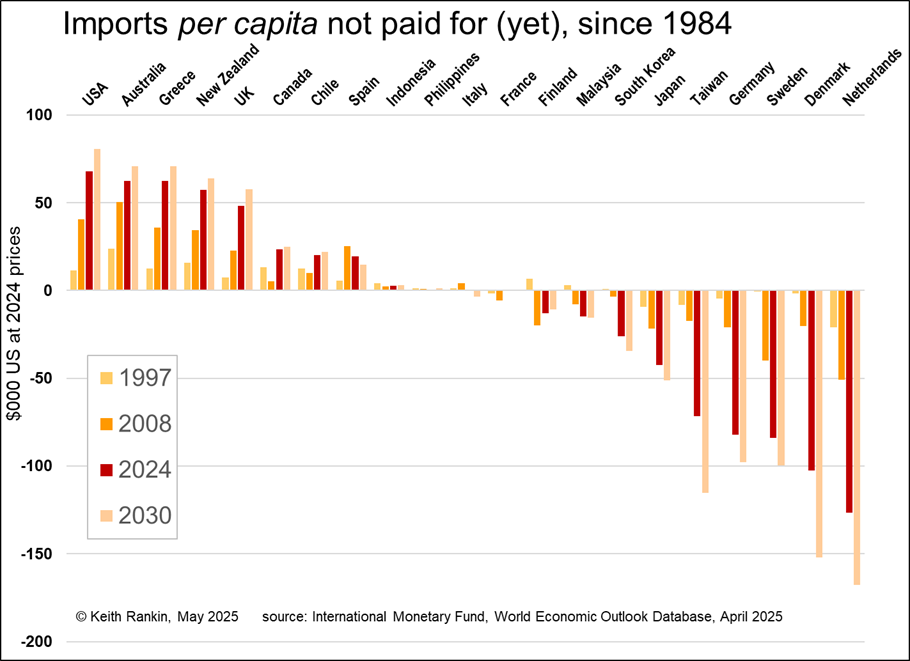
    My chart and article yesterday (International Trade over time: gifts with strings, Evening Report, 8 May 2025) shows the accumulated ‘excess benefits’ of unbalanced global trade over the last forty years. The countries on the top-left-side of the chart are deficit/debtor countries; and the countries on the bottom-right-side are surplus/creditor countries. (The countries are selected on the basis of available ‘current account’ data from the IMF’s World Economic Outlook Database, April 2025, and as representatives of deficit and surplus countries. China, if on the chart, would belong close to Malaysia. The chart is made from my own calculations to adjust for inflation.)

    The chart necessarily – because deficits must be financed elsewhere by surpluses – has a seesaw shape. Some countries are up, some countries are down; and some countries occupy the central pivot, neither up nor down. So long as some countries have consumed substantial amounts of stuff (imports) which they have not yet paid for (the deficit countries), some other countries (the surplus countries) have supplied stuff (exports) that they have not yet accepted payment for (and are unlikely to accept payment for in the imaginable future). Imports are paid for by exports.

    It’s not a true seesaw, which is typically either grounded or horizontally balanced. We may think of it as a seesaw pivoting above a chasm. What is true is that if the downside goes further down – that is, if the surplus countries’ accumulated surpluses get bigger – then the upside (accumulated deficits) must go further up. The seesaw is a ‘system’, and the only alternative to the seesaw shape is system collapse, analogous to the whole seesaw breaking off its pivot and falling into the chasm.

    Imports are paid for by exports. But many contracted payments are deferred, indeed to the point where the payments will never actually take place. Instead of receiving payment in the form of imports, the mercantilist surplus countries have gleefully accepted ‘promises’; effectively ‘IOUs’ (‘I owe you’). (These ‘financial promises’ or ‘financial assets’ are essentially bonds [ie credit], or titles [ie equity]; promises themselves can be bought and sold, and can appreciate or depreciate in market trading [including depreciating to zero]. Promises typically earn, for their owners, additional promises in the form of interest and dividends. Interest and dividends may be realised – that is, spent – on imports, or may be ‘compounded’ – another word for ‘accumulated’ – hence the concept of compound interest.) Technically, inflation exists when the particular promise that we call money depreciates in market value.

    In a mercantilist world, all countries want to occupy the low ‘ground’ (ie a point below the seesaw pivot); they want to import less than they export, and to accumulate promises. In a stable world economy, so long as some countries insist on occupying the low ground, then some others must occupy the high ground.

    The most obvious deficit countries in the chart – countries with an accumulation of enjoyed (or invested in new structures) but unpaid-for imports – are the United States, Australia, Greece, the United Kingdom, and New Zealand. (Another important deficit country is Türkiye, for which the data is not good enough, but would almost certainly have an accumulated ‘current account’ deficit of over $US100,000 per Turkish person.) These are the world’s ‘spendthrifts’.

    The most obvious surplus countries in the chart are Taiwan, Germany, Sweden, Denmark, and the Netherlands. Indeed, the European Union – more than anywhere else, including China – is a mercantilist enterprise. (Further, the European Union is starting to look quite shabby, especially the countries just mentioned.) This is what Donald Trump means by the European Union ‘screwing’ the United States. (Refer EU was born to ‘screw’ US, Trump says, France24, 26 Feb 2025.)

    Surplus/creditor nations (like Germany) do not want to settle; they want to compound, they want deficit/debtor nations (like Aotearoa New Zealand) to extend their liabilities. The mercantilist countries are content – indeed, more than content – for other countries to enjoy the fruits of their labour and their capital.

    Just as the deficit countries are the world’s ‘spendthrifts’, the surplus countries are the world’s ‘misers’. The global economy maintains a successful equilibrium so long as the willing spendthrifts balance out the insistent misers.

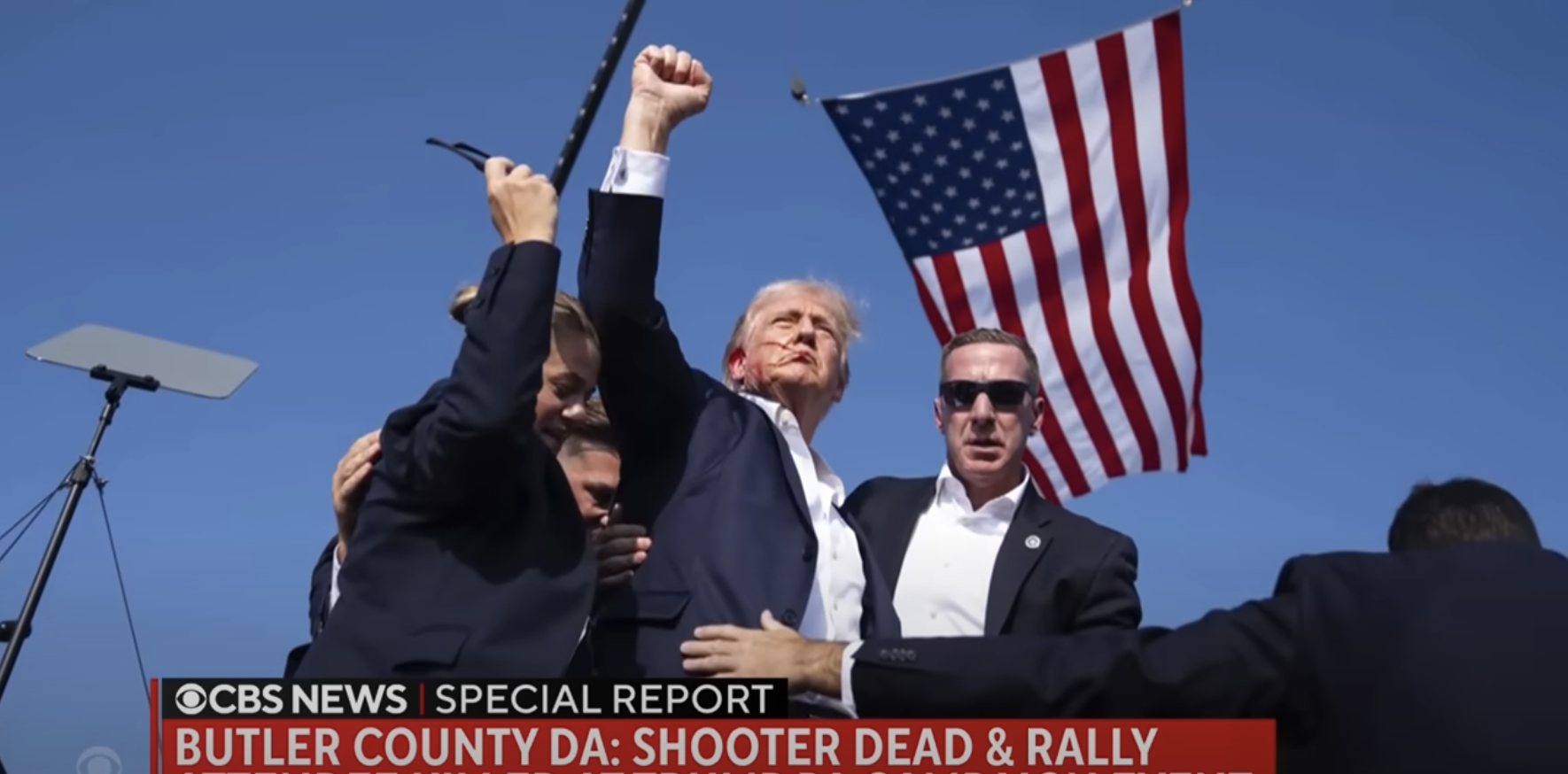
    US President Donald Trump raised a fist in defiance after an assassination attempt on his life in Pennsylvania, Saturday, July 13, 2024 (USEDST).

    Donald Trump threatens to disturb that global equilibrium by saying – in effect – that he wants the United States to join the ‘miser club’; he says he wants his country to stop being screwed by the misers. The thing is, though, he probably doesn’t actually mean it. His natural proclivity is to spend, and to gamble. He’s a hedonist, not a puritan nor a thriftwad; his nature is neither parsimonious nor austere.

    (I would rather Donald Trump than Friedrich Merz was United States’ president; and prefer the pragmatism of the United States and Australian Treasurers over the austere Nicola Willis or the United Kingdom’s brutally austere Rachel Reeves. In 2027, I am optimistic that, in office, NZ Labour’s Barbara Edmonds will be able to break away from the austere image of female Finance Ministers with whom we have become familiar – remember Ruthenasia; public austerity is an election-losing strategy, a generator of societal inequality and low morale.)

    Nevertheless, Trump may be unintentionally breaking the world economy, on account of his – or his advisers’ (eg Peter Navarro) – weak understanding of it. If the surplus/creditor nations sought to spend their credits (except for spending in very small increments) they would: either bankrupt the debtor countries, creating systemic collapse; or, due to depreciating prices of assets being dumped onto financial markets, have to accept many fewer imports than they felt they were due. Financial promises work according to the use-it or lose-it rule.

    The Great Depression

    Parsimony, austerity, and mercantilism in the 1920s got us into the Great Depression of 1930 to 1934. (These were the core years of the Depression; the timing varies for different countries.) The Great Depression was a global event that occurred as a ‘race to the bottom’; almost all countries wanted to be below the pivot of the seesaw and none at the top. The United Kingdom – under Chancellor of the Exchequer, Winston Churchill – in particular was a deficit country that tried to push its side of the seesaw down through a process of internal devaluation (deflation) at a time when France, United States (under the curmudgeonly Coolidge), and Germany had anchored their side of the seesaw down. (At that time, Germany had been – thanks to post World War One reparations – forced onto the same downside of the seesaw. Churchill’s most specific action was the returning of the British pound to an unworkable restored Gold Standard at an overvalued exchange rate.)

    (In the pre WW1 global environment, one of the most important balancing deficit/debtor countries was Russia. Russia seceded from the global capitalist system in 1917, largely as a result of the war. The loss of Russia’s pre-war presence – as a counterweight – was an aggravating factor in the Great Interwar Crisis.)

    Deep Mercantilism

    Donald Trump, while an overt mercantilist, is shallow in his convictions. He loves ‘money’, but he also loves what money can buy.

    Deep mercantilists love money, and other financial assets (‘virtual gold’) including cryptocurrencies, in miserly ways; they believe in making money, not spending it. (Stereotypical new wave misers are young men, mining and trading in Bitcoin from bedrooms in the parents’ homes.) Through hoarding, they act to impede the global circulation of money, not to enable it.

    Finance, as an academic discipline, is quintessentially mercantilist. It equates the accumulation and appreciation of financial assets – promises – with the creation of wealth; and that the wealthiest country in the world is the one with the fullest Treasury. And so many people – especially journalists – buy into that vision of wealth as a pile of treasure, as an accumulation of credits.

    Modern mercantilists only regard mined gold as wealth, not gold still in the ground; and only promises that are tradeable, or at least potentially tradeable. Financial institutions regard your mortgage as their wealth; and they understand public debt to be private wealth; they buy and sell mortgages, along with other assets such as government debt.

    And they believe in the magic of compound interest. They believe that unspent money – unsettled promises – grow exponentially and indefinitely. The seesaw chart, showing unpaid-for imports accumulated over 40 years, belies this. If the surplus nations all tried to spend their gold and their paper (and other virtual) riches – by becoming deficit countries, by shifting the seesaw into the alternate position – then they would find both that their ability to import from the present deficit/debtor countries would amount to less than the unpaid-for amounts shown in the chart – and they would find that many of their claims (ie promises) would be unrealisable.

    As already noted, trade credits – promises – are accumulated on a ‘use-it or lose-it’ basis; this amounts to a negative form of compound interest. The surplus countries have not sufficiently used their credits; without realising it, their hoarded credits have already lost much of their initial purchasing capacity. While individual countries – especially small ones like Finland – may successfully shift from one side of the seesaw to the other, it is too late for the seesaw to swing without the surplus group of countries incurring heavy losses. The present deficit countries are simply not tooled up to produce masses of goods and services for export.

    Private pension funds represent the epitome of deep mercantilism.

    Deep mercantilism is not just about countries and international trade. A major feature of the next Great Depression will be the collapse of these funds, as far too many ‘first world’ people in their fifties and sixties seek to withdraw and spend their retirement savings. Thus, the next Great Depression will be one of stagflation – not 1930s’-style deflation – as there will be a rush of ‘Generation Jones’ people (born in the later 1950s and early 1960s) to spend their savings and finding that the global cupboard of goods and services is becoming bare.

    Non-Mercantilism

    Human wealth is actually the ‘factors of production’: people (simplistically construed as ‘labour’) and nature (simplistically construed as ‘land’) and structures [and inventories; and including intangible structures such as ‘knowledge’] (construed by economists true to their discipline as ‘capital’) and the enjoyable goods and services which flow to humans from these ‘factors’.

    The next global Great Depression can be forestalled if the deficit countries (like United States and Aotearoa New Zealand) – the less-mercantilist countries, or at least the ‘unsuccessful’ would-be mercantilist countries – continue as net spenders, given that the substantial likelihood is that the prevalent mercantilist countries (like Germany and Sweden and Netherlands and China) are likely to at least try to persevere as accumulators of financial assets through the process of selling more goods than they buy.

    Or the next Great Depression can be forestalled by most countries slowly moving, in concert, into a position of balance. Imagine each end of the seesaw neither up nor down, a horizontal seesaw on its pivot. Here countries like France, Italy, Indonesia and Philippines serve as examples.

    Collapse and its prevention

    Under prevailing mercantilist ideology, the best place for a country to be is on the downside of the seesaw. The biggest danger – the danger of system breakage – is that of the deficit countries trying to get their side of the seesaw down while the surplus countries are also trying to keep their side down. Any option of voluntary balance – of some countries trying to do what the majority are trying not to do – may forestall a global economic collapse; including a voluntary continuation of the present situation, with one group of countries happy to stay up while another group of countries want to stay down.

    The irony is that the real winners are the alleged losers. For good reason, the seesaw chart shows these real-winner countries at the top rather than at the bottom. The real winners like to import, to enjoy their stuff; they do not pursue the mercantilist illusions of treasure hoards and compound interest.

    Children understand that when one side of the seesaw is down, the other should be up. And that being up is fun. Will the adults learn what children already know?

    *******

    Keith Rankin (keith at rankin dot nz), trained as an economic historian, is a retired lecturer in Economics and Statistics. He lives in Auckland, New Zealand.

    MIL OSI Analysis – EveningReport.nz –

    May 9, 2025
  • MIL-OSI United Kingdom: British High Commission Honiara celebrates VE Day 80 with Service

    Source: United Kingdom – Executive Government & Departments

    World news story

    British High Commission Honiara celebrates VE Day 80 with Service

    The ceremony involved wreath laying by invited guests, including the Governor General of Solomon Islands, His Excellency David Kapu and other dignitaries.

    Wreaths laid to honour those who have sacrificed their lives for our freedoms today.

    On Thursday 8 May, the British High Commission in Solomon Islands celebrated Victory in Europe (VE) Day 80 years on from when the Second World War ended in Europe.

    Held at the High Commissioner’s official residence at Tanuli in Honiara, the ceremony involved the laying of wreathes by invited guests, including the Governor General of Solomon Islands, H.E David Kapu; Australian High Commissioner to Solomon Islands H.E Rod Hilton and his Acting Defence Advisor Bret Verity and New Zealand High Commissioner to Solomon Islands H.E Jonathan Curr.

    Others included the Japanese Ambassador H.E Keiichi Higuchi; United States Chargée d’Affaires Ms Kristine Marsh, Reverend Wilfred Kekea from the Anglican Church of Melanesia; Westminster Foundation for Democracy Country Director Vatina Devesi; Rosalind Manekaea from the Guides and Joe Billy Oge from the Scout Movement.

    Speaking at the service British High Commissioner to Solomon Islands and Non-Resident High Commissioner to Nauru, His Excellency Paul Turner said:

    More than ever, it is important to remember and honour those who sacrificed their lives to fight fascism in Europe. The war in Ukraine and the unprovoked attack by Russia showed that peace and security in Europe and across the world was in a perilous state. Systems of international law and justice – which we had grown up with since the end of World War II – were now under attack from regimes such as the one in Russia.

    The war in the Far East did not end until 15 August 1945, when Japan surrendered, which was celebrated across the world as ‘Victory over Japan’ (VJ Day). The 80th anniversary of VJ Day takes place on Friday 15 August 2025, commemorating the end of the Second World War.

    The Second World War touched every aspect of life and had a devastating impact on those who experienced it, and for the generations after. From the sailors, soldiers and aviators who fought, to children who were evacuated, and all those who stepped into essential roles on the home front, we owe it to the Second World War generation who 80 years ago fought for our freedom and paid the ultimate sacrifice in giving generations lasting peace.

    Through a series of national and local events, we unite to pay tribute to the millions of people across the UK and Commonwealth who served in the Second World War as well as echoing the same celebrations 80 years ago as the population welcomed the end of the war.

    While VE and VJ Day 80 have been an opportunity for celebration, as it was across the streets of Britain in 1945, these commemorations were also one of the last opportunities to honour our living Second World War veterans.

    There is also a younger generation for whom the events of the Second World War – the sacrifices made, and the reasons for them – seem like distant history. It will be a time for us to come together to listen to their stories and reflect on their values that ensured the Allied victory – service and selflessness across our nation.

    In an increasingly uncertain and fragmented world, this anniversary has never been more important. It is only by learning from conflicts such as the Second World War and listening to their devastating effects from those who experienced them, that we bring to life the realities of war, especially for younger generations, so that they can learn about the horrors that it entailed and the sacrifices necessary to preserve peace and freedom.

    This year is particularly poignant, as it is one of the last opportunities to honour the living Second World War veterans, who fought so hard to preserve peace and freedom that enables our shared way of life.

    It is vital that we learn from their stories and ensure they are told to generations to come, in order that younger generations understand what they were fighting for and the horrors that conflicts on this scale can bring.

    Share this page

    The following links open in a new tab

    • Share on Facebook (opens in new tab)
    • Share on Twitter (opens in new tab)

    Updates to this page

    Published 9 May 2025

    MIL OSI United Kingdom –

    May 9, 2025
  • MIL-OSI Russia: Former Gansu Provincial Vice-Chairwoman Arrested for Bribery

    Translation. Region: Russian Federal

    Source: People’s Republic of China in Russian – People’s Republic of China in Russian –

    Source: People’s Republic of China – State Council News

    BEIJING, May 9 (Xinhua) — Zhao Jinyun, a former vice governor of northwest China’s Gansu Province, has been arrested on suspicion of bribery, the Supreme People’s Procuratorate (SPP) said Friday.

    The results of the investigation conducted against her by the State Supervisory Committee were transferred to the prosecutor’s office to initiate criminal proceedings with the final presentation of charges against her in court, the VNP added.

    An investigation into her was initiated in October 2024. -0-

    MIL OSI Russia News –

    May 9, 2025
  • MIL-OSI Russia: Breaking: Xi Jinping, Swedish King Exchange Congratulations on 75th Anniversary of Diplomatic Relations

    Translation. Region: Russian Federal

    Source: People’s Republic of China in Russian – People’s Republic of China in Russian –

    Source: People’s Republic of China – State Council News

    Xinhua | 09. 05. 2025

    Keywords: Xi Jinping,President of China,King of Sweden,Anniversary of the Establishment,Occasion,Relations,Urgent,Congratulations,Friday,Exchanged,Two Countries,Jinping,Messages,Gustav

    BEIJING, May 9 (Xinhua) — Chinese President Xi Jinping and Swedish King Carl XVI Gustaf on Friday exchanged congratulatory messages on the 75th anniversary of the establishment of diplomatic ties between the two countries. -0-

    Source: Xinhua

    Breaking: Xi Jinping, King of Sweden exchange congratulations on 75th anniversary of diplomatic ties Breaking: Xi Jinping, King of Sweden exchange congratulations on 75th anniversary of diplomatic ties

    MIL OSI Russia News –

    May 9, 2025
  • MIL-OSI Russia: Transport – Moscow Metro Celebrates 90 Years with Major Expansion Since 2010

    Source: Moscow Metro

    On May 15, Moscow Metro will mark its 90th anniversary, highlighting its remarkable growth and development over nearly a century. The city’s first metro line, launched in 1935, spanned 11.2 kilometers and included 13 stations, serving 177,000 daily passengers. Today, Moscow Metro has grown to include over 550 kilometers of lines and 302 stations, including the Moscow Central Circle (MCC), with daily ridership exceeding 8.2 million trips.

    New lines at Moscow Metro.

    Under the leadership of Moscow Mayor Sergey Sobyanin, the metro has undergone unprecedented development over the past 15 years:

    – More than half of the existing lines have been extended.

    Five entirely new lines have been added:

    • – Moscow Central Circle (MCC)
    • – Line 8A
    • – Line 15
    • – Big Circle Line
    • – Line 16

    Since 2010, the number of stations has increased by more than 1.6 times, from 182 to 302 metro and MCC stations. Thanks to this, the percentage of Muscovites living within walking distance of metro stations has risen from around 70% in 2010 to over 90% in 2025. We are always happy to welcome new passengers. All new stations and lines are designed with surplus capacity to meet demand for decades to come, — said Maksim Liksutov, Deputy Mayor for Transport.

    As Moscow Metro celebrates its 90th anniversary, it stands as a global leader in urban transportation, continually improving access, convenience, and infrastructure for millions of residents and visitors.

    MIL OSI Russia News –

    May 9, 2025
  • MIL-OSI China: Europe marks 80th anniversary of WWII victory with calls for peace, unity

    Source: People’s Republic of China – State Council News

    This photo taken on May 7, 2025 shows a view of ceramic poppies displayed at the Tower of London in London, Britain. An installation of nearly 30,000 ceramic poppies is on display from May 6 to Nov. 11 at the Tower of London, commemorating the 80th anniversary of the end of the Second World War. [Photo/Xinhua]

    Europe celebrated the 80th anniversary of the end of the Second World War this week, with parades and wreath-laying ceremonies unfolding across the continent. The defeat of Fascism and Nazism in 1945 is celebrated on Victory in Euorpe (VE) Day and throughout the week, European leaders underscored the enduring value of peace and unity.

    In Poland, nationwide observances on Thursday culminated in Warsaw’s Wesola district, home to the Polish Army’s Tadeusz Kosciuszko Armored Brigade. During an address to the army, Polish Prime Minister Donald Tusk vowed to strengthen Poland’s defense capability and safeguard the country.

    Meanwhile, on the social media platform X, Polish President Andrzej Duda posted a strong plea: “No more war! This appeal must resound today.” He called for a world grounded in “the force of law” rather than “the law of force,” and called the memories of World War II a solemn reminder of the need to be “responsible stewards of peace.”

    A ceremony commemorating the 80th anniversary of the end of World War II in Europe, known as Victory in Europe Day, is held at the Tomb of the Unknown Soldier in Warsaw, Poland, on May 8, 2025. [Photo/Xinhua]

    German Federal President Frank-Walter Steinmeier on Thursday reflected on Germany’s responsibility for the wars and called for the protection of unity, citing challenges including growing extremist forces in the country. He also reaffirmed Germany’s commitment to the principles of the post-war international order.

    In addition, the CEOs of 48 major German companies, including BASF, Evonik, Siemens, Bayer, and Deutsche Bank, issued a joint statement acknowledging their companies’ historical responsibility in the Nazi era and calling for efforts against hatred, exclusion and antisemitism.

    On the eve of the anniversary of VE Day on Wednesday, a meeting between newly-elected German Chancellor Friedrich Merz and French President Emmanuel Macron in Paris bore a special significance. The two leaders, representing nations once bitter enemies, emphasized the significance of German-French reconciliation.

    “German-French friendship is a gift, a gift of forgiveness and reconciliation, especially for us Germans,” Merz said during his first trip abroad since being elected.

    People attend a ceremony commemorating the 80th anniversary of the end of World War II in Europe at the Brandenburg Gate in Berlin, Germany, May 8, 2025. [Photo/Xinhua]

    Earlier this week in Britain, nearly 30,000 ceramic red poppies cascaded down the walls of the Tower of London, representing the loss of lives during the war. British King Charles and Queen Camilla reviewed a military parade in front of Buckingham Palace, as part of four days of commemorations beginning on Monday.

    In Slovakia, Prime Minister Robert Fico laid a wreath on Tuesday at the Red Army Military Cemetery in Michalovce, a city liberated by the Russian Red Army. Paying tribute to young soldiers who sacrificed their lives during the liberation of Slovakia, Fico emphasized that victory over fascism is a celebration of peace and life.

    In the Netherlands, flags were flown at half-mast across the country for the national day of remembrance. Thousands gathered in Amsterdam on Monday, where Dutch King Willem-Alexander laid a wreath at a war memorial, and the nation held a two-minute silence to honor the fallen.

    Italy’s commemorations began earlier, on April 25, with Liberation Day parades in Rome, Milan, Florence and other cities. National museums and parks offered free admission to the public as part of the celebrations. Italian President Sergio Mattarella, accompanied by Prime Minister Giorgia Meloni and Defense Minister Guido Crosetto, laid a wreath on the Tomb of the Unknown Soldier at the Altar of the Fatherland.

    “Defending the freedom of the European peoples is a shared task,” President Mattarella declared. “Now, equality, the affirmation of the rule of law, cooperation, the same freedom and democracy, have become common goods of the European peoples to be protected by all the parties to the European Union pact.”

    This photo taken on May 7, 2025 shows a view of ceramic poppies displayed at the Tower of London in London, Britain. An installation of nearly 30,000 ceramic poppies is on display from May 6 to Nov. 11 at the Tower of London, commemorating the 80th anniversary of the end of the Second World War. [Photo/Xinhua]

    At the EU level, the European Parliament marked the occasion in a plenary session that featured three Second World War veterans on Wednesday. Parliamentary President Roberta Metsola stressed that the best tribute to those who gave their lives is the resolve to “never again” repeat such wars.

    European Council President Antonio Costa underlined: “Peace is a heritage, but also a responsibility.”

    MIL OSI China News –

    May 9, 2025
  • MIL-OSI China: China, Russia urge nuclear-weapon states to abandon Cold War mentality: Joint statement

    Source: People’s Republic of China – State Council News

    China and Russia urged nuclear-weapon states to abandon the Cold War mentality and zero-sum games, according to a joint statement on global strategic stability released in Moscow on Thursday.

    The two sides emphasized the importance of maintaining a constructive relationship among major countries in addressing global strategic issues.

    Noting that nuclear-weapon states bear special responsibilities for international security and global strategic stability, the statement said that they should give up taking measures that trigger strategic risks, and concerns should be addressed through equal dialogue and consultations based on mutual respect to enhance trust and avoid dangerous misjudgments.

    The statement noted that not all nuclear-weapon states follow the above-mentioned position, saying the rising tensions among nuclear-weapon states have escalated, even to the point of facing direct military conflicts, adding that problems and challenges in the strategic domain keep emerging, and the risk of nuclear conflicts is rising.

    According to the statement, the fact that certain nuclear-weapon states build or expand permanent military bases in sensitive areas around other nuclear-weapon states, flex military muscle to exert pressure, or carry out hostile acts that threaten the core security interests of other countries has become one of the most urgent strategic risks to be eliminated.

    Meanwhile, the forward deployment of military facilities and advanced offensive and defensive weapons have been continuously strengthened, a trend that has raised serious concerns.

    The recently announced “Golden Dome” plan of the United States aims to build a global, multi-level and multi-domain missile defense system that is not subject to any constraints to resist various missile threats, including those from “evenly matched” opponents, said the statement, adding that it also causes serious damage to strategic stability.

    This plan completely and thoroughly negates the inseparable interrelationship between strategic offensive and strategic defensive arms, the core principle on maintaining global strategic stability. In addition, this plan also provides further support for the research and development of kinetic and non-kinetic means to strike missiles and their supporting facilities and achieve “left-of-launch.”

    The “Golden Dome” program openly proposed a significant increase in outer space combat means, including the development and deployment of orbital interception systems, weaponizing outer space and turning it into a large-scale armed confrontation site, which made the situation even worse, said the document.

    The two countries oppose the attempts of individual countries to use outer space for armed confrontation, and reject the implementation of security policies and activities aimed at gaining military superiority and defining outer space and using it as a “war-fighting domain.”

    China and Russia condemned the use of commercial space systems to interfere in the internal affairs of sovereign states and intervene in armed conflicts of other countries.

    Some individual nuclear-weapon state, supported by its allies, aims to undermine the reliability and effectiveness of the strategic deterrence of other nuclear-weapon states, revealing the attempt to seek overwhelming military superiority, and ultimately achieve “absolute strategic security.” It fundamentally violates the basic logic of maintaining strategic balance and runs counter to the principle of equal and indivisible security, according to the statement.

    Any military confrontation among nuclear-weapon states should be resolutely avoided, said the document, adding that political and diplomatic solutions to existing differences should be sought on the basis of mutual recognition of and mutual respect for each other’s security interests and concerns.

    Both sides pointed out in the statement that through a trilateral security partnership, the United States, Britain and Australia attempt to establish military facilities used by the two nuclear-weapon states to safeguard their nuclear forces within the territory of a signatory to the South Pacific Nuclear Free Zone Treaty, undermining regional strategic stability and provoking a regional arms race.

    MIL OSI China News –

    May 9, 2025
  • MIL-OSI Russia: The volume of tea exports from China to Russia in 2024 increased by 13.72 percent.

    Translation. Region: Russian Federal

    Source: People’s Republic of China in Russian – People’s Republic of China in Russian –

    Source: People’s Republic of China – State Council News

    GUIYANG, May 9 (Xinhua) — China exported 16,800 tons of tea to Russia in 2024, up 13.72 percent year on year, according to the 6th Tea Industry Conference held in Jiangkou County, southwest China’s Guizhou Province, from May 8 to 9.

    In monetary terms, the volume of tea exports from China to Russia last year amounted to approximately USD 58.68 million, which is 8.28 percent more year-on-year.

    According to the analytical report on the situation with tea import and export in China for 2024, published at the conference, green tea is the main type of tea exported from China to Russia, with a supply volume of 11.2 thousand tons or 79.88 percent of the total volume of tea exports to the Russian Federation.

    In addition, approximately 2.78 thousand tons of oolong tea and 2.11 thousand tons of black tea were exported from China to Russia, accounting for 19.85 percent and 15.09 percent of the total export volume, respectively.

    According to Wei Yu, Secretary General of the Tea Industry Committee, in 2024, Russia ranked fourth among China’s top five trading partners in tea exports after Morocco, Ghana and Uzbekistan.

    The document also said that in 2024, China’s total tea import and export volume reached 428.1 thousand tons, an increase of 5.3 percent year-on-year. At the same time, tea import was 54 thousand tons, an increase of 38.34 percent year-on-year, and export was 374.1 thousand tons, an increase of 1.79 percent. -0-

    MIL OSI Russia News –

    May 9, 2025
  • MIL-OSI Russia: Total revenue of listed companies in China to exceed 71 trillion yuan in 2024

    Translation. Region: Russian Federal

    Source: People’s Republic of China in Russian – People’s Republic of China in Russian –

    Source: People’s Republic of China – State Council News

    BEIJING, May 9 (Xinhua) — The combined operating income and net profit of 5,412 companies listed on the Shanghai, Shenzhen and Beijing stock exchanges last year were 71.98 trillion yuan (about 9.99 trillion U.S. dollars) and 5.22 trillion yuan, respectively, data from the China Association of Listed Companies showed Thursday.

    Of these companies, 4,036 were found to be profitable in 2024, accounting for about three-quarters of the country’s total listed companies. Among profitable companies, 2,194 saw profit growth, and 553 in this category saw profits grow by more than 100 percent last year.

    In 2024, the total R&D investment of listed companies continued to grow, reaching 1.88 trillion yuan, up nearly 60 billion yuan from the previous year.

    In the first quarter of 2025, net profits of companies listed on Chinese stock exchanges totaled 1.49 trillion yuan, up 3.55 percent year-on-year. A total of 4,084 companies were profitable during the same period, further strengthening the positive recovery trend of the Chinese economy.

    As of the end of April 2025, the total number of listed companies in China reached 5,420. Some of them have postponed the publication of their financial reports for 2024. -0-

    MIL OSI Russia News –

    May 9, 2025
  • MIL-Evening Report: What will the Antichrist look like? According to Western thought, an authoritarian king – or the pope

    Source: The Conversation (Au and NZ) – By Philip C. Almond, Emeritus Professor in the History of Religious Thought, The University of Queensland

    Composite image by The Conversation. Images courtesy of TruthSocial/@realDonaldTrump and Wikimedia Commons

    The US presidency and the papacy came together on May 3 when Donald Trump posted an AI-generated photograph of himself dressed as the pope to Truth Social. The image was then shared by the White House’s accounts.

    Seated in an ornate (Mar-a-Lago-style) golden chair, he was wearing a white cassock and a bishop’s hat, with his right forefinger raised.

    Trump has since told reporters he “had nothing to do with it […] somebody did it in fun”.

    This image of “Pope Donald I” is of historical significance, for reasons of which, no doubt, the White House and Trump were blissfully unaware. It is the first ever image to combine the two most important understandings of the figure of the Antichrist in Western thought: on the one hand, that of the pope, and on the other, that of the authoritarian, despotic world emperor.

    On April 22, the day after Pope Francis’ death, Trump declared “I’d like to be pope. That would be my number one choice”. On April 28, Trump told The Atlantic “I run the country and the world”.

    So, both pope and world emperor.

    The Imperial Antichrist

    In the New Testament, the First Letter of John says, before Christ came again, the Antichrist will appear: the most conspicuous sign the end of the world was near. nb small tweak to wording here

    The Antichrist would be the archetypal evil human being who would persecute the Christian faithful. He would be finally defeated by the forces of good. As Sir Isaac Newton suggested, “searching the Prophecies which [God] hath given us to know Antichrist by” is a Christian obligation.

    The first life of the Antichrist was written by a Benedictine monk, Adso of Montier-en-der, around 1,100 years ago. According to Adso, the Antichrist would be a tyrannical evil king who would corrupt all those around him with gold and silver. He would be brought up in all forms of wickedness. Evil spirits would be his instructors and his constant companions.

    The Antichrist, left, is depicted as a king, in this image from a 12th century manuscript.
    Wikimedia Commons

    Seeking his own glory, as Adso put it, this king “will call himself Almighty God”.

    The Antichrist was opposite to everything Christ-like. According to the Christian tradition, Christ was fully human yet absolutely “sin free”. The Antichrist too was fully human, but completely “sin full”. The Antichrist was not so much a supernatural being who became flesh, as a human being who became fully demonised.

    Influenced by Christian stories of the Antichrist, Islam and Judaism constructed their own Antichrists – al-Dajjal, the Antichrist of the Muslims, and Armilus, the Antichrist of the Jews. Both al-Dajjal and Armilus are king-like messiahs.

    Over the centuries, many world leaders have been labelled “the Antichrist” – the Roman emperors Nero and Domitian were Antichrist figures, and the French emperor Napoleon was named the Antichrist in his own time.

    There have been more recent leaders who have been likened to the Antichrist, among them former president of Iraq Saddam Hussein, King Charles III, former Russian leader Mikhail Gorbachev, al-Qaeda founder Osama bin Laden, and Trump.

    The Papal Antichrist

    In the year 1190, King Richard I of England, on his way to the Holy Land, was informed by the Italian theologian Joachim of Fiore (c.1135–1202) the next pope would be the Antichrist.

    In the history of the Antichrist, this was a momentous occasion. From this time on, the tyrannical Antichrist outside of the Church would be juxtaposed with the papal deceiver within it.

    That the Catholic pope was the Antichrist was the common reading of the pope in the 16th-century Protestant Reformation.

    Martin Luther (1483–1546), the founder of the Protestant revolution, declared the pope “is the true […] Antichrist who has raised himself over and set himself against Christ”.

    Just as all Christians would not worship the Devil as God, he went on to say, “so we cannot allow his apostle the pope or Antichrist, to govern as our head or lord”.

    This 1877 painting depicts Martin Luther summoned by the Catholic Church in 1521, to renounce or reaffirm his views criticising Pope Leo X.
    Wikimedia Commons

    As he was about to be burned by the Catholic Queen Mary for his Protestant beliefs, the Anglican bishop Thomas Cranmer (1489–1556) declared, “as for the pope, I refuse him, as Christ’s enemy and antichrist with all his false doctrine”.

    Even in 1988, as Pope John Paul II addressed the European Parliament, the Northern Ireland hardline Protestant leader Ian Paisley roared, “Antichrist! I renounce you and all your cults and creeds” – to which, we are told, the pope gave a slight bemused smile.

    Except among the most extreme of Protestant conservatives, the idea of the papal Antichrist no longer has any purchase. The papal Antichrist has vacated the Western stage for the imperial Antichrist.

    The Antichrist and the end of the world

    In the history of Christianity, the idea of the Antichrist was a key part of Christian expectations about the return of Christ and the end of the world.

    In the final battle between the forces of good and evil, the Antichrist would be defeated by the forces of Christ. In short, the rise of the world emperor who was the Antichrist was a sign that the end of the world was at hand.

    In the light of the Western history of “the Antichrist”, the image of the imperial and papal US president is a powerful sign that the global order – at least as we have known it for the last 80 years – may be at an end.


    Read more:
    Five things to know about the Antichrist


    Philip C. Almond does not work for, consult, own shares in or receive funding from any company or organisation that would benefit from this article, and has disclosed no relevant affiliations beyond their academic appointment.

    – ref. What will the Antichrist look like? According to Western thought, an authoritarian king – or the pope – https://theconversation.com/what-will-the-antichrist-look-like-according-to-western-thought-an-authoritarian-king-or-the-pope-256205

    MIL OSI Analysis – EveningReport.nz –

    May 9, 2025
  • MIL-OSI Russia: Happy Great Victory Day!

    Translation. Region: Russian Federal

    Source: Novosibirsk State University – Novosibirsk State University – Dear students, teachers and staff of the university! We sincerely congratulate you on Victory Day!

    This holiday reminds us of the great feat of our compatriots who fought for the freedom and independence of the Motherland.

    Many outstanding scientists who stood at the origins of Siberian science, directly participated in military actions and made their tangible contribution to the victory of the people of the Soviet Union over fascist Germany thanks to their scientific works. Many university teachers were at the front, survived all the hardships of the war, later returned to study, teaching, science and dedicated their lives to raising new generations of scientists, engineers, researchers.

    We are proud that our university is implementing many projects dedicated to this important date. They help preserve the memory of those who gave their lives for our freedom and pass this memory on to future generations.

    We wish you good health, prosperity and a peaceful sky above your head! Let this holiday be a reason for pride and unity for all of us.

    Happy holiday, dear friends!

    Please note: This information is raw content directly from the source of the information. It is exactly what the source states and does not reflect the position of MIL-OSI or its clients.

    MIL OSI Russia News –

    May 9, 2025
  • MIL-OSI Russia: China boosts employment and social security for people with disabilities

    Translation. Region: Russian Federal

    Source: People’s Republic of China in Russian – People’s Republic of China in Russian –

    Source: People’s Republic of China – State Council News

    BEIJING, May 9 (Xinhua) — More than 9.14 million people with disabilities will be employed across China in 2024, up 512,000 from a year earlier, according to an official report released Thursday.

    The volume of contracts concluded for basic medical insurance services and family doctor contracts among disabled people in China was higher than the national average, according to a document released by the All-China Federation of Disabled People (ACDF).

    The report shows that over the past year, more than 8.66 million people with disabilities received basic rehabilitation services, and nearly half a million children with disabilities benefited from rehabilitation assistance.

    By the end of 2024, there were 13,297 rehabilitation institutions for the disabled in China, with a total of 373,000 employees.

    In terms of social security, in 2024, more than 27.48 million people with disabilities in China were covered by the basic old-age insurance program, and more than 12.46 million were receiving pensions.

    By the end of last year, a total of 4,614 facilities for serving people with disabilities had been built, including 2,250 comprehensive service facilities and 1,246 rehabilitation facilities. -0-

    MIL OSI Russia News –

    May 9, 2025
  • MIL-OSI Russia: China Brings Chinese Wisdom and Solutions to Global Drug Governance

    Translation. Region: Russian Federal

    Source: People’s Republic of China in Russian – People’s Republic of China in Russian –

    Source: People’s Republic of China – State Council News

    Russians. Ori.org.KN | 09. 05. 2025

    Keywords: White paper

    Source: russian.china.org.cn

    China brings Chinese wisdom and judgment to global drug governance China fulfills its own responsibilities in drug control, at the same time firmly supports the existing international drug control system, takes an all-round part in making important decisions on international drug control, and brings Chinese wisdom and judgment to global drug governance.

    MIL OSI Russia News –

    May 9, 2025
  • MIL-OSI Russia: Three key words to evaluate Chinese President Xi Jinping’s trip to Russia

    Translation. Region: Russian Federal

    Source: People’s Republic of China in Russian – People’s Republic of China in Russian –

    Source: People’s Republic of China – State Council News

    From May 7 to 10, at the invitation of Russian President Vladimir Putin, Chinese President Xi Jinping will pay a state visit to Russia and take part in celebrations in Moscow to mark the 80th anniversary of the Soviet Union’s victory in the Great Patriotic War.

    At a special key historical moment, the energetic and skillful diplomacy of the great powers and three key words attract special public attention.

    Stability

    How great powers get along with each other has become a major theme in international relations. As instability in the international environment increases, the world looks to great powers to provide stability and positive energy.

    “History and reality have clearly shown us that China and Russia are good neighbors who cannot distance themselves from each other, and true friends who share sorrows and hardships, support each other and develop together,” President Xi Jinping emphasized in a telephone conversation with President Putin in February this year.

    Good neighbors and true friends, possessing powerful inner impulses based on deep historical logic.

    Regarding bilateral relations, it should be noted that the two countries “adhere to strengthening and developing bilateral relations based on the principles of non-alignment, non-confrontation and non-targeting of third parties” and “form a new type of relations between great powers based on mutual respect, peaceful coexistence and win-win cooperation.”

    From a global perspective, China and Russia are the largest neighboring countries. They are also two world powers that are permanent members of the UN Security Council. They bear a special responsibility for maintaining and developing peace throughout the world. And their friendly relations and the achievement of mutual goals contribute to the development of a multipolar world and the democratization of international relations.

    Reflecting on the past in light of the present, it can be noted that in the context of international turbulence, the key to the smooth development of Sino-Russian relations has become “finding the right way to coexist”, and “this not only meets the fundamental interests of the two countries and two peoples, but also contributes to peace, stability and prosperity of the region and the whole world.”

    Sense of history

    This year has special historical significance.

    May 9 marks the 80th anniversary of the Soviet Union’s victory in the Great Patriotic War, and September 3 marks the 80th anniversary of the Chinese people’s victory in the War of Resistance Against Japanese Aggression. These two anniversaries and two major battlefields together lead to the 80th anniversary of the Victory in the World Anti-Fascist War.

    80 years ago, when Asia and Europe were the two main battlefields of World War II, China and Russia made enormous sacrifices and significant historical contributions to ensuring victory in the world anti-fascist war and saving peoples from destruction, as well as the future of all mankind.

    It was not easy to achieve victory and peace, nor was it easy to establish the post-war international order.

    “If we lose the memory of history, our minds will be lost in darkness,” Chinese President Xi Jinping once quoted the famous words of renowned Russian historian Klyuchevsky, thereby expressing his determination to preserve historical memory and uphold peace.

    In May 2015, Chinese President Xi Jinping was invited to Moscow to participate in celebrations of the 70th anniversary of Victory in the Great Patriotic War. In September of the same year, a conference was held in Beijing dedicated to the 70th anniversary of the Victory in the War of Resistance against Japanese Aggression and the Victory in the World Anti-Fascist War.

    And now, ten years have passed unnoticed. Today, when the world stands at the crossroads of history, China and Russia support each other in holding events dedicated to the 80th anniversary of the Victory in the World Anti-Fascist War, promoting an accurate view of the history of World War II, preserving the results of World War II and the post-war international order, and defending international justice.

    The concept of order

    Today’s world has been shaped by history.

    It was on the basis of the Great Victory won 80 years ago that China and Russia, together with other major members of the anti-fascist alliance, discussed the establishment of the UN and jointly drafted a number of important international documents such as the UN Charter, which laid the foundations of the modern international order and established the basic rules of international relations.

    Peace rather than war, cooperation rather than confrontation, win-win rather than zero-sum – all this has become a powerful historical trend.

    “In this world, the degree of interconnectedness and interdependence of various countries has never been so profound. Humanity lives in one global village, in one time and space, where history and reality intersect, increasingly becoming a community of a common destiny, close and inseparable,” so in March 2013, Chinese President Xi Jinping gave the world the first interpretation of the concept of a community of a common destiny at the Moscow State Institute of International Relations (MGIMO MFA of Russia).

    Great power diplomacy aimed at long-term planning and far-reaching results.

    When turbulence intensifies, we must stand firmly on the right side of history, “resolutely oppose the attacks and actions that deny, distort and falsify the history of World War II,” and “jointly defend the outcome of World War II and international justice.”

    When the “countercurrent” starts to bubble up, we must unwaveringly stand by the progress of human civilization. “Practice genuine multilateralism, promote an equitable and orderly multipolar world, comprehensive economic globalization, jointly implement the global development initiative, the global security initiative and the global civilization initiative, and work together to build a community with a shared future for mankind.”

    It is the sacred duty of China and Russia to guide global governance in the right direction.

    “China and Russia should take this as an opportunity to jointly safeguard the international system with the UN as its core and the legacy of World War II, and promote all countries to uphold the purposes and principles of the UN Charter, adhere to the universally recognized norms of international relations, and practice genuine multilateralism,” Chinese President Xi Jinping emphasized during video conference talks with President Vladimir Putin in January this year.

    MIL OSI Russia News –

    May 9, 2025
  • MIL-OSI Russia: US ‘film tariffs’ would deal ‘devastating blow’ to film and TV industries

    Translation. Region: Russian Federal

    Source: People’s Republic of China in Russian – People’s Republic of China in Russian –

    Source: People’s Republic of China – State Council News

    The Hollywood Reporter reported on May 4 that US President Trump had announced the same day that he would impose a “100% tariff” on any films produced outside the United States that enter the country. He also authorized the Commerce Department and the US Trade Representative to implement the tariff policy.

    “The American film industry is rapidly dying!” Trump wrote on social media on May 4. It said that other countries were using various incentives to “entice American film producers and studios to leave the United States.” Trump also said that Hollywood had been “severely damaged” as a result, posing a “national security threat” to the United States. He authorized the Commerce Department and the U.S. Trade Representative to immediately begin procedures to impose 100% tariffs on all films imported into the United States and produced in foreign countries, expressing his hope to “have American-made films again.”

    In recent years, Hollywood has taken advantage of tax incentives to move film production to countries such as the UK, Australia, Ireland and Spain.

    According to the Guardian and Reuters, the Australian and New Zealand governments have already made their positions known on May 5, declaring that they will vigorously defend the interests of their film and television industries. William Reinsch, a senior fellow at the Center for Strategic and International Studies and a former senior official at the U.S. Department of Commerce, believes that imposing tariffs on foreign-made films “would cause far more problems than they are worth,” and that it is difficult to convince people that foreign-made films are a “national security threat.” One U.S. entertainment industry official believes that Trump’s move will not only affect film, but will also “deal a crushing blow to the television industry.”

    MIL OSI Russia News –

    May 9, 2025
  • MIL-OSI Russia: China braces for heavy rains

    Translation. Region: Russian Federal

    Source: People’s Republic of China in Russian – People’s Republic of China in Russian –

    Source: People’s Republic of China – State Council News

    BEIJING, May 9 (Xinhua) — The latest heavy rains have hit coastal and southern parts of China since Wednesday, bringing widespread downpours and severe convective weather including thunderstorms, short-term heavy rainfall and storms.

    Local authorities took prompt measures to ensure the safety of urban life and public safety.

    Rain intensified in central China’s Hubei Province overnight from Wednesday to Thursday, prompting the province’s meteorological bureau to step up emergency response measures.

    Moderate to heavy rains have been reported in eastern parts of South China’s Guangxi Zhuang Autonomous Region over the past two days, with some areas seeing torrential rains exceeding 100 millimeters.

    To address the dual challenges of drought and floods, more than 7.9 million relief items have been collected in the GCAR and disaster-prone areas have been equipped with more than 4,900 satellite phones and navigation devices.

    The region also mobilized 22,000 emergency response personnel, as well as 16,000 local teams, totaling 320,000 people.

    Heavy rains have disrupted rail services in central China’s Hunan Province, forcing some trains to be suspended or rerouted to ensure passenger safety.

    Meanwhile, more than 2,500 monitoring devices and 300 drones have been deployed in East China’s Jiangxi Province to remotely monitor power infrastructure.

    The National Meteorological Center (NMC) extended a yellow rainfall warning at 6 p.m. on Thursday, predicting heavy to torrential rainfall in many provinces, as well as the risk of lightning, hail and strong winds. Authorities urged the public to be aware of weather warnings and exercise caution when traveling and engaging in outdoor activities. -0-

    MIL OSI Russia News –

    May 9, 2025
  • MIL-OSI Russia: China, Russia Call on Nuclear Powers to Ditch Cold War Mentality

    Translation. Region: Russian Federal

    Source: People’s Republic of China in Russian – People’s Republic of China in Russian –

    Source: People’s Republic of China – State Council News

    MOSCOW, May 9 (Xinhua) — China and Russia have called on nuclear powers to abandon the Cold War mentality and zero-sum games, according to a joint statement released here on Thursday.

    The parties stressed the importance of maintaining constructive relations between major countries in resolving global strategic issues.

    Members of the nuclear club bear special responsibility for international security and global strategic stability, they should refrain from steps that cause strategic risks and resolve problems through equal dialogue and consultations based on mutual respect to strengthen trust and avoid dangerous misjudgments, Beijing and Moscow noted.

    The statement said that not all nuclear powers adhere to the above-mentioned position. Growing tensions between nuclear states have escalated to the point of risk of direct military clashes, problems and challenges continue to arise in the strategic sphere, and the danger of nuclear conflicts is increasing, China and Russia emphasized.

    The fact that some nuclear-weapon States are building or expanding permanent military bases in sensitive areas around other nuclear-weapon States, flexing their military muscle to exert pressure, or committing hostile acts that threaten the core security interests of other countries has become one of the most serious strategic risks and must be addressed without delay, the statement said.

    The forward deployment of military facilities and modern offensive and defensive weapons is constantly increasing, which is a cause for serious concern, the parties emphasized.

    The recently announced US “Golden Dome” plan aims to create a global missile defense system that will not be subject to any restrictions to repel various missile threats, including those from “peer” adversaries, which also seriously damages strategic stability, the statement said.

    This plan completely denies the inextricable link between strategic offensive and strategic defensive weapons, the basic principle of maintaining global strategic stability. In addition, it also provides for further support for research and development of kinetic and non-kinetic means of destroying missiles and their support facilities, and ensuring “kill before launch”.

    The Golden Dome program openly proposes a significant increase in the number of space warfare capabilities, including the development and deployment of orbital interception systems, the weaponization of space and its transformation into a site for large-scale armed confrontation, which further worsens the situation, the statement noted.

    According to the document, Beijing and Moscow oppose attempts by individual countries to use space for armed confrontation and reject security measures aimed at achieving military superiority, defining outer space as a “combat area” and its use as such.

    China and Russia have condemned the use of commercial space systems to interfere in the internal affairs of sovereign states and armed conflicts in other countries.

    A nuclear state, with the support of its allies, seeks to undermine the reliability and effectiveness of strategic deterrence of other nuclear powers in an attempt to achieve overwhelming military superiority and ultimately “absolute strategic security.” This fundamentally violates the basic logic of maintaining strategic balance and contradicts the principle of equal and indivisible security, the statement said.

    Any military confrontation between nuclear-weapon states should be resolutely avoided, and political and diplomatic solutions to existing differences should be sought on the basis of mutual recognition and mutual respect for security interests and issues of concern, the document emphasizes.

    Beijing and Moscow noted that through the trilateral security partnership, the United States, Britain and Australia are attempting to establish military facilities used by two nuclear-armed states to protect their nuclear forces on the territory of a country that has signed the South Pacific Nuclear-Free Zone Treaty, undermining strategic stability and provoking an arms race in the region. –0–

    MIL OSI Russia News –

    May 9, 2025
  • MIL-OSI Russia: Chinese take first place in visiting Brest Fortress in Belarus among tourists from far abroad — director

    Translation. Region: Russian Federal

    Source: People’s Republic of China in Russian – People’s Republic of China in Russian –

    Source: People’s Republic of China – State Council News

    Brest /Belarus/, May 9 /Xinhua/ — The Chinese are the first among tourists from far abroad to visit the Brest Fortress in Belarus. This was recently stated to journalists by the director of the memorial complex “Brest Hero Fortress” Alexander Korkotadze during a press tour of media representatives of the EAEU and CIS countries.

    “Among the countries of the far abroad, China ranks first in the number of tourists who visit the memorial complex “Brest Hero Fortress”. We see a trend towards an increase in tourist flow from China,” he said.

    A. Korkotadze also noted that in 2024, an exhibition about the defense of the Brest Fortress was opened at the Memorial Museum of the Chinese People’s War of Resistance against Japanese Aggressors in Beijing, and this year a return exhibition is planned at the Brest Fortress, dedicated to the 80th anniversary of the victory in World War II over militarist Japan.

    In addition, according to him, the fortress has been visited more in recent years. Families come here from all corners of the former Soviet Union. Over 125 thousand people visited the memorial in the first 4 months of 2025.

    “We have conducted more than 3,700 excursions, and tourists from more than 10 countries have already visited our memorial this year. And this is despite the sanctions, despite the fact that they are trying to cancel the role of the Soviet Union in the victory over fascism and hush it up. But people from European countries, from the USA, from Latin America, from Africa, from Asia come to us and receive the most truthful information here. Apparently, they come to us for the truth,” said A. Korkotadze. -0-

    MIL OSI Russia News –

    May 9, 2025
  • MIL-OSI Russia: China’s private sector moves to new level of legal protection

    Translation. Region: Russian Federal

    Source: People’s Republic of China in Russian – People’s Republic of China in Russian –

    Source: People’s Republic of China – State Council News

    On April 30, the Standing Committee of the National People’s Congress voted to pass China’s first basic law regulating the development of the private sector, the Law on Promoting the Development of the Private Sector. The law will go into effect on May 20, marking a shift from state support for private businesses to legal protection.

    The law covers the entire life cycle of private enterprises – from creation and development to termination of activities, and also takes into account the key interests of various stakeholders in matters of fair competition, investment and financing, protection of rights and interests, and scientific and technological innovation.

    An important task of the law is to boost the innovation capacity of private enterprises in the context of the new national strategy, said Feng Guo, vice president of the Economic Law Research Association of the China Law Society and a professor at the Wuhan University School of Law.

    Currently, private enterprises play a leading role in technological innovation in China, accounting for more than 70% of the country’s technological achievements, and accounting for more than 80% of specialized and innovative small and medium enterprises (“little giants”) and more than 90% of national high-tech enterprises. This year, private companies have made significant breakthroughs in areas such as generative artificial intelligence, intelligent robotics, civil aviation, and quantum technology.

    Tian Xuan, director of the National Institute of Financial Research at Tsinghua University, noted that the law contains a separate section on technological innovation. This is aimed at supporting private enterprises and stimulating investment in science and technology, which will contribute to the development of productive forces of new quality. It also demonstrates the state’s recognition of the important role of private entrepreneurs and the private sector in technological innovation.

    The private sector of the economy plays a huge role in advanced technologies. The law particularly emphasizes the need to encourage the participation of private enterprises in innovation and the development of major projects and key industries, as well as to give them the opportunity to lead these processes.

    The law provides support for the participation of private organizations in research and development of common digital and intelligent technologies, the creation of a data market, the legal and rational use of data, and the development and use of open public data.

    Tian Xuan also noted that an important part of the Law is dedicated to protecting the rights and interests of private enterprises. This will allow entrepreneurs to focus on running their business, long-term investment and technological innovation, without being distracted by other issues.

    MIL OSI Russia News –

    May 9, 2025
  • MIL-OSI Russia: China will continue efforts to join the Comprehensive and Progressive Agreement for Trans-Pacific Partnership

    Translation. Region: Russian Federal

    Source: People’s Republic of China in Russian – People’s Republic of China in Russian –

    Source: People’s Republic of China – State Council News

    BEIJING, May 9 (Xinhua) — China remains committed to advancing the accession process to the Comprehensive and Progressive Agreement for Trans-Pacific Partnership (CPTPP), the Ministry of Commerce said.

    Speaking at a regular press conference of the ministry on Thursday, spokesman He Yadong noted that since applying to join the CPTPP in September 2021, China has conducted an in-depth analysis of the provisions of this agreement, communicated with its participants at various levels and through various channels, and organized relevant experiments in those pilot free trade zones and free trade ports that have the necessary conditions.

    “All this demonstrates the determination, ability and concrete actions of the Chinese side in ensuring compliance with the high standards stipulated by the agreement,” He Yadong said.

    “No matter how the international situation changes,” he continued, “China will only open its doors wider to the outside world.” The country will steadily expand its institutional openness, take the initiative in working to ensure compliance with high-level international trade and economic rules, and actively advance the process of joining the CPTPP, the official representative of the Ministry of Commerce concluded. -0-

    MIL OSI Russia News –

    May 9, 2025
  • MIL-OSI China: President Xi on China-Russia relations

    Source: People’s Republic of China – State Council News

    Editor’s note: Chinese President Xi Jinping arrived in Moscow on Wednesday to pay a state visit to Russia and attend the celebrations marking the 80th anniversary of the Victory in the Soviet Union’s Great Patriotic War. In this poster series, China.org.cn highlights key remarks of President Xi on bilateral ties during the visit.

    1   2   3   4   5   6   7   8   9   10   11   12   >  

    MIL OSI China News –

    May 9, 2025
  • MIL-OSI China: China, Russia example of relations, cooperation between major countries: Joint statement

    Source: People’s Republic of China – State Council News

    Chinese President Xi Jinping and Russian President Vladimir Putin sign a joint statement on further deepening the China-Russia comprehensive strategic partnership of coordination for a new era after their talks at the Kremlin in Moscow, Russia, May 8, 2025. [Photo/Xinhua]

    China and Russia have set a model for the world on building new-type international relations as well as on developing cooperation between major countries and between the countries as each other’s biggest neighbor, said a bilateral joint statement on Thursday.

    The joint statement on further deepening the China-Russia comprehensive strategic partnership of coordination for a new era was released after Chinese President Xi Jinping and Russian President Vladimir Putin held talks in the Russian capital.

    The statement noted that the relations between China and Russia have reached the highest level in history with a steady and across-the-board development.

    China and Russia are each other’s important trade partner, and the two sides agree that the bilateral mutually beneficial cooperation has strongly contributed to the improvement of the well-being of the two peoples, the statement said.

    In efforts to further enhance the cooperation, China and Russia agree to push for a stable expansion of two-way trade with an optimized structure through lifting the share of high-tech products and fostering innovative forms of e-commerce, among other efforts.

    They will work to deepen investment cooperation and consolidate the overall energy cooperation partnership, according to the statement.

    The two sides will also jointly explore the potential in science and technology cooperation, finding new direction in areas including innovation and basic and applied researches, conducting regular selection and implementation of joint programs, and encouraging new patterns for collaboration, according to the statement.

    The statement said that the two countries will comprehensively deepen their practical cooperation in fields ranging from economic and trade, customs, agriculture, transportation, finance, industry, environmental protection, aerospace and satellite navigation, nuclear energy, urban construction to health care and information and communication technology, ensuring a higher-quality and upgraded bilateral cooperation by 2030.

    MIL OSI China News –

    May 9, 2025
←Previous Page
1 … 278 279 280 281 282 … 530
Next Page→
NewzIntel.com

NewzIntel.com

MIL Open Source Intelligence

  • Blog
  • About
  • FAQs
  • Authors
  • Events
  • Shop
  • Patterns
  • Themes

Twenty Twenty-Five

Designed with WordPress